EP1193280A1 - Polyimide resin, resin composition with improved moisture resistance comprising the same, adhesive solution, filmy bonding member, layered adhesive film, and processes for producing these - Google Patents
Polyimide resin, resin composition with improved moisture resistance comprising the same, adhesive solution, filmy bonding member, layered adhesive film, and processes for producing these Download PDFInfo
- Publication number
- EP1193280A1 EP1193280A1 EP00913104A EP00913104A EP1193280A1 EP 1193280 A1 EP1193280 A1 EP 1193280A1 EP 00913104 A EP00913104 A EP 00913104A EP 00913104 A EP00913104 A EP 00913104A EP 1193280 A1 EP1193280 A1 EP 1193280A1
- Authority
- EP
- European Patent Office
- Prior art keywords
- polyimide
- film
- resin
- general formula
- resin composition
- Prior art date
- Legal status (The legal status is an assumption and is not a legal conclusion. Google has not performed a legal analysis and makes no representation as to the accuracy of the status listed.)
- Granted
Links
- 0 *=C(c1ccccc11)OC1=O Chemical compound *=C(c1ccccc11)OC1=O 0.000 description 6
- LGRFSURHDFAFJT-UHFFFAOYSA-N O=C(c1c2cccc1)OC2=O Chemical compound O=C(c1c2cccc1)OC2=O LGRFSURHDFAFJT-UHFFFAOYSA-N 0.000 description 2
- GWUIIGNIWZITJM-UHFFFAOYSA-N C=[O]=C(c1ccccc11)OC1=O Chemical compound C=[O]=C(c1ccccc11)OC1=O GWUIIGNIWZITJM-UHFFFAOYSA-N 0.000 description 1
- YLPUSTPKNORDRH-IRLYEXJDSA-N CCC(C)(C)N/C(/C=C\C=C)=C/C Chemical compound CCC(C)(C)N/C(/C=C\C=C)=C/C YLPUSTPKNORDRH-IRLYEXJDSA-N 0.000 description 1
- IPWGAPCYYMTTLT-UHFFFAOYSA-N CCCc1cc(N)ccc1 Chemical compound CCCc1cc(N)ccc1 IPWGAPCYYMTTLT-UHFFFAOYSA-N 0.000 description 1
- PAYRUJLWNCNPSJ-UHFFFAOYSA-N Nc1ccccc1 Chemical compound Nc1ccccc1 PAYRUJLWNCNPSJ-UHFFFAOYSA-N 0.000 description 1
Images

Classifications
-
- C—CHEMISTRY; METALLURGY
- C08—ORGANIC MACROMOLECULAR COMPOUNDS; THEIR PREPARATION OR CHEMICAL WORKING-UP; COMPOSITIONS BASED THEREON
- C08G—MACROMOLECULAR COMPOUNDS OBTAINED OTHERWISE THAN BY REACTIONS ONLY INVOLVING UNSATURATED CARBON-TO-CARBON BONDS
- C08G73/00—Macromolecular compounds obtained by reactions forming a linkage containing nitrogen with or without oxygen or carbon in the main chain of the macromolecule, not provided for in groups C08G12/00 - C08G71/00
- C08G73/06—Polycondensates having nitrogen-containing heterocyclic rings in the main chain of the macromolecule
- C08G73/10—Polyimides; Polyester-imides; Polyamide-imides; Polyamide acids or similar polyimide precursors
- C08G73/1057—Polyimides containing other atoms than carbon, hydrogen, nitrogen or oxygen in the main chain
- C08G73/1064—Polyimides containing other atoms than carbon, hydrogen, nitrogen or oxygen in the main chain containing sulfur
-
- C—CHEMISTRY; METALLURGY
- C08—ORGANIC MACROMOLECULAR COMPOUNDS; THEIR PREPARATION OR CHEMICAL WORKING-UP; COMPOSITIONS BASED THEREON
- C08G—MACROMOLECULAR COMPOUNDS OBTAINED OTHERWISE THAN BY REACTIONS ONLY INVOLVING UNSATURATED CARBON-TO-CARBON BONDS
- C08G73/00—Macromolecular compounds obtained by reactions forming a linkage containing nitrogen with or without oxygen or carbon in the main chain of the macromolecule, not provided for in groups C08G12/00 - C08G71/00
- C08G73/06—Polycondensates having nitrogen-containing heterocyclic rings in the main chain of the macromolecule
- C08G73/10—Polyimides; Polyester-imides; Polyamide-imides; Polyamide acids or similar polyimide precursors
-
- C—CHEMISTRY; METALLURGY
- C08—ORGANIC MACROMOLECULAR COMPOUNDS; THEIR PREPARATION OR CHEMICAL WORKING-UP; COMPOSITIONS BASED THEREON
- C08G—MACROMOLECULAR COMPOUNDS OBTAINED OTHERWISE THAN BY REACTIONS ONLY INVOLVING UNSATURATED CARBON-TO-CARBON BONDS
- C08G73/00—Macromolecular compounds obtained by reactions forming a linkage containing nitrogen with or without oxygen or carbon in the main chain of the macromolecule, not provided for in groups C08G12/00 - C08G71/00
- C08G73/06—Polycondensates having nitrogen-containing heterocyclic rings in the main chain of the macromolecule
- C08G73/10—Polyimides; Polyester-imides; Polyamide-imides; Polyamide acids or similar polyimide precursors
- C08G73/1003—Preparatory processes
- C08G73/1007—Preparatory processes from tetracarboxylic acids or derivatives and diamines
- C08G73/101—Preparatory processes from tetracarboxylic acids or derivatives and diamines containing chain terminating or branching agents
-
- C—CHEMISTRY; METALLURGY
- C08—ORGANIC MACROMOLECULAR COMPOUNDS; THEIR PREPARATION OR CHEMICAL WORKING-UP; COMPOSITIONS BASED THEREON
- C08G—MACROMOLECULAR COMPOUNDS OBTAINED OTHERWISE THAN BY REACTIONS ONLY INVOLVING UNSATURATED CARBON-TO-CARBON BONDS
- C08G73/00—Macromolecular compounds obtained by reactions forming a linkage containing nitrogen with or without oxygen or carbon in the main chain of the macromolecule, not provided for in groups C08G12/00 - C08G71/00
- C08G73/06—Polycondensates having nitrogen-containing heterocyclic rings in the main chain of the macromolecule
- C08G73/10—Polyimides; Polyester-imides; Polyamide-imides; Polyamide acids or similar polyimide precursors
- C08G73/1003—Preparatory processes
- C08G73/1007—Preparatory processes from tetracarboxylic acids or derivatives and diamines
- C08G73/1028—Preparatory processes from tetracarboxylic acids or derivatives and diamines characterised by the process itself, e.g. steps, continuous
- C08G73/1032—Preparatory processes from tetracarboxylic acids or derivatives and diamines characterised by the process itself, e.g. steps, continuous characterised by the solvent(s) used
-
- C—CHEMISTRY; METALLURGY
- C08—ORGANIC MACROMOLECULAR COMPOUNDS; THEIR PREPARATION OR CHEMICAL WORKING-UP; COMPOSITIONS BASED THEREON
- C08G—MACROMOLECULAR COMPOUNDS OBTAINED OTHERWISE THAN BY REACTIONS ONLY INVOLVING UNSATURATED CARBON-TO-CARBON BONDS
- C08G73/00—Macromolecular compounds obtained by reactions forming a linkage containing nitrogen with or without oxygen or carbon in the main chain of the macromolecule, not provided for in groups C08G12/00 - C08G71/00
- C08G73/06—Polycondensates having nitrogen-containing heterocyclic rings in the main chain of the macromolecule
- C08G73/10—Polyimides; Polyester-imides; Polyamide-imides; Polyamide acids or similar polyimide precursors
- C08G73/1039—Polyimides; Polyester-imides; Polyamide-imides; Polyamide acids or similar polyimide precursors comprising halogen-containing substituents
-
- C—CHEMISTRY; METALLURGY
- C08—ORGANIC MACROMOLECULAR COMPOUNDS; THEIR PREPARATION OR CHEMICAL WORKING-UP; COMPOSITIONS BASED THEREON
- C08G—MACROMOLECULAR COMPOUNDS OBTAINED OTHERWISE THAN BY REACTIONS ONLY INVOLVING UNSATURATED CARBON-TO-CARBON BONDS
- C08G73/00—Macromolecular compounds obtained by reactions forming a linkage containing nitrogen with or without oxygen or carbon in the main chain of the macromolecule, not provided for in groups C08G12/00 - C08G71/00
- C08G73/06—Polycondensates having nitrogen-containing heterocyclic rings in the main chain of the macromolecule
- C08G73/10—Polyimides; Polyester-imides; Polyamide-imides; Polyamide acids or similar polyimide precursors
- C08G73/1046—Polyimides containing oxygen in the form of ether bonds in the main chain
- C08G73/105—Polyimides containing oxygen in the form of ether bonds in the main chain with oxygen only in the diamino moiety
-
- C—CHEMISTRY; METALLURGY
- C08—ORGANIC MACROMOLECULAR COMPOUNDS; THEIR PREPARATION OR CHEMICAL WORKING-UP; COMPOSITIONS BASED THEREON
- C08G—MACROMOLECULAR COMPOUNDS OBTAINED OTHERWISE THAN BY REACTIONS ONLY INVOLVING UNSATURATED CARBON-TO-CARBON BONDS
- C08G73/00—Macromolecular compounds obtained by reactions forming a linkage containing nitrogen with or without oxygen or carbon in the main chain of the macromolecule, not provided for in groups C08G12/00 - C08G71/00
- C08G73/06—Polycondensates having nitrogen-containing heterocyclic rings in the main chain of the macromolecule
- C08G73/10—Polyimides; Polyester-imides; Polyamide-imides; Polyamide acids or similar polyimide precursors
- C08G73/14—Polyamide-imides
-
- C—CHEMISTRY; METALLURGY
- C09—DYES; PAINTS; POLISHES; NATURAL RESINS; ADHESIVES; COMPOSITIONS NOT OTHERWISE PROVIDED FOR; APPLICATIONS OF MATERIALS NOT OTHERWISE PROVIDED FOR
- C09J—ADHESIVES; NON-MECHANICAL ASPECTS OF ADHESIVE PROCESSES IN GENERAL; ADHESIVE PROCESSES NOT PROVIDED FOR ELSEWHERE; USE OF MATERIALS AS ADHESIVES
- C09J7/00—Adhesives in the form of films or foils
- C09J7/10—Adhesives in the form of films or foils without carriers
-
- C—CHEMISTRY; METALLURGY
- C09—DYES; PAINTS; POLISHES; NATURAL RESINS; ADHESIVES; COMPOSITIONS NOT OTHERWISE PROVIDED FOR; APPLICATIONS OF MATERIALS NOT OTHERWISE PROVIDED FOR
- C09J—ADHESIVES; NON-MECHANICAL ASPECTS OF ADHESIVE PROCESSES IN GENERAL; ADHESIVE PROCESSES NOT PROVIDED FOR ELSEWHERE; USE OF MATERIALS AS ADHESIVES
- C09J7/00—Adhesives in the form of films or foils
- C09J7/20—Adhesives in the form of films or foils characterised by their carriers
- C09J7/22—Plastics; Metallised plastics
-
- C—CHEMISTRY; METALLURGY
- C09—DYES; PAINTS; POLISHES; NATURAL RESINS; ADHESIVES; COMPOSITIONS NOT OTHERWISE PROVIDED FOR; APPLICATIONS OF MATERIALS NOT OTHERWISE PROVIDED FOR
- C09J—ADHESIVES; NON-MECHANICAL ASPECTS OF ADHESIVE PROCESSES IN GENERAL; ADHESIVE PROCESSES NOT PROVIDED FOR ELSEWHERE; USE OF MATERIALS AS ADHESIVES
- C09J7/00—Adhesives in the form of films or foils
- C09J7/20—Adhesives in the form of films or foils characterised by their carriers
- C09J7/22—Plastics; Metallised plastics
- C09J7/25—Plastics; Metallised plastics based on macromolecular compounds obtained otherwise than by reactions involving only carbon-to-carbon unsaturated bonds
-
- C—CHEMISTRY; METALLURGY
- C09—DYES; PAINTS; POLISHES; NATURAL RESINS; ADHESIVES; COMPOSITIONS NOT OTHERWISE PROVIDED FOR; APPLICATIONS OF MATERIALS NOT OTHERWISE PROVIDED FOR
- C09J—ADHESIVES; NON-MECHANICAL ASPECTS OF ADHESIVE PROCESSES IN GENERAL; ADHESIVE PROCESSES NOT PROVIDED FOR ELSEWHERE; USE OF MATERIALS AS ADHESIVES
- C09J7/00—Adhesives in the form of films or foils
- C09J7/30—Adhesives in the form of films or foils characterised by the adhesive composition
- C09J7/35—Heat-activated
-
- C—CHEMISTRY; METALLURGY
- C09—DYES; PAINTS; POLISHES; NATURAL RESINS; ADHESIVES; COMPOSITIONS NOT OTHERWISE PROVIDED FOR; APPLICATIONS OF MATERIALS NOT OTHERWISE PROVIDED FOR
- C09J—ADHESIVES; NON-MECHANICAL ASPECTS OF ADHESIVE PROCESSES IN GENERAL; ADHESIVE PROCESSES NOT PROVIDED FOR ELSEWHERE; USE OF MATERIALS AS ADHESIVES
- C09J2203/00—Applications of adhesives in processes or use of adhesives in the form of films or foils
- C09J2203/326—Applications of adhesives in processes or use of adhesives in the form of films or foils for bonding electronic components such as wafers, chips or semiconductors
-
- C—CHEMISTRY; METALLURGY
- C09—DYES; PAINTS; POLISHES; NATURAL RESINS; ADHESIVES; COMPOSITIONS NOT OTHERWISE PROVIDED FOR; APPLICATIONS OF MATERIALS NOT OTHERWISE PROVIDED FOR
- C09J—ADHESIVES; NON-MECHANICAL ASPECTS OF ADHESIVE PROCESSES IN GENERAL; ADHESIVE PROCESSES NOT PROVIDED FOR ELSEWHERE; USE OF MATERIALS AS ADHESIVES
- C09J2463/00—Presence of epoxy resin
-
- C—CHEMISTRY; METALLURGY
- C09—DYES; PAINTS; POLISHES; NATURAL RESINS; ADHESIVES; COMPOSITIONS NOT OTHERWISE PROVIDED FOR; APPLICATIONS OF MATERIALS NOT OTHERWISE PROVIDED FOR
- C09J—ADHESIVES; NON-MECHANICAL ASPECTS OF ADHESIVE PROCESSES IN GENERAL; ADHESIVE PROCESSES NOT PROVIDED FOR ELSEWHERE; USE OF MATERIALS AS ADHESIVES
- C09J2479/00—Presence of polyamine or polyimide
- C09J2479/08—Presence of polyamine or polyimide polyimide
-
- C—CHEMISTRY; METALLURGY
- C09—DYES; PAINTS; POLISHES; NATURAL RESINS; ADHESIVES; COMPOSITIONS NOT OTHERWISE PROVIDED FOR; APPLICATIONS OF MATERIALS NOT OTHERWISE PROVIDED FOR
- C09J—ADHESIVES; NON-MECHANICAL ASPECTS OF ADHESIVE PROCESSES IN GENERAL; ADHESIVE PROCESSES NOT PROVIDED FOR ELSEWHERE; USE OF MATERIALS AS ADHESIVES
- C09J2479/00—Presence of polyamine or polyimide
- C09J2479/08—Presence of polyamine or polyimide polyimide
- C09J2479/086—Presence of polyamine or polyimide polyimide in the substrate
-
- H—ELECTRICITY
- H05—ELECTRIC TECHNIQUES NOT OTHERWISE PROVIDED FOR
- H05K—PRINTED CIRCUITS; CASINGS OR CONSTRUCTIONAL DETAILS OF ELECTRIC APPARATUS; MANUFACTURE OF ASSEMBLAGES OF ELECTRICAL COMPONENTS
- H05K1/00—Printed circuits
- H05K1/02—Details
- H05K1/03—Use of materials for the substrate
- H05K1/0313—Organic insulating material
- H05K1/032—Organic insulating material consisting of one material
- H05K1/0346—Organic insulating material consisting of one material containing N
-
- H—ELECTRICITY
- H05—ELECTRIC TECHNIQUES NOT OTHERWISE PROVIDED FOR
- H05K—PRINTED CIRCUITS; CASINGS OR CONSTRUCTIONAL DETAILS OF ELECTRIC APPARATUS; MANUFACTURE OF ASSEMBLAGES OF ELECTRICAL COMPONENTS
- H05K3/00—Apparatus or processes for manufacturing printed circuits
- H05K3/38—Improvement of the adhesion between the insulating substrate and the metal
- H05K3/386—Improvement of the adhesion between the insulating substrate and the metal by the use of an organic polymeric bonding layer, e.g. adhesive
-
- Y—GENERAL TAGGING OF NEW TECHNOLOGICAL DEVELOPMENTS; GENERAL TAGGING OF CROSS-SECTIONAL TECHNOLOGIES SPANNING OVER SEVERAL SECTIONS OF THE IPC; TECHNICAL SUBJECTS COVERED BY FORMER USPC CROSS-REFERENCE ART COLLECTIONS [XRACs] AND DIGESTS
- Y10—TECHNICAL SUBJECTS COVERED BY FORMER USPC
- Y10T—TECHNICAL SUBJECTS COVERED BY FORMER US CLASSIFICATION
- Y10T428/00—Stock material or miscellaneous articles
- Y10T428/31504—Composite [nonstructural laminate]
-
- Y—GENERAL TAGGING OF NEW TECHNOLOGICAL DEVELOPMENTS; GENERAL TAGGING OF CROSS-SECTIONAL TECHNOLOGIES SPANNING OVER SEVERAL SECTIONS OF THE IPC; TECHNICAL SUBJECTS COVERED BY FORMER USPC CROSS-REFERENCE ART COLLECTIONS [XRACs] AND DIGESTS
- Y10—TECHNICAL SUBJECTS COVERED BY FORMER USPC
- Y10T—TECHNICAL SUBJECTS COVERED BY FORMER US CLASSIFICATION
- Y10T428/00—Stock material or miscellaneous articles
- Y10T428/31504—Composite [nonstructural laminate]
- Y10T428/31721—Of polyimide
Definitions
- the present invention relates to a novel polyimide resin and a resin composition, an adhesive solution, a film-state joining component, and an adhesive laminate film which comprise the polyimide resin and to production methods therefor.
- the present invention is useful as a material for an adhesive having excellent heat resistance and adhesion, which is used for a flexible printed circuit board, a tape for TAB (Tape Automated Bonding), a composite lead frame, and a lamination material, or the like. Further, it relates to a laminate film suitable for a wire rod coating for superconductivity.
- packaging methods of semiconductor elements as well as higher density, higher efficiency, and higher function of wiring materials or parts for packaging have also been demanded.
- materials showing excellent adhesion such as semiconductor packages, COL (Chip on Lead) packages, LOC (Lead on Chip) packages, and MCM (Multi Chip Module) or the like, and printed-wiring board materials such as multiplayer FPC (Flexible Printed Circuit) as well as aerospace materials.
- adhesives such as acrylic adhesives, phenol-type adhesives, epoxy-type adhesives, and polyimide-type adhesives or the like are known for their superior mechanical characteristics, heat resistance, and insulating properties in semiconductor packages and other packaging materials.
- Phenol-type and epoxy-type adhesives with excellent adhesion are, however, poor in flexibility. There was a problem that acrylic adhesives having excellent flexibility are poor in heat resistance.
- polyimide is to be used.
- polyimide is in widespread application of the aerospace field to the electronic communications field and is also used as an adhesive because of its excellent heat resistance.
- a high temperature around 300°C and high pressure are required for bonding of a polyimide adhesive having excellent heat resistance, whose adhesive strength is not such high.
- a conventional polyimide adhesive has high water absorption and contains many residual volatile components (the absorbed moisture and the solvent used for producing an adhesive), for example, a problem such as swelling has easily arisen when a lead frame using this polyimide adhesive is dip-soldered.
- polyimide is soluble only in a few kinds of solvents, such as N,N-dimethylformaide, DMc, and NMP (N-methylpyrrolidone) or the like because of its very poor solubility in organic solvents.
- solvents such as N,N-dimethylformaide, DMc, and NMP (N-methylpyrrolidone) or the like because of its very poor solubility in organic solvents.
- these high-boiling solvents are not fully removable even after drying of the adhesive solution applied onto a film, therefore, the residual solvent content in the film leads to a cause of foaming.
- accelerators are devices which accelerate elementary particles, such as protons and electrons, and make protons and protons, and electrons and electrons to decay by colliding them each other and examine particles emitted from the decay, wherein a great amount of radiation is generated considering from the nature of the devices. Accordingly, superior radiation resistance is required for insulating coating materials and adhesives.
- thermosetting resins having epoxy resin as the main agent on polyimide films have been used so far.
- polyimide can be listed as thermal fused layers with excellent radiation resistance, however, it has become a problem that the thermal fused polyimide is bonded at a high temperature, while polyimide which can be bonded at a low temperature is poor in heat resistance, adhesion, and resins squeezing out at pressing. To solve the above problems, adhesives which can be bonded at low temperatures and have excellent radiation resistance have been needed.
- R 2 , R 3 , and R 4 represent independently alkyl, fluoro-alkyl, and alkoxyl groups or a halogen group, and are the same or different, x, y, z, m, and n are each an integer from 0 to 4. A whose number is n (m+1) may be respectively the same or different.
- Tetracarboxylic acid dianhydride containing 2,2-(4-hydroxyphenyl) propanedibenzoate-3,3'4,4'-tetracarboxylic acid dianhydride represented by the general formula (7) can be adjusted to have a residual impurities content of 1 wt% or lower.
- These polyimide resins may have both a glass transition temperature from 100°C to 250°C and water absorption of 1.5% or lower.
- the resin composition of the present invention comprises the polyimide resin and a thermosetting resin.
- the resin composition of the present invention may have water absorption after cured of 1.5% or lower.
- the resin composition of the present invention may have a residual volatile component of 3 wt% or lower.
- the polyimide resin may be a resin composition which is an amine-terminated polyimide oligomer.
- the cured resin of the present invention obtained by curing the above-mentioned resin composition may have water absorption of 1.5% or lower.
- Its residual volatile component may be 3 wt% or lower.
- the polyimide adhesive solution of the present invention is comprised the above polyimide resin, epoxy resin, and curing agent, wherein 50 mole % or more of a dianhydride residue included in the polyimide resin is an ester-acid dianhydride residue represented by the general formula (1): wherein X represents -(CH 2 ) k -, or is a divalent group which comprises an aromatic ring; and k is an integer from 1 to 10; and the organic solvent may include a cyclic ether solvent.
- the general description of the film-state joining component of the present invention is formed by laminating a thermosetting resin on one side or both sides of a base film with a main constituent of the above polyimide resin.
- Other general description of the film-state joining component of the present invention is formed by laminating the above resin composition on one side or both sides of the polyimide base film.
- the film-state joining component of the present invention is obtained by dissolving the above resin composition in an organic solvent and applying or flow casting the composition onto a support, and subsequently depositing the film-like resin composition layer obtained by peeling off a coating film from the support after being dried.
- the film-state joining component is obtained by dissolving the above mentioned resin composition in an organic solvent and applying or flow casting the composition onto at least one side of the polyimide base film, and drying it subsequently.
- the film-state joining component of the present invention is obtained by applying the above polyimide adhesive solution by applying or flow casting onto the support and peeling off the adhesive coating film from the support after being dried.
- the film-state joining component is obtained by applying the above polyimide adhesive solution or flow casting it onto at least one side of the polyimide base film and drying it subsequently.
- the above mentioned film-state joining component may be used for the adhesive laminate film for wire rod coating.
- the polyimide resin of the present invention is synthesized from tetracarboxylic acid dianhydride containing ester acid dianhydride represented by the general formula (1) (wherein X is a divalent group which comprises an aromatic ring) and diamine represented by the general formula (2) and/or formula (3).
- Ester acid dianhydride is represented by the general formula (1): wherein X represents -(CH 2 ) k -, or is a divalent group which comprises an aromatic ring: and k is an integer from 1 to 10.
- the polyimide resin using an ester acid dianhydride represented by the general formula (1) has a superior characteristic in heat resistance of solders so as to its excellent water absorption factor.
- an ester acid dianhydride used in the present invention 2,2-bis (4-hydroxyphenyl) propanedibenzoate-3,3',4,4'-tetracarboxylic acid dianhydride, p-phenylene-bis (trimellitic acid monoester anhydride), 3,3',4,4'-ethyleneglycol benzoate tetracarboxylic acid dianhydride, 4,4'-biphenylene-bis (trimellitic acid monoester anhydride), 1,4-naphthalene-bis (trimellitic acid monoester anhydride), 1,2-ethylene-bis (trimellitic acid monoester anhydride), 1,3-trimethylene-bis (trimellitic acid monoester anhydride), 1,4-tetramethylene-bis (trimellitic acid monoester an
- diamine to be used in the present invention is aliphatic diamine or aromatic diamine represented by the general formula (2): wherein R 1 represents alkyl, fluoro-alkyl, and alkoxyl groups or a halogen group, and n is an integer from 0 to 4.
- A is any one of bond groups selected from the groups consisting of a single bond, -O-, -(CH 2 )n-,
- diamines may be used either alone or in combination of two or more.
- aliphatic diamines include 1,2-diaminoethane, 1,3-diaminopentane, 1,3-diaminopropane, 1, 4-diaminobutane, 1,5-diaminopentane, 1,6-diaminohexane, 1,7-diaminohepthane, 1,8-diaminooctane, 1,9-diaminononane, 1,10-diaminodecane, or the like.
- aromatic diamines represented by the general formulae (2) and/or (3) include o-phenylenediamine, m-phenylenediamine, p-phenylenediamine, 2,4-toluenediamine, 3,3'-diaminodiphenyl ether, 3,4'-diaminophenyl ether, 4,4'-diaminophenyl ether, 3,3'-diaminodiphenylmethane, 3,4'-diaminodiphenyl methane, 4,4'-diaminodipheylmethane, 3,3'-diaminobenzophenone, 4,4'-diaminobenzophenone, 3,3'-diaminophenylsulfide, 4,4-diaminodiphenylsulfide, 1,3-bis (3-aminophenoxy) benzene, 1,4-bis (3-aminophenoxy) benzene, 1,4-bis (4-
- Aromatic diamines are more preferably used than aliphatic diamines in view of heat resistance, or the like as diamine components in the polyimide according to the present invention.
- p and q are each an integer from 1 to 5.
- a plurality of Y may be the same or two or more kinds of substituent groups in diamines represented by the general formula (4).
- hydrogen of each benzene ring may be substituted by various substituent groups as appropriate within the scope of the idea of the person in the art.
- the Substituent groups include methyl group, ethyl group, and halogen group such as Br and Cl, but these substitutent groups are not particularly limited.
- the diamines to be used for polyimide resins are siloxane diamines represented by the general formula (5) other than the above-mentioned diamines: wherein R 5 and R 6 are each a divalent aliphatic group whose carbon number is from 1 to 4 or a divalent aromatic group, R 7 , R 8 , R 9 , and R 10 are each a monovalent aliphatic group whose carbon number is from 1 to 4 or a momovalent aromatic group, n is an integer from 1 to 10.
- the diamines include ⁇ , bis (3-aminopropyl) polydimethylsiloxane, -bis (2-aminoethyl) polydimethylsiloxane, -bis (3-aminopropyl) polydimethylsiloxane, -bis (4-aminophenyl) polydimethylsiloxane, -bis (4-amino-3-methylphenyl) polydimethylsiloxane, -bis (3-aminopropyl) polydimethylsiloxan, or the like, but these are not particularly limited.
- each of the ratio of diamine is not particularly limited, however, the ratio of siloxane diamine to total diamines is within the range of 1 to 30 mole % is preferable.
- the polyimide resins containing siloxane diamine according to the present invention are easily handled when used as an adhesive because the solubility to a low boiling point solvent rises.
- the ratio of siloxane diamine is less than 1 mole %, the solubility to a low boiling point solvent is poor.
- the ratio is more than 30 mole %, heat resistance in the polyimide resin compositions obtained is poor.
- p and q are each an integer from 1 to 5.
- Diamines represented by the above general formula (4) and (6) may be used alone or in combination of two or more.
- Ester acid dianhydrides represented by the general formula (1) are used as a component in the polyimide resins according to the present invention: wherein X represents -(CH 2 ) k -, or is a divalent group which comprises an aromatic ring, k is an integer from 1 to 10.
- Tetracarboxylic acid dianhydrides containing 2,2' bis (4-hydroxyphenyl) propanedibenzoate-3,3',4,4'-tetracarboxylic acid dianhydride (hereafter referred to as ESDA) represented by the following general formula (7) and diamines may be imidized to obtain:
- tetracarboxylic acid dianhydrides which contains residual impurities in the total of tetracarboxylic acid dianhydrides including ESDA of 1 wt% or lower may be used for the polyimide resins of the present invention.
- the polyimide resins can be obtained by the imidization of diamines and tetracarboxylic acid dianhydrides containing ESDA which have preferably 1 wt% or lower of their residual impurities, more preferably 0.5 wt% or lower.
- the residual impurities in the present invention mean any materials except tetracarboxylic acid dianhydride and mainly trimellitic anhydride or its derivatives.
- the residual impurities act as a polymer inhibitor when polyamic acid which is a polyimide precursor of polyimide is purified. Accordingly, when the content of the residual impurities contained in tetracarboxylic acid dianhydride or ESDA exceeds 1%, no sufficient degree of polymerization to form a polyimide film can be obtained because of increased polymer inhibitor actions, but a film which has few self-support properties and vulnerable can be obtained.
- a method for limiting the content of the residual impurities contained in ESDA to 1% or lower includes a method for recrystallizing tetracarboxylic acid dianhydride or ESDA represented by the general formula (7) with a mixed solvent (Patent Publication No. 2-240074):
- a solvent belonging to group (A) and a solvent belonging to group (B) may be respectively used alone or in combination. Further, when aliphatic anhydrides are used for recrystallization, consecutive processing is also possible with a solvent belonging to the group (A) and/or a solvent belonging to the group (B).
- the solvent belonging to the group (A) includes a hydrocarbon solvent which is inactive to ESDA and has ESDA solubility of 3 g/100 g or less at 25°C, more particularly, aromatic hydrocarbon, such as benzene, toluene, xylene, ethyl benzene, and isopropyl benzene, and aliphatic hydrocarbon, such as heptane, hexane, octane, and cyclohexane.
- aromatic hydrocarbon such as benzene, toluene, xylene, ethyl benzene, and isopropyl benzene
- aliphatic hydrocarbon such as heptane, hexane, octane, and cyclohexane.
- the solvent belonging to the group (B) includes a solvent which is inactive to ESDA and has ESDA solubility of 5 g/100 g or more at 25°C, more particularly, ketones, such as diisopropyl ketone, methylethyl ketone, acetylacetone, acetophenone, and cyclohexanone, and ethers, such as diisopropyl ether, ethylbutyl ether, and dichloroisopropyl ether, and esters, such as ethyl acetate, butyl acetate, cellosolve acetate, carbitol acetate, methyl aceto acetate, methyl propionate, methyl butyricate, and methyl phthalate.
- ketones such as diisopropyl ketone, methylethyl ketone, acetylacetone, acetophenone, and cyclohexanone
- ethers such as
- An example of aliphatic anhydride includes acetic anhydride, but it is not limited.
- ESDA and other tetracarboxylic acid dianhydride can be used in combination to the extent which does not deteriorate characteristics of polyimide.
- tetracarboxylic acid dianhydrides examples include pyromellitic acid dianhydride, benzophenonetetracarboxylic acid dianhydride, biphenyltetracarboxylic acid dianhydride, diphenylethertetracarboxylic acid dianhydride, naphthalenetetracarboxylic acid dianhydride, and diphenylsulfonetetracarboxylic acid dianhydride, or the like. They may be used in combination of two or more together with ESDA.
- ESDA is contained 5 wt% or higher and 100 wt% or lower in total tetracarboxylic acid dianhydride, preferably contained 10 wt% or higher and 100 wt% or lower in total tetracarboxylic acid dianhydride.
- ESDA may be more preferably contained 30 wt% or higher and 100 wt% or lower in total tetracarboxylic acid dianhydride.
- the polyimide resin of the present invention is obtained by dehydration and ring closure of a polyamic acid polymer as its precursor.
- the polyamic acid polymer is obtained by a substantial equimolar polymerization of ester acid dianhydride represented by the above formula (1) and one kind or more of diamine components represented by the above formula (2) and/or (3), particularly the formula (4) and/or (6) or (4).
- Polymerization is generally performed in an organic polar solvent.
- a substantial equimolar herein means that the ratio between dianhydride and diamine is within the range of 0.98:1 to 1.02:1.
- a polymerization is performed preferably in the inactive atmosphere, such as argon gas, nitrogen gas by dissolving on diffusing at least one kind of diamine component represented by the above-mentioned general formula (2) and/or (3), particularly the general formula (4) and/or (6) and a dianhydride selected from ester acid dianhydride represented by the general formula (1) in an organic polar solvent or diffused to obtain a solution of a polyamic acid polymer.
- “Dissolving” herein includes a case wherein the solute is in the same status to be substantially dissolved by being evenly dispersed or diffused in a solvent in addition to the case the solute is perfectly dissolved in the solvent.
- each monomer when the above mentioned polyamic acid polymer is polymerized may be that a dianhydride is previously added in the organic polar solvents and then the diamine component may be added. Further, a part of diamine component may be first added in the organic polar solvent as appropriate and the next, a dianhydride may be added, and further the reminder of the diamine component may be added to obtain a solution of a polyamic acid polymer. Any other variety of addition methods which are known to those skilled in the art may be used.
- organic polar solvent is preferably used when a polyamic acid polymer is synthesized.
- organic polar solvents include, for example: sulfoxide solvents, such as dimethyl sulfoxide, diethyl sulfoxide, formamide solvents, such as N,N-dimethylformamide, and N,N-diethylformamide, acetamide solvents, such as N, N-dimethyl acetamide and N,N-diethylacetamide, a pyrrolidone solvent, such as N-methyl-2-pyrrolidone, phenol solvents, such as phenol, o-, m-, or p-cresol, xylenol, halogenated phenols, and catechol, or hexamethylphospholamide, ⁇ -butylolactone, or the like.
- aromatic hydrocarbon such as xylene or toluene can also be used in combination as necessary.
- the polyamic acid polymer obtained in this manner is dehydrated for ring closure, for example, by a thermal or chemical method to afford the polyimide resin of the present invention.
- the imidization methods include, for example, the thermal imidization to dehydrate the polyamic acid solution by heat treatment and the chemical imidization to dehydrate the solution by a dehydrating agent. Either of them may be used.
- the method for thermally dehydrating for ring closure is achieved by evaporating the solvent of the above-mentioned polyamic acid solution.
- the method for chemically dehydrating for ring closure is achieved by adding a dehydrating agent and a catalyst in amounts not smaller than the stoichiometric amounts to the above-mentioned polyamic acid polymer and evaporating an organic solvent. It is preferable to evaporate the organic solvent under temperature conditions of 160°C or lower within the range of time for about 5 to 90 minutes.
- the heating temperature is selected within the range between room temperature and about 250°C as appropriate. Imidization may be carried out at room temperature. Gradual heating is preferable.
- dehydrating agents examples include: aliphatic anhydride such as acetic anhydride, and aromatic anhydride.
- catalysts include: aliphatic tertiary amines, such as triethyl amine, aromatic tertiary amines, such as heterocyclic tertiary amines, such as pyridine and isoquinoline.
- Thermal imidization and chemical imidization may be used in combination.
- the polyimide resin of the present invention obtained in this manner has low water absorption and the glass transition temperature at a relatively low temperature. Specifically, it is preferable to have the glass transition temperature from 100°C to 250°C, a water absorption factor of 1.5% or lower, and a dielectric constant of 3.2 or lower because of excellent workability, durability, and insulation properties.
- the glass transition temperature of 100°C or lower is not preferable because of poor heat resistance.
- the glass transition temperature of 250°C or higher is not preferable because of high working temperature in view of workability. Since the glass transition temperature of the polyimide resin of the present invention is within the range of 100°C to 250°C, a lamination of the polyimide resin at a temperature close to this temperature range makes it possible to be dissolved.
- the polyimide resin may be preferably used within this temperature range from the viewpoint of easy curing of a themosetting resin.
- the polyimide resin may be more preferably used within the range of 100°C to 200°C.
- the polyimide resin having water absorption of over 1.5% is not preferable because it may have swelling
- the polyimide resin according to the present invention having water absorption of 1.5% or lower is preferable from the viewpoint of little deterioration of a film function caused by absorption of water. More preferably, the polyimide resin has water absorption of 1.3% or lower, particularly preferable is 1.0% or lower.
- the polyimide resin having a dielectric constant of over 3.2 is not preferable because it is poor in insulation properties, but the polyimide resin according to the present invention is preferable because its dielectric constant can be 3.2 or lower from the viewpoint of few dielectric loss when coating the wire rod to pass electric current. More preferably, it is 3.0 or lower.
- a silane coupling agent and a nonionic surface active agent, or the like may be added to the polyimide resin according to the present invention as appropriate.
- Exemplary silane coupling agents to be used include: vinyltrichlorosilane, vinyltriethoxysilane, metaachroxypropyltrimethoxysilane, or the like.
- the compounded amount is from 0.01 to 5 wt% to the total amount of the polyimide resin.
- Exemplary titanic coupling agents include:
- nonionic surface active agents include: fatty acid monoglycerin ester, aliphatic polyglycol ester, and aliphatic alkanolamide, or the like.
- the compounded amount is 0.01 to 5 wt% to the total amount of the polyimide resin.
- the resin composition of the present invention is to be one of structure components which comprise the above-mentioned polyimide resin. Therefore, when the resin composition of the present invention is cured, in a preferred embodiment, it becomes possible to have very low water absorption of 1.5% or lower, more preferably, 1.3% or lower, 1.0% or lower is particularly preferable. Further, when the resin composition is cured, the use of epoxy resin makes it possible to provide excellent adhesion in addition to polyimide resin's excellent heat resistance and low water absorption.
- the resin composition of the present invention can be obtained by evenly mixing by stirring the polyimide resin to be obtained in the above-mentioned manner and thermoplastic resin, such as epoxy resin and a curing agent, and other components.
- thermoplastic resin such as epoxy resin and a curing agent, and other components.
- further excellent adhesion in addition can be provided to characteristics of the polyimide resin to be used in the present invention.
- Bismaleimide, bisarylnadiimide, phenol resin, and cyanate resin, or the like may be used as thermoplastic resin to be used herein, but an epoxy resin is particularly preferred to be used in view of the balance of its characteristics.
- An arbitrary epoxy resin is usable in the present invention.
- bisphenol epoxy resins halogenated bisphenol epoxy resins, phenolnovolak epoxy resins, halogenated phenolnovolak resins, arkylphenolnovolak epoxy resins, polyphenol epoxy resins, polyglycol epoxy resins, alicyclic epoxy resins, cresolnovolak epoxy resins, glycidylamine epoxy resins, urethane denatured epoxy resins, rubber denatured epoxy resins, and epoxy denatured polysiloxane, or the like can be used.
- the examples include: Bisphenol A-type resins, such as Epikote 828 (manufactured by Shell International Chemicals Corporation), orthocrezol novolak resins, such as 180S65 (manufactured by Shell International Chemicals Corporation), Bisphenol-A novolak resins, such as 157S70 (manufactured by Shell International Chemicals Corporation), trishydroxyphenyl methane novolak resins, such as 1032H60 (manufactured by Shell International Chemicals Corporation), naphthalene aralkyl novolak resins, such as ESN375, tetraphenolethane 1031S (manufactured by Shell International Chemicals Corporation), YGD414S (Tohto Chemicals Corporation), trishydroxyphenyl methane EPPN502H (Nippon Kayaku Co., Ltd.), special Bisphenol VG3101L (Mitsui Chemicals, Inc.), special naphthol NC7000 (Nippon Kayaku Co., Ltd.), and glycid
- Epoxy resins having epoxy equivalent of 250 or less are preferable because of enhancement of its adhesion properties.
- Epoxy resins may be used in combination with thermoplastic resins, such as phenol resins, cyanate resins, and the like.
- the epoxy equivalent is obtained by dividing the molecular weight of the epoxy resins by the number of epoxy groups.
- thermosetting resins particularly epoxy resins are from 1 to 50 weight parts to 100 weight parts of polyimide which is a thermoplastic resin, the weight parts from 5 to 30 are preferably added.
- the weight parts are too few, the adhesive strength is low, but when they are too many, they are poor in flexibility, heat and radiation resistance as well.
- the resin composition of the present invention may be used in combination of an epoxy curing agent, such as a dianhydride type, amine-type, and imidazole type, an accelerator, or various types of coupling agents, as well as the above mentioned thermosetting resins in accordance with demands for improving absorption, heat resistance, and adhesion properties, or the like may be used in combination.
- an epoxy curing agent such as a dianhydride type, amine-type, and imidazole type
- an accelerator or various types of coupling agents, as well as the above mentioned thermosetting resins in accordance with demands for improving absorption, heat resistance, and adhesion properties, or the like may be used in combination.
- the polyimide resin contained as one of embodiments in the resin composition may be amine-terminated polyimide oligomer.
- the amine-terminated polyimide oligomer can be obtained by dehydrating polyamic acid oligomer having amine terminal which is a precursor for ring closure.
- the amine-terminated polyamic acid oligomer can be obtained by polymerizing ester acid dianhydride represented by the above formula (1) and at least one kind of diamine component represented by the above formula (4) and/or (6) by a mixture which becomes substantially an excess.
- the polyamic acid oligomer can be obtained, for example, by the polymerization of a 1-mole ester acid dianhydride and from 1.02 to 1.1 mole of a diamine component. The polymerization is ordinarily performed in an organic polar solvent.
- the polyimide oligomer in the inactive atmosphere, such as argon gas and nitrogen gas, at least one kind of diamine represented by the formula (4) and/or (6), and a dianhydride selected from ester acid dianhydride represented by the formula (1) are dissolved or diffused in the organic polar solvent to perform a polymerization and then the polyamic acid oligomer solution can be obtained.
- the synthesis process may be carried out by the similar method as the polyimide resin according to the present invention.
- the polyimide oligomer preferably has a number average molecular weight of 2,000 to 50,000, more preferably 3,000 to 40,000, and further preferably 5,000 to 30,000. If the molecular weight is 2,000 or greater, mechanical strength required for curing substances obtained by curing the composition will be retained. Further, if the polyimide oligomer having an amino group as a terminal has the number average of molecular weight of smaller than 50,000, the amount of amino group to be a reaction point with epoxy resin is relatively suitable for an epoxy group and has appropriate bridge density, so that it has stability from the viewpoint of structure because of no empty parts. This leads to prevent the penetration of solvents, so that peeling strength retention after conducting a PCT (Pressure Cooker Test), which is a reliability test for electronic materials, can be improved.
- PCT Pressure Cooker Test
- the amine-terminated polyimide oligomer is characterized in that it may be chemically bonded to epoxy resin. In the resin composition of the present invention, the amine terminal may be chemically bonded to epoxy resin, or may not be bonded to epoxy resin.
- the effects of the present invention can be obtained, if only the chemical bond between the amine terminal of polyimide oligomer and epoxy resin is formed before the resin composition for adhesion is finally cured. Accordingly, in the resin composition of the present invention before curing, the effects of the present invention can be obtained regardless of whether or not the amine terminal of the polyimide oligomer is chemically bonded to epoxy resin.
- the resin composition when used as a flexible copper clad laminate, there is an advantage that a chemical bond between an amine terminal of the polyimide oligomer and the epoxy resin results in little penetration of solvents because of its elaborate structure having multiple cross-linking points.
- the peeling strength retention after the PCT Pressure Cooker Test
- a high retention such as preferably 60% or greater, more preferably 70% or greater, further preferably 80% or greater.
- the residual volatile component of an organic solvent included after curing the resin composition may contain 3 wt% or lower.
- One kind or at least two kinds of solvents included in the resin composition of the present invention are not particularly limited, if only they dissolve a polyimide and an epoxy resin, but they are limited to the kind and amount that may limit the residual volatile component to 3 wt% or lower.
- the solvents having a low boiling point at 160°C or lower is preferable from the viewpoint of economics and workability.
- solvents having a low boiling point herein mean the solvents having a boiling point at 160°C or lower.
- the solvents have preferably a boiling point at 130°C or lower, more preferably at 105°C or lower.
- solvents having a low boiling point preferably include: tetrahydrofuran (hereinafter referred to as THF. Boiling point: 66°C), 1,4-dioxane (hereinafter referred to as dioxane. Boiling point: 103°C), 1,2-dimethoxyethane ( boiling point 84°C). They may be used alone or may be used in combination of two kinds or more.
- the residual volatile component in the curing substance which was obtained by curing the resin composition may be 3 wt% or lower, preferably 2 wt% or lower, and the component may be particularly preferable to be 1 wt% or lower.
- the residual volatile component may be easily measured, for example, by the gas chromatography method, or the like.
- a curing substance to measure the residual volatile component is prepared as mentioned below.
- An adhesive is cast onto a glass plate. After drying at 100°C for 10 minutes, the adhesive is peeled off from the glass plate to set on a steel frame, and a sheet having a thickness of 25 ⁇ m is obtained after drying at 150°C for 20 minutes. The obtained sheet is sandwiched between a polyimide film (Apical 50AH, manufactured by Kaneka Corporation) and a copper foil of 25 ⁇ m thickness, and a flexible copper clad laminate is obtained after giving pressure by heating at 200°C under a pressure of 3 MPa for 20 minutes.
- the cured adhesive within this laminate is dissolved with a solvent different from the solvents within the cured adhesive to prepare a sample of certain concentration (for example, 5 wt%). And then the weight of the residual volatile component can be measured using a detector such as FID by vaporizing in the carrier gas. Solvents, which are estimated to be contained in he residual volatile component, are solved in the other solvent to be prepared solutions in various concentrations. Each solution is vaporized in the carrier gas within a column for gas chromatography. A calibration curve is created. And then the weight of the residual volatile component can lead to an easy measurement according to the detector such as FID is made.
- a detector such as FID
- the residual volatile component in the curing substance which was obtained by curing the resin composition is reduced to be 3 wt% or lower, preferably 2 wt% or lower, and particularly preferable to be 1 wt% or lower.
- it becomes possible to attain a high peeling strength retention preferably 60% or greater, more preferably 70% or greater, further preferably 80% or greater after conducting a PCT (Pressure Cooker Test) which is a reliability test for electronic materials.
- Adjusting the mixture of the resin composition allows the water absorption of the resin composition to be easily adjusted by those skilled in the art.
- the water absorption of the curing substance obtained by the composition of the present invention is 1.5% or lower.
- the resin curing substance to measure the water absorption is prepared as mentioned below.
- An adhesive is cast onto a glass plate. After drying at 100°C for 10 minutes, the adhesive is peeled off from the glass plate to set on a steel frame, and a sheet having a thickness of 25 ⁇ m is obtained after drying at 150°C for 20 minutes. The obtained sheet is sandwiched between a polyimide film (Apical 50 AH, manufactured by Kaneka Corporation) and a copper foil of 25 ⁇ m thickness, and a flexible copper clad laminate is obtained after giving pressure by heating at 200°C under a pressure of 3MPa for 20 minutes.
- the water absorption of the cured adhesive within the laminate may be measured in an arbitrary method in the publicly known art. For example, it can be calculated by, for example, measurement based on ASTM D570.
- the resin composition according to the present invention is not limited in its producing method and timing of mixing each component. More specifically, a resin solution which comprises a thermoplastic polyimide and a thermosetting resin may be obtained by adding the thermosetting resin as it is to the thermoplastic polyimide solution. Or the resin solution may be adjusted by adding a low boiling point solvent to the thermoplastic polyimide solution and further adding a thermosetting resin to be stirred for mixing.
- the resin composition of the present invention may be obtained by throwing a polyimide solution into a poor solvent used at the time of polymerization of polyamic acid to remove a non-reacted monomer by depositing the polyimide resin to be dried, and then drying to obtain a solid polyimide resin as well.
- the polyimide has an attribute to be difficult to be dissolved.
- Typical examples are acetone, methanol, ethanol, isopropanol, benzene, methyl cellsolve, methyl ethyl ketone, or the like, which are not limited.
- the solid-state thermoplastic polyimide resin purified as described above may be converted in a filter refined varnish state by dissolving again this purified polyimide resin together with the above thermosetting resin in an organic solvent when being used.
- the organic solvent used at this time is not particularly limited and any known organic solvents that those skilled in the art can be used.
- the resin composition of the present invention has superior workability because of having superior solubility in organic solvents. Furthermore, such superior solubility in organic solvents leads to properties such as adhesiveness at a low temperature.
- the resin composition has an excellent low water absorption of 1.5% or lower, preferably 1.3% or lower, further preferably 1.0% or lower, and it can be bonded as an adhesive at the temperature of about 250°C or lower due to its excellent solder heat resistance and heat resistance, as well as excellent adhesion. Accordingly, the resin composition has superior workability.
- the polyimide and epoxy resin solutions obtained by imidization of a polyamic acid polymer can be used in a sheet state directly.
- the resin composition can be used as it is as a printed circuit board, or the like.
- it has properties preferably used for electronics, particularly, a flexible printed circuit board, a tape for TAB, a composite lead frame, lamination materials, or the like as a lamination material.
- the composition of the present invention has a sophisticated or elaborate structure having multiple cross-linking points in the resin composition so that the amine termination may be chemically bonded to the epoxy resin, which results in few permeation of the solvent.
- a high peeling strength retention preferably 60% or greater, more preferably 70% or greater, further preferably 80% or greater after conducting a PCT (Pressure Cooker Test) which is a reliability test for electronic materials.
- the composition has excellent solder heat resistance, as well as excellent heat resistance and adhesion, and when it is used as an adhesive, a composition which can be bonded at a relatively low temperature, for example, not higher than about 250°C is provided.
- the polyimide-type adhesive solution according to the present invention is obtained by dissolving the obtained thermoplastic polyimide resin of the present invention and the above-mentioned epoxy resin and curing agent in an organic solvent, but particularly, the polyimide-type adhesive solution of the present invention using an organic solvent including cyclic ether solvent has strong adhesion when used for laminating layers because the solvent can be removed by drying at a relatively low temperature.
- Tetrahydrofuran (THF), 1,4-dioxane, and dioxolane may be preferably used as cyclic ether solvents. Further, when a mixed organic solvent prepared by mixing a plurality of solvents is used, it is desirable to combine the organic solvent with a polar organic solvent. The effects of the present invention, however, appear more easily when including a cyclic ether solvent of 30 wt% or higher, preferably 50 wt% or higher.
- organic polar solvents in combination with a cyclic ether solvent are sulfoxide-type solvents, such as dimethyl sulfoxide and diethyl sulfoxide, formamide-type solvents, such as N, N-dimethylformamide and N, N-diethyl formamide, and acetamide-type solvents, such as N, N-dimethyl acetamide and N, N-diethyl acetamide.
- thermoplastic polyimide resin used for the adhesive solution of the present invention is characterized in that 50 mole % or more of dianhydride residue contained in the particle is an ester acid dianhydride residue represented by the general formula (1) : Wherein X represents -(CH 2 ) k -, or is a divalent group which comprises an aromatic ring, k is an integer from 1 to 10. It has excellent solubility in the above organic solvent because of its structure.
- anhydrides represented by the general formula (1) are 2,2-bis (4-hydroxyphenyl) propanedibenzoate-3,3',4,4'-tetracarboxylic acid anhydride, p-phenylenebis (trimellitic acid monoester anhydride), 4,4'-biphenylene-bis (trimellitic acid monoester anhydride), 1,4-naphthalene-bis (trimellitic acid monoester anhydride), 1,2-ethylene-bis (trimellitic acid monoester anhydride), 1,3-trimethylene-bis (trimellitic acid monoester anhydride ),1,4-tetramethylene-bis (trimellitic acid monoester anhydride), 1-5-pentamethylene-bis (trimellitic acid monoester anhydride), 1,6-hexamethylene-bis (trimellitic acid monoester anhydride), or the like.
- a plurality of Y may be the same or different between each of repeating units, and hydrogen of each benzene ring may be substituted by various types of substituted groups as appropriate within the scope of the idea of the person in the art. Typical examples are methyl group, ethyl group, hydrocarbon group, and halogen group such as Br and Cl, but these substituent groups are not particularly limited.
- an adhesive solution which is superior in workability is preferably obtained from the diamine compound represented by the general formula (6) having an amino group in the meta position out of the diamine compounds represented by the general formula (4).
- the diamine compounds represented by the general formula (4) may be used in combination of two or more kinds.
- Polyamic resins obtained from the above-mentioned diamine compounds and ester acid dianhydrides are soluble to the organic solvents including the above-mentioned cyclic ether solvents which are insoluble or slightly dissolved to most of conventional thermoplastic polyimides.
- the polyimide-type adhesive solution according to the present invention dissolves the above polyimide resin and the above epoxy resin in the organic solvent including the above cyclic ether solvent.
- the mixture ratio of epoxy resins is from 1 to 50 weight parts to 100 weight parts of polyimide which is a thermoplastic resin, the weight parts from 5 to 30 are preferably added. When the weight parts are too few, the adhesive strength is low, but when they are too many, they are poor in flexibility, heat resistance and radiation resistance as well.
- the concentration of the adhesive solution is from 5 to 50 wt% to the solid component whose denominator is the solution weight (thermoplastic polyimide + epoxy resin + curing agent), preferably from 10 to 40 wt%, from 15 to 30 wt% is particularly preferred. Procedures of dissolution may be decided as appropriate in view of workability, and the like.
- thermosetting resin is obtained by laminating the thermosetting resin onto one side or both sides of a base film which comprises the above obtained thermoplastic polyimide resin to dry by heating. Or after removing the solvent by casting the above thermosetting resin on a support to be a sheet, the joining component in a film state can be obtained by attaching the resin to the base film which comprises the thermoplastic polyimide resin.
- the thickness of the thermosetting resin laminated on the above polyimide film is preferably within the range of 0.5 to 5 ⁇ m, more preferably within the range of 0.5 to 3 ⁇ m.
- the thickness is 0.5 ⁇ m or less, its adhesion is not strong enough, and when the thickness is 5 ⁇ m or more, its mechanical strength is weak, so that the film becomes brittle.
- the other embodiment of the film-state joining component according to the present invention can be obtained by laminating the resin composition prepared by evenly mixing with stirring a thermoplastic polyimide resin, a thermosetting resin, and the other components of the surface of the polyimide film on one side or both sides.
- the resin composition solution comprising the thermoplastic polyimide and the thermosetting resin used in the present invention is obtained by dissolving the thermoplastic polyimide in a solvent to be a polyimide resin solution, and then adding the thermoplastic polyimide and the other components, and is applied onto the polyimide film by being dried.
- the resin composition solution obtained in such a manner is applied by flow casting on a support, and the solution may be laminated to the polyimide film as well after removing the solvent to be a sheet.
- a polyimide film for laminating a resin composition layer may be used for a polyimide film for laminating a resin composition layer, but they are not limited.
- the thickness of the polyimide film may be selected as appropriate when used.
- the thickness of the resin composition layer which comprises a thermoplastic polyimide and a thermosetting resin laminated on the above polyimide film may be selected as appropriate in accordance with needs when used, but the thickness is preferably within the range of 5 to 30 ⁇ m. When the thickness is too thin, its adhesion may be deteriorated, but when the thickness is too thick, it may cause difficulties in removing the organic solvent by drying, which leads to foaming.
- the bonding conditions of the joining component in a film state of the present invention may be enough, if only the joining component can be sufficiently bonded and cured.
- the component may be heated at a temperature from 150 to 250°C under a pressure from 0.1 to 10 MPa for 5 to 20 minutes.
- the film-state joining component according to the present invention may be used, for example, when metal foils, such as a copper foil, an aluminum foil, 42 alloy, the other film, and a printed circuit board, and the like are bonded by heating and giving pressure.
- the kind of the other film is not particularly limited, and for example, a polyimide film and a polyester film, and the like are used.
- the bonding conditions in this case are not particularly limited, if only the conditions are good enough for the film to be bonded and cured. More particularly, it is preferable to heat at a temperature from 150 to 250°C under a pressure from 0.1 to 10 MPa for 5 to 20 minutes, but the preferred embodiment is not limited to these conditions.
- the film-state joining component of the present invention is preferably used for a flexible printed circuit board, a tape for TAB (Tape automated bonding), a composite lead frame, and lamination materials, or the like. Since the film-state joining component according to the present invention has superior properties, such as workability at a low temperature, flexibility, and radiation resistance, the joining component can be used as an adhesive laminate film for wire rod coating, particularly suitable for a wire rod coating for superconductivity.
- the adhesive laminate film for wire rod coating according to the present invention is constructed by depositing a bonded layer which comprises a thermosetting resin and the above obtained thermoplastic polyimide resin film onto a polyimide film.
- a bonded layer which comprises a thermosetting resin and the above obtained thermoplastic polyimide resin film onto a polyimide film.
- Apical, Capton, and Uplex, and the like may be used for the polyimide film on which the bonded layer is laminated, but they are not limited.
- the polyimide film has a thickness within the range of 5 to 300 ⁇ m, preferably within the range of 10 to 125 ⁇ m.
- the bonded layer which comprises a thermoplastic polyimide and a thermosetting resin laminated on the above polyimide film has a thickness within the range of 1 to 20 ⁇ m, preferably within the range of 3 to 10 ⁇ m.
- a method for obtaining the adhesive laminate film for wire rod coating is, for example, to apply the film-like resin composition of the present invention, which comprises the thermoplastic polyimide resin obtained as described above and the thermosetting resin, onto the other polyimide film and perform thermocompression bonding.
- the adhesive laminate film for wire rod coating may be obtained by overlapping the thermoplastic polyimide resin and the film-state thermosetting resin of the present invention formed with a sheet of released paper to perform thermo compression bonding, and the released paper maybe peeled off when used.
- the desired adhesive laminate film for wire rod coating may be produced by casting the solution of the resin composition of the present invention which comprises a thermoplastic polyimide and a thermosetting resin in an organic solution, particularly the adhesive solution of the present invention, directly onto a polyimide film and drying.
- the obtained adhesive laminate film for wire rod coating according to the present invention is provided for coating the wire rod, for example, is subsequently rolled up, or rolled up after a film as a spacer, such as polyethylene terephthalate, polypropylene, and polyethylene, is disposed on its the bonded layer side.
- a film as a spacer such as polyethylene terephthalate, polypropylene, and polyethylene
- Such coating of the adhesive laminate film for wire rod coating is performed by selecting as appropriate from methods usually performed. Examples are as mentioned below.
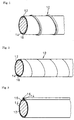
- an adhesive laminate film for wire rod coating 10 with a particular width is wrapped around the rim of a wire rod 12 in a spiral state so that both ends of the laminate film 10 may be overlapped, heat at a predetermined temperature to bond a polyimide film 16 to the wire rod 12 via a bonded layer 14.
- the adhesive laminate film 10 may be wrapped around the wire rod 12 to keep both edges of the laminate film 10 from overlapping.
- FIG. 3 it is also possible to form the laminate film 10 having a width which is slightly longer than the rim of the wire rod 12 to wrap the laminate film 10 along the wire rod 12 with the ends being bonded or pressed.
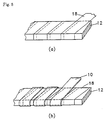
- the laminate film 10 is wrapped around the rim of the wire rod 12 with the bonded layer 14 outside, and the other film 18 without adhesion is further wrapped on the outside with the ends of the film 18 overlapped slightly or kept a space between them. And then the bonded layer 14 is fused by heating under a pressure, as well as bonding the polyimide film 16 in the overlapped portion of the ends of the laminate film 10, the other film 18 wrapped outside may be bonded to the boned layer 14.
- the laminate film of the present invention is bonded to the other film 18 to be formed in a tube state, so that the laminate film 10 can be coated on the rim of the wire rod 12 without a close contact with the wire rod 12.
- the film 18 may be the same or different from the above-mentioned polyimide 16 which comprises the laminate film 10 of the present invention.
- the adhesive laminate film for wire rod coating of the present invention may be, as shown in FIGs. 5 through 7, particularly used for an accelerator.
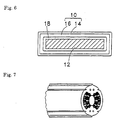
- the polyimide film 18 with a given width is wrapped around in the rim of a super conductivity wire rod for accelerator 12 with its ends being overlapped.
- the adhesive laminate film 10 with a given width of the present invention is wrapped around in a spiral with the bonded layer 14 disposed outside and spaced at both ends.
- FIG. 6 shows its cross section. A plurality of coated wire rods are subsequently heated to a predetermined temperature to bond between the superconductivity wire rods via the bonded layer 14.
- the wire rods coated with this adhesive laminate film for wire rod coating may be used for an accelerator in the embodiment as shown in FIG. 7.
- the adhesive laminate film for wire rod coating according to the present invention have easy handling and workability by previously using a prepared laminate of the other polyimide film and an adhesive layer, which leads to an improvement of productivity.
- the adhesive film which comprises a thermoplastic polyimide and a thermosetting resin used as an adhesive layer in the present invention may be used as an insulating coating material, and the adhesive film may also be used in peeling off a sheet of released paper after wrapping a resin film which comprises a film-like thermoplastic polyimide and a thermosetting resin and the released paper around the wire rod by overlapping in twofold and, performing thermo compression bonding.
- an adhesive film constructed by a thermoplastic resin and a thermosetting resin, and a substance made by overlapping the other available polyimide film such as Apical (manufactured by Kaneka Corporation) are wrapped around the wire rod and directly crimped by heating to be coated.
- the adhesive laminate film for wire rod coating according to the present invention has excellent workability at a low temperature, flexibility, and radiation resistance as well as a little deterioration of functions caused by water adsorption and has few dielectric loss and further excellent adhesion when the film is energized by coating the wire rod.
- the thermoplastic polyimide used as a component of a bonded layer in the present invention has a specific glass transition temperature within the range of 100°C to 250°C depending on the structure, and melts by lamination at a temperature close to the glass transition temperature so that the curing of the thermosetting resin may be facilitated.
- the adhesive laminate film for wire rod coating is bonded to the wire rod by heating at a glass transition temperature, that is, at the temperature from 100°C to 250°C.
- the wire rod therefore, does not suffer deterioration due to few effects caused by heating.
- the thermoplastic polyimide used for the bonded layer indicates a much lower water adsorption, so that the polyimide suffers less deterioration in functions caused by water adsorption.
- the wire rod is energized, due to a small dielectric constant less than 3.2, it has less dielectric loss, therefore, it can control heating the wire rod.
- the polyimide is confirmed to have superior characteristics in radiation resistance.
- Water absorption is calculated by measurement based on ASTM (American Society for Testing and Materials) D570.
- ASTM American Society for Testing and Materials
- a film-like composition a composition sheet having a thickness of 25 ⁇ m, was heated at 150°C for 3 hours to obtain a cured composition sheet.
- W1 was weight of the composition sheet after having been cured which was obtained by further drying at 150°C for 30 minutes.
- Dielectric constant was calculated by making evaluations by the Q meter method (1kH 2 ) in accordance with JISC (Japanese Industrial Standard Committee) 6481.
- Peeling strength was measured in accordance with JISC 6481, described below the conditions when a sample was in an ordinary state; at 20°C, at a high temperature; at 150°C.
- the sample was cut in such a manner that the width of the obtained copper pattern of FCCL was 3 mm, and a tensile test under the condition of peeling at the angle of 90 degrees at the peeling test speed of 50 mm/ min was conducted using a tensile tester ("S-100-C" manufactured by Shimadzu Corporation).
- the measuring method of materials in the examples 10 to 14 and the comparative examples 8 to 9 is as follows:
- the endothermic starting temperature was measured using a differential scanning calorimeter (DSC220 manufactured by Seiko Instruments) under the conditions of temperature rising velocity at 10°C/min. This endothermic starting temperature was regarded as a glass transition temperature. The lower the glass transition temperature is, the more superior the workability becomes.
- a cross-cut tape test was carried out in accordance with JIS (Japanese Industrial Standards) K-5400. 10 points are the maximum and the higher the points are, the more the composition sheet has excellent adhesion.
- BAPP-M 3,3'-bis(aminophenoxyphenyl)propane
- DMF N,N-dimethylformamide
- ESDA 2,2-bis(4-hydroxyphenyl) propane-dibenzoate-3,3',4,4'-tetracarboxylic acid dianhydride
- the obtained sheet was sandwiched between a polyimide film (Apical 50AH, manufactured by Kaneka Corporation) and a copper foil of 25 ⁇ m thickness, and then was heated at 200°C and pressurized at pressure 3MPa for 20 minutes to obtain a flexible copper clad laminate.
- a polyimide film Al 50AH, manufactured by Kaneka Corporation
- Example 1 The varnish obtained in Example 1 was applied onto a polyimide film (Apical 50AH manufactured by Kaneka Corporation) and then dried by heating at 100°C for 10 minutes and further dried by heating at 150°C for 20 minutes to form an adhesive layer having a thickness of 25 ⁇ m.
- a polyimide film (Apical 50AH manufactured by Kaneka Corporation)
- the obtained one-sided polyimide film and a copper foil having a thickness of 25 ⁇ m were heated at 200°C and pressurized at pressure 3MPa for 20 minutes to obtain a flexible copper clad laminate.
- a polyamic acid polymer solution and a polyimide powder were obtained in the same manner as in Example 1 except that a diamine component was 4,4'-(1, 3-phenylenebis (1-methyl ethylidene)) bisaniline (para-type).
- the obtained polyimide powder was treated in the same manner as in Example 1 to obtain a flexible copper clad laminate.
- a polyamic acid polymer solution and a polyimide powder were obtained in the same manner as in Example 1 except that a diamine component was 4,4'-bis(aminophenoxyphenyl)propane (para-type).
- the obtained polyimide powder was treated in the same manner as in Example 1 to obtain a flexible copper clad laminate.
- a polyamic acid polymer solution and a polyimide powder were obtained in the same manner as in Example 1 except that a diamine component was 3,3'-bis(aminophenoxyphenyl)sulfone (BAPS-M).
- the obtained polyimide powder was treated in the same manner as in Example 1 to obtain a flexible copper clad laminate.
- BAPP-M 3,3'-bis(aminophenoxyphenyl)propane
- DMF dimethylformamide
- BTDA benzophenonetetracarboxylic acid dianhydride
- the obtained sheet was sandwiched between a polyimide film (Apical 50AH, manufactured by Kaneka Corporation) and a copper foil of 25 ⁇ m thickness, and then was heated at 200°C and pressurized at pressure 3MPa for 20 minutes to obtain a flexible copper clad laminate.
- a polyimide film Al 50AH, manufactured by Kaneka Corporation
- Example 2 20 g of the polyimide powder obtained in Example 1 was dissolved in 83 g of DMF to prepare a varnish.
- the obtained varnish was cast onto a glass plate, dried at 100°C for 10 minutes, peeled off from the glass plate, and set on a steel frame.
- a sheet having a thickness of 25 ⁇ m was obtained by further drying at 150°C for 20 minutes.
- the obtained sheet was sandwiched between a polyimide film (Apical 50AH, manufactured by Kaneka Corporation) and a copper foil of 25 ⁇ m thickness, and then was heated at 200°C and pressurized at pressure 3MPa for 20 minutes to obtain a flexible copper clad laminate.
- a polyimide film Al 50AH, manufactured by Kaneka Corporation
- the obtained sheet was sandwiched between a polyimide film (Apical 50AH, manufactured by Kaneka Corporation) and a copper foil of 25 ⁇ m thickness, and then was heated at 200°C and pressurized at pressure 3MPa for 20 minutes to obtain a flexible copper clad laminate.
- a polyimide film Al 50AH, manufactured by Kaneka Corporation
- Peeling strength and solder heat resistance were evaluated on the coppered flexible laminated plate obtained in each of Examples 1 to 6 and Comparative Examples 1 to 3 as described above. Water absorption of each adhesive sheet was evaluated as well. The results obtained are shown in Table 1. Peeling strength (kgf/cm) Solder heat resistance Water absorption (%) 20°C 150°C Example 1 1.0 0.8 ⁇ 0.5 Example 2 1.0 0.8 ⁇ 0.5 Example 3 1.2 0.9 ⁇ 0.6 Example 4 1.1 0.9 ⁇ 0.6 Example 5 1.0 0.8 ⁇ 0.6 Example 6 1.0 0.8 ⁇ 1.0 Comparative Example 1 1.0 0.8 ⁇ 1.8 Comparative Example 2 0.2 0.1 ⁇ 0.4 Comparative Example 3 1.2 0.1 ⁇ 2.0
- ESDA 2,2-bis(4-hydroxyphenyl)propanedibenzoate -3,3',4,4'-tetracarboxylic acid dianhydride
- the obtained sheet was sandwiched between a polyimide film (Apical 50AH, manufactured by Kaneka Corporation) and a copper foil of 25 ⁇ m thickness, and then was heated at 200°C and pressurized at pressure 3MPa for 20 minutes to obtain a flexible copper clad laminate.
- a polyimide film Al 50AH, manufactured by Kaneka Corporation
- Example 7 The varnish obtained in Example 7 was applied onto a polyimide film (Apical 50AH manufactured by Kaneka Corporation) and then dried by heating at 100°C for 10 minutes and further dried by heating at 150°C for 20 minutes to form an adhesive layer having a thickness of 25 ⁇ m.
- the obtained one-sided polyimide film and a copper foil of 25 ⁇ m thickness were heated at 200°C and pressurized at pressure 3MPa for 20 minutes to obtain a flexible copper clad laminate.
- Example 7 20 g of the polyimide powder obtained in Example 7 and 5 g of glycidyl amine-type epoxy resin; TETRAD-C (manufactured by Mitsubishi Gas Chemical Co., Inc.) were dissolved in 83 g tetrahydrofuran (hereinafter referred to as THF) to prepare a varnish.
- THF 83 g tetrahydrofuran
- the obtained varnish was cast onto a glass plate. After drying at 100°C for 10 minutes, the varnish was peeled off from the glass plate, set on a steel frame, and further dried at 150°C for 20 minutes to obtain a sheet having a thickness of 25 ⁇ m.
- the obtained sheet was sandwiched between a polyimide film (Apical 50AH, manufactured by Kaneka Corporation) and a copper foil of 25 ⁇ m thickness. After heating at 200°C and applying a pressure of 3MPa for 20 minutes, a flexible copper clad laminate was obtained.
- BTDA benzophenonetetracarboxylic acid dianhydride
- the obtained sheet was sandwiched between a polyimide film (Apical 50AH, manufactured by Kaneka Corporation) and a copper foil of 25 ⁇ m thickness, and then was heated at 200°C and pressurized at pressure 3MPa for 20 minutes to obtain a flexible copper clad laminate.
- a polyimide film Al 50AH, manufactured by Kaneka Corporation
- BAPP-M 3,3'-bis(aminophenoxyphenyl)propane
- DMF dimethylformamide
- the solution in the flask was further stirred while cooled with an ice-water bath under a nitrogen substituted atmosphere.
- 0.1487 mole of pyromellitic acid dianhydride was gradually added with care to its viscosity. When the viscosity reached 1000 poise, the addition of pyromellitic acid dianhydride was stopped and then a polyamic acid polymer solution was obtained.
- Example 7 20 g of the polyimide powder obtained in Example 7 was dissolved in 83 g of THF to prepare a varnish.
- the obtained varnish was cast onto a glass plate, dried at 100°C for 10 minutes, peeled off from the glass plate and set on a steel frame, and further dried at 150°C for 20 minutes.
- a sheet having a thickness of 25 ⁇ m was obtained.
- the obtained sheet was sandwiched between a polyimide film (Apical 50AH, manufactured by Kaneka Corporation) and a copper foil of 25 ⁇ m thickness. After heating at 200°C and applying a pressure of 3MPa for 20 minutes, a flexible copper clad laminate was obtained.
- the obtained sheet was sandwiched between a polyimide film (Apical 50AH, manufactured by Kaneka Corporation) and a copper foil of 25 ⁇ m thickness, and then was heated at 200°C and pressurized at pressure 3MPa for 20 minutes to obtain a flexible copper clad laminate.
- a polyimide film Al 50AH, manufactured by Kaneka Corporation
- Peeling strength and solder heat resistance were evaluated on the flexible laminated plate obtained in each of Examples 7 to 9 and Comparative Examples 4 to 7. Water absorption of each adhesive sheet was evaluated as well. The results obtained are shown in Table 2. Peeling strength (kgf/cm) Solder heat resistance Water Absorption (%) THF solubility 20°C 150°C Example 7 1.0 0.7 ⁇ 0.5 ⁇ Example 8 1.0 0.7 ⁇ 0.5 ⁇ Example 9 1.2 0.8 ⁇ 0.6 ⁇ Comparative Example 4 1.0 0.7 ⁇ 1.8 ⁇ Comparative Example 5 - - - - ⁇ Comparative Example 6 0.2 0.1 ⁇ 0.4 ⁇ Comparative Example 7 1.2 0.1 ⁇ 2.0 ⁇
- the polyamic acid solution was applied by flow casting onto a PET film and heated at 80°C for 30 minutes. After peeling off the PET film, heating was conducted at 150°C, 200°C, and 250 °C for 30 minutes respectively. After finally heating at 300°C for 10 minutes, a polyimide film of high strength having a thickness of 25 ⁇ m was obtained. It was confirmed that there was absorption by an imide group at 1780cm -1 in an infrared radiation measurement.
- the polyimide film had a glass transition temperature of 225°C and a tensile strength of 15.3 kg/cm 2 .
- the polyamic acid solution was cast onto an aluminum plate (JIS H4000 A1050P) and a soft soda glass plate with a doctor knife. After heating at 80°C, 150°C, 200°C, and 250°C respectively for 30 minutes, heating was finally conducted at 300°C for 10 minutes to obtain a polyimide coating having a thickness of 20 to 25 ⁇ m. In a crosscut tape test, both of the polyimide coatings on the aluminum and glass plates got 10 points.
- a polyamic acid with an intrinsic viscosity of 1.1 was obtained in the similar manner as in Example 10 except that the adding order of ESDA having a residual impurities content of 0.3 weight % and DDE was reversed.
- This polyimide resin was confirmed to have absorption caused by an imide group at 1780 cm -1 in an infrared radiation measurement.
- the polyimide film had a glass transition temperature of 225°C and a tensile strength of 15.2 kg/cm 2 .
- both of the polyimide coating on the aluminum and glass plates got 10 points.
- a polyamic acid solution with an intrinsic viscosity of 1.0 was obtained in the similar manner as in Example 10 except that diamine was used as 19.8 g of 4,4'-diaminodiphenylmethane (DAM) instead of DDE.
- DAM 4,4'-diaminodiphenylmethane
- a polyimide film and a polyimide coating with high strength were obtained in the same manner as in Example 10.
- This polyimide resin was confirmed to have absorption caused by an imide group at 1780cm -1 in an infrared radiation measurement.
- the polyimide film had a glass transition temperature of 220°C and a tensile strength of 15.2 kg/cm 2 .
- both of the polyimide coating on the aluminum and glass plates got 10 points.
- a polyamic acid solution with an intrinsic viscosity of 1.0 was obtained in the similar manner as in Example 10 except that diamine was used as 2,2-bis [4-(4-aminophenoxy)phenyl] propane (BAPP) instead of DDE.
- BAPP 2,2-bis [4-(4-aminophenoxy)phenyl] propane
- a polyimide film and a polyimide coating with high strength were obtained in the same manner as in Example 10. This polyimide was confirmed to have absorption caused by an imide group at 1780cm -1 in an infrared radiation measurement.
- the polyimide film had a glass transition temperature of 205°C and a tensile strength of 14.5 kg/cm 2 .
- both of the polyimide coating on the aluminum and glass plates got 10 points.
- a polyamic acid with an intrinsic viscosity of 0.8 was obtained in the similar manner as in Example 10 except that 57.7g (100 mmole in ESDA pure content) of ESDA with residual impurities content of 1.0 wt% as an acid dianhydride component.
- a polyimide film and a polyimide coating with high strength were obtained in the same manner as in Example 10. This polyimide resin was confirmed to have absorption caused by an imide group at 1780cm -1 in an infrared radiation measurement.
- the polyimide film had a glass transition temperature of 215°C and a tensile strength of 12.5 kg/cm 2 .
- both of the polyimide coating on the aluminum and glass plates got 10 points.
- a polyamic acid with an intrinsic viscosity of 0.24 was obtained in the similar manner as in Example 10 except that 57.7g (100 mmole in ESDA pure content) of ESDA with compound (1) of 1.5 wt% as an acid dianhydride component.
- a polyimide film and a polyimide coating with high strength were obtained in the same manner as in Example 10.
- This polyimide resin was confirmed to have absorption caused by an imide group at 1780cm - 1 in an infrared radiation measurement.
- the polyimide film was very fragile and not self-support. Accordingly, it was impossible to measure its tensile strength. In a crosscut tape test, both of the polyimide coating on the aluminum and glass plates got 2 points.
- a polyamic acid with an intrinsic viscosity of 0.28 was obtained in the similar manner as in Example 10 except that 57.7g (100 mmole in ESDA pure content) of ESDA with compound (2) of 1.5 wt% as an acid dianhydride component.
- a polyimide film and a polyimide coating with high strength were obtained in the same manner as in Example 10. This polyimide resin was confirmed to have absorption caused by an imide group at 1780 cm -1 in an infrared radiation measurement.
- the polyimide film was very fragile and not self-support. Accordingly, it was impossible to measure its tensile strength. In a crosscut tape test, both of the polyimide coating on the aluminum and glass plates got 3 points.
- ESDA 2,2-bis(4-hydroxyphenyl) propanedibenzoate-3,3',4,4'-tetracarboxylic acid dianhydride
- the obtained sheet was sandwiched between a polyimide film (Apical 50AH, manufactured by Kaneka Corporation) and a copper foil of 25 ⁇ m thickness, and then was heated at 200°C and pressurized at pressure 3MPa for 20 minutes to obtain a flexible copper clad laminate.
- a polyimide film Al 50AH, manufactured by Kaneka Corporation
- Example 15 The varnish obtained in Example 15 was applied onto a polyimide film (Apical 50AH manufactured by Kaneka Corporation) and then dried by heating at 100°C for 10 minutes and further dried by heating at 150°C for 20 minutes to form an adhesive layer having a thickness of 25 ⁇ m.
- the obtained one-sided polyimide film and a copper foil of 25 ⁇ m thickness were heated at 200°C and pressurized at pressure 3MPa for 20 minutes to obtain a flexible copper clad laminate.
- Example 15 20 g of the polyimide powder obtained in Example 15 and g of glycidylamine-type epoxy resin; TETRAD-C (manufactured by Mitsubishi Chemical Co., Inc.) were dissolved in 83 g of mixed solution of dioxane and THF at a 1:1 weight ratio to obtain a varnish.
- the obtained varnish was cast onto a glass plate, dried at 100°C for 10 minutes, peeled off from the glass plate and set on a steel frame. A sheet having a thickness of 25 ⁇ m was obtained by further drying at 150°C for 20 minutes.
- the obtained sheet was sandwiched between a polyimide film (Apical 50AH, manufactured by Kaneka Corporation) and a copper foil of 25 ⁇ m thickness, and then was heated at 200°C and pressurized at pressure 3MPa for 20 minutes to obtain a flexible copper clad laminate.
- a polyimide film Al 50AH, manufactured by Kaneka Corporation
- a polyamic acid polymer solution and a polyimide powder were obtained in the same manner as in Example 15 except that diamine component was 4,4'-[1, 3-phenylenebis(1-methyl ethylidene)] bisaniline (para-type).
- the obtained polyimide powder was treated in the same manner as in Example 15 to obtain a flexible copper clad laminate.
- a polyamic acid polymer solution and a polyimide powder were obtained in the same manner as in Example 15 except that a diamine component was 4,4'-bis(aminophenoxyphenyl) propane (para-type).
- the obtained polyimide powder was treated in the same manner as in Example 15 to obtain a flexible copper clad laminate.
- a polyamic acid polymer solution and a polyimide powder were obtained in the same manner as in Example 15 except that a diamine component was 3,3'-bis(aminophenoxyphenyl) sulfone (BAPS-M).
- BAPS-M 3,3'-bis(aminophenoxyphenyl) sulfone
- the obtained polyimide powder was treated in the same manner as in Example 15 to obtain a flexible copper clad laminate.
- a flexible copper clad laminate was obtained in the same manner as in Example 15 except that the polyimide powder obtained in Example 15, Bisphenol A-type epoxy resin (Epikote 828), and 2-ethyl-4-methylimidazole used as a curing accelerator were dissolved in DMF.
- BAPP-M 3,3'-bis(aminophenoxyphenyl)propane
- DMF dimethylformamide
- BTDA benzophenonetetracarboxylic acid dianhydride
- the obtained sheet was sandwiched between a polyimide film (Apical 50AH, manufactured by Kaneka Corporation) and a copper foil of 25 ⁇ m thickness, and then was heated at 200°C and pressurized at pressure 3MPa for 20 minutes to obtain a flexible copper clad laminate.
- a polyimide film Al 50AH, manufactured by Kaneka Corporation
- a flexible copper clad laminate was obtained in the same manner as in Comparative Example 10 except that the polyimide powder obtained in Comparative Example 10 was dissolved in a mixed solution of dioxane and THF at a 1:1 weight ratio.
- Example 15 20 g of the polyimide powder obtained in Example 15 was dissolved in 83 g of DMF to prepare a varnish.
- the obtained varnish was cast onto a glass plate, dried at 100°C for 10 minutes, peeled off from the glass plate and set on a steel frame.
- a sheet having a thickness of 25 ⁇ m was obtained by further drying at 150°C for 20 minutes.
- the obtained sheet was sandwiched between a polyimide film (Apical 50AH, manufactured by Kaneka Corporation) and a copper foil of 25 ⁇ m thickness. After heating at 200°C and applying a pressure of 3MPa for 20 minutes, a flexible copper clad laminate was obtained.
- a flexible copper clad laminate was obtained in the same manner as in Comparative Example 12 except that the polyimide powder obtained in Example 15 was dissolved in a mixed solution of dioxane and THF at a 1:1 weight ratio.
- the obtained sheet was sandwiched between a polyimide film (Apical 50AH, manufactured by Kaneka Corporation) and a copper foil of 25 ⁇ m thickness, and then was heated at 200°C and pressurized at pressure 3MPa for 20 minutes to obtain a flexible copper clad laminate.
- a polyimide film Al 50AH, manufactured by Kaneka Corporation
- a flexible copper clad laminate was obtained in the same manner as in Comparative Example 5 except that Pratabond M1276, Epikote 828, and diaminodiphenyl sulfone in Comparative Example 15 were dissolved in a mixed solution of dioxane and THF at a 1:1 weight ratio.
- ESDA 2,2-bis(4-hydroxyphenyl) propanedibenzoate-3,3',4,4'-tetracarboxylic acid dianhydride
- the obtained sheet was sandwiched between a polyimide film (Apical 50AH, manufactured by Kaneka Corporation) and a copper foil of 25 ⁇ m thickness, and then was heated at 200°C and pressurized at pressure 3MPa for 20 minutes to obtain a flexible copper clad laminate.
- a polyimide film Al 50AH, manufactured by Kaneka Corporation
- Example 22 The varnish obtained in Example 22 was applied onto a polyimide film (Apical 50AH, manufactured by Kaneka Corporation). After drying by heating at 100°C for 10 minutes, the varnish was further dried by heating at 150°C for 20 minutes to form an adhesive layer having a thickness of 25 ⁇ m. A single-sided polyimide film with the obtained adhesive layer and a copper foil of 25 ⁇ m thickness were heated at 200°C under the pressure of 3MPa for 20 minutes to obtain a flexible copper clad laminate.
- a polyimide film Al 50AH, manufactured by Kaneka Corporation.
- Example 22 20 g of the polyimide powder obtained in Example 22 and 5 g of glycidylamine-type epoxy resin; TETRAD-C (manufactured by Mitsubishi Gas Chemical Co., Inc.) were dissolved in 83 g of DMF to obtain a varnish.
- the obtained varnish was cast onto a glass plate, dried at 100°C for 10 minutes, peeled off from the glass plate and set on a steel frame. A sheet having a thickness of 25 ⁇ m was obtained by further drying at 150°C for 20 minutes.
- the obtained sheet was sandwiched between a polyimide film (Apical 50AH, manufactured by Kaneka Corporation) and a copper foil of 25 ⁇ m thickness, and then was heated at 200°C and pressurized at pressure 3MPa for 20 minutes to obtain a flexible copper clad laminate.
- a polyimide film Al 50AH, manufactured by Kaneka Corporation
- a polyamic acid oligomer solution and a polyimide oligomer powder (molecular weight: 40000) were obtained in the same manner as in Example 22 except that a diamine component was 4, 4'-[1, 3 -phenylenebis(1-methylethylidene)] bisaniline (para-type).
- the obtained polyimide oligomer powder was treated in the same manner as in Example 22 to obtain a flexible copper clad laminate.
- a polyamic acid oligomer solution and a polyimide oligomer powder (molecular weight : 20000) were obtained in the same manner as in Example 22 except that a diamine component was 4, 4'-bis(aminophenoxyphenyl)propane (para-type).
- the obtained polyimide oligomer powder was treated in the same manner as in Example 22 to obtain a flexible copper clad laminate.
- a polyamic acid oligomer solution and a polyimide oligomer powder (molecular weight : 10000) were obtained in the same manner as in Example 22 except that a diamine component was 3, 3'-bis(aminophenoxyphenyl)sulfone (BAPS-M).
- BAPS-M 3'-bis(aminophenoxyphenyl)sulfone
- the thus-obtained polyimide oligomer powder was treated in the same manner as in Example 22 to obtain a flexible copper clad laminate.
- BAPP-M 3,3'-bis(aminophenoxyphenyl) propane
- DMF dimethylformamide
- BTDA benzophenonetetracarboxylic acid dianhydride
- the obtained sheet was sandwiched between a polyimide film (Apical 50AH, manufactured by Kaneka Corporation) and a copper foil of 25 ⁇ m thickness, and then was heated at 200°C and pressurized at pressure 3MPa for 20 minutes to obtain a flexible copper clad laminate.
- a polyimide film Al 50AH, manufactured by Kaneka Corporation
- Example 22 20 g of the polyimide oligomer powder obtained in Example 22 was dissolved in 83 g of DMF to obtain a varnish.
- the obtained varnish was cast onto a glass plate. After drying at 100°C for 10 minutes, the varnish was peeled off from the glass plate and was set on a steel frame. A sheet having a thickness of 25 ⁇ m was obtained by further drying at 150°C for 20 minutes. The obtained sheet was sandwiched between a polyimide film (Apical 50AH, manufactured by Kaneka Corporation) and a copper foil of 25 ⁇ m thickness. After heating at 200°C and applying a pressure of 3MPa for 20 minutes, a flexible copper clad laminate was obtained.
- a polyimide film Al 50AH, manufactured by Kaneka Corporation
- the obtained sheet was sandwiched between a polyimide film (Apical 50AH, manufactured by Kaneka Corporation) and a copper foil of 25 ⁇ m thickness, and then was heated at 200°C and pressurized at pressure 3MPa for 20 minutes to obtain a flexible copper clad laminate.
- a polyimide film Al 50AH, manufactured by Kaneka Corporation
- a flexible copper clad laminate was obtained in the same manner as in Example 22 except that a polyimide polymer powder (molecular weight : 100000) was obtained by gradually adding 0.1487 mole of ESDA which is equivalent mole to 0.1487 mole of BAPP-M in Example 22. Peeling strength and solder heat resistance were evaluated on the flexible copper clad laminate obtained in each of Examples 22 to 27 and Comparative Examples 16 to 19 as described above. Water absorption of each adhesive sheet was evaluated as well. The results obtained are shown in Table 4.
- BAPS-M 3,3'-bis (aminophenoxyphenyl)sulfone
- ESDA 2,2-bis(4-hydroxyphenyl)propanebenzoate -3,3',4,4'-tetracarboxylic acid dianhydride
- DMF dimethylformamide
- NMP N-methylpyrrolidone
- DMAc dimethylacetoamide
- the polyimide adhesive solution obtained in Example 28 was cast onto a polyimide film having a thickness of 25 ⁇ m (Apical 25AH, manufactured by Kaneka Corporation). After drying by heating at 100°C for 10 minutes, a film-state joining component having a thickness of 30 ⁇ m was obtained by heating at 180°C for 10 minutes in Example 28a, heating at 200°C for 10 minutes in Example 28b, and heating at 220°C for 10 minutes in Example 28c.
- Example 29a, 29b, and 29c Film-state joining components in Examples 29a, 29b, and 29c were obtained in the same manner as in Examples 28a through 29c except that a polyimide adhesive solution obtained in Example 29 was respectively used.
- Example 30a, 30b, and 30c Comparative Examples 20a, 20b, 20c, 21a, 21b, 21c, 22a, 22b, and 22c
- Film-state joining components were obtained in Examples 30a, 30b and 30c, and Comparative Examples 20a, 20b, 20c, 21a, 21b, 21c, 22a, 22b, and 22c in the same manner and under the same conditions as in the above examples. Joining components in a film state which were corresponding to Comparative Examples 23, 24 and 25, wherein there were some insoluble portions, were not prepared.
- BAPS-M 3,3'-bis(aminophenoxyphenyl)sulfone
- DMF dimethylformamide
- ESDA 2,2'-bis(4-hydroxyphenyl)propanedibenzoate 3,3',4,4'-tetracarboxylic acid dianhydride
- the obtained film-state joining component was sandwiched between a polyimide film (Apical 25AH, manufactured by Kaneka Corporation) and a copper foil of 25 ⁇ m thickness, and then was heated at 200°C and pressurized at pressure 3MPa for 20 minutes to obtain a flexible copper clad laminate. Peeling strength and solder heat resistance were measured on the obtained flexible copper clad laminate. Each measuring results are shown in Table 6.
- a polyimide powder was obtained in the same manner as in Example 31 except that a diamine component was 4,4'-bis (aminophenoxyphenyl) propane.
- the obtained polyimide had a glass transition temperature of 190°C.
- a film-state joining component was obtained in the same manner as in Example 31. And this material was measured for water absorption. By using this, a flexible copper clad laminate was obtained. Peeling strength and solder heat resistance were measured on the obtained flexible copper clad laminate. Each measuring results obtained are shown in Table 6.
- a polyimide powder was obtained in the same manner as in Example 31 except that a diamine component was 4,4'-[1, 4-phenylenebis(1-methylethylidene).
- the obtained polyimide had a glass transition temperature of 210°C.
- a film-state joining component was obtained in the same manner as in Example 31. And this material was measured for water absorption. By using this, a flexible copper clad laminate was obtained. Peeling strength and solder heat resistance were measured on the obtained flexible copper clad laminate. Each measuring results obtained are shown in Table 6.
- thermosetting resin content was TETRAD-C (manufactured by Mitsubishi Gas Chemical Co., Inc.).
- TETRAD-C manufactured by Mitsubishi Gas Chemical Co., Inc.
- Example 31 20 g of polyimide powder was dissolved in 83 g of DMF in the same manner as in Example 31.
- the obtained varnish was cast onto a glass plate. After drying at 100°C for 10 minutes, the varnish was peeled off from the glass plate and was set on a steel frame. A sheet having a thickness of 25 ⁇ m was obtained by further drying at 150°C for 30 minutes.
- the obtained sheet was sandwiched between a polyimide film (Apical 50AH, manufactured by Kaneka Corporation) and a copper foil of 25 ⁇ m thickness, and then was heated at 200°C and pressurized at pressure 3MHa for 20 minutes to obtain a flexible copper clad laminate.
- a polyimide film Al 50AH, manufactured by Kaneka Corporation
- the obtained sheet was sandwiched between a polyimide film (Apical 50AH, manufactured by Kaneka Corporation) and a copper foil of 25 ⁇ m thickness, and then was heated at 200°C and pressurized at pressure 3MPa for 20 minutes to obtain a flexible copper clad laminate.
- a polyimide film Al 50AH, manufactured by Kaneka Corporation
- a polyimide powder was obtained in the same manner as in Example 31 except that ESDA was changed to benzophenonetetracarboxylic acid dianhydride (BTDA). 20g of the obtained polyimide powder was dissolved in 83 g of DMF to obtain a varnish. The obtained varnish was cast onto a glass plate, dried at 100°C for 10 minutes, peeled off from the glass plate and set on a steel frame. A sheet having a thickness of 25 ⁇ m was obtained by further drying at 150°C for 20 minutes. And then, Epikote 1032H60 (manufactured by Shell International Chemicals Corporation) was applied onto the surface of the obtained sheet so that the thickness after drying may be 3 ⁇ m.
- BTDA benzophenonetetracarboxylic acid dianhydride
- BAPS-M 3,3'-bis(aminophenoxyphenyl)sulfone
- DMF dimethylformamide
- ESDA 2,2'-bis (4-hydroxyphenyl)propanedibenzoate-3,3',4,4'-tetracarboxylic acid dianhydride
- the obtained film-state joining component was sandwiched between a polyimide film (Apical 50AH, manufactured by Kaneka Corporation) and a copper foil of 25 ⁇ m thickness, and then was heated at 200°C and pressurized at pressure 3MPa for 20 minutes to obtain a flexible copper clad laminate. Peeling strength and solder heat resistance were measured on the obtained flexible copper clad laminate. Each measuring results obtained are shown in Table 7.
- a polyimide powder was obtained in the same manner as in Example 35 except that a diamine component was 4,4'-bis (aminophenoxyphenyl)propane.
- the obtained polyimide had a glass transition temperature of 190°C. Its water absorption was 0.5.
- a film-state joining component was obtained in the same manner as in Example 35.
- a flexible copper clad laminate was obtained in the same manner as in Example 35. Peeling strength and solder heat resistance were measured on the obtained flexible copper clad laminate. Each measuring results obtained are shown in Table 7.
- a polyimide powder was obtained in the same manner as in Example 35 except that a diamine component was 4,4'-[1, 4-phenylenebis(1-methylethylidene).
- the obtained polyimide had a glass transition temperature of 210°C. Its water absorption was 0.5.
- a film-state joining component was obtained in the same manner as in Example 35.
- a flexible copper clad laminate was obtained in the same manner as in Example 35. Peeling strength and solder heat resistance were measured on the obtained flexible copper clad laminate. Each measuring results obtained are shown in Table 7.
- a film-state joining component and a flexible copper clad laminate were obtained in the same manner as in Example 35 except that an adhesive was added to 20 g of polyimide powder, 5 g of glycidylamine-type epoxy resin; TETRAD-C (manufactured by Mitsubishi Gas Chemical Co., Inc.), 3 g of 4,4'-diaminophenyl sulfone to be dissolved in 83 g of DMF. Peeling strength and solder heat resistance were measured on the obtained flexible copper clad laminate. Each measuring results obtained are shown in Table 7.
- a polyimide powder was obtained in the same manner as in Example 35 except that ESDA was changed to benzophenonetetracarboxylic acid dianhydride. 20g of the obtained polyimide powder, 5 g of Epikote 1032H60 (manufactured by Shell International Chemicals Corporation), and 0.5 g of 4,4'-diaminophenyl sulfone were dissolved in 83 g of DMF to obtain a varnish. The obtained varnish was cast onto a polyimide film (Apical 25AH, manufactured by Kaneka Corporation). After drying at 100°C for 10 minutes, the varnish was further dried at 150°C for 10 minutes to obtain a film-state joining component having a thickness of 30 ⁇ m.
- ESDA was changed to benzophenonetetracarboxylic acid dianhydride.
- the obtained joining component was sandwiched between a polyimide film (Apical 50AH, manufactured by Kaneka Corporation) and a copper foil of 25 ⁇ m thickness, and then was heated at 200°C and pressurized at pressure 3MPa for 20 minutes to obtain a flexible copper clad laminate.
- a polyimide film Al 50AH, manufactured by Kaneka Corporation
- Example 35 20 g of the polyimide powder obtained in Example 35 was dissolved in 83 g of DMF to obtain a varnish.
- the obtained varnish was cast onto a polyimide film (Apical 25AH, manufactured by Kaneka Corporation). After drying at 100°C for 10 minutes, the varnish was further dried at 150°C for 10 minutes to obtain a film-state joining component having a thickness of 30 ⁇ m.
- the obtained joining component was sandwiched between a polyimide film (Apical 50AH, manufactured by Kaneka Corporation) and a copper foil of 25 ⁇ m thickness. After heating at 200°C and applying a pressure of 3MPa for 20 minutes, a flexible copper clad laminate was obtained.
- the obtained joining component was sandwiched between a polyimide film (Apical 50AH, manufactured by Kaneka Corporation) and a copper foil of 25 ⁇ m thickness, and then was heated at 200°C and pressurized at pressure 3MPa for 20 minutes to obtain a flexible copper clad laminate.
- a polyimide film Al 50AH, manufactured by Kaneka Corporation
- BAPS-M 3,3'-bis (aminophenoxyphenyl) sulfone
- DMF dimethylformamide
- ESDA 2,2'-bis(4-hydroxyphenyl)propanedibenzoate-3,3',4,4'-tetracarboxylic acid dianhydride
- the obtained sheet was laminated on a polyimide film (Apical 50AH, manufactured by Kaneka Corporation) and a sheet of released paper in order to be laminated at the temperature of 150°C and at the speed of 2.2 cm/min to obtain a desired adhesive laminated film for wire rod coating.
- a polyimide film Al 50AH, manufactured by Kaneka Corporation
- thermoplastic polyimide had a glass transition temperature of 140°C. Its water absorption was 0.9%. Its dielectric constant was 2.95.
- the released paper of this laminate film was peeled off to dispose a copper foil. After crimping at 180°C under a pressure of 30 kg/cm 2 for 10 minutes, peeling strength was measured to be 1.1 kgf/cm.
- a radiation resistance test was performed on the obtained adhesive laminate film for wire rod coating, any changes, such as discoloration and deterioration did not occur on the film. The results obtained are shown in Table 8. The radiation resistance test was performed by 5MGy irradiation using an electron beam of 2 MeV.
- a polyamic acid was obtained in the same manner as in Example 39 except that a diamine component was 4,4'-bis (aminophenoxyphenyl)propane.
- This polyamic acid was applied by flow casting onto a polyimide film (Apical (Trade mark) manufactured by Kaneka Corporation) used in Example 39. After heating at 80°C for 25 minutes, an adhesive laminate film for wire rod coating was obtained by heating the polyamic acid at 150°C, 250°C, 270°C, and 300°C respectively for 5 minutes to be imidized.
- the polyimide resin layer had a glass transition temperature of 190°C, its water absorption was 0.8%, and dielectric constant was 2.90.
- a polyamic acid was obtained in the same manner as in Example 39 except that a diamine component was 4,4'-[1, 4-phenylenebis(1-methylethylidene)bisaniline.
- This polyamic acid was applied by flow casting onto the polyimide film (Apical (Trade mark) manufactured by Kaneka Corporation) used in Example 39. After heating at 80°C for 25 minutes, an adhesive laminate film for wire rod coating was obtained by heating the polyamic acid at 150°C, 250°C, 270°C, and 300°C respectively for 5 minutes to be imidized.
- the polyimide resin layer had a glass transition temperature of 210°C, its water absorption was 0.8%, and dielectric constant was 2.88.
- peeling strength was measured in the same manner as in Example 39, its peeling strength was 1.1 kgf/cm.
- thermosetting resin consisting essentially of a thermoplastic polyimide and a thermosetting resin
- a thermosetting component was TETRAD-C (manufactured by Mitsubishi Gas Chemical Co., Inc.).
- TETRAD-C manufactured by Mitsubishi Gas Chemical Co., Inc.
- the polyimide resin layer had a glass transition temperature of 140°C, its water absorption was 0.9%, and dielectric constant was 2.96.
- peeling strength was measured in the same manner as in Example 39, its peeling strength was 1.2 kgf/cm.
- a polyamic acid was obtained from pimellitic acid dianhydride and ODA (oxydianiline) substantially in the same manner as in Example 39.
- This polyamic acid was applied by flow casting onto the polyimide film (Apical (Trade mark) manufactured by Kaneka Corporation) used in Example 39. After heating at 80°C for 25 minutes, an adhesive laminate film for wire rod coating was obtained by heating the polyamic acid at 150°C, 250°C, 270°C, and 300°C respectively for 5 minutes to be imidized.
- the polyimide resin layer had no glass transition temperature, its water absorption was 2.6%, and dielectric constant was 3.5.
- An adhesive laminate film for wire rod coating was obtained in the same manner as in Example 40 except that an adhesive which comprised Epikote 828 (Trade mark: manufactured by Shell International Chemicals Corporation) was used instead of a polyimide film having thermoplastic properties (adhesion).
- the adhesive layer had a glass transition temperature of 178°C, its water absorption was 2.0%, and dielectric constant was 3.8.
- the peeling strength of the obtained adhesive laminate film for wire rod coating was 0.3 kg/cm.
- the film was blackened. The results obtained are shown in Table 8.
- the present invention can provide a polyimide resin of novel configuration having excellent adhesion and low water absorption, as well as excellent heat resistance, mechanical strength, and electrical characteristics which are found in polyimide.
- the present invention can provide a resin composition which is capable of being used as an adhesive at relatively low temperatures, for example, 250°C.
- the resin composition of the present invention is not necessary to be used at high temperatures, but it has excellent adhesive strength on a polyimide film, which retains excellent adhesive strength up to high temperatures.
- the resin composition can achieve a low water absorption as low as 1.5% or lower. Since its peeling strength retention is high after a PCT treatment due to control of the residual volatile component of 3 wt% or lower, it has solder heat resistance free from swelling and the like when it is dip-soldered.
- the polyimide resin composition is capable of controlling immersion of a solvent and maintaining high retention of peeling strength after the PCT treatment which is a reliability test of materials for electronic devices because an amino-terminated polyimide oligomer used as a polyimide resin has multiple cross-linking points with epoxy resin to be close packed structure.
- the present invention can provide an adhesive solution which is capable of removing its solvent by drying at relatively low temperatures, using the polyimide resin of the present invention and a specific solvent, which lead to powerful adhesive strength on a laminated layer to be formed later.
- the polyimide resin, resin composition, and adhesive solution have an advantage of having great technical value as materials for electronic devices required for high reliability and heat resistance.
- the adhesive laminate film for wire rod coating according to the present invention is constructed by a polyimide having excellent heat resistance, radiation resistance, electrical characteristics, chemical resistance, and low temperature characteristics, and an adhesive layer which comprises a thermoplastic resin having a glass transition temperature of 100 to 250°C, water absorption of 1.5% or lower, dielectric constant of 3.2 or lower, and a thermosetting resin having exhibiting excellent adhesion at low temperatures.
- the adhesive laminate film for wire rod coating has, therefore, excellent characteristics comprehensively, such as superior worakability, flexibility, and adhesion at low temperatures, few deterioration caused by water adsorption, few dielectric loss at the time of passage of electric current and superior radiation resistance when coating the film on a wire rod.
- the adhesive laminate film is particularly suitable for coating on a superconductive wire rod, and the like, so that the film is most suitable for a use for a superconductive magnet for accelerator.
- the film can be bonded to the wire rod by heating within the scope of temperatures at which little deterioration in characteristics of the wire rod, so that the coating of the film is possible without any loss of characteristics of the wire rod coated with the film, for example, superconductivity characteristics when the wire rod is a superconductive wire rod.
Landscapes
- Chemical & Material Sciences (AREA)
- Organic Chemistry (AREA)
- Chemical Kinetics & Catalysis (AREA)
- Health & Medical Sciences (AREA)
- Medicinal Chemistry (AREA)
- Polymers & Plastics (AREA)
- Macromolecular Compounds Obtained By Forming Nitrogen-Containing Linkages In General (AREA)
- Adhesives Or Adhesive Processes (AREA)
Abstract

Description

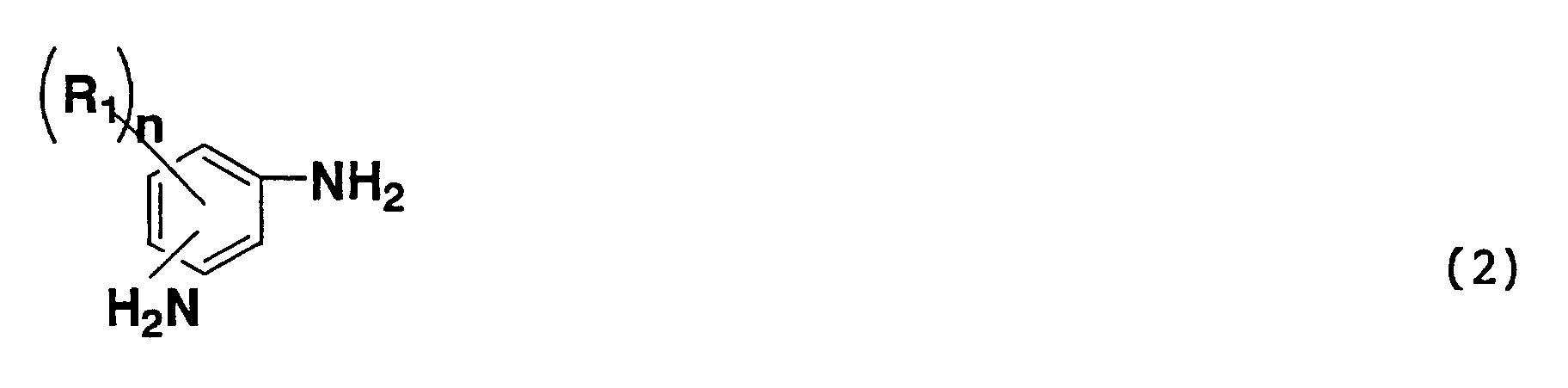




Other general explanation of the polyimide resin of the present invention is that the polyimide resin is obtained by a reaction among tetracarboxylic acid dianhydride containing 2,2-(4-hydroxyphenyl) propanedibenzoate-3,3'4,4'-tetracarboxylic acid dianhydride represented by the general formula (7):, and


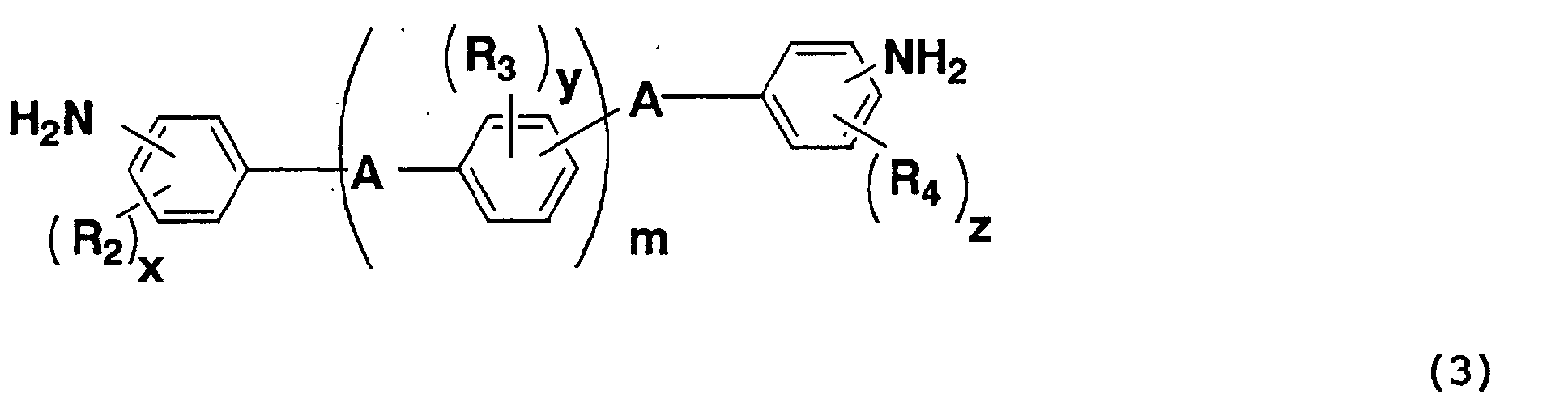


Other general description of the film-state joining component of the present invention is formed by laminating the above resin composition on one side or both sides of the polyimide base film. Further, the film-state joining component of the present invention is obtained by dissolving the above resin composition in an organic solvent and applying or flow casting the composition onto a support, and subsequently depositing the film-like resin composition layer obtained by peeling off a coating film from the support after being dried.
Or the film-state joining component is obtained by dissolving the above mentioned resin composition in an organic solvent and applying or flow casting the composition onto at least one side of the polyimide base film, and drying it subsequently.
In addition, the film-state joining component of the present invention is obtained by applying the above polyimide adhesive solution by applying or flow casting onto the support and peeling off the adhesive coating film from the support after being dried. Or the film-state joining component is obtained by applying the above polyimide adhesive solution or flow casting it onto at least one side of the polyimide base film and drying it subsequently.
Moreover, the above mentioned film-state joining component may be used for the adhesive laminate film for wire rod coating.
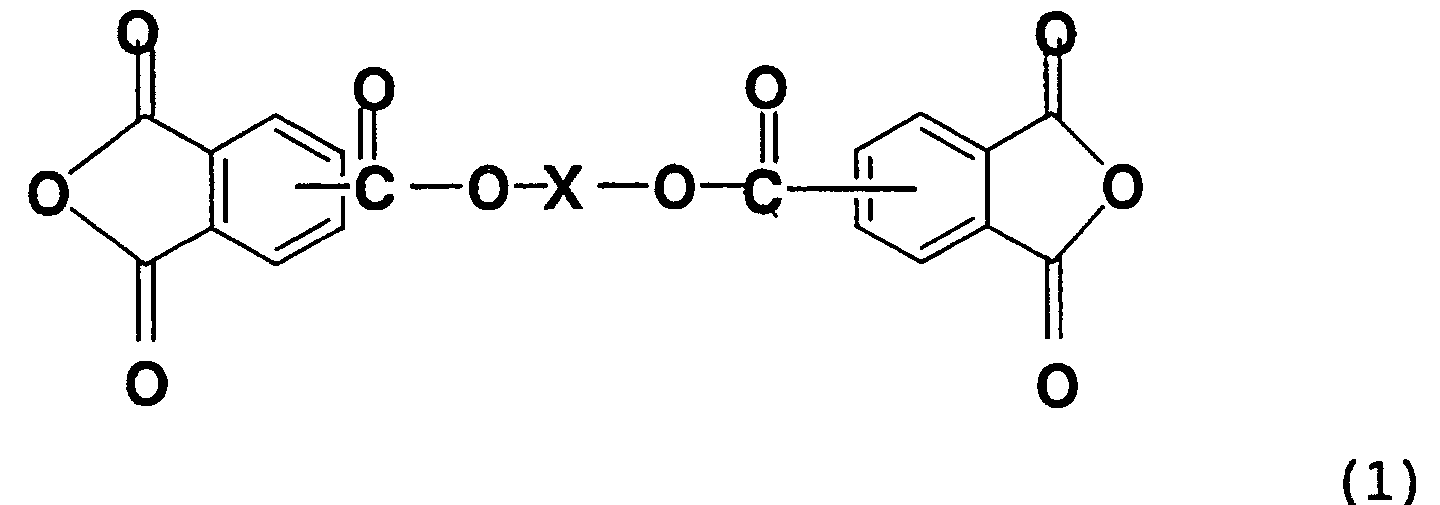


Examples of aliphatic diamines include 1,2-diaminoethane, 1,3-diaminopentane, 1,3-diaminopropane, 1, 4-diaminobutane, 1,5-diaminopentane, 1,6-diaminohexane, 1,7-diaminohepthane, 1,8-diaminooctane, 1,9-diaminononane, 1,10-diaminodecane, or the like.


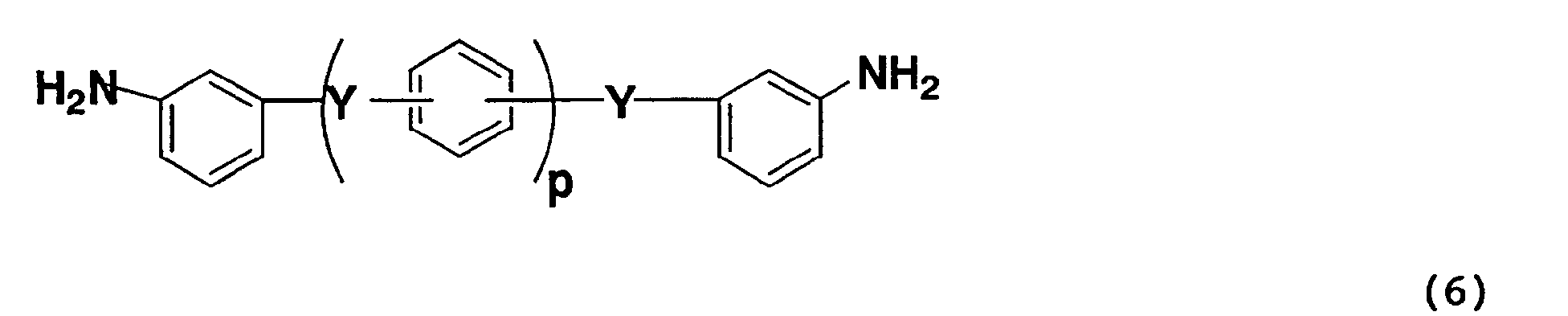


A method for limiting the content of the residual impurities contained in ESDA to 1% or lower includes a method for recrystallizing tetracarboxylic acid dianhydride or ESDA represented by the general formula (7) with a mixed solvent (Patent Publication No. 2-240074):


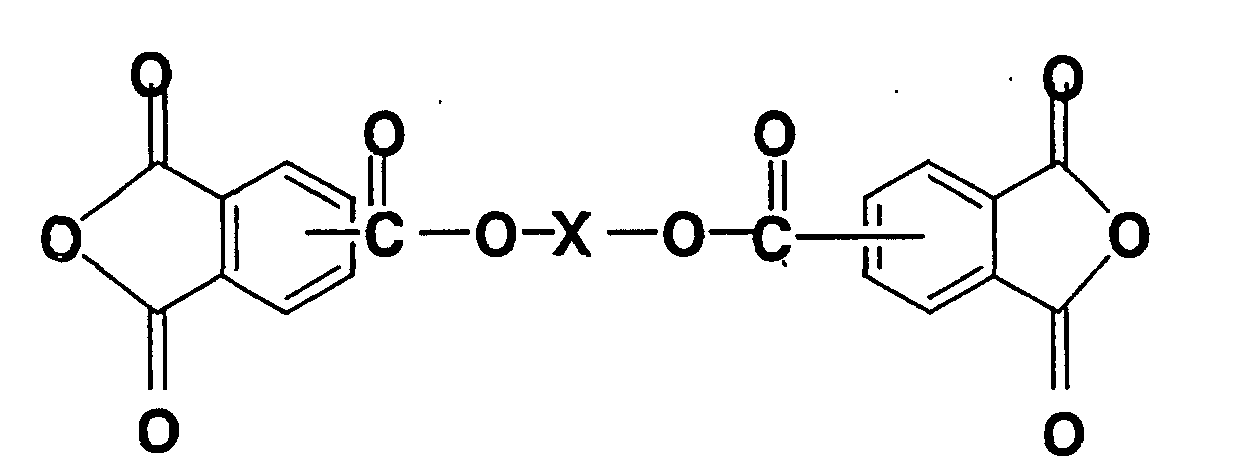
Preferable examples of anhydrides represented by the general formula (1) are 2,2-bis (4-hydroxyphenyl) propanedibenzoate-3,3',4,4'-tetracarboxylic acid anhydride, p-phenylenebis (trimellitic acid monoester anhydride), 4,4'-biphenylene-bis (trimellitic acid monoester anhydride), 1,4-naphthalene-bis (trimellitic acid monoester anhydride), 1,2-ethylene-bis (trimellitic acid monoester anhydride), 1,3-trimethylene-bis (trimellitic acid monoester anhydride ),1,4-tetramethylene-bis (trimellitic acid monoester anhydride), 1-5-pentamethylene-bis (trimellitic acid monoester anhydride), 1,6-hexamethylene-bis (trimellitic acid monoester anhydride), or the like. However, 2,2-bis (4-hydroxyphenyl) propanedibenzoate-3, 3',4,4'-tetracarboxylic acid dianhydride represented by the general formula (7) is particularly preferable:

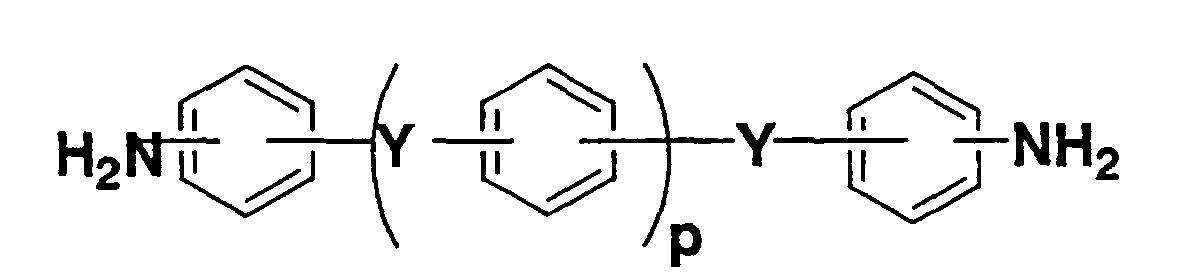
Generally known Apical, Capton, and Uplex, and the like may be used for the polyimide film on which the bonded layer is laminated, but they are not limited. Further, the polyimide film has a thickness within the range of 5 to 300 µm, preferably within the range of 10 to 125 µm.
Next, a method for obtaining the adhesive laminate film for wire rod coating is, for example, to apply the film-like resin composition of the present invention, which comprises the thermoplastic polyimide resin obtained as described above and the thermosetting resin, onto the other polyimide film and perform thermocompression bonding.
Water absorption is calculated by measurement based on ASTM (American Society for Testing and Materials) D570. A film-like composition; a composition sheet having a thickness of 25 µm, was heated at 150°C for 3 hours to obtain a cured composition sheet. W1 was weight of the composition sheet after having been cured which was obtained by further drying at 150°C for 30 minutes. W2 was weight obtained by wiping off the surface of the sheet after having immersed into distilled water (under an atmosphere of 20°C, 60% RH) for 24 hours, and then the water absorption was calculated by the following formula:
The measuring method of materials in the examples 10 to 14 and the comparative examples 8 to 9 is as follows:
Some concentrations of different solutions were determined to plot viscosity/concentration against concentration, and the line was extrapolated to zero concentration.
PCT treatment physical property measurements of Examples 15 to 27 and Comparative Examples 10 to 19 were carried out as mentioned below.
20 g of the obtained polyimide powder, 5 g of Epikote 828 (manufactured by Shell International Chemicals Corporation), and 0.015 g of 2-ethyl-4-methylimidazole were dissolved in 83 g of DMF to prepare a varnish. The obtained varnish was cast onto a glass plate, and peeled off from the glass plate, after dried at 100°C for 10 minutes and set on a steel frame. A sheet having a thickness of 25 µm was obtained by further drying at 150°C for 20 minutes. The obtained sheet was sandwiched between a polyimide film (Apical 50AH, manufactured by Kaneka Corporation) and a copper foil of 25 µm thickness, and then was heated at 200°C and pressurized at pressure 3MPa for 20 minutes to obtain a flexible copper clad laminate.
| Peeling strength (kgf/cm) | Solder heat resistance | Water absorption (%) | ||
| 20°C | 150°C | |||
| Example 1 | 1.0 | 0.8 | ○ | 0.5 |
| Example 2 | 1.0 | 0.8 | ○ | 0.5 |
| Example 3 | 1.2 | 0.9 | ○ | 0.6 |
| Example 4 | 1.1 | 0.9 | ○ | 0.6 |
| Example 5 | 1.0 | 0.8 | ○ | 0.6 |
| Example 6 | 1.0 | 0.8 | ○ | 1.0 |
| Comparative Example 1 | 1.0 | 0.8 | × | 1.8 |
| Comparative Example 2 | 0.2 | 0.1 | ○ | 0.4 |
| Comparative Example 3 | 1.2 | 0.1 | × | 2.0 |

| Peeling strength (kgf/cm) | Solder heat resistance | Water Absorption (%) | THF solubility | ||
| 20°C | 150°C | ||||
| Example 7 | 1.0 | 0.7 | ○ | 0.5 | ○ |
| Example 8 | 1.0 | 0.7 | ○ | 0.5 | ○ |
| Example 9 | 1.2 | 0.8 | ○ | 0.6 | ○ |
| Comparative Example 4 | 1.0 | 0.7 | × | 1.8 | ○ |
| Comparative Example 5 | - | - | - | - | × |
| Comparative Example 6 | 0.2 | 0.1 | ○ | 0.4 | ○ |
| Comparative Example 7 | 1.2 | 0.1 | × | 2.0 | ○ |

The obtained polyimide oligomer powder was treated in the same manner as in Example 22 to obtain a flexible copper clad laminate.
The obtained polyimide oligomer powder was treated in the same manner as in Example 22 to obtain a flexible copper clad laminate.
The thus-obtained polyimide oligomer powder was treated in the same manner as in Example 22 to obtain a flexible copper clad laminate.
Peeling strength and solder heat resistance were evaluated on the flexible copper clad laminate obtained in each of Examples 22 to 27 and Comparative Examples 16 to 19 as described above. Water absorption of each adhesive sheet was evaluated as well. The results obtained are shown in Table 4.

(Examples 30a, 30b, and 30c) (Comparative Examples 20a, 20b, 20c, 21a, 21b, 21c, 22a, 22b, and 22c)
| THF | Dioxane | Dioxolan | THF | Dioxane | Dioxolan | |
| Residual Solvent Content(%) | Example 28a | Example 29a | Example 30a | Comparative Example 20a | Comparative Example 21a | Comparative Example 22a |
| 0.5 | 3.2 | 0.8 | 5.1 | 8.0 | 6.2 | |
| Example 28b | Example 29b | Example 30b | Comparative Example 20b | Comparative Example 21b | Comparative Example 22b | |
| 0.0 | 1.3 | 0.2 | 2.0 | 4.3 | 3.5 | |
| Example 28c | Example 29c | Example 30c | Comparative Example 20c | Comparative Example 21c | Comparative Example 22c | |
| 0.0 | 0.2 | 0.1 | 0.9 | 1.9 | 1.4 | |
| Peeling Strength (kgf/cn) | Example 28a | Example 29a | Example 30a | Comparative Example 20a | Comparative Example 21a | Comparative Example 22a |
| 1.00 | 0.97 | 1.00 | 1.00 | 0.98 | 1.00 | |
| Example 28b | Example 29b | Example 30b | Comparative Example 20b | Comparative Example 21b | Comparative Example 22b | |
| 0.72 | 0.66 | 0.70 | 0.67 | 0.51 | 0.53 | |
| Example 28c | Example 29c | Example 30c | Comparative Example 20c | Comparative Example 21c | Comparative Example 22c | |
| 0.12 | 0.11 | 0.11 | 0.13 | 0.06 | 0.10 |
| Peeling strength (kgf/cm) | Solder heat resistance | Water absorption (%) | ||
| 20°C | 150°C | |||
| Example 31 | 1.0 | 0.9 | ○ | 0.6 |
| Example 32 | 1.0 | 0.8 | ○ | 0.5 |
| Example 33 | 1.0 | 0.8 | ○ | 0.5 |
| Example 34 | 1.1 | 0.7 | ○ | 0.6 |
| Comparative Example 26 | 0.1 | 0.1 | ○ | 0.6 |
| Comparative Example 27 | 0.9 | 0.2 | × | 2.0 |
| Comparative Example 28 | 1.0 | 0.9 | × | 1.8 |
Peeling strength and solder heat resistance were measured on the obtained flexible copper clad laminate. Each measuring results obtained are shown in Table 6.
The obtained film-state joining component was sandwiched between a polyimide film (Apical 50AH, manufactured by Kaneka Corporation) and a copper foil of 25 µm thickness, and then was heated at 200°C and pressurized at pressure 3MPa for 20 minutes to obtain a flexible copper clad laminate. Peeling strength and solder heat resistance were measured on the obtained flexible copper clad laminate. Each measuring results obtained are shown in Table 7.
| Peeling strength (kgf/cm) | Solder heat resistance | Water absorption (%) | ||
| 20°C | 150°C | |||
| Example 36 | 1.0 | 0.9 | ○ | 0.6 |
| Example 37 | 1.0 | 0.8 | ○ | 0.5 |
| Example 38 | 1.1 | 0.9 | ○ | 0.5 |
| Example 39 | 1.2 | 0.7 | ○ | 0.7 |
| Comparative Example 29 | 1.0 | 0.9 | × | 1.8 |
| Comparative Example 30 | 0.2 | 0.1 | ○ | 0.6 |
| Comparative Example 31 | 1.0 | 0.2 | × | 2.0 |
| Glass transition temperature(°C) | Water absorption (%) | Dielectric constant (-) | Peeling strength (kgf/cm) | Radiation resistance test | |
| Example 39 | 140 | 0.9 | 2.95 | 1.1 | ; |
| Example 40 | 190 | 0.8 | 2.90 | 1.1 | ; |
| Example 41 | 210 | 0.8 | 2.88 | 1.1 | ; |
| Example 42 | 140 | 0.9 | 2.96 | 1.2 | ; |
| Comparative Example 32 | None | 2.6 | 3.50 | Unattached | ; |
| Comparative Example 33 | 178 | 2.0 | 3.80 | 0.3 | Blackened |
When the obtained film was measured for each characteristic in the same manner as in Example 39, the polyimide resin layer had a glass transition temperature of 190°C, its water absorption was 0.8%, and dielectric constant was 2.90. When peeling strength was measured in the same manner as in Example 39, its peeling strength was 1.1 kgf/cm. When a radiation resistance test was performed on the obtained adhesive laminate film for wire rod coating, any changes, such as discoloration and deterioration did not occur on the film. The results obtained are shown in Table 8.
When the obtained film was measured for each characteristic in the same manner as in Example 39, the polyimide resin layer had a glass transition temperature of 210°C, its water absorption was 0.8%, and dielectric constant was 2.88. When peeling strength was measured in the same manner as in Example 39, its peeling strength was 1.1 kgf/cm. When a radiation resistance test was performed on the obtained adhesive laminate film for wire rod coating, any changes, such as discoloration and deterioration did not occur on the film. The results obtained are shown in Table 8.
When the obtained film was measured for each characteristic in the same manner as in Example 39, the polyimide resin layer had a glass transition temperature of 140°C, its water absorption was 0.9%, and dielectric constant was 2.96. When peeling strength was measured in the same manner as in Example 39, its peeling strength was 1.2 kgf/cm. When a radiation resistance test was performed on the obtained adhesive laminate film for wire rod coating, any changes, such as discoloration and deterioration, did not occur on the film. The results obtained are shown in Table 8.
When the obtained film was measured for each characteristic in the same manner as in Example 39, the polyimide resin layer had no glass transition temperature, its water absorption was 2.6%, and dielectric constant was 3.5. It was impossible to measure peeling strength of the obtained adhesive laminate film for wire rod coating under the conditions of temperature at 180°C under a pressure of 30 kg/cm2 for 10 minutes due to being incapable to be bonded. When a radiation resistance test was performed on the obtained adhesive laminate film for wire rod coating, any changes, such as discoloration and deterioration, did not occur on the film. The results obtained are shown in Table 8.
When the obtained film was measured for respective characteristics in the same manner as in Example 39, the adhesive layer had a glass transition temperature of 178°C, its water absorption was 2.0%, and dielectric constant was 3.8. The peeling strength of the obtained adhesive laminate film for wire rod coating was 0.3 kg/cm. As a result of a radiation resistance test, the film was blackened. The results obtained are shown in Table 8.
Claims (33)
- A polyimide resin obtained by reacting tetracarboxylic acid dianhydride containing ester acid dianhydride represented by the general formula (1):wherein X represents -(CH2)k-, or is a divalent group comprising an aromatic ring; and k is an integer from 1 to 10; with diamine containing an aromatic diamine represented by the general formula (2):
 wherein R1 represents alkyl, fluoro-alkyl, and alkoxyl groups or a halogen group; and n is an integer from 0 to 4. R1 whose number is n is the same or different, and/or an aromatic diamine represented by the general formula (3):
 wherein A is at least one selected from the groups consisting of a single bond, -O-, -(CH2)n-, -CO-, -C(=O)O-, -NHCO-, -C(CH3)2-, -C(CF3)2-, -S-, or -SO2-. R2, R3, and R4 represent independently alkyl, fluoro-alkyl, and alkoxyl groups or a halogen group, and are the same or different groups; x, y, z, m, and n are each an integer from 0 to 4; and A whose number is (m+1) is respectively the same or different.
- A polyimide resin obtained by reacting tetracarboxylic acid dianhydride containing ester acid dianhydride represented by the general formula (1):wherein X represents -(CH2)k- or is a divalent group comprising an aromatic ring; and k is an integer from 1 to 10; with aromatic diamine represented by the general formula (4):
 wherein Y is at least one selected from the groups consisting of a single bond, -CO-, -SO2-, -O-, -S-, -C(CH2)q-, -NHCO-, -C(CH3)2-, -C(CF3)2-, or -C(=O)O-; p and q are each an integer from 1 to 5.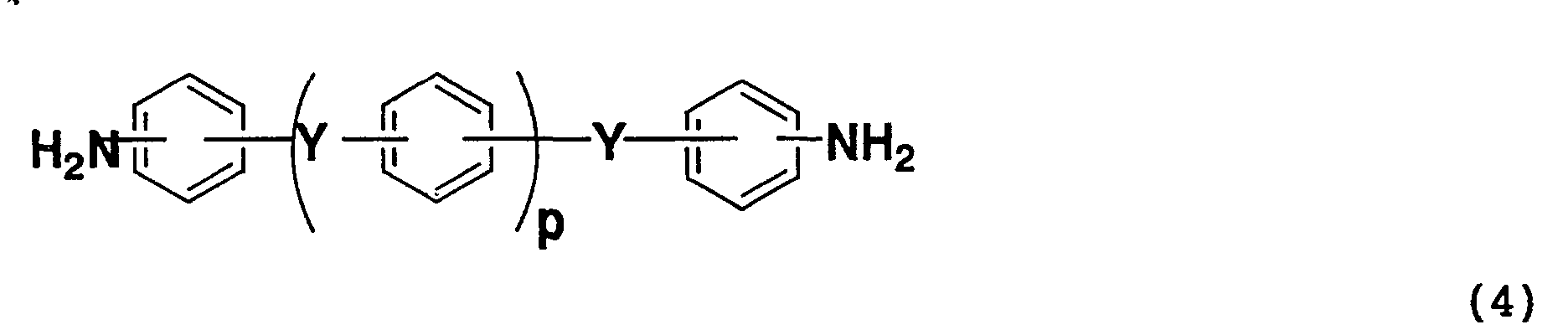
- A polyimide resin obtained by reacting tetracarboxylic acid dianhydride containing ester-acid dianhydride represented by the general formula (1):wherein X represents -(CH2)k- or is a divalent group comprising an aromatic ring; and k is an integer from 1 to 10; with aromatic diamine represented by the general formula (4):
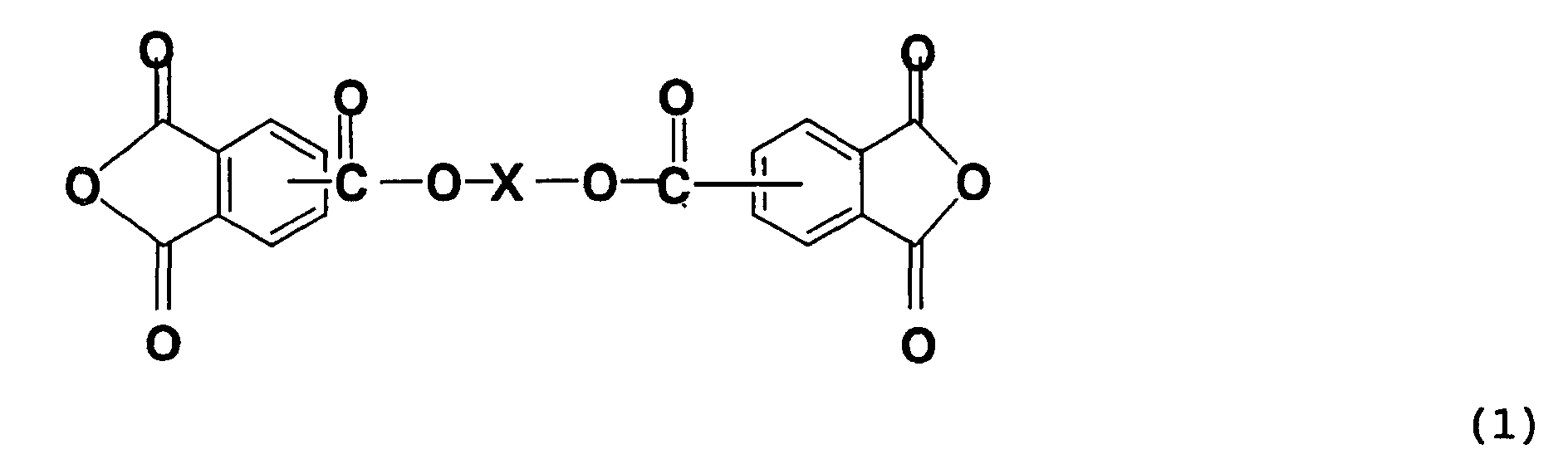 wherein Y is at least one selected from the groups consisting of a single bond, -CO-, -SO2-, -O-, -S-, -(CH2)q-, -NHCO-, -C(CH3)2-, -C(CF3)2-, or -C(=O)O-; p and q are each an integer from 1 to 5, and siloxane diamine represented by the general formula (5):
 wherein R5 and R6 are each a divalent aliphatic group whose carbon number is from 1 to 4 or a divalent aromatic group; R7, R8, R9, and R10 are each a monovalent aliphatic group whose carbon number is from 1 to 4 or a monovalent aromatic group; and n is an integer from 1 to 10.
- The polyimide resin according to claim 2 or 3, wherein
said diamine represented by the general formula (4) is aromatic diamine represented by the general formula (6):wherein Y is at least one group selected from the groups consisting of a single bond -, -CO-, -SO2-, -O-, -S-, -(CH2)q-, - NHCO-, -C(CH3)2-, -C(CF3)2-, or -C(=O)O-; p and q are each an integer from 1 to 5.
- The polyimide resin according to claim 3, further comprising siloxane diamine in an amount of 1 to 30 mole % based on the total amount of diamine.
- A polyimide resin obtained by reacting tetracarboxylic acid dianhydride containing 2,2-(4-hydroxyphenyl) propanedibenzoate-3,3',4,4'-tetracarboxylic acid dianhydride represented by the general formula (7),: with aromatic diamine represented by the formula (2),
 wherein R1 represents alkyl, fluoro-alkyl, and alkoxyl groups or a halogen group; n is an integer from 0 to 4; and R1 whose number is n is the same or different: and/or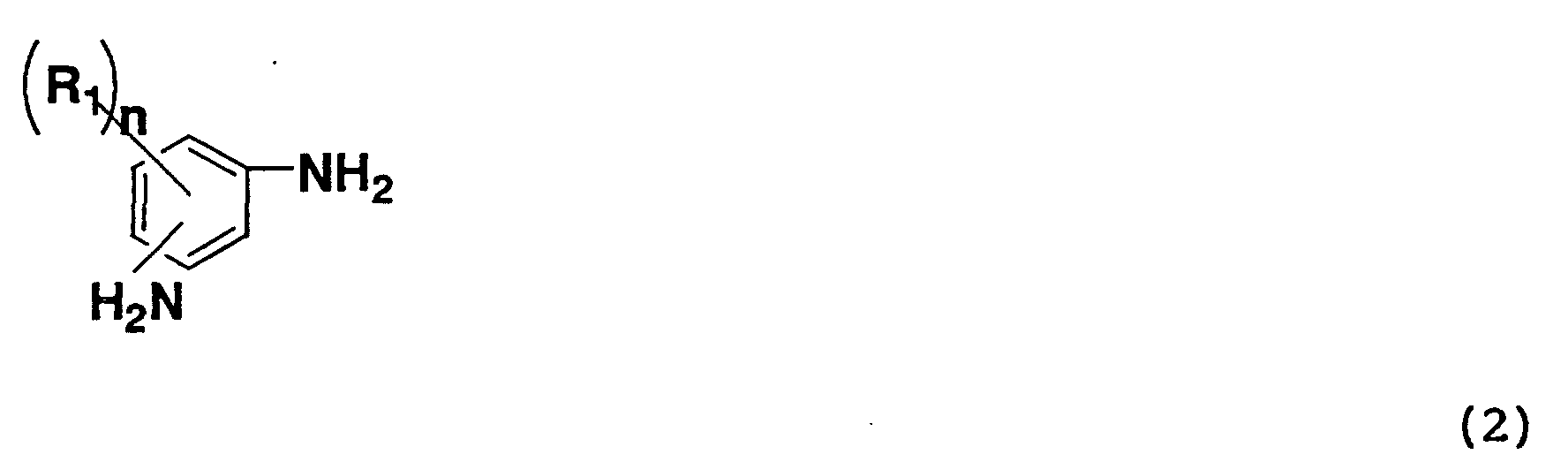
diamine containing aromatic diamine represented by the general formula (3):wherein A is at least one selected from the groups consisting of a single bond, -O-, -(CH2)n-, -CO-, -C(=O)O-, -NHCO-, -C(CH3)2-, -C(CF3)2-, -S-, or -SO2-. R2, R3, and R4 represent independently alkyl, fluoro-alkyl, and alkoxyl groups or a halogen group, and are the same or different groups; X, y, z, m, and n are each an integer from 0 to 4; and A whose number is (m+1) is respecively the same or different.
- A polyimide resin obtained by reacting tetracarboxylic acid dianhydride which is adjusted to have a residual impurities content of 1 wt% or lower and contains 2,2-(4-hydroxyphenyl) propanedibenzoate-3,3'4,4'-tetracarboxylic acid dianhydride represented by the general formula (7),: with aromatic diamine represented by the general formular (2),
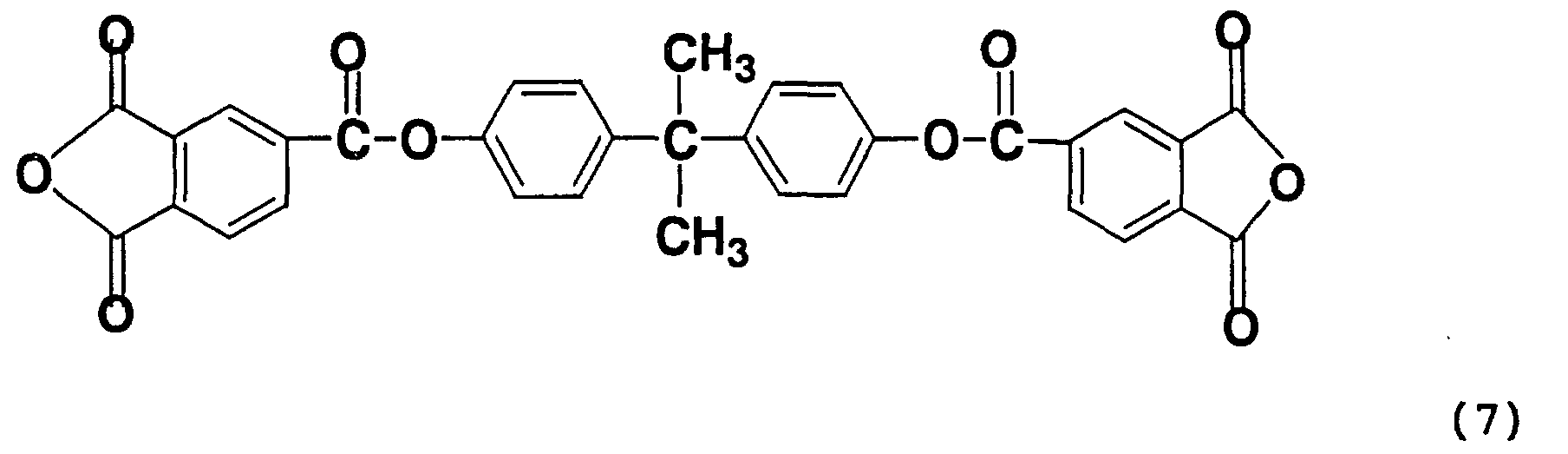 wherein R1 represents alkyl, fluoro-alkyl, and alkoxyl groups or a halogen groups; n is an integer from 0 to 4; and R1 whose number is n is the same or different: and/or
diamine containing aromatic diamine represented by the general formula (3),wherein A is at least one selected from the groups consisting of a single bond, -O-, -(CH2)n-, -CO-, -C(=O)O, -NHCO-, -C(CH3)2-, -C(CF3)2-, -S- or -SO2-. R2, R3, and R4 represent independently alkyl, fluoro-alkyl, and alkoxyl groups or a halogen group; and are the same or different groups; X, y, z, m, and n are each an integer from 0 to 4; and A whose number is (m+1) is respectively the same or different.
- The polyimide resin according to claim 7, further obtained by adjusting 2,2-(4-hydroxyphenyl)propanedibenzoate-3,3'4,4'-tetracarboxylic acid dianhydride represented by the general formula (7) to have a residual impurities content of 1 wt% or lower:
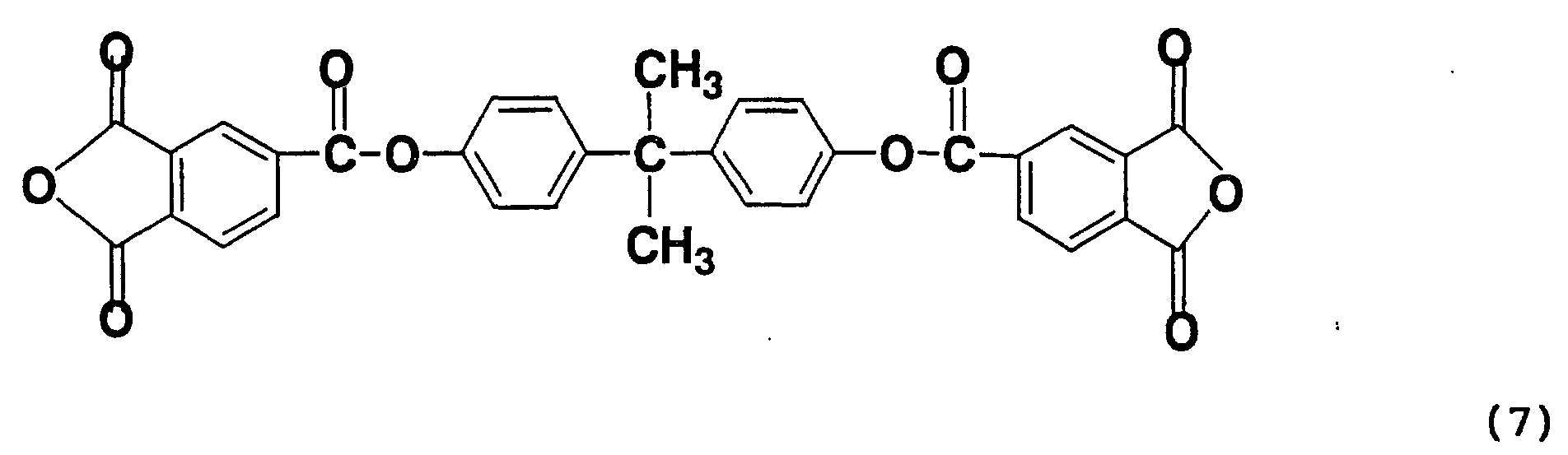
- The polyimide resin according to any one of claims 1, 2, 3, 6, or 7, having a glass transition temperature from 100°C to 250°C and water absorption of 1.5% or lower.
- The polyimide resin according to claim 9, having a glass transition temperature from 100°C to 250°C, water absorption of 1.5% or lower, and dielectric constant of 3.2 or lower.
- A resin composition comprising the polyimide resin according to any one of claims 1, 2, 3, 6, or 7; and a thermosetting resin.
- The resin composition according to claim 11, wherein said thermosetting resin is an epoxy resin.
- The resin composition according to claim 12, wherein said thermosetting resin includes two epoxy groups or more.
- The resin composition according to claim 12, wherein said epoxy resin has an epoxy equivalent of 250 or less.
- The resin composition according to claim 11, having water absorption after curing of 1.5% or lower.
- The resin composition according to claim 12, further comprising said polyimide resin and said epoxy resin, wherein the resin composition has a residual volatile component after curing of 3 wt% or lower.
- The resin composition according to claim 16, wherein components of said residual volatile component are at least one kind of solvent having a low boiling point which dissolves said polyimide resin and said epoxy resin.
- The resin composition according to claim 12, wherein said polyimide resin is amine-terminated polyimide oligomer.
- The resin composition according to claim 18, wherein said polyimide oligomer has a number-average molecular weight of 2,000 to 50,000.
- A cured resin obtained by curing the resin composition according to claim 11, having water absorption of 1.5% or lower.
- A cured resin obtained by curing the resin composition according to claim 12, having a residual volatile component of 3 wt% or lower.
- A polyimide adhesive solution in which said polyimide resin according to any one of claims 1, 2, 3, 6, or 7, epoxy resin, and a curing agent are dissolved in an organic solvent,
wherein 50 mole % or more of a dianhydride residue contained in said polyimide resin is an ester-acid dianhydride residue represented by the general formula (1):wherein X represents -(CH2)k-, or is a divalent group comprising an aromatic ring, k is an integer from 1 to 10; and said organic solvent includes a cyclic ether solvent
- The polyimide adhesive solution according to claim 22,
wherein said organic solvent contains a cyclic ether solvent of 30 wt% or higher. - A film-state joining component formed by laminating a thermosetting resin on one side or both sides of a base film with a main constituent of the polyimide resin according to any one of claims 1, 2, 3, 6, or 7.
- A film-state joining component according to claim 24,
wherein said thermosetting resin has a film thickness after dried of 0.5 to 5 µm. - A film-state joining component obtained by laminating the resin composition according to claim 12 on one side or both sides of a polyimide base film.
- A film-state joining component obtained by depositing a film-like resin composition layer on a polyimide base film,
wherein said film-like resin composition is obtained by dissolving the resin composition according to claim 12 in an organic solvent, applying or flow casting onto a support, and peeling off a coating film of the resin composition from the support. - A film-state joining component having a film-like resin composition layer, wherein said film-like resin is obtained by dissolving the resin composition according to claim 12 in an organic solvent, applying or flow casting onto at least one side of a polyimide base film, and drying.
- A film-state joining component obtained by applying the polyimide adhesive solution according to claim 22 or flow casting the polyimide adhesive solution onto a support and peeling off an adhesive coating film from the support.
- A film-state joining component having a polyimide adhesive layer on its surface, wherein said polyimide adhesive layer is obtained by applying the polyimide adhesive solution according to claim 22 or flow casting onto the polyimide adhesive solution at least one side of a polyimide base film, and drying.
- An adhesive laminate film for wire rod coating using the film-state joining component according to claim 26.
- A method of producing a polyimide resin in an organic solvent obtained by reacting 1 mole of ester-acid dianhydride represented by the general formula (1):wherein X represents -(CH2)k-, or is a divalent group comprising an aromatic ring; and k is an integer from 1 to 10, with 1.02 to 1.1 mole in mixing ratio of diamine represented by the general formula (4): and/or
 the general formula (6):

- A method of producing a polyimide resin obtained by reacting tetracarboxylic acid dianhydride which is adjusted to have a residual impurities content of 1 wt% or lower and contains 2,2-(4-hydroxyphenyl)propanedibenzoate-3,3'4,4'-tetracarboxylic acid dianhydride represented by the general formula (7),: with aromatic diamine represented by the general formula (2): and/or
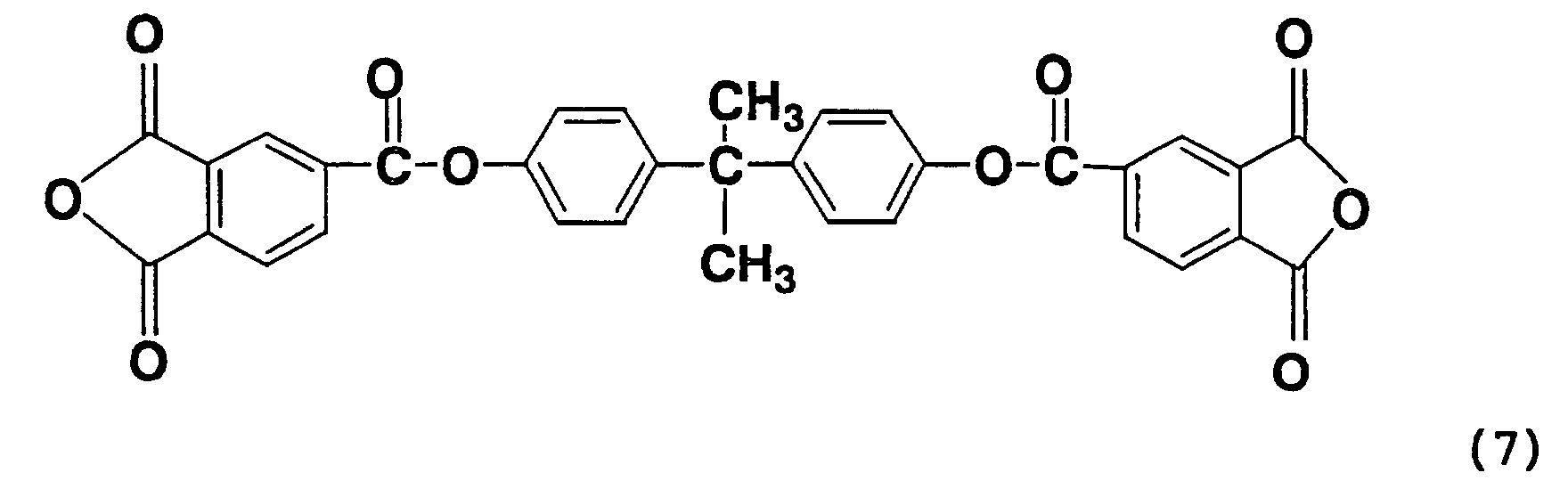 wherein R1 represents alkyl, fluoro-alkyl, and alkoxyl groups or a halogen group; n is an integer from 0 to 4; and R1 whose number is n is the same or different: and/or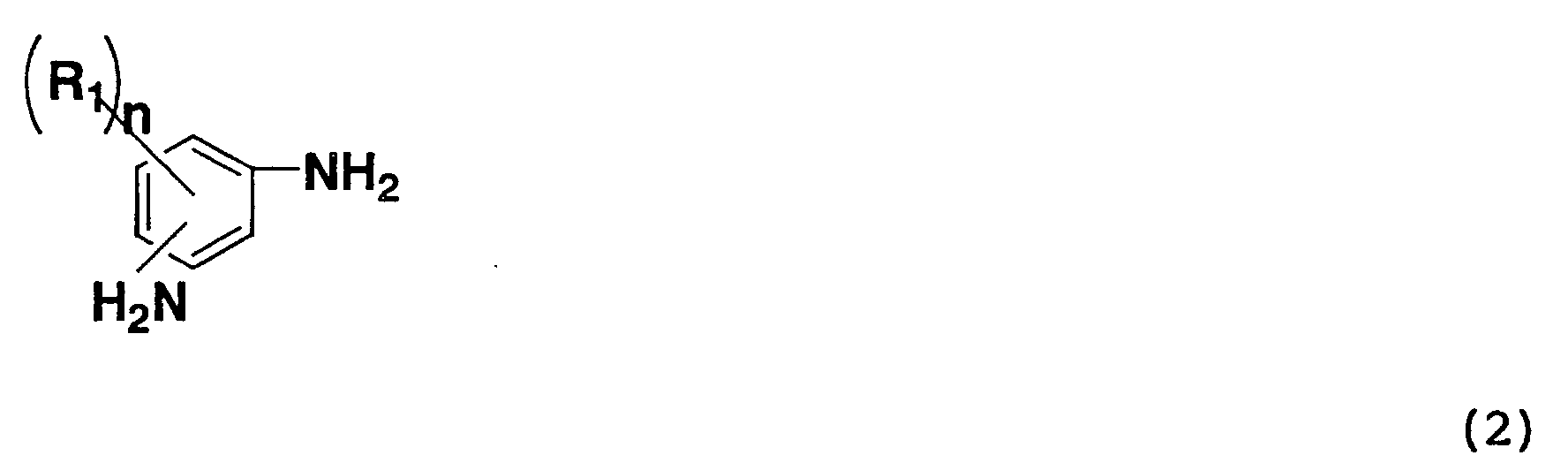
diamine containing aromatic diamine represented by the general formula (3),wherein A is at least one selected from the groups consisting of a single bond, -O-, -(CH2)n-, -CO-, -C(=O)O-, -NHCO-, -C(CH3)2-, -C(CF3)2-, -S-, or -SO2-. R2, R3, and R4 represent independently alkyl, fluoro-alkyl, and alkoxyl groups or a halogen group, and are the same or different groups; x, y, z, m, and n are each an integer from 0 to 4; and A whose number is (m+1) is respectively the same or different.
Applications Claiming Priority (15)
| Application Number | Priority Date | Filing Date | Title |
|---|---|---|---|
| JP10206699 | 1999-04-09 | ||
| JP10206699 | 1999-04-09 | ||
| JP11422499 | 1999-04-21 | ||
| JP11419199 | 1999-04-21 | ||
| JP11379699 | 1999-04-21 | ||
| JP11419199 | 1999-04-21 | ||
| JP11379699 | 1999-04-21 | ||
| JP11422499 | 1999-04-21 | ||
| JP31603499 | 1999-11-05 | ||
| JP31603499 | 1999-11-05 | ||
| JP31603599 | 1999-11-05 | ||
| JP31603599 | 1999-11-05 | ||
| JP2000045542 | 2000-02-23 | ||
| JP2000045542 | 2000-02-23 | ||
| PCT/JP2000/002181 WO2000061658A1 (en) | 1999-04-09 | 2000-04-04 | Polyimide resin, resin composition with improved moisture resistance comprising the same, adhesive solution, filmy bonding member, layered adhesive film, and processes for producing these |
Publications (3)
| Publication Number | Publication Date |
|---|---|
| EP1193280A1 true EP1193280A1 (en) | 2002-04-03 |
| EP1193280A4 EP1193280A4 (en) | 2002-07-31 |
| EP1193280B1 EP1193280B1 (en) | 2004-11-24 |
Family
ID=27565662
Family Applications (1)
| Application Number | Title | Priority Date | Filing Date |
|---|---|---|---|
| EP20000913104 Expired - Lifetime EP1193280B1 (en) | 1999-04-09 | 2000-04-04 | Polyimide resin composition with improved moisture resistance, adhesive solution, filmy bonding member, layered adhesive film, and processes for producing these |
Country Status (5)
| Country | Link |
|---|---|
| US (1) | US6693162B2 (en) |
| EP (1) | EP1193280B1 (en) |
| JP (1) | JP4743732B2 (en) |
| DE (1) | DE60016217T2 (en) |
| WO (1) | WO2000061658A1 (en) |
Cited By (3)
| Publication number | Priority date | Publication date | Assignee | Title |
|---|---|---|---|---|
| EP1288191A3 (en) * | 2001-09-04 | 2003-07-02 | Mitsui Chemicals, Inc. | Novel aromatic diamine and polyimide thereof |
| WO2004067665A1 (en) * | 2003-01-29 | 2004-08-12 | Tesa Ag | Method for gluing fpcb’s |
| US8067523B2 (en) | 2004-04-19 | 2011-11-29 | Kaneka Corporation | Thermosetting resin composition, laminated body using it, and circuit board |
Families Citing this family (43)
| Publication number | Priority date | Publication date | Assignee | Title |
|---|---|---|---|---|
| US6887580B2 (en) * | 2000-02-01 | 2005-05-03 | Nippon Steel Chemical Co., Ltd. | Adhesive polyimide resin and adhesive laminate |
| WO2001076866A1 (en) * | 2000-04-12 | 2001-10-18 | Kaneka Corporation | Laminate and multilayer printed board manufactured by using the same |
| TWI293315B (en) * | 2000-12-26 | 2008-02-11 | Ngk Spark Plug Co | Wiring substrate |
| JP2002309218A (en) * | 2001-04-11 | 2002-10-23 | Kanegafuchi Chem Ind Co Ltd | Adhesive laminated film for coating the accelerator beam tube |
| JP2003027034A (en) * | 2001-07-17 | 2003-01-29 | Kanegafuchi Chem Ind Co Ltd | Adhesive cover film |
| JP2003082301A (en) * | 2001-09-10 | 2003-03-19 | Japan Gore Tex Inc | Adhesive tape and semiconductor device |
| US20050119381A1 (en) * | 2002-03-08 | 2005-06-02 | Shigeru Tanaka | Thermosetting resin composition and laminates and circuit board substrates made by using the same |
| JP2004079826A (en) * | 2002-08-20 | 2004-03-11 | Nippon Steel Chem Co Ltd | Laminate for wiring board |
| JP2004259789A (en) * | 2003-02-25 | 2004-09-16 | Mitsui Chemicals Inc | Adhesive substrate for fixing lead frames |
| JP4359242B2 (en) * | 2003-05-14 | 2009-11-04 | 三井化学株式会社 | Adhesive resin composition, film adhesive, and semiconductor device using the same |
| US7220490B2 (en) * | 2003-12-30 | 2007-05-22 | E. I. Du Pont De Nemours And Company | Polyimide based adhesive compositions useful in flexible circuit applications, and compositions and methods relating thereto |
| JP5232386B2 (en) * | 2004-02-25 | 2013-07-10 | 株式会社カネカ | Thermosetting resin composition and use thereof |
| US20060043543A1 (en) * | 2004-08-25 | 2006-03-02 | Yoshiyuki Wada | Solder composition, connecting process with soldering, and connection structure with soldering |
| US7816487B2 (en) * | 2004-09-30 | 2010-10-19 | Intel Corporation | Die-attach films for chip-scale packaging, packages made therewith, and methods of assembling same |
| WO2006118105A1 (en) * | 2005-04-28 | 2006-11-09 | Ni Material Co., Ltd. | Thermosetting resin composition |
| JP2007091799A (en) * | 2005-09-27 | 2007-04-12 | Kaneka Corp | Thermosetting resin composition and its application |
| WO2007094561A1 (en) * | 2006-02-17 | 2007-08-23 | Cheil Industries Inc. | High molocular electrolyte membrane for fuel cell, and membrane-electrode assembly thereby, fuel cell |
| JP5244303B2 (en) * | 2006-05-23 | 2013-07-24 | 旭化成イーマテリアルズ株式会社 | Polyesterimide and method for producing the same |
| US20070290379A1 (en) * | 2006-06-15 | 2007-12-20 | Dueber Thomas E | Hydrophobic compositions for electronic applications |
| US8071693B2 (en) * | 2006-06-22 | 2011-12-06 | Sabic Innovative Plastics Ip B.V. | Polysiloxane/polyimide copolymers and blends thereof |
| US8168726B2 (en) * | 2006-06-22 | 2012-05-01 | Sabic Innovative Plastics Ip B.V. | Process for making polysiloxane/polymide copolymer blends |
| US8491997B2 (en) * | 2006-06-22 | 2013-07-23 | Sabic Innovative Plastics Ip B.V. | Conductive wire comprising a polysiloxane/polyimide copolymer blend |
| US8159825B1 (en) | 2006-08-25 | 2012-04-17 | Hypres Inc. | Method for fabrication of electrical contacts to superconducting circuits |
| JP5380805B2 (en) * | 2006-08-31 | 2014-01-08 | Jnc株式会社 | Inkjet ink |
| JP2008169318A (en) * | 2007-01-12 | 2008-07-24 | Nitto Denko Corp | High refractive index transparent titanium oxide / resin composition and method for producing coating composition for producing such composition |
| US20080236864A1 (en) * | 2007-03-28 | 2008-10-02 | General Electric Company | Cross linked polysiloxane/polyimide copolymers, methods of making, blends thereof, and articles derived therefrom |
| JP2008255141A (en) * | 2007-03-31 | 2008-10-23 | Ube Ind Ltd | Method for producing polyimide film and polyimide film |
| JP5009670B2 (en) * | 2007-04-05 | 2012-08-22 | 旭化成イーマテリアルズ株式会社 | Polyesterimide precursor and polyesterimide |
| JP2008266416A (en) * | 2007-04-18 | 2008-11-06 | Ube Ind Ltd | Method for producing polyimide film and polyimide film |
| JP2009013422A (en) * | 2008-09-03 | 2009-01-22 | Kaneka Corp | Coating material |
| WO2013180133A1 (en) * | 2012-05-29 | 2013-12-05 | 日東電工株式会社 | Adhesive, and transparent substrate using same |
| JP6349823B2 (en) * | 2013-03-21 | 2018-07-04 | 東洋紡株式会社 | Polyesterimide resin film, and resin and resin composition used therefor |
| JP6343989B2 (en) * | 2013-03-21 | 2018-06-20 | 東洋紡株式会社 | Transparent polyesterimide resin film, and resin and resin composition used therefor |
| CN105579492B (en) * | 2013-09-26 | 2017-10-27 | 普立万公司 | Aromatic polyimides for 3D printing processes |
| TWI808062B (en) * | 2016-08-12 | 2023-07-11 | 日商力森諾科股份有限公司 | Interlayer insulating film and manufacturing method thereof |
| US12091508B2 (en) | 2018-03-02 | 2024-09-17 | Kaneka Americas Holding, Inc. | Polyimides for temporary bonding adhesives, methods for manufacturing of thermoplastic polyimide materials, and methods for thin wafer bonding using the same |
| JP7269095B2 (en) * | 2019-05-29 | 2023-05-08 | 古河電気工業株式会社 | glass processing tape |
| KR20210048012A (en) * | 2019-10-22 | 2021-05-03 | 주식회사 엘지화학 | Adhisive compound for semiconductor and film using the same |
| WO2021117686A1 (en) * | 2019-12-10 | 2021-06-17 | ユニチカ株式会社 | Imide-group-containing compound, imide-group-containing curing agent, and epoxy resin cured material and electrically insulating material using said epoxy resin cured material |
| KR102324559B1 (en) * | 2020-02-28 | 2021-11-10 | (주)이녹스첨단소재 | Bonding film, bonding film laminate comprising the same and metal clad laminate comprising the same |
| JP7478008B2 (en) * | 2020-03-27 | 2024-05-02 | 積水化学工業株式会社 | Resin materials and multilayer printed wiring boards |
| JP7763038B2 (en) * | 2021-03-31 | 2025-10-31 | Tdk株式会社 | Resin composite laminate, method for producing resin composite laminate, and stretchable device |
| CN115536816B (en) * | 2022-10-28 | 2024-02-20 | 中国科学院兰州化学物理研究所 | A kind of thermosetting epoxy resin shape memory polymer and preparation method thereof |
Family Cites Families (65)
| Publication number | Priority date | Publication date | Assignee | Title |
|---|---|---|---|---|
| DE2357297C3 (en) * | 1973-11-16 | 1978-09-21 | Akzo Gmbh, 5600 Wuppertal | Process for the production of polyamide carboxylic acids |
| US4681928A (en) | 1984-06-01 | 1987-07-21 | M&T Chemicals Inc. | Poly(amide-amide acid), polyamide acid, poly(esteramide acid), poly(amide-imide), polyimide, poly(esterimide) from poly arylene diamine |
| JPH0696685B2 (en) * | 1986-10-31 | 1994-11-30 | 日立化成工業株式会社 | Conductive paste composition |
| JPH0788495B2 (en) * | 1987-01-30 | 1995-09-27 | 日立化成工業株式会社 | Film-like joining member |
| JPH0751545B2 (en) * | 1988-06-28 | 1995-06-05 | 日立化成工業株式会社 | New diamine |
| JPH07119281B2 (en) * | 1988-06-28 | 1995-12-20 | 日立化成工業株式会社 | Novel method for producing polyesterimide |
| JPH0751544B2 (en) * | 1988-06-28 | 1995-06-05 | 日立化成工業株式会社 | New diamine manufacturing method |
| JPH02245070A (en) * | 1989-03-17 | 1990-09-28 | Hitachi Chem Co Ltd | Conductive paste composition |
| JPH02245071A (en) * | 1989-03-17 | 1990-09-28 | Hitachi Chem Co Ltd | Conductive paste composition |
| JPH03195732A (en) * | 1989-12-25 | 1991-08-27 | Hitachi Chem Co Ltd | New polyesterimide |
| EP0456515B1 (en) * | 1990-05-10 | 1995-11-08 | Hitachi Chemical Co., Ltd. | Polyimides and thermosetting resin compositions containing the same |
| JP2762744B2 (en) * | 1990-12-26 | 1998-06-04 | 日立化成工業株式会社 | Method for producing polyimide, polyamic acid and polyimide resin |
| KR0159287B1 (en) * | 1991-01-24 | 1999-01-15 | 윤종용 | Method for producing siloxane modified polyimide resin |
| JPH0586183A (en) * | 1991-09-30 | 1993-04-06 | Hitachi Chem Co Ltd | Thermosetting polyimide and production thereof |
| JPH05331116A (en) * | 1992-05-28 | 1993-12-14 | Kanegafuchi Chem Ind Co Ltd | Diamine and method for producing the same |
| JP3004482B2 (en) * | 1992-08-28 | 2000-01-31 | 信越化学工業株式会社 | Polymer scale adhesion inhibitor, polymerization vessel for preventing adhesion of polymer scale, and method for producing polymer using the same |
| JPH06128462A (en) * | 1992-10-15 | 1994-05-10 | Hitachi Chem Co Ltd | Thermosetting resin composition, adhesive sheet, polyimide film having adhesive and metal foil laminated polyimide film |
| CA2111294A1 (en) * | 1992-12-16 | 1994-06-17 | Hiroyuki Furutani | Thermoplastic polyimide, polyamide acid, and thermally fusible laminated film for covering conductive wires |
| JPH06184904A (en) * | 1992-12-17 | 1994-07-05 | Kanegafuchi Chem Ind Co Ltd | Binder for heat-resistant nonwoven fabric |
| JPH06184903A (en) * | 1992-12-17 | 1994-07-05 | Kanegafuchi Chem Ind Co Ltd | Binder for heat-resistant nonwoven fabric |
| JP3486934B2 (en) * | 1993-01-06 | 2004-01-13 | 日立化成工業株式会社 | Thermosetting resin composition |
| JP3682982B2 (en) * | 1993-02-22 | 2005-08-17 | 日立化成工業株式会社 | Manufacturing method of composite adhesive sheet |
| CN1041034C (en) * | 1993-03-29 | 1998-12-02 | 日立化成工业株式会社 | Heat-resistant adhesive |
| US6046072A (en) | 1993-03-29 | 2000-04-04 | Hitachi Chemical Company, Ltd. | Process for fabricating a crack resistant resin encapsulated semiconductor chip package |
| JP3301163B2 (en) * | 1993-05-31 | 2002-07-15 | 日立化成工業株式会社 | Low dielectric constant film |
| JPH073019A (en) * | 1993-06-18 | 1995-01-06 | Kanegafuchi Chem Ind Co Ltd | Novel aromatic polyimide polymer and polyamic acid polymer |
| KR100326655B1 (en) | 1993-08-03 | 2002-06-29 | 후루타 다케시 | Polyimide laminate used for a carbay film or a base film for FPC production and a method for producing the laminate |
| JP3493363B2 (en) * | 1993-08-23 | 2004-02-03 | 鐘淵化学工業株式会社 | Novel copolymer and its production method |
| JPH0762096A (en) * | 1993-08-23 | 1995-03-07 | Kanegafuchi Chem Ind Co Ltd | Novel aromatic polyamic acid copolymer and polyimide copolymer |
| JPH0770539A (en) * | 1993-09-03 | 1995-03-14 | Kanegafuchi Chem Ind Co Ltd | Coverlay adhesive and coverlay film |
| JPH0770318A (en) * | 1993-09-06 | 1995-03-14 | Kanegafuchi Chem Ind Co Ltd | Heat resistant adhesive |
| JP3395158B2 (en) * | 1993-11-18 | 2003-04-07 | 鐘淵化学工業株式会社 | Method for manufacturing flexible metal foil-clad laminate |
| JP3632769B2 (en) * | 1993-12-28 | 2005-03-23 | 株式会社カネカ | Laminated insulation and method for producing the same |
| JP3662269B2 (en) * | 1994-01-10 | 2005-06-22 | 株式会社カネカ | Thermoplastic polyimide-based tubular film and method for producing the same |
| JPH0845900A (en) * | 1994-05-24 | 1996-02-16 | Hitachi Chem Co Ltd | Method for forming resin film having desired pattern on semiconductor substrate, semiconductor chip, semiconductor package, and resist image peeling liquid |
| KR100372995B1 (en) | 1994-05-24 | 2003-03-31 | 히다치 가세고교 가부시끼가이샤 | Method of Forming Resin Film Resin Film of Desired Pattern on Substrate, Semiconductor Chip, Semiconductor Package, and Resist Image Remover |
| JPH08100062A (en) * | 1994-09-28 | 1996-04-16 | Kanegafuchi Chem Ind Co Ltd | Novel aromatic polyimide powder and method for producing the same |
| JP3596556B2 (en) * | 1994-11-23 | 2004-12-02 | 株式会社カネカ | Flexible printed circuit board materials |
| JPH08176524A (en) * | 1994-12-22 | 1996-07-09 | Sumitomo Bakelite Co Ltd | Silicone polyimide adhesive |
| WO1996021693A1 (en) * | 1995-01-11 | 1996-07-18 | Kanegafuchi Kagaku Kogyo Kabushiki Kaisha | Novel heat-fusible copolymer, and powder, film, laminated heat insulator, electronic module, and capacitor produced from said copolymer, and process for producing the same |
| JPH08197695A (en) * | 1995-01-20 | 1996-08-06 | Kanegafuchi Chem Ind Co Ltd | Adhesive insulating film and manufacturing method thereof |
| JPH08199124A (en) * | 1995-01-26 | 1996-08-06 | Kanegafuchi Chem Ind Co Ltd | Bonding sheet |
| JPH08217877A (en) * | 1995-02-17 | 1996-08-27 | Kanegafuchi Chem Ind Co Ltd | Polyimide resin and polyimide film |
| JPH08273974A (en) * | 1995-03-31 | 1996-10-18 | Kanegafuchi Chem Ind Co Ltd | Capacitor |
| JPH091723A (en) * | 1995-04-17 | 1997-01-07 | Kanegafuchi Chem Ind Co Ltd | Heat resistant bonding sheet |
| JP3356584B2 (en) * | 1995-04-27 | 2002-12-16 | 鐘淵化学工業株式会社 | Flexible copper clad laminate |
| JPH09291151A (en) * | 1995-07-14 | 1997-11-11 | Kanegafuchi Chem Ind Co Ltd | NOVEL COPOLYMER HAVING THERMAL SEALING PROPERTY, THE COPOLYMER COMPOSITION, AND PROCESS FOR PRODUCING THE SAME |
| JPH0977871A (en) * | 1995-09-11 | 1997-03-25 | Japan Synthetic Rubber Co Ltd | Crystalline polyimide |
| JP3544043B2 (en) * | 1995-09-13 | 2004-07-21 | 鐘淵化学工業株式会社 | Method for producing polyimide powder and polyimide powder |
| JP3195732B2 (en) | 1995-12-26 | 2001-08-06 | 株式会社コロナ | Hot air heater |
| JPH09286858A (en) * | 1996-04-24 | 1997-11-04 | Kanegafuchi Chem Ind Co Ltd | Polyimide resin composition and method for producing the same |
| JPH09302091A (en) * | 1996-05-10 | 1997-11-25 | Kanegafuchi Chem Ind Co Ltd | Novel high elasticity polyimide resin composition |
| JP3635384B2 (en) * | 1996-10-29 | 2005-04-06 | 株式会社カネカ | Heat resistant bonding sheet |
| JP3700311B2 (en) * | 1997-02-05 | 2005-09-28 | 日本メクトロン株式会社 | Siloxane polyimide and heat-resistant adhesive containing the same |
| JPH10219110A (en) * | 1997-02-07 | 1998-08-18 | Kanegafuchi Chem Ind Co Ltd | Resin composition, tubular article comprising the same, and method for producing the same |
| JP3744634B2 (en) * | 1997-02-17 | 2006-02-15 | 株式会社カネカ | Polyimide resin film |
| JP4008978B2 (en) * | 1997-02-25 | 2007-11-14 | 株式会社カネカ | Resin composition |
| JP4032449B2 (en) * | 1997-03-25 | 2008-01-16 | 東洋紡績株式会社 | Insulated wire |
| JPH1150037A (en) * | 1997-08-05 | 1999-02-23 | Kanegafuchi Chem Ind Co Ltd | Liquid joining members |
| JPH1197578A (en) * | 1997-09-22 | 1999-04-09 | Hitachi Ltd | Semiconductor device and manufacturing method |
| JPH11158277A (en) * | 1997-12-01 | 1999-06-15 | Kanegafuchi Chem Ind Co Ltd | Binder resin for battery electrode and method for producing the same |
| JP3069649B2 (en) * | 1997-12-26 | 2000-07-24 | 株式会社ソフィア | Gaming machine |
| JPH11228693A (en) * | 1998-02-16 | 1999-08-24 | Kanegafuchi Chem Ind Co Ltd | Polyimide resin solution and method for producing the same |
| JP4875794B2 (en) * | 1998-10-05 | 2012-02-15 | 株式会社カネカ | Resin composition |
| KR20000035259A (en) * | 1998-11-05 | 2000-06-26 | 다케다 마사토시 | Polyimide film and electric/electronic equipment bases with the use thereof |
-
2000
- 2000-04-04 JP JP2000611595A patent/JP4743732B2/en not_active Expired - Lifetime
- 2000-04-04 EP EP20000913104 patent/EP1193280B1/en not_active Expired - Lifetime
- 2000-04-04 DE DE2000616217 patent/DE60016217T2/en not_active Expired - Lifetime
- 2000-04-04 WO PCT/JP2000/002181 patent/WO2000061658A1/en not_active Ceased
- 2000-04-04 US US09/958,612 patent/US6693162B2/en not_active Expired - Lifetime
Cited By (4)
| Publication number | Priority date | Publication date | Assignee | Title |
|---|---|---|---|---|
| EP1288191A3 (en) * | 2001-09-04 | 2003-07-02 | Mitsui Chemicals, Inc. | Novel aromatic diamine and polyimide thereof |
| US6933411B2 (en) | 2001-09-04 | 2005-08-23 | Mitsui Chemicals, Inc. | Aromatic diamine and polyimide thereof |
| WO2004067665A1 (en) * | 2003-01-29 | 2004-08-12 | Tesa Ag | Method for gluing fpcb’s |
| US8067523B2 (en) | 2004-04-19 | 2011-11-29 | Kaneka Corporation | Thermosetting resin composition, laminated body using it, and circuit board |
Also Published As
| Publication number | Publication date |
|---|---|
| DE60016217D1 (en) | 2004-12-30 |
| EP1193280B1 (en) | 2004-11-24 |
| JP4743732B2 (en) | 2011-08-10 |
| US20030045669A1 (en) | 2003-03-06 |
| EP1193280A4 (en) | 2002-07-31 |
| US6693162B2 (en) | 2004-02-17 |
| WO2000061658A1 (en) | 2000-10-19 |
| DE60016217T2 (en) | 2005-04-07 |
Similar Documents
| Publication | Publication Date | Title |
|---|---|---|
| EP1193280B1 (en) | Polyimide resin composition with improved moisture resistance, adhesive solution, filmy bonding member, layered adhesive film, and processes for producing these | |
| KR102485693B1 (en) | Polyimide, adhesive, film-shaped adhesive material, adhesive layer, adhesive sheet, copper foil with resin, copper clad laminate, printed wiring board, and multi-layer board and manufacturing method thereof | |
| JPWO2000061658A1 (en) | Polyimide resin, resin composition using the same with improved moisture resistance, adhesive solution, film-like joining member, adhesive laminate film, and methods for producing the same | |
| TWI716524B (en) | Copper clad laminate and printed circuit board | |
| CN107325285B (en) | Polyimide, polyimide-based adhesive, adhesive material, adhesive layer, adhesive sheet, laminate, wiring board, and method for producing same | |
| CN108690194B (en) | Polyimide, adhesive material, adhesive layer, adhesive sheet, copper foil, copper-clad laminate, wiring board, and method for producing same | |
| CN108690552B (en) | Adhesive, adhesive material, adhesive layer, adhesive sheet, copper foil, copper-clad laminate, wiring board, and method for producing same | |
| TWI400268B (en) | Thermosetting resin composition and use thereof | |
| TWI882013B (en) | Thermosetting resin composition, thermosetting resin sheet, electronic component, and electronic device | |
| JP2016069651A (en) | Polyimide resin composition, adhesive composition, primer composition, laminate and copper foil with resin | |
| KR20160117347A (en) | Polyimide-based adhesive, film adhesive, adhesive layer, adhesive sheet, copper-clad laminate and printed wiring board, and multi-layer board and its manufacturing method | |
| JP6825289B2 (en) | Resin composition, adhesive, film-like adhesive, adhesive sheet, multi-layer wiring board, copper foil with resin, copper-clad laminate, printed wiring board | |
| US8067523B2 (en) | Thermosetting resin composition, laminated body using it, and circuit board | |
| JPWO2003076515A1 (en) | Thermosetting resin composition, laminated body using the same, and circuit board | |
| CN106947079B (en) | Modified polyimide, adhesive composition, copper foil with resin, copper-clad laminate, printed wiring board, and multilayer substrate | |
| JP2012015311A (en) | Shield film and shield wiring board | |
| EP1281727A1 (en) | Soluble polyimide and composition comprising the same, bonding sheet, adhesive laminated film for covering accelerator beam tube, and adhesive laminated film for covering conductor wire for accelerator quench heater | |
| JP2004315754A (en) | Thermosetting resin composition, laminated body using the same, and circuit board | |
| JP4071958B2 (en) | Polyimide resin composition | |
| TWI701272B (en) | Resin composition, adhesive, film-like adhesive material, adhesive sheet, multilayer circuit board, copper foil with resin, copper clad laminate, printed circuit board | |
| JP2001329246A (en) | A curable resin composition for an adhesive having improved moisture resistance, a cured product obtained therefrom, and a method for producing the same. | |
| JP4077621B2 (en) | Low dielectric adhesive, film-like bonding material, and adhesive laminate | |
| JP2025532030A (en) | Polyimide adhesive compositions containing maleimide moieties and amine compounds, components and methods | |
| JP4620834B2 (en) | Bonding sheet | |
| JP2002060620A (en) | Polyimide solution excellent in storage stability, polyimide-based adhesive solution and film-like laminated member obtained using the same |
Legal Events
| Date | Code | Title | Description |
|---|---|---|---|
| PUAI | Public reference made under article 153(3) epc to a published international application that has entered the european phase |
Free format text: ORIGINAL CODE: 0009012 |
|
| 17P | Request for examination filed |
Effective date: 20011017 |
|
| AK | Designated contracting states |
Kind code of ref document: A1 Designated state(s): AT BE CH CY DE DK ES FI FR GB GR IE IT LI LU MC NL PT SE |
|
| RIN1 | Information on inventor provided before grant (corrected) |
Inventor name: KIKUCHI, TAKESHI Inventor name: FURUTANI, HIROYUKI Inventor name: TSUJI, HIROYUKI Inventor name: TANAKA, KOICHIRO |
|
| A4 | Supplementary search report drawn up and despatched |
Effective date: 20020619 |
|
| AK | Designated contracting states |
Kind code of ref document: A4 Designated state(s): CH DE FR IT LI |
|
| 17Q | First examination report despatched |
Effective date: 20030717 |
|
| RBV | Designated contracting states (corrected) |
Designated state(s): CH DE FR IT LI |
|
| GRAP | Despatch of communication of intention to grant a patent |
Free format text: ORIGINAL CODE: EPIDOSNIGR1 |
|
| RTI1 | Title (correction) |
Free format text: POLYIMIDE RESIN COMPOSITION WITH IMPROVED MOISTURE RESISTANCE, ADHESIVE SOLUTION, FILMY BONDING MEMBER, LAYERED ADHESIVE |
|
| GRAS | Grant fee paid |
Free format text: ORIGINAL CODE: EPIDOSNIGR3 |
|
| GRAA | (expected) grant |
Free format text: ORIGINAL CODE: 0009210 |
|
| AK | Designated contracting states |
Kind code of ref document: B1 Designated state(s): CH DE FR IT LI |
|
| REG | Reference to a national code |
Ref country code: CH Ref legal event code: EP Ref country code: CH Ref legal event code: NV Representative=s name: HEPP, WENGER & RYFFEL AG |
|
| REF | Corresponds to: |
Ref document number: 60016217 Country of ref document: DE Date of ref document: 20041230 Kind code of ref document: P |
|
| ET | Fr: translation filed | ||
| PLBE | No opposition filed within time limit |
Free format text: ORIGINAL CODE: 0009261 |
|
| STAA | Information on the status of an ep patent application or granted ep patent |
Free format text: STATUS: NO OPPOSITION FILED WITHIN TIME LIMIT |
|
| 26N | No opposition filed |
Effective date: 20050825 |
|
| PGFP | Annual fee paid to national office [announced via postgrant information from national office to epo] |
Ref country code: IT Payment date: 20080428 Year of fee payment: 9 |
|
| PG25 | Lapsed in a contracting state [announced via postgrant information from national office to epo] |
Ref country code: IT Free format text: LAPSE BECAUSE OF NON-PAYMENT OF DUE FEES Effective date: 20090404 |
|
| REG | Reference to a national code |
Ref country code: CH Ref legal event code: PCOW Free format text: NEW ADDRESS: 2-3-18, NAKANOSHIMA KITA-KU, OSAKA (JP) |
|
| REG | Reference to a national code |
Ref country code: FR Ref legal event code: CA Effective date: 20130416 |
|
| PGFP | Annual fee paid to national office [announced via postgrant information from national office to epo] |
Ref country code: DE Payment date: 20140430 Year of fee payment: 15 |
|
| REG | Reference to a national code |
Ref country code: DE Ref legal event code: R119 Ref document number: 60016217 Country of ref document: DE |
|
| PG25 | Lapsed in a contracting state [announced via postgrant information from national office to epo] |
Ref country code: DE Free format text: LAPSE BECAUSE OF NON-PAYMENT OF DUE FEES Effective date: 20151103 |
|
| REG | Reference to a national code |
Ref country code: FR Ref legal event code: PLFP Year of fee payment: 17 |
|
| REG | Reference to a national code |
Ref country code: FR Ref legal event code: PLFP Year of fee payment: 18 |
|
| REG | Reference to a national code |
Ref country code: FR Ref legal event code: PLFP Year of fee payment: 19 |
|
| PGFP | Annual fee paid to national office [announced via postgrant information from national office to epo] |
Ref country code: FR Payment date: 20190313 Year of fee payment: 20 |
|
| PGFP | Annual fee paid to national office [announced via postgrant information from national office to epo] |
Ref country code: CH Payment date: 20190416 Year of fee payment: 20 |
|
| REG | Reference to a national code |
Ref country code: CH Ref legal event code: PL |