EP1182718A1 - Ni/Metallhydrid-Sekundärelement - Google Patents
Ni/Metallhydrid-Sekundärelement Download PDFInfo
- Publication number
- EP1182718A1 EP1182718A1 EP01116524A EP01116524A EP1182718A1 EP 1182718 A1 EP1182718 A1 EP 1182718A1 EP 01116524 A EP01116524 A EP 01116524A EP 01116524 A EP01116524 A EP 01116524A EP 1182718 A1 EP1182718 A1 EP 1182718A1
- Authority
- EP
- European Patent Office
- Prior art keywords
- aluminum
- hydroxide
- nickel
- nickel hydroxide
- positive
- Prior art date
- Legal status (The legal status is an assumption and is not a legal conclusion. Google has not performed a legal analysis and makes no representation as to the accuracy of the status listed.)
- Granted
Links
- 229910052987 metal hydride Inorganic materials 0.000 title claims abstract description 11
- BFDHFSHZJLFAMC-UHFFFAOYSA-L nickel(ii) hydroxide Chemical compound [OH-].[OH-].[Ni+2] BFDHFSHZJLFAMC-UHFFFAOYSA-L 0.000 claims abstract description 46
- PXHVJJICTQNCMI-UHFFFAOYSA-N nickel Substances [Ni] PXHVJJICTQNCMI-UHFFFAOYSA-N 0.000 claims abstract description 41
- WNROFYMDJYEPJX-UHFFFAOYSA-K aluminium hydroxide Chemical compound [OH-].[OH-].[OH-].[Al+3] WNROFYMDJYEPJX-UHFFFAOYSA-K 0.000 claims abstract description 33
- 239000000203 mixture Substances 0.000 claims abstract description 22
- 229910052782 aluminium Inorganic materials 0.000 claims abstract description 17
- -1 aluminum compound Chemical class 0.000 claims abstract description 11
- 150000001875 compounds Chemical class 0.000 claims abstract description 11
- 239000003792 electrolyte Substances 0.000 claims abstract description 11
- 229910000428 cobalt oxide Inorganic materials 0.000 claims abstract description 9
- IVMYJDGYRUAWML-UHFFFAOYSA-N cobalt(ii) oxide Chemical compound [Co]=O IVMYJDGYRUAWML-UHFFFAOYSA-N 0.000 claims abstract description 9
- 150000004681 metal hydrides Chemical class 0.000 claims abstract description 9
- TWNQGVIAIRXVLR-UHFFFAOYSA-N oxo(oxoalumanyloxy)alumane Chemical compound O=[Al]O[Al]=O TWNQGVIAIRXVLR-UHFFFAOYSA-N 0.000 claims abstract description 9
- 229910045601 alloy Inorganic materials 0.000 claims abstract description 5
- 239000000956 alloy Substances 0.000 claims abstract description 5
- UFHFLCQGNIYNRP-UHFFFAOYSA-N Hydrogen Chemical compound [H][H] UFHFLCQGNIYNRP-UHFFFAOYSA-N 0.000 claims abstract description 4
- 229910052739 hydrogen Inorganic materials 0.000 claims abstract description 4
- 239000001257 hydrogen Substances 0.000 claims abstract description 4
- 229910052747 lanthanoid Inorganic materials 0.000 claims abstract description 4
- 150000002602 lanthanoids Chemical class 0.000 claims abstract description 4
- 229910021193 La 2 O 3 Inorganic materials 0.000 claims description 2
- AXCZMVOFGPJBDE-UHFFFAOYSA-L calcium dihydroxide Chemical compound [OH-].[OH-].[Ca+2] AXCZMVOFGPJBDE-UHFFFAOYSA-L 0.000 abstract description 4
- 229910001861 calcium hydroxide Inorganic materials 0.000 abstract description 4
- 239000000920 calcium hydroxide Substances 0.000 abstract description 4
- 235000011116 calcium hydroxide Nutrition 0.000 abstract 1
- MRELNEQAGSRDBK-UHFFFAOYSA-N lanthanum oxide Inorganic materials [O-2].[O-2].[O-2].[La+3].[La+3] MRELNEQAGSRDBK-UHFFFAOYSA-N 0.000 abstract 1
- 229910000652 nickel hydride Inorganic materials 0.000 abstract 1
- KTUFCUMIWABKDW-UHFFFAOYSA-N oxo(oxolanthaniooxy)lanthanum Chemical compound O=[La]O[La]=O KTUFCUMIWABKDW-UHFFFAOYSA-N 0.000 abstract 1
- RUDFQVOCFDJEEF-UHFFFAOYSA-N yttrium(III) oxide Inorganic materials [O-2].[O-2].[O-2].[Y+3].[Y+3] RUDFQVOCFDJEEF-UHFFFAOYSA-N 0.000 abstract 1
- 238000007600 charging Methods 0.000 description 30
- 238000007792 addition Methods 0.000 description 14
- 230000000052 comparative effect Effects 0.000 description 9
- XAGFODPZIPBFFR-UHFFFAOYSA-N aluminium Chemical compound [Al] XAGFODPZIPBFFR-UHFFFAOYSA-N 0.000 description 8
- 239000002245 particle Substances 0.000 description 8
- 238000010521 absorption reaction Methods 0.000 description 7
- 239000000654 additive Substances 0.000 description 7
- 239000011575 calcium Substances 0.000 description 6
- 239000013078 crystal Substances 0.000 description 6
- 238000011161 development Methods 0.000 description 5
- 229910052759 nickel Inorganic materials 0.000 description 5
- 238000000034 method Methods 0.000 description 4
- OYPRJOBELJOOCE-UHFFFAOYSA-N Calcium Chemical compound [Ca] OYPRJOBELJOOCE-UHFFFAOYSA-N 0.000 description 3
- QVGXLLKOCUKJST-UHFFFAOYSA-N atomic oxygen Chemical compound [O] QVGXLLKOCUKJST-UHFFFAOYSA-N 0.000 description 3
- 229910052791 calcium Inorganic materials 0.000 description 3
- 238000006243 chemical reaction Methods 0.000 description 3
- 230000007423 decrease Effects 0.000 description 3
- 238000004090 dissolution Methods 0.000 description 3
- 239000000463 material Substances 0.000 description 3
- 229910052760 oxygen Inorganic materials 0.000 description 3
- 239000001301 oxygen Substances 0.000 description 3
- UZLYXNNZYFBAQO-UHFFFAOYSA-N oxygen(2-);ytterbium(3+) Chemical compound [O-2].[O-2].[O-2].[Yb+3].[Yb+3] UZLYXNNZYFBAQO-UHFFFAOYSA-N 0.000 description 3
- 239000000843 powder Substances 0.000 description 3
- 229910003454 ytterbium oxide Inorganic materials 0.000 description 3
- 229940075624 ytterbium oxide Drugs 0.000 description 3
- 229910052727 yttrium Inorganic materials 0.000 description 3
- VWQVUPCCIRVNHF-UHFFFAOYSA-N yttrium atom Chemical compound [Y] VWQVUPCCIRVNHF-UHFFFAOYSA-N 0.000 description 3
- 229910002640 NiOOH Inorganic materials 0.000 description 2
- 229910052769 Ytterbium Inorganic materials 0.000 description 2
- 230000000996 additive effect Effects 0.000 description 2
- 229910052787 antimony Inorganic materials 0.000 description 2
- WATWJIUSRGPENY-UHFFFAOYSA-N antimony atom Chemical compound [Sb] WATWJIUSRGPENY-UHFFFAOYSA-N 0.000 description 2
- 229910052788 barium Inorganic materials 0.000 description 2
- DSAJWYNOEDNPEQ-UHFFFAOYSA-N barium atom Chemical compound [Ba] DSAJWYNOEDNPEQ-UHFFFAOYSA-N 0.000 description 2
- 229910052790 beryllium Inorganic materials 0.000 description 2
- ATBAMAFKBVZNFJ-UHFFFAOYSA-N beryllium atom Chemical compound [Be] ATBAMAFKBVZNFJ-UHFFFAOYSA-N 0.000 description 2
- 239000006258 conductive agent Substances 0.000 description 2
- 238000005137 deposition process Methods 0.000 description 2
- 238000007599 discharging Methods 0.000 description 2
- 230000000694 effects Effects 0.000 description 2
- 150000004679 hydroxides Chemical class 0.000 description 2
- 229910052738 indium Inorganic materials 0.000 description 2
- APFVFJFRJDLVQX-UHFFFAOYSA-N indium atom Chemical compound [In] APFVFJFRJDLVQX-UHFFFAOYSA-N 0.000 description 2
- 238000011068 loading method Methods 0.000 description 2
- 238000012360 testing method Methods 0.000 description 2
- NAWDYIZEMPQZHO-UHFFFAOYSA-N ytterbium Chemical compound [Yb] NAWDYIZEMPQZHO-UHFFFAOYSA-N 0.000 description 2
- OKTJSMMVPCPJKN-UHFFFAOYSA-N Carbon Chemical compound [C] OKTJSMMVPCPJKN-UHFFFAOYSA-N 0.000 description 1
- VYZAMTAEIAYCRO-UHFFFAOYSA-N Chromium Chemical compound [Cr] VYZAMTAEIAYCRO-UHFFFAOYSA-N 0.000 description 1
- 229910018916 CoOOH Inorganic materials 0.000 description 1
- 229910052691 Erbium Inorganic materials 0.000 description 1
- RTAQQCXQSZGOHL-UHFFFAOYSA-N Titanium Chemical compound [Ti] RTAQQCXQSZGOHL-UHFFFAOYSA-N 0.000 description 1
- AZDRQVAHHNSJOQ-UHFFFAOYSA-N alumane Chemical class [AlH3] AZDRQVAHHNSJOQ-UHFFFAOYSA-N 0.000 description 1
- JPEVFLRGVGYKHJ-UHFFFAOYSA-I aluminum;nickel(2+);pentahydroxide Chemical compound [OH-].[OH-].[OH-].[OH-].[OH-].[Al+3].[Ni+2] JPEVFLRGVGYKHJ-UHFFFAOYSA-I 0.000 description 1
- 239000007900 aqueous suspension Substances 0.000 description 1
- 230000015572 biosynthetic process Effects 0.000 description 1
- OJIJEKBXJYRIBZ-UHFFFAOYSA-N cadmium nickel Chemical compound [Ni].[Cd] OJIJEKBXJYRIBZ-UHFFFAOYSA-N 0.000 description 1
- 239000006229 carbon black Substances 0.000 description 1
- 239000002800 charge carrier Substances 0.000 description 1
- 229910052804 chromium Inorganic materials 0.000 description 1
- 239000011651 chromium Substances 0.000 description 1
- 229910017052 cobalt Inorganic materials 0.000 description 1
- 239000010941 cobalt Substances 0.000 description 1
- GUTLYIVDDKVIGB-UHFFFAOYSA-N cobalt atom Chemical compound [Co] GUTLYIVDDKVIGB-UHFFFAOYSA-N 0.000 description 1
- 150000001869 cobalt compounds Chemical class 0.000 description 1
- 230000007797 corrosion Effects 0.000 description 1
- 238000005260 corrosion Methods 0.000 description 1
- 230000006378 damage Effects 0.000 description 1
- 230000000254 damaging effect Effects 0.000 description 1
- 230000003247 decreasing effect Effects 0.000 description 1
- 230000008021 deposition Effects 0.000 description 1
- 238000010325 electrochemical charging Methods 0.000 description 1
- 238000010326 electrochemical discharging Methods 0.000 description 1
- 239000011262 electrochemically active material Substances 0.000 description 1
- UYAHIZSMUZPPFV-UHFFFAOYSA-N erbium Chemical compound [Er] UYAHIZSMUZPPFV-UHFFFAOYSA-N 0.000 description 1
- 238000002474 experimental method Methods 0.000 description 1
- 239000006260 foam Substances 0.000 description 1
- 229910002804 graphite Inorganic materials 0.000 description 1
- 239000010439 graphite Substances 0.000 description 1
- XLYOFNOQVPJJNP-UHFFFAOYSA-M hydroxide Chemical compound [OH-] XLYOFNOQVPJJNP-UHFFFAOYSA-M 0.000 description 1
- 239000006262 metallic foam Substances 0.000 description 1
- 238000012986 modification Methods 0.000 description 1
- 230000004048 modification Effects 0.000 description 1
- AIBQNUOBCRIENU-UHFFFAOYSA-N nickel;dihydrate Chemical compound O.O.[Ni] AIBQNUOBCRIENU-UHFFFAOYSA-N 0.000 description 1
- 229910052758 niobium Inorganic materials 0.000 description 1
- 239000010955 niobium Substances 0.000 description 1
- GUCVJGMIXFAOAE-UHFFFAOYSA-N niobium atom Chemical compound [Nb] GUCVJGMIXFAOAE-UHFFFAOYSA-N 0.000 description 1
- 230000003647 oxidation Effects 0.000 description 1
- 238000007254 oxidation reaction Methods 0.000 description 1
- 230000001590 oxidative effect Effects 0.000 description 1
- 231100000572 poisoning Toxicity 0.000 description 1
- 230000000607 poisoning effect Effects 0.000 description 1
- 239000004810 polytetrafluoroethylene Substances 0.000 description 1
- 229920001343 polytetrafluoroethylene Polymers 0.000 description 1
- 239000011148 porous material Substances 0.000 description 1
- 230000008092 positive effect Effects 0.000 description 1
- 239000002244 precipitate Substances 0.000 description 1
- 238000001556 precipitation Methods 0.000 description 1
- 238000002360 preparation method Methods 0.000 description 1
- 239000000126 substance Substances 0.000 description 1
- 238000003786 synthesis reaction Methods 0.000 description 1
- 238000010998 test method Methods 0.000 description 1
- 229910052719 titanium Inorganic materials 0.000 description 1
- 239000010936 titanium Substances 0.000 description 1
- 238000012546 transfer Methods 0.000 description 1
Images

Classifications
-
- H—ELECTRICITY
- H01—ELECTRIC ELEMENTS
- H01M—PROCESSES OR MEANS, e.g. BATTERIES, FOR THE DIRECT CONVERSION OF CHEMICAL ENERGY INTO ELECTRICAL ENERGY
- H01M10/00—Secondary cells; Manufacture thereof
- H01M10/34—Gastight accumulators
- H01M10/345—Gastight metal hydride accumulators
-
- H—ELECTRICITY
- H01—ELECTRIC ELEMENTS
- H01M—PROCESSES OR MEANS, e.g. BATTERIES, FOR THE DIRECT CONVERSION OF CHEMICAL ENERGY INTO ELECTRICAL ENERGY
- H01M4/00—Electrodes
- H01M4/02—Electrodes composed of, or comprising, active material
- H01M4/36—Selection of substances as active materials, active masses, active liquids
- H01M4/48—Selection of substances as active materials, active masses, active liquids of inorganic oxides or hydroxides
- H01M4/52—Selection of substances as active materials, active masses, active liquids of inorganic oxides or hydroxides of nickel, cobalt or iron
-
- H—ELECTRICITY
- H01—ELECTRIC ELEMENTS
- H01M—PROCESSES OR MEANS, e.g. BATTERIES, FOR THE DIRECT CONVERSION OF CHEMICAL ENERGY INTO ELECTRICAL ENERGY
- H01M4/00—Electrodes
- H01M4/02—Electrodes composed of, or comprising, active material
- H01M2004/026—Electrodes composed of, or comprising, active material characterised by the polarity
- H01M2004/028—Positive electrodes
-
- H—ELECTRICITY
- H01—ELECTRIC ELEMENTS
- H01M—PROCESSES OR MEANS, e.g. BATTERIES, FOR THE DIRECT CONVERSION OF CHEMICAL ENERGY INTO ELECTRICAL ENERGY
- H01M4/00—Electrodes
- H01M4/02—Electrodes composed of, or comprising, active material
- H01M4/62—Selection of inactive substances as ingredients for active masses, e.g. binders, fillers
-
- H—ELECTRICITY
- H01—ELECTRIC ELEMENTS
- H01M—PROCESSES OR MEANS, e.g. BATTERIES, FOR THE DIRECT CONVERSION OF CHEMICAL ENERGY INTO ELECTRICAL ENERGY
- H01M4/00—Electrodes
- H01M4/02—Electrodes composed of, or comprising, active material
- H01M4/64—Carriers or collectors
- H01M4/70—Carriers or collectors characterised by shape or form
- H01M4/80—Porous plates, e.g. sintered carriers
- H01M4/808—Foamed, spongy materials
-
- Y—GENERAL TAGGING OF NEW TECHNOLOGICAL DEVELOPMENTS; GENERAL TAGGING OF CROSS-SECTIONAL TECHNOLOGIES SPANNING OVER SEVERAL SECTIONS OF THE IPC; TECHNICAL SUBJECTS COVERED BY FORMER USPC CROSS-REFERENCE ART COLLECTIONS [XRACs] AND DIGESTS
- Y02—TECHNOLOGIES OR APPLICATIONS FOR MITIGATION OR ADAPTATION AGAINST CLIMATE CHANGE
- Y02E—REDUCTION OF GREENHOUSE GAS [GHG] EMISSIONS, RELATED TO ENERGY GENERATION, TRANSMISSION OR DISTRIBUTION
- Y02E60/00—Enabling technologies; Technologies with a potential or indirect contribution to GHG emissions mitigation
- Y02E60/10—Energy storage using batteries
Definitions
- the invention relates to a Ni / metal hydride secondary element with a positive nickel hydrooxide electrode, a negative electrode containing a hydrogen storage alloy and one alkaline electrolytes.
- Nickel hydroxide (Ni (OH) 2 ) is the electrochemically active material of the positive electrode of nickel-cadmium and nickel-metal hydride batteries.
- conductive agents are generally added in powder form. When the mass mixture is compacted, a three-dimensional guide frame is formed that electronically binds the nickel hydroxide particles. With ground electrodes, such as those used in button cells, fine nickel powder is mixed into the nickel hydroxide in order to obtain a conductive mass. In the past, graphite was used as a conductive agent in Ni / Cd cells, but it was susceptible to oxidative destruction. In the case of electrodes with a metal foam frame, the nickel foam serves as a guide frame, in the pores of which an aqueous suspension which contains nickel hydroxide is filled.
- Cobalt compounds in the form of CoO, Co (OH) 2 or metallic cobalt are added to the positive mass to form a fine guide structure that spans the particles in a mesh-like manner. These compounds are soluble in the electrolyte and are converted into electronically conductive CoOOH during the first charge of the cell, which binds the Ni (OH) 2 particles in the desired manner.
- the invention has for its object to provide a positive electrode that has a high Has charge absorption at elevated temperatures and which also has a high capacity has higher charging temperatures.
- an aluminum compound soluble in the electrolyte in particular aluminum hydroxide and / or aluminum oxide
- the charge absorption of Ni / metal hydride secondary elements is improved at elevated temperature.
- These additives can be deposited in finely divided form on the positive electrode or on the surface of the nickel hydroxide grains through dissolution / deposition processes. This could lead to a modification of the surface and thus to a higher overvoltage for the O 2 development and thereby improve the charge absorption at an increased charging temperature.
- Nickel hydroxides doped with aluminum are known from various publications.
- Document DE-AS 1 226 671 discloses a process for the preparation of Ni 1-x Al x (OH) 2 X x with improved electrochemical properties by precipitation of a mixture of Ni (NO 3 ) 2 and Al (NO 3 ) 3 ,
- aluminum is a component of nickel hydroxide, since it is embedded in the crystal, it replaces lattice sites in the crystal.
- the material produced by this process is not a mixture of nickel hydroxide and aluminum hydroxide, but is a real mixed crystal, i.e. a nickel aluminate.
- the aluminum introduced into the cell is present in the host lattice of the nickel hydroxide, it replaces lattice sites of the nickel. As a result, it changes the structural, chemical and electrochemical properties of nickel hydroxide, which is not the case when an aluminum compound is added to the positive mass according to the invention. Furthermore, if aluminum-doped nickel hydroxides are used, the aluminum cannot or only extremely difficultly be released from the nickel-aluminum hydroxide mixed crystal by the electrolyte, whereas the aluminum introduced according to the invention can be dissolved in the electrolyte.
- Solubility in the electrolyte is the prerequisite for the aluminum to be distributed in the form of its hydroxide by dissolution / deposition processes in the required manner, for the surface of the positive electrode and / or the nickel hydroxide particle to be modified by a thin, porous and / or ion-conducting film of Al (OH) 3 precipitates on the positive electrode and / or the nickel hydroxide grain.
- the dissolution / deposition dynamics of aluminum hydroxide are driven by pH changes during charging and discharging. Covering the surface of the positive electrode and / or the nickel hydroxide particle with a thin, porous and / or ion-conducting film made of Al (OH) 3 could result in an increase in the overvoltage for the O 2 development.
- the aluminum compound is in particular aluminum hydroxide and / or aluminum oxide.
- the mass of the aluminum compounds present in the positive mass mixture is 0.1 to 2% by weight, preferably 0.5 to 1.0% by weight, based on the mass of the present Nickel hydroxide.
- the positive electrode can contain further oxidic compounds from the group of the lanthanoids, Y 2 O 3 , La 2 O 3 and Ca (OH) 2 as well as mixtures of these compounds, the content of which was additionally added to aluminum hydroxide or aluminum oxide oxidic compounds does not exceed 9.0% by weight, based on the mass of the nickel hydroxide.
- buttons cells In order to simplify the test conditions, the suitability of the positive mass according to the invention is investigated using the example of button cells.
- a press electrode consisting of AB 5 storage alloy with the composition LmNi 3.6 Co 0.7 Mn 0.3 Al 0.4 , PTFE and carbon black is used as the negative electrode.
- the positive press electrode consists of spherical Ni (OH) 2 , 10% CoO, 30% Ni and possibly other additives. So-called standard cells, ie cells without addition, are also tested with each experiment.
- the discharge is carried out with a higher current in order to minimize self-discharge, especially at 60 ° C.
- the charge is picked up in the 3rd cycle the given temperature.
- the positive mass mixture contains 59.7% spherical nickel hydroxide, 0.3% aluminum hydroxide, 10.0% cobalt oxide and 30.0% nickel powder.
- the amount of aluminum hydroxide added is thus 0.5% by weight of the amount of nickel hydroxide present in the positive mixture.
- the positive mass mixture contains 60.0% spherical nickel hydroxide, 10.0% cobalt oxide and 30.0% nickel powder.
- the positive mass mixture contains 59.0% spherical nickel hydroxide, 1.0% aluminum hydroxide, 10.0% cobalt oxide and 30.0% nickel powder.
- the amount of aluminum hydroxide added is thus 1.7% by weight of the amount present in the positive mixture Nickel hydroxide.
- the positive mass mixture contains 57.0% spherical nickel hydroxide, 3.0% aluminum hydroxide, 10.0% cobalt oxide and 30.0% nickel powder.
- the amount of aluminum hydroxide added is thus 5.3% by weight of the amount of nickel hydroxide present in the positive mixture.
- the positive mass mixture contains 55.0% spherical nickel hydroxide, 5.0% aluminum hydroxide, 10.0% cobalt oxide and 30.0% nickel powder.
- the amount of aluminum hydroxide added is thus 9.1% by weight of the amount of nickel hydroxide present in the positive mixture.
- the positive mass mixture contains 59.7% spherical nickel hydroxide, 0.3% calcium hydroxide, 10.0% cobalt oxide and 30.0% nickel powder.
- the amount of calcium hydroxide added is thus 0.5% by weight of the amount of nickel hydroxide present in the positive mixture.
- the positive mass mixture contains 59.7% spherical nickel hydroxide, 0.3% ytterbium oxide, 10.0% cobalt oxide and 30.0% nickel powder.
- the amount of ytterbium oxide added is thus 0.5% by weight of the amount of nickel hydroxide present in the positive mixture.
- FIG. 2 shows the influence of the Al (OH) 3 content on the cell capacity C at different charging temperatures. Influence of the Al (OH) 3 content on the cell capacity at different charging temperatures m Al (OH) 3 / m Ni (OH) 2 Cell capacity [mAh] example [%] 21 ° C 45 ° C 60 ° C Example 1 (B1) 0.5 274.5 265.8 200.0 Comparison 2 (V2) 1.7 213.4 216.9 190.4 Comparison 3 (V3) 5.3 91.7 114.9 130.5 Comparison 4 (V4) 9.1 77.8 92.7 103.2
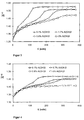
- FIG. 3 shows charging voltage curves (U) of cells with different Al (OH) 3 contents at a charging temperature of 21 ° C., 150% NC charging with C / 10.
- FIG. 4 shows charging voltage curves (U) of cells with different Al (OH) 3 contents at a charging temperature of 45 ° C., 150% NC charging with C / 10.
- the cell with an Al (OH) 3 addition according to the invention of 0.5% based on the mass of nickel hydroxide according to Example 1 has a higher final charge voltage than cells without aluminum hydroxide addition according to Comparative Example 1.
- the Ni 2+ / Ni 3+ potential is clearly at Potential of O 2 development limited, (Table 3 and Figure 3). Although the final charge voltage increases with increasing aluminum hydroxide content, the amount of charge absorbed by the electrode before reaching the final charge voltage decreases with increasing aluminum hydroxide content.
- the end-of-charge voltage increases as the temperature increases and the aluminum hydroxide content decreases from.
- An optimal cell capacity characterized by the absorbed The amount of charge before the final charge voltage is reached is given by an aluminum hydroxide content of about 0.5% based on the mass of nickel hydroxide according to Example 1.
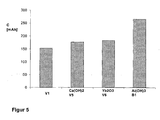
- FIG. 5 shows the influence of small amounts of different additives on the cell capacity C at the charging temperature of 45 ° C.
- the addition of Al (OH) 3 according to the invention has the greatest effect with an overall small amount of addition. If the capacity of the cells is initially around 7% lower at a charging temperature of 21 ° C. For example, the cells according to the invention have a capacity which is 45% to 74% higher at a charging temperature of 45 ° C.
Landscapes
- Chemical & Material Sciences (AREA)
- Chemical Kinetics & Catalysis (AREA)
- Electrochemistry (AREA)
- General Chemical & Material Sciences (AREA)
- Engineering & Computer Science (AREA)
- Manufacturing & Machinery (AREA)
- Inorganic Chemistry (AREA)
- Battery Electrode And Active Subsutance (AREA)
- Secondary Cells (AREA)
- Hydrogen, Water And Hydrids (AREA)
Abstract
Description
| Einfluss eines Al(OH)3-Zusatzes auf die Zellkapazität bei verschiedenen Ladetemperaturen | ||||
| m Al(OH)3/m Ni(OH)2 | Zellkapazität [mAh] | |||
| Beispiel | [%] | 21 °C | 45 °C | 60 °C |
| Vergleich 1 (V1) | 0.0 | 296.0 | 153.2 | 96.9 |
| Beispiel 1 (B1) | 0.5 | 274.5 | 265.8 | 200.0 |
| Einfluss des Al(OH)3-Gehaltes auf die Zellkapazität bei verschiedenen Ladetemperaturen | ||||
| m Al(OH)3 /m Ni(OH)2 | Zellkapazität [mAh] | |||
| Beispiel | [%] | 21 °C | 45 °C | 60 °C |
| Beispiel 1 (B1) | 0.5 | 274.5 | 265.8 | 200.0 |
| Vergleich 2 (V2) | 1.7 | 213.4 | 216.9 | 190.4 |
| Vergleich 3 (V3) | 5.3 | 91.7 | 114.9 | 130.5 |
| Vergleich 4 (V4) | 9.1 | 77.8 | 92.7 | 103.2 |
| Einfluss des Al(OH)3-Gehaltes auf die Ladeschlussspannung bei verschiedenen Ladetemperaturen | |||
| m Al(OH)3/m Ni(OH)2 | Ladeschlussspannung [V] | ||
| [%] | 21 °C | 45 °C | 60 °C |
| 0.0 | 1.468 | 1.404 | 1.364 |
| 0.5 | 1.508 | 1.453 | 1.416 |
| 1.7 | 1.509 | 1.450 | 1.412 |
| 5.3 | 1.517 | 1.461 | 1.425 |
| 9.1 | 1.527 | 1.468 | 1.399 |
| Einfluss unterschiedlicher Zusätze auf die Zellkapazität bei unterschiedlichen Ladetemperaturen, 150% NC Ladung mit C/10 | |||||
| Zellkapazität [mAh] | |||||
| Beispiele | Additiv | [%] | 21 °C | 45 °C | 60 °C |
| Vergleich 1 (V1) | kein | 0.0 | 296.0 | 153.2 | 95.9 |
| Vergleich 5 (V5) | Ca(OH)2 | 0.5 | 298.4 | 176.0 | 101.4 |
| Vergleich 6 (V6) | Yb2O3 | 0.5 | 296.7 | 183.5 | 95.4 |
| Beispiel 1 (B1) | Al(OH)3 | 0.5 | 274.5 | 265.8 | 200.0 |
Claims (6)
- Ni/Metallhydrid-Sekundärelement mit einer positiven Nickelhydroxidelektrode, einer negativen Elektrode, die eine Wasserstoffspeicherlegierung enthält, und einem alkalischen Elektrolyten, dadurch gekennzeichnet, dass die mit einem dreidimensionalen metallischen Leitgerüst versehene positive Elektrode neben Nickelhydroxid und Kobaltoxid zusätzlich eine im Elektrolyten lösliche Aluminiumverbindung enthält.
- Ni/Metallhydrid-Sekundärelement nach Anspruch 1, dadurch gekennzeichnet, dass die Aluminiumverbindung Aluminiumhydroxid und/oder Aluminiumoxid ist.
- Ni/Metallhydrid-Sekundärelement nach Anspruch 1 oder 2, dadurch gekennzeichnet, dass die Masse der in der positiven Massemischung vorhandenen Aluminiumverbindung 0.1 bis 2 Gew%, bezogen auf die Masse des vorhandenen Nickelhydroxids, beträgt.
- Ni/Metallhydrid-Sekundärelement nach Anspruch 3, dadurch gekennzeichnet, dass der Gehalt an Aluminiumhydroxid oder Aluminiumoxid zwischen 0.5 und 1.0 Gew%, bezogen auf die Masse des Nickelhydroxids, liegt.
- Ni/Metallhydrid-Sekundärelement nach einem der Ansprüche 1 bis 4, dadurch gekennzeichnet, dass die positive Elektrode in Kombination mit Aluminiumhydroxid oder Aluminiumoxid weitere oxidische Verbindungen aus der Gruppe der Lanthanoiden, Y2O3, La2O3 und Ca(OH)2 sowie Gemische dieser Verbindungen enthält.
- Ni/Metallhydrid-Sekundärelement nach Anspruch 5, dadurch gekennzeichnet, dass der Gehalt an zusätzlich zu Aluminiumhydroxid oder Aluminiumoxid beigemengten oxidischen Verbindungen 9.0 Gew%, bezogen auf die Masse des Nickelhydroxids, nicht überschreitet.
Applications Claiming Priority (2)
| Application Number | Priority Date | Filing Date | Title |
|---|---|---|---|
| DE10039833A DE10039833A1 (de) | 2000-08-16 | 2000-08-16 | Ni/Metallhydrid-Sekundärelement |
| DE10039833 | 2000-08-16 |
Publications (2)
| Publication Number | Publication Date |
|---|---|
| EP1182718A1 true EP1182718A1 (de) | 2002-02-27 |
| EP1182718B1 EP1182718B1 (de) | 2003-09-10 |
Family
ID=7652490
Family Applications (1)
| Application Number | Title | Priority Date | Filing Date |
|---|---|---|---|
| EP01116524A Expired - Lifetime EP1182718B1 (de) | 2000-08-16 | 2001-07-07 | Ni/Metallhydrid-Sekundärelement |
Country Status (5)
| Country | Link |
|---|---|
| US (1) | US6881519B2 (de) |
| EP (1) | EP1182718B1 (de) |
| AT (1) | ATE249684T1 (de) |
| DE (2) | DE10039833A1 (de) |
| ES (1) | ES2204787T3 (de) |
Cited By (1)
| Publication number | Priority date | Publication date | Assignee | Title |
|---|---|---|---|---|
| CN102956893A (zh) * | 2012-11-01 | 2013-03-06 | 浙江天能能源科技有限公司 | 一种低温镍氢电池及其制备方法 |
Families Citing this family (3)
| Publication number | Priority date | Publication date | Assignee | Title |
|---|---|---|---|---|
| KR100709205B1 (ko) * | 2001-04-02 | 2007-04-18 | 삼성에스디아이 주식회사 | 리튬 이차 전지용 양극 활물질 조성물 |
| DE10220486C1 (de) * | 2002-05-07 | 2003-09-18 | Nbt Gmbh | Alkalischer Akkumulator |
| JP5984287B2 (ja) * | 2012-05-30 | 2016-09-06 | Fdk株式会社 | アルカリ蓄電池 |
Citations (3)
| Publication number | Priority date | Publication date | Assignee | Title |
|---|---|---|---|---|
| US3342640A (en) * | 1962-12-08 | 1967-09-19 | Accumulateurs Fixes | Active electrode material for alkaline cells |
| EP0727835A1 (de) * | 1995-02-14 | 1996-08-21 | SANYO ELECTRIC Co., Ltd. | Nickelaktives Material für alkalische Speicherzellen und Herstellungsverfahren |
| JPH09204930A (ja) * | 1996-01-29 | 1997-08-05 | Toyota Autom Loom Works Ltd | ニッケル水素二次電池 |
Family Cites Families (7)
| Publication number | Priority date | Publication date | Assignee | Title |
|---|---|---|---|---|
| JP3097347B2 (ja) | 1992-09-18 | 2000-10-10 | 松下電器産業株式会社 | ニッケル・水素蓄電池 |
| DE69505911T2 (de) * | 1994-08-04 | 1999-04-08 | Sanyo Electric Co., Ltd., Moriguchi, Osaka | Aktivmasse Pulver für nichtgesinterte Nickelelektrode, nichtgesinterte Nickelelektrode für alkalische Batterie und Verfahren zu ihrer Herstellung |
| JP3351261B2 (ja) | 1996-09-30 | 2002-11-25 | 松下電器産業株式会社 | ニッケル正極とそれを用いたニッケル・水素蓄電池 |
| EP0851515A3 (de) * | 1996-12-27 | 2004-10-27 | Canon Kabushiki Kaisha | Pulvermaterial, Elektrode, Sekundärzelle und Verfahren zur Herstellung |
| JP3505953B2 (ja) | 1997-03-27 | 2004-03-15 | 松下電器産業株式会社 | ニッケル電極用活物質とそれを用いたアルカリ蓄電池用ニッケル正極 |
| JP3923157B2 (ja) | 1997-12-11 | 2007-05-30 | 松下電器産業株式会社 | アルカリ蓄電池 |
| JPH11238508A (ja) * | 1998-02-23 | 1999-08-31 | Matsushita Electric Ind Co Ltd | アルカリ蓄電池用ニッケル正極および製造方法 |
-
2000
- 2000-08-16 DE DE10039833A patent/DE10039833A1/de not_active Withdrawn
-
2001
- 2001-07-07 ES ES01116524T patent/ES2204787T3/es not_active Expired - Lifetime
- 2001-07-07 EP EP01116524A patent/EP1182718B1/de not_active Expired - Lifetime
- 2001-07-07 DE DE50100594T patent/DE50100594D1/de not_active Expired - Lifetime
- 2001-07-07 AT AT01116524T patent/ATE249684T1/de not_active IP Right Cessation
- 2001-07-20 US US09/909,497 patent/US6881519B2/en not_active Expired - Fee Related
Patent Citations (3)
| Publication number | Priority date | Publication date | Assignee | Title |
|---|---|---|---|---|
| US3342640A (en) * | 1962-12-08 | 1967-09-19 | Accumulateurs Fixes | Active electrode material for alkaline cells |
| EP0727835A1 (de) * | 1995-02-14 | 1996-08-21 | SANYO ELECTRIC Co., Ltd. | Nickelaktives Material für alkalische Speicherzellen und Herstellungsverfahren |
| JPH09204930A (ja) * | 1996-01-29 | 1997-08-05 | Toyota Autom Loom Works Ltd | ニッケル水素二次電池 |
Non-Patent Citations (1)
| Title |
|---|
| PATENT ABSTRACTS OF JAPAN vol. 1997, no. 12 25 December 1997 (1997-12-25) * |
Cited By (2)
| Publication number | Priority date | Publication date | Assignee | Title |
|---|---|---|---|---|
| CN102956893A (zh) * | 2012-11-01 | 2013-03-06 | 浙江天能能源科技有限公司 | 一种低温镍氢电池及其制备方法 |
| CN102956893B (zh) * | 2012-11-01 | 2015-02-25 | 浙江天能能源科技有限公司 | 一种低温镍氢电池及其制备方法 |
Also Published As
| Publication number | Publication date |
|---|---|
| EP1182718B1 (de) | 2003-09-10 |
| ES2204787T3 (es) | 2004-05-01 |
| US20020039682A1 (en) | 2002-04-04 |
| DE50100594D1 (de) | 2003-10-16 |
| DE10039833A1 (de) | 2002-02-28 |
| ATE249684T1 (de) | 2003-09-15 |
| US6881519B2 (en) | 2005-04-19 |
Similar Documents
| Publication | Publication Date | Title |
|---|---|---|
| DE69405098T2 (de) | Zusätze für primäre elektrochemische zellen mit mangandioxidkathoden | |
| DE60036154T2 (de) | Wiederaufladbare Spinell-Lithiumbatterien mit einer verbesserten Lebensdauer bei erhöhter Temperatur | |
| DE69712582T2 (de) | Aktives Material für die positive Elektrode alkalischer Speicherbatterien | |
| DE69309822T2 (de) | In alkalischer Speicherbatterie verwendete positive Nickelelektrode und diese Elektrode verwendende Nickel-Wasserstoff Speicherbatterie | |
| DE69712189T2 (de) | Zinkanode für elektrochemische zelle | |
| DE2912175C2 (de) | Negative Pulver-Gel-Elektrode und ihre Verwendung | |
| DE69737673T2 (de) | Nickelpositivelektrode und diese verwendende alkalische Speicherbatterie | |
| DE68912566T3 (de) | Alkalische Sammlerbatterie mit einer wasserstoffabsorbierenden Legierung. | |
| DE69110599T3 (de) | Nickel-Wasserstoff-Akkumulator und Verfahren zu seiner Herstellung. | |
| DE2738386C3 (de) | Gepreßte Nickelelektrode für galvanische Elemente | |
| DE102018107573B4 (de) | Fluoridionen-batterie | |
| DE69534897T2 (de) | Alkalische Sammlerbatterie und Verfahren zur Herstellung von Ni/Co-Hydroxid Aktivmasse für positive Elektrode | |
| DE69635695T2 (de) | Nickel positivelektrode für alkalische Speicherbatterie und gasdichte Nickel-Metallhydrid Speicherbatterie | |
| EP0204239A2 (de) | Positive Sammlerelektrode für Akkumulatoren mit alkalischem Elektrolyten | |
| EP0658948B1 (de) | Elektrischer Nickel-Metallhydrid Akkumulator mit graphitenthaltender Nickelhydroxidelektrode | |
| DE69607808T2 (de) | Nickel-Positivelektrode und alkalische Speicherbatterie diese verwendend | |
| DE69835938T2 (de) | Positives aktives Material für alkalische Speicherbatterie | |
| DE69317173T2 (de) | Pastöse Nickelelektrode für alkalische Sammlerbatterie und alkalische Sammlerbatterie | |
| DE3486180T2 (de) | Alkalische Sammlerbatterie. | |
| EP1182718B1 (de) | Ni/Metallhydrid-Sekundärelement | |
| DE69734119T2 (de) | Nickelmetallhydrid-Speicherzelle | |
| DE69936761T2 (de) | Nichtgesinterte Nickelelektrode für Sekundärbatterie mit alkalischem Elektrolyt | |
| DE60200009T2 (de) | Nickelelektrode für alkalische Sekundärbatterie und alkalische Sekundärbatterie | |
| DE69532517T2 (de) | Methode zur Herstellung einer Nickel-Metall-Hydridbatterie | |
| EP0658947A1 (de) | NI/Metallhydrid-Sekundärelement |
Legal Events
| Date | Code | Title | Description |
|---|---|---|---|
| PUAI | Public reference made under article 153(3) epc to a published international application that has entered the european phase |
Free format text: ORIGINAL CODE: 0009012 |
|
| AK | Designated contracting states |
Kind code of ref document: A1 Designated state(s): AT BE CH CY DE DK ES FI FR GB GR IE IT LI LU MC NL PT SE TR |
|
| AX | Request for extension of the european patent |
Free format text: AL;LT;LV;MK;RO;SI |
|
| 17P | Request for examination filed |
Effective date: 20020301 |
|
| 17Q | First examination report despatched |
Effective date: 20020517 |
|
| AKX | Designation fees paid |
Free format text: AT BE CH CY DE DK ES FI FR GB GR IE IT LI LU MC NL PT SE TR |
|
| GRAH | Despatch of communication of intention to grant a patent |
Free format text: ORIGINAL CODE: EPIDOS IGRA |
|
| GRAS | Grant fee paid |
Free format text: ORIGINAL CODE: EPIDOSNIGR3 |
|
| GRAA | (expected) grant |
Free format text: ORIGINAL CODE: 0009210 |
|
| RAP1 | Party data changed (applicant data changed or rights of an application transferred) |
Owner name: VARTA AUTOMOTIVE GMBH |
|
| AK | Designated contracting states |
Kind code of ref document: B1 Designated state(s): AT BE CH CY DE DK ES FI FR GB GR IE IT LI LU MC NL PT SE TR |
|
| PG25 | Lapsed in a contracting state [announced via postgrant information from national office to epo] |
Ref country code: TR Free format text: LAPSE BECAUSE OF FAILURE TO SUBMIT A TRANSLATION OF THE DESCRIPTION OR TO PAY THE FEE WITHIN THE PRESCRIBED TIME-LIMIT Effective date: 20030910 Ref country code: NL Free format text: LAPSE BECAUSE OF FAILURE TO SUBMIT A TRANSLATION OF THE DESCRIPTION OR TO PAY THE FEE WITHIN THE PRESCRIBED TIME-LIMIT Effective date: 20030910 Ref country code: FI Free format text: LAPSE BECAUSE OF FAILURE TO SUBMIT A TRANSLATION OF THE DESCRIPTION OR TO PAY THE FEE WITHIN THE PRESCRIBED TIME-LIMIT Effective date: 20030910 Ref country code: CY Free format text: LAPSE BECAUSE OF FAILURE TO SUBMIT A TRANSLATION OF THE DESCRIPTION OR TO PAY THE FEE WITHIN THE PRESCRIBED TIME-LIMIT Effective date: 20030910 Ref country code: IE Free format text: LAPSE BECAUSE OF FAILURE TO SUBMIT A TRANSLATION OF THE DESCRIPTION OR TO PAY THE FEE WITHIN THE PRESCRIBED TIME-LIMIT Effective date: 20030910 |
|
| REG | Reference to a national code |
Ref country code: GB Ref legal event code: FG4D Free format text: NOT ENGLISH |
|
| REG | Reference to a national code |
Ref country code: CH Ref legal event code: EP |
|
| GBT | Gb: translation of ep patent filed (gb section 77(6)(a)/1977) | ||
| REF | Corresponds to: |
Ref document number: 50100594 Country of ref document: DE Date of ref document: 20031016 Kind code of ref document: P |
|
| REG | Reference to a national code |
Ref country code: IE Ref legal event code: FG4D Free format text: GERMAN |
|
| PG25 | Lapsed in a contracting state [announced via postgrant information from national office to epo] |
Ref country code: GR Free format text: LAPSE BECAUSE OF FAILURE TO SUBMIT A TRANSLATION OF THE DESCRIPTION OR TO PAY THE FEE WITHIN THE PRESCRIBED TIME-LIMIT Effective date: 20031210 Ref country code: DK Free format text: LAPSE BECAUSE OF FAILURE TO SUBMIT A TRANSLATION OF THE DESCRIPTION OR TO PAY THE FEE WITHIN THE PRESCRIBED TIME-LIMIT Effective date: 20031210 Ref country code: SE Free format text: LAPSE BECAUSE OF FAILURE TO SUBMIT A TRANSLATION OF THE DESCRIPTION OR TO PAY THE FEE WITHIN THE PRESCRIBED TIME-LIMIT Effective date: 20031210 |
|
| PG25 | Lapsed in a contracting state [announced via postgrant information from national office to epo] |
Ref country code: PT Free format text: LAPSE BECAUSE OF FAILURE TO SUBMIT A TRANSLATION OF THE DESCRIPTION OR TO PAY THE FEE WITHIN THE PRESCRIBED TIME-LIMIT Effective date: 20031219 |
|
| NLV1 | Nl: lapsed or annulled due to failure to fulfill the requirements of art. 29p and 29m of the patents act | ||
| REG | Reference to a national code |
Ref country code: IE Ref legal event code: FD4D |
|
| REG | Reference to a national code |
Ref country code: ES Ref legal event code: FG2A Ref document number: 2204787 Country of ref document: ES Kind code of ref document: T3 |
|
| ET | Fr: translation filed | ||
| PG25 | Lapsed in a contracting state [announced via postgrant information from national office to epo] |
Ref country code: AT Free format text: LAPSE BECAUSE OF NON-PAYMENT OF DUE FEES Effective date: 20040707 Ref country code: LU Free format text: LAPSE BECAUSE OF NON-PAYMENT OF DUE FEES Effective date: 20040707 |
|
| PLBE | No opposition filed within time limit |
Free format text: ORIGINAL CODE: 0009261 |
|
| STAA | Information on the status of an ep patent application or granted ep patent |
Free format text: STATUS: NO OPPOSITION FILED WITHIN TIME LIMIT |
|
| PG25 | Lapsed in a contracting state [announced via postgrant information from national office to epo] |
Ref country code: BE Free format text: LAPSE BECAUSE OF NON-PAYMENT OF DUE FEES Effective date: 20040731 Ref country code: MC Free format text: LAPSE BECAUSE OF NON-PAYMENT OF DUE FEES Effective date: 20040731 |
|
| 26N | No opposition filed |
Effective date: 20040614 |
|
| BERE | Be: lapsed |
Owner name: *VARTA AUTOMOTIVE G.M.B.H. Effective date: 20040731 |
|
| PG25 | Lapsed in a contracting state [announced via postgrant information from national office to epo] |
Ref country code: LI Free format text: LAPSE BECAUSE OF NON-PAYMENT OF DUE FEES Effective date: 20050731 Ref country code: CH Free format text: LAPSE BECAUSE OF NON-PAYMENT OF DUE FEES Effective date: 20050731 |
|
| REG | Reference to a national code |
Ref country code: CH Ref legal event code: PL |
|
| REG | Reference to a national code |
Ref country code: FR Ref legal event code: CD |
|
| PGFP | Annual fee paid to national office [announced via postgrant information from national office to epo] |
Ref country code: ES Payment date: 20070725 Year of fee payment: 7 |
|
| BERE | Be: lapsed |
Owner name: *VARTA AUTOMOTIVE G.M.B.H. Effective date: 20040731 |
|
| PGFP | Annual fee paid to national office [announced via postgrant information from national office to epo] |
Ref country code: IT Payment date: 20070726 Year of fee payment: 7 |
|
| PGFP | Annual fee paid to national office [announced via postgrant information from national office to epo] |
Ref country code: GB Payment date: 20080723 Year of fee payment: 8 |
|
| PG25 | Lapsed in a contracting state [announced via postgrant information from national office to epo] |
Ref country code: IT Free format text: LAPSE BECAUSE OF NON-PAYMENT OF DUE FEES Effective date: 20080707 |
|
| REG | Reference to a national code |
Ref country code: ES Ref legal event code: FD2A Effective date: 20080708 |
|
| PG25 | Lapsed in a contracting state [announced via postgrant information from national office to epo] |
Ref country code: ES Free format text: LAPSE BECAUSE OF NON-PAYMENT OF DUE FEES Effective date: 20080708 |
|
| GBPC | Gb: european patent ceased through non-payment of renewal fee |
Effective date: 20090707 |
|
| PG25 | Lapsed in a contracting state [announced via postgrant information from national office to epo] |
Ref country code: GB Free format text: LAPSE BECAUSE OF NON-PAYMENT OF DUE FEES Effective date: 20090707 |
|
| PGFP | Annual fee paid to national office [announced via postgrant information from national office to epo] |
Ref country code: FR Payment date: 20100805 Year of fee payment: 10 Ref country code: DE Payment date: 20100825 Year of fee payment: 10 |
|
| REG | Reference to a national code |
Ref country code: FR Ref legal event code: ST Effective date: 20120330 |
|
| PG25 | Lapsed in a contracting state [announced via postgrant information from national office to epo] |
Ref country code: FR Free format text: LAPSE BECAUSE OF NON-PAYMENT OF DUE FEES Effective date: 20110801 Ref country code: DE Free format text: LAPSE BECAUSE OF NON-PAYMENT OF DUE FEES Effective date: 20120201 |
|
| REG | Reference to a national code |
Ref country code: DE Ref legal event code: R119 Ref document number: 50100594 Country of ref document: DE Effective date: 20120201 |