EP1177108B1 - Holzgefasster stift für schreib-, mal-, zeichen- und kosmetikzwecke - Google Patents
Holzgefasster stift für schreib-, mal-, zeichen- und kosmetikzwecke Download PDFInfo
- Publication number
- EP1177108B1 EP1177108B1 EP99965421A EP99965421A EP1177108B1 EP 1177108 B1 EP1177108 B1 EP 1177108B1 EP 99965421 A EP99965421 A EP 99965421A EP 99965421 A EP99965421 A EP 99965421A EP 1177108 B1 EP1177108 B1 EP 1177108B1
- Authority
- EP
- European Patent Office
- Prior art keywords
- pencil
- polymer dispersion
- plastic composition
- raised structures
- structures
- Prior art date
- Legal status (The legal status is an assumption and is not a legal conclusion. Google has not performed a legal analysis and makes no representation as to the accuracy of the status listed.)
- Revoked
Links
- 239000002537 cosmetic Substances 0.000 title claims description 3
- 238000004040 coloring Methods 0.000 title 1
- 239000002023 wood Substances 0.000 title 1
- 229920003023 plastic Polymers 0.000 claims abstract description 29
- 239000004033 plastic Substances 0.000 claims abstract description 29
- 239000004815 dispersion polymer Substances 0.000 claims abstract description 12
- 239000000203 mixture Substances 0.000 claims abstract description 11
- XLYOFNOQVPJJNP-UHFFFAOYSA-N water Substances O XLYOFNOQVPJJNP-UHFFFAOYSA-N 0.000 claims abstract description 5
- 230000009969 flowable effect Effects 0.000 claims abstract description 4
- 239000000470 constituent Substances 0.000 claims abstract 2
- 239000006185 dispersion Substances 0.000 claims description 12
- 239000002562 thickening agent Substances 0.000 claims description 10
- 239000000945 filler Substances 0.000 claims description 9
- 239000004814 polyurethane Substances 0.000 claims description 6
- 229920000642 polymer Polymers 0.000 claims description 5
- 229920001577 copolymer Polymers 0.000 claims description 4
- 239000000463 material Substances 0.000 claims description 4
- 229920002635 polyurethane Polymers 0.000 claims description 4
- 239000007787 solid Substances 0.000 claims description 3
- 239000004793 Polystyrene Substances 0.000 claims description 2
- 229920000058 polyacrylate Polymers 0.000 claims description 2
- 229920002223 polystyrene Polymers 0.000 claims description 2
- 229920002689 polyvinyl acetate Polymers 0.000 claims description 2
- 239000011118 polyvinyl acetate Substances 0.000 claims description 2
- 229920002994 synthetic fiber Polymers 0.000 abstract 1
- 239000003795 chemical substances by application Substances 0.000 description 7
- DNIAPMSPPWPWGF-UHFFFAOYSA-N Propylene glycol Chemical compound CC(O)CO DNIAPMSPPWPWGF-UHFFFAOYSA-N 0.000 description 6
- PPBRXRYQALVLMV-UHFFFAOYSA-N Styrene Chemical compound C=CC1=CC=CC=C1 PPBRXRYQALVLMV-UHFFFAOYSA-N 0.000 description 4
- TZCXTZWJZNENPQ-UHFFFAOYSA-L barium sulfate Chemical compound [Ba+2].[O-]S([O-])(=O)=O TZCXTZWJZNENPQ-UHFFFAOYSA-L 0.000 description 4
- 239000000049 pigment Substances 0.000 description 4
- NIXOWILDQLNWCW-UHFFFAOYSA-M Acrylate Chemical compound [O-]C(=O)C=C NIXOWILDQLNWCW-UHFFFAOYSA-M 0.000 description 3
- 238000001035 drying Methods 0.000 description 3
- 239000005995 Aluminium silicate Substances 0.000 description 2
- VTYYLEPIZMXCLO-UHFFFAOYSA-L Calcium carbonate Chemical compound [Ca+2].[O-]C([O-])=O VTYYLEPIZMXCLO-UHFFFAOYSA-L 0.000 description 2
- 206010000496 acne Diseases 0.000 description 2
- 235000012211 aluminium silicate Nutrition 0.000 description 2
- 239000011248 coating agent Substances 0.000 description 2
- 238000000576 coating method Methods 0.000 description 2
- NLYAJNPCOHFWQQ-UHFFFAOYSA-N kaolin Chemical compound O.O.O=[Al]O[Si](=O)O[Si](=O)O[Al]=O NLYAJNPCOHFWQQ-UHFFFAOYSA-N 0.000 description 2
- 239000004922 lacquer Substances 0.000 description 2
- 238000000034 method Methods 0.000 description 2
- 239000010445 mica Substances 0.000 description 2
- 229910052618 mica group Inorganic materials 0.000 description 2
- 230000002093 peripheral effect Effects 0.000 description 2
- 229920000570 polyether Polymers 0.000 description 2
- 230000003655 tactile properties Effects 0.000 description 2
- 239000000454 talc Substances 0.000 description 2
- 235000012222 talc Nutrition 0.000 description 2
- 229910052623 talc Inorganic materials 0.000 description 2
- 239000000080 wetting agent Substances 0.000 description 2
- POAOYUHQDCAZBD-UHFFFAOYSA-N 2-butoxyethanol Chemical compound CCCCOCCO POAOYUHQDCAZBD-UHFFFAOYSA-N 0.000 description 1
- 206010016322 Feeling abnormal Diseases 0.000 description 1
- 229920005921 JONCRYL® 537 Polymers 0.000 description 1
- 239000004698 Polyethylene Substances 0.000 description 1
- 239000004721 Polyphenylene oxide Substances 0.000 description 1
- 239000004743 Polypropylene Substances 0.000 description 1
- 229920002125 Sokalan® Polymers 0.000 description 1
- 229920013802 TRITON CF-10 Polymers 0.000 description 1
- GWEVSGVZZGPLCZ-UHFFFAOYSA-N Titan oxide Chemical compound O=[Ti]=O GWEVSGVZZGPLCZ-UHFFFAOYSA-N 0.000 description 1
- YKTSYUJCYHOUJP-UHFFFAOYSA-N [O--].[Al+3].[Al+3].[O-][Si]([O-])([O-])[O-] Chemical compound [O--].[Al+3].[Al+3].[O-][Si]([O-])([O-])[O-] YKTSYUJCYHOUJP-UHFFFAOYSA-N 0.000 description 1
- 125000005396 acrylic acid ester group Chemical group 0.000 description 1
- NIXOWILDQLNWCW-UHFFFAOYSA-N acrylic acid group Chemical group C(C=C)(=O)O NIXOWILDQLNWCW-UHFFFAOYSA-N 0.000 description 1
- 125000000129 anionic group Chemical group 0.000 description 1
- 235000012216 bentonite Nutrition 0.000 description 1
- 229910000019 calcium carbonate Inorganic materials 0.000 description 1
- 239000003086 colorant Substances 0.000 description 1
- 150000001875 compounds Chemical class 0.000 description 1
- XCJYREBRNVKWGJ-UHFFFAOYSA-N copper(II) phthalocyanine Chemical compound [Cu+2].C12=CC=CC=C2C(N=C2[N-]C(C3=CC=CC=C32)=N2)=NC1=NC([C]1C=CC=CC1=1)=NC=1N=C1[C]3C=CC=CC3=C2[N-]1 XCJYREBRNVKWGJ-UHFFFAOYSA-N 0.000 description 1
- 239000013530 defoamer Substances 0.000 description 1
- 230000009189 diving Effects 0.000 description 1
- 238000009472 formulation Methods 0.000 description 1
- 125000000524 functional group Chemical group 0.000 description 1
- 239000007788 liquid Substances 0.000 description 1
- 239000002184 metal Substances 0.000 description 1
- 229910052751 metal Inorganic materials 0.000 description 1
- 239000000178 monomer Substances 0.000 description 1
- 238000010422 painting Methods 0.000 description 1
- 239000004014 plasticizer Substances 0.000 description 1
- 229920000728 polyester Polymers 0.000 description 1
- 229920005862 polyol Polymers 0.000 description 1
- 150000003077 polyols Chemical class 0.000 description 1
- -1 polypropylene Polymers 0.000 description 1
- 229920001155 polypropylene Polymers 0.000 description 1
- 239000004810 polytetrafluoroethylene Substances 0.000 description 1
- 229920001343 polytetrafluoroethylene Polymers 0.000 description 1
- 229920003009 polyurethane dispersion Polymers 0.000 description 1
- 229920005749 polyurethane resin Polymers 0.000 description 1
- 238000002360 preparation method Methods 0.000 description 1
- 230000002035 prolonged effect Effects 0.000 description 1
- HXHCOXPZCUFAJI-UHFFFAOYSA-N prop-2-enoic acid;styrene Chemical compound OC(=O)C=C.C=CC1=CC=CC=C1 HXHCOXPZCUFAJI-UHFFFAOYSA-N 0.000 description 1
- 238000007650 screen-printing Methods 0.000 description 1
- 238000007711 solidification Methods 0.000 description 1
- 230000008023 solidification Effects 0.000 description 1
- 238000005507 spraying Methods 0.000 description 1
- 239000004094 surface-active agent Substances 0.000 description 1
- 235000010215 titanium dioxide Nutrition 0.000 description 1
- 231100000027 toxicology Toxicity 0.000 description 1
- UJMBCXLDXJUMFB-UHFFFAOYSA-K trisodium;5-oxo-1-(4-sulfonatophenyl)-4-[(4-sulfonatophenyl)diazenyl]-4h-pyrazole-3-carboxylate Chemical compound [Na+].[Na+].[Na+].[O-]C(=O)C1=NN(C=2C=CC(=CC=2)S([O-])(=O)=O)C(=O)C1N=NC1=CC=C(S([O-])(=O)=O)C=C1 UJMBCXLDXJUMFB-UHFFFAOYSA-K 0.000 description 1
- 239000001993 wax Substances 0.000 description 1
Images
Classifications
-
- A—HUMAN NECESSITIES
- A45—HAND OR TRAVELLING ARTICLES
- A45D—HAIRDRESSING OR SHAVING EQUIPMENT; EQUIPMENT FOR COSMETICS OR COSMETIC TREATMENTS, e.g. FOR MANICURING OR PEDICURING
- A45D40/00—Casings or accessories specially adapted for storing or handling solid or pasty toiletry or cosmetic substances, e.g. shaving soaps or lipsticks
- A45D40/20—Pencil-like cosmetics; Simple holders for handling stick-shaped cosmetics or shaving soap while in use
-
- B—PERFORMING OPERATIONS; TRANSPORTING
- B43—WRITING OR DRAWING IMPLEMENTS; BUREAU ACCESSORIES
- B43K—IMPLEMENTS FOR WRITING OR DRAWING
- B43K23/00—Holders or connectors for writing implements; Means for protecting the writing-points
- B43K23/008—Holders comprising finger grips
-
- B—PERFORMING OPERATIONS; TRANSPORTING
- B43—WRITING OR DRAWING IMPLEMENTS; BUREAU ACCESSORIES
- B43K—IMPLEMENTS FOR WRITING OR DRAWING
- B43K5/00—Pens with ink reservoirs in holders, e.g. fountain-pens
- B43K5/005—Pen barrels
Definitions
- the invention relates to a wood-framed pen for writing, painting, drawing and cosmetic purposes.
- Such pens usually have a wooden jacket in which a lead is centrally stored.
- the term pens should also be understood to mean pen-shaped holders for mines.
- Wood-covered pencils usually have smooth surfaces formed by a lacquer coating. Holding the pen is therefore associated with a greater effort, which is tiring with prolonged use.
- JP 9-39467 discloses a sleeve made of plastic or metal and forming the tip-near region of a pen-shaped applicator device, on the peripheral surface of which there are raised structures. These consist of a polyurethane resin and are applied to the sleeve surface using the screen printing process.
- the object of the invention is to propose a wood-cased pen of the type mentioned, which is improved in ergonomic terms.
- a pen in which the for Handling surface Grip surfaces or knobs has forming raised structures made of a plastic material. Due to the protruding from the pin peripheral surface Structures can, on the one hand, increase the diameter of the pin without the pin 's sharpness in the normalized pointed cones of common sharpeners becomes. This is especially true in the case of hexagonal pins which the raised structures on the flattened surface areas are arranged. On the other hand, the grip the presence of the sublime Structures increased, another improvement in grip as well as the tactile properties can be correspondingly Reach plastic material.
- the sublime structures with which preferably at least the front third the pen is provided, are in the form of an initially flowable Plastic compound applied to the surface of the pen, whereby the plastic mass then solidifies or solidifies is.
- the plastic mass is an aqueous, water-resistant polymer dispersion or a mixture of such dispersions.
- dispersions which contain a polymer or copolymer from the group consisting of polyurethane, polyacrylate, polystyrene, polyvinyl acetate and polyester polyurethane.
- Such dispersions or polymers can generally be solidified by simple drying.
- the polymers mentioned contain UV-crosslinkable functional groups. Solidification of the plastic mass is then possible in a relatively short time.
- the viscosity of the initially liquid plastic mass can be adjusted using thickeners and also fillers.
- the solids content of the polymer dispersions is preferably in a range from 30 to 65% by weight with such dispersions can be achieved by varying the filler and thickener content both the viscosity of the starting plastic mass and also adjust the consistency of the later sublime structures.
- Kaolin talcum barium sulfate is preferably used as filler, Titanium white, calcium carbonate and mica are used.
- fillers are advantageous with which the flexibility, elasticity, porosity and tactile properties let the sublime structures vary.
- Such fillers are in particular aluminum silicate hollow spheres, expanded hollow balls, PU soft feeling balls, micronized plastics such as polypropylene or PTFE, and PE waxes.
- pigment preparations are used as colorants Pigment contents between 15 and 75% by weight are considered.
- the viscosity the aqueous starting plastic mass which from the desired height of the raised structures and the type of depends on the application device used, is below of 40,000 mPa x s (25 ° C, spindle 64, 25 RPM, Brookfield).
- Associative thickeners such as PU polyethers are preferably used as thickeners and, polyether polyols are used. But are possible also non-associative thickeners, those based on acrylate and other thickeners such as modified bentonites.
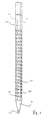
- Fig. 1 shows a pencil with a wooden casing 1 and a pencil lead 2.
- the Pen has a hexagonal outline shape. Stand by the individual hexagon surfaces 3 Knobs 4 emerge essentially in the radial direction.
- other structures can also be applied to the pen surface, for example in Strip-like structures extending in the longitudinal direction of the pin. It is also conceivable that the raised structure extends in a ring around the pin circumference.
- the sublime Structures or knobs 4 can both on an uncolored wooden surface and be applied to a lacquer coating.
- the acrylate dispersion is composed of 15% by weight STX-1532 and 40% Joncryl 537. Both dispersions are sold by Johnson. Such Plastic mass was applied to three of the hexagon grip surfaces in a hexagonal pin rolled up to a thickness of about 0.2 mm.
- the acrylic styrene dispersion is a dispersion based on a modified anionic Acrylate-styrene copolymer, and is available under the name NeoCryl XK-70 from the Zeneca company available.
- NeoCryl XK-70 from the Zeneca company available.
- With the specified plastic mass was a painted Wooden pencil completely sprayed on two thirds of its length. This process was repeated after each drying of the previous layer. In this way a grip zone with a thickness of approx. 0.5 mm was reached. Instead of spraying
- the grip zone can also be created by using the pen with its front area is dipped in the plastic mass. In order to achieve greater layer thicknesses a multiple diving expedient.
- the above recipe is an example of a red colored plastic mass based an aqueous, free of plasticizers, low residual monomer, finely dispersed copolymer dispersions from acrylic acid esters and styrene.
- the plastic dispersion has a solids content of approx. 50% and a pH between 6.5 and 8%. With the plastic mass was oval-shaped nubs on wood-framed through slit-shaped nozzles Pens applied.
Landscapes
- Engineering & Computer Science (AREA)
- Mechanical Engineering (AREA)
- Paints Or Removers (AREA)
- Inks, Pencil-Leads, Or Crayons (AREA)
- Cosmetics (AREA)
- Mechanical Pencils And Projecting And Retracting Systems Therefor, And Multi-System Writing Instruments (AREA)
- Compositions Of Macromolecular Compounds (AREA)
Description
| Acrylatdispersion | 55 % |
| Wasser | 29,8 % |
| Pigmentblue 15:1, C. 1.74160 | 8 % |
| (Luconyl G blau 6900; BASF AG) | |
| Propylenglykol | 5 % |
| Verdickungsmittel: Rheolate 420 | 1,7 % |
| (RHEOX Europe NV/SA) | |
| Tensid: FC 171 (3M) | 0,5 % |
| Entschäumungsmittel: Foamex N (Tego) | 0,2 % |
| Acrylat-Styrol-Polymerdispersion | 90 % |
| Verlaufshilfsmittel: | |
| Butylglykol | 4,8 % |
| Glimmer | 3 % |
| Talkum | 2 % |
| Entschäumungsmittel: | |
| Foamex N (Tego) | 0,2 % |
| Polyurethandispersion | 66 % |
| Kaolin | 20 % |
| Pigment Yellow 74, C. I. 11741 | 6,4 % |
| (Levanyl Gelb 5 GXLF (BAYER AG) | |
| Dispergier- und Verlaufshilfsmittel: | |
| Sokalan PA 15 (BASF AG) | 3,4 % |
| Netzmittel: | |
| Agitan 285 (Münzing-Chemie) | 3 % |
| Verdickungsmittel: | |
| Rheolate 205 (RHEOX Europe NV/SA) | 0,6 % |
| Entschäumungsmittel: | |
| T 4202 (Drew) | 0,3 % |
| Foamex N (Tego) | 0,3 %. |
| Polymerdispersion | 46 % |
| Wasser | 15 % |
| Bariumsulfat | 13 % |
| Pigment Red 112, C. I. 12370 | |
| (Sandospers Rot E-GRS der Clariant AG) | 10 % |
| weiterer Füllstoff: | |
| Propyltex 100 S (Micropowders Inc.) | 8 % |
| Verlaufshilfsmittel: | |
| Propylenglykol | 5,8% |
| Verdickungsmittel: | |
| Rheolate 420 (RHEOX, Europe NV/SA) | 1 % |
| Netzmittel: | |
| Triton CF-10 (Union-Carbide Corp.) | 1 % |
| Entschäumungsmittel: | |
| Foamex N (Tego) | 0,2% |
Claims (8)
- Holzgefasster Stift für Schreib-, Mal-, Zeichen- und Kosmetikzwecke, von dessen der Handhabung dienenden Oberfläche Griffflächen oder Griffnoppen bildende erhabene Strukturen aus einem Kunststoffmaterial vorstehen, die in Form einer zunächst fließfähigen, später zu den erhabenen Strukturen verfestigenden Kunststoffmasse aufgebracht sind,
dadurch gekennzeichnet, dass die Kunststoffmasse als Hauptbestandteil eine wässrige, wasserfest erhärtende Polymerdispersion oder eine Mischung solcher Dispersionen enthält. - Stift nach Anspruch 1,
gekennzeichnet durch
eine Polymerdispersion mit wenigstens einem Polymer oder Copolymer aus der Gruppe Polyurethan, Polyacrylat, Polystyrol, Polyvinylacetat und Polyesterpolyurethan. - Stift nach Anspruch 1 oder 2
gekennzeichnet durch
eine UV-vernetzbare Polymerdispersion. - Stift nach einem der Ansprüche 1 bis 3,
dadurch gekennzeichnet, dass die Polymerdispersion wenigstens einen Verdicker enthält. - Stift nach einem der Ansprüche 1 bis 4,
dadurch gekennzeichnet, dass die Polymerdispersion wenigstens einen Füllstoff enthält. - Stift nach einem der Ansprüche 1 bis 5,
gekennzeichnet durch
eine Polymerdispersion mit einen Feststoffgehalt von 30 bis 65 Gew.%. - Stift nach Anspruch 6,
dadurch gekennzeichnet, dass die Kunststoffmasse im nicht erhärteten Ausgangszustand 30 bis 95 Gew.% Polymerdispersion und als Rest Füllund Hilfsstoffe enthält. - Stift nach Anspruch 7
gekennzeichnet durch folgende Zusammensetzung (Gew.%) der
nicht erhärteten Kunststoffmasse:Polymerdispersion 40 bis 90 % Füllstoff 0 bis 40 % Hilfsstoffe Rest.
Applications Claiming Priority (5)
| Application Number | Priority Date | Filing Date | Title |
|---|---|---|---|
| DE29908127 | 1999-05-07 | ||
| DE29908127U | 1999-05-07 | ||
| DE29908890U | 1999-05-20 | ||
| DE29908890U DE29908890U1 (de) | 1999-05-07 | 1999-05-20 | Holzgefasster Stift für Schreib-, Mal-, Zeichen- und Kosmetikzwecke |
| PCT/EP1999/009323 WO2000068023A1 (de) | 1999-05-07 | 1999-12-01 | Holzgefasster stift für schreib-, mal-, zeichen- und kosmetikzwecke |
Publications (2)
| Publication Number | Publication Date |
|---|---|
| EP1177108A1 EP1177108A1 (de) | 2002-02-06 |
| EP1177108B1 true EP1177108B1 (de) | 2003-05-02 |
Family
ID=26062482
Family Applications (1)
| Application Number | Title | Priority Date | Filing Date |
|---|---|---|---|
| EP99965421A Revoked EP1177108B1 (de) | 1999-05-07 | 1999-12-01 | Holzgefasster stift für schreib-, mal-, zeichen- und kosmetikzwecke |
Country Status (11)
| Country | Link |
|---|---|
| US (1) | US6461067B1 (de) |
| EP (1) | EP1177108B1 (de) |
| JP (1) | JP3926988B2 (de) |
| CN (1) | CN1221408C (de) |
| AT (1) | ATE238915T1 (de) |
| AU (1) | AU760155B2 (de) |
| BR (1) | BR9917287A (de) |
| CZ (1) | CZ299958B6 (de) |
| ES (1) | ES2196908T3 (de) |
| TW (1) | TW559598B (de) |
| WO (1) | WO2000068023A1 (de) |
Cited By (4)
| Publication number | Priority date | Publication date | Assignee | Title |
|---|---|---|---|---|
| US6837637B1 (en) | 2003-09-12 | 2005-01-04 | Faber-Castell Ag | Wood-encased pencil for writing, sketching, drawing, and cosmetic purposes |
| DE202009014620U1 (de) | 2008-11-05 | 2010-03-25 | Faber-Castell Ag | Stift |
| US7909525B2 (en) | 2005-11-11 | 2011-03-22 | Faber-Castell Ag | Article, in particular a writing implement, having a gripping zone with raised structures |
| US8349411B2 (en) | 2008-04-17 | 2013-01-08 | Faber-Castell Ag | Method for producing raised structures on the surface of a pencil |
Families Citing this family (30)
| Publication number | Priority date | Publication date | Assignee | Title |
|---|---|---|---|---|
| KR100416068B1 (ko) * | 2001-02-13 | 2004-01-24 | 이경식 | 사출성형용 수지 조성물 |
| DE10119292A1 (de) * | 2001-04-19 | 2002-10-31 | Faber Castell Ag | Puderstift |
| US20040086318A1 (en) * | 2002-10-30 | 2004-05-06 | Geddes William Thomas | Unique writing instrument |
| US7025519B2 (en) * | 2002-10-30 | 2006-04-11 | Raymond Geddes & Company, Inc. | Unique writing instrument |
| BR0304184A (pt) * | 2003-09-19 | 2005-05-10 | A W Faber Castell S A | Processo de fabricação de lápis e lápis |
| DE10348070B3 (de) * | 2003-10-13 | 2005-02-24 | Faber-Castell Ag | Holzgefasster Stift für Schreib-, Mal-, Zeichen- oder Kosmetikzwecke |
| JP2005342906A (ja) * | 2004-05-31 | 2005-12-15 | Mitsubishi Pencil Co Ltd | 鉛筆軸の塗膜形成方法及び鉛筆 |
| US20070275251A1 (en) * | 2006-05-26 | 2007-11-29 | Yung-Shou Chen | Uv-treated wooden tool handle |
| EP1862225B1 (de) * | 2006-06-01 | 2013-07-10 | Faber-Castell AG | Stift mit einer spitzbaren Umhüllung und einer auf der Stiftoberfläche vorhandenen Griffzone |
| DE102007062556A1 (de) | 2006-12-29 | 2008-07-03 | Gaydoul, Karl Dieter | Stiftförmiger Gegenstand mit Griffelementen |
| USD586854S1 (en) * | 2007-04-27 | 2009-02-17 | Beifa Group Co., Ltd. | Pen |
| EP2008724A1 (de) * | 2007-06-26 | 2008-12-31 | Faber-Castell AG | Griffzonen aus Siliconkautschuk für Schreib-, Mal-, Zeichen- und Sportgeräte |
| DE202007009013U1 (de) | 2007-06-26 | 2008-11-06 | Faber-Castell Ag | Griffzonen aus Silikonkautschuk für Schreib-, Mal-, Zeichen- und Sportgeräte |
| CA127309S (en) * | 2008-02-14 | 2009-07-07 | Johann Froescheis Lyra Bleistift Fabrik Gmbh & Co Kg | Pen |
| DE202008006230U1 (de) | 2008-04-17 | 2009-08-27 | Faber-Castell Ag | Kunststoffzubereitung zur Erzeugung erhabener Strukturen auf der Oberfläche eines Stiftes |
| DE102010030539A1 (de) | 2010-06-25 | 2011-12-29 | Faber-Castell Ag | Verfahren zur Herstellung eines Stiftes mit einem aus Kunststoff bestehenden, erhaben aus seiner Oberfläche vorstehende Strukturen aufweisenden Schaft |
| EP2684705B1 (de) | 2012-07-13 | 2018-10-31 | Faber-Castell AG | Stift |
| DE202012012634U1 (de) | 2012-07-13 | 2013-07-05 | Faber-Castell Ag | Stift |
| US12005614B2 (en) * | 2018-08-21 | 2024-06-11 | Timothy McKenzie | Method of making pen body resin rods |
| US10406849B1 (en) | 2019-02-07 | 2019-09-10 | Khaled A. M. A. A. Al-Khulaifi | Training pen for writing |
| CN211441697U (zh) * | 2019-05-23 | 2020-09-08 | 斯特比洛国际公司 | 能削尖的笔 |
| JP7306686B2 (ja) * | 2019-07-23 | 2023-07-11 | 株式会社トンボ鉛筆 | 鉛筆トップコート用塗料組成物 |
| USD914091S1 (en) * | 2019-08-14 | 2021-03-23 | Staedtler Mars Gmbh & Co. Kg | Fountain pen |
| USD914093S1 (en) * | 2019-08-14 | 2021-03-23 | Staedtler Mars Gmbh & Co. Kg | Fountain pen |
| USD914092S1 (en) * | 2019-08-14 | 2021-03-23 | Staedtler Mars Gmbh & Co. Kg | Pencil |
| USD931935S1 (en) * | 2020-01-28 | 2021-09-28 | Staedtler Mars Gmbh & Co. Kg | Writing and drawing instrument |
| USD932547S1 (en) * | 2020-01-28 | 2021-10-05 | Staedtler Mars Gmbh & Co. Kg | Writing and drawing instrument |
| USD931936S1 (en) * | 2020-01-28 | 2021-09-28 | Staedtler Mars Gmbh & Co. Kg | Writing and drawing instrument |
| USD913373S1 (en) * | 2020-02-17 | 2021-03-16 | Pagani Pens Sa | Pen |
| USD934342S1 (en) * | 2021-03-08 | 2021-10-26 | elago CO. LTD | Cover for stylus pen |
Family Cites Families (7)
| Publication number | Priority date | Publication date | Assignee | Title |
|---|---|---|---|---|
| DE3406522A1 (de) * | 1984-02-11 | 1985-09-12 | Pelikan Ag, 3000 Hannover | Gehaeuse fuer von hand gehaltene geraete, insbesondere schreibgeraete |
| DE3406521C2 (de) * | 1984-02-23 | 1986-01-02 | Pelikan Ag, 3000 Hannover | Verfahren zur Herstellung eines Gehäuses für Geräte des täglichen Bedarfs |
| DE8714810U1 (de) * | 1987-11-03 | 1988-01-14 | Hermann Böhler GmbH, 6915 Dossenheim | Schreibgerät, insbesondere Füllfederhalter, mit Hartkunststoffmundstück, das mit einem Antirutschprofil versehen ist |
| US5173526A (en) * | 1991-04-26 | 1992-12-22 | Air Products And Chemicals, Inc. | Aqueous polyurethane-vinyl polymer dispersions for coating applications |
| JP3455932B2 (ja) * | 1995-01-30 | 2003-10-14 | ぺんてる株式会社 | 筆記具、塗布具における滑り止め |
| JPH0939467A (ja) * | 1995-07-26 | 1997-02-10 | Pentel Kk | 弾性凹凸パターンを有する軸体 |
| US5735622A (en) * | 1995-12-14 | 1998-04-07 | Pentech International Inc. | Writing instrument with a compressible friction coating and method of making |
-
1999
- 1999-12-01 AT AT99965421T patent/ATE238915T1/de active
- 1999-12-01 EP EP99965421A patent/EP1177108B1/de not_active Revoked
- 1999-12-01 AU AU20945/00A patent/AU760155B2/en not_active Expired
- 1999-12-01 BR BR9917287-9A patent/BR9917287A/pt not_active IP Right Cessation
- 1999-12-01 JP JP2000617027A patent/JP3926988B2/ja not_active Expired - Lifetime
- 1999-12-01 WO PCT/EP1999/009323 patent/WO2000068023A1/de not_active Ceased
- 1999-12-01 ES ES99965421T patent/ES2196908T3/es not_active Expired - Lifetime
- 1999-12-01 CN CNB99816626XA patent/CN1221408C/zh not_active Expired - Lifetime
- 1999-12-01 CZ CZ20013914A patent/CZ299958B6/cs not_active IP Right Cessation
-
2000
- 2000-05-16 TW TW089108662A patent/TW559598B/zh not_active IP Right Cessation
-
2001
- 2001-11-07 US US10/014,266 patent/US6461067B1/en not_active Expired - Lifetime
Cited By (6)
| Publication number | Priority date | Publication date | Assignee | Title |
|---|---|---|---|---|
| US6837637B1 (en) | 2003-09-12 | 2005-01-04 | Faber-Castell Ag | Wood-encased pencil for writing, sketching, drawing, and cosmetic purposes |
| EP1514700A2 (de) | 2003-09-12 | 2005-03-16 | Faber-Castell AG | Holzgefasster Stift für Schreib-, Mal-, Zeichen- und Kosmetikzwecke |
| US7909525B2 (en) | 2005-11-11 | 2011-03-22 | Faber-Castell Ag | Article, in particular a writing implement, having a gripping zone with raised structures |
| US8349411B2 (en) | 2008-04-17 | 2013-01-08 | Faber-Castell Ag | Method for producing raised structures on the surface of a pencil |
| DE202009014620U1 (de) | 2008-11-05 | 2010-03-25 | Faber-Castell Ag | Stift |
| EP2184179A1 (de) | 2008-11-05 | 2010-05-12 | Faber-Castell AG | Verfahren zur Herstellung eines Stiftes, insbesondere eines holzgefassten Stiftes für Schreib-, Mal- oder Kosmetikzwecke |
Also Published As
| Publication number | Publication date |
|---|---|
| US6461067B1 (en) | 2002-10-08 |
| WO2000068023A1 (de) | 2000-11-16 |
| AU760155B2 (en) | 2003-05-08 |
| AU2094500A (en) | 2000-11-21 |
| CZ20013914A3 (cs) | 2002-05-15 |
| ATE238915T1 (de) | 2003-05-15 |
| EP1177108A1 (de) | 2002-02-06 |
| TW559598B (en) | 2003-11-01 |
| US20020098029A1 (en) | 2002-07-25 |
| JP2002544012A (ja) | 2002-12-24 |
| JP3926988B2 (ja) | 2007-06-06 |
| CN1221408C (zh) | 2005-10-05 |
| CN1350491A (zh) | 2002-05-22 |
| BR9917287A (pt) | 2002-02-19 |
| CZ299958B6 (cs) | 2009-01-07 |
| ES2196908T3 (es) | 2003-12-16 |
Similar Documents
| Publication | Publication Date | Title |
|---|---|---|
| EP1177108A1 (de) | Holzgefasster stift für schreib-, mal-, zeichen- und kosmetikzwecke | |
| EP2313282B1 (de) | Schreib-, zeichen-, mal- oder kosmetikstift | |
| DE69915625T2 (de) | Löschbare farbstiftmine | |
| EP1514700B1 (de) | Holzgefasster Stift für Schreib-, Mal-, Zeichen- und Kosmetikzwecke | |
| EP0597328A2 (de) | Feststoffmine | |
| EP2100533B1 (de) | Lippenstift mit mehreren Funktionen | |
| EP1700713B1 (de) | Verfahren zur Herstellung von Beschichtungen mit strukturierter Oberfläche, verwendet insbesondere für Stifte, und Gegenstand mit strukturierter Oberfläche | |
| DE69331634T2 (de) | Tintenauswischsystem | |
| DE69416711T2 (de) | Wässrige Schreibtinte | |
| DE29908890U1 (de) | Holzgefasster Stift für Schreib-, Mal-, Zeichen- und Kosmetikzwecke | |
| DE1216336B (de) | Durchschreibeverfahren zur UEbertragung von Maschinen- und Handschrift von Blaettern oder Folien und Beschriftungs- sowie UEbertragungsblatt zu dessen Ausfuehrung | |
| DE2043552B2 (de) | Mehrschichtiges Band zum Einfärben von Vertiefungen | |
| DE10348070B3 (de) | Holzgefasster Stift für Schreib-, Mal-, Zeichen- oder Kosmetikzwecke | |
| DE1912820U (de) | Tafel fuer ausloschbares malen, zeichnen und formen. | |
| DE1671601A1 (de) | Druckempfindliches Farbuebertragungsblatt oder -band und Verfahren zu seiner Herstellung | |
| EP3815924B1 (de) | Mine oder kreide für schreib- und/oder malzwecke | |
| DE10236681B4 (de) | Weich-abreibbarer Farb-/Markierstift und Verfahren zu dessen Herstellung | |
| DE739939C (de) | Zeichenunterlage aus Pressspan | |
| AT412627B (de) | Schreibhilfe | |
| DE2613933A1 (de) | Malstift, malkreide oder malmine | |
| DE1909739A1 (de) | Kosmetischer Stift insbesondere Lidstrichzeichner | |
| JP2964647B2 (ja) | 固形修正具 | |
| DE202005018274U1 (de) | Stift mit Dekorationsfolie | |
| DE6907654U (de) | Kosmetischer stift insbesondere lidstrichzeichner. | |
| DE202019005649U1 (de) | Mine oder Kreide für Schreib- und/oder Malzwecke |
Legal Events
| Date | Code | Title | Description |
|---|---|---|---|
| PUAI | Public reference made under article 153(3) epc to a published international application that has entered the european phase |
Free format text: ORIGINAL CODE: 0009012 |
|
| 17P | Request for examination filed |
Effective date: 20011113 |
|
| AK | Designated contracting states |
Kind code of ref document: A1 Designated state(s): AT BE CH CY DE DK ES FI FR GB GR IE IT LI LU MC NL PT SE |
|
| AX | Request for extension of the european patent |
Free format text: AL;LT;LV;MK;RO;SI |
|
| GRAG | Despatch of communication of intention to grant |
Free format text: ORIGINAL CODE: EPIDOS AGRA |
|
| 17Q | First examination report despatched |
Effective date: 20020405 |
|
| GRAG | Despatch of communication of intention to grant |
Free format text: ORIGINAL CODE: EPIDOS AGRA |
|
| GRAH | Despatch of communication of intention to grant a patent |
Free format text: ORIGINAL CODE: EPIDOS IGRA |
|
| GRAH | Despatch of communication of intention to grant a patent |
Free format text: ORIGINAL CODE: EPIDOS IGRA |
|
| RAP1 | Party data changed (applicant data changed or rights of an application transferred) |
Owner name: FABER- CASTELL AG |
|
| GRAA | (expected) grant |
Free format text: ORIGINAL CODE: 0009210 |
|
| AK | Designated contracting states |
Designated state(s): AT BE CH CY DE DK ES FI FR GB GR IE IT LI LU MC NL PT SE |
|
| PG25 | Lapsed in a contracting state [announced via postgrant information from national office to epo] |
Ref country code: IE Free format text: LAPSE BECAUSE OF FAILURE TO SUBMIT A TRANSLATION OF THE DESCRIPTION OR TO PAY THE FEE WITHIN THE PRESCRIBED TIME-LIMIT Effective date: 20030502 Ref country code: FI Free format text: LAPSE BECAUSE OF FAILURE TO SUBMIT A TRANSLATION OF THE DESCRIPTION OR TO PAY THE FEE WITHIN THE PRESCRIBED TIME-LIMIT Effective date: 20030502 |
|
| REG | Reference to a national code |
Ref country code: GB Ref legal event code: FG4D Free format text: NOT ENGLISH |
|
| REG | Reference to a national code |
Ref country code: CH Ref legal event code: EP |
|
| REF | Corresponds to: |
Ref document number: 59905371 Country of ref document: DE Date of ref document: 20030605 Kind code of ref document: P |
|
| REG | Reference to a national code |
Ref country code: IE Ref legal event code: FG4D Free format text: GERMAN |
|
| PG25 | Lapsed in a contracting state [announced via postgrant information from national office to epo] |
Ref country code: SE Free format text: LAPSE BECAUSE OF FAILURE TO SUBMIT A TRANSLATION OF THE DESCRIPTION OR TO PAY THE FEE WITHIN THE PRESCRIBED TIME-LIMIT Effective date: 20030802 Ref country code: GR Free format text: LAPSE BECAUSE OF FAILURE TO SUBMIT A TRANSLATION OF THE DESCRIPTION OR TO PAY THE FEE WITHIN THE PRESCRIBED TIME-LIMIT Effective date: 20030802 Ref country code: DK Free format text: LAPSE BECAUSE OF FAILURE TO SUBMIT A TRANSLATION OF THE DESCRIPTION OR TO PAY THE FEE WITHIN THE PRESCRIBED TIME-LIMIT Effective date: 20030802 |
|
| PG25 | Lapsed in a contracting state [announced via postgrant information from national office to epo] |
Ref country code: PT Free format text: LAPSE BECAUSE OF FAILURE TO SUBMIT A TRANSLATION OF THE DESCRIPTION OR TO PAY THE FEE WITHIN THE PRESCRIBED TIME-LIMIT Effective date: 20030804 |
|
| GBT | Gb: translation of ep patent filed (gb section 77(6)(a)/1977) | ||
| LTIE | Lt: invalidation of european patent or patent extension |
Effective date: 20030502 |
|
| PG25 | Lapsed in a contracting state [announced via postgrant information from national office to epo] |
Ref country code: LU Free format text: LAPSE BECAUSE OF NON-PAYMENT OF DUE FEES Effective date: 20031201 Ref country code: CY Free format text: LAPSE BECAUSE OF FAILURE TO SUBMIT A TRANSLATION OF THE DESCRIPTION OR TO PAY THE FEE WITHIN THE PRESCRIBED TIME-LIMIT Effective date: 20031201 |
|
| REG | Reference to a national code |
Ref country code: ES Ref legal event code: FG2A Ref document number: 2196908 Country of ref document: ES Kind code of ref document: T3 |
|
| PG25 | Lapsed in a contracting state [announced via postgrant information from national office to epo] |
Ref country code: MC Free format text: LAPSE BECAUSE OF NON-PAYMENT OF DUE FEES Effective date: 20031231 Ref country code: BE Free format text: LAPSE BECAUSE OF NON-PAYMENT OF DUE FEES Effective date: 20031231 |
|
| REG | Reference to a national code |
Ref country code: IE Ref legal event code: FD4D Ref document number: 1177108E Country of ref document: IE |
|
| PLBI | Opposition filed |
Free format text: ORIGINAL CODE: 0009260 |
|
| ET | Fr: translation filed | ||
| PLAX | Notice of opposition and request to file observation + time limit sent |
Free format text: ORIGINAL CODE: EPIDOSNOBS2 |
|
| 26 | Opposition filed |
Opponent name: J. S. STAEDTLER GMBH & CO. Effective date: 20040130 |
|
| NLR1 | Nl: opposition has been filed with the epo |
Opponent name: J. S. STAEDTLER GMBH & CO. |
|
| PLAX | Notice of opposition and request to file observation + time limit sent |
Free format text: ORIGINAL CODE: EPIDOSNOBS2 |
|
| BERE | Be: lapsed |
Owner name: *FABER- CASTELL A.G. Effective date: 20031231 |
|
| PLBB | Reply of patent proprietor to notice(s) of opposition received |
Free format text: ORIGINAL CODE: EPIDOSNOBS3 |
|
| REG | Reference to a national code |
Ref country code: CH Ref legal event code: PFA Owner name: FABER-CASTELL AG Free format text: FABER-CASTELL AG#NUERNBERGER STRASSE 2#90546 STEIN (DE) -TRANSFER TO- FABER-CASTELL AG#NUERNBERGER STRASSE 2#90546 STEIN (DE) |
|
| RDAF | Communication despatched that patent is revoked |
Free format text: ORIGINAL CODE: EPIDOSNREV1 |
|
| APAH | Appeal reference modified |
Free format text: ORIGINAL CODE: EPIDOSCREFNO |
|
| APBP | Date of receipt of notice of appeal recorded |
Free format text: ORIGINAL CODE: EPIDOSNNOA2O |
|
| APBQ | Date of receipt of statement of grounds of appeal recorded |
Free format text: ORIGINAL CODE: EPIDOSNNOA3O |
|
| PGFP | Annual fee paid to national office [announced via postgrant information from national office to epo] |
Ref country code: ES Payment date: 20091218 Year of fee payment: 11 Ref country code: CH Payment date: 20091222 Year of fee payment: 11 Ref country code: AT Payment date: 20091217 Year of fee payment: 11 |
|
| PGFP | Annual fee paid to national office [announced via postgrant information from national office to epo] |
Ref country code: NL Payment date: 20091221 Year of fee payment: 11 |
|
| PGFP | Annual fee paid to national office [announced via postgrant information from national office to epo] |
Ref country code: IT Payment date: 20091223 Year of fee payment: 11 Ref country code: GB Payment date: 20091221 Year of fee payment: 11 Ref country code: FR Payment date: 20100105 Year of fee payment: 11 |
|
| PGFP | Annual fee paid to national office [announced via postgrant information from national office to epo] |
Ref country code: DE Payment date: 20100222 Year of fee payment: 11 |
|
| APBU | Appeal procedure closed |
Free format text: ORIGINAL CODE: EPIDOSNNOA9O |
|
| RDAG | Patent revoked |
Free format text: ORIGINAL CODE: 0009271 |
|
| STAA | Information on the status of an ep patent application or granted ep patent |
Free format text: STATUS: PATENT REVOKED |
|
| REG | Reference to a national code |
Ref country code: CH Ref legal event code: PL |
|
| 27W | Patent revoked |
Effective date: 20100722 |
|
| GBPR | Gb: patent revoked under art. 102 of the ep convention designating the uk as contracting state |
Effective date: 20100722 |
|
| PG25 | Lapsed in a contracting state [announced via postgrant information from national office to epo] |
Ref country code: LI Free format text: LAPSE BECAUSE OF THE APPLICANT RENOUNCES Effective date: 20030502 Ref country code: CH Free format text: LAPSE BECAUSE OF THE APPLICANT RENOUNCES Effective date: 20030502 |