EP1172900A2 - Nichtpolarisierter elektrischer Verbindervorrichtung insbesondere zur Verwendung in einem Airbag eines Kraftfahrzeugs - Google Patents
Nichtpolarisierter elektrischer Verbindervorrichtung insbesondere zur Verwendung in einem Airbag eines Kraftfahrzeugs Download PDFInfo
- Publication number
- EP1172900A2 EP1172900A2 EP01305816A EP01305816A EP1172900A2 EP 1172900 A2 EP1172900 A2 EP 1172900A2 EP 01305816 A EP01305816 A EP 01305816A EP 01305816 A EP01305816 A EP 01305816A EP 1172900 A2 EP1172900 A2 EP 1172900A2
- Authority
- EP
- European Patent Office
- Prior art keywords
- receptacle
- contact
- plug
- contacts
- connector
- Prior art date
- Legal status (The legal status is an assumption and is not a legal conclusion. Google has not performed a legal analysis and makes no representation as to the accuracy of the status listed.)
- Withdrawn
Links
Images




Classifications
-
- H—ELECTRICITY
- H01—ELECTRIC ELEMENTS
- H01R—ELECTRICALLY-CONDUCTIVE CONNECTIONS; STRUCTURAL ASSOCIATIONS OF A PLURALITY OF MUTUALLY-INSULATED ELECTRICAL CONNECTING ELEMENTS; COUPLING DEVICES; CURRENT COLLECTORS
- H01R24/00—Two-part coupling devices, or either of their cooperating parts, characterised by their overall structure
- H01R24/58—Contacts spaced along longitudinal axis of engagement
-
- H—ELECTRICITY
- H01—ELECTRIC ELEMENTS
- H01R—ELECTRICALLY-CONDUCTIVE CONNECTIONS; STRUCTURAL ASSOCIATIONS OF A PLURALITY OF MUTUALLY-INSULATED ELECTRICAL CONNECTING ELEMENTS; COUPLING DEVICES; CURRENT COLLECTORS
- H01R2105/00—Three poles
Definitions
- This invention is directed to electrical connectors comprising a plug and receptacle assembly for use in transmitting electrical signals on more than one signal path.
- This invention is more specifically directed to electrical connectors that do not require polarization.
- This electrical connector assembly employs axially spaced contacts in one connector and arcuately spaced contacts in a mating connector with the arcuately spaced contacts having axially spaced contact points to engage the axially spaced contacts in the mating electrical connector.
- This invention is also related to electrical connectors for use in automotive applications, such as electrical connectors for airbag inflation initiators or squibs.
- Vehicle airbag systems typically include an airbag unit mounted within the cabin of the vehicle, in order to protect the occupant in the event of an accident, and a deceleration or other sensor that is typically not in the vicinity of the inflatable airbag.
- an airbag inflation initiator or squib is activated in response to a signal from the sensor.
- the conventional squib unit typically contains an explosive material, such as gun powder, that is fired upon receipt of an electrical signal to cause the rapid release of high pressure gas to inflate the airbag.
- the squib is therefore typically part of the airbag unit.
- a squib electrical connector is normally mated to the airbag inflation initiator or squib in order to connect lead wires or other conductors leading from the sensor unit.
- the electrical connector system permits independent assembly of the airbag unit and the sensor or the remainder of the airbag system, and also permits subsequent connection and disconnection for servicing or repair.
- Conventional squib units typically employ two terminal pins and, when a current flows through both pins, the squib is activated and the airbag is inflated.
- the two pins are located side by side.
- a shorting bar is normally mounted on both pins and, when the squib connector is mated to the pins, the shorting bar is forced away from one of the pins.
- These conventional squib connector assemblies are also generally polarized so that the wrong pin is not connected to the sensor to permit inadvertent inflation of the airbag or to insure that the airbag will properly inflate upon receipt of a signal.
- US-A-6,029,995 shows a relatively recent example of a mechanism for inflating an airbag as part of a vehicle restraint system.
- US-A-5,435,754 and US-A-5,653,606 show two examples of electrical connectors that can be employed with conventional squib units.
- US-A-5,993,230 discloses a different technique in which a single pin connection is employed in conjunction with a surrounding electrically conductive annular ground plate so. that the plug connector can be attached, in what is termed, an orientationless fashion.
- One approach that has been considered for use with new smart airbag systems is to incorporate an active integrated circuit into the airbag unit or into the airbag inflation initiator or smart squib. This integrated circuit can then communicate with an external sensor or controller using two or three signal paths and the squib would be activated only upon receipt of a distinct signal pattern.
- the nonpolarized electrical connector assembly of the present invention provides a means for connecting an airbag inflation initiator or squib, including a smart squib, with an external sensor or controller over two or three or more signal lines.
- This connector assembly eliminates the need for polarization and shorting clips as well as the need for ferrites.
- the connector assembly can also fit within a smaller envelope than conventional squib connectors.
- the plug connector can be positioned at any angle relative to the mating axis between the plug connector and the receptacle connector.
- the receptacle connector can be mated with the airbag initiator eliminating the need to mount the connector terminals in the squib itself.
- the plug connector can also be latched to the receptacle connector in any 360° orientation.
- the connector assembly and the receptacle contacts are also suitable for transmitting signals of 50ma.
- the invention depicted herein, in the form of a preferred embodiment, is an electrical connector assembly and a receptacle connector subassembly that accomplishes each of these objectives and is adaptable to other applications and capabilities.
- a receptacle connector subassembly is used to connect a mating plug having axially spaced plug contacts to an electronic component subassembly such as an airbag inflation initiator or squib.
- the receptacle connector subassembly includes a receptacle housing and a plurality of electrical contacts or terminals.
- the housing is partially insertable into a cavity in the electronic component subassembly.
- This housing receptacle has a plug passage defined by a curved surface, which receives a mating plug.
- a plurality of slots extend axially along the curved surface, at arcuately spaced locations around the plug passage, and the receptacle contacts are inserted into these slots.
- Each receptacle contact has an electronic component mating section adjacent one end of the plug passage and a plug mating section closer to an opposite end of the respective receptacle contact.
- the plug mating sections of separate receptacle contacts are located at different axial positions in the plug passage so that individual receptacle contacts can each engage aligned ones of the axially spaced plug contacts when the mating plug is inserted into the plug passage of the receptacle housing.
- the mating plug need not be arcuately aligned relative to the individual receptacle contacts.
- a latch on the plug engages a latching shoulder on the receptacle housing for any mutual angular orientation between the plug and the receptacle.
- the receptacle is keyed relative to the electronic component or squib so that the receptacle terminals can be attached to leads or pins in the electronic component.
- the receptacle contacts employed in the preferred embodiment of this invention each have a resilient beam extending in one direction from a central mounting section. A contact point on the resilient beam is spaced from the mounting section.
- the mounting section secures the receptacle contact in a connector housing.
- the receptacle contact also has a resilient component contact section extending in an opposite direction from the central mounting section.
- the component contact section includes a contact slot open to one axial end of the receptacle contact.
- the component contact section is in the form of a C-channel or clip. Both the contact slot and the contact point on the resilient beam are offset in the same direction relative to the mounting section so that both the contact point and the contact slot will protrude in the same direction relative to the housing when the receptacle contact in mounted in the housing.
- the electrical connector assembly 10 comprising the preferred embodiment of this invention comprises a receptacle connector subassembly 20 and a plug connector subassembly 100.
- This electrical connector assembly 10 is intended to mate with an airbag inflation initiator or squib 2, as shown in Figure 1.
- This assembly 10 permits the plug connector subassembly 100 to be mated to the receptacle connector subassembly 20 in any angular orientation relative to the mating axis of the two connector subassemblies shown in Figure 1. It follows then that the plug connector 100 can be positioned in any angular orientation relative to the airbag initiator or squib 2. The plug connector 100 therefore need not be polarized relative to either the receptacle connector 20 or the squib 2.
- the connector assembly 10 could be employed with other devices, either in automotive or motor vehicle applications, or in any number of other applications that are not related to automotive applications.
- the airbag initiator or squib 2 referred to herein more generally as an electronic component or electronic component subassembly, with which this connector assembly 10 is employed, comprises a housing 4 having a cavity 5 extending into the housing 4 from an exposed face or end of the squib 2.
- Three electrical contact pins 6 extend perpendicularly relative to the cavity axis and across the cavity 5, as shown in Figure 2. These pins 6 are recessed relative to the exposed face of the housing 4.
- a polarizing key 7 is located along one side of the cylindrical cavity 5.
- This squib 2 is referred to as a smart squib because it incorporates an integrated circuit component (not shown) to activate the airbag initiator in response to signal transmitted to the integrated circuit component through the connector subassembly 10 and through pins 6 that are permanently connected to the integrated circuit component.
- Figure 1 shows a housing compartment 9 in which the integrated circuit component can be mounted.
- the receptacle connector subassembly 20 is mounted to the airbag initiator or squib 2, with the receptacle connector subassembly partially inserted and positioned in the cavity 5.
- the plug connector subassembly 100 is then mated to the receptacle subassembly 20 by inserting the plug post 106 with three cylindrical axially spaced plug contacts 102A, 102B, and 102C into the central plug passage or bore 38 extending into the cylindrical receptacle connector housing 22.
- Figure 3 shows the plug connector subassembly 100 mated to a freestanding receptacle connector subassembly 20. It should be understood that Figure 3 is intended merely for illustrative purposes and the plug connector subassembly 100 would not be mated to the receptacle connector subassembly 20 in this configuration. In practice, the receptacle connector subassembly 20 would be first mated to the airbag initiator or smart squib 2 and this combination would be mounted in a vehicle.
- FIG. 3 does demonstrate, however, the relative positions of the two connector subassemblies when mated and does show the latches 114 on the plug connector housing 104 as they engage a companion peripheral latching shoulder 34 on the exterior of the receptacle housing 22 to secure the plug connector subassembly 100 to both the receptacle connector subassembly 20 and the smart squib 2.
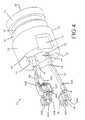
- Figures 4-6 show additional details of the receptacle connector subassembly 20, which comprises a molded receptacle housing 22 and three receptacle contacts 50A, 50B and 50C that are positioned in slots 42 surrounding a central plug passage or bore 38 that extends between an exterior face or end 24 and an interior housing end or face 26.
- the housing 22 is molded in one piece from a plastic material, such as a conventional polyetherimide (PEI) having high creep resistance.
- PEI polyetherimide
- the receptacle contacts or terminals 50A, 50B and 50C are stamped and formed, each in one piece, from a conventional spring metal, having a thickness of 0.25 mm, with contact areas appropriately plated for corrosion resistance and contact stability. The thickness of all of the contacts 50A, 50B, 50C is the same in the preferred embodiment of this invention.
- the molded receptacle housing 22 shown in Figures 4 and 7A-D has a toroidal configuration or cross section defined by a cylindrical outer surface and a central inner passage 38 defined by a generally cylindrical inwardly facing surface 40 which is interrupted by a series of axially extending slots 42.
- the central inner passage 38 is dimensioned to receive the post section 106 of the plug connector subassembly 100 so that electrical connector can be made with the three axially spaced plug contacts 102A, 102B, and 102C extending concentrically around the plug post 106.
- the three axially extending slots 42 are dimensioned to mount the three receptacle contacts 50A, 50B, and 50C at three arcuately spaced locations on half of the cylindrical surface 40.
- Receptacle contact 50A is positioned ninety degrees from receptacle contact 50C which, in turn, is positioned ninety degrees from receptacle contact 50B, which is opposed to contact 50A.
- the central plug receiving passage 38 extends between opposite end faces or surfaces 24, 26 on the receptacle housing 22.
- Interior housing face 24 will be positioned adjacent the base of the cavity 5 when the receptacle connector subassembly 20 is mated to the squib 2.
- the exterior housing end face 26 will extend beyond the squib housing 4 when the receptacle connector subassembly 20 is fully mated to the squib 2.
- a polarizing notch 36 extends into the exterior cylindrical face of the receptacle housing 22 adjacent to the interior face 24 and opposite from the slot 42 in which the short receptacle contact 50C is positioned. This polarizing notch 36 receives the polarizing key 7 on the squib housing 4.
- the receptacle connector subassembly 20 is polarized or keyed relative to the airbag initiator 2 so that the receptacle contacts 50A, 50B and 50C are properly positioned in alignment with the corresponding pins 6. It should be understood, however, that while the receptacle connector subassembly is keyed, polarized or properly angularly positioned relative to the squib 2, the plug connector subassembly 100 still does not have to be polarized or keyed or angularly oriented or aligned with either the receptacle connector subassembly 20 or the airbag initiator 2.
- the cylindrical or toroidal receptacle housing 22 has four sectors, all of which form a single one piece molded body.
- the first or lower housing sector 28 located adjacent to the interior face 24 has the largest outer dimension. It is this first section that will be received in the cavity 5 when the receptacle connector subassembly 20 is mated to the squib airbag initiator 2, and the polarizing notch 36 is located in this housing sector 28.
- An adjacent second housing sector 32 has a smaller external diameter and a next adjacent third housing sector 34 has the smallest outer diameter on the housing 22.
- a lip or ring 34 is located at the exterior end 26 of the housing 22, and this ring 34 has a larger outer diameter than the sector 32 to which it is adjacent.
- This ring 34 serves as a latching shoulder that is engaged by a plug latch 114 when the plug connector subassembly 100 is mated to the receptacle connector subassembly 20.
- the smaller sector 32 provides clearance for the plug latch 114. Since the shoulder or ring 34 extends completely around the periphery of the receptacle housing 22, the plug latch 114 can engage the shoulder 34 at any angular position so that the plug connector subassembly can be mated in any angular orientation and is free to rotate once mated.
- Each of the receptacle contacts 50A, 50B and 50C can be positioned in the receptacle housing 20 by inserting the contacts from the interior housing end 24 into the slots 42 located along the inwardly facing curved passage surface 40.
- Each of the slots 42 is recessed relative to the curved surface 40 and thus extends radially outward from this inwardly facing surface 40.
- Sidewalls 44 define the slots 42 and ribs 46 on the walls 44 serve to restrict the receptacle contacts after they have been inserted behind the ribs 46.
- Each of the receptacle contacts 50A, 50B and 50C has a mounting section 82 with teeth 84 extending from opposite edges of the mounting section 82.
- each of the receptacle contacts will have a contact point or area 58 located between outer housing faces 24, 26 at opposite ends of the housing 22.
- Electronic component contact sections 62 located on one end of each receptacle contact 50A, 50B and 50C will protrude beyond the interior receptacle housing face 24 so that these component contact sections 62 will be in position to engage the pins 6 extending perpendicular to the axis of the plug passage 38 and the cavity 5 in the initiator 2.
- Each of the stamped and formed contacts 50A, 50B and 50C has a resilient cantilever contact beam 56 extending from the central contact mounting section 82 toward a free end 54 that will be facing the exterior end of the receptacle contact.
- contact free end 54 will be the first portion of the contact to engage the plug connector when it is inserted into plug passage 38.
- a raised contact point or area 58 is located adjacent the free end 54 and comprises the innermost part of each receptacle contact 50A, 50B and 50C so that it will engage a corresponding and aligned plug contact 102A, 102B, and 102C extending around the periphery of the plug post or pin 106.
- the cantilever contact beam When the contact point 58 engages the plug contact 102A, 102B, or 102C, the cantilever contact beam is flexed generating a contact force sufficient to maintain a reliable contact between the plug contacts and the corresponding receptacle contact 50A, 50B or 50C.
- the cantilever beams 56 on different receptacle contacts have different lengths so that the axial positions of the contact points 58 on different receptacle contacts 50A, 50B and 50C will be mutually axially spaced or offset. In this way individual receptacle contacts 50A, 50B and 50C will engage different axially spaced plug contacts 102A, 102B, and 102C when the plug connector 100 is properly mated with the receptacle connector 20.
- a long receptacle contact 50A has the longest cantilever beam 56 so that its contact point 58 will be closest to the exterior end 26 of the receptacle connector where it will engage a peripheral plug contact 102A closest to the exterior receptacle end 26.
- a middle receptacle contact 50B has a somewhat shorter cantilever beam 56 so that its contact point 58 will engage a middle plug contact 102B.
- Short receptacle contact 50C has the shortest cantilever beam 56 so that it will be aligned with the first plug contact 102C to be inserted into the plug passage 30 as the two connectors are mated. Since the plug contacts 102 extend completely around the plug housing, it is only the axial positions of the plug contacts 102 A, 102B, 102C and the receptacle contacts 50A, 50B, 50C that result in mating between corresponding contacts.
- the three receptacle contacts 50A, 50B and 50C each have a resilient electronic component mating section 62 on the opposite side of the mounting section 82 from the resilient cantilever contact beam 56.
- Each of these component mounting sections 62 comprise a C-channel or C-clip for engaging one of the parallel pins 6 in the squib component 2.
- the long receptacle contact 50A and the middle receptacle contact 50B have identical C-channel contact sections 62 because these contacts are positioned so that the corresponding pin 6 will extend generally tangent to the mounting section 82 and the resilient beam 56.
- These receptacle contacts 50A and 50B are positioned opposite each other with the short receptacle contact 50C located between the other two receptacle contacts.
- the short receptacle contact 50C is thereof positioned so that its the central component pin extends generally perpendicular to the plate of the mounting section 82 and the cantilever beam 56 on the short receptacle contact 50C.
- Each receptacle component contact section 62 does have at least one component contact slot 66 open on one end of the receptacle contact and extending axially relative to the receptacle contact and to the central passage or bore 38. Pins 6 will therefore be aligned with and received in corresponding slots 66 when the receptacle contact is mated with the squib component 2.
- the long receptacle contact 50A and the middle receptacle contact 50B each has two slotted flat plate sections 68 extending inwardly from one end of the spaced flat plate 68. Slots 66 formed in these flat plate sections 68 have one edge with a recessed portion in which one of the pins 6 will fit so that a reliable electrical connector can be made between the receptacle contacts 50A and 50B and the corresponding pins 6. Force is required to either insert the pins 6 or remove the pins 6 from the slots 66.
- the slots 66 in the two flat plate sections 68 are aligned and the two flat plate sections 68 are joined by a central section 70 which joins the component contact section 62 to the remainder of the receptacle contact 50A or 50B.
- the central section 70 is joined to an offset section 60 between the mounting section 82 so that the component contact section 62 and the contact point 58 will both be on the same side of the mounting section. Both the component contact section 62 and the cantilever beam contact point 58 will then extend inwardly relative to the curved housing wall 40 into the plug passage 38.
- the short receptacle contact 50C also has a component contact section 62 formed by two flat plate sections 74 bent at right angles relative to a central flat plate section 72 to form a U-shaped configuration.
- the component slot 66 in the short receptacle contact 50C is however located in the central flat plate section 72 so that it will be properly oriented relative to a pin extending perpendicular to the stamped and formed short receptacle contact mounting section and resilient cantilever beam.
- the central flat plate section 72 is also joined to an offset section 60 so that both the short receptacle contact component mating section 62 and the resilient contact beam 56 will be positioned to extend into the plug passage or bore 38 when mounted in the corresponding housing slot 42.
- the plug connector subassembly 100 comprises a plug housing 104, also molded from a polyetherimide material, and three peripheral plug contacts 102A, 102B, 102C spaced axially along a central plug housing post 106.
- the cylindrical post 106 extends from a larger plug cap 108 having a larger outer diameter.
- a bore 110 extends through the plug post 106 and joins three conductor passageways 120 through which individual conductors or wires (not shown) can be inserted so that the wires can be terminated to respective plug contacts 102A, 102B, and 102C.
- the cylindrical plug contacts 102A, 102B, and 102C are located on the exterior surface of the post 106 where they will contact the contact points 58 on receptacle contacts 50A, 50B and 50C when the plug connector subassembly 100 is fully inserted into the plug passage 38 in the receptacle connector subassembly 20.
- Adjacent plug contacts 102A, 102B, and 102C are spaced apart by gaps and the endmost plug contact is spaced from the leading edge 112 of the post which first enters the receptacle housing 22.
- Two molded plug latches 114 extend from the periphery of the plug cap 108 and a radial gap is formed between each latch 114 and the opposed plug post 106 having a smaller outer diameter.
- Each latch 114 has a flexible latch beam 116 with an inwardly facing latch boss 118 located on the distal end of the latch beam 116.
- the latches 114 are configured so that the latch bosses 118 engage the peripheral latching shoulder 34 on the receptacle connector housing 22 to secure the plug connector subassembly 100 to its mating receptacle subassembly 20.
- the latch and the latching shoulder engage regardless of the angular orientation of the connector subassemblies.
- This preferred connector assembly 10 which is representative of other equivalent configurations, is capable of supplying either two or three signal transmission lines to and/or from an electronic component, such as an airbag inflation initiator or squib 2, using only a single male connecting member or plug post 106 and does not require polarization, keying or alignment of the plug connector assembly 100 relative to electronic component 2, the receptacle contacts 50A, 50B or 50C or the receptacle connector subassembly 20. No shorting bars are required for this connector assembly.
- the long receptacle contact 50A mates with the uppermost plug contact 102A, and this pair of terminals comprises a first signal path.
- the middle receptacle contact 50B mates with the middle plug contact 102B, and this pair of terminals comprises a second signal path.
- the short receptacle contact 50C mates with the lowermost plug contact 102C, and this pair of terminals comprise a third signal contact.
- one of these signal paths could be dedicated to ground or could supply a timing signal or could comprise a path for other purposes.
- signals of 50ma are transmitted on these signal paths.
- This connector assembly also has a relatively small size or envelope. For instance, the mated plug and receptacle connector assembly has a length of 9.5 mm and a maximum outside diameter of 6.2 mm.
- the plug connector 100 can be mated with to the receptacle connector subassembly 20 without stubbing and the contacts have excellent floating characteristics. These characteristics make the connector assembly 10 especially suitable for use as a squib or airbag inflation initiator connector, but the basic connector system can be used for other automotive as well as nonautomotive applications. This invention is also not limited to the use of two or three plug and receptacle contacts and is suitable for use with more that three contacts.
- FIG. 9-14 A second embodiment of an electrical connector assembly for use in a squib or airbag inflator assembly is shown in Figures 9-14.
- the main difference between the first and second embodiments is the respective orientation of the plug and receptacle contacts.
- the plug contacts face radially outward and the receptacle contacts face radially inward.
- the plug contacts face radially inward and the receptacle contacts face radially outward.
- the plug contacts are not exposed and are less likely to come into inadvertent contact with other components or equipment.
- Figure 9 shows the alternative version of the airbag inflation initiator or squib 202 with the alternative connector plug 300 mated to the alternative connector receptacle or socket 220.
- Receptacle 220 can be mounted in the squib 202 in the same manner as for the other embodiment, and the squib component 202 can indeed be identical to the first embodiment of the squib connector.
- the plug 300 is latched to the receptacle 220 by latches 314.
- Figures 10 and 11 show the connector receptacle assembly 220 that includes a molded receptacle housing 222 and three receptacle contacts 250A-C.
- the molded housing 222 is generally cylindrical in shape and has an interior face 224 which will be inserted into a squib component cavity in the same fashion as in the first embodiment.
- An opposite exterior face 226 will be exposed so that the plug 300 can be mated to the receptacle 220.
- the receptacle housing 222 includes a cylindrical support column 230 that extends to the exterior face 226.
- This support column has a cylindrical outer surface 240 with an annular passage 238 extending between the central support column 230 and the exterior wall of the housing 220.
- Three axial slots 242 extend along the support column 230, and the receptacle contacts 250A-C are positioned within these axial slots.
- the receptacle contacts 250A-C are inserted into the receptacle or socket housing 222 and the axial slots 242 through the interior face 224, as generally represented in Figure 10.
- the three receptacle contacts 250A-C are similar to the receptacle contacts 50A-C, but they are configured so that the receptacle contacts 250A-C can be oriented to face outwardly along cylindrical surface 240, rather then inwardly as in the first embodiment.
- Each of the three receptacle contacts 250A-C includes a cantilever beam contact section 254 and a mating section 262 on opposite sides of a mounting section 282.
- the cantilever beams extend into the annular channel passage 238 where they will mate with plug contacts 302A-C in a manner that will be subsequently discussed in more detail.
- each receptacle contact includes at least one mating channel 266 that can be clipped or snapped onto contact pins in the squib electronic component in the same manner as in the first embodiment.
- the mounting section 282 of each receptacle contact includes teeth that engage the side walls of the corresponding axial slot 242 to secure the contact within the slot 242 and to the support column 230.
- the lengths of the cantilever beams 254 are different and form a long receptacle contact 250A, a middle receptacle contact 250B and a short receptacle contact 250C. The contact area of these three receptacle contacts 250A-C is then axially staggered in much the same manner as in the first embodiment.
- Plug 300 includes three plug contacts 302A-C mounted in a molded plug housing 304.
- the plug housing 304 includes a plug housing base 326 and a plug housing cover 332.
- the housing base has three side by side channels 328.
- a cylindrical plug silo 306 extends from an outer side of the plug housing and a silo bore 310 extends through the silo 306 and into communication with each of the three channels 328. Portions of the plug contacts 302A-C are positioned in the channels 328, while other portions extend into the silo bore 310.
- Each of the plug contacts 302A-C includes a cylindrical band contact section 322A-C, respectively, that forms the mating section that is engaged by the corresponding receptacle terminal or contact when the plug connector 300 is mated to the receptacle connector 220. Wires are terminated to the individual plug contacts 302A-C by plug contact crimp sections 324A-C.
- the intermediate plug contact sections joining crimp sections 324A-C to cylindrical bands 322A-C are of different lengths, so that the individual cylindrical bands 322A-C can be axially staggered within the silo bore 310.
- the cylindrical bands 322A-C are stacked in axial alignment, with cylindrical insulator rings 330A-B positioned between adjacent cylindrical bands 322A-C, as shown in Figure 12.
- the plug contacts 302A-C stacked in the manner shown in Figure 13, the stacked band sections 322A-C can be inserted into the silo bore 310.
- the remaining portions of the plug contacts 302A-C, including the crimp sections 324A-C are then positioned within the channels 328 and the cover 332 is mated to the base 326 to form the completed plug assembly 300.
- Figure 14 shows that the cylindrical band sections 322A-C are positioned on an inwardly facing cylindrical surface of the surrounding silo 306 so that the band sections 322A-C are exposed in the silo bore 310.
- the relative lengths of the contacts will insure that that plug contact 302A can only mate with receptacle contact 250A, that plug contact 302B can only mate with receptacle contact 250B and that plug contact 302C can only mate with receptacle contact 302C.
- first and second embodiments may differ, each forms a nonpolarized connector assembly that can be mated no matter what the mutual angular orientation of one connector to the other.
- These alternative connector assemblies are therefore representative of other configurations employing the same or equivalent elements as would be understood by one of ordinary skill in the art. Therefore this invention is not limited to the preferred embodiments depicted herein, but is instead defined by the following claims.
Landscapes
- Details Of Connecting Devices For Male And Female Coupling (AREA)
- Air Bags (AREA)
- Coupling Device And Connection With Printed Circuit (AREA)
Applications Claiming Priority (4)
| Application Number | Priority Date | Filing Date | Title |
|---|---|---|---|
| US61370600A | 2000-07-11 | 2000-07-11 | |
| US613706 | 2000-07-11 | ||
| US09/863,653 US6398590B2 (en) | 2000-07-11 | 2001-05-23 | Nonpolarized electrical connector assembly especially for use as automotive squib connector |
| US863653 | 2001-05-23 |
Publications (2)
| Publication Number | Publication Date |
|---|---|
| EP1172900A2 true EP1172900A2 (de) | 2002-01-16 |
| EP1172900A3 EP1172900A3 (de) | 2004-03-17 |
Family
ID=27087083
Family Applications (1)
| Application Number | Title | Priority Date | Filing Date |
|---|---|---|---|
| EP01305816A Withdrawn EP1172900A3 (de) | 2000-07-11 | 2001-07-05 | Nichtpolarisierter elektrischer Verbindervorrichtung insbesondere zur Verwendung in einem Airbag eines Kraftfahrzeugs |
Country Status (3)
| Country | Link |
|---|---|
| US (2) | US6398590B2 (de) |
| EP (1) | EP1172900A3 (de) |
| JP (1) | JP4693019B2 (de) |
Cited By (3)
| Publication number | Priority date | Publication date | Assignee | Title |
|---|---|---|---|---|
| DE10349888B4 (de) * | 2003-10-25 | 2006-10-05 | Adam Opel Ag | Codierte Zündeinheit für ein Airbag-Modul sowie damit ausgerüstetes Airbag-Modul für ein Kraftfahrzeug-Airbag-System |
| CN102694324A (zh) * | 2011-04-19 | 2012-09-26 | 东莞维升电子制品有限公司 | 可任意旋转的导接结构及插座 |
| CN104037522A (zh) * | 2014-06-27 | 2014-09-10 | 贵州航天电器股份有限公司 | 一种具有连接锁紧装置的射频同轴电连接器 |
Families Citing this family (26)
| Publication number | Priority date | Publication date | Assignee | Title |
|---|---|---|---|---|
| TW534881B (en) * | 2000-06-08 | 2003-06-01 | Daicel Chem | Gas generator for safety airbag and safety airbag apparatus |
| CA103670S (en) * | 2003-02-14 | 2004-10-29 | Tokai Corp | Electric battery |
| DE10329741A1 (de) * | 2003-07-02 | 2005-01-27 | Robert Bosch Gmbh | Steuergerät mit blockierenden Befestigungsstellen |
| US7004778B2 (en) * | 2003-07-07 | 2006-02-28 | Kent Barker | Electrical connection apparatus and method for an airbag inflator |
| USD519159S1 (en) * | 2003-10-29 | 2006-04-18 | National Vending Asset Management Limited | Vending machine |
| USD534689S1 (en) * | 2004-10-26 | 2007-01-02 | Andis Company | Hair clipper |
| KR100630751B1 (ko) * | 2005-06-27 | 2006-10-02 | 삼성전자주식회사 | 커넥터 및 이를 구비한 하드디스크 드라이브 |
| US7137822B1 (en) * | 2005-12-21 | 2006-11-21 | Single Buoy Moorings Inc. | High voltage swivel |
| US20070178767A1 (en) * | 2006-01-30 | 2007-08-02 | Harshman E S | Electrical connector |
| KR100849029B1 (ko) * | 2007-04-30 | 2008-07-29 | 한국단자공업 주식회사 | 내진동 커넥터 |
| US20110263163A1 (en) * | 2008-11-26 | 2011-10-27 | John Schmidli | Compact Multi-Contact Plug and Socket |
| KR101113592B1 (ko) * | 2010-12-06 | 2012-02-22 | 암페놀커머셜인터커넥트코리아(주) | 이어폰 잭 |
| DE102012101232B4 (de) * | 2012-02-16 | 2013-11-07 | Borgwarner Beru Systems Gmbh | Glühkerzensteckverbinder |
| US9290419B2 (en) * | 2012-11-29 | 2016-03-22 | Autoliv Asp, Inc. | Duplex actuation system for inflatable restraints |
| JP6337491B2 (ja) * | 2014-02-12 | 2018-06-06 | 株式会社オートネットワーク技術研究所 | コネクタ |
| JP6278860B2 (ja) * | 2014-07-29 | 2018-02-14 | 日本航空電子工業株式会社 | コネクタ |
| JP5861763B1 (ja) | 2014-11-12 | 2016-02-16 | 第一精工株式会社 | 電気コネクタおよびその製造方法 |
| JP6007964B2 (ja) | 2014-12-12 | 2016-10-19 | 第一精工株式会社 | 電気コネクタ |
| JP5862755B1 (ja) | 2014-12-12 | 2016-02-16 | 第一精工株式会社 | コネクタ端子 |
| JP6239493B2 (ja) | 2014-12-12 | 2017-11-29 | 第一精工株式会社 | 電気コネクタ |
| JP5896009B1 (ja) | 2014-12-12 | 2016-03-30 | 第一精工株式会社 | コネクタ端子 |
| CN108656105B (zh) * | 2017-03-30 | 2024-06-25 | 泰科电子(上海)有限公司 | 自动取料设备 |
| TWI723734B (zh) * | 2020-01-08 | 2021-04-01 | 禾昌興業股份有限公司 | 浮動導引連接器 |
| US11404823B2 (en) * | 2020-06-22 | 2022-08-02 | J.S.T. Corporation | Blind mate connector system and method for assembling thereof |
| JP7812744B2 (ja) * | 2022-06-10 | 2026-02-10 | 矢崎総業株式会社 | 回転式のコネクタ |
| KR102764456B1 (ko) * | 2022-11-14 | 2025-02-07 | 주식회사 경신 | 정션박스용 버스바 |
Family Cites Families (30)
| Publication number | Priority date | Publication date | Assignee | Title |
|---|---|---|---|---|
| US2703393A (en) * | 1950-05-11 | 1955-03-01 | Breeze Corp | Plug and jack assembly |
| US3054095A (en) * | 1959-12-07 | 1962-09-11 | American Meter Co | Remote meter reading system |
| GB1065544A (en) * | 1964-03-16 | 1967-04-19 | Carr Fastener Co Ltd | Electrical socket |
| SE431590B (sv) * | 1979-09-03 | 1984-02-13 | Bofors Ab | Kontaktdon med hogfrekvensfilter till en elektrisk tendare |
| JPS61114686U (de) * | 1984-12-28 | 1986-07-19 | ||
| US4804343A (en) | 1988-04-11 | 1989-02-14 | General Motors Corporation | Lamp socket assembly |
| US5070605A (en) * | 1988-04-22 | 1991-12-10 | Medtronic, Inc. | Method for making an in-line pacemaker connector system |
| DE8905896U1 (de) * | 1989-05-11 | 1989-08-17 | Bayern-Chemie Gesellschaft für flugchemische Antriebe mbH, 8261 Aschau | Steckverbindung für einen elektrischen Anzünder |
| US5131680A (en) | 1991-03-19 | 1992-07-21 | Trw Vehicle Safety Systems Inc. | Inflator assembly |
| US5226667A (en) | 1991-03-19 | 1993-07-13 | Trw Vehicle Safety Systems Inc. | Percussion igniter assembly |
| US5200574A (en) | 1991-04-05 | 1993-04-06 | Morton International, Inc. | Universal squib connector |
| US5241910A (en) | 1991-04-05 | 1993-09-07 | Morton International, Inc. | Universal squib connector for a gas generator |
| JPH0550695U (ja) * | 1991-12-11 | 1993-07-02 | 応研精工株式会社 | スリップリング |
| US5314345A (en) * | 1992-10-09 | 1994-05-24 | Trw Inc. | Electrical connection system with interlock |
| US5275575A (en) | 1992-10-09 | 1994-01-04 | Trw Inc. | Electrical connection system with safety interlock |
| GB9225118D0 (en) | 1992-12-01 | 1993-01-20 | Amp Gmbh | Shunted airbag connector |
| JPH06215842A (ja) * | 1993-01-18 | 1994-08-05 | Matsushita Electric Ind Co Ltd | 車両用スリップリング装置 |
| US5338215A (en) * | 1993-03-19 | 1994-08-16 | Molex Incorporated | Jack assembly including a contact switching system |
| US5409403A (en) * | 1993-10-25 | 1995-04-25 | Falossi; Aldo | 360 degree connector system |
| US5462448A (en) | 1994-09-08 | 1995-10-31 | Morton International, Inc. | Electrical connector locking system |
| GB9423346D0 (en) | 1994-11-18 | 1995-01-11 | Amp Great Britain | Electrical interconnection system having retention and shorting features |
| DE19534205C2 (de) * | 1995-09-15 | 1997-09-04 | Amphenol Tuchel Elect | Elektrischer Steckverbinder |
| JP2002513501A (ja) | 1996-08-12 | 2002-05-08 | トーマス アンド ベッツ インターナショナル インコーポレイテッド | 自動推進の乗物用エアーバッグ・アセンブリーのための無方向導火爆管コネクターアッセンブリー |
| JP2908336B2 (ja) * | 1996-08-22 | 1999-06-21 | 米沢日本電気株式会社 | 電気接続コネクタ |
| JP3266518B2 (ja) * | 1996-08-28 | 2002-03-18 | エスエムケイ株式会社 | プラグとジャックの接続構造 |
| US6036226A (en) | 1997-02-03 | 2000-03-14 | General Dynamics Armament Systems, Inc. | Inflator capable of modulation air bag inflation rate in a vehicle occupant restraint apparatus |
| TW371120U (en) * | 1997-04-08 | 1999-09-21 | Hon Hai Prec Ind Co Ltd | Joint structure of plug |
| US6029995A (en) | 1998-04-09 | 2000-02-29 | Trw Vehicle Safety Systems Inc. | Vehicle occupant protection apparatus |
| TW453528U (en) * | 1999-07-02 | 2001-09-01 | Hon Hai Prec Ind Co Ltd | Socket connector |
| US6435917B1 (en) * | 2000-09-20 | 2002-08-20 | Unicorp Systems, Llc | Electrical jack |
-
2001
- 2001-05-23 US US09/863,653 patent/US6398590B2/en not_active Expired - Fee Related
- 2001-07-05 EP EP01305816A patent/EP1172900A3/de not_active Withdrawn
- 2001-07-11 JP JP2001210733A patent/JP4693019B2/ja not_active Expired - Fee Related
-
2002
- 2002-02-05 US US10/067,525 patent/US6607406B2/en not_active Expired - Fee Related
Cited By (5)
| Publication number | Priority date | Publication date | Assignee | Title |
|---|---|---|---|---|
| DE10349888B4 (de) * | 2003-10-25 | 2006-10-05 | Adam Opel Ag | Codierte Zündeinheit für ein Airbag-Modul sowie damit ausgerüstetes Airbag-Modul für ein Kraftfahrzeug-Airbag-System |
| CN102694324A (zh) * | 2011-04-19 | 2012-09-26 | 东莞维升电子制品有限公司 | 可任意旋转的导接结构及插座 |
| CN102694324B (zh) * | 2011-04-19 | 2014-09-03 | 东莞维升电子制品有限公司 | 可任意旋转的导接结构及插座 |
| CN104037522A (zh) * | 2014-06-27 | 2014-09-10 | 贵州航天电器股份有限公司 | 一种具有连接锁紧装置的射频同轴电连接器 |
| CN104037522B (zh) * | 2014-06-27 | 2016-07-06 | 贵州航天电器股份有限公司 | 一种具有连接锁紧装置的射频同轴电连接器 |
Also Published As
| Publication number | Publication date |
|---|---|
| JP2002075558A (ja) | 2002-03-15 |
| US20020123269A1 (en) | 2002-09-05 |
| US6607406B2 (en) | 2003-08-19 |
| JP4693019B2 (ja) | 2011-06-01 |
| EP1172900A3 (de) | 2004-03-17 |
| US6398590B2 (en) | 2002-06-04 |
| US20020009918A1 (en) | 2002-01-24 |
Similar Documents
| Publication | Publication Date | Title |
|---|---|---|
| US6398590B2 (en) | Nonpolarized electrical connector assembly especially for use as automotive squib connector | |
| EP0591948B1 (de) | Elektrische Verbindungsanordnung mit Sicherheitsverriegelung | |
| EP0591947B1 (de) | Elektrische Verbindungsanordnung mit Verriegelung | |
| US6893277B2 (en) | Squib connector assembly with CPA | |
| US6149448A (en) | Electrical connector assembly | |
| US10236640B2 (en) | Electrical connector for a safety restraint system | |
| EP1309038B1 (de) | Richtungsfreie Zündpille-Anschlusseinrichtung für Kraftfahrzeug-Luftsacksysteme | |
| JPH07201420A (ja) | 電気プラグ接続装置 | |
| CN1316689C (zh) | 电连接器用插头及其组装方法 | |
| EP3116075B1 (de) | Elektrischer steckverbinder für ein sicherheitsrückhaltesystem | |
| EP1324434B1 (de) | Elektrische Steckverbinderanordnung mit Kurzschlusselementen | |
| EP2380244B1 (de) | Kurzschluss-clip für ein airbag-zündsystem | |
| EP1271709B1 (de) | Elektische Verbinderseinrichtung mit Verriegelungsteil | |
| JP7390429B2 (ja) | コネクタ位置保証要素を備える電気コネクタ | |
| US6663421B1 (en) | Igniter shorting contact | |
| US20070001440A1 (en) | Gas generator with integrated electrical plug |
Legal Events
| Date | Code | Title | Description |
|---|---|---|---|
| PUAI | Public reference made under article 153(3) epc to a published international application that has entered the european phase |
Free format text: ORIGINAL CODE: 0009012 |
|
| AK | Designated contracting states |
Kind code of ref document: A2 Designated state(s): AT BE CH CY DE DK ES FI FR GB GR IE IT LI LU MC NL PT SE TR |
|
| AX | Request for extension of the european patent |
Free format text: AL;LT;LV;MK;RO;SI |
|
| RIC1 | Information provided on ipc code assigned before grant |
Ipc: 7F 42B 3/18 B Ipc: 7H 01R 13/11 B Ipc: 7H 01R 24/04 A |
|
| PUAL | Search report despatched |
Free format text: ORIGINAL CODE: 0009013 |
|
| AK | Designated contracting states |
Kind code of ref document: A3 Designated state(s): AT BE CH CY DE DK ES FI FR GB GR IE IT LI LU MC NL PT SE TR |
|
| AX | Request for extension of the european patent |
Extension state: AL LT LV MK RO SI |
|
| AKX | Designation fees paid | ||
| REG | Reference to a national code |
Ref country code: DE Ref legal event code: 8566 |
|
| STAA | Information on the status of an ep patent application or granted ep patent |
Free format text: STATUS: THE APPLICATION IS DEEMED TO BE WITHDRAWN |
|
| 18D | Application deemed to be withdrawn |
Effective date: 20040918 |