EP1168614A2 - Longitudinal gekoppeltes akustisches Oberflächenwellenresonatorfilter - Google Patents
Longitudinal gekoppeltes akustisches Oberflächenwellenresonatorfilter Download PDFInfo
- Publication number
- EP1168614A2 EP1168614A2 EP01401685A EP01401685A EP1168614A2 EP 1168614 A2 EP1168614 A2 EP 1168614A2 EP 01401685 A EP01401685 A EP 01401685A EP 01401685 A EP01401685 A EP 01401685A EP 1168614 A2 EP1168614 A2 EP 1168614A2
- Authority
- EP
- European Patent Office
- Prior art keywords
- electrode finger
- idt
- acoustic wave
- surface acoustic
- wave filter
- Prior art date
- Legal status (The legal status is an assumption and is not a legal conclusion. Google has not performed a legal analysis and makes no representation as to the accuracy of the status listed.)
- Withdrawn
Links
- 238000010897 surface acoustic wave method Methods 0.000 claims abstract description 157
- 239000011295 pitch Substances 0.000 claims description 179
- 239000000758 substrate Substances 0.000 claims description 22
- 230000003247 decreasing effect Effects 0.000 claims description 7
- 238000003780 insertion Methods 0.000 description 30
- 230000037431 insertion Effects 0.000 description 30
- 238000013461 design Methods 0.000 description 19
- 238000012986 modification Methods 0.000 description 17
- 230000004048 modification Effects 0.000 description 17
- 230000006866 deterioration Effects 0.000 description 9
- 239000006185 dispersion Substances 0.000 description 6
- 230000006872 improvement Effects 0.000 description 6
- 238000007796 conventional method Methods 0.000 description 4
- 238000000034 method Methods 0.000 description 4
- 229910012463 LiTaO3 Inorganic materials 0.000 description 3
- 238000010586 diagram Methods 0.000 description 3
- 238000009826 distribution Methods 0.000 description 3
- 229910003327 LiNbO3 Inorganic materials 0.000 description 2
- 230000008859 change Effects 0.000 description 2
- 230000008569 process Effects 0.000 description 2
- 230000005855 radiation Effects 0.000 description 2
- 230000005540 biological transmission Effects 0.000 description 1
- 238000006243 chemical reaction Methods 0.000 description 1
- 230000007547 defect Effects 0.000 description 1
- 230000001419 dependent effect Effects 0.000 description 1
- 238000005530 etching Methods 0.000 description 1
- 239000000463 material Substances 0.000 description 1
Images










Classifications
-
- H—ELECTRICITY
- H03—ELECTRONIC CIRCUITRY
- H03H—IMPEDANCE NETWORKS, e.g. RESONANT CIRCUITS; RESONATORS
- H03H9/00—Networks comprising electromechanical or electro-acoustic elements; Electromechanical resonators
- H03H9/46—Filters
- H03H9/64—Filters using surface acoustic waves
-
- H—ELECTRICITY
- H03—ELECTRONIC CIRCUITRY
- H03H—IMPEDANCE NETWORKS, e.g. RESONANT CIRCUITS; RESONATORS
- H03H9/00—Networks comprising electromechanical or electro-acoustic elements; Electromechanical resonators
- H03H9/46—Filters
- H03H9/64—Filters using surface acoustic waves
- H03H9/6423—Means for obtaining a particular transfer characteristic
- H03H9/6433—Coupled resonator filters
- H03H9/6436—Coupled resonator filters having one acoustic track only
-
- H—ELECTRICITY
- H03—ELECTRONIC CIRCUITRY
- H03H—IMPEDANCE NETWORKS, e.g. RESONANT CIRCUITS; RESONATORS
- H03H9/00—Networks comprising electromechanical or electro-acoustic elements; Electromechanical resonators
- H03H9/02—Details
- H03H9/125—Driving means, e.g. electrodes, coils
- H03H9/145—Driving means, e.g. electrodes, coils for networks using surface acoustic waves
- H03H9/14544—Transducers of particular shape or position
- H03H9/14576—Transducers whereby only the last fingers have different characteristics with respect to the other fingers, e.g. different shape, thickness or material, split finger
- H03H9/14582—Transducers whereby only the last fingers have different characteristics with respect to the other fingers, e.g. different shape, thickness or material, split finger the last fingers having a different pitch
-
- H—ELECTRICITY
- H03—ELECTRONIC CIRCUITRY
- H03H—IMPEDANCE NETWORKS, e.g. RESONANT CIRCUITS; RESONATORS
- H03H9/00—Networks comprising electromechanical or electro-acoustic elements; Electromechanical resonators
- H03H9/02—Details
- H03H9/125—Driving means, e.g. electrodes, coils
- H03H9/145—Driving means, e.g. electrodes, coils for networks using surface acoustic waves
- H03H9/14544—Transducers of particular shape or position
- H03H9/14588—Horizontally-split transducers
Definitions
- the present invention relates to a surface acoustic wave filter for use as a band-pass filter or other filter in an RF stage of a portable telephone or electronic apparatus, and more particularly, to a longitudinally coupled resonator type surface acoustic wave device having a plurality of interdigital transducers (IDTs) arranged in the propagation direction of a surface acoustic wave.
- IDTs interdigital transducers
- band-pass filters used in the RF stage of portable telephones surface acoustic wave filters have been widely used.
- the band-pass filters are required to have a low loss, a high attenuation, and a wide passband. Accordingly, various attempts to satisfy such requirements have been made in the surface acoustic wave filters.
- Japanese Unexamined Patent Application Publication No. 5-267990 discloses a method of increasing the band-width of a longitudinally coupled resonator type surface acoustic wave filter.
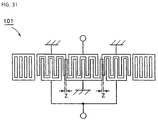
- Fig. 31 shows a longitudinally coupled resonator type surface acoustic wave filter 101 disclosed in the Japanese Unexamined Patent Application Publication No. 5-267990.
- a distance Z (hereinafter, referred to as an IDT-IDT interval) between the centers of adjacent electrode fingers in neighboring IDT's shown in Fig. 31 is set at about 0.25 times the wavelength ⁇ l which is determined by the pitch of the electrode fingers.
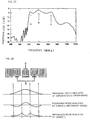
- Figs. 27 and 28 are graphs for illustration of increasing a band-width in this conventional technique.
- Fig. 27 shows a relation between generated resonance mode frequencies.
- Fig. 28 schematically shows the effective current distributions at the respective resonance mode frequencies. These figures also show portions magnified at the scale indicated on the right of the ordinate axis.
- a resonance mode (resonance mode indicated by the arrow C) having peaks in the intensity distribution of a surface acoustic wave and presented in the IDT-IDT interval areas, is utilized, in addition to the zero-order mode (resonance mode indicated by the arrow B), and the secondary mode (resonance mode indicated by the arrow A) to form a pass band.
- the IDT-IDT interval is set at 0.50 ⁇ l to prevent undesired radiation of a bulk wave.
- the band can be widened by setting the interval at 0.25 ⁇ l.
- Figs. 29 and 30 illustrate changes in the resonance mode frequencies indicated by the arrows A to C, obtained when the IDT-IDT interval is varied.
- the results shown in Figs. 29 and 30 are obtained and ascertained when the impedance matching conditions are intentionally deviated. It should be pointed out that the results shown in Figs. 29 and 30 show relative changes in the resonance mode frequencies, not indicating the absolute positions of the accurate resonance mode frequencies. These figures also show portions magnified at the scale indicated on the right of the ordinate axis.
- Fig. 29 shows the shifts of the respective resonance mode frequencies on a basis of the zero-order mode frequency, caused when the IDT-IDT interval is varied, that is, changes in frequency difference between the respective resonance mode frequencies, on a basis of the resonance frequency in the zero-order mode.
- Fig. 30 shows changes in amplitude level between the respective resonance mode frequencies. As seen in Figs. 29 and 30, all of the resonance mode frequencies and the amplitude levels are changed when the IDT-IDT interval is varied.
- the IDT-IDT interval is adjusted so as to increase the pass bandwidth. This will be described with reference to Fig. 32.
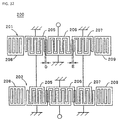
- Fig. 32 is a schematic plan view illustrating another example of conventional longitudinally coupled resonator type surface acoustic wave filter.
- a surface acoustic wave filter 200 is produced by forming the respective electrodes, made of Al, on a 40 ⁇ 5° Y-cut X propagation LiTaO 3 substrate (not shown).
- the longitudinally coupled resonator type surface acoustic wave filter 200 has the configuration in which longitudinally coupled resonator type surface acoustic wave filter portions 201 and 202 are two-stage dependently connected.
- the surface acoustic wave filter portions 201 and 202 are configured in the same manner, and contain first, second, and third IDT's 205 to 207, and reflectors 208 and 209 provided at respective sides of the first, second, and third IDT's 205 to 207.
- the surface acoustic wave filter portions 201 and 202 are designed in compliance with the following specifications.
- all of the IDT-IDT intervals, the IDT - reflector intervals, and the intervals between adjacent electrode fingers are expressed as the distance between the centers of electrode fingers, respectively.
- the above-mentioned duty ratio is defined as the ratio of the size in the width direction of an electrode finger along the surface acoustic wave propagation direction, compared to the sum of this size in the width direction and the size of the space between the electrode finger and the adjacent electrode finger.
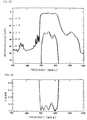
- Figs. 33 and 34 illustrate changes in the characteristics of the surface acoustic wave transducer 200 shown in Fig. 32, obtained when the IDT-IDT intervals D and E are decreased by 0.005 ⁇ l as compared with the above-described design value to increase the bandwidth.
- the solid lines represent the characteristics obtained when the IDT intervals D and E are decreased, and the broken lines represent the characteristics obtained when the above specifications are applied.
- Fig. 33 shows the frequency characteristics
- Fig. 34 shows changes in VSWR.
- the pass bandwidth which corresponds to the range of from the through-level to 4 dB lower than the through-level is increased by about 1 MHz.
- the flatness of the insertion loss within the pass band is deteriorated, and moreover, the VSWR is reduced by about 0.25.
- Figs. 35 and 36 show changes in characteristics of the surface acoustic wave filter 200, obtained when the IDT-IDT intervals D and E are increased by 0.003 ⁇ l as compared with the abode-described design values, so that the flatness of the insertion loss within the pass band is enhanced, and the VSWR characteristic is improved.
- the solid lines represent the characteristics when the IDT intervals D and E are increased, and the broken lines show the characteristics obtained when the above-described specifications are applied.
- the flatness of the insertion loss and the VSWR within the pass band can be improved by increasing the IDT-IDT intervals, while the pass bandwidth becomes narrower by about 1 MHz.
- the reason is that when it is attempted to produce a desired characteristic by adjustment of the IDT-IDT intervals, all of the resonance modes are changed, as seen in Figs. 29 and 30.
- the three resonance modes can not be individually adjusted, characteristics satisfying all of the requirements as to pass bandwidth, the flatness of the insertion loss within the pass band, the VSWR, and so forth can not be obtained.
- preferred embodiments of the present invention provide a longitudinally coupled resonator type surface acoustic wave filter which solves the above-described technical defects, and in which the arrangement of the above-described three resonance modes are widely adjustable, and the design flexibility of the pass bandwidth, the flatness of the insertion loss within the pass band, and the VSWR are greatly enhanced.
- a preferred embodiment of the present invention provides a longitudinally coupled resonator type surface acoustic wave filter in which the flatness of the insertion loss within the pass band is greatly enhanced, and the VSWR characteristic is greatly improved without the pass bandwidth being decreased.
- Another preferred embodiment of the present invention provides a longitudinally coupled resonator type surface acoustic wave filter in which the bandwidth can be increased without the flatness of the insertion loss and the VSWR characteristic within the pass band being deteriorated.
- a longitudinally coupled resonator type surface acoustic wave filter which comprises a piezoelectric substrate, and first, second, and third IDT's provided on the piezoelectric substrate to extend along the surface acoustic wave propagation direction and having plural electrode fingers, respectively, at least one of the first, second, and third IDT's containing at least one narrow pitch electrode finger portion in which the pitches of the electrode fingers arranged at the end of the IDT towards a neighboring IDT are shorter than those of the other electrode fingers in the IDT, the distance between the centers of at least one pair of adjacent electrode fingers differing from 0.25 ⁇ A + 0.25 ⁇ B in which ⁇ A represents the wavelength determined by the pitch of one electrode finger, and ⁇ B represents the wavelength determined by the pitch of the other electrode finger.
- At least one pair of the adjacent electrodes may be not only a pair of adjacent electrode fingers provided in the narrow pitch electrode finger portion and a remaining electrode finger portion neighboring the narrow pitch electrode finger portion, and a pair of adjacent electrode fingers provided in neighboring IDT's, respectively, but also a pair of adjacent electrode fingers in an area other than that in which the above-mentioned adjacent electrode fingers are provided.
- a longitudinally coupled resonator type surface acoustic wave filter which comprises a piezoelectric substrate, and first, second, and third IDT's provided on the piezoelectric substrate to extend along the surface acoustic wave propagation direction and having plural electrode fingers, respectively, at least one of the first, second, and third IDT's including at least one narrow pitch electrode finger portion in which the pitches of the electrode fingers arranged at the end of the IDT towards a neighboring IDT are shorter than those of the other electrode fingers in the IDT, if ⁇ l2 represents the wavelength determined by the electrode finger pitch of the narrow pitch electrode finger portion, and ⁇ l1 represents the wavelength determined by the electrode finger pitch of the electrode finger portion provided in the IDT including the narrow pitch electrode finger portion and being other than the narrow pitch electrode finger portion, the distance between the centers of the adjacent electrode fingers provided in the narrow pitch electrode finger portion and the electrode finger portion other than the narrow pitch electrode finger portion differs by 0.25 ⁇ l1 + 0.25 ⁇ l2.
- a longitudinally coupled resonator type surface acoustic wave filter which includes a piezoelectric substrate, and first, second, and third IDT's provided on the piezoelectric substrate to extend along the surface acoustic wave propagation direction and having plural electrode fingers, respectively, at least one of the first, second, and third IDT's including at least one narrow pitch electrode finger portion in which the pitches of the electrode fingers arranged at the end of the IDT towards a the neighboring IDT are shorter than those of the other electrode fingers in the IDT, in the case in which ⁇ l2 represents the wavelength determined by the electrode finger pitch of the narrow pitch electrode finger portion, and ⁇ l1 represents the wavelength determined by the electrode finger pitch of the electrode finger portion provided in the IDT including the narrow pitch electrode finger portion and being other than the narrow pitch electrode finger portion, the distance between the centers of the adjacent electrode fingers provided in the narrow pitch electrode finger portion and a neighboring electrode finger portion differs by 0.25 ⁇ 1 + 0.25 ⁇ l2.
- a longitudinally coupled resonator type surface acoustic wave filter which includes a piezoelectric substrate, and first, second, and third IDT's provided on the piezoelectric substrate to extend along the surface acoustic wave propagation direction and having plural electrode fingers, respectively, at least one of the first, second, and third IDT's including at least one narrow pitch electrode finger portion in which the pitches of the electrode fingers arranged at the end of the IDT towards a neighboring IDT are shorter than those of the other electrode fingers in the IDT, in the case in which ⁇ 12 represents the wavelength determined by the electrode finger pitch of the narrow pitch electrode finger portion, and ⁇ I1 represents the wavelength determined by the electrode finger pitch of the electrode finger portion provided in the IDT including the narrow pitch electrode finger portion and being other than the narrow pitch electrode finger portion, the distance between the centers of the adjacent electrode fingers provided in the neighboring IDT's, respectively, being set to differ by 0.5 ⁇ l2, when the narrow pitch electrode finger portions are provided adjacently to
- the deviation amount of the distance between the centers of the adjacent electrode fingers is up to 0.25 ⁇ l1.
- the electrode covering ratio of one electrode finger of a pair of the adjacent electrode fingers provided in the neighboring IDT's is relatively high, wherein the gap between a pair of the adjacent electrode fingers is substantially reduced.
- An area between a pair of the adjacent electrode fingers provided in the neighboring IDT's may be metallized.
- a longitudinally coupled resonator type surface acoustic wave filter which includes a piezoelectric substrate, and first, second, and third IDT's provided on the piezoelectric substrate to extend along the surface acoustic wave propagation direction and having plural electrode fingers, respectively, at least one of the first, second, and third IDT's including at least one narrow pitch electrode finger portion in which the pitches of the electrode fingers arranged at the end of the IDT towards a neighboring IDT are shorter than those of the other electrode fingers in the IDT, an electrode finger portion succeeding the narrow pitch electrode finger portion having a relatively wide electrode finger pitch, an electrode finger portion having a different electrode finger pitch being provided in the narrow pitch electrode finger portion.
- the distance between the centers of at least one pair of the adjacent electrode fingers respectively provided in the narrow pitch electrode finger portions having different electrode finger pitches differ by 0.25 ⁇ A + 0.25 ⁇ B, in which ⁇ A and ⁇ B represent the wavelengths determined by the respective electrode finger pitches.
- the narrow pitch electrode finger portion is a chirp type electrode finger portion.
- the chirp type electrode finger portion is configured to have electrode finger pitches arranged in the linearly decreasing order from the center in the surface acoustic wave propagation direction of the IDT toward the outside thereof.
- a longitudinally coupled resonator type surface acoustic wave filter which includes plural longitudinally coupled resonator type surface acoustic wave filters described above and plural-stage dependently connected.
- a communications device which uses longitudinally coupled resonator type surface acoustic wave filters described above.
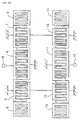
- Fig. 1 is a schematic plan view of a longitudinally coupled resonator type surface acoustic wave filter according to a first preferred embodiment of the present invention.
- the longitudinally coupled resonator type surface acoustic wave filters of this and the succeeding preferred embodiments are EGSM reception band-pass filters.
- the longitudinally coupled resonator type surface acoustic wave filters of the present invention are not limited to the above filters, and can be used as a band-pass filter in various applications.
- a longitudinally coupled resonator type surface acoustic wave filter 1 is provided, using a 40 ⁇ 5° Y cut X propagation LiTaO 3 substrate 2 as the piezoelectric substrate.
- surface acoustic wave filter portions 3 and 4 are two-stage dependently connected.
- the surface acoustic wave filter portions 3 and 4 are longitudinally coupled resonator type surface acoustic wave filters having three IDT's, respectively. Both of the filters 3 and 4 have substantially the same configuration.
- the first, second, and third IDT's 5, 6, and 7 are arranged in the surface acoustic wave propagation direction.
- Reflectors 8 and 9 are arranged at respective sides of the area in which the IDT's 5, 6, and 7 are provided.
- the first, second, and third IDT's 10, 11, and 12 are arranged.
- Reflectors 13 and 14 are arranged at respective sides of the area in which the IDT's 10, 11, and 12 are provided.
- One end of the second IDT 6 in the center of the surface acoustic wave filter portion 3 is connected to an input terminal 15. Also, one end of the first and third IDT's 5 and 7 in the surface acoustic wave filter portion 3 are electrically connected to one end of the first and third IDT's 10 and 12 in the surface acoustic wave filter portion 4. One end of the second IDT 11 in the surface acoustic wave filter portion 4 is electrically connected to an output terminal 16. All of the ends of the IDT's 5 to 7 and 10 to 12 which are on the sides opposite to the ends thereof which are connected to the input terminal 15, the output terminal 16, and the other IDT's are connected to a ground potential.
- the IDT's 5 to 7 have narrow pitch electrode finger portions in which the electrode finger pitches are relatively narrow.
- electrode fingers 5a and 6a are adjacent to each other in the area where the IDT's 5 and 6 are adjacent to each other.
- the electrode finger 6b of the IDT 6 and the electrode finger 7a of the IDT 7 are adjacent to each other.
- Several electrode fingers of the IDT 6 including the electrode finger 6b at the end thereof on the IDT 7 side define a narrow pitch electrode finger portion N3.
- the narrow pitch electrode finger portions N2 and N3 are provided at both ends of the IDT 6 in the surface acoustic wave propagation direction.
- the electrode finger pitches in the narrow pitch electrode finger portions N2 and N3 are narrow as compared with the electrode finger pitch of the electrode finger portion in the center of the IDT 6.
- the electrode finger pitches of the narrow pitch electrode finger portions N2 and N3 are set to be the same.
- a narrow pitch electrode finger portion N4 is provided in the IDT 7.
- the narrow pitch electrode finger portion N4 includes plural electrode fingers at the end thereof on the IDT 6 side.
- the electrode finger pitch in the narrow pitch electrode finger portion N4 is narrower than that in the remaining electrode finger portion thereof.
- the narrow pitch electrode finger portions N1, N2, N3, and N4 are provided as well as in the IDT's 5 to 7.
- the number of the electrode fingers shown in Fig. 1 is smaller than the number of electrode fingers used in practice.
- a basic design example (hereinafter, referred to as a reference example) of a longitudinally coupled resonator type surface acoustic wave filter 1, which is not an example of the present invention, will be described.
- the wavelength determined by the electrode finger pitch in the narrow pitch electrode finger portions N1 to N4 is designated by ⁇ l2.
- the wavelength determined by the electrode finger pitch in the other electrode finger portions is designated by ⁇ l1.
- the electrode finger crossing width W in the IDT's 5 to 7 and 10 to 12 is 35.8 ⁇ I1.
- the number of electrode fingers in the respective narrow pitch electrode finger portions is 4, and that of the electrode fingers in the respective remaining electrode finger portion is 25.
- the number of electrode fingers in each of the narrow pitch electrode finger portions N2 and N3 provided at both ends, respectively, is 4.
- the number of electrode fingers in the electrode finger portion in the center thereof, which is not the narrow pitch electrode finger portion, is 27.
- the ⁇ l1 is 4.19 ⁇ m.
- the ⁇ l2 is 3.90 ⁇ m.
- the wavelength ⁇ R of the reflectors 8, 9, 13, and 14 is 4.29 ⁇ m.
- the number of electrode fingers in the respective reflectors is 100.
- the electrode finger inter-center distance (which is the distance between the centers of a pair of the adjacent electrode fingers provided in a narrow pitch electrode finger portion and the remaining electrode finger portion) is equal to the sum of 0.25 ⁇ l1 and 0.25 ⁇ l2.
- the inter-center distance between the centers of a pair of the adjacent electrode fingers provided in a narrow pitch electrode finger portion and the remaining electrode finger portion is indicated by the arrow X1, X2, X3, or X4 in Fig. 1.
- the distance is between the centers of a pair of the adjacent electrode fingers provided in the area where the narrow pitch electrode finger portion N1 of the IDT 5 and the remaining electrode finger portion thereof are adjacent to each other.
- the neighboring IDT-IDT interval is 0.50 ⁇ l2.
- respective narrow pitch electrode finger portions are provided at the ends of both of the IDT's which are neighboring to each other.
- the distance between the centers of the adjacent electrode fingers provided in neighboring IDT's, indicated by arrow X5 or X6, is set at 0.50 ⁇ l2.
- the interval between an IDT and the neighbouring reflector is 0.50 ⁇ R.
- the duty ratio in the IDT's 5 to 7 and 10 to 12 is 0.73.
- the duty ratio in the reflectors is 0.55.
- the electrode film-thickness is 0.08 ⁇ l1.
- each of the distances X5 and X6 between the centers of the adjacent electrode fingers provided in neighboring IDT's, and each of the distances X1 to X4 between the centers of the adjacent electrode fingers respectively provided in neighboring electrode finger portions, of a same IDT, having different electrode finger pitches are set as the sum of 0.25 times each of the wavelengths which are determined by the electrode finger pitches in the electrode finger portions each including a pair of the adjacent electrode fingers. The reason is that the continuity of the propagation path of a surface acoustic wave is maintained, and the loss caused by radiation of a bulk wave is greatly reduced.
- the loss is low, and a wider pass band is produced by using the above-mentioned three resonance modes, as compared with the conventional longitudinally coupled resonator type surface acoustic wave filter.
- each of the inter-center distances X1 to X6 deviates from the sum of 0.25 times the wavelength which is determined by the pitch of plural electrode fingers including one of a pair of the adjacent electrode fingers and extending away from the other of the adjacent electrode fingers, and 0.25 times the wavelength which is determined by the pitch of plural electrode fingers containing the other of the adjacent electrode fingers and extending away from said one of the adjacent electrode fingers. This will be described more concretely below.
- Dispersions in insertion loss and the VSWR within the pass band are greatly improved by adjusting the inter-center distances X1 to X6 in the above-described reference example used as a basic design.
- the electrode finger crossing width is set at 43.0 ⁇ l1.
- the inter-center distances X1 to X6 are set as follows:
- the electrode finger crossing width is changed as described above.
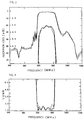
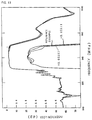
- Fig. 2 shows the frequency characteristics of the longitudinally coupled resonator type surface acoustic wave filter of this preferred embodiment and the above-described reference example.
- Fig. 3 shows the VWSR characteristics thereof.
- the solid lines represent the results obtained in the first preferred embodiment, and the broken lines represent the results of the above reference example.
- Fig. 2 also shows the frequency characteristics magnified at the scale listed on the right side of the ordinate axis.
- the pass bandwidth which corresponds to the range of from the through-level to the attenuation 4 dB lower than the through-level is substantially the same as that of the reference example.
- each of the distances X1 to X4 between the centers of a pair of the adjacent electrode fingers provided in a narrow pitch electrode finger portion and the electrode finger portion having a pitch different from that of the narrow pitch electrode finger portion but in the same IDT is set to be greater than that of the reference example. That is, each of the distances X1 to X4 is set to be greater than the sum of 0.25 times each of the wavelengths which are determined by the respective electrode finger pitches in a pair of the adjacent electrode fingers, and moreover, each of the distances X5 and X6 between the centers of a pair of the adjacent electrode fingers provided in neighboring IDT's is set to be greater than the above design value.
- Fig. 4 shows the features of the surface acoustic wave filter portion 3 alone, removed from the longitudinally coupled resonator type surface acoustic wave filter 1 shown in Fig. 1.
- each of the IDT's 5 and 7 is connected to an output terminal 17.
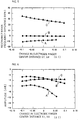
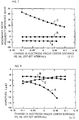
- Figs. 5 to 10 show changes in the frequencies in the resonance modes A to C (the resonance modes A to C shown in Figs. 27 and 28) produced when the electrode finger inter-center distances X1 to X6 are varied in the longitudinally coupled resonator type surface acoustic wave filter of Fig. 1 (Fig.4).
- Figs. 5 to 10 show the results obtained when the impedance of 50 ⁇ is exchanged for an impedance of 5 ⁇ for deviation from the matching condition.
- the results of Figs. 5 to 10 show the relative positions, not the correct absolute positions of the resonance mode frequencies.
- Figs. 5 and 6 show changes in the frequencies of the resonance modes A to C caused when the inter-center distances X1 and X4 shown in Fig. 4 are varied
- Figs. 7 and 8 show changes in the resonance mode frequencies, caused when the inter-center distances X5 and X6 (that is, the IDT-IDT intervals) are varied
- Figs. 9 and 10 show changes in the resonance mode frequencies, caused when the inter-center distances X2 and X3 are varied.
- Figs. 5 to 10 it is seen that the change-states of the frequencies in three kinds of the resonance modes, caused when the inter-center distances are varied, respectively, are different from each other, depending on the inter-center distances. Moreover, for the purpose of illustrating the differences in change of the characteristics caused when the respective inter-center distances are varied, Figs. 11 to 13 show changes in the frequency characteristics, caused when the inter-center distances are changed by ⁇ 0.02 ⁇ l 1 in the above-described reference example.
- Fig. 11 shows the results obtained when the inter-center distances X1 and X4 are changed
- Fig. 12 shows those obtained when the inter-center distances X5 and X6 are changed
- Fig. 13 shows those obtained when the inter-center distances X2 and X3 are changed.
- the changes within the pass band differ significantly when the respective inter-center distances are adjusted. That is, the inter-center distances X1 to X6, namely, the inter-center distances X1 and X4, the inter-center distances X5 and X6, and the inter-center distances X2 and X3 are paired, respectively.
- the flexibility for controlling the resonance mode frequencies and the levels by adjustment of three types of the inter-center distances is significantly enhanced.
- the inter-center distances X1 to X4 are set to be greater than those of the above-described basic design value, while the inter-center distances X5 and X6 are set to be less than those of the basic design value.
- the electrode finger crossing width W is changed. Moreover, the wavelength of the IDT and the wavelength of the reflectors are changed to correct deviations in center frequency.
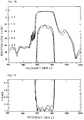
- Figs. 14 and 15 show the frequency characteristic and the VSWR of this modification.
- the pass bandwidth which corresponds to the range of from the through-level to the attenuation 4 dB lower than the through-level is increased by about 1 MHz as compared with the reference example.
- no significant deterioration is shown as compared with the reference example, though some wave-shape is formed in the pass band, and the VSWR is comparable to that of the reference example.
- Fig. 16 shows changes in propagation loss when the inter-center distances X5 and X6 shown in Fig. 1 are varied. Changes in IDT-IDT interval, that is, changes in inter-center distances X5 and X6 are plotted as abscissa. At the zero point, the inter-center distance is 0.5 ⁇ l2. The propagation loss is 1.5 dB. Values obtained by removing a loss due to impedance mismatching from the insertion loss are plotted as ordinate.
- the upper limit of the adjustment amount of the inter-center distances X1 to X6 is less that the value which is obtained by adding 0.25 ⁇ l1 (in which ⁇ l is the wavelength determined by the electrode finger pitch in an electrode finger portion, not in a narrow pitch electrode finger portion) to the basic design value, that is, the sum of 0.25 times each of the wavelengths determined by the respective pitches of the adjacent two electrode fingers.
- the adjustment amount is about 0.25 ⁇ l1.
- the lower limit of the adjustment amount is set to be in the range in which etching process or lift-off process is available.
- the design flexibilities for controlling dispersions in pass bandwidth and insertion loss, and the VSWR in the pass-band, are significantly enhanced.
- the arrangement of the three resonance modes is controlled by adjusting the three types of the electrode finger inter-center distances, and thereby, the steepness of the filter characteristic in the vicinity of the pass band.
- a 40 ⁇ 5° Y cut X propagation LiTaO 3 substrate is used.
- the piezoelectric material defining the piezoelectric substrate in this invention has no special limitation.
- a 64 to 72° Y cut X propagation LiNbO 3 substrate, a 41° Y cut X propagation LiNbO 3 substrate, or other suitable substrate may be employed.
- three-IDT-type longitudinally coupled resonator type surface acoustic wave filter portions each having first, second, and third IDT's, which are two-stage dependently connected, and the 1-stage 3-IDT-type longitudinally coupled resonator type surface acoustic wave filter portion 3A are described.
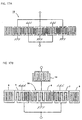
- the present invention can also be applied to a five-IDT-type longitudinally coupled resonator type surface acoustic wave filter 18 having five IDT's as shown in Fig. 17A, and a multi-electrode longitudinally coupled resonator type surface acoustic wave filter having more than 5 IDT's.
- the present invention can be applied to a device in which a surface acoustic wave resonator 19 is connected in series with a surface acoustic wave filter portion 3A as shown in Fig. 17B.
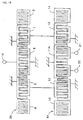
- one of the interdigital electrodes of the IDT 11A in the center of the second longitudinally coupled resonator type surface acoustic wave filter portion 4A may be divided into two portions, and output terminals 20 and 21 are connected to the portions, respectively.
- a longitudinally coupled resonator type surface acoustic wave filter having a balance - unbalance conversion function may be produced as in this example.
- the first longitudinally coupled resonator type surface acoustic wave filter portion 3B and the second longitudinally coupled resonator type surface acoustic wave filter portion 4A may have different electrode finger crossing widths.
- the longitudinally coupled resonator type surface acoustic wave filter portions of the respective stages may have different design conditions other than the electrode finger crossing width.
- both of the adjacent electrode fingers provided in neighboring IDT's are connected to the ground potential.
- one of the electrode fingers may be a ground electrode, and the other electrode finger may be a signal electrode, as seen in the surface acoustic wave filter portion 3B of Fig. 18.
- the arrangement of the three resonance modes is controlled by adjustment of the three types of the electrode finger inter-center distances, that is, the electrode finger inter-center distances X1 and X4, the electrode finger inter-center distances X5 and X6, and the electrode finger inter-center distances X2 and X3.
- the electrode finger inter-center distances X1 and X4 the electrode finger inter-center distances X5 and X6, and the electrode finger inter-center distances X2 and X3.
- the continuity of a surface acoustic wave is damaged as described above.
- Such a change amount as employed in the first preferred embodiment does not significantly influence the continuity of the surface acoustic wave. The loss may considerably increase with the above-described IDT-IDT intervals.
- the electrode finger inter-center distances X5 and X6 between the IDT's 5 and 6, between the IDT's 6 and 7, between the IDT's 10 and 11, and between the IDT's 11 and 12 are increased, and one of adjacent electrodes is configured to have an increased width.
- the width of one electrode finger 6a is increased, and thereby, the gap Y1 between the electrode fingers 5a and 6a is equal to the gap between the electrode fingers in the narrow pitch electrode portion in the vicinity of the gap Y1.
- one of the adjacent electrode fingers is configured to have an increased width, and thus the gap between the electrode fingers is substantially equal to the gap between the electrode fingers in the vicinity thereof. Thereby, the deterioration of the insertion loss is greatly reduced.
- Fig. 20 is a schematic plan view of a longitudinally coupled resonator type surface acoustic wave filter according to a modification of the second preferred embodiment.
- one of the adjacent electrode fingers is configured to have an increased width.
- the IDT-IDT interval area is completely metallized. That is, the area between the neighboring IDT's is completely metallized. Also in this case, similarly to the second preferred embodiment, the deterioration of the insertion loss in the pass band is greatly suppressed. This will be described with reference to concrete experimental examples.
- Table 1 lists the values of propagation loss obtained when the electrode finger inter-center distances X5 and X6 are increased from 0.5 ⁇ l2 by 0.2 ⁇ I1, that is, Table 1 lists the values of the propagation loss in the first preferred embodiment and the modification (of the second embodiment) shown in Fig. 20.
- the propagation loss means a value obtained by subtracting a loss caused by impedance mismatching from the insertion loss.
- propagation losses obtained when the IDT-IDT intervals, that is, the electrode finger inter-center distances X5 and X6 are 0.5 ⁇ l2 (that is, the above-described reference example), are also listed.
- Table 1 propagation loss (dB) first embodiment IDT-IDT interval free 1.75 modification of Fig. 20 IDT-IDT interval metallized 1.50 reference example IDT-IDT interval 0.50 ⁇ l2 1.50
- the upper limit of the adjustment amount of the electrode finger inter-center distances X5 and X6, that is, the IDT-IDT intervals is set to the value obtained by adding 0.25 ⁇ l to the sum of 0.25 ⁇ l times each of the two adjacent electrode finger pitches.
- the adjustment amount may be further increased, when the constitution of the second example is used.
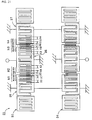
- Fig. 21 is a schematic plan view of a longitudinally coupled resonator type surface acoustic wave filter according to a third preferred embodiment.
- the longitudinally coupled resonator type surface acoustic wave filter 31 of the third preferred embodiment two electrode finger pitches are provided in the narrow pitch electrode finger portion.
- the filter 31 is substantially the same as the longitudinally coupled resonator type surface acoustic wave filter of the first preferred embodiment. Accordingly, the same components are designated by the same reference numerals, and for these components, the description in the first example is applied.
- Surface acoustic wave filter portions 33 and 34 are two-stage dependently connected in the similar manner to that of the first preferred embodiment.
- IDT's 35 to 37 are arranged in the surface acoustic wave propagation direction.
- the IDT's 35 to 37 each have a narrow pitch electrode finger portion similar to the IDT's 5 to 7.
- the narrow pitch electrode finger portion N1 includes electrode finger portions N1A and N1B having different electrode finger pitches. That is, the electrode finger portion N1B including two electrode fingers provided at the end of the IDT 35 near the IDT 36, and the adjacent electrode finger portion N1A, have different electrode finger pitches.
- electrode finger portions N2A, N2B, N3A, and N3B having different electrode finger pitches are provided in the narrow pitch electrode finger portions N2 and N3 of the IDT 36.
- electrode finger portions N4A and N4B have different electrode finger pitches.
- the longitudinally coupled resonator type surface acoustic wave filter portion 34 is similarly configured.
- the electrode finger portions N1B, N2B, N3B, and N4B which are positioned relatively close to the neighboring ends of IDT's are classified into a group B.
- the narrow pitch electrode finger portions N1A, N2A, N3A, and N4A which are positioned relatively far from the neighboring ends of IDT's are classified into a group A. All of the electrode finger pitches of the group A are the same, and all of the electrode finger pitches of the group B are the same.
- the electrode finger pitch of the group A is set to be greater than that of the group B.
- each of the inter-center distances X1 to X10 is set at the value equal to the sum of 0.25 times the wavelength determined by the pitch of a pair of the neighboring electrode fingers.
- the electrode finger crossing width is 40.5 ⁇ l1.
- the wavelength ⁇ l1 of the IDT in each of the electrode finger portions excluding the narrow pitch electrode finger portions is 4.20 ⁇ m.
- the wavelength ⁇ l2 of the electrode fingers of the group A is 3.92 ⁇ m.
- the wavelength ⁇ l3 of the electrode fingers of the group B is 3.87 ⁇ m.
- the wavelength ⁇ R of the respective reflectors is 4.30 ⁇ m.
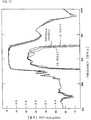
- Figs. 22 and 23 show the frequency characteristic and the VSWR of the longitudinally coupled resonator type surface acoustic wave filter of the third preferred embodiment.
- the characteristics of the reference example previously described in the first preferred embodiment are represented by the broken lines in Figs.22 and 23.
- the VSWR is improved by about 0.25, and the minimum insertion loss is substantially increased, as compared with the above-described reference example.
- dispersions in insertion loss within the pass band are greatly reduced.
- the pass bandwidth which corresponds to the range of from the through-level to the attenuation 4 dB lower than the through-level is similar to that of the reference example.
- the arrangement of the three resonance modes A, B, and C is controlled in a similar fashion to the first preferred embodiment by adjusting each of the narrow pitch electrode finger portions to have two electrode finger portions of which the pitches are different, such that the characteristics are greatly improved.
- the two electrode finger portions having different electrode finger pitches are arranged in each of the narrow pitch electrode finger portions.
- three or more electrode finger portions having different pitches may be so arranged.
- the arrangement of the above-described three resonance modes is controlled by adjusting the inter-center distances X1 to X10 shown in Fig. 21.
- the flexibility of controlling the arrangement of the three resonance modes is further improved as compared with the first preferred embodiment.
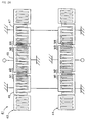
- Fig. 24 is a schematic plan view of a longitudinally coupled resonator type surface acoustic wave filter according to a fourth preferred embodiment.
- longitudinally coupled resonator type surface acoustic wave filter 41 of the fourth preferred embodiment longitudinally coupled resonator type surface acoustic wave filter portions 43 and 44 are two-stage dependently connected, similar to the longitudinally coupled resonator type surface acoustic wave filter portions 3 and 4 of the first preferred embodiment.
- a portion of the electrode finger portion of the IDT 45 which is near the end thereof on the IDT 46 side is configured as a chirp type electrode finger portion M1. More particularly, the pitches of the four electrode fingers of the IDT 45 in the area near the end thereof on the IDT 46 side, including the electrode finger at the end thereof, are linearly changed. That is, as the electrode fingers are positioned farther from the end of the IDT 46, the pitches are increased.
- the chirp type electrode finger portion M1 is provided instead of the narrow pitch electrode finger portion in the first preferred embodiment.
- chirp type electrode finger portions M2 to M4 are provided instead of the narrow pitch electrode finger portions, in the area where IDT's are adjacent to each other.
- the electrode finger pitches are arranged in decreasing order from the center of the IDT 45 toward the end thereof on the IDT 46 side.
- the longitudinally coupled resonator type surface acoustic wave filter portion 44 is also configured similar to the longitudinally coupled resonator type surface acoustic wave filter portion 43.
- the same advantages as those of the first preferred embodiment are obtained by providing a chirp type electrode finger portion instead of the narrow pitch electrode finger portion in this preferred embodiment. That is, the arrangement of the above-described three resonance modes is controlled similarly to the first preferred embodiment, by adjusting the values of the maximum and minimum pitches or the difference between them in the chirp type electrode finger portion.
- Figs. 25 and 26 are schematic block diagrams illustrating a communications device using the longitudinally coupled resonator type surface acoustic wave filter of the present invention.
- a diplexer 62 is connected to an antenna 61.
- a longitudinally coupled resonator type surface acoustic wave filter 64 configured according to the present invention and an amplifier 65 are connected between the diplexer 62 and a reception side mixer 63.
- an amplifier 67 and a longitudinally coupled resonator type surface acoustic wave filter 68 configured according to the present invention are connected between the diplexer 62 and a transmission side mixer 66.
- the longitudinally coupled resonator type surface acoustic wave filter configured according to the present invention is effectively used as the surface acoustic wave filter 64.
- a longitudinally coupled resonator type surface acoustic wave filter configured according to the present invention is effectively used as the surface acoustic wave filter 64A.
- At least one of the first, second, and third IDT's containing at least one narrow pitch electrode finger portion in which the pitches of a portion of the electrode fingers arranged at the end of the IDT towards a neighboring IDT are less than those of the other electrode fingers, wherein the distance between the centers of at least one pair of adjacent electrode fingers is deviated from 0.25 ⁇ A + 0.25 ⁇ B in which ⁇ A represents the wavelength determined by the pitch of one electrode finger, and ⁇ B represents the wavelength determined by the pitch of the other electrode finger of the pair.
- the arrangement of the above-described three resonance modes is controlled by adjusting the inter-center distances, and thereby, a wide band, enhancement of the flatness of the insertion loss within the pass band, and improvement of the VSWR are achieved.
- the distance between the centers of the adjacent electrode fingers of the neighboring IDT's may be deviated from 0.5 ⁇ l2, when the narrow pitch electrode finger portions are arranged on both of the neighboring sides of the IDT's, and moreover, may be set to be different from 0.25 ⁇ l1 + 0.25 ⁇ l2, when the narrow pitch electrode finger portion is provided in only one of the IDT's.
- the arrangement of the above-described three resonance modes is significantly controlled by adjusting the inter-center distances. Thereby, a wide band, enhancement of the flatness of the insertion loss within the pass band, and improvement of the VSWR is achieved.
- the arrangement of the above-described three resonance modes is significantly controlled by adjusting the inter-center distances, and thereby, a wide band, enhancement of the flatness of the insertion loss within the pass band, and improvement of the VSWR are achieved.
- the deviation amount is preferably up to about 0.25 ⁇ l1. Thereby, deterioration of the propagation loss is greatly suppressed.
- the electrode covering ratio of one electrode finger of a pair of the adjacent electrode fingers provided in the neighboring IDT's may be relatively high, wherein the gap between a pair of the adjacent electrode fingers is substantially reduced.
- the above-described arrangement of the three resonance modes is controlled by adjusting the distance between the centers of the adjacent electrode fingers in the neighboring electrode finger portions with different electrode finger pitches provided in the narrow pitch electrode finger portion.
- a wide band, enhancement of the flatness of the insertion loss within the pass band, and improvement of the VSWR are achieved.
- the distance between the centers of at least one pair of the adjacent electrode fingers provided in the narrow pitch electrode finger portions having different electrode finger pitches, respectively, is deviated from 0.25 ⁇ A + 0.25 ⁇ B, in which ⁇ A and ⁇ B represent the wavelengths determined by the respective electrode finger pitches.
- the arrangement of the three resonance modes is significantly controlled.
- a wide band, enhancement of the flatness of the insertion loss within the pass band, and improvement of the VSWR is achieved.
- the narrow pitch electrode finger portion includes a chirp type electrode finger portion
- the arrangement of the above-described three resonance modes is significantly controlled by adjusting the maximum and minimum pitch values and the difference between them in the chirp type electrode finger portion.
- the chirp type electrode finger portion is configured to have electrode finger pitches arranged in linearly decreasing order from the center of the IDT toward the outside thereof in the surface acoustic wave propagation direction, the continuity of the propagation path of a surface acoustic wave is greatly enhanced, such that deterioration of the insertion loss is prevented.
Landscapes
- Physics & Mathematics (AREA)
- Acoustics & Sound (AREA)
- Surface Acoustic Wave Elements And Circuit Networks Thereof (AREA)
Applications Claiming Priority (2)
| Application Number | Priority Date | Filing Date | Title |
|---|---|---|---|
| JP2000191562A JP3358615B2 (ja) | 2000-06-26 | 2000-06-26 | 縦結合共振子型弾性表面波フィルタ |
| JP2000191562 | 2000-06-26 |
Publications (2)
| Publication Number | Publication Date |
|---|---|
| EP1168614A2 true EP1168614A2 (de) | 2002-01-02 |
| EP1168614A3 EP1168614A3 (de) | 2006-07-26 |
Family
ID=18690847
Family Applications (1)
| Application Number | Title | Priority Date | Filing Date |
|---|---|---|---|
| EP01401685A Withdrawn EP1168614A3 (de) | 2000-06-26 | 2001-06-26 | Longitudinal gekoppeltes akustisches Oberflächenwellenresonatorfilter |
Country Status (5)
| Country | Link |
|---|---|
| US (1) | US6583691B2 (de) |
| EP (1) | EP1168614A3 (de) |
| JP (1) | JP3358615B2 (de) |
| KR (1) | KR100415280B1 (de) |
| CN (1) | CN1190006C (de) |
Cited By (7)
| Publication number | Priority date | Publication date | Assignee | Title |
|---|---|---|---|---|
| EP1158672A3 (de) * | 2000-05-22 | 2005-08-17 | Murata Manufacturing Co., Ltd. | Akustisches Oberflächenwellenfilter vom longitudinal gekoppelten Resonator Typ |
| EP1467485A3 (de) * | 2003-04-10 | 2005-09-07 | Murata Manufacturing Co., Ltd. | Akustische Oberflächenwellenvorrichtung und Kommunikationsgerät mit derselben |
| US7504911B2 (en) | 2005-05-27 | 2009-03-17 | Kyocera Corporation | Surface acoustic wave resonator, surface acoustic wave device, and communications equipment |
| EP1249934A3 (de) * | 2001-04-09 | 2010-02-03 | Murata Manufacturing Co., Ltd. | Akustische Oberflächenwellenanordnung und Kommunikationseinheit |
| EP1341304A3 (de) * | 2002-02-28 | 2010-02-24 | Murata Manufacturing Co., Ltd. | Akustischer Oberflächenwellenfilter |
| EP2256925A3 (de) * | 2009-05-27 | 2012-05-09 | Murata Manufacturing Co., Ltd. | Elastische Wellenvorrichtung |
| CN116633307A (zh) * | 2023-05-23 | 2023-08-22 | 无锡市好达电子股份有限公司 | 弹性波装置 |
Families Citing this family (36)
| Publication number | Priority date | Publication date | Assignee | Title |
|---|---|---|---|---|
| JP3743329B2 (ja) * | 2001-03-23 | 2006-02-08 | 株式会社村田製作所 | 弾性表面波フィルタ、およびそれを用いた弾性表面波装置、通信機装置 |
| US6798318B1 (en) * | 2001-04-27 | 2004-09-28 | Sawtek, Inc. | Hybrid leaky surface acoustic wave resonator filter |
| DE60231043D1 (de) | 2001-06-29 | 2009-03-19 | Panasonic Corp | Oberflächenwellenfilter |
| EP1276235A1 (de) * | 2001-07-13 | 2003-01-15 | Matsushita Electric Industrial Co., Ltd. | Oberflächenwellen Filter und Kommunikationsgerät das diesen benutzt |
| JP3685102B2 (ja) * | 2001-07-27 | 2005-08-17 | 株式会社村田製作所 | 弾性表面波フィルタ、通信装置 |
| JP4090250B2 (ja) * | 2001-12-10 | 2008-05-28 | 富士通メディアデバイス株式会社 | 弾性表面波フィルタ |
| JP2004048675A (ja) * | 2002-05-15 | 2004-02-12 | Murata Mfg Co Ltd | 弾性表面波装置及びそれを有する通信装置 |
| JP4059152B2 (ja) * | 2002-10-16 | 2008-03-12 | セイコーエプソン株式会社 | 弾性表面波共振子 |
| CN100452650C (zh) | 2003-07-02 | 2009-01-14 | 京瓷株式会社 | 弹性表面波装置及使用该装置的通信装置 |
| WO2005031971A1 (ja) * | 2003-09-25 | 2005-04-07 | Murata Manufacturing Co., Ltd. | 弾性表面波フィルタ及び通信機 |
| KR100778226B1 (ko) | 2004-04-19 | 2007-11-20 | 가부시키가이샤 무라타 세이사쿠쇼 | 탄성파 필터 및 그것을 사용한 통신기 |
| DE102004020183B4 (de) * | 2004-04-22 | 2015-12-03 | Epcos Ag | Oberflächenwellen-Resonatorfilter mit longitudinal gekoppelten Wandlern |
| JP4069917B2 (ja) * | 2004-09-15 | 2008-04-02 | 株式会社村田製作所 | バランス型弾性表面波フィルタ |
| ATE403270T1 (de) | 2004-11-04 | 2008-08-15 | Murata Mfg Co Ltd Patent Secti | Symmetrie-saw-filter |
| CN100512000C (zh) | 2004-11-04 | 2009-07-08 | 株式会社村田制作所 | 平衡型saw滤波器 |
| US20060236421A1 (en) * | 2005-04-14 | 2006-10-19 | Pennell Roger I | Secondary metabolite production via manipulation of genome methylation |
| JP4641036B2 (ja) | 2005-10-27 | 2011-03-02 | 京セラ株式会社 | 弾性表面波装置および通信装置 |
| JP5094074B2 (ja) * | 2006-07-27 | 2012-12-12 | 京セラ株式会社 | 弾性表面波素子及び弾性表面波装置 |
| JP2008035220A (ja) * | 2006-07-28 | 2008-02-14 | Kyocera Corp | 弾性表面波装置及び通信装置 |
| JP5033876B2 (ja) | 2007-06-28 | 2012-09-26 | 京セラ株式会社 | 弾性表面波装置及び通信装置 |
| US8552618B2 (en) | 2008-04-25 | 2013-10-08 | Kyocera Corporation | Surface acoustic wave device with IDT electrodes having different electrode finger pitches and communication apparatus using same |
| CN102804600B (zh) * | 2009-06-26 | 2015-09-02 | 京瓷株式会社 | 表面声波滤波器以及使用其的分波器 |
| JP5340112B2 (ja) * | 2009-10-28 | 2013-11-13 | 京セラ株式会社 | 弾性表面波装置 |
| DE102013204428B4 (de) * | 2012-03-29 | 2014-08-07 | Leibniz-Institut Für Festkörper- Und Werkstoffforschung Dresden E.V. | Akustisches Oberflächenwellenbauelement |
| JP6134550B2 (ja) * | 2013-03-22 | 2017-05-24 | スカイワークスフィルターソリューションズジャパン株式会社 | 弾性波装置およびそれを用いたアンテナ共用器 |
| CN105745840B (zh) * | 2013-11-29 | 2018-09-28 | 京瓷株式会社 | 弹性波元件、分波器以及通信装置 |
| CN205992889U (zh) * | 2014-03-31 | 2017-03-01 | 株式会社村田制作所 | 声表面波滤波器 |
| CN107078716B (zh) * | 2014-10-31 | 2020-07-14 | 株式会社村田制作所 | 弹性波装置以及弹性波模块 |
| US20170104470A1 (en) * | 2015-10-09 | 2017-04-13 | Avago Technologies General Ip (Singapore) Pte. Ltd. | Interdigitated transducers and reflectors for surface acoustic wave devices with non-uniformly spaced elements |
| WO2018025962A1 (ja) * | 2016-08-05 | 2018-02-08 | 株式会社村田製作所 | 弾性表面波フィルタ、高周波モジュールおよびマルチプレクサ |
| DE102016123151A1 (de) * | 2016-11-30 | 2018-06-14 | Snaptrack, Inc. | Breitband-DMS-Filter |
| JP6886331B2 (ja) * | 2017-04-07 | 2021-06-16 | 太陽誘電株式会社 | 弾性波共振器、フィルタおよびマルチプレクサ |
| DE102018131952A1 (de) * | 2018-12-12 | 2020-06-18 | RF360 Europe GmbH | Elektroakustischer Resonator mit unterdrückter Anregungtransversaler Spaltmoden und verringerten transversalen Moden |
| KR102656794B1 (ko) * | 2019-07-17 | 2024-04-12 | 가부시키가이샤 무라타 세이사쿠쇼 | 탄성파 필터 및 멀티플렉서 |
| US11063571B2 (en) * | 2019-07-25 | 2021-07-13 | Zhuhai Crystal Resonance Technologies Co., Ltd. | Packaged electronic components |
| CN121077428B (zh) * | 2025-11-05 | 2026-03-10 | 偲百创(深圳)科技有限公司 | 声表面波谐振器及其设计方法 |
Citations (4)
| Publication number | Priority date | Publication date | Assignee | Title |
|---|---|---|---|---|
| US4223284A (en) * | 1977-11-07 | 1980-09-16 | Murata Manufacturing Co., Ltd. | Acoustic surface wave device |
| JPH04132409A (ja) * | 1990-09-25 | 1992-05-06 | Hitachi Ltd | 弾性表面波共振器 |
| US5986524A (en) * | 1996-12-25 | 1999-11-16 | Murata Manufacturing Co., Ltd. | Surface acoustic wave resonator filter with a weighted asymmetrical interdigital electrode |
| JP2000183682A (ja) * | 1998-12-21 | 2000-06-30 | Toyo Commun Equip Co Ltd | 二重モードsawフィルタ |
Family Cites Families (7)
| Publication number | Priority date | Publication date | Assignee | Title |
|---|---|---|---|---|
| JP3160023B2 (ja) | 1991-08-21 | 2001-04-23 | 東洋通信機株式会社 | 縦結合二重モードsawフィルタ |
| CA2178438C (en) * | 1995-06-16 | 2001-11-20 | Ji-Dong Dai | Cascaded surface wave device filters |
| JP3882205B2 (ja) * | 1998-08-28 | 2007-02-14 | セイコーエプソン株式会社 | 縦多重モードsawフィルタ |
| DE19849782B4 (de) * | 1998-10-28 | 2004-09-30 | Epcos Ag | Oberflächenwellenanordnung mit zumindest zwei Oberflächenwellen-Strukturen |
| JP2000349591A (ja) * | 1999-06-08 | 2000-12-15 | Oki Electric Ind Co Ltd | 弾性表面波フィルタを用いた分波器 |
| JP4415360B2 (ja) | 2000-01-28 | 2010-02-17 | エプソントヨコム株式会社 | 縦結合弾性表面波フィルタ |
| JP3435640B2 (ja) * | 2000-05-22 | 2003-08-11 | 株式会社村田製作所 | 縦結合共振子型弾性表面波フィルタ |
-
2000
- 2000-06-26 JP JP2000191562A patent/JP3358615B2/ja not_active Expired - Lifetime
-
2001
- 2001-06-12 US US09/878,935 patent/US6583691B2/en not_active Expired - Lifetime
- 2001-06-26 EP EP01401685A patent/EP1168614A3/de not_active Withdrawn
- 2001-06-26 KR KR10-2001-0036553A patent/KR100415280B1/ko not_active Expired - Lifetime
- 2001-06-26 CN CNB011243104A patent/CN1190006C/zh not_active Expired - Lifetime
Patent Citations (4)
| Publication number | Priority date | Publication date | Assignee | Title |
|---|---|---|---|---|
| US4223284A (en) * | 1977-11-07 | 1980-09-16 | Murata Manufacturing Co., Ltd. | Acoustic surface wave device |
| JPH04132409A (ja) * | 1990-09-25 | 1992-05-06 | Hitachi Ltd | 弾性表面波共振器 |
| US5986524A (en) * | 1996-12-25 | 1999-11-16 | Murata Manufacturing Co., Ltd. | Surface acoustic wave resonator filter with a weighted asymmetrical interdigital electrode |
| JP2000183682A (ja) * | 1998-12-21 | 2000-06-30 | Toyo Commun Equip Co Ltd | 二重モードsawフィルタ |
Cited By (9)
| Publication number | Priority date | Publication date | Assignee | Title |
|---|---|---|---|---|
| EP1158672A3 (de) * | 2000-05-22 | 2005-08-17 | Murata Manufacturing Co., Ltd. | Akustisches Oberflächenwellenfilter vom longitudinal gekoppelten Resonator Typ |
| EP1249934A3 (de) * | 2001-04-09 | 2010-02-03 | Murata Manufacturing Co., Ltd. | Akustische Oberflächenwellenanordnung und Kommunikationseinheit |
| EP1341304A3 (de) * | 2002-02-28 | 2010-02-24 | Murata Manufacturing Co., Ltd. | Akustischer Oberflächenwellenfilter |
| EP1467485A3 (de) * | 2003-04-10 | 2005-09-07 | Murata Manufacturing Co., Ltd. | Akustische Oberflächenwellenvorrichtung und Kommunikationsgerät mit derselben |
| US7005948B2 (en) | 2003-04-10 | 2006-02-28 | Murata Manufacturing Co., Ltd. | Surface acoustic wave device and communication apparatus using the same |
| US7504911B2 (en) | 2005-05-27 | 2009-03-17 | Kyocera Corporation | Surface acoustic wave resonator, surface acoustic wave device, and communications equipment |
| EP2256925A3 (de) * | 2009-05-27 | 2012-05-09 | Murata Manufacturing Co., Ltd. | Elastische Wellenvorrichtung |
| US8289107B2 (en) | 2009-05-27 | 2012-10-16 | Murata Manufacturing Co., Ltd. | Acoustic wave device having narrower-pitch electrodes, normally-shaped electrodes and apodized electrodes |
| CN116633307A (zh) * | 2023-05-23 | 2023-08-22 | 无锡市好达电子股份有限公司 | 弹性波装置 |
Also Published As
| Publication number | Publication date |
|---|---|
| JP2002009587A (ja) | 2002-01-11 |
| JP3358615B2 (ja) | 2002-12-24 |
| EP1168614A3 (de) | 2006-07-26 |
| CN1190006C (zh) | 2005-02-16 |
| US6583691B2 (en) | 2003-06-24 |
| KR20020000729A (ko) | 2002-01-05 |
| CN1338820A (zh) | 2002-03-06 |
| US20020047759A1 (en) | 2002-04-25 |
| KR100415280B1 (ko) | 2004-01-16 |
Similar Documents
| Publication | Publication Date | Title |
|---|---|---|
| US6583691B2 (en) | Longitudinally coupled resonator type surface acoustic wave filter with an IDT having a narrow pitch portion | |
| EP1158672B1 (de) | Akustisches Oberflächenwellenfilter vom longitudinal gekoppelten Resonator Typ | |
| KR100434412B1 (ko) | 종결합 공진자형 탄성표면파 필터 | |
| US6873226B2 (en) | Edge-reflection surface acoustic wave filter | |
| US7236067B2 (en) | Surface acoustic wave filter | |
| KR100434411B1 (ko) | 탄성 표면파 장치 | |
| EP0664610B1 (de) | Akustisches Oberflächenwellenfilter | |
| US7646266B2 (en) | Surface acoustic wave resonator and surface acoustic wave filter using the same | |
| EP1337039A1 (de) | Oberflächenwellen Bauelement und Kommunikationsgerät | |
| US20190305747A1 (en) | Acoustic wave device | |
| US7501917B2 (en) | Surface acoustic wave filter | |
| EP1175006A1 (de) | Akustischesoberflächenwellenfilter mit longitudinaler koppelung | |
| EP1005154B1 (de) | Akustisches Oberfächenwellenfilter zur Verbesserung der Flachheit des Durchlassbereichs und Verfahrung zur Herstellung desselben | |
| KR100874828B1 (ko) | 탄성 표면파 필터 장치 | |
| US20230078097A1 (en) | Surface-acoustic-wave resonator and filter utilizing effective reflecting structure | |
| EP1729415B1 (de) | Symmetrisches oberflächenwellenfilter | |
| US6720847B2 (en) | Longitudinally-coupled resonator surface acoustic wave filter and communication apparatus using the same | |
| JP4285052B2 (ja) | 縦結合共振子型弾性表面波フィルタ | |
| JP3915322B2 (ja) | 弾性表面波フィルタ | |
| JPH10209808A (ja) | 弾性表面波フィルタ | |
| US20200287522A1 (en) | Surface acoustic wave filter and design method thereof | |
| US20030090341A1 (en) | Longitudinally coupled surface acoustic wave resonator filter |
Legal Events
| Date | Code | Title | Description |
|---|---|---|---|
| PUAI | Public reference made under article 153(3) epc to a published international application that has entered the european phase |
Free format text: ORIGINAL CODE: 0009012 |
|
| 17P | Request for examination filed |
Effective date: 20010702 |
|
| AK | Designated contracting states |
Kind code of ref document: A2 Designated state(s): AT BE CH CY DE DK ES FI FR GB GR IE IT LI LU MC NL PT SE TR |
|
| AX | Request for extension of the european patent |
Free format text: AL;LT;LV;MK;RO;SI |
|
| PUAL | Search report despatched |
Free format text: ORIGINAL CODE: 0009013 |
|
| AK | Designated contracting states |
Kind code of ref document: A3 Designated state(s): AT BE CH CY DE DK ES FI FR GB GR IE IT LI LU MC NL PT SE TR |
|
| AX | Request for extension of the european patent |
Extension state: AL LT LV MK RO SI |
|
| AKX | Designation fees paid |
Designated state(s): DE FR GB |
|
| RAP1 | Party data changed (applicant data changed or rights of an application transferred) |
Owner name: MURATA MANUFACTURING CO., LTD. |
|
| 17Q | First examination report despatched |
Effective date: 20090227 |
|
| STAA | Information on the status of an ep patent application or granted ep patent |
Free format text: STATUS: THE APPLICATION IS DEEMED TO BE WITHDRAWN |
|
| 18D | Application deemed to be withdrawn |
Effective date: 20180607 |