EP1154259B1 - Measuring apparatus including a measuring chip - Google Patents
Measuring apparatus including a measuring chip Download PDFInfo
- Publication number
- EP1154259B1 EP1154259B1 EP20010111432 EP01111432A EP1154259B1 EP 1154259 B1 EP1154259 B1 EP 1154259B1 EP 20010111432 EP20010111432 EP 20010111432 EP 01111432 A EP01111432 A EP 01111432A EP 1154259 B1 EP1154259 B1 EP 1154259B1
- Authority
- EP
- European Patent Office
- Prior art keywords
- dielectric block
- sample
- measuring
- film layer
- light beam
- Prior art date
- Legal status (The legal status is an assumption and is not a legal conclusion. Google has not performed a legal analysis and makes no representation as to the accuracy of the status listed.)
- Expired - Lifetime
Links
- 229910052751 metal Inorganic materials 0.000 claims description 35
- 239000002184 metal Substances 0.000 claims description 35
- 230000003287 optical effect Effects 0.000 claims description 28
- 238000002198 surface plasmon resonance spectroscopy Methods 0.000 claims description 25
- 239000000463 material Substances 0.000 claims description 18
- 239000011347 resin Substances 0.000 claims description 9
- 229920005989 resin Polymers 0.000 claims description 9
- 238000006243 chemical reaction Methods 0.000 claims description 3
- 239000011521 glass Substances 0.000 claims description 3
- 230000005284 excitation Effects 0.000 claims 1
- 239000010408 film Substances 0.000 description 45
- 239000012530 fluid Substances 0.000 description 12
- 230000002411 adverse Effects 0.000 description 8
- 239000007788 liquid Substances 0.000 description 7
- 238000002347 injection Methods 0.000 description 6
- 239000007924 injection Substances 0.000 description 6
- 238000001746 injection moulding Methods 0.000 description 6
- 230000002950 deficient Effects 0.000 description 5
- 239000004033 plastic Substances 0.000 description 5
- 229920003023 plastic Polymers 0.000 description 5
- 238000005259 measurement Methods 0.000 description 4
- PCHJSUWPFVWCPO-UHFFFAOYSA-N gold Chemical compound [Au] PCHJSUWPFVWCPO-UHFFFAOYSA-N 0.000 description 3
- 229910052737 gold Inorganic materials 0.000 description 3
- 239000010931 gold Substances 0.000 description 3
- 229920003229 poly(methyl methacrylate) Polymers 0.000 description 3
- 239000004926 polymethyl methacrylate Substances 0.000 description 3
- BQCADISMDOOEFD-UHFFFAOYSA-N Silver Chemical compound [Ag] BQCADISMDOOEFD-UHFFFAOYSA-N 0.000 description 2
- 238000004458 analytical method Methods 0.000 description 2
- 230000006835 compression Effects 0.000 description 2
- 238000007906 compression Methods 0.000 description 2
- 230000008021 deposition Effects 0.000 description 2
- 230000006866 deterioration Effects 0.000 description 2
- 239000003989 dielectric material Substances 0.000 description 2
- 230000000644 propagated effect Effects 0.000 description 2
- 229910052709 silver Inorganic materials 0.000 description 2
- 239000004332 silver Substances 0.000 description 2
- 229910052782 aluminium Inorganic materials 0.000 description 1
- XAGFODPZIPBFFR-UHFFFAOYSA-N aluminium Chemical compound [Al] XAGFODPZIPBFFR-UHFFFAOYSA-N 0.000 description 1
- 239000000427 antigen Substances 0.000 description 1
- 102000036639 antigens Human genes 0.000 description 1
- 108091007433 antigens Proteins 0.000 description 1
- 238000011088 calibration curve Methods 0.000 description 1
- -1 cupper Chemical compound 0.000 description 1
- 150000001925 cycloalkenes Chemical class 0.000 description 1
- 238000006073 displacement reaction Methods 0.000 description 1
- 230000005684 electric field Effects 0.000 description 1
- 230000005281 excited state Effects 0.000 description 1
- 239000003574 free electron Substances 0.000 description 1
- 238000011835 investigation Methods 0.000 description 1
- 230000001788 irregular Effects 0.000 description 1
- 239000005304 optical glass Substances 0.000 description 1
- 230000010287 polarization Effects 0.000 description 1
- 239000004417 polycarbonate Substances 0.000 description 1
- 229920000515 polycarbonate Polymers 0.000 description 1
- 229920000098 polyolefin Polymers 0.000 description 1
- 238000004445 quantitative analysis Methods 0.000 description 1
- 238000011160 research Methods 0.000 description 1
- 239000004065 semiconductor Substances 0.000 description 1
- 239000011540 sensing material Substances 0.000 description 1
- 238000001228 spectrum Methods 0.000 description 1
- 229920003002 synthetic resin Polymers 0.000 description 1
- 239000000057 synthetic resin Substances 0.000 description 1
- 239000010409 thin film Substances 0.000 description 1
Images


Classifications
-
- G—PHYSICS
- G01—MEASURING; TESTING
- G01N—INVESTIGATING OR ANALYSING MATERIALS BY DETERMINING THEIR CHEMICAL OR PHYSICAL PROPERTIES
- G01N21/00—Investigating or analysing materials by the use of optical means, i.e. using sub-millimetre waves, infrared, visible or ultraviolet light
- G01N21/17—Systems in which incident light is modified in accordance with the properties of the material investigated
- G01N21/55—Specular reflectivity
- G01N21/552—Attenuated total reflection
- G01N21/553—Attenuated total reflection and using surface plasmons
-
- G—PHYSICS
- G01—MEASURING; TESTING
- G01N—INVESTIGATING OR ANALYSING MATERIALS BY DETERMINING THEIR CHEMICAL OR PHYSICAL PROPERTIES
- G01N2201/00—Features of devices classified in G01N21/00
- G01N2201/04—Batch operation; multisample devices
- G01N2201/0415—Carrusel, sequential
Definitions
- This invention relates to a measuring apparatus according to the preamble of claim 1, for instance, a surface plasmon resonance sensor for quantitatively analyzing a material in a sample utilizing generation of surface plasmon.
- the plasmon resonance sensor using the Kretschmann configuration basically comprises a dielectric block shaped, for instance, like a prism, a metal film which is formed on one face of the dielectric block and is brought into contact with a sample, a light source emitting a light beam, an optical system which causes the light beam to enter the dielectric block so that the light beam is reflected in total internal reflection at the interface of the dielectric block and the metal film and various angles of incidence of the light beam to the interface of the dielectric block and the metal film including an angle of incidence at which surface plasmon is generated can be obtained, and a photodetector means which is able to detect the intensity of the light beam reflected in total internal reflection at the interface and detect a state of surface plasmon resonance.
- a relatively thin incident light beam may be caused to impinge upon the interface while deflecting the incident light beam or a relatively thick incident light beam may be caused to impinge on the interface in the form of convergent light or divergent light so that components of the incident light beam impinge upon the interface at various angles.
- the light beam which is reflected from the interface at an angle which varies as the incident light beam is deflected may be detected by a photodetector which is moved in synchronization with deflection of the incident light beam or by an area sensor extending in the direction in which reflected light beam is moved as a result of deflection.
- an area sensor which extends in directions so that all the components of light reflected from the interface at various angles can be detected by the area sensor may be used.
- a plasmon resonance sensor when a light beam impinges upon the interface at a particular angle of incidence ⁇ sp not smaller than the angle of total internal reflection, evanescent waves having an electric field distribution in the sample in contact with the metal film are generated and surface plasmon is excited in the interface between the metal film and the sample.
- the wave vector of the evanescent waves is equal to the wave number of the surface plasmon and wave number matching is established, the evanescent waves and the surface plasmon resonate and light energy is transferred to the surface plasmon, whereby the intensity of light reflected in total internal reflection at the interface of the dielectric block and the metal film sharply drops.
- the sharp intensity drop is generally detected as a dark line by the photodetector.
- the aforesaid resonance occurs only when the incident light beam is p-polarized. Accordingly, it is necessary to set the light beam to impinge upon the interface in the form of p-polarized light.
- K sp ⁇ ⁇ c ⁇ ⁇ m ⁇ ⁇ ⁇ s ⁇ m ⁇ + ⁇ s
- K sp represents the wave number of the surface plasmon
- ⁇ represents the angular frequency of the surface plasmon
- c represents the speed of light in a vacuum
- ⁇ m and ⁇ s respectively represent the dielectric constants of the metal and the sample.
- the concentration of a specific material in the sample can be determined on the basis of a predetermined calibration curve or the like. Accordingly, a specific component in the sample can be quantitatively analyzed by detecting the angle of incidence ⁇ sp at which the intensity of light reflected in total internal reflection from the interface of the prism and the metal film sharply drops.
- the metal film is fixedly formed on a flat and thin dielectric plate as a unit and the unit is removably integrated with a prism-like dielectric block which functions as an optical coupler for causing total internal reflection.
- the prism-like dielectric block is fixedly provided with respect to the optical system and the unit of the metal film and the dielectric plate is changed sample by sample as a measuring chip.
- the leaky mode sensor basically comprises a dielectric block shaped, for instance, like a prism, a clad layer which is formed on one face of the dielectric block, an optical waveguide layer which is formed on the clad layer and is brought into contact with a sample, a light source emitting a light beam, an optical system which causes the light beam to enter the dielectric block at various angles of incidence so that total internal reflection conditions are satisfied at the interface of the dielectric block and the clad layer, and a photodetector means which is able to detect the intensity of the light beam reflected in total internal reflection at the interface and detect an excited state of waveguide mode, i.e., attenuation in total internal reflection (ATR).
- ATR attenuation in total internal reflection
- the leaky mode sensor In the leaky mode sensor with this arrangement, when the light beam is caused to impinge upon the clad layer through the dielectric block at an angle not smaller than an angle of total internal reflection, only light having a particular wave number and impinging upon the optical waveguide layer at a particular angle of incidence comes to propagate through the optical waveguide layer in a waveguide mode after passing through the clad layer.
- the waveguide mode When the waveguide mode is thus excited, almost all the incident light is taken in the optical waveguide layer and accordingly, the intensity of light reflected in total internal reflection at the interface of the dielectric block and the clad layer sharply drops. That is, attenuation in total internal reflection occurs.
- the refractive index and/or the properties of the sample related to the refractive index can be detected on the basis of the angle of incidence at which the attenuation in total internal reflection occurs.
- the leaky mode sensor it is possible to fix a dielectric block with respect to the optical system, to form the clad layer and the optical waveguide layer on another dielectric block to form a measuring chip, and to change the measuring chip sample by sample.
- the dielectric blocks have to be integrated with each other by way of refractive index matching fluid in order to prevent a space from being formed between the dielectric blocks to make discontinuous the refractive index between the blocks.
- Such operation is very troublesome, which makes the conventional measuring chips inconvenient to handle.
- loading and unloading the measuring chips take a lot of labor, which is apt to cause deterioration in the measuring efficiency.
- the refractive index matching fluid can adversely affect the environment.
- a measuring apparatus is known from EP 0 884 581 A1 .
- the sample is constituted by a liquid which is conveyed through a flow cell.
- WO 95/22754 discloses a measuring apparatus according to the preamble of claim 1.
- the space above the film layer is defined by walls which are perpendicularly oriented with respect to the film layer.
- WO 97/15819 discloses a surface plasmon resonance sensor in which a target liquid is dropped on a measurement area.
- JP 9 257 701 discloses a surface plasmon resonance sensor comprising a detecting piece which includes a prism part having a light reflection side formed by a vapour-deposited silver thin film.
- the object of the present invention is to provide a measuring apparatus which is easily replaceable and can eliminate necessity of using refractive index matching fluid.
- a measuring chip which is used in a measuring apparatus comprising the features of claim 1.
- the measuring apparatus is provided with a sample holder mechanism for holding the sample on the film layer.
- the sample holder mechanism comprises a member which defines above the film layer a space having closed side walls and is flared upward. It is preferred that the inner surface of the member which defines above the film layer a space having closed side walls is smoothly merged with the first face of the dielectric block on which the film layer is formed.
- the dielectric block be polygonal such as a rectangle in a horizontal cross-section.
- the horizontal cross-section means a cross-section taken along a plane perpendicular to the vertical direction of the block in which the block is positioned in operation of the measuring chip.
- the dielectric block is polygonal in a horizontal cross-section
- corners of the polygonal be rounded in at least one horizontal plane.
- the polygonal may be rounded at corners between two adjacent side surfaces thereof, at corners between two adjacent side surfaces and the bottom surface, and at both the corners.
- the dielectric block when the dielectric block is polygonal in a horizontal cross-section, it is preferred that the dielectric block is tapered downward so that the cross-sectional area becomes larger upward. In this case, it is preferred that the inclined side surfaces of the dielectric block be at 3 to 15° to the vertical axis of the dielectric block.
- the dielectric block is formed of, for instance, glass or transparent resin.
- the sample holder mechanism be formed integrally with the dielectric block.
- a sensing medium which makes bonding reaction with a particular material in the sample be fixed on the film layer.
- the single dielectric block has all the light incident face, the light emanating face and the face on which the film layer is formed and functions as an optical coupler, the measuring apparatus need be coupled with or decoupled from another member and accordingly, can be easily and quickly replaced.
- the measuring chip of the present invention need not be coupled with another dielectric block (as an optical coupler) by way of refractive index matching fluid, and accordingly it is very easy to handle.
- the sample holder mechanism comprises a member which defines above the film layer a space which has closed side walls and is flared upward, the film layer can be uniform in thickness. That is, since the film layer is generally formed by deposition, when the sample holder mechanism is of such a shape, the film layer can be uniformly formed without being adversely affected by the sample holder mechanism.
- the dielectric block is polygonal in a horizontal cross-section and the corners of the polygonal are rounded in at least one horizontal plane, plastic injection molding of the dielectric block/sample holder mechanism unit is facilitated since ejection of the products from the injection mold becomes smoother, whereby defective products can be reduced.
- the dielectric block is polygonal in a horizontal cross-section and is tapered downward so that the cross-sectional area becomes larger upward, positioning of the measuring chip on the measuring apparatus is facilitated.
- the dielectric block can be automatically set in a predetermined direction in a horizontal plane and held there through engagement of polygons.
- the measuring chips can be automatically positioned also in the vertical direction.
- the measuring chip can be especially accurately positioned, the reason for which will become apparent later.
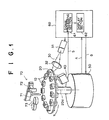
- a surface plasmon resonance sensor comprises a turn table 20 on which a plurality of measuring chips 10 in accordance with a first embodiment of the present invention are supported, a laser 31 such as a semiconductor laser which emits a measuring light beam 30, a condenser lens 32 which forms an incident optical system, a photodetector 40, a drive means 50 which intermittently rotates the turn table 20, a controller 60 which controls the drive means 50 and at the same time receives output signal S of the photodetector 40 to execute processing described later, and an automatic sample supply mechanism 70.
- a laser 31 such as a semiconductor laser which emits a measuring light beam 30
- a condenser lens 32 which forms an incident optical system
- a photodetector 40 which intermittently rotates the turn table 20
- a controller 60 which controls the drive means 50 and at the same time receives output signal S of the photodetector 40 to execute processing described later
- an automatic sample supply mechanism 70 an automatic sample supply mechanism
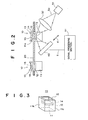
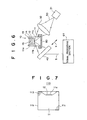
- each of the measuring chips 10 comprises a transparent dielectric block 11 which is rectangular in shape, a metal film 12 such as of gold, silver, cupper, aluminum or the like which is formed on the upper face of the block 11, and a sample holder frame (constituting a sample holder mechanism) 13 which is a tubular member defining above the metal film 12 a space having closed side walls.
- the dielectric block 11 is of a single piece which has all the face on which the metal film 12 is formed (a face forming an interface 11a to be described later), a light incident face 11 through which the measuring light beam 30 enters the block 11 and a light emanating face 11c through which the measuring light beam 30 emanates the block 11.
- the sample holder frame 13 is stored, for instance, a sample liquid 15 in the manner to be described later.
- the measuring chip 10 is formed, for instance, by integrally forming the dielectric block 11 and the sample holder frame 13 by injection molding of transparent resin and is replaceable.
- the measuring chips 10 are removably held in through holes formed in the turn table 20.
- a sensing medium 14 is fixed on the metal film 12. The sensing medium 14 will be described later.
- the transparent resin for forming the dielectric block 11 and the sample holder frame 13 PMMA, polycarbonate, amorphous polyolefin, cycloolefin and the like are preferred. Also glass may be preferably employed.
- the material for forming the dielectric block 11 those which are 1.45 to 2.5 or so in refractive index are generally preferred since a practical SPR angle is obtained in the refractive index range.
- the turn table 20 is arranged so that a plurality of (eleven in this particular embodiment) measuring chips 10 are supported on a circle about its axis of rotation 20a at regular intervals.
- the drive means 50 comprises a stepping motor and rotates the turn table 20 by an angle equal to the angular space between the chips 10.
- the condenser lens 32 condenses the light beam 30 and caused to enter the dielectric block 11 in the form of a convergent light beam so that various angles of incidence of the light beam 30 to the interface 11a of the dielectric block 11 and the metal film 12 can be obtained.
- the range of the angles of incidence is set to include a range in which the total internal reflection condition of the light beam 30 is satisfied at the interface 11a and a surface plasmon resonance can take place.
- the light beam 30 impinges upon the interface 11a in the form of p-polarized light.
- This can be realized by suitably positioning the laser 31 or by control the polarization direction of the light beam 30 by the use of a wavelength plate, a polarizing plate or the like.
- the photodetector 40 comprises a line sensor having a number of photodetector elements arranged in a row in the direction of arrow X in Figure 2 .
- the controller 60 receives an address signal A representing the position of the drive means 50 and outputs a drive signal D for driving the drive means 50 on the basis of a predetermined sequence. Further, the controller 60 is provided with a signal processing section 61 which receives an output signal S from the photodetector 40 and a display section 62 which receives an output of the signal processing section 61.
- the automatic sample supply mechanism 70 comprises a pipette 71 which sucks a predetermined amount of sample liquid and a pipette drive means 72 which moves the pipette 71.
- the automatic sample supply mechanism 70 causes the pipette 72 to suck the sample in a sample container 73 held in a predetermined position and moves the pipette 71 above the sample holder frame 13 of a measuring chip 10 in a predetermined position, and causes the pipette 71 to spot the sample liquid in the sample holder frame 13.
- the turn table 20 is intermittently rotated by the drive means 50.
- sample liquid 15 is supplied to the sample holder frame 13 of the measuring chip 10 in the predetermined position by the automatic sample supply mechanism 70.
- the laser 31 is driven under the control of the controller 60 and the light beam 30 emitted from the laser 31 impinges upon the interface 11a between the dielectric block 11 and the metal film 12 in the form of convergent light.
- the light beam 30 is reflected in total internal reflection at the interface 11a and is detected by the photodetector 40.
- the light beam 30 Since the light beam 30 impinges upon the interface 11a in the form of convergent light, the light beam 30 includes components which impinge upon the interface at various angles ⁇ .
- the angles ⁇ of incidence is not smaller than the angle of total internal reflection. Accordingly, the light beam 30 is reflected in total internal reflection at the interface 11a, and the reflected light beam 30 at the interface 11a includes components reflected at various reflecting angles.
- the optical system such as the condenser lens 32 may be arranged so that the light beam 30 impinges upon the interface 11 in a defocused state. This arrangement is advantageous in that errors in detecting the state of surface plasmon resonance, e.g., in detecting the position of the aforesaid dark line, are averaged, whereby the measuring accuracy is enhanced.
- FIG. 4 is a graph showing the relation between the angle of incidence ⁇ sp of the light beam 30 and the output (I) of the photodetector 40.
- the position of the photodetector element which detects the dark line can be determined and the angle ⁇ sp of incidence at which the intensity I of the light beam 30 reflected in total internal reflection at the interface 11a sharply drops can be determined. Accordingly by referring to a standard curve which represents the relation between the intensity I of the reflected light and the angle ⁇ sp of incidence at which the intensity I of the light beam 30 reflected in total internal reflection at the interface 11a sharply drops for each sample, a particular material in the sample 15 can be quantitatively analyzed.
- the signal processing section 61 of the controller 60 quantitatively analyzes the particular material in the sample 15 on the basis of this fact and the result of the analysis is displayed by the display section 62.
- the measuring chips 10 When each sample 15 is subjected to measurement only once, the measuring chips 10 may be manually or automatically removed from the turn table 20. Whereas when each sample 15 is subjected to measurement a plurality of times, the measuring chips 10 may be left on the turn table 20 so that the measuring chip 20 is brought to the measuring position again when the turn table 20 makes another rotation.
- the surface plasmon resonance sensor of this embodiment since a plurality of measuring chips 10 are held on the turn table 20 and the turn table 20 is intermittently rotated so that the measuring chips 10 are brought to the measuring position in sequence, a plurality of samples 15 can be measured at a high efficiency whereby the time required to measure each sample can be shortened.
- the automatic sample supply mechanism 70 since, the automatic sample supply mechanism 70 is provided, the time required to supply samples to the measuring chips 10 also can be shortened, whereby the time required to measure each sample can be further shortened.
- the measuring chip 10 of this embodiment need not be coupled with another dielectric block (as an optical coupler) by way of refractive index matching fluid, it is very easy to handle. Further, since it is not necessary to use the refractive index matching fluid, adverse influence of the fluid on the environment can be avoided.
- the sensing medium 14 fixed on the surface of the metal film 12 is selectively linked to a specific material in the sample 15.
- a specific material in the sample 15 for instance, combinations of antigen and antibody are known.
- antigen-antibody reaction can be detected on the basis of the angle ⁇ sp of total internal reflection attenuation.
- Figure 5 shows a measuring chip 10' in accordance with an example and a surface plasmon resonance sensor employing the measuring chip 10'.
- elements analogous to those shown in Figure 2 are given the same reference numerals and will not be described here.
- the measuring chip 10' of this example differs from the measuring chip 10 of the first embodiment in that the measuring chip 10' is not provided with the sensing medium 14. Accordingly, the specific material in the sample 15 is not linked with the sensing medium and the normal quantitative analysis of a material to be measured in the sample 15 is effected.
- the measuring chip 10' of the example is the same as the measuring chip 10 of the first embodiment.
- the measuring chip of the present invention is employed in an apparatus where a plurality of the measuring chips are mounted on the turn table 20 and automatically brought to and removed from the measuring position by rotating the turn table 20, the measuring chip of the present invention can be employed in a measuring apparatus where such an automatic measuring chip supply mechanism is not provided.
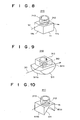
- the surface plasmon resonance sensor shown in Figure 6 comprises an attachment 80 which is fixed with respect to the laser 31, the condenser lens 32 and the photodetector 40.
- the measuring chip 10 is manually set to the attachment 80, and after measurement, the measuring chip 10 is manually replaced by new one.
- the measuring chip 110 of the second embodiment of the present invention shown in Figure 7 is the same as the measuring chip 10, and in the measuring chip 110, the space inside the sample holder frame 113 is also flared upward. Since the metal film 12 is generally formed by deposition, when the sample holder mechanism 113 is of such a shape, the metal film 12 can be formed in a uniform thickness without being adversely affected by the sample holder frame 113.
- the measuring chip 210 of the example shown in Figure 8 differs from that of the example shown in Figure 3 in that the sample holder frame 213 is cylindrical and the metal film 212 is circular.
- the sample holder frame 313 has a cylindrical inner space though is rectangular in outer shape.
- the metal film 312 is circular.
- the dielectric block 311 has a spherical light incident face 311b and a spherical light emanating face 311c.
- the light incident face 311b and the light emanating face 311c of the dielectric block 311 function like a lens to the light beam 30.
- the measuring chip 410 of the example shown in Figure 10 differs from that 210 of the example shown in Figure 8 in the shape of the dielectric block 411. That is, a part of the dielectric block 411 outside the optical path of the light beam 30 is cut away. With this arrangement, the material for forming the dielectric block can be saved.
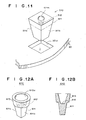
- the measuring chip 510 of the third embodiment and a surface plasmon resonance sensor in which the measuring chip 510 of the third embodiment is employed will be described with reference to Figure 11 , hereinbelow.
- the measuring chip 510 comprises a dielectric block 511 formed of transparent resin.
- the dielectric block 511 is of a quadrangular pyramid in outer shape which flares upward and is positioned with the smaller side down when it is set on the surface plasmon resonance sensor.
- two side faces form a light incident face 511b and a light emanating face 511c.
- the light incident face 511b and the light emanating face 511c of the dielectric body 511 may be transparent over the entire area or may be transparent only the part through which the light beam 30 travels.
- the other two faces may be transparent over the entire area or may be transparent only the part through which the light beam 30 travels, or may be semitransparent.
- a sample holder hole 511m which is tapered downward is formed on the top of the dielectric block 511 and a metal film 512 is formed on the bottom of the sample holder hole 511m. That is, in this embodiment, the part of the dielectric block 511 around the sample holder hole 511m forms the sample holder frame.
- the turn table 20 ( Figure 1 ) of the surface plasmon resonance sensor has a plurality of chip holding holes 20w which is of a quadrilateral in shape. Each of the chip holding holes 20w is tapered downward to conform to the outer shape of the dielectric block 511.
- the measuring chip 510 is inserted into the chip holding hole 20w from above and is held on the turn table 20 by way of engagement between the outer surface of the dielectric block 511 and inner surface of the chip holding hole 20w. Since the measuring chip 20w is positioned and held by way of engagement between the outer surface of the dielectric block 511 and the inner surface of the chip holding hole 20w which are both of quadrilateral in shape, the dielectric block 511 can be automatically oriented with respect to the turn table in the horizontal direction and cannot be moved from the position in the horizontal direction. With this arrangement, positioning of the measuring chip 510 in the horizontal direction is facilitated.
- the measuring chip can be automatically located also in the vertical direction.
- the part of the dielectric block 511 lower than the chained line in Figure 11 projects downward beyond the lower edge of the turn table 20.
- the measuring chip 610 of the fourth embodiment shown in Figures 12A and 12B differs from that 510 of the third embodiment in that a conical sample holding frame 613 provided with a conical sample holding hole 613a tapered downward is formed on the dielectric block 611 integrally therewith.
- a metal film 612 is formed on the bottom of the sample holding hole 613a.
- the dielectric block 611 of the measuring chip 601 of this embodiment is basically the same in the outer shape as the dielectric block 510 of the third embodiment. Out of the four side faces of the dielectric block 611, two side faces form a light incident face 611b and a light emanating face 611c. Since the dielectric block 611 is basically the same as that of the third embodiment in the outer shape, also the measuring chip 610 of this embodiment can be easily positioned in both the horizontal and vertical directions.
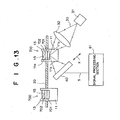
- FIG 13 is a side cross-sectional view partly cut away showing a measuring chip 700 in accordance with a further example and a leaky mode sensor employing the measuring chip 700.
- the leaky mode sensor is basically of the same structure as the surface plasmon resonance sensor shown in Figure 2 .
- the measuring chip 700 comprises a dielectric block 11, a clad layer 701 formed on the top surface of the dielectric block 11 and an optical waveguide layer 702 formed on the clad layer 701.
- the dielectric block 11 is formed of, for instance, synthetic resin or optical glass such as BK7.
- the clad layer 701 is formed of dielectric material lower than the dielectric block 11 in refractive index or metal such as gold.
- the optical wave guide layer 702 is formed of dielectric material such as PMMA which is higher than the clad layer 701 in refractive index.
- the thickness of the clad layer 701 is 36.5nm when it is formed gold film, and the thickness of the optical waveguide layer 702 is about 700nm when it is formed of PMMA.
- the leaky mode sensor when the light beam 30 emitted from the laser 31 is caused to impinge upon the clad layer 701 at an angle not smaller than an angle of total internal reflection, the light beam 30 is reflected in total internal reflection at the interface 11a of the dielectric block 11 and the clad layer 701, and only light having a particular wave number and impinging upon the waveguide layer 702 at a particular angle of incidence comes to propagate through the optical waveguide layer 702 in a waveguide mode after passing through the clad layer 701.
- the waveguide mode is thus excited, almost all the incident light is taken in the optical waveguide layer 702 and accordingly, the intensity of light reflected in total internal reflection at the interface 11a of the dielectric block 11 and the clad layer 701 sharply drops. That is, attenuation in total internal reflection occurs.
- the wave number of light to be propagated through the optical waveguide layer 702 in a waveguide mode depends upon the refractive index of the sample 15 on the optical waveguide layer 702, the refractive index and/or the properties of the sample 15 related to the refractive index can be detected on the basis of the angle of incidence at which the attenuation in total internal reflection occurs.
- a signal processing section 61 quantitatively analyzes the particular material in the sample 15 on the basis of this fact and the result of the analysis is displayed by the display section (not shown).
- the measuring chip 700 of this example need not be coupled with another dielectric block by way of refractive index matching fluid, it is very easy to handle. Further, since it is not necessary to use the refractive index matching fluid, adverse influence of the fluid on the environment can be avoided.
- a measuring chip 810 in accordance with the fifth embodiment of the present invention will be described with reference to Figures 14, 15A and 15B , hereinbelow.
- the measuring chip 810 of this embodiment is substantially the same as the measuring chip 510 of the third embodiment shown in Figure 11 except the shape of the sample holder hole 811m. That is, the measuring chip 810 comprises a dielectric block 811 formed of transparent resin.
- the dielectric block 811 is of a quadrangular pyramid in outer shape which flares upward and is positioned with the smaller side down when it is set on the surface plasmon resonance sensor.
- two side faces form a light incident face 811b and a light emanating face 811c.
- the light incident face 811b and the light emanating face 811c of the dielectric body 811 may be transparent over the entire area or may be transparent only the part through which the light beam 30 travels.
- the other two faces may be transparent over the entire area or may be transparent only the part through which the light beam 30 travels, or may be semitransparent.
- a sample holder hole 811m which is tapered downward is formed on the top of the dielectric block 811 and a metal film 812 is formed on the bottom of the sample holder hole 811m. That is, in this embodiment, the part of the dielectric block 811 around the sample holder hole 811m forms the sample holder frame.
- plastic injection molding When the dielectric block 811 is formed of transparent resin, plastic injection molding is generally employed. In plastic injection molding, when the product cannot be smoothly ejected from the injection mold, the product becomes of an irregular shape and a defective product is generated.
- the dielectric block 511 shown in Figure 11 can be relatively smoothly ejected from the injection mold since the sample holder hole 511m is tapered. However, a sharp edge defined between the side wall of the sample holder hole 511m and the bottom of the same can adversely affect ejection of the product.
- the sample holder hole 811m is formed like a bowl and the side wall of the sample holder hole 811m smoothly merges into the bottom of the same, the product can be ejected so smoothly from the injection mold that generation of defective products is suppressed to produce high yield.
- the metal film 812 can be formed in a uniform thickness without being adversely affected by the part around the sample holder hole 811m.
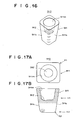
- a measuring chip 910 in accordance with the sixth embodiment of the present invention will be described with reference to Figures 16, 17A and 17B , hereinbelow.
- the measuring chip 910 of this embodiment is substantially the same as the measuring chip 810 of the fifth embodiment shown in Figures 14, 15A and 15B except the shape of the sample holder hole 911m and the outer shape of the dielectric block 911. That is, the measuring chip 910 comprises a dielectric block 911 formed of transparent resin.
- the dielectric block 911 is of a quadrangular pyramid in outer shape which flares upward and is positioned with the smaller side down when it is set on-the surface plasmon resonance sensor. Out of the four side faces of the dielectric block 911, two side faces form a light incident face 911b and a light emanating face 911c.
- the edges between adjacent side faces of the dielectric block 911 are rounded as indicated by arrow R1 in Figure 17A
- the corners between the side faces and the bottom face of the dielectric block 911 are rounded as indicated by arrow R2 in Figure 17B . That is, in both the horizontal cross-sections denoted by arrows v1 and v2, the corners of the dielectric block 911 are rounder.
- the rounded edges and the rounded corners permit the product to be smoothly ejected from the injection mold and suppress generation of defective products, whereby high yield is obtained.
- the shapes of the dielectric blocks 811 and 911 of the measuring chips in accordance with the fifth and sixth embodiments of the present invention may be also applied to the leaky mode sensor shown in Figure 13 and provide substantially the same results.
- the measuring system was basically the same as the surface plasmon resonance sensor shown in Figure 1 .
- Measuring chips 910 of the sixth embodiment were set in the chip holding holes 20w of the turn table 20 and the turn table 20 was rotated to bring the measuring chips 910 to the measuring position in sequence.
- the same light source and photodetector as shown in Figure 2 were used.
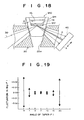
- Measuring chips 910 which were 1°, 3° , 7° , 10° , 15° and 20° in angle of taper ( ⁇ ), the angle between the vertical axis of the dielectric block 911 and the side faces of the same, were prepared, and at the same time, a measuring chip which was 0° in angle of taper ⁇ (not tapered) was prepared. Then the measuring chips were set on respective turn tables which were the same as the angles of taper ⁇ in angle of inclination of the chip holding holes 20w.
- Sensing medium 14 was fixed on the metal film 912 of each measuring chip and samples containing therein a specific material to be linked with the sensing medium 14.
- the specific material in the sample 15 is linked with the sensing medium 14, the refractive index of the sensing medium 14 is changed and the angle ⁇ sp at which attenuation in total internal reflection occurs changes.
- the change of the angle ⁇ sp at which attenuation in total internal reflection occurs is normally within 0.1 to 1.0°.
- fluctuation in the measured value of the angle ⁇ sp at which attenuation in total internal reflection occurs due to fluctuation in position of the measuring chip 910 should not exceed 1/10 of the range over which the angle ⁇ sp changes due to link of the specific material in the sample 15 with the sensing medium 14. That is, fluctuation in the measured value of the angle ⁇ sp due to fluctuation in position of the measuring chip should be not larger than 0.01° .
- the measuring chip is positioned with respect to the chip holder hole 20w of the turn table 20 by virtue of the tapered outer shape of the dielectric block, the measuring chip can be slightly displaced in the vertical direction as the turn table 20 is turned.
- the displacement of the measuring chip results in fluctuation in measured values of the angle ⁇ sp.
- the turn tables 20 which were loaded with the measuring chip having different angles of taper ⁇ were turned by one rotation and the difference between the measured values of the angle ⁇ sp before and after the rotation.
- the result is as shown in Figure 19 .
- fluctuation in the measured value of the angle ⁇ sp due to fluctuation in position of the measuring chip can be not larger than 0.01° when the angle of taper ⁇ is in the range 3 to 15°.
Landscapes
- Physics & Mathematics (AREA)
- Health & Medical Sciences (AREA)
- Life Sciences & Earth Sciences (AREA)
- Chemical & Material Sciences (AREA)
- Analytical Chemistry (AREA)
- Biochemistry (AREA)
- General Health & Medical Sciences (AREA)
- General Physics & Mathematics (AREA)
- Immunology (AREA)
- Pathology (AREA)
- Investigating Or Analysing Materials By Optical Means (AREA)
- Optical Measuring Cells (AREA)
- Automatic Analysis And Handling Materials Therefor (AREA)
Applications Claiming Priority (8)
| Application Number | Priority Date | Filing Date | Title |
|---|---|---|---|
| JP2000138604 | 2000-05-11 | ||
| JP2000138604 | 2000-05-11 | ||
| JP2000212125 | 2000-07-13 | ||
| JP2000212125 | 2000-07-13 | ||
| JP2001016633 | 2001-01-25 | ||
| JP2001016633 | 2001-01-25 | ||
| JP2001092666 | 2001-03-28 | ||
| JP2001092666A JP4368535B2 (ja) | 2000-05-11 | 2001-03-28 | 測定チップ |
Publications (2)
| Publication Number | Publication Date |
|---|---|
| EP1154259A1 EP1154259A1 (en) | 2001-11-14 |
| EP1154259B1 true EP1154259B1 (en) | 2011-07-13 |
Family
ID=27481283
Family Applications (1)
| Application Number | Title | Priority Date | Filing Date |
|---|---|---|---|
| EP20010111432 Expired - Lifetime EP1154259B1 (en) | 2000-05-11 | 2001-05-10 | Measuring apparatus including a measuring chip |
Country Status (3)
| Country | Link |
|---|---|
| US (1) | US6597456B2 (ja) |
| EP (1) | EP1154259B1 (ja) |
| JP (1) | JP4368535B2 (ja) |
Families Citing this family (28)
| Publication number | Priority date | Publication date | Assignee | Title |
|---|---|---|---|---|
| US20020127706A1 (en) * | 2001-01-25 | 2002-09-12 | Fuji Photo Film Co., Ltd. | Surface plasmon resonance measuring chip and method of manufacture thereof |
| EP1420929B1 (de) * | 2001-08-30 | 2011-10-12 | Bayer Technology Services GmbH | Verfahren zur herstellung von abformkörpern, insbesondere optischen strukturen, und deren verwendung |
| JP2003106992A (ja) * | 2001-09-28 | 2003-04-09 | Fuji Photo Optical Co Ltd | 測定チップおよびその作製方法 |
| JP2003139694A (ja) * | 2001-11-06 | 2003-05-14 | Fuji Photo Film Co Ltd | 測定プレート |
| US7187444B2 (en) * | 2001-11-12 | 2007-03-06 | Fuji Photo Film Co., Ltd. | Measuring method and apparatus using attenuation in total internal reflection |
| JP4382339B2 (ja) | 2001-12-14 | 2009-12-09 | 富士フイルム株式会社 | 測定チップ |
| JP4173725B2 (ja) * | 2001-12-25 | 2008-10-29 | 富士フイルム株式会社 | エバネッセント波を利用したセンサー |
| JP3801914B2 (ja) * | 2001-12-25 | 2006-07-26 | 富士写真フイルム株式会社 | 測定チップの再使用方法 |
| DE60213056T2 (de) * | 2001-12-25 | 2007-01-04 | Fuji Photo Film Co., Ltd., Minami-Ashigara | Sensorsystem mit evaneszenten Wellen |
| JP4030796B2 (ja) * | 2002-05-13 | 2008-01-09 | 富士フイルム株式会社 | 測定チップ |
| JP3786073B2 (ja) * | 2002-10-10 | 2006-06-14 | 株式会社日立製作所 | 生化学センサ用キットおよび測定装置 |
| DE602004025073D1 (de) | 2003-09-02 | 2010-03-04 | Fujifilm Corp | Messgerät basierend auf der Oberflächenplasmonenresonanz |
| JP2005077317A (ja) * | 2003-09-02 | 2005-03-24 | Fuji Photo Film Co Ltd | 測定装置 |
| JP4455362B2 (ja) * | 2004-03-11 | 2010-04-21 | 富士フイルム株式会社 | 全反射減衰を利用した測定装置 |
| JP2005257455A (ja) * | 2004-03-11 | 2005-09-22 | Fuji Photo Film Co Ltd | 測定装置および測定ユニット |
| US7187446B2 (en) * | 2004-07-26 | 2007-03-06 | Fuji Photo Film Co., Ltd. | Measuring apparatus |
| US20070243633A1 (en) * | 2004-09-30 | 2007-10-18 | Fuji Photo Film Co., Ltd. | Biosensor |
| JP4270511B2 (ja) * | 2005-02-28 | 2009-06-03 | 富士フイルム株式会社 | バイオセンサー |
| JP4435709B2 (ja) * | 2005-03-22 | 2010-03-24 | 富士フイルム株式会社 | バイオセンサー |
| JP4435708B2 (ja) * | 2005-03-22 | 2010-03-24 | 富士フイルム株式会社 | バイオセンサー |
| JP2007248361A (ja) * | 2006-03-17 | 2007-09-27 | Toshiba Corp | 抗体チップ、抗原測定装置及び液体排出方法 |
| GB2441780B (en) * | 2006-08-07 | 2009-05-20 | Toshiba Res Europ Ltd | An apparatus for measuring a signal from a carrier with surface plasmon characteristics |
| US8804114B2 (en) | 2010-11-03 | 2014-08-12 | Pocared Diagnostics Ltd. | Optical cup |
| EP2698624A1 (de) * | 2012-08-16 | 2014-02-19 | Siemens Healthcare Diagnostics Products GmbH | Reaktionsgefäß |
| EP2931915B1 (en) | 2012-12-11 | 2022-08-03 | Pocared Diagnostics Ltd. | Optics cup with curved bottom |
| US10337994B2 (en) * | 2016-09-20 | 2019-07-02 | Kabushiki Kaisha Toshiba | Sample liquid measuring device and measuring method |
| CN109943476A (zh) * | 2019-04-16 | 2019-06-28 | 北京龙基高科生物科技有限公司 | 一种基因芯片测序设备 |
| CN115839930B (zh) * | 2023-02-14 | 2023-05-12 | 成都华芯众合电子科技有限公司 | 一种通过等离激元共振测量液体折射率的光学平台 |
Family Cites Families (9)
| Publication number | Priority date | Publication date | Assignee | Title |
|---|---|---|---|---|
| GB8813307D0 (en) * | 1988-06-06 | 1988-07-13 | Amersham Int Plc | Biological sensors |
| GB9019123D0 (en) * | 1990-09-01 | 1990-10-17 | Fisons Plc | Analytical device |
| JPH06167443A (ja) | 1992-10-23 | 1994-06-14 | Olympus Optical Co Ltd | 表面プラズモン共鳴を利用した測定装置 |
| FI96800C (fi) | 1994-02-16 | 1996-08-26 | Valtion Teknillinen | Laite analyysin suorittamiseksi |
| US5815278A (en) | 1995-10-25 | 1998-09-29 | University Of Washington | Surface plasmon resonance light pipe sensing probe and related interface optics |
| JPH09257701A (ja) | 1996-03-21 | 1997-10-03 | Toto Ltd | 表面プラズモン共鳴センサ |
| EP0884581A1 (en) | 1997-06-13 | 1998-12-16 | Hoechst Aktiengesellschaft | Optical sensor for detecting chemical substances dissolved or dispersed in water |
| JP3739537B2 (ja) * | 1997-03-26 | 2006-01-25 | 大日本印刷株式会社 | 光学的分析装置用測定チップ |
| GB9803704D0 (en) * | 1998-02-24 | 1998-04-15 | Univ Manchester | Waveguide structure |
-
2001
- 2001-03-28 JP JP2001092666A patent/JP4368535B2/ja not_active Expired - Fee Related
- 2001-05-10 US US09/851,957 patent/US6597456B2/en not_active Expired - Lifetime
- 2001-05-10 EP EP20010111432 patent/EP1154259B1/en not_active Expired - Lifetime
Also Published As
| Publication number | Publication date |
|---|---|
| JP2002296172A (ja) | 2002-10-09 |
| JP4368535B2 (ja) | 2009-11-18 |
| US20010040680A1 (en) | 2001-11-15 |
| US6597456B2 (en) | 2003-07-22 |
| EP1154259A1 (en) | 2001-11-14 |
Similar Documents
| Publication | Publication Date | Title |
|---|---|---|
| EP1154259B1 (en) | Measuring apparatus including a measuring chip | |
| US7075654B2 (en) | Measuring apparatus and measuring chip | |
| EP0601205B1 (en) | Optical measurement instrument | |
| EP1186881A1 (en) | Measuring method and instrument utilizing total reflection attenuation | |
| US8268613B2 (en) | Surface plasmon resonance measuring chip and method of manufacture thereof | |
| US7027159B2 (en) | Sensor utilizing evanescent wave | |
| US7144153B2 (en) | Measuring apparatus | |
| US7535570B2 (en) | One dimensional measuring unit having a dielectric block | |
| EP1308714B1 (en) | Measuring plate for a sensor utilising attenuated total reflection | |
| EP1319940B1 (en) | Measuring chip for a surface plasmon resonance measurement apparatus | |
| US7317534B2 (en) | Measuring method and system | |
| JP2002243636A (ja) | 全反射減衰を利用したセンサーおよび測定チップ | |
| EP1512961B1 (en) | Measuring apparatus based on surface plasmon resonance | |
| US6788415B2 (en) | Turntable measuring apparatus utilizing attenuated total reflection | |
| JP2002296177A (ja) | 表面プラズモン共鳴測定チップ | |
| US7365853B2 (en) | Measuring method and measuring apparatus utilizing attenuated total reflection | |
| JP2002277390A (ja) | 測定チップ | |
| JP2004061419A (ja) | 測定装置 | |
| WO2019221040A1 (ja) | 検体検出チップ及びこれを用いた検体検出装置 | |
| JP4053246B2 (ja) | 全反射減衰を利用したセンサー | |
| JP2003194712A (ja) | 全反射減衰を利用した測定装置および測定チップ | |
| US20030062842A1 (en) | Measuring chip and method of manufacture thereof | |
| JP2003106991A (ja) | 測定チップおよびその作製方法 | |
| JP2002048707A (ja) | 全反射減衰を利用した測定方法および装置 | |
| JP2007003488A (ja) | バイオセンサー |
Legal Events
| Date | Code | Title | Description |
|---|---|---|---|
| PUAI | Public reference made under article 153(3) epc to a published international application that has entered the european phase |
Free format text: ORIGINAL CODE: 0009012 |
|
| AK | Designated contracting states |
Kind code of ref document: A1 Designated state(s): AT BE CH CY DE DK ES FI FR GB GR IE IT LI LU MC NL PT SE TR Kind code of ref document: A1 Designated state(s): CH DE FR GB IT LI SE |
|
| AX | Request for extension of the european patent |
Free format text: AL;LT;LV;MK;RO;SI |
|
| 17P | Request for examination filed |
Effective date: 20020417 |
|
| AKX | Designation fees paid |
Free format text: CH DE FR GB IT LI SE |
|
| 17Q | First examination report despatched |
Effective date: 20050617 |
|
| 17Q | First examination report despatched |
Effective date: 20050617 |
|
| RAP1 | Party data changed (applicant data changed or rights of an application transferred) |
Owner name: FUJIFILM CORPORATION |
|
| GRAP | Despatch of communication of intention to grant a patent |
Free format text: ORIGINAL CODE: EPIDOSNIGR1 |
|
| RTI1 | Title (correction) |
Free format text: MEASURING APPARATUS INCLUDING A MEASURING CHIP |
|
| GRAS | Grant fee paid |
Free format text: ORIGINAL CODE: EPIDOSNIGR3 |
|
| GRAA | (expected) grant |
Free format text: ORIGINAL CODE: 0009210 |
|
| AK | Designated contracting states |
Kind code of ref document: B1 Designated state(s): CH DE FR GB IT LI SE |
|
| REG | Reference to a national code |
Ref country code: GB Ref legal event code: FG4D |
|
| REG | Reference to a national code |
Ref country code: CH Ref legal event code: EP |
|
| REG | Reference to a national code |
Ref country code: DE Ref legal event code: R096 Ref document number: 60144935 Country of ref document: DE Effective date: 20110901 |
|
| PG25 | Lapsed in a contracting state [announced via postgrant information from national office to epo] |
Ref country code: SE Free format text: LAPSE BECAUSE OF FAILURE TO SUBMIT A TRANSLATION OF THE DESCRIPTION OR TO PAY THE FEE WITHIN THE PRESCRIBED TIME-LIMIT Effective date: 20110713 |
|
| PLBE | No opposition filed within time limit |
Free format text: ORIGINAL CODE: 0009261 |
|
| STAA | Information on the status of an ep patent application or granted ep patent |
Free format text: STATUS: NO OPPOSITION FILED WITHIN TIME LIMIT |
|
| PG25 | Lapsed in a contracting state [announced via postgrant information from national office to epo] |
Ref country code: IT Free format text: LAPSE BECAUSE OF FAILURE TO SUBMIT A TRANSLATION OF THE DESCRIPTION OR TO PAY THE FEE WITHIN THE PRESCRIBED TIME-LIMIT Effective date: 20110713 |
|
| 26N | No opposition filed |
Effective date: 20120416 |
|
| REG | Reference to a national code |
Ref country code: DE Ref legal event code: R097 Ref document number: 60144935 Country of ref document: DE Effective date: 20120416 |
|
| REG | Reference to a national code |
Ref country code: CH Ref legal event code: PL |
|
| PG25 | Lapsed in a contracting state [announced via postgrant information from national office to epo] |
Ref country code: CH Free format text: LAPSE BECAUSE OF NON-PAYMENT OF DUE FEES Effective date: 20120531 Ref country code: LI Free format text: LAPSE BECAUSE OF NON-PAYMENT OF DUE FEES Effective date: 20120531 |
|
| PGFP | Annual fee paid to national office [announced via postgrant information from national office to epo] |
Ref country code: GB Payment date: 20140507 Year of fee payment: 14 |
|
| PGFP | Annual fee paid to national office [announced via postgrant information from national office to epo] |
Ref country code: FR Payment date: 20140509 Year of fee payment: 14 Ref country code: DE Payment date: 20140507 Year of fee payment: 14 |
|
| REG | Reference to a national code |
Ref country code: DE Ref legal event code: R119 Ref document number: 60144935 Country of ref document: DE |
|
| GBPC | Gb: european patent ceased through non-payment of renewal fee |
Effective date: 20150510 |
|
| REG | Reference to a national code |
Ref country code: FR Ref legal event code: ST Effective date: 20160129 |
|
| PG25 | Lapsed in a contracting state [announced via postgrant information from national office to epo] |
Ref country code: DE Free format text: LAPSE BECAUSE OF NON-PAYMENT OF DUE FEES Effective date: 20151201 Ref country code: GB Free format text: LAPSE BECAUSE OF NON-PAYMENT OF DUE FEES Effective date: 20150510 |
|
| PG25 | Lapsed in a contracting state [announced via postgrant information from national office to epo] |
Ref country code: FR Free format text: LAPSE BECAUSE OF NON-PAYMENT OF DUE FEES Effective date: 20150601 |