EP1153909A2 - Ortho-substituierte Benzaldehyde, Verfahren zu ihrer Herstellung und ihre Verwendung - Google Patents
Ortho-substituierte Benzaldehyde, Verfahren zu ihrer Herstellung und ihre Verwendung Download PDFInfo
- Publication number
- EP1153909A2 EP1153909A2 EP01110519A EP01110519A EP1153909A2 EP 1153909 A2 EP1153909 A2 EP 1153909A2 EP 01110519 A EP01110519 A EP 01110519A EP 01110519 A EP01110519 A EP 01110519A EP 1153909 A2 EP1153909 A2 EP 1153909A2
- Authority
- EP
- European Patent Office
- Prior art keywords
- formula
- compounds
- iii
- compound
- lithium
- Prior art date
- Legal status (The legal status is an assumption and is not a legal conclusion. Google has not performed a legal analysis and makes no representation as to the accuracy of the status listed.)
- Granted
Links
- 238000000034 method Methods 0.000 title claims abstract description 13
- 238000002360 preparation method Methods 0.000 title claims abstract description 5
- 230000008569 process Effects 0.000 title claims abstract description 4
- 150000003935 benzaldehydes Chemical class 0.000 title description 5
- 150000001875 compounds Chemical class 0.000 claims abstract description 22
- 150000002642 lithium compounds Chemical class 0.000 claims abstract description 13
- 229910052794 bromium Inorganic materials 0.000 claims abstract description 11
- 229910052801 chlorine Inorganic materials 0.000 claims abstract description 11
- 229910052731 fluorine Inorganic materials 0.000 claims abstract description 7
- 125000002485 formyl group Chemical group [H]C(*)=O 0.000 claims abstract description 7
- 239000002904 solvent Substances 0.000 claims abstract description 6
- 239000003905 agrochemical Substances 0.000 claims abstract description 4
- 239000003814 drug Substances 0.000 claims abstract description 4
- 239000012776 electronic material Substances 0.000 claims abstract description 4
- 239000011877 solvent mixture Substances 0.000 claims abstract description 4
- 239000007858 starting material Substances 0.000 claims abstract description 4
- 229910052740 iodine Inorganic materials 0.000 claims abstract description 3
- ZMXDDKWLCZADIW-UHFFFAOYSA-N N,N-Dimethylformamide Chemical compound CN(C)C=O ZMXDDKWLCZADIW-UHFFFAOYSA-N 0.000 claims description 14
- 238000006243 chemical reaction Methods 0.000 claims description 7
- 125000004432 carbon atom Chemical group C* 0.000 claims description 6
- 239000000203 mixture Substances 0.000 claims description 5
- DCERHCFNWRGHLK-UHFFFAOYSA-N C[Si](C)C Chemical compound C[Si](C)C DCERHCFNWRGHLK-UHFFFAOYSA-N 0.000 claims description 4
- ZCSHNCUQKCANBX-UHFFFAOYSA-N lithium diisopropylamide Chemical compound [Li+].CC(C)[N-]C(C)C ZCSHNCUQKCANBX-UHFFFAOYSA-N 0.000 claims description 4
- 125000001997 phenyl group Chemical group [H]C1=C([H])C([H])=C(*)C([H])=C1[H] 0.000 claims description 4
- 239000011541 reaction mixture Substances 0.000 claims description 4
- LPNYRYFBWFDTMA-UHFFFAOYSA-N potassium tert-butoxide Chemical compound [K+].CC(C)(C)[O-] LPNYRYFBWFDTMA-UHFFFAOYSA-N 0.000 claims description 3
- 239000000126 substance Substances 0.000 claims description 3
- SUAKHGWARZSWIH-UHFFFAOYSA-N N,N‐diethylformamide Chemical compound CCN(CC)C=O SUAKHGWARZSWIH-UHFFFAOYSA-N 0.000 claims description 2
- -1 alkyl lithium Chemical compound 0.000 claims description 2
- 238000004519 manufacturing process Methods 0.000 claims description 2
- 229910052757 nitrogen Inorganic materials 0.000 claims description 2
- 125000004433 nitrogen atom Chemical group N* 0.000 claims description 2
- 229910052744 lithium Inorganic materials 0.000 claims 2
- KIDHWZJUCRJVML-UHFFFAOYSA-N putrescine Chemical compound NCCCCN KIDHWZJUCRJVML-UHFFFAOYSA-N 0.000 claims 2
- WHXSMMKQMYFTQS-UHFFFAOYSA-N Lithium Chemical compound [Li] WHXSMMKQMYFTQS-UHFFFAOYSA-N 0.000 claims 1
- 239000007788 liquid Substances 0.000 claims 1
- 125000001792 phenanthrenyl group Chemical class C1(=CC=CC=2C3=CC=CC=C3C=CC12)* 0.000 claims 1
- 239000000460 chlorine Substances 0.000 description 11
- IMNFDUFMRHMDMM-UHFFFAOYSA-N N-Heptane Chemical compound CCCCCCC IMNFDUFMRHMDMM-UHFFFAOYSA-N 0.000 description 8
- YMWUJEATGCHHMB-UHFFFAOYSA-N Dichloromethane Chemical compound ClCCl YMWUJEATGCHHMB-UHFFFAOYSA-N 0.000 description 6
- LAVPYRPTHABUAD-UHFFFAOYSA-N 6-bromo-2,3-difluorobenzaldehyde Chemical compound FC1=CC=C(Br)C(C=O)=C1F LAVPYRPTHABUAD-UHFFFAOYSA-N 0.000 description 5
- VLKZOEOYAKHREP-UHFFFAOYSA-N n-Hexane Chemical compound CCCCCC VLKZOEOYAKHREP-UHFFFAOYSA-N 0.000 description 5
- VEXZGXHMUGYJMC-UHFFFAOYSA-N Hydrochloric acid Chemical compound Cl VEXZGXHMUGYJMC-UHFFFAOYSA-N 0.000 description 4
- MZRVEZGGRBJDDB-UHFFFAOYSA-N N-Butyllithium Chemical compound [Li]CCCC MZRVEZGGRBJDDB-UHFFFAOYSA-N 0.000 description 4
- WYURNTSHIVDZCO-UHFFFAOYSA-N Tetrahydrofuran Chemical compound C1CCOC1 WYURNTSHIVDZCO-UHFFFAOYSA-N 0.000 description 4
- 239000000047 product Substances 0.000 description 4
- BXXUAIPEOHAIKN-UHFFFAOYSA-N 6-bromo-2,3,4-trifluorobenzaldehyde Chemical compound FC1=CC(Br)=C(C=O)C(F)=C1F BXXUAIPEOHAIKN-UHFFFAOYSA-N 0.000 description 3
- YVKZXQCYLHFHIR-UHFFFAOYSA-N 6-chloro-2,3-difluorobenzaldehyde Chemical compound FC1=CC=C(Cl)C(C=O)=C1F YVKZXQCYLHFHIR-UHFFFAOYSA-N 0.000 description 3
- RTZKZFJDLAIYFH-UHFFFAOYSA-N Diethyl ether Chemical compound CCOCC RTZKZFJDLAIYFH-UHFFFAOYSA-N 0.000 description 3
- XEKOWRVHYACXOJ-UHFFFAOYSA-N Ethyl acetate Chemical compound CCOC(C)=O XEKOWRVHYACXOJ-UHFFFAOYSA-N 0.000 description 3
- YXFVVABEGXRONW-UHFFFAOYSA-N Toluene Chemical compound CC1=CC=CC=C1 YXFVVABEGXRONW-UHFFFAOYSA-N 0.000 description 3
- 150000001299 aldehydes Chemical class 0.000 description 3
- 230000015572 biosynthetic process Effects 0.000 description 3
- 125000001153 fluoro group Chemical group F* 0.000 description 3
- 125000001424 substituent group Chemical group 0.000 description 3
- SRSFRDPFEUIKGR-UHFFFAOYSA-N 1,2-difluoro-7-pentylphenanthrene Chemical compound FC1=CC=C2C3=CC=C(CCCCC)C=C3C=CC2=C1F SRSFRDPFEUIKGR-UHFFFAOYSA-N 0.000 description 2
- FEWLNYSYJNLUOO-UHFFFAOYSA-N 1-Piperidinecarboxaldehyde Chemical compound O=CN1CCCCC1 FEWLNYSYJNLUOO-UHFFFAOYSA-N 0.000 description 2
- 238000005160 1H NMR spectroscopy Methods 0.000 description 2
- RKMGAJGJIURJSJ-UHFFFAOYSA-N 2,2,6,6-tetramethylpiperidine Chemical compound CC1(C)CCCC(C)(C)N1 RKMGAJGJIURJSJ-UHFFFAOYSA-N 0.000 description 2
- NHVFNTZGCFELBI-UHFFFAOYSA-N 6-chloro-2,3,4-trifluorobenzaldehyde Chemical compound FC1=CC(Cl)=C(C=O)C(F)=C1F NHVFNTZGCFELBI-UHFFFAOYSA-N 0.000 description 2
- KLYCPFXDDDMZNQ-UHFFFAOYSA-N Benzyne Chemical compound C1=CC#CC=C1 KLYCPFXDDDMZNQ-UHFFFAOYSA-N 0.000 description 2
- XTHFKEDIFFGKHM-UHFFFAOYSA-N Dimethoxyethane Chemical compound COCCOC XTHFKEDIFFGKHM-UHFFFAOYSA-N 0.000 description 2
- BZLVMXJERCGZMT-UHFFFAOYSA-N Methyl tert-butyl ether Chemical compound COC(C)(C)C BZLVMXJERCGZMT-UHFFFAOYSA-N 0.000 description 2
- 238000005481 NMR spectroscopy Methods 0.000 description 2
- OFBQJSOFQDEBGM-UHFFFAOYSA-N Pentane Chemical compound CCCCC OFBQJSOFQDEBGM-UHFFFAOYSA-N 0.000 description 2
- PMZURENOXWZQFD-UHFFFAOYSA-L Sodium Sulfate Chemical compound [Na+].[Na+].[O-]S([O-])(=O)=O PMZURENOXWZQFD-UHFFFAOYSA-L 0.000 description 2
- FAPWRFPIFSIZLT-UHFFFAOYSA-M Sodium chloride Chemical compound [Na+].[Cl-] FAPWRFPIFSIZLT-UHFFFAOYSA-M 0.000 description 2
- 239000000010 aprotic solvent Substances 0.000 description 2
- 125000003118 aryl group Chemical group 0.000 description 2
- 238000004587 chromatography analysis Methods 0.000 description 2
- 239000013078 crystal Substances 0.000 description 2
- 239000000284 extract Substances 0.000 description 2
- 238000003682 fluorination reaction Methods 0.000 description 2
- 150000002367 halogens Chemical group 0.000 description 2
- 239000004973 liquid crystal related substance Substances 0.000 description 2
- ANYSGBYRTLOUPO-UHFFFAOYSA-N lithium tetramethylpiperidide Chemical compound [Li]N1C(C)(C)CCCC1(C)C ANYSGBYRTLOUPO-UHFFFAOYSA-N 0.000 description 2
- LCEDQNDDFOCWGG-UHFFFAOYSA-N morpholine-4-carbaldehyde Chemical compound O=CN1CCOCC1 LCEDQNDDFOCWGG-UHFFFAOYSA-N 0.000 description 2
- 238000010534 nucleophilic substitution reaction Methods 0.000 description 2
- 238000007122 ortho-metalation reaction Methods 0.000 description 2
- 238000000746 purification Methods 0.000 description 2
- 150000003335 secondary amines Chemical class 0.000 description 2
- 229910052938 sodium sulfate Inorganic materials 0.000 description 2
- 235000011152 sodium sulphate Nutrition 0.000 description 2
- YLQBMQCUIZJEEH-UHFFFAOYSA-N tetrahydrofuran Natural products C=1C=COC=1 YLQBMQCUIZJEEH-UHFFFAOYSA-N 0.000 description 2
- XLYOFNOQVPJJNP-UHFFFAOYSA-N water Substances O XLYOFNOQVPJJNP-UHFFFAOYSA-N 0.000 description 2
- UZRMPSOGFATLJE-UHFFFAOYSA-N (4-pentylphenyl)boronic acid Chemical compound CCCCCC1=CC=C(B(O)O)C=C1 UZRMPSOGFATLJE-UHFFFAOYSA-N 0.000 description 1
- KSASJELKLBIMSG-UHFFFAOYSA-N 1,2-difluoro-4-iodobenzene Chemical compound FC1=CC=C(I)C=C1F KSASJELKLBIMSG-UHFFFAOYSA-N 0.000 description 1
- RYHBNJHYFVUHQT-UHFFFAOYSA-N 1,4-Dioxane Chemical compound C1COCCO1 RYHBNJHYFVUHQT-UHFFFAOYSA-N 0.000 description 1
- AGRIQBHIKABLPJ-UHFFFAOYSA-N 1-Pyrrolidinecarboxaldehyde Chemical compound O=CN1CCCC1 AGRIQBHIKABLPJ-UHFFFAOYSA-N 0.000 description 1
- BUYSIDPAOVWMQX-UHFFFAOYSA-N 1-bromo-2,3,4,5-tetrafluorobenzene Chemical compound FC1=CC(Br)=C(F)C(F)=C1F BUYSIDPAOVWMQX-UHFFFAOYSA-N 0.000 description 1
- REYPREDAEPMPDG-UHFFFAOYSA-N 1-chloro-2,3,4,5-tetrafluorobenzene Chemical compound FC1=CC(Cl)=C(F)C(F)=C1F REYPREDAEPMPDG-UHFFFAOYSA-N 0.000 description 1
- PALVLTKHGHYGQJ-UHFFFAOYSA-N 2,3-difluoro-6-(4-pentylphenyl)benzaldehyde Chemical compound C1=CC(CCCCC)=CC=C1C1=CC=C(F)C(F)=C1C=O PALVLTKHGHYGQJ-UHFFFAOYSA-N 0.000 description 1
- VPURHZYVCAVPQJ-UHFFFAOYSA-N 2,3-difluoro-6-iodobenzaldehyde Chemical compound FC1=CC=C(I)C(C=O)=C1F VPURHZYVCAVPQJ-UHFFFAOYSA-N 0.000 description 1
- KGBTZEMKVZUBMK-UHFFFAOYSA-N 2-[2,3-difluoro-6-(4-pentylphenyl)phenyl]oxirane Chemical group C1=CC(CCCCC)=CC=C1C1=CC=C(F)C(F)=C1C1OC1 KGBTZEMKVZUBMK-UHFFFAOYSA-N 0.000 description 1
- JJQXBJGNTDTGIQ-UHFFFAOYSA-N 2-bromo-3,4,5,6-tetrafluorobenzaldehyde Chemical compound FC1=C(F)C(F)=C(C=O)C(Br)=C1F JJQXBJGNTDTGIQ-UHFFFAOYSA-N 0.000 description 1
- PJNILWKRAKKEQM-UHFFFAOYSA-N 2-bromo-6-fluorobenzaldehyde Chemical compound FC1=CC=CC(Br)=C1C=O PJNILWKRAKKEQM-UHFFFAOYSA-N 0.000 description 1
- JHZJQBMDCWHHEY-UHFFFAOYSA-N 2-chloro-3,4,5,6-tetrafluorobenzaldehyde Chemical compound FC1=C(F)C(F)=C(C=O)C(Cl)=C1F JHZJQBMDCWHHEY-UHFFFAOYSA-N 0.000 description 1
- OACPOWYLLGHGCR-UHFFFAOYSA-N 2-chloro-6-fluorobenzaldehyde Chemical compound FC1=CC=CC(Cl)=C1C=O OACPOWYLLGHGCR-UHFFFAOYSA-N 0.000 description 1
- DUCCBZWPROUBNU-UHFFFAOYSA-N 2-fluoro-6-iodobenzaldehyde Chemical compound FC1=CC=CC(I)=C1C=O DUCCBZWPROUBNU-UHFFFAOYSA-N 0.000 description 1
- OPQMRQYYRSTBME-UHFFFAOYSA-N 4-chloro-1,2-difluorobenzene Chemical compound FC1=CC=C(Cl)C=C1F OPQMRQYYRSTBME-UHFFFAOYSA-N 0.000 description 1
- HKJCELUUIFFSIN-UHFFFAOYSA-N 5-bromo-1,2,3-trifluorobenzene Chemical compound FC1=CC(Br)=CC(F)=C1F HKJCELUUIFFSIN-UHFFFAOYSA-N 0.000 description 1
- ZCYVEMRRCGMTRW-UHFFFAOYSA-N 7553-56-2 Chemical group [I] ZCYVEMRRCGMTRW-UHFFFAOYSA-N 0.000 description 1
- WKBOTKDWSSQWDR-UHFFFAOYSA-N Bromine atom Chemical compound [Br] WKBOTKDWSSQWDR-UHFFFAOYSA-N 0.000 description 1
- ZAMOUSCENKQFHK-UHFFFAOYSA-N Chlorine atom Chemical compound [Cl] ZAMOUSCENKQFHK-UHFFFAOYSA-N 0.000 description 1
- XDTMQSROBMDMFD-UHFFFAOYSA-N Cyclohexane Chemical compound C1CCCCC1 XDTMQSROBMDMFD-UHFFFAOYSA-N 0.000 description 1
- PXGOKWXKJXAPGV-UHFFFAOYSA-N Fluorine Chemical compound FF PXGOKWXKJXAPGV-UHFFFAOYSA-N 0.000 description 1
- 238000003747 Grignard reaction Methods 0.000 description 1
- 238000007341 Heck reaction Methods 0.000 description 1
- KWYHDKDOAIKMQN-UHFFFAOYSA-N N,N,N',N'-tetramethylethylenediamine Chemical compound CN(C)CCN(C)C KWYHDKDOAIKMQN-UHFFFAOYSA-N 0.000 description 1
- XFTIKWYXFSNCQF-UHFFFAOYSA-N N,N-dipropylformamide Chemical compound CCCN(C=O)CCC XFTIKWYXFSNCQF-UHFFFAOYSA-N 0.000 description 1
- VYPSYNLAJGMNEJ-UHFFFAOYSA-N Silicium dioxide Chemical compound O=[Si]=O VYPSYNLAJGMNEJ-UHFFFAOYSA-N 0.000 description 1
- 238000006069 Suzuki reaction reaction Methods 0.000 description 1
- 238000007239 Wittig reaction Methods 0.000 description 1
- 230000004913 activation Effects 0.000 description 1
- 239000004480 active ingredient Substances 0.000 description 1
- HUMNYLRZRPPJDN-UHFFFAOYSA-N benzenecarboxaldehyde Natural products O=CC1=CC=CC=C1 HUMNYLRZRPPJDN-UHFFFAOYSA-N 0.000 description 1
- GDTBXPJZTBHREO-UHFFFAOYSA-N bromine Substances BrBr GDTBXPJZTBHREO-UHFFFAOYSA-N 0.000 description 1
- 244000309464 bull Species 0.000 description 1
- 238000006555 catalytic reaction Methods 0.000 description 1
- 238000009833 condensation Methods 0.000 description 1
- 230000005494 condensation Effects 0.000 description 1
- 239000012043 crude product Substances 0.000 description 1
- 238000002425 crystallisation Methods 0.000 description 1
- 230000008025 crystallization Effects 0.000 description 1
- HSUGRBWQSSZJOP-RTWAWAEBSA-N diltiazem Chemical compound C1=CC(OC)=CC=C1[C@H]1[C@@H](OC(C)=O)C(=O)N(CCN(C)C)C2=CC=CC=C2S1 HSUGRBWQSSZJOP-RTWAWAEBSA-N 0.000 description 1
- 238000004821 distillation Methods 0.000 description 1
- 230000000694 effects Effects 0.000 description 1
- 239000003480 eluent Substances 0.000 description 1
- 150000002170 ethers Chemical class 0.000 description 1
- 239000011737 fluorine Substances 0.000 description 1
- 238000009472 formulation Methods 0.000 description 1
- 229930195733 hydrocarbon Natural products 0.000 description 1
- 150000002430 hydrocarbons Chemical class 0.000 description 1
- 230000007062 hydrolysis Effects 0.000 description 1
- 238000006460 hydrolysis reaction Methods 0.000 description 1
- 238000011065 in-situ storage Methods 0.000 description 1
- 150000002641 lithium Chemical class 0.000 description 1
- YNESATAKKCNGOF-UHFFFAOYSA-N lithium bis(trimethylsilyl)amide Chemical compound [Li+].C[Si](C)(C)[N-][Si](C)(C)C YNESATAKKCNGOF-UHFFFAOYSA-N 0.000 description 1
- UPRXAOPZPSAYHF-UHFFFAOYSA-N lithium;cyclohexyl(propan-2-yl)azanide Chemical compound CC(C)N([Li])C1CCCCC1 UPRXAOPZPSAYHF-UHFFFAOYSA-N 0.000 description 1
- 239000000463 material Substances 0.000 description 1
- FRCLVJBDJNNNGI-UHFFFAOYSA-N n,n-bis(trimethylsilyl)formamide Chemical compound C[Si](C)(C)N(C=O)[Si](C)(C)C FRCLVJBDJNNNGI-UHFFFAOYSA-N 0.000 description 1
- UNBDDZDKBWPHAX-UHFFFAOYSA-N n,n-di(propan-2-yl)formamide Chemical compound CC(C)N(C=O)C(C)C UNBDDZDKBWPHAX-UHFFFAOYSA-N 0.000 description 1
- NZMAJUHVSZBJHL-UHFFFAOYSA-N n,n-dibutylformamide Chemical compound CCCCN(C=O)CCCC NZMAJUHVSZBJHL-UHFFFAOYSA-N 0.000 description 1
- GBDYFPAHVXJQEP-UHFFFAOYSA-N n-ethyl-n-phenylformamide Chemical compound CCN(C=O)C1=CC=CC=C1 GBDYFPAHVXJQEP-UHFFFAOYSA-N 0.000 description 1
- JIKUXBYRTXDNIY-UHFFFAOYSA-N n-methyl-n-phenylformamide Chemical compound O=CN(C)C1=CC=CC=C1 JIKUXBYRTXDNIY-UHFFFAOYSA-N 0.000 description 1
- 239000012074 organic phase Substances 0.000 description 1
- QNGNSVIICDLXHT-UHFFFAOYSA-N para-ethylbenzaldehyde Natural products CCC1=CC=C(C=O)C=C1 QNGNSVIICDLXHT-UHFFFAOYSA-N 0.000 description 1
- WVDDGKGOMKODPV-ZQBYOMGUSA-N phenyl(114C)methanol Chemical compound O[14CH2]C1=CC=CC=C1 WVDDGKGOMKODPV-ZQBYOMGUSA-N 0.000 description 1
- 230000009257 reactivity Effects 0.000 description 1
- 238000001953 recrystallisation Methods 0.000 description 1
- 230000009467 reduction Effects 0.000 description 1
- 230000004044 response Effects 0.000 description 1
- 239000000741 silica gel Substances 0.000 description 1
- 229910002027 silica gel Inorganic materials 0.000 description 1
- 239000011780 sodium chloride Substances 0.000 description 1
- 238000003786 synthesis reaction Methods 0.000 description 1
- VFJYIHQDILEQNR-UHFFFAOYSA-M trimethylsulfanium;iodide Chemical compound [I-].C[S+](C)C VFJYIHQDILEQNR-UHFFFAOYSA-M 0.000 description 1
Classifications
-
- C—CHEMISTRY; METALLURGY
- C07—ORGANIC CHEMISTRY
- C07C—ACYCLIC OR CARBOCYCLIC COMPOUNDS
- C07C47/00—Compounds having —CHO groups
- C07C47/52—Compounds having —CHO groups bound to carbon atoms of six—membered aromatic rings
- C07C47/55—Compounds having —CHO groups bound to carbon atoms of six—membered aromatic rings containing halogen
-
- C—CHEMISTRY; METALLURGY
- C07—ORGANIC CHEMISTRY
- C07C—ACYCLIC OR CARBOCYCLIC COMPOUNDS
- C07C45/00—Preparation of compounds having >C = O groups bound only to carbon or hydrogen atoms; Preparation of chelates of such compounds
-
- C—CHEMISTRY; METALLURGY
- C07—ORGANIC CHEMISTRY
- C07C—ACYCLIC OR CARBOCYCLIC COMPOUNDS
- C07C45/00—Preparation of compounds having >C = O groups bound only to carbon or hydrogen atoms; Preparation of chelates of such compounds
- C07C45/61—Preparation of compounds having >C = O groups bound only to carbon or hydrogen atoms; Preparation of chelates of such compounds by reactions not involving the formation of >C = O groups
- C07C45/67—Preparation of compounds having >C = O groups bound only to carbon or hydrogen atoms; Preparation of chelates of such compounds by reactions not involving the formation of >C = O groups by isomerisation; by change of size of the carbon skeleton
- C07C45/68—Preparation of compounds having >C = O groups bound only to carbon or hydrogen atoms; Preparation of chelates of such compounds by reactions not involving the formation of >C = O groups by isomerisation; by change of size of the carbon skeleton by increase in the number of carbon atoms
-
- C—CHEMISTRY; METALLURGY
- C09—DYES; PAINTS; POLISHES; NATURAL RESINS; ADHESIVES; COMPOSITIONS NOT OTHERWISE PROVIDED FOR; APPLICATIONS OF MATERIALS NOT OTHERWISE PROVIDED FOR
- C09K—MATERIALS FOR MISCELLANEOUS APPLICATIONS, NOT PROVIDED FOR ELSEWHERE
- C09K2323/00—Functional layers of liquid crystal optical display excluding electroactive liquid crystal layer characterised by chemical composition
Definitions
- Benzaldehydes with ortho-halogen substituents or with a total of up to five Halogen substituents are considered diverse in chemical literature Starting materials described for the synthesis of active ingredients (e.g. EP-A- 0 174 131, EP-A- 0 271 240, EP-A- 0 289 942, FR-A- 1 514 517, US-A-3 856 504, US-A-3 982 020, US-A-4 902 814) or generally as Intermediate (DE-A 3310953).
- Aldehydes which in one ortho position contain a chlorine, Bromine or iodine substituents and in the other ortho position a fluorine substituent wear, are in the form of 2-chloro-6-fluorobenzaldehyde, 2-bromo-6-fluorobenzaldehyde and 2-fluoro-6-iodobenzaldehyde.
- 2-chloro-6-fluorobenzaldehyde 2-bromo-6-fluorobenzaldehyde
- 2-fluoro-6-iodobenzaldehyde 2-chloro-6-fluorobenzaldehyde
- 2-bromo-6-fluorobenzaldehyde 2-fluoro-6-iodobenzaldehyde
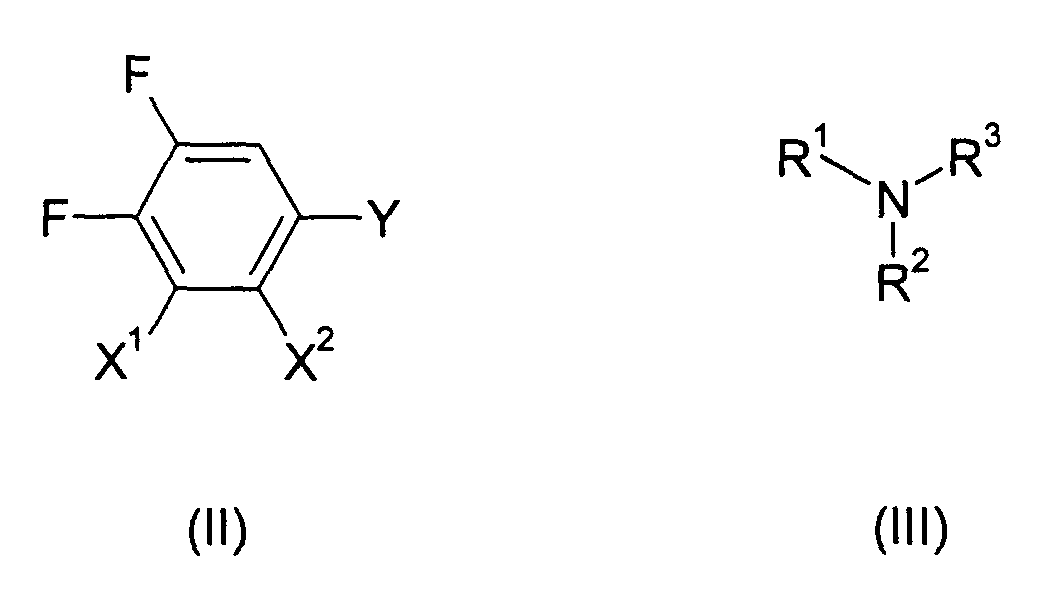
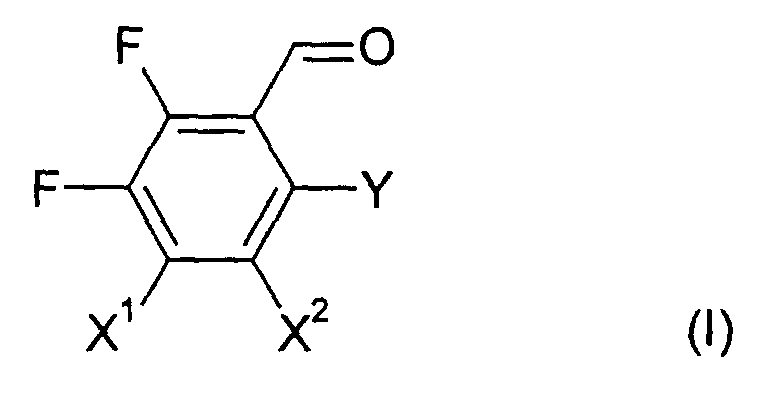
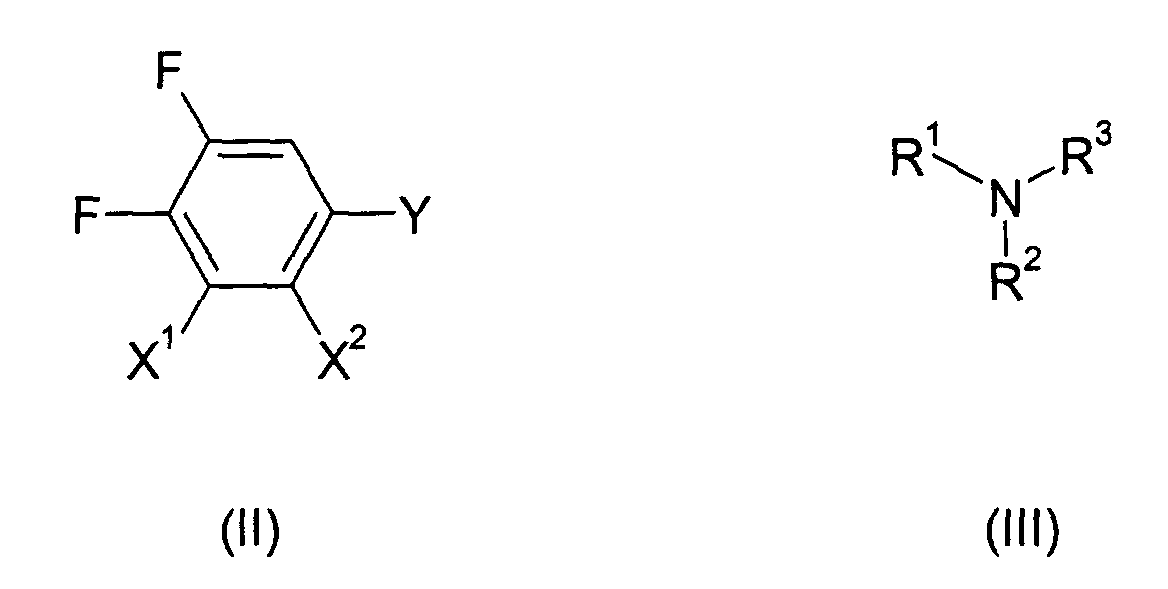
- the invention further relates to a process for the preparation of the compounds of the formula (I), characterized in that a halogenobenzene of the formula (II) - in which Y, X 1 and X 2 have the meaning as in (I) - in one Solvent or solvent mixture is reacted with an organic lithium compound at a temperature that does not promote the formation of arine.
- the molar ratio of lithium compound: starting product (II) is preferably 1: 1 to 1.2: 1.
- the lithium compound produced is reacted with a formyl equivalent of the formula (III), again at a temperature which does not promote arine formation, and then subjected to hydrolysis to (I).
- the molar ratio (II): (III) is preferably 1: 1 to 1: 2.
- R 1 is an alkyl radical with 1 to 6 C atoms, a trimethylsilyl radical or (optionally substituted) phenyl
- R 2 is an alkyl radical with 1 to 6 C atoms, a trimethylsilyl radical or (optionally substituted) phenyl
- R 3 -CH ( O) or -CH (OR 4 ) 2
- R 1 and R 2 can also be part of a five- to seven-membered ring together with the nitrogen atom.
- R 4 represents an alkyl radical of 1 to 4 carbon atoms.
- the reaction of (II) with the organic lithium compound is preferably carried out at a temperature below -60 ° C., very particularly preferably below -70 ° C., in particular at a temperature in the range from -70 ° C. to -110 ° C.
- the response times are usually 1 to 8 hours.
- the reaction mixture is slowly warmed to -25 to -15 ° C and carefully hydrolyzed with water. It is then acidified to pH 1 to 5 with hydrochloric acid and extracted with a suitable solvent (for example tert-butyl methyl ether, dichloromethane, ethyl acetate, toluene).
- a suitable solvent for example tert-butyl methyl ether, dichloromethane, ethyl acetate, toluene.
- the organic phase extracts are combined and dried, for example with sodium sulfate.
- the solvent can be removed in vacuo and the desired ortho-substituted benzaldehyde of the formula (III) can be obtained in this way.
- Purification which may be required can be carried out by chromatography, distillation or crystallization or a combination of the methods mentioned.
- the yields are usually in the range from 50 to 80%, based on (II).
- the organic lithium compound is preferably the lithium compound of a secondary amine, preferably with sterically demanding substituents.
- Lithium diisopropylamide, lithium 2,2,6,6-tetramethylpiperidide, lithium dicyclohexylamide, lithium cyclohexylisopropylamide or lithium bis (trimethylsilyl) amide is particularly preferred.
- Lithium-2,2,6,6-tetramethylpiperidide is very particularly preferred.
- the organic lithium compound is an alkyl lithium compound or the lithium compound of a secondary amine; n-butyllithium is preferred. If necessary, potassium tert-butoxide can also be added for better activation.
- Y in formula (II) denotes Br. It can also be advantageous to add substances which activate or influence the selectivity to the reaction mixture, for example tetramethylethylene diamine or potassium tert-butoxide (the latter preferably in the case of the compounds of the formula (II) in which Y is Cl).
- the formyl equivalent of the formula (III) is preferably N, N-dimethylformamide, N, N-diethylformamide, N, N-dipropylformamide, N, N-diisopropylformamide, N, N-dibutylformamide, N-formylpyrrolidine, N-formylmorpholine, N-formylpiperidine , Dimethylformamide dialkylacetal, N-methylformanilide, N-ethylformanilide or N, N-bis (trimethylsilyl) -formamide.
- the formyl equivalent of the formula (III) is very particularly preferably N, N-dimethylformamide.
- Aprotic solvents are suitable as solvents in the sense of the invention, for example ethers such as tetrahydrofuran, 1,2-dimethoxyethane, 1,4-dioxane, Diethyl ether, or hydrocarbons such as hexane, cyclohexane, heptane, pentane, or mixtures of aprotic solvents.
- ethers such as tetrahydrofuran, 1,2-dimethoxyethane, 1,4-dioxane, Diethyl ether
- hydrocarbons such as hexane, cyclohexane, heptane, pentane, or mixtures of aprotic solvents.
- reaction of (II) with the organic lithium compound can also in Presence of the compound (III) take place, so that lithium derivative formed in situ from (II) can react directly with (III). This can be necessary and advantageous the reaction above -60 ° C, e.g. in the range from -20 to + 25 ° C, perform.
- Another object of the invention is the use of compounds of formula (I) as starting materials for the production of agrochemicals, electronic materials - in particular liquid crystals - and pharmaceuticals.
- the compounds of the formula (I) are particularly suitable for this purpose, since both the aldehyde function (for example via a Wittig reaction, reduction to benzyl alcohol, condensation with CH, NH or SH compounds) and the halogen function (which is to be understood here as the function of the substituent Y) (for example via Suzuki coupling, Grignard reaction, Heck reaction) are available for reactions and also - under special conditions in the case of the compounds or the derived products derived therefrom, in which X 1 F means, particularly in the case of the compounds or the derived products derived therefrom in which X 1 and X 2 mean F, the reactivity of a difluoroaromatic (for example via ortho-metalation) or trifluoroaromatic (for example via ortho-metalation or aromatic nucleophilic substitution) or tetrafluo
- 2-Bromo-4,5,6-trifluorobenzaldehyde can be obtained analogously to Example 1 from 1-bromo-3,4,5-trifluorobenzene.
- 2-Chloro-5,6-difluorobenzaldehyde can be prepared analogously to Example 1 from 1-chloro-3,4-difluorobenzene be preserved.
- 2-Bromo-3,4,5,6-tetrafluorobenzaldehyde can be prepared analogously to Example 1 from 1-bromo-2,3,4,5-tetrafluorobenzene be preserved.
- 2-Chloro-3,4,5,6-tetrafluorobenzaldehyde can be prepared analogously to Example 1 from 1-chloro-2,3,4,5-tetrafluorobenzene be preserved.
- 2-iodo-5,6-difluorobenzaldehyde can be prepared analogously to Example 1 from 3,4-difluoroiodobenzene be preserved.
Landscapes
- Chemical & Material Sciences (AREA)
- Organic Chemistry (AREA)
- Chemical Kinetics & Catalysis (AREA)
- Organic Low-Molecular-Weight Compounds And Preparation Thereof (AREA)
Abstract

Weiterhin betrifft die vorliegende Erfindung ein Verfahren zur Herstellung der Verbindungen der Formel (I) durch Umsetzung eines Halogenbenzols der Formel (II) in einem Lösemittel oder Lösemittelgemisch bei einer Temperatur unterhalb -60°C mit einer organischen Lithiumverbindung und anschließend mit einem Formyläquivalent der Formel (III).
Description
Y: Cl oder Br; oder
Y: Cl oder Br ; oder
Y: Cl oder Br
- insbesondere
- 2-Chlor-5,6-difluorbenzaldehyd
- 2-Brom-5,6-difluorbenzaldehyd
- 2-Chlor-4,5,6-trifluorbenzaldehyd
- 2-Brom-4,5,6-trifluorbenzaldehyd
Die Reaktionszeiten betragen in der Regel 1 bis 8 Stunden. Nach Abschluss der Reaktion (z.B. durch DC oder GC detektierbar) wird die Reaktionsmischung langsam bis auf -25 bis -15 °C erwärmt und vorsichtig mit Wasser hydrolysiert. Danach wird mit Salzsäure bis auf pH 1 bis 5 angesäuert und mit einem geeigneten Lösemittel (z.B. tert.-Butylmethylether, Dichlormethan, Ethylacetat, Toluol) extrahiert. Die Extrakte der organischen Phase werden vereinigt und beispielsweise mit Natriumsulfat getrocknet. Das Lösemittel kann im Vakuum abgetrennt und so der gewünschte ortho-substituierte Benzaldehyd der Formel (III) erhalten werden. Eine gegebenenfalls erforderliche Reinigung kann erfolgen durch Chromatographie, Destillation oder Kristallisation oder einer Kombination der genannten Methoden. Die Ausbeuten liegen üblicherweise im Bereich von 50 bis 80 %, bezogen auf (II). Die organische Lithiumverbindung ist bevorzugt die Lithiumverbindung eines sekundären Amins, vorzugsweise mit sterisch anspruchvollen Substituenten. Besonders bevorzugt ist Lithiumdiisopropylamid, Lithium-2,2,6,6-tetramethylpiperidid, Lithiumdicyclohexylamid, Lithiumcyclohexylisopropylamid oder Lithiumbis-(trimethylsilyl)-amid. Ganz besonders bevorzugt ist Lithium-2,2,6,6-tetramethylpiperidid. Für die Verbindungen der Formel (II), in denen Y Cl bedeutet, ist die organische Lithiumverbindung eine Alkyllithiumverbindung oder die Lithiumverbindung eines sekundären Amins; bevorzugt ist n-Butyllithium. Gegebenenfalls kann auch Kalium-tertbutylat zur besseren Aktivierung zugesetzt werden.
Es kann auch vorteilhaft sein, dem Reaktionsgemisch aktivierende bzw. die Selektivität beeinflussende Stoffe zuzusetzen, z.B. Tetramethylethylendiamin oder Kalium-tertbutylat (letzteres bevorzugt im Fall der Verbindungen der Formel (II), in denen Y Cl bedeutet).
Ganz besonders bevorzugt ist das Formyläquivalent der Formel (III) N,N-Dimethylformamid.
Hierzu sind die Verbindungen der Formel (I) in besonderem Maße geeignet, da sowohl die Aldehyd-Funktion (z.B. über Wittig-Reaktion, Reduktion zum Benzylalkohol, Kondensation mit C-H-, N-H- oder S-H-Verbindungen) als auch die Halogen-Funktion (worunter hier die Funktion des Substituenten Y verstanden werden soll) (z.B. über Suzuki-Kupplung, Grignard-Reaktion, Heck-Reaktion) für Reaktionen zur Verfügung stehen sowie auch - unter speziellen Bedingungen im Falle der Verbindungen bzw. der daraus abgeleiteten Folgeprodukte, bei denen X1 F bedeutet, ganz besonders im Falle der Verbindungen bzw. der daraus abgeleiteten Folgeprodukte, bei denen X1 und X2 F bedeuten - die Reaktivität eines Difluor-Aromaten (z.B. über ortho-Metallierung) bzw. Trifluoraromaten (z. B. über ortho-Metallierung oder aromatische nucleophile Substitution) bzw. Tetrafluoraromaten (z.B. über aromatische nucleophile Substitution) ausgenutzt werden kann.
Claims (13)
- Verbindungen der Formel (I)worin X1, X2 und Y folgende Bedeutung haben:
 X1 H oder FX2 H oder FY Cl, Br oder I
 - Verbindungen nach Anspruch 1, worinbedeuten.a) X1 und X2: H
Y: Cl oder Brb) X1 : F X2: H
Y: Cl oder Brc) X1 und X2: F
Y: Cl oder Br - Verfahren zur Herstellung der Verbindungen gemäß Anspruch 1 oder 2, dadurch gekennzeichnet, dass ein Halogenbenzol der Formel (II) - in dem Y, X1 und X2 die gleiche Bedeutung wie in Anspruch 1 haben - in einem Lösemittel oder Lösemittelgemisch bei einer Temperatur unterhalb -60°C mit einer organischen Lithiumverbindung und anschließend mit einem Formyläquivalent der Formel (III) umgesetzt wirdund anschließend hydrolysiert wird, wobei in Formel (III) R1 einen Alkylrest mit 1 bis 6 C-Atomen, einen Trimethylsilylrest oder (gegebenenfalls substituiertes) Phenyl bedeutet, R2 einen Alkylrest von 1 bis 6 C-Atomen, einen Trimethylsilylrest oder (gegebenenfalls substituiertes) Phenyl bedeutet und R3 für -CH(=O) oder -CH(OR4)2 steht, wobei R1 und R2 gegebenenfalls zusammen mit dem Stickstoffatom Teil eines fünf- bis siebengliedrigen Ringes sein können und R4 einen Alkylrest von 1 bis 4 C-Atomen bedeutet.

- Verfahren nach Anspruch 3, dadurch gekennzeichnet, dass die Temperatur unterhalb von -70°C liegt.
- Verfahren nach Anspruch 3 oder 4, dadurch gekennzeichnet, dass die Verbindung der Formel (III) Dimethylformamid oder Diethylformamid ist.
- Verfahren nach mindestens einem der vorhergehenden Ansprüche 3 bis 5 dadurch gekennzeichnet, dass die organische Lithiumverbindung Lithium-2,2,6,6-tetramethylpiperid oder Lithiumdiisopropylamid ist oder, im Falle Y = Cl, Alkyllithium ist.
- Verfahren nach mindestens einem der vorhergehenden Ansprüche 3 bis 6, dadurch gekennzeichnet, dass dem Reaktionsgemisch aktivierende oder die Selektivität beeinflussende Stoffe, insbesondere Tetramethylendiamin oder Kalium-tertbutylat zugesetzt werden.
- Verfahren nach mindestens einem der vorhergehenden Ansprüche 3 bis 7, dadurch gekennzeichnet, dass die Umsetzung der Verbindung der Formel (II) mit der organischen Lithiumverbindung in Gegenwart von Verbindungen der Formel (III) erfolgt.
- Verfahren nach Anspruch 8, dadurch gekennzeichnet, dass die Reaktion bei einer Temperatur im Bereich von -20 bis +25°C durchgeführt wird.
- Verfahren nach mindestens einem der vorhergehenden Ansprüche 3 bis 9, dadurch gekennzeichnet, dass die Ausbeuten an Verbindungen der Formel (I) im Bereich von 50 bis 80 % liegen.
- Verwendung der Verbindungen nach Anspruch 1 oder 2 als Ausgangsmaterial für die Herstellung von Agrochemikalien, Elektronikmaterialien und Pharmazeutika.
- Verwendung nach Anspruch 11, dadurch gekennzeichnet, dass die Elektronikmaterialien Komponenten flüssigkristalliner Mischungen sind.
- Verwendung nach Anspruch 12, dadurch gekennzeichnet, dass die Komponenten flüssigkristalliner Mischungen Phenanthrenderivate sind.
Applications Claiming Priority (2)
| Application Number | Priority Date | Filing Date | Title |
|---|---|---|---|
| DE10022661 | 2000-05-10 | ||
| DE10022661A DE10022661A1 (de) | 2000-05-10 | 2000-05-10 | Ortho-substituierte Benzaldehyde, Verfahren zu ihrer Herstellung und ihre Verwendung |
Publications (3)
| Publication Number | Publication Date |
|---|---|
| EP1153909A2 true EP1153909A2 (de) | 2001-11-14 |
| EP1153909A3 EP1153909A3 (de) | 2002-07-24 |
| EP1153909B1 EP1153909B1 (de) | 2004-10-13 |
Family
ID=7641386
Family Applications (1)
| Application Number | Title | Priority Date | Filing Date |
|---|---|---|---|
| EP01110519A Expired - Lifetime EP1153909B1 (de) | 2000-05-10 | 2001-04-28 | Ortho-substituierte Benzaldehyde, Verfahren zu ihrer Herstellung und ihre Verwendung |
Country Status (6)
| Country | Link |
|---|---|
| US (1) | US6811832B2 (de) |
| EP (1) | EP1153909B1 (de) |
| JP (1) | JP2001316323A (de) |
| KR (1) | KR100758518B1 (de) |
| CN (1) | CN1170804C (de) |
| DE (2) | DE10022661A1 (de) |
Cited By (1)
| Publication number | Priority date | Publication date | Assignee | Title |
|---|---|---|---|---|
| GB2377706A (en) * | 2001-06-07 | 2003-01-22 | Merck Patent Gmbh | Liquid-crystalline phenanthrenes |
Families Citing this family (10)
| Publication number | Priority date | Publication date | Assignee | Title |
|---|---|---|---|---|
| DE10145780B4 (de) | 2001-09-17 | 2012-10-04 | Merck Patent Gmbh | Fluorierte Cyclopenta[a]naphthaline und ihre Verwendung in Flüssigkristallmischungen und Displays |
| DE10145779B4 (de) * | 2001-09-17 | 2012-11-15 | Merck Patent Gmbh | Fluorierte Cyclopenta[b]naphthaline und ihre Verwendung in Flüssigkristallmischungen |
| US6677479B2 (en) | 2001-11-13 | 2004-01-13 | Clariant Finance Lbvi Limited | Substituted fluoroaromatics, process for preparing them and their use |
| DE102004022728B4 (de) * | 2004-05-07 | 2018-08-23 | Merck Patent Gmbh | Fluorierte Phenanthrene und ihre Verwendung in Flüssigkristallmischungen |
| CN102659544A (zh) * | 2012-05-02 | 2012-09-12 | 上海中新裕祥化工有限公司 | 2,3-二氟苯甲醛的制备方法 |
| CN102659546A (zh) * | 2012-05-03 | 2012-09-12 | 江苏泰特尔化工有限公司 | 一种新型的液晶中间体4-溴-2,3-二氟苯甲醛 |
| CN104447250A (zh) * | 2014-12-24 | 2015-03-25 | 常熟市新华化工有限公司 | 一种由对氯甲苯合成对氯苯甲醛的方法 |
| CN105967974B (zh) * | 2016-05-06 | 2018-08-31 | 蚌埠中实化学技术有限公司 | 一种2-甲基-3,4,5-三氟溴苯的制备方法 |
| CN111018892A (zh) * | 2020-01-03 | 2020-04-17 | 烟台盛华液晶材料有限公司 | 一种芳烃氟邻位金属化的制备方法 |
| CN115010574B (zh) * | 2022-06-06 | 2024-01-05 | 爱斯特(成都)生物制药股份有限公司 | 1-溴-2-氯-4-氟-2碘苯的合成方法 |
Family Cites Families (15)
| Publication number | Priority date | Publication date | Assignee | Title |
|---|---|---|---|---|
| CH471196A (de) * | 1966-04-06 | 1969-04-15 | Basf Ag | Verfahren zur Herstellung eines orangen Pigmentfarbstoffs |
| FR1514517A (fr) | 1967-03-08 | 1968-02-23 | Ile De France | Procédé de préparation de dérivés de n-substitués benzamides |
| US3982020A (en) * | 1970-03-17 | 1976-09-21 | Sandoz, Inc. | Substituted benzylidene hydrazines for treating hyperglycemia, obesity and inflammation |
| US3856504A (en) * | 1971-06-08 | 1974-12-24 | Hercules Inc | Use of certain n-(2,6-dihalobenzylidene)-benzylamines and certain n-(2,6-dihalobenzylidene)phenylethylamines to increase crop yield |
| DE3310953A1 (de) * | 1983-03-25 | 1984-09-27 | Bayer Ag, 5090 Leverkusen | Verfahren zur herstellung von benzalchloriden |
| EP0174131A3 (de) | 1984-09-01 | 1989-06-07 | FISONS plc | Dihydropyridine, Verfahren und Zwischenprodukte zu ihrer Herstellung und diese enthaltende pharmazeutische Zusammensetzungen |
| AU6042686A (en) * | 1985-07-29 | 1987-02-05 | American Home Products Corporation | 1,4,5,6,7,8-hexahydro-(substituted) phenyl-1,7- napthyridine-3-carboxylic acid derivatives |
| GB8617649D0 (en) * | 1986-07-18 | 1986-08-28 | Ici Plc | Fluorobenzyl esters |
| GB8629806D0 (en) | 1986-12-12 | 1987-01-21 | Ici Plc | Fluorobenzyl esters |
| DE3882167T2 (de) | 1987-05-08 | 1994-04-07 | Ihara Chemical Ind Co | Verfahren zur Herstellung von Fluorbenzaldehyden. |
| US5340833A (en) * | 1992-05-01 | 1994-08-23 | Eisai Co., Ltd. | Urokinase inhibitors |
| US5648021A (en) * | 1994-01-17 | 1997-07-15 | Hoechst Aktiengesellschaft | Phenanthrene derivatives and their use in liquid-crystalline mixtures |
| DE19500768C2 (de) | 1994-01-17 | 2003-11-20 | Aventis Res & Tech Gmbh & Co | Phenanthren-Derivate und ihre Verwendung in flüssigkristallinen Mischungen |
| UA56185C2 (uk) * | 1996-09-30 | 2003-05-15 | Пфайзер Інк. | Аралкіл- та аралкіліденгетероциклічні лактами та іміди, фармацевтична композиція та спосіб лікування |
| GB0005789D0 (en) * | 2000-03-11 | 2000-05-03 | Knoll Ag | Therapeutic agents |
-
2000
- 2000-05-10 DE DE10022661A patent/DE10022661A1/de not_active Withdrawn
-
2001
- 2001-04-28 EP EP01110519A patent/EP1153909B1/de not_active Expired - Lifetime
- 2001-04-28 DE DE2001504070 patent/DE50104070D1/de not_active Expired - Lifetime
- 2001-05-09 KR KR1020010025235A patent/KR100758518B1/ko not_active Expired - Fee Related
- 2001-05-10 US US09/852,552 patent/US6811832B2/en not_active Expired - Fee Related
- 2001-05-10 JP JP2001140008A patent/JP2001316323A/ja not_active Ceased
- 2001-05-10 CN CNB011177411A patent/CN1170804C/zh not_active Expired - Fee Related
Cited By (1)
| Publication number | Priority date | Publication date | Assignee | Title |
|---|---|---|---|---|
| GB2377706A (en) * | 2001-06-07 | 2003-01-22 | Merck Patent Gmbh | Liquid-crystalline phenanthrenes |
Also Published As
| Publication number | Publication date |
|---|---|
| KR20010104657A (ko) | 2001-11-26 |
| EP1153909A3 (de) | 2002-07-24 |
| CN1339428A (zh) | 2002-03-13 |
| EP1153909B1 (de) | 2004-10-13 |
| US6811832B2 (en) | 2004-11-02 |
| KR100758518B1 (ko) | 2007-09-14 |
| US20010050352A1 (en) | 2001-12-13 |
| JP2001316323A (ja) | 2001-11-13 |
| DE50104070D1 (de) | 2004-11-18 |
| DE10022661A1 (de) | 2001-11-15 |
| CN1170804C (zh) | 2004-10-13 |
Similar Documents
| Publication | Publication Date | Title |
|---|---|---|
| DE2646792A1 (de) | Verfahren zur herstellung von alpha-(arylsubstituierten)-propionsaeuren | |
| EP1153909B1 (de) | Ortho-substituierte Benzaldehyde, Verfahren zu ihrer Herstellung und ihre Verwendung | |
| DE4020052A1 (de) | Verfahren zur herstellung von 2-chlor-5-methyl-pyridin | |
| EP0116323B1 (de) | Verfahren zur Herstellung von aromatischen Aldehyden | |
| EP0034741B1 (de) | Verfahren zur Herstellung eines substituierten Bromfluorbenzols und 3-Brom-4-fluorbenzonitril | |
| DE2726561A1 (de) | Verfahren zur herstellung von 2-arylalkansaeurederivaten | |
| DE2753454A1 (de) | Quadratsaeureester | |
| DE60203200T2 (de) | Synthese von vicinalen Difluoraromaten und Zwischenprodukte davon | |
| EP1002786B1 (de) | Verfahren zur Herstellung von Trifluorbenzoesäuren | |
| DE2759964C2 (de) | 2,6-Dimethoxy-4-(quaternäre-alkyl)phenyl-disubstituierte-phosphate und Verfahren zu ihrer Herstellung | |
| EP0123187A2 (de) | Verfahren zur Herstellung von fluorierten Phenylessigsäureestern und neue fluorierte Trichlorethylbenzole | |
| DE2652810C3 (de) | Verfahren zur Herstellung von aromatischen Fluorverbindungen | |
| DE3887603T2 (de) | Chemisches Verfahren. | |
| DE69614863T2 (de) | 2,3-dihalogen-6-trifluormethylbenzol-derivate und verfahren zu ihrer herstellung | |
| EP0031875B1 (de) | Verfahren zur Herstellung von Cyclohexenderivaten | |
| EP0089485B1 (de) | Verfahren zur Herstellung von 5-Chlor-1H-tetrazol-1-carbonsäureestern sowie Verfahren zur Herstellung der erforderlichen Dichlorisonitril-carbonsäureester | |
| DE10161611A1 (de) | Substituierte Fluoraromaten, Verfahren zu ihrer Herstellung und ihre Verwendung | |
| DE10155499A1 (de) | Substituierte Fluoraromaten, Verfahren zu ihrer Herstellung und ihre Verwendung | |
| DE4408083C1 (de) | Verfahren zur Herstellung von 4-Fluoralkoxyzimtsäurenitrilen | |
| DE3216851A1 (de) | Verfahren zur herstellung von substituierten biphenylverbindungen | |
| EP0025925B1 (de) | Verfahren zur Herstellung von Alpha-Cyano-phenoxy-benzyl-estern | |
| DE102008007755A1 (de) | Halogenierte 4-Formylbenzonitrile, ihre Herstellung und Verwendung | |
| DE19755509B4 (de) | Cyclobutanon-Derivate, Verfahren zu ihrer Herstellung und ihre Verwendung zur Herstellung flüssigkristalliner Verbindungen | |
| EP0259346A1 (de) | r-1-CYAN-1-R2 -CIS-4-R1 -CYCLOHEXANVERBINDUNGEN. | |
| EP0019132A1 (de) | Verfahren zur Herstellung von alpha-Halogencyclobutanonen |
Legal Events
| Date | Code | Title | Description |
|---|---|---|---|
| PUAI | Public reference made under article 153(3) epc to a published international application that has entered the european phase |
Free format text: ORIGINAL CODE: 0009012 |
|
| AK | Designated contracting states |
Kind code of ref document: A2 Designated state(s): AT BE CH CY DE DK ES FI FR GB GR IE IT LI LU MC NL PT SE TR |
|
| AX | Request for extension of the european patent |
Free format text: AL;LT;LV;MK;RO;SI |
|
| PUAL | Search report despatched |
Free format text: ORIGINAL CODE: 0009013 |
|
| RIC1 | Information provided on ipc code assigned before grant |
Free format text: 7C 07C 47/55 A, 7C 07C 45/42 B, 7C 07C 45/68 B, 7C 07C 45/00 B |
|
| AK | Designated contracting states |
Kind code of ref document: A3 Designated state(s): AT BE CH CY DE DK ES FI FR GB GR IE IT LI LU MC NL PT SE TR |
|
| AX | Request for extension of the european patent |
Free format text: AL;LT;LV;MK;RO;SI |
|
| 17P | Request for examination filed |
Effective date: 20030124 |
|
| AKX | Designation fees paid |
Designated state(s): DE FR GB |
|
| 17Q | First examination report despatched |
Effective date: 20030328 |
|
| GRAP | Despatch of communication of intention to grant a patent |
Free format text: ORIGINAL CODE: EPIDOSNIGR1 |
|
| GRAS | Grant fee paid |
Free format text: ORIGINAL CODE: EPIDOSNIGR3 |
|
| GRAA | (expected) grant |
Free format text: ORIGINAL CODE: 0009210 |
|
| AK | Designated contracting states |
Kind code of ref document: B1 Designated state(s): DE FR GB |
|
| REG | Reference to a national code |
Ref country code: GB Ref legal event code: FG4D Free format text: NOT ENGLISH |
|
| REG | Reference to a national code |
Ref country code: IE Ref legal event code: FG4D Free format text: GERMAN |
|
| REF | Corresponds to: |
Ref document number: 50104070 Country of ref document: DE Date of ref document: 20041118 Kind code of ref document: P |
|
| GBT | Gb: translation of ep patent filed (gb section 77(6)(a)/1977) |
Effective date: 20050207 |
|
| REG | Reference to a national code |
Ref country code: IE Ref legal event code: FD4D |
|
| PLBE | No opposition filed within time limit |
Free format text: ORIGINAL CODE: 0009261 |
|
| STAA | Information on the status of an ep patent application or granted ep patent |
Free format text: STATUS: NO OPPOSITION FILED WITHIN TIME LIMIT |
|
| ET | Fr: translation filed | ||
| 26N | No opposition filed |
Effective date: 20050714 |
|
| REG | Reference to a national code |
Ref country code: GB Ref legal event code: 732E |
|
| REG | Reference to a national code |
Ref country code: FR Ref legal event code: TP |
|
| PGFP | Annual fee paid to national office [announced via postgrant information from national office to epo] |
Ref country code: FR Payment date: 20110426 Year of fee payment: 11 Ref country code: DE Payment date: 20110420 Year of fee payment: 11 |
|
| PGFP | Annual fee paid to national office [announced via postgrant information from national office to epo] |
Ref country code: GB Payment date: 20110427 Year of fee payment: 11 |
|
| GBPC | Gb: european patent ceased through non-payment of renewal fee |
Effective date: 20120428 |
|
| REG | Reference to a national code |
Ref country code: FR Ref legal event code: ST Effective date: 20121228 |
|
| PG25 | Lapsed in a contracting state [announced via postgrant information from national office to epo] |
Ref country code: GB Free format text: LAPSE BECAUSE OF NON-PAYMENT OF DUE FEES Effective date: 20120428 |
|
| REG | Reference to a national code |
Ref country code: DE Ref legal event code: R119 Ref document number: 50104070 Country of ref document: DE Effective date: 20121101 |
|
| PG25 | Lapsed in a contracting state [announced via postgrant information from national office to epo] |
Ref country code: FR Free format text: LAPSE BECAUSE OF NON-PAYMENT OF DUE FEES Effective date: 20120430 |
|
| PG25 | Lapsed in a contracting state [announced via postgrant information from national office to epo] |
Ref country code: DE Free format text: LAPSE BECAUSE OF NON-PAYMENT OF DUE FEES Effective date: 20121101 |
|
| REG | Reference to a national code |
Ref country code: DE Ref legal event code: R082 Ref document number: 50104070 Country of ref document: DE Representative=s name: PATENTANWAELTE ISENBRUCK BOESL HOERSCHLER LLP, DE Ref country code: DE Ref legal event code: R081 Ref document number: 50104070 Country of ref document: DE Owner name: MERCK PATENT GMBH, DE Free format text: FORMER OWNER: AZ ELECTRONIC MATERIALS (GERMANY) GMBH, 65203 WIESBADEN, DE |
|
| REG | Reference to a national code |
Ref country code: GB Ref legal event code: 732E Free format text: REGISTERED BETWEEN 20151112 AND 20151118 |
|
| REG | Reference to a national code |
Ref country code: FR Ref legal event code: CD Owner name: MERCK PATENT GMBH, DE Effective date: 20160303 Ref country code: FR Ref legal event code: TP Owner name: MERCK PATENT GMBH, DE Effective date: 20160303 |