EP1127293B1 - Photocurable and photopatternable hydrogel matrix based on azlactone copolymers - Google Patents
Photocurable and photopatternable hydrogel matrix based on azlactone copolymers Download PDFInfo
- Publication number
- EP1127293B1 EP1127293B1 EP99909939A EP99909939A EP1127293B1 EP 1127293 B1 EP1127293 B1 EP 1127293B1 EP 99909939 A EP99909939 A EP 99909939A EP 99909939 A EP99909939 A EP 99909939A EP 1127293 B1 EP1127293 B1 EP 1127293B1
- Authority
- EP
- European Patent Office
- Prior art keywords
- azlactone
- composition
- layer
- article
- hydrogel
- Prior art date
- Legal status (The legal status is an assumption and is not a legal conclusion. Google has not performed a legal analysis and makes no representation as to the accuracy of the status listed.)
- Expired - Lifetime
Links
- 239000000017 hydrogel Substances 0.000 title claims description 20
- 229920001577 copolymer Polymers 0.000 title description 23
- 239000011159 matrix material Substances 0.000 title description 3
- 239000000203 mixture Substances 0.000 claims description 69
- IEJPPSMHUUQABK-UHFFFAOYSA-N 2,4-diphenyl-4h-1,3-oxazol-5-one Chemical group O=C1OC(C=2C=CC=CC=2)=NC1C1=CC=CC=C1 IEJPPSMHUUQABK-UHFFFAOYSA-N 0.000 claims description 42
- 239000000758 substrate Substances 0.000 claims description 34
- 238000000034 method Methods 0.000 claims description 33
- 229920000642 polymer Polymers 0.000 claims description 33
- 239000000178 monomer Substances 0.000 claims description 24
- 238000006243 chemical reaction Methods 0.000 claims description 17
- 244000005700 microbiome Species 0.000 claims description 7
- MLIWQXBKMZNZNF-PWDIZTEBSA-N (2e,6e)-2,6-bis[(4-azidophenyl)methylidene]-4-methylcyclohexan-1-one Chemical compound O=C1\C(=C\C=2C=CC(=CC=2)N=[N+]=[N-])CC(C)C\C1=C/C1=CC=C(N=[N+]=[N-])C=C1 MLIWQXBKMZNZNF-PWDIZTEBSA-N 0.000 claims description 6
- 230000005855 radiation Effects 0.000 claims description 5
- 125000000391 vinyl group Chemical group [H]C([*])=C([H])[H] 0.000 claims description 5
- 230000005670 electromagnetic radiation Effects 0.000 claims description 4
- 229920002554 vinyl polymer Polymers 0.000 claims description 4
- QKPKBBFSFQAMIY-UHFFFAOYSA-N 2-ethenyl-4,4-dimethyl-1,3-oxazol-5-one Chemical compound CC1(C)N=C(C=C)OC1=O QKPKBBFSFQAMIY-UHFFFAOYSA-N 0.000 claims description 3
- RQUGVTLRYOAFLV-UHFFFAOYSA-N n-(4-aminobutyl)-4-azido-2-hydroxybenzamide Chemical compound NCCCCNC(=O)C1=CC=C(N=[N+]=[N-])C=C1O RQUGVTLRYOAFLV-UHFFFAOYSA-N 0.000 claims description 3
- 238000004519 manufacturing process Methods 0.000 claims 8
- 230000001678 irradiating effect Effects 0.000 claims 1
- 239000000499 gel Substances 0.000 description 38
- ZWEHNKRNPOVVGH-UHFFFAOYSA-N 2-Butanone Chemical compound CCC(C)=O ZWEHNKRNPOVVGH-UHFFFAOYSA-N 0.000 description 33
- WHNPOQXWAMXPTA-UHFFFAOYSA-N 3-methylbut-2-enamide Chemical compound CC(C)=CC(N)=O WHNPOQXWAMXPTA-UHFFFAOYSA-N 0.000 description 22
- 238000012546 transfer Methods 0.000 description 22
- 239000000243 solution Substances 0.000 description 18
- 238000000576 coating method Methods 0.000 description 17
- 239000010410 layer Substances 0.000 description 17
- 239000011248 coating agent Substances 0.000 description 16
- 239000000523 sample Substances 0.000 description 16
- 102000004190 Enzymes Human genes 0.000 description 15
- 108090000790 Enzymes Proteins 0.000 description 15
- XLYOFNOQVPJJNP-UHFFFAOYSA-N water Substances O XLYOFNOQVPJJNP-UHFFFAOYSA-N 0.000 description 13
- IJGRMHOSHXDMSA-UHFFFAOYSA-N Atomic nitrogen Chemical compound N#N IJGRMHOSHXDMSA-UHFFFAOYSA-N 0.000 description 11
- 108091034117 Oligonucleotide Proteins 0.000 description 11
- 230000006870 function Effects 0.000 description 11
- 229910052757 nitrogen Inorganic materials 0.000 description 10
- 239000004971 Cross linker Substances 0.000 description 9
- 108020004414 DNA Proteins 0.000 description 9
- ZMXDDKWLCZADIW-UHFFFAOYSA-N N,N-Dimethylformamide Chemical compound CN(C)C=O ZMXDDKWLCZADIW-UHFFFAOYSA-N 0.000 description 9
- 229920003229 poly(methyl methacrylate) Polymers 0.000 description 9
- 239000004926 polymethyl methacrylate Substances 0.000 description 9
- KFZMGEQAYNKOFK-UHFFFAOYSA-N Isopropanol Chemical compound CC(C)O KFZMGEQAYNKOFK-UHFFFAOYSA-N 0.000 description 8
- 238000001931 thermography Methods 0.000 description 8
- 239000000463 material Substances 0.000 description 7
- 150000001412 amines Chemical group 0.000 description 6
- 239000011521 glass Substances 0.000 description 6
- 238000000059 patterning Methods 0.000 description 6
- 230000008569 process Effects 0.000 description 6
- 230000008901 benefit Effects 0.000 description 5
- 125000004432 carbon atom Chemical group C* 0.000 description 5
- 239000011229 interlayer Substances 0.000 description 5
- 241000894007 species Species 0.000 description 5
- GQHTUMJGOHRCHB-UHFFFAOYSA-N 2,3,4,6,7,8,9,10-octahydropyrimido[1,2-a]azepine Chemical compound C1CCCCN2CCCN=C21 GQHTUMJGOHRCHB-UHFFFAOYSA-N 0.000 description 4
- KAKZBPTYRLMSJV-UHFFFAOYSA-N Butadiene Chemical group C=CC=C KAKZBPTYRLMSJV-UHFFFAOYSA-N 0.000 description 4
- JLCPHMBAVCMARE-UHFFFAOYSA-N [3-[[3-[[3-[[3-[[3-[[3-[[3-[[3-[[3-[[3-[[3-[[5-(2-amino-6-oxo-1H-purin-9-yl)-3-[[3-[[3-[[3-[[3-[[3-[[5-(2-amino-6-oxo-1H-purin-9-yl)-3-[[5-(2-amino-6-oxo-1H-purin-9-yl)-3-hydroxyoxolan-2-yl]methoxy-hydroxyphosphoryl]oxyoxolan-2-yl]methoxy-hydroxyphosphoryl]oxy-5-(5-methyl-2,4-dioxopyrimidin-1-yl)oxolan-2-yl]methoxy-hydroxyphosphoryl]oxy-5-(6-aminopurin-9-yl)oxolan-2-yl]methoxy-hydroxyphosphoryl]oxy-5-(6-aminopurin-9-yl)oxolan-2-yl]methoxy-hydroxyphosphoryl]oxy-5-(6-aminopurin-9-yl)oxolan-2-yl]methoxy-hydroxyphosphoryl]oxy-5-(6-aminopurin-9-yl)oxolan-2-yl]methoxy-hydroxyphosphoryl]oxyoxolan-2-yl]methoxy-hydroxyphosphoryl]oxy-5-(5-methyl-2,4-dioxopyrimidin-1-yl)oxolan-2-yl]methoxy-hydroxyphosphoryl]oxy-5-(4-amino-2-oxopyrimidin-1-yl)oxolan-2-yl]methoxy-hydroxyphosphoryl]oxy-5-(5-methyl-2,4-dioxopyrimidin-1-yl)oxolan-2-yl]methoxy-hydroxyphosphoryl]oxy-5-(5-methyl-2,4-dioxopyrimidin-1-yl)oxolan-2-yl]methoxy-hydroxyphosphoryl]oxy-5-(6-aminopurin-9-yl)oxolan-2-yl]methoxy-hydroxyphosphoryl]oxy-5-(6-aminopurin-9-yl)oxolan-2-yl]methoxy-hydroxyphosphoryl]oxy-5-(4-amino-2-oxopyrimidin-1-yl)oxolan-2-yl]methoxy-hydroxyphosphoryl]oxy-5-(4-amino-2-oxopyrimidin-1-yl)oxolan-2-yl]methoxy-hydroxyphosphoryl]oxy-5-(4-amino-2-oxopyrimidin-1-yl)oxolan-2-yl]methoxy-hydroxyphosphoryl]oxy-5-(6-aminopurin-9-yl)oxolan-2-yl]methoxy-hydroxyphosphoryl]oxy-5-(4-amino-2-oxopyrimidin-1-yl)oxolan-2-yl]methyl [5-(6-aminopurin-9-yl)-2-(hydroxymethyl)oxolan-3-yl] hydrogen phosphate Polymers Cc1cn(C2CC(OP(O)(=O)OCC3OC(CC3OP(O)(=O)OCC3OC(CC3O)n3cnc4c3nc(N)[nH]c4=O)n3cnc4c3nc(N)[nH]c4=O)C(COP(O)(=O)OC3CC(OC3COP(O)(=O)OC3CC(OC3COP(O)(=O)OC3CC(OC3COP(O)(=O)OC3CC(OC3COP(O)(=O)OC3CC(OC3COP(O)(=O)OC3CC(OC3COP(O)(=O)OC3CC(OC3COP(O)(=O)OC3CC(OC3COP(O)(=O)OC3CC(OC3COP(O)(=O)OC3CC(OC3COP(O)(=O)OC3CC(OC3COP(O)(=O)OC3CC(OC3COP(O)(=O)OC3CC(OC3COP(O)(=O)OC3CC(OC3COP(O)(=O)OC3CC(OC3COP(O)(=O)OC3CC(OC3COP(O)(=O)OC3CC(OC3CO)n3cnc4c(N)ncnc34)n3ccc(N)nc3=O)n3cnc4c(N)ncnc34)n3ccc(N)nc3=O)n3ccc(N)nc3=O)n3ccc(N)nc3=O)n3cnc4c(N)ncnc34)n3cnc4c(N)ncnc34)n3cc(C)c(=O)[nH]c3=O)n3cc(C)c(=O)[nH]c3=O)n3ccc(N)nc3=O)n3cc(C)c(=O)[nH]c3=O)n3cnc4c3nc(N)[nH]c4=O)n3cnc4c(N)ncnc34)n3cnc4c(N)ncnc34)n3cnc4c(N)ncnc34)n3cnc4c(N)ncnc34)O2)c(=O)[nH]c1=O JLCPHMBAVCMARE-UHFFFAOYSA-N 0.000 description 4
- 239000000853 adhesive Substances 0.000 description 4
- 230000001070 adhesive effect Effects 0.000 description 4
- 230000027455 binding Effects 0.000 description 4
- HQABUPZFAYXKJW-UHFFFAOYSA-N butan-1-amine Chemical compound CCCCN HQABUPZFAYXKJW-UHFFFAOYSA-N 0.000 description 4
- 229910052799 carbon Inorganic materials 0.000 description 4
- 239000003054 catalyst Substances 0.000 description 4
- -1 cofactors Substances 0.000 description 4
- 150000001875 compounds Chemical class 0.000 description 4
- 238000004132 cross linking Methods 0.000 description 4
- 238000001723 curing Methods 0.000 description 4
- JHIVVAPYMSGYDF-UHFFFAOYSA-N cyclohexanone Chemical compound O=C1CCCCC1 JHIVVAPYMSGYDF-UHFFFAOYSA-N 0.000 description 4
- 230000003100 immobilizing effect Effects 0.000 description 4
- 238000001459 lithography Methods 0.000 description 4
- 238000001000 micrograph Methods 0.000 description 4
- 238000000386 microscopy Methods 0.000 description 4
- 230000003287 optical effect Effects 0.000 description 4
- 239000007787 solid Substances 0.000 description 4
- 239000000126 substance Substances 0.000 description 4
- NIXOWILDQLNWCW-UHFFFAOYSA-M Acrylate Chemical compound [O-]C(=O)C=C NIXOWILDQLNWCW-UHFFFAOYSA-M 0.000 description 3
- OKTJSMMVPCPJKN-UHFFFAOYSA-N Carbon Chemical compound [C] OKTJSMMVPCPJKN-UHFFFAOYSA-N 0.000 description 3
- ZMANZCXQSJIPKH-UHFFFAOYSA-N Triethylamine Chemical compound CCN(CC)CC ZMANZCXQSJIPKH-UHFFFAOYSA-N 0.000 description 3
- DAKWPKUUDNSNPN-UHFFFAOYSA-N Trimethylolpropane triacrylate Chemical compound C=CC(=O)OCC(CC)(COC(=O)C=C)COC(=O)C=C DAKWPKUUDNSNPN-UHFFFAOYSA-N 0.000 description 3
- 125000000217 alkyl group Chemical group 0.000 description 3
- 125000003118 aryl group Chemical group 0.000 description 3
- 210000004027 cell Anatomy 0.000 description 3
- 239000013626 chemical specie Substances 0.000 description 3
- MHMNJMPURVTYEJ-UHFFFAOYSA-N fluorescein-5-isothiocyanate Chemical compound O1C(=O)C2=CC(N=C=S)=CC=C2C21C1=CC=C(O)C=C1OC1=CC(O)=CC=C21 MHMNJMPURVTYEJ-UHFFFAOYSA-N 0.000 description 3
- FUZZWVXGSFPDMH-UHFFFAOYSA-N hexanoic acid Chemical compound CCCCCC(O)=O FUZZWVXGSFPDMH-UHFFFAOYSA-N 0.000 description 3
- 125000004356 hydroxy functional group Chemical group O* 0.000 description 3
- 238000003384 imaging method Methods 0.000 description 3
- 229920000139 polyethylene terephthalate Polymers 0.000 description 3
- 239000005020 polyethylene terephthalate Substances 0.000 description 3
- 238000006116 polymerization reaction Methods 0.000 description 3
- 150000003141 primary amines Chemical class 0.000 description 3
- 108090000765 processed proteins & peptides Proteins 0.000 description 3
- 230000004044 response Effects 0.000 description 3
- 125000006413 ring segment Chemical group 0.000 description 3
- 239000002904 solvent Substances 0.000 description 3
- 125000001424 substituent group Chemical group 0.000 description 3
- 230000008961 swelling Effects 0.000 description 3
- SGUVLZREKBPKCE-UHFFFAOYSA-N 1,5-diazabicyclo[4.3.0]-non-5-ene Chemical compound C1CCN=C2CCCN21 SGUVLZREKBPKCE-UHFFFAOYSA-N 0.000 description 2
- LMDZBCPBFSXMTL-UHFFFAOYSA-N 1-ethyl-3-(3-dimethylaminopropyl)carbodiimide Chemical compound CCN=C=NCCCN(C)C LMDZBCPBFSXMTL-UHFFFAOYSA-N 0.000 description 2
- OZAIFHULBGXAKX-UHFFFAOYSA-N 2-(2-cyanopropan-2-yldiazenyl)-2-methylpropanenitrile Chemical compound N#CC(C)(C)N=NC(C)(C)C#N OZAIFHULBGXAKX-UHFFFAOYSA-N 0.000 description 2
- DKPFZGUDAPQIHT-UHFFFAOYSA-N Butyl acetate Natural products CCCCOC(C)=O DKPFZGUDAPQIHT-UHFFFAOYSA-N 0.000 description 2
- 238000000018 DNA microarray Methods 0.000 description 2
- 238000001712 DNA sequencing Methods 0.000 description 2
- OAKJQQAXSVQMHS-UHFFFAOYSA-N Hydrazine Chemical compound NN OAKJQQAXSVQMHS-UHFFFAOYSA-N 0.000 description 2
- YNAVUWVOSKDBBP-UHFFFAOYSA-N Morpholine Chemical class C1COCCN1 YNAVUWVOSKDBBP-UHFFFAOYSA-N 0.000 description 2
- WHNWPMSKXPGLAX-UHFFFAOYSA-N N-Vinyl-2-pyrrolidone Chemical compound C=CN1CCCC1=O WHNWPMSKXPGLAX-UHFFFAOYSA-N 0.000 description 2
- DTQVDTLACAAQTR-UHFFFAOYSA-N Trifluoroacetic acid Chemical compound OC(=O)C(F)(F)F DTQVDTLACAAQTR-UHFFFAOYSA-N 0.000 description 2
- 238000010521 absorption reaction Methods 0.000 description 2
- 238000013459 approach Methods 0.000 description 2
- 239000007900 aqueous suspension Substances 0.000 description 2
- 238000003491 array Methods 0.000 description 2
- 150000001540 azides Chemical class 0.000 description 2
- 125000000852 azido group Chemical group *N=[N+]=[N-] 0.000 description 2
- 230000015572 biosynthetic process Effects 0.000 description 2
- 125000002837 carbocyclic group Chemical group 0.000 description 2
- 239000006229 carbon black Substances 0.000 description 2
- 125000000753 cycloalkyl group Chemical group 0.000 description 2
- 229940079593 drug Drugs 0.000 description 2
- 239000003814 drug Substances 0.000 description 2
- 230000000694 effects Effects 0.000 description 2
- 238000002474 experimental method Methods 0.000 description 2
- 229920001002 functional polymer Polymers 0.000 description 2
- 238000013007 heat curing Methods 0.000 description 2
- 125000005842 heteroatom Chemical group 0.000 description 2
- 238000009396 hybridization Methods 0.000 description 2
- 238000011065 in-situ storage Methods 0.000 description 2
- 238000010348 incorporation Methods 0.000 description 2
- HZVOZRGWRWCICA-UHFFFAOYSA-N methanediyl Chemical compound [CH2] HZVOZRGWRWCICA-UHFFFAOYSA-N 0.000 description 2
- 229940088644 n,n-dimethylacrylamide Drugs 0.000 description 2
- YLGYACDQVQQZSW-UHFFFAOYSA-N n,n-dimethylprop-2-enamide Chemical compound CN(C)C(=O)C=C YLGYACDQVQQZSW-UHFFFAOYSA-N 0.000 description 2
- 229920000620 organic polymer Polymers 0.000 description 2
- 229920000058 polyacrylate Polymers 0.000 description 2
- 229920000098 polyolefin Polymers 0.000 description 2
- 229920001184 polypeptide Polymers 0.000 description 2
- 238000007639 printing Methods 0.000 description 2
- 102000004196 processed proteins & peptides Human genes 0.000 description 2
- 230000002829 reductive effect Effects 0.000 description 2
- 150000003335 secondary amines Chemical class 0.000 description 2
- 238000012163 sequencing technique Methods 0.000 description 2
- 229910052717 sulfur Inorganic materials 0.000 description 2
- 238000003786 synthesis reaction Methods 0.000 description 2
- 238000012360 testing method Methods 0.000 description 2
- 150000003573 thiols Chemical class 0.000 description 2
- 238000009281 ultraviolet germicidal irradiation Methods 0.000 description 2
- 238000005406 washing Methods 0.000 description 2
- 229920002818 (Hydroxyethyl)methacrylate Polymers 0.000 description 1
- ILBBNQMSDGAAPF-UHFFFAOYSA-N 1-(6-hydroxy-6-methylcyclohexa-2,4-dien-1-yl)propan-1-one Chemical compound CCC(=O)C1C=CC=CC1(C)O ILBBNQMSDGAAPF-UHFFFAOYSA-N 0.000 description 1
- UTQUILVPBZEHTK-ZOQUXTDFSA-N 1-[(2r,3r,4s,5r)-3,4-dihydroxy-5-(hydroxymethyl)oxolan-2-yl]-3-methylpyrimidine-2,4-dione Chemical group O=C1N(C)C(=O)C=CN1[C@H]1[C@H](O)[C@H](O)[C@@H](CO)O1 UTQUILVPBZEHTK-ZOQUXTDFSA-N 0.000 description 1
- BVKCTCWYHGXELK-UHFFFAOYSA-N 1-azido-4-(4-azidophenoxy)benzene Chemical compound C1=CC(N=[N+]=[N-])=CC=C1OC1=CC=C(N=[N+]=[N-])C=C1 BVKCTCWYHGXELK-UHFFFAOYSA-N 0.000 description 1
- KRPUDHQXDFRBGF-UHFFFAOYSA-N 1-azido-4-(4-azidophenyl)sulfonylbenzene Chemical compound C1=CC(N=[N+]=[N-])=CC=C1S(=O)(=O)C1=CC=C(N=[N+]=[N-])C=C1 KRPUDHQXDFRBGF-UHFFFAOYSA-N 0.000 description 1
- ARKQRZXCXIMZHG-UHFFFAOYSA-N 1-azido-4-[(4-azidophenyl)methyl]benzene Chemical compound C1=CC(N=[N+]=[N-])=CC=C1CC1=CC=C(N=[N+]=[N-])C=C1 ARKQRZXCXIMZHG-UHFFFAOYSA-N 0.000 description 1
- HXYORIGKNOKFTR-UHFFFAOYSA-N 2,6-dimethylhepta-2,5-dienediamide Chemical compound NC(=O)C(C)=CCC=C(C)C(N)=O HXYORIGKNOKFTR-UHFFFAOYSA-N 0.000 description 1
- SMZOUWXMTYCWNB-UHFFFAOYSA-N 2-(2-methoxy-5-methylphenyl)ethanamine Chemical compound COC1=CC=C(C)C=C1CCN SMZOUWXMTYCWNB-UHFFFAOYSA-N 0.000 description 1
- JAHNSTQSQJOJLO-UHFFFAOYSA-N 2-(3-fluorophenyl)-1h-imidazole Chemical compound FC1=CC=CC(C=2NC=CN=2)=C1 JAHNSTQSQJOJLO-UHFFFAOYSA-N 0.000 description 1
- JKNCOURZONDCGV-UHFFFAOYSA-N 2-(dimethylamino)ethyl 2-methylprop-2-enoate Chemical compound CN(C)CCOC(=O)C(C)=C JKNCOURZONDCGV-UHFFFAOYSA-N 0.000 description 1
- 229920000536 2-Acrylamido-2-methylpropane sulfonic acid Polymers 0.000 description 1
- XHZPRMZZQOIPDS-UHFFFAOYSA-N 2-Methyl-2-[(1-oxo-2-propenyl)amino]-1-propanesulfonic acid Chemical compound OS(=O)(=O)CC(C)(C)NC(=O)C=C XHZPRMZZQOIPDS-UHFFFAOYSA-N 0.000 description 1
- LBLYYCQCTBFVLH-UHFFFAOYSA-N 2-Methylbenzenesulfonic acid Chemical compound CC1=CC=CC=C1S(O)(=O)=O LBLYYCQCTBFVLH-UHFFFAOYSA-N 0.000 description 1
- NIXOWILDQLNWCW-UHFFFAOYSA-N 2-Propenoic acid Natural products OC(=O)C=C NIXOWILDQLNWCW-UHFFFAOYSA-N 0.000 description 1
- XMLYCEVDHLAQEL-UHFFFAOYSA-N 2-hydroxy-2-methyl-1-phenylpropan-1-one Chemical compound CC(C)(O)C(=O)C1=CC=CC=C1 XMLYCEVDHLAQEL-UHFFFAOYSA-N 0.000 description 1
- PIYJQTKZHLLZQE-UHFFFAOYSA-N 2-methyl-n-[2-(2-methylprop-2-enoylamino)ethyl]prop-2-enamide Chemical compound CC(=C)C(=O)NCCNC(=O)C(C)=C PIYJQTKZHLLZQE-UHFFFAOYSA-N 0.000 description 1
- KUDUQBURMYMBIJ-UHFFFAOYSA-N 2-prop-2-enoyloxyethyl prop-2-enoate Chemical compound C=CC(=O)OCCOC(=O)C=C KUDUQBURMYMBIJ-UHFFFAOYSA-N 0.000 description 1
- UTQUILVPBZEHTK-UHFFFAOYSA-N 3-Methyluridine Natural products O=C1N(C)C(=O)C=CN1C1C(O)C(O)C(CO)O1 UTQUILVPBZEHTK-UHFFFAOYSA-N 0.000 description 1
- YUDPTGPSBJVHCN-YMILTQATSA-N 4-methylumbelliferyl beta-D-glucoside Chemical compound C1=CC=2C(C)=CC(=O)OC=2C=C1O[C@@H]1O[C@H](CO)[C@@H](O)[C@H](O)[C@H]1O YUDPTGPSBJVHCN-YMILTQATSA-N 0.000 description 1
- DANDTMGGYNCQLG-UHFFFAOYSA-N 4h-1,3-oxazol-5-one Chemical group O=C1CN=CO1 DANDTMGGYNCQLG-UHFFFAOYSA-N 0.000 description 1
- OZAIFHULBGXAKX-VAWYXSNFSA-N AIBN Substances N#CC(C)(C)\N=N\C(C)(C)C#N OZAIFHULBGXAKX-VAWYXSNFSA-N 0.000 description 1
- HRPVXLWXLXDGHG-UHFFFAOYSA-N Acrylamide Chemical compound NC(=O)C=C HRPVXLWXLXDGHG-UHFFFAOYSA-N 0.000 description 1
- 102000015081 Blood Coagulation Factors Human genes 0.000 description 1
- 108010039209 Blood Coagulation Factors Proteins 0.000 description 1
- 102000008186 Collagen Human genes 0.000 description 1
- 108010035532 Collagen Proteins 0.000 description 1
- YXHKONLOYHBTNS-UHFFFAOYSA-N Diazomethane Chemical compound C=[N+]=[N-] YXHKONLOYHBTNS-UHFFFAOYSA-N 0.000 description 1
- 206010064571 Gene mutation Diseases 0.000 description 1
- 102000006947 Histones Human genes 0.000 description 1
- 108010033040 Histones Proteins 0.000 description 1
- VEXZGXHMUGYJMC-UHFFFAOYSA-N Hydrochloric acid Chemical compound Cl VEXZGXHMUGYJMC-UHFFFAOYSA-N 0.000 description 1
- WOBHKFSMXKNTIM-UHFFFAOYSA-N Hydroxyethyl methacrylate Chemical compound CC(=C)C(=O)OCCO WOBHKFSMXKNTIM-UHFFFAOYSA-N 0.000 description 1
- CERQOIWHTDAKMF-UHFFFAOYSA-N Methacrylic acid Chemical compound CC(=C)C(O)=O CERQOIWHTDAKMF-UHFFFAOYSA-N 0.000 description 1
- 108091028043 Nucleic acid sequence Proteins 0.000 description 1
- 108020005187 Oligonucleotide Probes Proteins 0.000 description 1
- 239000004962 Polyamide-imide Substances 0.000 description 1
- 239000004642 Polyimide Substances 0.000 description 1
- 229920001328 Polyvinylidene chloride Polymers 0.000 description 1
- VYPSYNLAJGMNEJ-UHFFFAOYSA-N Silicium dioxide Chemical compound O=[Si]=O VYPSYNLAJGMNEJ-UHFFFAOYSA-N 0.000 description 1
- DBMJMQXJHONAFJ-UHFFFAOYSA-M Sodium laurylsulphate Chemical compound [Na+].CCCCCCCCCCCCOS([O-])(=O)=O DBMJMQXJHONAFJ-UHFFFAOYSA-M 0.000 description 1
- OKKRPWIIYQTPQF-UHFFFAOYSA-N Trimethylolpropane trimethacrylate Chemical compound CC(=C)C(=O)OCC(CC)(COC(=O)C(C)=C)COC(=O)C(C)=C OKKRPWIIYQTPQF-UHFFFAOYSA-N 0.000 description 1
- BVPLGHIKVDESFL-UHFFFAOYSA-N [[4-[diazonio(phenyl)methylidene]cyclohexa-2,5-dien-1-ylidene]-phenylmethyl]iminoazanide Chemical compound C=1C=C(C(=[N+]=[N-])C=2C=CC=CC=2)C=CC=1C(=[N+]=[N-])C1=CC=CC=C1 BVPLGHIKVDESFL-UHFFFAOYSA-N 0.000 description 1
- 239000003377 acid catalyst Substances 0.000 description 1
- 125000003647 acryloyl group Chemical group O=C([*])C([H])=C([H])[H] 0.000 description 1
- 230000003213 activating effect Effects 0.000 description 1
- 125000003545 alkoxy group Chemical group 0.000 description 1
- 230000004075 alteration Effects 0.000 description 1
- 150000001408 amides Chemical class 0.000 description 1
- 150000001413 amino acids Chemical class 0.000 description 1
- 238000004458 analytical method Methods 0.000 description 1
- 239000000427 antigen Substances 0.000 description 1
- 102000036639 antigens Human genes 0.000 description 1
- 108091007433 antigens Proteins 0.000 description 1
- IVRMZWNICZWHMI-UHFFFAOYSA-N azide group Chemical group [N-]=[N+]=[N-] IVRMZWNICZWHMI-UHFFFAOYSA-N 0.000 description 1
- 239000011324 bead Substances 0.000 description 1
- 230000008512 biological response Effects 0.000 description 1
- 230000005540 biological transmission Effects 0.000 description 1
- 239000003114 blood coagulation factor Substances 0.000 description 1
- 210000004204 blood vessel Anatomy 0.000 description 1
- 229910052794 bromium Inorganic materials 0.000 description 1
- BTANRVKWQNVYAZ-UHFFFAOYSA-N butan-2-ol Chemical compound CCC(C)O BTANRVKWQNVYAZ-UHFFFAOYSA-N 0.000 description 1
- 239000011545 carbonate/bicarbonate buffer Substances 0.000 description 1
- 150000007942 carboxylates Chemical class 0.000 description 1
- 210000003850 cellular structure Anatomy 0.000 description 1
- 239000000919 ceramic Substances 0.000 description 1
- 230000008859 change Effects 0.000 description 1
- 239000007795 chemical reaction product Substances 0.000 description 1
- 239000003153 chemical reaction reagent Substances 0.000 description 1
- 239000003795 chemical substances by application Substances 0.000 description 1
- 229910052801 chlorine Inorganic materials 0.000 description 1
- ZCDOYSPFYFSLEW-UHFFFAOYSA-N chromate(2-) Chemical compound [O-][Cr]([O-])(=O)=O ZCDOYSPFYFSLEW-UHFFFAOYSA-N 0.000 description 1
- 238000003776 cleavage reaction Methods 0.000 description 1
- 239000008199 coating composition Substances 0.000 description 1
- 229920001436 collagen Polymers 0.000 description 1
- 238000010276 construction Methods 0.000 description 1
- 238000011109 contamination Methods 0.000 description 1
- 239000013068 control sample Substances 0.000 description 1
- 230000008878 coupling Effects 0.000 description 1
- 238000010168 coupling process Methods 0.000 description 1
- 238000005859 coupling reaction Methods 0.000 description 1
- 239000003431 cross linking reagent Substances 0.000 description 1
- 125000004093 cyano group Chemical group *C#N 0.000 description 1
- 238000001514 detection method Methods 0.000 description 1
- 150000004985 diamines Chemical class 0.000 description 1
- FHIVAFMUCKRCQO-UHFFFAOYSA-N diazinon Chemical compound CCOP(=S)(OCC)OC1=CC(C)=NC(C(C)C)=N1 FHIVAFMUCKRCQO-UHFFFAOYSA-N 0.000 description 1
- 238000007598 dipping method Methods 0.000 description 1
- 239000006185 dispersion Substances 0.000 description 1
- 231100000673 dose–response relationship Toxicity 0.000 description 1
- 238000001035 drying Methods 0.000 description 1
- 230000009977 dual effect Effects 0.000 description 1
- 230000007613 environmental effect Effects 0.000 description 1
- 230000002255 enzymatic effect Effects 0.000 description 1
- 150000002148 esters Chemical class 0.000 description 1
- CCIVGXIOQKPBKL-UHFFFAOYSA-M ethanesulfonate Chemical compound CCS([O-])(=O)=O CCIVGXIOQKPBKL-UHFFFAOYSA-M 0.000 description 1
- STVZJERGLQHEKB-UHFFFAOYSA-N ethylene glycol dimethacrylate Chemical compound CC(=C)C(=O)OCCOC(=O)C(C)=C STVZJERGLQHEKB-UHFFFAOYSA-N 0.000 description 1
- 239000012530 fluid Substances 0.000 description 1
- GNBHRKFJIUUOQI-UHFFFAOYSA-N fluorescein Chemical compound O1C(=O)C2=CC=CC=C2C21C1=CC=C(O)C=C1OC1=CC(O)=CC=C21 GNBHRKFJIUUOQI-UHFFFAOYSA-N 0.000 description 1
- 238000000799 fluorescence microscopy Methods 0.000 description 1
- 239000007850 fluorescent dye Substances 0.000 description 1
- 229910052731 fluorine Inorganic materials 0.000 description 1
- 239000005350 fused silica glass Substances 0.000 description 1
- 239000003102 growth factor Substances 0.000 description 1
- 125000001475 halogen functional group Chemical group 0.000 description 1
- 238000010438 heat treatment Methods 0.000 description 1
- NUKZAGXMHTUAFE-UHFFFAOYSA-N hexanoic acid methyl ester Natural products CCCCCC(=O)OC NUKZAGXMHTUAFE-UHFFFAOYSA-N 0.000 description 1
- 125000006038 hexenyl group Chemical group 0.000 description 1
- 239000005556 hormone Substances 0.000 description 1
- 229940088597 hormone Drugs 0.000 description 1
- 150000003840 hydrochlorides Chemical class 0.000 description 1
- 230000007062 hydrolysis Effects 0.000 description 1
- 238000006460 hydrolysis reaction Methods 0.000 description 1
- 238000003018 immunoassay Methods 0.000 description 1
- 239000003112 inhibitor Substances 0.000 description 1
- 230000002401 inhibitory effect Effects 0.000 description 1
- 239000003999 initiator Substances 0.000 description 1
- 238000007641 inkjet printing Methods 0.000 description 1
- 229910003480 inorganic solid Inorganic materials 0.000 description 1
- 230000003993 interaction Effects 0.000 description 1
- 229910052740 iodine Inorganic materials 0.000 description 1
- 238000005259 measurement Methods 0.000 description 1
- 239000000155 melt Substances 0.000 description 1
- 229910052751 metal Inorganic materials 0.000 description 1
- 239000002184 metal Substances 0.000 description 1
- FQPSGWSUVKBHSU-UHFFFAOYSA-N methacrylamide Chemical compound CC(=C)C(N)=O FQPSGWSUVKBHSU-UHFFFAOYSA-N 0.000 description 1
- LVHBHZANLOWSRM-UHFFFAOYSA-N methylenebutanedioic acid Natural products OC(=O)CC(=C)C(O)=O LVHBHZANLOWSRM-UHFFFAOYSA-N 0.000 description 1
- 238000002493 microarray Methods 0.000 description 1
- 238000002156 mixing Methods 0.000 description 1
- 238000012986 modification Methods 0.000 description 1
- 230000004048 modification Effects 0.000 description 1
- ZIUHHBKFKCYYJD-UHFFFAOYSA-N n,n'-methylenebisacrylamide Chemical compound C=CC(=O)NCNC(=O)C=C ZIUHHBKFKCYYJD-UHFFFAOYSA-N 0.000 description 1
- OMNKZBIFPJNNIO-UHFFFAOYSA-N n-(2-methyl-4-oxopentan-2-yl)prop-2-enamide Chemical compound CC(=O)CC(C)(C)NC(=O)C=C OMNKZBIFPJNNIO-UHFFFAOYSA-N 0.000 description 1
- 210000002569 neuron Anatomy 0.000 description 1
- 125000000449 nitro group Chemical group [O-][N+](*)=O 0.000 description 1
- 239000012299 nitrogen atmosphere Substances 0.000 description 1
- 229910052755 nonmetal Inorganic materials 0.000 description 1
- 230000009871 nonspecific binding Effects 0.000 description 1
- 238000005935 nucleophilic addition reaction Methods 0.000 description 1
- 235000015097 nutrients Nutrition 0.000 description 1
- 239000002751 oligonucleotide probe Substances 0.000 description 1
- 230000003647 oxidation Effects 0.000 description 1
- 238000007254 oxidation reaction Methods 0.000 description 1
- 230000037361 pathway Effects 0.000 description 1
- 125000001997 phenyl group Chemical group [H]C1=C([H])C([H])=C(*)C([H])=C1[H] 0.000 description 1
- 238000006303 photolysis reaction Methods 0.000 description 1
- 230000015843 photosynthesis, light reaction Effects 0.000 description 1
- 230000010399 physical interaction Effects 0.000 description 1
- 229920002037 poly(vinyl butyral) polymer Polymers 0.000 description 1
- 229920002312 polyamide-imide Polymers 0.000 description 1
- 208000030683 polygenic disease Diseases 0.000 description 1
- 229920001721 polyimide Polymers 0.000 description 1
- 108091033319 polynucleotide Proteins 0.000 description 1
- 102000040430 polynucleotide Human genes 0.000 description 1
- 239000002157 polynucleotide Substances 0.000 description 1
- 239000005033 polyvinylidene chloride Substances 0.000 description 1
- 238000002360 preparation method Methods 0.000 description 1
- 239000000047 product Substances 0.000 description 1
- 125000005470 propylenyl group Chemical group 0.000 description 1
- 125000006239 protecting group Chemical group 0.000 description 1
- 108090000623 proteins and genes Proteins 0.000 description 1
- 102000004169 proteins and genes Human genes 0.000 description 1
- 238000007342 radical addition reaction Methods 0.000 description 1
- 238000010526 radical polymerization reaction Methods 0.000 description 1
- 239000011541 reaction mixture Substances 0.000 description 1
- 230000009257 reactivity Effects 0.000 description 1
- 238000011160 research Methods 0.000 description 1
- 239000011347 resin Substances 0.000 description 1
- 229920005989 resin Polymers 0.000 description 1
- 230000000717 retained effect Effects 0.000 description 1
- 238000007142 ring opening reaction Methods 0.000 description 1
- 238000007761 roller coating Methods 0.000 description 1
- 150000003839 salts Chemical class 0.000 description 1
- 230000007017 scission Effects 0.000 description 1
- 235000019333 sodium laurylsulphate Nutrition 0.000 description 1
- 239000012064 sodium phosphate buffer Substances 0.000 description 1
- 239000011877 solvent mixture Substances 0.000 description 1
- 238000001179 sorption measurement Methods 0.000 description 1
- 238000004528 spin coating Methods 0.000 description 1
- 238000005507 spraying Methods 0.000 description 1
- 238000010345 tape casting Methods 0.000 description 1
- 238000013519 translation Methods 0.000 description 1
- VZTGWJFIMGVKSN-UHFFFAOYSA-O trimethyl-[3-(2-methylprop-2-enoylamino)propyl]azanium Chemical class CC(=C)C(=O)NCCC[N+](C)(C)C VZTGWJFIMGVKSN-UHFFFAOYSA-O 0.000 description 1
- 229940088594 vitamin Drugs 0.000 description 1
- 239000011782 vitamin Substances 0.000 description 1
- 235000013343 vitamin Nutrition 0.000 description 1
- 229930003231 vitamin Natural products 0.000 description 1
- 239000010457 zeolite Substances 0.000 description 1
Images

Classifications
-
- G—PHYSICS
- G03—PHOTOGRAPHY; CINEMATOGRAPHY; ANALOGOUS TECHNIQUES USING WAVES OTHER THAN OPTICAL WAVES; ELECTROGRAPHY; HOLOGRAPHY
- G03F—PHOTOMECHANICAL PRODUCTION OF TEXTURED OR PATTERNED SURFACES, e.g. FOR PRINTING, FOR PROCESSING OF SEMICONDUCTOR DEVICES; MATERIALS THEREFOR; ORIGINALS THEREFOR; APPARATUS SPECIALLY ADAPTED THEREFOR
- G03F7/00—Photomechanical, e.g. photolithographic, production of textured or patterned surfaces, e.g. printing surfaces; Materials therefor, e.g. comprising photoresists; Apparatus specially adapted therefor
- G03F7/004—Photosensitive materials
- G03F7/008—Azides
- G03F7/012—Macromolecular azides; Macromolecular additives, e.g. binders
- G03F7/0125—Macromolecular azides; Macromolecular additives, e.g. binders characterised by the polymeric binder or the macromolecular additives other than the macromolecular azides
-
- C—CHEMISTRY; METALLURGY
- C08—ORGANIC MACROMOLECULAR COMPOUNDS; THEIR PREPARATION OR CHEMICAL WORKING-UP; COMPOSITIONS BASED THEREON
- C08F—MACROMOLECULAR COMPOUNDS OBTAINED BY REACTIONS ONLY INVOLVING CARBON-TO-CARBON UNSATURATED BONDS
- C08F220/00—Copolymers of compounds having one or more unsaturated aliphatic radicals, each having only one carbon-to-carbon double bond, and only one being terminated by only one carboxyl radical or a salt, anhydride ester, amide, imide or nitrile thereof
- C08F220/02—Monocarboxylic acids having less than ten carbon atoms; Derivatives thereof
- C08F220/10—Esters
- C08F220/12—Esters of monohydric alcohols or phenols
- C08F220/14—Methyl esters, e.g. methyl (meth)acrylate
-
- G—PHYSICS
- G03—PHOTOGRAPHY; CINEMATOGRAPHY; ANALOGOUS TECHNIQUES USING WAVES OTHER THAN OPTICAL WAVES; ELECTROGRAPHY; HOLOGRAPHY
- G03F—PHOTOMECHANICAL PRODUCTION OF TEXTURED OR PATTERNED SURFACES, e.g. FOR PRINTING, FOR PROCESSING OF SEMICONDUCTOR DEVICES; MATERIALS THEREFOR; ORIGINALS THEREFOR; APPARATUS SPECIALLY ADAPTED THEREFOR
- G03F7/00—Photomechanical, e.g. photolithographic, production of textured or patterned surfaces, e.g. printing surfaces; Materials therefor, e.g. comprising photoresists; Apparatus specially adapted therefor
- G03F7/0005—Production of optical devices or components in so far as characterised by the lithographic processes or materials used therefor
- G03F7/0007—Filters, e.g. additive colour filters; Components for display devices
-
- G—PHYSICS
- G03—PHOTOGRAPHY; CINEMATOGRAPHY; ANALOGOUS TECHNIQUES USING WAVES OTHER THAN OPTICAL WAVES; ELECTROGRAPHY; HOLOGRAPHY
- G03F—PHOTOMECHANICAL PRODUCTION OF TEXTURED OR PATTERNED SURFACES, e.g. FOR PRINTING, FOR PROCESSING OF SEMICONDUCTOR DEVICES; MATERIALS THEREFOR; ORIGINALS THEREFOR; APPARATUS SPECIALLY ADAPTED THEREFOR
- G03F7/00—Photomechanical, e.g. photolithographic, production of textured or patterned surfaces, e.g. printing surfaces; Materials therefor, e.g. comprising photoresists; Apparatus specially adapted therefor
- G03F7/004—Photosensitive materials
- G03F7/0047—Photosensitive materials characterised by additives for obtaining a metallic or ceramic pattern, e.g. by firing
-
- G—PHYSICS
- G03—PHOTOGRAPHY; CINEMATOGRAPHY; ANALOGOUS TECHNIQUES USING WAVES OTHER THAN OPTICAL WAVES; ELECTROGRAPHY; HOLOGRAPHY
- G03F—PHOTOMECHANICAL PRODUCTION OF TEXTURED OR PATTERNED SURFACES, e.g. FOR PRINTING, FOR PROCESSING OF SEMICONDUCTOR DEVICES; MATERIALS THEREFOR; ORIGINALS THEREFOR; APPARATUS SPECIALLY ADAPTED THEREFOR
- G03F7/00—Photomechanical, e.g. photolithographic, production of textured or patterned surfaces, e.g. printing surfaces; Materials therefor, e.g. comprising photoresists; Apparatus specially adapted therefor
- G03F7/004—Photosensitive materials
- G03F7/027—Non-macromolecular photopolymerisable compounds having carbon-to-carbon double bonds, e.g. ethylenic compounds
- G03F7/032—Non-macromolecular photopolymerisable compounds having carbon-to-carbon double bonds, e.g. ethylenic compounds with binders
- G03F7/033—Non-macromolecular photopolymerisable compounds having carbon-to-carbon double bonds, e.g. ethylenic compounds with binders the binders being polymers obtained by reactions only involving carbon-to-carbon unsaturated bonds, e.g. vinyl polymers
-
- G—PHYSICS
- G03—PHOTOGRAPHY; CINEMATOGRAPHY; ANALOGOUS TECHNIQUES USING WAVES OTHER THAN OPTICAL WAVES; ELECTROGRAPHY; HOLOGRAPHY
- G03F—PHOTOMECHANICAL PRODUCTION OF TEXTURED OR PATTERNED SURFACES, e.g. FOR PRINTING, FOR PROCESSING OF SEMICONDUCTOR DEVICES; MATERIALS THEREFOR; ORIGINALS THEREFOR; APPARATUS SPECIALLY ADAPTED THEREFOR
- G03F7/00—Photomechanical, e.g. photolithographic, production of textured or patterned surfaces, e.g. printing surfaces; Materials therefor, e.g. comprising photoresists; Apparatus specially adapted therefor
- G03F7/004—Photosensitive materials
- G03F7/038—Macromolecular compounds which are rendered insoluble or differentially wettable
-
- G—PHYSICS
- G03—PHOTOGRAPHY; CINEMATOGRAPHY; ANALOGOUS TECHNIQUES USING WAVES OTHER THAN OPTICAL WAVES; ELECTROGRAPHY; HOLOGRAPHY
- G03F—PHOTOMECHANICAL PRODUCTION OF TEXTURED OR PATTERNED SURFACES, e.g. FOR PRINTING, FOR PROCESSING OF SEMICONDUCTOR DEVICES; MATERIALS THEREFOR; ORIGINALS THEREFOR; APPARATUS SPECIALLY ADAPTED THEREFOR
- G03F7/00—Photomechanical, e.g. photolithographic, production of textured or patterned surfaces, e.g. printing surfaces; Materials therefor, e.g. comprising photoresists; Apparatus specially adapted therefor
- G03F7/004—Photosensitive materials
- G03F7/09—Photosensitive materials characterised by structural details, e.g. supports, auxiliary layers
- G03F7/095—Photosensitive materials characterised by structural details, e.g. supports, auxiliary layers having more than one photosensitive layer
-
- Y—GENERAL TAGGING OF NEW TECHNOLOGICAL DEVELOPMENTS; GENERAL TAGGING OF CROSS-SECTIONAL TECHNOLOGIES SPANNING OVER SEVERAL SECTIONS OF THE IPC; TECHNICAL SUBJECTS COVERED BY FORMER USPC CROSS-REFERENCE ART COLLECTIONS [XRACs] AND DIGESTS
- Y10—TECHNICAL SUBJECTS COVERED BY FORMER USPC
- Y10T—TECHNICAL SUBJECTS COVERED BY FORMER US CLASSIFICATION
- Y10T428/00—Stock material or miscellaneous articles
- Y10T428/249921—Web or sheet containing structurally defined element or component
- Y10T428/249953—Composite having voids in a component [e.g., porous, cellular, etc.]
Definitions
- This invention relates to a photocurable and photopatternable composition
- a photocurable and photopatternable composition comprising a photocrosslinker and a polymer having azlactone functionality.
- the composition may be patterned with high resolution on a substrate and used to bind biologically active molecules.
- US 5,552,270 concerns a method of DNA sequencing wherein DNA oligonucleotides are immobilized in a matrix of gel squares which are supported on a substrate.
- the DNA is bound to the substrate by oxidation of an added 3' terminal 3-methyl uridine followed by reaction with a substrate-bound hydrazine to produce "a relatively stable morpholine derivative".
- the reference discloses gel squares that are between 25 and 100 ⁇ m on a side and are separated by spaces twice as wide. ('270 at col. 2, lns. 60-64).
- US 5,744,305 concerns a biological chip plate that includes DNA or peptide oligomer patches synthesized in situ by "light-directed synthesis", where protective groups are selectively removed prior to each monomer addition step by a light reaction using a mask.
- the initial base of each oligomeric strand is apparently bound to the substrate by attachment to an amine function. ('305 at Figs. 1 & 2).
- US 4,871,824 concerns low-swelling beads of azlactone-functional polymers for use as reactive supports for immobilization of biologically active molecules.
- US 5,344,701 concerns methods for immobilizing biomolecules on substrates by attachment to azlactone-functional coatings.
- This reference discloses the application to a substrate of azlactone-functional monomers having free-radical addition sites, optionally with a free-radical crosslinker such as a divinyl, and subsequent polymerization in situ.
- US 5,725,989 concerns a laser addressable thermal transfer imaging element that comprises a support, a light-to-heat conversion layer, an interlayer, and a thermal transfer layer.
- the present invention provides a photocurable and photopattemable composition
- a photocurable and photopattemable composition comprising a) at least one copolymer derived from and 1 to 99 parts by weight of at least one azlactone-functional monomer and 0 to 99 parts of at least one co-monomer; and b) at least one photocrosslinker; wherein the composition may be used to bind biologically active molecules.
- the present invention provides a hydrogel comprising the cured composition of the invention, where the gel is capable of binding biologically active molecules.
- the gel advantageously is swellable, thus providing a greater concentration of biologically active molecules per unit area when used as a coating.
- the present invention provides a substrate coated with the composition of the invention, where the composition is capable of being patterned to a high resolution, which may be cured, and where the composition is capable of being reacted with biomolecules to immobilize the biomolecules on the substrate.
- the present invention provides methods of making the coated substrates described above.
- compositions and methods useful for immobilizing biomolecules that employs azlactone-functional polymers in combination with photocrosslinkers.
- the composition of the present invention may be photopatterned with high resolution.
- the resulting cured gel preferably is swellable, providing a greater concentration of biomolecules per unit area.
- Figure 1 is a micrograph of hydrogel pads according to the present invention taken at 200 X magnification.
- the scale bar represents 100 ⁇ m.
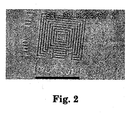
- Figure 2 is micrograph of hydrogel patterns according to the present invention taken at 1000 X magnification.
- the scale bar represents 40 ⁇ m.
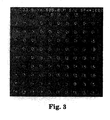
- Figure 3 is micrograph of hydrogel pads according to the present invention taken at 100 X magnification. The spacing between centers is 200 ⁇ m.
- the present invention provides a photocurable and photopatternable composition
- a photocurable and photopatternable composition comprising a) at least one copolymer derived from 1 to 99 parts by weight of at least one azlactone-functional monomer and 0 to 99 parts of at least one co-monomer; and b) at least one photocrosslinker; wherein the composition may be used to bind biologically active molecules.
- the copolymer of the azlactone-functional monomer may be any suitable polymer type, including polyolefin, polyamide, or polyimide.
- the polymer is a polyolefin.
- the copolymer may optionally contain crosslinks derived from copolymeric crosslinkers such as divinyl species.
- the copolymer of the azlactone-functional monomer may be prepared by any suitable method, including methods disclosed in US 4,451,619, US 4,737,560, US 5,200,471, US 5,292,840, US 5,336,742, US 5,344,701, US 5,403,902, US 5,451,453 and US 4,871,824.
- Preferred methods include free radical polymerization.
- the polymerization of the copolymer is complete before reaction with the photocrosslinker.
- the azlactone-functional monomer may be any suitable monomer containing an azlactone function, including monomers having structures III and IV: wherein R 1 is a polymerizable function such as vinyl, propylenyl and hexenyl wherein each R 2 independently can be an alkyl group having 1 to 14 carbon atoms, a cycloalkyl group having 3 to 14 carbon atoms, an arenyl group having 6 to 26 carbon atoms and 0 to 3 S, N, and nonperoxidic O heteroatoms, or two R 2 substituents taken together with the carbon to which they are joined can form a carbocyclic ring containing 4 to 12 ring atoms.
- a preferred azlactone-functional monomer is 2-vinyl-4,4-dimethyl 2 oxazolin-5-one (vinyl dimethylazlactone, VDM).
- the co-monomer may be any suitable monomer.
- Preferred monomers include vinyl group-containing and acryloyl group-containing compounds.
- a representative list of such monomers includes acrylamide, methacrylamide, N,N-dimethylacrylamide, diacetoneacrylamide, N-vinylpyrrolidone, hydroxyethyl methacrylate, 2-acrylamido-2-methylpropanesulfonic acid and its salts, N-(3-methacrylamidopropyl)-N,N,N-trimethylammonium salts, N,N-dimethylaminoethyl methacrylate, acrylic acid, methacrylic acid, itaconic acid, and combinations thereof.
- Preferred co-monomers are N,N-dimethylacrylamide and N-vinylpyrrolidone.
- Optional copolymeric crosslinkers may be any suitable species with two or more polymerizable functions.
- Suitable multifunctional crosslinking monomers include ethylenically unsaturated ( ⁇ , ⁇ -unsaturated) esters such as ethylene diacrylate, ethylene dimethacrylate, trimethylolpropane triacrylate and trimethacrylate, and ⁇ , ⁇ -unsaturated amides, such as methylenebis(acrylamide), methylenebis(methacrylamide), N,N'-diacryloyl-1,2-diaminocthane, N,N'-dimethacryloyl-1,2-diaminoethane, and reaction products of 2-alkenyl azlactones and short chain diamines.
- ⁇ , ⁇ -unsaturated esters such as ethylene diacrylate, ethylene dimethacrylate, trimethylolpropane triacrylate and trimethacrylate
- ⁇ , ⁇ -unsaturated amides such as
- the photocrosslinker may be any suitable chemical species that is capable of binding two or more polymer molecules in response to the application of electromagnetic radiation and that is capable of attaching to the polymer at sites other than the end of a growing polymer chain.
- the photocrosslinker should be capable of attaching to the polymer after polymerization of the polymer is complete.
- Preferred photocrosslinkers include bisazides, bisdiazocarbonyls, and bisdiazirines. The bisazides are most prefered with regard to ease of use. Azide (-N 3 ) groups release nitrogen (N 2 ) upon application of UV light, leaving behind a highly reactive divalent nitrogen, nitrene. Reactive carbene can be generated by photolysis of a diazocarbonyl or a diazirine.
- Active nitrene or carbene species can insert into many types of bonds including C-C or C-H bonds on pre-polymerized polymers to provide a crosslink.
- Azide, bisazide, azocarbonyl and bisdiazocarbonyl crosslinkers may form substrate-polymer links as well as polymer-polymer crosslinks, and are therefore preferred.
- Preferred diazide species include 2,6-bis(4-azidobenzylidene)-4-methyl cyclohexanone (BAMC), 4,4'diazidodiphenylether, 4,4'diazidodiphenylsulfone, 4,4'diazidodiphenylacetone, 4,4'diazidodiphenylmethane.
- Preferred bisdiazocarbonyl species include 1,4-bis( ⁇ -diazobenzyl) benzene.
- the photocrosslinker may be capable of thermal cure as well as photocure.
- the photocrosslinker may be a hetero-difunctional compound having a first function which attaches to the polymer and a second function which forms crosslinks upon application of light.
- a hetero-difunctional compound having a first function which attaches to the polymer and a second function which forms crosslinks upon application of light.
- 4-[ p -azidosalicylamido]butylamine (ASBA, available from Pierce Chemical Co., Rockford, IL) has an amine function that binds to an azlactone and an azido function that forms a crosslink to another polymer chain upon application of UV light, as described above.
- the crosslinker In cases where the photocrosslinker attaches to the polymer by occupying an azlactone function of the polymer, the crosslinker must be present in an amount less than 1 equivalent so that it does not occupy all of the azlactone sites necessary to bind biomolecules. In other words, the number of azlactone-reactive functions present on photocrosslinkers must be less than the total number of azlactone functions present on the polymer.
- the biomolecules are attached prior to photocrosslinking, i.e. the composition already contains biomolecule-azlactone bonds, then this condition need not apply.
- composition of the present invention may be coated on a substrate, cured (i.e. photocrosslinked), patterned, and reacted with biomolecules.
- cured i.e. photocrosslinked
- biomolecules i.e. biomolecules
- these four steps may be done in any order.
- LITI laser induced thermal imaging
- the substrate may be any suitable material to which the polymer will adhere.
- Useful substrates include inorganic solids such as glass, ceramics, unfired metal and nonmetal oxides, clays, zeolites, and organic polymers.
- Preferred substrates are those that readily react with the photocrosslinker. When the photocrosslinker contains azide functions, such preferred substrates include organic polymers and surface-treated glass including siloxane-modified glass.
- Coating of the composition on the substrate may be achieved by any suitable method.
- the coating may have a thickness in the range of 1 nanometer to 5 mm, but is preferably between 0.05 to 100 ⁇ m and most preferably between 1 to 20 ⁇ m.
- the composition may be coated with or without addition of solvent. Suitable methods include spin coating, spray coating, knife coating, dipping, or roller coating. The composition may be selectively coated to provide a patterned surface. Such methods include known printing methods such as ink jet printing, offset, flexographic printing, etc. The composition may also be knife coated onto a microstructured surface (e.g. a surface having micron scale depressions or channels) in such a way that the composition resides in the microstructures, providing a patterned array of the composition.
- a microstructured surface e.g. a surface having micron scale depressions or channels
- the composition of the present invention may be cured by exposure to electromagnetic radiation, preferably UV light, most preferably UV-A light.
- the composition may be selectively cured by selective exposure to light. Selective exposure methods include exposure through a mask or photographic negative or exposure by a directed beam of light or laser.
- the uncured composition may then be removed, e.g. by washing, to provide a patterned coating.
- the composition may then be further cured, either by light or heat cure. Heat cure may entirely replace light cure in some circumstances, in particular where the gel is not patterned or is patterned by means other than photopatterning, such as mechanical means.
- Patterning may be achieved by a variety of means including selective coating of the composition on a substrate, selective curing of the composition, or selective removal of the composition from a substrate. It is an advantage of the present invention that the composition may be photopatterned to a resolution of less than 2 ⁇ m by selective curing of the composition. Typical features are less than 1000 ⁇ m in size. Preferably, the patterned coating has features of less than 200 ⁇ m in size, more preferably less than 20 ⁇ m, and most preferably less than 2 ⁇ m.
- the size dimensions referred to above are in-plane dimensions of the coated features or of the interstices between the coated features.
- the composition may be patterned onto a substrate by laser addressable thermal transfer imaging processes such as those described in U.S. Patent No. 5,725,989.
- a thermal transfer donor element is constructed comprising a support layer, a light-to-heat conversion layer, and a transfer layer comprising the composition to be patterned.
- a melt stick transfer process occurs and the composition containing transfer layer is imaged onto the receptor.
- the photocrosslinkable azlactone composition of this invention can be used in the transfer layer of such a system.
- This photocrosslinkable azlactone composition can be reacted with biomolecules before incorporation into the transfer layer, after incorporation into the transfer layer, or after laser addressed thermal transfer to the receptor.
- the azlactone composition of this invention can be thermally or photochemically crosslinked before or after the transfer process. This process offers the opportunity to pre-pattern different biomolecules onto a transfer layer comprising the present azlactone composition prior to laser addressed thermal imaging of individual aziactone-biomolecule conjugates to the receptor substrate. Registration of the donor and receptor elements may be robotically altered between any or all of the transfer steps to build up desired array spacings and sizes for transferred elements on the receptor that is different from the patterning of the biomolecules on the transfer layer.
- the laser addressable thermal imaging process offers high resolution imaging and high registration accuracy.
- a distinct advantage of the composition of the present invention is its capacity to bind biomolecules before or after thermal imaging and to provide a means to thermally or photochemcially cure the sample to the receptor after transfer.
- the azlactone functions of the polymer may bind to a variety of attaching functions present on biomolecules, including, primary amine, secondary amine, hydroxy and thiol. These groups react, either in the presence or absence of suitable catalysts, with azlactones by nucleophilic addition to produce a residue of a biomolecule bound to a residue of an azlactone function.
- a typical reaction pathway is: wherein R 1 is H or CH 3 , R 2 and R 3 independently can be an alkyl group having 1 to 14 carbon atoms, a cycloalkyl group having 3 to 14 carbon atoms, an aryl group having 5 to 12 ring atoms, an arenyl group having 6 to 26 carbon and 0 to 3 S, N, and nonperoxidic O heteroatoms, or R 2 and R 3 taken together with the carbon to which they are joined can form a carbocyclic ring containing 4 to 12 ring atoms, n is an integer 0 or 1, X can be -O-, -S-, -NH-, or -NR 4 - wherein R 4 can be C 1 - C 20 alkyl, C 6 - C 30 aryl, or a second bond to G, HXG is a biomolecule having attaching function HX-, and XG is a residue of HXG which remains bound to the polymer.
- catalysts may be required to achieve effective attaching reaction rates.
- Primary amine functions require no catalysts.
- Acid catalysts such as trifluoroacetic acid, ethanesulfonic acid, toluenesulfonic acid, and the like are effective with hydroxy and secondary amine functions.
- Amine bases such as triethylamine, 1,8-diazabicyclo[5.4.0]undec-7-ene (DBU) and 1,5-diazabicyclo[4.3.0]non-5-ene (DBN) (both available from Aldrich Chemical Co., Milwaukee, WI) are effective as well for hydroxy and thiol attaching functions.
- the level of catalyst employed is generally from 1 to 10 parts, preferably 1 to 5 parts, based on 100 parts of azlactone.
- the azlactone functions of the present invention advantageously prefer attachment to polypeptide and polynucleotide sequences at a terminal end.
- the step of attaching biomolecules to the polymer may be carried out before or after coating, before or after curing, and before or after patterning.
- capping groups may be added to occupy any unused azlactone functions and prevent later contamination of the gel by any unwanted material.
- Capping groups preferably react readily with the azlactone and preferably do not interfere with the desired characteristics of the gel.
- the capping group is water soluble and thus improves the swellability of the gel.
- Preferable capping groups are primary amines and water.
- the resulting cured gel is advantageously swellable, since a swellable gel may bind a greater amount of the biomolecule in a given area of a substrate. This increase in areal density improves the ability to take measurements such as optical readings of the target site and allows for greater miniaturization.
- the gel advantageously swells to at least twice its dry volume when soaked in water overnight, preferably at least three times its dry volume, more preferably at least four times and most preferably at least five times its dry volume.
- the degree of swelling can be advantageously controlled through the amount of photo-crosslinking agent employed.
- This invention is useful in analytical devices employing biomolecules as test probes or reference standards, in particular where it is desirable to employ a variety of differing biomolecules in a compact area of a substrate.
- Oligonucleotide containing gel pads of the present invention can be used to make high density DNA chips having anywhere from thousands to millions of probes spotted on the surface of a chip.
- a complete array of oligonucleotide probes e.g. all 1024 possible pentamers, or all 65,536 possible octamers
- the target DNA sequence can be identified by analysis of the overlapping sets of oligomers that form perfect duplexes with the target sequence.
- chips such as these are useful in applications that require sequencing of multiple gene mutations, as might be required in detecting a polygenic disease.
- Low density DNA chips generally can have up to 300 probes and are particularly suited to diagnostic applications where detection of a specific organism or strain or a panel of tests is required.
- gels of the present invention containing oligonucleotides can, for example, be patterned onto individually addressable microelectrodes that serve as an addressable programmable electronic matrix for free field electrophoretic control of target DNA hybridization as described in US Patents 5,632,957 and 5,605,662.
- a sample of DNA is electrophoretically moved from one microlocation to the next.
- Electronic stringency control is used to retain the DNA that matches the capture probe at each microlocation.
- Microarrays of enzyme-containing gel pads of the present invention can be used to screen chemical compounds for enzyme inhibiting or activating effect. Individual gel pads would be exposed to various doses of the target compound and the dose response monitored by determining the enzyme activity in each gel pad.
- Natural or genetically engineered microorganisms can also be immobilized on individual gel pads of the present invention. Biomolecules on the surface of microorganisms serve as anchor points for attachment to the gel. The biological response of the microorganisms to chemical stimuli or other environmental conditions can be monitored. Alternatively, such microorganism-containing gel pads can be used as individual bioreactors.
- Gels containing biological molecules that promote cell attachment and growth can be patterned using the methods and compositions describe above.
- the resultant patterned gels can be used to generate two dimensional cellular structures such as neuron networks, skin, or blood vessels.
- compositions of the present invention can also be used to support immunoassay panels, panels for drugs of abuse, enzyme based electrodes and optodes.
- an array of gel pads can be used to soak up a metered amount of fluid containing microorganisms to be detected. Growth nutrients and fluorescent probes can be incorporated in the gel pads. The number of viable organisms in the sample can be related to the number of gel pads that exhibit a fluorescent response.
- DMA dimethylacrylamide
- VDM 2-vinyl-4,4-dimethyl-2-oxazoline-5-one
- MEK methyl ethyl
- Example 2 Lithographic patterning of (DMA:VDM) using 2,6-bis(4-azidobenzylidene)-4-methyl cyclohexanone (BAMC) photocrosslinker: Dimethylformamide (DMF) solvent
- a 50:50 (w/w) DMA:VDM copolymer (prepared as described in Example 1) was prepared as a 40% (w/w) solution in methyl ethyl ketone (MEK) solvent. The MEK was extracted in a vacuum desicrator for 24 hours. The dried copolymer was redissolved in dimethylformamide to make a 40 % (w/w) solution.
- MEK methyl ethyl ketone
- the resulting mixture was hand spread using a spatula onto a 1.5 cm ⁇ 2.0 cm ⁇ 1 mm thick sheet of poly(methylmethacrylate) (PMMA, DRG-100, Atohaas Americas, Inc., Philadelphia, PA).
- PMMA poly(methylmethacrylate)
- a fused silica photolithographic mask (MRS-3, Geller Microanalytical Laboratory, Topsfield, MA) was dip coated with an aqueous 1 % sodium dodecyl sulphate solution as a releasing agent, then dried under a nitrogen stream.
- the mask was applied by hand to the coated PMMA sheet with the chromate patterns contacting the DMA:VDM coating, and the laminate was exposed to UV irradiation source (Model: ELC4001, Electro-lite Corp., Danbury, CT.
- hydrogel patterns on PMMA were obtained using the MRS-3 mask described above to provide patterns having resolution of less than 2 ⁇ m.
- a micrograph at 1000 X magnification (made using a Leica Model DMRX microscope, Leica, Wetzlar, Germany) showed that azlactone hydrogels can be lithographically patterned with better than 2 ⁇ m resolution. See Figure 2.
- Example 3 Lithographic patterning of DMA:VDM using BAMC photocrosslinker: MEK/butyl acetate solvent mixture
- a 40 % (w/w) solution of 50:50 DMA:VDM copolymer (prepared as described in Example 1) in MEK was mixed with an equal amount of a 2.86 % (w/w) solution of BAMC (30% aqueous suspension) in butyl acetate.
- the butyl acetate solution of the resulting mixture was spin coated at 4,500 rpm on a Photo-resist spinner (Model 1-EC101D-R435, Headway Research Inc., Garland, TX) onto a 1.5 cm ⁇ 2.0 cm ⁇ 1 mm PMMA sheet.
- the coating was allowed to dry in a vacuum desiccator for 1 hour at 23 °C and approximately 0.1 mtorr.
- Lithographic procedures as described in Example 2 provided gel patterns having resolution essentially the same as that shown in Example 2, as shown by microscopy.
- EFD 32 gauge flat-tip needle EFD 32 gauge flat-tip needle
- the sample was put in a sealed, humidified container for 2 hours at room temperature before washing with DI water and incubating in DI water for 10 hours. Bright spots of fluorescence were observed using an epifluorescence microscope (Leica) to detect the FITC reporter, indicating covalent attachment of the oligonucleotide to the photo-crosslinked gel via reaction of the amine with azlactone functionality.
- the cured DMA:VDM coating was incubated in DI water for one hour to hydrolyze the azlactone rings and then dried in a stream of nitrogen before spotting the amine terminated oligonucleotide solution and incubating in a humidified container for 2 hours.
- the sample was washed with DI water and examined under fluorescence microscopy. No fluorescent spots were observed under the same detector gain.
- Example 4 Lithographic patterning of DMA:VDM using 4-(p-azidosalicylamido)butylamine (ASBA)
- Example 5 Lithographic patterning of DMA:VDM using a UV-Curable Acrylate Adhesive
- This example demonstrates that gels with azlactone functionality can be lithographically patterned using a mixture of azlactone polymer with UV-curable polymer.
- the advantage of this approach is that the density of azlactone can be varied by mixing UV-curable polymer and azlactone polymer in different ratios.
- a 40 % (w/w) solution of 50:50 DMA:VDM copolymer (Example 1) in MEK was mixed in varying amounts with UV curable acrylate adhesive (Class VI Medical Grade Adhesive, Model 4M01, Electro-lite Corp., Danbury, CT) at 1:1 to 1:30 v/v ratios.
- UV curable acrylate adhesive Class VI Medical Grade Adhesive, Model 4M01, Electro-lite Corp., Danbury, CT
- the mixtures were hand spread onto PMMA.
- Lithographic procedures as described in Example 2 were followed with a five minute UV exposure. Comparable resolution to Example 2 was observed on gel arrays at a ratio of 5 parts acrylate adhesive:2 parts azlactone copolymer, v/v.
- LITI donor sheets consisted of the azlactone hydrogel layer, a polyacrylate interlayer, and a carbon black light-to-heat conversion layer on a polyethylene terephthalate substrate. These donor sheets were prepared as follows:
- the light-to-heat conversion layer was prepared by coating an aqueous dispersion of carbon black in a radiation curable resin onto a 4 mil (0.1 mm) PET substrate with a Yasui Seiki Lab Coater, Model CAG-150 (Yasui Seiki Co., Bloomington, Ind.) using a microgravure roll of 90 helical cells per lineal inch.
- the coating composition was 1 part trimethylolpropane triacrylate (SartomerTM SR351HP, Sartomer Co. Inc., Exton, PA), 1.15 parts 3M Matchprint Negative Black Millbase (3M Co., St.
- the coating was subsequently in-line dried and UV-cured on the coater.
- the transmision optical density (TOD -logT, where T is the measured fractional transmission) of the coated film was 2.35 at 1060 nm.
- the polyacrylate interlayer was prepared as a 20% solids solution of 130 g trimethylolpropane triacrylate (SartomerTM SR351HP), 130 g of a 3:1 mixture (25% solids w/w/) and polyvinyl butyral (ButvarTM B98, Monsanto Co., St. Louis, MO), 221 g 1-methyl-2-propanol, 8.13 g DarocurTM 1173 in 331.5 g methyl ethyl ketone, which was then coated onto the light-to-heat conversion layer at a thickness of from 1.0 to 1.2 ⁇ m and cured with actinic radiation via exposure in a Radiation Polymer Corporation (Plainfield, III.) UV Processor Model No. QC 1202AN3TR (medium pressure UV lamp, total exposure ca. 100 millijoules/cm 2 , N 2 atmosphere) to produce an interlayer.
- UV Processor Model No. QC 1202AN3TR medium pressure UV lamp, total exposure ca. 100 millijou
- a 40% (w/w) solution of 60:40 (w/w) DMA/VDM copolymer (prepared as described in Example 1, using 56 parts DMA and 84 parts VDM) solid was prepared in cyclohexanone as described in Example 2.
- the residue resulting from drying 28 mg of a 30% aqueous suspension of BAMC crosslinker was taken up in 2 mL of the polymer-cyclohexanone solulion, and the resulting mixture was hand spread onto the interlayer under reduced lighting conditions, at a target coating thickness of 5 ⁇ m to complete the LITI donor substrate.
- the LITI apparatus used a YAG laser (Model 2600 from Control Laser Corporation, Orlando, FL) operated in the continuous wave (cw) mode.
- the cw output beam was incident on a model 1201E-2 acousto-optic modulator (AOM) driven by a model 231A rf driver, both from Isomet Corporation, Springfield, VA.
- the component of the YAG laser beam diffracted into the first order by the AOM was selected by an aperture and focused to a 100 ⁇ m diameter spot with a three element, 2.5" focal length objective lens.
- the LITI donor sheet in contact with the glass receptor was placed at the focus of the objective lens on a model number ATS50030 xy translation stage from Aerotech Inc., Pittsburg, PA.
- the rf driver for the AOM was gated on and off with a model 8116A function generator from Hewlett-Packard, Santa Clara, CA.
- different areas of the LITI donor sheet/receptor combination were moved into the laser beam and the laser beam turned on and off to produce optical pulses with pulse widths in the range of 0.1-100 msec.
- Absorption of these laser pulses by the donor sheet resulted in rapid heating of the above described DMA/VDM copolymer layer and thermal transfer of the copolymer to the glass receptor.
- Example 7 Laser Induced Thermal Imaging (LITI) of an Enzyme Bound to DMA:VDM Using BAMC Photocrosslinker
- Laser Induced Thermal Imaging (LITI) donor sheets were prepared as described in Example 6 with the following change:
- the azlactone hydrogel coating was treated at various locations with a 1 mg/mL solution of ⁇ -D-glucosidase enzyme in 50 mM sodium phosphate buffer pH 7.6 and allowed to dry. This provided covalent attachment of the enzyme to the azlactone transfer layer of the donor sheet construction via reaction of reactive pendant groups on the enzyme with the azlactone functionality of the hydrogel composition.
- Enzyme impregnated azlactone was transferred by LITI to a PVdC (polyvinylidene chloride) primed PET receptor sheet using methods similar to those described in Example 6.
- PVdC polyvinylidene chloride
- 100 ⁇ m wide stripes were imaged onto the receptor and subsequently crosslinked. Some stripes corresponded to regions of the donor sheet where enzyme had been applied. Some stripes corresponded to control regions where no enzyme was applied. All stripes were innoculated with a 0.05 mM solution of an indicator (4 methyl-umbelliferyl- ⁇ -D-glucoside) that becomes fluorescent as a result of enzymatic cleavage by ⁇ -D-glucosidase enzyme.
Landscapes
- Physics & Mathematics (AREA)
- General Physics & Mathematics (AREA)
- Spectroscopy & Molecular Physics (AREA)
- Chemical & Material Sciences (AREA)
- Engineering & Computer Science (AREA)
- Chemical Kinetics & Catalysis (AREA)
- Organic Chemistry (AREA)
- Polymers & Plastics (AREA)
- Medicinal Chemistry (AREA)
- Health & Medical Sciences (AREA)
- Architecture (AREA)
- Structural Engineering (AREA)
- Ceramic Engineering (AREA)
- Addition Polymer Or Copolymer, Post-Treatments, Or Chemical Modifications (AREA)
- Apparatus Associated With Microorganisms And Enzymes (AREA)
- Immobilizing And Processing Of Enzymes And Microorganisms (AREA)
- Physical Or Chemical Processes And Apparatus (AREA)
- Compositions Of Macromolecular Compounds (AREA)
Applications Claiming Priority (3)
| Application Number | Priority Date | Filing Date | Title |
|---|---|---|---|
| US09/183,197 US6156478A (en) | 1998-10-30 | 1998-10-30 | Photocurable and photopatternable hydrogel matrix based on azlactone copolymers |
| US183197 | 1998-10-30 | ||
| PCT/US1999/005143 WO2000026725A1 (en) | 1998-10-30 | 1999-03-08 | Photocurable and photopatternable hydrogel matrix based on azlactone copolymers |
Publications (2)
| Publication Number | Publication Date |
|---|---|
| EP1127293A1 EP1127293A1 (en) | 2001-08-29 |
| EP1127293B1 true EP1127293B1 (en) | 2003-10-22 |
Family
ID=22671857
Family Applications (1)
| Application Number | Title | Priority Date | Filing Date |
|---|---|---|---|
| EP99909939A Expired - Lifetime EP1127293B1 (en) | 1998-10-30 | 1999-03-08 | Photocurable and photopatternable hydrogel matrix based on azlactone copolymers |
Country Status (8)
| Country | Link |
|---|---|
| US (2) | US6156478A (enExample) |
| EP (1) | EP1127293B1 (enExample) |
| JP (1) | JP4350906B2 (enExample) |
| KR (1) | KR100554478B1 (enExample) |
| CN (1) | CN1325505A (enExample) |
| AU (1) | AU749808B2 (enExample) |
| DE (1) | DE69912300T2 (enExample) |
| WO (1) | WO2000026725A1 (enExample) |
Families Citing this family (28)
| Publication number | Priority date | Publication date | Assignee | Title |
|---|---|---|---|---|
| US7534543B2 (en) * | 1996-04-15 | 2009-05-19 | 3M Innovative Properties Company | Texture control of thin film layers prepared via laser induced thermal imaging |
| US6376619B1 (en) * | 1998-04-13 | 2002-04-23 | 3M Innovative Properties Company | High density, miniaturized arrays and methods of manufacturing same |
| US7638464B2 (en) | 1999-04-26 | 2009-12-29 | Biocept, Inc. | Three dimensional format biochips |
| US6482638B1 (en) * | 1999-12-09 | 2002-11-19 | 3M Innovative Properties Company | Heat-relaxable substrates and arrays |
| JP2004518138A (ja) * | 2000-10-26 | 2004-06-17 | バイオセプト インコーポレイテッド | 3次元型バイオチップ |
| US6686431B2 (en) * | 2000-11-01 | 2004-02-03 | Avery Dennison Corporation | Optical coating having low refractive index |
| EP1245272A1 (en) * | 2001-03-30 | 2002-10-02 | Ucb S.A. | Substrates, preparation and use |
| US6794458B2 (en) * | 2001-05-18 | 2004-09-21 | 3M Innovative Properties Company | Azlactone-functional hydrophilic coatings and hydrogels |
| US20030040125A1 (en) * | 2001-08-21 | 2003-02-27 | 3M Innovative Properties Company | Methods for performing immunological assays |
| US7223350B2 (en) * | 2002-03-29 | 2007-05-29 | International Business Machines Corporation | Planarization in an encapsulation process for thin film surfaces |
| US20030052003A1 (en) * | 2002-10-15 | 2003-03-20 | Kelly Patrick | Cast analyte diffusion-limiting membranes using photopolymerizable hydrophylic monomers |
| WO2004076511A2 (en) * | 2003-02-21 | 2004-09-10 | Ciphergen Biosystems, Inc. | Photocrosslinked hydrogel surface coatings |
| US6762257B1 (en) * | 2003-05-05 | 2004-07-13 | 3M Innovative Properties Company | Azlactone chain transfer agents for radical polymerization |
| JP4373260B2 (ja) * | 2004-03-29 | 2009-11-25 | 一則 片岡 | 高分子複合体 |
| EP1858959A1 (en) * | 2005-02-16 | 2007-11-28 | 3M Innovative Properties Company | Method of making topographically patterned coatings |
| JP2008532737A (ja) * | 2005-02-16 | 2008-08-21 | スリーエム イノベイティブ プロパティズ カンパニー | モルフォロジー的にパターン化されたコーティングを製造する方法 |
| JP2006316010A (ja) * | 2005-05-13 | 2006-11-24 | Institute Of Physical & Chemical Research | 物質固定化剤、物質固定化方法および物質固定化基体 |
| US7396631B2 (en) * | 2005-10-07 | 2008-07-08 | 3M Innovative Properties Company | Radiation curable thermal transfer elements |
| US7678526B2 (en) * | 2005-10-07 | 2010-03-16 | 3M Innovative Properties Company | Radiation curable thermal transfer elements |
| US8513322B2 (en) * | 2007-05-31 | 2013-08-20 | 3M Innovative Properties Company | Polymeric beads and methods of making polymeric beads |
| JP5432175B2 (ja) | 2007-12-12 | 2014-03-05 | スリーエム イノベイティブ プロパティズ カンパニー | 物品の製造方法及び物品 |
| BRPI0820704A2 (pt) * | 2007-12-12 | 2015-06-16 | 3M Innovative Proferties Company | Métodos de fabricação de materiais poliméricos moldados |
| BRPI0914610B1 (pt) | 2008-06-26 | 2018-03-06 | 3M Innovative Properties Company | Suporte sólido com uma cadeia enxertada |
| US9296870B2 (en) * | 2009-07-27 | 2016-03-29 | The Trustees Of Columbia University In The City Of New York | Modification of surfaces with nanoparticles |
| US10272180B2 (en) * | 2014-09-09 | 2019-04-30 | University Of Washington | Functionalized zwitterionic and mixed charge polymers, related hydrogels, and methods for their use |
| TWI648271B (zh) | 2014-09-23 | 2019-01-21 | 日商住友電木股份有限公司 | 二氮環丙烯化合物及由其衍生之組成物 |
| EP3995828A1 (en) * | 2020-11-04 | 2022-05-11 | MicroCoat Biotechnologie GmbH | Novel functionalized hydrogel coatings of assay plates and uses thereof |
| CN114839835B (zh) * | 2022-03-18 | 2025-12-09 | 清华大学 | 量子点的无损光刻图案化方法和设备 |
Family Cites Families (21)
| Publication number | Priority date | Publication date | Assignee | Title |
|---|---|---|---|---|
| DE1745348A1 (de) * | 1967-12-01 | 1971-09-09 | Roehm Gmbh | Azlactongruppen enthaltende Mischpolymerisate |
| US4451619A (en) * | 1982-09-30 | 1984-05-29 | Minnesota Mining And Manufacturing Company | Method of hydrophilizing or hydrophobizing polymers |
| US5336742A (en) * | 1987-03-13 | 1994-08-09 | Minnesota Mining And Manufacturing Company | Polymeric supports |
| US4871824A (en) * | 1987-03-13 | 1989-10-03 | Minnesota Mining And Manufacturing Company | Variably crosslinked polymeric supports |
| US4737560A (en) * | 1987-03-13 | 1988-04-12 | Minnesota Mining And Manufacturing Company | Polymer beads |
| US5292840A (en) * | 1987-03-13 | 1994-03-08 | Minnesota Mining And Manufacturing Company | Polymeric supports |
| US5013795A (en) * | 1989-04-10 | 1991-05-07 | Minnesota Mining And Manufacturing Company | Azlactone graft copolymers |
| US5744101A (en) * | 1989-06-07 | 1998-04-28 | Affymax Technologies N.V. | Photolabile nucleoside protecting groups |
| US4981933A (en) * | 1989-06-23 | 1991-01-01 | Polaroid Corporation | Azlactone copolymers |
| JPH0450946A (ja) * | 1990-06-15 | 1992-02-19 | Fujitsu Ltd | 放射線レジストとパターン形成方法 |
| US5200471A (en) * | 1990-11-05 | 1993-04-06 | Minnesota Mining And Manufacturing Company | Biomolecules covalently immobilized with a high bound specific biological activity and method of preparing same |
| US5235015A (en) * | 1991-02-21 | 1993-08-10 | Minnesota Mining And Manufacturing Company | High speed aqueous solvent developable photopolymer compositions |
| RU1794088C (ru) * | 1991-03-18 | 1993-02-07 | Институт Молекулярной Биологии Ан@ Ссср | Способ определени нуклеотидной последовательности ДНК и устройство дл его осуществлени |
| US5352714A (en) * | 1991-11-05 | 1994-10-04 | Bausch & Lomb Incorporated | Wettable silicone hydrogel compositions and methods for their manufacture |
| US5632957A (en) * | 1993-11-01 | 1997-05-27 | Nanogen | Molecular biological diagnostic systems including electrodes |
| US5605662A (en) * | 1993-11-01 | 1997-02-25 | Nanogen, Inc. | Active programmable electronic devices for molecular biological analysis and diagnostics |
| US5344701A (en) * | 1992-06-09 | 1994-09-06 | Minnesota Mining And Manufacturing Company | Porous supports having azlactone-functional surfaces |
| WO1996024075A1 (en) * | 1995-02-03 | 1996-08-08 | Novartis Ag | Crosslinked polymers containing ester or amide groups |
| EP0808348B1 (en) * | 1995-02-10 | 1999-05-06 | Minnesota Mining And Manufacturing Company | Cross-linkable pressure sensitive adhesive and process for the production of an article coated with a crosslinked pressure sensitive adhesive |
| KR100206664B1 (ko) * | 1995-06-28 | 1999-07-01 | 세키사와 다다시 | 화학증폭형 레지스트 조성물 및 레지스트 패턴의 형성방법 |
| US5725989A (en) * | 1996-04-15 | 1998-03-10 | Chang; Jeffrey C. | Laser addressable thermal transfer imaging element with an interlayer |
-
1998
- 1998-10-30 US US09/183,197 patent/US6156478A/en not_active Expired - Lifetime
-
1999
- 1999-03-08 JP JP2000580047A patent/JP4350906B2/ja not_active Expired - Fee Related
- 1999-03-08 AU AU29021/99A patent/AU749808B2/en not_active Ceased
- 1999-03-08 WO PCT/US1999/005143 patent/WO2000026725A1/en not_active Ceased
- 1999-03-08 KR KR1020017005395A patent/KR100554478B1/ko not_active Expired - Fee Related
- 1999-03-08 CN CN99813055A patent/CN1325505A/zh active Pending
- 1999-03-08 DE DE1999612300 patent/DE69912300T2/de not_active Expired - Lifetime
- 1999-03-08 EP EP99909939A patent/EP1127293B1/en not_active Expired - Lifetime
-
2000
- 2000-11-10 US US09/710,186 patent/US6372407B1/en not_active Expired - Lifetime
Also Published As
| Publication number | Publication date |
|---|---|
| CN1325505A (zh) | 2001-12-05 |
| US6156478A (en) | 2000-12-05 |
| WO2000026725A1 (en) | 2000-05-11 |
| JP2002529543A (ja) | 2002-09-10 |
| JP4350906B2 (ja) | 2009-10-28 |
| EP1127293A1 (en) | 2001-08-29 |
| AU749808B2 (en) | 2002-07-04 |
| KR20010089379A (ko) | 2001-10-06 |
| AU2902199A (en) | 2000-05-22 |
| DE69912300D1 (de) | 2003-11-27 |
| US6372407B1 (en) | 2002-04-16 |
| KR100554478B1 (ko) | 2006-03-03 |
| DE69912300T2 (de) | 2004-07-29 |
Similar Documents
| Publication | Publication Date | Title |
|---|---|---|
| EP1127293B1 (en) | Photocurable and photopatternable hydrogel matrix based on azlactone copolymers | |
| EP1190254B1 (en) | Attachment of biomolecule to a polymeric solid support by cycloaddition of a linker | |
| US6664061B2 (en) | Use and evaluation of a [2+2] photoaddition in immobilization of oligonucleotides on a three-dimensional hydrogel matrix | |
| US6391937B1 (en) | Polyacrylamide hydrogels and hydrogel arrays made from polyacrylamide reactive prepolymers | |
| CN1653189B (zh) | 制备聚合物涂层的方法 | |
| JP2003515133A (ja) | フィルムベースのアドレス可能なプログラマブル電子マトリックス物品およびその製造と使用方法 | |
| JPH11187900A (ja) | プローブの固相へのスポッティング方法、プローブアレイとその製造方法、及びそれを用いた標的物質の検出方法、標的物質の構造の特定化方法 | |
| Shamansky et al. | Immobilization and detection of DNA on microfluidic chips | |
| WO2014112633A1 (ja) | 細胞培養用基材及び細胞培養用基材の製造方法 | |
| RU2309959C1 (ru) | Применение немодифицированных полимерных материалов для изготовления подложки биочипов, биочип на их основе и способ его изготовления, способ иммобилизации гидрогелей на немодифицированных полимерных материалах | |
| US20060222876A1 (en) | Polymer composite | |
| JP2006322709A (ja) | 物質固定化基板 | |
| US20060111517A1 (en) | Recognition layers made of hydrogel based on polyacrylamide for use in biosensor technology | |
| JP2006322708A (ja) | 物質固定化方法 | |
| JP2006316010A (ja) | 物質固定化剤、物質固定化方法および物質固定化基体 | |
| US20050136538A1 (en) | Lithographic method for attaching biological cells to a solid substrate using a small molecule linker | |
| US20070196930A1 (en) | Molecular stamp for printing biomolecules onto a substate | |
| JP2001066305A (ja) | プローブをインクジェット法で吐出させるための液体組成物 | |
| JP2003136640A (ja) | 樹脂硬化物及びその製造方法 | |
| KR20230150348A (ko) | 물질 고정화용 기질 및 그 이용 | |
| JPH08145996A (ja) | ボロン酸基をもつ化合物を共有結合させた不溶性担体、および、側鎖にボロン酸基を有する高分子化合物を用いた、糖化蛋白の定量方法 | |
| JP2007064963A (ja) | 生体物質固定用担体 | |
| JPH10211771A (ja) | オフセット印刷用版材 |
Legal Events
| Date | Code | Title | Description |
|---|---|---|---|
| PUAI | Public reference made under article 153(3) epc to a published international application that has entered the european phase |
Free format text: ORIGINAL CODE: 0009012 |
|
| 17P | Request for examination filed |
Effective date: 20010521 |
|
| AK | Designated contracting states |
Kind code of ref document: A1 Designated state(s): DE FR GB IT SE |
|
| GRAG | Despatch of communication of intention to grant |
Free format text: ORIGINAL CODE: EPIDOS AGRA |
|
| 17Q | First examination report despatched |
Effective date: 20020610 |
|
| GRAG | Despatch of communication of intention to grant |
Free format text: ORIGINAL CODE: EPIDOS AGRA |
|
| GRAG | Despatch of communication of intention to grant |
Free format text: ORIGINAL CODE: EPIDOS AGRA |
|
| GRAH | Despatch of communication of intention to grant a patent |
Free format text: ORIGINAL CODE: EPIDOS IGRA |
|
| GRAS | Grant fee paid |
Free format text: ORIGINAL CODE: EPIDOSNIGR3 |
|
| GRAA | (expected) grant |
Free format text: ORIGINAL CODE: 0009210 |
|
| AK | Designated contracting states |
Kind code of ref document: B1 Designated state(s): DE FR GB IT SE |
|
| PG25 | Lapsed in a contracting state [announced via postgrant information from national office to epo] |
Ref country code: IT Free format text: LAPSE BECAUSE OF FAILURE TO SUBMIT A TRANSLATION OF THE DESCRIPTION OR TO PAY THE FEE WITHIN THE PRESCRIBED TIME-LIMIT;WARNING: LAPSES OF ITALIAN PATENTS WITH EFFECTIVE DATE BEFORE 2007 MAY HAVE OCCURRED AT ANY TIME BEFORE 2007. THE CORRECT EFFECTIVE DATE MAY BE DIFFERENT FROM THE ONE RECORDED. Effective date: 20031022 Ref country code: FR Free format text: LAPSE BECAUSE OF FAILURE TO SUBMIT A TRANSLATION OF THE DESCRIPTION OR TO PAY THE FEE WITHIN THE PRESCRIBED TIME-LIMIT Effective date: 20031022 |
|
| REG | Reference to a national code |
Ref country code: GB Ref legal event code: FG4D |
|
| REF | Corresponds to: |
Ref document number: 69912300 Country of ref document: DE Date of ref document: 20031127 Kind code of ref document: P |
|
| PG25 | Lapsed in a contracting state [announced via postgrant information from national office to epo] |
Ref country code: SE Free format text: LAPSE BECAUSE OF FAILURE TO SUBMIT A TRANSLATION OF THE DESCRIPTION OR TO PAY THE FEE WITHIN THE PRESCRIBED TIME-LIMIT Effective date: 20040122 |
|
| PLBE | No opposition filed within time limit |
Free format text: ORIGINAL CODE: 0009261 |
|
| STAA | Information on the status of an ep patent application or granted ep patent |
Free format text: STATUS: NO OPPOSITION FILED WITHIN TIME LIMIT |
|
| 26N | No opposition filed |
Effective date: 20040723 |
|
| EN | Fr: translation not filed | ||
| REG | Reference to a national code |
Ref country code: HK Ref legal event code: WD Ref document number: 1039656 Country of ref document: HK |
|
| PGFP | Annual fee paid to national office [announced via postgrant information from national office to epo] |
Ref country code: GB Payment date: 20140305 Year of fee payment: 16 |
|
| PGFP | Annual fee paid to national office [announced via postgrant information from national office to epo] |
Ref country code: DE Payment date: 20140417 Year of fee payment: 16 |
|
| REG | Reference to a national code |
Ref country code: DE Ref legal event code: R119 Ref document number: 69912300 Country of ref document: DE |
|
| GBPC | Gb: european patent ceased through non-payment of renewal fee |
Effective date: 20150308 |
|
| PG25 | Lapsed in a contracting state [announced via postgrant information from national office to epo] |
Ref country code: DE Free format text: LAPSE BECAUSE OF NON-PAYMENT OF DUE FEES Effective date: 20151001 Ref country code: GB Free format text: LAPSE BECAUSE OF NON-PAYMENT OF DUE FEES Effective date: 20150308 |