EP1110607A2 - Verfahren zur Modifizierung ionenaustauschbarer Stoffe - Google Patents
Verfahren zur Modifizierung ionenaustauschbarer Stoffe Download PDFInfo
- Publication number
- EP1110607A2 EP1110607A2 EP00127326A EP00127326A EP1110607A2 EP 1110607 A2 EP1110607 A2 EP 1110607A2 EP 00127326 A EP00127326 A EP 00127326A EP 00127326 A EP00127326 A EP 00127326A EP 1110607 A2 EP1110607 A2 EP 1110607A2
- Authority
- EP
- European Patent Office
- Prior art keywords
- ammonium
- substances
- ion
- exchangeable
- reaction
- Prior art date
- Legal status (The legal status is an assumption and is not a legal conclusion. Google has not performed a legal analysis and makes no representation as to the accuracy of the status listed.)
- Granted
Links
Classifications
-
- B—PERFORMING OPERATIONS; TRANSPORTING
- B01—PHYSICAL OR CHEMICAL PROCESSES OR APPARATUS IN GENERAL
- B01J—CHEMICAL OR PHYSICAL PROCESSES, e.g. CATALYSIS OR COLLOID CHEMISTRY; THEIR RELEVANT APPARATUS
- B01J20/00—Solid sorbent compositions or filter aid compositions; Sorbents for chromatography; Processes for preparing, regenerating or reactivating thereof
- B01J20/02—Solid sorbent compositions or filter aid compositions; Sorbents for chromatography; Processes for preparing, regenerating or reactivating thereof comprising inorganic material
- B01J20/10—Solid sorbent compositions or filter aid compositions; Sorbents for chromatography; Processes for preparing, regenerating or reactivating thereof comprising inorganic material comprising silica or silicate
- B01J20/16—Alumino-silicates
- B01J20/18—Synthetic zeolitic molecular sieves
- B01J20/186—Chemical treatments in view of modifying the properties of the sieve, e.g. increasing the stability or the activity, also decreasing the activity
-
- B—PERFORMING OPERATIONS; TRANSPORTING
- B01—PHYSICAL OR CHEMICAL PROCESSES OR APPARATUS IN GENERAL
- B01J—CHEMICAL OR PHYSICAL PROCESSES, e.g. CATALYSIS OR COLLOID CHEMISTRY; THEIR RELEVANT APPARATUS
- B01J39/00—Cation exchange; Use of material as cation exchangers; Treatment of material for improving the cation exchange properties
- B01J39/08—Use of material as cation exchangers; Treatment of material for improving the cation exchange properties
-
- C—CHEMISTRY; METALLURGY
- C01—INORGANIC CHEMISTRY
- C01B—NON-METALLIC ELEMENTS; COMPOUNDS THEREOF; METALLOIDS OR COMPOUNDS THEREOF NOT COVERED BY SUBCLASS C01C
- C01B39/00—Compounds having molecular sieve and base-exchange properties, e.g. crystalline zeolites; Their preparation; After-treatment, e.g. ion-exchange or dealumination
- C01B39/02—Crystalline aluminosilicate zeolites; Isomorphous compounds thereof; Direct preparation thereof; Preparation thereof starting from a reaction mixture containing a crystalline zeolite of another type, or from preformed reactants; After-treatment thereof
- C01B39/026—After-treatment
-
- B—PERFORMING OPERATIONS; TRANSPORTING
- B01—PHYSICAL OR CHEMICAL PROCESSES OR APPARATUS IN GENERAL
- B01J—CHEMICAL OR PHYSICAL PROCESSES, e.g. CATALYSIS OR COLLOID CHEMISTRY; THEIR RELEVANT APPARATUS
- B01J29/00—Catalysts comprising molecular sieves
- B01J29/04—Catalysts comprising molecular sieves having base-exchange properties, e.g. crystalline zeolites
- B01J29/06—Crystalline aluminosilicate zeolites; Isomorphous compounds thereof
- B01J29/061—Crystalline aluminosilicate zeolites; Isomorphous compounds thereof containing metallic elements added to the zeolite
Definitions
- the invention relates to a method for modification ion-exchangeable substances. like, zeolites. ion exchangeable Structural analogues of zeolites, ion-exchangeable, X-ray amorphous, inorganic substances, mixtures of the previously mentioned groups of substances as well as ion-exchangeable ones. organic substances, in particular such cations into which substances are to be integrated. across from which the substances to be treated in an aqueous medium low selectivity to trade them Have ions.
- the exchange of the relevant cations takes place in the previously specifically loaded with ammonium ions ion-exchangeable substances under conditions which Exchange of the desired cations favor the targeted Removal of volatile ammonia or volatile Excludes ammonium compounds.
- the invention further relates, as described, to ion-exchangeable, modified zeolites. which is preferred in adsorption and catalytic processes can be used.
- Zeolites are crystalline, microporous framework aluminosilicates. see. DW Breck: "Zeolite Molecular Sieves”. John Wiley & Sons, New York. 1974. p.5. There are now over 98 different structures, see: WM Meier. DH Olson. C. Baerlocher: "Atlas of Zeolite Structure Types”. 4 th rev. Ed., Elsevier, London. 1996.
- zeolites can be used as ion exchangers, see: RP Townsend, Ioc. cit., adsorbent, see: DM Ruthven: “Principles of Adsorption and Adsorption Processes", John Wiley & Sons, New York, 1984, and / or catalyst component, see: J. Weitkamp, L. Puppe (Eds.): “Catalysis and Zeolites: Fundamentals and Applications", Springer, Berlin, 1999.
- ammonium-containing detachments are first reacted with a suitable alkali - usually NaOH or Ca (OH) 2 - under conditions such that the ammonia formed is completely stripped off via the gas phase. This is done via a packed column at elevated temperature and passing a corresponding stripping gas or applying a suitable vacuum, the latter case being quite complex in terms of apparatus and process technology, cf.
- a disadvantage of the above-mentioned indirect processes using the ammonium form of zeolites to achieve a certain degree of exchange with an ion / ion of low selectivity is the fact that the reaction of the ammonium form at a higher pH and, as already described above, in order to remove the To achieve ammonia or another volatile ammonium compound from the reaction zone at higher temperature and / or passing air or other suitable gas and / or applying a vacuum must be carried out.
- higher temperatures in the elevated pH range there is the risk of irreversible damage to the zeolite structure or the risk of hydrolysis of polyvalent cations which may already be present in the zeolite framework.
- the present invention is therefore based on the problem that zeolites, ion-exchangeable structural analogues the zeolite, ion-exchangeable, X-ray amorphous, inorganic substances, mixtures of the aforementioned Groups of substances and ion-exchangeable, organic substances in certain ion forms due to bad Exchange selectivities in aqueous solution not or only very expensive to produce by direct ion exchange let and those described above, the prior art moderate, indirect process using the ammonium form of the substances mentioned with a high technical equipment or associated costs.
- the zeolites produced in the process according to the invention are particularly suitable as highly selective adsorbent and catalyst components.
- the filter cake was washed with three portions of 300 ml of distilled water, suction filtered and then dried under an infrared lamp at a maximum of 60 ° C.
- the loss on ignition at 950 ° C. and the content of lithium oxide (Li 2 O) based on the residue on ignition were determined for the dried product using a flame photometer (FLAPHOvar, Carl Zeiss Jena).
- a portion of the dried filter cake was slowly heated to a temperature of 400 ° C. under vacuum (VacPrep 061, from micromeritics) and activated at this temperature and a residual vacuum of less than 0.05 mbar for at least a further 2 hours.
- the mass of the activated sample was then determined by weighing and the nitrogen adsorption at 25 ° C. and 1000 mbar nitrogen pressure using an adsorption measuring device (Gemini 2370, from micromeritics).
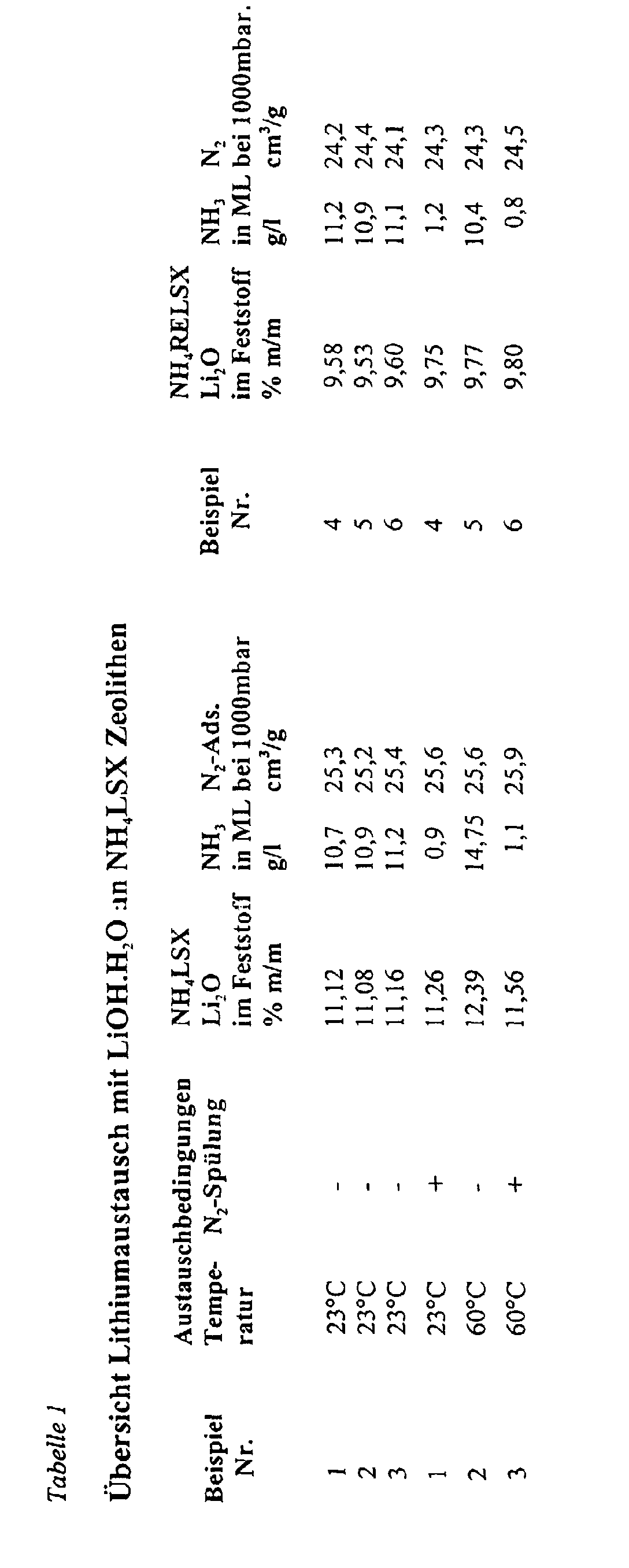
- An object of the present invention is the sensible use of the cost-intensive lithium hydroxide contained in the mother liquor and the avoidance of the production of an excess of ammonium sulfate when working up the mother liquors from the ammonium exchange. According to the invention, these two problems are solved in that after the ammonium exchange has ended and before the actual lithium exchange, the thoroughly washed filter cake is treated with the mother liquor containing lithium hydroxide and ammonium.
- the mother liquor containing lithium hydroxide 10 g of NH 4 RELSX were mashed in water and suctioned off on a Buchner funnel to form a filter cake about 5 mm high.
- the reactions listed in the exemplary embodiments take place at temperatures of -10 ... 50 ° C, preferably at -1 .. .35 ° C and at a pressure of 0.5 ... 5bar. preferably at 0.9 ... 1.5 bar.
- Clogging up after graduation the reaction by filtration separated mother liquor to Process of the preceding ammonium exchange takes place at temperatures from -10 ... 100 ° C. preferably at -1 ... 35 ° C discontinuously in the stirred tank or semi-continuously on a filter press or fully continuous on a band filter.
- the starting materials are preferably Zeolites. especially of type A. X or Y.
- the cations to be exchanged are preferably Cations of the elements of the first main group of the periodic table of the elements, especially around Li cations.
- the Fabrics produced according to the invention are preferred used and serve as adsorbents / components especially for the adsorptive enrichment of oxygen from air.
Landscapes
- Chemical & Material Sciences (AREA)
- Organic Chemistry (AREA)
- Chemical Kinetics & Catalysis (AREA)
- General Life Sciences & Earth Sciences (AREA)
- Life Sciences & Earth Sciences (AREA)
- Inorganic Chemistry (AREA)
- Geology (AREA)
- Analytical Chemistry (AREA)
- Engineering & Computer Science (AREA)
- Materials Engineering (AREA)
- Solid-Sorbent Or Filter-Aiding Compositions (AREA)
- Addition Polymer Or Copolymer, Post-Treatments, Or Chemical Modifications (AREA)
- Silicates, Zeolites, And Molecular Sieves (AREA)
- Organic Low-Molecular-Weight Compounds And Preparation Thereof (AREA)
- Water Treatment By Sorption (AREA)
Abstract
Description
John Wiley & Sons, New York. 1974. p.5. Inzwischen kennt man über 98 unterschiedliche Strukturen, vgl.: W.M. Meier. D. H. Olson. C. Baerlocher: "Atlas of Zeolite Structure Types". 4 th rev. Ed., Elsevier, London. 1996.
R. Szostak: "Molecular Sieves: Principles of Synthesis and Identification", Van Nostrand Reinhold, New York, 1989, pp. 205-281.
"Principles of Adsorption and Adsorption Processes", John Wiley & Sons, New York, 1984, und/oder Katalysator-komponente, vgl.: J. Weitkamp, L. Puppe (Eds.):
"Catalysis and Zeolites: Fundamentals and Applications", Springer, Berlin, 1999, eingesetzt werden.
Allen letztgenannten Schriften ist ein Grundprinzip gemeinsam. nämlich, daß man einen angestrebten hohen Austauschgrad an einem Zeolithen mit einem Kation gegenüber welchem der Zeolith in wäßriger Lösung eine schlechte Selektivität aufweist, dadurch erreicht, daß die vorher mit entsprechend hohem Austauschgrad hergestellte Ammoniumform bei hohem pH-Wert, d. h. pH >7, mit einer, das einzutauschende Kation enthaltender Verbindung umgesetzt wird. Als Triebkraft für diese Reaktion wird in den genannten Schriften beschrieben, daß im Zuge der Umsetzung gezielt ein flüchtiges Reaktionsprodukt - meist gasförmiger Ammoniak - aus dem System entfernt wird. Dieses Prinzip funktioniert ebenfalls bei der Umsetzung im festen Zustand. vgl.: H. G. Karge, H. K. Beyer: "Introduction of Cations into Zeolites by Solid Reaction", in: " Studies in Surface Science and Catalysis", Elsevier, Amsterdam, Vol. 69, 1991. pp. 43-64; hier wird die Ammoniumform des Zeolithen mit einem Salz des einzutauschenden Kations umgesetzt, dessen Anion mit Ammonium flüchtige Verbindungen bildet, wie z. B. Chlorid. In diesem Fall wird also als Triebkraft der Reaktion Ammoniumchlorid der Reaktionszone entzogen.
Bei der Anwendung von höheren Temperaturen im erhöhten pH-Bereich besteht die Gefahr einer irreversiblen Schädigung der Zeolithstruktur bzw. die Gefahr der Hydrolyse von gegebenenfalls bereits im Zeolithgerüst befindlichen mehrwertigen Kationen. Das Hindurchleiten von nicht speziell vorgereinigter Luft in solchen Systemen birgt die Gefahr der Bildung unlöslicher Carbonate/Hydrogencarbonate durch Reaktion des in der Luft vorhandenen CO2 mit Hydroxidionen, d. h.. eine aufwendige Luftvorreinigung bzw. der Einsatz von CO2-freien Gasen, vgl. US-PS 3.985.859, ist meist unvermeidlich.
Die Ergebnisse sind in Tabelle 2 zusammengefaßt.
| Temperatur | Li2O, | N2-Adsorption | Molverhältnisse | ||||
| % m/m | bei 1000 mbar Ncm3/g | Li/Al | RE/Al | Na/Al | K/Al | ΣM+/Al | |
| 23°C | 9,04 | 23,5 | 0,812 | 0,198 | 0,002 | 0,004 | 1,016 |
| 62°C | 9,45 | 23,3 | 0,831 | 0,199 | 0,002 | 0,004 | 1,036 |
Claims (12)
- Verfahren zur Modifizierung ionenaustauschbarer Stoffe. welche die nachfolgenden Stoffgruppen betreffen: Zeolithe. ionenaustauschbare Strukturanaloga der Zeolithe. ionenaustauschbare, röntgenamorphe. anorganische Substanzen, Gemische aus den vorher genannten Stoffgruppen sowie ionenaustauschbare, organischer Substanzen durch Reaktion der vorher gezielt mit Ammoniumionen beladenen Materialien mit Substanzen, welche die einzutauschenden Kationen. die als Elemente in der 1. und 2. Hauptgruppe im Periodensystem der Elemente stehen, einzeln oder im Gemisch enthalten, in wäßrigem Medium bei pH-Werten > 7, dadurch gekennzeichnet, daß die Reaktion der Ammoniumform der genannten Substanzen unter Bedingungen erfolgt, welche die gezielte Entfernung von Ammoniak bzw. einer anderen flüchtigen Ammoniumverbindung aus der wäßrigen Phase als der Reaktionszone verhindern. die nach Abtrennung des Feststoffes vorliegende wäßrige Mutterlauge als Waschlösung für den vorangegangenen Ammoniumaustauschprozeß verwendet und mit der dann verbleibenden Ablauge die im sauren pH-Bereich - pH <3 - vorliegende Ammoniumrohlösung aus dem Ammoniumrückgewinnungsprozeß auf den einer aus dem jeweiligen Ammoniumsalz hergestellten Ammoniumsalzlösung entsprechenden pH-Wert eingestellt wird.
- Verfahren nach Anspruch 1, dadurch gekennzeichnet, daß die Reaktion bei Temperaturen von -10...50°C, vorzugsweise bei -1...35°C erfolgt.
- Verfahren nach Anspruch 1 und 2, dadurch gekennzeichnet, daß die Reaktion bei einem Druck von 0,5...5 bar, vorzugsweise bei einem Druck von 0,9...1,5 bar erfolgt.
- Verfahren nach einem der vorangegangenen Ansprüche. dadurch gekennzeichnet, daß das Zusetzen der nach Abschluß der Reaktion durch Filtration abgetrennten Mutterlauge zum Prozeß des vorangestellten Ammoniumaustausches bei Temperaturen von -10...100°C, vorzugsweie bei -1...35°C erfolgt.
- Verfahren nach Anspruch 4, dadurch gekennzeichnet, daß das Zusetzen der nach Abschluß der Reaktion durch Filtration abgetrennten Mutterlauge zum Prozeß des vorangestellten Ammoniumaustausches diskontinuierlich im Rührbehälter oder halbkontinuierlich auf einer Filterpresse oder vollkontinuierlich auf einem Bandfilter erfolgt.
- Verfahren nach einem der vorangegangenen Ansprüche, dadurch gekennzeichnet, daß die vor der Reaktion gezielt mit Ammoniumionen beladenen Materialien durch Ionenaustausch von natrium- und/oder kalium- und/oder calcium- und/oder magnesiumionenhaltigen Ausgangsmaterialien mit Ammoniumlösungen. welche durch Einstellung von saurer Ammoniumrohlösung aus dem Ammoniumrückgewinnungsprozeß mit nach Zusetzen der nach Abschluß der Reaktion durch Filtration abgetrennten Mutterlauge zum Prozeß des vorangestellten Ammoniumaustausches verbleibender ammoniakhaltiger Ablauge auf einen dem einer aus dem jeweiligen Ammoniumsalz gewonnenen Ammoniumsalzlösung entsprechenden pH-Wert gemäß Anspruch 1 erhalten wurden, hergestellt werden.
- Verfahren nach einem der vorangegangenen Ansprüche, dadurch gekennzeichnet, daß die Ausgangsmaterialien zur Stoffgruppe der Zeolithe gehören.
- Verfahren nach Anspruch 7, dadurch gekennzeichnet, daß es sich bei den Ausgangsmaterialien um Zeolithe vom Typ A, X oder Y handelt.
- Verfahren nach einem der vorangegangenen Ansprüche. dadurch gekennzeichnet, daß es sich bei den einzutauschenden Kationen um Kationen der Elemente der 1. Hauptgruppe des Periodensystems der Elemente handelt.
- Verfahren nach Anspruch 9, dadurch gekennzeichnet, daß es sich bei den einzutauschenden Kationen um Li-Kationen handelt.
- Verfahren nach einem der vorangegangenen Ansprüche, dadurch gekennzeichnet, daß die erfindungsgemäß hergestellten Stoffe als Adsorptionsmittel/-komponenten eingesetzt werden.
- Verfahren nach einem der vorangegangenen Ansprüche, dadurch gekennzeichnet, daß die erfindungsgemäß hergestellten Adsorptionsmittel zur adsorptiven Anreicherung von Sauerstoff aus Luft eingesetzt werden.
Applications Claiming Priority (2)
| Application Number | Priority Date | Filing Date | Title |
|---|---|---|---|
| DE19961597 | 1999-12-21 | ||
| DE19961597A DE19961597A1 (de) | 1999-12-21 | 1999-12-21 | Verfahren zur Modifizierung ionenaustauschbarer Stoffe |
Publications (3)
| Publication Number | Publication Date |
|---|---|
| EP1110607A2 true EP1110607A2 (de) | 2001-06-27 |
| EP1110607A3 EP1110607A3 (de) | 2001-09-05 |
| EP1110607B1 EP1110607B1 (de) | 2002-10-16 |
Family
ID=7933514
Family Applications (1)
| Application Number | Title | Priority Date | Filing Date |
|---|---|---|---|
| EP00127326A Expired - Lifetime EP1110607B1 (de) | 1999-12-21 | 2000-12-13 | Verfahren zur Modifizierung ionenaustauschbarer Stoffe |
Country Status (3)
| Country | Link |
|---|---|
| EP (1) | EP1110607B1 (de) |
| AT (1) | ATE226111T1 (de) |
| DE (2) | DE19961597A1 (de) |
Cited By (1)
| Publication number | Priority date | Publication date | Assignee | Title |
|---|---|---|---|---|
| CN110156233A (zh) * | 2019-06-11 | 2019-08-23 | 无锡威孚环保催化剂有限公司 | 一种处理Cu-SSZ-13分子筛废液的方法 |
Family Cites Families (5)
| Publication number | Priority date | Publication date | Assignee | Title |
|---|---|---|---|---|
| US3375065A (en) * | 1965-01-25 | 1968-03-26 | Grace W R & Co | Method of cation exchanging synthetic faujasite |
| US4556550A (en) * | 1983-10-19 | 1985-12-03 | Union Carbide Corporation | Process for the preparation of high-level ion-exchanged forms of Zeolites F and Zeolite W |
| CA2044893C (en) * | 1990-06-20 | 1998-11-03 | Senshi Kasahara | Transition metal-containing zeolite having high hydrothermal stability, production method thereof and method of using same |
| IL112027A (en) * | 1994-02-14 | 1999-03-12 | Boc Group Inc | Method for separating nitrogen from other gases |
| US5916836A (en) * | 1996-12-27 | 1999-06-29 | Tricat Management Gmbh | Method of manufacture of molecular sieves |
-
1999
- 1999-12-21 DE DE19961597A patent/DE19961597A1/de not_active Withdrawn
-
2000
- 2000-12-13 AT AT00127326T patent/ATE226111T1/de not_active IP Right Cessation
- 2000-12-13 DE DE50002716T patent/DE50002716D1/de not_active Expired - Lifetime
- 2000-12-13 EP EP00127326A patent/EP1110607B1/de not_active Expired - Lifetime
Cited By (1)
| Publication number | Priority date | Publication date | Assignee | Title |
|---|---|---|---|---|
| CN110156233A (zh) * | 2019-06-11 | 2019-08-23 | 无锡威孚环保催化剂有限公司 | 一种处理Cu-SSZ-13分子筛废液的方法 |
Also Published As
| Publication number | Publication date |
|---|---|
| ATE226111T1 (de) | 2002-11-15 |
| EP1110607B1 (de) | 2002-10-16 |
| EP1110607A3 (de) | 2001-09-05 |
| DE50002716D1 (de) | 2003-08-07 |
| DE19961597A1 (de) | 2001-07-05 |
Similar Documents
| Publication | Publication Date | Title |
|---|---|---|
| DE69715578T2 (de) | Verfahren zur Herstellung von Molekularsieben | |
| DE69829021T2 (de) | Gebundenes zeolithisches Adsorbens, Verfahren zu dessen Herstellung und dessen Verwendung bei der kryogenen Trennung von Prozessgas | |
| DE60004382T2 (de) | Zeolithische adsorbentien,verfahren zu ihrer herstellung und ihre verwendung zum entfernen von co2 aus gasströmen | |
| DE69917041T2 (de) | Molekularsiebadsorbens zur gasreinigung und seine herstellung | |
| DE60020346T2 (de) | Selektive entfernung von stickstoff aus erdgas durch druckwechseladsorption (psa) | |
| DE60120819T2 (de) | Verfahren zur adsorptiven Trennung von Kohlendioxid | |
| DE60024350T2 (de) | Adsorptionsmittel und adsorptives Trennungsverfahren | |
| DE60031824T2 (de) | Formling aus sehr reinem binderfreien Zeolith X mit niedrigem Siliciumdioxidgehalt und diesen gebrauchendes Verfahren zur Gastrennung | |
| DE2016838B2 (de) | Verfahren zur Herstellung von granulierten, abriebfesten, bindemittelfreien Molekularsiebzeolithen | |
| DE1184743B (de) | Verfahren zur Herstellung von dekationisierten zeolithischen Aluminosilicaten | |
| DE2606097A1 (de) | Verfahren zur herstellung von ferrierit | |
| DE3308693A1 (de) | Adsorptionsmittel fuer kohlenmonoxid und verfahren zu dessen herstellung | |
| EP0056850A1 (de) | Verfahren zur Teilentsalzung von Wässern mit einer Kombination von schwach saurem und basischem Ionenaustauschermaterial und anschliessender Regeneration des Ionenaustauschermaterials | |
| DE2824342C3 (de) | Verfahren zur Herstellung von feinkörnigem kristallinem Natriumalumosilicat vom Typ 4A | |
| DE1467045A1 (de) | Verfahren zur Herstellung von synthetischen,kristallinen,zeolithischen Aluminosilicaten | |
| DE2704039B2 (de) | Synthetisches kristallines zeolithisches Molekularsieb und Verfahren zu seiner Herstellung | |
| DE69523957T2 (de) | Trennung von stickstoff von einem einsatzgas | |
| DE69833039T2 (de) | Trennprozess | |
| EP0302514A2 (de) | Verfahren zur Gewinnung von wasserfreiem Magnesiumcarbonat | |
| DE3734189A1 (de) | Verfahren zur abtrennung und wiedergewinnung von naphthalinsulfonsaeuren aus waessrigen loesungen | |
| DE2347574A1 (de) | Gastrennverfahren mittels zeolithen | |
| DE1935861A1 (de) | Synthetischer Zeolith und Verfahren zur Herstellung desselben | |
| EP1110607B1 (de) | Verfahren zur Modifizierung ionenaustauschbarer Stoffe | |
| DE3424463C2 (de) | ||
| DE112010004511T5 (de) | Verfahren zum herstellen eines zeoliths vom mtw-typ |
Legal Events
| Date | Code | Title | Description |
|---|---|---|---|
| PUAI | Public reference made under article 153(3) epc to a published international application that has entered the european phase |
Free format text: ORIGINAL CODE: 0009012 |
|
| AK | Designated contracting states |
Kind code of ref document: A2 Designated state(s): AT BE CH CY DE DK ES FI FR GB GR IE IT LI LU MC NL PT SE TR |
|
| AX | Request for extension of the european patent |
Free format text: AL;LT;LV;MK;RO;SI |
|
| PUAL | Search report despatched |
Free format text: ORIGINAL CODE: 0009013 |
|
| AK | Designated contracting states |
Kind code of ref document: A3 Designated state(s): AT BE CH CY DE DK ES FI FR GB GR IE IT LI LU MC NL PT SE TR |
|
| AX | Request for extension of the european patent |
Free format text: AL;LT;LV;MK;RO;SI |
|
| RIC1 | Information provided on ipc code assigned before grant |
Free format text: 7B 01J 39/08 A, 7B 01J 29/06 B, 7C 01B 39/02 B, 7B 01J 20/18 B |
|
| 17P | Request for examination filed |
Effective date: 20010808 |
|
| AKX | Designation fees paid | ||
| 17Q | First examination report despatched |
Effective date: 20020418 |
|
| GRAG | Despatch of communication of intention to grant |
Free format text: ORIGINAL CODE: EPIDOS AGRA |
|
| REG | Reference to a national code |
Ref country code: DE Ref legal event code: 8566 |
|
| RBV | Designated contracting states (corrected) |
Designated state(s): AT BE CH CY DE DK ES FI FR GB GR IE IT LI LU MC NL PT SE TR |
|
| GRAG | Despatch of communication of intention to grant |
Free format text: ORIGINAL CODE: EPIDOS AGRA |
|
| GRAH | Despatch of communication of intention to grant a patent |
Free format text: ORIGINAL CODE: EPIDOS IGRA |
|
| GRAH | Despatch of communication of intention to grant a patent |
Free format text: ORIGINAL CODE: EPIDOS IGRA |
|
| GRAA | (expected) grant |
Free format text: ORIGINAL CODE: 0009210 |
|
| AK | Designated contracting states |
Kind code of ref document: B1 Designated state(s): AT BE CH CY DE DK ES FI FR GB GR IE IT LI LU MC NL PT SE TR |
|
| PG25 | Lapsed in a contracting state [announced via postgrant information from national office to epo] |
Ref country code: NL Free format text: LAPSE BECAUSE OF FAILURE TO SUBMIT A TRANSLATION OF THE DESCRIPTION OR TO PAY THE FEE WITHIN THE PRESCRIBED TIME-LIMIT Effective date: 20021016 Ref country code: GR Free format text: LAPSE BECAUSE OF FAILURE TO SUBMIT A TRANSLATION OF THE DESCRIPTION OR TO PAY THE FEE WITHIN THE PRESCRIBED TIME-LIMIT Effective date: 20021016 Ref country code: FR Free format text: LAPSE BECAUSE OF FAILURE TO SUBMIT A TRANSLATION OF THE DESCRIPTION OR TO PAY THE FEE WITHIN THE PRESCRIBED TIME-LIMIT Effective date: 20021016 Ref country code: FI Free format text: LAPSE BECAUSE OF FAILURE TO SUBMIT A TRANSLATION OF THE DESCRIPTION OR TO PAY THE FEE WITHIN THE PRESCRIBED TIME-LIMIT Effective date: 20021016 Ref country code: TR Free format text: LAPSE BECAUSE OF FAILURE TO SUBMIT A TRANSLATION OF THE DESCRIPTION OR TO PAY THE FEE WITHIN THE PRESCRIBED TIME-LIMIT Effective date: 20021016 Ref country code: GB Free format text: LAPSE BECAUSE OF FAILURE TO SUBMIT A TRANSLATION OF THE DESCRIPTION OR TO PAY THE FEE WITHIN THE PRESCRIBED TIME-LIMIT Effective date: 20021016 Ref country code: IE Free format text: LAPSE BECAUSE OF FAILURE TO SUBMIT A TRANSLATION OF THE DESCRIPTION OR TO PAY THE FEE WITHIN THE PRESCRIBED TIME-LIMIT Effective date: 20021016 Ref country code: IT Free format text: LAPSE BECAUSE OF FAILURE TO SUBMIT A TRANSLATION OF THE DESCRIPTION OR TO PAY THE FEE WITHIN THE PRESCRIBED TIME-LIMIT;WARNING: LAPSES OF ITALIAN PATENTS WITH EFFECTIVE DATE BEFORE 2007 MAY HAVE OCCURRED AT ANY TIME BEFORE 2007. THE CORRECT EFFECTIVE DATE MAY BE DIFFERENT FROM THE ONE RECORDED. Effective date: 20021016 |
|
| REF | Corresponds to: |
Ref document number: 226111 Country of ref document: AT Date of ref document: 20021115 Kind code of ref document: T |
|
| REG | Reference to a national code |
Ref country code: GB Ref legal event code: FG4D Free format text: NOT ENGLISH |
|
| REG | Reference to a national code |
Ref country code: CH Ref legal event code: EP |
|
| REG | Reference to a national code |
Ref country code: IE Ref legal event code: FG4D Free format text: GERMAN |
|
| PG25 | Lapsed in a contracting state [announced via postgrant information from national office to epo] |
Ref country code: LU Free format text: LAPSE BECAUSE OF NON-PAYMENT OF DUE FEES Effective date: 20021213 Ref country code: AT Free format text: LAPSE BECAUSE OF NON-PAYMENT OF DUE FEES Effective date: 20021213 |
|
| PG25 | Lapsed in a contracting state [announced via postgrant information from national office to epo] |
Ref country code: CY Free format text: LAPSE BECAUSE OF FAILURE TO SUBMIT A TRANSLATION OF THE DESCRIPTION OR TO PAY THE FEE WITHIN THE PRESCRIBED TIME-LIMIT Effective date: 20021231 Ref country code: BE Free format text: LAPSE BECAUSE OF NON-PAYMENT OF DUE FEES Effective date: 20021231 |
|
| PG25 | Lapsed in a contracting state [announced via postgrant information from national office to epo] |
Ref country code: SE Free format text: LAPSE BECAUSE OF FAILURE TO SUBMIT A TRANSLATION OF THE DESCRIPTION OR TO PAY THE FEE WITHIN THE PRESCRIBED TIME-LIMIT Effective date: 20030116 Ref country code: DK Free format text: LAPSE BECAUSE OF FAILURE TO SUBMIT A TRANSLATION OF THE DESCRIPTION OR TO PAY THE FEE WITHIN THE PRESCRIBED TIME-LIMIT Effective date: 20030116 Ref country code: PT Free format text: LAPSE BECAUSE OF FAILURE TO SUBMIT A TRANSLATION OF THE DESCRIPTION OR TO PAY THE FEE WITHIN THE PRESCRIBED TIME-LIMIT Effective date: 20030116 |
|
| NLV1 | Nl: lapsed or annulled due to failure to fulfill the requirements of art. 29p and 29m of the patents act | ||
| GBV | Gb: ep patent (uk) treated as always having been void in accordance with gb section 77(7)/1977 [no translation filed] |
Effective date: 20021016 |
|
| PG25 | Lapsed in a contracting state [announced via postgrant information from national office to epo] |
Ref country code: ES Free format text: LAPSE BECAUSE OF FAILURE TO SUBMIT A TRANSLATION OF THE DESCRIPTION OR TO PAY THE FEE WITHIN THE PRESCRIBED TIME-LIMIT Effective date: 20030429 |
|
| BERE | Be: lapsed |
Owner name: CHEMIEWERK *BAD KOSTRITZ G.M.B.H. Effective date: 20021231 |
|
| PG25 | Lapsed in a contracting state [announced via postgrant information from national office to epo] |
Ref country code: MC Free format text: LAPSE BECAUSE OF NON-PAYMENT OF DUE FEES Effective date: 20030701 |
|
| REF | Corresponds to: |
Ref document number: 50002716 Country of ref document: DE Date of ref document: 20030807 Kind code of ref document: P |
|
| EN | Fr: translation not filed | ||
| REG | Reference to a national code |
Ref country code: IE Ref legal event code: FD4D Ref document number: 1110607E Country of ref document: IE |
|
| PLBE | No opposition filed within time limit |
Free format text: ORIGINAL CODE: 0009261 |
|
| STAA | Information on the status of an ep patent application or granted ep patent |
Free format text: STATUS: NO OPPOSITION FILED WITHIN TIME LIMIT |
|
| 26N | No opposition filed |
Effective date: 20030717 |
|
| PG25 | Lapsed in a contracting state [announced via postgrant information from national office to epo] |
Ref country code: LI Free format text: LAPSE BECAUSE OF NON-PAYMENT OF DUE FEES Effective date: 20041231 Ref country code: CH Free format text: LAPSE BECAUSE OF NON-PAYMENT OF DUE FEES Effective date: 20041231 |
|
| REG | Reference to a national code |
Ref country code: CH Ref legal event code: PL |
|
| PGFP | Annual fee paid to national office [announced via postgrant information from national office to epo] |
Ref country code: DE Payment date: 20130227 Year of fee payment: 13 |
|
| REG | Reference to a national code |
Ref country code: DE Ref legal event code: R119 Ref document number: 50002716 Country of ref document: DE |
|
| REG | Reference to a national code |
Ref country code: DE Ref legal event code: R119 Ref document number: 50002716 Country of ref document: DE Effective date: 20140701 |
|
| PG25 | Lapsed in a contracting state [announced via postgrant information from national office to epo] |
Ref country code: DE Free format text: LAPSE BECAUSE OF NON-PAYMENT OF DUE FEES Effective date: 20140701 |