EP1064935B2 - Compositions pharmaceutiques solides à libération prologée obtenues par thermoformage - Google Patents
Compositions pharmaceutiques solides à libération prologée obtenues par thermoformage Download PDFInfo
- Publication number
- EP1064935B2 EP1064935B2 EP00401825A EP00401825A EP1064935B2 EP 1064935 B2 EP1064935 B2 EP 1064935B2 EP 00401825 A EP00401825 A EP 00401825A EP 00401825 A EP00401825 A EP 00401825A EP 1064935 B2 EP1064935 B2 EP 1064935B2
- Authority
- EP
- European Patent Office
- Prior art keywords
- active ingredient
- pharmaceutical composition
- release pharmaceutical
- composition according
- mixture
- Prior art date
- Legal status (The legal status is an assumption and is not a legal conclusion. Google has not performed a legal analysis and makes no representation as to the accuracy of the status listed.)
- Expired - Lifetime
Links
Images



Classifications
-
- A—HUMAN NECESSITIES
- A61—MEDICAL OR VETERINARY SCIENCE; HYGIENE
- A61K—PREPARATIONS FOR MEDICAL, DENTAL OR TOILETRY PURPOSES
- A61K9/00—Medicinal preparations characterised by special physical form
- A61K9/20—Pills, tablets, discs, rods
- A61K9/2004—Excipients; Inactive ingredients
- A61K9/2022—Organic macromolecular compounds
- A61K9/2027—Organic macromolecular compounds obtained by reactions only involving carbon-to-carbon unsaturated bonds, e.g. polyvinyl pyrrolidone, poly(meth)acrylates
-
- A—HUMAN NECESSITIES
- A61—MEDICAL OR VETERINARY SCIENCE; HYGIENE
- A61K—PREPARATIONS FOR MEDICAL, DENTAL OR TOILETRY PURPOSES
- A61K31/00—Medicinal preparations containing organic active ingredients
- A61K31/74—Synthetic polymeric materials
- A61K31/745—Polymers of hydrocarbons
-
- A—HUMAN NECESSITIES
- A61—MEDICAL OR VETERINARY SCIENCE; HYGIENE
- A61K—PREPARATIONS FOR MEDICAL, DENTAL OR TOILETRY PURPOSES
- A61K47/00—Medicinal preparations characterised by the non-active ingredients used, e.g. carriers or inert additives; Targeting or modifying agents chemically bound to the active ingredient
- A61K47/30—Macromolecular organic or inorganic compounds, e.g. inorganic polyphosphates
- A61K47/32—Macromolecular compounds obtained by reactions only involving carbon-to-carbon unsaturated bonds, e.g. carbomers, poly(meth)acrylates, or polyvinyl pyrrolidone
-
- A—HUMAN NECESSITIES
- A61—MEDICAL OR VETERINARY SCIENCE; HYGIENE
- A61K—PREPARATIONS FOR MEDICAL, DENTAL OR TOILETRY PURPOSES
- A61K9/00—Medicinal preparations characterised by special physical form
- A61K9/0012—Galenical forms characterised by the site of application
- A61K9/0019—Injectable compositions; Intramuscular, intravenous, arterial, subcutaneous administration; Compositions to be administered through the skin in an invasive manner
-
- A—HUMAN NECESSITIES
- A61—MEDICAL OR VETERINARY SCIENCE; HYGIENE
- A61K—PREPARATIONS FOR MEDICAL, DENTAL OR TOILETRY PURPOSES
- A61K9/00—Medicinal preparations characterised by special physical form
- A61K9/20—Pills, tablets, discs, rods
- A61K9/2095—Tabletting processes
-
- A—HUMAN NECESSITIES
- A61—MEDICAL OR VETERINARY SCIENCE; HYGIENE
- A61P—SPECIFIC THERAPEUTIC ACTIVITY OF CHEMICAL COMPOUNDS OR MEDICINAL PREPARATIONS
- A61P19/00—Drugs for skeletal disorders
- A61P19/08—Drugs for skeletal disorders for bone diseases, e.g. rachitism, Paget's disease
- A61P19/10—Drugs for skeletal disorders for bone diseases, e.g. rachitism, Paget's disease for osteoporosis
-
- A—HUMAN NECESSITIES
- A61—MEDICAL OR VETERINARY SCIENCE; HYGIENE
- A61P—SPECIFIC THERAPEUTIC ACTIVITY OF CHEMICAL COMPOUNDS OR MEDICINAL PREPARATIONS
- A61P25/00—Drugs for disorders of the nervous system
- A61P25/04—Centrally acting analgesics, e.g. opioids
-
- A—HUMAN NECESSITIES
- A61—MEDICAL OR VETERINARY SCIENCE; HYGIENE
- A61P—SPECIFIC THERAPEUTIC ACTIVITY OF CHEMICAL COMPOUNDS OR MEDICINAL PREPARATIONS
- A61P25/00—Drugs for disorders of the nervous system
- A61P25/14—Drugs for disorders of the nervous system for treating abnormal movements, e.g. chorea, dyskinesia
- A61P25/16—Anti-Parkinson drugs
-
- A—HUMAN NECESSITIES
- A61—MEDICAL OR VETERINARY SCIENCE; HYGIENE
- A61P—SPECIFIC THERAPEUTIC ACTIVITY OF CHEMICAL COMPOUNDS OR MEDICINAL PREPARATIONS
- A61P3/00—Drugs for disorders of the metabolism
- A61P3/08—Drugs for disorders of the metabolism for glucose homeostasis
- A61P3/10—Drugs for disorders of the metabolism for glucose homeostasis for hyperglycaemia, e.g. antidiabetics
-
- A—HUMAN NECESSITIES
- A61—MEDICAL OR VETERINARY SCIENCE; HYGIENE
- A61P—SPECIFIC THERAPEUTIC ACTIVITY OF CHEMICAL COMPOUNDS OR MEDICINAL PREPARATIONS
- A61P31/00—Antiinfectives, i.e. antibiotics, antiseptics, chemotherapeutics
-
- A—HUMAN NECESSITIES
- A61—MEDICAL OR VETERINARY SCIENCE; HYGIENE
- A61P—SPECIFIC THERAPEUTIC ACTIVITY OF CHEMICAL COMPOUNDS OR MEDICINAL PREPARATIONS
- A61P31/00—Antiinfectives, i.e. antibiotics, antiseptics, chemotherapeutics
- A61P31/04—Antibacterial agents
-
- A—HUMAN NECESSITIES
- A61—MEDICAL OR VETERINARY SCIENCE; HYGIENE
- A61P—SPECIFIC THERAPEUTIC ACTIVITY OF CHEMICAL COMPOUNDS OR MEDICINAL PREPARATIONS
- A61P31/00—Antiinfectives, i.e. antibiotics, antiseptics, chemotherapeutics
- A61P31/12—Antivirals
-
- A—HUMAN NECESSITIES
- A61—MEDICAL OR VETERINARY SCIENCE; HYGIENE
- A61P—SPECIFIC THERAPEUTIC ACTIVITY OF CHEMICAL COMPOUNDS OR MEDICINAL PREPARATIONS
- A61P35/00—Antineoplastic agents
-
- A—HUMAN NECESSITIES
- A61—MEDICAL OR VETERINARY SCIENCE; HYGIENE
- A61P—SPECIFIC THERAPEUTIC ACTIVITY OF CHEMICAL COMPOUNDS OR MEDICINAL PREPARATIONS
- A61P37/00—Drugs for immunological or allergic disorders
- A61P37/08—Antiallergic agents
-
- A—HUMAN NECESSITIES
- A61—MEDICAL OR VETERINARY SCIENCE; HYGIENE
- A61P—SPECIFIC THERAPEUTIC ACTIVITY OF CHEMICAL COMPOUNDS OR MEDICINAL PREPARATIONS
- A61P9/00—Drugs for disorders of the cardiovascular system
- A61P9/12—Antihypertensives
Definitions
- the present invention relates to a new solid pharmaceutical composition, sustained release, obtained by hot thermoforming a mixture based on polymer (s) belonging to the family of polymethacrylates, and active ingredient (s) drug (s).
- the present invention is an alternative to overcoming the general difficulties previously described for obtaining solid pharmaceutical compositions for the sustained release of drug active principle (s) by the use of thermoforming techniques.
- it makes it possible to reduce a number of steps for the production of finalized dosage forms, thus limiting the problems of reproducibility and the economic cost, and also saving time and space within a production line.
- the invention relates to a new application of polymethacrylates to the production of said solid pharmaceutical compositions without the addition of plasticizer and without the addition of agents modulating the release of the active ingredient (s).
- the invention as implemented by the Applicant, thus makes it possible to restrict the number of products involved in a pharmaceutical formulation, thus limiting the problems of storage and supply, as well as the problems related to the management of the product. 'environment.
- Hot thermoforming particularly concerns the techniques of extrusion, coextrusion, injection and co-injection. These different techniques are well known in the field of plastics and have been widely used in the automotive or packaging industry.
- compositions which are obtained by extrusion of a mixture comprising at least one active ingredient, one or more extrudable and pharmaceutically acceptable polymers, a plasticizer and / or a retardant, the latter compound making it possible to modulate the release of the active ingredient.
- WO 96/14058 claims a pharmaceutical composition including in particular as therapeutic agent an opioid which is dispersed in a matrix made by extrusion.
- the matrix to be extruded thus comprises an active ingredient, a hydrophobic material that can be melted, such as an alkyl cellulose or an acrylic or methacrylic polymer, and a hydrophobic material such as a fatty acid or a fatty alcohol.
- a plasticizer is added to the mixture.
- the US Patent 5,102,668 discloses a controlled release pharmaceutical composition, independent of pH, said composition being obtained by wet extrusion of polymers such as polymethacrylates, said polymers being hydrophilic at low pH and hydrophobic high pH.
- the polymethacrylate used preferentially is Eudragit ® E100.
- the extrudates thus obtained must then undergo a spheronisation step and then, advantageously, they are covered with a polymer film consisting of Eudragit ® NE 30 D.
- the association between the polymer comprising the extrudate and the polymer constituting the coating film solves the particular technical problem of this invention which is the control of the release of the active ingredient as a function of the pH of the dissolution medium.
- DE 41 38 513 which presents a process for preparing a controlled release pharmaceutical composition, by continuous extrusion of a mixture comprising at least one active ingredient, a polymethacrylate, and a polymer of N-vinylpyrrolidone and / or hydroxyalkyl (methyl) celluose .
- These latter compounds are used as a plasticizer and play a role in regulating the controlled release of the active ingredient.
- FR 2 766 088 discloses a method for producing an article from which controlled release devices can be produced, said method comprising coextruding polymer and active ingredient, the polymer being preferably an organosilicon compound capable of crosslinking in the presence or absence of crosslinking agent.
- the present invention makes it possible, in a simple and inexpensive way, to directly obtain a solid, sustained-release pharmaceutical composition by simple mixing of one or more active ingredient (s) and polymer (s) having plastic properties selected from Eudragit ® RL and / or RS, Eudragit ® RLPO and / or Eudragit ® RSPO, Eudragit ® type L100, L100-55 and / or S100 alone or in combination with one or more of the aforementioned Eudragit ® , and being pharmaceutically acceptable, without addition of plasticizer or retardant, said mixture being thermoformed.
- the control of the release of the active prince contained in said composition is obtained solely through a judicious choice of the plastic polymer (s) used, and their relative quantity with respect to this or the active principle (s).
- the pharmaceutical composition according to the invention in addition to being new, makes it possible to obtain galenic forms which are easily adaptable to the various active principles and to their best mode of administration, and ensure a prolonged and reproducible release of said active principles.
- One of the objects of the invention is the development of a solid sustained-release pharmaceutical composition containing a simple mixture of active principle (s) and polymer (s) having plastic properties. s) said polymer (s) being conetitué (s) by the group polymethacrylates as defined in claim 1, without addition of plasticizer, and / or retardant and without solvent.
- the solid pharmaceutical compositions of the Applicant by virtue of their specific constitution, may as well be subjected to the technique of extrusion, co-extrusion or injection or co-extrusion. -injection.
- the implementation of these techniques makes it possible to obtain matrices in forms of size and geometry appropriate to the various routes of administration such as, in particular, oral, oral, sublingual, ocular, vaginal, rectal, and parenteral.
- This advantage of the pharmaceutical compositions of said invention makes it possible to envisage the manufacture, from the same raw material, of the galenic formulation best adapted both to the active ingredient incorporated in said composition, and to its best route of administration according to the characteristics of said active ingredient and the population to use these formulations.
- Another object of the invention was to obtain a solid pharmaceutical composition whose matrix would be adaptable to a broad spectrum of active principles, having very different physicochemical characteristics such as, for example, lipophilic, hydrophilic therapeutic agents or chemically unstable therapeutic agents.
- one of the objects of the invention was to obtain a solid pharmaceutical composition where it was possible to simply modulate the release of the active ingredient, by simple adaptation of the amounts of active ingredients and plastic polymers used.
- the present invention relates to a sustained release solid pharmaceutical composition; administrable especially by oral route, containing a thermoformable mixture, at least one active ingredient and one or more polymers selected from the group of polymethacrylates, the extended release of the active principle (s) being only provided by the chemical nature, the amount of the polymethacrylate (s) used in claim 1, and the technique used for the manufacture of said composition.
- controlled release pharmaceutical composition it comprises a release of the principle (s) active (s) over a period of a few minutes corresponding to an immediate release, with a duration of more than 20 hours corresponding to a prolonged release, said release being able to be carried out in a time-shifted manner after absorption of the composition.
- the latency time corresponding to the time between the absorption of said composition and the release of the active principle may be from 30 minutes to 8 hours, the release of the active principle being possible then be an immediate release or a prolonged release as defined above.
- polymethacrylate is meant a methacrylic acid copolymer corresponding to a totally polymerized copolymer of methacrylic acid and acrylic or methacrylic ester chosen from Eudragit ® RL and / or RS, Eudragit ® RLPO and / or Eudragit ® RSPO, l Eudragit ® type L100, L100-55 and / or S100 alone or in combination with several of the aforementioned Eudragit ® .
- These Eudragit ® can be in the form of a powder or granules.
- thermoformable mixing is meant a mixture capable of undergoing a transformation by the combined effect of heat and shear forces of a worm such extrusion techniques, co-extrusion, injection , and co-injection.
- Eudragit ® RL and RS which refer to copolymers of ammonium methacrylate consisting of fully polymerised copolymers of acrylic acid and acid ester methacrylic content containing a small amount of quaternary ammonium groups.
- the Eudragit ® used in the thermoformable mixture of the invention are Eudragit ® RLPO and / or RSPO corresponding to poly (ethyl acrylate, methyl methacrylate, trimethylaminoethyl methacrylate chloride) in the relative proportions 1: 2: 0.2 and 1: 2: 0.1 respectively.
- the thermoformable mixture of the invention may contain Eudragit ® type L100, L100-55 and / or S100.
- Eudragit ® L100 corresponds to a poly (methacrylic acid, methylmethacrylate) in relative proportions 1: 1.
- Eudragit ® L100-55 corresponds to a poly (methacrylic acid, ethylacrylate) in relative proportions 1: 1.
- Eudragit ® S100 corresponds to a poly (methacrylic acid, methylmethacrylate) in relative proportions 1: 2.
- These categories of Eudragit ® can be used as the only polymethacrylate polymer in the thermoformable mixture or in combination with one or more of the other types of Eudragit ® mentioned above.
- These polymethacrylates are soluble at pH greater than 5.5, thus allowing a release of active ingredient at the intestinal and / or colonic level.
- the use of these Eudragit ® is particularly interesting for obtaining gastroresistant solid pharmaceutical compositions, sustained release
- solid pharmaceutical compositions that can be administered, in particular, orally, buccally, sublingually, ocularly, rectally, vaginally or parenterally, with sustained release, size and various geometries, monolayer or multilayer, best adapted according to the most appropriate release profiles for each therapeutic agent.
- compositions can be used directly without any other technical processing operation, except for their conditioning. If desired, said pharmaceutical compositions may, however, be milled or granulated for capsule setting or to be compressed, or be coated.
- compositions of the invention may also optionally contain excipients, pharmacologically acceptable, selected for example from the group of antioxidants, flavoring agents, dyes, preservatives, sweeteners, and antiadherents.
- the thermoforming temperature is between 60 ° C and 150 ° C. In a preferred manner, the temperature is between 80 and 130 ° C.
- active ingredients used in the composition according to the invention mention may be made, without limitation, of penicillins, cephalosporins, cyclins, beta-lactamase inhibitors, aminoglycosides, quinolones, nitroimidazoles, sulphonamides or antibacterials, antihistamines, antiallergics, anesthetics, antiinflammatory steroids or not, analgesics of local or systemic action, antispasmodics, anticancer drugs, diuretics, beta-blockers, antihypertensives, antiangoreux, antiarrhythmics, vasodilators, bradycardisants, calcium channel blockers, sedatives, cardiotonic, antifungal, antiulcer, veinotonic, vasoprotective, anticianmic, antiemetic, anticoagulant, antithrombotic, immunosuppressive, immunomodulatory, antiviral, antidiabetic, lipid-lowering, antiobesity, anticonvulsant, hypobes
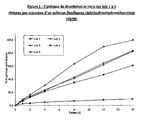
- Example 1 The compositions of Example 1 are obtained by the extrusion technique. They are all dated to 125 mg of active ingredient, the latter being Benfluorex chloride orthohydrate. The compositions consist of a mixture comprising 50% of active ingredient and 50% of polymethacrylate.
- Example 1 shows the influence of the nature of the polymethacrylates used on the in vitro dissolution kinetics of the active ingredient.
- the amount of Eudragit® RLPO relative to that of Eudragit® RSPO varies from 100 to 0%.
- a release of the active ingredient is observed over a period of 16 hours.
- Example 2 The compositions of Example 2 are obtained by the technique of extrution. They are all dosed at 3.2 mg of active principle, the latter being Riménidine dihydrogenophosphates. The compositions consist of a mixture comprising 10% of active ingredient and 90% of polymethacrylate.
- Example 2 confirms the observations obtained in Example 1, concerning the influence of the nature of the polymethacrylates used, on the in vitro release of the active ingredient. Control of the release of the active ingredient is obtained by modulating the amount of Eudragit ® RLPO compared to that of Eudragit ® RSPO.
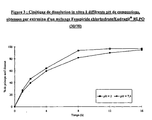
- Example 3 The composition of Example 3 is obtained by the technique of extrusion. It is dosed at 150 mg of active ingredient, this being Fenspiride hydrochloride.
- the composition consists of a mixture comprising 30% of active ingredient and 70% of polymethacrylate, this being only Eudragit ® RLPO.
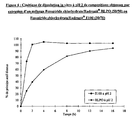
- Example 4 The compositions of Example 4 are obtained by the extrusion technique. They are dosed at 150 mg of active ingredient, this being Fenspiride hydrochloride.
- the compositions consist of a mixture comprising 30% of active ingredient and 70% of polymethacrylate, which is either Eudragit ® RLPO or Eudragit ® E100.
- Example 4 shows a much faster release at pH 2 with Eudragit ® E100 than with Eudragit ® RLPO.
- the kinetics of in vitro dissolution are presented in the appendix in the figure 4 .
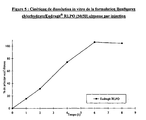
- Example 5 The composition of Example 5 is obtained by the injection technique. It is dosed at 135 mg of active ingredient, which is Benfluorex hydrochloride.
- active ingredient which is Benfluorex hydrochloride.
- the composition consists of a mixture comprising 50% of active ingredient and 50% of polymethacrylates, this being Eudragit ® RLPO.
- the release of the active ingredient as a function of time is linear over 6 hours with a kinetics of order 0.
- the kinetics of in vitro dissolution are presented in the appendix in the figure 5 .
- Example 8 The compositions of Example 8 are obtained by the coextrusion technique. They are all dosed at 135 mg of active ingredient, the latter being Fenspiride hydrochloride.
- the inner layer consists of a mixture of 30% Fenspiride and 70% Eudragit ® RLPO.
- the outer layer consists of 100% Eudragit ® RLPO. The presence of an outer layer of polymethacrylate RLPO slows the kinetics of release of the active ingredient from the inner layer.
- Increasing the thickness of the outer layer from 0.1 mm to 0.4 mm makes it possible to slow down even more the kinetics of release of the active principle and to obtain a lag-time or lag time of the 4 hours before the release of the active ingredient.
- Example 7 The composition of Example 7 is obtained by the extrusion technique. It is dosed with 59 mg of active principle, the latter being (1R) -1 - ( ⁇ - [[(2R) -2- (acetylamino) -3-phenylpropanoyl] (cytopenyl) amino hydrochloride] acetyl ⁇ amino) -4 - ⁇ [amino (imino) methyl] amino ⁇ butylboronic.
- the composition consists of a mixture comprising 59% of active ingredient and 41% of polymethacrytate, the latter being Eudragit ® RLPO.
- the in vitro release of the active ingredient is prolonged over four hours ( figure 7 ).
- the Figures 7 and 8 are presented in the appendix.
- compositions of Example 10 are obtained by the extrusion technique according to the protocol described in Example 2, but in this case they are assayed at 25 mg of N- [2- (7-methoxy-1-naphthyl) ) ethyl] acetamide and they consist of a mixture comprising 30% of active ingredient and 70% of polymethacrylate.
- Example 11 The compositions of Example 11 are obtained as those of Example 6, but are assayed at 100 mg of N- [2- (5-ethyl-1-benzothien-3-yl) ethyl] acetamide in place of fenspiride.
Landscapes
- Health & Medical Sciences (AREA)
- Chemical & Material Sciences (AREA)
- Life Sciences & Earth Sciences (AREA)
- Pharmacology & Pharmacy (AREA)
- Public Health (AREA)
- General Health & Medical Sciences (AREA)
- Animal Behavior & Ethology (AREA)
- Veterinary Medicine (AREA)
- Medicinal Chemistry (AREA)
- Chemical Kinetics & Catalysis (AREA)
- Organic Chemistry (AREA)
- Nuclear Medicine, Radiotherapy & Molecular Imaging (AREA)
- General Chemical & Material Sciences (AREA)
- Epidemiology (AREA)
- Engineering & Computer Science (AREA)
- Bioinformatics & Cheminformatics (AREA)
- Communicable Diseases (AREA)
- Physical Education & Sports Medicine (AREA)
- Neurosurgery (AREA)
- Neurology (AREA)
- Biomedical Technology (AREA)
- Oncology (AREA)
- Diabetes (AREA)
- Dermatology (AREA)
- Inorganic Chemistry (AREA)
- Rheumatology (AREA)
- Orthopedic Medicine & Surgery (AREA)
- Psychology (AREA)
- Obesity (AREA)
- Virology (AREA)
- Immunology (AREA)
- Emergency Medicine (AREA)
- Cardiology (AREA)
- Pain & Pain Management (AREA)
- Heart & Thoracic Surgery (AREA)
- Pulmonology (AREA)
- Hematology (AREA)
- Endocrinology (AREA)
- Medicinal Preparation (AREA)
- Pharmaceuticals Containing Other Organic And Inorganic Compounds (AREA)
Description
- La présente invention concerne une nouvelle composition pharmaceutique solide, à libération prolongée, obtenue par thermoformage à chaud d'un mélange à base de polymère(s) appartenant à la famille des polyméthacrylates, et de principe(s) actif(s) médicamenteux.
- De nombreuses compositions pharmaceutiques destinées à la libération controlée de principes actifs pharmaceutiques ont été proposées et réalisées, pour leur administration par voie orale, buccale, sublinguale, oculaire, rectale, vaginale et/ou parentérale. Ces nouvelles compositions avaient essentiellement pour objectifs:
- de réduire la fréquence d'administration des médicaments,
- d'obtenir des taux relativement constants de principe actif dans le milieu ou au site biologique visé,
- d'obtenir des profils de libération en corrélation avec l'activité pharmacologique des médicaments.
- Quelles que soient les compositions matricielles envisagées, leur obtention se heurte à des problèmes spécifiques de fabrication :
- procédé de fabrication complexe et en plusieurs étapes,
- stabilité du principe actif au cours du procédé de fabrication et vis-à-vis des excipients utilisés,
- modulation de la vitesse de libération, du ou des principes actifs, délicate, souvent variable dans le temps et dépendante par exemple de la granulométrie des lots de polymères avec les procédés de compression,
- procédé de fabrication permettant l'obtention d'une forme pharmaceutique essentiellement adaptée à une seule voie d'administration,
- reproductibilité des lots du fait de la multiplication des étapes.
- La présente invention est une alternative permettant de surmonter les difficultés d'ordre général précédément exposées pour l'obtention de compositions pharmaceutiques solides permettant la libération prolongée de principe(s) actif(s) médicamenteux par l'utilisation des techniques de thermoformage. Elle permet notamment de réduire nombre d'étape pour la production de formes galéniques finalisées, limitant ainsi les problèmes de reproductilité et le coût économique, et assurant aussi un gain de temps et d'espaces au sein d'une chaîne de production.
- Plus particulièrement, l'invention vise une nouvelle application des polyméthacrylates à la réalisation desdites compositions phamaceutiques solides sans addition de plastifiant et sans addition d'agents modulant la libération du ou des principes actifs. L'invention, telle que mise en oeuvre par la Demanderesse permet ainsi de restreindre le nombre de produit intervenant au sein d'une formulation galénique, limitant ainsi les problèmes de stockage et d'approvisionnement, ainsi que les problèmes liés à la gestion de l'environnement.
- La thermoformage à chaud concerne notamment les techniques de l'extrusion, de la co-extrusion, de l'injection et de la co-injection. Ces différentes techniques sont bien connues dans la domaine de la plasturgie et ont été largement utilisées dans le secteur de l'automobile ou de l'embalage.
- De part leurs caractéristiques, et les propriétés physicochimiques des polymères utilisables pour le thermoformage, ces techniques, et notamment l'extrusion simple, sont de plus en plus appliquées au domaine de la mise en forme des principes actifs.
- Différents brevets décrivent ainsi des compositions pharmaceutiques à libération contrôlée qui sont obtenues par extrusion d'un mélange comportant au moins, un principe actif, un ou plusieurs polymères extrudables et pharmaceutiquement acceptables, un plastifiant et/ou un retardant, ce dernier composé permettant de moduler la libération du principe actif.
- C'est le cas plus particulièrement de la demande de
brevet WO 96/14058 - Le
brevet US 5,102,668 décrit une composition pharmaceutique à libération contrôlée, indépendante du pH, ladite composition étant obtenue par extrusion humide de polymères tels que les polyméthacrylates, lesdits polymères étant hydrophiles à faible pH et hydrophobes fort pH. Le polyméthacrylate utilisé préférentiellement est de l'Eudragit® E100. Les extrudats ainsi obtenus doivent ensuite subir une étape de sphéronisation, puis de façon avantageuse, ils sont recouverts d'un film de polymère constitué d'Eudragit® NE 30 D. L'association entre le polymère constituant l'extrudat et le polymère constituant le film de revêtement permet de résoudre le problème technique particulier de cette invention qui est le contrôle de la libération du principe actif en fonction du pH du milieu de dissolution. - Parmi l'art antérieur, on peut également citer le
brevet DE 41 38 513 qui présente un procédé de préparation d'une composition pharmaceutique à libération contrôlée, par extrusion en continu d'un mélange comprenant au moins un principe actif, un polyméthacrylate, et un polymère de N-vinylpyrrolidone et/ou d'hydroxyalkyl (méthyl)celluose. Ces derniers composés sont utilisés en tant que plastifiant et jouent un rôle dans la régulation de la libération contrôlée du principe actif. - Dans l'article Pharm. Res. 1996, 13 (5), 804-808, il est également décrit l'extrusion à chaud d'Eudragit® E100 additionné de plastifiant, au moins 12 % de triéthylcitrate, pour obtention de films permettant la libération contrôlée de principes actifs.
- De même, les revues J. Cont. Rel. 1995, 36, 243-250 et Drug Dev. Ind. Pharm. 1994, 20, 1323-1339 rapportant l'utilisation de l'Eudragit® RS PM additionné de plastifiant (triacetine) pour l'obtention de granules par extrusion à chaud. La cinétique de libération du principe actif est rapide et les granules ne libèrent pas la totalité du principe actif. Les températures d'extrusion se situent entre 130°C et 140°C.
- Ces différents documents décrivent ainsi l'application de la technique de l'extrusion simple pour l'obtention de nouvelles compositions pharmaceutiques. Les techniques de l'injection et de la co-injection ont été beaucoup moins étudiées et elles concernent principalement des compositions pharmaceutiques solides dont la matrice est à base de dérivés cellulosés, d'amidon ou de polyéthylène glycol.
- Enfin, concernant la technique de la co-extrusion, la demande de
brevet FR 2 766 088 - La présente invention permet, d'une façon simple et économique, d'obtenir directement une composition pharmaceutique solide, à libération prolongée, par simple mélange d'un ou plusieurs principe(s) actif(s) et de polymère(s) ayant des propriétés plastiques choisis parmi les Eudragit® RL et/ou RS, l'Eudragit® RLPO et/ou l'Eudragit® RSPO, l'Eudragit® de type L100, L100-55 et/ou S100 seul(s) ou en association avec un ou plusieurs des Eudragit® cités précédemment, et étant phamaceutiquement acceptables, sans ajout de plastifiant ou de retardant, ledit mélange étant thermoformé. Le contrôle de la libération du prince actif contenu dans ladite composition est obtenu uniquement grâce à un choix judicieux du ou des polymères plastiques utilisés, et de leur quantité relative par rapport à cette du ou des principe(s) actif(s). La composition pharmaceutique selon l'invention, outre le fait qu'elle soit nouvelle, permet d'obtenir des formes galéniques aisément adaptables aux divers principes actifs et à leur meilleur mode d'administration, et assurent une libération prolongée et reproductible desdits principes actifs.
- L'un des objets de l'invention état de mettre au point une composition pharmaceutique solide, à libération prolongée, contenant un simple mélange de principe(s) actif(s), et de polymère(s) ayant des propriétés plastiques, le(s) dit(s) polymère(s) étant conetitué(s) par le groupe des polyméthacrylates tels que définis dans la revendication 1, sans ajout de plastifiant, et/ou de retardant et sans solvant.
- D'une façon surprenante, les compositions pharmaceutiques solides de la Demanderesse, de part leur constitution spécifique, peuvent aussi bien être soumises à la technique de l'extrusion, de la co-extrusion qu'à celle de l'injection ou de la co-injection. La mise en oeuvre de ces techniques permet d'aboutir à l'obtention de matrices sous des formes de taille et de géométrie appropriées aux diverses voies d'administration telles que notamment la vole orale, buccale, sublinguale, oculaire, vaginale, rectale, et parentérale. Cet avantage des compositions pharmaceutiques de ladite invention permet d'envisager la fabrication, à partir de la même matière première, de la formulation galénique la mieux adaptée à la fois au principe actif incorporé dans ladite composition, et à sa meilleure voie d'administration selon les caractéristiques dudit principe actif et de la population devant utiliser ces formulations.
- Un autre objet de l'invention était d'obtenir une composition pharmaceutique solide dont la matrice serait adaptable à un large spectre de principes actifs, présentant des caractéristiques physicochimiques très différentes comme par exemple les agents thérapeutiques lipophiles, hydrophiles ou les agents thérapeutiques instables chimiquement
- Enfin, un des objets de l'invention était d'obtenir une composition pharmaceutique solide où il était possible de moduler simplement la libération du principe actif, par simple adaptation des quantités de principes actifs et de polymères plastiques utilisés.
- Plus spécifiquement, la présente invention concerne une composition pharmaceutique solide à libération prolongée; administrable notamment par vole orale, contenant un mélange thermeformable, d'au moins un principe actif et d'un ou plusieurs polymères choisis parmi le groupe des polyméthacrylates, la libération prolongée du ou des principe (s) actif(s) étant uniquement assurée par la nature chimique, la quantité du ou des polyméthacrylates utilisés de la revendication 1, et la technique mise en oeuvre pour la fabrication de ladite composition.
- Par composition pharmaceutique à libération contrôlée, on comprend une libération du ou des principe(s) actif (s) sur une durée de quelques minutes correspondant à une libération immédiate, à une durée de plus de 20 heures correspondant à une libération prolongée, ladite libération pouvant s'effectuer de façon décalée dans le temps après absorption de la composition. Dans le cas de composition pharmaceutique à libération décalée, le temps de latence correspondant au temps entre l'absorption de ladite composition et la libération du principe actif, peut être d'une durée de 30 minutes à 8 heures, la libération du principe actif pouvant ensuite être une libération immédate ou une libération prolongée telle que définis précédemment.
- Par polyméthacrylate, on entend un copolymère d'acide méthacrylique correspondant à un copolymère totalement polymérisé d'acide méthacrylique et d'ester acrylique ou méthacrylique choisis parmi les Eudragit® RL et/ou RS, Eudragit® RLPO et/ou Eudragit® RSPO, l'Eudragit® de type L100, L100-55 et/ou S100 seul(s) ou en association avec plusieurs des Eudragit® cités précédemment. Ces Eudragit®, peuvent se présenter sous la forme d'une poudre ou de granulés.
- Par mélange thermoformable, on entend un mélange apte à subir une transformation par l'effet combiné de la chaleur et des forces de cisaillement d'une vis sans fin comme les techniques de l'extrusion, de la co-extrusion, de l'injection, et de la co-injection.
- Parmi les différents Eudragit® commercialisés, ceux utilisés préférentiellement dans le cadre de l'invention sont les Eudragit® RL et RS qui se réfèrent à des copolymères de méthacrylate ammonium consistant en des copolymères totalement polymérisés d'acide acrylique et d'ester d'acide méthacrylique contentant une faible quantité de groupes ammonium quaternaire.
- Ces Eudragit® répondent à la formule générale (I) :

- R1 représente un atome d'hydrogène ou un groupement méthyle,
- R2 représente un groupement méthyle ou éthyle,
- R3 représente un groupement méthyle,
- et R4 représente un groupement

- D'une façon particulièrement avantageuse, les Eudragit® utilisés au sein du mélange thermoformable de l'invention, sont les Eudragit® RLPO et/ou RSPO correspondant à des poly(éthyle acrylate, méthyle méthacrylate, chlorure de triméthylaminoéthyle méthacrylate) dans des proportions relatives respectives de 1:2:0,2 et 1:2:0,1.
- Selon une variante de l'invention, le mélange thermoformable de l'invention peut contenir de l'Eudragit® de type L100, L100-55 et/ou S100. L'Eudragit® L100 correspond à un poly(méthacrylique acide, méthylméthacrylate) dans des proportions relatives 1:1. L'Eudragit® L100-55 correspond à un poly(méthacrylique acide, éthylacrylate) dans des proportions relatives 1:1. L'Eudragit® S100 correspond à un poly(méthacrylique acide, méthylméthacrylate) dans des proportions relatives 1:2. Ces catégories d'Eudragit® peuvent être utilisées comme seul polymère polyméthacrylate au sein du mélange thermoformable ou en association avec un ou plusieurs des autres types d'Eudragit® cités precédemment. Ces polyméthacrylates sont solubles à des pH supérieurs à 5,5, permettant ainsi une libération de principe actif au niveau intestinal et/ou colonique. L'utilisation de cesdits Eudragit® est particulièrement intéressante pour l'obtention de compositions pharmaceutiques solides gastrorésistantes, à libération prolongée.
- Ainsi, les compositions pharmaceutiques de l'invention sont obtenues par mélange d'au moins un principe actif et d'un ou plusieurs polymères polyméthacrylates, abaissement de la viscosité de ce mélange sous l'effet de la chaleur et des forces de cisaillement d'une vis sans fin à l'intérieur d'un fourreau, puis traitement de ce mélange fondu selon l'une des voies suivantes :
- soit expulsion de l'extrudeuse à travers un orifice calibré, de taille et de forme variable, le matériau obtenu étant ensuite découpé selon la taille finale souhaitée de la matrice. Ceci constitue la technique de l'extrusion simple,
- soit la première extrudeuse contenant ledit mélange, de viscosité réduite, décrit précédemment est associée à une seconde extrudeuse contenant un mélange comportant :
- soit uniquement un ou plusieurs polyméthacrylate(s) pour le contrôle de la libération du ou des principe(s) actif(s) à partir du compartiment central,
- soit un ou plusieurs polyméthacrylate(s) en mélange avec un ou plusieurs principe(s) actif(s), identique(s) ou différent(s) de celui (ou ceux) contenu(s) dans le compartiment central,
- soit injection sous pression, au sein d'une presse, dans des moules de forme et de volume parfaitement définis selon les caractéristiques géométriques souhaitées pour la matrice. Ceci constitue la technique de l'injection,
- soit la presse est équipée de plusieurs unités d'injection permettant l'injection dans un même moule, de façon séquentielle ou simultanées, d'au moins deux mélanges, identiques ou différents. La première unité d'injection injecte ledit mélange, décrit précédemment, celui-ci constituant la partie centrale, ou coeur, de la matrice. La deuxième unité d'injection injecte à la périphérie de la partie centrale, une couche externe d'un mélange comportant :
- * soit uniquement un ou plusieurs polyméthacrylate(s) pour le contrôle de la libération du ou des principe(s) actif(s),
- * soit un ou plusieurs polyméthacrylate(s) en mélange avec un ou plusieurs principe(s) actif(s), idendique(s) ou différent(s), de celui (ou ceux) contenu(s) dans la partie centrale.
- Selon la technique employée, il est donc possible d'obtenir dans la cadre de la présente invention des compositions pharmaceutiques solides, administrables notamment par voie orale, buccale, sublinguale, oculaire, rectale, vaginale ou parentérale, à libération prolongée, de taille et de géométrie variées, monocouche ou multicouche, adaptées au mieux selon les profils de libération les plus adéquates pour chaque agent thérapeutique.
- Ces compositions pharmaceutique peuvent être utilisées directement, sans autre opération technique de transformation, hormis leur conditionnement. Si on le souhaite, lesdites compositions pharmaceutiques peuvent toutefois subir une transformation par broyage ou par granulation pour une mise en gélule ou pour être comprimées, ou être soumise à un enrobage.
- Les compositions pharmaceutiques de l'invention peuvent aussi contenir éventuellement des excipients, pharmacologiquement acceptables, choisis par exemple parmi le groupe des antioxydants, des aromatisants, des colorants, des conservateurs, des édulcorants, et des antiadhérents.
- La température de thermoformage est comprise entre 60°C et 150°C. D'une façon préférentielle, la température est comprise entre 80 et 130°C.
- Parmi les principes actifs entrant dans la composition selon l'invention, on peut citer, à titre non limitatif, les pénicillines, les céphalosporines, les cyclines, les inhibiteurs de béta-lactamases, les aminosides, les quinolones, les nitroimidazolés, les sulfamides ou les antibactériens, les antihistaminiques, les antiallergiques, les anesthésiques, les antiinflammatoires stéroïdiens ou non, les antalgiques d'action locale ou systémique, les antispasmodiques, les anticancéreux, les diurétiques, les béta-bloquants, les antihypertenseurs, les antiangoreux, les antiarythmiques, les vasodilatateurs, les bradycardisants, les inhibiteurs calciques, les sédatifs, les cardiotoniques, les antifungiques, les antiulcéreux, les veinotoniqes, les vasculoprotecteurs, les antischémiques, les antiémétiques, les anticoagulants, les antithrombotiques, les immunosuppresseurs, les immunomodulateurs, les antivireux, les antidiabétiques, les hypolipidémiants, les antiobésités, les anticonvulsivants, les hypnotiques, les antiparkinsoniens, les antimigraineux, les neuroleptiques, les anxiolytiques, les antidéprésseurs les antipychotiques, les psychostimulants, les promnésiants, les bronchodilatateurs, les antitussifs, les antistéoporotiques, les hormones peptidiques, les stéroïdes, les enzymes, les inhibiteurs d'enzymes, les agonistes et antagonistes mélatoninergiques.
- Les exemples suivants illustrant l'invention mais ne la limitent en aucune façon.
- Les compositions de l'exemple 1 sont obtenues par la technique de l'extrusion. Elles sont toutes datées à 125 mg de principe actif, celui-ci étant du Benfluorex chlorthydrate. Les compositions sont constituées d'un mélange comportant 50 % de principe actif et 50% de polyméthacrylate.
L'example 1 montre l'influence de la nature des polyméthacrylates utilisés, sur la cinétique de dissolution in vitro du principe actif. Ainsi dans les lots 1 à 5, à poids de polyméthacrylates constant, la quantité d'Eudragit® RLPO par rapport à celle d'Eudragit® RSPO varie de 100 à 0 %.
En absence d'Eudragit® RSPO au sein du mélange, on observe une libération du principe actif sur une durée de 16 heures. L'addition d'une faible quantité d'Eudragit® RSPO permet de contrôler la vitesse de libération du Benfluorex.Tableau 1 : Variation du rapport d'Eudragit® RLPO/RSPO d'une composition de Benfluorex chlorhydrate dosée à 125 mg Lots Polyméthacrylate (50% de la composition) 1 2 3 4 5 Eudragit® RLPO (en%) 100 90 75 50 0 Eudragit® RSPO (en%) 0 10 25 50 100 Les cinétiques de dissolution in vitro sont présentées en annexe dans la figure 1 . - Les compositions de l'exemple 2 sont obtenues par la technique de l'extrution. Elles sont toutes dosées à 3,2 mg de principe actif, celui-ci étant de la Riménidine dihydrogénophosphates. Les compositions sont constituées d'un mélange comportant 10% de principe actif et 90% de polyméthacrylate.
L'exemple 2 confirme les observations obtenues dans l'exemple 1, concernant l'influence de la nature des polyméthacrylates utilisés, sur la libération in vitro du principe actif.
Le contrôle de la libération du principe actif est obtenu par la modulation de la quantité d'Eudragit® RLPO par rapport è celle d'Eudragit® RSPO.Tableau 2 : Variation du rapport d'Eudragit® RLPO/RSPO d'une composition de Rilménidine dihydrogénophosphate dosées à 3,2 mg Lots Polyméthacrylate (90 % de la composition) 6 7 8 9 Eudragit® RSPO (en %) 100 90 75 50 Polyméthacrylate (90 % de la composition) 6 7 8 9 Eudragit® RLPO (en %) 0 10 25 50 figure 2 . - La composition de l'exemple 3 est obtenue par la technique de l'extrusion. Elle est dosée à 150 mg de principe actif celui-ci étant du Fenspiride chlorhydrate. La composition est constituée d'un mélange comportant 30% de principe actif et 70 % de polyméthacrylate, celui-ci étant uniquement de l'Eudragit® RLPO.
L'exemple 3 montre la faible influence du pH du milieu de dissolution sur la cinétique de libération du principe actif, comme le montre lafigure 3 (annexe) où est représenté le profil de dissolution à pH=2 et le profil de dissolution à pH=7,4. - Les cinétiques de dissolution in vitro sont présentées en annexe dans la
figure 3 . - Les compositions de l'exemple 4 sont obtenues par la technique de l'extrusion. Elles sont dosées à 150 mg de principe actif celui-ci étant du Fenspiride chlorhydrate. Les compositions sont constituées d'un mélange comportant 30 % de principe actif et 70 % de polyméthacrylate, celui-ci étant soit de l'Eudragit® RLPO, soit de l'Eudragit® E100. L'exemple 4 montre une libération beaucoup plus rapide à pH 2 avec l'Eudragit® E100 qu'avec l'Eudragit® RLPO.
Les cinétiques de dissolution in vitro sont présentées en annexe dans lafigure 4 . - La composition de l'exemple 5 est obtenue par la technique de l'injection. Elle est dosée à 135 mg de principe actif, celui-ci étant du Benfluorex chlorhydrate. La composition est constituée d'un mélange comportant 50 % de principe actif et 50 % de polyméthacrylats, celui-ci étant de l'Eudragit® RLPO. La libération du principe actif en fonction du temps est linéaire sur 6 heures avec une cinétique d'ordre 0.
La cinétique de dissolution in vitro est présentée en annexe dans lafigure 5 . - Les compositions de l'exemple 8 sont obtenues par la technique de co-extrusion. Elles sont toutes dosées à 135 mg de principe actif, celui-ci étant du Fenspiride chlorhydrate. La couche interne est constituée d'un mélange de 30 % de Fenspiride et 70 % d'Eudragit® RLPO. La couche externe est constituée à 100 % d'Eudragit® RLPO.
La présence d'une couche externe de polyméthacrylate RLPO permet de ralentir la cinétique de libération du principe actif depuis la couche interne. - L'augmentation de l'épaisseur de la couche externe de 0,1 mm a 0,4 mm permet de ralentir encore plus la cinétique de libération du principe actif et d'obtenir un "lag-time" ou temps de latence de l'ordre de 4 heures avant la libération du principe actif.
- Les cinétiques de dissolution in vitro sont présentées en annexe dans la
figure 6 . - La composition de l'exemple 7 est obtenue par la technique de l'extrusion. Elle est dosée à 59 mg de principe actif, celui-ci étant du chlorhydrate de l'acide (1R)-1-({-[[(2R)-2-(acétylamino)-3-phénylpropanoyl](cyctopentyl)amino] acétyl}amino)-4-{[amino(imino)méthy]amino}butylboronique. La composition est constituée d'un mélange comportant 59 % de principe actif et 41 % de polyméthacrytate, celui-ci étant de l'Eudragit® RLPO.
La libération in vitro du principe actif est prolongée sur quatre heures (figure 7 ). Les résultats des taux plasmatiques obtenus chez l'Homme (n = 12) sont présentés sur lafigure 8 après administration par voie orale d'un extrudat dosé à 59 mg dudit principe actif. Lesfigures 7 et 8 sont présentées en annexe. - De la même façon que dans l'exemple 1, différentes compositions constituées d'un mélange 1/1:principe actif/polyméthacrylate, ont été obtenues avec divers principes actifs. Ces compositions sont dosées en principe actif de la façon suivante :
- gliclazide 30mg
- piridédil 50 mg
- L-tartrate de 2-({2-méthoxy-2-[3-(trifluorométhyl)phényl]éthyl}amino) éthyl-4-2(2-({2-(9H-fluorèn-9-yl)acétyl]amino} éthyl)benzoate 200 mg
- 3a,10-dihydro-5,5-dioxo-4H-(S)-pyrrilidino[1,2-c][1,2,4]benzothladiazine 100 mg
- N-[2-(5-éthyl-1-benzothièn-3-yl)éthyl]acétamide 100 mg
- De la même façon que dans l'exemple 2, différentes compositions constituées d'un mélange 1/9 : principe actif/polyméthacrylate ont été obtenues avec divers principes actifs. Ces compositions sont dosées en principe actif de la façon suivante :
- Indapamide 1,5 mg
- Chlorhydrate de tertatolol 5 mg
- Les compositions de l'exemple 10 sont obtenues par la technique de l'extrusion selon le protocole décrit dans l'exemple 2, mais dans ce cas elles sont dosées à 25 mg de N-[2-(7-méthoxy-1-naphtyl)éthyl]acétamide et elles sont constituées d'un mélange comportant 30 % de principe actif et 70 % de polyméthacrylate.
- Lee compositions de l'exemple 11 sont obtenues comme celles de l'exemple 6, mais elles sont dosées à 100 mg de N-[2-(5-éthyl-1-benzothièn-3-yl)éthyl]acétamide à la place du Fenspiride.
Claims (23)
- Composition pharmaceutique solide, à libération prolongée, caractérisée en ce qu'elle comporte un mélange thermoformé d'au moins un principe actif et d'un ou plusieurs polymères choisis parmi le groupe des polyméthacrylates et sans plastifiant, la libération du ou des principe(s) actif(s) étant uniquement contrôlée par la nature du ou des polyméthacrylates utilisés, leur quantité relative par rapport au(x) principe(s) actif(s), et par la technique mise en oeuvre pour la fabrication de ladite composition,
le ou les polyméthacrylate(s) utilisé(s) dans le mélange thermoformé appartienne(nt) à la famille des Eudragit® RL et/ou RS ; ou
le ou les polyméthacrylate(s) utilisé(s) dans le mélange thermoformé est (sont) de l'Eudragit® RLPO et/ou de l'Eudragit® RSPO ; ou
le mélange thermoformé comporte de l'Eudragit® de type L100, L100-55 et/ou S100, seul(s) ou en association avec un ou plusieurs des Eudragit® cités précédemment. - Composition pharmaceutique solide à libération prolongée selon la revendication 1, caractérisée en ce que ladite composition est administrable selon l'une des voies choisies parmi orale, buccale, sublinguale, oculaire, vaginale, rectale et parentérale.
- Composition pharmaceutique solide à libération prolongée selon l'une quelconque des revendications 1 et 2, caractérisée en ce que ladite composition est administrable par voie orale.
- Composition pharmaceutique solide à libération prolongée selon la revendication 1, caractérisée en ce que la température de thermoformage du mélange est comprise entre 60°C et 150°C.
- Composition pharmaceutique solide à libération prolongée selon l'une quelconque des revendications 1 et 4, caractérisée en ce que la température de thermoformage du mélange est comprise entre 80°C et 130°C.
- Composition pharmaceutique solide à libération prolongée selon la revendication 1, caractérisée en ce que le mélange est thermoformé selon la technique de l'extrusion.
- Composition pharmaceutique solide à libération prolongée selon la revendication 1, caractérisée en ce que le mélange est thermoformé selon la technique de l'injection.
- Composition pharmaceutique solide à libération prolongée selon la revendication 1, caractérisée en ce que le mélange est thermoformé selon la technique de la co-extrusion, la couche interne de ladite composition étant alors constituée par ledit mélange et la couche externe de ladite composition étant constituée soit par un ou plusieurs polyméthacrylate(s), soit par un ou plusieurs polyméthacrylate(s) en mélange avec un ou plusieurs principe(s) actif(s), identique(s) ou différent(s), de celui ou de ceux contenu(s) dans la couche interne.
- Composition pharmaceutique solide à libération prolongée selon la revendication 1, caractérisée en ce que le mélange est thermoformé selon la technique de la co-injection, la partie centrale de ladite composition étant alors constituée par ledit mélange et la couche externe de ladite composition étant constituée soit par un ou plusieurs polyméthacrylate(s), soit par un ou plusieurs polyméthacrylate(s) en mélange avec un ou plusieurs principe(s) actif(s), identique(s) ou différent(s), de celui (ou ceux) contenu(s) dans la partie centrale.
- Composition pharmaceutique solide à libération prolongée selon la revendication 1, caractérisée en ce qu'elle comporte éventuellement un ou plusieurs excipients, pharmacologiquement acceptables, choisis parmi les antioxydants, les aromatisants, les colorants, les conservateurs, les édulcorants et les antiadhérents.
- Composition pharmaceutique solide à libération prolongée selon la revendication 1 caractérisée en ce que le ou les principes actifs sont choisis parmi les antiinfectieux comme les pénicillines, les céphalosporines, les cyclines, les inhibiteurs de béta-lactamases, les aminosides, les quinolones, les nitroimidazolés, les sulfamides ou les antibactériens, les antihistaminiques, les antiallergiques, les anesthésiques, les antiinflammatoires stéroïdiens ou non, les antalgiques d'action locale ou systémique, les antispasmodiques, les anticancéreux, les diurétiques, les béta-bloquants, les antihypertenseurs, les antiangoreux, les antiarythmiques, les vasodilatateurs, les bradycardisants, les inhibiteurs calciques, les sédatifs, les cardiotoniques, les antifungiques, les antiulcéreux, les veinotoniques, les vasculoprotecteurs, les antiischémiques, les antiémétiques, les anticoagulants, les antithrombotiques, les immunosuppresseurs, les immunomodulateurs, les antiviraux, les antidiabétiques, les hypolipidémiants, les antiobésités, les anticonvulsivants, les hypnotiques, les antiparkinsoniens, les antimigraineux, les neuroleptiques, les anxiolytiques, les antidépresseurs, les antipsychotiques, les psychostimulants, les promnésiants, les bronchodilatateurs, les antitussifs, les antistéoporotiques, les hormones peptidiques, les stéroïdes, les enzymes, les inhibiteurs d'enzymes, les agonistes et antagonistes mélatoninergiques.
- Composition pharmaceutique solide à libération prolongée selon la revendication 1, caractérisée en ce que le principe actif est du benfluorex chlorhydrate.
- Composition pharmaceutique solide à libération prolongée selon la revendication 1, caractérisée en ce que le principe actif est de la rilménidine dihydrogénophosphate.
- Composition pharmaceutique solide à libération prolongée selon la revendication 1, caractérisée en ce que le principe actif est du fenspiride chlorhydrate.
- Composition pharmaceutique solide à libération prolongée selon la revendication 1, caractérisée en ce que le principe actif est du chlorhydrate de l'acide (1R)-1-({-[[(2R)-2-(acétylamino)-3-phénylpropanoyl](cyclopentyl)amino]acétyl}amino)-4-{[amidino(imino) méthyl]amino}butylboronique.
- Composition pharmaceutique solide à libération prolongée selon la revendication 1, caractérisée en ce que le principe actif est du gliclazide.
- Composition pharmaceutique solide à libération prolongée selon la revendication 1, caractérisée en ce que le principe actif est du piribédil.
- Composition pharmaceutique solide à libération prolongée selon la revendication 1, caractérisée en ce que le principe actif est du L-tartrate de 2-({2-méthoxy-2-[3-(trifluorométhyl)phényl]éthyl}amino)éthyl-4-2-(2-{[2-(9H-fluorèn-9-yl)acétyl]amino} éthyl)benzoate.
- Composition pharmaceutique solide à libération prolongée selon la revendication 1, caractérisée en ce que le principe actif est du 3a,10-dihydro-5,5-dioxo-4H-(S)-pyrrolidino[1,2-c][1,2,4]benzothiadiazine.
- Composition pharmaceutique solide à libération prolongée selon la revendication 1, caractérisée en ce que le principe actif est du N-[2-(5-éthyl-1-benzothièn-3-yl)éthyl]acétamide.
- Composition pharmaceutique solide à libération prolongée selon la revendication 1, caractérisée en ce que le principe actif est de l'indapamide.
- Composition pharmaceutique solide à libération prolongée selon la revendication 1, caractérisée en ce que le principe actif est du chlorhydrate de tertatolol.
- Composition pharmaceutique solide à libération prolongée selon la revendication 1, caractérisée en ce que le principe actif est du N-[2-(7-méthoxy-1-naphtyl)éthyl]acétamide.
Priority Applications (2)
| Application Number | Priority Date | Filing Date | Title |
|---|---|---|---|
| SI200031000T SI1064935T2 (sl) | 1999-06-28 | 2000-06-27 | Trdni farmacevtski sestavki z zapoznelim sproĺˇäťanjem uäśinkovine, pridobljeni s termiäśnim oblikovanjem |
| CY20081100615T CY1110351T1 (el) | 1999-06-28 | 2008-06-10 | Στερεες φαρμακευτικες συνθεσεις ελεγχομενης απελευθερωσης που λαμβανονται με θερμοδιαμορφωση |
Applications Claiming Priority (2)
| Application Number | Priority Date | Filing Date | Title |
|---|---|---|---|
| FR9908210 | 1999-06-28 | ||
| FR9908210A FR2795326B1 (fr) | 1999-06-28 | 1999-06-28 | Composition pharmaceutique solide thermoformable a liberation controlee |
Related Child Applications (2)
| Application Number | Title | Priority Date | Filing Date |
|---|---|---|---|
| EP07022196.5 Division-Into | 2007-11-15 | ||
| EP07022196 Division | 2007-11-15 |
Publications (3)
| Publication Number | Publication Date |
|---|---|
| EP1064935A1 EP1064935A1 (fr) | 2001-01-03 |
| EP1064935B1 EP1064935B1 (fr) | 2008-05-14 |
| EP1064935B2 true EP1064935B2 (fr) | 2011-06-08 |
Family
ID=9547360
Family Applications (1)
| Application Number | Title | Priority Date | Filing Date |
|---|---|---|---|
| EP00401825A Expired - Lifetime EP1064935B2 (fr) | 1999-06-28 | 2000-06-27 | Compositions pharmaceutiques solides à libération prologée obtenues par thermoformage |
Country Status (22)
| Country | Link |
|---|---|
| US (1) | US6319520B1 (fr) |
| EP (1) | EP1064935B2 (fr) |
| JP (2) | JP2001031591A (fr) |
| KR (1) | KR100554899B1 (fr) |
| CN (1) | CN1174744C (fr) |
| AT (1) | ATE395045T1 (fr) |
| AU (1) | AU765885B2 (fr) |
| BR (1) | BR0002880A (fr) |
| CA (1) | CA2312545C (fr) |
| CY (1) | CY1110351T1 (fr) |
| DE (1) | DE60038848D1 (fr) |
| DK (1) | DK1064935T4 (fr) |
| EA (1) | EA003751B1 (fr) |
| ES (1) | ES2307489T5 (fr) |
| FR (1) | FR2795326B1 (fr) |
| HU (1) | HU229342B1 (fr) |
| NO (1) | NO331449B1 (fr) |
| NZ (1) | NZ505431A (fr) |
| PL (1) | PL202494B1 (fr) |
| PT (1) | PT1064935E (fr) |
| SI (1) | SI1064935T2 (fr) |
| ZA (1) | ZA200003245B (fr) |
Families Citing this family (60)
| Publication number | Priority date | Publication date | Assignee | Title |
|---|---|---|---|---|
| US6776792B1 (en) | 1997-04-24 | 2004-08-17 | Advanced Cardiovascular Systems Inc. | Coated endovascular stent |
| EP1112063A4 (fr) * | 1998-09-08 | 2009-05-13 | Smithkline Beecham Corp | Comprimes a base de fibres solubles et d'un derive de lipstatine |
| FR2795326B1 (fr) * | 1999-06-28 | 2001-08-31 | Adir | Composition pharmaceutique solide thermoformable a liberation controlee |
| DE10026698A1 (de) | 2000-05-30 | 2001-12-06 | Basf Ag | Selbstemulgierende Wirkstoffformulierung und Verwendung dieser Formulierung |
| US6783793B1 (en) | 2000-10-26 | 2004-08-31 | Advanced Cardiovascular Systems, Inc. | Selective coating of medical devices |
| FR2818552B1 (fr) * | 2000-12-26 | 2003-02-07 | Servier Lab | Compositions pharmaceutique solide thermoformable pour la liberation controlee d'ivabradine |
| FR2818550B1 (fr) * | 2000-12-26 | 2003-02-07 | Servier Lab | Composition pharmaceutique solide thermoformable pour la liberation controle de perindopril |
| US6764505B1 (en) | 2001-04-12 | 2004-07-20 | Advanced Cardiovascular Systems, Inc. | Variable surface area stent |
| US7862495B2 (en) | 2001-05-31 | 2011-01-04 | Advanced Cardiovascular Systems, Inc. | Radiation or drug delivery source with activity gradient to minimize edge effects |
| US7247313B2 (en) * | 2001-06-27 | 2007-07-24 | Advanced Cardiovascular Systems, Inc. | Polyacrylates coatings for implantable medical devices |
| US7175873B1 (en) | 2001-06-27 | 2007-02-13 | Advanced Cardiovascular Systems, Inc. | Rate limiting barriers for implantable devices and methods for fabrication thereof |
| US6565659B1 (en) | 2001-06-28 | 2003-05-20 | Advanced Cardiovascular Systems, Inc. | Stent mounting assembly and a method of using the same to coat a stent |
| US6656216B1 (en) | 2001-06-29 | 2003-12-02 | Advanced Cardiovascular Systems, Inc. | Composite stent with regioselective material |
| GB0117619D0 (en) * | 2001-07-19 | 2001-09-12 | Phoqus Ltd | Pharmaceutical dosage form |
| US20030204180A1 (en) * | 2002-04-30 | 2003-10-30 | Kimberly-Clark Worldwide, Inc. | Temperature responsive delivery systems |
| US7005137B1 (en) | 2002-06-21 | 2006-02-28 | Advanceed Cardiovascular Systems, Inc. | Coating for implantable medical devices |
| US7396539B1 (en) | 2002-06-21 | 2008-07-08 | Advanced Cardiovascular Systems, Inc. | Stent coatings with engineered drug release rate |
| US7622146B2 (en) * | 2002-07-18 | 2009-11-24 | Advanced Cardiovascular Systems, Inc. | Rate limiting barriers for implantable devices and methods for fabrication thereof |
| US7169178B1 (en) * | 2002-11-12 | 2007-01-30 | Advanced Cardiovascular Systems, Inc. | Stent with drug coating |
| EP1615625A4 (fr) | 2003-04-21 | 2010-12-15 | Euro Celtique Sa | Forme posologique inviolable contenant des particules co-extrudees d'agent repulsif contraire et procede de fabrication |
| TWI357815B (en) * | 2003-06-27 | 2012-02-11 | Euro Celtique Sa | Multiparticulates |
| US20060165790A1 (en) * | 2003-06-27 | 2006-07-27 | Malcolm Walden | Multiparticulates |
| KR101087464B1 (ko) | 2003-08-08 | 2011-11-25 | 밸리언트 인터내셔널(바베이도스) 에스알엘 | 부프로피온 히드로클로라이드의 개질 방출형 정제 |
| US8377952B2 (en) | 2003-08-28 | 2013-02-19 | Abbott Laboratories | Solid pharmaceutical dosage formulation |
| US8025899B2 (en) | 2003-08-28 | 2011-09-27 | Abbott Laboratories | Solid pharmaceutical dosage form |
| US7198675B2 (en) | 2003-09-30 | 2007-04-03 | Advanced Cardiovascular Systems | Stent mandrel fixture and method for selectively coating surfaces of a stent |
| US7563324B1 (en) | 2003-12-29 | 2009-07-21 | Advanced Cardiovascular Systems Inc. | System and method for coating an implantable medical device |
| PL1729730T3 (pl) | 2004-03-30 | 2009-06-30 | Euro Celtique Sa | Odporna na zniszczenie postać dawkowania zawierająca adsorbent i środek przeciwdziałający |
| US7553377B1 (en) | 2004-04-27 | 2009-06-30 | Advanced Cardiovascular Systems, Inc. | Apparatus and method for electrostatic coating of an abluminal stent surface |
| RU2273482C2 (ru) * | 2004-06-21 | 2006-04-10 | Открытое акционерное общество "Химико-фармацевтический комбинат "АКРИХИН" (ОАО "АКРИХИН") | Фармацевтическая композиция с пролонгированным высвобождением гликлазида |
| CA2601716C (fr) | 2004-06-25 | 2011-05-31 | Board Of Regents, The University Of Texas System | Methodes et compositions de traitement du trouble d'hyperactivite avec deficit de l'attention et de l'hyperphenylalanemie |
| GB2418854B (en) | 2004-08-31 | 2009-12-23 | Euro Celtique Sa | Multiparticulates |
| US7632307B2 (en) | 2004-12-16 | 2009-12-15 | Advanced Cardiovascular Systems, Inc. | Abluminal, multilayer coating constructs for drug-delivery stents |
| US7867547B2 (en) | 2005-12-19 | 2011-01-11 | Advanced Cardiovascular Systems, Inc. | Selectively coating luminal surfaces of stents |
| CN101370480A (zh) * | 2006-02-03 | 2009-02-18 | 赢创罗姆有限责任公司 | 含有由聚合物和在水中溶解较差的活性成分组成的混合物的药物组合物 |
| CA2646593C (fr) * | 2006-03-20 | 2015-12-08 | Duramed Pharmaceuticals, Inc. | Anneaux intravaginaux souples et comprimes, leurs procedes de fabrication et d'utilisation et appareil destine a leur fabrication |
| US8003156B2 (en) | 2006-05-04 | 2011-08-23 | Advanced Cardiovascular Systems, Inc. | Rotatable support elements for stents |
| US8603530B2 (en) | 2006-06-14 | 2013-12-10 | Abbott Cardiovascular Systems Inc. | Nanoshell therapy |
| US8048448B2 (en) | 2006-06-15 | 2011-11-01 | Abbott Cardiovascular Systems Inc. | Nanoshells for drug delivery |
| US8017237B2 (en) | 2006-06-23 | 2011-09-13 | Abbott Cardiovascular Systems, Inc. | Nanoshells on polymers |
| DE102007009242A1 (de) * | 2007-02-22 | 2008-09-18 | Evonik Röhm Gmbh | Pellets mit magensaftresistenter Wirkstoff-Matix |
| WO2008137461A1 (fr) * | 2007-05-01 | 2008-11-13 | Concert Pharmaceuticals Inc. | Naphtyl(éthyl)acétamides |
| US8048441B2 (en) | 2007-06-25 | 2011-11-01 | Abbott Cardiovascular Systems, Inc. | Nanobead releasing medical devices |
| DK3045043T3 (da) | 2009-02-26 | 2020-08-03 | Relmada Therapeutics Inc | Orale farmaceutiske sammensætninger af 3-hydroxy-n-methylmorphinan med forlænget frigivelse og fremgangsmåde til anvendelse |
| CN101481321B (zh) * | 2009-02-27 | 2012-04-18 | 上海医药工业研究院 | 阿戈美拉汀卤化氢复合物及其制备方法 |
| WO2012130837A1 (fr) | 2011-03-28 | 2012-10-04 | Ratiopharm Gmbh | Agomélatine solide sous une forme non cristalline |
| EP2550863A1 (fr) * | 2011-07-27 | 2013-01-30 | Bayer Intellectual Property GmbH | Particules contenant une matière active à base de polyacrylate |
| CN103764125A (zh) * | 2011-08-30 | 2014-04-30 | 根特大学 | 多层释放制剂 |
| CA2877410A1 (fr) | 2012-07-16 | 2014-01-23 | Ratiopharm Gmbh | Complexe d'agomelatine et de cyclodextrine |
| JO3339B1 (ar) * | 2012-09-11 | 2019-03-13 | Shanghai Inst Pharmaceutical Ind | شكل مستقر غير متبلور من الأغوميلاتين وعملية تحضيره والتركيبات الدوائية التي تحتوي عليه |
| KR101659983B1 (ko) * | 2012-12-31 | 2016-09-26 | 주식회사 삼양바이오팜 | 용융 압출된 방출 제어용 약학 조성물, 및 이를 포함하는 경구용 제제 |
| PL2810656T3 (pl) | 2013-06-06 | 2018-01-31 | Zentiva Ks | Preparaty agomelatyny zawierające agomelatynę w postaci kokryształów |
| EP2810647A1 (fr) | 2013-06-06 | 2014-12-10 | Zentiva, a.s. | Formulations pharmaceutiques, comprenant l'agomélatine sous forme d'un co-cristal de l'agomélatine avec un acide organique |
| CN103724415B (zh) * | 2013-12-31 | 2015-05-27 | 中山大学 | 斜带石斑鱼性别调控基因Rspo1及其制备方法和应用 |
| PT109154B (pt) * | 2016-02-12 | 2019-11-05 | Univ De Coimbra | Tecnologia não-invasiva de inserto ocular para libertação controlada de fármacos |
| FR3070619B1 (fr) | 2017-09-01 | 2024-10-04 | Ab7 Innovation | Piece moulee monolithique en matrice multiple pour la diffusion d’actifs et son procede d’obtention |
| ES2938608T3 (es) | 2017-09-20 | 2023-04-13 | Tillotts Pharma Ag | Método para preparar una forma farmacéutica sólida que comprende anticuerpos mediante granulación en húmedo, extrusión y esferonización |
| AU2018361503A1 (en) * | 2017-11-02 | 2020-05-14 | Ishihara Sangyo Kaisha, Ltd. | Sustained-release medical composition |
| KR101856911B1 (ko) * | 2017-12-13 | 2018-05-10 | 동국대학교 산학협력단 | 펠루비프로펜의 서방성 고체분산체 제제 및 이의 제조방법 |
| CN109985025B (zh) * | 2017-12-29 | 2023-01-13 | 沈阳药科大学 | 具有pH触发释药特征的眼部缓释给药系统 |
Citations (4)
| Publication number | Priority date | Publication date | Assignee | Title |
|---|---|---|---|---|
| DE4138513A1 (de) † | 1991-11-23 | 1993-05-27 | Basf Ag | Feste pharmazeutische retardform |
| WO1996014058A1 (fr) † | 1994-11-04 | 1996-05-17 | Euro-Celtique, S.A. | Formulations opioides administrables par voie orale et obtenues par fusion-extrusion |
| WO1997008950A1 (fr) † | 1995-09-07 | 1997-03-13 | Fuisz Technologies, Ltd. | Systeme permettant de rendre biodisponibles des agents bioalterants sensiblement non solubles |
| DE19539362A1 (de) † | 1995-10-23 | 1997-04-24 | Basf Ag | Verfahren zur Herstellung von festen Arzneiformen |
Family Cites Families (5)
| Publication number | Priority date | Publication date | Assignee | Title |
|---|---|---|---|---|
| US5102668A (en) * | 1990-10-05 | 1992-04-07 | Kingaform Technology, Inc. | Sustained release pharmaceutical preparation using diffusion barriers whose permeabilities change in response to changing pH |
| CA2075517C (fr) * | 1992-04-01 | 1997-03-11 | John Wick | Piece transdermique incorporant une pellicule de polymeres incorporee a l'aide d'un agent actif |
| DE19728516C2 (de) * | 1997-07-04 | 1999-11-11 | Sanol Arznei Schwarz Gmbh | TTS zur Verabreichung von Levonorgestrel und gegebenenfalls Estradiol |
| FR2766088B1 (fr) * | 1997-07-17 | 2001-01-05 | Dow Corning Sa | Dispositifs a liberation controlee d'un agent pharmaceutique, leur fabrication par co-extrusion et article intermediaire |
| FR2795326B1 (fr) * | 1999-06-28 | 2001-08-31 | Adir | Composition pharmaceutique solide thermoformable a liberation controlee |
-
1999
- 1999-06-28 FR FR9908210A patent/FR2795326B1/fr not_active Expired - Fee Related
-
2000
- 2000-06-27 NZ NZ505431A patent/NZ505431A/xx not_active IP Right Cessation
- 2000-06-27 JP JP2000193043A patent/JP2001031591A/ja active Pending
- 2000-06-27 NO NO20003349A patent/NO331449B1/no not_active IP Right Cessation
- 2000-06-27 EA EA200000584A patent/EA003751B1/ru not_active IP Right Cessation
- 2000-06-27 ES ES00401825T patent/ES2307489T5/es not_active Expired - Lifetime
- 2000-06-27 CA CA002312545A patent/CA2312545C/fr not_active Expired - Fee Related
- 2000-06-27 DE DE60038848T patent/DE60038848D1/de not_active Expired - Lifetime
- 2000-06-27 BR BR0002880-0A patent/BR0002880A/pt not_active Application Discontinuation
- 2000-06-27 DK DK00401825.5T patent/DK1064935T4/da active
- 2000-06-27 EP EP00401825A patent/EP1064935B2/fr not_active Expired - Lifetime
- 2000-06-27 PT PT00401825T patent/PT1064935E/pt unknown
- 2000-06-27 US US09/604,500 patent/US6319520B1/en not_active Expired - Lifetime
- 2000-06-27 AT AT00401825T patent/ATE395045T1/de active
- 2000-06-27 SI SI200031000T patent/SI1064935T2/sl unknown
- 2000-06-28 KR KR1020000035933A patent/KR100554899B1/ko not_active Expired - Fee Related
- 2000-06-28 HU HU0002469A patent/HU229342B1/hu not_active IP Right Cessation
- 2000-06-28 PL PL341042A patent/PL202494B1/pl unknown
- 2000-06-28 CN CNB001193228A patent/CN1174744C/zh not_active Expired - Fee Related
- 2000-06-28 ZA ZA200003245A patent/ZA200003245B/xx unknown
- 2000-06-29 AU AU42734/00A patent/AU765885B2/en not_active Ceased
-
2005
- 2005-12-07 JP JP2005353417A patent/JP2006077033A/ja active Pending
-
2008
- 2008-06-10 CY CY20081100615T patent/CY1110351T1/el unknown
Patent Citations (4)
| Publication number | Priority date | Publication date | Assignee | Title |
|---|---|---|---|---|
| DE4138513A1 (de) † | 1991-11-23 | 1993-05-27 | Basf Ag | Feste pharmazeutische retardform |
| WO1996014058A1 (fr) † | 1994-11-04 | 1996-05-17 | Euro-Celtique, S.A. | Formulations opioides administrables par voie orale et obtenues par fusion-extrusion |
| WO1997008950A1 (fr) † | 1995-09-07 | 1997-03-13 | Fuisz Technologies, Ltd. | Systeme permettant de rendre biodisponibles des agents bioalterants sensiblement non solubles |
| DE19539362A1 (de) † | 1995-10-23 | 1997-04-24 | Basf Ag | Verfahren zur Herstellung von festen Arzneiformen |
Also Published As
Similar Documents
| Publication | Publication Date | Title |
|---|---|---|
| EP1064935B1 (fr) | Compositions pharmaceutiques solides à libération contrôlée obtenues par thermoformage | |
| EP1345594B1 (fr) | Composition pharmaceutique solide thermoformable pour la liberation controlee d'ivabradine | |
| EP1345605B1 (fr) | COMPOSITION PHARMACEUTIQUE SOLIDE THERMOFORMée POUR LA LIBERATION CONTROLEE DE PERINDOPRIL | |
| FR2818549A1 (fr) | Composition pharmaceutique solide thermoformable pour la liberation controlee de trimetazidine | |
| HK1033435B (en) | Solid thermoformable controlled-release pharmaceutical composition | |
| MXPA00006383A (en) | Solid thermoformable controlled-release pharmaceutical composition | |
| HK1063739B (en) | Thermoformable solid pharmaceutical composition for controlled release of perindopril |
Legal Events
| Date | Code | Title | Description |
|---|---|---|---|
| PUAI | Public reference made under article 153(3) epc to a published international application that has entered the european phase |
Free format text: ORIGINAL CODE: 0009012 |
|
| 17P | Request for examination filed |
Effective date: 20000706 |
|
| AK | Designated contracting states |
Kind code of ref document: A1 Designated state(s): AT BE CH CY DE DK ES FI FR GB GR IE IT LI LU MC NL PT SE |
|
| AX | Request for extension of the european patent |
Free format text: AL PAYMENT 20000706;LT PAYMENT 20000706;LV PAYMENT 20000706;MK PAYMENT 20000706;RO PAYMENT 20000706;SI PAYMENT 20000706 |
|
| AKX | Designation fees paid |
Free format text: AT BE CH CY DE DK ES FI FR GB GR IE IT LI LU MC NL PT SE |
|
| AXX | Extension fees paid |
Free format text: AL PAYMENT 20000706;LT PAYMENT 20000706;LV PAYMENT 20000706;MK PAYMENT 20000706;RO PAYMENT 20000706;SI PAYMENT 20000706 |
|
| RAP1 | Party data changed (applicant data changed or rights of an application transferred) |
Owner name: LES LABORATOIRES SERVIER |
|
| 17Q | First examination report despatched |
Effective date: 20040803 |
|
| 17Q | First examination report despatched |
Effective date: 20040803 |
|
| GRAP | Despatch of communication of intention to grant a patent |
Free format text: ORIGINAL CODE: EPIDOSNIGR1 |
|
| RIC1 | Information provided on ipc code assigned before grant |
Ipc: A61K 9/20 20060101AFI20071116BHEP Ipc: A61K 9/22 20060101ALI20071116BHEP Ipc: A61K 47/32 20060101ALI20071116BHEP |
|
| RTI1 | Title (correction) |
Free format text: SOLID CONTROLLED-RELEASE PHARMACEUTICAL COMPOSITIONS PREPARED BY MEANS OF A THERMOFORMING PROCESS |
|
| GRAS | Grant fee paid |
Free format text: ORIGINAL CODE: EPIDOSNIGR3 |
|
| GRAA | (expected) grant |
Free format text: ORIGINAL CODE: 0009210 |
|
| AK | Designated contracting states |
Kind code of ref document: B1 Designated state(s): AT BE CH CY DE DK ES FI FR GB GR IE IT LI LU MC NL PT SE |
|
| AX | Request for extension of the european patent |
Extension state: AL LT LV MK RO SI |
|
| REG | Reference to a national code |
Ref country code: GB Ref legal event code: FG4D Free format text: NOT ENGLISH |
|
| REG | Reference to a national code |
Ref country code: CH Ref legal event code: EP |
|
| REG | Reference to a national code |
Ref country code: IE Ref legal event code: FG4D |
|
| REG | Reference to a national code |
Ref country code: CH Ref legal event code: NV Representative=s name: BOHEST AG |
|
| REF | Corresponds to: |
Ref document number: 60038848 Country of ref document: DE Date of ref document: 20080626 Kind code of ref document: P |
|
| REG | Reference to a national code |
Ref country code: PT Ref legal event code: SC4A Free format text: AVAILABILITY OF NATIONAL TRANSLATION Effective date: 20080624 |
|
| REG | Reference to a national code |
Ref country code: GR Ref legal event code: EP Ref document number: 20080401559 Country of ref document: GR |
|
| REG | Reference to a national code |
Ref country code: DK Ref legal event code: T3 |
|
| REG | Reference to a national code |
Ref country code: SE Ref legal event code: TRGR |
|
| REG | Reference to a national code |
Ref country code: ES Ref legal event code: FG2A Ref document number: 2307489 Country of ref document: ES Kind code of ref document: T3 |
|
| PLBI | Opposition filed |
Free format text: ORIGINAL CODE: 0009260 |
|
| PLAB | Opposition data, opponent's data or that of the opponent's representative modified |
Free format text: ORIGINAL CODE: 0009299OPPO |
|
| 26 | Opposition filed |
Opponent name: EVONIK ROEHM GMBH Effective date: 20090130 |
|
| PLAX | Notice of opposition and request to file observation + time limit sent |
Free format text: ORIGINAL CODE: EPIDOSNOBS2 |
|
| R26 | Opposition filed (corrected) |
Opponent name: EVONIK ROEHM GMBH Effective date: 20090130 |
|
| PG25 | Lapsed in a contracting state [announced via postgrant information from national office to epo] |
Ref country code: CY Free format text: LAPSE BECAUSE OF NON-PAYMENT OF DUE FEES Effective date: 20080627 |
|
| NLR1 | Nl: opposition has been filed with the epo |
Opponent name: EVONIK ROEHM GMBH |
|
| PLAF | Information modified related to communication of a notice of opposition and request to file observations + time limit |
Free format text: ORIGINAL CODE: EPIDOSCOBS2 |
|
| PLAF | Information modified related to communication of a notice of opposition and request to file observations + time limit |
Free format text: ORIGINAL CODE: EPIDOSCOBS2 |
|
| PLBB | Reply of patent proprietor to notice(s) of opposition received |
Free format text: ORIGINAL CODE: EPIDOSNOBS3 |
|
| PLBP | Opposition withdrawn |
Free format text: ORIGINAL CODE: 0009264 |
|
| RTI2 | Title (correction) |
Free format text: SOLID DELAYED-RELEASE PHARMACEUTICAL COMPOSITIONS PREPARED BY MEANS OF A THERMOFORMING PROCESS |
|
| PUAH | Patent maintained in amended form |
Free format text: ORIGINAL CODE: 0009272 |
|
| STAA | Information on the status of an ep patent application or granted ep patent |
Free format text: STATUS: PATENT MAINTAINED AS AMENDED |
|
| 27A | Patent maintained in amended form |
Effective date: 20110608 |
|
| AK | Designated contracting states |
Kind code of ref document: B2 Designated state(s): AT BE CH CY DE DK ES FI FR GB GR IE IT LI LU MC NL PT SE |
|
| AX | Request for extension of the european patent |
Extension state: AL LT LV MK RO SI |
|
| REG | Reference to a national code |
Ref country code: CH Ref legal event code: AEN Free format text: BREVET MAINTENU DANS UNE FORME MODIFIEE |
|
| REG | Reference to a national code |
Ref country code: NL Ref legal event code: T3 |
|
| REG | Reference to a national code |
Ref country code: DK Ref legal event code: T4 |
|
| REG | Reference to a national code |
Ref country code: SE Ref legal event code: RPEO |
|
| REG | Reference to a national code |
Ref country code: ES Ref legal event code: DC2A Ref document number: 2307489 Country of ref document: ES Kind code of ref document: T5 Effective date: 20111107 |
|
| REG | Reference to a national code |
Ref country code: GR Ref legal event code: EP Ref document number: 20110402123 Country of ref document: GR Effective date: 20111013 |
|
| REG | Reference to a national code |
Ref country code: DE Ref legal event code: R102 Ref document number: 60038848 Country of ref document: DE Effective date: 20110608 |
|
| REG | Reference to a national code |
Ref country code: SI Ref legal event code: SP73 Owner name: LES LABORATOIRES SERVIER; FR Effective date: 20131213 |
|
| REG | Reference to a national code |
Ref country code: CH Ref legal event code: PCAR Free format text: NEW ADDRESS: HOLBEINSTRASSE 36-38, 4051 BASEL (CH) |
|
| REG | Reference to a national code |
Ref country code: FR Ref legal event code: PLFP Year of fee payment: 17 |
|
| REG | Reference to a national code |
Ref country code: FR Ref legal event code: PLFP Year of fee payment: 18 |
|
| PGFP | Annual fee paid to national office [announced via postgrant information from national office to epo] |
Ref country code: NL Payment date: 20170531 Year of fee payment: 18 |
|
| PGFP | Annual fee paid to national office [announced via postgrant information from national office to epo] |
Ref country code: IE Payment date: 20170515 Year of fee payment: 18 Ref country code: MC Payment date: 20170511 Year of fee payment: 18 Ref country code: GR Payment date: 20170628 Year of fee payment: 18 Ref country code: GB Payment date: 20170621 Year of fee payment: 18 Ref country code: CH Payment date: 20170616 Year of fee payment: 18 Ref country code: DK Payment date: 20170612 Year of fee payment: 18 Ref country code: FR Payment date: 20170627 Year of fee payment: 18 |
|
| PGFP | Annual fee paid to national office [announced via postgrant information from national office to epo] |
Ref country code: LU Payment date: 20170505 Year of fee payment: 18 Ref country code: PT Payment date: 20170330 Year of fee payment: 18 Ref country code: IT Payment date: 20170608 Year of fee payment: 18 Ref country code: FI Payment date: 20170615 Year of fee payment: 18 Ref country code: SE Payment date: 20170613 Year of fee payment: 18 Ref country code: AT Payment date: 20170516 Year of fee payment: 18 Ref country code: BE Payment date: 20170427 Year of fee payment: 18 |
|
| PGFP | Annual fee paid to national office [announced via postgrant information from national office to epo] |
Ref country code: CY Payment date: 20170622 Year of fee payment: 18 Ref country code: DE Payment date: 20170629 Year of fee payment: 18 Ref country code: ES Payment date: 20170831 Year of fee payment: 18 |
|
| REG | Reference to a national code |
Ref country code: DE Ref legal event code: R119 Ref document number: 60038848 Country of ref document: DE |
|
| REG | Reference to a national code |
Ref country code: LT Ref legal event code: MM9D Effective date: 20180627 |
|
| REG | Reference to a national code |
Ref country code: DK Ref legal event code: EBP Effective date: 20180630 |
|
| REG | Reference to a national code |
Ref country code: SE Ref legal event code: EUG |
|
| PG25 | Lapsed in a contracting state [announced via postgrant information from national office to epo] |
Ref country code: FI Free format text: LAPSE BECAUSE OF NON-PAYMENT OF DUE FEES Effective date: 20180627 Ref country code: SE Free format text: LAPSE BECAUSE OF NON-PAYMENT OF DUE FEES Effective date: 20180628 Ref country code: CY Free format text: LAPSE BECAUSE OF NON-PAYMENT OF DUE FEES Effective date: 20180627 Ref country code: PT Free format text: LAPSE BECAUSE OF NON-PAYMENT OF DUE FEES Effective date: 20181227 |
|
| REG | Reference to a national code |
Ref country code: CH Ref legal event code: PL |
|
| REG | Reference to a national code |
Ref country code: NL Ref legal event code: MM Effective date: 20180701 |
|
| REG | Reference to a national code |
Ref country code: AT Ref legal event code: MM01 Ref document number: 395045 Country of ref document: AT Kind code of ref document: T Effective date: 20180627 |
|
| GBPC | Gb: european patent ceased through non-payment of renewal fee |
Effective date: 20180627 |
|
| REG | Reference to a national code |
Ref country code: BE Ref legal event code: MM Effective date: 20180630 |
|
| PG25 | Lapsed in a contracting state [announced via postgrant information from national office to epo] |
Ref country code: NL Free format text: LAPSE BECAUSE OF NON-PAYMENT OF DUE FEES Effective date: 20180701 Ref country code: MC Free format text: LAPSE BECAUSE OF NON-PAYMENT OF DUE FEES Effective date: 20180702 Ref country code: LU Free format text: LAPSE BECAUSE OF NON-PAYMENT OF DUE FEES Effective date: 20180627 |
|
| REG | Reference to a national code |
Ref country code: SI Ref legal event code: KO00 Effective date: 20190219 |
|
| REG | Reference to a national code |
Ref country code: IE Ref legal event code: MM4A |
|
| PG25 | Lapsed in a contracting state [announced via postgrant information from national office to epo] |
Ref country code: IE Free format text: LAPSE BECAUSE OF NON-PAYMENT OF DUE FEES Effective date: 20180627 Ref country code: IT Free format text: LAPSE BECAUSE OF NON-PAYMENT OF DUE FEES Effective date: 20180627 Ref country code: LI Free format text: LAPSE BECAUSE OF NON-PAYMENT OF DUE FEES Effective date: 20180630 Ref country code: CH Free format text: LAPSE BECAUSE OF NON-PAYMENT OF DUE FEES Effective date: 20180630 Ref country code: DE Free format text: LAPSE BECAUSE OF NON-PAYMENT OF DUE FEES Effective date: 20190101 Ref country code: FR Free format text: LAPSE BECAUSE OF NON-PAYMENT OF DUE FEES Effective date: 20180630 Ref country code: AT Free format text: LAPSE BECAUSE OF NON-PAYMENT OF DUE FEES Effective date: 20180627 Ref country code: GB Free format text: LAPSE BECAUSE OF NON-PAYMENT OF DUE FEES Effective date: 20180627 |
|
| PG25 | Lapsed in a contracting state [announced via postgrant information from national office to epo] |
Ref country code: BE Free format text: LAPSE BECAUSE OF NON-PAYMENT OF DUE FEES Effective date: 20180630 Ref country code: GR Free format text: LAPSE BECAUSE OF NON-PAYMENT OF DUE FEES Effective date: 20190107 |
|
| PG25 | Lapsed in a contracting state [announced via postgrant information from national office to epo] |
Ref country code: DK Free format text: LAPSE BECAUSE OF NON-PAYMENT OF DUE FEES Effective date: 20180630 |
|
| REG | Reference to a national code |
Ref country code: ES Ref legal event code: FD2A Effective date: 20190916 |
|
| PG25 | Lapsed in a contracting state [announced via postgrant information from national office to epo] |
Ref country code: ES Free format text: LAPSE BECAUSE OF NON-PAYMENT OF DUE FEES Effective date: 20180628 |