EP1060213B1 - Hybrid materials employing ppe/polystyrene/curable epoxy mixtures - Google Patents
Hybrid materials employing ppe/polystyrene/curable epoxy mixtures Download PDFInfo
- Publication number
- EP1060213B1 EP1060213B1 EP98930155A EP98930155A EP1060213B1 EP 1060213 B1 EP1060213 B1 EP 1060213B1 EP 98930155 A EP98930155 A EP 98930155A EP 98930155 A EP98930155 A EP 98930155A EP 1060213 B1 EP1060213 B1 EP 1060213B1
- Authority
- EP
- European Patent Office
- Prior art keywords
- epoxy
- weight percent
- polymer
- ppe
- curable
- Prior art date
- Legal status (The legal status is an assumption and is not a legal conclusion. Google has not performed a legal analysis and makes no representation as to the accuracy of the status listed.)
- Expired - Lifetime
Links
- 239000004593 Epoxy Substances 0.000 title claims description 96
- 239000000203 mixture Substances 0.000 title claims description 71
- 239000004793 Polystyrene Substances 0.000 title claims description 21
- 229920002223 polystyrene Polymers 0.000 title claims description 19
- 239000000463 material Substances 0.000 title description 33
- 229920001955 polyphenylene ether Polymers 0.000 claims description 48
- 229920005669 high impact polystyrene Polymers 0.000 claims description 43
- 239000004797 high-impact polystyrene Substances 0.000 claims description 43
- 229920001169 thermoplastic Polymers 0.000 claims description 35
- 239000003054 catalyst Substances 0.000 claims description 30
- 229920000642 polymer Polymers 0.000 claims description 30
- 238000002156 mixing Methods 0.000 claims description 19
- 239000003795 chemical substances by application Substances 0.000 claims description 15
- 238000000034 method Methods 0.000 claims description 9
- 239000002904 solvent Substances 0.000 claims description 7
- 238000004519 manufacturing process Methods 0.000 claims description 3
- -1 n-amyl Chemical group 0.000 description 38
- 239000004416 thermosoftening plastic Substances 0.000 description 22
- 125000003118 aryl group Chemical group 0.000 description 21
- 229920000647 polyepoxide Polymers 0.000 description 20
- 238000001723 curing Methods 0.000 description 18
- 229910052717 sulfur Inorganic materials 0.000 description 17
- 125000000217 alkyl group Chemical group 0.000 description 15
- 125000004432 carbon atom Chemical group C* 0.000 description 15
- 239000000853 adhesive Substances 0.000 description 13
- 230000001070 adhesive effect Effects 0.000 description 13
- 150000003839 salts Chemical class 0.000 description 13
- 239000003822 epoxy resin Substances 0.000 description 12
- 229910052698 phosphorus Inorganic materials 0.000 description 12
- 229920002863 poly(1,4-phenylene oxide) polymer Polymers 0.000 description 11
- 125000004435 hydrogen atom Chemical class [H]* 0.000 description 10
- PPBRXRYQALVLMV-UHFFFAOYSA-N Styrene Chemical group C=CC1=CC=CC=C1 PPBRXRYQALVLMV-UHFFFAOYSA-N 0.000 description 9
- 150000001450 anions Chemical class 0.000 description 9
- 229910052731 fluorine Inorganic materials 0.000 description 9
- 125000001997 phenyl group Chemical group [H]C1=C([H])C([H])=C(*)C([H])=C1[H] 0.000 description 9
- 238000000576 coating method Methods 0.000 description 8
- 150000001875 compounds Chemical class 0.000 description 8
- 125000001153 fluoro group Chemical group F* 0.000 description 8
- 239000011737 fluorine Substances 0.000 description 7
- LNEPOXFFQSENCJ-UHFFFAOYSA-N haloperidol Chemical compound C1CC(O)(C=2C=CC(Cl)=CC=2)CCN1CCCC(=O)C1=CC=C(F)C=C1 LNEPOXFFQSENCJ-UHFFFAOYSA-N 0.000 description 7
- 229920006864 PPE/PS Polymers 0.000 description 6
- 229920001577 copolymer Polymers 0.000 description 6
- 125000003700 epoxy group Chemical group 0.000 description 6
- 229910052736 halogen Inorganic materials 0.000 description 6
- 125000005843 halogen group Chemical group 0.000 description 6
- 238000010128 melt processing Methods 0.000 description 6
- 239000000126 substance Substances 0.000 description 6
- 125000001931 aliphatic group Chemical group 0.000 description 5
- IISBACLAFKSPIT-UHFFFAOYSA-N bisphenol A Chemical compound C=1C=C(O)C=CC=1C(C)(C)C1=CC=C(O)C=C1 IISBACLAFKSPIT-UHFFFAOYSA-N 0.000 description 5
- 239000011248 coating agent Substances 0.000 description 5
- 238000001125 extrusion Methods 0.000 description 5
- 230000009477 glass transition Effects 0.000 description 5
- MGFYSGNNHQQTJW-UHFFFAOYSA-N iodonium Chemical compound [IH2+] MGFYSGNNHQQTJW-UHFFFAOYSA-N 0.000 description 5
- 229910052751 metal Inorganic materials 0.000 description 5
- 239000002184 metal Substances 0.000 description 5
- 239000008188 pellet Substances 0.000 description 5
- 229920005989 resin Polymers 0.000 description 5
- 239000011347 resin Substances 0.000 description 5
- 239000000758 substrate Substances 0.000 description 5
- 229910021630 Antimony pentafluoride Inorganic materials 0.000 description 4
- 229910016855 F9SO2 Inorganic materials 0.000 description 4
- 239000004727 Noryl Substances 0.000 description 4
- 229920001207 Noryl Polymers 0.000 description 4
- 238000005266 casting Methods 0.000 description 4
- 230000000052 comparative effect Effects 0.000 description 4
- 125000004122 cyclic group Chemical group 0.000 description 4
- 150000002118 epoxides Chemical class 0.000 description 4
- 239000000835 fiber Substances 0.000 description 4
- 150000002367 halogens Chemical class 0.000 description 4
- 125000002887 hydroxy group Chemical group [H]O* 0.000 description 4
- 239000003446 ligand Substances 0.000 description 4
- 238000001228 spectrum Methods 0.000 description 4
- RWSOTUBLDIXVET-UHFFFAOYSA-O sulfonium Chemical compound [SH3+] RWSOTUBLDIXVET-UHFFFAOYSA-O 0.000 description 4
- 238000012360 testing method Methods 0.000 description 4
- 229920001187 thermosetting polymer Polymers 0.000 description 4
- KUBDPQJOLOUJRM-UHFFFAOYSA-N 2-(chloromethyl)oxirane;4-[2-(4-hydroxyphenyl)propan-2-yl]phenol Chemical compound ClCC1CO1.C=1C=C(O)C=CC=1C(C)(C)C1=CC=C(O)C=C1 KUBDPQJOLOUJRM-UHFFFAOYSA-N 0.000 description 3
- ZWEHNKRNPOVVGH-UHFFFAOYSA-N 2-Butanone Chemical compound CCC(C)=O ZWEHNKRNPOVVGH-UHFFFAOYSA-N 0.000 description 3
- PYSRRFNXTXNWCD-UHFFFAOYSA-N 3-(2-phenylethenyl)furan-2,5-dione Chemical compound O=C1OC(=O)C(C=CC=2C=CC=CC=2)=C1 PYSRRFNXTXNWCD-UHFFFAOYSA-N 0.000 description 3
- OECTYKWYRCHAKR-UHFFFAOYSA-N 4-vinylcyclohexene dioxide Chemical compound C1OC1C1CC2OC2CC1 OECTYKWYRCHAKR-UHFFFAOYSA-N 0.000 description 3
- 229910017048 AsF6 Inorganic materials 0.000 description 3
- PEDCQBHIVMGVHV-UHFFFAOYSA-N Glycerine Chemical compound OCC(O)CO PEDCQBHIVMGVHV-UHFFFAOYSA-N 0.000 description 3
- XEEYBQQBJWHFJM-UHFFFAOYSA-N Iron Chemical compound [Fe] XEEYBQQBJWHFJM-UHFFFAOYSA-N 0.000 description 3
- JUJWROOIHBZHMG-UHFFFAOYSA-N Pyridine Chemical compound C1=CC=NC=C1 JUJWROOIHBZHMG-UHFFFAOYSA-N 0.000 description 3
- VYPSYNLAJGMNEJ-UHFFFAOYSA-N Silicium dioxide Chemical compound O=[Si]=O VYPSYNLAJGMNEJ-UHFFFAOYSA-N 0.000 description 3
- 229920000147 Styrene maleic anhydride Polymers 0.000 description 3
- 239000002313 adhesive film Substances 0.000 description 3
- 239000002671 adjuvant Substances 0.000 description 3
- 229910052782 aluminium Inorganic materials 0.000 description 3
- XAGFODPZIPBFFR-UHFFFAOYSA-N aluminium Chemical compound [Al] XAGFODPZIPBFFR-UHFFFAOYSA-N 0.000 description 3
- 150000005840 aryl radicals Chemical class 0.000 description 3
- WTEOIRVLGSZEPR-UHFFFAOYSA-N boron trifluoride Chemical class FB(F)F WTEOIRVLGSZEPR-UHFFFAOYSA-N 0.000 description 3
- 239000000460 chlorine Substances 0.000 description 3
- 229910052801 chlorine Inorganic materials 0.000 description 3
- 150000002148 esters Chemical class 0.000 description 3
- 150000002170 ethers Chemical class 0.000 description 3
- 229920001519 homopolymer Polymers 0.000 description 3
- 239000001257 hydrogen Substances 0.000 description 3
- 229910052739 hydrogen Inorganic materials 0.000 description 3
- 150000003949 imides Chemical class 0.000 description 3
- 239000007788 liquid Substances 0.000 description 3
- 125000001624 naphthyl group Chemical group 0.000 description 3
- 229910052760 oxygen Inorganic materials 0.000 description 3
- 239000011941 photocatalyst Substances 0.000 description 3
- 229920003023 plastic Polymers 0.000 description 3
- 239000004033 plastic Substances 0.000 description 3
- 239000000843 powder Substances 0.000 description 3
- 125000001424 substituent group Chemical group 0.000 description 3
- 238000001029 thermal curing Methods 0.000 description 3
- YXALYBMHAYZKAP-UHFFFAOYSA-N 7-oxabicyclo[4.1.0]heptan-4-ylmethyl 7-oxabicyclo[4.1.0]heptane-4-carboxylate Chemical compound C1CC2OC2CC1C(=O)OCC1CC2OC2CC1 YXALYBMHAYZKAP-UHFFFAOYSA-N 0.000 description 2
- IJGRMHOSHXDMSA-UHFFFAOYSA-N Atomic nitrogen Chemical compound N#N IJGRMHOSHXDMSA-UHFFFAOYSA-N 0.000 description 2
- 229910015900 BF3 Inorganic materials 0.000 description 2
- VTYYLEPIZMXCLO-UHFFFAOYSA-L Calcium carbonate Chemical compound [Ca+2].[O-]C([O-])=O VTYYLEPIZMXCLO-UHFFFAOYSA-L 0.000 description 2
- OKTJSMMVPCPJKN-UHFFFAOYSA-N Carbon Chemical compound [C] OKTJSMMVPCPJKN-UHFFFAOYSA-N 0.000 description 2
- ZAMOUSCENKQFHK-UHFFFAOYSA-N Chlorine atom Chemical compound [Cl] ZAMOUSCENKQFHK-UHFFFAOYSA-N 0.000 description 2
- RYGMFSIKBFXOCR-UHFFFAOYSA-N Copper Chemical compound [Cu] RYGMFSIKBFXOCR-UHFFFAOYSA-N 0.000 description 2
- RWSOTUBLDIXVET-UHFFFAOYSA-N Dihydrogen sulfide Chemical class S RWSOTUBLDIXVET-UHFFFAOYSA-N 0.000 description 2
- CSNNHWWHGAXBCP-UHFFFAOYSA-L Magnesium sulfate Chemical compound [Mg+2].[O-][S+2]([O-])([O-])[O-] CSNNHWWHGAXBCP-UHFFFAOYSA-L 0.000 description 2
- PXHVJJICTQNCMI-UHFFFAOYSA-N Nickel Chemical compound [Ni] PXHVJJICTQNCMI-UHFFFAOYSA-N 0.000 description 2
- 239000004642 Polyimide Substances 0.000 description 2
- NINIDFKCEFEMDL-UHFFFAOYSA-N Sulfur Chemical compound [S] NINIDFKCEFEMDL-UHFFFAOYSA-N 0.000 description 2
- GWEVSGVZZGPLCZ-UHFFFAOYSA-N Titan oxide Chemical compound O=[Ti]=O GWEVSGVZZGPLCZ-UHFFFAOYSA-N 0.000 description 2
- HCHKCACWOHOZIP-UHFFFAOYSA-N Zinc Chemical compound [Zn] HCHKCACWOHOZIP-UHFFFAOYSA-N 0.000 description 2
- 125000002723 alicyclic group Chemical group 0.000 description 2
- 125000003545 alkoxy group Chemical group 0.000 description 2
- 125000004390 alkyl sulfonyl group Chemical group 0.000 description 2
- 238000004458 analytical method Methods 0.000 description 2
- 229910052787 antimony Inorganic materials 0.000 description 2
- WATWJIUSRGPENY-UHFFFAOYSA-N antimony atom Chemical compound [Sb] WATWJIUSRGPENY-UHFFFAOYSA-N 0.000 description 2
- 229910052785 arsenic Inorganic materials 0.000 description 2
- RQNWIZPPADIBDY-UHFFFAOYSA-N arsenic atom Chemical compound [As] RQNWIZPPADIBDY-UHFFFAOYSA-N 0.000 description 2
- 125000004429 atom Chemical group 0.000 description 2
- QVGXLLKOCUKJST-UHFFFAOYSA-N atomic oxygen Chemical compound [O] QVGXLLKOCUKJST-UHFFFAOYSA-N 0.000 description 2
- 125000005605 benzo group Chemical group 0.000 description 2
- 125000000499 benzofuranyl group Chemical group O1C(=CC2=C1C=CC=C2)* 0.000 description 2
- 125000004196 benzothienyl group Chemical group S1C(=CC2=C1C=CC=C2)* 0.000 description 2
- PXKLMJQFEQBVLD-UHFFFAOYSA-N bisphenol F Chemical compound C1=CC(O)=CC=C1CC1=CC=C(O)C=C1 PXKLMJQFEQBVLD-UHFFFAOYSA-N 0.000 description 2
- 229940106691 bisphenol a Drugs 0.000 description 2
- 229910052794 bromium Inorganic materials 0.000 description 2
- WERYXYBDKMZEQL-UHFFFAOYSA-N butane-1,4-diol Chemical compound OCCCCO WERYXYBDKMZEQL-UHFFFAOYSA-N 0.000 description 2
- OSGAYBCDTDRGGQ-UHFFFAOYSA-L calcium sulfate Chemical compound [Ca+2].[O-]S([O-])(=O)=O OSGAYBCDTDRGGQ-UHFFFAOYSA-L 0.000 description 2
- 125000002837 carbocyclic group Chemical group 0.000 description 2
- 229910052799 carbon Inorganic materials 0.000 description 2
- 239000011203 carbon fibre reinforced carbon Substances 0.000 description 2
- 238000010538 cationic polymerization reaction Methods 0.000 description 2
- 229910052804 chromium Inorganic materials 0.000 description 2
- 239000011651 chromium Substances 0.000 description 2
- 238000007334 copolymerization reaction Methods 0.000 description 2
- 229910052802 copper Inorganic materials 0.000 description 2
- 239000010949 copper Substances 0.000 description 2
- 238000004132 cross linking Methods 0.000 description 2
- 125000004988 dibenzothienyl group Chemical group C1(=CC=CC=2SC3=C(C21)C=CC=C3)* 0.000 description 2
- QGBSISYHAICWAH-UHFFFAOYSA-N dicyandiamide Chemical compound NC(N)=NC#N QGBSISYHAICWAH-UHFFFAOYSA-N 0.000 description 2
- GYZLOYUZLJXAJU-UHFFFAOYSA-N diglycidyl ether Chemical class C1OC1COCC1CO1 GYZLOYUZLJXAJU-UHFFFAOYSA-N 0.000 description 2
- 229920006351 engineering plastic Polymers 0.000 description 2
- 238000005516 engineering process Methods 0.000 description 2
- 125000002541 furyl group Chemical group 0.000 description 2
- 230000004927 fusion Effects 0.000 description 2
- 239000011521 glass Substances 0.000 description 2
- 125000001188 haloalkyl group Chemical group 0.000 description 2
- 238000010438 heat treatment Methods 0.000 description 2
- 125000005842 heteroatom Chemical group 0.000 description 2
- BHEPBYXIRTUNPN-UHFFFAOYSA-N hydridophosphorus(.) (triplet) Chemical compound [PH] BHEPBYXIRTUNPN-UHFFFAOYSA-N 0.000 description 2
- 238000010348 incorporation Methods 0.000 description 2
- 239000003999 initiator Substances 0.000 description 2
- 229910052742 iron Inorganic materials 0.000 description 2
- 238000003475 lamination Methods 0.000 description 2
- 238000002844 melting Methods 0.000 description 2
- 229910052752 metalloid Inorganic materials 0.000 description 2
- 150000002738 metalloids Chemical class 0.000 description 2
- 239000000178 monomer Substances 0.000 description 2
- 229910052757 nitrogen Inorganic materials 0.000 description 2
- 229920003986 novolac Polymers 0.000 description 2
- 239000001301 oxygen Substances 0.000 description 2
- 230000000737 periodic effect Effects 0.000 description 2
- 150000002989 phenols Chemical class 0.000 description 2
- 150000004714 phosphonium salts Chemical class 0.000 description 2
- 229920001721 polyimide Polymers 0.000 description 2
- 238000006116 polymerization reaction Methods 0.000 description 2
- CYIDZMCFTVVTJO-UHFFFAOYSA-N pyromellitic acid Chemical compound OC(=O)C1=CC(C(O)=O)=C(C(O)=O)C=C1C(O)=O CYIDZMCFTVVTJO-UHFFFAOYSA-N 0.000 description 2
- 229920005604 random copolymer Polymers 0.000 description 2
- 238000000926 separation method Methods 0.000 description 2
- 239000007787 solid Substances 0.000 description 2
- 239000007858 starting material Substances 0.000 description 2
- 238000003756 stirring Methods 0.000 description 2
- 238000003860 storage Methods 0.000 description 2
- 239000011593 sulfur Substances 0.000 description 2
- 238000009864 tensile test Methods 0.000 description 2
- 239000012815 thermoplastic material Substances 0.000 description 2
- 125000001544 thienyl group Chemical group 0.000 description 2
- 239000012745 toughening agent Substances 0.000 description 2
- RIOQSEWOXXDEQQ-UHFFFAOYSA-N triphenylphosphine Chemical compound C1=CC=CC=C1P(C=1C=CC=CC=1)C1=CC=CC=C1 RIOQSEWOXXDEQQ-UHFFFAOYSA-N 0.000 description 2
- 229910052725 zinc Inorganic materials 0.000 description 2
- 239000011701 zinc Substances 0.000 description 2
- 125000004178 (C1-C4) alkyl group Chemical group 0.000 description 1
- KYPOHTVBFVELTG-OWOJBTEDSA-N (e)-but-2-enedinitrile Chemical compound N#C\C=C\C#N KYPOHTVBFVELTG-OWOJBTEDSA-N 0.000 description 1
- KYPOHTVBFVELTG-UPHRSURJSA-N (z)-but-2-enedinitrile Chemical compound N#C\C=C/C#N KYPOHTVBFVELTG-UPHRSURJSA-N 0.000 description 1
- KYVBNYUBXIEUFW-UHFFFAOYSA-N 1,1,3,3-tetramethylguanidine Chemical compound CN(C)C(=N)N(C)C KYVBNYUBXIEUFW-UHFFFAOYSA-N 0.000 description 1
- HIDBROSJWZYGSZ-UHFFFAOYSA-N 1-phenylpyrrole-2,5-dione Chemical compound O=C1C=CC(=O)N1C1=CC=CC=C1 HIDBROSJWZYGSZ-UHFFFAOYSA-N 0.000 description 1
- RNFJDJUURJAICM-UHFFFAOYSA-N 2,2,4,4,6,6-hexaphenoxy-1,3,5-triaza-2$l^{5},4$l^{5},6$l^{5}-triphosphacyclohexa-1,3,5-triene Chemical compound N=1P(OC=2C=CC=CC=2)(OC=2C=CC=CC=2)=NP(OC=2C=CC=CC=2)(OC=2C=CC=CC=2)=NP=1(OC=1C=CC=CC=1)OC1=CC=CC=C1 RNFJDJUURJAICM-UHFFFAOYSA-N 0.000 description 1
- KPTMGJRRIXXKKW-UHFFFAOYSA-N 2,3,5-trimethyl-7-oxabicyclo[2.2.1]hepta-1,3,5-triene Chemical group O1C2=C(C)C(C)=C1C=C2C KPTMGJRRIXXKKW-UHFFFAOYSA-N 0.000 description 1
- SHKUUQIDMUMQQK-UHFFFAOYSA-N 2-[4-(oxiran-2-ylmethoxy)butoxymethyl]oxirane Chemical compound C1OC1COCCCCOCC1CO1 SHKUUQIDMUMQQK-UHFFFAOYSA-N 0.000 description 1
- LXBGSDVWAMZHDD-UHFFFAOYSA-N 2-methyl-1h-imidazole Chemical compound CC1=NC=CN1 LXBGSDVWAMZHDD-UHFFFAOYSA-N 0.000 description 1
- 125000004493 2-methylbut-1-yl group Chemical group CC(C*)CC 0.000 description 1
- 125000005916 2-methylpentyl group Chemical group 0.000 description 1
- GVLZQVREHWQBJN-UHFFFAOYSA-N 3,5-dimethyl-7-oxabicyclo[2.2.1]hepta-1,3,5-triene Chemical group CC1=C(O2)C(C)=CC2=C1 GVLZQVREHWQBJN-UHFFFAOYSA-N 0.000 description 1
- 125000005917 3-methylpentyl group Chemical group 0.000 description 1
- HLBLWEWZXPIGSM-UHFFFAOYSA-N 4-Aminophenyl ether Chemical compound C1=CC(N)=CC=C1OC1=CC=C(N)C=C1 HLBLWEWZXPIGSM-UHFFFAOYSA-N 0.000 description 1
- ZYEDGEXYGKWJPB-UHFFFAOYSA-N 4-[2-(4-aminophenyl)propan-2-yl]aniline Chemical compound C=1C=C(N)C=CC=1C(C)(C)C1=CC=C(N)C=C1 ZYEDGEXYGKWJPB-UHFFFAOYSA-N 0.000 description 1
- HVMHLMJYHBAOPL-UHFFFAOYSA-N 4-[2-(7-oxabicyclo[4.1.0]heptan-4-yl)propan-2-yl]-7-oxabicyclo[4.1.0]heptane Chemical compound C1CC2OC2CC1C(C)(C)C1CC2OC2CC1 HVMHLMJYHBAOPL-UHFFFAOYSA-N 0.000 description 1
- RBHIUNHSNSQJNG-UHFFFAOYSA-N 6-methyl-3-(2-methyloxiran-2-yl)-7-oxabicyclo[4.1.0]heptane Chemical compound C1CC2(C)OC2CC1C1(C)CO1 RBHIUNHSNSQJNG-UHFFFAOYSA-N 0.000 description 1
- QGZKDVFQNNGYKY-UHFFFAOYSA-O Ammonium Chemical compound [NH4+] QGZKDVFQNNGYKY-UHFFFAOYSA-O 0.000 description 1
- 229930185605 Bisphenol Natural products 0.000 description 1
- ZOXJGFHDIHLPTG-UHFFFAOYSA-N Boron Chemical compound [B] ZOXJGFHDIHLPTG-UHFFFAOYSA-N 0.000 description 1
- WKBOTKDWSSQWDR-UHFFFAOYSA-N Bromine atom Chemical compound [Br] WKBOTKDWSSQWDR-UHFFFAOYSA-N 0.000 description 1
- 229920000049 Carbon (fiber) Polymers 0.000 description 1
- UGFAIRIUMAVXCW-UHFFFAOYSA-N Carbon monoxide Chemical compound [O+]#[C-] UGFAIRIUMAVXCW-UHFFFAOYSA-N 0.000 description 1
- VYZAMTAEIAYCRO-UHFFFAOYSA-N Chromium Chemical compound [Cr] VYZAMTAEIAYCRO-UHFFFAOYSA-N 0.000 description 1
- MQJKPEGWNLWLTK-UHFFFAOYSA-N Dapsone Chemical compound C1=CC(N)=CC=C1S(=O)(=O)C1=CC=C(N)C=C1 MQJKPEGWNLWLTK-UHFFFAOYSA-N 0.000 description 1
- RTZKZFJDLAIYFH-UHFFFAOYSA-N Diethyl ether Chemical compound CCOCC RTZKZFJDLAIYFH-UHFFFAOYSA-N 0.000 description 1
- PXGOKWXKJXAPGV-UHFFFAOYSA-N Fluorine Chemical compound FF PXGOKWXKJXAPGV-UHFFFAOYSA-N 0.000 description 1
- 244000043261 Hevea brasiliensis Species 0.000 description 1
- FYYHWMGAXLPEAU-UHFFFAOYSA-N Magnesium Chemical compound [Mg] FYYHWMGAXLPEAU-UHFFFAOYSA-N 0.000 description 1
- VVQNEPGJFQJSBK-UHFFFAOYSA-N Methyl methacrylate Chemical compound COC(=O)C(C)=C VVQNEPGJFQJSBK-UHFFFAOYSA-N 0.000 description 1
- KEJOCWOXCDWNID-UHFFFAOYSA-N Nitrilooxonium Chemical compound [O+]#N KEJOCWOXCDWNID-UHFFFAOYSA-N 0.000 description 1
- 239000004952 Polyamide Substances 0.000 description 1
- 239000004721 Polyphenylene oxide Substances 0.000 description 1
- 229910000831 Steel Inorganic materials 0.000 description 1
- ATJFFYVFTNAWJD-UHFFFAOYSA-N Tin Chemical compound [Sn] ATJFFYVFTNAWJD-UHFFFAOYSA-N 0.000 description 1
- RTAQQCXQSZGOHL-UHFFFAOYSA-N Titanium Chemical compound [Ti] RTAQQCXQSZGOHL-UHFFFAOYSA-N 0.000 description 1
- 239000007983 Tris buffer Substances 0.000 description 1
- 238000003848 UV Light-Curing Methods 0.000 description 1
- 125000002777 acetyl group Chemical group [H]C([H])([H])C(*)=O 0.000 description 1
- 239000002253 acid Substances 0.000 description 1
- 125000002015 acyclic group Chemical group 0.000 description 1
- 125000002252 acyl group Chemical group 0.000 description 1
- WNLRTRBMVRJNCN-UHFFFAOYSA-L adipate(2-) Chemical compound [O-]C(=O)CCCCC([O-])=O WNLRTRBMVRJNCN-UHFFFAOYSA-L 0.000 description 1
- 150000001334 alicyclic compounds Chemical class 0.000 description 1
- 150000001408 amides Chemical class 0.000 description 1
- 125000004103 aminoalkyl group Chemical group 0.000 description 1
- 125000000129 anionic group Chemical group 0.000 description 1
- VBVBHWZYQGJZLR-UHFFFAOYSA-I antimony pentafluoride Chemical compound F[Sb](F)(F)(F)F VBVBHWZYQGJZLR-UHFFFAOYSA-I 0.000 description 1
- 150000004982 aromatic amines Chemical class 0.000 description 1
- 125000006615 aromatic heterocyclic group Chemical group 0.000 description 1
- 239000011324 bead Substances 0.000 description 1
- 239000000440 bentonite Substances 0.000 description 1
- 229910000278 bentonite Inorganic materials 0.000 description 1
- SVPXDRXYRYOSEX-UHFFFAOYSA-N bentoquatam Chemical compound O.O=[Si]=O.O=[Al]O[Al]=O SVPXDRXYRYOSEX-UHFFFAOYSA-N 0.000 description 1
- UHOVQNZJYSORNB-UHFFFAOYSA-N benzene Substances C1=CC=CC=C1 UHOVQNZJYSORNB-UHFFFAOYSA-N 0.000 description 1
- IOJUPLGTWVMSFF-UHFFFAOYSA-N benzothiazole Chemical compound C1=CC=C2SC=NC2=C1 IOJUPLGTWVMSFF-UHFFFAOYSA-N 0.000 description 1
- 125000003236 benzoyl group Chemical group [H]C1=C([H])C([H])=C(C([H])=C1[H])C(*)=O 0.000 description 1
- JRPRCOLKIYRSNH-UHFFFAOYSA-N bis(oxiran-2-ylmethyl) benzene-1,2-dicarboxylate Chemical compound C=1C=CC=C(C(=O)OCC2OC2)C=1C(=O)OCC1CO1 JRPRCOLKIYRSNH-UHFFFAOYSA-N 0.000 description 1
- ZXOATMQSUNJNNG-UHFFFAOYSA-N bis(oxiran-2-ylmethyl) benzene-1,3-dicarboxylate Chemical compound C=1C=CC(C(=O)OCC2OC2)=CC=1C(=O)OCC1CO1 ZXOATMQSUNJNNG-UHFFFAOYSA-N 0.000 description 1
- 229920001400 block copolymer Polymers 0.000 description 1
- 229910052796 boron Inorganic materials 0.000 description 1
- GDTBXPJZTBHREO-UHFFFAOYSA-N bromine Substances BrBr GDTBXPJZTBHREO-UHFFFAOYSA-N 0.000 description 1
- 229910000019 calcium carbonate Inorganic materials 0.000 description 1
- 239000006229 carbon black Substances 0.000 description 1
- CREMABGTGYGIQB-UHFFFAOYSA-N carbon carbon Chemical compound C.C CREMABGTGYGIQB-UHFFFAOYSA-N 0.000 description 1
- 239000004917 carbon fiber Substances 0.000 description 1
- 229910002091 carbon monoxide Inorganic materials 0.000 description 1
- 150000001244 carboxylic acid anhydrides Chemical class 0.000 description 1
- 150000001768 cations Chemical class 0.000 description 1
- 239000000919 ceramic Substances 0.000 description 1
- 238000006243 chemical reaction Methods 0.000 description 1
- 239000003426 co-catalyst Substances 0.000 description 1
- 229910017052 cobalt Inorganic materials 0.000 description 1
- 239000010941 cobalt Substances 0.000 description 1
- GUTLYIVDDKVIGB-UHFFFAOYSA-N cobalt atom Chemical compound [Co] GUTLYIVDDKVIGB-UHFFFAOYSA-N 0.000 description 1
- 235000019646 color tone Nutrition 0.000 description 1
- 239000011231 conductive filler Substances 0.000 description 1
- 125000004093 cyano group Chemical group *C#N 0.000 description 1
- 150000001923 cyclic compounds Chemical class 0.000 description 1
- 239000000539 dimer Substances 0.000 description 1
- IUNMPGNGSSIWFP-UHFFFAOYSA-N dimethylaminopropylamine Chemical compound CN(C)CCCN IUNMPGNGSSIWFP-UHFFFAOYSA-N 0.000 description 1
- LTYMSROWYAPPGB-UHFFFAOYSA-O diphenylsulfanium Chemical compound C=1C=CC=CC=1[SH+]C1=CC=CC=C1 LTYMSROWYAPPGB-UHFFFAOYSA-O 0.000 description 1
- 230000000694 effects Effects 0.000 description 1
- 239000013536 elastomeric material Substances 0.000 description 1
- 125000001495 ethyl group Chemical group [H]C([H])([H])C([H])([H])* 0.000 description 1
- 239000000945 filler Substances 0.000 description 1
- 239000003063 flame retardant Substances 0.000 description 1
- 238000003682 fluorination reaction Methods 0.000 description 1
- 229910021485 fumed silica Inorganic materials 0.000 description 1
- 239000003365 glass fiber Substances 0.000 description 1
- 125000003055 glycidyl group Chemical group C(C1CO1)* 0.000 description 1
- 229910002804 graphite Inorganic materials 0.000 description 1
- 239000010439 graphite Substances 0.000 description 1
- 150000002357 guanidines Chemical class 0.000 description 1
- 238000013007 heat curing Methods 0.000 description 1
- 125000003187 heptyl group Chemical group [H]C([*])([H])C([H])([H])C([H])([H])C([H])([H])C([H])([H])C([H])([H])C([H])([H])[H] 0.000 description 1
- 125000000623 heterocyclic group Chemical group 0.000 description 1
- 150000002429 hydrazines Chemical class 0.000 description 1
- 229930195733 hydrocarbon Natural products 0.000 description 1
- SMWDFEZZVXVKRB-UHFFFAOYSA-O hydron;quinoline Chemical compound [NH+]1=CC=CC2=CC=CC=C21 SMWDFEZZVXVKRB-UHFFFAOYSA-O 0.000 description 1
- 150000002460 imidazoles Chemical class 0.000 description 1
- 238000011065 in-situ storage Methods 0.000 description 1
- LPAGFVYQRIESJQ-UHFFFAOYSA-N indoline Chemical compound C1=CC=C2NCCC2=C1 LPAGFVYQRIESJQ-UHFFFAOYSA-N 0.000 description 1
- 239000012784 inorganic fiber Substances 0.000 description 1
- 229910052740 iodine Inorganic materials 0.000 description 1
- UQSXHKLRYXJYBZ-UHFFFAOYSA-N iron oxide Inorganic materials [Fe]=O UQSXHKLRYXJYBZ-UHFFFAOYSA-N 0.000 description 1
- 125000000959 isobutyl group Chemical group [H]C([H])([H])C([H])(C([H])([H])[H])C([H])([H])* 0.000 description 1
- 125000004491 isohexyl group Chemical group C(CCC(C)C)* 0.000 description 1
- 125000001972 isopentyl group Chemical group [H]C([H])([H])C([H])(C([H])([H])[H])C([H])([H])C([H])([H])* 0.000 description 1
- 125000001449 isopropyl group Chemical group [H]C([H])([H])C([H])(*)C([H])([H])[H] 0.000 description 1
- 239000004922 lacquer Substances 0.000 description 1
- 238000010030 laminating Methods 0.000 description 1
- 229910052749 magnesium Inorganic materials 0.000 description 1
- 239000011777 magnesium Substances 0.000 description 1
- 229910052943 magnesium sulfate Inorganic materials 0.000 description 1
- 235000019341 magnesium sulphate Nutrition 0.000 description 1
- FPYJFEHAWHCUMM-UHFFFAOYSA-N maleic anhydride Chemical compound O=C1OC(=O)C=C1 FPYJFEHAWHCUMM-UHFFFAOYSA-N 0.000 description 1
- 229910052748 manganese Inorganic materials 0.000 description 1
- 239000011572 manganese Substances 0.000 description 1
- WPBNNNQJVZRUHP-UHFFFAOYSA-L manganese(2+);methyl n-[[2-(methoxycarbonylcarbamothioylamino)phenyl]carbamothioyl]carbamate;n-[2-(sulfidocarbothioylamino)ethyl]carbamodithioate Chemical compound [Mn+2].[S-]C(=S)NCCNC([S-])=S.COC(=O)NC(=S)NC1=CC=CC=C1NC(=S)NC(=O)OC WPBNNNQJVZRUHP-UHFFFAOYSA-L 0.000 description 1
- 239000002923 metal particle Substances 0.000 description 1
- 150000002739 metals Chemical class 0.000 description 1
- LGRLWUINFJPLSH-UHFFFAOYSA-N methanide Chemical compound [CH3-] LGRLWUINFJPLSH-UHFFFAOYSA-N 0.000 description 1
- 125000005525 methide group Chemical group 0.000 description 1
- 125000002496 methyl group Chemical group [H]C([H])([H])* 0.000 description 1
- XLSZMDLNRCVEIJ-UHFFFAOYSA-N methylimidazole Natural products CC1=CNC=N1 XLSZMDLNRCVEIJ-UHFFFAOYSA-N 0.000 description 1
- 239000010445 mica Substances 0.000 description 1
- 229910052618 mica group Inorganic materials 0.000 description 1
- 239000004005 microsphere Substances 0.000 description 1
- 229910052750 molybdenum Inorganic materials 0.000 description 1
- 125000004108 n-butyl group Chemical group [H]C([H])([H])C([H])([H])C([H])([H])C([H])([H])* 0.000 description 1
- 125000001280 n-hexyl group Chemical group C(CCCCC)* 0.000 description 1
- 125000004123 n-propyl group Chemical group [H]C([H])([H])C([H])([H])C([H])([H])* 0.000 description 1
- 229920003052 natural elastomer Polymers 0.000 description 1
- 229920001194 natural rubber Polymers 0.000 description 1
- 229910052759 nickel Inorganic materials 0.000 description 1
- 150000002825 nitriles Chemical class 0.000 description 1
- 125000000449 nitro group Chemical group [O-][N+](*)=O 0.000 description 1
- NIHNNTQXNPWCJQ-UHFFFAOYSA-N o-biphenylenemethane Natural products C1=CC=C2CC3=CC=CC=C3C2=C1 NIHNNTQXNPWCJQ-UHFFFAOYSA-N 0.000 description 1
- 150000002896 organic halogen compounds Chemical class 0.000 description 1
- 125000002524 organometallic group Chemical group 0.000 description 1
- NDLPOXTZKUMGOV-UHFFFAOYSA-N oxo(oxoferriooxy)iron hydrate Chemical compound O.O=[Fe]O[Fe]=O NDLPOXTZKUMGOV-UHFFFAOYSA-N 0.000 description 1
- 125000004430 oxygen atom Chemical group O* 0.000 description 1
- 125000001037 p-tolyl group Chemical group [H]C1=C([H])C(=C([H])C([H])=C1*)C([H])([H])[H] 0.000 description 1
- 238000007719 peel strength test Methods 0.000 description 1
- 125000003538 pentan-3-yl group Chemical group [H]C([H])([H])C([H])([H])C([H])(*)C([H])([H])C([H])([H])[H] 0.000 description 1
- 125000005010 perfluoroalkyl group Chemical group 0.000 description 1
- 238000000016 photochemical curing Methods 0.000 description 1
- 239000000049 pigment Substances 0.000 description 1
- 229920003366 poly(p-phenylene terephthalamide) Polymers 0.000 description 1
- 229920002647 polyamide Polymers 0.000 description 1
- 229920000728 polyester Polymers 0.000 description 1
- 229920005862 polyol Polymers 0.000 description 1
- 229920000098 polyolefin Polymers 0.000 description 1
- 229920005672 polyolefin resin Polymers 0.000 description 1
- 229920013636 polyphenyl ether polymer Polymers 0.000 description 1
- 229920006380 polyphenylene oxide Polymers 0.000 description 1
- 229920013637 polyphenylene oxide polymer Polymers 0.000 description 1
- 229920001451 polypropylene glycol Polymers 0.000 description 1
- 238000002360 preparation method Methods 0.000 description 1
- SCUZVMOVTVSBLE-UHFFFAOYSA-N prop-2-enenitrile;styrene Chemical compound C=CC#N.C=CC1=CC=CC=C1 SCUZVMOVTVSBLE-UHFFFAOYSA-N 0.000 description 1
- 230000001681 protective effect Effects 0.000 description 1
- 125000003226 pyrazolyl group Chemical group 0.000 description 1
- UMJSCPRVCHMLSP-UHFFFAOYSA-N pyridine Natural products COC1=CC=CN=C1 UMJSCPRVCHMLSP-UHFFFAOYSA-N 0.000 description 1
- JUJWROOIHBZHMG-UHFFFAOYSA-O pyridinium Chemical compound C1=CC=[NH+]C=C1 JUJWROOIHBZHMG-UHFFFAOYSA-O 0.000 description 1
- 150000003242 quaternary ammonium salts Chemical class 0.000 description 1
- 230000005855 radiation Effects 0.000 description 1
- 150000003254 radicals Chemical class 0.000 description 1
- 239000012783 reinforcing fiber Substances 0.000 description 1
- 239000012779 reinforcing material Substances 0.000 description 1
- 239000011369 resultant mixture Substances 0.000 description 1
- 229910052702 rhenium Inorganic materials 0.000 description 1
- 229920006395 saturated elastomer Polymers 0.000 description 1
- 125000002914 sec-butyl group Chemical group [H]C([H])([H])C([H])([H])C([H])(*)C([H])([H])[H] 0.000 description 1
- 150000003335 secondary amines Chemical class 0.000 description 1
- 239000000377 silicon dioxide Substances 0.000 description 1
- 230000003068 static effect Effects 0.000 description 1
- 239000010959 steel Substances 0.000 description 1
- 229920000638 styrene acrylonitrile Polymers 0.000 description 1
- 239000011145 styrene acrylonitrile resin Substances 0.000 description 1
- 229920003048 styrene butadiene rubber Polymers 0.000 description 1
- 238000007725 thermal activation Methods 0.000 description 1
- 239000013008 thixotropic agent Substances 0.000 description 1
- 229910052718 tin Inorganic materials 0.000 description 1
- 239000010936 titanium Substances 0.000 description 1
- 229910052719 titanium Inorganic materials 0.000 description 1
- 239000004408 titanium dioxide Substances 0.000 description 1
- 125000001889 triflyl group Chemical group FC(F)(F)S(*)(=O)=O 0.000 description 1
- SRPWOOOHEPICQU-UHFFFAOYSA-N trimellitic anhydride Chemical compound OC(=O)C1=CC=C2C(=O)OC(=O)C2=C1 SRPWOOOHEPICQU-UHFFFAOYSA-N 0.000 description 1
- HVYVMSPIJIWUNA-UHFFFAOYSA-N triphenylstibine Chemical compound C1=CC=CC=C1[Sb](C=1C=CC=CC=1)C1=CC=CC=C1 HVYVMSPIJIWUNA-UHFFFAOYSA-N 0.000 description 1
- 229910052721 tungsten Inorganic materials 0.000 description 1
- 238000009281 ultraviolet germicidal irradiation Methods 0.000 description 1
- 229910052720 vanadium Inorganic materials 0.000 description 1
- GPPXJZIENCGNKB-UHFFFAOYSA-N vanadium Chemical compound [V]#[V] GPPXJZIENCGNKB-UHFFFAOYSA-N 0.000 description 1
- 229920006163 vinyl copolymer Polymers 0.000 description 1
- 239000010456 wollastonite Substances 0.000 description 1
- 229910052882 wollastonite Inorganic materials 0.000 description 1
- 239000008096 xylene Substances 0.000 description 1
- 150000003738 xylenes Chemical class 0.000 description 1
Images
Classifications
-
- C—CHEMISTRY; METALLURGY
- C08—ORGANIC MACROMOLECULAR COMPOUNDS; THEIR PREPARATION OR CHEMICAL WORKING-UP; COMPOSITIONS BASED THEREON
- C08G—MACROMOLECULAR COMPOUNDS OBTAINED OTHERWISE THAN BY REACTIONS ONLY INVOLVING UNSATURATED CARBON-TO-CARBON BONDS
- C08G65/00—Macromolecular compounds obtained by reactions forming an ether link in the main chain of the macromolecule
- C08G65/02—Macromolecular compounds obtained by reactions forming an ether link in the main chain of the macromolecule from cyclic ethers by opening of the heterocyclic ring
- C08G65/04—Macromolecular compounds obtained by reactions forming an ether link in the main chain of the macromolecule from cyclic ethers by opening of the heterocyclic ring from cyclic ethers only
- C08G65/22—Cyclic ethers having at least one atom other than carbon and hydrogen outside the ring
-
- C—CHEMISTRY; METALLURGY
- C08—ORGANIC MACROMOLECULAR COMPOUNDS; THEIR PREPARATION OR CHEMICAL WORKING-UP; COMPOSITIONS BASED THEREON
- C08L—COMPOSITIONS OF MACROMOLECULAR COMPOUNDS
- C08L25/00—Compositions of, homopolymers or copolymers of compounds having one or more unsaturated aliphatic radicals, each having only one carbon-to-carbon double bond, and at least one being terminated by an aromatic carbocyclic ring; Compositions of derivatives of such polymers
- C08L25/02—Homopolymers or copolymers of hydrocarbons
- C08L25/04—Homopolymers or copolymers of styrene
- C08L25/06—Polystyrene
-
- C—CHEMISTRY; METALLURGY
- C08—ORGANIC MACROMOLECULAR COMPOUNDS; THEIR PREPARATION OR CHEMICAL WORKING-UP; COMPOSITIONS BASED THEREON
- C08L—COMPOSITIONS OF MACROMOLECULAR COMPOUNDS
- C08L51/00—Compositions of graft polymers in which the grafted component is obtained by reactions only involving carbon-to-carbon unsaturated bonds; Compositions of derivatives of such polymers
- C08L51/003—Compositions of graft polymers in which the grafted component is obtained by reactions only involving carbon-to-carbon unsaturated bonds; Compositions of derivatives of such polymers grafted on to macromolecular compounds obtained by reactions only involving unsaturated carbon-to-carbon bonds
-
- C—CHEMISTRY; METALLURGY
- C08—ORGANIC MACROMOLECULAR COMPOUNDS; THEIR PREPARATION OR CHEMICAL WORKING-UP; COMPOSITIONS BASED THEREON
- C08L—COMPOSITIONS OF MACROMOLECULAR COMPOUNDS
- C08L51/00—Compositions of graft polymers in which the grafted component is obtained by reactions only involving carbon-to-carbon unsaturated bonds; Compositions of derivatives of such polymers
- C08L51/04—Compositions of graft polymers in which the grafted component is obtained by reactions only involving carbon-to-carbon unsaturated bonds; Compositions of derivatives of such polymers grafted on to rubbers
-
- C—CHEMISTRY; METALLURGY
- C08—ORGANIC MACROMOLECULAR COMPOUNDS; THEIR PREPARATION OR CHEMICAL WORKING-UP; COMPOSITIONS BASED THEREON
- C08L—COMPOSITIONS OF MACROMOLECULAR COMPOUNDS
- C08L63/00—Compositions of epoxy resins; Compositions of derivatives of epoxy resins
-
- C—CHEMISTRY; METALLURGY
- C08—ORGANIC MACROMOLECULAR COMPOUNDS; THEIR PREPARATION OR CHEMICAL WORKING-UP; COMPOSITIONS BASED THEREON
- C08L—COMPOSITIONS OF MACROMOLECULAR COMPOUNDS
- C08L71/00—Compositions of polyethers obtained by reactions forming an ether link in the main chain; Compositions of derivatives of such polymers
- C08L71/08—Polyethers derived from hydroxy compounds or from their metallic derivatives
- C08L71/10—Polyethers derived from hydroxy compounds or from their metallic derivatives from phenols
- C08L71/12—Polyphenylene oxides
-
- H—ELECTRICITY
- H05—ELECTRIC TECHNIQUES NOT OTHERWISE PROVIDED FOR
- H05K—PRINTED CIRCUITS; CASINGS OR CONSTRUCTIONAL DETAILS OF ELECTRIC APPARATUS; MANUFACTURE OF ASSEMBLAGES OF ELECTRICAL COMPONENTS
- H05K1/00—Printed circuits
- H05K1/02—Details
- H05K1/03—Use of materials for the substrate
- H05K1/0313—Organic insulating material
- H05K1/032—Organic insulating material consisting of one material
- H05K1/0326—Organic insulating material consisting of one material containing O
Definitions
- This invention relates to methods for making curable melt processed materials comprising mixtures of polyphenylene ether (PPE) and polystyrene (PS), particularly high impact polystyrene (HIPS), with uncured epoxy components which comprise a curable epoxy and an epoxy curing agent, curable materials made by this method, and materials resulting from the subsequent cure of those materials.
- PPE polyphenylene ether
- PS polystyrene
- HIPS high impact polystyrene
- thermosetting resin It is a common practice in the industry to blend a small amount of elastomeric or thermoplastic material into a hard thermosetting resin in order to toughen (i.e. , increase the ductility of) the thermoset.
- Elastomeric or thermoplastic toughening agents include natural rubbers, polyolefins, and vinyl copolymers such as poly(styrene-co-butadiene).
- the toughening agent is blended in a ratio of from about 1:20 to about 1:4 with a curable thermosetting resin such that the thermoplastic component becomes the dispersed phase in a thermosetting resin continuous phase.
- EP 592,145 and US 4,912,172 disclose curable compositions consisting essentially of a polyphenylene ether (PPE), an epoxy, a zinc or aluminum catalyst, and, in some cases, an imide co-catalyst. These references do not teach that a curable melt processed composition of greater than 50% thermoplastic can be obtained. These references disclose solvent mixing of the components or mixing wherein a liquid epoxy is the major component. These references do not teach the use of a PPE/HIPS blend thermoplastic. These references disclose materials for structural use rather than for use as adhesives or coatings.
- PPE polyphenylene ether
- US 5,001,010 discloses a curable article comprising a mixture of an epoxy and an epoxy cure catalyst with a specific PPE obtained by melt processing the PPE at 230°C - 290°C prior to addition of epoxy.
- This reference discloses solvent mixing of the epoxy with the melt-processed PPE and subsequent cure at 190°C - 250°C.
- US 5,308,565 discloses a prepreg board made with reinforcing fiber and a curable composition which preferably comprises PPE, a liquid epoxy, a flame retardant, and a curing catalyst, but at least comprising the first two elements.
- the blend is partially cured during mixing ('565 at col. 2, In. 50) at 100-130°C, so that it can be granulated and mixed with a substrate for final curing to form a mat.
- the reference emphasizes throughout that the mixing is performed at 100-130°C.
- the reference recommends an epoxy content of greater than 50%. ('565 at col. 13, ln. 31). This reference discloses materials for structural use rather than for use as adhesives or coatings.
- EP 137,545 discloses an article made from a blend of PPE, HIPS and an epoxy resin which is coated with a lacquer or adhesive.
- the material of the reference is required to receive a coating or adhesive and is not disclosed as being suitable for use as a coating or adhesive.
- the reference does not teach that the epoxy component is cured or uncured at any point.
- the reference does not teach curing the epoxy component or the inclusion of any curative or catalyst.
- the present invention provides a method of making a curable melt blended composition by melt blending 60 to 99.9 weight percent of a thermoplastic component, comprising 1-99 weight percent of polyphenylene ether (PPE) polymer, and 1-99 weight percent of polystyrene polymer, preferably high impact polystyrene (HIPS) polymer, and 0.1 to 40 weight percent of an uncured epoxy component, comprising a curable epoxy and an effective amount of a curing agent for said curable epoxy, where melt blending occurs at a temperature greater than 150°C and is achieved without addition of solvent and the epoxy component of the resulting composition is substantially uncured.
- a thermoplastic component comprising 1-99 weight percent of polyphenylene ether (PPE) polymer, and 1-99 weight percent of polystyrene polymer, preferably high impact polystyrene (HIPS) polymer
- HIPS high impact polystyrene
- the present invention provides a curable melt blended composition
- a curable melt blended composition comprising 60 to 99.9 weight percent of a thermoplastic component, comprising 1-99 weight percent of polyphenylene ether (PPE) polymer, and 1-99 weight percent of polystyrene polymer, preferably high impact polystyrene (HIPS) polymer; and 0.1 to 40 weight percent of an uncured epoxy component, comprising a curable epoxy and an effective amount ofa curing agent for said curable epoxy, wherein the epoxy component of the resulting composition is substantially uncured.
- PPE polyphenylene ether
- HIPS high impact polystyrene
- the present invention provides a cured material resulting from the heat or light cure of the curable melt blended composition provided herein.
- the present invention provides an adhesive or coating comprising the curable melt blended composition provided herein or the cured material resulting from the heat or light cure of the curable melt blended composition provided herein.
- thermoplastic is the major component.
- the art does not disclose or teach the method, or the resulting material, wherein PPE/PS, epoxy and epoxy curing agent and, optionally, a compatibilizer, are combined by melt processing, without solvent, at greater than 150°C, to result in a curable composition wherein the epoxy component remains substantially uncured.
- the art does not disclose or anticipate the improved peel and overlap shear strengths exhibited by the PPE/PS/epoxy blends relative to PPE/epoxy blends.
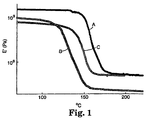
- Figure 1 is a plot of storage modulus versus temperature obtained by dynamic mechanical analysis of a material of the present invention, in cured (A) and uncured (B) state, and a comparative example (C).
- the present invention provides a curable melt blended composition
- a curable melt blended composition comprising 60 to 99.9 weight percent of a thermoplastic polymer comprising 1-99 weight percent of polyphenylene ether (PPE) polymer and 1-99 weight percent of polystyrene polymer, preferably high impact polystyrene (HIPS) polymer; and 0.1 to 40 weight percent of an uncured epoxy component comprising a curable epoxy and an effective amount of curing agent for the epoxy, wherein the epoxy component of the composition is substantially uncured.
- PPE polyphenylene ether
- HIPS high impact polystyrene
- the thermoplastic component includes 1-99% by weight of a polyphenylene ether polymer (PPE).
- PPE polyphenylene ether polymer
- the polyphenylene ethers (also known as polyphenylene oxides or PPOs) used in the present invention are a well-known class of polymers. They are widely used in industry, especially as engineering plastics in applications requiring toughness and heat resistance.
- the polyphenylene ethers comprise a plurality of structural units having the formula:
- each Q 1 is independently halogen, primary or secondary lower alkyl (i.e., alkyl containing up to 7 carbon atoms), phenyl, haloalkyl, aminoalkyl, hydrocarbonoxy, or halohydrocarbonoxy wherein at least two carbon atoms separate the halogen and oxygen atoms; and each Q 2 is independently hydrogen, halogen, primary or secondary lower alkyl, phenyl, haloalkyl, hydrocarbonoxy or halohydrocarbonoxy as defined for Q 1 .
- Suitable primary lower alkyl groups are methyl, ethyl, n-propyl, n-butyl, isobutyl, n-amyl, isoamyl, 2-methylbutyl, n-hexyl, 2,3-dimethylbutyl, 2-,3- or 4-methylpentyl and the corresponding heptyl groups.
- secondary lower alkyl groups are isopropyl, sec-butyl and 3-pentyl.
- any alkyl radicals are straight chain rather than branched.
- each Q 1 is alkyl or phenyl, especially C 1-4 alkyl, and each Q 2 is hydrogen.
- Suitable homopolymers are those containing, for example, 2,6-dimethyl-1,4-phenylene ether units.
- Suitable copolymers include random copolymers containing such units in combination with, for example, 2,3,6-trimethyl-1,4-phenylene ether units.
- Many suitable random copolymers, as well as homopolymers, are disclosed in the patent literature, e.g. at U.S. Pat. Nos. 4,054,5 53, 4,092,294, 4,477,649, 4,477,651 and 4,517,341.
- a preferred PPE poly(2,6-dimethylphenylene oxide) is available under the trade name BlendexTM HPP820 from General Electric Co., Pitsfield, Massachusetts.
- the thermoplastic component may include 1-99% by weight of a polystyrene polymer, but preferably 1-90% and more preferably 10-90% by weight.
- Polystyrene polymers are well known in the art.
- the polystyrene may optionally be substituted at any available position.
- the polystyrene polymer is a high impact polystyrene polymer (HIPS).
- HIPS high impact polystyrene polymer
- Thermoplastic high impact polystyrene polymers (HIPS) are well known in the art, as are PPE/HIPS blends.
- Preferred PPE/HIPS blends are available from General Electric Co., Pitsfield, Massachusetts, under the trade name NorylTM.
- NorylTM EN185 comprises approximately 10% PPE and 90% HIPS and NorylTM SE1X comprises approximately 50% PPE and 50% HIPS.
- the T g and heat deflection temperature (HDT) of PPE/HIPS blends are determined by the relative amount of PPE to HIPS, with Tg and HDT increasing in proportion to PPE content
- NorylTM EN185, NorylTM SE1X, and BlendexTM HPP820 have HDT's (at 264 psi) of 82, 118, and 182° C, respectively.
- the thermoplastic component may optionally include greater than 0% by weight to about 25% by weight, preferably 1-15% and more preferably 1-10% by weight, of a functionalized polystyrene as a compatibilizer for the thermoplastic and epoxy components and to promote adhesion of the cured composition to a substrate.
- the functionalized polystyrene can be mixed with the thermoplastic polymer blend prior to mixing with the epoxy or can be added during melt blending of the thermoplastic and epoxy.
- Suitable functionalized polystyrenes are polystyrenes that have additional chemical functionality, obtained through either copolymerization of styrene monomer with a functional monomer or graft copolymerization subsequent to styrene polymerization.
- functionalized groups include O, N, S, P, or halogen heteroatoms.
- Reactive functionalized groups include carboxylic arid, hydroxyl, amide, nitrile, carboxylic acid anhydride, epoxide, or halogen groups.
- SMA styrenemaleic anhydride
- SAN styrene-acrylonitrile
- SMA copolymers include the DylarkTM family, such as DylarkTM 332 (Nova Chemicals, Sarnia, Ontario, Canada), the CadonTM family, such as CadonTM 135 (Bayer Corp., Pittsburgh, PA), and the SapronTM S family, such as Sapron TM SM 300 (DSM Engineering Plastics North America, Northbrook, IL).
- Commercially available SAN copolymers include LuranTM polymers (BASF Corp., Plastic Materials, Mt. Olive, NJ). ). Any functionalized block copolymers comprising styrene can be useful as compatibilizers in the present invention, including, for example, maleated KratonTM polymers (Shell Chemical Co., Houston, TX).
- the blend comprises 0.1-40% by weight, but preferably 1-30% and more preferably 1-20% by weight, of an epoxy component comprising a thermosettable epoxy resin.
- the thermosettable epoxy resins of the invention preferably comprise compounds which contain one or more 1,2-, 1,3- and 1,4-cyclic ethers, which also may be known as 1,2-, 1,3- and 1,4-epoxides.
- the 1,2-cyclic ethers are preferred.
- Such compounds can be saturated or unsaturated, aliphatic, alicyclic, aromatic or heterocyclic, or can comprise combinations thereof.
- Compounds that contain more than one epoxy group i . e ., polyepoxides) are preferred.
- Aromatic polyepoxides (i . e ., compounds containing at least one aromatic ring structure, e . g ., a benzene ring, and more than one epoxy group) that can be used in the present invention include the polyglycidyl ethers of polyhydric phenols, such as Bisphenol A-type resins and their derivatives, epoxy cresol-novolac resins, Bisphenol-F resins and their derivatives, and epoxy phenol-novolac resins; and glycidyl esters of aromatic carboxylic acids, e .
- polyhydric phenols such as Bisphenol A-type resins and their derivatives, epoxy cresol-novolac resins, Bisphenol-F resins and their derivatives, and epoxy phenol-novolac resins
- glycidyl esters of aromatic carboxylic acids e .
- aromatic polyepoxides are the polyglycidyl ethers of polyhydric phenols, such as the EPONTM series of diglycidyl ethers of Bisphenol-A, including EPON 828 and EPON 1001 F, available commercially from Shell Chemicals, Inc., Houston, TX.
- Representative aliphatic cyclic polyepoxides i . e ., cyclic compounds containing one or more saturated carbocyclic rings and more than one epoxy group, also known as alicyclic compounds
- useful in the present invention include the "ERLTM"series of alicyclic epoxides commercially available from Union Carbide Corp., Danbury, CT, such as vinyl cyclohexene dioxide (ERL-4206), 3,4-epoxycyclohexylmethyl-3,4-epoxycyclohexane carboxylate (ERL-4221), 3,4-epoxy-6-methylcyclohexylinethyl-3,4-epoxy-6-methylcyclohexane carboxylate (ERL-4201), bis(3,4-epoxy-6-methylcycylohexylmethyl)adipate (ERL-4289), dipentene dioxide (ERL-4269), as well as 2-(3,4-epoxycyclohexyl
- Representative aliphatic polyepoxides include 1,4-bis(2,3-epoxypropoxy)butane, polyglycidyl ethers of aliphatic polyols such as glycerol, polypropylene glycol, 1,4-butanediol, and the like, and the diglycidyl ester of linoleic dimer acid.
- Suitable curatives or catalysts should tolerate the melt processing step according to the present invention without substantially curing the epoxy component, while retaining the ability to cure the epoxy component at a later time under the influence of heat or light. More specifically, the epoxy should remain substantially uncured after exposure to the temperature present in the melt processing step for the duration of the melt processing step.
- Other factors that influence catalyst selection include the thickness of the film to be cured, transparency of the film to curing radiation, and the film's end use (for example, when the final use of the film occurs after orientation or stretching, use of a thermal catalyst may not be appropriate, since the thermal activation may compromise the degree of orientation or the structural integrity of the stretched film).
- suitable curatives may be selected from any known catalysts.
- Curatives of the present invention can be photocatalysts or thermal curing agents.
- photocatalysts include two general types: onium salts and cationic organometallic salts, which are both useful in the invention.
- Onium salt photocatalysts for cationic polymerizations include iodonium and sulfonium complex salts.
- Useful aromatic iodonium complex salts are of the general formula: wherein
- the anions may be generally classified as fluorinated (including highly fluorinated and perfluorinated) tris alkyl- or arylsulfonyl methides and corresponding bis alkyl- or arylsulfonyl imides, as represented by Formulas X and Y, respectively, and hereinafter referred to as "methide” and "imide” anions, respectively, for brevity, (R f SO 2 ) 3 C - (X) (R f SO 2 ) 2 N - (Y) wherein each R f is independently selected from the group consisting of highly fluorinated or perfluorinated alkyl or fluorinated aryl radicals.
- the methides and imides may also be cyclic, when a combination of any two R f groups are linked to form a bridge.
- the R f alkyl chains may contain from 1-20 carbon atoms, with 1-12 carbon atoms preferred.
- the R f alkyl chains may be straight, branched, or cyclic and preferably are straight. Heteroatoms or radicals such as divalent oxygen, trivalent nitrogen or hexavalent sulfur may interrupt the skeletal chain, as is well recognized in the art.
- R f is or contains a cyclic structure, such structure preferably has 5 or 6 ring members, 1 or 2 of which can be heteroatoms.
- the alkyl radical R f is also free of ethylenic or other carbon-carbon unsaturation: e.g. , it is a saturated aliphatic, cycloaliphatic or heterocyclic radical.
- highly fluorinated is meant that the degree of fluorination on the chain is sufficient to provide the chain with properties similar to those of a perfluorinated chain. More particularly, a highly fluorinated alkyl group will have more than half the total number of hydrogen atoms on the chain replaced with fluorine atoms. Although hydrogen atoms may remain on the chain, it is preferred that all hydrogen atoms be replaced with fluorine to form a perfluoroalkyl group, and that any hydrogen atoms beyond the at least half replaced with fluorine that are not replaced with fluorine be replaced with bromine and or chlorine.
- At least two out of three hydrogens on the alkyl group be replaced with fluorine, still more preferred that at least three of four hydrogen atoms be replaced with fluorine and most preferred that all hydrogen atoms be replaced with fluorine to form a perfluorinated alkyl group.
- the fluorinated aryl radicals of Formulas 2a and 2b may contain from 6 to 22 ring carbon atoms, preferably 6 ring carbon atoms, where at least one, and preferably at least two, ring carbon atoms of each aryl radical are substituted with a fluorine atom or a highly fluorinated or perfluorinated alkyl radical as defined above, e . g ., CF 3 .
- Examples of anions useful in the practice of the present invention include: (C 2 F 5 SO 2 ) 2 N - , (C 4 F 9 SO 2 ) 2 N - , (C 8 F 17 SO 2 ) 3 C - , (CF 3 SO 2 ) 3 C - , (CF 3 SO 2 ) 2 N - , (C 4 F 9 SO 2 ) 3 C - , (CF 3 SO 2 ) 2 (C 4 F 9 SO 2 )C - , (CF 3 SO 2 )(C 4 F 9 SO 2 )N - , [(CF 3 ) 2 NC 2 F 4 SO 2 ] 2 N - , (CF 3 ) 2 NC 2 F 4 SO 2 C - (SO 2 CF 3 ) 2 , (3,5-bis(CF 3 )C 6 H 3 )SO 2 N - SO 2 CF 3 , C 6 F 5 SO 2 C - (SO 2 CF 3 ) 2 C 6 F 5 SO 2 N - SO 2 CF 3 and the like.
- the Ar 1 and Ar 2 aromatic groups may optionally comprise one or more fused benzo rings (e . g ., naphthyl, benzothienyl, dibenzothienyl, benzofuranyl, dibenzofuranyl).
- the aromatic groups may also be substituted, if desired, by one or more non-basic groups if they are essentially non-reactive with epoxide and hydroxyl functionalities.
- aromatic iodonium complex salts useful in the invention are photosensitive only in the ultraviolet region of the spectrum. However, they can be sensitized to the near ultraviolet and the visible range of the spectrum by sensitizers for known photolyzable organic halogen compounds.
- Illustrative sensitizers include aromatic amines and colored aromatic polycyclic hydrocarbons, as described in U.S. Patent No. 4,250,053.
- Aromatic sulfonium complex salt catalysts suitable for use in the invention are of the general formula wherein
- R 3 , R 4 or R 5 is an aromatic group, it may optionally have one or more fused benzo rings (e . g ., naphthyl, benzothienyl, dibenzothienyl, benzofuranyl, and dibenzofuranyl).
- the aromatic groups may also be substituted, if desired, by one or more non-basic groups if they are essentially non-reactive with epoxide and hydroxyl functionalities.
- Triaryl-substituted salts such as triphenylsulfonium hexafluoroantimonate and p-(phenyl(thiophenyl))diphenylsulfonium hexafluoroantimonate are preferred sulfonium salts.
- Triphenylsulfonium hexafluoroantimonate (Ph 3 SSbF 6 ) is a most preferred catalyst.
- Useful sulfonium salts are described more fully in U.S. Patent No. 5,256,828.
- Aromatic sulfonium complex salts useful in the invention are photosensitive only in the ultraviolet region of the spectrum. However, they can be sensitized to the near ultraviolet and the visible range of the spectrum by a select group of sensitizers such as described in U.S. Patent Nos. 4,256,828 and 4,250,053.
- Suitable photoactivatable organometallic complex salts useful in the invention include those described in U.S. Patent Nos. 5,059,701, 5,191,101, and 5,252,694.
- Such salts of organometallic cations have the general formula: [(L 1 )(L 2 )M m ] +c X - wherein M m represents a metal atom selected from elements of periodic groups IVB, VB, VIB, VIIB and VIII, preferably Cr, Mo, W, Mn, Re, Fe, and Co; L 1 represents none, one, or two ligands contributing ⁇ -electrons that can be the same or different ligand selected from the group consisting of substituted and unsubstituted acyclic and cyclic unsaturated compounds and groups and substituted and unsubstituted carbocyclic aromatic and heterocyclic aromatic compounds, each capable of contributing two to twelve ⁇ -electrons to the valence shell of the metal atom M.
- L 1 is selected from the group consisting of substituted and unsubstituted ⁇ 3 -allyl, ⁇ 5 -cyclopentadienyl, ⁇ 7 -cycloheptatrienyl compounds, and ⁇ 6 -aromatic compounds selected from the group consisting of ⁇ 6 -benzene and substituted ⁇ 6 -benzene compounds ( e.g.
- L 2 represents none or 1 to 3 ligands contributing an even number of ⁇ -electrons that can be the same or different ligand selected from the group consisting of carbon monoxide, nitrosonium, triphenyl phosphine; triphenyl stibine and derivatives of phosphorous, arsenic and antimony, with the proviso that the total electronic charge contributed to M m by L 1 and L 2 results in a net residual positive charge ofe to the complex; and e is an integer having a value of 1 or 2, the residual charge of the complex cation; X is a halogen-containing complex anion, as described above.
- thermally-activated curing agents for epoxy resins e.g. , compounds that effect curing and crosslinking of the epoxide by entering into a chemical reaction therewith
- curing agents are thermally stable at temperatures at which mixing of the components takes place.
- Suitable thermal curing agents include aliphatic and aromatic primary and secondary amines, e . g ., di(4-aminophenyl)sulfone, di(4-aminophenyl)ether, and 2,2-bis-(4-aminophenyl)propane; aliphatic and aromatic tertiary amines, e . g ., dimethylaminopropylamine and pyridine; quaternary ammonium salts, particularly pyridinium salts such as N-methyl-4-picolinium hexafluorophosphate; sulfoninum salts; fluorene diamines, such as those described in U. S. Patent No.
- boron trifluoride complexes such as BF 3 •Et 2 O and BF 3 •H 2 NC 2 H 5 OH; imidazoles, such as methylimidazole; hydrazines, such as adipohydrazine; and guanidines, such as tetramethylguanidine and dicyandiamide (cyanoguanimide, commonly known as DiCy). It is to be understood that a careful choice among these curing agents must be made, since many of them would be unsuitable for use when high-melting PPE/HIPS materials are present, but that they may be useful in preparing mixtures of the invention that comprise low-melting thermoplastic materials and epoxy resins.
- Additional high temperature thermal epoxy catalysts that can be particularly useful in the present invention include simple pyridinium, quinolinium, indolinium, benzothiazolium, alkyl, aryl and alkylaryl ammonium, sulfonium and phosphonium salts. These are effective initiators of the cationic polymerization of epoxies in the 250 - 350°C temperature range. Because of these high exotherm temperatures, these catalysts are particularly suited to use with extrusion temperatures of 200°C or greater. The compositions are stable in the extruder ( i.e. , they do not cure), eliminating problems that would be caused by crosslinking during this processing step. When finally cured, these compositions give surprisingly high overlap shear bond strengths. Useful ammonium and phosphonium salts are described in copending application USSN 08/782,476.
- Catalysts useful in the invention can be present in an amount in the range of 0.01 to 10 weight percent, based on total epoxy resin composition, preferably 0.01 to 5 weight percent, and most preferably 0.5 to 3 weight percent.
- Catalysts may be added to the chosen epoxy in a powder form at temperatures up to about 150°C. No solvent is necessary for this operation. Incorporation time can range from 10-20 minutes depending on the epoxy/catalyst system.
- the epoxy/catalyst may then be pumped into the extruder for the melt processing step. Alternatively, the catalyst could be added directly into the thermoplastic/epoxy mixture during melt blending.
- Various adjuvants can also be added to the compositions of the invention to alter the physical characteristics of the final material.
- thixotropic agents such as fumed silica; pigments to enhance color tones such as ferric oxide, carbon black and titanium dioxide; fillers such as mica, silica, acicular wollastonite, calcium carbonate, magnesium sulfate and calcium sulfate; electrically and/or thermally conductive fillers, including metal particles, graphite, and metal-coated microspheres; chopped fibers and whiskers, including glass and carbon; clays such as bentonite; glass beads and bubbles; reinforcing materials such as unidirectional woven and nonwoven webs of organic and inorganic fibers such as polyester, polyimide, glass fibers, polyamides such as poly(p-phenylene terephthalamide), carbon fibers, and ceramic fibers. Amounts up to about 200 parts of adjuvant per 100 parts of PPE/PS/epoxy composition can be used.
- the materials of the present invention can be prepared by batch or continuous processing.
- Batch processing can be accomplished by adding solid thermoplastic, typically in pellet form, to a preheated mixer, such as a Brabender mixer (C. W. Brabender Instruments, Inc., South Hackensack, NJ) equipped with, e.g. , cam or sigma blades. After stirring for about 5 minutes, the thermoplastic is melted and a mixture of epoxy and curative for the epoxy is added with continued stirring. The resultant mixture is stirred to ensure complete mixing, at a duration and temperature below that which would substantially cure the epoxy component, and removed from the mixer while still molten. The mixture can then be molded, formed, shaped or pressed into a desired final configuration. The shaped object may then be irradiated and/or heated to cure the epoxy resin component. In particular, when a thin sheet or film is desired, the molten mass can be pressed in a heated flat-plate press, such as a Carver laboratory press (F. Carver, Inc., Wabash, IN).
- a heated flat-plate press such as a Car
- Continuous processing can be accomplished using an extruder, e . g ., a twinscrew extruder, equipped with a downstream port, a static mixer and an appropriate output orifice (film die, sheet die, fiber die, profile die, etc.) and a take-up or casting roll and wind-up roll(s), as appropriate.
- the casting roll may be cooled or maintained at a set temperature by thermostatic means.
- Solid thermoplastic is added to the input end of the extruder and processed using a temperature profile that is appropriate for the thermoplastic and which will not substantially cure the epoxy component, taking into account the duration of residence of the material in the extruder during processing.
- the epoxy component may be injected via gear or syringe pump. Take-up line speed is adjusted as appropriate for the output (sheet, fiber, etc.), typically from about 0.5 m/min to about 200 m/min.
- thermoplastic polymer cools and solidifies
- further heating of the extrudate can take place directly at the die orifice or at a casting wheel.
- the heat source(s) can be located just prior to the take-up roll.
- UV irradiation of the heated extrudate can take place directly at the die orifice. Irradiation can be accomplished by any number of commercially-available UV sources, such as one or more Fusion Systems D or H bulbs (available from Fusion UV Curing Systems, Rockville, D) or Sylvania BL 350 bulbs.
- the light source(s) can be located just prior to the take-up roll.
- the irradiation devices are absent and precautions may be taken to prevent UV exposure.
- a blended film obtained from a sheet die, may be drawn either uniaxially or biaxially as it emerges from the die. Cure, as above, may take place before, during or after such drawing.
- the material may be applied to its final substrate in an uncured state as a sheet and cured in situ by application of heat, pressure, UV light, or combinations thereof.
- This invention is useful in the production of high performance adhesives and coatings, especially where improved peel strength is required; For example, this invention is useful in laminating films for electronic applications.
- the present invention is useful as an adhesive, as a protective covercoat, or as both.
- Table A discloses the starting materials and weight proportions used in each example. Table A also discloses peel strength values for examples where that value was measured. Examples designated with a C, i.e., examples 1C, 13C, and 21C-30C, are comparative examples. Composition and Peel Strength of Examples Ex # PPE or PPE/HIPS blend Epoxy (Epon 828TM) Catalyst Functionalized Polystyrene (Dylark 332TM) Peel Strength on Kapton ETM (ave.
- Uncured materials were made according to the present invention by first blending the epoxy with the catalyst and injecting this mixture via a gear pump (Model HPB 4740, Zenith Metering pump, Parker Hannifin Co., Sanford, NC) into a conical twin screw extruder (Haake, Paramus, NJ) where the epoxy was mixed with the thermoplastic PPO or PPO/HIPS blend at a constant screw rate of 100 rpm. The mixture was extruded as a film onto a casting wheel which was maintained at 20°C.
- a gear pump Model HPB 4740, Zenith Metering pump, Parker Hannifin Co., Sanford, NC
- a conical twin screw extruder Heake, Paramus, NJ
- compositions comprising Noryl EN 185 and epoxy
- the four extruder zones were each set at 200 °C, with a pellet feed rate of 22.45 g/min, using a K-TronTM feeder (K-Tron International, Pitman, NJ).
- Typical processing temperatures were 182 - 209 - 206 - 204 °C, from back (pellet-feed end) to front (die end) of the extruder.
- Pressure at the front (tip) of the extruder prior to epoxy introduction was 7.93 MPa.
- the amount of epoxy added was controlled by varying the speed of the metering pump from 10 to 30 rpm.
- compositions comprising Noryl SE1X and epoxy (except Examples 18 and 19), the extruder zones were set at 260 - 282 - 282 - 282 °C, processing temperatures were 288 - 279 - 285 - 281 °C from back to front, and the pellet feed rate was 30 g/min. Initial pressure at the extruder tip was 7.6 MPa. Metering pump speed was varied from 8 to 30 rpm. For Examples 18 and 19, the extruder zones were set at 213 - 203 - 204 - 218 °C. Processing temperatures, from back to front, were 203 - 224 - 217 - 218 °C for Example 18 and 195 - 213 - 208 - 218 °C for Example 19. The pellet feed rate was 24.2 g/min. Initial pressure at the extruder tip was 13.1 MPa for Example 18 and 8.6 MPa for Example 19. Metering pump speed was 13 rpm for Example 18 and 26 rpm for Example 19.
- compositions comprising Blendex HPP820 and epoxy
- the extruder zones were set at 260 - 288 - 288 - 288 °C
- processing temperatures were 236 - 289 - 288 - 286 °C
- back to front and the powder feed rate was 7.2 g/min.
- Initial pressure at the extruder tip was 10.9 MPa.
- Metering pump speed was varied from 2 to 9 rpm.
- N-methyl-4-picolinium hexafluorophosphate P, described in copending application USSN 08/782,476, Example 6
- Ar 3 SSbF 6 S, where Ar can be phenyl, p-tolyl, or naphthyl; prepared as described in Example 2).
- N-methyl-4-picolinium hexafluorophosphate P
- Ar 3 SSbF 6 S
- the catalysts were added to the epoxy in powder form, without solvent, at 80° C. Incorporation time ranged from 10-20 minutes depending on the epoxy/catalyst system.
- the resulting mixture contained about 2% by weight catalyst.
- the weight of catalyst is included in the weight of the epoxy in Table A.
- the epoxy used was EponTM 828 (diglycidyl ether of Bisphenol A), available from Shell Chemicals, Inc., Houston, TX.
- the PPE and PPE/HIPS blends used were NorylTM EN185 and NorylTM SE1X, which are blends of poly(2,6-dimethylphenylene oxide) (PPO) and high impact polystyrene (HIPS) (General Electric Plastics, Pittsfield, MA), and BlendexTM HPP820, which is PPO without admixed HIPS (General Electric Plastics ) It is estimated that the EN185 is approximately 10% PPO and 90% HIPS and the SE1X is approximately 50% PPO and 50% HIPS. Note that the T g and heat deflection temperature (HDT) of PPO/HIPS blends are determined by the relative amount of PPO to HIPS, with Tg and HDT increasing in proportion to PPO content. NorylTM EN185, NorylTM SE1X, and BlendexTM HPP820 have HDT's (at 1.8 MPa) of 82, 118, and 182°C, respectively.
- HDT heat deflection temperature
- a functionalized polystyrene was mixed as a compatiblizer with the thermoplastic polymer blend prior to mixing with the epoxy to improve compatibility of the thermoplastic and epoxy components.
- the material used a copolymer of styrene and maleic anhydride, is sold under the trade name DylarkTM 332 (Nova Chemicals, Sarnia, Ontario, Canada), which can be dry blended with the PPE and/or PPE/HIPS pellets prior to blending with epoxy.
- DylarkTM 332 Nova Chemicals, Sarnia, Ontario, Canada
- Peel strength tests were performed on 0.05 mm thick Kapton E films, a polyimide substrate used in flexible circuitry.
- the adhesive films of the examples were laminated between two pieces of Kapton E film such that approximately 5.0 cm of Kapton E extended beyond the lamination, for peel testing.
- the adhesive films were typically 0.025 mm thick, ranging from 0.012 mm to 0.51 mm thick, after lamination. Films comprising the S catalyst were laminated at 220° C, 3450 kPa for 50 min. and films comprising the P catalyst were laminated at 270° C, 3450 kPa for 50 min.
- Overlap shear strength tests were performed essentially according to ASTM D1002-94 on three substrates: steel, aluminum and copper. Coupons of these materials measuring 11.43 cm x 2.54 cm x 3.2 mm were thoroughly cleaned with methyl ethyl ketone. Adhesive films of the invention, having thicknesses of from about 0.25 to about 0.75 mm were cut into squares measuring 2.54 cm on a side and placed between two coupons such that the area of overlap was 6.45 cm 2 . The coupons and sample were held together with a small piece of high-temperature TeflonTM tape (Model 5490, 3M, St. Paul, MN) and were heated under pressure in a Carver press.
- TeflonTM tape Model 5490, 3M, St. Paul, MN
- Dynamic Mechanical Analysis (DMA) tensile testing was performed on cured and uncured materials, resulting in plots of storage modulus (a measure of the sample stiffness) versus temperature. Free-standing sample strips measuring 36mm x 6.4 mm x 10 mm were used. The materials of the EN185-based examples were cured at 220° C for 50 minutes and the materials of the SE1X and HPP820-based materials were cured at 270° C for 50 minutes. A Seiko Instruments DMA 200 Rheometer (Seiko Instruments, Torrance, CA) equipped with a tensile sample feature was used. Separation between jaws was 20 mm. The temperature ramp was 2°C per minute from -80 to 300°C, probed at 1 Hz.
- DMA Dynamic Mechanical Analysis
- Curve A represents Example 15 (9.4% Epon 828, containing P-Cat, in Noryl SE1X) after cure.
- Curve B represents Example 15 before cure.
- Curve C represents a comparative example, Example 13C, which is 100% Noryl SEIX.
- the DMA test results were used to determine glass transition temperatures, shown in Table C.
- the glass transition temperature of uncured materials was seen to decrease as more epoxy was added to the base thermoplastic.
- the glass transition temperature of the PPE/PS increased after curing.
- the glass transition temperature increased after cure to a level higher than that of the thermoplastic alone.
- the materials of the present invention based on PPE/HIPS blends are capable of maintaining their stiffness and other mechanical properties to higher temperatures.
Landscapes
- Chemical & Material Sciences (AREA)
- Health & Medical Sciences (AREA)
- Chemical Kinetics & Catalysis (AREA)
- Medicinal Chemistry (AREA)
- Polymers & Plastics (AREA)
- Organic Chemistry (AREA)
- Epoxy Resins (AREA)
- Compositions Of Macromolecular Compounds (AREA)
- Adhesives Or Adhesive Processes (AREA)
Applications Claiming Priority (3)
| Application Number | Priority Date | Filing Date | Title |
|---|---|---|---|
| US09/025,400 US6518362B1 (en) | 1998-02-18 | 1998-02-18 | Melt blending polyphenylene ether, polystyrene and curable epoxy |
| US25400 | 1998-02-18 | ||
| PCT/US1998/012179 WO1999042524A1 (en) | 1998-02-18 | 1998-06-22 | Hybrid materials employing ppe/polystyrene/curable epoxy mixtures |
Publications (2)
| Publication Number | Publication Date |
|---|---|
| EP1060213A1 EP1060213A1 (en) | 2000-12-20 |
| EP1060213B1 true EP1060213B1 (en) | 2004-05-12 |
Family
ID=21825841
Family Applications (1)
| Application Number | Title | Priority Date | Filing Date |
|---|---|---|---|
| EP98930155A Expired - Lifetime EP1060213B1 (en) | 1998-02-18 | 1998-06-22 | Hybrid materials employing ppe/polystyrene/curable epoxy mixtures |
Country Status (7)
| Country | Link |
|---|---|
| US (4) | US6518362B1 (enExample) |
| EP (1) | EP1060213B1 (enExample) |
| JP (1) | JP2002504584A (enExample) |
| AU (1) | AU7961698A (enExample) |
| CA (1) | CA2319218A1 (enExample) |
| DE (1) | DE69823882T2 (enExample) |
| WO (1) | WO1999042524A1 (enExample) |
Cited By (1)
| Publication number | Priority date | Publication date | Assignee | Title |
|---|---|---|---|---|
| US6913792B2 (en) | 1998-02-18 | 2005-07-05 | 3M Innovative Properties Company | Hybrid materials employing PPE/polystyrene/curable epoxy mixtures |
Families Citing this family (49)
| Publication number | Priority date | Publication date | Assignee | Title |
|---|---|---|---|---|
| US6906120B1 (en) * | 2000-06-20 | 2005-06-14 | General Electric | Poly(arylene ether) adhesive compositions |
| US6787579B2 (en) * | 2001-05-02 | 2004-09-07 | L&L Products, Inc. | Two-component (epoxy/amine) structural foam-in-place material |
| US7473715B2 (en) * | 2001-05-02 | 2009-01-06 | Zephyros, Inc. | Two component (epoxy/amine) structural foam-in-place material |
| US7022777B2 (en) * | 2001-06-28 | 2006-04-04 | General Electric | Moldable poly(arylene ether) thermosetting compositions, methods, and articles |
| US20030050352A1 (en) * | 2001-09-04 | 2003-03-13 | Symyx Technologies, Inc. | Foamed Polymer System employing blowing agent performance enhancer |
| JP4102112B2 (ja) * | 2002-06-06 | 2008-06-18 | 株式会社東芝 | 半導体装置及びその製造方法 |
| EP1557413B1 (en) * | 2002-09-25 | 2012-08-01 | Adeka Corporation | Novel aromatic sulfonium salt compound, photo-acid generator comprising the same and photopolymerizable composition containing the same, resin composition for optical three-dimensional shaping, and method of optically forming three-dimensional shape |
| US20040224591A1 (en) * | 2003-03-07 | 2004-11-11 | Thai Hwee Tatz | Alkyl acrylate copolymer modified oriented polypropylene films, tapes, fibers and woven and nonwoven textiles |
| US7125461B2 (en) | 2003-05-07 | 2006-10-24 | L & L Products, Inc. | Activatable material for sealing, baffling or reinforcing and method of forming same |
| US7199165B2 (en) | 2003-06-26 | 2007-04-03 | L & L Products, Inc. | Expandable material |
| US8070994B2 (en) | 2004-06-18 | 2011-12-06 | Zephyros, Inc. | Panel structure |
| US7204574B2 (en) * | 2004-06-30 | 2007-04-17 | Lexmark International, Inc. | Polyimide thickfilm flow feature photoresist and method of applying same |
| US7521093B2 (en) * | 2004-07-21 | 2009-04-21 | Zephyros, Inc. | Method of sealing an interface |
| US7838589B2 (en) * | 2004-07-21 | 2010-11-23 | Zephyros, Inc. | Sealant material |
| US20070004871A1 (en) * | 2005-06-30 | 2007-01-04 | Qiwei Lu | Curable composition and method |
| US7429800B2 (en) * | 2005-06-30 | 2008-09-30 | Sabic Innovative Plastics Ip B.V. | Molding composition and method, and molded article |
| US7378455B2 (en) * | 2005-06-30 | 2008-05-27 | General Electric Company | Molding composition and method, and molded article |
| FR2890234A1 (fr) * | 2005-08-29 | 2007-03-02 | St Microelectronics Crolles 2 | Procede de protection de la grille d'un transistor et circuit integre correspondant |
| US20070066698A1 (en) | 2005-09-20 | 2007-03-22 | Yang Wenliang P | Dual cure compositions, methods of curing thereof and articles therefrom |
| US20070066710A1 (en) * | 2005-09-21 | 2007-03-22 | Peters Edward N | Method for electrical insulation and insulated electrical conductor |
| US8022123B2 (en) * | 2005-12-22 | 2011-09-20 | Glen Burnie Technologies, Llc | Method for manufacturing and dispersing nanoparticles in thermoplastics |
| EP2412699A1 (en) * | 2005-12-28 | 2012-02-01 | E.I. Du Pont De Nemours And Company | Compositions comprising novel compounds and electronic devices made with such compositions |
| US20100152348A1 (en) * | 2006-04-06 | 2010-06-17 | David Abecassis | Nanocompatibilized novel polymer blends |
| US20080227899A1 (en) * | 2006-05-11 | 2008-09-18 | David Abecassis | Novel method for polymer RDP-clay nanocomposites and mechanisms for polymer/polymer blending |
| US20080023679A1 (en) * | 2006-05-11 | 2008-01-31 | David Abecassis | Novel flame retardant nanoclay |
| US20080071013A1 (en) * | 2006-07-12 | 2008-03-20 | David Abecassis | Novel thermoplastic pelletizing technology |
| US20080064798A1 (en) * | 2006-07-21 | 2008-03-13 | David Abecassis | Novel method for nanoclay particle dispersion |
| US20080317987A1 (en) * | 2006-07-21 | 2008-12-25 | David Abecassis | Nanocomposite materials for ethanol, methanol and hydrocarbon transportation use and storage |
| US20080064802A1 (en) * | 2006-07-26 | 2008-03-13 | David Abecassis | Method for polymer-polymer compatiblization and non polymer filler dispersion and compositions made therefrom |
| US20080071035A1 (en) * | 2006-09-15 | 2008-03-20 | Delsman Erik R | Curable poly(arylene ether) composition and method |
| US20080071036A1 (en) * | 2006-09-15 | 2008-03-20 | Delsman Erik R | Cured poly(arylene ether) composition, method, and article |
| WO2008084281A1 (en) * | 2007-01-09 | 2008-07-17 | Nokia Corporation | Power for uplink acknowledgment transmission |
| WO2008115414A2 (en) * | 2007-03-15 | 2008-09-25 | Glen Burnie Technologies, L.L.C. | A novel method for producing an organoclay additive for use in polypropylene |
| US20090042044A1 (en) * | 2007-08-08 | 2009-02-12 | David Abecassis | Novel nanocomposite coating for the reduction of pigment particles loss and UV fade and chemical degradation for decorative & structural products made from concrete and concrete composites |
| US20100029986A1 (en) * | 2007-10-19 | 2010-02-04 | David Abecassis | Novel amine functionalized carbon nanotube |
| US8337163B2 (en) | 2007-12-05 | 2012-12-25 | General Electric Company | Fiber composite half-product with integrated elements, manufacturing method therefor and use thereof |
| US8425785B2 (en) | 2008-03-31 | 2013-04-23 | Intel Corporation | Mechanical adhesion of copper metallization to dielectric with partially cured epoxy fillers |
| GB0806434D0 (en) | 2008-04-09 | 2008-05-14 | Zephyros Inc | Improvements in or relating to structural adhesives |
| US8079820B2 (en) * | 2008-12-18 | 2011-12-20 | General Electric Company | Blade module, a modular rotor blade and a method for assembling a modular rotor blade |
| US20110070379A1 (en) * | 2009-03-11 | 2011-03-24 | Cytec Technology Corp. | Light and uv stabilisers |
| GB0916205D0 (en) | 2009-09-15 | 2009-10-28 | Zephyros Inc | Improvements in or relating to cavity filling |
| BR112012022319B1 (pt) | 2010-03-04 | 2020-01-28 | Zephyros Inc | laminado estrutural compósito |
| US20120040106A1 (en) | 2010-08-16 | 2012-02-16 | Stefan Simmerer | Apparatus for impregnating a fiber material with a resin and methods for forming a fiber-reinforced plastic part |
| US20120138223A1 (en) | 2011-09-29 | 2012-06-07 | General Electric Company | Uv-ir combination curing system and method of use for wind blade manufacture and repair |
| EP3024871B1 (en) | 2013-07-26 | 2022-12-07 | Zephyros Inc. | Thermosetting adhesive films including a fibrous carrier |
| CN103441162B (zh) * | 2013-09-06 | 2016-04-13 | 苏州柯莱美高分子材料科技有限公司 | 太阳能电池组件的太阳能背板以及太阳能电池组件 |
| CN104650573B (zh) * | 2013-11-22 | 2017-11-17 | 深圳光启创新技术有限公司 | 用于制作高频天线基板的复合材料、高频天线基板及其制作方法 |
| GB201417985D0 (en) | 2014-10-10 | 2014-11-26 | Zephyros Inc | Improvements in or relating to structural adhesives |
| EP3692097A4 (en) | 2017-10-02 | 2021-07-07 | Commscope Technologies LLC | THERMOPLASTIC GEL WITH LOW COMPRESSION RESIDUE AND GEL SEAL ARRANGEMENT FOR CABLES |
Family Cites Families (33)
| Publication number | Priority date | Publication date | Assignee | Title |
|---|---|---|---|---|
| US4054553A (en) | 1975-06-02 | 1977-10-18 | General Electric Company | Polyphenylene oxide process |
| US4256828A (en) | 1975-09-02 | 1981-03-17 | Minnesota Mining And Manufacturing Company | Photocopolymerizable compositions based on epoxy and hydroxyl-containing organic materials |
| US4092294A (en) | 1976-08-30 | 1978-05-30 | General Electric Company | Method for preparing polyphenylene ethers |
| US4250053A (en) | 1979-05-21 | 1981-02-10 | Minnesota Mining And Manufacturing Company | Sensitized aromatic iodonium or aromatic sulfonium salt photoinitiator systems |
| US4517341A (en) | 1982-07-27 | 1985-05-14 | General Electric Company | Process for preparing polyphenylene oxide-rubber graft copolymers and products obtained thereby |
| US5191101A (en) | 1982-11-22 | 1993-03-02 | Minnesota Mining And Manufacturing Company | Energy polymerizable compositions containing organometallic initiators |
| US4477649A (en) | 1983-03-25 | 1984-10-16 | General Electric Company | Two-stage continuous process for preparation of polyphenylene oxides |
| US4477651A (en) | 1983-06-06 | 1984-10-16 | General Electric Company | Process for preparing polyphenylene oxides |
| NL8303497A (nl) | 1983-10-12 | 1985-05-01 | Gen Electric | Voorwerp geheel of gedeeltelijk vervaardigd uit een polymeermengsel en voorzien van een polyurethaanlaklaag of een polyurethaanlijmlaag. |
| US5256694A (en) | 1984-09-22 | 1993-10-26 | Basf Aktiengesellschaft | Diarylacetylenes, their preparation and their use |
| US4684678A (en) | 1985-05-30 | 1987-08-04 | Minnesota Mining And Manufacturing Company | Epoxy resin curing agent, process, and composition |
| WO1988000953A1 (fr) * | 1986-08-04 | 1988-02-11 | Toray Industries, Inc. | Composition de resine et son procede de preparation |
| US4912172A (en) | 1987-09-03 | 1990-03-27 | General Electric Company | Compositions comprising polyphenylene ethers, polyepoxides and aluminum or zinc diketone salt |
| US5073605A (en) * | 1988-07-14 | 1991-12-17 | General Electric Company | Bromine-bisphenol reacted bisphenol and novolak epoxy resins with polyphenylene ether |
| US5001010A (en) * | 1988-10-11 | 1991-03-19 | General Electric Company | Curable polyphenylene ether-polyepoxide compositions from melt processed polyphenylene ethers, and laminates prepared therefrom |
| JPH036260A (ja) | 1989-05-31 | 1991-01-11 | Nippon G Ii Plast Kk | ポリフェニレンエーテル系樹脂組成物 |
| US5089343A (en) * | 1989-08-03 | 1992-02-18 | General Electric Company | Curable dielectric polyphenylene ether-polyepoxide compositions |
| KR920701362A (ko) | 1989-10-06 | 1992-08-11 | 아더 엠.킹 | 전기 적층품을 위한 폴리페닐렌 옥시드/하이브리드 에폭시 수지계 |
| US5006010A (en) * | 1989-11-03 | 1991-04-09 | Duckett John W | Roadway with uni-directional light reflective lane marker |
| EP0462378B1 (en) * | 1990-04-26 | 1996-07-10 | Mitsubishi Chemical Corporation | Polyethylene terephthalate composition |
| KR930701561A (ko) | 1990-06-08 | 1993-06-12 | 게리 엘. 그리스울드 | 전자 용품용 재처리가능한 접착제 |
| US5059701A (en) | 1990-09-20 | 1991-10-22 | Minnesota Mining And Manufacturing Company | Methods for preparation of cyclopentadienyliron (II) arenes |
| US5262491A (en) * | 1991-03-29 | 1993-11-16 | General Electric Company | High performance curable PPO/monomeric epoxy compositions with tin metal salt compatibilizing agent |
| US5252694A (en) | 1992-01-22 | 1993-10-12 | Minnesota Mining And Manufacturing Company | Energy-polymerization adhesive, coating, film and process for making the same |
| US5256828A (en) | 1992-06-12 | 1993-10-26 | Texaco Chemical Company | Heterogeneous catalyst for alkoxylation of alcohols |
| DE69318665T2 (de) | 1992-10-09 | 1998-12-10 | General Electric Co., Schenectady, N.Y. | Polyphenylenether/Polyepoxid Harzzusammensetzungen |
| US5308565A (en) | 1993-02-05 | 1994-05-03 | General Electric Company | Method of preparing modified polyphenylene oxide resin systems for electrical laminates having improved solderability and solvent resistance |
| US5625000A (en) * | 1993-10-07 | 1997-04-29 | Sumitomo Chemical Company, Limited | Thermoplastic resin composition |
| US5554664A (en) * | 1995-03-06 | 1996-09-10 | Minnesota Mining And Manufacturing Company | Energy-activatable salts with fluorocarbon anions |
| JPH08295865A (ja) | 1995-04-27 | 1996-11-12 | Asahi Corp | エポキシ樹脂系接着剤 |
| US5709948A (en) | 1995-09-20 | 1998-01-20 | Minnesota Mining And Manufacturing Company | Semi-interpenetrating polymer networks of epoxy and polyolefin resins, methods therefor, and uses thereof |
| EP0920482A1 (en) | 1996-08-26 | 1999-06-09 | Minnesota Mining And Manufacturing Company | Fluoropolymer-epoxy resin semi-interpenetrating network composition |
| US6518362B1 (en) * | 1998-02-18 | 2003-02-11 | 3M Innovative Properties Company | Melt blending polyphenylene ether, polystyrene and curable epoxy |
-
1998
- 1998-02-18 US US09/025,400 patent/US6518362B1/en not_active Expired - Lifetime
- 1998-06-22 CA CA002319218A patent/CA2319218A1/en not_active Abandoned
- 1998-06-22 JP JP2000532472A patent/JP2002504584A/ja active Pending
- 1998-06-22 AU AU79616/98A patent/AU7961698A/en not_active Withdrawn
- 1998-06-22 WO PCT/US1998/012179 patent/WO1999042524A1/en not_active Ceased
- 1998-06-22 DE DE69823882T patent/DE69823882T2/de not_active Expired - Lifetime
- 1998-06-22 EP EP98930155A patent/EP1060213B1/en not_active Expired - Lifetime
-
2002
- 2002-12-16 US US10/319,953 patent/US6787605B2/en not_active Expired - Lifetime
-
2004
- 2004-06-17 US US10/870,265 patent/US6913792B2/en not_active Expired - Fee Related
-
2005
- 2005-06-24 US US11/166,603 patent/US20050267266A1/en not_active Abandoned
Cited By (1)
| Publication number | Priority date | Publication date | Assignee | Title |
|---|---|---|---|---|
| US6913792B2 (en) | 1998-02-18 | 2005-07-05 | 3M Innovative Properties Company | Hybrid materials employing PPE/polystyrene/curable epoxy mixtures |
Also Published As
| Publication number | Publication date |
|---|---|
| AU7961698A (en) | 1999-09-06 |
| DE69823882T2 (de) | 2005-05-19 |
| WO1999042524A1 (en) | 1999-08-26 |
| DE69823882D1 (de) | 2004-06-17 |
| US6518362B1 (en) | 2003-02-11 |
| JP2002504584A (ja) | 2002-02-12 |
| US6913792B2 (en) | 2005-07-05 |
| EP1060213A1 (en) | 2000-12-20 |
| US6787605B2 (en) | 2004-09-07 |
| US20050267266A1 (en) | 2005-12-01 |
| US20030130439A1 (en) | 2003-07-10 |
| CA2319218A1 (en) | 1999-08-26 |
| US20040225063A1 (en) | 2004-11-11 |
Similar Documents
| Publication | Publication Date | Title |
|---|---|---|
| US6787605B2 (en) | Composition of polyphenylene ether, polystyrene and curable epoxy | |
| JP3231814B2 (ja) | 異方性導電膜 | |
| TWI409287B (zh) | 硬化性樹脂組成物,硬化性薄膜及其等之硬化物 | |
| KR100499992B1 (ko) | 플루오로 중합체와 에폭시 수지를 포함하는 반 상호 침투성 네트워크 조성물 | |
| EP2231729B1 (en) | Acrylic-based rubber modified thermoset composition | |
| EP1229079B1 (en) | Thermosetting resin composition and use thereof | |
| EP1149130A1 (en) | Acrylic terpolymer for the use as a self-fixturing adhesive | |
| JPH01158039A (ja) | 硬化性樹脂組成物 | |
| EP0851894B1 (en) | Semi-interpenetrating polymer networks of epoxy and polyolefin resins, methods therefor, and uses thereof | |
| CA1057441A (en) | Flame resistant thermosetting resin composition and metal clad laminate composed of the thermosetting resin composition | |
| JP3404005B2 (ja) | エポキシ樹脂に使用するための硬化剤 | |
| JP7749957B2 (ja) | フェノキシ樹脂、熱硬化性樹脂組成物、樹脂シート、樹脂基板、回路基板、および電子装置 | |
| JP4273530B2 (ja) | 環状カーボナート樹脂組成物及びその硬化物 | |
| JPH06206984A (ja) | 絶縁積層板用のポリフェニレンエーテル/ポリエポキシド樹脂組成物 | |
| JPH08208808A (ja) | 硬化性樹脂組成物 | |
| US4654383A (en) | Flame-retardant epoxy resins | |
| JPH09194565A (ja) | 環状カーボナート樹脂組成物及びその硬化物 | |
| JP2006335791A (ja) | エポキシ樹脂組成物、およびそれを含むプリプレグ | |
| GB2103621A (en) | Thermosetting resin composition | |
| KR940001721B1 (ko) | 경화성 폴리페닐렌 에테르-폴리에폭사이드 조성물 및 이로부터 제조된 적층물 | |
| JPH03153757A (ja) | ポリフェニレンサルファイド系樹脂組成物 | |
| JPS63304076A (ja) | 一液型接着剤組成物 | |
| TW201041930A (en) | Thermosetting resin composition and application | |
| KR100886600B1 (ko) | 열경화성 수지로부터의 대상물의 제조 방법 | |
| Moon | Preparation and properties of polyimide-toughened epoxy resins |
Legal Events
| Date | Code | Title | Description |
|---|---|---|---|
| PUAI | Public reference made under article 153(3) epc to a published international application that has entered the european phase |
Free format text: ORIGINAL CODE: 0009012 |
|
| 17P | Request for examination filed |
Effective date: 20000915 |
|
| AK | Designated contracting states |
Kind code of ref document: A1 Designated state(s): DE FR GB IT |
|
| GRAP | Despatch of communication of intention to grant a patent |
Free format text: ORIGINAL CODE: EPIDOSNIGR1 |
|
| GRAS | Grant fee paid |
Free format text: ORIGINAL CODE: EPIDOSNIGR3 |
|
| GRAA | (expected) grant |
Free format text: ORIGINAL CODE: 0009210 |
|
| AK | Designated contracting states |
Kind code of ref document: B1 Designated state(s): DE FR GB IT |
|
| REG | Reference to a national code |
Ref country code: GB Ref legal event code: FG4D |
|
| REF | Corresponds to: |
Ref document number: 69823882 Country of ref document: DE Date of ref document: 20040617 Kind code of ref document: P |
|
| ET | Fr: translation filed | ||
| PLBE | No opposition filed within time limit |
Free format text: ORIGINAL CODE: 0009261 |
|
| STAA | Information on the status of an ep patent application or granted ep patent |
Free format text: STATUS: NO OPPOSITION FILED WITHIN TIME LIMIT |
|
| 26N | No opposition filed |
Effective date: 20050215 |
|
| PGFP | Annual fee paid to national office [announced via postgrant information from national office to epo] |
Ref country code: FR Payment date: 20070618 Year of fee payment: 10 |
|
| REG | Reference to a national code |
Ref country code: FR Ref legal event code: ST Effective date: 20090228 |
|
| PG25 | Lapsed in a contracting state [announced via postgrant information from national office to epo] |
Ref country code: FR Free format text: LAPSE BECAUSE OF NON-PAYMENT OF DUE FEES Effective date: 20080630 |
|
| PGFP | Annual fee paid to national office [announced via postgrant information from national office to epo] |
Ref country code: IT Payment date: 20100617 Year of fee payment: 13 |
|
| PGFP | Annual fee paid to national office [announced via postgrant information from national office to epo] |
Ref country code: GB Payment date: 20100616 Year of fee payment: 13 Ref country code: DE Payment date: 20100616 Year of fee payment: 13 |
|
| GBPC | Gb: european patent ceased through non-payment of renewal fee |
Effective date: 20110622 |
|
| PG25 | Lapsed in a contracting state [announced via postgrant information from national office to epo] |
Ref country code: IT Free format text: LAPSE BECAUSE OF NON-PAYMENT OF DUE FEES Effective date: 20110622 |
|
| REG | Reference to a national code |
Ref country code: DE Ref legal event code: R119 Ref document number: 69823882 Country of ref document: DE Effective date: 20120103 |
|
| PG25 | Lapsed in a contracting state [announced via postgrant information from national office to epo] |
Ref country code: DE Free format text: LAPSE BECAUSE OF NON-PAYMENT OF DUE FEES Effective date: 20120103 |
|
| PG25 | Lapsed in a contracting state [announced via postgrant information from national office to epo] |
Ref country code: GB Free format text: LAPSE BECAUSE OF NON-PAYMENT OF DUE FEES Effective date: 20110622 |