EP1050530A1 - 1-Aza-2-Alkyl-6-Aryl-Cycloalcanes utiles pour améliorer la mémoire - Google Patents
1-Aza-2-Alkyl-6-Aryl-Cycloalcanes utiles pour améliorer la mémoire Download PDFInfo
- Publication number
- EP1050530A1 EP1050530A1 EP00401199A EP00401199A EP1050530A1 EP 1050530 A1 EP1050530 A1 EP 1050530A1 EP 00401199 A EP00401199 A EP 00401199A EP 00401199 A EP00401199 A EP 00401199A EP 1050530 A1 EP1050530 A1 EP 1050530A1
- Authority
- EP
- European Patent Office
- Prior art keywords
- formula
- compound
- branched
- linear
- group
- Prior art date
- Legal status (The legal status is an assumption and is not a legal conclusion. Google has not performed a legal analysis and makes no representation as to the accuracy of the status listed.)
- Granted
Links
Classifications
-
- C—CHEMISTRY; METALLURGY
- C07—ORGANIC CHEMISTRY
- C07D—HETEROCYCLIC COMPOUNDS
- C07D223/00—Heterocyclic compounds containing seven-membered rings having one nitrogen atom as the only ring hetero atom
-
- C—CHEMISTRY; METALLURGY
- C07—ORGANIC CHEMISTRY
- C07D—HETEROCYCLIC COMPOUNDS
- C07D401/00—Heterocyclic compounds containing two or more hetero rings, having nitrogen atoms as the only ring hetero atoms, at least one ring being a six-membered ring with only one nitrogen atom
- C07D401/02—Heterocyclic compounds containing two or more hetero rings, having nitrogen atoms as the only ring hetero atoms, at least one ring being a six-membered ring with only one nitrogen atom containing two hetero rings
- C07D401/04—Heterocyclic compounds containing two or more hetero rings, having nitrogen atoms as the only ring hetero atoms, at least one ring being a six-membered ring with only one nitrogen atom containing two hetero rings directly linked by a ring-member-to-ring-member bond
-
- A—HUMAN NECESSITIES
- A61—MEDICAL OR VETERINARY SCIENCE; HYGIENE
- A61P—SPECIFIC THERAPEUTIC ACTIVITY OF CHEMICAL COMPOUNDS OR MEDICINAL PREPARATIONS
- A61P25/00—Drugs for disorders of the nervous system
-
- A—HUMAN NECESSITIES
- A61—MEDICAL OR VETERINARY SCIENCE; HYGIENE
- A61P—SPECIFIC THERAPEUTIC ACTIVITY OF CHEMICAL COMPOUNDS OR MEDICINAL PREPARATIONS
- A61P25/00—Drugs for disorders of the nervous system
- A61P25/04—Centrally acting analgesics, e.g. opioids
-
- A—HUMAN NECESSITIES
- A61—MEDICAL OR VETERINARY SCIENCE; HYGIENE
- A61P—SPECIFIC THERAPEUTIC ACTIVITY OF CHEMICAL COMPOUNDS OR MEDICINAL PREPARATIONS
- A61P25/00—Drugs for disorders of the nervous system
- A61P25/14—Drugs for disorders of the nervous system for treating abnormal movements, e.g. chorea, dyskinesia
- A61P25/16—Anti-Parkinson drugs
-
- A—HUMAN NECESSITIES
- A61—MEDICAL OR VETERINARY SCIENCE; HYGIENE
- A61P—SPECIFIC THERAPEUTIC ACTIVITY OF CHEMICAL COMPOUNDS OR MEDICINAL PREPARATIONS
- A61P25/00—Drugs for disorders of the nervous system
- A61P25/28—Drugs for disorders of the nervous system for treating neurodegenerative disorders of the central nervous system, e.g. nootropic agents, cognition enhancers, drugs for treating Alzheimer's disease or other forms of dementia
-
- A—HUMAN NECESSITIES
- A61—MEDICAL OR VETERINARY SCIENCE; HYGIENE
- A61P—SPECIFIC THERAPEUTIC ACTIVITY OF CHEMICAL COMPOUNDS OR MEDICINAL PREPARATIONS
- A61P29/00—Non-central analgesic, antipyretic or antiinflammatory agents, e.g. antirheumatic agents; Non-steroidal antiinflammatory drugs [NSAID]
-
- A—HUMAN NECESSITIES
- A61—MEDICAL OR VETERINARY SCIENCE; HYGIENE
- A61P—SPECIFIC THERAPEUTIC ACTIVITY OF CHEMICAL COMPOUNDS OR MEDICINAL PREPARATIONS
- A61P43/00—Drugs for specific purposes, not provided for in groups A61P1/00-A61P41/00
-
- C—CHEMISTRY; METALLURGY
- C07—ORGANIC CHEMISTRY
- C07D—HETEROCYCLIC COMPOUNDS
- C07D211/00—Heterocyclic compounds containing hydrogenated pyridine rings, not condensed with other rings
- C07D211/04—Heterocyclic compounds containing hydrogenated pyridine rings, not condensed with other rings with only hydrogen or carbon atoms directly attached to the ring nitrogen atom
- C07D211/06—Heterocyclic compounds containing hydrogenated pyridine rings, not condensed with other rings with only hydrogen or carbon atoms directly attached to the ring nitrogen atom having no double bonds between ring members or between ring members and non-ring members
- C07D211/36—Heterocyclic compounds containing hydrogenated pyridine rings, not condensed with other rings with only hydrogen or carbon atoms directly attached to the ring nitrogen atom having no double bonds between ring members or between ring members and non-ring members with hetero atoms or with carbon atoms having three bonds to hetero atoms with at the most one bond to halogen, e.g. ester or nitrile radicals, directly attached to ring carbon atoms
- C07D211/38—Halogen atoms or nitro radicals
-
- C—CHEMISTRY; METALLURGY
- C07—ORGANIC CHEMISTRY
- C07D—HETEROCYCLIC COMPOUNDS
- C07D211/00—Heterocyclic compounds containing hydrogenated pyridine rings, not condensed with other rings
- C07D211/04—Heterocyclic compounds containing hydrogenated pyridine rings, not condensed with other rings with only hydrogen or carbon atoms directly attached to the ring nitrogen atom
- C07D211/06—Heterocyclic compounds containing hydrogenated pyridine rings, not condensed with other rings with only hydrogen or carbon atoms directly attached to the ring nitrogen atom having no double bonds between ring members or between ring members and non-ring members
- C07D211/36—Heterocyclic compounds containing hydrogenated pyridine rings, not condensed with other rings with only hydrogen or carbon atoms directly attached to the ring nitrogen atom having no double bonds between ring members or between ring members and non-ring members with hetero atoms or with carbon atoms having three bonds to hetero atoms with at the most one bond to halogen, e.g. ester or nitrile radicals, directly attached to ring carbon atoms
- C07D211/40—Oxygen atoms
- C07D211/44—Oxygen atoms attached in position 4
- C07D211/46—Oxygen atoms attached in position 4 having a hydrogen atom as the second substituent in position 4
-
- C—CHEMISTRY; METALLURGY
- C07—ORGANIC CHEMISTRY
- C07D—HETEROCYCLIC COMPOUNDS
- C07D211/00—Heterocyclic compounds containing hydrogenated pyridine rings, not condensed with other rings
- C07D211/04—Heterocyclic compounds containing hydrogenated pyridine rings, not condensed with other rings with only hydrogen or carbon atoms directly attached to the ring nitrogen atom
- C07D211/06—Heterocyclic compounds containing hydrogenated pyridine rings, not condensed with other rings with only hydrogen or carbon atoms directly attached to the ring nitrogen atom having no double bonds between ring members or between ring members and non-ring members
- C07D211/36—Heterocyclic compounds containing hydrogenated pyridine rings, not condensed with other rings with only hydrogen or carbon atoms directly attached to the ring nitrogen atom having no double bonds between ring members or between ring members and non-ring members with hetero atoms or with carbon atoms having three bonds to hetero atoms with at the most one bond to halogen, e.g. ester or nitrile radicals, directly attached to ring carbon atoms
- C07D211/54—Sulfur atoms
-
- C—CHEMISTRY; METALLURGY
- C07—ORGANIC CHEMISTRY
- C07D—HETEROCYCLIC COMPOUNDS
- C07D211/00—Heterocyclic compounds containing hydrogenated pyridine rings, not condensed with other rings
- C07D211/04—Heterocyclic compounds containing hydrogenated pyridine rings, not condensed with other rings with only hydrogen or carbon atoms directly attached to the ring nitrogen atom
- C07D211/68—Heterocyclic compounds containing hydrogenated pyridine rings, not condensed with other rings with only hydrogen or carbon atoms directly attached to the ring nitrogen atom having one double bond between ring members or between a ring member and a non-ring member
- C07D211/72—Heterocyclic compounds containing hydrogenated pyridine rings, not condensed with other rings with only hydrogen or carbon atoms directly attached to the ring nitrogen atom having one double bond between ring members or between a ring member and a non-ring member with hetero atoms or with carbon atoms having three bonds to hetero atoms, with at the most one bond to halogen, directly attached to ring carbon atoms
-
- C—CHEMISTRY; METALLURGY
- C07—ORGANIC CHEMISTRY
- C07D—HETEROCYCLIC COMPOUNDS
- C07D211/00—Heterocyclic compounds containing hydrogenated pyridine rings, not condensed with other rings
- C07D211/04—Heterocyclic compounds containing hydrogenated pyridine rings, not condensed with other rings with only hydrogen or carbon atoms directly attached to the ring nitrogen atom
- C07D211/68—Heterocyclic compounds containing hydrogenated pyridine rings, not condensed with other rings with only hydrogen or carbon atoms directly attached to the ring nitrogen atom having one double bond between ring members or between a ring member and a non-ring member
- C07D211/72—Heterocyclic compounds containing hydrogenated pyridine rings, not condensed with other rings with only hydrogen or carbon atoms directly attached to the ring nitrogen atom having one double bond between ring members or between a ring member and a non-ring member with hetero atoms or with carbon atoms having three bonds to hetero atoms, with at the most one bond to halogen, directly attached to ring carbon atoms
- C07D211/74—Oxygen atoms
-
- C—CHEMISTRY; METALLURGY
- C07—ORGANIC CHEMISTRY
- C07D—HETEROCYCLIC COMPOUNDS
- C07D211/00—Heterocyclic compounds containing hydrogenated pyridine rings, not condensed with other rings
- C07D211/04—Heterocyclic compounds containing hydrogenated pyridine rings, not condensed with other rings with only hydrogen or carbon atoms directly attached to the ring nitrogen atom
- C07D211/80—Heterocyclic compounds containing hydrogenated pyridine rings, not condensed with other rings with only hydrogen or carbon atoms directly attached to the ring nitrogen atom having two double bonds between ring members or between ring members and non-ring members
- C07D211/84—Heterocyclic compounds containing hydrogenated pyridine rings, not condensed with other rings with only hydrogen or carbon atoms directly attached to the ring nitrogen atom having two double bonds between ring members or between ring members and non-ring members with hetero atoms or with carbon atoms having three bonds to hetero atoms, with at the most one bond to halogen directly attached to ring carbon atoms
- C07D211/86—Oxygen atoms
-
- C—CHEMISTRY; METALLURGY
- C07—ORGANIC CHEMISTRY
- C07D—HETEROCYCLIC COMPOUNDS
- C07D223/00—Heterocyclic compounds containing seven-membered rings having one nitrogen atom as the only ring hetero atom
- C07D223/02—Heterocyclic compounds containing seven-membered rings having one nitrogen atom as the only ring hetero atom not condensed with other rings
- C07D223/06—Heterocyclic compounds containing seven-membered rings having one nitrogen atom as the only ring hetero atom not condensed with other rings with hetero atoms or with carbon atoms having three bonds to hetero atoms with at the most one bond to halogen, e.g. ester or nitrile radicals, directly attached to ring carbon atoms
- C07D223/08—Oxygen atoms
-
- C—CHEMISTRY; METALLURGY
- C07—ORGANIC CHEMISTRY
- C07D—HETEROCYCLIC COMPOUNDS
- C07D409/00—Heterocyclic compounds containing two or more hetero rings, at least one ring having sulfur atoms as the only ring hetero atoms
- C07D409/02—Heterocyclic compounds containing two or more hetero rings, at least one ring having sulfur atoms as the only ring hetero atoms containing two hetero rings
- C07D409/04—Heterocyclic compounds containing two or more hetero rings, at least one ring having sulfur atoms as the only ring hetero atoms containing two hetero rings directly linked by a ring-member-to-ring-member bond
Definitions
- the present invention relates to novel 1-aza-2-alkyl-6-aryl-cycloalkanes, their preparation process, the pharmaceutical compositions containing them as well as their use as mnemocognitive and analgesic facilitators.
- hydrochloric hydrobromic, sulfuric, phosphonic, acetic, trifluoroacetic acids, lactic, pyruvic, malonic, succinic, glutaric, fumaric, tartaric, maleic, citric, ascorbic, oxalic, methanesulfonic, benzenesulfonic, camphoric, etc ...
- aryl group is meant phenyl, biphenylyl, naphthyl, tetrahydronaphthyl, each of these groups being optionally substituted by one or more groups, identical or different, chosen from halogen, linear or branched (C 1 -C 6 ) alkyl, hydroxy, alkoxy (C 1 -C 6 ) linear or branched, trihalomethyl, and amino (optionally substituted by one or more alkyl groups (C 1 -C 6 ) linear or branched).
- heteroaryl group is meant a mono- or bicyclic aromatic group of 5 to 12 chains containing one, two or three heteroatoms chosen from oxygen, nitrogen or sulfur, it being understood that the heteroaryl may be optionally substituted by one or more groups, identical or different, selected from halogen, alkyl (C 1 -C 6) linear or branched, hydroxy, alkoxy (C 1 -C 6) linear or branched, trihalomethyl, and amino (optionally substituted by one or more alkyl (C 1 -C 6 ) linear or branched).
- heteroaryl groups non-limiting mention may be made of thienyl, pyridyl, furyl, pyrrolyl, imidazolyl, oxazolyl, isoxazolyl, thiazolyl, isothiazolyl groups.
- the preferred compounds of formula (I) are those for which n represents 0.
- the group X as defined in formula (I) is preferably an oxygen atom or an OR 3 group in which R 3 represents a hydrogen atom.
- the group R 1 as defined in formula (I) is preferably a hydrogen atom.
- aryl assigned to the group Ar as defined in formula (I) is preferably the optionally substituted phenyl group.
- heteroaryl assigned to the group Ar as defined in formula (I) is preferably the optionally substituted thienyl group or the group optionally substituted pyridyle.
- the compounds of the present invention in addition to being new, exhibit facilitative properties of cognitive and analgesic processes which make them useful in the treatment of cognitive deficits associated with cerebral aging and pathologies neurodegenerative such as Alzheimer's disease, Parkinson's disease, disease Pick's, Korsakoff's disease, frontal and subcortical dementia and in the pain treatment.
- neurodegenerative such as Alzheimer's disease, Parkinson's disease, disease Pick's, Korsakoff's disease, frontal and subcortical dementia and in the pain treatment.
- the invention also extends to pharmaceutical compositions containing as a principle active a compound of formula (I) with one or more inert, non-toxic and appropriate.
- pharmaceutical compositions according to the invention there may be mentioned more especially those suitable for oral, parenteral administration (intravenous or subcutaneous), nasal, single or coated tablets, sublingual tablets, capsules, tablets, suppositories, creams, ointments, dermal gels, injections, oral suspensions, etc.
- the useful dosage is adaptable according to the nature and severity of the disease, the route administration and the patient's age and weight. This dosage varies from 1 to 500 mg per day in one or more doses.
- DMSO dimethyl sulfoxide
- compound of relative configuration (2R *, 4S *, 6R *) is meant a racemic mixture of composed of absolute configurations (2R, 4S, 6R) and (2S, 4R, 6S).
- the starting materials used are known products or prepared according to methods known preparations.
- the expected product is obtained according to the process described in Example 5 from the compound described in Example 1.
- the expected product is obtained according to the process described in Example 2 from the compound described in Example 1, replacing iodomethane with benzyl chloroformate.
- the expected product is obtained according to the process described in Example 5 from the compound described in Example 10.
- the expected product is obtained according to the process described in Example 12 from the compound described in stage A of example 19.
- the expected product is obtained according to the process described in Example 7, from the compound described in stage B of example 21.
- the expected product is obtained according to the process described in Example 1, from 2-chlorobenzaldehyde.
- the expected product is obtained according to the process described in Example 1, from 4-chlorobenzaldehyde.
- the expected product is obtained according to the process described in Example 1, starting from 3,4-dichlorobenzaldehyde.
- the expected product is obtained according to the process described in Example 1, starting from 3-methoxybenzaldehyde.
- the expected product is obtained according to the process described in Example 1, starting from thiophene-2-carboxaldehyde.
- the expected product is obtained according to the process described in Example 6, from the compound described in Example 28.
- the expected product is obtained according to the process described in Example 1, starting from thiophene-3-carboxaldehyde.
- the expected product is obtained according to the process described in Example 7 from the compound described in stage A of example 31.
- the expected product is obtained according to the process described in Example 12 from the compound described in stage A of example 31.
- the expected product is obtained according to the process described in Example 1 from 4-bromo-thiophene-2-carboxaldehyde.
- the expected product is obtained according to the process described in Example 1 from 4-chloro-thiophene-2-carboxaldehyde.
- the expected product is obtained according to the process described in Example 1 from nicotinaldehyde.
- the expected product is obtained according to the process described in Example 2 from the compound described in Example 36, replacing iodomethane with acetyl chloride.
- the expected product is obtained according to the process described in stage A of Example 3 from of the compound described in Example 38.
- the expected product is obtained according to the process described in stage A of Example 14 to starting from the compound described in Example 40 and from methanethiol.
- the expected product is obtained according to the process described in Example 4 from the compound described in Example 39, replacing iodomethane with methyl chloroformate.
- the expected product is obtained according to the process described in Example 15 from the compound described in Example 43, replacing the hydroxylamine hydrochloride with 2- (aminooxy) -N, N-dimethylethanamine.
- the effects on motor skills of the compounds of the present invention were evaluated in rats Adult male wistar. Wistar rats (180-200 g) were treated (intraperitoneally) with the products under study or their vehicles (2 ml / kg). Thirty minutes after treatment pharmacological, the animals were placed in an open-field (40x40x60 cm), located in a controlled environment experimental room. The motor skills of animals have been evaluated by measuring the distance traveled (cm) in this open-field during 30 minutes. This measurement was carried out automatically by a video surveillance system coupled to a microcomputer (Videotrack system, View-Point, France). The results were expressed as means plus or minus standard errors on the means, and inter-batch comparisons were made by an analysis of variance test a factor followed, if necessary, by a Dunnett test.
- mice The effects on body temperature of the compounds of this intervention have been evaluated in adult male NMRI mice.
- the rectal temperature of the mice (18-20 g) was measured just before pharmacological treatment (intraperitoneal route) with the products under study or their vehicles (20 mg / kg).
- the mice were then placed in cages individual (10x10x10 cm) and their rectal temperature was measured every 30 minutes for 2 hours after treatment. Values were means (° C) plus or less standard errors on means, and inter-batch comparisons were performed by a one-factor variance analysis test followed, if necessary, by a Dunnett.
- Example Dose (mg / kg) Inhibition (%) 1 10 51 25 20 69 26 10 55 30 20 51
- the experimenter observes the social recognition behavior of the adult rat and measures its overall duration. Then the young rat is removed from the cage of the adult rat and is placed in an individual cage, until the second presentation. The adult rat then receives the product to be tested (intraperitoneally) and, 2 hours later, is brought back into the presence (5 minutes) of the young rat. Social recognition behavior is then observed again and its duration is measured.
- the table below gives the difference (T 2 -T 1 ), expressed in seconds, of the "recognition" times of the 2 meetings.
- the object recognition test in the Wistar rat was initially developed by ENNACEUR and DELACOUR (Behav. Brain Res., 1988, 31 , 47-59). This test is based on the spontaneous exploratory activity of the animal and has the characteristics of episodic memory in humans. Sensitive to aging (SCALI et al., Eur. J. Pharmacol., 1997, 325 , 173-180), as well as to cholinergic dysfunctions (BARTOLINI et al., Pharm. Biochem. Behav. 1996, 53 (2), 277-283), this memory test is based on the differential exploration of 2 objects of fairly similar shape, one familiar, the other new. Before the test, the animals are used to the environment (enclosure not applicable).
- the rats are placed (3 minutes) in the enclosure where there are 2 identical objects.
- the exploration time of each object is measured.
- the 2nd session (3 minutes), 24 hours later, 1 of the 2 objects is replaced by a new object.
- the exploration time of each object is measured.
- the judgment criterion is the Delta difference, expressed in seconds, between the exploration times of the new object and the familiar object during the 2nd session.
- the control animals treated prior to the vehicle by IP or po 30 minutes before each session, explore the familiar object and the new object in an identical manner, which signals the forgetting of the object already presented. Animals treated with a mnemocognitive compound, preferentially explore the new object, which signals the memory of the object already presented.
- the table below gives the Delta difference, expressed in seconds, of the exploration times of the two objects.
- Preparation formula for 1000 tablets dosed at 10 mg Composed of Example 1 10 g Hydroxypropylcellulose 2 g Wheat starch 10 g Lactose 100g Magnesium stearate 3 g Talc 3 g
Landscapes
- Organic Chemistry (AREA)
- Chemical & Material Sciences (AREA)
- Health & Medical Sciences (AREA)
- Bioinformatics & Cheminformatics (AREA)
- Engineering & Computer Science (AREA)
- Chemical Kinetics & Catalysis (AREA)
- General Health & Medical Sciences (AREA)
- Nuclear Medicine, Radiotherapy & Molecular Imaging (AREA)
- General Chemical & Material Sciences (AREA)
- Pharmacology & Pharmacy (AREA)
- Life Sciences & Earth Sciences (AREA)
- Animal Behavior & Ethology (AREA)
- Medicinal Chemistry (AREA)
- Public Health (AREA)
- Veterinary Medicine (AREA)
- Neurology (AREA)
- Neurosurgery (AREA)
- Biomedical Technology (AREA)
- Pain & Pain Management (AREA)
- Rheumatology (AREA)
- Psychology (AREA)
- Hospice & Palliative Care (AREA)
- Psychiatry (AREA)
- Pharmaceuticals Containing Other Organic And Inorganic Compounds (AREA)
- Nitrogen Condensed Heterocyclic Rings (AREA)
- Plural Heterocyclic Compounds (AREA)
- Hydrogenated Pyridines (AREA)
- Acyclic And Carbocyclic Compounds In Medicinal Compositions (AREA)
- Organic Low-Molecular-Weight Compounds And Preparation Thereof (AREA)
- Low-Molecular Organic Synthesis Reactions Using Catalysts (AREA)
- Medicines Containing Antibodies Or Antigens For Use As Internal Diagnostic Agents (AREA)
- Nitrogen And Oxygen Or Sulfur-Condensed Heterocyclic Ring Systems (AREA)
Abstract
Description


- R3 représente un atome d'hydrogène ou un groupement alkyle (C1-C6) linéaire ou ramifié, acyle (C1-C6) linéaire ou ramifié, alkoxycarbonyle (C1-C6) linéaire ou ramifié ou arylalkoxycarbonyle (C1-C6) linéaire ou ramifié,
- R4 représente un atome d'hydrogène ou un groupement alkyle (C1-C6) linéaire ou ramifié ou aryle,
- R5 représente un atome d'hydrogène ou un groupement alkyle (C1-C6) linéaire ou ramifié éventuellement substitué par un ou plusieurs groupements, identiques ou différents, choisis parmi hydroxy, amino (éventuellement substitué par un ou deux groupements alkyle (C1-C6) linéaire ou ramifié) et alkoxy (C1-C6) linéaire ou ramifié,


à la condition que les composés de formule (I) soient différents :
- de la 6-méthyl-2-phényl-2,3-dihydro-4-pyridinone,
- de la 2-méthyl-6-phényl-4-pipéridinone,
- des N-benzyl-2-(R'2)-6-phényl-4-pipéridinones dans lesquelles R'2 représente le groupement méthyle, éthyle, propyle ou isopropyle,
- et des 2-(R"2)-6-phényl-4-pipéridinols dans lesquels R"2 représente le groupement isopropyle ou butyle.

avec du chlorure de thionyle, pour conduire au chlorure d'acide correspondant que l'on fait réagir avec un composé de formule (III) :

en présence de triiodure de samarium,
pour conduire après déprotection par un acide HA au composé de formule (IV) :

composé de formule (IV), que l'on fait ensuite réagir en milieu basique pour conduire au composé de formule (la), cas particulier des composés de formule (I):
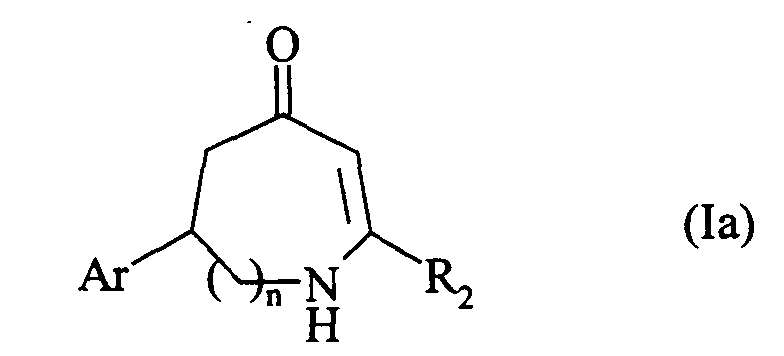
composé de formule (la) que l'on condense, si on le désire, avec un composé de formule R'1-Y, dans laquelle R'1 représente un groupement arylalkyle (C1-C6) linéaire ou ramifié, alkyle (C1-C6) linéaire ou ramifié, acyle (C1-C6) linéaire ou ramifié, alkoxycarbonyle (C1-C6) linéaire ou ramifié, arylalkoxycarbonyle (C1-C6) linéaire ou ramifié ou trifluoroacétyle et Y représente un groupe partant, pour conduire au composé de formule (Ib), cas particulier des composés de formule (I) :
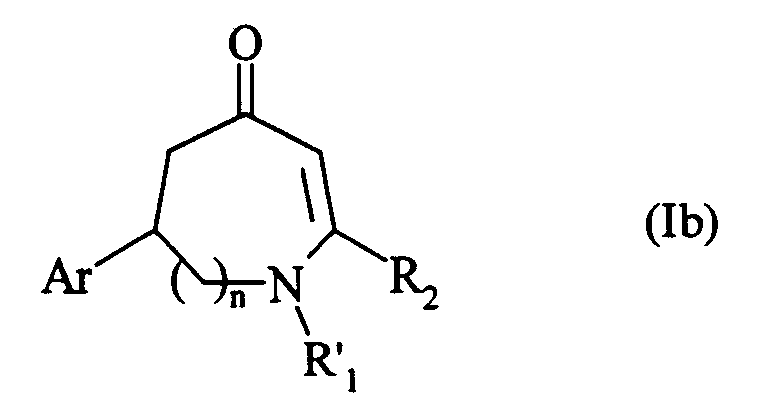
composé de formule (la) ou (Ib) que l'on transforme, si on le désire,
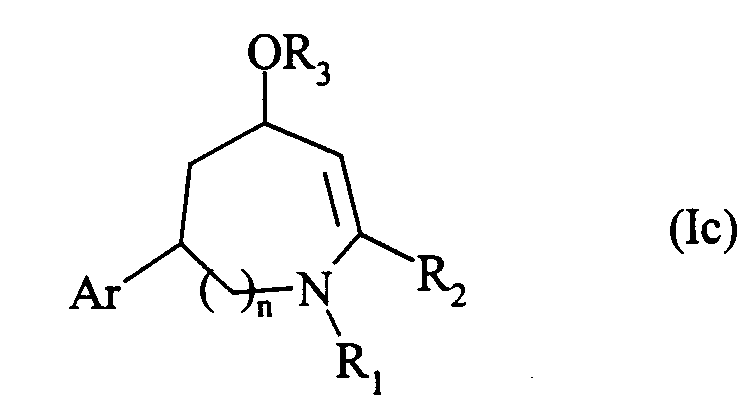
- soit par réduction partielle à l'aide d'un agent réducteur approprié, suivie, lorsqu'on le
souhaite, d'une alkylation, acylation ou estérification de la fonction hydroxy, pour
conduire au composé de formule (Ic), cas particulier des composés de formule (I) :
dans laquelle Ar, n et R2 ont la même signification que précédemment, et R1 et R3 ont la même signification que dans la formule (I),
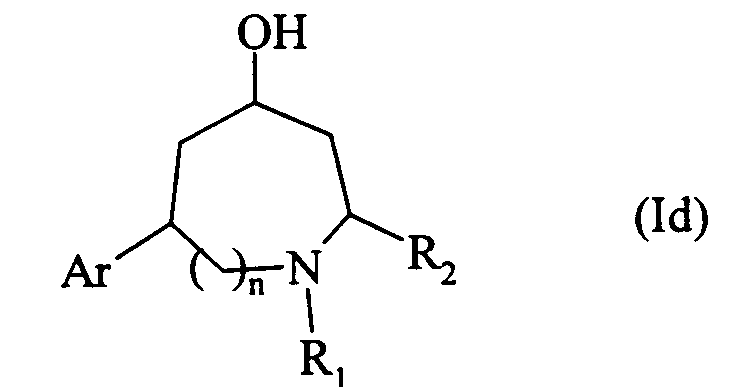
- soit par réduction totale à l'aide d'un agent réducteur approprié, pour conduire au
composé de formule (Id), cas particulier des composés de formule (I) :
dans laquelle Ar, n, R1 et R2 ont la même signification que précédemment,
composé de formule (Id) que l'on fait réagir, si on le souhaite,- soit avec un composé de formule R'3-Y dans laquelle R'3 représente un
groupement alkyle (C1-C6) linéaire ou ramifié, acyle (C1-C6) linéaire ou ramifié,
alkoxycarbonyle (C1-C6) linéaire ou ramifié ou arylalkoxycarbonyle (C1-C6)
linéaire ou ramifié et Y représente un groupe partant, pour conduire au composé
de formule (Ie), cas particulier des composés de formule (I) :
dans laquelle Ar, n, R1, R2 et R'3 ont la même signification que précédemment,

- soit en groupement oxo par une réaction d'oxydation à l'aide d'un agent oxydant
approprié, pour conduire au composé de formule (If), cas particulier des composés
de formule (I) :
dans laquelle Ar, n, R1 et R2 ont la même signification que précédemment,

- soit avec un composé de formule R'3-Y dans laquelle R'3 représente un
groupement alkyle (C1-C6) linéaire ou ramifié, acyle (C1-C6) linéaire ou ramifié,
alkoxycarbonyle (C1-C6) linéaire ou ramifié ou arylalkoxycarbonyle (C1-C6)
linéaire ou ramifié et Y représente un groupe partant, pour conduire au composé
de formule (Ie), cas particulier des composés de formule (I) :
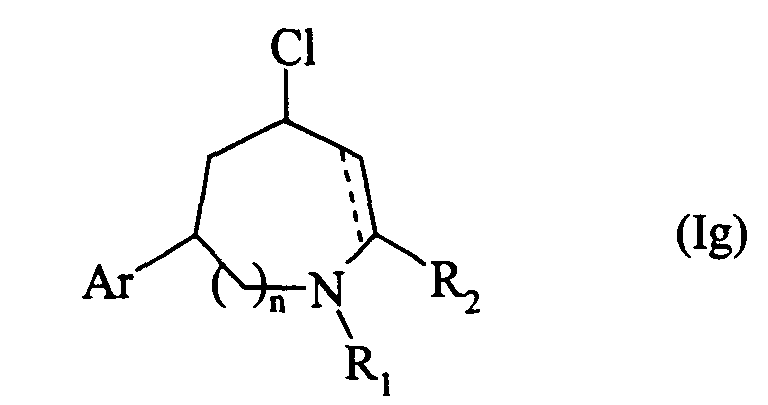
- soit avec un agent de chloration tel que, par exemple, le chlorure de thionyle, pour
conduire au composé de formule (Ig), cas particulier des composés de formule (I) :
dans laquelle Ar, n, R1 et R2 ont la même signification que précédemment, et ---- a la même signification que dans la formule (I),
que l'on met en réaction, lorsqu'on le souhaite, avec un composé de formule HSR4, dans laquelle R4 a la même signification que dans la formule (I), pour conduire au composé de formule (Ih), cas particulier des composés de formule (I) :dans laquelle Ar, n, R1, R2, R4 et ---- ont la même signification que dans la formule (I),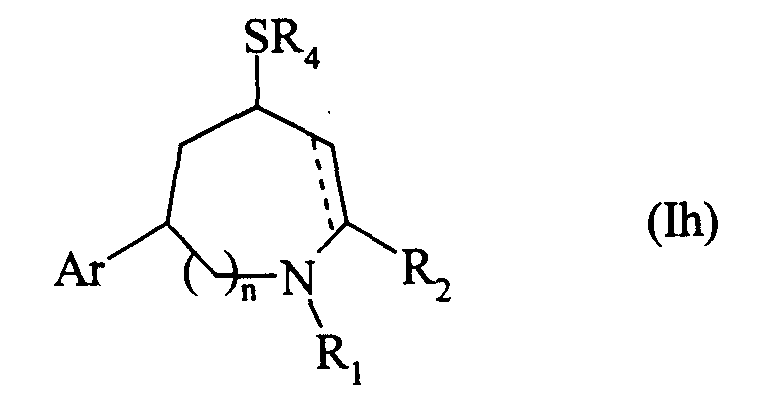
- soit avec un composé de formule H2N-OR5 dans laquelle R5 a la même signification que
dans la formule (I), pour conduire au composé de formule (Ii), cas particulier des
composés de formule (I) :
dans laquelle Ar, n, R1, R2, R5 et ---- ont la même signification que précédemment,

composés de formule (la), (Ib), (Ic), (Id), (Ie), (If), (Ig), (Ih) ou (Ii) qui constituent l'ensemble des composés de formule (I), que l'on purifie, le cas échéant, selon une technique classique de purification, dont on sépare, si on le souhaite, les isomères selon une technique classique de séparation, et que l'on transforme, si on le souhaite, en leurs sels d'addition à un acide pharmaceutiquement acceptable.
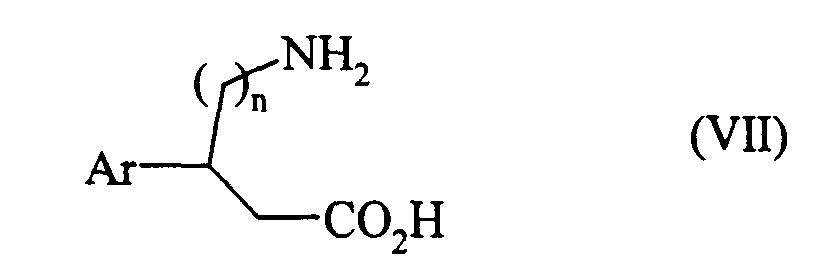
- lorsque n est égal à 0, selon le procédé décrit par W.M. Rodionow et E.Th. Malewinskaya dans Ber. 1926, 59, 2952 et T.B. Johnson, J.E. Livak dans J. Am. Chem. Soc. 1936, 58, 299
- lorsque n est égal à 1, selon le procédé décrit par Keberle dans le brevet CH 449046,
Bande NH3 + entre 3255 et 2500 cm-1
Bande CO à 1725 cm-1
| Microanalyse élémentaire : | |||
| %C | %H | %N | |
| calculé | 65,02 | 5,91 | 6,32 |
| trouvé | 64,89 | 6,02 | 6,25 |
| Microanalyse élémentaire : | |||
| %C | %H | %N | |
| calculé | 57,39 | 6,23 | 3,94 |
| trouvé | 57,82 | 6,21 | 3,78 |
| Microanalyse élémentaire : | |||
| %C | %H | %N | |
| calculé | 45,82 | 6,53 | 5,34 |
| trouvé | 45,54 | 6,62 | 5,41 |
| Microanalyse élémentaire : | |||
| %C | %H | %N | |
| calculé | 60,89 | 5,54 | 11,83 |
| trouvé | 60,95 | 5,62 | 11,15 |
| Microanalyse élémentaire : | |||
| %C | %H | %N | |
| calculé | 76,97 | 7,00 | 7,18 |
| trouvé | 76,69 | 7,11 | 7,39 |
| Microanalyse élémentaire : | |||
| %C | %H | %N | |
| calculé | 63,29 | 7,97 | 6,15 |
| trouvé | 62,95 | 8,09 | 5,99 |
| Microanalyse élémentaire : | |||
| %C | %H | %N | |
| calculé | 65,02 | 5,91 | 6,32 |
| trouvé | 65,20 | 5,93 | 6,32 |
| Microanalyse élémentaire : | |||
| %C | %H | %N | |
| calculé | 65,02 | 5,91 | 6,32 |
| trouvé | 64,90 | 5,92 | 6,31 |
| Microanalyse élémentaire : | |||
| %C | %H | %N | |
| calculé | 66,24 | 5,99 | 5,84 |
| trouvé | 66,25 | 5,84 | 6,17 |
| Microanalyse élémentaire : | |||
| %C | %H | %N | |
| calculé | 56,27 | 4,33 | 5,47 |
| trouvé | 56,27 | 4,33 | 5,45 |
| Microanalyse élémentaire : | |||
| %C | %H | %N | |
| calculé | 71,87 | 6,96 | 6,45 |
| trouvé | 71,82 | 6,66 | 6,72 |
| Microanalyse élémentaire : | |||
| % C | % H | % N | |
| calculé | 62,15 | 5,74 | 7,25 |
| trouvé | 62,30 | 5,81 | 7,08 |
| Microanalyse élémentaire : | |||
| %C | %H | %N | |
| calculé | 51,38 | 6,90 | 5,99 |
| trouvé | 51,16 | 7,01 | 5,79 |
| Microanalyse élémentaire : | |||
| %C | %H | %N | |
| calculé | 62,15 | 5,74 | 7,25 |
| trouvé | 62,27 | 5,82 | 7,20 |
| Microanalyse élémentaire : | |||
| %C | %H | %N | |
| calculé | 51,38 | 6,90 | 5,99 |
| trouvé | 51,26 | 6,81 | 5,81 |
| Microanalyse élémentaire : | |||
| % C | % H | % N | |
| calculé | 44,13 | 3,70 | 5,15 |
| trouvé | 44,01 | 3,78 | 5,06 |
| Microanalyse élémentaire : | |||
| %C | %H | %N | |
| calculé | 52,75 | 4,43 | 6,15 |
| trouvé | 52,52 | 4,49 | 6,01 |
| Microanalyse élémentaire : | |||
| %C | %H | %N | |
| calculé | 52,75 | 4,43 | 6,15 |
| trouvé | 52,52 | 4,49 | 6,01 |
| Microanalyse élémentaire : | |||
| %C | %H | %N | |
| calculé | 48,39 | 5,41 | 7,52 |
| trouvé | 48,26 | 5,46 | 7,55 |
| Exemple | Dose (mg/kg) | Inhibition (%) |
| 1 | 10 | 51 |
| 25 | 20 | 69 |
| 26 | 10 | 55 |
| 30 | 20 | 51 |
| Exemple | Dose (mg/kg) | T2-T1 (s) |
| 1 | 3 | -36 |
| 21 | 3 | -33 |
| 24 | 3 | -32 |
| 36 | 3 | -36 |
| Exemple | Dose (mg/kg) | Delta (s) | Voie |
| 1 | 0,3 | 7,5 | i.p. |
| 0,3 | 9,95 | p.o. | |
| 18 | 1 | 6,2 | p.o. |
| 22 | 0,3 | 9,98 | i.p. |
| 3 | 5,93 | p.o. | |
| 24 | 3 | 7,55 | i.p. |
| 27 | 3 | 6,68 | i.p. |
| Composé de l'exemple 1 | 10 g |
| Hydroxypropylcellulose | 2 g |
| Amidon de blé | 10 g |
| Lactose | 100 g |
| Stéarate de magnésium | 3 g |
| Talc | 3 g |
Claims (17)
- Composés de formule (I) :dans laquelle :
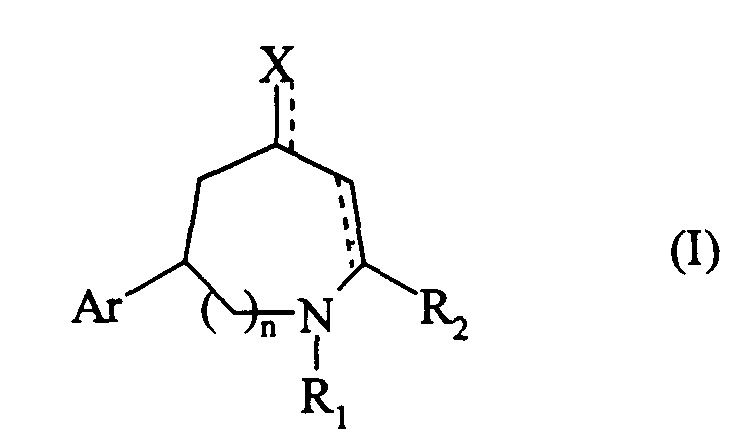 leurs isomères ainsi que leurs sels d'addition à un acide pharmaceutiquement acceptable,n représente 0 ou 1,
 R1 représente un atome d'hydrogène ou un groupement arylalkyle (C1-C6) linéaire ou ramifié, alkyle (C1-C6) linéaire ou ramifié, acyle (C1-C6) linéaire ou ramifié, alkoxycarbonyle (C1-C6) linéaire ou ramifié, arylalkoxycarbonyle (C1-C6) linéaire ou ramifié ou trifluoroacétyle,
 R2 représente un groupement alkyle (C1-C6) linéaire ou ramifié,
 X représente un atome d'oxygène, de chlore ou un groupement OR3, SR4 ou NOR5,
 R3 représente un atome d'hydrogène ou un groupement alkyle (C1-C6) linéaire ou ramifié, acyle (C1-C6) linéaire ou ramifié, alkoxycarbonyle (C1-C6) linéaire ou ramifié ou arylalkoxycarbonyle (C1-C6) linéaire ou ramifié,R4 représente un atome d'hydrogène ou un groupement alkyle (C1-C6) linéaire ou ramifié ou aryle,R5 représente un atome d'hydrogène ou un groupement alkyle (C1-C6) linéaire ou ramifié éventuellement substitué par un ou plusieurs groupements, identiques ou différents, choisis parmi hydroxy, amino (éventuellement substitué par un ou deux groupements alkyle (C1-C6) linéaire ou ramifié) et alkoxy (C1-C6) linéaire ou ramifié,---- représente une liaison simple ou double, étant entendu que la valence des atomes est respectée,
 Ar représente un groupement aryle ou un groupement hétéroaryle,
à la condition que les composés de formule (I) soient différents :étant entendu que par groupement aryle, on entend phényle, biphénylyle, naphtyle, tétrahydronaphtyle, chacun de ces groupements étant éventuellement substitué par un ou plusieurs groupements, identiques ou différents, choisis parmi halogène, alkyle (C1-C6) linéaire ou ramifié, hydroxy, alkoxy (C1-C6) linéaire ou ramifié, trihalogénométhyle, et amino (substitué éventuellement par un ou plusieurs groupements alkyle (C1-C6) linéaire ou ramifié).de la 6-méthyl-2-phényl-2,3-dihydro-4-pyridinone,de la 2-méthyl-6-phényl-4-pipéridinone,des N-benzyl-2-(R'2)-6-phényl-4-pipéridinones dans lesquelles R'2 représente le groupement méthyle, éthyle, propyle ou isopropyle,et des 2-(R''2)-6-phényl-4-pipéridinols dans lesquels R"2 représente le groupement isopropyle ou butyle,
et par groupement hétéroaryle, on entend un groupement aromatique mono- ou bicyclique de 5 à 12 chaínons contenant un, deux ou trois hétéroatomes choisis parmi oxygène, azote ou soufre étant entendu que l'hétéroaryle peut être éventuellement substitué par un ou plusieurs groupements, identiques ou différents, choisis parmi halogène, alkyle (C1-C6) linéaire ou ramifié, hydroxy, alkoxy (C1-C6) linéaire ou ramifié, trihalogénométhyle, et amino (substitué éventuellement par un ou plusieurs groupements alkyle (C1-C6) linéaire ou ramifié). - Composé de formule (I) selon la revendication 1 tel que n représente 0.
- Composé de formule (I) selon la revendication 1 tel que X représente un atome d'oxygène ou un groupement OR3 dans lequel R3 est tel que défini dans la revendication 1.
- Composé de formule (I) selon la revendication 1 tel que X représente un groupement NOR5 dans lequel R5 est tel que défini dans la revendication 1.
- Composé de formule (I) selon la revendication 1 tel que X représente un groupement SR4 dans lequel R4 est tel que défini dans la revendication 1.
- Composé de formule (I) selon la revendication 1 tel que X représente un atome de chlore.
- Composé de formule (I) selon la revendication 3 tel que X représente un atome d'oxygène ou un groupement OR3 dans lequel R3 représente un atome d'hydrogène.
- Composé de formule (I) selon l'une quelconque des revendications 1 à 7 tel que R1 représente un atome d'hydrogène.
- Composé de formule (I) selon l'une quelconque des revendications 1 à 8 tel que Ar représente le groupement phényle éventuellement substitué.
- Composé de formule (I) selon l'une quelconque des revendications 1 à 8 tel que Ar représente le groupement thiényle éventuellement substitué.
- Composé de formule (I) selon l'une quelconque des revendications 1 à 8 tel que Ar représente le groupement pyridyle éventuellement substitué.
- Composé de formule (I) selon la revendication 1 qui est la (±)-2-(3-chlorophényl)-6-méthyl-2,3-dihydro-4(1H)-pyridinone, ses isomères ainsi que ses sels d'addition à un acide pharmaceutiquement acceptable.
- Composé de formule (I) selon la revendication 1 qui est le (2R*,4S*,6R*)-2-phényl-6-méthyl-4-pipéridinol, ses isomères ainsi que ses sels d'addition à un acide pharmaceutiquement acceptable.
- Procédé de préparation des composés de formule (I) caractérisé en en ce que l'on met en réaction un composé de formule (II) :dans laquelle Ar et n ont la même signification que dans la formule (I),

avec du chlorure de thionyle, pour conduire au chlorure d'acide correspondant que l'on fait réagir avec un composé de formule (III) :dans laquelle R2 a la même signification que dans la formule (I),
en présence de triiodure de samarium,
pour conduire après déprotection par un acide HA au composé de formule (IV) :dans laquelle Ar, n et R2 ont la même signification que précédemment, et HA représente un acide donneur de proton,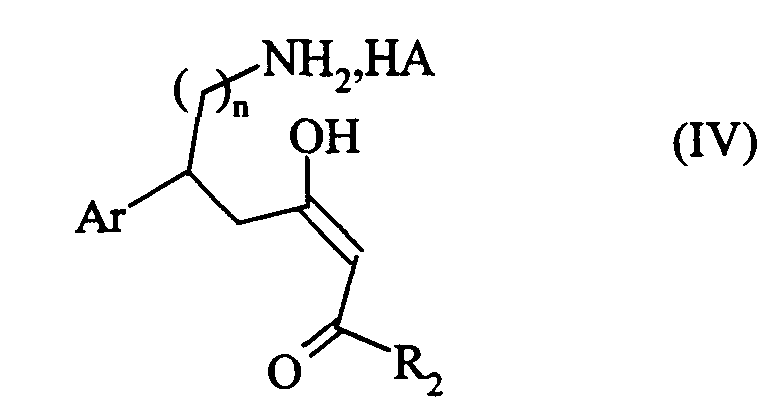
composé de formule (IV), que l'on fait ensuite réagir en milieu basique pour conduire au composé de formule (Ia), cas particulier des composés de formule (I) :dans laquelle Ar, n et R2 ont la même signification que précédemment,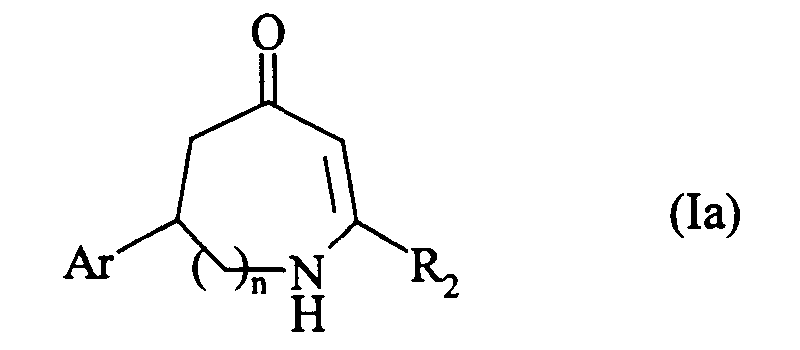
composé de formule (la) que l'on condense, si on le désire, avec un composé de formule R'1-Y, dans laquelle R'1 représente un groupement arylalkyle (C1-C6) linéaire ou ramifié, alkyle (C1-C6) linéaire ou ramifié, acyle (C1-C6) linéaire ou ramifié, alkoxycarbonyle (C1-C6) linéaire ou ramifié, arylalkoxycarbonyle (C1-C6) linéaire ou ramifié ou trifluoroacétyle et Y représente un groupe partant, pour conduire au composé de formule (Ib), cas particulier des composés de formule (I) :dans laquelle Ar, n, R'1 et R2 ont la même signification que précédemment,
composé de formule (la) ou (Ib) que l'on transforme, si on le désire,soit par réduction partielle à l'aide d'un agent réducteur approprié, suivie, lorsqu'on le souhaite, d'une alkylation, acylation ou estérification de la fonction hydroxy, pour conduire au composé de formule (Ic), cas particulier des composés de formule (I) :dans laquelle Ar, n et R2 ont la même signification que précédemment, et R1 et R3 ont la même signification que dans la formule (I),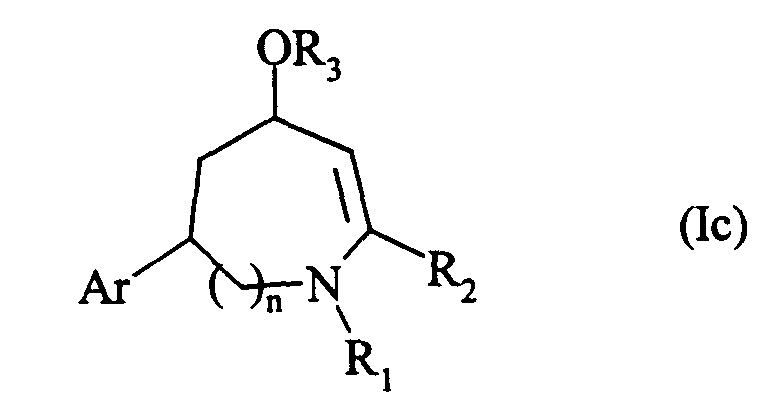 soit par réduction totale à l'aide d'un agent réducteur approprié, pour conduire au composé de formule (Id), cas particulier des composés de formule (I) :dans laquelle Ar, n, R1 et R2 ont la même signification que précédemment,
composé de formule (Id) que l'on fait réagir, si on le souhaite,composés de formule (la), (Ib) ou (If) que l'on fait réagir, lorsqu'on le souhaite,soit avec un composé de formule R'3-Y dans laquelle R'3 représente un groupement alkyle (C1-C6) linéaire ou ramifié, acyle (C1-C6) linéaire ou ramifié, alkoxycarbonyle (C1-C6) linéaire ou ramifié ou arylalkoxycarbonyle (C1-C6) linéaire ou ramifié et Y représente un groupe partant, pour conduire au composé de formule (le), cas particulier des composés de formule (I) :dans laquelle Ar, n, R1, R2 et R'3 ont la même signification que précédemment,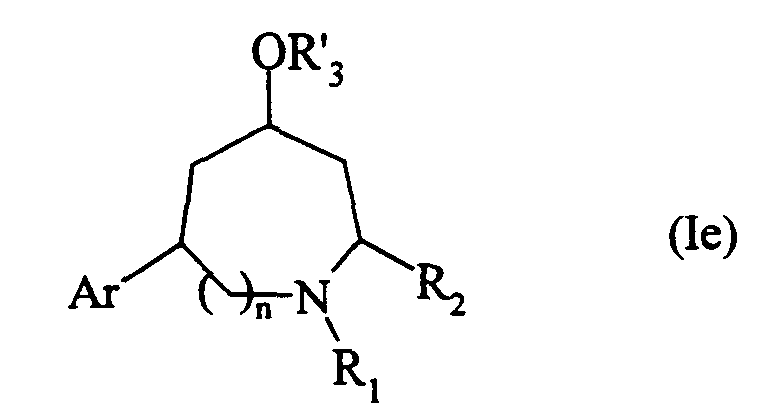 soit en groupement oxo par une réaction d'oxydation à l'aide d'un agent oxydant approprié, pour conduire au composé de formule (If), cas particulier des composés de formule (I) :dans laquelle Ar, n, R1 et R2 ont la même signification que précédemment,
 soit avec un agent de chloration tel que, par exemple, le chlorure de thionyle, pour conduire au composé de formule (Ig), cas particulier des composés de formule (I) :dans laquelle Ar, n, R1 et R2 ont la même signification que précédemment, et ---- a la même signification que dans la formule (I),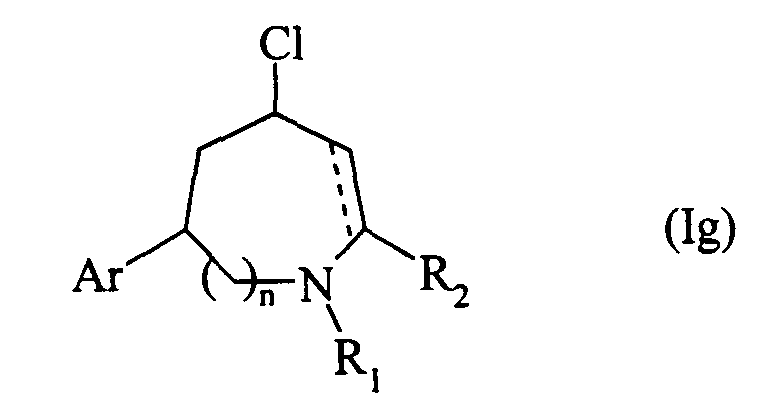
que l'on met en réaction, lorsqu'on le souhaite, avec un composé de formule HSR4, dans laquelle R4 a la même signification que dans la formule (I), pour conduire au composé de formule (Ih), cas particulier des composés de formule (I) :dans laquelle Ar, n, R1, R2, R4 et ---- ont la même signification que dans la formule (I), soit avec un composé de formule H2N-OR5 dans laquelle R5 a la même signification que dans la formule (I), pour conduire au composé de formule (Ii), cas particulier des composés de formule (I) :dans laquelle Ar, n, R1, R2, R5 et ---- ont la même signification que précédemment,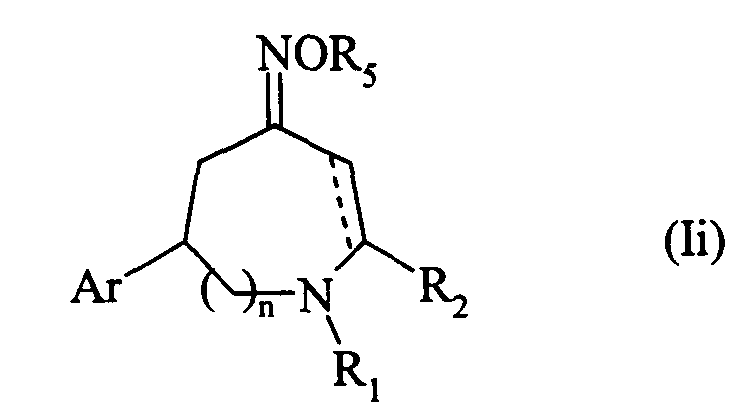
composés de formule (la), (Ib), (Ic), (Id), (le), (If), (Ig), (Ih) ou (Ii) qui constituent l'ensemble des composés de formule (I), que l'on purifie, le cas échéant, selon une technique classique de purification, dont on sépare, si on le souhaite, les isomères selon une technique classique de séparation, et que l'on transforme, si on le souhaite, en leurs sels d'addition à un acide pharmaceutiquement acceptable. - Composition pharmaceutique contenant comme principe actif un composé selon l'une quelconque des revendications 1 à 13, seul ou en combinaison avec un ou plusieurs véhicules inertes, non toxiques et pharmaceutiquement acceptables.
- Composition pharmaceutique selon la revendication 15 utile en tant que facilitateur mnémocognitif.
- Composition pharmaceutique selon la revendication 15 utile en tant qu'antalgique.
Priority Applications (1)
| Application Number | Priority Date | Filing Date | Title |
|---|---|---|---|
| SI200030240T SI1050530T1 (en) | 1999-05-03 | 2000-05-02 | 1-Aza-2-alkyl-6-aryl-cycloalkanes usefull as memory enhancers |
Applications Claiming Priority (2)
| Application Number | Priority Date | Filing Date | Title |
|---|---|---|---|
| FR9905600A FR2793246B1 (fr) | 1999-05-03 | 1999-05-03 | Nouveaux derives de 1-aza-2-alkyl-6-aryl-cycloalcanes, leur procede de preparation et les compositions pharmaceutiques qui les contiennent |
| FR9905600 | 1999-05-03 |
Publications (2)
| Publication Number | Publication Date |
|---|---|
| EP1050530A1 true EP1050530A1 (fr) | 2000-11-08 |
| EP1050530B1 EP1050530B1 (fr) | 2003-10-22 |
Family
ID=9545153
Family Applications (1)
| Application Number | Title | Priority Date | Filing Date |
|---|---|---|---|
| EP00401199A Expired - Lifetime EP1050530B1 (fr) | 1999-05-03 | 2000-05-02 | 1-Aza-2-Alkyl-6-Aryl-Cycloalcanes utiles pour améliorer la mémoire |
Country Status (23)
| Country | Link |
|---|---|
| US (2) | US6323222B1 (fr) |
| EP (1) | EP1050530B1 (fr) |
| JP (1) | JP3224376B2 (fr) |
| KR (1) | KR100438086B1 (fr) |
| CN (1) | CN1145612C (fr) |
| AT (1) | ATE252558T1 (fr) |
| AU (1) | AU763685B2 (fr) |
| BR (1) | BR0002076A (fr) |
| CA (1) | CA2308783C (fr) |
| DE (1) | DE60006029T2 (fr) |
| DK (1) | DK1050530T3 (fr) |
| EA (1) | EA002620B1 (fr) |
| ES (1) | ES2209777T3 (fr) |
| FR (1) | FR2793246B1 (fr) |
| HU (1) | HUP0001727A2 (fr) |
| MX (1) | MXPA00004157A (fr) |
| NO (1) | NO315850B1 (fr) |
| NZ (1) | NZ504299A (fr) |
| PL (1) | PL339966A1 (fr) |
| PT (1) | PT1050530E (fr) |
| SE (1) | SE1050530T5 (fr) |
| SI (1) | SI1050530T1 (fr) |
| ZA (1) | ZA200002151B (fr) |
Cited By (2)
| Publication number | Priority date | Publication date | Assignee | Title |
|---|---|---|---|---|
| US6451789B1 (en) * | 1999-05-03 | 2002-09-17 | Les Labortoires Servier | 1-aza-2-alky-6-aryl-cycloalkanes |
| FR2846654A1 (fr) * | 2002-11-05 | 2004-05-07 | Servier Lab | Nouveaux derives de la 2,3-dihydro-4(1h)-pyridinone, leur procede de preparation et les compositions pharmaceutiques qui les contiennent |
Families Citing this family (4)
| Publication number | Priority date | Publication date | Assignee | Title |
|---|---|---|---|---|
| DE602006019103D1 (de) * | 2005-08-12 | 2011-02-03 | Hoffmann La Roche | Fluorsubstituierte 2-oxo-azepan-derivate |
| CN102264701A (zh) * | 2008-12-23 | 2011-11-30 | 霍夫曼-拉罗奇有限公司 | 作为p2x7调节剂的二氢吡啶酮脲 |
| US8153808B2 (en) * | 2008-12-23 | 2012-04-10 | Roche Palo Alto Llc | Dihydropyridone amides as P2X7 modulators |
| US12612379B2 (en) | 2021-11-30 | 2026-04-28 | Vertex Pharmaceuticals Incorporated | Inhibitors of APOL1 and methods of using same |
Citations (1)
| Publication number | Priority date | Publication date | Assignee | Title |
|---|---|---|---|---|
| EP0119087A1 (fr) * | 1983-03-14 | 1984-09-19 | Pfizer Inc. | -2-(2-Hydroxy-phényl) pipéridines substitués en position 4 sur le noyau phényl |
Family Cites Families (3)
| Publication number | Priority date | Publication date | Assignee | Title |
|---|---|---|---|---|
| DE2013761A1 (en) * | 1970-03-21 | 1971-10-07 | Farbwerke Hoechst AG, vorm. Meister Lucius & Brüning, 6000 Frankfurt | 4-azacycloalk-2-enone prepn |
| DE3414830A1 (de) * | 1984-04-19 | 1985-10-31 | Hoechst Ag, 6230 Frankfurt | Verfahren und zwischenprodukte zur herstellung von (e)- und (z)-4-methoxy-2,2'-bipyridyl-6-aldoximen und ihre verwendung als arzneimittel |
| FR2793246B1 (fr) * | 1999-05-03 | 2001-06-29 | Adir | Nouveaux derives de 1-aza-2-alkyl-6-aryl-cycloalcanes, leur procede de preparation et les compositions pharmaceutiques qui les contiennent |
-
1999
- 1999-05-03 FR FR9905600A patent/FR2793246B1/fr not_active Expired - Fee Related
-
2000
- 2000-04-27 EA EA200000373A patent/EA002620B1/ru not_active IP Right Cessation
- 2000-04-27 JP JP2000127382A patent/JP3224376B2/ja not_active Expired - Fee Related
- 2000-04-28 MX MXPA00004157A patent/MXPA00004157A/es active IP Right Grant
- 2000-04-28 PL PL00339966A patent/PL339966A1/xx not_active Application Discontinuation
- 2000-04-30 CN CNB001181580A patent/CN1145612C/zh not_active Expired - Fee Related
- 2000-05-02 DE DE60006029T patent/DE60006029T2/de not_active Expired - Fee Related
- 2000-05-02 NO NO20002315A patent/NO315850B1/no not_active Application Discontinuation
- 2000-05-02 EP EP00401199A patent/EP1050530B1/fr not_active Expired - Lifetime
- 2000-05-02 ES ES00401199T patent/ES2209777T3/es not_active Expired - Lifetime
- 2000-05-02 DK DK00401199T patent/DK1050530T3/da active
- 2000-05-02 NZ NZ504299A patent/NZ504299A/xx unknown
- 2000-05-02 SI SI200030240T patent/SI1050530T1/xx unknown
- 2000-05-02 SE SE00401199T patent/SE1050530T5/xx unknown
- 2000-05-02 AT AT00401199T patent/ATE252558T1/de not_active IP Right Cessation
- 2000-05-02 PT PT00401199T patent/PT1050530E/pt unknown
- 2000-05-02 US US09/561,646 patent/US6323222B1/en not_active Expired - Fee Related
- 2000-05-03 CA CA002308783A patent/CA2308783C/fr not_active Expired - Fee Related
- 2000-05-03 ZA ZA200002151A patent/ZA200002151B/xx unknown
- 2000-05-03 AU AU31324/00A patent/AU763685B2/en not_active Ceased
- 2000-05-03 HU HU0001727A patent/HUP0001727A2/hu unknown
- 2000-05-03 KR KR10-2000-0023668A patent/KR100438086B1/ko not_active Expired - Fee Related
- 2000-05-03 BR BR0002076-1A patent/BR0002076A/pt not_active IP Right Cessation
-
2001
- 2001-09-26 US US09/964,085 patent/US6451789B1/en not_active Expired - Fee Related
Patent Citations (1)
| Publication number | Priority date | Publication date | Assignee | Title |
|---|---|---|---|---|
| EP0119087A1 (fr) * | 1983-03-14 | 1984-09-19 | Pfizer Inc. | -2-(2-Hydroxy-phényl) pipéridines substitués en position 4 sur le noyau phényl |
Non-Patent Citations (1)
| Title |
|---|
| STÉPHANE CIBLAT ET AL.: "A practical asymmetric synthesis of 2,6-cis-disubstituted piperidines", TETRAHEDRON: ASYMMETRY., vol. 10, - 4 June 1999 (1999-06-04), ELSEVIER SCIENCE PUBLISHERS, AMSTERDAM., NL, pages 2225 - 2235, XP002128793, ISSN: 0957-4166 * |
Cited By (3)
| Publication number | Priority date | Publication date | Assignee | Title |
|---|---|---|---|---|
| US6451789B1 (en) * | 1999-05-03 | 2002-09-17 | Les Labortoires Servier | 1-aza-2-alky-6-aryl-cycloalkanes |
| FR2846654A1 (fr) * | 2002-11-05 | 2004-05-07 | Servier Lab | Nouveaux derives de la 2,3-dihydro-4(1h)-pyridinone, leur procede de preparation et les compositions pharmaceutiques qui les contiennent |
| WO2004043952A1 (fr) * | 2002-11-05 | 2004-05-27 | Les Laboratoires Servier | Nouveaux derives de 2,3-dihydro-4(1h)-pyridinones, leur procede de preparation et les compositions pharmaceutiques qui les contiennent |
Also Published As
Similar Documents
| Publication | Publication Date | Title |
|---|---|---|
| EP0946546B1 (fr) | Derives de la pyridin-2-yl-methylamine, leur procede de preparation et leur application comme medicaments | |
| EP0837848A1 (fr) | 4-aryl-1-phenylalkyl-1,2,3,6-tetrahydropyridines ayant une activite neurotrophique et neuroprotectrice | |
| FR2663934A1 (fr) | Nouveaux derives de l'acide 4 - amino butyrique, leur procede de preparation et les preparations pharmaceutiques qui les contiennent. | |
| EP0005689B1 (fr) | Nouveaux acides lactame-N-acétiques et leurs amides, leurs procédés de préparation et compositions thérapeutiques | |
| US6995179B2 (en) | Dihydropyridine derivative | |
| LU81923A1 (fr) | 1,2,4,5-tetra-alkyl-4-arylpiperidines,leur utilisation therapeutique,leur preparation et les intermediaires appropries | |
| EP1050530B1 (fr) | 1-Aza-2-Alkyl-6-Aryl-Cycloalcanes utiles pour améliorer la mémoire | |
| EP1050531B1 (fr) | Composés pyridiniques ou pipéridiniques substitués pour le traitement des maladies neurodégénératives | |
| EP1438291B1 (fr) | Aralkyl-tetrahydro-pyridines, leur preparation et compositions pharmaceutiques les contenant | |
| FR2846654A1 (fr) | Nouveaux derives de la 2,3-dihydro-4(1h)-pyridinone, leur procede de preparation et les compositions pharmaceutiques qui les contiennent | |
| EP1275644A1 (fr) | Nouveaux dérivés de benzène sulfonamide, leur procédé de préparation et les compositions pharmaceutiques qui les contiennent | |
| WO1998025913A1 (fr) | Nouveaux derives [3h]-benzoxazole-2-thiones et [3h]-benzothiazole-2-thiones substitues, leur procede de preparation et les compositions pharmaceutiques qui les contiennent | |
| EP0412898A1 (fr) | Nouveaux dérivés d'oxazolo pyridines, leur procédé de préparation et les compositions pharmaceutiques qui les contiennent | |
| FR2948368A1 (fr) | Nouveaux composes piperidiniques, leur procede de preparation et les compositions pharmaceutiques qui les contiennent | |
| FR2807754A1 (fr) | Nouveaux derives de cyclobuta-indole carboxamide, leur procede de preparation et les compositions pharmaceutiques qui les contiennent | |
| FR2722193A1 (fr) | Derives n-oxydes de 1-(7-chloro-4-quinoleinyl)pyrazole-3-carboxamides substitues, procede pour leur preparation et les compositions pharmaceitiques les contenant | |
| FR2832405A1 (fr) | Tetrahydropyridyl-alkyl-heterocycles azotes, procede pour leur preparation et compositions pharmaceutiques les contenant | |
| FR2493314A1 (fr) | Derives de 5-(o-aminoacyl)-3-carbalcoxyamino-10,11-dihydro-5h-dibenzo (b, f) azepine, leur procede de preparation et leur application therapeutique |
Legal Events
| Date | Code | Title | Description |
|---|---|---|---|
| PUAI | Public reference made under article 153(3) epc to a published international application that has entered the european phase |
Free format text: ORIGINAL CODE: 0009012 |
|
| 17P | Request for examination filed |
Effective date: 20000512 |
|
| AK | Designated contracting states |
Kind code of ref document: A1 Designated state(s): AT BE CH CY DE DK ES FI FR GB GR IE IT LI LU MC NL PT SE |
|
| AX | Request for extension of the european patent |
Free format text: AL PAYMENT 20000512;LT PAYMENT 20000512;LV PAYMENT 20000512;MK PAYMENT 20000512;RO PAYMENT 20000512;SI PAYMENT 20000512 |
|
| AKX | Designation fees paid |
Free format text: AT BE CH CY DE DK ES FI FR GB GR IE IT LI LU MC NL PT SE |
|
| AXX | Extension fees paid |
Free format text: AL PAYMENT 20000512;LT PAYMENT 20000512;LV PAYMENT 20000512;MK PAYMENT 20000512;RO PAYMENT 20000512;SI PAYMENT 20000512 |
|
| 17Q | First examination report despatched |
Effective date: 20010726 |
|
| RAP1 | Party data changed (applicant data changed or rights of an application transferred) |
Owner name: LES LABORATOIRES SERVIER |
|
| GRAH | Despatch of communication of intention to grant a patent |
Free format text: ORIGINAL CODE: EPIDOS IGRA |
|
| GRAS | Grant fee paid |
Free format text: ORIGINAL CODE: EPIDOSNIGR3 |
|
| GRAA | (expected) grant |
Free format text: ORIGINAL CODE: 0009210 |
|
| AK | Designated contracting states |
Kind code of ref document: B1 Designated state(s): AT BE CH CY DE DK ES FI FR GB GR IE IT LI LU MC NL PT SE |
|
| AX | Request for extension of the european patent |
Extension state: AL LT LV MK RO SI |
|
| REG | Reference to a national code |
Ref country code: GB Ref legal event code: FG4D Free format text: NOT ENGLISH |
|
| REG | Reference to a national code |
Ref country code: CH Ref legal event code: EP |
|
| REG | Reference to a national code |
Ref country code: CH Ref legal event code: NV Representative=s name: A. BRAUN, BRAUN, HERITIER, ESCHMANN AG PATENTANWAE |
|
| REG | Reference to a national code |
Ref country code: IE Ref legal event code: FG4D Free format text: FRENCH |
|
| REF | Corresponds to: |
Ref document number: 60006029 Country of ref document: DE Date of ref document: 20031127 Kind code of ref document: P |
|
| REG | Reference to a national code |
Ref country code: GR Ref legal event code: EP Ref document number: 20030405066 Country of ref document: GR |
|
| REG | Reference to a national code |
Ref country code: SE Ref legal event code: TRGR |
|
| GBT | Gb: translation of ep patent filed (gb section 77(6)(a)/1977) |
Effective date: 20040204 |
|
| REG | Reference to a national code |
Ref country code: DK Ref legal event code: T3 |
|
| REG | Reference to a national code |
Ref country code: SE Ref legal event code: RPOT |
|
| REG | Reference to a national code |
Ref country code: ES Ref legal event code: FG2A Ref document number: 2209777 Country of ref document: ES Kind code of ref document: T3 |
|
| PLBE | No opposition filed within time limit |
Free format text: ORIGINAL CODE: 0009261 |
|
| STAA | Information on the status of an ep patent application or granted ep patent |
Free format text: STATUS: NO OPPOSITION FILED WITHIN TIME LIMIT |
|
| 26N | No opposition filed |
Effective date: 20040723 |
|
| REG | Reference to a national code |
Ref country code: SI Ref legal event code: IF |
|
| PGFP | Annual fee paid to national office [announced via postgrant information from national office to epo] |
Ref country code: FR Payment date: 20050518 Year of fee payment: 6 |
|
| PGFP | Annual fee paid to national office [announced via postgrant information from national office to epo] |
Ref country code: PT Payment date: 20060306 Year of fee payment: 7 |
|
| PGFP | Annual fee paid to national office [announced via postgrant information from national office to epo] |
Ref country code: AT Payment date: 20060307 Year of fee payment: 7 |
|
| PGFP | Annual fee paid to national office [announced via postgrant information from national office to epo] |
Ref country code: GR Payment date: 20060313 Year of fee payment: 7 |
|
| PGFP | Annual fee paid to national office [announced via postgrant information from national office to epo] |
Ref country code: BE Payment date: 20060403 Year of fee payment: 7 |
|
| PGFP | Annual fee paid to national office [announced via postgrant information from national office to epo] |
Ref country code: CY Payment date: 20060412 Year of fee payment: 7 Ref country code: IE Payment date: 20060412 Year of fee payment: 7 |
|
| PGFP | Annual fee paid to national office [announced via postgrant information from national office to epo] |
Ref country code: MC Payment date: 20060413 Year of fee payment: 7 |
|
| PGFP | Annual fee paid to national office [announced via postgrant information from national office to epo] |
Ref country code: GB Payment date: 20060426 Year of fee payment: 7 |
|
| PGFP | Annual fee paid to national office [announced via postgrant information from national office to epo] |
Ref country code: LU Payment date: 20060511 Year of fee payment: 7 |
|
| PGFP | Annual fee paid to national office [announced via postgrant information from national office to epo] |
Ref country code: SE Payment date: 20060512 Year of fee payment: 7 |
|
| PGFP | Annual fee paid to national office [announced via postgrant information from national office to epo] |
Ref country code: FI Payment date: 20060519 Year of fee payment: 7 |
|
| PGFP | Annual fee paid to national office [announced via postgrant information from national office to epo] |
Ref country code: DK Payment date: 20060526 Year of fee payment: 7 |
|
| PGFP | Annual fee paid to national office [announced via postgrant information from national office to epo] |
Ref country code: NL Payment date: 20060530 Year of fee payment: 7 |
|
| PGFP | Annual fee paid to national office [announced via postgrant information from national office to epo] |
Ref country code: DE Payment date: 20060531 Year of fee payment: 7 Ref country code: IT Payment date: 20060531 Year of fee payment: 7 |
|
| PGFP | Annual fee paid to national office [announced via postgrant information from national office to epo] |
Ref country code: CH Payment date: 20060607 Year of fee payment: 7 |
|
| PGFP | Annual fee paid to national office [announced via postgrant information from national office to epo] |
Ref country code: ES Payment date: 20060623 Year of fee payment: 7 |
|
| REG | Reference to a national code |
Ref country code: FR Ref legal event code: ST Effective date: 20070131 |
|
| REG | Reference to a national code |
Ref country code: PT Ref legal event code: MM4A Free format text: LAPSE DUE TO NON-PAYMENT OF FEES Effective date: 20071102 |
|
| LTLA | Lt: lapse of european patent or patent extension |
Effective date: 20070502 |
|
| BERE | Be: lapsed |
Owner name: LES LABORATOIRES *SERVIER Effective date: 20070531 |
|
| EUG | Se: european patent has lapsed | ||
| REG | Reference to a national code |
Ref country code: CH Ref legal event code: PL |
|
| REG | Reference to a national code |
Ref country code: DK Ref legal event code: EBP |
|
| GBPC | Gb: european patent ceased through non-payment of renewal fee |
Effective date: 20070502 |
|
| PG25 | Lapsed in a contracting state [announced via postgrant information from national office to epo] |
Ref country code: PT Free format text: LAPSE BECAUSE OF NON-PAYMENT OF DUE FEES Effective date: 20071102 Ref country code: MC Free format text: LAPSE BECAUSE OF NON-PAYMENT OF DUE FEES Effective date: 20070531 Ref country code: FI Free format text: LAPSE BECAUSE OF NON-PAYMENT OF DUE FEES Effective date: 20070502 Ref country code: NL Free format text: LAPSE BECAUSE OF NON-PAYMENT OF DUE FEES Effective date: 20071201 |
|
| NLV4 | Nl: lapsed or anulled due to non-payment of the annual fee |
Effective date: 20071201 |
|
| REG | Reference to a national code |
Ref country code: IE Ref legal event code: MM4A |
|
| PG25 | Lapsed in a contracting state [announced via postgrant information from national office to epo] |
Ref country code: AT Free format text: LAPSE BECAUSE OF NON-PAYMENT OF DUE FEES Effective date: 20070502 Ref country code: CH Free format text: LAPSE BECAUSE OF NON-PAYMENT OF DUE FEES Effective date: 20070531 Ref country code: LI Free format text: LAPSE BECAUSE OF NON-PAYMENT OF DUE FEES Effective date: 20070531 |
|
| REG | Reference to a national code |
Ref country code: SI Ref legal event code: KO00 Effective date: 20071211 |
|
| PG25 | Lapsed in a contracting state [announced via postgrant information from national office to epo] |
Ref country code: BE Free format text: LAPSE BECAUSE OF NON-PAYMENT OF DUE FEES Effective date: 20070531 |
|
| PG25 | Lapsed in a contracting state [announced via postgrant information from national office to epo] |
Ref country code: DK Free format text: LAPSE BECAUSE OF NON-PAYMENT OF DUE FEES Effective date: 20070531 Ref country code: FR Free format text: LAPSE BECAUSE OF NON-PAYMENT OF DUE FEES Effective date: 20060531 Ref country code: DE Free format text: LAPSE BECAUSE OF NON-PAYMENT OF DUE FEES Effective date: 20071201 |
|
| PG25 | Lapsed in a contracting state [announced via postgrant information from national office to epo] |
Ref country code: CY Free format text: LAPSE BECAUSE OF NON-PAYMENT OF DUE FEES Effective date: 20070502 Ref country code: IE Free format text: LAPSE BECAUSE OF NON-PAYMENT OF DUE FEES Effective date: 20070502 Ref country code: GB Free format text: LAPSE BECAUSE OF NON-PAYMENT OF DUE FEES Effective date: 20070502 |
|
| PG25 | Lapsed in a contracting state [announced via postgrant information from national office to epo] |
Ref country code: SE Free format text: LAPSE BECAUSE OF NON-PAYMENT OF DUE FEES Effective date: 20070503 |
|
| REG | Reference to a national code |
Ref country code: ES Ref legal event code: FD2A Effective date: 20070503 |
|
| PG25 | Lapsed in a contracting state [announced via postgrant information from national office to epo] |
Ref country code: ES Free format text: LAPSE BECAUSE OF NON-PAYMENT OF DUE FEES Effective date: 20070503 Ref country code: GR Free format text: LAPSE BECAUSE OF NON-PAYMENT OF DUE FEES Effective date: 20071204 |
|
| PG25 | Lapsed in a contracting state [announced via postgrant information from national office to epo] |
Ref country code: LU Free format text: LAPSE BECAUSE OF NON-PAYMENT OF DUE FEES Effective date: 20070502 |
|
| PG25 | Lapsed in a contracting state [announced via postgrant information from national office to epo] |
Ref country code: IT Free format text: LAPSE BECAUSE OF NON-PAYMENT OF DUE FEES Effective date: 20070502 |