EP1031981A2 - Transmission de données - Google Patents
Transmission de données Download PDFInfo
- Publication number
- EP1031981A2 EP1031981A2 EP00301511A EP00301511A EP1031981A2 EP 1031981 A2 EP1031981 A2 EP 1031981A2 EP 00301511 A EP00301511 A EP 00301511A EP 00301511 A EP00301511 A EP 00301511A EP 1031981 A2 EP1031981 A2 EP 1031981A2
- Authority
- EP
- European Patent Office
- Prior art keywords
- data
- sample data
- sample
- sampling frequency
- time stamp
- Prior art date
- Legal status (The legal status is an assumption and is not a legal conclusion. Google has not performed a legal analysis and makes no representation as to the accuracy of the status listed.)
- Withdrawn
Links
Images

Classifications
-
- G—PHYSICS
- G11—INFORMATION STORAGE
- G11B—INFORMATION STORAGE BASED ON RELATIVE MOVEMENT BETWEEN RECORD CARRIER AND TRANSDUCER
- G11B20/00—Signal processing not specific to the method of recording or reproducing; Circuits therefor
- G11B20/10—Digital recording or reproducing
-
- H—ELECTRICITY
- H04—ELECTRIC COMMUNICATION TECHNIQUE
- H04L—TRANSMISSION OF DIGITAL INFORMATION, e.g. TELEGRAPHIC COMMUNICATION
- H04L12/00—Data switching networks
- H04L12/28—Data switching networks characterised by path configuration, e.g. LAN [Local Area Networks] or WAN [Wide Area Networks]
- H04L12/40—Bus networks
- H04L12/40052—High-speed IEEE 1394 serial bus
- H04L12/40058—Isochronous transmission
-
- G—PHYSICS
- G11—INFORMATION STORAGE
- G11B—INFORMATION STORAGE BASED ON RELATIVE MOVEMENT BETWEEN RECORD CARRIER AND TRANSDUCER
- G11B27/00—Editing; Indexing; Addressing; Timing or synchronising; Monitoring; Measuring tape travel
- G11B27/10—Indexing; Addressing; Timing or synchronising; Measuring tape travel
- G11B27/19—Indexing; Addressing; Timing or synchronising; Measuring tape travel by using information detectable on the record carrier
- G11B27/28—Indexing; Addressing; Timing or synchronising; Measuring tape travel by using information detectable on the record carrier by using information signals recorded by the same method as the main recording
- G11B27/30—Indexing; Addressing; Timing or synchronising; Measuring tape travel by using information detectable on the record carrier by using information signals recorded by the same method as the main recording on the same track as the main recording
- G11B27/3027—Indexing; Addressing; Timing or synchronising; Measuring tape travel by using information detectable on the record carrier by using information signals recorded by the same method as the main recording on the same track as the main recording used signal is digitally coded
-
- H—ELECTRICITY
- H04—ELECTRIC COMMUNICATION TECHNIQUE
- H04L—TRANSMISSION OF DIGITAL INFORMATION, e.g. TELEGRAPHIC COMMUNICATION
- H04L12/00—Data switching networks
- H04L12/28—Data switching networks characterised by path configuration, e.g. LAN [Local Area Networks] or WAN [Wide Area Networks]
- H04L12/40—Bus networks
- H04L12/40052—High-speed IEEE 1394 serial bus
- H04L12/40071—Packet processing; Packet format
-
- H—ELECTRICITY
- H04—ELECTRIC COMMUNICATION TECHNIQUE
- H04L—TRANSMISSION OF DIGITAL INFORMATION, e.g. TELEGRAPHIC COMMUNICATION
- H04L12/00—Data switching networks
- H04L12/28—Data switching networks characterised by path configuration, e.g. LAN [Local Area Networks] or WAN [Wide Area Networks]
- H04L12/40—Bus networks
- H04L12/40052—High-speed IEEE 1394 serial bus
- H04L12/40117—Interconnection of audio or video/imaging devices
-
- G—PHYSICS
- G11—INFORMATION STORAGE
- G11B—INFORMATION STORAGE BASED ON RELATIVE MOVEMENT BETWEEN RECORD CARRIER AND TRANSDUCER
- G11B20/00—Signal processing not specific to the method of recording or reproducing; Circuits therefor
- G11B20/10—Digital recording or reproducing
- G11B20/10527—Audio or video recording; Data buffering arrangements
-
- G—PHYSICS
- G11—INFORMATION STORAGE
- G11B—INFORMATION STORAGE BASED ON RELATIVE MOVEMENT BETWEEN RECORD CARRIER AND TRANSDUCER
- G11B20/00—Signal processing not specific to the method of recording or reproducing; Circuits therefor
- G11B20/10—Digital recording or reproducing
- G11B20/10527—Audio or video recording; Data buffering arrangements
- G11B2020/10537—Audio or video recording
- G11B2020/10592—Audio or video recording specifically adapted for recording or reproducing multichannel signals
-
- G—PHYSICS
- G11—INFORMATION STORAGE
- G11B—INFORMATION STORAGE BASED ON RELATIVE MOVEMENT BETWEEN RECORD CARRIER AND TRANSDUCER
- G11B2220/00—Record carriers by type
- G11B2220/20—Disc-shaped record carriers
- G11B2220/25—Disc-shaped record carriers characterised in that the disc is based on a specific recording technology
- G11B2220/2537—Optical discs
- G11B2220/2562—DVDs [digital versatile discs]; Digital video discs; MMCDs; HDCDs
Definitions
- the present invention relates to a sample data transmitting method, a sample data receiving method, and a sample data transmission method as well as its transmitting apparatus, its receiving apparatus, and its transmission apparatus suited for use to reproduce DVD audio to which is applied, for example, DVD-ROM (Read-Only-Memory). Particularly, it is intended that a plurality of data sampled at different sampling frequencies can effectively be transmitted in a predetermined transmission format.
- a DVD audio to which DVD-ROM is applied has been developed. Then, in such DVD audio, by taking advantage of the fact that a recording capacity of the DVD-ROM is extremely large, an attempt has been carried out to record a multi-channel and high quality sound signal with a sampling frequency set at 96kHz for example.
- a total of four channels are recorded by providing 2 channels of sample data for example, with a sampling frequency of 96kHz and the number of quantized bits of 24 bits for a main acoustic signal as well as 2 channels of sample data with a sampling frequency of 48kHz and the number of quantized bits of 16 bits for a sub-acoustic signal such as a so-called surround and the like.
- the conventional one has been made for example, to D/A-convert a digitally reproduced signal within the apparatus to take out as an analog acoustic signal and supply it to another amplifier and the like.
- an originally digitized signal is advantageously transmitted as it is against signal deterioration during transmission.
- busfrom transmission paths the number of laid-on transmission paths can be reduced.
- a format regulated by lEEE1394 is used for example.
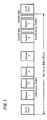
- a synchronizing signal (cycle start) is generated from, for example, reference apparatus at a constant cycle (125 ⁇ s)as shown in FIG. 6.
- an arbitrary number of signal channels (1 to n) called an isochronous (synchronous) packet are provided.
- the isochronous packet has a structure, e.g. as shown in A of FIG. 7.
- a value (data length) indicating a length of the subsequent area.
- a value (tag) showing a format of the packet
- a value (channel) showing a channel number
- a value (tcode) to identify the packet
- a value (sy) used for synchronization and so on.
- the first row of the isochronous packet is made a header area wherein information on various kinds of controls is provided. Further, in the second row is provided an error correcting code (header CRC) for data on the above-mentioned header area in the first row. Then, in and after the third row of the isochronous packet is provided data on a digital acoustic signal to be transmitted and the like over the range shown in the above-mentioned value (data length). Also, in the last row of the packet is provided an error correcting code (data CRC) for data transmitted in and after the third row.
- head CRC error correcting code
- a section for transmitting such as control information and the like called an asynchronous (nonsynchronous) packet is provided in a remaining period after the isochronous packet (the minimum amount is secured) between on the above synchronizing signals (cycle start). Then, in accordance with control information transmitted via the asynchronous packet, transmission of the digital acoustic signal and the like is carried out between arbitrary apparatuses using some channel of the above-mentioned asynchronous packet.
- B of FIG. 7 is shown a structure of the asynchronous packet where controlling information (data) of, for example, one quadlet is written into a desired memory or register of the arbitrary apparatus.
- the first row of the packet is one quadlet and for the first half 2 bytes in the first row is provided an identifying code of a destination (addressee) apparatus (destination ID). Also, for the first half 2 bytes in the second row is provided an identifying code of a sending apparatus (source ID). Meanwhile, these identifying codes are beforehand set for each of apparatuses for example, at a time of constructing a system.
- addresses of a memory of the destination and the like destination offset.
- Data of 4 bytes to be written is provided in the fourth row.
- error correcting codes (header CRC) for each of data in the first to fourth rows.
- C of FIG. 7 is shown a structure of the synchronizing signal (cycle start).
- the synchronizing signal is also transmitted with the structure of the asynchronous packet.
- the first and third rows of this packet are the same as those of another asynchronous packet.
- all apparatuses are designated by the destination identifying code in the first half 2 bytes in the first row.
- the sender identifying code of the first half 2 bytes in the second row provides that of the reference apparatus.
- a cycle time code (a value of a timer register provided in the reference apparatus).
- an error correcting code (header CRC) for each of data in the first to fourth rows.
- a bus line to connect between, for example, the above-mentioned DVD player or the like and the acoustic apparatus of other digital formats or the like.
- mutual control is carried out between these apparatuses using the control information transmitted by way of the above-mentioned asynchronous packet.
- This control enables mutual transmission of data such as an arbitrary digital acoustic signal and the like by using some channel of the above-mentioned asynchronous packet between these apparatuses.
- a sampling frequency of a digital acoustic signal is such that one frequency is determined corresponding to a signal of one system. Therefore, when there are a main acoustic signal at, a sampling frequency of 96kHz and a sub-acoustic signal at a sampling frequency of 48kHz as the above-mentioned DVD audio recording signal, it has been impossible to transmit these signals collectively (en bloc) on the conventional format.
- the present invention is such that, for sample data at different sampling frequencies, data generated during one of the sampling periods is collected together to form a data block and at the same time, data of the number of sample data generated during the sampling period is added thereto. This makes it possible to transmit en bloc signals at different sampling frequencies as well as to easily reconstruct and restore these sample data.
- the first embodiment according to the present invention is a sample data transmitting method of transmitting a first sample data sampled at a first sampling frequency and a second sample data sampled at a second sampling frequency higher than the first sampling frequency, in which the transmission is carried out by collecting together the first and second sample data generated during a sampling period of the first sampling frequency into a data block and by adding data of the number corresponding to the number of sample data generated during the sampling period of the first sampling frequency to the second sample data.
- the transmission is carried out by collecting together the first and second sample data generated during a sampling period of the first sampling frequency into a data block and by adding data of the number corresponding to the number of sample data generated during the sampling period of the first sampling frequency to the second sample data.
- the second embodiment according to the present invention is a sample data receiving method of receiving a transmitted signal comprising a first sample data sampled at a first sampling frequency and a second sample data sampled at a second sampling frequency higher than the first sampling frequency, and in which the first and second sample data generated during a sampling period of the first sampling frequency are collected together to form a data block, and data of the number corresponding to the number of sample data generated during the sampling period of the first sampling frequency is added to the second sample data.
- the reception is carried out by forming a first clock signal of the first sampling frequency as well as forming a second clock signal of the second sampling frequency from the first clock signal and at the same time, discriminating of the number data corresponding to the number of sample data, added to the second sample data, generated during the sampling period of the first sampling frequency, for reconstructing a data sequence of the second sample data.
- the third embodiment according to the present invention is a sample data transmission method of transmitting a first sample data sampled by a first sampling frequency and a second sample data sampled by a second sampling frequency higher than the first sampling frequency, in which: the transmission side collects together that the first and second sample data generated during a sampling period of the first sampling frequency to form a data block and adds data of the number corresponding to the number of sample data generated during the sampling period of the first sampling frequency to the second sample data; for transmission and the receiving side forms a first clock signal of the first sampling frequency as well as forms a second clock signal of the second sampling frequency by multiplying the first clock signal and at the same time, discriminates data of the number corresponding to the number of sample data, added to the second sample data, which are generated during the sampling period of the first sampling frequency to reconstruct the second sample data for reception.
- the transmission side collects together that the first and second sample data generated during a sampling period of the first sampling frequency to form a data block and adds data of the number corresponding to the number of sample data generated during the sampling
- the fourth embodiment according to the present invention is a sample data transmitting apparatus for transmitting a first sample data sampled at a first sampling frequency and a second sample data sampled at a second sampling frequency higher than the first sampling frequency, comprising means for forming en bloc the first and second sample data generated during a sampling period of the first sampling frequency into a data block and means for adding data of the number corresponding to the number of sample data generated during the sampling period of the first sampling frequency to the second sample data.
- the fifth embodiment according to the present invention is a sample data receiving apparatus for receiving a transmitted signal comprising a first sample data sampled by the first sampling frequency and a second sample data sampled by a second sampling frequency higher than the first sampling frequency, and in which: the first and second sample data generated during a sampling period of the first sampling frequency are formed collectively into a data block; and data of the number corresponding to the number of sample data generated during the sampling period of the first sampling frequency is added to the second sample data.
- It comprises means for forming a first clock signal of the first sampling frequency, means for forming a second clock signal of the second sampling frequency from the first clock signal, and means for discriminating data of the number corresponding to the number of the sample data generated during the sampling period of the first sampling frequency, which are added to the second sample data, to reconstruct the data sequence of the second sample data for reception.
- the sixth embodiment according to the present invention is a sample data transmission apparatus for transmitting a first sample data sampled at a first sampling frequency and a second sample data sampled at a second sampling frequency higher than the first sampling frequency, comprising: means to collect together the first and second sample data generated during a sampling period of the first sampling frequency to form a data block, means for adding data of the number corresponding to the number of sample data generated during the sampling period of the first sampling frequency to the second sample data for transmission; and means for forming a first clock signal of the first sampling frequency as well as forming a second clock signal of the second sampling frequency by multiplying the first clock signal and discriminating data of the number corresponding to the number of sample data, added to the second sample data, generated during the sampling period of the first sampling frequency to reconstruct the second sample data for reception.
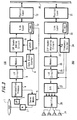
- FIG. 1 is a block diagram showing the whole structure of a system to which the sample data transmitting method, receiving method, transmission method, and its transmitting apparatus, receiving apparatus, transmission apparatus according to the present invention are applied.
- a dikc 1 as a recording medium of a digitized acoustic signal such as DVD audio and the like to which, for example, a DVD-ROM (Read-Only-Memory) is applied.
- This disc 1 is rotated by a motor 2 and from a recording surface of the rotated disc 1 is derived a recorded signal through an optical pickup 3. Then, the derived signal is supplied to a reproduction processing apparatus 4 and a digital acoustic signal according to a format of the above-mentioned DVD audio is reproduced.
- a total of 4 channels comprising 2 channels for sample data with the sampling frequency of 96kHz and the quantized bit number of 24 bits for, for example, a main acoustic signal and 2 channels for sample data with the sampling frequency of 48kHz and the quantized bit number of 16 bits for, for example, a sub-acoustic signal such as surround or the like are recorded and these recorded digital acoustic signals are reproduced.
- a synchronizing signal detected together with the acoustic signal in the above-mentioned reproduction processing apparatus 4 is supplied to a servo means 5 for driving the motor 2.
- the above-mentioned synchronizing signal is compared with a reference clock signal from, for example, an interior timer described below in the servo means 5 and in order for these timing to have predetermined relations, revolution of the motor 2 is servo-controlled.
- the disc 1 connected to the motor 2 is rotated at a predetermined revolution speed for reproducing, for example, the digitized acoustic signal.
- the digitized acoustic signal reproduced by the above-mentioned reproduction processing apparatus 4 is supplied to a memory 7 through an interface (I/F) circuit 6. Then, in the memory 7, for example, a total of 6 sample data comprising 4 pieces of sample data for 2 channels ⁇ 2 samplings, a sampling frequency of 96kHz and the quantized bit number of 24 bits and 2 pieces of sample data for 2 channels, a sampling frequency of 48kHz and the quantized bit number of 16 bits are formed into one data block.
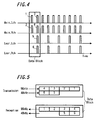
- the sample data of a left channel (Main, Lch) and a right channel (Main, Rch) of the main acoustic signal are formed by a sampling frequency of 96kHz and the sample data of a left channel (Rear, Lch) and a right channel (Rear, Rch) of the sub-acoustic signal are formed by a sampling frequency of 48kHz.
- the sample data of the main acoustic signal are formed twice that of the sub-acoustic signal.
- 6 pieces of the sample data being a sum of a total of 4 pieces (1, 2, 3, 4) of respective 2 pieces of the left channel and the right channel of the main acoustic signal and a total of 2 pieces (5, 6) of each one piece of the left channel and the right channel of the sub-acoustic signal are combined, for example, in order of illustrated numbers to form one data block.
- the thus formed data blocks are inputted in the memory 7.
- the memory 7 is made to have a so-called first-infirst-out structure, wherein the inputted data blocks are outputted in the inputted order at predetermined timing.
- the outputted datablocks are supplied to a CIP heaeder adding circuit 8 described below.
- the number of the data blocks inputted in the above-mentioned memory 7 is counted by a block counter 9.
- the counted value from the data block counter 9 and a reference time from a cycle timer provided at a link layer 10 for, e.g. a serial bus according to IEEE1394 described below are both supplied to a latch circuit 11. Then, a reference time from the cycle timer at a time when, for example, the 3 low order digits of the counted value (binary numeral) of the above-mentioned data block counter 9 becomes [000] is latched and the latched reference time is supplied to the header adding circuit 8.
- headers provided, for example, in the third and fourth rows of the above-mentioned isochronous packet are formed as described below and the data block is provided as follows.
- the isochronous packet is formed in a constant cycle (125 ⁇ s). Therefore, a plurality of the data blocks generated during the cycle (125 ⁇ s). are provided in one isochronous packet.
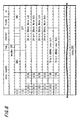
- FIG. 4 the structure of the isochronous packet formed is shown in FIG. 4.
- Prescribed headers formed in the link layer 10 described below are provided in the first and second rows of the isochronous packet. Then, in the third and fourth rows following the first and second rows are provided the header describing about the data block transmitted on this packet.
- DBS counted value
- DRC next counted value
- a value [10] In the first 2 bits in the fourth row of the isochronous packet is provided a value [10]. In the last half 2 bytes in the fourth row is provided a reference time (time stamp data) value (SYT) from the cycle timer latched by the above-mentioned latch circuit 11. Meanwhile, in the blank portions in the figure are provided other control data and the like, but since they have nothing to do with the application of the present invention, its description is omitted. In this manner, the predetermined CIP (Common lsochronous Packet) header is provided in the third and fourth rows of the ischronous packet.
- CIP Common lsochronous Packet
- the above-mentioned data blocks After the fifth row of the isochronous packet are provided the above-mentioned data blocks.
- these 6 pieces (rows) of sample data are made into one data block, and a plurality of the data blocks generated during the above-mentioned cycle (125 ⁇ s) are successively provided.
- the fifth row is provided the first sample data of the left channel of the main acoustic signal of, for example, a sampling frequency of 96kHz, the quantized bit number of 24 bits (24-bit 96kHz, Main, Lch). Then, in the first 2 bits in the fifth row is provided a value [11] showing, for example, DVD audio and at the fourth bit is provided a flag [1] showing that the following sample data is data sampled by a twofold sampling frequency. Further, at the seventh and eighth bits is provided a value [00] showing that the quantized bit number of the succeeding sample data is 24 bits.
- the eighth row is provided the second sample data of the right channel of the main acoustic signal of a sampling frequency of 96kHz, the quantized bit number of 24 bits (24-bit, 96kHz, Main, Rch).
- a sample data of the left channel of the sub-acoustic signal of, for example, a sampling frequency of 48kHz, the quantized bit number of 16 bits (16-bit, 48kHz, Rear, Lch).
- a value [11] showing, for example, DVD audio
- a flag [0] showing that the succeeding sample data is data sampled by a basic sampling frequency.
- a value [10] showing that the quantized bit number of the succeeding sample data is 16 bits.
- a sample data of the right channel of the sub-acoustic signal of, for example, a sampling frequency of 48kHz, the quantized number of 16 bits (16-bit, 48kHz, Rear, Rch). Then, these 6 pieces (rows) of sample data are made into one data block and a plurality of the data blocks generated during the above-mentioned cycle (125 ⁇ s) are successively provided. In addition, although succeeding data blocks are omitted, rows of the same form are repeated. Further, in the last row of the packet is provided an error correction code (data CRC) for data transmitted on and after the third row.
- data CRC error correction code
- Data on and after the third row of the thus formed isochronous packet is supplied from adding the above-mentioned CIP header circuit 8 to the link layer 10 for the serial bus of the IEE1394. Then, in the link layer 10 is generated the prescribed isochronous packet header which is provided in the first and second rows of the isochronous packet. That is to say, in the first half 2 bytes in the first row of the packet is provided a value (data length) showing a length of subsequent data area.
- data such as a value (tag) showing a format of the packet, a value (channel) showing a predetermined channel number, a value (tcode) for identifying the packet, and a value (sy) used for synchronization to form the prescribed header.
- a value (tag9 showing a format of the packet is provided a value indicating that CIP header is included in the subsequent data.
- an error correction code (header CRC) for the header area data in the above-mentioned first row.
- the isochronous packet is formed in this manner.
- the thus formed isochronous packet is further supplied from the above-mentioned link layer 10 to a physical layer 12 for a serial bus of the IEEE1394. Then, from the physical layer 12 is carried out transmission to the serial bus 20 at predetermined timing in accordance with a synchronizing signal (cycle start) and the like transmitted on, for example, the IEEE1394 serial bus 20.
- the isochronous packet transmitted to the serial bus 20 is supplied to a link layer 22 through, for example, a physical layer 21 of a receiving apparatus 200 and a necessary packet is received by discriminating the above-mentioned value (channel) showing a channel number for example. Then, the received isochronous packet is supplied from the link layer 22 to a CIP header analyzing circuit 23 of and an analysis of the header provided, for example, in the third and fourth rows of the isochronous packet is carried out.
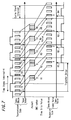
- the reference time from the cycle timer at a time for example, when the low three order digits of the counted value (binary numeral) of the data block counter 9 becomes [000] is latched, and the latched reference time is transmitted as a value (SYT) of the CIP header.
- the counted value (DBS) of the data block counter 9 at a time when the first data block to be included in the isochronous packet is formed and the next counted value (DBC) of the data block counter 9 when the last data block is formed are transferred on the CIP header.
- date blocks generated at a previous cycle start interval are collected to form the isochronous packet at each cycle start interval shown wholly by vertical lines.
- the counted value (DSB) of data block counter 9 when the first data block is formed among them and the next counted value (DBS) of the data block counter 9 when the last data block is formed are transmitted on the CIP header.
- the counted value (DBC) transmitted on a previously received isochronous packet is the counted value of the data block counter 9 when the first data block of an isochronous packet currently received is formed, and a data block when the two lower order digits of the counted value become [00] after starting count from this counted value (DBC) becomes a diagonally shaded data block corresponding to the reference time (time stamp data) at intervals of four pieces of data blocks.
- a clock signal at intervals (48kHz) wherein the above-mentioned data block is formed and a 96kHz clock signal which doubles this clock signal can be formed.
- PLL phase lock
- the data blocks derived from the CIP header analyzing circuit 23 are supplied to a memory 25 which is made a first-in first-out (FIFO) structure. Then the data blocks corresponding to, for example, the above-mentioned reference time (time stamp data) cen be taken out of the memory 25 at timing of the reference time by an interface (I/F) circuit 26 which is timing controlled by the above-mentioned clock signals of 48kHz and 96kHz. The subsequent data blocks thereto can be taken out sequentially in synchronism with the clock signals.
- I/F interface
- a D/A converting circuit 27 These digital acoustic signals are further supplied to a D/A converting circuit 27, respectively.
- the sample data of a sampling frequency of 48kHz can be put into analog data by a D/A converter of 96 kHz by using the same value twice at a time by, for example, holding a previous value.
- the sample data of the quantized bit number of 16 bits can be put into analog data by a 24 bit D/A converter which makes its value high order. Then the above-mentioned D/A converting circuit 27 can now be implemented by using, for example, the 24 bit and 96kHz D/A converter.
- the acoustic signals D/A converted by the D/A converting circuit 27 are supplied to a speakers group 4 through an output amplifier 28. Consequently, digital acoustic signals derived from a recording medium (disc 1) of DVD audio or the like including: left and right channels of a main acoustic signal of, for example, a sampling frequency of 96kHz and the quantized bit number of 24 bits; and of left and right channels of the sub-acoustic signal of sampling frequency of 48kHz and the quantized bit number of 16 bits are transmitted through, for example, IEEE1394 serial bus 20 and emitted from the speakers group 24.
- the number of sample data included in 1 data block on the side of the higher sampling frequency can be made a multiple of the number of sample data by the lower frequency, thus making it possible to easily form the data block.
- the relation between these sampling frequencies can be determined optionally.
- the receiving side by adding time stamp data indicating a reference time at every prescribed number of data blocks for transmission, the receiving side can easily achieve synchronization of data blocks and easily generate a clock signal and the like for D/A conversion by using the data blocks.
- the synchronization of data blocks by the time stamp data can be further facilitated. Additionally, by shifting the time stamp data beforehand in view of a time required for a transmission processing, the synchronization of data blocks by the time stamp data can be still more facilitated.
- the number of sample data included in one data block on the side of the higher sampling frequency can be made a multiple of the number of sample data by of the lower sampling frequency, thus making it possible to easily form the data block.
- the receiving side by adding time stamp data indicating a reference time at every prescribed number of data blocks for transmission, the receiving side can easily achieve synchronization of data blocks and easily further out occurrence of a clock signal and the like for D/A conversion by using the data blocks.
- the number of data included in 1 data block on the side of the higher sampling frequency can be made a multiple of the number of sample data by the lower sampling frequency, thus making it possible to easily form the data block.
- the receiving side can easily achieve synchronization of data blocks and further, easily generate of a clock signal and the like for D/A conversion by using the data blocks.
- the number of sample data included in one data block by the higher sampling frequency can be made a multiple of the number of sample data by the lower sampling frequency, thus making it possible to easily form the data block.
- the receiving side by adding time stamp data indicating a reference time at every prescribed number of data blocks, the receiving side can easily achieve synchronization of data blocks and further easily generate of a clock signal and the like for D/A conversion by using the data blocks,.
- the number of sample data included in one data block by the higher sampling frequency can be made a multiple of the number of sample data by the lower sampling frequency, thus making it possible to easily form the data block.
- the receiving side can easily achieve synchronization of data blocks and further easily generate of a clock signal and the like for D/A conversion by using the data blocks.
- the number of sample data included in 1 data block on the side of the higher frequency can be made multiple-times the number of data on the side of the lower frequency, thereby making it possible to easily form a data block.
- the receiving side can easily obtain synchronization of data blocks and by further using the data blocks, further easily generate of a clock signal and the like for D/A conversion.
- the number of sample data included in one data block by the higher sampling frequency can be made a multiple of the number of sample data by the lower frequency, thus making it possible to easily form the data block.
- the receiving side can easily achieve synchronization of data blocks and, easily generate of a clock signal and the like for D/A conversion by using the data blocks.
- the number of sample data included in one data block at the higher sampling frequency can be made a multiple of the number of sample data on the side of the lower sampling frequency, thus making it possible to easily form the data block.
- the receiving side can easily achieve synchronization of data blocks and further easily generate of a clock signal and the like for D/A conversion by using the data blocks.
- the number of sample data included in one data at the higher sampling frequency can be made a multiple of the number of sample data at the lower sampling frequency, thus making it possible to easily form the data block.
- the receiving side can easily achieve synchronization of data blocks and further easily generate of a clock signal and the like for D/A conversion by using the data blocks.
Landscapes
- Engineering & Computer Science (AREA)
- Signal Processing (AREA)
- Computer Networks & Wireless Communication (AREA)
- Multimedia (AREA)
- Signal Processing For Digital Recording And Reproducing (AREA)
- Synchronisation In Digital Transmission Systems (AREA)
- Communication Control (AREA)
- Small-Scale Networks (AREA)
Applications Claiming Priority (2)
| Application Number | Priority Date | Filing Date | Title |
|---|---|---|---|
| JP4869899 | 1999-02-25 | ||
| JP11048698A JP2000253091A (ja) | 1999-02-25 | 1999-02-25 | サンプルデータの送信方法、受信方法、伝送方法、及びその送信装置、受信装置、伝送装置 |
Publications (2)
| Publication Number | Publication Date |
|---|---|
| EP1031981A2 true EP1031981A2 (fr) | 2000-08-30 |
| EP1031981A3 EP1031981A3 (fr) | 2001-11-07 |
Family
ID=12810540
Family Applications (1)
| Application Number | Title | Priority Date | Filing Date |
|---|---|---|---|
| EP00301511A Withdrawn EP1031981A3 (fr) | 1999-02-25 | 2000-02-25 | Transmission de données |
Country Status (6)
| Country | Link |
|---|---|
| US (1) | US6807233B1 (fr) |
| EP (1) | EP1031981A3 (fr) |
| JP (1) | JP2000253091A (fr) |
| KR (1) | KR20000058184A (fr) |
| CN (1) | CN1216479C (fr) |
| TW (1) | TW462171B (fr) |
Cited By (2)
| Publication number | Priority date | Publication date | Assignee | Title |
|---|---|---|---|---|
| EP1407552A4 (fr) * | 2001-05-24 | 2004-08-18 | Cirrus Logic Inc | Appareil et procede de conversion numerique-analogique multivoies de signaux presentant differentes frequences d'echantillonnage |
| CN111046632A (zh) * | 2019-11-29 | 2020-04-21 | 智器云南京信息科技有限公司 | 一种数据提取转换方法、系统、存储介质及电子设备 |
Families Citing this family (3)
| Publication number | Priority date | Publication date | Assignee | Title |
|---|---|---|---|---|
| KR100574938B1 (ko) * | 2003-02-20 | 2006-04-28 | 삼성전자주식회사 | 고속 직렬 링크에서 데이터 복원시 에러 발생을감소시키는 데이터 복원장치 및 그 복원방법 |
| JP4301270B2 (ja) * | 2006-09-07 | 2009-07-22 | ヤマハ株式会社 | オーディオ再生装置およびオーディオ再生方法 |
| JP5488317B2 (ja) * | 2010-08-04 | 2014-05-14 | 富士通株式会社 | 監視システム、装置、監視方法及び監視プログラム |
Family Cites Families (10)
| Publication number | Priority date | Publication date | Assignee | Title |
|---|---|---|---|---|
| DE4223477C2 (de) | 1992-07-16 | 2000-03-02 | Siemens Ag | Verfahren und Anordnung zum Durchschalten von Datensignalen unterschiedlicher Datenrate über ein Zeitkoppelfeld |
| JP3630441B2 (ja) * | 1992-12-21 | 2005-03-16 | ソニー株式会社 | 送信方法、受信方法、通信方法、双方向バスシステム及び電子機器 |
| DE69531012T2 (de) * | 1994-03-09 | 2004-05-19 | Matsushita Electric Industrial Co., Ltd., Kadoma | Datenübertragungssystem und Verfahren |
| JP3203978B2 (ja) * | 1994-07-25 | 2001-09-04 | ソニー株式会社 | データ送受信装置、データ受信装置及びデータ送信装置 |
| US5933430A (en) | 1995-08-12 | 1999-08-03 | Sony Corporation | Data communication method |
| JPH1065718A (ja) * | 1996-08-23 | 1998-03-06 | Sony Corp | データ伝送方法及び装置 |
| JPH10190705A (ja) | 1996-10-22 | 1998-07-21 | Sony Corp | 伝送装置および方法、並びに、受信装置および方法 |
| JPH10224424A (ja) * | 1997-02-12 | 1998-08-21 | Matsushita Electric Ind Co Ltd | データ送信装置、データ受信装置、及び媒体 |
| SG71113A1 (en) | 1997-05-05 | 2000-04-18 | Wea Mfg Inc | Synchronizing audio signal samples taken at different sampling raters |
| US6636474B1 (en) | 1997-07-16 | 2003-10-21 | Victor Company Of Japan, Ltd. | Recording medium and audio-signal processing apparatus |
-
1999
- 1999-02-25 JP JP11048698A patent/JP2000253091A/ja active Pending
-
2000
- 2000-02-24 US US09/512,044 patent/US6807233B1/en not_active Expired - Fee Related
- 2000-02-24 TW TW089103279A patent/TW462171B/zh not_active IP Right Cessation
- 2000-02-24 KR KR1020000009149A patent/KR20000058184A/ko not_active Abandoned
- 2000-02-25 EP EP00301511A patent/EP1031981A3/fr not_active Withdrawn
- 2000-02-25 CN CN001178539A patent/CN1216479C/zh not_active Expired - Fee Related
Cited By (3)
| Publication number | Priority date | Publication date | Assignee | Title |
|---|---|---|---|---|
| EP1407552A4 (fr) * | 2001-05-24 | 2004-08-18 | Cirrus Logic Inc | Appareil et procede de conversion numerique-analogique multivoies de signaux presentant differentes frequences d'echantillonnage |
| CN111046632A (zh) * | 2019-11-29 | 2020-04-21 | 智器云南京信息科技有限公司 | 一种数据提取转换方法、系统、存储介质及电子设备 |
| CN111046632B (zh) * | 2019-11-29 | 2023-11-10 | 智器云南京信息科技有限公司 | 一种数据提取转换方法、系统、存储介质及电子设备 |
Also Published As
| Publication number | Publication date |
|---|---|
| CN1216479C (zh) | 2005-08-24 |
| US6807233B1 (en) | 2004-10-19 |
| KR20000058184A (ko) | 2000-09-25 |
| TW462171B (en) | 2001-11-01 |
| EP1031981A3 (fr) | 2001-11-07 |
| CN1272015A (zh) | 2000-11-01 |
| JP2000253091A (ja) | 2000-09-14 |
Similar Documents
| Publication | Publication Date | Title |
|---|---|---|
| JP2725257B2 (ja) | ディジタル記録装置 | |
| EP1087557A2 (fr) | Dispositif pour la transmission de données de son numérique ainsi que dispositif pour la réception de ces données de son numérique | |
| EP0312405A2 (fr) | Système pour le codage d'enregistrements sonores pour l'enregistrement à haute densité et pour la transmission à haute vitesse | |
| WO2000072600A2 (fr) | Procede pour convertir un flot de signaux d'informations paquetise en un flot de signaux d'informations avec des marques d'horodatage et vice versa | |
| JP2000512115A (ja) | データ転送システム、送信機及び受信機 | |
| JP3684986B2 (ja) | オーディオ受信装置 | |
| US6807233B1 (en) | Sample data transmitting method, receiving method, transmission/reception method and its transmission apparatus, reception apparatus, transmission/reception apparatus | |
| EP0338812B1 (fr) | Appareil et procédé pour l'enregistrement/reproduction sur bande magnétique de signaux vidéo numériques et de signaux audio numériques correspondants | |
| JPS631664B2 (fr) | ||
| EP1648140B1 (fr) | Système de communication et procédé en transmission de données audio ou musicales | |
| US5493547A (en) | Recording eight digital audio channels on a single magneto optical disk | |
| EP1067770B1 (fr) | Méthode d'enregistrement de flux de transport de données | |
| JP4101361B2 (ja) | 音声データ送受信装置および音声データ送受信システム | |
| JPH06326967A (ja) | データ伝送方法 | |
| JP4419899B2 (ja) | オーディオ送信装置 | |
| JP3135523B2 (ja) | パルス符号変調されたディジタルオーディオ信号の記録及び再生のためのシステム | |
| KR0138329B1 (ko) | 디지탈신호처리시스템에 있어서 인터페이스방법 및 장치 | |
| JP2767795B2 (ja) | ディジタルインターフェース | |
| JP3351385B2 (ja) | シリアルデータ送受信方法及び装置 | |
| JPH02148466A (ja) | 磁気テープ記録/再生装置 | |
| JPS6149741B2 (fr) | ||
| JPS601940A (ja) | データ列伝送システム | |
| JP2002232426A (ja) | データ送信装置、データ受信装置、データ送信方法、データ受信方法、伝送システム | |
| JP2576953B2 (ja) | デイスク再生装置 | |
| JPS60214490A (ja) | デイジタル信号記録再生装置の編集方法 |
Legal Events
| Date | Code | Title | Description |
|---|---|---|---|
| PUAI | Public reference made under article 153(3) epc to a published international application that has entered the european phase |
Free format text: ORIGINAL CODE: 0009012 |
|
| AK | Designated contracting states |
Kind code of ref document: A2 Designated state(s): DE FR GB Kind code of ref document: A2 Designated state(s): AT BE CH CY DE DK ES FI FR GB GR IE IT LI LU MC NL PT SE |
|
| AX | Request for extension of the european patent |
Free format text: AL;LT;LV;MK;RO;SI |
|
| PUAL | Search report despatched |
Free format text: ORIGINAL CODE: 0009013 |
|
| AK | Designated contracting states |
Kind code of ref document: A3 Designated state(s): AT BE CH CY DE DK ES FI FR GB GR IE IT LI LU MC NL PT SE |
|
| AX | Request for extension of the european patent |
Free format text: AL;LT;LV;MK;RO;SI |
|
| 17P | Request for examination filed |
Effective date: 20020408 |
|
| AKX | Designation fees paid |
Free format text: DE FR GB |
|
| 17Q | First examination report despatched |
Effective date: 20020718 |
|
| STAA | Information on the status of an ep patent application or granted ep patent |
Free format text: STATUS: THE APPLICATION IS DEEMED TO BE WITHDRAWN |
|
| 18D | Application deemed to be withdrawn |
Effective date: 20030129 |