EP0989124B1 - Benzotriazolrest enthaltende Polyesterverbindungen und Verfahren zu deren Herstellung - Google Patents
Benzotriazolrest enthaltende Polyesterverbindungen und Verfahren zu deren Herstellung Download PDFInfo
- Publication number
- EP0989124B1 EP0989124B1 EP19980402368 EP98402368A EP0989124B1 EP 0989124 B1 EP0989124 B1 EP 0989124B1 EP 19980402368 EP19980402368 EP 19980402368 EP 98402368 A EP98402368 A EP 98402368A EP 0989124 B1 EP0989124 B1 EP 0989124B1
- Authority
- EP
- European Patent Office
- Prior art keywords
- ultraviolet
- rays
- compound
- resin
- weight
- Prior art date
- Legal status (The legal status is an assumption and is not a legal conclusion. Google has not performed a legal analysis and makes no representation as to the accuracy of the status listed.)
- Expired - Lifetime
Links
- 150000001875 compounds Chemical class 0.000 title claims description 112
- 125000003354 benzotriazolyl group Chemical group N1N=NC2=C1C=CC=C2* 0.000 title claims description 17
- 229920000728 polyester Polymers 0.000 title claims description 16
- 238000002360 preparation method Methods 0.000 title description 4
- 230000002745 absorbent Effects 0.000 claims description 102
- 239000002250 absorbent Substances 0.000 claims description 102
- -1 lactone compound Chemical class 0.000 claims description 39
- 229920005989 resin Polymers 0.000 claims description 36
- 239000011347 resin Substances 0.000 claims description 36
- 229920003002 synthetic resin Polymers 0.000 claims description 25
- 239000000057 synthetic resin Substances 0.000 claims description 25
- 125000004432 carbon atom Chemical group C* 0.000 claims description 14
- 239000004793 Polystyrene Substances 0.000 claims description 13
- 229920002223 polystyrene Polymers 0.000 claims description 13
- 238000000034 method Methods 0.000 claims description 12
- 229920000915 polyvinyl chloride Polymers 0.000 claims description 12
- 229920001328 Polyvinylidene chloride Polymers 0.000 claims description 11
- 229920000515 polycarbonate Polymers 0.000 claims description 11
- 239000004417 polycarbonate Substances 0.000 claims description 11
- 239000004800 polyvinyl chloride Substances 0.000 claims description 10
- 239000005033 polyvinylidene chloride Substances 0.000 claims description 10
- 229920000122 acrylonitrile butadiene styrene Polymers 0.000 claims description 9
- 125000000217 alkyl group Chemical group 0.000 claims description 9
- 125000004435 hydrogen atom Chemical group [H]* 0.000 claims description 9
- XECAHXYUAAWDEL-UHFFFAOYSA-N acrylonitrile butadiene styrene Chemical compound C=CC=C.C=CC#N.C=CC1=CC=CC=C1 XECAHXYUAAWDEL-UHFFFAOYSA-N 0.000 claims description 8
- 239000004676 acrylonitrile butadiene styrene Substances 0.000 claims description 8
- 238000007142 ring opening reaction Methods 0.000 claims description 8
- 239000004952 Polyamide Substances 0.000 claims description 7
- 229920002647 polyamide Polymers 0.000 claims description 7
- 229920002803 thermoplastic polyurethane Polymers 0.000 claims description 7
- 239000011342 resin composition Substances 0.000 claims description 6
- 229920000098 polyolefin Polymers 0.000 claims description 5
- 239000004925 Acrylic resin Substances 0.000 claims description 4
- 229920000178 Acrylic resin Polymers 0.000 claims description 4
- 150000002596 lactones Chemical class 0.000 claims description 4
- 239000000113 methacrylic resin Substances 0.000 claims description 4
- 125000002947 alkylene group Chemical group 0.000 claims description 3
- 125000005843 halogen group Chemical group 0.000 claims description 3
- 238000012644 addition polymerization Methods 0.000 claims 1
- 230000015572 biosynthetic process Effects 0.000 description 49
- 230000000052 comparative effect Effects 0.000 description 49
- 238000003786 synthesis reaction Methods 0.000 description 49
- 239000000047 product Substances 0.000 description 38
- 239000000203 mixture Substances 0.000 description 23
- 238000010521 absorption reaction Methods 0.000 description 17
- 238000002835 absorbance Methods 0.000 description 16
- 229920000642 polymer Polymers 0.000 description 16
- CHKKZILXOJVMAD-UHFFFAOYSA-N 2-(benzotriazol-2-yl)-4-(2-hydroxyethyl)phenol Chemical compound OCCC1=CC=C(O)C(N2N=C3C=CC=CC3=N2)=C1 CHKKZILXOJVMAD-UHFFFAOYSA-N 0.000 description 14
- 230000008859 change Effects 0.000 description 13
- 230000014759 maintenance of location Effects 0.000 description 13
- PAPBSGBWRJIAAV-UHFFFAOYSA-N ε-Caprolactone Chemical compound O=C1CCCCCO1 PAPBSGBWRJIAAV-UHFFFAOYSA-N 0.000 description 13
- 238000006243 chemical reaction Methods 0.000 description 11
- 238000000862 absorption spectrum Methods 0.000 description 10
- 229920003229 poly(methyl methacrylate) Polymers 0.000 description 10
- 229920000139 polyethylene terephthalate Polymers 0.000 description 10
- 239000005020 polyethylene terephthalate Substances 0.000 description 10
- 239000004926 polymethyl methacrylate Substances 0.000 description 10
- 238000002474 experimental method Methods 0.000 description 9
- 239000000243 solution Substances 0.000 description 9
- QPFMBZIOSGYJDE-UHFFFAOYSA-N 1,1,2,2-tetrachloroethane Chemical compound ClC(Cl)C(Cl)Cl QPFMBZIOSGYJDE-UHFFFAOYSA-N 0.000 description 8
- VNWKTOKETHGBQD-UHFFFAOYSA-N methane Chemical compound C VNWKTOKETHGBQD-UHFFFAOYSA-N 0.000 description 8
- 150000001298 alcohols Chemical class 0.000 description 7
- 238000010828 elution Methods 0.000 description 7
- 230000008569 process Effects 0.000 description 7
- HEDRZPFGACZZDS-UHFFFAOYSA-N Chloroform Chemical compound ClC(Cl)Cl HEDRZPFGACZZDS-UHFFFAOYSA-N 0.000 description 6
- HEMHJVSKTPXQMS-UHFFFAOYSA-M Sodium hydroxide Chemical compound [OH-].[Na+] HEMHJVSKTPXQMS-UHFFFAOYSA-M 0.000 description 6
- 230000000740 bleeding effect Effects 0.000 description 6
- 239000000463 material Substances 0.000 description 6
- 229920001610 polycaprolactone Polymers 0.000 description 6
- 239000004632 polycaprolactone Substances 0.000 description 6
- 229920005992 thermoplastic resin Polymers 0.000 description 6
- HMUNWXXNJPVALC-UHFFFAOYSA-N 1-[4-[2-(2,3-dihydro-1H-inden-2-ylamino)pyrimidin-5-yl]piperazin-1-yl]-2-(2,4,6,7-tetrahydrotriazolo[4,5-c]pyridin-5-yl)ethanone Chemical compound C1C(CC2=CC=CC=C12)NC1=NC=C(C=N1)N1CCN(CC1)C(CN1CC2=C(CC1)NN=N2)=O HMUNWXXNJPVALC-UHFFFAOYSA-N 0.000 description 5
- VZSRBBMJRBPUNF-UHFFFAOYSA-N 2-(2,3-dihydro-1H-inden-2-ylamino)-N-[3-oxo-3-(2,4,6,7-tetrahydrotriazolo[4,5-c]pyridin-5-yl)propyl]pyrimidine-5-carboxamide Chemical compound C1C(CC2=CC=CC=C12)NC1=NC=C(C=N1)C(=O)NCCC(N1CC2=C(CC1)NN=N2)=O VZSRBBMJRBPUNF-UHFFFAOYSA-N 0.000 description 5
- WZFUQSJFWNHZHM-UHFFFAOYSA-N 2-[4-[2-(2,3-dihydro-1H-inden-2-ylamino)pyrimidin-5-yl]piperazin-1-yl]-1-(2,4,6,7-tetrahydrotriazolo[4,5-c]pyridin-5-yl)ethanone Chemical compound C1C(CC2=CC=CC=C12)NC1=NC=C(C=N1)N1CCN(CC1)CC(=O)N1CC2=C(CC1)NN=N2 WZFUQSJFWNHZHM-UHFFFAOYSA-N 0.000 description 5
- 239000007983 Tris buffer Substances 0.000 description 5
- 239000003963 antioxidant agent Substances 0.000 description 5
- 235000006708 antioxidants Nutrition 0.000 description 5
- LUZSPGQEISANPO-UHFFFAOYSA-N butyltin Chemical compound CCCC[Sn] LUZSPGQEISANPO-UHFFFAOYSA-N 0.000 description 5
- 238000000425 proton nuclear magnetic resonance spectrum Methods 0.000 description 5
- 239000011541 reaction mixture Substances 0.000 description 5
- VYPSYNLAJGMNEJ-UHFFFAOYSA-N silicon dioxide Inorganic materials O=[Si]=O VYPSYNLAJGMNEJ-UHFFFAOYSA-N 0.000 description 5
- 239000002904 solvent Substances 0.000 description 5
- XLYOFNOQVPJJNP-UHFFFAOYSA-N water Substances O XLYOFNOQVPJJNP-UHFFFAOYSA-N 0.000 description 5
- 239000004743 Polypropylene Substances 0.000 description 4
- 239000002253 acid Substances 0.000 description 4
- 150000001565 benzotriazoles Chemical class 0.000 description 4
- 239000003054 catalyst Substances 0.000 description 4
- 239000003795 chemical substances by application Substances 0.000 description 4
- 239000011248 coating agent Substances 0.000 description 4
- 238000000576 coating method Methods 0.000 description 4
- 238000004090 dissolution Methods 0.000 description 4
- 238000004817 gas chromatography Methods 0.000 description 4
- 239000011521 glass Substances 0.000 description 4
- 238000005259 measurement Methods 0.000 description 4
- 229920001155 polypropylene Polymers 0.000 description 4
- 239000003381 stabilizer Substances 0.000 description 4
- 239000000126 substance Substances 0.000 description 4
- LFQSCWFLJHTTHZ-UHFFFAOYSA-N Ethanol Chemical compound CCO LFQSCWFLJHTTHZ-UHFFFAOYSA-N 0.000 description 3
- OKKJLVBELUTLKV-UHFFFAOYSA-N Methanol Chemical compound OC OKKJLVBELUTLKV-UHFFFAOYSA-N 0.000 description 3
- 238000004458 analytical method Methods 0.000 description 3
- 125000003118 aryl group Chemical group 0.000 description 3
- 229920001577 copolymer Polymers 0.000 description 3
- 230000003247 decreasing effect Effects 0.000 description 3
- MCPKSFINULVDNX-UHFFFAOYSA-N drometrizole Chemical compound CC1=CC=C(O)C(N2N=C3C=CC=CC3=N2)=C1 MCPKSFINULVDNX-UHFFFAOYSA-N 0.000 description 3
- 125000000325 methylidene group Chemical group [H]C([H])=* 0.000 description 3
- 239000010453 quartz Substances 0.000 description 3
- 239000007787 solid Substances 0.000 description 3
- YEJRWHAVMIAJKC-UHFFFAOYSA-N 4-Butyrolactone Chemical compound O=C1CCCO1 YEJRWHAVMIAJKC-UHFFFAOYSA-N 0.000 description 2
- OZJPLYNZGCXSJM-UHFFFAOYSA-N 5-valerolactone Chemical compound O=C1CCCCO1 OZJPLYNZGCXSJM-UHFFFAOYSA-N 0.000 description 2
- PXHVJJICTQNCMI-UHFFFAOYSA-N Nickel Chemical class [Ni] PXHVJJICTQNCMI-UHFFFAOYSA-N 0.000 description 2
- 239000000654 additive Substances 0.000 description 2
- 230000003712 anti-aging effect Effects 0.000 description 2
- 239000007864 aqueous solution Substances 0.000 description 2
- 229920001400 block copolymer Polymers 0.000 description 2
- 239000003814 drug Substances 0.000 description 2
- BHEPBYXIRTUNPN-UHFFFAOYSA-N hydridophosphorus(.) (triplet) Chemical compound [PH] BHEPBYXIRTUNPN-UHFFFAOYSA-N 0.000 description 2
- 230000010354 integration Effects 0.000 description 2
- 230000031700 light absorption Effects 0.000 description 2
- 239000011159 matrix material Substances 0.000 description 2
- 230000003287 optical effect Effects 0.000 description 2
- ZSUXOVNWDZTCFN-UHFFFAOYSA-L tin(ii) bromide Chemical compound Br[Sn]Br ZSUXOVNWDZTCFN-UHFFFAOYSA-L 0.000 description 2
- JTDNNCYXCFHBGG-UHFFFAOYSA-L tin(ii) iodide Chemical compound I[Sn]I JTDNNCYXCFHBGG-UHFFFAOYSA-L 0.000 description 2
- 238000004383 yellowing Methods 0.000 description 2
- TXUICONDJPYNPY-UHFFFAOYSA-N (1,10,13-trimethyl-3-oxo-4,5,6,7,8,9,11,12,14,15,16,17-dodecahydrocyclopenta[a]phenanthren-17-yl) heptanoate Chemical compound C1CC2CC(=O)C=C(C)C2(C)C2C1C1CCC(OC(=O)CCCCCC)C1(C)CC2 TXUICONDJPYNPY-UHFFFAOYSA-N 0.000 description 1
- QLUXVUVEVXYICG-UHFFFAOYSA-N 1,1-dichloroethene;prop-2-enenitrile Chemical compound C=CC#N.ClC(Cl)=C QLUXVUVEVXYICG-UHFFFAOYSA-N 0.000 description 1
- OHVLMTFVQDZYHP-UHFFFAOYSA-N 1-(2,4,6,7-tetrahydrotriazolo[4,5-c]pyridin-5-yl)-2-[4-[2-[[3-(trifluoromethoxy)phenyl]methylamino]pyrimidin-5-yl]piperazin-1-yl]ethanone Chemical compound N1N=NC=2CN(CCC=21)C(CN1CCN(CC1)C=1C=NC(=NC=1)NCC1=CC(=CC=C1)OC(F)(F)F)=O OHVLMTFVQDZYHP-UHFFFAOYSA-N 0.000 description 1
- 238000005160 1H NMR spectroscopy Methods 0.000 description 1
- ZXDDPOHVAMWLBH-UHFFFAOYSA-N 2,4-Dihydroxybenzophenone Chemical compound OC1=CC(O)=CC=C1C(=O)C1=CC=CC=C1 ZXDDPOHVAMWLBH-UHFFFAOYSA-N 0.000 description 1
- GJDRKHHGPHLVNI-UHFFFAOYSA-N 2,6-ditert-butyl-4-(diethoxyphosphorylmethyl)phenol Chemical compound CCOP(=O)(OCC)CC1=CC(C(C)(C)C)=C(O)C(C(C)(C)C)=C1 GJDRKHHGPHLVNI-UHFFFAOYSA-N 0.000 description 1
- LDXJRKWFNNFDSA-UHFFFAOYSA-N 2-(2,4,6,7-tetrahydrotriazolo[4,5-c]pyridin-5-yl)-1-[4-[2-[[3-(trifluoromethoxy)phenyl]methylamino]pyrimidin-5-yl]piperazin-1-yl]ethanone Chemical compound C1CN(CC2=NNN=C21)CC(=O)N3CCN(CC3)C4=CN=C(N=C4)NCC5=CC(=CC=C5)OC(F)(F)F LDXJRKWFNNFDSA-UHFFFAOYSA-N 0.000 description 1
- IYBOGQYZTIIPNI-UHFFFAOYSA-N 2-methylhexano-6-lactone Chemical compound CC1CCCCOC1=O IYBOGQYZTIIPNI-UHFFFAOYSA-N 0.000 description 1
- XXCRXPYEAMCJKH-UHFFFAOYSA-N 3,3,4-trimethyloxepan-2-one Chemical compound CC1CCCOC(=O)C1(C)C XXCRXPYEAMCJKH-UHFFFAOYSA-N 0.000 description 1
- YLZOPXRUQYQQID-UHFFFAOYSA-N 3-(2,4,6,7-tetrahydrotriazolo[4,5-c]pyridin-5-yl)-1-[4-[2-[[3-(trifluoromethoxy)phenyl]methylamino]pyrimidin-5-yl]piperazin-1-yl]propan-1-one Chemical compound N1N=NC=2CN(CCC=21)CCC(=O)N1CCN(CC1)C=1C=NC(=NC=1)NCC1=CC(=CC=C1)OC(F)(F)F YLZOPXRUQYQQID-UHFFFAOYSA-N 0.000 description 1
- BUHDINKIEGLUCV-UHFFFAOYSA-N 4-(3-hydroxypropyl)-2-(5-methylbenzotriazol-2-yl)-6-propan-2-ylphenol Chemical compound CC(C)C1=CC(CCCO)=CC(N2N=C3C=C(C)C=CC3=N2)=C1O BUHDINKIEGLUCV-UHFFFAOYSA-N 0.000 description 1
- MEULQGJMDOFEQP-UHFFFAOYSA-N 4-[1-(4-hydroxyphenyl)cyclohex-2-en-1-yl]phenol Chemical compound C1=CC(O)=CC=C1C1(C=2C=CC(O)=CC=2)C=CCCC1 MEULQGJMDOFEQP-UHFFFAOYSA-N 0.000 description 1
- UWSMKYBKUPAEJQ-UHFFFAOYSA-N 5-Chloro-2-(3,5-di-tert-butyl-2-hydroxyphenyl)-2H-benzotriazole Chemical compound CC(C)(C)C1=CC(C(C)(C)C)=CC(N2N=C3C=C(Cl)C=CC3=N2)=C1O UWSMKYBKUPAEJQ-UHFFFAOYSA-N 0.000 description 1
- IJGRMHOSHXDMSA-UHFFFAOYSA-N Atomic nitrogen Chemical compound N#N IJGRMHOSHXDMSA-UHFFFAOYSA-N 0.000 description 1
- OKTJSMMVPCPJKN-UHFFFAOYSA-N Carbon Chemical compound [C] OKTJSMMVPCPJKN-UHFFFAOYSA-N 0.000 description 1
- UTGQNNCQYDRXCH-UHFFFAOYSA-N N,N'-diphenyl-1,4-phenylenediamine Chemical compound C=1C=C(NC=2C=CC=CC=2)C=CC=1NC1=CC=CC=C1 UTGQNNCQYDRXCH-UHFFFAOYSA-N 0.000 description 1
- AFCARXCZXQIEQB-UHFFFAOYSA-N N-[3-oxo-3-(2,4,6,7-tetrahydrotriazolo[4,5-c]pyridin-5-yl)propyl]-2-[[3-(trifluoromethoxy)phenyl]methylamino]pyrimidine-5-carboxamide Chemical compound O=C(CCNC(=O)C=1C=NC(=NC=1)NCC1=CC(=CC=C1)OC(F)(F)F)N1CC2=C(CC1)NN=N2 AFCARXCZXQIEQB-UHFFFAOYSA-N 0.000 description 1
- ISWSIDIOOBJBQZ-UHFFFAOYSA-N Phenol Chemical compound OC1=CC=CC=C1 ISWSIDIOOBJBQZ-UHFFFAOYSA-N 0.000 description 1
- JKIJEFPNVSHHEI-UHFFFAOYSA-N Phenol, 2,4-bis(1,1-dimethylethyl)-, phosphite (3:1) Chemical compound CC(C)(C)C1=CC(C(C)(C)C)=CC=C1OP(OC=1C(=CC(=CC=1)C(C)(C)C)C(C)(C)C)OC1=CC=C(C(C)(C)C)C=C1C(C)(C)C JKIJEFPNVSHHEI-UHFFFAOYSA-N 0.000 description 1
- 239000004696 Poly ether ether ketone Substances 0.000 description 1
- 206010042496 Sunburn Diseases 0.000 description 1
- 229910021626 Tin(II) chloride Inorganic materials 0.000 description 1
- XTXRWKRVRITETP-UHFFFAOYSA-N Vinyl acetate Chemical compound CC(=O)OC=C XTXRWKRVRITETP-UHFFFAOYSA-N 0.000 description 1
- BZHJMEDXRYGGRV-UHFFFAOYSA-N Vinyl chloride Chemical compound ClC=C BZHJMEDXRYGGRV-UHFFFAOYSA-N 0.000 description 1
- UKLDJPRMSDWDSL-UHFFFAOYSA-L [dibutyl(dodecanoyloxy)stannyl] dodecanoate Chemical compound CCCCCCCCCCCC(=O)O[Sn](CCCC)(CCCC)OC(=O)CCCCCCCCCCC UKLDJPRMSDWDSL-UHFFFAOYSA-L 0.000 description 1
- 239000006096 absorbing agent Substances 0.000 description 1
- 229920001893 acrylonitrile styrene Polymers 0.000 description 1
- 239000003513 alkali Substances 0.000 description 1
- XITRBUPOXXBIJN-UHFFFAOYSA-N bis(2,2,6,6-tetramethylpiperidin-4-yl) decanedioate Chemical compound C1C(C)(C)NC(C)(C)CC1OC(=O)CCCCCCCCC(=O)OC1CC(C)(C)NC(C)(C)C1 XITRBUPOXXBIJN-UHFFFAOYSA-N 0.000 description 1
- 238000009835 boiling Methods 0.000 description 1
- FACXGONDLDSNOE-UHFFFAOYSA-N buta-1,3-diene;styrene Chemical compound C=CC=C.C=CC1=CC=CC=C1.C=CC1=CC=CC=C1 FACXGONDLDSNOE-UHFFFAOYSA-N 0.000 description 1
- YHWCPXVTRSHPNY-UHFFFAOYSA-N butan-1-olate;titanium(4+) Chemical compound [Ti+4].CCCC[O-].CCCC[O-].CCCC[O-].CCCC[O-] YHWCPXVTRSHPNY-UHFFFAOYSA-N 0.000 description 1
- 229910052799 carbon Inorganic materials 0.000 description 1
- 239000003086 colorant Substances 0.000 description 1
- 238000010276 construction Methods 0.000 description 1
- 239000002537 cosmetic Substances 0.000 description 1
- 239000006071 cream Substances 0.000 description 1
- 229920001887 crystalline plastic Polymers 0.000 description 1
- JGFBRKRYDCGYKD-UHFFFAOYSA-N dibutyl(oxo)tin Chemical compound CCCC[Sn](=O)CCCC JGFBRKRYDCGYKD-UHFFFAOYSA-N 0.000 description 1
- 239000012975 dibutyltin dilaurate Substances 0.000 description 1
- VILAVOFMIJHSJA-UHFFFAOYSA-N dicarbon monoxide Chemical compound [C]=C=O VILAVOFMIJHSJA-UHFFFAOYSA-N 0.000 description 1
- OHCIBJNNZNPROG-UHFFFAOYSA-N dilauryl 3,3'-thiodipropionate Chemical compound CCCCCCCCCCCCOC(=O)CCSSCCC(=O)OCCCCCCCCCCCC OHCIBJNNZNPROG-UHFFFAOYSA-N 0.000 description 1
- 229910001873 dinitrogen Inorganic materials 0.000 description 1
- XGZNHFPFJRZBBT-UHFFFAOYSA-N ethanol;titanium Chemical compound [Ti].CCO.CCO.CCO.CCO XGZNHFPFJRZBBT-UHFFFAOYSA-N 0.000 description 1
- 238000001704 evaporation Methods 0.000 description 1
- 230000008020 evaporation Effects 0.000 description 1
- 230000000763 evoking effect Effects 0.000 description 1
- 238000005562 fading Methods 0.000 description 1
- 239000012467 final product Substances 0.000 description 1
- XXMIOPMDWAUFGU-UHFFFAOYSA-N hexane-1,6-diol Chemical compound OCCCCCCO XXMIOPMDWAUFGU-UHFFFAOYSA-N 0.000 description 1
- 239000011261 inert gas Substances 0.000 description 1
- 238000002329 infrared spectrum Methods 0.000 description 1
- 230000002045 lasting effect Effects 0.000 description 1
- 239000007788 liquid Substances 0.000 description 1
- 239000012280 lithium aluminium hydride Substances 0.000 description 1
- 230000007774 longterm Effects 0.000 description 1
- 238000004519 manufacturing process Methods 0.000 description 1
- 239000003550 marker Substances 0.000 description 1
- QSHDDOUJBYECFT-UHFFFAOYSA-N mercury Chemical compound [Hg] QSHDDOUJBYECFT-UHFFFAOYSA-N 0.000 description 1
- 229910052753 mercury Inorganic materials 0.000 description 1
- 229910052759 nickel Inorganic materials 0.000 description 1
- 238000000655 nuclear magnetic resonance spectrum Methods 0.000 description 1
- QUAMTGJKVDWJEQ-UHFFFAOYSA-N octabenzone Chemical compound OC1=CC(OCCCCCCCC)=CC=C1C(=O)C1=CC=CC=C1 QUAMTGJKVDWJEQ-UHFFFAOYSA-N 0.000 description 1
- 238000010422 painting Methods 0.000 description 1
- 230000037361 pathway Effects 0.000 description 1
- 238000005191 phase separation Methods 0.000 description 1
- 125000001997 phenyl group Chemical group [H]C1=C([H])C([H])=C(*)C([H])=C1[H] 0.000 description 1
- 229920003023 plastic Polymers 0.000 description 1
- 239000004033 plastic Substances 0.000 description 1
- 229920002492 poly(sulfone) Polymers 0.000 description 1
- 229920002530 polyetherether ketone Polymers 0.000 description 1
- 238000006116 polymerization reaction Methods 0.000 description 1
- 229920001955 polyphenylene ether Polymers 0.000 description 1
- SCUZVMOVTVSBLE-UHFFFAOYSA-N prop-2-enenitrile;styrene Chemical compound C=CC#N.C=CC1=CC=CC=C1 SCUZVMOVTVSBLE-UHFFFAOYSA-N 0.000 description 1
- BDERNNFJNOPAEC-UHFFFAOYSA-N propan-1-ol Chemical compound CCCO BDERNNFJNOPAEC-UHFFFAOYSA-N 0.000 description 1
- HKJYVRJHDIPMQB-UHFFFAOYSA-N propan-1-olate;titanium(4+) Chemical compound CCCO[Ti](OCCC)(OCCC)OCCC HKJYVRJHDIPMQB-UHFFFAOYSA-N 0.000 description 1
- 125000001501 propionyl group Chemical group O=C([*])C([H])([H])C([H])([H])[H] 0.000 description 1
- 230000009467 reduction Effects 0.000 description 1
- 150000003839 salts Chemical class 0.000 description 1
- 239000002453 shampoo Substances 0.000 description 1
- 238000001228 spectrum Methods 0.000 description 1
- 239000001119 stannous chloride Substances 0.000 description 1
- 235000011150 stannous chloride Nutrition 0.000 description 1
- 229940108184 stannous iodide Drugs 0.000 description 1
- 239000007858 starting material Substances 0.000 description 1
- 229920000468 styrene butadiene styrene block copolymer Polymers 0.000 description 1
- 238000005979 thermal decomposition reaction Methods 0.000 description 1
- 229920002725 thermoplastic elastomer Polymers 0.000 description 1
- 150000003606 tin compounds Chemical class 0.000 description 1
- KSBAEPSJVUENNK-UHFFFAOYSA-L tin(ii) 2-ethylhexanoate Chemical compound [Sn+2].CCCCC(CC)C([O-])=O.CCCCC(CC)C([O-])=O KSBAEPSJVUENNK-UHFFFAOYSA-L 0.000 description 1
- JMXKSZRRTHPKDL-UHFFFAOYSA-N titanium(IV) ethoxide Substances [Ti+4].CC[O-].CC[O-].CC[O-].CC[O-] JMXKSZRRTHPKDL-UHFFFAOYSA-N 0.000 description 1
- 229940117958 vinyl acetate Drugs 0.000 description 1
- 125000000391 vinyl group Chemical group [H]C([*])=C([H])[H] 0.000 description 1
Images


Classifications
-
- C—CHEMISTRY; METALLURGY
- C08—ORGANIC MACROMOLECULAR COMPOUNDS; THEIR PREPARATION OR CHEMICAL WORKING-UP; COMPOSITIONS BASED THEREON
- C08K—Use of inorganic or non-macromolecular organic substances as compounding ingredients
- C08K5/00—Use of organic ingredients
- C08K5/16—Nitrogen-containing compounds
- C08K5/34—Heterocyclic compounds having nitrogen in the ring
- C08K5/3467—Heterocyclic compounds having nitrogen in the ring having more than two nitrogen atoms in the ring
- C08K5/3472—Five-membered rings
- C08K5/3475—Five-membered rings condensed with carbocyclic rings
-
- C—CHEMISTRY; METALLURGY
- C07—ORGANIC CHEMISTRY
- C07D—HETEROCYCLIC COMPOUNDS
- C07D249/00—Heterocyclic compounds containing five-membered rings having three nitrogen atoms as the only ring hetero atoms
- C07D249/16—Heterocyclic compounds containing five-membered rings having three nitrogen atoms as the only ring hetero atoms condensed with carbocyclic rings or ring systems
- C07D249/18—Benzotriazoles
- C07D249/20—Benzotriazoles with aryl radicals directly attached in position 2
Definitions
- the present invention relates to new compounds having a benzotriazole group and a preparation method thereof.
- the present invention concerns also an ultraviolet-rays absorbent comprising one of the above-mentioned compounds and a resin composition containing an ultraviolet absorbent which is very light resistant and chemical resistant.
- Synthetic resins having a great strength, a great durability and that can be used in industrial mold processes are commonly used in various industrial fields, such as, for example, the car industry, electrical and electronical industries, or the construction industry.
- these synthetic resins have several drawbacks. When these synthetic resins are exposed to a light containing ultraviolet rays, such as sunlight, they are deteriorated by the ultraviolet rays and their colour changes. Consequently, the resulting reduction of their molecular weight leads to a drop in their strength.
- an ultraviolet-rays absorbent is usually added.
- the ultraviolet-rays absorbent is evaporated off or thermally deteriorated.
- the ultraviolet-rays absorbent leaks out of the surface of the molded articles. It is therefore impossible to confer a light-resistance to these synthetic resins which is stable for a long period of time.
- JP-A-60-38411 corresponding to EP 0131 468, JP-A-62 181360 and JP-A-3-281685
- a group having a polymerizable double bond such as a vinyl group
- the above-mentioned polymerizable ultraviolet-rays absorbents have the following drawbacks, therefore leaving the door open for further improvements.
- the compatibility of the resin and the ultraviolet-rays absorbent may not be sufficient, thereby decreasing the mechanical strength of the resin. This tendency is particularly remarkable in the case of a polyolefin, a polyvinyl-chloride, a polyvinylidene-chloride or other thermoplastic resins.
- a long-term light resistance cannot be obtained.
- polyvinyl-chlorides, polyvinylidene-chlorides, polycarbonates, polyamides, polyesters and other thermoplastic resins such as thermoplastic polyurethane resins have an extremely high mechanical strength and are widely used as a variety of materials in mold processes.
- polyvinyl-chlorides, polyvinylidene-chlorides, polycarbonates, polyesters, and thermoplastic urethane resins are degraded by alkaline compounds which reduce their mechanical strength. Resins such as polyamides are soluble in widely-used solvents such as methanol. Improvements regarding the resins' resistance to chemicals such as alkaline compounds and their solvent resistance have been therefore also required.
- Document JP-A-03 23 6390 discloses a benzotriazole derivative used as a photostabilizer. However, this compound has no polyester moiety and the document does not teach to introduce such a moiety in order to improve the compatibility of the compound with resins.
- the inventors of the present invention have succeeded in obtaining ultraviolet-rays absorbents which are polymerizable compounds, by using, as starting materials, known ultraviolet-rays absorbents.
- the compatibility of these polymerizable compounds and the resin is excellent for a wide range of resins.
- the ultraviolet-rays absorbents of the invention confer an excellent light resistance to the resins without any loss of the desirable features of the resins.
- the ultraviolet-rays absorbents of the invention are not evaporated off or thermally deteriorated during the mold process and they do not leak out the molded articles.
- the inventors discovered how to obtain a synthetic resin having a light resistance stable for a long period of time.
- an ultraviolet-rays absorbent containing the above-mentioned specified compounds is able to confer an excellent resistance to alkaline compounds and an excellent solvent resistance, to a synthetic resin having a poor resistance to alkaline compounds and a poor solvent resistance.
- the present invention has been completed by the findings.
- Formulae (1) and (1') show the compounds provided by a first aspect of the present invention. These compounds have a benzotriazole group. wherein :
- a second aspect of the present invention also provides a method for preparing the above-mentioned compounds containing a benzotriazole group described in the first aspect of the invention.
- these compounds may be obtained by polymerising the compounds of formulae (2) and (2') with a lactone compound of formula (3).
- This polymerisation reaction is a ring-opening addition-polymerisation of the lactone compound.
- a third aspect of the present invention also provides ultraviolet-rays absorbents comprising the above-mentioned compounds containing a benzotriazole group described in the first aspect of the present invention.
- a fourth aspect of the present invention provides synthetic-resin compositions containing a synthetic resin and the above-mentioned ultraviolet-rays absorbents described in the third aspect of the invention.
- the resin compositions of a fifth aspect of the invention comprise, as a synthetic resin, at least one synthetic resin selected from the group consisting of a polyvinyl-chloride, a polyvinylidene-chloride, a polyolefin, a polycarbonate, a polystyrene, an acrylic resin, a methacrylic resin, a polyamide, a polyester, an acrylonitrile-butadiene-styrene resin or a thermoplastic urethane resin.
- a synthetic resin selected from the group consisting of a polyvinyl-chloride, a polyvinylidene-chloride, a polyolefin, a polycarbonate, a polystyrene, an acrylic resin, a methacrylic resin, a polyamide, a polyester, an acrylonitrile-butadiene-styrene resin or a thermoplastic urethane resin.
- the resin compositions according to the invention have a high and time-stable light resistance and chemical resistance.
- the compounds containing a benzotriazole group of the above-mentioned formulae (1) and (1') of the present invention are novel compounds and may be used as ultraviolet-rays absorbents for synthetic resins.
- the method of preparing the above-mentioned compounds having a benzotriazole group represented by the above-mentioned formula (1) or (1') is a ring-opening addition-polymerisation of the lactone compound (3) of formula (3) with one of the alcohols of formulae (2) and (2').
- m is an integer which indicates the number of molecules of each polymer.
- m is not necessarily an integer.
- the ultraviolet-rays absorbent tends to leak-out of the surface of the molded articles.
- the ultraviolet-rays absorbability is unpreferably insufficient.
- m and m' are not limited to the above-mentioned values.
- the alcohols of formula (2) may be, specifically, 3-(5-chloro-2H-benzotriazol-2-yl)-5-(1,1-dimethyl-ethyl)-4-hydroxy-benzene-propanol3-(2H-benzotriazol-2-yl)-4-hydroxy-benzene-ethanol, 3-(5-methyl-2H-benzotriazol-2-yl)-5-(1-methyl-ethyl)-4-hydroxy-benzene-propanol or the like.
- the alcohols of formula (2') may be, for example, bis-[3-(2H-benzotriazol-2-yl)-4-hydroxy-benzene-ethanol]methane or the like.
- the two benzotriazole rings may be substituted by the group R 1 of formula (2). These two benzotriazole rings may be substituted by similar R 1 groups or by different R 1 groups.
- ethanol, propanol or other alcohols which substitute the benzene ring may be linear alcohols or branched alcohols.
- the above-mentioned alcohols may be synthetic products or tradely available products. Otherwise, they can be obtained by reducing tradely-available benzotriazole-type ultraviolet-rays absorbents by using lithium-aluminium hydride, etc.
- ⁇ -caprolactone trimethyl- ⁇ -caprolactone, monomethyl- ⁇ -caprolactone, ⁇ -butyrolactone, ⁇ -valerolactone, or the like, may be used as the lactone compound of the above-mentioned formula (3).
- the catalysts that may be used for the ring-opening addition-polymerisation are, for example, tetraethyl-titanate, tetrabutyl-titanate, tetrapropyl-titanate, or other organic titanate-compounds, stannous octoate, dibutyl-tin-oxide, dibutyl-tin-dilaurate, a n-butyl-tin tris(alkanoate) or other organic tin-compounds, stannous chloride, stannous bromide, stannous iodide or other stannous halide compounds.
- the amount by weight of catalyst added is 0.1-10,000 ppm and preferably 1-5,000ppm based on the amount by weight of alcohol used.
- the amount of catalyst is less than 0.1ppm, the ring-opening reaction of the lactones is remarkably slown down which is not economically interesting.
- the amount of catalyst is more than 10,000ppm, the ring-opening reaction occurs quickly but when the obtained polyester compounds containing a benzotriazole group are used to form synthetic resins, these resins have a poor durability and a poor water resistance.
- the reaction temperature is 90°C-240°C and preferably 100°C-220°C.
- reaction temperature When the reaction temperature is less than 90°C, the ring-opening reaction of the lactones is remarkably slown down which is not economically interesting. On the contrary, when the reaction temperature is more than 240°C, the polylactones obtained by ring-opening addition-polymerisation are depolymerized which is not desirable. Moreover, when the reaction is performed under an inert gas atmosphere, such as a nitrogen gas atmosphere, particularly good results regarding the colour of the final product can be obtained.
- an inert gas atmosphere such as a nitrogen gas atmosphere
- the compounds containing a benzotriazole group of the invention may be synthesised according to the aforementioned method.
- the synthetic resins that can be synthesised by adding in a resin, as an ultraviolet absorbent, the polyester compounds containing a benzotriazole group of the invention (hereinafter, referred as to ultraviolet-rays absorbable compounds or ultraviolet-rays absorbable polymers), as a ultraviolet-rays absorbable compound, to a resin are not limited. Any type of known resin may be used. However, the thermoplastic resins are the most suitable because it is very easy to add the polyester compounds containing a benzotriazole group of the invention thereinto.
- thermoplastic resins that may be used are, for example, a polyvinyl-chloride, a polyvinylidene-chloride, a polyolefin, a polycarbonate, a polystryrene, an acrylic resin, a methacrylic resin, a polyamide, a polyester, an acrylonitrile-butadiene-styrene resin (ABS), a thermoplastic polyurethane resin, a copolymer of vinyl-chloride and vinylidene-chloride-acrylonitrile resin, an acrylonitrile-styrene resin (AS), a vinyl-acetate resin, a polyphenylene-ether, a polysulphone, a polyethersulphone, a polyether-ether-ketone or other crystalline plastics.
- ABS acrylonitrile-butadiene-styrene resin
- AS acrylonitrile-styrene resin
- AS acrylonitrile-styrene resin
- a polyvinyl-chloride, a poly-vinylidene-chloride, a polyolefin, a polycarbonate, a polystyrene, an acrylic resin, a methacrylic resin, a polyamide, a polyester, an ABS resin and a thermoplastic urethane resin may be, for example, used.
- a polyvinyl-chloride, a polyvinylidene-chloride, a polycarbonate, a polyester, a thermoplastic urethane or other thermoplastic resin having a poor alkali resistance and a polyamide or other thermoplastic resin having a poor solvent resistance may be used.
- one, two or more kinds of resin may be used.
- the relative proportions of the resin and the ultraviolet-rays absorbent of formulae (1) and (1') are not limited. However, usually, the proportions are, in weight ratio : (resin(s) amount (amount by weight) : ultraviolet-rays absorbent (amount by weight) 80-99.995 : 20-0.005 and more preferably, 90-99 : 10-0.1.
- the resin compositions of the invention may also optionally contain at least one sort of the following known additives : antioxidants, photostabilisers, process stabilisers, anti-aging agents and compatibilizing agents.
- the anti-oxidants that can be used are, for example, bis-[3-(3,5-di-tert-butyl-4-hydroxyphenyl) propionyl)1, 6 hexane-diol, 3,5-di-tert-butyl-4-hydroxy-benzyl-phosphonate-diethyl ester or other hindered phenol type anti-oxidants, dilauryl-3,3'-dithio-dipropionate or other organic sulphuric anti-oxidants, trialkyl-phenyl-phosphate or other phosphorous-containing anti-oxidants.
- photostabiliser for example, bis-(2, 2, 6, 6-tetramethyl-4-piperidyl)sebacate or other hindered-amine photo-stabilisers may be used, as well as dibutyl-dithio-nickel-carbamate or other salts of nickel.
- process stabiliser for example, tris-(2, 4-di-tert-butyl-phenyl)phosphite or other phosphorous-containing process stabilisers may be used.
- the anti-aging agents may be, for example, 1, 1-bis-(4-hydroxy-phenyl)cyclohexene, N,N'-diphenyl-p-phenylene-diamine or the like.
- the compatibilizing agents may be, for example, a block copolymer of styrene-butadiene-styrene, a block copolymer of styrene-ethylene-butylene-styrene or other thermoplastic rubbers.
- the amount of these additives is not limited but usually, it represents about , 0.01 to 20 weight % based on the synthetic resin.
- compositions of the invention can be employed in all uses in which the synthetic resin can be employed.
- the resins of the invention may be used when there are risks in being exposed to a light such as sunlight and ultraviolet rays.
- compositions of the present invention may be used to produce sheets or films that may be used in the agricultural field.
- the compositions of the present invention may be used for printing materials, such as colorants, in cosmetics for preventing fading, in creams for stopping sunburn, in shampoos or rinses, or other hair care products, in sponge wears, stockings, for making fibres used to manufacture clothes or other articles such as hats or the like, curtains, carpets, for furniture such as wallpaper, for plastic lenses, contact lenses, artificial eyes or other medical devices, optical filters, prisms, mirrors, optical articles for photographic material, tapes, ink or other stationery articles, for marker boards, or as a coating for the surface of marking devices.
- the device used is a dew-cycle sunshine weather-meter WEL-SUN-DC manufactured by Suga Shikenki CO., Ltd.
- the light source used is a carbon arc with a raining cycle of 18 min per 120 min.
- the temperature of the black panel was set at 80°C.
- the device used is a Shimadzu Autograph DSC of Shimadzu CO., Ltd,.
- the reaction temperature was set at 150°C for 6 hours and the concentration of the ⁇ -caprolactone was then measured during the reaction by gas chromatography. When the concentration of the ⁇ -caprolactone was equal to 0.45%, the reaction was stopped. The reacting product showed an acid value of 1.9 mg KOH/g and was solid at room temperature.
- the infrared-absorption spectrum of the obtained compound (1) was measured. This compound showed an absorption peak at the specific absorption wavelengths of the 3-(2H-benzotriazol-2-yl)-4-hydroxy-benzene-ethanol which are 1460, 1257, 1217, 870, 748 cm -1 and at the specific absorption wavelengths of the polycaprolactone which are 2941, 2864 and 1257 cm -1 .
- the 1 H-NMR spectrum of the obtained compound (1) was also measured to verify the structure thereof.
- This 1 H-NMR spectrum showed a signal at 7.5 ppm (corresponding integrated value A1) and a signal at 7.9 ppm (corresponding integrated value A2) both of these signals corresponding to the aromatic protons of the benzotriazole ring.
- the signal at 2.3 ppm corresponds to the methylene protons near the carbon atoms of the polycaprolactone and had a corresponding integration B. Since the value of (B/(A1 + A2)) was equal to 3, the structure of the compound (1) could be verified.
- Example 1 As mentioned above, in Example 1, 570g of ⁇ -caprolactone and 50ppm of a n-butyl-tin tris(alkanoate) (trade name "SCAT-24” produced by of Sankyo Yukigosei Co. Ltd;) were added in 134.5g of 3-(2H-benzotriazol-2-yl)-4-hydroxy-benzene-ethanol (trade name "JF-269” produced by Johoku Kagaku CO,. Ltd;). After 8 hours while maintaining the reaction temperature at 150°C, the concentration of the ⁇ -caprolactone in the reaction mixture was measured by gas chromatography. The reaction was stopped when the concentration of ⁇ -caprolactone was equal to 0.30%. The resulting product was a solid at room temperature and showed an acid value corresponding to 2.05mg KOH/g.
- SCAT-24 n-butyl-tin tris(alkanoate)
- the infrared-absorption spectrum of the obtained compound (2) was measured at the same specific absorption wavelengths as in the case of compound (1).
- This compound (2) had an infrared-absorption at the specific absorption wavelengths of the 3-(2H-benzotriazol-2-yl)-4-hydroxy-benzene-ethanol and at the specific absorption wavelengths of the polycaprolactone.
- the ultraviolet-rays absorption spectra of this compound (2) was measured as for the compound (1).
- the compound (2) had absorption peaks at 220 nm (intensity 0.82), 300 nm (intensity 0.39), and 350 nm (intensity 0.42).
- the strong intensities showed that the compound (2) had a sufficient ultraviolet-rays absorption in the ultraviolet region.
- the ultraviolet-rays absorbable polymers of the invention and the ultraviolet-rays absorbents of the prior art were mixed with 100 parts by weight of polypropylene.
- Table 1 shows the parts by weight of the ultraviolet-rays absorbents with respect to 100 parts by weight of polypropylene.
- the resulting resin was injection-molded to form a dumbbell of JIS N°2.
- Ultraviolet-rays absorbent parts by weight Example 1 N°1 compound synthesized in Synthesis Example 1 2 N°2 compound synthesized in Synthesis Example 2 2 Comparative Example 1 N°1 trade name "JF-269" 2 N°2 none 0
- dumbbells were submitted to the light-exposure test using the above-mentioned sunshine weather-meter. After a determined time of exposure, a resistance test was performed to determine the corresponding elongation ratio at rupture.
- Fig. 1 shows the corresponding elongation ratio at rupture. According to Fig. 1, it was confirmed that the compositions containing the ultraviolet-rays absorbable polymers of the present invention have an excellent light resistance compared to the compositions containing the ultraviolet-rays absorbents of the prior art.
- the ultraviolet-rays absorbable compounds obtained in the above-mentioned Synthesis Examples and the ultraviolet-rays absorbents of the prior art were mixed with 100 parts by weight of polyvinyl-chloride.
- Table 2 shows the parts by weight of the ultraviolet-rays absorbents with respect to 100 parts by weight of polyvinyl-chloride.
- the resulting resin was then injection-molded to form a plain plate having a thickness of 1.6 mm.
- the resulting plain plate was then submitted to the light-exposure test. The results are collectively shown in Table 2.
- the ultraviolet-rays absorbable compounds obtained in the above-mentioned Synthesis Examples and the ultraviolet-rays absorbents of the prior art were mixed with 100 parts by weight of polyvinylidene-chloride.
- Table 3 shows the parts by weight of the ultraviolet-rays absorbents with respect to 100 parts by weight of polyvinylidene-chloride.
- the resulting mixture was then injection-molded to form a plain plate having a thickness of 1.6 mm.
- the resulting plain plates were then submitted to the light-exposure test. The results are shown in Table 3.
- the ultraviolet-rays absorbable compounds obtained in the above-mentioned Synthesis Examples and the ultraviolet-rays absorbents of the prior art were mixed with polystyrene and dissolved in tetrachloro-ethane to form a homogenous solution.
- Table 7 shows the amounts by weight of the ultraviolet-rays absorbents and the polystyrene, respectively.
- the resulting solution was dropped on a quartz-glass disk having a thickness of 1 mm and a diameter of 30 mm.
- a thin homogenous film having a thickness of 0.9-1.0 ⁇ m was then formed by use of a spin coater.
- the resulting disk was introduced in 70°C hot water and the film absorbance at 340nm was measured every two hours.
- Example 7 In the case of the ultraviolet-rays absorbent of the prior art (Comparative Example 7), the absorbance linearly decreased because of the elution of the ultraviolet-rays absorbent. On the contrary, in the case of the compound synthesised in Example 1 (Example 7, ultraviolet-rays absorbent of the invention), there was no elution or bleeding of the ultraviolet-rays absorbent and the absorbance kept the same value as it was initially.
- Table 7 shows the initial absorbance at 340nm (A 0 ) and the absorbance at 340 nm after 10 hours (A 10 ). The ratio A 0 /A 10 is also indicated in Table 7.
- Example 7 After 10 hours, the disk was submitted to the light-exposure test as explained in Example 1.
- the disk obtained in Example 7 was exposed for 500 hours without any eye-visible colour change.
- the disk obtained in Comparative Example 7 showed yellowing after 200 hours of light exposure. Consequently, it is confirmed that the compositions of the invention have a stable light resistance.
- the ultraviolet-rays absorbable compounds obtained in the above-mentioned Synthesis Example 2 and the ultraviolet-rays absorbents of the prior art were mixed with poly(methyl methacrylate) (PMMA) and dissolved in tetrachloroethane to form a homogenous solution.
- Table 8 shows the amount by weight of the ultraviolet-rays absorbent and the PMMA, respectively.
- the resulting solution was used, as in Example 7, to form a homogeneous film having a thickness of about 1 ⁇ m.
- the resulting disk was introduced in 70°C hot water and its absorbance at 340nm was measured every two hours. Table 8 shows the corresponding results.
- Example 9 15 mg of the ultraviolet-rays absorbable polymer obtained in synthesis Example 2 were mixed with 85 mg of polyethylene terephthalate (Example 9) and 5 mg of a ultraviolet-rays absorbent of the prior art (in the present case, 2-(2'-hydroxy-5'-methyl-phenyl)benzotriazole) were mixed with 95mg of polyethylene terephthalate (Comparative Example 9). These mixtures were used to form films as in Example 7. The obtained films were introduced into a 2% sodium hydroxide aqueous solution at 70°C. The absorbance (At) of these films was measured at 340 nm and 231 nm every two hours. The retention ratio was defined as At/Ao.
- the absorbance and the retention ratio of the films were measured.
- the polyethylene terephthalate films without any ultraviolet-rays absorbent there was a remarkable dissolution of the polyethylene terephthalate film (there was a decrease of 50 % of the retention ratio 231 nm).
- the polyethylene terephthalate film containing a ultraviolet-rays absorbent of the prior art there was also a remarkable elution of the ultraviolet-rays absorbent (there was a decrease of 85% of the retention ratio at 340 nm) in addition to the above-mentioned dissolution of the film.
- the retention ratio was always maintained to about 100 % in the case of Example 9.
- the ultraviolet-rays absorbent of formula (1') will be described below.
- the concentration of the ⁇ -caprolactone of the reaction mixture was measured by gas chromatography. The reaction was stopped when the concentration of ⁇ -caprolactone was equal to 0.43%.
- the resulting product was liquid at room temperature and had an acid value corresponding to 1.8 g KOH/g and a viscosity of 2645 10 3 Pa.s (2645 cPo) at 60°C. This product had an average molecular weight by number (MN) of 1391 and an average molecular weight by mass of 1688, both measured by a GPC analysis. The ratio MW/MN was equal to 1.213.
- Fig. 5 shows the infrared spectrum of the obtained compound (3).
- Fig. 6 shows the 1 H-NMR spectrum of the same compound.
- the reaction was stopped when the concentration of ⁇ -caprolactone was equal to 0.55%.
- the resulting product was solid at room temperature and had an acid value corresponding to 2.5 mg KOH/g and a viscosity of 987 10 3 Pa.s (987 cPo) at 60°C.
- This product had an average molecular weight by number (MN) of 2017 and an average molecular weight by mass (MW) of 2465, both measured by a GPC analysis.
- the ratio MW/MN was equal to 1.222.
- the infrared-absorption spectrum of the obtained compound (4) showed that this compound (4) had the infrared-absorption peaks corresponding to the specific infrared-absorption peaks of the bis-[3-(2H-benzotriazol-2-yl)-4-hydroxy-benzene-ethanol]methane (at wavelengths of 1460, 1257, 1217, 870, 748cm -1 respectively) and the infrared-absorption peaks of the polycaprolactone (at wavelengths equal to 2941, 2864, 1257cm -1 respectively).
- the 1 H-NMR spectra of the compound (4) was also measured to verify the structure thereof.
- This spectrum showed a signal at 7.5 ppm (having an integrated value A1, on the NMR spectra) and a signal at 7.9 ppm (having an integrated value A2), both of them corresponding to the aromatic protons of the benzotriazole ring.
- the signal at 2.3 ppm corresponding to the methylene protons near the carbon atoms of the polycaprolactone had an integration B. Since the value of B/(A1 +A2) was equal to 5, the structure of the compound (4) was verified.
- dumbbells were submitted to the light-exposure test, using the sunshine weather-meter. After a determined time of exposure, a resistance test was performed in order to determine the corresponding elongation ratios at rupture.
- the experimental conditions were as explained hereinafter.
- Fig. 9 shows the results of these experiments. On the basis of Fig. 9, it was confirmed that the products of the invention had an excellent light resistance, compared with the products of the prior art.
- Fig. 12 shows the results of this experiment. According to Fig. 12, it was confirmed that the compositions using the ultraviolet-rays absorbents of the present invention had an excellent light resistance compared with the compositions using the ultraviolet-rays absorbents of the prior art.
- the ultraviolet-rays absorbable compounds obtained in the above-mentioned Synthesis Examples and the ultraviolet-rays absorbents of the prior art were mixed with polystyrene and then dissolved in tetrachloroethane in order to form an homogenous solution.
- Table 15 shows the amount by weight of the ultraviolet-rays absorbent and the polystyrene, respectively for each solution.
- the resulting solution was dropped on a quartz-glass disk having a thickness of 1 mm and a diameter of 30 mm, to form a thin homogenous film having a thickness of 0.9-1.0 ⁇ m, by use of a spin coater.
- the disk was then introduced in 70°C hot water and the absorbance at 340nm thereof was measured every two hours.
- Example 16 In the case of the ultraviolet-rays absorbents of the prior art (Comparative Example 16), the absorbance decreased linearly due to the elution of the ultraviolet-rays absorbent. On the contrary, in the case of the compound synthesised in Example 3 (Example 16, ultraviolet-rays absorbent of the invention), there was no elution or bleeding of the ultraviolet-rays absorbent and thus the absorbance kept the same value as initially.
- Table 15 shows the initial absorbance at 340 nm (A 0 ) and the absorbance at 340nm after 10 hours (A 10 ). The ratio A 0 /A 10 is indicated in Table 15.
- Example 16 After 10 hours, the disks were submitted to the light-exposure test as explained in Example 10. The disk obtained in Example 16 was exposed for 500 hours without any eye-visible colour change. However, the disk obtained in the comparative Example 16 showed a yellowing after 200 hours of light exposure. Consequently, it was confirmed that the compositions of the invention had a stable light resistance.
- the ultraviolet-rays absorbable compounds obtained in the above-mentioned Synthesis Example 4 and the ultraviolet-rays absorbents of the prior art were mixed with poly(methyl methacrylate) (PMMA) and dissolved in tetrachloroethane to form a homogenous solution.
- Table 16 shows the amount by weight of the ultraviolet-rays absorbents and the PMMA, respectively.
- the resulting solution was used, as in Example 16, to form a homogeneous film having a thickness of about 1 ⁇ m.
- the disk was then introduced in 70°C hot water and the absorbance at 340nm thereof was measured every two hours. Table 16 shows the results of this experiment.
- Example 18 15 mg of the ultraviolet-rays absorbable polymer obtained in Synthesis Example 4 were mixed with 85 mg of polyethylene terephthalate (Example 18). Separatly, 5 mg of a ultraviolet-rays absorbent of the prior art (2-(2'-hydroxy-5'-methyl-phenyl)benzotriazole) were mixed with 95mg of polyethylene terephthalate (Comparative Example 18). These mixtures were used to form films as in Example 16. The obtained films were introduced into a 2% sodium hydroxide aqueous solution which is at 70°C. The absorbance (At) of these films was measured at 340nm and 231 nm every two hours. The retention ratio was defined as At/Ao. After 10 hours, the absorbance and the retention ratio of the films were measured.
Landscapes
- Chemical & Material Sciences (AREA)
- Organic Chemistry (AREA)
- Health & Medical Sciences (AREA)
- Chemical Kinetics & Catalysis (AREA)
- Medicinal Chemistry (AREA)
- Polymers & Plastics (AREA)
- Compositions Of Macromolecular Compounds (AREA)
Claims (5)
- Benzotriazolgruppen-hältige Verbindung der Formel (1) oder (1')
 worin
worin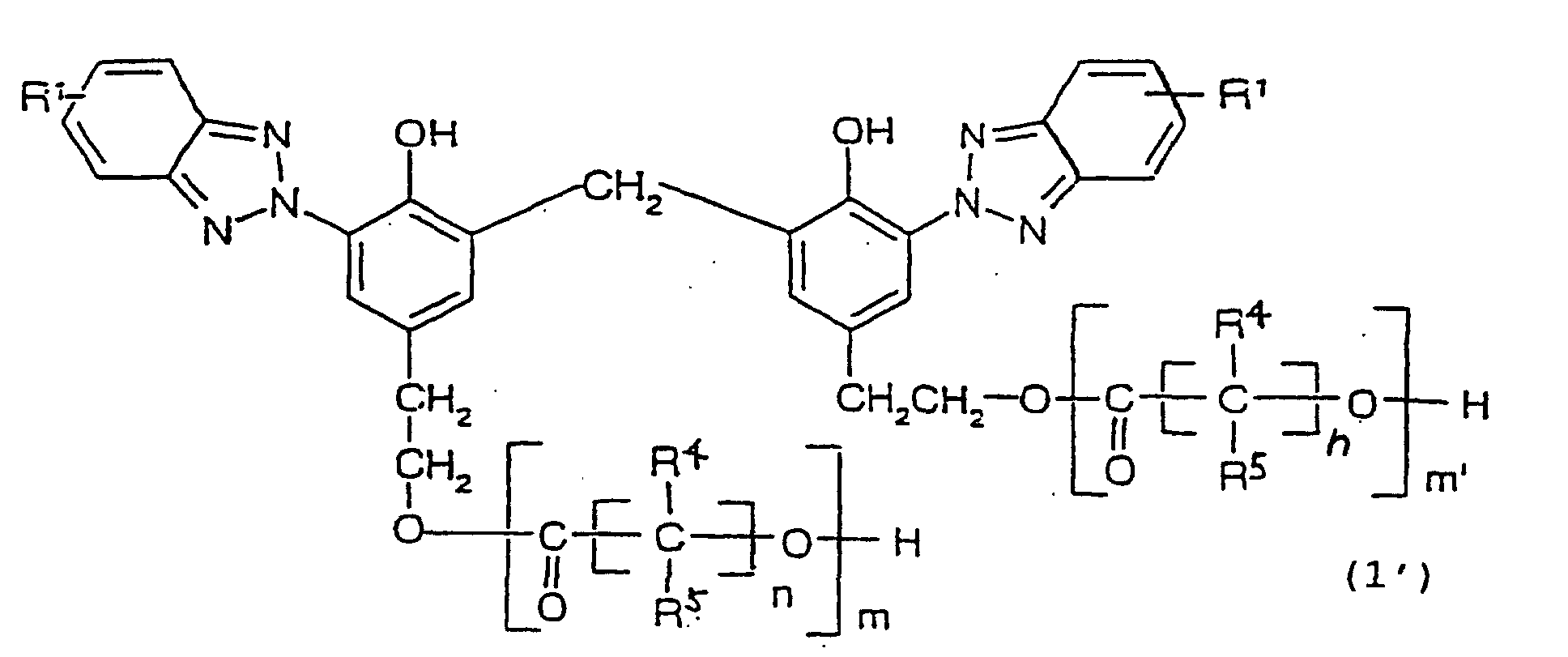
R1 ein Wasserstoffatom, Halogenatom oder eine Alkylgruppe mit 1 bis 10 Kohlenstoffatomen darstellt;
R2 ein Wasserstoffatom oder eine Alkylgruppe mit 1 bis 10 Kohlenstoffatomen ist;
R3 eine Alkylengruppe mit 1 bis 10 Kohlenstoffatomen darstellt;
R4 und R5 Wasserstoffatome oder Alkylgruppe mit 1 bis 10 Kohlenstoffatomen darstellen ;
n eine ganze Zahl von 4 bis 8 ist ;
m und m' jeweils eine Zahl von 1 bis 20 sind. - Verfahren zur Synthese einer Verbindung gemäß Anspruch 1, dadurch gekennzeichnet, dass die Verbindung der Formel (2) oder (2') mit einer Lactonverbindung der Formel (3) in einer Additionspolymerisation reagieren gelassen wird, was in einer Ringöffnung der Lactonverbindung (3) resultiert,worin R1, R2, R3, R4, R5 und n wie in Anspruch 1 definiert sind.

- Ultraviolettstrahlen-Absorptionsmittel, dadurch gekennzeichnet, dass es eine Verbindung gemäß Anspruch 1 oder eine durch das Verfahren gemäß Anspruch 2 erhaltene Verbindung umfasst.
- Harzzusammensetzung, dadurch gekennzeichnet, dass sie ein synthetisches Harz und ein Ultraviolettstrahlen-Absorptionsmittel gemäß Anspruch 3 enthält.
- Harzzusammensetzung gemäß Anspruch 4, dadurch gekennzeichnet, dass das synthetische Harz zumindest eine Harzart, ausgewählt aus der Gruppe bestehend aus einem Polyvinylchlorid, einem Polyvinylidenchlorid, einem Polyolefin, einem Polycarbonat, einem Polystyrol, einem Acrylharz, einem Methacrylharz, einem Polyamid, einem Polyester, einem Acrylnitril-Butadien-Styrolharz oder einem thermoplastischen Urethanharz, enthält.
Priority Applications (2)
| Application Number | Priority Date | Filing Date | Title |
|---|---|---|---|
| DE1998607223 DE69807223T2 (de) | 1998-09-25 | 1998-09-25 | Benzotriazolrest enthaltende Polyesterverbindungen und Verfahren zu deren Herstellung |
| EP19980402368 EP0989124B1 (de) | 1998-09-25 | 1998-09-25 | Benzotriazolrest enthaltende Polyesterverbindungen und Verfahren zu deren Herstellung |
Applications Claiming Priority (1)
| Application Number | Priority Date | Filing Date | Title |
|---|---|---|---|
| EP19980402368 EP0989124B1 (de) | 1998-09-25 | 1998-09-25 | Benzotriazolrest enthaltende Polyesterverbindungen und Verfahren zu deren Herstellung |
Publications (2)
| Publication Number | Publication Date |
|---|---|
| EP0989124A1 EP0989124A1 (de) | 2000-03-29 |
| EP0989124B1 true EP0989124B1 (de) | 2002-08-14 |
Family
ID=8235497
Family Applications (1)
| Application Number | Title | Priority Date | Filing Date |
|---|---|---|---|
| EP19980402368 Expired - Lifetime EP0989124B1 (de) | 1998-09-25 | 1998-09-25 | Benzotriazolrest enthaltende Polyesterverbindungen und Verfahren zu deren Herstellung |
Country Status (2)
| Country | Link |
|---|---|
| EP (1) | EP0989124B1 (de) |
| DE (1) | DE69807223T2 (de) |
Cited By (1)
| Publication number | Priority date | Publication date | Assignee | Title |
|---|---|---|---|---|
| US8153703B2 (en) | 2008-11-04 | 2012-04-10 | Novartis Ag | UV/visible light absorbers for ophthalmic lens materials |
Families Citing this family (3)
| Publication number | Priority date | Publication date | Assignee | Title |
|---|---|---|---|---|
| KR100634655B1 (ko) * | 1998-10-01 | 2006-10-16 | 니폰샤신인사츠가부시키가이샤 | 전사재, 표면 보호 시트, 및 이들을 사용함에 의한성형품의 제조방법 |
| WO2002032981A1 (en) * | 2000-10-17 | 2002-04-25 | Daicel Chemical Industries, Ltd. | Ultraviolet-absorbing resin, aqueous resin emulsion, resin composition, aqueous resin emulsion composition and its use, and aqueous polyurethane emulsion |
| JP5273748B2 (ja) | 2007-04-30 | 2013-08-28 | アルコン,インコーポレイテッド | 眼用レンズ材料用uv吸収剤 |
Family Cites Families (5)
| Publication number | Priority date | Publication date | Assignee | Title |
|---|---|---|---|---|
| EP0057160B1 (de) * | 1981-01-23 | 1985-06-19 | Ciba-Geigy Ag | 2-(2-Hydroxyphenyl)-benztriazole, ihre Verwendung als UV-Absorber und ihre Herstellung |
| NZ208751A (en) * | 1983-07-11 | 1987-04-30 | Iolab Corp | 2-hydroxy-5-acrylyloxyalkylphenyl-2h-benzotriazole derivatives and polymers and copolymers thereof and use as uv absorbing additives in polymer compositions |
| JP2913313B2 (ja) * | 1990-02-09 | 1999-06-28 | シプロ化成株式会社 | ベンゾトリアゾール系化合物、その製法および用途 |
| ES2156992T3 (es) * | 1995-03-17 | 2001-08-01 | Ciba Sc Holding Ag | Absorbedores de uv liposomogenicos. |
| JP2961307B2 (ja) * | 1996-03-28 | 1999-10-12 | 大塚化学株式会社 | ビスベンゾトリアゾリルフェノール化合物 |
-
1998
- 1998-09-25 DE DE1998607223 patent/DE69807223T2/de not_active Expired - Fee Related
- 1998-09-25 EP EP19980402368 patent/EP0989124B1/de not_active Expired - Lifetime
Cited By (2)
| Publication number | Priority date | Publication date | Assignee | Title |
|---|---|---|---|---|
| US8153703B2 (en) | 2008-11-04 | 2012-04-10 | Novartis Ag | UV/visible light absorbers for ophthalmic lens materials |
| US8232326B2 (en) | 2008-11-04 | 2012-07-31 | Novartis Ag | UV/visible light absorbers for ophthalmic lens materials |
Also Published As
| Publication number | Publication date |
|---|---|
| DE69807223D1 (de) | 2002-09-19 |
| EP0989124A1 (de) | 2000-03-29 |
| DE69807223T2 (de) | 2003-04-17 |
Similar Documents
| Publication | Publication Date | Title |
|---|---|---|
| US6037393A (en) | Compound, a process for the preparation thereof, and a resin composition | |
| JP3714575B2 (ja) | 紫外線吸収剤とその製造方法及び合成樹脂組成物 | |
| JP7405133B2 (ja) | 熱可塑性樹脂、その製造方法、及び、光学レンズ | |
| BRPI0514471B1 (pt) | Compostos absorventes de luz ultravioleta (uv) e composições que contêm os compostos absorventes de uv | |
| GB2089800A (en) | 1-oxo-3,8-diaza-4-oxospiro(4,5)decanes | |
| CN113330058A (zh) | 成核剂组合物、烯烃系树脂组合物、其成型品及烯烃系树脂组合物的制造方法 | |
| JP2008291055A (ja) | 末端変性ポリカーボネート樹脂組成物 | |
| US3271321A (en) | Resins homogeneously brightened with bis-styrylbenzenes | |
| JP2003255490A (ja) | 記録・表示媒体用組成物および記録・表示媒体 | |
| JP2000095849A (ja) | ベンゾトリアゾール基含有ポリエステル、その製造方法、それを含む紫外線吸収剤、及び合成樹脂組成物 | |
| EP0989124A1 (de) | Benzotriazolrest enthaltende Polyesterverbindungen und Verfahren zu deren Herstellung | |
| CA1053839A (en) | Polymer compositions containing titanium dioxide having improved visible and ultraviolet and light stability | |
| JPH0790184A (ja) | 耐光及び耐薬品性樹脂組成物 | |
| JP3621972B2 (ja) | ポリカーボネート樹脂組成物及びそのシート成形品 | |
| EP1314755B1 (de) | Uv-strahlen absorbierendes Mittel für thermoplastische Polymere und Verfahren zu ihrer Herstellung | |
| JP2008274009A (ja) | ポリカーボネート樹脂組成物 | |
| JPS59176256A (ja) | オリゴマーエステル及び有機ポリマーの安定化方法 | |
| KR100568697B1 (ko) | 벤조트리아졸기함유폴리에스테르,그것의제조방법,그것을포함하는자외선흡수제및합성수지조성물 | |
| CN117916325A (zh) | 热塑性树脂组合物、成型体、热塑性树脂组合物的制造方法和透射率提高方法 | |
| CA1276170C (en) | Benzylidenemalonic or vinylogous benzylidenemalonic acid polyesters, their preparation and their use for the uv stabilisation of thermoplastics | |
| US4851551A (en) | Ultraviolet ray absorbing agent | |
| JPH01193362A (ja) | 安定化された合成樹脂組成物 | |
| EP1642892A1 (de) | Sterisch gehinderte aminverbindung mit addiertem lacton | |
| JPH04154862A (ja) | 耐候性樹脂組成物 | |
| JP3232764B2 (ja) | 耐熱性樹脂組成物 |
Legal Events
| Date | Code | Title | Description |
|---|---|---|---|
| PUAI | Public reference made under article 153(3) epc to a published international application that has entered the european phase |
Free format text: ORIGINAL CODE: 0009012 |
|
| AK | Designated contracting states |
Kind code of ref document: A1 Designated state(s): DE FR GB |
|
| AX | Request for extension of the european patent |
Free format text: AL;LT;LV;MK;RO;SI |
|
| 17P | Request for examination filed |
Effective date: 20000428 |
|
| AKX | Designation fees paid |
Free format text: DE FR GB |
|
| 17Q | First examination report despatched |
Effective date: 20010117 |
|
| GRAG | Despatch of communication of intention to grant |
Free format text: ORIGINAL CODE: EPIDOS AGRA |
|
| GRAG | Despatch of communication of intention to grant |
Free format text: ORIGINAL CODE: EPIDOS AGRA |
|
| GRAH | Despatch of communication of intention to grant a patent |
Free format text: ORIGINAL CODE: EPIDOS IGRA |
|
| GRAH | Despatch of communication of intention to grant a patent |
Free format text: ORIGINAL CODE: EPIDOS IGRA |
|
| GRAA | (expected) grant |
Free format text: ORIGINAL CODE: 0009210 |
|
| AK | Designated contracting states |
Kind code of ref document: B1 Designated state(s): DE FR GB |
|
| REG | Reference to a national code |
Ref country code: GB Ref legal event code: FG4D |
|
| REF | Corresponds to: |
Ref document number: 69807223 Country of ref document: DE Date of ref document: 20020919 |
|
| ET | Fr: translation filed | ||
| PLBE | No opposition filed within time limit |
Free format text: ORIGINAL CODE: 0009261 |
|
| STAA | Information on the status of an ep patent application or granted ep patent |
Free format text: STATUS: NO OPPOSITION FILED WITHIN TIME LIMIT |
|
| 26N | No opposition filed |
Effective date: 20030515 |
|
| PGFP | Annual fee paid to national office [announced via postgrant information from national office to epo] |
Ref country code: FR Payment date: 20080915 Year of fee payment: 11 |
|
| PGFP | Annual fee paid to national office [announced via postgrant information from national office to epo] |
Ref country code: DE Payment date: 20081002 Year of fee payment: 11 |
|
| REG | Reference to a national code |
Ref country code: FR Ref legal event code: ST Effective date: 20100531 |
|
| PG25 | Lapsed in a contracting state [announced via postgrant information from national office to epo] |
Ref country code: FR Free format text: LAPSE BECAUSE OF NON-PAYMENT OF DUE FEES Effective date: 20090930 Ref country code: DE Free format text: LAPSE BECAUSE OF NON-PAYMENT OF DUE FEES Effective date: 20100401 |
|
| PGFP | Annual fee paid to national office [announced via postgrant information from national office to epo] |
Ref country code: GB Payment date: 20170920 Year of fee payment: 20 |
|
| REG | Reference to a national code |
Ref country code: GB Ref legal event code: PE20 Expiry date: 20180924 |
|
| PG25 | Lapsed in a contracting state [announced via postgrant information from national office to epo] |
Ref country code: GB Free format text: LAPSE BECAUSE OF EXPIRATION OF PROTECTION Effective date: 20180924 |