EP0961651B1 - Method & apparatus for the formation of particles - Google Patents
Method & apparatus for the formation of particles Download PDFInfo
- Publication number
- EP0961651B1 EP0961651B1 EP98907005A EP98907005A EP0961651B1 EP 0961651 B1 EP0961651 B1 EP 0961651B1 EP 98907005 A EP98907005 A EP 98907005A EP 98907005 A EP98907005 A EP 98907005A EP 0961651 B1 EP0961651 B1 EP 0961651B1
- Authority
- EP
- European Patent Office
- Prior art keywords
- solution
- suspension
- supercritical fluid
- supercritical
- fluids
- Prior art date
- Legal status (The legal status is an assumption and is not a legal conclusion. Google has not performed a legal analysis and makes no representation as to the accuracy of the status listed.)
- Expired - Lifetime
Links
- 239000002245 particle Substances 0.000 title claims abstract description 130
- 230000015572 biosynthetic process Effects 0.000 title claims abstract description 72
- 238000000034 method Methods 0.000 title claims abstract description 50
- 239000012530 fluid Substances 0.000 claims abstract description 247
- 239000000725 suspension Substances 0.000 claims abstract description 84
- 239000000126 substance Substances 0.000 claims abstract description 41
- 239000006185 dispersion Substances 0.000 claims description 24
- 238000000605 extraction Methods 0.000 claims description 9
- 230000009471 action Effects 0.000 claims description 6
- 238000011144 upstream manufacturing Methods 0.000 claims description 4
- 239000000047 product Substances 0.000 description 39
- 238000002474 experimental method Methods 0.000 description 21
- CURLTUGMZLYLDI-UHFFFAOYSA-N Carbon dioxide Chemical compound O=C=O CURLTUGMZLYLDI-UHFFFAOYSA-N 0.000 description 20
- 229910002092 carbon dioxide Inorganic materials 0.000 description 16
- OKKJLVBELUTLKV-UHFFFAOYSA-N Methanol Chemical compound OC OKKJLVBELUTLKV-UHFFFAOYSA-N 0.000 description 15
- PVNIIMVLHYAWGP-UHFFFAOYSA-N Niacin Chemical compound OC(=O)C1=CC=CN=C1 PVNIIMVLHYAWGP-UHFFFAOYSA-N 0.000 description 10
- 238000009826 distribution Methods 0.000 description 9
- 239000000843 powder Substances 0.000 description 9
- 238000002466 solution-enhanced dispersion by supercritical fluid Methods 0.000 description 9
- 238000006243 chemical reaction Methods 0.000 description 8
- 239000010408 film Substances 0.000 description 8
- 230000008569 process Effects 0.000 description 8
- CSCPPACGZOOCGX-UHFFFAOYSA-N Acetone Chemical compound CC(C)=O CSCPPACGZOOCGX-UHFFFAOYSA-N 0.000 description 7
- 229910001220 stainless steel Inorganic materials 0.000 description 7
- 239000010935 stainless steel Substances 0.000 description 7
- YXFVVABEGXRONW-UHFFFAOYSA-N Toluene Chemical compound CC1=CC=CC=C1 YXFVVABEGXRONW-UHFFFAOYSA-N 0.000 description 6
- 238000011065 in-situ storage Methods 0.000 description 6
- 239000000463 material Substances 0.000 description 6
- 239000003607 modifier Substances 0.000 description 6
- LFQSCWFLJHTTHZ-UHFFFAOYSA-N Ethanol Chemical compound CCO LFQSCWFLJHTTHZ-UHFFFAOYSA-N 0.000 description 5
- 239000004696 Poly ether ether ketone Substances 0.000 description 5
- 229960003512 nicotinic acid Drugs 0.000 description 5
- 235000001968 nicotinic acid Nutrition 0.000 description 5
- 239000011664 nicotinic acid Substances 0.000 description 5
- 229920002530 polyetherether ketone Polymers 0.000 description 5
- 238000001878 scanning electron micrograph Methods 0.000 description 5
- 239000001569 carbon dioxide Substances 0.000 description 4
- 238000002156 mixing Methods 0.000 description 4
- 238000001556 precipitation Methods 0.000 description 4
- SQGYOTSLMSWVJD-UHFFFAOYSA-N silver(1+) nitrate Chemical compound [Ag+].[O-]N(=O)=O SQGYOTSLMSWVJD-UHFFFAOYSA-N 0.000 description 4
- 239000000919 ceramic Substances 0.000 description 3
- 230000000694 effects Effects 0.000 description 3
- 239000007789 gas Substances 0.000 description 3
- 238000010438 heat treatment Methods 0.000 description 3
- 239000000203 mixture Substances 0.000 description 3
- 238000012986 modification Methods 0.000 description 3
- 230000004048 modification Effects 0.000 description 3
- IJGRMHOSHXDMSA-UHFFFAOYSA-N Atomic nitrogen Chemical compound N#N IJGRMHOSHXDMSA-UHFFFAOYSA-N 0.000 description 2
- RTZKZFJDLAIYFH-UHFFFAOYSA-N Diethyl ether Chemical compound CCOCC RTZKZFJDLAIYFH-UHFFFAOYSA-N 0.000 description 2
- XPDWGBQVDMORPB-UHFFFAOYSA-N Fluoroform Chemical compound FC(F)F XPDWGBQVDMORPB-UHFFFAOYSA-N 0.000 description 2
- KFZMGEQAYNKOFK-UHFFFAOYSA-N Isopropanol Chemical compound CC(C)O KFZMGEQAYNKOFK-UHFFFAOYSA-N 0.000 description 2
- GQPLMRYTRLFLPF-UHFFFAOYSA-N Nitrous Oxide Chemical compound [O-][N+]#N GQPLMRYTRLFLPF-UHFFFAOYSA-N 0.000 description 2
- 239000004793 Polystyrene Substances 0.000 description 2
- NDAUXUAQIAJITI-UHFFFAOYSA-N albuterol Chemical compound CC(C)(C)NCC(O)C1=CC=C(O)C(CO)=C1 NDAUXUAQIAJITI-UHFFFAOYSA-N 0.000 description 2
- 238000004458 analytical method Methods 0.000 description 2
- 238000000429 assembly Methods 0.000 description 2
- 230000000712 assembly Effects 0.000 description 2
- 230000008901 benefit Effects 0.000 description 2
- 230000000903 blocking effect Effects 0.000 description 2
- 239000011248 coating agent Substances 0.000 description 2
- 238000000576 coating method Methods 0.000 description 2
- 238000013461 design Methods 0.000 description 2
- 239000000839 emulsion Substances 0.000 description 2
- 239000010419 fine particle Substances 0.000 description 2
- 230000005484 gravity Effects 0.000 description 2
- 239000007788 liquid Substances 0.000 description 2
- 238000004519 manufacturing process Methods 0.000 description 2
- 239000011159 matrix material Substances 0.000 description 2
- 230000007246 mechanism Effects 0.000 description 2
- 229920000642 polymer Polymers 0.000 description 2
- 229920002223 polystyrene Polymers 0.000 description 2
- 239000000376 reactant Substances 0.000 description 2
- 238000004064 recycling Methods 0.000 description 2
- 229960002052 salbutamol Drugs 0.000 description 2
- 229910001961 silver nitrate Inorganic materials 0.000 description 2
- 239000007787 solid Substances 0.000 description 2
- 239000012798 spherical particle Substances 0.000 description 2
- 238000012546 transfer Methods 0.000 description 2
- 229910000619 316 stainless steel Inorganic materials 0.000 description 1
- QTBSBXVTEAMEQO-UHFFFAOYSA-M Acetate Chemical compound CC([O-])=O QTBSBXVTEAMEQO-UHFFFAOYSA-M 0.000 description 1
- OTMSDBZUPAUEDD-UHFFFAOYSA-N Ethane Chemical compound CC OTMSDBZUPAUEDD-UHFFFAOYSA-N 0.000 description 1
- VGGSQFUCUMXWEO-UHFFFAOYSA-N Ethene Chemical compound C=C VGGSQFUCUMXWEO-UHFFFAOYSA-N 0.000 description 1
- 239000005977 Ethylene Substances 0.000 description 1
- 229910052772 Samarium Inorganic materials 0.000 description 1
- 238000005054 agglomeration Methods 0.000 description 1
- 230000002776 aggregation Effects 0.000 description 1
- 238000013459 approach Methods 0.000 description 1
- 208000006673 asthma Diseases 0.000 description 1
- 239000007795 chemical reaction product Substances 0.000 description 1
- AFYPFACVUDMOHA-UHFFFAOYSA-N chlorotrifluoromethane Chemical compound FC(F)(F)Cl AFYPFACVUDMOHA-UHFFFAOYSA-N 0.000 description 1
- 238000004140 cleaning Methods 0.000 description 1
- 239000006184 cosolvent Substances 0.000 description 1
- 239000008367 deionised water Substances 0.000 description 1
- 229940079593 drug Drugs 0.000 description 1
- 239000003814 drug Substances 0.000 description 1
- 238000005516 engineering process Methods 0.000 description 1
- 239000002360 explosive Substances 0.000 description 1
- 239000012467 final product Substances 0.000 description 1
- 238000005470 impregnation Methods 0.000 description 1
- 239000011872 intimate mixture Substances 0.000 description 1
- 238000011031 large-scale manufacturing process Methods 0.000 description 1
- 210000003041 ligament Anatomy 0.000 description 1
- 238000012423 maintenance Methods 0.000 description 1
- 125000002496 methyl group Chemical group [H]C([H])([H])* 0.000 description 1
- 239000011859 microparticle Substances 0.000 description 1
- 239000000178 monomer Substances 0.000 description 1
- 239000002105 nanoparticle Substances 0.000 description 1
- 229910052757 nitrogen Inorganic materials 0.000 description 1
- 239000001272 nitrous oxide Substances 0.000 description 1
- 238000003921 particle size analysis Methods 0.000 description 1
- 238000002360 preparation method Methods 0.000 description 1
- 238000012545 processing Methods 0.000 description 1
- 229910052761 rare earth metal Inorganic materials 0.000 description 1
- 150000002910 rare earth metals Chemical class 0.000 description 1
- 238000011084 recovery Methods 0.000 description 1
- 230000009467 reduction Effects 0.000 description 1
- 230000000717 retained effect Effects 0.000 description 1
- 150000003839 salts Chemical class 0.000 description 1
- KZUNJOHGWZRPMI-UHFFFAOYSA-N samarium atom Chemical compound [Sm] KZUNJOHGWZRPMI-UHFFFAOYSA-N 0.000 description 1
- JPDBEEUPLFWHAJ-UHFFFAOYSA-K samarium(3+);triacetate Chemical compound [Sm+3].CC([O-])=O.CC([O-])=O.CC([O-])=O JPDBEEUPLFWHAJ-UHFFFAOYSA-K 0.000 description 1
- 229910052594 sapphire Inorganic materials 0.000 description 1
- 239000010980 sapphire Substances 0.000 description 1
- 238000004626 scanning electron microscopy Methods 0.000 description 1
- 238000000926 separation method Methods 0.000 description 1
- 239000002904 solvent Substances 0.000 description 1
- 239000007858 starting material Substances 0.000 description 1
- 239000000758 substrate Substances 0.000 description 1
- SFZCNBIFKDRMGX-UHFFFAOYSA-N sulfur hexafluoride Chemical compound FS(F)(F)(F)(F)F SFZCNBIFKDRMGX-UHFFFAOYSA-N 0.000 description 1
- 229960000909 sulfur hexafluoride Drugs 0.000 description 1
- -1 t-Butylamino Chemical group 0.000 description 1
- 239000010409 thin film Substances 0.000 description 1
- 230000001988 toxicity Effects 0.000 description 1
- 231100000419 toxicity Toxicity 0.000 description 1
- XLYOFNOQVPJJNP-UHFFFAOYSA-N water Substances O XLYOFNOQVPJJNP-UHFFFAOYSA-N 0.000 description 1
- 229910052724 xenon Inorganic materials 0.000 description 1
- FHNFHKCVQCLJFQ-UHFFFAOYSA-N xenon atom Chemical compound [Xe] FHNFHKCVQCLJFQ-UHFFFAOYSA-N 0.000 description 1
Images



Classifications
-
- B—PERFORMING OPERATIONS; TRANSPORTING
- B01—PHYSICAL OR CHEMICAL PROCESSES OR APPARATUS IN GENERAL
- B01D—SEPARATION
- B01D11/00—Solvent extraction
- B01D11/04—Solvent extraction of solutions which are liquid
- B01D11/0403—Solvent extraction of solutions which are liquid with a supercritical fluid
- B01D11/0407—Solvent extraction of solutions which are liquid with a supercritical fluid the supercritical fluid acting as solvent for the solute
-
- A—HUMAN NECESSITIES
- A61—MEDICAL OR VETERINARY SCIENCE; HYGIENE
- A61K—PREPARATIONS FOR MEDICAL, DENTAL OR TOILETRY PURPOSES
- A61K9/00—Medicinal preparations characterised by special physical form
- A61K9/14—Particulate form, e.g. powders, Processes for size reducing of pure drugs or the resulting products, Pure drug nanoparticles
- A61K9/16—Agglomerates; Granulates; Microbeadlets ; Microspheres; Pellets; Solid products obtained by spray drying, spray freeze drying, spray congealing,(multiple) emulsion solvent evaporation or extraction
- A61K9/1682—Processes
- A61K9/1688—Processes resulting in pure drug agglomerate optionally containing up to 5% of excipient
-
- B—PERFORMING OPERATIONS; TRANSPORTING
- B01—PHYSICAL OR CHEMICAL PROCESSES OR APPARATUS IN GENERAL
- B01D—SEPARATION
- B01D11/00—Solvent extraction
- B01D11/04—Solvent extraction of solutions which are liquid
- B01D11/0403—Solvent extraction of solutions which are liquid with a supercritical fluid
- B01D11/0411—Solvent extraction of solutions which are liquid with a supercritical fluid the supercritical fluid acting as solvent for the solvent and as anti-solvent for the solute, e.g. formation of particles from solutions
-
- B—PERFORMING OPERATIONS; TRANSPORTING
- B01—PHYSICAL OR CHEMICAL PROCESSES OR APPARATUS IN GENERAL
- B01D—SEPARATION
- B01D11/00—Solvent extraction
- B01D11/04—Solvent extraction of solutions which are liquid
- B01D11/0488—Flow sheets
-
- B—PERFORMING OPERATIONS; TRANSPORTING
- B01—PHYSICAL OR CHEMICAL PROCESSES OR APPARATUS IN GENERAL
- B01J—CHEMICAL OR PHYSICAL PROCESSES, e.g. CATALYSIS OR COLLOID CHEMISTRY; THEIR RELEVANT APPARATUS
- B01J2/00—Processes or devices for granulating materials, e.g. fertilisers in general; Rendering particulate materials free flowing in general, e.g. making them hydrophobic
- B01J2/02—Processes or devices for granulating materials, e.g. fertilisers in general; Rendering particulate materials free flowing in general, e.g. making them hydrophobic by dividing the liquid material into drops, e.g. by spraying, and solidifying the drops
- B01J2/04—Processes or devices for granulating materials, e.g. fertilisers in general; Rendering particulate materials free flowing in general, e.g. making them hydrophobic by dividing the liquid material into drops, e.g. by spraying, and solidifying the drops in a gaseous medium
Definitions
- This invention relates to the controlled formation of particulate products using supercritical fluids. It provides a method and apparatus for the formation of substances in particulate form, and also the particulate product of the method.
- the invention relates generally to the formation of particles of a substance of interest, from a solution or suspension of that substance in an appropriate vehicle, using a supercritical fluid to extract the vehicle and hence cause precipitation of a particulate product.
- SEDS Solution Enhanced Dispersion by Supercritical Fluids
- SEDS allows a high degree of control over conditions such as pressure, temperature and fluid flow rates, and over the physical dispersion of the solution/suspension, at the exact point where particle formation occurs (ie, at the point where the vehicle is extracted into the supercritical fluid). It therefore allows excellent control over the size, shape and other physical and/or chemical properties of the particles formed.
- the present invention builds on this existing technology. It provides a modification to the SEDS technique, which can lead to greatly improved control over the characteristics of the particulate product.
- a method for forming particles of a substance comprising (a) introducing into a particle formation chamber, the temperature and pressure in which are controlled, a first supercritical fluid and a solution or suspension of the substance in a vehicle; (b) simultaneously introducing, into the particle formation chamber, an impinging flow of a second supercritical fluid, at an angle to, and directed at, the direction of flow of the first supercritical fluid, the first and second supercritical fluids entering the particle formation chamber separately; and (c) using both the first and the second supercritical fluids to disperse the solution or suspension, and to extract the vehicle from it, substantially simultaneously and substantially immediately on introduction of the fluids into the particle formation chamber.
- the method of the present invention allows for greatly improved dispersion of the solution or suspension of the substance of interest, by the additional impinging (preferably counter-current) flow of the second supercritical fluid.
- This improved dispersion can be attributed to enhanced physical contact between the solution/suspension and the (usually relatively high velocity and therefore also high kinetic energy) supercritical fluids, hence effecting the formation of very fine particles with an extremely narrow size distribution.
- the two supercritical fluid flows directed at one another and usually in substantially opposite directions, each transfer their kinetic energy to the solution or suspension, serving to break it up into individual fluid elements; the size and size distribution of these elements can be very closely controlled by adjusting the flow rates of the various fluids and other working conditions such as the temperature and pressure inside the particle formation chamber.
- the solution/suspension can be subjected to a very high degree of dispersion due to the high overall supercritical fluid velocity (ie, high overall kinetic energy), and its efficient dispersion, at substantially the same time as the vehicle is extracted from it, in turn can provide a high degree of uniformity in the particles formed.
- high overall supercritical fluid velocity ie, high overall kinetic energy
- a further advantage of using two supercritical fluid flows, and hence introducing a higher level of kinetic energy into the solution/suspension at or near the point of particle formation, is that particles formed from the solution or suspension can be forced rapidly away from the point of particle formation and hence apparatus blockages (which might otherwise occur in the inlet means used to introduce the fluids into the particle formation chamber) can be reduced or even avoided.
- the supercritical fluids thus serve to disperse the solution or suspension, to extract the vehicle from it and to remove particulate products from the region of particle formation.
- the high velocities of the supercritical fluids facilitate quick removal of the particles, ensuring that they cannot reunite with fluid elements, aggregate with one another or otherwise clog up the region of particle formation.
- the directions of flow of the first supercritical fluid and the solution or suspension may be substantially parallel, for instance coaxial, as described in WO-95/01221 and WO-96/00610.
- the solution or suspension may in the present invention be introduced at an angle (eg, of up to 90°) to the flow of the first supercritical fluid, so long as it is then dispersed by the supercritical fluid(s) immediately it comes into contact with them.
- the directions of flow of all the fluids should be chosen so as to maximise the amount of physical contact between them in the region of particle formation; this in turn serves to maximise the amount of kinetic energy transferred from the supercritical fluids to the solution/suspension and to the particulate products, thus improving dispersion and more efficiently removing particles from areas of potential blockage.
- the use of two supercritical fluid flows together improves these processes yet further and ensures better control over the mechanism of particle formation.
- the present invention provides apparatus suitable for carrying out the above described method.
- the apparatus comprises a particle formation chamber; means for controlling the temperature in the chamber at a desired level; means for controlling the pressure in the chamber at a desired level; first fluid inlet means for the separate introduction into the chamber of (i) a first supercritical fluid and (ii) a solution or suspension of the substance of interest in a vehicle; a pump for conveying the solution or suspension to the first fluid inlet means; and second fluid inlet means for introducing into the particle formation chamber, simultaneously with but separately from the first supercritical fluid, an impinging flow of a second supercritical fluid, at an angle to, and directed at, the direction of flow of the first supercritical fluid, the apparatus being such as to allow dispersion of the solution or suspension, and extraction of the vehicle, to occur substantially simultaneously and substantially immediately on introduction of the fluids into the particle formation chamber, by the action of both the first and the second supercritical fluids.
- the first fluid inlet means preferably allows the co-introduction of the first supercritical fluid and the solution or suspension, for instance in substantially parallel directions or even coaxially.
- the second supercritical fluid preferably flows in a direction substantially opposite to that of the first, ie, the angle at which it is directed at the first supercritical fluid flow is preferably about 180°.
- the angle at which it is directed at the first supercritical fluid flow is preferably about 180°.
- other impinging angles may be chosen, again the general idea being to maximise physical contact between the fluids in the region of particle formation.
- the first and second supercritical fluids will usually, although not necessarily, meet at or very close to the point of particle formation, ie, the point at which they contact the solution or suspension.
- the term "supercritical fluid” means a fluid substantially at or above its critical pressure (P c ) and critical temperature (T c ) simultaneously.
- the pressure of the fluid is likely to be in the range (1.01 - 7.0)P c , and its temperature in the range (1.01 - 4.0)T c .
- vehicle means a fluid which is able to carry a solid or solids in solution or suspension.
- a vehicle may be composed of one or more component fluids.
- the vehicle used in the present invention should be substantially soluble in the chosen supercritical fluids, to allow its extraction at the point of particle formation.
- supercritical solution means one or more supercritical fluids together with one or more vehicles which it or they have extracted and dissolved.
- the solution will usually, although not necessarily, itself be in the supercritical state, at least within the particle formation chamber.
- the substance to which the method of the invention is applied may be any substance which needs to be produced in particulate form. It may be a substance for use in or as a pharmaceutical. However, the particulate product may also be a product of use in the ceramics, explosives or photographic industries; a foodstuff; a dye; a coating; etc. In each case, the principle behind the method of the invention remains the same; the technician need only adjust operating conditions in order to effect proper control over the characteristics of the particles being formed.
- the substance may be in a single or multi-component form - it could for instance comprise an intimate mixture of two materials, or one material in a matrix of another, or one material coated onto a substrate of another, or other similar mixtures.
- the particulate product, formed from the substance using the method of the invention may also be in a multi-component form - such products may be made from solutions or suspensions containing only single component starting materials, provided the solutions/suspensions are introduced with the supercritical fluids in the correct manner (more than one solution/suspension may be introduced into the particle formation chamber with the supercritical fluids).
- the particulate product may also be a substance formed from an in situ reaction (ie, immediately prior to, or on, dispersion by the supercritical fluid(s)) between two or more reactant substances, each carried by an appropriate vehicle.
- in situ reaction ie, immediately prior to, or on, dispersion by the supercritical fluid(s)
- reactant substances each carried by an appropriate vehicle.
- modifications to the SEDS process involving the use of in situ reactions and/or more than one solution or suspension of a substance of interest, are described in WO-95/01221 and WO-96/00610, and can also be applied when carrying out the present invention.
- Each of the first and second supercritical fluids may be any suitable supercritical fluid, for instance supercritical carbon dioxide, nitrogen, nitrous oxide, sulphur hexafluoride, xenon, ethylene, chlorotrifluoromethane, ethane, trifluoromethane or mixtures thereof.
- a particularly preferred supercritical fluid is supercritical carbon dioxide, due to its relatively low cost, toxicity, flammability and critical temperature.
- the second and first supercritical fluids are preferably, but not necessarily, the same; again, conveniently both are supercritical carbon dioxide.
- Either or both of the supercritical fluids may optionally contain one or more modifiers, for example methanol, ethanol, isopropanol, acetone or water.
- a modifier preferably constitutes not more than 20%, and more preferably between 1% and 10%, mole fraction of the supercritical fluid.
- modifier is itself well known to those skilled in the art.
- a modifier (or cosolvent) may be described as a chemical which, when added to a supercritical fluid, changes the intrinsic properties of the fluid in or around its critical point.
- the vehicle may be any appropriate fluid which either dissolves or suspends the substance of interest and is itself substantially soluble in the chosen supercritical fluids.
- vehicle in any particular case will depend on the nature of the substance, on the supercritical fluids and on other practical criteria including those governing the desired end product.
- vehicle encompasses a mixture of two or more fluids which together have the necessary characteristics vis-a-vis the substance of interest and the supercritical fluids.
- the relative flow rates of the fluids introduced into the particle formation chamber may be used to control the size, size distribution and other characteristics of the particles formed. Each fluid flow rate may be separately adjusted. Preferably, the flow rates of the two supercritical fluids are much higher than that of the solution or suspension. Typically, the ratio of the solution/suspension flow rate to each supercritical fluid flow rate will be between 0.001 and 0.2, preferably between 0.001 and 0.1, more preferably between 0.01 and 0.07.
- fluid flow rates chosen in any particular case will depend entirely on the substance of interest and the types of fluids being used.
- the flow rates of the supercritical fluids are particularly important because the supercritical fluids act to disperse the solution/suspension and to remove particles from the region of particle formation. Their flow rates therefore affect the size of the fluid elements caused by the dispersion, and hence of the particles formed by extracting the vehicle from those fluid elements. They also help to avoid blockages in the particle formation apparatus.
- supercritical conditions may be maintained in the chamber at all times.
- the flow rates of the supercritical fluids relative to that of the solution or suspension, and the pressures and temperatures of the fluids, should be sufficient to allow the supercritical fluids to accommodate the vehicle (generally, the vehicle will represent no more than around 5% mole fraction of the supercritical fluids), so that the vehicle can be extracted from the solution/suspension to cause particle formation.
- Careful selection of such operating conditions can ensure the existence of only a single phase during most of the particle formation process, in the solution containing the supercritical fluids and the extracted vehicle. This in turn allows improved control over particle characteristics and substantially eliminates the risk of residual vehicle in the particulate product.
- fluids are preferably introduced into the particle formation chamber through fluid inlet means of the type described below in connection with the apparatus of the invention.
- fluids should be made to flow in a smooth, continuous and preferably substantially pulse-less manner. This helps prevent draw-back of fluids into the inlet means, which could lead to particle precipitation in undesirable locations and blocking of apparatus.
- the temperature in the particle formation chamber may be maintained at a desired level (preferably ⁇ 0.1°C) by means of a heating jacket or an oven.
- the pressure in the chamber is conveniently maintained at a desired level (preferably ⁇ 2 bar) by means of a back-pressure regulator.
- the method of the invention preferably additionally involves collecting the particles following their formation, more preferably in the particle formation chamber itself.
- the method may also involve recovering the solution formed on extraction of the vehicle into the supercritical fluid(s), separating the components of the solution and recycling one or more of those components for future use.
- either or both of the supercritical fluids may be removed, purified and recycled.
- the method is preferably carried out in a substantially continuous, as opposed to batch-wise, manner. This means that the formation and collection of particles, and/or the recovery and recycling of fluids, are preferably carried out continuously.
- the first and second fluid inlet means preferably comprise first and second nozzles respectively.
- the first fluid inlet means may in fact comprise two nozzles, one for introduction of the first supercritical fluid and one for introduction of the solution or suspension, arranged at an appropriate angle relative to one another.
- the first and second fluid inlet means may both form part of a single fluid inlet assembly usable to introduce all fluids into the particle formation chamber in the appropriate manner.
- a preferred fluid inlet assembly comprises two main components:
- the secondary nozzle passage is coaxial with the primary nozzle passages but points in the opposite direction, so that the outlet end of the secondary nozzle passage faces the outlet ends of the primary nozzle passages.
- the primary nozzle passages may be of the type which allow "pre-filming" or “sheathing” of at least one of the fluids to occur, immediately prior to its contact with the other fluid(s).
- the primary nozzle may be used to cause pre-filming of the solution or suspension, immediately prior to its dispersion by the supercritical fluid(s). This means that the dimensions of the primary nozzle passages, and the relative positions of their outlets, must be such that a fluid entering through one passage is formed, as it reaches the outlet of that passage, into a thin film or sheath by its contact with, say, the lip of an adjacent passage outlet.
- This film or sheath can then be stretched (destabilised), and ultimately dispersed into separate fluid elements, when it comes into contact with a stream of a high velocity fluid in another nozzle passage and/or with an impinging stream from the secondary nozzle.
- the thickness of the film or sheath, and hence the size of the fluid elements formed on dispersion will depend on the relative flow rates of the fluids, and also on the nozzle geometry.
- outlets of the primary nozzle passages should be reasonably close to that of the secondary nozzle passage, again so as to maximise kinetic energy transfer between the second supercritical fluid and the solution/suspension.
- the actual distance and angle between them will depend, for instance, on the size, type and shape of particles it is desired to form, on the nature of the substance and the fluids, on the fluid flow rates to be used, on manufacturing constraints, etc.
- the outlet of an inner passage may occur either upstream or downstream of that of one or more of the surrounding outer passage(s) or at virtually the same location.
- contact between a solution/suspension passing through the inner passage and a first supercritical fluid passing through a surrounding passage occurs inside the primary nozzle and before the two together contact the second supercritical fluid. Accordingly, a degree of dispersion and extraction can occur before further dispersion by the second supercritical fluid.
- Such an inlet assembly may also for example be used in carrying out in situ reactions, for instance between one component carried in the vehicle and another in the first supercritical fluid, or between two components carried in two separate vehicles down two out of three primary nozzle passages, which reactions take place just within the primary nozzle, immediately prior to extraction of the vehicle or vehicles and particle formation. It could further be used, for instance, in the preparation of coated particles or particles in which one component is impregnated in a matrix of another.
- both the first and the second supercritical fluids can together act to disperse a solution or suspension passing through the inner primary nozzle passage. This can increase the level of control over the particle characteristics and so is often one of the preferred arrangements.
- in situ reactions, coating, impregnation and other multi-component operations may still be carried out, by introducing further components through additional secondary nozzle passages.
- the secondary nozzle may itself, therefore, comprise two or more concentric passages, so that solutions or suspensions of substances of interest, as well as the second supercritical fluid, may be introduced at an angle to the first supercritical fluid flow.
- the same comments apply to the two or more secondary nozzle passages, as regards the positions of their outlets, and the desirability of the pre-filming approach, as to the primary nozzle passages.
- the fluid inlet assembly typically comprises an intermediate chamber located between the primary and the secondary nozzle outlets, in which chamber the fluids may meet and interact.
- This chamber is preferably shaped to direct the fluids and/or particles formed from them, away from the point at which the fluids meet. Since particle formation typically occurs virtually at the nozzle outlets, the intermediate chamber itself forms part of the particle formation chamber.
- the intermediate chamber could, for instance, be directed at an angle (including perpendicular) to the primary and secondary nozzle passages, and in use may be downwardly directed so as to allow gravity to contribute (together with the relatively high overall velocity of the two supercritical fluid flows) to removal of particulate products from the nozzle outlet region.
- the size and shape of the intermediate chamber may be used in part to determine the characteristics of the particles formed, and again to contribute towards efficient particle removal and to minimise the risk of solution droplets uniting with the particles and causing agglomeration.
- the intermediate chamber should be so sized and shaped as to maximise fluid turbulence in or around the region of particle formation, which again enhances physical contact between the fluids and aids dispersion of the solution/suspension and removal of particulate products.
- the nozzle passages may conveniently be made of stainless steel; other suitable materials include sapphire, high performance ceramics and high performance polymers.
- Other aspects of the design of the inlet assembly for instance the diameters of the nozzle passages and their outlets; the positioning of the primary and secondary nozzles relative to one another, the number of passages in each nozzle- and the uses to which they may be put, are as disclosed in WO-95/01221 and WO-96/00610 (although these documents refer to nozzles providing only one direction of flow, their teachings may apply equally to the primary or the secondary nozzle passages of use in the apparatus of the present invention).
- the fluid flow rates are preferably chosen so that the precipitated particles are caused to leave the inlet assembly virtually as soon as they are formed, so as to avoid blocking of the nozzle passage outlets.
- the design of the intermediate chamber may be chosen so as to help in this, by creating the desired flow characteristics in the region of particle formation.
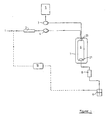
- the apparatus shown includes a particle collection vessel 6.
- This is typically a standard reaction vessel, for instance of the type available from Keystone Scientific Inc, of an appropriate capacity for the particular use to which it is to be put.
- the temperature and pressure in the vessel may be maintained at a constant desired level, by means of an oven 7 and a back pressure regulator 8 respectively.
- the system When used in accordance with the present invention, the system is initially pressurised and stable working conditions are met.
- a suitable gas for example carbon dioxide
- a suitable gas for example carbon dioxide
- a solution of a substance of interest in a suitable vehicle is drawn from source 5 by a pump 3 and also fed to the vessel 6 via inlet assembly 20.
- the inlet assembly 20 is shown only schematically in Figure 2 and will be described in more detail below. It introduces the supercritical fluid formed in cooler 2 (in two oppositely-directed flows) and the solution from source 5, into the particle collection vessel in the manner required by the method of the invention. Particle formation occurs primarily in an intermediate chamber within the inlet assembly, and the particles formed fall into the vessel 6 where they are retained by collecting means 21.
- the resultant supercritical solution is fed to a back pressure regulator 8 and thence to a separation vessel 9, where it is allowed to expand, causing the supercritical fluid to separate as a gas from the liquid vehicle.
- the gas may then be fed to a tank 10 and returned to the cooler 2.
- the vehicle may also be collected for subsequent re-use. Means, not shown, may be provided to smooth the fluid flow pulses produced by the pumps 3 and 4.
- the inlet assembly and the vessel 6 are flushed through with clean, dry supercritical fluid, so as to ensure removal of any residual vehicle.
- the vessel can then be de-pressurised and the particulate product removed.
- the temperature and pressure within vessel 6 are maintained at a supercritical level, ie, a level which ensures that the solution formed on extraction of the vehicle into the supercritical fluid remains in a supercritical condition both during and after particle precipitation, or at least reaches a supercritical condition as soon as possible after particle formation.
- the inlet assembly 20 may take the form shown in Figures 2
- the inlet assembly illustrated comprises two oppositely directed inlet nozzles generally labelled 30 and 31.
- the outlets of these two nozzles terminate facing one another in the intermediate chamber 32, in which fluid mixing and particle formation occur during use of the apparatus.
- the outlet portions of the nozzles are housed in heating block 33, to allow temperature control at the nozzle outlets and within chamber 32.
- the "primary" nozzle 30 can be seen in more detail in Figure 3. It comprises two concentric passages 34 and 35, of which the inner (35) terminates downstream of the outer.
- the outer passage 34 ends in a terminating passage section 29.
- the inlet assembly is arranged to allow introduction of two separate fluids into these two passages.
- the protrusion of the inner passage beyond the outlet of the outer passage is advantageous because, in use, a solution or suspension emerging from the inner passage can be subjected, simultaneously, to the effects of two supercritical fluid flows, that through the outer primary nozzle passage 34 and also the oppositely directed flow through "secondary" nozzle 31. This ensures a more efficient dispersion of the solution/suspension, and helps to prevent clogging at the nozzle outlets as particle formation takes place.
- the length of the protruding portion of the inner passage 35 may again be chosen according to requirements; it should be short enough for fluid contact and enhanced dispersion to occur in accordance with the method of the invention.
- the secondary nozzle 31 (see Figure 4) comprises only a single passage 36, with a narrower terminating passage section 37.
- the passages of both nozzles are made of 316 stainless steel, mounted in stainless steel mounting blocks 38.
- primary nozzle 30 has an internal diameter of 0.35 mm for its inner passage 35 and an internal diameter of 0.75 mm for its outer passage 34.
- Inner passage 35 terminates 0.2 mm downstream of the outlet end of the terminating section 29 (length 0.5 mm) of outer passage 34.
- the internal diameter of the secondary nozzle passage 36 is 0.75 mm, with a terminating passage section 37 of internal diameter 0.15 mm and length 0.4 mm.
- the angle of taper at the outlet of the main passage 36 is 45°.
- the mounting blocks 38 also have a 45° chamfer at the nozzle outlets, of about 0.9 mm depth. (Note that in practice, the upstream edges of these chamfered portions do not align exactly with the inner walls of the intermediate chamber 32, even though it may appear that way from Figure 2.) It may be preferable to increase the chamfer depth, so that the tip of each block tapers almost to a point near its respective nozzle outlet - this may help to reduce build-up of particulate product at and between the nozzle outlets.
- the chamber 32 needs to be shaped to allow for mixing of the fluids introduced through the nozzle passages, and dispersion of the solution or suspension of the substance of interest; this in turn allows the formation of a "cloud" of dispersed particles which can more easily be pushed away (by the action of the supercritical fluid flows) into a collection vessel, rather than remaining in chamber 32 to clog the nozzle outlets.
- the internal diameter of the chamber 32 shown in Figure 2 is 3.5 mm; a preferred form of inlet assembly might well have a narrower intermediate chamber (to increase fluid turbulence), or a wider one (which can help to reduce blockage and can make cleaning and maintenance generally easier).
- An intermediate chamber of the same internal diameter as the collection vessel to which it is to be connected may be preferred, and would allow a more efficient dispersion of fluids and particulate products.
- the inlet nozzles should protrude further into the intermediate chamber, to retain the desired spacing between their outlets.
- the width of the gap between the nozzle outlets (in this case 1.2 mm, measured between opposing faces of the mounting blocks 38) must be chosen in any given case to prevent build-up of particulate product in the chamber 32; it will depend therefore on parameters such as the fluid flow rates being used and the nozzle geometry. In particular, it should be chosen so as to achieve the maximum possible turbulence between the incoming fluids (and hence efficient fluid mixing), whilst minimising the risk of blockage at the nozzle outlets.
- the width of the gap may be between approximately 0.4 mm and 2.5 mm, more preferably between approximately 1 mm and 2 mm. Measured in another way, it may be between approximately two and twelve times the internal diameter of the nozzle passage outlets.
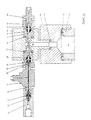
- Figure 5 shows in more detail the components of, and used with, the inlet assembly of Figures 2-4.
- the two oppositely-directed nozzles 30 and 31, in their mounting blocks 38, are encased in heating block 33.
- Both nozzle mounting blocks carry PEEK (poly ether-ether ketone) seals 39.
- the inlet of secondary nozzle 31 is connected to a standard inlet component 40 (Swagelock (trade mark) 1/16 inch stainless steel male union), through which a flow of supercritical fluid may be introduced into the chamber 32, in a direction opposite to that of fluids entering through the primary nozzle 30.
- the inlet of nozzle 30 is connected to a standard Swagelock 1/16 inch stainless steel T-connector 41, which in turn is connected to a standard female inlet component 42 (Valco (trade mark) 2-2997 stainless steel female union).
- This arrangement allows the introduction of two separate fluids into nozzle 30, one (typically a supercritical fluid) directly into the T-connector 41 and thence into outer passage 34 of the nozzle, and one (typically a solution or suspension of a substance of interest) through the inlet component 42 into the inner nozzle passage 35.
- the lower, outlet, end of chamber 32 is connected to the top of a Keystone (trade mark) high pressure vessel 43, of 25 mm external diameter, 14 mm internal diameter and 50 ml capacity.
- the connection is made via an end fitting member 44, PEEK collar seal 45 and PEEK vessel seal 46 (all also Keystone).
- Components 47 are Swagelock 1/16 inch stainless steel ferrules; component 48 is an Alltech (trade mark) universal 1/16 inch stainless steel ferrule. Component 49 is a custom-made PEEK ferrule of 0.65 mm internal diameter.
- chamber 32 and vessel 43 serve together as a "particle formation chamber”.
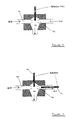
- FIG. 6 has a primary nozzle comprising two concentric passages 50 and 51, of which the inner passage 51 terminates upstream of (inside) outer passage 50. It also has a secondary nozzle comprising passage 52, coaxial with but facing the opposite direction to the primary nozzle passages, and an intermediate chamber 53 through which fluids and precipitated particles may be discharged. Typically, the nozzles are used to introduce into the chamber 53 two counter-current flows of supercritical fluid, through passages 50 and 52, and a solution or suspension of a substance of interest in a vehicle, through inner primary passage 51.
- the solution or suspension initially contacts the first flow of supercritical fluid inside passage 50, and immediately thereafter contacts the second, counter-current, flow of supercritical fluid from passage 52. Both flows of supercritical fluid serve to disperse the solution or suspension, to extract the vehicle from it and to remove the particulate product.
- Additional reactants may be carried in the supercritical fluid flowing through outer primary passage 50, to allow for in situ reactions with the substance(s) carried in the solution/suspension flowing through inner passage 51.
- the Figure 6 assembly may be used to introduce a first supercritical fluid through inner primary passage 51 and a solution/suspension of a substance of interest through outer primary passage 50.
- the mechanism in this case seems to involve the solution/suspension being formed into a thin conical "sheath" on the inner surface of the outer passage, around the outlet of inner passage 51.
- the surface of this sheath is destabilised by the high velocity supercritical fluid emerging from the inner passage; the sheath is broken into thin "ligaments" at the outlet of the outer passage 50 and is finally broken up, by the action of the two supercritical fluids, into separate fluid elements.
- the inner primary passage 61 terminates downstream of the outlet end of outer primary passage 60.
- both supercritical fluid flows would serve to disperse the solution or suspension and extract the vehicle from it.
- particles formed when the fluids come into contact with one another are directed away via the intermediate chamber 63.
- an inner secondary nozzle passage 64 Shown in dotted lines in Figure 7 is an inner secondary nozzle passage 64, through which another fluid could be introduced into the system if required.
- the primary nozzle may comprise two or more passages; the secondary nozzle may at the same time comprise one or more concentric passages.
- Figure 7 assembly could equally well be used to introduce supercritical fluids through the inner nozzle passages and solution/suspension through the outer.
- the Figure 8 and Figure 9 assemblies allow the introduction of a target solution or suspension in a direction roughly perpendicular to that of two counter-current supercritical fluid flows.
- the assembly comprises two oppositely directed single-passage nozzles 70 and 72, through which supercritical fluid will typically be introduced, an intermediate chamber 73 and a third nozzle 75 through which a solution or suspension of a substance of interest can be introduced directly into the supercritical fluid streams.
- a modified version of the Figure 8 apparatus includes an additional primary nozzle passage 71, allowing the introduction of another solution or suspension with one of the supercritical fluid flows. Both solution/suspension flows (ie, that through nozzle passage 75 and that through passage 71) are dispersed by the supercritical fluids flowing through passages 70 and 72.
- the provision of two solution/suspension inlets means that the assembly of Figure 9 may be used for a whole range of different processes, such as in situ reactions and the like.
- nicotinic acid particles were generated from a solution of nicotinic acid in absolute ethanol, using supercritical CO 2 to extract the solvent.
- the same apparatus and materials were used, but with the fluid inlet assembly of Figure 2 replaced by a simple two-passage concentric inlet nozzle of the type illustrated in WO-95/01221 and WO-96/00610, the nicotinic acid solution being introduced through the inner of the two passages and the supercritical CO 2 through the outer.
- the conditions inside the particle formation vessel were 90 bar and 90°C.
- a 0.625% w/v solution of nicotinic acid in absolute ethanol was fed to the relevant inlet assembly at a flow rate of 0.3 ml/min.
- the flow rate of the supercritical CO 2 into the inlet assembly was 9 ml/min - in the case of the "cross-flow" inlet assembly of the present invention, this gave two opposing CO 2 flows each at a rate of 9 ml/min.
- the nicotinic acid particles were collected in the particle collection vessel, ie, the Keystone high pressure vessel labelled 43 in Figure 5.
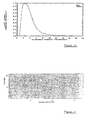
- particle sizes were measured by aerodynamic diameter using the Aerosizer/Aerodisperser (Amherst Processing Instruments) dry powder analyser.
- particle sizes were determined by suspension in ether and analysis using the Malvern LoC PCS system.
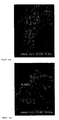
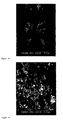
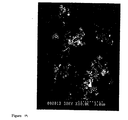
- Figure 12 SEM micrographs of the products are shown in Figure 12; Figure 12A is the product of the cross flow nozzle experiment (Run 2); Figure 12B the product of the control experiment (also Run 2).
- Nozzle passages 50 and 51 had internal diameters of 0.75 mm and 0.35 mm respectively; the wall of inner passage 51 had an external diameter of 0.65 mm.
- the outlet of passage 50 was of diameter 0.15 mm.
- This experiment was used to produce silver nitrate particles having well controlled physicochemical characteristics.
- Emulsions of microparticles of silver salts are often used to coat films and paper in the photographic industry.
- Picture resolution and film speed are affected by the size of particles of the salts present in the emulsion.
- the finer the particle size the higher the resolution and the slower the speed of the final product (film or print). Therefore, a substantial amount of effort has been directed in the past to producing a high resolution product with a high film speed. It would be highly desirable if the SEDS process could be used to prepare very fine, monodisperse particles of an inorganic photo-sensitive material.
- Example 2 Using the apparatus of Example 2, a 0.2% w/v solution of polystyrene in toluene was introduced through inner passage 61 at 0.2 ml/min. Supercritical CO 2 was introduced at 18 ml/min through passages 60 and 62. The particle formation vessel (Keystone, 125 ml) was kept at 100 bar and 35°C.
- Example 3 a polystyrene solution was introduced into the apparatus of Example 3.
- the solution concentration was 0.2% w/v in toluene and it was introduced with a flow rate of 0.2 ml/min through passage 50.
- Supercritical CO 2 flow rate 18 ml/min was introduced into the particle formation vessel (125 ml, Keystone), kept at 150 bar and 35°C, through nozzle passages 51 and 52.
- the product a fine, fluffy, free flowing white powder, was collected at the end of the experiment and stored in a screw-cap bottle.
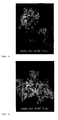
- the mean particle diameter of the product was around 500 nm when examined by the SEM ( Figure 18).
- Samarium is a rare earth metal used in the manufacture of soft permanent magnets for electronic devices, and also in ceramic products. In this experiment, particles of its acetate were produced.
- 0.2 g of samarium acetate was dissolved in 2 ml of deionised water and 20 ml of methanol and introduced into the apparatus of Example 3, at a flow rate of 0.2 ml/min.
- Two opposing flows of supercritical CO 2 were introduced through the nozzle as well.
- the pressure and temperature in the 125 ml Keystone vessel were maintained at 150 bar and 50°C respectively.
- the product a fine fluffy white powder, was collected and stored free from moisture.
Landscapes
- Chemical & Material Sciences (AREA)
- Chemical Kinetics & Catalysis (AREA)
- Health & Medical Sciences (AREA)
- Engineering & Computer Science (AREA)
- Bioinformatics & Cheminformatics (AREA)
- Animal Behavior & Ethology (AREA)
- Public Health (AREA)
- Pharmacology & Pharmacy (AREA)
- Epidemiology (AREA)
- Life Sciences & Earth Sciences (AREA)
- Organic Chemistry (AREA)
- General Health & Medical Sciences (AREA)
- Medicinal Chemistry (AREA)
- Veterinary Medicine (AREA)
- Physical Or Chemical Processes And Apparatus (AREA)
- Extraction Or Liquid Replacement (AREA)
- Glanulating (AREA)
- Manufacturing Of Micro-Capsules (AREA)
- Medicinal Preparation (AREA)
- Nozzles (AREA)
Applications Claiming Priority (3)
| Application Number | Priority Date | Filing Date | Title |
|---|---|---|---|
| GBGB9703673.5A GB9703673D0 (en) | 1997-02-21 | 1997-02-21 | Method and apparatus for the formation of particles |
| GB9703673 | 1997-02-21 | ||
| PCT/GB1998/000538 WO1998036825A1 (en) | 1997-02-21 | 1998-02-20 | Method & apparatus for the formation of particles |
Publications (2)
| Publication Number | Publication Date |
|---|---|
| EP0961651A1 EP0961651A1 (en) | 1999-12-08 |
| EP0961651B1 true EP0961651B1 (en) | 2004-05-12 |
Family
ID=10808111
Family Applications (1)
| Application Number | Title | Priority Date | Filing Date |
|---|---|---|---|
| EP98907005A Expired - Lifetime EP0961651B1 (en) | 1997-02-21 | 1998-02-20 | Method & apparatus for the formation of particles |
Country Status (10)
| Country | Link |
|---|---|
| US (2) | US6440337B1 (enExample) |
| EP (1) | EP0961651B1 (enExample) |
| JP (1) | JP2001513012A (enExample) |
| AT (1) | ATE266463T1 (enExample) |
| AU (1) | AU6299898A (enExample) |
| CA (1) | CA2278347C (enExample) |
| DE (1) | DE69823806T2 (enExample) |
| GB (2) | GB9703673D0 (enExample) |
| WO (1) | WO1998036825A1 (enExample) |
| ZA (1) | ZA981432B (enExample) |
Cited By (1)
| Publication number | Priority date | Publication date | Assignee | Title |
|---|---|---|---|---|
| KR100963164B1 (ko) * | 2005-03-22 | 2010-06-15 | 주식회사 리제론 | 초임계유체를 이용한 단백질 미세입자화 장치 및 단백질미세입자화 방법 |
Families Citing this family (86)
| Publication number | Priority date | Publication date | Assignee | Title |
|---|---|---|---|---|
| GB9804379D0 (en) * | 1998-03-02 | 1998-04-22 | Bradford Particle Design Ltd | Method of particle formation |
| GB2339165B (en) * | 1998-05-15 | 2000-11-01 | Bradford Particle Design Ltd | Methods and apparatus for particle formation |
| GB9810559D0 (en) * | 1998-05-15 | 1998-07-15 | Bradford Particle Design Ltd | Method and apparatus for particle formation |
| SE9804001D0 (sv) | 1998-11-23 | 1998-11-23 | Astra Ab | New process |
| GB9828204D0 (en) * | 1998-12-21 | 1999-02-17 | Smithkline Beecham Plc | Process |
| DE19860497A1 (de) * | 1998-12-28 | 2000-07-06 | Basf Ag | Verfahren und Vorrichtung zur Herstellung stabil feinteiliger Pulver |
| SE9901059L (sv) * | 1999-03-22 | 2000-09-23 | Johan Carlfors | Metod för framställning av partiklar |
| SE9901667D0 (sv) * | 1999-05-07 | 1999-05-07 | Astra Ab | Method and device for forming particles |
| HK1049621A1 (zh) | 1999-06-09 | 2003-05-23 | 罗伯特‧E‧希弗斯 | 超临界流体辅助的喷雾和鼓泡乾燥 |
| GB9915975D0 (en) | 1999-07-07 | 1999-09-08 | Bradford Particle Design Ltd | Method for the formation of particles |
| EP1090894A1 (de) * | 1999-10-06 | 2001-04-11 | Fraunhofer-Gesellschaft zur Förderung der angewandten Forschung e.V. | Verfahren zur Herstellung feinpartikulärer Explosivstoffe |
| EP1242112A4 (en) | 1999-12-21 | 2005-02-09 | Rxkinetix Inc | PRODUCTS CONTAINING MEDICINANT SUBSTANCE PARTICLES AND PROCESS FOR PREPARING THE SAME |
| US6761909B1 (en) | 1999-12-21 | 2004-07-13 | Rxkinetix, Inc. | Particulate insulin-containing products and method of manufacture |
| US6616015B2 (en) * | 2000-01-27 | 2003-09-09 | Crown Cork & Seal Technologies Corporation | Manifold structure for pressure molding |
| CH694686A5 (it) | 2000-03-04 | 2005-06-15 | Eco2 Sa | Prodotto di micronizzazione di sostanze farmaceutiche. |
| CZ20011726A3 (cs) | 2000-05-26 | 2002-02-13 | Pfizer Products Inc. | Způsob reakční krystalizace, který umoľňuje řídit velikost částic |
| FR2815540B1 (fr) † | 2000-10-19 | 2005-06-10 | Separex Sa | Procede de fabrication de tres fines particules constituees d'un principe insere dans une molecule hote |
| GB0027357D0 (en) | 2000-11-09 | 2000-12-27 | Bradford Particle Design Plc | Particle formation methods and their products |
| AUPR197000A0 (en) | 2000-12-08 | 2001-01-11 | Unisearch Limited | Synthesis of small particles |
| AU2002221320B2 (en) * | 2000-12-08 | 2006-06-15 | The University Of Sydney | Synthesis of small particles |
| GB0102075D0 (en) | 2001-01-26 | 2001-03-14 | Astrazeneca Ab | Process |
| BR0207570B1 (pt) | 2001-02-26 | 2013-02-05 | aparelho para formaÇço de partÍculas micronizadas e submicronizadas de uma substÂncia, bocal, e, processo realizado usando o aparelho. | |
| WO2003006223A1 (en) | 2001-07-10 | 2003-01-23 | University Technology Corporation | Devices and methods for the production of particles |
| GB0117696D0 (en) * | 2001-07-20 | 2001-09-12 | Bradford Particle Design Plc | Particle information |
| GB0208742D0 (en) | 2002-04-17 | 2002-05-29 | Bradford Particle Design Ltd | Particulate materials |
| JP4374249B2 (ja) | 2001-10-22 | 2009-12-02 | ドンペ ピーエイチエー.アール.エムエー エス.ピー.エー. | 超臨界的流体による処理方法:タンパク質微粒子の調製およびそれらの安定化 |
| EP1461020A4 (en) | 2001-12-07 | 2008-10-29 | Map Pharmaceuticals Inc | SYNTHESIS OF SMALL PARTICLES |
| AU2002365617B2 (en) * | 2001-12-07 | 2008-04-03 | Map Pharmaceuticals, Inc. | Synthesis of small particles |
| WO2003079993A2 (en) * | 2002-03-20 | 2003-10-02 | Advanced Inhalation Research, Inc. | hGH (HUMAN GROWTH HORMONE) FORMULATIONS FOR PULMONARY ADMINISTRATION |
| US20050163725A1 (en) * | 2002-03-20 | 2005-07-28 | Blizzard Charles D. | Method for administration of growth hormone via pulmonary delivery |
| US7008644B2 (en) * | 2002-03-20 | 2006-03-07 | Advanced Inhalation Research, Inc. | Method and apparatus for producing dry particles |
| WO2003086606A1 (en) * | 2002-04-12 | 2003-10-23 | Feyecon Development & Implementation B.V. | Process for small particle formation |
| US7582284B2 (en) | 2002-04-17 | 2009-09-01 | Nektar Therapeutics | Particulate materials |
| GB0216562D0 (en) | 2002-04-25 | 2002-08-28 | Bradford Particle Design Ltd | Particulate materials |
| EP1501483A2 (en) * | 2002-04-25 | 2005-02-02 | Nektar Therapeutics UK Ltd | Particulate materials |
| US9339459B2 (en) | 2003-04-24 | 2016-05-17 | Nektar Therapeutics | Particulate materials |
| AU2003297391B2 (en) * | 2002-12-19 | 2010-02-25 | Baxter International, Inc. | Process for preparing combination pharmaceutical formulations using supercritical fluids |
| GB0229714D0 (en) * | 2002-12-20 | 2003-01-29 | Glaxo Group Ltd | Novel apparatus and method |
| KR20050088243A (ko) | 2002-12-30 | 2005-09-02 | 넥타르 테라퓨틱스 | 프리필름화 분무기 |
| GB0300339D0 (en) * | 2003-01-08 | 2003-02-05 | Bradford Particle Design Ltd | Particle formation |
| US6931888B2 (en) * | 2003-02-07 | 2005-08-23 | Ferro Corporation | Lyophilization method and apparatus for producing particles |
| US7306171B2 (en) * | 2003-04-09 | 2007-12-11 | Graco Minnesota Inc. | Plural component spray gun for fast setting materials |
| US6875285B2 (en) * | 2003-04-24 | 2005-04-05 | Taiwan Semiconductor Manufacturing Company, Ltd. | System and method for dampening high pressure impact on porous materials |
| JP2006525303A (ja) | 2003-05-08 | 2006-11-09 | ネクター セラピューティクス ユーケー リミティド | 微粒子物質 |
| GB0327723D0 (en) | 2003-09-15 | 2003-12-31 | Vectura Ltd | Pharmaceutical compositions |
| SE0303476D0 (sv) | 2003-12-22 | 2003-12-22 | Censdelivery Ab | Device, method and use for the formation of small particles |
| GB0402963D0 (en) * | 2004-02-11 | 2004-03-17 | Univ Nottingham | Counter current mixing device for two different fluids |
| US20050218076A1 (en) * | 2004-03-31 | 2005-10-06 | Eastman Kodak Company | Process for the formation of particulate material |
| US7223445B2 (en) * | 2004-03-31 | 2007-05-29 | Eastman Kodak Company | Process for the deposition of uniform layer of particulate material |
| US7220456B2 (en) | 2004-03-31 | 2007-05-22 | Eastman Kodak Company | Process for the selective deposition of particulate material |
| MXPA06015220A (es) | 2004-06-21 | 2007-12-13 | Nektar Therapeutics | Composiciones comprendiendo anfotericina b, metodos y sistemas. |
| US8513204B2 (en) | 2004-06-21 | 2013-08-20 | Novartis Ag | Compositions comprising amphotericin B, mehods and systems |
| WO2007013881A2 (en) | 2004-09-27 | 2007-02-01 | Auburn University | Selection and deposition of nanoparticles using co2-expanded liquids |
| WO2006078841A1 (en) * | 2005-01-21 | 2006-07-27 | President And Fellows Of Harvard College | Systems and methods for forming fluidic droplets encapsulated in particles such as colloidal particles |
| ES2265262B1 (es) * | 2005-01-31 | 2008-03-01 | Activery Biotech, S.L.(Titular Al 50%) | Procedimiento para la obtencion de sistemas micro- y nanodispersos. |
| AU2006272438B2 (en) | 2005-07-15 | 2011-08-04 | Map Pharmaceuticals, Inc. | Method of particle formation |
| US7588995B2 (en) * | 2005-11-14 | 2009-09-15 | Taiwan Semiconductor Manufacturing Company, Ltd. | Method to create damage-free porous low-k dielectric films and structures resulting therefrom |
| ES2390183T3 (es) * | 2006-10-11 | 2012-11-07 | Crititech, Inc. | Método de precipitación de partículas pequeñas de medicamento en recipiente de uso |
| US7951723B2 (en) * | 2006-10-24 | 2011-05-31 | Taiwan Semiconductor Manufacturing Company, Ltd. | Integrated etch and supercritical CO2 process and chamber design |
| PL2425820T3 (pl) | 2007-02-11 | 2015-08-31 | Map Pharmaceuticals Inc | Sposób terapeutycznego stosowania dhe w celu umożliwienia szybkiego złagodzenia migreny przy jednoczesnym zminimalizowaniu profilu działań niepożądanych |
| US8585943B2 (en) * | 2007-12-07 | 2013-11-19 | Xspray Microparticles Ab | Method and arrangement for the production of particles |
| FI121990B (fi) * | 2007-12-20 | 2011-07-15 | Beneq Oy | Laite sumun ja hiukkasten tuottamiseksi |
| US8834930B2 (en) | 2008-05-15 | 2014-09-16 | Novartis Ag | Pulmonary delivery of a fluoroquinolone |
| US20100071336A1 (en) * | 2008-09-23 | 2010-03-25 | Timothy Franklin Christensen | Sprockets And Chains For A Row Unit |
| US8215489B1 (en) | 2008-10-31 | 2012-07-10 | Auburn University | Method and apparatus for physical separation of different sized nanostructures |
| US20100294986A1 (en) * | 2009-05-19 | 2010-11-25 | Massachusetts Institute Of Technology | Supercritical fluid facilitated particle formation in microfluidic systems |
| US20100298602A1 (en) * | 2009-05-19 | 2010-11-25 | Massachusetts Institute Of Technology | Systems and methods for microfluidic crystallization |
| US20110171141A1 (en) * | 2009-06-26 | 2011-07-14 | Kellerman Donald J | Administration of dihydroergotamine mesylate particles using a metered dose inhaler |
| EP2604335A4 (en) * | 2010-08-11 | 2017-05-17 | LG Chem, Ltd. | Production device for inorganic compounds and a production method for inorganic compounds using the same |
| MX350838B (es) | 2011-02-11 | 2017-09-18 | Grain Proc Corporation * | Composicion de sal. |
| KR101522526B1 (ko) * | 2012-11-26 | 2015-05-26 | 주식회사 엘지화학 | 무기 입자의 제조방법 및 그로부터 얻어진 무기 입자 |
| CN105073237A (zh) * | 2013-01-15 | 2015-11-18 | 诺丁汉大学 | 混合反应器及相关的方法 |
| US8778181B1 (en) | 2013-03-14 | 2014-07-15 | Crititech, Inc. | Equipment assembly for and method of processing particles |
| US9925512B2 (en) | 2013-03-14 | 2018-03-27 | Crititech, Inc. | Equipment assembly for and method of processing particles |
| GB201402556D0 (en) | 2014-02-13 | 2014-04-02 | Crystec Ltd | Improvements relating to inhalable particles |
| BR112017010426A2 (pt) | 2014-11-20 | 2017-12-26 | Basf Se | processo para preparar um pó inorgânico poroso. |
| US11136438B2 (en) | 2015-07-13 | 2021-10-05 | Sabic Global Technologies B.V. | Process for the preparation of polyolefin particles |
| EP4616852A3 (en) | 2015-07-22 | 2025-10-22 | Anavex Life Sciences Corp. | Crystal forms of tetrahydro-n,n-dimethyl-2,2-diphenyl-3-furanmethanamine hydrochloride, processes of making such forms, and their pharmaceutical compositions |
| EP3478749B1 (en) * | 2016-06-30 | 2020-09-09 | SABIC Global Technologies B.V. | Process for the preparation of polyolefin particles |
| CN106395855B (zh) * | 2016-11-14 | 2018-06-26 | 中北大学 | 撞击流-微波加热耦合反应装置 |
| WO2018121980A1 (en) | 2017-01-02 | 2018-07-05 | Sabic Global Technologies B.V. | Process for recycling polyolefin |
| WO2018189366A1 (en) | 2017-04-13 | 2018-10-18 | Basf Se | Process for preparing a porous material |
| US10815046B2 (en) | 2018-03-03 | 2020-10-27 | Byoplanet International, LLC | Size-selective aerosol nozzle device |
| WO2020053349A1 (de) * | 2018-09-12 | 2020-03-19 | Basf Se | Verfahren zur kontinuierlichen überkritischen trocknung von aerogelpartikeln |
| GB202312252D0 (en) | 2023-08-10 | 2023-09-27 | Inhalis Therapeutics Sa | Crystalline compositions |
| GB202318661D0 (en) | 2023-12-06 | 2024-01-17 | Crystec Ltd | Tranexamic acid compositions |
Family Cites Families (101)
| Publication number | Priority date | Publication date | Assignee | Title |
|---|---|---|---|---|
| BE421211A (enExample) * | 1936-05-02 | |||
| GB621785A (en) | 1943-07-27 | 1949-04-20 | Teco Sa | Apparatus for the pulverisation of liquids in the form of aerosols |
| JPS5254709A (en) * | 1975-10-31 | 1977-05-04 | Lion Corp | Multi-stage spray drying method |
| SE418247B (sv) * | 1975-11-17 | 1981-05-18 | Haessle Ab | Sett att framstella kroppar med reglerad frigoring av en aktiv komponent |
| FI54093C (fi) * | 1976-12-20 | 1978-10-10 | Outokumpu Oy | Saett att framstaella pulverformigt selen fraon raoselen |
| US4356167A (en) * | 1978-01-27 | 1982-10-26 | Sandoz, Inc. | Liposome drug delivery systems |
| DE3013839A1 (de) * | 1979-04-13 | 1980-10-30 | Freunt Ind Co Ltd | Verfahren zur herstellung einer aktivierten pharmazeutischen zusammensetzung |
| JPS6034925B2 (ja) * | 1979-07-31 | 1985-08-12 | 帝人株式会社 | 持続性鼻腔用製剤およびその製造法 |
| US4397907A (en) * | 1981-06-22 | 1983-08-09 | Hughes Aircraft Company | Multi-purpose air permeable composites |
| US5260306A (en) * | 1981-07-24 | 1993-11-09 | Fisons Plc | Inhalation pharmaceuticals |
| DE3268533D1 (en) * | 1981-07-24 | 1986-02-27 | Fisons Plc | Inhalation drugs, methods for their production and pharmaceutical formulations containing them |
| CH656077A5 (de) * | 1982-01-29 | 1986-06-13 | Glatt Maschinen & Apparatebau | Verfahren zum ueberziehen von teilchen, insbesondere arzneimittel-teilchen, und vorrichtung zur durchfuehrung des verfahrens. |
| US4582731A (en) * | 1983-09-01 | 1986-04-15 | Battelle Memorial Institute | Supercritical fluid molecular spray film deposition and powder formation |
| US4514574A (en) * | 1984-01-09 | 1985-04-30 | The Dow Chemical Company | Process for separating isomeric mixtures |
| US4624848A (en) * | 1984-05-10 | 1986-11-25 | Ciba-Geigy Corporation | Active agent containing hydrogel devices wherein the active agent concentration profile contains a sigmoidal concentration gradient for improved constant release, their manufacture and use |
| IE58110B1 (en) * | 1984-10-30 | 1993-07-14 | Elan Corp Plc | Controlled release powder and process for its preparation |
| ES2053549T3 (es) * | 1986-08-11 | 1994-08-01 | Innovata Biomed Ltd | Un proceso para la preparacion de una formulacion farmaceutica apropiada para inhalacion. |
| US4760093A (en) * | 1986-10-21 | 1988-07-26 | American Home Products Corporation (Del.) | Spray dried acetaminophen |
| JP2562624B2 (ja) * | 1986-11-07 | 1996-12-11 | 昭和電工株式会社 | 水溶性マイクロカプセルおよび液体洗剤組成物 |
| US4784878A (en) * | 1987-04-06 | 1988-11-15 | Damrow Company, Inc. | Spray drying method and apparatus for concurrent particle coating |
| US4835187A (en) * | 1987-06-15 | 1989-05-30 | American Home Products Corporation | Spray dried ibuprofen |
| US5219575A (en) * | 1987-06-26 | 1993-06-15 | Duphar International Research B.V. | Compositions with controlled zero-order delivery rate and method of preparing these compositions |
| US5160674A (en) * | 1987-07-29 | 1992-11-03 | Massachusetts Institute Of Technology | Microcellular foams of semi-crystaline polymeric materials |
| SE462704B (sv) | 1987-12-09 | 1990-08-20 | Hg Tech Ab | Foerfarande vid atomisering av vaetskor och anordning foer genomfoerande av foerfarandet |
| ES2043640T3 (es) * | 1987-12-21 | 1994-01-01 | Union Carbide Corp | Fluidos supercriticos como diluyentes en la aplicacion por rociada liquida de revestimientos. |
| DE3744329A1 (de) * | 1987-12-28 | 1989-07-06 | Schwarz Pharma Gmbh | Verfahren zur herstellung einer mindestens einen wirkstoff und einen traeger umfassenden zubereitung |
| US4919853A (en) * | 1988-01-21 | 1990-04-24 | The United States Of America As Represented By The United States Department Of Energy | Apparatus and method for spraying liquid materials |
| US5066522A (en) * | 1988-07-14 | 1991-11-19 | Union Carbide Chemicals And Plastics Technology Corporation | Supercritical fluids as diluents in liquid spray applications of adhesives |
| US4999189A (en) * | 1988-11-14 | 1991-03-12 | Schering Corporation | Sustained release oral suspensions |
| US5009367A (en) * | 1989-03-22 | 1991-04-23 | Union Carbide Chemicals And Plastics Technology Corporation | Methods and apparatus for obtaining wider sprays when spraying liquids by airless techniques |
| US5232707A (en) * | 1989-07-10 | 1993-08-03 | Syntex (U.S.A.) Inc. | Solvent extraction process |
| US5238920A (en) * | 1989-08-22 | 1993-08-24 | Abbott Laboratories | Pulmonary surfactant protein fragments |
| US5178878A (en) * | 1989-10-02 | 1993-01-12 | Cima Labs, Inc. | Effervescent dosage form with microparticles |
| US5542935A (en) * | 1989-12-22 | 1996-08-06 | Imarx Pharmaceutical Corp. | Therapeutic delivery systems related applications |
| GB9001635D0 (en) * | 1990-01-24 | 1990-03-21 | Ganderton David | Aerosol carriers |
| US5000888A (en) * | 1990-05-23 | 1991-03-19 | Basf Corporation | Process for spray drying riboflavin to produce a granulate product having low binder content |
| GB9017155D0 (en) * | 1990-08-03 | 1990-09-19 | Ici Plc | Spray drying |
| DE4118230A1 (de) * | 1990-12-20 | 1992-06-25 | Bayer Ag | Verfahren zur isolierung von polymeren aus ihren loesungsmitteln mit kohlendioxid-haltigen fluessigkeiten |
| DE4041563A1 (de) * | 1990-12-22 | 1992-06-25 | Sanol Arznei Schwarz Gmbh | Verfahren zur herstellung wirkstoffhaltiger mikropartikel aus hydrolytisch abbaubaren polymeren |
| GB9107628D0 (en) * | 1991-04-10 | 1991-05-29 | Moonbrook Limited | Preparation of diagnostic agents |
| DE4117751A1 (de) * | 1991-05-30 | 1992-12-03 | Bayer Ag | Verfahren zur isolierung von polycarbonaten |
| KR100259989B1 (ko) * | 1991-10-01 | 2000-08-01 | 모리다 가쓰라 | 서방성 마이크로캡슐 제제 및 그의 제조법 |
| DK0717987T3 (da) * | 1991-12-18 | 2001-11-12 | Minnesota Mining & Mfg | Suspension-aerosol-formuleringer |
| CA2127877A1 (en) * | 1992-01-21 | 1993-07-22 | Robert M. Platz | Improved process for preparing micronized polypeptide drugs |
| US5639441A (en) * | 1992-03-06 | 1997-06-17 | Board Of Regents Of University Of Colorado | Methods for fine particle formation |
| AU4198793A (en) * | 1992-07-24 | 1994-01-27 | Takeda Chemical Industries Ltd. | Microparticle preparation and production thereof |
| GB9221329D0 (en) * | 1992-10-10 | 1992-11-25 | Delta Biotechnology Ltd | Preparation of further diagnostic agents |
| CA2145626A1 (en) * | 1992-11-02 | 1994-05-11 | Frederick S. Mandel | Method of preparing coating materials |
| NZ248813A (en) * | 1992-11-25 | 1995-06-27 | Eastman Kodak Co | Polymeric grinding media used in grinding pharmaceutical substances |
| US5354934A (en) * | 1993-02-04 | 1994-10-11 | Amgen Inc. | Pulmonary administration of erythropoietin |
| US5916596A (en) * | 1993-02-22 | 1999-06-29 | Vivorx Pharmaceuticals, Inc. | Protein stabilized pharmacologically active agents, methods for the preparation thereof and methods for the use thereof |
| US5554382A (en) * | 1993-05-28 | 1996-09-10 | Aphios Corporation | Methods and apparatus for making liposomes |
| IS1796B (is) * | 1993-06-24 | 2001-12-31 | Ab Astra | Fjölpeptíð lyfjablanda til innöndunar sem einnig inniheldur eykjaefnasamband |
| GB9313642D0 (en) * | 1993-07-01 | 1993-08-18 | Glaxo Group Ltd | Method and apparatus for the formation of particles |
| GB9313650D0 (en) * | 1993-07-01 | 1993-08-18 | Glaxo Group Ltd | Method and apparatus for the formation of particles |
| NZ276277A (en) * | 1993-11-08 | 1998-04-27 | Gillette Co | Antiperspirant compound, in aerogel form, being an aluminium salt, a zirconium salt or an aluminium-zirconium salt |
| US5595761A (en) * | 1994-01-27 | 1997-01-21 | The Board Of Regents Of The University Of Oklahoma | Particulate support matrix for making a rapidly dissolving tablet |
| US5635210A (en) * | 1994-02-03 | 1997-06-03 | The Board Of Regents Of The University Of Oklahoma | Method of making a rapidly dissolving tablet |
| JPH09508695A (ja) * | 1994-02-09 | 1997-09-02 | キナートン・リミテッド | 溶液から材料を乾燥する方法 |
| US5502056A (en) * | 1994-05-27 | 1996-03-26 | Breitbarth; Richard | Caffeine containing composition |
| GB9413202D0 (en) * | 1994-06-30 | 1994-08-24 | Univ Bradford | Method and apparatus for the formation of particles |
| US6290991B1 (en) * | 1994-12-02 | 2001-09-18 | Quandrant Holdings Cambridge Limited | Solid dose delivery vehicle and methods of making same |
| US6117455A (en) * | 1994-09-30 | 2000-09-12 | Takeda Chemical Industries, Ltd. | Sustained-release microcapsule of amorphous water-soluble pharmaceutical active agent |
| US5716558A (en) * | 1994-11-14 | 1998-02-10 | Union Carbide Chemicals & Plastics Technology Corporation | Method for producing coating powders catalysts and drier water-borne coatings by spraying compositions with compressed fluids |
| US5639475A (en) * | 1995-02-03 | 1997-06-17 | Eurand America, Incorporated | Effervescent microcapsules |
| US5534270A (en) * | 1995-02-09 | 1996-07-09 | Nanosystems Llc | Method of preparing stable drug nanoparticles |
| US5510118A (en) * | 1995-02-14 | 1996-04-23 | Nanosystems Llc | Process for preparing therapeutic compositions containing nanoparticles |
| US6258341B1 (en) * | 1995-04-14 | 2001-07-10 | Inhale Therapeutic Systems, Inc. | Stable glassy state powder formulations |
| CN1036194C (zh) * | 1995-05-30 | 1997-10-22 | 华东理工大学 | 超临界流体析晶法制取猛炸药微颗粒的工艺 |
| US5667806A (en) * | 1995-06-07 | 1997-09-16 | Emisphere Technologies, Inc. | Spray drying method and apparatus |
| US5607697A (en) * | 1995-06-07 | 1997-03-04 | Cima Labs, Incorporated | Taste masking microparticles for oral dosage forms |
| JP2002515856A (ja) * | 1995-10-11 | 2002-05-28 | タラリア セラピューティックス インコーポレーテッド | リポソーム組成物およびそれらの利用方法 |
| ES2306452T3 (es) * | 1995-10-17 | 2008-11-01 | Jagotec Ag | Aporte de farmacos insolubles. |
| US5807578A (en) * | 1995-11-22 | 1998-09-15 | Lab Pharmaceutical Research International Inc. | Fast-melt tablet and method of making same |
| US5708036A (en) * | 1996-01-29 | 1998-01-13 | Pesterfield, Jr.; E. Charles | Method of treating premature uterine contractions using the optically active R(-)-isomer of albuterol |
| EP0885038B1 (en) * | 1996-03-01 | 2011-06-15 | The University Of Kansas | Methods and apparatus for particle precipitation and coating using near-critical and supercritical antisolvents |
| US5874029A (en) * | 1996-10-09 | 1999-02-23 | The University Of Kansas | Methods for particle micronization and nanonization by recrystallization from organic solutions sprayed into a compressed antisolvent |
| US6116516A (en) * | 1996-05-13 | 2000-09-12 | Universidad De Sevilla | Stabilized capillary microjet and devices and methods for producing same |
| ES2140998B1 (es) * | 1996-05-13 | 2000-10-16 | Univ Sevilla | Procedimiento de atomizacion de liquidos. |
| US5855913A (en) * | 1997-01-16 | 1999-01-05 | Massachusetts Instite Of Technology | Particles incorporating surfactants for pulmonary drug delivery |
| US6017310A (en) * | 1996-09-07 | 2000-01-25 | Andaris Limited | Use of hollow microcapsules |
| US6001336A (en) * | 1996-12-31 | 1999-12-14 | Inhale Therapeutic Systems | Processes for spray drying aqueous suspensions of hydrophobic drugs and compositions thereof |
| US6051257A (en) * | 1997-02-24 | 2000-04-18 | Superior Micropowders, Llc | Powder batch of pharmaceutically-active particles and methods for making same |
| GB9800936D0 (en) * | 1997-05-10 | 1998-03-11 | Univ Nottingham | Biofunctional polymers |
| US6090407A (en) * | 1997-09-23 | 2000-07-18 | Research Development Foundation | Small particle liposome aerosols for delivery of anti-cancer drugs |
| US6565885B1 (en) * | 1997-09-29 | 2003-05-20 | Inhale Therapeutic Systems, Inc. | Methods of spray drying pharmaceutical compositions |
| GB9810559D0 (en) * | 1998-05-15 | 1998-07-15 | Bradford Particle Design Ltd | Method and apparatus for particle formation |
| WO1999065469A2 (en) * | 1998-06-19 | 1999-12-23 | Rtp Pharma Inc. | Processes to generate submicron particles of water-insoluble compounds |
| US6387410B1 (en) * | 1998-09-10 | 2002-05-14 | Norton Healthcare Ltd | Anti-inflammatory pharmaceutical formulations |
| GB9915975D0 (en) * | 1999-07-07 | 1999-09-08 | Bradford Particle Design Ltd | Method for the formation of particles |
| US20020081266A1 (en) * | 1999-08-20 | 2002-06-27 | Norton Healthcare Ltd. | Spray dried powders for pulmonary or nasal administration |
| PE20011227A1 (es) * | 2000-04-17 | 2002-01-07 | Chiesi Farma Spa | Formulaciones farmaceuticas para inhaladores de polvo seco en la forma de aglomerados duros |
| US6551617B1 (en) * | 2000-04-20 | 2003-04-22 | Bristol-Myers Squibb Company | Taste masking coating composition |
| US6620351B2 (en) * | 2000-05-24 | 2003-09-16 | Auburn University | Method of forming nanoparticles and microparticles of controllable size using supercritical fluids with enhanced mass transfer |
| WO2002009669A2 (en) * | 2000-08-01 | 2002-02-07 | Inhale Therapeutic Systems, Inc. | Apparatus and process to produce particles having a narrow size distribution and particles made thereby |
| FR2815540B1 (fr) * | 2000-10-19 | 2005-06-10 | Separex Sa | Procede de fabrication de tres fines particules constituees d'un principe insere dans une molecule hote |
| GB0027357D0 (en) * | 2000-11-09 | 2000-12-27 | Bradford Particle Design Plc | Particle formation methods and their products |
| GB0117696D0 (en) * | 2001-07-20 | 2001-09-12 | Bradford Particle Design Plc | Particle information |
| DE50109276D1 (de) * | 2001-12-06 | 2006-05-11 | Schmall Karl Heinz | Wasserstrahl-Schneidemaschine mit berührungsloser und wahlweise taktiler Abstands-Führungssensor-Einrichtung |
| AU2003209673B2 (en) * | 2002-03-08 | 2007-10-18 | M/S. Ind-Swift Limited | Tasteless directly compressible fast-dissolving complexes and pharmaceutical formulations thereof |
| JP2006525303A (ja) * | 2003-05-08 | 2006-11-09 | ネクター セラピューティクス ユーケー リミティド | 微粒子物質 |
-
1997
- 1997-02-21 GB GBGB9703673.5A patent/GB9703673D0/en active Pending
-
1998
- 1998-02-20 US US09/380,025 patent/US6440337B1/en not_active Expired - Lifetime
- 1998-02-20 DE DE69823806T patent/DE69823806T2/de not_active Expired - Lifetime
- 1998-02-20 GB GB9803634A patent/GB2322326B/en not_active Expired - Lifetime
- 1998-02-20 AU AU62998/98A patent/AU6299898A/en not_active Abandoned
- 1998-02-20 AT AT98907005T patent/ATE266463T1/de not_active IP Right Cessation
- 1998-02-20 EP EP98907005A patent/EP0961651B1/en not_active Expired - Lifetime
- 1998-02-20 WO PCT/GB1998/000538 patent/WO1998036825A1/en not_active Ceased
- 1998-02-20 JP JP53639898A patent/JP2001513012A/ja not_active Ceased
- 1998-02-20 ZA ZA981432A patent/ZA981432B/xx unknown
- 1998-02-20 CA CA002278347A patent/CA2278347C/en not_active Expired - Lifetime
-
2002
- 2002-08-22 US US10/225,943 patent/US20030047824A1/en not_active Abandoned
Cited By (1)
| Publication number | Priority date | Publication date | Assignee | Title |
|---|---|---|---|---|
| KR100963164B1 (ko) * | 2005-03-22 | 2010-06-15 | 주식회사 리제론 | 초임계유체를 이용한 단백질 미세입자화 장치 및 단백질미세입자화 방법 |
Also Published As
| Publication number | Publication date |
|---|---|
| WO1998036825A1 (en) | 1998-08-27 |
| US6440337B1 (en) | 2002-08-27 |
| GB2322326A (en) | 1998-08-26 |
| US20030047824A1 (en) | 2003-03-13 |
| GB2322326B (en) | 2001-12-12 |
| EP0961651A1 (en) | 1999-12-08 |
| CA2278347C (en) | 2006-01-03 |
| ATE266463T1 (de) | 2004-05-15 |
| JP2001513012A (ja) | 2001-08-28 |
| CA2278347A1 (en) | 1998-08-27 |
| GB9803634D0 (en) | 1998-04-15 |
| DE69823806D1 (de) | 2004-06-17 |
| DE69823806T2 (de) | 2005-04-28 |
| ZA981432B (en) | 1998-08-27 |
| GB9703673D0 (en) | 1997-04-09 |
| AU6299898A (en) | 1998-09-09 |
Similar Documents
| Publication | Publication Date | Title |
|---|---|---|
| US6440337B1 (en) | Method and apparatus for the formation of particles | |
| CA2329902C (en) | Methods and apparatus for particle formation | |
| US7087197B2 (en) | Particle formation | |
| EP1409123B1 (en) | Method and apparatus for preparing particles | |
| CN100531886C (zh) | 形成微米和亚微米颗粒的装置及其方法 | |
| US20050085409A1 (en) | Particle formation | |
| EP1133345A4 (en) | METHOD AND APPARATUS FOR SELECTIVELY SEPARATING THE DIMENSION OF MICRO AND NANO PARTICLES | |
| EP1703965B1 (en) | Device, method and use for the formation of small particles | |
| WO2004062784A1 (en) | Process and device for particle formation | |
| US20030150085A1 (en) | Manipulation of solvent properties for particle formation | |
| GB2339165A (en) | Method and apparatus for particle formation using supercritical fluids |
Legal Events
| Date | Code | Title | Description |
|---|---|---|---|
| PUAI | Public reference made under article 153(3) epc to a published international application that has entered the european phase |
Free format text: ORIGINAL CODE: 0009012 |
|
| 17P | Request for examination filed |
Effective date: 19990719 |
|
| AK | Designated contracting states |
Kind code of ref document: A1 Designated state(s): AT BE CH DE DK ES FI FR GB GR IE IT LI NL PT SE |
|
| RAP1 | Party data changed (applicant data changed or rights of an application transferred) |
Owner name: BRADFORD PARTICLE DESIGN PLC |
|
| 17Q | First examination report despatched |
Effective date: 20000718 |
|
| RAP1 | Party data changed (applicant data changed or rights of an application transferred) |
Owner name: BRADFORD PARTICLE DESIGN LIMITED |
|
| GRAP | Despatch of communication of intention to grant a patent |
Free format text: ORIGINAL CODE: EPIDOSNIGR1 |
|
| RBV | Designated contracting states (corrected) |
Designated state(s): AT BE CH DE DK ES FI FR GR IE IT LI NL PT SE |
|
| RAP1 | Party data changed (applicant data changed or rights of an application transferred) |
Owner name: NEKTAR THERAPEUTICS UK LIMITED |
|
| GRAS | Grant fee paid |
Free format text: ORIGINAL CODE: EPIDOSNIGR3 |
|
| GRAA | (expected) grant |
Free format text: ORIGINAL CODE: 0009210 |
|
| AK | Designated contracting states |
Kind code of ref document: B1 Designated state(s): AT BE CH DE DK ES FI FR GR IE IT LI NL PT SE |
|
| PG25 | Lapsed in a contracting state [announced via postgrant information from national office to epo] |
Ref country code: NL Free format text: LAPSE BECAUSE OF FAILURE TO SUBMIT A TRANSLATION OF THE DESCRIPTION OR TO PAY THE FEE WITHIN THE PRESCRIBED TIME-LIMIT Effective date: 20040512 Ref country code: FI Free format text: LAPSE BECAUSE OF FAILURE TO SUBMIT A TRANSLATION OF THE DESCRIPTION OR TO PAY THE FEE WITHIN THE PRESCRIBED TIME-LIMIT Effective date: 20040512 Ref country code: BE Free format text: LAPSE BECAUSE OF FAILURE TO SUBMIT A TRANSLATION OF THE DESCRIPTION OR TO PAY THE FEE WITHIN THE PRESCRIBED TIME-LIMIT Effective date: 20040512 Ref country code: AT Free format text: LAPSE BECAUSE OF FAILURE TO SUBMIT A TRANSLATION OF THE DESCRIPTION OR TO PAY THE FEE WITHIN THE PRESCRIBED TIME-LIMIT Effective date: 20040512 |
|
| REG | Reference to a national code |
Ref country code: CH Ref legal event code: EP |
|
| REG | Reference to a national code |
Ref country code: IE Ref legal event code: FG4D |
|
| REF | Corresponds to: |
Ref document number: 69823806 Country of ref document: DE Date of ref document: 20040617 Kind code of ref document: P |
|
| PG25 | Lapsed in a contracting state [announced via postgrant information from national office to epo] |
Ref country code: SE Free format text: LAPSE BECAUSE OF FAILURE TO SUBMIT A TRANSLATION OF THE DESCRIPTION OR TO PAY THE FEE WITHIN THE PRESCRIBED TIME-LIMIT Effective date: 20040812 Ref country code: GR Free format text: LAPSE BECAUSE OF FAILURE TO SUBMIT A TRANSLATION OF THE DESCRIPTION OR TO PAY THE FEE WITHIN THE PRESCRIBED TIME-LIMIT Effective date: 20040812 Ref country code: DK Free format text: LAPSE BECAUSE OF FAILURE TO SUBMIT A TRANSLATION OF THE DESCRIPTION OR TO PAY THE FEE WITHIN THE PRESCRIBED TIME-LIMIT Effective date: 20040812 |
|
| REG | Reference to a national code |
Ref country code: CH Ref legal event code: NV Representative=s name: MICHELI & CIE INGENIEURS-CONSEILS |
|
| PG25 | Lapsed in a contracting state [announced via postgrant information from national office to epo] |
Ref country code: ES Free format text: LAPSE BECAUSE OF FAILURE TO SUBMIT A TRANSLATION OF THE DESCRIPTION OR TO PAY THE FEE WITHIN THE PRESCRIBED TIME-LIMIT Effective date: 20040823 |
|
| NLV1 | Nl: lapsed or annulled due to failure to fulfill the requirements of art. 29p and 29m of the patents act | ||
| ET | Fr: translation filed | ||
| PG25 | Lapsed in a contracting state [announced via postgrant information from national office to epo] |
Ref country code: IE Free format text: LAPSE BECAUSE OF NON-PAYMENT OF DUE FEES Effective date: 20050221 |
|
| PLBE | No opposition filed within time limit |
Free format text: ORIGINAL CODE: 0009261 |
|
| STAA | Information on the status of an ep patent application or granted ep patent |
Free format text: STATUS: NO OPPOSITION FILED WITHIN TIME LIMIT |
|
| 26N | No opposition filed |
Effective date: 20050215 |
|
| REG | Reference to a national code |
Ref country code: IE Ref legal event code: MM4A |
|
| PGFP | Annual fee paid to national office [announced via postgrant information from national office to epo] |
Ref country code: CH Payment date: 20070215 Year of fee payment: 10 |
|
| PG25 | Lapsed in a contracting state [announced via postgrant information from national office to epo] |
Ref country code: PT Free format text: LAPSE BECAUSE OF NON-PAYMENT OF DUE FEES Effective date: 20041012 |
|
| PGFP | Annual fee paid to national office [announced via postgrant information from national office to epo] |
Ref country code: IT Payment date: 20070718 Year of fee payment: 10 |
|
| PGFP | Annual fee paid to national office [announced via postgrant information from national office to epo] |
Ref country code: FR Payment date: 20070212 Year of fee payment: 10 |
|
| REG | Reference to a national code |
Ref country code: CH Ref legal event code: PL |
|
| PG25 | Lapsed in a contracting state [announced via postgrant information from national office to epo] |
Ref country code: LI Free format text: LAPSE BECAUSE OF NON-PAYMENT OF DUE FEES Effective date: 20080229 Ref country code: CH Free format text: LAPSE BECAUSE OF NON-PAYMENT OF DUE FEES Effective date: 20080229 |
|
| REG | Reference to a national code |
Ref country code: FR Ref legal event code: ST Effective date: 20081031 |
|
| PG25 | Lapsed in a contracting state [announced via postgrant information from national office to epo] |
Ref country code: FR Free format text: LAPSE BECAUSE OF NON-PAYMENT OF DUE FEES Effective date: 20080229 |
|
| PG25 | Lapsed in a contracting state [announced via postgrant information from national office to epo] |
Ref country code: IT Free format text: LAPSE BECAUSE OF NON-PAYMENT OF DUE FEES Effective date: 20080220 |
|
| REG | Reference to a national code |
Ref country code: DE Ref legal event code: R082 Ref document number: 69823806 Country of ref document: DE Representative=s name: MEISSNER, BOLTE & PARTNER GBR, DE |
|
| REG | Reference to a national code |
Ref country code: FR Ref legal event code: TP Owner name: NEKTAR THERAPEUTICS, US Effective date: 20121026 |
|
| REG | Reference to a national code |
Ref country code: DE Ref legal event code: R082 Ref document number: 69823806 Country of ref document: DE Representative=s name: MEISSNER BOLTE PATENTANWAELTE RECHTSANWAELTE P, DE Effective date: 20121113 Ref country code: DE Ref legal event code: R082 Ref document number: 69823806 Country of ref document: DE Representative=s name: MEISSNER, BOLTE & PARTNER GBR, DE Effective date: 20121113 Ref country code: DE Ref legal event code: R081 Ref document number: 69823806 Country of ref document: DE Owner name: NEKTAR THERAPEUTICS, SAN FRANCISCO, US Free format text: FORMER OWNER: NEKTAR THERAPEUTICS UK LTD., BRADFORD, WEST YORKSHIRE, GB Effective date: 20121113 Ref country code: DE Ref legal event code: R081 Ref document number: 69823806 Country of ref document: DE Owner name: NEKTAR THERAPEUTICS, US Free format text: FORMER OWNER: NEKTAR THERAPEUTICS UK LTD., BRADFORD, GB Effective date: 20121113 |
|
| PGFP | Annual fee paid to national office [announced via postgrant information from national office to epo] |
Ref country code: DE Payment date: 20170217 Year of fee payment: 20 |
|
| REG | Reference to a national code |
Ref country code: DE Ref legal event code: R071 Ref document number: 69823806 Country of ref document: DE |