EP0948582B1 - Hydrocarbon conversion process - Google Patents
Hydrocarbon conversion process Download PDFInfo
- Publication number
- EP0948582B1 EP0948582B1 EP97937280A EP97937280A EP0948582B1 EP 0948582 B1 EP0948582 B1 EP 0948582B1 EP 97937280 A EP97937280 A EP 97937280A EP 97937280 A EP97937280 A EP 97937280A EP 0948582 B1 EP0948582 B1 EP 0948582B1
- Authority
- EP
- European Patent Office
- Prior art keywords
- hydrotreating
- steam
- catalyst
- zone
- group
- Prior art date
- Legal status (The legal status is an assumption and is not a legal conclusion. Google has not performed a legal analysis and makes no representation as to the accuracy of the status listed.)
- Expired - Lifetime
Links
- 229930195733 hydrocarbon Natural products 0.000 title claims description 109
- 150000002430 hydrocarbons Chemical class 0.000 title claims description 109
- 239000004215 Carbon black (E152) Substances 0.000 title claims description 77
- 238000000034 method Methods 0.000 title claims description 50
- 238000006243 chemical reaction Methods 0.000 title description 9
- 239000003054 catalyst Substances 0.000 claims description 123
- 229910052739 hydrogen Inorganic materials 0.000 claims description 81
- 239000001257 hydrogen Substances 0.000 claims description 79
- 239000007789 gas Substances 0.000 claims description 74
- 238000004230 steam cracking Methods 0.000 claims description 68
- UFHFLCQGNIYNRP-UHFFFAOYSA-N Hydrogen Chemical compound [H][H] UFHFLCQGNIYNRP-UHFFFAOYSA-N 0.000 claims description 61
- PXHVJJICTQNCMI-UHFFFAOYSA-N Nickel Chemical compound [Ni] PXHVJJICTQNCMI-UHFFFAOYSA-N 0.000 claims description 38
- PNEYBMLMFCGWSK-UHFFFAOYSA-N aluminium oxide Inorganic materials [O-2].[O-2].[O-2].[Al+3].[Al+3] PNEYBMLMFCGWSK-UHFFFAOYSA-N 0.000 claims description 38
- -1 VIB metals Chemical class 0.000 claims description 26
- 238000009835 boiling Methods 0.000 claims description 26
- 239000010457 zeolite Substances 0.000 claims description 25
- VYPSYNLAJGMNEJ-UHFFFAOYSA-N Silicium dioxide Chemical compound O=[Si]=O VYPSYNLAJGMNEJ-UHFFFAOYSA-N 0.000 claims description 24
- 229910052751 metal Inorganic materials 0.000 claims description 23
- 239000002184 metal Substances 0.000 claims description 23
- KDLHZDBZIXYQEI-UHFFFAOYSA-N Palladium Chemical compound [Pd] KDLHZDBZIXYQEI-UHFFFAOYSA-N 0.000 claims description 20
- 229910021536 Zeolite Inorganic materials 0.000 claims description 20
- HNPSIPDUKPIQMN-UHFFFAOYSA-N dioxosilane;oxo(oxoalumanyloxy)alumane Chemical compound O=[Si]=O.O=[Al]O[Al]=O HNPSIPDUKPIQMN-UHFFFAOYSA-N 0.000 claims description 20
- 238000005984 hydrogenation reaction Methods 0.000 claims description 19
- 229910052759 nickel Inorganic materials 0.000 claims description 19
- BASFCYQUMIYNBI-UHFFFAOYSA-N platinum Chemical compound [Pt] BASFCYQUMIYNBI-UHFFFAOYSA-N 0.000 claims description 18
- 239000000203 mixture Substances 0.000 claims description 17
- ZOKXTWBITQBERF-UHFFFAOYSA-N Molybdenum Chemical compound [Mo] ZOKXTWBITQBERF-UHFFFAOYSA-N 0.000 claims description 16
- 229910052750 molybdenum Inorganic materials 0.000 claims description 16
- 239000011733 molybdenum Substances 0.000 claims description 16
- WFKWXMTUELFFGS-UHFFFAOYSA-N tungsten Chemical compound [W] WFKWXMTUELFFGS-UHFFFAOYSA-N 0.000 claims description 14
- 229910052721 tungsten Inorganic materials 0.000 claims description 14
- 239000010937 tungsten Substances 0.000 claims description 14
- 239000000377 silicon dioxide Substances 0.000 claims description 12
- 229910017052 cobalt Inorganic materials 0.000 claims description 11
- 239000010941 cobalt Substances 0.000 claims description 11
- GUTLYIVDDKVIGB-UHFFFAOYSA-N cobalt atom Chemical compound [Co] GUTLYIVDDKVIGB-UHFFFAOYSA-N 0.000 claims description 11
- 150000002739 metals Chemical class 0.000 claims description 11
- 229910000510 noble metal Inorganic materials 0.000 claims description 10
- 229910052763 palladium Inorganic materials 0.000 claims description 10
- 125000001741 organic sulfur group Chemical group 0.000 claims description 9
- 229910052697 platinum Inorganic materials 0.000 claims description 9
- 239000011230 binding agent Substances 0.000 claims description 5
- 230000000694 effects Effects 0.000 claims description 5
- 239000002808 molecular sieve Substances 0.000 claims description 5
- URGAHOPLAPQHLN-UHFFFAOYSA-N sodium aluminosilicate Chemical compound [Na+].[Al+3].[O-][Si]([O-])=O.[O-][Si]([O-])=O URGAHOPLAPQHLN-UHFFFAOYSA-N 0.000 claims description 5
- 239000011148 porous material Substances 0.000 claims description 4
- 229910052681 coesite Inorganic materials 0.000 claims description 3
- 229910052593 corundum Inorganic materials 0.000 claims description 3
- 229910052906 cristobalite Inorganic materials 0.000 claims description 3
- 229910052809 inorganic oxide Inorganic materials 0.000 claims description 3
- 229910017464 nitrogen compound Inorganic materials 0.000 claims description 3
- 150000002830 nitrogen compounds Chemical class 0.000 claims description 3
- 229910052682 stishovite Inorganic materials 0.000 claims description 3
- 229910052905 tridymite Inorganic materials 0.000 claims description 3
- 229910001845 yogo sapphire Inorganic materials 0.000 claims description 3
- 238000000354 decomposition reaction Methods 0.000 claims description 2
- 150000003568 thioethers Chemical class 0.000 claims 2
- 239000011959 amorphous silica alumina Substances 0.000 claims 1
- 239000000047 product Substances 0.000 description 97
- 239000003921 oil Substances 0.000 description 63
- UHOVQNZJYSORNB-UHFFFAOYSA-N Benzene Chemical compound C1=CC=CC=C1 UHOVQNZJYSORNB-UHFFFAOYSA-N 0.000 description 36
- 239000007788 liquid Substances 0.000 description 34
- 230000000052 comparative effect Effects 0.000 description 28
- RRHGJUQNOFWUDK-UHFFFAOYSA-N Isoprene Chemical compound CC(=C)C=C RRHGJUQNOFWUDK-UHFFFAOYSA-N 0.000 description 24
- ZSWFCLXCOIISFI-UHFFFAOYSA-N cyclopentadiene Chemical compound C1C=CC=C1 ZSWFCLXCOIISFI-UHFFFAOYSA-N 0.000 description 24
- KAKZBPTYRLMSJV-UHFFFAOYSA-N Butadiene Chemical compound C=CC=C KAKZBPTYRLMSJV-UHFFFAOYSA-N 0.000 description 22
- ATUOYWHBWRKTHZ-UHFFFAOYSA-N Propane Chemical compound CCC ATUOYWHBWRKTHZ-UHFFFAOYSA-N 0.000 description 22
- 229920006395 saturated elastomer Polymers 0.000 description 22
- 150000002431 hydrogen Chemical class 0.000 description 21
- QGZKDVFQNNGYKY-UHFFFAOYSA-N Ammonia Chemical compound N QGZKDVFQNNGYKY-UHFFFAOYSA-N 0.000 description 18
- VNWKTOKETHGBQD-UHFFFAOYSA-N methane Chemical compound C VNWKTOKETHGBQD-UHFFFAOYSA-N 0.000 description 18
- 230000003247 decreasing effect Effects 0.000 description 14
- 150000001993 dienes Chemical class 0.000 description 13
- 238000000926 separation method Methods 0.000 description 13
- PMJHHCWVYXUKFD-SNAWJCMRSA-N (E)-1,3-pentadiene Chemical compound C\C=C\C=C PMJHHCWVYXUKFD-SNAWJCMRSA-N 0.000 description 12
- GWEVSGVZZGPLCZ-UHFFFAOYSA-N Titan oxide Chemical compound O=[Ti]=O GWEVSGVZZGPLCZ-UHFFFAOYSA-N 0.000 description 12
- MCMNRKCIXSYSNV-UHFFFAOYSA-N Zirconium dioxide Chemical compound O=[Zr]=O MCMNRKCIXSYSNV-UHFFFAOYSA-N 0.000 description 12
- OTMSDBZUPAUEDD-UHFFFAOYSA-N Ethane Chemical compound CC OTMSDBZUPAUEDD-UHFFFAOYSA-N 0.000 description 11
- 239000001273 butane Substances 0.000 description 11
- NFWSQSCIDYBUOU-UHFFFAOYSA-N methylcyclopentadiene Chemical compound CC1=CC=CC1 NFWSQSCIDYBUOU-UHFFFAOYSA-N 0.000 description 11
- IJDNQMDRQITEOD-UHFFFAOYSA-N n-butane Chemical compound CCCC IJDNQMDRQITEOD-UHFFFAOYSA-N 0.000 description 11
- OFBQJSOFQDEBGM-UHFFFAOYSA-N n-pentane Natural products CCCCC OFBQJSOFQDEBGM-UHFFFAOYSA-N 0.000 description 11
- 239000001294 propane Substances 0.000 description 11
- RWSOTUBLDIXVET-UHFFFAOYSA-N Dihydrogen sulfide Chemical compound S RWSOTUBLDIXVET-UHFFFAOYSA-N 0.000 description 9
- 125000003118 aryl group Chemical group 0.000 description 9
- 229910000037 hydrogen sulfide Inorganic materials 0.000 description 9
- VXNZUUAINFGPBY-UHFFFAOYSA-N 1-Butene Chemical compound CCC=C VXNZUUAINFGPBY-UHFFFAOYSA-N 0.000 description 8
- 230000002378 acidificating effect Effects 0.000 description 8
- 229910021529 ammonia Inorganic materials 0.000 description 8
- NNPPMTNAJDCUHE-UHFFFAOYSA-N isobutane Chemical compound CC(C)C NNPPMTNAJDCUHE-UHFFFAOYSA-N 0.000 description 8
- 238000004519 manufacturing process Methods 0.000 description 8
- 125000002534 ethynyl group Chemical group [H]C#C* 0.000 description 7
- 125000001477 organic nitrogen group Chemical group 0.000 description 7
- IJGRMHOSHXDMSA-UHFFFAOYSA-N Atomic nitrogen Chemical compound N#N IJGRMHOSHXDMSA-UHFFFAOYSA-N 0.000 description 6
- VGGSQFUCUMXWEO-UHFFFAOYSA-N Ethene Chemical compound C=C VGGSQFUCUMXWEO-UHFFFAOYSA-N 0.000 description 6
- 239000005977 Ethylene Substances 0.000 description 6
- UCKMPCXJQFINFW-UHFFFAOYSA-N Sulphide Chemical compound [S-2] UCKMPCXJQFINFW-UHFFFAOYSA-N 0.000 description 6
- 238000006477 desulfuration reaction Methods 0.000 description 6
- 230000023556 desulfurization Effects 0.000 description 6
- 239000003350 kerosene Substances 0.000 description 6
- 150000002736 metal compounds Chemical class 0.000 description 6
- 150000005673 monoalkenes Chemical class 0.000 description 6
- NINIDFKCEFEMDL-UHFFFAOYSA-N Sulfur Chemical compound [S] NINIDFKCEFEMDL-UHFFFAOYSA-N 0.000 description 5
- 239000000463 material Substances 0.000 description 5
- QQONPFPTGQHPMA-UHFFFAOYSA-N propylene Natural products CC=C QQONPFPTGQHPMA-UHFFFAOYSA-N 0.000 description 5
- 125000004805 propylene group Chemical group [H]C([H])([H])C([H])([*:1])C([H])([H])[*:2] 0.000 description 5
- 229910052717 sulfur Inorganic materials 0.000 description 5
- 239000011593 sulfur Substances 0.000 description 5
- VQTUBCCKSQIDNK-UHFFFAOYSA-N Isobutene Chemical group CC(C)=C VQTUBCCKSQIDNK-UHFFFAOYSA-N 0.000 description 4
- IYABWNGZIDDRAK-UHFFFAOYSA-N allene Chemical compound C=C=C IYABWNGZIDDRAK-UHFFFAOYSA-N 0.000 description 4
- HSFWRNGVRCDJHI-UHFFFAOYSA-N alpha-acetylene Natural products C#C HSFWRNGVRCDJHI-UHFFFAOYSA-N 0.000 description 4
- 238000005336 cracking Methods 0.000 description 4
- 230000002950 deficient Effects 0.000 description 4
- 239000000295 fuel oil Substances 0.000 description 4
- 239000007792 gaseous phase Substances 0.000 description 4
- 239000001282 iso-butane Substances 0.000 description 4
- 239000012263 liquid product Substances 0.000 description 4
- MWWATHDPGQKSAR-UHFFFAOYSA-N propyne Chemical group CC#C MWWATHDPGQKSAR-UHFFFAOYSA-N 0.000 description 4
- 229910000323 aluminium silicate Inorganic materials 0.000 description 3
- IAQRGUVFOMOMEM-UHFFFAOYSA-N butene Natural products CC=CC IAQRGUVFOMOMEM-UHFFFAOYSA-N 0.000 description 3
- 229910052799 carbon Inorganic materials 0.000 description 3
- 239000000969 carrier Substances 0.000 description 3
- 239000007791 liquid phase Substances 0.000 description 3
- VLKZOEOYAKHREP-UHFFFAOYSA-N n-Hexane Chemical compound CCCCCC VLKZOEOYAKHREP-UHFFFAOYSA-N 0.000 description 3
- 229910052757 nitrogen Inorganic materials 0.000 description 3
- IAQRGUVFOMOMEM-ONEGZZNKSA-N trans-but-2-ene Chemical compound C\C=C\C IAQRGUVFOMOMEM-ONEGZZNKSA-N 0.000 description 3
- CIWBSHSKHKDKBQ-JLAZNSOCSA-N Ascorbic acid Chemical compound OC[C@H](O)[C@H]1OC(=O)C(O)=C1O CIWBSHSKHKDKBQ-JLAZNSOCSA-N 0.000 description 2
- 150000004945 aromatic hydrocarbons Chemical class 0.000 description 2
- 239000011203 carbon fibre reinforced carbon Substances 0.000 description 2
- 230000003197 catalytic effect Effects 0.000 description 2
- 239000000356 contaminant Substances 0.000 description 2
- 238000004821 distillation Methods 0.000 description 2
- 238000002290 gas chromatography-mass spectrometry Methods 0.000 description 2
- 229910052680 mordenite Inorganic materials 0.000 description 2
- 229910000069 nitrogen hydride Inorganic materials 0.000 description 2
- 238000004064 recycling Methods 0.000 description 2
- 239000010454 slate Substances 0.000 description 2
- 239000000126 substance Substances 0.000 description 2
- 238000004227 thermal cracking Methods 0.000 description 2
- JZRWCGZRTZMZEH-UHFFFAOYSA-N thiamine Chemical compound CC1=C(CCO)SC=[N+]1CC1=CN=C(C)N=C1N JZRWCGZRTZMZEH-UHFFFAOYSA-N 0.000 description 2
- 239000013585 weight reducing agent Substances 0.000 description 2
- 241000269627 Amphiuma means Species 0.000 description 1
- DGAQECJNVWCQMB-PUAWFVPOSA-M Ilexoside XXIX Chemical compound C[C@@H]1CC[C@@]2(CC[C@@]3(C(=CC[C@H]4[C@]3(CC[C@@H]5[C@@]4(CC[C@@H](C5(C)C)OS(=O)(=O)[O-])C)C)[C@@H]2[C@]1(C)O)C)C(=O)O[C@H]6[C@@H]([C@H]([C@@H]([C@H](O6)CO)O)O)O.[Na+] DGAQECJNVWCQMB-PUAWFVPOSA-M 0.000 description 1
- MXRIRQGCELJRSN-UHFFFAOYSA-N O.O.O.[Al] Chemical compound O.O.O.[Al] MXRIRQGCELJRSN-UHFFFAOYSA-N 0.000 description 1
- 235000014676 Phragmites communis Nutrition 0.000 description 1
- KJTLSVCANCCWHF-UHFFFAOYSA-N Ruthenium Chemical compound [Ru] KJTLSVCANCCWHF-UHFFFAOYSA-N 0.000 description 1
- 150000001336 alkenes Chemical class 0.000 description 1
- VXAUWWUXCIMFIM-UHFFFAOYSA-M aluminum;oxygen(2-);hydroxide Chemical compound [OH-].[O-2].[Al+3] VXAUWWUXCIMFIM-UHFFFAOYSA-M 0.000 description 1
- 239000010953 base metal Substances 0.000 description 1
- 230000008033 biological extinction Effects 0.000 description 1
- 238000010504 bond cleavage reaction Methods 0.000 description 1
- CREMABGTGYGIQB-UHFFFAOYSA-N carbon carbon Chemical compound C.C CREMABGTGYGIQB-UHFFFAOYSA-N 0.000 description 1
- 239000003245 coal Substances 0.000 description 1
- 239000002131 composite material Substances 0.000 description 1
- 230000001419 dependent effect Effects 0.000 description 1
- 238000005194 fractionation Methods 0.000 description 1
- ZZUFCTLCJUWOSV-UHFFFAOYSA-N furosemide Chemical compound C1=C(Cl)C(S(=O)(=O)N)=CC(C(O)=O)=C1NCC1=CC=CO1 ZZUFCTLCJUWOSV-UHFFFAOYSA-N 0.000 description 1
- 238000010438 heat treatment Methods 0.000 description 1
- 239000000017 hydrogel Substances 0.000 description 1
- 238000007327 hydrogenolysis reaction Methods 0.000 description 1
- FAHBNUUHRFUEAI-UHFFFAOYSA-M hydroxidooxidoaluminium Chemical compound O[Al]=O FAHBNUUHRFUEAI-UHFFFAOYSA-M 0.000 description 1
- 239000012535 impurity Substances 0.000 description 1
- 229910052741 iridium Inorganic materials 0.000 description 1
- GKOZUEZYRPOHIO-UHFFFAOYSA-N iridium atom Chemical compound [Ir] GKOZUEZYRPOHIO-UHFFFAOYSA-N 0.000 description 1
- 239000003863 metallic catalyst Substances 0.000 description 1
- 150000002898 organic sulfur compounds Chemical class 0.000 description 1
- 229910052762 osmium Inorganic materials 0.000 description 1
- SYQBFIAQOQZEGI-UHFFFAOYSA-N osmium atom Chemical compound [Os] SYQBFIAQOQZEGI-UHFFFAOYSA-N 0.000 description 1
- 230000000737 periodic effect Effects 0.000 description 1
- 238000005504 petroleum refining Methods 0.000 description 1
- 239000002243 precursor Substances 0.000 description 1
- 238000000197 pyrolysis Methods 0.000 description 1
- 238000006722 reduction reaction Methods 0.000 description 1
- 229910052703 rhodium Inorganic materials 0.000 description 1
- 239000010948 rhodium Substances 0.000 description 1
- MHOVAHRLVXNVSD-UHFFFAOYSA-N rhodium atom Chemical compound [Rh] MHOVAHRLVXNVSD-UHFFFAOYSA-N 0.000 description 1
- 229910052707 ruthenium Inorganic materials 0.000 description 1
- 230000007017 scission Effects 0.000 description 1
- 229910052708 sodium Inorganic materials 0.000 description 1
- 239000011734 sodium Substances 0.000 description 1
- 241000894007 species Species 0.000 description 1
- 125000000101 thioether group Chemical group 0.000 description 1
Images

Classifications
-
- C—CHEMISTRY; METALLURGY
- C10—PETROLEUM, GAS OR COKE INDUSTRIES; TECHNICAL GASES CONTAINING CARBON MONOXIDE; FUELS; LUBRICANTS; PEAT
- C10G—CRACKING HYDROCARBON OILS; PRODUCTION OF LIQUID HYDROCARBON MIXTURES, e.g. BY DESTRUCTIVE HYDROGENATION, OLIGOMERISATION, POLYMERISATION; RECOVERY OF HYDROCARBON OILS FROM OIL-SHALE, OIL-SAND, OR GASES; REFINING MIXTURES MAINLY CONSISTING OF HYDROCARBONS; REFORMING OF NAPHTHA; MINERAL WAXES
- C10G69/00—Treatment of hydrocarbon oils by at least one hydrotreatment process and at least one other conversion process
- C10G69/02—Treatment of hydrocarbon oils by at least one hydrotreatment process and at least one other conversion process plural serial stages only
- C10G69/06—Treatment of hydrocarbon oils by at least one hydrotreatment process and at least one other conversion process plural serial stages only including at least one step of thermal cracking in the absence of hydrogen
-
- C—CHEMISTRY; METALLURGY
- C10—PETROLEUM, GAS OR COKE INDUSTRIES; TECHNICAL GASES CONTAINING CARBON MONOXIDE; FUELS; LUBRICANTS; PEAT
- C10G—CRACKING HYDROCARBON OILS; PRODUCTION OF LIQUID HYDROCARBON MIXTURES, e.g. BY DESTRUCTIVE HYDROGENATION, OLIGOMERISATION, POLYMERISATION; RECOVERY OF HYDROCARBON OILS FROM OIL-SHALE, OIL-SAND, OR GASES; REFINING MIXTURES MAINLY CONSISTING OF HYDROCARBONS; REFORMING OF NAPHTHA; MINERAL WAXES
- C10G65/00—Treatment of hydrocarbon oils by two or more hydrotreatment processes only
- C10G65/02—Treatment of hydrocarbon oils by two or more hydrotreatment processes only plural serial stages only
- C10G65/04—Treatment of hydrocarbon oils by two or more hydrotreatment processes only plural serial stages only including only refining steps
-
- C—CHEMISTRY; METALLURGY
- C10—PETROLEUM, GAS OR COKE INDUSTRIES; TECHNICAL GASES CONTAINING CARBON MONOXIDE; FUELS; LUBRICANTS; PEAT
- C10G—CRACKING HYDROCARBON OILS; PRODUCTION OF LIQUID HYDROCARBON MIXTURES, e.g. BY DESTRUCTIVE HYDROGENATION, OLIGOMERISATION, POLYMERISATION; RECOVERY OF HYDROCARBON OILS FROM OIL-SHALE, OIL-SAND, OR GASES; REFINING MIXTURES MAINLY CONSISTING OF HYDROCARBONS; REFORMING OF NAPHTHA; MINERAL WAXES
- C10G65/00—Treatment of hydrocarbon oils by two or more hydrotreatment processes only
- C10G65/02—Treatment of hydrocarbon oils by two or more hydrotreatment processes only plural serial stages only
- C10G65/04—Treatment of hydrocarbon oils by two or more hydrotreatment processes only plural serial stages only including only refining steps
- C10G65/08—Treatment of hydrocarbon oils by two or more hydrotreatment processes only plural serial stages only including only refining steps at least one step being a hydrogenation of the aromatic hydrocarbons
Definitions
- This invention relates to a process for upgrading hydrocarbon feedstocks for subsequent use in steam cracking.
- this invention describes a process for upgrading hydrocarbon feedstocks for use in steam cracking by the application of successive hydrotreating and hydrogenation of the unsaturated and/or aromatic species found therein, and the resultant yield increase of hydrogen, C 1 -C 4 hydrocarbons and steam cracked naphtha, and the concomitant decrease in the yield of steam cracked gas oil and steam cracked tar, upon steam cracking of the hydrotreated and hydrogenated hydrocarbon feedstocks.
- Steam cracking is a process widely known in the petrochemical art.
- the primary intent of the process is the production of C 1 -C 4 hydrocarbons, particularly ethylene, propylene, and butadiene, by thermal cracking of hydrocarbon feedstocks in the presence of steam at elevated temperatures.
- the steam cracking process in general has been well described in the publication entitled "Manufacturing Ethylene" by S. B. Zdonik et. al, Oil and Gas Journal Reprints 1966 - 1970.
- Typical liquid feedstocks for conventional steam crackers are straight run (virgin) and hydrotreated straight run (virgin) feedstocks ranging from light naphthas to vacuum gas oils.
- Gaseous feedstocks such as ethane, propane and butane are also commonly processed in the steam cracker.
- the selection of a feedstock for processing in the steam cracker is a function of several criteria including: (i) availability of the feedstock, (ii) cost of the feedstock and (iii) the yield slate derived by steam cracking of that feedstock. Feedstock availability and cost are predominantly a function of global supply and demand issues. On the other hand, the yield slate derived by steam cracking of a given feedstock is a function of the chemical characteristics of that feedstock. In general, the yield of high value C 1 -C 4 hydrocarbons, particularly ethylene, propylene and butadiene, is greatest when the steam cracker feedstocks are gaseous feedstocks such as ethane, propane and butane.
- the yield of the least desirable products of steam cracking, steam cracked gas oil and steam cracked tar are generally even higher when low quality hydrogen deficient cracked feedstocks such as thermally cracked naphtha, thermally cracked gas oil, catalytically cracked naphtha, catalytically cracked gas oil, coker naphthas and coker gas oil are processed.
- low quality hydrogen deficient cracked feedstocks such as thermally cracked naphtha, thermally cracked gas oil, catalytically cracked naphtha, catalytically cracked gas oil, coker naphthas and coker gas oil are processed.
- the significantly increased yield of low value steam cracked gas oil and steam cracked tar products relative to production of high value C 1 -C 4 hydrocarbon products obtained when processing the low quality hydrogen deficient cracked feedstocks is such that these feedstocks are rarely processed in steam crackers.
- Catalytic hydrodesulfurization sulfur removal
- hydrodenitrification nitrogen removal
- hydrogenation olefins, diolefins and aromatics saturation
- Hydrodesulfurization, hydrodenitrification and partial hydrogenation have been applied to upgrading feedstocks for steam cracking as described by Zimmermann in U.S. Patent No. 4,619,757.
- This two stage approach employed base metal, bi-metallic catalysts on both non-acidic (alumina) and acidic (zeolite) supports.
- Winquist et. al. U.S. Patent No. 5,391,291, described an approach for upgrading of kerosene, fuel oil, and vacuum gas oil feedstocks by first pre-treating the feedstock to effect hydrodesulfurization and hydrodenitrification, and thereafter hydrogenation of the resultant liquid hydrocarbon fraction to yield a high cetane number fuel oil product.
- the present invention which comprises successive hydrotreating and hydrogenation steps followed by a steam cracking step results in significant yield improvements for hydrogen, C 1 -C 4 hydrocarbons and steam cracked naphtha when applied to straight run (virgin) feedstocks; and results in high yields of hydrogen, C 1 -C 4 hydrocarbons and steam cracked naphtha and reduced yields of steam cracked gas oil and steam cracked tar when applied to low quality, hydrogen deficient, cracked feedstocks such as thermally cracked naphtha, thermally cracked kerosene, thermally cracked gas oil, catalytically cracked naphtha, catalytically cracked kerosene, catalytically cracked gas oil, coker naphthas, coker kerosene, coker gas oil, steam cracked naphthas and steam cracked gas oils.
- the ability of this process to treat low quality hydrogen deficient cracked feedstocks, such as steam cracked gas oil permits these heretofore undesirable feedstocks to be recycled to extinction through the combined feedstock upgrading and steam cracking
- hydrogen, C 1 -C 4 hydrocarbons and steam cracked naphtha can be produced in higher quantities in a process in which the effluent from at least one hydrotreating zone containing at least one hydrotreating catalyst is passed to an aromatics saturation zone containing an aromatics saturation catalyst, and the effluent from the aromatics saturation zone is then passed to a steam cracking zone.
- the effluents from the steam cracking zone are then passed to one or more fractionating zones in which the effluents are separated into a fraction comprising hydrogen and C 1 -C 4 hydrocarbons, a steam cracked naphtha fraction, a steam cracked gas oil fraction and a steam cracked tar fraction.
- the process of the present invention results in improved yields of the high value steam cracked products, i.e., C 1 -C 4 hydrocarbons, particularly ethylene, propylene, and butadiene, and steam cracked naphtha, particularly isoprene, cis-pentadiene, trans-pentadiene, cyclopentadiene, methylcyclopentadiene, and benzene, and reduced yields of steam cracked gas oil and steam cracked tar.
- the high value steam cracked products i.e., C 1 -C 4 hydrocarbons, particularly ethylene, propylene, and butadiene
- steam cracked naphtha particularly isoprene, cis-pentadiene, trans-pentadiene, cyclopentadiene, methylcyclopentadiene, and benzene
- This invention provides an integrated process for converting a hydrocarbon feedstock having components boiling above 100°C into steam cracked products comprising hydrogen, C 1 -C 4 hydrocarbons, steam cracked naphtha (boiling from C 5 to 220°C), steam cracked gas oil (boiling from 220°C to 275°C) and steam cracked tar (boiling above 275°C).
- the process of the present invention therefore comprises: (i) passing the hydrocarbon feedstock through at least one hydrotreating zone wherein said feedstock is contacted at an elevated temperature and pressure with a hydrogen source and at least one hydrotreating catalyst to effect substantially complete conversion of organic sulfur and/or nitrogen compounds contained therein to H 2 S and NH 3 , respectively; (ii) passing the product from said hydrotreating zone to a product separation zone to remove gases and, if desired, light hydrocarbon fractions; (iii) passing the product from said product separation zone to an aromatics saturation zone wherein said product from said separation zone is contacted at elevated temperature and pressure with a hydrogen source and at least one aromatics saturation catalyst; (iv) passing the product from said aromatics saturation zone to a product separation zone to remove gases and, if desired, light hydrocarbon fractions and thereafter; (v) passing the product from said separation zone to a steam cracking zone and thereafter; (vi) passing the product from said steam cracking zone to one or more product separation zones to separate the product into a fraction comprising hydrogen and C 1
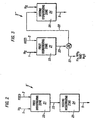
- Figure 1 illustrates one embodiment of the present process wherein a hydrogen containing gas stream is admixed with the hydrocarbon feedstock and passed to one hydrotreating zone employing at least one hydrotreating catalyst.
- the operating conditions of the hydrotreating zone are adjusted to achieve substantially completed desulfurization and denitrification of the hydrocarbon feedstock.
- Figure 2 illustrates a second embodiment of the hydrotreating zone shown in Figure 1 wherein a hydrogen containing gas stream is admixed with the hydrocarbon feedstock and passed, in series flow, to two hydrotreating zones employing two different hydrotreating catalysts contained within two different reactors.
- Figure 3 illustrates a third embodiment of the hydrotreating zone shown in Figure 1 wherein a hydrogen containing gas stream is admixed with the hydrocarbon feedstock and passed to two hydrotreating zones employing two different hydrotreating catalysts contained within two different reactors with an intervening product separation zone.
- C 1 -C 4 hydrocarbons refers to methane, ethane, ethylene, acetylene, propane, propylene, propadiene, methylacetylene, butane, isobutane, isobutylene, butene-1, cis-butene-2, trans-butene-2, butadiene, and C 4 -acetylenes.
- steam cracked naphtha refers to products boiling between C 5 and 220°C, including isoprene, cis-pentadiene, trans-pentadiene, cyclopentadiene, methylcyclopentadiene, and benzene.
- the hydrocarbon feedstock in the process of the present invention typically comprises a hydrocarbon fraction having a major proportion, i.e., greater than 95 percent, of its components boiling above 100°C, preferably above 150°C or higher.
- Suitable feedstocks of this type include straight run (virgin) naphtha, cracked naphthas (e.g. catalytically cracked, steam cracked, and coker naphthas and the like), straight run (virgin) kerosene, cracked kerosenes (e.g. catalytically cracked, steam cracked, and coker kerosenes and the like), straight run (virgin) gas oils (e.g. atmospheric and vacuum gas oil and the like), cracked gas oils (e.g.
- the feedstock will have an extended boiling range, e.g., up to 650°C or higher, but may be of more limited ranges with certain feedstocks. In general, the feedstocks will have a boiling range between 150°C and 650°C.
- the hydrocarbon feedstock and a hydrogen source are contacted with at least one hydrotreating catalyst to effect substantially complete decomposition of organic sulfur and/or nitrogen compounds in the feedstock, i.e., organic sulfur levels below about 100 parts per million, preferably below 50 parts per million, and more preferably below 25 parts per million, and organic nitrogen levels below 15 parts per million, preferably below 5 parts per million, and more preferably below 3 parts per million.
- the source of hydrogen will typically be hydrogen-containing mixtures of gases which normally contain 70 volume percent to 100 volume percent hydrogen.
- the catalyst will typically be one or more conventional hydrotreating catalysts having one or more Group VIB and/or Group VIII (Periodic Table of the Elements) metal compounds supported on an amorphous carrier such as alumina, silica-alumina, silica, zirconia or titania. Examples of such metals comprise nickel, cobalt, molybdenum and tungsten.
- the hydrotreating catalyst is preferably an oxide and/or sulfide of a Group VIII metal, preferably cobalt or nickel, mixed with an oxide and/or a sulfide of a Group VIB metal, preferably molybdenum or tungsten, supported on alumina or silica-alumina.
- the catalysts are preferably in sulfided form.
- the hydrotreating zone contains at least two hydrotreating catalysts in a stacked bed or layered arrangement.
- the first hydrotreating catalyst typically comprises one or more Group VIB and/or Group VIII metal compounds supported on an amorphous carrier such as alumina, silica-alumina, silica, zirconia or titania. Examples of such metals comprise nickel, cobalt, molybdenum and tungsten.
- the first hydrotreating catalyst is preferably an oxide and/or sulfide of a Group VIII metal, preferably cobalt or nickel, mixed with an oxide and/or a sulfide of a Group VIB metal, preferably molybdenum or tungsten, supported on alumina or silica-alumina.
- the second hydrotreating catalyst typically comprises one or more Group VIB and/or Group VIII metal components supported on an acidic porous support. From Group VIB, molybdenum, tungsten and mixtures thereof are preferred. From Group VIII, cobalt, nickel and mixtures thereof are preferred. Preferably, both Group VIB and Group VIII metals are present.
- the hydrotreating component of the second hydrotreating catalyst is nickel and/or cobalt combined with tungsten and/or molybdenum with nickel/tungsten or nickel/molybdenum being particularly preferred.
- the Group VIB and Group VIII metals are supported on an acidic carrier, such as, for example, silica-alumina, or a large pore molecular sieve, i.e. zeolites such as zeolite Y, particularly, ultrastable zeolite Y (zeolite USY), or other dealuminated zeolite Y.
- zeolites such as zeolite Y, particularly, ultrastable zeolite Y (zeolite USY), or other dealuminated zeolite Y.
- Mixtures of the porous amorphous inorganic oxide carriers and the molecular sieves can also be used.
- both the first and second hydrotreating catalysts in the stacked bed arrangement are sulfided prior to use.
- the hydrotreating zone is typically operated at temperatures in the range of from 200°C to 550°C, preferably from 250°C to 500°C, and more preferably from 275°C to 425°C.
- the pressure in the hydrotreating zone is generally in the range of from 400 psig to 3,000 psig (27 bar to 204 bar), preferably from 400 psig to 1,500 psig (27 bar to 102 bar).
- Liquid hourly space velocities will typically be in the range of from 0.1 to 10, preferably from 0.5 to 5 volumes of liquid hydrocarbon per hour per volume of catalyst, and hydrogen to oil ratios will be in the range of from 500 to 10,000 standard cubic feet of hydrogen per barrel of feed (SCF/BBL) (from 0.089 to 2.0 standard cubic meters per liter (m 3 /l)), preferably from 1,000 to 5,000 SCF/BBL (from 0.17 to 0.89 m 3 /l), most preferably from 2,000 to 3,000 SCF/BBL (from 0.35 to 0.53 m 3 /l).
- SCF/BBL standard cubic feet of hydrogen per barrel of feed
- m 3 /l standard cubic meters per liter
- the hydrotreating step may be carried out utilizing two or more hydrotreating zones.
- the hydrotreating step can be carried out in the manner described below in which two zones, a first hydrotreating zone and a second hydrotreating zone, are used.
- the hydrocarbon feedstock and a hydrogen source are contacted with a first hydrotreating catalyst.
- the source of hydrogen will typically be hydrogen-containing mixtures of gases which normally contain 70 volume percent to 100 volume percent hydrogen.
- the first hydrotreating catalyst will typically include one or more Group VIB and/or Group VIII metal compounds on an amorphous carrier such as alumina, silica-alumina, silica, zirconia or titania. Examples of such metals comprise nickel, cobalt, molybdenum and tungsten.
- the first hydrotreating catalyst is preferably an oxide and/or sulfide of a Group VIII metal, preferably cobalt or nickel, mixed with an oxide and/or a sulfide of a Group VIB metal, preferably molybdenum or tungsten, supported on alumina or silica-alumina.
- the catalysts are preferably in sulfided form.
- the first hydrotreating zone is generally operated at temperatures in the range of from 200°C to 550°C, preferably from 250°C to 500°C, and more preferably from 275°C to 425°C.
- the pressure in the first hydrotreating zone is generally in the range of from 400 psig to 3,000 psig (27 bar to 204 bar), preferably from 400 psig to 1,500 psig (27 bar to 102 bar).
- Liquid hourly space velocities will typically be in the range of from 0.2 to 2, preferably from 0.5 to 1 volumes of liquid hydrocarbon per hour per volume of catalyst, and hydrogen to oil ratios will be in the range of from 500 to 10,000 standard cubic feet of hydrogen per barrel of feed (SCP/BBL) (from 0.089 to 2.0 standard cubic meters per liter (m 3 /l)), preferably from 1,000 to 5,000 SCF/BBL (from 0.17 to 0.89 m 3 /l), most preferably from 2,000 to 3,000 SCF/BBL (from 0.35 to 0.53 m 3 /l). These conditions are adjusted to achieve the desired degree of desulfurization and denitrification. Typically, it is desirable in the first hydrotreating zone to reduce the organic sulfur level to below 500 parts per million, preferably below 200 parts per million, and the organic nitrogen level to below 50 parts per million, preferably below 25 parts per million.
- the product from the first hydrotreating zone may then, optionally, be passed to a means whereby ammonia and hydrogen sulfide are removed from the hydrocarbon product by conventional means.
- the hydrocarbon product from the first hydro treating zone is then sent to a second hydrotreating zone.
- the hydrocarbon product may also be passed to a fractionating zone prior to being sent to the second hydrotreating zone if removal of light hydrocarbon fractions is desired.
- the product from the first hydrotreating zone and a hydrogen source typically hydrogen, 70 volume percent to 100 volume percent, in admixture with other gases, are contacted with at least one second hydrotreating catalyst.
- the operating conditions normally used in the second hydrotreating reaction zone include a temperature in the range of from 200°C to 550°C, preferably from 250°C to 500°C, and more preferably, from 275°C to 425°C, a liquid hourly space velocity (LHSV) of 0.1 to 10 volumes of liquid hydrocarbon per hour per volume of catalyst, preferably an LHSV of 0.5 to 5, and a total pressure within the range of 400 psig to 3,000 psig (27 bar to 204 bar), preferably from 400 psig to 1,500 psig (27 bar to 102 bar).
- LHSV liquid hourly space velocity
- the hydrogen circulation rate is generally in the range of from 500 to 10,000 standard cubic feet per barrel (SCF/BBL) (from 0.089 to 2.0 standard cubic meters per liter (m 3 /l)), preferably from 1,000 to 5,000 SCF/BBL (from 0.17 to 0.89 m 3 /l), and more preferably from 2,000 to 3,000 SCF/BBL (from 0.35 to 0.53 m 3 /l). These conditions are adjusted to achieve substantially complete desulfurization and denitrification.
- SCF/BBL standard cubic feet per barrel
- the hydrotreated product obtained from the hydrotreating zone or zones have an organic sulfur level below 100 parts per million, preferably below 50 parts per million, and more preferably below 25 parts per million, and an organic nitrogen level below 15 parts per million, preferably below 5 parts per million and more preferably below 3 parts per million. It is understood that the severity of the operating conditions is decreased as the volume of the feedstock and/or the level of nitrogen and sulfur contaminants to the second hydrotreating zone is decreased. For example, if product gases, including H 2 S and NH 3 (ammonia), and, optionally, light hydrocarbon fractions are removed after the first hydrotreating zone, then the temperature in the second hydrotreating zone will be lower, or alternatively, the LHSV in the second hydrotreating zone will be higher.
- the catalysts typically utilized in the second hydrotreating zone comprise an active metals component supported on an acidic porous support.
- the active metal component, "the hydrotreating component", of the second hydrotreating catalyst is selected from a Group VIB and/or a Group VIII metal component. From Group VIB, molybdenum, tungsten and mixtures thereof are preferred. From Group VIII, cobalt, nickel and mixtures thereof are preferred. Preferably, both Group VIB and Group VIII metals are present.
- the hydrotreating component is nickel and/or cobalt combined with tungsten and/or molybdenum with nickel/tungsten or nickel/molybdenum being particularly preferred.
- the components are typically present in the sulfide form.
- the Group VIB and Group VIII metals are supported on an acidic carrier.
- Two main classes of carriers known in the art are typically utilized: (a) silica-alumina, and (b) the large pore molecular sieves, i.e. zeolites such as Zeolite Y, Mordenite, Zeolite Beta and the like. Mixtures of the porous amorphous inorganic oxide carriers and the molecular sieves are also used.
- sica-alumina refers to non-zeolitic aluminosilicates.
- the most preferred support comprises a zeolite Y, preferably a dealuminated zeolite Y such as an ultrastable zeolite Y (zeolite USY).
- zeolite USY ultrastable zeolite Y
- the ultrastable zeolites used herein are well known to those skilled in the art. They are generally prepared from sodium zeolite Y by dealumination.
- the zeolite is composited with a binder selected from alumina, silica, silica-alumina and mixtures thereof.
- a binder selected from alumina, silica, silica-alumina and mixtures thereof.
- the binder is alumina, preferably a gamma alumina binder or a precursor thereto, such as an alumina hydrogel, aluminum trihydroxide, aluminum oxyhydroxide or pseudoboehmite.
- the Group VIB/Group VIII second hydrotreating catalysts are preferably sulfided prior to use in the second hydrotreating zone.
- the catalysts are sulfided by heating the catalysts to elevated temperatures (e.g., 200-400°C) in the presence of hydrogen and sulfur or a sulfur-containing material.
- the product from the final hydrotreating zone is then necessarily passed to a. means whereby ammonia and hydrogen sulfide are removed from the liquid hydrocarbon product by conventional means.
- the liquid hydrocarbon product from the final hydratreating zone is then sent to an aromatics saturation zone. Prior to being sent to the aromatics saturation zone, however, the liquid hydrocarbon product may be passed to a fractionating zone for removal of product gases, and light hydrocarbon fractions.
- the product from the final hydrotreating zone and a hydrogen source typically hydrogen, 70 volume percent to 100 volume percent, in admixture with other gases, are contacted with at least one aromatics saturation catalyst.
- the operating conditions of the aromatics saturation zone generally include a temperature between 200°C and 370°C, preferably between 250°C and 350°C, and most preferably between 275°C and 350°C, and a pressure in the range of from 400 psig to 3,000 psig (from 27 bar to 204 bar), preferably in the range of from 400 psig to 1,500 psig (from 27 bar to 102 bar), more preferably in the range of from 400 psig to 1,000 psig (from 27 bar to 68 bar) and most preferably in the range of from 400 psig to 600 psig (from 27 bar to 41 bar).
- Space velocities between 0.1 and 10 volumes of liquid hydrocarbon per hour per volume of catalyst can be applied, preferably between 0.5 and 5 and most preferably between 1 and 3.
- Hydrogen/feedstock ratios between 2,000 and 15,000 SCF/BBL (0.35 to 2.67 m 3 /l), preferably between 3,000 and 10,000 SCF/BBL (0.53 to 1.78 m 3 /l), and most preferably between 4,000 and 8,000 SCF/BBL (0.71 to 1.42 m 3 /l), can be suitably applied.
- the temperature to be applied is dependent on the nature of the feedstock to be saturated and the volume of feedstock supplied to the aromatics saturation zone.
- a temperature will be chosen which allows substantial hydrogenation of the hydrogenatable components in the feedstock, i.e., at least 70% of the total amount of components to be hydrogenated. It is preferable to carry out aromatics saturation under conditions which allow at least 80% conversion by hydrogenation of the hydrogenatable components, with greater than 90% conversion by hydrogenation being particularly preferred.
- aromatics saturation zone By a proper choice of temperature and pressure for the aromatics saturation zone, more than 95% of the hydrogenatable components can be hydrogenated without causing substantial simultaneous molecular weight reduction due to hydrogenolysis of carbon - carbon single bonds.
- aromatics saturation is preferably performed at relatively low temperatures which favor the hydrogenation equilibrium while simultaneously minimizing undesirable molecular weight reduction reactions due to carbon - carbon bond scission.
- Aromatics saturation catalysts suitable, for this invention have been described by Minderhoud et. al. in U.S. Patent No. 4,960,505, and Winquist et. al. in U.S. Patent No. 5,391,291.
- the aromatics saturation catalysts typically used in the aromatics saturation (hydrogenation) zone of the present process comprise one or more Group VIII noble metal hydrogenation components supported on an amorphous support such as alumina, silica-alumina, silica, titania or zirconia, or mixtures thereof, or a crystalline support such as aluminosilicates, aluminophosphates, silicoaluminophosphates or borosilicates. Large pore zeolites such as Zeolite Y. Mordenite, Zeolite Beta, and the like and combinations thereof are preferred aluminosilicates.
- Catalysts which contain a crystalline support are generally formed with an amorphous binder such as alumina, silica, or silica-alumina, with preference being given to the use of alumina.
- the aromatics saturation catalysts are preferably based on or supported on certain modified Y-type zeolites having a unit cell size between 24.18 and 24.35 ⁇ .
- the modified Y-type materials also typically have an SiO 2 /Al 2 O 3 molar ratio of at least 25, preferably 35:1 and more preferably, 50:1.
- the Group VIII noble metals suitable for use in the aromatics saturation catalyst comprise ruthenium, rhodium, palladium, osmium, iridium, platinum and mixtures thereof. Very good results have been obtained with combinations of platinum and palladium.
- the use of aromatics saturation catalysts containing both platinum and palladium is preferred since such catalysts allow relatively low hydrogenation temperatures.
- the Group VIII noble metals are suitably applied in amounts between 0.05 percent by weight and 3 percent by weight, basis the carrier or support material. Preferably, the amounts of noble metals used are in the range between 0.2 percent by weight and 2 percent by weight, basis the support material. When two noble metals are utilized, the amount of the two metals normally ranges between 0.5 percent by weight and 3 percent by weight, basis the support material. When platinum and palladium are used as the noble metals, normally a platinum/palladium molar ratio of 0.25-0.75 is typically utilized.
- the hydrocarbon product from the aromatics saturation zone is then passed to a steam cracking (pyrolysis) zone.
- a steam cracking zone Prior to being sent to the steam cracking zone, however, if desired, the hydrocarbon product from the aromatics saturation zone may be passed to a fractionating zone for removal of product gases, and light hydrocarbon fractions.
- the operating conditions of the steam cracking zone normally include a coil outlet temperature greater than 700°C, in particular between 700°C and 925°C, and preferably between 750°C and 900°C, with steam present at a steam to hydrocarbon weight ratio in the range of from 0.1:1 to 2.0:1.
- the coil outlet pressure in the steam cracking zone is typically in the range of from 0 psig to 75 psig (0 bar to 5 bar), preferably in the range of from 0 psig to 50 psig 0 bar to 4 bar).
- the residence time for the cracking reaction is typically in the range of from 0.01 second to 5 seconds and preferably in the range of from 0.1 second to 1 second.
- the effluent from the steam cracking step may be sent to one or more fractionating zones wherein the effluent is separated into a fraction comprising hydrogen and C 1 -C 4 hydrocarbons, a steam cracked naphtha fraction boiling from C 5 to 220°C, a steam cracked gas oil fraction boiling in the range of from 220°C to 275°C and a steam cracked tar fraction boiling above 275°C.
- the amount of the undesirable steam cracked products, i.e., steam cracked gas oil and steam cracked tar, obtained utilizing the process of the present invention is quite low.
- the yield of steam cracked gas oil is reduced by at least 30 percent, relative to that obtained when either untreated or hydrotreated feedstock is subjected to steam cracking and product separation, and the yield of steam cracked tar is reduced by at least 40 percent, relative to that obtained when either untreated or hydrotreated feedstock is subjected to steam cracking and product separation.
- the process according to the present invention may be carried out in any suitable equipment.
- the various hydrotreating and saturation zones in the present invention typically comprise one or more vertical reactors containing at least one catalyst bed and are equipped with a means of injecting a hydrogen source into the reactors.
- a fixed bed hydrotreating and aromatics saturation reactor system wherein the feedstock is passed over one or more stationary beds of catalyst in each zone is particularly preferred.
- hydrotreating catalyst 4 in the hydrotreating zone 3 typically comprises one or more Group VIB and/or Group VIII metal compounds supported on an amorphous carrier such as alumina, silica-alumina, silica, zirconia or titania.
- hydrotreating zone 3 may also contain a second hydrotreating catalyst in addition to hydrotreating catalyst 4.
- the second hydrotreating catalyst typically comprises one or more Group VIB and or Group VIII metal compounds supported on an acidic porous support.
- the two hydrotreating catalysts are arranged in a stacked bed or layered configuration with hydrotreating catalyst 4 being on top and the second hydrotreating catalyst being on bottom.
- Hydrotreating zone 3 is typically operated at temperatures in the range of from 200°C to 550°C, preferably from 250°C to 500°C.
- the pressure in the hydrotreating zone is generally in the range of from 400 psig to 3,000 psig ( 27 bar to 204 bar), preferably from 400 psig to 1,500 psig (27 bar to 102 bar).
- Liquid hourly space velocities will typically be in the range of from 0.1 to 10, preferably from 0.5 to 5 volumes of liquid hydrocarbon per hour per volume of catalyst, and hydrogen to oil ratios will be in the range of from 500 to 10,000 standard cubic feet of hydrogen per barrel of feed (SCF/BBL) (from 0.089 to 2.0 standard cubic meters per liter (m 3 /l)), preferably from 1,000 to 5,000 SCF/BBL (from 0.17 to 0.89 m 3 /l), most preferably from 2,000 to 3,000 SCF/BBL (from 0.35 to 0.53 m 3 /l).
- SCF/BBL standard cubic feet of hydrogen per barrel of feed
- m 3 /l standard cubic meters per liter
- hydrotreating zone 3 It is desirable in hydrotreating zone 3 to reduce the organic sulfur level to below 100 parts per million, preferably below 50 parts per million, and more preferably below 25 parts per million, and the organic nitrogen level to below 15 parts per million, preferably below 5 parts per million, and more preferably below 3 parts per million.
- the total effluent from the hydrotreating zone 3 is withdrawn via line 5 and passed through a separator 6 where gaseous products i.e. hydrogen, ammonia and hydrogen sulfide are removed through line 7.
- gaseous products i.e. hydrogen, ammonia and hydrogen sulfide are removed through line 7.
- a light hydrocarbon fraction may also be removed before the liquid hydrocarbon stream is withdrawn from the separator 6 via line 8.
- the liquid hydrocarbon stream in line 8 and hydrogen via line 9 are then passed into aromatics saturation zone 10.
- the aromatics saturation catalyst 11 typically used in the aromatics saturation zone 10 of the present process comprises one or more Group VIII noble metal hydrogenation components supported on an amorphous or crystalline support.
- Aromatics saturation zone 10 is typically operated at temperatures between 200°C and 370°C, preferably between 250°C and 350°C, and most preferably between 275°C and 350°C, and a pressure in the range of from 400 psig to 3/000 psig (from 27 bar to 204 bar), preferably in the range of from 400 psig to 1,500 psig (from 27 bar to 102 bar), more preferably in the range of from 400 psig to 1,000 psig (from 27 bar to 68 bar), and most preferably in the range of from 400 psig to 600 psig (from 27 bar to 41 bar).
- Liquid hourly space velocities in the aromatics saturation zone are typically in the range of from 0.1 to 10 volumes of liquid hydrocarbon per hour per volume of catalyst, preferably from 0.5 to 5, and more preferably from 1 to 3. Hydrogen/feedstock ratios between 2,000 and 15,000 SCF/BBL (0.35 to 2.67 m 3 /l), preferably between 3,000 and 10,000 SCF/BBL (0.53 to 1.78 m 3 /l), and most preferably between 4,000 and 8,000 SCF/BBL ( 0.71 to 1.42 m 3 /l), can be suitably applied. Generally, a temperature will be chosen which allows substantial hydrogenation of the hydrogenatable components in the feedstock, i.e., at least 70% of the total amount of components to be hydrogenated. It is preferable to carry out aromatics saturation under conditions which allow at least 80% conversion by hydrogenation of the hydrogenatable components, with greater than 90% conversion by hydrogenation being particularly preferred.
- the total effluent from the aromatics saturation zone 10 is withdrawn via line 12.
- the product from aromatics saturation zone 10 may be passed to a separator where gaseous products i.e. hydrogen, ammonia and hydrogen sulfide, and a light hydrocarbon fraction can be removed.
- gaseous products i.e. hydrogen, ammonia and hydrogen sulfide, and a light hydrocarbon fraction can be removed.
- the product from the aromatics saturation zone in line. 12 and steam via line 13 are then passed into steam cracking zone 14.
- the operating conditions of the steam cracking zone normally include a coil outlet temperature greater than 700°C, in particular between 700°C and 925°C, and preferably between 750°C and 900°C, with steam present at a steam to hydrocarbon weight ratio in the range of from 0.1:1 to 2.0:1.
- the coil outlet pressure in the steam cracking zone is typically in the range of from 0 psig to 75 psig (0 bar to 5 bar), preferably in the range of from 0 psig to 50 psig (0 bar to 4 bar).
- the residence time for the cracking reaction is typically in the range of from 0.01 second to 5 seconds and preferably in the range of from 0.1 second to 1 second.
- the total effluent from the steam cracking zone 14 is withdrawn via line 15 and passed to fractionation zone 16 where a fraction comprising hydrogen and C 1 -C 4 hydrocarbons are removed through line 17, steam cracked naphtha (boiling between C 5 and 220°C) is removed through line 18, steam cracked gas oil boiling in the range of from 220°C to 275°C is removed through line 19 (the streams removed via line 18 and line 19 may optionally recycled to line 2 hydrocarbon feedstock to the hydrotreating zone 3), and steam cracked tar boiling above 275°C is removed through line 20.
- first hydrotreating zone 21 the hydrotreating portion of the process (hydrotreating zone 3 in Figure 1) is carried out using two hydrotreating zones, i.e., first hydrotreating zone 21 and second hydrotreating zone 24.
- the first hydrotreating catalyst 22 in first hydrotreating zone 21 will typically comprise one or more Group VIB and/or Group VIII metal compounds supported on an amorphous carrier such as alumina, silica-alumina, silica, zirconia or titania.
- First hydrotreating zone 21 is generally operated at temperatures in the range of from 200°C to 550°C, preferably from 250°C to 500°C, and more preferably from 275°C to 425°C.
- the pressure in the first hydrotreating zone is generally in the range of from 400 psig to 3,000 psig (27 bar to 204 bar), preferably from 400 psig to 1,500 psig (27 bar to 102 bar).
- Liquid hourly space velocities will typically be in the range of from 0.2 to 2, preferably from 0.5 to 1 volumes of liquid hydrocarbon per hour per volume of catalyst, and hydrogen to oil ratios will be in the range of from 500 to 10,000 standard cubic feet of hydrogen per barrel of feed (SCF/BBL) (from 0.089 to 2.0 standard cubic meters per liter (m 3 /l)), preferably from 1,000 to 5,000 SCF/BBL (from 0.17 to 0.89 m 3 /l), most preferably from 2,000 to 3,000 SCF/BBL (from 0.35 to 0.53 m 3 /l). These conditions are adjusted to achieve the desired degree of desulfurization and denitrification. Typically, it is desirable in the first hydrotreating zone to reduce the organic sulfur level to below 500 parts per million, preferably below 200 parts per million, and the organic nitrogen level to below 50 parts per million, preferably below 25 parts per million.
- Second hydrotreating catalyst 25 typically comprises one or more Group VIB and/or a Group VIII metals compounds supported on an acidic porous support.
- second hydrotreating zone 24 the total effluent from first hydrotreating zone 21 is contacted with second hydrotreating catalyst 25 at temperature in the range of from 200°C to 550°C, preferably from 250°C to 500°C, and more preferably, from 275°C to 425°C, a liquid hourly space velocity (LHSV) of 0.1 to 10 volumes of liquid hydrocarbon per hour per volume of catalyst, preferably 0.5 to 5, and a total pressure within the range of 400 psig to 3,000 psig (27 bar to 204 bar), preferably from 400 psig to 1,500 psig (27 bar to 102 bar).
- LHSV liquid hourly space velocity
- the hydrogen circulation rate is generally in the range of from 500 to 10,000 standard cubic feet per barrel (SCF/BBL) (from 0.089 to 2.0 standard cubic meters per liter (m 3 /l)), preferably from 1,000 to 5,000 SCF/BBL (from 0.17 to 0.89 m 3 /l), and most preferably from 2,000 to 3,000 SCF/BBL (from 0.35 to 0.53 m 3 /l). These conditions are adjusted to achieve substantially complete desulfurization and denitrification.
- SCF/BBL standard cubic feet per barrel
- the second hydrotreating zone it is desirable in the second hydrotreating zone to reduce the organic sulfur level to below 100 parts per million, preferably below 50 parts per million, and most preferably below 25 parts per million, and the organic nitrogen level to below 15 parts per million, preferably below 5 parts per million and most preferably below 3 parts per million.
- the total effluent from the second hydrotreating zone 24 is withdrawn via line 5 and passed to separator 6 where gaseous products, i.e. hydrogen, ammonia and hydrogen sulfide are removed via line 7.
- gaseous products i.e. hydrogen, ammonia and hydrogen sulfide are removed via line 7.
- a light hydrocarbon fraction may also be removed before the product from second hydrotreating zone 24 is passes via line 8 to the aromatics saturation zone 10.
- hydrotreating portion of the process is carried out using two hydrotreating zones, i.e., first hydrotreating zone 21 which contains first hydrotreating catalyst 22, and second hydrotreating zone 24 which contains second hydrotreating catalyst 25, as in Figure 2, with a separator 26 between the two hydrotreating zones.
- the total effluent from the first hydrotreating zone 21 which contains the first hydrotreating catalyst 22 is withdrawn via line 23 and passed to separator 26 where gaseous products, i.e. hydrogen, ammonia and hydrogen sulfide are removed through line 27.
- gaseous products i.e. hydrogen, ammonia and hydrogen sulfide
- a light hydrocarbon fraction may be removed before the product from the first hydrotreating zone is withdrawn from the separator 26 via line 28.
- the liquid hydrocarbon stream in line 28 is then passed to the second hydrotreating zone 24 which contains the second hydrotreating catalyst 25.
- the total effluent from the second hydrotreating zone 24 is then withdrawn via line 5 and passed to separator 6 where gaseous products i.e. hydrogen, ammonia and hydrogen sulfide are removed via line 7.
- gaseous products i.e. hydrogen, ammonia and hydrogen sulfide are removed via line 7.
- a light hydrocarbon fraction may also be removed before the product from second hydrotreating zone 24 is passed via line 8 to the aromatics saturation zone 10.
- Example 1 and Comparative Example 1-A below were each carried out using a 100% Atmospheric Gas Oil (AGO) feedstock having the properties shown in Table 1 below.
- Example 1 illustrates the process of the present invention.
- Comparative Example 1-A illustrates AGO which has been subjected to hydrotreating only prior to steam cracking.
- Example 1 describes the process of the present invention using a 100% Atmospheric Gas Oil (AGO) feed.
- AGO Atmospheric Gas Oil
- the catalysts A and B were operated in the hydrotreating zone as a "stacked bed" wherein the feedstock and hydrogen were contacted with catalyst A first and thereafter with catalyst B; the volume ratio of the catalysts (A:B) in the hydrotreating zone was 2:1.
- the feed stock was hydrotreated at 370°C (700°F), 600 psig (41 bar) total unit pressure, an overall LHSV of 0.33 hr -1 and a hydrogen flow rate cf 2,900 SCF/BBL (0.52 m 3 /l).
- the hydrocarbon produce was distilled to remove the liquid hydrocarbon fraction boiling below 185°C (365°F).
- the distilled hydrotreated feed was then passed to the aromatics saturation zone where it was contacted with hydrogen and a commercial zeolite supported platinum and palladium aromatics saturation catalyst (catalyst C), available under the name of Z-704C from Zeolyst International.
- the aromatics saturation zone was operated at 316°C (600°F), 600 psig (41 bar) total unit pressure, LHSV of 1.5 hr -1 and a hydrogen flow rate of 5,000 SCF/BBL (0.89 m 3 /l).
- Aromatics saturation of the distilled hydrotreated AGO feed consumed 420 SCF/BBL (0.084 m 3 /l) hydrogen and resulted in the production of 0.4 percent by weight of light gases (methane, ethane, propane and butane) and 5.6 percent by weight of liquid, hydrocarbon boiling between C 5 and 150°C (300°F).
- the distilled saturated AGO was then passed to the steam cracking zone where it was contacted with steam at a temperature of 775 to 780°C, a pressure of 10 to 15 psig (0.68 bar to 1 bar), and a steam to hydrocarbon weight ratio of 0.30:1 to 0.45:1.
- the residence time in the steam cracker was 0.4 to 0.6 seconds.
- the steam cracked product was then sent to a fractionating zone to quantify total hydrogen (H 2 ) and C 1 -C 4 hydrocarbors, steam cracked naphtha (SCN), steam cracked gas oil (SCGO), and steam cracked tar (SCT).
- SCN steam cracked naphtha
- SCGO steam cracked gas oil
- SCT steam cracked tar
- the yield of each of the particularly valuable steam cracked mono- and diolefin products in the H 2 and C 1 -C 4 hydrocarbons fraction i.e., ethylene, propylene, and butadiene
- the yield of each of the valuable steam cracked diolefin and aromatic products in the steam cracked naphtha fraction i.e., isoprene, cis-pentadiene, trans-pentadiene, cyclopentadiene, methylcyclopentadiene, and benzene
- the yield of the low value steam cracked gas oil product is decreased by about 54 percent
- the yield of the low value steam cracked tar product is decreased by about 62 percent when the process of the present invention comprising hydrotreating, aromatics saturation and steam cracking (Example 1) is utilized relative to the yields obtained when the feed is subjected to hydrotreating only prior to steam cracking (Comparative Example 1-A).
- Example 2 and Comparative Example 2-A below were each carried out using a hydrotreated 100% Heavy Atmospheric Gas Oil (HT-HAGO) feedstock having the properties shown in Table 4 below, and Comparative Examplas 2-B and 2-C were carried out using a 100% Heavy Atmospheric Gas Oil (HAGO) feedstock having the properties shown in Table 4 below.
- Example 2 illustrates the process of the present invention.
- Comparative Example 2-A illustrates HAGO which has been subjected to hydrotreating using a single hydrotreating catalyst, with no aromatics saturation, prior to steam cracking.
- Comparative Example 2-B illustrates untreated HAGO which has been steam cracked.
- Comparative Example 2-C illustrates HAGO which has been subjected to hydrotreating using a stacked bed of two hydrotreating catalysts with no aromatics saturation prior to steam cracking.
- the already hydrotreated feed (HT-HAGO) and hydrogen were passed to the aromatics saturation zone and contacted with catalyst C.
- the aromatics saturation zone was operated at 300°C (575°F), 600 psig (41 bar) total unit pressure, an LHSV of 1.5 hr -1 and a hydrogen flow rate of 5,000 SCF/B5L (0.89 m 3 /l).
- Aromatics saturation of the HT-HAGO feed consumed 520 SCF/BBL (0.09 m 3 /l) hydrogen and resulted in the production of 1.4 percent by weight of light gases (methane, ethane, propane and butane) and 13.3 percent by weight of liquid hydrocarbon boiling between C 5 and 150°C (300°F).
- the distilled saturated HT-HAGO was then passed to the steam cracking zone where it was contacted with steam at a temperature of 745 to 765°C, a pressure of 13 to 25.5 psig (0.88 bar to 1.7 bar), and a steam to hydrocarbon weight ratio of 0.3:1 to 0.45:1.
- the residence time in the steam cracker was 0.4 to 0.6 seconds.
- the steam cracked product was then sent to a fractionating zone to quantify total hydrogen (H 2 ) and C 1 -C 4 hydrocarbons, steam cracked naphtha (SCN), steam cracked gas oil (SCGO), and steam cracked tar (SCT).
- SCN steam cracked naphtha
- SCGO steam cracked gas oil
- SCT steam cracked tar
- Example 2 The hydrotreated 100% Heavy Atmospheric Gas Oil (HT-HAGO) feed of Example 2 above was treated in the same manner as set forth in Example 2 above, except that the HT-HAGO was not subjected to aromatics saturation.
- the steam cracking results are presented in Table 6 below.
- the untreated 100% Heavy Atmospheric Gas Oil (HAGO) feed of Comparative Example 2-B above was hydrotreated using two hydrotreating catalysts in a stacked bed system as follows.
- Catalysts A and B catalysts were operated as a "stacked bed" wherein the HAGO and hydrogen contacted catalyst A first and thereafter catalyst B, with the volume ratio of the catalysts (A:B) being 1:1.
- the HAGO was hydrotreated at 360°C (675°F), 585 psig (39.8 bar) total unit pressure, an overall LHSV of 0.5 hr -1 and a hydrogen flow rate of 3,000 SCF/BBL (0.53 m 3 /l).
- HT-HAGO (Comparative Example 2-A), HALO reed (Comparative Example 2-B), hydrotreated HAGO (Comparative Example 2-C) and distilled saturated HT-HAGO (Example 2) were analyzed by GC-MS in order to determine the structural types of the hydrocarbons present. These results are shown in Table 5 below. The results clearly show that the process of the present invention (Example 2) is effective at reducing the aromatic content of hydrocarbon feed streams with a concomitant rise in the quantity of both paraffins/isoparaffins and naphthenes.
- the yield of each of the particularly valuable steam cracked mono- and diolefin products in the H 2 and C 1 -C 4 hydrocarbons fraction, i.e., ethylene, propylene, and butadiene is increased by at least about 18 percent
- the yield of each of the valuable steam cracked diolefin and aromatic products in the steam cracked naphtha fraction i.e., isoprene, cis-pentadiene, trans-pentadiene, cyclopentadiene, methylcyclopentadiene, and benzene
- the yield of the low value steam cracked gas oil product is decreased by about 55 percent
- the yield of the low value steam cracked tar product is decreased by about 62 percent when the process of the present invention comprising hydrotreating, aromatics saturation and steam cracking (Example 2) is utilized relative to the yields obtained when the feed is subjected to hydrotreating only prior to steam cracking (Comparative Example 2-C
- the yield of each of the particularly valuable steam cracked mono- and diolefin products in the H 2 and C 1 -C 4 hydrocarbons fractions is increased at least about 5 percent
- the yield of each of the valuable steam cracked diolefin and aromatic products in the steam cracked naphtha fraction i.e., isoprene, cis-pentadiene, trans-pentadiene, cyclopentadiene, methylcyclopentadiene, and benzene
- the yield of the low value steam cracked gas oil product is decreased by about 53 percent
- the yield of the low value steam cracked tar product is decreased by about 63 percent when the process of the present invention comprising hydrotreating, aromatics saturation and steam cracking (Example 2) is utilized relative to the yields obtained when the feed is subjected to hydrotreating only prior to steam cracking
- Example 3 Comparative Example 3-B and Comparative Example 3-A below were each carried out using a 100% Catalytically Cracked Naphtha (CCN) feedstock having the properties shown in Table 7 below.
- CCN Catalytically Cracked Naphtha
- Example 3 illustrates the process of the present invention.
- Comparative Example 3-A is illustrative of untreated CCN.
- Comparative Example 3-B illustrates CCN which has been subjected to hydrotreating only prior to steam cracking.
- Example 3 describes the process of the present Invention using a 100% Catalytically Cracked Naphtha (CCN) feed.
- CCN Catalytically Cracked Naphtha
- the catalysts A and B were operated in the hydrotreating zone as a "stacked bed" wherein the feedstock and hydrogen were contacted with catalyst A first and thereafter with catalyst B; the volume ratio of the catalysts (A:B) in the hydrotreating zone was 2:1.
- the feed stock was hydrotreated at 370°C (700°F), 600 psig (41 bar) total unit pressure, an overall LHSV of 0.33 hr -1 and a hydrogen flow rate of 2,900 SCF/BBL (0.52 m 3 /l).
- the hydrotreated CCN was then passed to the aromatics saturation zone where it was contacted with hydrogen and a commercial zeolite supported platinum and palladium aromatics saturation catalyst (catalyst C), available under the name of Z-704C from Zeolyst International.
- Catalyst C commercial zeolite supported platinum and palladium aromatics saturation catalyst
- the aromatics saturation zone was operated at 316°C (600°F), 500 psig (41 bar) total unit pressure, LHSV of 1.5 hr -1 and a hydrogen flow rate of 5,000 SCF/BBL (0.89 m 3 /l).
- Aromatics saturation of the hydrotreated CCN feed consumed 1320 SCF/BBL (0.23 m 3 /l) hydrogen and resulted in the production of 1.9 percent by weight of light gases (methane, ethane, propane and butane) and 5,4 percent by weight of liquid hydrocarbon boiling between C 5 and 150°C (300°F). Following aromatics saturation, the saturated CCN had the properties shown in Table 7.
- the saturated CCN was then passed to the steam cracking zone where it was contacted with steam at a temperature of 790 to 805°C, a pressure of between 18.0 to 20.5 psig (1.22 bar to 1.39 bar), and a steam to hydrocarbon weight ratio of 0.3:1 to 0.45:1.
- the residence time in the steam cracker was 0.4 to 0.6 seconds.
- the steam cracked product was then sent to a fractionating zone to quantify total hydrogen (H2) and C 1 -C 4 ) hydrocarbons, steam cracked naphtha (SCN), steam cracked gas oil (SCGO), and steam cracked tar (SCT).
- H2 total hydrogen
- SCN steam cracked naphtha
- SCGO steam cracked gas oil
- SCT steam cracked tar
- a 100% Catalytically Cracked Naphtha (CCN) feed was treated in the same manner as set forth in Example 3 above, except that it was not subjected to hydrotreating or to aromatics saturation.
- the steam cracking results are presented in Table 9 below.
- CCN feed A 100% Catalytically Cracked Naphtha (CCN) feed was treated in the same manner as set forth in Example 3 above, except that it was not subjected to aromatics saturation.
- the steam cracking results are presented in Table 9 below.
- Properties of CCN Feed Comp. Ex. 3-A
- Hydrotreated CCN Camp. Ex. 3-B
- Saturated CCN Example 3)
- CCN Feed (3-A)
- the yield of each of the particularly valuable steam cracked mono- and diolefin products in the H 2 and C 1 -C 4 hydrocarbons fraction is increased by at least about 55.0 percent
- the yield of each of the valuable steam cracked diolefin and aromatic products in the steam cracked naphtha fraction i.e., isoprene, cis-pentadiene, trans-pentadiene, cyclopentadiene, methylcyclopentadiene, and benzene
- the yield of the low value steam cracked gas oil product is decreased by about 71 percent
- the yield of the low value steam cracked tar product is decreased by about 59 percent when the process of the present invention comprising hydrotreating, aromatics saturation and steam cracking (Example 3) is utilized relative to the yields obtained when the feed is subjected to hydrotreating only prior to steam cracking (Comparative
Landscapes
- Chemical & Material Sciences (AREA)
- Oil, Petroleum & Natural Gas (AREA)
- Engineering & Computer Science (AREA)
- Chemical Kinetics & Catalysis (AREA)
- General Chemical & Material Sciences (AREA)
- Organic Chemistry (AREA)
- Physics & Mathematics (AREA)
- Thermal Sciences (AREA)
- Production Of Liquid Hydrocarbon Mixture For Refining Petroleum (AREA)
- Catalysts (AREA)
- Organic Low-Molecular-Weight Compounds And Preparation Thereof (AREA)
- Fuel Cell (AREA)
Applications Claiming Priority (7)
| Application Number | Priority Date | Filing Date | Title |
|---|---|---|---|
| US2785996P | 1996-08-15 | 1996-08-15 | |
| US27859P | 1996-08-15 | ||
| US3461296P | 1996-12-31 | 1996-12-31 | |
| US34612P | 1996-12-31 | ||
| US08/848,438 US6190533B1 (en) | 1996-08-15 | 1997-05-08 | Integrated hydrotreating steam cracking process for the production of olefins |
| US848438 | 1997-05-08 | ||
| PCT/US1997/014416 WO1998006794A1 (en) | 1996-08-15 | 1997-08-15 | Hydrocarbon conversion process |
Publications (2)
| Publication Number | Publication Date |
|---|---|
| EP0948582A1 EP0948582A1 (en) | 1999-10-13 |
| EP0948582B1 true EP0948582B1 (en) | 2003-01-02 |
Family
ID=27363107
Family Applications (2)
| Application Number | Title | Priority Date | Filing Date |
|---|---|---|---|
| EP97937280A Expired - Lifetime EP0948582B1 (en) | 1996-08-15 | 1997-08-15 | Hydrocarbon conversion process |
| EP97937289A Expired - Lifetime EP0951524B1 (en) | 1996-08-15 | 1997-08-15 | Hydrocarbon conversion process |
Family Applications After (1)
| Application Number | Title | Priority Date | Filing Date |
|---|---|---|---|
| EP97937289A Expired - Lifetime EP0951524B1 (en) | 1996-08-15 | 1997-08-15 | Hydrocarbon conversion process |
Country Status (9)
| Country | Link |
|---|---|
| US (1) | US6190533B1 (enExample) |
| EP (2) | EP0948582B1 (enExample) |
| JP (2) | JP2002501551A (enExample) |
| CN (2) | CN1133729C (enExample) |
| AU (2) | AU717657B2 (enExample) |
| CA (1) | CA2262492C (enExample) |
| DE (2) | DE69707709T2 (enExample) |
| ES (2) | ES2185978T3 (enExample) |
| WO (2) | WO1998006794A1 (enExample) |
Families Citing this family (104)
| Publication number | Priority date | Publication date | Assignee | Title |
|---|---|---|---|---|
| JPS6444250A (en) * | 1987-08-10 | 1989-02-16 | Kawasaki Refractories Co Ltd | Continuous casting nozzle for stainless steel |
| JPH0489981A (ja) * | 1990-07-31 | 1992-03-24 | Hitachi Building Syst Eng & Service Co Ltd | 扉の解錠方法 |
| US6926898B2 (en) | 2000-04-12 | 2005-08-09 | Human Genome Sciences, Inc. | Albumin fusion proteins |
| KR100419065B1 (ko) * | 2001-03-07 | 2004-02-19 | 주식회사 엘지화학 | 열분해 반응관 및 이를 이용한 열분해 방법 |
| GB0126643D0 (en) * | 2001-11-06 | 2002-01-02 | Bp Exploration Operating | Composition and process |
| US6783659B2 (en) | 2001-11-16 | 2004-08-31 | Chevron Phillips Chemical Company, L.P. | Process to produce a dilute ethylene stream and a dilute propylene stream |
| US7097758B2 (en) * | 2002-07-03 | 2006-08-29 | Exxonmobil Chemical Patents Inc. | Converting mist flow to annular flow in thermal cracking application |
| US7090765B2 (en) * | 2002-07-03 | 2006-08-15 | Exxonmobil Chemical Patents Inc. | Process for cracking hydrocarbon feed with water substitution |
| US7138047B2 (en) * | 2002-07-03 | 2006-11-21 | Exxonmobil Chemical Patents Inc. | Process for steam cracking heavy hydrocarbon feedstocks |
| JP2004269685A (ja) * | 2003-03-07 | 2004-09-30 | Nippon Oil Corp | 軽油組成物及びその製造方法 |
| CN100412171C (zh) * | 2003-03-07 | 2008-08-20 | 新日本石油株式会社 | 轻油馏分的氢化处理方法 |
| US20050038304A1 (en) * | 2003-08-15 | 2005-02-17 | Van Egmond Cor F. | Integrating a methanol to olefin reaction system with a steam cracking system |
| CN100564484C (zh) * | 2004-03-22 | 2009-12-02 | 埃克森美孚化学专利公司 | 蒸汽裂解重质烃原料的方法 |
| US7244871B2 (en) * | 2004-05-21 | 2007-07-17 | Exxonmobil Chemical Patents, Inc. | Process and apparatus for removing coke formed during steam cracking of hydrocarbon feedstocks containing resids |
| US7247765B2 (en) * | 2004-05-21 | 2007-07-24 | Exxonmobil Chemical Patents Inc. | Cracking hydrocarbon feedstock containing resid utilizing partial condensation of vapor phase from vapor/liquid separation to mitigate fouling in a flash/separation vessel |
| US7297833B2 (en) * | 2004-05-21 | 2007-11-20 | Exxonmobil Chemical Patents Inc. | Steam cracking of light hydrocarbon feedstocks containing non-volatile components and/or coke precursors |
| US7358413B2 (en) * | 2004-07-14 | 2008-04-15 | Exxonmobil Chemical Patents Inc. | Process for reducing fouling from flash/separation apparatus during cracking of hydrocarbon feedstocks |
| US7235705B2 (en) * | 2004-05-21 | 2007-06-26 | Exxonmobil Chemical Patents Inc. | Process for reducing vapor condensation in flash/separation apparatus overhead during steam cracking of hydrocarbon feedstocks |
| US7220887B2 (en) * | 2004-05-21 | 2007-05-22 | Exxonmobil Chemical Patents Inc. | Process and apparatus for cracking hydrocarbon feedstock containing resid |
| US7351872B2 (en) * | 2004-05-21 | 2008-04-01 | Exxonmobil Chemical Patents Inc. | Process and draft control system for use in cracking a heavy hydrocarbon feedstock in a pyrolysis furnace |
| US7285697B2 (en) * | 2004-07-16 | 2007-10-23 | Exxonmobil Chemical Patents Inc. | Reduction of total sulfur in crude and condensate cracking |
| US7488459B2 (en) * | 2004-05-21 | 2009-02-10 | Exxonmobil Chemical Patents Inc. | Apparatus and process for controlling temperature of heated feed directed to a flash drum whose overhead provides feed for cracking |
| US7312371B2 (en) * | 2004-05-21 | 2007-12-25 | Exxonmobil Chemical Patents Inc. | Steam cracking of hydrocarbon feedstocks containing non-volatile components and/or coke precursors |
| US7193123B2 (en) * | 2004-05-21 | 2007-03-20 | Exxonmobil Chemical Patents Inc. | Process and apparatus for cracking hydrocarbon feedstock containing resid to improve vapor yield from vapor/liquid separation |
| US7481871B2 (en) * | 2004-12-10 | 2009-01-27 | Exxonmobil Chemical Patents Inc. | Vapor/liquid separation apparatus |
| US7402237B2 (en) * | 2004-10-28 | 2008-07-22 | Exxonmobil Chemical Patents Inc. | Steam cracking of hydrocarbon feedstocks containing salt and/or particulate matter |
| US7408093B2 (en) * | 2004-07-14 | 2008-08-05 | Exxonmobil Chemical Patents Inc. | Process for reducing fouling from flash/separation apparatus during cracking of hydrocarbon feedstocks |
| US7311746B2 (en) * | 2004-05-21 | 2007-12-25 | Exxonmobil Chemical Patents Inc. | Vapor/liquid separation apparatus for use in cracking hydrocarbon feedstock containing resid |
| EP1832645A4 (en) * | 2004-12-28 | 2012-01-11 | Japan Energy Corp | METHOD FOR PRODUCING A GAS OIL BASED MATERIAL WITH SUPER LOW SULFUR CONTENT OR GAS OIL COMPOSITION WITH SUPER LOW SULFUR CONTENT AND GAS OIL COMPOSITION WITH SUPER LOW SULFUR CONTENT |
| US8173854B2 (en) * | 2005-06-30 | 2012-05-08 | Exxonmobil Chemical Patents Inc. | Steam cracking of partially desalted hydrocarbon feedstocks |
| US8696888B2 (en) | 2005-10-20 | 2014-04-15 | Exxonmobil Chemical Patents Inc. | Hydrocarbon resid processing |
| US8709233B2 (en) * | 2006-08-31 | 2014-04-29 | Exxonmobil Chemical Patents Inc. | Disposition of steam cracked tar |
| JP5105326B2 (ja) * | 2007-04-19 | 2012-12-26 | 昭和電工株式会社 | 水素化方法及び石油化学プロセス |
| US8864996B2 (en) * | 2007-08-28 | 2014-10-21 | Exxonmobil Research And Engineering Company | Reduction of conradson carbon residue and average boiling points utilizing high pressure ultrafiltration |
| US7867379B2 (en) * | 2007-08-28 | 2011-01-11 | Exxonmobil Research And Engineering Company | Production of an upgraded stream from steam cracker tar by ultrafiltration |
| US7897828B2 (en) * | 2007-08-28 | 2011-03-01 | Exxonmobile Research And Engineering Company | Process for separating a heavy oil feedstream into improved products |
| US8177965B2 (en) * | 2007-08-28 | 2012-05-15 | Exxonmobil Research And Engineering Company | Enhancement of saturates content in heavy hydrocarbons utilizing ultrafiltration |
| US7815790B2 (en) * | 2007-08-28 | 2010-10-19 | Exxonmobil Research And Engineering Company | Upgrade of visbroken residua products by ultrafiltration |
| US7871510B2 (en) * | 2007-08-28 | 2011-01-18 | Exxonmobil Research & Engineering Co. | Production of an enhanced resid coker feed using ultrafiltration |
| US7815791B2 (en) * | 2008-04-30 | 2010-10-19 | Exxonmobil Chemical Patents Inc. | Process and apparatus for using steam cracked tar as steam cracker feed |
| US9458390B2 (en) * | 2009-07-01 | 2016-10-04 | Exxonmobil Chemical Patents Inc. | Process and system for preparation of hydrocarbon feedstocks for catalytic cracking |
| US8197668B2 (en) * | 2009-07-09 | 2012-06-12 | Exxonmobil Chemical Patents Inc. | Process and apparatus for upgrading steam cracker tar using hydrogen donor compounds |
| US9005430B2 (en) * | 2009-12-10 | 2015-04-14 | IFP Energies Nouvelles | Process and apparatus for integration of a high-pressure hydroconversion process and a medium-pressure middle distillate hydrotreatment process, whereby the two processes are independent |
| US8821713B2 (en) | 2009-12-17 | 2014-09-02 | H R D Corporation | High shear process for processing naphtha |
| SG181824A1 (en) | 2010-01-21 | 2012-07-30 | Shell Int Research | Process for treating a hydrocarbon-containing feed |
| SG181825A1 (en) | 2010-01-21 | 2012-07-30 | Shell Int Research | Process for treating a hydrocarbon-containing feed |
| EP2526167A2 (en) | 2010-01-21 | 2012-11-28 | Shell Oil Company | Hydrocarbon composition |
| EP2526165A2 (en) | 2010-01-21 | 2012-11-28 | Shell Oil Company | Hydrocarbon composition |
| JP5318019B2 (ja) * | 2010-03-30 | 2013-10-16 | Jx日鉱日石エネルギー株式会社 | スチームクラッカーにおけるhar油の処理方法 |
| US8658022B2 (en) * | 2010-11-23 | 2014-02-25 | Equistar Chemicals, Lp | Process for cracking heavy hydrocarbon feed |
| CN101976924B (zh) * | 2010-12-02 | 2013-07-24 | 石云艾 | 单相多极开关磁阻电机 |
| US9255230B2 (en) | 2012-01-27 | 2016-02-09 | Saudi Arabian Oil Company | Integrated hydrotreating and steam pyrolysis process for direct processing of a crude oil |
| US9382486B2 (en) | 2012-01-27 | 2016-07-05 | Saudi Arabian Oil Company | Integrated hydrotreating, solvent deasphalting and steam pyrolysis process for direct processing of a crude oil |
| US9279088B2 (en) | 2012-01-27 | 2016-03-08 | Saudi Arabian Oil Company | Integrated hydrotreating and steam pyrolysis process including hydrogen redistribution for direct processing of a crude oil |
| US9284497B2 (en) | 2012-01-27 | 2016-03-15 | Saudi Arabian Oil Company | Integrated solvent deasphalting and steam pyrolysis process for direct processing of a crude oil |
| CN107118801B (zh) * | 2012-01-27 | 2019-11-05 | 沙特阿拉伯石油公司 | 用于直接加工原油的整合的加氢处理和水蒸气热解方法 |
| US9284502B2 (en) | 2012-01-27 | 2016-03-15 | Saudi Arabian Oil Company | Integrated solvent deasphalting, hydrotreating and steam pyrolysis process for direct processing of a crude oil |
| US9296961B2 (en) | 2012-01-27 | 2016-03-29 | Saudi Arabian Oil Company | Integrated hydrotreating and steam pyrolysis process including residual bypass for direct processing of a crude oil |
| US9228139B2 (en) | 2012-03-20 | 2016-01-05 | Saudi Arabian Oil Company | Integrated hydroprocessing and steam pyrolysis of crude oil to produce light olefins and coke |
| KR102148951B1 (ko) | 2012-03-20 | 2020-08-27 | 사우디 아라비안 오일 컴퍼니 | 석유화학제품을 생산하기 위한 원유의 통합된 수소화공정, 스팀 열분해 및 슬러리 수소화공정 |
| EP2828357B1 (en) | 2012-03-20 | 2026-05-06 | Saudi Arabian Oil Company | Steam cracking process and system with integral vapor-liquid separation |
| EP2828362B1 (en) | 2012-03-20 | 2020-12-30 | Saudi Arabian Oil Company | Integrated slurry hydroprocessing and steam pyrolysis of crude oil to produce petrochemicals |
| WO2013142609A1 (en) * | 2012-03-20 | 2013-09-26 | Saudi Arabian Oil Company | Integrated hydroprocessing, steam pyrolysis catalytic cracking process to produce petrochemicals from crude oil |
| US10603657B2 (en) | 2016-04-11 | 2020-03-31 | Saudi Arabian Oil Company | Nano-sized zeolite supported catalysts and methods for their production |
| US11084992B2 (en) | 2016-06-02 | 2021-08-10 | Saudi Arabian Oil Company | Systems and methods for upgrading heavy oils |
| US10301556B2 (en) | 2016-08-24 | 2019-05-28 | Saudi Arabian Oil Company | Systems and methods for the conversion of feedstock hydrocarbons to petrochemical products |
| US10472579B2 (en) * | 2016-11-21 | 2019-11-12 | Saudi Arabian Oil Company | Process and system for conversion of crude oil to petrochemicals and fuel products integrating vacuum gas oil hydrocracking and steam cracking |
| US10689587B2 (en) | 2017-04-26 | 2020-06-23 | Saudi Arabian Oil Company | Systems and processes for conversion of crude oil |
| US10344222B2 (en) * | 2017-05-17 | 2019-07-09 | Exonmobil Chemical Patents Inc. | Upgrading hydrocarbon pyrolysis products |
| US10894925B2 (en) * | 2017-07-14 | 2021-01-19 | Exxonmobil Chemical Patents Inc. | Multistage upgrading hydrocarbon pyrolysis tar |
| KR102474319B1 (ko) | 2017-07-17 | 2022-12-08 | 사우디 아라비안 오일 컴퍼니 | 오일 업그레이드 후 정제하여 중유를 가공처리하기 위한 시스템 및 방법 |
| CN110997601B (zh) | 2017-08-15 | 2021-01-29 | Sabic环球技术有限责任公司 | 通过集成的蒸汽裂解和加氢裂解方法生产轻质烯烃 |
| WO2019036291A1 (en) | 2017-08-15 | 2019-02-21 | Sabic Global Technologies B.V. | SHALE GAS AND CONDENSATE GIVING CHEMICALS |
| WO2020033065A1 (en) | 2018-08-09 | 2020-02-13 | Exxonmobil Research And Engineering Company | Advanced steam cracking |
| CN110129088B (zh) * | 2019-05-06 | 2021-03-30 | 盘锦北方沥青燃料有限公司 | 一种低碳烃混合加氢生产乙烯裂解原料的方法 |
| US11572517B2 (en) | 2019-12-03 | 2023-02-07 | Saudi Arabian Oil Company | Processing facility to produce hydrogen and petrochemicals |
| US11680521B2 (en) | 2019-12-03 | 2023-06-20 | Saudi Arabian Oil Company | Integrated production of hydrogen, petrochemicals, and power |
| US11193072B2 (en) | 2019-12-03 | 2021-12-07 | Saudi Arabian Oil Company | Processing facility to form hydrogen and petrochemicals |
| US11426708B2 (en) | 2020-03-02 | 2022-08-30 | King Abdullah University Of Science And Technology | Potassium-promoted red mud as a catalyst for forming hydrocarbons from carbon dioxide |
| US11279891B2 (en) | 2020-03-05 | 2022-03-22 | Saudi Arabian Oil Company | Systems and processes for direct crude oil upgrading to hydrogen and chemicals |
| US11492255B2 (en) | 2020-04-03 | 2022-11-08 | Saudi Arabian Oil Company | Steam methane reforming with steam regeneration |
| US11420915B2 (en) | 2020-06-11 | 2022-08-23 | Saudi Arabian Oil Company | Red mud as a catalyst for the isomerization of olefins |
| US11495814B2 (en) | 2020-06-17 | 2022-11-08 | Saudi Arabian Oil Company | Utilizing black powder for electrolytes for flow batteries |
| US11583824B2 (en) | 2020-06-18 | 2023-02-21 | Saudi Arabian Oil Company | Hydrogen production with membrane reformer |
| US11999619B2 (en) | 2020-06-18 | 2024-06-04 | Saudi Arabian Oil Company | Hydrogen production with membrane reactor |
| US11492254B2 (en) | 2020-06-18 | 2022-11-08 | Saudi Arabian Oil Company | Hydrogen production with membrane reformer |
| US12000056B2 (en) | 2020-06-18 | 2024-06-04 | Saudi Arabian Oil Company | Tandem electrolysis cell |
| US11274068B2 (en) | 2020-07-23 | 2022-03-15 | Saudi Arabian Oil Company | Process for interconversion of olefins with modified beta zeolite |
| US11332678B2 (en) | 2020-07-23 | 2022-05-17 | Saudi Arabian Oil Company | Processing of paraffinic naphtha with modified USY zeolite dehydrogenation catalyst |
| US11420192B2 (en) | 2020-07-28 | 2022-08-23 | Saudi Arabian Oil Company | Hydrocracking catalysts containing rare earth containing post-modified USY zeolite, method for preparing hydrocracking catalysts, and methods for hydrocracking hydrocarbon oil with hydrocracking catalysts |
| US11154845B1 (en) | 2020-07-28 | 2021-10-26 | Saudi Arabian Oil Company | Hydrocracking catalysts containing USY and beta zeolites for hydrocarbon oil and method for hydrocracking hydrocarbon oil with hydrocracking catalysts |
| US11142703B1 (en) | 2020-08-05 | 2021-10-12 | Saudi Arabian Oil Company | Fluid catalytic cracking with catalyst system containing modified beta zeolite additive |
| US11718522B2 (en) | 2021-01-04 | 2023-08-08 | Saudi Arabian Oil Company | Black powder catalyst for hydrogen production via bi-reforming |
| US11427519B2 (en) | 2021-01-04 | 2022-08-30 | Saudi Arabian Oil Company | Acid modified red mud as a catalyst for olefin isomerization |
| US11814289B2 (en) | 2021-01-04 | 2023-11-14 | Saudi Arabian Oil Company | Black powder catalyst for hydrogen production via steam reforming |
| US11820658B2 (en) | 2021-01-04 | 2023-11-21 | Saudi Arabian Oil Company | Black powder catalyst for hydrogen production via autothermal reforming |
| US11724943B2 (en) | 2021-01-04 | 2023-08-15 | Saudi Arabian Oil Company | Black powder catalyst for hydrogen production via dry reforming |
| US11578016B1 (en) | 2021-08-12 | 2023-02-14 | Saudi Arabian Oil Company | Olefin production via dry reforming and olefin synthesis in a vessel |
| US12258272B2 (en) | 2021-08-12 | 2025-03-25 | Saudi Arabian Oil Company | Dry reforming of methane using a nickel-based bi-metallic catalyst |
| US11718575B2 (en) | 2021-08-12 | 2023-08-08 | Saudi Arabian Oil Company | Methanol production via dry reforming and methanol synthesis in a vessel |
| US11787759B2 (en) | 2021-08-12 | 2023-10-17 | Saudi Arabian Oil Company | Dimethyl ether production via dry reforming and dimethyl ether synthesis in a vessel |
| US11618858B1 (en) | 2021-12-06 | 2023-04-04 | Saudi Arabian Oil Company | Hydrodearylation catalysts for aromatic bottoms oil, method for producing hydrodearylation catalysts, and method for hydrodearylating aromatic bottoms oil with hydrodearylation catalysts |
| US11617981B1 (en) | 2022-01-03 | 2023-04-04 | Saudi Arabian Oil Company | Method for capturing CO2 with assisted vapor compression |
| US12018392B2 (en) | 2022-01-03 | 2024-06-25 | Saudi Arabian Oil Company | Methods for producing syngas from H2S and CO2 in an electrochemical cell |
Family Cites Families (18)
| Publication number | Priority date | Publication date | Assignee | Title |
|---|---|---|---|---|
| NL6503410A (enExample) | 1963-02-21 | 1965-09-20 | ||
| US3293192A (en) | 1965-08-23 | 1966-12-20 | Grace W R & Co | Zeolite z-14us and method of preparation thereof |
| US3513217A (en) * | 1966-09-16 | 1970-05-19 | Universal Oil Prod Co | Olefin producing process |
| US3511771A (en) * | 1967-07-24 | 1970-05-12 | Exxon Research Engineering Co | Integrated hydrofining,hydrodesulfurization and steam cracking process |
| US3617501A (en) * | 1968-09-06 | 1971-11-02 | Exxon Research Engineering Co | Integrated process for refining whole crude oil |
| US3644197A (en) * | 1969-01-31 | 1972-02-22 | Union Oil Co | Dual-catalyst hydrofining process |
| GB1383229A (en) * | 1972-11-08 | 1975-02-05 | Bp Chem Int Ltd | Production of gaseous olefins from petroleum residue feedstocks |
| US3855113A (en) * | 1972-12-21 | 1974-12-17 | Chevron Res | Integrated process combining hydrofining and steam cracking |
| US3907920A (en) * | 1974-03-25 | 1975-09-23 | Continental Oil Co | Two-stage hydropyrolysis-cracking process for producing ethylene |
| FR2380337A1 (fr) * | 1977-02-11 | 1978-09-08 | Inst Francais Du Petrole | Procede de vapocraquage de charges lourdes precede d'un hydrotraitement |
| FR2390493B1 (fr) * | 1977-05-12 | 1985-04-26 | Linde Ag | Procede de preparation d'olefines |
| US4447314A (en) * | 1982-05-05 | 1984-05-08 | Mobil Oil Corporation | Demetalation, desulfurization, and decarbonization of petroleum oils by hydrotreatment in a dual bed system prior to cracking |
| DE3232395A1 (de) * | 1982-08-31 | 1984-03-01 | Linde Ag, 6200 Wiesbaden | Verfahren zur herstellung von olefinen |
| US4446004A (en) * | 1982-12-23 | 1984-05-01 | Mobil Oil Corporation | Process for upgrading vacuum resids to premium liquid products |
| FR2619390A1 (fr) | 1987-08-14 | 1989-02-17 | Shell Int Research | Procede d'hydrogenation d'huiles hydrocarbonees |
| US5472928A (en) * | 1989-07-19 | 1995-12-05 | Scheuerman; Georgieanna L. | Catalyst, method and apparatus for an on-stream particle replacement system for countercurrent contact of a gas and liquid feed stream with a packed bed |
| EP0519573B1 (en) | 1991-06-21 | 1995-04-12 | Shell Internationale Researchmaatschappij B.V. | Hydrogenation catalyst and process |
| EP0584879B1 (en) * | 1992-08-25 | 1997-10-29 | Shell Internationale Researchmaatschappij B.V. | Process for the preparation of lower olefins |
-
1997
- 1997-05-08 US US08/848,438 patent/US6190533B1/en not_active Expired - Lifetime
- 1997-08-15 EP EP97937280A patent/EP0948582B1/en not_active Expired - Lifetime
- 1997-08-15 ES ES97937280T patent/ES2185978T3/es not_active Expired - Lifetime
- 1997-08-15 WO PCT/US1997/014416 patent/WO1998006794A1/en not_active Ceased
- 1997-08-15 CN CNB971979812A patent/CN1133729C/zh not_active Expired - Fee Related
- 1997-08-15 DE DE69707709T patent/DE69707709T2/de not_active Expired - Fee Related
- 1997-08-15 AU AU39841/97A patent/AU717657B2/en not_active Ceased
- 1997-08-15 CA CA002262492A patent/CA2262492C/en not_active Expired - Fee Related
- 1997-08-15 JP JP51006898A patent/JP2002501551A/ja not_active Ceased
- 1997-08-15 CN CNB971980748A patent/CN1133730C/zh not_active Expired - Fee Related
- 1997-08-15 EP EP97937289A patent/EP0951524B1/en not_active Expired - Lifetime
- 1997-08-15 ES ES97937289T patent/ES2165624T3/es not_active Expired - Lifetime
- 1997-08-15 WO PCT/US1997/014437 patent/WO1998006795A1/en not_active Ceased
- 1997-08-15 DE DE69718203T patent/DE69718203T2/de not_active Expired - Fee Related
- 1997-08-15 JP JP51007998A patent/JP2001521556A/ja active Pending
- 1997-08-15 AU AU39834/97A patent/AU719599B2/en not_active Ceased
Also Published As
| Publication number | Publication date |
|---|---|
| JP2001521556A (ja) | 2001-11-06 |
| CN1133730C (zh) | 2004-01-07 |
| DE69707709T2 (de) | 2002-06-20 |
| AU3983497A (en) | 1998-03-06 |
| EP0951524A1 (en) | 1999-10-27 |
| EP0948582A1 (en) | 1999-10-13 |
| WO1998006794A1 (en) | 1998-02-19 |
| AU3984197A (en) | 1998-03-06 |
| ES2185978T3 (es) | 2003-05-01 |
| JP2002501551A (ja) | 2002-01-15 |
| CN1230975A (zh) | 1999-10-06 |
| CN1133729C (zh) | 2004-01-07 |
| ES2165624T3 (es) | 2002-03-16 |
| DE69718203T2 (de) | 2003-11-13 |
| CN1230976A (zh) | 1999-10-06 |
| DE69718203D1 (de) | 2003-02-06 |
| AU717657B2 (en) | 2000-03-30 |
| EP0951524B1 (en) | 2001-10-24 |
| CA2262492C (en) | 2006-04-11 |
| AU719599B2 (en) | 2000-05-11 |
| WO1998006795A1 (en) | 1998-02-19 |
| CA2262492A1 (en) | 1998-02-19 |
| US6190533B1 (en) | 2001-02-20 |
| DE69707709D1 (de) | 2001-11-29 |
Similar Documents
| Publication | Publication Date | Title |
|---|---|---|
| US6210561B1 (en) | Steam cracking of hydrotreated and hydrogenated hydrocarbon feeds | |
| US6190533B1 (en) | Integrated hydrotreating steam cracking process for the production of olefins | |
| EP0944693B1 (en) | Process for increased olefin yields from heavy feedstocks | |
| RU2149172C1 (ru) | Способ обессеривания бензина | |
| EP1216218B1 (en) | Hydrocarbon upgrading process | |
| US8933283B2 (en) | Process for the preparation of clean fuel and aromatics from hydrocarbon mixtures catalytic cracked on fluid bed | |
| JPH05247474A (ja) | 炭化水素の改質方法 | |
| US11279888B2 (en) | Process and system for hydrogenation of aromatic complex bottoms | |
| KR101322011B1 (ko) | 프로필렌을 제조함과 동시에 고옥탄가 탈황 가솔린을제조하기 위한, 탄소수 4 및/또는 5의 올레핀을 포함하는공급물의 직접 전환 방법 | |
| US11767479B2 (en) | Two-stage hydrocracking process for producing naphtha, comprising a hydrogenation stage implemented downstream of the second hydrocracking stage | |
| CN113348229B (zh) | 包括在第二加氢裂化步骤上游的氢化步骤的生产中间馏出物的两步加氢裂化方法 | |
| CA2262392C (en) | Hydrocarbon conversion process | |
| US5045174A (en) | Process for the production of heartcut distillate resin precursors | |
| CN118440731B (zh) | 一种原油生产化工原料的加工方法 | |
| US20240383825A1 (en) | Distillate hydrocracking process with a reverse isomerization step to increase a concentration of n-paraffins | |
| CN112166172A (zh) | 由轻质烃原料制备中间馏出物的加氢裂化方法 | |
| RU2796569C2 (ru) | Способ крекинга в водородной среде для получения среднего дистиллята из легких углеводородных исходных материалов | |
| CN112166173A (zh) | 由轻质烃原料制备中间馏出物的加氢裂化方法 |
Legal Events
| Date | Code | Title | Description |
|---|---|---|---|
| PUAI | Public reference made under article 153(3) epc to a published international application that has entered the european phase |
Free format text: ORIGINAL CODE: 0009012 |
|
| 17P | Request for examination filed |
Effective date: 19990303 |
|
| AK | Designated contracting states |
Kind code of ref document: A1 Designated state(s): BE DE ES FR GB IT NL SE |
|
| 17Q | First examination report despatched |
Effective date: 20000721 |
|
| RAP1 | Party data changed (applicant data changed or rights of an application transferred) |
Owner name: EXXONMOBIL CHEMICAL PATENTS INC. |
|
| GRAG | Despatch of communication of intention to grant |
Free format text: ORIGINAL CODE: EPIDOS AGRA |
|
| GRAG | Despatch of communication of intention to grant |
Free format text: ORIGINAL CODE: EPIDOS AGRA |
|
| GRAG | Despatch of communication of intention to grant |
Free format text: ORIGINAL CODE: EPIDOS AGRA |
|
| GRAH | Despatch of communication of intention to grant a patent |
Free format text: ORIGINAL CODE: EPIDOS IGRA |
|
| GRAH | Despatch of communication of intention to grant a patent |
Free format text: ORIGINAL CODE: EPIDOS IGRA |
|
| GRAA | (expected) grant |
Free format text: ORIGINAL CODE: 0009210 |
|
| AK | Designated contracting states |
Kind code of ref document: B1 Designated state(s): BE DE ES FR GB IT NL SE |
|
| REG | Reference to a national code |
Ref country code: GB Ref legal event code: FG4D Free format text: 20030102 |
|
| REF | Corresponds to: |
Ref document number: 69718203 Country of ref document: DE Date of ref document: 20030206 Kind code of ref document: P |
|
| GRAH | Despatch of communication of intention to grant a patent |
Free format text: ORIGINAL CODE: EPIDOS IGRA |
|
| REG | Reference to a national code |
Ref country code: SE Ref legal event code: TRGR |
|
| REG | Reference to a national code |
Ref country code: ES Ref legal event code: FG2A Ref document number: 2185978 Country of ref document: ES Kind code of ref document: T3 |
|
| ET | Fr: translation filed | ||
| PLBE | No opposition filed within time limit |
Free format text: ORIGINAL CODE: 0009261 |
|
| STAA | Information on the status of an ep patent application or granted ep patent |
Free format text: STATUS: NO OPPOSITION FILED WITHIN TIME LIMIT |
|
| 26N | No opposition filed |
Effective date: 20031003 |
|
| PGFP | Annual fee paid to national office [announced via postgrant information from national office to epo] |
Ref country code: ES Payment date: 20070810 Year of fee payment: 11 |
|
| PGFP | Annual fee paid to national office [announced via postgrant information from national office to epo] |
Ref country code: DE Payment date: 20070831 Year of fee payment: 11 |
|
| PGFP | Annual fee paid to national office [announced via postgrant information from national office to epo] |
Ref country code: GB Payment date: 20070705 Year of fee payment: 11 |
|
| PGFP | Annual fee paid to national office [announced via postgrant information from national office to epo] |
Ref country code: SE Payment date: 20060804 Year of fee payment: 10 Ref country code: NL Payment date: 20070710 Year of fee payment: 11 Ref country code: IT Payment date: 20070813 Year of fee payment: 11 Ref country code: BE Payment date: 20070830 Year of fee payment: 11 |
|
| EUG | Se: european patent has lapsed | ||
| PG25 | Lapsed in a contracting state [announced via postgrant information from national office to epo] |
Ref country code: SE Free format text: LAPSE BECAUSE OF NON-PAYMENT OF DUE FEES Effective date: 20070816 |
|
| PGFP | Annual fee paid to national office [announced via postgrant information from national office to epo] |
Ref country code: FR Payment date: 20070803 Year of fee payment: 11 |
|
| GBPC | Gb: european patent ceased through non-payment of renewal fee |
Effective date: 20080815 |
|
| NLV4 | Nl: lapsed or anulled due to non-payment of the annual fee |
Effective date: 20090301 |
|
| PG25 | Lapsed in a contracting state [announced via postgrant information from national office to epo] |
Ref country code: NL Free format text: LAPSE BECAUSE OF NON-PAYMENT OF DUE FEES Effective date: 20090301 |
|
| REG | Reference to a national code |
Ref country code: FR Ref legal event code: ST Effective date: 20090430 |
|
| PG25 | Lapsed in a contracting state [announced via postgrant information from national office to epo] |
Ref country code: BE Free format text: LAPSE BECAUSE OF NON-PAYMENT OF DUE FEES Effective date: 20080831 |
|
| PG25 | Lapsed in a contracting state [announced via postgrant information from national office to epo] |
Ref country code: IT Free format text: LAPSE BECAUSE OF NON-PAYMENT OF DUE FEES Effective date: 20080815 Ref country code: FR Free format text: LAPSE BECAUSE OF NON-PAYMENT OF DUE FEES Effective date: 20080901 Ref country code: DE Free format text: LAPSE BECAUSE OF NON-PAYMENT OF DUE FEES Effective date: 20090303 |
|
| REG | Reference to a national code |
Ref country code: ES Ref legal event code: FD2A Effective date: 20080816 |
|
| PG25 | Lapsed in a contracting state [announced via postgrant information from national office to epo] |
Ref country code: GB Free format text: LAPSE BECAUSE OF NON-PAYMENT OF DUE FEES Effective date: 20080815 |
|
| PG25 | Lapsed in a contracting state [announced via postgrant information from national office to epo] |
Ref country code: ES Free format text: LAPSE BECAUSE OF NON-PAYMENT OF DUE FEES Effective date: 20080816 |