EP0941072B1 - Method and apparatus for the coating of substrates for pharmaceutical use - Google Patents
Method and apparatus for the coating of substrates for pharmaceutical use Download PDFInfo
- Publication number
- EP0941072B1 EP0941072B1 EP97912341A EP97912341A EP0941072B1 EP 0941072 B1 EP0941072 B1 EP 0941072B1 EP 97912341 A EP97912341 A EP 97912341A EP 97912341 A EP97912341 A EP 97912341A EP 0941072 B1 EP0941072 B1 EP 0941072B1
- Authority
- EP
- European Patent Office
- Prior art keywords
- active
- substrate
- coating material
- cover
- coating layer
- Prior art date
- Legal status (The legal status is an assumption and is not a legal conclusion. Google has not performed a legal analysis and makes no representation as to the accuracy of the status listed.)
- Expired - Lifetime
Links
Images


Classifications
-
- A—HUMAN NECESSITIES
- A61—MEDICAL OR VETERINARY SCIENCE; HYGIENE
- A61K—PREPARATIONS FOR MEDICAL, DENTAL OR TOILETRY PURPOSES
- A61K9/00—Medicinal preparations characterised by special physical form
- A61K9/20—Pills, tablets, discs, rods
- A61K9/2072—Pills, tablets, discs, rods characterised by shape, structure or size; Tablets with holes, special break lines or identification marks; Partially coated tablets; Disintegrating flat shaped forms
- A61K9/2086—Layered tablets, e.g. bilayer tablets; Tablets of the type inert core-active coat
-
- A—HUMAN NECESSITIES
- A61—MEDICAL OR VETERINARY SCIENCE; HYGIENE
- A61K—PREPARATIONS FOR MEDICAL, DENTAL OR TOILETRY PURPOSES
- A61K9/00—Medicinal preparations characterised by special physical form
- A61K9/20—Pills, tablets, discs, rods
- A61K9/28—Dragees; Coated pills or tablets, e.g. with film or compression coating
- A61K9/2886—Dragees; Coated pills or tablets, e.g. with film or compression coating having two or more different drug-free coatings; Tablets of the type inert core-drug layer-inactive layer
-
- A—HUMAN NECESSITIES
- A61—MEDICAL OR VETERINARY SCIENCE; HYGIENE
- A61K—PREPARATIONS FOR MEDICAL, DENTAL OR TOILETRY PURPOSES
- A61K9/00—Medicinal preparations characterised by special physical form
- A61K9/20—Pills, tablets, discs, rods
- A61K9/28—Dragees; Coated pills or tablets, e.g. with film or compression coating
- A61K9/2893—Tablet coating processes
-
- A—HUMAN NECESSITIES
- A61—MEDICAL OR VETERINARY SCIENCE; HYGIENE
- A61K—PREPARATIONS FOR MEDICAL, DENTAL OR TOILETRY PURPOSES
- A61K9/00—Medicinal preparations characterised by special physical form
- A61K9/70—Web, sheet or filament bases ; Films; Fibres of the matrix type containing drug
-
- A—HUMAN NECESSITIES
- A61—MEDICAL OR VETERINARY SCIENCE; HYGIENE
- A61K—PREPARATIONS FOR MEDICAL, DENTAL OR TOILETRY PURPOSES
- A61K9/00—Medicinal preparations characterised by special physical form
- A61K9/70—Web, sheet or filament bases ; Films; Fibres of the matrix type containing drug
- A61K9/7007—Drug-containing films, membranes or sheets
Definitions
- the present invention relates to methods of coating substrates, to apparatus for coating substrates and to coated substrates for pharmaceutical use.
- the invention relates to the coating of pharmaceutical substrates to produce solid dosage forms.
- solid dosage form is to be interpreted in a broad sense as covering a wide variety of pharmaceutical products.
- pharmaceutical products to be taken orally for example, pharmaceutical tablets of conventional shape as well as capsules and spherules and tablets of unconventional shape.
- the pharmaceutical substrate may be a conventional tablet core or may be for example an edible sheet or film.
- pharmaceutical products not taken orally for example, a pessary, a bougie, a suppository or a patch for application to the skin.
- pharmaceutical substrate it is to be understood that the term covers the substrates of the solid dosage forms indicated above.
- solid dosage form does not, however, include pharmaceutical products such as small pellets and granules, for example small pellets which are filled into capsule shells for administration and granules which are compressed to form tablets. Such pellets or granules are not themselves each solid dosage forms but rather, when combined together in a capsule or tablet, define in combination a solid dosage form.
- the invention is of particular application to pharmaceutical tablets of conventional shape. Where reference is made throughout the specification to pharmaceutical tablets, it should be understood that this should be interpreted in a broad sense, unless it is clear to the contrary, as covering also other pharmaceutical products taken orally, for example capsules and spherules.
- active material and “active component” used throughout the specification includes material which is biologically active and will comprise one or a mixture of pharmaceutical materials.
- the pharmaceutical materials include those materials which are administered for the prevention and/or treatment of disease.
- a mixture containing the biologically active ingredient together with diluents such as lactose and other ingredients is mixed and portions of the mixture are formed into discrete tablets by, for example, pressing samples of the mixture.
- the resulting tablet core may be coated using, for example, a conventional liquid coating technique in which the tablet cores are tumbled in a drum while liquid coating material is sprayed onto the surfaces of the tablet cores.
- the liquid coating on the surfaces of the cores is usually dried by heating to dry the coating.
- a problem with the method of producing tablets described above is that, due to inhomogeneity of the mixture from which the tablet cores are made, the amount of active ingredient in the resulting tablet cores varies from one tablet to the next. While that is a problem for all types of tablet core produced in that way, it is a particularly serious problem when the amount of active ingredient in each core is low, for example for active compounds of high activity. In that case a small absolute variation in the percentage amount of active ingredient in the cores corresponds to a significant variation in the dose contained in each tablet which is clearly most undesirable.
- the active ingredient and a small amount of diluent are granulated together and the granulated mixture is added to further diluent.
- the mixture is then compressed in the usual way to form tablet cores.
- the proportion of active ingredient added to the diluent is high thus helping to reduce the variation in the dose in each tablet core.
- the variation in the dose for tablets formed by this method is still found to be as much as ⁇ 15%.
- a two-layer tablet core is produced by compressing a powder having a lower layer of diluent and an upper layer of diluent mixed with the active ingredient.
- Cores formed by this method require special designs of presses and are found to have a relatively large variation in their contained dose. They also require reformulation of the components making up the core. Also, such presses generally have lower rates of production of cores than standard presses.
- a coating solution containing active material is applied to the surfaces of small beads using conventional spray coating techniques, for example by spraying the coating solution towards the beads as they are tumbled in a revolving drum.
- the coated beads are filled into capsule shells for administration.
- Such a method is not appropriate for use where accuracy in the amount of the active material applied to the cores is required because there is little control over the amount of coating material applied to each core using that method.
- EP 0 277 741 relates to a method of producing spherical coated granules, generally 14-80 mesh in size, for filling into capsules.
- the granules are coated with a drug and a low substituted hydroxypropylcellulose, and a further coating is optionally applied in a fluidized bed.
- the specification describes spraying the active powder together with hydroxypropylcellulose (binder) solution, and spraying again with hydroxypropylcellulose powder, followed by drying at 40°C under reduced pressure and then enteric coating.
- GB 1 561 100 relates to a special solid pharmaceutical dosage form produced by coating a web with a material containing a medicament, and then fabricating the web into a solid geometric form so as to substantially internalize the medicament, for example by lamination or winding, and unitizing the geometric form to produce a plurality of unit dosage forms which are then sealed so the medicament is completely internalized.
- EP 0 259 749 relates to a special drug dosage form comprising a film-like carrier material coated with a coating containing active agent which is subdivided into removable oral dosage units. There can be different coating layers, and a protective layer may be applied over the active agent-containing layer. A smooth roll coating process is described.
- the active agent may be applied to the carrier material in the form of an aqueous solution and then dried or applied as a pre-formed film.
- LU 52460 relates to a local anaesthetic material comprising a sheet comprising a water-soluble film-forming material and a local anaesthetic.
- the sheet may be formed from a solution of the film-forming material and the anaesthetic by spray coating or by spreading or casting the solution on a surface and heating the solution, and the dried film can be converted to pieces of the desired size and shape.
- the sheet material may be covered with a water insoluble backing and a removable sheet to protect against contamination.
- WO 92/14451 describes methods of electrostatically coating conventional tablet cores containing active ingredient with a powder coating material, but only non-active coating material and application of a single coating layer are described.
- a method of coating a pharmaceutical substrate comprising the steps of:
- biologically active material is applied to the outer surface of the substrate.
- active material is applied to an outer surface of a preformed pharmaceutical tablet core.
- the active coating material may therefore be applied to the substrate in a small quantity and thus the percentage of biologically active component in the active coating material mixture may be high, leading to less variation in the amount of active material from one dosage form to the next compared with the known methods described above.
- the active coating material may be applied to a substrate which contains no biologically active material or may be applied to a substrate which contains the same or a different biologically active material.
- the method may be used to provide a solid dosage form which contains one active component in the substrate and a different active component as a coating on the surface of the substrate. It is envisaged that those active components could be released at different rates.
- the active material may be applied to a substrate to which one or more coating layers have already been applied.
- the substrate is a tablet core containing active material
- the core may be coated with a delayed release coating prior to the application of the active coating material.
- the layer containing the active components will be susceptible to damage resulting in loss of active material.
- a cover coating over the surface of the active coating layer the active coating layer is protected from damage. That protection is especially desirable when the coating material contains a small amount of active component.
- the coating may also provide protection from chemical damage; for example, the cover coating may be moisture resistant and/or may give delayed release of the active components.
- cover coating it is clearly preferable for the cover coating to cover completely all of the active coating but incomplete coating, for example at the edge of the active coating layer, may be tolerated in some circumstances.
- cover coating will often comprise a single coating of one material composition, it may comprise more than one coating and/or coatings including more than one composition.
- a preformed sheet or film may be applied as one of the coatings.
- the active coating material is applied electrostatically.
- coating materials electrostatically for example, reduction in waste of coating material, improved coating efficiency and improved coating weight uniformity.
- the active coating material is applied in the form of a dry powder.
- At least 90% by weight of the particles of the active coating material have a particle size not more than 200 ⁇ m.
- At least 90% by weight of the particles of the active coating material have a particle size between from 1 to 200 ⁇ m.
- at least 90% by weight of the particles of the active coating material have a particle size between from 1 ⁇ m to 100 ⁇ m.
- the term "particle size" refers to the equivalent particle diameter of the particles and may be measured using, for example, laser light diffraction.
- the particle size of the powder is an important factor in powder coating techniques. If the particles of the powder are very small, the powder will often be too cohesive for successful powder application using many powder coating techniques. However, large particles can be disadvantageous because they are often more difficult to coat onto a surface and, if the coating material is to be fused after application to the surface, longer fusing times may be required, leading to increased risk of damage to the substrate and to the active component.
- % by weight of particles for example the % by weight of particles having a particular size, the particles will also preferably have that % by volume of particles of that size.
- the coating material may be applied in the form of a liquid.
- the method includes the step of applying a metered dose of the active coating material to a surface of the substrate.
- the part to be coated for example, a pharmaceutical tablet core
- coating material is sprayed into the drum such that coating material is applied to all of the surfaces of the cores.
- the substrate may be supported on a surface while coating material is sprayed towards exposed surfaces of the substrate.
- a problem with such methods is that there is a large variation in the amount of coating material applied to each core. While that can be tolerated where the coating is, for example, a cosmetic coat, where the coating material contains active material, very accurate application of the coating material on each surface is required.
- a metered dose of coating material is applied to each substrate, thus allowing for the application of the required amount of active material to each substrate.
- This is to be contrasted with the known methods where coating material is sprayed towards the cores.
- the amount of coating material applied to each substrate depends on many factors all of which would require close control if accurate application is to be achieved. It will be understood that whilst reference is made to applying a metered dose, that should not be taken to imply that there is necessarily any measurement of the amount of material applied.
- the active coating material may be applied in the form of a jet of particles of coating material
- the active coating material is applied in the form of a liquid.
- a metered volume of liquid may be applied to each substrate.
- the active coating material is applied in the form of individual liquid droplets which are propelled from the supply directly towards a surface of the substrate.
- the material is applied as a plurality of individual droplets, it is more simple to alter the dose of active material applied to the substrate by changing the number of droplets applied.
- the number of droplets applied is controllable.
- substantially all of the active coating material released from the supply is applied to a surface of a substrate. It is highly preferable for there to be little or no overspray of the coating material.
- a predetermined number of droplets of active coating material are applied to the surface of the substrate.
- the number of droplets applied to the substrate surface determines the amount of active material applied.
- the coating material is applied in the form of a jet of liquid droplets directed at an exposed surface of the substrate.
- a jet of liquid droplets allows material to be applied more accurately with less overspray.
- the method is such that the coefficient of variation of the quantity of active coating material applied to each substrate (or region of the substrate) is not more than 15%.
- the coefficient of variation can be 50% or more. Whilst that is acceptable where the coating is a cosmetic coating, it is not acceptable where the coating contains active material. Preferably the coefficient of variation is not more than 10%, and most preferably 3% or less.
- an ink jet head is used to apply coating material to the substrate.
- a conventional ink jet head for example those used for ink jet printers, can be used to apply an easily controllable amount of material from the head onto a substrate.
- the active coating material is applied to only a part of the surface of the substrate.
- the area of the surface of the substrate covered by the active coating layer is less than 40% of the total surface area of the substrate.
- the area covered by the active coating layer is less than 25% of the total surface area of the substrate.
- the active coating may form a plurality of small coated regions on the surface of the substrate.
- the active coating layer covers only a part of the exposed surface of the substrate.
- the area of the exposed surface covered by the active coating layer may be less than 10% of the total area of the exposed surface.
- the part to be coated for example a pharmaceutical tablet core
- a revolving drum during the coating process such that coating material is applied to all of the surfaces of the core.
- coating material may be applied accurately to a predetermined part of the substrate, thereby helping to reduce loss of powder due to overspray.
- the area of the surface covered by the active coating layer is less than 25%, preferably less than 10% of the total area of the surface.
- the coated area is less than 5% of the total area.
- the active coating material may be applied to the surface of the substrate in the form of a small spot.
- the cover coating is applied to only a part of the surface of the substrate.
- the cover coating material may be applied to one face only of the tablet core.
- the cover coating may cover only a part of the exposed surface of the substrate.
- the active coating material further includes one or more excipients.
- the formulation will usually consist of the active component and a mixture of excipients that will aid in the coating of the material.
- the formulation may also include other components, for example, colorants and/or flavourings and/or agents to control the rate of release of the active component.
- the substrate is supported on a support means during the coating of the active coating material.
- a support means during the coating of the active coating material.
- the substrate is fragile, for example a tablet core, because the likelihood of damage to the substrate is reduced.
- Supporting of the substrate also allows the application of the coating material to be more accurate and the uniformity of coating can be improved compared with the case in which the substrate is, for example, tumbled in a revolving drum during the coating stage, as is conventional practice for the coating of tablet cores.
- the support means conveys the substrate through a region adjacent to a source of the active coating material. That allows the method to be continuous.
- the method comprises supporting the substrate adjacent to the source of the active coating material with a surface of the substrate maintained at such a different electric potential from that of the active coating material that the application of the electric potential causes the active coating material to move from the source of the active coating material towards the substrate, a surface of the substrate becoming coated with the active coating material.
- the substrate is supported from above and the powder moves from the source upwards towards a lower surface of the substrate.
- the substrate is charged when the substrate is adjacent the source of the active coating material.
- the source of active coating material may be charged.
- the method may further include the step that after the active coating layer is applied the active coating material is treated to form an active film coating secured to the surface of the substrate.
- the treatment advantageously comprises a heating step, preferably by infra red radiation, but other forms of electromagnetic radiation may be used.
- the change in the coating upon heating will simply be a physical change from a powder to a liquid and then, on cooling, to a solid coating, but there are other possibilities: for example, the powder coating may comprise a polymer which is cured during the treatment step, for example by irradiation with energy in the gamma, ultra violet or radio frequency bands, to form a cross-linked polymer coating.
- the active coating material applied to the surface of the substrate might not be treated to form an active film coating.
- the cover coating applied subsequently over the active coating material could be used to seal the active coating on the surface of the substrate.
- the treatment advantageously comprises drying the coating material with a heater although other methods could be used.
- the coating material containing the active component is susceptible to damage at high temperatures and it is therefore particularly important that the temperature of treatment is not high.
- the temperature of treatment is less than 250°C, preferably less than 200°C and more preferably less than 150°C. Where the higher treatment temperatures are used, the duration of the treatment is advantageously short to reduce the possibility of damage of the coating material.
- the cover coating material is applied electrostatically.
- the cover coating material may be in the form of a powder.
- the cover coating material may also include active material.
- the active material in the cover coating may be the same or different from the active material in the active coating layer.
- At least 90% by weight of the particles of the cover coating material have a particle size not more than 200 ⁇ m, preferably between from 1 to 200 ⁇ m.
- the substrate is supported on a support means during the coating of the cover coating material.
- a support means that reduces the risk of damage of the substrate and can increase the accuracy of the application of the coating.
- the support means conveys the substrate through a region adjacent to a source of the cover coating material.
- the method comprises supporting the substrate adjacent to the source of the cover coating material with a surface of the substrate maintained at such a different electric potential from that of the cover coating material that the application of the electric potential causes the cover coating material to move from the source of the cover coating material towards the substrate, a surface of the substrate becoming coated with the cover coating material.
- the substrate is supported from above and the powder moves from the source upwards towards a lower surface of the substrate.
- the substrate is charged when the substrate is adjacent to the source of the cover coating material.
- the source of cover coating material may be charged.
- the method further includes the step that after the cover coating layer is applied the cover coating material is treated to form a film coating secured to the surface of the substrate.
- the treatment of the cover coating layer may be similar to that of the active coating layer described above.
- the active coating layer covers only part of a surface of the substrate.
- the cover coating layer may cover only part of a surface of the substrate.
- the cover coating layer may cover the whole surface of the substrate.
- the method may further include the step of applying a further coating material to a surface of the substrate to form a further coating layer.
- the further coating material may include biologically active material, the further coating layer forming a further active coating layer and the method may further include the step of applying a further cover coating material onto the further active coating layer to form a further cover coating layer such that the further active coating layer is substantially completely covered by the further cover coating layer.
- substrates having two or more different active components may be produced.
- the cover coating material covering the first active coating may be different from that covering the second active coating so that the rate of release of the first active component may be different from that of the second active component.
- the two active components may be the same and the cover coatings may be the same or different materials.
- One or more of the cover coating materials may contain active material.
- the method is continuous.
- the coated pharmaceutical substrate is a solid dosage form, preferably a solid dosage form for oral administration.
- the quantity of active coating material being substantially equal to a dose of the active material
- the quantity of one dose may be a fraction of the single standard dose, for example 1 / 2 or 1 / 3 of a single standard dose of the active material. It will be understood that the quantity of active material will depend on the active component used and the number of solid dosage forms to be taken by the patient for each dose. Where more than one layer of the active coating material is to be applied to each substrate, the quantity of active component in each layer will be chosen accordingly.
- the amount of active material applied to each core will usually contain one dose of the active component.
- the substrate is other than a conventional tablet core, for example where the substrate is in the form of a film or sheet, a plurality of regions of active coating material may be applied to the surface of the substrate.
- the amount of active coating material applied to each region may be chosen so as to contain substantially one dose of the active component.
- the method advantageously further includes the step of dividing the coated substrate to form a plurality of solid dosage forms.
- each solid dosage form would include substantially one dose of the active material.
- the cover coating may be applied before the coated substrate is divided. Alternatively, the cover coating may be applied after the dividing step.
- the invention also provides a method of coating a substrate, the method comprising applying an active coating material to a surface of the substrate to form an active coating layer, the active coating material comprising biologically active material, electrostatically applying a cover coating layer over the exposed surfaces of the active coating layer and dividing the layered product to form layered portions, each layered portion including substantially one dose of the active material.
- a particularly preferred embodiment of the invention provides a method of coating a substrate, the method comprising applying an active powder material to a surface of the substrate to form an active coating layer, the active coating material comprising biologically active material and being applied electrostatically to the surface of the substrate, and applying a cover coating over the exposed surfaces of the active coating layer to substantially completely cover the active coating layer on the surface of the substrate, the cover coating also being applied electrostatically.
- a further coating layer may be applied such that the final product is substantially completely coated.
- the active coating layer and cover coating layer may be applied to one face of the tablet core.
- the partially coated core may subsequently have a further coating applied to the uncoated surfaces of the core.
- the substrate is moved relative to a source of active coating material during the application of the active coating layer to the substrate.
- the invention also provides apparatus for coating a pharmaceutical substrate according to a method as described above which comprises:
- the apparatus advantageously includes means for applying both the active coating material and the cover coating material electrostatically.
- the coating material may be applied in the form of a dry powder or in the form of a liquid.
- the source of active coating material comprises a conveyor for conveying active coating material through a region in which the substrate is supported by the support means.
- the conveyor may comprise a conveyor belt. Where the conveyor is used it is possible to provide a substantially uniform supply of coating material to the region in which the coating is applied.
- the apparatus further includes means for supplying active coating material to the source, comprising a reservoir of active coating material arranged adjacent to the conveyor, and means for transferring the active coating material from the reservoir to the conveyor.
- the rate of transfer of the coating material from the reservoir to the conveyor can be adjusted to change the amount of coating material applied to the substrate.
- the means for transferring the active coating material includes charging means for applying a charge to the conveyor.
- the charge may be applied using a corona charge wire adjacent to the conveyor.
- the charged conveyor attracts coating material from the reservoir onto the surface of the conveyor from where it is conveyed to the region in which the coating is applied.
- the reservoir is arranged below the conveyor.
- the source comprises means for applying a metered dose of active coating material on a surface of the substrate.
- the source may comprise an ink jet head.
- the source may comprise means for directing droplets of liquid active coating material towards a surface of the substrate.
- the apparatus may comprise means for applying active coating material from the source onto only a part of the surface of the substrate.
- the means for applying the coating material may include means for directing coating material towards the surface of the substrate in the form of a jet of liquid droplets.
- the means for forming a jet of liquid droplets may be similar to devices known in the field of ink jet printing heads for directing liquid droplets of ink towards a printing surface.
- the apparatus may further include means for applying a cover coating material onto only a part of the surface of the substrate.
- a pharmaceutical product comprising a substrate, a fused-film active coating layer on a surface of the substrate, the active coating layer comprising biologically active material, and a fused-film cover coating layer that has been applied electrostatically on the active coating layer, substantially completely covering the active coating layer.
- the pharmaceutical product may further include a second active coating layer, and a cover coating layer substantially completely covering the second active coating layer.
- the first active coating layer may cover one face of the tablet and the second active coating layer may cover the opposite face of the tablet.
- the cover coating layer covering the first active coating layer may be different from the cover coating layer covering the second active coating layer. Thus different release rates of the two active coatings may be obtained as described above.
- the coated pharmaceutical product is a solid dosage form, preferably a solid dosage form to be administered orally.
- the substrate may contain biologically active material.
- the method according to the invention is particularly suitable for the case in which the quantity of active component to be administered is low.
- the first active component may be present in the substrate, for example the tablet core, in the usual way and the second active component may be contained in a coating on the surface of the substrate in accordance with the present invention.
- the active coating layer may cover only a part of the surface area of the substrate.
- the active coating may cover less than 25% of the surface area of the substrate.
- the active coating layer covers less than the total area of a face of the core.
- the area covered by the active coating material layer is less than 20%, more preferably less than 10%.
- the coating material layer is in the form of a spot of material on the surface of the substrate.
- the coating layer may be shaped, for example to form a pattern, a picture, symbols, letters or numerals.
- the cover coating layer may cover only a part of the surface of the substrate.
- the invention also provides a pharmaceutical product made by a method described above.
- a further aspect of the invention provides a method of coating a pharmaceutical substrate, the method including the step of applying an active coating material to a surface of the substrate to form a coating layer, the active coating material comprising biological material, in which the active coating layer covers only a part of the surface of the substrate.
- the apparatus shown in Figure 1 is for coating both faces of pharmaceutical tablet cores.
- the apparatus comprises an inclined tablet core feed chute 1 leading to a first rotatable wheel 2 having circular depressions 3 in its outer surface.
- the cores 4 are fed from the chute 1 into the depressions 3 where they are held by suction by means of a suction line 5 in communication with the base of the depression 3 via an opening.
- the first drum is rotated in the direction shown by the arrow A.
- Adjacent to the outer surface of the wheel 2 downstream from the feed chute 1 is an active coating station 6 and a cover coating station 7.
- Downstream from the active coating station is an active coating fusing station 8 at which the active coating is fused and downstream from the cover coating station 7 is a cover coating fusing station 9 at which the cover coating is fused.
- a cooling station (not shown) may be provided downstream from each of the fusing stations 8, 9 where cool air is directed at the core to cool the fused coating.
- a second wheel 10 similar to the first wheel 2 is arranged adjacent to the first wheel 2, the nip between the wheels being downstream of the fusing station 9.
- the second wheel 10 rotates in an opposite sense to that of the first wheel 2 as shown by the arrow B.
- a second cover coating station 11 and a second fusing station 12 Arranged adjacent to the outer edge of the second wheel 10 downstream from the nip of the two wheels are a second cover coating station 11 and a second fusing station 12.
- the tablet cores are fed continuously from the core feed chute 1 to the depressions 3 in the rotating wheel 2.
- the core lies over the opening in the depression 3 leading to the suction line 5 and the core is held in the depression by suction.
- the core is moved on the rotating wheel 2 to the active coating station 6 where active coating including biologically active material is applied as described in more detail below and is fused at the active coating fusing station 8.
- the core then moves to the cover coating station 7 where a further coating is applied over the active coating.
- the coated core then moves to the fusing station 9 where a heater fuses the cover coating to form a film coating secured to the core.
- the suction holding the core in the depression 3 is released and the core is transferred into a depression 3' on the surface of the rotating second wheel 10 where it is held by suction with coated surfaces of the core adjacent to the surfaces of the depression and the uncoated surfaces of the tablet exposed.
- the second wheel 10 moves the core to the second cover coating station 11 and the second fusing station 12 and a second cooling station (not shown) to form a fully coated tablet core.
- the core is then moved to an exit chute 1'.
- the suction holding the core is released and the core drops from the wheel along the chute which takes the cores to be further processed and/or packed.
- the coating material in each of the two cover coating stations may be the same or different materials, and where more than one active coating station is used, the coating material in each of the active coating stations may be the same or different materials.
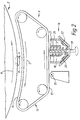
- Figure 2 shows the active coating device 6 in more detail.
- Figure 2 shows a portion of the wheel 2 together with a core 4 in a depression 3 on the surface of the wheel 2.
- the active coating station 6 comprises a conveyor 13 arranged in a loop in a vertical plane so that the upper surface 14 faces the surface of the wheel and the cores 4 which pass the device 6 as the wheel rotates.
- the contour of the upper surface 14 of the conveyor 13 is chosen to match the contour of the outer surface of the wheel so that the distance between the core and the upper surface of the conveyor is unchanged as the wheel rotates.
- the direction of rotation C of the conveyor 13 is such that the direction of movement of the upper surface of the conveyor is opposite to that of the movement of the core over the upper surface of the conveyor. Alternatively, the direction of movement of the upper surface of the conveyor and the core may be the same.
- a corona charge wire 15 and a powder source 16 are arranged beneath the conveyor immediately below the lower surface 17 of the conveyor.
- the corona charge wire 15 sprays charge onto the lower surface 17 of the conveyor. It will be appreciated that a different method could be used to apply charge to the conveyor.
- the powder source 16 uses an archimedes screw to form a small mound of powder beneath the lower surface of the conveyor.
- the source 16 comprises a hopper 18 containing the powder including the biologically active component, and an Archimedes screw 19 which in use passes through the powder material 20 in the hopper 18 and through a vertical barrel 21.
- the powder material 20 is circulated from the lower regions of the hopper 18 to the top of the barrel 21 where a moving heap of powder is formed.
- the heap will be of substantially constant size and shape as excess powder overflows from the top of the barrel 21 and is returned to the hopper 18.
- Stirrers 22 are provided in the hopper 18 to help to improve the flow of the powder and break up any agglomerates.
- the powder source 16 is located downstream from the charge spraying device 15 and powder from the heap of powder is attracted to the surface of the charged conveyor 17 where it forms a thin, uniform layer which is transported to the upper surface 14 of the conveyor.
- the tablet core 4 passing over the upper surface of the conveyor is held at a different potential from that of the conveyor 13, either by earthing the core or applying a charge to the core as described below, and powder on the conveyor moves from the conveyor to the exposed surfaces of the tablet core 4 to form a powder coating.
- the active coating station 6 is enclosed in a housing (not shown) to reduce the risk of powder loss of the active powder.
- the housing has an opening above the upper surface of the conveyor 14 so that the tablet core 4 is exposed to the active powder coating material as it passes the station 6.
- the thickness of the powder layer formed on the surface of the tablet core depends on several factors including the amount of charge sprayed onto the conveyor, the magnitude of the charge applied to the core, the size of the heap of powder produced, the size of the opening in the housing and the speed of the conveyor. Those factors will be varied to give the desired coating depending on the type of powder and core used.
- the tablet core including the active coating then passes to the active coating fusing station 8 which comprises a heater which is used to fuse the coating material.
- a cooler situated downstream from the active coating fusing station 8 directs air at the core to cool the fused active coating.
- the active coated tablet core then passes to the cover coating station 7 where a charge is applied to the tablet core as described below and the core is passed over an earthed trough containing the cover coating powder.
- the powder from the trough is attracted to the exposed surfaces of the tablet core to form a cover coating over the active coating.
- the tablet then passes to the cover coating fusing station 9 where the cover coating is fused to form a film coating and to a cooling station where cool air is directed at the core to cool the fused coating.
- each depression 3 is electrically insulated from the other depressions on the wheel by means of a cup of insulating material 23 and is provided with a respective pick up arm 24 extending radially inward from the depression 3 towards but ending short of the centre of the wheel.
- the pick up arms 24 are attached to the inner surface of the wheel 2 and rotate with it.
- Each associated pick up arm 24 and depression 3 together make a moving electrode which is in contact with the core 4 when it is located in the depression 3.
- a stationary electrode 25 is located inside the wheel at each angular position corresponding to each coating station, as required.
- the outer surfaces of the stationary electrodes are at the same radial distance from the centre of the wheel as the free ends of the pick up arms 24 of the moving electrodes. As the wheel 2 rotates, the moving electrodes contact the stationary electrodes and a charge is applied to the tablet core 4 in the depression 3.
- the partially coated tablet core then passes onto the second wheel, and the uncoated surfaces are coated with a cover coating in a similar way.
- Figures 4a and 4b show schematic cross-sectional views of tablets coated in accordance with the first aspect of the present invention.
- the tablet shown in Figure 4a comprises a core 4, an active coating layer 26 comprising active material covering the upper surface and part of the side surface of the core, and a cover coating 27 covering the active coating layer 26.
- the core also has a further cover coating 28 covering the opposite face and part of the side surface of the core.
- the further cover coating 28 may be of the same or different composition as that of the cover coating 27.
- the thickness of the coating layers relative to the size of the core have been greatly exaggerated for clarity.
- the thickness of each coating layer would usually be of the order of from 5 to 100 ⁇ m.
- most of the coating material deposited on the core surface will be deposited on the face of the core facing the powder source such that the coating on that face of the core will be thicker than the coating on the exposed side faces of the core where less coating material is deposited.
- Figure 4b shows a tablet having an active coating 26' and a cover coating 27'.
- the tablet is similar to that of Figure 4a except that there is no further cover coating on the opposite side of the core.
- a first coating containing no active material may be applied to all or part of the surfaces of the substrate before the application of the active coating material.
- the first coating may be a delayed release coating.
- composition of the active coating material used will of course depend on the active ingredient to be used and the amount of the coating to be applied.
- Active materials most suitable to be applied to the tablet include those materials having a high therapeutic activity, for example those where the usual prescribed dose is about 1mg or less, and which have a good stability to degradation due to heat where the coating material containing active material is to be heated.
- An active material which may be applied to a tablet core in accordance with the invention is Diltiazem HCL.
- the amount of active ingredient to be coated onto each core or other substrate will generally be small and the active ingredient will usually be diluted with one or more excipients.
- the excipients used will be chosen so that they aid the coating of the active material onto the cores by, for example improving the electrostatic properties of the powder and its physical properties and aiding the formation of the fused active coating, for example the excipient may be a material which melts at a low temperature to aid the formation of a film.
- the particle size will be an important factor with regard to the transfer of the active coating material from the conveyor to the tablet core and to the subsequent fusing of the material.
- a particle size range of 1 to 200 ⁇ m will be used (at least 90% of the particles of the powder having a size within that range).
- an active coating material is as follows: Xylitol 45% wt Diltiazem HCL (active) 45% wt TiO 2 9% wt Colloidal silica 1% wt
- the active composition will comprise three main components together with additives.
- the components may, for example, comprise the following
- Each component may comprise one or more different materials.
- the active coating material of the above example was in the form of a powder and had a particle size distribution such that at least 90% wt of the particles had a size in the range of from 5 to 25 ⁇ m. It is often preferred that at least 90% by weight of the particles have a size in the range of from 1 to 45 ⁇ m. In one preferred embodiment 90% by weight of the particles have a size less than 70 ⁇ m, 50% by weight have a particle size less than 40 ⁇ m and 10% by weight of the particles have a size less than 10 ⁇ m.
- the active powder coating material may be produced using one or a combination of the following processing steps:
- all of the components of the composition may be co-micronised to give a powder material having the desired particle size.
- An example of a powder cover coating material is as follows: 39.75% Eudragit RS (ammonio-methacrylate copolymer) 39.75% Klucel (hydroxy propyl cellulose) 15.0% Titanium dioxide 5.0% Aluminium lake 0.5% Aerosil 200 (colloidal silicon dioxide)
- the cover coating material was prepared by the following method:
- the cover coating material will usually include components to control the dissolution rate of the cover coating to give controlled release of the active material in the active coating layer. Where more than one active coating is applied to each tablet or other substrate, the release of each active coating can be different where different materials are used for the cover coating over each of those active coatings.
- a suitable liquid coating device would be used at the active coating station 6 and/or the cover coating station 7 and the fusing device would be replaced by, for example a drying device to dry the liquid coating, if necessary.
- an ink jet printer head is used to apply active coating and/or cover coating material in an apparatus similar to that described above and as shown in Figures 1 and 3.
- the head may be an ink jet printer head, for example an adapted Compact 200 head manufactured by Alphadot Limited. That head has 5 outlets spread over an area of about 10mm and can be used to direct liquid coating material towards the exposed surfaces of the tablet core such that, for a tablet core having two parallel flat faces, the liquid coating substantially completely covers one of the flat faces.
- head may be used to apply coating material to the surface of the substrate and that the head will be chosen so as to give the desired deposition of the coating material on the surface of the substrate to be coated.
- the coating is to cover only a part of the exposed surface of the substrate, the size and arrangement of the outlets will be chosen accordingly.
- active coating material is to be applied to a tablet core using an ink jet printer head using the apparatus shown in Figures 1 and 3, the printer head is arranged at the active coating station 6 and active coating material in the form of a liquid is applied to a surface of a pharmaceutical tablet core held on the first wheel 2.
- a head for applying the liquid is positioned such that the outlet or outlets of the head is less than 1mm from a surface of a tablet core held on the wheel 2 at the active coating station 6.
- the liquid coating material comprises the active component and a solvent, preferably water, and an excipient, for example PEG, to aid in film forming.
- a solvent preferably water
- an excipient for example PEG
- the solids content of the liquid coating material is very low, advantageously there would be substantially no solids content and advantageously the active material is fully dissolved in the solvent.
- active liquid coating materials which may be used are as follows a) Sodium citrate 0.02 Chlorpheniramine maleate 2.48 Propylene glycol 4.00 Water 18.50 Ethanol 75.00 b) Sodium citrate 0.02 Chlorpheniramine maleate 2.00 Methocel E15 1.00 Lactose B.P. 6.00 PEG 4000 1.00 Water 89.98
- the apparatus may include heating means 8 downstream from the coating station 6 for drying the applied coating material.
- the heater 8 may not be required. It will be appreciated that where the heater 8 is used the temperature required to dry the active coating will be significantly lower than the temperature required to fuse powder coating material as described above.
- the apparatus may further include a cover coating station 7 and a fusing station 9 as described above and, where the core is to be further coated, the apparatus includes a second wheel 10 with a coating station 11 and fusing station 12 as described above.
- a further active coating is to be applied, a further active coating station and, optionally, a further heater may be provided upstream from the coating station 11.
- An example of a suitable cover coating material is described above.
- Figure 4c shows a tablet coated by a method described above.
- the tablet comprises a core 4, a first active coating layer 26'' covering substantially all of the upper face of the core, a cover coating 27'' covering the active coating layer and part of the sides of the tablet core, a second active coating layer 29 covering part of the lower surface of the core and a second cover coating layer 28 covering the second active coating layer 29.
- the two active coating layers 26'' and 29 may include the same or different active ingredients; the two cover coating layers 27'' and 28 may be of the same or different material and may have different dissolution rates.
- the active coating material is applied using the method described above, substantially all of the coating material is applied to a face of the tablet core, with substantially no coating material being applied to the sides of the tablet core.
- the active coating material is applied to a substrate using an ultrasonic spray head.
- the ultrasonic spray head forms a cloud of liquid droplets which are charged electrostatically. A charge may be imparted on the droplets, for example, by applying a high voltage to the ultrasonic spray head. The charged droplets become attracted to the substrate which is at a potential difference from the droplets.
- the apparatus described above could be modified for the coating of pharmaceutical substrates other than conventional tablet cores.
- the method and apparatus described could be used to coat tablet cores of non-conventional shape or pharmaceutical substrates in the form of a film or sheet.
Landscapes
- Health & Medical Sciences (AREA)
- Engineering & Computer Science (AREA)
- Bioinformatics & Cheminformatics (AREA)
- Animal Behavior & Ethology (AREA)
- Public Health (AREA)
- Pharmacology & Pharmacy (AREA)
- Epidemiology (AREA)
- Life Sciences & Earth Sciences (AREA)
- Chemical & Material Sciences (AREA)
- General Health & Medical Sciences (AREA)
- Medicinal Chemistry (AREA)
- Veterinary Medicine (AREA)
- Medicinal Preparation (AREA)
- Materials For Medical Uses (AREA)
- Application Of Or Painting With Fluid Materials (AREA)
- Medical Preparation Storing Or Oral Administration Devices (AREA)
- Coating Apparatus (AREA)
- Glanulating (AREA)
Applications Claiming Priority (3)
| Application Number | Priority Date | Filing Date | Title |
|---|---|---|---|
| GBGB9623634.4A GB9623634D0 (en) | 1996-11-13 | 1996-11-13 | Method and apparatus for the coating of substrates for pharmaceutical use |
| GB9623634 | 1996-11-13 | ||
| PCT/GB1997/003121 WO1998020861A1 (en) | 1996-11-13 | 1997-11-13 | Method and apparatus for the coating of substrates for pharmaceutical use |
Publications (2)
| Publication Number | Publication Date |
|---|---|
| EP0941072A1 EP0941072A1 (en) | 1999-09-15 |
| EP0941072B1 true EP0941072B1 (en) | 2004-01-14 |
Family
ID=10802890
Family Applications (2)
| Application Number | Title | Priority Date | Filing Date |
|---|---|---|---|
| EP97912341A Expired - Lifetime EP0941072B1 (en) | 1996-11-13 | 1997-11-13 | Method and apparatus for the coating of substrates for pharmaceutical use |
| EP97912333A Expired - Lifetime EP0941078B8 (en) | 1996-11-13 | 1997-11-13 | Method and apparatus for the coating of substrates for pharmaceutical use |
Family Applications After (1)
| Application Number | Title | Priority Date | Filing Date |
|---|---|---|---|
| EP97912333A Expired - Lifetime EP0941078B8 (en) | 1996-11-13 | 1997-11-13 | Method and apparatus for the coating of substrates for pharmaceutical use |
Country Status (12)
| Country | Link |
|---|---|
| US (3) | US6783768B1 (enExample) |
| EP (2) | EP0941072B1 (enExample) |
| JP (2) | JP2001504721A (enExample) |
| AT (2) | ATE295723T1 (enExample) |
| AU (2) | AU4956897A (enExample) |
| CA (2) | CA2279842C (enExample) |
| DE (2) | DE69733315T2 (enExample) |
| DK (2) | DK0941078T3 (enExample) |
| ES (2) | ES2242216T3 (enExample) |
| GB (3) | GB9623634D0 (enExample) |
| PT (2) | PT941078E (enExample) |
| WO (2) | WO1998020861A1 (enExample) |
Cited By (13)
| Publication number | Priority date | Publication date | Assignee | Title |
|---|---|---|---|---|
| US7077860B2 (en) | 1997-04-24 | 2006-07-18 | Advanced Cardiovascular Systems, Inc. | Method of reducing or eliminating thrombus formation |
| US7297159B2 (en) | 2000-10-26 | 2007-11-20 | Advanced Cardiovascular Systems, Inc. | Selective coating of medical devices |
| US7390524B1 (en) | 2004-05-20 | 2008-06-24 | Advanced Cardiovascular Systems, Inc. | Method for electrostatic spraying of an abluminal stent surface |
| US7553377B1 (en) | 2004-04-27 | 2009-06-30 | Advanced Cardiovascular Systems, Inc. | Apparatus and method for electrostatic coating of an abluminal stent surface |
| US7563324B1 (en) | 2003-12-29 | 2009-07-21 | Advanced Cardiovascular Systems Inc. | System and method for coating an implantable medical device |
| US7632307B2 (en) | 2004-12-16 | 2009-12-15 | Advanced Cardiovascular Systems, Inc. | Abluminal, multilayer coating constructs for drug-delivery stents |
| US7867547B2 (en) | 2005-12-19 | 2011-01-11 | Advanced Cardiovascular Systems, Inc. | Selectively coating luminal surfaces of stents |
| US8003156B2 (en) | 2006-05-04 | 2011-08-23 | Advanced Cardiovascular Systems, Inc. | Rotatable support elements for stents |
| US8017237B2 (en) | 2006-06-23 | 2011-09-13 | Abbott Cardiovascular Systems, Inc. | Nanoshells on polymers |
| US8048441B2 (en) | 2007-06-25 | 2011-11-01 | Abbott Cardiovascular Systems, Inc. | Nanobead releasing medical devices |
| US8048448B2 (en) | 2006-06-15 | 2011-11-01 | Abbott Cardiovascular Systems Inc. | Nanoshells for drug delivery |
| US8603530B2 (en) | 2006-06-14 | 2013-12-10 | Abbott Cardiovascular Systems Inc. | Nanoshell therapy |
| WO2024149597A1 (de) * | 2023-01-12 | 2024-07-18 | BLZ Bayerisches Laserzentrum Gemeinnützige Forschungsgesellschaft mbH | Verfahren zur additiven fertigung eines medizinischen und/oder pharmazeutischen produkts sowie entsprechendes produkt |
Families Citing this family (123)
| Publication number | Priority date | Publication date | Assignee | Title |
|---|---|---|---|---|
| US7008668B2 (en) * | 1995-05-09 | 2006-03-07 | Phoqus Pharmaceuticals Limited | Powder coating composition for electrostatic coating of pharmaceutical substrates |
| WO1996035516A1 (en) * | 1995-05-09 | 1996-11-14 | Colorcon Limited | Electrostatic coating |
| GB9623634D0 (en) * | 1996-11-13 | 1997-01-08 | Bpsi Holdings Inc | Method and apparatus for the coating of substrates for pharmaceutical use |
| US6303143B1 (en) | 1998-06-10 | 2001-10-16 | Sarnoff Corporation | Pharmaceutical product |
| US6287595B1 (en) | 1998-06-10 | 2001-09-11 | Delsys Pharmaceuticals Corporation | Biomedical assay device |
| KR100561223B1 (ko) * | 1998-06-12 | 2006-03-15 | 마이크로도스 테크놀로지즈 인코포레이티드 | 약제 및 약물의 계량, 포장 및 운송 |
| US6152130A (en) * | 1998-06-12 | 2000-11-28 | Microdose Technologies, Inc. | Inhalation device with acoustic control |
| US6142146A (en) * | 1998-06-12 | 2000-11-07 | Microdose Technologies, Inc. | Inhalation device |
| DE19830650C1 (de) * | 1998-07-09 | 1999-08-12 | Lohmann Therapie Syst Lts | Trockenkopierprozeß zur Herstellung flächiger, einzeldosierter Wirkstoffzubereitungen |
| US6652903B2 (en) | 1998-07-09 | 2003-11-25 | Lts Lohmann Therapie-Systeme Ag | Dry-copying method for producing flat, individually dosed preparations of active agents |
| US6372246B1 (en) | 1998-12-16 | 2002-04-16 | Ortho-Mcneil Pharmaceutical, Inc. | Polyethylene glycol coating for electrostatic dry deposition of pharmaceuticals |
| US6806017B2 (en) * | 1999-12-17 | 2004-10-19 | Phoqus Limited | Electrostatic application of powder material to solid dosage forms |
| GB0002305D0 (en) * | 2000-02-01 | 2000-03-22 | Phoqus Limited | Power material for electrostatic application |
| US7664484B2 (en) * | 2000-09-07 | 2010-02-16 | Tangoe, Inc. | Pooling groups of wireless communication users |
| CA2427381A1 (en) | 2000-10-26 | 2002-11-28 | Alza Corporation | Transdermal drug delivery devices having coated microprotrusions |
| US6932861B2 (en) | 2000-11-28 | 2005-08-23 | Fmc Corporation | Edible PGA coating composition |
| GB2370243B (en) | 2000-12-21 | 2004-06-16 | Phoqus Ltd | Electrostatic application of powder material to solid dosage forms in an elect ric field |
| US7062312B2 (en) * | 2001-01-17 | 2006-06-13 | Pediamed Pharmaceuticals, Inc. | Combination and method including a visual marker for determining compliance with a medication regimen |
| US20030194374A1 (en) * | 2001-01-17 | 2003-10-16 | Xanodyne Pharmacal, Inc. | Compositions including a visual marker and method of use thereof |
| US7497910B2 (en) * | 2001-06-26 | 2009-03-03 | Tiger Microsystems, Inc. | Dry powder electrostatic deposition method and apparatus |
| US6565659B1 (en) | 2001-06-28 | 2003-05-20 | Advanced Cardiovascular Systems, Inc. | Stent mounting assembly and a method of using the same to coat a stent |
| GB2384199B (en) | 2002-01-17 | 2005-04-06 | Phoqus Ltd | Electrostatic application of powder material to solid dosage forms |
| GB0221293D0 (en) | 2002-09-13 | 2002-10-23 | Phoqus Ltd | Method and apparatus for applying powder in a pattern to a substrate |
| US9561182B2 (en) | 2003-08-22 | 2017-02-07 | Cure Pharmaceutical Corporation | Edible films for administration of medicaments to animals, methods for their manufacture and methods for their use for the treatment of animals |
| US20040131662A1 (en) * | 2003-11-12 | 2004-07-08 | Davidson Robert S. | Method and apparatus for minimizing heat, moisture, and shear damage to medicants and other compositions during incorporation of same with edible films |
| US20040191302A1 (en) | 2003-03-28 | 2004-09-30 | Davidson Robert S. | Method and apparatus for minimizing heat, moisture, and shear damage to medicants and other compositions during incorporation of same with edible films |
| US8999372B2 (en) * | 2002-11-14 | 2015-04-07 | Cure Pharmaceutical Corporation | Methods for modulating dissolution, bioavailability, bioequivalence and drug delivery profile of thin film drug delivery systems, controlled-release thin film dosage formats, and methods for their manufacture and use |
| AU2003295577A1 (en) * | 2002-11-14 | 2004-06-15 | Zengen, Inc. | Edible film for relief of cough or symptoms associated with pharyngitis |
| GB2420298B (en) * | 2003-06-18 | 2006-08-23 | Phoqus Pharmaceuticals Ltd | Method and apparatus for the application of powder material to substrates |
| US7198653B2 (en) * | 2003-07-31 | 2007-04-03 | Delavau Llc | Calcium carbonate granulation |
| US7198675B2 (en) | 2003-09-30 | 2007-04-03 | Advanced Cardiovascular Systems | Stent mandrel fixture and method for selectively coating surfaces of a stent |
| GB0330171D0 (en) * | 2003-12-30 | 2004-02-04 | Phoqus Pharmaceuticals Ltd | Method and apparatus for the application of powder material to substrates |
| GB0403808D0 (en) * | 2004-02-20 | 2004-03-24 | Bioprogress Technology Ltd | Films for use as dosage forms |
| GB0407312D0 (en) * | 2004-03-31 | 2004-05-05 | Phoqus Pharmaceuticals Ltd | Method and apparatus for the application of powder material to substrates |
| US7727576B2 (en) * | 2004-04-16 | 2010-06-01 | Hewlett-Packard Development Company, L.P. | System and a method for producing layered oral dosage forms |
| EP1748762B1 (de) | 2004-05-28 | 2013-12-18 | AbbVie Deutschland GmbH & Co KG | Dosierungsform, erhältlich aus einer ein anorganisches pigment umfassenden pulvermischung |
| TWI547431B (zh) * | 2004-06-09 | 2016-09-01 | 史密斯克萊美占公司 | 生產藥物之裝置及方法 |
| US8609198B2 (en) * | 2004-07-21 | 2013-12-17 | Hewlett-Packard Development Company, L.P. | Pharmaceutical dose form with a patterned coating and method of making the same |
| GB0427456D0 (en) * | 2004-12-15 | 2005-01-19 | Phoqus Pharmaceuticals Ltd | Formulation for production of capsule shells and capsules |
| JP2006206449A (ja) * | 2005-01-25 | 2006-08-10 | Pharma Polytech:Kk | コーティング用粉末、その製造方法及び該コーティング用粉末含有製剤 |
| JP2008529772A (ja) * | 2005-02-14 | 2008-08-07 | ザ ユニバーシティ オブ ノッティンガム | 重合膜の堆積 |
| EP2671508B1 (en) | 2005-04-28 | 2020-09-16 | Proteus Digital Health, Inc. | Pharma-informatics system |
| US8912908B2 (en) | 2005-04-28 | 2014-12-16 | Proteus Digital Health, Inc. | Communication system with remote activation |
| US8836513B2 (en) | 2006-04-28 | 2014-09-16 | Proteus Digital Health, Inc. | Communication system incorporated in an ingestible product |
| US8802183B2 (en) | 2005-04-28 | 2014-08-12 | Proteus Digital Health, Inc. | Communication system with enhanced partial power source and method of manufacturing same |
| WO2006119286A1 (en) * | 2005-05-03 | 2006-11-09 | Innozen, Inc. | Edible film for transmucosal delivery of nutritional supplements |
| US20070009564A1 (en) * | 2005-06-22 | 2007-01-11 | Mcclain James B | Drug/polymer composite materials and methods of making the same |
| ES2691646T3 (es) * | 2005-07-15 | 2018-11-28 | Micell Technologies, Inc. | Revestimientos poliméricos que contienen polvo de fármaco de morfología controlada |
| WO2007011708A2 (en) | 2005-07-15 | 2007-01-25 | Micell Technologies, Inc. | Stent with polymer coating containing amorphous rapamycin |
| US7862848B2 (en) * | 2005-08-03 | 2011-01-04 | The University Of Western Ontario | Direct coating solid dosage forms using powdered materials |
| US8784886B2 (en) * | 2006-03-09 | 2014-07-22 | GlaxoSmithKline, LLC | Coating capsules with active pharmaceutical ingredients |
| EP2081550B2 (en) | 2006-03-09 | 2021-05-26 | Reliant Pharmaceuticals, Inc. | Coating capsules with active pharmaceutical ingredients |
| WO2007115050A2 (en) * | 2006-03-29 | 2007-10-11 | Wm. Wrigley Jr. Company | Non-contact printed comestible products and apparatus and method for producing same |
| CA2996768C (en) * | 2006-04-26 | 2020-12-08 | Micell Technologies, Inc. | Coatings containing multiple drugs |
| EP2023742A4 (en) * | 2006-05-12 | 2017-07-19 | Mars, Incorporated | Food-grade toner |
| RU2435184C2 (ru) | 2006-05-12 | 2011-11-27 | Марс, Инкорпорейтед | Использование порошков для создания изображений на объектах, лентах или листах |
| US7976872B2 (en) | 2006-07-24 | 2011-07-12 | L. Perrigo Company | Method for distributing a pharmaceutically active compound in an excipient |
| WO2008042909A2 (en) | 2006-10-02 | 2008-04-10 | Micell Technologies Inc. | Surgical sutures having increased strength |
| JP5336382B2 (ja) * | 2006-10-23 | 2013-11-06 | ミセル テクノロジーズ、インコーポレイテッド | コーティングの間に基板を荷電するためのホルダー |
| US11426494B2 (en) | 2007-01-08 | 2022-08-30 | MT Acquisition Holdings LLC | Stents having biodegradable layers |
| CN101711137B (zh) | 2007-01-08 | 2014-10-22 | 米歇尔技术公司 | 具有可生物降解层的支架 |
| US9270025B2 (en) | 2007-03-09 | 2016-02-23 | Proteus Digital Health, Inc. | In-body device having deployable antenna |
| WO2008131131A1 (en) * | 2007-04-17 | 2008-10-30 | Micell Technologies, Inc. | Stents having biodegradable layers |
| CN101815540B (zh) * | 2007-05-25 | 2015-08-19 | 米歇尔技术公司 | 用于医疗器材涂层的聚合物膜 |
| US20100298928A1 (en) * | 2007-10-19 | 2010-11-25 | Micell Technologies, Inc. | Drug Coated Stents |
| FR2924349B1 (fr) | 2007-12-03 | 2010-01-01 | Dbv Tech | Methode de desensibilitation aux allergenes |
| CA2721832C (en) | 2008-04-17 | 2018-08-07 | Micell Technologies, Inc. | Stents having bioabsorbable layers |
| WO2010009335A1 (en) * | 2008-07-17 | 2010-01-21 | Micell Technologies, Inc. | Drug delivery medical device |
| US8540633B2 (en) | 2008-08-13 | 2013-09-24 | Proteus Digital Health, Inc. | Identifier circuits for generating unique identifiable indicators and techniques for producing same |
| BRPI0823144A2 (pt) * | 2008-10-06 | 2015-06-16 | Disa Ind As | Placa de forro para forrar câmaras de moldagem de máquinas de moldagem |
| US8834913B2 (en) * | 2008-12-26 | 2014-09-16 | Battelle Memorial Institute | Medical implants and methods of making medical implants |
| US20100239635A1 (en) * | 2009-03-23 | 2010-09-23 | Micell Technologies, Inc. | Drug delivery medical device |
| WO2010111238A2 (en) * | 2009-03-23 | 2010-09-30 | Micell Technologies, Inc. | Improved biodegradable polymers |
| US20100241220A1 (en) * | 2009-03-23 | 2010-09-23 | Mcclain James B | Peripheral Stents Having Layers |
| US8540664B2 (en) | 2009-03-25 | 2013-09-24 | Proteus Digital Health, Inc. | Probablistic pharmacokinetic and pharmacodynamic modeling |
| CN102481195B (zh) | 2009-04-01 | 2015-03-25 | 米歇尔技术公司 | 涂覆支架 |
| EP3366326A1 (en) | 2009-04-17 | 2018-08-29 | Micell Technologies, Inc. | Stents having controlled elution |
| SG10201810784SA (en) | 2009-04-28 | 2018-12-28 | Proteus Digital Health Inc | Highly Reliable Ingestible Event Markers And Methods For Using The Same |
| EP2429813B1 (en) * | 2009-05-11 | 2018-06-13 | The Regents of the University of Colorado, a Body Corporate | Ultra-thin metal oxide and carbon-metal oxide films prepared by atomic layer deposition (ald) |
| US20100291201A1 (en) * | 2009-05-14 | 2010-11-18 | Cerovene, Inc. | Coated pharmaceutical capsule dosage form |
| EP2453834A4 (en) | 2009-07-16 | 2014-04-16 | Micell Technologies Inc | MEDICAL DEVICE DISPENSING MEDICINE |
| EP2531140B1 (en) | 2010-02-02 | 2017-11-01 | Micell Technologies, Inc. | Stent and stent delivery system with improved deliverability |
| US8577488B2 (en) | 2010-02-11 | 2013-11-05 | Monosol Rx, Llc | Method and system for optimizing film production and minimizing film scrap |
| US8795762B2 (en) | 2010-03-26 | 2014-08-05 | Battelle Memorial Institute | System and method for enhanced electrostatic deposition and surface coatings |
| MX2012011693A (es) | 2010-04-07 | 2013-02-15 | Proteus Digital Health Inc | Dispositivo ingerible miniatura. |
| WO2011133655A1 (en) | 2010-04-22 | 2011-10-27 | Micell Technologies, Inc. | Stents and other devices having extracellular matrix coating |
| WO2012009684A2 (en) | 2010-07-16 | 2012-01-19 | Micell Technologies, Inc. | Drug delivery medical device |
| WO2012071280A2 (en) | 2010-11-22 | 2012-05-31 | Proteus Biomedical, Inc. | Ingestible device with pharmaceutical product |
| DE102011004024A1 (de) * | 2011-02-14 | 2012-08-16 | Illinois Tool Works Inc. | Steuervorrichtung für eine Pulversprühbeschichtungseinrichtung |
| EP2683251B1 (en) | 2011-03-11 | 2021-08-25 | Intercontinental Great Brands LLC | Method of forming multilayer confectionery |
| EP2701668A1 (en) | 2011-04-29 | 2014-03-05 | Massachusetts Institute of Technology | Layer processing for pharmaceuticals |
| WO2012166819A1 (en) | 2011-05-31 | 2012-12-06 | Micell Technologies, Inc. | System and process for formation of a time-released, drug-eluting transferable coating |
| US9756874B2 (en) | 2011-07-11 | 2017-09-12 | Proteus Digital Health, Inc. | Masticable ingestible product and communication system therefor |
| WO2015112603A1 (en) | 2014-01-21 | 2015-07-30 | Proteus Digital Health, Inc. | Masticable ingestible product and communication system therefor |
| US10117972B2 (en) | 2011-07-15 | 2018-11-06 | Micell Technologies, Inc. | Drug delivery medical device |
| PL3536161T3 (pl) | 2011-07-21 | 2025-12-15 | Perfetti Van Melle Benelux B.V. | Zaawansowane formowanie i chłodzenie gumy |
| US10188772B2 (en) | 2011-10-18 | 2019-01-29 | Micell Technologies, Inc. | Drug delivery medical device |
| KR20150038038A (ko) | 2012-07-23 | 2015-04-08 | 프로테우스 디지털 헬스, 인코포레이티드 | 섭취 가능한 부품을 포함하는 섭취 가능한 이벤트 마커를 제조하기 위한 기술 |
| DK2910013T3 (en) | 2012-10-18 | 2018-08-06 | Proteus Digital Health Inc | Apparatus, system and method for adaptive optimization for power output and transmit power in a power source for a communication device |
| WO2014116770A1 (en) | 2013-01-23 | 2014-07-31 | Arx, Llc | Production of unit dose constructs |
| TWI659994B (zh) | 2013-01-29 | 2019-05-21 | 美商普羅托斯數位健康公司 | 高度可膨脹之聚合型薄膜及包含彼之組成物 |
| CN110269959A (zh) | 2013-03-12 | 2019-09-24 | 脉胜医疗技术公司 | 可生物吸收的生物医学植入物 |
| WO2014144738A1 (en) | 2013-03-15 | 2014-09-18 | Proteus Digital Health, Inc. | Metal detector apparatus, system, and method |
| WO2014186532A1 (en) | 2013-05-15 | 2014-11-20 | Micell Technologies, Inc. | Bioabsorbable biomedical implants |
| US9796576B2 (en) | 2013-08-30 | 2017-10-24 | Proteus Digital Health, Inc. | Container with electronically controlled interlock |
| US10084880B2 (en) | 2013-11-04 | 2018-09-25 | Proteus Digital Health, Inc. | Social media networking based on physiologic information |
| WO2015117004A1 (en) * | 2014-01-31 | 2015-08-06 | Board Of Regents, The University Of Texas System | Method for preparing films |
| ES3076044T3 (en) | 2014-03-03 | 2026-08-11 | Perfetti Van Melle Benelux B V | Method for manufacturing a comestible |
| US10213960B2 (en) | 2014-05-20 | 2019-02-26 | Massachusetts Institute Of Technology | Plasticity induced bonding |
| US11051543B2 (en) | 2015-07-21 | 2021-07-06 | Otsuka Pharmaceutical Co. Ltd. | Alginate on adhesive bilayer laminate film |
| EP4793326A2 (en) | 2015-09-16 | 2026-08-19 | Apeel Technology, Inc. | Method for forming a protective coating by applying fatty acid glyceride compounds to a surface |
| TWI731928B (zh) | 2016-01-26 | 2021-07-01 | 美商aPEEL科技公司 | 製備及保存經消毒產品之方法 |
| CN109843149B (zh) | 2016-07-22 | 2020-07-07 | 普罗秋斯数字健康公司 | 可摄入事件标记的电磁感测和检测 |
| KR102605670B1 (ko) | 2016-10-26 | 2023-11-24 | 오츠카 세이야쿠 가부시키가이샤 | 섭취 가능한 이벤트 마커를 갖는 캡슐을 제조하는 방법 |
| JP2020005823A (ja) * | 2018-07-06 | 2020-01-16 | フロイント産業株式会社 | 錠剤コーティング装置、及び錠剤コーティング方法 |
| JP7277087B2 (ja) * | 2018-08-17 | 2023-05-18 | 株式会社ダイセル | 包装体、錠剤入り包装体、包装体の収容部材の製造方法、及び包装体の収容部材の製造装置 |
| US12245605B2 (en) | 2018-09-05 | 2025-03-11 | Apeel Technology, Inc. | Compounds and formulations for protective coatings |
| JP7361530B2 (ja) * | 2019-08-09 | 2023-10-16 | 株式会社Screenホールディングス | 固体製剤及び固体製剤への印刷方法 |
| EP4114181A1 (en) | 2020-03-04 | 2023-01-11 | Apeel Technology, Inc. | Coated agricultural products and corresponding methods |
| AU2021304692A1 (en) * | 2020-07-10 | 2023-02-09 | Cotex Technologies Inc. | Coated substrates and method of making same |
| IL302360B2 (en) | 2020-10-30 | 2025-01-01 | Apeel Tech Inc | Preparations and methods of their preparation |
| CN113663668B (zh) * | 2021-09-01 | 2023-04-07 | 南大恩洁优环境技术(江苏)股份公司 | 一种VOCs净化用炭纤维负载室温催化剂及其制备方法 |
| US12408680B2 (en) | 2021-09-08 | 2025-09-09 | Apeel Technology, Inc. | Compounds and formulations for protective coatings |
Family Cites Families (86)
| Publication number | Priority date | Publication date | Assignee | Title |
|---|---|---|---|---|
| FR24084E (fr) | 1920-03-13 | 1922-02-21 | Capon Nee Antoine Rousset | Mannequin extensible |
| GB561100A (en) | 1941-06-27 | 1944-05-04 | Miller Printing Machinery Co | Improvements in or relating to apparatus for conveying sheets |
| US2698814A (en) | 1952-05-01 | 1955-01-04 | Ransburg Electro Coating Corp | Electrostatic coating apparatus and method |
| NL6406815A (enExample) | 1963-06-19 | 1964-12-21 | ||
| GB1108791A (en) * | 1964-04-06 | 1968-04-03 | Addressograph Multigraph | Electrophotographic developer mixes |
| DE1617282A1 (de) | 1965-11-30 | 1975-02-06 | Astra Pharma Prod | Vorrichtung zur lokalanaesthetisierung durch oertliche aufbringung und verfahren zur herstellung dieser vorrichtung |
| DE2247701A1 (de) | 1972-09-28 | 1974-04-11 | Heinz Dr Haase | Verfahren und vorrichtung zum aufbringen fester oder fluessiger partikel auf oberflaechen mittels elektrischer feldkraefte |
| US3900000A (en) | 1973-11-28 | 1975-08-19 | Thomas J Gallen | Apparatus for spray coating articles |
| DE3049179A1 (de) | 1975-03-20 | 1982-07-29 | Röhm GmbH, 6100 Darmstadt | Bindemittel fuer arzneimittelueberzuege. |
| US4197289A (en) * | 1975-12-15 | 1980-04-08 | Hoffmann-La Roche Inc. | Novel dosage forms |
| CH624846A5 (en) * | 1975-12-15 | 1981-08-31 | Hoffmann La Roche | Solid pharmaceutical unit dose form and process and apparatus for producing it |
| US4029757A (en) * | 1975-12-15 | 1977-06-14 | Hoffmann-La Roche Inc. | Manufacture of pharmaceutical unit dosage forms |
| US4349531A (en) | 1975-12-15 | 1982-09-14 | Hoffmann-La Roche Inc. | Novel dosage form |
| AU514195B2 (en) * | 1975-12-15 | 1981-01-29 | F. Hoffmann-La Roche & Co. | Dosage form |
| US4427712A (en) * | 1976-04-13 | 1984-01-24 | Continental Can Company, Inc. | Electrodynamic coating process |
| JPS52151717A (en) | 1976-06-09 | 1977-12-16 | Shionogi & Co Ltd | Sugar coating on solid preparations |
| US4163031A (en) | 1977-10-25 | 1979-07-31 | Celanese Corporation | Powder composition and method of preparation |
| DE2849494A1 (de) | 1978-11-15 | 1980-05-29 | Voss Gunter M | Verfahren zur herstellung von arzneimittel-formlingen |
| US4548825A (en) | 1978-11-15 | 1985-10-22 | Boehringer Ingelheim Gmbh | Method for ink-jet printing on uncoated tablets or uncoated tablet cores |
| CA1140784A (en) | 1979-06-04 | 1983-02-08 | Xerox Corporation | Conductive powder coated electrostatographic carriers |
| GB2056885A (en) | 1979-08-08 | 1981-03-25 | Blundell Permoglaze Ltd | Powder coating cellulose fibre substrates |
| US4543370A (en) | 1979-11-29 | 1985-09-24 | Colorcon, Inc. | Dry edible film coating composition, method and coating form |
| JPS5911563B2 (ja) * | 1980-02-27 | 1984-03-16 | 日本原子力研究所 | 多層構造の徐放性複合体を製造する方法 |
| JPS57171428A (en) | 1981-04-13 | 1982-10-22 | Sankyo Co Ltd | Preparation of coated solid preparation |
| US4454125A (en) | 1982-04-22 | 1984-06-12 | Demopoulos Harry B | Dry powder formulations having improved flow and compressibility characteristics, and method for the preparation thereof |
| US4482387A (en) | 1982-07-12 | 1984-11-13 | E. R. Squibb & Sons, Inc. | Powdered wax, tablet coated therewith and method |
| FR2534139B1 (fr) | 1982-10-07 | 1986-08-29 | Laruelle Claude | Nouvelle forme galenique du sulpiride, son procede de preparation et medicament comprenant cette nouvelle forme |
| US4704295A (en) | 1983-09-19 | 1987-11-03 | Colorcon, Inc. | Enteric film-coating compositions |
| US4547571A (en) | 1983-10-06 | 1985-10-15 | Kohjin Co., Ltd. | Process for preparing carboxymethyl ethyl cellulose suitable for enteric coating |
| GB8414220D0 (en) | 1984-06-04 | 1984-07-11 | Sterwin Ag | Medicaments in unit dose form |
| EP0212747B1 (en) | 1985-08-16 | 1991-04-10 | The Procter & Gamble Company | Drug particles having constant release and immediate release |
| JPS62103012A (ja) | 1985-10-23 | 1987-05-13 | Eisai Co Ltd | 多重顆粒 |
| GB2189698A (en) | 1986-04-30 | 1987-11-04 | Haessle Ab | Coated omeprazole tablets |
| US4810501A (en) | 1986-06-17 | 1989-03-07 | Warner-Lambert Company | Sustained release pharmaceutical preparations |
| JPS6327424A (ja) | 1986-07-17 | 1988-02-05 | Shionogi & Co Ltd | 徐放性製剤およびその製造法 |
| FR2602423B1 (fr) | 1986-08-08 | 1989-05-05 | Ethypharm Sa | Procede de preparation d'un medicament a base de fenofibrate, medicament obtenu par ce procede |
| DE3630603A1 (de) * | 1986-09-09 | 1988-03-10 | Desitin Arzneimittel Gmbh | Darreichungs- und dosierungsform fuer arzneimittelwirkstoffe, reagentien oder dergleichen sowie verfahren zu deren herstellung |
| US5026560A (en) * | 1987-01-29 | 1991-06-25 | Takeda Chemical Industries, Ltd. | Spherical granules having core and their production |
| GB8707740D0 (en) | 1987-04-01 | 1987-05-07 | Strathclyde Minerals Ltd | Composition |
| DE3721721C1 (de) * | 1987-07-01 | 1988-06-09 | Hoechst Ag | Verfahren zur Umhuellung von Granulaten |
| DE8712547U1 (de) | 1987-09-17 | 1987-11-19 | Behr-Industrieanlagen GmbH & Co, 7121 Ingersheim | Werkstückträger zur elektrostatischen Werkstückbeschichtung |
| US4988208A (en) | 1987-10-08 | 1991-01-29 | Koshin Kenki Kogyo Co., Ltd. | Method of and apparatus for mixing or dispersing particles |
| US4994273A (en) | 1987-11-02 | 1991-02-19 | Merck & Co., Inc. | Solubility modulated drug delivery device |
| DE3827214A1 (de) | 1988-08-11 | 1990-02-15 | Roehm Gmbh | Retardierte arzneiform und verfahren zu ihrer herstellung |
| US5206030A (en) | 1990-02-26 | 1993-04-27 | Fmc Corporation | Film-forming composition and use for coating pharmaceuticals, foods and the like |
| US5084287A (en) | 1990-03-15 | 1992-01-28 | Warner-Lambert Company | Pharmaceutically useful micropellets with a drug-coated core and controlled-release polymeric coat |
| EP0452862B1 (en) | 1990-04-18 | 1995-07-19 | Asahi Kasei Kogyo Kabushiki Kaisha | Spherical seed cores, spherical granules and process for production thereof |
| GB9009390D0 (en) * | 1990-04-26 | 1990-06-20 | Smith Kline French Lab | Pharmaceutical compositions |
| EP0459048B1 (en) | 1990-06-01 | 1996-03-20 | Courtaulds Coatings (Holdings) Limited | Coloured powder coating compositions |
| JPH0427677U (enExample) * | 1990-06-29 | 1992-03-05 | ||
| US5436026A (en) | 1990-11-05 | 1995-07-25 | Mcneil-Ppc, Inc. | Discharge and transfer system for apparatus for gelatin coating tablets |
| DE69132166T2 (de) | 1990-12-20 | 2000-12-21 | Warner-Jenkinson Co. Inc., St. Louis | Filmbildende zusammensetzungen aus feuchtem pulver |
| GB2253164B (en) | 1991-02-22 | 1994-10-05 | Hoechst Uk Ltd | Improvements in or relating to electrostatic coating of substrates of medicinal products |
| GB2256648B (en) | 1991-05-29 | 1995-08-30 | Colorcon Ltd | Wax polish composition |
| JP2711036B2 (ja) | 1991-10-11 | 1998-02-10 | 日本ペイント株式会社 | 粉体塗料及び粉体塗料用原料 |
| US5162117A (en) | 1991-11-22 | 1992-11-10 | Schering Corporation | Controlled release flutamide composition |
| JP3138838B2 (ja) | 1992-04-30 | 2001-02-26 | 東レ・ダウコーニング・シリコーン株式会社 | 混合粉体の製造方法 |
| PH30929A (en) | 1992-09-03 | 1997-12-23 | Janssen Pharmaceutica Nv | Beads having a core coated with an antifungal and a polymer. |
| GB9223300D0 (en) | 1992-11-06 | 1992-12-23 | Courtaulds Coatings Holdings | Powder coating compositions and their use |
| US5411730A (en) | 1993-07-20 | 1995-05-02 | Research Corporation Technologies, Inc. | Magnetic microparticles |
| CH686518A5 (de) | 1993-10-05 | 1996-04-15 | Asahi Optical Co Ltd | Granulares Polymerkomposit, Herstellungsverfahren fur dieses und diagnostische Mittel. |
| IT1265473B1 (it) | 1993-12-30 | 1996-11-22 | Otefal Srl | Procedimento per la produzione di polveri a granulometria controllata e prodotto in polvere cosi' ottenuto |
| US5395626A (en) | 1994-03-23 | 1995-03-07 | Ortho Pharmaceutical Corporation | Multilayered controlled release pharmaceutical dosage form |
| DE4414079A1 (de) | 1994-04-22 | 1995-10-26 | Basf Ag | Zweifach gasphasenpassivierte Metallpigmente |
| JP2913377B2 (ja) | 1994-04-22 | 1999-06-28 | 株式会社巴川製紙所 | 粉体塗料 |
| AUPM695294A0 (en) | 1994-07-20 | 1994-08-11 | Borody, Thomas Julius | Improved combination therapy dose unit |
| US5871751A (en) | 1994-10-12 | 1999-02-16 | The State Of Oregon Acting By And Through The State Board Of Higher Education On Behalf Of Oregon State University | Renibacterium salmoninarum vaccine and method for its preparation |
| US5615614A (en) * | 1995-04-03 | 1997-04-01 | Van Pelt Equipment Corporation | Thermography process and apparatus |
| WO1996035516A1 (en) * | 1995-05-09 | 1996-11-14 | Colorcon Limited | Electrostatic coating |
| US5714007A (en) * | 1995-06-06 | 1998-02-03 | David Sarnoff Research Center, Inc. | Apparatus for electrostatically depositing a medicament powder upon predefined regions of a substrate |
| US5669973A (en) | 1995-06-06 | 1997-09-23 | David Sarnoff Research Center, Inc. | Apparatus for electrostatically depositing and retaining materials upon a substrate |
| US5642727A (en) | 1995-07-25 | 1997-07-01 | David Sarnoff Research Center, Inc. | Inhaler apparatus using a tribo-electric charging technique |
| US6026809A (en) * | 1996-01-25 | 2000-02-22 | Microdose Technologies, Inc. | Inhalation device |
| US5753302A (en) | 1996-04-09 | 1998-05-19 | David Sarnoff Research Center, Inc. | Acoustic dispenser |
| US5858099A (en) | 1996-04-09 | 1999-01-12 | Sarnoff Corporation | Electrostatic chucks and a particle deposition apparatus therefor |
| US5788814A (en) | 1996-04-09 | 1998-08-04 | David Sarnoff Research Center | Chucks and methods for positioning multiple objects on a substrate |
| US5846595A (en) * | 1996-04-09 | 1998-12-08 | Sarnoff Corporation | Method of making pharmaceutical using electrostatic chuck |
| US5857456A (en) * | 1996-06-10 | 1999-01-12 | Sarnoff Corporation | Inhaler apparatus with an electronic means for enhanced release of dry powders |
| IL127449A0 (en) | 1996-06-10 | 1999-10-28 | Sarnoff Corp | Inhaler apparatus with modified surfaces for enhanced release of dry powders |
| US5871010A (en) * | 1996-06-10 | 1999-02-16 | Sarnoff Corporation | Inhaler apparatus with modified surfaces for enhanced release of dry powders |
| US5699649A (en) * | 1996-07-02 | 1997-12-23 | Abrams; Andrew L. | Metering and packaging device for dry powders |
| GB9623634D0 (en) * | 1996-11-13 | 1997-01-08 | Bpsi Holdings Inc | Method and apparatus for the coating of substrates for pharmaceutical use |
| US5792513A (en) | 1997-03-07 | 1998-08-11 | Koslow Technologies Corporation | Continuous solid state web coating process |
| US6045753A (en) | 1997-07-29 | 2000-04-04 | Sarnoff Corporation | Deposited reagents for chemical processes |
| US6004752A (en) | 1997-07-29 | 1999-12-21 | Sarnoff Corporation | Solid support with attached molecules |
| US6237590B1 (en) | 1997-09-18 | 2001-05-29 | Delsys Pharmaceutical Corporation | Dry powder delivery system apparatus |
-
1996
- 1996-11-13 GB GBGB9623634.4A patent/GB9623634D0/en active Pending
-
1997
- 1997-11-13 EP EP97912341A patent/EP0941072B1/en not_active Expired - Lifetime
- 1997-11-13 AU AU49568/97A patent/AU4956897A/en not_active Abandoned
- 1997-11-13 PT PT97912333T patent/PT941078E/pt unknown
- 1997-11-13 GB GB9911054A patent/GB2333474B/en not_active Expired - Fee Related
- 1997-11-13 EP EP97912333A patent/EP0941078B8/en not_active Expired - Lifetime
- 1997-11-13 AT AT97912333T patent/ATE295723T1/de not_active IP Right Cessation
- 1997-11-13 GB GB9911055A patent/GB2334685B/en not_active Revoked
- 1997-11-13 CA CA002279842A patent/CA2279842C/en not_active Expired - Fee Related
- 1997-11-13 JP JP52231898A patent/JP2001504721A/ja not_active Ceased
- 1997-11-13 DK DK97912333T patent/DK0941078T3/da active
- 1997-11-13 ES ES97912333T patent/ES2242216T3/es not_active Expired - Lifetime
- 1997-11-13 AU AU49576/97A patent/AU4957697A/en not_active Abandoned
- 1997-11-13 CA CA002279841A patent/CA2279841C/en not_active Expired - Fee Related
- 1997-11-13 AT AT97912341T patent/ATE257697T1/de not_active IP Right Cessation
- 1997-11-13 DE DE69733315T patent/DE69733315T2/de not_active Expired - Fee Related
- 1997-11-13 ES ES97912341T patent/ES2214613T3/es not_active Expired - Lifetime
- 1997-11-13 PT PT97912341T patent/PT941072E/pt unknown
- 1997-11-13 WO PCT/GB1997/003121 patent/WO1998020861A1/en not_active Ceased
- 1997-11-13 WO PCT/GB1997/003113 patent/WO1998020863A1/en not_active Ceased
- 1997-11-13 DE DE69727242T patent/DE69727242T2/de not_active Expired - Fee Related
- 1997-11-13 DK DK97912341T patent/DK0941072T3/da active
- 1997-11-13 JP JP52231498A patent/JP2001504720A/ja not_active Ceased
-
1999
- 1999-05-13 US US09/310,740 patent/US6783768B1/en not_active Expired - Fee Related
-
2001
- 2001-09-26 US US09/962,624 patent/US7153538B2/en not_active Expired - Fee Related
-
2004
- 2004-07-16 US US10/892,238 patent/US20050003074A1/en not_active Abandoned
Cited By (21)
| Publication number | Priority date | Publication date | Assignee | Title |
|---|---|---|---|---|
| US7077860B2 (en) | 1997-04-24 | 2006-07-18 | Advanced Cardiovascular Systems, Inc. | Method of reducing or eliminating thrombus formation |
| US7297159B2 (en) | 2000-10-26 | 2007-11-20 | Advanced Cardiovascular Systems, Inc. | Selective coating of medical devices |
| US7563324B1 (en) | 2003-12-29 | 2009-07-21 | Advanced Cardiovascular Systems Inc. | System and method for coating an implantable medical device |
| US8097292B2 (en) | 2004-04-27 | 2012-01-17 | Advanced Cardiovascular Systems, Inc, | Methods for electrostatic coating of an abluminal stent surface |
| US7553377B1 (en) | 2004-04-27 | 2009-06-30 | Advanced Cardiovascular Systems, Inc. | Apparatus and method for electrostatic coating of an abluminal stent surface |
| US7390524B1 (en) | 2004-05-20 | 2008-06-24 | Advanced Cardiovascular Systems, Inc. | Method for electrostatic spraying of an abluminal stent surface |
| US7632307B2 (en) | 2004-12-16 | 2009-12-15 | Advanced Cardiovascular Systems, Inc. | Abluminal, multilayer coating constructs for drug-delivery stents |
| US7867547B2 (en) | 2005-12-19 | 2011-01-11 | Advanced Cardiovascular Systems, Inc. | Selectively coating luminal surfaces of stents |
| US8596215B2 (en) | 2006-05-04 | 2013-12-03 | Advanced Cardiovascular Systems, Inc. | Rotatable support elements for stents |
| US8465789B2 (en) | 2006-05-04 | 2013-06-18 | Advanced Cardiovascular Systems, Inc. | Rotatable support elements for stents |
| US8003156B2 (en) | 2006-05-04 | 2011-08-23 | Advanced Cardiovascular Systems, Inc. | Rotatable support elements for stents |
| US8637110B2 (en) | 2006-05-04 | 2014-01-28 | Advanced Cardiovascular Systems, Inc. | Rotatable support elements for stents |
| US8741379B2 (en) | 2006-05-04 | 2014-06-03 | Advanced Cardiovascular Systems, Inc. | Rotatable support elements for stents |
| US8603530B2 (en) | 2006-06-14 | 2013-12-10 | Abbott Cardiovascular Systems Inc. | Nanoshell therapy |
| US8808342B2 (en) | 2006-06-14 | 2014-08-19 | Abbott Cardiovascular Systems Inc. | Nanoshell therapy |
| US8048448B2 (en) | 2006-06-15 | 2011-11-01 | Abbott Cardiovascular Systems Inc. | Nanoshells for drug delivery |
| US8017237B2 (en) | 2006-06-23 | 2011-09-13 | Abbott Cardiovascular Systems, Inc. | Nanoshells on polymers |
| US8293367B2 (en) | 2006-06-23 | 2012-10-23 | Advanced Cardiovascular Systems, Inc. | Nanoshells on polymers |
| US8592036B2 (en) | 2006-06-23 | 2013-11-26 | Abbott Cardiovascular Systems Inc. | Nanoshells on polymers |
| US8048441B2 (en) | 2007-06-25 | 2011-11-01 | Abbott Cardiovascular Systems, Inc. | Nanobead releasing medical devices |
| WO2024149597A1 (de) * | 2023-01-12 | 2024-07-18 | BLZ Bayerisches Laserzentrum Gemeinnützige Forschungsgesellschaft mbH | Verfahren zur additiven fertigung eines medizinischen und/oder pharmazeutischen produkts sowie entsprechendes produkt |
Also Published As
Similar Documents
| Publication | Publication Date | Title |
|---|---|---|
| US7153538B2 (en) | Method and apparatus for the coating of substrates for pharmaceutical use | |
| CA2220506C (en) | Powder coating composition for electrostatic coating of pharmaceutical substrates | |
| CN108888513B (zh) | 用于颗粒制剂的干粉包衣设备 | |
| GB2356587A (en) | Coating of substrates for pharmaceutical use | |
| CN101237846B (zh) | 使用粉末材料直接包衣固体制剂 | |
| RU2147231C1 (ru) | Кишечные гранулы дульоксетина | |
| US7008668B2 (en) | Powder coating composition for electrostatic coating of pharmaceutical substrates | |
| EP1173135B1 (en) | A method and apparatus for manufacturing dissolvable tablets | |
| GB2356585A (en) | Coating of substrates for pharmaceutical use | |
| GB2336551A (en) | Electrostatic coating of pharmaceutical substrates | |
| US6045855A (en) | Electrostatic coating of small falling objects | |
| CA2220485C (en) | Electrostatic coating | |
| Baruwala et al. | A Review on Solvent less coating: Recent Advances in Pharmaceutical Coating | |
| MXPA97008613A (es) | Revestimiento electrostatico | |
| MXPA97008614A (en) | Composition of powder coating for the electrostatic coating of farmaceuti substrates |
Legal Events
| Date | Code | Title | Description |
|---|---|---|---|
| PUAI | Public reference made under article 153(3) epc to a published international application that has entered the european phase |
Free format text: ORIGINAL CODE: 0009012 |
|
| 17P | Request for examination filed |
Effective date: 19990610 |
|
| AK | Designated contracting states |
Kind code of ref document: A1 Designated state(s): AT BE CH DE DK ES FI FR GB GR IE IT LI LU MC NL PT SE |
|
| 111Z | Information provided on other rights and legal means of execution |
Free format text: 20000921 AT BE CH DE DK ES FI FR GB GR IE IT LI LU MC NL PT SE |
|
| 17Q | First examination report despatched |
Effective date: 20020124 |
|
| GRAH | Despatch of communication of intention to grant a patent |
Free format text: ORIGINAL CODE: EPIDOS IGRA |
|
| RAP1 | Party data changed (applicant data changed or rights of an application transferred) |
Owner name: PHOQUS PHARMACEUTICALS LIMITED |
|
| GRAS | Grant fee paid |
Free format text: ORIGINAL CODE: EPIDOSNIGR3 |
|
| GRAA | (expected) grant |
Free format text: ORIGINAL CODE: 0009210 |
|
| AK | Designated contracting states |
Kind code of ref document: B1 Designated state(s): AT BE CH DE DK ES FI FR GB GR IE IT LI LU MC NL PT SE |
|
| REG | Reference to a national code |
Ref country code: GB Ref legal event code: FG4D |
|
| REG | Reference to a national code |
Ref country code: CH Ref legal event code: EP |
|
| BECA | Be: change of holder's address |
Owner name: *PHOQUS PHARMACEUTICALS LTD10 KINGS HILL AVENUE, K Effective date: 20040114 |
|
| REG | Reference to a national code |
Ref country code: IE Ref legal event code: FG4D |
|
| REF | Corresponds to: |
Ref document number: 69727242 Country of ref document: DE Date of ref document: 20040219 Kind code of ref document: P |
|
| REG | Reference to a national code |
Ref country code: CH Ref legal event code: PFA Owner name: PHOQUS PHARMACEUTICALS LTD. Free format text: PHOQUS PHARMACEUTICALS LIMITED#MEADOW COURT, RANTERS LANE#GOUDHURST, KENT TN17 1HR (GB) -TRANSFER TO- PHOQUS PHARMACEUTICALS LTD.#10 KINGS HILL AVENUE, KINGS HILL#WEST MALLING, KENT ME19 4PQ (GB) Ref country code: CH Ref legal event code: NV Representative=s name: ISLER & PEDRAZZINI AG |
|
| REG | Reference to a national code |
Ref country code: SE Ref legal event code: TRGR |
|
| RAP2 | Party data changed (patent owner data changed or rights of a patent transferred) |
Owner name: PHOQUS PHARMACEUTICALS LIMITED |
|
| REG | Reference to a national code |
Ref country code: DK Ref legal event code: T3 Ref country code: GR Ref legal event code: EP Ref document number: 20040401086 Country of ref document: GR |
|
| REG | Reference to a national code |
Ref country code: PT Ref legal event code: TE4A Free format text: PHOQUS PHARMACEUTICALS LIMITED GB Effective date: 20040414 Ref country code: PT Ref legal event code: SC4A Free format text: AVAILABILITY OF NATIONAL TRANSLATION Effective date: 20040414 |
|
| NLT2 | Nl: modifications (of names), taken from the european patent patent bulletin |
Owner name: PHOQUS PHARMACEUTICALS LIMITED |
|
| REG | Reference to a national code |
Ref country code: ES Ref legal event code: FG2A Ref document number: 2214613 Country of ref document: ES Kind code of ref document: T3 |
|
| PGFP | Annual fee paid to national office [announced via postgrant information from national office to epo] |
Ref country code: MC Payment date: 20041027 Year of fee payment: 8 |
|
| ET | Fr: translation filed | ||
| PGFP | Annual fee paid to national office [announced via postgrant information from national office to epo] |
Ref country code: LU Payment date: 20041116 Year of fee payment: 8 |
|
| PLBE | No opposition filed within time limit |
Free format text: ORIGINAL CODE: 0009261 |
|
| STAA | Information on the status of an ep patent application or granted ep patent |
Free format text: STATUS: NO OPPOSITION FILED WITHIN TIME LIMIT |
|
| PG25 | Lapsed in a contracting state [announced via postgrant information from national office to epo] |
Ref country code: LU Free format text: LAPSE BECAUSE OF NON-PAYMENT OF DUE FEES Effective date: 20041130 |
|
| 26N | No opposition filed |
Effective date: 20041015 |
|
| PGFP | Annual fee paid to national office [announced via postgrant information from national office to epo] |
Ref country code: SE Payment date: 20051107 Year of fee payment: 9 |
|
| PGFP | Annual fee paid to national office [announced via postgrant information from national office to epo] |
Ref country code: FI Payment date: 20051114 Year of fee payment: 9 |
|
| PGFP | Annual fee paid to national office [announced via postgrant information from national office to epo] |
Ref country code: DK Payment date: 20051115 Year of fee payment: 9 |
|
| PG25 | Lapsed in a contracting state [announced via postgrant information from national office to epo] |
Ref country code: MC Free format text: LAPSE BECAUSE OF NON-PAYMENT OF DUE FEES Effective date: 20051130 |
|
| PG25 | Lapsed in a contracting state [announced via postgrant information from national office to epo] |
Ref country code: FI Free format text: LAPSE BECAUSE OF NON-PAYMENT OF DUE FEES Effective date: 20061113 |
|
| PG25 | Lapsed in a contracting state [announced via postgrant information from national office to epo] |
Ref country code: SE Free format text: LAPSE BECAUSE OF NON-PAYMENT OF DUE FEES Effective date: 20061114 |
|
| PGFP | Annual fee paid to national office [announced via postgrant information from national office to epo] |
Ref country code: NL Payment date: 20061116 Year of fee payment: 10 |
|
| PGFP | Annual fee paid to national office [announced via postgrant information from national office to epo] |
Ref country code: IE Payment date: 20061117 Year of fee payment: 10 Ref country code: FR Payment date: 20061117 Year of fee payment: 10 Ref country code: DE Payment date: 20061117 Year of fee payment: 10 |
|
| PGFP | Annual fee paid to national office [announced via postgrant information from national office to epo] |
Ref country code: CH Payment date: 20061122 Year of fee payment: 10 Ref country code: BE Payment date: 20061122 Year of fee payment: 10 Ref country code: AT Payment date: 20061122 Year of fee payment: 10 |
|
| PGFP | Annual fee paid to national office [announced via postgrant information from national office to epo] |
Ref country code: GB Payment date: 20061123 Year of fee payment: 10 Ref country code: ES Payment date: 20061123 Year of fee payment: 10 |
|
| PGFP | Annual fee paid to national office [announced via postgrant information from national office to epo] |
Ref country code: GR Payment date: 20061129 Year of fee payment: 10 |
|
| PG25 | Lapsed in a contracting state [announced via postgrant information from national office to epo] |
Ref country code: DK Free format text: LAPSE BECAUSE OF NON-PAYMENT OF DUE FEES Effective date: 20061130 |
|
| PGFP | Annual fee paid to national office [announced via postgrant information from national office to epo] |
Ref country code: IT Payment date: 20061130 Year of fee payment: 10 Ref country code: PT Payment date: 20061130 Year of fee payment: 10 |
|
| REG | Reference to a national code |
Ref country code: DK Ref legal event code: EBP |
|
| EUG | Se: european patent has lapsed | ||
| REG | Reference to a national code |
Ref country code: CH Ref legal event code: PCAR Free format text: ISLER & PEDRAZZINI AG;POSTFACH 1772;8027 ZUERICH (CH) |
|
| REG | Reference to a national code |
Ref country code: FR Ref legal event code: GC |
|
| REG | Reference to a national code |
Ref country code: PT Ref legal event code: MM4A Free format text: LAPSE DUE TO NON-PAYMENT OF FEES Effective date: 20080513 |
|
| BERE | Be: lapsed |
Owner name: *PHOQUS PHARMACEUTICALS LTD Effective date: 20071130 |
|
| GBPC | Gb: european patent ceased through non-payment of renewal fee |
Effective date: 20071113 |
|
| PG25 | Lapsed in a contracting state [announced via postgrant information from national office to epo] |
Ref country code: LI Free format text: LAPSE BECAUSE OF NON-PAYMENT OF DUE FEES Effective date: 20071130 Ref country code: CH Free format text: LAPSE BECAUSE OF NON-PAYMENT OF DUE FEES Effective date: 20071130 |
|
| REG | Reference to a national code |
Ref country code: CH Ref legal event code: PL |
|
| NLV4 | Nl: lapsed or anulled due to non-payment of the annual fee |
Effective date: 20080601 |
|
| REG | Reference to a national code |
Ref country code: IE Ref legal event code: MM4A |
|
| PG25 | Lapsed in a contracting state [announced via postgrant information from national office to epo] |
Ref country code: AT Free format text: LAPSE BECAUSE OF NON-PAYMENT OF DUE FEES Effective date: 20071113 |
|
| PG25 | Lapsed in a contracting state [announced via postgrant information from national office to epo] |
Ref country code: BE Free format text: LAPSE BECAUSE OF NON-PAYMENT OF DUE FEES Effective date: 20071130 Ref country code: PT Free format text: LAPSE BECAUSE OF NON-PAYMENT OF DUE FEES Effective date: 20080513 |
|
| PG25 | Lapsed in a contracting state [announced via postgrant information from national office to epo] |
Ref country code: NL Free format text: LAPSE BECAUSE OF NON-PAYMENT OF DUE FEES Effective date: 20080601 Ref country code: IE Free format text: LAPSE BECAUSE OF NON-PAYMENT OF DUE FEES Effective date: 20071113 Ref country code: DE Free format text: LAPSE BECAUSE OF NON-PAYMENT OF DUE FEES Effective date: 20080603 |
|
| REG | Reference to a national code |
Ref country code: FR Ref legal event code: ST Effective date: 20080930 |
|
| PG25 | Lapsed in a contracting state [announced via postgrant information from national office to epo] |
Ref country code: GB Free format text: LAPSE BECAUSE OF NON-PAYMENT OF DUE FEES Effective date: 20071113 |
|
| REG | Reference to a national code |
Ref country code: ES Ref legal event code: FD2A Effective date: 20071114 |
|
| PG25 | Lapsed in a contracting state [announced via postgrant information from national office to epo] |
Ref country code: FR Free format text: LAPSE BECAUSE OF NON-PAYMENT OF DUE FEES Effective date: 20071130 Ref country code: ES Free format text: LAPSE BECAUSE OF NON-PAYMENT OF DUE FEES Effective date: 20071114 |
|
| PG25 | Lapsed in a contracting state [announced via postgrant information from national office to epo] |
Ref country code: GR Free format text: LAPSE BECAUSE OF NON-PAYMENT OF DUE FEES Effective date: 20080605 |
|
| PG25 | Lapsed in a contracting state [announced via postgrant information from national office to epo] |
Ref country code: IT Free format text: LAPSE BECAUSE OF NON-PAYMENT OF DUE FEES Effective date: 20071113 |