EP0925564B1 - Fussgängerampel - Google Patents
Fussgängerampel Download PDFInfo
- Publication number
- EP0925564B1 EP0925564B1 EP97935245A EP97935245A EP0925564B1 EP 0925564 B1 EP0925564 B1 EP 0925564B1 EP 97935245 A EP97935245 A EP 97935245A EP 97935245 A EP97935245 A EP 97935245A EP 0925564 B1 EP0925564 B1 EP 0925564B1
- Authority
- EP
- European Patent Office
- Prior art keywords
- walk
- pedestrian
- visual indicator
- control
- signal
- Prior art date
- Legal status (The legal status is an assumption and is not a legal conclusion. Google has not performed a legal analysis and makes no representation as to the accuracy of the status listed.)
- Expired - Lifetime
Links
- 210000001508 eye Anatomy 0.000 claims abstract description 20
- 230000000007 visual effect Effects 0.000 claims description 60
- 230000005236 sound signal Effects 0.000 claims description 10
- 238000001514 detection method Methods 0.000 claims description 8
- 230000004044 response Effects 0.000 claims description 7
- 238000000034 method Methods 0.000 abstract description 8
- 230000011664 signaling Effects 0.000 description 7
- 210000005252 bulbus oculi Anatomy 0.000 description 6
- 210000003128 head Anatomy 0.000 description 5
- 230000008901 benefit Effects 0.000 description 4
- 230000003287 optical effect Effects 0.000 description 4
- SPLKSRDVCTUAGF-UHFFFAOYSA-N 3-(1-adamantyl)-4-methyl-5-phenyl-1,2,4-triazole Chemical compound N=1N=C(C23CC4CC(CC(C4)C2)C3)N(C)C=1C1=CC=CC=C1 SPLKSRDVCTUAGF-UHFFFAOYSA-N 0.000 description 3
- 230000004913 activation Effects 0.000 description 3
- 230000005540 biological transmission Effects 0.000 description 2
- 230000009467 reduction Effects 0.000 description 2
- 230000007704 transition Effects 0.000 description 2
- 230000001755 vocal effect Effects 0.000 description 2
- 206010048909 Boredom Diseases 0.000 description 1
- 206010022998 Irritability Diseases 0.000 description 1
- 230000001154 acute effect Effects 0.000 description 1
- 230000002411 adverse Effects 0.000 description 1
- 238000013459 approach Methods 0.000 description 1
- 230000002238 attenuated effect Effects 0.000 description 1
- 238000013475 authorization Methods 0.000 description 1
- 230000008859 change Effects 0.000 description 1
- 230000001143 conditioned effect Effects 0.000 description 1
- 230000003247 decreasing effect Effects 0.000 description 1
- 238000013461 design Methods 0.000 description 1
- 238000010586 diagram Methods 0.000 description 1
- 238000007865 diluting Methods 0.000 description 1
- 239000006185 dispersion Substances 0.000 description 1
- 230000000977 initiatory effect Effects 0.000 description 1
- 238000012423 maintenance Methods 0.000 description 1
- 239000003973 paint Substances 0.000 description 1
- 230000002093 peripheral effect Effects 0.000 description 1
- 230000035755 proliferation Effects 0.000 description 1
- 230000001737 promoting effect Effects 0.000 description 1
- WGTRJVCFDUCKCM-FMKGYKFTSA-N viridiflorene Chemical compound C1C[C@H]2C(C)(C)[C@H]2[C@@H]2[C@H](C)CCC2=C1C WGTRJVCFDUCKCM-FMKGYKFTSA-N 0.000 description 1
Images

Classifications
-
- G—PHYSICS
- G08—SIGNALLING
- G08G—TRAFFIC CONTROL SYSTEMS
- G08G1/00—Traffic control systems for road vehicles
- G08G1/09—Arrangements for giving variable traffic instructions
- G08G1/095—Traffic lights
-
- F—MECHANICAL ENGINEERING; LIGHTING; HEATING; WEAPONS; BLASTING
- F21—LIGHTING
- F21W—INDEXING SCHEME ASSOCIATED WITH SUBCLASSES F21K, F21L, F21S and F21V, RELATING TO USES OR APPLICATIONS OF LIGHTING DEVICES OR SYSTEMS
- F21W2111/00—Use or application of lighting devices or systems for signalling, marking or indicating, not provided for in codes F21W2102/00 – F21W2107/00
- F21W2111/02—Use or application of lighting devices or systems for signalling, marking or indicating, not provided for in codes F21W2102/00 – F21W2107/00 for roads, paths or the like
Definitions
- the present invention relates generally to an apparatus for signaling pedestrian traffic at intersections and, in particular, to an apparatus for prompting pedestrians using crosswalks to look for turning vehicles.
- One way to prompt pedestrians to listen and watch for turning vehicles during the time when crossing is authorized is the use of signs located next to the walk button requesting that they be alert to turning vehicles.
- signs located next to the walk button requesting that they be alert to turning vehicles.
- One drawback is that not all crosswalks require that a walk button be pressed and, even if it is required, the person can press the button without reading the sign.
- No device is known, however, for using a voice and or animated visual message to prompt pedestrians to look for turning vehicles.
- the present invention has been designed to correct this problem.
- a variation to this device can also be used to prompt pedestrians to watch for vehicles passing vehicles that have yielded for them at unsignalized marked crosswalks.
- Traffic lights have been used for a long time and, they, like automobiles, have gone from being an oddity and a rarity, at the beginning of this century, to being a virtual necessity. At the same time traffic lights have become increasingly complex. Integrating a traffic light into an entire traffic control system has necessitated interconnecting traffic signals electronically to properly coordinate vehicular and pedestrian traffic at specific intersections as well as to properly coordinate vehicle traffic between intersections.
- Advertising displays directed to motorists to promote merchants' products and services are, of course, also very common, usually in the form of highway billboards, signage along streets, and store front displays.
- traffic control signals are usually placed at intersections where there is a high volume of vehicular traffic, so advertising at those same intersections would get exposed to many people, usually at times when the people can do little else other than to drive or ride in the vehicle. Revenues from the rental of such advertising space on traffic signals could be put to good use by local governments for road and street improvements or other desirable community improvements or expenditures.
- the United Sates Patent No. 1,662,348 shows a large, framed, box-like mounting structure that contains both a set of red, amber, and green traffic signal lights and an illuminated advertising display.
- the advertising display portion of this apparatus includes a semi-transparent surface mask or screen having advertising printed thereon along with a set of back lights to illuminate the advertising mask or screen from behind.
- Stricker apparently tried to minimize the problem of diverting drivers' attentions from the stop, go, and caution messages intended to be conveyed by the conventional red, green, and amber traffic lights by providing corresponding red, green, and amber back lighting for illuminating his advertising displays. Unfortunately, such color-coordinated backlighting still presented the advertising to the drivers at all times.
- the United States Patent No. 5,150,116 shows a traffic light timed advertising center including an advertising display device, such as an electronic message center or other visual display device for displaying alpha-numeric and symbolic advertising messages, in which the advertising messages can be made selectively visible and invisible to drivers, is positioned adjacent a traffic control signal device having alternative signal phases for sequentially stopping and permitting the flow of traffic.
- an advertising display device such as an electronic message center or other visual display device for displaying alpha-numeric and symbolic advertising messages, in which the advertising messages can be made selectively visible and invisible to drivers, is positioned adjacent a traffic control signal device having alternative signal phases for sequentially stopping and permitting the flow of traffic.
- a display control device including an electronic control signal, coordinates the advertising display device with the traffic control signal device to make the advertising message invisible to drivers at selected times, particularly during transitions of the traffic control signal device from one signal phase to another, during a particular phase, and for predetermined time intervals before or after the transition from one phase to another, as desired or appropriate to display the advertising message only during times of the traffic control signal device phases when drivers' attentions to the advertising message will not adversely affect the drivers' attentions to required driving functions.
- Such a device brings the advantage that the sound signaling is operated only upon request and not continuously, which could trouble the neighborhood because of an infinite repetition of the same crossing authorization and forbidding messages.
- this device has the disadvantage of being relatively expensive, especially if each blind person is provided with his own remote control housing.
- Sound signaling and optical signaling at a crosswalk both can be activated by a single push button as shown in the U.S. Patent No. 5,241,307.
- An activation of optical signaling, such as green and red figurines is immediate, whereas the transmission of a sound message authorizing or forbidding a crossing is activated only when the pedestrian pushes the button for a predetermined time.
- the generation device for sound signals is controlled by a microprocessor including logic and analog inputs and outputs, the messages being stored in digital form and transmitted according to the ADPCM method.
- Pedestrian traffic as well as automobile traffic makes use of intersections in urban and suburban streets. As pedestrians travel from one location in a city to another, they are faced with many intersections which must be crossed. In order to assist the pedestrians in crossing safely, the familiar "WALK” and “DON'T WALK” signs are linked to standard motor-traffic controls. This allows pedestrians to, ideally, cross with, rather than against, the flow of automobile traffic. While these controls, i.e. the "WALK” and “DON'T WALK” signs, warn pedestrian traffic of the safest opportunity to cross the intersection, they do not prevent a pedestrian from crossing against the light, i.e. entering the intersection when oncoming traffic has a "green light".
- the United States Patent No. 5,406,276 shows a crosswalk warning light system for warning drivers that a pedestrian has entered a crosswalk by shining a light, preferably a laser, having a beam parallel to the crosswalk.
- the crosswalk warning light system detects a pedestrian entering the crosswalk and activates a light that is aimed across the intersection, thus the driver sees this beam of light, which is projected across the intersection and is warned of the presence of a pedestrian in the crosswalk.
- the crosswalk warning light system is timed so as to deactivate the light after a predetermined interval of time.
- a first and an adjacent laser are spaced apart a distance substantially the width of the crosswalk, provide parallel beams of light on each side of the crosswalk.
- a second laser disposed at the opposite end of the crosswalk, provides a second beam of light, aimed substantially co-linearly with the first. This allows at least a partial beam of light at each end of the crosswalk in the event a pedestrian blocks the first laser beam.
- the "WALK” indication means that there may or may not be possible conflict of pedestrians with turning vehicles.
- much evidence suggests that pedestrians do not consistently look for conflicts with turning vehicles.
- the over representation of left turning vehicles in pedestrian collisions in crosswalks at signalized intersections has been carefully documented by researchers (Habib, 1980; Quaye, Leden and Hauer, 1993). Quaye et al. speculated that these types of crashes may be related to the low level of observing behavior exhibited by pedestrians using crosswalks with traffic and pedestrian signals.
- Van Houten and Malieri also found that signs requesting pedestrians to look for turning vehicles erected next to the pedestrian signal head, or a similar message painted in the crosswalk, produced enduring increases in the percentage of pedestrians looking for all threats and almost eliminated conflicts between pedestrians and turning vehicles. Similar reductions were also reported by Van Houten, Malieri, Van Houten and Retting (1995) using a digitally recorded verbal message played at the start of the "WALK" phase prompting pedestrians to look for turning vehicles. The reductions in conflict frequency reported in these studies takes on considerable significance given the high correlation between this type of conflict and the incidence of pedestrian crashes (Lord, 1994).
- US patent no. 51326287 discloses a traffic message signal device including a housing having a display structure.
- the display structure includes a non-reflective support panel supporting a plurality of light-emitting diode elements arranged in a configuration defining a traffic-related message.
- the light-emitting diode elements are high intensity limited dispersion L.E.D.s which emit light in an attenuated angular spread about a central axis.
- the light-emitting diode elements are supported on board members with their central axis generally parallel to each other and generally perpendicular to the support panel.
- the present invention concerns an apparatus for prompting pedestrians at a crosswalk including a first look visual indicator means responsive to a first control signal for displaying a first image of a pair of left looking eyes, a second look visual indicator means responsive to a second control signal for displaying a second image of a pair of right looking eyes, a don't walk visual indicator means responsive to a third control signal for displaying a third image representing a don't walk message, a walk visual indicator means responsive to a fourth control signal for displaying a fourth image representing a walk message, and a control means connected to the visual indicator means for generating the first through fourth control signals.
- the control means causes the don't walk visual indicator means to flash the third image to prompt a pedestrian that the don't walk message is about to be displayed and to steadily display the third image to prompt the pedestrian not to enter a crosswalk, causes the walk visual indicator means to display the fourth image to prompt a pedestrian to enter the crosswalk, and causes the first and second look visual indicator means to alternately display the first and second images to prompt the pedestrian to look for turning vehicles.
- the first and second control signals are generated in response to a traffic signal status signal generated by a traffic control or in response to a pedestrian detection signal generated by a motion detector for detecting pedestrians.
- the control means generates an audio signal and an audio means connected to the control means is responsive to the audio signal for delivering an audible warning message to prompt the pedestrian to look for turning vehicles during generation of the first and second control signals.
- the present invention also concerns a method of prompting pedestrians at a crosswalk comprising the steps of: a. generating a first image of a pair of left looking eyes; b. generating a second image of a pair of right looking eyes; and c. cyclically performing the steps a. and b. alternately during a predetermined time period to prompt a pedestrian at a crosswalk to look for vehicles.
- the method further includes a step of generating a walk image to prompt the pedestrian to enter the crosswalk after performing the step c. and a step of generating a don't walk image to prompt the pedestrian not to enter the crosswalk before performing the step c.
- the step c. includes generating an audible message to prompt a pedestrian at the crosswalk to look for vehicles and performing the step c. in response to a traffic signal status signal generated by a traffic control or in response to a pedestrian detection signal generated by a motion detector.
- a primary purpose of the present invention is to reduce pedestrian-motor vehicle collisions in crosswalks. More specifically, the present invention relates to increasing the probability that pedestrians will avoid collisions with turning vehicles in signalized and unsignalized crosswalks, thereby increasing their safety.
- the present invention prompts pedestrians to look and listen for turning vehicles at the start of the pedestrian walk signal by auditory and or visual means at signalized intersections, and prompts pedestrians to watch for vehicles passing yielding vehicles in adjacent lanes at unsignalized intersections by auditory means.
- An object of the present invention is to prompt pedestrians to look for turning vehicles while they cross with the pedestrian walk signal.
- Another objective of the present invention is to establish the visual and auditory messages as conditioned reinforcers for pedestrians by arranging for the promoting message to come on within 0.1 seconds and 0.8 seconds prior to the start of the conventional walk signal.
- a further objective of the present invention is to prime pedestrians to respond to peripheral visual and auditory stimuli associated with turning vehicles in order to reduce the incidence of motor vehicle pedestrian conflicts and pedestrian crashes in crosswalks when the walk signal is present.
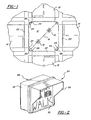
- FIG-1 There is shown in the FIG-1 a roadway intersection 10 , in plan view, including a north/south roadway 12 intersecting with an east/west roadway 14 .
- Vehicular traffic at the intersection 10 is controlled by a pair of traffic signals 16 which are typically suspended above the road surface on a cable 18 stretched between a pair of poles 20 located at diametrically opposed corners of the intersection.
- Pedestrian traffic at the intersection 10 is directed from corner to corner along crosswalks 22 which are typically delineated by lines painted on the roadways 12 and 14.
- Mounted on each of the poles 20 is a pair of pedestrian signals 24 each facing an associated one of the crosswalks 22 .
- a pair of poles 26 are provided on the other two corners each having a pair of the pedestrian signals 24 mounted thereon. Therefore, a pedestrian entering any one of the four crosswalks 22 will be facing one of the pedestrian signals 24 .
- a head 28 of one of the pedestrian signals 24 is shown in the FIG-2 as including a generally box shaped housing 30 with a display 32 forming a front face thereof and a shade 34 surrounding the display.
- the display 32 consists of a plurality of light emitting diodes (LEDs) mounted behind a lens which is at least partially transparent.
- the display 32 is divided into three generally equal size rectangular areas, an upper area 36, a central area 38 and a lower area 40.
- the upper area 36 there is a plurality of LEDs 42 which LEDs are arranged to form a visual image or symbol to display the word "DON'T" as a first portion of a don't walk message.
- the LEDs 44 which LEDs are arranged to form a visual image or symbol to display the word "WALK" as a second portion of the don't walk visual message.
- the LEDs 42 and 44 can be turned on to display a "DON'T WALK" message as shown in the FIG-4 to a pedestrian facing the display 32 .
- the central area 38 of the display 32 there are three pluralities of LEDs for displaying three additional messages.
- a plurality of LEDs 46 which LEDs are arranged to form visual image or symbol to display a pair of left looking eyes as a visual message representing "LOOK RIGHT".
- the resulting symbol conveys a message to facing pedestrians to look to the right for turning vehicles.
- a plurality of LEDs 48 which LEDs are arranged to form a visual image or symbol to display a pair of right looking eyes as a visual message representing "LOOK LEFT".
- the resulting symbol conveys a message to facing pedestrians to look to the left for turning vehicles.
- the resulting symbol conveys a message to facing pedestrians to look to the left for turning vehicles.
- there is a plurality of LEDs 50 which LEDs are arranged to form visual image or symbol to display the word "WALK" as a visual walk message.
- an output of the voice circuit 56 is connected to an input of a set of speakers 58 to generate an audio signal which drives the speakers to deliver an audible warning message to prompt pedestrians.
- the system is designed to withstand temperature extremes ranging from -30°C to +40°C.
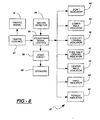
- the groups of LEDs 42, 44 and 50 have been described in terms of the verbal messages "DON'T WALK” and "WALK", many pedestrian signals utilize images of a silhouette of an upraised hand in an orange color and a silhouette of a walking person in a white color to convey the respective messages. Accordingly, the silhouette of the hand can be provided in the upper area 36 of the display 32 and the silhouette of the walking person can be provided in the lower area 40 while the central area 38 contains the symbols 46 and 48. As shown in the FIG-8, an input of a hand indicator 60 and an input of a person indicator 62 can be connected to the output of the pedestrian signal control 54 to receive the appropriate control signals.
- the pedestrians also can be prompted to look for vehicles that pass stopped vehicles at crosswalks that are not controlled by a traffic signal, or are controlled by a pedestrian activated flashing amber light.
- Such an auditory message is generated by the voice circuit 56 and the speakers 58 when a pedestrian activates a motion detector 64 by stepping up to the curb adjacent to the crosswalk.
- the motion detector 64 has an output connected to an input of the pedestrian signal control 54 for generating a pedestrian detection signal.
- the visual warning message conveyed by the eyes symbol indicators 46 and 48 prompts pedestrians to look for turning vehicles at the start of the "WALK" phase of the pedestrian signal display 32 .
- Animation is accomplished by rapidly alternating between activation of the image of the eyeballs at the right sides of the eyes represented by the indicator 48 and the image of the eyeballs at the left sides of the eyes represented by the indicator 46 .
- these images can consist of two blue color eyes with blue eyeballs that scan left and right at a rate of approximately two cycles per second for a period of three seconds at the start of the "WALK" phase.
- This pictographic signal can be constructed from blue (460 nm) LEDs with an 8° field of view so that the images would be visible to pedestrians but not motorists.
- the "WALK" image can be the word indicator 50 or a person pictograph constructed from blue LEDs with an 8° degree field of view.
- the DON'T WALK image can consist of the word indicators 42 and 44 or a hand pictograph constructed from portland orange (605 nm) LEDs with an 8° field of view. The use of LEDs with a narrow field of view would make the messages highly visible to pedestrians and restrict the visibility of the messages to motorists, thereby selectively delivering the messages to the target population.
- the design of the pedestrian signal head 28 typically would comply with the following standards:
- the preferred method of visually prompting pedestrians to be aware of turning vehicles on a potential collision course at crosswalks controlled by a traffic signal is to present a warning message that consists of the image of two eyes 46 and 48 with the eyeballs moving back and forth between left and right for several seconds prior to the initiation of the standard walk signal.
- the preferred way to auditorially prompt pedestrians to be aware of vehicles on a potential collision course is to provide a spoken message through the speakers 58 warning them to look for turning vehicles.
- the preferred method of auditorially prompting pedestrians to be aware of vehicles that pass stopped vehicles at crosswalks that are not controlled by a traffic signal, or are controlled by a pedestrian activated flashing amber light, is to provide an auditory message when the pedestrian activates the motion detector 64 by stepping up to the curb adjacent to the crosswalk.
- the pedestrian signal control 54 can be installed in the box for the traffic control 52 and activated by the drop in logic voltage initiated at the start of the all red traffic signal condition, such that the start of the all red condition initiates a timer incorporated as part of the invention.
- the timer is adjustable so that the onset of the auditory and or visual message warning pedestrians to look for turning vehicle occurs between 0.1 and 0.8 seconds prior to the start of the message authorizing crossing.
- the messages are provided on all light changes because many pedestrians do not press the pedestrian button, and lights are frequently operated on fixed timer, or by loop detectors that detect the presence of vehicles on the side street. Because the signal is provided on every light change, a feedback loop may be employed to use the ambient sound level at the intersection to regulate the output volume of the speakers.
- the present invention includes an apparatus for prompting pedestrians including: a first visual indicator means 46 responsive to a first control signal for displaying a first image of a pair of left looking eyes; a second visual indicator means 48 responsive to a second control signal for displaying a second image of a pair of right looking eyes; and a control means 54 connected to the first and second visual indicator means 46,48 for alternately generating the first and second control signals whereby the first and second visual indicator means alternately display the first and second images to prompt a pedestrian to look for turning vehicles.
- the control means 54 generates the first and second control signals to cause the first and second images to be alternately displayed at a rate of approximately two cycles per second.
- the first and-second visual indicators 46,48 can be illuminated by blue (460 nm) LEDs.
- the apparatus includes a don't walk visual indicator means 42,44,60 responsive to a third control signal for displaying a don't walk message to the pedestrian, the control means 54 being connected to the don't walk visual indicator means for generating the third control signal.
- the don't walk visual indicator means 42,44,60 can be illuminated by orange (605 nm) LEDs on a black background.
- the don't walk visual indicator means 42,44 is formed as a pair of words "DON'T WALK" and the don't walk visual indicator means 60 is formed as an upraised hand.
- the apparatus includes a walk visual indicator means 50,62 responsive to a fourth control signal for displaying a walk message to the pedestrian, the control means 54 being connected to the walk visual indicator means for generating the fourth control signal.
- the walk visual indicator means 50,62 can be illuminated by blue (460 nm) LEDs on a black background.
- the walk visual indicator means 50 is formed as a word "WALK” and the walk visual indicator means 62 is formed
- the control means 54 generates an audio signal and the apparatus includes audio means 56,58 connected to the control means and being responsive to the audio signal for delivering an audible warning message to prompt a pedestrian to look for turning vehicles.
- the apparatus also can include a traffic signal control 52 having an output connected to an input of the control means 54 for generating traffic signal status signals whereby the control means responds to the traffic signal status signals to generate the first and second control signals in coordination with a traffic signal 16 connected to the traffic signal control.
- the apparatus can include a motion detector 64 having an output connected to an input of the control means 54 for generating a pedestrian detection signal upon sensing an adjacent pedestrian whereby the control means responds to the pedestrian detection signal to generate the first and second control signals.
- the present invention also includes a method of prompting pedestrians at a crosswalk including the steps of: a. generating the first image 46 of a pair of left looking eyes; b. generating the second image 48 of a pair of right looking eyes; and c. cyclically performing the steps a and b. alternately during a predetermined time period to prompt a pedestrian at the crosswalk 22 to look for vehicles.
- the method also includes a step of generating the walk image 50,62 to prompt the pedestrian to enter the crosswalk 22 after performing the step c. and the step of generating the don't walk image 42,44,60 to prompt the pedestrian not to enter the crosswalk before performing the step c.
- the step c is a method of prompting pedestrians at a crosswalk including the steps of: a. generating the first image 46 of a pair of left looking eyes; b. generating the second image 48 of a pair of right looking eyes; and c. cyclically performing the steps a and b. alternately during a predetermined time period
- a pedestrian at the crosswalk 22 can look for vehicles and performing the step c. in response to a traffic signal status signal generated by a traffic control 52 or in response to a pedestrian detection signal generated by a motion detector 64 .
Landscapes
- Physics & Mathematics (AREA)
- General Physics & Mathematics (AREA)
- Traffic Control Systems (AREA)
Claims (16)
- Vorrichtung zum Auffordern von Fußgängern, umfassend:eine auf ein erstes Steuersignal reagierende erste visuelle Anzeigeeinrichtung (46) zum Anzeigen eines ersten Bildes eines nach links blickenden Augenpaares,eine auf ein zweites Steuersignal reagierende zweite visuelle Anzeigeeinrichtung (48) zum Anzeigen eines zweiten Bildes eines nach rechts blickenden Augenpaares, undeine mit der genannten ersten und zweiten visuellen Anzeigeeinrichtung (46, 48) verbundene Steuereinrichtung (54) zum abwechselnden Erzeugen der genannten ersten und zweiten Steuersignale, wodurch die genannte erste und zweite visuelle Anzeigeeinrichtung abwechselnd das genannte erste und zweite Bild anzeigen, um einen Fußgänger aufzufordern, sich nach abbiegenden Fahrzeugen umzusehen.
- Vorrichtung nach Anspruch 1, bei der die genannte Steuereinrichtung (54) die genannten ersten und zweiten Steuersignale erzeugt, um zu bewirken, dass die genannten ersten und zweiten Bilder mit einer Geschwindigkeit von ungefähr zwei Takten pro Sekunde abwechselnd angezeigt werden.
- Vorrichtung nach Anspruch 1, bei der die genannten ersten und zweiten visuellen Anzeiger (46, 48) von blauen (460 nm) LEDs beleuchtet werden.
- Vorrichtung nach Anspruch 1 mit einer auf ein drittes Steuersignal reagierenden visuellen Stopp-Anzeigeeinrichtung (42,44,60) zum Anzeigen eines Stopp-Hinweises für den Fußgänger, wobei die genannte Steuereinrichtung (54) zum Erzeugen des genannten dritten Steuersignals mit der genannten visuellen Stopp-Anzeigeeinrichtung verbunden ist.
- Vorrichtung nach Anspruch 4, bei der die genannte visuelle Stopp-Anzeigeeinrichtung (42, 44, 60) von orangefarbenen (605 nm) LEDs auf schwarzem Hintergrund beleuchtet wird.
- Vorrichtung nach Anspruch 4, bei der die genannte visuelle Stopp-Anzeigeeinrichtung (42, 44) als ein Wortpaar "DON'T WALK" gestaltet ist.
- Vorrichtung nach Anspruch 4, bei der die genannte visuelle Stopp-Anzeigeeinrichtung (60) als eine erhobene Hand gestaltet ist.
- Vorrichtung nach Anspruch 1 mit einer auf ein viertes Steuersignal reagierenden visuellen Gehen-Anzeigeeinrichtung (50, 62) zum Anzeigen eines Gehen-Hinweises für den Fußgänger, wobei die genannte Steuereinrichtung (54) zum Erzeugen des genannten vierten Steuersignals mit der genannten visuellen Gehen-Anzeigeeinrichtung verbunden ist.
- Vorrichtung nach Anspruch 8, bei der die genannte visuelle Gehen-Anzeigeeinrichtung (50, 62) von blauen (460 nm) LEDs auf schwarzem Hintergrund beleuchtet wird.
- Vorrichtung nach Anspruch 8, bei der die genannte visuelle Gehen-Anzeigeeinrichtung (50) als ein Wort "WALK" gestaltet ist.
- Vorrichtung nach Anspruch 8, bei der die genannte visuelle Gehen-Anzeigeeinrichtung (62) als eine gehende Person gestaltet ist.
- Vorrichtung nach Anspruch 1, bei der die genannte Steuereinrichtung ein Tonsignal erzeugt, und mit einer mit der genannten Steuereinrichtung (54) verbundenen und auf das genannte Tonsignal reagierenden Audioeinrichtung (56, 58) zum Ausgeben eines akustischen Warnhinweises, um einen Fußgänger aufzufordern, sich nach abbiegenden Fahrzeugen umzusehen.
- Vorrichtung nach Anspruch 1 mit einer Verkehrssignalsteuerung (52), die einen mit einem Eingang der genannten Steuereinrichtung (54) verbundenen Ausgang hat zum Erzeugen von Verkehrssignalstatussignalen, bei der die genannte Steuereinrichtung auf die genannten Verkehrssignalstatussignale reagiert, um die genannten ersten und zweiten Steuersignale in Koordination mit einem mit der genannten Verkehrssignalsteuerung verbundenen Verkehrssignal (16) zu erzeugen.
- Vorrichtung nach Anspruch 1, die einen Bewegungsdetektor (64) mit einem mit einem Eingang der genannten Steuereinrichtung (54) verbundenen Ausgang hat zum Erzeugen eines Fußgängererfassungssignals bei Erfassen eines daneben befindlichen Fußgängers, bei der die genannte Steuereinrichtung auf das genannte Fußgängererfassungssignal reagiert, um die genannten ersten und zweiten Steuersignale zu erzeugen.
- Vorrichtung nach Anspruch 1, umfassend:eine auf ein drittes Steuersignal reagierende visuelle Stopp-Anzeigeeinrichtung (42, 44, 60) zum Anzeigen eines dritten Bildes, das einen Stopp-Hinweis darstellt,eine auf ein viertes Steuersignal reagierende visuelle Gehen-Anzeigeeinrichtung (50, 62) zum Anzeigen eines vierten Bildes, das einen Gehen-Hinweis darstellt, unddie mit den genannten visuellen Anzeigeeinrichtungen (42, 44, 46, 48, 50, 60, 62) verbundene Steuereinrichtung (54) zum Erzeugen des genannten dritten Steuersignals, bei dem die genannte visuelle Stopp-Anzeigeeinrichtung (42, 44, 60) das genannte dritte Bild blinkend anzeigt, um einen Fußgänger darauf hinzuweisen, dass der genannte Stopp-Hinweis gleich angezeigt werden wird, und das dritte Bild konstant anzeigt, um den Fußgänger aufzufordern, einen Überweg (22) nicht zu betreten, zum Erzeugen des genannten vierten Steuersignals, bei dem die genannte visuelle Stopp-Anzeigeeinrichtung (50,62) das genannte vierte Bild anzeigt, um einen Fußgänger aufzufordern, den Überweg zu betreten.
- Vorrichtung nach Anspruch 1, bei der die genannte Steuereinrichtung ein Tonsignal erzeugt, und mit einer mit der genannten Steuereinrichtung (54) verbundenen und auf das genannte Steuersignal ansprechenden Audioeinrichtung (56, 58) zum Ausgeben eines akustischen Warnhinweises, um einen Fußgänger aufzufordern, sich während des Erzeugens der genannten ersten und zweiten Steuersignale nach abbiegenden Fahrzeugen umzusehen.
Applications Claiming Priority (3)
| Application Number | Priority Date | Filing Date | Title |
|---|---|---|---|
| US08/708,191 US5654705A (en) | 1996-09-06 | 1996-09-06 | Apparatus for prompting pedestrians |
| PCT/US1997/013524 WO1998010395A1 (en) | 1996-09-06 | 1997-07-31 | Apparatus for prompting pedestrians |
| US708191 | 2000-11-08 |
Publications (3)
| Publication Number | Publication Date |
|---|---|
| EP0925564A1 EP0925564A1 (de) | 1999-06-30 |
| EP0925564A4 EP0925564A4 (de) | 1999-12-22 |
| EP0925564B1 true EP0925564B1 (de) | 2004-06-23 |
Family
ID=24844755
Family Applications (1)
| Application Number | Title | Priority Date | Filing Date |
|---|---|---|---|
| EP97935245A Expired - Lifetime EP0925564B1 (de) | 1996-09-06 | 1997-07-31 | Fussgängerampel |
Country Status (6)
| Country | Link |
|---|---|
| US (2) | US5654705A (de) |
| EP (1) | EP0925564B1 (de) |
| AU (1) | AU3823197A (de) |
| CA (1) | CA2263481C (de) |
| DE (1) | DE69729640D1 (de) |
| WO (1) | WO1998010395A1 (de) |
Families Citing this family (57)
| Publication number | Priority date | Publication date | Assignee | Title |
|---|---|---|---|---|
| US6384742B1 (en) * | 1994-06-08 | 2002-05-07 | Michael A. Harrison | Pedestrian crosswalk signal apparatus—pedestrian crosswalk |
| US6597293B1 (en) * | 1994-06-08 | 2003-07-22 | Michael A. Harrison | Intersection traffic control apparatus |
| US5661645A (en) | 1996-06-27 | 1997-08-26 | Hochstein; Peter A. | Power supply for light emitting diode array |
| US6150771A (en) | 1997-06-11 | 2000-11-21 | Precision Solar Controls Inc. | Circuit for interfacing between a conventional traffic signal conflict monitor and light emitting diodes replacing a conventional incandescent bulb in the signal |
| US6570505B1 (en) | 1997-12-30 | 2003-05-27 | Gelcore Llc | LED lamp with a fault-indicating impedance-changing circuit |
| US6160495A (en) * | 1998-01-05 | 2000-12-12 | Demco Technologies, Inc. | Device for presenting multiple illuminated messages and a method for making same |
| US6147623A (en) * | 1998-08-20 | 2000-11-14 | Rippen; Craig R. | Smart cross programmable vehicle and pedestrian signage with electronic display and infrared remote control |
| JP2000123281A (ja) * | 1998-10-13 | 2000-04-28 | Koito Ind Ltd | 音響式視覚障害者用交通信号付加装置 |
| US6198410B1 (en) * | 1999-10-12 | 2001-03-06 | Larry White | Illuminatable traffic sign |
| JP3174832B2 (ja) * | 1999-10-27 | 2001-06-11 | 建設省土木研究所長 | 横断歩行者衝突防止システム |
| US6473002B1 (en) * | 2000-10-05 | 2002-10-29 | Power Signal Technologies, Inc. | Split-phase PED head signal |
| US6833796B2 (en) * | 2001-01-19 | 2004-12-21 | Gelcore Llc | Count down led traffic signal |
| AUPS065802A0 (en) * | 2002-02-20 | 2002-03-14 | Rhino Advertising Pty Limited | A method of placing visible advertising |
| ATE319152T1 (de) * | 2002-04-05 | 2006-03-15 | Jcdecaux Sa | Strassenmöbel mit schutzeinrichtung |
| US6802757B1 (en) | 2003-05-01 | 2004-10-12 | The First Years, Inc. | Developmental toy |
| US20040225434A1 (en) * | 2003-05-07 | 2004-11-11 | Gotfried Bradley L. | Vehicle navigation and safety systems |
| US20050046595A1 (en) * | 2003-08-26 | 2005-03-03 | Mr.John Blyth | Solar powered sign annunciator |
| US7688222B2 (en) | 2003-09-18 | 2010-03-30 | Spot Devices, Inc. | Methods, systems and devices related to road mounted indicators for providing visual indications to approaching traffic |
| US6967587B2 (en) * | 2003-09-22 | 2005-11-22 | Sanidoor, Llc | Hands-free door opener and method |
| US7019669B1 (en) * | 2003-12-01 | 2006-03-28 | Robert Carey Carr | Trail safe alert system |
| US20050259446A1 (en) * | 2004-05-14 | 2005-11-24 | Smith Matthew S | Decorative night light |
| KR200397860Y1 (ko) * | 2005-01-04 | 2005-10-10 | 종 해 김 | 다목적 led 보행자 신호등 시스템과 장치 |
| US20060176192A1 (en) * | 2005-02-09 | 2006-08-10 | Claudia Noriega | Advertising system associated with a traffic signal |
| US20060197684A1 (en) * | 2005-02-23 | 2006-09-07 | Jacques Tremblay | Programmable traffic light unit |
| JP2006268379A (ja) * | 2005-03-23 | 2006-10-05 | Fujitsu Ltd | 交通信号機の制御装置 |
| US20070257817A1 (en) * | 2006-05-08 | 2007-11-08 | Ivoice, Inc. | Traffic signal system with countdown signaling and with advertising and/or news message |
| US20080098634A1 (en) * | 2006-11-01 | 2008-05-01 | Skyline Products, Inc. | Outdoor display sign |
| GB2443416A (en) * | 2006-11-06 | 2008-05-07 | Bernard Paul Greenwood | Pedestrian safety warning |
| US7716861B2 (en) * | 2006-11-28 | 2010-05-18 | Skyline Products, Inc. | Outdoor display sign |
| ES2310120B1 (es) * | 2007-03-27 | 2009-11-05 | Rubber Patents, S.L. | Paso de peatones con detector y avisador de presencia. |
| DK200700707A (da) * | 2007-05-11 | 2008-11-12 | Bombardier Transp Signal Denma | Varslingsanlæg |
| US8031062B2 (en) * | 2008-01-04 | 2011-10-04 | Smith Alexander E | Method and apparatus to improve vehicle situational awareness at intersections |
| US20090174572A1 (en) * | 2008-01-04 | 2009-07-09 | Smith Alexander E | Method and apparatus for an adaptive target vehicle notification system |
| TWM344599U (en) * | 2008-04-14 | 2008-11-11 | Hon Hai Prec Ind Co Ltd | Electrical connector |
| US7883234B2 (en) | 2008-04-18 | 2011-02-08 | Spot Devices, Inc | Embeddable lighting systems |
| KR20100009465U (ko) * | 2009-03-18 | 2010-09-29 | 한종휘 | 보행자 신호등 장치 |
| US8666104B2 (en) * | 2009-04-02 | 2014-03-04 | Mitek Corp., Inc. | Lighting and audio communication system |
| US8300869B2 (en) * | 2009-04-02 | 2012-10-30 | Mitek Corp., Inc. | Lighting and audio communication system |
| WO2011059276A2 (en) * | 2009-11-13 | 2011-05-19 | Samsung Electronics Co., Ltd. | Method and apparatus for managing content |
| US8232896B2 (en) * | 2009-12-10 | 2012-07-31 | Gary Keller | Pedestrian signal housing with information display |
| FI122746B (fi) * | 2011-03-28 | 2012-06-15 | Okapi Systems Oy | Valaistava liikenteen hallinnoimisväline |
| JP5687940B2 (ja) * | 2011-03-31 | 2015-03-25 | 株式会社日立製作所 | 情報表示端末 |
| US9286794B2 (en) * | 2013-10-18 | 2016-03-15 | Elwha Llc | Pedestrian warning system |
| WO2017021767A2 (en) * | 2015-04-17 | 2017-02-09 | Vladimir Kranz | Signaling equipment for temporarily controlled intersection and crosswalk |
| US11055987B2 (en) | 2017-01-26 | 2021-07-06 | Nortak Software Ltd. | Animated incoming traffic sign |
| JP6429413B2 (ja) | 2017-03-10 | 2018-11-28 | 株式会社Subaru | 画像表示装置 |
| JP6465317B2 (ja) * | 2017-03-10 | 2019-02-06 | 株式会社Subaru | 画像表示装置 |
| JP6515125B2 (ja) | 2017-03-10 | 2019-05-15 | 株式会社Subaru | 画像表示装置 |
| JP6465318B2 (ja) | 2017-03-10 | 2019-02-06 | 株式会社Subaru | 画像表示装置 |
| JP6593803B2 (ja) | 2017-03-10 | 2019-10-23 | 株式会社Subaru | 画像表示装置 |
| JP6497819B2 (ja) * | 2017-03-10 | 2019-04-10 | 株式会社Subaru | 画像表示装置 |
| JP6497818B2 (ja) | 2017-03-10 | 2019-04-10 | 株式会社Subaru | 画像表示装置 |
| CN208585167U (zh) * | 2018-08-08 | 2019-03-08 | 苏州上声电子股份有限公司 | 一种带网罩的行人警示器 |
| CN109872528A (zh) * | 2019-04-02 | 2019-06-11 | 地洲智慧能源(浙江)有限公司 | 一种太阳能双向智慧红绿灯 |
| FR3108762B1 (fr) | 2020-03-25 | 2022-12-09 | Saez Jerome | Système et procede pour la detection et le signalement de l’engagement d’un passage pieton |
| US11365847B2 (en) * | 2020-04-22 | 2022-06-21 | Keystone Sales Group, Inc. | Motion activated warehouse safety light |
| US20260011270A1 (en) * | 2023-08-02 | 2026-01-08 | James Urbano | Battery-Operated Traffic Control Device |
Family Cites Families (34)
| Publication number | Priority date | Publication date | Assignee | Title |
|---|---|---|---|---|
| US21818A (en) * | 1858-10-19 | Post for clothes-lines | ||
| USRE21818E (en) | 1941-06-03 | Radio traffic control system | ||
| US1662348A (en) * | 1925-09-12 | 1928-03-13 | George W Stricker | Changeable sign and traffic signal |
| US2130013A (en) * | 1936-06-08 | 1938-09-13 | Harry G Hunter | Automatic electric traffic signal system |
| US2137719A (en) * | 1936-07-17 | 1938-11-22 | Weston A Gray | Signaling system and apparatus for same |
| US2503574A (en) * | 1947-05-06 | 1950-04-11 | Walkolite Company Inc | Combined pedestrian traffic signal and advertising device |
| US3783446A (en) * | 1971-12-09 | 1974-01-01 | J Mcgimpsey | Traffic control system |
| US4293841A (en) * | 1978-08-03 | 1981-10-06 | Detector Systems, Inc. | Pedestrian traffic control system |
| US4240063A (en) * | 1979-07-23 | 1980-12-16 | Indicator Controls Corp. | Visor assembly for pedestrian traffic signal |
| US4443783A (en) * | 1981-02-25 | 1984-04-17 | Mitchell Wilbur L | Traffic light control for emergency vehicles |
| US4843045A (en) * | 1982-12-20 | 1989-06-27 | The Dow Chemical Company | Process of making ceramic composites with improved thermal shock resistance |
| US4736186A (en) * | 1983-12-09 | 1988-04-05 | Jones Richard D | Emergency warning signal |
| US5132683A (en) * | 1984-09-24 | 1992-07-21 | Samuel Gould | Neon pedestrian crossing signal |
| US4775865A (en) * | 1985-12-16 | 1988-10-04 | E-Lited Limited, A California Limited Partnership | Emergency vehicle warning and traffic control system |
| US4704610A (en) * | 1985-12-16 | 1987-11-03 | Smith Michel R | Emergency vehicle warning and traffic control system |
| US4843337A (en) * | 1987-11-02 | 1989-06-27 | Conn Jr Roy S | Driveway safety light |
| JPH0540093Y2 (de) * | 1988-05-30 | 1993-10-12 | ||
| JPH0216600A (ja) * | 1988-07-05 | 1990-01-19 | Seiko Instr Inc | 固体録音再生装置 |
| US5136287A (en) * | 1988-09-02 | 1992-08-04 | Arnold Borenstein | Traffic-related message signal using light-emitting diodes |
| US4954822A (en) * | 1988-09-02 | 1990-09-04 | Arnold Borenstein | Traffic signal using light-emitting diodes |
| US4951045A (en) * | 1989-03-29 | 1990-08-21 | Intelligent Safety Technology, Inc. | Portable electronic warning device for temporary conditions |
| US5103223A (en) * | 1990-01-26 | 1992-04-07 | Humphrey Jerry J | Street crossing signal |
| US5150116A (en) * | 1990-04-12 | 1992-09-22 | West Harold B | Traffic-light timed advertising center |
| US5092705A (en) * | 1990-11-13 | 1992-03-03 | Subhash Raswant | Method of controlling pedestrian and vehicular traffic flow |
| US5235329A (en) * | 1991-10-01 | 1993-08-10 | E A S Emergency Alert Systems, Inc. | Emergency vehicle detection device |
| FR2684785B1 (fr) * | 1991-12-04 | 1994-02-04 | Sefer | Dispositif de generation de signalisation sonore pour pietons. |
| US5249027A (en) * | 1992-03-16 | 1993-09-28 | Rockwell International Corporation | Inter-vehicle distance measuring system |
| US5406276A (en) * | 1992-07-09 | 1995-04-11 | Ogle; Terry B. | Cross-walk warning light system |
| FR2704082B1 (fr) * | 1993-04-14 | 1995-05-24 | Thomson Csf | Dispositif de surveillance de passage de mobiles, en particulier de piétons en vue de la gestion de feux de circulation de passages piétonniers. |
| US5559509A (en) * | 1995-01-09 | 1996-09-24 | Ogle; Terry B. | Cross-walk warning light system |
| US5519390A (en) * | 1995-02-02 | 1996-05-21 | Casini; Peter | Traffic light timer |
| US5633629A (en) * | 1995-02-08 | 1997-05-27 | Hochstein; Peter A. | Traffic information system using light emitting diodes |
| US5572202A (en) * | 1995-04-03 | 1996-11-05 | Regel; Kenneth E. | Traffic signalling system |
| US5734339A (en) * | 1996-09-20 | 1998-03-31 | Ogle; Terry B. | Crosswalk warning light system |
-
1996
- 1996-09-06 US US08/708,191 patent/US5654705A/en not_active Ceased
-
1997
- 1997-07-31 EP EP97935245A patent/EP0925564B1/de not_active Expired - Lifetime
- 1997-07-31 AU AU38231/97A patent/AU3823197A/en not_active Abandoned
- 1997-07-31 CA CA002263481A patent/CA2263481C/en not_active Expired - Fee Related
- 1997-07-31 DE DE69729640T patent/DE69729640D1/de not_active Expired - Fee Related
- 1997-07-31 WO PCT/US1997/013524 patent/WO1998010395A1/en not_active Ceased
-
1998
- 1998-09-23 US US09/159,350 patent/USRE36930E/en not_active Expired - Lifetime
Also Published As
| Publication number | Publication date |
|---|---|
| AU3823197A (en) | 1998-03-26 |
| EP0925564A1 (de) | 1999-06-30 |
| WO1998010395A1 (en) | 1998-03-12 |
| CA2263481A1 (en) | 1998-03-12 |
| DE69729640D1 (de) | 2004-07-29 |
| EP0925564A4 (de) | 1999-12-22 |
| CA2263481C (en) | 2006-05-30 |
| USRE36930E (en) | 2000-10-31 |
| US5654705A (en) | 1997-08-05 |
Similar Documents
| Publication | Publication Date | Title |
|---|---|---|
| CA2263481C (en) | Apparatus for prompting pedestrians | |
| AU2009243423B2 (en) | A crossing-located alert system | |
| US20030191577A1 (en) | Road safety street furniture | |
| US6850169B2 (en) | Emergency traffic signal device | |
| AU646457B2 (en) | Traffic light timed advertising center | |
| US6847306B2 (en) | Emergency traffic signal attachment | |
| KR200397860Y1 (ko) | 다목적 led 보행자 신호등 시스템과 장치 | |
| US20100182164A1 (en) | Electronic traffic signage | |
| US20080266136A1 (en) | Emergency traffic signal system and apparatus | |
| US6519884B1 (en) | Street and road sign | |
| KR100389501B1 (ko) | 보행자 보호용 신호등 제어방법 | |
| NL1007437C2 (nl) | Inrichting en stelsel voor het afgeven van een waarschuwing in reactie op een spookrijder. | |
| US7315235B1 (en) | First warning system for automotive vehicles | |
| KR102315187B1 (ko) | 등대형 교통신호등 및 그를 포함하는 등대형 교통시스템 | |
| KR102394353B1 (ko) | 공공정보 알림 기능을 구비한 다목적 교통신호 장치 | |
| KR102645892B1 (ko) | 어린이 보호 구역 안전 표지판 장치 | |
| KR200274427Y1 (ko) | 교통사고 예방장치 | |
| KR200225245Y1 (ko) | 조명광고판이 형성된 제어함 | |
| JPH06299520A (ja) | 移動物体報知装置 | |
| KR200414137Y1 (ko) | 어린이보호구역 통합표지판 | |
| JP2003119732A (ja) | 車両進入防止システム | |
| KR20010000314A (ko) | 어린이보호구역 교통안전시스템 | |
| JP2001143164A (ja) | 表示装置 | |
| JP2025178609A (ja) | 交通保安用投影装置 | |
| KR200196014Y1 (ko) | 신호등 |
Legal Events
| Date | Code | Title | Description |
|---|---|---|---|
| PUAI | Public reference made under article 153(3) epc to a published international application that has entered the european phase |
Free format text: ORIGINAL CODE: 0009012 |
|
| 17P | Request for examination filed |
Effective date: 19990223 |
|
| AK | Designated contracting states |
Kind code of ref document: A1 Designated state(s): DE ES FR GB IT |
|
| A4 | Supplementary search report drawn up and despatched |
Effective date: 19991105 |
|
| AK | Designated contracting states |
Kind code of ref document: A4 Designated state(s): DE ES FR GB IT |
|
| RIC1 | Information provided on ipc code assigned before grant |
Free format text: 6G 08G 1/095 A, 6F 21Q 3/00 B |
|
| 17Q | First examination report despatched |
Effective date: 20030311 |
|
| GRAP | Despatch of communication of intention to grant a patent |
Free format text: ORIGINAL CODE: EPIDOSNIGR1 |
|
| GRAS | Grant fee paid |
Free format text: ORIGINAL CODE: EPIDOSNIGR3 |
|
| GRAA | (expected) grant |
Free format text: ORIGINAL CODE: 0009210 |
|
| AK | Designated contracting states |
Kind code of ref document: B1 Designated state(s): DE ES FR GB IT |
|
| PG25 | Lapsed in a contracting state [announced via postgrant information from national office to epo] |
Ref country code: IT Free format text: LAPSE BECAUSE OF FAILURE TO SUBMIT A TRANSLATION OF THE DESCRIPTION OR TO PAY THE FEE WITHIN THE PRE;WARNING: LAPSES OF ITALIAN PATENTS WITH EFFECTIVE DATE BEFORE 2007 MAY HAVE OCCURRED AT ANY TIME BEFORE 2007. THE CORRECT EFFECTIVE DATE MAY BE DIFFERENT FROM THE ONE RECORDED.SCRIBED TIME-LIMIT Effective date: 20040623 Ref country code: FR Free format text: LAPSE BECAUSE OF FAILURE TO SUBMIT A TRANSLATION OF THE DESCRIPTION OR TO PAY THE FEE WITHIN THE PRESCRIBED TIME-LIMIT Effective date: 20040623 |
|
| REG | Reference to a national code |
Ref country code: GB Ref legal event code: FG4D |
|
| RIC1 | Information provided on ipc code assigned before grant |
Ipc: 7F 21S 8/00 B Ipc: 7G 08G 1/095 A |
|
| REF | Corresponds to: |
Ref document number: 69729640 Country of ref document: DE Date of ref document: 20040729 Kind code of ref document: P |
|
| PG25 | Lapsed in a contracting state [announced via postgrant information from national office to epo] |
Ref country code: GB Free format text: LAPSE BECAUSE OF NON-PAYMENT OF DUE FEES Effective date: 20040923 |
|
| PG25 | Lapsed in a contracting state [announced via postgrant information from national office to epo] |
Ref country code: ES Free format text: LAPSE BECAUSE OF FAILURE TO SUBMIT A TRANSLATION OF THE DESCRIPTION OR TO PAY THE FEE WITHIN THE PRESCRIBED TIME-LIMIT Effective date: 20041004 |
|
| PG25 | Lapsed in a contracting state [announced via postgrant information from national office to epo] |
Ref country code: DE Free format text: LAPSE BECAUSE OF NON-PAYMENT OF DUE FEES Effective date: 20050201 |
|
| PLBE | No opposition filed within time limit |
Free format text: ORIGINAL CODE: 0009261 |
|
| STAA | Information on the status of an ep patent application or granted ep patent |
Free format text: STATUS: NO OPPOSITION FILED WITHIN TIME LIMIT |
|
| GBPC | Gb: european patent ceased through non-payment of renewal fee |
Effective date: 20040923 |
|
| 26N | No opposition filed |
Effective date: 20050324 |
|
| EN | Fr: translation not filed |