EP0923327B1 - Crimped bristle toothbrush - Google Patents
Crimped bristle toothbrush Download PDFInfo
- Publication number
- EP0923327B1 EP0923327B1 EP97932420A EP97932420A EP0923327B1 EP 0923327 B1 EP0923327 B1 EP 0923327B1 EP 97932420 A EP97932420 A EP 97932420A EP 97932420 A EP97932420 A EP 97932420A EP 0923327 B1 EP0923327 B1 EP 0923327B1
- Authority
- EP
- European Patent Office
- Prior art keywords
- bristles
- brush
- crimped
- head
- tufts
- Prior art date
- Legal status (The legal status is an assumption and is not a legal conclusion. Google has not performed a legal analysis and makes no representation as to the accuracy of the status listed.)
- Expired - Lifetime
Links
- 210000003128 head Anatomy 0.000 claims description 32
- 210000000214 mouth Anatomy 0.000 claims description 8
- 238000003780 insertion Methods 0.000 claims description 5
- 230000037431 insertion Effects 0.000 claims description 5
- 230000001788 irregular Effects 0.000 claims description 5
- 230000033001 locomotion Effects 0.000 abstract description 36
- 125000004122 cyclic group Chemical group 0.000 abstract description 3
- 241000549893 Carphochaete Species 0.000 description 33
- 230000009471 action Effects 0.000 description 9
- 238000000034 method Methods 0.000 description 9
- 229920000572 Nylon 6/12 Polymers 0.000 description 6
- 230000008901 benefit Effects 0.000 description 6
- 238000013461 design Methods 0.000 description 6
- 239000000463 material Substances 0.000 description 6
- 229920000642 polymer Polymers 0.000 description 6
- 230000001680 brushing effect Effects 0.000 description 5
- 238000002788 crimping Methods 0.000 description 5
- 230000000694 effects Effects 0.000 description 4
- 238000012360 testing method Methods 0.000 description 4
- 238000013459 approach Methods 0.000 description 3
- 238000004140 cleaning Methods 0.000 description 3
- 239000000203 mixture Substances 0.000 description 3
- 230000035515 penetration Effects 0.000 description 3
- 239000004033 plastic Substances 0.000 description 3
- 238000005259 measurement Methods 0.000 description 2
- 230000000737 periodic effect Effects 0.000 description 2
- 238000013519 translation Methods 0.000 description 2
- 239000005995 Aluminium silicate Substances 0.000 description 1
- 239000002033 PVDF binder Substances 0.000 description 1
- 125000000218 acetic acid group Chemical group C(C)(=O)* 0.000 description 1
- 230000003213 activating effect Effects 0.000 description 1
- 230000006978 adaptation Effects 0.000 description 1
- 239000000654 additive Substances 0.000 description 1
- 235000012211 aluminium silicate Nutrition 0.000 description 1
- 210000004763 bicuspid Anatomy 0.000 description 1
- 125000004218 chloromethyl group Chemical group [H]C([H])(Cl)* 0.000 description 1
- 239000002131 composite material Substances 0.000 description 1
- 238000007796 conventional method Methods 0.000 description 1
- 238000005520 cutting process Methods 0.000 description 1
- 208000002925 dental caries Diseases 0.000 description 1
- 238000006073 displacement reaction Methods 0.000 description 1
- 210000000887 face Anatomy 0.000 description 1
- 239000000945 filler Substances 0.000 description 1
- 229920002313 fluoropolymer Polymers 0.000 description 1
- 239000004811 fluoropolymer Substances 0.000 description 1
- 208000007565 gingivitis Diseases 0.000 description 1
- 230000036541 health Effects 0.000 description 1
- 238000010438 heat treatment Methods 0.000 description 1
- 230000006872 improvement Effects 0.000 description 1
- 238000000338 in vitro Methods 0.000 description 1
- 208000014674 injury Diseases 0.000 description 1
- 230000007794 irritation Effects 0.000 description 1
- NLYAJNPCOHFWQQ-UHFFFAOYSA-N kaolin Chemical compound O.O.O=[Al]O[Si](=O)O[Si](=O)O[Al]=O NLYAJNPCOHFWQQ-UHFFFAOYSA-N 0.000 description 1
- 238000004519 manufacturing process Methods 0.000 description 1
- 238000012986 modification Methods 0.000 description 1
- 230000004048 modification Effects 0.000 description 1
- 230000007505 plaque formation Effects 0.000 description 1
- 229920002492 poly(sulfone) Polymers 0.000 description 1
- 229920000058 polyacrylate Polymers 0.000 description 1
- 229920001707 polybutylene terephthalate Polymers 0.000 description 1
- 229920000728 polyester Polymers 0.000 description 1
- 239000004810 polytetrafluoroethylene Substances 0.000 description 1
- 229920001343 polytetrafluoroethylene Polymers 0.000 description 1
- 229920002981 polyvinylidene fluoride Polymers 0.000 description 1
- 238000003825 pressing Methods 0.000 description 1
- 230000008569 process Effects 0.000 description 1
- 238000010791 quenching Methods 0.000 description 1
- 230000000171 quenching effect Effects 0.000 description 1
- 229920005989 resin Polymers 0.000 description 1
- 239000011347 resin Substances 0.000 description 1
- 238000005096 rolling process Methods 0.000 description 1
- 239000000126 substance Substances 0.000 description 1
- 239000004753 textile Substances 0.000 description 1
- 238000012876 topography Methods 0.000 description 1
- 238000012546 transfer Methods 0.000 description 1
- 230000008733 trauma Effects 0.000 description 1
- 238000009732 tufting Methods 0.000 description 1
Images







Classifications
-
- A—HUMAN NECESSITIES
- A61—MEDICAL OR VETERINARY SCIENCE; HYGIENE
- A61C—DENTISTRY; APPARATUS OR METHODS FOR ORAL OR DENTAL HYGIENE
- A61C17/00—Devices for cleaning, polishing, rinsing or drying teeth, teeth cavities or prostheses; Saliva removers; Dental appliances for receiving spittle
- A61C17/16—Power-driven cleaning or polishing devices
- A61C17/22—Power-driven cleaning or polishing devices with brushes, cushions, cups, or the like
- A61C17/222—Brush body details, e.g. the shape thereof or connection to handle
-
- A—HUMAN NECESSITIES
- A46—BRUSHWARE
- A46B—BRUSHES
- A46B9/00—Arrangements of the bristles in the brush body
- A46B9/02—Position or arrangement of bristles in relation to surface of the brush body, e.g. inclined, in rows, in groups
- A46B9/04—Arranged like in or for toothbrushes
-
- A—HUMAN NECESSITIES
- A46—BRUSHWARE
- A46B—BRUSHES
- A46B9/00—Arrangements of the bristles in the brush body
- A46B9/06—Arrangement of mixed bristles or tufts of bristles, e.g. wire, fibre, rubber
-
- A—HUMAN NECESSITIES
- A46—BRUSHWARE
- A46D—MANUFACTURE OF BRUSHES
- A46D1/00—Bristles; Selection of materials for bristles
-
- A—HUMAN NECESSITIES
- A61—MEDICAL OR VETERINARY SCIENCE; HYGIENE
- A61C—DENTISTRY; APPARATUS OR METHODS FOR ORAL OR DENTAL HYGIENE
- A61C17/00—Devices for cleaning, polishing, rinsing or drying teeth, teeth cavities or prostheses; Saliva removers; Dental appliances for receiving spittle
- A61C17/16—Power-driven cleaning or polishing devices
- A61C17/22—Power-driven cleaning or polishing devices with brushes, cushions, cups, or the like
- A61C17/24—Power-driven cleaning or polishing devices with brushes, cushions, cups, or the like rotating continuously
- A61C17/26—Power-driven cleaning or polishing devices with brushes, cushions, cups, or the like rotating continuously driven by electric motor
-
- A—HUMAN NECESSITIES
- A61—MEDICAL OR VETERINARY SCIENCE; HYGIENE
- A61C—DENTISTRY; APPARATUS OR METHODS FOR ORAL OR DENTAL HYGIENE
- A61C17/00—Devices for cleaning, polishing, rinsing or drying teeth, teeth cavities or prostheses; Saliva removers; Dental appliances for receiving spittle
- A61C17/16—Power-driven cleaning or polishing devices
- A61C17/22—Power-driven cleaning or polishing devices with brushes, cushions, cups, or the like
- A61C17/32—Power-driven cleaning or polishing devices with brushes, cushions, cups, or the like reciprocating or oscillating
- A61C17/34—Power-driven cleaning or polishing devices with brushes, cushions, cups, or the like reciprocating or oscillating driven by electric motor
-
- A—HUMAN NECESSITIES
- A61—MEDICAL OR VETERINARY SCIENCE; HYGIENE
- A61C—DENTISTRY; APPARATUS OR METHODS FOR ORAL OR DENTAL HYGIENE
- A61C17/00—Devices for cleaning, polishing, rinsing or drying teeth, teeth cavities or prostheses; Saliva removers; Dental appliances for receiving spittle
- A61C17/16—Power-driven cleaning or polishing devices
- A61C17/22—Power-driven cleaning or polishing devices with brushes, cushions, cups, or the like
- A61C17/32—Power-driven cleaning or polishing devices with brushes, cushions, cups, or the like reciprocating or oscillating
- A61C17/34—Power-driven cleaning or polishing devices with brushes, cushions, cups, or the like reciprocating or oscillating driven by electric motor
- A61C17/3409—Power-driven cleaning or polishing devices with brushes, cushions, cups, or the like reciprocating or oscillating driven by electric motor characterized by the movement of the brush body
- A61C17/3436—Rotation around the axis perpendicular to the plane defined by the bristle holder
-
- A—HUMAN NECESSITIES
- A61—MEDICAL OR VETERINARY SCIENCE; HYGIENE
- A61C—DENTISTRY; APPARATUS OR METHODS FOR ORAL OR DENTAL HYGIENE
- A61C17/00—Devices for cleaning, polishing, rinsing or drying teeth, teeth cavities or prostheses; Saliva removers; Dental appliances for receiving spittle
- A61C17/16—Power-driven cleaning or polishing devices
- A61C17/22—Power-driven cleaning or polishing devices with brushes, cushions, cups, or the like
- A61C17/32—Power-driven cleaning or polishing devices with brushes, cushions, cups, or the like reciprocating or oscillating
- A61C17/34—Power-driven cleaning or polishing devices with brushes, cushions, cups, or the like reciprocating or oscillating driven by electric motor
- A61C17/3409—Power-driven cleaning or polishing devices with brushes, cushions, cups, or the like reciprocating or oscillating driven by electric motor characterized by the movement of the brush body
- A61C17/3472—Power-driven cleaning or polishing devices with brushes, cushions, cups, or the like reciprocating or oscillating driven by electric motor characterized by the movement of the brush body with combined movements of the brush body
-
- D—TEXTILES; PAPER
- D02—YARNS; MECHANICAL FINISHING OF YARNS OR ROPES; WARPING OR BEAMING
- D02G—CRIMPING OR CURLING FIBRES, FILAMENTS, THREADS, OR YARNS; YARNS OR THREADS
- D02G1/00—Producing crimped or curled fibres, filaments, yarns, or threads, giving them latent characteristics
- D02G1/14—Producing crimped or curled fibres, filaments, yarns, or threads, giving them latent characteristics using grooved rollers or gear-wheel-type members
-
- A—HUMAN NECESSITIES
- A46—BRUSHWARE
- A46B—BRUSHES
- A46B2200/00—Brushes characterized by their functions, uses or applications
- A46B2200/10—For human or animal care
- A46B2200/1066—Toothbrush for cleaning the teeth or dentures
-
- A—HUMAN NECESSITIES
- A61—MEDICAL OR VETERINARY SCIENCE; HYGIENE
- A61C—DENTISTRY; APPARATUS OR METHODS FOR ORAL OR DENTAL HYGIENE
- A61C17/00—Devices for cleaning, polishing, rinsing or drying teeth, teeth cavities or prostheses; Saliva removers; Dental appliances for receiving spittle
- A61C17/16—Power-driven cleaning or polishing devices
- A61C17/22—Power-driven cleaning or polishing devices with brushes, cushions, cups, or the like
- A61C17/32—Power-driven cleaning or polishing devices with brushes, cushions, cups, or the like reciprocating or oscillating
- A61C17/34—Power-driven cleaning or polishing devices with brushes, cushions, cups, or the like reciprocating or oscillating driven by electric motor
- A61C17/3409—Power-driven cleaning or polishing devices with brushes, cushions, cups, or the like reciprocating or oscillating driven by electric motor characterized by the movement of the brush body
- A61C17/3427—Rotation around the axis perpendicular to the axis of toothbrush handle and in the plane defined by the bristle holder
-
- A—HUMAN NECESSITIES
- A61—MEDICAL OR VETERINARY SCIENCE; HYGIENE
- A61C—DENTISTRY; APPARATUS OR METHODS FOR ORAL OR DENTAL HYGIENE
- A61C2204/00—Features not otherwise provided for
- A61C2204/002—Features not otherwise provided for using batteries
-
- Y—GENERAL TAGGING OF NEW TECHNOLOGICAL DEVELOPMENTS; GENERAL TAGGING OF CROSS-SECTIONAL TECHNOLOGIES SPANNING OVER SEVERAL SECTIONS OF THE IPC; TECHNICAL SUBJECTS COVERED BY FORMER USPC CROSS-REFERENCE ART COLLECTIONS [XRACs] AND DIGESTS
- Y10—TECHNICAL SUBJECTS COVERED BY FORMER USPC
- Y10S—TECHNICAL SUBJECTS COVERED BY FORMER USPC CROSS-REFERENCE ART COLLECTIONS [XRACs] AND DIGESTS
- Y10S15/00—Brushing, scrubbing, and general cleaning
- Y10S15/05—Varied length bristle
Definitions
- the invention relates to toothbrushes and bristles for use in toothbrushes.
- Toothbrushes are available having bristles with varying degrees of stiffness, commonly labelled “soft”, “medium” and “hard”. According to industry standards, such toothbrushes have stiffnesses, as measured by ISO 8627 (1987), of less than 7 centinewtons per square millimeter (cN/mm 2 , soft), 6 to 9 cN/mm 2 (medium), and greater than 8 cN/mm 2 (hard). Soft brushes are comfortable to use, and minimize trauma and irritation of the gums. Typically, however, better cleaning is provided by stiffer, i.e., medium to hard, brushes.
- a typical brush disclosed in US-A-5 467 495, has a cylindrical bristle supporting structure with bristles arranged in several approximately concentric circular rings.
- DE-U-295 01 338 describes a toothbrush having crimped and non-crimped bristles. The crimped bristles are achieved by shrinking the bristles which results in an irregular crimp.
- DE-U-94-08 268 discloses an oral brush with crimped bristles.
- EP-B-893 958 falling within the terms of Article 54(3) EPC, discloses an oral brush having crimped bristles mounted thereon.
- DE-A-35 14 600 discloses an oral brush including non-crimped bristle tufts and individually mounted crimped bristles.
- JP-A-406 141 929 discloses an oral brush including a plurality of individually mounted filaments provided with surface recesses and projections running in a direction which is transverse to or parallel to the longitudinal axis of the filament.
- US-A-3 840 932 discloses an ultrasonic toothbrush applicator having crimped bristles mounted on the brush head.
- the invention features an improved oral brush that includes crimped bristles.
- crimped bristles are preferably formed by cutting crimped elongated filaments to a suitable length for use as bristles.
- the crimped bristles are low in stiffness, for a "soft" feel, but, unexpectedly, have been found to also provide excellent cleaning.
- crimped it is meant that bristles have a plurality of deformations, e.g., bends, curves or protrusions, at intervals along their length.
- crimp is intended to include what is referred to herein as “structural crimp", in which the ratio of the depth of the deformations (measured as twice the amplitude of the deformation minus the diameter of the bristle, where amplitude is defined as the distance from the longitudinal axis to the outermost surface of the bristle) to the diameter of the bristle is sufficiently great that the longitudinal centerline of the bristle is deformed and thus an imaginary longitudinal axis taken along the length of the bristle would not be parallel to the longitudinal centerline of the bristle (see Fig. 1B).
- crimp is also intended to include what is referred to herein as “surface crimp", in which the ratio of the depth of the deformation to the diameter of the bristle is sufficiently small so that the longitudinal centerline of the bristle is not deformed and thus the longitudinal centerline of the bristle is parallel to an imaginary longitudinal axis taken along the length of the bristle (see Figs. 1C and ID).
- surface crimp in which the ratio of the depth of the deformation to the diameter of the bristle is sufficiently small so that the longitudinal centerline of the bristle is not deformed and thus the longitudinal centerline of the bristle is parallel to an imaginary longitudinal axis taken along the length of the bristle (see Figs. 1C and ID).
- crimp also includes combinations of structural and surface crimp occurring on a single bristle or different bristles.
- the intervals between deformations may be regularly spaced, i.e., the crimp may be in the form of a sinusoidal or other regularly repeating wave-form of any desired shape (e.g., arcuate waves or angular waves).
- the specification also discusses crimping in which the intervals are irregular, i.e., the crimp may include randomly occurring deformations.
- an oral brush comprising a body including
- the crimp lies in a single plane. It is also preferred, if the crimp is sinusoidal or of similar non-random geometry, that each bristle has substantially the same frequency and amplitude.
- the crimp of the bristles may be substantially sinusoidal, preferably having an amplitude of from about 0.01 mm to 1.0 mm, and a frequency of from about 0.5 to 50 crimps/cm, more preferably 0.5 to 8 crimps/cm.
- Structural crimp preferably has a width that is equal to the reciprocal of the frequency.
- Surface crimp preferably has a width of from about 0.05 to 2.0 mm, a ratio of depth of crimp to bristle diameter of from about 0.01 to 0.20, a deformation depth of from about 1 to 150 micrometers, and a total number of deformations per centimeter of from 1 to 50.
- the crimp of neighboring bristles may be in-phase, i.e., the waves of one bristle are in line with the waves of the bristles surrounding it, or may be out-of-phase, i.e., offset, either randomly or to a predetermined extent.
- the bristles may have a stiffness of up to 9 centinewtons per square millimeter (cN/mm 2 ); preferred bristles have a stiffness corresponding to that possessed by conventional bristles used in standard "soft” or “extra soft” toothbrushes, i.e., a stiffness grade (according to ISO 8627) of from about 2 to 7 cN/mm 2 .
- the crimped bristles have a diameter of 0.152 mm (0.006 inch) and each tuft hole preferably contains from 40 to 56 crimped bristles. It is also preferred that the non-crimped bristles be mounted along a perimeter of the body and said crimped bristles be mounted on two spaced, symmetrical central regions of said body, the symmetrical regions preferably being semi-circular in shape. It is further preferred that the crimped bristles contain a dye that is releasable from the crimped bristles during use to indicate the wear of the brush-head.
- oral brush is any brush that includes a body having a brush portion designed for insertion into the mouth.
- the brush portion includes a plurality of bristles extending therefrom and being dimensioned to be used to brush tooth surfaces.
- the oral brush comprises an electric toothbrush.
- at least two of the tufts of non-crimped bristles extending beyond the distal ends of the tufts of crimped bristles are separated by a distance of about 10 millimeters.
- Suitable electric toothbrushes may include a brush head selected from the group consisting of vibrating, oscillating, and rotating brush heads. or any other conventional brush-head.
- the tufts of crimped bristles are arranged in an inner region of the brush head, surrounded by the tufts of non-crimped bristles arranged in an outer region of the brush head.
- the tufts of non-crimped bristles each have at least about 8 percent more (and have, in some instances, up to 15 percent or more) bristles than each of the tufts of crimped bristles.
- the tufts of crimped bristles are splayed, at rest, such that they occupy a substantially wider area at their distal ends than at their base ends (i.e., at the body).
- the oral brush is adapted to rotate the brush head about a rotational axis substantially parallel to the longitudinal axis of the tuft. and to cyclically move the brush head in the direction of the rotational axis.
- random does not imply mathematical randomness, but is intended to merely indicate that the condition described is not uniform or regularly repeating, but has some degree of randomness.
- stiffness refers to the stiffness of the oral brush when tested in accordance with ISO 8627.
- a toothbrush 10 includes a plastic body having a handle 12 and a head 14 attached to a bristle portion 16.
- the body of the toothbrush is formed by conventional methods well-known in the art.
- the handle is shaped to be grasped by a hand, but alternatively can be shaped to fit into an electric toothbrush.
- the configuration of the head can vary and may be rectangular, oval, diamond-shaped, or any other shape, with bristles which are trimmed flat, V-shaped, serrated, convex curved, or any other desired topography.
- the shape and size of handle 12 and head 14 can vary and the axes of the handle and head may be on the same or a different plane.
- the bristle portion is formed of one or more tufts 20 of individual bristles attached to the head in manners known to the art, e.g., stapling or hot-tufting.
- Bristle portion 16 includes a number of crimped bristles. Any material suitable for use in oral brush bristles may be used to form the crimped bristles, provided that a degree of crimp can be imparted to the material. Suitable materials include, but are not limited to, Nylon 6-12, PBT, PVDF, acetyl resins, polyesters, fluoropolymers, polyacrylates, polysulfones, and mixtures thereof. Preferred materials are capable of retaining the crimp imparted during normal use of the oral brush, and, when crimped, have the stiffness characteristics desired for a particular application.
- the bristles may contain PTFE, kaolin, or other fillers or additives.
- the bristles may each comprise a blend of polymers, or bristles comprising different polymers may be mounted on the same oral brush. If the bristles comprise a blend of polymers, the individual polymers may either be blended to form a single phase, or maintained in separate phases and coextruded together in any desired configuration, e.g., with one polymer forming a sheath surrounding another polymer (sheath/core) or side-by-side.
- the bristles have substantially uniform cross-sectional dimensions between about 0.152 mm to about 0.508 mm (about 0.006 inch to about 0.020 inch).
- the crimped bristles have a stiffness grade (ISO 8627) of from about 2 to 7 cN/mm 2 .
- the crimp is substantially sinusoidal.
- the sinusoidal crimp preferably has an amplitude of from 0.01 to 1.0 mm and a frequency of 0.5 to 50 crimps/cm.
- the crimp width is equal to the reciprocal of the frequency. Neighboring bristles may be aligned, so that the sine waves are in-phase (Fig. 3), or offset so that the sine waves are out-of-phase (Fig. 3A), or any desired combination of these configurations.
- the crimp may be surface crimp, as shown in Figs. 1C and 1D.
- the frequency is preferably from 1 to 50 crimps/cm
- the width is preferably from 0.05 to 2.0 mm
- the ratio of the depth of the crimp (d) to the diameter of the bristle (D) is from about 0.01 to 0.2.
- the deformations may be substantially rectangular in cross-section, as shown, or may be hemi-spherical or any other desired type of deformation.
- the crimp can be intermittent, i.e., the bristle may include portions that are crimped and portions that are not crimped, at regular intervals or arranged in any desired manner. Having straight portions may facilitate insertion of the bristles into bristle holes in the toothbrush head without excessive fanning out of the bristles due to the crimp.
- the intermittently crimped filament would be cut into bristles at approximately the midpoints of the crimped portions, and each bristle folded in half so that the straight portion could be inserted into the tuft holes in the head.
- Suitable methods of imparting crimp include mechanical, thermal and chemical methods.
- Crimping techniques are well known in the general filament forming art and include: false twisting the filaments, heating them and then untwisting them; gear crimping; neck drawing; passing the filaments through a stuffer box; and asymmetric quenching of the filaments.
- a filament 30 is passed through a pair of opposed gears 32, 34 which impart a crimp 36 to the filament as is well known in the textile industry.
- the spacing between the gears can be adjusted to adjust the level of crimping obtained.
- the teeth of the gears can be regular or irregular, depending upon the regularity of crimp desired.
- One gear can have no teeth, or differently spaced teeth, if desired.
- FIG. 5 A method of imparting intermittent crimp is shown in Fig. 5. This method is similar to that shown in Fig. 4, but the teeth of the gears are intermittent rather than continuous, i.e., the teeth are arranged in sets 38, having gaps 40 therebetween. As a result, the filament 30 exiting the gears includes straight portions 42 (corresponding to the gaps 40) and crimped portions 44 (corresponding to the teeth 38).
- a brush was made of 0.178 mm (0.007 inch) diameter nylon 612 filaments having a mean frequency of 5.6 crimps/centimeter and a mean amplitude of 0.15 millimeter (see Table 1 for measurements of individual filaments, on which these means were based). Measurements of Selected Crimped Bristles Bristle Frequency (crimps/em) Amplitude (mm) 1 5.6 0.153 2 5.7 0.164 3 5.5 0.161 4 5.6 0.151 5 5.5 0.131 Mean 5.6 0.152
- the stiffness grade (tested according to ISO 8627) of this brush was about 20% less than a comparable brush made with straight 0.178 mm (0.007 inch) thick nylon 612 filaments, and about 40% less than a comparable brush made with straight 0.203 mm (0.008 inch) thick nylon 612 filaments (see Table 2).
- Stiffness Grade of Oral-B P-35 Brushes with Different Bristles Diameter (mil) Stiffness Grade (cN/mm 2 ) Straight Crimped 6 3.8 c , 3.5 d 2.8, 2.5 c 7 4.6* c , 4.6 d 3.5 a , 3.8 b , 3.7 c 8 5.4 c , 5.75 d 5.8, 5.9 b 5.0 b , 4.6 c
- the trial was a crossover study in which panelists were randomly assigned a brush and asked to follow their normal oral hygiene routine for six days. After the six days had elapsed, the panelists refrained from normal oral hygiene for 24 hours and then visited the dental clinic. At the clinic, plaque was scored using the Turesky modification of the Quigley-Hein plaque index (see Turesky, S., Gilmore N.D., Glickman I., "Reduced Plaque Formation by the Chloromethyl Analogue of Victamine C," J.
- the toothbrush may include other types of non-crimped bristles in combination with the crimped bristles, e.g., gum-massaging bristles or conventional straight bristles.
- the crimped bristles can be located in some or all of the perimeter tufts to provide softness against the gums. or can be located in some or all of the inner tufts to provide fullness.
- sinusoidal crimp has been illustrated above, the bristles may have other types of crimp, e.g., the crimp may have a different non-random shape, e.g., square waves, or may be random.
- all of the bristles of the brush will have the same crimp geometry.
- the oral brush need not be a manual toothbrush having a conventional shape, as shown in Fig. 1, but may be any type of brush designed for brushing teeth that includes a body with bristles extending therefrom.
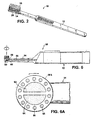
- the toothbrush may be any type of electric toothbrush, e.g., a toothbrush 50 having a body 52, a neck 54, a drive shaft 56, and a head 58 operably connected to the drive shaft 56 by a pinion gear 60, as shown in Fig. 6.
- Head 58 includes a plurality of crimped bristles, and a plurality of non-crimped bristles.
- Head 58a (Fig. 6A) includes a plurality of tufts of crimped bristles defining a pair of substantially semi-circular brush portions 62 and 64, and further includes a plurality of tufts 66 of non-crimped bristles disposed about the periphery of the head.
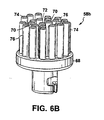
- head 58b has an array of tufts 70 of crimped bristles extending from a body 68 and arranged with tufts 72 and 74 of straight bristles dyed with a wear indicator. and tufts 76 of undyed straight bristles.
- Crimped tufts 70 and straight dyed tufts 72 make up the inner field of tufts, while straight dyed tufts 74 and straight undyed tufts 76 make up the outer row of tufts. As seen in Figs.
- outer, straight dyed tufts 74 are longer by a distance, x, of about 0.7 millimeters, than the other tufts of the head, and have an overall exposed length, y, of about 8.2 millimeters.
- the diameter D 0 of the outer ring of tufts is preferably about 10.2 millimeters to correspond to a typical width of a tooth.
- the individual crimped bristles of tufts 70 have about 18 crimps per inch (7 crimps/centimeter), with a crimp amplitude of about 0.0035 inch (0.09 millimeter).
- tufts 70 each have about 46 bristles
- tufts 72 and 74 each have about 52 bristles
- tufts 76 each have about 54 bristles.
- Many other arrangements of crimped and non-crimped bristles can also be used, as would be understood by a person skilled in the art.
- tufts of bristles in the above figures are illustrated as having a generally cylindrical shape, tufts of structurally crimped bristles tend to have more of a conical shape, illustrated in Fig. 8. Due to the deformations of the structurally crimped bristles, especially those near head body 68, individual crimped bristles 78 of the tuft tend to be splayed away from each other, such that the tuft assumes an overall conical form, enlarging from a diameter d 1 at the base of the tuft to a diameter d 2 at the top of the tuft, with the axes of the individual crimped bristles being less parallel than in tufts of straight bristles.
- the crimped tuft occupies more space, as viewed from its distal end, giving the brush a fuller, more dense appearance. Additionally, because of the splaying of the bristles and the axial undulations of the individual, structurally crimped bristles, the bristles are each directed. at their very distal tips, in different directions. The benefit of this multi-directional tip orientation is explained below.
- FIGs. 9A and 9B Another benefit of combining crimped tufts and straight tufts is illustrated by comparing Figs. 9A and 9B.
- two adjacent tufts of bristles are shown, loaded against the surface of a tooth 80 with a force applied generally in the direction of the bristles (i.e., a normal load).
- Fig. 9A both tufts 82 and 84 have straight bristles.
- tuft 82 is shown extending into the gap 86 between tooth 80 and an adjacent tooth 81.
- the distal ends of tuft 84 are loaded directly against the surface of tooth 80, causing tuft 84 to be bowed toward tuft 82.
- the bristles in tuft 84 Because of the close spacing and identical structure of all of the bristles in tuft 84, and because their distal ends tend to contact tooth 80 in the same general area, the bristles tend to be bowed in the same direction, with outer portions of some bristles laying along the surface of the tooth. being pressed against, in turn by outer portions of other bristles. The net effect is that the distal ends of some of the bristles in tuft 84 are loaded more than others, increasing their tendency to wear.
- tuft 84 of Fig. 9A has been replaced by a tuft 88 of structurally crimped bristles. Because the axes of the crimped bristles of tuft 88 are much less parallel than the axes of straight bristles in a tuft, and because of the multi-directional orientation of the distal tips of the bristles, as described above, the crimped bristles of tuft 88 tend to be splayed in different directions when loaded directly against the tooth surface. The end portions of the bristles of tuft 88 therefore tend to extend to cover a larger surface area of the tooth, overlapping to some extent another tuft of crimped bristles, shown in dashed lines.
- bristle tufts has particular advantages in a bristle head (e.g., head 58b of Fig. 6B) that is moved against the tooth surface in a cyclic motion toward and away from the surface of the tooth (i.e., in the direction of the bristles), as well as in a rotary motion.
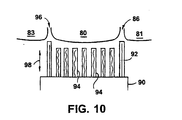
- a brush head 90 has outer tufts 92 of straight bristles and inner tufts 94 of crimped bristles. (For purposes of illustration, all of the tufts are shown schematically). Because of the spacing between opposing outer tufts 92, the outer tufts are shown to roughly line up with neighboring gaps 86 and 96 between adjacent teeth 80 and 81, and 80 and 83, respectively.
- crimped tufts 94 are loaded substantially directly against the surface of tooth 80, and straight tufts 92 extend into gaps 86 and 96. As explained above with respect to Fig. 8B, this loading causes crimped tufts 94 to be splayed outward. So cyclically splayed, the distal ends of the bristles of tufts 94 extend and retreat along the surface of tooth 80 and between tooth 80 and adjacent gum tissue, helping to loosen and remove debris.
- the low effective stiffness of the crimped. inner tufts helps to absorb the cyclic load between the tooth surface and the handle of the toothbrush, such that there tends to be less discomforting vibration imparted to the hand of the user.
- An example of such an electric toothbrush applicable to the invention is shown in Figs. 11 through 15 and described below.
- Figs. 11 through 13 show a first design example of an electric toothbrush 100, serving to clean a user's teeth. and to remove plaque from dental surfaces.
- the electric toothbrush includes a roughly cylindrical, elongated handle 102.
- a brush attachment 104 itself in roughly cylindrical, elongated form, can be mounted on handle 102.
- the diameter of the handle is so chosen that a user can hold the electric toothbrush by the handle securely in his or her hand.
- the diameter of the brush attachment 104 is smaller than the diameter of the handle to permit easy insertion of the brush attachment into the user's mouth.
- a multiplicity of bristles 106 protrude from the bristle head, serving to clean the user's teeth.
- the handle 102 incorporates a housing 108, which accommodates a frame 110.
- the frame is elongated and partly cylindrical, and extends over almost the entire length of the housing, and thus of the handle.
- frame 110 is elastically held in place in housing 108 by cushions 112, of plastic or rubber or a similar material.
- Attached to frame 110 are an electric motor 114, a battery 116 and additional electronic components such as a charging coil 118 and the like. These components are arranged one behind the other in the longitudinal direction of handle 102. Also attached to the frame is a rocker arm 120, which can swivel around a spindle 122. The rocker arm and spindle are located in the section of handle 102 that faces brush attachment 104. Part of rocker arm 120 protrudes from handle 102.
- Rocker arm 120 incorporates a tube 124, a cantilever 126, and two support stems 128 and 130.
- Tube 124 of rocker arm 120 extends through an opening 132 in the end of handle 102, facing brush attachment 104. and protrudes from the handle.
- annular diaphragm 134 Located between tube 124 and housing 108 of the handle is an annular diaphragm 134, made of plastic, rubber or a similar material, by way of which tube 124 extends elastically from the handle.
- a clamp 136 Holding and retaining the tube in the housing is a clamp 136, which surrounds the diaphragm in ring-shaped fashion.
- At least that part of tube 124 that extends from handle 102 has a cross section that is contoured on the outside. It is on this protruding part of the tube that brush attachment 104 can be mounted. At its end that faces the handle, the brush attachment has a cross section that is contoured on the inside in such a way as to match the outer contour of tube 124.
- the matching contours are formed in such a way that the brush attachment can be mounted on the handle in only one particular angular position.
- the contour may have a star-shaped, or triangular, or similar configuration.
- brush attachment 104 When mounted on tube 124 of rocker arm 120, brush attachment 104 becomes an integral part of the rocker arm.
- a shaft 138 Located in tube 124 is a shaft 138, which is pivot-mounted at one end, on the free end of the tube, protruding from handle 102 and, at the other end, on support stem 128.
- Shaft 138 extends roughly in the longitudinal direction of the handle and brush attachment 104, and defines an axis 140.
- the shaft constitutes another component of rocker arm assembly 120. This shaft protrudes from tube 124 where, at its free end, it is contoured on the outside.
- the axis of spindle 122 of rocker arm 120, and axis 140 of shaft 138 extend roughly perpendicular to each other.
- Tube 124 of rocker arm 120 accepts brush attachment 104.
- the brush attachment is provided with a support tube 142, in which a brush shaft 144 is pivot-mounted.
- brush shaft 144 is concentric with axis 140.
- the brush shaft has a recess 146.
- This recess has a cross section with an inside contour which corresponds to the outer contour of shaft 138 that protrudes from tube 124.
- the matching contours are configured in a way that shaft 138 can be inserted in recess 146 in several angular positions.
- the contour may be square.
- Bristle head 150 is disk-shaped, and can swivel about a pin 152.
- Pin 152 extends through the center of the disk of the bristle head. Bristles 106 extend away from the bristle head, approximately parallel with pin 152.
- Pin 152 of bristle head 150 extends roughly perpendicular to axis 140 of shaft 138, and also approximately perpendicular to spindle 122 of rocker arm 120.
- the handle houses a quadrilateral link 158.
- electric motor 114 has a motor shaft 160 which extends approximately parallel with axis 140 of shaft 138, and protrudes from the electric motor in the direction of rocker arm 120.
- Rotationally fixed on the motor shaft is a pinion 162, which meshes with a spur gear 164.
- Spur gear 164 is pivot-mounted on a shaft 166 which extends approximately parallel with motor shaft 160.
- a lug 168 positioned in a support stem 170 that is held by the electric motor, extends from spur gear 164 concentric with shaft 166.
- a drive crank 172 is attached to the spur gear, extending essentially parallel with, but at a distance from shaft 166.
- This crank is also pivot-mounted in the support stem 130 of rocker arm 120, by way of a connector 174 and a tenon 176.
- Tenon 176 is concentric with shaft 166.
- a connecting rod 178 is attached in a rotating form to crank 172.
- connecting rod 178 is swivel-connected to a crank 180 by means of a pin 182.
- crank 180 is fixed to shaft 138 of the rocker arm.
- a ball bearing 184 is mounted on motor shaft 160 of the electric motor.
- the ball bearing has an eccentric inner race 186 and a concentric outer race 188. It is with eccentric inner race 186 that ball bearing 184 is seated on the motor shaft.
- the eccentric inner race thus acts as the imbalance.
- Concentric outer race 188 is in contact with the free end of cantilever 126 of rocker arm 120.
- frame 110 is provided with openings 190 and 192. which hold a leaf spring 194 in place by its free ends.
- Leaf spring 194 is positioned in a way that it bears on cantilever 126 of rocker arm 120, pressing it against outer race 188 of ball bearing 184.
- the pressure with which the leaf spring pushes the cantilever against the ball bearing is a function of the elasticity constant of leaf spring 194.
- the frequency of alternating rotary movement 196 of bristle head 150 can be between about 50 Hz and about 80 Hz. Preferably, the frequency should be about 63 Hz.
- brush attachment 104 when mounted, constitutes an integral part of the rocker arm 120. Consequently, the brush attachment, along with bristle head 150, is set into a vibrating swivel motion around axis 122.
- axis 122 is oriented approximately at a right angle to pin 152, the bristle head follows a reciprocating stroke movement 198, in a direction essentially parallel with pin 152. This essentially parallel alignment of the bristles 106 and pin 152 ultimately causes the bristles to deliver a poking action in the direction in which the bristles extend.
- the travel of reciprocating stroke 198 of bristle head 150, and thus the poking action of bristles 106, can be over a distance in the range between about ⁇ 0.02 mm and about ⁇ 0.2 mm; the total travel thus being about 0.04 mm to about 0.4 mm.
- this travel movement of stroke 198 in either direction is about ⁇ 0.05 mm, and the overall travel is thus about 0.1 mm.
- the frequency of the back-and-forth movement i.e.. reciprocating stroke 198 of bristle head 150, and thus of the poking action of bristles 106, can be between about 130 Hz and about 200 Hz, and is preferably about 164 Hz.
- the frequency of the reciprocating stroke movement is thus higher, and preferably substantially higher, than the frequency of alternating rotary movement 196.
- the rotary movement 196 and the stroke movement 198 of bristle head 150 are both generated by electric motor 114.
- the frequency of reciprocating stroke 198 of the bristle head corresponds directly to the rotational speed of the electric motor.
- the frequency of alternating rotary movement 196 of the bristle head is determined by the rotational speed of the electric motor as modulated by quadrilateral link 158. Accordingly, the frequency ratio of the alternating rotary movement to that of the reciprocating stroke movement is a finite value, or a periodic fraction, or a non-periodic fraction.
- cantilever 126 of rocker arm 120 is pressed against outer race 188 of ball bearing 184 by leaf spring 194.
- the cantilever also pushes against that side of the ball bearing on which bristle head 150 is located.
- the result will be that cantilever 126 is lifted off of outer race 188 of the ball bearing, against the spring action of leaf spring 194.
- the vibration generated by the ball bearing is thus no longer transferred to the rocker arm, nor, consequently, to the bristle head and the bristles.
- force 200 exceeds that certain level.
- the retraction of cantilever 126 away from ball bearing 184 will turn off the reciprocating stroke movement 198 of the bristle head. and with it the poking action of the bristles.
- the specific pressure level of force 200 at which cantilever 126 is lifted off of ball bearing 184 can be predetermined by the selection of the appropriate elasticity constant of leaf spring 194.
- the specific level of force 200 may be in the range of about 1.5 Newton to about 4.0 Newton, and is preferably held at about 2.0 Newton.
- FIG. 14 illustrates a second design example of an electric toothbrush 202, which in its configuration and function is very similar to electric toothbrush 100 of Figs. 11 through 13. The difference lies in the approach to generating the vibration of rocker arm 120, which in the electric toothbrush of Fig. 14 is not brought about by a ball bearing with an eccentric inner race. Therefore, the following only describes the components which differ from those in electric toothbrush 100. Identical components bear identical reference numbers.
- the vibration is generated by means of an eccentric element 204 which is mounted in fixed position on motor shaft 160 of electric motor 114.
- the eccentric element may be in the form of a wheel or similar element, which is either seated in off-center fashion, or displays an eccentric circumference.
- the free end of cantilever 126 of rocker arm 120 is provided with a rotating roller 206, which is mounted on a spindle 208 that extends approximately parallel with motor shaft 160.
- Roller 206 bears on the eccentric element 204 and, as the motor shaft rotates, rolls with its circumference along the circumference of the eccentric element.
- rocker arm 120 is vibrated by eccentric element 204, and the revolving roller 206 on it. This vibration, as explained above, is transferred to bristle head 150 where it generates reciprocating stroke movement 198.
- a guide shoe may be provided which slides along the circumference of the eccentric element 204.
- outer race 188 of ball bearing 184 is not concentric as shown in Figs. 11 through 13, but is instead eccentric. When combined with roller 206, this will generate a vibration which is a composite of the vibration derived from eccentric inner race 186, and the vibration generated by the eccentric outer race.
- roller 206 mounted on cantilever 126 as shown in Fig. 14.
- the wheel is either mounted off-center or has an eccentric circumference. In this case it is not necessary to equip the wheel with any other component that would be mounted on motor shaft 160 of electric motor 114.
- the eccentric wheel bears directly on the motor shaft and revolves as the motor shaft rotates.
- rocker arm 120 is set in a vibratory motion which, in turn, produces the reciprocating stroke motion 198 of bristle head 150, and with it the poking action of the bristles.
- Fig. 15 illustrates a third design example of an electric toothbrush 210, which in terms of its structural concept and function is very similar to electric toothbrush 100 of Figs. 11 through 13. The only difference is the location of cantilever 126 of rocker arm 120, which in electric toothbrush 210 of Fig. 15 is not on the same side of shaft 138 as bristle head 150. Therefore, the following describes only the components which differ from those in electric toothbrush 100. Identical components bear identical reference numbers.
- cantilever 126 of rocker arm 120 bears on outer race 188 of ball bearing 184 on that side which is located opposite bristle head 150.
- the cantilever will always be in a state where leaf spring 194 presses it against the ball bearing.
- Even force 200 applied to bristles 106 will not lift the cantilever off of the ball bearing.
- leaf spring 194 only serves to provide initial spring tension.
- the reciprocating stroke movement 198 of bristle head 150, and consequently the poking action of the bristles, remain in effect regardless of any force 200.
- the vibration, and with it the reciprocating stroke movement 198 of the bristle head are not generated by an electric motor 114 as provided for in the figures, but by an independent drive system.
- the frequency of the reciprocating stroke movement 198 of the bristle head, and the frequency of the poking action of the bristles will be independent of the frequency of the alternating rotary movement 196 of the bristle head.
- the separate drive system for stroke movement 198 may, for instance, be a second electric motor, or an electromagnetic oscillator, or a piezoelectric actuator.
Landscapes
- Health & Medical Sciences (AREA)
- Dentistry (AREA)
- Epidemiology (AREA)
- Life Sciences & Earth Sciences (AREA)
- Animal Behavior & Ethology (AREA)
- General Health & Medical Sciences (AREA)
- Public Health (AREA)
- Veterinary Medicine (AREA)
- Engineering & Computer Science (AREA)
- Mechanical Engineering (AREA)
- Textile Engineering (AREA)
- Brushes (AREA)
Applications Claiming Priority (5)
| Application Number | Priority Date | Filing Date | Title |
|---|---|---|---|
| US67509696A | 1996-07-03 | 1996-07-03 | |
| US675096 | 1996-07-03 | ||
| US886425 | 1997-07-01 | ||
| US08/886,425 US6058541A (en) | 1996-07-03 | 1997-07-01 | Crimped bristle toothbrush |
| PCT/US1997/011459 WO1998000049A1 (en) | 1996-07-03 | 1997-07-02 | Crimped bristle toothbrush |
Publications (2)
| Publication Number | Publication Date |
|---|---|
| EP0923327A1 EP0923327A1 (en) | 1999-06-23 |
| EP0923327B1 true EP0923327B1 (en) | 2004-04-21 |
Family
ID=27101271
Family Applications (1)
| Application Number | Title | Priority Date | Filing Date |
|---|---|---|---|
| EP97932420A Expired - Lifetime EP0923327B1 (en) | 1996-07-03 | 1997-07-02 | Crimped bristle toothbrush |
Country Status (8)
| Country | Link |
|---|---|
| US (1) | US6058541A (https=) |
| EP (1) | EP0923327B1 (https=) |
| JP (1) | JP2002513297A (https=) |
| AT (1) | ATE264634T1 (https=) |
| AU (1) | AU715137B2 (https=) |
| DE (1) | DE69728774T2 (https=) |
| ES (1) | ES2215232T3 (https=) |
| WO (1) | WO1998000049A1 (https=) |
Cited By (2)
| Publication number | Priority date | Publication date | Assignee | Title |
|---|---|---|---|---|
| DE202018001075U1 (de) | 2018-02-19 | 2018-03-28 | Semen Zaitchik | Bürste, insbesondere Zahnbürste deren Putzelemente die fraktalen Charakteristiken aufweisen |
| US10278485B2 (en) | 2016-09-01 | 2019-05-07 | Colgate-Palmolive Company | Oral care implement and filament therefor |
Families Citing this family (125)
| Publication number | Priority date | Publication date | Assignee | Title |
|---|---|---|---|---|
| US7093316B2 (en) * | 1994-04-19 | 2006-08-22 | Applied Elastomerics, Inc. | Gels for force gauging |
| DE69738128T2 (de) * | 1996-04-05 | 2008-06-05 | The University Of Virginia Patent Foundation | Metallfaserbürste mit permanentem kontakt |
| US6079087A (en) * | 1997-02-05 | 2000-06-27 | Cansler; Ronald | Method for making wavy tapered brush bristles |
| DE19818345A1 (de) * | 1998-04-24 | 1999-10-28 | Pedex & Co Gmbh | Borste, Verfahren zu ihrer Herstellung und Gerät mit einer solchen Borste |
| US6371294B1 (en) * | 1998-09-30 | 2002-04-16 | The Procter & Gamble Company | Electric toothbrush |
| USD456998S1 (en) | 1999-01-25 | 2002-05-14 | Lawrence A. Blaustein | Head portion of an electric toothbrush |
| JP3550052B2 (ja) * | 1999-06-28 | 2004-08-04 | ユニ・チャーム株式会社 | 伸縮性不織布およびその製造方法 |
| US6553604B1 (en) | 2000-03-16 | 2003-04-29 | Gillette Canada Company | Toothbrush |
| ES2225525T3 (es) | 2000-04-03 | 2005-03-16 | Astenjohnson, Inc. | Componente de atadura prerizado. |
| TW576883B (en) | 2000-04-03 | 2004-02-21 | Astenjohnson Inc | Industrial textiles assembled from pre-crimped components |
| DE10046536A1 (de) * | 2000-09-19 | 2002-03-28 | Coronet Werke Gmbh | Verfahren zur Herstellung von Borstenwaren |
| US20020120995A1 (en) * | 2000-10-02 | 2002-09-05 | Brezler Russel A. | Low friction toothbrush |
| DE60112774T2 (de) * | 2000-10-02 | 2006-06-08 | E.I. Du Pont De Nemours And Co., Wilmington | Reibungsarme zahnbürste |
| US6735804B2 (en) | 2001-01-12 | 2004-05-18 | Conair Corporation | Toothbrush bristle disk |
| US6836917B2 (en) | 2001-05-07 | 2005-01-04 | The Procter & Gamble Company | Replaceable head electric toothbrush and connection structure therefor |
| US20020189041A1 (en) * | 2001-05-24 | 2002-12-19 | Duff Ronald R. | Polyurethane bristles |
| US7607189B2 (en) * | 2004-07-14 | 2009-10-27 | Colgate-Palmolive | Oral care implement |
| US7143462B2 (en) | 2002-09-20 | 2006-12-05 | Colgate-Palmolive Company | Oral care implement |
| US7908699B2 (en) | 2001-07-03 | 2011-03-22 | Colgate-Palmolive Company | Oral care implement |
| US6725490B2 (en) * | 2001-11-06 | 2004-04-27 | The Procter & Gamble Company | Complex motion toothbrush |
| USD499884S1 (en) | 2002-03-15 | 2004-12-21 | The Procter & Gamble Company | Electric toothbrush |
| DE10211391A1 (de) | 2002-03-15 | 2003-10-02 | Braun Gmbh | Elektrische Zahnbürste und Zahnbürstenkopf hierfür |
| US8990996B2 (en) | 2002-08-09 | 2015-03-31 | Colgate-Palmolive Company | Toothbrush |
| US8806695B2 (en) * | 2002-08-09 | 2014-08-19 | Colgate-Palmolive Company | Oral care implement having flexibly supported cleaning elements extending in opposite directions |
| US7836539B2 (en) | 2002-08-09 | 2010-11-23 | Colgate-Palmolive Company | Oral care implement |
| US8151397B2 (en) | 2002-08-09 | 2012-04-10 | Colgate-Palmolive Company | Oral care implement having flexibly supported cleaning elements extending in opposite directions |
| US20060026784A1 (en) | 2002-08-09 | 2006-02-09 | Colgate-Palmolive Company | Oral care implement |
| US7721376B2 (en) | 2002-09-20 | 2010-05-25 | Colgate-Palmolive Company | Oral care implement |
| US7841041B2 (en) | 2002-08-09 | 2010-11-30 | Colgate-Palmolive Company | Oral care implement |
| US7614111B2 (en) | 2002-08-09 | 2009-11-10 | Colgate-Palmolive Company | Oral care implement |
| US7845042B2 (en) | 2002-08-09 | 2010-12-07 | Colgate-Palmolive Company | Oral care implement |
| US8876221B2 (en) | 2002-08-09 | 2014-11-04 | Colgate-Palmolive Company | Oral care implement |
| CA2495388A1 (en) * | 2002-08-19 | 2004-02-26 | Colgate-Palmolive Company | Toothbrush |
| US7975343B2 (en) | 2002-09-20 | 2011-07-12 | Colgate-Palmolive Company | Toothbrush |
| US7089621B2 (en) | 2002-09-20 | 2006-08-15 | Colgate-Palmolive Company | Toothbrush |
| US7594293B2 (en) * | 2002-09-20 | 2009-09-29 | Colgate-Palmolive Co. | Oral care implement |
| US7725980B2 (en) * | 2004-12-15 | 2010-06-01 | Colgate-Palmolive Company | Oral care implement |
| CA2500180C (en) * | 2002-09-27 | 2008-08-12 | Colgate-Palmolive Company | Toothbrush with cups |
| US20040107521A1 (en) * | 2002-12-06 | 2004-06-10 | The Procter & Gamble Company | Electric toothbrushes |
| USD536876S1 (en) | 2003-02-03 | 2007-02-20 | Church & Dwight Co., Inc. | Head portion of a toothbrush |
| USD612611S1 (en) | 2003-02-11 | 2010-03-30 | The Gillette Company | Head of a toothbrush |
| US7934284B2 (en) * | 2003-02-11 | 2011-05-03 | Braun Gmbh | Toothbrushes |
| US20040177462A1 (en) | 2003-03-14 | 2004-09-16 | The Gillette Company | Toothbrush head |
| US20060272112A9 (en) | 2003-03-14 | 2006-12-07 | The Gillette Company | Toothbrush |
| US20050236008A9 (en) * | 2003-03-28 | 2005-10-27 | Gueret Jean-Louis H | Cosmetic applicator |
| US20040200016A1 (en) * | 2003-04-09 | 2004-10-14 | The Procter & Gamble Company | Electric toothbrushes |
| US7941886B2 (en) * | 2003-09-19 | 2011-05-17 | Braun Gmbh | Toothbrushes |
| JP2007521874A (ja) * | 2004-02-09 | 2007-08-09 | コーニンクレッカ フィリップス エレクトロニクス エヌ ヴィ | 歯ブラシの少なくとも1つのブリストルを有するシャフトを駆動する手段 |
| JP2008515569A (ja) * | 2004-10-20 | 2008-05-15 | ザ プロクター アンド ギャンブル カンパニー | 歯ブラシ |
| US8042217B2 (en) | 2004-11-02 | 2011-10-25 | Colgate-Palmolive Company | Toothbrush and method of making the same |
| WO2006095222A1 (en) * | 2004-12-21 | 2006-09-14 | Koninklijke Philips Electronics, N.V. | Hydraulic system for driving a membrane brushhead which includes bristles mounted thereon |
| US8281448B2 (en) | 2005-10-24 | 2012-10-09 | Colgate-Palmolive Company | Oral care implement having one or more moving sections |
| US8523888B2 (en) * | 2006-12-18 | 2013-09-03 | Colgate-Palmolive Company | Oral care implement |
| US8056176B2 (en) | 2007-01-25 | 2011-11-15 | The Procter & Gamble Company | Toothbrushes |
| US8201298B2 (en) | 2007-02-09 | 2012-06-19 | Colgate-Palmolive Company | Toothbrush with low profile head |
| DE102007018766A1 (de) * | 2007-04-20 | 2008-10-23 | Braun Gmbh | Zahnbürste |
| US7821113B2 (en) * | 2008-06-03 | 2010-10-26 | Texas Instruments Incorporated | Leadframe having delamination resistant die pad |
| EP2184033A1 (de) * | 2008-11-05 | 2010-05-12 | Braun Gmbh | Elektrische Zahnbürste sowie Bürstenkopf hierfür |
| EP2184031A1 (de) * | 2008-11-05 | 2010-05-12 | Braun Gmbh | Elektrische Zahnbürste sowie Bürstenkopf hierfür |
| EP2184032A1 (de) * | 2008-11-05 | 2010-05-12 | Braun Gmbh | Elektrische Zahnbürste sowie Bürstenkopf hierfür |
| USD606316S1 (en) | 2008-11-06 | 2009-12-22 | The Procter & Gamble Company | Toothbrush head |
| USD606318S1 (en) | 2008-11-06 | 2009-12-22 | The Procter & Gamble Company | Toothbrush head |
| USD606757S1 (en) | 2008-11-06 | 2009-12-29 | The Procter & Gamble Company | Toothbrush head |
| USD606758S1 (en) | 2008-11-06 | 2009-12-29 | The Procter & Gamble Company | Toothbrush head |
| USD611711S1 (en) | 2008-11-06 | 2010-03-16 | The Procter & Gamble Company | Toothbrush head |
| USD621158S1 (en) | 2008-11-06 | 2010-08-10 | The Procter & Gamble Company | Toothbrush head |
| USD606317S1 (en) | 2008-11-06 | 2009-12-22 | The Procter & Gamble Company | Toothbrush head |
| PL2445374T3 (pl) | 2009-06-26 | 2017-04-28 | The Gillette Company | Wskaźnik nacisku dla szczoteczki do zębów |
| RU2411891C1 (ru) * | 2009-09-10 | 2011-02-20 | Сергей Алексеевич Пшенников | Ворс для метлы, линия по его производству и узел второй протяжки нити для осуществления линии по производству ворса для метлы |
| EP2496113B1 (en) | 2009-11-02 | 2023-05-10 | Braun GmbH | Toothbrush |
| KR101657575B1 (ko) * | 2010-04-30 | 2016-09-20 | 주식회사 엘지생활건강 | 치간 세정부재 및 이의 제조방법 |
| EP2409667B1 (en) * | 2010-07-22 | 2015-06-17 | Braun GmbH | Electric appliance for personal use |
| EP2410641A1 (en) | 2010-07-23 | 2012-01-25 | Braun GmbH | Linear electric motor |
| BR112013005083B1 (pt) | 2010-09-20 | 2020-12-15 | The Gillette Company Llc | Cabo para higiene bucal |
| US8769758B2 (en) | 2010-09-20 | 2014-07-08 | The Gillette Company | Force sensing oral care instrument |
| DE202010015189U1 (de) | 2010-11-09 | 2011-02-17 | Emag Ag | Behandlungsgerät |
| PL2642886T3 (pl) | 2010-11-22 | 2017-12-29 | Braun Gmbh | Szczoteczka do zębów |
| US8732890B2 (en) | 2010-11-22 | 2014-05-27 | Braun Gmbh | Toothbrush |
| US20120167319A1 (en) | 2011-01-05 | 2012-07-05 | Steven Francis Quigley | Wet friction material for oral care devices |
| US8904590B2 (en) | 2011-02-09 | 2014-12-09 | Braun Gmbh | Oral care instrument |
| US8484788B2 (en) * | 2011-03-14 | 2013-07-16 | L'oreal Sa | Brushhead for electric skin brush appliance |
| US20120272468A1 (en) | 2011-04-26 | 2012-11-01 | The Procter & Gamble Company | Oral Care Device Comprising A Synthetic Polymer Derived From A Renewable Resource And Methods Of Producing Said Device |
| US8763189B2 (en) | 2011-05-05 | 2014-07-01 | Braun Gmbh | Oral hygiene implement |
| US9439740B2 (en) | 2011-05-05 | 2016-09-13 | Braun Gmbh | Oral hygiene implement |
| CN103607927B (zh) | 2011-06-15 | 2015-12-23 | 吉列公司 | 头部设有两个柔性翼部的口腔护理器械 |
| WO2013005190A1 (en) | 2011-07-06 | 2013-01-10 | Braun Gmbh | Cleaning section for an electric oral hygiene device |
| EP2737619B1 (en) | 2011-07-25 | 2017-08-23 | Braun GmbH | Oral care devices with linear electro-polymer motors |
| DK2550937T3 (da) | 2011-07-25 | 2014-05-19 | Braun Gmbh | Magnetforbindelse mellem et tandbørstehåndtag og et børstehoved |
| ES2534822T3 (es) | 2011-07-25 | 2015-04-29 | Braun Gmbh | Dispositivo de higiene bucodental |
| JP6363505B2 (ja) * | 2011-10-27 | 2018-07-25 | グラクソスミスクライン・コンシューマー・ヘルスケア・ゲゼルシャフト・ミット・ベシュレンクテル・ハフツング・ウント・コムパニー・コマンディットゲゼルシャフトGlaxoSmithKline Consumer Healthcare GmbH & Co. KG | 歯ブラシ |
| EP2782474B1 (en) | 2011-11-22 | 2018-10-10 | The Procter and Gamble Company | Method for producing a toothbrush having an inner cavity |
| US9510664B2 (en) | 2011-11-22 | 2016-12-06 | The Procter & Gamble Co | Toothbrush having an inner cavity |
| US9420877B2 (en) | 2011-11-22 | 2016-08-23 | The Procter & Gamble Company | Method for producing a toothbrush having an inner cavity |
| US9756931B2 (en) | 2011-11-22 | 2017-09-12 | The Procter & Gamble Company | Method for producing a toothbrush having an inner cavity |
| US9463593B2 (en) | 2011-11-22 | 2016-10-11 | The Procter & Gamble Company | Method for producing a toothbrush having an inner cavity |
| CN107802368A (zh) | 2012-02-07 | 2018-03-16 | 博朗有限公司 | 口腔健康检测装置 |
| US9718594B2 (en) | 2012-02-10 | 2017-08-01 | The Gillette Company Llc | Oral care instrument and package therefore |
| CN102583106A (zh) * | 2012-03-06 | 2012-07-18 | 褚建祥 | 一种弹性棕丝加工装置 |
| CN102583212A (zh) * | 2012-03-06 | 2012-07-18 | 褚建祥 | 一种棕丝床垫自动给料机 |
| US20130299372A1 (en) | 2012-05-08 | 2013-11-14 | Braun Gmbh | Powered Oral Care Device Package |
| US9131765B2 (en) | 2012-12-20 | 2015-09-15 | Brushpoint Innovations Inc | Brush head for an electric toothbrush |
| USD689698S1 (en) | 2013-02-18 | 2013-09-17 | Brushpoint Innovations Inc | Brush head for electric toothbrush |
| USD706033S1 (en) | 2013-02-18 | 2014-06-03 | Brushpoint Innovations Inc | Brush head for electric toothbrush |
| WO2014207503A1 (en) * | 2013-06-24 | 2014-12-31 | L'oreal | Brushhead for skin brush appliance |
| CN105792701B (zh) | 2013-12-12 | 2018-03-02 | 高露洁-棕榄公司 | 具有带有不同的口腔护理添加剂的股线部件的螺旋刷毛以及包括该螺旋刷毛的口腔护理器具 |
| US10477958B2 (en) | 2013-12-12 | 2019-11-19 | Colgate-Palmolive Company | Multi-component bristle having components with different oral care additives, and oral care implement comprising the same |
| JP2016539730A (ja) | 2013-12-12 | 2016-12-22 | コルゲート・パーモリブ・カンパニーColgate−Palmolive Company | 異なる口腔ケア添加剤を備える構成部を含む複数構成部ブラシ毛、およびそれを含む口腔ケア器具 |
| JP6266783B2 (ja) | 2013-12-24 | 2018-01-24 | ブラウン ゲーエムベーハー | パーソナル衛生用具 |
| DK2910143T3 (da) | 2014-02-21 | 2020-03-02 | Procter & Gamble | Hoved til et mundplejeredskab |
| US10021964B2 (en) | 2014-06-13 | 2018-07-17 | L'oreal | Replacement indicating brush |
| KR20170084197A (ko) | 2014-12-19 | 2017-07-19 | 더 질레트 컴퍼니 엘엘씨 | 힘-감지 칫솔 |
| JP6402859B2 (ja) * | 2015-11-30 | 2018-10-10 | パナソニックIpマネジメント株式会社 | 美容装置 |
| US11197539B2 (en) * | 2016-03-15 | 2021-12-14 | Anisa International, Inc. | Cosmetic brush fiber with star-shaped cross section |
| FR3054958B1 (fr) | 2016-08-11 | 2018-09-07 | Oreal | Pinceau d'application d'un produit cosmetique, methode et kit associes |
| US10426249B2 (en) | 2016-09-01 | 2019-10-01 | Colgate-Palmolive Company | Oral care implement |
| USD830699S1 (en) | 2017-02-03 | 2018-10-16 | Harria Investment Group Ltd. | Brush head for an electric toothbrush |
| USD838990S1 (en) | 2017-05-11 | 2019-01-29 | Harria Investment Group Ltd | Brush head for an electric toothbrush |
| CN109223230B (zh) | 2017-07-11 | 2020-09-25 | Js控股股份有限公司 | 用于电动牙刷的可移除的刷头 |
| US10736413B2 (en) | 2017-07-31 | 2020-08-11 | L'oreal | Systems, devices, and methods of a self-activation use odometer for a skin care brush |
| EP3930537A1 (en) | 2019-02-27 | 2022-01-05 | The Procter & Gamble Company | Voice assistant in an electric toothbrush |
| US11134771B2 (en) | 2019-05-06 | 2021-10-05 | L'oreal | Skin care brush systems having cleansing agent-infused elements |
| US12257118B2 (en) | 2019-05-20 | 2025-03-25 | Braun Gmbh | Bristle driven pulsation |
| US11707130B2 (en) | 2019-12-26 | 2023-07-25 | L'oreal | Fluid-filled cleaning head |
| KR102901782B1 (ko) * | 2022-04-22 | 2025-12-18 | 나성식 | 칫솔용 칫솔모 및 이를 포함하는 칫솔 |
| US12108868B2 (en) * | 2022-07-29 | 2024-10-08 | Ninghai Zhong Jie Brush Co., Ltd. | Powered tool brush and powered tool having same |
Citations (5)
| Publication number | Priority date | Publication date | Assignee | Title |
|---|---|---|---|---|
| US3840932A (en) * | 1972-12-26 | 1974-10-15 | Ultrasonic Systems | Ultrasonic toothbrush applicator |
| DE2757046A1 (de) * | 1977-12-21 | 1979-07-05 | Braun Ag | Buerste zum reinigen von oberflaechen |
| DE3514600A1 (de) * | 1985-02-11 | 1986-08-14 | Otmato AG, Glarus | Zahnbuerste mit vorratskammer fuer zahnputzmittel |
| JPH06141929A (ja) * | 1992-11-12 | 1994-05-24 | Hiroshi Fukuba | 歯ブラシ |
| EP0893958B1 (de) * | 1996-04-17 | 2000-03-29 | CORONET-WERKE GmbH | Bürste zur zahnfleischmassage und zahnreinigung und verfahren zur herstellung der borsten einer solchen bürste |
Family Cites Families (22)
| Publication number | Priority date | Publication date | Assignee | Title |
|---|---|---|---|---|
| CH15641A (de) * | 1897-12-23 | 1898-07-15 | Schmidt C F | Bürste |
| US2317485A (en) * | 1940-04-27 | 1943-04-27 | Pepsodent Co | Brush |
| GB598821A (en) * | 1944-09-21 | 1948-02-26 | Du Pont | Improvements in paint brushes bristled with synthetic filaments |
| US2790986A (en) * | 1952-12-31 | 1957-05-07 | Empire Brushes Inc | Paint brushes |
| US3118527A (en) * | 1959-04-06 | 1964-01-21 | Johns Manville | Friction element, a clutch facing, and method and apparatus for making same |
| US3425206A (en) * | 1963-11-12 | 1969-02-04 | Monsanto Co | Dyed intermittently textured yarn |
| US3295156A (en) * | 1965-04-14 | 1967-01-03 | Colgate Palmolive Co | Toothbrush |
| US3567569A (en) * | 1965-08-09 | 1971-03-02 | Toyo Rayon Co Ltd | Synthetic fibers having novel shape |
| US3411979A (en) * | 1965-08-24 | 1968-11-19 | Polymers Inc | Foamed artificial filament |
| US3505163A (en) * | 1967-06-22 | 1970-04-07 | Usm Corp | Helically crimped vinyl filament |
| US4373541A (en) * | 1979-08-07 | 1983-02-15 | Nishioka Gary J | Bristle structure for brushes and brush assembly |
| DE3116189A1 (de) * | 1981-04-23 | 1982-12-23 | Bodo 2000 Hamburg Jesse | Profilierte borsten fuer zahnbuersten und buersten aller art |
| US4616374A (en) * | 1983-07-08 | 1986-10-14 | William Novogrodsky | Microfloss toothbrush |
| US4524480A (en) * | 1983-08-01 | 1985-06-25 | Perfection Automotive Products Corp. | Wire wheel cover brush |
| US5195546A (en) * | 1990-12-11 | 1993-03-23 | Ketema | Cosmetic brush and bristles |
| DE4114136A1 (de) * | 1991-04-30 | 1992-11-05 | Schlerf Coronet Werke | Borstenwaren und verfahren zu ihrer herstellung |
| US5268005A (en) * | 1991-06-17 | 1993-12-07 | Gillette Canada Inc. | Method for ring-dyeing nylon filaments with indigotine dye for tooth-brushes |
| US5161555A (en) * | 1991-07-25 | 1992-11-10 | Ketema | Cosmetic brush |
| DE4201873C1 (en) * | 1992-01-24 | 1993-05-27 | Braun Ag, 6000 Frankfurt, De | Brush for electrically operated toothbrush - has two concentric circular rings of bristles of different heights spaced apart by circle without bristles same width as circle with bristles |
| US5491865A (en) * | 1992-02-11 | 1996-02-20 | L'oreal | Brush for the application of nail varnish or a similar product |
| DE9408268U1 (de) * | 1994-05-19 | 1994-07-14 | Seever, Wieland, 29229 Celle | Zahnbürstenkopf |
| DE29501338U1 (de) * | 1995-01-30 | 1995-06-22 | Weiland, Wolfgang, 24866 Busdorf | Zahnbürste |
-
1997
- 1997-07-01 US US08/886,425 patent/US6058541A/en not_active Expired - Lifetime
- 1997-07-02 AU AU35882/97A patent/AU715137B2/en not_active Expired
- 1997-07-02 ES ES97932420T patent/ES2215232T3/es not_active Expired - Lifetime
- 1997-07-02 DE DE69728774T patent/DE69728774T2/de not_active Expired - Lifetime
- 1997-07-02 JP JP50440798A patent/JP2002513297A/ja not_active Ceased
- 1997-07-02 WO PCT/US1997/011459 patent/WO1998000049A1/en not_active Ceased
- 1997-07-02 AT AT97932420T patent/ATE264634T1/de active
- 1997-07-02 EP EP97932420A patent/EP0923327B1/en not_active Expired - Lifetime
Patent Citations (5)
| Publication number | Priority date | Publication date | Assignee | Title |
|---|---|---|---|---|
| US3840932A (en) * | 1972-12-26 | 1974-10-15 | Ultrasonic Systems | Ultrasonic toothbrush applicator |
| DE2757046A1 (de) * | 1977-12-21 | 1979-07-05 | Braun Ag | Buerste zum reinigen von oberflaechen |
| DE3514600A1 (de) * | 1985-02-11 | 1986-08-14 | Otmato AG, Glarus | Zahnbuerste mit vorratskammer fuer zahnputzmittel |
| JPH06141929A (ja) * | 1992-11-12 | 1994-05-24 | Hiroshi Fukuba | 歯ブラシ |
| EP0893958B1 (de) * | 1996-04-17 | 2000-03-29 | CORONET-WERKE GmbH | Bürste zur zahnfleischmassage und zahnreinigung und verfahren zur herstellung der borsten einer solchen bürste |
Cited By (2)
| Publication number | Priority date | Publication date | Assignee | Title |
|---|---|---|---|---|
| US10278485B2 (en) | 2016-09-01 | 2019-05-07 | Colgate-Palmolive Company | Oral care implement and filament therefor |
| DE202018001075U1 (de) | 2018-02-19 | 2018-03-28 | Semen Zaitchik | Bürste, insbesondere Zahnbürste deren Putzelemente die fraktalen Charakteristiken aufweisen |
Also Published As
| Publication number | Publication date |
|---|---|
| JP2002513297A (ja) | 2002-05-08 |
| DE69728774T2 (de) | 2005-03-24 |
| ES2215232T3 (es) | 2004-10-01 |
| AU3588297A (en) | 1998-01-21 |
| US6058541A (en) | 2000-05-09 |
| ATE264634T1 (de) | 2004-05-15 |
| AU715137B2 (en) | 2000-01-20 |
| WO1998000049A1 (en) | 1998-01-08 |
| EP0923327A1 (en) | 1999-06-23 |
| DE69728774D1 (de) | 2004-05-27 |
Similar Documents
| Publication | Publication Date | Title |
|---|---|---|
| EP0923327B1 (en) | Crimped bristle toothbrush | |
| US6496999B1 (en) | Toothbrush with bristle configuration adapted for cleaning tooth surfaces and interproximal areas | |
| US6018840A (en) | Notched dental hygiene article | |
| EP3251546B1 (en) | Head for an oral care implement and oral care implement | |
| EP1524928B1 (en) | Toothbrushes | |
| AU2003221871B2 (en) | Powered toothbrush head | |
| WO2002054975A1 (en) | Toothbrush bristle disk | |
| KR20050065562A (ko) | 칫솔 | |
| JP2005504597A (ja) | 歯ブラシ | |
| KR20050057600A (ko) | 선형 및 회전 필드를 갖는 칫솔 | |
| UA47476C2 (uk) | Щітка для масажу ясен та чищення зубів і спосіб виготовлення щетинок для такої щітки | |
| EP1133247A1 (en) | Oral brush | |
| US20030088932A1 (en) | Toothbrush | |
| JPH1057149A (ja) | 歯ブラシ | |
| EP1571943A1 (en) | Toothbrush | |
| JP2003061749A (ja) | 歯ブラシ | |
| EP1538946A2 (en) | Toothbrush | |
| JP3583346B2 (ja) | 歯ブラシ | |
| JP2001353025A (ja) | 歯ブラシ | |
| JP4097323B2 (ja) | 歯ブラシ | |
| JP3585811B2 (ja) | 歯ブラシ | |
| JPH09220122A (ja) | 歯間ブラシ | |
| JP2004180712A (ja) | 電動歯ブラシ | |
| JP4656775B2 (ja) | 歯ブラシ | |
| JP2001346631A (ja) | 歯ブラシ |
Legal Events
| Date | Code | Title | Description |
|---|---|---|---|
| PUAI | Public reference made under article 153(3) epc to a published international application that has entered the european phase |
Free format text: ORIGINAL CODE: 0009012 |
|
| 17P | Request for examination filed |
Effective date: 19990125 |
|
| AK | Designated contracting states |
Kind code of ref document: A1 Designated state(s): AT BE CH DE DK ES FI FR GB IE IT LI NL PT SE |
|
| 17Q | First examination report despatched |
Effective date: 20011010 |
|
| GRAP | Despatch of communication of intention to grant a patent |
Free format text: ORIGINAL CODE: EPIDOSNIGR1 |
|
| GRAS | Grant fee paid |
Free format text: ORIGINAL CODE: EPIDOSNIGR3 |
|
| GRAA | (expected) grant |
Free format text: ORIGINAL CODE: 0009210 |
|
| RAP1 | Party data changed (applicant data changed or rights of an application transferred) |
Owner name: THE GILLETTE COMPANY |
|
| RAP1 | Party data changed (applicant data changed or rights of an application transferred) |
Owner name: THE GILLETTE COMPANY |
|
| AK | Designated contracting states |
Kind code of ref document: B1 Designated state(s): AT BE CH DE DK ES FI FR GB IE IT LI NL PT SE |
|
| PG25 | Lapsed in a contracting state [announced via postgrant information from national office to epo] |
Ref country code: NL Free format text: LAPSE BECAUSE OF FAILURE TO SUBMIT A TRANSLATION OF THE DESCRIPTION OR TO PAY THE FEE WITHIN THE PRESCRIBED TIME-LIMIT Effective date: 20040421 Ref country code: IT Free format text: LAPSE BECAUSE OF FAILURE TO SUBMIT A TRANSLATION OF THE DESCRIPTION OR TO PAY THE FEE WITHIN THE PRE;WARNING: LAPSES OF ITALIAN PATENTS WITH EFFECTIVE DATE BEFORE 2007 MAY HAVE OCCURRED AT ANY TIME BEFORE 2007. THE CORRECT EFFECTIVE DATE MAY BE DIFFERENT FROM THE ONE RECORDED.SCRIBED TIME-LIMIT Effective date: 20040421 Ref country code: FI Free format text: LAPSE BECAUSE OF FAILURE TO SUBMIT A TRANSLATION OF THE DESCRIPTION OR TO PAY THE FEE WITHIN THE PRESCRIBED TIME-LIMIT Effective date: 20040421 |
|
| REG | Reference to a national code |
Ref country code: GB Ref legal event code: FG4D |
|
| REG | Reference to a national code |
Ref country code: CH Ref legal event code: EP |
|
| REG | Reference to a national code |
Ref country code: CH Ref legal event code: NV Representative=s name: A. BRAUN, BRAUN, HERITIER, ESCHMANN AG PATENTANWAE |
|
| REG | Reference to a national code |
Ref country code: IE Ref legal event code: FG4D |
|
| REF | Corresponds to: |
Ref document number: 69728774 Country of ref document: DE Date of ref document: 20040527 Kind code of ref document: P |
|
| PG25 | Lapsed in a contracting state [announced via postgrant information from national office to epo] |
Ref country code: SE Free format text: LAPSE BECAUSE OF FAILURE TO SUBMIT A TRANSLATION OF THE DESCRIPTION OR TO PAY THE FEE WITHIN THE PRESCRIBED TIME-LIMIT Effective date: 20040721 Ref country code: DK Free format text: LAPSE BECAUSE OF FAILURE TO SUBMIT A TRANSLATION OF THE DESCRIPTION OR TO PAY THE FEE WITHIN THE PRESCRIBED TIME-LIMIT Effective date: 20040721 |
|
| NLV1 | Nl: lapsed or annulled due to failure to fulfill the requirements of art. 29p and 29m of the patents act | ||
| REG | Reference to a national code |
Ref country code: ES Ref legal event code: FG2A Ref document number: 2215232 Country of ref document: ES Kind code of ref document: T3 |
|
| ET | Fr: translation filed | ||
| PLBQ | Unpublished change to opponent data |
Free format text: ORIGINAL CODE: EPIDOS OPPO |
|
| PLBI | Opposition filed |
Free format text: ORIGINAL CODE: 0009260 |
|
| PLAX | Notice of opposition and request to file observation + time limit sent |
Free format text: ORIGINAL CODE: EPIDOSNOBS2 |
|
| 26 | Opposition filed |
Opponent name: THE PROCTER & GAMBLE COMPANY Effective date: 20050121 |
|
| PLAX | Notice of opposition and request to file observation + time limit sent |
Free format text: ORIGINAL CODE: EPIDOSNOBS2 |
|
| PLAF | Information modified related to communication of a notice of opposition and request to file observations + time limit |
Free format text: ORIGINAL CODE: EPIDOSCOBS2 |
|
| PLAF | Information modified related to communication of a notice of opposition and request to file observations + time limit |
Free format text: ORIGINAL CODE: EPIDOSCOBS2 |
|
| PLBP | Opposition withdrawn |
Free format text: ORIGINAL CODE: 0009264 |
|
| PLBB | Reply of patent proprietor to notice(s) of opposition received |
Free format text: ORIGINAL CODE: EPIDOSNOBS3 |
|
| PLBD | Termination of opposition procedure: decision despatched |
Free format text: ORIGINAL CODE: EPIDOSNOPC1 |
|
| PLAM | Termination of opposition procedure: information related to despatch of decision modified |
Free format text: ORIGINAL CODE: EPIDOSCOPC1 |
|
| PLBM | Termination of opposition procedure: date of legal effect published |
Free format text: ORIGINAL CODE: 0009276 |
|
| STAA | Information on the status of an ep patent application or granted ep patent |
Free format text: STATUS: OPPOSITION PROCEDURE CLOSED |
|
| 27C | Opposition proceedings terminated |
Effective date: 20060119 |
|
| PG25 | Lapsed in a contracting state [announced via postgrant information from national office to epo] |
Ref country code: PT Free format text: LAPSE BECAUSE OF NON-PAYMENT OF DUE FEES Effective date: 20040921 |
|
| REG | Reference to a national code |
Ref country code: CH Ref legal event code: PFA Owner name: THE GILLETTE COMPANY Free format text: THE GILLETTE COMPANY#PRUDENTIAL TOWER BUILDING#BOSTON, MASSACHUSETTS 02199 (US) -TRANSFER TO- THE GILLETTE COMPANY#PRUDENTIAL TOWER BUILDING#BOSTON, MASSACHUSETTS 02199 (US) |
|
| PLAB | Opposition data, opponent's data or that of the opponent's representative modified |
Free format text: ORIGINAL CODE: 0009299OPPO |
|
| PGFP | Annual fee paid to national office [announced via postgrant information from national office to epo] |
Ref country code: IE Payment date: 20080718 Year of fee payment: 12 |
|
| REG | Reference to a national code |
Ref country code: IE Ref legal event code: MM4A |
|
| PG25 | Lapsed in a contracting state [announced via postgrant information from national office to epo] |
Ref country code: IE Free format text: LAPSE BECAUSE OF NON-PAYMENT OF DUE FEES Effective date: 20090702 |
|
| REG | Reference to a national code |
Ref country code: CH Ref legal event code: PCAR Free format text: NEW ADDRESS: HOLBEINSTRASSE 36-38, 4051 BASEL (CH) |
|
| REG | Reference to a national code |
Ref country code: FR Ref legal event code: PLFP Year of fee payment: 20 |
|
| PGFP | Annual fee paid to national office [announced via postgrant information from national office to epo] |
Ref country code: GB Payment date: 20160624 Year of fee payment: 20 |
|
| PGFP | Annual fee paid to national office [announced via postgrant information from national office to epo] |
Ref country code: FR Payment date: 20160621 Year of fee payment: 20 |
|
| PGFP | Annual fee paid to national office [announced via postgrant information from national office to epo] |
Ref country code: DE Payment date: 20160801 Year of fee payment: 20 Ref country code: CH Payment date: 20160725 Year of fee payment: 20 |
|
| REG | Reference to a national code |
Ref country code: CH Ref legal event code: PFUS Owner name: THE GILLETTE COMPANY LLC, US Free format text: FORMER OWNER: THE GILLETTE COMPANY, US Ref country code: CH Ref legal event code: NV Representative=s name: LARDELLI AND PARTNER, CH |
|
| PGFP | Annual fee paid to national office [announced via postgrant information from national office to epo] |
Ref country code: AT Payment date: 20160627 Year of fee payment: 20 |
|
| REG | Reference to a national code |
Ref country code: DE Ref legal event code: R081 Ref document number: 69728774 Country of ref document: DE Owner name: THE GILLETTE COMPANY LLC (N. D. GES. D. STAATE, US Free format text: FORMER OWNER: THE GILLETTE CO., BOSTON, MASS., US |
|
| PGFP | Annual fee paid to national office [announced via postgrant information from national office to epo] |
Ref country code: BE Payment date: 20160714 Year of fee payment: 20 Ref country code: ES Payment date: 20160708 Year of fee payment: 20 |
|
| REG | Reference to a national code |
Ref country code: FR Ref legal event code: TP Owner name: THE GILLETTE COMPANY LLC, US Effective date: 20170203 |
|
| REG | Reference to a national code |
Ref country code: DE Ref legal event code: R071 Ref document number: 69728774 Country of ref document: DE |
|
| REG | Reference to a national code |
Ref country code: CH Ref legal event code: PL |
|
| REG | Reference to a national code |
Ref country code: GB Ref legal event code: 732E Free format text: REGISTERED BETWEEN 20170622 AND 20170628 |
|
| REG | Reference to a national code |
Ref country code: GB Ref legal event code: PE20 Expiry date: 20170701 |
|
| PG25 | Lapsed in a contracting state [announced via postgrant information from national office to epo] |
Ref country code: GB Free format text: LAPSE BECAUSE OF EXPIRATION OF PROTECTION Effective date: 20170701 |
|
| REG | Reference to a national code |
Ref country code: AT Ref legal event code: MK07 Ref document number: 264634 Country of ref document: AT Kind code of ref document: T Effective date: 20170702 |
|
| REG | Reference to a national code |
Ref country code: ES Ref legal event code: FD2A Effective date: 20180508 |
|
| PG25 | Lapsed in a contracting state [announced via postgrant information from national office to epo] |
Ref country code: ES Free format text: LAPSE BECAUSE OF EXPIRATION OF PROTECTION Effective date: 20170703 |