EP0922491A2 - Katalysator auf der Basis von Pd, Au und Alkalimetall(e), seine Herstellung und seine Verwendung in der Herstellung von Vinylacetat - Google Patents
Katalysator auf der Basis von Pd, Au und Alkalimetall(e), seine Herstellung und seine Verwendung in der Herstellung von Vinylacetat Download PDFInfo
- Publication number
- EP0922491A2 EP0922491A2 EP98122922A EP98122922A EP0922491A2 EP 0922491 A2 EP0922491 A2 EP 0922491A2 EP 98122922 A EP98122922 A EP 98122922A EP 98122922 A EP98122922 A EP 98122922A EP 0922491 A2 EP0922491 A2 EP 0922491A2
- Authority
- EP
- European Patent Office
- Prior art keywords
- palladium
- compounds
- catalyst
- carrier
- gold
- Prior art date
- Legal status (The legal status is an assumption and is not a legal conclusion. Google has not performed a legal analysis and makes no representation as to the accuracy of the status listed.)
- Granted
Links
Classifications
-
- B—PERFORMING OPERATIONS; TRANSPORTING
- B01—PHYSICAL OR CHEMICAL PROCESSES OR APPARATUS IN GENERAL
- B01J—CHEMICAL OR PHYSICAL PROCESSES, e.g. CATALYSIS OR COLLOID CHEMISTRY; THEIR RELEVANT APPARATUS
- B01J37/00—Processes, in general, for preparing catalysts; Processes, in general, for activation of catalysts
- B01J37/34—Irradiation by, or application of, electric, magnetic or wave energy, e.g. ultrasonic waves ; Ionic sputtering; Flame or plasma spraying; Particle radiation
- B01J37/341—Irradiation by, or application of, electric, magnetic or wave energy, e.g. ultrasonic waves ; Ionic sputtering; Flame or plasma spraying; Particle radiation making use of electric or magnetic fields, wave energy or particle radiation
- B01J37/344—Irradiation by, or application of, electric, magnetic or wave energy, e.g. ultrasonic waves ; Ionic sputtering; Flame or plasma spraying; Particle radiation making use of electric or magnetic fields, wave energy or particle radiation of electromagnetic wave energy
-
- B—PERFORMING OPERATIONS; TRANSPORTING
- B01—PHYSICAL OR CHEMICAL PROCESSES OR APPARATUS IN GENERAL
- B01J—CHEMICAL OR PHYSICAL PROCESSES, e.g. CATALYSIS OR COLLOID CHEMISTRY; THEIR RELEVANT APPARATUS
- B01J23/00—Catalysts comprising metals or metal oxides or hydroxides, not provided for in group B01J21/00
- B01J23/38—Catalysts comprising metals or metal oxides or hydroxides, not provided for in group B01J21/00 of noble metals
- B01J23/48—Silver or gold
- B01J23/52—Gold
-
- B—PERFORMING OPERATIONS; TRANSPORTING
- B01—PHYSICAL OR CHEMICAL PROCESSES OR APPARATUS IN GENERAL
- B01J—CHEMICAL OR PHYSICAL PROCESSES, e.g. CATALYSIS OR COLLOID CHEMISTRY; THEIR RELEVANT APPARATUS
- B01J23/00—Catalysts comprising metals or metal oxides or hydroxides, not provided for in group B01J21/00
- B01J23/38—Catalysts comprising metals or metal oxides or hydroxides, not provided for in group B01J21/00 of noble metals
- B01J23/54—Catalysts comprising metals or metal oxides or hydroxides, not provided for in group B01J21/00 of noble metals combined with metals, oxides or hydroxides provided for in groups B01J23/02 - B01J23/36
- B01J23/66—Silver or gold
-
- B—PERFORMING OPERATIONS; TRANSPORTING
- B01—PHYSICAL OR CHEMICAL PROCESSES OR APPARATUS IN GENERAL
- B01J—CHEMICAL OR PHYSICAL PROCESSES, e.g. CATALYSIS OR COLLOID CHEMISTRY; THEIR RELEVANT APPARATUS
- B01J37/00—Processes, in general, for preparing catalysts; Processes, in general, for activation of catalysts
- B01J37/02—Impregnation, coating or precipitation
- B01J37/0201—Impregnation
- B01J37/0205—Impregnation in several steps
-
- B—PERFORMING OPERATIONS; TRANSPORTING
- B01—PHYSICAL OR CHEMICAL PROCESSES OR APPARATUS IN GENERAL
- B01J—CHEMICAL OR PHYSICAL PROCESSES, e.g. CATALYSIS OR COLLOID CHEMISTRY; THEIR RELEVANT APPARATUS
- B01J37/00—Processes, in general, for preparing catalysts; Processes, in general, for activation of catalysts
- B01J37/16—Reducing
-
- C—CHEMISTRY; METALLURGY
- C07—ORGANIC CHEMISTRY
- C07C—ACYCLIC OR CARBOCYCLIC COMPOUNDS
- C07C67/00—Preparation of carboxylic acid esters
- C07C67/04—Preparation of carboxylic acid esters by reacting carboxylic acids or symmetrical anhydrides onto unsaturated carbon-to-carbon bonds
- C07C67/05—Preparation of carboxylic acid esters by reacting carboxylic acids or symmetrical anhydrides onto unsaturated carbon-to-carbon bonds with oxidation
- C07C67/055—Preparation of carboxylic acid esters by reacting carboxylic acids or symmetrical anhydrides onto unsaturated carbon-to-carbon bonds with oxidation in the presence of platinum group metals or their compounds
-
- C—CHEMISTRY; METALLURGY
- C07—ORGANIC CHEMISTRY
- C07C—ACYCLIC OR CARBOCYCLIC COMPOUNDS
- C07C69/00—Esters of carboxylic acids; Esters of carbonic or haloformic acids
- C07C69/007—Esters of unsaturated alcohols having the esterified hydroxy group bound to an acyclic carbon atom
- C07C69/01—Vinyl esters
Definitions
- the present invention relates to a catalyst which Palladium and / or its compounds, gold and / or its compounds and at least one alkali metal compound contains, a process for its preparation and its use in the manufacture of vinyl acetate in the gas phase from acetic acid, ethylene and oxygen or Gases containing oxygen.
- shell catalysts can be used by impregnating the carrier material with soluble Precious metal compounds, insoluble after the following failures Precious metal compounds on the carrier by action alkaline compounds and final ones Create reduction to the precious metals.
- US-A-4,048,096 describes a method of manufacture of a catalyst containing palladium, gold and potassium for vinyl acetate production.
- the Impregnated catalyst support with a solution which contains a mixture of the dissolved palladium and gold salts. It is essential to the invention that this solution the same volume as the pores of the carrier material in the is dry.
- the carrier particles are rotating in a Vessel moved. Without drying the impregnated carrier, the precious metal salts on the Carrier particles then by adding alkalis converted into insoluble compounds and thus to the Carrier particles fixed. With a final treatment with a reducing agent, the palladium and Gold connections to the corresponding metals reduced.
- After application of an alkali metal compound in a further impregnation step becomes a catalyst obtained the desired shell structure from palladium and gold with a thickness of 0.5 mm on the surface of the carrier material.
- US-A-3,775,342 also describes the production of a Palladium, gold and potassium containing catalyst for Vinyl acetate production.
- the backing material in any order with two solutions treated, one of which is the dissolved palladium and Contains gold salts and the other one has an alkaline reaction Substance.
- the carrier is dried in an intermediate step, before being contacted with the second solution becomes.
- the volume of both solutions corresponds to that Pore volume of the carrier material.
- US-A-5,332,710 also discloses the manufacture of a Catalyst for the production of vinyl acetate, wherein one the insoluble precious metal salts also by adding alkalis precipitates on the carrier particles. To do this the carrier particles in the alkaline Solution submerged and from the start of the precipitation rotating in a drum for at least half an hour emotional. This process is called "rotation immersion" designated.
- the invention further relates to a catalyst for Production of vinyl acetate in the gas phase from ethylene, Acetic acid and oxygen or oxygen-containing Gases, the palladium and / or its compounds, gold and / or its compounds and alkali metal compounds contains on a particulate, porous support and by the manufacturing method described above is available.
- Another object of the invention relates to a method for the production of vinyl acetate in the gas phase from ethylene, acetic acid and oxygen and / or oxygen containing gases in the presence.
- a catalyst by the manufacturing process described above is available.
- the catalysts of the invention surprisingly perform in the manufacture of vinyl acetate not only to an improved selectivity of the reaction, but allow also a higher space-time yield.
- the carrier particles of the catalyst according to the invention can have any geometric shape, for example the shape of balls, tablets, cylinders, rings or stars in regular or irregular designs.
- the dimensions of the carrier particles i.e. the diameter and the length and thickness are generally between 1 and 10 mm, especially 3 to 9 mm.
- Prefers become carrier particles in spherical shape with a diameter from 4 to 8 mm.
- the known inert carrier materials such as silica, aluminum oxide, aluminum silicates, silicates, titanium oxide, zirconium oxide, titanates, silicon carbide and carbon can be used as carriers.
- pyrogenic silicas obtained by flame hydrolysis of silicon tetrachloride or the pyrogenic SiO 2 -M x O y mixtures obtained by flame hydrolysis of silicon tetrachloride and another metal chloride such as aluminum chloride (US Pat. No. 3,939,199 and EP-A-0 723 810 ).
- Silicic acid (SiO 2 ), Baddelyt (ZrO 2 ) and SiO 2 -Al 2 O 3 mixtures are preferably used as the carrier material.
- the compacts described in DE-OS-38 03 895 and DE-OS-39 12 504 are particularly suitable.
- Carriers of the aforementioned type with a specific surface area of 50 to 400 m 2 / g (measured by the BET method) and an average pore radius of 50 to 2000 ⁇ (measured by means of mercury porosimetry) are particularly suitable.
- step a) of the method according to the invention the so-called Impregnation step, the carrier particles impregnated with the soluble palladium and gold compounds.
- the carrier particles impregnated with the soluble palladium and gold compounds Coming as palladium and gold compounds all salts and complexes considered in the following described solvents are soluble, further a precipitation as hydroxide or oxide are accessible and in the finished catalyst - possibly after a washing step - none of the performance of the catalyst leave harmful substances.
- palladium compounds are palladium (II) chloride, Sodium or potassium palladium (II) chloride, Palladium (II) nitrate, nitrite, sulfate, -oxide hydrate, -oxalate, -acetylacetonate or acetoacetate suitable.
- Palladium salts of aliphatic Monocarboxylic acids with 2 to 5 carbon atoms, preferably the palladium (II) acetate can be used.
- Gold (III) chloride, gold (III) acetate, tetrachlorogold (III) acid and their alkali metal salts can be used as soluble Gold compounds are used.
- such compounds are used in amounts such that the finished catalyst 2 to 14 g / l, preferably 4 to 8 g / l, palladium and 1 to 8 g / l, preferably 2 to 5 g / l, contains gold.
- a solvent for the palladium and gold compounds as well as for the alkali metal compounds to be applied in step d) are all connections suitable in to which the selected salts are soluble and which after Impregnation in an optional drying step are easy to remove.
- suitable Water or unsubstituted carboxylic acids with 2 to 10 Carbon atoms such as acetic acid, propionic acid, n- and iso-butyric acid and the n- and iso-valeric acids. Because of their favorable physical properties and also for economic reasons is called carboxylic acid preferably acetic acid used.
- carboxylic acid preferably acetic acid used.
- the use of a additional solvent is appropriate if a carboxylic acid is used in which the palladium and Gold compounds are not sufficiently soluble. So can e.g.
- additional solvents are considered those which are inert and miscible with the carboxylic acid at the same time are, e.g. Water, ether, e.g. Tetrahydrofuran or Dioxane, or hydrocarbons such as e.g. Benzene.
- Palladium and gold compounds in step a) can be found under Use a solution to be done all at the same time contains soluble palladlum and gold compounds.
- the carrier material one or more times with this Solution to be soaked. Because the amount used Palladium and gold compounds with single and multiple Impregnation should be identical is with multiple impregnation to divide the total volume of the solution accordingly. The one-time impregnation with the total volume is preferred the solution.
- the impregnation of the carrier material but also using two separate solutions, one of which is the palladium compounds and the other the gold connections contains.
- the both solutions either simultaneously or in in any order one after the other with the carrier material be contacted, in the latter case the carrier after impregnation with the first solution must be dried.
- the total volume should the noble metal salt solution or the two noble metal salt solutions together about 90-100%, preferably 95-100% and in particular 98-99% of the pore volume of the carrier material be dry. In practice it can thereby also be proceeded in such a way that the carrier particles covered with an excess of the noble metal salt solution and then pour off the excess solution or is filtered off. But is preferred only the above, approximately the pore volume of the catalyst support appropriate amount of solution added.
- the carrier particles have proven to be advantageous during the impregnation to achieve an intimate Agitation to move. This can be done using a rotating or moving piston or a mixing drum can be achieved.
- the speed of rotation or general on the one hand, the intensity of the movement should be sufficient to be a complete wetting of the carrier particles to achieve with the impregnation solution, on the other hand but it must not be so large that a noticeable Abrasion of the carrier material occurs.
- the impregnated carrier material at temperatures of at most 150 ° C, preferably 80-150 ° C and in particular 100-150 ° C dried.
- This drying can, for example, in a fan dryer in a hot air stream take place or in a drying cabinet in an inert gas stream, especially in a nitrogen or Carbon dioxide flow.
- under reduced Pressure preferably at 0.01-0.08 MPa, dried.
- step b the so-called fixing step, the on the carrier particles, soluble palladium and Gold compounds under the action of an alkaline reacting solution converted into insoluble compounds and thus fixed on the carrier.
- the insoluble compounds are the hydroxides and / or oxides of the precious metals.
- Any solution can be considered as an alkaline solution, which is able to remove the soluble palladium and To convert gold compounds into insoluble compounds.
- Alkaline hydroxides, alkaline reagents, Alkali silicates and alkali carbonates are used.
- Prefers is an aqueous solution of the alkali metal hydroxides, especially potassium or sodium hydroxide.
- aqueous solutions containing boron compounds can be used as alkaline solutions.
- alkaline solutions are especially aqueous solutions of sodium tetraborate decahydrate (“Borax"), potassium tetraborate or mixtures of Suitable for alkali and boric acid.
- the alkaline solution can have buffer properties.
- the amount of alkaline contained in the aqueous solution It is advisable to choose the connection that they applied for the stoichiometric implementation of the soluble palladium and gold compounds at least is sufficient. But it can also be an excess of alkaline compound are used, this Excess usually based on 1-10 times the amount on the stoichiometrically required amount.
- the carrier material impregnated according to step a) long enough in an alkaline solution given, the concentration of which is such that the desired, insoluble precious metal compounds precipitated become.
- the volume of the alkaline solution becomes like this chosen for complete coverage and immersion the impregnated carrier particles are sufficient.
- those immersed in the alkaline solution are impregnated carrier particles beginning with the Deposition of the insoluble palladium and gold compounds rotated, the rotation at least half an hour, preferably one hour and maximum should take up to 4 hours.
- This fixing method will referred to as "rotation - immersion” and is described in US Pat. No. 5,332,710, to which reference is hereby made directly, described in detail.
- step a) impregnated carrier dried before the fixing step b) become.
- the fixing step b) in method II consists of at least two separate stages of treatment with the alkaline fixative.
- the first fusing stage the impregnated and then dried carrier with the alkaline fixative solution contacted.
- the volume this first fixing solution corresponds to the pore volume and thus the absorbency of the carrier material in the dry condition.
- the amount of alkaline contained in it Connections should be such that the molar ratio of alkali metal from the alkaline Connection to anions from the soluble metal salt in the area from 0.7: 1 to 2: 1.
- the alkaline fixing solution is poured onto the carrier particles for absorption, and these are then up to 24 hours, preferably 2-8 hours, let stand.
- the second fixing stage can be divided into two Variants A) and B) are carried out.
- the molar ratio in both variants is between the alkali metal from the alkaline compound about the anion from the metal salt in the fixing solution 0.2: 1 to 2: 1.
- the undried Exposed carrier particles to a second fixing solution, the solution volume at least just covering the carrier should.
- the alkaline fixing solution is used for soaking up poured onto the carrier particles and they become then up to 16 hours, but at least 2 hours and preferably left to stand for at least 4 hours.
- the carriers are after contact with the first fixing solution in the second step according to the rotation immersion Process of US-A-5,332,710.
- the rotation should be at least half Hour, preferably one hour and up to a maximum of 4 Take hours.
- the treatment can in the second fixation stage to the treatment in the first stage to be equivalent in that a Fixing solution of the same concentration is used and the volume of the second fixing solution is also that Pore volume and thus the absorption capacity of the carrier material corresponds in the dry state.
- a Fixing solution of the same concentration is used and the volume of the second fixing solution is also that Pore volume and thus the absorption capacity of the carrier material corresponds in the dry state.
- the total molar ratio of alkali metal to Anion from the metal salt for both fixing stages together in the range from 1.1: 1 to 3.3: 1.
- the carrier be washed with water, preferably with distilled water Water to remove any remaining on the substrate
- Anions e.g. Chlorides, remove that derive from the impregnation step and through the deposition the precious metals were released.
- this laundry may also be an existing one Excess alkaline compound removed.
- the impregnated carrier material is subsequently the fixing step at temperatures not exceeding 150 ° C, preferably 80-150 ° C and especially 100-150 ° C dried.
- This drying can be done, for example, in a blower dryer done in a hot air stream or in one Drying cabinet in an inert gas stream, especially in a stream of nitrogen or carbon dioxide. Possibly under reduced pressure, preferably at 0.01-0.08 MPa, dried.
- Such drying is on this Particularly advantageous if the following described reduction step c) carried out in the gas phase becomes. In the case of reduction in the liquid phase however, prior drying is not necessary.
- step c) the carrier as well as the ones deposited on it insoluble palladium and gold compounds treated with a reducing agent to make the precipitated Palladium and gold compounds in the metallic form to convict.
- a reducing agent are, for example, hydrazine, formic acid or a Alkali borohydride, preferably sodium borohydride, used.
- a reducing agent are, for example, hydrazine, formic acid or a Alkali borohydride, preferably sodium borohydride, used.
- the reducing agent dilute with an inert gas.
- an inert gas for example Nitrogen, carbon dioxide or an inert gas be used.
- a reducing agent diluted with inert gas 0.01-50 vol%, preferably 0.5-20 vol% reducing agent.
- the carrier particles can washed again one or more times, preferably with distilled water to remove interfering anions, e.g. Chlorides, as well as residues of the alkaline compound used to remove.
- the washing process can also do this serve, residues of the reducing agent from step c) remove.
- the catalyst can then be dried again. where the drying conditions are analogous to the conditions drying after the fixing step b) should be chosen.
- the catalyst is therefore in Step d) preferably with an aqueous solution Impregnated alkali metal compound.
- alkali metal compounds can sodium, potassium, rubidium or cesium compounds are used, potassium compounds are preferred.
- anions of these alkali metal compounds are mainly carboxylates, especially acetates or Suitable propionate. Use is particularly preferred of potassium acetate.
- they can also be used Compounds that under the reaction conditions alkali metal acetates release, i.e. in the case of using Acetic acid as a solvent, these are the alkali metal hydroxides, oxides or carbonates.
- the alkali metal compound is in such an amount that the catalyst is used the drying step described below 0.1-10% by weight alkali metal, preferably 1-4% by weight Alkali metal, especially potassium, based on the total mass of the catalyst.
- the catalyst in step e) at temperatures of at most 150 ° C, preferably 80-150 ° C and especially 100-150 ° C dried.
- This drying can for example in a fan dryer in a hot air stream take place or in a drying cabinet in one Inert gas flow, especially in a nitrogen or Carbon dioxide flow. If necessary, under reduced Pressure, preferably at 0.01-0.08 MPa, dried.
- the method is characterized in that the catalyst before, during or after one of the steps a) to e) with Microwaves are irradiated.
- the catalyst can be added after the impregnation step a) and before the fixing step b) with the Microwaves are irradiated.
- microwaves are also during the reduction step c) possible, especially if the reduction is carried out in the gas phase.
- the catalyst can also only after Step e) irradiated with microwaves and in this way be annealed.
- the catalyst is usually irradiated at a radiation frequency of 300 MHz to 30 GHz, preferably is operated at 2.45 GHz.
- a radiation frequency of 300 MHz to 30 GHz preferably is operated at 2.45 GHz.
- Has proven itself a radiation power of 10-2000 W, preferred 180-900 W, in particular 300-600 W, and a radiation duration of up to 10 h, preferably 1-60 min, in particular 5-15 min.
- Method and microwave radiation essential to the invention contains a catalyst that can be produced, based on the total mass of the catalyst, 0.2-2.5% by weight, preferably 0.6-1.5% by weight, palladium, 0.2-2.5% by weight, preferably 0.3-1.0% by weight, gold and 0.1 - 10% by weight alkali metal, preferably 1.0 - 4.0% by weight Alkali metal, especially potassium.
- acetic acid is passed, Gases containing ethylene and oxygen or oxygen at temperatures from 100 to 220 ° C, preferably 120 to 200 ° C, and pressures of 0.1 to 2.5 MPa, preferably 0.1 to 2 MPa, over the catalyst of the invention.
- inert gases such as nitrogen or Carbon dioxide beneficial.
- Carbon dioxide is particularly suitable to dilute in a circulatory style as it is already formed during the reaction.
- the achievable with the catalysts of the invention higher selectivity as well as greater space-time yield can be used in practice in two ways: Firstly, in that it exists in existing plants All other reaction conditions can be maintained is a larger amount of vinyl acetate per unit volume and time unit to produce. Because of the higher The product mixture removed from the reactor exhibits selectivity also a higher vinyl acetate content and fewer by-products, especially carbon dioxide. As a result, the processing, i.e. the extraction of the Vinyl acetate is easier because e.g. the amount of that to be separated Carbon dioxide is lower and accordingly also the loss associated with carbon dioxide separation of discharged ethylene decreases. In this way educt can be saved.
- the basic workup of the product mixture after the vinyl acetate production is described for example in EP-A-0 423 658.
- reaction temperature of vinyl acetate production lower with the same space-time yield to be able to.
- a lower reaction temperature has an effect again positive for the overall service life of the catalyst out.
- Spherical silicon dioxide is used as the catalyst carrier from Südchemie AG with a diameter of 7 mm and a pore volume of 324 ml water / g was used. 250 ml of the carrier are impregnated with an aqueous solution, the sodium tetrachloropalladate and sodium tetrachloroaurate contains. Then the carrier at a Temperature that does not exceed 100 ° C in warm air dried. The carriers treated in this way are treated with a impregnated aqueous sodium hydroxide solution. The volume the sodium hydroxide solution is equal to the dry absorbency of the carrier. After the first stage the base treated carrier was left to stand for 4 hours and then poured into a second sodium hydroxide solution.
- the volume of this second sodium hydroxide solution is also equal to the dry absorption capacity of the Backing material.
- the catalyst is in a constant Nitrogen flow at a temperature of no more dried than 150 ° C.
- the dried catalysts are then at a temperature of 150 ° C with ethylene reduced.
- the reducing gas contains 5% ethylene in Nitrogen and is over 5 h at atmospheric pressure the catalysts passed.
- the reduced catalyst comes with an aqueous solution containing 10 g of potassium acetate contains, at a solution volume that the absorbance corresponded to the wearer, impregnated.
- the catalysts are at a temperature of no more than 150 ° C dried. Following this is the catalyst at room temperature for 10 minutes with microwaves one Radiation frequency of 2.45 GHz and a radiation power irradiated by 600 W.
- the catalyst is produced as in the example 1 described, after the last drying however, there is no irradiation with microwaves.
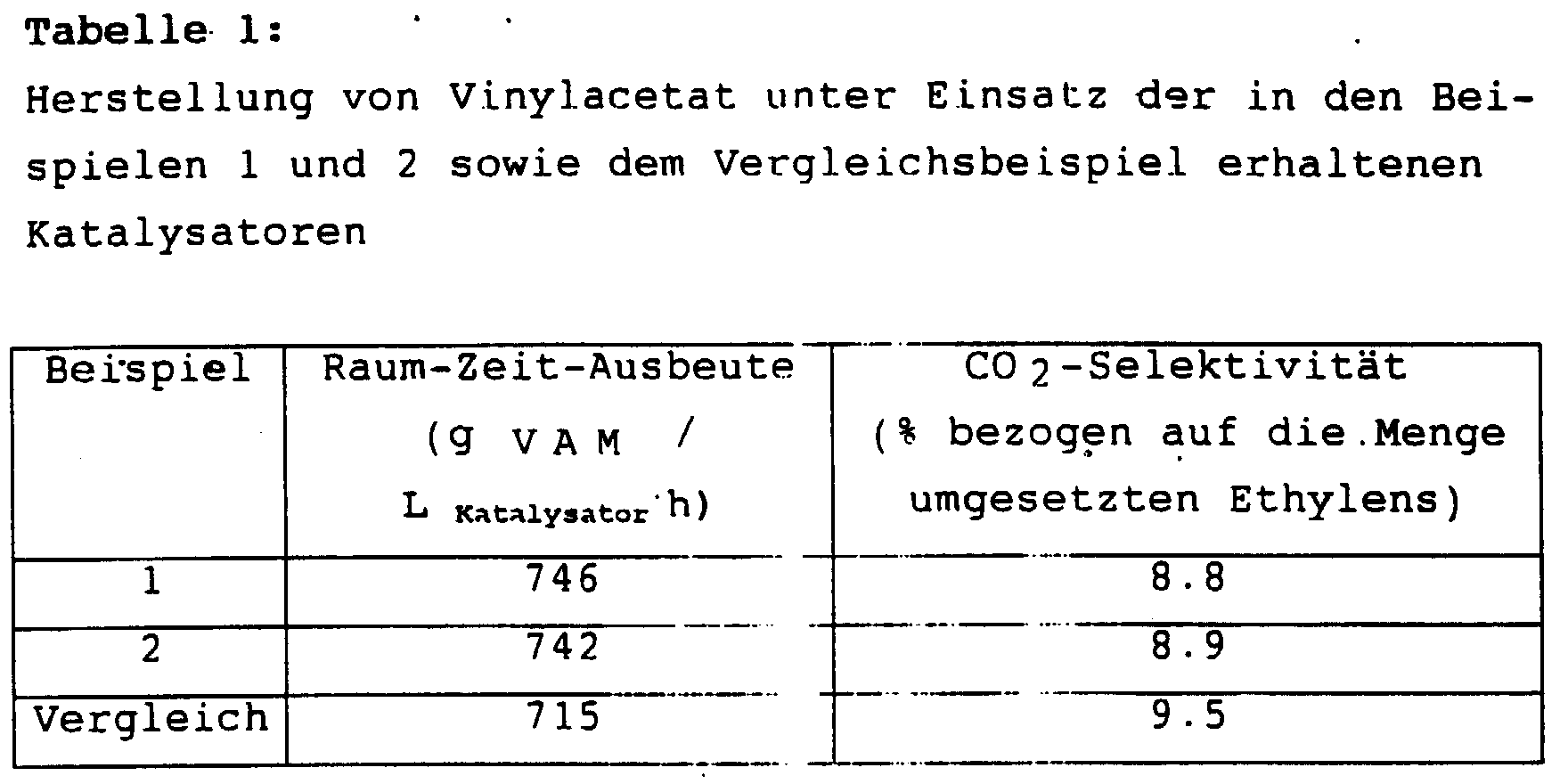
- the catalysts prepared in Examples 1 and 2 and the comparative example are used in a Berty reactor for the production of vinyl acetate in the gas phase from gases containing ethylene, acetic acid and oxygen.
- the test results are summarized in Table 1 below.
Landscapes
- Chemical & Material Sciences (AREA)
- Organic Chemistry (AREA)
- Engineering & Computer Science (AREA)
- Chemical Kinetics & Catalysis (AREA)
- Materials Engineering (AREA)
- Physics & Mathematics (AREA)
- Health & Medical Sciences (AREA)
- Toxicology (AREA)
- Plasma & Fusion (AREA)
- Optics & Photonics (AREA)
- Electromagnetism (AREA)
- Organic Low-Molecular-Weight Compounds And Preparation Thereof (AREA)
- Catalysts (AREA)
- Low-Molecular Organic Synthesis Reactions Using Catalysts (AREA)
- Physical Or Chemical Processes And Apparatus (AREA)
Abstract
Description
Besonders geeignet sind Träger der vorgenannten Art mit einer spezifischen Oberfläche von 50 bis 400 m2/g (gemessen nach der BET-Methode) und einem mittleren Porenradius von 50 bis 2000 Å (gemessen mittels der Quecksilber-Porosimetrie).
Die Versuchsergebnisse sind nachfolgend in Tabelle 1 zusammengefaßt.
Claims (12)
- Verfahren zur Herstellung eines Katalysators zur Produktion von Vinylacetat in der Gasphase aus Ethylen, Essigsäure und Sauerstoff oder Sauerstoff enthaltenden Gasen, der Palladium und/oder dessen Verbindungen, Gold und/oder dessen Verbindungen sowie Alkalimetallverbindungen auf einem teilchenförmigen, porösen Träger enthält, wobei der Katalysator hergestellt wird, indem mandadurch gekennzeichnet, daß der Katalysator vor, während oder nach einem der Verfahrensschritte a) bis e) mit Mikrowellen bestrahlt wird.a) den Träger mit löslichen Palladium- und Goldverbindungen imprägniert,b) die löslichen Palladium- und Goldverbindungen durch Zugabe einer alkalisch reagierenden Lösung auf dem Träger in unlösliche Palladium- und Goldverbindungen überführt,c) die unlöslichen Palladium- und Goldverbindungen auf dem Träger durch ein Reduktionsmittel in flüssiger oder gasförmiger Phase reduziert,d) den Träger mit mindestens einer löslichen Alkalimetallverbindung imprägniert unde) den Träger abschließend bei höchstens 150°C trocknet,
- Verfahren nach Anspruch 1, dadurch gekennzeichnet, daß die Bestrahlung des Katalysators bei einer Strahlungsfrequenz von 300 MHz bis 30 GHz, bevorzugt 2.45 GHz, und einer Strahlungsleistung von 10 bis 2000 W, bevorzugt 180-900 W, insbesondere 300-600 W, sowie eine Bestrahlungsdauer von bis zu 10 h, bevorzugt 1-60 min, insbesondere 5-15 min, erfolgt.
- Verfahren nach Anspruch 1 oder 2, dadurch gekennzeichnet, daß der Katalysatorträger vor dem Imprägnierungschritt a) der Mikrowellenbestrahlung ausgesetzt wird.
- Verfahren nach Anspruch 1 oder 2, dadurch gekennzeichnet, daß der Katalysator nach dem Imprägnierungsschritt a) und vor dem Fixierungsschritt b) mit den Mikrowellen bestrahlt wird.
- Verfahren nach Anspruch 1 oder 2, dadurch gekennzeichnet, daß die Mikrowellenbestrahlung während des Reduktionschrittes c) erfolgt, vorzugsweise dann, wenn die Reduktion in der Gasphase durchgeführt wird.
- Verfahren nach Anspruch 1 oder 2, dadurch gekennzeichnet, daß der Katalysator im Anschluß an Schritt e) mit Mikrowellen bestrahlt wird.
- Verfahren nach Anspruch 1, dadurch gekennzeichnet, daß in Schritt c) die unlöslichen Palladium- und Gold-verbindungen auf dem Träger entweder in flüssiger Phase bei einer Temperatur von 0-90°C, vorzugsweise 15-25°C, mit Hydrazin, Ameisensäure oder einem Alkaliborhydrid, bevorzugt Natriumborhydrid, als Reduktionsmittel behandelt werden oder aber in der Gasphase bei einer Temperatur von 40 - 260 °C, vorzugsweise 70 - 200 °C mit Wasserstoff, Ethylen, Propylen, Isobutylen, Butylen als Reduktionsmittel.
- Verfahren nach Anspruch 1, dadurch gekennzeichnet, daß der Träger Schritt d) mit einer wäßrigen Lösung einer Alkalimetallverbindung, vorzugsweise einem Alkalimetallcarboxylat, insbesondere Kaliumacetat, imprägniert wird.
- Katalysator zur Herstellung von Vinylacetat in der Gasphase aus Ethylen, Essigsäure und Sauerstoff oder Sauerstoff enthaltenden Gasen, der Palladium und/oder dessen Verbindungen, Gold und/oder dessen Verbindungen sowie Alkalimetallverbindungen auf einem teilchenförmigen, porösen Träger enthält und nach dem Verfahren gemäß einem oder mehreren der Ansprüche 1-8 erhältlich ist.
- Katalysator nach Anspruch 9, dadurch gekennzeichnet, daß er, bezogen auf die Gesamtmasse des Katalysators, 0.2 - 2.5 Gew%, vorzugsweise 0.6 - 1.5 Gew%, Palladium, 0.2 - 2.5 Gew%, vorzugsweise 0.3 - 1.0 Gew%, Gold, 0.1 - 10 Gew% Alkalimetall, vorzugsweise 1.0 - 4.0 Gew% Alkalimetall, insbesondere Kalium, enthält.
- Verfahren zur Herstellung von Vinylacetat in der Gasphase aus Ethylen, Essigsäure und Sauerstoff und/oder Sauerstoff enthaltenden Gasen in Gegenwart des Katalysators nach Anspruch 9 oder 10.
- Verfahren nach Anspruch 11, dadurch gekennzeichnet, daß es bei Temperaturen von 100 bis 220 °C, vorzugsweise 120 bis 200 °C, und Drücken von 0,1 bis 2,5 MPa, vorzugsweise 0,1 bis 2 MPa, durchgeführt wird.
Applications Claiming Priority (2)
| Application Number | Priority Date | Filing Date | Title |
|---|---|---|---|
| DE19754992A DE19754992C2 (de) | 1997-12-11 | 1997-12-11 | Katalysator, Verfahren zur Herstellung des Katalysators und Verfahren zur Herstellung von Vinylacetat unter Einsatz des Katalysators |
| DE19754992 | 1997-12-11 |
Publications (3)
| Publication Number | Publication Date |
|---|---|
| EP0922491A2 true EP0922491A2 (de) | 1999-06-16 |
| EP0922491A3 EP0922491A3 (de) | 2000-03-29 |
| EP0922491B1 EP0922491B1 (de) | 2005-12-28 |
Family
ID=7851508
Family Applications (1)
| Application Number | Title | Priority Date | Filing Date |
|---|---|---|---|
| EP98122922A Expired - Lifetime EP0922491B1 (de) | 1997-12-11 | 1998-12-02 | Katalysator auf der Basis von Pd, Au und Alkalimetall(e), seine Herstellung und seine Verwendung in der Herstellung von Vinylacetat |
Country Status (24)
| Country | Link |
|---|---|
| US (2) | US5968860A (de) |
| EP (1) | EP0922491B1 (de) |
| JP (1) | JP4116170B2 (de) |
| KR (1) | KR100617886B1 (de) |
| CN (1) | CN1101731C (de) |
| AR (1) | AR013796A1 (de) |
| AT (1) | ATE314142T1 (de) |
| AU (1) | AU9705298A (de) |
| BR (1) | BR9805322A (de) |
| CA (1) | CA2255326C (de) |
| CZ (1) | CZ294655B6 (de) |
| DE (2) | DE19754992C2 (de) |
| DK (1) | DK0922491T3 (de) |
| ES (1) | ES2255125T3 (de) |
| HU (1) | HUP9802833A3 (de) |
| ID (1) | ID21457A (de) |
| MY (1) | MY117157A (de) |
| NO (1) | NO985784L (de) |
| NZ (1) | NZ333248A (de) |
| PL (1) | PL330213A1 (de) |
| SG (1) | SG75903A1 (de) |
| TR (1) | TR199802558A2 (de) |
| TW (1) | TW474914B (de) |
| ZA (1) | ZA9811282B (de) |
Cited By (2)
| Publication number | Priority date | Publication date | Assignee | Title |
|---|---|---|---|---|
| WO2001036092A1 (en) * | 1999-11-17 | 2001-05-25 | Celanese International Corporation | Vinyl acetate catalyst comprising metallic palladium and gold and prepared utilizing sonication |
| EP1205246A1 (de) * | 2000-11-09 | 2002-05-15 | Dairen Chemical Corporation | Verfahren zur Herstellung von Katalysatoren und ihre Verwendung für die Bereitung von Alkenylacetaten |
Families Citing this family (18)
| Publication number | Priority date | Publication date | Assignee | Title |
|---|---|---|---|---|
| DE19828491A1 (de) * | 1998-06-26 | 1999-12-30 | Degussa | Formkörper auf Basis von Siliciumdioxid |
| DE19843693A1 (de) * | 1998-09-24 | 2000-03-30 | Degussa | Trägerkatalysator für die Produktion von Vinylacetatmonomer |
| CN1101729C (zh) * | 1999-11-10 | 2003-02-19 | 大连化学工业股份有限公司 | 氧酰化反应用催化剂和其制备方法及其应用 |
| WO2001036091A1 (en) * | 1999-11-17 | 2001-05-25 | Celanese International Corporation | Vinyl acetate catalyst comprising metallic palladium and gold and prepared utilizing sonication |
| US6420308B1 (en) * | 2000-07-07 | 2002-07-16 | Saudi Basic Industries Corp | Highly selective shell impregnated catalyst of improved space time yield for production of vinyl acetate |
| US6794332B2 (en) * | 2000-07-07 | 2004-09-21 | Saudi Basic Industries Corporation | Highly selective shell impregnated catalyst of improved space time yield for production of vinyl acetate |
| US7425647B2 (en) * | 2001-03-30 | 2008-09-16 | Shell Oil Company | Process for preparing a group V111-metal containing catalyst, use thereof for preparing an alkenyl carboxylate |
| JP4421201B2 (ja) * | 2002-03-27 | 2010-02-24 | シエル・インターナシヨナル・リサーチ・マートスハツペイ・ベー・ヴエー | 触媒を調製する方法、触媒、および触媒の使用 |
| US6936568B2 (en) | 2002-06-12 | 2005-08-30 | Sud-Chemie Inc. | Selective hydrogenation catalyst |
| TW201236755A (en) | 2003-12-19 | 2012-09-16 | Celanese Int Corp | Halide free precursors for catalysts |
| ZA200704864B (en) | 2004-12-20 | 2008-08-27 | Celanese Int Corp | Modified support materials for catalysts |
| US8227369B2 (en) * | 2005-05-25 | 2012-07-24 | Celanese International Corp. | Layered composition and processes for preparing and using the composition |
| CN100551523C (zh) * | 2005-10-28 | 2009-10-21 | 厦门大学 | 一种金属氧化物负载的贵金属催化剂制备方法 |
| BRPI0920995B1 (pt) | 2008-11-26 | 2018-03-13 | China Petroleum & Chemical Corporation | Catalisador de metal carregado e método de preparação do mesmo. |
| CN102247838B (zh) * | 2010-05-21 | 2013-03-27 | 中国石油化工股份有限公司 | 具有特定红外吸收特征的负载型钯催化剂 |
| JP6392218B2 (ja) | 2012-07-02 | 2018-09-19 | ビーエーエスエフ コーポレーション | 酢酸ビニルモノマーの製造のための方法及び複合触媒 |
| WO2021252452A1 (en) | 2020-06-11 | 2021-12-16 | Celanese International Corporation | Methods of producing catalysts for vinyl acetate production |
| CN116550383B (zh) * | 2023-07-12 | 2023-10-31 | 中国天辰工程有限公司 | 一种不饱和醋酸酯及其催化剂的制备方法 |
Family Cites Families (6)
| Publication number | Priority date | Publication date | Assignee | Title |
|---|---|---|---|---|
| US3627821A (en) * | 1967-12-23 | 1971-12-14 | Knapsack Ag | Process for the manufacture of unsaturated esters of carboxylic acids |
| EP0519824A1 (de) * | 1991-06-19 | 1992-12-23 | Georges Roussy | Verfahren zur katalytischen Kohlenwasserstoffreformierung mit Mikrowellen |
| FR2677898B1 (fr) * | 1991-06-19 | 1994-10-07 | Georges Roussy | Procede de fabrication des catalyseurs metalliques deposes sur supports d'oxydes. |
| DE4120492A1 (de) * | 1991-06-21 | 1992-12-24 | Hoechst Ag | Verfahren zur herstellung von vinylacetat |
| US5332710A (en) * | 1992-10-14 | 1994-07-26 | Hoechst Celanese Corporation | Vinyl acetate catalyst preparation method |
| DE19613791C2 (de) * | 1996-04-04 | 2002-01-31 | Celanese Chem Europe Gmbh | Katalysator, Verfahren zu seiner Herstellung und Verfahren zur Herstellung von Vinylacetat |
-
1997
- 1997-12-11 DE DE19754992A patent/DE19754992C2/de not_active Expired - Fee Related
-
1998
- 1998-11-26 ID IDP981544A patent/ID21457A/id unknown
- 1998-12-02 DE DE59813314T patent/DE59813314D1/de not_active Expired - Lifetime
- 1998-12-02 EP EP98122922A patent/EP0922491B1/de not_active Expired - Lifetime
- 1998-12-02 AT AT98122922T patent/ATE314142T1/de active
- 1998-12-02 ES ES98122922T patent/ES2255125T3/es not_active Expired - Lifetime
- 1998-12-02 DK DK98122922T patent/DK0922491T3/da active
- 1998-12-02 US US09/203,688 patent/US5968860A/en not_active Expired - Lifetime
- 1998-12-07 HU HU9802833A patent/HUP9802833A3/hu unknown
- 1998-12-09 TR TR1998/02558A patent/TR199802558A2/xx unknown
- 1998-12-09 ZA ZA9811282A patent/ZA9811282B/xx unknown
- 1998-12-09 NZ NZ333248A patent/NZ333248A/xx unknown
- 1998-12-09 SG SG1998005393A patent/SG75903A1/en unknown
- 1998-12-09 CZ CZ19984049A patent/CZ294655B6/cs not_active IP Right Cessation
- 1998-12-09 JP JP35032298A patent/JP4116170B2/ja not_active Expired - Fee Related
- 1998-12-09 CA CA002255326A patent/CA2255326C/en not_active Expired - Fee Related
- 1998-12-09 TW TW087120392A patent/TW474914B/zh not_active IP Right Cessation
- 1998-12-09 AR ARP980106251A patent/AR013796A1/es unknown
- 1998-12-10 NO NO985784A patent/NO985784L/no not_active Application Discontinuation
- 1998-12-10 CN CN98123287A patent/CN1101731C/zh not_active Expired - Fee Related
- 1998-12-10 AU AU97052/98A patent/AU9705298A/en not_active Abandoned
- 1998-12-10 PL PL98330213A patent/PL330213A1/xx unknown
- 1998-12-10 KR KR1019980054067A patent/KR100617886B1/ko not_active Expired - Fee Related
- 1998-12-10 MY MYPI98005583A patent/MY117157A/en unknown
- 1998-12-10 BR BR9805322-1A patent/BR9805322A/pt not_active Application Discontinuation
-
1999
- 1999-06-02 US US09/324,819 patent/US6114573A/en not_active Expired - Lifetime
Cited By (3)
| Publication number | Priority date | Publication date | Assignee | Title |
|---|---|---|---|---|
| WO2001036092A1 (en) * | 1999-11-17 | 2001-05-25 | Celanese International Corporation | Vinyl acetate catalyst comprising metallic palladium and gold and prepared utilizing sonication |
| EP1205246A1 (de) * | 2000-11-09 | 2002-05-15 | Dairen Chemical Corporation | Verfahren zur Herstellung von Katalysatoren und ihre Verwendung für die Bereitung von Alkenylacetaten |
| EP1792652A1 (de) * | 2000-11-09 | 2007-06-06 | Dairen Chemical Corporation | Herstellungsverfahren für einen Katalysator |
Also Published As
Similar Documents
| Publication | Publication Date | Title |
|---|---|---|
| EP0922491B1 (de) | Katalysator auf der Basis von Pd, Au und Alkalimetall(e), seine Herstellung und seine Verwendung in der Herstellung von Vinylacetat | |
| DE19613791C2 (de) | Katalysator, Verfahren zu seiner Herstellung und Verfahren zur Herstellung von Vinylacetat | |
| EP1189694B1 (de) | Katalysatoren für die gasphasenoxidation von ethylen und essigsäure zu vinylacetat, verfahren zu ihrer herstellung und ihre verwendung | |
| EP1198291B1 (de) | Katalysator und verfahren zur herstellung von vinylacetat | |
| EP0330853B1 (de) | Verfahren zur Herstellung von Vinylacetat | |
| EP0634209B1 (de) | Katalysator, Verfahren zu dessen Herstellung, sowie dessen Verwendung zur Herstellung von Vinylacetat | |
| EP0634208B1 (de) | Trägerkatalysator, Verfahren zu dessen Herstellung, sowie dessen Verwendung zur Herstellung von Vinylacetat | |
| EP0922490B1 (de) | Katalysator, Verfahren zur Herstellung des Katalysators und Verfahren zur Herstellung von Vinylacetat unter Einsatz des Katalysators | |
| DE69618635T2 (de) | Katalysator zur herstellung von vinylazetat | |
| DE69912585T2 (de) | Verfahren zur herstellung eines katalysators für die bereitung von vinylacetat | |
| DE19755023C2 (de) | Katalysator und Verfahren zur Herstellung von Vinylacetat | |
| DE69702313T2 (de) | Verfahren zur zweistufigen goldauftragung für die herstellung eines katalysators für die herstellung von vinylacetat | |
| EP0431478B1 (de) | Verfahren zur Herstellung von Vinylacetat | |
| EP0403950B1 (de) | Verfahren zur Herstellung von Vinylacetat | |
| EP1102635B1 (de) | Verfahren zur herstellung von trägerkatalysatoren sowie deren verwendung für die herstellung von vinylacetatmonomer | |
| DE10030039A1 (de) | Katalysator zur Herstellung von Vinylacetat und Verfahren zur Herstellung des Katalysators | |
| EP0871604B1 (de) | Katalysator und verfahren zur herstellung von vinylacetat | |
| DE19755022C2 (de) | Katalysator und Verfahren zur Herstellung von Vinylacetat |
Legal Events
| Date | Code | Title | Description |
|---|---|---|---|
| PUAI | Public reference made under article 153(3) epc to a published international application that has entered the european phase |
Free format text: ORIGINAL CODE: 0009012 |
|
| AK | Designated contracting states |
Kind code of ref document: A2 Designated state(s): AT BE CH DE DK ES FR GB IT LI NL SE |
|
| AX | Request for extension of the european patent |
Free format text: AL;LT;LV;MK;RO;SI |
|
| RAP1 | Party data changed (applicant data changed or rights of an application transferred) |
Owner name: CELANESE CHEMICALS EUROPE GMBH |
|
| PUAL | Search report despatched |
Free format text: ORIGINAL CODE: 0009013 |
|
| AK | Designated contracting states |
Kind code of ref document: A3 Designated state(s): AT BE CH CY DE DK ES FI FR GB GR IE IT LI LU MC NL PT SE |
|
| AX | Request for extension of the european patent |
Free format text: AL;LT;LV;MK;RO;SI |
|
| 17P | Request for examination filed |
Effective date: 20000929 |
|
| AKX | Designation fees paid |
Free format text: AT BE CH DE DK ES FR GB IT LI NL SE |
|
| 17Q | First examination report despatched |
Effective date: 20020514 |
|
| GRAP | Despatch of communication of intention to grant a patent |
Free format text: ORIGINAL CODE: EPIDOSNIGR1 |
|
| GRAS | Grant fee paid |
Free format text: ORIGINAL CODE: EPIDOSNIGR3 |
|
| GRAA | (expected) grant |
Free format text: ORIGINAL CODE: 0009210 |
|
| AK | Designated contracting states |
Kind code of ref document: B1 Designated state(s): AT BE CH DE DK ES FR GB IT LI NL SE |
|
| PG25 | Lapsed in a contracting state [announced via postgrant information from national office to epo] |
Ref country code: IT Free format text: LAPSE BECAUSE OF FAILURE TO SUBMIT A TRANSLATION OF THE DESCRIPTION OR TO PAY THE FEE WITHIN THE PRE;WARNING: LAPSES OF ITALIAN PATENTS WITH EFFECTIVE DATE BEFORE 2007 MAY HAVE OCCURRED AT ANY TIME BEFORE 2007. THE CORRECT EFFECTIVE DATE MAY BE DIFFERENT FROM THE ONE RECORDED.SCRIBED TIME-LIMIT Effective date: 20051228 |
|
| REG | Reference to a national code |
Ref country code: GB Ref legal event code: FG4D Free format text: NOT ENGLISH |
|
| REG | Reference to a national code |
Ref country code: CH Ref legal event code: EP |
|
| REG | Reference to a national code |
Ref country code: SE Ref legal event code: TRGR |
|
| REG | Reference to a national code |
Ref country code: CH Ref legal event code: NV Representative=s name: BOVARD AG PATENTANWAELTE |
|
| REF | Corresponds to: |
Ref document number: 59813314 Country of ref document: DE Date of ref document: 20060202 Kind code of ref document: P |
|
| REG | Reference to a national code |
Ref country code: DK Ref legal event code: T3 |
|
| GBT | Gb: translation of ep patent filed (gb section 77(6)(a)/1977) |
Effective date: 20060322 |
|
| REG | Reference to a national code |
Ref country code: ES Ref legal event code: FG2A Ref document number: 2255125 Country of ref document: ES Kind code of ref document: T3 |
|
| ET | Fr: translation filed | ||
| PLBE | No opposition filed within time limit |
Free format text: ORIGINAL CODE: 0009261 |
|
| STAA | Information on the status of an ep patent application or granted ep patent |
Free format text: STATUS: NO OPPOSITION FILED WITHIN TIME LIMIT |
|
| 26N | No opposition filed |
Effective date: 20060929 |
|
| PGRI | Patent reinstated in contracting state [announced from national office to epo] |
Ref country code: IT Effective date: 20091201 |
|
| REG | Reference to a national code |
Ref country code: CH Ref legal event code: PFA Owner name: CELANESE CHEMICALS EUROPE GMBH Free format text: CELANESE CHEMICALS EUROPE GMBH#LURGIALLEE 14#60439 FRANKFURT AM MAIN (DE) -TRANSFER TO- CELANESE CHEMICALS EUROPE GMBH#LURGIALLEE 14#60439 FRANKFURT AM MAIN (DE) |
|
| PGFP | Annual fee paid to national office [announced via postgrant information from national office to epo] |
Ref country code: DK Payment date: 20121211 Year of fee payment: 15 |
|
| PGFP | Annual fee paid to national office [announced via postgrant information from national office to epo] |
Ref country code: CH Payment date: 20121213 Year of fee payment: 15 Ref country code: DE Payment date: 20121128 Year of fee payment: 15 |
|
| PGFP | Annual fee paid to national office [announced via postgrant information from national office to epo] |
Ref country code: GB Payment date: 20121128 Year of fee payment: 15 Ref country code: IT Payment date: 20121220 Year of fee payment: 15 Ref country code: SE Payment date: 20121217 Year of fee payment: 15 Ref country code: ES Payment date: 20121227 Year of fee payment: 15 |
|
| PGFP | Annual fee paid to national office [announced via postgrant information from national office to epo] |
Ref country code: NL Payment date: 20121208 Year of fee payment: 15 Ref country code: AT Payment date: 20121127 Year of fee payment: 15 Ref country code: FR Payment date: 20130107 Year of fee payment: 15 |
|
| PGFP | Annual fee paid to national office [announced via postgrant information from national office to epo] |
Ref country code: BE Payment date: 20121217 Year of fee payment: 15 |
|
| BERE | Be: lapsed |
Owner name: *CELANESE CHEMICALS EUROPE G.M.B.H. Effective date: 20131231 |
|
| REG | Reference to a national code |
Ref country code: DE Ref legal event code: R119 Ref document number: 59813314 Country of ref document: DE |
|
| REG | Reference to a national code |
Ref country code: DK Ref legal event code: EBP Effective date: 20131231 |
|
| REG | Reference to a national code |
Ref country code: NL Ref legal event code: V1 Effective date: 20140701 |
|
| REG | Reference to a national code |
Ref country code: SE Ref legal event code: EUG |
|
| REG | Reference to a national code |
Ref country code: CH Ref legal event code: PL |
|
| REG | Reference to a national code |
Ref country code: AT Ref legal event code: MM01 Ref document number: 314142 Country of ref document: AT Kind code of ref document: T Effective date: 20131202 |
|
| GBPC | Gb: european patent ceased through non-payment of renewal fee |
Effective date: 20131202 |
|
| PG25 | Lapsed in a contracting state [announced via postgrant information from national office to epo] |
Ref country code: SE Free format text: LAPSE BECAUSE OF NON-PAYMENT OF DUE FEES Effective date: 20131203 |
|
| REG | Reference to a national code |
Ref country code: DE Ref legal event code: R119 Ref document number: 59813314 Country of ref document: DE Effective date: 20140701 |
|
| REG | Reference to a national code |
Ref country code: FR Ref legal event code: ST Effective date: 20140829 |
|
| PG25 | Lapsed in a contracting state [announced via postgrant information from national office to epo] |
Ref country code: BE Free format text: LAPSE BECAUSE OF NON-PAYMENT OF DUE FEES Effective date: 20131231 Ref country code: NL Free format text: LAPSE BECAUSE OF NON-PAYMENT OF DUE FEES Effective date: 20140701 Ref country code: LI Free format text: LAPSE BECAUSE OF NON-PAYMENT OF DUE FEES Effective date: 20131231 Ref country code: DE Free format text: LAPSE BECAUSE OF NON-PAYMENT OF DUE FEES Effective date: 20140701 Ref country code: CH Free format text: LAPSE BECAUSE OF NON-PAYMENT OF DUE FEES Effective date: 20131231 |
|
| PG25 | Lapsed in a contracting state [announced via postgrant information from national office to epo] |
Ref country code: AT Free format text: LAPSE BECAUSE OF NON-PAYMENT OF DUE FEES Effective date: 20131202 Ref country code: FR Free format text: LAPSE BECAUSE OF NON-PAYMENT OF DUE FEES Effective date: 20131231 Ref country code: GB Free format text: LAPSE BECAUSE OF NON-PAYMENT OF DUE FEES Effective date: 20131202 |
|
| PG25 | Lapsed in a contracting state [announced via postgrant information from national office to epo] |
Ref country code: DK Free format text: LAPSE BECAUSE OF NON-PAYMENT OF DUE FEES Effective date: 20131231 |
|
| REG | Reference to a national code |
Ref country code: ES Ref legal event code: FD2A Effective date: 20150327 |
|
| PG25 | Lapsed in a contracting state [announced via postgrant information from national office to epo] |
Ref country code: ES Free format text: LAPSE BECAUSE OF NON-PAYMENT OF DUE FEES Effective date: 20131203 |
|
| PG25 | Lapsed in a contracting state [announced via postgrant information from national office to epo] |
Ref country code: IT Free format text: LAPSE BECAUSE OF FAILURE TO SUBMIT A TRANSLATION OF THE DESCRIPTION OR TO PAY THE FEE WITHIN THE PRESCRIBED TIME-LIMIT Effective date: 20131231 |
|
| PG25 | Lapsed in a contracting state [announced via postgrant information from national office to epo] |
Ref country code: IT Free format text: LAPSE BECAUSE OF FAILURE TO SUBMIT A TRANSLATION OF THE DESCRIPTION OR TO PAY THE FEE WITHIN THE PRESCRIBED TIME-LIMIT Effective date: 20131202 |