EP0911802B1 - Apparatus and method for generating arpeggio notes - Google Patents
Apparatus and method for generating arpeggio notes Download PDFInfo
- Publication number
- EP0911802B1 EP0911802B1 EP98119760A EP98119760A EP0911802B1 EP 0911802 B1 EP0911802 B1 EP 0911802B1 EP 98119760 A EP98119760 A EP 98119760A EP 98119760 A EP98119760 A EP 98119760A EP 0911802 B1 EP0911802 B1 EP 0911802B1
- Authority
- EP
- European Patent Office
- Prior art keywords
- arpeggio
- pattern
- notes
- note
- patterns
- Prior art date
- Legal status (The legal status is an assumption and is not a legal conclusion. Google has not performed a legal analysis and makes no representation as to the accuracy of the status listed.)
- Expired - Lifetime
Links
Images

Classifications
-
- G—PHYSICS
- G10—MUSICAL INSTRUMENTS; ACOUSTICS
- G10H—ELECTROPHONIC MUSICAL INSTRUMENTS; INSTRUMENTS IN WHICH THE TONES ARE GENERATED BY ELECTROMECHANICAL MEANS OR ELECTRONIC GENERATORS, OR IN WHICH THE TONES ARE SYNTHESISED FROM A DATA STORE
- G10H1/00—Details of electrophonic musical instruments
- G10H1/18—Selecting circuits
- G10H1/26—Selecting circuits for automatically producing a series of tones
- G10H1/28—Selecting circuits for automatically producing a series of tones to produce arpeggios
Definitions
- the present invention relates to an arpeggio performing apparatus and method which automatically conducts arpeggio performance using the notes as determined based on the note pitch information inputted from the keyboard or the like devices and on the arpeggio pattern defining the sounding timings, etc. of the notes to constitute an arpeggio (broken chord) performance, and relates further to a computer readable medium containing program instructions for operating the computer system to realize and control arpeggio performances.
- Such a type of instrument comprises, for example, stored data sets defining a plurality of arpeggio patterns and associated data processors, and operates in such a way that the user selects a desired arpeggio pattern and depresses a key or keys in the predetermined region in the keyboard to designate a tonality key and a mode for arpeggio performance, then a plurality of note numbers are created in accordance with the selected arpeggio pattern based on the depressed key(s), and notes identified by such note numbers are sounded sequentially in the predetermined order.
- a complicated arpeggio performance will be realized, without playing an arpeggio fingering on the keyboard.
- An arpeggio pattern is stored in the form of a data set which defines the note sounding timing, the note length (duration), the tone volume, the octave shift amount, etc. for each of the arpeggio constituting notes.
- the data set may be preset in the instrument, or may be set by the user, and any desired one will be selected for use from among a plurality of such patterns.
- the object is accomplished by providing an apparatus or a method for generating arpeggio notes, or a computer readable medium containing program instructions executable by a computer system to configure such an apparatus, which stores a plurality of arpeggio patterns each of which defines at least generation timings of the notes to constitute an arpeggio performance, permits the user to select at least two arpeggio patterns from among the stored arpeggio patterns and also to input note pitch information which designates pitches of arpeggio constituent notes, and generates notes for arpeggio performance based on the selected arpeggio patterns and the inputted note pitch information.
- the object is also accomplished by providing an apparatus or a method for generating arpeggio notes, or a computer readable medium containing program instructions executable by a computer system to configure such an apparatus, which stores at least one arpeggio pattern each of which defines at least generation timings of the notes to constitute an arpeggio performance, further stores a plurality of groove patterns each of which includes modification data defining at least one modification amount by which at least the timing of note generation is to be modified, permits the user to select at least one arpeggio pattern and at least one groove pattern from among the stored patterns, modifies the selected arpeggio pattern using the selected groove pattern to make a modified arpeggio pattern, permits the user to input note pitch information which designates pitches of arpeggio constituent notes, and generates notes for arpeggio performance based on the modified arpeggio pattern and the inputted note pitch information.
- an apparatus for generating arpeggio notes comprises: a note pitch input device inputting note pitch information which designates pitches of arpeggio constituent notes; an arpeggio pattern storage device storing a plurality of arpeggio patterns each of which defines at least generation timings of the arpeggio constituent notes; an arpeggio pattern selection device for selecting at least two arpeggio patterns from the arpeggio pattern storage device; and a tone generator device for generating a plurality of notes for arpeggio performance based on the inputted note pitch information and the selected at least two arpeggio patterns.
- the arpeggio performance according to at least two arpeggio patterns simultaneously will enhance a variety in the arpeggio performance.
- an apparatus for generating arpeggio notes comprises: a note pitch input device inputting note pitch information which designates pitches of arpeggio constituent notes; an arpeggio pattern storage device storing at least one arpeggio pattern each of which defines at least generation timings of the arpeggio constituent notes; a groove pattern storage device storing a plurality of groove patterns each of which includes modification data defining at least one modification amount by which at least the timing of note generation is to be modified; a groove pattern selection device for selecting at least one groove pattern from the groove pattern storage device; an arpeggio pattern modification device for modifying at least the timing of note generation of the arpeggio pattern stored in the arpeggio pattern storage device using the modification data in the selected at least one groove pattern; and a tone generator device for generating a plurality of notes for arpeggio performance based on the inputted note pitch information and the modified at least one arpeggio pattern.
- the arpeggio performance according to the timing-modified arpeggio pattern will provide a rhythm
- an apparatus for generating arpeggio notes comprises: a note pitch input device inputting note pitch information which designates pitches of arpeggio constituent notes; an arpeggio pattern storage device storing at least one arpeggio patterns each of which defines at least generation timings and a tone color of the arpeggio constituent notes; and a tone generator device for generating a plurality of notes for arpeggio performance based on the inputted note pitch information and at the timings and in a tone color defined by the stored at least one arpeggio pattern.
- the arpeggio patterns can be prepared such that each arpeggio pattern is given a unique tone color, and thus the arpeggio performance will be more pleasing in terms of tone color of the generated notes. When plural arpeggio patterns are used simultancously, each pattern can be recognized independently by means of differences in tone color.
- an apparatus for generating arpeggio notes comprises: a note pitch input device inputting note pitch information which designates pitches of arpeggio constituent notes; an arpeggio pattern storage device storing track arpeggio patterns including a plurality of track data set each of which defines at least generation timings and a tone color of the arpeggio constituent notes; and a tone generator device for generating a plurality of notes for arpeggio performance based on the inputted note pitch information and at the timings and in a tone color defined by the stored track arpeggio patterns.
- the track data architecture provides concurrent progression of a plurality of arpeggio patterns in parallel, and the user can enjoy even a complicated arpeggio performance with full of variety in adequate tone colors.
- FIG. 1 of the drawings is a general block diagram of an embodiment of an electronic musical instrument incorporating an automatic arpeggio performance apparatus according to the present invention.
- CPU 1 controls the overall operation of the electronic musical instrument according to control programs stored in a ROM 2 and using working areas in a RAM 3.
- the CPU 1 gets note numbers, key-on signals, key-off signals etc. from the keyboard 4 via a key detecting circuit 4a, and conducts note generation processing and note extinction processing by instructing note numbers, velocity signals, note-on signals and note-off signals to a tone generator circuit 5.
- the tone generator circuit 5 generates a tone signal in accordance with the note number, the note-on signal and the velocity signal in a tone color determined by the tone color setting.
- the tone signals generated at the tone generator 5 are imparted with desired various tone effects at an effects circuit 6 and are emitted as audible sounds by a sound system 7.
- the CPU gets a note number signal and a note-off signal, it attenuates or stops the tone generation to extinguish the sounding.
- an arbitrarily demarcated key range in the keyboard can be set by the user to be the arpeggio key range, in which the depressed keys are detected in the form of note numbers (note pitch data), which in turn are used to define the pitches of arpeggio constituent notes.
- the CPU 1 sets the note numbers, the velocity signals, and note-on/note-off signals for the tone generator circuit 5 to generate and extinguish the sounding of the arpeggio performance tones.
- Note numbers detected outside the arpeggio key range are used for the tone generation of notes in accordance with an ordinary keyboard performance.
- the arpeggio key range can be set by appointing a split point in the keyboard 4 to divide the keyboard 4 into two regions and to nominate the lower side therefrom as an arpeggio key range, or by appointing a lower and a higher end to directly nominate the arpeggio key range.
- the CPU 1 also gets input data from various switches 4 arranged in a control panel via a switch detecting circuit 8a, and conducts various processings in accordance with the manipulations of the switches 8, including switching over to the arpeggio performance mode.
- the so-called GUI graphical user interface
- the so-called LCD panel in a display circuit, etc. may also be employed for the user's input manipulation such as selection of arpeggio patterns.
- the CPU 1 also delivers information on input-designated tempo to a timer 10, which generates a tempo clock signal for the designated tempo.
- the CPU 1 conducts interruption processing at each clock signal pulse, and conducts the processing for the arpeggio note generation.
- the tempo clock signal includes 96 clock pulses for the duration of a quarter note and 384 clock pulses for the span of one measure.
- An external storage device 11 may be a hard disk drive, a floppy disk drive, a CD-ROM drive, an optical magnetic disk drive, or else, and may be used for storing and providing various data such as the arpeggio patterns.
- An interface 12 is a communication interface connected to a MIDI device or an external computer, and serves to permit the apparatus communicate with an external MIDI device or an external computer to transmit and receive various data including arpeggio patterns.
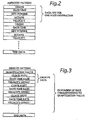
- Fig. 2 shows a data format of an arpeggio pattern used in this embodiment.
- the arpeggio pattern consists of a number of data sets respectively corresponding to the notes constituting the arpeggio performance and "end data" for one measure, in which one data set includes five data pieces, i.e. "timing" data, "gate time” data, "key number” data, “octave” data and “velocity” data for defining the generation of one note.
- the "timing” is data representing a clock value which indicates the starting time point of a tone generation
- the "gate time” is data representing a clock value which indicates the time length from the key-on to the key-off of the tone generation.
- the "key number” is data identifying the pitch of a note to be generated.
- the RAM 3 there are provided registers nominated as the "key numbers”, and into these "key number” registers are stored the note numbers detected in the arpeggio key range such that each note number is allotted to each of "key number” data according to a predetermined rule. And in the arpeggio tone generation processing, the note numbers allotted to the "key numbers” in the arpeggio pattern are read out from the registers and are used to determine the note pitches of the tones for arpeggio performance. These note numbers themselves, however, are not necessarily be the absolute note pitches of the tones to be actually generated, as octave shifts will be introduced individually.
- the "key numbers" are data respectively of values "1" through "4", and each of these values is allotted to a predetermined data set for one of tone generations according to the pitch travel pattern for the arpeggio.
- the allotment rule in this embodiment is that the note numbers detected in the arpeggio key range in the order from the lowest note and upward are successively allotted to the "key numbers" in the order from the lowest value and upward.
- the "octave” is data indicating the amount of octave shift for the note pitch designated by the key depressed in the arpeggio key range. For example, when the note number assigned to the "key number" in a data set for one note is "C3" and if the stored "octave” value is "0", a note is generated in the pitch of C3 itself without an octave shift at the timing of the note C3 generation, whereas if the stored "octave” value is "+1”, a note is generated in the pitch of C4 with an octave shift by the amount of one octave upward at the timing of the note C3 generation.
- the "velocity” is data representing a velocity value for the tone to be generated. This is the data to be used for controlling the tone volume, etc. in the generation of tones, and is so named because it corresponds to the velocity of a key depression in the case of a piano or other touch responsive keyboard musical instruments. While this data is included in the arpeggio pattern as previously provided, but this data may be ignored in tone generation in the case of an electronic musical instrument or an apparatus having a touch responsive keyboard which is capable of detecting the velocity value of each key manipulation, and the velocity values detected at respective key depressions may be used instead.
- timing denotes the timing of tone generation
- gate denotes the gate time
- key denotes the key number
- oct denotes the octave
- vel denotes the velocity.
- the length of the arpeggio pattern in this example is one measure (i.e. 384 clocks), and the notes are generated in the manner depicted in Fig. 7(A) to be explained later.
- the note number C3 (the lowest note among the four) is assigned to the key number 1
- the note number E3 (the second lowest note among the four) is assigned to the key number 2
- the note number G3 to the key number 3
- the note number B3 to the key number 4 (in an ascending order from the lowest).
- this arpeggio pattern is to generate notes determined by the note numbers of the lowest two keys among the depressed keys in the arpeggio key range.
- the note to be generated at the first beat will be C3 without an octave shift.
- the note to be generated at the second beat will be C4, as the "oct" data in the second beat data is "+1”.
- the note to be generated at the third beat will be E3 without an octave shift. But the note to be generated at the fourth beat will be E4, as the "oct" data in the fourth beat data is "+1".
- the note numbers of the keys depressed in the arpeggio key range are referred to by the key numbers, and the notes will be generated based on the note numbers in the arpeggio pattern with or without an octave shift depending on the value of the "oct" data.
- the note numbers of the depressed keys are note pitch information determining the pitches of the arpeggio constituent notes with the help of the octave data.
- An electronic musical instrument of this embodiment further has a grooving faculty for imparting delicate groove sensation (kind of nuance felt in individual player's performances) to the performance data formed by the user, in addition to the function of arpeggio notes generation for automatic arpeggio performance.
- An arpeggio pattern itself is a serial alignment of tone generation timings, and therefore is of a similar format to the ordinary musical performance data. Thus, the arpeggio pattern can be modified to have delicate characteristic feeling by means of the groove function imparting processing.
- the groove function is a function of modifying the "timing" data, the "gate time” data and the "velocity" data among the note generation determining elements in the arpeggio pattern to fit, for instance, the performance style of music (such as swing, beat rock and other musical genres) by the use of groove pattern data as shown in Fig. 3 to make a modified arpeggio pattern.
- the groove function operates in such a way that the arpeggio pattern is first processed by quantization and then the quantized arpeggio pattern is subject to the modification by the groove function.
- the quantization function may be substantially canceled by means of "user-set groove function values" as will be described herein later.
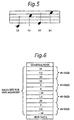
- Fig. 3 shows a data format of a groove pattern used in this embodiment.
- the arpeggio pattern consists of quantization value data, a number of groove data sets and "end data".
- the "quantization value” is data specifying the basic beat interval (temporal resolution) for quantization processing.
- the basic beat interval is expressed in terms of note duration such as a 16th note, an 8th note and a quarter note.
- the groove data sets are prepared in the number corresponding to the quantization value. For example, in the case of a groove pattern for one measure of 4/4 meter, the number of such data sets is sixteen under the quantization value of a 16th note, eight under the quantization value of an 8th note, and four under the quantization value of a quarter note.
- a basic unit for processing quantization in reference to the positions of the resolution beats specified by the "quantization value” is termed a "grid".
- One set of groove data comprises “clock shift” data which represents the amount of shifting the note generation timing before (-) or after (+) in the number of clocks, "gate time rate” data which represents the rate of changing the gate time (duration) of the note in the multiplication factor, and "velocity offset” data which represents the value of increasing (+) or decreasing (-) the velocity value of the note to be generated.
- This embodiment further comprises user-set groove function values (which is set by the user) for adjusting the sensitivity (degree) of the groove effect including quantization.
- These user-set groove function values include a "quantization strength” value which represents the degree of effecting quantization, a “groove timing” value which represents the degree of effecting the clock shift value included in the groove pattern onto the notes to be generated, a “groove gate time” value which represents the degree of effecting the gate time rate in the groove pattern onto the notes to be generated, and a “groove velocity” value which represents the degree of effecting the velocity offset value included in the groove pattern onto the notes to be generated.
- Fig. 6 is a data chart showing an example of the groove pattern used in this embodiment
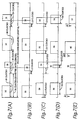
- Figs. 7(A), 7(B), 7(C), 7(D) and 7(E) are time charts of tone generation showing an example of how an original arpeggio pattern will be modified by means of a grooving function in the embodiment.
- the "quantization value” is a "quarter note”
- those "user-set groove function values” as a "quantization strength” value, a "groove timing” value, a “groove gate time” value and a “groove velocity” value are all determined to be "0.5".
- the abscissa is the time axis (in clock time) and the ordinate is the tone volume axis (in velocity value).
- the whole abscissa span covers one measure length of 384 clocks.
- Each of the rectangular blocks above the horizontal axis indicates each of the note generations in which the width represents the note duration in terms of clock time and the height represents the tone volume in terms of velocity value.
- the time chart of Fig. 7(A) represents the original stored arpeggio pattern. The note to be generated at the first (i.e.
- the note at the #1) grid has a timing value of "0" (at the very head of the measure), a gate time value of "48", and a velocity value of "30".
- the note at the second grid has a timing value of "24” indicating the delay of tone generation by 24 clocks from the normal second beat timing, a gate time value of "24” indicating the duration of tone generation for 24 clocks, and a velocity value of "20” indicating the intensity of tone generation in the amount of 20.
- the note at the third grid has a timing value of "0” indicating no delay of tone generation from the normal third beat timing, a gate time value of "48", and a velocity value of "30".
- the note at the fourth grid has a timing value of "24” indicating 24-clock delay of tone generation from the normal fourth beat timing, a gate time value of "24", and a velocity value of "30".
- the quantization strength influences the originally deviated amount of each note generation timing by the factor of "0.5” (i.e. every deviated amount is multiplied by 0.5 to make a new amount of deviation).
- the deviation value is "0" and hence the new amount is also "0". There will be no change in position of these two note generation timing.
- Fig. 7(B) illustrates a resultant arpeggio pattern with modification by the clock shifts (of the above described quantized amount) in the groove pattern from the arpeggio pattern obtained at Fig.
- Fig. 7(B) illustrates a resultant arpeggio pattern with modification by the gate time rate (of the above described quantized amount) in the groove pattern from the arpeggio pattern obtained at Fig. 7(C).
- Fig. 7(E) illustrates a resultant arpeggio pattern with modification by the velocity offset (of the above described quantized amount) in the groove pattern from the arpeggio pattern obtained at Fig. 7(D).
- tN tO + (CS ⁇ GvT)
- gN gO ⁇ ⁇ 1+(GTh-1) x
- GvGT ⁇ vN vO + (VOF ⁇ GvV)
- tN a new timing
- tO an old timing
- CS a clock shift
- GvT a groove timing
- gN a new gate time
- gO an old gate time
- GTR is a gate time rate
- GvGT is a groove gate time
- vN is a new velocity
- vO is an old velocity
- VOF a velocity offset
- GvV is a groove velocity.
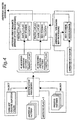
- Fig. 4 illustrates an outline of the conceptual structure and function of the main portion of the embodiment.
- a plurality of arpeggio patterns and a plurality of groove patterns are stored in the ROM 2 or RAM 3.
- a plurality of arpeggio patterns and a plurality of groove patterns will become selectable.
- Each of the arpeggio patterns and the groove patterns is identified from another by an identifier number or the like, which number is to be selected and stored in the RAM 3 for selecting out the intended arpeggio pattern and groove pattern.
- the RAM 3 is provided with a storage area for an arpeggio flag to indicate the state of selection of the arpeggio patterns. In this arpeggio flag is set a value "0" when no arpeggio pattern is selected, a value "1" when one arpeggio pattern is selected, and a value "2" when two arpeggio patterns are selected.
- This embodiment is constructed such that two arpeggio patterns are selectable at a time from among the stored patterns and further that a desired groove pattern can be selected for each selected arpeggio pattern. And each selected arpeggio pattern will be modified in accordance with the inputted user-set groove function values and the selected groove pattern as specifically exemplified above.
- the two modified arpeggio patterns are stored in the RAM 3 respectively as a #1 modified arpeggio pattern and a #2 modified arpeggio pattern.
- the groove patterns may not necessarily be selected it case the groove function is not required.
- the timing values in the respective data set for the first note in Fig.
- timing_1 flag and the tuming_2 flag which are work areas for storing the timing data for the modified arpeggio patterns.
- the timing data values of the first note data set existing in the selected arpeggio pattern are respectively set in those flag areas.
- the note numbers of the depressed keys are assigned to the key numbers as described before
- the interruption processing for arpeggio performance controls the timing_1 flag, the gate_1 flag, the timing_2 flag and the gate_2 flag
- arpeggio notes are generated based on the key numbers and velocity values included in the #1 and #2 modified arpeggio patterns or, in case of no modification by groove patterns, in the #1 and #2 selected arpeggio patterns.
- the arpeggio performances in two kinds of arpeggio patterns are available.
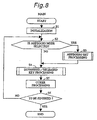
- Fig. 8 is a flowchart showing the main loop of the control program in this embodiment
- Figs. 9(A) through 11(B) are flow charts showing subroutines and interruption processing in this embodiment. Referring these figures, the operation of the embodiment will be described hereinbelow.
- the respective flags used in the control are express as below, in which the same notation means both the flag name and the data content according to the context for the sake of simplicity, unless otherwise intended specifically.
- Step S1 is to initialize the system including setting "0" value in the flags arpeggio, timing_1, timing_2, gate_1, gate_2, time and run.
- Step S2 judges whether the arpeggio mode is being selected. If the arpeggio mode is selected, the process moves forward to step S3 to conduct the arpeggio set processing of Fig. 9 before going to step S4, and if the arpeggio mode is not selected, the process moves directly to step S4 for the depressed/released key processing of Fig. 10. After the processing of step S4, other processing including detection of actuation status of the panel switches 8 and the associated processing in response to the switch actuations at step S5.
- Step S6 is to judge whether an instruction as to finish the operation has been made, for example, by turning of the power switch. If the system is to be finished, the processing will go to an end, and if not, the processing goes back to step S2.
- step S5 detects such actuation and conducts associated processing, and thereafter step S2 judges the selection of the arpeggio mode.
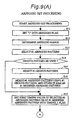
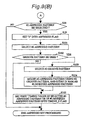
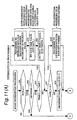
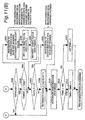
- Figs. 9(A) and 9(B) in combination is a flowchart showing the arpeggio set processing in the embodiment, in which the two figures are connected at the same encircled letter A points with each other.
- step S11 sets "1" into the arpeggio flag
- step S12 determines the arpeggio key range by conducting processing responsive to the user's input manipulation.
- step S13 conducts processing for selecting a first arpeggio pattern in response to the user's input manipulation.
- Step S14 judges whether the user's input instruction requests to use the groove pattern, and in case of "NO", the process goes directly to step S17, while in case of "YES", the process moves forward to step S15 to conduct processing of selecting a first groove pattern.
- Step S16 modifies the #1 arpeggio pattern using the #1 groove pattern and stores the modified arpeggio pattern into the predetermined area in the RAM 3 as a first modified arpeggio pattern before moving to step S17.
- Step S17 sets the first timing value of the selected #1 arpeggio pattern (in case the groove pattern is not used) or of the #1 modified arpeggio pattern (in case the groove pattern is used) into timing_1 flag before moving to step S18.
- Step S18 processing for the user's input manipulation, judges whether the user has selected to use #2 arpeggio pattern, and if the answer is "NO", the processing goes to its end. If the #2 arpeggio pattern is to be selected, step S19 sets "2" into the arpeggio flag, and step S101 processes for the user's input manipulation and conducts processing of selecting #2 arpeggio pattern.
- step S102 judges whether the user's input instruction requests to use the groove pattern, and in case of "NO", the process goes directly to step S105, while in case of "YES", the process moves forward to step S103 to conduct processing of selecting a second groove pattern.
- Step S104 modifies the #2 arpeggio pattern using the #2 groove pattern and stores the modified arpeggio pattern into the predetermined area in the RAM 3 as a second modified arpeggio pattern before moving to step S105.
- Step S105 sets the first timing value of the selected #2 arpeggio pattern (in case the groove pattern is not used) or of the #2 modified arpeggio pattern (in case the groove pattern is used) into timing_2 flag before ending the arpeggio set processing.
- the respective data pieces such as the timing data, the gate time data, key number data, the octave data and the velocity data are read out in sequence using the predetermined data reading pointer which is renewed sequentially. Similar to the above-mentioned setting of the first timing value into the timing_1 or timing_2 flag, after reading out the data (in such a case, timing value) the pointer is set to the next data (in such a case, gate time).
- the #1 and #2 arpeggio patterns can be selected, and further these arpeggio patterns can be modified using desired groove patterns to make a wide variety (not limited to those previously stored in data base) of arpeggio patterns.
- the number of arpeggio patterns and the use of groove patterns are arbitrary according to the desire of the user.
- the arpeggio pattern to be processed may be the arpeggio pattern selected from among the previously prepared (stored) data base or may be the modified arpeggio pattern using the groove pattern according to the situation. Therefore in the following description, both of them will be simply referred to as an "arpeggio pattern".
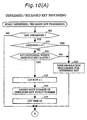
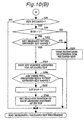
- Figs. 10(A) and 10(B) in combination is a flowchart showing the depressed/released key processing in the embodiment, in which the two figures are connected at the same encircled letter B points with each other.
- This flowchart constitutes a subroutine chart for the step S4 in the main routine of Fig. 8.
- step S21 judges whether there are any key depressed, and if there is no key depressed, the process skips to step S28, while if there are any key depressed, then step S22 judges whether arpeggio 0.
- the flag arpeggio 0 means that the arpeggio performance is not selected by the user, and thus the process moves to step S23 for the ordinary performance processing, i.e.
- step S202 judges whether the released key is a key within the arpeggio key range, and if not, the same process by step S201 takes place as described just above. If the released key belongs in the arpeggio key range, step S203 frees the key number which has until now been assigned to the note number of the released key, i.e. makes the key number available for future assignment of a new note number before moving forward to step 204. Thus the key number to which the note number of the released key has been allotted loses the corresponding note number, and no tone generation occurs at the generation timing instructed for this key number. This makes a rest in musical notation.
- step S203 may be so arranged that the rest of the keys, if any, in the arpeggio key range (i.e. the keys still being depressed in the arpeggio key range) shall be re-allotted to the key numbers in the correspondingly ascending order one to one from the lowest note anew.
- the data read-out position of the arpeggio pattern is set to the top and that timing is set into timing_1 or timing_2 flag to prepare for the next arpeggio start
- Figs. 11(A) and 11(B) in combination is a flowchart showing the interruption processing in the embodiment, in which the two figures are connected at the same encircled letter C points with each other and at D points with each other.
- the interruption processing is periodically initiated by the clock signal from the timer 10.
- step S34 to successively read out the data following the timing data (as shown in Fig. 2) in the #1 arpeggio pattern one after another and output the note numbers (if there is octave shift data, the note number of the octave-shifted note, the same being applied hereinbelow ) of the note pitches corresponding to the key numbers, the velocity values and the note-on flags to the tone generator circuit 5 for the note generation processing.
- Step S35 sets the read-out gate time value into the gate_1 flag
- step S36 sets the next timing value into the timing_1 flag before moving to step S37.
- the processing through steps S302 to S308 is the processing similar to the processing through steps S33 to S39 for the #1 arpeggio pattern except that the processing through steps S302 to S308 is for the #2 arpeggio pattern.
- timing_2 time
- step S304 the read-out gate time value into gate_2 flag, and then the next timing value is set into timing_2 at step S305.
- Step S309 is the processing for automatic musical performance.
- the automatic performance processing realizes an automatic musical accompaniment, which is conducted by generating notes according to the sequentially read-out musical performance data aligned timewise in succession based on the clock signal just as the automatic arpeggio performance. Consequently, the automatic performance processing is included in this interruption processing.
- the automatic performance processing at step S309 typically plays a substantial role when the apparatus is set at the "automatic accompaniment mode", and when both the arpeggio mode and the automatic accompaniment mode are set, the data tracks of the bass and the rhythm for the manual performance data may be read out to generate the tones for the bass and the rhythm together with the tones of the arpeggio performance.
- the apparatus of the present invention provides two kinds of arpeggio note generation based on #1 and #2 arpeggio patterns and on the note numbers corresponding to the keys depressed in the arpeggio key range, which enhances arpeggio performance and provides arpeggio note generation with rich expressivity.
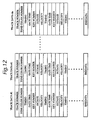
- arpeggio patterns there are provided a plurality of arpeggio patterns and two are selected independently from among them, but arpeggio patterns may be provided in the form of multi-track data as shown in Fig. 12.
- Fig. 12 there are a plurality of track data from track #1 to #n in a laterally engaged set in which each track data constitutes an individual arpeggio pattern (herein referred to as "track arpeggio pattern").
- Each track data of the track arpeggio patterns includes "track number” data representing the number of the track and "tone color number” data representing the identifying number to designate the tone color for the note data of each track in addition to the "timing" data, "gate time” data, “key number” data, “octave” data and “velocity” data as each data set for one note designation as was the case in Fig. 2.
- each track contains each individual "timing" flag for storing the timing data for each track for the processes corresponding to step S33 to step S36.
- each track contains each individual "gate time” flag for storing the gate time data for each track.
- the generated tones in the aforementioned embodiment was in a single kind of tone color which was selected for the ordinary keyboard performances, the system utilizing the above-mentioned track arpeggio patterns can realize arpeggio note generation in different tone colors for different tracks.
- the apparatus using the above-mentioned track arpeggio patterns may be constructed such that the arpeggio note generation corresponding to any particular desired tracks can be muted according to the user's preference in order to use not all the arpeggio patterns simultaneously.
- the note numbers corresponding to the keys depressed in the arpeggio key range are respectively assigned to those four key numbers so that the arpeggio notes are determined by the note numbers which are quoted by the key numbers included in the arpeggio pattern data. Therefore, in case the number of depressed keys are smaller than the number of key numbers (four in this embodiment), there may be a key number(s) which is (are) not assigned to any note number(s). But the arpeggio patterns always include a key number for each note data set, and therefore a note data set which include a key number not assigned to a note number will be a rest in musical notation. Alternatively, such a blank key number (i.e. a key number not occupied with a note number) may be filled with a note number of such a key as the highest or the lowest key among the depressed keys additionally.
- the note pitch of each arpeggio note in the arpeggio pattern may be determined by sequentially allotting the note numbers of the depressed keys to the note generation timings according to some predetermined rule using the order of key depressions and the order of note generations.
- the arpeggio patterns and the groove patterns are data sets having a length of one musical measure, but the data length may not be limited to one measure but may be of plural measures.
- the arpeggio key range is to be set by the user, but it may be predetermined in the apparatus.
- the arpeggio pattern selected for use is modified to prepare beforehand the modified arpeggio pattern and the arpeggio note generation will be realized based on the modified arpeggio pattern.
- the grooving process may be introduced amid the execution of the arpeggio note generation by modifying the data set for each note in the arpeggio pattern with reference to the data set at each grid in the groove pattern on the way of arpeggio performance.
- two groove patterns are selected to be used for modifying two arpeggio patterns, respectively.
- the invention should not be construed to be limited to such a construction, as two arpeggio patterns may be modified using a single groove pattern.
- a single arpeggio pattern may be modified using more than one groove pattern to provide more than one modified arpeggio pattern.
- More than one arpeggio pattern may drive simultaneous arpeggio note generation in a plurality of modified arpeggio patterns.
- the apparatus may include a device for displaying recommended groove pattern candidates which will fit each selected arpeggio pattern so that a beginner can easily practice arpeggio pattern modification.
- the same note pitch infonnation of the keys depressed in the arpeggio key range designates the arpeggio notes to be generated simultaneously according to the two arpeggio patterns selected by the user, but the apparatus may alternatively constructed such that different note pitch information may be used for the two arpeggio patterns separately so that two different arpeggio performances in separate arpeggio patterns are played with different notes.
- the note pitch information on the keys depressed in the arpeggio key range the information on the even-numbered keys from the lowest key upward is to be used for arpeggio note generation in the #1 arpeggio pattern, while the odd-numbered keys from the lowest is to be used for arpeggio note generation in the #2 arpeggio pattern.
- two arpeggio key ranges may be set and the note pitch information from the respective key ranges may be used with the #1 and the #2 arpeggio pattern, respectively.
- the note pitch information of a plurality of keys depressed in the arpeggio key range may be used with the #1 arpeggio pattern, while another pitch information obtained by shifting the note pitch information up or down by one octave may be used with the #2 arpeggio pattern to play arpeggio performances.
- the key numbers are assigned from the lowest number upward to the depressed keys in the arpeggio key range from the lowest depressed key upward, but the key numbers may be assigned from the lowest number upward to the depressed keys in the order of key depressions (i.e. from the earliest key onward).
- two kinds of arpeggio patterns and two kinds of groove patterns are employed, but more than two arpeggio patterns or groove patterns may be employed to conduct more than two kinds of arpeggio performances.
- the data format of the arpeggio pattern is in the form of "event + absolute time” representing the timings for arpeggio note generation in terms of absolute time from the beginning of a musical piece or of each measure, but the format may be of "event + relative time” representing the timings in terms of time interval (duration in clock counts) from the preceding event to each event.
- an arpeggio pattern itself may be in the form of "note pitch (or rest) + duration” representing the arpeggio pattern using the pitch and the duration of each note or the duration of each rest.
- the arpeggio pattern may be stored in the memory according to address-dependent direct data mapping (beta-gaki mapping) in which a memory area is secured to cover the sufficient number of addresses for the resolution of events (Le. one clock count in the embodiment) with each address allotted for each timing, and then the key number data, velocity data, etc. of each event are stored at the addresses corresponding to the event time.
- address-dependent direct data mapping (beta-gaki mapping) in which a memory area is secured to cover the sufficient number of addresses for the resolution of events (Le. one clock count in the embodiment) with each address allotted for each timing, and then the key number data, velocity data, etc. of each event are stored at the addresses corresponding to the event time.
- address-dependent direct data mapping (beta-gaki mapping) in which a memory area is secured to cover the sufficient number of addresses for the resolution of events (Le. one clock count in the embodiment) with each address allotted for each timing, and then the key number data, velocity data, etc. of each event are stored
- the tempo for arpeggio note generation can be varied in various manners.
- the period of tempo clock i.e. of interruption signal
- the values of timing data may be converted according to the intended tempo with the clock itself being kept at the same period, or a unit count value (e.g. a decremental value) for counting the timing data at each processing may be changed, or any other known manners may be employed.
- the arpeggio patterns, the groove patterns, and the control programs are stored in the ROM 2 beforehand.
- the arpeggio patterns, the groove patterns, and the control programs may be stored in a CD-ROM, so that the programs and data are read out from the CD-ROM and loaded in the hard disk (equipped according to necessity).
- the CPU 1 develops (spreads) the control program from the hard disk onto the RAM 3, and controls the operation of arpeggio note generation based on the program on the RAM 3 as in the embodiment explained above. This means that the CPU 1 conducts the similar operation in the system as in the case the control program is stored in the ROM 2.
- control program, etc. may be stored in floppy disks, a magneto-optical disk, etc. and may be supplied to the RAM 3 or the hard disk.
- the arpeggio patterns, the groove patterns and the control program may be down-loaded from an external source using the interface 12.
- the interface 12 is connected to a server computer via a LAN (local area network) or any communication network such as the Internet and a public telephone line, and receives the delivery of such arpeggio pattern data, groove pattern data and control program data from the server computer to down-load the same onto the hard disk.
- LAN local area network
- any communication network such as the Internet and a public telephone line
- the present invention can be applicable not only to an integrated keyboard type electronic musical instrument, but also to a string type instrument, a wind type instrument, or else.
- the tone generator circuit and the automatic performance system may not be included in an electronic musical instrument, but the tone generator, a sequencer, an effector and so forth may be separate devices being connected by MIDI cables and other communication lines including various networks.
- the arpeggio note generating apparatus of the present invention can be configured with a general purpose personal computer and an application software.
- the CPU in a personal computer performs various controls using working areas in the RAM with the aid of an OS installed, for example, in the hard disk.
- the arpeggio patterns, the groove patterns and the control program may be supplied in the form of a recorded medium so that such softwares may be transferred to the hard disk or the like for the CPU to operate similarly as mentioned above.
- the selection of the arpeggio patterns and the groove patterns may be easily conducted by inputting necessary data using a keyboard or a mouse.
- a sound board, if any, installed in the personal computer can serve as the tone generator circuit.
- the personal computer may, off course, be connected to external communication network for any necessary data acquisition.
- a computer readable medium on which is stored a computer program for generating arpeggio notes according to the manner described belongs to the scope of the present invention.
- a medium may be a ROM, a RAM, a hard disk, a CD-ROM, a magneto-optical disk, and any storage device in an externally locating server computer connected via a communication network.
- Various manners or technology prevailing in the computer field may also be available in the present invention.
Landscapes
- Physics & Mathematics (AREA)
- Engineering & Computer Science (AREA)
- Acoustics & Sound (AREA)
- Multimedia (AREA)
- Electrophonic Musical Instruments (AREA)
Applications Claiming Priority (3)
| Application Number | Priority Date | Filing Date | Title |
|---|---|---|---|
| JP290010/97 | 1997-10-22 | ||
| JP29001097A JP3829439B2 (ja) | 1997-10-22 | 1997-10-22 | アルペジオ発音装置およびアルペジオ発音を制御するためのプログラムを記録したコンピュータ読み取り可能な媒体 |
| JP29001097 | 1997-10-22 |
Publications (2)
| Publication Number | Publication Date |
|---|---|
| EP0911802A1 EP0911802A1 (en) | 1999-04-28 |
| EP0911802B1 true EP0911802B1 (en) | 2003-07-09 |
Family
ID=17750620
Family Applications (1)
| Application Number | Title | Priority Date | Filing Date |
|---|---|---|---|
| EP98119760A Expired - Lifetime EP0911802B1 (en) | 1997-10-22 | 1998-10-22 | Apparatus and method for generating arpeggio notes |
Country Status (4)
| Country | Link |
|---|---|
| US (1) | US6051771A (enExample) |
| EP (1) | EP0911802B1 (enExample) |
| JP (1) | JP3829439B2 (enExample) |
| DE (1) | DE69816225T2 (enExample) |
Families Citing this family (22)
| Publication number | Priority date | Publication date | Assignee | Title |
|---|---|---|---|---|
| JP3702785B2 (ja) * | 2000-12-27 | 2005-10-05 | ヤマハ株式会社 | 楽音演奏装置、方法及び媒体 |
| JP4086665B2 (ja) * | 2003-01-15 | 2008-05-14 | ローランド株式会社 | 自動演奏装置 |
| JP3938104B2 (ja) * | 2003-06-19 | 2007-06-27 | ヤマハ株式会社 | アルペジオパターン設定装置およびプログラム |
| US7834261B2 (en) * | 2005-09-30 | 2010-11-16 | Pioneer Corporation | Music composition reproducing device and music composition reproducing method |
| JP4821532B2 (ja) | 2006-09-21 | 2011-11-24 | ヤマハ株式会社 | アルペジオ演奏装置及びプログラム |
| JP4821533B2 (ja) | 2006-09-21 | 2011-11-24 | ヤマハ株式会社 | アルペジオ演奏装置及びプログラム |
| JP4793204B2 (ja) * | 2006-09-29 | 2011-10-12 | ヤマハ株式会社 | 電子楽器および電子楽器制御用プログラム |
| JP5200368B2 (ja) * | 2006-11-30 | 2013-06-05 | ヤマハ株式会社 | アルペジオ生成装置およびアルペジオ生成方法を実現するためのプログラム |
| JP4835434B2 (ja) * | 2006-12-28 | 2011-12-14 | ヤマハ株式会社 | 演奏パターン再生装置及びそのコンピュータプログラム |
| JP4835433B2 (ja) * | 2006-12-28 | 2011-12-14 | ヤマハ株式会社 | 演奏パターン再生装置及びそのコンピュータプログラム |
| JP5141013B2 (ja) * | 2006-12-28 | 2013-02-13 | ヤマハ株式会社 | アルペジオデータ生成装置及びプログラム |
| JP2009139690A (ja) * | 2007-12-07 | 2009-06-25 | Kawai Musical Instr Mfg Co Ltd | 電子鍵盤楽器 |
| US20110011242A1 (en) * | 2009-07-14 | 2011-01-20 | Michael Coyote | Apparatus and method for processing music data streams |
| US9263018B2 (en) * | 2013-07-13 | 2016-02-16 | Apple Inc. | System and method for modifying musical data |
| US9384719B2 (en) * | 2013-07-15 | 2016-07-05 | Apple Inc. | Generating customized arpeggios in a virtual musical instrument |
| US9105260B1 (en) * | 2014-04-16 | 2015-08-11 | Apple Inc. | Grid-editing of a live-played arpeggio |
| WO2016007899A1 (en) * | 2014-07-10 | 2016-01-14 | Rensselaer Polytechnic Institute | Interactive, expressive music accompaniment system |
| US9412351B2 (en) * | 2014-09-30 | 2016-08-09 | Apple Inc. | Proportional quantization |
| EP4027331B1 (en) | 2019-09-04 | 2025-10-08 | Roland Corporation | Arpeggiator, method and program having function therefor |
| US12475871B2 (en) | 2019-09-04 | 2025-11-18 | Roland Corporation | Arpeggiator, recording medium and method of making arpeggio |
| US20220343884A1 (en) * | 2019-09-04 | 2022-10-27 | Roland Corporation | Arpeggiator, recording medium and method of making arpeggio |
| WO2021044560A1 (ja) | 2019-09-04 | 2021-03-11 | ローランド株式会社 | アルペジエータおよびその機能を備えたプログラム |
Family Cites Families (8)
| Publication number | Priority date | Publication date | Assignee | Title |
|---|---|---|---|---|
| US4271741A (en) * | 1978-03-15 | 1981-06-09 | The Wurlitzer Company | Accompaniment system for electronic musical instrument |
| US4444081A (en) * | 1982-06-04 | 1984-04-24 | Baldwin Piano & Organ Company | Arpeggio generating system and method |
| JPS5948598U (ja) * | 1982-09-22 | 1984-03-31 | カシオ計算機株式会社 | 電子楽器 |
| JPS62235989A (ja) * | 1986-04-07 | 1987-10-16 | ヤマハ株式会社 | 伴奏パタ−ン選択装置 |
| JP2631722B2 (ja) * | 1988-11-11 | 1997-07-16 | ローランド株式会社 | 自動演奏装置 |
| US5495073A (en) * | 1992-05-18 | 1996-02-27 | Yamaha Corporation | Automatic performance device having a function of changing performance data during performance |
| US5714705A (en) * | 1995-09-19 | 1998-02-03 | Roland Corporation | Arpeggiator |
| JP3625914B2 (ja) * | 1995-09-20 | 2005-03-02 | ローランド株式会社 | アルペジエータ |
-
1997
- 1997-10-22 JP JP29001097A patent/JP3829439B2/ja not_active Expired - Fee Related
-
1998
- 1998-10-21 US US09/176,645 patent/US6051771A/en not_active Expired - Lifetime
- 1998-10-22 EP EP98119760A patent/EP0911802B1/en not_active Expired - Lifetime
- 1998-10-22 DE DE69816225T patent/DE69816225T2/de not_active Expired - Lifetime
Also Published As
| Publication number | Publication date |
|---|---|
| JP3829439B2 (ja) | 2006-10-04 |
| EP0911802A1 (en) | 1999-04-28 |
| DE69816225D1 (de) | 2003-08-14 |
| US6051771A (en) | 2000-04-18 |
| DE69816225T2 (de) | 2004-04-22 |
| JPH11126074A (ja) | 1999-05-11 |
Similar Documents
| Publication | Publication Date | Title |
|---|---|---|
| US6051771A (en) | Apparatus and method for generating arpeggio notes based on a plurality of arpeggio patterns and modified arpeggio patterns | |
| JP3309687B2 (ja) | 電子楽器 | |
| JP3582359B2 (ja) | 楽譜割付け装置及び楽譜割付けプログラムを記録したコンピュータで読み取り可能な記録媒体 | |
| US6582235B1 (en) | Method and apparatus for displaying music piece data such as lyrics and chord data | |
| US5763804A (en) | Real-time music creation | |
| US7091410B2 (en) | Apparatus and computer program for providing arpeggio patterns | |
| US6118065A (en) | Automatic performance device and method capable of a pretended manual performance using automatic performance data | |
| US5962802A (en) | Automatic performance device and method capable of controlling a feeling of groove | |
| US5942710A (en) | Automatic accompaniment apparatus and method with chord variety progression patterns, and machine readable medium containing program therefore | |
| JP2010079178A (ja) | 電子楽器 | |
| US4685370A (en) | Automatic rhythm playing apparatus having plurality of rhythm patterns for a rhythm sound | |
| US6011210A (en) | Musical performance guiding device and method for musical instruments | |
| US7381882B2 (en) | Performance control apparatus and storage medium | |
| JP3353777B2 (ja) | アルペジオ発音装置およびアルペジオ発音を制御するためのプログラムを記録した媒体 | |
| JP3507006B2 (ja) | アルペジオ発音装置およびアルペジオ発音を制御するためのプログラムを記録したコンピュータで読み取り可能な媒体 | |
| JP3656597B2 (ja) | 電子楽器 | |
| US5942711A (en) | Roll-sound performance device and method | |
| JP2605456B2 (ja) | 電子楽器 | |
| JP4175364B2 (ja) | アルペジオ発音装置およびアルペジオ発音を制御するためのプログラムを記録したコンピュータ読み取り可能な媒体 | |
| JP2007163710A (ja) | 演奏支援装置及びプログラム | |
| JPH10268866A (ja) | 自動演奏制御装置 | |
| JP3953071B2 (ja) | 電子楽器 | |
| JP3731532B2 (ja) | 電子楽器 | |
| JP3879759B2 (ja) | 電子楽器 | |
| JP3879761B2 (ja) | 電子楽器 |
Legal Events
| Date | Code | Title | Description |
|---|---|---|---|
| PUAI | Public reference made under article 153(3) epc to a published international application that has entered the european phase |
Free format text: ORIGINAL CODE: 0009012 |
|
| 17P | Request for examination filed |
Effective date: 19981022 |
|
| AK | Designated contracting states |
Kind code of ref document: A1 Designated state(s): DE GB IT |
|
| AX | Request for extension of the european patent |
Free format text: AL;LT;LV;MK;RO;SI |
|
| AKX | Designation fees paid |
Free format text: DE GB IT |
|
| 17Q | First examination report despatched |
Effective date: 20020510 |
|
| GRAH | Despatch of communication of intention to grant a patent |
Free format text: ORIGINAL CODE: EPIDOS IGRA |
|
| GRAH | Despatch of communication of intention to grant a patent |
Free format text: ORIGINAL CODE: EPIDOS IGRA |
|
| GRAA | (expected) grant |
Free format text: ORIGINAL CODE: 0009210 |
|
| AK | Designated contracting states |
Designated state(s): DE GB IT |
|
| REG | Reference to a national code |
Ref country code: GB Ref legal event code: FG4D |
|
| REF | Corresponds to: |
Ref document number: 69816225 Country of ref document: DE Date of ref document: 20030814 Kind code of ref document: P |
|
| PLBE | No opposition filed within time limit |
Free format text: ORIGINAL CODE: 0009261 |
|
| STAA | Information on the status of an ep patent application or granted ep patent |
Free format text: STATUS: NO OPPOSITION FILED WITHIN TIME LIMIT |
|
| 26N | No opposition filed |
Effective date: 20040414 |
|
| PGFP | Annual fee paid to national office [announced via postgrant information from national office to epo] |
Ref country code: IT Payment date: 20131016 Year of fee payment: 16 |
|
| PG25 | Lapsed in a contracting state [announced via postgrant information from national office to epo] |
Ref country code: IT Free format text: LAPSE BECAUSE OF NON-PAYMENT OF DUE FEES Effective date: 20141022 |
|
| PGFP | Annual fee paid to national office [announced via postgrant information from national office to epo] |
Ref country code: GB Payment date: 20151021 Year of fee payment: 18 Ref country code: DE Payment date: 20151013 Year of fee payment: 18 |
|
| REG | Reference to a national code |
Ref country code: DE Ref legal event code: R119 Ref document number: 69816225 Country of ref document: DE |
|
| GBPC | Gb: european patent ceased through non-payment of renewal fee |
Effective date: 20161022 |
|
| PG25 | Lapsed in a contracting state [announced via postgrant information from national office to epo] |
Ref country code: DE Free format text: LAPSE BECAUSE OF NON-PAYMENT OF DUE FEES Effective date: 20170503 Ref country code: GB Free format text: LAPSE BECAUSE OF NON-PAYMENT OF DUE FEES Effective date: 20161022 |