EP0906794B1 - Système de tri de produits longs - Google Patents
Système de tri de produits longs Download PDFInfo
- Publication number
- EP0906794B1 EP0906794B1 EP98307381A EP98307381A EP0906794B1 EP 0906794 B1 EP0906794 B1 EP 0906794B1 EP 98307381 A EP98307381 A EP 98307381A EP 98307381 A EP98307381 A EP 98307381A EP 0906794 B1 EP0906794 B1 EP 0906794B1
- Authority
- EP
- European Patent Office
- Prior art keywords
- conveyor
- long product
- long
- receiving
- sorting system
- Prior art date
- Legal status (The legal status is an assumption and is not a legal conclusion. Google has not performed a legal analysis and makes no representation as to the accuracy of the status listed.)
- Expired - Lifetime
Links
Images



Classifications
-
- B—PERFORMING OPERATIONS; TRANSPORTING
- B23—MACHINE TOOLS; METAL-WORKING NOT OTHERWISE PROVIDED FOR
- B23Q—DETAILS, COMPONENTS, OR ACCESSORIES FOR MACHINE TOOLS, e.g. ARRANGEMENTS FOR COPYING OR CONTROLLING; MACHINE TOOLS IN GENERAL CHARACTERISED BY THE CONSTRUCTION OF PARTICULAR DETAILS OR COMPONENTS; COMBINATIONS OR ASSOCIATIONS OF METAL-WORKING MACHINES, NOT DIRECTED TO A PARTICULAR RESULT
- B23Q17/00—Arrangements for observing, indicating or measuring on machine tools
- B23Q17/20—Arrangements for observing, indicating or measuring on machine tools for indicating or measuring workpiece characteristics, e.g. contour, dimension, hardness
-
- B—PERFORMING OPERATIONS; TRANSPORTING
- B07—SEPARATING SOLIDS FROM SOLIDS; SORTING
- B07C—POSTAL SORTING; SORTING INDIVIDUAL ARTICLES, OR BULK MATERIAL FIT TO BE SORTED PIECE-MEAL, e.g. BY PICKING
- B07C5/00—Sorting according to a characteristic or feature of the articles or material being sorted, e.g. by control effected by devices which detect or measure such characteristic or feature; Sorting by manually actuated devices, e.g. switches
- B07C5/04—Sorting according to size
- B07C5/12—Sorting according to size characterised by the application to particular articles, not otherwise provided for
-
- B—PERFORMING OPERATIONS; TRANSPORTING
- B07—SEPARATING SOLIDS FROM SOLIDS; SORTING
- B07C—POSTAL SORTING; SORTING INDIVIDUAL ARTICLES, OR BULK MATERIAL FIT TO BE SORTED PIECE-MEAL, e.g. BY PICKING
- B07C5/00—Sorting according to a characteristic or feature of the articles or material being sorted, e.g. by control effected by devices which detect or measure such characteristic or feature; Sorting by manually actuated devices, e.g. switches
- B07C5/36—Sorting apparatus characterised by the means used for distribution
- B07C5/361—Processing or control devices therefor, e.g. escort memory
- B07C5/362—Separating or distributor mechanisms
-
- B—PERFORMING OPERATIONS; TRANSPORTING
- B23—MACHINE TOOLS; METAL-WORKING NOT OTHERWISE PROVIDED FOR
- B23Q—DETAILS, COMPONENTS, OR ACCESSORIES FOR MACHINE TOOLS, e.g. ARRANGEMENTS FOR COPYING OR CONTROLLING; MACHINE TOOLS IN GENERAL CHARACTERISED BY THE CONSTRUCTION OF PARTICULAR DETAILS OR COMPONENTS; COMBINATIONS OR ASSOCIATIONS OF METAL-WORKING MACHINES, NOT DIRECTED TO A PARTICULAR RESULT
- B23Q7/00—Arrangements for handling work specially combined with or arranged in, or specially adapted for use in connection with, machine tools, e.g. for conveying, loading, positioning, discharging, sorting
- B23Q7/12—Sorting arrangements
-
- B—PERFORMING OPERATIONS; TRANSPORTING
- B21—MECHANICAL METAL-WORKING WITHOUT ESSENTIALLY REMOVING MATERIAL; PUNCHING METAL
- B21B—ROLLING OF METAL
- B21B39/00—Arrangements for moving, supporting, or positioning work, or controlling its movement, combined with or arranged in, or specially adapted for use in connection with, metal-rolling mills
- B21B39/002—Piling, unpiling, unscrambling
Definitions
- the present invention relates to a long-product sorting system.
- the present invention pertains to a system for sorting in-between-length and remnant long-products efficiently and automatically.
- Such systems are known, for instance , from AT 358836, GB 2 170 187 or US 3 085 686.
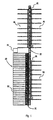
- FIG. 1 is the top plan elevational view of an embodiment of the present invention.
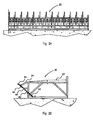
- FIGS. 2A and B are front and right side views respectively of the measuring table of the long product sorting system embodying the present invention.
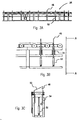
- FIGS. 3A and 3B are front elevational views of the conveyor assembly of the long product sorting system.
- FIG. 3C is the right side, cross sectional view of the stopper and kicker assemblies of the conveyor assembly according to section A - A in FIG. 3B
- FIG 4A is a front elevational view of the extended conveyor assembly of the long product sorting system embodying the present invention.
- FIG. 4B is the right side, cross sectional view of the stopper and kicker assembly according to section B - B of the extended conveyor assembly.
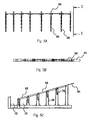
- FIG. 5A is a top plan view of the bin embodying the present invention.
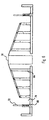
- FIG. 58 is an enlarged view of one frame of a bins section.
- FIG. 5C is the right cross-sectional view of the bins section embodying the present invention according to section C - C in FIG. 5A.
- FIG. 6 is the right side plan view of the dual bins of the extended conveyor assembly embodying the present invention.
- FIGS 7A and 7B are flowcharts illustrating the logic of a controller for the long product sorting system embodying the present invention.
- Embodiments of the present invention provide a method and apparatus for sorting long products of varying lengths automatically.
- the system features various functional modules.
- the first module functions to measure the length of the product to be sorted.
- One embodiment of this module includes a sorting table having a sorting area and a measuring unit.
- the second module functions to transfer the measured product to the proximity of the correct storage bin.
- One embodiment of this second module is a conveyor system.
- the third module includes a group of storage bins disposed in parallel to the conveyor, the bins in each group having descending heights to utilize gravity as the moving force for the product to roll or slide down along the bin covers. A retractable bin cover or lever can be raised to allow the bin to receive the product.
- the system may be automated using a computer algorithm.
- the system includes a sorting table 20 having a sorting area 22 and a measuring unit 24, a conveyor system 26 having a primary conveyor section 28 and secondary conveyor section 30, three groups of bins in sections 1, 2 and 3 (reference numerals 32, 34 and 36 ) respectively, and a control and display panel with a personal computer 38.
- Another embodiment would consist of only the primary conveyor section if a small number of bins are used.
- Other embodiments are envisioned whereby additional conveyor sections and groups of bins may be added to accommodate more types of long products of different lengths.
- the sorting area is a table. Other structures or an open area can also be used to retain the product for convenient sorting.
- the sorting table 20 includes a series of measuring sensors 44 mounted on the measuring unit 24 for sensing the length of the objects put on the surface of the sorting area 22.
- a set of mechanical pushers 40 are provided to transfer the measured product onto the conveyor system.
- the pushers 40 are located adjacent to the sensors 44 and mechanically operated with a pneumatic cylinder 42 , and a guide 46.
- an inductance proximity sensor is used.
- the pushers may also be operated by hydraulic or electrical means.
- modifications within the knowledge of one of ordinary skill in the art may be made to use optical or image processing methods for measurement.
- Figures 3A to C show an example of the primary conveyor section 28 adjacent to the section 1 primary group of bins.
- the conveyor includes a stopper plate and a series of kicker plates.
- the stoppers or kickers are plates which are provided perpendicular to the conveying direction of the conveyor system.
- the stopper plate aligns a product in the correct position along the conveying direction before it is "kicked" into the bin. It also functions as a gate to prevent the product in the primary conveyor from entering the secondary conveyor if the latter has a product already deposited there.
- the stopper/kicker plates 48 are trapezoidal in shape, and have their upper surfaces 50 sloping downwards towards the primary bins section.
- each stopper and kicker assembly is provided with a pneumatic cylinder 52, kicker plate 48 and guide support 54 and conventional means for the mechanical extension of the plate.
- a product that is transferred to the conveyor system would travel unimpeded along the conveyor.
- the stopper plate is switched to a projected position before the product arrives, then it acts as a stopper to prevent the product from moving further down the conveyor system.
- the kicker plates located directly below that product would be switched to a projected position.
- the product would be "kicked" off the conveyor system onto section 1 containing a group of bins.
- Figures 3A shows all the plates in the extended position.
- Figure 4A shows a segment of the secondary conveyor section 30 .
- the secondary conveyor section as discussed above acts as a extended conveyor and is situated between the sections 2 and 3 bins sections.
- the kicker assemblies In order for the kicker assemblies to function bidirectionally, i.e. kicking the product either to bins section 2 on one side or bins section 3 on the other side, two sets of kicker/stoppers are required in this secondary conveyor section.
- One type have plates 56 with the upper surface 58 sloping downwards in one direction, and another type with plates 60 with the upper surface 62 sloping downwards in the other direction. In this embodiment, any of the plates may function as a stopper.
- the bins sections according to one embodiment of the present invention comprises a plurality of elongated bins aligned in parallel with the conveyor.
- the bins are arranged in descending heights starting from the edge of the conveyor.
- the cover of each bin maintains a sloped configuration when closed whereby gravity causes the long product to roll or slide down the closed lever cover.
- the lever cover of the correct bin is switched to an open position and those of the wrong bins to a closed position before the product is pushed off the conveyor, such that the product would roll over the closed bins until it drops into the open bin.
- Figure 5A to C shows the preferred embodiment of a bins section in accordance with the present invention.
- a sliding plate 64 serves as a platform from where a product "kicked" from the conveyor would roll past. It allows the products to roll down from the conveyor effectively.
- a plurality of elongated support pillars 66 are provided adjacent to the support beam. The support pillars are aligned to support a structure of levers 68 .
- the bins 70 are spaces provided between the support pillars. These bins have descending heights starting from the sliding plate. The levers can be switched to an open position, where upon products may be dropped into the bin below.
- lever 72 is in the open position, resulting in the product being dropped into bin 74 , when the product is "kicked” off to the left of the conveyor by appropriate kickers.
- the levers are operated with pneumatic cylinders 76 and actuators by conventional mechanical means.
- Figures 7A and B shows a computer method for the automation of the equipment and method described above.
- the switches for the control of the various equipment are connected to a control and display station.
- the system When the power of the control unit is switched on 105, the system to go through a self-check process 107.
- the first step of the operation is the input from the operator as to whether there is any remaining bundle In the current batch or a new batch is to be started 113. If there is no unsorted bundle in the current batch, i.e. the current batch has been completely sorted, a Change New Batch Routine 115 is performed to allow the entry of all the necessary batch and product information required by the system. If there are still bundles remaining in the current batch, the operator is prompted for whether current infeed unsorted bundle is completed 117.
- step 121 If there are still products in the current bundle, the operation proceeds to step 121. However, if the current infeed unsorted bundle is completed, the Change Bundle Routine 119 is performed. All necessary bundle information are input to the system. When all information has been entered, the operation proceeds to step 121. The conveyor system will be switched on at step 121. All kickers, stoppers and pushers will be retracted to the home position 123. All bin covers are also activated to the closed position. The system control 125 checks to ensure all pushers are down before switching on the "PUT IN" light 127 to signal to the operator that the system is ready for him to throw in a new product.
- the system checks the signal feedback by measurements made by the measuring sensors to determine the presence or absence of a product, and to check 131 if the product length is a valid length 133. If the length is valid, implying that there is a suitable product in the measuring unit, the "PUT IN" light is turned off 139, signaling to the operator not to throw any new product into the measuring unit. However, if the system detects an invalid length, a warning is issued 135, and the control loops back 103 to step 121.
- the length of the product is calculated 141.
- the correct section, sorting bin and stopper to be activated are identified in step 143.
- the number of product in the identified bin and the current sorted bundle are determined in step 145. If the current sorted bundle in this bin is full 147, a New Sorted Bundle Subroutine is performed. This subroutine temporarily stops the system such that the operator can physically bundle up the complete bundle. If the current bin is full 151, a Clear Bin Subroutine is performed. This subroutine stops the machine and allows clearing of any bundle in all bins. If both current sorted bundle and bin are not full, Section 1 stopper will be raised in step 155 to confine the product to section 1. The system confirms in step 157 that the stopper is up before raising the pushers in step 159, which causes the product to be pushed into the conveyor.
- step 163 After some time delay 161, all pushers are retracted in step 163. Depending on the section the product is supposed to go, the sequence deviates after step 165. If the correct section is section 2 or section 3, section 1 stopper will be retracted in step 171 to allow for the product to pass through. The correct stopper within section 2 or 3 will also be raised 173 to stop and position the product which would be traveling down the secondary conveyor after being released by the lowered section 1 stopper. Step 175 sends a signal to the correct bin cover for the lever to open. All kickers are then raised in step 177 to push the product out of the conveyor where it rolls or slides down into the designated bin. After some time delay 187 to allow the product time to drop into the bin, the bin cover is closed 189 . At the same time, the system ensure that the kickers are fully raised and subsequently fully retracted using steps 177-185.
- the product is sorted, and the system updates the production data 191. If the current infeed unsorted bundle is completed and a new bundle is to be sorted 193, the system will update 195 the production data by decreasing the number of unsorted bundle by one and the program loops 101 to step 113. If the current infeed unsorted bundle is not complete, the operation loops back 103 to step 121 and prompts the operator to throw in a new product.
- each support pillar have been described in the above examples as being designated for product for one length, it is possible that each channel may be subdivided to store products of different lengths. This is accomplished by using stopper plates at different positions to confine a product to a particular segment or frame within a bin.
Landscapes
- Engineering & Computer Science (AREA)
- Mechanical Engineering (AREA)
- Branching, Merging, And Special Transfer Between Conveyors (AREA)
- Sorting Of Articles (AREA)
- Control Of Conveyors (AREA)
- Discharge Of Articles From Conveyors (AREA)
Claims (20)
- Dispositif de tri de produits allongés comprenant :caractérisé en ce que lesdits produits allongés sont triés dans des moyens (70) de réception désignés, automatiquement à la longueur standard la plus proche.au moins une unité de mesure (24) présentant des moyens de mesure pour s'assurer de la longueur de chacun desdits produits allongés, et des moyens de transfert pour transférer vers l'avant ledit produit allongé mesuré ; etau moins une section de réception, à proximité de ladite unité de mesure (24) et apte à recevoir les produits allongés mesurés transférés par lesdits moyens de transfert depuis ceux-ci, ladite section de réception présentant une pluralité de moyens de réception (70) pour recevoir au travers de celle-ci les produits allongés mesurés de longueur similaire, chacun desdits moyens de réception (70) étant pourvus de moyens de couverture (68) présentant une position fermée et une position ouverte, lesdits moyens de couverture (68) dans leur position fermée étant adaptés à former une surface supérieure en pente au travers de ladite section de réception de façon que lesdits produits allongés mesurés, reçus de ladite unité de mesure (24) puissent graviter de manière latérale à partir du sommet de l'un des moyens de réception (70), vers le sommet du moyen de réception suivant (70) le long de ladite surface en pente, lesdits moyens de couverture (68) étant en outre aptes à se déplacer vers une position ouverte pour permettre à un moyen de réception (70) désigné, de recevoir les produits allongés mesurés,
- Dispositif de tri de produits allongés selon la revendication 1, caractérisé en ce qu'un convoyeur (26) est pourvu entre ladite unité de mesure (24) et ladite section de réception, ledit convoyeur (26) étant apte à recevoir lesdits produits allongés à partir de ladite unité de mesure (24) et apte à transférer les produits allongés vers la section de réception le long de celle-ci.
- Dispositif de tri de produits allongés selon la revendication 2, caractérisé en ce que le convoyeur (26) est aligné longitudinalement entre ladite unité de mesure (24) et le bord de ladite surface en pente de ladite surface de réception, ledit convoyeur (26) comprenant :des moyens d'arrêt disposés le long de la longueur dudit convoyeur (26) pour stopper le mouvement en avant dudit produit allongé mesuré le long du convoyeur (26) ; etdes moyens de déchargement disposés le long de la longueur dudit convoyeur (26) pour décharger le produit allongé mesuré latéralement dudit convoyeur (26) sur ladite section de réception.
- Système de tri de produits allongés selon la revendication 2, caractérisé en ce qu'il comporte en outre au moins un convoyeur secondaire (30) proche d'au moins une section de réception secondaire, ledit convoyeur secondaire (30) étant apte à transférer ledit produit allongé dudit convoyeur (26) vers au moins une section de réception secondaire, chaque section de réception secondaire présentant une pluralité de moyens de réception secondaire avec des moyens de couverture, lesdits moyens de couverture de ladite pluralité de moyens de réception secondaire étant joints pour former une surface supérieure en pente de ladite section de réception secondaire.
- Système de tri de produits allongés selon la revendication 4, caractérisé en ce que le convoyeur secondaire (30) est aligné longitudinalement avec le bord supérieur de ladite surface en pente de ladite section de réception secondaire, ledit convoyeur secondaire (30) étant de plus aligné axialement avec ledit convoyeur (26), ledit convoyeur secondaire (30) comprenant en outre :des moyens d'arrêt disposés le long de la longueur dudit convoyeur secondaire (30) pour arrêter le mouvement vers l'avant dudit produit allongé mesuré le long ; etdes moyens de déchargement disposés le long de la longueur dudit convoyeur secondaire (30) pour décharger le produit allongé mesuré latéralement dudit convoyeur (26) sur ladite section de réception ;caractérisé en ce que lesdits produits allongés peuvent être transférés depuis ladite unité de mesure (24) vers ladite section de réception secondaire, via le convoyeur (26), et le convoyeur (30) secondaire.
- Système de tri de produits allongés selon l'une des revendications précédentes, caractérisé en ce que ladite pluralité des moyens de réception sont de forme allongée avec les côtés longitudinaux alignés en parallèle, lesdits moyens de réception alignés ayant en outre des hauteurs descendantes avec un côté longitudinal du moyen de réception le plus grand, disposés adjacents à ladite unité de mesure (24), et en ce qu'un produit allongé mesuré est transféré hors de ladite unité de mesure (24) par lesdits moyens de transfert en gravitant latéralement le long de ladite section de réception.
- Dispositif de tri de produits allongés selon l'une des revendications précédentes, caractérisé en ce que les moyens de couverture sont constitués d'un assemblage de levier (68).
- Dispositif de tri de produits allongés selon l'une des revendications précédentes, caractérisé en ce que lesdits moyens de mesure sont au moins une matrice de capteur de mesure (44).
- Dispositif de tri de produits allongés selon l'une des revendications précédentes, caractérisé en ce que lesdits moyens de transfert sont constitués d'une matrice de pousseurs.
- Dispositif de tri de produits allongés selon la revendication 8, caractérisé en ce que lesdits capteurs de mesure (44) sont espacés d'une distance prédéterminée les uns des autres, ladite distance prédéterminée correspondant à la tolérance dudit dispositif de tri de produits allongés.
- Dispositif de tri de produits allongés selon l'une des revendications 8 ou 10, caractérisé en ce que ledit capteur de mesure (44) comporte un capteur de proximité d'inductance.
- Dispositif de tri de produits allongés selon la revendication 9, caractérisé en ce que ledit pousseur comporte une plaque trapézoïdale actionnée par au moins un cylindre (42) pneumatique pour transférer lesdits produits allongés mesurés latéralement vers ladite section de réception.
- Dispositif de tri de produits allongés selon la revendication 7, caractérisé en ce que ledit assemblage de levier (68) comporte un levier articulé sur des moyens supports, ledit levier étant en outre actionné par un cylindre (42) pneumatique.
- Dispositif de tri de produits allongés selon l'une des revendications précédentes, caractérisé en ce qu'une table de mesure est fournie le long d'un côté de ladite unité de mesure (24), ladite table de mesure étant apte à faire en sorte que lesdits produits allongés gravitent vers le côté de ladite unité de mesure (24).
- Dispositif de tri de produits allongés selon l'une des revendications précédentes, caractérisé en ce qu'un contrôleur est prévu, ce dernier présentant au moins des moyens d'entrée aptes à recevoir une information de mesure, et au moins un moyen de sortie apte à transmettre l'information.
- Procédé de tri de produits allongés utilisant un dispositif de tri de produits allongés, ledit dispositif incluant une unité de mesure (24) présentant des moyens capteurs et des moyens de transferts et au moins une section de réception présentant une pluralité de moyens de réception (70) avec des moyens de couverture (68) aptes à se déplacer vers une position ouverte pour permettre à des moyens de réception désignés de recevoir par les produits longs mesurés, lesdits moyens de couverture (68) formant dans leur position fermée une surface supérieure en pente au travers de ladite section de réception, ledit procédé comprenant les étapes de :mesurer la longueur dudit produit allongé en utilisant lesdits moyens de mesure ;désigner un moyen de réception (70) pour recevoir ledit produit allongé ;ouvrir lesdits moyens de couverture desdits moyens de réception désignés ;transférer ledit produit allongé vers ledit moyen de réception désigné (70) par lesdits moyens de transfert de façon que ledit produit allongé soit transféré latéralement depuis ladite unité de mesure (24) vers ladite section de réception et voyage latéralement le long de celle-ci dans ledit moyen de réception désigné (70),caractérisé en ce que lesdits produits allongés sont triés automatiquement aux longueurs standards les plus proches.
- Procédé selon la revendication 16, caractérisé en ce qu'il comporte en outre l'étape de déplacer un produit allongé vers l'unité de mesure (24) avant ladite étape de mesurer la longueur dudit produit allongé en utilisant lesdits moyens de mesure.
- Procédé selon la revendication 16, caractérisé en ce que ledit dispositif comporte en outre un convoyeur (26) présentant des moyens d'arrêt et des moyens de déchargement.
- Procédé selon la revendication 18, caractérisé en ce qu'il comporte en outre l'étape de désigner un moyen d'arrêt pour arrêter ledit produit allongé le long dudit convoyeur (26), après ladite étape de mesure de la longueur dudit produit allongé en utilisant lesdits moyens de mesure.
- Procédé selon l'une des revendications précédentes, caractérisé en ce qu'il comporte en outre les étapes de :élever lesdits moyens d'arrêt désignés dans ledit convoyeur (26) pour stopper ledit produit allongé en une position désignée ;transférer ledit produit allongé vers ledit convoyeur (26) en utilisant lesdits moyens de transfert ; etarrêter ledit produit allongé dans la position désignée le long dudit convoyeur (26) par lesdits moyens d'arrêt avant ladite étape de transférer ledit produit allongé vers un moyen de réception désigné par lesdits moyens de déchargement de façon que ledit produit allongé soit déchargé latéralement depuis le convoyeur (26) vers ladite section de réception, et se déplace latéralement le long de celle-ci, dans les moyens de réception désignés.
Applications Claiming Priority (2)
| Application Number | Priority Date | Filing Date | Title |
|---|---|---|---|
| SG1997003427A SG68632A1 (en) | 1997-09-16 | 1997-09-16 | Long product sorting system |
| SG9703427 | 1997-09-16 |
Publications (3)
| Publication Number | Publication Date |
|---|---|
| EP0906794A2 EP0906794A2 (fr) | 1999-04-07 |
| EP0906794A3 EP0906794A3 (fr) | 1999-07-28 |
| EP0906794B1 true EP0906794B1 (fr) | 2003-12-03 |
Family
ID=20429735
Family Applications (1)
| Application Number | Title | Priority Date | Filing Date |
|---|---|---|---|
| EP98307381A Expired - Lifetime EP0906794B1 (fr) | 1997-09-16 | 1998-09-11 | Système de tri de produits longs |
Country Status (7)
| Country | Link |
|---|---|
| EP (1) | EP0906794B1 (fr) |
| JP (1) | JPH11179296A (fr) |
| AU (1) | AU715124B2 (fr) |
| DE (1) | DE69820190T2 (fr) |
| MY (1) | MY117144A (fr) |
| SG (1) | SG68632A1 (fr) |
| TW (1) | TW464547B (fr) |
Families Citing this family (10)
| Publication number | Priority date | Publication date | Assignee | Title |
|---|---|---|---|---|
| CN104759418B (zh) * | 2015-03-16 | 2018-04-17 | 机科发展科技股份有限公司 | 一种活塞自动检测分选机 |
| CN104722498B (zh) * | 2015-03-16 | 2018-04-06 | 机科发展科技股份有限公司 | 一种曲轴自动检测分选机 |
| CN108326052A (zh) * | 2018-01-18 | 2018-07-27 | 宣化钢铁集团有限责任公司 | 一种在线自动分拣短尺螺纹钢的装置及方法 |
| CN110125005B (zh) * | 2019-05-24 | 2022-05-10 | 广东灿城农产品集团有限公司 | 一种有机蔬菜分拣设备 |
| CN110802039A (zh) * | 2019-11-26 | 2020-02-18 | 梁国欣 | 管件自动分拣系统 |
| CN111644467A (zh) * | 2020-06-01 | 2020-09-11 | 天津市宏盛源工贸有限公司 | 一种扁钢轧机 |
| CN113562440B (zh) * | 2021-07-23 | 2022-04-19 | 株洲硬质合金集团有限公司 | 一种用于挤压pcb钻针无心磨加工自动收料装置 |
| CN113664615B (zh) * | 2021-09-22 | 2023-03-31 | 青岛海通车桥有限公司 | 一种具有防错位结构的智能显示自调器用长度调整工装置 |
| CN113926727B (zh) * | 2021-09-29 | 2024-05-03 | 山东海奥斯生物科技股份有限公司 | 一种肠衣原料皮自动分拣传输装置 |
| CN116853843B (zh) * | 2023-07-29 | 2025-10-21 | 江苏欧朗汽车科技股份有限公司 | 一种直管自动分料机及其分料方法 |
Family Cites Families (6)
| Publication number | Priority date | Publication date | Assignee | Title |
|---|---|---|---|---|
| US3085686A (en) * | 1961-11-28 | 1963-04-16 | John C Hanbury | Automatic lumber sorter |
| US3656617A (en) * | 1968-10-28 | 1972-04-18 | Metallurgie Hoboken | Device for manipulating copper bars |
| US3923157A (en) * | 1974-07-17 | 1975-12-02 | W & Steel Co | Bar handling and length determining apparatus |
| AT358836B (de) * | 1978-09-29 | 1980-10-10 | Hammars Mekaniska Verkstad Ab | Vorrichtung zum vermessen und markieren von staemmen |
| DE3501725C1 (de) * | 1985-01-19 | 1986-07-31 | Wieland-Werke Ag, 7900 Ulm | Verfahren und Vorrichtung zum Aussortieren von krummen Stangen,Rohren o.dgl. |
| JPH09155298A (ja) * | 1995-12-08 | 1997-06-17 | Toyo Kanetsu Kk | 仕分装置 |
-
1997
- 1997-09-16 SG SG1997003427A patent/SG68632A1/en unknown
-
1998
- 1998-09-10 MY MYPI98004140A patent/MY117144A/en unknown
- 1998-09-11 DE DE69820190T patent/DE69820190T2/de not_active Expired - Fee Related
- 1998-09-11 EP EP98307381A patent/EP0906794B1/fr not_active Expired - Lifetime
- 1998-09-15 AU AU84227/98A patent/AU715124B2/en not_active Ceased
- 1998-09-15 TW TW087115323A patent/TW464547B/zh not_active IP Right Cessation
- 1998-09-16 JP JP10261705A patent/JPH11179296A/ja active Pending
Also Published As
| Publication number | Publication date |
|---|---|
| DE69820190D1 (de) | 2004-01-15 |
| AU715124B2 (en) | 2000-01-20 |
| AU8422798A (en) | 1999-04-01 |
| TW464547B (en) | 2001-11-21 |
| EP0906794A2 (fr) | 1999-04-07 |
| JPH11179296A (ja) | 1999-07-06 |
| MY117144A (en) | 2004-05-31 |
| DE69820190T2 (de) | 2004-09-23 |
| SG68632A1 (en) | 1999-11-16 |
| EP0906794A3 (fr) | 1999-07-28 |
Similar Documents
| Publication | Publication Date | Title |
|---|---|---|
| DE69922553T2 (de) | Hängend angeordnete Sortiervorrichtung für Förderer | |
| CN107708881B (zh) | 带有偏移引导件的高速、双侧滑靴式分拣机 | |
| US4544064A (en) | Distribution installation for moving piece goods | |
| AU715124B2 (en) | Long product sorting system | |
| US5325972A (en) | Method of controlling sorting systems, and a sorting system thus controlled | |
| CH715083B1 (de) | Verfahren und Sortiersystem zum automatischen und manuellen Sortieren von Gegenständen unter Verwendung von in vertikalen Spalten angeordneten Sortierzielen. | |
| US6182815B1 (en) | Inductor station for sortation conveying system | |
| US20100072114A1 (en) | Method and device for sorting containers for recycling purposes | |
| DE10021802B4 (de) | Verfahren zur Hochleistungssortierung von Paletten | |
| JP4789457B2 (ja) | 振分装置 | |
| CN110723522A (zh) | 轴承噪声的检测设备 | |
| WO2022223412A1 (fr) | Procédé de fonctionnement d'un convoyeur pour produits successifs et système de transport correspondant | |
| CN113522778A (zh) | 一种基于人工智能的多功能物流分拣设备及其分拣方法 | |
| DK162210B (da) | Fremgangsmaade og apparat til fordeling af enkelte genstande paa flere transportbaner | |
| CN111974711A (zh) | 一种工件尺寸检测系统及检测方法 | |
| US3786944A (en) | Apparatus and method for applying labels to articles in a warehouse system | |
| DE102008037659A1 (de) | Versandregal vorzugsweise in einer Kommissionieranlage | |
| US3038604A (en) | Device for the mechanical sorting and collecting of veneer sheets of different lengths | |
| DE102004012133B4 (de) | Vorrichtung zum Vereinzeln quaderförmiger Stückgüter verschiedenster Abmessungen, insbesondere von Arzneimittelpackungen | |
| CN219487884U (zh) | 一种输送设备 | |
| CN113770046B (zh) | 一种自动化生产线用分拣装置 | |
| KR102453931B1 (ko) | 농산물 선별기 및 선별 방법 | |
| US4497480A (en) | Ejector mechanism for incomplete fascicles in a conveyor line | |
| EP0752279B1 (fr) | Dispositif pour charger des machines de tri en enveloppes | |
| CN221515287U (zh) | 一种磁芯在线检测分拣装置 |
Legal Events
| Date | Code | Title | Description |
|---|---|---|---|
| PUAI | Public reference made under article 153(3) epc to a published international application that has entered the european phase |
Free format text: ORIGINAL CODE: 0009012 |
|
| AK | Designated contracting states |
Kind code of ref document: A2 Designated state(s): DE FR GB IT |
|
| AX | Request for extension of the european patent |
Free format text: AL;LT;LV;MK;RO;SI |
|
| PUAL | Search report despatched |
Free format text: ORIGINAL CODE: 0009013 |
|
| AK | Designated contracting states |
Kind code of ref document: A3 Designated state(s): AT BE CH CY DE DK ES FI FR GB GR IE IT LI LU MC NL PT SE |
|
| AX | Request for extension of the european patent |
Free format text: AL;LT;LV;MK;RO;SI |
|
| RIC1 | Information provided on ipc code assigned before grant |
Free format text: 6B 07C 5/12 A, 6B 07C 5/36 B |
|
| 17P | Request for examination filed |
Effective date: 20000115 |
|
| AKX | Designation fees paid |
Free format text: DE FR GB IT |
|
| 17Q | First examination report despatched |
Effective date: 20021023 |
|
| GRAH | Despatch of communication of intention to grant a patent |
Free format text: ORIGINAL CODE: EPIDOS IGRA |
|
| RTI1 | Title (correction) |
Free format text: LONG PRODUCTS SORTING SYSTEM |
|
| GRAS | Grant fee paid |
Free format text: ORIGINAL CODE: EPIDOSNIGR3 |
|
| GRAA | (expected) grant |
Free format text: ORIGINAL CODE: 0009210 |
|
| AK | Designated contracting states |
Kind code of ref document: B1 Designated state(s): DE FR GB IT |
|
| REG | Reference to a national code |
Ref country code: GB Ref legal event code: FG4D |
|
| REF | Corresponds to: |
Ref document number: 69820190 Country of ref document: DE Date of ref document: 20040115 Kind code of ref document: P |
|
| PGFP | Annual fee paid to national office [announced via postgrant information from national office to epo] |
Ref country code: GB Payment date: 20040621 Year of fee payment: 7 |
|
| PGFP | Annual fee paid to national office [announced via postgrant information from national office to epo] |
Ref country code: FR Payment date: 20040728 Year of fee payment: 7 |
|
| ET | Fr: translation filed | ||
| PLBE | No opposition filed within time limit |
Free format text: ORIGINAL CODE: 0009261 |
|
| STAA | Information on the status of an ep patent application or granted ep patent |
Free format text: STATUS: NO OPPOSITION FILED WITHIN TIME LIMIT |
|
| 26N | No opposition filed |
Effective date: 20040906 |
|
| REG | Reference to a national code |
Ref country code: GB Ref legal event code: 732E |
|
| PGFP | Annual fee paid to national office [announced via postgrant information from national office to epo] |
Ref country code: DE Payment date: 20050224 Year of fee payment: 7 |
|
| REG | Reference to a national code |
Ref country code: FR Ref legal event code: TP |
|
| PG25 | Lapsed in a contracting state [announced via postgrant information from national office to epo] |
Ref country code: GB Free format text: LAPSE BECAUSE OF NON-PAYMENT OF DUE FEES Effective date: 20050911 |
|
| PG25 | Lapsed in a contracting state [announced via postgrant information from national office to epo] |
Ref country code: DE Free format text: LAPSE BECAUSE OF NON-PAYMENT OF DUE FEES Effective date: 20060401 |
|
| GBPC | Gb: european patent ceased through non-payment of renewal fee |
Effective date: 20050911 |
|
| PG25 | Lapsed in a contracting state [announced via postgrant information from national office to epo] |
Ref country code: FR Free format text: LAPSE BECAUSE OF NON-PAYMENT OF DUE FEES Effective date: 20060531 |
|
| REG | Reference to a national code |
Ref country code: FR Ref legal event code: ST Effective date: 20060531 |
|
| PGFP | Annual fee paid to national office [announced via postgrant information from national office to epo] |
Ref country code: IT Payment date: 20130927 Year of fee payment: 16 |
|
| PG25 | Lapsed in a contracting state [announced via postgrant information from national office to epo] |
Ref country code: IT Free format text: LAPSE BECAUSE OF NON-PAYMENT OF DUE FEES Effective date: 20140911 |