EP0902027B1 - Indol- und Indazol-derivate, Verfahren zu deren Herstellung und sie enthaltende Zusammensetzungen - Google Patents
Indol- und Indazol-derivate, Verfahren zu deren Herstellung und sie enthaltende Zusammensetzungen Download PDFInfo
- Publication number
- EP0902027B1 EP0902027B1 EP98402154A EP98402154A EP0902027B1 EP 0902027 B1 EP0902027 B1 EP 0902027B1 EP 98402154 A EP98402154 A EP 98402154A EP 98402154 A EP98402154 A EP 98402154A EP 0902027 B1 EP0902027 B1 EP 0902027B1
- Authority
- EP
- European Patent Office
- Prior art keywords
- group
- branched
- linear
- formula
- optionally substituted
- Prior art date
- Legal status (The legal status is an assumption and is not a legal conclusion. Google has not performed a legal analysis and makes no representation as to the accuracy of the status listed.)
- Expired - Lifetime
Links
- 0 *CCC1(*)CCC2N(*O)*=C(*)C2CC1 Chemical compound *CCC1(*)CCC2N(*O)*=C(*)C2CC1 0.000 description 4
Classifications
-
- C—CHEMISTRY; METALLURGY
- C07—ORGANIC CHEMISTRY
- C07D—HETEROCYCLIC COMPOUNDS
- C07D231/00—Heterocyclic compounds containing 1,2-diazole or hydrogenated 1,2-diazole rings
- C07D231/02—Heterocyclic compounds containing 1,2-diazole or hydrogenated 1,2-diazole rings not condensed with other rings
- C07D231/10—Heterocyclic compounds containing 1,2-diazole or hydrogenated 1,2-diazole rings not condensed with other rings having two or three double bonds between ring members or between ring members and non-ring members
- C07D231/12—Heterocyclic compounds containing 1,2-diazole or hydrogenated 1,2-diazole rings not condensed with other rings having two or three double bonds between ring members or between ring members and non-ring members with only hydrogen atoms, hydrocarbon or substituted hydrocarbon radicals, directly attached to ring carbon atoms
-
- A—HUMAN NECESSITIES
- A61—MEDICAL OR VETERINARY SCIENCE; HYGIENE
- A61P—SPECIFIC THERAPEUTIC ACTIVITY OF CHEMICAL COMPOUNDS OR MEDICINAL PREPARATIONS
- A61P25/00—Drugs for disorders of the nervous system
- A61P25/04—Centrally acting analgesics, e.g. opioids
-
- A—HUMAN NECESSITIES
- A61—MEDICAL OR VETERINARY SCIENCE; HYGIENE
- A61P—SPECIFIC THERAPEUTIC ACTIVITY OF CHEMICAL COMPOUNDS OR MEDICINAL PREPARATIONS
- A61P25/00—Drugs for disorders of the nervous system
- A61P25/06—Antimigraine agents
-
- A—HUMAN NECESSITIES
- A61—MEDICAL OR VETERINARY SCIENCE; HYGIENE
- A61P—SPECIFIC THERAPEUTIC ACTIVITY OF CHEMICAL COMPOUNDS OR MEDICINAL PREPARATIONS
- A61P43/00—Drugs for specific purposes, not provided for in groups A61P1/00-A61P41/00
-
- A—HUMAN NECESSITIES
- A61—MEDICAL OR VETERINARY SCIENCE; HYGIENE
- A61P—SPECIFIC THERAPEUTIC ACTIVITY OF CHEMICAL COMPOUNDS OR MEDICINAL PREPARATIONS
- A61P9/00—Drugs for disorders of the cardiovascular system
-
- A—HUMAN NECESSITIES
- A61—MEDICAL OR VETERINARY SCIENCE; HYGIENE
- A61P—SPECIFIC THERAPEUTIC ACTIVITY OF CHEMICAL COMPOUNDS OR MEDICINAL PREPARATIONS
- A61P9/00—Drugs for disorders of the cardiovascular system
- A61P9/12—Antihypertensives
-
- C—CHEMISTRY; METALLURGY
- C07—ORGANIC CHEMISTRY
- C07D—HETEROCYCLIC COMPOUNDS
- C07D233/00—Heterocyclic compounds containing 1,3-diazole or hydrogenated 1,3-diazole rings, not condensed with other rings
- C07D233/54—Heterocyclic compounds containing 1,3-diazole or hydrogenated 1,3-diazole rings, not condensed with other rings having two double bonds between ring members or between ring members and non-ring members
- C07D233/56—Heterocyclic compounds containing 1,3-diazole or hydrogenated 1,3-diazole rings, not condensed with other rings having two double bonds between ring members or between ring members and non-ring members with only hydrogen atoms or radicals containing only hydrogen and carbon atoms, attached to ring carbon atoms
-
- C—CHEMISTRY; METALLURGY
- C07—ORGANIC CHEMISTRY
- C07D—HETEROCYCLIC COMPOUNDS
- C07D249/00—Heterocyclic compounds containing five-membered rings having three nitrogen atoms as the only ring hetero atoms
- C07D249/02—Heterocyclic compounds containing five-membered rings having three nitrogen atoms as the only ring hetero atoms not condensed with other rings
- C07D249/08—1,2,4-Triazoles; Hydrogenated 1,2,4-triazoles
Definitions
- the present invention relates to new derivatives of indole and indazole, their process for their preparation and the pharmaceutical compositions containing them.
- the serotonin (5-HT) receptors have been subdivided into seven major families, of which the 5-HT 1 receptor family forms a heterogeneous group in which certain receptors have not yet been well characterized.
- the anti-migraine agent sumatriptan interacts with 5-HT 1 receptors which have been described as the 5-HT 1B , 5-HT 1D or 5-HT 1-like types (Sumner et al., Brit. J. Pharmacol., 105 , 603, 1992, Olesen, Labericht, 23 , 160, 1992).
- the selectivity of sumatriptan for these 5-HT 1B, 1D, 1-like receptors has been proposed as the main reason for its anti-migraine activity (Macon et al., J. Med. Chem., 37 , 2509, 1994), in which selective vasoconstriction of the carotid vascular bed is involved (Saxena et al. TIPS, 10 , 200, 1989).
- Such receptors, present in the venous system are also found in the brain and their activation or inhibition can be the cause of certain diseases of the central nervous system (Clitherow et al., J. Med. Chem, 37 , 2253 , 1994).
- the compounds of the present invention have an original structure due in particular to the presence of an amino side chain substituting heterocyclic nitrogen and of a triazole unit substituting the aromatic nucleus.
- This structure confers on the derivatives of the invention, surprisingly, a high selectivity for the 5-HT 1B , 5-HT 1D or 5-HT 1like receptors. They are therefore likely to be used as a veinotonic agent in the treatment of venous insufficiency and associated diseases, but also in the treatment of migraine and conditions associated with this disease, "cluster headaches", pain, migraine associated with vascular diseases as well as in hypertension, obesity and eating disorders.
- the activity of the compounds of the invention was evaluated in a pharmacological test measuring their potential for contraction of the saphenous vein isolated from dogs or rabbits as described by Humphrey et al. (Br. J. Pharmacol., 94 , 1123, 1988).
- aryl group is meant a group chosen from phenyl and naphthyl.
- heteroaryl group is meant a group chosen from furyl, thienyl, pyridyle, pyrrolyle, imidazolyle, tétrazolyle, pyrazinyle et pyrimidinyle.
- phenyl, benzyl, aryl, arylalkyl, heteroaryl, or heteroarylalkyl means that the groups concerned are substituted by one or more halogen atoms, and / or linear or branched (C 1 -C 6 ) alkyl group. , linear or branched (C 1 -C 6 ) alkoxy, hydroxy, and / or linear or branched (C 1 -C 6 ) trihaloalkyl (C 1 -C 6 ).
- hydrochloric hydrobromic, sulfuric, phosphonic, acetic, trifluoroacetic acids, lactic, pyruvic, malonic, succinic, glutaric, fumaric, tartaric, maleic, citric, ascorbic, sulphonic methane, camphoric, oxalic, etc ...
- non-limiting examples that may be mentioned sodium hydroxide, potassium hydroxide, triethylamine, tertbutylamine, etc.
- the present invention relates to the derivatives of formula (I) for which the triazolyl or triazolylmethyl group is attached in position 6 of the nucleus indole or indazole.
- Another advantageous aspect of the invention relates to the compounds of formula (I) for which the triazolyl or triazolylmethyl group is attached in position 5 of the nucleus indole or indazole.
- the preferred compounds of the invention are those for which n is worth 0.
- the invention preferably relates to the compounds of formula (I) for which X represents a group CR 2 , R 2 preferably being a hydrogen atom.
- R 1 preferably represents a hydrogen atom.
- the invention relates to the compounds of formula (I) for which, in the substituent AG 1 , A represents a ⁇ bond or a linear or branched (C 1 -C 6 ) alkylene group, and G 1 represents a pyrrolidinyl group (for example 3-pyrrolidinyl), piperidyl (for example 4-piperidyl) or 1-piperazinyl, the said groups being substituted or unsubstituted.
- Preferred substituents include alkyl groups advantageously way (C 1 -C 6) linear or branched, aryl, aryl (C 1 -C 6) linear or branched, heteroaryl, and / or heteroaryl (C 1 -C 6 ) linear or branched.
- the pyrrolidinyl and piperidyl groups being advantageously substituted on the nitrogen atom.
- Another preferred aspect of the invention relates to the compounds of formula (I) for which A represents a linear or branched (C 1 -C 6 ) alkylene group and G 1 represents a group in which R 3 and R 4 independently represent a hydrogen atom, or a linear or branched (C 1 -C 6 ) alkyl, cycloalkyl (C 3 -C 7 ), cycloalkyl (C 3 -C 7 ) alkyl (C 1 -C 6 ) linear or branched, arylalkyl (C 1 -C 6 ) linear or branched optionally substituted, aryl optionally substituted.
- R 3 and R 4 represent a linear or branched (C 1 -C 6 ) alkyl group.
- the invention relates to the compounds of formula (I) for which the triazolyl or triazolylmethyl group is attached in position 6 of the indole or indazole ring
- X represents a group -CH- or a nitrogen atom
- R 1 represents a hydrogen atom
- A represents a ⁇ bond or a linear or branched (C 1 -C 6 ) alkylene group
- G 1 represents a pyrrolidinyl or piperidinyl group optionally substituted on any of the vertices of the cycle by a group linear or branched (C 1 -C 6 ) alkyl, optionally substituted aryl, optionally substituted linear or branched arylalkyl (C 1 -C 6 ), optionally substituted heteroaryl, or optionally substituted linear or branched heteroarylalkyl (C 1 -C 6 ), or G 1 represents a 1-piperazinyl group optionally substituted on the nitrogen atom in position 4 by a linear
- the invention also extends to pharmaceutical compositions containing as active ingredient at least one compound of formula (I) alone or in combination with one or several non-toxic inert pharmaceutically acceptable excipients or vehicles.
- pharmaceutical compositions according to the invention there may be mentioned more particularly those suitable for oral, parenteral, nasal administration, single or coated tablets, sublingual tablets, capsules, tablets, suppositories, creams, ointments, dermal gels, etc.
- the useful dosage varies according to the age and weight of the patient, the nature and severity of the condition, as well as the route of administration. This can be nasal, rectal, parenteral or oral. Generally, the unit dosage ranges from 1 to 500 mg for a treatment in 1 to 3 taken per 24 hours.
- the expected product is obtained according to the process described in Example 1, stage d, from 6-amino-1- (2-dimethylaminoethyl) indole described in application WO 95/32967.
- the corresponding dihydrochloride is obtained by the action of a standard solution of hydrochloric acid in ethanol. Melting point : 254-256 ° C
- the expected product is obtained according to the process described in Example 1, stage a, in replacing 1- (tertbutyloxycarbonyl) -3-formylpyrrolidine with N-benzyl-4-piperidone.
- the expected product is obtained according to the process described in Example 1, stage b, from the compound described in the previous stage.
- the expected product is obtained according to the process described in Example 1, stage c, from the compound described in the previous stage.
- the expected product is obtained according to the process described in Example 1, stage d, from the compound described in the previous stage, followed by treatment of the base with a titrated solution hydrochloric acid in ethanol.
- the expected product is obtained according to the process described in Example 1, stage c, from the compound described in the previous stage.
- the expected product is obtained according to the process described in Example 1, stage d, from the compound described in the previous stage.
- the corresponding dihydrochloride is obtained by action of a standard solution of hydrochloric acid in ethanol.
- the expected product is obtained according to the process described in Example 4, stage c, in replacing 4-benzylpiperidine with 4- (5-methoxypyrimidin-4-yl) piperazine.
- the expected product is obtained according to the process described in Example 1, stage c, from the compound described in the previous stage.
- the expected product is obtained according to the process described in Example 1, stage d, from the compound described in the preceding stage.
- the corresponding hydrochloride is obtained by the action of a titrated solution of hydrochloric acid in ethanol. Melting point : 130-132 ° C
- the expected product is obtained according to the process described in Example 1, stage c, from the compound described in the previous stage.
- the expected product is obtained according to the process described in Example 1, stage d, from the compound described in the previous stage.
- the corresponding dihydrochloride is obtained by action of a standard solution of hydrochloric acid in ethanol.
- the expected product is obtained according to the process described in Example 4, stage a, in replacing 6-nitroindole with 6-nitroindazole, and after separation of the isomers of position trained.
- the expected product is obtained according to the process described in Example 4, stage b, from the compound described in the previous stage.
- the expected product is obtained according to the process described in Example 4, stage c, from the compound described in the previous stage, replacing 4-benzylpiperidine with 4- (5-methoxypirimidin-4-yl) piperazine.
- the expected product is obtained according to the process described in Example 1, stage c, from the compound described in the previous stage.
- the expected product is obtained according to the process described in Example 1, stage d, from the compound described in the previous stage.
- the expected product is obtained according to the process described in Example 1, stage a, in replacing 1- (tertbutyloxycarbonyl) -3-formylpyrrolidine with N-methyl-4-piperidone.
- the expected product is obtained according to the process described in Example 1, stage b, from the compound described in the previous stage.
- the expected product is obtained according to the process described in Example 1, stage c, from the compound described in the previous stage.
- the expected product is obtained according to the process described in Example 1, stage d, from the compound described in the previous stage.
- the base obtained is then salified with a titrated solution of hydrochloric acid in ethanol. Melting point : 195-198 ° C
- the expected product is obtained according to the process described in Example 4, stage c, in replacing 4-benzylpiperidine with N- (2-phenylethyl) piperazine.
- the expected product is obtained according to the process described in Example 1, stage c, from the compound described in the previous stage.
- Stage c 1- ⁇ 3- [4- (2-Phenylethyl) piperazine-1-yl] propyl ⁇ -6 - ([1,2,4] triazol-4-yl) indole, dihydrochloride
- the expected product is obtained according to the process described in Example 1, stage d, from the compound described in the previous stage.
- the base obtained is then salified with a titrated solution of hydrochloric acid in ethanol. Melting point :> 270 ° C
- the expected product is obtained according to the process described in Example 10, using as starting material the compound described in example 1, stage b.
- the expected product is obtained according to the process described in Example 1, stage a, in replacing 1- (tertbutyloxycarbonyl) -3-formylpyrrolidine with acetaldehyde, and using as starting material the compound described in the previous stage.
- the expected product is obtained according to the process described in Example 1, stages c and d, in using as starting material the compound described in the previous stage.
- Dihydrochloride corresponding is obtained by the action of a titrated solution of hydrochloric acid in ethanol.
- the expected product is obtained according to the process described in Example 1, stage a, in replacing 1- (tertbutyloxycarbonyl) -3-formylpyrrolidine by cyclohexane-carboxaidehyde and using as starting material the compound described in stage a of Example 11.
- the expected product is obtained according to the process described in Example 1, stages c and d, in using as starting material the compound described in the previous stage.
- Dihydrochloride corresponding is obtained by the action of a titrated solution of hydrochloric acid in ethanol.
- the expected product is obtained according to the process described in Example 1, stage a, in replacing 1- (tertbutyloxycarbonyl) -3-formylpyrrolidine with 2-furfuraldehyde and using as starting material the compound described in stage a of Example 11.
- the expected product is obtained according to the process described in Example 1, stages c and d, in using as starting material the compound described in the previous stage.
- Dihydrochloride corresponding is obtained by the action of a titrated solution of hydrochloric acid in ethanol.
- the expected product is obtained according to the process described in Example 1, stage a, by replacing 1- (tertbutyloxycarbonyl) -3-formylpyrrolidine with 2-pyridinecarboxaldehyde and using as starting material the compound described in the stage has example 11.
- the expected product is obtained according to the process described in Example 1, stages c and d, in using as starting material the compound described in the previous stage.
- Dihydrochloride corresponding is obtained by the action of a titrated solution of hydrochloric acid in ethanol.
- the expected product is obtained according to the process described in Example 1, stage a, in replacing 1- (tertbutyloxycarbonyl) -3-formylpyrrolidine with N-carbethoxy-4-piperidone.
- Stage b 1- (1-Carbethoxy-4-piperidyl) -6 - ([1,2,4] triazol-4-yl) indole
- the expected product is obtained according to the process described in Example 1, stages c and d, in using as starting material the compound described in the previous stage.
- the expected product is obtained according to the process described in Example 10, using as starting material the compound described in the preceding stage, and an aqueous solution hydrochloric acid.
- the expected product is obtained according to the process described in Example 1, stage a, by replacing 1- (tertbutyloxycarbonyl) -3-formylpyrrolidine with 2-pyridinecarboxaldehyde, and using as starting material the compound described in Example 15, stage a.
- Stage b 1- [1- (2-Pyridylmethyl) piperid-4-yl] -6 - ([1,2,4] triazol-4-yl) indole , dihydrochloride
- the expected product is obtained according to the process described in Example 1, stages c and d, in using as starting material the compound described in the previous stage.
- Dihydrochloride corresponding is obtained by the action of a titrated solution of hydrochloric acid in ethanol.
- the expected product is obtained according to the process described in Example 1, stage a, in replacing 1- (tertbutyloxycarbonyl) -3-formylpyrrolidine by 2-furfuraldehyde, and using as starting material the compound described in example 15, stage a.
- Stage b 1- [1- (2-Furylmethyl) piperid-4-yl] -6 - ([1,2,4] triazol-4-yl) indole , dihydrochloride
- the expected product is obtained according to the process described in Example 1, stages c and d, in using as starting material the compound described in the previous stage.
- Dihydrochloride corresponding is obtained by the action of a titrated solution of hydrochloric acid in ethanol.
- the expected product is obtained according to the process described in Example 1, stage a, in replacing 1- (tertbutyloxycarbonyl) -3-formylpyrrolidine with cinnamic aldehyde and using as starting material the compound described in Example 15, stage a.
- Stage b 1- [1- (3-Phenylpropyl) piperid-4-yl] -6 - ([1,2,4,] triazol-4-yl) indole , dihydrochloride
- the expected product is obtained according to the process described in Example 1, stages c and d, in using as starting material the compound described in the previous stage.
- Dihydrochloride corresponding is obtained by the action of a titrated solution of hydrochloric acid in ethanol.
- the expected product is obtained according to the process described in Example 1, stage a, replacing 1- (tertbutyloxycarbonyl) -3-formylpyrrolidine with cyclohexanecarboxaldehyde, and using the compound described as starting material in example 15, stage a.
- the expected product is obtained according to the process described in Example 1, stages c and d, in using as starting material the compound described in the previous stage.
- Dihydrochloride corresponding is obtained by the action of a titrated solution of hydrochloric acid in ethanol.
- the expected product is obtained according to the process described in Example 4, replacing, at stage c, 4-benzylpiperidine by 2-methylpiperidine.
- the expected product is obtained according to the process described in Example 4, replacing, at stage c, 4-benzylpiperidine by 4-methylpiperidine.
- the expected product is obtained according to the process described in Example 4, replacing, at stage c, 4-benzylpiperidine by 2,6-dimethylpiperidine.
- the expected product is obtained according to the process described in Example 4, replacing, at stage c, 4-benzylpiperidine by 3,5-dimethylpiperidine.
- the expected product is obtained according to the process described in Example 4, replacing, at stage a, 3-bromopropanol by 2-bromoethanol, and in stage c, 4-benzylpiperidine by benzylamine.
- the expected product is obtained according to the process described in Example 4, replacing, at stage c, 4-benzylpiperidine by benzylamine.
- the expected product is obtained according to the process described in Example 4, replacing, at stage c, 4-benzylpiperidine by aniline.
- the expected product is obtained according to the process described in Example 4, replacing, at stage c, 4-benzylpiperidine by cyclohexylamine.
- the expected product is obtained according to the process described in Example 4, replacing, at stage c, 4-benzylpiperidine by piperazine, in large excess.
- the expected product is obtained according to the process described in Example 4, replacing, at stage c, 4-benzylpiperidine by 4-phenylpiperazine.
- the expected product is obtained according to the process described in Example 4, replacing, at stage c, 4-benzylpiperidine by 1- (2-pyridyl) piperazine.
- the expected product is obtained according to the process described in Example 4, replacing, at stage c, 4-benzylpiperidine by 1-methylpiperazine.
- the expected product is obtained according to the process described in Example 4, replacing, at stage c, 4-benzylpiperidine by cyclohexylpiperazine.
- the expected product is obtained according to the process described in Example 1, stage a, replacing 1- (tertbutyloxycarbonyl) -3-formylpyrrolidine with 2-pyridinecarboxaldehyde and using 6-nitro-1 - [(1-piperazinyl) propyl] indole as the starting material (isolated during the process for preparing the compound described in example 28.
- Stage b 1- ⁇ 3- [4- (2-Pyridylmethyl) piperazin-1-yl] propyl ⁇ -6 - ([1,2,4] triazol-4-yl) indole, dihydrochloride
- the expected product is obtained according to the process described in Example 1, stages c and d, in using as starting material the compound described in the previous stage.
- Dihydrochloride corresponding is obtained by the action of a titrated solution of hydrochloric acid in ethanol.
- the expected product is obtained according to the process described in Example 4, replacing, at stage c, 4-benzylpiperidine by 1- (3-trifluoromethylphenyl) piperazine.
- the expected product is obtained according to the process described in Example 1, stages a, c and d, in replacing 6-nitroindoline with 6-nitroindazole.
- the expected product is obtained according to the process described in Example 10, using as starting material, the compound described in Example 35.
- the expected product is obtained according to the process described in Example 10, using as starting material 1- [N- (tert-Butyloxycarbonylpyrrolidin-3-yl) methyl] -6-nitroindazole, isolated during the process for preparing the compound described in Example 35.
- the expected product is obtained according to the process described in Example 1, stage a, in replacing 1- (tertbutyloxycarbonyl) -3-formylpyrrolidine by cyclohexane-carboxaldehyde and using as starting material the compound described in the stage previous.
- the expected product is obtained according to the process described in Example 1, stages c and d, in using as starting material the compound described in the previous stage.
- the corresponding dihydrochloride is obtained by the action of a titrated acid solution hydrochloric acid in ethanol.
- the expected product is obtained according to the process described in Example 1, stage a, in replacing 1- (tertbutyloxycarbonyl) -3-formylpyrrolidine with 2-pyridinecarboxaldehyde and using as starting material the compound described in Example 37, stage a.
- the expected product is obtained according to the process described in Example 1, stages c and d, in using as starting material the compound described in the previous stage.
- the corresponding dihydrochloride is obtained by the action of a titrated acid solution hydrochloric acid in ethanol.
- the expected product is obtained according to the process described in Example 1, stage a, in replacing 1- (tertbutyloxycarbonyl) -3-formylpyrrolidine with N-carbethoxy-4-piperidone, and using 6-nitroindazole as the starting material.
- Stage b 1- (1-Carbethoxy-4-piperidyl) -6 - ([1,2,4] triazol-4-yl) indazole
- the expected product is obtained according to the process described in Example 1, stages c and d, in using as starting material the compound described in the previous stage.
- the expected product is obtained according to the process described in Example 10, using as starting material the compound described in the preceding stage, and an aqueous solution hydrochloric acid.
- the expected product is obtained according to the process described in Example 1, stage a, in replacing 1- (tertbutyloxycarbonyl) -3-formylpyrrolidine with N-benzyl-4-piperidone, and using 6-nitroindazole as the starting material.
- the expected product is obtained according to the process described in Example 1, stages c and d, in using as starting material the compound described in the previous stage.
- the corresponding dihydrochloride is obtained by the action of a titrated acid solution hydrochloric acid in ethanol.
- the expected product is obtained according to the process described in Example 1, stage a, in replacing 1- (tertbutyloxycarbonyl) -3-formylpyrrolidine with 2-furfuraldehyde, and using as starting material the compound described in example 39, stage a.
- Stage b 1- [N- (2-Furylmethyl) piperid-4-yl] -6 - ([1,2,4] triazol-4-yl) indazole, dihydrochloride
- the expected product is obtained according to the process described in Example 1, stages c and d, in using as starting material the compound described in the previous stage.
- the corresponding dihydrochloride is obtained by the action of a titrated acid solution hydrochloric acid in ethanol.
- the expected product is obtained according to the process described in Example 1, stage a, in replacing 1- (tertbutyloxycarbonyl) -3-formylpyrrolidine with N-methyl-4-piperidone.
- the expected product is obtained according to the process described in Example 1, stages c and d, in using as starting material the compound described in the previous stage.
- the corresponding dihydrochloride is obtained by the action of a titrated acid solution hydrochloric acid in ethanol.
- the expected product is obtained according to the process described in Example 4, using as starting product 6-nitroindazole and replacing, in stage c, 4-benzylpiperidine with benzylamine and using as a reducing agent, in stage d, hydrazine in the presence of nickel.
- the expected product is obtained according to the process described in Example 4, using as starting product 6-nitroindazole and replacing, in stage c, 4-benzylpiperidine with piperazine in large excess.
- the expected product is obtained according to the process described in Example 4, using as starting product 6-nitroindazole and replacing, in stage c, 4-benzylpiperidine with 4- (2-phenylethyl) piperazine.
- the expected product is obtained according to the process described in Example 4, using as starting product 6-nitroindazole and replacing, in stage c, 4-benzylpiperidine with 1- (3-trifluoromethylphenyl) piperazine.
- the expected product is obtained according to the process described in Example 4, using as starting product 6-nitroindazole and replacing, in stage c, 4-benzylpiperidine with 1-methylpiperazine.
- the expected product is obtained according to the process described in Example 4, using as starting product 6-nitroindazole and replacing, in stage c, 4-benzylpiperidine with cyclohexylpiperazine.
- the expected product is obtained according to the process described in Example 1, stage a, in replacing 1- (tertbutyloxycarbonyl) -3-formylpyrrolidine with N-benzylpiperidone and using 6-hydroxymethylindole as the starting material (prepared from acid corresponding carboxylic.
- the expected product is obtained according to the process described in Example 1, stage c, using as starting material the compound described in the previous stage.
- the expected product is obtained according to the process described in Example 1, stage d, using as starting material the compound described in the preceding stage. Melting point: > 270 ° C (dec.)
- the experiments are carried out on saphenous veins of dogs (10-25 kg) or rabbits (2-3 kg) anesthetized with pentobarbital (30 mg / kg iv).
- the saphenous veins are quickly removed and cut into rings. These rings are mounted between two hooks in tanks thermostated at 37 ° C containing physiological solution (composition in mM: NaCl 118.3; KCl 4.7; CaCl 2 2.5; MgSO 4 1.2; KH 2 PO 4 1.2; Na HCO 3 25.0; Ca-EDTA 0.026 and glucose 11.1).
- the physiological solution is bubbled by a mixture of 95% O 2 - 5% CO 2 .
- the lower hook consists of the fixed point while the upper hook is connected to an isometric force sensor.
- the tissues are placed under a basic tension of 1.5 grams (dog) and 1 gram (rabbit).
- the pharmacological substances studied are prepared immediately before use; they are dissolved in water or in dimethyl sulfoxide. After assembly, the preparations are left to stand for 60 minutes, rinsing being carried out every 30 minutes.
- the organ is then placed in the presence of phenoxybenzamine (5 ⁇ 10 -8 M) for 20 minutes. This agent is removed by several successive washes for 45 minutes. After readjusting the base tension, a contraction is caused by the KCI (100 mM). After washing and returning to the baseline, a contraction is induced by 5-hydroxytryptamine (10 -5 M).
- a dose-response curve for pharmacological substances is performed by adding cumulative doses (10 -9 to 10 -4 M).
- This EC 50 is calculated as follows: the voltage values are first converted into percentages relative to the maximum effect induced by the KCI. The effective concentration 50% (EC 50 ) is determined by non-linear regression according to the model of the law of mass action of Michaelis-Menten.
- the compounds of Examples 5 and 6 contract the saphenous vein of rabbits with EC 50 of 0.30 ⁇ M and 0.12 ⁇ M respectively and maximum responses of 75% and 87% respectively.
- the EC 50 of the compound of Example 6 is 0.17 ⁇ M and the maximum response of 47%.
- the compound of Example 5 causes a maximum contraction of 6% at a concentration of 100 ⁇ M.
- Preparation formula for 1000 tablets dosed at 10 mg Composed of Example 5 10 g Hydroxypropylcellulose 2 g Wheat starch 10 g Lactose 100g Magnesium stearate 3 g Talc 3 g
Landscapes
- Organic Chemistry (AREA)
- Chemical & Material Sciences (AREA)
- Health & Medical Sciences (AREA)
- Medicinal Chemistry (AREA)
- General Chemical & Material Sciences (AREA)
- Veterinary Medicine (AREA)
- Chemical Kinetics & Catalysis (AREA)
- Life Sciences & Earth Sciences (AREA)
- Pharmacology & Pharmacy (AREA)
- Nuclear Medicine, Radiotherapy & Molecular Imaging (AREA)
- Engineering & Computer Science (AREA)
- Bioinformatics & Cheminformatics (AREA)
- Public Health (AREA)
- Animal Behavior & Ethology (AREA)
- General Health & Medical Sciences (AREA)
- Heart & Thoracic Surgery (AREA)
- Cardiology (AREA)
- Pain & Pain Management (AREA)
- Biomedical Technology (AREA)
- Neurology (AREA)
- Neurosurgery (AREA)
- Pharmaceuticals Containing Other Organic And Inorganic Compounds (AREA)
- Plural Heterocyclic Compounds (AREA)
Claims (16)
- Verbindungen der Formel (I):in der:
 n 0 oder 1 bedeutet,A eine σ-Bindung oder eine geradkettige oder verzweigte (C1-C8)-Alkylengruppe oder eine geradkettige oder verzweigte (C2-C8)-Alkenylengruppe darstellt,ein Stickstoffatom oder eine Gruppe C-R2 darstellt, worin R2 ein Wasserstoffatom oder eine geradkettige oder verzweigte (C1-C6)-Alkylgruppe bedeutet,R1 ein Wasserstoffatom oder eine geradkettige oder verzweigte (C1-C6)-Alkyl-gruppe darstellt,G1 eine Pyrrolidinyl- oder Piperidylgruppe darstellt, wobei jede dieser Gruppen gegebenenfalls an einem der Ringatome substituiert sein kann durch eine geradkettige oder verzweigte (C1-C6)-Alkylgruppe, (C3-C7)-Cycloalkylgruppe, geradkettige oder verzweigte (C1-C6)-Alkyl-(C3-C7)-cycloalkylgruppe, Nitrilgruppe, Carboxygruppe, geradkettige oder verzweigte (C1-C6)-Alkoxycarbonylgruppe, Carbamoylgruppe (die gegebenenfalls durch eine oder zwei geradkettige oder verzweigte (C1-C6)-Alkylgruppen, (C3-C7)-Cycloalkylgruppen, gegebenenfalls substituierte Phenylgruppen und/oder gegebenenfalls substituierte Benzylgruppen substituiert sein kann), gegebenenfalls substituierte Arylgruppe, gegebenenfalls substituierte geradkettige oder verzweigte Aryl-(C1-C6)-alkylgruppe, gegebenenfalls substituierte Heteroarylgruppe oder gegebenenfalls substituierte geradkettige oder verzweigte Heteroaryl-(C1-C6)-alkylgruppe substituiert ist, mit der Maßgabe, daß die Pyrrolidin- und Piperidingruppen über irgendeines der Ringatome an A gebunden sein können,
oder G1 eine Gruppedarstellt, in der: R3 und R4 unabhängig voneinander Wasserstoffatome oder geradkettige oder verzweigte (C1-C6)-Alkylgruppen, (C3-C7)-Cycloalkylgruppen, geradkettige oder verzweigte (C3-C7)-Cycloalkyl-(C1-C6)-alkylgruppen, geradkettige oder verzweigte und gegebenenfalls substituierte Aryl-(C1-C6)-alkylgruppen oder gegebenenfalls substituierte Arylgruppen bedeuten oder gemeinsam mit dem sie tragenden Stickstoffatom eine Gruppe:bilden, in der B eine σ-Bindung oder eine geradkettige oder verzweigte (C1-C6)-Alkylengruppe und R5 ein Wasserstoffatom oder eine geradkettige oder verzweigte (C1-C6)-Alkylgruppe, (C3-C7)-Cycloalkylgruppe, gegebenenfalls substituierte Arylgruppe, geradkettige oder verzweigte und gegebenenfalls substituierte Aryl-(C1-C6)-alkylgruppe, gegebenenfalls substituierte Heteroarylgruppe oder geradkettige oder verzweigte und gegebenenfalls substituierte Heteroaryl-(C1-C6)-alkylgruppe bedeuten,
 deren Enantiomere, Diastereoisomere sowie deren Additionssalze mit einer pharmazeutisch annehmbaren Säure oder Base, mit der Maßgabe, daß:unter einer Arylgruppe eine Gruppe ausgewählt aus Phenyl und Naphthyl zu verstehen ist,unter einer Heteroarylgruppe eine Gruppe ausgewählt aus Furyl, Thienyl, Pyridyl, Pyrrolyl, Imidazolyl, Tetrazolyl, Pyrazinyl und Pyrimidinyl zu verstehen ist,und der Begriff gegebenenfalls substituiert bezüglich der Ausdrücke Phenyl, Benzyl, Aryl, Arylalkyl, Heteroaryl oder Heteroarylalkyl bedeutet, daß die betreffenden Gruppen durch ein oder mehrere Halogenatome und/oder geradkettige oder verzweigte (C1-C6)-Alkylgruppen, geradkettige oder verzweigte (C1-C6)-Alkoxygruppen, Hydroxygruppen und/oder geradkettige oder verzweigte (C1-C6)-Trihalogenalkylgruppen substituiert sind.
 - Verbindungen der Formel (I) nach Anspruch 1, bei denen die Triazolylgruppe oder die Triazolylmethylgruppe in der 6-Stellung des Indol- oder Indazolkerns gebunden ist, deren Enantiomere, Diastereoisomere sowie deren Additionssalze mit einer pharmazeutisch annehmbaren Säure oder Base.
- Verbindungen der Formel (I) nach Anspruch 1, worin die Triazolylgruppe oder die Triazolylmethylgruppe in der 5-Stellung des Indol- oder Indazolkerns gebunden ist, deren Enantiomere, Diastereoisomere sowie deren Additionssalze mit einer pharmazeutisch annehmbaren Säure oder Base.
- Verbindungen der Formel (I) nach Anspruch 1, worin n den Wert 0 besitzt, deren Enantiomere, Diastereoisomere sowie deren Additionssalze mit einer pharmazeutisch annehmbaren Säure oder Base.
- Verbindungen der Formel (I) nach Anspruch 1, worin X eine Gruppe C-R2 darstellt, worin R2 ein Wasserstoffatom oder eine geradkettige oder verzweigte (C1-C6)-Alkylgruppe darstellt, deren Enantiomere, Diastereoisomere sowie deren Additionssalze mit einer pharmazeutisch annehmbaren Säure oder Base.
- Verbindungen der Formel (I) nach Anspruch 1, worin X ein Stickstoffatom bedeutet, deren Enantiomere, Diastereoisomere sowie deren Additionssalze mit einer pharmazeutisch annehmbaren Säure oder Base.
- Verbindungen der Formel (I) nach Anspruch 1, worin A eine σ-Bindung oder eine geradkettige oder verzweigte (C1-C6)-Alkylengruppe und G1 eine Pyrrolidinyl- oder Piperidinylgruppe bedeuten, wobei jede dieser Gruppen gegebenenfalls an einem ihrer Ringatome durch eine geradkettige oder verzweigte (C1-C6)-Alkylgruppe, (C3-C7)-Cycloalkylgruppe, geradkettige oder verzweigte (C3-C7)-Cycloalkyl-(C1-C6)-alkylgruppe, Nitrilgruppe, Carboxygruppe, geradkettige oder verzweigte (C1-C6)-Alkoxycarbonylgruppe, Carbamoylgruppe (die gegebenenfalls durch eine oder zwei geradkettige oder verzweigte (C1-C6)-Alkylgruppen, (C3-C7)-Cycloalkylgruppen, gegebenenfalls substituierte Phenylgruppen und/oder gegebenenfalls substituierte Benzylgruppen substituiert ist), gegebenenfalls substituierte Arylgruppen, geradkettige oder verzweigte und gegebenenfalls substituierte Aryl-(C1-C6)-alkylgruppen, gegebenenfalls substituierte Heteroarylgruppen oder geradkettige oder verzweigte, gegebenenfalls substituierte Heteroaryl-(C1-C6)-alkylgruppen substituiert ist,
oder G1 eine Gruppeworin B eine σ-Bindung oder eine geradkettige oder verzweigte (C1-C6)-Alkylengruppe und R5 ein Wasserstoffatom oder eine geradkettige oder verzweigte (C1-C6)-Alkylgruppe, (C3-C7)-Cycloalkylgruppe, gegebenenfalls substituierte Arylgruppe, geradkettige oder verzweigte und gegebenenfalls substituierte Aryl-(C1-C6)-alkylgruppe, gegebenenfalls substituierte Heteroarylgruppe oder geradkettige oder verzweigte und gegebenenfalls substituierte Heteroaryl-(C1-C6)-alkylgruppe bedeuten, deren Enantiomere, Diastereoisomere sowie deren Additionssalze mit einer pharmazeutisch annehmbaren Säure oder Base.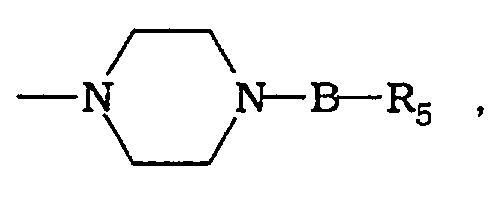
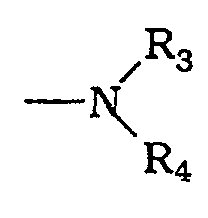
- Verbindung der Formel (I) nach Anspruch 1, worin A eine geradkettige oder verzweigte (C1-C6)-Alkylengruppe und G1 eine Gruppebedeuten, worin R3 und R4 unabhängig voneinander Wasserstoffatome, geradkettige oder verzweigte (C1-C6)-Alkylgruppen, (C3-C7)-Cycloalkylgruppen, geradkettige oder verzweigte (C3-C7)-Cycloalkyl-(C1-C6)-alkylgruppen, geradkettige oder verzweigte und gegebenenfalls substituierte Aryl-(C1-C6)-alkylgruppen und gegebenenfalls substituierte Arylgruppen bedeuten, deren Enantiomere, Diastereoisomere sowie deren Additionssalze mit einer pharmazeutisch annehbmaren Säure oder Base.
- Verbindungen der Formel (I) nach Anspruch 1, worin die Triazolyl- oder die Triazolylmethylgruppe in der 6-Stellung des Indol- oder Indazolkerns gebunden ist, X eine Gruppe -CH- oder ein Stickstoffatom, R1 ein Wasserstoffatom, A eine σ-Bindung oder eine geradkettige oder verzweigte (C1-C6)-Alkylengruppe und G1 eine Pyrrolidinyl- oder Piperidinylgruppe, die gegebenenfalls an einem ihrer Ringatome durch eine geradkettige oder verzweigte (C1-C6)-Alkylgruppe, gegebenenfalls substituierte Arylgruppe, geradkettige oder verzweigte und gegebenenfalls substituierte Aryl-(C1-C6)-alkylgruppe, gegebenenfalls substituierte Heteroarylgruppe oder geradkettige oder verzweigte und gegebenenfalls substituierte Heteroaryl-(C1-C6)-alkylgruppe substituiert sind, oder G1 eine 1-Piperazinylgruppe, die gegebenenfalls am Stickstoffatom in der 4-Stellung durch eine geradkettige oder verzweigte (C1-C6)-Alkylgruppe, gegebenenfalls substituierte Arylgruppe, geradkettige oder verzweigte und gegebenenfalls substituierte Aryl-(C1-C6)-alkylgruppe, gegebenenfalls substituierte Heteroarylgruppe oder geradkettige oder verzweigte und gegebenenfalls substituierte Heteroaryl-(C1-C6)-alkylgruppe substituiert ist, bedeuten,
oder A eine geradkettige oder verzweigte (C1-C6)-Alkylengruppe und G1 eine Gruppebedeuten, worin R3 und R4 unabhängig voneinander Wasserstoffatome oder geradkettige oder verzweigte (C1-C6)-Alkylgruppen bedeuten, deren Enantiomere, Diastereoisomere sowie deren Additionssalze mit einer pharmazeutisch annehmbaren Säure oder Base.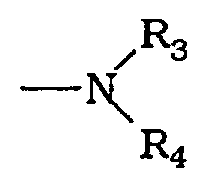
- Verbindung der Formel (I) nach Anspruch 1, nämlich 1-(Dimethylaminoethyl)-6-([1,2,4]triazol-4-yl)-indol sowie dessen Additionssalze mit einer pharmazeutisch annehmbaren Säure.
- Verbindung der Formel (I) nach Anspruch 1, nämlich 1-(Dimethylaminoethyl)-6-([1,2,4]triazol-4-yl)-indazol sowie dessen Additionssalze mit einer pharmazeutisch annehmbaren Säure.
- Verbindung der Formel (I) nach Anspruch 1, nämlich 1-{3-[4-(5-Methoxypyrimidin-4-yl)-piperazin-1-yl]-propyl}-6-([1,2,4]triazol-4-yl)-indol sowie dessen Additionssalze mit einer pharmazeutisch annehmbaren Säure.
- Verbindung der Formel (I) nach Anspruch 1, nämlich 1-{3-[4-(5-Methoxypyrimidin-4-yl)-piperazin-1-yl]-propyl}-6-([1,2,4]triazol-4-yl)-indazol sowie dessen Additionssalze mit einer pharmazeutisch annehmbaren Säure.
- Verfahren zur Herstellung der Verbindungen der Formel (I), dadurch gekennzeichnet, daß manwenn in der herzustellenden Verbindung der Formel (I) X eine Gruppe C-R2 darstellt, man als Ausgangsprodukt eine Verbindung der Formel (II/a) verwendet:in der R1 und R2 die bezüglich der Formel (I) angegebenen Bedeutungen besitzen und Y eine Nitrogruppe darstellt, wenn in der herzustellenden Verbindung der Formel (I) n den Wert 0 besitzt, oder eine Hydroxymethylgruppe darstellt, wenn in der herzustellenden Verbindung der Formel (I) n den Wert 1 besitzt,
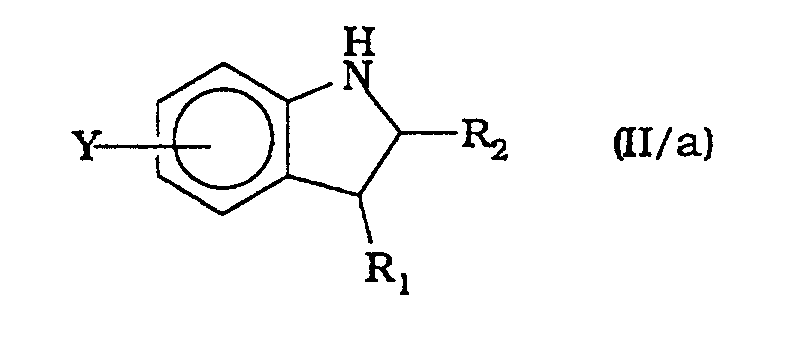
welche manentweder mit einem Derivat der Formel (III/a):
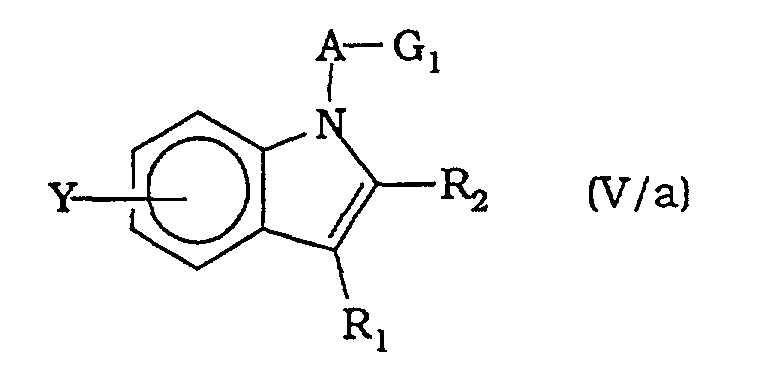
kondensiert zur Bildung einer Verbindung der Formel (IV):in der A, Y, G1, R1, R2 die oben angegebenen Bedeutungen besitzen, welche man einer Oxidationsreaktion unterwirft zur Bildung einer Verbindung der Formel (V/a):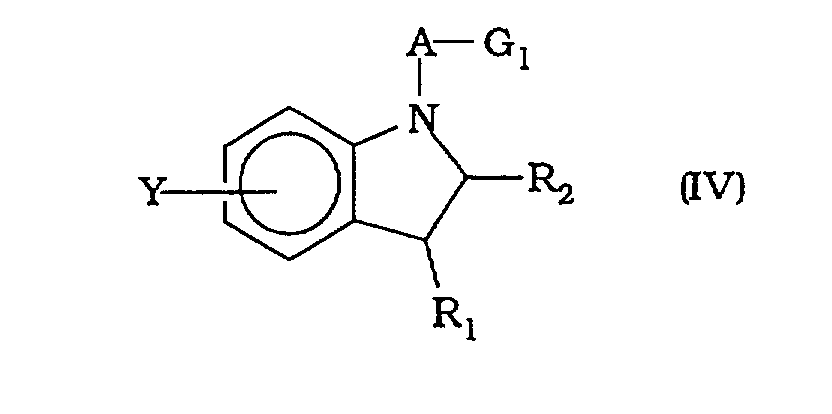 in der A, Y, G1, R1, R2 die oben angegebenen Bedeutungen besitzen, deren Gruppe G1, wenn sie eine Pyrrolidinyl-, Piperidyl- oder Piperazinylgruppe bedeutet, am Stickstoffatom in basischem Medium oder durch reduzierende Aminierung an einem Carbonylderivat substituiert werden kann,
 oder mit einem Derivat der Formel (III/b) in basischem Medium kondensiert:
zur Bildung einer Verbindung der Formel (IV'):in der Y, A, R1, R2 die oben angegebenen Bedeutungen besitzen, welche nach der Bromierung und Oxidation mit einem Derivat der Formel G1H kondensiert wird, worin G1 die für die Formel (I) angegebenen Bedeutungen besitzt, zur Bildung einer Verbindung der Formel (V/a), wie sie oben definiert worden ist, oder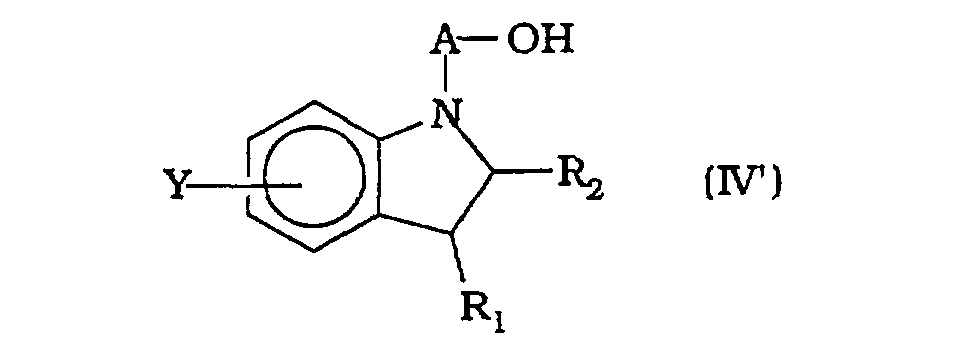 wenn in der herzustellenden Verbindung der Formel (I) X ein Stickstoffatom bedeutet, man als Ausgangsmaterial eine Verbindung der Formel (II/b) verwendet:in der Y und R1 die oben angegebenen Bedeutungen besitzen, welche
 entweder mit einem Derivat der Formel (III/c) in basischem Medium kondensiert wird:
zur Bildung einer Verbindung der Formel (V/b):in der A, Y, G1 und R1 die oben angegebenen Bedeutungen besitzen, deren Gruppe G1, wenn sie eine Pyrrolidinyl-, Piperidyl- oder Piperazinylgruppe bedeutet, am Stickstoffatom in basischem Medium oder durch eine reduzierende Aminierungsreaktion an einem Carbonylderivat substituiert werden kann, oder mit einem Derivat der Formel (III/b), wie sie oben definiert worden ist, kondensiert zur Bildung einer Verbindung der Formel (VI):in der Y, A und R1 die oben angegebenen Bedeutungen besitzen, welche nach der Bromierung mit einem Derivat der Formel HG1 kondensiert wird, worin G1 die bezüglich der Formel (I) angegebenen Bedeutungen besitzt, zur Bildung einer Verbindung der Formel (V/b), wie sie oben definiert worden ist,
welche Verbindungen der Formeln (V/a) und (V/b) die Gesamtheit der Verbindungen der Formel (V) bilden:in der X, Y, A, R1 und G1 die bezüglich der Formel (I) angegebenen Bedeutungen besitzen und Y die oben angegebenen Bedeutungen aufweist,
welche durch Reduktion der Gruppe Y (wenn Y eine Hydroxymethylgruppe darstellt, über ein Zwischenprodukt vom Azido-Typ) zu einer Verbindung der Formel (VII) führt:in der n, X, A, G1 und R1 die oben angegebenen Bedeutungen besitzen, welche mit N,N-Dimethylformamid-azin in saurem Medium kondensiert wird zur Bildung der Verbindungen der Formel (I),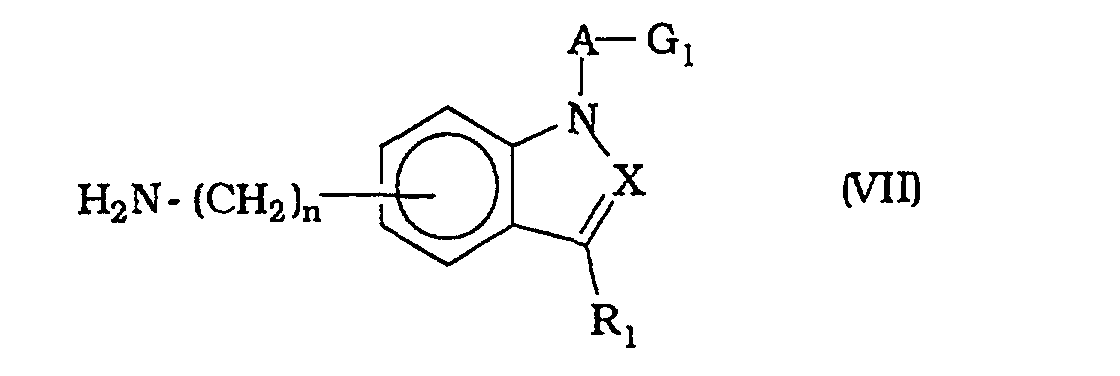 welche man gegebenenfalls mit Hilfe einer klassischen Reinigungsmethode reinigt,welche man gegebenenfalls mit Hilfe einer klassischen Trennmethode in ihre Enantiomeren trennt,und die man gegebenenfalls in ihre Additionssalze mit einer pharmazeutisch annehmbaren Säure oder Base umwandelt,wobei es sich versteht, daß, wenn Y eine Hydroxygruppe enthält, diese letztere in Abhängigkeit von der Art der eingesetzten Reagenzien geschützt und wieder von der Schutzgruppe befreit werden kann.
 - Pharmazeutische Zubereitungen enthaltend als Wirkstoff mindestens eine Verbindung nach einem der Ansprüche 1 bis 13 allein oder in Kombination mit einem oder mehreren inerten, nichttoxischen, pharmazeutisch annehmbaren Trägermaterialien oder Bindemitteln.
- Pharmazeutische Zubereitungen nach Anspruch 15 enthaltend mindestens einen Wirkstoff nach einem der Ansprüche 1 bis 13 zur Behandlung von Veneninsuffizienz und Erkrankungen, die verknüpft sind mit und/oder bei der Behandlung der Migräne und der Migräne, die mit Gefäßerkrankungen verbunden ist.
Applications Claiming Priority (2)
| Application Number | Priority Date | Filing Date | Title |
|---|---|---|---|
| FR9710939 | 1997-09-03 | ||
| FR9710939A FR2767827A1 (fr) | 1997-09-03 | 1997-09-03 | Nouveaux derives de l'indole et de l'indazole, leur procede de preparation et les compositions pharmaceutiques qui les contiennent |
Publications (2)
| Publication Number | Publication Date |
|---|---|
| EP0902027A1 EP0902027A1 (de) | 1999-03-17 |
| EP0902027B1 true EP0902027B1 (de) | 2001-07-25 |
Family
ID=9510710
Family Applications (1)
| Application Number | Title | Priority Date | Filing Date |
|---|---|---|---|
| EP98402154A Expired - Lifetime EP0902027B1 (de) | 1997-09-03 | 1998-09-01 | Indol- und Indazol-derivate, Verfahren zu deren Herstellung und sie enthaltende Zusammensetzungen |
Country Status (19)
| Country | Link |
|---|---|
| US (2) | US6020336A (de) |
| EP (1) | EP0902027B1 (de) |
| JP (1) | JPH11130773A (de) |
| CN (2) | CN1087741C (de) |
| AT (1) | ATE203531T1 (de) |
| AU (1) | AU736602B2 (de) |
| BR (1) | BR9803318A (de) |
| CA (1) | CA2246485C (de) |
| DE (1) | DE69801196T2 (de) |
| DK (1) | DK0902027T5 (de) |
| ES (1) | ES2162404T3 (de) |
| FR (1) | FR2767827A1 (de) |
| GR (1) | GR3036678T3 (de) |
| HU (1) | HUP9801977A1 (de) |
| NO (1) | NO316271B1 (de) |
| NZ (1) | NZ331683A (de) |
| PL (1) | PL328323A1 (de) |
| PT (1) | PT902027E (de) |
| ZA (1) | ZA988072B (de) |
Cited By (1)
| Publication number | Priority date | Publication date | Assignee | Title |
|---|---|---|---|---|
| RU2295326C1 (ru) * | 2005-10-05 | 2007-03-20 | Елена Николаевна Лаптева | Комплексный способ снижения избыточной массы тела |
Families Citing this family (16)
| Publication number | Priority date | Publication date | Assignee | Title |
|---|---|---|---|---|
| WO2000038677A1 (en) * | 1998-12-23 | 2000-07-06 | Allelix Biopharmaceuticals Inc. | Indole and indolizidine derivatives for the treatment of migraine |
| YU54202A (sh) | 2000-01-18 | 2006-01-16 | Agouron Pharmaceuticals Inc. | Jedinjenja indazola, farmaceutske smeše i postupci za stimulisanje i inhibiranje ćelijske proliferacije |
| HN2001000008A (es) | 2000-01-21 | 2003-12-11 | Inc Agouron Pharmaceuticals | Compuesto de amida y composiciones farmaceuticas para inhibir proteinquinasas, y su modo de empleo |
| BR0110302A (pt) | 2000-04-18 | 2003-01-14 | Agouron Pharma | Compostos de pirazol para inibição de proteìnas cinase, sal e pró-droga farmaceuticamente aceitável, metabólito farmaceuticamente ativo ou sal farmaceuticamente aceitável de metabólito, composição farmacêutica, método de tratamento de condição doentia em mamìferos mediada pela atividade de proteìna cinase, método de modulação ou inibição da atividade de um receptor de proteìna cinase |
| AU2001281255B2 (en) | 2000-08-14 | 2006-07-20 | Ortho-Mcneil Pharmaceutical, Inc. | Substituted pyrazoles |
| US7332494B2 (en) | 2000-08-14 | 2008-02-19 | Janssen Pharmaceutica, N.V. | Method for treating allergies using substituted pyrazoles |
| US20070105841A1 (en) * | 2000-08-14 | 2007-05-10 | Breitenbucher J G | Method for treating allergies using substituted pyrazoles |
| FR2829134B1 (fr) | 2001-08-28 | 2006-11-24 | Atofina | Procede de preparation de (meth) acrylates d'alkylimidazolidone |
| US20030073672A1 (en) * | 2001-09-05 | 2003-04-17 | Breitenbucher J. Guy | Method for treating allergies using substituted pyrazoles |
| JPWO2012086735A1 (ja) * | 2010-12-22 | 2014-06-05 | 大正製薬株式会社 | 縮合複素環化合物 |
| CN102617548A (zh) * | 2011-01-31 | 2012-08-01 | 北京赛林泰医药技术有限公司 | 作为gpr受体激动剂的双环杂芳基化合物及其组合物和应用 |
| WO2014102588A2 (en) * | 2012-12-27 | 2014-07-03 | Purdue Pharma L.P. | Indole and indoline-type piperidine compounds and uses thereof |
| WO2014102589A1 (en) | 2012-12-27 | 2014-07-03 | Purdue Pharma L.P. | Quinazolin-4(3h)-one-type piperidine compounds and uses thereof |
| WO2015138280A2 (en) * | 2014-03-10 | 2015-09-17 | Innov17 Llc | Retinoic acid receptor-related orphan receptor modulators and uses thereof |
| US20150252022A1 (en) * | 2014-03-10 | 2015-09-10 | Innov17 Llc | Retinoic acid receptor-related orphan receptor modulators and uses thereof |
| WO2018106667A1 (en) * | 2016-12-05 | 2018-06-14 | Microbiotix, Inc. | Broad-spectrum inhibitors of filoviruses |
Family Cites Families (10)
| Publication number | Priority date | Publication date | Assignee | Title |
|---|---|---|---|---|
| HU198036B (en) * | 1983-08-22 | 1989-07-28 | Hoechst Roussel Pharma | Process for production of derivatives of 3-piperidil-/1h/-indasole and medical preparatives containing them |
| TW203049B (de) * | 1990-04-13 | 1993-04-01 | Yamanouchi Pharma Co Ltd | |
| EP0597112A4 (en) * | 1992-03-27 | 1994-06-22 | Kyoto Pharma Ind | Novel imidazole derivative, pharmaceutical use thereof, and intermediate therefor. |
| IL106445A (en) * | 1992-07-30 | 1998-01-04 | Merck Sharp & Dohme | History of 1,2,4-Trans-Triazole 4-Transform, Preparation and Pharmaceutical Preparations Containing Them |
| GB9402016D0 (en) * | 1994-02-02 | 1994-03-30 | Merck Sharp & Dohme | Therapeutic agents |
| EP0759918A1 (de) * | 1994-05-19 | 1997-03-05 | MERCK SHARP & DOHME LTD. | Indol-3-ylalkyl-piperidin-piperazin, -piperidin und tetrahydropyridin-derivate als 5-ht1 d-alpha agonisten |
| GB2289465A (en) * | 1994-05-19 | 1995-11-22 | Merck Sharp & Dohme | Five-membered heteroaromatic 5-HT receptor agonists |
| JPH10503768A (ja) * | 1994-08-02 | 1998-04-07 | メルク シヤープ エンド ドーム リミテツド | アゼチジン、ピロリジンおよびピペリジン誘導体 |
| ZA965837B (en) * | 1995-07-11 | 1997-01-31 | Merck & Co Inc | A triazolylmethyl-indole ethylamine bisulfate salt |
| WO1997006159A1 (en) * | 1995-08-07 | 1997-02-20 | Merck Sharp & Dohme Limited | Substituted 1-indolylpropyl-4-phenethylpiperazine derivatives |
-
1997
- 1997-09-03 FR FR9710939A patent/FR2767827A1/fr not_active Withdrawn
-
1998
- 1998-09-01 PT PT98402154T patent/PT902027E/pt unknown
- 1998-09-01 DE DE69801196T patent/DE69801196T2/de not_active Expired - Fee Related
- 1998-09-01 DK DK98402154T patent/DK0902027T5/da active
- 1998-09-01 EP EP98402154A patent/EP0902027B1/de not_active Expired - Lifetime
- 1998-09-01 BR BR9803318-2A patent/BR9803318A/pt not_active IP Right Cessation
- 1998-09-01 ES ES98402154T patent/ES2162404T3/es not_active Expired - Lifetime
- 1998-09-01 AT AT98402154T patent/ATE203531T1/de not_active IP Right Cessation
- 1998-09-02 NO NO19984033A patent/NO316271B1/no not_active IP Right Cessation
- 1998-09-02 PL PL98328323A patent/PL328323A1/xx unknown
- 1998-09-02 NZ NZ331683A patent/NZ331683A/xx unknown
- 1998-09-02 CN CN98124581A patent/CN1087741C/zh not_active Expired - Fee Related
- 1998-09-02 CN CNA021184682A patent/CN1510034A/zh active Pending
- 1998-09-02 HU HU9801977A patent/HUP9801977A1/hu unknown
- 1998-09-02 US US09/146,009 patent/US6020336A/en not_active Expired - Fee Related
- 1998-09-03 JP JP10249314A patent/JPH11130773A/ja active Pending
- 1998-09-03 CA CA002246485A patent/CA2246485C/fr not_active Expired - Fee Related
- 1998-09-03 AU AU83068/98A patent/AU736602B2/en not_active Ceased
- 1998-09-03 ZA ZA988072A patent/ZA988072B/xx unknown
-
1999
- 1999-04-26 US US09/299,314 patent/US6046205A/en not_active Expired - Fee Related
-
2001
- 2001-09-20 GR GR20010401535T patent/GR3036678T3/el not_active IP Right Cessation
Cited By (1)
| Publication number | Priority date | Publication date | Assignee | Title |
|---|---|---|---|---|
| RU2295326C1 (ru) * | 2005-10-05 | 2007-03-20 | Елена Николаевна Лаптева | Комплексный способ снижения избыточной массы тела |
Also Published As
| Publication number | Publication date |
|---|---|
| CN1087741C (zh) | 2002-07-17 |
| NO984033L (no) | 1999-03-04 |
| ZA988072B (en) | 1999-03-09 |
| DE69801196D1 (de) | 2001-08-30 |
| CN1218052A (zh) | 1999-06-02 |
| CA2246485A1 (fr) | 1999-03-03 |
| CA2246485C (fr) | 2004-04-20 |
| PT902027E (pt) | 2001-11-30 |
| JPH11130773A (ja) | 1999-05-18 |
| GR3036678T3 (en) | 2001-12-31 |
| DE69801196T2 (de) | 2002-03-14 |
| HK1019738A1 (en) | 2000-02-25 |
| HUP9801977A1 (hu) | 2000-11-28 |
| AU8306898A (en) | 1999-03-18 |
| AU736602B2 (en) | 2001-08-02 |
| DK0902027T5 (da) | 2001-12-03 |
| FR2767827A1 (fr) | 1999-02-26 |
| US6020336A (en) | 2000-02-01 |
| ES2162404T3 (es) | 2001-12-16 |
| NO316271B1 (no) | 2004-01-05 |
| EP0902027A1 (de) | 1999-03-17 |
| BR9803318A (pt) | 2000-02-08 |
| ATE203531T1 (de) | 2001-08-15 |
| NZ331683A (en) | 2000-01-28 |
| HU9801977D0 (en) | 1998-10-28 |
| NO984033D0 (no) | 1998-09-02 |
| PL328323A1 (en) | 1999-03-15 |
| CN1510034A (zh) | 2004-07-07 |
| DK0902027T3 (da) | 2001-10-15 |
| US6046205A (en) | 2000-04-04 |
Similar Documents
| Publication | Publication Date | Title |
|---|---|---|
| US5834493A (en) | Indole derivatives as 5-HT1A and/or 5-HT2 ligands | |
| US5578616A (en) | Phenyl-alkyl-imidazoles | |
| EP0902027A1 (de) | Indol- und Indazol-derivate, Verfahren zu deren Herstellung und sie enthaltende Zusammensetzungen | |
| EP0610134B1 (de) | Indolderivate als 5-HT1-like Agonisten | |
| EP0721455B1 (de) | Tetrahydropyridin-(oder 4-hydroxypiperidin) alkylazole mit sigma und/oder 5ht 1a-rezeptor aktivität | |
| EP0466585A1 (de) | Neue Derivate des Piperidins, Tetrahydropyridins und des Pyrrolidins, Verfahren zu ihrer Herstellung und diese enthaltende Arzneimittel | |
| JPH0733384B2 (ja) | アミノ−チアゾ−ル及びオキサゾ−ル誘導体 | |
| EP0694536A1 (de) | 1-Benzyl-1,3-dihydro-2H-benzimidazol-2-one-Derivate, ihre Herstellung und diese enthaltende Zusammensetzungen | |
| EP1023898B1 (de) | Cyano-indolen als Serotoninwiederaufnahme Inhibitoren und als 5-HT2c Rezeptor Liganden | |
| WO1997028157A1 (fr) | Nouveaux derives de la piperidine substitues en position 4 par un groupe imidazolidin-2-on-1-yl-ethyl, tetrahydropyrimidin-2-on-1-yl-ethyl, et 1,3-dia-zepin-2-on-1-yl-ethyl, et leurs applications comme antagonistes des recepteurs alpha-2 adrenergiques | |
| EP1383762B1 (de) | Tetrahydropyridyl-alkyl-heterozykle, verfahren zu ihrer herstellung und pharmazeutische zusammensetzungen die sie enthalten | |
| EP1245565B1 (de) | Indenoindolon-Derivate, Verfahren zu ihrer Herstellung und die enthaltenden pharmazeutischen Zusammensetzungen | |
| FR2766824A1 (fr) | Nouveaux composes heterocycliques, leur procede de preparation et les compositions pharmaceutiques qui les contiennent | |
| EP0950049B1 (de) | Diphenylalkyl-tetrahydropyridine, verfahren zu ihren herstellung und diese enthaltende arzneimittel | |
| EP1119564B1 (de) | Aryl-4-fluoro-4-(2-pyridin-2-yl-ethylamino)-methyl]-piperidin-1-yl-methanone derivate als 5-ht1-rezeptor-agonisten | |
| EP1931341B1 (de) | 1h-indol-pyridincarbonsäureamid und 1h-indol-piperidincarbonsäureamid-derivate und ihre verwendung als tyrosin hydroxylase-induktoren | |
| EP1710240A1 (de) | Piperazinderivate und ihre Verwendung als Serotonin-Wiederaufnahme-Inhibitoren oder als Neurokinin-Antagonisten | |
| EP1383761B1 (de) | Phenyl- und pyridyl-piperidine mit tnf-wirkung | |
| FR2773800A1 (fr) | Derives de benzimidazole, leur procede de preparation et leur application en therapeutique | |
| EP1511735B1 (de) | Imidazolverbindungen und ihre verwendung als alpha-2 adrenorezeptorliganden | |
| EP1476433A1 (de) | Trizyklo-imidazolinen derivaten, verfahren zu deren herstellung und deren verwendung als heilmitteln | |
| FR2823750A1 (fr) | Tetrahydropyridyl-alkyl-heterocycles, procede pour leur preparation et compositions pharmaceutiques les contenant |
Legal Events
| Date | Code | Title | Description |
|---|---|---|---|
| PUAI | Public reference made under article 153(3) epc to a published international application that has entered the european phase |
Free format text: ORIGINAL CODE: 0009012 |
|
| 17P | Request for examination filed |
Effective date: 19980914 |
|
| AK | Designated contracting states |
Kind code of ref document: A1 Designated state(s): AT BE CH DE DK ES FI FR GB GR IE IT LI LU NL PT SE |
|
| AX | Request for extension of the european patent |
Free format text: AL;LT;LV;MK;RO;SI |
|
| AKX | Designation fees paid |
Free format text: AT BE CH DE DK ES FI FR GB GR IE IT LI LU NL PT SE |
|
| 17Q | First examination report despatched |
Effective date: 20000522 |
|
| GRAG | Despatch of communication of intention to grant |
Free format text: ORIGINAL CODE: EPIDOS AGRA |
|
| GRAG | Despatch of communication of intention to grant |
Free format text: ORIGINAL CODE: EPIDOS AGRA |
|
| GRAH | Despatch of communication of intention to grant a patent |
Free format text: ORIGINAL CODE: EPIDOS IGRA |
|
| GRAH | Despatch of communication of intention to grant a patent |
Free format text: ORIGINAL CODE: EPIDOS IGRA |
|
| GRAA | (expected) grant |
Free format text: ORIGINAL CODE: 0009210 |
|
| AK | Designated contracting states |
Kind code of ref document: B1 Designated state(s): AT BE CH DE DK ES FI FR GB GR IE IT LI LU NL PT SE |
|
| REF | Corresponds to: |
Ref document number: 203531 Country of ref document: AT Date of ref document: 20010815 Kind code of ref document: T |
|
| REG | Reference to a national code |
Ref country code: CH Ref legal event code: EP |
|
| REG | Reference to a national code |
Ref country code: IE Ref legal event code: FG4D Free format text: FRENCH |
|
| REF | Corresponds to: |
Ref document number: 69801196 Country of ref document: DE Date of ref document: 20010830 |
|
| REG | Reference to a national code |
Ref country code: CH Ref legal event code: NV Representative=s name: A. BRAUN, BRAUN, HERITIER, ESCHMANN AG PATENTANWAE |
|
| REG | Reference to a national code |
Ref country code: DK Ref legal event code: T3 |
|
| REG | Reference to a national code |
Ref country code: CH Ref legal event code: PFA Free format text: ADIR ET COMPAGNIE TRANSFER- LES LABORATOIRES SERVIER |
|
| REG | Reference to a national code |
Ref country code: FR Ref legal event code: TP |
|
| GBT | Gb: translation of ep patent filed (gb section 77(6)(a)/1977) |
Effective date: 20011025 |
|
| REG | Reference to a national code |
Ref country code: PT Ref legal event code: SC4A Free format text: AVAILABILITY OF NATIONAL TRANSLATION Effective date: 20010726 |
|
| REG | Reference to a national code |
Ref country code: DK Ref legal event code: T5 |
|
| REG | Reference to a national code |
Ref country code: GB Ref legal event code: 732E |
|
| REG | Reference to a national code |
Ref country code: ES Ref legal event code: FG2A Ref document number: 2162404 Country of ref document: ES Kind code of ref document: T3 |
|
| BECA | Be: change of holder's address |
Free format text: 20010725 LES LABORATOIRES *SERVIER:1 RUE CARLE HEBERT, 92415 COURBEVOIE CEDEX |
|
| BECH | Be: change of holder |
Free format text: 20010725 LES LABORATOIRES *SERVIER |
|
| REG | Reference to a national code |
Ref country code: GB Ref legal event code: IF02 |
|
| NLS | Nl: assignments of ep-patents |
Owner name: LES LABORATOIRES SERVIER |
|
| REG | Reference to a national code |
Ref country code: PT Ref legal event code: PC4A Free format text: LES LABORATOIRES SERVIER FR Effective date: 20011105 |
|
| PLBE | No opposition filed within time limit |
Free format text: ORIGINAL CODE: 0009261 |
|
| STAA | Information on the status of an ep patent application or granted ep patent |
Free format text: STATUS: NO OPPOSITION FILED WITHIN TIME LIMIT |
|
| 26N | No opposition filed | ||
| PGFP | Annual fee paid to national office [announced via postgrant information from national office to epo] |
Ref country code: PT Payment date: 20030703 Year of fee payment: 6 Ref country code: AT Payment date: 20030703 Year of fee payment: 6 |
|
| PGFP | Annual fee paid to national office [announced via postgrant information from national office to epo] |
Ref country code: IE Payment date: 20030704 Year of fee payment: 6 |
|
| PGFP | Annual fee paid to national office [announced via postgrant information from national office to epo] |
Ref country code: GR Payment date: 20030718 Year of fee payment: 6 |
|
| PGFP | Annual fee paid to national office [announced via postgrant information from national office to epo] |
Ref country code: FI Payment date: 20030801 Year of fee payment: 6 |
|
| PGFP | Annual fee paid to national office [announced via postgrant information from national office to epo] |
Ref country code: SE Payment date: 20030808 Year of fee payment: 6 |
|
| PGFP | Annual fee paid to national office [announced via postgrant information from national office to epo] |
Ref country code: LU Payment date: 20030811 Year of fee payment: 6 |
|
| PGFP | Annual fee paid to national office [announced via postgrant information from national office to epo] |
Ref country code: GB Payment date: 20030827 Year of fee payment: 6 |
|
| PGFP | Annual fee paid to national office [announced via postgrant information from national office to epo] |
Ref country code: BE Payment date: 20030910 Year of fee payment: 6 |
|
| PGFP | Annual fee paid to national office [announced via postgrant information from national office to epo] |
Ref country code: FR Payment date: 20030924 Year of fee payment: 6 Ref country code: NL Payment date: 20030924 Year of fee payment: 6 Ref country code: DK Payment date: 20030924 Year of fee payment: 6 |
|
| PGFP | Annual fee paid to national office [announced via postgrant information from national office to epo] |
Ref country code: DE Payment date: 20030926 Year of fee payment: 6 |
|
| PGFP | Annual fee paid to national office [announced via postgrant information from national office to epo] |
Ref country code: CH Payment date: 20030930 Year of fee payment: 6 |
|
| PGFP | Annual fee paid to national office [announced via postgrant information from national office to epo] |
Ref country code: ES Payment date: 20031008 Year of fee payment: 6 |
|
| PG25 | Lapsed in a contracting state [announced via postgrant information from national office to epo] |
Ref country code: LU Free format text: LAPSE BECAUSE OF NON-PAYMENT OF DUE FEES Effective date: 20040901 Ref country code: IE Free format text: LAPSE BECAUSE OF NON-PAYMENT OF DUE FEES Effective date: 20040901 Ref country code: GB Free format text: LAPSE BECAUSE OF NON-PAYMENT OF DUE FEES Effective date: 20040901 Ref country code: FI Free format text: LAPSE BECAUSE OF NON-PAYMENT OF DUE FEES Effective date: 20040901 Ref country code: AT Free format text: LAPSE BECAUSE OF NON-PAYMENT OF DUE FEES Effective date: 20040901 |
|
| PG25 | Lapsed in a contracting state [announced via postgrant information from national office to epo] |
Ref country code: SE Free format text: LAPSE BECAUSE OF NON-PAYMENT OF DUE FEES Effective date: 20040902 Ref country code: ES Free format text: LAPSE BECAUSE OF NON-PAYMENT OF DUE FEES Effective date: 20040902 |
|
| PG25 | Lapsed in a contracting state [announced via postgrant information from national office to epo] |
Ref country code: LI Free format text: LAPSE BECAUSE OF NON-PAYMENT OF DUE FEES Effective date: 20040930 Ref country code: DK Free format text: LAPSE BECAUSE OF NON-PAYMENT OF DUE FEES Effective date: 20040930 Ref country code: CH Free format text: LAPSE BECAUSE OF NON-PAYMENT OF DUE FEES Effective date: 20040930 Ref country code: BE Free format text: LAPSE BECAUSE OF NON-PAYMENT OF DUE FEES Effective date: 20040930 |
|
| PG25 | Lapsed in a contracting state [announced via postgrant information from national office to epo] |
Ref country code: PT Free format text: LAPSE BECAUSE OF NON-PAYMENT OF DUE FEES Effective date: 20050301 |
|
| BERE | Be: lapsed |
Owner name: LES LABORATOIRES *SERVIER Effective date: 20040930 |
|
| PG25 | Lapsed in a contracting state [announced via postgrant information from national office to epo] |
Ref country code: NL Free format text: LAPSE BECAUSE OF NON-PAYMENT OF DUE FEES Effective date: 20050401 Ref country code: DE Free format text: LAPSE BECAUSE OF NON-PAYMENT OF DUE FEES Effective date: 20050401 |
|
| PG25 | Lapsed in a contracting state [announced via postgrant information from national office to epo] |
Ref country code: GR Free format text: LAPSE BECAUSE OF NON-PAYMENT OF DUE FEES Effective date: 20050405 |
|
| GBPC | Gb: european patent ceased through non-payment of renewal fee |
Effective date: 20040901 |
|
| EUG | Se: european patent has lapsed | ||
| REG | Reference to a national code |
Ref country code: CH Ref legal event code: PL |
|
| PG25 | Lapsed in a contracting state [announced via postgrant information from national office to epo] |
Ref country code: FR Free format text: LAPSE BECAUSE OF NON-PAYMENT OF DUE FEES Effective date: 20050531 |
|
| REG | Reference to a national code |
Ref country code: PT Ref legal event code: MM4A Free format text: LAPSE DUE TO NON-PAYMENT OF FEES Effective date: 20050301 |
|
| NLV4 | Nl: lapsed or anulled due to non-payment of the annual fee |
Effective date: 20050401 |
|
| REG | Reference to a national code |
Ref country code: IE Ref legal event code: MM4A |
|
| REG | Reference to a national code |
Ref country code: DK Ref legal event code: EBP |
|
| REG | Reference to a national code |
Ref country code: FR Ref legal event code: ST |
|
| PG25 | Lapsed in a contracting state [announced via postgrant information from national office to epo] |
Ref country code: IT Free format text: LAPSE BECAUSE OF NON-PAYMENT OF DUE FEES Effective date: 20050901 |
|
| REG | Reference to a national code |
Ref country code: ES Ref legal event code: FD2A Effective date: 20040902 |
|
| BERE | Be: lapsed |
Owner name: LES LABORATOIRES *SERVIER Effective date: 20040930 |