EP0896016A2 - Hochdispersion und Verfahren zu ihrer Herstellung - Google Patents
Hochdispersion und Verfahren zu ihrer Herstellung Download PDFInfo
- Publication number
- EP0896016A2 EP0896016A2 EP98114435A EP98114435A EP0896016A2 EP 0896016 A2 EP0896016 A2 EP 0896016A2 EP 98114435 A EP98114435 A EP 98114435A EP 98114435 A EP98114435 A EP 98114435A EP 0896016 A2 EP0896016 A2 EP 0896016A2
- Authority
- EP
- European Patent Office
- Prior art keywords
- resin
- particle dispersion
- fine particles
- fine particle
- particles
- Prior art date
- Legal status (The legal status is an assumption and is not a legal conclusion. Google has not performed a legal analysis and makes no representation as to the accuracy of the status listed.)
- Granted
Links
- 239000010419 fine particle Substances 0.000 title claims abstract description 119
- 239000006185 dispersion Substances 0.000 title claims abstract description 77
- 238000004519 manufacturing process Methods 0.000 title claims description 9
- 239000002245 particle Substances 0.000 claims abstract description 95
- 229920005989 resin Polymers 0.000 claims abstract description 91
- 239000011347 resin Substances 0.000 claims abstract description 91
- 239000000463 material Substances 0.000 claims abstract description 41
- 238000004040 coloring Methods 0.000 claims abstract description 29
- 239000007788 liquid Substances 0.000 claims abstract description 24
- 239000002344 surface layer Substances 0.000 claims abstract description 13
- VYPSYNLAJGMNEJ-UHFFFAOYSA-N Silicium dioxide Chemical compound O=[Si]=O VYPSYNLAJGMNEJ-UHFFFAOYSA-N 0.000 claims description 20
- 239000000049 pigment Substances 0.000 claims description 19
- 239000000203 mixture Substances 0.000 claims description 16
- 239000002904 solvent Substances 0.000 claims description 12
- GWEVSGVZZGPLCZ-UHFFFAOYSA-N Titan oxide Chemical compound O=[Ti]=O GWEVSGVZZGPLCZ-UHFFFAOYSA-N 0.000 claims description 11
- OGIDPMRJRNCKJF-UHFFFAOYSA-N titanium oxide Inorganic materials [Ti]=O OGIDPMRJRNCKJF-UHFFFAOYSA-N 0.000 claims description 11
- 238000001816 cooling Methods 0.000 claims description 10
- 229920005992 thermoplastic resin Polymers 0.000 claims description 8
- 239000000377 silicon dioxide Substances 0.000 claims description 7
- RJDOZRNNYVAULJ-UHFFFAOYSA-L [O--].[O--].[O--].[O--].[O--].[O--].[O--].[O--].[O--].[O--].[F-].[F-].[Mg++].[Mg++].[Mg++].[Al+3].[Si+4].[Si+4].[Si+4].[K+] Chemical compound [O--].[O--].[O--].[O--].[O--].[O--].[O--].[O--].[O--].[O--].[F-].[F-].[Mg++].[Mg++].[Mg++].[Al+3].[Si+4].[Si+4].[Si+4].[K+] RJDOZRNNYVAULJ-UHFFFAOYSA-L 0.000 claims description 6
- -1 alicyclic hydrocarbons Chemical class 0.000 claims description 6
- 150000001338 aliphatic hydrocarbons Chemical class 0.000 claims description 5
- RTAQQCXQSZGOHL-UHFFFAOYSA-N Titanium Chemical compound [Ti] RTAQQCXQSZGOHL-UHFFFAOYSA-N 0.000 claims description 4
- OJMOMXZKOWKUTA-UHFFFAOYSA-N aluminum;borate Chemical compound [Al+3].[O-]B([O-])[O-] OJMOMXZKOWKUTA-UHFFFAOYSA-N 0.000 claims description 4
- 238000010438 heat treatment Methods 0.000 claims description 4
- 239000010936 titanium Substances 0.000 claims description 4
- 229910052719 titanium Inorganic materials 0.000 claims description 4
- 229930195733 hydrocarbon Natural products 0.000 claims description 3
- 238000002156 mixing Methods 0.000 claims description 3
- 229920002545 silicone oil Polymers 0.000 claims description 3
- 125000003178 carboxy group Chemical group [H]OC(*)=O 0.000 claims description 2
- 239000008119 colloidal silica Substances 0.000 claims description 2
- XLYOFNOQVPJJNP-UHFFFAOYSA-M hydroxide Chemical compound [OH-] XLYOFNOQVPJJNP-UHFFFAOYSA-M 0.000 claims description 2
- 239000011368 organic material Substances 0.000 claims description 2
- 239000000741 silica gel Substances 0.000 claims description 2
- 229910002027 silica gel Inorganic materials 0.000 claims description 2
- 150000002430 hydrocarbons Chemical class 0.000 claims 1
- 230000000694 effects Effects 0.000 description 13
- 239000012046 mixed solvent Substances 0.000 description 13
- 230000001747 exhibiting effect Effects 0.000 description 11
- YXFVVABEGXRONW-UHFFFAOYSA-N Toluene Chemical compound CC1=CC=CC=C1 YXFVVABEGXRONW-UHFFFAOYSA-N 0.000 description 9
- 239000012530 fluid Substances 0.000 description 9
- LFQSCWFLJHTTHZ-UHFFFAOYSA-N Ethanol Chemical compound CCO LFQSCWFLJHTTHZ-UHFFFAOYSA-N 0.000 description 6
- 239000006229 carbon black Substances 0.000 description 6
- 235000019241 carbon black Nutrition 0.000 description 6
- 239000003086 colorant Substances 0.000 description 5
- 238000000034 method Methods 0.000 description 5
- 238000011156 evaluation Methods 0.000 description 4
- 239000011344 liquid material Substances 0.000 description 4
- 239000000987 azo dye Substances 0.000 description 3
- 230000000052 comparative effect Effects 0.000 description 3
- 229920001577 copolymer Polymers 0.000 description 3
- XCJYREBRNVKWGJ-UHFFFAOYSA-N copper(II) phthalocyanine Chemical compound [Cu+2].C12=CC=CC=C2C(N=C2[N-]C(C3=CC=CC=C32)=N2)=NC1=NC([C]1C=CC=CC1=1)=NC=1N=C1[C]3C=CC=CC3=C2[N-]1 XCJYREBRNVKWGJ-UHFFFAOYSA-N 0.000 description 3
- 239000005038 ethylene vinyl acetate Substances 0.000 description 3
- 239000010445 mica Substances 0.000 description 3
- 229910052618 mica group Inorganic materials 0.000 description 3
- 229920001200 poly(ethylene-vinyl acetate) Polymers 0.000 description 3
- 238000001556 precipitation Methods 0.000 description 3
- 238000010992 reflux Methods 0.000 description 3
- 239000000126 substance Substances 0.000 description 3
- CNPVJWYWYZMPDS-UHFFFAOYSA-N 2-methyldecane Chemical compound CCCCCCCCC(C)C CNPVJWYWYZMPDS-UHFFFAOYSA-N 0.000 description 2
- RYGMFSIKBFXOCR-UHFFFAOYSA-N Copper Chemical compound [Cu] RYGMFSIKBFXOCR-UHFFFAOYSA-N 0.000 description 2
- 239000000654 additive Substances 0.000 description 2
- HSFWRNGVRCDJHI-UHFFFAOYSA-N alpha-acetylene Natural products C#C HSFWRNGVRCDJHI-UHFFFAOYSA-N 0.000 description 2
- PZTQVMXMKVTIRC-UHFFFAOYSA-L chembl2028348 Chemical compound [Ca+2].[O-]S(=O)(=O)C1=CC(C)=CC=C1N=NC1=C(O)C(C([O-])=O)=CC2=CC=CC=C12 PZTQVMXMKVTIRC-UHFFFAOYSA-L 0.000 description 2
- 125000002534 ethynyl group Chemical group [H]C#C* 0.000 description 2
- 230000005484 gravity Effects 0.000 description 2
- 239000010954 inorganic particle Substances 0.000 description 2
- 235000010187 litholrubine BK Nutrition 0.000 description 2
- 229920003146 methacrylic ester copolymer Polymers 0.000 description 2
- 239000003921 oil Substances 0.000 description 2
- 229920006324 polyoxymethylene Polymers 0.000 description 2
- 229920001296 polysiloxane Polymers 0.000 description 2
- 238000003756 stirring Methods 0.000 description 2
- JHPBZFOKBAGZBL-UHFFFAOYSA-N (3-hydroxy-2,2,4-trimethylpentyl) 2-methylprop-2-enoate Chemical compound CC(C)C(O)C(C)(C)COC(=O)C(C)=C JHPBZFOKBAGZBL-UHFFFAOYSA-N 0.000 description 1
- DHKHKXVYLBGOIT-UHFFFAOYSA-N 1,1-Diethoxyethane Chemical compound CCOC(C)OCC DHKHKXVYLBGOIT-UHFFFAOYSA-N 0.000 description 1
- OSNILPMOSNGHLC-UHFFFAOYSA-N 1-[4-methoxy-3-(piperidin-1-ylmethyl)phenyl]ethanone Chemical compound COC1=CC=C(C(C)=O)C=C1CN1CCCCC1 OSNILPMOSNGHLC-UHFFFAOYSA-N 0.000 description 1
- OEPOKWHJYJXUGD-UHFFFAOYSA-N 2-(3-phenylmethoxyphenyl)-1,3-thiazole-4-carbaldehyde Chemical compound O=CC1=CSC(C=2C=C(OCC=3C=CC=CC=3)C=CC=2)=N1 OEPOKWHJYJXUGD-UHFFFAOYSA-N 0.000 description 1
- MFYSUUPKMDJYPF-UHFFFAOYSA-N 2-[(4-methyl-2-nitrophenyl)diazenyl]-3-oxo-n-phenylbutanamide Chemical compound C=1C=CC=CC=1NC(=O)C(C(=O)C)N=NC1=CC=C(C)C=C1[N+]([O-])=O MFYSUUPKMDJYPF-UHFFFAOYSA-N 0.000 description 1
- JQXYBDVZAUEPDL-UHFFFAOYSA-N 2-methylidene-5-phenylpent-4-enoic acid Chemical compound OC(=O)C(=C)CC=CC1=CC=CC=C1 JQXYBDVZAUEPDL-UHFFFAOYSA-N 0.000 description 1
- LBBAKTMYSIFTBS-UHFFFAOYSA-N 3-[(4-aminophenyl)diazenyl]benzene-1,2-diamine Chemical compound C1=CC(N)=CC=C1N=NC1=CC=CC(N)=C1N LBBAKTMYSIFTBS-UHFFFAOYSA-N 0.000 description 1
- 229910002012 Aerosil® Inorganic materials 0.000 description 1
- CERQOIWHTDAKMF-UHFFFAOYSA-N Methacrylic acid Chemical class CC(=C)C(O)=O CERQOIWHTDAKMF-UHFFFAOYSA-N 0.000 description 1
- 229930182556 Polyacetal Natural products 0.000 description 1
- 239000004952 Polyamide Substances 0.000 description 1
- 239000004743 Polypropylene Substances 0.000 description 1
- XTXRWKRVRITETP-UHFFFAOYSA-N Vinyl acetate Chemical compound CC(=O)OC=C XTXRWKRVRITETP-UHFFFAOYSA-N 0.000 description 1
- BZHJMEDXRYGGRV-UHFFFAOYSA-N Vinyl chloride Chemical compound ClC=C BZHJMEDXRYGGRV-UHFFFAOYSA-N 0.000 description 1
- 235000010724 Wisteria floribunda Nutrition 0.000 description 1
- 239000011354 acetal resin Substances 0.000 description 1
- 230000002378 acidificating effect Effects 0.000 description 1
- 230000000996 additive effect Effects 0.000 description 1
- DJPURDPSZFLWGC-UHFFFAOYSA-N alumanylidyneborane Chemical compound [Al]#B DJPURDPSZFLWGC-UHFFFAOYSA-N 0.000 description 1
- 150000004945 aromatic hydrocarbons Chemical class 0.000 description 1
- ZCGHEBMEQXMRQL-UHFFFAOYSA-N benzyl 2-carbamoylpyrrolidine-1-carboxylate Chemical compound NC(=O)C1CCCN1C(=O)OCC1=CC=CC=C1 ZCGHEBMEQXMRQL-UHFFFAOYSA-N 0.000 description 1
- 239000003795 chemical substances by application Substances 0.000 description 1
- 239000010949 copper Substances 0.000 description 1
- 229910052802 copper Inorganic materials 0.000 description 1
- 239000002270 dispersing agent Substances 0.000 description 1
- 238000009826 distribution Methods 0.000 description 1
- 239000000975 dye Substances 0.000 description 1
- 229920001971 elastomer Polymers 0.000 description 1
- 230000005684 electric field Effects 0.000 description 1
- 150000002170 ethers Chemical class 0.000 description 1
- 229920006242 ethylene acrylic acid copolymer Polymers 0.000 description 1
- 229920005648 ethylene methacrylic acid copolymer Polymers 0.000 description 1
- NBVXSUQYWXRMNV-UHFFFAOYSA-N fluoromethane Chemical compound FC NBVXSUQYWXRMNV-UHFFFAOYSA-N 0.000 description 1
- 230000014509 gene expression Effects 0.000 description 1
- 229910052736 halogen Inorganic materials 0.000 description 1
- 150000002367 halogens Chemical class 0.000 description 1
- 230000001771 impaired effect Effects 0.000 description 1
- 230000003993 interaction Effects 0.000 description 1
- 238000004898 kneading Methods 0.000 description 1
- FDZZZRQASAIRJF-UHFFFAOYSA-M malachite green Chemical compound [Cl-].C1=CC(N(C)C)=CC=C1C(C=1C=CC=CC=1)=C1C=CC(=[N+](C)C)C=C1 FDZZZRQASAIRJF-UHFFFAOYSA-M 0.000 description 1
- 229940107698 malachite green Drugs 0.000 description 1
- 229920003145 methacrylic acid copolymer Polymers 0.000 description 1
- 229940117841 methacrylic acid copolymer Drugs 0.000 description 1
- 235000012736 patent blue V Nutrition 0.000 description 1
- 239000003208 petroleum Substances 0.000 description 1
- IEQIEDJGQAUEQZ-UHFFFAOYSA-N phthalocyanine Chemical compound N1C(N=C2C3=CC=CC=C3C(N=C3C4=CC=CC=C4C(=N4)N3)=N2)=C(C=CC=C2)C2=C1N=C1C2=CC=CC=C2C4=N1 IEQIEDJGQAUEQZ-UHFFFAOYSA-N 0.000 description 1
- 229920002647 polyamide Polymers 0.000 description 1
- 229920001225 polyester resin Polymers 0.000 description 1
- 239000004645 polyester resin Substances 0.000 description 1
- 229920013716 polyethylene resin Polymers 0.000 description 1
- 229920001155 polypropylene Polymers 0.000 description 1
- 230000001376 precipitating effect Effects 0.000 description 1
- 239000001008 quinone-imine dye Substances 0.000 description 1
- PYWVYCXTNDRMGF-UHFFFAOYSA-N rhodamine B Chemical compound [Cl-].C=12C=CC(=[N+](CC)CC)C=C2OC2=CC(N(CC)CC)=CC=C2C=1C1=CC=CC=C1C(O)=O PYWVYCXTNDRMGF-UHFFFAOYSA-N 0.000 description 1
- 229920006395 saturated elastomer Polymers 0.000 description 1
- RMAQACBXLXPBSY-UHFFFAOYSA-N silicic acid Chemical compound O[Si](O)(O)O RMAQACBXLXPBSY-UHFFFAOYSA-N 0.000 description 1
- 239000007787 solid Substances 0.000 description 1
- 229920001909 styrene-acrylic polymer Polymers 0.000 description 1
- 150000003440 styrenes Chemical class 0.000 description 1
- 238000004381 surface treatment Methods 0.000 description 1
- LLZRNZOLAXHGLL-UHFFFAOYSA-J titanic acid Chemical compound O[Ti](O)(O)O LLZRNZOLAXHGLL-UHFFFAOYSA-J 0.000 description 1
- 238000011282 treatment Methods 0.000 description 1
- 229920002554 vinyl polymer Polymers 0.000 description 1
- 230000000007 visual effect Effects 0.000 description 1
Images
Classifications
-
- C—CHEMISTRY; METALLURGY
- C08—ORGANIC MACROMOLECULAR COMPOUNDS; THEIR PREPARATION OR CHEMICAL WORKING-UP; COMPOSITIONS BASED THEREON
- C08J—WORKING-UP; GENERAL PROCESSES OF COMPOUNDING; AFTER-TREATMENT NOT COVERED BY SUBCLASSES C08B, C08C, C08F, C08G or C08H
- C08J3/00—Processes of treating or compounding macromolecular substances
- C08J3/12—Powdering or granulating
- C08J3/14—Powdering or granulating by precipitation from solutions
-
- C—CHEMISTRY; METALLURGY
- C08—ORGANIC MACROMOLECULAR COMPOUNDS; THEIR PREPARATION OR CHEMICAL WORKING-UP; COMPOSITIONS BASED THEREON
- C08J—WORKING-UP; GENERAL PROCESSES OF COMPOUNDING; AFTER-TREATMENT NOT COVERED BY SUBCLASSES C08B, C08C, C08F, C08G or C08H
- C08J3/00—Processes of treating or compounding macromolecular substances
- C08J3/02—Making solutions, dispersions, lattices or gels by other methods than by solution, emulsion or suspension polymerisation techniques
- C08J3/09—Making solutions, dispersions, lattices or gels by other methods than by solution, emulsion or suspension polymerisation techniques in organic liquids
-
- C—CHEMISTRY; METALLURGY
- C08—ORGANIC MACROMOLECULAR COMPOUNDS; THEIR PREPARATION OR CHEMICAL WORKING-UP; COMPOSITIONS BASED THEREON
- C08J—WORKING-UP; GENERAL PROCESSES OF COMPOUNDING; AFTER-TREATMENT NOT COVERED BY SUBCLASSES C08B, C08C, C08F, C08G or C08H
- C08J3/00—Processes of treating or compounding macromolecular substances
- C08J3/20—Compounding polymers with additives, e.g. colouring
- C08J3/205—Compounding polymers with additives, e.g. colouring in the presence of a continuous liquid phase
Definitions
- the present invention relates to a fine particle dispersion and a method of manufacturing the same, particularly, to a fine particle dispersion having the viscosity promptly increased upon application of an electric field, exhibiting an electrorheological effect, i.e., the effect that various colors are developed by coloring materials, and acting as an electrorheological (ER) fluid to allow the dispersion to be used as an operating fluid in, for example, an engine mount, a damper and a valve. Since the fine particle dispersion of the present invention is capable of developing various colors, the dispersion can also be used as a coloring material such as a liquid toner and an ink for an ink jet apparatus. The present invention also relates to a method of manufacturing the particular fine particle dispersion.
- the dispersed fine particles have a specific gravity larger than that of the carrier liquid, leading to a poor dispersion of the fine particles. Also, since a black material such as a carbon black is dispersed in the carrier liquid, the conventional ER fluid cannot be used as a coloring material.
- an electrorheological (ER) fluid using resin particles having a specific gravity close to that of the carrier liquid.
- the resin particles have a large particle diameter, e.g., about 15 ⁇ m.
- an ER fluid using resin particles since it is difficult to have both a coloring material and an ER material (material used for imparting an electrorheological effect to the resin particle) buried in the resin particle, an ER fluid using resin particles has not yet been put to practical use.
- the present inventors previously proposed a liquid toner composition containing a coloring material and resin particles having such a small particle diameter as 2 to 3 ⁇ m of a volume-based median diameter, said composition exhibiting the properties of an ER fluid, and also proposed a method of manufacturing the particular liquid toner composition.
- the present inventors have arrived at the present invention.
- An object of the present invention is to provide a fine particle dispersion exhibiting a high ER effect, the dispersion containing resin particles, which may or may not contain a coloring material, having an average particle diameter controlled to fall within a range of between 0.5 and 20 ⁇ m and having inorganic particles attached to or contained in, mainly, the surface region thereof, and a method of manufacturing the same.
- a fine particle dispersion having resin or both resin and a coloring material dispersed in a carrier liquid, the resin being controlled to have an average particle diameter of 0.5 to 20 ⁇ m and having inorganic fine particles attached to or contained in, mainly, a surface layer thereof.
- a fine particle dispersion comprising the steps of:
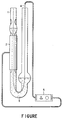
- the single FIGURE shows an apparatus for evaluating the electrorheological (ER) properties of a fine particle dispersion according to one embodiment of the present invention.
- the fine particle dispersion of the present invention contains inorganic fine particles serving to allow the dispersion to produce an electrorheological (ER) effect.
- ER electrorheological
- the inorganic fine particles to be present deep inside the particle consisting of resin or resin and a coloring material (hereinafter referred to as a colored resin particle).
- a colored resin particle a coloring material
- the inorganic fine particles to be added selectively in the vicinity of the surface layer of the resin particle or the colored resin particle in order to permit the dispersion of the present invention to produce higher ER properties.
- the inorganic fine particles used in the present invention include, for example, titanium-based particles such as titanium oxide particles and hydrous titanium oxide particles; silica-based particles such as silica particles, colloidal silica and silica gel; synthetic mica particles; and aluminum borate particles.
- the particle diameter and specific surface area of these particles can be determined appropriately, as desired.
- the surface of the inorganic fine particle to treated with an organic material, a hydroxide, or the like in order to improve the dispersion capability or affinity with the resin of the inorganic fine particles.
- the titanium-based particles used as the inorganic fine particles in the present invention include, for example, inorganic fine particles available from Ishihara Sangyo Kaisha Co. under trade names of C-11, TTO-55(A), TTO-55(B), TTO-55(C), TTO-55(S), TTO-51(A), TTO-51(N), inorganic fine particles available from Teika Co. under trade names of MT-100SA, MT-100SAS, MT-150W, X-039, X-040, X-041, and inorganic fine particles available from Sakai Kagaku Co. under trade names of STR-40, STR-60, STR-65 and STR-80.
- the silica-based particles used as the inorganic fine particles in the present invention include, for example, aerosils available from Japan Aerosil Co. under trade names of 130, 200, 200SV, 200CF, 300, 300CF, 380, R972, R974, R202, R805, R812, OX50, TT600, MOX80, MOX170, and COK84; particles available from Nissan Kagaku Kogyo K.K. under trade names of IPA-ST and IPA-ST-Z1; particles available from Shokubai Kasei Kogyo K.K. under the trade name of OSCAL-1235; and particles available from Fuji Silica Kagaku K.K. under trade names of CARIACT-15, CARIACT-30 and CARIACT-50.
- the synthetic mica used in the present invention as inorganic fine particles include, for example, mica particles available from Corp. Chemical K.K. under the trade name of MK-100.
- the aluminum boron particles used as inorganic fine particles in the present invention include, for example, those available from Shikoku Kasei Kogyo K.K. under trade names of PF series and PC series.
- the inorganic fine particles used in the present invention are not limited to those exemplified above.
- the fine particle dispersion of the present invention is used as a coloring material, it is desirable to use white inorganic fine particles, particularly, fine particles of titanium oxide, hydrous titanium oxide, silica, synthetic mica and aluminum borate. It should be noted that the ER properties of the dispersion can be further improved by applying a surface treatment to these white inorganic fine particles.
- thermoplastic resins used in the present invention include, for example, vinyl chloride resin, vinylidene chloride resin, vinyl acetate resin, polyvinyl acetal resin, styrene series resin, methacrylic acid series resin, polyethylene resin, polypropylene resin, fluorocarbon resin, polyamide series resin, polyacetal resin, and saturated polyester resin.
- olefinic resins having a carboxyl group or an ester bond including, for example, ethylene-vinyl acetate copolymer, a partially saponified ethylene-vinyl acetate copolymer, ethylene-acrylic acid copolymer, ethylene-methacrylic acid copolymer, ethylene-acrylic ester copolymer, ethylene-methacrylic ester copolymer, acrylic ester resin, methacrylic ester resin, styrene-acrylic acid copolymer, styrene-methacrylic acid copolymer, styrene-acrylic ester copolymer and styrene-methacrylic ester copolymer.
- ethylene-vinyl acetate copolymer a partially saponified ethylene-vinyl acetate copolymer
- ethylene-acrylic acid copolymer ethylene-methacrylic acid copolymer
- these resins can be used singly or in the form of a mixture of at least two of these resins.
- the pigment should be added in an amount of 50 to 1% by weight relative to 50 to 99% by weight of the resin.
- a pigment used generally in an ink composition or toner can be used as the coloring material in the fine particle dispersion of the present invention.
- various carbon blacks manufactured by the furnace method, contact method, acetylene method, etc. and available on the market for use as an additive to rubber, for color development and for electrical conduction can be used as a black pigment in the present invention.
- carbon blacks manufactured by the furnace method including HCF, MCF, RCF, LCF, and LFF
- carbon blacks manufactured by the channel method including HCC, MCC, RCC and LCC, which are classified on pages 290 to 291 of "Carbon Black Binran (Handbook)" published in April, 1995, and various acetylene blacks described on page 294 of "Carbon Black Binran” noted above.
- the non-black pigments used in the present invention include, for example, phthalocyanine blue, phthalocyanine green, sky blue, rhodamine lake, malachite green lake, Hansa yellow, benzidine yellow, and brilliant carmine 6B.
- the pigments exemplified above can be used together with dyes including, for example, oil-soluble azo dyes such as oil black and oil red; basic azo dyes such as bismark brown; acidic azo dyes such as blue black HF; and quinone imine dyes such as nigrosine. It is also possible to use a so-called processed pigment, i.e., a pigment having the surface coated with resin.
- oil-soluble azo dyes such as oil black and oil red
- basic azo dyes such as bismark brown
- acidic azo dyes such as blue black HF
- quinone imine dyes such as nigrosine.
- processed pigment i.e., a pigment having the surface coated with resin.
- the coloring material can be added to the fine particle dispersion of the present invention by means of kneading under heat in advance with the thermoplastic resin.
- the coloring material can be added before precipitation of particles in the manufacturing process of the fine particle dispersion so as to allow the coloring material to be mixed and dispersed sufficiently in the solvent and the resin.
- the carrier liquid used in the present invention include straight-chain or branched aliphatic hydrocarbons, alicyclic hydrocarbons, halogen derivatives thereof, and silicone oils.
- the carrier liquid used in the present invention include, for example, a silicone oil available from Toshiba Silicone Ltd. under the trade name TSF451, liquid materials available from Exxon Chemical Ltd.
- Isopar G under trade names of Isopar G, Isopar H, Isopar K, Isopar L, Isopar M and Isopar V; a liquid material available from Shell Petroleum Ltd. under the trade name of Shellzole 71; and liquid materials available from Idemitsu Petrochemical Co., Ltd. under trade names of IP1620, IP2028 and IP2835.
- the solvent used in the present invention is required to dissolve the resin in the heating step and to hardly dissolve the resin at room temperature. Further, the solubility parameter (SP value) of the solvent is controlled so as to control the diameter of the precipitated resin particles or precipitated colored resin particles. It should be noted that the difference ⁇ SP value between the SP value of the resin itself and the SP value of the solvent should be as small as possible in order to diminish the diameter of the precipitated resin particles or the precipitated colored resin particles. Either a single solvent or a mixed solvent can be used in the present invention.
- the solvent used in the present invention includes, for example, straight-chain or branched aliphatic hydrocarbons, halogenated aliphatic hydrocarbons, aromatic hydrocarbons, aliphatic alcohols, and ethers. These solvents can be used singly or in the form of a mixture of at least two of these solvents.
- additives may be added as required.
- an ER fluid containing fine resin particles as the base material it is important to allow the ER material and the resin particles to be made integral like a complex composition. In order to obtain a high ER effect, it is desirable for the ER material to be selectively attached in the vicinity of the surface layer of the resin particle.
- a colorant such as a pigment is required to be contained in the resin particle. In view of the color developing properties, it is desirable for the pigment particles to be dispersed as uniformly as possible in the resin particles.
- the colorant particles are required to be dispersed uniformly within the resin particles and, at the same time, the ER material is required to be attached in the vicinity of the surface layer of the resin particle.
- the present invention provides a fine particle dispersion exhibiting a high ER effect, said dispersion containing resin particles, which may or may not contain a coloring material, having an average particle diameter controlled to fall within a range of between 0.5 and 20 ⁇ m and having inorganic particles attached to or contained in, mainly, the surface region thereof, and a method of manufacturing the same.
- An inorganic fine particle dispersion was prepared by dispersing 900 parts of C-11 (trade name of hydrated titanium oxide particles manufactured by Ishihara Sangyo Kaisha Ltd. and having a particle diameter of 5 to 10 nm) in 300 parts of a mixed solvent having an SP value of 9.18 and consisting of 48% of Isopar L manufactured by Exxon Chemical Ltd., 32% of toluene manufactured by Katayama Kagaku K.K. and 20% of ethanol manufactured by Katayama Kagaku K.K. using Dinomill KDL-Pilot type, which is a wet mill sold by Sinmal Enterprises Inc.
- the particle diameter shown in Table 1 is a volume-based median diameter measured by "LA-700", which is a trade name of a laser diffraction/scattering type particle size distribution meter manufactured by Horiba Seisakusho K.K.
- the kinematic viscosity (cSt) indicated in Table 1 was measured with an Ostwald viscometer 1 shown in FIGURE. Specifically, an electrode (copper plate) 2 was mounted within the Ostwald viscometer 1. A fine particle dispersion 3 having a particle concentration of 10% was housed in the Ostwald viscometer 1. Further, a bare copper wire 4 having a diameter of 0.2 mm was arranged within the Ostwald viscometer 1 and connected to a high voltage power source 5.
- a fine particle dispersion exhibiting an ER effect was prepared as in Example 1, except that STR-60 (trade name of fine titanium oxide particles manufactured by Sakai Kagaku Kogyo K.K. and having a particle diameter of 0.02 to 0.05 ⁇ m) was used in place of the hydrated titanium oxide C-11 used in Example 1. Then, zirconium naphthenate was added as a charging agent to the fine particle dispersion in an amount of 10% based on the solid component of the dispersion to prepare a positively charged liquid toner.
- the properties of the liquid toner and the result of evaluation of the image quality are show in Table 1.
- images were printed on a coated paper sheet using "Mitsubishi Electronic Printing System", and the image quality was evaluated by visual observation. Further, the printing concentration was measured by using a Macbeth densitometer.
- a fine particle dispersion was prepared as in Example 1, except that the inorganic fine particle dispersion was added in the step of adding the resin and pigment in place of adding the inorganic fine particle dispersion after precipitation of the colored resin particles.
- the properties of the fine particle dispersion are shown in Table 1. As apparent from Table 1, the ER properties were made inferior to those in Example 1 because the ER material of the inorganic fine particles is dispersed within the resin particle together with the pigment.
- a liquid toner was prepared as in Example 2, except that the inorganic fine particle dispersion was added in the step of adding the resin and pigment in place of adding the inorganic fine particle dispersion after precipitation of the colored resin particles.
- the properties of the liquid toner and the result of evaluation of the image quality are shown in Table 1. As apparent from Table 1, the image quality was made inferior to that in Example 2 because the ER properties were impaired in Comparative Example 2.
- a liquid toner was prepared as in Example 2, except that inorganic fine particles manufactured by Sakai Kagaku K.K. and having a particle diameter of 0.02 to 0.05 ⁇ m, which was prepared by treating the surface of STR-60 (titanium oxide fine particles used in Example 2) with titanium hydroxide in an amount of 10% based on the weight of STR-60, was used in place of STR-60 used in Example 2.
- STR-60 titanium oxide fine particles used in Example 2
- the properties of the liquid toner and the result of evaluation of the image quality are shown in Table 1.
- An inorganic fine particle dispersion was prepared by dispersing 900 parts of STR-60 (titanium oxide fine particles) in 300 parts of a mixed solvent consisting of 50% of Isopar L, 33% of toluene, and 17% of ethanol by using Dinomil. On the other hand, poured into a container equipped with a stirrer, a thermometer and a reflux cooler were 1,200g of the mixed solvent noted above and 50g of Dumiran C-2280. The mixture was kept stirred for 30 minutes at 70°C to dissolve Dumiran C-2280 completely, followed by cooling the solution to room temperature to precipitate the resin particles.
- STR-60 titanium oxide fine particles
- An inorganic fine particle dispersion was prepared by adding 900 parts of MK-100, which is a trade name of synthetic mica particles having a particle diameter of 1 to 5 ⁇ m, to 300 parts of a mixed solvent having an SP value of 9.89 and consisting of 40% of Isopar L, 27% of toluene, and 33% of ethanol.
- the mica particles added to the mixed solvent were pulverized by Dinomil to allow the dispersion to contain mica particles having a diameter of 0.5 to 2 ⁇ m.
- poured into a container equipped with a stirrer, a thermometer, and a reflux cooler were 1,200g of the mixed solvent noted above, 50g of Dumiran C-2280, and 10g of brilliant carmine 6B (C.I.
- the mixture was kept stirred for 30 minutes at 70°C to dissolve completely Dumiran C-2280, followed by cooling the resultant solution to room temperature so as to precipitate colored resin particles.
- 10g of the inorganic fine particle dispersion noted above was added to the system and the system was kept stirred again at 50°C, followed by cooling the system to room temperature.
- the mixed solvent of the fine particle dispersion was replaced by Isopar L so as to prepare a fine particle dispersion exhibiting an ER effect.
- the properties of the fine particle dispersion are also shown in Table 1.
- a fine particle dispersion exhibiting an ER effect was prepared as in Example 5, except that PF-03, which is a trade name of aluminum borate manufactured by Shikoku Kasei Kogyo K.K. and having a particle diameter of 3 ⁇ m, was used in place of the synthetic mica MK-100 used in Example 5 in preparing an inorganic fine particle dispersion containing inorganic fine particles having a particle diameter of 1 ⁇ m.
- the properties of the fine particle dispersion are shown in Table 1.
- a liquid toner was prepared as in Example 2, except that 10g of OSCAL-1235, which is a trade name of silica sol manufactured by Shokubai Kasei Kogyo K.K., in place of the inorganic fine particle dispersion used in Example 2.
- the properties of the liquid toner and the result of evaluation of the image quality are shown in Table 1.
- a mixture of a pigment and resin is kneaded, or a dispersing agent is added in the present invention to permit the pigment to be dispersed sufficient in the solvent.
- the pigment is uniformly contained in the resin particle in precipitating the colored resin particles.
- inorganic fine particles acting as an ER material are added, followed by mixing under heat the ER material with the colored resin particles. In this heating step, the resin surface layer of the colored resin particle is swollen. Because of the interaction with the swollen resin surface layer, the pigment particles are selectively attached to the surface of the colored resin particle. Then, the system is cooled, with the result that the inorganic fine particles are fixed to the surface of the colored resin particle.
- the fine particle dispersion of the present invention is enabled to exhibit high ER properties.
- the coloring agent is uniformly contained inside the resin particle, the fine particle dispersion of the present invention can also be used as a coloring material.
Landscapes
- Chemical & Material Sciences (AREA)
- Health & Medical Sciences (AREA)
- Chemical Kinetics & Catalysis (AREA)
- Medicinal Chemistry (AREA)
- Polymers & Plastics (AREA)
- Organic Chemistry (AREA)
- Dispersion Chemistry (AREA)
- Processes Of Treating Macromolecular Substances (AREA)
- Pigments, Carbon Blacks, Or Wood Stains (AREA)
- Developing Agents For Electrophotography (AREA)
- Liquid Developers In Electrophotography (AREA)
- Physical Or Chemical Processes And Apparatus (AREA)
- Colloid Chemistry (AREA)
- Compositions Of Macromolecular Compounds (AREA)
Applications Claiming Priority (3)
| Application Number | Priority Date | Filing Date | Title |
|---|---|---|---|
| JP21191697 | 1997-08-06 | ||
| JP21191697A JP3364117B2 (ja) | 1997-08-06 | 1997-08-06 | 微粒子分散液及びその製造方法 |
| JP211916/97 | 1997-08-06 |
Publications (3)
| Publication Number | Publication Date |
|---|---|
| EP0896016A2 true EP0896016A2 (de) | 1999-02-10 |
| EP0896016A3 EP0896016A3 (de) | 2001-01-10 |
| EP0896016B1 EP0896016B1 (de) | 2003-10-01 |
Family
ID=16613793
Family Applications (1)
| Application Number | Title | Priority Date | Filing Date |
|---|---|---|---|
| EP98114435A Expired - Lifetime EP0896016B1 (de) | 1997-08-06 | 1998-08-01 | Hochdispersion und Verfahren zu ihrer Herstellung |
Country Status (4)
| Country | Link |
|---|---|
| US (1) | US6420469B1 (de) |
| EP (1) | EP0896016B1 (de) |
| JP (1) | JP3364117B2 (de) |
| DE (1) | DE69818587T2 (de) |
Cited By (1)
| Publication number | Priority date | Publication date | Assignee | Title |
|---|---|---|---|---|
| US9493728B2 (en) | 2009-06-24 | 2016-11-15 | Bell Flavors & Fragrances Duft Und Aroma Gmbh | Microparticles and method of making microparticles |
Families Citing this family (5)
| Publication number | Priority date | Publication date | Assignee | Title |
|---|---|---|---|---|
| JP4167388B2 (ja) * | 2000-09-27 | 2008-10-15 | 株式会社東芝 | 半導体装置の製造方法 |
| US20050274455A1 (en) * | 2004-06-09 | 2005-12-15 | Extrand Charles W | Electro-active adhesive systems |
| EP2356158B1 (de) | 2008-12-12 | 2018-12-26 | Dow Global Technologies LLC | Beschichtungszusammensetzung, verfahren zur herstellung einer beschichtungszusammensetzung, beschichteter artikel und verfahren zur herstellung derartiger artikel |
| KR101719843B1 (ko) | 2009-07-24 | 2017-03-24 | 다우 글로벌 테크놀로지스 엘엘씨 | 코팅된 용기 장치, 그의 제조 방법 |
| KR20170046381A (ko) | 2015-10-21 | 2017-05-02 | 에스프린팅솔루션 주식회사 | 정전하상 현상용 토너 |
Family Cites Families (11)
| Publication number | Priority date | Publication date | Assignee | Title |
|---|---|---|---|---|
| US3939087A (en) * | 1973-11-19 | 1976-02-17 | Pitney-Bowes, Inc. | Toner compositions containing silane treated fumed silica |
| US4760009A (en) * | 1985-12-04 | 1988-07-26 | E. I. Du Pont De Nemours And Company | Process for preparation of liquid toner for electrostatic imaging |
| JPH02235994A (ja) | 1989-03-10 | 1990-09-18 | Asahi Chem Ind Co Ltd | 電気粘性流体 |
| JPH05247255A (ja) * | 1991-10-28 | 1993-09-24 | Bridgestone Corp | 電気応答性弾性体 |
| CA2124849A1 (en) | 1991-12-03 | 1993-06-24 | Martin Vogel | Process for particle adsorption |
| EP0562978B1 (de) * | 1992-03-23 | 1997-05-21 | Fujikura Kasei Co., Ltd. | Elektrorheologische Flüssigkeit |
| JP3511628B2 (ja) | 1992-03-23 | 2004-03-29 | 藤倉化成株式会社 | 電気レオロジー流体組成物 |
| JP2740434B2 (ja) | 1992-11-11 | 1998-04-15 | 大日精化工業株式会社 | エポキシ系樹脂微粒子及びその製造方法 |
| JP3413879B2 (ja) * | 1993-07-15 | 2003-06-09 | 藤倉化成株式会社 | 電気レオロジー流体組成物 |
| WO1996034036A1 (en) * | 1995-04-25 | 1996-10-31 | Mitsubishi Rayon Co., Ltd. | Composite and moldings produced therefrom |
| JPH1063036A (ja) * | 1996-08-15 | 1998-03-06 | Mitsubishi Heavy Ind Ltd | 液体トナー組成物及びその製造方法 |
-
1997
- 1997-08-06 JP JP21191697A patent/JP3364117B2/ja not_active Expired - Fee Related
-
1998
- 1998-08-01 EP EP98114435A patent/EP0896016B1/de not_active Expired - Lifetime
- 1998-08-01 DE DE69818587T patent/DE69818587T2/de not_active Expired - Fee Related
-
2000
- 2000-09-19 US US09/665,547 patent/US6420469B1/en not_active Expired - Fee Related
Cited By (1)
| Publication number | Priority date | Publication date | Assignee | Title |
|---|---|---|---|---|
| US9493728B2 (en) | 2009-06-24 | 2016-11-15 | Bell Flavors & Fragrances Duft Und Aroma Gmbh | Microparticles and method of making microparticles |
Also Published As
| Publication number | Publication date |
|---|---|
| JPH1149861A (ja) | 1999-02-23 |
| EP0896016A3 (de) | 2001-01-10 |
| JP3364117B2 (ja) | 2003-01-08 |
| US6420469B1 (en) | 2002-07-16 |
| DE69818587T2 (de) | 2004-07-29 |
| DE69818587D1 (de) | 2003-11-06 |
| EP0896016B1 (de) | 2003-10-01 |
Similar Documents
| Publication | Publication Date | Title |
|---|---|---|
| US5306591A (en) | Liquid developer compositions having an imine metal complex | |
| DE69029418T2 (de) | Organisches Pigment enthaltender Farbtoner und Verfahren zu dessen Herstellung | |
| AU768292B2 (en) | Liquid toner composition | |
| EP0896016B1 (de) | Hochdispersion und Verfahren zu ihrer Herstellung | |
| EP0824227A1 (de) | Flüssigentwicklerzusammensetzung und Verfahren zu deren Herstellung | |
| JPH03179366A (ja) | ネガ型静電液体現像液用金属アルコキシド変性樹脂 | |
| JPH0212161A (ja) | 液体静電現像液用添加剤としての1官能性アミン類 | |
| JPH06118726A (ja) | 湿式トナーおよびその製造方法 | |
| US6383703B1 (en) | Non-magnetic mono-component toner | |
| JP3044410B2 (ja) | トナー | |
| CN108368365A (zh) | 静电墨水组合物 | |
| JPH01120568A (ja) | 液体静電現像液用添加剤としてのポリアミン類 | |
| JPH03107952A (ja) | ポジ型静電液体現像液用の補助剤としての置換カルボン酸 | |
| JP3206988B2 (ja) | 湿式トナーおよびその製造方法 | |
| JP3860018B2 (ja) | フラッシュ定着トナー及びその製造方法 | |
| JP2000089520A (ja) | 液体トナー組成物 | |
| JP3229647B2 (ja) | 湿式トナー及びその製造方法 | |
| JP3374980B2 (ja) | 湿式現像剤、その製法及び湿式現像剤を用いた印刷物 | |
| JPH05273792A (ja) | 湿式トナー及びその製造方法 | |
| JP3229646B2 (ja) | 湿式トナー及びその製造方法 | |
| JP2514636B2 (ja) | 電子写真現像剤用樹脂分散液 | |
| JPS63123058A (ja) | 静電写真用液体現像剤 | |
| JPS58107550A (ja) | 静電写真用液体現像剤 | |
| JPH0728282A (ja) | 湿式現像剤およびその製造方法ならびに印刷物 | |
| JP2003015361A (ja) | カラートナー用着色材及びカラートナー、該カラートナーを用いた現像方式 |
Legal Events
| Date | Code | Title | Description |
|---|---|---|---|
| PUAI | Public reference made under article 153(3) epc to a published international application that has entered the european phase |
Free format text: ORIGINAL CODE: 0009012 |
|
| 17P | Request for examination filed |
Effective date: 19980801 |
|
| AK | Designated contracting states |
Kind code of ref document: A2 Designated state(s): BE DE FR GB IT |
|
| AX | Request for extension of the european patent |
Free format text: AL;LT;LV;MK;RO;SI |
|
| PUAL | Search report despatched |
Free format text: ORIGINAL CODE: 0009013 |
|
| AK | Designated contracting states |
Kind code of ref document: A3 Designated state(s): AT BE CH CY DE DK ES FI FR GB GR IE IT LI LU MC NL PT SE |
|
| AX | Request for extension of the european patent |
Free format text: AL;LT;LV;MK;RO;SI |
|
| RIC1 | Information provided on ipc code assigned before grant |
Free format text: 7C 08J 3/09 A, 7C 08J 3/205 B, 7C 10M 171/00 B, 7C 08J 3/215 B, 7C 08J 3/21 B |
|
| 17Q | First examination report despatched |
Effective date: 20010808 |
|
| AKX | Designation fees paid |
Free format text: BE DE FR GB IT |
|
| GRAH | Despatch of communication of intention to grant a patent |
Free format text: ORIGINAL CODE: EPIDOS IGRA |
|
| GRAS | Grant fee paid |
Free format text: ORIGINAL CODE: EPIDOSNIGR3 |
|
| GRAA | (expected) grant |
Free format text: ORIGINAL CODE: 0009210 |
|
| AK | Designated contracting states |
Kind code of ref document: B1 Designated state(s): BE DE FR GB IT |
|
| REG | Reference to a national code |
Ref country code: GB Ref legal event code: FG4D |
|
| REF | Corresponds to: |
Ref document number: 69818587 Country of ref document: DE Date of ref document: 20031106 Kind code of ref document: P |
|
| ET | Fr: translation filed | ||
| PLBE | No opposition filed within time limit |
Free format text: ORIGINAL CODE: 0009261 |
|
| STAA | Information on the status of an ep patent application or granted ep patent |
Free format text: STATUS: NO OPPOSITION FILED WITHIN TIME LIMIT |
|
| 26N | No opposition filed |
Effective date: 20040702 |
|
| PGFP | Annual fee paid to national office [announced via postgrant information from national office to epo] |
Ref country code: GB Payment date: 20050727 Year of fee payment: 8 |
|
| PGFP | Annual fee paid to national office [announced via postgrant information from national office to epo] |
Ref country code: DE Payment date: 20050728 Year of fee payment: 8 |
|
| PGFP | Annual fee paid to national office [announced via postgrant information from national office to epo] |
Ref country code: FR Payment date: 20050809 Year of fee payment: 8 |
|
| PGFP | Annual fee paid to national office [announced via postgrant information from national office to epo] |
Ref country code: BE Payment date: 20051014 Year of fee payment: 8 |
|
| PG25 | Lapsed in a contracting state [announced via postgrant information from national office to epo] |
Ref country code: BE Free format text: LAPSE BECAUSE OF NON-PAYMENT OF DUE FEES Effective date: 20060831 |
|
| PGFP | Annual fee paid to national office [announced via postgrant information from national office to epo] |
Ref country code: IT Payment date: 20060831 Year of fee payment: 9 |
|
| PG25 | Lapsed in a contracting state [announced via postgrant information from national office to epo] |
Ref country code: DE Free format text: LAPSE BECAUSE OF NON-PAYMENT OF DUE FEES Effective date: 20070301 |
|
| GBPC | Gb: european patent ceased through non-payment of renewal fee |
Effective date: 20060801 |
|
| REG | Reference to a national code |
Ref country code: FR Ref legal event code: ST Effective date: 20070430 |
|
| PG25 | Lapsed in a contracting state [announced via postgrant information from national office to epo] |
Ref country code: GB Free format text: LAPSE BECAUSE OF NON-PAYMENT OF DUE FEES Effective date: 20060801 |
|
| BERE | Be: lapsed |
Owner name: *MITSUBISHI HEAVY INDUSTRIES LTD Effective date: 20060831 |
|
| PG25 | Lapsed in a contracting state [announced via postgrant information from national office to epo] |
Ref country code: FR Free format text: LAPSE BECAUSE OF NON-PAYMENT OF DUE FEES Effective date: 20060831 |
|
| PG25 | Lapsed in a contracting state [announced via postgrant information from national office to epo] |
Ref country code: IT Free format text: LAPSE BECAUSE OF NON-PAYMENT OF DUE FEES Effective date: 20070801 |