EP0894888A1 - Pulverförmige, vernetzbare Textilbinder-Zusammenseztung - Google Patents
Pulverförmige, vernetzbare Textilbinder-Zusammenseztung Download PDFInfo
- Publication number
- EP0894888A1 EP0894888A1 EP98112246A EP98112246A EP0894888A1 EP 0894888 A1 EP0894888 A1 EP 0894888A1 EP 98112246 A EP98112246 A EP 98112246A EP 98112246 A EP98112246 A EP 98112246A EP 0894888 A1 EP0894888 A1 EP 0894888A1
- Authority
- EP
- European Patent Office
- Prior art keywords
- powdery
- weight
- group
- copolymer
- crosslinkable
- Prior art date
- Legal status (The legal status is an assumption and is not a legal conclusion. Google has not performed a legal analysis and makes no representation as to the accuracy of the status listed.)
- Granted
Links
- 239000011230 binding agent Substances 0.000 title claims abstract description 35
- 239000000203 mixture Substances 0.000 title claims abstract description 35
- 239000004753 textile Substances 0.000 title claims abstract description 29
- 239000000843 powder Substances 0.000 claims abstract description 51
- 229920001577 copolymer Polymers 0.000 claims abstract description 30
- 238000004519 manufacturing process Methods 0.000 claims abstract description 21
- 239000000178 monomer Substances 0.000 claims abstract description 16
- 238000002844 melting Methods 0.000 claims abstract description 12
- 230000008018 melting Effects 0.000 claims abstract description 12
- 125000000391 vinyl group Chemical group [H]C([*])=C([H])[H] 0.000 claims abstract description 12
- 238000001035 drying Methods 0.000 claims abstract description 11
- 229920001567 vinyl ester resin Polymers 0.000 claims abstract description 11
- BZHJMEDXRYGGRV-UHFFFAOYSA-N Vinyl chloride Chemical compound ClC=C BZHJMEDXRYGGRV-UHFFFAOYSA-N 0.000 claims abstract description 9
- 125000003178 carboxy group Chemical group [H]OC(*)=O 0.000 claims abstract description 9
- 238000000465 moulding Methods 0.000 claims abstract description 8
- 150000001875 compounds Chemical class 0.000 claims abstract description 7
- 230000009477 glass transition Effects 0.000 claims abstract description 7
- IQPQWNKOIGAROB-UHFFFAOYSA-N isocyanate group Chemical group [N-]=C=O IQPQWNKOIGAROB-UHFFFAOYSA-N 0.000 claims abstract description 5
- 239000000835 fiber Substances 0.000 claims description 41
- XLYOFNOQVPJJNP-UHFFFAOYSA-N water Substances O XLYOFNOQVPJJNP-UHFFFAOYSA-N 0.000 claims description 20
- 239000002657 fibrous material Substances 0.000 claims description 16
- 229920000642 polymer Polymers 0.000 claims description 16
- 238000000034 method Methods 0.000 claims description 14
- 239000004744 fabric Substances 0.000 claims description 10
- 239000004593 Epoxy Substances 0.000 claims description 8
- 239000004745 nonwoven fabric Substances 0.000 claims description 8
- -1 polypropylene Polymers 0.000 claims description 8
- XTXRWKRVRITETP-UHFFFAOYSA-N Vinyl acetate Chemical compound CC(=O)OC=C XTXRWKRVRITETP-UHFFFAOYSA-N 0.000 claims description 7
- 229920000742 Cotton Polymers 0.000 claims description 6
- PPBRXRYQALVLMV-UHFFFAOYSA-N Styrene Chemical compound C=CC1=CC=CC=C1 PPBRXRYQALVLMV-UHFFFAOYSA-N 0.000 claims description 6
- 125000005396 acrylic acid ester group Chemical group 0.000 claims description 6
- 238000004132 cross linking Methods 0.000 claims description 6
- 239000003365 glass fiber Substances 0.000 claims description 5
- 125000005397 methacrylic acid ester group Chemical group 0.000 claims description 5
- 238000002156 mixing Methods 0.000 claims description 5
- 230000008569 process Effects 0.000 claims description 5
- SMZOUWXMTYCWNB-UHFFFAOYSA-N 2-(2-methoxy-5-methylphenyl)ethanamine Chemical compound COC1=CC=C(C)C=C1CCN SMZOUWXMTYCWNB-UHFFFAOYSA-N 0.000 claims description 4
- NIXOWILDQLNWCW-UHFFFAOYSA-N 2-Propenoic acid Natural products OC(=O)C=C NIXOWILDQLNWCW-UHFFFAOYSA-N 0.000 claims description 4
- HRPVXLWXLXDGHG-UHFFFAOYSA-N Acrylamide Chemical compound NC(=O)C=C HRPVXLWXLXDGHG-UHFFFAOYSA-N 0.000 claims description 4
- VZCYOOQTPOCHFL-OWOJBTEDSA-N Fumaric acid Chemical compound OC(=O)\C=C\C(O)=O VZCYOOQTPOCHFL-OWOJBTEDSA-N 0.000 claims description 4
- 239000004952 Polyamide Substances 0.000 claims description 4
- 238000007720 emulsion polymerization reaction Methods 0.000 claims description 4
- 125000003700 epoxy group Chemical group 0.000 claims description 4
- 229920002647 polyamide Polymers 0.000 claims description 4
- 229920000728 polyester Polymers 0.000 claims description 4
- VZCYOOQTPOCHFL-UHFFFAOYSA-N trans-butenedioic acid Natural products OC(=O)C=CC(O)=O VZCYOOQTPOCHFL-UHFFFAOYSA-N 0.000 claims description 4
- 229920002554 vinyl polymer Polymers 0.000 claims description 4
- CERQOIWHTDAKMF-UHFFFAOYSA-N Methacrylic acid Chemical compound CC(=C)C(O)=O CERQOIWHTDAKMF-UHFFFAOYSA-N 0.000 claims description 3
- VVQNEPGJFQJSBK-UHFFFAOYSA-N Methyl methacrylate Chemical compound COC(=O)C(C)=C VVQNEPGJFQJSBK-UHFFFAOYSA-N 0.000 claims description 3
- 239000004743 Polypropylene Substances 0.000 claims description 3
- CQEYYJKEWSMYFG-UHFFFAOYSA-N butyl acrylate Chemical compound CCCCOC(=O)C=C CQEYYJKEWSMYFG-UHFFFAOYSA-N 0.000 claims description 3
- 239000003054 catalyst Substances 0.000 claims description 3
- 229920001155 polypropylene Polymers 0.000 claims description 3
- WMKDZGZVVZOYCO-UHFFFAOYSA-N 1-butoxyperoxybutane Chemical compound CCCCOOOCCCC WMKDZGZVVZOYCO-UHFFFAOYSA-N 0.000 claims description 2
- JAHNSTQSQJOJLO-UHFFFAOYSA-N 2-(3-fluorophenyl)-1h-imidazole Chemical compound FC1=CC=CC(C=2NC=CN=2)=C1 JAHNSTQSQJOJLO-UHFFFAOYSA-N 0.000 claims description 2
- 244000198134 Agave sisalana Species 0.000 claims description 2
- 240000008564 Boehmeria nivea Species 0.000 claims description 2
- 244000025254 Cannabis sativa Species 0.000 claims description 2
- 235000012766 Cannabis sativa ssp. sativa var. sativa Nutrition 0.000 claims description 2
- 235000012765 Cannabis sativa ssp. sativa var. spontanea Nutrition 0.000 claims description 2
- 244000060011 Cocos nucifera Species 0.000 claims description 2
- 235000013162 Cocos nucifera Nutrition 0.000 claims description 2
- 235000011777 Corchorus aestuans Nutrition 0.000 claims description 2
- 235000010862 Corchorus capsularis Nutrition 0.000 claims description 2
- 241000219146 Gossypium Species 0.000 claims description 2
- 235000004431 Linum usitatissimum Nutrition 0.000 claims description 2
- 240000006240 Linum usitatissimum Species 0.000 claims description 2
- 239000004698 Polyethylene Substances 0.000 claims description 2
- OFOBLEOULBTSOW-UHFFFAOYSA-N Propanedioic acid Natural products OC(=O)CC(O)=O OFOBLEOULBTSOW-UHFFFAOYSA-N 0.000 claims description 2
- 229920000297 Rayon Polymers 0.000 claims description 2
- 150000003926 acrylamides Chemical class 0.000 claims description 2
- 235000009120 camo Nutrition 0.000 claims description 2
- 150000003857 carboxamides Chemical class 0.000 claims description 2
- 229920002678 cellulose Polymers 0.000 claims description 2
- 239000001913 cellulose Substances 0.000 claims description 2
- 239000000919 ceramic Substances 0.000 claims description 2
- 235000005607 chanvre indien Nutrition 0.000 claims description 2
- 150000002170 ethers Chemical class 0.000 claims description 2
- 239000001530 fumaric acid Substances 0.000 claims description 2
- 239000011487 hemp Substances 0.000 claims description 2
- 125000002510 isobutoxy group Chemical group [H]C([H])([H])C([H])(C([H])([H])[H])C([H])([H])O* 0.000 claims description 2
- VZCYOOQTPOCHFL-UPHRSURJSA-N maleic acid Chemical compound OC(=O)\C=C/C(O)=O VZCYOOQTPOCHFL-UPHRSURJSA-N 0.000 claims description 2
- 239000011976 maleic acid Substances 0.000 claims description 2
- LVHBHZANLOWSRM-UHFFFAOYSA-N methylenebutanedioic acid Natural products OC(=O)CC(=C)C(O)=O LVHBHZANLOWSRM-UHFFFAOYSA-N 0.000 claims description 2
- 239000002557 mineral fiber Substances 0.000 claims description 2
- 229920000573 polyethylene Polymers 0.000 claims description 2
- 150000003839 salts Chemical class 0.000 claims description 2
- 150000003460 sulfonic acids Chemical class 0.000 claims description 2
- 239000002023 wood Substances 0.000 claims description 2
- 210000002268 wool Anatomy 0.000 claims description 2
- 240000000491 Corchorus aestuans Species 0.000 claims 1
- 239000000463 material Substances 0.000 abstract description 4
- 150000001252 acrylic acid derivatives Chemical class 0.000 abstract 1
- 239000000839 emulsion Substances 0.000 abstract 1
- 150000002118 epoxides Chemical class 0.000 abstract 1
- 239000006185 dispersion Substances 0.000 description 8
- 239000004971 Cross linker Substances 0.000 description 5
- 238000009826 distribution Methods 0.000 description 5
- 238000007711 solidification Methods 0.000 description 5
- 230000008023 solidification Effects 0.000 description 5
- QGZKDVFQNNGYKY-UHFFFAOYSA-N Ammonia Chemical compound N QGZKDVFQNNGYKY-UHFFFAOYSA-N 0.000 description 4
- IJGRMHOSHXDMSA-UHFFFAOYSA-N Atomic nitrogen Chemical compound N#N IJGRMHOSHXDMSA-UHFFFAOYSA-N 0.000 description 4
- IISBACLAFKSPIT-UHFFFAOYSA-N bisphenol A Chemical compound C=1C=C(O)C=CC=1C(C)(C)C1=CC=C(O)C=C1 IISBACLAFKSPIT-UHFFFAOYSA-N 0.000 description 4
- 125000002843 carboxylic acid group Chemical group 0.000 description 4
- 239000011521 glass Substances 0.000 description 4
- 238000006116 polymerization reaction Methods 0.000 description 4
- 238000012360 testing method Methods 0.000 description 4
- WSFSSNUMVMOOMR-UHFFFAOYSA-N Formaldehyde Chemical compound O=C WSFSSNUMVMOOMR-UHFFFAOYSA-N 0.000 description 3
- 238000010521 absorption reaction Methods 0.000 description 3
- 238000007792 addition Methods 0.000 description 3
- 125000004432 carbon atom Chemical group C* 0.000 description 3
- 238000009960 carding Methods 0.000 description 3
- 238000005227 gel permeation chromatography Methods 0.000 description 3
- 239000000047 product Substances 0.000 description 3
- 239000007921 spray Substances 0.000 description 3
- AZYRZNIYJDKRHO-UHFFFAOYSA-N 1,3-bis(2-isocyanatopropan-2-yl)benzene Chemical compound O=C=NC(C)(C)C1=CC=CC(C(C)(C)N=C=O)=C1 AZYRZNIYJDKRHO-UHFFFAOYSA-N 0.000 description 2
- YUBYWXGQWBNUDW-UHFFFAOYSA-N 2,2,2-triphenylethylphosphanium;bromide Chemical compound [Br-].C=1C=CC=CC=1C(C=1C=CC=CC=1)(C[PH3+])C1=CC=CC=C1 YUBYWXGQWBNUDW-UHFFFAOYSA-N 0.000 description 2
- UPMLOUAZCHDJJD-UHFFFAOYSA-N 4,4'-Diphenylmethane Diisocyanate Chemical compound C1=CC(N=C=O)=CC=C1CC1=CC=C(N=C=O)C=C1 UPMLOUAZCHDJJD-UHFFFAOYSA-N 0.000 description 2
- SOGAXMICEFXMKE-UHFFFAOYSA-N Butylmethacrylate Chemical compound CCCCOC(=O)C(C)=C SOGAXMICEFXMKE-UHFFFAOYSA-N 0.000 description 2
- BAPJBEWLBFYGME-UHFFFAOYSA-N Methyl acrylate Chemical compound COC(=O)C=C BAPJBEWLBFYGME-UHFFFAOYSA-N 0.000 description 2
- DBMJMQXJHONAFJ-UHFFFAOYSA-M Sodium laurylsulphate Chemical compound [Na+].CCCCCCCCCCCCOS([O-])(=O)=O DBMJMQXJHONAFJ-UHFFFAOYSA-M 0.000 description 2
- 229910021529 ammonia Inorganic materials 0.000 description 2
- 229940106691 bisphenol a Drugs 0.000 description 2
- 238000001816 cooling Methods 0.000 description 2
- 239000008367 deionised water Substances 0.000 description 2
- 229910021641 deionized water Inorganic materials 0.000 description 2
- 238000010036 direct spinning Methods 0.000 description 2
- 239000004815 dispersion polymer Substances 0.000 description 2
- 238000005516 engineering process Methods 0.000 description 2
- 229920001519 homopolymer Polymers 0.000 description 2
- 239000003999 initiator Substances 0.000 description 2
- 239000011159 matrix material Substances 0.000 description 2
- 150000002763 monocarboxylic acids Chemical class 0.000 description 2
- 229910052757 nitrogen Inorganic materials 0.000 description 2
- 229920001568 phenolic resin Polymers 0.000 description 2
- USHAGKDGDHPEEY-UHFFFAOYSA-L potassium persulfate Chemical compound [K+].[K+].[O-]S(=O)(=O)OOS([O-])(=O)=O USHAGKDGDHPEEY-UHFFFAOYSA-L 0.000 description 2
- 238000003825 pressing Methods 0.000 description 2
- 235000019333 sodium laurylsulphate Nutrition 0.000 description 2
- 239000002904 solvent Substances 0.000 description 2
- 238000001694 spray drying Methods 0.000 description 2
- 238000003756 stirring Methods 0.000 description 2
- 239000000126 substance Substances 0.000 description 2
- 239000000758 substrate Substances 0.000 description 2
- 230000008961 swelling Effects 0.000 description 2
- 229920001169 thermoplastic Polymers 0.000 description 2
- 239000004416 thermosoftening plastic Substances 0.000 description 2
- NMNOBTGEMFIKFS-UHFFFAOYSA-M (2-formylphenyl)-methyl-diphenylphosphanium;bromide Chemical compound [Br-].C=1C=CC=CC=1[P+](C=1C(=CC=CC=1)C=O)(C)C1=CC=CC=C1 NMNOBTGEMFIKFS-UHFFFAOYSA-M 0.000 description 1
- 229920003067 (meth)acrylic acid ester copolymer Polymers 0.000 description 1
- BJELTSYBAHKXRW-UHFFFAOYSA-N 2,4,6-triallyloxy-1,3,5-triazine Chemical compound C=CCOC1=NC(OCC=C)=NC(OCC=C)=N1 BJELTSYBAHKXRW-UHFFFAOYSA-N 0.000 description 1
- MOBNLCPBAMKACS-UHFFFAOYSA-N 2-(1-chloroethyl)oxirane Chemical compound CC(Cl)C1CO1 MOBNLCPBAMKACS-UHFFFAOYSA-N 0.000 description 1
- GOXQRTZXKQZDDN-UHFFFAOYSA-N 2-Ethylhexyl acrylate Chemical compound CCCCC(CC)COC(=O)C=C GOXQRTZXKQZDDN-UHFFFAOYSA-N 0.000 description 1
- 125000000143 2-carboxyethyl group Chemical group [H]OC(=O)C([H])([H])C([H])([H])* 0.000 description 1
- 240000004792 Corchorus capsularis Species 0.000 description 1
- BRLQWZUYTZBJKN-UHFFFAOYSA-N Epichlorohydrin Chemical compound ClCC1CO1 BRLQWZUYTZBJKN-UHFFFAOYSA-N 0.000 description 1
- JIGUQPWFLRLWPJ-UHFFFAOYSA-N Ethyl acrylate Chemical compound CCOC(=O)C=C JIGUQPWFLRLWPJ-UHFFFAOYSA-N 0.000 description 1
- HETCEOQFVDFGSY-UHFFFAOYSA-N Isopropenyl acetate Chemical compound CC(=C)OC(C)=O HETCEOQFVDFGSY-UHFFFAOYSA-N 0.000 description 1
- CNCOEDDPFOAUMB-UHFFFAOYSA-N N-Methylolacrylamide Chemical compound OCNC(=O)C=C CNCOEDDPFOAUMB-UHFFFAOYSA-N 0.000 description 1
- 239000004793 Polystyrene Substances 0.000 description 1
- 239000004372 Polyvinyl alcohol Substances 0.000 description 1
- 239000002253 acid Substances 0.000 description 1
- 150000007513 acids Chemical class 0.000 description 1
- 238000004026 adhesive bonding Methods 0.000 description 1
- 150000001298 alcohols Chemical class 0.000 description 1
- 150000003868 ammonium compounds Chemical class 0.000 description 1
- YOUGRGFIHBUKRS-UHFFFAOYSA-N benzyl(trimethyl)azanium Chemical compound C[N+](C)(C)CC1=CC=CC=C1 YOUGRGFIHBUKRS-UHFFFAOYSA-N 0.000 description 1
- JZQAAQZDDMEFGZ-UHFFFAOYSA-N bis(ethenyl) hexanedioate Chemical compound C=COC(=O)CCCCC(=O)OC=C JZQAAQZDDMEFGZ-UHFFFAOYSA-N 0.000 description 1
- ZPOLOEWJWXZUSP-WAYWQWQTSA-N bis(prop-2-enyl) (z)-but-2-enedioate Chemical compound C=CCOC(=O)\C=C/C(=O)OCC=C ZPOLOEWJWXZUSP-WAYWQWQTSA-N 0.000 description 1
- 244000309464 bull Species 0.000 description 1
- IKWKJIWDLVYZIY-UHFFFAOYSA-M butyl(triphenyl)phosphanium;bromide Chemical compound [Br-].C=1C=CC=CC=1[P+](C=1C=CC=CC=1)(CCCC)C1=CC=CC=C1 IKWKJIWDLVYZIY-UHFFFAOYSA-M 0.000 description 1
- BVKZGUZCCUSVTD-UHFFFAOYSA-N carbonic acid Chemical class OC(O)=O BVKZGUZCCUSVTD-UHFFFAOYSA-N 0.000 description 1
- 238000010382 chemical cross-linking Methods 0.000 description 1
- 150000001805 chlorine compounds Chemical class 0.000 description 1
- 230000015271 coagulation Effects 0.000 description 1
- 238000005345 coagulation Methods 0.000 description 1
- 238000000576 coating method Methods 0.000 description 1
- 239000000084 colloidal system Substances 0.000 description 1
- 239000007859 condensation product Substances 0.000 description 1
- 238000007596 consolidation process Methods 0.000 description 1
- 150000001991 dicarboxylic acids Chemical class 0.000 description 1
- 238000000113 differential scanning calorimetry Methods 0.000 description 1
- 125000005442 diisocyanate group Chemical group 0.000 description 1
- YCUBDDIKWLELPD-UHFFFAOYSA-N ethenyl 2,2-dimethylpropanoate Chemical compound CC(C)(C)C(=O)OC=C YCUBDDIKWLELPD-UHFFFAOYSA-N 0.000 description 1
- IGBZOHMCHDADGY-UHFFFAOYSA-N ethenyl 2-ethylhexanoate Chemical compound CCCCC(CC)C(=O)OC=C IGBZOHMCHDADGY-UHFFFAOYSA-N 0.000 description 1
- MEGHWIAOTJPCHQ-UHFFFAOYSA-N ethenyl butanoate Chemical compound CCCC(=O)OC=C MEGHWIAOTJPCHQ-UHFFFAOYSA-N 0.000 description 1
- GLVVKKSPKXTQRB-UHFFFAOYSA-N ethenyl dodecanoate Chemical compound CCCCCCCCCCCC(=O)OC=C GLVVKKSPKXTQRB-UHFFFAOYSA-N 0.000 description 1
- UIWXSTHGICQLQT-UHFFFAOYSA-N ethenyl propanoate Chemical compound CCC(=O)OC=C UIWXSTHGICQLQT-UHFFFAOYSA-N 0.000 description 1
- SUPCQIBBMFXVTL-UHFFFAOYSA-N ethyl 2-methylprop-2-enoate Chemical compound CCOC(=O)C(C)=C SUPCQIBBMFXVTL-UHFFFAOYSA-N 0.000 description 1
- 125000001495 ethyl group Chemical group [H]C([H])([H])C([H])([H])* 0.000 description 1
- 239000011888 foil Substances 0.000 description 1
- 238000004108 freeze drying Methods 0.000 description 1
- 125000000524 functional group Chemical group 0.000 description 1
- 239000008187 granular material Substances 0.000 description 1
- 230000005484 gravity Effects 0.000 description 1
- 230000006872 improvement Effects 0.000 description 1
- 238000009413 insulation Methods 0.000 description 1
- 239000012774 insulation material Substances 0.000 description 1
- 150000004694 iodide salts Chemical class 0.000 description 1
- 150000002605 large molecules Chemical class 0.000 description 1
- 239000010985 leather Substances 0.000 description 1
- 239000007788 liquid Substances 0.000 description 1
- 238000005259 measurement Methods 0.000 description 1
- 239000000155 melt Substances 0.000 description 1
- 125000002496 methyl group Chemical group [H]C([H])([H])* 0.000 description 1
- 239000003973 paint Substances 0.000 description 1
- PNJWIWWMYCMZRO-UHFFFAOYSA-N pent‐4‐en‐2‐one Natural products CC(=O)CC=C PNJWIWWMYCMZRO-UHFFFAOYSA-N 0.000 description 1
- 239000002985 plastic film Substances 0.000 description 1
- 229920006255 plastic film Polymers 0.000 description 1
- 229920006149 polyester-amide block copolymer Polymers 0.000 description 1
- 229920002223 polystyrene Polymers 0.000 description 1
- 229920002451 polyvinyl alcohol Polymers 0.000 description 1
- 238000002360 preparation method Methods 0.000 description 1
- FBCQUCJYYPMKRO-UHFFFAOYSA-N prop-2-enyl 2-methylprop-2-enoate Chemical compound CC(=C)C(=O)OCC=C FBCQUCJYYPMKRO-UHFFFAOYSA-N 0.000 description 1
- NHARPDSAXCBDDR-UHFFFAOYSA-N propyl 2-methylprop-2-enoate Chemical compound CCCOC(=O)C(C)=C NHARPDSAXCBDDR-UHFFFAOYSA-N 0.000 description 1
- 125000001436 propyl group Chemical group [H]C([*])([H])C([H])([H])C([H])([H])[H] 0.000 description 1
- PNXMTCDJUBJHQJ-UHFFFAOYSA-N propyl prop-2-enoate Chemical compound CCCOC(=O)C=C PNXMTCDJUBJHQJ-UHFFFAOYSA-N 0.000 description 1
- 230000001681 protective effect Effects 0.000 description 1
- 150000003856 quaternary ammonium compounds Chemical class 0.000 description 1
- 239000002994 raw material Substances 0.000 description 1
- 230000009467 reduction Effects 0.000 description 1
- 239000011265 semifinished product Substances 0.000 description 1
- 239000007787 solid Substances 0.000 description 1
- 238000003860 storage Methods 0.000 description 1
- 239000012209 synthetic fiber Substances 0.000 description 1
- 229920002994 synthetic fiber Polymers 0.000 description 1
- 238000009864 tensile test Methods 0.000 description 1
- DZLFLBLQUQXARW-UHFFFAOYSA-N tetrabutylammonium Chemical compound CCCC[N+](CCCC)(CCCC)CCCC DZLFLBLQUQXARW-UHFFFAOYSA-N 0.000 description 1
- 229920001187 thermosetting polymer Polymers 0.000 description 1
- HJHUXWBTVVFLQI-UHFFFAOYSA-N tributyl(methyl)azanium Chemical class CCCC[N+](C)(CCCC)CCCC HJHUXWBTVVFLQI-UHFFFAOYSA-N 0.000 description 1
- NLVXSWCKKBEXTG-UHFFFAOYSA-N vinylsulfonic acid Chemical compound OS(=O)(=O)C=C NLVXSWCKKBEXTG-UHFFFAOYSA-N 0.000 description 1
- 239000002351 wastewater Substances 0.000 description 1
Classifications
-
- D—TEXTILES; PAPER
- D04—BRAIDING; LACE-MAKING; KNITTING; TRIMMINGS; NON-WOVEN FABRICS
- D04H—MAKING TEXTILE FABRICS, e.g. FROM FIBRES OR FILAMENTARY MATERIAL; FABRICS MADE BY SUCH PROCESSES OR APPARATUS, e.g. FELTS, NON-WOVEN FABRICS; COTTON-WOOL; WADDING ; NON-WOVEN FABRICS FROM STAPLE FIBRES, FILAMENTS OR YARNS, BONDED WITH AT LEAST ONE WEB-LIKE MATERIAL DURING THEIR CONSOLIDATION
- D04H1/00—Non-woven fabrics formed wholly or mainly of staple fibres or like relatively short fibres
- D04H1/40—Non-woven fabrics formed wholly or mainly of staple fibres or like relatively short fibres from fleeces or layers composed of fibres without existing or potential cohesive properties
- D04H1/42—Non-woven fabrics formed wholly or mainly of staple fibres or like relatively short fibres from fleeces or layers composed of fibres without existing or potential cohesive properties characterised by the use of certain kinds of fibres insofar as this use has no preponderant influence on the consolidation of the fleece
- D04H1/4326—Condensation or reaction polymers
- D04H1/435—Polyesters
-
- C—CHEMISTRY; METALLURGY
- C08—ORGANIC MACROMOLECULAR COMPOUNDS; THEIR PREPARATION OR CHEMICAL WORKING-UP; COMPOSITIONS BASED THEREON
- C08L—COMPOSITIONS OF MACROMOLECULAR COMPOUNDS
- C08L101/00—Compositions of unspecified macromolecular compounds
- C08L101/02—Compositions of unspecified macromolecular compounds characterised by the presence of specified groups, e.g. terminal or pendant functional groups
- C08L101/06—Compositions of unspecified macromolecular compounds characterised by the presence of specified groups, e.g. terminal or pendant functional groups containing oxygen atoms
- C08L101/08—Carboxyl groups
-
- B—PERFORMING OPERATIONS; TRANSPORTING
- B29—WORKING OF PLASTICS; WORKING OF SUBSTANCES IN A PLASTIC STATE IN GENERAL
- B29B—PREPARATION OR PRETREATMENT OF THE MATERIAL TO BE SHAPED; MAKING GRANULES OR PREFORMS; RECOVERY OF PLASTICS OR OTHER CONSTITUENTS OF WASTE MATERIAL CONTAINING PLASTICS
- B29B15/00—Pretreatment of the material to be shaped, not covered by groups B29B7/00 - B29B13/00
- B29B15/08—Pretreatment of the material to be shaped, not covered by groups B29B7/00 - B29B13/00 of reinforcements or fillers
- B29B15/10—Coating or impregnating independently of the moulding or shaping step
-
- C—CHEMISTRY; METALLURGY
- C08—ORGANIC MACROMOLECULAR COMPOUNDS; THEIR PREPARATION OR CHEMICAL WORKING-UP; COMPOSITIONS BASED THEREON
- C08F—MACROMOLECULAR COMPOUNDS OBTAINED BY REACTIONS ONLY INVOLVING CARBON-TO-CARBON UNSATURATED BONDS
- C08F2/00—Processes of polymerisation
- C08F2/12—Polymerisation in non-solvents
- C08F2/16—Aqueous medium
- C08F2/22—Emulsion polymerisation
- C08F2/24—Emulsion polymerisation with the aid of emulsifying agents
-
- C—CHEMISTRY; METALLURGY
- C08—ORGANIC MACROMOLECULAR COMPOUNDS; THEIR PREPARATION OR CHEMICAL WORKING-UP; COMPOSITIONS BASED THEREON
- C08F—MACROMOLECULAR COMPOUNDS OBTAINED BY REACTIONS ONLY INVOLVING CARBON-TO-CARBON UNSATURATED BONDS
- C08F218/00—Copolymers of compounds having one or more unsaturated aliphatic radicals, each having only one carbon-to-carbon double bond, and at least one being terminated by an acyloxy radical of a saturated carboxylic acid, of carbonic acid or of a haloformic acid
- C08F218/02—Esters of monocarboxylic acids
- C08F218/04—Vinyl esters
- C08F218/08—Vinyl acetate
-
- C—CHEMISTRY; METALLURGY
- C08—ORGANIC MACROMOLECULAR COMPOUNDS; THEIR PREPARATION OR CHEMICAL WORKING-UP; COMPOSITIONS BASED THEREON
- C08F—MACROMOLECULAR COMPOUNDS OBTAINED BY REACTIONS ONLY INVOLVING CARBON-TO-CARBON UNSATURATED BONDS
- C08F8/00—Chemical modification by after-treatment
- C08F8/44—Preparation of metal salts or ammonium salts
-
- C—CHEMISTRY; METALLURGY
- C08—ORGANIC MACROMOLECULAR COMPOUNDS; THEIR PREPARATION OR CHEMICAL WORKING-UP; COMPOSITIONS BASED THEREON
- C08K—Use of inorganic or non-macromolecular organic substances as compounding ingredients
- C08K7/00—Use of ingredients characterised by shape
- C08K7/02—Fibres or whiskers
-
- D—TEXTILES; PAPER
- D04—BRAIDING; LACE-MAKING; KNITTING; TRIMMINGS; NON-WOVEN FABRICS
- D04H—MAKING TEXTILE FABRICS, e.g. FROM FIBRES OR FILAMENTARY MATERIAL; FABRICS MADE BY SUCH PROCESSES OR APPARATUS, e.g. FELTS, NON-WOVEN FABRICS; COTTON-WOOL; WADDING ; NON-WOVEN FABRICS FROM STAPLE FIBRES, FILAMENTS OR YARNS, BONDED WITH AT LEAST ONE WEB-LIKE MATERIAL DURING THEIR CONSOLIDATION
- D04H1/00—Non-woven fabrics formed wholly or mainly of staple fibres or like relatively short fibres
- D04H1/40—Non-woven fabrics formed wholly or mainly of staple fibres or like relatively short fibres from fleeces or layers composed of fibres without existing or potential cohesive properties
- D04H1/42—Non-woven fabrics formed wholly or mainly of staple fibres or like relatively short fibres from fleeces or layers composed of fibres without existing or potential cohesive properties characterised by the use of certain kinds of fibres insofar as this use has no preponderant influence on the consolidation of the fleece
- D04H1/4209—Inorganic fibres
-
- D—TEXTILES; PAPER
- D04—BRAIDING; LACE-MAKING; KNITTING; TRIMMINGS; NON-WOVEN FABRICS
- D04H—MAKING TEXTILE FABRICS, e.g. FROM FIBRES OR FILAMENTARY MATERIAL; FABRICS MADE BY SUCH PROCESSES OR APPARATUS, e.g. FELTS, NON-WOVEN FABRICS; COTTON-WOOL; WADDING ; NON-WOVEN FABRICS FROM STAPLE FIBRES, FILAMENTS OR YARNS, BONDED WITH AT LEAST ONE WEB-LIKE MATERIAL DURING THEIR CONSOLIDATION
- D04H1/00—Non-woven fabrics formed wholly or mainly of staple fibres or like relatively short fibres
- D04H1/40—Non-woven fabrics formed wholly or mainly of staple fibres or like relatively short fibres from fleeces or layers composed of fibres without existing or potential cohesive properties
- D04H1/42—Non-woven fabrics formed wholly or mainly of staple fibres or like relatively short fibres from fleeces or layers composed of fibres without existing or potential cohesive properties characterised by the use of certain kinds of fibres insofar as this use has no preponderant influence on the consolidation of the fleece
- D04H1/4209—Inorganic fibres
- D04H1/4218—Glass fibres
-
- D—TEXTILES; PAPER
- D04—BRAIDING; LACE-MAKING; KNITTING; TRIMMINGS; NON-WOVEN FABRICS
- D04H—MAKING TEXTILE FABRICS, e.g. FROM FIBRES OR FILAMENTARY MATERIAL; FABRICS MADE BY SUCH PROCESSES OR APPARATUS, e.g. FELTS, NON-WOVEN FABRICS; COTTON-WOOL; WADDING ; NON-WOVEN FABRICS FROM STAPLE FIBRES, FILAMENTS OR YARNS, BONDED WITH AT LEAST ONE WEB-LIKE MATERIAL DURING THEIR CONSOLIDATION
- D04H1/00—Non-woven fabrics formed wholly or mainly of staple fibres or like relatively short fibres
- D04H1/40—Non-woven fabrics formed wholly or mainly of staple fibres or like relatively short fibres from fleeces or layers composed of fibres without existing or potential cohesive properties
- D04H1/42—Non-woven fabrics formed wholly or mainly of staple fibres or like relatively short fibres from fleeces or layers composed of fibres without existing or potential cohesive properties characterised by the use of certain kinds of fibres insofar as this use has no preponderant influence on the consolidation of the fleece
- D04H1/425—Cellulose series
-
- D—TEXTILES; PAPER
- D04—BRAIDING; LACE-MAKING; KNITTING; TRIMMINGS; NON-WOVEN FABRICS
- D04H—MAKING TEXTILE FABRICS, e.g. FROM FIBRES OR FILAMENTARY MATERIAL; FABRICS MADE BY SUCH PROCESSES OR APPARATUS, e.g. FELTS, NON-WOVEN FABRICS; COTTON-WOOL; WADDING ; NON-WOVEN FABRICS FROM STAPLE FIBRES, FILAMENTS OR YARNS, BONDED WITH AT LEAST ONE WEB-LIKE MATERIAL DURING THEIR CONSOLIDATION
- D04H1/00—Non-woven fabrics formed wholly or mainly of staple fibres or like relatively short fibres
- D04H1/40—Non-woven fabrics formed wholly or mainly of staple fibres or like relatively short fibres from fleeces or layers composed of fibres without existing or potential cohesive properties
- D04H1/42—Non-woven fabrics formed wholly or mainly of staple fibres or like relatively short fibres from fleeces or layers composed of fibres without existing or potential cohesive properties characterised by the use of certain kinds of fibres insofar as this use has no preponderant influence on the consolidation of the fleece
- D04H1/425—Cellulose series
- D04H1/4258—Regenerated cellulose series
-
- D—TEXTILES; PAPER
- D04—BRAIDING; LACE-MAKING; KNITTING; TRIMMINGS; NON-WOVEN FABRICS
- D04H—MAKING TEXTILE FABRICS, e.g. FROM FIBRES OR FILAMENTARY MATERIAL; FABRICS MADE BY SUCH PROCESSES OR APPARATUS, e.g. FELTS, NON-WOVEN FABRICS; COTTON-WOOL; WADDING ; NON-WOVEN FABRICS FROM STAPLE FIBRES, FILAMENTS OR YARNS, BONDED WITH AT LEAST ONE WEB-LIKE MATERIAL DURING THEIR CONSOLIDATION
- D04H1/00—Non-woven fabrics formed wholly or mainly of staple fibres or like relatively short fibres
- D04H1/40—Non-woven fabrics formed wholly or mainly of staple fibres or like relatively short fibres from fleeces or layers composed of fibres without existing or potential cohesive properties
- D04H1/42—Non-woven fabrics formed wholly or mainly of staple fibres or like relatively short fibres from fleeces or layers composed of fibres without existing or potential cohesive properties characterised by the use of certain kinds of fibres insofar as this use has no preponderant influence on the consolidation of the fleece
- D04H1/4266—Natural fibres not provided for in group D04H1/425
-
- D—TEXTILES; PAPER
- D04—BRAIDING; LACE-MAKING; KNITTING; TRIMMINGS; NON-WOVEN FABRICS
- D04H—MAKING TEXTILE FABRICS, e.g. FROM FIBRES OR FILAMENTARY MATERIAL; FABRICS MADE BY SUCH PROCESSES OR APPARATUS, e.g. FELTS, NON-WOVEN FABRICS; COTTON-WOOL; WADDING ; NON-WOVEN FABRICS FROM STAPLE FIBRES, FILAMENTS OR YARNS, BONDED WITH AT LEAST ONE WEB-LIKE MATERIAL DURING THEIR CONSOLIDATION
- D04H1/00—Non-woven fabrics formed wholly or mainly of staple fibres or like relatively short fibres
- D04H1/40—Non-woven fabrics formed wholly or mainly of staple fibres or like relatively short fibres from fleeces or layers composed of fibres without existing or potential cohesive properties
- D04H1/42—Non-woven fabrics formed wholly or mainly of staple fibres or like relatively short fibres from fleeces or layers composed of fibres without existing or potential cohesive properties characterised by the use of certain kinds of fibres insofar as this use has no preponderant influence on the consolidation of the fleece
- D04H1/4282—Addition polymers
- D04H1/4291—Olefin series
-
- D—TEXTILES; PAPER
- D04—BRAIDING; LACE-MAKING; KNITTING; TRIMMINGS; NON-WOVEN FABRICS
- D04H—MAKING TEXTILE FABRICS, e.g. FROM FIBRES OR FILAMENTARY MATERIAL; FABRICS MADE BY SUCH PROCESSES OR APPARATUS, e.g. FELTS, NON-WOVEN FABRICS; COTTON-WOOL; WADDING ; NON-WOVEN FABRICS FROM STAPLE FIBRES, FILAMENTS OR YARNS, BONDED WITH AT LEAST ONE WEB-LIKE MATERIAL DURING THEIR CONSOLIDATION
- D04H1/00—Non-woven fabrics formed wholly or mainly of staple fibres or like relatively short fibres
- D04H1/40—Non-woven fabrics formed wholly or mainly of staple fibres or like relatively short fibres from fleeces or layers composed of fibres without existing or potential cohesive properties
- D04H1/42—Non-woven fabrics formed wholly or mainly of staple fibres or like relatively short fibres from fleeces or layers composed of fibres without existing or potential cohesive properties characterised by the use of certain kinds of fibres insofar as this use has no preponderant influence on the consolidation of the fleece
- D04H1/4326—Condensation or reaction polymers
- D04H1/4334—Polyamides
-
- D—TEXTILES; PAPER
- D04—BRAIDING; LACE-MAKING; KNITTING; TRIMMINGS; NON-WOVEN FABRICS
- D04H—MAKING TEXTILE FABRICS, e.g. FROM FIBRES OR FILAMENTARY MATERIAL; FABRICS MADE BY SUCH PROCESSES OR APPARATUS, e.g. FELTS, NON-WOVEN FABRICS; COTTON-WOOL; WADDING ; NON-WOVEN FABRICS FROM STAPLE FIBRES, FILAMENTS OR YARNS, BONDED WITH AT LEAST ONE WEB-LIKE MATERIAL DURING THEIR CONSOLIDATION
- D04H1/00—Non-woven fabrics formed wholly or mainly of staple fibres or like relatively short fibres
- D04H1/40—Non-woven fabrics formed wholly or mainly of staple fibres or like relatively short fibres from fleeces or layers composed of fibres without existing or potential cohesive properties
- D04H1/58—Non-woven fabrics formed wholly or mainly of staple fibres or like relatively short fibres from fleeces or layers composed of fibres without existing or potential cohesive properties by applying, incorporating or activating chemical or thermoplastic bonding agents, e.g. adhesives
- D04H1/587—Non-woven fabrics formed wholly or mainly of staple fibres or like relatively short fibres from fleeces or layers composed of fibres without existing or potential cohesive properties by applying, incorporating or activating chemical or thermoplastic bonding agents, e.g. adhesives characterised by the bonding agents used
-
- D—TEXTILES; PAPER
- D04—BRAIDING; LACE-MAKING; KNITTING; TRIMMINGS; NON-WOVEN FABRICS
- D04H—MAKING TEXTILE FABRICS, e.g. FROM FIBRES OR FILAMENTARY MATERIAL; FABRICS MADE BY SUCH PROCESSES OR APPARATUS, e.g. FELTS, NON-WOVEN FABRICS; COTTON-WOOL; WADDING ; NON-WOVEN FABRICS FROM STAPLE FIBRES, FILAMENTS OR YARNS, BONDED WITH AT LEAST ONE WEB-LIKE MATERIAL DURING THEIR CONSOLIDATION
- D04H1/00—Non-woven fabrics formed wholly or mainly of staple fibres or like relatively short fibres
- D04H1/40—Non-woven fabrics formed wholly or mainly of staple fibres or like relatively short fibres from fleeces or layers composed of fibres without existing or potential cohesive properties
- D04H1/58—Non-woven fabrics formed wholly or mainly of staple fibres or like relatively short fibres from fleeces or layers composed of fibres without existing or potential cohesive properties by applying, incorporating or activating chemical or thermoplastic bonding agents, e.g. adhesives
- D04H1/60—Non-woven fabrics formed wholly or mainly of staple fibres or like relatively short fibres from fleeces or layers composed of fibres without existing or potential cohesive properties by applying, incorporating or activating chemical or thermoplastic bonding agents, e.g. adhesives the bonding agent being applied in dry state, e.g. thermo-activatable agents in solid or molten state, and heat being applied subsequently
-
- D—TEXTILES; PAPER
- D04—BRAIDING; LACE-MAKING; KNITTING; TRIMMINGS; NON-WOVEN FABRICS
- D04H—MAKING TEXTILE FABRICS, e.g. FROM FIBRES OR FILAMENTARY MATERIAL; FABRICS MADE BY SUCH PROCESSES OR APPARATUS, e.g. FELTS, NON-WOVEN FABRICS; COTTON-WOOL; WADDING ; NON-WOVEN FABRICS FROM STAPLE FIBRES, FILAMENTS OR YARNS, BONDED WITH AT LEAST ONE WEB-LIKE MATERIAL DURING THEIR CONSOLIDATION
- D04H1/00—Non-woven fabrics formed wholly or mainly of staple fibres or like relatively short fibres
- D04H1/40—Non-woven fabrics formed wholly or mainly of staple fibres or like relatively short fibres from fleeces or layers composed of fibres without existing or potential cohesive properties
- D04H1/58—Non-woven fabrics formed wholly or mainly of staple fibres or like relatively short fibres from fleeces or layers composed of fibres without existing or potential cohesive properties by applying, incorporating or activating chemical or thermoplastic bonding agents, e.g. adhesives
- D04H1/64—Non-woven fabrics formed wholly or mainly of staple fibres or like relatively short fibres from fleeces or layers composed of fibres without existing or potential cohesive properties by applying, incorporating or activating chemical or thermoplastic bonding agents, e.g. adhesives the bonding agent being applied in wet state, e.g. chemical agents in dispersions or solutions
-
- D—TEXTILES; PAPER
- D06—TREATMENT OF TEXTILES OR THE LIKE; LAUNDERING; FLEXIBLE MATERIALS NOT OTHERWISE PROVIDED FOR
- D06M—TREATMENT, NOT PROVIDED FOR ELSEWHERE IN CLASS D06, OF FIBRES, THREADS, YARNS, FABRICS, FEATHERS OR FIBROUS GOODS MADE FROM SUCH MATERIALS
- D06M15/00—Treating fibres, threads, yarns, fabrics, or fibrous goods made from such materials, with macromolecular compounds; Such treatment combined with mechanical treatment
- D06M15/19—Treating fibres, threads, yarns, fabrics, or fibrous goods made from such materials, with macromolecular compounds; Such treatment combined with mechanical treatment with synthetic macromolecular compounds
- D06M15/21—Macromolecular compounds obtained by reactions only involving carbon-to-carbon unsaturated bonds
- D06M15/227—Macromolecular compounds obtained by reactions only involving carbon-to-carbon unsaturated bonds of hydrocarbons, or reaction products thereof, e.g. afterhalogenated or sulfochlorinated
- D06M15/233—Macromolecular compounds obtained by reactions only involving carbon-to-carbon unsaturated bonds of hydrocarbons, or reaction products thereof, e.g. afterhalogenated or sulfochlorinated aromatic, e.g. styrene
-
- D—TEXTILES; PAPER
- D06—TREATMENT OF TEXTILES OR THE LIKE; LAUNDERING; FLEXIBLE MATERIALS NOT OTHERWISE PROVIDED FOR
- D06M—TREATMENT, NOT PROVIDED FOR ELSEWHERE IN CLASS D06, OF FIBRES, THREADS, YARNS, FABRICS, FEATHERS OR FIBROUS GOODS MADE FROM SUCH MATERIALS
- D06M15/00—Treating fibres, threads, yarns, fabrics, or fibrous goods made from such materials, with macromolecular compounds; Such treatment combined with mechanical treatment
- D06M15/19—Treating fibres, threads, yarns, fabrics, or fibrous goods made from such materials, with macromolecular compounds; Such treatment combined with mechanical treatment with synthetic macromolecular compounds
- D06M15/21—Macromolecular compounds obtained by reactions only involving carbon-to-carbon unsaturated bonds
- D06M15/244—Macromolecular compounds obtained by reactions only involving carbon-to-carbon unsaturated bonds of halogenated hydrocarbons
- D06M15/248—Macromolecular compounds obtained by reactions only involving carbon-to-carbon unsaturated bonds of halogenated hydrocarbons containing chlorine
-
- D—TEXTILES; PAPER
- D06—TREATMENT OF TEXTILES OR THE LIKE; LAUNDERING; FLEXIBLE MATERIALS NOT OTHERWISE PROVIDED FOR
- D06M—TREATMENT, NOT PROVIDED FOR ELSEWHERE IN CLASS D06, OF FIBRES, THREADS, YARNS, FABRICS, FEATHERS OR FIBROUS GOODS MADE FROM SUCH MATERIALS
- D06M15/00—Treating fibres, threads, yarns, fabrics, or fibrous goods made from such materials, with macromolecular compounds; Such treatment combined with mechanical treatment
- D06M15/19—Treating fibres, threads, yarns, fabrics, or fibrous goods made from such materials, with macromolecular compounds; Such treatment combined with mechanical treatment with synthetic macromolecular compounds
- D06M15/21—Macromolecular compounds obtained by reactions only involving carbon-to-carbon unsaturated bonds
- D06M15/263—Macromolecular compounds obtained by reactions only involving carbon-to-carbon unsaturated bonds of unsaturated carboxylic acids; Salts or esters thereof
-
- D—TEXTILES; PAPER
- D06—TREATMENT OF TEXTILES OR THE LIKE; LAUNDERING; FLEXIBLE MATERIALS NOT OTHERWISE PROVIDED FOR
- D06M—TREATMENT, NOT PROVIDED FOR ELSEWHERE IN CLASS D06, OF FIBRES, THREADS, YARNS, FABRICS, FEATHERS OR FIBROUS GOODS MADE FROM SUCH MATERIALS
- D06M15/00—Treating fibres, threads, yarns, fabrics, or fibrous goods made from such materials, with macromolecular compounds; Such treatment combined with mechanical treatment
- D06M15/19—Treating fibres, threads, yarns, fabrics, or fibrous goods made from such materials, with macromolecular compounds; Such treatment combined with mechanical treatment with synthetic macromolecular compounds
- D06M15/21—Macromolecular compounds obtained by reactions only involving carbon-to-carbon unsaturated bonds
- D06M15/327—Macromolecular compounds obtained by reactions only involving carbon-to-carbon unsaturated bonds of unsaturated alcohols or esters thereof
- D06M15/333—Macromolecular compounds obtained by reactions only involving carbon-to-carbon unsaturated bonds of unsaturated alcohols or esters thereof of vinyl acetate; Polyvinylalcohol
-
- D—TEXTILES; PAPER
- D06—TREATMENT OF TEXTILES OR THE LIKE; LAUNDERING; FLEXIBLE MATERIALS NOT OTHERWISE PROVIDED FOR
- D06M—TREATMENT, NOT PROVIDED FOR ELSEWHERE IN CLASS D06, OF FIBRES, THREADS, YARNS, FABRICS, FEATHERS OR FIBROUS GOODS MADE FROM SUCH MATERIALS
- D06M15/00—Treating fibres, threads, yarns, fabrics, or fibrous goods made from such materials, with macromolecular compounds; Such treatment combined with mechanical treatment
- D06M15/19—Treating fibres, threads, yarns, fabrics, or fibrous goods made from such materials, with macromolecular compounds; Such treatment combined with mechanical treatment with synthetic macromolecular compounds
- D06M15/37—Macromolecular compounds obtained otherwise than by reactions only involving carbon-to-carbon unsaturated bonds
- D06M15/55—Epoxy resins
-
- D—TEXTILES; PAPER
- D06—TREATMENT OF TEXTILES OR THE LIKE; LAUNDERING; FLEXIBLE MATERIALS NOT OTHERWISE PROVIDED FOR
- D06M—TREATMENT, NOT PROVIDED FOR ELSEWHERE IN CLASS D06, OF FIBRES, THREADS, YARNS, FABRICS, FEATHERS OR FIBROUS GOODS MADE FROM SUCH MATERIALS
- D06M23/00—Treatment of fibres, threads, yarns, fabrics or fibrous goods made from such materials, characterised by the process
- D06M23/08—Processes in which the treating agent is applied in powder or granular form
-
- C—CHEMISTRY; METALLURGY
- C08—ORGANIC MACROMOLECULAR COMPOUNDS; THEIR PREPARATION OR CHEMICAL WORKING-UP; COMPOSITIONS BASED THEREON
- C08F—MACROMOLECULAR COMPOUNDS OBTAINED BY REACTIONS ONLY INVOLVING CARBON-TO-CARBON UNSATURATED BONDS
- C08F2800/00—Copolymer characterised by the proportions of the comonomers expressed
- C08F2800/20—Copolymer characterised by the proportions of the comonomers expressed as weight or mass percentages
-
- C—CHEMISTRY; METALLURGY
- C08—ORGANIC MACROMOLECULAR COMPOUNDS; THEIR PREPARATION OR CHEMICAL WORKING-UP; COMPOSITIONS BASED THEREON
- C08F—MACROMOLECULAR COMPOUNDS OBTAINED BY REACTIONS ONLY INVOLVING CARBON-TO-CARBON UNSATURATED BONDS
- C08F2810/00—Chemical modification of a polymer
- C08F2810/20—Chemical modification of a polymer leading to a crosslinking, either explicitly or inherently
-
- C—CHEMISTRY; METALLURGY
- C08—ORGANIC MACROMOLECULAR COMPOUNDS; THEIR PREPARATION OR CHEMICAL WORKING-UP; COMPOSITIONS BASED THEREON
- C08L—COMPOSITIONS OF MACROMOLECULAR COMPOUNDS
- C08L2201/00—Properties
- C08L2201/02—Flame or fire retardant/resistant
-
- C—CHEMISTRY; METALLURGY
- C08—ORGANIC MACROMOLECULAR COMPOUNDS; THEIR PREPARATION OR CHEMICAL WORKING-UP; COMPOSITIONS BASED THEREON
- C08L—COMPOSITIONS OF MACROMOLECULAR COMPOUNDS
- C08L2203/00—Applications
- C08L2203/16—Applications used for films
-
- Y—GENERAL TAGGING OF NEW TECHNOLOGICAL DEVELOPMENTS; GENERAL TAGGING OF CROSS-SECTIONAL TECHNOLOGIES SPANNING OVER SEVERAL SECTIONS OF THE IPC; TECHNICAL SUBJECTS COVERED BY FORMER USPC CROSS-REFERENCE ART COLLECTIONS [XRACs] AND DIGESTS
- Y10—TECHNICAL SUBJECTS COVERED BY FORMER USPC
- Y10T—TECHNICAL SUBJECTS COVERED BY FORMER US CLASSIFICATION
- Y10T428/00—Stock material or miscellaneous articles
- Y10T428/24—Structurally defined web or sheet [e.g., overall dimension, etc.]
- Y10T428/24058—Structurally defined web or sheet [e.g., overall dimension, etc.] including grain, strips, or filamentary elements in respective layers or components in angular relation
- Y10T428/24074—Strand or strand-portions
- Y10T428/24091—Strand or strand-portions with additional layer[s]
-
- Y—GENERAL TAGGING OF NEW TECHNOLOGICAL DEVELOPMENTS; GENERAL TAGGING OF CROSS-SECTIONAL TECHNOLOGIES SPANNING OVER SEVERAL SECTIONS OF THE IPC; TECHNICAL SUBJECTS COVERED BY FORMER USPC CROSS-REFERENCE ART COLLECTIONS [XRACs] AND DIGESTS
- Y10—TECHNICAL SUBJECTS COVERED BY FORMER USPC
- Y10T—TECHNICAL SUBJECTS COVERED BY FORMER US CLASSIFICATION
- Y10T428/00—Stock material or miscellaneous articles
- Y10T428/29—Coated or structually defined flake, particle, cell, strand, strand portion, rod, filament, macroscopic fiber or mass thereof
- Y10T428/2982—Particulate matter [e.g., sphere, flake, etc.]
Definitions
- the invention relates to a powdery, crosslinkable textile binder composition as well as processes for the production of polymer-bound, textile moldings or fabrics under Use of the textile binder composition.
- These binders are usually based on synthetic, high molecular weight compounds and can according to the state technology either in the form of solids, for example as powder, granulate or fiber, or in the form of liquids, for example as an aqueous polymer dispersion or solution, be applied.
- the increased strength of the nonwovens results from the binding of the fibers by the polymers that adhere to the fiber and thus reinforce the fiber structures.
- thermoplastic Powder for example polypropylene, polyester or polyamide
- the AU-B 36659/89 also describes a method for solidification of glass fiber materials using thermoplastic powders.
- powders based on polyester or polystyrene recommended.
- the low strength is disadvantageous the fiber structures bound in this way on contact with water or solvents.
- Thermosetting copolymers based on acrylic acid esters and / or vinyl esters, which still (meth) acrylic acid esters of mono- or polyfunctional hydroxycarboxylic acids and N-alkoxyalkyl (meth) acrylamide contain as crosslinking component, are described in US-A 4129545 as powdery paints.
- From EP-A 721004 are crosslinkable in water known dispersible powders, which are both film-forming polymers with at least one functional group as well as reactive Contain components, which after the dispersion of the powder form covalent bonds in water.
- Aqueous dispersions The powder composition is used to make waterproof Coatings used.
- the invention was based on the object of a textile binder To provide with the disadvantages of the state binders known in the art such as lack of strength, high drying effort, poor flow behavior and uneven Distribution of the binder can be avoided.
- Suitable copolymers are those based on one or more monomers from the group comprising vinyl esters of unbranched or branched alkylcarboxylic acids having 1 to 15 carbon atoms, methacrylic acid esters and acrylic acid esters of alcohols having 1 to 10 carbon atoms, vinyl aromatics such as styrene and vinyl chloride.
- Preferred vinyl esters are vinyl acetate, vinyl propionate, vinyl butyrate, vinyl 2-ethylhexanoate, vinyl laurate, 1-methyl vinyl acetate, vinyl pivalate and vinyl esters of alpha-branched monocarboxylic acids with 5 or 9 carbon atoms, for example VeoVa5 R or VeoVa9 R.
- Preferred methacrylic acid esters or acrylic acid esters are methyl acrylate, methyl methacrylate, ethyl acrylate, ethyl methacrylate, propyl acrylate, propyl methacrylate, n-butyl acrylate, n-butyl methacrylate, 2-ethylhexyl acrylate.
- the composition of the copolymer is chosen so that a glass transition temperature Tg or a melting point of greater than 40 ° C, preferably from 55 ° C to 150 ° C results.
- the glass transition temperature Tg and the melting point of the polymers can be determined in a known manner by means of differential scanning calorimetry (DSC).
- Tg n the glass transition temperature in degrees Kelvin of the homopolymer of the monomer n. Tg values for homopolymers are listed in Polymer Handbook 2nd Edition, J. Wiley & Sons, New York (1975).
- the melt viscosity of the binding powder is determined by the average molecular weight Mw and the molecular weight distribution Mw / Mn of the copolymer determined.
- the weight average Molecular weight Mw is between 60,000 and 300000.
- the molecular weight and the molecular weight distribution can in a known manner during the polymerization for example through the use of regulator substances and adjust over the polymerization temperature and can by means of Gel permeation chromatography (GPC) can be measured.
- GPC Gel permeation chromatography
- Preferred copolymers are vinyl acetate / vinyl chloride, vinyl acetate / VeoVa5 R -, vinyl acetate / VeoVa9 R -, methyl methacrylate / butyl acrylate and styrene / butyl acrylate copolymers, each of which contains 0.01 to 25% by weight of the stated monomer units containing carboxyl groups, and the composition of which is selected in such a way that that the above-mentioned glass temperatures Tg or melting points result.
- Suitable ethylenically unsaturated, carboxyl group-containing monomers are ethylenically unsaturated mono- or dicarboxylic acids such as acrylic acid, methacrylic acid, maleic acid, fumaric acid, Itaconic acid.
- the content of carboxyl groups is preferably Comonomer units 0.01 to 10% by weight, based on the total weight of the copolymer.
- the copolymers 0.01 to 10.0 %
- auxiliary monomers from the group of ethylenically unsaturated Carboxamides, preferably acrylamide, from the group the ethylenically unsaturated sulfonic acids or their salts, preferably vinyl sulfonic acid, from the group of multiple ethylenically unsaturated comonomers, for example divinyl adipate, Diallyl maleate, allyl methacrylate or triallyl cyanurate and / or from the group of N-methylol (meth) acrylamides as well as their ethers such as isobutoxy or n-butoxy ether.
- the copolymers contain each 0.01 to 2% by weight of acrylic acid and / or Acrylamide.
- the copolymers are prepared in a manner known per se Manner, preferably by the emulsion polymerization process, as described for example in WO-A 94/20661, the disclosure of which is part of the present Registration should be. This is used to manufacture the powder available polymer dispersion dried. The drying can be by spray drying, freeze drying or by coagulation the dispersion and subsequent fluidized bed drying respectively. Spray drying is preferred. Prefers the copolymer is produced and its Drying without the addition of protective colloid.
- Suitable crosslinkers are powdered compounds which have two or more epoxy or isocyanate groups, with a melting point of 40 ° C to 150 ° C.
- Epoxy crosslinkers are those of the bisphenol A type, that is Condensation products of bisphenol-A and epichlorohydrin or Methylepichlorohydrin. Such epoxy crosslinkers are commercially available for example under the trade names Epicot or Eurepox, available.
- Suitable diisocyanates are also common Commercial products, for example m-tetramethylxylene diisocyanate (TMXDI), methylene diphenyl diisocyanate (MDI).
- TXDI m-tetramethylxylene diisocyanate
- MDI methylene diphenyl diisocyanate
- the content of Crosslinker is generally from 0.1 to 25% by weight, preferably from 4 to 12% by weight, based on the powder Copolymer.
- Powdered catalysts are suitable, for example, which differs from triphenylphosphonium halides or quaternary Derive ammonium compounds. examples for this are Methyl, ethyl, propyl, butyl triphenylphosphonium bromide or the corresponding iodides and chlorides. Are suitable also triphenylphosphonium halides with a substituted alkyl radical such as 2-carboxyethyl, 3-bromopropyl or formylmethyl triphenylphosphonium bromide.
- Suitable quaternary ammonium compounds are tetrabutylammonium, benzyltrimethylammonium, Methyltributylammonium salts.
- the connections mentioned are commercially available and are preferably in amounts of 0.1 up to 5% by weight, based on the powdery copolymer, used.
- the preparation of the crosslinkable textile binder composition is done by mixing the powdered components in the specified mixing ratios.
- the known Devices for mixing powders are used.
- Natural or synthetic raw materials are used as fiber material suitable.
- these are synthetic fibers based on fiber-forming polymers such as viscose, polyester, polyamide, Polypropylene, polyethylene fibers. Glass fibers are also suitable, Ceramic fibers, mineral fibers.
- natural Fiber materials are wood, cellulose, wool, cotton, Jute, flax, hemp, coconut, ramie and sisal fibers.
- the fibers can also be in the form of woven textiles, yarns, or used in the form of nonwovens such as scrims or knitted fabrics become. These nonwovens can optionally be mechanical pre-consolidated, for example needled.
- the powder mixture is generally mixed in one Amount of 5 to 30 wt%, based on the fiber weight used.
- the fibers can for example by means of an air laying, wet laying, direct spinning or Carding device can be designed. If necessary mechanically solidified before binding be, for example by cross laying, needles or Water jet consolidation. Then the powder mixture sprinkled into the laid fiber material, the powder flat, punctiform or pattern-like in partial areas sprinkled and if necessary by needles into the fiber material can be entered. Then the fiber material by applying temperature and possibly pressure bound.
- the powdered textile binder is also suitable for production of laminates, with two fiber layers glued together are, or a fiber layer glued to another substrate becomes. It can be done in such a way that a fiber layer is laid out, with the binding powder mixed in beforehand or is sprinkled after laying, and another layer of fibers for example by laying on air.
- the second fiber layer can also be another substrate, for example a plastic film can be placed. Then follows binding by application of temperature and optionally Pressure. With this procedure, for example Insulation materials made of tear cotton, which with a non-woven fabric are permanently laminated as cover fleece, accessible. Another application is the bonding of glass fibers with decorative cover foils or cover plates in the field of building insulation or the manufacture of shoe caps by gluing of fabrics or fleeces with leather.
- the powdered textile binder is particularly suitable for production of voluminous nonwovens or wadding, for example as semi-finished products for the production of molded parts from fiber materials or as upholstery, insulating and filter wadding Find use.
- the binding powder is in the fiber material sprinkled in and the material by raising the temperature, preferably solidified in a mold.
- the fiber structures after mixing with the powder mixture or after sprinkling the powder mixture treated with water or superheated steam.
- the powdery, crosslinkable textile binder composition according to the invention distinguishes itself from aqueous binders characterized in that the energy-consuming drying and waste water disposal be avoided. Compared to previously known powder connectors The advantages are that it is water and solvent resistant The fibers are bound without harmful substances are released, as in the case of phenol-formaldehyde resins or in the case of powders which are only N-methylolacrylamide included as a crosslinker, is the case.
- the polymerization was continued at 80 ° C. for about 2 hours. After cooling and adjusting the pH The dispersion was spray dried to 8 using ammonia. The glass temperature of this product was 59 ° C.
- the polymerization was continued at 80 ° C. for about 2 hours After cooling and adjusting the pH to 8 The dispersion was spray dried using ammonia. The glass temperature of this product was 59 ° C.
- a binding powder based on a redispersible self-crosslinking Dispersion powder according to the prior art WO-A 94/20661 was produced.
- This polymer powder was stabilized by means of a polyvinyl alcohol and contained N-methylol groups as crosslinkable groups.
- the molecular weight (GPC) was approximately 700,000 g / mol.
- tear cotton were each mixed with 13.2 g of binding powder from Examples 1 to 5 and spread out over an area of 24 ⁇ 24 cm.
- the fiber / powder mixtures were still moistened with about 40 g of water by spray application and then immediately pressed at temperatures of about 180 ° C. for 5 minutes, so that hard pressed 2 mm thick or soft, 10 mm thick plates with a weight per unit area of approx. 2200 g / m 2 and a density of approx. 1115 kg / m 3 or 223 kg / m 3 .
- 115 g of tear cotton were each mixed with 13.2 g of binding powder from the examples and spread over an area of 24 ⁇ 24 cm.
- the fiber / powder mixtures were then immediately pressed at temperatures of approx. 180 ° C for 5 minutes, so that hard pressed 2 mm thick or soft 10 mm thick plates with a basis weight of approx. 2200 g / m 2 and a density of approx 1115 kg / m 3 or 223 kg / m 3 were created.
- the two tables show that the inventive Examples 3 and 4 compared to the prior art (Example 5) have an improved maximum tensile force at room temperature.
- the heat level of the hard pressed, highly compressed 2 mm thick Shaped fiber body is in the context of the measurement accuracy as to look at right away.
- soft fiber moldings is the heat level of the binding powder according to the invention (Examples 3 and 4) significant compared to the prior art (Example 5) improved.
Landscapes
- Chemical & Material Sciences (AREA)
- Engineering & Computer Science (AREA)
- Textile Engineering (AREA)
- Chemical Kinetics & Catalysis (AREA)
- Medicinal Chemistry (AREA)
- Organic Chemistry (AREA)
- Polymers & Plastics (AREA)
- Health & Medical Sciences (AREA)
- General Chemical & Material Sciences (AREA)
- Inorganic Chemistry (AREA)
- Dispersion Chemistry (AREA)
- Mechanical Engineering (AREA)
- Treatments For Attaching Organic Compounds To Fibrous Goods (AREA)
- Nonwoven Fabrics (AREA)
- Polyurethanes Or Polyureas (AREA)
- Reinforced Plastic Materials (AREA)
- Compositions Of Macromolecular Compounds (AREA)
- Adhesives Or Adhesive Processes (AREA)
- Machines For Manufacturing Corrugated Board In Mechanical Paper-Making Processes (AREA)
- Laminated Bodies (AREA)
- Epoxy Resins (AREA)
- Addition Polymer Or Copolymer, Post-Treatments, Or Chemical Modifications (AREA)
Abstract
Description
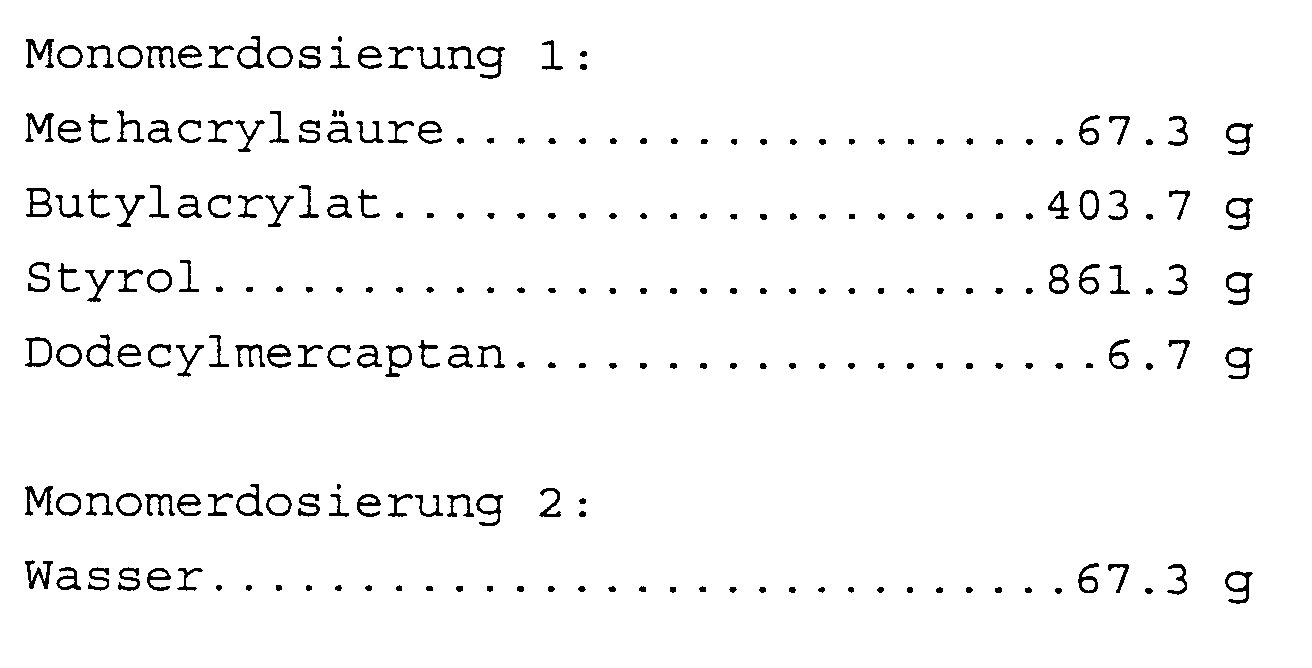
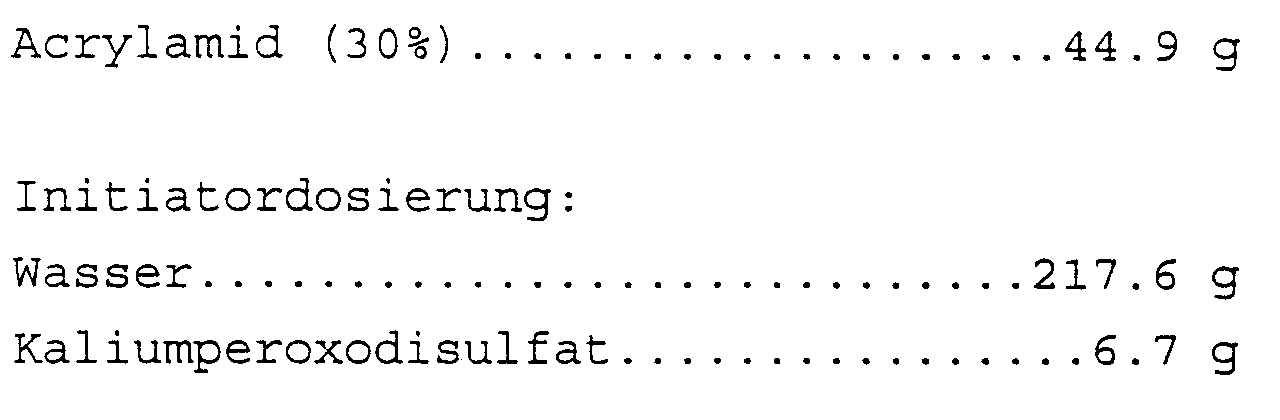
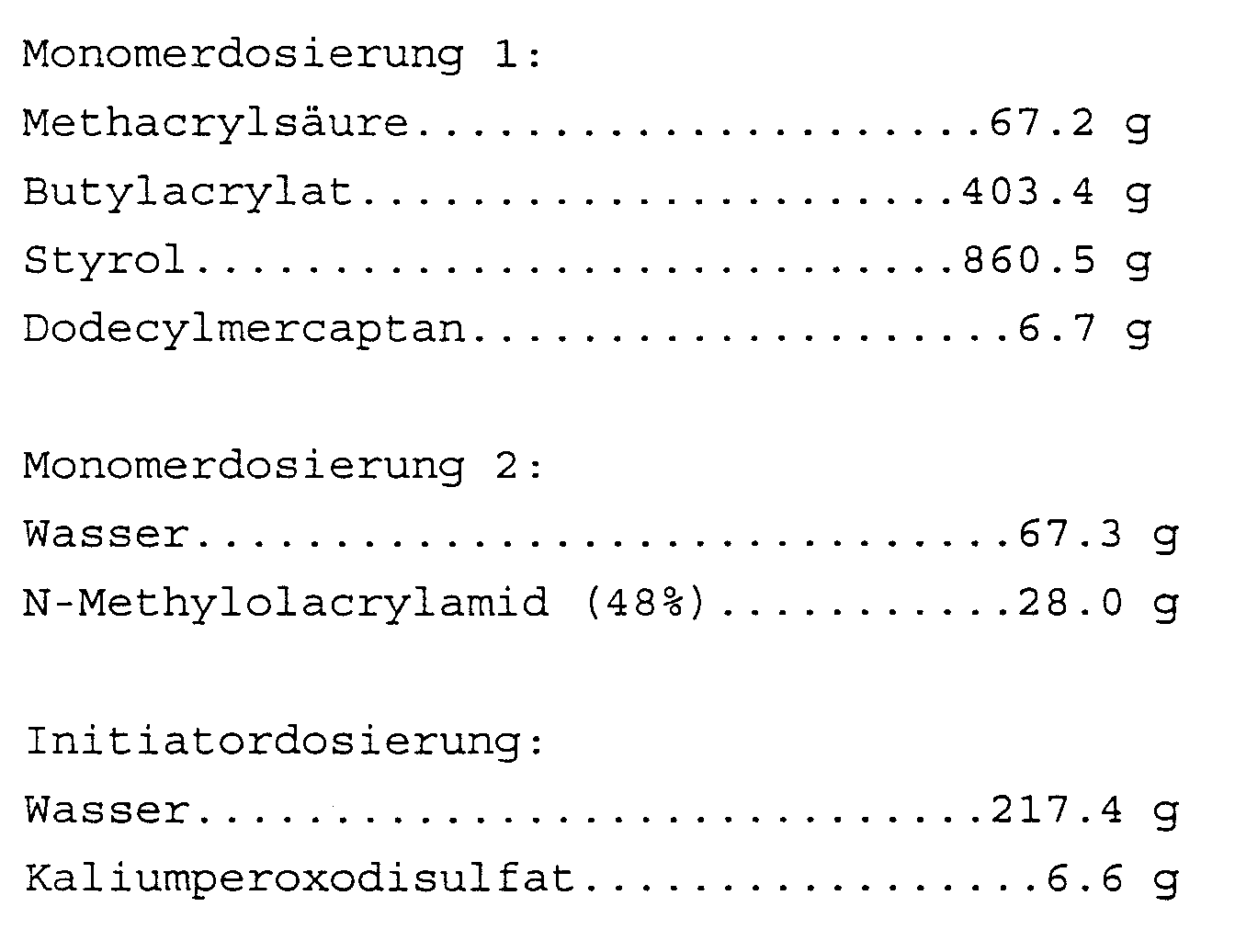
Aus den verpreßten faserigen Formkörpern wurden Prüfkörper (Abmessungen: 10 x 100 mm ) herausgestanzt und bei Raumtemperatur auf einer Zwick-Zugprüfmaschine analog DIN 53857 geprüft.
Zur Bestimmung der Wasseraufnahme wurden die trockenen Faserformkörper (Abmessung: 50 x 20 mm) für 1 h bzw. 24 h in Wasser gelagert und die Gewichtsaufnahme infolge Wasserquellung gravimetrisch bestimmt.
Zur Prüfung hinsichtlich des Wärmestandvermögens wurden 240 x 20 mm lange Streifen geschnitten. Diese Streifen wurden waagerecht auf einer planen Unterlage fixiert, so daß die Streifen mit einer Länge von 100 mm über den Rand der Unterlage überstanden. Im Falle der harten Formkörper (Plattendicke 2 mm) wurde ein 40 g-Gewicht angehängt, während die weichen Formkörper (Plattendicke: 10 mm) nur der Schwerkraft ihres Eigengewichts ausgesetzt waren. Das Wärmestandvermögen wurde durch Messung der Durchbiegung d nach einer einstündigen Lagerung bei T = 120°C ermittelt.

Claims (10)
- Pulverförmige, vernetzbare Textilbinder-Zusammensetzung, zur Herstellung von polymergebundenen, textilen Formteilen oder Flächengebilden, enthaltenda) ein pulverförmiges Mischpolymerisat, erhältlich durch Emulsionspolymerisation und anschließende Trocknung, von einem oder mehreren Monomeren aus der Gruppe umfassend Vinylester, Acrylsäureester, Methacrylsäureester, Vinylaromaten und Vinylchlorid und von 0.01 bis 25 Gew%, bezogen auf das Gesamtgewicht des Mischpolymerisats, von einem oder mehreren ethylenisch ungesättigten, carboxylgruppenhaltigen Monomeren, wobei das Mischpolymerisat eine Glastemperatur Tg oder einen Schmelzpunkt von größer 40°C, ein Molekulargewicht Mw von 60000 bis 300000 aufweist, undb) mindestens eine pulverförmige Verbindung, welche zwei oder mehr Epoxid- oder Isocyanatgruppen aufweist und einen Schmelzpunkt von 40°C bis 150°C aufweist.
- Pulverförmige, vernetzbare Textilbinder-Zusammensetzung nach Anspruch 1, dadurch gekennzeichnet, daß die Zusammensetzung noch 0.1 bis 5 Gew%, bezogen auf das pulverförmige Mischpolymerisat, eines pulverförmigen Vernetzungskatalysators enthält.
- Pulverförmige, vernetzbare Textilbinder-Zusammensetzung nach Anspruch 1 oder 2, dadurch gekennzeichnet, daß als Mischpolymerisat eines aus der Gruppe Vinylacetat/Vinylchlorid-, Vinylacetat/VeoVa5R-, Vinylacetat/VeoVa9R-, Methylmethacrylat/Butylacrylat- und Styrol/Butylacrylat-Mischpolymerisat, welche jeweils 0.01 bis 25 Gew% der genannten carboxylgruppenhaltigen Monomereinheiten enthalten, eingesetzt wird.
- Pulverförmige, vernetzbare Textilbinder-Zusammensetzung nach Anspruch 1 bis 3, dadurch gekennzeichnet, daß als carboxylgruppenhaltigen Monomereinheiten solche aus der Gruppe Acrylsäure, Methacrylsäure, Maleinsäure, Fumarsäure, Itaconsäure enthalten sind.
- Pulverförmige, vernetzbare Textilbinder-Zusammensetzung nach Anspruch 1 bis 4, dadurch gekennzeichnet, daß das Mischpolymerisat noch 0.01 bis 10.0 Gew%, bezogen auf das Gesamtgewicht des Mischpolymerisats, ein oder mehrere Monomere aus der Gruppe der ethylenisch ungesättigten Carbonsäureamide, aus der Gruppe der ethylenisch ungesättigten Sulfonsäuren bzw. deren Salze, aus der Gruppe der mehrfach ethylenisch ungesättigten Comonomeren, und aus der Gruppe der N-Methylol(meth)acrylamide sowie deren Ether wie Isobutoxy- oder n-Butoxyether enthält.
- Pulverförmige, vernetzbare Textilbinder-Zusammensetzung nach Anspruch 1 bis 5, dadurch gekennzeichnet, daß Acrylsäure und/oder Acrylamid in einer Menge von jeweils 0.01 bis 2 Gew% enthalten ist.
- Verfahren zur Herstellung von polymergebundenen, textilen Formteilen oder Flächengebilden aus Fasermaterialien, wobei das Fasermaterial mit einem pulverförmigen, polymeren Bindemittel in Kontakt gebracht wird und bei einer Temperatur von 100°C bis 250°C und gegebenenfalls unter Druck verfestigt wird, dadurch gekennzeichnet, daß als Bindemittel eine vernetzbare Pulvermischung gemäß Anspruch 1 bis 6 verwendet wird.
- Verfahren nach Anspruch 7, dadurch gekennzeichnet, daß als Fasermaterial eines oder mehrere aus der Gruppe Viskose-, Polyester-, Polyamid-, Polypropylen-, Polyethylen-Fasern, Glasfasern, Keramikfasern, Mineralfasern, Holz-, Cellulose-, Woll-, Baumwolle-, Jute-, Flachs-, Hanf-, Kokos-, Ramie- und Sisalfasern, in Form von gewebten Textilien, von Garnen, oder in Form von Nonwovens wie Gelegen oder Gewirken eingesetzt wird.
- Verfahren nach Anspruch 7 oder 8, dadurch gekennzeichnet, daß die vernetzbare Pulvermischung in einer Menge von 5 bis 30 Gew%, bezogen auf das Fasergewicht, eingesetzt wird.
- Verfahren nach Anspruch 7 bis 9, dadurch gekennzeichnet, daß die Fasergebilde nach dem Vermischen mit der Pulvermischung oder nach dem Einstreuen der Pulvermischung mit Wasser oder Heißdampf behandelt werden.
Applications Claiming Priority (2)
| Application Number | Priority Date | Filing Date | Title |
|---|---|---|---|
| DE19733133A DE19733133A1 (de) | 1997-07-31 | 1997-07-31 | Pulverförmige, vernetzbare Textilbinder-Zusammensetzung |
| DE19733133 | 1997-07-31 |
Publications (2)
| Publication Number | Publication Date |
|---|---|
| EP0894888A1 true EP0894888A1 (de) | 1999-02-03 |
| EP0894888B1 EP0894888B1 (de) | 2001-03-14 |
Family
ID=7837575
Family Applications (1)
| Application Number | Title | Priority Date | Filing Date |
|---|---|---|---|
| EP98112246A Expired - Lifetime EP0894888B1 (de) | 1997-07-31 | 1998-07-02 | Pulverförmige, vernetzbare Textilbinder-Zusammensetzung |
Country Status (14)
| Country | Link |
|---|---|
| US (1) | US5977244A (de) |
| EP (1) | EP0894888B1 (de) |
| JP (1) | JP2994341B2 (de) |
| KR (1) | KR100281441B1 (de) |
| CN (1) | CN1141350C (de) |
| BR (1) | BR9803726A (de) |
| CA (1) | CA2244613C (de) |
| CZ (1) | CZ289564B6 (de) |
| DE (2) | DE19733133A1 (de) |
| ES (1) | ES2156422T3 (de) |
| ID (1) | ID20627A (de) |
| PL (1) | PL192453B1 (de) |
| RU (1) | RU2149934C1 (de) |
| TR (1) | TR199801480A2 (de) |
Cited By (6)
| Publication number | Priority date | Publication date | Assignee | Title |
|---|---|---|---|---|
| EP1046737A1 (de) * | 1999-04-22 | 2000-10-25 | Wacker-Chemie GmbH | Verfahren zur Herstellung von Faservliesen nach dem Airlaidverfahren |
| EP1106724A1 (de) * | 1999-12-09 | 2001-06-13 | Wacker Polymer Systems GmbH & Co. KG | Verfahren zur Vorbindung von Fasermaterialien |
| EP1136516A1 (de) * | 2000-03-23 | 2001-09-26 | Wacker Polymer Systems GmbH & Co. KG | Vernetzbare Polymerzusammensetzung |
| US6695993B2 (en) | 2001-01-25 | 2004-02-24 | Wacker Polymer Systems Gmbh & Co. Kg | Process for forming recyclable articles |
| WO2016087255A1 (en) | 2014-12-02 | 2016-06-09 | Synthomer Deutschland Gmbh | Polymer latex composition for fibre binding |
| WO2020108723A1 (de) | 2018-11-26 | 2020-06-04 | Wacker Chemie Ag | Vernetzbare polymerzusammensetzung aus zwei miteinander reaktiven copoylmerisaten unterschiedlicher glassübergangstemperaturen |
Families Citing this family (26)
| Publication number | Priority date | Publication date | Assignee | Title |
|---|---|---|---|---|
| DE19842661A1 (de) | 1998-09-17 | 2000-05-04 | Wacker Chemie Gmbh | Verwendung von Polymerpulver zur Herstellung von beschußfesten Fasermaterialien |
| DE19912253C2 (de) * | 1999-03-18 | 2003-04-24 | Wacker Chemie Gmbh | Verwendung einer wäßrigen Polymerdispersion auf Acrylatbasis zur Herstellung von wiederablösbaren Haftkleberfilmen |
| DE19928933A1 (de) | 1999-06-24 | 2000-12-28 | Wacker Polymer Systems Gmbh | Verfahren zur Herstellung von Polyvinylalkohol-stabilisierten Polymerisaten |
| HRP20010953A2 (en) * | 1999-06-24 | 2003-04-30 | Paroc Group Oy Ab | Method for manufacturing a binder and use thereof |
| ES2156083B1 (es) * | 1999-08-06 | 2002-02-01 | Quinorgan S L | Material de refuerzo termoconformable y termoadherente, metodo de preparacion y su aplicacion para el calzado. |
| DE10206126A1 (de) * | 2002-02-14 | 2003-09-04 | Wacker Polymer Systems Gmbh | Pulverförmige Bindemittelzusammensetzung |
| US20030162023A1 (en) * | 2002-02-27 | 2003-08-28 | Lear Corporation | Panel having a dry polymer reinforced pet substrate |
| EP1413668A1 (de) * | 2002-10-21 | 2004-04-28 | Bamberger Kaliko GmbH | Witterungsbeständige, PVC-freie Flächenmaterialien auf Textilbasis |
| EP1413669B1 (de) * | 2002-10-21 | 2008-02-13 | Bamberger Kaliko GmbH | Witterungsbeständige, PVC-freie Flächenmaterialien auf Textilbasis |
| JP4772502B2 (ja) * | 2003-03-25 | 2011-09-14 | 三洋化成工業株式会社 | 鉱物繊維用バインダー組成物及び鉱物繊維マット |
| US20070026754A1 (en) * | 2003-04-25 | 2007-02-01 | Carmen Martin Rivera | Scouring material |
| DE10347665A1 (de) * | 2003-10-09 | 2005-05-19 | Degussa Ag | Vernetzbare Basisschicht für Fixiereinlagen nach dem Doppelpunktverfahren |
| DE10347628A1 (de) * | 2003-10-09 | 2005-05-19 | Degussa Ag | Vernetzbare Basisschicht für Fixiereinlagen nach dem Doppelpunktverfahren |
| JP4996875B2 (ja) * | 2005-04-28 | 2012-08-08 | 日華化学株式会社 | 撥水剤、撥水加工方法及び撥水性繊維製品 |
| DE102005051588A1 (de) * | 2005-10-27 | 2007-05-03 | Wacker Polymer Systems Gmbh & Co. Kg | Silan-modifizierte Dispersionspulver |
| GB0818186D0 (en) * | 2008-10-06 | 2008-11-12 | 3M Innovative Properties Co | Scouring material comprising natural fibres |
| DE202009005902U1 (de) * | 2009-04-21 | 2009-07-02 | Heumüller, Jürgen | Anzündhilfe |
| US10315219B2 (en) * | 2010-05-31 | 2019-06-11 | Valinge Innovation Ab | Method of manufacturing a panel |
| CN102720065B (zh) * | 2012-05-09 | 2014-04-16 | 潘葵 | 纺织品抗冻性测试标准样品及其制备方法 |
| JP6044727B2 (ja) * | 2014-04-26 | 2016-12-14 | 星光Pmc株式会社 | 樹脂組成物及び樹脂組成物の製造方法 |
| CN104098814B (zh) * | 2014-06-25 | 2016-08-17 | 洪建生 | 再不分散乳胶粉及其应用 |
| WO2016055128A1 (en) | 2014-10-06 | 2016-04-14 | Siniat International | Improved mat and related gypsum boards suitable for wet or humid areas |
| FR3027546B1 (fr) | 2014-10-24 | 2017-07-21 | Porcher Ind | Meches poudrees par procede electrostatique |
| CN105200670B (zh) * | 2015-08-17 | 2017-08-01 | 赖明荣 | 一种耐低温无纺布 |
| CN114195926A (zh) | 2015-12-09 | 2022-03-18 | 国际人造丝公司 | 羧化乙酸乙烯酯/乙烯共聚物分散体及其用途 |
| CN116988204B (zh) * | 2023-07-13 | 2025-10-31 | 博森纺织科技股份有限公司 | 一种防臭抑菌面料及其生产工艺 |
Citations (7)
| Publication number | Priority date | Publication date | Assignee | Title |
|---|---|---|---|---|
| FR2340389A1 (fr) * | 1976-02-06 | 1977-09-02 | Basf Ag | Liants a base de polyacrylates, pour le renforcement de nappes de fibres de verre |
| EP0164554A2 (de) * | 1984-05-14 | 1985-12-18 | Kao Corporation | Verfahren zur Behandlung von Textilien |
| US4943612A (en) * | 1986-12-06 | 1990-07-24 | Lion Corporation | Ultra-fine particulated polymer latex and composition containing the same |
| WO1992022603A1 (en) * | 1991-06-13 | 1992-12-23 | Dsm N.V. | Product of fibrous material and resin |
| EP0590702A1 (de) * | 1992-07-31 | 1994-04-06 | ENIRICERCHE S.p.A. | Verstärktes Verbundmaterial wobei der Matrix gebildet ist aus einem Gemisch von Thermoplasten und Duroplasten |
| EP0731207A1 (de) * | 1995-03-09 | 1996-09-11 | Wacker-Chemie GmbH | Bindemittel für textile Flächengebilde |
| WO1997042367A1 (en) * | 1996-05-09 | 1997-11-13 | Buck George S | Bonding fibrous batts with thermosetting fiber-binders of certain epoxy resins |
Family Cites Families (9)
| Publication number | Priority date | Publication date | Assignee | Title |
|---|---|---|---|---|
| US4129545A (en) * | 1976-01-16 | 1978-12-12 | Mitsubishi Rayon Co., Ltd. | Thermosetting acrylic copolymer usable as a powder paint and method for producing the same |
| JPS5891859A (ja) * | 1981-11-20 | 1983-05-31 | 日本バイリ−ン株式会社 | 不織布の製造方法 |
| US4612224A (en) * | 1985-12-02 | 1986-09-16 | Sheller-Globe Corporation | Fiber web for compression molding structural substrates for panels |
| AU612496B2 (en) * | 1988-10-06 | 1991-07-11 | Owens-Corning Fiberglas Corporation | Preformable mat |
| FI84843C (fi) * | 1989-05-17 | 1992-01-27 | Ahlstroem Oy | Foerfarande foer framstaellning av fiberfoerstaerkt raomaterial foer plast. |
| US5207954A (en) * | 1989-09-25 | 1993-05-04 | Union Carbide Chemicals & Plastics Technology Corporation | Method of making coreactable powdered coatings |
| RU2016152C1 (ru) * | 1990-08-13 | 1994-07-15 | Геннадий Иванович Синяев | Установка для нанесения порошкового клеящего вещества на ткань |
| DE4306808A1 (de) * | 1993-03-04 | 1994-09-08 | Wacker Chemie Gmbh | Vernetzbare Dispersionspulver als Bindemittel für Fasern |
| DE69520423T2 (de) * | 1995-01-06 | 2001-10-18 | Rohm And Haas Co., Philadelphia | Wasserdispergierbare Pulverzusammensetzung für wasserbeständige Überzugsmittel |
-
1997
- 1997-07-31 DE DE19733133A patent/DE19733133A1/de not_active Withdrawn
-
1998
- 1998-07-02 ES ES98112246T patent/ES2156422T3/es not_active Expired - Lifetime
- 1998-07-02 DE DE59800523T patent/DE59800523D1/de not_active Expired - Lifetime
- 1998-07-02 EP EP98112246A patent/EP0894888B1/de not_active Expired - Lifetime
- 1998-07-27 ID IDP981052A patent/ID20627A/id unknown
- 1998-07-27 KR KR1019980030117A patent/KR100281441B1/ko not_active Expired - Fee Related
- 1998-07-29 US US09/126,456 patent/US5977244A/en not_active Expired - Lifetime
- 1998-07-30 RU RU98114858A patent/RU2149934C1/ru not_active IP Right Cessation
- 1998-07-30 BR BR9803726-9A patent/BR9803726A/pt not_active IP Right Cessation
- 1998-07-30 PL PL327765A patent/PL192453B1/pl not_active IP Right Cessation
- 1998-07-30 JP JP10215426A patent/JP2994341B2/ja not_active Expired - Fee Related
- 1998-07-31 CA CA002244613A patent/CA2244613C/en not_active Expired - Fee Related
- 1998-07-31 TR TR1998/01480A patent/TR199801480A2/xx unknown
- 1998-07-31 CZ CZ19982425A patent/CZ289564B6/cs not_active IP Right Cessation
- 1998-07-31 CN CNB98117115XA patent/CN1141350C/zh not_active Expired - Fee Related
Patent Citations (7)
| Publication number | Priority date | Publication date | Assignee | Title |
|---|---|---|---|---|
| FR2340389A1 (fr) * | 1976-02-06 | 1977-09-02 | Basf Ag | Liants a base de polyacrylates, pour le renforcement de nappes de fibres de verre |
| EP0164554A2 (de) * | 1984-05-14 | 1985-12-18 | Kao Corporation | Verfahren zur Behandlung von Textilien |
| US4943612A (en) * | 1986-12-06 | 1990-07-24 | Lion Corporation | Ultra-fine particulated polymer latex and composition containing the same |
| WO1992022603A1 (en) * | 1991-06-13 | 1992-12-23 | Dsm N.V. | Product of fibrous material and resin |
| EP0590702A1 (de) * | 1992-07-31 | 1994-04-06 | ENIRICERCHE S.p.A. | Verstärktes Verbundmaterial wobei der Matrix gebildet ist aus einem Gemisch von Thermoplasten und Duroplasten |
| EP0731207A1 (de) * | 1995-03-09 | 1996-09-11 | Wacker-Chemie GmbH | Bindemittel für textile Flächengebilde |
| WO1997042367A1 (en) * | 1996-05-09 | 1997-11-13 | Buck George S | Bonding fibrous batts with thermosetting fiber-binders of certain epoxy resins |
Cited By (14)
| Publication number | Priority date | Publication date | Assignee | Title |
|---|---|---|---|---|
| EP1046737A1 (de) * | 1999-04-22 | 2000-10-25 | Wacker-Chemie GmbH | Verfahren zur Herstellung von Faservliesen nach dem Airlaidverfahren |
| DE19918343A1 (de) * | 1999-04-22 | 2000-10-26 | Wacker Chemie Gmbh | Verfahren zur Herstellung von Faservliesen nach dem Airlaidverfahren |
| DE19918343C2 (de) * | 1999-04-22 | 2001-03-08 | Wacker Chemie Gmbh | Verfahren zur Herstellung von Faservliesen nach dem Airlaidverfahren |
| US6458299B1 (en) | 1999-04-22 | 2002-10-01 | Wacker Chemie Gmbh | Production of fiber webs by the airlaid process |
| DE19959415C2 (de) * | 1999-12-09 | 2002-03-07 | Wacker Polymer Systems Gmbh | Verfahren zur Vorbindung von Fasermaterialien |
| DE19959415A1 (de) * | 1999-12-09 | 2001-06-21 | Wacker Polymer Systems Gmbh | Verfahren zur Vorbindung von Fasermaterialien |
| EP1106724A1 (de) * | 1999-12-09 | 2001-06-13 | Wacker Polymer Systems GmbH & Co. KG | Verfahren zur Vorbindung von Fasermaterialien |
| US6472462B1 (en) | 1999-12-09 | 2002-10-29 | Wacker-Chemie Gmbh | Prebinding of fiber materials |
| EP1136516A1 (de) * | 2000-03-23 | 2001-09-26 | Wacker Polymer Systems GmbH & Co. KG | Vernetzbare Polymerzusammensetzung |
| US6884837B2 (en) | 2000-03-23 | 2005-04-26 | Wacker Polymer Systems, Gmbh & Co. | Crosslinkable polymer composition |
| US6695993B2 (en) | 2001-01-25 | 2004-02-24 | Wacker Polymer Systems Gmbh & Co. Kg | Process for forming recyclable articles |
| WO2016087255A1 (en) | 2014-12-02 | 2016-06-09 | Synthomer Deutschland Gmbh | Polymer latex composition for fibre binding |
| US12054881B2 (en) | 2014-12-02 | 2024-08-06 | Synthomer Deutschland Gmbh | Polymer latex composition for fibre binding |
| WO2020108723A1 (de) | 2018-11-26 | 2020-06-04 | Wacker Chemie Ag | Vernetzbare polymerzusammensetzung aus zwei miteinander reaktiven copoylmerisaten unterschiedlicher glassübergangstemperaturen |
Also Published As
| Publication number | Publication date |
|---|---|
| ES2156422T3 (es) | 2001-06-16 |
| KR100281441B1 (ko) | 2001-02-01 |
| CA2244613A1 (en) | 1999-01-31 |
| CZ289564B6 (cs) | 2002-02-13 |
| CN1141350C (zh) | 2004-03-10 |
| CA2244613C (en) | 2002-04-30 |
| US5977244A (en) | 1999-11-02 |
| JP2994341B2 (ja) | 1999-12-27 |
| TR199801480A3 (tr) | 2001-08-21 |
| DE59800523D1 (de) | 2001-04-19 |
| DE19733133A1 (de) | 1999-02-04 |
| TR199801480A2 (xx) | 2001-08-21 |
| CN1208062A (zh) | 1999-02-17 |
| RU2149934C1 (ru) | 2000-05-27 |
| PL327765A1 (en) | 1999-02-01 |
| KR19990014203A (ko) | 1999-02-25 |
| JPH11172573A (ja) | 1999-06-29 |
| EP0894888B1 (de) | 2001-03-14 |
| CZ242598A3 (cs) | 1999-02-17 |
| BR9803726A (pt) | 2000-05-16 |
| PL192453B1 (pl) | 2006-10-31 |
| ID20627A (id) | 1999-02-04 |
Similar Documents
| Publication | Publication Date | Title |
|---|---|---|
| EP0894888B1 (de) | Pulverförmige, vernetzbare Textilbinder-Zusammensetzung | |
| EP0687317B1 (de) | Vernetzbare dispersionspulver als bindemittel für fasern | |
| EP1136516B1 (de) | Verwendung einer vernetzbaren Polymerzusammensetzung | |
| EP1004629B1 (de) | Verfahren zur Herstellung von schnellhärtenden, mit Phenolharz gebundenen Formkörpern | |
| EP0965672B1 (de) | Faserbindepulver-Zusammensetzung und Verwendung für die Verfestigung von Fasermaterialien | |
| EP1106724B1 (de) | Verfahren zur Vorbindung von Fasermaterialien | |
| EP0906463B1 (de) | Verwendung eines copolymerisats als lösungsmittelfestes textilbindemittel | |
| DE19918343A1 (de) | Verfahren zur Herstellung von Faservliesen nach dem Airlaidverfahren | |
| EP1428852A1 (de) | Pulverförmige, formaldehydfreie Bindemittelzusammensetzung und deren Anwendung zum Verbinden von Substraten durch thermisches Härten | |
| EP3752541B1 (de) | Formaldehydfreie bindemittel-zusammensetzung | |
| EP1227123A1 (de) | Verfahren zur Herstellung von wiederverwertbaren Formkörpern | |
| WO1996008597A1 (de) | Lösungsmittelfester textilbinder | |
| DE1277191C2 (de) | Verfahren zur herstellung von gebundenen faservliesen | |
| DE19842661A1 (de) | Verwendung von Polymerpulver zur Herstellung von beschußfesten Fasermaterialien | |
| DE69015217T3 (de) | Zweistufige Polymerisation von Vinylacetat-/Ethylen-Emulsionscopolymeren mit unverträglichen Monomeren. | |
| EP0672073B1 (de) | Verfahren zur herstellung eines siegelbaren, selbstvernetzenden bindemittels | |
| EP1336623B1 (de) | Pulverförmige Bindemittelzusammensetzung | |
| EP1114849A1 (de) | Wässrige Styrol-Butadien-Dispersionen zur Verfestigung von bituminierbaren Vliesstoffen | |
| EP3927878A1 (de) | Formaldehydfreie bindemittel-zusammensetzung | |
| DE10306032B4 (de) | Verwendung von Vinylester-Festharzen zur Faserbindung | |
| WO2020108723A1 (de) | Vernetzbare polymerzusammensetzung aus zwei miteinander reaktiven copoylmerisaten unterschiedlicher glassübergangstemperaturen | |
| WO2020192912A1 (de) | Formaldehydfreie bindemittel-zusammensetzung | |
| DE10206125A1 (de) | Pulverförmige Bindemittelzusammensetzung zur Bindung von partikulären Materialien |
Legal Events
| Date | Code | Title | Description |
|---|---|---|---|
| PUAI | Public reference made under article 153(3) epc to a published international application that has entered the european phase |
Free format text: ORIGINAL CODE: 0009012 |
|
| 17P | Request for examination filed |
Effective date: 19980710 |
|
| AK | Designated contracting states |
Kind code of ref document: A1 Designated state(s): BE DE ES FI FR GB IT NL SE |
|
| AX | Request for extension of the european patent |
Free format text: AL;LT;LV;MK;RO;SI |
|
| 17Q | First examination report despatched |
Effective date: 19990210 |
|
| AKX | Designation fees paid |
Free format text: BE DE ES FI FR GB IT NL SE |
|
| GRAG | Despatch of communication of intention to grant |
Free format text: ORIGINAL CODE: EPIDOS AGRA |
|
| GRAG | Despatch of communication of intention to grant |
Free format text: ORIGINAL CODE: EPIDOS AGRA |
|
| GRAH | Despatch of communication of intention to grant a patent |
Free format text: ORIGINAL CODE: EPIDOS IGRA |
|
| GRAH | Despatch of communication of intention to grant a patent |
Free format text: ORIGINAL CODE: EPIDOS IGRA |
|
| GRAA | (expected) grant |
Free format text: ORIGINAL CODE: 0009210 |
|
| AK | Designated contracting states |
Kind code of ref document: B1 Designated state(s): BE DE ES FI FR GB IT NL SE |
|
| REF | Corresponds to: |
Ref document number: 59800523 Country of ref document: DE Date of ref document: 20010419 |
|
| ITF | It: translation for a ep patent filed | ||
| GBT | Gb: translation of ep patent filed (gb section 77(6)(a)/1977) |
Effective date: 20010510 |
|
| ET | Fr: translation filed | ||
| REG | Reference to a national code |
Ref country code: ES Ref legal event code: FG2A Ref document number: 2156422 Country of ref document: ES Kind code of ref document: T3 |
|
| REG | Reference to a national code |
Ref country code: GB Ref legal event code: IF02 |
|
| PLBE | No opposition filed within time limit |
Free format text: ORIGINAL CODE: 0009261 |
|
| STAA | Information on the status of an ep patent application or granted ep patent |
Free format text: STATUS: NO OPPOSITION FILED WITHIN TIME LIMIT |
|
| 26N | No opposition filed | ||
| PGFP | Annual fee paid to national office [announced via postgrant information from national office to epo] |
Ref country code: FI Payment date: 20020621 Year of fee payment: 5 |
|
| PGFP | Annual fee paid to national office [announced via postgrant information from national office to epo] |
Ref country code: BE Payment date: 20020724 Year of fee payment: 5 |
|
| PG25 | Lapsed in a contracting state [announced via postgrant information from national office to epo] |
Ref country code: FI Free format text: LAPSE BECAUSE OF NON-PAYMENT OF DUE FEES Effective date: 20030702 |
|
| PG25 | Lapsed in a contracting state [announced via postgrant information from national office to epo] |
Ref country code: BE Free format text: LAPSE BECAUSE OF NON-PAYMENT OF DUE FEES Effective date: 20030731 |
|
| BERE | Be: lapsed |
Owner name: *WACKER-CHEMIE G.M.B.H. Effective date: 20030731 |
|
| PGFP | Annual fee paid to national office [announced via postgrant information from national office to epo] |
Ref country code: SE Payment date: 20120725 Year of fee payment: 15 Ref country code: GB Payment date: 20120719 Year of fee payment: 15 |
|
| PGFP | Annual fee paid to national office [announced via postgrant information from national office to epo] |
Ref country code: IT Payment date: 20120731 Year of fee payment: 15 Ref country code: FR Payment date: 20120806 Year of fee payment: 15 Ref country code: ES Payment date: 20120726 Year of fee payment: 15 Ref country code: DE Payment date: 20120720 Year of fee payment: 15 |
|
| PGFP | Annual fee paid to national office [announced via postgrant information from national office to epo] |
Ref country code: NL Payment date: 20120719 Year of fee payment: 15 |
|
| REG | Reference to a national code |
Ref country code: NL Ref legal event code: V1 Effective date: 20140201 |
|
| REG | Reference to a national code |
Ref country code: SE Ref legal event code: EUG |
|
| GBPC | Gb: european patent ceased through non-payment of renewal fee |
Effective date: 20130702 |
|
| REG | Reference to a national code |
Ref country code: FR Ref legal event code: ST Effective date: 20140331 |
|
| PG25 | Lapsed in a contracting state [announced via postgrant information from national office to epo] |
Ref country code: GB Free format text: LAPSE BECAUSE OF NON-PAYMENT OF DUE FEES Effective date: 20130702 Ref country code: DE Free format text: LAPSE BECAUSE OF NON-PAYMENT OF DUE FEES Effective date: 20140201 Ref country code: NL Free format text: LAPSE BECAUSE OF NON-PAYMENT OF DUE FEES Effective date: 20140201 Ref country code: SE Free format text: LAPSE BECAUSE OF NON-PAYMENT OF DUE FEES Effective date: 20130703 |
|
| REG | Reference to a national code |
Ref country code: DE Ref legal event code: R119 Ref document number: 59800523 Country of ref document: DE Effective date: 20140201 |
|
| PG25 | Lapsed in a contracting state [announced via postgrant information from national office to epo] |
Ref country code: FR Free format text: LAPSE BECAUSE OF NON-PAYMENT OF DUE FEES Effective date: 20130731 Ref country code: IT Free format text: LAPSE BECAUSE OF NON-PAYMENT OF DUE FEES Effective date: 20130702 |
|
| REG | Reference to a national code |
Ref country code: ES Ref legal event code: FD2A Effective date: 20140911 |
|
| PG25 | Lapsed in a contracting state [announced via postgrant information from national office to epo] |
Ref country code: ES Free format text: LAPSE BECAUSE OF NON-PAYMENT OF DUE FEES Effective date: 20130703 |