EP0840887B1 - Procede et dispositif pour determiner les caracteristiques rheologiques et mecaniques de matieres - Google Patents
Procede et dispositif pour determiner les caracteristiques rheologiques et mecaniques de matieres Download PDFInfo
- Publication number
- EP0840887B1 EP0840887B1 EP96945980A EP96945980A EP0840887B1 EP 0840887 B1 EP0840887 B1 EP 0840887B1 EP 96945980 A EP96945980 A EP 96945980A EP 96945980 A EP96945980 A EP 96945980A EP 0840887 B1 EP0840887 B1 EP 0840887B1
- Authority
- EP
- European Patent Office
- Prior art keywords
- sample
- mechanical
- determined
- acceleration
- measurement
- Prior art date
- Legal status (The legal status is an assumption and is not a legal conclusion. Google has not performed a legal analysis and makes no representation as to the accuracy of the status listed.)
- Expired - Lifetime
Links
- 238000000034 method Methods 0.000 title claims description 47
- 239000000463 material Substances 0.000 title claims description 39
- 230000008569 process Effects 0.000 title claims description 22
- 230000001133 acceleration Effects 0.000 claims description 37
- 239000002245 particle Substances 0.000 claims description 33
- 238000012360 testing method Methods 0.000 claims description 33
- 238000005259 measurement Methods 0.000 claims description 30
- 238000005534 hematocrit Methods 0.000 claims description 18
- 238000000926 separation method Methods 0.000 claims description 17
- 210000004369 blood Anatomy 0.000 claims description 16
- 239000008280 blood Substances 0.000 claims description 16
- 239000002609 medium Substances 0.000 claims description 14
- 230000008859 change Effects 0.000 claims description 11
- 239000000126 substance Substances 0.000 claims description 10
- 238000009826 distribution Methods 0.000 claims description 9
- 210000004027 cell Anatomy 0.000 claims description 7
- 210000002381 plasma Anatomy 0.000 claims description 7
- 238000004062 sedimentation Methods 0.000 claims description 7
- 230000002123 temporal effect Effects 0.000 claims description 7
- 239000003153 chemical reaction reagent Substances 0.000 claims description 6
- 239000002612 dispersion medium Substances 0.000 claims description 6
- 210000003743 erythrocyte Anatomy 0.000 claims description 6
- 239000011248 coating agent Substances 0.000 claims description 5
- 238000000576 coating method Methods 0.000 claims description 5
- 230000036962 time dependent Effects 0.000 claims description 5
- 238000011156 evaluation Methods 0.000 claims description 4
- 238000005188 flotation Methods 0.000 claims description 4
- 239000000203 mixture Substances 0.000 claims description 4
- 239000000047 product Substances 0.000 claims description 4
- 239000000706 filtrate Substances 0.000 claims description 3
- 230000002706 hydrostatic effect Effects 0.000 claims description 3
- 239000011859 microparticle Substances 0.000 claims description 3
- 238000006243 chemical reaction Methods 0.000 claims description 2
- 238000010276 construction Methods 0.000 claims description 2
- 230000007547 defect Effects 0.000 claims description 2
- 210000003463 organelle Anatomy 0.000 claims description 2
- 238000012856 packing Methods 0.000 claims description 2
- 238000004806 packaging method and process Methods 0.000 claims 1
- 238000005204 segregation Methods 0.000 description 13
- 238000004458 analytical method Methods 0.000 description 11
- 239000000725 suspension Substances 0.000 description 8
- 239000013049 sediment Substances 0.000 description 7
- 238000005119 centrifugation Methods 0.000 description 6
- 239000007788 liquid Substances 0.000 description 6
- 239000006185 dispersion Substances 0.000 description 5
- 239000000839 emulsion Substances 0.000 description 5
- 230000005540 biological transmission Effects 0.000 description 4
- 239000000499 gel Substances 0.000 description 4
- 230000009471 action Effects 0.000 description 3
- 239000000853 adhesive Substances 0.000 description 3
- 230000001070 adhesive effect Effects 0.000 description 3
- 238000012512 characterization method Methods 0.000 description 3
- 238000012937 correction Methods 0.000 description 3
- 238000001514 detection method Methods 0.000 description 3
- 239000012530 fluid Substances 0.000 description 3
- 229910000831 Steel Inorganic materials 0.000 description 2
- 239000002131 composite material Substances 0.000 description 2
- 239000000470 constituent Substances 0.000 description 2
- 230000002349 favourable effect Effects 0.000 description 2
- 230000003993 interaction Effects 0.000 description 2
- 238000011835 investigation Methods 0.000 description 2
- 238000004519 manufacturing process Methods 0.000 description 2
- 230000005693 optoelectronics Effects 0.000 description 2
- 238000012545 processing Methods 0.000 description 2
- 239000010959 steel Substances 0.000 description 2
- 239000002351 wastewater Substances 0.000 description 2
- DGAQECJNVWCQMB-PUAWFVPOSA-M Ilexoside XXIX Chemical compound C[C@@H]1CC[C@@]2(CC[C@@]3(C(=CC[C@H]4[C@]3(CC[C@@H]5[C@@]4(CC[C@@H](C5(C)C)OS(=O)(=O)[O-])C)C)[C@@H]2[C@]1(C)O)C)C(=O)O[C@H]6[C@@H]([C@H]([C@@H]([C@H](O6)CO)O)O)O.[Na+] DGAQECJNVWCQMB-PUAWFVPOSA-M 0.000 description 1
- 230000004931 aggregating effect Effects 0.000 description 1
- 238000000149 argon plasma sintering Methods 0.000 description 1
- 230000008033 biological extinction Effects 0.000 description 1
- 239000012620 biological material Substances 0.000 description 1
- 238000004820 blood count Methods 0.000 description 1
- 239000002537 cosmetic Substances 0.000 description 1
- 238000013461 design Methods 0.000 description 1
- 238000011161 development Methods 0.000 description 1
- 230000004069 differentiation Effects 0.000 description 1
- 239000002270 dispersing agent Substances 0.000 description 1
- 238000005315 distribution function Methods 0.000 description 1
- 230000007613 environmental effect Effects 0.000 description 1
- 239000006260 foam Substances 0.000 description 1
- 230000005484 gravity Effects 0.000 description 1
- 208000015181 infectious disease Diseases 0.000 description 1
- 239000013067 intermediate product Substances 0.000 description 1
- 238000009533 lab test Methods 0.000 description 1
- 238000012417 linear regression Methods 0.000 description 1
- 239000006194 liquid suspension Substances 0.000 description 1
- 238000010327 methods by industry Methods 0.000 description 1
- 230000003287 optical effect Effects 0.000 description 1
- 239000003973 paint Substances 0.000 description 1
- 239000000049 pigment Substances 0.000 description 1
- 239000011148 porous material Substances 0.000 description 1
- 230000036515 potency Effects 0.000 description 1
- 238000004886 process control Methods 0.000 description 1
- 239000002994 raw material Substances 0.000 description 1
- 238000007430 reference method Methods 0.000 description 1
- 238000005070 sampling Methods 0.000 description 1
- 238000007493 shaping process Methods 0.000 description 1
- 239000002002 slurry Substances 0.000 description 1
- 229910052708 sodium Inorganic materials 0.000 description 1
- 239000011734 sodium Substances 0.000 description 1
- 238000009987 spinning Methods 0.000 description 1
- 239000007858 starting material Substances 0.000 description 1
- 238000003860 storage Methods 0.000 description 1
- 239000006228 supernatant Substances 0.000 description 1
- 230000002195 synergetic effect Effects 0.000 description 1
- 210000001519 tissue Anatomy 0.000 description 1
- 230000007704 transition Effects 0.000 description 1
- XLYOFNOQVPJJNP-UHFFFAOYSA-N water Substances O XLYOFNOQVPJJNP-UHFFFAOYSA-N 0.000 description 1
Images
Classifications
-
- G—PHYSICS
- G01—MEASURING; TESTING
- G01N—INVESTIGATING OR ANALYSING MATERIALS BY DETERMINING THEIR CHEMICAL OR PHYSICAL PROPERTIES
- G01N11/00—Investigating flow properties of materials, e.g. viscosity, plasticity; Analysing materials by determining flow properties
- G01N11/02—Investigating flow properties of materials, e.g. viscosity, plasticity; Analysing materials by determining flow properties by measuring flow of the material
-
- G—PHYSICS
- G01—MEASURING; TESTING
- G01N—INVESTIGATING OR ANALYSING MATERIALS BY DETERMINING THEIR CHEMICAL OR PHYSICAL PROPERTIES
- G01N15/00—Investigating characteristics of particles; Investigating permeability, pore-volume or surface-area of porous materials
- G01N15/04—Investigating sedimentation of particle suspensions
- G01N15/05—Investigating sedimentation of particle suspensions in blood
-
- G—PHYSICS
- G01—MEASURING; TESTING
- G01N—INVESTIGATING OR ANALYSING MATERIALS BY DETERMINING THEIR CHEMICAL OR PHYSICAL PROPERTIES
- G01N33/00—Investigating or analysing materials by specific methods not covered by groups G01N1/00 - G01N31/00
- G01N33/48—Biological material, e.g. blood, urine; Haemocytometers
- G01N33/483—Physical analysis of biological material
- G01N33/487—Physical analysis of biological material of liquid biological material
- G01N33/49—Blood
- G01N33/4905—Determining clotting time of blood
-
- G—PHYSICS
- G01—MEASURING; TESTING
- G01N—INVESTIGATING OR ANALYSING MATERIALS BY DETERMINING THEIR CHEMICAL OR PHYSICAL PROPERTIES
- G01N33/00—Investigating or analysing materials by specific methods not covered by groups G01N1/00 - G01N31/00
- G01N33/48—Biological material, e.g. blood, urine; Haemocytometers
- G01N33/483—Physical analysis of biological material
- G01N33/487—Physical analysis of biological material of liquid biological material
- G01N33/49—Blood
- G01N33/491—Blood by separating the blood components
Definitions
- the invention relates to a method and a device for determining rheological and mechanical material parameters, in particular disperse media and biological and technical materials.
- the device acts as an automatic analyzer for the simultaneous measurement of several material parameters.
- the basic principle is the use of variable acceleration forces and the registration of the changes caused thereby in the examination material or the tracking of specially designed measuring bodies. They are used to determine parameters such as segregation speed, flotation speed, particle types, particle size distribution, volume concentration, sediment packing density of disperse substance systems, the determination of viscosity, viscoelasticity and substance concentration of fluids and gels or dispersion media as well as the determination of hydraulic conductivity, elasticity, adhesiveness, adhesive strength or Tear resistance of materials possible.
- the method and the device also make it possible to document changes in time and reaction sequences, for example changes in the sol-gel state, by means of cyclical measurements.
- Methods and devices of the first group generally determine the number of particles with high reliability for monodisperse, non-conductive particles. Distribution functions are limited to 1 to 2 orders of magnitude, and deformable particles are undetermined in size.
- the suspension medium requires a defined conductivity, which must not be changed by introducing the sample.
- Methods and devices of the second group do not allow direct particle number determination and have an ideal measuring range of 1 to 250 ⁇ m for particle size determination. Dispersions with a small difference in density between the suspension medium and particles and particles smaller than 1 ⁇ m require a very long measurement time, and the measurement accuracy is significantly reduced. Another fundamental restriction is the requirement for a higher particle density, homogeneously distributed in the suspension medium.
- Methods and devices of the third group are able to measure size ranges from 50nm to 500 ⁇ m.
- the use of the 'start line' technique and the measurement of the extinction by means of special optics at selected points in a cuvette result in very high acquisition costs (> 40,000 DM) with only slightly improved analysis properties.
- the automatic measurement of particles with different form factors or with different densities has so far not been possible.
- Methods and devices of the fourth group which are essentially classified as 'high-end' devices, deliver very precise particle numbers and enable the particle shape to be assessed. On the other hand, they are characterized by very high acquisition costs (> DM 60,000) and very high usability requirements. They are therefore less suitable for extensive use in laboratory tests for small and medium-sized companies
- the object of the invention is to develop a method and a device which enable the determination of rheological and mechanical material parameters, in particular of disperse media.
- the object was achieved in that, using variable acceleration forces and the registration of the changes caused thereby in the test material, specially designed measuring bodies are tracked and the movement of a test body in a medium to be examined is measured under the action of acceleration forces.
- the speed at which a test specimen moves through a changing medium represents a measure of the viscosity or viscoelasticity.
- the measurement speed of the test specimen is continuously measured optoelectrically. Its movement is caused by constant or variable acceleration.
- the solution according to the invention realizes the multiplexity - utilizing variable acceleration forces, registering the changes in the test material causing changes, tracking specially designed measuring bodies - in that measuring vessels equipped with test bodies are optionally used and different measuring processes are processed step by step.
- the method according to the invention for the automatic analysis of geometric, mechanical and rheological parameters of material systems and materials is based on the fact that different cuvettes or measuring systems, which are matched to the examination material and the examination parameters, are placed on a horizontally or vertically positioned slide or rotor and subjected to a predetermined or variable time-dependent acceleration depending on the process.
- the change in the local and temporal composition of the material system induced by the acceleration, the geometric arrangement or position of the materials or the position of corresponding test specimens is detected in high resolution by mechanical or electromagnetic waves.
- several material parameters - such as segregation rate, float rate, viscosity, viscoelasticity, volume concentration, particle size distribution, particle types, elasticity, adhesiveness, adhesive strength or tensile strength - are calculated simultaneously from these signals and their time dependency.
- the sedimentation / flotation speed of particles or droplets e.g. erythrocytes
- the phase boundary between the disperse phase e.g.
- the sample completely segregates.
- the proportions of the total volume are recorded via a length measurement, based on the filling height to be detected or the known filling volume, taking into account the vessel geometry, and the volume concentration or an adequate measure (eg hematocrit) is determined from this
- the determined segregation rate of the examined sample is automatically normalized to a standard concentration using the volume concentration determined for the same sample.
- the movement of a test specimen in a medium to be examined is caused by centrifugal forces
- the time-dependent position of the test specimen can be measured by mechanical or electromagnetic waves
- the viscosity or viscoelasticity can be determined from the force-movement data.
- the position of the test specimen in the sample vessel is fixed by mechanical, electrical or magnetic forces so that these forces can be changed from the outside or by process control.
- the movement of the test specimen is caused by a constant, preset or variable acceleration depending on the process.
- the test specimen can be connected to the sample vessel by means of an elastic connecting element in such a way that the time-dependent change in position of the test specimen due to changes in acceleration can be determined.
- the method according to the invention is further characterized in that a construction - parallel connections are possible - is introduced into the measuring vessel with a characterized geometry and is overlaid or underlaid with the medium.
- the acceleration force builds up a hydrostatic pressure
- the volume flow through the filter is measured by detecting the change in the initial quantity or the quantity of filtrate
- the viscosity of the medium is calculated from the hydraulic conductivity.
- the sedimentation is / Flotation speed of particles or droplets (e.g. erythrocytes) is determined by detecting the phase boundary between the disperse phase (e.g. blood) and the dispersion medium (e.g.
- the position of the test specimen is removed and the viscosity or viscoelasticity of the dispersion medium is determined in the subsequent time interval.
- the determined or normalized segregation rate of the examined sample is automatically normalized on line or off line to the standard viscosity using the dispersant viscosity determined for the same sample.
- a certain amount of the sample is placed in an additional sample receptacle - which is filled with a suitable reagent which partially or completely dissolves the disperse phase.
- the undissolved components are optionally separated by a suitable acceleration and the amount of the substances in solution (e.g. cell contents) or the remaining, non-separable microparticles (e.g.
- reagents are used which only dissolve or change a fraction of the disperse phase.
- the volume concentration of the residual phase after segregation at a suitable acceleration and the concentration of the partial fraction dissolved or changed by the reagent or non-separable microparticles are then determined.
- a certain volume of the - if necessary prediluted - measurement sample is placed in an additional measuring vessel and the change over time during the separation in the highly diluted solution is registered as a function of the radial position.
- the total volume concentration, the fractional volume concentrations and the grain size distribution are determined from the comparison of the experimental and theoretical models.
- the determination is made from a radially spatially resolved measurement at a predetermined time or at a time determined as a function of the course of the process.
- the measurement sample is placed in measuring vessels with carrier media of different densities, a predetermined or time-dependent acceleration controlled by the process is realized and the density distribution of the disperse phase is also determined.
- one or more fractions of the disperse phase can be marked or colored in a suitable manner for better volume or substance concentration determination.
- sample vessel A a certain apparent volume concentration
- sample vessel B a certain substance concentration
- the influence of partial fractions in the case of polydisperse systems on these parameters and from the comparison the packability of the disperse phase and the deformability of the disperse particles are automatically determined between the apparent and the absolute volume concentration.
- a standard dispersion of known particle-particle interaction e.g. aggregating erythrocytes
- the course of segregation in both cuvettes is registered, and by comparing the segregation behavior and / or course, the interaction of the unknown dispersion is relative to this standard Size determined.
- the invention is further characterized in that the acceleration is increased step by step depending on the change in the separation state, registered and, with optional inclusion of the volume concentration and the viscosity of the dispersion medium, the deformability of the constituents of the disperse phase or the packability of the segregated disperse phase is characterized.
- suitable sample containers are placed on the rotor in radially different positions, the separation process in both cuvettes is registered after a definable time t1, then the separation process is continued at a constant or changed rotor speed, the separation process of the cuvette placed near the axis of rotation is further followed and one for the deformation behavior / Packability characteristic time t2 is determined by comparing the segregation behavior and / or course with that of the cuvette remote from the axis of rotation at time t1.
- a standard dispersion of known deformability / packability is introduced into one of the two cuvettes and the deformability / packability of the unknown dispersion as a relative to this standard related size determined
- a further feature of the invention consists in checking the layer of a material adhering or adhering to a test plate for intactness and completeness of the coating, exposing it to a variable increasing acceleration, the time of first defects in the coating and the course of detachment of the entire layer by means of mechanical or electromagnetic waves to record and present as a function of the acting acceleration force.
- a test material with unknown pore geometry can also be placed in a specially designed measuring vessel, overlaid or underlaid with a medium of known viscosity, the hydrostatic pressure built up by the acceleration force, the volume flow through the filter via the detection of the change in the initial quantity or the filtrate quantity or Measure a concentration and calculate the hydraulic conductivity from the volume flow and viscosity.
- the invention is further characterized in that the change in acceleration occurs cyclically and the deflection of the test specimen, frequency, resonance frequency and frequency shift are determined and registered as a function of time.
- the temperature can be registered during the entire measurement and included in the evaluation steps.
- the media to be examined are primarily suspensions, emulsions, waste water and slurries of biological or technical origin.
- the media to be examined in accordance with the present invention are liquids, suspensions, emulsions, foams or gels, and the materials to be examined are primarily biological cells, tissues, biomaterials and composites of low adhesive strength and tensile strength.
- the invention is also based on a combination of known procedures and devices as well as known and new steps or device parts. The combined use of known and new techniques leads to a synergistic effect insofar as it makes measurements possible - for example the simultaneous determination of several substance parameters of disperse media - which could not previously be achieved.
- the device according to the invention for the automatic analysis of geometric, mechanical and rheological parameters of material systems and materials consists of special measuring vessels and test devices, a controllable drive unit for generating the acceleration forces, a sled or rotor designed and capable of being accommodated for the measuring vessels or test devices, or one or more Mechanical or electromechanical wave-based sensor devices for recording the changes in the temporal and local composition of the material system caused by the acceleration forces, the geometric arrangement or position of the material, the position of phase boundaries and corresponding test specimens, one or more evaluation units for converting the sensor primary signals into signals that can be used in computing , a microcontroller or microcomputer unit for on-line storage and control of the for operation and Au necessary information, a software package to determine the material and material parameters from the converted measurement signals, the nomograms and the acceleration forces used.
- the device is further characterized in that the special measuring vessels have a different geometry, are used filled with or without reagents and are designed with or without test specimens. Special designs relate to the geometry of the vessels and the test specimens, the reagents used, the position of the test specimens (free or attached) and the manner in which they are attached.
- An embodiment of the device can be found in the "LUMiFuge” device (example 1).
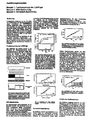
- the measuring principle of this device consists in the detection of the rotation-induced separation process of the blood samples by means of an optoelectronic sensor. The transmission profile of the sample is registered for each temporal measuring point during the rotation.
- the measuring principle of the device consists in the detection of the rotation caused Separation process of the blood samples using an optoelectronic sensor (see FIG. 1).
- the transmission profile for each time measuring point is used during the rotation of the sample registered.
- the software uses these to determine the positions of the Sediment / plasma boundary layer or the filling height and calculates the height of the Plasma column. Their chronological course lies as a separation curve from the others Processing before.
- Figure 1 Optical operating principle of the LUMiFuge. That transmitted through the sample (1) A CCD line sensor (3) registers light from a light source (2). The so won Information (transmission profile 4) is used as an analog-discontinuous voltage in an A / D converter supplied, the digitized data are available for further processing by the device-internal microcontroller and / or a PC available.
- FIG. 2 Two-stage course of the measurement.
- the segregation curve (-) is recorded at low centrifugal acceleration (25 xg).
- the LumiFuge-BSG value (5) denotes the height of the plasma column at a specified point in time (in this case 288 s).
- the numerical differentiation of the segregation curve provides the temporal course of the segregation rate (---).
- the maximum of the segregation rate (LUMiFuge V max , 6) is determined as a further BSG value.
- the hematocrit determination (7) is carried out after increasing the centrifugal acceleration (900 xg) in the second measuring section by dividing the sediment height at the end of the centrifugation by the filling height.
- the LUMiFuge immediately determines the hematocrit in the second phase of the measurement regime according to the BSG determination (see Figure 2).
- the reference values were collected by triple determination with a Hk centrifuge (Haemofuge, Heraeus, 14000 xg)
- Hk centrifuge Heraeus, 14000 xg
- erythrocytes / plasma suspensions in the Hematocrit range between 0.25 to 0.55.
- Centrifugation time between 5 and 30 minutes with centrifugal accelerations from 500 xg, 600 xg, 750 xg or 900 xg.
- 5 shows the correlation between Reference values and those of the LUMiFuge are shown.
- the determined parameters of the linear regression allow the correction of the data on the conventional certain hematocrit value.
- the results illustrate the possibility of Determination of hematocrit with a centrifugation time of only five minutes.
- the LUMiFuge enables the parallel determination of BSG and hematocrit on a blood sample, with which a hematocrit correction of the BSG value can be done.
- Sampling tubes can be used as sample containers (closed one-way system, minimizing the risk of infection, 2 ml blood) as well special cuvettes (0.5 ml blood) are used. A temperature control correction of the BSG is possible.
Landscapes
- Health & Medical Sciences (AREA)
- Life Sciences & Earth Sciences (AREA)
- Engineering & Computer Science (AREA)
- Chemical & Material Sciences (AREA)
- Biomedical Technology (AREA)
- Physics & Mathematics (AREA)
- Hematology (AREA)
- Immunology (AREA)
- Analytical Chemistry (AREA)
- General Physics & Mathematics (AREA)
- Biochemistry (AREA)
- Pathology (AREA)
- General Health & Medical Sciences (AREA)
- Urology & Nephrology (AREA)
- Biophysics (AREA)
- Molecular Biology (AREA)
- Ecology (AREA)
- Food Science & Technology (AREA)
- Medicinal Chemistry (AREA)
- Dispersion Chemistry (AREA)
- Investigating Or Analysing Biological Materials (AREA)
Claims (10)
- Procédé de détermination de grandeurs caractéristiques rhéologiques et mécaniques de matériau par l'analyse de paramètres géométriques, mécaniques et rhéologiques de milieux et de matériaux, caractérisé en ce que les différentes cuvettes ou systèmes de mesure adaptés au produit examiné et au ou aux paramètres à examiner sont soumis à une accélération variable dans le temps, la modification induite par l'accélération de la composition en termes de localisation et de temporalité du produit à examiner, la disposition géométrique ou la position des matériaux ou l'emplacement de corps d'échantillon correspondants est détecté en haute résolution par des ondes mécaniques ou électromagnétiques et de ces signaux, plusieurs grandeurs caractéristiques de matériau ainsi que leur dépendance avec le temps sont simultanément acquises.
- Procédé selon la revendication 1, caractérisé en ce que, pour le même échantillon, au cours du premier intervalle de temps, sous une faible accélération, la vitesse de sédimentation / flottation de particules ou de gouttelettes (par exemple, d'érythrocytes) est déterminée par détection de la limite de phase entre la phase dispersée (par exemple, le sang) et le milieu de dispersion (par exemple, le plasma sanguin) et que dans un intervalle de temps suivant, sous une plus forte accélération, l'échantillon est totalement dissocié, les proportions par rapport au volume total sont déterminées par une mesure des longueurs se référant à la hauteur de remplissage également à détecter ou au volume de remplissage connu, en tenant compte de la géométrie du récipient et que, à partir de cela, la concentration par volume ou une mesure adéquate (par exemple, d'hématocrite) ainsi que la capacité de tassement de la phase dispersée ou la capacité de déformation des particules ou des gouttelettes dispersées est automatiquement déterminée.
- Procédé selon la revendication 1, caractérisé en ce que le mouvement d'un corps d'échantillon dans le récipient à échantillon, au choix, fixé ou couplé par un élément de liaison élastique avec le récipient à échantillon, dans un milieu à examiner, est provoqué sous l'effet de forces centrifuges, au travers de forces mécaniques, électriques ou magnétiques qui peuvent être modifiées de l'extérieur ou commandées par le processus, la position en fonction du temps du corps d'échantillon est mesurée par des ondes mécaniques ou électromagnétiques et à partir des données force - mouvement, la viscosité ou la viscoélasticité est déterminée.
- Procédé selon la revendication 1, caractérisé en ce que, dans le récipient de mesure, une construction, des raccordements en parallèle sont possibles, de géométrie caractérisée est introduite, est disposée en surcouche ou en sous-couche avec le milieu, par la force d'accélération, une pression hydrostatique est créée, le débit volumique par le filtre est mesuré par la détection de la modification de la quantité initiale ou de la quantité de filtrat, et à partir de la conductivité hydraulique, la viscosité du milieu est calculée.
- Procédé selon la revendication 1, caractérisé en ce que, une quantité définie de l'échantillon est apportée à un récipient à échantillon supplémentaire, qui est rempli d'un réactif adapté qui dissout totalement ou partiellement une phase dispersée, les composants non dissous sont, au choix, séparés par une accélération adaptée et la quantité de matériau passant en solution (par exemple, le matériau de contenu de cellules) ou les microparticules restantes non séparables (par exemple, des organites de cellule) est mesurée par des ondes mécaniques ou électromagnétiques ou le mouvement de corps d'échantillon est mesuré et, par l'exploitation de nomogrammes, la concentration initiale de la phase dispersée de l'échantillon examiné est déterminée.
- Procédé selon la revendication 1, caractérisé en ce que, dans le cas de systèmes polydispersés, un certain volume de l'échantillon mesuré, si nécessaire, prédilué, est apporté dans des récipients de mesure supplémentaires qui peuvent contenir un milieu porteur de densités variables, la modification dans le temps en raison des forces centrifuges pendant la dissociation de mélange dans la solution très diluée en fonction de la position radiale est enregistrée, une transposition selon la technique de programme du système d'équations décrivant ce processus de dissociation de mélange s'effectue, et par la comparaison de la modélisation expérimentale et théorique, la concentration par volume totale, les concentrations par volume fractionnaire et la distribution des tailles de grain ou la distribution des densités des différentes phases sont déterminées.
- Procédé selon la revendication 1, 2 et 5, caractérisé en ce que, une ou plusieurs fractions de la phase dispersée peuvent être marquées ou colorées de manière appropriée pour une meilleure détermination de la concentration de matériau ou par volume.
- Procédé selon la revendication 1, caractérisé en ce que le caractère intact et complet d'une couche de matériau adhérant à ou collant sur une plaque de test est vérifié ou un matériau couplé avec une masse, dont la résistance mécanique doit être testée, est soumis à une accélération augmentante et variable, le moment auquel se crée le premier défaut dans la couche rapportée ainsi que le déroulement de du détachement de la totalité de la couche est enregistré au moyen d'ondes mécaniques et électromagnétiques et représenté en tant que fonction de la force d'accélération appliquée.
- Procédé selon la revendication 1, caractérisé en ce que des récipients à échantillon adaptés sont placés sur le rotor, en des positions différant dans le sens radial, l'évolution de la dissociation de mélange dans les deux cuvettes est enregistrée après un temps t1 définissable, ensuite, le processus de dissociation de mélange est poursuivi à vitesse de rotation du rotor constante ou modifiée, le déroulement de la dissociation de mélange dans la cuvette placée à proximité de l'axe de rotation est encore poursuivi, et un temps t2 caractéristique du comportement à la déformation / de la capacité de tassement, est déterminé au temps t1 par comparaison du comportement et / ou de l'évolution de dissociation de mélange avec celui de la cuvette éloignée de l'axe de rotation.
- Dispositif d'analyse de paramètres géométriques, mécaniques et rhéologiques de milieux et de matériaux, se composant de récipients de mesure spéciaux et de dispositifs de mesure, d'une unité d'entraínement commandable pour générer les forces d'accélération, d'un système de réception conçu pour les récipients de mesure ou les dispositifs de mesure, de dispositifs de détection pour déterminer les modifications provoquées par les forces d'accélération de la composition en termes de localisation et de temporalité du système de matériaux, de la disposition géométrique ou de la position du matériau, de l'emplacement des limites de phase et de corps d'échantillon correspondants, d'unités d'exploitation pour la transformation des signaux primaires de détecteur, d'une unité de microcontrôleur ou d'une unité de microcalculateur ainsi que d'un ensemble de logiciels pour l'acquisition simultanée de plusieurs grandeurs caractéristiques ainsi que leur dépendance du temps.
Applications Claiming Priority (3)
| Application Number | Priority Date | Filing Date | Title |
|---|---|---|---|
| DE19542225 | 1995-11-01 | ||
| DE1995142225 DE19542225B4 (de) | 1995-11-01 | 1995-11-01 | Verfahren und Vorrichtung zur Bestimmung von rheologischen und mechanischen Stoffkenngrößen |
| PCT/DE1996/002131 WO1997016713A2 (fr) | 1995-11-01 | 1996-10-31 | Procede et dispositif pour determiner les caracteristiques rheologiques et mecaniques de matieres |
Publications (2)
| Publication Number | Publication Date |
|---|---|
| EP0840887A2 EP0840887A2 (fr) | 1998-05-13 |
| EP0840887B1 true EP0840887B1 (fr) | 2004-02-04 |
Family
ID=7777314
Family Applications (1)
| Application Number | Title | Priority Date | Filing Date |
|---|---|---|---|
| EP96945980A Expired - Lifetime EP0840887B1 (fr) | 1995-11-01 | 1996-10-31 | Procede et dispositif pour determiner les caracteristiques rheologiques et mecaniques de matieres |
Country Status (3)
| Country | Link |
|---|---|
| EP (1) | EP0840887B1 (fr) |
| DE (1) | DE19542225B4 (fr) |
| WO (1) | WO1997016713A2 (fr) |
Families Citing this family (5)
| Publication number | Priority date | Publication date | Assignee | Title |
|---|---|---|---|---|
| DE102004011387B4 (de) | 2004-03-05 | 2010-04-29 | L.U.M. Gmbh | Verfahren und Vorrichtung zur Charakterisierung von multiplen Proben einer Dispersion |
| DE102007020646A1 (de) | 2007-04-30 | 2008-11-20 | L.U.M. Gmbh | Bestimmung von Partikeleigenschaften durch überlagerte Felder |
| EP2239585B1 (fr) * | 2008-01-22 | 2016-11-30 | Shimadzu Corporation | Système de prélèvement et de mesure de liquide |
| DE102009060861B4 (de) | 2009-11-27 | 2017-02-02 | Lum Gmbh | Verfahren und Vorrichtung zur gleichzeitigen Charakterisierung von Konzentrationsverläufen an mehreren Stellen einer Probe |
| CN106248603B (zh) * | 2016-09-27 | 2019-09-24 | 济南恒辉科济食品配料有限公司 | 食品悬浊和乳浊体系稳定性测定检测方法及检测装置 |
Family Cites Families (22)
| Publication number | Priority date | Publication date | Assignee | Title |
|---|---|---|---|---|
| NL109202C (fr) * | 1959-11-20 | |||
| DE1966274C3 (de) * | 1969-03-11 | 1979-07-05 | Fa. Andreas Hettich, 7200 Tuttlingen | Zentrifuge mit einem Schleuderkopf zur Aufnahme von durchsichtigen Probengefäßen |
| US3635678A (en) * | 1969-06-13 | 1972-01-18 | Baxter Laboratories Inc | Clot-timing system and method |
| DE2019341C3 (de) * | 1970-04-22 | 1979-12-20 | Dr. Eduard Fresenius Chemisch-Pharmazeutische Industrie Kg, 6380 Bad Homburg | Einrichtung zur Simulierung von Strömungswirkungen in einer gerinnenden Flüssigkeit, insbesondere in Blut |
| US3679367A (en) * | 1970-09-14 | 1972-07-25 | Technicon Instr | Apparatus for determining the pack volume of particulates in liquid mixtures |
| DE2227943A1 (de) * | 1972-06-08 | 1973-12-20 | Joachim Weck | Geraet zum messen des gerinnungszeitpunktes von insbesondere menschlichem plasma |
| IT1076740B (it) * | 1977-04-28 | 1985-04-27 | E L V I Spa | Apparecchiatura per la determinazione dei parametri di elasticita' del sangue |
| US4135883A (en) * | 1977-08-29 | 1979-01-23 | Bio-Dynamics Inc. | Blood analyzer system |
| DE2908469A1 (de) * | 1979-03-05 | 1980-09-11 | Fresenius Chem Pharm Ind | Verfahren und vorrichtung zur bestimmung der visko-elastischen eigenschaften von fluiden |
| AU542204B2 (en) * | 1979-03-23 | 1985-02-14 | Terumo Corp. | Separating blood |
| FR2555316B1 (fr) * | 1983-11-22 | 1986-06-20 | Saint Cloud Ecole Normale Supe | Procede et dispositif pour determiner la viscosite d'un fluide |
| JPS60227155A (ja) * | 1984-04-25 | 1985-11-12 | Shimadzu Corp | 粒度分布測定装置 |
| US4720465A (en) * | 1985-05-14 | 1988-01-19 | Fisher Scientific Company | Centrifugal kinetic agglutination assay |
| AT392354B (de) * | 1986-09-29 | 1991-03-25 | Vianova Kunstharz Ag | Platte-kegel-viskosimeter mit viskositaetsabhaengiger scherratenregelung |
| DD262485A1 (de) * | 1987-06-11 | 1988-11-30 | Akad Wissenschaften Ddr | Messeinrichtung fuer rotationsrheometer mit einem kegel und einer platte |
| DD267322A1 (de) * | 1987-12-24 | 1989-04-26 | Medizin Labortechnik Veb K | Rotationsviskosimeter |
| DD267323A1 (de) * | 1987-12-24 | 1989-04-26 | Medizin Labortechnik Veb K | Verfahren zur charakterisierung viskoelastischer eigenschaften von fluessigkeiten |
| JPH02269938A (ja) * | 1989-04-11 | 1990-11-05 | Idemitsu Petrochem Co Ltd | 分析装置 |
| DE69118573T2 (de) * | 1990-03-12 | 1996-08-29 | Beckman Instruments Inc | Optimale zentrifugale Trennung |
| DE4041554A1 (de) * | 1990-12-22 | 1991-05-02 | Komanns Aribert | Verfahren und vorrichtung zur messung der sedimentationskinetik von blutzellen, haemagglutinaten und antigen-antikoerper-komplexen unter einwirkung von zentrifugalkraeften |
| DE4116313C2 (de) * | 1991-05-15 | 1998-11-19 | Lerche Dietmar Prof Dr | Verfahren und Vorrichtung zur Messung der Elastomechanik von Sedimenten aus Suspensionen und Emulsionen |
| DE4437475C1 (de) * | 1994-10-19 | 1996-04-04 | Andreas Calatzis | Vorrichtung zum Messen der Koagulationseigenschaften von Test-Flüssigkeiten |
-
1995
- 1995-11-01 DE DE1995142225 patent/DE19542225B4/de not_active Expired - Lifetime
-
1996
- 1996-10-31 WO PCT/DE1996/002131 patent/WO1997016713A2/fr not_active Ceased
- 1996-10-31 EP EP96945980A patent/EP0840887B1/fr not_active Expired - Lifetime
Also Published As
| Publication number | Publication date |
|---|---|
| WO1997016713A2 (fr) | 1997-05-09 |
| DE19542225A1 (de) | 1997-05-07 |
| DE19542225B4 (de) | 2011-05-26 |
| EP0840887A2 (fr) | 1998-05-13 |
| WO1997016713A3 (fr) | 1997-08-14 |
Similar Documents
| Publication | Publication Date | Title |
|---|---|---|
| DE69921463T2 (de) | Verfahren um blutzellzählungen durchzuführen | |
| US3009388A (en) | Apparatus for determining fluid fractions and sedimentataion rates | |
| EP0784201B1 (fr) | Procédé automatisé, précis et de haute sensibilité et dispositif pour l'identification et le dosage des plaquettes sanguines et pour déterminer l'état d'activation des plaquettes en utilisant des échantillons du sang complet | |
| DE69922355T2 (de) | Analyse von ruhenden mit antikoagulans behandelten vollblutproben | |
| DE69218463T2 (de) | Quantifizierung von Fibrinogen im Vollblut | |
| US6025201A (en) | Highly sensitive, accurate, and precise automated method and device for identifying and quantifying platelets and for determining platelet activation state using whole blood samples | |
| US6127184A (en) | Calibration of a whole blood sample analyzer | |
| US4747685A (en) | Biological microparticle inspection apparatus | |
| Lines | The electrical sensing zone method (the Coulter principle) | |
| DE69621151T2 (de) | Verfahren und gerät für die sedimentation und die optische untersuchung von in einem fluidium schwebenden teilchen, sowie küvette zur ausführung diese verfahrens | |
| DE69623650T2 (de) | Verfahren zum testen einer zellprobe | |
| DE19542225B4 (de) | Verfahren und Vorrichtung zur Bestimmung von rheologischen und mechanischen Stoffkenngrößen | |
| EP1723405A1 (fr) | Procede et dispositif pour caracteriser de multiples echantillons d'une ou de differentes dispersions | |
| WO2000067547A2 (fr) | Procede de detection de serum et de determination de sa qualite, et dispositifs correspondant | |
| Arndt-Jovin et al. | Computer-controlled cell (particle) analyzer and separator. Use of light scattering | |
| DE29517875U1 (de) | Vorrichtung zur Bestimmung von rheologischen und mechanischen Stoffkenngrößen | |
| EP2646799A1 (fr) | Procédé et dispositif de détermination de la teneur en eau de liquides non à base d'eau | |
| DE19733784C2 (de) | Verfahren und Vorrichtung zur Bestimmung der Verteilung der Feststoffdichte von Einzelpartikeln in einem Partikelkollektiv | |
| EP3751289A1 (fr) | Dispositif de surveillance optique d'un dosage d'un liquide à pipetter | |
| DE19735931C2 (de) | Kolbenhubpipette für die Volumendosierung und Viskositätsmessung | |
| DE102008010411B4 (de) | Verfahren und Vorrichtung zur Quantifizierung der Entmischung von Dispersionen | |
| DE2413285A1 (de) | Anordnung zum messen der aggregationsgeschwindigkeit von teilchen | |
| EP0196205A2 (fr) | Appareil pour la séparation de matières particulaires | |
| DD216541A1 (de) | Verfahren zur photometrischen messung mechanischer eigenschaften von biologischen partikeln | |
| DE10103620C1 (de) | Verfahren zur Anakyse von Proben mittels einer Streulichtmessung |
Legal Events
| Date | Code | Title | Description |
|---|---|---|---|
| PUAI | Public reference made under article 153(3) epc to a published international application that has entered the european phase |
Free format text: ORIGINAL CODE: 0009012 |
|
| 17P | Request for examination filed |
Effective date: 19980213 |
|
| AK | Designated contracting states |
Kind code of ref document: A2 Designated state(s): FR GB IT |
|
| 17Q | First examination report despatched |
Effective date: 20011030 |
|
| GRAH | Despatch of communication of intention to grant a patent |
Free format text: ORIGINAL CODE: EPIDOS IGRA |
|
| GRAS | Grant fee paid |
Free format text: ORIGINAL CODE: EPIDOSNIGR3 |
|
| GRAA | (expected) grant |
Free format text: ORIGINAL CODE: 0009210 |
|
| AK | Designated contracting states |
Kind code of ref document: B1 Designated state(s): FR GB IT |
|
| REG | Reference to a national code |
Ref country code: GB Ref legal event code: FG4D Free format text: NOT ENGLISH |
|
| GBT | Gb: translation of ep patent filed (gb section 77(6)(a)/1977) |
Effective date: 20040526 |
|
| ET | Fr: translation filed | ||
| PLBE | No opposition filed within time limit |
Free format text: ORIGINAL CODE: 0009261 |
|
| STAA | Information on the status of an ep patent application or granted ep patent |
Free format text: STATUS: NO OPPOSITION FILED WITHIN TIME LIMIT |
|
| 26N | No opposition filed |
Effective date: 20041105 |
|
| PGFP | Annual fee paid to national office [announced via postgrant information from national office to epo] |
Ref country code: FR Payment date: 20121113 Year of fee payment: 17 |
|
| PGFP | Annual fee paid to national office [announced via postgrant information from national office to epo] |
Ref country code: GB Payment date: 20121023 Year of fee payment: 17 Ref country code: IT Payment date: 20121023 Year of fee payment: 17 |
|
| GBPC | Gb: european patent ceased through non-payment of renewal fee |
Effective date: 20131031 |
|
| PG25 | Lapsed in a contracting state [announced via postgrant information from national office to epo] |
Ref country code: GB Free format text: LAPSE BECAUSE OF NON-PAYMENT OF DUE FEES Effective date: 20131031 |
|
| REG | Reference to a national code |
Ref country code: FR Ref legal event code: ST Effective date: 20140630 |
|
| PG25 | Lapsed in a contracting state [announced via postgrant information from national office to epo] |
Ref country code: IT Free format text: LAPSE BECAUSE OF NON-PAYMENT OF DUE FEES Effective date: 20131031 Ref country code: FR Free format text: LAPSE BECAUSE OF NON-PAYMENT OF DUE FEES Effective date: 20131031 |