EP0821233A2 - Volumenunabhängiger diagnostischer Testträger und Verfahren zur Bestimmung von Analyten mit dessen Hilfe - Google Patents
Volumenunabhängiger diagnostischer Testträger und Verfahren zur Bestimmung von Analyten mit dessen Hilfe Download PDFInfo
- Publication number
- EP0821233A2 EP0821233A2 EP97112360A EP97112360A EP0821233A2 EP 0821233 A2 EP0821233 A2 EP 0821233A2 EP 97112360 A EP97112360 A EP 97112360A EP 97112360 A EP97112360 A EP 97112360A EP 0821233 A2 EP0821233 A2 EP 0821233A2
- Authority
- EP
- European Patent Office
- Prior art keywords
- test carrier
- diagnostic test
- layer
- network
- detection
- Prior art date
- Legal status (The legal status is an assumption and is not a legal conclusion. Google has not performed a legal analysis and makes no representation as to the accuracy of the status listed.)
- Granted
Links
Images




Classifications
-
- G—PHYSICS
- G01—MEASURING; TESTING
- G01N—INVESTIGATING OR ANALYSING MATERIALS BY DETERMINING THEIR CHEMICAL OR PHYSICAL PROPERTIES
- G01N33/00—Investigating or analysing materials by specific methods not covered by groups G01N1/00 - G01N31/00
- G01N33/48—Biological material, e.g. blood, urine; Haemocytometers
- G01N33/50—Chemical analysis of biological material, e.g. blood, urine; Testing involving biospecific ligand binding methods; Immunological testing
- G01N33/52—Use of compounds or compositions for colorimetric, spectrophotometric or fluorometric investigation, e.g. use of reagent paper and including single- and multilayer analytical elements
- G01N33/521—Single-layer analytical elements
-
- G—PHYSICS
- G01—MEASURING; TESTING
- G01N—INVESTIGATING OR ANALYSING MATERIALS BY DETERMINING THEIR CHEMICAL OR PHYSICAL PROPERTIES
- G01N33/00—Investigating or analysing materials by specific methods not covered by groups G01N1/00 - G01N31/00
- G01N33/48—Biological material, e.g. blood, urine; Haemocytometers
- G01N33/50—Chemical analysis of biological material, e.g. blood, urine; Testing involving biospecific ligand binding methods; Immunological testing
- G01N33/53—Immunoassay; Biospecific binding assay; Materials therefor
-
- Y—GENERAL TAGGING OF NEW TECHNOLOGICAL DEVELOPMENTS; GENERAL TAGGING OF CROSS-SECTIONAL TECHNOLOGIES SPANNING OVER SEVERAL SECTIONS OF THE IPC; TECHNICAL SUBJECTS COVERED BY FORMER USPC CROSS-REFERENCE ART COLLECTIONS [XRACs] AND DIGESTS
- Y10—TECHNICAL SUBJECTS COVERED BY FORMER USPC
- Y10T—TECHNICAL SUBJECTS COVERED BY FORMER US CLASSIFICATION
- Y10T436/00—Chemistry: analytical and immunological testing
- Y10T436/25—Chemistry: analytical and immunological testing including sample preparation
- Y10T436/25375—Liberation or purification of sample or separation of material from a sample [e.g., filtering, centrifuging, etc.]
Definitions
- the invention relates to a diagnostic test carrier containing a base layer with a or several arranged thereon required for the determination of analyte in liquid sample Detection layers containing reagents and one covering the detection layers Network that is larger than the detection layers and that is attached to the base layer is.
- the invention also relates to the use of this diagnostic test carrier for Determination of analyte in a liquid and a method for the determination of analyte in liquid sample with the aid of a diagnostic test carrier according to the invention.
- reagents are on or in corresponding layers of a solid test carrier which is brought into contact with the sample.
- the reaction of liquid sample and reagents leads to a detectable signal, especially a color change, which is visual or can be evaluated with the aid of a device, usually by reflection photometry.
- Test carriers are often designed as test strips, which essentially consist of an elongated Base layer made of plastic material and attached detection layers as test fields consist. However, test carriers are also known, which are square or rectangular platelets are designed.
- Test carriers of the type described at the outset are, for example, from the German patent specification 21 18 455 known.
- diagnostic test carriers for the detection of analytes in Liquids described consist of a base layer and at least one of the detection reagents containing detection layer, the surface of which does not lie on the base layer is provided with a cover layer.
- the top layer can consist of a fine mesh Network in the form of a fabric, knitted fabric or fleece. Plastic fabric are given as preferred networks for a quick wetting of the detection layer to achieve with sample liquid and to avoid disturbing chromatography effects.
- Such a diagnostic test carrier is used to detect an analyte in a liquid immersed in an appropriate liquid, preferably urine.
- the detection layer comes into contact with a very large excess of liquid that is not from that Test carrier can be included. Depending on the duration of contact of the detection layer however, different color intensities can be observed with the liquid to be examined will. Longer contact times usually lead to more positive results. A correct quantitative analyte determination is therefore not possible.
- test carriers with the lowest possible volume requirements are therefore the goal of diverse current developments.
- test carriers do not only have to be included very small sample volumes of about 3 ⁇ l give correct measured values, but they have to work reliably even with relatively large sample volumes of around 15-20 ⁇ l Hold sample liquid.
- liquid leakage from the test carrier hygienic problems can occur, for example when there is a potentially infectious problem Foreign blood is measured or if the test carrier is to be measured using equipment and then there is a risk of contamination of the measuring device. This goal is known of the patent applicant has not yet been achieved in a satisfactory manner in a simple manner been.
- the object of the present invention is therefore to provide a diagnostic test carrier for quantitative Determination of analyte in a liquid to provide an undosed one Sample liquid amount can be abandoned. Sample volumes from 3 ⁇ l should be sufficient. However, a sample liquid excess should not become time-dependent false positive Lead results. In addition, excess sample liquid should not be hygienic Problems and the test carrier should be as easy to manufacture as possible.
- the object of the invention is namely a diagnostic test carrier with a base layer and a detection layer arranged thereon, which is used to determine analyte in liquid Contains required reagents.
- the detection layer is covered by a network, which is larger than the detection layer and which is outside the detection layer on the Base layer is attached.
- the network of the diagnostic test carrier according to the invention is hydrophilic, but not capillary-active on its own. Beyond that which extends beyond the detection layers Areas of the network is an inert cover made of liquid impermeable to samples Material arranged so that on the area of the network that is above a detection layer an area for sample application remains free.
- the invention also relates to the use of such a diagnostic test carrier for the determination of analyte in a liquid.
- a procedure for Determination of analyte in liquid sample with the help of such a diagnostic test carrier Object of the invention in which sample liquid is applied to the sample application point becomes.
- the network carries excess liquid from the detection layer to the over the Detection layer protruding area of the network, whereupon the detection layer is observed for signal formation.
- the signal formation is a measure of the presence or amount of analyte in the examined liquid sample.
- the network of the diagnostic test carrier according to the invention should not itself be capillary-active or be absorbent so that the sample liquid is as complete as possible for the detection layer is available.
- Networks that have proven to be suitable are those that are vertical Immersion in water allows the water to rise in the network by less than 2 mm.
- Coarse-mesh monofilament fabrics are preferably used as the network are hydrophilic.
- the tissue material itself can be hydrophilic or, for example can be made hydrophilic by treatment with wetting agent.
- a particularly preferred Mesh material is polyester, the mesh made of this material then Treated wetting agent is used.
- the thickness of the network must be such that the cover and the underlying layer are at such a distance from each other that remaining Liquid over the saturated detection layer and in the filled mesh of the Network sucked up by capillary force in the area under the cover and from the Sample application is carried away.
- the thickness of the network for this is 50 to 400 ⁇ m advantageous.
- the network must have a sufficiently large mesh size so that liquid through the Network reaches the detection layer. Due to the nature of the network Liquid does not spread horizontally in the mesh over the mesh surface, but flows vertically through the network to the detection layer.
- a diagnostic test carrier in particular, come for the base layer materials in question that do not absorb the liquids to be examined.
- plastic films being made of, for example Polystyrene, polyvinyl chloride, polyester, polycarbonate or polyamide are particularly preferred.
- absorbent materials such as wood, paper or cardboard impregnated with water-repellent agents or coated with a waterproof film, with silicones or hard fats as water repellents and, for example, as film formers Nitrocellulose or cellulose acetate can be used.
- Carrier materials are suitable for metal foils or glass.
- a detection layer it is necessary to use such materials which are able to contain the liquid to be examined with the ingredients contained therein record, tape.
- absorbent materials such as nonwovens, Fabrics, knitted fabrics, membranes or other porous plastic materials or swellable Materials such as gelatin or dispersion films used as layer materials can.
- the materials in question for the detection layer must of course can also carry reagents necessary for the detection of the analyte to be determined are. In the simplest case there are all necessary for the detection of the analyte Reagents on or in a layer.
- detection layer is intended to encompass both cases in which the reagents either only in or on one layer or in two or more as above described, arranged layers.
- the detection layer can also contain a layer that consists of plasma or serum Is able to separate whole blood, such as a glass fiber fleece, such as it is is known from EP-B-0 045 476.
- a layer that consists of plasma or serum Is able to separate whole blood such as a glass fiber fleece, such as it is is known from EP-B-0 045 476.
- One or more such separation layers can be over one or several layers that carry detection reagents.
- Such a structure should also be included in the term "detection layer”.
- Preferred materials for the detection layer are papers or porous plastic materials, like membranes. Of these, asymmetrical porous membranes are particularly preferred are advantageously arranged so that the sample liquid to be examined on the large pore side of the membrane is abandoned and the determination of the analyte from the fine pore Side of the membrane.
- the porous membrane materials are polyamide, Polyvinylidene difluoride, polyether sulfone or polysulfone membranes are particularly preferred.
- Polyamide 66 membranes and hydrophilized ones are particularly suitable asymmetric polysulfone membranes.
- the reagents for the determination of the to be detected As a rule, analytes are introduced into the materials mentioned above by impregnation or applied by coating on one side. With asymmetrical coating Membranes are advantageously coated on the fine-pored side.
- Suitable film formers are preferably organic plastics, such as Polyvinyl esters, polyvinyl acetates, polyacrylic esters, polymethacrylic acid, polyacrylamides, polyamides, Polystyrene, copolymers, for example of butadiene and styrene or of maleic acid esters and vinyl acetate or other film-forming, natural and synthetic organic Polymers and mixtures thereof in the form of aqueous dispersions.
- organic plastics such as Polyvinyl esters, polyvinyl acetates, polyacrylic esters, polymethacrylic acid, polyacrylamides, polyamides, Polystyrene, copolymers, for example of butadiene and styrene or of maleic acid esters and vinyl acetate or other film-forming, natural and synthetic organic Polymers and mixtures thereof in the form of aqueous dispersions.
- the dispersions can be spread on an underlayer to form an even layer, which after the Drying gives a waterproof film.
- the dry films have a thickness of 10 ⁇ m to 500 microns, preferably from 30 to 200 microns.
- the film can be used together with the base as a carrier be used or applied to another carrier for the detection reaction will.
- the reagents required for the detection reaction are usually can be added to the dispersion used to make the open films be advantageous if the film formed is impregnated with the reagents after its production becomes. Pre-impregnation of the fillers with the reagents is also possible. Which reagents can be used to determine a specific analyte known to the expert. This need not be explained in more detail here.
- a detection layer preferred according to the invention is a film layer, as described in WO-A-92 15 879.
- This layer is made from a dispersion or emulsion of a polymeric film former, which additionally in homogeneous distribution contains a pigment, a swelling agent and the detection reagent.
- a polymer film former are particularly suitable polyvinyl esters, polyvinyl acetates, polyacrylic esters, polymethacrylic acid, Polyvinylamides, polyamides and polystyrene.
- copolymers e.g. of butadiene, styrene or maleic acid esters. Titanium dioxide is one for pigment particularly suitable for the film.
- the swelling agent used is said to be particularly good Have swelling properties, particularly methyl vinyl ether maleic anhydride copolymer is recommended. Which reagents are used to determine a particular analyte are left to the specialist.
- a diagnostic test carrier according to the invention is very particularly preferred Test field used as a detection layer, which is composed of two layers.
- This test field comprises a transparent film, on which in this order a first and a second film layer are superimposed. It is essential that the transparent First layer in the moist state is significantly less light-scattering than that overlying second layer.
- the uncoated side of the transparent film is called Identifies the detection side and the side of the second layer that lies opposite the side with the second layer on top of the first is called the sample application side.
- the film layers are made from dispersions or emulsions of polymeric film formers.
- Dispersion film formers contain microscopic, in the carrier liquid (mostly water) insoluble polymer particles, which disperse in the finest distribution in the carrier liquid are. If the liquid is removed by evaporation during film formation, the approach Particles and eventually touch. Due to the large forces and a with the film formation associated with a gain in surface energy, the particles grow a largely closed film layer.
- an emulsion of the film former can be used, in which this is dissolved in a solvent. The dissolved polymer is emulsified in a carrier liquid that is not with the solvent is miscible.
- Particularly suitable polymers for such film formers are polyvinyl esters, polyvinyl acetates, Polyacrylic esters, polymethacrylic acid, polyvinylamides, polyamides and polystyrene.
- copolymers e.g. B. of butadiene, styrene or maleic acid suitable.
- the two film layers mentioned are located on a transparent film in the test field.
- Plastic foils which are impermeable to liquids are particularly suitable for this purpose are.
- Polycarbonate film has proven to be particularly preferred.
- the two layers of film can be produced from coating compositions which contain the same polymeric film former or they can be produced from coating compositions that contain different polymeric film formers.
- first shift Contains swelling agent and possibly a weakly light-scattering filler second layer a swelling agent and in any case at least one highly light-scattering pigment.
- second layer can also contain non-porous fillers and porous fillers such as Diatomaceous earth, contained in small quantities without becoming permeable to erythrocytes.
- a well swelling swelling agent that is, a substance that is ingested of water increases their volume
- the swelling properties should be so good that for a test where the speed the color formation - such as a glucose detection reaction - predominantly from the penetration of the sample liquid through the layer depends on the optically detectable Reaction is measurable after a maximum of one minute.
- a well swelling swelling agent that is, a substance that is ingested of water increases their volume
- the swelling properties should be so good that for a test where the speed the color formation - such as a glucose detection reaction - predominantly from the penetration of the sample liquid through the layer depends on the optically detectable Reaction is measurable after
- Diatomaceous earth is also known as diatomaceous earth. It is made from the silica scaffolds deposits of the diatom species, which are broken down in different places will.
- the preferred diatomaceous earth has an average particle diameter of 5-15 ⁇ m, these values being determined with a type 715 laser granulometer, which is distributed by the company Pabisch, Kunststoff, Federal Republic of Germany.
- the strongly light-scattering pigment portion of the second layer is at least 25% by weight, based on the dried and ready-to-use double layer of the test field. Since the weakly light-scattering fillers and the strong light-scattering pigments essential for the optical properties of the film layers are responsible, possess the first and the second film layer different fillers and pigments.
- the first film layer should either contain no fillers or fillers whose refractive index is close to the refractive index of water. Have proven to be particularly suitable for this Silicon dioxide, silicates and aluminum silicates have been proven. A sodium aluminum silicate with the Trade names Transpafill® is particularly preferred.
- the second layer should be very light-scattering. Ideally, that is Refractive index of the pigments in the second film layer is at least 2.5. Therefore, it is preferred Titanium dioxide used. Particles with an average diameter of about 0.2 to 0.8 ⁇ m have proven to be particularly advantageous. Easily processable titanium dioxide types in the anatase modification are very particularly preferred.
- Reagent systems for the detection of certain analytes by color formation are known to the person skilled in the art known. It is possible that all components of the reagent system are in one film layer are located. But it is also possible that the components of the reagent system both film layers are distributed. The color-forming reagent system is advantageously located at least in part in the first film layer.
- color formation is understood not only to mean the transition from white to color, but also any color change, of course those color changes which are associated with the greatest possible shift in the maximum absorption waveline ( ⁇ max ) are particularly preferred.
- both film layers are non-hemolyzing Contain wetting agents.
- Neutral that is, non-charged wetting agents are special for this suitable.
- N-Octanoyl-N-methyl-glucamide is very particularly preferred.
- the respective film layers in succession from a homogeneous dispersion of the above Components manufactured.
- the transparent film for the first film layer After applying the coating compound for the first film layer in a certain layer thickness the layer dried.
- the coating composition for the second layer is then applied to this layer also applied in a thin layer thickness and dried. After drying should the thickness of the first and second film layers together at most 0.2 mm, preferably at most 0.12 mm, particularly preferably a maximum of 0.08 mm.
- the dry one second film layer about 2 to 5 times thicker than the first.
- the test carrier according to the invention can have 1 detection layer. But he can also contain several detection layers arranged side by side. In the case of multiple detection layers can be the same or different, so that one and the same analyte in several detection layers next to each other or different analytes can be determined can be detected in a different detection layer. But it is also possible that there are several spatially separated reaction areas next to each other on a detection layer so that either the same analyte is repeated several times or different Analytes can be determined side by side in the same detection layer. In the latter case the material of the layer is the same except for the reagents for determining the analytes. In different reagents contain different reagents. Various Reaction areas can be touching or side by side lying areas that do not form a signal with analyte must be separated.
- the diagnostic test carrier that which covers the detection layer is Network larger than the detection layer below.
- the one over the detection layer protruding part of the network that is the part of the network that is not connected to the Detection layer in contact is outside the detection layer on the base layer attached directly or indirectly via spacers.
- the attachment can be according to the expert methods known from test carrier technology. For example, the attachment using hot melt adhesive or hardening cold adhesive.
- the attachment using hot melt adhesive or hardening cold adhesive.
- a one-off or screened adhesive advantageous because the capillary active liquid transport in this Case is particularly possible. Double-sided adhesive strips have also been found to be advantageous proven.
- Adhesive tapes are particularly suitable for processing proven with natural or synthetic rubber. It is particularly advantageous if that Means that are used to attach the network to the base layer, about the same thickness how the detection layer (s) has. It then serves as a kind of spacer around the network also outside the area of the detection layer (s) as a whole To keep the surface level.
- a network can cover all detection layers or several Networks are used.
- diagnostic test vehicle the detection layer, but at least the reaction areas, that is, reagent-bearing areas of the detection layer (s) that indicate signal formation can be observed and measured, visible through the base layer. This can be done achieved that the base layer is transparent. But it is also possible that the Base layer has a perforation from the detection layer or layers is covered. The detection layer or the detection layers are then through the perforation at least the reaction areas of the detection layers are visible.
- a detection layer is a hole through which the detection layer or a Reaction district is observable.
- the hole has a slightly smaller diameter than that smallest length extension of the detection layer, so that the detection layer outside the Hole rests on the base layer and can be attached there.
- the Detection layer by double-sided adhesive tapes arranged on both sides and that Network above the detection layer and its attachment to the base layer are sufficient fixed.
- the detection layer itself is also preferred by means of thin adhesive tape attached to the base course.
- reaction areas of a detection layer can also be seen through a hole be.
- the perforation of a diagnostic test carrier according to the invention can also consist of two or more holes exist that are used to determine analyte (one or more analytes) can be.
- Various detection layers can be arranged over the holes be or only a detection layer with several reaction areas, so that by 1 Hole a detection layer or a reaction area can be observed. It is also possible that several reaction zones can be observed through one hole.
- an inert cover over the network of the diagnostic test carrier according to the invention made of sample-impermeable, usually water-impermeable and non-absorbent Material arranged so that the area of the network is outside the detection layer is covered. Ideally, the cover also protrudes a little over the area of the Detection layer. In any case, a significant part of the network that the Detection layer covered, free. This free part of the network is called the sample application center designated.
- Plastic films have proven to be particularly advantageous as a cover. If cover and network have different colors, for example white and yellow or white and red, the position can be identified very clearly on the one to be examined Sample liquid to be added.
- one or more arrows can be printed on the cover be made clear in which direction, that is, with which end an inventive diagnostic test carrier is to be placed or pushed into a measuring device.
- a sample application point can be particularly easily covered by means of two band-shaped covers Plastic films can be reached covering a band-like area of the detection layer blanket network. If 2 or more sample application sites are provided 3 or more band-shaped plastic films are to be used.
- the cover Foils used are on the network and possibly on the base layer attached. Hot melt adhesives are suitable for such an attachment, preferably at certain points or are applied in a grid pattern on the base layer or the underside of the cover or Adhesive tapes if the foils are not self-adhesive. In any case, it is heading for make sure that a capillary gap remains under the cover, formed by the network, in the excess sample liquid is absorbed by a detection layer saturated with liquid can be.
- the sample application point is preferably located above the Punching in the base layer, through which a signal formation in the detection layer is observed can be.
- sample liquid on that of the detection layer abandoned side of the network is sample liquid on that of the detection layer abandoned side of the network, ideally so much that the through liquid entering the network completely saturates the detection layer.
- sample liquid body fluids such as blood, plasma, serum, urine, saliva come in particular etc. in question.
- Blood or liquids derived from blood, such as plasma or serum, as well as urine are particularly preferred sample liquids.
- Excess liquid is removed by the Network from the detection layer to the area that extends beyond the detection layer of the network. In the detection layer can then be determined in the presence of the Analyts a signal can be detected.
- Such a signal for a color change including both color formation, color loss and color change is also understood.
- the intensity of the color change is a measure of that Amount of analyte in the examined liquid sample. It can be done visually or with the help of a device, mostly evaluated quantitatively by reflection photometry.
- the sample is present, for example, visually or by reflectometry Measurement of several sub-areas of the detection layer determine that only part of the detection layer is moistened and therefore too little sample liquid has been applied has been.
- such a cover In addition to marking the sample application site, such a cover also supports the capillary forces, which lead excess fluid away from the detection layer cause. In addition, the cover leads to that of the detection layer excess liquid is protected from external contact and such liquid is not can easily drip off the test carrier.
- a great advantage of the diagnostic test carrier according to the invention is that none predetermined volume of a sample liquid must be applied to the test carrier. Excess liquid is, as already mentioned above, through the detection layer projecting network away from the detection layer. Because excess Liquid being drained away from the detection layer also becomes hygienic Taken into account. A drop of liquid from the test carrier or a contact of liquid, for example, with parts of a device in which the test carrier for apparatus Evaluation is reliably avoided. This is especially true when examining a very important one from blood or blood derived samples such as plasma or serum Aspect.
- the size of the area of the network that extends beyond the detection layer depends on that in practice largest sample volume to be expected, so that actually excess liquid from the detection layer can be removed. In this way, the presence is there signal intensity of an analyte regardless of the amount and the Duration of contact of the sample liquid with the detection layer.
- the color that follows Completion of the detection reaction usually within a few seconds to less Minutes, remains unchanged for the measurement. It is only through the The stability of the coloring system is determined, but not, for example, by the analyte Excess liquid diffuses into the detection layer. False positive results are also avoided and quantitative analyte determination is made possible.
- test carrier By covering parts of the network and thus marking the sample application site care is taken to ensure that liquid only reaches the optimal position on the Detection layer can reach. In combination with a detection layer that is little Absorbs liquid and still ensures intensive signal formation, it is ensured that reliable analyte determinations are possible even with very small sample volumes are. Because the test carrier according to the invention consists of only a few components, which are easy and quick to assemble, it is very inexpensive to manufacture.
- FIG. 1-23 Preferred embodiments of the diagnostic test carrier according to the invention are shown in FIG. 1-23 shown.
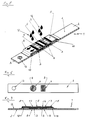
- FIG. 1 shows a perspective view of a diagnostic test carrier according to the invention with a sample application center.
- FIG. 2 shows a top view of the underside of a diagnostic test carrier according to the invention 1 with round perforations under the detection layer.
- FIG. 3 shows a cross section through a diagnostic test carrier according to the invention Fig. 1 along A-A.
- FIG. 4 shows an enlargement of part of the cross section from FIG. 3.
- FIG. 5 shows a perspective view of a diagnostic test carrier according to the invention with two sample application points.
- FIG. 6 shows a top view of the underside of a diagnostic test carrier according to the invention 5 with a perforation consisting of a round and rectangular hole under 2 separate detection layers.
- FIG. 7 shows a cross section through a diagnostic test carrier according to the invention Fig. 5 along A-A.
- FIG. 8 shows a perspective view of a diagnostic test carrier according to the invention with an extra large sample application point.
- FIG. 9 shows a top view of the underside of a diagnostic test carrier according to the invention 8 with a perforation consisting of a round and rectangular hole below an extra large detection layer.
- FIG. 10 shows a cross section through a diagnostic test carrier according to the invention Fig. 8 along A-A.
- FIG. 11 shows a perspective view of a diagnostic test carrier according to the invention with a sample application point over one of two detection layers.
- FIG. 12 shows a top view of the underside of a diagnostic test carrier according to the invention 11 with a perforation consisting of round and rectangular hole below two separate detection layers.
- FIG. 13 shows a cross section through a diagnostic test carrier according to the invention Fig. 11 along A-A.
- FIG. 14 shows a perspective view of a diagnostic test carrier according to the invention with an extra large sample application point.
- FIG. 15 shows a top view of the underside of a diagnostic test carrier according to the invention 14 with a perforation consisting of an extra large rectangular hole under a detection layer with two adjacent reaction areas.
- FIG. 16 shows a cross section through a diagnostic test carrier according to the invention Fig. 14 along A-A.
- FIG. 17 shows a perspective view of a diagnostic test carrier according to the invention with a sample application point over one of the two reaction areas.
- FIG. 18 shows a top view of the underside of a diagnostic test carrier according to the invention 17 with a perforation consisting of an extra large rectangular hole under a detection layer with two adjacent reaction areas.
- FIG. 19 shows a cross section through a diagnostic test carrier according to the invention Fig. 17 along A-A.
- Test carrier (1) is in the form of a test strip.
- a detection layer (3) which is covered by a larger network (4).
- the detection layer (3) is the network (4) by means of spacers (10) on the base layer (2) attached.
- These spacers can be hot-melt adhesive surfaces or double-sided adhesive Be tapes that fix the network (4) on the base layer (2). Ideally they have Spacers (10) approximately the same thickness as the detection layer (3).
- the one as cover (5) serving layers are attached to the base layer (2) and the network (4). they are so arranged that it extends beyond the detection layer (3) area of the network (4) cover.
- the covers (5) also protrude slightly from the detection layer (3). However, they leave most of the network (4) free, which is the detection layer (3) covered. This area represents the sample application point (7) abandoned sample liquid to be examined (12).
- the positioning hole (13) serves the Test strips in the case of an apparatus measurement, for example a reflection photometric measurement to be held at a precisely predetermined point on the apparatus. This can be done happen that, for example, a pin protrudes into the positioning hole (13) and so the test carrier (1) holds at a predetermined location.
- the left cover (5) contains printed Arrows that show the user the end of the test carrier (1) placed in a measuring device or to be pushed.
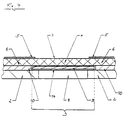
- Fig. 4 shows an enlarged cross section through a diagnostic according to the invention Test carrier, as shown in Fig. 1 and 3.
- This figure is intended to explain how a Process for determining an analyte in a liquid sample is in progress.
- sample liquid is placed on the sample application point (7) of the network (4).
- the liquid penetrates vertically through the network (4) into the detection layer (3), which in turn is fastened with double-sided adhesive tape (14) to the base layer (2).
- the tape attachment (14) contains a hole that corresponds to the perforation (8) of the base layer (2) and that too lies exactly above this perforation (8). If sufficient sample liquid has been added, this liquid is distributed in the detection layer (3) over the entire reaction area (9).
- the detection layer (3) can cover the one above Vacuum network (4) even dry, since network (4) is not itself capillary-active.
- network (4) is not itself capillary-active.
- the covers (5) match at least something with the area of the detection layer (3) overlap under the network (4).
- the reaction area (9) Detection layer (3) can be observed.
- a supervision of the Underside of the diagnostic test carrier shown in FIGS. 1, 3 and 4. In case of presence of the analyte in the applied sample liquid, the reaction zone (9) change.
- a signal is formed, for example a color change, the intensity of which Measure of the amount of analyte in the sample liquid.
- the diagnostic test carrier according to the invention shown in FIGS. 5 to 7 is concerned one with two detection layers (3), which are arranged above two Sample application points (7) for sample liquid (12) are accessible.
- the sample application sites (7) are formed by three band-shaped covers (5) covering the areas of the Cover network (4) that protrude beyond the detection layers (3).
- a continuous network (4) has been used.
- two separate networks (4) with an intermediate liquid barrier, such as an adhesive tape or a hot melt adhesive line can be used.
- In the base course (2) of the test carrier (1) there is a perforation (8) of two holes, each have a reaction zone (9) of one of the two detection layers (3) observed.
- a Such test carrier (1) is suitable, for example, for the simultaneous determination of two different analytes.
- the spatial separation of the detection layers (3) is advantageous if the reagents or reaction products can interfere with each other.
- the diagnostic test carrier (1) according to FIGS. 8 to 10 has an extra Large sample application point (7) over a detection layer (3) through a perforation (8) two holes is observable.
- different holes can be over two holes
- Reaction areas (9) can be arranged which contain reagents for different analytes. In this way, two analytes can be determined from one sample.
- the two reaction areas can also be used to determine the same analyte with different sensitivity be used.
- 11 to 13 show a diagnostic test carrier (1) according to the invention, in which there are two detection layers (3) above a perforation (8) consisting of two holes.
- One per Detection layer (3) is located over a hole in the perforation (8).
- the sample application site In this case, (7) is only over one of the two detection layers (3). How it got there Sample liquid (12) only in the detection layer under the sample application point (7) (3) before excess liquid due to capillary forces in the area of the network (4) below the right cover (5) also in the right detection layer (3) by the rectangular hole in the carrier film (2) can be observed.
- the test carrier (1) according to FIGS. 14-16 has an extra large sample application point (7) a detection layer (3) which carries two reaction areas (9) which are directly adjacent to one another are. These two reaction areas are from the bottom of the base layer (2) through the Perforation (8), which in this case consists of only a single rectangular hole, is visible.
- Sample liquid (12) which is applied centrally to the sample application point (7), penetrates through the network (4) into the detection layer (3) and reaches both reaction areas at the same time (9). With such a test carrier, for example, two from one sample different analytes can be determined.
- the test carrier (1) which is shown in Fig. 17-19, corresponds essentially to the test carrier 14-16. However, the sample application point (7) is now only above one of the two reaction areas (9).
- the right reaction area (9) is through the right cover (5) protected from the direct application of sample liquid (12). Sample liquid can come here (12) only via capillary forces within the area of the network (4), which is located under the right cover.
- test carrier according to FIG. 1 is produced in the following steps:
- a 5 mm wide double-sided layer is placed on a polyester base layer containing titanium dioxide Adhesive tape (polyester backing and synthetic rubber adhesive) applied. This association will punched together with a hole spacing of 6 mm to create the measuring holes. After that the protective paper of the double-sided adhesive tape is peeled off.
- a 5 mm wide strip of the detection layer produced in this way is placed on the film side die-cut double-sided adhesive tape is glued to the base layer to match.
- Double-sided adhesive tapes are directly adjacent to the detection layer on both sides (PVC backing and natural rubber adhesive) glued to the backing film as a spacer.
- one spacer is 6 mm and the other 9 mm wide. After that the protective film of the two double-sided adhesive tapes is removed.
- a yellow monofilament coarse mesh impregnated with wetting agent is placed on this composite Polyester fabric Scrynel PE 280 HC (Zurich bag cloth factory Rüschlikon, Switzerland) applied and glued by pressing.
- the tape goods are cut into 6 mm wide test carriers so that the measuring hole in the test carrier is in the middle.
Landscapes
- Health & Medical Sciences (AREA)
- Life Sciences & Earth Sciences (AREA)
- Immunology (AREA)
- Engineering & Computer Science (AREA)
- Hematology (AREA)
- Molecular Biology (AREA)
- Biomedical Technology (AREA)
- Chemical & Material Sciences (AREA)
- Urology & Nephrology (AREA)
- Biotechnology (AREA)
- Microbiology (AREA)
- Cell Biology (AREA)
- Food Science & Technology (AREA)
- Medicinal Chemistry (AREA)
- Physics & Mathematics (AREA)
- Analytical Chemistry (AREA)
- Biochemistry (AREA)
- General Health & Medical Sciences (AREA)
- General Physics & Mathematics (AREA)
- Pathology (AREA)
- Investigating Or Analysing Biological Materials (AREA)
- Investigating Or Analyzing Non-Biological Materials By The Use Of Chemical Means (AREA)
Abstract
dadurch gekennzeichnet, daß das Netzwerk (4) hydrophil aber alleine nicht kapillaraktiv ist und eine inerte Abdeckung (5) aus probenundurchlässigem Material über den über die Nachweisschicht hinausragenden Bereichen (6) des Netzwerkes, so angeordnet ist, daß eine Probenauftragsstelle (7) auf dem die Nachweisschicht überdeckenden Bereich des Netzwerkes (4) frei bleibt
sowie die Verwendung eines solchen Testträgers zur Bestimmung von Analyt in einer Flüssigkeit. Außerdem ist Gegenstand der Erfindung ein Verfahren zur Bestimmung eines Analyts in flüssiger Probe mit Hilfe eines erfindungsgemäßen Testträgers.
Description
- 1
- Diagnostischer Testträger
- 2
- Tragschicht
- 3
- Nachweisschicht
- 4
- Netzwerk
- 5
- Abdeckung
- 6
- über die Nachweisschicht hinausragender Bereich des Netzwerkes
- 7
- Probenauftragsstelle
- 8
- Lochung
- 9
- Reaktionsbezirk
- 10
- Abstandhalter
- 11
- kapillaraktiver Spalt
- 12
- Probenflüssigkeit
- 13
- Positionierloch
- 14
- Klebebandbefestigung für Nachweisschicht
| Wasser: | 820,0 g |
| Citronensäure-1-hydrat: | 2,5 g |
| Calciumchlorid-2-hydrat: | 0,5 g |
| Natriumhydroxid: | 1,4 g |
| Xanthan gum: | 3,4 g |
| Tetraethylammoniumchlorid: | 2,0 g |
| N-Octanoyl-N-methyl-glucamid: | 2,1 g |
| Polyvinylpyrrolidon (MG 25000): | 3,5 g |
| Transpafill® (Natrium-Aluminiumsilikat): | 62,1 g |
| Polyvinylpropionat-Dispersion (50 Gew.-% in Wasser): | 60,8 g |
| Bis-(2-hydroxyethyl)-(4-hydroximinocyclohexa-2,5-dienylidin)-ammoniumchlorid: | 1,2 g |
| 2,18-Phosphormolybdänsäure-hexanatriumsalz: | 16,1 g |
| Pyrrolochinolin-chinon: | 32 mg |
| Glucosedehydrogenase rec. aus Acinetobacter calcoaceticus, EC 1.1.99.17: | 1,7 MU (2,4 g) |
| 1-Hexanol: | 1,6 g |
| 1-Methoxy-2-propanol: | 20,4 g |
| Wasser: | 579,7 g |
| Natriumhydroxid: | 3,4 g |
| Gantrez® (Methylvinylether-maleinsäure-Copolymer): | 13,8 g |
| N-Octanoyl-N-methyl-glucamid: | 3,6 g |
| Tetraethylammoniumchlorid: | 9,7 g |
| Polyvinylpyrrolidon (MG 25000): | 20,2 g |
| Titandioxid: | 177,1 g |
| Kieselgur: | 55,3 g |
| Polyvinylpropionat-Dispersion (50 Gew.-% in Wasser): | 70,6 g |
| 2,18-Phosphormolybdansäure-hexanatriumsalz: | 44,3 g |
| Kaliumhexacyanoferrat (III): | 0,3 g |
| 1-Hexanol: | 1,6 g |
| 1-Methoxy-2-propanol: | 20,4 g |
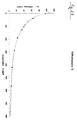
| Volumentoleranz des Teststreifens bei Meßvariante 1 | |||
| Probevolumen | gemessene relative Remission [%] | berechnete Konzentration nach Kalibrationskurve 1 | prozentuale Abweichung vom Referenzwert |
| 3 µl | 42,8 | 117,5 | - 0,5 |
| 5 µl | 42,9 | 117,1 | - 0,8 |
| 8 µl | 42,6 | 118,5 | 0,4 |
| 10 µl | 41,8 | 122,1 | 3,4 |
| 20 µl | 41,9 | 121,6 | 3,0 |
| Volumentoleranz des Teststreifens bei Meßvariante 2 | |||
| Probevolumen | gemessene relative Remission [%] | berechnete Konzentration nach Kalibrationskurve 2 | prozentuale Abweichung vom Referenzwert |
| 3 µl | 37,4 | 117,5 | - 0,5 |
| 5 µl | 37,6 | 117,0 | - 0,9 |
| 8 µl | 37,4 | 117,7 | - 0,3 |
| 10 µl | 37,2 | 118,6 | 0,4 |
| 20 µl | 37,0 | 119,4 | 1,1 |
| Volumentoleranz des Teststreifens bei Meßvariante 3 | |||
| Probevolumen | gemessene relative Remission [%] | berechnete Konzentration nach Kalibrationskurve 3 | prozentuale Abweichung vom Referenzwert |
| 3 µl | 33,4 | 120,2 | 1,5 |
| 5 µl | 34,0 | 117,7 | - 0,6 |
| 8 µl | 33,9 | 118,0 | - 0,3 |
| 10 µl | 34,1 | 117,0 | - 1,2 |
| 20 µl | 33,8 | 118,5 | 0,1 |
| Volumentoleranz des Teststreifens bei Meßvariante 4 | |||
| Probevolumen | gemessene relative Remission [%] | berechnete Konzentration nach Kalibrationskurve 4 | prozentuale Abweichung vom Referenzwert |
| 3 µl | 35,2 | 119,2 | 0,8 |
| 5 µl | 35,3 | 118,7 | 0,3 |
| 8 µl | 35,6 | 117,3 | - 0,8 |
| 10 µl | 35,6 | 117,4 | - 0,8 |
| 20 µl | 35,4 | 118,0 | - 0,3 |
Claims (14)
- Diagnostischer Testträger (1) enthaltend eine Tragschicht (2) mit einer darauf angeordneten zur Bestimmung von Analyt in flüssiger Probe erforderliche Reagenzien enthaltenden Nachweisschicht (3) und ein die Nachweisschicht (3) überdeckendes Netzwerk (4), das größer als die Nachweisschicht (3) ist und das auf der Tragschicht (2) befestigt ist, dadurch gekennzeichnet, daß das Netzwerk (4) hydrophil aber alleine nicht kapillaraktiv ist, und eine inerte Abdeckung (5) aus probenundurchlässigem Material über den über die Nachweisschicht hinausragenden Bereichen (6) des Netzwerkes so angeordnet ist, daß eine Probenauftragsstelle (7) auf dem die Nachweisschicht überdeckenden Bereich des Netzwerkes (4) frei bleibt und das Netzwerk (4) zwischen Abdeckung (5) und Nachweisschicht (3) sowie zwischen Abdeckung (5) und Tragschicht (2) beziehungsweise zwischen Abdeckung (5) und Abstandhalter (10) auf der Tragschicht (2) einen kapillaraktiven Spalt erzeugt.
- Diagnostischer Testträger gemäß Patentanspruch 1, dadurch gekennzeichnet, daß auf der Tragschicht mehrere Nachweisschichten nebeneinander angeordnet sind.
- Diagnostischer Testträger gemäß Patentansprüchen 1 oder 2, dadurch gekennzeichnet, daß die Tragschicht gelocht und die Nachweisschicht(en) über der Lochung angeordnet ist (sind).
- Diagnostischer Testträger gemäß Patentanspruch 3, dadurch gekennzeichnet, daß sich die Probenauftragsstelle über der Lochung der Tragschicht befindet.
- Diagnostischer Testträger gemäß Patentanspruch 3, dadurch gekennzeichnet, daß sich die Probenauftragsstelle nicht über der Lochung der Tragschicht befindet.
- Diagnostischer Testträger gemäß einem der vorangehenden Patentansprüche, dadurch gekennzeichnet, daß die Tragschicht als Lochung mehrere Löcher enthält über denen eine oder mehrere Nachweisschichten angeordnet sind.
- Diagnostischer Testträger gemäß einem der Patentansprüche 2-5, dadurch gekennzeichnet, daß die Tragschicht als Lochung mehrere Löcher enthält, über denen jeweils unterschiedliche Nachweisschichten angeordnet sind.
- Diagnostischer Testträger gemäß Patentanspruch 1, dadurch gekennzeichnet, daß die Tragschicht ein Loch enthält, über dem eine Nachweisschicht mit mehreren nebeneinander befindlichen Reaktionsbezirken angeordnet ist.
- Diagnostischer Testträger gemäß einem der Patentansprüche 7 oder 8, dadurch gekennzeichnet, daß sich über mehreren oder allen Nachweisschichten oder Reaktionsbezirken jeweils eine Probenauftragsstelle befindet.
- Diagnostischer Testtrager gemäß einem der Patentansprüche 7 oder 8, dadurch gekennzeichnet, daß sich nur über einer der Nachweisschichten oder einem Reaktionsbezirk eine Probenauftragsstelle befindet.
- Diagnostischer Testträger gemäß einem der vorangehenden Patentansprüche, dadurch gekennzeichnet, daß das Netzwerk ein monofiles Gewebe ist.
- Diagnostischer Testträger gemäß einem der vorangehenden Patentansprüche, dadurch gekennzeichnet, daß das Netzwerk mittels eines Klebebandes, bevorzugt mit Natur- oder Synthesekautschuk, auf der Tragschicht befestigt ist.
- Verwendung eines diagnostischen Testträgers gemäß einem der Patentansprüche 1-12 zur Bestimmung von Analyt in einer Flüssigkeit.
- Verfahren zur Bestimmung von Analyt in flüssiger Probe mit Hilfe eines diagnostischen Testträgers gemäß einem der Patentansprüche 1-12, wobei Probenflüssigkeit auf die Probenauftragsstelle aufgegeben wird, überschüssige Flüssigkeit, die nicht von der (den) Nachweisschicht(en) und dem (den) darüber liegenden Bereich(en) des Netzwerkes (4) aufgenommen wird, in den über die Nachweisschicht(en) hinausragenden Bereich des Netzwerkes weggeführt wird und die Nachweisschicht(en) auf eine Signalbildung hin beobachtet wird (werden), wobei die Signalbildung ein Maß für die Anwesenheit bzw. Menge an Analyt in der untersuchten flüssigen Probe darstellt.
Applications Claiming Priority (2)
| Application Number | Priority Date | Filing Date | Title |
|---|---|---|---|
| DE19629657A DE19629657A1 (de) | 1996-07-23 | 1996-07-23 | Volumenunabhängiger diagnostischer Testträger und Verfahren zur Bestimmung von Analyt mit dessen Hilfe |
| DE19629657 | 1996-07-23 |
Publications (3)
| Publication Number | Publication Date |
|---|---|
| EP0821233A2 true EP0821233A2 (de) | 1998-01-28 |
| EP0821233A3 EP0821233A3 (de) | 1999-03-10 |
| EP0821233B1 EP0821233B1 (de) | 2002-09-25 |
Family
ID=7800575
Family Applications (1)
| Application Number | Title | Priority Date | Filing Date |
|---|---|---|---|
| EP97112360A Expired - Lifetime EP0821233B1 (de) | 1996-07-23 | 1997-07-18 | Volumenunabhängiger diagnostischer Testträger und Verfahren zur Bestimmung von Analyten mit dessen Hilfe |
Country Status (26)
| Country | Link |
|---|---|
| US (1) | US5846837A (de) |
| EP (1) | EP0821233B1 (de) |
| JP (1) | JP3479434B2 (de) |
| KR (1) | KR100236846B1 (de) |
| CN (1) | CN1135387C (de) |
| AR (1) | AR008406A1 (de) |
| AT (1) | ATE225039T1 (de) |
| AU (1) | AU701834B2 (de) |
| CA (1) | CA2210652C (de) |
| CZ (1) | CZ293684B6 (de) |
| DE (2) | DE19629657A1 (de) |
| DK (1) | DK0821233T3 (de) |
| EE (1) | EE9700163A (de) |
| ES (1) | ES2184012T3 (de) |
| HR (1) | HRP970400A2 (de) |
| HU (1) | HUP9701273A3 (de) |
| IL (1) | IL121354A (de) |
| MX (1) | MX9705535A (de) |
| NO (1) | NO973382L (de) |
| NZ (1) | NZ328375A (de) |
| PL (1) | PL191051B1 (de) |
| PT (1) | PT821233E (de) |
| SK (1) | SK99297A3 (de) |
| TW (1) | TW514728B (de) |
| UA (1) | UA45381C2 (de) |
| ZA (1) | ZA976466B (de) |
Cited By (18)
| Publication number | Priority date | Publication date | Assignee | Title |
|---|---|---|---|---|
| EP0995992A3 (de) * | 1998-10-23 | 2000-05-03 | Roche Diagnostics GmbH | Spreitschichten, Netzmittel zu ihrer Herstellung und deren Verwendung in Teststreifen |
| EP0995993A3 (de) * | 1998-10-23 | 2000-05-03 | Roche Diagnostics GmbH | Funktionelle Auflage für flexible Objekte, insbesondere für diagnostische Teststreifen |
| WO1999064620A3 (en) * | 1998-06-10 | 2001-01-18 | Abbott Lab | Diagnostic assay requiring a small sample of biological fluid |
| US6455001B1 (en) | 1998-10-23 | 2002-09-24 | Roche Diagnostics Gmbh | Functional layers of high precision, process for their production and test strips containing these functional layers |
| US6475436B1 (en) | 1999-01-23 | 2002-11-05 | Roche Diagnostics Gmbh | Method and device for removing consumable analytic products from a storage container |
| US6497845B1 (en) | 1998-04-24 | 2002-12-24 | Roche Diagnostics Gmbh | Storage container for analytical devices |
| US6579882B2 (en) | 1998-06-04 | 2003-06-17 | Abbott Laboratories | Cell adhesion-inhibiting antiinflammatory compounds |
| US6881378B1 (en) | 1999-03-19 | 2005-04-19 | Roche Diagnostics Gmbh | Multilayered analytical device |
| EP2000799A1 (de) | 2005-10-25 | 2008-12-10 | Roche Diagnostics GmbH | Analysegerät zur Analyse einer Probe auf einem Testelement |
| EP2011630A1 (de) * | 2007-07-03 | 2009-01-07 | F. Hoffmann-La Roche AG | Verfahren zur Herstellung eines Analyseelementes |
| EP2145683A1 (de) * | 2008-07-14 | 2010-01-20 | F.Hoffmann-La Roche Ag | Analytisches Testelement mit hydrophil modifizierter Oberfläche |
| WO2010092160A1 (de) * | 2009-02-13 | 2010-08-19 | F. Hoffmann-La Roche Ag | Diagnostisches testband für flüssigproben |
| US7808645B2 (en) | 2005-06-22 | 2010-10-05 | Roche Diagnostics Operations, Inc. | Analysis system for analyzing a sample on an analytical test element |
| US7951331B2 (en) | 2006-07-12 | 2011-05-31 | Roche Diagnostics Operations, Inc. | Analysis system and method for analyzing a sample on an analytical test element |
| US8318106B2 (en) | 2004-07-28 | 2012-11-27 | Roche Diagnostics Operations, Inc. | Analysis system for analyzing a sample on a test element |
| WO2013135669A1 (de) | 2012-03-12 | 2013-09-19 | Roche Diagnostics Gmbh | Testsystem und verfahren zur kontrolle der ausrichtung eines teststreifens |
| US10274482B2 (en) | 2014-02-05 | 2019-04-30 | Roche Diabetes Care, Inc. | Rare metals as components of coatings in diagnostic test elements and methods of determining an amount/quality of dried compositions in such coatings |
| US12253517B2 (en) | 2013-10-29 | 2025-03-18 | Roche Diabetes Care, Inc. | Nano-enzyme containers for test elements |
Families Citing this family (55)
| Publication number | Priority date | Publication date | Assignee | Title |
|---|---|---|---|---|
| DE19629655A1 (de) * | 1996-07-23 | 1998-01-29 | Boehringer Mannheim Gmbh | Diagnostischer Testträger und Verfahren zur Bestimmung eines Analyts mit dessen Hilfe |
| DE19822123C2 (de) * | 1997-11-21 | 2003-02-06 | Meinhard Knoll | Verfahren und Vorrichtung zum Nachweis von Analyten |
| DE19753847A1 (de) * | 1997-12-04 | 1999-06-10 | Roche Diagnostics Gmbh | Analytisches Testelement mit Kapillarkanal |
| DE19753851A1 (de) * | 1997-12-04 | 1999-06-10 | Roche Diagnostics Gmbh | Vorrichtung zum kapillaren Flüssigkeitstransport |
| DE19753850A1 (de) | 1997-12-04 | 1999-06-10 | Roche Diagnostics Gmbh | Probennahmevorrichtung |
| DE19755529A1 (de) | 1997-12-13 | 1999-06-17 | Roche Diagnostics Gmbh | Analysensystem für Probenflüssigkeiten |
| US6036659A (en) | 1998-10-09 | 2000-03-14 | Flexsite Diagnostics, Inc. | Collection device for biological samples and methods of use |
| US6696240B1 (en) | 1999-10-26 | 2004-02-24 | Micronix, Inc. | Capillary test strip to separate particulates |
| DE60043049D1 (de) | 1999-12-28 | 2009-11-12 | Arkray Inc | Bluttestvorrichtung |
| CN100437114C (zh) * | 2001-04-12 | 2008-11-26 | 爱科来株式会社 | 样品分析装置 |
| GB0109925D0 (en) * | 2001-04-23 | 2001-06-13 | Axis Shield Asa | Method |
| CA2460773C (en) * | 2001-09-24 | 2012-04-10 | Atsuo F. Fukunaga | Breathing circuits having unconventional respiratory conduits and systems and methods for optimizing utilisation of fresh gases |
| US6659966B2 (en) | 2001-11-15 | 2003-12-09 | Roche Diagnostics Corporation | Fluid sampling apparatus |
| US7004928B2 (en) | 2002-02-08 | 2006-02-28 | Rosedale Medical, Inc. | Autonomous, ambulatory analyte monitor or drug delivery device |
| DE10248555B4 (de) * | 2002-10-18 | 2004-12-02 | Roche Diagnostics Gmbh | Verfahren und Analysesystem zur Ermittlung der Konzentration eines Analyten in einer Probe, die aus dem Analyten und der Probenmatrix besteht und Testelement dafür |
| AU2003291250A1 (en) * | 2002-11-05 | 2004-06-07 | Therasense, Inc. | Assay device, system and method |
| US7572237B2 (en) | 2002-11-06 | 2009-08-11 | Abbott Diabetes Care Inc. | Automatic biological analyte testing meter with integrated lancing device and methods of use |
| CA2455669A1 (en) * | 2003-02-04 | 2004-08-04 | Bayer Healthcare, Llc | Method and test strip for determining glucose in blood |
| US7052652B2 (en) * | 2003-03-24 | 2006-05-30 | Rosedale Medical, Inc. | Analyte concentration detection devices and methods |
| US6931327B2 (en) | 2003-08-01 | 2005-08-16 | Dexcom, Inc. | System and methods for processing analyte sensor data |
| DE10338446A1 (de) | 2003-08-21 | 2005-03-31 | Roche Diagnostics Gmbh | Positioniereinrichtung für ein Testelement |
| DE10346417A1 (de) * | 2003-10-07 | 2005-06-02 | Roche Diagnostics Gmbh | Analytisches Testelement umfassend ein Netzwerk zur Bildung eines Kapillarkanals |
| DE102004005139A1 (de) * | 2004-02-02 | 2005-08-18 | Prisma Diagnostika Gmbh | Testelement und Verfahren zum Testen von Blut |
| DE102004007983A1 (de) | 2004-02-18 | 2005-09-08 | Roche Diagnostics Gmbh | Testelement mit Einschicht-Reaktionsfilm |
| DE102004009012A1 (de) | 2004-02-25 | 2005-09-15 | Roche Diagnostics Gmbh | Testelement mit einer Kapillare zum Transport einer flüssigen Probe |
| US20060281187A1 (en) * | 2005-06-13 | 2006-12-14 | Rosedale Medical, Inc. | Analyte detection devices and methods with hematocrit/volume correction and feedback control |
| JP5232003B2 (ja) | 2005-09-30 | 2013-07-10 | インテュイティ メディカル インコーポレイテッド | 多部分体液試料採取及び分析カートリッジ |
| US8801631B2 (en) | 2005-09-30 | 2014-08-12 | Intuity Medical, Inc. | Devices and methods for facilitating fluid transport |
| US7955484B2 (en) * | 2005-12-14 | 2011-06-07 | Nova Biomedical Corporation | Glucose biosensor and method |
| ES2401692T3 (es) * | 2006-03-14 | 2013-04-23 | F. Hoffmann-La Roche Ag | Método para preparar un elemento analítico multicapa |
| US20100012049A1 (en) * | 2006-04-12 | 2010-01-21 | Jms Co., Ltd | Cavitation heating system and method |
| EP1917909A1 (de) * | 2006-10-12 | 2008-05-07 | Roche Diagnostics GmbH | Probengewinnungssystem und Verfahren zum Gewinnen einer flüssigen Probe |
| PL1921441T3 (pl) | 2006-11-07 | 2014-02-28 | Hoffmann La Roche | Sposób analizowania próbki na elemencie testowym i system analityczny |
| DE502007005670D1 (de) * | 2007-05-16 | 2010-12-30 | Roche Diagnostics Gmbh | Stechsystem |
| EP2039293A1 (de) * | 2007-09-19 | 2009-03-25 | F. Hoffman-la Roche AG | Kombinationsantrieb für ein Probengewinnungssystem zum Gewinnen einer flüssigen Probe |
| US8008068B2 (en) * | 2008-02-29 | 2011-08-30 | Light Pointe Medical, Inc. | Nonhemolytic optical sensor with enhanced reflectance |
| US20090219509A1 (en) * | 2008-02-29 | 2009-09-03 | Hiroshi Nomura | Optical sensor with enhanced reflectance |
| WO2009145920A1 (en) | 2008-05-30 | 2009-12-03 | Intuity Medical, Inc. | Body fluid sampling device -- sampling site interface |
| JP5642066B2 (ja) | 2008-06-06 | 2014-12-17 | インテュイティ メディカル インコーポレイテッド | 体液の試料内に含まれている検体の存在または濃度を決定する検定を行う方法および装置 |
| US10383556B2 (en) | 2008-06-06 | 2019-08-20 | Intuity Medical, Inc. | Medical diagnostic devices and methods |
| KR101311020B1 (ko) * | 2008-11-07 | 2013-09-25 | 에프. 호프만-라 로슈 아게 | 광도계 반응 필름용 세립 충전물질 |
| KR101203385B1 (ko) * | 2009-06-04 | 2012-11-21 | 주식회사 인포피아 | 혈액의 퍼짐성이 향상된 측정 스트립 |
| EP2267446A1 (de) | 2009-06-24 | 2010-12-29 | Roche Diagnostics GmbH | Spreitschicht und Verfahren zur Herstellung einer Analyseelement-Spreitschicht |
| EP2283774A1 (de) | 2009-08-13 | 2011-02-16 | Roche Diagnostics GmbH | Testelement zur Analyse einer Körperflüssigkeit |
| EP3106871B1 (de) | 2009-11-30 | 2021-10-27 | Intuity Medical, Inc. | Verfahren zum verifizieren der genauigkeit des betriebs einer analyt-überwachungsvorrichtung |
| EP2584964B1 (de) | 2010-06-25 | 2021-08-04 | Intuity Medical, Inc. | Analytüberwachungsvorrichtungen |
| EP3750480B1 (de) | 2011-08-03 | 2022-02-02 | Intuity Medical, Inc. | Vorrichtung zur entnahme von körperflüssigkeiten |
| WO2013093024A1 (en) * | 2011-12-22 | 2013-06-27 | Dsm Ip Assets B.V. | Multilayered woven manufacture and use of the multilayer woven manufacture as carriers for dried matrix spot applications |
| US10729386B2 (en) | 2013-06-21 | 2020-08-04 | Intuity Medical, Inc. | Analyte monitoring system with audible feedback |
| DE102013110011B4 (de) * | 2013-09-12 | 2018-07-12 | Gert Horstmeyer | Verfahren und Einrichtung zur Analyse von Ölen und technischen Betriebsflüssigkeiten und zur qualifizierten Bewertung der Betriebszustände von Aggregaten |
| RU2723537C2 (ru) | 2014-01-24 | 2020-06-15 | Ф. Хоффманн-Ля Рош Аг | Способ изготовления однокодовых и бескодовых тест-полосок |
| WO2016147527A1 (ja) * | 2015-03-19 | 2016-09-22 | テルモ株式会社 | 成分測定装置セット及び体液測定チップ |
| SE539853C2 (en) * | 2016-02-03 | 2017-12-19 | Hemcheck Sweden Ab | An arrangement for collection and separation of a body fluid for purposes of analysis and a method relating thereto |
| SE2050749A1 (en) * | 2020-06-24 | 2021-12-25 | Hemcheck Sweden Ab | Collection device for bodily fluid samples |
| KR20250153421A (ko) * | 2024-04-18 | 2025-10-27 | 주식회사 큐라힐바이오 | 당뇨 환자용 휴대형 당 검사지 |
Family Cites Families (16)
| Publication number | Priority date | Publication date | Assignee | Title |
|---|---|---|---|---|
| US2785057A (en) * | 1953-12-08 | 1957-03-12 | Union Central Life Insurance C | Device for testing liquids |
| US3509872A (en) * | 1967-11-30 | 1970-05-05 | Andrew Truhan | Body fluid test stick |
| DE2118455B1 (de) * | 1971-04-16 | 1972-09-21 | Boehringer Mannheim Gmbh | Teststreifen |
| US4258001A (en) * | 1978-12-27 | 1981-03-24 | Eastman Kodak Company | Element, structure and method for the analysis or transport of liquids |
| DE2910134A1 (de) * | 1979-03-15 | 1980-09-25 | Boehringer Mannheim Gmbh | Diagnostisches mittel zum nachweis von bestandteilen von koerperfluessigkeiten |
| US4816224A (en) * | 1980-08-05 | 1989-03-28 | Boehringer Mannheim Gmbh | Device for separating plasma or serum from whole blood and analyzing the same |
| DE3029579C2 (de) * | 1980-08-05 | 1985-12-12 | Boehringer Mannheim Gmbh, 6800 Mannheim | Verfahren und Mittel zur Abtrennung von Plasma oder Serum aus Vollblut |
| JPS57101761A (en) * | 1980-12-17 | 1982-06-24 | Konishiroku Photo Ind Co Ltd | Analyzing element |
| DE3118381A1 (de) * | 1981-05-09 | 1982-11-25 | Boehringer Mannheim Gmbh, 6800 Mannheim | Mehrschichtiges testmittel zum nachweis einer komponente einer fluessigen probe |
| US4647430A (en) * | 1985-06-20 | 1987-03-03 | Miles Laboratories, Inc. | Volume independent test device |
| DE3721237A1 (de) * | 1987-06-27 | 1989-01-05 | Boehringer Mannheim Gmbh | Diagnostischer testtraeger und verfahren zu dessen herstellung |
| US5051237A (en) * | 1988-06-23 | 1991-09-24 | P B Diagnostic Systems, Inc. | Liquid transport system |
| EP0388782A1 (de) * | 1989-03-20 | 1990-09-26 | Quantai Biotronics Inc. | Verfahren zum Nachweis von Analyten |
| ES2087525T3 (es) * | 1991-02-28 | 1996-07-16 | Boehringer Mannheim Gmbh | Soporte de ensayo para la determinacion de un analito procedente de sangre entera. |
| DE4132743A1 (de) * | 1991-10-02 | 1993-04-08 | Boehringer Mannheim Gmbh | Testtraeger fuer die analyse von fluessigkeiten |
| JPH05126831A (ja) * | 1991-11-05 | 1993-05-21 | Konica Corp | 免疫測定素子及び免疫測定方法 |
-
1996
- 1996-07-23 DE DE19629657A patent/DE19629657A1/de not_active Withdrawn
-
1997
- 1997-07-16 AU AU28660/97A patent/AU701834B2/en not_active Expired
- 1997-07-16 TW TW086110080A patent/TW514728B/zh active
- 1997-07-17 CZ CZ19972276A patent/CZ293684B6/cs not_active IP Right Cessation
- 1997-07-17 CA CA002210652A patent/CA2210652C/en not_active Expired - Lifetime
- 1997-07-18 ES ES97112360T patent/ES2184012T3/es not_active Expired - Lifetime
- 1997-07-18 EP EP97112360A patent/EP0821233B1/de not_active Expired - Lifetime
- 1997-07-18 DE DE59708311T patent/DE59708311D1/de not_active Expired - Lifetime
- 1997-07-18 NZ NZ328375A patent/NZ328375A/en unknown
- 1997-07-18 PT PT97112360T patent/PT821233E/pt unknown
- 1997-07-18 AT AT97112360T patent/ATE225039T1/de active
- 1997-07-18 DK DK97112360T patent/DK0821233T3/da active
- 1997-07-21 EE EE9700163A patent/EE9700163A/xx unknown
- 1997-07-21 IL IL12135497A patent/IL121354A/xx not_active IP Right Cessation
- 1997-07-21 SK SK992-97A patent/SK99297A3/sk unknown
- 1997-07-21 US US08/900,401 patent/US5846837A/en not_active Expired - Lifetime
- 1997-07-21 AR ARP970103261A patent/AR008406A1/es unknown
- 1997-07-22 PL PL321251A patent/PL191051B1/pl unknown
- 1997-07-22 UA UA97073902A patent/UA45381C2/uk unknown
- 1997-07-22 HR HR19629657.9A patent/HRP970400A2/xx not_active Application Discontinuation
- 1997-07-22 HU HU9701273A patent/HUP9701273A3/hu unknown
- 1997-07-22 MX MX9705535A patent/MX9705535A/es unknown
- 1997-07-22 NO NO973382A patent/NO973382L/no not_active Application Discontinuation
- 1997-07-22 ZA ZA976466A patent/ZA976466B/xx unknown
- 1997-07-23 KR KR1019970034536A patent/KR100236846B1/ko not_active Expired - Lifetime
- 1997-07-23 CN CNB971153639A patent/CN1135387C/zh not_active Expired - Lifetime
- 1997-07-23 JP JP19762997A patent/JP3479434B2/ja not_active Expired - Lifetime
Cited By (34)
| Publication number | Priority date | Publication date | Assignee | Title |
|---|---|---|---|---|
| US6497845B1 (en) | 1998-04-24 | 2002-12-24 | Roche Diagnostics Gmbh | Storage container for analytical devices |
| US7547417B2 (en) | 1998-04-24 | 2009-06-16 | Roche Diagnostics Gmbh | Storage container for analytical devices |
| US6579882B2 (en) | 1998-06-04 | 2003-06-17 | Abbott Laboratories | Cell adhesion-inhibiting antiinflammatory compounds |
| WO1999064620A3 (en) * | 1998-06-10 | 2001-01-18 | Abbott Lab | Diagnostic assay requiring a small sample of biological fluid |
| US6537496B1 (en) | 1998-10-23 | 2003-03-25 | Roche Diagnostics Gmbh | Functional overlay for flexible objects in particular for diagnostic test strips |
| US6455001B1 (en) | 1998-10-23 | 2002-09-24 | Roche Diagnostics Gmbh | Functional layers of high precision, process for their production and test strips containing these functional layers |
| US7347971B2 (en) | 1998-10-23 | 2008-03-25 | Roche Diagnostics Gmbh | Spreading layers and their use in test strips |
| EP0995992A3 (de) * | 1998-10-23 | 2000-05-03 | Roche Diagnostics GmbH | Spreitschichten, Netzmittel zu ihrer Herstellung und deren Verwendung in Teststreifen |
| EP0995993A3 (de) * | 1998-10-23 | 2000-05-03 | Roche Diagnostics GmbH | Funktionelle Auflage für flexible Objekte, insbesondere für diagnostische Teststreifen |
| US6475436B1 (en) | 1999-01-23 | 2002-11-05 | Roche Diagnostics Gmbh | Method and device for removing consumable analytic products from a storage container |
| US7569187B2 (en) | 1999-01-23 | 2009-08-04 | Roche Diagnostics Gmbh | Device for removing consumable analytic products from a storage container |
| US7211437B2 (en) | 1999-01-23 | 2007-05-01 | Roche Diagnostics Gmbh | Method for removing consumable analytic products from a storage container |
| US6881378B1 (en) | 1999-03-19 | 2005-04-19 | Roche Diagnostics Gmbh | Multilayered analytical device |
| US8318106B2 (en) | 2004-07-28 | 2012-11-27 | Roche Diagnostics Operations, Inc. | Analysis system for analyzing a sample on a test element |
| US7808645B2 (en) | 2005-06-22 | 2010-10-05 | Roche Diagnostics Operations, Inc. | Analysis system for analyzing a sample on an analytical test element |
| US8330046B2 (en) | 2005-10-25 | 2012-12-11 | Roche Diagnostics Operations, Inc. | Device for analysis of a sample on a test element |
| US8692119B2 (en) | 2005-10-25 | 2014-04-08 | Roche Diagnostics Operations, Inc. | Device for analysis of a sample on a test element |
| EP2000799A1 (de) | 2005-10-25 | 2008-12-10 | Roche Diagnostics GmbH | Analysegerät zur Analyse einer Probe auf einem Testelement |
| US7951331B2 (en) | 2006-07-12 | 2011-05-31 | Roche Diagnostics Operations, Inc. | Analysis system and method for analyzing a sample on an analytical test element |
| WO2009004017A1 (de) * | 2007-07-03 | 2009-01-08 | Roche Diagnostics Gmbh | Verfahren zur herstellung eines analyseelementes |
| EP2011630A1 (de) * | 2007-07-03 | 2009-01-07 | F. Hoffmann-La Roche AG | Verfahren zur Herstellung eines Analyseelementes |
| KR101233906B1 (ko) * | 2007-07-03 | 2013-02-18 | 에프. 호프만-라 로슈 아게 | 분석 요소의 제조 방법 |
| US8129195B2 (en) | 2007-07-03 | 2012-03-06 | Roche Diagnostics Operations, Inc. | Method for the production of an analytical element |
| WO2010007014A1 (de) * | 2008-07-14 | 2010-01-21 | F. Hoffmann-La Roche Ag | Analytisches testelement und verfahren zu dessen herstellung |
| US8586377B2 (en) | 2008-07-14 | 2013-11-19 | Roche Diagnostics Operations, Inc. | Analytical test element and process for its production |
| EP2145683A1 (de) * | 2008-07-14 | 2010-01-20 | F.Hoffmann-La Roche Ag | Analytisches Testelement mit hydrophil modifizierter Oberfläche |
| WO2010092160A1 (de) * | 2009-02-13 | 2010-08-19 | F. Hoffmann-La Roche Ag | Diagnostisches testband für flüssigproben |
| EP2223746A1 (de) * | 2009-02-13 | 2010-09-01 | F. Hoffmann-La Roche AG | Diagnostisches Testband für Flüssigproben |
| US8404478B2 (en) | 2009-02-13 | 2013-03-26 | Roche Diagnostics Operations, Inc. | Diagnostic test tape for liquid samples |
| EP3025782A1 (de) * | 2009-02-13 | 2016-06-01 | F. Hoffmann-La Roche AG | Diagnostisches testband für flüssigproben |
| WO2013135669A1 (de) | 2012-03-12 | 2013-09-19 | Roche Diagnostics Gmbh | Testsystem und verfahren zur kontrolle der ausrichtung eines teststreifens |
| US12253517B2 (en) | 2013-10-29 | 2025-03-18 | Roche Diabetes Care, Inc. | Nano-enzyme containers for test elements |
| US10274482B2 (en) | 2014-02-05 | 2019-04-30 | Roche Diabetes Care, Inc. | Rare metals as components of coatings in diagnostic test elements and methods of determining an amount/quality of dried compositions in such coatings |
| US11391715B2 (en) | 2014-02-05 | 2022-07-19 | Roche Diabetes Care, Inc. | Rare metals as components of coatings in diagnostic test elements and methods of determining an amount/quality of dried compositions in such coatings |
Also Published As
Similar Documents
| Publication | Publication Date | Title |
|---|---|---|
| EP0821233B1 (de) | Volumenunabhängiger diagnostischer Testträger und Verfahren zur Bestimmung von Analyten mit dessen Hilfe | |
| EP0821234B1 (de) | Diagnostischer Testträger mit mehrschichtigem Testfeld und Verfahren zur Bestimmung von Analyten mit dessen Hilfe | |
| DE69110098T2 (de) | Teststreifen zur visuellen Bestimmung der Blutglucosekonzentration. | |
| DE2927345C2 (de) | ||
| DD142607A5 (de) | Verfahren und testvorrichtung zur bestimmung des vorhandenseins einer probenkomponente | |
| DE19781288B4 (de) | Opake Reaktionsmatrix zur Analyse von Vollblut | |
| DE69903898T2 (de) | Teststreifen zur visuellen Ermittlung der Blutglukose-Konzentration | |
| EP0995992B1 (de) | Spreitschichten, Netzmittel zu ihrer Herstellung und deren Verwendung in Teststreifen | |
| DE68927777T2 (de) | Testvorrichtung mit definiertem Volumen | |
| DE60129042T2 (de) | Teststreifen für den gleichzeitigen nachweis mehrerer analyten | |
| EP0064710B1 (de) | Mehrschichtiges Testmittel zum Nachweis einer Komponente einer flüssigen Probe | |
| DE68916458T2 (de) | Verfahren und Gerät zur Trennung einer Körperflüssigkeit von Teilchen in dieser Flüssigkeit und Testsatz für diese Trennung und Analyse der Körperflüssigkeit. | |
| EP0821236A2 (de) | Diagnostischer Testträger und Verfahren zur Bestimmung eines Analyts mit dessen Hilfe | |
| EP0995994B1 (de) | Funktionsschichten mit hoher Präzision, Verfahren zu ihrer Herstellung und Teststreifen enthaltend diese Funktionsschichten | |
| EP0750196B1 (de) | Mehrschichtiges Analysenelement zur Bestimmung eines Analyten in einer Flüssigkeit | |
| EP1522343B1 (de) | Analytisches Testelement umfassend ein hydrophiles Netzwerk zur Bildung eines Kapillarkanals, dessen Verwendung und Verfahren zur Bestimmung eines Analyten in einer Flüssigkeit | |
| DE2118455B1 (de) | Teststreifen | |
| CH640946A5 (de) | Verfahren und vorrichtung zum analysieren von blutproben mit hilfe von poroesen materialien. | |
| DE2518721A1 (de) | Vorrichtung zur analyse von loesungen und koerperfluessigkeiten | |
| CH640638A5 (de) | Teststreifen zur glukosebestimmung. | |
| DE3733084A1 (de) | Testtraeger zur analytischen bestimmung eines bestandteils einer koerperfluessigkeit | |
| DE69624877T2 (de) | Flüssigkeitshaltevorrichtung | |
| EP0995993B1 (de) | Funktionelle Auflage für flexible Objekte, insbesondere für diagnostische Teststreifen | |
| DE3202667A1 (de) | Analyseneinheit | |
| DE3510992C2 (de) |
Legal Events
| Date | Code | Title | Description |
|---|---|---|---|
| PUAI | Public reference made under article 153(3) epc to a published international application that has entered the european phase |
Free format text: ORIGINAL CODE: 0009012 |
|
| AK | Designated contracting states |
Kind code of ref document: A2 Designated state(s): AT BE CH DE DK ES FI FR GB GR IE IT LI LU NL PT SE |
|
| AX | Request for extension of the european patent |
Free format text: LT;LV |
|
| PUAL | Search report despatched |
Free format text: ORIGINAL CODE: 0009013 |
|
| AK | Designated contracting states |
Kind code of ref document: A3 Designated state(s): AT BE CH DE DK ES FI FR GB GR IE IT LI LU MC NL PT SE |
|
| AX | Request for extension of the european patent |
Free format text: AL;LT;LV;RO;SI |
|
| RAP3 | Party data changed (applicant data changed or rights of an application transferred) |
Owner name: ROCHE DIAGNOSTICS GMBH |
|
| 17P | Request for examination filed |
Effective date: 19990910 |
|
| AKX | Designation fees paid |
Free format text: AT BE CH DE DK ES FI FR GB GR IE IT LI LU NL PT SE |
|
| AXX | Extension fees paid |
Free format text: LT PAYMENT 19990910;LV PAYMENT 19990910 |
|
| 17Q | First examination report despatched |
Effective date: 20010117 |
|
| GRAG | Despatch of communication of intention to grant |
Free format text: ORIGINAL CODE: EPIDOS AGRA |
|
| GRAG | Despatch of communication of intention to grant |
Free format text: ORIGINAL CODE: EPIDOS AGRA |
|
| GRAH | Despatch of communication of intention to grant a patent |
Free format text: ORIGINAL CODE: EPIDOS IGRA |
|
| GRAH | Despatch of communication of intention to grant a patent |
Free format text: ORIGINAL CODE: EPIDOS IGRA |
|
| GRAA | (expected) grant |
Free format text: ORIGINAL CODE: 0009210 |
|
| AK | Designated contracting states |
Kind code of ref document: B1 Designated state(s): AT BE CH DE DK ES FI FR GB GR IE IT LI LU NL PT SE |
|
| AX | Request for extension of the european patent |
Free format text: LT PAYMENT 19990910;LV PAYMENT 19990910 |
|
| REF | Corresponds to: |
Ref document number: 225039 Country of ref document: AT Date of ref document: 20021015 Kind code of ref document: T |
|
| REG | Reference to a national code |
Ref country code: GB Ref legal event code: FG4D Free format text: NOT ENGLISH |
|
| REG | Reference to a national code |
Ref country code: CH Ref legal event code: EP |
|
| REG | Reference to a national code |
Ref country code: IE Ref legal event code: FG4D Free format text: GERMAN |
|
| REF | Corresponds to: |
Ref document number: 59708311 Country of ref document: DE Date of ref document: 20021031 |
|
| REG | Reference to a national code |
Ref country code: CH Ref legal event code: NV Representative=s name: F. HOFFMANN-LA ROCHE AG |
|
| GBT | Gb: translation of ep patent filed (gb section 77(6)(a)/1977) |
Effective date: 20021123 |
|
| REG | Reference to a national code |
Ref country code: DK Ref legal event code: T3 |
|
| REG | Reference to a national code |
Ref country code: GR Ref legal event code: EP Ref document number: 20020404342 Country of ref document: GR |
|
| LTIE | Lt: invalidation of european patent or patent extension |
Effective date: 20020925 |
|
| REG | Reference to a national code |
Ref country code: PT Ref legal event code: SC4A Free format text: AVAILABILITY OF NATIONAL TRANSLATION Effective date: 20021223 |
|
| REG | Reference to a national code |
Ref country code: ES Ref legal event code: FG2A Ref document number: 2184012 Country of ref document: ES Kind code of ref document: T3 |
|
| ET | Fr: translation filed | ||
| PLBE | No opposition filed within time limit |
Free format text: ORIGINAL CODE: 0009261 |
|
| STAA | Information on the status of an ep patent application or granted ep patent |
Free format text: STATUS: NO OPPOSITION FILED WITHIN TIME LIMIT |
|
| 26N | No opposition filed |
Effective date: 20030626 |
|
| REG | Reference to a national code |
Ref country code: DE Ref legal event code: R081 Ref document number: 59708311 Country of ref document: DE Owner name: ROCHE DIABETES CARE GMBH, DE Free format text: FORMER OWNER: ROCHE DIAGNOSTICS GMBH, 68305 MANNHEIM, DE |
|
| REG | Reference to a national code |
Ref country code: FR Ref legal event code: PLFP Year of fee payment: 20 |
|
| PGFP | Annual fee paid to national office [announced via postgrant information from national office to epo] |
Ref country code: IE Payment date: 20160627 Year of fee payment: 20 Ref country code: GB Payment date: 20160624 Year of fee payment: 20 Ref country code: GR Payment date: 20160627 Year of fee payment: 20 |
|
| PGFP | Annual fee paid to national office [announced via postgrant information from national office to epo] |
Ref country code: FR Payment date: 20160621 Year of fee payment: 20 Ref country code: PT Payment date: 20160627 Year of fee payment: 20 Ref country code: DK Payment date: 20160627 Year of fee payment: 20 Ref country code: LU Payment date: 20160715 Year of fee payment: 20 |
|
| PGFP | Annual fee paid to national office [announced via postgrant information from national office to epo] |
Ref country code: NL Payment date: 20160708 Year of fee payment: 20 |
|
| PGFP | Annual fee paid to national office [announced via postgrant information from national office to epo] |
Ref country code: DE Payment date: 20160801 Year of fee payment: 20 Ref country code: CH Payment date: 20160725 Year of fee payment: 20 Ref country code: FI Payment date: 20160706 Year of fee payment: 20 Ref country code: IT Payment date: 20160720 Year of fee payment: 20 |
|
| PGFP | Annual fee paid to national office [announced via postgrant information from national office to epo] |
Ref country code: AT Payment date: 20160627 Year of fee payment: 20 Ref country code: SE Payment date: 20160708 Year of fee payment: 20 |
|
| PGFP | Annual fee paid to national office [announced via postgrant information from national office to epo] |
Ref country code: BE Payment date: 20160714 Year of fee payment: 20 Ref country code: ES Payment date: 20160708 Year of fee payment: 20 |
|
| REG | Reference to a national code |
Ref country code: DE Ref legal event code: R071 Ref document number: 59708311 Country of ref document: DE |
|
| REG | Reference to a national code |
Ref country code: NL Ref legal event code: MK Effective date: 20170717 |
|
| REG | Reference to a national code |
Ref country code: DK Ref legal event code: EUP Effective date: 20170718 |
|
| REG | Reference to a national code |
Ref country code: CH Ref legal event code: PL |
|
| REG | Reference to a national code |
Ref country code: GB Ref legal event code: PE20 Expiry date: 20170717 |
|
| REG | Reference to a national code |
Ref country code: IE Ref legal event code: MK9A |
|
| REG | Reference to a national code |
Ref country code: AT Ref legal event code: MK07 Ref document number: 225039 Country of ref document: AT Kind code of ref document: T Effective date: 20170718 |
|
| REG | Reference to a national code |
Ref country code: BE Ref legal event code: MK Effective date: 20170718 |
|
| PG25 | Lapsed in a contracting state [announced via postgrant information from national office to epo] |
Ref country code: PT Free format text: LAPSE BECAUSE OF EXPIRATION OF PROTECTION Effective date: 20170725 Ref country code: GB Free format text: LAPSE BECAUSE OF EXPIRATION OF PROTECTION Effective date: 20170717 Ref country code: IE Free format text: LAPSE BECAUSE OF EXPIRATION OF PROTECTION Effective date: 20170718 |
|
| REG | Reference to a national code |
Ref country code: ES Ref legal event code: FD2A Effective date: 20180508 |
|
| PG25 | Lapsed in a contracting state [announced via postgrant information from national office to epo] |
Ref country code: ES Free format text: LAPSE BECAUSE OF EXPIRATION OF PROTECTION Effective date: 20170719 |