EP0809679B1 - Gegenstände mit haftklebern mit verbesserter haftung an weichgemachtes polyvinylchlorid - Google Patents
Gegenstände mit haftklebern mit verbesserter haftung an weichgemachtes polyvinylchlorid Download PDFInfo
- Publication number
- EP0809679B1 EP0809679B1 EP96903685A EP96903685A EP0809679B1 EP 0809679 B1 EP0809679 B1 EP 0809679B1 EP 96903685 A EP96903685 A EP 96903685A EP 96903685 A EP96903685 A EP 96903685A EP 0809679 B1 EP0809679 B1 EP 0809679B1
- Authority
- EP
- European Patent Office
- Prior art keywords
- weight
- adhesive
- copolymerizable
- parts
- group
- Prior art date
- Legal status (The legal status is an assumption and is not a legal conclusion. Google has not performed a legal analysis and makes no representation as to the accuracy of the status listed.)
- Expired - Lifetime
Links
- 239000004820 Pressure-sensitive adhesive Substances 0.000 title claims abstract description 49
- 229920012485 Plasticized Polyvinyl chloride Polymers 0.000 title claims abstract description 35
- 230000001070 adhesive effect Effects 0.000 claims abstract description 111
- 239000000853 adhesive Substances 0.000 claims abstract description 110
- 239000000178 monomer Substances 0.000 claims abstract description 96
- 229920000915 polyvinyl chloride Polymers 0.000 claims abstract description 61
- 239000000758 substrate Substances 0.000 claims abstract description 52
- 239000000203 mixture Substances 0.000 claims abstract description 46
- 239000004744 fabric Substances 0.000 claims abstract description 45
- -1 acrylate ester Chemical class 0.000 claims abstract description 39
- 238000000034 method Methods 0.000 claims abstract description 32
- 239000003431 cross linking reagent Substances 0.000 claims abstract description 26
- 150000001408 amides Chemical class 0.000 claims abstract description 20
- 230000002378 acidificating effect Effects 0.000 claims abstract description 16
- 230000009477 glass transition Effects 0.000 claims abstract description 16
- 229920001519 homopolymer Polymers 0.000 claims abstract description 13
- 229920001577 copolymer Polymers 0.000 claims abstract description 12
- 150000003509 tertiary alcohols Chemical class 0.000 claims abstract description 6
- 238000012360 testing method Methods 0.000 claims description 76
- NIXOWILDQLNWCW-UHFFFAOYSA-N acrylic acid group Chemical group C(C=C)(=O)O NIXOWILDQLNWCW-UHFFFAOYSA-N 0.000 claims description 49
- 238000007789 sealing Methods 0.000 claims description 39
- DXPPIEDUBFUSEZ-UHFFFAOYSA-N 6-methylheptyl prop-2-enoate Chemical compound CC(C)CCCCCOC(=O)C=C DXPPIEDUBFUSEZ-UHFFFAOYSA-N 0.000 claims description 31
- 229940088644 n,n-dimethylacrylamide Drugs 0.000 claims description 29
- YLGYACDQVQQZSW-UHFFFAOYSA-N n,n-dimethylprop-2-enamide Chemical compound CN(C)C(=O)C=C YLGYACDQVQQZSW-UHFFFAOYSA-N 0.000 claims description 29
- 239000004014 plasticizer Substances 0.000 claims description 29
- XLYOFNOQVPJJNP-UHFFFAOYSA-N water Substances O XLYOFNOQVPJJNP-UHFFFAOYSA-N 0.000 claims description 26
- 239000000463 material Substances 0.000 claims description 22
- 230000003750 conditioning effect Effects 0.000 claims description 19
- NIXOWILDQLNWCW-UHFFFAOYSA-M Acrylate Chemical compound [O-]C(=O)C=C NIXOWILDQLNWCW-UHFFFAOYSA-M 0.000 claims description 14
- CQEYYJKEWSMYFG-UHFFFAOYSA-N butyl acrylate Chemical group CCCCOC(=O)C=C CQEYYJKEWSMYFG-UHFFFAOYSA-N 0.000 claims description 13
- 230000005855 radiation Effects 0.000 claims description 10
- 238000002791 soaking Methods 0.000 claims description 10
- 230000003068 static effect Effects 0.000 claims description 10
- 125000000217 alkyl group Chemical group 0.000 claims description 9
- 229910052751 metal Inorganic materials 0.000 claims description 9
- 239000002184 metal Substances 0.000 claims description 9
- 125000004432 carbon atom Chemical group C* 0.000 claims description 8
- 150000001252 acrylic acid derivatives Chemical class 0.000 claims description 7
- 150000001875 compounds Chemical class 0.000 claims description 7
- 238000006356 dehydrogenation reaction Methods 0.000 claims description 7
- 125000005233 alkylalcohol group Chemical group 0.000 claims description 6
- GOXQRTZXKQZDDN-UHFFFAOYSA-N 2-Ethylhexyl acrylate Chemical compound CCCCC(CC)COC(=O)C=C GOXQRTZXKQZDDN-UHFFFAOYSA-N 0.000 claims description 4
- SOGAXMICEFXMKE-UHFFFAOYSA-N Butylmethacrylate Chemical compound CCCCOC(=O)C(C)=C SOGAXMICEFXMKE-UHFFFAOYSA-N 0.000 claims description 4
- VZCYOOQTPOCHFL-OWOJBTEDSA-N Fumaric acid Chemical compound OC(=O)\C=C\C(O)=O VZCYOOQTPOCHFL-OWOJBTEDSA-N 0.000 claims description 4
- 238000010894 electron beam technology Methods 0.000 claims description 4
- QRWZCJXEAOZAAW-UHFFFAOYSA-N n,n,2-trimethylprop-2-enamide Chemical compound CN(C)C(=O)C(C)=C QRWZCJXEAOZAAW-UHFFFAOYSA-N 0.000 claims description 4
- JMCVCHBBHPFWBF-UHFFFAOYSA-N n,n-diethyl-2-methylprop-2-enamide Chemical compound CCN(CC)C(=O)C(C)=C JMCVCHBBHPFWBF-UHFFFAOYSA-N 0.000 claims description 4
- OVHHHVAVHBHXAK-UHFFFAOYSA-N n,n-diethylprop-2-enamide Chemical compound CCN(CC)C(=O)C=C OVHHHVAVHBHXAK-UHFFFAOYSA-N 0.000 claims description 4
- FTQWRYSLUYAIRQ-UHFFFAOYSA-N n-[(octadecanoylamino)methyl]octadecanamide Chemical class CCCCCCCCCCCCCCCCCC(=O)NCNC(=O)CCCCCCCCCCCCCCCCC FTQWRYSLUYAIRQ-UHFFFAOYSA-N 0.000 claims description 4
- VZCYOOQTPOCHFL-UHFFFAOYSA-N trans-butenedioic acid Natural products OC(=O)C=CC(O)=O VZCYOOQTPOCHFL-UHFFFAOYSA-N 0.000 claims description 4
- JAHNSTQSQJOJLO-UHFFFAOYSA-N 2-(3-fluorophenyl)-1h-imidazole Chemical compound FC1=CC=CC(C=2NC=CN=2)=C1 JAHNSTQSQJOJLO-UHFFFAOYSA-N 0.000 claims description 3
- NCTBYWFEJFTVEL-UHFFFAOYSA-N 2-methylbutyl prop-2-enoate Chemical compound CCC(C)COC(=O)C=C NCTBYWFEJFTVEL-UHFFFAOYSA-N 0.000 claims description 3
- CERQOIWHTDAKMF-UHFFFAOYSA-N Methacrylic acid Chemical compound CC(=C)C(O)=O CERQOIWHTDAKMF-UHFFFAOYSA-N 0.000 claims description 3
- 238000003776 cleavage reaction Methods 0.000 claims description 3
- 238000005304 joining Methods 0.000 claims description 3
- LVHBHZANLOWSRM-UHFFFAOYSA-N methylenebutanedioic acid Natural products OC(=O)CC(=C)C(O)=O LVHBHZANLOWSRM-UHFFFAOYSA-N 0.000 claims description 3
- 150000003918 triazines Chemical class 0.000 claims description 3
- PRAMZQXXPOLCIY-UHFFFAOYSA-N 2-(2-methylprop-2-enoyloxy)ethanesulfonic acid Chemical compound CC(=C)C(=O)OCCS(O)(=O)=O PRAMZQXXPOLCIY-UHFFFAOYSA-N 0.000 claims description 2
- CFVWNXQPGQOHRJ-UHFFFAOYSA-N 2-methylpropyl prop-2-enoate Chemical compound CC(C)COC(=O)C=C CFVWNXQPGQOHRJ-UHFFFAOYSA-N 0.000 claims description 2
- CYUZOYPRAQASLN-UHFFFAOYSA-N 3-prop-2-enoyloxypropanoic acid Chemical compound OC(=O)CCOC(=O)C=C CYUZOYPRAQASLN-UHFFFAOYSA-N 0.000 claims description 2
- NQSLZEHVGKWKAY-UHFFFAOYSA-N 6-methylheptyl 2-methylprop-2-enoate Chemical compound CC(C)CCCCCOC(=O)C(C)=C NQSLZEHVGKWKAY-UHFFFAOYSA-N 0.000 claims description 2
- CUXGDKOCSSIRKK-UHFFFAOYSA-N 7-methyloctyl prop-2-enoate Chemical compound CC(C)CCCCCCOC(=O)C=C CUXGDKOCSSIRKK-UHFFFAOYSA-N 0.000 claims description 2
- LVGFPWDANALGOY-UHFFFAOYSA-N 8-methylnonyl prop-2-enoate Chemical compound CC(C)CCCCCCCOC(=O)C=C LVGFPWDANALGOY-UHFFFAOYSA-N 0.000 claims description 2
- OFOBLEOULBTSOW-UHFFFAOYSA-N Propanedioic acid Natural products OC(=O)CC(O)=O OFOBLEOULBTSOW-UHFFFAOYSA-N 0.000 claims description 2
- 150000001735 carboxylic acids Chemical class 0.000 claims description 2
- HNEGQIOMVPPMNR-IHWYPQMZSA-N citraconic acid Chemical compound OC(=O)C(/C)=C\C(O)=O HNEGQIOMVPPMNR-IHWYPQMZSA-N 0.000 claims description 2
- 229940018557 citraconic acid Drugs 0.000 claims description 2
- LDHQCZJRKDOVOX-NSCUHMNNSA-N crotonic acid Chemical compound C\C=C\C(O)=O LDHQCZJRKDOVOX-NSCUHMNNSA-N 0.000 claims description 2
- 239000001530 fumaric acid Substances 0.000 claims description 2
- VZCYOOQTPOCHFL-UPHRSURJSA-N maleic acid Chemical compound OC(=O)\C=C/C(O)=O VZCYOOQTPOCHFL-UPHRSURJSA-N 0.000 claims description 2
- 239000011976 maleic acid Substances 0.000 claims description 2
- ANISOHQJBAQUQP-UHFFFAOYSA-N octyl prop-2-enoate Chemical compound CCCCCCCCOC(=O)C=C ANISOHQJBAQUQP-UHFFFAOYSA-N 0.000 claims description 2
- 150000003016 phosphoric acids Chemical class 0.000 claims description 2
- 150000004756 silanes Chemical class 0.000 claims description 2
- 150000003460 sulfonic acids Chemical class 0.000 claims description 2
- LDHQCZJRKDOVOX-UHFFFAOYSA-N trans-crotonic acid Natural products CC=CC(O)=O LDHQCZJRKDOVOX-UHFFFAOYSA-N 0.000 claims description 2
- 239000002243 precursor Substances 0.000 claims 3
- 229910052757 nitrogen Inorganic materials 0.000 abstract description 14
- 238000000576 coating method Methods 0.000 abstract description 4
- 239000011248 coating agent Substances 0.000 abstract description 3
- QJGQUHMNIGDVPM-UHFFFAOYSA-N nitrogen group Chemical group [N] QJGQUHMNIGDVPM-UHFFFAOYSA-N 0.000 abstract description 2
- 239000010410 layer Substances 0.000 description 82
- 239000004800 polyvinyl chloride Substances 0.000 description 58
- 239000010408 film Substances 0.000 description 57
- SMZOUWXMTYCWNB-UHFFFAOYSA-N 2-(2-methoxy-5-methylphenyl)ethanamine Chemical compound COC1=CC=C(C)C=C1CCN SMZOUWXMTYCWNB-UHFFFAOYSA-N 0.000 description 38
- IJGRMHOSHXDMSA-UHFFFAOYSA-N Atomic nitrogen Chemical compound N#N IJGRMHOSHXDMSA-UHFFFAOYSA-N 0.000 description 18
- FIHBHSQYSYVZQE-UHFFFAOYSA-N 6-prop-2-enoyloxyhexyl prop-2-enoate Chemical compound C=CC(=O)OCCCCCCOC(=O)C=C FIHBHSQYSYVZQE-UHFFFAOYSA-N 0.000 description 15
- ZDHCZVWCTKTBRY-UHFFFAOYSA-N omega-Hydroxydodecanoic acid Natural products OCCCCCCCCCCCC(O)=O ZDHCZVWCTKTBRY-UHFFFAOYSA-N 0.000 description 15
- 230000000052 comparative effect Effects 0.000 description 14
- KWVGIHKZDCUPEU-UHFFFAOYSA-N 2,2-dimethoxy-2-phenylacetophenone Chemical compound C=1C=CC=CC=1C(OC)(OC)C(=O)C1=CC=CC=C1 KWVGIHKZDCUPEU-UHFFFAOYSA-N 0.000 description 13
- 239000000126 substance Substances 0.000 description 11
- PSGCQDPCAWOCSH-UHFFFAOYSA-N (4,7,7-trimethyl-3-bicyclo[2.2.1]heptanyl) prop-2-enoate Chemical compound C1CC2(C)C(OC(=O)C=C)CC1C2(C)C PSGCQDPCAWOCSH-UHFFFAOYSA-N 0.000 description 10
- LTYBJDPMCPTGEE-UHFFFAOYSA-N (4-benzoylphenyl) prop-2-enoate Chemical compound C1=CC(OC(=O)C=C)=CC=C1C(=O)C1=CC=CC=C1 LTYBJDPMCPTGEE-UHFFFAOYSA-N 0.000 description 10
- 239000003999 initiator Substances 0.000 description 10
- 238000006116 polymerization reaction Methods 0.000 description 10
- 229920005989 resin Polymers 0.000 description 10
- 239000011347 resin Substances 0.000 description 10
- 229920000728 polyester Polymers 0.000 description 9
- 239000004814 polyurethane Substances 0.000 description 9
- 239000006188 syrup Substances 0.000 description 9
- 235000020357 syrup Nutrition 0.000 description 9
- 238000003851 corona treatment Methods 0.000 description 8
- 229920003023 plastic Polymers 0.000 description 8
- 229920002635 polyurethane Polymers 0.000 description 8
- 239000004971 Cross linker Substances 0.000 description 7
- 230000001143 conditioned effect Effects 0.000 description 7
- 239000004033 plastic Substances 0.000 description 7
- 238000006243 chemical reaction Methods 0.000 description 6
- 238000004132 cross linking Methods 0.000 description 6
- 230000000694 effects Effects 0.000 description 6
- 238000010998 test method Methods 0.000 description 6
- 229920002554 vinyl polymer Polymers 0.000 description 6
- WHNWPMSKXPGLAX-UHFFFAOYSA-N N-Vinyl-2-pyrrolidone Chemical compound C=CN1CCCC1=O WHNWPMSKXPGLAX-UHFFFAOYSA-N 0.000 description 5
- 239000002131 composite material Substances 0.000 description 5
- 239000012530 fluid Substances 0.000 description 5
- 238000009472 formulation Methods 0.000 description 5
- 229920000554 ionomer Polymers 0.000 description 5
- 238000005259 measurement Methods 0.000 description 5
- 239000003208 petroleum Substances 0.000 description 5
- 239000004417 polycarbonate Substances 0.000 description 5
- 229920000515 polycarbonate Polymers 0.000 description 5
- 239000002904 solvent Substances 0.000 description 5
- 238000012546 transfer Methods 0.000 description 5
- 125000000391 vinyl group Chemical group [H]C([*])=C([H])[H] 0.000 description 5
- LVAGMBHLXLZJKZ-UHFFFAOYSA-N 2-o-decyl 1-o-octyl benzene-1,2-dicarboxylate Chemical compound CCCCCCCCCCOC(=O)C1=CC=CC=C1C(=O)OCCCCCCCC LVAGMBHLXLZJKZ-UHFFFAOYSA-N 0.000 description 4
- MQIUGAXCHLFZKX-UHFFFAOYSA-N Di-n-octyl phthalate Natural products CCCCCCCCOC(=O)C1=CC=CC=C1C(=O)OCCCCCCCC MQIUGAXCHLFZKX-UHFFFAOYSA-N 0.000 description 4
- 239000004952 Polyamide Substances 0.000 description 4
- 239000002253 acid Substances 0.000 description 4
- IISBACLAFKSPIT-UHFFFAOYSA-N bisphenol A Chemical compound C=1C=C(O)C=CC=1C(C)(C)C1=CC=C(O)C=C1 IISBACLAFKSPIT-UHFFFAOYSA-N 0.000 description 4
- HBGGXOJOCNVPFY-UHFFFAOYSA-N diisononyl phthalate Chemical compound CC(C)CCCCCCOC(=O)C1=CC=CC=C1C(=O)OCCCCCCC(C)C HBGGXOJOCNVPFY-UHFFFAOYSA-N 0.000 description 4
- 239000004816 latex Substances 0.000 description 4
- 229920000126 latex Polymers 0.000 description 4
- 239000012188 paraffin wax Substances 0.000 description 4
- 229920002647 polyamide Polymers 0.000 description 4
- 229920001296 polysiloxane Polymers 0.000 description 4
- 150000003254 radicals Chemical class 0.000 description 4
- 239000007921 spray Substances 0.000 description 4
- 229920001169 thermoplastic Polymers 0.000 description 4
- 239000004416 thermosoftening plastic Substances 0.000 description 4
- XEKOWRVHYACXOJ-UHFFFAOYSA-N Ethyl acetate Chemical compound CCOC(C)=O XEKOWRVHYACXOJ-UHFFFAOYSA-N 0.000 description 3
- JIGUQPWFLRLWPJ-UHFFFAOYSA-N Ethyl acrylate Chemical compound CCOC(=O)C=C JIGUQPWFLRLWPJ-UHFFFAOYSA-N 0.000 description 3
- JOYRKODLDBILNP-UHFFFAOYSA-N Ethyl urethane Chemical compound CCOC(N)=O JOYRKODLDBILNP-UHFFFAOYSA-N 0.000 description 3
- 239000004677 Nylon Substances 0.000 description 3
- 229920006266 Vinyl film Polymers 0.000 description 3
- 125000001931 aliphatic group Chemical group 0.000 description 3
- 150000004056 anthraquinones Chemical class 0.000 description 3
- 239000012298 atmosphere Substances 0.000 description 3
- 239000012965 benzophenone Substances 0.000 description 3
- BJQHLKABXJIVAM-UHFFFAOYSA-N bis(2-ethylhexyl) phthalate Chemical compound CCCCC(CC)COC(=O)C1=CC=CC=C1C(=O)OCC(CC)CCCC BJQHLKABXJIVAM-UHFFFAOYSA-N 0.000 description 3
- 238000005034 decoration Methods 0.000 description 3
- JQCXWCOOWVGKMT-UHFFFAOYSA-N diheptyl phthalate Chemical compound CCCCCCCOC(=O)C1=CC=CC=C1C(=O)OCCCCCCC JQCXWCOOWVGKMT-UHFFFAOYSA-N 0.000 description 3
- 230000004927 fusion Effects 0.000 description 3
- 239000011229 interlayer Substances 0.000 description 3
- 229920001778 nylon Polymers 0.000 description 3
- 239000003921 oil Substances 0.000 description 3
- 235000019198 oils Nutrition 0.000 description 3
- PNJWIWWMYCMZRO-UHFFFAOYSA-N pent‐4‐en‐2‐one Natural products CC(=O)CC=C PNJWIWWMYCMZRO-UHFFFAOYSA-N 0.000 description 3
- 229920006264 polyurethane film Polymers 0.000 description 3
- 239000010734 process oil Substances 0.000 description 3
- 238000005406 washing Methods 0.000 description 3
- 238000003466 welding Methods 0.000 description 3
- JWYVGKFDLWWQJX-UHFFFAOYSA-N 1-ethenylazepan-2-one Chemical compound C=CN1CCCCCC1=O JWYVGKFDLWWQJX-UHFFFAOYSA-N 0.000 description 2
- JKNCOURZONDCGV-UHFFFAOYSA-N 2-(dimethylamino)ethyl 2-methylprop-2-enoate Chemical compound CN(C)CCOC(=O)C(C)=C JKNCOURZONDCGV-UHFFFAOYSA-N 0.000 description 2
- XDLMVUHYZWKMMD-UHFFFAOYSA-N 3-trimethoxysilylpropyl 2-methylprop-2-enoate Chemical compound CO[Si](OC)(OC)CCCOC(=O)C(C)=C XDLMVUHYZWKMMD-UHFFFAOYSA-N 0.000 description 2
- CSCPPACGZOOCGX-UHFFFAOYSA-N Acetone Chemical compound CC(C)=O CSCPPACGZOOCGX-UHFFFAOYSA-N 0.000 description 2
- HRPVXLWXLXDGHG-UHFFFAOYSA-N Acrylamide Chemical compound NC(=O)C=C HRPVXLWXLXDGHG-UHFFFAOYSA-N 0.000 description 2
- 229920002126 Acrylic acid copolymer Polymers 0.000 description 2
- IRIAEXORFWYRCZ-UHFFFAOYSA-N Butylbenzyl phthalate Chemical compound CCCCOC(=O)C1=CC=CC=C1C(=O)OCC1=CC=CC=C1 IRIAEXORFWYRCZ-UHFFFAOYSA-N 0.000 description 2
- NIQCNGHVCWTJSM-UHFFFAOYSA-N Dimethyl phthalate Chemical compound COC(=O)C1=CC=CC=C1C(=O)OC NIQCNGHVCWTJSM-UHFFFAOYSA-N 0.000 description 2
- 239000004593 Epoxy Substances 0.000 description 2
- VGGSQFUCUMXWEO-UHFFFAOYSA-N Ethene Chemical compound C=C VGGSQFUCUMXWEO-UHFFFAOYSA-N 0.000 description 2
- 239000005977 Ethylene Substances 0.000 description 2
- CERQOIWHTDAKMF-UHFFFAOYSA-M Methacrylate Chemical compound CC(=C)C([O-])=O CERQOIWHTDAKMF-UHFFFAOYSA-M 0.000 description 2
- BAPJBEWLBFYGME-UHFFFAOYSA-N Methyl acrylate Chemical compound COC(=O)C=C BAPJBEWLBFYGME-UHFFFAOYSA-N 0.000 description 2
- 229920001328 Polyvinylidene chloride Polymers 0.000 description 2
- VYPSYNLAJGMNEJ-UHFFFAOYSA-N Silicium dioxide Chemical compound O=[Si]=O VYPSYNLAJGMNEJ-UHFFFAOYSA-N 0.000 description 2
- 244000028419 Styrax benzoin Species 0.000 description 2
- 235000000126 Styrax benzoin Nutrition 0.000 description 2
- 235000008411 Sumatra benzointree Nutrition 0.000 description 2
- GWEVSGVZZGPLCZ-UHFFFAOYSA-N Titan oxide Chemical compound O=[Ti]=O GWEVSGVZZGPLCZ-UHFFFAOYSA-N 0.000 description 2
- ZFOZVQLOBQUTQQ-UHFFFAOYSA-N Tributyl citrate Chemical compound CCCCOC(=O)CC(O)(C(=O)OCCCC)CC(=O)OCCCC ZFOZVQLOBQUTQQ-UHFFFAOYSA-N 0.000 description 2
- XTXRWKRVRITETP-UHFFFAOYSA-N Vinyl acetate Chemical compound CC(=O)OC=C XTXRWKRVRITETP-UHFFFAOYSA-N 0.000 description 2
- BZHJMEDXRYGGRV-UHFFFAOYSA-N Vinyl chloride Chemical compound ClC=C BZHJMEDXRYGGRV-UHFFFAOYSA-N 0.000 description 2
- 238000005299 abrasion Methods 0.000 description 2
- 238000010521 absorption reaction Methods 0.000 description 2
- 150000008062 acetophenones Chemical class 0.000 description 2
- 229910052782 aluminium Inorganic materials 0.000 description 2
- XAGFODPZIPBFFR-UHFFFAOYSA-N aluminium Chemical compound [Al] XAGFODPZIPBFFR-UHFFFAOYSA-N 0.000 description 2
- 238000004458 analytical method Methods 0.000 description 2
- RDOXTESZEPMUJZ-UHFFFAOYSA-N anisole Chemical compound COC1=CC=CC=C1 RDOXTESZEPMUJZ-UHFFFAOYSA-N 0.000 description 2
- 238000013459 approach Methods 0.000 description 2
- 125000003118 aryl group Chemical group 0.000 description 2
- 230000008901 benefit Effects 0.000 description 2
- 229960002130 benzoin Drugs 0.000 description 2
- RWCCWEUUXYIKHB-UHFFFAOYSA-N benzophenone Chemical compound C=1C=CC=CC=1C(=O)C1=CC=CC=C1 RWCCWEUUXYIKHB-UHFFFAOYSA-N 0.000 description 2
- 239000011230 binding agent Substances 0.000 description 2
- 238000005266 casting Methods 0.000 description 2
- 239000003795 chemical substances by application Substances 0.000 description 2
- 239000003086 colorant Substances 0.000 description 2
- 230000007423 decrease Effects 0.000 description 2
- ISAOCJYIOMOJEB-UHFFFAOYSA-N desyl alcohol Natural products C=1C=CC=CC=1C(O)C(=O)C1=CC=CC=C1 ISAOCJYIOMOJEB-UHFFFAOYSA-N 0.000 description 2
- DOIRQSBPFJWKBE-UHFFFAOYSA-N dibutyl phthalate Chemical compound CCCCOC(=O)C1=CC=CC=C1C(=O)OCCCC DOIRQSBPFJWKBE-UHFFFAOYSA-N 0.000 description 2
- FLKPEMZONWLCSK-UHFFFAOYSA-N diethyl phthalate Chemical compound CCOC(=O)C1=CC=CC=C1C(=O)OCC FLKPEMZONWLCSK-UHFFFAOYSA-N 0.000 description 2
- MGWAVDBGNNKXQV-UHFFFAOYSA-N diisobutyl phthalate Chemical compound CC(C)COC(=O)C1=CC=CC=C1C(=O)OCC(C)C MGWAVDBGNNKXQV-UHFFFAOYSA-N 0.000 description 2
- 239000012153 distilled water Substances 0.000 description 2
- 150000002148 esters Chemical class 0.000 description 2
- 238000001125 extrusion Methods 0.000 description 2
- 238000010528 free radical solution polymerization reaction Methods 0.000 description 2
- 235000019382 gum benzoic Nutrition 0.000 description 2
- 239000012943 hotmelt Substances 0.000 description 2
- 125000004435 hydrogen atom Chemical group [H]* 0.000 description 2
- 230000002209 hydrophobic effect Effects 0.000 description 2
- 230000006872 improvement Effects 0.000 description 2
- 210000000554 iris Anatomy 0.000 description 2
- XMGQYMWWDOXHJM-UHFFFAOYSA-N limonene Chemical compound CC(=C)C1CCC(C)=CC1 XMGQYMWWDOXHJM-UHFFFAOYSA-N 0.000 description 2
- 239000007788 liquid Substances 0.000 description 2
- HQKMJHAJHXVSDF-UHFFFAOYSA-L magnesium stearate Chemical compound [Mg+2].CCCCCCCCCCCCCCCCCC([O-])=O.CCCCCCCCCCCCCCCCCC([O-])=O HQKMJHAJHXVSDF-UHFFFAOYSA-L 0.000 description 2
- QSHDDOUJBYECFT-UHFFFAOYSA-N mercury Chemical compound [Hg] QSHDDOUJBYECFT-UHFFFAOYSA-N 0.000 description 2
- 238000013508 migration Methods 0.000 description 2
- 230000005012 migration Effects 0.000 description 2
- 230000003287 optical effect Effects 0.000 description 2
- 239000003960 organic solvent Substances 0.000 description 2
- 239000003973 paint Substances 0.000 description 2
- 230000036961 partial effect Effects 0.000 description 2
- 150000002978 peroxides Chemical class 0.000 description 2
- 235000019271 petrolatum Nutrition 0.000 description 2
- 125000001997 phenyl group Chemical group [H]C1=C([H])C([H])=C(*)C([H])=C1[H] 0.000 description 2
- 239000000049 pigment Substances 0.000 description 2
- 229920003229 poly(methyl methacrylate) Polymers 0.000 description 2
- 229920001225 polyester resin Polymers 0.000 description 2
- 229920000139 polyethylene terephthalate Polymers 0.000 description 2
- 239000005020 polyethylene terephthalate Substances 0.000 description 2
- 229920000642 polymer Polymers 0.000 description 2
- 239000004926 polymethyl methacrylate Substances 0.000 description 2
- 229920000098 polyolefin Polymers 0.000 description 2
- 230000037452 priming Effects 0.000 description 2
- 230000008569 process Effects 0.000 description 2
- 238000010526 radical polymerization reaction Methods 0.000 description 2
- 239000000376 reactant Substances 0.000 description 2
- 230000010076 replication Effects 0.000 description 2
- WBHHMMIMDMUBKC-XLNAKTSKSA-N ricinelaidic acid Chemical class CCCCCC[C@@H](O)C\C=C\CCCCCCCC(O)=O WBHHMMIMDMUBKC-XLNAKTSKSA-N 0.000 description 2
- 239000007787 solid Substances 0.000 description 2
- 239000003549 soybean oil Substances 0.000 description 2
- 235000012424 soybean oil Nutrition 0.000 description 2
- 239000003381 stabilizer Substances 0.000 description 2
- 125000001424 substituent group Chemical group 0.000 description 2
- 238000006467 substitution reaction Methods 0.000 description 2
- 239000003784 tall oil Substances 0.000 description 2
- CIHOLLKRGTVIJN-UHFFFAOYSA-N tert‐butyl hydroperoxide Chemical compound CC(C)(C)OO CIHOLLKRGTVIJN-UHFFFAOYSA-N 0.000 description 2
- RGCVYEOTYJCNOS-UHFFFAOYSA-N (4-cyano-2-methylphenyl)boronic acid Chemical compound CC1=CC(C#N)=CC=C1B(O)O RGCVYEOTYJCNOS-UHFFFAOYSA-N 0.000 description 1
- ZXKXJHAOUFHNAS-FVGYRXGTSA-N (S)-fenfluramine hydrochloride Chemical class [Cl-].CC[NH2+][C@@H](C)CC1=CC=CC(C(F)(F)F)=C1 ZXKXJHAOUFHNAS-FVGYRXGTSA-N 0.000 description 1
- JYEUMXHLPRZUAT-UHFFFAOYSA-N 1,2,3-triazine Chemical compound C1=CN=NN=C1 JYEUMXHLPRZUAT-UHFFFAOYSA-N 0.000 description 1
- MYWOJODOMFBVCB-UHFFFAOYSA-N 1,2,6-trimethylphenanthrene Chemical compound CC1=CC=C2C3=CC(C)=CC=C3C=CC2=C1C MYWOJODOMFBVCB-UHFFFAOYSA-N 0.000 description 1
- MSAHTMIQULFMRG-UHFFFAOYSA-N 1,2-diphenyl-2-propan-2-yloxyethanone Chemical compound C=1C=CC=CC=1C(OC(C)C)C(=O)C1=CC=CC=C1 MSAHTMIQULFMRG-UHFFFAOYSA-N 0.000 description 1
- UICXTANXZJJIBC-UHFFFAOYSA-N 1-(1-hydroperoxycyclohexyl)peroxycyclohexan-1-ol Chemical compound C1CCCCC1(O)OOC1(OO)CCCCC1 UICXTANXZJJIBC-UHFFFAOYSA-N 0.000 description 1
- NVXYNWZJMIFTMV-UHFFFAOYSA-N 10-o-benzyl 1-o-butyl decanedioate Chemical compound CCCCOC(=O)CCCCCCCCC(=O)OCC1=CC=CC=C1 NVXYNWZJMIFTMV-UHFFFAOYSA-N 0.000 description 1
- WBELHNUIWMNAFH-UHFFFAOYSA-N 12-prop-2-enoyloxydodecyl prop-2-enoate Chemical compound C=CC(=O)OCCCCCCCCCCCCOC(=O)C=C WBELHNUIWMNAFH-UHFFFAOYSA-N 0.000 description 1
- PIZHFBODNLEQBL-UHFFFAOYSA-N 2,2-diethoxy-1-phenylethanone Chemical compound CCOC(OCC)C(=O)C1=CC=CC=C1 PIZHFBODNLEQBL-UHFFFAOYSA-N 0.000 description 1
- OZAIFHULBGXAKX-UHFFFAOYSA-N 2-(2-cyanopropan-2-yldiazenyl)-2-methylpropanenitrile Chemical compound N#CC(C)(C)N=NC(C)(C)C#N OZAIFHULBGXAKX-UHFFFAOYSA-N 0.000 description 1
- BXKHXFAVNRGESM-UHFFFAOYSA-N 2-(2-ethylhexoxycarbonyl)cyclohex-3-ene-1-carboxylic acid Chemical compound CCCCC(CC)COC(=O)C1C=CCCC1C(O)=O BXKHXFAVNRGESM-UHFFFAOYSA-N 0.000 description 1
- YEVQZPWSVWZAOB-UHFFFAOYSA-N 2-(bromomethyl)-1-iodo-4-(trifluoromethyl)benzene Chemical compound FC(F)(F)C1=CC=C(I)C(CBr)=C1 YEVQZPWSVWZAOB-UHFFFAOYSA-N 0.000 description 1
- DPBJAVGHACCNRL-UHFFFAOYSA-N 2-(dimethylamino)ethyl prop-2-enoate Chemical compound CN(C)CCOC(=O)C=C DPBJAVGHACCNRL-UHFFFAOYSA-N 0.000 description 1
- ZWEHNKRNPOVVGH-UHFFFAOYSA-N 2-Butanone Chemical class CCC(C)=O ZWEHNKRNPOVVGH-UHFFFAOYSA-N 0.000 description 1
- YCAJENWBJXXARG-UHFFFAOYSA-N 2-decoxycarbonyl-5-octoxycarbonylbenzoic acid Chemical compound CCCCCCCCCCOC(=O)C1=CC=C(C(=O)OCCCCCCCC)C=C1C(O)=O YCAJENWBJXXARG-UHFFFAOYSA-N 0.000 description 1
- LIAWCKFOFPPVGF-UHFFFAOYSA-N 2-ethyladamantane Chemical compound C1C(C2)CC3CC1C(CC)C2C3 LIAWCKFOFPPVGF-UHFFFAOYSA-N 0.000 description 1
- NEYTXADIGVEHQD-UHFFFAOYSA-N 2-hydroxy-2-(prop-2-enoylamino)acetic acid Chemical compound OC(=O)C(O)NC(=O)C=C NEYTXADIGVEHQD-UHFFFAOYSA-N 0.000 description 1
- XMLYCEVDHLAQEL-UHFFFAOYSA-N 2-hydroxy-2-methyl-1-phenylpropan-1-one Chemical compound CC(C)(O)C(=O)C1=CC=CC=C1 XMLYCEVDHLAQEL-UHFFFAOYSA-N 0.000 description 1
- BQZJOQXSCSZQPS-UHFFFAOYSA-N 2-methoxy-1,2-diphenylethanone Chemical compound C=1C=CC=CC=1C(OC)C(=O)C1=CC=CC=C1 BQZJOQXSCSZQPS-UHFFFAOYSA-N 0.000 description 1
- PZBLUWVMZMXIKZ-UHFFFAOYSA-N 2-o-(2-ethoxy-2-oxoethyl) 1-o-ethyl benzene-1,2-dicarboxylate Chemical compound CCOC(=O)COC(=O)C1=CC=CC=C1C(=O)OCC PZBLUWVMZMXIKZ-UHFFFAOYSA-N 0.000 description 1
- YJERZJLSXBRUDQ-UHFFFAOYSA-N 2-o-(3,4-dihydroxybutyl) 1-o-methyl benzene-1,2-dicarboxylate Chemical compound COC(=O)C1=CC=CC=C1C(=O)OCCC(O)CO YJERZJLSXBRUDQ-UHFFFAOYSA-N 0.000 description 1
- WHHSHXMIKFVAEK-UHFFFAOYSA-N 2-o-benzyl 1-o-octyl benzene-1,2-dicarboxylate Chemical compound CCCCCCCCOC(=O)C1=CC=CC=C1C(=O)OCC1=CC=CC=C1 WHHSHXMIKFVAEK-UHFFFAOYSA-N 0.000 description 1
- OMQBXAQAHHFSST-UHFFFAOYSA-N 2-o-decyl 1-o-hexyl benzene-1,2-dicarboxylate Chemical compound CCCCCCCCCCOC(=O)C1=CC=CC=C1C(=O)OCCCCCC OMQBXAQAHHFSST-UHFFFAOYSA-N 0.000 description 1
- KUDUQBURMYMBIJ-UHFFFAOYSA-N 2-prop-2-enoyloxyethyl prop-2-enoate Chemical compound C=CC(=O)OCCOC(=O)C=C KUDUQBURMYMBIJ-UHFFFAOYSA-N 0.000 description 1
- ALKCLFLTXBBMMP-UHFFFAOYSA-N 3,7-dimethylocta-1,6-dien-3-yl hexanoate Chemical compound CCCCCC(=O)OC(C)(C=C)CCC=C(C)C ALKCLFLTXBBMMP-UHFFFAOYSA-N 0.000 description 1
- WWJCRUKUIQRCGP-UHFFFAOYSA-N 3-(dimethylamino)propyl 2-methylprop-2-enoate Chemical compound CN(C)CCCOC(=O)C(C)=C WWJCRUKUIQRCGP-UHFFFAOYSA-N 0.000 description 1
- UFQHFMGRRVQFNA-UHFFFAOYSA-N 3-(dimethylamino)propyl prop-2-enoate Chemical compound CN(C)CCCOC(=O)C=C UFQHFMGRRVQFNA-UHFFFAOYSA-N 0.000 description 1
- NUCFNMOPTGEHQA-UHFFFAOYSA-N 3-bromo-2h-pyrazolo[4,3-c]pyridine Chemical compound C1=NC=C2C(Br)=NNC2=C1 NUCFNMOPTGEHQA-UHFFFAOYSA-N 0.000 description 1
- RYFGPNSTFKJLLD-UHFFFAOYSA-N 3-pyridin-3-ylpropyl prop-2-enoate Chemical compound C=CC(=O)OCCCC1=CC=CN=C1 RYFGPNSTFKJLLD-UHFFFAOYSA-N 0.000 description 1
- LEUWBMAQQQENOO-UHFFFAOYSA-N 4-(4-chlorophenyl)-6-methyl-2-oxo-3,4-dihydro-1h-pyridine-5-carboxylic acid Chemical compound C1C(=O)NC(C)=C(C(O)=O)C1C1=CC=C(Cl)C=C1 LEUWBMAQQQENOO-UHFFFAOYSA-N 0.000 description 1
- SIXWIUJQBBANGK-UHFFFAOYSA-N 4-(4-fluorophenyl)-1h-pyrazol-5-amine Chemical compound N1N=CC(C=2C=CC(F)=CC=2)=C1N SIXWIUJQBBANGK-UHFFFAOYSA-N 0.000 description 1
- GPZYYYGYCRFPBU-UHFFFAOYSA-N 6-Hydroxyflavone Chemical compound C=1C(=O)C2=CC(O)=CC=C2OC=1C1=CC=CC=C1 GPZYYYGYCRFPBU-UHFFFAOYSA-N 0.000 description 1
- OIUGWVWLEGLAGH-UHFFFAOYSA-N 6-nonoxy-6-oxohexanoic acid Chemical compound CCCCCCCCCOC(=O)CCCCC(O)=O OIUGWVWLEGLAGH-UHFFFAOYSA-N 0.000 description 1
- DECACTMEFWAFRE-UHFFFAOYSA-N 6-o-benzyl 1-o-octyl hexanedioate Chemical compound CCCCCCCCOC(=O)CCCCC(=O)OCC1=CC=CC=C1 DECACTMEFWAFRE-UHFFFAOYSA-N 0.000 description 1
- NWSGBTCJMJADLE-UHFFFAOYSA-N 6-o-decyl 1-o-octyl hexanedioate Chemical compound CCCCCCCCCCOC(=O)CCCCC(=O)OCCCCCCCC NWSGBTCJMJADLE-UHFFFAOYSA-N 0.000 description 1
- CTJNIFYNYXUFFE-UHFFFAOYSA-N 6-prop-2-enoyloxyhexyl prop-2-enoate Chemical compound C(C=C)(=O)OCCCCCCOC(C=C)=O.C(C=C)(=O)OCCCCCCOC(C=C)=O CTJNIFYNYXUFFE-UHFFFAOYSA-N 0.000 description 1
- RSWGJHLUYNHPMX-UHFFFAOYSA-N Abietic-Saeure Natural products C12CCC(C(C)C)=CC2=CCC2C1(C)CCCC2(C)C(O)=O RSWGJHLUYNHPMX-UHFFFAOYSA-N 0.000 description 1
- QZCLKYGREBVARF-UHFFFAOYSA-N Acetyl tributyl citrate Chemical compound CCCCOC(=O)CC(C(=O)OCCCC)(OC(C)=O)CC(=O)OCCCC QZCLKYGREBVARF-UHFFFAOYSA-N 0.000 description 1
- 239000004925 Acrylic resin Substances 0.000 description 1
- 229920000178 Acrylic resin Polymers 0.000 description 1
- 239000004342 Benzoyl peroxide Substances 0.000 description 1
- OMPJBNCRMGITSC-UHFFFAOYSA-N Benzoylperoxide Chemical compound C=1C=CC=CC=1C(=O)OOC(=O)C1=CC=CC=C1 OMPJBNCRMGITSC-UHFFFAOYSA-N 0.000 description 1
- LSNNMFCWUKXFEE-UHFFFAOYSA-M Bisulfite Chemical compound OS([O-])=O LSNNMFCWUKXFEE-UHFFFAOYSA-M 0.000 description 1
- GOJCZVPJCKEBQV-UHFFFAOYSA-N Butyl phthalyl butylglycolate Chemical compound CCCCOC(=O)COC(=O)C1=CC=CC=C1C(=O)OCCCC GOJCZVPJCKEBQV-UHFFFAOYSA-N 0.000 description 1
- 229920008347 Cellulose acetate propionate Polymers 0.000 description 1
- KRKNYBCHXYNGOX-UHFFFAOYSA-K Citrate Chemical class [O-]C(=O)CC(O)(CC([O-])=O)C([O-])=O KRKNYBCHXYNGOX-UHFFFAOYSA-K 0.000 description 1
- 239000004803 Di-2ethylhexylphthalate Substances 0.000 description 1
- XTJFFFGAUHQWII-UHFFFAOYSA-N Dibutyl adipate Chemical compound CCCCOC(=O)CCCCC(=O)OCCCC XTJFFFGAUHQWII-UHFFFAOYSA-N 0.000 description 1
- PYGXAGIECVVIOZ-UHFFFAOYSA-N Dibutyl decanedioate Chemical compound CCCCOC(=O)CCCCCCCCC(=O)OCCCC PYGXAGIECVVIOZ-UHFFFAOYSA-N 0.000 description 1
- VOWAEIGWURALJQ-UHFFFAOYSA-N Dicyclohexyl phthalate Chemical compound C=1C=CC=C(C(=O)OC2CCCCC2)C=1C(=O)OC1CCCCC1 VOWAEIGWURALJQ-UHFFFAOYSA-N 0.000 description 1
- RDOFJDLLWVCMRU-UHFFFAOYSA-N Diisobutyl adipate Chemical compound CC(C)COC(=O)CCCCC(=O)OCC(C)C RDOFJDLLWVCMRU-UHFFFAOYSA-N 0.000 description 1
- ZVFDTKUVRCTHQE-UHFFFAOYSA-N Diisodecyl phthalate Chemical compound CC(C)CCCCCCCOC(=O)C1=CC=CC=C1C(=O)OCCCCCCCC(C)C ZVFDTKUVRCTHQE-UHFFFAOYSA-N 0.000 description 1
- UDSFAEKRVUSQDD-UHFFFAOYSA-N Dimethyl adipate Chemical compound COC(=O)CCCCC(=O)OC UDSFAEKRVUSQDD-UHFFFAOYSA-N 0.000 description 1
- LCGLNKUTAGEVQW-UHFFFAOYSA-N Dimethyl ether Chemical compound COC LCGLNKUTAGEVQW-UHFFFAOYSA-N 0.000 description 1
- NEHDRDVHPTWWFG-UHFFFAOYSA-N Dioctyl hexanedioate Chemical compound CCCCCCCCOC(=O)CCCCC(=O)OCCCCCCCC NEHDRDVHPTWWFG-UHFFFAOYSA-N 0.000 description 1
- 206010073306 Exposure to radiation Diseases 0.000 description 1
- AEMRFAOFKBGASW-UHFFFAOYSA-N Glycolic acid Chemical class OCC(O)=O AEMRFAOFKBGASW-UHFFFAOYSA-N 0.000 description 1
- HRUJAEJKCNCOGW-UHFFFAOYSA-N Mono-(2-ethylhexyl) terephthalate Chemical compound CCCCC(CC)COC(=O)C1=CC=C(C(O)=O)C=C1 HRUJAEJKCNCOGW-UHFFFAOYSA-N 0.000 description 1
- CNCOEDDPFOAUMB-UHFFFAOYSA-N N-Methylolacrylamide Chemical compound OCNC(=O)C=C CNCOEDDPFOAUMB-UHFFFAOYSA-N 0.000 description 1
- 239000006057 Non-nutritive feed additive Substances 0.000 description 1
- DRUKNYVQGHETPO-UHFFFAOYSA-N Nonanedioic acid dimethyl ester Natural products COC(=O)CCCCCCCC(=O)OC DRUKNYVQGHETPO-UHFFFAOYSA-N 0.000 description 1
- 229910019142 PO4 Inorganic materials 0.000 description 1
- 235000019483 Peanut oil Nutrition 0.000 description 1
- 239000004264 Petrolatum Substances 0.000 description 1
- 239000004698 Polyethylene Substances 0.000 description 1
- 239000004793 Polystyrene Substances 0.000 description 1
- KHPCPRHQVVSZAH-HUOMCSJISA-N Rosin Natural products O(C/C=C/c1ccccc1)[C@H]1[C@H](O)[C@@H](O)[C@@H](O)[C@@H](CO)O1 KHPCPRHQVVSZAH-HUOMCSJISA-N 0.000 description 1
- 229920003182 Surlyn® Polymers 0.000 description 1
- YSMRWXYRXBRSND-UHFFFAOYSA-N TOTP Chemical compound CC1=CC=CC=C1OP(=O)(OC=1C(=CC=CC=1)C)OC1=CC=CC=C1C YSMRWXYRXBRSND-UHFFFAOYSA-N 0.000 description 1
- KRADHMIOFJQKEZ-UHFFFAOYSA-N Tri-2-ethylhexyl trimellitate Chemical compound CCCCC(CC)COC(=O)C1=CC=C(C(=O)OCC(CC)CCCC)C(C(=O)OCC(CC)CCCC)=C1 KRADHMIOFJQKEZ-UHFFFAOYSA-N 0.000 description 1
- YYQRGCZGSFRBAM-UHFFFAOYSA-N Triclofos Chemical compound OP(O)(=O)OCC(Cl)(Cl)Cl YYQRGCZGSFRBAM-UHFFFAOYSA-N 0.000 description 1
- DOOTYTYQINUNNV-UHFFFAOYSA-N Triethyl citrate Chemical compound CCOC(=O)CC(O)(C(=O)OCC)CC(=O)OCC DOOTYTYQINUNNV-UHFFFAOYSA-N 0.000 description 1
- DAKWPKUUDNSNPN-UHFFFAOYSA-N Trimethylolpropane triacrylate Chemical compound C=CC(=O)OCC(CC)(COC(=O)C=C)COC(=O)C=C DAKWPKUUDNSNPN-UHFFFAOYSA-N 0.000 description 1
- 238000003848 UV Light-Curing Methods 0.000 description 1
- SMEGJBVQLJJKKX-HOTMZDKISA-N [(2R,3S,4S,5R,6R)-5-acetyloxy-3,4,6-trihydroxyoxan-2-yl]methyl acetate Chemical compound CC(=O)OC[C@@H]1[C@H]([C@@H]([C@H]([C@@H](O1)O)OC(=O)C)O)O SMEGJBVQLJJKKX-HOTMZDKISA-N 0.000 description 1
- 239000006096 absorbing agent Substances 0.000 description 1
- 229940081735 acetylcellulose Drugs 0.000 description 1
- 238000003916 acid precipitation Methods 0.000 description 1
- 229920006243 acrylic copolymer Polymers 0.000 description 1
- 229920006222 acrylic ester polymer Polymers 0.000 description 1
- 239000002313 adhesive film Substances 0.000 description 1
- 239000012790 adhesive layer Substances 0.000 description 1
- WNLRTRBMVRJNCN-UHFFFAOYSA-L adipate(2-) Chemical compound [O-]C(=O)CCCCC([O-])=O WNLRTRBMVRJNCN-UHFFFAOYSA-L 0.000 description 1
- 150000001278 adipic acid derivatives Chemical class 0.000 description 1
- 230000002411 adverse Effects 0.000 description 1
- 230000032683 aging Effects 0.000 description 1
- 229920000180 alkyd Polymers 0.000 description 1
- 125000005250 alkyl acrylate group Chemical group 0.000 description 1
- 238000004873 anchoring Methods 0.000 description 1
- PYKYMHQGRFAEBM-UHFFFAOYSA-N anthraquinone Natural products CCC(=O)c1c(O)c2C(=O)C3C(C=CC=C3O)C(=O)c2cc1CC(=O)OC PYKYMHQGRFAEBM-UHFFFAOYSA-N 0.000 description 1
- 229940045713 antineoplastic alkylating drug ethylene imines Drugs 0.000 description 1
- 239000003963 antioxidant agent Substances 0.000 description 1
- 239000004760 aramid Substances 0.000 description 1
- 150000008365 aromatic ketones Chemical class 0.000 description 1
- 229920003235 aromatic polyamide Polymers 0.000 description 1
- 230000001174 ascending effect Effects 0.000 description 1
- 239000010426 asphalt Substances 0.000 description 1
- QVGXLLKOCUKJST-UHFFFAOYSA-N atomic oxygen Chemical compound [O] QVGXLLKOCUKJST-UHFFFAOYSA-N 0.000 description 1
- 229940067597 azelate Drugs 0.000 description 1
- AGXUVMPSUKZYDT-UHFFFAOYSA-L barium(2+);octadecanoate Chemical compound [Ba+2].CCCCCCCCCCCCCCCCCC([O-])=O.CCCCCCCCCCCCCCCCCC([O-])=O AGXUVMPSUKZYDT-UHFFFAOYSA-L 0.000 description 1
- 150000008366 benzophenones Chemical class 0.000 description 1
- 235000019400 benzoyl peroxide Nutrition 0.000 description 1
- 230000005540 biological transmission Effects 0.000 description 1
- 230000015572 biosynthetic process Effects 0.000 description 1
- LBKFHGHXATXEBY-UHFFFAOYSA-N bis(1-methylcyclohexyl) benzene-1,2-dicarboxylate Chemical compound C=1C=CC=C(C(=O)OC2(C)CCCCC2)C=1C(=O)OC1(C)CCCCC1 LBKFHGHXATXEBY-UHFFFAOYSA-N 0.000 description 1
- CMCJNODIWQEOAI-UHFFFAOYSA-N bis(2-butoxyethyl)phthalate Chemical compound CCCCOCCOC(=O)C1=CC=CC=C1C(=O)OCCOCCCC CMCJNODIWQEOAI-UHFFFAOYSA-N 0.000 description 1
- SAOKZLXYCUGLFA-UHFFFAOYSA-N bis(2-ethylhexyl) adipate Chemical compound CCCCC(CC)COC(=O)CCCCC(=O)OCC(CC)CCCC SAOKZLXYCUGLFA-UHFFFAOYSA-N 0.000 description 1
- ZDWGXBPVPXVXMQ-UHFFFAOYSA-N bis(2-ethylhexyl) nonanedioate Chemical compound CCCCC(CC)COC(=O)CCCCCCCC(=O)OCC(CC)CCCC ZDWGXBPVPXVXMQ-UHFFFAOYSA-N 0.000 description 1
- HSUIVCLOAAJSRE-UHFFFAOYSA-N bis(2-methoxyethyl) benzene-1,2-dicarboxylate Chemical compound COCCOC(=O)C1=CC=CC=C1C(=O)OCCOC HSUIVCLOAAJSRE-UHFFFAOYSA-N 0.000 description 1
- ZWYAVGUHWPLBGT-UHFFFAOYSA-N bis(6-methylheptyl) decanedioate Chemical compound CC(C)CCCCCOC(=O)CCCCCCCCC(=O)OCCCCCC(C)C ZWYAVGUHWPLBGT-UHFFFAOYSA-N 0.000 description 1
- 238000012662 bulk polymerization Methods 0.000 description 1
- CJZGTCYPCWQAJB-UHFFFAOYSA-L calcium stearate Chemical compound [Ca+2].CCCCCCCCCCCCCCCCCC([O-])=O.CCCCCCCCCCCCCCCCCC([O-])=O CJZGTCYPCWQAJB-UHFFFAOYSA-L 0.000 description 1
- 235000013539 calcium stearate Nutrition 0.000 description 1
- 239000008116 calcium stearate Substances 0.000 description 1
- 150000001732 carboxylic acid derivatives Chemical class 0.000 description 1
- 239000004359 castor oil Substances 0.000 description 1
- 235000019438 castor oil Nutrition 0.000 description 1
- 229920002301 cellulose acetate Polymers 0.000 description 1
- 229920006217 cellulose acetate butyrate Polymers 0.000 description 1
- 230000008859 change Effects 0.000 description 1
- 150000001860 citric acid derivatives Chemical class 0.000 description 1
- 239000003240 coconut oil Substances 0.000 description 1
- 235000019864 coconut oil Nutrition 0.000 description 1
- 235000012343 cottonseed oil Nutrition 0.000 description 1
- 239000002385 cottonseed oil Substances 0.000 description 1
- 239000013039 cover film Substances 0.000 description 1
- 229920003020 cross-linked polyethylene Polymers 0.000 description 1
- 239000004703 cross-linked polyethylene Substances 0.000 description 1
- 238000001723 curing Methods 0.000 description 1
- IFDVQVHZEKPUSC-UHFFFAOYSA-N cyclohex-3-ene-1,2-dicarboxylic acid Chemical class OC(=O)C1CCC=CC1C(O)=O IFDVQVHZEKPUSC-UHFFFAOYSA-N 0.000 description 1
- 230000032798 delamination Effects 0.000 description 1
- 230000006866 deterioration Effects 0.000 description 1
- 238000011161 development Methods 0.000 description 1
- 230000018109 developmental process Effects 0.000 description 1
- UCVPKAZCQPRWAY-UHFFFAOYSA-N dibenzyl benzene-1,2-dicarboxylate Chemical compound C=1C=CC=C(C(=O)OCC=2C=CC=CC=2)C=1C(=O)OCC1=CC=CC=C1 UCVPKAZCQPRWAY-UHFFFAOYSA-N 0.000 description 1
- AEPUKSBIJZXFCI-UHFFFAOYSA-N dibenzyl nonanedioate Chemical compound C=1C=CC=CC=1COC(=O)CCCCCCCC(=O)OCC1=CC=CC=C1 AEPUKSBIJZXFCI-UHFFFAOYSA-N 0.000 description 1
- 229940100539 dibutyl adipate Drugs 0.000 description 1
- HCQHIEGYGGJLJU-UHFFFAOYSA-N didecyl hexanedioate Chemical compound CCCCCCCCCCOC(=O)CCCCC(=O)OCCCCCCCCCC HCQHIEGYGGJLJU-UHFFFAOYSA-N 0.000 description 1
- PUFGCEQWYLJYNJ-UHFFFAOYSA-N didodecyl benzene-1,2-dicarboxylate Chemical compound CCCCCCCCCCCCOC(=O)C1=CC=CC=C1C(=O)OCCCCCCCCCCCC PUFGCEQWYLJYNJ-UHFFFAOYSA-N 0.000 description 1
- 235000014113 dietary fatty acids Nutrition 0.000 description 1
- 229940031769 diisobutyl adipate Drugs 0.000 description 1
- VNGOYPQMJFJDLV-UHFFFAOYSA-N dimethyl benzene-1,3-dicarboxylate Chemical compound COC(=O)C1=CC=CC(C(=O)OC)=C1 VNGOYPQMJFJDLV-UHFFFAOYSA-N 0.000 description 1
- FBSAITBEAPNWJG-UHFFFAOYSA-N dimethyl phthalate Natural products CC(=O)OC1=CC=CC=C1OC(C)=O FBSAITBEAPNWJG-UHFFFAOYSA-N 0.000 description 1
- 125000002147 dimethylamino group Chemical group [H]C([H])([H])N(*)C([H])([H])[H] 0.000 description 1
- 229960001826 dimethylphthalate Drugs 0.000 description 1
- DROMNWUQASBTFM-UHFFFAOYSA-N dinonyl benzene-1,2-dicarboxylate Chemical compound CCCCCCCCCOC(=O)C1=CC=CC=C1C(=O)OCCCCCCCCC DROMNWUQASBTFM-UHFFFAOYSA-N 0.000 description 1
- LERGDXJITDVDBZ-UHFFFAOYSA-N dioctyl benzene-1,3-dicarboxylate Chemical compound CCCCCCCCOC(=O)C1=CC=CC(C(=O)OCCCCCCCC)=C1 LERGDXJITDVDBZ-UHFFFAOYSA-N 0.000 description 1
- UCEHPOGKWWZMHC-UHFFFAOYSA-N dioctyl cyclohex-3-ene-1,2-dicarboxylate Chemical compound CCCCCCCCOC(=O)C1CCC=CC1C(=O)OCCCCCCCC UCEHPOGKWWZMHC-UHFFFAOYSA-N 0.000 description 1
- MIMDHDXOBDPUQW-UHFFFAOYSA-N dioctyl decanedioate Chemical compound CCCCCCCCOC(=O)CCCCCCCCC(=O)OCCCCCCCC MIMDHDXOBDPUQW-UHFFFAOYSA-N 0.000 description 1
- VJHINFRRDQUWOJ-UHFFFAOYSA-N dioctyl sebacate Chemical compound CCCCC(CC)COC(=O)CCCCCCCCC(=O)OCC(CC)CCCC VJHINFRRDQUWOJ-UHFFFAOYSA-N 0.000 description 1
- ASMQGLCHMVWBQR-UHFFFAOYSA-M diphenyl phosphate Chemical compound C=1C=CC=CC=1OP(=O)([O-])OC1=CC=CC=C1 ASMQGLCHMVWBQR-UHFFFAOYSA-M 0.000 description 1
- YCZJVRCZIPDYHH-UHFFFAOYSA-N ditridecyl benzene-1,2-dicarboxylate Chemical compound CCCCCCCCCCCCCOC(=O)C1=CC=CC=C1C(=O)OCCCCCCCCCCCCC YCZJVRCZIPDYHH-UHFFFAOYSA-N 0.000 description 1
- QQVHEQUEHCEAKS-UHFFFAOYSA-N diundecyl benzene-1,2-dicarboxylate Chemical compound CCCCCCCCCCCOC(=O)C1=CC=CC=C1C(=O)OCCCCCCCCCCC QQVHEQUEHCEAKS-UHFFFAOYSA-N 0.000 description 1
- 230000009977 dual effect Effects 0.000 description 1
- 238000004049 embossing Methods 0.000 description 1
- 238000005516 engineering process Methods 0.000 description 1
- 230000007613 environmental effect Effects 0.000 description 1
- 239000003822 epoxy resin Substances 0.000 description 1
- FWDBOZPQNFPOLF-UHFFFAOYSA-N ethenyl(triethoxy)silane Chemical compound CCO[Si](OCC)(OCC)C=C FWDBOZPQNFPOLF-UHFFFAOYSA-N 0.000 description 1
- NKSJNEHGWDZZQF-UHFFFAOYSA-N ethenyl(trimethoxy)silane Chemical compound CO[Si](OC)(OC)C=C NKSJNEHGWDZZQF-UHFFFAOYSA-N 0.000 description 1
- FEHYCIQPPPQNMI-UHFFFAOYSA-N ethenyl(triphenoxy)silane Chemical compound C=1C=CC=CC=1O[Si](OC=1C=CC=CC=1)(C=C)OC1=CC=CC=C1 FEHYCIQPPPQNMI-UHFFFAOYSA-N 0.000 description 1
- MBGQQKKTDDNCSG-UHFFFAOYSA-N ethenyl-diethoxy-methylsilane Chemical compound CCO[Si](C)(C=C)OCC MBGQQKKTDDNCSG-UHFFFAOYSA-N 0.000 description 1
- JEWCZPTVOYXPGG-UHFFFAOYSA-N ethenyl-ethoxy-dimethylsilane Chemical compound CCO[Si](C)(C)C=C JEWCZPTVOYXPGG-UHFFFAOYSA-N 0.000 description 1
- 229920005648 ethylene methacrylic acid copolymer Polymers 0.000 description 1
- 238000002474 experimental method Methods 0.000 description 1
- 239000000194 fatty acid Substances 0.000 description 1
- 229930195729 fatty acid Natural products 0.000 description 1
- 230000005669 field effect Effects 0.000 description 1
- 239000000945 filler Substances 0.000 description 1
- 239000003063 flame retardant Substances 0.000 description 1
- 229920002313 fluoropolymer Polymers 0.000 description 1
- 239000011521 glass Substances 0.000 description 1
- ZEMPKEQAKRGZGQ-XOQCFJPHSA-N glycerol triricinoleate Natural products CCCCCC[C@@H](O)CC=CCCCCCCCC(=O)OC[C@@H](COC(=O)CCCCCCCC=CC[C@@H](O)CCCCCC)OC(=O)CCCCCCCC=CC[C@H](O)CCCCCC ZEMPKEQAKRGZGQ-XOQCFJPHSA-N 0.000 description 1
- LNEPOXFFQSENCJ-UHFFFAOYSA-N haloperidol Chemical compound C1CC(O)(C=2C=CC(Cl)=CC=2)CCN1CCCC(=O)C1=CC=C(F)C=C1 LNEPOXFFQSENCJ-UHFFFAOYSA-N 0.000 description 1
- IPCSVZSSVZVIGE-UHFFFAOYSA-N hexadecanoic acid Chemical compound CCCCCCCCCCCCCCCC(O)=O IPCSVZSSVZVIGE-UHFFFAOYSA-N 0.000 description 1
- 229910052739 hydrogen Inorganic materials 0.000 description 1
- 150000002432 hydroperoxides Chemical class 0.000 description 1
- 239000004615 ingredient Substances 0.000 description 1
- 239000010954 inorganic particle Substances 0.000 description 1
- 238000003780 insertion Methods 0.000 description 1
- 230000037431 insertion Effects 0.000 description 1
- YOBAEOGBNPPUQV-UHFFFAOYSA-N iron;trihydrate Chemical compound O.O.O.[Fe].[Fe] YOBAEOGBNPPUQV-UHFFFAOYSA-N 0.000 description 1
- 239000012182 japan wax Substances 0.000 description 1
- 150000002576 ketones Chemical class 0.000 description 1
- 238000010030 laminating Methods 0.000 description 1
- 230000000670 limiting effect Effects 0.000 description 1
- 230000007774 longterm Effects 0.000 description 1
- 235000019359 magnesium stearate Nutrition 0.000 description 1
- 229910052753 mercury Inorganic materials 0.000 description 1
- 150000002734 metacrylic acid derivatives Chemical class 0.000 description 1
- 229910021645 metal ion Inorganic materials 0.000 description 1
- FQPSGWSUVKBHSU-UHFFFAOYSA-N methacrylamide Chemical compound CC(=C)C(N)=O FQPSGWSUVKBHSU-UHFFFAOYSA-N 0.000 description 1
- MYWUZJCMWCOHBA-VIFPVBQESA-N methamphetamine Chemical compound CN[C@@H](C)CC1=CC=CC=C1 MYWUZJCMWCOHBA-VIFPVBQESA-N 0.000 description 1
- VNWKTOKETHGBQD-UHFFFAOYSA-N methane Natural products C VNWKTOKETHGBQD-UHFFFAOYSA-N 0.000 description 1
- UZKWTJUDCOPSNM-UHFFFAOYSA-N methoxybenzene Substances CCCCOC=C UZKWTJUDCOPSNM-UHFFFAOYSA-N 0.000 description 1
- 239000011325 microbead Substances 0.000 description 1
- 239000004005 microsphere Substances 0.000 description 1
- 239000002480 mineral oil Substances 0.000 description 1
- 238000005065 mining Methods 0.000 description 1
- 238000002156 mixing Methods 0.000 description 1
- 238000012986 modification Methods 0.000 description 1
- 230000004048 modification Effects 0.000 description 1
- WIBFFTLQMKKBLZ-SEYXRHQNSA-N n-butyl oleate Chemical compound CCCCCCCC\C=C/CCCCCCCC(=O)OCCCC WIBFFTLQMKKBLZ-SEYXRHQNSA-N 0.000 description 1
- YPHQUSNPXDGUHL-UHFFFAOYSA-N n-methylprop-2-enamide Chemical compound CNC(=O)C=C YPHQUSNPXDGUHL-UHFFFAOYSA-N 0.000 description 1
- AWGZKFQMWZYCHF-UHFFFAOYSA-N n-octylprop-2-enamide Chemical compound CCCCCCCCNC(=O)C=C AWGZKFQMWZYCHF-UHFFFAOYSA-N 0.000 description 1
- OPECTNGATDYLSS-UHFFFAOYSA-N naphthalene-2-sulfonyl chloride Chemical compound C1=CC=CC2=CC(S(=O)(=O)Cl)=CC=C21 OPECTNGATDYLSS-UHFFFAOYSA-N 0.000 description 1
- BDJRBEYXGGNYIS-UHFFFAOYSA-N nonanedioic acid Chemical compound OC(=O)CCCCCCCC(O)=O BDJRBEYXGGNYIS-UHFFFAOYSA-N 0.000 description 1
- 239000004745 nonwoven fabric Substances 0.000 description 1
- YAFOVCNAQTZDQB-UHFFFAOYSA-N octyl diphenyl phosphate Chemical compound C=1C=CC=CC=1OP(=O)(OCCCCCCCC)OC1=CC=CC=C1 YAFOVCNAQTZDQB-UHFFFAOYSA-N 0.000 description 1
- 238000001579 optical reflectometry Methods 0.000 description 1
- 150000002894 organic compounds Chemical group 0.000 description 1
- 239000012044 organic layer Substances 0.000 description 1
- 230000010355 oscillation Effects 0.000 description 1
- 150000002923 oximes Chemical class 0.000 description 1
- 239000001301 oxygen Substances 0.000 description 1
- 229910052760 oxygen Inorganic materials 0.000 description 1
- 239000000312 peanut oil Substances 0.000 description 1
- 229940066842 petrolatum Drugs 0.000 description 1
- NBIIXXVUZAFLBC-UHFFFAOYSA-K phosphate Chemical compound [O-]P([O-])([O-])=O NBIIXXVUZAFLBC-UHFFFAOYSA-K 0.000 description 1
- 239000010452 phosphate Substances 0.000 description 1
- 150000003013 phosphoric acid derivatives Chemical class 0.000 description 1
- 239000008029 phthalate plasticizer Substances 0.000 description 1
- 150000003021 phthalic acid derivatives Chemical class 0.000 description 1
- 230000000704 physical effect Effects 0.000 description 1
- 239000010665 pine oil Substances 0.000 description 1
- 239000011297 pine tar Substances 0.000 description 1
- 229940068124 pine tar Drugs 0.000 description 1
- 239000000088 plastic resin Substances 0.000 description 1
- 229920001084 poly(chloroprene) Polymers 0.000 description 1
- 229920002037 poly(vinyl butyral) polymer Polymers 0.000 description 1
- 229920005668 polycarbonate resin Polymers 0.000 description 1
- 239000004431 polycarbonate resin Substances 0.000 description 1
- 229920000647 polyepoxide Polymers 0.000 description 1
- 229920006267 polyester film Polymers 0.000 description 1
- 239000004645 polyester resin Substances 0.000 description 1
- 229920006393 polyether sulfone Polymers 0.000 description 1
- 229920000573 polyethylene Polymers 0.000 description 1
- 239000002861 polymer material Substances 0.000 description 1
- 229920005672 polyolefin resin Polymers 0.000 description 1
- 229920002223 polystyrene Polymers 0.000 description 1
- 229920005749 polyurethane resin Polymers 0.000 description 1
- 229920002689 polyvinyl acetate Polymers 0.000 description 1
- 239000011118 polyvinyl acetate Substances 0.000 description 1
- 239000005033 polyvinylidene chloride Substances 0.000 description 1
- 239000000843 powder Substances 0.000 description 1
- 230000002035 prolonged effect Effects 0.000 description 1
- QVKOLZOAOSNSHQ-UHFFFAOYSA-N prop-1-ene;prop-2-enoic acid Chemical compound CC=C.OC(=O)C=C QVKOLZOAOSNSHQ-UHFFFAOYSA-N 0.000 description 1
- 230000002787 reinforcement Effects 0.000 description 1
- 229960003656 ricinoleic acid Drugs 0.000 description 1
- FEUQNCSVHBHROZ-UHFFFAOYSA-N ricinoleic acid Natural products CCCCCCC(O[Si](C)(C)C)CC=CCCCCCCCC(=O)OC FEUQNCSVHBHROZ-UHFFFAOYSA-N 0.000 description 1
- 150000003839 salts Chemical class 0.000 description 1
- 150000003329 sebacic acid derivatives Chemical class 0.000 description 1
- 238000000926 separation method Methods 0.000 description 1
- 238000004904 shortening Methods 0.000 description 1
- 239000000377 silicon dioxide Substances 0.000 description 1
- 230000003595 spectral effect Effects 0.000 description 1
- 238000003860 storage Methods 0.000 description 1
- 230000035882 stress Effects 0.000 description 1
- BDHFUVZGWQCTTF-UHFFFAOYSA-M sulfonate Chemical compound [O-]S(=O)=O BDHFUVZGWQCTTF-UHFFFAOYSA-M 0.000 description 1
- 238000004381 surface treatment Methods 0.000 description 1
- 238000009864 tensile test Methods 0.000 description 1
- 229920001897 terpolymer Polymers 0.000 description 1
- 150000003512 tertiary amines Chemical class 0.000 description 1
- 229920005992 thermoplastic resin Polymers 0.000 description 1
- 229920001187 thermosetting polymer Polymers 0.000 description 1
- 239000002562 thickening agent Substances 0.000 description 1
- 239000004408 titanium dioxide Substances 0.000 description 1
- KHPCPRHQVVSZAH-UHFFFAOYSA-N trans-cinnamyl beta-D-glucopyranoside Natural products OC1C(O)C(O)C(CO)OC1OCC=CC1=CC=CC=C1 KHPCPRHQVVSZAH-UHFFFAOYSA-N 0.000 description 1
- 230000007704 transition Effects 0.000 description 1
- 229960001147 triclofos Drugs 0.000 description 1
- WEAPVABOECTMGR-UHFFFAOYSA-N triethyl 2-acetyloxypropane-1,2,3-tricarboxylate Chemical compound CCOC(=O)CC(C(=O)OCC)(OC(C)=O)CC(=O)OCC WEAPVABOECTMGR-UHFFFAOYSA-N 0.000 description 1
- 239000001069 triethyl citrate Substances 0.000 description 1
- VMYFZRTXGLUXMZ-UHFFFAOYSA-N triethyl citrate Natural products CCOC(=O)C(O)(C(=O)OCC)C(=O)OCC VMYFZRTXGLUXMZ-UHFFFAOYSA-N 0.000 description 1
- 235000013769 triethyl citrate Nutrition 0.000 description 1
- ARCGXLSVLAOJQL-UHFFFAOYSA-N trimellitic acid Chemical class OC(=O)C1=CC=C(C(O)=O)C(C(O)=O)=C1 ARCGXLSVLAOJQL-UHFFFAOYSA-N 0.000 description 1
- XZZNDPSIHUTMOC-UHFFFAOYSA-N triphenyl phosphate Chemical compound C=1C=CC=CC=1OP(OC=1C=CC=CC=1)(=O)OC1=CC=CC=C1 XZZNDPSIHUTMOC-UHFFFAOYSA-N 0.000 description 1
- 150000003673 urethanes Chemical class 0.000 description 1
- 235000015112 vegetable and seed oil Nutrition 0.000 description 1
- 239000008158 vegetable oil Substances 0.000 description 1
- 239000004034 viscosity adjusting agent Substances 0.000 description 1
- 238000001429 visible spectrum Methods 0.000 description 1
- 239000001993 wax Substances 0.000 description 1
- 230000003313 weakening effect Effects 0.000 description 1
- 238000005303 weighing Methods 0.000 description 1
- 239000002759 woven fabric Substances 0.000 description 1
- XOOUIPVCVHRTMJ-UHFFFAOYSA-L zinc stearate Chemical compound [Zn+2].CCCCCCCCCCCCCCCCCC([O-])=O.CCCCCCCCCCCCCCCCCC([O-])=O XOOUIPVCVHRTMJ-UHFFFAOYSA-L 0.000 description 1
- 239000004711 α-olefin Substances 0.000 description 1
Images

Classifications
-
- C—CHEMISTRY; METALLURGY
- C09—DYES; PAINTS; POLISHES; NATURAL RESINS; ADHESIVES; COMPOSITIONS NOT OTHERWISE PROVIDED FOR; APPLICATIONS OF MATERIALS NOT OTHERWISE PROVIDED FOR
- C09J—ADHESIVES; NON-MECHANICAL ASPECTS OF ADHESIVE PROCESSES IN GENERAL; ADHESIVE PROCESSES NOT PROVIDED FOR ELSEWHERE; USE OF MATERIALS AS ADHESIVES
- C09J7/00—Adhesives in the form of films or foils
- C09J7/20—Adhesives in the form of films or foils characterised by their carriers
- C09J7/22—Plastics; Metallised plastics
-
- C—CHEMISTRY; METALLURGY
- C09—DYES; PAINTS; POLISHES; NATURAL RESINS; ADHESIVES; COMPOSITIONS NOT OTHERWISE PROVIDED FOR; APPLICATIONS OF MATERIALS NOT OTHERWISE PROVIDED FOR
- C09J—ADHESIVES; NON-MECHANICAL ASPECTS OF ADHESIVE PROCESSES IN GENERAL; ADHESIVE PROCESSES NOT PROVIDED FOR ELSEWHERE; USE OF MATERIALS AS ADHESIVES
- C09J7/00—Adhesives in the form of films or foils
-
- B—PERFORMING OPERATIONS; TRANSPORTING
- B32—LAYERED PRODUCTS
- B32B—LAYERED PRODUCTS, i.e. PRODUCTS BUILT-UP OF STRATA OF FLAT OR NON-FLAT, e.g. CELLULAR OR HONEYCOMB, FORM
- B32B27/00—Layered products comprising a layer of synthetic resin
-
- B—PERFORMING OPERATIONS; TRANSPORTING
- B32—LAYERED PRODUCTS
- B32B—LAYERED PRODUCTS, i.e. PRODUCTS BUILT-UP OF STRATA OF FLAT OR NON-FLAT, e.g. CELLULAR OR HONEYCOMB, FORM
- B32B37/00—Methods or apparatus for laminating, e.g. by curing or by ultrasonic bonding
- B32B37/12—Methods or apparatus for laminating, e.g. by curing or by ultrasonic bonding characterised by using adhesives
-
- B—PERFORMING OPERATIONS; TRANSPORTING
- B32—LAYERED PRODUCTS
- B32B—LAYERED PRODUCTS, i.e. PRODUCTS BUILT-UP OF STRATA OF FLAT OR NON-FLAT, e.g. CELLULAR OR HONEYCOMB, FORM
- B32B7/00—Layered products characterised by the relation between layers; Layered products characterised by the relative orientation of features between layers, or by the relative values of a measurable parameter between layers, i.e. products comprising layers having different physical, chemical or physicochemical properties; Layered products characterised by the interconnection of layers
- B32B7/04—Interconnection of layers
- B32B7/12—Interconnection of layers using interposed adhesives or interposed materials with bonding properties
-
- C—CHEMISTRY; METALLURGY
- C09—DYES; PAINTS; POLISHES; NATURAL RESINS; ADHESIVES; COMPOSITIONS NOT OTHERWISE PROVIDED FOR; APPLICATIONS OF MATERIALS NOT OTHERWISE PROVIDED FOR
- C09J—ADHESIVES; NON-MECHANICAL ASPECTS OF ADHESIVE PROCESSES IN GENERAL; ADHESIVE PROCESSES NOT PROVIDED FOR ELSEWHERE; USE OF MATERIALS AS ADHESIVES
- C09J133/00—Adhesives based on homopolymers or copolymers of compounds having one or more unsaturated aliphatic radicals, each having only one carbon-to-carbon double bond, and at least one being terminated by only one carboxyl radical, or of salts, anhydrides, esters, amides, imides, or nitriles thereof; Adhesives based on derivatives of such polymers
- C09J133/04—Homopolymers or copolymers of esters
- C09J133/06—Homopolymers or copolymers of esters of esters containing only carbon, hydrogen and oxygen, the oxygen atom being present only as part of the carboxyl radical
-
- C—CHEMISTRY; METALLURGY
- C09—DYES; PAINTS; POLISHES; NATURAL RESINS; ADHESIVES; COMPOSITIONS NOT OTHERWISE PROVIDED FOR; APPLICATIONS OF MATERIALS NOT OTHERWISE PROVIDED FOR
- C09J—ADHESIVES; NON-MECHANICAL ASPECTS OF ADHESIVE PROCESSES IN GENERAL; ADHESIVE PROCESSES NOT PROVIDED FOR ELSEWHERE; USE OF MATERIALS AS ADHESIVES
- C09J133/00—Adhesives based on homopolymers or copolymers of compounds having one or more unsaturated aliphatic radicals, each having only one carbon-to-carbon double bond, and at least one being terminated by only one carboxyl radical, or of salts, anhydrides, esters, amides, imides, or nitriles thereof; Adhesives based on derivatives of such polymers
- C09J133/04—Homopolymers or copolymers of esters
- C09J133/06—Homopolymers or copolymers of esters of esters containing only carbon, hydrogen and oxygen, the oxygen atom being present only as part of the carboxyl radical
- C09J133/062—Copolymers with monomers not covered by C09J133/06
-
- G—PHYSICS
- G02—OPTICS
- G02B—OPTICAL ELEMENTS, SYSTEMS OR APPARATUS
- G02B5/00—Optical elements other than lenses
- G02B5/12—Reflex reflectors
- G02B5/122—Reflex reflectors cube corner, trihedral or triple reflector type
- G02B5/124—Reflex reflectors cube corner, trihedral or triple reflector type plural reflecting elements forming part of a unitary plate or sheet
-
- G—PHYSICS
- G02—OPTICS
- G02B—OPTICAL ELEMENTS, SYSTEMS OR APPARATUS
- G02B5/00—Optical elements other than lenses
- G02B5/12—Reflex reflectors
- G02B5/126—Reflex reflectors including curved refracting surface
- G02B5/128—Reflex reflectors including curved refracting surface transparent spheres being embedded in matrix
-
- B—PERFORMING OPERATIONS; TRANSPORTING
- B32—LAYERED PRODUCTS
- B32B—LAYERED PRODUCTS, i.e. PRODUCTS BUILT-UP OF STRATA OF FLAT OR NON-FLAT, e.g. CELLULAR OR HONEYCOMB, FORM
- B32B2307/00—Properties of the layers or laminate
- B32B2307/40—Properties of the layers or laminate having particular optical properties
- B32B2307/416—Reflective
-
- C—CHEMISTRY; METALLURGY
- C09—DYES; PAINTS; POLISHES; NATURAL RESINS; ADHESIVES; COMPOSITIONS NOT OTHERWISE PROVIDED FOR; APPLICATIONS OF MATERIALS NOT OTHERWISE PROVIDED FOR
- C09J—ADHESIVES; NON-MECHANICAL ASPECTS OF ADHESIVE PROCESSES IN GENERAL; ADHESIVE PROCESSES NOT PROVIDED FOR ELSEWHERE; USE OF MATERIALS AS ADHESIVES
- C09J2301/00—Additional features of adhesives in the form of films or foils
- C09J2301/30—Additional features of adhesives in the form of films or foils characterized by the chemical, physicochemical or physical properties of the adhesive or the carrier
- C09J2301/302—Additional features of adhesives in the form of films or foils characterized by the chemical, physicochemical or physical properties of the adhesive or the carrier the adhesive being pressure-sensitive, i.e. tacky at temperatures inferior to 30°C
-
- Y—GENERAL TAGGING OF NEW TECHNOLOGICAL DEVELOPMENTS; GENERAL TAGGING OF CROSS-SECTIONAL TECHNOLOGIES SPANNING OVER SEVERAL SECTIONS OF THE IPC; TECHNICAL SUBJECTS COVERED BY FORMER USPC CROSS-REFERENCE ART COLLECTIONS [XRACs] AND DIGESTS
- Y10—TECHNICAL SUBJECTS COVERED BY FORMER USPC
- Y10T—TECHNICAL SUBJECTS COVERED BY FORMER US CLASSIFICATION
- Y10T428/00—Stock material or miscellaneous articles
- Y10T428/24—Structurally defined web or sheet [e.g., overall dimension, etc.]
- Y10T428/24355—Continuous and nonuniform or irregular surface on layer or component [e.g., roofing, etc.]
-
- Y—GENERAL TAGGING OF NEW TECHNOLOGICAL DEVELOPMENTS; GENERAL TAGGING OF CROSS-SECTIONAL TECHNOLOGIES SPANNING OVER SEVERAL SECTIONS OF THE IPC; TECHNICAL SUBJECTS COVERED BY FORMER USPC CROSS-REFERENCE ART COLLECTIONS [XRACs] AND DIGESTS
- Y10—TECHNICAL SUBJECTS COVERED BY FORMER USPC
- Y10T—TECHNICAL SUBJECTS COVERED BY FORMER US CLASSIFICATION
- Y10T428/00—Stock material or miscellaneous articles
- Y10T428/28—Web or sheet containing structurally defined element or component and having an adhesive outermost layer
-
- Y—GENERAL TAGGING OF NEW TECHNOLOGICAL DEVELOPMENTS; GENERAL TAGGING OF CROSS-SECTIONAL TECHNOLOGIES SPANNING OVER SEVERAL SECTIONS OF THE IPC; TECHNICAL SUBJECTS COVERED BY FORMER USPC CROSS-REFERENCE ART COLLECTIONS [XRACs] AND DIGESTS
- Y10—TECHNICAL SUBJECTS COVERED BY FORMER USPC
- Y10T—TECHNICAL SUBJECTS COVERED BY FORMER US CLASSIFICATION
- Y10T428/00—Stock material or miscellaneous articles
- Y10T428/28—Web or sheet containing structurally defined element or component and having an adhesive outermost layer
- Y10T428/2804—Next to metal
-
- Y—GENERAL TAGGING OF NEW TECHNOLOGICAL DEVELOPMENTS; GENERAL TAGGING OF CROSS-SECTIONAL TECHNOLOGIES SPANNING OVER SEVERAL SECTIONS OF THE IPC; TECHNICAL SUBJECTS COVERED BY FORMER USPC CROSS-REFERENCE ART COLLECTIONS [XRACs] AND DIGESTS
- Y10—TECHNICAL SUBJECTS COVERED BY FORMER USPC
- Y10T—TECHNICAL SUBJECTS COVERED BY FORMER US CLASSIFICATION
- Y10T428/00—Stock material or miscellaneous articles
- Y10T428/28—Web or sheet containing structurally defined element or component and having an adhesive outermost layer
- Y10T428/2852—Adhesive compositions
-
- Y—GENERAL TAGGING OF NEW TECHNOLOGICAL DEVELOPMENTS; GENERAL TAGGING OF CROSS-SECTIONAL TECHNOLOGIES SPANNING OVER SEVERAL SECTIONS OF THE IPC; TECHNICAL SUBJECTS COVERED BY FORMER USPC CROSS-REFERENCE ART COLLECTIONS [XRACs] AND DIGESTS
- Y10—TECHNICAL SUBJECTS COVERED BY FORMER USPC
- Y10T—TECHNICAL SUBJECTS COVERED BY FORMER US CLASSIFICATION
- Y10T428/00—Stock material or miscellaneous articles
- Y10T428/28—Web or sheet containing structurally defined element or component and having an adhesive outermost layer
- Y10T428/2852—Adhesive compositions
- Y10T428/2878—Adhesive compositions including addition polymer from unsaturated monomer
-
- Y—GENERAL TAGGING OF NEW TECHNOLOGICAL DEVELOPMENTS; GENERAL TAGGING OF CROSS-SECTIONAL TECHNOLOGIES SPANNING OVER SEVERAL SECTIONS OF THE IPC; TECHNICAL SUBJECTS COVERED BY FORMER USPC CROSS-REFERENCE ART COLLECTIONS [XRACs] AND DIGESTS
- Y10—TECHNICAL SUBJECTS COVERED BY FORMER USPC
- Y10T—TECHNICAL SUBJECTS COVERED BY FORMER US CLASSIFICATION
- Y10T428/00—Stock material or miscellaneous articles
- Y10T428/28—Web or sheet containing structurally defined element or component and having an adhesive outermost layer
- Y10T428/2852—Adhesive compositions
- Y10T428/2878—Adhesive compositions including addition polymer from unsaturated monomer
- Y10T428/2887—Adhesive compositions including addition polymer from unsaturated monomer including nitrogen containing polymer [e.g., polyacrylonitrile, polymethacrylonitrile, etc.]
-
- Y—GENERAL TAGGING OF NEW TECHNOLOGICAL DEVELOPMENTS; GENERAL TAGGING OF CROSS-SECTIONAL TECHNOLOGIES SPANNING OVER SEVERAL SECTIONS OF THE IPC; TECHNICAL SUBJECTS COVERED BY FORMER USPC CROSS-REFERENCE ART COLLECTIONS [XRACs] AND DIGESTS
- Y10—TECHNICAL SUBJECTS COVERED BY FORMER USPC
- Y10T—TECHNICAL SUBJECTS COVERED BY FORMER US CLASSIFICATION
- Y10T428/00—Stock material or miscellaneous articles
- Y10T428/28—Web or sheet containing structurally defined element or component and having an adhesive outermost layer
- Y10T428/2852—Adhesive compositions
- Y10T428/2878—Adhesive compositions including addition polymer from unsaturated monomer
- Y10T428/2891—Adhesive compositions including addition polymer from unsaturated monomer including addition polymer from alpha-beta unsaturated carboxylic acid [e.g., acrylic acid, methacrylic acid, etc.] Or derivative thereof
-
- Y—GENERAL TAGGING OF NEW TECHNOLOGICAL DEVELOPMENTS; GENERAL TAGGING OF CROSS-SECTIONAL TECHNOLOGIES SPANNING OVER SEVERAL SECTIONS OF THE IPC; TECHNICAL SUBJECTS COVERED BY FORMER USPC CROSS-REFERENCE ART COLLECTIONS [XRACs] AND DIGESTS
- Y10—TECHNICAL SUBJECTS COVERED BY FORMER USPC
- Y10T—TECHNICAL SUBJECTS COVERED BY FORMER US CLASSIFICATION
- Y10T428/00—Stock material or miscellaneous articles
- Y10T428/31504—Composite [nonstructural laminate]
- Y10T428/31678—Of metal
- Y10T428/31692—Next to addition polymer from unsaturated monomers
-
- Y—GENERAL TAGGING OF NEW TECHNOLOGICAL DEVELOPMENTS; GENERAL TAGGING OF CROSS-SECTIONAL TECHNOLOGIES SPANNING OVER SEVERAL SECTIONS OF THE IPC; TECHNICAL SUBJECTS COVERED BY FORMER USPC CROSS-REFERENCE ART COLLECTIONS [XRACs] AND DIGESTS
- Y10—TECHNICAL SUBJECTS COVERED BY FORMER USPC
- Y10T—TECHNICAL SUBJECTS COVERED BY FORMER US CLASSIFICATION
- Y10T428/00—Stock material or miscellaneous articles
- Y10T428/31504—Composite [nonstructural laminate]
- Y10T428/31678—Of metal
- Y10T428/31692—Next to addition polymer from unsaturated monomers
- Y10T428/31699—Ester, halide or nitrile of addition polymer
-
- Y—GENERAL TAGGING OF NEW TECHNOLOGICAL DEVELOPMENTS; GENERAL TAGGING OF CROSS-SECTIONAL TECHNOLOGIES SPANNING OVER SEVERAL SECTIONS OF THE IPC; TECHNICAL SUBJECTS COVERED BY FORMER USPC CROSS-REFERENCE ART COLLECTIONS [XRACs] AND DIGESTS
- Y10—TECHNICAL SUBJECTS COVERED BY FORMER USPC
- Y10T—TECHNICAL SUBJECTS COVERED BY FORMER US CLASSIFICATION
- Y10T428/00—Stock material or miscellaneous articles
- Y10T428/31504—Composite [nonstructural laminate]
- Y10T428/31855—Of addition polymer from unsaturated monomers
- Y10T428/31909—Next to second addition polymer from unsaturated monomers
- Y10T428/31913—Monoolefin polymer
- Y10T428/3192—Next to vinyl or vinylidene chloride polymer
-
- Y—GENERAL TAGGING OF NEW TECHNOLOGICAL DEVELOPMENTS; GENERAL TAGGING OF CROSS-SECTIONAL TECHNOLOGIES SPANNING OVER SEVERAL SECTIONS OF THE IPC; TECHNICAL SUBJECTS COVERED BY FORMER USPC CROSS-REFERENCE ART COLLECTIONS [XRACs] AND DIGESTS
- Y10—TECHNICAL SUBJECTS COVERED BY FORMER USPC
- Y10T—TECHNICAL SUBJECTS COVERED BY FORMER US CLASSIFICATION
- Y10T428/00—Stock material or miscellaneous articles
- Y10T428/31504—Composite [nonstructural laminate]
- Y10T428/31855—Of addition polymer from unsaturated monomers
- Y10T428/31935—Ester, halide or nitrile of addition polymer
Definitions
- the present invention relates generally to signage articles such as retroreflective and non-retroreflective articles. More particularly, the invention relates to pressure-sensitive adhesives which allow excellent adhesion of retroreflective and non-retroreflective base substrates to surfaces such as highly monomericly plasticized polyvinyl chloride coated fabric, as may frequently be used in tarpaulins.
- a truck cover is defined as a fitted cover or a cover specifically designed for use on a flat bed, open top, dump truck or trailer, and differs strictly from a tarpaulin per se, since tarpaulins are not usually fitted for any particular use.
- the terms are interchangeable.
- tarpaulins usually consist of a fabric coated with a plastic material.
- the fabric although not required in all instances, is usually a woven polyester or nylon, which may have a weft insertion.
- the plastic material is typically chosen to be tough and flexible, and thus plasticized polyvinyl chloride (PVC), polyamides (such as nylon and aramid), and polyprenes (such as chloroprene rubber) are commonly employed.
- PVC polyvinyl chloride
- polyamides such as nylon and aramid
- polyprenes such as chloroprene rubber
- a tarpaulin comprising a fabric coated with a plastic material, preferably PVC, polyamide, or polyprene, provided with a decoration of a reflecting material by anchoring (with an overlaying transparent flexible film) a reflecting sheet to a piece of intermediate tarpaulin cloth, whose coating is of the same type as (or is compatible with) that of the tarpaulin, by high frequency welding or heat application, and then applying the piece of intermediate tarpaulin cloth provided with reflecting sheet and overlaying transparent flexible film, optionally formed in the desired shape, to the tarpaulin by hot air fusion.
- a plastic material preferably PVC, polyamide, or polyprene
- PVC coated fabrics differ primarily in the type and amount of plasticizer added to the PVC.
- One commercially available PVC coated fabric has been analyzed to contain up to 42 weight percent of low molecular weight monomeric plasticizer. These low molecular weight monomeric plasticizers tend to migrate to the surface of the PVC coated fabric, and tend to cause problems in adhering materials to the PVC coated fabric with pressure-sensitive adhesives (PSAs).
- PSAs pressure-sensitive adhesives
- Acrylic PSAs generally comprise a primary component of acrylate or methacrylate monomer or a combination of such monomers which, when polymerized, have a low glass transition temperature (T g ) and low modulus (i.e. they are rubbery and soft). These soft, tacky low T g monomers are typically copolymerized with a secondary component consisting of high T g monomers, usually polar monomers such as acrylic acid, methacrylic acid, itaconic acid, acrylamide, methacrylamide, and mixtures thereof. As described in U.S. Patent No.
- European Patent Application No. 615 983 A2 published September 21, 1994, describes a PSA having outstanding ability to bond to solid acidic surfaces such as acidic acid-rain resistant automotive paints and PVC, and to remain firmly bonded thereto, comprising (a) about 60 to about 90 parts by weight of at least one monomer selected from the group consisting of monofunctional unsaturated (meth)acrylate esters of non-tertiary alkyl alcohols, and mixtures thereof, the alkyl groups of which comprise from about 4 to about 12 carbon atoms which as homopolymers have glass transition temperatures below about -20°C; (b) correspondingly, about 40 to about 10 parts by weight of a basic monomer copolymerizable with the monomer of element (a); (c) about 0 to about 3 parts by weight of an acidic monomer copolymerizable with the monomers of elements (a) and (b) wherein when the acidic monomer is included, the basic copolymerizable monomer should be present in a molar excess; and
- copolymers described therein are copolymers of isooctyl acrylate (low Tg monomer), acrylic acid and a basic copolymerizable monomer which may be selected from strongly basic, moderately basic, and weakly basic monomers.
- the structure employs a non-pressure-sensitive adhesive which requires time to cure, such as a one component moisture-curable polyurethane adhesive, to adhere the free-standing prisms to the substrate, and thus the structure requires preassembly.
- articles which utilizes a select class of acrylate adhesives, some of which were disclosed in assignee's previously mentioned published European application, to adhere a variety of materials (such as sealing films of cube-corner retroreflective sheeting, wherein the sealing film is made using any of a variety of polymeric materials, for example polyurethane, polyester, and polyvinylchloride films, or metallized cube-corners, or other types of retroreflective sheetings (such as beaded sheetings) and non-reflective base sheetings) to a monomericly plasticized polyvinylchloride (PVC) component, with sufficient peel strength, static shear strength and tolerance to plasticizer and moisture to pass at least three, preferably all tests demanded of such signage articles.
- PVC component includes PVC coated fabrics and PVC articles devoid of fabric. Particularly preferred monomericly plasticized PVC components are PVC coated fabrics.
- one aspect of the invention is an article comprising:
- the adhesive is used to adhere a highly monomericly plasticized PVC component, preferably a PVC coated fabric, to the substrate.
- the substrate layer is preferably selected from the group consisting of i) a sealing film (preferably polyurethane, polyester, polyvinylchloride or polycarbonate) attached to a transparent retroreflective sheeting having a substantially flat surface and a structured second surface, the structured second surface comprised of a plurality of grooves defining a plurality of peaks, ii) a metallized retroreflective sheeting having a substantially flat surface and structured second surface, the structured surface having a layer of metal thereon, iii) the non-light-impinging surface of a beaded retroreflective sheeting (i.e., retroreflective sheetings comprising a plurality of transparent microbeads), and iv) other non-retroreflective substrates, such as polymeric films including polyurethane films, polyolefin films, and plasticized vinyl films (such as described in U.S. Patent No. 4,605,592 (Paquette et al.)) or soft metallic films such as aluminum
- the article may be attached to a PVC coated fabric using thermal methods, such as high frequency welding, hot air fusion, and the like. This is useful when it is desired to add retroreflective sheeting to used or old tarpaulins, or when repairing torn or worn tarpaulins.
- Another aspect of the invention is a method of bonding a monomericly plasticized PVC component to a substrate, the method comprising the steps of:
- One great advantage of the method of the invention is that the user can easily apply the retroreflective sheeting to the tarpaulin without any additional tools, such as high frequency welding and hot air fusion machines.
- the invention provides a retroreflective article comprising a highly monomericly plasticized PVC component adhered to a substrate by a pressure-sensitive adhesive (PSA).
- PSA pressure-sensitive adhesive
- the articles of the invention pass at least three rigorous tests, and preferably all tests, further described herein, which are used to determine if the articles will withstand static shear after water soaking, static shear after thermal conditioning, pressure washing, and the like, in a real world setting. Many previously known adhesives have not shown the ability to meet at least three of these tests. Before discussing these tests and the pressure-sensitive adhesives, however, the inventive articles are described with reference to the drawing figures.
- a retroreflective article comprising a transparent retroreflective sheeting having a substantially flat first surface and a structured second surface, the structured second surface comprised of a plurality of sets of grooves defining a plurality of peaks (in typical cube-corner sheeting at least three sets of parallel grooves intersect, whereas in prism films a single set of parallel grooves is typical), a sealing film layer (colored or colorless) disposed in and bonded to a first portion of the grooves, a second portion of the grooves precluded from contact with the sealing film layer, and a pressure-sensitive adhesive layer (as herein described) disposed between the sealing film layer and a highly monomericly plasticized PVC component.
- peak means a projection having at least two planar facets, such as prisms, pyramidal protrusions, cube-corner protrusions, and the like.
- planar facets such as prisms, pyramidal protrusions, cube-corner protrusions, and the like.
- the phrase does not include protrusions which do not include planar facets, such as protrusions present in holographic films.
- transparent retroreflective sheeting means a plastic sheeting transmitting at least 90% of incident light in the visible spectrum (400 to 700 nanometers wave length), as determined by a standard spectrophotometer.
- sheeting 100 comprises a transparent layer 2 having a flat, smooth surface 4 and a structured surface 6 comprised of a plurality of peaks 8.
- Layer 2 may be extremely thin to enhance flexibility, or overlay 13 may have a low modulus as disclosed in Assignee's copending Patent Application Serial No. 08/326,696, filed October 20, 1994.
- layer 2 is formed from a thermoplastic overlay film 13 and decoupled thermoset cube corner elements.
- thermoplastic sealing film layer 10 is disposed on peaks 8, and a plurality of air spaces 12 are defined between cube-corners and sealing film layer 10 so as to impart retroreflectivity to the article.
- Sealing film layer 10 is adhered to layer 2 at a plurality of sealing areas 14, where the thermoplastic sealing film material has flowed between individual cube corner elements to reach and fuse with the thermoplastic overlay film 13. The sealing prevents water, oil and the like from entering between sealing film layer 10 and layer 2.
- reference numeral 16 denotes an optional chemical primer layer or a corona treatment layer positioned between sealing film layer 10 and a PSA layer 17. Chemical and/or physical priming is preferred but not necessary to the invention.
- the combination of layers consisting of layer 2, sealing film layer 10, and primer layer or corona treatment layer 16 is designated as a retroreflective sheeting substrate 18.
- a liner (not illustrated) is preferably positioned on the surface of PSA layer 17 so as to protect its surface prior to adhering to a monomericly plasticized PVC component 20.
- FIG. 2 illustrates another inventive article embodiment, respectively.
- FIG. 2 illustrates a cube-corner retroreflective sheeting 200, comprising layer 2 as in the embodiment illustrated in FIG. 1.
- embodiment 200 comprises a metal layer 3, which serves to reflect light incident upon layer 2.
- No sealing layer is present.
- FIG. 2 illustrates a layer of PSA 17 adhering a plasticized PVC component 20 to metal layer 3. This embodiment eliminates the need for a sealing film, but requires the PSA to be able to bond a plasticized PVC component to a metal surface.
- Layer 2 may be any one of the cube-corner or substantially totally internal reflecting sheetings described in U.S. Patent Nos. 3,140,340; 3,648,348; 4,576,850; 4,588,258; 4,775,219; 4,801,193; 4,805,984; 4,895,428; 4,906,070; 4,938,563; 5,056,892; 5,138,488; 5,175,030; and 5,183,597.
- layer 2 preferably comprises a large number of precisely shaped elements (preferably pyramidal, cube-corners or a series of parallel prisms) defined by grooves which define the elements.
- the pyramids, cube-corners, or prisms substantially totally reflect the light in a direction opposite to the incident direction.
- the precisely shaped elements define a plurality of pockets 12 (FIG. 1), filled with air or other fluid.
- “Substantially totally internal reflecting” pertains to the optical quality of the film, and means that the film has a T-Test Value of 5% or less, wherein the T-Test is described as follows.
- the optical quality of a retroreflective film can be evaluated with apparatus including a laser (such as a Spectra-Physics Inc.
- Model 117A with a spatial filter, a beam expander, and a collimator.
- Two diaphragms or irises are placed 18 and 38 cm from the laser, and an annular sample holder with an opening 6.35 cm in diameter is placed 84 cm from the laser.
- an integrating sphere with a 3 cm diameter aperture
- a LABSPHERE ML-400 radiometer is used to measure the laser.
- the laser is focused through the aperture to obtain a clean circle of light of about 3 mm diameter on a black surface mounted on the sample holder.
- a source intensity measurement of 100% is taken with no sample in place.
- T-Test Value is a criterion of the fidelity of replication of the TIRF. Smaller T-Test Value percentages indicate better fidelity of replication than larger percentages, and a T-Test Value of 5% or less indicates that the film is substantially totally internal reflecting.
- Layer 2 preferably comprises an acrylic material having excellent durability, such as poly(methyl)methacrylate, polyester (such as polyethylene terephthalate), polyamide, polycarbonate, poly(vinylchloride), poly(vinylidenechloride), cellulose acetate butyrate, cellulose acetate propionate, poly(ethersulfone), polyurethane, ionomer resins (such as the metal ion crosslinked polyethylene/acrylic acid ionomers known under the trade designation SURLYN), and the like, and preferably also comprises a UV absorber.
- an acrylic material having excellent durability such as poly(methyl)methacrylate, polyester (such as polyethylene terephthalate), polyamide, polycarbonate, poly(vinylchloride), poly(vinylidenechloride), cellulose acetate butyrate, cellulose acetate propionate, poly(ethersulfone), polyurethane, ionomer resins (such as the metal ion crosslinked polyethylene/acryl
- layer 2 preferably has a refractive index of about 1.6, which is possible if the layer is made of a polycarbonate resin, an ionomer resin such as just described, or an acrylic resin.
- Structured sheeting or layer 2 may be made as one integral material, e.g., by embossing a preformed sheet with a described array of cube-corner elements, or casting a fluid material into a mold; or they may be made as a layered product, e.g., by casting the elements against a preformed film as taught in U.S. Patent No. 3,684,348, or by laminating a preformed film over the front face of individual molded elements. Polycarbonates and ionomers are preferred integral sheet materials.
- the thickness of layer 2 preferably ranges from 50 to 500 micrometers in terms of the height from the apex of the pyramid or prism to the base of the base portion. If the thickness is less than 50 micrometers, the mechanical strength is not sufficient and a predetermined height is difficult to obtain for the pyramids or prisms, so that retroreflectivity decreases. If the thickness exceeds 500 micrometers, on the other hand, the total thickness of the retroreflective sheet becomes so thick that handling becomes difficult and the amount of adhesive required increases.
- sealing film layer 10 (FIG. 1) is involved in exhibition of retroreflectivity by forming an air layer 12 between sealing film layer 10 and layer 2.
- an air layer must exist below the precisely shaped elements so as to produce a change in refractive index.
- Sealing film layer 10 is laminated onto the structured surface of layer 2, and sealing film layer 10 is bonded thereto with heat and/or radiation at a plurality of locations, thus forming a plurality of sealed air pockets.
- air is used only as an example and that other fluids may be used, depending on the atmosphere in which the articles of the invention are produced, and provided that the fluid used is significantly different in refractive index from layer 2 (a difference in refractive indices of 0.5 is preferred).
- the procedures of U.S. Patent No. 4,025,159 may be used to effect the bonding of sealing film layer 10 to the structured second surface of layer 2.
- the sealing film layer has the seal effect for water and the like.
- Sealing film layer 10 is preferably a plastic film-like article comprising a plastic resin, such as polyurethane, polyester, polyvinylchoride and the like, which may contain a predetermined amount of one or more pigments such as titanium dioxide (white), silica, red oxide, and the like, added to the resin. Particularly, white is suitable for the present invention because recognizability of the retroreflective articles of the invention is high.
- a plastic resin such as polyurethane, polyester, polyvinylchoride and the like
- pigments such as titanium dioxide (white), silica, red oxide, and the like
- FIG. 3 is a cross-sectional view (enlarged) of an illustrative article embodiment 300 of the invention comprising an embedded lens retroreflective substrate adhered to a PVC component using an adhesive in accordance with the invention.
- the retroreflective sheeting substrate comprises a polyvinyl butyral layer 32 in which a plurality of glass microspheres 34 are embedded.
- Other organic layers such as glyptal, alkyd, ethylene and/or propylene acrylic acid copolymers, ethylene methacrylic acid copolymer, ionomers, crosslinked and /or uncrosslinked aliphatic polyurethanes, vinyl, PMMA, and the like may also comprise layer 32.
- a cover material 38 is illustrated over printed indicia for abrasion resistance, chemical deterioration resistance, and the like, which would be desired by users of the inventive articles in prolonged (i.e. greater than 1 year) outdoor usage, such as license plates, highway signs, street signs, and the like.
- a reflective layer 36, PSA layer 40, and plasticized PVC component 42 complete the structure.
- Preferred embedded lens retroreflective substrate sheetings include those known under the trade designation SCOTCHLITE, particularly the 3700, 4200, and 5300 series, available from Minnesota Mining and Manufacturing Co., St. Paul, MN, hereinafter 3M). Enclosed-lens retroreflective sheetings may also be used and illustrative examples are described in U.S. Patent Nos. 2,407,680, 4,664,966 and 4,511,210. Also useful retroreflective substrates are encapsulated-lens sheetings such as are disclosed in U.S. Patent Nos. 3,190,178; 4,025,159; 4,896,943; 5,064,272; and 5,066,098.
- non-reflective substrates may be adhered to monomericly plasticized PVC components using the inventive adhesive.
- suitable non-reflective substrates include those previously mentioned polymeric films including polyurethane films, polyolefin films, and plasticized vinyl films (such as described in U.S. Patent No. 4,605,592 (Paquette et al.), or soft metallic films such as aluminum.
- Other substrates include one attachment sheeting of a hook and loop attachment system such as those known under the trade designations VELCRO and SCOTCHMATE, the latter available from 3M.
- the articles of the invention may have human and/or machine readable indicia, such as desired alpha-numeric indicia, bar codes, logos and the like, printed on the exposed surface of the substrate (i.e. that surface of the substrate not having adhesive attached thereto), which may subsequently be buried beneath adhesive and cover film layers, such as described in the previously incorporated by reference PCT applications.
- the printed indicia may be printed using wax-based binder/colorants or resin-based binder/colorant layers in a thermal mass transfer process, such as disclosed in assignee's pending United States Patent Application Serial Nos. 08/386,279 and 08/386,280, both filed February 9, 1995, and or printed using the dry toner powder procedures of U.S. Patent No. 5,085,918 and pending United States serial no. 08/335,468, filed November 7, 1994.
- the surface of retroreflective and non-retroreflective substrates which contacts the adhesive can be a wide variety of materials. Therefore, surface treatments may be necessary to secure better adhesion to the plasticized PVC component.
- thermoplastic resin for forming a sealing film layer are polyester and polyurethane resins.
- bonding of polyurethane and polyester films to adhesive layers is not easy and further, when processing aids are present on the films, they tend to migrate toward the interface between the adhesive and the film, causing weakening of the bond.
- processing aids are present on the films, they tend to migrate toward the interface between the adhesive and the film, causing weakening of the bond.
- the sealing film layer is primed either physically or chemically, however, these problems can effectively be overcome.
- a chemical primer layer or a corona treatment layer 16 is preferably disposed between sealing film layer 10 and PSA layer 17.
- a chemical primer layer and/or corona treatment is employed, inter-layer adhesion between the sealing layer film 10 and PSA layer 17 can be improved, and thus high adhesion of the articles of the invention to a substrate is possible.
- Suitable chemical primer layers may be selected from urethanes, silicones, epoxy resins, vinyl acetate resins, ethyleneimines, and the like.
- the urethane and the silicone types are particularly effective chemical primers for polyester colored sealing film layers.
- the primer layer having a continuous gelled network structure of inorganic particles which is described in Japanese Unexamined Patent Publication (Kokai) No. 2-200476, is suitable for the present invention. This is because it has particularly remarkable affinity for polyester resins and polyolefin resins.
- Examples of chemical primers for vinyl and polyethylene terephthalate films include crosslinked acrylic ester/acrylic acid copolymers disclosed in U.S. Patent No. 3,578,622.
- the thickness of the chemical primer layer is suitably within the range of 10 to 3,000 nanometers (nm). If the thickness is less than 10 nm, the primer effect is minimal and if it exceeds 3,000 nm, on the other hand, inter-layer peel is likely to occur in the primer layer.
- Corona treatment is a preferred physical priming that can be suitably applied to the unexposed surface of the substrate onto which is then coated the adhesive of the present invention. Corona treatment improves the inter-layer adhesion between the adhesive and the substrate. Corona treatment of films is a well-known technique, and is described generally in Cramm, R.H., and Bibee, D.V., The Theory and Practice of Corona Treatment for Improving Adhesion , TAPPI, Vol. 65, No. 8, pp 75-78 (March 1982), and in U.S. Defensive publication H 688, published October 3, 1989.
- Adhesives useful in the invention are pressure sensitive and preferably possess good initial tack (sometimes referred to as "preadhesion"), thus providing easy application of retroreflective sheeting onto monomericly plasticized PVC components.
- the PSAs should have acceptable performance after absorption of plasticizer. During summer, the temperature on the PVC canvas side of a truck trailer could conceivably reach as high as 130° F (54°C). This would enhance the migration of the plasticizer into the adhesive.
- the PSAs should have acceptable performance after exposure to water or moisture. Under rainy conditions, water could be present at the interface between the retroreflective sheeting and the PVC coated fabric material. Water would have a greater effect on the performance of the adhesive if it contained more hydrophilic components.
- the acrylic copolymers useful in the adhesive of the invention preferably contain from 50 to 90 parts per hundred parts by weight monomer, more preferably 60 to 80 parts per hundred parts monomer, contained in the copolymer of at least one monomer selected from the group consisting of a first monofunctional acrylate or methacrylate ester of a non-tertiary alkyl alcohol, the alkyl group of which comprises from 4 to 12 carbon atoms, and mixtures thereof.
- Such acrylate or methacrylate esters generally have, as homopolymers, glass transition temperatures below about -25°C. Higher amounts of this monomer relative to the other comonomers affords the PSA with higher tack at low temperature, while lower than 50 weight percent of this monomer reduces or completely eliminates the pressure-sensitivity of the adhesive.
- Preferred acrylate or methacrylate ester monomers include but are not limited to those selected from the group consisting of n-butyl acrylate (BA), n-butyl methacrylate, isobutyl acrylate, 2-methyl butyl acrylate, 2-ethylhexyl acrylate, n-octyl acrylate, isooctyl acrylate (IOA), isooctyl methacrylate, isononyl acrylate, isodecyl acrylate, and mixtures thereof.
- BA n-butyl acrylate
- IOA isooctyl methacrylate
- isononyl acrylate isodecyl acrylate
- Particularly preferred acrylates include those selected from the group consisting of isooctyl acrylate, n-butyl acrylate, 2-methyl butyl acrylate, 2-ethylhexyl acrylate, and mixtures thereof.
- Basic copolymerizable monomers are required in the PSAs useful in the invention to enhance both the basic character and shear strength of these adhesives.
- Preferred copolymerizable basic polar monomers include moderately basic N,N-dialkyl substituted amides, and monomers which behave as N,N-dialkyl substituted amides.
- Examples of useful moderately basic copolymerizable monomers include N,N-dimethyl acrylamide (NNDMA), N,N-dimethyl methacrylamide, N,N-diethyl acrylamide, N,N-diethyl methacrylamide, N-vinyl pyrrolidone (NVP), N-vinyl caprolactam and the like.
- Weakly basic copolymerizable monomers, such as N-octyl acrylamide can be used in combination with a major amount of moderately basic monomer.
- Strongly basic monomers such as N,N-dimethylaminoethyl methacrylate, N,N-dimethylaminopropyl methacrylate, N,N-dimethylaminoethyl acrylate, N,N-dimethylaminopropyl acrylate, and the like, were found to be too basic when used as the sole basic monomer, actually dehydrochlorinating PVC upon aging and thereby possibly shortening the useful life of PVC coated fabric and other PVC components.
- strongly basic monomers such as N,N-dimethylaminoethyl methacrylate
- these monomers be present in a minor amount and used in conjunction with a major amount of a moderately basic monomer.
- moderately basic polar monomers alone or in combination with other basic monomers.
- PSAs useful in of the present invention comprise from 10 to 25 parts by weight of moderately basic copolymerizable monomer.
- Exemplary mechanical test results are obtained when there is present from 14 to 20 parts by weight moderately basic copolymerizable monomers, particularly in conjunction with 60 to 80 parts by weight isooctyl acrylate and/or n-butyl acrylate as the low T g monomer, and 3 to 6 parts by weight acrylic acid.
- Particularly preferred basic copolymerizable monomers are represented by general Formula (I).
- the basicity of the nitrogen containing monomers utilized in the present invention is defined by their substitution. Substituents that increase the electron density on a nitrogen by field effects or resonance in the case of aromatic bases will increase the basicity of nitrogen. The higher the degree of substitution on the nitrogen by linear or branched alkyl groups, the higher the basicity of the monomer. Conversely, substituents which decrease the electron density on the nitrogen of a basic copolymerizable monomer, such as a phenyl group will reduce the basicity of the monomer.
- Particularly preferred copolymerizable moderately basic monomers include those selected from the group consisting of N,N-dimethyl acrylamide, N,N-dimethyl methacrylamide, N,N-diethyl acrylamide, N,N-diethyl methacrylamide, and mixtures thereof.
- the amount of copolymerizable basic monomer used is from 10 to 25 parts per hundred parts of the final copolymer.
- low levels typically more than 3 to 7 parts by weight, more preferably from more than 3 to 6 parts by weight
- an acidic monomer such as a carboxylic acid
- this copolymerizable acidic component tends to diminish the tack of the pressure-sensitive adhesive of the present invention.
- Useful copolymerizable acidic monomers include but are not limited to those selected from the group consisting of ethylenically unsaturated carboxylic acids, ethylenically unsaturated sulfonic acids, and ethylenically unsaturated phosphoric acids.
- examples of such compounds include those selected from the group consisting of acrylic acid (AA), methacrylic acid, itaconic acid, fumaric acid, crotonic acid, citraconic acid and maleic acid, ⁇ -carboxyethyl acrylate, sulfoethyl methacrylate, and the like, and mixtures thereof.
- PSAs useful in the invention preferably exhibit acceptable performance on water soaking, which may be problematic if hydrophilic monomers are present. Therefore, from 0 to 30 weight percent of a hydrophobic monomer having as a homopolymer a T g greater than - 25°C, may be substituted for or partially replace hydrophilic monomers such as acrylic acid.
- Useful secondary acrylate monomers include isobornyl acrylate (IBA), ethyl acrylate, methyl acrylate, vinyl acetate, and the like.
- the crosslinking agent is an organic compound which reacts with the other monomers by virtue of having a plurality of ethylenically unsaturated groups. These compounds are referred to as multifunctional acrylates herein.
- a crosslinking agent is a compound which can directly react with the polymeric backbone and result in crosslinking, for example, peroxide thermal cure or benzophenone UV cure.
- a crosslinking agent is present in an amount of from about 0.05 to about 1 percent by weight in the pressure-sensitive adhesive of the present invention based upon the total weight of the monomers employed.
- crosslinking agents are selected according to the polymerization method employed.
- Preferred crosslinking agents for the PSAs prepared via photopolymerization on web are multifunctional acrylates such as 1,6-hexanediol diacrylate (HDDA) as well as those disclosed in U.S. Patent No. 4,379,201 (Heilmann et al.) such as trimethylolpropane triacrylate, pentaerythritol tetraacrylate, 1,2-ethylene glycol diacrylate, and 1,12-dodecanediol diacrylate.
- HDDA 1,6-hexanediol diacrylate
- U.S. Patent No. 4,379,201 Heilmann et al.
- trimethylolpropane triacrylate pentaerythritol tetraacrylate
- 1,2-ethylene glycol diacrylate 1,12-dodecanediol diacrylate
- Additional useful crosslinking agents include hydrogen abstraction type photocrosslinkers such as those based on benzophenones, acetophenones, anthraquinones, and the like. These crosslinking agents can be copolymerizable or non-copolymerizable. Examples of non-copolymerizable hydrogen abstraction crosslinking agents include benzophenone; radiation-activatable crosslinking agents such as those described in U.S. Patent No.
- copolymerizable ⁇ -cleavage type phototinitiators can be employed, such as acrylamido-functional disubstituted acetyl aryl ketones (such as those described in assignee's U.S. Patent Application Serial No. 08/136,576, filed October 13, 1993.
- crosslinking (not necessarily requiring addition of crosslinking agents) is by exposure to an electron-beam.
- crosslinking agents include the substituted triazines, such as those disclosed in U.S. Patent Nos. 4,329,384 and 4,330,590 (Vesley), e.g., 2,4-bis(trichloromethyl)-6-p-methoxystyrene-5-triazine and the chromophore halomethyl-5-triazines.
- Crosslinking agents useful in solution polymerized PSAs useful in the invention are those which are free radically copolymerizable and which effect crosslinking through exposure to radiation, moisture or heat following polymerization.
- Such crosslinkers include the above mentioned photoactive substituted triazines and hydrogen abstraction type photocrosslinkers.
- Hydrolyzable, free radically copolymerizable crosslinkers such as mono-ethylenically unsaturated mono-, di- and trialkoxy silane compounds including but not limited to methacryloxypropyltrimethoxysilane (sold under the tradename "Silane A-174" by Union Carbide Chemicals and Plastics Co.), vinyldimethylethoxysilane, vinylmethyldiethoxysilane, vinyltriethoxysilane, vinyltrimethoxysilane, vinyltriphenoxysilane, and the like are also useful crosslinking agents.
- Heat activated copolymerizable crosslinking agents including but not limited to N-methylol acrylamide and acrylamido glycolic acid, can also be used to enhance the shear strength of the pressure-sensitive adhesive composition of the invention.
- Bisamide crosslinking agents may also be employed.
- Bisamide crosslinking agents are more fully described as compounds within the general formula (I): wherein R 1 and R 3 are the same or different and are independently selected from the group consisting of H and C n H 2n+1 , wherein n is an integer ranging from 1 to 5, and R 2 is a divalent radical selected from the group consisting of benzeno (-C 6 H 4 -), substituted benzeno, triazine, and C m H 2m , where m is an integer ranging from 1 to 10.
- An example of a useful bisamide within general formula I is N,N'-bis-1,2-propyleneisophthalamide, which has the following structure (general formula II):
- Suitable thermal free radical initiators which may be utilized include but are not limited to those selected from the group consisting of azo compounds such as 2,2'-azobis(isobutyronitrile), hydroperoxides such as tert-butyl hydroperoxide, and peroxides such as benzoyl peroxide and cyclohexanone peroxide.
- azo compounds such as 2,2'-azobis(isobutyronitrile)
- hydroperoxides such as tert-butyl hydroperoxide
- peroxides such as benzoyl peroxide and cyclohexanone peroxide.
- Photoinitiators which are useful according to the invention include but are not limited to those selected from the group consisting of benzoin ethers such as benzoin methyl ether or benzoin isopropyl ether, substituted benzoin ethers such as anisole methyl ether, substituted acetophenones such as 2,2-diethoxyacetophenone and 2,2-dimethoxy-2-phenyl acetophenone, substituted alpha ketols such as 2-methyl-2-hydroxy propiophenone, aromatic sulfonyl chlorides such as 2-naphthalene sulfonyl chloride, and photoactive oximes such as 1-phenyl-1,1-propanedione-2-(0-ethoxycarbonyl)-oxime.
- an initiator is present in an amount of 0.01 to 0.5 percent by weight based upon the total weight of the monomers of the instant pressure-sensitive adhesive compositions.
- the glass transition temperature (T g ) of adhesives useful in the present invention is preferably within the range of -10°C to 10°C, more preferably from -5°C to 5°C.
- T g is lower than -10°C, preadhesion (tack) tends to become excessively high, and when T g exceeds 10°C, on the contrary, preadhesion tends to become too low.
- T g values in these preferred ranges allow the adhesive to possess good peel strength even after absorption of monomeric plasticizer from the PVC component.
- glass transition temperature (T g ) of adhesives useful in the invention means a measurement value determined through the use of dynamic mechanical analysis (DMA) using a Bohlin VOR rheometer.
- DMA dynamic mechanical analysis
- G' storage
- G loss shear relaxation moduli
- the parallel plates used were 1 inch (2.54 cm) in diameter.
- the thickness of the adhesive samples ranged from 0.5 to 2 mm.
- the first set of measurements were taken at 25°C. Using liquid nitrogen, measurements were taken starting at 10°C down to -40°C at 10° increments. There was roughly a 15 minute interval between measurements at different temperatures to allow the adhesive sample to relax and attain equilibrium at the set temperature.
- the frequency sweeps ranged from 0.063 to 63 rad/sec.
- the normal force was held constant and the torque was about 20 gm-cm.
- G' and G" were obtained at each temperature.
- Adhesives useful in the invention can be polymerized by conventional free radical polymerization methods, whether thermally or radiation initiated, including solution and bulk polymerization processes.
- the acrylate ester component, basic copolymerizable component and acidic polar component along with a suitable inert organic solvent and free radically copolymerizable crosslinker are charged into a four-neck reaction vessel which is equipped with a stirrer, a thermometer, a condenser, addition funnel and a thermowatch. After this monomer mixture is charged into the reaction vessel, a concentrated thermal free radical initiator solution is added to the addition funnel. The whole reaction vessel and addition funnel and their contents are then purged with nitrogen to create an inert atmosphere. Once purged, the solution within the vessel is heated to about 55°C, the initiator is added, and the mixture is stirred during the course of the reaction. A 98 to 99 percent conversion should be obtained in about 20 hours.
- Another polymerization method is a two step ultraviolet (UV) radiation initiated photopolymerization of a 100% solids monomer mixture.
- the first step the low viscosity monomers are mixed at the appropriate ratios and a photoinitiator is added to the mixture.
- the mixture is purged with nitrogen to remove dissolved oxygen.
- Short exposure to UV light results in a partially polymerized syrup with moderate viscosity that can be coated easily.
- Further photoinitiator and crosslinker are added to the syrup.
- the syrup is then coated (while excluding O 2 ) at a desired thickness, usually 0.5 to 10 mils (about 0.01 to 0.25 millimeters). During the coating process, the syrup is further exposed to a bank of UV lights to complete the polymerization and crosslink the adhesive.
- An alternative to the above two step method involves the use of an extruder.
- a plastic pouch is filled with monomers and initiators, with the addition of chain transfer agents to keep the molecular weight low enough after polymerization so that the polymer can be extruded.
- the filled pouch is exposed to UV, which produces the polymerized composition inside the pouch.
- the pouch and contents are then fed to the extruder and the resulting molten composition hot melt coated onto a liner, after which it is then exposed again to UV or electron beam to crosslink the adhesive, to yield a composition comprising a high moloecular weight PSA having a small percentage of pouch plastic polymer material therein, typically 3 weight percent or less.
- Reactive extrusion such as the continuous free radical polymerization methods described in U.S. Pat. Nos. 4,619,979 and 4,843,134 (both Kotnour et al.), may also be utilized to prepare PSAs useful in the invention.
- Reactive extrusion is a solventless technology where the polymerization is initiated by thermal means as opposed to UV radiation.
- the monomers along with the initiator are fed to an extruder.
- the temperature along the extruder is varied to control the polymerization. Chain transfer agents are added to control the molecular weight and prevent gel formation.
- the adhesive obtained at the end of the extruder is hot melt coated and cured either by UV light or electron beam in order to improve its cohesive strength.
- Suitable inert organic solvent may be any organic liquid which is essentially inert to the reactants and product and will not otherwise adversely affect the reaction.
- solvents include ethyl acetate, acetone, methyl ethyl ketones, and mixtures thereof.
- the amount of solvent is generally 30-80% by weight based on the total weight of the reactants (monomer, crosslinker, initiator) and solvent.
- Other useful materials which can be blended into the pressure-sensitive adhesive layer include, but are not limited to those selected from the group consisting of fillers, pigments, woven and nonwoven fabrics, antioxidants, stabilizers, fire retardants, and viscosity adjusting agents.
- PVC component materials There are many types of monomericly plasticized PVC component materials, including: PVC coated fabric; vinyl films containing as much as 25 to 100 parts of monomeric plasticizer (usually dioctylphthalate) to 100 parts vinyl resin; and vinyl coated papers and scrims.
- Other substrates include PVC substrates such as those mentioned in Japanese published Kokai Nos. 5-263055, 5-140523 and 5-105857, incorporated by reference herein.
- the '055 publication describes soft vinyl chloride resins containing a metal type stabilizing agent, while the '523 publication describes soft vinyl chloride resins containing an epoxy radical.
- the '587 publication describes plasticized PVC, wherein the plasticizer is one or more of those listed below.
- the primary component of monomericly plasticized PVC coated fabric is of course polyvinyl chloride.
- Some PVC coated fabrics have an acrylate or methacrylate copolymer added to PVC.
- the PVC coated fabrics primarily differ in the type and amount of plasticizer added to the polyvinyl chloride. They may also differ in their weight; the most common PVC coated fabric is an 18 oz. per sq. yd. version (610 grams per sq. meter or "gsm"), with the base fabric (usually woven nylon, polyester, or weft inserted fabric) generally weighing from 5 to 10 oz. per sq. yd. (170 to 340 gsm), more typically from 5 oz. per sq. yd. to 7 oz. per sq.
- the heavier base fabrics are used in heavyweight truck tarpaulins, which may have a weight of up to 25 oz. per sq. yd. (about 850 gsm).
- Lighter weight fabrics in the 1 oz. to 14 oz. per sq. yd range (30 to 475 gsm) are also within the invention, and are used in applications where weight is important and other physical properties, such as abrasion resistance, are not as important.
- both truck covers and tarpaulins are within the invention, including mesh type truck covers, which are light in weight, generally 5 to 10 oz. per sq. yd. (170 to 340 gsm).
- monomericly plasticized PVC component materials may contain one or more of the following monomeric plasticizers: phthalic acid derivatives such as dimethyl phthalate, dibutyl phthalate, diethyl phthalate, diheptyl phthalate, di 2-ethylhexyl phthalate, diisooctyl phthalate, di n-octyl phthalate, dinonyl phthalate, diisononyl phthalate, diisodecyl phthalate, diundecyl phthalate, dilauryl phthalate, ditridecyl phthalate, diisobutyl phthalate, dibenzyl phthalate, butylbenzyl phthalate, dicyclohexyl phthalate, dimethoxyethyl phthalate, dibutoxyethyl phthalate, dimethylcyclohexyl phthalate, octyldecyl phthalate, o
- retroreflective sheeting may be effectively adhered to materials other than plasticized PVC canvas using the adhesives of the invention, such as polyvinylidene chloride, polyvinyl acetate, polystyrene, PMMA, polyacetyl, polycarbonate, polyamide, acetylcellulose, fluoroplastic, automotive paints, and the like.
- adhesives of the invention such as polyvinylidene chloride, polyvinyl acetate, polystyrene, PMMA, polyacetyl, polycarbonate, polyamide, acetylcellulose, fluoroplastic, automotive paints, and the like.
- the samples were placed in a fixture such that the bottom of the sheeting was 212 mm away from a R.T. or cooler water spray nozzle and the top was tilted at a 45° angle away from the water spray.
- the water spray was directed at the base of the sheeting for 15 seconds at a pressure of around 8500 kPa.
- the sheeting bottom was evaluated for lifting away from the PVC. If the lifting was less than 1 mm, it was assigned a pass rating. The article was judged to have failed the pressure wash test if the sheeting lifted greater than 1 mm uniformly.
- a 25.4 mm X 152.4 mm strip of adhesive was laminated to the sealing film of a cube-corner retroreflective sheeting and this was applied in partial overlapping fashion to a similar sized PVC coated fabric such that an end portion of the PVC coated fabric was free of adhesive.
- a hand roller was used to establish good contact between the adhesive, the sealing film and the PVC coated fabric.
- the samples were conditioned in a constant temperature (R.T.) and relative humidity (50%) (CTRH) room for 24 hrs.
- the sheeting-adhesive-PVC coated fabric sandwich is termed the composite.
- the following peel tests were performed to test the adhesive performance:
- the composite was placed in a tensile testing machine known under the trade designation SINTECH such that the end of the sheeting with the adhesive was clamped in the upper jaw and the end comprised only of PVC coated fabric was clamped in the lower jaw.
- the jaws were then separated at 30.5 cm/minute and the force required to effect the separation was noted in lb f /in.
- the original adhesive thickness was 0.127 mm.
- a mixture of 80 parts IOA, 15 parts of the moderately basic copolymerizable monomer NNDMA, 5 parts AA, 0.10 part KB-1 was inerted and partially photopolymerized under ultraviolet (UV) irradiation (40 watt fluorescent black lamp having 90% of the emissions between 300 and 400 nm and a maximum at 351 nm and which provides radiation intensity of about 1-2 mW/cm 2 ) to yield a coatable syrup of about 3,000 centipoise (cPs). Then 0.1 part of KB-1 and 0.08 part HDDA were added to the syrup with thorough mixing. The sample was coated at 127 micrometer thickness between two siliconized polyester liners and polymerized under a bank of the same fluorescent UV lamps.
- UV ultraviolet
- the total UV dose was about 300 mJ/cm 2 , which yielded a pressure-sensitive adhesive.
- Test samples were prepared as explained in Test Methods.
- the substrate was a dual layered film comprising a 2.5 mil (0.64 mm) polyurethane layer and a 4 mil (1.0 mm) polycarbonate reinforcement layer, with the polyurethane layer facing the adhesive.
- test sample was made and tested as in Example 1, except the adhesive used had a ratio of 80 parts IOA, 18 parts NNDMA, 2 parts AA, and 0.08 part HDDA was used.
- test sample was made and tested as in Example 1, except the adhesive used had a ratio of 80 parts BA, 18 parts NNDMA, 2 parts AA, and 0.08 part HDDA.
- test sample was made and tested as in Example 1, except the adhesive used had a ratio of 60 parts IOA, 25 parts IBA, 15 parts NNDMA, and 0.08 part HDDA.
- a test sample was made as in Example 1, except the adhesive used had a ratio of 65 parts IOA, 33 parts IBA and 2 parts acrylic acid (AA), which is termed CA 1 in Table 1.
- Example 2 For this comparative example, a test sample was made as in Example 1, except the adhesive used was CA 2.
- Example 3 For this comparative example, a test sample was made as in Example 1, except the adhesive used was CA 3.
- Example 2 For this comparative example, a test sample was made and tested as in Example 1, except the adhesive used was CA 4.
- Example 2 For this comparative example, a test sample was made and tested as in Example 1, except the adhesive used was CA 5.
- the CA-3 and CA-4 adhesives gave unacceptable performance in at least two of the three T-peel tests.
- the CA-5 adhesive gave values close to the unacceptable range in both the thermal conditioned and water soak T-peel test.
- CA-1 and CA-2 adhesives exhibited high initial and 10 day water soak T-peel values but performed poorly in the T-peel test after thermal conditioning.
- the adhesive probably absorbed the plasticizer during thermal conditioning, and as a result, its performance was lowered.
- Example 1 In contrast, the preferred inventive adhesive of Example 1 exhibited acceptable T-peel values in all the tests. The initial adhesion was high ( ⁇ 6.9 lb f /in [12.1 N/cm]). The values dropped after both thermal conditioning and water soaking but the peel values in both these tests were a significant improvement over the Comparative Examples. Further, this adhesive passed the pressure wash test after both thermal conditioning and water soaking.
- Example 4 At comparable T g 's, the 60/25/15 IOA/IBA/NNDMA formulation (Example 4) exhibited lower initial and thermal conditioned peel values than the 80/15/5 IOA/NNDMA/AA formulation of Example 1. However, the adhesive of Example 4 exhibited 10 day water soak peel values not much lower than the 24 hr. R.T. dwell peels. The absence of AA and the presence of the hydrophobic acrylate, IBA, helped the adhesive maintain its performance after immersing in water. This and all the IOA/NNDMA/AA formulations passed both the thermal conditioned and water soak pressure wash tests.
- Example 3 exhibited better T-peel results than the adhesive of Example 2; these Examples 2 and 3 are given for reference.
- a premix was prepared using 80 parts IOA, 15 parts NNDMA, 5 parts AA, and 0.04 part KB-1. This mixture was partially polymerized under a nitrogen-rich atmosphere by exposure to ultraviolet radiation (40 watt black lamp) to provide a coatable syrup having a viscosity of about 3000 cps. 0.05 part HDDA and 0.16 part KB-1 were then added to the syrup and it was knife coated onto silicone-treated polyethylene-coated paper release liner at a thickness of 5 mils (0.127 mm). The resulting composite was then exposed to ultraviolet radiation having a spectral output from 300-400 nm with a maximum at 351 nm in a nitrogen-rich environment. An intensity of about 3 mW/cm 2 was used during an exposure time sufficient to result in a total energy of 550 mJ/cm 2 .
- a test sample was made and tested as in Example 5, except that 0.075 part ABP was added prior to the partial polymerization step, and 0.04 part of HDDA rather than 0.05 part was added to the syrup.
- a sample was made and tested as in Example 5, except that 0.108 part of ABP was substituted for the HDDA, an intensity of about 3 mW/cm 2 was used during an exposure time sufficient to result in a total energy of 450 mJ/cm 2 in a first curing step, and a second high intensity UV curing step was used which employed a medium pressure mercury vapor lamp for a time sufficient to produce a total energy in the second step of 250 mJ/cm 2 .
- Example 7 A sample was made and tested as in Example 7, except that 0.09 part of ANT was substituted for the ABP.
- adhesive formulations based on IOA/NNDMA/AA and BA/NNDMA/AA adhesives are particularly preferred for use in the inventive articles.
Landscapes
- Physics & Mathematics (AREA)
- Chemical & Material Sciences (AREA)
- Organic Chemistry (AREA)
- General Physics & Mathematics (AREA)
- Optics & Photonics (AREA)
- Adhesives Or Adhesive Processes (AREA)
- Laminated Bodies (AREA)
- Adhesive Tapes (AREA)
Claims (17)
- Gegenstand, umfassend:(a) eine Schicht eines Haftklebstoffs, umfassend ein vernetztes Copolymer von 100 Gewichtsteilen Monomerbestandteile (i), (ii), (iii) und gegebenenfalls (iv), dadurch gekennzeichnet, daß das Copolymer umfaßt:(i) 50 bis 90 Gewichtsteile wenigstens eines Monomers, das aus einem ersten monofunktionellen Acrylat- oder Methacrylatester eines nichttertiären Alkylalkohols und Gemischen davon ausgewählt ist, wobei deren Alkylrest 4 bis 12 Kohlenstoffatome umfaßt, und welches als Homopolymer eine Glasübergangstemperatur von weniger als -25°C hat;(ii) 10 bis 25 Gewichtsteile gemäßigt basische, copolymerisierbare N,N-Dialkyl-substituierte Amide;(iii) mehr als 3 bis 7 Gewichtsteile eines saueren Monomers, das mit den Monomeren von Bestandteil (i) und den copolymerisierbaren N,N-Dialkyl-substituierten Amiden von Bestandteil (ii) copolymerisierbar ist, wobei die copolymerisierbaren N,N-Dialkyl-substituierten Amide in einem molaren Überschuß vorhanden sind;(iv) 0 bis 30 Gewichtsteile eines zweiten monofunktionellen Acrylat- oder Methacrylatesters eines nichttertiären Alkohols mit einer Glasübergangstemperatur als Homopolymer gleich oder größer als -25°C; und(v) 0,01 bis 1 Gewichtsprozent (Gew.-%) eines Vernetzungsmittels, basierend auf dem Gesamtgewicht von (i) plus (ii) plus (iii) plus (iv), wobei die relativen Mengen der Monomere so ausgewählt sind, daß der Gegenstand wenigstens drei Tests besteht, die ausgewählt sind aus:a) Druckwaschtest nach Durchtränken mit Wasser, nämlich ein Druckwaschtest gemäß des General-Motors-Standards Nr. 95 31 P, wobei der zu beurteilende Gegenstand diesen Test nicht bestanden hat, wenn die Folie einheitlich mehr als 1 mm angehoben wird,b) Druckwaschtest nach thermischer Behandlung, nämlich ein Druckwaschtest gemäß des General-Motors-Standards Nr. 95 31 P nach thermischer Behandlung bei 70°C (158°F), wobei der zu beurteilende Gegenstand diesen Test nicht bestanden hat, wenn die Folie einheitlich mehr als 1 mm angehoben wird,c) Statischer Schertest (anfänglich), nämlich ein Statischer Schertest gemäß PSTC-7, wobei die Testprobe diesen Test bestanden hat, wenn innerhalb von 10000 Minuten kein Versagen auftrat,d) Statischer Schertest nach thermischer Behandlung, nämlich ein Statischer Schertest gemäß PSTC-7 nach thermischer Behandlung bei 70°C (158°F), wobei die Testprobe diesen Test bestanden hat, wenn innerhalb von 10000 Minuten kein Versagen auftrat,e) Winkelschältest nach thermischer Behandlung bei 70°C (158°F), wobei Schälwerte kleiner als 2 lbf/in (3,5 N/cm) als unannehmbar betrachtet wurden, undf) Winkelschältest nach Durchtränken mit Wasser, wobei Schälwerte kleiner als 2 lbf/in (3,5 N/cm) als unannehmbar betrachtet wurden; und(b) ein Substrat, auf welches der Klebstoff aufgebracht ist.
- Gegenstand nach Anspruch 1, ferner dadurch gekennzeichnet, daß eine monomer weichgemachte PVC-Komponente mit 10 bis 50 Gew.-% eines monomeren Weichmachers und mit wenigstens einer Oberfläche mit dem Haftklebstoff am Substrat klebt.
- Gegenstand nach Anspruch 2, ferner dadurch gekennzeichnet, daß das Substrat aus i) einer durchsichtigen, rückstrahlenden Folie mit einer im wesentlichen glatten Oberfläche und einer strukturierten zweiten Oberfläche, wobei die strukturierte zweite Oberfläche eine Mehrzahl von Furchen, die eine Mehrzahl von Erhebungen definieren, umfaßt, und einer polymeren Dichtungsfolie, die an der strukturierten zweiten Oberfläche an einer Mehrzahl von Stellen befestigt ist, wobei die Dichtungsfolie mit dem Klebstoff in Kontakt ist, ii) einer metallisierten, rückstrahlenden Folie mit einer im wesentlichen glatten Oberfläche und einer strukturierten zweiten Oberfläche, wobei die strukturierte zweite Oberfläche eine Metallschicht darauf hat und der Klebstoff mit der Metallschicht in Kontakt ist, iii) der Oberfläche einer rückstrahlenden Folie mit Wulst, auf der kein Licht auftrifft, und iv) aus Polymerfolien und Weichmetallfolien ausgewählten nichtrückstrahlenden Substraten ausgewählt ist.
- Gegenstand nach Anspruch 2, ferner dadurch gekennzeichnet, daß die monomer weichgemachte PVC-Komponente ein mit monomer weichgemachtem PVC beschichtetes Gewebe ist.
- Gegenstand nach Anspruch 1, ferner dadurch gekennzeichnet, daß die N,N-Dialkyl-substituierten Amide aus Monomeren der allgemeinen Formel (I) ausgewählt sind:wobei
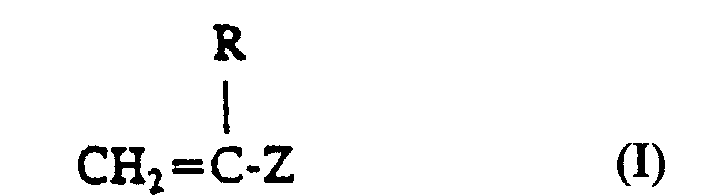 R aus -H und -CH3 ausgewählt ist;Z-C(=O)NR1R2 ist; undR1 und R2 unabhängig voneinander aus Alkylresten mit 1 bis 10 Kohlenstoffatomen ausgewählt sind.
 - Gegenstand nach Anspruch 1, ferner dadurch gekennzeichnet, daß das erste monofunktionelle Acrylat- oder Methacrylatestermonomer aus n-Butylacrylat, n-Butylmethacrylat, Isobutylacrylat, 2-Methylbutylacrylat, 2-Ethylhexylacrylat, n-Octylacrylat, Isooctylacrylat, Isooctylmethacrylat, Isononylacrylat, Isodecylacrylat und Gemischen davon ausgewählt ist.
- Gegenstand nach Anspruch 1, ferner dadurch gekennzeichnet, daß die copolymerisierbaren N,N-Dialkyl-substituierten Amide aus N,N-Dimethylacrylamid, N,N-Dimethylmethacrylamid, N,N-Diethylacrylamid, N,N-Diethylmethacrylamid und Gemischen davon ausgewählt sind.
- Gegenstand nach Anspruch 1, ferner dadurch gekennzeichnet, daß das sauere Monomer aus ethylenisch ungesättigten Carbonsäuren, ethylenisch ungesättigten Sulfonsäuren, ethylenisch ungesättigten Phosphorsäuren und Gemischen davon ausgewählt ist.
- Gegenstand nach Anspruch 8, ferner dadurch gekennzeichnet, daß das sauere Monomer aus Acrylsäure, Methacrylsäure, Itaconsäure, Fumarsäure, Crotonsäure, Citraconsäure, Maleinsäure, β-Carboxyethylacrylat, Sulfoethylmethacrylat und Gemischen davon ausgewählt ist.
- Gegenstand nach Anspruch 1, ferner dadurch gekennzeichnet, daß das Vernetzungsmittel aus multifunktionellen Acrylaten, substituierten Triazinen, monoethylenisch ungesättigten Silanen, wasserstoffabstrahierenden Verbindungen, copolymerisierbaren, α-spaltbaren Photoinitiatoren, Bisamidverbindungen und durch Wärme aktivierten, copolymerisierbaren Vernetzungsmitteln ausgewählt ist.
- Verfahren zum Binden einer monomer weichgemachten PVC-Komponente mit 10 bis 50 Gew.-% eines monomeren Weichmachers an ein Substrat, dadurch gekennzeichnet, daß das Verfahren die Schritte umfaßt:(a) Formulieren einer Haftklebstoffzusammensetzung, umfassend ein vernetztes Copolymer von 100 Gewichtsteilen Monomerbestandteile (i), (ii), (iii) und gegebenenfalls (iv), wobei das Copolymer umfaßt:(i) 50 bis 90 Gewichtsteile wenigstens eines Monomers, das aus einem ersten monofunktionellen Acrylat- oder Methacrylatester eines nichttertiären Alkylalkohols und Gemischen davon ausgewählt ist, wobei deren Alkylrest 4 bis 12 Kohlenstoffatome umfaßt, und welches als Homopolymer eine Glasübergangstemperatur von weniger als -25°C hat;(ii) 10 bis 25 Gewichtsteile copolymerisierbare N,N-Dialkyl-substituierte Amide;(iii) mehr als 3 bis 7 Gewichtsteile eines saueren Monomers, das mit den Monomeren von Bestandteil (i) und den copolymerisierbaren N,N-Dialkyl-substituierten Amiden von Bestandteil (ii) copolymerisierbar ist, wobei die copolymerisierbaren N,N-Dialkyl-substituierten Amide in einem molaren Überschuß vorhanden sind;(iv) 0 bis 30 Gewichtsteile eines zweiten monofunktionellen Acrylatesters eines nichttertiären Alkohols mit einer Glasübergangstemperatur als Homopolymer gleich oder größer als -25°C; und(v) 0,01 bis 1 Gew.-% eines Vernetzungsmittels, basierend auf dem Gesamtgewicht von (i) plus (ii) plus (iii) plus (iv),(b) Auftragen der Klebstoffzusammensetzung entweder auf eine monomer weichgemachte PVC-Komponente mit 10 bis 50 Gew.-% eines monomeren Weichmachers, eine Oberfläche eines Substrats oder beides; und(c) Verbinden des Substrats mit der PVC-Komponente, wobei die Klebstoffzusammensetzung zwischen der PVC-Komponente und dem Material, das die Oberfläche des Substrats bildet, angeordnet ist.
- Verfahren nach Anspruch 11, ferner dadurch gekennzeichnet, daß das Substrat aus i) einer durchsichtigen, rückstrahlenden Folie mit einer im wesentlichen glatten Oberfläche und einer strukturierten zweiten Oberfläche, wobei die strukturierte zweite Oberfläche eine Mehrzahl von Furchen, die eine Mehrzahl von Erhebungen definieren, umfaßt, und einer polymeren Dichtungsfolie, die an der strukturierten zweiten Oberfläche an einer Mehrzahl von Stellen befestigt ist, wobei die Dichtungsfolie mit dem Klebstoff in Kontakt ist, ii) einer metallisierten, rückstrahlenden Folie mit einer im wesentlichen glatten Oberfläche und einer strukturierten zweiten Oberfläche mit einer Metallschicht darauf, wobei der Klebstoff mit der Metallschicht in Kontakt ist, iii) der Oberfläche einer rückstrahlenden Folie mit Wulst, auf der kein Licht auftrifft, und iv) aus Polymerfolien und Weichmetallfolien ausgewählten nichtrückstrahlenden Substraten ausgewählt ist.
- Verfahren nach Anspruch 11, ferner dadurch gekennzeichnet, daß die copolymerisierbaren N,N-Dialkyl-substituierten Amide in 14 bis 20 Gewichtsteilen vorhanden sind.
- Verfahren nach Anspruch 11, ferner dadurch gekennzeichnet, daß die copolymerisierbaren N,N-Dialkyl-substituierten Amide aus N,N-Dimethylacrylamid, N,N-Dimethylmethacrylamid, N,N-Diethylacrylamid, N,N-Diethylmethacrylamid und Gemischen davon ausgewählt sind.
- Verfahren nach Anspruch 11, ferner dadurch gekennzeichnet, daß der Klebstoff nach Schritt (b) und vor Schritt (c) Bedingungen ausgesetzt wird, die zum Vernetzen des Klebstoffs hinreichend sind.
- Verfahren nach Anspruch 15, wobei die Bedingungen den Schritt des Einwirkens eines Elektronenstrahls auf den Klebstoff umfassen.
- Verfahren zum Binden einer monomer weichgemachten PVC-Komponente mit 10 bis 50 Gew.-% eines monomeren Weichmachers an ein Substrat, wobei das Verfahren die Schritte umfaßt:(a) Füllen eines Beutels mit einem Precursor, umfassend 100 Gewichtsteile Monomerbestandteile (i), (ii), (iii), (vi) gegebenenfalls (iv) und (v), wobei der Precursor umfaßt:(i) 50 bis 90 Gewichtsteile wenigstens eines Monomers, das aus einem ersten monofunktionellen Acrylat- oder Methacrylatester eines nichttertiären Alkylalkohols und Gemischen davon ausgewählt ist, wobei deren Alkylrest 4 bis 12 Kohlenstoffatome umfaßt, und welches als Homopolymer eine Glasübergangstemperatur von weniger als -25°C hat;(ii) 10 bis 25 Gewichtsteile copolymerisierbare N,N-Dialkyl-substituierte Amide;(iii) mehr als 3 bis 7 Gewichtsteile eines saueren Monomers, das mit dem/n Monomer/en von Bestandteil (i) und den copolymerisierbaren N,N-Dialkyl-substituierten Amiden von Bestandteil (ii) copolymerisierbar ist, wobei die copolymerisierbaren N,N-Dialkyl-substituierten Amide in einem molaren Überschuß vorhanden sind;(iv) 0 bis 30 Gewichtsteile eines zweiten monofunktionellen Acrylat- oder Methacrylatesters eines nichttertiären Alkohols mit einer Glasübergangstemperatur als Homopolymer gleich oder größer als -25°C;(v) 0,01 bis 1 Gew.-% eines Vernetzungsmittels, basierend auf dem Gesamtgewicht von (i) plus (ii) plus (iii) plus (iv), und(vi) 0,01 bis 0,05 Gew.-% eines Photoinitiators, basierend auf dem Gesamtgewicht der Monomere der betreffenden Haftklebstoffzusammensetzungen;(b) Einwirken von Ultraviolettstrahlung auf den mit dem Precursor gefüllten Beutel, um einen Klebstoff zu liefern;(c) Extrudieren des den Klebstoff enthaltenden Beutels auf eine Abziehschicht;(d) Einwirken von Strahlung auf den extrudierten Beutelklebstoff, um einen vernetzten Klebstoff zu liefern;(e) Auftragen des Klebstoffs entweder auf eine monomer weichgemachte PVC-Komponente mit 10 bis 50 Gew.-% eines monomeren Weichmachers, eine Oberfläche eines Substrats oder beides; und(f) Verbinden des Substrats mit der PVC-Komponente, wobei die Klebstoffzusammensetzung zwischen der PVC-Komponente und der Oberfläche des Substrats angeordnet ist.
Applications Claiming Priority (3)
| Application Number | Priority Date | Filing Date | Title |
|---|---|---|---|
| US38971995A | 1995-02-16 | 1995-02-16 | |
| US389719 | 1995-02-16 | ||
| PCT/US1996/001044 WO1996026221A2 (en) | 1995-02-16 | 1996-01-30 | Pressure sensitive adhesive article, retroreflective sheeting therewith and method of bonding pvc therewith |
Publications (2)
| Publication Number | Publication Date |
|---|---|
| EP0809679A2 EP0809679A2 (de) | 1997-12-03 |
| EP0809679B1 true EP0809679B1 (de) | 2000-05-17 |
Family
ID=23539442
Family Applications (1)
| Application Number | Title | Priority Date | Filing Date |
|---|---|---|---|
| EP96903685A Expired - Lifetime EP0809679B1 (de) | 1995-02-16 | 1996-01-30 | Gegenstände mit haftklebern mit verbesserter haftung an weichgemachtes polyvinylchlorid |
Country Status (12)
| Country | Link |
|---|---|
| US (1) | US5861211A (de) |
| EP (1) | EP0809679B1 (de) |
| JP (2) | JPH11500171A (de) |
| KR (1) | KR100418310B1 (de) |
| CN (1) | CN1106436C (de) |
| AU (1) | AU699849B2 (de) |
| CA (1) | CA2210479A1 (de) |
| DE (1) | DE69608420T2 (de) |
| ES (1) | ES2145995T3 (de) |
| MX (1) | MX9706018A (de) |
| RU (1) | RU2154578C2 (de) |
| WO (1) | WO1996026221A2 (de) |
Families Citing this family (75)
| Publication number | Priority date | Publication date | Assignee | Title |
|---|---|---|---|---|
| WO1998017466A1 (en) * | 1996-10-23 | 1998-04-30 | Minnesota Mining And Manufacturing Company | Article comprising a flexible retroreflective sheeting |
| US6066394A (en) * | 1997-04-09 | 2000-05-23 | Solutia Inc. | Plasticizer resistant emulsion acrylic pressure sensitive adhesive |
| US6238787B1 (en) * | 1997-10-01 | 2001-05-29 | Park-Ohio Industries | Method of attaching a strip to a rubber molded part |
| US6720387B1 (en) | 1998-02-18 | 2004-04-13 | 3M Innovative Properties Company | Hot-melt adhesive compositions comprising acidic polymer and basic polymer blends |
| US6270887B1 (en) * | 1998-02-23 | 2001-08-07 | Morgan Adhesives Company | Breathable film cover for window structures |
| US6348679B1 (en) | 1998-03-17 | 2002-02-19 | Ameritherm, Inc. | RF active compositions for use in adhesion, bonding and coating |
| KR200277048Y1 (ko) * | 1998-12-26 | 2002-09-13 | 김명덕 | 스티커 |
| US6558781B1 (en) * | 1999-07-12 | 2003-05-06 | Canon Kabushiki Kaisha | Conductive roller, process cartridge and image forming apparatus |
| US6451239B1 (en) | 1999-08-23 | 2002-09-17 | Robert B. Wilson | Process of making a hook fastener using radio frequency heating |
| US6649888B2 (en) | 1999-09-23 | 2003-11-18 | Codaco, Inc. | Radio frequency (RF) heating system |
| US6656307B2 (en) * | 1999-11-24 | 2003-12-02 | 3M Innovative Properties Company | Method of making signs having metalized cube corner sheeting |
| CN1149252C (zh) * | 1999-12-22 | 2004-05-12 | 三井化学株式会社 | 多孔膜及其制备方法 |
| US6340719B1 (en) | 1999-12-29 | 2002-01-22 | 3M-Innovative Properties Company | Crosslinking process |
| US6958179B2 (en) | 1999-12-30 | 2005-10-25 | 3M Innovative Properties Company | Segmented sheeting and methods of making and using same |
| US6517664B1 (en) | 2000-01-10 | 2003-02-11 | Process Resources Corporation | Techniques for labeling of plastic, glass or metal containers or surfaces with polymeric labels |
| US6551014B2 (en) | 2000-02-24 | 2003-04-22 | 3M Innovative Properties Company | Raised pavement marker with improved lens |
| DE10029553A1 (de) * | 2000-06-15 | 2002-01-03 | Beiersdorf Ag | Verfahren zur Herstellung vernetzbarer Acrylathaftklebemassen |
| EP1168282A1 (de) * | 2000-06-20 | 2002-01-02 | 3M Innovative Properties Company | Etikette zur Befestigung an Kleidung |
| US6656319B1 (en) | 2000-10-25 | 2003-12-02 | 3M Innovative Properties Company | Fluid-activatable adhesive articles and methods |
| US20020169271A1 (en) * | 2000-10-26 | 2002-11-14 | Weiling Peng | Adhesive mixture for bonding fluorohydrocarbon film to fibrous cementitious materials |
| AU2002213497B2 (en) | 2000-10-26 | 2008-01-31 | James Hardie International Finance B.V. | Building panel assembly having a protective film, method of making same and adhesive system for bonding the protective film |
| TWI241332B (en) | 2000-12-01 | 2005-10-11 | 3M Innovative Properties Co | Crosslinked pressure sensitive adhesive compositions, and adhesive articles based thereon, useful in high temperature applications |
| JP2002241712A (ja) * | 2001-02-02 | 2002-08-28 | Three M Innovative Properties Co | 透明接着シート |
| US20040067329A1 (en) * | 2001-02-02 | 2004-04-08 | Takahide Okuyama | Transparent adhesive sheet |
| DE10105278A1 (de) | 2001-02-02 | 2002-08-08 | Basf Ag | Klebstoffe, enthaltend Polyvinylalkylether |
| JP4459470B2 (ja) * | 2001-04-06 | 2010-04-28 | 信越化学工業株式会社 | 電子部品の放熱構造体及びそれに用いる放熱シート |
| JP4906196B2 (ja) * | 2001-04-25 | 2012-03-28 | スリーエム イノベイティブ プロパティズ カンパニー | 耐可塑剤性粘着剤組成物及び粘着剤物品 |
| US7744998B2 (en) * | 2001-04-25 | 2010-06-29 | 3M Innovative Properties Company | Plasticizer-resistant pressure-sensitive adhesive composition and adhesive article |
| US8281535B2 (en) * | 2002-07-16 | 2012-10-09 | James Hardie Technology Limited | Packaging prefinished fiber cement articles |
| EP1534511B1 (de) * | 2002-07-16 | 2012-05-30 | James Hardie Technology Limited | Verpackung vorbehandelter faserzementprodukte |
| US7550528B2 (en) | 2002-10-15 | 2009-06-23 | Exxonmobil Chemical Patents Inc. | Functionalized olefin polymers |
| US7541402B2 (en) | 2002-10-15 | 2009-06-02 | Exxonmobil Chemical Patents Inc. | Blend functionalized polyolefin adhesive |
| US7700707B2 (en) | 2002-10-15 | 2010-04-20 | Exxonmobil Chemical Patents Inc. | Polyolefin adhesive compositions and articles made therefrom |
| KR101113341B1 (ko) | 2002-10-15 | 2012-09-27 | 엑손모빌 케미칼 패턴츠 인코포레이티드 | 올레핀 중합용 다중 촉매 시스템 및 이로부터 제조된중합체 |
| US20040087721A1 (en) * | 2002-11-05 | 2004-05-06 | Bruhn Jeffrey N. | Noise and vibration damping materials |
| US7156527B2 (en) * | 2003-03-06 | 2007-01-02 | 3M Innovative Properties Company | Lamina comprising cube corner elements and retroreflective sheeting |
| US7927703B2 (en) * | 2003-04-11 | 2011-04-19 | 3M Innovative Properties Company | Adhesive blends, articles, and methods |
| WO2005052276A1 (en) * | 2003-11-28 | 2005-06-09 | James Hardie International Finance B.V. | Eave lining system |
| DE102004001299A1 (de) * | 2004-01-08 | 2005-07-28 | Tesa Ag | Hitze-aktivierbare Haftklebemasse |
| US7022406B1 (en) | 2004-03-24 | 2006-04-04 | Morgan Adhesives Company | Breathable film cover for window panes |
| US20060154050A1 (en) * | 2004-05-18 | 2006-07-13 | Toray Plastics (America), Inc., A Corporation Of Rhode Island | Holographic transfer thermoplastic sheet |
| BRPI0512092B1 (pt) * | 2004-06-14 | 2015-08-11 | Lintec Corp | Chapa adesiva sensível à pressão e método de produção da mesma |
| CA2580688A1 (en) * | 2004-10-12 | 2006-04-27 | 3M Innovative Properties Company | Protective film adhesive |
| DE102004061771A1 (de) * | 2004-12-22 | 2006-07-06 | Klebchemie M.G. Becker Gmbh +Co.Kg | Verfahren zur Versiegelung von Oberflächen |
| CN101111786A (zh) * | 2005-01-31 | 2008-01-23 | 瑞弗莱克塞特公司 | 背衬织物的成卷材料和衣服带子 |
| DE102005016516A1 (de) * | 2005-04-08 | 2006-10-12 | Klebchemie M.G. Becker Gmbh & Co. Kg | Mehrstufig härtende Oberflächenbeschichtung |
| US7727617B2 (en) * | 2005-06-22 | 2010-06-01 | 3M Innovative Properties Company | Thermal mass transfer imaged retroreflective sheeting |
| JP4943044B2 (ja) * | 2005-07-20 | 2012-05-30 | リンテック株式会社 | 粘着シート |
| JP5491172B2 (ja) * | 2006-04-18 | 2014-05-14 | スリーエム イノベイティブ プロパティズ カンパニー | 窒素含有成分を含む微細構造物品 |
| EP2094799B1 (de) * | 2006-11-02 | 2013-08-28 | Avery Dennison Corporation | Emulsionshaftmittel für waschbare folie |
| US7964269B2 (en) * | 2006-11-22 | 2011-06-21 | 3M Innovative Properties Company | Colorless thermal mass transfer compositions and articles |
| US9207373B2 (en) | 2007-04-10 | 2015-12-08 | Stoncor Group, Inc. | Methods for fabrication and highway marking usage of agglomerated retroreflective beads |
| US8292539B2 (en) * | 2007-04-10 | 2012-10-23 | Stoncor Group, Inc. | Agglomerated retroreflective beads for highway marking and methods for fabrication and use thereof |
| US7858681B2 (en) * | 2007-08-21 | 2010-12-28 | E. I. Du Pont De Nemours And Company | Product comprising ionomer and plasticizer |
| CN101372607B (zh) * | 2007-10-25 | 2010-06-23 | 河北华夏实业有限公司 | 适用于软聚氯乙烯电气胶粘带的乳液压敏胶粘剂及其制造方法 |
| ATE458792T1 (de) * | 2007-12-04 | 2010-03-15 | Sika Technology Ag | Heissschmelzklebstoff mit guter haftung auf polyolefinen |
| JP5324105B2 (ja) * | 2008-01-29 | 2013-10-23 | スリーエム イノベイティブ プロパティズ カンパニー | 構造化表面を有する感圧接着層を含む電磁干渉抑制シート |
| US8101277B2 (en) * | 2008-08-01 | 2012-01-24 | Gerald Alvin Logan | Thermally formed, dimensionally and topographically exact, automotive protective film |
| US8242185B2 (en) * | 2009-08-03 | 2012-08-14 | Morgan Adhesives Company | Adhesive compositions for easy application and improved durability |
| US8686060B2 (en) | 2009-08-03 | 2014-04-01 | Morgan Adhesives Company | Adhesive compositions for easy application and improved durability |
| EP2694573B1 (de) * | 2011-04-01 | 2020-05-27 | 3M Innovative Properties Company | Folien umfassend triazin-basierte ultraviolettabsorber |
| RU2506296C2 (ru) * | 2012-02-28 | 2014-02-10 | федеральное государственное бюджетное образовательное учреждение высшего профессионального образования "Ивановский государственный политехнический университет" (ИВГПУ) | Многослойный клеевой материал |
| CN102675773B (zh) * | 2012-05-31 | 2014-02-12 | 江苏润大橡塑材料有限公司 | 一种软质pvc增塑剂及其制备方法 |
| WO2015056632A1 (ja) * | 2013-10-15 | 2015-04-23 | スリーボンドファインケミカル株式会社 | 光硬化性組成物 |
| JP6506955B2 (ja) * | 2014-03-11 | 2019-04-24 | 日東電工株式会社 | 粘着テープ |
| US8899318B1 (en) | 2014-04-24 | 2014-12-02 | Ronald C. Parsons | Applying an aggregate to expandable tubular |
| JP6537302B2 (ja) * | 2015-03-06 | 2019-07-03 | スリーエム イノベイティブ プロパティズ カンパニー | 感圧接着剤及び積層体 |
| CA3046090C (en) * | 2016-12-14 | 2023-03-07 | Polyone Corporation | Flexible polyvinyl halide used for injection over-molding |
| US20190134942A1 (en) * | 2017-11-07 | 2019-05-09 | Giovanni SOMASCHINI | Adhesive protection element |
| JP2020105253A (ja) * | 2018-12-26 | 2020-07-09 | スリーエム イノベイティブ プロパティズ カンパニー | シール材形成用組成物、シール材、シール材の熱硬化物及び接着構造体の製造方法 |
| KR102639908B1 (ko) * | 2019-02-08 | 2024-02-23 | 애버리 데니슨 코포레이션 | 플렉시블 재귀반사성 시팅 |
| CN111849109B (zh) * | 2019-04-24 | 2022-01-04 | 歌尔股份有限公司 | 一种用于微型发声装置的振膜和微型发声装置 |
| US20220127433A1 (en) * | 2020-10-22 | 2022-04-28 | Potters Industries, Llc | Durable retroreflective optical elements |
| IT202300020808A1 (it) * | 2023-10-06 | 2025-04-06 | Framis Italia S P A | Film adesivo multistrato per la decorazione o l'imbastitura di tessuti |
| CN120924175A (zh) * | 2025-07-18 | 2025-11-11 | 东莞市亿洲胶粘制品有限公司 | 一种抗水抗电击穿pvc绝缘电工胶带及其制备方法 |
Family Cites Families (72)
| Publication number | Priority date | Publication date | Assignee | Title |
|---|---|---|---|---|
| US2407680A (en) * | 1945-03-02 | 1946-09-17 | Minnesota Mining & Mfg | Reflex light reflector |
| USRE24906E (en) * | 1955-11-18 | 1960-12-13 | Pressure-sensitive adhesive sheet material | |
| DE1594125A1 (de) * | 1957-04-24 | 1969-11-27 | Minnesota Mining & Mfg | Druckempfindliches Klebeband oder -blatt |
| US3140340A (en) * | 1961-03-01 | 1964-07-07 | Minnesota Mining & Mfg | Reflex reflector article |
| US3190178A (en) * | 1961-06-29 | 1965-06-22 | Minnesota Mining & Mfg | Reflex-reflecting sheeting |
| US3578622A (en) * | 1968-02-05 | 1971-05-11 | Minnesota Mining & Mfg | Sprayable adhesive |
| GB1308186A (en) * | 1969-04-21 | 1973-02-21 | Freimuth F | Method of attaching a round closure or guide member in an enc losing body |
| US3684348A (en) * | 1970-09-29 | 1972-08-15 | Rowland Dev Corp | Retroreflective material |
| SE7513915L (sv) * | 1975-01-10 | 1976-07-12 | Minnesota Mining & Mfg | Overdragsmaterial for att gora underlag returreflekterande |
| US4025159A (en) * | 1976-02-17 | 1977-05-24 | Minnesota Mining And Manufacturing Company | Cellular retroreflective sheeting |
| US4576850A (en) * | 1978-07-20 | 1986-03-18 | Minnesota Mining And Manufacturing Company | Shaped plastic articles having replicated microstructure surfaces |
| US4511210A (en) * | 1979-10-01 | 1985-04-16 | Minnesota Mining And Manufacturing Company | Retroreflective sheeting |
| US4330590A (en) * | 1980-02-14 | 1982-05-18 | Minnesota Mining And Manufacturing Company | Photoactive mixture of acrylic monomers and chromophore-substituted halomethyl-2-triazine |
| US4329384A (en) * | 1980-02-14 | 1982-05-11 | Minnesota Mining And Manufacturing Company | Pressure-sensitive adhesive tape produced from photoactive mixture of acrylic monomers and polynuclear-chromophore-substituted halomethyl-2-triazine |
| US4364972A (en) * | 1981-01-16 | 1982-12-21 | Minnesota Mining And Manufacturing Company | Pressure-sensitive adhesive copolymers of acrylic acid ester and N-vinyl pyrrolidone |
| US4379201A (en) * | 1981-03-30 | 1983-04-05 | Minnesota Mining And Manufacturing Company | Multiacrylate cross-linking agents in pressure-sensitive photoadhesives |
| US4605592A (en) * | 1982-08-19 | 1986-08-12 | Minnesota Mining And Manufacturing Company | Composite decorative article |
| US4588258A (en) * | 1983-09-12 | 1986-05-13 | Minnesota Mining And Manufacturing Company | Cube-corner retroreflective articles having wide angularity in multiple viewing planes |
| US4843134A (en) * | 1984-03-28 | 1989-06-27 | Minnesota Mining And Manufacturing Company | Acrylate pressure-sensitive adhesives containing insolubles |
| US4619979A (en) * | 1984-03-28 | 1986-10-28 | Minnesota Mining And Manufacturing Company | Continuous free radial polymerization in a wiped-surface reactor |
| US4664966A (en) * | 1985-11-18 | 1987-05-12 | Minnesota Mining And Manufacturing Company | Enclosed-lens retroreflective sheeting having tough, weather-resistant, transparent cover film |
| US5064272A (en) * | 1985-11-18 | 1991-11-12 | Minnesota Mining And Manufacturing Company | Encapsulated-lens retroreflective sheeting and method of making |
| US5056892A (en) * | 1985-11-21 | 1991-10-15 | Minnesota Mining And Manufacturing Company | Totally internally reflecting thin, flexible film |
| US4805984A (en) * | 1985-11-21 | 1989-02-21 | Minnesota Mining And Manufacturing Company | Totally internally reflecting light conduit |
| CA1279783C (en) * | 1985-11-21 | 1991-02-05 | Minnesota Mining And Manufacturing Company | Totally internally reflecting thin, flexible film |
| US4737559A (en) * | 1986-05-19 | 1988-04-12 | Minnesota Mining And Manufacturing Co. | Pressure-sensitive adhesive crosslinked by copolymerizable aromatic ketone monomers |
| US4732790A (en) * | 1986-08-21 | 1988-03-22 | Ppg Industries, Inc. | Color plus clear application of thermosetting high solids coating composition of hydroxy-functional epoxies and anhydrides |
| US4775219A (en) * | 1986-11-21 | 1988-10-04 | Minnesota Mining & Manufacturing Company | Cube-corner retroreflective articles having tailored divergence profiles |
| US4938563A (en) * | 1986-11-21 | 1990-07-03 | Minnesota Mining And Manufacturing Company | High efficiency cube corner retroflective material |
| US4896943A (en) * | 1987-05-13 | 1990-01-30 | Minnesota Mining And Manufacturing Company | Encapsulated-lens retroreflective sheeting having improved cover film |
| US5066098A (en) * | 1987-05-15 | 1991-11-19 | Minnesota Mining And Manufacturing Company | Cellular encapsulated-lens high whiteness retroreflective sheeting with flexible cover sheet |
| US5019377A (en) * | 1987-12-11 | 1991-05-28 | The Procter & Gamble Company | Low glass transistion temperature adhesive copolymers for use in hair styling products |
| NL8800428A (nl) * | 1988-02-19 | 1989-09-18 | Avery International Corp | Thermoplastische, voor weekmaker ongevoelige film, en zelfklevende film die de voor weekmaker ongevoelige film bevat. |
| US4801193A (en) * | 1988-03-04 | 1989-01-31 | Reflexite Corporation | Retroreflective sheet material and method of making same |
| US4985488A (en) * | 1988-05-20 | 1991-01-15 | Minnesota Mining And Manufacturing Company | Pressure-sensitive adhesive having improved adhesion to plasticized vinyl substrates |
| US4946742A (en) * | 1988-05-20 | 1990-08-07 | Minnesota Mining And Manufacturing Company | Pressure-sensitive adhesive having improved adhesion to plasticized vinyl substrates |
| USH688H (en) * | 1988-06-16 | 1989-10-03 | E. I. Du Pont De Nemours And Company | Process for surface modification of polyethylene terephthalate film |
| US4895428A (en) * | 1988-07-26 | 1990-01-23 | Minnesota Mining And Manufacturing Company | High efficiency retroreflective material |
| CA2002449C (en) * | 1988-12-05 | 2001-05-08 | Mark A. Strobel | Pressure-sensitive article with priming layer |
| US4943461A (en) * | 1989-02-01 | 1990-07-24 | Minnesota Mining And Manufacturing Company | Radiation-curable pressure-sensitive adhesive having improved adhesion to plasticized vinyl substrates |
| US5183597A (en) * | 1989-02-10 | 1993-02-02 | Minnesota Mining And Manufacturing Company | Method of molding microstructure bearing composite plastic articles |
| US5175030A (en) * | 1989-02-10 | 1992-12-29 | Minnesota Mining And Manufacturing Company | Microstructure-bearing composite plastic articles and method of making |
| US5079047A (en) * | 1989-05-12 | 1992-01-07 | Minnesota Mining And Manufacturing Company | Radiation-curable pressure-sensitive adhesive having improved adhesion to plasticized vinyl substrates |
| CA2018011A1 (en) * | 1989-06-30 | 1990-12-31 | Dennis L. Levens | Method of attaching a rubber sheeting to rigid insulation using a pressure-sensitive adhesive and corresponding articles |
| JPH0819315B2 (ja) * | 1990-04-05 | 1996-02-28 | 日本ペイント株式会社 | 熱硬化性樹脂組成物 |
| US5229207A (en) * | 1990-04-24 | 1993-07-20 | Minnesota Mining And Manufacturing Company | Film composite having repositionable adhesive by which it can become permanently bonded to a plasticized substrate |
| US5085918A (en) * | 1990-05-15 | 1992-02-04 | Minnesota Mining And Manufacturing Company | Printed retroreflective sheet |
| WO1992002348A1 (en) * | 1990-08-01 | 1992-02-20 | H.B. Fuller Licensing And Financing Inc. | Method of packaging an adhesive composition and corresponding packaged article |
| US5138488A (en) * | 1990-09-10 | 1992-08-11 | Minnesota Mining And Manufacturing Company | Retroreflective material with improved angularity |
| MX9101079A (es) * | 1990-09-17 | 1992-05-04 | Du Pont | Composicion de revestimiento y proceso para revestir un substrato con la misma |
| JPH05105857A (ja) * | 1991-08-21 | 1993-04-27 | Sekisui Chem Co Ltd | 粘着剤組成物および粘着テープ、ラベルもしくはシート |
| US5137972A (en) * | 1991-08-29 | 1992-08-11 | Basf Corporation | Environmental etch resistant, two-component, coating composition, method of coating therewith, and coating obtained therefrom |
| JPH05140523A (ja) * | 1991-09-27 | 1993-06-08 | Sekisui Chem Co Ltd | 粘着剤組成物、粘着テープまたはシート、貼付構造体および粘着剤付き軟質塩化ビニル系樹脂製品 |
| JPH05263055A (ja) * | 1991-10-21 | 1993-10-12 | Sekisui Chem Co Ltd | 粘着剤組成物、粘着テープまたはシート、貼付構造体および粘着剤付き軟質塩化ビニル系樹脂製品 |
| DK167938B1 (da) * | 1991-12-04 | 1994-01-03 | Ulrich Oppenhejm | Presenning forsynet med en dekoration af reflekterende materiale og fremgangsmaade til fremstilling deraf |
| US5202361A (en) * | 1991-12-23 | 1993-04-13 | Minnesota Mining And Manufacturing Company | Pressure-sensitive adhesive |
| DE69211360T2 (de) * | 1992-02-10 | 1997-01-30 | Minnesota Mining & Mfg | Strahlungsvernetzte Elastomere |
| JPH05263064A (ja) * | 1992-03-23 | 1993-10-12 | Nippon Shokubai Co Ltd | 粘着剤組成物 |
| CA2093191A1 (en) * | 1992-04-15 | 1993-10-16 | Richard J. Webb | Psa containing thermally conductive, electrically insulative particles and a transfer tape from this psa |
| JPH05310810A (ja) * | 1992-05-14 | 1993-11-22 | Sekisui Chem Co Ltd | 光重合性組成物及び粘弾性製品の製造方法 |
| JP3364248B2 (ja) * | 1992-10-20 | 2003-01-08 | サンスター技研株式会社 | 湿気硬化性のポリオレフィン用粘着剤 |
| US5262479A (en) * | 1992-11-24 | 1993-11-16 | National Starch And Chemical Investment Holding Corporation | Plasticizer resisant hot melt pressure sensitive adhesive |
| JPH0819392B2 (ja) * | 1992-11-30 | 1996-02-28 | 日東電工株式会社 | 感圧接着剤とその接着シ―ト類 |
| JPH0819391B2 (ja) * | 1992-11-30 | 1996-02-28 | 日東電工株式会社 | 感圧接着剤とその接着シ―ト類 |
| JP2795366B2 (ja) * | 1992-12-09 | 1998-09-10 | 日東電工株式会社 | 発泡基材付接着シ―ト類 |
| JPH0819393B2 (ja) * | 1992-12-09 | 1996-02-28 | 日東電工株式会社 | 感圧接着剤とその接着シ―ト類 |
| JPH06200225A (ja) * | 1992-12-29 | 1994-07-19 | Nitto Denko Corp | 塗料用感圧性接着剤とその接着シ―ト類 |
| US5637173A (en) * | 1993-02-17 | 1997-06-10 | Reflexite Corporation | Method for forming a retroreflective structure having free-standing prisms |
| CA2118960A1 (en) * | 1993-03-16 | 1994-09-17 | Albert I. Everaerts | Pressure-sensitive adhesives having improved adhesion to acid-rain resistant automotive paints |
| DE4313008C1 (de) * | 1993-04-21 | 1994-11-10 | Beiersdorf Ag | Selbstklebemasse auf Acrylathotmelt-Basis, Verfahren zu deren Herstellung und deren Verwendung |
| WO1995013331A1 (en) * | 1993-11-10 | 1995-05-18 | Minnesota Mining And Manufacturing Company | Pressure sensitive adhesives |
| JP3549168B2 (ja) * | 1994-11-21 | 2004-08-04 | 日東電工株式会社 | 再剥離用粘着剤とその粘着シ―ト類 |
-
1996
- 1996-01-30 EP EP96903685A patent/EP0809679B1/de not_active Expired - Lifetime
- 1996-01-30 MX MX9706018A patent/MX9706018A/es not_active IP Right Cessation
- 1996-01-30 AU AU47690/96A patent/AU699849B2/en not_active Ceased
- 1996-01-30 DE DE69608420T patent/DE69608420T2/de not_active Expired - Lifetime
- 1996-01-30 CN CN96191930A patent/CN1106436C/zh not_active Expired - Fee Related
- 1996-01-30 WO PCT/US1996/001044 patent/WO1996026221A2/en not_active Ceased
- 1996-01-30 RU RU97115558/04A patent/RU2154578C2/ru not_active IP Right Cessation
- 1996-01-30 JP JP8525684A patent/JPH11500171A/ja not_active Withdrawn
- 1996-01-30 ES ES96903685T patent/ES2145995T3/es not_active Expired - Lifetime
- 1996-01-30 KR KR1019970705621A patent/KR100418310B1/ko not_active Expired - Lifetime
- 1996-01-30 CA CA002210479A patent/CA2210479A1/en not_active Abandoned
- 1996-08-12 US US08/695,498 patent/US5861211A/en not_active Expired - Lifetime
-
2005
- 2005-05-25 JP JP2005153002A patent/JP2005290391A/ja active Pending
Also Published As
| Publication number | Publication date |
|---|---|
| DE69608420D1 (de) | 2000-06-21 |
| WO1996026221A2 (en) | 1996-08-29 |
| EP0809679A2 (de) | 1997-12-03 |
| US5861211A (en) | 1999-01-19 |
| CN1106436C (zh) | 2003-04-23 |
| KR100418310B1 (ko) | 2005-05-31 |
| AU699849B2 (en) | 1998-12-17 |
| JP2005290391A (ja) | 2005-10-20 |
| CN1183795A (zh) | 1998-06-03 |
| CA2210479A1 (en) | 1996-08-29 |
| KR19980702224A (ko) | 1998-07-15 |
| RU2154578C2 (ru) | 2000-08-20 |
| AU4769096A (en) | 1996-09-11 |
| JPH11500171A (ja) | 1999-01-06 |
| DE69608420T2 (de) | 2000-09-14 |
| ES2145995T3 (es) | 2000-07-16 |
| WO1996026221A3 (en) | 1996-10-24 |
| MX9706018A (es) | 1998-04-30 |
Similar Documents
| Publication | Publication Date | Title |
|---|---|---|
| EP0809679B1 (de) | Gegenstände mit haftklebern mit verbesserter haftung an weichgemachtes polyvinylchlorid | |
| MXPA97006018A (en) | Articles that incorporate adhesives sensitive to lapresion, which have improved adherence to polyvinyl plastify chloride | |
| EP0859819B1 (de) | Wärmeaktivierbare klebstoffzusammensetzung | |
| EP0934156B1 (de) | Gegenstand mit flexibler retroreflektiver hülle | |
| JP3117599B2 (ja) | 再帰反射性シート | |
| EP0832162B1 (de) | Retroreflektierende gegenstände für rettungsvorrichtungen auf see | |
| CN1208470A (zh) | 交联聚氨酯粘合剂在逆向反射片上的应用 | |
| US20030223137A1 (en) | Reflective sheet, articles made therefrom and methods of using same | |
| US10877191B2 (en) | Barrier elements on a microstructured article having adhesive sealing layer and specified modulus of elasticity | |
| US12241006B2 (en) | High density post arrays | |
| AU702114C (en) | Heat-activatable adhesive composition | |
| WO1998055555A1 (en) | Anti-dew adhesive film | |
| MXPA98003462A (en) | Termoactive composition adhesive |
Legal Events
| Date | Code | Title | Description |
|---|---|---|---|
| PUAI | Public reference made under article 153(3) epc to a published international application that has entered the european phase |
Free format text: ORIGINAL CODE: 0009012 |
|
| 17P | Request for examination filed |
Effective date: 19970806 |
|
| AK | Designated contracting states |
Kind code of ref document: A2 Designated state(s): DE DK ES FR GB IT NL |
|
| 17Q | First examination report despatched |
Effective date: 19971209 |
|
| GRAG | Despatch of communication of intention to grant |
Free format text: ORIGINAL CODE: EPIDOS AGRA |
|
| GRAG | Despatch of communication of intention to grant |
Free format text: ORIGINAL CODE: EPIDOS AGRA |
|
| GRAG | Despatch of communication of intention to grant |
Free format text: ORIGINAL CODE: EPIDOS AGRA |
|
| GRAH | Despatch of communication of intention to grant a patent |
Free format text: ORIGINAL CODE: EPIDOS IGRA |
|
| GRAH | Despatch of communication of intention to grant a patent |
Free format text: ORIGINAL CODE: EPIDOS IGRA |
|
| GRAA | (expected) grant |
Free format text: ORIGINAL CODE: 0009210 |
|
| AK | Designated contracting states |
Kind code of ref document: B1 Designated state(s): DE DK ES FR GB IT NL |
|
| PG25 | Lapsed in a contracting state [announced via postgrant information from national office to epo] |
Ref country code: NL Free format text: LAPSE BECAUSE OF FAILURE TO SUBMIT A TRANSLATION OF THE DESCRIPTION OR TO PAY THE FEE WITHIN THE PRESCRIBED TIME-LIMIT Effective date: 20000517 Ref country code: IT Free format text: LAPSE BECAUSE OF FAILURE TO SUBMIT A TRANSLATION OF THE DESCRIPTION OR TO PAY THE FEE WITHIN THE PRESCRIBED TIME-LIMIT;WARNING: LAPSES OF ITALIAN PATENTS WITH EFFECTIVE DATE BEFORE 2007 MAY HAVE OCCURRED AT ANY TIME BEFORE 2007. THE CORRECT EFFECTIVE DATE MAY BE DIFFERENT FROM THE ONE RECORDED. Effective date: 20000517 |
|
| REF | Corresponds to: |
Ref document number: 69608420 Country of ref document: DE Date of ref document: 20000621 |
|
| REG | Reference to a national code |
Ref country code: ES Ref legal event code: FG2A Ref document number: 2145995 Country of ref document: ES Kind code of ref document: T3 |
|
| ET | Fr: translation filed | ||
| PG25 | Lapsed in a contracting state [announced via postgrant information from national office to epo] |
Ref country code: DK Free format text: LAPSE BECAUSE OF FAILURE TO SUBMIT A TRANSLATION OF THE DESCRIPTION OR TO PAY THE FEE WITHIN THE PRESCRIBED TIME-LIMIT Effective date: 20000817 |
|
| NLV1 | Nl: lapsed or annulled due to failure to fulfill the requirements of art. 29p and 29m of the patents act | ||
| PLBE | No opposition filed within time limit |
Free format text: ORIGINAL CODE: 0009261 |
|
| STAA | Information on the status of an ep patent application or granted ep patent |
Free format text: STATUS: NO OPPOSITION FILED WITHIN TIME LIMIT |
|
| 26N | No opposition filed | ||
| REG | Reference to a national code |
Ref country code: GB Ref legal event code: IF02 |
|
| PGFP | Annual fee paid to national office [announced via postgrant information from national office to epo] |
Ref country code: ES Payment date: 20080128 Year of fee payment: 13 |
|
| REG | Reference to a national code |
Ref country code: ES Ref legal event code: FD2A Effective date: 20090131 |
|
| PG25 | Lapsed in a contracting state [announced via postgrant information from national office to epo] |
Ref country code: ES Free format text: LAPSE BECAUSE OF NON-PAYMENT OF DUE FEES Effective date: 20090131 |
|
| REG | Reference to a national code |
Ref country code: FR Ref legal event code: PLFP Year of fee payment: 20 |
|
| PGFP | Annual fee paid to national office [announced via postgrant information from national office to epo] |
Ref country code: DE Payment date: 20150127 Year of fee payment: 20 |
|
| PGFP | Annual fee paid to national office [announced via postgrant information from national office to epo] |
Ref country code: FR Payment date: 20150108 Year of fee payment: 20 Ref country code: GB Payment date: 20150128 Year of fee payment: 20 |
|
| REG | Reference to a national code |
Ref country code: DE Ref legal event code: R071 Ref document number: 69608420 Country of ref document: DE |
|
| REG | Reference to a national code |
Ref country code: GB Ref legal event code: PE20 Expiry date: 20160129 |
|
| PG25 | Lapsed in a contracting state [announced via postgrant information from national office to epo] |
Ref country code: GB Free format text: LAPSE BECAUSE OF EXPIRATION OF PROTECTION Effective date: 20160129 |