EP0804977B1 - Fahrzeugsonnenblende und Verfahren zur Herstellung - Google Patents
Fahrzeugsonnenblende und Verfahren zur Herstellung Download PDFInfo
- Publication number
- EP0804977B1 EP0804977B1 EP97302392A EP97302392A EP0804977B1 EP 0804977 B1 EP0804977 B1 EP 0804977B1 EP 97302392 A EP97302392 A EP 97302392A EP 97302392 A EP97302392 A EP 97302392A EP 0804977 B1 EP0804977 B1 EP 0804977B1
- Authority
- EP
- European Patent Office
- Prior art keywords
- roll
- panel
- hollow
- bending
- hollow panel
- Prior art date
- Legal status (The legal status is an assumption and is not a legal conclusion. Google has not performed a legal analysis and makes no representation as to the accuracy of the status listed.)
- Expired - Lifetime
Links
- 238000004519 manufacturing process Methods 0.000 title claims description 20
- 238000000034 method Methods 0.000 claims description 48
- 238000005452 bending Methods 0.000 claims description 40
- 239000004744 fabric Substances 0.000 claims description 19
- 229910052782 aluminium Inorganic materials 0.000 description 16
- XAGFODPZIPBFFR-UHFFFAOYSA-N aluminium Chemical compound [Al] XAGFODPZIPBFFR-UHFFFAOYSA-N 0.000 description 16
- 229910052751 metal Inorganic materials 0.000 description 14
- 239000002184 metal Substances 0.000 description 14
- 239000011347 resin Substances 0.000 description 9
- 229920005989 resin Polymers 0.000 description 9
- 238000010586 diagram Methods 0.000 description 7
- 238000003475 lamination Methods 0.000 description 7
- 230000003014 reinforcing effect Effects 0.000 description 6
- 239000003112 inhibitor Substances 0.000 description 5
- 238000003825 pressing Methods 0.000 description 5
- 230000000694 effects Effects 0.000 description 3
- 229920002803 thermoplastic polyurethane Polymers 0.000 description 3
- 229910000838 Al alloy Inorganic materials 0.000 description 2
- RYGMFSIKBFXOCR-UHFFFAOYSA-N Copper Chemical compound [Cu] RYGMFSIKBFXOCR-UHFFFAOYSA-N 0.000 description 2
- JOYRKODLDBILNP-UHFFFAOYSA-N Ethyl urethane Chemical compound CCOC(N)=O JOYRKODLDBILNP-UHFFFAOYSA-N 0.000 description 2
- 229920006311 Urethane elastomer Polymers 0.000 description 2
- 239000004411 aluminium Substances 0.000 description 2
- 238000010420 art technique Methods 0.000 description 2
- 229910052802 copper Inorganic materials 0.000 description 2
- 239000010949 copper Substances 0.000 description 2
- 238000005096 rolling process Methods 0.000 description 2
- OKTJSMMVPCPJKN-UHFFFAOYSA-N Carbon Chemical compound [C] OKTJSMMVPCPJKN-UHFFFAOYSA-N 0.000 description 1
- 229910000831 Steel Inorganic materials 0.000 description 1
- 239000000853 adhesive Substances 0.000 description 1
- 230000001070 adhesive effect Effects 0.000 description 1
- 238000000137 annealing Methods 0.000 description 1
- 230000015572 biosynthetic process Effects 0.000 description 1
- 238000005097 cold rolling Methods 0.000 description 1
- 230000006835 compression Effects 0.000 description 1
- 238000007906 compression Methods 0.000 description 1
- 238000011109 contamination Methods 0.000 description 1
- 238000007796 conventional method Methods 0.000 description 1
- 230000010485 coping Effects 0.000 description 1
- 230000007812 deficiency Effects 0.000 description 1
- 239000000428 dust Substances 0.000 description 1
- 239000013013 elastic material Substances 0.000 description 1
- 229920001971 elastomer Polymers 0.000 description 1
- 230000005611 electricity Effects 0.000 description 1
- 238000004049 embossing Methods 0.000 description 1
- 230000002708 enhancing effect Effects 0.000 description 1
- 239000012530 fluid Substances 0.000 description 1
- 229910002804 graphite Inorganic materials 0.000 description 1
- 239000010439 graphite Substances 0.000 description 1
- 238000010030 laminating Methods 0.000 description 1
- 239000000314 lubricant Substances 0.000 description 1
- 239000000463 material Substances 0.000 description 1
- 239000007769 metal material Substances 0.000 description 1
- 239000004745 nonwoven fabric Substances 0.000 description 1
- 239000002245 particle Substances 0.000 description 1
- 238000013001 point bending Methods 0.000 description 1
- 230000000630 rising effect Effects 0.000 description 1
- 238000007493 shaping process Methods 0.000 description 1
- 230000000087 stabilizing effect Effects 0.000 description 1
- 230000003068 static effect Effects 0.000 description 1
- 239000010959 steel Substances 0.000 description 1
- 239000004634 thermosetting polymer Substances 0.000 description 1
- 238000011282 treatment Methods 0.000 description 1
- 238000003466 welding Methods 0.000 description 1
- 239000002023 wood Substances 0.000 description 1
- 210000002268 wool Anatomy 0.000 description 1
Images

Classifications
-
- B—PERFORMING OPERATIONS; TRANSPORTING
- B21—MECHANICAL METAL-WORKING WITHOUT ESSENTIALLY REMOVING MATERIAL; PUNCHING METAL
- B21D—WORKING OR PROCESSING OF SHEET METAL OR METAL TUBES, RODS OR PROFILES WITHOUT ESSENTIALLY REMOVING MATERIAL; PUNCHING METAL
- B21D5/00—Bending sheet metal along straight lines, e.g. to form simple curves
- B21D5/14—Bending sheet metal along straight lines, e.g. to form simple curves by passing between rollers
- B21D5/146—Bending sheet metal along straight lines, e.g. to form simple curves by passing between rollers one roll being covered with deformable material
-
- B—PERFORMING OPERATIONS; TRANSPORTING
- B21—MECHANICAL METAL-WORKING WITHOUT ESSENTIALLY REMOVING MATERIAL; PUNCHING METAL
- B21D—WORKING OR PROCESSING OF SHEET METAL OR METAL TUBES, RODS OR PROFILES WITHOUT ESSENTIALLY REMOVING MATERIAL; PUNCHING METAL
- B21D5/00—Bending sheet metal along straight lines, e.g. to form simple curves
- B21D5/06—Bending sheet metal along straight lines, e.g. to form simple curves by drawing procedure making use of dies or forming-rollers, e.g. making profiles
- B21D5/08—Bending sheet metal along straight lines, e.g. to form simple curves by drawing procedure making use of dies or forming-rollers, e.g. making profiles making use of forming-rollers
-
- B—PERFORMING OPERATIONS; TRANSPORTING
- B21—MECHANICAL METAL-WORKING WITHOUT ESSENTIALLY REMOVING MATERIAL; PUNCHING METAL
- B21D—WORKING OR PROCESSING OF SHEET METAL OR METAL TUBES, RODS OR PROFILES WITHOUT ESSENTIALLY REMOVING MATERIAL; PUNCHING METAL
- B21D5/00—Bending sheet metal along straight lines, e.g. to form simple curves
- B21D5/06—Bending sheet metal along straight lines, e.g. to form simple curves by drawing procedure making use of dies or forming-rollers, e.g. making profiles
- B21D5/10—Bending sheet metal along straight lines, e.g. to form simple curves by drawing procedure making use of dies or forming-rollers, e.g. making profiles for making tubes
- B21D5/12—Bending sheet metal along straight lines, e.g. to form simple curves by drawing procedure making use of dies or forming-rollers, e.g. making profiles for making tubes making use of forming-rollers
-
- Y—GENERAL TAGGING OF NEW TECHNOLOGICAL DEVELOPMENTS; GENERAL TAGGING OF CROSS-SECTIONAL TECHNOLOGIES SPANNING OVER SEVERAL SECTIONS OF THE IPC; TECHNICAL SUBJECTS COVERED BY FORMER USPC CROSS-REFERENCE ART COLLECTIONS [XRACs] AND DIGESTS
- Y10—TECHNICAL SUBJECTS COVERED BY FORMER USPC
- Y10T—TECHNICAL SUBJECTS COVERED BY FORMER US CLASSIFICATION
- Y10T156/00—Adhesive bonding and miscellaneous chemical manufacture
- Y10T156/10—Methods of surface bonding and/or assembly therefor
- Y10T156/1002—Methods of surface bonding and/or assembly therefor with permanent bending or reshaping or surface deformation of self sustaining lamina
-
- Y—GENERAL TAGGING OF NEW TECHNOLOGICAL DEVELOPMENTS; GENERAL TAGGING OF CROSS-SECTIONAL TECHNOLOGIES SPANNING OVER SEVERAL SECTIONS OF THE IPC; TECHNICAL SUBJECTS COVERED BY FORMER USPC CROSS-REFERENCE ART COLLECTIONS [XRACs] AND DIGESTS
- Y10—TECHNICAL SUBJECTS COVERED BY FORMER USPC
- Y10T—TECHNICAL SUBJECTS COVERED BY FORMER US CLASSIFICATION
- Y10T156/00—Adhesive bonding and miscellaneous chemical manufacture
- Y10T156/10—Methods of surface bonding and/or assembly therefor
- Y10T156/1002—Methods of surface bonding and/or assembly therefor with permanent bending or reshaping or surface deformation of self sustaining lamina
- Y10T156/1007—Running or continuous length work
-
- Y—GENERAL TAGGING OF NEW TECHNOLOGICAL DEVELOPMENTS; GENERAL TAGGING OF CROSS-SECTIONAL TECHNOLOGIES SPANNING OVER SEVERAL SECTIONS OF THE IPC; TECHNICAL SUBJECTS COVERED BY FORMER USPC CROSS-REFERENCE ART COLLECTIONS [XRACs] AND DIGESTS
- Y10—TECHNICAL SUBJECTS COVERED BY FORMER USPC
- Y10T—TECHNICAL SUBJECTS COVERED BY FORMER US CLASSIFICATION
- Y10T156/00—Adhesive bonding and miscellaneous chemical manufacture
- Y10T156/10—Methods of surface bonding and/or assembly therefor
- Y10T156/1002—Methods of surface bonding and/or assembly therefor with permanent bending or reshaping or surface deformation of self sustaining lamina
- Y10T156/1007—Running or continuous length work
- Y10T156/1008—Longitudinal bending
-
- Y—GENERAL TAGGING OF NEW TECHNOLOGICAL DEVELOPMENTS; GENERAL TAGGING OF CROSS-SECTIONAL TECHNOLOGIES SPANNING OVER SEVERAL SECTIONS OF THE IPC; TECHNICAL SUBJECTS COVERED BY FORMER USPC CROSS-REFERENCE ART COLLECTIONS [XRACs] AND DIGESTS
- Y10—TECHNICAL SUBJECTS COVERED BY FORMER USPC
- Y10T—TECHNICAL SUBJECTS COVERED BY FORMER US CLASSIFICATION
- Y10T156/00—Adhesive bonding and miscellaneous chemical manufacture
- Y10T156/10—Methods of surface bonding and/or assembly therefor
- Y10T156/1002—Methods of surface bonding and/or assembly therefor with permanent bending or reshaping or surface deformation of self sustaining lamina
- Y10T156/1007—Running or continuous length work
- Y10T156/1008—Longitudinal bending
- Y10T156/101—Prior to or during assembly with additional lamina
Definitions
- the present invention relates to an automotive sunshade panel formed from a hollow panel having a two-dimensional or three-dimensional curved surface conforming to a bent curved surface in the form of the top of an automobile, and to a method of manufacturing such an automotive sunshade panel.
- JP-A-08-090080 discloses a method of manufacturing through bulging a bent panel having inflations serving as reinforcing ribs from an aluminum Roll-Bond panel stock.
- a forming machine provided with a forming surface having a curved surface of a radius of curvature to be formed.
- a planar stock is disposed on the forming machine.
- a punch holder of the forming machine is then lowered to chuck the peripheries of the planar stock. With the peripheries being chucked, the planar stock is finally brought into abutment against the forming surface.
- a multiplicity of dies corresponding to various types of vehicles are required, and hence relatively small-lot products result uneconomically in a relative increase of cost used up by the dies.
- the invention described in the above publication uses an aluminum Roll-Bond panel as stock.
- This stock tends to bring about a decrease in the gauge direction with a forming force during the press forming, as well as deficiencies such as collapse of the inflated portions.
- fabrics are typically laminated to the automotive sunshade panel, they must be laminated to the curved surface after pressing since lamination before pressing may possibly allow the fabrics to peel off under the action of lubricant used in the pressing process. This resulted in increased number of working steps and was costly.
- Typical stock for the automotive sunshade panel can be a thermoset resin sheet, a steel sheet, or an aluminum sheet, with a recent attention paid to the aluminum sheet (including aluminum alloy sheet) in terms of its lightweight and recyclability.
- the aluminium sheet has a gauge of the order of 0.8 to 1.0 mmt for pressing process.
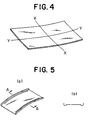
- twin rolls consisting of a metal roll 1 and a resin roll 2 as shown in Fig. 2.
- a method of manufacturing an automotive sunshade panel comprises bending a hollow panel having longitudinal edges by means of twin rolls consisting of a rigid roll and an elastic roll, in the roll circumferential direction (Y-Y axis), and flanging said longitudinal edges of said hollow panel by press forming or roll forming.
- a method of manufacturing an automotive sunshade panel comprises flanging longitudinal edges of a hollow panel by press forming or roll forming, and bending said hollow panel by means of twin rolls consisting of a rigid roll and an elastic roll, in the roll circumferential direction (Y-Y axis).
- the present invention provides a method of manufacturing an automotive sunshade panel which overcomes the above problems involved in the prior art techniques.
- the present invention also enables an automotive sunshade panel to be made by use of means capable of coping with a wide variety of types of vehicles through a simple method without additional processes such as bulging with expensive dies, as well as means extremely effective for the manufacture of products in relatively small lots.
- the present inventors have researched in depth the use of twin rolls consisting of a rigid roll and an elastic roll as shown in Fig. 2 to form aluminum panel stocks having large radii of curvature such as automobile sunshade panels.
- Fig. 2 aluminum panel stocks having large radii of curvature
- the present invention was conceived based on such a knowledge.
- an automotive sunshade panel having longitudinal flanged edges and having a two-dimensional or three-dimensional curved surface formed at least partially of the central part excepting the peripheries of the metallic hollow panel.
- a fabric may be laminated to at least one side of the hollow panel.
- the metallic hollow panel can be formed into a one-side inflated Roll-Bond panel, a two-side inflated Roll-Bond panel, a both-side flat three-layer Roll-Bond panel or a honeycomb panel.
- the metallic hollow panel is first bent in the roll circumferential direction (Y-Y axis) by means of twin rolls consisting of a rigid roll and an elastic roll, and then is subjected to a flanging process in which its longitudinal edges are flanged by press forming or roll forming.
- the metallic hollow panel may be first subjected to the flanging process in which its longitudinal edges are flanged by press forming or roll forming, and then be bent in the roll circumferential direction (Y-Y axis) by means of the twin rolls consisting of the rigid roll and the elastic roll.
- the above hollow panel may carry fabrics laminated to at least one side thereof.
- the hollow panel can be a one-side inflated Roll-Bond panel, a both-side inflated Roll-Bond panel, a both-side flat three-layer Roll Bond panel or a honeycomb panel.
- the twin rolls Upon the execution of bending process in the roll circumferential direction (Y-Y axis) by means of the twin rolls consisting of the rigid roll and the elastic roll, there may be used as the twin rolls so-called crown rolls, that is, cambered rolls having curvatures in the roll axial direction, so as to achieve bending in the roll axial direction (X-X axis) in addition to the bending in the roll circumferential direction (Y-Y axis) to consequently effect three-dimensional bending.
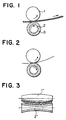
- Fig. 1 is an explanatory view showing an example of a method of forming a hollow panel curved surface in accordance with the present invention.
- reference numeral 1 denotes a metal roll serving as a rigid roll
- reference numeral 2 denotes a resin roll serving as an elastic roll.
- the surface of the resin roll 2 is coated with an elastic material, typically an urethane rubber layer 3.
- the metal roll 1 is first lowered to press against the urethane rubber roll surface 3.
- a hollow panel is then passed through the nip between the two rolls under such a condition, it is bent in the roll circumferential direction (Y-Y axis) at a radius of curvature along a depression area R formed in the urethane having an elasticity.
- the hardness of the urethane resin can be 50 to 90 degrees, preferably 55 to 65 degrees.
- the roll gap and compression ratio may be varied to achieve a desired radius of curvature. It is to be appreciated that there can also be obtained a continuously curved surface or a trapezoidal surface through two point bending due to partial release of the compressive force.
- the radius of curvature is typically of the order of 1000 to 15000 mm, whereas for the trapezoidal bending, the radius of curvature is typically of the order of 150 to 300 mm.
- a hollow panel to be formed Used as a hollow panel to be formed is a panel having hollow portions within its interior and consisting of two or three sheet stocks as shown in Fig. 8(a) to Fig. 8(d).
- a one-side inflated Roll-Bond panel shown in Fig. 8(a) is formed as follows. Two aluminum sheets are prepared at first for the process in which they are subjected to the steps of: chemically removing a harmful fat or stain from their surfaces; and mechanically removing therefrom an oxide layer by using a wire brush so that their fresh surfaces are exposed to the following treatments.
- a bond inhibitor which is applied to such a fresh surface of at least one aluminum plate, covers its areas in a predetermined pattern where the reinforcing ribs are to be formed.
- An ink composed mainly of colloidal graphite having a particle diameter of 1 um or less is used in general as the bond inhibitor, and is usually applied to said surface by the printing technique.
- the two aluminum sheets are overlaid upon one another such that the surface carrying the bond inhibitor is closed. Subsequently, they are hot rolled by rolls and under a condition which can ensure a sufficient strength of the bonded plates.
- the sheets are tightly consolidated and from a single panel, with areas printed with the inhibitor however remaining unbonded.
- a compressed fluid such as compressed air is forced from a side edge into the clearances, which are present between the plates on their areas where the bond inhibitor exists.
- the areas of the predetermined pattern are inflated in this manner so that the thus expanded hollow portions protrude inwards in a roll bonded panel.
- This panel has thus no lugs or protrusions on its outer surface, but has only on its inner surface the reinforcing ribs of a desired height and cross-sectional shape. This process may therefore be called "one-side inflation" process.
- an outer aluminum plate which is made of a heat-treatable aluminum alloy.
- a double-side flat three-layer Roll-Bond panel as shown in Fig. 8(c) is formed by providing alternate patterns on both sides of the intermediate of three sheet stocks so as to obtain planar exterior surfaces.
- a honeycomb panel as shown in Fig. 8(d) includes a plurality of sheet stocks arranged in a so-called honeycomb form between top and bottom sheet stocks. The channel patterns of such hollow panels are not intended to be limited to any specific ones.
- the hollow panel In the case of using as the hollow panel the one-side inflated Roll-Bond panel shown in Fig. 8(a), it is preferable that it be passed through the nip between the two rolls so that its flat side comes into contact with the rigid (metal) roll 1 with its inflated side coming into contact with the elastic (resin) roll 2.
- the hollow panel is the double-side inflated Roll-Bond panel as shown in Fig. 8(b) or the double-side flat three-layer Roll-Bond panel as shown in Fig. 8(c) or the panel as shown in Fig. 8(d)
- either side of the hollow panel may abut against the rigid (metal) roll 1 .
- the hollow panel of the present invention can be used as the metallic material for the hollow panel of the present invention.
- the hollow panel should be annealed or partially-annealed.
- the present invention will hereinafter be described for the aluminum hollow panel, but it is natural that the same apply to the copper panel. Additionally, the original sheet stocks for the hollow panel of the present invention may be multi-cavity molded.
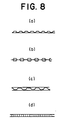
- Fig. 3 illustrates cambered rolls 1" and 2" whose roll forming surfaces have curvatures, for use as the twin rolls comprising metal/resin rolls serving as rigid/elastic rolls.
- Use of such cambered rolls provides a sunshade panel having a radius of curvature in the roll axial direction (X-X axis), thereby achieving three-dimensional bending as shown in Fig. 4 in cooperation with the bending in the roll circumferential direction (Y-Y axis).
- the forming surface of the rigid (metal) roll 1" may be convex with the elastic (resin) roller 2" having a concave surface, or vice versa.
- the rigid (metal) roll 1' has a convex surface.
- a curvature R of bending in the roll axial direction (X-X axis) is typically 2000 mm or more.
- the size of the hollow panel is about 300 to 1000 mm in width and about 600 to 1000 mm in length.
- the hollow panel is subjected to a flanging process which includes bending both edges of the hollow panel into concave or U-shaped sections as shown in Figs. 5a and 5b by means of press working or roll forming.
- a flanging process will ensure a formation of the hollow panel presenting embossing effect.
- the flanging process not only has an effect of enhancing the plate rigidity, but also is indispensable as safety measures in order to prevent plate cut surfaces from injuring a driver or fellow passengers.
- Fig. 6 illustrates another example of the method in accordance with the present invention.
- a hollow panel first undergoes a flanging process in which its longitudinal edges are bent into concave or U-shaped sections by means of press working or roll forming (Figs. 6(a) and 6(b)).
- Use is then made of twin rolls as shown in Fig. 6(c) consisting of a rigid roll 1' made of metal, wood, or the like having a width slightly smaller than that of the planar central portion of the flanged hollow panel, and an elastic roll 2' having a surface coated with urethane or the like and a width larger than that of the rigid roll 1'.
- This method also ensures the acquisition of substantially the same formed article as that shown in Fig. 5.
- the die production cost in the Fig. 6 forming method is further reduced as compared with the Fig. 5 method.
- a panel centrally having a three-dimensional curved surface can be obtained if cambered rolls 1" and 2" having roll forming surfaces with curvatures are used as the twin rolls comprising rigid/elastic rolls.
- the present invention employs the metal roll and resin roll as the rigid roll and elastic roll, respectively, the combination of the rigid/elastic rolls is not intended to be limited to the combination of the metal/resin rolls and any combination is available as long as the roll surfaces have rigidity/elasticity.
- the present invention will thus provide automotive sunshade panels each having longitudinal edges of concave or U shape in section and having an embossed central portion in the form of a continuous curved surface, a trapezoidal curved surface or a three-dimensional curved surface.
- Those automotive sunshade panels may be manufactured by either of the two methods set forth hereinabove.
- a fabric Prior to the rolling process, a fabric may be laminated onto the hollow panel. Due to a relatively small pressure used for the forming process in the method of the present invention, the fabric will not be damaged in spite of pre-forming lamination of the fabric onto the hollow panel. An increase in production costs is thus prevented which may arise from skillful work necessary for post-forming fabric lamination on curved surfaces as in the prior art.
- Test Specimen A one-side inflated Roll-Bond panel; pre-inflation gauge 1.2 (0.6 x 2) A1100-O Test Specimen B: double-side inflated Roll-Bond panel; pre-inflation gauge 1.2 (0.6 x 2) A1100-O Test Specimen C: double-side flat Roll-Bond panel; pre-inflation gauge 1.2 (0.4 x 3) A1100-O Test Specimen D: double-side flat honeycomb panel; overall gauge 3.8 (0.4 + 3 + 0.4) A1100-H24
- test specimens were each dimensioned to be 400 x 750 mm and the test specimens having fabric laminated surfaces were also tested.
- a rubber-based spray-type adhesive for fabric lamination, a thick close-woven wool fabric of 1 mmt in thickness is laminated on the flat surface, with a non-woven fabric of 0.2 mmt in thickness laminated on the patterned surface.
- Used as the upper roll and the lower roll were a metal roll (roll diameter: 65 mm) and an urethane resin roll (roll diameter: 160 mm; hardness: 60 degrees), respectively.
- a metal roll roll
- an urethane resin roll roll diameter: 160 mm; hardness: 60 degrees
- Table 1 shows results of the pre/post-bending sheet gauge and bending curvature for each of the specimens.
- test specimens A to D tested in the Embodiment 1 were first subjected to the pressing process to bend the hollow panel edges into U-shaped sections. They were then subjected to the two-dimensional bending process by means of the twin rolls shown in Fig. 6(c). The execution of these steps resulted in a two-dimensionally bent automotive sunshade panel having substantially the same flanging form as shown in Figs. 7a and 7b.
- test specimens A to D tested in the Embodiment 1 were subjected to three-dimensional bending process in the same manner except for the use of the cambered rolls as the upper and lower rolls.
- the upper metal roll 1" had a convex crown of 10,000 mm in radius of curvature
- the lower urethane resin roll 2" had a concave crown of 10,000 mm in radius of curvature.
- Table 2 After the execution of the three-dimensional bending process, the hollow panels were subjected to the flanging process.
- Test specimen D includes a 0.4 mm skin and a 0.2 mm cell.
- Table 1 revealed that adjustment of the roll gap enabled curved surfaces having arbitrary radii of curvature to be obtained in the two-dimensional bending.
- the tolerances may be influenced by variability in overall thickness of the Roll-Bond inflation, it is envisaged that there is no problem as long as the inflation thickness tolerances lie within the range of ⁇ 0.1 mm.
- Table 2 has proved that the R dimensions of the three-layered Roll-Bond panels lie within permissible tolerances in terms of design R dimensions of products although the three-dimensional bending presents a somewhat larger radius of curvature than the R of the roll crown due to differences in structural rigidity of the stocks.
- the Y-Y axis R may become large to some extent if conformed to 2,500 mm of X-X axis R, which would however be within the design permissible tolerances. The above test results have thus ensured that the resultant hollow panels entail no problems in terms of form and are conveniently suitable as automotive sunshade panels.
- automotive sunshade panels which meet requirements therefor, having a two-dimensional curved surface of 5000 mm in Y-Y axis R or having a three-dimensional curved surface of 5000 mm in Y-Y axis R and of 2000 mm in X-X axis R, at reduced production costs due to no need for any specific dies and without requiring conventional reinforcing ribs for stabilizing the curved surfaces due to substantially no occurrence of spring back.
Landscapes
- Engineering & Computer Science (AREA)
- Mechanical Engineering (AREA)
- Laminated Bodies (AREA)
- Bending Of Plates, Rods, And Pipes (AREA)
Claims (8)
- Verfahren zur Herstellung von Fahrzeugsonnenschutzblenden, beinhaltend die folgenden Schritte:Biegen eines hohlen Bleches mit längsverlaufenden Kanten mittels eines Walzenpaares (1, 2), bestehend aus einer starren Walze und einer elastischen Walze, in Walzumfangsrichtung (Y-Y Achse), undBördeln der längsverlaufenden Kanten des hohlen Blechs durch Druckumformen oder Walzumformen.
- Verfahren zur Herstellung von Fahrzeugsonnenschutzblenden, beinhaltend die Schritte :Bördeln längsverlaufender Kanten eines hohlen Blechs durch Druckumformen oder Walzumformen, undBiegen des hohlen Blechs mittels eines Walzenpaares (1, 2), bestehend aus einer starren Walze und einer elastischen Walze, in Walzumfangsrichtung (Y-Y Achse).
- Verfahren zur Herstellung von Fahrzeugsonnenschutzblenden nach Anspruch 1 oder 2, bei dem
das hohle Blech dreidimensional gebogen wird durch Verwendung gewölbter Walzenpaare (1'', 2'') jede aufweisend eine Krümmung in Walzenachsrichtung (X-X Achse) mit den Walzenpaaren bestehend aus einer starren Walze und einer elastischen Walze. - Verfahren zur Herstellung von Fahrzeugsonnenschutzblenden nach einem der vorhergehenden Ansprüche, bei dem das hohle Blech ein Gewebe trägt, laminiert auf mindestens eine Seite des Blechs.
- Verfahren nach einem oder mehreren der vorhergehenden Ansprüche, bei dem das hohle Blech ein einseitig luftgefülltes walzplattiertes Blech ist.
- Verfahren nach einem oder mehreren der vorhergehenden Ansprüche, bei dem das hohle Blech ein beidseitig luftgefülltes walzplattiertes Blech ist.
- Verfahren nach einem oder mehreren der vorhergehenden Ansprüche, bei dem das hohle Blech ein beidseitig flaches dreilagiges walzplattiertes Blech ist.
- Verfahren nach einem oder mehreren der vorhergehenden Ansprüche, bei dem das hohle Blech ein Wabenblech ist.
Applications Claiming Priority (6)
| Application Number | Priority Date | Filing Date | Title |
|---|---|---|---|
| JP132652/96 | 1996-04-30 | ||
| JP13265296A JPH09295051A (ja) | 1996-04-30 | 1996-04-30 | 中空パネルの曲面形成方法およびそれにより得られた自動車用遮光パネル |
| JP13265296 | 1996-04-30 | ||
| JP289306/96 | 1996-10-11 | ||
| JP28930696A JPH10113734A (ja) | 1996-10-11 | 1996-10-11 | 自動車用遮光パネルおよびその製造方法 |
| JP28930696 | 1996-10-11 |
Publications (3)
| Publication Number | Publication Date |
|---|---|
| EP0804977A2 EP0804977A2 (de) | 1997-11-05 |
| EP0804977A3 EP0804977A3 (de) | 1998-08-12 |
| EP0804977B1 true EP0804977B1 (de) | 2002-06-19 |
Family
ID=26467168
Family Applications (1)
| Application Number | Title | Priority Date | Filing Date |
|---|---|---|---|
| EP97302392A Expired - Lifetime EP0804977B1 (de) | 1996-04-30 | 1997-04-08 | Fahrzeugsonnenblende und Verfahren zur Herstellung |
Country Status (6)
| Country | Link |
|---|---|
| US (2) | US6332644B1 (de) |
| EP (1) | EP0804977B1 (de) |
| KR (1) | KR100464289B1 (de) |
| CN (1) | CN1115264C (de) |
| DE (1) | DE69713449T2 (de) |
| TW (1) | TW381980B (de) |
Cited By (1)
| Publication number | Priority date | Publication date | Assignee | Title |
|---|---|---|---|---|
| US6494875B1 (en) | 1998-08-24 | 2002-12-17 | Advanced Cardiovascular Systems, Inc. | Bifurcated catheter assembly |
Families Citing this family (22)
| Publication number | Priority date | Publication date | Assignee | Title |
|---|---|---|---|---|
| WO2004103601A1 (ja) * | 1999-07-22 | 2004-12-02 | Jiro Iwaya | プレス成形体およびプレス成形方法 |
| US6626351B2 (en) * | 2000-09-19 | 2003-09-30 | Tower Automotive Technology Products, Inc. | Method and apparatus for the manufacturing of structural members |
| JP2004062074A (ja) * | 2002-07-31 | 2004-02-26 | Toyota Motor Corp | 吸音装置 |
| US6729074B1 (en) * | 2002-12-03 | 2004-05-04 | Inalfa Roof Systems Group B.V. | Assembly of guides and sliding panel, and sunshade for application therein |
| US6698825B1 (en) | 2002-12-17 | 2004-03-02 | Arvinmeritor Technology, Llc | Sunshade for a vehicle |
| CN1296219C (zh) * | 2002-12-31 | 2007-01-24 | 延锋伟世通汽车饰件系统有限公司 | 汽车遮阳板的装配及其翻转力矩测量的一体化方法及其装置 |
| JP4079970B2 (ja) * | 2003-09-18 | 2008-04-23 | 旭化成ケミカルズ株式会社 | 面衝撃安定性に優れた樹脂組成物 |
| WO2007095843A1 (fr) * | 2006-02-21 | 2007-08-30 | Jilin University | Équipement destiné à la mise en forme d'une pièce tridimensionnelle flexible |
| US20080067906A1 (en) * | 2006-08-23 | 2008-03-20 | Juten Robert | Modular components for building structures |
| DE102007038713B4 (de) * | 2007-08-14 | 2009-07-23 | Thyssenkrupp Steel Ag | Verfahren zur Herstellung von partiell verstärkten Hohlprofilen |
| US9162553B2 (en) * | 2009-08-18 | 2015-10-20 | Joe Robert Benites | Shade device for car side window |
| CN102380532A (zh) * | 2011-11-19 | 2012-03-21 | 吉林大学 | 用于板材三维曲面成形的曲面轧制装置和方法 |
| CN102717683A (zh) * | 2012-07-03 | 2012-10-10 | 太仓高腾复合材料有限公司 | 一种高隔热环保遮阳挡及其制作方法 |
| DE102013215916A1 (de) | 2013-08-12 | 2015-02-12 | Bayerische Motoren Werke Aktiengesellschaft | Abkantung eines Bleches, vorzugsweise im optisch relevanten Außenbereich eines Fahrzeuges |
| CN110014058A (zh) * | 2018-01-10 | 2019-07-16 | 李书军 | 一种曲面蜂窝芯板成型工艺 |
| KR102044919B1 (ko) * | 2018-03-15 | 2019-11-14 | 에스앤씨 주식회사 | 위치 조절가능한 롤러를 이용하여 텐션 조절이 가능하도록 한 멀티 와이어 절단장치 |
| CN108943746B (zh) * | 2018-09-05 | 2023-05-26 | 江苏铁锚玻璃股份有限公司 | 汽车天窗遮阳板自动复合设备 |
| CN110814176B (zh) * | 2019-11-29 | 2020-10-23 | 吉林大学 | 采用柔性辊与弹性辊的曲面零件连续成形方法 |
| CN113814316B (zh) * | 2020-06-18 | 2023-12-12 | 宝山钢铁股份有限公司 | 一种板料辊压工艺及其装置 |
| JP2025070386A (ja) * | 2023-10-20 | 2025-05-02 | Jfeスチール株式会社 | 板巻き加工品の製造方法 |
| PL447891A1 (pl) * | 2024-02-29 | 2025-09-01 | Politechnika Rzeszowska im. Ignacego Łukasiewicza | Sposób gięcia części blaszanej o stałej krzywiźnie |
| EP4640330A1 (de) * | 2024-04-26 | 2025-10-29 | Inalfa Roof Systems Group B.V. | Verfahren zur herstellung eines betätigungsbalkens einer fahrzeugsonnenblendenanordnung |
Family Cites Families (28)
| Publication number | Priority date | Publication date | Assignee | Title |
|---|---|---|---|---|
| US471407A (en) * | 1892-03-22 | Walter c | ||
| US1625061A (en) * | 1925-02-19 | 1927-04-19 | Philip H Trout | Welded composite corrugated sheet |
| US2159783A (en) * | 1937-02-16 | 1939-05-23 | American Car & Foundry Motor | Vehicle roof construction |
| US2428591A (en) * | 1943-12-08 | 1947-10-07 | Owens Corning Fiberglass Corp | Insulating fabric |
| NL101683C (de) * | 1958-01-11 | |||
| DE1113643B (de) * | 1958-02-22 | 1961-09-07 | Hans Golde | Schiebedach fuer Kraftfahrzeuge od. dgl. |
| US3150707A (en) * | 1961-04-27 | 1964-09-29 | Howell Pat | Apparatus for making metal building and building elements |
| FR1398077A (fr) * | 1964-03-25 | 1965-05-07 | Nord Aviation | Procédé pour réunir entre eux des panneaux à noyau ondulé |
| US3394514A (en) * | 1966-08-29 | 1968-07-30 | Robertson Co H H | Metal cellular flooring sections and composte flor utilizing the same |
| US3689730A (en) * | 1971-04-19 | 1972-09-05 | James R Campbell | Apparatus for bonding metallic panels |
| DE7619090U1 (de) * | 1976-06-16 | 1976-11-18 | Dynamit Nobel Ag, 5210 Troisdorf | Selbsttragendes Formteil für Kraftfahrzeuge |
| DE2637839C2 (de) * | 1976-08-21 | 1983-12-01 | Webasto-Werk W. Baier GmbH & Co, 8035 Gauting | Dachhimmelbefestigung für ein Kraftfahrzeugdach |
| JPS5827851Y2 (ja) * | 1978-10-16 | 1983-06-17 | 本田技研工業株式会社 | 車輌のスライディングル−フ装置におけるサンシェ−ド装置 |
| US4414257A (en) * | 1981-07-09 | 1983-11-08 | Mitsubishi Denki Kabushiki Kaisha | Elevator panel |
| JPS6167622A (ja) * | 1984-09-07 | 1986-04-07 | Kasai Kogyo Co Ltd | 自動車用サンル−フシエイド |
| JPS61200025A (ja) * | 1985-02-28 | 1986-09-04 | Toyota Motor Corp | 自動車のチルト・スライド式サンル−フ |
| NL8500808A (nl) * | 1985-03-20 | 1986-10-16 | Vermeulen Hollandia Octrooien | Schuifdak voor een voertuig. |
| DE3527839C1 (de) * | 1985-08-02 | 1986-10-30 | Rockwell Golde Gmbh, 6000 Frankfurt | Schiebehimmel fuer ein Schiebedach fuer Kraftfahrzeuge |
| JPH0338009Y2 (de) * | 1987-06-29 | 1991-08-12 | ||
| FR2621677B1 (fr) * | 1987-10-13 | 1990-06-22 | Heuliez Henri France Design | Structure rigide destinee a la realisation de panneaux ou d'elements tridimensionnels |
| JPH01181921A (ja) * | 1988-01-14 | 1989-07-19 | Shinko Pfaudler Co Ltd | 熱交換用ジャケット部材の成形方法および装置 |
| NL8802771A (nl) * | 1988-11-10 | 1990-06-01 | Vermeulen Hollandia Octrooien | Open-dakconstructie voor een voertuig. |
| US5121784A (en) * | 1990-02-06 | 1992-06-16 | Lennard Paul M | Louvered sunshade with controllable apertures |
| JP3229399B2 (ja) * | 1992-01-10 | 2001-11-19 | トヨタ自動車株式会社 | パネルの構造 |
| JPH05193421A (ja) * | 1992-01-16 | 1993-08-03 | Yokohama Rubber Co Ltd:The | ハニカムパネルの切欠凹部の構造及びその製造方法 |
| US5503903A (en) * | 1993-09-16 | 1996-04-02 | Indiana Acoustical Components | Automotive headliner panel and method of making same |
| NO943247L (no) * | 1994-09-02 | 1996-03-04 | Eknes Ind As Georg | Fremgangsmåte og system til böyning av celleplate |
| JPH0890080A (ja) | 1994-09-14 | 1996-04-09 | Fuji Heavy Ind Ltd | アルミニウム製板状曲がり材の製造方法 |
-
1997
- 1997-02-27 TW TW086102635A patent/TW381980B/zh active
- 1997-02-28 US US08/808,789 patent/US6332644B1/en not_active Expired - Fee Related
- 1997-04-08 EP EP97302392A patent/EP0804977B1/de not_active Expired - Lifetime
- 1997-04-08 DE DE69713449T patent/DE69713449T2/de not_active Expired - Fee Related
- 1997-04-28 CN CN97109790A patent/CN1115264C/zh not_active Expired - Fee Related
- 1997-04-29 KR KR1019970016214A patent/KR100464289B1/ko not_active Expired - Fee Related
-
1998
- 1998-09-11 US US09/151,934 patent/US6572721B1/en not_active Expired - Fee Related
Cited By (1)
| Publication number | Priority date | Publication date | Assignee | Title |
|---|---|---|---|---|
| US6494875B1 (en) | 1998-08-24 | 2002-12-17 | Advanced Cardiovascular Systems, Inc. | Bifurcated catheter assembly |
Also Published As
| Publication number | Publication date |
|---|---|
| US6332644B1 (en) | 2001-12-25 |
| CN1115264C (zh) | 2003-07-23 |
| TW381980B (en) | 2000-02-11 |
| KR970069468A (ko) | 1997-11-07 |
| EP0804977A3 (de) | 1998-08-12 |
| KR100464289B1 (ko) | 2005-06-02 |
| CN1167695A (zh) | 1997-12-17 |
| DE69713449T2 (de) | 2002-10-02 |
| EP0804977A2 (de) | 1997-11-05 |
| US6572721B1 (en) | 2003-06-03 |
| DE69713449D1 (de) | 2002-07-25 |
Similar Documents
| Publication | Publication Date | Title |
|---|---|---|
| US6332644B1 (en) | Automotive sunshade panel and method of manufacturing same | |
| CN102317001B (zh) | 用于制造压力淬火的金属部件的方法 | |
| EP2241494B1 (de) | Tailored blank produckt | |
| CN107186034B (zh) | 压制成型品的制造装置 | |
| EP2500118A1 (de) | Plattenmaterial mit konkaven/konvexen abschnitten und laminatstruktur sowie fahrzeugplatte mit diesem plattenmaterial | |
| JPS59109466A (ja) | 主として曲げ荷重を受ける部位に用いられる自動車用メンバの製造方法 | |
| CN101888908A (zh) | 尺寸高度精确的轴瓦的制造方法 | |
| CN105531049B (zh) | 压制成型品和压制成型品的制造方法以及压制成型品的制造装置 | |
| JPH1058570A (ja) | 複合パネル | |
| EP0150818B1 (de) | Pressformverfahren und Vorrichtung dafür | |
| CN113226584B (zh) | 冲压成形方法 | |
| JP2021006348A (ja) | プレス用鋼板およびプレス成形品、並びにプレス用鋼板の製造方法 | |
| US4092200A (en) | Process for manufacturing an automotive ceiling panel | |
| US4242399A (en) | Corrugated paperboard for trim board and method of producing the same | |
| GB2263081A (en) | Superplastic forming of sandwich panel | |
| JPH0890080A (ja) | アルミニウム製板状曲がり材の製造方法 | |
| JPH10297282A (ja) | 自動車用遮光パネル | |
| JPH09295051A (ja) | 中空パネルの曲面形成方法およびそれにより得られた自動車用遮光パネル | |
| GB2328458A (en) | Double layered sheet metal | |
| JP2000247143A (ja) | 自動車用遮光パネルおよびその製造方法 | |
| JPH10113734A (ja) | 自動車用遮光パネルおよびその製造方法 | |
| CA1091724A (en) | Automotive ceiling panel and process for manufacturing same | |
| JPS6313619A (ja) | 樹脂積層金属板の曲げ加工方法 | |
| JP2008044232A (ja) | 積層金属板加工物の製造方法 | |
| Tsuzuku | Superplastic Forming of Sandwich Panel |
Legal Events
| Date | Code | Title | Description |
|---|---|---|---|
| PUAI | Public reference made under article 153(3) epc to a published international application that has entered the european phase |
Free format text: ORIGINAL CODE: 0009012 |
|
| AK | Designated contracting states |
Kind code of ref document: A2 Designated state(s): DE FR GB IT NL |
|
| PUAL | Search report despatched |
Free format text: ORIGINAL CODE: 0009013 |
|
| AK | Designated contracting states |
Kind code of ref document: A3 Designated state(s): DE FR GB IT NL |
|
| 17P | Request for examination filed |
Effective date: 19981201 |
|
| 17Q | First examination report despatched |
Effective date: 20000313 |
|
| GRAG | Despatch of communication of intention to grant |
Free format text: ORIGINAL CODE: EPIDOS AGRA |
|
| GRAG | Despatch of communication of intention to grant |
Free format text: ORIGINAL CODE: EPIDOS AGRA |
|
| GRAH | Despatch of communication of intention to grant a patent |
Free format text: ORIGINAL CODE: EPIDOS IGRA |
|
| RAP1 | Party data changed (applicant data changed or rights of an application transferred) |
Owner name: SHOWA DENKO K K |
|
| RAP1 | Party data changed (applicant data changed or rights of an application transferred) |
Owner name: SHOWA DENKO K.K. |
|
| GRAH | Despatch of communication of intention to grant a patent |
Free format text: ORIGINAL CODE: EPIDOS IGRA |
|
| GRAA | (expected) grant |
Free format text: ORIGINAL CODE: 0009210 |
|
| AK | Designated contracting states |
Kind code of ref document: B1 Designated state(s): DE FR GB IT NL |
|
| REG | Reference to a national code |
Ref country code: GB Ref legal event code: FG4D |
|
| RIN1 | Information on inventor provided before grant (corrected) |
Inventor name: SUDA, MASAYUKI Inventor name: AKAGI, TOSHIJI Inventor name: ITO, TOMIO Inventor name: ITO, YUKO |
|
| REF | Corresponds to: |
Ref document number: 69713449 Country of ref document: DE Date of ref document: 20020725 |
|
| ET | Fr: translation filed | ||
| PLBE | No opposition filed within time limit |
Free format text: ORIGINAL CODE: 0009261 |
|
| STAA | Information on the status of an ep patent application or granted ep patent |
Free format text: STATUS: NO OPPOSITION FILED WITHIN TIME LIMIT |
|
| 26N | No opposition filed |
Effective date: 20030320 |
|
| PGFP | Annual fee paid to national office [announced via postgrant information from national office to epo] |
Ref country code: NL Payment date: 20040406 Year of fee payment: 8 |
|
| PGFP | Annual fee paid to national office [announced via postgrant information from national office to epo] |
Ref country code: GB Payment date: 20040407 Year of fee payment: 8 |
|
| PGFP | Annual fee paid to national office [announced via postgrant information from national office to epo] |
Ref country code: FR Payment date: 20040408 Year of fee payment: 8 |
|
| PGFP | Annual fee paid to national office [announced via postgrant information from national office to epo] |
Ref country code: DE Payment date: 20040415 Year of fee payment: 8 |
|
| PG25 | Lapsed in a contracting state [announced via postgrant information from national office to epo] |
Ref country code: IT Free format text: LAPSE BECAUSE OF NON-PAYMENT OF DUE FEES;WARNING: LAPSES OF ITALIAN PATENTS WITH EFFECTIVE DATE BEFORE 2007 MAY HAVE OCCURRED AT ANY TIME BEFORE 2007. THE CORRECT EFFECTIVE DATE MAY BE DIFFERENT FROM THE ONE RECORDED. Effective date: 20050408 Ref country code: GB Free format text: LAPSE BECAUSE OF NON-PAYMENT OF DUE FEES Effective date: 20050408 |
|
| PG25 | Lapsed in a contracting state [announced via postgrant information from national office to epo] |
Ref country code: NL Free format text: LAPSE BECAUSE OF NON-PAYMENT OF DUE FEES Effective date: 20051101 Ref country code: DE Free format text: LAPSE BECAUSE OF NON-PAYMENT OF DUE FEES Effective date: 20051101 |
|
| GBPC | Gb: european patent ceased through non-payment of renewal fee |
Effective date: 20050408 |
|
| PG25 | Lapsed in a contracting state [announced via postgrant information from national office to epo] |
Ref country code: FR Free format text: LAPSE BECAUSE OF NON-PAYMENT OF DUE FEES Effective date: 20051230 |
|
| NLV4 | Nl: lapsed or anulled due to non-payment of the annual fee |
Effective date: 20051101 |
|
| REG | Reference to a national code |
Ref country code: FR Ref legal event code: ST Effective date: 20051230 |