EP0803538B1 - Hydrolysestabilisator für Estergruppen enthaltendes Harz und Verfahren zur Hydrolysestabilisation eines Estergruppen enthaltenden Harzes unter Verwendung besagten Hydrolysestabilisators - Google Patents
Hydrolysestabilisator für Estergruppen enthaltendes Harz und Verfahren zur Hydrolysestabilisation eines Estergruppen enthaltenden Harzes unter Verwendung besagten Hydrolysestabilisators Download PDFInfo
- Publication number
- EP0803538B1 EP0803538B1 EP97105933A EP97105933A EP0803538B1 EP 0803538 B1 EP0803538 B1 EP 0803538B1 EP 97105933 A EP97105933 A EP 97105933A EP 97105933 A EP97105933 A EP 97105933A EP 0803538 B1 EP0803538 B1 EP 0803538B1
- Authority
- EP
- European Patent Office
- Prior art keywords
- carbodiimide
- hmdi
- ester group
- containing resin
- ipdi
- Prior art date
- Legal status (The legal status is an assumption and is not a legal conclusion. Google has not performed a legal analysis and makes no representation as to the accuracy of the status listed.)
- Expired - Lifetime
Links
- 229920005989 resin Polymers 0.000 title claims description 72
- 239000011347 resin Substances 0.000 title claims description 72
- 230000007062 hydrolysis Effects 0.000 title claims description 58
- 238000006460 hydrolysis reaction Methods 0.000 title claims description 58
- 125000004185 ester group Chemical group 0.000 title claims description 52
- 239000003381 stabilizer Substances 0.000 title claims description 37
- 238000000034 method Methods 0.000 title claims description 20
- 230000006641 stabilisation Effects 0.000 title claims description 13
- 238000011105 stabilization Methods 0.000 title claims description 13
- 239000005058 Isophorone diisocyanate Substances 0.000 claims description 94
- NIMLQBUJDJZYEJ-UHFFFAOYSA-N isophorone diisocyanate Chemical compound CC1(C)CC(N=C=O)CC(C)(CN=C=O)C1 NIMLQBUJDJZYEJ-UHFFFAOYSA-N 0.000 claims description 94
- 150000001718 carbodiimides Chemical class 0.000 claims description 79
- 239000000203 mixture Substances 0.000 claims description 55
- 238000006116 polymerization reaction Methods 0.000 claims description 42
- 150000001732 carboxylic acid derivatives Chemical class 0.000 claims description 16
- 150000008065 acid anhydrides Chemical class 0.000 claims description 15
- VPKDCDLSJZCGKE-UHFFFAOYSA-N carbodiimide group Chemical group N=C=N VPKDCDLSJZCGKE-UHFFFAOYSA-N 0.000 claims description 12
- 238000002156 mixing Methods 0.000 claims description 7
- NNOZGCICXAYKLW-UHFFFAOYSA-N 1,2-bis(2-isocyanatopropan-2-yl)benzene Chemical compound O=C=NC(C)(C)C1=CC=CC=C1C(C)(C)N=C=O NNOZGCICXAYKLW-UHFFFAOYSA-N 0.000 claims description 5
- 125000003178 carboxy group Chemical group [H]OC(*)=O 0.000 claims description 4
- 239000002253 acid Substances 0.000 claims 1
- RRAMGCGOFNQTLD-UHFFFAOYSA-N hexamethylene diisocyanate Chemical compound O=C=NCCCCCCN=C=O RRAMGCGOFNQTLD-UHFFFAOYSA-N 0.000 description 92
- AZYRZNIYJDKRHO-UHFFFAOYSA-N 1,3-bis(2-isocyanatopropan-2-yl)benzene Chemical compound O=C=NC(C)(C)C1=CC=CC(C(C)(C)N=C=O)=C1 AZYRZNIYJDKRHO-UHFFFAOYSA-N 0.000 description 52
- 230000015572 biosynthetic process Effects 0.000 description 50
- 238000003786 synthesis reaction Methods 0.000 description 50
- PAFZNILMFXTMIY-UHFFFAOYSA-N cyclohexylamine Chemical compound NC1CCCCC1 PAFZNILMFXTMIY-UHFFFAOYSA-N 0.000 description 44
- 239000003054 catalyst Substances 0.000 description 34
- 125000005442 diisocyanate group Chemical group 0.000 description 31
- 238000006243 chemical reaction Methods 0.000 description 28
- 239000012948 isocyanate Substances 0.000 description 27
- 150000002513 isocyanates Chemical class 0.000 description 27
- -1 polyethylene terephthalate Polymers 0.000 description 24
- 230000035484 reaction time Effects 0.000 description 23
- KQWGXHWJMSMDJJ-UHFFFAOYSA-N cyclohexyl isocyanate Chemical compound O=C=NC1CCCCC1 KQWGXHWJMSMDJJ-UHFFFAOYSA-N 0.000 description 15
- IQPQWNKOIGAROB-UHFFFAOYSA-N isocyanate group Chemical group [N-]=C=O IQPQWNKOIGAROB-UHFFFAOYSA-N 0.000 description 11
- 150000001412 amines Chemical class 0.000 description 10
- 229920001707 polybutylene terephthalate Polymers 0.000 description 10
- XLYOFNOQVPJJNP-UHFFFAOYSA-N water Substances O XLYOFNOQVPJJNP-UHFFFAOYSA-N 0.000 description 9
- IJGRMHOSHXDMSA-UHFFFAOYSA-N Atomic nitrogen Chemical compound N#N IJGRMHOSHXDMSA-UHFFFAOYSA-N 0.000 description 8
- 230000000694 effects Effects 0.000 description 8
- 229920000139 polyethylene terephthalate Polymers 0.000 description 7
- 239000005020 polyethylene terephthalate Substances 0.000 description 7
- 239000002981 blocking agent Substances 0.000 description 6
- 150000001875 compounds Chemical class 0.000 description 6
- NZNMSOFKMUBTKW-UHFFFAOYSA-N cyclohexanecarboxylic acid Chemical compound OC(=O)C1CCCCC1 NZNMSOFKMUBTKW-UHFFFAOYSA-N 0.000 description 6
- 238000002347 injection Methods 0.000 description 6
- 239000007924 injection Substances 0.000 description 6
- 229920000728 polyester Polymers 0.000 description 6
- 239000007858 starting material Substances 0.000 description 6
- 229920005749 polyurethane resin Polymers 0.000 description 5
- 230000009257 reactivity Effects 0.000 description 5
- 230000000087 stabilizing effect Effects 0.000 description 5
- CURLTUGMZLYLDI-UHFFFAOYSA-N Carbon dioxide Chemical compound O=C=O CURLTUGMZLYLDI-UHFFFAOYSA-N 0.000 description 4
- LFQSCWFLJHTTHZ-UHFFFAOYSA-N Ethanol Chemical compound CCO LFQSCWFLJHTTHZ-UHFFFAOYSA-N 0.000 description 4
- LGRFSURHDFAFJT-UHFFFAOYSA-N Phthalic anhydride Natural products C1=CC=C2C(=O)OC(=O)C2=C1 LGRFSURHDFAFJT-UHFFFAOYSA-N 0.000 description 4
- JHIWVOJDXOSYLW-UHFFFAOYSA-N butyl 2,2-difluorocyclopropane-1-carboxylate Chemical compound CCCCOC(=O)C1CC1(F)F JHIWVOJDXOSYLW-UHFFFAOYSA-N 0.000 description 4
- 150000002148 esters Chemical class 0.000 description 4
- 229910052757 nitrogen Inorganic materials 0.000 description 4
- 239000000126 substance Substances 0.000 description 4
- QOSSAOTZNIDXMA-UHFFFAOYSA-N Dicylcohexylcarbodiimide Chemical compound C1CCCCC1N=C=NC1CCCCC1 QOSSAOTZNIDXMA-UHFFFAOYSA-N 0.000 description 3
- 239000000654 additive Substances 0.000 description 3
- 238000004898 kneading Methods 0.000 description 3
- UPMLOUAZCHDJJD-UHFFFAOYSA-N 4,4'-Diphenylmethane Diisocyanate Chemical compound C1=CC(N=C=O)=CC=C1CC1=CC=C(N=C=O)C=C1 UPMLOUAZCHDJJD-UHFFFAOYSA-N 0.000 description 2
- 239000004593 Epoxy Chemical class 0.000 description 2
- 229920006311 Urethane elastomer Polymers 0.000 description 2
- 238000010521 absorption reaction Methods 0.000 description 2
- 239000012298 atmosphere Substances 0.000 description 2
- WPYMKLBDIGXBTP-UHFFFAOYSA-N benzoic acid Chemical compound OC(=O)C1=CC=CC=C1 WPYMKLBDIGXBTP-UHFFFAOYSA-N 0.000 description 2
- 230000000903 blocking effect Effects 0.000 description 2
- 239000004202 carbamide Substances 0.000 description 2
- 239000001569 carbon dioxide Substances 0.000 description 2
- 229910002092 carbon dioxide Inorganic materials 0.000 description 2
- 238000006114 decarboxylation reaction Methods 0.000 description 2
- 230000006866 deterioration Effects 0.000 description 2
- JQVDAXLFBXTEQA-UHFFFAOYSA-N dibutylamine Chemical compound CCCCNCCCC JQVDAXLFBXTEQA-UHFFFAOYSA-N 0.000 description 2
- 229920001971 elastomer Polymers 0.000 description 2
- 239000000806 elastomer Substances 0.000 description 2
- 238000010438 heat treatment Methods 0.000 description 2
- 125000002887 hydroxy group Chemical group [H]O* 0.000 description 2
- 239000011261 inert gas Substances 0.000 description 2
- 238000000465 moulding Methods 0.000 description 2
- 150000002918 oxazolines Chemical class 0.000 description 2
- 230000000704 physical effect Effects 0.000 description 2
- 239000002904 solvent Substances 0.000 description 2
- DVKJHBMWWAPEIU-UHFFFAOYSA-N toluene 2,4-diisocyanate Chemical compound CC1=CC=C(N=C=O)C=C1N=C=O DVKJHBMWWAPEIU-UHFFFAOYSA-N 0.000 description 2
- ADFXKUOMJKEIND-UHFFFAOYSA-N 1,3-dicyclohexylurea Chemical compound C1CCCCC1NC(=O)NC1CCCCC1 ADFXKUOMJKEIND-UHFFFAOYSA-N 0.000 description 1
- NNZVKALEGZPYKL-UHFFFAOYSA-N 1-isocyanato-2-methylpropane Chemical compound CC(C)CN=C=O NNZVKALEGZPYKL-UHFFFAOYSA-N 0.000 description 1
- DYQFCTCUULUMTQ-UHFFFAOYSA-N 1-isocyanatooctane Chemical compound CCCCCCCCN=C=O DYQFCTCUULUMTQ-UHFFFAOYSA-N 0.000 description 1
- OQURWGJAWSLGQG-UHFFFAOYSA-N 1-isocyanatopropane Chemical compound CCCN=C=O OQURWGJAWSLGQG-UHFFFAOYSA-N 0.000 description 1
- SKIIKRJAQOSWFT-UHFFFAOYSA-N 2-[3-[1-(2,2-difluoroethyl)piperidin-4-yl]oxy-4-[2-(2,3-dihydro-1H-inden-2-ylamino)pyrimidin-5-yl]pyrazol-1-yl]-1-(2,4,6,7-tetrahydrotriazolo[4,5-c]pyridin-5-yl)ethanone Chemical compound FC(CN1CCC(CC1)OC1=NN(C=C1C=1C=NC(=NC=1)NC1CC2=CC=CC=C2C1)CC(=O)N1CC2=C(CC1)NN=N2)F SKIIKRJAQOSWFT-UHFFFAOYSA-N 0.000 description 1
- MGOLNIXAPIAKFM-UHFFFAOYSA-N 2-isocyanato-2-methylpropane Chemical compound CC(C)(C)N=C=O MGOLNIXAPIAKFM-UHFFFAOYSA-N 0.000 description 1
- 239000005711 Benzoic acid Substances 0.000 description 1
- 0 CC(C)(C1)CC(*)(*)CC1N=C=O Chemical compound CC(C)(C1)CC(*)(*)CC1N=C=O 0.000 description 1
- 238000000862 absorption spectrum Methods 0.000 description 1
- 230000002378 acidificating effect Effects 0.000 description 1
- 239000002671 adjuvant Substances 0.000 description 1
- 230000002411 adverse Effects 0.000 description 1
- 125000003158 alcohol group Chemical group 0.000 description 1
- 125000001931 aliphatic group Chemical group 0.000 description 1
- 150000004982 aromatic amines Chemical class 0.000 description 1
- 125000003118 aryl group Chemical group 0.000 description 1
- 235000010233 benzoic acid Nutrition 0.000 description 1
- 230000005587 bubbling Effects 0.000 description 1
- 238000009833 condensation Methods 0.000 description 1
- 230000005494 condensation Effects 0.000 description 1
- 238000006482 condensation reaction Methods 0.000 description 1
- 238000005336 cracking Methods 0.000 description 1
- KLDONSSXFQTAFU-UHFFFAOYSA-N cyclohexanecarboxylic acid Chemical compound C1(CCCCC1)C(=O)O.C1(CCCCC1)C(=O)O.C1(CCCCC1)C(=O)O KLDONSSXFQTAFU-UHFFFAOYSA-N 0.000 description 1
- 230000001877 deodorizing effect Effects 0.000 description 1
- WUDNUHPRLBTKOJ-UHFFFAOYSA-N ethyl isocyanate Chemical compound CCN=C=O WUDNUHPRLBTKOJ-UHFFFAOYSA-N 0.000 description 1
- 230000002349 favourable effect Effects 0.000 description 1
- 239000007789 gas Substances 0.000 description 1
- 239000012535 impurity Substances 0.000 description 1
- 238000004519 manufacturing process Methods 0.000 description 1
- 239000000155 melt Substances 0.000 description 1
- HNHVTXYLRVGMHD-UHFFFAOYSA-N n-butyl isocyanate Chemical compound CCCCN=C=O HNHVTXYLRVGMHD-UHFFFAOYSA-N 0.000 description 1
- NPUSNLZOJIWRLY-UHFFFAOYSA-N n-butylbutan-1-amine;cyclohexanecarboxylic acid Chemical compound CCCCNCCCC.OC(=O)C1CCCCC1 NPUSNLZOJIWRLY-UHFFFAOYSA-N 0.000 description 1
- 239000012299 nitrogen atmosphere Substances 0.000 description 1
- 150000002903 organophosphorus compounds Chemical class 0.000 description 1
- 239000008188 pellet Substances 0.000 description 1
- 229920005906 polyester polyol Polymers 0.000 description 1
- 229920001225 polyester resin Polymers 0.000 description 1
- 239000004645 polyester resin Substances 0.000 description 1
- 239000004814 polyurethane Substances 0.000 description 1
- 239000000843 powder Substances 0.000 description 1
- 150000003384 small molecules Chemical class 0.000 description 1
- 239000000243 solution Substances 0.000 description 1
- 238000001228 spectrum Methods 0.000 description 1
- 238000009987 spinning Methods 0.000 description 1
- 238000003756 stirring Methods 0.000 description 1
- 238000003860 storage Methods 0.000 description 1
- 229920001187 thermosetting polymer Polymers 0.000 description 1
- 238000004448 titration Methods 0.000 description 1
- 230000001988 toxicity Effects 0.000 description 1
- 231100000419 toxicity Toxicity 0.000 description 1
- 238000009834 vaporization Methods 0.000 description 1
- 230000008016 vaporization Effects 0.000 description 1
Classifications
-
- C—CHEMISTRY; METALLURGY
- C08—ORGANIC MACROMOLECULAR COMPOUNDS; THEIR PREPARATION OR CHEMICAL WORKING-UP; COMPOSITIONS BASED THEREON
- C08K—Use of inorganic or non-macromolecular organic substances as compounding ingredients
- C08K5/00—Use of organic ingredients
- C08K5/04—Oxygen-containing compounds
- C08K5/10—Esters; Ether-esters
-
- C—CHEMISTRY; METALLURGY
- C08—ORGANIC MACROMOLECULAR COMPOUNDS; THEIR PREPARATION OR CHEMICAL WORKING-UP; COMPOSITIONS BASED THEREON
- C08K—Use of inorganic or non-macromolecular organic substances as compounding ingredients
- C08K5/00—Use of organic ingredients
- C08K5/16—Nitrogen-containing compounds
- C08K5/29—Compounds containing one or more carbon-to-nitrogen double bonds
Definitions
- the present invention relates to a hydrolysis stabilizer for an ester group-containing resin and a process for the hydrolysis stabilization of an ester group-containing resin using said hydrolysis stabilizer. More particularly, it relates to a hydrolysis stabilizer for an ester group-containing resin which stabilizer does not generate a bad odor when kneaded with the resin at a high temperature, has an excellent compatibility and reactivity with a resin to which the stabilizer is added, even at a low temperature and exhibits thereby an excellent hydrolysis stabilizing effect and comprises a carbodiimide as a main component, and to a process for the hydrolysis stabilization of an ester group-containing resin using the above hydrolysis stabilizer.
- Ester group-containing resins for example, polyester polyurethane (PU), polyethylene terephthalate (PET), polybutylene terephthalate (PBT) and the like have excellent elasticity and moldability, and hence, have been employed in various uses.
- PU polyester polyurethane
- PET polyethylene terephthalate
- PBT polybutylene terephthalate
- the above-mentioned polyester polyurethane resin is usually obtained by urethanizing a diisocyanate such as 4,4'-diphenylmethane diisocyanate (MDI), tolylene diisocyanate (TDI) with a difunctional polyester polyol, so that it has many ester groups in the molecule.
- MDI 4,4'-diphenylmethane diisocyanate
- TDI tolylene diisocyanate
- the above additives include, for example, oxazolines, epoxy compounds, aromatic polycarbodiimides, aliphatic monocarbodiimides. These additives are usually in the form of powder and used in such a manner that they are dry blended with resin pellets or mixed in a given amount with the resin by use of a measuring hopper during molding or spinning, and then, the resulting mixture is melt-kneaded at a given temperature (250-300°C in the case of polyethylene terephthalate).
- the above-mentioned epoxy compounds and oxazolines have no sufficient effect of improving the hydrolysis resistance, increase the melt viscosity of the resin and deteriorate the moldability, so that they have no practical usability.
- the above aromatic carbodiimides are usually thermosetting, and hence, their carbodiimide groups cross-link upon heating and when they are kneaded with the resin, the viscosity of the resulting mixture increases or they become lump-like and are ununiformly dispersed in the resin, and hence, in some cases, no desirable effect of hydrolysis stabilization can be obtained.
- dicyclohexylcarbodiimide As aliphatic carbodiimides, the use of dicyclohexylcarbodiimide is well known; however, this dicyclohexylcarbodiimide reacts easily with water to be converted to dicyclohexylurea, and hence, has a problem in that close attention must be paid for preventing moisture in the storage of dicylohexylcarbodiimide. Therefore, it is inadequate to use in industry. Furthermore, a monocarbodiimide is a low molecular weight compound and when added to a polyester polyurethane resin, it bleeds out of the resin, so that it has such a problem that the hydrolysis resistance is not sufficient.
- a hydrolysis stabilizer for an ester group-containing resin which comprises as a main component a carbodiimide having at least two carbodiimide groups in the molecule and resulting from 4,4'-dicyclohezylmethane diisocyanate represented by the formula (I): or isophorone diisocyanate represented by the formula (II): or a mixture of 4,4'-dicyclohexylmethane diisocyanate of the formula (I) with isophorone diisocyanate of the formula (II) wherein the carbodiimide is end-blocked with a carboxylic acid, an acid anhydride or a monoisocyanate, or, a carbodiimide having at least two carbodiimide groups in the molecule and resulting from a mixture of tetramethylxylylene diisocyanate represented by the formula (III): with 4,4'-dicyclohexylmethane diisocyan
- a process for the hydrolysis stabilization of an ester group-containing resin which comprises mixing a polyester resin with a carbodiimide having at least two carbodiimide groups in the molecule and resulting from 4,4'-dicyclohexylmethane diisocyanate represented by the formula (I): or isophorone diisocyanate represented by the formula (II): or a mixture of 4,4'-dicyclohexylmethane diisocyanate of the formula (I) with isophorone diisocyanate of the formula (II) wherein the carbodiimide is end-blocked with a carboxylic acid, an acid anhydride or a monoisocyanate, or, a carbodiimide having at least two carbodiimide groups in the molecule and resulting from a mixture of tetramethylxylylene diisocyanate represented by the formula (III): with 4,4'-dicyclohexylmethan
- the present hydrolysis stabilizer for an ester group-containing resin comprises as a main component:
- the above carbodiimidization reaction is effected in the presence of a suitable carbodiimidization catalyst, and as the carbodiimidization catalyst which can be used, organic phosphorus compounds are preferable, and phosphorene oxides are particularly preferable in view of activity.
- a suitable carbodiimidization catalyst which can be used, organic phosphorus compounds are preferable, and phosphorene oxides are particularly preferable in view of activity.
- organic phosphorus compounds are preferable, and phosphorene oxides are particularly preferable in view of activity.
- organic phosphorus compounds are preferable, and phosphorene oxides are particularly preferable in view of activity.
- phosphorene oxides are particularly preferable in view of activity.
- 3-methyl-1-phenyl-2-phosphorene-1-oxide 3-methyl-1-ethyl-2-phosphorene-1-oxide, 1,3-dimethyl-2-phosphorene -1-oxide, 1-phenyl-2-phosphorene-1-oxide, 1-ethyl-2
- the above carbodiimidization reaction can be carried out by a known method, for example, by adding the above-mentioned catalyst to (1) HMDI, IPDI or a mixture of HMDI and IPDI, or (2) a mixture of TMXDI with HMDI, IPDI or a mixture of HMDI and IPDI in the absence of a solvent or to a solution of (1) or (2) in a solvent inert thereto, in a proportion of 0.1 to 10% by weight (a larger amount is possible when the economy is neglected), preferably 0.5 to 5% by weight, based on the total weight of the isocyanates in the atmosphere of an inert gas such as nitrogen or with bubbling of the inert gas, and then heating the resulting mixture with stirring at a reaction temperature within the range of from 150°C to 200°C, thereby allowing a carbodiimidization reaction accompanied by decarboxylation reaction to proceed.
- an inert gas such as nitrogen or with bubbling of the inert gas
- the reaction time for the above reaction is varied depending upon the reaction temperature, the kind and amount of the catalyst, and when, for example, HMDI is used as the starting material and 3-methyl-1-phenyl-2-phosphorene-1-oxide is added in a proportion of 1% by weight based on the total weight of the isocyanates and the reaction is effected at a reaction temperature of 180°C, it is possible to obtain in about 20 hours a carbodiimide compound resulting from HMDI, and even when IPDI is used as the starting material the same applies.
- the proceeding of the reaction may be confirmed by observing the absorption of isocyanate group at 2258 cm -1 in an infrared absorption spectrum or confirmed by a titration method.
- a carbodiimide represented by the following formula (IV) can be obtained: OCN-(R 1 -NCN) n -R 2 -NCO wherein R 1 and R 2 may be the same as or different from each other and each represents the residue of TMXDI, HMDI or IPDI freed from NCO group; and the polymerization style of the above isocyanates may be a random polymerization or a block polymerization; and n is an integer of 2 or more.
- the carbodiimide which is the main component of the present hydrolysis stabilizer for an ester group-containing resin is a product obtained by end-blocking a carbodiimide having terminal isocyanate groups obtained by the above-mentioned method, with a carboxylic acid, an acid anhydride or a monoisocyanate.
- a carbodiimide represented by the following formula (V) can be obtained: R 3 -NCN-(R 5 -NCN) m -R 4 wherein R 3 and R 4 may be the same as or different from each other and each represents the residue of the monoisocyanate freed from NCO group; m is an integer of 1 or more; and R 5 represents the residue of the diisocyanate used in the reaction similarly to R 1 and R 2 .
- the proportion (mole ratio) of the diisocyanate [(1) HMDI, IPDI or a mixture of HMDI and IPDI or (2) a mixture of TMXDI with HMDI, IPDI or a mixture of HMDI and IPDI] to the monoisocyanate is 1 2 - 30 : 2 , preferably 4 : 2 - 19 : 2, and when the diisocyanate and the monoisocyanate are used in a proportion of 3 : 2, the number of carbodiimide units in one molecule, namely n, becomes 4 and when the proportion is 19 2, n becomes 20.
- the terminals of the carbodiimide are blocked with the monoisocyanate, it is favorable, for obtaining a carbodiimide having the desired molecular weight, that the diisocyanate and the monoisocyanate are previously mixed to effect carbodiimidization, because it is possible to control the amount of the monocarbodiimide produced by condensation of the monoisocyanate molecules with each other.
- the monoisocyanate used for blocking the terminals of the carbodiimide includes n-butyl isocyanate, tert-butyl isocyanate, isobutyl isocyanate, ethyl isocyanate, n-propyl isocyanate, cyclohexyl isocyanate, n-octyl isocyanate , and these may be used alone or in admixture of two or more.
- a carbodiimide represented by the formula (VI) can be obtained: R 6 -X-(R 1 -NCN) p -R 2 -X-R 7 wherein R 6 and R 7 may be the same as or different from each other and each represents the residue of the monofunctional compound having a group capable of reacting with an isocyanate group, for example, a carboxylic acid or an acid anhydride, formed by reaction with the isocyanate; X represents a bond formed by the reaction of the monofunctional compound having a group capable of reacting with the isocyanate group with the isocyanate; and p is an integer of 2 or more.
- the reaction between the isocyanate and the end-blocking agent may be effected before the carbodiimidization or may be effected after the carbodiimidization to a suitable degree of polymerization by adding the end-blocking agent in an amount equivalent to the residual isocyanate.
- the present hydrolysis stabilizer for an ester group-containing resin comprises the above-mentioned carbodiimide as a main component, and in the actual use, the above carbodiimide may be used as a single component or may be used in combination with an appropriate adjuvant.
- the present process for the hydrolysis stabilization of an ester group-containing resin comprises mixing the above-mentioned carbodiimide with the ester type resin.
- the mixing method is not critical and any appropriate mixing method can be adopted.
- the proportion of the above carbodiimide to the ester group-containing resin is 0.01 to 5% by weight, preferably 0.3 to 1% by weight, and when the proportion is less than 0.01% by weight, the amount of the carbodiimide bond for the ester group becomes small, the hydrolysis stabilization effect cannot be said to be sufficient. When the proportion exceeds 5% by weight, the carbodiimide exhibits its plasticizing effect on the ester group-containing resin and adversely affects the physical properties of the resin.
- Document DE-OS 195 25 235 A1 discloses a urea-modified carbodiimide as well as a process for the production thereof.
- the carbodiimide is used as a hydrolysis stabiliser.
- the carbodiimide is end-blocked by primary or secondary organic aliphatic amines in order to introduce urea-bonds into the carbodiimide.
- JP-A-07-017939 discloses isocyanate-terminated carbodiimides having a degree of polymerization (n) of 0 to 10 and an improved compatibility.
- this isocyanate is low in reactivity owing to steric hindrance and when the carbodiimide is mixed with the ester group-containing resin, the reaction of the isocyanate with the carboxyl or hydroxyl group present at the ends of the ester group-containing resin is slow and the isocyanate remains as such in the ester group-containing resin even after the melt-kneading. Therefore, there is such a problem that this isocyanate reacts with moisture to generate carbon dioxide, whereby voids and the like are formed in the ester group-containing resin.
- the reactivity of the terminal isocyanate group of the carbodiimide resulting from HMDI, IPDI or a mixture of HMDI and IPDI which is the main component of the hydrolysis stabilizer is sufficiently high even when the carbodiimide results from a mixture of TMXDI with HMDI, IPDI or a mixture of HMDI and IPDI.
- the terminal isocyanate groups are consumed by the reaction with the carboxyl or hydroxyl group present at the ends of the ester group-containing resin, and there is substantially no case where the isocyanate remains as such in the ester group-containing resin after the melt-kneading. Therefore, there is no problem of voids due to carbon dioxide.
- JP-A-07-017939 discloses carbodiimides in which the terminal isocyanates are blocked with an alcohol or an amine.
- this carbodiimide is low in reactivity because of steric hindrance, and in order to obtain the desired hydrolysis stabilizing effect, it is necessary that the carbodiimide be added in an amount as large as possible within the limited addition amount range (when the amount of the carbodiimide added is too large, there appears a plasticizing effect on the ester group-containing resin). Accordingly, the blocking of the terminal isocyanate group with an alcohol or an amine results in an increase of molecular weight and also a decrease of the above-mentioned addition amount, and hence, is not desirable in view of the hydrolysis stabilizing effect.
- the reactivity of the terminal isocyanate group of the carbodiimide which is the main component of the stabilizer is sufficiently high as described above, and hence, even when the terminal isocyanate group is blocked with an alcohol or an amine to increase the molecular weight, a sufficient hydrolysis stabilizing effect is exhibited without increasing the addition amount so much.
- HMDI 3-methyl-1-phenyl-2-phosphorene-1-oxide
- carbodiimidization catalyst 3-methyl-1-phenyl-2-phosphorene-1-oxide
- HMDI degree of polymerization
- CHI cyclohexyl isocyanate
- the end-blocking agent was changed to an alcohol, an amine, a carboxylic acid or an acid anhydride as shown in Tables 4, 5 and 6, and in the same manner as in Synthesis Example 15, there were obtained carbodiimides having a urea bond, a urethane bond, an imido bond or an amido bond in the molecular chain as shown in Tables 4, 5 and 6.
- Synthesis Example 16 (*) 17 (*) 18 (*) 19 20 Diisocyanate Amount (g) HMDI 498 IPDI 245 IPDI 467 HMDI 288 HMDI 498 Blocking agent Cyclohexylamine Do. Do. Cyclohexylcarboxylic acid Do.
- a polybutylene terephthalate [PBT] manufactured by DAINIPPON INK & CHEMICALS INC. (Product No. BT-1000) was melt-kneaded with 1% by weight of the present hydrolysis stabilizer for an ester group-containing resin which comprised as the main component one of the carbodiimides obtained in Synthesis Examples 1 to 30, by means of a twin screw extruder and injection molded into JIS-K6301 Dumbbell No. 4.
- the sample thus obtained was immersed in hot water at 95°C and the tensile strength of the sample was measured by a tensile tester every time shown in Table 7.
- a polybutylene terephthalate [PBT] elastomer manufactured by DAINIPPON INK & CHEMICALS, INC. (Product No. GRILUX [registered trademark] EH-700) and 0.5% by weight of the present hydrolysis stabilizer for an ester group-containing resin comprising as the main component one of the carbodiimides obtained in Synthesis Examples 1 to 30 were melt-mixed and extruded using a twin screw extruder and then formed into a film of about 500 ⁇ m using a T-die, after which the film thus obtained was injection molded into JIS-K6301 Dumbbell No. 4.
- a polyethylene terephthalate [PET] resin manufactured by KANEBO LTD. (Product No. EFG-7) and 0.5% by weight of the present hydrolysis stabilizer for an ester group-containing resin comprising as the main component one of the carbodiimides obtained in Synthesis Examples 1 to 30 were melt-mixed and extruded using a twin screw extruder and then formed into a film of about 500 ⁇ m using a T-die, after which the film thus obtained was injection molded into JIS-K6301 Dumbbell No. 4.
- the sample thus obtained was immersed in hot water at 95°C and the tensile strength was measured by a tensile tester every time shown in Tables 16 to 18. The results are shown in Tables 16 to 18.
- a polybutylene terephthalate [PBT] manufactured by DAINIPPON INK & CHEMICALS, INC. (Product No. BT-1000) and 1% by weight of the present hydrolysis stabilizer for an ester group-containing resin comprising as the main component one of the carbodiimides obtained in Synthesis Examples 31 to 92 were melt-kneaded using a twin screw extruder and then injection molded into JIS-K6301 Dumbbell No. 4. The sample thus obtained was immersed in hot water at 95°C and the tensile strength was measured by a tensile tester every time shown in Tables 33 to 38. The results are shown in Tables 33 to 38.
- a polyethylene terephthalate [PET] resin manufactured by KANEBO LTD. (Product No. EFG-7) and 0.5% by weight of the present hydrolysis stabilizer for an ester group-containing resin comprising as the main component one of the carbodiimides obtained in Synthesis Examples 31 to 92 were melt-mixed and extruded using a twin screw extruder and then formed into a film of about 500 ⁇ m using a T-die, after which the film thus obtained was injection molded to obtain JIS-K6301 Dumbbell No. 4.
- the sample thus obtained was immersed in hot water at 95°C and the tensile strength was measured by a tensile tester every time shown in Tables 51 to 56. The results are shown in Tables 51 to 56.
- the present hydrolysis stabilizer for an ester-containing resin has an excellent compatibility with the ester group-containing resin and can be added to the resin without causing any trouble when the resin was synthesized and melt-kneaded. Moreover, since the hydrolysis stabilizer has a high molecular weight, it can sufficiently exhibit the hydrolysis stabilizing effect on the resin.
- the present process for the hydrolysis stabilization of an ester group-containing resin comprises mixing the above-mentioned hydrolysis stabilizer with the ester group-containing resin, and hence, can be easily carried out.
Landscapes
- Chemical & Material Sciences (AREA)
- Health & Medical Sciences (AREA)
- Chemical Kinetics & Catalysis (AREA)
- Medicinal Chemistry (AREA)
- Polymers & Plastics (AREA)
- Organic Chemistry (AREA)
- Polyurethanes Or Polyureas (AREA)
- Compositions Of Macromolecular Compounds (AREA)
- Organic Low-Molecular-Weight Compounds And Preparation Thereof (AREA)
Claims (8)
- Hydrolysestabilisator für ein Estergruppen-haltiges Harz, welcher als eine Hauptkomponente ein Carbodiimid mit mindestens zwei Carbodiimidgruppen im Molekül umfasst und erhalten wird aus 4,4'-Dicyclohexylmethandiisocyanat, angegeben durch die Formel (I):oder Isophorondiisocyanat, angegeben durch die Formel (II):
 oder einer Mischung von 4,4'-Dicyclohexylmethandiisocyanat der Formel (I) und Isophorondiisocyanat der Formel (II), wobei das Carbodiimid mit einer Carbonsäure, einem Säureanhydrid oder einem Monoisocyanat endblockiert ist.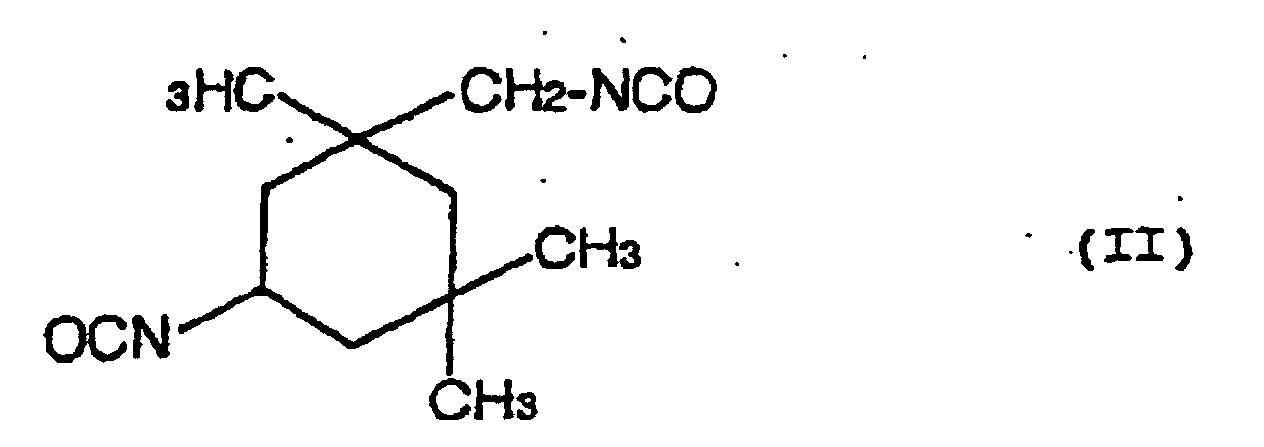
- Hydrolysestabilisator für ein Estergruppen-haltiges Harz gemäß Anspruch 1, wobei das Carbodiimid einen durchschnittlichen Polymerisationsgrad von 2 bis 30 besitzt.
- Hydrolysestabilisator für ein Estergruppen-haltiges Harz, welcher als Hauptkomponente ein Carbodiimid mit mindestens zwei Carbodiimidgruppen im Molekül umfasst und erhalten wird aus einer Mischung von Tetramethylxylylendiisocyanat, angegeben durch die Formel (III):mit 4,4'-Dicyclohexylmethandiisocyanat, angegeben durch die Formel (I):
 oder Isophorondiisocyanat, angegeben durch die Formel (II):
 oder einer Mischung von 4,4'-Dicyclohexylmethandiisocyanat der Formel (I) und Isophorondiisocyanat der Formel (II),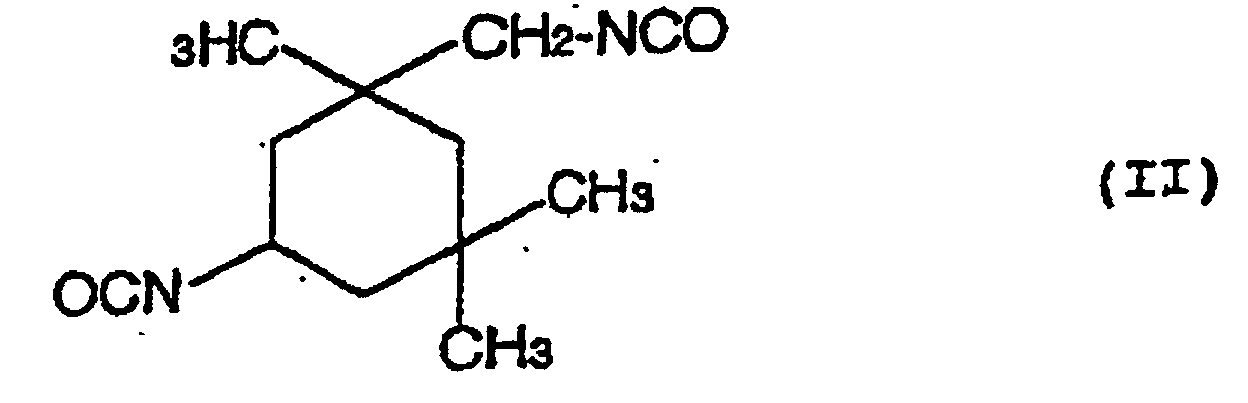
wobei das Carbodiimid mit einer Carbonsäure, einem Säureanhydrid oder einem Monoisocyanat endblockiert ist. - Hydrolysestabilisator für ein Estergruppen-haltiges Harz nach Anspruch 3, wobei das Carbodiimid einen durchschnittlichen Polymerisationsgrad von 2 bis 30 besitzt.
- Verfahren für die Hydrolysestabilisierung eines Estergruppen-haltigen Harzes, umfassend das Mischen des Estergruppen-haltigen Harzes mit einem Carbodiimid mit mindestens zwei Carbodiimidgruppen im Molekül, und erhalten aus 4,4'-Dicyclohexylmethandiisocyanat, angegeben durch die Formel (I):oder Isophorondiisocyanat, angegeben durch die Formel (II):
 oder einer Mischung von 4,4'-Dicyclohexylmethandiisocyanat der Formel (I) und Isophorondiisocyanat der Formel (II), wobei das Carbodiimid mit einer Carbonsäure, einem Säureanhydrid oder einem Monoisocyanat endblockiert ist.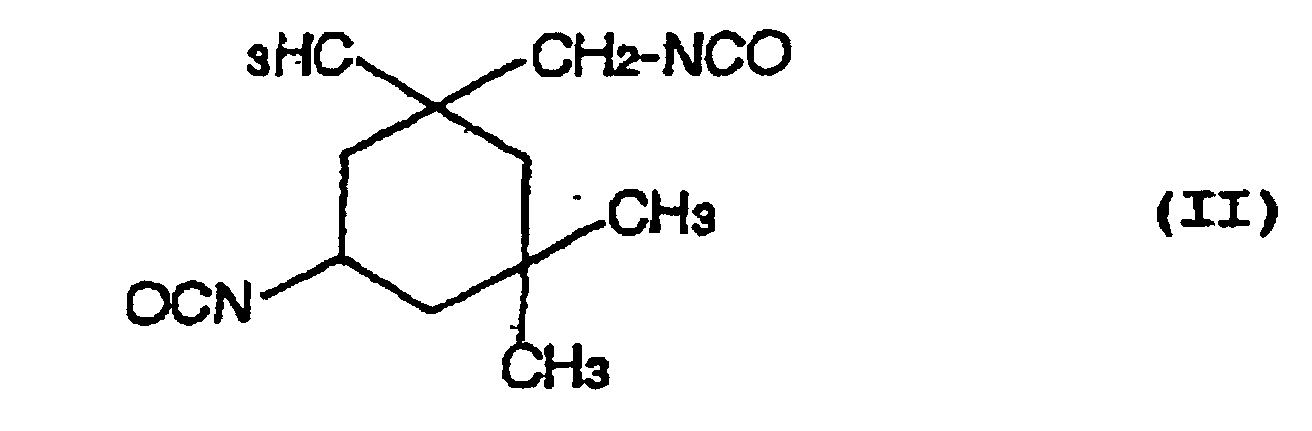
- Verfahren für die Hydrolysestabilisierung eines Estergruppen-haltigen Harzes gemäß Anspruch 5, wobei das Carbodiimid einen durchschnittlichen Polymerisationsgrad von 2 bis 30 besitzt.
- Verfahren für die Hydrolysestabilisierung eines Estergruppen-haltigen Harzes, umfassend das Mischen des Estergruppen-haltigen Harzes mit einem Carbodiimid mit mindestens zwei Carbodiimidgruppen im Molekül, und erhalten aus einer Mischung von Tetramethylxylylendiisocyanat, angegeben durch die Formel (III):mit 4,4'-Dicyclohexylmethandiisocyanat, angegeben durch die Formel (I):
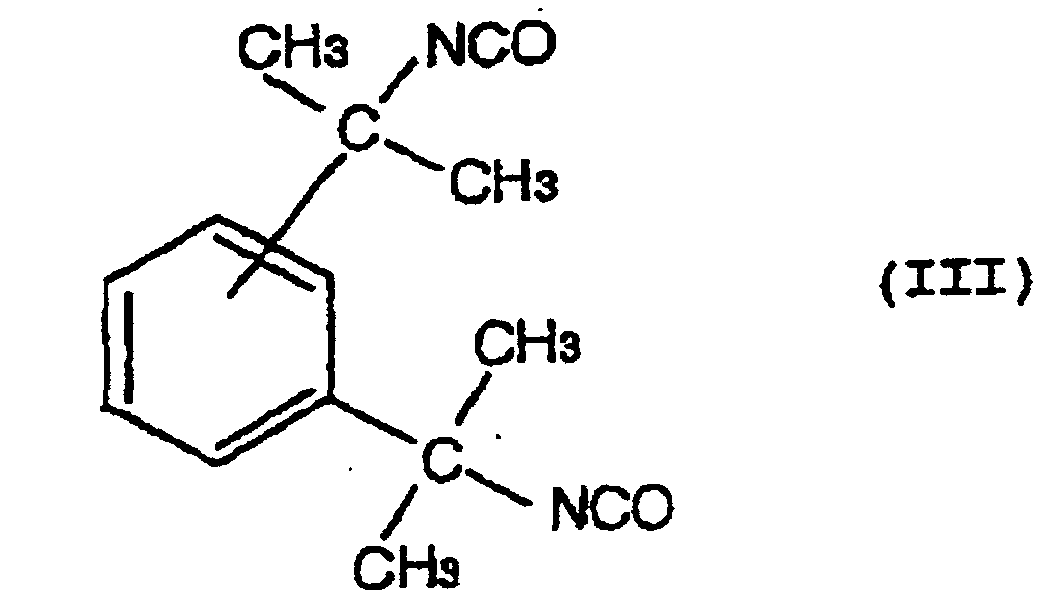 oder Isophorondiisocyanat, angegeben durch die Formel (II):
 oder einer Mischung von 4,4'-Dicyclohexylmethandiisocyanat der Formel (I) und Isophorondiisocyanat der Formel (II), wobei das Carbodiimid mit einer Carbonsäure, einem Säureanhydrid oder einem Monoisocyanat endblockiert ist.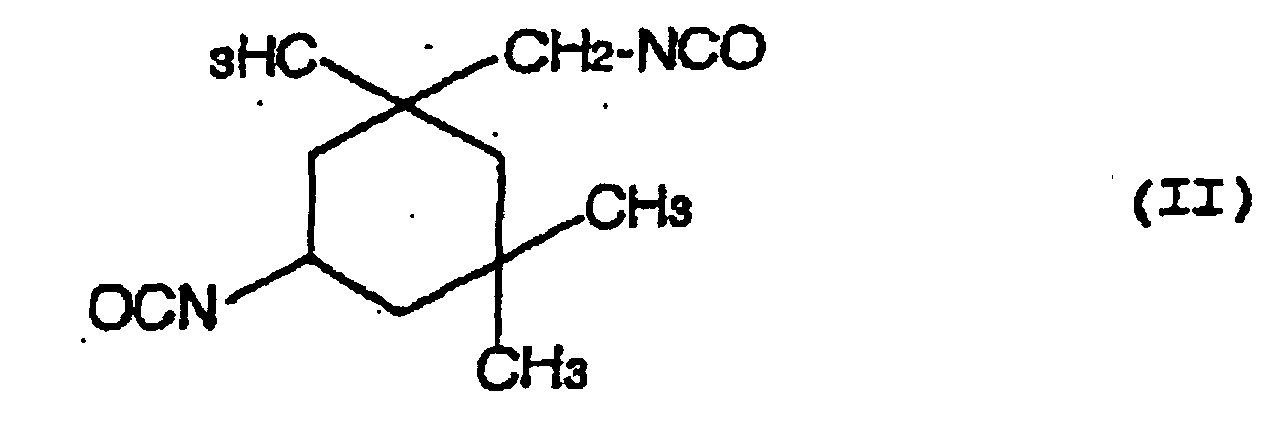
- Verfahren für die Hydrolysestabilisierung eines Estergruppen-haltigen Harzes gemäß Anspruch 7, wobei das Carbodiimid einen durchschnittlichen Polymerisationsgrad von 2 bis 30 besitzt.
Applications Claiming Priority (3)
| Application Number | Priority Date | Filing Date | Title |
|---|---|---|---|
| JP131383/96 | 1996-04-26 | ||
| JP13138396 | 1996-04-26 | ||
| JP13138396A JP3393752B2 (ja) | 1996-04-26 | 1996-04-26 | エステル基を有する樹脂用の耐加水分解安定剤及び該安定剤によるエステル基を有する樹脂の耐加水分解安定化方法 |
Publications (3)
| Publication Number | Publication Date |
|---|---|
| EP0803538A2 EP0803538A2 (de) | 1997-10-29 |
| EP0803538A3 EP0803538A3 (de) | 1998-04-15 |
| EP0803538B1 true EP0803538B1 (de) | 2003-10-22 |
Family
ID=15056678
Family Applications (1)
| Application Number | Title | Priority Date | Filing Date |
|---|---|---|---|
| EP97105933A Expired - Lifetime EP0803538B1 (de) | 1996-04-26 | 1997-04-10 | Hydrolysestabilisator für Estergruppen enthaltendes Harz und Verfahren zur Hydrolysestabilisation eines Estergruppen enthaltenden Harzes unter Verwendung besagten Hydrolysestabilisators |
Country Status (5)
| Country | Link |
|---|---|
| US (2) | US5889096A (de) |
| EP (1) | EP0803538B1 (de) |
| JP (1) | JP3393752B2 (de) |
| KR (1) | KR100450736B1 (de) |
| DE (1) | DE69725642T2 (de) |
Families Citing this family (31)
| Publication number | Priority date | Publication date | Assignee | Title |
|---|---|---|---|---|
| JP3393752B2 (ja) * | 1996-04-26 | 2003-04-07 | 日清紡績株式会社 | エステル基を有する樹脂用の耐加水分解安定剤及び該安定剤によるエステル基を有する樹脂の耐加水分解安定化方法 |
| US6147128A (en) * | 1998-05-14 | 2000-11-14 | Astenjohnson, Inc. | Industrial fabric and yarn made from recycled polyester |
| DE10007726A1 (de) * | 2000-02-19 | 2001-08-23 | Mitsubishi Polyester Film Gmbh | Transparente, siegelfähige, UV-stabilisierte und flammhemmend ausgerüstete Polyesterfolie, Verfahren zu ihrer Herstellung und ihre Verwendung |
| DE50112551D1 (de) * | 2000-09-29 | 2007-07-12 | Mitsubishi Polyester Film Gmbh | Hydrolysebeständig ausgerüstete, transparente, biaxial orientierte Folie aus einem kristallisierbaren Thermoplasten und Verfahren zu ihrer Herstellung |
| KR20020030007A (ko) * | 2000-09-29 | 2002-04-22 | 힐커트 | 결정성 열가소성 수지로부터 제조된 내가수분해성 투명이축배향 필름 및 그 제조방법 |
| DE10126149A1 (de) * | 2001-05-30 | 2002-12-05 | Mitsubishi Polyester Film Gmbh | Gedeckt eingefärbte, hydrolysebeständige, biaxial orientierte Folie aus einem kristallisierbaren Thermoplasten und Verfahren zu ihrer Herstellung |
| DE10206112A1 (de) * | 2002-02-13 | 2003-08-21 | Basf Ag | Wässrige Dispersionen, aufgebaut aus Polycarbodiimiden |
| EP1342746A1 (de) * | 2002-03-06 | 2003-09-10 | Mitsubishi Polyester Film GmbH | Biaxial orientierte, hydrolysebeständige Kondensatorfolie aus einem kristallisierbaren Thermoplasten, Verfahren zu ihrer Herstellung und ihre Verwendung |
| JP4084953B2 (ja) * | 2002-04-18 | 2008-04-30 | 日清紡績株式会社 | 生分解性プラスチック組成物とその成形品及び生分解速度制御方法 |
| JP4585749B2 (ja) * | 2003-08-07 | 2010-11-24 | 日清紡ホールディングス株式会社 | 黄変を抑えたカルボジイミド組成物、耐加水分解安定剤及び熱可塑性樹脂組成物 |
| JP2005082642A (ja) * | 2003-09-05 | 2005-03-31 | Nisshinbo Ind Inc | エステル基を有する樹脂用の耐加水分解安定剤及び熱可塑性樹脂組成物 |
| JP2008115197A (ja) * | 2005-03-04 | 2008-05-22 | Daicel Chem Ind Ltd | ノンハロゲン難燃化ポリエステルエラストマー組成物およびその製造方法 |
| JP4733010B2 (ja) * | 2006-12-25 | 2011-07-27 | 三洋化成工業株式会社 | ポリカルボジイミド及びポリエステル系ウレタン樹脂組成物 |
| US7863440B2 (en) * | 2006-12-28 | 2011-01-04 | Great Eastern Resins Industrial Co., Ltd. | Macrocyclic carbodiimides (MC-CDI) and their derivatives, syntheses and applications of the same |
| US8424045B2 (en) * | 2009-08-14 | 2013-04-16 | Lumexis Corporation | Video display unit docking assembly for fiber-to-the-screen inflight entertainment system |
| WO2011156571A1 (en) * | 2010-06-09 | 2011-12-15 | Toray Plastics (America), Inc. Lumirror Division | Optically clear uv and hydrolysis resistant polyester film |
| US20130046037A1 (en) * | 2011-08-17 | 2013-02-21 | Basf Se | Process for producing rigid polyurethane foams |
| CN102731439B (zh) * | 2012-06-07 | 2014-12-10 | 广州合成材料研究院有限公司 | 一种封端剂及抗水解树脂的合成方法 |
| CN104797615B (zh) | 2012-09-19 | 2017-07-11 | 巴斯夫欧洲公司 | 制备聚碳化二亚胺的方法 |
| JP6055319B2 (ja) | 2013-01-21 | 2016-12-27 | 日清紡ケミカル株式会社 | ポリエステル樹脂組成物の製造方法 |
| JP6227873B2 (ja) * | 2013-01-21 | 2017-11-08 | 日清紡ケミカル株式会社 | ポリエステル樹脂組成物 |
| JP6055353B2 (ja) | 2013-03-28 | 2016-12-27 | 日清紡ケミカル株式会社 | エステル系樹脂組成物、該エステル系樹脂組成物の製造方法、並びに該エステル系樹脂を用いた成形品 |
| JP5793585B2 (ja) * | 2014-02-05 | 2015-10-14 | 日清紡ケミカル株式会社 | ポリエステル系樹脂組成物、及び該ポリエステル系樹脂組成物を用いた成形品 |
| JP5793586B2 (ja) * | 2014-02-05 | 2015-10-14 | 日清紡ケミカル株式会社 | ポリエステル系樹脂組成物、該ポリエステル系樹脂組成物の製造方法、及び該ポリエステル系樹脂組成物を用いた成形品 |
| US10058502B2 (en) | 2015-12-31 | 2018-08-28 | L'oreal | Nail polish compositions |
| JP6633577B2 (ja) * | 2016-07-29 | 2020-01-22 | 三ツ星ベルト株式会社 | 熱硬化性ポリウレタン組成物及びその用途 |
| JP7757601B2 (ja) | 2018-01-23 | 2025-10-22 | ボスティック・ソシエテ・アノニム | 光硬化性シーリング用材料 |
| WO2019185409A1 (de) | 2018-03-29 | 2019-10-03 | Basf Se | Pvc-zusammensetzung, enthaltend wenigstens einen weichmacher der wenigstens eine carbonsäureestergruppe aufweist und wenigstens eine carbodiimidverbindung |
| JP2020070363A (ja) * | 2018-10-31 | 2020-05-07 | 日清紡ケミカル株式会社 | ポリエステル樹脂改質剤及びその製造方法、並びにポリエステル樹脂組成物 |
| JP7438787B2 (ja) * | 2020-02-26 | 2024-02-27 | 日清紡ケミカル株式会社 | ポリカルボジイミド化合物、エポキシ樹脂用硬化剤、及びエポキシ樹脂組成物 |
| WO2025224106A1 (en) | 2024-04-25 | 2025-10-30 | Basf Se | Use of a composition or thermosetting resin or thermoset polymer made therefrom as build-up film material in a printed circuit element |
Family Cites Families (17)
| Publication number | Priority date | Publication date | Assignee | Title |
|---|---|---|---|---|
| FR1310138A (de) * | 1960-12-02 | 1963-03-06 | ||
| US4419294A (en) * | 1982-03-08 | 1983-12-06 | American Cyanamid Company | Carbodiimide oligomers of tertiary aliphatic isocyanates |
| US4487964A (en) * | 1983-02-24 | 1984-12-11 | Union Carbide Corporation | Method of making mixed aliphatic/aromatic polycarbodiimides |
| US4820863A (en) * | 1986-03-31 | 1989-04-11 | Union Carbide Corporation | Surface active polycarbodiimides |
| DE3916874A1 (de) * | 1989-05-24 | 1990-11-29 | Basf Ag | Weiche, elastische polyurethan-folien, verfahren zu ihrer herstellung und ihre verwendung |
| DE4102174A1 (de) * | 1991-01-25 | 1992-07-30 | Basf Ag | Verfahren zur herstellung von zelligen polyurethan-elastomeren unter verwendung von polyethercarbonatdiolen als ausgangskomponente |
| DE4107454A1 (de) * | 1991-03-08 | 1992-09-10 | Basf Ag | Verbundelemente aus einer deck- und traegerschicht aus thermoplastischen polyurethanen, ein verfahren zu ihrer herstellung und ihre verwendung |
| AU1891492A (en) * | 1991-04-29 | 1992-12-21 | Ppg Industries, Inc. | A stable, one-package, non-gelled coating composition curable under ambient conditions |
| JP3165971B2 (ja) * | 1991-12-26 | 2001-05-14 | 日清紡績株式会社 | ポリテトラメチルキシリレンカルボジイミド |
| AU661794B2 (en) * | 1992-10-21 | 1995-08-03 | Bayer Aktiengesellschaft | A sheathing material for optical fibres, based on polyalkylene terephthalate/polycarbonate |
| US5837760A (en) * | 1994-03-16 | 1998-11-17 | Elastogran Gmbh | Self-extinguishing thermoplastic polyurethanes and their preparation |
| DE4410557A1 (de) * | 1994-03-26 | 1995-09-28 | Basf Lacke & Farben | Wäßriges Mehrkomponenten-Polyurethan-Beschichtungsmittel, Verfahren zu seiner Herstellung und seine Verwendung in Verfahren zur Herstellung einer Mehrschichtlackierung |
| JPH0827092A (ja) * | 1994-07-15 | 1996-01-30 | Nisshinbo Ind Inc | ウレア変性カルボジイミド及びその製造方法 |
| JP3335257B2 (ja) * | 1994-08-04 | 2002-10-15 | 日清紡績株式会社 | ウレア変性カルボジイミド及びその製造方法 |
| JPH09157588A (ja) * | 1995-10-04 | 1997-06-17 | Nisshinbo Ind Inc | ウレタン系塗料用硬化剤及びポリエステル/ウレタン系塗料 |
| JP3393752B2 (ja) * | 1996-04-26 | 2003-04-07 | 日清紡績株式会社 | エステル基を有する樹脂用の耐加水分解安定剤及び該安定剤によるエステル基を有する樹脂の耐加水分解安定化方法 |
| US5900439A (en) * | 1996-09-02 | 1999-05-04 | Basf Aktiengesellschaft | Stabilized polyurethanes |
-
1996
- 1996-04-26 JP JP13138396A patent/JP3393752B2/ja not_active Expired - Lifetime
-
1997
- 1997-04-09 US US08/826,967 patent/US5889096A/en not_active Expired - Lifetime
- 1997-04-10 DE DE69725642T patent/DE69725642T2/de not_active Expired - Lifetime
- 1997-04-10 EP EP97105933A patent/EP0803538B1/de not_active Expired - Lifetime
- 1997-04-25 KR KR1019970015584A patent/KR100450736B1/ko not_active Expired - Lifetime
-
1998
- 1998-12-23 US US09/219,352 patent/US6126860A/en not_active Expired - Lifetime
Also Published As
| Publication number | Publication date |
|---|---|
| US6126860A (en) | 2000-10-03 |
| KR970070071A (ko) | 1997-11-07 |
| US5889096A (en) | 1999-03-30 |
| EP0803538A3 (de) | 1998-04-15 |
| EP0803538A2 (de) | 1997-10-29 |
| JPH09296097A (ja) | 1997-11-18 |
| JP3393752B2 (ja) | 2003-04-07 |
| KR100450736B1 (ko) | 2004-12-04 |
| DE69725642D1 (de) | 2003-11-27 |
| DE69725642T2 (de) | 2004-04-29 |
Similar Documents
| Publication | Publication Date | Title |
|---|---|---|
| US5889096A (en) | Hydrolysis stabilizer for ester group-containing resin and process for hydrolysis stabilization of ester group-containing resin using said hydrolysis stabilizer | |
| KR100307257B1 (ko) | 1,3-비스(1-메틸-1-이소시아네이토에틸)벤젠을기재로하는카르보디이미드및/또는올리고머폴리카르보디이미드,이들의제조방법및가수분해안정화제로서의이들의사용방법 | |
| US5504241A (en) | Carbodiimides and/or oligomeric polycarbodiimides based on 1,3-bis(1-methyl-1-isocyanatoethyl)benzene, their preparation, and their use as hydrolysis stabilizers | |
| EP0799843B1 (de) | Carbodiimide enthaltende Polyurethanharze | |
| US5597942A (en) | Carbodiimides and/or oligomeric polycarbodiimides based on 1 3-bis (1-methyl-1-isocyanatoethyl) benzene their use as hydrolysis stabilizers | |
| CN109952333B (zh) | 聚碳化二亚胺共聚物 | |
| EP0460481A2 (de) | Verfahren zur Stabilisierung von Estergruppen enthaltenden Kunststoffen | |
| KR19990077603A (ko) | 카르보디이미드및그의제조방법 | |
| US5912290A (en) | Hydrolysis stabilizer for ester group-containing resin | |
| DE10015658A1 (de) | Blockcopolymere auf Basis von Polycarbodiimiden, ein Verfahren zu ihrer Herstellung und ihre Verwendung als Hydrolysestabilisatoren | |
| US5637769A (en) | Urea-modified carbodiimide and process for production thereof | |
| EP4053201A1 (de) | Kompatibilisierungsmittel und polyesterharzzusammensetzung | |
| JP3388990B2 (ja) | 不飽和ポリエステル樹脂用の耐加水分解安定剤及び該耐加水分解安定剤による不飽和ポリエステル樹脂の耐加水分解安定化方法 | |
| EP0850985A1 (de) | Mittel zur Verbesserung der Resistenz von Estergruppen enthaltendem Harz gegen mikrobielle Schädigung, Methode zur Verbesserung besagter Resistenz, und Harzzusammensetzung mit Resistenz gegen mikrobielle Schädigung | |
| WO2005111048A1 (de) | Carbodiimide enthaltend harnstoffgruppen und silangruppen | |
| CA2427046C (en) | A process for making polyaziridines | |
| EP0808828A2 (de) | Carbodiimide mit Doppelbindungen | |
| JP7232697B2 (ja) | ポリエステル系樹脂組成物 | |
| CA1081894A (en) | Stabilized thermoplastic polyesterurethanes | |
| US20240294693A1 (en) | Aromatic carbodiimides, process for the preparation and use thereof | |
| JP2000256436A (ja) | カルボジイミド、その製造法、使用法、およびカルボジイミドを含む混合物 | |
| EP0978511B1 (de) | N,N'-disubstituierte N-(2-hydroxyalkyl)-Harnstoffe | |
| DE112005000561B4 (de) | Carbodiimide enthaltend Silangruppen | |
| KR20240117160A (ko) | 중합체 카보다이이미드, 이의 제조 방법 및 이의 용도 | |
| JP2026503164A (ja) | ポリマー安定剤としてのポリカルボジイミド組成物 |
Legal Events
| Date | Code | Title | Description |
|---|---|---|---|
| PUAI | Public reference made under article 153(3) epc to a published international application that has entered the european phase |
Free format text: ORIGINAL CODE: 0009012 |
|
| AK | Designated contracting states |
Kind code of ref document: A2 Designated state(s): DE FR GB |
|
| PUAL | Search report despatched |
Free format text: ORIGINAL CODE: 0009013 |
|
| AK | Designated contracting states |
Kind code of ref document: A3 Designated state(s): DE FR GB |
|
| 17P | Request for examination filed |
Effective date: 19980525 |
|
| 17Q | First examination report despatched |
Effective date: 20020924 |
|
| GRAH | Despatch of communication of intention to grant a patent |
Free format text: ORIGINAL CODE: EPIDOS IGRA |
|
| GRAS | Grant fee paid |
Free format text: ORIGINAL CODE: EPIDOSNIGR3 |
|
| GRAA | (expected) grant |
Free format text: ORIGINAL CODE: 0009210 |
|
| AK | Designated contracting states |
Kind code of ref document: B1 Designated state(s): DE FR GB |
|
| REG | Reference to a national code |
Ref country code: GB Ref legal event code: FG4D |
|
| REF | Corresponds to: |
Ref document number: 69725642 Country of ref document: DE Date of ref document: 20031127 Kind code of ref document: P |
|
| ET | Fr: translation filed | ||
| PLBE | No opposition filed within time limit |
Free format text: ORIGINAL CODE: 0009261 |
|
| STAA | Information on the status of an ep patent application or granted ep patent |
Free format text: STATUS: NO OPPOSITION FILED WITHIN TIME LIMIT |
|
| 26N | No opposition filed |
Effective date: 20040723 |
|
| PGFP | Annual fee paid to national office [announced via postgrant information from national office to epo] |
Ref country code: FR Payment date: 20070411 Year of fee payment: 11 |
|
| REG | Reference to a national code |
Ref country code: FR Ref legal event code: ST Effective date: 20081231 |
|
| PG25 | Lapsed in a contracting state [announced via postgrant information from national office to epo] |
Ref country code: FR Free format text: LAPSE BECAUSE OF NON-PAYMENT OF DUE FEES Effective date: 20080430 |
|
| PGFP | Annual fee paid to national office [announced via postgrant information from national office to epo] |
Ref country code: DE Payment date: 20160405 Year of fee payment: 20 Ref country code: GB Payment date: 20160406 Year of fee payment: 20 |
|
| REG | Reference to a national code |
Ref country code: DE Ref legal event code: R071 Ref document number: 69725642 Country of ref document: DE |
|
| REG | Reference to a national code |
Ref country code: GB Ref legal event code: PE20 Expiry date: 20170409 |
|
| PG25 | Lapsed in a contracting state [announced via postgrant information from national office to epo] |
Ref country code: GB Free format text: LAPSE BECAUSE OF EXPIRATION OF PROTECTION Effective date: 20170409 |