EP0802261A1 - Enzymatische Acylierung eines Retinolderivates - Google Patents
Enzymatische Acylierung eines Retinolderivates Download PDFInfo
- Publication number
- EP0802261A1 EP0802261A1 EP97105918A EP97105918A EP0802261A1 EP 0802261 A1 EP0802261 A1 EP 0802261A1 EP 97105918 A EP97105918 A EP 97105918A EP 97105918 A EP97105918 A EP 97105918A EP 0802261 A1 EP0802261 A1 EP 0802261A1
- Authority
- EP
- European Patent Office
- Prior art keywords
- lipase
- dihydro
- hydroxy
- retinol
- acetate
- Prior art date
- Legal status (The legal status is an assumption and is not a legal conclusion. Google has not performed a legal analysis and makes no representation as to the accuracy of the status listed.)
- Granted
Links
Classifications
-
- C—CHEMISTRY; METALLURGY
- C12—BIOCHEMISTRY; BEER; SPIRITS; WINE; VINEGAR; MICROBIOLOGY; ENZYMOLOGY; MUTATION OR GENETIC ENGINEERING
- C12P—FERMENTATION OR ENZYME-USING PROCESSES TO SYNTHESISE A DESIRED CHEMICAL COMPOUND OR COMPOSITION OR TO SEPARATE OPTICAL ISOMERS FROM A RACEMIC MIXTURE
- C12P7/00—Preparation of oxygen-containing organic compounds
- C12P7/62—Carboxylic acid esters
-
- C—CHEMISTRY; METALLURGY
- C12—BIOCHEMISTRY; BEER; SPIRITS; WINE; VINEGAR; MICROBIOLOGY; ENZYMOLOGY; MUTATION OR GENETIC ENGINEERING
- C12P—FERMENTATION OR ENZYME-USING PROCESSES TO SYNTHESISE A DESIRED CHEMICAL COMPOUND OR COMPOSITION OR TO SEPARATE OPTICAL ISOMERS FROM A RACEMIC MIXTURE
- C12P23/00—Preparation of compounds containing a cyclohexene ring having an unsaturated side chain containing at least ten carbon atoms bound by conjugated double bonds, e.g. carotenes
Definitions
- the present invention relates to a new process for the preparation of (11Z, 13Z) -7,10-dihydro-10-hydroxy-retinyl-acylates [(2Z, 4Z, 7E) -carboxylic acid-3,7-dimethyl-6-hydroxy- 9- [2 ', 2', 6'-trimethyl-cyclohex-6'-en-1'-yl] nona-2,4,7-trienyl ester] of the formula where R is a C 1-23 alkyl group or C 2-23 alkenyl group (as will be explained in more detail below), by enzyme-catalyzed, selective monoacylation of (11Z, 13Z) -7,10-dihydro-10-hydroxy- retinol [(2Z, 4Z, 7E) -3,7-dimethyl-9- [2 ', 2', 6'-trimethyl-cyclohex-6'-en-1'-yl] nona-2,4,7- triene-1,6-di
- the (11Z, 13Z) -7,10-dihydro-10-acetoxy-retinyl acetate of the formula III is inert under the conditions of the catalytic dehydration and thus does not only interfere with the processing of (11Z, 13Z) -7.10- Dihydro-10-hydroxy-retinyl acetate (of the formula I in which R denotes methyl) but also when working up vitamin A acetate. Therefore, a process is of great technical interest not only for the selective monoacetylation, but also generally for the selective monoacylation of (11Z, 13Z) -7,10-dihydro-10-hydroxy-retinol of the formula II.
- the present invention is based on the object of a process for the preparation of (11Z, 13Z) -7,10-dihydro-10-hydroxy-retinyl-acylates of the formula I by esterification of (11Z, 13Z) -7,10-dihydro
- To provide -10-hydroxy-retinol which does not have the disadvantages of the previously known procedures (for example undesired formation of (11Z, 13Z) -7,10-dihydro-10-acetoxy-retinyl acetate of the formula III).
- this object was achieved in that the acylation of (11Z, 13Z) -7,10-dihydro-10-hydroxy-retinol of the formula II in the presence of a lipase (enzyme class EC 3.1.1.3) and under very specific Pre and reaction conditions is carried out.
- the present invention relates to a process for the preparation of a (11Z, 13Z) -7,10-dihydro-10-hydroxy-retinyl-acylate of the above formula I, wherein R is a C 1-23 alkyl group or a 1 to 3 double bonds having C 2-23 alkenyl group, which is characterized in that (11Z, 13Z) -7,10-dihydro-10-hydroxy-retinol of the formula II also given above in an organic solvent is selectively monoacylated in the presence of an acylating agent with a lipase in suspension.
- Tetrahedron Asymmetry 4 , 757-760 (1993) describes the resolution of 2-methyl-5- (4-methoxyphenyl) pentane-1,3-diol by esterification with vinyl acetate in the presence of immobilized lipase PS, the yield of monoacylated product 66% and the optical purity 42% ee.
- Tetrahedron Lett. 31 , 3405-3408 (1990) describes the selective acylation of aliphatic 1, n-diols with anhydrides in the presence of lipase from porcine pancreas, the selectivities being ⁇ 98% and the yields being ⁇ 95%.
- Lipases suitable for the purpose of the present invention are those of the enzyme class EC 3.1.1.3, which show good activity and selectivity, in particular Lipase PL from Alcaligenes sp ., Their immobilized forms Lipase PLC and Lipase PLG, and Lipase MY-30 from Candida cylindracea ( renamed Candida rugosa ) (Meito Sangyo, Tokyo, Japan), Lipozyme® IM-20 from Mucor miehei (renamed Rhizomucor miehei ) (Novo Nordisk, Bagsvaerd, Denmark), Lipase CE-5 from Humicola lanuginosa and Lipase G from Penicillium cyclopium (both Amano Pharmaceutical Co.
- Lipase PL, Lipase PLC, Lipase PLG, Lipozyme® IM-20 and Chirazyme® L-2 are particularly preferred, very particularly preferred Lipase PL, Lipase PLC, Lipase PLG and Chirazyme® L-2.
- C 1-23 alkyl group or “C 2-23 alkenyl group having 1 to 3 double bonds” (R) is understood to mean both straight-chain and branched alkyl or alkenyl groups, depending on the number of carbon atoms.
- Examples of the C 1-23 alkyl groups are methyl, ethyl, propyl, pentyl, heptyl, undecyl, pentadecyl and heptadecyl, or the C 2-23 alkenyl groups 8-heptadecenyl and heptadeca-8,11-dienyl.
- RCO alkanoyl and alkenoyl
- the lipase which is available in the commercially available form as powder, grains or small spheres, is up to 20% by weight (% by weight) based on (11Z, 13Z) -7, 10-dihydro-10-hydroxy-retinol) is used, but the proportion of lipase is preferred between approximately 0.1% by weight and approximately 10% by weight, particularly preferably between approximately 1% by weight and approximately 5% by weight.
- organic solvents which are suitable for the purpose of the present invention, there may be mentioned: aliphatic hydrocarbons with 5-8 carbon atoms, such as hexane and heptane; alicyclic hydrocarbons with 6-10 carbon atoms, such as cyclohexane, methylcyclohexane and decalin; chlorinated aliphatic hydrocarbons such as methylene chloride, chloroform and carbon tetrachloride; nitro substituted aliphatic hydrocarbons such as nitromethane; aromatic hydrocarbons such as toluene and xylene; aliphatic ethers such as 1,2-dimethoxyethane, diethyl ether, diisopropyl ether and tert-butyl methyl ether; cyclic ethers such as tetrahydrofuran, methylfuran and 1,4-dioxane; aliphatic esters such as trimethyl orthoformate, ethyl acetate
- the various common alkyl and alkenyl acylates such as methyl acetate, ethyl acetate, butyl acetate, vinyl acetate, allyl acetate, isopropenyl acetate, ethyl propionate, ethyl butyrate and vinyl propionate, and esters of longer-chain fatty acids, e.g. Vinyl laurate.
- Ethyl acetate, butyl acetate or vinyl acetate, particularly preferably vinyl acetate is preferably used for the acetylation.
- the amount of acylating agent used can be between 1 mol equivalent and a multiple excess; The acylating agent is used in excess, in particular, if it simultaneously serves as a solvent, which can be the case with the alkyl and alkenyl acylates.
- the concentration of (11Z, 13Z) -7,10-dihydro-10-hydroxy-retinol is expediently 10% to 50%, preferably 20% to 40% [in weight / volume (W / V) printed out]:
- the solubility of the educt is controlled by the choice of solvent or solvent mixture and / or the temperature.
- the reaction temperature is advantageously between about 10 ° C. and the reflux temperature of the reaction mixture, preferably between room temperature and about 90 ° C., particularly preferably between room temperature and about 60 ° C.
- the (11Z, 13Z) -7,10-dihydro-10-hydroxy-retinol need not be dissolved at the beginning of the reaction; rather, a suspension can also be present at the start of the reaction.
- the immobilization of the lipase can also take place in the presence of a "bile salt" (co-immobilization), as a result of which the activity can be increased in part (activator).
- Suitable bile salts include sodium cholate and sodium deoxycholate.
- reaction with the lipase is expediently carried out under an inert gas atmosphere, e.g. Nitrogen or argon, and in the dark and / or in the presence of a radical scavenger, e.g. Hydroquinone or 2,6-di (tert.butyl) -p-cresol.
- an inert gas atmosphere e.g. Nitrogen or argon
- a radical scavenger e.g. Hydroquinone or 2,6-di (tert.butyl) -p-cresol.
- the catalyst can be filtered off in a batch process and reused.
- the water content of the reaction solution - and thus the lipase - plays a role in the stability and activity of the lipase.
- the addition of a small amount of water ( ⁇ 0.2% of the reaction solution) has a positive influence on the lipase activity; weakly basic solutions, such as ammonium bicarbonate or ammonium hydroxide solutions, or organic bases, e.g. Triethylamine or ethyldiisopropylamine.
- the water can also be added periodically or in the sense of an equilibration step.
- the purity of the starting material is also decisive: by appropriate cleaning of the starting material, which is obtained from the preliminary stage, among other things. still contains heavy metals, the long-term stability of the lipase preparation can be considerably improved. Filtration through various auxiliaries, such as diatomaceous earth, silica gel, ethylenediaminetetraacetic acid (EDTA) salts and aluminum oxide, and washing with aqueous EDTA solution at a pH of around 8 have proven to be simple and effective cleaning processes among others the heavy metal content of the educt can be reduced and the effectiveness of the lipase preparation can be improved.
- auxiliaries such as diatomaceous earth, silica gel, ethylenediaminetetraacetic acid (EDTA) salts and aluminum oxide
- the process according to the invention can be carried out as a repeated batch process or as a continuous process, using conventional reactor types, such as, for example, a fixed bed reactor, tubular reactor, fiber reactor, circulation reactor, fluidized bed reactor (with intermediate floor) or slurry reactor.
- reactor types such as, for example, a fixed bed reactor, tubular reactor, fiber reactor, circulation reactor, fluidized bed reactor (with intermediate floor) or slurry reactor.
- Another aspect of the present invention is the above-mentioned use of a (11Z, 13Z) -7,10-dihydro-10-hydroxy retinyl acylate obtained according to the invention, preferably the acetate, for the preparation of the corresponding vitamin A acylate or the vitamin A-acetate.
- Lipase PL and 0.5 mg cholate salt (sodium cholate, sodium deoxycholate) were dissolved in 2.0 ml bidistilled water and added to 2.5 g DICALITE® Speedex or sea sand suspended in 6 ml bidistilled water. The suspension was carefully dried as described in Example 4 and the dried material was ground if necessary.
- cholate salt sodium cholate, sodium deoxycholate
- the filtrate was first evaporated together with the washing solution and then first together with two 300 ml portions of hexane and then with 300 ml pentane, in order to azeotropically remove traces of acetic acid formed. After drying under high vacuum at 35 ° for about 16 hours, 56.73 g (163.7 mmol, 99%) (11Z, 13Z) -7,10-dihydro-10-hydroxy-retinyl acetate were obtained as a pale yellowish oil.
- Example 11 The procedure was as described in Example 11, except that the (11Z, 13Z) -7,10-dihydro-10-hydroxy-retinol was cleaned as described in Example 9B using DICALITE® Speedex. The results are shown graphically as follows:
- the homogeneous mixture was filtered through a membrane filter [RC60, 1 ⁇ m, Schleicher & Schuell AG, Dassel, Germany (S&S)] and then through a column of 10 mm in diameter, which was washed in succession with 7 g of DICALITE® Speedex and 600 mg of Lipase PLC (Meito Sangyo) was pumped at a flow rate of 0.5 ml / minute. The temperature was varied between 20 and 50 °. Reaction samples were taken in each case and analyzed by SFC and HPLC. The results are shown graphically as follows:
Landscapes
- Organic Chemistry (AREA)
- Chemical & Material Sciences (AREA)
- Engineering & Computer Science (AREA)
- Life Sciences & Earth Sciences (AREA)
- Zoology (AREA)
- Wood Science & Technology (AREA)
- Health & Medical Sciences (AREA)
- General Engineering & Computer Science (AREA)
- General Chemical & Material Sciences (AREA)
- Chemical Kinetics & Catalysis (AREA)
- Biotechnology (AREA)
- Biochemistry (AREA)
- Bioinformatics & Cheminformatics (AREA)
- Microbiology (AREA)
- General Health & Medical Sciences (AREA)
- Genetics & Genomics (AREA)
- Preparation Of Compounds By Using Micro-Organisms (AREA)
- Enzymes And Modification Thereof (AREA)
- Organic Low-Molecular-Weight Compounds And Preparation Thereof (AREA)
- Thermotherapy And Cooling Therapy Devices (AREA)
- Steroid Compounds (AREA)
- Acyclic And Carbocyclic Compounds In Medicinal Compositions (AREA)
Abstract
Description
- Die vorliegende Erfindung betrifft ein neues Verfahren zur Herstellung von (11Z,13Z)-7,10-Dihydro-10-hydroxy-retinyl-acylaten [(2Z,4Z,7E)-Carbonsäure-3,7-dimethyl-6-hydroxy-9-[2',2',6'-trimethyl-cyclohex-6'-en-1'-yl]nona-2,4,7-trienylester] der Formel

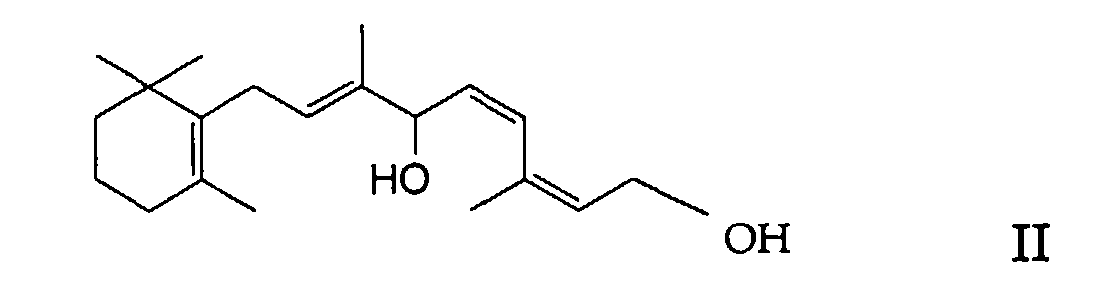

- Das (11Z,13Z)-7,10-Dihydro-10-acetoxy-retinyl-acetat der Formel III ist unter den Bedingungen der katalytischen Dehydratisierung inert und stört somit nicht nur bei der Aufarbeitung von (11Z,13Z)-7,10-Dihydro-10-hydroxy-retinyl-acetat (der Formel I, in der R Methyl bedeutet) sondern auch bei der Aufarbeitung von Vitamin A-acetat. Deshalb ist ein Verfahren nicht nur für die selektive Monoacetylierung, sondern generell auch für die selektive Monoacylierung von (11Z,13Z)-7,10-Dihydro-10-hydroxy-retinol der Formel II von grossem technischem Interesse.
- Der vorliegenden Erfindung liegt nun die Aufgabe zugrunde, ein Verfahren zur Herstellung von (11Z,13Z)-7,10-Dihydro-10-hydroxy-retinyl-acylaten der Formel I durch Veresterung von (11Z,13Z)-7,10-Dihydro-10-hydroxy-retinol bereitzustellen, das die Nachteile der vorbekannten Arbeitsweisen (z.B. unerwünschte Bildung von (11Z,13Z)-7,10-Dihydro-10-acetoxy-retinyl-acetat der Formel III) nicht aufweist. Dazu ist es notwendig, dass die Enzym-katalysierte Reaktion äusserst selektiv und in hohen Ausbeuten verläuft und dass das Enzym die katalytische Wirkung bereits in geringen Mengen entfaltet, sich leicht abtrennen und mehrfach wiederverwenden lässt.
- Im Rahmen der vorliegenden Erfindung wurde diese Aufgabe dadurch gelöst, dass die Acylierung von (11Z,13Z)-7,10-Dihydro-10-hydroxy-retinol der Formel II in Gegenwart einer Lipase (Enzymklasse EC 3.1.1.3) und unter ganz spezifischen Vor- und Reaktionsbedingungen durchgeführt wird.
- Demnach betrifft die vorliegende Erfindung ein Verfahren zur Herstellung eines (11Z,13Z)-7,10-Dihydro-10-hydroxy-retinyl-acylats der oben angegebenen Formel I, worin R eine C1-23-Alkylgruppe oder eine 1 bis 3 Doppelbindungen aufweisende C2-23-Alkenylgruppe bedeutet, welches dadurch gekennzeichnet ist, dass (11Z,13Z)-7,10-Dihydro-10-hydroxy-retinol der ebenfalls oben angegebenen Formel II in einem organischen Lösungsmittel in Gegenwart eines Acylierungsmittels mit einer in Suspension vorliegenden Lipase selektiv monoacyliert wird.
- Die selektive Acylierung primärer Hydroxygruppen neben sekundären in Gegenwart von Lipasen ist aus der Literatur bekannt. So wird beispielsweise gemäss J. Org. Chem. 55, 2366-2369 (1990) die Acylierung von Amphenicolen, d.h. von phenylsubstituierten kurzkettigen aliphatischen Diolen, durch Veresterung mit einem Trifluorethylacylat oder einem cyclischen Anhydrid unter Verwendung einer aus Pseudomonas cyclopium isolierten Lipase durchgeführt, wobei die Ausbeute 83% bzw. 64% beträgt, ohne dass die Reinheit angegeben ist.
- In Tetrahedron: Asymmetry 4, 757-760 (1993) ist die Racematspaltung von 2-Methyl-5-(4-methoxyphenyl)-pentan-1,3-diol durch Veresterung mit Vinylacetat in Gegenwart von immobilisierter Lipase PS beschrieben, wobei die Ausbeute an monoacyliertem Produkt 66% und die optische Reinheit 42% e.e. beträgt.
- In Appl. Biochem. Biotechnol. 11, 401-407 (1985) wurde eine Serie von 1,2- und 1,3-Diolen (gelöst in Ethylacylaten) mit Lipase aus Schweinepankreas in Ausbeuten von ≤97% acyliert.
- Gemäss J. Chem. Soc., Chem. Commun., 1989, 1535-1536 wurde 2-Ethyl-hexan-1,3-diol mit Lipase aus Schweinepankreas in 60%iger Ausbeute acyliert.
- Tetrahedron Lett. 31, 3405-3408 (1990) beschreibt die selektive Acylierung von aliphatischen 1,n-Diolen mit Anhydriden in Gegenwart von Lipase aus Schweinepankreas, wobei die Selektivitäten ≤98% und die Ausbeuten ≤95% betrugen.
- In Ind. J. Chem. 32, 30-34 (1993) ist die selektive Acylierung (98% Selektivität) von 1,5-Hexandiol mit n-Decansäure mit Lipase aus Chromobacterium viscosum beschrieben.
- Alle diese vorbekannten Verfahren weisen gewichtige Nachteile auf: so liefern zwar alle diese Verfahren die erwünschten Produkte, doch lässt die Selektivität und damit die Reinheit und/oder die Ausbeute zu wünschen übrig. Darüber hinaus ist in keiner dieser Literaturstellen von einer mehrmaligen Verwendung der eingesetzten Lipase, also von der Stabilität der Lipase, die Rede, geschweige denn von einer gleichzeitigen Substratreinigung.
- Die Acylierung von (11Z,13Z)-7,10-Dihydro-10-hydroxy-retinol der Formel II erfolgt wie bereits erwähnt in einem - vorzugsweise nahezu wasserfreien - organischen Lösungsmittel in Gegenwart eines Acylierungsmittels mit einer in Suspension vorliegenden Lipase.
- Für den Zweck der vorliegenden Erfindung geeignete Lipasen sind solche der Enzymklasse EC 3.1.1.3, welche gute Aktivität und Selektivität zeigen, insbesondere Lipase PL aus Alcaligenes sp., deren immobilisierte Formen Lipase PLC und Lipase PLG, und Lipase MY-30 aus Candida cylindracea (umbenannt Candida rugosa) (Firma Meito Sangyo, Tokyo, Japan), Lipozyme® IM-20 aus Mucor miehei (umbenannt Rhizomucor miehei) (Firma Novo Nordisk, Bagsvaerd, Dänemark), Lipase CE-5 aus Humicola lanuginosa und Lipase G aus Penicillium cyclopium (beide Firma Amano Pharmaceutical Co. Ltd., Nagoya, Japan) sowie Chirazyme® L-2 aus Candida antarctica (Firma Boehringer Mannheim GmbH, Deutschland; ehemals Novozym® SP 435 der Firma Novo Nordisk). Besonders bevorzugt sind Lipase PL, Lipase PLC, Lipase PLG, Lipozyme® IM-20 und Chirazyme® L-2, ganz besonders bevorzugt Lipase PL, Lipase PLC, Lipase PLG und Chirazyme® L-2.
- Unter dem Ausdruck "C1-23-Alkylgruppe" oder "1 bis 3 Doppelbindungen aufweisende C2-23-Alkenylgruppe" (R) sind je nach Anzahl der Kohlenstoffatome sowohl geradkettige als auch verzweigte Alkyl- bzw. Alkenylgruppen zu verstehen. Beispiele der C1-23-Alkylgruppen sind Methyl, Ethyl, Propyl, Pentyl, Heptyl, Undecyl, Pentadecyl und Heptadecyl, bzw. der C2-23-Alkenylgruppen 8-Heptadecenyl und Heptadeca-8,11-dienyl. Die entsprechenden Alkanoyl- und Alkenoylgruppen (RCO) sind Acetyl, Propionyl, Butyryl, Lauryl, Caproyl, Capryl, Palmitoyl und Stearoyl bzw. Oleoyl und Linolyl. Eine besonders bevorzugte Bedeutung von R ist Methyl, wobei es sich bei dem erfindungsgemässen Verfahren um eine Enzymkatalysierte, selektive Monoacetylierung handelt.
- Im Batch-Verfahren wird die Lipase, welche in kommerziell erhältlicher Form als Pulver, Körner oder kleine Kugeln vorliegt, in bis zu 20 Gewichts-(Gew.-)% (Gew./Gew. bezogen auf (11Z,13Z)-7,10-Dihydro-10-hydroxy-retinol) eingesetzt, vorzugsweise liegt jedoch der Anteil Lipase zwischen etwa 0,1 Gew.-% und etwa 10 Gew.-%, besonders bevorzugt zwischen etwa 1 Gew.-% und etwa 5 Gew.-%.
- Als organische Lösungsmittel, welche sich für den Zweck der vorliegenden Erfindung eignen, können genannt werden: aliphatische Kohlenwasserstoffe mit 5-8 Kohlenstoffatomen, wie Hexan und Heptan; alicyclische Kohlenwasserstoffe mit 6-10 Kohlenstoffatomen, wie Cyclohexan, Methylcyclohexan und Decalin; chlorierte aliphatische Kohlenwasserstoffe, wie Methylenchlorid, Chloroform und Tetrachlorkohlenstoff; nitrosubstituierte aliphatische Kohlenwasserstoffe, wie Nitromethan; aromatische Kohlenwasserstoffe, wie Toluen und Xylen; aliphatische Ether, wie 1,2-Dimethoxyethan, Diethylether, Diisopropylether und tert.-Butylmethylether; cyclische Ether, wie Tetrahydrofuran, Methylfuran und 1,4-Dioxan; aliphatische Ester, wie Trimethylorthoformiat, Ethylacetat, Butylacetat, Vinylacetat, Vinylpropionat und Isopropenylacetat; aliphatische Ketone, wie Aceton; aliphatische Nitrile, wie Acetonitril; aliphatische Amine, wie Triethylamin; aliphatische Acetale, wie Formaldehyd-dimethylacetal; und Gemische solcher Lösungsmittel. Bevorzugt sind Hexan, Cyclohexan, Methylenchlorid, Tetrachlorkohlenstoff, Toluen, Diisopropylether, Vinylacetat, Vinylpropionat, Tetrahydrofuran, Methylfuran und Formaldehyd-dimethylacetal, insbesondere Methylenchlorid, Diisopropylether, Vinylacetat, Vinylpropionat, Tetrahydrofuran, Formaldehyd-dimethylacetal und Gemische dieser Lösungsmittel.
- Als Acylierungsmittel können die verschiedenen gängigen Alkyl- und Alkenylacylate, wie Methylacetat, Ethylacetat, Butylacetat, Vinylacetat, Allylacetat, Isopropenylacetat, Ethylpropionat, Ethylbutyrat und Vinylpropionat sowie Ester längerkettiger Fettsäuren, z.B. Vinyllaurat, eingesetzt werden. Bevorzugt wird zur Acetylierung Ethylacetat, Butylacetat oder Vinylacetat, besonders bevorzugt Vinylacetat, verwendet. Für die Herstellung des Propionats (R = Ethyl) ist Vinylpropionat bevorzugt, und auch für die Herstellung längerkettiger Acylate sind die Vinyl-Ester der entsprechenden Fettsäuren bevorzugt. Die Menge an eingesetztem Acylierungsmittel kann zwischen 1 Mol-Aequivalent und einem mehrfachen Ueberschuss liegen; das Acylierungsmittel wird insbesondere dann im Ueberschuss verwendet, wenn es gleichzeitig als Lösungsmittel dient, was bei den Alkyl- und Alkenylacylaten der Fall sein kann.
- Die Konzentration an (11Z,13Z)-7,10-Dihydro-10-hydroxy-retinol beträgt zweckmässig 10% bis 50%, vorzugsweise 20% bis 40% [in Gewicht/Volumen (G/V) ausgedruckt]: Die Löslichkeit des Edukts wird dabei durch die Wahl des Lösungsmittels bzw. Lösungsmittelgemisches und/oder der Temperatur gesteuert. So liegt die Reaktionstemperatur vorteilhafterweise zwischen etwa 10°C und der Rückflusstemperatur des Reaktionsgemisches, vorzugsweise zwischen der Raumtemperatur und etwa 90°C, besonders bevorzugt zwischen der Raumtemperatur und etwa 60°C. Im Batch-Verfahren braucht das (11Z,13Z)-7,10-Dihydro-10-hydroxy-retinol am Anfang der Reaktion nicht gelöst zu sein; vielmehr kann am Anfang der Reaktion auch eine Suspension vorliegen.
- Um die Zugänglichkeit zur Lipase und deren Wiederverwendung zu verbessern, kann sie auf verschiedenen Trägermaterialien immobilisiert werden. Diese Immobilisierung kann kovalent oder nicht-kovalent erfolgen, vorzugsweise nicht-kovalent, durch einfache Adsorption auf ein geeignetes Trägermaterial mit grosser Oberfläche. Da Lipase und Trägermaterial in organischen Lösungsmitteln unlöslich sind, erfolgt während der Reaktion keine messbare Desorption. Als Trägermaterialien eignen sich viele der üblichen, billigen Filterhilfstoffe, Adsorbentien, Ionenaustauscher und Chromatographiematerialien, wie Florisil®, Diatomeenerde, Bentonite, Cellulose, Molekularsieb, Amberlite®, Amberlyst®, Kieselgel oder Aluminiumoxid, und dergleichen, aber auch andere billige Materialien mit grossen Oberflächen, wie Sand, gesintertes Glas oder Hohlfasern und dergleichen. Bevorzugt ist die Verwendung von Diatomeenerde und Seesand. Alternativ können auch kommerziell erhältliche, bereits immobilisierte Lipasepräparate eingesetzt werden, beispielsweise die Lipasepräparate der Firma Meito Sangyo bzw. Boehringer Mannheim GmbH:
- Lipase PLC: Lipase PL immobilisiert auf Diatomeenerde;
- Lipase PLG: Lipase PL immobilisiert auf granulierter Diatomeenerde;
- Chirazyme® L-2 (ehemals Novozym® SP 435): Lipase aus Candida antarctica, immobilisiert auf makroporösem Polyacryl.
- Erwünschtenfalls kann die Immobilisierung der Lipase auch in Gegenwart eines "Gallensalzes" erfolgen (Co-immobilisierung), wodurch die Aktivität teilweise gesteigert werden kann (Aktivator). Geeignete Gallensalze sind z.B. Natriumcholat und Natriumdeoxycholat.
- Um die Gefahr chemischer Nebenreaktionen praktisch von vornherein auszuschliessen, wird die Umsetzung mit der Lipase zweckmässig unter einer Inertgasatmosphäre, z.B. Stickstoff oder Argon, und unter Lichtausschluss und/oder in der Gegenwart eines Radikalfängers, z.B. Hydrochinon oder 2,6-Di(tert.butyl)-p-cresol, durchgeführt.
- Der Katalysator kann im Batch-Verfahren nach einem Versuch abfiltriert und wiederverwendet werden. Für die Stabilität und Aktivität der Lipase spielt unter anderem der Wassergehalt der Reaktionslösung - und damit der Lipase - eine Rolle. Die Zugabe einer geringen Menge Wasser (<0.2% der Reaktionslösung) hat dabei einen positiven Einfluss auf die Lipaseaktivität; noch besser wirken schwach basische Lösungen, wie Ammoniumbicarbonat- oder Ammoniumhydroxid-Lösungen, oder organische Basen, z.B. Triethylamin oder Ethyldiisopropylamin. Die Zugabe des Wassers kann auch nur periodisch oder im Sinne eines Aequilibrierungsschrittes erfolgen.
- Für die effiziente Wiederverwendung der Lipase, welche für die Wirtschaftlichkeit des Verfahrens äussertst wichtig ist, ist auch die Reinheit des Edukts entscheidend: Durch eine entsprechende Reinigung des Edukts, welches aus der Vorstufe u.a. noch Schwermetalle enthält, kann die Langzeitstabilität des Lipasepräparates beträchtlich verbessert werden. Als einfache und wirkungsvolle Reinigungsverfahren haben sich das Filtrieren über verschiedene Hilfsstoffe, wie Diatomeenerde, Kieselgel, Ethylendiamin-tetraessigsäure (EDTA)-Salze und Aluminiumoxid, und das Waschen mit wässriger EDTA-Lösung bei einem pH-Wert von etwa 8 erwiesen, mit deren Hilfe u.a. der Schwermetallgehalt des Edukts gesenkt und die Wirksamkeit des Lipasepräparates verbessert werden kann.
- Das erfindungsgemässe Verfahren kann als wiederholtes Batch-Verfahren oder als kontinuierliches Verfahren durchgeführt werden, und zwar unter Verwendung gängiger Reaktortypen, wie beispielsweise Festbettreaktor, Schlauchreaktor, Faserreaktor, Umlaufreaktor, Wirbelschichtreaktor (mit Zwischenboden) oder Slurry-Reaktor.
- Einen weiteren Aspekt der vorliegenden Erfindung stellt die oben erwähnte Verwendung eines erfindungsgemässen erhaltenen (11Z,13Z)-7,10-Dihydro-10-hydroxy-retinyl-acylats, vorzugsweise des Acetats, zur Herstellung des entsprechenden Vitamin A-acylats bzw. des Vitamin A-acetats dar.
- Die folgenden Beispiele zur Herstellung von verschiedenen (11Z,13Z)-7,10-Dihydro-10-hydroxy-retinyl-acylaten durch Enzym-katalysierte, selektive Monoacylierung von (11Z,13Z)-7,10-Dihydro-10-hydroxy-retinol zeigen vorteilhafte Ausführungsformen des erfindungsgemässen Verfahrens auf, sollen jedoch keinerlei Einschänkung darstellen. Alle Temperaturen sind in Celsiusgraden angegeben.
- 10,0 g (32,8 mmol) (11Z,13Z)-7,10-Dihydro-10-hydroxy-retinol und 10 mg 2,6-Di-(tert.butyl)-p-cresol (BHT) wurden in einem Gemisch von 30 ml Toluen und 5 ml Vinylacetat (54,1 mmol) gelöst. Die Reaktion wurde durch Zugabe von 500 mg Lipase PLC (Meito Sangyo) gestartet, und die Suspension 17 Stunden bei Raumtemperatur auf einem Roller leicht gerührt. Die Lipase wurde danach abfiltriert und mit Toluen gewaschen, und das Filtrat eingedampft. Nach eintägigem Trocknen unter Hochvakuum erhielt man 11,4 g (33 mmol) (11Z,13Z)-7,10-Dihydro-10-hydroxy-retinyl-acetat in einer Ausbeute von 100,6% und einer Reinheit von >99% [gemäss überkritischer (supercritical) Flüssigchromatographie (SFC)-Flächenprozent].
- 10,0 g (32,8 mmol) (11Z,13Z)-7,10-Dihydro-10-hydroxy-retinol wurden in ein Gemisch von 6,8 ml Toluen und 3,2 ml (34,6 mmol) Vinylacetat aufgenommen. Die Reaktion wurde durch Zugabe von 500 mg Lipase PLC (Meito Sangyo) gestartet, und das Reaktionsgemisch 16 Stunden bei Raumtemperatur leicht gerührt. Die Lipase wurde danach abfiltriert und mit Toluen gewaschen, und das Filtrat eingedampft. Nach eintägigem Trocknen unter Hochvakuum und Rühren erhielt man 11,23 g (32,4 mmol) (11Z,13Z)-7,10-Dihydro-10-hydroxy-retinyl-acetat in einer Ausbeute von 98,8% und einer Reinheit von 97,2% (SFC-Flächenprozent).
- 20,0 g (65,7 mmol) (11Z,13Z)-7,10-Dihydro-10-hydroxy-retinol und 20 mg BHT wurden in 56 ml Toluen, 56 ml tert.Butylmethylether (TBME) und 7,5 ml (81,2 mmol) Vinylacetat gelöst. Die Reaktion wurde durch Zugabe von 1.0 g Lipase PLC (Meito Sangyo) gestartet, und die Suspension 16 Stunden bei 40° leicht gerührt. Die Lipase wurde danach abfiltriert und mit Toluen gewaschen, und das Filtrat eingedampft. Nach eintägigem Trocknen unter Hochvakuum erhielt man 23,1 g (66,7 mmol) (11Z,13Z)-7,10-Dihydro-10-hydroxy-retinyl-acetat in einer Ausbeute von 101,5% und einer Reinheit von >99% (SFC-Flächenprozent).
-
- A) Immobilisierung auf diversen Trägermaterialien: 2,0 ml Lipase PL-Lösung (25 mg/ml bidestilliertem Wasser) wurden zu 2,5 ml Trägermaterial gegeben, und die erhaltene Suspension bei Raumtemperatur schonend gerührt. Der gleichmässig benetzte Träger wurde durch allmähliches, vorsichtiges Erhöhen des Vakuums (Schaumbildung) getrocknet. Der Träger wurde schliesslich 2 Tage am Hochvakuum getrocknet und, wie nachfolgend beschrieben, eingesetzt.
- B) Immobilisierung auf porösen Glaskugeln: 2,0 ml Lipase PL-Lösung (20 mg/ml bidestilliertem Wasser), wurden zu 2,0 g Siran Carrier Sikug 041/02/120/A (poröses, gesintertes Glas der Firma Schott Glaswerke, Mainz, Deutschland) gegeben, und die Suspension, wie oben unter A) beschrieben, getrocknet.
- Zu den wie oben beschrieben erhaltenen, getrockneten Lipasepräparaten wurden jeweils 8,0 ml eines 2:2:1-Gemisches von Hexan, tert.Butylmethylether (TBME) und Vinylacetat, enthaltend 1,0 g (11Z,13Z)-7,10-Dihydro-10-hydroxy-retinol, gegeben, und die Reaktionslösung bei Raumtemperatur auf einem Roller leicht gerührt. Nach 6 und 27 Stunden wurden je 25 µl-Proben für die HPLC-Analytik entnommen. Die Ergebnisse sind in der nachfolgenden Tabelle 1, in der A für (11Z,13Z)-7,10-Dihydro-10-hydroxy-retinol und B für (11Z,13Z)-7,10-Dihydro-10-hydroxy-retinyl-acetat stehen, zusammengefasst.
Tabelle 1 HPLC-Flächenprozent # Trägermaterial A B nach 6 Std. 27 Std. nach 6 Std. 27 Std. 1 Kieselgel 60 (0,2-0,5 mm; Merck) 38,2 61,8 2 Florisil® 43,9 56,1 3 Seesand (40-100 mesh; Fluka 84880) 40,4 4,9 59,6 95,1 4 Molekularsieb (3 Å; Merck) 35,9 64,1 5 Avicel® (mikrokristalline Cellulose) 29,0 71,0 6 DICALITE® Speedex (Diatomeenerde) 34,7 3,8 65,3 96,2 7 Hyflo Super Cel® (Kieselgur, Fluka 56678) 36,8 63,2 8 Clarcel Typ Die/B (Diatomeenerde der Firma CECA, Paris, Frankreich) 41,1 6,5 58,9 93,5 9 Bentonite (Fluka 11957) 74,8 25,2 10 Bentonite (Fluka 11959) 95,2 4,8 11 Aluminiumoxid neutral I (Camag 507-C der Firma Camag, Muttenz, Schweiz) 33,5 66,5 12 Aluminiumoxid basisch I (Camag 5016-A) 31,1 68,9 13 Amberlite® XAD-7 (20-50 mesh) 33,1 66,9 14 Amberlite® XAD-8 (20-50 mesh) 46,2 53,8 15 Amberlyst® A-21 (0,4-0,55 mm) 38,0 12,6 62,0 87,4 16 Amberlite® IR-45 21,9 78,1 17 Amberlite® IRA-93 33,3 9,2 66,7 90,8 18 Glaskügelchen (0,5 mm) 70,1 29,9 19 Siran Carrier Sikug 041/02/120/A 34,1 65,9 - 8,0 ml einer Lösung von 1,0 g (11Z,13Z)-7,10-Dihydro-10-hydroxy-retinol in einem 2:2:1-Gemisch von Hexan, TBME und Vinylacetat wurden mit jeweils 30 mg Lipase PLC bzw. Lipase PLG versetzt, und die Suspension auf einem Roller unter Argon bei Raumtemperatur im Dunkeln leicht gerührt. Nach 24 Stunden war der Restgehalt an (11Z,13Z)-7,10-Dihydro-10-hydroxy-retinol weniger als 1% (HPLC). Bei Verwendung von jeweils 51 mg Lipase PLC bzw. Lipase PLG war nach 24 Stunden kein (11Z,13Z)-7,10-Dihydro-10-hydroxy-retinol mehr nachweisbar.
- 25 mg Lipase PL und 0,5 mg Cholatsalz (Natriumcholat, Natriumdeoxycholat) wurden in 2,0 ml bidestilliertem Wasser gelöst und zu 2,5 g in 6 ml bidestilliertem Wasser aufgeschlämmtem DICALITE® Speedex bzw. Seesand gegeben. Die Suspension wurde wie in Beispiel 4 beschrieben vorsichtig getrocknet und das Trockengut nötigenfalls zerrieben.
- Die hergestellten Lipasepräparate wurden wie in Beispiel 5 beschrieben mit 8 ml (11Z,13Z)-7,10-Dihydro-10-hydroxy-retinol-Lösung getestet. Nach jeweils 24 Stunden wurde mittels HPLC analysiert. Die Ergebnisse sind in der nachfolgenden Tabelle 2, in der A für (11Z,13Z)-7,10-Dihydro-10-hydroxy-retinol steht, zusammengefasst.
Tabelle 2 Cholat-Salz Träger Restgehalt an A (HPLC-Flächen-%) keines DICALITE® 9,1 Seesand 37,8 Natriumcholat DICALITE® 6,5 Seesand 31,2 Natriumdeoxycholat DICALITE® 5,6 Seesand 32,3 - 50,0 g (164,2 mmol) (11Z,13Z)-7,10-Dihydro-10-hydroxy-retinol wurden in einem Gemisch von 140 ml Hexan, 140 ml TBME, 70 ml Vinylacetat und 50 mg BHT gelöst. 2,5 g Lipase PLC wurden zugegeben, und die Suspension auf einem Roller bei Raumtemperatur unter Argon und im Dunkeln 24 Stunden leicht gerührt. Dann wurde der Lipasekatalysator abfiltriert, mit Diethylether gewaschen und zur Wiederverwendung getrocknet. Das Filtrat wurde zunächst zusammen mit der Waschlösung und danach zuerst zusammen mit zwei 300 ml-Portionen von Hexan und dann mit 300 ml Pentan eingedampft, um auf diese Weise Spuren gebildeter Essigsäure azeotrop zu entfernen. Nach etwa 16-stündigem Trocknen am Hochvakuum bei 35° wurden 56,73 g (163,7 mmol, 99 %) (11Z,13Z)-7,10-Dihydro-10-hydroxy-retinyl-acetat als schwach gelbliches Oel erhalten.
- Analytik: >99% Reinheit (SFC-Flächenprozent); bestätigt gemäss 250-MHz-1H-NMR (CDCl3), EI-MS (m/e 346), IR(Film) und Mikroanalyse:
Ber. : C 76,26%; H 9,89%; Gef. : C 76,07%; H 9,73%. - Je 8,0 ml einer Lösung von 1,0 g (11Z,13Z)-7,10-Dihydro-10-hydroxy-retinol und 1 mg BHT in einem 2:2:1-Gemisch von Hexan, TBME und Vinylacetat wurden zu jeweils 50 mg Lipase PLC gegeben, welche bereits vorher schon viermal (als ein einziger Batch) unter den gleichen Bedingungen eingesetzt und zwischen den einzelnen Ansätzen lediglich mit einem 1:1-Gemisch von Hexan und TBME gewaschen worden war. Zu den einzelnen Proben wurden nun verschiedene wässrige Lösungen zugesetzt, die Reaktionssuspensionen auf einem Roller 17 Stunden leicht gerührt und dann mittels HPLC analysiert. Die Ergebnisse sind in der nachfolgenden Tabelle 3, in der B für (11Z,13Z)-7,10-Dihydro-10-hydroxy-retinyl-acetat steht, zusammengefasst.
Tabelle 3 Zusatz gebildetes B (HPLC-Flächen-%) keiner 6 10 µl Wasser 19 10 µl 0,1 M Ammoniumbicarbonat-Lösung 28 -
- A. 1 kg (11Z,13Z)-7,10-Dihydro-10-hydroxy-retinol wurde in 8 l Ethylacetat gelöst und mit zwei 3 l-Portionen einer 50 mmolaren EDTA-Lösung mit einem pH-Wert von 8,0 bei Raumtemperatur gewaschen. Die organische Phase wurde danach über wasserfreiem Natriumsulfat getrocknet und eingedampft, und der Rückstand am Hochvakuum getrocknet.
- B. Jeweils 50 g (11Z,13Z)-7,10-Dihydro-10-hydroxy-retinol wurden in 400 ml Ethylacetat gelöst und jeweils über 5 g Aluminiumoxid basisch, DICALITE® Speedex bzw. Kieselgel filtriert. Das Filtrat wurde eingedampft und am Hochvakuum getrocknet.
- C. Jeweils 3,5 g der gemäss A. bzw. B. gereinigten (11Z,13Z)-7,10-Dihydro-10-hydroxy-retinol-Proben wurden in 25 ml eines 2:2:1-Gemisches von Toluen, TBME und Vinylacetat gelöst. Von jeder Lösung wurden drei 8,0 ml-Proben entnommen (Dreifachversuch) und jeweils mit 2,5 mg Lipase PLC versetzt. Die Reaktionssuspension wurde 24 Stunden bei Raumtemperatur auf einem Roller leicht gerührt und anschliessend mittels SFC analysiert. Die Ergebnisse sind in der nachfolgenden Tabelle 4, in der A und B für (11Z,13Z)-7,10-Dihydro-10-hydroxy-retinol bzw. (11Z,13Z)-7,10-Dihydro-10-hydroxy-retinyl-acetat stehen, zusammengefasst.
-
Tabelle 4 Reinigungsmethode Gebildetes B (SFC-Flächenprozent; minimal - maximal) A + B (SFC-Flächenprozent: Mittelwert) ungereinigt 24,3 - 27,9 95,0 EDTA 73,2 - 77,8 99,4 Aluminiumoxid basisch 69,0 - 70,4 99,6 DICALITE® Speedex 68,1 - 73,4 99,7 Kieselgel 51,7 - 55,2 99,7 - In einer 2-l-Chromatographiesäule mit Glasfritte wurden 5,0 g Lipase PLC vorgelegt. Dann wurde in dieser Reihenfolge 100,0 g (11Z,13Z)-7,10-Dihydro-10-hydroxy-retinol, 280 ml Hexan, 280 ml TBME, 140 ml Vinylacetat, welches gegebenenfalls 500 µl einer 0,1 M Ammoniumbicarbonat- bzw. einer 1%igen Ammoniumhydroxid-Lösung enthielt, und 100 mg BHT zugegeben und die Säule durch Drehen (Rührmotor) leicht gerührt, wobei die Säule mit dem Auslass nach oben geneigt war, so dass die Fritte von der Lösung nicht berührt wurde. Nach 17-stündiger Inkubation bei Raumtemperatur wurde die Reaktionslösung abgelassen und mittels SFC analysiert. Das zurückgebliebene Lipasepräparat wurde zunächst dreimal mit je 100 ml eines 1:1-Gemisches von Hexan und TBME (ca. je 15 Minuten pro Waschung) und danach mit 50 ml n-Hexan gewaschen und dann wieder für einen neuen Zyklus eingesetzt. Die Ergebnisse sind in der nachfolgenden Tabelle 5, in der A und B für (11Z,13Z)-7,10-Dihydro-10-hydroxy-retinol bzw. (11Z,13Z)-7,10-Dihydro-10-hydroxy-retinyl-acetat stehen, zusammengefasst.
Tabelle 5 gebildetes B (SFC-Flächenprozent; 
1. Zyklus 2. Zyklus 3. Zyklus 4. Zyklus A (ungereinigt) 99,0 92,0 50,6 22,7 A + 0,1 M NH4HCO3 pro Ansatz 99,6 99,4 95,0 76,3 A + 1% NH4OH pro Ansatz (Waschlösung enthält 1‰ V/V 1% NH4OH) 100 99,4 97,8 88,7 A gereinigt gemäss Beispiel 9 A. 100 100 100 99,8 - (11Z,13Z)-7,10-Dihydro-10-hydroxy-retinol wurde wie in Beispiel 9 A beschrieben gereinigt und danach wie in Beispiel 10 beschrieben in einem wiederholten Batch-Verfahren eingesetzt, wobei jedoch 3,0 g Lipase PLC, 90,0 g (11Z,13Z)-7,10-Dihydro-10-hydroxy-retinol, 250 ml Toluen, 250 ml TBME und 125 ml Vinylacetat, welches 450 µl 1% Ammoniumhydroxid-Lösung enthielt, verwendet wurden. Die Reaktionszeit betrug 23 Stunden. Zwischen den Zyklen wurde das Lipasepräparat zweimal mit je 100 ml eines 1:1-Gemisches von Toluen und TBME, welcher 1‰ (V/V) einer 1%igen Ammoniumhydroxid-Lösung enthielt, gewaschen, und jeweils nach 4 Zyklen 3 Tage bei Raumtemperatur in Toluen stehen gelassen. Die Ergebnisse sind wie folgt graphisch dargestellt:

- Die Vorgehensweise war wie in Beispiel 11 beschrieben, ausser dass das (11Z,13Z)-7,10-Dihydro-10-hydroxy-retinol wie in Beispiel 9 B beschrieben unter Verwendung von DICALITE® Speedex gereinigt wurde . Die Ergebnisse sind wie folgt graphisch dargestellt:

- Der Einfluss der Temperatur auf die Reaktion wurde mit einem kontinuierlichen Verfahrensexperiment geprüft. 18,0 g (59,1 mmol, 14,4% G/V) (11Z,13Z)-7,10-Dihydro-10-hydroxy-retinol wurden in einem Gemisch von 100 ml Toluen, welches 300 ppm Wasser enthielt, und 25 ml Vinylacetat gelöst. Das homogene Gemisch wurde über einen Membranfilter [RC60, 1µm, Schleicher & Schuell AG, Dassel, Deutschland (S&S)] filtriert und danach durch eine Kolonne von 10 mm Durchmesser, welche nacheinander mit 7 g DICALITE® Speedex und 600 mg Lipase PLC (Meito Sangyo) gefüllt worden war, mit einer Durchlaufgeschwindigkeit von 0,5 ml/Minute gepumpt. Die Temperatur wurde jeweils zwischen 20 and 50° variiert. Reaktionsproben wurden jeweils entnommen und mittels SFC und HPLC analysiert. Die Ergebnisse sind wie folgt graphisch dargestellt:

- Der Einfluss der Temperatur auf die Reaktion wurde ebenfalls mit einem Batch-Verfahrensexperiment geprüft. 48,0 g (157,6 mmol) (11Z,13Z)-7,10-Dihydro-10-hydroxy-retinol wurden in soviel Toluen, welches 20% (G/V) Vinylacetat enthielt, gelöst, dass das erhaltene Gemisch ein Volumen von 240 ml aufwies. Das homogene Gemisch wurde dann über einen Membranfilter (RC60, 1µm, S&S) filtriert und unter Rühren (100-110 Umdrehungen/Minute) bei 50° gehalten. Die Reaktion wurde durch Zugabe von 3,0 g Lipase PLC (Meito Sangyo) gestartet und mittels HPLC überwacht. Die Ergebnisse sind wie folgt tabellarisch (Tabelle 6) und graphisch angegeben:
Tabelle 6 Temperatur (°C) Reaktionszeit (Min.) Ausbeute (% HPLC) Raumtemp. 1830 73,9 50 780 99,9 
- Der Einfluss des Lösungsmittels auf die Reaktion wurde mit einem Batch-Verfahrensexperiment geprüft. 48,0 g (157,6 mmol) (11Z,13Z)-7,10-Dihydro-10-hydroxy-retinol wurden in soviel Lösungsmittel, welches 20% (G/V) Vinylacetat enthielt, gelöst, dass das erhaltene Gemisch ein Volumen von 240 ml aufwies. Das homogene Gemisch wurde dann über einen Membranfilter (RC60, 1µm, S&S) filtriert und unter Rühren (100-110 Umdrehungen/Minute) bei 50° gehalten. Die Reaktion wurde durch Zugabe von 3,0 g Lipase PLC (Meito Sangyo) gestartet und mittels HPLC überwacht. Die Ergebnisse sind in der nachfolgenden Tabelle 7 zusammengefasst:
Tabelle 7 Lösungsmittel Reaktionszeit (Min.) Ausbeute (% HPLC) Acetonitril 520 97,9 Isopropanol 420 57,4 tert.Butanol 420 79,9 Aceton 1350 99,2 Nitromethan 480 97,1 Methylfuran 395 99,5 Tetrahydrofuran 1380 97,0 Triethylamin 480 92,4 Pyridin 520 68,3 Formaldehyd-dimethylacetal 270 99,6 1,2-Dimethoxyethan 480 97,3 Diisopropylether 340 99,6 Trimethylorthoformiat 420 93,2 tert.Butylmethylether 480 99,3 Toluen 780 99,9 1,4-Dioxan 1380 96,5 Methylenchlorid 340 99,5 Chloroform 480 96,7 Hexan 780 99,9 Cyclohexan 480 99,6 Tetrachlorkohlenstoff 480 99,3 - Der Einfluss des Acetylierungsmittels auf die Reaktion wurde mit einem Batch-Verfahrensexperiment geprüft. 48,0 g (157,6 mmol) (11Z,13Z)-7,10-Dihydro-10-hydroxy-retinol wurden in soviel Lösungsmittel, welches 20% (G/V) Vinylacetat enthielt, gelöst, dass das erhaltene Gemisch ein Volumen von 240 ml aufwies. Das homogene Gemisch wurde dann über einen Membranfilter (RC60, 1µm, S&S) filtriert und unter Rühren (100-110 Umdrehungen/Minute) bei 50° gehalten. Die Reaktion wurde durch Zugabe von 3,0 g Lipase PLC (Meito Sangyo) gestartet und mittels HPLC überwacht. Die Ergebnisse sind wie folgt tabellarisch (Tabelle 8) und graphisch dargestellt:
Tabelle 8 Acetylierungsmittel Reaktionszeit (Min.) Ausbeute (% HPLC) Vinylacetat 340 99,5 Methylacetat 460 40,0 Ethylacetat 460 36,7 Isopropenylacetat 480 6,7 Allylacetat 480 40,2 
- Der Einfluss des Acylierungsmittels auf die Reaktion wurde mit einem Batch-Verfahrensexperiment geprüft. 0,5 g (1,64 mmol) (11Z,13Z)-7,10-Dihydro-10-hydroxy-retinol wurden mit 5 ml Vinyl-Ester gelöst bzw. in 5ml Vinyl-Ester suspendiert. Die Reaktion wurde durch Zugabe von 12,5 mg Lipase PLC (Meito Sangyo) gestartet, während 17 Stunden bei Raumtemperatur gerührt (Rollen-Rührer) und mittels HPLC überwacht. Die Ergebnisse sind in der nachfolgenden Tabelle 9 zusammengefasst.
Tabelle 9 Vinyl-Ester Ausbeute (% HPLC) Vinylacetat 87,5 Vinylpropionat 47,6 Vinylbutyrat 81,2 Vinylcrotonat 14,8 Vinyllaurat 21,6 - Der Einfluss des Acylierungsmittels auf die Reaktion wurde mit einem Batch-Verfahrensexperiment geprüft. 0,5 g (1,64 mmol) (11Z,13Z)-7,10-Dihydro-10-hydroxy-retinol wurden mit 5 ml Vinyl-Ester gelöst bzw. in 5ml Vinyl-Ester suspendiert. Die Reaktion wurde durch Zugabe von 12,5 mg Lipase Chirazyme® L-2 (Boehringer Mannheim GmbH, ex Novozym® 435 von Novo Nordisk) gestartet, während 17 Stunden bei Raumtemperatur gerührt (Rollen-Rührer) und mittels HPLC überwacht. Die Ergebnisse sind in der nachfolgenden Tabelle 10 zusammengefasst.
Tabelle 10 Vinyl-Ester Ausbeute (% HPLC) Vinylacetat 96,3 Vinylpropionat 77,2 Vinylbutyrat 99,0 Vinylcrotonat 2,8 Vinyllaurat 36,3
Claims (17)
- Verfahren zur Herstellung eines (11Z,13Z)-7,10-Dihydro-10-hydroxy-retinylacylats der Formel


- Verfahren nach Anspruch 1, dadurch gekennzeichnet, dass es sich bei der Lipase um Lipase PL aus Alcaligenes sp. , Lipase PLC, Lipase PLG, Lipase MY-30 aus Candida cylindracea (Candida rugosa), Lipozyme® IM-20 aus Mucor miehei (Rhizomucor miehei), Lipase CE-5 aus Humicola lanuginosa oder Lipase G aus Penicillium cyclopium , vorzugsweise um Lipase PL, Lipase PLC, Lipase PLG oder Lipozyme® IM-20, ganz besonders bevorzugt um Lipase PL, Lipase PLC oder Lipase PLG, handelt.
- Verfahren nach Anspruch 1, dadurch gekennzeichnet, dass es sich bei der Lipase um Chirazyme® L-2 aus Candida antarctica handelt.
- Verfahren nach einem der Ansprüche 1 bis 3, dadurch gekennzeichnet, dass R der Formel I Methyl bedeutet, wobei (11Z,13Z)-7,10-Dihydro-10-hydroxy-retinol der Formel II selektiv monoacetyliert wird.
- Verfahren nach einem der Ansprüche 1 bis 4, dadurch gekennzeichnet, dass der Anteil an Lipase bis zu 20 Gew.-% bezogen auf (11Z,13Z)-7,10-Dihydro-10-hydroxy-retinol beträgt, vorzugsweise jedoch zwischen etwa 0,1 Gew.-% und etwa 10 Gew.-%, besonders bevorzugt zwischen etwa 1 Gew.-% und etwa 5 Gew.-% liegt.
- Verfahren nach einem der Ansprüche 1 bis 5, dadurch gekennzeichnet, dass die Lipase in immobilisierter Form vorliegt.
- Verfahren nach Anspruch 6, dadurch gekennzeichnet, dass die Lipase in Gegenwart eines Gallensalzes, vorzugsweise von Natriumcholat oder Natriumdeoxycholat, immobilisiert wurde.
- Verfahren nach einem der Ansprüche 1 bis 7, dadurch gekennzeichnet, dass die Umsetzung unter Inertgasatmosphäre und unter Lichtausschluss und/oder in Gegenwart eines Radikalfängers durchgeführt wird.
- Verfahren nach einem der Ansprüche 1 bis 8, dadurch gekennzeichnet, dass als Lösungsmittel ein aliphatischer Kohlenwasserstoff mit 5-8 Kohlenstoffatomen, ein cyclischer Kohlenwasserstoff mit 6-10 Kohlenstoffatomen, ein chlorierter aliphatischer Kohlenwasserstoff, ein nitrosubstituierter aliphatischer Kohlenwasserstoff, ein aromatischer Kohlenwasserstoff, ein aliphatischer Ether, ein cyclischer Ether, ein aliphatischer Ester, ein aliphatisches Keton, ein aliphatisches Nitril, ein aliphatisches Amin, ein aliphatisches Acetal oder ein Gemisch solcher Lösungsmittel eingesetzt wird.
- Verfahren nach Anspruch 9, dadurch gekennzeichnet, dass als Lösungsmittel n-Hexan, Cyclohexan, Methylenchlorid, Tetrachlorkohlenstoff, Toluen, Diisopropylether, Tetrahydrofuran, Methylfuran, Vinylacetat, Vinylpropionat oder Formaldehyd-dimethylacetal, vorzugsweise Methylenchlorid, Diisopropylether, Tetrahydrofuran, Vinylacetat, Vinylpropionat, Tetrahydrofuran, Methylfuran oder Formaldehyd-dimethylacetal, oder ein Gemisch solcher Lösungsmittel eingesetzt wird.
- Verfahren nach einem der Ansprüche 1 bis 10, dadurch gekennzeichnet, dass als Acetylierungsmittel ein Alkyl- oder Alkenylacetat, vorzugsweise Ethylacetat, Butylacetat oder Vinylacetat, besonders bevorzugt Vinylacetat, eingesetzt wird.
- Verfahren nach einem der Ansprüche 1 bis 11, dadurch gekennzeichnet, dass die Konzentration an (11Z,13Z)-7,10-Dihydro-10-hydroxy-retinol 10% bis 50%, vorzugsweise 20% bis 40%, (G/V) beträgt.
- Verfahren nach einem der Ansprüche 1 bis 12, dadurch gekennzeichnet, dass die Reaktionstemperatur zwischen etwa 10°C und der Rückflusstemperatur des Reaktionsgemisches, vorzugsweise zwischen der Raumtemperatur und etwa 90°C, besonders bevorzugt zwischen der Raumtemperatur und etwa 60°C, liegt.
- Verfahren nach einem der Ansprüche 1 bis 13, dadurch gekennzeichnet, dass der Reaktionslösung eine geringe Menge (<0.2% ) an Wasser oder einer schwach basischen Lösung zugegeben wird.
- Verfahren nach einem der Ansprüche 1 bis 14, dadurch gekennzeichnet, dass das (11Z,13Z)-7,10-Dihydro-10-hydroxy-retinol zur Entfernung von schädlichen Verunreinigungen über einen Filtrierhilfsstoff, vorzugsweise Diatomeenerde, ein Ethylendiamin-tetraessigsäure-Salze, Kieselgel oder Aluminiumoxid, filtriert oder mit wässriger Ethylendiamin-tetraessigsäure-Lösung bei einem pH-Wert von etwa 8 gewaschen wird.
- Verfahren nach einem der Ansprüche 1 bis 15, dadurch gekennzeichnet, dass das Verfahren als wiederholtes Batch-Verfahren oder als kontinuierliches Verfahren durchgeführt wird.
- Verwendung eines gemäss einem der Ansprüche 1 bis 16 erhaltenem (11Z,13Z)-7,10-Dihydro-10-hydroxy-retinyl-acylats, vorzugsweise des Acetats, zur Herstellung des entsprechenden Vitamin A-acylates bzw. des Vitamin A-acetats.
Priority Applications (1)
| Application Number | Priority Date | Filing Date | Title |
|---|---|---|---|
| EP97105918A EP0802261B1 (de) | 1996-04-18 | 1997-04-10 | Enzymatische Acylierung eines Retinolderivates |
Applications Claiming Priority (5)
| Application Number | Priority Date | Filing Date | Title |
|---|---|---|---|
| EP96106086 | 1996-04-18 | ||
| EP96106086 | 1996-04-18 | ||
| EP97102768 | 1997-02-20 | ||
| EP97102768 | 1997-02-20 | ||
| EP97105918A EP0802261B1 (de) | 1996-04-18 | 1997-04-10 | Enzymatische Acylierung eines Retinolderivates |
Publications (2)
| Publication Number | Publication Date |
|---|---|
| EP0802261A1 true EP0802261A1 (de) | 1997-10-22 |
| EP0802261B1 EP0802261B1 (de) | 2001-08-08 |
Family
ID=26141873
Family Applications (1)
| Application Number | Title | Priority Date | Filing Date |
|---|---|---|---|
| EP97105918A Expired - Lifetime EP0802261B1 (de) | 1996-04-18 | 1997-04-10 | Enzymatische Acylierung eines Retinolderivates |
Country Status (10)
| Country | Link |
|---|---|
| US (1) | US5902738A (de) |
| EP (1) | EP0802261B1 (de) |
| JP (2) | JP3953571B2 (de) |
| CN (1) | CN1261582C (de) |
| AT (1) | ATE204024T1 (de) |
| BR (1) | BR9701843A (de) |
| DE (1) | DE59704220D1 (de) |
| DK (1) | DK0802261T3 (de) |
| ES (1) | ES2162148T3 (de) |
| ID (1) | ID16631A (de) |
Families Citing this family (16)
| Publication number | Priority date | Publication date | Assignee | Title |
|---|---|---|---|---|
| DE69802465T2 (de) * | 1997-05-29 | 2002-06-27 | Sumitomo Chemical Co., Ltd. | Polyalkoholderivate und Verfahren zur Herstellung davon |
| US6403344B1 (en) * | 2001-03-28 | 2002-06-11 | Council Of Scientific And Industrial Research | Enzymatic process for the preparation of an acetylated phospholipid |
| GB2401866A (en) * | 2002-02-06 | 2004-11-24 | Commw Scient Ind Res Org | Esterases with lipase activity |
| JP4478540B2 (ja) * | 2004-09-16 | 2010-06-09 | 日清オイリオグループ株式会社 | リパーゼ粉末、その製造方法及びその使用 |
| EP1814402A2 (de) * | 2004-11-17 | 2007-08-08 | Natural ASA | Enzymatisch synthetisierte marine phospholipide |
| US20060222695A1 (en) * | 2005-04-01 | 2006-10-05 | Filiberto Zadini | Deoxycholic acid liposome-based dermatological topical preparation |
| AU2006256131B2 (en) * | 2005-06-09 | 2010-09-23 | Novozymes A/S | Lipase powder composition |
| US20090035348A1 (en) * | 2005-11-22 | 2009-02-05 | Z & Z Medical Holdings, Inc. | Dissolution of arterial plaque |
| US8304383B2 (en) | 2005-11-22 | 2012-11-06 | Atheronova Operations, Inc. | Dissolution of arterial plaque |
| JP4917349B2 (ja) * | 2006-05-11 | 2012-04-18 | 日清オイリオグループ株式会社 | リパーゼ活性の回復方法 |
| US7566795B2 (en) | 2006-10-06 | 2009-07-28 | Eastman Chemical Company | Preparation of retinyl esters |
| US20080287429A1 (en) * | 2007-05-15 | 2008-11-20 | Z & Z Medical Holdings, Inc. | Dissolution of Arterial Cholesterol Plaques by Pharmacologically Induced Elevation of Endogenous Bile Salts |
| KR20130041792A (ko) * | 2010-04-07 | 2013-04-25 | 닛산 가가쿠 고교 가부시키 가이샤 | 아실옥시피라논 화합물의 제조방법, 알킨 화합물의 제조방법 및 디하이드로푸란 화합물의 제조방법 |
| CN105154480A (zh) * | 2015-09-30 | 2015-12-16 | 浙江工业大学 | 一种维生素a中间体的制备方法 |
| CN112522331B (zh) * | 2020-12-09 | 2024-03-22 | 上海克琴科技有限公司 | 一种生物酶催化的羟基频哪酮视黄酸酯的合成方法 |
| WO2024041972A1 (en) | 2022-08-23 | 2024-02-29 | Bayer Aktiengesellschaft | Nucleic acids encoding improved lipase proteins |
Family Cites Families (1)
| Publication number | Priority date | Publication date | Assignee | Title |
|---|---|---|---|---|
| US5155255A (en) * | 1990-04-27 | 1992-10-13 | Hoffmann-La Roche Inc. | Process for producing cycloalkenylalkenes |
-
1997
- 1997-03-31 US US08/829,280 patent/US5902738A/en not_active Expired - Lifetime
- 1997-04-10 DE DE59704220T patent/DE59704220D1/de not_active Expired - Lifetime
- 1997-04-10 AT AT97105918T patent/ATE204024T1/de not_active IP Right Cessation
- 1997-04-10 EP EP97105918A patent/EP0802261B1/de not_active Expired - Lifetime
- 1997-04-10 JP JP09207097A patent/JP3953571B2/ja not_active Expired - Fee Related
- 1997-04-10 ES ES97105918T patent/ES2162148T3/es not_active Expired - Lifetime
- 1997-04-10 DK DK97105918T patent/DK0802261T3/da active
- 1997-04-17 CN CN97110552.9A patent/CN1261582C/zh not_active Expired - Fee Related
- 1997-04-18 BR BR9701843A patent/BR9701843A/pt active Search and Examination
- 1997-04-21 ID IDP971322A patent/ID16631A/id unknown
-
2007
- 2007-03-05 JP JP2007054727A patent/JP2007143561A/ja active Pending
Non-Patent Citations (4)
| Title |
|---|
| AKITA H. ET AL.: "Total synthesis of (-)-Oudemansin X based on enzymatic resolution using immobilized lipase", TETRAHEDRON: ASYMMETRY, vol. 4, no. 5, 1993, pages 757 - 760, XP000652320 * |
| CANADA F.J. ET AL.: "Substrate specifities and mechanism in the enzymatic processing of vitamin A into 11-cis-retinol", BIOCHEMISTRY, vol. 29, no. 41, 1990, pages 9690 - 9697, XP000654919 * |
| O'CONNOR J. UND YAGHI B.: "A rapid and sensitive separation of retinol and retinyl palmitate using a small, disposable bonded-phase column: kinetic applications", J. LIPID RES., vol. 29, no. 12, 1988, pages 1693 - 1697, XP000654926 * |
| RAMASWAMY S. ET AL.: "Porcine pancreatic lipase mediated selective acylation of primary alcohols in organic solvents", TETRAHEDRON LETT., vol. 31, no. 24, 1990, pages 3405 - 3408, XP000654907 * |
Also Published As
| Publication number | Publication date |
|---|---|
| US5902738A (en) | 1999-05-11 |
| JP2007143561A (ja) | 2007-06-14 |
| CN1169473A (zh) | 1998-01-07 |
| JPH1036301A (ja) | 1998-02-10 |
| EP0802261B1 (de) | 2001-08-08 |
| ID16631A (id) | 1997-10-23 |
| DE59704220D1 (de) | 2001-09-13 |
| BR9701843A (pt) | 1998-09-29 |
| ATE204024T1 (de) | 2001-08-15 |
| ES2162148T3 (es) | 2001-12-16 |
| JP3953571B2 (ja) | 2007-08-08 |
| DK0802261T3 (da) | 2001-11-12 |
| CN1261582C (zh) | 2006-06-28 |
Similar Documents
| Publication | Publication Date | Title |
|---|---|---|
| EP0802261B1 (de) | Enzymatische Acylierung eines Retinolderivates | |
| DE68913393T2 (de) | Methode zur Trennung von Hydroxy-Cyclopentenonen unter Verwendung einer Lipase und Transacylierungsagenzien. | |
| DE60129865T2 (de) | Verfahren zur Herstellung von Dihydroxyestern und ihren Derivaten | |
| DE3424440C2 (de) | ||
| DE3872924T2 (de) | Verfahren zur herstellung von optisch aktiven verbindungen. | |
| DE69021711T2 (de) | Verfahren zur Herstellung von optisch aktiven Hydroxylactonen. | |
| EP0492497B1 (de) | Verfahren zur Acylierung von Alkoholen mit einem immobilisierten Pseudomonas-Lipase | |
| EP0337920B1 (de) | Verfahren zur hochregioselektiven Veresterung und Esterspaltung an ungesättigten Zuckerverbindungen mit Hilfe von Lipasen und Esterasen und mit diesem Verfahren herstellbare Produkte | |
| DE69127222T2 (de) | Verfahren zur Herstellung von Epoxyalkoholen von hoher optischer Reinheit | |
| DE69732772T2 (de) | Enzymatisches verfahren zur stereoselektiven herstellung von therapeutischen amiden | |
| DE69325698T2 (de) | Enzymatisches Verfahren zur stereoselektiven Herstellung einem Enantiomer aus einem hetero bicyclischen Alkohols | |
| DE3783901T2 (de) | Verfahren zur enzymatischen trennung der optischen isomere von racemischen oxazolidinon-derivaten. | |
| EP0507278A2 (de) | Immobilisierter Biokatalysator, dessen Herstellung und Verwendung zur Estersynthese in einem Säulenreaktor | |
| DE4115697A1 (de) | Verfahren zur herstellung von zwischenverbindungen, die bei der synthese von benzothiazepinen verwendbar sind | |
| DE69626308T2 (de) | Verfahren zur herstellung von zwischenprodukten für die synthese von schimmelbestreitungs mitteln | |
| DE3618538C2 (de) | queR | |
| DE69221685T2 (de) | Verfahren zur herstellung von optisch aktivem 3-chlor-1-phenyl-propan-1-ol und dessen derivat | |
| AT398081B (de) | Verfahren zur enzymatischen hydrolyse eines carbonsäurederivates | |
| DE69221024T2 (de) | Verfahren zur Herstellung von Ascorbinsäure-Estern oder Erythorbinsäure-Estern | |
| AT398579B (de) | Enzymatisches verfahren zur trennung racemischer gemische von delta-valerolactonen | |
| AT401385B (de) | Enzymatische racematspaltung asymmetrischer alkohole mittels vinylestern mehrbasiger carbonsäuren | |
| DE3041224C2 (de) | ||
| DE3724721A1 (de) | Verfahren zur enzymatischen racematspaltung von 1-acyloxy-2-cyclopenten-4-on(2,2- dimethylpropandiol)-ketal | |
| DE69620437T2 (de) | Verfahren zur herstellung von optisch aktivem 2-substituiertem tetrahydropyran-4-on | |
| DE69006801T2 (de) | Optisch aktive Cyclopentenole und Verfahren zu deren Herstellung. |
Legal Events
| Date | Code | Title | Description |
|---|---|---|---|
| PUAI | Public reference made under article 153(3) epc to a published international application that has entered the european phase |
Free format text: ORIGINAL CODE: 0009012 |
|
| 17P | Request for examination filed |
Effective date: 19970410 |
|
| AK | Designated contracting states |
Kind code of ref document: A1 Designated state(s): AT BE CH DE DK ES FR GB IT LI NL |
|
| 17Q | First examination report despatched |
Effective date: 19991022 |
|
| GRAG | Despatch of communication of intention to grant |
Free format text: ORIGINAL CODE: EPIDOS AGRA |
|
| GRAG | Despatch of communication of intention to grant |
Free format text: ORIGINAL CODE: EPIDOS AGRA |
|
| GRAH | Despatch of communication of intention to grant a patent |
Free format text: ORIGINAL CODE: EPIDOS IGRA |
|
| GRAH | Despatch of communication of intention to grant a patent |
Free format text: ORIGINAL CODE: EPIDOS IGRA |
|
| GRAA | (expected) grant |
Free format text: ORIGINAL CODE: 0009210 |
|
| AK | Designated contracting states |
Kind code of ref document: B1 Designated state(s): AT BE CH DE DK ES FR GB IT LI NL |
|
| REF | Corresponds to: |
Ref document number: 204024 Country of ref document: AT Date of ref document: 20010815 Kind code of ref document: T |
|
| REG | Reference to a national code |
Ref country code: CH Ref legal event code: EP |
|
| REF | Corresponds to: |
Ref document number: 59704220 Country of ref document: DE Date of ref document: 20010913 |
|
| GBT | Gb: translation of ep patent filed (gb section 77(6)(a)/1977) |
Effective date: 20010928 |
|
| REG | Reference to a national code |
Ref country code: DK Ref legal event code: T3 |
|
| REG | Reference to a national code |
Ref country code: ES Ref legal event code: FG2A Ref document number: 2162148 Country of ref document: ES Kind code of ref document: T3 |
|
| REG | Reference to a national code |
Ref country code: GB Ref legal event code: IF02 |
|
| ET | Fr: translation filed | ||
| PLBE | No opposition filed within time limit |
Free format text: ORIGINAL CODE: 0009261 |
|
| STAA | Information on the status of an ep patent application or granted ep patent |
Free format text: STATUS: NO OPPOSITION FILED WITHIN TIME LIMIT |
|
| 26N | No opposition filed | ||
| REG | Reference to a national code |
Ref country code: CH Ref legal event code: PUE Owner name: DSM IP ASSETS B.V. Free format text: F. HOFFMANN-LA ROCHE AG#124 GRENZACHERSTRASSE#4070 BASEL (CH) -TRANSFER TO- DSM IP ASSETS B.V.#HET OVERLOON 1#6411 TE HEERLEN (NL) |
|
| NLS | Nl: assignments of ep-patents |
Owner name: DSM IP ASSETS B.V. |
|
| REG | Reference to a national code |
Ref country code: GB Ref legal event code: 732E |
|
| REG | Reference to a national code |
Ref country code: CH Ref legal event code: NV Representative=s name: DSM NUTRITIONAL PRODUCTS |
|
| REG | Reference to a national code |
Ref country code: FR Ref legal event code: TP |
|
| PGFP | Annual fee paid to national office [announced via postgrant information from national office to epo] |
Ref country code: AT Payment date: 20070321 Year of fee payment: 11 |
|
| PGFP | Annual fee paid to national office [announced via postgrant information from national office to epo] |
Ref country code: NL Payment date: 20070424 Year of fee payment: 11 |
|
| PGFP | Annual fee paid to national office [announced via postgrant information from national office to epo] |
Ref country code: BE Payment date: 20070515 Year of fee payment: 11 |
|
| PGFP | Annual fee paid to national office [announced via postgrant information from national office to epo] |
Ref country code: ES Payment date: 20080428 Year of fee payment: 12 Ref country code: DK Payment date: 20080429 Year of fee payment: 12 Ref country code: CH Payment date: 20080430 Year of fee payment: 12 |
|
| BERE | Be: lapsed |
Owner name: *DMS IP ASSETS B.V. Effective date: 20080430 |
|
| PGFP | Annual fee paid to national office [announced via postgrant information from national office to epo] |
Ref country code: FR Payment date: 20080417 Year of fee payment: 12 |
|
| PGFP | Annual fee paid to national office [announced via postgrant information from national office to epo] |
Ref country code: GB Payment date: 20080429 Year of fee payment: 12 |
|
| NLV4 | Nl: lapsed or anulled due to non-payment of the annual fee |
Effective date: 20081101 |
|
| PG25 | Lapsed in a contracting state [announced via postgrant information from national office to epo] |
Ref country code: NL Free format text: LAPSE BECAUSE OF NON-PAYMENT OF DUE FEES Effective date: 20081101 |
|
| PG25 | Lapsed in a contracting state [announced via postgrant information from national office to epo] |
Ref country code: AT Free format text: LAPSE BECAUSE OF NON-PAYMENT OF DUE FEES Effective date: 20080410 |
|
| PG25 | Lapsed in a contracting state [announced via postgrant information from national office to epo] |
Ref country code: BE Free format text: LAPSE BECAUSE OF NON-PAYMENT OF DUE FEES Effective date: 20080430 |
|
| REG | Reference to a national code |
Ref country code: CH Ref legal event code: PL |
|
| REG | Reference to a national code |
Ref country code: DK Ref legal event code: EBP |
|
| GBPC | Gb: european patent ceased through non-payment of renewal fee |
Effective date: 20090410 |
|
| REG | Reference to a national code |
Ref country code: FR Ref legal event code: ST Effective date: 20091231 |
|
| PG25 | Lapsed in a contracting state [announced via postgrant information from national office to epo] |
Ref country code: LI Free format text: LAPSE BECAUSE OF NON-PAYMENT OF DUE FEES Effective date: 20090430 Ref country code: CH Free format text: LAPSE BECAUSE OF NON-PAYMENT OF DUE FEES Effective date: 20090430 |
|
| PG25 | Lapsed in a contracting state [announced via postgrant information from national office to epo] |
Ref country code: GB Free format text: LAPSE BECAUSE OF NON-PAYMENT OF DUE FEES Effective date: 20090410 Ref country code: FR Free format text: LAPSE BECAUSE OF NON-PAYMENT OF DUE FEES Effective date: 20091222 Ref country code: DK Free format text: LAPSE BECAUSE OF NON-PAYMENT OF DUE FEES Effective date: 20090430 |
|
| REG | Reference to a national code |
Ref country code: ES Ref legal event code: FD2A Effective date: 20090411 |
|
| PG25 | Lapsed in a contracting state [announced via postgrant information from national office to epo] |
Ref country code: ES Free format text: LAPSE BECAUSE OF NON-PAYMENT OF DUE FEES Effective date: 20090411 |
|
| PGFP | Annual fee paid to national office [announced via postgrant information from national office to epo] |
Ref country code: DE Payment date: 20150408 Year of fee payment: 19 |
|
| PGFP | Annual fee paid to national office [announced via postgrant information from national office to epo] |
Ref country code: IT Payment date: 20150422 Year of fee payment: 19 |
|
| REG | Reference to a national code |
Ref country code: DE Ref legal event code: R119 Ref document number: 59704220 Country of ref document: DE |
|
| PG25 | Lapsed in a contracting state [announced via postgrant information from national office to epo] |
Ref country code: DE Free format text: LAPSE BECAUSE OF NON-PAYMENT OF DUE FEES Effective date: 20161101 |
|
| PG25 | Lapsed in a contracting state [announced via postgrant information from national office to epo] |
Ref country code: IT Free format text: LAPSE BECAUSE OF NON-PAYMENT OF DUE FEES Effective date: 20160410 |