EP0802261B1 - Enzymatische Acylierung eines Retinolderivates - Google Patents
Enzymatische Acylierung eines Retinolderivates Download PDFInfo
- Publication number
- EP0802261B1 EP0802261B1 EP97105918A EP97105918A EP0802261B1 EP 0802261 B1 EP0802261 B1 EP 0802261B1 EP 97105918 A EP97105918 A EP 97105918A EP 97105918 A EP97105918 A EP 97105918A EP 0802261 B1 EP0802261 B1 EP 0802261B1
- Authority
- EP
- European Patent Office
- Prior art keywords
- lipase
- process according
- dihydro
- hydroxy
- retinol
- Prior art date
- Legal status (The legal status is an assumption and is not a legal conclusion. Google has not performed a legal analysis and makes no representation as to the accuracy of the status listed.)
- Expired - Lifetime
Links
Classifications
-
- C—CHEMISTRY; METALLURGY
- C12—BIOCHEMISTRY; BEER; SPIRITS; WINE; VINEGAR; MICROBIOLOGY; ENZYMOLOGY; MUTATION OR GENETIC ENGINEERING
- C12P—FERMENTATION OR ENZYME-USING PROCESSES TO SYNTHESISE A DESIRED CHEMICAL COMPOUND OR COMPOSITION OR TO SEPARATE OPTICAL ISOMERS FROM A RACEMIC MIXTURE
- C12P7/00—Preparation of oxygen-containing organic compounds
- C12P7/62—Carboxylic acid esters
-
- C—CHEMISTRY; METALLURGY
- C12—BIOCHEMISTRY; BEER; SPIRITS; WINE; VINEGAR; MICROBIOLOGY; ENZYMOLOGY; MUTATION OR GENETIC ENGINEERING
- C12P—FERMENTATION OR ENZYME-USING PROCESSES TO SYNTHESISE A DESIRED CHEMICAL COMPOUND OR COMPOSITION OR TO SEPARATE OPTICAL ISOMERS FROM A RACEMIC MIXTURE
- C12P23/00—Preparation of compounds containing a cyclohexene ring having an unsaturated side chain containing at least ten carbon atoms bound by conjugated double bonds, e.g. carotenes
Definitions
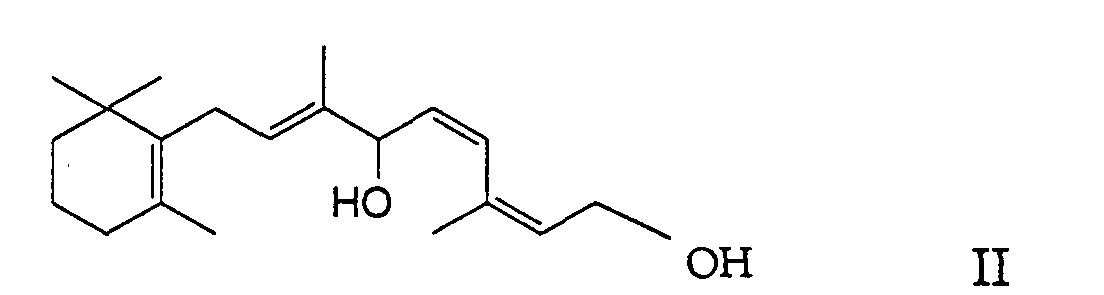
- the present invention relates to a new process for the preparation of (11Z, 13Z) -7,10-dihydro-10-hydroxy-retinyl-acylates [(2Z, 4Z, 7E) -carboxylic acid-3,7-dimethyl-6-hydroxy- 9- [2 ', 2', 6'-trimethyl-cyclohex-6'-en-1'-yl] nona-2,4,7-trienyl ester] of the formula in which R denotes a C 1-23 alkyl group or C 2-23 alkenyl group (as will be explained in more detail below), by enzyme-catalyzed, selective monoacylation of (11Z, 13Z) -7,10-dihydro-10-hydroxy-retinol [(2Z, 4Z, 7E) -3,7-dimethyl-9- [2 ', 2', 6 '-trimethylcyclohex-6'-en-1'-yl] nona-2,4,7-triene-1,6-
- the (11Z, 13Z) -7,10-dihydro-10-acetoxy retinyl acetate of Formula III is inert and disruptive under the conditions of catalytic dehydration thus not only when working up (11Z, 13Z) -7,10-dihydro-10-hydroxyretinyl acetate (of formula I in which R is methyl) but also in the Processing of vitamin A acetate. Therefore a procedure is not just for the selective monoacetylation, but generally also for the selective Monoacylation of (11Z, 13Z) -7,10-dihydro-10-hydroxy-retinol of the formula II of great technical interest.
- the present invention is based on the object Process for the preparation of (11Z, 13Z) -7,10-dihydro-10-hydroxy-retinylacylates of formula I by esterification of (11Z, 13Z) -7,10-dihydro-10-hydroxy-retinol
- To provide the disadvantages of the known Working methods e.g. undesired formation of (11Z, 13Z) -7,10-dihydro-10-acetoxy-retinyl-acetate of formula III
- the enzyme-catalyzed reaction is extremely selective and high Yields proceeds and that the enzyme already has the catalytic effect unfolded in small quantities, separated easily and several times can be reused.
- the present invention relates to a process for the preparation of a (11Z, 13Z) -7,10-dihydro-10-hydroxy-retinyl-acylate of the above formula I, wherein R is a C 1-23 alkyl group or a 1 to 3 double bonds having C 2-23 alkenyl group, which is characterized in that (11Z, 13Z) -7,10-dihydro-10-hydroxy retinol of the formula II also given above in an organic solvent in the presence of an acylating agent which is an alkyl - or alkenyl acylate, is selectively monoacylated with a lipase in suspension.
- Tetrahedron Asymmetry 4 , 757-760 (1993) describes the resolution of 2-methyl-5- (4-methoxyphenyl) pentane-1,3-diol by esterification with vinyl acetate in the presence of immobilized lipase PS, the yield of monoacylated product 66% and the optical purity 42% ee.
- Tetrahedron Lett. 31 , 3405-3408 (1990) describes the selective acylation of aliphatic 1, n-diols with anhydrides in the presence of lipase from porcine pancreas, the selectivities being ⁇ 98% and the yields being ⁇ 95%.
- acylation of (11Z, 13Z) -7,10-dihydro-10-hydroxy-retinol of the formula II takes place as already mentioned in a - preferably almost water-free - Organic solvents in the presence of an acylating agent , which is an alkyl or alkenyl acylate, with a lipase in suspension.
- an acylating agent which is an alkyl or alkenyl acylate
- Lipases suitable for the purpose of the present invention are those of the enzyme class EC 3.1.1.3, which show good activity and selectivity, in particular Lipase PL from Alcaligenes sp ., Their immobilized forms Lipase PLC and Lipase PLG, and Lipase MY-30 from Candida cylindracea ( renamed Candida rugosa ) (Meito Sangyo, Tokyo, Japan), Lipozyme® IM-20 from Mucor miehei (renamed Rhizomucor miehei ) (Novo Nordisk, Bagsvaerd, Denmark), Lipase CE-5 from Humicola lanuginosa and Lipase G from Penicillium cyclopium (both Amano Pharmaceutical Co.
- Lipase PL, Lipase PLC, Lipase PLG, Lipozyme® IM-20 and Chirazyme® L-2 are particularly preferred, very particularly preferred Lipase PL, Lipase PLC, Lipase PLG and Chirazyme® L-2.
- C 1-23 alkyl group or “C 2-23 alkenyl group having 1 to 3 double bonds” (R) is understood to mean both straight-chain and branched alkyl or alkenyl groups, depending on the number of carbon atoms.
- Examples of the C 1-23 alkyl groups are methyl, ethyl, propyl, pentyl, heptyl, undecyl, pentadecyl and heptadecyl, or the C 2-23 alkenyl groups 8-heptadecenyl and heptadeca-8,11-dienyl.
- RCO alkanoyl and alkenoyl
- the lipase which is commercially available Form in the form of powder, grains or small balls, in up to 20 % By weight (weight / weight based on (11Z, 13Z) -7,10-dihydro-10-hydroxy-retinol) used, but preferably the proportion is lipase between about 0.1% and about 10% by weight, particularly preferred between about 1% and about 5% by weight.
- organic solvents which are suitable for the purpose of the present Suitable invention can be called: aliphatic hydrocarbons with 5-8 carbon atoms such as hexane and heptane; alicyclic Hydrocarbons with 6-10 carbon atoms, such as cyclohexane, Methylcyclohexane and decalin; chlorinated aliphatic hydrocarbons, such as methylene chloride, chloroform and carbon tetrachloride; nitro substituted aliphatic hydrocarbons such as nitromethane; aromatic Hydrocarbons such as toluene and xylene; aliphatic ethers, such as 1,2-dimethoxyethane, Diethyl ether, diisopropyl ether and tert-butyl methyl ether; cyclic ethers such as tetrahydrofuran, methylfuran and 1,4-dioxane; aliphatic esters, such as trimethyl orthoformate, ethoxy
- the various common alkyl and Alkenyl acylates such as methyl acetate, ethyl acetate, butyl acetate, vinyl acetate, Allyl acetate, isopropenyl acetate, ethyl propionate, ethyl butyrate and vinyl propionate as well as esters of longer chain fatty acids, e.g. Vinyl laurate become.
- Vinyl acetate, particularly preferably vinyl acetate is used.
- the amount of acylating agent used can be between 1 mole equivalent and a multiple excess lie; the acylating agent is then in excess in particular used if it also serves as a solvent, which is the case with the alkyl and alkenyl acylates may be the case.
- the concentration of (11Z, 13Z) -7,10-dihydro-10-hydroxy-retinol is expediently 10% to 50%, preferably 20% to 40% [in weight / volume (W / V) printed out]:
- the solubility of the educt is determined by the choice of the solvent or solvent mixture and / or the temperature controlled.
- the reaction temperature is advantageously between about 10 ° C and the reflux temperature of the reaction mixture, preferably between room temperature and about 90 ° C, especially preferably between room temperature and about 60 ° C.
- the (11Z, 13Z) -7,10-dihydro-10-hydroxy-retinol at the beginning the reaction is not resolved; rather, at the beginning of the reaction there is also a suspension.
- the immobilization of the lipase can also be carried out in Presence of a "bile salt” take place (co-immobilization), whereby the activity can be increased in part (activator).
- Suitable Bile salts are e.g. Sodium cholate and sodium deoxycholate.
- the reaction with the lipase is appropriately below an inert gas atmosphere, e.g. Nitrogen or argon, and in the dark and / or in the presence of a radical scavenger, e.g. Hydroquinone or 2,6-di (tert.butyl) -p-cresol.
- an inert gas atmosphere e.g. Nitrogen or argon
- a radical scavenger e.g. Hydroquinone or 2,6-di (tert.butyl) -p-cresol.
- the catalyst can be filtered off in a batch process after an experiment and be reused.
- the stability and activity of the lipase plays among other things the water content of the reaction solution - and thus the lipase - a role.
- the addition of a small amount of water has a positive influence on lipase activity; weakly basic solutions such as ammonium bicarbonate or ammonium hydroxide solutions, or organic Bases, e.g. Triethylamine or ethyldiisopropylamine.
- the addition of water can also only periodically or in the sense of an equilibration step respectively.
- the method according to the invention can be used as a repeated batch method or carried out as a continuous process, and using common types of reactors, such as Fixed bed reactor, hose reactor, fiber reactor, circulation reactor, Fluidized bed reactor (with intermediate floor) or slurry reactor.
- reactors such as Fixed bed reactor, hose reactor, fiber reactor, circulation reactor, Fluidized bed reactor (with intermediate floor) or slurry reactor.
- Another aspect of the present invention is the above mentioned use of a (11Z, 13Z) -7,10-dihydro-10-hydroxy-retinyl-acylate obtained according to the invention, preferably the acetate, for Production of the corresponding vitamin A acylate or vitamin A acetate represents.
- lipase PL and 0.5 mg cholate salt sodium cholate, sodium deoxycholate
- cholate salt sodium cholate, sodium deoxycholate
- the lipase preparations prepared were tested as described in Example 5 with 8 ml (11Z, 13Z) -7,10-dihydro-10-hydroxy-retinol solution. After every 24 hours, analysis was carried out by HPLC. The results are summarized in Table 2 below, in which A stands for (11Z, 13Z) -7,10-dihydro-10-hydroxyretinol. Cholate salt carrier Residual A (HPLC area%) none DICALITE® 9.1 Sea sand 37.8 Sodium cholate DICALITE® 6.5 Sea sand 31.2 Sodium deoxycholate DICALITE® 5.6 Sea sand 32.3
- the filtrate was first together with the washing solution and then first together with two 300 ml portions of hexane and then with 300 ml pentane evaporated to azeotrope traces of acetic acid formed remove. After drying in a high vacuum at 35 ° for about 16 hours became 56.73 g (163.7 mmol, 99%) (11Z, 13Z) -7,10-dihydro-10-hydroxy-retinyl acetate obtained as a pale yellowish oil.
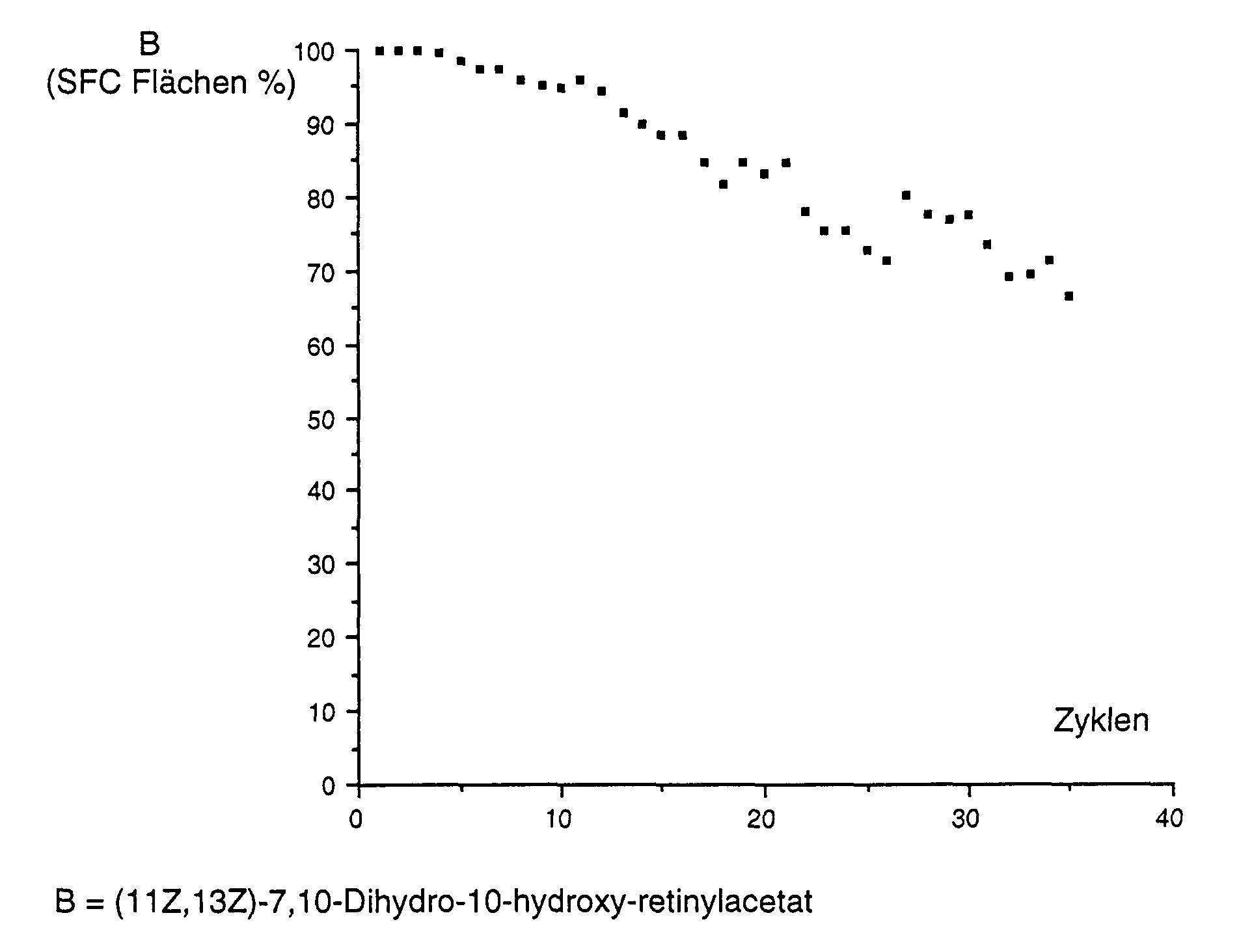
- the lipase preparation was made twice with 100 ml each 1: 1 mixture of toluene and TBME, which 1 ⁇ (V / V) a 1% Contained ammonium hydroxide solution, washed, and after 4 Cycles left for 3 days at room temperature in toluene.
- the Results are shown graphically as follows:
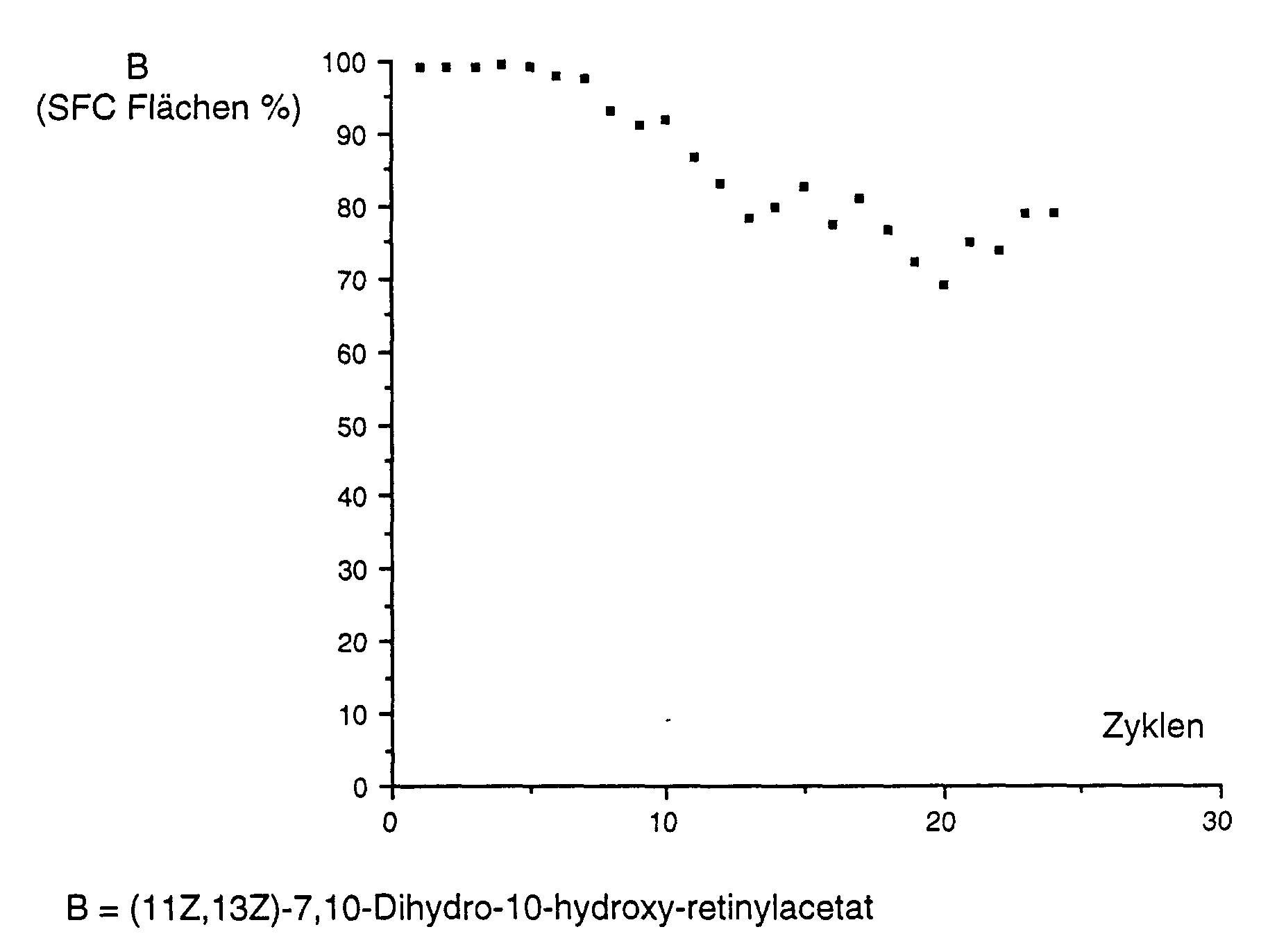
- Example 11 The procedure was as described in Example 11, except that the (11Z, 13Z) -7,10-dihydro-10-hydroxy retinol as described in Example 9B was cleaned using DICALITE® Speedex.
- the Results are shown graphically as follows:
- the homogeneous mixture was filtered through a membrane filter [RC60, 1 ⁇ m, Schleicher & Schuell AG, Dassel, Germany (S&S)] and then through a column of 10 mm in diameter, which was washed in succession with 7 g DICALITE® Speedex and 600 mg Lipase PLC (Meito Sangyo) was pumped at a flow rate of 0.5 ml / minute. The temperature was varied between 20 and 50 °. Reaction samples were taken in each case and analyzed by SFC and HPLC. The results are shown graphically as follows:
Landscapes
- Organic Chemistry (AREA)
- Chemical & Material Sciences (AREA)
- Engineering & Computer Science (AREA)
- Life Sciences & Earth Sciences (AREA)
- Zoology (AREA)
- Wood Science & Technology (AREA)
- Health & Medical Sciences (AREA)
- General Engineering & Computer Science (AREA)
- General Chemical & Material Sciences (AREA)
- Chemical Kinetics & Catalysis (AREA)
- Biotechnology (AREA)
- Biochemistry (AREA)
- Bioinformatics & Cheminformatics (AREA)
- Microbiology (AREA)
- General Health & Medical Sciences (AREA)
- Genetics & Genomics (AREA)
- Preparation Of Compounds By Using Micro-Organisms (AREA)
- Enzymes And Modification Thereof (AREA)
- Organic Low-Molecular-Weight Compounds And Preparation Thereof (AREA)
- Steroid Compounds (AREA)
- Acyclic And Carbocyclic Compounds In Medicinal Compositions (AREA)
- Thermotherapy And Cooling Therapy Devices (AREA)
Description

durch Enzym-katalysierte, selektive Monoacylierung von (11Z,13Z)-7,10-Dihydro-10-hydroxy-retinol [(2Z,4Z,7E)-3,7-Dimethyl-9-[2',2',6'-trimethylcyclohex-6'-en-1'-yl]nona-2,4,7-trien-1,6-diol] der Formel

- Lipase PLC: Lipase PL immobilisiert auf Diatomeenerde;
- Lipase PLG: Lipase PL immobilisiert auf granulierter Diatomeenerde;
- Chirazyme® L-2 (ehemals Novozym® SP 435): Lipase aus Candida antarctica, immobilisiert auf makroporösem Polyacryl.
| HPLC-Flächenprozent | |||||
| # | Trägermaterial | A | B | ||
| nach 6 Std. | 27 Std. | nach 6 Std. | 27 Std. | ||
| 1 | Kieselgel 60 (0,2-0,5 mm; Merck) | 38,2 | 61,8 | ||
| 2 | Florisil® | 43,9 | 56,1 | ||
| 3 | Seesand (40-100 mesh; Fluka 84880) | 40,4 | 4,9 | 59,6 | 95,1 |
| 4 | Molekularsieb (3 Å; Merck) | 35,9 | 64,1 | ||
| 5 | Avicel® (mikrokristalline Cellulose) | 29,0 | 71,0 | ||
| 6 | DICALITE® Speedex (Diatomeenerde) | 34,7 | 3,8 | 65,3 | 96,2 |
| 7 | Hyflo Super Cel® (Kieselgur, Fluka 56678) | 36,8 | 63,2 | ||
| 8 | Clarcel Typ Die/B (Diatomeenerde der Firma CECA, Paris, Frankreich) | 41,1 | 6,5 | 58,9 | 93,5 |
| 9 | Bentonite (Fluka 11957) | 74,8 | 25,2 | ||
| 10 | Bentonite (Fluka 11959) | 95,2 | 4,8 | ||
| 11 | Aluminiumoxid neutral I (Camag 507-C der Firma Camag, Muttenz, Schweiz) | 33,5 | 66,5 | ||
| 12 | Aluminiumoxid basisch I (Camag 5016-A) | 31,1 | 68,9 | ||
| 13 | Amberlite® XAD-7 (20-50 mesh) | 33,1 | 66,9 | ||
| 14 | Amberlite® XAD-8 (20-50 mesh) | 46,2 | 53,8 | ||
| 15 | Amberlyst® A-21 (0,4-0,55 mm) | 38,0 | 12,6 | 62,0 | 87,4 |
| 16 | Amberlite® IR-45 | 21,9 | 78,1 | ||
| 17 | Amberlite® IRA-93 | 33,3 | 9,2 | 66,7 | 90,8 |
| 18 | Glaskügelchen (0,5 mm) | 70,1 | 29,9 | ||
| 19 | Siran Carrier Sikug 041/02/120/A | 34,1 | 65,9 |
| Cholat-Salz | Träger | Restgehalt an A (HPLC-Flächen-%) |
| keines | DICALITE® | 9,1 |
| Seesand | 37,8 | |
| Natriumcholat | DICALITE® | 6,5 |
| Seesand | 31,2 | |
| Natriumdeoxycholat | DICALITE® | 5,6 |
| Seesand | 32,3 |
| Ber. : | C 76,26%; | H 9,89%; |
| Gef. : | C 76,07%; | H 9,73%. |
| Zusatz | gebildetes B (HPLC-Flächen-%) |
| keiner | 6 |
| 10 µl Wasser | 19 |
| 10 µl 0,1 M Ammoniumbicarbonat-Lösung | 28 |
| Reinigungsmethode | Gebildetes B (SFC-Flächenprozent; minimal - maximal) | A + B (SFC-Flächenprozent: Mittelwert) |
| ungereinigt | 24,3 - 27,9 | 95,0 |
| EDTA | 73,2 - 77,8 | 99,4 |
| Aluminiumoxid basisch | 69,0 - 70,4 | 99,6 |
| DICALITE® Speedex | 68,1 - 73,4 | 99,7 |
| Kieselgel | 51,7 - 55,2 | 99,7 |
| gebildetes B (SFC-Flächenprozent; | ||||
| 1. Zyklus | 2. Zyklus | 3. Zyklus | 4. Zyklus | |
| A (ungereinigt) | 99,0 | 92,0 | 50,6 | 22,7 |
| A + 0,1 M NH4HCO3 pro Ansatz | 99,6 | 99,4 | 95,0 | 76,3 |
| A + 1% NH4OH pro Ansatz (Waschlösung enthält 1‰ V/V 1% NH4OH) | 100 | 99,4 | 97,8 | 88,7 |
| A gereinigt gemäss Beispiel 9 A. | 100 | 100 | 100 | 99,8 |

| Temperatur (°C) | Reaktionszeit (Min.) | Ausbeute (% HPLC) |
| Raumtemp. | 1830 | 73,9 |
| 50 | 780 | 99,9 |

| Lösungsmittel | Reaktionszeit (Min.) | Ausbeute (% HPLC) |
| Acetonitril | 520 | 97,9 |
| Isopropanol | 420 | 57,4 |
| tert.Butanol | 420 | 79,9 |
| Aceton | 1350 | 99,2 |
| Nitromethan | 480 | 97,1 |
| Methylfuran | 395 | 99,5 |
| Tetrahydrofuran | 1380 | 97,0 |
| Triethylamin | 480 | 92,4 |
| Pyridin | 520 | 68,3 |
| Formaldehyd-dimethylacetal | 270 | 99,6 |
| 1,2-Dimethoxyethan | 480 | 97,3 |
| Diisopropylether | 340 | 99,6 |
| Trimethylorthoformiat | 420 | 93,2 |
| tert.Butylmethylether | 480 | 99,3 |
| Toluen | 780 | 99,9 |
| 1,4-Dioxan | 1380 | 96,5 |
| Methylenchlorid | 340 | 99,5 |
| Chloroform | 480 | 96,7 |
| Hexan | 780 | 99,9 |
| Cyclohexan | 480 | 99,6 |
| Tetrachlorkohlenstoff | 480 | 99,3 |
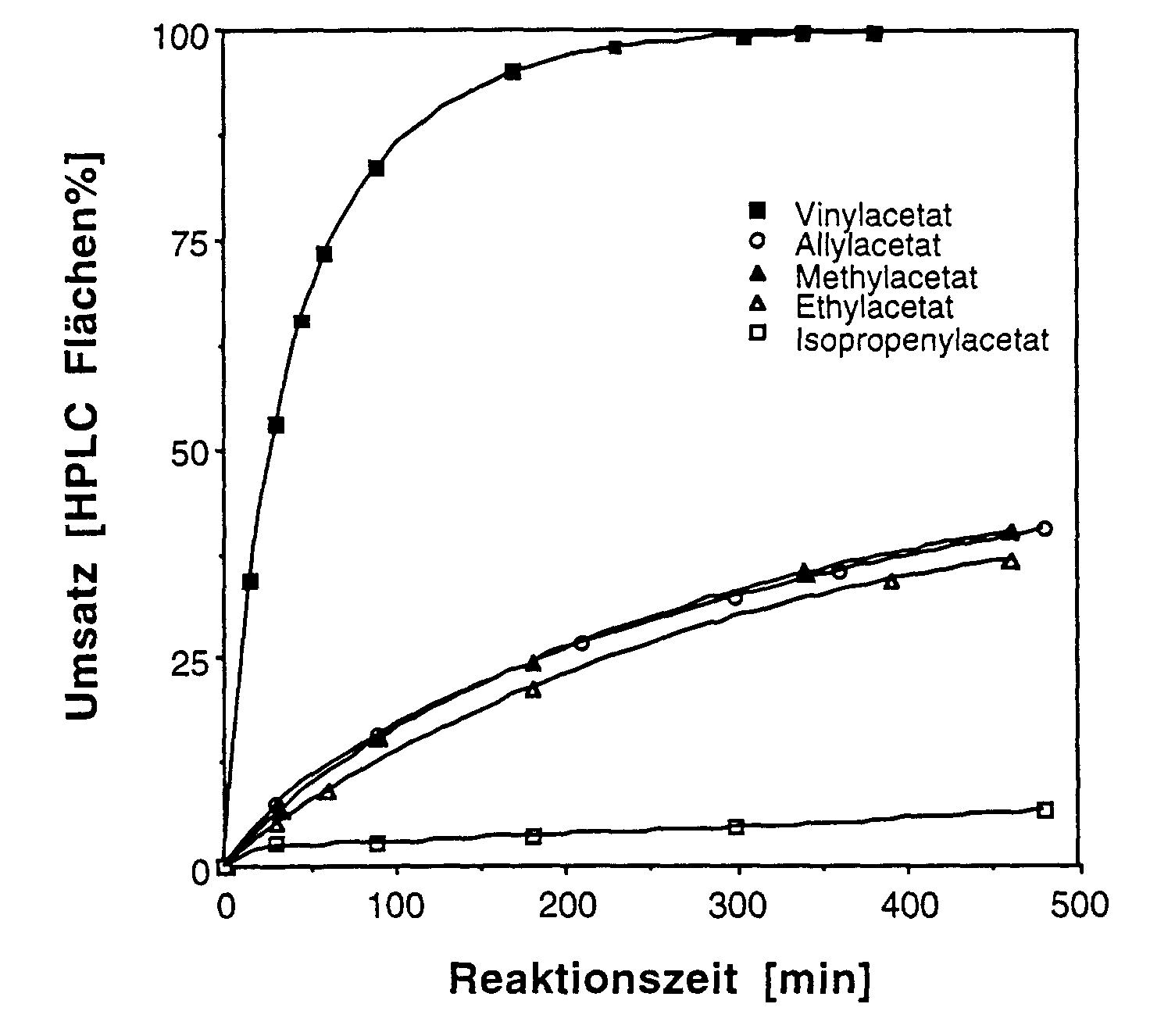
| Acetylierungsmittel | Reaktionszeit (Min.) | Ausbeute (% HPLC) |
| Vinylacetat | 340 | 99,5 |
| Methylacetat | 460 | 40,0 |
| Ethylacetat | 460 | 36,7 |
| Isopropenylacetat | 480 | 6,7 |
| Allylacetat | 480 | 40,2 |
| Vinyl-Ester | Ausbeute (% HPLC) |
| Vinylacetat | 87,5 |
| Vinylpropionat | 47,6 |
| Vinylbutyrat | 81,2 |
| Vinylcrotonat | 14,8 |
| Vinyllaurat | 21,6 |
| Vinyl-Ester | Ausbeute (% HPLC) |
| Vinylacetat | 96,3 |
| Vinylpropionat | 77,2 |
| Vinylbutyrat | 99,0 |
| Vinylcrotonat | 2,8 |
| Vinyllaurat | 36,3 |
Claims (18)
- Verfahren zur Herstellung eines (11Z,13Z)-7,10-Dihydro-10-hydroxy-retinylacylats der Formelworin R eine C1-23-Alkylgruppe oder eine 1 bis 3 Doppelbindungen

aufweisende C2-23-Alkenylgruppe bedeutet,
dadurch gekennzeichnet, dass (11Z,13Z)-7,10-Dihydro-10-hydroxy-retinol der Formelin einem organischen Lösungsmittel in Gegenwart eines Acylierungsmittels, welches ein Alkyl- oder Alkenylacylat ist, mit einer in Suspension vorliegenden Lipase selektiv monoacyliert wird.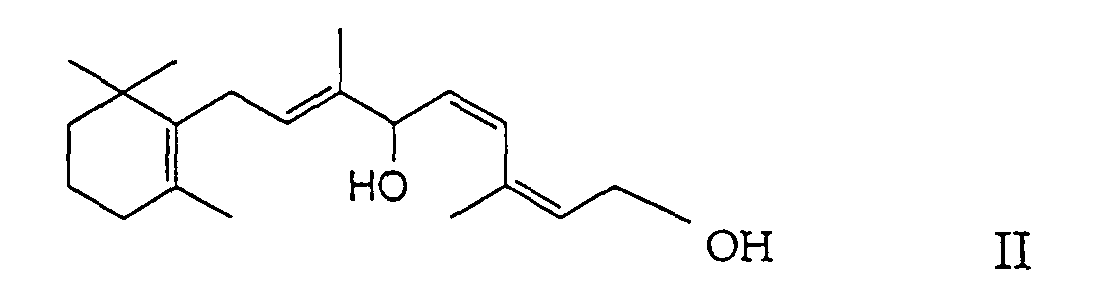
- Verfahren nach Anspruch 1, dadurch gekennzeichnet, dass es sich bei der Lipase um Lipase PL aus Alcaligenes sp. , Lipase PLC, Lipase PLG, Lipase MY-30 aus Candida cylindracea (Candida rugosa), Lipozyme® IM-20 aus Mucor miehei (Rhizomucor miehei), Lipase CE-5 aus Humicola lanuginosa oder Lipase G aus Penicillium cyclopium handelt.
- Verfahren nach Anspruch 1, dadurch gekennzeichnet, dass es sich bei der Lipase um Chirazyme® L-2 aus Candida antarctica handelt.
- Verfahren nach einem der Ansprüche 1 bis 3, dadurch gekennzeichnet, dass R der Formel I Methyl bedeutet, wobei (11Z,13Z)-7,10-Dihydro-10-hydroxy-retinol der Formel II selektiv monoacetyliert wird.
- Verfahren nach einem der Ansprüche 1 bis 4, dadurch gekennzeichnet, dass der Anteil an Lipase bis zu 20 Gew.-% bezogen auf (11Z,13Z)-7,10-Dihydro-10-hydroxy-retinol beträgt.
- Verfahren nach Anspruch 5, dadurch gekennzeichnet, dass der Anteil an Lipase zwischen etwa 0,1 Gew.-% und etwa 10 Gew.-% liegt.
- Verfahren nach einem der Ansprüche 1 bis 6, dadurch gekennzeichnet, dass die Lipase in immobilisierter Form vorliegt.
- Verfahren nach Anspruch 7, dadurch gekennzeichnet, dass die Lipase in Gegenwart eines Gallensalzes immobilisiert wurde.
- Verfahren nach einem der Ansprüche 1 bis 8, dadurch gekennzeichnet, dass die Umsetzung unter Inertgasatmosphäre und unter Lichtausschluss und/oder in Gegenwart eines Radikalfängers durchgeführt wird.
- Verfahren nach einem der Ansprüche 1 bis 9, dadurch gekennzeichnet, dass als Lösungsmittel ein aliphatischer Kohlenwasserstoff mit 5-8 Kohlenstoffatomen, ein cyclischer Kohlenwasserstoff mit 6-10 Kohlenstoffatomen, ein chlorierter aliphatischer Kohlenwasserstoff, ein nitrosubstituierter aliphatischer Kohlenwasserstoff, ein aromatischer Kohlenwasserstoff, ein aliphatischer Ether, ein cyclischer Ether, ein aliphatischer Ester, ein aliphatisches Keton, ein aliphatisches Nitril, ein aliphatisches Amin, ein aliphatisches Acetal oder ein Gemisch solcher Lösungsmittel eingesetzt wird.
- Verfahren nach Anspruch 10, dadurch gekennzeichnet, dass als Lösungsmittel n-Hexan, Cyclohexan, Methylenchlorid, Tetrachlorkohlenstoff, Toluen, Diisopropylether, Tetrahydrofuran, Methylfuran, Vinylacetat, Vinylpropionat oder Formaldehyd-dimethylacetal ,oder ein Gemisch solcher Lösungsmittel eingesetzt wird.
- Verfahren nach einem der Ansprüche 1 bis 11, dadurch gekennzeichnet, dass als Acetylierungsmittel Ethylacetat, Butylacetat oder Vinylacetat eingesetzt wird.
- Verfahren nach einem der Ansprüche 1 bis 12, dadurch gekennzeichnet, dass die Konzentration an (11Z,13Z)-7,10-Dihydro-10-hydroxyretinol 10% bis 50% (G/V) beträgt.
- Verfahren nach einem der Ansprüche 1 bis 13, dadurch gekennzeichnet, dass die Reaktionstemperatur zwischen etwa 10°C und der Rückflusstemperatur des Reaktionsgemisches. liegt.
- Verfahren nach einem der Ansprüche 1 bis 14, dadurch gekennzeichnet, dass der Reaktionslösung eine geringe Menge (<0.2% ) an Wasser oder einer schwach basischen Lösung zugegeben wird.
- Verfahren nach einem der Ansprüche 1 bis 15, dadurch gekennzeichnet, dass das (11Z,13Z)-7,10-Dihydro-10-hydroxy-retinol zur Entfernung von schädlichen Verunreinigungen über einen Filtrierhilfsstoff filtriert oder mit wässriger Ethylendiamin-tetraessigsäure-Lösung bei einem pH-Wert von etwa 8 gewaschen wird.
- Verfahren nach einem der Ansprüche 1 bis 16, dadurch gekennzeichnet, dass das Verfahren als wiederholtes Batch-Verfahren oder als kontinuierliches Verfahren durchgeführt wird.
- Verfahren nach einem der Ansprüche 1 bis 17, dadurch gekennzeichnet, dass das erhaltene (11Z,13Z)-7,10-Dihydro-10-hydroxy-retinyl-acylat ,durch Wasserabspaltung unter gleichzeitiger cis-trans-Isomerisierung in das entsprechende Vitamin A-acylat übergeführt wird.
Priority Applications (1)
| Application Number | Priority Date | Filing Date | Title |
|---|---|---|---|
| EP97105918A EP0802261B1 (de) | 1996-04-18 | 1997-04-10 | Enzymatische Acylierung eines Retinolderivates |
Applications Claiming Priority (5)
| Application Number | Priority Date | Filing Date | Title |
|---|---|---|---|
| EP96106086 | 1996-04-18 | ||
| EP96106086 | 1996-04-18 | ||
| EP97102768 | 1997-02-20 | ||
| EP97102768 | 1997-02-20 | ||
| EP97105918A EP0802261B1 (de) | 1996-04-18 | 1997-04-10 | Enzymatische Acylierung eines Retinolderivates |
Publications (2)
| Publication Number | Publication Date |
|---|---|
| EP0802261A1 EP0802261A1 (de) | 1997-10-22 |
| EP0802261B1 true EP0802261B1 (de) | 2001-08-08 |
Family
ID=26141873
Family Applications (1)
| Application Number | Title | Priority Date | Filing Date |
|---|---|---|---|
| EP97105918A Expired - Lifetime EP0802261B1 (de) | 1996-04-18 | 1997-04-10 | Enzymatische Acylierung eines Retinolderivates |
Country Status (10)
| Country | Link |
|---|---|
| US (1) | US5902738A (de) |
| EP (1) | EP0802261B1 (de) |
| JP (2) | JP3953571B2 (de) |
| CN (1) | CN1261582C (de) |
| AT (1) | ATE204024T1 (de) |
| BR (1) | BR9701843A (de) |
| DE (1) | DE59704220D1 (de) |
| DK (1) | DK0802261T3 (de) |
| ES (1) | ES2162148T3 (de) |
| ID (1) | ID16631A (de) |
Families Citing this family (16)
| Publication number | Priority date | Publication date | Assignee | Title |
|---|---|---|---|---|
| DE69802465T2 (de) * | 1997-05-29 | 2002-06-27 | Sumitomo Chemical Co., Ltd. | Polyalkoholderivate und Verfahren zur Herstellung davon |
| US6403344B1 (en) * | 2001-03-28 | 2002-06-11 | Council Of Scientific And Industrial Research | Enzymatic process for the preparation of an acetylated phospholipid |
| GB2401866A (en) * | 2002-02-06 | 2004-11-24 | Commw Scient Ind Res Org | Esterases with lipase activity |
| JP4478540B2 (ja) * | 2004-09-16 | 2010-06-09 | 日清オイリオグループ株式会社 | リパーゼ粉末、その製造方法及びその使用 |
| AU2005305610A1 (en) * | 2004-11-17 | 2006-05-26 | Natural Asa | Enzymatically synthesized marine phospholipids |
| US20060222695A1 (en) * | 2005-04-01 | 2006-10-05 | Filiberto Zadini | Deoxycholic acid liposome-based dermatological topical preparation |
| CA2611723C (en) * | 2005-06-09 | 2014-02-11 | The Nisshin Oillio Group, Ltd. | Lipase powder compositions |
| US8304383B2 (en) | 2005-11-22 | 2012-11-06 | Atheronova Operations, Inc. | Dissolution of arterial plaque |
| US20090035348A1 (en) * | 2005-11-22 | 2009-02-05 | Z & Z Medical Holdings, Inc. | Dissolution of arterial plaque |
| JP4917349B2 (ja) * | 2006-05-11 | 2012-04-18 | 日清オイリオグループ株式会社 | リパーゼ活性の回復方法 |
| US7566795B2 (en) * | 2006-10-06 | 2009-07-28 | Eastman Chemical Company | Preparation of retinyl esters |
| US20080287429A1 (en) * | 2007-05-15 | 2008-11-20 | Z & Z Medical Holdings, Inc. | Dissolution of Arterial Cholesterol Plaques by Pharmacologically Induced Elevation of Endogenous Bile Salts |
| WO2011126082A1 (ja) * | 2010-04-07 | 2011-10-13 | 日産化学工業株式会社 | アシロキシピラノン化合物の製造方法、アルキン化合物の製造方法及びジヒドロフラン化合物の製造方法 |
| CN105154480A (zh) * | 2015-09-30 | 2015-12-16 | 浙江工业大学 | 一种维生素a中间体的制备方法 |
| CN112522331B (zh) * | 2020-12-09 | 2024-03-22 | 上海克琴科技有限公司 | 一种生物酶催化的羟基频哪酮视黄酸酯的合成方法 |
| JP2025527619A (ja) | 2022-08-23 | 2025-08-22 | バイエル・アクチエンゲゼルシヤフト | 改善されたリパーゼタンパク質をコードする核酸 |
Family Cites Families (1)
| Publication number | Priority date | Publication date | Assignee | Title |
|---|---|---|---|---|
| US5155255A (en) * | 1990-04-27 | 1992-10-13 | Hoffmann-La Roche Inc. | Process for producing cycloalkenylalkenes |
-
1997
- 1997-03-31 US US08/829,280 patent/US5902738A/en not_active Expired - Lifetime
- 1997-04-10 JP JP09207097A patent/JP3953571B2/ja not_active Expired - Fee Related
- 1997-04-10 DK DK97105918T patent/DK0802261T3/da active
- 1997-04-10 EP EP97105918A patent/EP0802261B1/de not_active Expired - Lifetime
- 1997-04-10 ES ES97105918T patent/ES2162148T3/es not_active Expired - Lifetime
- 1997-04-10 AT AT97105918T patent/ATE204024T1/de not_active IP Right Cessation
- 1997-04-10 DE DE59704220T patent/DE59704220D1/de not_active Expired - Lifetime
- 1997-04-17 CN CN97110552.9A patent/CN1261582C/zh not_active Expired - Fee Related
- 1997-04-18 BR BR9701843A patent/BR9701843A/pt active Search and Examination
- 1997-04-21 ID IDP971322A patent/ID16631A/id unknown
-
2007
- 2007-03-05 JP JP2007054727A patent/JP2007143561A/ja active Pending
Also Published As
| Publication number | Publication date |
|---|---|
| ATE204024T1 (de) | 2001-08-15 |
| ID16631A (id) | 1997-10-23 |
| JP2007143561A (ja) | 2007-06-14 |
| DE59704220D1 (de) | 2001-09-13 |
| ES2162148T3 (es) | 2001-12-16 |
| CN1261582C (zh) | 2006-06-28 |
| JP3953571B2 (ja) | 2007-08-08 |
| DK0802261T3 (da) | 2001-11-12 |
| BR9701843A (pt) | 1998-09-29 |
| JPH1036301A (ja) | 1998-02-10 |
| US5902738A (en) | 1999-05-11 |
| EP0802261A1 (de) | 1997-10-22 |
| CN1169473A (zh) | 1998-01-07 |
Similar Documents
| Publication | Publication Date | Title |
|---|---|---|
| EP0802261A1 (de) | Enzymatische Acylierung eines Retinolderivates | |
| DE60129865T2 (de) | Verfahren zur Herstellung von Dihydroxyestern und ihren Derivaten | |
| DE3872924T2 (de) | Verfahren zur herstellung von optisch aktiven verbindungen. | |
| DE69021711T2 (de) | Verfahren zur Herstellung von optisch aktiven Hydroxylactonen. | |
| EP0337920B1 (de) | Verfahren zur hochregioselektiven Veresterung und Esterspaltung an ungesättigten Zuckerverbindungen mit Hilfe von Lipasen und Esterasen und mit diesem Verfahren herstellbare Produkte | |
| EP0492497B1 (de) | Verfahren zur Acylierung von Alkoholen mit einem immobilisierten Pseudomonas-Lipase | |
| DE69928002T2 (de) | Verfahren zur herstellung von mycophenolatestern | |
| DE69127222T2 (de) | Verfahren zur Herstellung von Epoxyalkoholen von hoher optischer Reinheit | |
| DE69325698T2 (de) | Enzymatisches Verfahren zur stereoselektiven Herstellung einem Enantiomer aus einem hetero bicyclischen Alkohols | |
| DE69732772T2 (de) | Enzymatisches verfahren zur stereoselektiven herstellung von therapeutischen amiden | |
| EP0507278A2 (de) | Immobilisierter Biokatalysator, dessen Herstellung und Verwendung zur Estersynthese in einem Säulenreaktor | |
| DE3783901T2 (de) | Verfahren zur enzymatischen trennung der optischen isomere von racemischen oxazolidinon-derivaten. | |
| DE69033442T2 (de) | Optisch aktive Verbindungen mit mehreren chiralen Zentren und ihre Herstellung | |
| DE3618538C2 (de) | queR | |
| DE69221685T2 (de) | Verfahren zur herstellung von optisch aktivem 3-chlor-1-phenyl-propan-1-ol und dessen derivat | |
| DE69221024T2 (de) | Verfahren zur Herstellung von Ascorbinsäure-Estern oder Erythorbinsäure-Estern | |
| AT398081B (de) | Verfahren zur enzymatischen hydrolyse eines carbonsäurederivates | |
| EP2298727A1 (de) | Verfahren zur Herstellung von Estern kurzkettiger Alkohole aus triglyceridreichen Ölen | |
| AT398579B (de) | Enzymatisches verfahren zur trennung racemischer gemische von delta-valerolactonen | |
| DE3724721A1 (de) | Verfahren zur enzymatischen racematspaltung von 1-acyloxy-2-cyclopenten-4-on(2,2- dimethylpropandiol)-ketal | |
| DE69620437T2 (de) | Verfahren zur herstellung von optisch aktivem 2-substituiertem tetrahydropyran-4-on | |
| WO2003095596A1 (de) | Verfahren zur herstellung von c4-c12-fettsäuren | |
| DE69006801T2 (de) | Optisch aktive Cyclopentenole und Verfahren zu deren Herstellung. | |
| DE69315720T2 (de) | Verfahren zur Trennung von 1,2-Isopropylidenglycerinbenzoylester-Enantiomeren | |
| DE69026053T2 (de) | Verfahren zur Herstellung von optisch-aktiven Hydroxyestern |
Legal Events
| Date | Code | Title | Description |
|---|---|---|---|
| PUAI | Public reference made under article 153(3) epc to a published international application that has entered the european phase |
Free format text: ORIGINAL CODE: 0009012 |
|
| 17P | Request for examination filed |
Effective date: 19970410 |
|
| AK | Designated contracting states |
Kind code of ref document: A1 Designated state(s): AT BE CH DE DK ES FR GB IT LI NL |
|
| 17Q | First examination report despatched |
Effective date: 19991022 |
|
| GRAG | Despatch of communication of intention to grant |
Free format text: ORIGINAL CODE: EPIDOS AGRA |
|
| GRAG | Despatch of communication of intention to grant |
Free format text: ORIGINAL CODE: EPIDOS AGRA |
|
| GRAH | Despatch of communication of intention to grant a patent |
Free format text: ORIGINAL CODE: EPIDOS IGRA |
|
| GRAH | Despatch of communication of intention to grant a patent |
Free format text: ORIGINAL CODE: EPIDOS IGRA |
|
| GRAA | (expected) grant |
Free format text: ORIGINAL CODE: 0009210 |
|
| AK | Designated contracting states |
Kind code of ref document: B1 Designated state(s): AT BE CH DE DK ES FR GB IT LI NL |
|
| REF | Corresponds to: |
Ref document number: 204024 Country of ref document: AT Date of ref document: 20010815 Kind code of ref document: T |
|
| REG | Reference to a national code |
Ref country code: CH Ref legal event code: EP |
|
| REF | Corresponds to: |
Ref document number: 59704220 Country of ref document: DE Date of ref document: 20010913 |
|
| GBT | Gb: translation of ep patent filed (gb section 77(6)(a)/1977) |
Effective date: 20010928 |
|
| REG | Reference to a national code |
Ref country code: DK Ref legal event code: T3 |
|
| REG | Reference to a national code |
Ref country code: ES Ref legal event code: FG2A Ref document number: 2162148 Country of ref document: ES Kind code of ref document: T3 |
|
| REG | Reference to a national code |
Ref country code: GB Ref legal event code: IF02 |
|
| ET | Fr: translation filed | ||
| PLBE | No opposition filed within time limit |
Free format text: ORIGINAL CODE: 0009261 |
|
| STAA | Information on the status of an ep patent application or granted ep patent |
Free format text: STATUS: NO OPPOSITION FILED WITHIN TIME LIMIT |
|
| 26N | No opposition filed | ||
| REG | Reference to a national code |
Ref country code: CH Ref legal event code: PUE Owner name: DSM IP ASSETS B.V. Free format text: F. HOFFMANN-LA ROCHE AG#124 GRENZACHERSTRASSE#4070 BASEL (CH) -TRANSFER TO- DSM IP ASSETS B.V.#HET OVERLOON 1#6411 TE HEERLEN (NL) |
|
| NLS | Nl: assignments of ep-patents |
Owner name: DSM IP ASSETS B.V. |
|
| REG | Reference to a national code |
Ref country code: GB Ref legal event code: 732E |
|
| REG | Reference to a national code |
Ref country code: CH Ref legal event code: NV Representative=s name: DSM NUTRITIONAL PRODUCTS |
|
| REG | Reference to a national code |
Ref country code: FR Ref legal event code: TP |
|
| PGFP | Annual fee paid to national office [announced via postgrant information from national office to epo] |
Ref country code: AT Payment date: 20070321 Year of fee payment: 11 |
|
| PGFP | Annual fee paid to national office [announced via postgrant information from national office to epo] |
Ref country code: NL Payment date: 20070424 Year of fee payment: 11 |
|
| PGFP | Annual fee paid to national office [announced via postgrant information from national office to epo] |
Ref country code: BE Payment date: 20070515 Year of fee payment: 11 |
|
| PGFP | Annual fee paid to national office [announced via postgrant information from national office to epo] |
Ref country code: ES Payment date: 20080428 Year of fee payment: 12 Ref country code: DK Payment date: 20080429 Year of fee payment: 12 Ref country code: CH Payment date: 20080430 Year of fee payment: 12 |
|
| BERE | Be: lapsed |
Owner name: *DMS IP ASSETS B.V. Effective date: 20080430 |
|
| PGFP | Annual fee paid to national office [announced via postgrant information from national office to epo] |
Ref country code: FR Payment date: 20080417 Year of fee payment: 12 |
|
| PGFP | Annual fee paid to national office [announced via postgrant information from national office to epo] |
Ref country code: GB Payment date: 20080429 Year of fee payment: 12 |
|
| NLV4 | Nl: lapsed or anulled due to non-payment of the annual fee |
Effective date: 20081101 |
|
| PG25 | Lapsed in a contracting state [announced via postgrant information from national office to epo] |
Ref country code: NL Free format text: LAPSE BECAUSE OF NON-PAYMENT OF DUE FEES Effective date: 20081101 |
|
| PG25 | Lapsed in a contracting state [announced via postgrant information from national office to epo] |
Ref country code: AT Free format text: LAPSE BECAUSE OF NON-PAYMENT OF DUE FEES Effective date: 20080410 |
|
| PG25 | Lapsed in a contracting state [announced via postgrant information from national office to epo] |
Ref country code: BE Free format text: LAPSE BECAUSE OF NON-PAYMENT OF DUE FEES Effective date: 20080430 |
|
| REG | Reference to a national code |
Ref country code: CH Ref legal event code: PL |
|
| REG | Reference to a national code |
Ref country code: DK Ref legal event code: EBP |
|
| GBPC | Gb: european patent ceased through non-payment of renewal fee |
Effective date: 20090410 |
|
| REG | Reference to a national code |
Ref country code: FR Ref legal event code: ST Effective date: 20091231 |
|
| PG25 | Lapsed in a contracting state [announced via postgrant information from national office to epo] |
Ref country code: LI Free format text: LAPSE BECAUSE OF NON-PAYMENT OF DUE FEES Effective date: 20090430 Ref country code: CH Free format text: LAPSE BECAUSE OF NON-PAYMENT OF DUE FEES Effective date: 20090430 |
|
| PG25 | Lapsed in a contracting state [announced via postgrant information from national office to epo] |
Ref country code: GB Free format text: LAPSE BECAUSE OF NON-PAYMENT OF DUE FEES Effective date: 20090410 Ref country code: FR Free format text: LAPSE BECAUSE OF NON-PAYMENT OF DUE FEES Effective date: 20091222 Ref country code: DK Free format text: LAPSE BECAUSE OF NON-PAYMENT OF DUE FEES Effective date: 20090430 |
|
| REG | Reference to a national code |
Ref country code: ES Ref legal event code: FD2A Effective date: 20090411 |
|
| PG25 | Lapsed in a contracting state [announced via postgrant information from national office to epo] |
Ref country code: ES Free format text: LAPSE BECAUSE OF NON-PAYMENT OF DUE FEES Effective date: 20090411 |
|
| PGFP | Annual fee paid to national office [announced via postgrant information from national office to epo] |
Ref country code: DE Payment date: 20150408 Year of fee payment: 19 |
|
| PGFP | Annual fee paid to national office [announced via postgrant information from national office to epo] |
Ref country code: IT Payment date: 20150422 Year of fee payment: 19 |
|
| REG | Reference to a national code |
Ref country code: DE Ref legal event code: R119 Ref document number: 59704220 Country of ref document: DE |
|
| PG25 | Lapsed in a contracting state [announced via postgrant information from national office to epo] |
Ref country code: DE Free format text: LAPSE BECAUSE OF NON-PAYMENT OF DUE FEES Effective date: 20161101 |
|
| PG25 | Lapsed in a contracting state [announced via postgrant information from national office to epo] |
Ref country code: IT Free format text: LAPSE BECAUSE OF NON-PAYMENT OF DUE FEES Effective date: 20160410 |