EP0800541B1 - Siloxanhaltige netzwerke - Google Patents
Siloxanhaltige netzwerke Download PDFInfo
- Publication number
- EP0800541B1 EP0800541B1 EP95940935A EP95940935A EP0800541B1 EP 0800541 B1 EP0800541 B1 EP 0800541B1 EP 95940935 A EP95940935 A EP 95940935A EP 95940935 A EP95940935 A EP 95940935A EP 0800541 B1 EP0800541 B1 EP 0800541B1
- Authority
- EP
- European Patent Office
- Prior art keywords
- lower alkyl
- hydrogen
- polymer
- alkyl
- carbon atoms
- Prior art date
- Legal status (The legal status is an assumption and is not a legal conclusion. Google has not performed a legal analysis and makes no representation as to the accuracy of the status listed.)
- Expired - Lifetime
Links
- KPUWHANPEXNPJT-UHFFFAOYSA-N disiloxane Chemical class [SiH3]O[SiH3] KPUWHANPEXNPJT-UHFFFAOYSA-N 0.000 title description 2
- 125000000217 alkyl group Chemical group 0.000 claims abstract description 55
- 229920000642 polymer Polymers 0.000 claims abstract description 49
- 239000001257 hydrogen Substances 0.000 claims abstract description 37
- 229910052739 hydrogen Inorganic materials 0.000 claims abstract description 37
- 239000000178 monomer Substances 0.000 claims abstract description 37
- UFHFLCQGNIYNRP-UHFFFAOYSA-N Hydrogen Chemical compound [H][H] UFHFLCQGNIYNRP-UHFFFAOYSA-N 0.000 claims abstract description 32
- 238000000465 moulding Methods 0.000 claims abstract description 24
- 125000000391 vinyl group Chemical group [H]C([*])=C([H])[H] 0.000 claims abstract description 22
- 229920002554 vinyl polymer Polymers 0.000 claims abstract description 21
- 238000004519 manufacturing process Methods 0.000 claims abstract description 6
- -1 hydroxy, hydroxycarbonyl Chemical group 0.000 claims description 45
- 125000004432 carbon atom Chemical group C* 0.000 claims description 44
- 239000007943 implant Substances 0.000 claims description 29
- 125000003545 alkoxy group Chemical group 0.000 claims description 20
- 125000003342 alkenyl group Chemical group 0.000 claims description 19
- 229920001296 polysiloxane Polymers 0.000 claims description 19
- 229910052736 halogen Inorganic materials 0.000 claims description 18
- 150000002367 halogens Chemical group 0.000 claims description 18
- 125000001997 phenyl group Chemical group [H]C1=C([H])C([H])=C(*)C([H])=C1[H] 0.000 claims description 15
- 150000001875 compounds Chemical class 0.000 claims description 14
- 125000004453 alkoxycarbonyl group Chemical group 0.000 claims description 11
- 125000003118 aryl group Chemical group 0.000 claims description 11
- 210000004087 cornea Anatomy 0.000 claims description 11
- 230000002209 hydrophobic effect Effects 0.000 claims description 11
- 229910052731 fluorine Inorganic materials 0.000 claims description 10
- 239000011737 fluorine Substances 0.000 claims description 10
- YCKRFDGAMUMZLT-UHFFFAOYSA-N Fluorine atom Chemical compound [F] YCKRFDGAMUMZLT-UHFFFAOYSA-N 0.000 claims description 9
- CERQOIWHTDAKMF-UHFFFAOYSA-M Methacrylate Chemical compound CC(=C)C([O-])=O CERQOIWHTDAKMF-UHFFFAOYSA-M 0.000 claims description 9
- WHNWPMSKXPGLAX-UHFFFAOYSA-N N-Vinyl-2-pyrrolidone Chemical compound C=CN1CCCC1=O WHNWPMSKXPGLAX-UHFFFAOYSA-N 0.000 claims description 9
- PPBRXRYQALVLMV-UHFFFAOYSA-N Styrene Chemical compound C=CC1=CC=CC=C1 PPBRXRYQALVLMV-UHFFFAOYSA-N 0.000 claims description 9
- ORTFAQDWJHRMNX-UHFFFAOYSA-N hydroxidooxidocarbon(.) Chemical group O[C]=O ORTFAQDWJHRMNX-UHFFFAOYSA-N 0.000 claims description 8
- FQPSGWSUVKBHSU-UHFFFAOYSA-N methacrylamide Chemical compound CC(=C)C(N)=O FQPSGWSUVKBHSU-UHFFFAOYSA-N 0.000 claims description 8
- 229920000578 graft copolymer Polymers 0.000 claims description 7
- 125000002496 methyl group Chemical group [H]C([H])([H])* 0.000 claims description 7
- 125000000304 alkynyl group Chemical group 0.000 claims description 6
- XXROGKLTLUQVRX-UHFFFAOYSA-N allyl alcohol Chemical compound OCC=C XXROGKLTLUQVRX-UHFFFAOYSA-N 0.000 claims description 6
- 238000000576 coating method Methods 0.000 claims description 6
- 150000002431 hydrogen Chemical group 0.000 claims description 6
- NLHHRLWOUZZQLW-UHFFFAOYSA-N Acrylonitrile Chemical compound C=CC#N NLHHRLWOUZZQLW-UHFFFAOYSA-N 0.000 claims description 5
- 150000001252 acrylic acid derivatives Chemical class 0.000 claims description 5
- 125000005103 alkyl silyl group Chemical group 0.000 claims description 5
- 150000001735 carboxylic acids Chemical class 0.000 claims description 5
- 229920001577 copolymer Polymers 0.000 claims description 5
- 125000004665 trialkylsilyl group Chemical group 0.000 claims description 5
- VZCYOOQTPOCHFL-OWOJBTEDSA-N Fumaric acid Chemical compound OC(=O)\C=C\C(O)=O VZCYOOQTPOCHFL-OWOJBTEDSA-N 0.000 claims description 4
- 125000005250 alkyl acrylate group Chemical group 0.000 claims description 4
- 239000011248 coating agent Substances 0.000 claims description 4
- 150000001993 dienes Chemical class 0.000 claims description 4
- VZCYOOQTPOCHFL-UHFFFAOYSA-N trans-butenedioic acid Natural products OC(=O)C=CC(O)=O VZCYOOQTPOCHFL-UHFFFAOYSA-N 0.000 claims description 4
- 125000000026 trimethylsilyl group Chemical group [H]C([H])([H])[Si]([*])(C([H])([H])[H])C([H])([H])[H] 0.000 claims description 4
- KGIGUEBEKRSTEW-UHFFFAOYSA-N 2-vinylpyridine Chemical compound C=CC1=CC=CC=N1 KGIGUEBEKRSTEW-UHFFFAOYSA-N 0.000 claims description 3
- HRPVXLWXLXDGHG-UHFFFAOYSA-N Acrylamide Chemical compound NC(=O)C=C HRPVXLWXLXDGHG-UHFFFAOYSA-N 0.000 claims description 3
- GYCMBHHDWRMZGG-UHFFFAOYSA-N Methylacrylonitrile Chemical compound CC(=C)C#N GYCMBHHDWRMZGG-UHFFFAOYSA-N 0.000 claims description 3
- QNRMTGGDHLBXQZ-UHFFFAOYSA-N buta-1,2-diene Chemical compound CC=C=C QNRMTGGDHLBXQZ-UHFFFAOYSA-N 0.000 claims description 3
- 229920001195 polyisoprene Polymers 0.000 claims description 3
- CTXUTPWZJZHRJC-UHFFFAOYSA-N 1-ethenylpyrrole Chemical compound C=CN1C=CC=C1 CTXUTPWZJZHRJC-UHFFFAOYSA-N 0.000 claims description 2
- JAHNSTQSQJOJLO-UHFFFAOYSA-N 2-(3-fluorophenyl)-1h-imidazole Chemical compound FC1=CC=CC(C=2NC=CN=2)=C1 JAHNSTQSQJOJLO-UHFFFAOYSA-N 0.000 claims description 2
- 229920000536 2-Acrylamido-2-methylpropane sulfonic acid Polymers 0.000 claims description 2
- XHZPRMZZQOIPDS-UHFFFAOYSA-N 2-Methyl-2-[(1-oxo-2-propenyl)amino]-1-propanesulfonic acid Chemical compound OS(=O)(=O)CC(C)(C)NC(=O)C=C XHZPRMZZQOIPDS-UHFFFAOYSA-N 0.000 claims description 2
- KFDVPJUYSDEJTH-UHFFFAOYSA-N 4-ethenylpyridine Chemical compound C=CC1=CC=NC=C1 KFDVPJUYSDEJTH-UHFFFAOYSA-N 0.000 claims description 2
- OFOBLEOULBTSOW-UHFFFAOYSA-N Propanedioic acid Natural products OC(=O)CC(O)=O OFOBLEOULBTSOW-UHFFFAOYSA-N 0.000 claims description 2
- 125000002723 alicyclic group Chemical group 0.000 claims description 2
- 125000001931 aliphatic group Chemical group 0.000 claims description 2
- 150000001345 alkine derivatives Chemical class 0.000 claims description 2
- 239000001530 fumaric acid Substances 0.000 claims description 2
- VZCYOOQTPOCHFL-UPHRSURJSA-N maleic acid Chemical compound OC(=O)\C=C/C(O)=O VZCYOOQTPOCHFL-UPHRSURJSA-N 0.000 claims description 2
- 239000011976 maleic acid Substances 0.000 claims description 2
- HNEGQIOMVPPMNR-NSCUHMNNSA-N mesaconic acid Chemical compound OC(=O)C(/C)=C/C(O)=O HNEGQIOMVPPMNR-NSCUHMNNSA-N 0.000 claims description 2
- LVHBHZANLOWSRM-UHFFFAOYSA-N methylenebutanedioic acid Natural products OC(=O)CC(=C)C(O)=O LVHBHZANLOWSRM-UHFFFAOYSA-N 0.000 claims description 2
- HNEGQIOMVPPMNR-UHFFFAOYSA-N methylfumaric acid Natural products OC(=O)C(C)=CC(O)=O HNEGQIOMVPPMNR-UHFFFAOYSA-N 0.000 claims description 2
- KKFHAJHLJHVUDM-UHFFFAOYSA-N n-vinylcarbazole Chemical compound C1=CC=C2N(C=C)C3=CC=CC=C3C2=C1 KKFHAJHLJHVUDM-UHFFFAOYSA-N 0.000 claims description 2
- 229920000307 polymer substrate Polymers 0.000 claims description 2
- MNCGMVDMOKPCSQ-UHFFFAOYSA-M sodium;2-phenylethenesulfonate Chemical compound [Na+].[O-]S(=O)(=O)C=CC1=CC=CC=C1 MNCGMVDMOKPCSQ-UHFFFAOYSA-M 0.000 claims description 2
- NIXOWILDQLNWCW-UHFFFAOYSA-M Acrylate Chemical compound [O-]C(=O)C=C NIXOWILDQLNWCW-UHFFFAOYSA-M 0.000 claims 3
- 125000002897 diene group Chemical group 0.000 claims 1
- 150000002148 esters Chemical class 0.000 claims 1
- BWYYYTVSBPRQCN-UHFFFAOYSA-M sodium;ethenesulfonate Chemical compound [Na+].[O-]S(=O)(=O)C=C BWYYYTVSBPRQCN-UHFFFAOYSA-M 0.000 claims 1
- 150000003254 radicals Chemical class 0.000 abstract description 26
- 229920006037 cross link polymer Polymers 0.000 abstract description 19
- 239000000203 mixture Substances 0.000 abstract description 10
- 239000004971 Cross linker Substances 0.000 abstract 1
- 238000003776 cleavage reaction Methods 0.000 abstract 1
- 230000007017 scission Effects 0.000 abstract 1
- IJGRMHOSHXDMSA-UHFFFAOYSA-N Atomic nitrogen Chemical compound N#N IJGRMHOSHXDMSA-UHFFFAOYSA-N 0.000 description 30
- 239000000047 product Substances 0.000 description 20
- ZWEHNKRNPOVVGH-UHFFFAOYSA-N 2-Butanone Chemical compound CCC(C)=O ZWEHNKRNPOVVGH-UHFFFAOYSA-N 0.000 description 18
- KAKZBPTYRLMSJV-UHFFFAOYSA-N Butadiene Chemical compound C=CC=C KAKZBPTYRLMSJV-UHFFFAOYSA-N 0.000 description 16
- WYURNTSHIVDZCO-UHFFFAOYSA-N Tetrahydrofuran Chemical compound C1CCOC1 WYURNTSHIVDZCO-UHFFFAOYSA-N 0.000 description 16
- 230000003287 optical effect Effects 0.000 description 16
- 238000004132 cross linking Methods 0.000 description 15
- 239000000463 material Substances 0.000 description 15
- 229910052757 nitrogen Inorganic materials 0.000 description 15
- 239000000243 solution Substances 0.000 description 15
- 125000002348 vinylic group Chemical group 0.000 description 14
- UAEPNZWRGJTJPN-UHFFFAOYSA-N methylcyclohexane Chemical compound CC1CCCCC1 UAEPNZWRGJTJPN-UHFFFAOYSA-N 0.000 description 12
- 239000002904 solvent Substances 0.000 description 11
- 239000011148 porous material Substances 0.000 description 10
- 210000001519 tissue Anatomy 0.000 description 10
- 239000003054 catalyst Substances 0.000 description 9
- 238000007334 copolymerization reaction Methods 0.000 description 9
- 239000011521 glass Substances 0.000 description 9
- 238000000034 method Methods 0.000 description 9
- XLYOFNOQVPJJNP-UHFFFAOYSA-N water Substances O XLYOFNOQVPJJNP-UHFFFAOYSA-N 0.000 description 9
- 210000004027 cell Anatomy 0.000 description 8
- 239000007789 gas Substances 0.000 description 8
- 238000012360 testing method Methods 0.000 description 8
- YLQBMQCUIZJEEH-UHFFFAOYSA-N tetrahydrofuran Natural products C=1C=COC=1 YLQBMQCUIZJEEH-UHFFFAOYSA-N 0.000 description 8
- 238000006243 chemical reaction Methods 0.000 description 7
- 150000002734 metacrylic acid derivatives Chemical class 0.000 description 7
- XKRFYHLGVUSROY-UHFFFAOYSA-N Argon Chemical compound [Ar] XKRFYHLGVUSROY-UHFFFAOYSA-N 0.000 description 6
- XTHFKEDIFFGKHM-UHFFFAOYSA-N Dimethoxyethane Chemical compound COCCOC XTHFKEDIFFGKHM-UHFFFAOYSA-N 0.000 description 6
- YXFVVABEGXRONW-UHFFFAOYSA-N Toluene Chemical compound CC1=CC=CC=C1 YXFVVABEGXRONW-UHFFFAOYSA-N 0.000 description 6
- GYNNXHKOJHMOHS-UHFFFAOYSA-N methyl-cycloheptane Natural products CC1CCCCCC1 GYNNXHKOJHMOHS-UHFFFAOYSA-N 0.000 description 6
- 239000005062 Polybutadiene Substances 0.000 description 5
- DSVRVHYFPPQFTI-UHFFFAOYSA-N bis(ethenyl)-methyl-trimethylsilyloxysilane;platinum Chemical compound [Pt].C[Si](C)(C)O[Si](C)(C=C)C=C DSVRVHYFPPQFTI-UHFFFAOYSA-N 0.000 description 5
- 230000004048 modification Effects 0.000 description 5
- 238000012986 modification Methods 0.000 description 5
- 229920002857 polybutadiene Polymers 0.000 description 5
- 230000001681 protective effect Effects 0.000 description 5
- 230000005855 radiation Effects 0.000 description 5
- 238000003756 stirring Methods 0.000 description 5
- WHNPOQXWAMXPTA-UHFFFAOYSA-N 3-methylbut-2-enamide Chemical compound CC(C)=CC(N)=O WHNPOQXWAMXPTA-UHFFFAOYSA-N 0.000 description 4
- 101000801643 Homo sapiens Retinal-specific phospholipid-transporting ATPase ABCA4 Proteins 0.000 description 4
- 102100033617 Retinal-specific phospholipid-transporting ATPase ABCA4 Human genes 0.000 description 4
- JHIVVAPYMSGYDF-UHFFFAOYSA-N cyclohexanone Chemical compound O=C1CCCCC1 JHIVVAPYMSGYDF-UHFFFAOYSA-N 0.000 description 4
- 239000012530 fluid Substances 0.000 description 4
- 230000035699 permeability Effects 0.000 description 4
- 229920006254 polymer film Polymers 0.000 description 4
- 102000004169 proteins and genes Human genes 0.000 description 4
- 108090000623 proteins and genes Proteins 0.000 description 4
- WEVYAHXRMPXWCK-UHFFFAOYSA-N Acetonitrile Chemical compound CC#N WEVYAHXRMPXWCK-UHFFFAOYSA-N 0.000 description 3
- ZAMOUSCENKQFHK-UHFFFAOYSA-N Chlorine atom Chemical compound [Cl] ZAMOUSCENKQFHK-UHFFFAOYSA-N 0.000 description 3
- RRHGJUQNOFWUDK-UHFFFAOYSA-N Isoprene Natural products CC(=C)C=C RRHGJUQNOFWUDK-UHFFFAOYSA-N 0.000 description 3
- CERQOIWHTDAKMF-UHFFFAOYSA-N Methacrylic acid Chemical compound CC(=C)C(O)=O CERQOIWHTDAKMF-UHFFFAOYSA-N 0.000 description 3
- SECXISVLQFMRJM-UHFFFAOYSA-N N-Methylpyrrolidone Chemical compound CN1CCCC1=O SECXISVLQFMRJM-UHFFFAOYSA-N 0.000 description 3
- 229910052786 argon Inorganic materials 0.000 description 3
- QVGXLLKOCUKJST-UHFFFAOYSA-N atomic oxygen Chemical compound [O] QVGXLLKOCUKJST-UHFFFAOYSA-N 0.000 description 3
- 230000010261 cell growth Effects 0.000 description 3
- 239000000460 chlorine Substances 0.000 description 3
- 229910052801 chlorine Inorganic materials 0.000 description 3
- 125000001495 ethyl group Chemical group [H]C([H])([H])C([H])([H])* 0.000 description 3
- 125000004356 hydroxy functional group Chemical group O* 0.000 description 3
- VLKZOEOYAKHREP-UHFFFAOYSA-N n-Hexane Chemical compound CCCCCC VLKZOEOYAKHREP-UHFFFAOYSA-N 0.000 description 3
- 239000001301 oxygen Substances 0.000 description 3
- 229910052760 oxygen Inorganic materials 0.000 description 3
- 229920002818 (Hydroxyethyl)methacrylate Polymers 0.000 description 2
- FMQPBWHSNCRVQJ-UHFFFAOYSA-N 1,1,1,3,3,3-hexafluoropropan-2-yl 2-methylprop-2-enoate Chemical compound CC(=C)C(=O)OC(C(F)(F)F)C(F)(F)F FMQPBWHSNCRVQJ-UHFFFAOYSA-N 0.000 description 2
- RYHBNJHYFVUHQT-UHFFFAOYSA-N 1,4-Dioxane Chemical compound C1COCCO1 RYHBNJHYFVUHQT-UHFFFAOYSA-N 0.000 description 2
- VXNZUUAINFGPBY-UHFFFAOYSA-N 1-Butene Chemical compound CCC=C VXNZUUAINFGPBY-UHFFFAOYSA-N 0.000 description 2
- XLPJNCYCZORXHG-UHFFFAOYSA-N 1-morpholin-4-ylprop-2-en-1-one Chemical compound C=CC(=O)N1CCOCC1 XLPJNCYCZORXHG-UHFFFAOYSA-N 0.000 description 2
- QTKPMCIBUROOGY-UHFFFAOYSA-N 2,2,2-trifluoroethyl 2-methylprop-2-enoate Chemical compound CC(=C)C(=O)OCC(F)(F)F QTKPMCIBUROOGY-UHFFFAOYSA-N 0.000 description 2
- QRIMLDXJAPZHJE-UHFFFAOYSA-N 2,3-dihydroxypropyl 2-methylprop-2-enoate Chemical compound CC(=C)C(=O)OCC(O)CO QRIMLDXJAPZHJE-UHFFFAOYSA-N 0.000 description 2
- CSCPPACGZOOCGX-UHFFFAOYSA-N Acetone Chemical compound CC(C)=O CSCPPACGZOOCGX-UHFFFAOYSA-N 0.000 description 2
- OMPJBNCRMGITSC-UHFFFAOYSA-N Benzoylperoxide Chemical compound C=1C=CC=CC=1C(=O)OOC(=O)C1=CC=CC=C1 OMPJBNCRMGITSC-UHFFFAOYSA-N 0.000 description 2
- WKBOTKDWSSQWDR-UHFFFAOYSA-N Bromine atom Chemical compound [Br] WKBOTKDWSSQWDR-UHFFFAOYSA-N 0.000 description 2
- HEDRZPFGACZZDS-UHFFFAOYSA-N Chloroform Chemical compound ClC(Cl)Cl HEDRZPFGACZZDS-UHFFFAOYSA-N 0.000 description 2
- IAZDPXIOMUYVGZ-UHFFFAOYSA-N Dimethylsulphoxide Chemical compound CS(C)=O IAZDPXIOMUYVGZ-UHFFFAOYSA-N 0.000 description 2
- LFQSCWFLJHTTHZ-UHFFFAOYSA-N Ethanol Chemical compound CCO LFQSCWFLJHTTHZ-UHFFFAOYSA-N 0.000 description 2
- 102000016359 Fibronectins Human genes 0.000 description 2
- 108010067306 Fibronectins Proteins 0.000 description 2
- MHAJPDPJQMAIIY-UHFFFAOYSA-N Hydrogen peroxide Chemical compound OO MHAJPDPJQMAIIY-UHFFFAOYSA-N 0.000 description 2
- WOBHKFSMXKNTIM-UHFFFAOYSA-N Hydroxyethyl methacrylate Chemical compound CC(=C)C(=O)OCCO WOBHKFSMXKNTIM-UHFFFAOYSA-N 0.000 description 2
- 229920002121 Hydroxyl-terminated polybutadiene Polymers 0.000 description 2
- KFZMGEQAYNKOFK-UHFFFAOYSA-N Isopropanol Chemical compound CC(C)O KFZMGEQAYNKOFK-UHFFFAOYSA-N 0.000 description 2
- BAPJBEWLBFYGME-UHFFFAOYSA-N Methyl acrylate Chemical compound COC(=O)C=C BAPJBEWLBFYGME-UHFFFAOYSA-N 0.000 description 2
- VVQNEPGJFQJSBK-UHFFFAOYSA-N Methyl methacrylate Chemical compound COC(=O)C(C)=C VVQNEPGJFQJSBK-UHFFFAOYSA-N 0.000 description 2
- 239000004743 Polypropylene Substances 0.000 description 2
- 235000019400 benzoyl peroxide Nutrition 0.000 description 2
- GDTBXPJZTBHREO-UHFFFAOYSA-N bromine Substances BrBr GDTBXPJZTBHREO-UHFFFAOYSA-N 0.000 description 2
- 229910052794 bromium Inorganic materials 0.000 description 2
- 238000004113 cell culture Methods 0.000 description 2
- MVPPADPHJFYWMZ-UHFFFAOYSA-N chlorobenzene Chemical compound ClC1=CC=CC=C1 MVPPADPHJFYWMZ-UHFFFAOYSA-N 0.000 description 2
- FJKIXWOMBXYWOQ-UHFFFAOYSA-N ethenoxyethane Chemical compound CCOC=C FJKIXWOMBXYWOQ-UHFFFAOYSA-N 0.000 description 2
- 150000002170 ethers Chemical class 0.000 description 2
- 239000012634 fragment Substances 0.000 description 2
- 238000010559 graft polymerization reaction Methods 0.000 description 2
- 239000003102 growth factor Substances 0.000 description 2
- 229920001519 homopolymer Polymers 0.000 description 2
- 239000005556 hormone Substances 0.000 description 2
- 229940088597 hormone Drugs 0.000 description 2
- 229930195733 hydrocarbon Natural products 0.000 description 2
- 150000002430 hydrocarbons Chemical class 0.000 description 2
- 238000006459 hydrosilylation reaction Methods 0.000 description 2
- 239000007788 liquid Substances 0.000 description 2
- 229940088644 n,n-dimethylacrylamide Drugs 0.000 description 2
- YLGYACDQVQQZSW-UHFFFAOYSA-N n,n-dimethylprop-2-enamide Chemical compound CN(C)C(=O)C=C YLGYACDQVQQZSW-UHFFFAOYSA-N 0.000 description 2
- 235000015097 nutrients Nutrition 0.000 description 2
- 239000002504 physiological saline solution Substances 0.000 description 2
- BASFCYQUMIYNBI-UHFFFAOYSA-N platinum Chemical compound [Pt] BASFCYQUMIYNBI-UHFFFAOYSA-N 0.000 description 2
- 239000002861 polymer material Substances 0.000 description 2
- 229920001155 polypropylene Polymers 0.000 description 2
- 125000002924 primary amino group Chemical group [H]N([H])* 0.000 description 2
- 230000008569 process Effects 0.000 description 2
- 210000001747 pupil Anatomy 0.000 description 2
- 239000000376 reactant Substances 0.000 description 2
- 150000003839 salts Chemical class 0.000 description 2
- SNOOUWRIMMFWNE-UHFFFAOYSA-M sodium;6-[(3,4,5-trimethoxybenzoyl)amino]hexanoate Chemical compound [Na+].COC1=CC(C(=O)NCCCCCC([O-])=O)=CC(OC)=C1OC SNOOUWRIMMFWNE-UHFFFAOYSA-M 0.000 description 2
- 238000003860 storage Methods 0.000 description 2
- DCGLONGLPGISNX-UHFFFAOYSA-N trimethyl(prop-1-ynyl)silane Chemical compound CC#C[Si](C)(C)C DCGLONGLPGISNX-UHFFFAOYSA-N 0.000 description 2
- 125000003258 trimethylene group Chemical group [H]C([H])([*:2])C([H])([H])C([H])([H])[*:1] 0.000 description 2
- LCPUCXXYIYXLJY-UHFFFAOYSA-N 1,1,2,4,4,4-hexafluorobutyl 2-methylprop-2-enoate Chemical compound CC(=C)C(=O)OC(F)(F)C(F)CC(F)(F)F LCPUCXXYIYXLJY-UHFFFAOYSA-N 0.000 description 1
- SMZOUWXMTYCWNB-UHFFFAOYSA-N 2-(2-methoxy-5-methylphenyl)ethanamine Chemical compound COC1=CC=C(C)C=C1CCN SMZOUWXMTYCWNB-UHFFFAOYSA-N 0.000 description 1
- OEPOKWHJYJXUGD-UHFFFAOYSA-N 2-(3-phenylmethoxyphenyl)-1,3-thiazole-4-carbaldehyde Chemical compound O=CC1=CSC(C=2C=C(OCC=3C=CC=CC=3)C=CC=2)=N1 OEPOKWHJYJXUGD-UHFFFAOYSA-N 0.000 description 1
- GOXQRTZXKQZDDN-UHFFFAOYSA-N 2-Ethylhexyl acrylate Chemical compound CCCCC(CC)COC(=O)C=C GOXQRTZXKQZDDN-UHFFFAOYSA-N 0.000 description 1
- NIXOWILDQLNWCW-UHFFFAOYSA-N 2-Propenoic acid Natural products OC(=O)C=C NIXOWILDQLNWCW-UHFFFAOYSA-N 0.000 description 1
- OMIGHNLMNHATMP-UHFFFAOYSA-N 2-hydroxyethyl prop-2-enoate Chemical compound OCCOC(=O)C=C OMIGHNLMNHATMP-UHFFFAOYSA-N 0.000 description 1
- BONVROUPOZRCDU-UHFFFAOYSA-N 2-hydroxyprop-2-enamide Chemical group NC(=O)C(O)=C BONVROUPOZRCDU-UHFFFAOYSA-N 0.000 description 1
- 125000003903 2-propenyl group Chemical group [H]C([*])([H])C([H])=C([H])[H] 0.000 description 1
- 125000001494 2-propynyl group Chemical group [H]C#CC([H])([H])* 0.000 description 1
- ZIFLDVXQTMSDJE-UHFFFAOYSA-N 3-[[dimethyl-[3-(2-methylprop-2-enoyloxy)propyl]silyl]oxy-dimethylsilyl]propyl 2-methylprop-2-enoate Chemical compound CC(=C)C(=O)OCCC[Si](C)(C)O[Si](C)(C)CCCOC(=O)C(C)=C ZIFLDVXQTMSDJE-UHFFFAOYSA-N 0.000 description 1
- NWBTXZPDTSKZJU-UHFFFAOYSA-N 3-[dimethyl(trimethylsilyloxy)silyl]propyl 2-methylprop-2-enoate Chemical compound CC(=C)C(=O)OCCC[Si](C)(C)O[Si](C)(C)C NWBTXZPDTSKZJU-UHFFFAOYSA-N 0.000 description 1
- QZPSOSOOLFHYRR-UHFFFAOYSA-N 3-hydroxypropyl prop-2-enoate Chemical compound OCCCOC(=O)C=C QZPSOSOOLFHYRR-UHFFFAOYSA-N 0.000 description 1
- VEXZGXHMUGYJMC-UHFFFAOYSA-M Chloride anion Chemical compound [Cl-] VEXZGXHMUGYJMC-UHFFFAOYSA-M 0.000 description 1
- 208000030275 Chondronectin Diseases 0.000 description 1
- 102000008186 Collagen Human genes 0.000 description 1
- 108010035532 Collagen Proteins 0.000 description 1
- XDTMQSROBMDMFD-UHFFFAOYSA-N Cyclohexane Chemical compound C1CCCCC1 XDTMQSROBMDMFD-UHFFFAOYSA-N 0.000 description 1
- SNRUBQQJIBEYMU-UHFFFAOYSA-N Dodecane Natural products CCCCCCCCCCCC SNRUBQQJIBEYMU-UHFFFAOYSA-N 0.000 description 1
- 102000018386 EGF Family of Proteins Human genes 0.000 description 1
- 108010066486 EGF Family of Proteins Proteins 0.000 description 1
- JIGUQPWFLRLWPJ-UHFFFAOYSA-N Ethyl acrylate Chemical compound CCOC(=O)C=C JIGUQPWFLRLWPJ-UHFFFAOYSA-N 0.000 description 1
- 101710145505 Fiber protein Proteins 0.000 description 1
- 102000006395 Globulins Human genes 0.000 description 1
- 108010044091 Globulins Proteins 0.000 description 1
- WQZGKKKJIJFFOK-GASJEMHNSA-N Glucose Natural products OC[C@H]1OC(O)[C@H](O)[C@@H](O)[C@@H]1O WQZGKKKJIJFFOK-GASJEMHNSA-N 0.000 description 1
- 108090000288 Glycoproteins Proteins 0.000 description 1
- 102000003886 Glycoproteins Human genes 0.000 description 1
- 108010085895 Laminin Proteins 0.000 description 1
- FXHOOIRPVKKKFG-UHFFFAOYSA-N N,N-Dimethylacetamide Chemical compound CN(C)C(C)=O FXHOOIRPVKKKFG-UHFFFAOYSA-N 0.000 description 1
- 101710135467 Outer capsid protein sigma-1 Proteins 0.000 description 1
- QAOWNCQODCNURD-UHFFFAOYSA-L Sulfate Chemical compound [O-]S([O-])(=O)=O QAOWNCQODCNURD-UHFFFAOYSA-L 0.000 description 1
- XTXRWKRVRITETP-UHFFFAOYSA-N Vinyl acetate Chemical compound CC(=O)OC=C XTXRWKRVRITETP-UHFFFAOYSA-N 0.000 description 1
- IAXXETNIOYFMLW-COPLHBTASA-N [(1s,3s,4s)-4,7,7-trimethyl-3-bicyclo[2.2.1]heptanyl] 2-methylprop-2-enoate Chemical compound C1C[C@]2(C)[C@@H](OC(=O)C(=C)C)C[C@H]1C2(C)C IAXXETNIOYFMLW-COPLHBTASA-N 0.000 description 1
- FQUIJBQJVGXLOF-UHFFFAOYSA-N [1,1,2,3,3,4,4,5,5,6,6,7,7,8,8,8-hexadecafluoro-2-[fluoro(2,2,3,3,3-pentafluoropropanethioyl)amino]octyl] 2-methylprop-2-enoate Chemical compound CC(=C)C(=O)OC(F)(F)C(F)(N(F)C(=S)C(F)(F)C(F)(F)F)C(F)(F)C(F)(F)C(F)(F)C(F)(F)C(F)(F)C(F)(F)F FQUIJBQJVGXLOF-UHFFFAOYSA-N 0.000 description 1
- 238000011481 absorbance measurement Methods 0.000 description 1
- 230000000274 adsorptive effect Effects 0.000 description 1
- 150000001336 alkenes Chemical class 0.000 description 1
- 125000006193 alkinyl group Chemical group 0.000 description 1
- HSFWRNGVRCDJHI-UHFFFAOYSA-N alpha-acetylene Natural products C#C HSFWRNGVRCDJHI-UHFFFAOYSA-N 0.000 description 1
- 150000001413 amino acids Chemical class 0.000 description 1
- 238000004873 anchoring Methods 0.000 description 1
- 210000004102 animal cell Anatomy 0.000 description 1
- 238000013459 approach Methods 0.000 description 1
- 239000000010 aprotic solvent Substances 0.000 description 1
- IZEZWVNKHDEIAC-UHFFFAOYSA-N azane;ethyl 2-methylprop-2-enoate;hydrochloride Chemical compound [NH4+].[Cl-].CCOC(=O)C(C)=C IZEZWVNKHDEIAC-UHFFFAOYSA-N 0.000 description 1
- 210000000988 bone and bone Anatomy 0.000 description 1
- 210000004045 bowman membrane Anatomy 0.000 description 1
- 210000000481 breast Anatomy 0.000 description 1
- CQEYYJKEWSMYFG-UHFFFAOYSA-N butyl acrylate Chemical compound CCCCOC(=O)C=C CQEYYJKEWSMYFG-UHFFFAOYSA-N 0.000 description 1
- 125000000484 butyl group Chemical group [H]C([*])([H])C([H])([H])C([H])([H])C([H])([H])[H] 0.000 description 1
- 230000021164 cell adhesion Effects 0.000 description 1
- YACLQRRMGMJLJV-UHFFFAOYSA-N chloroprene Chemical compound ClC(=C)C=C YACLQRRMGMJLJV-UHFFFAOYSA-N 0.000 description 1
- 229920001436 collagen Polymers 0.000 description 1
- 238000012937 correction Methods 0.000 description 1
- 238000002316 cosmetic surgery Methods 0.000 description 1
- KBLWLMPSVYBVDK-UHFFFAOYSA-N cyclohexyl prop-2-enoate Chemical compound C=CC(=O)OC1CCCCC1 KBLWLMPSVYBVDK-UHFFFAOYSA-N 0.000 description 1
- 125000001028 difluoromethyl group Chemical group [H]C(F)(F)* 0.000 description 1
- SBZXBUIDTXKZTM-UHFFFAOYSA-N diglyme Chemical compound COCCOCCOC SBZXBUIDTXKZTM-UHFFFAOYSA-N 0.000 description 1
- PZPGRFITIJYNEJ-UHFFFAOYSA-N disilane Chemical compound [SiH3][SiH3] PZPGRFITIJYNEJ-UHFFFAOYSA-N 0.000 description 1
- VTIIJXUACCWYHX-UHFFFAOYSA-L disodium;carboxylatooxy carbonate Chemical compound [Na+].[Na+].[O-]C(=O)OOC([O-])=O VTIIJXUACCWYHX-UHFFFAOYSA-L 0.000 description 1
- 125000003438 dodecyl group Chemical group [H]C([H])([H])C([H])([H])C([H])([H])C([H])([H])C([H])([H])C([H])([H])C([H])([H])C([H])([H])C([H])([H])C([H])([H])C([H])([H])C([H])([H])* 0.000 description 1
- 230000003511 endothelial effect Effects 0.000 description 1
- 210000002919 epithelial cell Anatomy 0.000 description 1
- 210000000981 epithelium Anatomy 0.000 description 1
- 125000004185 ester group Chemical group 0.000 description 1
- MEGHWIAOTJPCHQ-UHFFFAOYSA-N ethenyl butanoate Chemical compound CCCC(=O)OC=C MEGHWIAOTJPCHQ-UHFFFAOYSA-N 0.000 description 1
- BLZSRIYYOIZLJL-UHFFFAOYSA-N ethenyl pentanoate Chemical compound CCCCC(=O)OC=C BLZSRIYYOIZLJL-UHFFFAOYSA-N 0.000 description 1
- UIWXSTHGICQLQT-UHFFFAOYSA-N ethenyl propanoate Chemical compound CCC(=O)OC=C UIWXSTHGICQLQT-UHFFFAOYSA-N 0.000 description 1
- SUPCQIBBMFXVTL-UHFFFAOYSA-N ethyl 2-methylprop-2-enoate Chemical compound CCOC(=O)C(C)=C SUPCQIBBMFXVTL-UHFFFAOYSA-N 0.000 description 1
- 125000002534 ethynyl group Chemical group [H]C#C* 0.000 description 1
- 239000003925 fat Substances 0.000 description 1
- 230000002349 favourable effect Effects 0.000 description 1
- 239000012467 final product Substances 0.000 description 1
- 125000001153 fluoro group Chemical group F* 0.000 description 1
- 239000008103 glucose Substances 0.000 description 1
- 230000012010 growth Effects 0.000 description 1
- 150000008282 halocarbons Chemical class 0.000 description 1
- 210000003128 head Anatomy 0.000 description 1
- 125000006038 hexenyl group Chemical class 0.000 description 1
- 125000004051 hexyl group Chemical group [H]C([H])([H])C([H])([H])C([H])([H])C([H])([H])C([H])([H])C([H])([H])* 0.000 description 1
- 125000003707 hexyloxy group Chemical group [H]C([H])([H])C([H])([H])C([H])([H])C([H])([H])C([H])([H])C([H])([H])O* 0.000 description 1
- 125000005980 hexynyl group Chemical class 0.000 description 1
- 239000012456 homogeneous solution Substances 0.000 description 1
- 238000006897 homolysis reaction Methods 0.000 description 1
- 102000043667 human chondronectin Human genes 0.000 description 1
- 108700020610 human chondronectin Proteins 0.000 description 1
- 238000002513 implantation Methods 0.000 description 1
- 238000000338 in vitro Methods 0.000 description 1
- 238000001727 in vivo Methods 0.000 description 1
- 238000002329 infrared spectrum Methods 0.000 description 1
- 239000003999 initiator Substances 0.000 description 1
- PNDPGZBMCMUPRI-UHFFFAOYSA-N iodine Chemical compound II PNDPGZBMCMUPRI-UHFFFAOYSA-N 0.000 description 1
- 230000001788 irregular Effects 0.000 description 1
- 210000004153 islets of langerhan Anatomy 0.000 description 1
- 229940119545 isobornyl methacrylate Drugs 0.000 description 1
- 125000001449 isopropyl group Chemical group [H]C([H])([H])C([H])(*)C([H])([H])[H] 0.000 description 1
- 150000002576 ketones Chemical class 0.000 description 1
- 239000003446 ligand Substances 0.000 description 1
- 230000007774 longterm Effects 0.000 description 1
- 229920002521 macromolecule Polymers 0.000 description 1
- 238000005259 measurement Methods 0.000 description 1
- 239000012528 membrane Substances 0.000 description 1
- 230000004060 metabolic process Effects 0.000 description 1
- 229910052751 metal Inorganic materials 0.000 description 1
- 239000002184 metal Substances 0.000 description 1
- 229910021645 metal ion Inorganic materials 0.000 description 1
- 150000002739 metals Chemical class 0.000 description 1
- 210000001087 myotubule Anatomy 0.000 description 1
- OMNKZBIFPJNNIO-UHFFFAOYSA-N n-(2-methyl-4-oxopentan-2-yl)prop-2-enamide Chemical compound CC(=O)CC(C)(C)NC(=O)C=C OMNKZBIFPJNNIO-UHFFFAOYSA-N 0.000 description 1
- 125000001624 naphthyl group Chemical group 0.000 description 1
- 230000006855 networking Effects 0.000 description 1
- 125000004365 octenyl group Chemical class C(=CCCCCCC)* 0.000 description 1
- 125000002347 octyl group Chemical group [H]C([*])([H])C([H])([H])C([H])([H])C([H])([H])C([H])([H])C([H])([H])C([H])([H])C([H])([H])[H] 0.000 description 1
- 125000005069 octynyl group Chemical class [H]C([H])([H])C([H])([H])C([H])([H])C([H])([H])C([H])([H])C([H])([H])C#C* 0.000 description 1
- 125000001181 organosilyl group Chemical group [SiH3]* 0.000 description 1
- 125000003538 pentan-3-yl group Chemical group [H]C([H])([H])C([H])([H])C([H])(*)C([H])([H])C([H])([H])[H] 0.000 description 1
- 125000002255 pentenyl group Chemical class C(=CCCC)* 0.000 description 1
- 125000001147 pentyl group Chemical group C(CCCC)* 0.000 description 1
- 125000005981 pentynyl group Chemical class 0.000 description 1
- PNJWIWWMYCMZRO-UHFFFAOYSA-N pent‐4‐en‐2‐one Natural products CC(=O)CC=C PNJWIWWMYCMZRO-UHFFFAOYSA-N 0.000 description 1
- 230000002093 peripheral effect Effects 0.000 description 1
- 150000002978 peroxides Chemical class 0.000 description 1
- 238000005191 phase separation Methods 0.000 description 1
- 230000004962 physiological condition Effects 0.000 description 1
- 238000009832 plasma treatment Methods 0.000 description 1
- 229910052697 platinum Inorganic materials 0.000 description 1
- 229920001084 poly(chloroprene) Polymers 0.000 description 1
- 238000006116 polymerization reaction Methods 0.000 description 1
- USHAGKDGDHPEEY-UHFFFAOYSA-L potassium persulfate Chemical compound [K+].[K+].[O-]S(=O)(=O)OOS([O-])(=O)=O USHAGKDGDHPEEY-UHFFFAOYSA-L 0.000 description 1
- 102000004196 processed proteins & peptides Human genes 0.000 description 1
- 108090000765 processed proteins & peptides Proteins 0.000 description 1
- HJWLCRVIBGQPNF-UHFFFAOYSA-N prop-2-enylbenzene Chemical compound C=CCC1=CC=CC=C1 HJWLCRVIBGQPNF-UHFFFAOYSA-N 0.000 description 1
- LYBIZMNPXTXVMV-UHFFFAOYSA-N propan-2-yl prop-2-enoate Chemical compound CC(C)OC(=O)C=C LYBIZMNPXTXVMV-UHFFFAOYSA-N 0.000 description 1
- NHARPDSAXCBDDR-UHFFFAOYSA-N propyl 2-methylprop-2-enoate Chemical compound CCCOC(=O)C(C)=C NHARPDSAXCBDDR-UHFFFAOYSA-N 0.000 description 1
- 125000001436 propyl group Chemical group [H]C([*])([H])C([H])([H])C([H])([H])[H] 0.000 description 1
- PNXMTCDJUBJHQJ-UHFFFAOYSA-N propyl prop-2-enoate Chemical compound CCCOC(=O)C=C PNXMTCDJUBJHQJ-UHFFFAOYSA-N 0.000 description 1
- 125000001453 quaternary ammonium group Chemical group 0.000 description 1
- 239000011541 reaction mixture Substances 0.000 description 1
- 230000035484 reaction time Effects 0.000 description 1
- 230000029058 respiratory gaseous exchange Effects 0.000 description 1
- 230000004044 response Effects 0.000 description 1
- 230000000717 retained effect Effects 0.000 description 1
- 150000003283 rhodium Chemical class 0.000 description 1
- 125000002914 sec-butyl group Chemical group [H]C([H])([H])C([H])([H])C([H])(*)C([H])([H])[H] 0.000 description 1
- 230000003248 secreting effect Effects 0.000 description 1
- LCAOOCIBOAHKPO-UHFFFAOYSA-M sodium ethenesulfonate hydrate Chemical group C(=C)S(=O)(=O)O.[Na+].[OH-] LCAOOCIBOAHKPO-UHFFFAOYSA-M 0.000 description 1
- 229940045872 sodium percarbonate Drugs 0.000 description 1
- 239000011949 solid catalyst Substances 0.000 description 1
- 238000010186 staining Methods 0.000 description 1
- 210000002536 stromal cell Anatomy 0.000 description 1
- 239000000126 substance Substances 0.000 description 1
- 239000000758 substrate Substances 0.000 description 1
- 238000004381 surface treatment Methods 0.000 description 1
- 238000001356 surgical procedure Methods 0.000 description 1
- 230000004083 survival effect Effects 0.000 description 1
- ILMRJRBKQSSXGY-UHFFFAOYSA-N tert-butyl(dimethyl)silicon Chemical group C[Si](C)C(C)(C)C ILMRJRBKQSSXGY-UHFFFAOYSA-N 0.000 description 1
- 125000005425 toluyl group Chemical group 0.000 description 1
- 125000002023 trifluoromethyl group Chemical group FC(F)(F)* 0.000 description 1
- 230000001960 triggered effect Effects 0.000 description 1
- 210000003556 vascular endothelial cell Anatomy 0.000 description 1
- 230000035899 viability Effects 0.000 description 1
- 229920001567 vinyl ester resin Polymers 0.000 description 1
- 230000008403 visual deficit Effects 0.000 description 1
- 230000000007 visual effect Effects 0.000 description 1
- 125000005023 xylyl group Chemical group 0.000 description 1
Classifications
-
- C—CHEMISTRY; METALLURGY
- C08—ORGANIC MACROMOLECULAR COMPOUNDS; THEIR PREPARATION OR CHEMICAL WORKING-UP; COMPOSITIONS BASED THEREON
- C08G—MACROMOLECULAR COMPOUNDS OBTAINED OTHERWISE THAN BY REACTIONS ONLY INVOLVING UNSATURATED CARBON-TO-CARBON BONDS
- C08G18/00—Polymeric products of isocyanates or isothiocyanates
- C08G18/06—Polymeric products of isocyanates or isothiocyanates with compounds having active hydrogen
- C08G18/28—Polymeric products of isocyanates or isothiocyanates with compounds having active hydrogen characterised by the compounds used containing active hydrogen
- C08G18/30—Low-molecular-weight compounds
- C08G18/32—Polyhydroxy compounds; Polyamines; Hydroxyamines
- C08G18/3203—Polyhydroxy compounds
- C08G18/3215—Polyhydroxy compounds containing aromatic groups or benzoquinone groups
-
- C—CHEMISTRY; METALLURGY
- C07—ORGANIC CHEMISTRY
- C07C—ACYCLIC OR CARBOCYCLIC COMPOUNDS
- C07C271/00—Derivatives of carbamic acids, i.e. compounds containing any of the groups, the nitrogen atom not being part of nitro or nitroso groups
- C07C271/06—Esters of carbamic acids
- C07C271/08—Esters of carbamic acids having oxygen atoms of carbamate groups bound to acyclic carbon atoms
- C07C271/10—Esters of carbamic acids having oxygen atoms of carbamate groups bound to acyclic carbon atoms with the nitrogen atoms of the carbamate groups bound to hydrogen atoms or to acyclic carbon atoms
- C07C271/20—Esters of carbamic acids having oxygen atoms of carbamate groups bound to acyclic carbon atoms with the nitrogen atoms of the carbamate groups bound to hydrogen atoms or to acyclic carbon atoms to carbon atoms of hydrocarbon radicals substituted by nitrogen atoms not being part of nitro or nitroso groups
-
- C—CHEMISTRY; METALLURGY
- C07—ORGANIC CHEMISTRY
- C07C—ACYCLIC OR CARBOCYCLIC COMPOUNDS
- C07C271/00—Derivatives of carbamic acids, i.e. compounds containing any of the groups, the nitrogen atom not being part of nitro or nitroso groups
- C07C271/06—Esters of carbamic acids
- C07C271/08—Esters of carbamic acids having oxygen atoms of carbamate groups bound to acyclic carbon atoms
- C07C271/24—Esters of carbamic acids having oxygen atoms of carbamate groups bound to acyclic carbon atoms with the nitrogen atom of at least one of the carbamate groups bound to a carbon atom of a ring other than a six-membered aromatic ring
-
- C—CHEMISTRY; METALLURGY
- C07—ORGANIC CHEMISTRY
- C07C—ACYCLIC OR CARBOCYCLIC COMPOUNDS
- C07C271/00—Derivatives of carbamic acids, i.e. compounds containing any of the groups, the nitrogen atom not being part of nitro or nitroso groups
- C07C271/06—Esters of carbamic acids
- C07C271/08—Esters of carbamic acids having oxygen atoms of carbamate groups bound to acyclic carbon atoms
- C07C271/26—Esters of carbamic acids having oxygen atoms of carbamate groups bound to acyclic carbon atoms with the nitrogen atom of at least one of the carbamate groups bound to a carbon atom of a six-membered aromatic ring
- C07C271/28—Esters of carbamic acids having oxygen atoms of carbamate groups bound to acyclic carbon atoms with the nitrogen atom of at least one of the carbamate groups bound to a carbon atom of a six-membered aromatic ring to a carbon atom of a non-condensed six-membered aromatic ring
-
- C—CHEMISTRY; METALLURGY
- C08—ORGANIC MACROMOLECULAR COMPOUNDS; THEIR PREPARATION OR CHEMICAL WORKING-UP; COMPOSITIONS BASED THEREON
- C08F—MACROMOLECULAR COMPOUNDS OBTAINED BY REACTIONS ONLY INVOLVING CARBON-TO-CARBON UNSATURATED BONDS
- C08F2/00—Processes of polymerisation
- C08F2/46—Polymerisation initiated by wave energy or particle radiation
- C08F2/48—Polymerisation initiated by wave energy or particle radiation by ultraviolet or visible light
- C08F2/50—Polymerisation initiated by wave energy or particle radiation by ultraviolet or visible light with sensitising agents
-
- C—CHEMISTRY; METALLURGY
- C08—ORGANIC MACROMOLECULAR COMPOUNDS; THEIR PREPARATION OR CHEMICAL WORKING-UP; COMPOSITIONS BASED THEREON
- C08F—MACROMOLECULAR COMPOUNDS OBTAINED BY REACTIONS ONLY INVOLVING CARBON-TO-CARBON UNSATURATED BONDS
- C08F283/00—Macromolecular compounds obtained by polymerising monomers on to polymers provided for in subclass C08G
- C08F283/12—Macromolecular compounds obtained by polymerising monomers on to polymers provided for in subclass C08G on to polysiloxanes
- C08F283/124—Macromolecular compounds obtained by polymerising monomers on to polymers provided for in subclass C08G on to polysiloxanes on to polysiloxanes having carbon-to-carbon double bonds
-
- C—CHEMISTRY; METALLURGY
- C08—ORGANIC MACROMOLECULAR COMPOUNDS; THEIR PREPARATION OR CHEMICAL WORKING-UP; COMPOSITIONS BASED THEREON
- C08F—MACROMOLECULAR COMPOUNDS OBTAINED BY REACTIONS ONLY INVOLVING CARBON-TO-CARBON UNSATURATED BONDS
- C08F290/00—Macromolecular compounds obtained by polymerising monomers on to polymers modified by introduction of aliphatic unsaturated end or side groups
- C08F290/02—Macromolecular compounds obtained by polymerising monomers on to polymers modified by introduction of aliphatic unsaturated end or side groups on to polymers modified by introduction of unsaturated end groups
-
- C—CHEMISTRY; METALLURGY
- C08—ORGANIC MACROMOLECULAR COMPOUNDS; THEIR PREPARATION OR CHEMICAL WORKING-UP; COMPOSITIONS BASED THEREON
- C08F—MACROMOLECULAR COMPOUNDS OBTAINED BY REACTIONS ONLY INVOLVING CARBON-TO-CARBON UNSATURATED BONDS
- C08F290/00—Macromolecular compounds obtained by polymerising monomers on to polymers modified by introduction of aliphatic unsaturated end or side groups
- C08F290/02—Macromolecular compounds obtained by polymerising monomers on to polymers modified by introduction of aliphatic unsaturated end or side groups on to polymers modified by introduction of unsaturated end groups
- C08F290/04—Polymers provided for in subclasses C08C or C08F
- C08F290/042—Polymers of hydrocarbons as defined in group C08F10/00
-
- C—CHEMISTRY; METALLURGY
- C08—ORGANIC MACROMOLECULAR COMPOUNDS; THEIR PREPARATION OR CHEMICAL WORKING-UP; COMPOSITIONS BASED THEREON
- C08G—MACROMOLECULAR COMPOUNDS OBTAINED OTHERWISE THAN BY REACTIONS ONLY INVOLVING UNSATURATED CARBON-TO-CARBON BONDS
- C08G18/00—Polymeric products of isocyanates or isothiocyanates
- C08G18/06—Polymeric products of isocyanates or isothiocyanates with compounds having active hydrogen
- C08G18/28—Polymeric products of isocyanates or isothiocyanates with compounds having active hydrogen characterised by the compounds used containing active hydrogen
- C08G18/2805—Compounds having only one group containing active hydrogen
- C08G18/285—Nitrogen containing compounds
- C08G18/2875—Monohydroxy compounds containing tertiary amino groups
-
- C—CHEMISTRY; METALLURGY
- C08—ORGANIC MACROMOLECULAR COMPOUNDS; THEIR PREPARATION OR CHEMICAL WORKING-UP; COMPOSITIONS BASED THEREON
- C08G—MACROMOLECULAR COMPOUNDS OBTAINED OTHERWISE THAN BY REACTIONS ONLY INVOLVING UNSATURATED CARBON-TO-CARBON BONDS
- C08G18/00—Polymeric products of isocyanates or isothiocyanates
- C08G18/06—Polymeric products of isocyanates or isothiocyanates with compounds having active hydrogen
- C08G18/28—Polymeric products of isocyanates or isothiocyanates with compounds having active hydrogen characterised by the compounds used containing active hydrogen
- C08G18/40—High-molecular-weight compounds
- C08G18/48—Polyethers
- C08G18/50—Polyethers having heteroatoms other than oxygen
- C08G18/5003—Polyethers having heteroatoms other than oxygen having halogens
- C08G18/5015—Polyethers having heteroatoms other than oxygen having halogens having fluorine atoms
-
- C—CHEMISTRY; METALLURGY
- C08—ORGANIC MACROMOLECULAR COMPOUNDS; THEIR PREPARATION OR CHEMICAL WORKING-UP; COMPOSITIONS BASED THEREON
- C08G—MACROMOLECULAR COMPOUNDS OBTAINED OTHERWISE THAN BY REACTIONS ONLY INVOLVING UNSATURATED CARBON-TO-CARBON BONDS
- C08G18/00—Polymeric products of isocyanates or isothiocyanates
- C08G18/06—Polymeric products of isocyanates or isothiocyanates with compounds having active hydrogen
- C08G18/28—Polymeric products of isocyanates or isothiocyanates with compounds having active hydrogen characterised by the compounds used containing active hydrogen
- C08G18/40—High-molecular-weight compounds
- C08G18/48—Polyethers
- C08G18/50—Polyethers having heteroatoms other than oxygen
- C08G18/5021—Polyethers having heteroatoms other than oxygen having nitrogen
- C08G18/5024—Polyethers having heteroatoms other than oxygen having nitrogen containing primary and/or secondary amino groups
-
- C—CHEMISTRY; METALLURGY
- C08—ORGANIC MACROMOLECULAR COMPOUNDS; THEIR PREPARATION OR CHEMICAL WORKING-UP; COMPOSITIONS BASED THEREON
- C08G—MACROMOLECULAR COMPOUNDS OBTAINED OTHERWISE THAN BY REACTIONS ONLY INVOLVING UNSATURATED CARBON-TO-CARBON BONDS
- C08G18/00—Polymeric products of isocyanates or isothiocyanates
- C08G18/06—Polymeric products of isocyanates or isothiocyanates with compounds having active hydrogen
- C08G18/28—Polymeric products of isocyanates or isothiocyanates with compounds having active hydrogen characterised by the compounds used containing active hydrogen
- C08G18/40—High-molecular-weight compounds
- C08G18/61—Polysiloxanes
-
- C—CHEMISTRY; METALLURGY
- C08—ORGANIC MACROMOLECULAR COMPOUNDS; THEIR PREPARATION OR CHEMICAL WORKING-UP; COMPOSITIONS BASED THEREON
- C08G—MACROMOLECULAR COMPOUNDS OBTAINED OTHERWISE THAN BY REACTIONS ONLY INVOLVING UNSATURATED CARBON-TO-CARBON BONDS
- C08G18/00—Polymeric products of isocyanates or isothiocyanates
- C08G18/06—Polymeric products of isocyanates or isothiocyanates with compounds having active hydrogen
- C08G18/28—Polymeric products of isocyanates or isothiocyanates with compounds having active hydrogen characterised by the compounds used containing active hydrogen
- C08G18/40—High-molecular-weight compounds
- C08G18/64—Macromolecular compounds not provided for by groups C08G18/42 - C08G18/63
- C08G18/6415—Macromolecular compounds not provided for by groups C08G18/42 - C08G18/63 having nitrogen
- C08G18/6446—Proteins and derivatives thereof
-
- C—CHEMISTRY; METALLURGY
- C08—ORGANIC MACROMOLECULAR COMPOUNDS; THEIR PREPARATION OR CHEMICAL WORKING-UP; COMPOSITIONS BASED THEREON
- C08G—MACROMOLECULAR COMPOUNDS OBTAINED OTHERWISE THAN BY REACTIONS ONLY INVOLVING UNSATURATED CARBON-TO-CARBON BONDS
- C08G18/00—Polymeric products of isocyanates or isothiocyanates
- C08G18/06—Polymeric products of isocyanates or isothiocyanates with compounds having active hydrogen
- C08G18/28—Polymeric products of isocyanates or isothiocyanates with compounds having active hydrogen characterised by the compounds used containing active hydrogen
- C08G18/67—Unsaturated compounds having active hydrogen
- C08G18/675—Low-molecular-weight compounds
- C08G18/677—Low-molecular-weight compounds containing heteroatoms other than oxygen and the nitrogen of primary or secondary amino groups
- C08G18/678—Low-molecular-weight compounds containing heteroatoms other than oxygen and the nitrogen of primary or secondary amino groups containing nitrogen
-
- C—CHEMISTRY; METALLURGY
- C08—ORGANIC MACROMOLECULAR COMPOUNDS; THEIR PREPARATION OR CHEMICAL WORKING-UP; COMPOSITIONS BASED THEREON
- C08G—MACROMOLECULAR COMPOUNDS OBTAINED OTHERWISE THAN BY REACTIONS ONLY INVOLVING UNSATURATED CARBON-TO-CARBON BONDS
- C08G18/00—Polymeric products of isocyanates or isothiocyanates
- C08G18/06—Polymeric products of isocyanates or isothiocyanates with compounds having active hydrogen
- C08G18/70—Polymeric products of isocyanates or isothiocyanates with compounds having active hydrogen characterised by the isocyanates or isothiocyanates used
-
- C—CHEMISTRY; METALLURGY
- C08—ORGANIC MACROMOLECULAR COMPOUNDS; THEIR PREPARATION OR CHEMICAL WORKING-UP; COMPOSITIONS BASED THEREON
- C08G—MACROMOLECULAR COMPOUNDS OBTAINED OTHERWISE THAN BY REACTIONS ONLY INVOLVING UNSATURATED CARBON-TO-CARBON BONDS
- C08G18/00—Polymeric products of isocyanates or isothiocyanates
- C08G18/06—Polymeric products of isocyanates or isothiocyanates with compounds having active hydrogen
- C08G18/70—Polymeric products of isocyanates or isothiocyanates with compounds having active hydrogen characterised by the isocyanates or isothiocyanates used
- C08G18/72—Polyisocyanates or polyisothiocyanates
- C08G18/728—Polymerisation products of compounds having carbon-to-carbon unsaturated bonds and having isocyanate or isothiocyanate groups or groups forming isocyanate or isothiocyanate groups
-
- C—CHEMISTRY; METALLURGY
- C08—ORGANIC MACROMOLECULAR COMPOUNDS; THEIR PREPARATION OR CHEMICAL WORKING-UP; COMPOSITIONS BASED THEREON
- C08G—MACROMOLECULAR COMPOUNDS OBTAINED OTHERWISE THAN BY REACTIONS ONLY INVOLVING UNSATURATED CARBON-TO-CARBON BONDS
- C08G18/00—Polymeric products of isocyanates or isothiocyanates
- C08G18/06—Polymeric products of isocyanates or isothiocyanates with compounds having active hydrogen
- C08G18/70—Polymeric products of isocyanates or isothiocyanates with compounds having active hydrogen characterised by the isocyanates or isothiocyanates used
- C08G18/72—Polyisocyanates or polyisothiocyanates
- C08G18/80—Masked polyisocyanates
-
- C—CHEMISTRY; METALLURGY
- C08—ORGANIC MACROMOLECULAR COMPOUNDS; THEIR PREPARATION OR CHEMICAL WORKING-UP; COMPOSITIONS BASED THEREON
- C08G—MACROMOLECULAR COMPOUNDS OBTAINED OTHERWISE THAN BY REACTIONS ONLY INVOLVING UNSATURATED CARBON-TO-CARBON BONDS
- C08G18/00—Polymeric products of isocyanates or isothiocyanates
- C08G18/06—Polymeric products of isocyanates or isothiocyanates with compounds having active hydrogen
- C08G18/70—Polymeric products of isocyanates or isothiocyanates with compounds having active hydrogen characterised by the isocyanates or isothiocyanates used
- C08G18/72—Polyisocyanates or polyisothiocyanates
- C08G18/80—Masked polyisocyanates
- C08G18/8061—Masked polyisocyanates masked with compounds having only one group containing active hydrogen
- C08G18/807—Masked polyisocyanates masked with compounds having only one group containing active hydrogen with nitrogen containing compounds
-
- C—CHEMISTRY; METALLURGY
- C08—ORGANIC MACROMOLECULAR COMPOUNDS; THEIR PREPARATION OR CHEMICAL WORKING-UP; COMPOSITIONS BASED THEREON
- C08G—MACROMOLECULAR COMPOUNDS OBTAINED OTHERWISE THAN BY REACTIONS ONLY INVOLVING UNSATURATED CARBON-TO-CARBON BONDS
- C08G18/00—Polymeric products of isocyanates or isothiocyanates
- C08G18/06—Polymeric products of isocyanates or isothiocyanates with compounds having active hydrogen
- C08G18/70—Polymeric products of isocyanates or isothiocyanates with compounds having active hydrogen characterised by the isocyanates or isothiocyanates used
- C08G18/81—Unsaturated isocyanates or isothiocyanates
- C08G18/8141—Unsaturated isocyanates or isothiocyanates masked
- C08G18/815—Polyisocyanates or polyisothiocyanates masked with unsaturated compounds having active hydrogen
- C08G18/8158—Polyisocyanates or polyisothiocyanates masked with unsaturated compounds having active hydrogen with unsaturated compounds having only one group containing active hydrogen
- C08G18/8166—Polyisocyanates or polyisothiocyanates masked with unsaturated compounds having active hydrogen with unsaturated compounds having only one group containing active hydrogen with unsaturated monofunctional alcohols or amines
-
- C—CHEMISTRY; METALLURGY
- C08—ORGANIC MACROMOLECULAR COMPOUNDS; THEIR PREPARATION OR CHEMICAL WORKING-UP; COMPOSITIONS BASED THEREON
- C08G—MACROMOLECULAR COMPOUNDS OBTAINED OTHERWISE THAN BY REACTIONS ONLY INVOLVING UNSATURATED CARBON-TO-CARBON BONDS
- C08G18/00—Polymeric products of isocyanates or isothiocyanates
- C08G18/06—Polymeric products of isocyanates or isothiocyanates with compounds having active hydrogen
- C08G18/70—Polymeric products of isocyanates or isothiocyanates with compounds having active hydrogen characterised by the isocyanates or isothiocyanates used
- C08G18/81—Unsaturated isocyanates or isothiocyanates
- C08G18/8141—Unsaturated isocyanates or isothiocyanates masked
- C08G18/815—Polyisocyanates or polyisothiocyanates masked with unsaturated compounds having active hydrogen
- C08G18/8158—Polyisocyanates or polyisothiocyanates masked with unsaturated compounds having active hydrogen with unsaturated compounds having only one group containing active hydrogen
- C08G18/8175—Polyisocyanates or polyisothiocyanates masked with unsaturated compounds having active hydrogen with unsaturated compounds having only one group containing active hydrogen with esters of acrylic or alkylacrylic acid having only one group containing active hydrogen
-
- C—CHEMISTRY; METALLURGY
- C08—ORGANIC MACROMOLECULAR COMPOUNDS; THEIR PREPARATION OR CHEMICAL WORKING-UP; COMPOSITIONS BASED THEREON
- C08G—MACROMOLECULAR COMPOUNDS OBTAINED OTHERWISE THAN BY REACTIONS ONLY INVOLVING UNSATURATED CARBON-TO-CARBON BONDS
- C08G77/00—Macromolecular compounds obtained by reactions forming a linkage containing silicon with or without sulfur, nitrogen, oxygen or carbon in the main chain of the macromolecule
- C08G77/42—Block-or graft-polymers containing polysiloxane sequences
- C08G77/442—Block-or graft-polymers containing polysiloxane sequences containing vinyl polymer sequences
-
- G—PHYSICS
- G02—OPTICS
- G02B—OPTICAL ELEMENTS, SYSTEMS OR APPARATUS
- G02B1/00—Optical elements characterised by the material of which they are made; Optical coatings for optical elements
- G02B1/04—Optical elements characterised by the material of which they are made; Optical coatings for optical elements made of organic materials, e.g. plastics
- G02B1/041—Lenses
- G02B1/043—Contact lenses
-
- G—PHYSICS
- G03—PHOTOGRAPHY; CINEMATOGRAPHY; ANALOGOUS TECHNIQUES USING WAVES OTHER THAN OPTICAL WAVES; ELECTROGRAPHY; HOLOGRAPHY
- G03F—PHOTOMECHANICAL PRODUCTION OF TEXTURED OR PATTERNED SURFACES, e.g. FOR PRINTING, FOR PROCESSING OF SEMICONDUCTOR DEVICES; MATERIALS THEREFOR; ORIGINALS THEREFOR; APPARATUS SPECIALLY ADAPTED THEREFOR
- G03F7/00—Photomechanical, e.g. photolithographic, production of textured or patterned surfaces, e.g. printing surfaces; Materials therefor, e.g. comprising photoresists; Apparatus specially adapted therefor
- G03F7/004—Photosensitive materials
- G03F7/027—Non-macromolecular photopolymerisable compounds having carbon-to-carbon double bonds, e.g. ethylenic compounds
-
- G—PHYSICS
- G03—PHOTOGRAPHY; CINEMATOGRAPHY; ANALOGOUS TECHNIQUES USING WAVES OTHER THAN OPTICAL WAVES; ELECTROGRAPHY; HOLOGRAPHY
- G03F—PHOTOMECHANICAL PRODUCTION OF TEXTURED OR PATTERNED SURFACES, e.g. FOR PRINTING, FOR PROCESSING OF SEMICONDUCTOR DEVICES; MATERIALS THEREFOR; ORIGINALS THEREFOR; APPARATUS SPECIALLY ADAPTED THEREFOR
- G03F7/00—Photomechanical, e.g. photolithographic, production of textured or patterned surfaces, e.g. printing surfaces; Materials therefor, e.g. comprising photoresists; Apparatus specially adapted therefor
- G03F7/004—Photosensitive materials
- G03F7/027—Non-macromolecular photopolymerisable compounds having carbon-to-carbon double bonds, e.g. ethylenic compounds
- G03F7/028—Non-macromolecular photopolymerisable compounds having carbon-to-carbon double bonds, e.g. ethylenic compounds with photosensitivity-increasing substances, e.g. photoinitiators
- G03F7/031—Organic compounds not covered by group G03F7/029
-
- G—PHYSICS
- G03—PHOTOGRAPHY; CINEMATOGRAPHY; ANALOGOUS TECHNIQUES USING WAVES OTHER THAN OPTICAL WAVES; ELECTROGRAPHY; HOLOGRAPHY
- G03F—PHOTOMECHANICAL PRODUCTION OF TEXTURED OR PATTERNED SURFACES, e.g. FOR PRINTING, FOR PROCESSING OF SEMICONDUCTOR DEVICES; MATERIALS THEREFOR; ORIGINALS THEREFOR; APPARATUS SPECIALLY ADAPTED THEREFOR
- G03F7/00—Photomechanical, e.g. photolithographic, production of textured or patterned surfaces, e.g. printing surfaces; Materials therefor, e.g. comprising photoresists; Apparatus specially adapted therefor
- G03F7/004—Photosensitive materials
- G03F7/027—Non-macromolecular photopolymerisable compounds having carbon-to-carbon double bonds, e.g. ethylenic compounds
- G03F7/032—Non-macromolecular photopolymerisable compounds having carbon-to-carbon double bonds, e.g. ethylenic compounds with binders
- G03F7/033—Non-macromolecular photopolymerisable compounds having carbon-to-carbon double bonds, e.g. ethylenic compounds with binders the binders being polymers obtained by reactions only involving carbon-to-carbon unsaturated bonds, e.g. vinyl polymers
-
- G—PHYSICS
- G03—PHOTOGRAPHY; CINEMATOGRAPHY; ANALOGOUS TECHNIQUES USING WAVES OTHER THAN OPTICAL WAVES; ELECTROGRAPHY; HOLOGRAPHY
- G03F—PHOTOMECHANICAL PRODUCTION OF TEXTURED OR PATTERNED SURFACES, e.g. FOR PRINTING, FOR PROCESSING OF SEMICONDUCTOR DEVICES; MATERIALS THEREFOR; ORIGINALS THEREFOR; APPARATUS SPECIALLY ADAPTED THEREFOR
- G03F7/00—Photomechanical, e.g. photolithographic, production of textured or patterned surfaces, e.g. printing surfaces; Materials therefor, e.g. comprising photoresists; Apparatus specially adapted therefor
- G03F7/004—Photosensitive materials
- G03F7/075—Silicon-containing compounds
- G03F7/0757—Macromolecular compounds containing Si-O, Si-C or Si-N bonds
-
- C—CHEMISTRY; METALLURGY
- C07—ORGANIC CHEMISTRY
- C07C—ACYCLIC OR CARBOCYCLIC COMPOUNDS
- C07C2601/00—Systems containing only non-condensed rings
- C07C2601/12—Systems containing only non-condensed rings with a six-membered ring
- C07C2601/14—The ring being saturated
-
- Y—GENERAL TAGGING OF NEW TECHNOLOGICAL DEVELOPMENTS; GENERAL TAGGING OF CROSS-SECTIONAL TECHNOLOGIES SPANNING OVER SEVERAL SECTIONS OF THE IPC; TECHNICAL SUBJECTS COVERED BY FORMER USPC CROSS-REFERENCE ART COLLECTIONS [XRACs] AND DIGESTS
- Y10—TECHNICAL SUBJECTS COVERED BY FORMER USPC
- Y10S—TECHNICAL SUBJECTS COVERED BY FORMER USPC CROSS-REFERENCE ART COLLECTIONS [XRACs] AND DIGESTS
- Y10S522/00—Synthetic resins or natural rubbers -- part of the class 520 series
- Y10S522/904—Monomer or polymer contains initiating group
Definitions
- the present invention describes a crosslinked polymer which is composed of a Polymerization product of a highly unsaturated polymer (a) and a polysiloxane (b) with terminal or pendent hydrosilane groups, with numerous unsaturated Carbon-carbon bonds are retained, to which, if necessary, at least a vinyl monomer is grafted on; Processes for producing cross-linked polymers; ophthalmic moldings, in particular contact lenses or artificial corneas consisting entirely or essentially of such crosslinked polymers; furthermore the Use of cross-linked polymers for the coating of surfaces of ophthalmic Molded articles.
- Polysiloxane (meth) acrylate copolymers that are crosslinked, for example, by photopolymerization often show phase separation.
- such materials are due their relatively high content of ester groups is often not sufficiently stable to be buffered physiological saline to be autoclaved.
- Such materials also show (for example in implants) under physiological conditions is not sufficient Long-term stability and can be easily broken down enzymatically.
- the problem was solved by combining an unsaturated polymer (a) with a polysiloxane (b) cross-linked, and in a second optional step with a vinyl monomer Required is graft copolymerized.
- the invention further relates to an ophthalmic molded body made from a graft polymer, which by reacting a crosslinking product described above with a hydrophilic or hydrophobic vinylic monomer is available.
- An unsaturated polymer (a) which contains repeating units of the formula (I) and / or (II) is typically terminated by a radical R 1 , R 2 , R 3 or R 4 .
- R 1 preferably denotes hydrogen or lower alkyl having up to 8 carbon atoms, more preferably hydrogen or lower alkyl having up to 4 carbon atoms, more preferably hydrogen or lower alkyl having up to 2 carbon atoms and in particular hydrogen or methyl.
- Another preferred meaning of R 1 is tri-lower alkylsilyl and especially trimethylsilyl, especially when R 1 is linked to a unit of the formula (II).
- R 2 preferably represents lower alkenyl having up to 8 carbon atoms, which is unsubstituted or substituted by lower alkoxy, lower alkoxycarbonyl, hydroxycarbonyl, halogen or phenyl; more preferably lower alkenyl having up to 4 carbon atoms, which is unsubstituted or substituted by lower alkoxy, lower alkoxycarbonyl, hydroxycarbonyl, halogen or phenyl; and in particular for lower alkenyl having up to 4 carbon atoms, which is unsubstituted or substituted by halogen or phenyl.
- R 2 preferably represents lower alkyl having up to 8 carbon atoms, which is unsubstituted or substituted by lower alkoxy, hydroxy, halogen or phenyl; more preferably lower alkyl having up to 4 carbon atoms, which is unsubstituted or substituted by lower alkoxy, halogen or phenyl; and in particular for lower alkyl with up to 4 carbon atoms, which is unsubstituted or substituted by halogen or phenyl.
- R 3 preferably represents hydrogen or lower alkyl having up to 8 carbon atoms, more preferably hydrogen or lower alkyl having up to 4 carbon atoms, particularly preferably hydrogen or lower alkyl having up to 2 carbon atoms and in particular hydrogen or methyl.
- R 4 has the same meaning and preference regardless of R 3 .
- R 2 and R 3 together have a preferred meaning for - (CH 2 ) q -, where q is an integer from 3 to 4, R 2 and R 3 are particularly preferably trimethylene.
- R 2 and R 3 likewise preferably together represent a divalent radical of the formula (III), where r is an integer from 1 to 3 and s is 2.
- R 3 and R 4 together represent - (CH 2 ) p - where p is an integer from 3 to 4.
- R 3 and R 4 are especially trimethylene.
- n and m is independently an integer of 10 to 100,000, more preferably 20 to 10,000 and especially 25 to 1000.
- the sum the indices m and n likewise preferably represent an integer from 10 to 100,000, more preferably for 20 to 10,000 and especially for 25 to 1,000.
- a preferred unsaturated polymer (a) is a compound containing repeating units which are selected from units of the formula (I) and (II), in which R 1 , R 3 and R 4 are hydrogen and R 2 is lower alkenyl or halogen-substituted Niederalkenyl means.
- a preferred unsaturated polymer (a) is a compound containing repeating units which are selected from units of the formula (I) and (II), in which R 1 , R 3 and R 4 are hydrogen and R 2 is lower alkenyl with up to 4 carbon atoms.
- a preferred unsaturated polymer (a) is a compound containing repeating units of the formula (I), in which R 1 , R 3 and R 4 are hydrogen and R 2 is lower alkenyl having up to 4 carbon atoms.
- a preferred unsaturated polymer (a) is a compound containing repeating units of the formula (II), in which R 1 is tri-lower alkylsilyl and R 2 is lower alkyl.
- a preferred unsaturated polymer (a) is a compound comprising alternatingly repeating units of the formulas (I) and (II), in which R 1 , R 3 and R 4 are hydrogen and R 2 is lower alkyl or lower alkenyl with up to 4 C - Atoms stands.
- An unsaturated polymer (a) is, for example, a polymer of a conjugated aliphatic or alicyclic conjugated diene, for example by halogen or Lower alkyl is substituted; a polymer of an alkyne or dialkin that is unsubstituted or is substituted by lower alkyl or trimethylsilyl; a copolymer of a conjugate Diene with a hydrophilic or hydrophobic vinylic monomer; also partially hydrogenated Derivatives of the compounds mentioned.
- Examples of preferred polymeric conjugated dienes are cis-, trans-, iso- or syndiotactic Poly-1,2-butadiene, poly-1,4-butadiene or polyisoprene; Poly-pentenamer; Polychloroprene; Polypiperylene;
- Examples of copolymers are butadiene or isoprene copolymers with hydrophilic or hydrophobic vinyl monomers such as e.g. Acrylonitrile, Styrene, acrylic acid or hydroxyethyl methacrylate; an example of a polyalkyne is poly-1-trimethylsilyl-propyne.
- a highly preferred unsaturated polymer (a) is selected from syndiotactic poly-1,2-butadiene, Poly-1,4-butadiene and polyisoprene.
- a highly preferred unsaturated polymer (a) is poly-1-trimethylsilyl propyne.
- Hydrosilane groups containing a polysiloxane (b) are used in the context of present invention preferably a polysiloxane of the formula (IV) given above understood, where the index x for 1 to 1000, in particular for 1 to 500, especially for 1 to 200 or 1 to 100 and particularly preferably 2 to 85.
- the condition must be met that at least two of them, but not more than about 20% of all the radicals R 5 , R 6 and R 7 are hydrogen. It is particularly preferred that no more than about 15% of all radicals R 5 , R 6 and R 7 are hydrogen. It is particularly preferred that exactly two of the radicals R 5 , R 6 and R 7 are hydrogen. These are preferably the two R 7 radicals.
- the radicals R 5 and R 6 are preferably alkyl, fluorine-containing lower alkyl or phenyl, in particular lower alkyl, such as methyl or ethyl, or phenyl. Particularly preferred for the radicals R 5 and R 6 is lower alkyl with up to 8 carbon atoms, such as methyl.
- the R 7 radicals denote hydrogen.
- Compounds of the formula (IV) in which the radicals R 5 , R 6 and R 7 have these meanings are ⁇ , ⁇ -dihydrogen polysiloxanes.
- the radicals R 5 , R 6 and R 7 denote hydrogen, fluorine-containing lower alkyl, alkyl or phenyl, in particular hydrogen, lower alkyl, such as methyl or ethyl, or phenyl, with the proviso that at least two of the radicals R 5 , R 6 and R 7 and preferably a maximum of 20% of the radicals R 5 , R 6 and R 7 are hydrogen.
- Hydrosilane groups are used in the presence or absence of a solvent and advantageously implemented in the presence of a catalyst, hereinafter referred to as crosslinking referred to as.
- a solvent is advantageously used which is largely inert, i.e. does not participate in the reaction.
- Suitable examples are ethers such as tetrahydrofuran (THF), dimethoxyethane, diethylene glycol dimethyl ether or dioxane, halogenated hydrocarbons such as chloroform or chlorobenzene, hydrocarbons such as toluene, hexane, Methylcyclohexane or mixtures of several of these solvents.
- the amount of wagered Solvent is preferably in a range that solutions with a Concentration of 1 to 60%, more preferably 20 to 60% and especially 5 to 50% Weight / volume result, with the weight given on the amount of used Relates reactants.
- Suitable catalysts for the crosslinking reaction (or polyaddition reaction) between an unsaturated polymer (a) and a polysiloxane (b) containing hydrosilane groups are, in particular, platinum and rhodium complexes or salts of such metals such as H 2 PtCl 6 , PtCl 4 or platinum-divinyltetramethyldisiloxane; also peroxides such as dibenzoyl peroxide or high-energy radiation such as UV light of a suitable wavelength.
- the amount of catalyst added is, in particular in the case of liquid, in a range from 0.0001 to 1% by volume and advantageously in a range from 0.001 to 0.1% by volume. In the case of solid catalysts, the number ranges mentioned are% by weight.
- the reactants an unsaturated polymer (a) and a polysiloxane (b), are used in such a mass ratio that a crosslinking product from it Polysiloxane content of 30-80% by weight and in particular 40-70% by weight having.
- the reaction temperature of the crosslinking can be, for example, from -30 to 150 ° C.
- the range of 10 to 100 ° C is a preferred temperature range.
- Another preferred temperature range is room temperature (RT).
- the response times are Range of about 5 minutes to 48 hours, preferably about 0.5 to 12 hours. If necessary, work is carried out under argon or nitrogen as a protective gas
- the reaction point is advantageously determined by an infrared (IR) Absorbance measurement of the Si-H vibration. Once the Si-H band in the IR spectrum disappears, the crosslinking (polyaddition reaction) approaches the end.
- IR infrared
- a vinylic monomer based on a crosslinking product obtainable by reacting one unsaturated polymer (a) with a polysiloxane (b) containing hydrosilane groups, grafted on can be hydrophilic or hydrophobic. This reaction becomes graft copolymerization called.
- a graft copolymerization is typically carried out with the addition of a radical generator (or Radical initiator) heated.
- a radical generator is e.g. Azadiisobutyronitrile (AIBN), Potassium peroxodisulfate, dibenzoyl peroxide, hydrogen peroxide or sodium percarbonate. If, for example, the components mentioned are heated, they form with homolysis Radicals, which then typically initiate graft copolymerization.
- the amount of added radical generator is typically in the range of about 0.001 to 5% by weight with respect to the total amount of polymer, preferably in the range from about 0.01 to 2% by weight and especially in the range of about 0.05 to 1% by weight.
- a head copolymerization can also be carried out with high-energy radiation, e.g. W light suitable wavelength are triggered, in particular with the addition of suitable Photoinitiators such as Darocure®2959, Darocure®1171 or Irgacure®184.
- suitable Photoinitiators such as Darocure®2959, Darocure®1171 or Irgacure®184.
- the amount of added photoinitiator is typically in the range of about 0.001 to 10% by weight with respect to the total amount of polymer, preferably in the range from about 0.01 to 5% by weight and especially in the range of about 0.05 to 2% by weight.
- a graft copolymerization can be carried out in the presence or absence of a solvent become.
- solvents are suitable as solvents that the dissolve monomers used, e.g. dipolar aprotic solvents such as dimethyl sulfoxide, Acetonitrile, N-methylpyrrolidone (NMP) or dimethylacetamide, ketones such as e.g. Methyl ethyl ketone or cyclohexanone, ethers such as e.g. THF, dimethoxyethane or dioxane, hydrocarbons such as.
- dipolar aprotic solvents such as dimethyl sulfoxide, Acetonitrile, N-methylpyrrolidone (NMP) or dimethylacetamide
- ketones such as e.g. Methyl ethyl ketone or cyclohexanone
- ethers such as e.g. THF, dimethoxyethane or dioxane
- Toluene or cyclohexane as well as mixtures of suitable ones Solvents such as Mixtures of THF and methyl ethyl ketone or NMP and cyclohexanone.
- Solutions containing a vinyl monomer for grafting are usually used in a range from 10 to 70% and preferably in a range from 20 to 60% Weight / volume set, with the weight given on the amount of used Monomer refers. If no solvent is present, for example, a vinylic monomer act as a solvent per se, which ideally also for Graft copolymerization is used.
- a crosslinking product onto which a vinyl monomer is to be grafted is, for example, in a solution containing a vinyl monomer, for example for Swollen for 2 to 15 minutes, removed from the solution, and then thermally or with High energy radiation graft copolymerized according to the methods below.
- the graft polymerization in the thermal variant, is preferably in a temperature range from 0 to 150 ° C and more preferably in a range from 20 to 100 ° C carried out.
- the reaction times are typically in the range from about 5 minutes to about 12 hours, preferably in a range of 0.5 to 4 hours. If necessary is worked under argon or nitrogen as a protective gas.
- the graft polymerization is carried out under the influence of high-energy radiation, so is typically irradiated with a suitable wavelength of UV light, usually at Room temperature and typically for about 2 to 10 minutes (e.g. with a 2000 watt UV High pressure lamp). If necessary, use argon or nitrogen as a protective gas worked.
- the extent to which a vinyl monomer is grafted on is typical depending on the nature of a networking product on the one hand, and on the vinylic monomer on the other hand.
- Another factor is e.g. the steric hindrance both in the basic body and in the case of a vinyl monomer, e.g. decides how much of a monomer can be grafted on.
- a vinyl monomer grafted onto a crosslinking product is a secondary polymer which either partially or completely penetrates, or it forms a grafted layer.
- the layer thickness of one Graft polymer typically controlled by the duration of a graft copolymerization can generally be in the range from 1 to 200 ⁇ m, preferably in the range from 1 up to 150 ⁇ m and in particular in the range from 1 to 100 ⁇ m.
- the quantitative ratio of primary polymer to secondary polymer can be within wide limits vary, it is preferably in a range from 10:90 to 90:10% by weight.
- the amount of hydrophilic vinylic monomer preferably depends on the water content of the final product, the graft copolymer, e.g. preferably up to 50% by weight and in particular from 15 to 35% by weight.
- a hydrophobic vinylic monomer is understood to mean a monomer which as Homopolymer typically yields a polymer that is water insoluble and less than Can absorb 10 weight percent water.
- hydrophilic vinyl monomer is understood to mean a monomer which typically gives a polymer as a homopolymer which is water-soluble or at least Can absorb 10 weight percent water.
- Suitable hydrophobic vinylic monomers include, without this selection being final, C 1 -C 18 alkyl and C 3 -C 18 cycloalkyl acrylates and methacrylates, C 3 -C 18 alkyl acrylamides and methacrylamides, acrylonitrile, methacrylonitrile, vinyl C 1 -C 18 alkanoates, C 2 -C 18 alkenes, C 2 -C 18 halo alkenes, styrene, lower alkyl styrene, lower alkyl vinyl ether, C 2 -C 10 perfluoroalkyl acrylates and methacrylates or correspondingly partially fluorinated acrylates and methacrylates, C 3 -C 12 perfluoroalkyl-ethyl-thiocarbonylaminoethyl-acrylates and methacrylates, acryloxy and methacryloxy-alkylsiloxanes, N-vinylcarbazole, C 1 -
- hydrophobic vinylic monomers examples include methyl acrylate, ethyl acrylate, Propyl acrylate, isopropyl acrylate, cyclohexyl acrylate, 2-ethylhexyl acrylate, methyl methacrylate, Ethyl methacrylate, propyl methacrylate, butyl acrylate, vinyl acetate, vinyl propionate, Vinyl butyrate, vinyl valerate, styrene, chloroprene, isoprene, virtyl chloride, vinylidene chloride, acrylonitrile, 1-butene, butadiene, methacrylonitrile, vinyl toluene, vinyl ethyl ether, perfluorohexylethylthiocarbonylaminoethyl methacrylate, Isobornyl methacrylate, trifluoroethyl methacrylate, hexafluoroisopropyl methacryl
- hydrophobic vinylic monomers are tris-trimethylsilyloxysilylpropyl methacrylate, Methyl methacrylate, trifluoroethyl methacrylate and hexafluoroisopropyl methacrylate.
- Suitable hydrophilic vinyl monomers include, without this enumeration in conclusion, lower alkyl acrylates and methacrylates substituted by hydroxy, Acrylamide, methacrylamide, lower alkyl acrylamides and methacrylamides, ethoxylated Acrylates and methacrylates, hydroxy-substituted lower alkyl acrylamides and methacrylamides, lower alkyl vinyl ether substituted by hydroxy, sodium vinyl sulfonate, Sodium styrene sulfonate, 2-acrylamido-2-methylpropanesulfonic acid, N-vinylpyrrole, N-vinyl-2-pyrrolidone, 2- and 4-vinylpyridine, vinylically unsaturated carboxylic acids with a total of 3 to 5 Carbon atoms, amino lower alkyl (where the term "amino" also quaternary ammonium comprises), mono-lower alkylamino-lower alkyl and di-lower alkylamin
- N-vinyl-2-pyrrolidone e.g. N-vinyl-2-pyrrolidone, Acrylamide, methacrylamide, lower alkyl (meth) acrylates substituted by hydroxy, hydroxyalkylamides and methacrylamides substituted by hydroxy and vinyl unsaturated carboxylic acids with a total of 3 to 5 carbon atoms.
- hydrophilic vinylic monomers examples include hydroxyethyl methacrylate, Hydroxyethyl acrylate, hydroxypropyl acrylate, ammonium ethyl methacrylate hydrochloride, Acrylamide, methacrylamide, N, N-dimethylacrylamide, N- (meth) acryloylmorpholine, allyl alcohol, Vinyl pyridine, glycerol methacrylate, N- (1,1-dimethyl-3-oxobutyl) acrylamide, N-vinyl-2-pyrrolidone, (Meth) acrylic acid, methacrylic acid and the like.
- Preferred hydrophilic vinyl monomers are N, N-dimethylacrylamide, N-vinyl-2-pyrrolidone, Glycerol methacrylate, (meth) acrylic acid and N- (meth) acryloylmorpholine.
- cross-linked polymer is both a cross-linking product before and after as well as a graft copolymer, provided it is not expressly said something else.
- cross-linked Polymer understood a graft copolymer.
- Alkyl has up to 20 carbon atoms and can be straight-chain or branched.
- Alkyl preferably represents lower alkyl which has up to 8 carbon atoms and more preferably up to 4 and in particular up to 2 carbon atoms. Suitable examples include dodecyl, Octyl, hexyl, pentyl, butyl, propyl, ethyl, methyl, 2-propyl, 2-butyl or 3-pentyl.
- Aryl stands for a carbocyclic aromatic compound with up to 20 carbon atoms that is unsubstituted or preferably substituted by lower alkyl or lower alkoxy. Examples are phenyl, toluyl, xylyl, methoxyphenyl, t-butoxyphenyl, or naphthyl Phenantryl.
- lower means in the context of this invention in connection with residues and compounds, unless defined otherwise, in particular residues or compounds with up to 8 carbon atoms, preferably with up to 6 and in particular with up to 4 carbon atoms.
- Fluorine-containing lower alkyl stands for a linear or branched lower alkyl with up to 8 Carbon atoms that are partially or completely substituted by fluorine. Examples for this are trifluoromethyl, difluoromethyl, hexafluoropropyl or 1,1-trifluoropropyl.
- Alkenyl has up to 2 to 20 carbon atoms and can be linear or branched. Alkenyl stands in particular for lower alkenyl having 2 to 8 carbon atoms, preferably 2 to 6 carbon atoms and in particular 2 to 4 carbon atoms. Examples of alkenyl are vinyl, allyl, 1-propen-2-yl, 1-buten-2- or -3- or -4-yl, 2-buten-3-yl, the isomers of pentenyl, hexenyl or Octenyl.
- Alkynyl has up to 2 to 20 carbon atoms and can be linear or branched.
- Alkynyl stands in particular for lower alkynyl having 2 to 8 carbon atoms, preferably 2 to 6 carbon atoms and in particular 2 to 4 carbon atoms.
- Examples of alkynyl are ethynyl, propargyl, 1-butyn-1-, 3- or -4-yl, the isomers of pentynyl, hexynyl or octynyl.
- Halogen is in particular fluorine, chlorine, bromine or iodine, preferably fluorine, chlorine and Bromine and especially for fluorine and chlorine.
- Alkoxy has up to 20 carbon atoms and is preferably lower alkoxy.
- Lower alkoxy has up to 8 carbon atoms, preferably up to 6 carbon atoms, and is e.g. Methoxy, ethoxy, propoxy, butoxy, tert-butoxy or hexyloxy.
- Trialkylsilyl stands for silyl which carries three alkyl ligands independently of one another.
- Trialkylsilyl preferably represents tri-lower alkylsilyl. Examples of tri-lower alkylsilyl are t-butyldimethylsilyl, Thexyl-dimethylsilyl or trimethylsilyl.
- the invention further relates to methods for producing the crosslinked according to the invention Polymers.
- An unsaturated polymer (a), e.g. polybutadiene, is e.g. with a Polysiloxane dihydride, for example in a ratio of 1: 1 or 2: 1, mixed, wherein a suitable solvent is usually used; the resulting mixture is then preferably degassed, usually with a suitable catalyst and preferably under protective gas, for example in a form, e.g. a contact lens shape filled; the molds are closed and typically open for 0.5-12 hours Heated 20 - 100 ° C until all H-Si groups are implemented, which is suitably by an IR spectroscopic measurement can be determined; finally the cross-linked molded body removed.
- moldings containing a (primary, as described above) crosslinking product can typically be graft-copolymerized in a second step, for example as follows:
- the moldings are, for example, immersed in a solution which contains vinylic monomer and, if appropriate, a graft copolymerization catalyst, and are swollen for, for example, 10 minutes; the swollen moldings are generally removed from the solution and finally typically heated under protective gas and, alternatively or in addition thereto, irradiated with, for example, UV light of a suitable wavelength.
- a vinylic monomer can first be grafted onto an unsaturated polymer (a), typically under the above graft copolymerization conditions, and then can be crosslinked in a second step with a polysiloxane (b) containing hydrosilane groups, usually under the crosslinking conditions of a hydrosilylation reaction described above .
- the polymers according to the invention can form molded articles in a manner known per se are processed, in particular into contact lenses, for example by crosslinking the polymers are made in a suitable contact lens form.
- Contact lenses, especially soft ones, which contain a crosslinked polymer according to the invention have a range of unusual and extremely advantageous properties. These properties include, for example, their excellent compatibility with the human cornea (possibly after a suitable surface treatment (e.g. plasma hydrophilization)) and with the tear fluid, which are based on a balanced ratio of water content, oxygen permeability and mechanical and adsorptive properties. On account of their favorable permeability properties with regard to various types of salts, nutrients, water and various other components of the tear fluid and gases (CO 2 , O 2 ), contact lenses according to the invention impair the natural metabolic processes in the cornea only insignificantly or not at all. In contrast to many siloxane-containing contact lenses from the prior art, lenses which contain a crosslinked polymer according to the invention as an essential component show high dimensional stability and excellent storage stability.
- a preferred embodiment relates to contact lenses that are substantially or completely consist of a graft copolymer according to the invention, the water content is in particular in a range from 15 to 30% by weight.
- Contact lenses according to the invention with a preferred water content in one area from 15 to 30% by weight also show a high water permeability and furthermore an advantageous one Agility on the eye.
- Another preferred embodiment relates to contact lenses that are essentially made up of a crosslinked polymer according to the invention, which is weak hydrated, flexible gas permeable (RGP) contact lenses.
- RGP flexible gas permeable
- Another object of the present invention is directed to the use of a Cross-linked polymer according to the invention for the coating of ophthalmic usable polymer substrates, e.g. Products such as contact lenses, intraocular lenses or eye bandages, with hydrophilic coatings (coatings) being preferred.
- ophthalmic usable polymer substrates e.g. Products such as contact lenses, intraocular lenses or eye bandages, with hydrophilic coatings (coatings) being preferred.
- a crosslinked polymer according to the invention is also suitable for use as a corneal implant or to be used as a comeal implant, artificial cornea; further than Cell growth substrates, as a material for the attachment and cultivation of animal cells in in vitro and in vivo, as medical implants such as implantable semipermeable Membrane materials, as tissue implants for cosmetic surgery, as an implant, which contains hormone-secreting cells, e.g. Pancreatic islet cells, as a breast implant or as an artificial joint and the like.
- a corneal implant which is made from a cross-linked polymer described above.
- a called corneal implant can be made with the same method as has been described above in the manufacture of contact lenses.
- Corneal implants can be implanted using conventional surgical procedures, e.g. under, in or through the epithelial tissue of the cornea or into the stroma of the cornea or into other layers of tissue of the cornea.
- Such implants can have optical properties of the cornea, e.g. in the sense of correcting a visual deficit and / or by changing the appearance of the eye, e.g. pupil staining.
- a corneal implant may encompass the area over the optical axis that is at the Implantation covers the pupil and conveys vision, further the area that the Surrounds periphery of the optical axis. The implant can cover the entire area have the same visual properties.
- tissue fluid for example of proteins or glycoproteins, e.g. Growth factors, Peptides, hormones or proteins that are responsible for the transport of essentials Metal ions through a corneal implant, especially between epithelial cells and Stromal cells and even behind the endothelial layer is important for both survival Tissue as well as for the viability of tissue outside and inside a Corneal implant.
- proteins or glycoproteins e.g. Growth factors, Peptides, hormones or proteins that are responsible for the transport of essentials Metal ions
- a corneal implant especially between epithelial cells and Stromal cells and even behind the endothelial layer is important for both survival Tissue as well as for the viability of tissue outside and inside a Corneal implant.
- a home skin implant is therefore preferably manufactured with a Porosity sufficient to hold liquid components of tissue with a molecular weight of> 100,000 daltons, with a flow of components from Tissue fluid is guaranteed in addition to a flow of low molecular weight Nutrient components such as Glucose, fats or amino acids or breathing gases between Cells on both sides of an implant.
- pores can additionally be in an inventive crosslinked polymer can be incorporated, namely by one of the numerous known methods, which are described for example in WO 90/07575, WO91 / 07687, US5,244,799, US5,238,613, US 4,799,931 or US 5,213,721.
- an implant preferably has a porosity that is sufficient to proteins and other biological macromolecules with a molecular weight up to or to pass greater than 10,000 daltons, such as a molecular weight of 10,000 - 1,000,000 daltons, but not so big that whole cells can pass through and in can penetrate the area above the optical axis of the implant.
- the porosity of the implant is made possible by pores, contains the area above the optical axis a large number of pores, the number of which should not be limited but which should be sufficient to allow free flow between the outer and inner area of an implant of tissue components.
- the concept of a pore is understood above and below to mean a pore that is not geometrical Has limitations and both regular and irregular Has morphology.
- the specification of a pore size does not mean that all Pores have the same diameter. Rather, it is an average Diameter.
- the corneal implant can do the same Show porosity as in the area above the optical axis.
- This peripheral area one Implant that surrounds the area of the optical axis is also called a skirt referred to, but can in contrast to the area of the optical axis ingrowth of corneal cells, thereby anchoring the implant to the eye happens.
- the porosity in the apron can also be an independent feature of the material to which the apron is made.
- the apron is made of the same material as that Material over the optical axis, so pores can have different diameters on the one hand on the apron and on the other hand above the optical axis.
- the apron can be made of a different material than that Material over the optical axis, as stated above, the porosity in the apron should be larger than that over the optical axis.
- An apron exists preferably of an optically clear polymer such as one over the optical axis; the Apron can also consist of an optically non-clear material, or it will made of porous material that is not optically clear.
- a crosslinked polymer according to the invention can colonize tissue cells such as for example vascular endothelial cells, fibroplasts or cells formed in bones support, it is not necessary that a specific surface condition is present to stimulate cell adhesion and growth. This is advantageous because the process costs can be kept low.
- a Crosslinked polymer according to the invention with a known technique on its surface be modified, e.g. the plasma treatment of a surface using radio frequency Glow discharge, for example as described in US 4,919,659 or in WO 89/00220 or by radiation or with chemical treatment.
- a crosslinked polymer according to the invention can have one or more Components are coated on its surface, for example for growth to promote tissue.
- Such materials are, for example, fibronectin, chondroitan sulfate, Collagen, laminin, cell attachment proteins, globulin, chondronectin, epidermale Growth factors, muscle fiber proteins, and / or derivatives thereof, active fragments and mixtures thereof. Fibronectin, epidermal growth factors and / or their Derivatives, active fragments and mixtures thereof are especially useful.
- surface coating can also be carried out according to one described above Surface modification can be made.
- a networked according to the invention Polymer can advantageously combine several of the properties mentioned, such as. attaching to cells with good biostability and resistance to Deposits.
- the mechanical properties of a crosslinked polymer according to the invention are suitable to be used as a corneal implant, the material preferably has a modulus of elasticity of 0.5 - 10 MPa.
- a so-called modulus of elasticity gives a corneal implant a suitable flexibility to insert into the eye enable, such as over the area of Bowman's membrane.
- a crosslinked polymer according to the invention can also be used as a cell growth support, e.g. as a cell culture device, e.g. Dishes, bottles, bowls and the like, also in biological reactors such as in the production of valuable proteins and other cell culture components.
- a cell growth support e.g. as a cell culture device, e.g. Dishes, bottles, bowls and the like, also in biological reactors such as in the production of valuable proteins and other cell culture components.
- 1.1 g of poly (1,2-syndiotactic) butadiene are in 20 ml of absolute THF and under Warm to 40 ° C dissolved under nitrogen.
- 1.1 g H - Siloxart test product 1085 from Goldschmidt AG
- PC 072, ABCR platinum-divinyltetramethyl-disiloxane catalyst
- a polymer film is produced with the following components: 3.3 g poly (1,2-syndiotactic) butadiene and 2.0 g H - siloxane (test product K-3272, by Goldschmidt AG).
- a polymer film is produced with the following components: 3.0 g poly (1,2-syndiotactic) butadiene and 2.0 g H-siloxane (test product 1085 from Goldschmidt AG).
- Part of this solution is used to fill polypropylene contact lens molds (Molds) with a diameter of 21 mm and a center height of 0.5 mm and then closed with a loose-fitting polypropylene cover. These molds are heated under nitrogen (60 ° C) for 12 hours. The molds are then opened, the lenses removed, extracted with THF / acetone (1: 1) and dried to constant weight.
- Molds polypropylene contact lens molds
- Lenses are produced analogously to Example 7, starting from 6 g of hydroxyl-terminated polybutadiene (Polysciences Inc., catalog No. 06508) and 4.0 g of H-siloxane (test product 1085 from Goldschmidt AG).
- a polymer film is produced and a 2 x 1 cm piece of it is immersed for 10 minutes in a solution containing 2.6 g of N-vinylpyrrolidone (NVP), 6.4 g of methyl ethyl ketone and 0.2 g of Irgacure®184 (photoinitiator Ciba-Geigy ) contains.
- NVP N-vinylpyrrolidone
- Irgacure®184 photoinitiator Ciba-Geigy
- Example 9 the polymer film from Example 4 was treated with a solution which contained 2.6 g of dimethylacrylamide (DMA), 4 g of methyl ethyl ketone and 0.2 g of Irgacure®184 (photoinitiator Ciba-Geigy). As in Example 9, it is immersed for ten minutes, rinsed and irradiated with UV. Contact angle Advancing angle Receding angle before the DMA modification 111 71 after the DMA modification 92 44
- DMA dimethylacrylamide
- Irgacure®184 photoinitiator Ciba-Geigy
Landscapes
- Chemical & Material Sciences (AREA)
- Organic Chemistry (AREA)
- Chemical Kinetics & Catalysis (AREA)
- Medicinal Chemistry (AREA)
- Health & Medical Sciences (AREA)
- Polymers & Plastics (AREA)
- Physics & Mathematics (AREA)
- General Physics & Mathematics (AREA)
- Spectroscopy & Molecular Physics (AREA)
- Optics & Photonics (AREA)
- Macromonomer-Based Addition Polymer (AREA)
- Graft Or Block Polymers (AREA)
- Materials For Medical Uses (AREA)
- Silicon Polymers (AREA)
- Eyeglasses (AREA)
- Organic Low-Molecular-Weight Compounds And Preparation Thereof (AREA)
- Polymerisation Methods In General (AREA)
- Other Resins Obtained By Reactions Not Involving Carbon-To-Carbon Unsaturated Bonds (AREA)
- Curing Cements, Concrete, And Artificial Stone (AREA)
- Addition Polymer Or Copolymer, Post-Treatments, Or Chemical Modifications (AREA)
- Polyurethanes Or Polyureas (AREA)
- Application Of Or Painting With Fluid Materials (AREA)
- Surface Treatment Of Optical Elements (AREA)
- Solid-Sorbent Or Filter-Aiding Compositions (AREA)
- Preparation Of Clay, And Manufacture Of Mixtures Containing Clay Or Cement (AREA)
- Heterocyclic Carbon Compounds Containing A Hetero Ring Having Nitrogen And Oxygen As The Only Ring Hetero Atoms (AREA)
- Fats And Perfumes (AREA)
- Photoreceptors In Electrophotography (AREA)
- Liquid Crystal Substances (AREA)
- Compounds Of Unknown Constitution (AREA)
Description
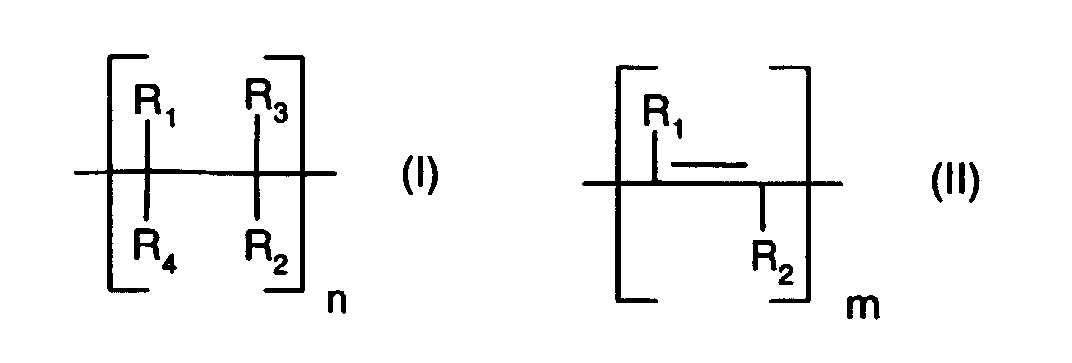

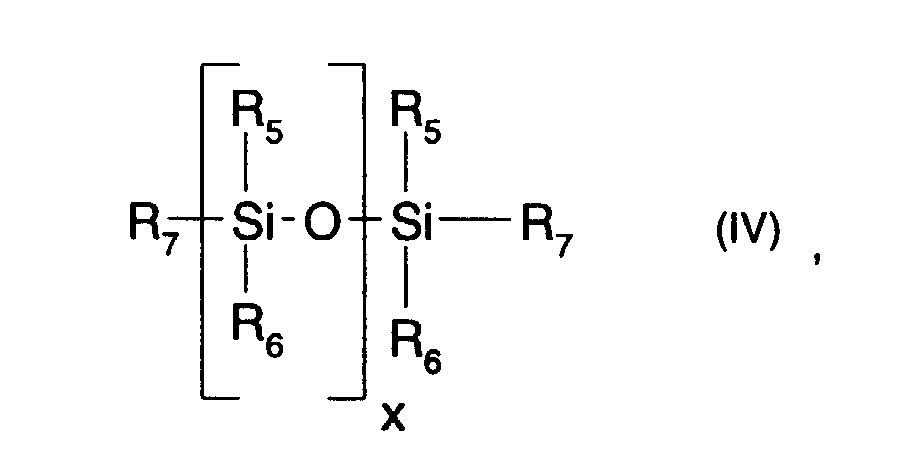

Die Reste R5 und R6 bedeuten vorzugsweise Alkyl, fluorhaltiges Niederalkyl oder Phenyl, insbesondere Niederalkyl, wie Methyl oder Ethyl, oder Phenyl. Besonders bevorzugt ist für die Reste R5 und R6 die Bedeutung Niederalkyl mit bis zu 8 Kohlenstoffatomen, wie Methyl. Die Reste R7 bedeuten Wasserstoff. Verbindungen der Formel (IV), bei denen die Reste R5, R6 und R7 diese Bedeutungen aufweisen, sind α, ω-Dihydrogen-polysiloxane.
Die Formkörper werden z.B. in eine Lösung getaucht, die vinylisches Monomer sowie gegebenenfalls einen Pfropfcopolymerisationskatalysator enthalten, und für beispielsweise 10 Minuten gequollen; die gequollenen Formkörper werden im allgemeinen aus der Lösung entfernt, und schliesslich typischerweise unter Schutzgas erwärmt sowie, alternativ oder additiv dazu, mit z.B. UV-Licht geeigneter Wellenlänge bestrahlt.
Ein vinylisches Monomer kann zunächst auf ein ungesättigtes Polymer (a) aufgepfropft werden, typischerweise unter den vorstehend genannten Pfropfcopolymerisationsbedingungen, und kann dann in einem zweiten Schritt mit einem Polysiloxan (b), enthaltend Hydrosilangruppen, vernetzt werden, üblicherweise unter den vorstehend beschriebenen Vernetzungsbedingungen einer Hydrosilylierungsreaktion.
Der Film dieses Beispiels ist ziemlich spröde.
Danach werden die Förmchen geöffnet, die Linsen entfernt, mit THF/Aceton (1:1) extrahiert und bis zur Gewichtskonstanz getrocknet.
| Eigenschaften der Polymere aus den Beispielen | ||||
| Beispiel | Polybutadien (PB) mittleres MG | H-Siloxan (HS) mittleres MG | Verhältnis PB / HS | Shore A Härte |
| 1 | 100'000 | 566 | 2:1 | 42 |
| 3 | 100'000 | 566 | 1:1 | 43 |
| 4 | 100'000 | 2200 | 1:1 | 52 |
| 5 | 100'000 | 2200 | 3:2 | 62 |
| 6 | 100'000 | 566 | 3:2 | 46 |
| 7 | 3000 | 566 | 2:1 | 63 |
| 8 | 3000 | 566 | 3:2 | 57 |
| Eigenschaften der Polymere aus den Beispielen | ||||
| Beispiel | E-Modulus (MPa) | O2Dk (Barrer) | Bruchdehnung (%) | Extrahierbare Anteile (%) |
| 1 | 1.27 | 152 | 370 | 3.1 |
| 3 | 0.74 | 105 | 80 | 3.5 |
| 4 | 1.13 | 196 | 420 | 2.5 |
| 5 | 1.21 | 159 | 430 | 2.7 |
| 6 | 0.82 | 129 | 174 | 4.5 |
| 7 | 1.24 | 57 | 52 | 2.9 |
| 8 | 0.84 | 55 | 67 | 4.71 |
| Kontaktwinkel | Advancing Angle | Receding Angle |
| vor der NVP-Modifikation | 111 | 71 |
| nach der NVP-Modifikation | 97 | 38 |
| Kontaktwinkel | Advancing Angle | Receding Angle |
| vor der DMA-Modifikation | 111 | 71 |
| nach der DMA-Modifikation | 92 | 44 |
Claims (20)
- Ophthalmischer Formkörper, erhältlich durch Umsetzen eines ungesättigten Polymers (a), das sich wiederholende Einheiten enthält, die ausgewählt sind aus Einheiten der Formel (I) und (II),wobei
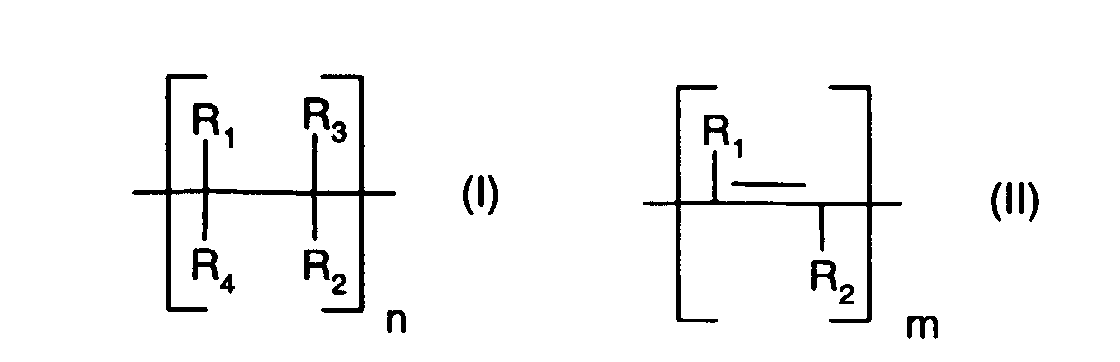 R1 für Wasserstoff, Alkyl oder Trialkyl-silyl steht;R2 Alkyl, das unsubstituiert oder durch Alkoxy, Alkoxycarbonyl, Hydroxy, Hydroxycarbonyl, Halogen oder Aryl substituiert ist; Alkenyl, das unsubstituiert oder durch Alkoxy, Alkoxycarbonyl, Hydroxycarbonyl, Halogen oder Aryl substituiert ist; oder Alkinyl, das unsubstituiert oder durch Alkoxy, Alkoxycarbonyl, Hydroxycarbonyl, Halogen oder Aryl substituiert ist, bedeutet;R3 und R4 unabhängig voneinander für Wasserstoff oder Alkyl stehen;oder R2 und R3 zusammen für -(CH2)q- stehen, wobei q eine ganze Zahl von 3 bis 5 bedeutet, oder R2 und R3 zusammen für einen zweiwertigen Rest der Fomel (III) stehen,wobei r und s unabhängig voneinander für eine ganze Zahl von 1 bis 3 stehen; oder
 R3 und R4 zusammen für -(CH2)p- stehen, wobei p eine ganze Zahl von 3 bis 5 bedeutet; n und m unabhängig voneinander für eine ganze Zahl von 10 bis 100 000 stehen; und die Summe von n und m ebenfalls für eine ganze Zahl von 10 bis 100 000 steht, mit der Massgabe, dass mindestens 20 % aller Segmente mindestens je eine ungesättigte Kohlenstoff-Kohlenstoff-Bindung aufweisen;und eines Polysiloxans (b) enthaltend Hydrosilangruppen der Formel (IV)wobei der Index x für 1 bis 1000 steht; und die Reste R5, R6 und R7 unabhängig
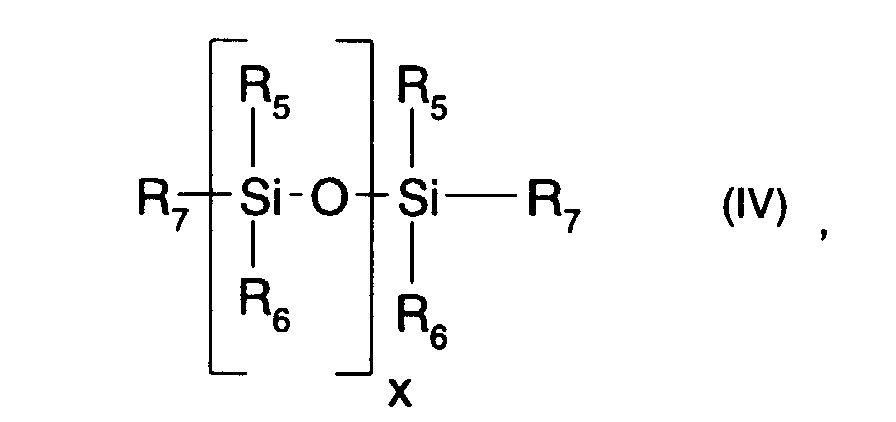 voneinander für Wasserstoff, Alkyl, Alkoxy, Phenyl oder fluorhaltiges Niederalkyl mit bis zu 8 Kohlenstoffatomen stehen, mit der Massgabe, dass in einer Verbindung der Formel (IV) mindestens zwei der Reste R5, R6 und R7 und höchstens 20 % aller Reste R5, R6 und R7 Wasserstoff bedeuten; in solch einem Massenverhältnis, dass das Vernetzungsprodukt daraus einen Polysiloxangehalt von 30 bis 80 Gew.-% aufweist.
 - Ophthalmischer Formkörper aus einem Pfropfpolymer, das durch Umsetzen eines Vernetzungsprodukts gemäss Anspruch 1 mit einem hydrophilen oder hydrophoben vinylischen Monomer erhältlich ist.
- Ophthalmischer Formkörper gemäss Anspruch 1 oder 2, wobei das ungesättigte Polymer (a) sich wiederholende Einheiten enthält, die ausgewählt sind aus Einheiten der Formel (I) und (II), worin R1, R3 und R4 für Wasserstoff stehen und R2 Niederalkenyl oder durch Halogen substituiertes Niederalkenyl mit bis zu 8 C-Atomen bedeutet.
- Ophthalmischer Formkörper gemäss Anspruch 1 oder 2, wobei das ungesättigte Polymer (a) sich wiederholende Einheiten enthält, die ausgewählt sind aus Einheiten der Formel (I) und (II), worin R1, R3 und R4 für Wasserstoff stehen und R2 für Niederalkenyl mit bis zu 4 C-Atomen steht.
- Ophthalmischer Formkörper gemäss Anspruch 1 oder 2, wobei das ungesättigte Polymer (a) sich wiederholende Einheiten der Formel (I) enthält, worin R1, R3 und R4 für Wasserstoff stehen und R2 für Niederalkenyl mit bis zu 4 C-Atomen steht.
- Ophthalmischer Formkörper gemäss Anspruch 1 oder 2, wobei das ungesättigte Polymer (a) sich wiederholende Einheiten der Formel (II) enthält, worin R1 für Triniederalkylsilyl und R2 für Niederalkyl steht.
- Ophthalmischer Formkörper gemäss Anspruch 1 oder 2, wobei das ungesättigte Polymer (a) alternierend sich wiederholende Einheiten der Formel (I) und (II) enthält, worin R1, R3 und R4 für Wasserstoff stehen und R2 für Niederalkyl oder Niederalkenyl mit bis zu 4 C-Atomen steht.
- Ophthalmischer Formkörper gemäss Anspruch 1 oder 2, wobei das ungesättigte Polymer (a) ausgewählt ist aus syndiotaktischem Poly-1,2-butadien, Poly-1,4-butadien und Polyisopren.
- Ophthalmischer Formkörper gemäss einem der Ansprüche 1 bis 8, wobei das Polysiloxan (b) für eine Verbindung der Formel (IV) steht, worin genau zwei der Reste R5, R6 und R7 Wasserstoff bedeuten.
- Ophthalmischer Formkörper gemäss Anspruch 9, wobei die beiden Reste R7 Wasserstoff bedeuten.
- Ophthalmischer Formkörper gemäss einem der Ansprüche 1 bis 10, wobei das Polysiloxan (b) für eine Verbindung der Formel (IV) steht, zwei Silicium-WasserstoffBindungen endständig angeordnet sind und die Reste R5 und R6 für Niederalkyl, fluorhaltiges Niederalkyl oder Phenyl stehen.
- Ophthalmischer Formkörper gemäss Anspruch 11, wobei die Reste R5 und R6 für Niederalkyl mit bis zu 8 Kohlenstoffatomen und insbesondere für Methyl stehen.
- Ophthalmischer Formkörper gemäss einem der Ansprüche 1 bis 12, wobei x für 1 bis 500, vor allem für 1 bis 200 oder für 1 bis 100 und besonders bevorzugt für 2 bis 85 steht.
- Ophthalmischer Formkörper gemäss Anspruch 1 oder 2, wobei das ungesättigte Polymer (a) ausgewählt ist aus der Gruppe eines polymeren konjugierten aliphatischen oder alicyclischen konjugierten Diens, das durch Halogen oder Niederalkyl substituiert ist; eines Polymers eines Alkins oder Dialkins, das unsubstituiert oder durch Niederalkyl oder Trimethylsilyl substituiert ist; eines Copolymers von einem konjugierten Dien mit einem hydrophilen oder hydrophoben vinylischen Monomer; oder von einem partiell hydrierten Derivat der genannten Verbindungen.
- Ophthalmischer Formkörper gemäss einem der Ansprüche 2 bis 14, wobei das hydrophobe vinylische Monomer ausgewählt ist unter C1-C18-Alkyl- und C3-C18-Cycloalkylacrylat und -methacrylat, C3-C18-Alkylacrylamid und -methacrylamid, Acrylnitril, Methacrylnitril, Vinyl-C1-C18-alkanoat, C2-C18-Alken, C2-C18-Haloalken, Styrol, Niederalkylstyrol, Niederalkylvinylether, C2-C10-Perfluoralkyl-acrylat und methacrylat oder entsprechend partiell fluoriertes Acrylat und Methacrylat, C3-C12-Perfluoralkyl-ethyl-thiocarbonylaminoethyl-acrylat und methacrylat, Acryloxy und Methacryloxy-alkylsiloxan, N-Vinylcarbazol und C1-C12-Alkylester der Maleinsäure, Fumarsäure, Itaconsäure und Mesaconsäure.
- Ophthalmischer Formkörper gemäss einem der Ansprüche 2 bis 14, wobei das hydrophile vinylische Monomer ausgewählt ist unter durch Hydroxy substituiertes Niederalkylacrylat und -methacrylat, Acrylamid, Methacrylamid, Niederalkylacrylamid und - methacrylamid, ethoxyliertes Acrylat und Methacrylat, durch Hydroxy substituiertes Niederalkylacrylamid und Methacrylamid, durch Hydroxy substituierter Niederalkylvinylether, Natriumvinylsulfonat, Natriumstyrolsulfonat, 2-Acrylamido-2-methylpropansulfonsäure, N-Vinylpyrrol, N-Vinyl-2-pyrrolidon, 2- und 4-Vinylpyridin, vinylisch ungesättigte Carbonsäuren mit insgesamt 3 bis 5 Kohlenstoffatomen, Aminoniederalkyl-, Mononiederalkylamino-niederalkyl- und Diniederalkylamino-niederalkylacrylat und -methacrylat und Allylalkohol.
- Ophthalmischer Formkörper gemäss einem der Ansprüche 1 bis 16, dadurch gekennzeichnet, dass es sich um eine Kontaktlinse, ein Hornhautimplantat oder um eine künstliche Hornhaut handelt.
- Verwendung eines Polymers gemäss einem der Ansprüche 1 bis 16 zur Herstellung von Kontaktlinsen.
- Verwendung eines Polymers gemäss einem der Ansprüche 1 bis 16 zur Beschichtung von ophthalmisch verwendbaren Polymersubstraten.
- Verwendung eines Polymers gemäss einem der Ansprüche 1 bis 16 als Hornhautimplantat oder künstliche Homhaut.
Applications Claiming Priority (5)
| Application Number | Priority Date | Filing Date | Title |
|---|---|---|---|
| CH396894 | 1994-12-30 | ||
| CH396794 | 1994-12-30 | ||
| CH3967/94 | 1994-12-30 | ||
| CH3968/94 | 1994-12-30 | ||
| PCT/CH1995/000308 WO1996020964A1 (de) | 1994-12-30 | 1995-12-27 | Siloxanhaltige netzwerke |
Publications (2)
| Publication Number | Publication Date |
|---|---|
| EP0800541A1 EP0800541A1 (de) | 1997-10-15 |
| EP0800541B1 true EP0800541B1 (de) | 1999-02-24 |
Family
ID=25694297
Family Applications (3)
| Application Number | Title | Priority Date | Filing Date |
|---|---|---|---|
| EP95940936A Expired - Lifetime EP0800657B1 (de) | 1994-12-30 | 1995-12-27 | Polymere auf der grundlage von blockcopolymeren |
| EP95940935A Expired - Lifetime EP0800541B1 (de) | 1994-12-30 | 1995-12-27 | Siloxanhaltige netzwerke |
| EP95940937A Expired - Lifetime EP0793541B1 (de) | 1994-12-30 | 1995-12-27 | Nco-terminale vinyltelomere |
Family Applications Before (1)
| Application Number | Title | Priority Date | Filing Date |
|---|---|---|---|
| EP95940936A Expired - Lifetime EP0800657B1 (de) | 1994-12-30 | 1995-12-27 | Polymere auf der grundlage von blockcopolymeren |
Family Applications After (1)
| Application Number | Title | Priority Date | Filing Date |
|---|---|---|---|
| EP95940937A Expired - Lifetime EP0793541B1 (de) | 1994-12-30 | 1995-12-27 | Nco-terminale vinyltelomere |
Country Status (20)
| Country | Link |
|---|---|
| US (1) | US6087412A (de) |
| EP (3) | EP0800657B1 (de) |
| JP (3) | JP3560980B2 (de) |
| KR (1) | KR987001001A (de) |
| CN (3) | CN1171798A (de) |
| AT (3) | ATE184812T1 (de) |
| AU (3) | AU692979B2 (de) |
| BR (2) | BR9510122A (de) |
| CA (3) | CA2208977A1 (de) |
| CZ (1) | CZ206197A3 (de) |
| DE (3) | DE59504366D1 (de) |
| DK (2) | DK0793541T3 (de) |
| ES (3) | ES2138246T3 (de) |
| FI (3) | FI972737A7 (de) |
| GR (2) | GR3029377T3 (de) |
| HU (1) | HUT77423A (de) |
| NO (3) | NO973019L (de) |
| NZ (1) | NZ297369A (de) |
| PL (1) | PL321142A1 (de) |
| WO (3) | WO1996020795A1 (de) |
Families Citing this family (52)
| Publication number | Priority date | Publication date | Assignee | Title |
|---|---|---|---|---|
| US5807944A (en) * | 1996-06-27 | 1998-09-15 | Ciba Vision Corporation | Amphiphilic, segmented copolymer of controlled morphology and ophthalmic devices including contact lenses made therefrom |
| AU5884198A (en) * | 1997-01-31 | 1998-08-25 | Dsm N.V. | Process for the reaction of polyolefins with hydrosilanes |
| TW473488B (en) * | 1998-04-30 | 2002-01-21 | Novartis Ag | Composite materials, biomedical articles formed thereof and process for their manufacture |
| US6080829A (en) * | 1998-06-24 | 2000-06-27 | Medtronic, Inc. | Silalkylenesiloxane copolymer materials and methods for their preparation |
| SE9900935D0 (sv) * | 1999-03-16 | 1999-03-16 | Pharmacia & Upjohn Bv | Macromolecular compounds |
| JP2002544205A (ja) * | 1999-05-10 | 2002-12-24 | チバ スペシャルティ ケミカルズ ホールディング インコーポレーテッド | 新規な光開始剤及びその応用 |
| EP1192233A1 (de) | 1999-05-21 | 2002-04-03 | Cabot Corporation | Polymerzusammensetzung |
| US6423802B1 (en) | 1999-05-21 | 2002-07-23 | Cabot Corporation | Water soluble copolymers and polymer compositions comprising same and use thereof |
| US6541159B1 (en) * | 1999-08-12 | 2003-04-01 | Reveo, Inc. | Oxygen separation through hydroxide-conductive membrane |
| JP2001163933A (ja) * | 1999-10-27 | 2001-06-19 | Novartis Ag | 材料表面を改質する方法 |
| EP1095965B1 (de) * | 1999-10-27 | 2005-02-09 | Novartis AG | Verfahren zur Modifikation einer Materialoberfläche |
| US6824559B2 (en) * | 2000-12-22 | 2004-11-30 | Advanced Cardiovascular Systems, Inc. | Ethylene-carboxyl copolymers as drug delivery matrices |
| US6420479B1 (en) * | 2000-12-29 | 2002-07-16 | National Starch And Chemical Investment Holding Corporation | Star polymer colloidal stabilizers |
| TW200407367A (en) * | 2001-11-13 | 2004-05-16 | Novartis Ag | Method for modifying the surface of biomedical articles |
| CA2475468C (en) * | 2002-02-08 | 2011-11-01 | Ophtec B.V. | High refractive index flexible silicone |
| JP2004045750A (ja) * | 2002-07-11 | 2004-02-12 | Menicon Co Ltd | 高含水性眼用レンズ及びその製造方法 |
| US7250408B2 (en) | 2002-12-16 | 2007-07-31 | Bayer Schering Pharma Ag | Glucocorticoid receptor antagonists for prophylaxis and therapy of glucocorticoid-mediated hypogonadism, of sexual dysfunction and/or infertility |
| US7795324B2 (en) * | 2004-07-15 | 2010-09-14 | Agfa Graphics, N.V. | Radiation curable compositions |
| EP1616921B1 (de) * | 2004-07-15 | 2007-10-31 | Agfa Graphics N.V. | Neue strahlenhärtbare Zusammensetzungen |
| US7538144B2 (en) * | 2004-07-15 | 2009-05-26 | Agfa Graphics, N.V. | Photoreactive polymers |
| US7507773B2 (en) * | 2004-07-15 | 2009-03-24 | Agfa Graphics N.V. | Radiation curable compositions |
| US7875698B2 (en) * | 2004-07-15 | 2011-01-25 | Agfa Graphics Nv | Polymeric initiators |
| EP1616920B1 (de) * | 2004-07-15 | 2008-02-20 | Agfa Graphics N.V. | Neue Polymerisationsinitiatoren |
| US7396861B2 (en) * | 2004-07-15 | 2008-07-08 | Agfa Graphics Nv | Radiation curable compositions |
| US8142691B2 (en) * | 2004-09-30 | 2012-03-27 | Lawrence Livermore National Security, Llc | Thermal casting of polymers in centrifuge for producing X-ray optics |
| US8197841B2 (en) | 2004-12-22 | 2012-06-12 | Bausch & Lomb Incorporated | Polymerizable surfactants and their use as device forming comonomers |
| US7682771B2 (en) * | 2004-12-29 | 2010-03-23 | 3M Innovative Properties Company | Compositions containing photosensitive fluorochemical and uses thereof |
| EP1858955A1 (de) * | 2005-02-23 | 2007-11-28 | E.I. Dupont De Nemours And Company | Verfahren mit alpha-, omega-difunktionellen aldaramiden als monomere und vernetzer |
| US8877216B2 (en) | 2005-05-23 | 2014-11-04 | Dow Corning Corporation | Cosmetic and skin-care compositions comprising saccharide-siloxane copolymers |
| US20070122443A1 (en) * | 2005-11-29 | 2007-05-31 | Narayanan Pallassana V | Amphiphilic copolymer compositions |
| WO2007149083A1 (en) * | 2006-06-21 | 2007-12-27 | Bausch & Lomb Incorporated | Polymerizable surfactants and their use as device forming comonomers |
| KR101677505B1 (ko) * | 2009-08-26 | 2016-11-18 | 제이에스알 가부시끼가이샤 | 신규 화합물, 그 제조 방법, 이 신규 화합물을 함유하는 감방사선성 조성물 및 경화막 |
| US9522980B2 (en) * | 2010-05-06 | 2016-12-20 | Johnson & Johnson Vision Care, Inc. | Non-reactive, hydrophilic polymers having terminal siloxanes and methods for making and using the same |
| US9657435B2 (en) | 2010-06-28 | 2017-05-23 | Basf Se | Metal free bleaching composition |
| US8853372B2 (en) | 2010-08-23 | 2014-10-07 | Dow Corning Corporation | Saccharide siloxanes stable in aqueous environments and methods for the preparation and use of such saccharide siloxanes |
| US9170349B2 (en) | 2011-05-04 | 2015-10-27 | Johnson & Johnson Vision Care, Inc. | Medical devices having homogeneous charge density and methods for making same |
| US20130203813A1 (en) | 2011-05-04 | 2013-08-08 | Johnson & Johnson Vision Care, Inc. | Medical devices having homogeneous charge density and methods for making same |
| US9188702B2 (en) | 2011-09-30 | 2015-11-17 | Johnson & Johnson Vision Care, Inc. | Silicone hydrogels having improved curing speed and other properties |
| TWI434865B (zh) | 2011-12-29 | 2014-04-21 | Pegavision Corp | 親水有機矽高聚物之製造方法 |
| US9244196B2 (en) | 2012-05-25 | 2016-01-26 | Johnson & Johnson Vision Care, Inc. | Polymers and nanogel materials and methods for making and using the same |
| US9297929B2 (en) | 2012-05-25 | 2016-03-29 | Johnson & Johnson Vision Care, Inc. | Contact lenses comprising water soluble N-(2 hydroxyalkyl) (meth)acrylamide polymers or copolymers |
| US10073192B2 (en) | 2012-05-25 | 2018-09-11 | Johnson & Johnson Vision Care, Inc. | Polymers and nanogel materials and methods for making and using the same |
| US11054743B2 (en) | 2015-12-15 | 2021-07-06 | Changzhou Tronly Advanced Electronic Materials Co., Ltd. | Fluorene polyfunctional photoinitiator and preparation and use thereof, and photosensitive resin composition containing fluorene photoinitiator and use thereof |
| JP6833171B2 (ja) | 2016-09-13 | 2021-02-24 | 常州強力先端電子材料有限公司Changzhou Tronly Advanced Electronic Materials Co.,Ltd. | フルオレン類光開始剤、その製造方法、それを有する光硬化性組成物、及び光硬化分野におけるフルオレン類光開始剤の使用 |
| US10676575B2 (en) * | 2016-10-06 | 2020-06-09 | Johnson & Johnson Vision Care, Inc. | Tri-block prepolymers and their use in silicone hydrogels |
| WO2018149370A1 (zh) | 2017-02-17 | 2018-08-23 | 常州强力先端电子材料有限公司 | 芴氨基酮类光引发剂、其制备方法及含芴氨基酮类光引发剂的uv光固化组合物 |
| FR3064267B1 (fr) * | 2017-03-27 | 2021-07-23 | Arkema France | Compose reticulant, son procede de synthese, composition liquide comprenant ledit compose reticulant, son procede de polymerisation, et materiau obtenu apres polymerisation de ladite composition |
| CN111410860A (zh) * | 2019-01-08 | 2020-07-14 | 疏科纳米疏水科技(嘉兴)有限公司 | 制备超疏水墙体装修用材料的方法 |
| CN111410914A (zh) * | 2019-01-08 | 2020-07-14 | 疏科纳米疏水科技(嘉兴)有限公司 | 制备超疏水涂料的方法 |
| US11891526B2 (en) | 2019-09-12 | 2024-02-06 | Johnson & Johnson Vision Care, Inc. | Ink composition for cosmetic contact lenses |
| JP2022151117A (ja) * | 2021-03-26 | 2022-10-07 | 日油株式会社 | コンタクトレンズ用保存液 |
| CN115141162B (zh) * | 2022-09-05 | 2022-12-20 | 天津久日新材料股份有限公司 | 一种光引发剂的制备方法及其产品 |
Family Cites Families (14)
| Publication number | Priority date | Publication date | Assignee | Title |
|---|---|---|---|---|
| JPS497346A (de) * | 1972-05-10 | 1974-01-23 | ||
| JPS5293718A (en) * | 1976-01-31 | 1977-08-06 | Shin Etsu Chem Co Ltd | Preparation of organosilicon compounds |
| JPS555904A (en) * | 1978-06-27 | 1980-01-17 | Toshiba Corp | Production of base material for electroless plating |
| JPS63125541A (ja) * | 1986-11-17 | 1988-05-28 | Bridgestone Corp | 可撓性物品 |
| KR880010065A (ko) * | 1987-02-16 | 1988-10-06 | 아사쿠라 다쯔오 | 고무조성물, 가교될 수 있는 고무조성물 및 그로부터 제조되는 오일시일 및 고무호오스 |
| DE3738567A1 (de) * | 1987-03-12 | 1988-09-22 | Merck Patent Gmbh | Coreaktive fotoinitiatoren |
| DE3880920T2 (de) * | 1987-08-05 | 1993-10-07 | Ciba Geigy | Verbindungen. |
| US5070170A (en) * | 1988-02-26 | 1991-12-03 | Ciba-Geigy Corporation | Wettable, rigid gas permeable, substantially non-swellable contact lens containing block copolymer polysiloxane-polyoxyalkylene backbone units, and use thereof |
| FR2641785B1 (fr) * | 1989-01-19 | 1992-07-31 | Essilor Int | Composition de polymeres transparents pour lentilles de contact de type rigide, permeables a l'oxygene |
| US5334681A (en) * | 1989-06-20 | 1994-08-02 | Ciba-Geigy Corporation | Fluorine and/or silicone containing poly(alkylene-oxide)-block copolymer hydrogels and contact lenses thereof |
| JPH03217480A (ja) * | 1990-01-22 | 1991-09-25 | Goyo Shiko Kk | 抗接着剤 |
| US5371147A (en) * | 1990-10-11 | 1994-12-06 | Permeable Technologies, Inc. | Silicone-containing acrylic star polymers, block copolymers and macromonomers |
| DE4224559A1 (de) * | 1992-07-24 | 1994-01-27 | Bayer Ag | Kombinationen aus Polyorganosiloxanen und doppelbindungshaltigen Fluorkautschuken durch Si-H-Addition |
| TW328535B (en) * | 1993-07-02 | 1998-03-21 | Novartis Ag | Functional photoinitiators and their manufacture |
-
1995
- 1995-12-27 DE DE59504366T patent/DE59504366D1/de not_active Expired - Fee Related
- 1995-12-27 JP JP52066096A patent/JP3560980B2/ja not_active Expired - Fee Related
- 1995-12-27 CN CN95197183A patent/CN1171798A/zh active Pending
- 1995-12-27 JP JP8520659A patent/JPH10512308A/ja active Pending
- 1995-12-27 ES ES95940937T patent/ES2138246T3/es not_active Expired - Lifetime
- 1995-12-27 EP EP95940936A patent/EP0800657B1/de not_active Expired - Lifetime
- 1995-12-27 EP EP95940935A patent/EP0800541B1/de not_active Expired - Lifetime
- 1995-12-27 AT AT95940937T patent/ATE184812T1/de not_active IP Right Cessation
- 1995-12-27 HU HU9800218A patent/HUT77423A/hu unknown
- 1995-12-27 AU AU42515/96A patent/AU692979B2/en not_active Ceased
- 1995-12-27 CN CN95197443A patent/CN1173148A/zh active Pending
- 1995-12-27 FI FI972737A patent/FI972737A7/fi unknown
- 1995-12-27 ES ES95940935T patent/ES2128110T3/es not_active Expired - Lifetime
- 1995-12-27 US US08/860,132 patent/US6087412A/en not_active Expired - Lifetime
- 1995-12-27 KR KR1019970704468A patent/KR987001001A/ko not_active Withdrawn
- 1995-12-27 NZ NZ297369A patent/NZ297369A/xx unknown
- 1995-12-27 AU AU42514/96A patent/AU4251496A/en not_active Abandoned
- 1995-12-27 PL PL95321142A patent/PL321142A1/xx unknown
- 1995-12-27 JP JP52066196A patent/JP4375811B2/ja not_active Expired - Lifetime
- 1995-12-27 FI FI972738A patent/FI972738A7/fi unknown
- 1995-12-27 WO PCT/CH1995/000310 patent/WO1996020795A1/de not_active Ceased
- 1995-12-27 CN CN95197442A patent/CN1173227A/zh active Pending
- 1995-12-27 WO PCT/CH1995/000308 patent/WO1996020964A1/de not_active Ceased
- 1995-12-27 CA CA002208977A patent/CA2208977A1/en not_active Abandoned
- 1995-12-27 DK DK95940937T patent/DK0793541T3/da active
- 1995-12-27 AT AT95940936T patent/ATE173742T1/de not_active IP Right Cessation
- 1995-12-27 ES ES95940936T patent/ES2125676T3/es not_active Expired - Lifetime
- 1995-12-27 DE DE59505153T patent/DE59505153D1/de not_active Expired - Fee Related
- 1995-12-27 CA CA002208967A patent/CA2208967A1/en not_active Abandoned
- 1995-12-27 AT AT95940935T patent/ATE176915T1/de not_active IP Right Cessation
- 1995-12-27 FI FI972611A patent/FI972611A7/fi not_active Application Discontinuation
- 1995-12-27 DK DK95940936T patent/DK0800657T3/da active
- 1995-12-27 BR BR9510122A patent/BR9510122A/pt not_active Application Discontinuation
- 1995-12-27 DE DE59506915T patent/DE59506915D1/de not_active Expired - Lifetime
- 1995-12-27 WO PCT/CH1995/000309 patent/WO1996021167A1/de not_active Ceased
- 1995-12-27 EP EP95940937A patent/EP0793541B1/de not_active Expired - Lifetime
- 1995-12-27 AU AU42516/96A patent/AU701751B2/en not_active Ceased
- 1995-12-27 CA CA002208996A patent/CA2208996A1/en not_active Abandoned
- 1995-12-27 BR BR9510434-8A patent/BR9510434A/pt not_active Application Discontinuation
- 1995-12-27 CZ CZ972061A patent/CZ206197A3/cs unknown
-
1997
- 1997-06-27 NO NO973019A patent/NO973019L/no unknown
- 1997-06-27 NO NO973020A patent/NO973020L/no unknown
- 1997-06-27 NO NO973018A patent/NO973018L/no unknown
-
1999
- 1999-02-12 GR GR990400461T patent/GR3029377T3/el unknown
- 1999-12-22 GR GR990403297T patent/GR3032210T3/el unknown
Also Published As
Similar Documents
| Publication | Publication Date | Title |
|---|---|---|
| WO1996020964A1 (de) | Siloxanhaltige netzwerke | |
| DE69706852T2 (de) | Copolymere mit amphiphilen segmenten und kontrollierter morphologie; opthalmische produkte und kontaktlinsen auf basis diesen copolymeren | |
| DE69605778T2 (de) | Verwendung eines polymers als ein substrat zum zellwachstum | |
| DE69604285T2 (de) | Polysiloxan-polyol makromere, deren herstellung und verwendung | |
| DE69613841T2 (de) | Polymerisierbare siloxanmakromonomere | |
| DE60029992T2 (de) | Weiche kontaktlinsen | |
| DE69935457T2 (de) | Perfluoroalkylpolyetherpolymere für ophthalmische anwendungen | |
| DE69611086T2 (de) | Polymerisierbares perfluoroalkylether makromer | |
| DE60018044T2 (de) | Neue biomaterialien | |
| DE69021282T2 (de) | Prepolymere zur Verwendung in biomedizinischen Vorrichtungen. | |
| DE60103621T2 (de) | Vernetzbare oder polymerisierbare präpolymere | |
| DE69407573T2 (de) | Fluorsiloxanhydrogele | |
| DE68925328T2 (de) | Kontaktlinse auf der Basis von vernetzten Silikon-Urethanpolymeren | |
| DE69314055T2 (de) | Siloxy-funktionelles macromonomer | |
| DE2831274A1 (de) | Polysiloxanhydrogele | |
| DE69611161T2 (de) | Polymerisierbarer perfluoroalkyläther-siloxan-makromer | |
| CZ310897A3 (cs) | Makromery, způsob jejich přípravy, polymery, které je obsahují a jejich použití | |
| DD218374A5 (de) | Verfahren zur herstellung von silikonhaltigen polymeren | |
| DE60014611T2 (de) | Organische verbindungen | |
| JP2003519280A (ja) | ヒドロゲル | |
| DE3727044A1 (de) | Massen fuer kontaktlinsen und biokompatible koerper | |
| EP0914169B1 (de) | Materialien zur behandlung des glaukoms | |
| DE602005004916T2 (de) | Neue präpolymere für verbesserte oberflächenveränderung von kontaktlinsen | |
| DE68921657T2 (de) | Benetzbare, flexible und Sauerstoff durchlassende Kontaktlinsen auf der Basis von Polyoxyalkyleneinheiten und ihre Verwendung. | |
| JP2003502493A (ja) | 成形物の製造方法 |
Legal Events
| Date | Code | Title | Description |
|---|---|---|---|
| PUAI | Public reference made under article 153(3) epc to a published international application that has entered the european phase |
Free format text: ORIGINAL CODE: 0009012 |
|
| 17P | Request for examination filed |
Effective date: 19970610 |
|
| AK | Designated contracting states |
Kind code of ref document: A1 Designated state(s): AT BE CH DE DK ES FR GB GR IE IT LI LU NL PT SE |
|
| 17Q | First examination report despatched |
Effective date: 19971020 |
|
| GRAG | Despatch of communication of intention to grant |
Free format text: ORIGINAL CODE: EPIDOS AGRA |
|
| GRAG | Despatch of communication of intention to grant |
Free format text: ORIGINAL CODE: EPIDOS AGRA |
|
| GRAH | Despatch of communication of intention to grant a patent |
Free format text: ORIGINAL CODE: EPIDOS IGRA |
|
| GRAH | Despatch of communication of intention to grant a patent |
Free format text: ORIGINAL CODE: EPIDOS IGRA |
|
| GRAA | (expected) grant |
Free format text: ORIGINAL CODE: 0009210 |
|
| AK | Designated contracting states |
Kind code of ref document: B1 Designated state(s): AT BE CH DE DK ES FR GB GR IE IT LI LU NL PT SE |
|
| PG25 | Lapsed in a contracting state [announced via postgrant information from national office to epo] |
Ref country code: SE Free format text: THE PATENT HAS BEEN ANNULLED BY A DECISION OF A NATIONAL AUTHORITY Effective date: 19990224 Ref country code: NL Free format text: LAPSE BECAUSE OF FAILURE TO SUBMIT A TRANSLATION OF THE DESCRIPTION OR TO PAY THE FEE WITHIN THE PRESCRIBED TIME-LIMIT Effective date: 19990224 Ref country code: GR Free format text: LAPSE BECAUSE OF NON-PAYMENT OF DUE FEES Effective date: 19990224 |
|
| RBV | Designated contracting states (corrected) |
Designated state(s): AT BE CH DE DK ES FR GB GR IE IT LI LU NL PT SE |
|
| REF | Corresponds to: |
Ref document number: 176915 Country of ref document: AT Date of ref document: 19990315 Kind code of ref document: T |
|
| REG | Reference to a national code |
Ref country code: CH Ref legal event code: EP |
|
| REG | Reference to a national code |
Ref country code: IE Ref legal event code: FG4D Free format text: GERMAN |
|
| REF | Corresponds to: |
Ref document number: 59505153 Country of ref document: DE Date of ref document: 19990401 |
|
| ET | Fr: translation filed | ||
| GBT | Gb: translation of ep patent filed (gb section 77(6)(a)/1977) |
Effective date: 19990325 |
|
| REG | Reference to a national code |
Ref country code: ES Ref legal event code: FG2A Ref document number: 2128110 Country of ref document: ES Kind code of ref document: T3 |
|
| ITF | It: translation for a ep patent filed | ||
| PG25 | Lapsed in a contracting state [announced via postgrant information from national office to epo] |
Ref country code: PT Free format text: LAPSE BECAUSE OF FAILURE TO SUBMIT A TRANSLATION OF THE DESCRIPTION OR TO PAY THE FEE WITHIN THE PRESCRIBED TIME-LIMIT Effective date: 19990524 Ref country code: DK Free format text: LAPSE BECAUSE OF FAILURE TO SUBMIT A TRANSLATION OF THE DESCRIPTION OR TO PAY THE FEE WITHIN THE PRESCRIBED TIME-LIMIT Effective date: 19990524 |
|
| NLV1 | Nl: lapsed or annulled due to failure to fulfill the requirements of art. 29p and 29m of the patents act | ||
| PG25 | Lapsed in a contracting state [announced via postgrant information from national office to epo] |
Ref country code: IE Free format text: LAPSE BECAUSE OF NON-PAYMENT OF DUE FEES Effective date: 19991019 |
|
| PGFP | Annual fee paid to national office [announced via postgrant information from national office to epo] |
Ref country code: FR Payment date: 19991116 Year of fee payment: 5 |
|
| REG | Reference to a national code |
Ref country code: IE Ref legal event code: FD4D |
|
| PGFP | Annual fee paid to national office [announced via postgrant information from national office to epo] |
Ref country code: DE Payment date: 19991122 Year of fee payment: 5 |
|
| PGFP | Annual fee paid to national office [announced via postgrant information from national office to epo] |
Ref country code: GB Payment date: 19991125 Year of fee payment: 5 |
|
| PGFP | Annual fee paid to national office [announced via postgrant information from national office to epo] |
Ref country code: ES Payment date: 19991216 Year of fee payment: 5 |
|
| PG25 | Lapsed in a contracting state [announced via postgrant information from national office to epo] |
Ref country code: LU Free format text: LAPSE BECAUSE OF NON-PAYMENT OF DUE FEES Effective date: 19991227 Ref country code: AT Free format text: LAPSE BECAUSE OF NON-PAYMENT OF DUE FEES Effective date: 19991227 |
|
| PLBE | No opposition filed within time limit |
Free format text: ORIGINAL CODE: 0009261 |
|
| STAA | Information on the status of an ep patent application or granted ep patent |
Free format text: STATUS: NO OPPOSITION FILED WITHIN TIME LIMIT |
|
| PG25 | Lapsed in a contracting state [announced via postgrant information from national office to epo] |
Ref country code: LI Free format text: LAPSE BECAUSE OF NON-PAYMENT OF DUE FEES Effective date: 19991231 Ref country code: CH Free format text: LAPSE BECAUSE OF NON-PAYMENT OF DUE FEES Effective date: 19991231 Ref country code: BE Free format text: LAPSE BECAUSE OF NON-PAYMENT OF DUE FEES Effective date: 19991231 |
|
| 26N | No opposition filed | ||
| BERE | Be: lapsed |
Owner name: NOVARTIS A.G. Effective date: 19991231 |
|
| PG25 | Lapsed in a contracting state [announced via postgrant information from national office to epo] |
Ref country code: GB Free format text: LAPSE BECAUSE OF NON-PAYMENT OF DUE FEES Effective date: 20001227 |
|
| GBPC | Gb: european patent ceased through non-payment of renewal fee |
Effective date: 20001227 |
|
| PG25 | Lapsed in a contracting state [announced via postgrant information from national office to epo] |
Ref country code: FR Free format text: LAPSE BECAUSE OF NON-PAYMENT OF DUE FEES Effective date: 20010831 |
|
| REG | Reference to a national code |
Ref country code: FR Ref legal event code: ST |
|
| PG25 | Lapsed in a contracting state [announced via postgrant information from national office to epo] |
Ref country code: DE Free format text: LAPSE BECAUSE OF NON-PAYMENT OF DUE FEES Effective date: 20011002 |
|
| PG25 | Lapsed in a contracting state [announced via postgrant information from national office to epo] |
Ref country code: ES Free format text: LAPSE BECAUSE OF NON-PAYMENT OF DUE FEES Effective date: 20011228 |
|
| REG | Reference to a national code |
Ref country code: ES Ref legal event code: FD2A Effective date: 20020112 |
|
| PG25 | Lapsed in a contracting state [announced via postgrant information from national office to epo] |
Ref country code: IT Free format text: LAPSE BECAUSE OF NON-PAYMENT OF DUE FEES;WARNING: LAPSES OF ITALIAN PATENTS WITH EFFECTIVE DATE BEFORE 2007 MAY HAVE OCCURRED AT ANY TIME BEFORE 2007. THE CORRECT EFFECTIVE DATE MAY BE DIFFERENT FROM THE ONE RECORDED. Effective date: 20051227 |