EP0768053B1 - Niedrigtemperatur-Schauvitrine - Google Patents
Niedrigtemperatur-Schauvitrine Download PDFInfo
- Publication number
- EP0768053B1 EP0768053B1 EP96116179A EP96116179A EP0768053B1 EP 0768053 B1 EP0768053 B1 EP 0768053B1 EP 96116179 A EP96116179 A EP 96116179A EP 96116179 A EP96116179 A EP 96116179A EP 0768053 B1 EP0768053 B1 EP 0768053B1
- Authority
- EP
- European Patent Office
- Prior art keywords
- evaporator
- defrosting
- refrigerant
- display case
- low temperature
- Prior art date
- Legal status (The legal status is an assumption and is not a legal conclusion. Google has not performed a legal analysis and makes no representation as to the accuracy of the status listed.)
- Expired - Lifetime
Links
- 238000010257 thawing Methods 0.000 claims description 87
- 239000003507 refrigerant Substances 0.000 claims description 71
- 229910052751 metal Inorganic materials 0.000 claims description 37
- 239000002184 metal Substances 0.000 claims description 37
- 238000001816 cooling Methods 0.000 description 27
- 238000009413 insulation Methods 0.000 description 23
- XLYOFNOQVPJJNP-UHFFFAOYSA-N water Substances O XLYOFNOQVPJJNP-UHFFFAOYSA-N 0.000 description 22
- 238000005192 partition Methods 0.000 description 12
- 238000011084 recovery Methods 0.000 description 9
- 238000005338 heat storage Methods 0.000 description 7
- 229910000838 Al alloy Inorganic materials 0.000 description 5
- 238000010586 diagram Methods 0.000 description 4
- 239000012530 fluid Substances 0.000 description 4
- 235000015243 ice cream Nutrition 0.000 description 4
- 239000007788 liquid Substances 0.000 description 4
- 238000005086 pumping Methods 0.000 description 4
- 229910052782 aluminium Inorganic materials 0.000 description 2
- XAGFODPZIPBFFR-UHFFFAOYSA-N aluminium Chemical compound [Al] XAGFODPZIPBFFR-UHFFFAOYSA-N 0.000 description 2
- 238000007599 discharging Methods 0.000 description 2
- 235000013611 frozen food Nutrition 0.000 description 2
- 230000002093 peripheral effect Effects 0.000 description 2
- 230000001681 protective effect Effects 0.000 description 2
- 239000010935 stainless steel Substances 0.000 description 2
- 229910001220 stainless steel Inorganic materials 0.000 description 2
- 229910001335 Galvanized steel Inorganic materials 0.000 description 1
- PPBRXRYQALVLMV-UHFFFAOYSA-N Styrene Chemical compound C=CC1=CC=CC=C1 PPBRXRYQALVLMV-UHFFFAOYSA-N 0.000 description 1
- 238000005219 brazing Methods 0.000 description 1
- 230000015556 catabolic process Effects 0.000 description 1
- 235000009508 confectionery Nutrition 0.000 description 1
- 238000006731 degradation reaction Methods 0.000 description 1
- 230000006866 deterioration Effects 0.000 description 1
- 239000008397 galvanized steel Substances 0.000 description 1
- 230000020169 heat generation Effects 0.000 description 1
- 239000012774 insulation material Substances 0.000 description 1
- 230000014759 maintenance of location Effects 0.000 description 1
- 238000000034 method Methods 0.000 description 1
- 230000000717 retained effect Effects 0.000 description 1
- 230000001932 seasonal effect Effects 0.000 description 1
- 238000011144 upstream manufacturing Methods 0.000 description 1
Images




Classifications
-
- A—HUMAN NECESSITIES
- A47—FURNITURE; DOMESTIC ARTICLES OR APPLIANCES; COFFEE MILLS; SPICE MILLS; SUCTION CLEANERS IN GENERAL
- A47F—SPECIAL FURNITURE, FITTINGS, OR ACCESSORIES FOR SHOPS, STOREHOUSES, BARS, RESTAURANTS OR THE LIKE; PAYING COUNTERS
- A47F3/00—Show cases or show cabinets
- A47F3/04—Show cases or show cabinets air-conditioned, refrigerated
- A47F3/0439—Cases or cabinets of the open type
- A47F3/0443—Cases or cabinets of the open type with forced air circulation
- A47F3/0447—Cases or cabinets of the open type with forced air circulation with air curtains
-
- F—MECHANICAL ENGINEERING; LIGHTING; HEATING; WEAPONS; BLASTING
- F25—REFRIGERATION OR COOLING; COMBINED HEATING AND REFRIGERATION SYSTEMS; HEAT PUMP SYSTEMS; MANUFACTURE OR STORAGE OF ICE; LIQUEFACTION SOLIDIFICATION OF GASES
- F25D—REFRIGERATORS; COLD ROOMS; ICE-BOXES; COOLING OR FREEZING APPARATUS NOT OTHERWISE PROVIDED FOR
- F25D21/00—Defrosting; Preventing frosting; Removing condensed or defrost water
-
- F—MECHANICAL ENGINEERING; LIGHTING; HEATING; WEAPONS; BLASTING
- F25—REFRIGERATION OR COOLING; COMBINED HEATING AND REFRIGERATION SYSTEMS; HEAT PUMP SYSTEMS; MANUFACTURE OR STORAGE OF ICE; LIQUEFACTION SOLIDIFICATION OF GASES
- F25B—REFRIGERATION MACHINES, PLANTS OR SYSTEMS; COMBINED HEATING AND REFRIGERATION SYSTEMS; HEAT PUMP SYSTEMS
- F25B47/00—Arrangements for preventing or removing deposits or corrosion, not provided for in another subclass
- F25B47/02—Defrosting cycles
- F25B47/022—Defrosting cycles hot gas defrosting
-
- F—MECHANICAL ENGINEERING; LIGHTING; HEATING; WEAPONS; BLASTING
- F25—REFRIGERATION OR COOLING; COMBINED HEATING AND REFRIGERATION SYSTEMS; HEAT PUMP SYSTEMS; MANUFACTURE OR STORAGE OF ICE; LIQUEFACTION SOLIDIFICATION OF GASES
- F25D—REFRIGERATORS; COLD ROOMS; ICE-BOXES; COOLING OR FREEZING APPARATUS NOT OTHERWISE PROVIDED FOR
- F25D21/00—Defrosting; Preventing frosting; Removing condensed or defrost water
- F25D21/06—Removing frost
- F25D21/08—Removing frost by electric heating
Definitions
- the present invention relates to a low temperature display case wherein are formed ducts, which communicate with the rear and the lower side of a storage chamber that is open to the front, whereby cool air, which is obtained by heat exchange in an evaporator that is provided upright in a duct at the rear, is discharged by a blower from openings at the upper edge of the storage chamber.
- a low temperature display case of the above described type is designed with a division wall located on the internal face of a substantially C-shaped heat insulation wall and a deck pan located at the bottom to define a storage chamber and a duct, and an evaporator and a blower are provided in the duct.
- air cooled in the duct is circulated through the storage chamber.
- the low temperature display case 100 is constructed with a substantially C-shaped heat insulation division wall 103 mounted, with an intervening space, inside a heat insulation wall 102, which is also substantially C shaped.
- a partition panel 104 is attached, with an intervening space, at its rear side to the upper and the lower internal side of the heat insulation division wall 103.
- Deck struts 106 are provided on each side and in the center of the partition panel 104.
- the lower ends of the deck struts 106 and of the partition panel 104 are secured either directly or via another member to a metal fitting 107, the ends of which are fixed to frames (not shown) on either side of the heat insulation wall 102.
- a deck pan 108 is provided, with an intervening space, above a bottom wall 103A of the heat insulation division wall 103.
- a storage chamber 109 which is open to the front, is defined by an area enclosed by the partition panel 104 and the deck pan 108.
- An evaporator 113 that is included in a cooler is provided upright at the rear inside the inner duct 112, with the front lower end of its tube sheet (not shown) fixed to the metal fitting 107.
- a suction blower 114 (for an inner duct) is provided below the deck pan 108 in the front internal portion of the inner duct 112, and a suction blower 116 (for an outer duct) is provided in the front internal portion of the outer duct 111, which is located below the inner duct 112.
- the top surface of the bottom wall 103A, of the heat insulation division wall 103 inclines downward at an angle of 4 degrees, for example, toward a drain hole 117, which is located beneath the blower 114.
- the top face of the bottom wall 103A therefore, serves as a drain pan 118, and drain pan heaters (electric heaters) 119 for the drain pan 118 are provided near the drain hole 117.
- the drain hole 117 communicates with the outer duct 111, and defrosting heaters (electric heaters) 122 and an attachment plate 121 are provided inside the inner duct 112 at the upper rear portion of the drain pan 118.
- the defrosting heaters 122 are located forward of the evaporator 113 and under the metal fitting 107, so that during defrosting, water falling from the evaporator 113 will not fall directly on the heaters 122.
- the upper ends of the inner and outer ducts 112 and 111 communicate respectively with an inner discharge opening 124 and an outer discharge opening 126, which are positioned near the upper edge of the opening of the storage chamber 109.
- An inner intake opening 127 and an outer intake opening 128 are formed at the lower edge of the opening of the storage chamber 109, and from the front the opening 127 is located behind the opening 128.
- the inner intake opening 127 communicates with the inner duct 112, and the outer intake opening 128 communicates with the outer duct 111.
- decks 129 on which frozen foods, such as ice cream can be displayed, are supported as a series of steps by the deck struts 106.
- the cooling device when the cooling device is activated to drive the blowers 114 and 116, air is drawn in by the blower 114 and is driven toward the evaporator 113.
- the air that passes through the evaporator 113 and is cooled by heat exchange rises along the inner duct 112 and is expelled toward the front opening of the storage chamber 109 from the inner discharge opening 124, which is formed at the upper edge of the front opening of the storage chamber 109.
- a curtain of cool air covers the front opening of the storage chamber 109 while the cool air circulates through the storage chamber 109 to maintain therein at a predetermined refrigerating temperature.
- the air that is driven by the blower 116 rises along the outer duct layer 111 and is expelled toward the front opening of the storage chamber 109 from the outer discharge opening 126, which is formed at the upper edge of the opening of the storage chamber 109. As a result, a protective air curtain is formed outside the cool air curtain.
- frost builds up on the evaporator 113 and around the periphery of its inner duct 112. Therefore, while the blowers 114 and 116 are being operated, the defrosting heaters 122 are periodically rendered conductive, and warm air from the blower 114 is conveyed to the evaporator 113 to heat it. At the same time, refrigerant gas is discharged at a high temperature from a compressor (not shown) of the cooling device and flows through the pipe in the evaporator 113 to heat it from the inside. In this manner, defrosting of the evaporator 113 is performed.
- the defrosting of the evaporator 113 is completed when the temperature of the evaporator 113 has reached a specific defrosting end temperature, e.g., +10°C.
- a specific defrosting end temperature e.g., +10°C.
- the defrosting time can be reduced, thawing of goods, such as ice cream, that are displayed in the storage chamber 109 can be prevented, and deterioration of the quality of the goods can be inhibited.
- frost will remain in those locations that are hard for the high temperature refrigerant gas and the heat from the defrosting heaters 122 to reach. For example, cold water and ice fall on that portion of the drain pan 118 that is below the evaporator 113, and since that location is relatively distant from both the drain pan heaters 119 and the defrosting heaters 122, the temperature there rises only to 0°C.
- the inclination angle of the drain pan 118 is small, e.g., four degrees, and water dose not drain away well and tends to remain at that location, hard frost builds up on the portion of the drain pan 118 that lies below the evaporator 113 and impedes the circulation of cool air along the inner duct layer 112.
- metal fitting 107 that contacts the evaporator 113 is greatly affected by the cooling provided by the evaporator 113, frost tends to build up on it, and water that falls on it from the top of the evaporator 113 tends to remain there. And as the metal fitting 107 is located apart from the pipe of the evaporator 113 and the defrosting heaters 122, when the defrosting time is reduced, as is described above, incomplete defrosting will occur at the metal fitting 107, and residual frost will build up thereon that can break the pipe in the evaporator 113.
- US-A-4 145 893 is directed to a low temperature display case comprising: a duct, a storage chamber having an opening at the front, an evaporator, a blower for discharging cooled air, a drain guide face at the bottom of said duct, defrosting heaters and a sharply sloped portion below said evaporator, wherein heat generated by that frosting heaters aids defrosting of the case.
- EP-A-0 345 098 discloses a refrigerating system in which defrosting of the evaporator is effected by feading high temperature refrigerant into the evaporator.
- Patent Abstracts of Japan, vol. 014, no. 159 (M-0956) provides a drain hole to which a drain guide face is inclined.
- a low temperature display case which comprises:
- one part of the defrosting heaters is located close to a position where incomplete defrosting tends to occur.
- a tube sheet for the evaporator is made of a metal having high thermal conductivity.
- a metal strut fitting which is fixed to front lower ends of the tube sheet of the evaporator, is made of a metal having high thermal conductivity.
- one part of the defrosting heaters is located near the metal strut fitting.
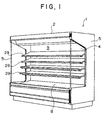
- Fig. 1 is a perspective view of a low temperature display case 1 according to the present invention
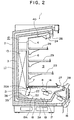
- Fig. 2 is a vertical cross sectional side view of the low temperature display case 1
- Fig. 3 is a perspective view of an evaporator 13
- Fig. 4 is a refrigerant circuit diagram for a cooling device R for cooling the low temperature display case 1.
- the low temperature display case 1 of the present invention is a refrigerating openfront display case that is installed in a store, such as a supermarket or a convenience store, to display chilled confections, such as ice cream, that are for sale.
- the low temperature display case 1 has a substantially C shaped heat insulation wall 2, and side plates 5 that are attached to both sides of the insulation wall 2.
- Heat insulation division wall 3, which is substantially C shaped, is so mounted inside the heat insulation wall 2 that there is an intervening space between them.
- a partition panel 4 is provided inside the upper portion of the heat insulation division wall 3 and extends outward, describing an intervening space.
- Deck struts 6 are provided at both ends and in the center of the partition panel 4.
- the lower ends of the deck struts 6 and of the partition panel 4 are secured either directly or via another member to a metal fitting 7, the ends of which are fixed to frames (not shown) on either side of the heat insulation wall 2.
- a deck pan 8 is provided, with an intervening space, above a bottom wall 3A of the heat insulation division wall 3.
- a storage chamber 9, which is open to the front, is defined by an area enclosed by the partition panel 4 and the deck pan 8.
- the evaporator 13 that is included in a cooling device is provided upright at the rear inside the inner duct 12.
- the evaporator 13 comprises a plurality of aluminum heat exchange fins 31, tube sheets 32, 33 and 34, which are located at the center and the sides of the heat exchange fins 31; and a sinuously shaped refrigerant pipe 36 that is passed through the tube sheets 32, 33 and 34.
- the refrigerant pipe 36 has a refrigerant inlet 36A and a refrigerant outlet 36B at its left end near the tube sheet 32.
- the center tube sheet 33 and the right end tube sheet 34, both of which are located away from the refrigerant inlet 36A, are made of an aluminum alloy that is a metal having high thermal conductivity.
- the tube sheet 32 at the left end of the refrigerant pipe 36 is made of galvanized steel or stainless steel, as is a conventional one. This is because brazing is used to connect bent pipes to the refrigerant inlet and outlet 36A and 36B, and the tube sheet would melt if it were formed of aluminum.
- the front lower ends of the tube sheets 32, 33 and 34 of the evaporator 13 are fixed to the metal fitting 7.
- the metal fitting 7 is also made of an aluminum alloy that is a metal having high thermal conductivity, and has a plurality of holes are formed in it.
- a suction blower 14 (for an inner duct) is provided below the deck pan 108 in the front internal portion of the inner duct 12, and a suction blower 16 (for an outer duct) is provided in the front internal portion of the outer duct 11, which at that point is located below the inner duct 12.
- the top surface of the bottom wall 3A, of the heat insulation division wall 3, inclines downward at an angle of 4 degrees, for example, toward a drain hole 17, which is located beneath the blower 14.
- the top face of the bottom wall 3A therefore, serves as a drain pan 18, which is a drain guide face, and drain pan heaters (electric heaters) 19 for the drain pan 18 are provided near the drain hole 17, which communicates with the outer duct 11.
- Defrosting heaters (electric heaters) 22 and an attachment plate 21 are provided inside the inner duct 12 at the upper rear portion of the drain pan 18.
- the defrosting heaters 22 are located forward of the evaporator 13 and under the metal fitting 7, so that during defrosting, water falling from the evaporator 13 will not fall directly onto the heaters 22.
- a part 22A, one of the defrosting heaters 22, is located near the metal fitting 7.
- a slope member 38 is provided as an inclined portion on the drain pan 18 at a position that is directly beneath the evaporator 13.
- the slope member 38 is made of stainless steel, and its surface is inclined downward toward the drain hole 17 at an inclination angle that is greater than that of the drain pan 18.
- the slope member 38 is mounted on, and extends from one side to the other of the drain pan 18. With this arrangement, the surface of the slope member 38 is positioned near the defrosting heaters 22.
- the inclination portion is made of an independent slope member 38 in this embodiment, it may be formed as an integral part of the heat insulation division wall 3.
- heat insulation material 39 foamed styrol, is used to fill the slope member 38 (adjacent to the heat insulation division wall 3), and a part 19A, one of the drain pan heaters 19, is located near the slope member 38.
- the inner intake opening 27 communicates with the inner duct 12, and the outer intake opening 28 communicates with the outer duct 11.
- a defrost recovery temperature sensor 40 for the defrosting heaters 22 is provided at the upper portion of the inner duct 12 (upstream of the inner discharge opening 24). Decks 29 are supported by the strut 6 as a series of steps, and frozen foods, such as ice cream, are displayed on the decks 29.
- a cooling device R comprises a condensing unit 41; a circuit for the low temperature display case 1; a hot gas (high temperature refrigerant) defrosting circuit (hereinafter referred to as a defrost controller) 42; an accumulator 52; and an ejection pressure adjustment valve 56.
- a defrost controller hot gas defrosting circuit
- the condensing unit 41 includes a compressor 43; a condenser 44; a blower 46 for a condenser; and a fluid reservoir 47.
- the circuit for the display case 1 includes the above described evaporator 13; an expansion valve 53; solenoid valves SV1 and SV3; and a defrost recovery temperature sensor 54 for the defrost controller 42.
- the defrost controller 42 has a heat storage tank 38; an intake pressure adjustment valve 49; a three-way valve SV2; solenoid valves SV5, SV6 and SV4; and check valves 50 and 51.
- the discharge side of the compressor 43 communicates with the heat storage tank 48 and is connected to the inlet (A) of the three-way valve SV2.
- the outlet (C) of the three-way valve SV2 is connected to the condenser 44, which communicates with the fluid reservoir 47.
- the fluid reservoir 47 is connected to the solenoid valve SV1 via the check valve 51 and a high pressure refrigerant pipe 60.
- the solenoid valve SV1 is connected to the refrigerant inlet 36A of the evaporator 13 via the expansion valve 53.
- the heat sensing portion of the expansion valve 53 is attached to the refrigerant outlet 36B of the evaporator 13, and the solenoid valve SV3 is connected in parallel so as to short circuit the expansion valve 53.
- the defrost recovery temperature sensor 54 is attached to the refrigerant outlet 36B of the refrigerant pipe 36 for the evaporator 13.
- the refrigerant outlet 36B of the evaporator 13 is connected to the intake pressure adjustment valve 49 via the solenoid valve SV6, and the pipe from the intake pressure adjustment valve 49 is passed through the heat storage tank 48 and is connected to the accumulator 52.
- the accumulator 52 is connected to the intake side of the compressor 43.
- the solenoid valve SV5 short-circuits the solenoid valve SV6, the intake pressure adjustment valve 49, and the heat storage tank 48.
- the outlet (B) of the three-way valve SV2 is connected via the check valve 50 to the high pressure refrigerant pipe 60 on the outlet side of the check valve 51.
- the outlet (C) of the threeway valve SV2 and the inlet of the solenoid valve SV6 communicate with each other via the solenoid valve SV4.
- the ejection pressure adjustment valve 56 is connected between the discharge side of the compressor 43 and the outlet (C) of the three-way valve SV2.
- a controller (not shown) sets a flow path across the threeway valve SV2 from A to C, and the solenoid valves SV4, SV6 and SV3 are closed.
- the solenoid valve SV5 is opened, and when the temperature in the storage chamber 9 in the low temperature display case 1 (or the discharged cool air temperature) becomes high, the solenoid valve SV1 is opened.
- the refrigerant that has been condensed by the condenser 44 is separated from uncondensed refrigerant gas in the fluid reservoir 47, and only liquid refrigerant is fed through the check valve 51, the high pressure refrigerant pipe 60, and the solenoid valve SV1 to the expansion valve 53.
- the air that is drawn in by the blower 16 rises along the outer duct 11, and is discharged, toward the front opening of the storage chamber 9, from the outer discharge opening 26, which is formed at the upper edge of the front opening.
- a protective air curtain is formed outside the curtain of cooled air.
- the refrigerant is discharged from the refrigerant outlet 36B of the evaporator 13, and flows through the solenoid valve SV5 to the accumulator 52.
- unvaporized liquid refrigerant is separated from the refrigerant in the gaseous form, and only refrigerant in the gaseous form is fed into the compressor 43.
- the controller closes the solenoid valve SV1 in accordance with the output of a temperature sensor (not shown). Since the flow of the refrigerant to the evaporator 13 is interrupted, the cooling function performed by the evaporator 13 is halted. The intake pressure at the compressor 43 is thereafter reduced and the compressor 43 is halted by a low pressure switch (not shown).
- the controller opens the solenoid valve SV1. Accordingly, the intake pressure at the compressor 43, the compressor 43 is activated, and the cooling cycle is begun. By repeating the above process, on average, the storage chamber 9 is maintained at a refrigerating temperature of -20°C.
- frost builds up on the evaporator 13 and in the inner duct 12.
- the controller periodically renders the defrosting heaters 22 and the drain pan heater 19A conductive.
- the evaporator 13 is heated by warm air that is blown across it by the blower 14, and the drain pan 18 is also heated.
- the solenoid valves SV1, SV4, SV6 and SV3 are opened and the solenoid valve SV5 is closed.
- refrigerant gas that is discharged at a high temperature and under high pressure from the compressor 43 is passed through the heat storage tank 48, the three-way valve SV2, the check valve 51, the high pressure refrigerant pipe 60 and the solenoid valves SV1 and SV3, bypasses the expansion valve 53, and enters the evaporator 13 through the refrigerant inlet 36A.
- the evaporator 13 As a consequence of the inflow of the high temperature refrigerant, the evaporator 13 is heated from the inside, and the frost is thawed by warm air from the defrosting heaters 22. The evaporator 13, therefore, is gradually defrosted.
- the refrigerant that has heated the evaporator 13 and has been discharged form the refrigerant outlet 36B of the evaporator 13 is fed through the solenoid valve sV6 to the intake pressure adjustment valve 49.
- the pressure on the refrigerant is adjusted, and the refrigerant is thereafter vaporized in the heat storage tank 48 and flows to the accumulator 52. Unvaporized liquid refrigerant is separated in the same manner as is described above, and only refrigerant in the gaseous form is drawn in by the compressor 43.
- the inclination of the slope member 38 is so sharp that the water flows smoothly toward the drain hole 17 in the drain pan 18 and is discharged to the exterior. Since the surface of the slope member 38 is located near the defrosting heaters 22, the temperature at the surface rises until it is 0 C or higher. In addition, since the part 19A, one of the drain pan heaters 19, is also located near the slope member 38, the refreezing of the water that is produced when frost is thawed can be inhibited in the inner duct 12 below the evaporator 13, and incomplete defrosting can therefore be prevented.
- the tube sheets 33 and 34 of the evaporator 13 are made of an aluminum alloy, heat is smoothly transmitted via the refrigerant pipe 36 to the metal fitting 7. And since the metal fitting 7 is also formed of an aluminum alloy and is positioned near the defrosting heater 22A, the metal fitting is adequately heated.
- the frost is rapidly thawed, and as a plurality of holes are formed in the metal fitting 7, water also falls smoothly.
- the problem posed by the incomplete defrosting of the metal fitting 7 is resolved, and the danger that the refrigerant pipe 36 may be broken is eliminated.
- the tube sheet 32 on the refrigerant inlet 36A is not formed of an aluminum alloy, there is abundant heat at that point because refrigerant at a high temperature flows in through the inlet 36A and prevents the occurrence of incomplete defrosting.
- drain pan heaters 19 are also rendered conductive during the defrosting, water that falls on the drain pan 18 can be prevented from refreezing, and frost and ice on other portions in the inner duct can be thawed.
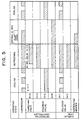
- the defrosting of the evaporator 13 is terminated, and the temperature of the outlet 36B is raised to, for example, +10°C.
- the controller terminates the defrosting operation, begins a 6minute dripping operation whereby the threeway SV2 is switched so that the flow path is from A to C, the solenoid valves SV4, SV5, SV3 and SV1 are closed, and the collection of refrigerant in the evaporator 13 is begun by beginning a pumping down operation.
- the air temperature in the inner duct 12 does not rise to +10°C when the temperature at the outlet 36B of the evaporator 13 is raised to +10°C.
- the controller Based on the defrost recovery temperature sensor 40, the controller maintains the defrosting heaters 22 in the conductive state until the air temperature in the inner duct 12 rises to, for example, +10°C. Therefore, even after the defrosting operation is terminated, the defrosting heaters 22 are continuously generating heat.
- the temperature in the evaporator 14 is reduced at the start of the pumping down operation, and accordingly, the air temperature in the inner duct 12 is temporarily reduced. If heat generation by the defrosting heaters 22 were halted at this time, the temperature at the evaporator 13 would not be increased much, and incomplete defrosting would occur. As is described above, however, since the defrosting heaters 22 continue to generate heat, the air temperature in the inner duct 12, which is temporarily reduced at the start of the pumping down operation, rises again. As a result, the problem that arises when water remaining on the evaporator 13 is refrozen does not occur.
- the controller closes the solenoid valve SV6 and opens the solenoid valve SV5 to restart the above described cooling operation.
- the defrost recovery temperature sensor 54 for detecting the temperature at the outlet 36B of the evaporator 13, and the defrost recovery temperature sensor 40, for detecting the air temperature in the inner duct 12, are employed to independently control the time at which the supply to the evaporator 13 of gaseous refrigerant at a high temperature is halted, and the time at which the generation of heat by the defrosting heaters 22 is halted. Incomplete defrosting in the vicinity of the evaporator 13 is prevented, and compared with a conventional cooling device where defrosting heaters are conductive during a dripping period, the increase in the air temperature in the inner duct 12 can be controlled. Therefore, the minimum amount of heat is required for defrosting, and the temperature increase in the storage chamber 9 is reduced to the minimum.
- the time at which defrosting using the high temperature refrigerant gas is terminated varies depending on seasonal changes in the ambient temperature of the condensing unit 41. Since the amount of heat generated by the defrosting heaters 22 is constant, an almost constant time can be set for halting the power supply to the defrosting heater 22 in accordance with the defrost recovery temperature sensor 40.
- Figs. 6 and 7 are refrigerant circuit diagrams for a low temperature display case and a cooling device R according to another embodiment.
- the same reference numerals as are used in Figs. 1 through 5 are also used in Figs. 6 and 7 to denote corresponding or identical components.
- one part of a high pressure refrigerant pipe 60 that extends from a check valve 50 through a solenoid valve SV1 is employed as a drawing pipe 61, which is attached to the internal face of a slope member 38.
- the slope member 38 need not be provided across the entire width of the inner duct 12. A great amount of heat is provided at an inlet 36A of an evaporator 13 because the inlet 36A is the point at which the refrigerant at a high temperature flows. The slope member 38 is not required in this portion. When the slope member 38 is not extended to the portion, the refrigerant inlet 36A and outlet 36B can be easily provided for the evaporator 13.
- a slope member (inclined portion) is so provided on a drain pan (on the inclined surface of the drain pan), at a position below the evaporator, that it is inclined toward a drain hole at a greater angle than is the drain pan. Water and ice that falls during the defrosting of the evaporator is smoothly discharged through the drain hole.
- the surface of the slope member is positioned near the defrosting heaters, and is strongly affected by the heat produced by them. Therefore, the refreezing of water on the drain pan under the evaporator can be prevented. According to the present invention, the water generated during defrosting can be fully discharged, and the degradation of the cooling ability due to residual frost can be prevented.
- frost does not build up on the surface of the slope member during cooling. Also, during defrosting, the refreezing of water that falls from above can be effectively prevented, and incomplete frosting can be inhibited.
- One part of the defrosting heaters is provided near the position where residual frost tends to accumulate. Since one of the defrosting heaters is provided near the metal fitting, as is described above, frost on the metal fitting can be completely thawed at a position that is less affected by heat from the high temperature refrigerant that flows through the evaporator. Incomplete frosting can thus be inhibited.
- the tube sheets of the evaporator are formed of metal having highly thermal conductivity, the heat from the high temperature refrigerant that flows through the evaporator can be effectively transmitted to peripheral components that are fixed to the tube sheets. Incomplete frosting around the evaporator can thus be inhibited.
- the metal fitting that is secured to the lower front end of the tube sheet of the evaporator is made of metal having highly thermal conductivity, the heat from the high temperature refrigerant that flows through the evaporator can be effectively transmitted to the metal fitting where frost tends to accumulate. Incomplete frosting around the evaporator can thus be inhibited.
- the heat produced by the defrosting heater can prevent the retention of residual frost on the metal fitting.
Landscapes
- Engineering & Computer Science (AREA)
- Physics & Mathematics (AREA)
- Thermal Sciences (AREA)
- Mechanical Engineering (AREA)
- General Engineering & Computer Science (AREA)
- Chemical & Material Sciences (AREA)
- Combustion & Propulsion (AREA)
- Defrosting Systems (AREA)
- Removal Of Water From Condensation And Defrosting (AREA)
- Freezers Or Refrigerated Showcases (AREA)
Claims (5)
- Niedrigtemperatur-Schauvitrine (1) mit:wobei für das Entfrosten des Verdampfers (13) ein Kühlmittel mit hoher Temperatur in den Verdampfer (13) geleitet wird und die Wärme durch die Entfrost-Heizvor-richtungen (22) erzeugt wird.einer Außenleitung (11), die so ausgebildet ist, daß sie mit einem rückwärtigen und einem unteren Teil einer Lagerkammer (9), die an ihrer Frontseite eine Öffnung hat, in Verbindung steht,einem Verdampfer (13), der senkrecht in einer inneren Leitung (12) an einem rückwärtigen Ort vorgesehen ist,einem Gebläse (14) zum Verteilen von Luft, die in dem Verdampfer (13) durch Wärmetausch gekühlt worden ist, von einer oberen Kante der Öffnung der Lagerkammer aus,einer Ablaufführungsfläche (18), die an einem Bodenlevel der inneren Leitung (12) vorgesehen ist, und die nach unten in Richtung auf eine Ablauföffnung (17) geneigt ist;Entfrost-Heizvorrichtungen (22), die in einem unteren Teil der inneren Leitung (12) vorgesehen sind, und die vor einer Position unterhalb des Verdampfers (13) angeordnet sind,einem scharf geneigten Teil (38), der an der Ablaufführungsfläche (18) unterhalb des Verdampfers vorgesehen ist und mit einem größeren Winkel zur Ablauföffnung (17) geneigt ist, als die Ablaufführungsfläche (18); undeinem Rohr (60, 61) durch welches das Hochtemperaturkühlmittel zirkuliert, das an dem stark geneigten Teil (38) angebracht ist,
- Niedrigtemperatur-Schauvitrine nach Anspruch 1,
wobei ein Teil der Entfrost-Heizvorrichtungen (22) nahe einer Position liegt, wo die Tendenz besteht, daß ein unvollständiges Entfrosten auftritt. - Niedrigtemperatur-Schauvitrine nach Anspruch 1,
wobei eine Rohrwand (33, 34) für den Verdampfer (13) aus einem Metall besteht, das eine hohe Wärmeleitfähigkeit hat. - Niedrigtemperatur-Schauvitrine nach Anspruch 3,
wobei eine Metallstreben-Befestigung, die an den vorderen unteren Enden der Rohrwand des Verdampfers befestigt ist, aus einem Metall besteht, das eine hohe Wärmeleitfähigkeit hat. - Niedrigtemperatur-Schauvitrine nach Anspruch 4,
wobei ein Teil der Entfrost-Heizvorrichtungen (22) in der Nähe der Metallstrebenbefestigung angeordnet ist.
Applications Claiming Priority (3)
| Application Number | Priority Date | Filing Date | Title |
|---|---|---|---|
| JP28924695 | 1995-10-11 | ||
| JP289246/95 | 1995-10-11 | ||
| JP28924695A JP3177428B2 (ja) | 1995-10-11 | 1995-10-11 | 低温ショーケース |
Publications (3)
| Publication Number | Publication Date |
|---|---|
| EP0768053A2 EP0768053A2 (de) | 1997-04-16 |
| EP0768053A3 EP0768053A3 (de) | 1998-01-07 |
| EP0768053B1 true EP0768053B1 (de) | 2002-02-06 |
Family
ID=17740675
Family Applications (1)
| Application Number | Title | Priority Date | Filing Date |
|---|---|---|---|
| EP96116179A Expired - Lifetime EP0768053B1 (de) | 1995-10-11 | 1996-10-09 | Niedrigtemperatur-Schauvitrine |
Country Status (7)
| Country | Link |
|---|---|
| US (1) | US5761922A (de) |
| EP (1) | EP0768053B1 (de) |
| JP (1) | JP3177428B2 (de) |
| KR (1) | KR100186665B1 (de) |
| DE (1) | DE69619050T2 (de) |
| DK (1) | DK0768053T3 (de) |
| ES (1) | ES2171586T3 (de) |
Families Citing this family (23)
| Publication number | Priority date | Publication date | Assignee | Title |
|---|---|---|---|---|
| FR2786999B1 (fr) | 1998-12-09 | 2001-02-23 | Nevoret Concept | Meuble frigorifique de vente |
| DE10140889A1 (de) * | 2001-08-21 | 2003-03-06 | Linde Ag | Neuartiges Kühlregal |
| US6519962B1 (en) * | 2002-06-27 | 2003-02-18 | Carrier Corporation | Refrigerated merchandiser angular air guide vanes |
| JP2005156117A (ja) * | 2003-11-28 | 2005-06-16 | Sanyo Electric Co Ltd | ショーケース |
| JP2006046694A (ja) * | 2004-07-30 | 2006-02-16 | Daikin Ind Ltd | 冷凍装置 |
| KR100597748B1 (ko) * | 2004-08-27 | 2006-07-07 | 삼성전자주식회사 | 냉동시스템 |
| JP2007260223A (ja) * | 2006-03-29 | 2007-10-11 | Sanyo Electric Co Ltd | オープンショーケース |
| CA2552454A1 (en) * | 2006-07-17 | 2008-01-17 | W. C. Wood Company Limited | Frost management system for a refrigerated cabinet |
| JP4895848B2 (ja) * | 2007-02-08 | 2012-03-14 | 三洋電機株式会社 | 冷却装置 |
| JP4935480B2 (ja) * | 2007-04-19 | 2012-05-23 | 富士電機株式会社 | 冷却装置 |
| JP2010057806A (ja) * | 2008-09-05 | 2010-03-18 | Sanyo Electric Co Ltd | 低温ショーケース |
| JP5258463B2 (ja) * | 2008-09-05 | 2013-08-07 | 三洋電機株式会社 | 低温ショーケース |
| EP3330642B1 (de) * | 2010-05-26 | 2020-04-29 | Mitsubishi Electric Corporation | Kälte-klimaanlage |
| JP5789755B2 (ja) * | 2010-11-30 | 2015-10-07 | パナソニックIpマネジメント株式会社 | 冷凍装置 |
| GB2482073A (en) * | 2011-09-15 | 2012-01-18 | David Turner | A System And Method To Reduce Refrigerated Air Leaving An Open Deck Display Cabinet. |
| US20120227424A1 (en) * | 2011-03-10 | 2012-09-13 | Prince Castle LLC | Converging/Diverging Front Intake |
| DE102012107712A1 (de) * | 2012-08-22 | 2014-02-27 | Aht Cooling Systems Gmbh | Kühlregal |
| US9687088B2 (en) * | 2013-04-08 | 2017-06-27 | Heatcraft Refrigeration Products Llc | Deflector for display cases |
| WO2015062662A1 (en) * | 2013-10-31 | 2015-05-07 | Arcelik Anonim Sirketi | Refrigerator with an improved defrost circuit and method for controlling the refrigerator |
| US10646054B2 (en) * | 2016-03-31 | 2020-05-12 | Panasonic Intellectual Property Management Co., Ltd. | Showcase and operation method thereof |
| CN106949658A (zh) * | 2017-03-17 | 2017-07-14 | 广东美的制冷设备有限公司 | 空调器及空调器的控制方法 |
| CN108420239A (zh) * | 2017-09-20 | 2018-08-21 | 汝州市中鼎科技有限公司 | 一种便于除冰的自动恒温海鲜展示柜 |
| CN115127284A (zh) * | 2022-07-07 | 2022-09-30 | 合肥美菱物联科技有限公司 | 一种冰箱化霜系统及化霜方法 |
Family Cites Families (9)
| Publication number | Priority date | Publication date | Assignee | Title |
|---|---|---|---|---|
| US2513675A (en) * | 1947-01-17 | 1950-07-04 | Russell F Petersen | Open display refrigerated case |
| US3182466A (en) * | 1962-03-22 | 1965-05-11 | Dual Jet Refrigeration Company | Conditioned storage cabinet |
| DE1197105B (de) * | 1962-11-09 | 1965-07-22 | Martin Gabler | Verfahren zum Erzeugen tiefer Temperaturen in den Faechern eines Kuehlregals und nach diesem Verfahren arbeitendes Kuehlregal |
| US4117698A (en) * | 1977-06-29 | 1978-10-03 | Kysor Industrial Corporation | Refrigerated display |
| US4690209A (en) * | 1985-03-18 | 1987-09-01 | Martin Cory I | Air conditioner evaporator system |
| GB8813051D0 (en) * | 1988-06-02 | 1988-07-06 | Craig Nocol Ltd | Refrigeration system |
| JPH0221177A (ja) * | 1988-07-07 | 1990-01-24 | Fuji Electric Co Ltd | 冷気循環形オープンショーケースの除霜方式 |
| JP2547926B2 (ja) * | 1992-08-18 | 1996-10-30 | 富士電機株式会社 | 冷凍冷蔵オープンショーケースの除霜方法 |
| US5475988A (en) * | 1994-11-17 | 1995-12-19 | Delaware Capital Formation Inc. | Refrigerated display case with an improved air flow control and a contaminant control apparatus |
-
1995
- 1995-10-11 JP JP28924695A patent/JP3177428B2/ja not_active Expired - Fee Related
-
1996
- 1996-10-09 EP EP96116179A patent/EP0768053B1/de not_active Expired - Lifetime
- 1996-10-09 DE DE69619050T patent/DE69619050T2/de not_active Expired - Lifetime
- 1996-10-09 ES ES96116179T patent/ES2171586T3/es not_active Expired - Lifetime
- 1996-10-09 DK DK96116179T patent/DK0768053T3/da active
- 1996-10-09 KR KR1019960044743A patent/KR100186665B1/ko not_active Expired - Fee Related
- 1996-10-11 US US08/731,347 patent/US5761922A/en not_active Expired - Fee Related
Also Published As
| Publication number | Publication date |
|---|---|
| ES2171586T3 (es) | 2002-09-16 |
| DK0768053T3 (da) | 2002-05-27 |
| US5761922A (en) | 1998-06-09 |
| KR970022124A (ko) | 1997-05-28 |
| DE69619050D1 (de) | 2002-03-21 |
| JPH09113103A (ja) | 1997-05-02 |
| JP3177428B2 (ja) | 2001-06-18 |
| KR100186665B1 (ko) | 1999-10-01 |
| DE69619050T2 (de) | 2002-11-21 |
| EP0768053A3 (de) | 1998-01-07 |
| EP0768053A2 (de) | 1997-04-16 |
Similar Documents
| Publication | Publication Date | Title |
|---|---|---|
| EP0768053B1 (de) | Niedrigtemperatur-Schauvitrine | |
| EP0768501B1 (de) | Abtauverfahren für eine Niedrigtemperatur-Schauvitrine und NT-Schauvitrine | |
| US4459826A (en) | Refrigerator | |
| CA2180113C (en) | Defrosting apparatus for refrigerators and method for controlling the same | |
| JP3688892B2 (ja) | 冷凍冷蔵庫 | |
| US20080092569A1 (en) | Cooling unit with multi-parameter defrost control | |
| KR20020084688A (ko) | 중간온도 냉장식 머천다이저 | |
| US5207761A (en) | Refrigerator/water purifier with common evaporator | |
| US3638449A (en) | Refrigeration apparatus | |
| US5715689A (en) | Evaporator for combination refrigerator/freezer | |
| US20110252816A1 (en) | Refrigerator icemaker moisture removal and defrost assembly | |
| US2994209A (en) | Frostless refrigerator | |
| EP1334321B1 (de) | Abtauverfahren für kühlschrank | |
| JP3649875B2 (ja) | 低温ショーケース | |
| JP3086181B2 (ja) | 冷却貯蔵庫 | |
| US3683636A (en) | Refrigeration system defrosting means | |
| KR100674531B1 (ko) | 비착상식 냉각 시스템 | |
| JP6974089B2 (ja) | 冷凍・冷蔵ショーケース | |
| JP3942455B2 (ja) | 冷却庫 | |
| JP6330137B2 (ja) | 冷蔵庫 | |
| JP7365821B2 (ja) | 冷凍・冷蔵ショーケース | |
| CN1155647A (zh) | 低温陈列柜 | |
| CN101135527A (zh) | 制冷储藏库 | |
| JPH09269179A (ja) | 冷却装置の除霜装置 | |
| JP2008051368A (ja) | 冷却ユニットと冷却ユニットを備えた貯蔵庫 |
Legal Events
| Date | Code | Title | Description |
|---|---|---|---|
| PUAI | Public reference made under article 153(3) epc to a published international application that has entered the european phase |
Free format text: ORIGINAL CODE: 0009012 |
|
| AK | Designated contracting states |
Kind code of ref document: A2 Designated state(s): BE DE DK ES FR GB IT |
|
| PUAL | Search report despatched |
Free format text: ORIGINAL CODE: 0009013 |
|
| AK | Designated contracting states |
Kind code of ref document: A3 Designated state(s): BE DE DK ES FR GB IT |
|
| 17P | Request for examination filed |
Effective date: 19980626 |
|
| 17Q | First examination report despatched |
Effective date: 19991001 |
|
| GRAG | Despatch of communication of intention to grant |
Free format text: ORIGINAL CODE: EPIDOS AGRA |
|
| GRAG | Despatch of communication of intention to grant |
Free format text: ORIGINAL CODE: EPIDOS AGRA |
|
| GRAH | Despatch of communication of intention to grant a patent |
Free format text: ORIGINAL CODE: EPIDOS IGRA |
|
| GRAH | Despatch of communication of intention to grant a patent |
Free format text: ORIGINAL CODE: EPIDOS IGRA |
|
| GRAA | (expected) grant |
Free format text: ORIGINAL CODE: 0009210 |
|
| REG | Reference to a national code |
Ref country code: GB Ref legal event code: IF02 |
|
| AK | Designated contracting states |
Kind code of ref document: B1 Designated state(s): BE DE DK ES FR GB IT |
|
| REF | Corresponds to: |
Ref document number: 69619050 Country of ref document: DE Date of ref document: 20020321 |
|
| ET | Fr: translation filed | ||
| REG | Reference to a national code |
Ref country code: DK Ref legal event code: T3 |
|
| REG | Reference to a national code |
Ref country code: ES Ref legal event code: FG2A Ref document number: 2171586 Country of ref document: ES Kind code of ref document: T3 |
|
| PLBE | No opposition filed within time limit |
Free format text: ORIGINAL CODE: 0009261 |
|
| STAA | Information on the status of an ep patent application or granted ep patent |
Free format text: STATUS: NO OPPOSITION FILED WITHIN TIME LIMIT |
|
| 26N | No opposition filed |
Effective date: 20021107 |
|
| PGFP | Annual fee paid to national office [announced via postgrant information from national office to epo] |
Ref country code: ES Payment date: 20091026 Year of fee payment: 14 Ref country code: DK Payment date: 20091023 Year of fee payment: 14 |
|
| PGFP | Annual fee paid to national office [announced via postgrant information from national office to epo] |
Ref country code: IT Payment date: 20091023 Year of fee payment: 14 Ref country code: GB Payment date: 20091023 Year of fee payment: 14 Ref country code: FR Payment date: 20091110 Year of fee payment: 14 |
|
| PGFP | Annual fee paid to national office [announced via postgrant information from national office to epo] |
Ref country code: BE Payment date: 20091029 Year of fee payment: 14 |
|
| PGFP | Annual fee paid to national office [announced via postgrant information from national office to epo] |
Ref country code: DE Payment date: 20091218 Year of fee payment: 14 |
|
| BERE | Be: lapsed |
Owner name: *SANYO ELECTRIC CO. LTD Effective date: 20101031 |
|
| REG | Reference to a national code |
Ref country code: DK Ref legal event code: EBP |
|
| GBPC | Gb: european patent ceased through non-payment of renewal fee |
Effective date: 20101009 |
|
| PG25 | Lapsed in a contracting state [announced via postgrant information from national office to epo] |
Ref country code: FR Free format text: LAPSE BECAUSE OF NON-PAYMENT OF DUE FEES Effective date: 20101102 |
|
| REG | Reference to a national code |
Ref country code: FR Ref legal event code: ST Effective date: 20110630 |
|
| PG25 | Lapsed in a contracting state [announced via postgrant information from national office to epo] |
Ref country code: GB Free format text: LAPSE BECAUSE OF NON-PAYMENT OF DUE FEES Effective date: 20101009 Ref country code: BE Free format text: LAPSE BECAUSE OF NON-PAYMENT OF DUE FEES Effective date: 20101031 |
|
| REG | Reference to a national code |
Ref country code: DE Ref legal event code: R119 Ref document number: 69619050 Country of ref document: DE Effective date: 20110502 |
|
| PG25 | Lapsed in a contracting state [announced via postgrant information from national office to epo] |
Ref country code: DK Free format text: LAPSE BECAUSE OF NON-PAYMENT OF DUE FEES Effective date: 20101031 |
|
| REG | Reference to a national code |
Ref country code: ES Ref legal event code: FD2A Effective date: 20111118 |
|
| PG25 | Lapsed in a contracting state [announced via postgrant information from national office to epo] |
Ref country code: IT Free format text: LAPSE BECAUSE OF NON-PAYMENT OF DUE FEES Effective date: 20101009 |
|
| PG25 | Lapsed in a contracting state [announced via postgrant information from national office to epo] |
Ref country code: ES Free format text: LAPSE BECAUSE OF NON-PAYMENT OF DUE FEES Effective date: 20101010 |
|
| PG25 | Lapsed in a contracting state [announced via postgrant information from national office to epo] |
Ref country code: DE Free format text: LAPSE BECAUSE OF NON-PAYMENT OF DUE FEES Effective date: 20110502 |