EP0751502A2 - Magnetaufzeichnungssystem und dafür verwendetes Magnetaufzeichnungsmedium - Google Patents
Magnetaufzeichnungssystem und dafür verwendetes Magnetaufzeichnungsmedium Download PDFInfo
- Publication number
- EP0751502A2 EP0751502A2 EP96110302A EP96110302A EP0751502A2 EP 0751502 A2 EP0751502 A2 EP 0751502A2 EP 96110302 A EP96110302 A EP 96110302A EP 96110302 A EP96110302 A EP 96110302A EP 0751502 A2 EP0751502 A2 EP 0751502A2
- Authority
- EP
- European Patent Office
- Prior art keywords
- magnetic
- magnetic recording
- recording medium
- layer
- molar ratio
- Prior art date
- Legal status (The legal status is an assumption and is not a legal conclusion. Google has not performed a legal analysis and makes no representation as to the accuracy of the status listed.)
- Granted
Links
Images




Classifications
-
- G—PHYSICS
- G11—INFORMATION STORAGE
- G11B—INFORMATION STORAGE BASED ON RELATIVE MOVEMENT BETWEEN RECORD CARRIER AND TRANSDUCER
- G11B5/00—Recording by magnetisation or demagnetisation of a record carrier; Reproducing by magnetic means; Record carriers therefor
-
- B—PERFORMING OPERATIONS; TRANSPORTING
- B82—NANOTECHNOLOGY
- B82Y—SPECIFIC USES OR APPLICATIONS OF NANOSTRUCTURES; MEASUREMENT OR ANALYSIS OF NANOSTRUCTURES; MANUFACTURE OR TREATMENT OF NANOSTRUCTURES
- B82Y10/00—Nanotechnology for information processing, storage or transmission, e.g. quantum computing or single electron logic
-
- G—PHYSICS
- G11—INFORMATION STORAGE
- G11B—INFORMATION STORAGE BASED ON RELATIVE MOVEMENT BETWEEN RECORD CARRIER AND TRANSDUCER
- G11B5/00—Recording by magnetisation or demagnetisation of a record carrier; Reproducing by magnetic means; Record carriers therefor
- G11B5/127—Structure or manufacture of heads, e.g. inductive
- G11B5/33—Structure or manufacture of flux-sensitive heads, i.e. for reproduction only; Combination of such heads with means for recording or erasing only
- G11B5/39—Structure or manufacture of flux-sensitive heads, i.e. for reproduction only; Combination of such heads with means for recording or erasing only using magneto-resistive devices or effects
- G11B5/3903—Structure or manufacture of flux-sensitive heads, i.e. for reproduction only; Combination of such heads with means for recording or erasing only using magneto-resistive devices or effects using magnetic thin film layers or their effects, the films being part of integrated structures
-
- G—PHYSICS
- G11—INFORMATION STORAGE
- G11B—INFORMATION STORAGE BASED ON RELATIVE MOVEMENT BETWEEN RECORD CARRIER AND TRANSDUCER
- G11B5/00—Recording by magnetisation or demagnetisation of a record carrier; Reproducing by magnetic means; Record carriers therefor
- G11B5/62—Record carriers characterised by the selection of the material
- G11B5/64—Record carriers characterised by the selection of the material comprising only the magnetic material without bonding agent
- G11B5/65—Record carriers characterised by the selection of the material comprising only the magnetic material without bonding agent characterised by its composition
- G11B5/658—Record carriers characterised by the selection of the material comprising only the magnetic material without bonding agent characterised by its composition containing oxygen, e.g. molecular oxygen or magnetic oxide
-
- G—PHYSICS
- G11—INFORMATION STORAGE
- G11B—INFORMATION STORAGE BASED ON RELATIVE MOVEMENT BETWEEN RECORD CARRIER AND TRANSDUCER
- G11B5/00—Recording by magnetisation or demagnetisation of a record carrier; Reproducing by magnetic means; Record carriers therefor
- G11B5/127—Structure or manufacture of heads, e.g. inductive
- G11B5/33—Structure or manufacture of flux-sensitive heads, i.e. for reproduction only; Combination of such heads with means for recording or erasing only
- G11B5/39—Structure or manufacture of flux-sensitive heads, i.e. for reproduction only; Combination of such heads with means for recording or erasing only using magneto-resistive devices or effects
- G11B2005/3996—Structure or manufacture of flux-sensitive heads, i.e. for reproduction only; Combination of such heads with means for recording or erasing only using magneto-resistive devices or effects large or giant magnetoresistive effects [GMR], e.g. as generated in spin-valve [SV] devices
-
- G—PHYSICS
- G11—INFORMATION STORAGE
- G11B—INFORMATION STORAGE BASED ON RELATIVE MOVEMENT BETWEEN RECORD CARRIER AND TRANSDUCER
- G11B5/00—Recording by magnetisation or demagnetisation of a record carrier; Reproducing by magnetic means; Record carriers therefor
- G11B5/012—Recording on, or reproducing or erasing from, magnetic disks
-
- G—PHYSICS
- G11—INFORMATION STORAGE
- G11B—INFORMATION STORAGE BASED ON RELATIVE MOVEMENT BETWEEN RECORD CARRIER AND TRANSDUCER
- G11B5/00—Recording by magnetisation or demagnetisation of a record carrier; Reproducing by magnetic means; Record carriers therefor
- G11B5/74—Record carriers characterised by the form, e.g. sheet shaped to wrap around a drum
- G11B5/82—Disk carriers
-
- Y—GENERAL TAGGING OF NEW TECHNOLOGICAL DEVELOPMENTS; GENERAL TAGGING OF CROSS-SECTIONAL TECHNOLOGIES SPANNING OVER SEVERAL SECTIONS OF THE IPC; TECHNICAL SUBJECTS COVERED BY FORMER USPC CROSS-REFERENCE ART COLLECTIONS [XRACs] AND DIGESTS
- Y10—TECHNICAL SUBJECTS COVERED BY FORMER USPC
- Y10S—TECHNICAL SUBJECTS COVERED BY FORMER USPC CROSS-REFERENCE ART COLLECTIONS [XRACs] AND DIGESTS
- Y10S428/00—Stock material or miscellaneous articles
- Y10S428/90—Magnetic feature
Definitions
- the present invention relates to a magnetic recording system used for auxiliary recording system of computers and the like and a magnetic recording medium used for the magnetic recording system. More particularly, it relates to a magnetic recording system having a high recording density of 1 gigabit per 1 square inch or more and a magnetic recording medium suitable for realizing the high recording density.
- JP-A-5-73880 discloses a magnetic recording medium which comprises a CoCrPt magnetic layer containing silicon oxide, zirconium oxide, tantalum oxide, silicon nitride, boron nitride, titanium nitride or aluminum nitride.
- JP-A-5-197944 discloses a magnetic recording medium which comprises a CoNiPtMO magnetic layer or CoCrPtMO magnetic layer (M is at least one element selected from Si, B, Zr, Al, Y, P, Ti, Sn and In).
- the above conventional magnetic recording media suffer from the problems that decrease of medium noise in the high linear recording density area of higher than 150 kFCI (Flux Change per Inch) is insufficient and it is difficult to realize a high recording density of at least 1 gigabit per square inch.
- the object of the present invention is to solve the above technical problems and to provide a magnetic recording system which makes it possible to attain a high recording density of at least 1 gigabit per 1 square inch, and a magnetic recording medium suitable for realizing the high recording density.
- the present invention provides a magnetic recording system having a magnetic recording medium and a magnetic recording head which carries out writing in and reading back from the magnetic recording medium, said magnetic recording medium comprising a substrate and a magnetic layer formed on the substrate directly or indirectly with an underlayer intervening between the magnetic layer and the substrate, characterized in that the magnetic layer of the magnetic recording medium comprises a mixture of at least one non-magnetic compound selected from the group consisting of oxides represented by the formula MOx (wherein M represents at least one element selected from Si, Al, Ta, Y and Ti, and x represents a numerical value of from about 1 to about 2.5) and a magnetic material of an alloy comprising Co and Pt as main components, the molar ratio of Pt to Co in the magnetic layer is 0.6-1.2 and the molar ratio of the non-magnetic compound to Co is 0.1-2.8, and the magnetic recording head includes a magnetoresistive read back magnetic recording head.
- MOx oxides represented by the formula MOx (wherein M represents at least one element selected from Si, Al,
- the present invention provides the magnetic recording system having the above construction, characterized in that the magnetoresistive read back magnetic recording head has two shield layers and a magnetoresistive sensor formed between the shield layers and the distance between the two shield layers is 0.35 ⁇ m or less.
- the present invention provides the magnetic recording system having the above construction, characterized in that the product (Br ⁇ t) of a residual magnetic flux density, Br, measured by applying a magnetic field in the relative running direction of the magnetic recording head in respect to the magnetic recording medium at the time of recording and a thickness, t, of the magnetic layer of the magnetic recording medium is 0.001 to 0.01 T (10-100 gauss) ⁇ micron.
- the present invention provides the magnetic recording system having the above construction, characterized in that the coercivity of the magnetic recording medium measured by applying a magnetic field in the relative running direction of the magnetic recording head in respect to the magnetic recording medium at the time of recording is 191 kA/m (2.4 kOe) or more.
- the present invention provides the magnetic recording system having the above construction, characterized in that the magnetoresistive read back magnetic recording head has a magnetoresistive sensor which includes a plurality of magnetic layers and non-magnetic layers provided between the magnetic layers, said magnetic layers causing a great change in resistivity due to relative change of mutual magnetization directions by external magnetic field.
- the present invention provides the above-mentioned magnetic recording system of the first aspect, characterized in that the non-magnetic compound in the magnetic layer of the magnetic recording medium is not an oxide, but a nitride represented by the formula LNy (wherein L represents at least one element selected from Si, B and Al and y represents a numerical value of from about 1 to about 1.3).
- the molar ratio of the non-magnetic compound to Co in the magnetic layer of the magnetic recording medium is 0.5-2.4.
- the present invention provides a magnetic recording medium comprising a substrate and a magnetic layer formed on the substrate directly or indirectly with an underlayer intervening between the magnetic layer and the substrate, characterized in that the magnetic layer of the magnetic recording medium comprises a mixture of at least one non-magnetic compound selected from the group consisting of oxides represented by the formula MOx (wherein M represents at least one element selected from Si, Al, Ta, Y and Ti, and x represents a numerical value of from about 1 to about 2.5) and a magnetic material of an alloy comprising Co and Pt as main components, the molar ratio of Pt to Co in the magnetic layer is 0.6-1.2 and the molar ratio of the non-magnetic compound to Co is 0.1-2.8.
- MOx oxides represented by the formula MOx (wherein M represents at least one element selected from Si, Al, Ta, Y and Ti, and x represents a numerical value of from about 1 to about 2.5)
- MOx represents at least one element selected from Si, Al, Ta, Y and Ti
- x represents
- the present invention provides the magnetic recording medium of the seventh aspect, characterized in that the non-magnetic compound in the magnetic layer of the magnetic recording medium is not an oxide, but a nitride represented by the formula LNy (wherein L represents at least one element selected from Si, B and Al and y represents a numerical value of from about 1 to about 1.3).
- the molar ratio of the non-magnetic compound to Co in the magnetic layer of the magnetic recording medium is 0.5-2.4.
- the inventors have prepared various magnetic recording media changing the composition of the magnetic layer to search for the composition of the magnetic layer optimum when the medium is combined with a magnetic recording head. Furthermore, they have changed the magnetic recording heads to search for magnetic recording heads having the structure optimum when the magnetic recording head is combined with the magnetic recording medium. As a result, the magnetic recording systems and magnetic recording media of the present invention have been accomplished.
- the magnetic layer of the magnetic recording medium is composed of a mixture of at least one non-magnetic compound selected from the group consisting of oxides and nitrides and a magnetic material of an alloy comprising Co and Pt as main components, the molar ratio of Pt to Co in the magnetic layer is limited to 0.6-1.2, and, furthermore, a magnetoresistive read back recording head is employed.
- the medium S/N can be increased to about 2.0 or more.
- the medium S/N is a ratio of output to medium noise (a value obtained by excluding the noise of system from the total noise).
- the alloy may consist essentially of Co and Pt.
- the distance between the two shield layers is limited to 0.35 ⁇ m or less.
- the product of residual magnetic flux density, Br, measured by applying a magnetic field in the relative running direction of the magnetic recording head in respect to the magnetic recording medium at the time of recording and thickness, t, of the magnetic layer of the magnetic recording medium is limited to 0.001 to 0.01 T (10-100 gauss) ⁇ micron.
- the coercivity of the magnetic recording medium measured by applying a magnetic field in the relative running direction of the magnetic recording head in respect to the magnetic recording medium at the time of recording is limited to 191 kA/m (2.4 kOe) or more.
- system S/N When the coercivity is 191 kA/m (2.4 kOe) or more, system S/N is higher than 1 and noise can be made smaller than signal.
- the system S/N is a ratio of output to the noise of system.
- a magnetoresistive head there is employed a structure having a magnetoresistive sensor including a plurality of magnetic layers and non-magnetic layers provided between the magnetic layers, said magnetic layers bringing about a great change in resistivity due to relative change of mutual magnetization directions caused by external magnetic field.
- signal intensity can be further enhanced by the giant magnetoresistive effect, and a magnetic recording system of high reliability with a recording density of at least 3 gigabits per 6.451 cm 2 (1 square inch) can be realized.
- the reason for using an alloy comprising Co and Pt as main components as a magnetic material of the magnetic layer of the magnetic recording medium is as follows. Hitherto, a (Co+Pt+ ⁇ ) (ternary) alloy has been used as the magnetic material. However, when the alloy comprising (Co+Pt) as main components is used with limiting the compositional ratio thereof and this magnetic material is combined with a magnetoresistive head, the medium S/N can be made to about 2.0 or higher. Thus, the medium noise in the high linear recording density area of 150 kFCI or higher can be sufficiently reduced and a high recording density of 1 gigabit or higher per 6.451 cm 2 (1 square inch) can be realized.
- Elements such as Ar which are inevitably taken in during film-forming by sputtering or the like may be contained in a slight amount in the magnetic material.
- the reasons for employing an oxide represented by the formula MOx (wherein M represents at least one element selected from Si, Al, Ta, Y and Ti, and x represents a numerical value of from about 1 to about 2.5) as the non-magnetic compound in the magnetic layer of the magnetic recording medium and limiting the molar ratio of the non-magnetic compound to Co in the magnetic layer to 0.1-2.8 are as follows.
- the molar ratio of the oxide to Co is 0.1 or more, normalized noise can be reduced to 0.025 or less.
- the normalized noise is a value obtained by normalizing with a signal output of 10 kFCI the medium noise when signal is recorded at a recording density of 150 kFCI.
- the coercivity can be increased to 191 kA/m (2.4 kOe) or more.
- the molar ratio of the oxide to Co is 2.8 or less, a sufficient output can be obtained.
- a nitride represented by the formula LNy (wherein L represents at least one element selected from Si, B and Al and y represents a numerical value of from about 1 to about 1.3) is employed in place of the oxide as the non-magnetic compound in the magnetic layer of the magnetic recording medium.
- the molar ratio of the nitride to Co is 0.1 or more, normalized noise can be reduced to 0.025 or less. Moreover, the coercivity can be increased to 191 kA/m (2.4 kOe) or more. When the molar ratio of the nitride to Co is 2.8 or less, a sufficient output can be obtained.
- the reason for limiting the molar ratio of the non-magnetic compound to Co in the magnetic layer of the magnetic recording medium to 0.5-2.4 is that when the molar ratio of the non-magnetic compound to Co is limited to the range of 0.5-2.4, the normalized noise can be reduced to 0.016 or less, and, moreover, the coercivity can be increased to 191 kA/m (2.4 kOe) or more.
- the magnetic layer is composed of a mixture of at least one non-magnetic compound selected from the group consisting of oxides represented by the formula MOx (wherein M represents at least one element selected from Si, Al, Ta, Y and Ti, and x represents a numerical value of from about 1 to about 2.5) and an alloy magnetic material comprising Co and Pt as main components, the molar ratio of Pt to Co in the magnetic layer is limited to 0.6-1.2 and the molar ratio of the non-magnetic compound to Co is limited to 0.1-2.8.
- MOx oxides represented by the formula MOx (wherein M represents at least one element selected from Si, Al, Ta, Y and Ti, and x represents a numerical value of from about 1 to about 2.5)
- MOx represents at least one element selected from Si, Al, Ta, Y and Ti
- x represents a numerical value of from about 1 to about 2.5
- the molar ratio of Pt to Co in the magnetic layer is limited to 0.6-1.2 and the molar ratio of the non-magne
- the medium S/N can be increased to about 2 or more.
- the medium noise in a high linear recording density area of at least 150 kFCI can be sufficiently reduced and a high recording density of at least 1 gigabit per 6.451 cm 2 (1 square inch) can be realized.
- the reason for using an alloy comprising Co and Pt as main components as a magnetic material of the magnetic layer is as follows. Hitherto, a (Co+Pt+ ⁇ ) (ternary) alloy has been used as the magnetic material. However, when the alloy comprising (Co+Pt) as main components is used with limiting the compositional ratio thereof, the medium S/N can be made to about 2.0 or more. Thus, the medium noise in the high linear recording density area of 150 kFCI or more can be sufficiently reduced and a high recording density of 1 gigabit or more per 6.451 cm 2 (1 square inch) can be realized.
- the reasons for employing an oxide represented by the formula MOx (wherein M represents at least one element selected from Si, Al, Ta, Y and Ti, and x represents a numerical value of from about 1 to about 2.5) as the non-magnetic compound in the magnetic layer and limiting the molar ratio of the non-magnetic compound to Co in the magnetic layer to 0.1-2.8 are as follows.
- M represents at least one element selected from Si, Al, Ta, Y and Ti, and x represents a numerical value of from about 1 to about 2.5
- M represents at least one element selected from Si, Al, Ta, Y and Ti
- x represents a numerical value of from about 1 to about 2.5
- a nitride represented by the formula LNy (wherein L represents at least one element selected from Si, B and Al and y represents a numerical value of from about 1 to about 1.3) is used in place of the oxide as the non-magnetic compound in the magnetic layer.
- molar ratio of the nitride to Co When the molar ratio of the nitride to Co is 0.1 or more, normalized noise can be reduced to 0.025 or less. Moreover, coercivity can be increased to 191 kA/m (2.4 kOe) or more. When the molar ratio of the nitride to Co is 2.8 or less, a sufficient output can be obtained.
- the reason for limiting the molar ratio of the non-magnetic compound to Co in the magnetic layer to 0.5-2.4 in the invention of the seventh or eighth aspect is that when the molar ratio of the non-magnetic compound to Co is limited to the range of 0.5-2.4, the normalized noise can be reduced to 0.016 or less and, moreover, coercivity can be increased to 191 kA/m (2.4 kOe) or more.
- Figure 1(a) is a schematic plan view of the magnetic recording system of Example 1.
- Figure 1(b) is a A-A' schematic sectional view of the magnetic recording system shown in Figure 1(a).
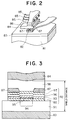
- Figure 2 is an oblique view which shows the structure of magnetic recording head in the magnetic recording system of Example 1.
- Figure 3 is a schematic view which shows the sectional structure of magnetoresistive sensor of the magnetic recording head in the magnetic recording system of Example 1.
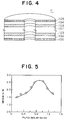
- Figure 4 is an oblique view which shows the structure of magnetic recording medium in the magnetic recording system of Example 1.
- Figure 5 is a characteristic curve which shows the relation between the molar ratio of Pt to Co in the magnetic layer of the magnetic recording medium and the medium S/N of the magnetic recording medium of Example 1.
- Figure 6 is a characteristic curve which shows the relation between the molar ratio of silicon oxide to Co in the magnetic layer of the magnetic recording medium and the normalized noise of the magnetic recording medium of Example 1.
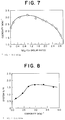
- Figure 7 is a characteristic curve which shows the relation between the molar ratio of silicon oxide to Co in the magnetic layer of the magnetic recording medium and the coercivity of the magnetic recording medium of Example 1.
- Figure 8 is a characteristic curve which shows the relation between the coercivity and the system S/N.
- Figure 9 is a block diagram of an apparatus for measuring jitter.
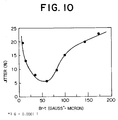
- Figure 10 is a characteristic curve which shows the relation between (Br ⁇ t) and jitter.
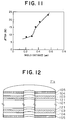
- Figure 11 is a characteristic curve which shows the relation between shield distance and jitter.
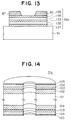
- Figure 12 is an oblique view which shows the structure of the magnetic recording medium in the magnetic recording system of Example 2.
- Figure 13 is a schematic view which shows the sectional structure of magnetoresistive sensor of the magnetic recording head in the magnetic recording system of Example 4.
- Figure 14 is an oblique view which shows the structure of the magnetic recording medium in the magnetic recording system of Example 5.
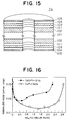
- Figure 15 is an oblique view which shows the structure of the magnetic recording medium in the magnetic recording system of Example 6.
- Figure 16 is a characteristic curve which shows the relation between the molar ratio of silicon oxide to Co in the magnetic layer of the magnetic recording medium and the normalized noise of the magnetic recording medium of Comparative Example.
- Figure 17 is a characteristic curve which shows the relation between the molar ratio of silicon oxide to Co in the magnetic layer of the magnetic recording medium and the coercivity of the magnetic recording medium of Comparative Example.
- Figures 1(a) and (b) are schematic plan view and schematic sectional view of magnetic recording system 70 of Example 1.
- the magnetic recording system 70 has magnetic recording medium 71, magnetic recording medium driving unit 72 which rotates the magnetic recording medium 71 in the recording direction, magnetic recording head 73 which carries out writing in and reading back from the magnetic recording medium 71, magnetic recording head driving unit 74 which drives the magnetic head 73 relatively to the magnetic recording medium 71, and read/write signal processing part 75 which carries out processing of write signal or read signal.
- Figure 2 shows the structure of the magnetic recording head 73.
- the magnetic recording head 73 is a dual head with inductive head for writing and magnetoresistive (MR) read back recording head. That is, the portion comprising upper recording magnetic pole 86 and shield layer-recording magnetic pole 84 which hold coil 85 therebetween acts as a magnetic recording head for writing. The portion comprising the shield layer-recording magnetic pole 84 and lower shield layer 83 between which magnetoresistive sensor 82 and electrode pattern 87 are held acts as a magnetic recording head for read back. The output signal from the magnetoresistive sensor 82 is taken out through the electrode pattern 87.
- the lower shield layer 83 is formed on slider substrate 81.
- Figure 3 shows sectional structure of the magnetoresistive sensor 82.
- the magnetoresistive sensor 82 is provided on the lower shield layer 83 with a gap layer 91 intervening between them, and the magnetoresistive sensor 82 includes antiferromagnetic domain stabilizing layer 92 provided on the gap layer 91, thin film magnetoresistive conductive layer 93 of ferromagnetic material which is made a single domain by the antiferromagnetic domain stabilizing layer 92, non-magnetic layer 95 for cutting off the exchange interaction between sensor 94 of the thin film magnetoresistive conductive layer 93 and the antiferromagnetic domain stabilizing layer 92, soft magnetic layer 97 for generating a bias magnetic field for the sensor 94, and high resistivity layer 96 for controlling current distribution ratio between the soft magnetic layer 97 and the thin film magnetoresistive conductive layer 93.
- the magnetic recording head 73 was made in the following manner.
- a sintered body mainly composed of aluminum oxide and titanium carbide was used as slider substrate 81.
- An Ni-Fe alloy film of 1 ⁇ m thick was formed as lower shield layer 83 by sputtering method.
- An aluminum oxide film of 100 nm thick was formed as the gap layer 91 by sputtering method.
- An NiO layer of 20 nm thick was formed as the antiferromagnetic domain stabilizing layer 92 by sputtering method.
- An Nb layer of 2 nm thick was formed as the non-magnetic layer 95 by sputtering method.
- An Ni-Fe alloy layer of 15 nm thick was formed as the thin film magnetoresistive conductive layer 93 by sputtering method.
- a Ta layer of 15 nm thick was formed as the high resistivity layer 96 by sputtering method.
- An Ni-Fe-Nb alloy layer of 20 nm thick was formed as the soft magnetic layer 97 by sputtering method.
- a Cu thin film of 100 nm thick was formed as the electrode pattern 87 by sputtering method.
- Gap layer 98 comprising aluminum oxide of 100 nm thick was formed between the electrode pattern 87 and the shield layer-recording magnetic pole 84 by sputtering method.
- Ni-Fe alloy layer of 1 ⁇ m thick was formed as soft the shield layer-recording magnetic pole 84 by sputtering method.
- a Cu film of 3 ⁇ m thick was formed as coil 85 by sputtering method.
- Ni-Fe alloy layer of 3 ⁇ m thick was formed as the upper recording magnetic pole 86 by sputtering method.
- a gap layer comprising aluminum oxide of 300 nm thick was also formed between the shield layer-recording magnetic pole 84 and the upper recording magnetic pole 86 by sputtering method.
- Figure 4 shows a sectional structure of the magnetic recording medium 71.
- the magnetic recording medium 71 comprises substrate 101 of a chemically reinforced glass, magnetic layer 103 of Co-Pt magnetic material containing silicon oxide, protective carbon layer 104, and adsorptive perfluoroalkyl polyether lubricant layer 105.
- the magnetic recording medium 71 was made in the following manner.
- Magnetic layer 103 having a thickness of 25 nm and made of a Co-Pt magnetic material containing silicon oxide was formed on a disk-like glass substrate 101 of 50.8 mm (2.5 inches) in diameter and 0.4 mm thick by RF magnetron sputtering method under the deposition conditions of substrate temperature: room temperature, Ar gas pressure: 15 mTorr and making power density: 5 W per 1 cm 2 . Then, protective carbon layer 104 of 10-30 nm thick was formed on the magnetic layer 103 by DC magnetron sputtering method under the deposition conditions of substrate temperature: 150°C, Ar gas pressure: 5 mTorr and making power density: 3 W per 1 cm 2 .
- polystyrene particles were electrostatically coated on the surface of the protective layer 104, followed by subjecting to plasma etching of 15 nm with using the polystyrene particle coat as a mask to form micro unevenness on the surface of the protective layer 104. Finally, an adsorptive perfluoroalkyl polyether lubricant layer 105 of 2-20 nm thick was formed on the protective layer 104 by dipping method.
- Figure 5 shows the relation between the molar ratio of Pt to Co in the Co-Pt magnetic material and the medium S/N at a recording density of 1 gigabit per 1 square inch.
- the molar ratio of silicon oxide to Co was 0.8.
- the medium S/N could be 2.0 or more.
- Figure 6 shows the relation between the molar ratio of silicon oxide to Co in the Co-Pt magnetic material and the normalized noise.
- the molar ratio of Pt to Co was about 0.67 (60 at% Co-40 at% Pt).
- the normalized noise could be 0.025 or less.
- the normalized noise could be 0.016 or less.
- Figure 7 shows the relation between the molar ratio of silicon oxide to Co in the Co-Pt magnetic material and the coercivity.
- the molar ratio of Pt to Co was about 0.67.
- the coercivity could be made to 2.4 kOe or more.
- the molar ratio of silicon oxide to Co was 0.5-1.4, a coercivity of 239 kA/m (3.0 kOe) or more could be obtained and this is preferred.
- Figure 8 is a graph prepared by plotting against each coercivity the maximum system S/N obtained by examining the system S/N using the media different in Br ⁇ t.
- the molar ratio of silicon oxide to Co is preferably 0.1-2.8.
- the read output from magnetic recording head 73 was pulsed by low-pass filter 51, differential circuit 52 and pulsing circuit 53, fluctuation of pulse interval, ⁇ , was analyzed by jitter meter 54, and the ratio of standard deviation, ⁇ , of pulse interval, ⁇ , to the average value of the pulse interval, ⁇ , was measured as jitter.
- Figure 10 shows the relation between the product (Br ⁇ t) of residual magnetic flux density, Br, measured by applying a magnetic field in the relative running direction of magnetic recording head 73 in respect to magnetic recording medium 71 at the time of recording and magnetic layer thickness, t, of the magnetic recording medium 71 and the jitter of output signal when high density signals of a constant frequency was written and read back.
- Figure 11 shows the relation between the distance (shield distance) between the lower shield layer 83 and the shield layer-recording magnetic pole 84 and the jitter.
- the write/read characteristics of magnetic recording system 70 having magnetic recording medium 71 in which the molar ratio of Pt to Co in magnetic layer 103 was 0.67 (60 at% Co-40 at% Pt) and the molar ratio of silicon oxide to Co was about 0.9 were evaluated under the conditions of head flying height: 30 nm, linear recording density: 210 kBPI, and track density: 9.6 kTPI.
- the system S/N was 1.8. This value was higher about 30% than that obtained when 73 at% Co-15 at% Cr-12 at% Pt was used in place of 60 at% Co-40 at% Pt as the magnetic material.
- information of 2 gigabits per 1 square inch could be written and read by subjecting the input signal into the magnetic recording head 73 to 8-9 code modulation processing and subjecting the output signal to maximum likelihood decoding processing.
- the number of bit error after conducting head seek test of 50,000 times from inner periphery to outer periphery was less than 10 bits/face and a mean time between failures MTBF of 150,000 hours could be attained.
- a permanent magnet film bias layer may be used in place of the soft magnetic layer 97 of the magnetoresistive sensor 82.
- Ti, Si, Si-C, carbon, crystallized glass, ceramics, etc. may be used as the material of substrate 101 of the magnetic recording medium 71.
- protective layer 104 of the magnetic recording medium 71 there may be used carbides such as tungsten carbide and (W-Mo)-C, nitrides such as (Zr-Nb)-N and silicon nitride, oxides such as silicon dioxide and zirconia, and, furthermore, boron, boron carbide, molybdenum disulfide, Rh, etc. It is preferred to provide the protective layer 104 and the lubricant layer 105 because sliding resistance and corrosion resistance can be improved.
- Magnetic recording medium 71a having the structure shown in Figure 12 was used in the magnetic recording system having the same construction as of Example 1.
- This magnetic recording medium 71a had the same structure as of the magnetic recording medium 71 of Example 1, except that underlayer 121 was additionally provided and the material of the magnetic layer 103 was changed.
- the underlayer 121 was formed in the following manner.
- Underlayer 121 of Cr having a thickness of 15 nm was formed on a disk-like glass substrate 101 of 50.8 mm (2.5 inches) in diameter and 0.4 mm in thickness by DC magnetron sputtering method under the deposition conditions of substrate temperature: room temperature, Ar gas pressure: 6.666 mhPa (5 mTorr) and making power density: 7 W per 1 cm 2 .
- Ti, V, Ge, Zr, Nb, Mo, Ta, W, and Ni-P may be used as the material of underlayer 121.
- the material of magnetic layer 103 was 52 at% Co-48 at% Pt to which silicon oxide, aluminum oxide, tantalum oxide, yttrium oxide or titanium oxide was added.
- Table 1 shows composition of the magnetic recording medium 71a, magnetic properties and normalized noise.
- results obtained when 73 at% Co-15 at% Cr-12 at% Pt was used in place of 52 at% Co-48 at% Pt are also shown in Table 1.
- the write/read characteristics of magnetic recording system having magnetic recording medium 71a of Sample No.14 shown in Table 1 were evaluated under the conditions of head flying height: 26 nm, linear recording density: 210 kBPI, and track density: 9.6 kTPI.
- information of 2 gigabits per 6.451 cm 2 (1 square inch) could be written and read by subjecting the input signals into the magnetic recording head 73 to 8-9 code modulation processing and subjecting the output signals to maximum likelihood decoding processing.
- the number of bit errors after conducting head seek test of 50,000 times from inner periphery to outer periphery was less than 10 bits/face and a mean time between failures MTBF of 150,000 hours could be attained.
- the underlayer is provided for controlling orientation of the magnetic layer while in the magnetic recording medium of the present invention, it is provided for controlling crystal grain size and improvement of adhesion to the substrate and corrosion resistance.
- Silicon nitride, boron nitride or aluminum nitride was added in place of the oxide as the non-magnetic compound to the magnetic layer of the magnetic recording medium 71a in Example 2.
- Table 2 shows composition of the magnetic recording medium, magnetic properties and normalized noise.
- results obtained when 73 at% Co-15 at% Cr-12 at% Pt was used in place of 52 at% Co-48 at% Pt are also shown in Table 2.
- the write/read characteristics of the magnetic recording system having the magnetic recording medium of Sample No.21 shown in Table 2 were evaluated under the conditions of head flying height: 26 nm, linear recording density: 210 kBPI, and track density: 9.6 kTPI.
- information of 2 gigabits per 1 square inch could be written and read by subjecting the input signal into the magnetic recording head 73 to 8-9 code modulation processing and subjecting the output signal to maximum likelihood decoding processing.
- magnetoresistive sensor 82a shown in Figure 13 was used in place of the magnetoresistive sensor 82 ( Figure 3) of magnetic recording head for reading.
- an Fe-Co-Ni alloy film formed by plating method was used as the upper recording magnetic pole 86 of the magnetic recording head for writing.
- the magnetic recording medium was changed.
- the magnetoresistive sensor 82a shown in Figure 13 was a magnetoresistive sensor which utilizes resistivity change occurring due to the change in the relative magnetization directions between the two magnetic layers 132 and 134 separated by non-magnetic layer 133 (magnetoresistivity change due to the spin valve effect).
- Buffer layer 131 was a Ti layer of 2 nm thick.
- the first magnetic layer 132 was a 80 at% Ni-20 at% Fe alloy layer of 3 nm thick.
- the non-magnetic layer 133 was a Cu layer of 1.5 nm thick.
- the second magnetic layer 134 was a 80 at% Ni-20 at% Fe alloy layer of 3 nm thick.
- Antiferromagnetic layer 135 was a 50 at% Fe-50 at% Mn alloy layer of 5 nm thick.
- the magnetization of the second magnetic layer 134 was fixed to one direction by the exchange bias magnetic field from the antiferromagnetic layer 135 and the magnetization direction of the first magnetic layer 132 changed by the leakage field from the magnetic recording medium 71 to cause change in resistivity.
- the crystal lattice plane ⁇ 111 ⁇ of the first magnetic layer 132 and the second magnetic layer 134 was orientated so that the plane was in parallel to the film surface.
- the exchange interaction between the magnetic layers 132 and 134 was weakened and a sensitivity which was about twice that of the magnetoresistive sensor 82 of Example 1 was obtained.
- the saturated magnetic flux density increased to 1.6 T (16000 gausses) and the over writing characteristics could be improved by about 6 dB as compared with those of Example 3.
- the magnetic recording medium had the structure obtained by forming the magnetic layer 103 of 25 nm thick composed of 52 at% Co-48 at% Pt containing silicon oxide at a molar ratio of 1.2 (molar ratio of the silicon oxide to Co) on a carbon substrate having a diameter of 33.02 mm (1.3 inch), a thickness of 0.4 mm and a surface roughness of 1 nm under the same conditions as in Example 1, forming thereon protective carbon layer 104 of 20 nm thick, subjecting the surface to electrostatic coating with polystyrene particles, carrying out plasma etching of 13 nm using the coat as a mask to form micro unevenness on the surface of the protective layer 104, and, finally, forming an adsorptive perfluoroalkyl polyether lubricant layer 105 on the protective layer 104 by dipping method.
- the coercivity measured by applying a magnetic field in the circumferential direction of the disk of this magnetic recording medium was 216 kA/m (2.71 kOe) and the product of residual magnetic flux density, Br, and the total magnetic layer thickness, t, (Br ⁇ t) was 0.0062 T (62 gauss) ⁇ micron.
- the write/read characteristics of the magnetic recording system of Example 4 were evaluated under the conditions of head flying height: 25 nm, linear recording density: 260 kBPI, and track density: 11.6 kTPI.
- Information of 3 gigabits per 1 square inch could be written and read back by subjecting the input signal into the magnetic recording head 73 to 8-9 code modulation processing and subjecting the output signal to maximum likelihood decode processing.
- the number of bit errors after conducting head seek test of 50,000 times from inner periphery to outer periphery was less than 10 bits/face and a mean time between failures (MTBF) of 150,000 hours could be attained.
- the thickness of the non-magnetic layer 133 in the magnetoresistive sensor 82a is preferably 1.5 nm or more, but if it is too thick, the over writing characteristics are deteriorated since the distance between the magnetic recording head for writing and the lowermost magnetic layer 132 is great. Especially, when the non-magnetic layer has a two-layer structure, the over writing characteristics are deteriorated because the non-magnetic layer becomes thick. In order to solve this problem, it is effective to use as the recording magnetic pole of the magnetic recording head for writing a soft magnetic thin film of an Fe-Co-Ni alloy, an Fe-Si alloy or the like which has a higher saturated magnetic flux density than the conventional Ni-Fe alloys. Especially, good results can be obtained when a soft magnetic thin film having a saturated magnetic flux density of at least 1.5 T (15000 gausses) is used.
- the medium may have a structure comprising a substrate 101 of Al-Mg alloy and, formed on both sides thereof, non-magnetic plated layer 102 of Ni-P, Ni-W-P or the like, magnetic layer 103, protective layer 104 and lubricant layer 105.
- the medium may have a structure comprising a substrate 101 of Al-Mg alloy and, formed on both sides thereof, non-magnetic plated layer 102 of Ni-P, Ni-W-P or the like, underlayer 121, magnetic layer 103, protective layer 104 and lubricant layer 105.
- a mixed gas comprising an Ar sputtering gas used for film deposition by sputtering and oxygen or nitrogen was used.
- the coercivity could be increased to some extent. However, the effect to reduce the normalized noise was small and it was difficult to realize a recording density of higher than 1 gigabit per 6.451 cm 2 (1 square inch).
- a high S/N and a low bit error rate can be obtained, and, therefore, a mean time between failures of more than 150,000 hours can be realized with a high recording density of at least 1 gigabit per 6.451 cm 2 (1 square inch).
Landscapes
- Engineering & Computer Science (AREA)
- Physics & Mathematics (AREA)
- Chemical & Material Sciences (AREA)
- Nanotechnology (AREA)
- Manufacturing & Machinery (AREA)
- Mathematical Physics (AREA)
- Theoretical Computer Science (AREA)
- Crystallography & Structural Chemistry (AREA)
- Spectroscopy & Molecular Physics (AREA)
- Magnetic Record Carriers (AREA)
- Signal Processing For Digital Recording And Reproducing (AREA)
- Magnetic Heads (AREA)
Applications Claiming Priority (2)
| Application Number | Priority Date | Filing Date | Title |
|---|---|---|---|
| JP16052195A JP3448698B2 (ja) | 1995-06-27 | 1995-06-27 | 磁気記憶装置及び磁気記録媒体 |
| JP160521/95 | 1995-06-27 |
Publications (3)
| Publication Number | Publication Date |
|---|---|
| EP0751502A2 true EP0751502A2 (de) | 1997-01-02 |
| EP0751502A3 EP0751502A3 (de) | 1997-01-08 |
| EP0751502B1 EP0751502B1 (de) | 2006-05-24 |
Family
ID=15716762
Family Applications (1)
| Application Number | Title | Priority Date | Filing Date |
|---|---|---|---|
| EP96110302A Expired - Lifetime EP0751502B1 (de) | 1995-06-27 | 1996-06-26 | Magnetaufzeichnungssystem und dafür verwendetes Magnetaufzeichnungsmedium |
Country Status (6)
| Country | Link |
|---|---|
| US (2) | US5919581A (de) |
| EP (1) | EP0751502B1 (de) |
| JP (1) | JP3448698B2 (de) |
| CN (1) | CN1082219C (de) |
| DE (1) | DE69636155T2 (de) |
| SG (1) | SG42420A1 (de) |
Cited By (2)
| Publication number | Priority date | Publication date | Assignee | Title |
|---|---|---|---|---|
| US6597654B2 (en) | 1999-05-21 | 2003-07-22 | Matsushita Electric Industrial Co., Ltd. | Recordable optical disk |
| EP1345212A3 (de) * | 2002-03-13 | 2003-12-03 | Fuji Photo Film Co., Ltd. | Magnetisches Aufzeichnungsmedium |
Families Citing this family (20)
| Publication number | Priority date | Publication date | Assignee | Title |
|---|---|---|---|---|
| JP3448698B2 (ja) * | 1995-06-27 | 2003-09-22 | 株式会社日立製作所 | 磁気記憶装置及び磁気記録媒体 |
| JPH10275325A (ja) * | 1997-03-28 | 1998-10-13 | Fuji Photo Film Co Ltd | ディスク状磁気記録媒体 |
| US6221508B1 (en) * | 1997-12-09 | 2001-04-24 | Hitachi, Ltd. | Magnetic recording media |
| ES2267791T3 (es) * | 2000-02-07 | 2007-03-16 | Nagoya Oilchemical Co., Ltd. | Composicion de resina, material de moldeo y objeto moldeado. |
| JP2002133645A (ja) * | 2000-10-20 | 2002-05-10 | Fuji Electric Co Ltd | 磁気記録媒体およびその製造方法 |
| US6714387B1 (en) * | 2001-01-08 | 2004-03-30 | Headway Technologies, Inc. | Spin valve head with reduced element gap |
| US6577477B1 (en) | 2001-02-01 | 2003-06-10 | Headway Technologies, Inc. | Hard magnetic bias configuration for GMR |
| WO2003009280A1 (en) * | 2001-07-11 | 2003-01-30 | Fujitsu Limited | Magnetic recording medium and method for manufacturing the same |
| US20030134151A1 (en) * | 2001-09-14 | 2003-07-17 | Fuji Photo Film Co., Ltd. | Magnetic recording medium |
| JP3773104B2 (ja) * | 2001-12-11 | 2006-05-10 | 富士電機デバイステクノロジー株式会社 | 磁気記録媒体およびその製造方法 |
| US7192664B1 (en) | 2003-06-24 | 2007-03-20 | Seagate Technology Llc | Magnetic alloy containing TiO2 for perpendicular magnetic recording application |
| US20050095421A1 (en) * | 2003-11-03 | 2005-05-05 | Seagate Technology | Magnetic material for non-reactive process of granular perpendicular recording application |
| US7482071B2 (en) * | 2005-05-24 | 2009-01-27 | Hitachi Global Storage Technologies Netherlands B.V. | Perpendicular magnetic recording disk with improved recording layer having high oxygen content |
| US7491452B2 (en) | 2005-08-12 | 2009-02-17 | Hitachi Global Storage Technologies Netherlands B.V. | Perpendicular magnetic recording disk with recording layer containing selected metal oxides and formed on a reduced-thickness exchange-break layer |
| DE102008041727B4 (de) * | 2008-09-01 | 2011-06-16 | Robert Bosch Gmbh | Vorrichtung und Verfahren zur Stabilisierung eines Lane Keeping Support Systems |
| US8685547B2 (en) | 2009-02-19 | 2014-04-01 | Seagate Technology Llc | Magnetic recording media with enhanced writability and thermal stability |
| US8653824B1 (en) * | 2009-12-16 | 2014-02-18 | Western Digital (Fremont), Llc | Delta temperature test method and system |
| US8427775B2 (en) * | 2010-06-30 | 2013-04-23 | HGST Netherlands B.V. | Particle-capturing device including a component configured to provide an additional function within an enclosure exclusive of capturing particles |
| US9142240B2 (en) | 2010-07-30 | 2015-09-22 | Seagate Technology Llc | Apparatus including a perpendicular magnetic recording layer having a convex magnetic anisotropy profile |
| JP6304371B2 (ja) * | 2014-04-24 | 2018-04-04 | 富士電機株式会社 | 磁気記録媒体の製造方法 |
Family Cites Families (16)
| Publication number | Priority date | Publication date | Assignee | Title |
|---|---|---|---|---|
| US4438066A (en) * | 1981-06-30 | 1984-03-20 | International Business Machines Corporation | Zero to low magnetostriction, high coercivity, polycrystalline, Co-Pt magnetic recording media |
| US4663685A (en) * | 1985-08-15 | 1987-05-05 | International Business Machines | Magnetoresistive read transducer having patterned longitudinal bias |
| US4988578A (en) * | 1986-03-10 | 1991-01-29 | Komag, Inc. | Method for manufacturing a thin film magnetic recording medium |
| US5143794A (en) * | 1988-08-10 | 1992-09-01 | Hitachi, Ltd. | Magnetic recording media for longitudinal recording, process for producing the same and magnetic memory apparatus |
| US4902583A (en) * | 1989-03-06 | 1990-02-20 | Brucker Charles F | Thick deposited cobalt platinum magnetic film and method of fabrication thereof |
| DE4021970C2 (de) * | 1989-07-10 | 1993-12-16 | Toshiba Kawasaki Kk | Magnetischer Aufzeichnungsträger und Verfahren zu seiner Herstellung |
| JPH03222113A (ja) * | 1990-01-25 | 1991-10-01 | Fuji Photo Film Co Ltd | 磁気記録媒体 |
| JPH04356721A (ja) * | 1991-03-28 | 1992-12-10 | Fuji Photo Film Co Ltd | 磁気記録媒体 |
| JPH087859B2 (ja) * | 1991-09-06 | 1996-01-29 | インターナショナル・ビジネス・マシーンズ・コーポレイション | 磁気記録媒体及びその製造方法 |
| JPH05197944A (ja) * | 1991-10-02 | 1993-08-06 | A G Technol Kk | 磁気記録媒体および製造方法 |
| JP3104328B2 (ja) * | 1991-10-22 | 2000-10-30 | ソニー株式会社 | 垂直磁気記録装置及び垂直磁気記録再生装置 |
| US5605733A (en) * | 1992-01-22 | 1997-02-25 | Hitachi, Ltd. | Magnetic recording medium, method for its production, and system for its use |
| US5478661A (en) * | 1993-04-01 | 1995-12-26 | Ag Technology Co., Ltd. | Magnetic recording medium and method for its production |
| US5631094A (en) * | 1994-01-28 | 1997-05-20 | Komag, Incorporated | Magnetic alloy for improved corrosion resistance and magnetic performance |
| US5583727A (en) * | 1995-05-15 | 1996-12-10 | International Business Machines Corporation | Multiple data layer magnetic recording data storage system with digital magnetoresistive read sensor |
| JP3448698B2 (ja) * | 1995-06-27 | 2003-09-22 | 株式会社日立製作所 | 磁気記憶装置及び磁気記録媒体 |
-
1995
- 1995-06-27 JP JP16052195A patent/JP3448698B2/ja not_active Expired - Fee Related
-
1996
- 1996-06-24 SG SG1996010132A patent/SG42420A1/en unknown
- 1996-06-25 US US08/670,121 patent/US5919581A/en not_active Expired - Lifetime
- 1996-06-26 DE DE69636155T patent/DE69636155T2/de not_active Expired - Fee Related
- 1996-06-26 EP EP96110302A patent/EP0751502B1/de not_active Expired - Lifetime
- 1996-06-27 CN CN96110204A patent/CN1082219C/zh not_active Expired - Fee Related
-
1999
- 1999-05-25 US US09/317,852 patent/US6177208B1/en not_active Expired - Fee Related
Cited By (3)
| Publication number | Priority date | Publication date | Assignee | Title |
|---|---|---|---|---|
| US6597654B2 (en) | 1999-05-21 | 2003-07-22 | Matsushita Electric Industrial Co., Ltd. | Recordable optical disk |
| EP1345212A3 (de) * | 2002-03-13 | 2003-12-03 | Fuji Photo Film Co., Ltd. | Magnetisches Aufzeichnungsmedium |
| US6869688B2 (en) | 2002-03-13 | 2005-03-22 | Fuji Photo Film Co., Ltd. | Magnetic recording medium |
Also Published As
| Publication number | Publication date |
|---|---|
| US6177208B1 (en) | 2001-01-23 |
| DE69636155T2 (de) | 2007-06-06 |
| CN1082219C (zh) | 2002-04-03 |
| CN1146589A (zh) | 1997-04-02 |
| JPH0916935A (ja) | 1997-01-17 |
| JP3448698B2 (ja) | 2003-09-22 |
| US5919581A (en) | 1999-07-06 |
| EP0751502A3 (de) | 1997-01-08 |
| SG42420A1 (en) | 1997-08-15 |
| EP0751502B1 (de) | 2006-05-24 |
| DE69636155D1 (de) | 2006-06-29 |
Similar Documents
| Publication | Publication Date | Title |
|---|---|---|
| EP0751502B1 (de) | Magnetaufzeichnungssystem und dafür verwendetes Magnetaufzeichnungsmedium | |
| US7056604B2 (en) | Magnetic recording media and magnetic recording system using the same | |
| US6221508B1 (en) | Magnetic recording media | |
| EP0725391A2 (de) | Magnetisches Aufzeichnungsmedium sowie magnetisches Aufzeichnungssystem damit | |
| US6511761B1 (en) | Magnetic recording media and magnetic storage apparatus | |
| US6372367B1 (en) | Magnetic recording medium, method for producing the same and magnetic recording apparatus using the same | |
| US6432562B1 (en) | Magnetic recording medium with a nialru seedlayer | |
| US6129981A (en) | Magnetic recording medium and magnetic recording disk device | |
| US6815097B2 (en) | Magnetic recording medium | |
| US20020037440A1 (en) | Magnetic recording medium, the manufacturing method and magnetic recording apparatus using the same | |
| US5945190A (en) | Magnetic recording medium and magnetic disk device | |
| EP0809238B1 (de) | Magnetischer Aufzeichnungsträger und diesen Träger verwendendes magnetisches Aufzeichnungssystem | |
| JP3217012B2 (ja) | 磁気記録媒体 | |
| JP3564707B2 (ja) | 磁気記録媒体 | |
| JP3394108B2 (ja) | 磁気記憶装置及び多層磁性層磁気記録媒体 | |
| JP2918199B2 (ja) | 磁気記録媒体及び磁気記憶装置 | |
| JPH10289437A (ja) | 磁気記録媒体及び磁気記憶装置 | |
| US6376097B1 (en) | Recording media with a TiW sealing layer | |
| JP2000067423A (ja) | 面内磁気記録媒体およびこれを用いた磁気記憶装置 | |
| JP2000222715A (ja) | 磁気記録媒体 | |
| JPH0916939A (ja) | 多層磁性層磁気記録媒体およびそれを用いた磁気記憶装置 | |
| JP2002216341A (ja) | 垂直磁気記録媒体 | |
| JP3565103B2 (ja) | 磁気記録装置 | |
| JP2001110030A (ja) | 磁気記録媒体 | |
| JP2001006145A (ja) | 磁気記録媒体及びその製造方法並びに磁気記憶装置 |
Legal Events
| Date | Code | Title | Description |
|---|---|---|---|
| PUAI | Public reference made under article 153(3) epc to a published international application that has entered the european phase |
Free format text: ORIGINAL CODE: 0009012 |
|
| PUAL | Search report despatched |
Free format text: ORIGINAL CODE: 0009013 |
|
| AK | Designated contracting states |
Kind code of ref document: A2 Designated state(s): DE FR GB |
|
| AK | Designated contracting states |
Kind code of ref document: A3 Designated state(s): DE FR GB |
|
| 17P | Request for examination filed |
Effective date: 19961204 |
|
| 17Q | First examination report despatched |
Effective date: 20000224 |
|
| RAP1 | Party data changed (applicant data changed or rights of an application transferred) |
Owner name: HITACHI GLOBAL STORAGE TECHNOLOGIES JAPAN, LTD. |
|
| GRAP | Despatch of communication of intention to grant a patent |
Free format text: ORIGINAL CODE: EPIDOSNIGR1 |
|
| GRAS | Grant fee paid |
Free format text: ORIGINAL CODE: EPIDOSNIGR3 |
|
| GRAA | (expected) grant |
Free format text: ORIGINAL CODE: 0009210 |
|
| AK | Designated contracting states |
Kind code of ref document: B1 Designated state(s): DE FR GB |
|
| REG | Reference to a national code |
Ref country code: GB Ref legal event code: FG4D |
|
| REF | Corresponds to: |
Ref document number: 69636155 Country of ref document: DE Date of ref document: 20060629 Kind code of ref document: P |
|
| ET | Fr: translation filed | ||
| PLBE | No opposition filed within time limit |
Free format text: ORIGINAL CODE: 0009261 |
|
| STAA | Information on the status of an ep patent application or granted ep patent |
Free format text: STATUS: NO OPPOSITION FILED WITHIN TIME LIMIT |
|
| 26N | No opposition filed |
Effective date: 20070227 |
|
| PGFP | Annual fee paid to national office [announced via postgrant information from national office to epo] |
Ref country code: DE Payment date: 20070606 Year of fee payment: 12 |
|
| PGFP | Annual fee paid to national office [announced via postgrant information from national office to epo] |
Ref country code: GB Payment date: 20070523 Year of fee payment: 12 |
|
| PGFP | Annual fee paid to national office [announced via postgrant information from national office to epo] |
Ref country code: FR Payment date: 20070521 Year of fee payment: 12 |
|
| GBPC | Gb: european patent ceased through non-payment of renewal fee |
Effective date: 20080626 |
|
| REG | Reference to a national code |
Ref country code: FR Ref legal event code: ST Effective date: 20090228 |
|
| PG25 | Lapsed in a contracting state [announced via postgrant information from national office to epo] |
Ref country code: DE Free format text: LAPSE BECAUSE OF NON-PAYMENT OF DUE FEES Effective date: 20090101 |
|
| PG25 | Lapsed in a contracting state [announced via postgrant information from national office to epo] |
Ref country code: GB Free format text: LAPSE BECAUSE OF NON-PAYMENT OF DUE FEES Effective date: 20080626 |
|
| PG25 | Lapsed in a contracting state [announced via postgrant information from national office to epo] |
Ref country code: FR Free format text: LAPSE BECAUSE OF NON-PAYMENT OF DUE FEES Effective date: 20080630 |