EP0743381B1 - Verfahren zum thermischen Stabilisieren von aus Polyacrylnitrilfasern bestehenden mehrflächigen Gebilden - Google Patents
Verfahren zum thermischen Stabilisieren von aus Polyacrylnitrilfasern bestehenden mehrflächigen Gebilden Download PDFInfo
- Publication number
- EP0743381B1 EP0743381B1 EP96106044A EP96106044A EP0743381B1 EP 0743381 B1 EP0743381 B1 EP 0743381B1 EP 96106044 A EP96106044 A EP 96106044A EP 96106044 A EP96106044 A EP 96106044A EP 0743381 B1 EP0743381 B1 EP 0743381B1
- Authority
- EP
- European Patent Office
- Prior art keywords
- sheet structure
- gas
- fibres
- multidimensional
- multidimensional sheet
- Prior art date
- Legal status (The legal status is an assumption and is not a legal conclusion. Google has not performed a legal analysis and makes no representation as to the accuracy of the status listed.)
- Expired - Lifetime
Links
- 238000000034 method Methods 0.000 title claims description 61
- 230000008569 process Effects 0.000 title description 24
- 230000003019 stabilising effect Effects 0.000 title 1
- 239000007789 gas Substances 0.000 claims description 67
- 229920002239 polyacrylonitrile Polymers 0.000 claims description 40
- 230000006641 stabilisation Effects 0.000 claims description 33
- 238000006243 chemical reaction Methods 0.000 claims description 29
- 239000000463 material Substances 0.000 claims description 24
- 229910052760 oxygen Inorganic materials 0.000 claims description 14
- OKTJSMMVPCPJKN-UHFFFAOYSA-N Carbon Chemical compound [C] OKTJSMMVPCPJKN-UHFFFAOYSA-N 0.000 claims description 13
- QVGXLLKOCUKJST-UHFFFAOYSA-N atomic oxygen Chemical compound [O] QVGXLLKOCUKJST-UHFFFAOYSA-N 0.000 claims description 13
- 239000001301 oxygen Substances 0.000 claims description 13
- 229910052799 carbon Inorganic materials 0.000 claims description 12
- 238000003763 carbonization Methods 0.000 claims description 12
- 238000004519 manufacturing process Methods 0.000 claims description 12
- 239000004753 textile Substances 0.000 claims description 9
- 239000007800 oxidant agent Substances 0.000 claims description 8
- GQPLMRYTRLFLPF-UHFFFAOYSA-N Nitrous Oxide Chemical compound [O-][N+]#N GQPLMRYTRLFLPF-UHFFFAOYSA-N 0.000 claims description 7
- 229920000620 organic polymer Polymers 0.000 claims description 6
- 239000011261 inert gas Substances 0.000 claims description 5
- 239000000126 substance Substances 0.000 claims description 5
- 239000007858 starting material Substances 0.000 claims description 4
- 238000007669 thermal treatment Methods 0.000 claims description 4
- 239000004745 nonwoven fabric Substances 0.000 claims description 3
- 238000013021 overheating Methods 0.000 claims description 3
- AKEJUJNQAAGONA-UHFFFAOYSA-N sulfur trioxide Chemical compound O=S(=O)=O AKEJUJNQAAGONA-UHFFFAOYSA-N 0.000 claims description 3
- JCXJVPUVTGWSNB-UHFFFAOYSA-N Nitrogen dioxide Chemical compound O=[N]=O JCXJVPUVTGWSNB-UHFFFAOYSA-N 0.000 claims description 2
- CBENFWSGALASAD-UHFFFAOYSA-N Ozone Chemical compound [O-][O+]=O CBENFWSGALASAD-UHFFFAOYSA-N 0.000 claims description 2
- 238000013459 approach Methods 0.000 claims description 2
- 238000009940 knitting Methods 0.000 claims description 2
- 238000009941 weaving Methods 0.000 claims description 2
- 239000000835 fiber Substances 0.000 description 71
- 239000004744 fabric Substances 0.000 description 50
- 238000011105 stabilization Methods 0.000 description 32
- 239000000203 mixture Substances 0.000 description 14
- 238000012545 processing Methods 0.000 description 6
- 230000001105 regulatory effect Effects 0.000 description 6
- 239000002131 composite material Substances 0.000 description 5
- 238000012360 testing method Methods 0.000 description 5
- IJGRMHOSHXDMSA-UHFFFAOYSA-N Atomic nitrogen Chemical compound N#N IJGRMHOSHXDMSA-UHFFFAOYSA-N 0.000 description 4
- 239000012298 atmosphere Substances 0.000 description 4
- 238000007254 oxidation reaction Methods 0.000 description 4
- 230000001590 oxidative effect Effects 0.000 description 4
- 229920000642 polymer Polymers 0.000 description 4
- 230000008901 benefit Effects 0.000 description 3
- 230000007797 corrosion Effects 0.000 description 3
- 238000005260 corrosion Methods 0.000 description 3
- 230000006378 damage Effects 0.000 description 3
- 238000005259 measurement Methods 0.000 description 3
- 239000001272 nitrous oxide Substances 0.000 description 3
- 230000003647 oxidation Effects 0.000 description 3
- 230000000087 stabilizing effect Effects 0.000 description 3
- 238000012546 transfer Methods 0.000 description 3
- RNFJDJUURJAICM-UHFFFAOYSA-N 2,2,4,4,6,6-hexaphenoxy-1,3,5-triaza-2$l^{5},4$l^{5},6$l^{5}-triphosphacyclohexa-1,3,5-triene Chemical compound N=1P(OC=2C=CC=CC=2)(OC=2C=CC=CC=2)=NP(OC=2C=CC=CC=2)(OC=2C=CC=CC=2)=NP=1(OC=1C=CC=CC=1)OC1=CC=CC=C1 RNFJDJUURJAICM-UHFFFAOYSA-N 0.000 description 2
- XKRFYHLGVUSROY-UHFFFAOYSA-N Argon Chemical compound [Ar] XKRFYHLGVUSROY-UHFFFAOYSA-N 0.000 description 2
- 229920000049 Carbon (fiber) Polymers 0.000 description 2
- MWUXSHHQAYIFBG-UHFFFAOYSA-N Nitric oxide Chemical compound O=[N] MWUXSHHQAYIFBG-UHFFFAOYSA-N 0.000 description 2
- 230000033228 biological regulation Effects 0.000 description 2
- 239000004917 carbon fiber Substances 0.000 description 2
- 238000010000 carbonizing Methods 0.000 description 2
- 229920002678 cellulose Polymers 0.000 description 2
- 239000001913 cellulose Substances 0.000 description 2
- 238000010924 continuous production Methods 0.000 description 2
- 238000006297 dehydration reaction Methods 0.000 description 2
- 238000009792 diffusion process Methods 0.000 description 2
- 238000002474 experimental method Methods 0.000 description 2
- 239000003063 flame retardant Substances 0.000 description 2
- 229910002804 graphite Inorganic materials 0.000 description 2
- 239000010439 graphite Substances 0.000 description 2
- 239000011810 insulating material Substances 0.000 description 2
- 238000009413 insulation Methods 0.000 description 2
- 239000011159 matrix material Substances 0.000 description 2
- 229910052757 nitrogen Inorganic materials 0.000 description 2
- 230000001681 protective effect Effects 0.000 description 2
- 239000000758 substrate Substances 0.000 description 2
- 230000032258 transport Effects 0.000 description 2
- 238000009827 uniform distribution Methods 0.000 description 2
- XMTQQYYKAHVGBJ-UHFFFAOYSA-N 3-(3,4-DICHLOROPHENYL)-1,1-DIMETHYLUREA Chemical compound CN(C)C(=O)NC1=CC=C(Cl)C(Cl)=C1 XMTQQYYKAHVGBJ-UHFFFAOYSA-N 0.000 description 1
- MGWGWNFMUOTEHG-UHFFFAOYSA-N 4-(3,5-dimethylphenyl)-1,3-thiazol-2-amine Chemical compound CC1=CC(C)=CC(C=2N=C(N)SC=2)=C1 MGWGWNFMUOTEHG-UHFFFAOYSA-N 0.000 description 1
- MYMOFIZGZYHOMD-UHFFFAOYSA-N Dioxygen Chemical compound O=O MYMOFIZGZYHOMD-UHFFFAOYSA-N 0.000 description 1
- UFHFLCQGNIYNRP-UHFFFAOYSA-N Hydrogen Chemical class [H][H] UFHFLCQGNIYNRP-UHFFFAOYSA-N 0.000 description 1
- 229910000831 Steel Inorganic materials 0.000 description 1
- -1 Wool Polymers 0.000 description 1
- 238000010521 absorption reaction Methods 0.000 description 1
- 230000003213 activating effect Effects 0.000 description 1
- 239000000654 additive Substances 0.000 description 1
- 229910052786 argon Inorganic materials 0.000 description 1
- 238000005452 bending Methods 0.000 description 1
- 230000015572 biosynthetic process Effects 0.000 description 1
- 239000000969 carrier Substances 0.000 description 1
- 239000012159 carrier gas Substances 0.000 description 1
- 230000003197 catalytic effect Effects 0.000 description 1
- 230000008859 change Effects 0.000 description 1
- 239000007795 chemical reaction product Substances 0.000 description 1
- 239000011248 coating agent Substances 0.000 description 1
- 238000000576 coating method Methods 0.000 description 1
- 230000000052 comparative effect Effects 0.000 description 1
- 238000001816 cooling Methods 0.000 description 1
- 229920001577 copolymer Polymers 0.000 description 1
- 238000004132 cross linking Methods 0.000 description 1
- 230000018044 dehydration Effects 0.000 description 1
- 238000006356 dehydrogenation reaction Methods 0.000 description 1
- 230000001419 dependent effect Effects 0.000 description 1
- 229910001882 dioxygen Inorganic materials 0.000 description 1
- 238000009826 distribution Methods 0.000 description 1
- 238000011143 downstream manufacturing Methods 0.000 description 1
- 239000005293 duran Substances 0.000 description 1
- 238000005516 engineering process Methods 0.000 description 1
- 238000009950 felting Methods 0.000 description 1
- 230000009969 flowable effect Effects 0.000 description 1
- 238000005755 formation reaction Methods 0.000 description 1
- 239000011521 glass Substances 0.000 description 1
- 230000017525 heat dissipation Effects 0.000 description 1
- 238000010438 heat treatment Methods 0.000 description 1
- 125000001072 heteroaryl group Chemical group 0.000 description 1
- 125000005842 heteroatom Chemical group 0.000 description 1
- 239000001257 hydrogen Substances 0.000 description 1
- 229910052739 hydrogen Inorganic materials 0.000 description 1
- 238000005470 impregnation Methods 0.000 description 1
- 230000006872 improvement Effects 0.000 description 1
- 238000007726 management method Methods 0.000 description 1
- 238000002844 melting Methods 0.000 description 1
- 230000008018 melting Effects 0.000 description 1
- VNWKTOKETHGBQD-UHFFFAOYSA-N methane Chemical compound C VNWKTOKETHGBQD-UHFFFAOYSA-N 0.000 description 1
- 238000002156 mixing Methods 0.000 description 1
- 229910052759 nickel Inorganic materials 0.000 description 1
- PXHVJJICTQNCMI-UHFFFAOYSA-N nickel Substances [Ni] PXHVJJICTQNCMI-UHFFFAOYSA-N 0.000 description 1
- 238000012856 packing Methods 0.000 description 1
- 238000005192 partition Methods 0.000 description 1
- 230000005501 phase interface Effects 0.000 description 1
- 239000004810 polytetrafluoroethylene Substances 0.000 description 1
- 229920001343 polytetrafluoroethylene Polymers 0.000 description 1
- 238000004886 process control Methods 0.000 description 1
- 229920005989 resin Polymers 0.000 description 1
- 239000011347 resin Substances 0.000 description 1
- 238000007363 ring formation reaction Methods 0.000 description 1
- 238000005475 siliconizing Methods 0.000 description 1
- 239000010959 steel Substances 0.000 description 1
- 239000011318 synthetic pitch Substances 0.000 description 1
- 229920003002 synthetic resin Polymers 0.000 description 1
- 239000000057 synthetic resin Substances 0.000 description 1
- 238000005496 tempering Methods 0.000 description 1
- 238000010003 thermal finishing Methods 0.000 description 1
- 230000007704 transition Effects 0.000 description 1
- 238000011144 upstream manufacturing Methods 0.000 description 1
- 210000002268 wool Anatomy 0.000 description 1
Images


Classifications
-
- D—TEXTILES; PAPER
- D01—NATURAL OR MAN-MADE THREADS OR FIBRES; SPINNING
- D01F—CHEMICAL FEATURES IN THE MANUFACTURE OF ARTIFICIAL FILAMENTS, THREADS, FIBRES, BRISTLES OR RIBBONS; APPARATUS SPECIALLY ADAPTED FOR THE MANUFACTURE OF CARBON FILAMENTS
- D01F9/00—Artificial filaments or the like of other substances; Manufacture thereof; Apparatus specially adapted for the manufacture of carbon filaments
- D01F9/08—Artificial filaments or the like of other substances; Manufacture thereof; Apparatus specially adapted for the manufacture of carbon filaments of inorganic material
- D01F9/12—Carbon filaments; Apparatus specially adapted for the manufacture thereof
- D01F9/14—Carbon filaments; Apparatus specially adapted for the manufacture thereof by decomposition of organic filaments
- D01F9/20—Carbon filaments; Apparatus specially adapted for the manufacture thereof by decomposition of organic filaments from polyaddition, polycondensation or polymerisation products
- D01F9/21—Carbon filaments; Apparatus specially adapted for the manufacture thereof by decomposition of organic filaments from polyaddition, polycondensation or polymerisation products from macromolecular compounds obtained by reactions only involving carbon-to-carbon unsaturated bonds
- D01F9/22—Carbon filaments; Apparatus specially adapted for the manufacture thereof by decomposition of organic filaments from polyaddition, polycondensation or polymerisation products from macromolecular compounds obtained by reactions only involving carbon-to-carbon unsaturated bonds from polyacrylonitriles
- D01F9/225—Carbon filaments; Apparatus specially adapted for the manufacture thereof by decomposition of organic filaments from polyaddition, polycondensation or polymerisation products from macromolecular compounds obtained by reactions only involving carbon-to-carbon unsaturated bonds from polyacrylonitriles from stabilised polyacrylonitriles
Definitions
- the invention relates to a method for manufacturing one made of carbon or mostly made of Carbon consisting of multi-dimensional fibers flat structure made of a polyacrylonitrile or consisting essentially of polyacrylonitrile Starting material, secondly a plant for implementation of the procedure and one following this procedure manufactured felt.
- PAN fibers multidimensional flat structures on the basis of polyacrylonitrile
- PAN fibers can be stabilization of webs in continuous operation until now not economically and also that discontinuous stabilization is not entirely thinner Material webs or pieces are problematic.
- thermal stabilized multi-dimensional made of fibers flat structures based on polyacrylonitrile therefore until today mostly through a comparative elaborate process prepared by first the As such, PAN fibers are thermally stabilized, i.e. infusible and then the stabilized fibers the various multidimensional flat fiber structures further processed.
- the Thermally stabilized fibers first crimped, then closed Cut staple fibers and it must then come out of the Staple fibers made a felt in a final step become.
- the invention was therefore based on the object of a method for direct transfer from polyacrylonitrile or consisting essentially of polyacrylonitrile Fibers built up, multi-dimensional flat structures such as woven, knitted, knitted, laid, Felting, fleece into the infusible, not carbonized Provide form in one process step.
- the main task was to be a continuous to provide a working method of this type which the Possibility of precise regulation of the reaction temperatures and the scope of the reaction in the flat Forms depending on the time it takes to complete the thermal stabilization of the multi-dimensional flat Perform structures in the shortest possible time without the fibers are damaged.
- Another job was to provide a device or facility make, with the help of the inventive method can be carried out. After all, it was one too Object of the invention, but made from infusible non-carbonized fibers existing multidimensional to provide sheet-like structures that can be used using the new process have been produced.
- the task is characterized by a procedure with the Features of claim 1 solved.
- the others Claims contain the solution of the other specified Objects or embodiments of the invention. you will be hereby introduced in the text of the description.
- non-meltable, non-carbonized form of Fibers or multidimensional fibers two-dimensional structures is synonymous with the term “thermal stabilized “or” stabilized “fibers or from fibers existing multi-dimensional flat structures and was used this thermal treatment stage of the fibers or flat structures clearly from those levels distinguish that at temperatures above 320 ° C can be achieved and either with “partially carbonized", “carbonized” or referred to as “graphitized”.
- thermal stabilized or from fibers existing multi-dimensional flat structures
- the filaments in the fabric must be supplied with sufficient heat to start the reactions taking place during stabilization. From the time of the start, the total of the enthalpies of reaction is strongly exothermic and the reactions would go off with the consequence of the melting or burning of the material web, if this did not prevent the use of control measures.
- the essential feature of the method according to the invention is that the multi-dimensional sheet-like structures or material webs made up of PAN fibers during the entire thermal stabilization phase, characterized by the initial heat requirement and the subsequent exothermic region, from a gas or gas mixture which is appropriately tempered in a suitable manner is flowed through. In the starting phase, such an amount of heat is transferred to the fibers that the stabilization reactions begin to take place.
- the gas cools the fibers to such an extent that the exothermic reactions take place at the specified temperatures and in the final phase, when the heat builds up in the fibers as the reactions subside, heat is optionally added again in order to maintain the desired reaction temperature and to finish stabilization quickly.
- the gas flowing through also serves as a medium for mass transport. It transports oxygen or oxygen carriers to the fibers and leads gaseous reaction products such as H 2 O, CO 2 , CO or HCN away from the fibers. Since the material transitions to and from the fiber run in a diffusion-controlled manner, it is advantageous to work with comparatively high flow velocities in the fabric web in order to achieve thin phase interfaces on the fibers. This also meets the requirement for the best possible heat transfer conditions.
- the process is a precise record of that in the fabric prevailing temperatures, which are control variables for the flowing through the fabric and the temperature in it regulating gases are necessary.
- discontinuous Operation does not cause any difficulties. It can Thermocouples can be arranged in the fabric by means of which is measured and regulated. The situation is different in the preferred continuous driving style. Here must be to adjust and maintain the Temperatures in the fabric are an indirect process be applied. To do this, proceed as follows: In a discontinuously operating test apparatus, in which an accurate measurement of the temperature inside the multidimensional flat structure, e.g.
- thermocouples possible is by varying the parameters Composition, temperature and flow rate of the gas first determines the temperature range in which the desired quality of the multidimensional fiber flat structure in the thermally stabilized Condition is preserved. After that, if this is still possible is required, with the specification of serving as a reference Temperature curves that were within the previously in the Material temperature range measured for the correct and economical reaction management necessary dependent sizes like the temperature and the Flow rate and possibly the pressure of the flowing gas can be determined.
- the apparatus for Implementation of the experiments mentioned will be elsewhere described in this document. Those after the in parameters described above, determined parameters, which is easy even in a continuously operating system can be measured and regulated and via which the Setting and maintaining the desired Temperature profile in the fabric is caused then transferred to the production plant.
- the supervision and fine control of the temperature of the fabric in this facility may then be necessary should, for example by measuring the temperature difference from incoming to emerging from the fabric Gas or with thin webs of material by measurement the surface temperature of the fabric happen.
- the temperature profile during the stabilization can vary Start of the reactions involved in stabilization isothermal, starting from a certain temperature level declining or from such a temperature level starting to be controlled increasing. Where necessary combinations of the three types mentioned of temperature profiles can be applied.
- An important one, especially the economics of the process influencing parameter is that for the stabilization reaction needed time. Of course always will be aimed at this reaction in the shortest possible time perform.
- Types of multidimensional manufactured using PAN fibers flat structures are stabilized.
- the Differences relate to the thickness of the two-dimensional structures - it can be woven or non-woven with one Thickness in the range of tenths of a millimeter to felt in Area of 10 cm and above can be stabilized - too on the material composition - pure PAN or PAN with copolymers or additives - the type of manufacture of fibers and yarns - for example from staple fibers or yarn made from filaments - or the way the production of the multidimensional flat structure and thus the fiber arrangement and the density or packing the fibers in the structure such as weaving, knitting, knotting, Work, matting, creating confusion.
- all multi-dimensional made of PAN fibers flat structures thermally stabilized be flowed through by gas.
- a Fabric for example a felt, in which the fibers are very are arranged closely next to each other, points out during the stabilization reactions are high Energy density, their thermal insulation is very good and it is comparatively difficult to flow through.
- One too fast driving at too high temperatures would be too Damage to the fabric until the reaction goes through to lead.
- Fabric web for example a fabric, scrim or knitted fabric must also be relatively slow and not too high Temperatures can be stabilized as here despite good ones Possibilities for heat transfer and removal through the flowing gas overheating the inside of the fibers or Fiber bundles must be avoided and the stabilization reactions because of their diffusion-controlled process need a certain time.
- Relatively unproblematic a thin sheet of fabric is loose Fiber structure from thin threads, which at comparatively high temperature can be stabilized in a short time.
- the indication of a preferred driving style is being considered the above statements difficult. Because of the Significance of the invention for high mass throughput However, fabric is always the procedure preferred, while adhering to certain quality criteria the shortest time for the fabric has thermal stabilization.
- Gas mixture can also stabilize with gas mixtures be carried out, the composition of which changes during the stabilization reaction or it will an inert gas for part of the reaction, for example Nitrogen or argon and for the other part that an oxidant-containing gas is used.
- an inert gas for part of the reaction, for example Nitrogen or argon and for the other part that an oxidant-containing gas is used.
- the temperature range within which the stabilization generally performed is between 180 and 320, preferably between 220 and 260 ° C, these Temperatures than the temperatures that the fabric panel gas flowing through on the upstream side has been defined are.
- the temperatures of the individual fibers in the fabric can when using the specified gas temperatures and proper reaction sequence up to a maximum of 10 K above the Temperatures of the inflowing gas are.
- dimensions and the Shape and material composition of the fibers of the Fabric will stabilize within a period of time in the range of 0.5 and 10 hours, preferably from 0.5 to 6 hours.
- oxygen for the expiry of an essential part of Stabilizing process forming dehydration reaction of the PAN polymer is the presence of oxygen required. All oxygen come as oxygen donors releasing, convertible into gas or vapor form Substances, but especially molecular oxygen, ozone, Sulfur trioxide, nitrogen dioxide or nitrous oxide, Nitrous oxide or nitrous oxide and nitrogen monoxide in question. These substances are generally even in cases where this would be possible, not in pure Form, but in a mixture with an inert carrier gas applied. The proportion of or consisting of oxygen Substances containing oxygen are preferred at 20 volume percent, based on the gas mixture the same 100%. The gas mixture used is particularly preferred Air.
- the stabilization process can be used for further processing of the multidimensional flat structures as additional, subsequent process steps, partial carbonization, carbonizing and graphitizing connect. This can be done by one or more of these additional process steps carried out in plants be coupled to the oxidizer or the Are part of this facility.
- the partial carbonization is in on known manner in the temperature range from 320 to 800 ° C, preferably from 500 to 700 ° C inert Atmosphere.
- Part Carbonized Fabric panels can be used, for example, for flame retardant Textiles, insulating linings, as filter material or used for the production of composite materials become.
- Partial carbonization can be followed by carbonization, that in an inert atmosphere in the temperature range of 800 up to 1800 ° C, preferably from 800 to 1400 ° C becomes.
- This process which is also carried out continuously can become the multi-dimensional Flat fibers forming completely in carbon converted.
- Such multi-dimensional flat Formations are under protective gas up to the highest temperatures used. They are excellent corrosion resistant and have a comparatively high electrical resistance. Therefore they can be used as filter material or as substrate material for catalytic or electrochemical Applications are used. So made Felts can e.g. because of their thermal insulation properties also as high-temperature insulating material in non-oxidizing Atmosphere can be used.
- Main application area carbonized Fabric panels is the manufacture of composite materials, especially of composite materials Resin or carbon matrix.
- the last thermal finishing stage which after the Multi-dimensional process produced according to the invention can be subjected to flat structures, that is Graphitieren in an inert atmosphere in the temperature range from 1800 to about 3000 ° C, preferably in the range is carried out above 2000 ° C.
- This step too is continuous, for example with a system according to DE utility model 72 31 623 feasible.
- any of those made by one of the methods described multi-dimensional sheet is for Manufacture of a wide variety of composite materials kind suitable.
- fabric Matrix combinations can be used in conjunction with corresponding Processing and / or finishing steps such as carbonizing, graphitizing, Impregnation, coating, siliconizing or activating for a variety of applications specifically made materials become.
- a speed controllable Fan 17 by the improvement the flow through the fabric in the outflow area a differential pressure to the pressure in the inflow area is regulated can be.
- FIG. 2 gives a schematic representation, not to scale a system for continuous thermal Stabilize multidimensional flat structures based on PAN fibers again.
- a fabric web 18 is from one located on an unwinding unit 19 Web roll 20 unwound, preferably on a grating 21 a wire rack made of thin wires and with Meshes of large clear width by at least one a spatial section 22 existing furnace 23, in which the conditions for thermal stabilization be maintained, transported and after leaving of the oven 23 on a winder 24 wound.
- the grating 21 is expediently moved synchronously with the fabric web 18 through the oven 23. It runs as an endless belt with the help of driven Rolls 25, 25 'around. This can also be done after another known methods can be used.
- the fabric web 18 When going through of the furnace 23, which during a certain predetermined Time happens, the fabric web 18 is of a certain, tailored to the respective stabilization task Amount of gas that has a given composition and Temperature has flowed through.
- Amount of gas that has a given composition and Temperature has flowed through For control and for Regulation of the temperature and flow conditions in the furnace 23 are in the inflow area above the fabric web 18 and Outflow area below the fabric measuring points for the Temperature (T), for the gas pressure (p) and for the Flow velocity (v) installed.
- Switched control loops are activated using the values measured at these points, the heaters 26 at Tempering the inflowing gas, the fans 27 in Inflow area for the generation of the desired gas flow and the fans 28 in the outflow area for the Removal of the gases from the outflow area and for the Maintaining an effective flow through the Material web 18 controlled the required differential pressure.
- the heaters 26 at Tempering the inflowing gas
- the fans 27 in Inflow area for the generation of the desired gas flow
- the fans 28 in the outflow area for the Removal of the gases from the outflow area and for the Maintaining an effective flow through the Material web 18 controlled the required differential pressure.
- the measurement of gas temperatures in the inflow and in the outflow area serves to control the temperature conditions in the fabric and leaves important conclusions on the correct course of the reaction and the quality of the Panel too.
- For isothermal driving with one gas constant composition can be the subdivision of the furnace 23 in departments 22, 22 ', 22' ', 22' '' are omitted. If however using the stabilization reaction certain temperature gradients or with different gases Composition should be carried out the furnace can be divided into sections 22 in which the Process parameters independent of those of other departments 22 can be regulated.
- the number of four Departments 22, 22 ', 22' ', 22' '' is only an example here have been specified. Depending on the process technology The system can also meet fewer or more requirements Departments 22 included.
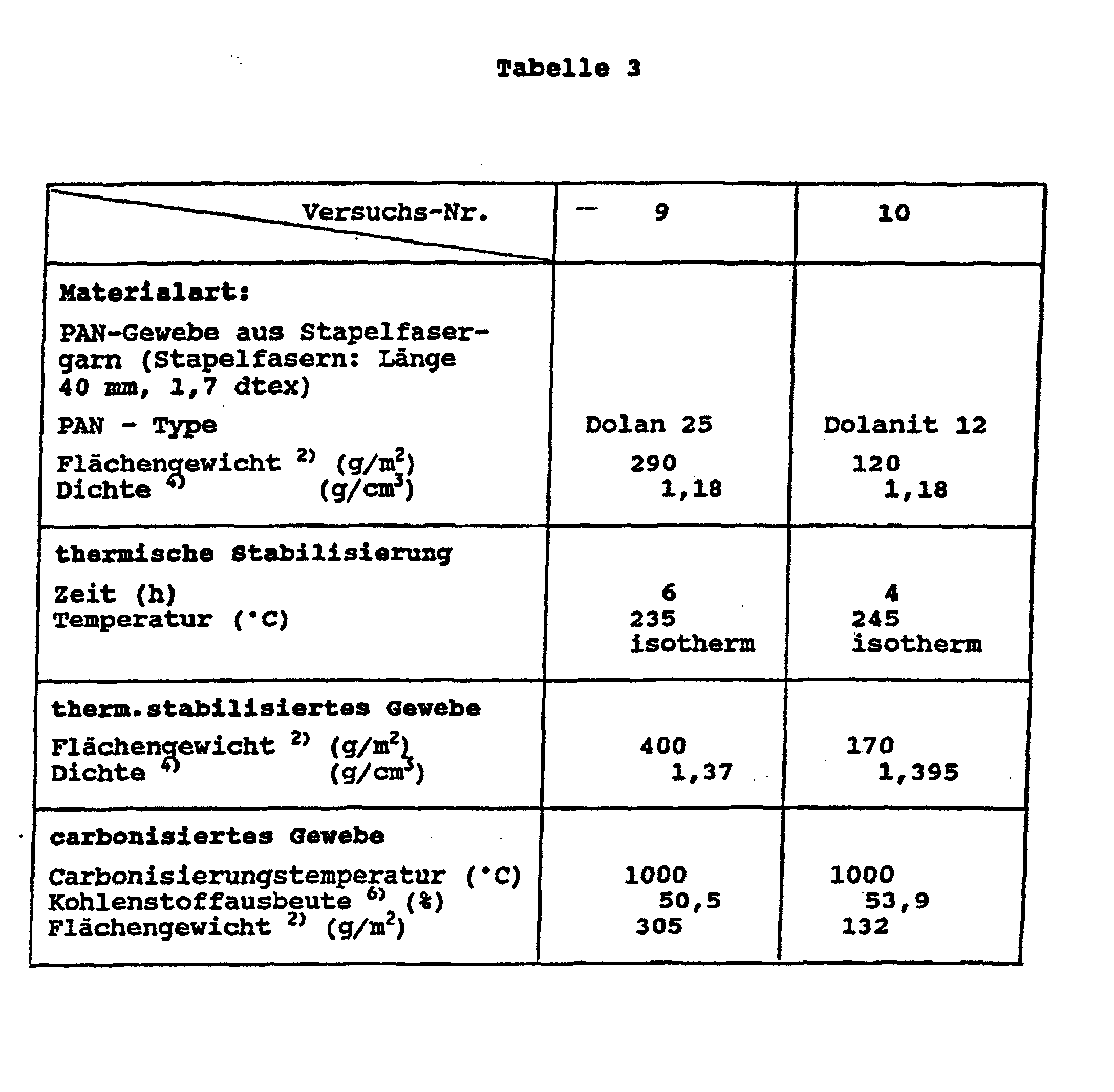
- test results show that webs of different qualities based on PAN can be thermally stabilized using different process conditions using the process described above. It can further be seen from the test results that the properties of the stabilized fabric produced can be influenced by selecting the process conditions for thermal stabilization. This proves that with the method according to the invention, after carrying out simple preliminary tests, it is possible to produce, in a targeted manner, multidimensional flat structures consisting of thermally treated PAN fibers with predetermined properties.
Landscapes
- Chemical & Material Sciences (AREA)
- Chemical Kinetics & Catalysis (AREA)
- General Chemical & Material Sciences (AREA)
- Engineering & Computer Science (AREA)
- Textile Engineering (AREA)
- Inorganic Fibers (AREA)
- Nonwoven Fabrics (AREA)
- Woven Fabrics (AREA)
Description
- Bei der Herstellung von aus thermisch stabilisierten Fasern auf Basis PAN bestehenden mehrdimensionalen flächigen Gebilden fällt der bisher notwendige Umweg, zuerst PAN-Fasern thermisch zu stabilisieren und dann diese thermisch stabilisierten Fasern, die im Vergleich zu den nicht stabilisierten Fasern aus PAN wesentlich steifer und damit mechanisch empfindlicher und textil schwerer verarbeitbar sind, zu Stoffbahnen zu verarbeiten, nunmehr weg. Dieser Vorteil ist besonders dort groß, wo die Fasern, wie dies beispielsweise bei der Herstellung von Filzen geschieht, zur Weiterverarbeitung gekräuselt oder/und zu Stapelfasern verarbeitet werden müssen, ehe daraus Stoffbahnen hergestellt werden. Stoffbahnen aus PAN-Fasern können jetzt direkt thermisch stabilisiert werden. Bei dieser Verfahrensweise ist es von Vorteil, daß die Herstellung von mehrdimensionalen flächigen Gebilden aus PAN-Fasern unproblematisch ist und letztere deshalb in einer Vielzahl von Qualitäten kommerziell verfügbar sind.
- Das Verfahren kann kontinuierlich durchgeführt werden. Dadurch ist es möglich, bezüglich der Verteilung ihrer Stoffeigenschaften gleichmäßigere und damit qualitativ bessere thermisch stabilisierte Stoffbahnen auf Basis PAN wirtschaftlicher herzustellen.
- Als Folge der gleichmäßigeren Verteilung der Stoffeigenschaften ergeben sich bei der Weiterverarbeitung der Stoffbahnen, insbesondere beim Teilcarbonisieren, Carbonisieren und Graphitieren Verarbeitungsvorteile. Die nach diesen Verarbeitungsstufen erhaltenen Stoffbahnen haben ebenfalls eine bessere Qualität.
- Zwei Stellen zum Messen der Strömungsgeschwindigkeit im Anströmbereich in Teilrohr 1, in Rohrmitte 10 und in Wandnähe 10',
- zwei Stellen zum Messen der Temperatur im Anströmbereich in Teilrohr 1, in Rohrmitte 11 und in Wandnähe 11',
- eine Stelle zum Messen des Gasdrucks 12 im Anströmbereich,
- zwei Stellen zum Messen der Temperatur in der, bzw. direkt an der Stoffbahn, in der Mitte 13 und im Randbereich 13',
- eine Stelle zum Messen des Gasdrucks 14 im Abströmbereich hinter der Stoffbahn,
- zwei Stellen zum Messen der Temperatur im Abströmbereich, in Rohrmitte 15 und in Wandnähe 15',
- eine Stelle zum Messen der Strömungsgeschwindigkeit 16 im Abströmbereich.


Claims (18)
- Verfahren zum Herstellen eines aus Kohlenstoff oder überwiegend aus Kohlenstoff bestehenden, aus Fasern aufgebauten mehrdimensionalen flächigen Gebildes aus einem aus Polyacrylnitril oder im wesentlichen aus Polyacrylnitril bestehenden Ausgangsmaterial,
dadurch gekennzeichnet, dass
das aus Fasern aus Polyacrylnitril oder im wesentlichen aus Polyacrylnitril bestehende mehrdimensionale flächige Gebilde zum Überführen in die nicht schmelzbare, nicht carbonisierte Form unter Erhalt seiner textilen Struktur mit einem auf Temperaturen im Bereich von 180 bis 320 °C erhitzten, eine Sauerstoff abgebende Substanz enthaltenden Gas während einer Zeit von wenigstens 0,5 und höchstens 10 Stunden durchströmt wird,
wobei die Gastemperaturen im An- und im Abströmbereich gemessen werden und die das flächige Gebilde durchströmende Gasmenge so geregelt ist, dass
einerseits in dem flächigen Gebilde stets die Temperaturen aufrechterhalten werden, die für den Ablauf der thermischen Stabilisierung der Polyacrylnitril- oder im wesentlichen aus Polyacrylnitril bestehenden Fasern notwendigen chemischen Reaktionen erforderlich sind
und andererseits eine schädliche Überhitzung dieser Fasern in dem flächigen Gebilde nicht eintritt. - Verfahren nach Patentanspruch 1,
dadurch gekennzeichnet, daß
zum Durchströmen des aus Fasern aufgebauten mehrdimensionalen flächigen Gebildes ein ein Oxidationsmittel aus der Gruppe Sauerstoff, Ozon, SO3, NO2, N2O, NO enthaltendes Gas verwendet wird. - Verfahren nach Patentanspruch 1,
dadurch gekennzeichnet, daß zum Überführen des aus dem organischen Polymeren bestehenden mehrdimensionalen flächigen Gebildes in die nicht schmelzbare, nicht carbonisierte Form Luft als Oxidationsmittel verwendet wird. - Verfahren nach einem der Patentansprüche 1, 2 oder 3,
dadurch gekennzeichnet, daß
das aus dem organischen Polymeren bestehende mehrdimensionale flächige Gebilde zum Überführen in die nicht schmelzbare, nicht carbonisierte Form zuerst mit einem auf Temperaturen im Bereich von 180 bis 320 °C erhitzten, inerten Gas und danach mit einem ein Oxidationsmittel enthaltenden Gas, das Temperaturen im Bereich von 180 bis 320 °C aufweist, durchströmt wird. - Verfahren nach einem der Patentansprüche 1, 2 oder 3,
dadurch gekennzeichnet, daß
das aus dem organischen Polymeren bestehende mehrdimensionale flächige Gebilde zum Überführen in die nicht schmelzbare, nicht carbonisierte Form zuerst mit einem auf Temperaturen im Bereich von 180 bis 320 °C erhitzten, ein Oxidationsmittel enthaltenden Gas und danach mit einem inerten Gas, das Temperaturen im Bereich von 180 bis 320 °C aufweist, durchströmt wird. - Verfahren nach einem der Patentansprüche 1 bis 5,
dadurch gekennzeichnet, daß
das aus dem organischen Polymeren bestehende mehrdimensionale flächige Gebilde beim Überführen in die nicht schmelzbare, nicht carbonisierte Form mit mindestens einem Gas durchströmt wird, das Temperaturen im Bereich von 220 bis 260 °C aufweist. - Verfahren nach einem der Patentansprüche 1 bis 6,
dadurch gekennzeichnet, daß
das aus dem organischen Polymeren bestehende mehrdimensionale flächige Gebilde beim Überführen in die nicht schmelzbare, nicht carbonisierte Form während eines Zeitraumes im Bereich von 0,5 bis 6 Stunden mit mindestens einem auf Temperaturen im Bereich von 180 bis 320 °C erhitzten Gas durchströmt wird. - Verfahren nach einem der Patentansprüche 1 bis 7,
dadurch gekennzeichnet, daß
es kontinuierlich durchgeführt wird. - Verfahren nach einem der Patentansprüche 1 bis 8,
dadurch gekennzeichnet, daß
das in die nicht schmelzbare, nicht carbonisierte Form überführte mehrdimensionale flächige Gebilde zusätzlich bei Temperaturen im Bereich von 320 bis 800 °C unter nicht oxidierenden Bedingungen teilcarbonisiert wird. - Verfahren nach Patentanspruch 9,
dadurch gekennzeichnet, daß
das in die nicht schmelzbare, nicht carbonisierte Form überführte mehrdimensionale flächige Gebilde bei Temperaturen im Bereich von 500 bis 700 °C teilcarbonisiert wird. - Verfahren nach einem der Patentansprüche 1 bis 10,
dadurch gekennzeichnet, daß
das in die nicht schmelzbare, nicht carbonisierte Form überführte mehrdimensionale flächige Gebilde nach Durchlaufen des Temperaturbereichs von 320 bis 800 °C zusätzlich im Temperaturbereich von 800 bis 1800 °C carbonisiert wird. - Verfahren nach Patentanspruch 11,
dadurch gekennzeichnet, daß
das Carbonisieren im Temperaturbereich von 800 bis 1400 °C durchgeführt wird. - Verfahren nach einem der Patentansprüche 1 bis 12,
dadurch gekennzeichnet, daß
als mehrdimensionales flächiges Gebilde eine nach einem Web-, Strick- oder Wirkverfahren hergestellte Stoffbahn verwendet wird. - Verfahren nach einem der Patentansprüche 1 bis 12,
dadurch gekennzeichnet, daß
als mehrdimensionales flächiges Gebilde ein Vlies oder ein Filz verwendet wird. - Aus Kohlenstoff oder überwiegend aus Kohlenstoff bestehendes aus Fasern aufgebautes mehrdimensionales flächiges Gebilde, ausgewählt aus Filzen, Vliesen und Gelegen,
dadurch gekennzeichnet, daß
es nach einem der Verfahren gemäß den Patentansprüchen 1 bis 14 hergestellt worden ist. - Vorrichtung zum kontinuierlichen thermischen Behandeln von aus Fasern aus Polyacrylnitril oder im wesentlichen aus Polyacrylnitril bestehenden mehrdimensionalen flächigen Gebilden (18) mit einer
Ab- (19) und Aufwickelvorrichtung (24),
einer zwischen der Ab- (19) und der Aufwickelvorrichtung (24) angeordneten gasdurchlässigen Transportbahn (21) für ein aus Fasern bestehendes mehrdimensionales flächiges Gebilde (18)
und
einem um einen Teil der Transportbahn (21) für das aus Fasern bestehende mehrdimensionale flächige Gebilde (18) angeordneten Ofen (23), durch den das aus Fasern bestehende mehrdimensionale flächige Gebilde (18) auf der Transportbahn (21) transportiert werden kann,
dadurch gekennzeichnet, daß
der Ofen (23) mindestens eine kammerartige Abteilung (22) aufweist, durch die das aus Fasern bestehende mehrdimensionale flächige Gebilde (18) transportiert werden kann,
daß Vorrichtungen (27) vorhanden sind, mittels derer Gase durch die mindestens eine kammerartige Abteilung (22) gefördert werden können,
daß Vorrichtungen (26) vorhanden sind, mittels derer die die mindestens eine kammerartige Abteilung (22) durchströmenden Gase geregelt geheizt werden können,
daß die mindestens eine kammerartige Abteilung (22) so ausgerüstet ist (32), daß die temperierten Gase möglichst gleichmäßig in Richtung des aus Fasern bestehenden mehrdimensionalen flächigen Gebildes (18) strömen und dieses durchströmen,
daß, in Richtung der Gasströmung gesehen, hinter dem aus Fasern bestehenden mehrdimensionalen flächigen Gebilde (18) Vorrichtungen (28) für das Abführen oder Absaugen der Gase vorhanden sind, die das aus Fasern bestehende mehrdimensionale flächige Gebilde (18) durchströmt haben,
und daß, in Richtung der Gasströmung gesehen, mindestens vor dem aus Fasern bestehenden mehrdimensionalen flächigen Gebilde (18) in der mindestens einen Kammer (22) Vorrichtungen (T, p, v) zum Messen und Regeln der Gastemperatur und des Strömungszustandes des Gases vorhanden sind, die die Temperatur oder/und die Gasströmung des strömenden Gases in der mindestens einen kammerartigen Abteilung (22) auf bestimmte, vorgegebene Werte einregelt. - Vorrichtung nach Patentanspruch 16,
dadurch gekennzeichnet, daß
in Richtung der Gasströmung gesehen, vor und nach dem aus Fasern bestehenden mehrdimensionalen flächigen Gebilde (18) in der mindestens einen kammerartigen Abteilung (22) Vorrichtungen (T, p, v) zum Messen und Regeln der Gastemperatur und des Strömungszustandes des Gases vorhanden sind. - Vorrichtung nach einem der Patentansprüche 16 und 17,
dadurch gekennzeichnet, daß
zum Überwachen und Regeln des Strömungszustandes des Gases Meß- und Regelvorrichtungen für den Gasdruck (p) und die Gasgeschwindigkeit (v) vorhanden sind.
Applications Claiming Priority (2)
| Application Number | Priority Date | Filing Date | Title |
|---|---|---|---|
| DE19517911A DE19517911A1 (de) | 1995-05-16 | 1995-05-16 | Verfahren zum Umwandeln von aus Polyacrylnitrilfasern bestehenden mehrdimensionalen flächigen Gebilden in den thermisch stabilisierten Zustand |
| DE19517911 | 1995-05-16 |
Publications (3)
| Publication Number | Publication Date |
|---|---|
| EP0743381A2 EP0743381A2 (de) | 1996-11-20 |
| EP0743381A3 EP0743381A3 (de) | 1998-05-20 |
| EP0743381B1 true EP0743381B1 (de) | 2003-07-02 |
Family
ID=7762031
Family Applications (1)
| Application Number | Title | Priority Date | Filing Date |
|---|---|---|---|
| EP96106044A Expired - Lifetime EP0743381B1 (de) | 1995-05-16 | 1996-04-18 | Verfahren zum thermischen Stabilisieren von aus Polyacrylnitrilfasern bestehenden mehrflächigen Gebilden |
Country Status (4)
| Country | Link |
|---|---|
| US (2) | US5853429A (de) |
| EP (1) | EP0743381B1 (de) |
| JP (1) | JPH08311722A (de) |
| DE (2) | DE19517911A1 (de) |
Cited By (1)
| Publication number | Priority date | Publication date | Assignee | Title |
|---|---|---|---|---|
| DE102007002594A1 (de) | 2007-01-12 | 2008-07-17 | Bayerisches Zentrum für Angewandte Energieforschung e.V. | Beschichtete kohlenstoffhaltige Aerogelplatte und Verfahren zu deren Herstellung |
Families Citing this family (22)
| Publication number | Priority date | Publication date | Assignee | Title |
|---|---|---|---|---|
| DE19548421B4 (de) | 1995-12-22 | 2004-06-03 | Celanese Ventures Gmbh | Verfahren zur kontinuierlichen Herstellung von Membranelektrodeneinheiten |
| DE19731797C2 (de) | 1997-07-24 | 2001-05-31 | Trw Automotive Safety Sys Gmbh | Hitzebeständiges Airbaggewebe |
| JP4161473B2 (ja) * | 1999-07-01 | 2008-10-08 | 豊田合成株式会社 | インサートをもつ押出成形品及びその製造方法 |
| WO2001004980A1 (en) | 1999-07-07 | 2001-01-18 | Sgl Carbon Ag | Electrode substrate for electrochemical cells based on low-cost manufacturing processes |
| DE19953259C2 (de) | 1999-11-04 | 2003-05-28 | Sgl Carbon Ag | Verbunde aus einem mit Fasern verstärkten Verbundwerkstoff mit keramischer Matrix und einem Backing und Verwendung der Verbunde |
| US6537654B1 (en) | 1999-11-04 | 2003-03-25 | Sgl Technik Gmbh | Protection products and armored products made of fiber-reinforced composite material with ceramic matrix |
| DE10050512A1 (de) * | 2000-10-11 | 2002-05-23 | Freudenberg Carl Kg | Leitfähiger Vliesstoff |
| US6514072B1 (en) * | 2001-05-23 | 2003-02-04 | Harper International Corp. | Method of processing carbon fibers |
| WO2002095116A1 (en) * | 2001-05-24 | 2002-11-28 | Mitsubishi Chemical Functional Products, Inc. | Production method for continuous alumina fiber blanket |
| US20030075579A1 (en) * | 2001-07-31 | 2003-04-24 | Bruce Dover | Array of processing drums and method of processing carbon fibers |
| US20050080449A1 (en) * | 2002-10-31 | 2005-04-14 | Mulder Rudolf T. | Safety cartridge for retrievable medical filter |
| SE524779C2 (sv) * | 2002-12-20 | 2004-10-05 | Andritz Fiber Drying Ab | Anordning vid torkning eller värmebehandling av ett banformigt material |
| EP1642073B1 (de) * | 2003-07-01 | 2008-02-20 | Strahm Textile Systems AG | Umluftofen |
| US20060130357A1 (en) * | 2004-12-17 | 2006-06-22 | Cemen Tech Inc. | Continuous horizontal grain drying system |
| WO2011056569A1 (en) * | 2009-10-28 | 2011-05-12 | The Dow Chemical Investments Llc | Device to dry catalyst roaster conveyor belt and method of using same |
| US20110143262A1 (en) * | 2009-12-10 | 2011-06-16 | Gm Global Technology Operations, Inc. | Gas diffusion media made from electrically conductive coatings on non-conductive fibers |
| US20110204611A1 (en) * | 2010-02-18 | 2011-08-25 | Daimler Trucks North America Llc | Fiber reinforced polymer frame rail |
| CN102839448B (zh) * | 2012-09-28 | 2014-06-18 | 山东大学 | 一种防静电碳基纤维及其制备方法与应用 |
| DE102014009243B3 (de) * | 2014-06-20 | 2015-11-19 | Eisenmann Ag | Oxidationsofen |
| FR3030705A1 (fr) | 2014-12-17 | 2016-06-24 | Andritz Perfojet Sas | Installation de sechage d'un voile de non-tisse humide |
| RU2648316C2 (ru) * | 2016-07-28 | 2018-03-23 | Общество с ограниченной ответственностью Научно-производственный центр "УВИКОМ" (ООО НПЦ "УВИКОМ") | Печь окисления полиакрилонитрильных волокон для изготовления углеродных волокон |
| KR102147418B1 (ko) | 2018-04-27 | 2020-08-24 | 주식회사 엘지화학 | 탄소섬유 제조용 전구체 섬유의 안정화 방법 및 이를 이용한 탄소섬유의 제조방법 |
Family Cites Families (17)
| Publication number | Priority date | Publication date | Assignee | Title |
|---|---|---|---|---|
| DE7231623U (de) * | 1972-12-21 | Sigri Elektrographit Gmbh | Widerstandsofen zum Graphitleren von Kohlenstoffilz | |
| US2319300A (en) * | 1939-09-08 | 1943-05-18 | Associated Spring Corp | Contact strip annealing furnace |
| US2319302A (en) * | 1942-08-17 | 1943-05-18 | Associated Spring Corp | Contact strip annealing furnace |
| GB1110791A (en) * | 1964-04-24 | 1968-04-24 | Nat Res Dev | The production of carbon fibres |
| US3961888A (en) * | 1968-09-18 | 1976-06-08 | Celanese Corporation | Acrylic fiber conversion utilizing a stabilization treatment conducted initially in an essentially inert atmosphere |
| DE1959984A1 (de) * | 1969-11-29 | 1971-06-09 | John Heathcoat & Company Ltd | Verfahren und Vorrichtung zur Herstellung von Kohlefaeden |
| GB1405891A (en) * | 1971-06-28 | 1975-09-10 | Quimco Gmbh | Apparatus for producing carbon fibres |
| US4452601A (en) * | 1982-03-19 | 1984-06-05 | Celanese Corporation | Process for the thermal stabilization of acrylic fibers and films |
| US4507272A (en) * | 1983-05-09 | 1985-03-26 | Hitco | Method of purifying partially carbonized pan material prior to carbonization |
| JPS60167928A (ja) * | 1984-02-10 | 1985-08-31 | Nippon Soken Inc | ピツチ系炭素繊維の不融化処理方法並びに装置 |
| US4591517A (en) * | 1984-06-08 | 1986-05-27 | Overly, Inc. | Web dryer with variable ventilation rate |
| US4789332A (en) * | 1986-06-26 | 1988-12-06 | Aluminum Company Of America | Apparatus for removing volatiles from metal |
| IT1205512B (it) * | 1986-12-30 | 1989-03-23 | Mauro Poppi | Forno per la cottura di materiali ceramici quali piastrelle e simili |
| JPH0737690B2 (ja) * | 1988-12-19 | 1995-04-26 | 大阪瓦斯株式会社 | ピッチ繊維の不融化炉 |
| CA2009546C (en) * | 1989-02-23 | 1996-05-28 | Warren C. Schimpf | Thermally stabilized polyacrylonitrile polymers for carbon fiber manufacture |
| JP2648073B2 (ja) * | 1992-09-14 | 1997-08-27 | 新日本製鐵株式会社 | ピッチ系炭素繊維不融化炉の炉内ガス組成の調整法 |
| EP0626548A1 (de) * | 1993-05-28 | 1994-11-30 | Akzo Nobel N.V. | Verfahren und Apparat für die Oxidierung mit hoher Geschwindigkeit von organischen Fasern |
-
1995
- 1995-05-16 DE DE19517911A patent/DE19517911A1/de not_active Ceased
-
1996
- 1996-04-18 DE DE59610563T patent/DE59610563D1/de not_active Expired - Fee Related
- 1996-04-18 EP EP96106044A patent/EP0743381B1/de not_active Expired - Lifetime
- 1996-05-15 JP JP8145194A patent/JPH08311722A/ja active Pending
-
1997
- 1997-07-11 US US08/893,737 patent/US5853429A/en not_active Expired - Fee Related
- 1997-07-11 US US08/893,396 patent/US5967770A/en not_active Expired - Fee Related
Cited By (1)
| Publication number | Priority date | Publication date | Assignee | Title |
|---|---|---|---|---|
| DE102007002594A1 (de) | 2007-01-12 | 2008-07-17 | Bayerisches Zentrum für Angewandte Energieforschung e.V. | Beschichtete kohlenstoffhaltige Aerogelplatte und Verfahren zu deren Herstellung |
Also Published As
| Publication number | Publication date |
|---|---|
| DE59610563D1 (de) | 2003-08-07 |
| US5853429A (en) | 1998-12-29 |
| DE19517911A1 (de) | 1996-11-21 |
| EP0743381A3 (de) | 1998-05-20 |
| US5967770A (en) | 1999-10-19 |
| JPH08311722A (ja) | 1996-11-26 |
| EP0743381A2 (de) | 1996-11-20 |
Similar Documents
| Publication | Publication Date | Title |
|---|---|---|
| EP0743381A2 (de) | Verfahren zum thermisch Stabilisieren von aus Polyacrylnitrilfasern bestehenden mehrflächigen Gebilden | |
| DE69220555T2 (de) | Filz aus Kohlefasern und Verfahren zu dessen Herstellung | |
| DE2614391C3 (de) | Verfahren und Vorrichtung zur Herstellung von Kohlenstofffasern | |
| DE2614415C3 (de) | Verfahren zur Herstellung von Kohlenstoff-Fasern | |
| DE1181671B (de) | Durchlaessiges im wesentlichen kompaktes Metallmaterial fuer Filterzwecke | |
| DE69223449T2 (de) | Verfahren zur kontinuierlichen Herstellung von Kohlenstoffasern mittels Kalzinierofen | |
| DE1939390A1 (de) | Verfahren zum thermischen Stabilisieren von Acrylfasermaterial | |
| DE2128907C3 (de) | Verfahren zum Graphitisieren von Fasermaterial | |
| DE69408336T2 (de) | Verfahren zur chemischen gasphaseninfiltration eines materials in das innere eines fasersubtrats durch einen temperaturgradienten im substrat | |
| DE2231731A1 (de) | Verfahren und vorrichtung zur herstellung von kohlefasern | |
| EP3738753A1 (de) | Verfahren zur herstellung eines hybridfaserbündels, hybridfaserbündel und vorrichtung zur herstellung eines hybridfaserbündels | |
| DE2034907C3 (de) | Verfahren und Vorrichtung zur Herstellung von Reduktionsgasen | |
| DE2925950C3 (de) | Verfahren und Vorrichtung zur Unschmelzbarmachung von Pechfasern | |
| DE2823426C3 (de) | Verfahren zur Herstellung von oxidierten, carbonisierbaren Fasern und die Verwendung der danach hergestellten Fasern | |
| DE3138893C2 (de) | ||
| DE3413472C2 (de) | ||
| DE2546509B2 (de) | Verfahren zur Herstellung von Kohlenstoffäden oder -fasern | |
| DE2251320B2 (de) | Verfahren zur Herstellung schwer entflammbarer Fasermaterialien | |
| DE2130600C3 (de) | Verfahren zur Herstellung von carbonisiertem und gegebenenfalls graphitisiertem Fasermaterial | |
| DE2211639B2 (de) | Verfahren zur Herstellung von Kohlenstoff-Fäden | |
| DE2603029A1 (de) | Verfahren zur herstellung modifizierter polyacrylnitril-faeden | |
| DE1900243A1 (de) | Verfahren zur Herstellung von flexiblen Kohlenstoff-Fasern | |
| DE1959984A1 (de) | Verfahren und Vorrichtung zur Herstellung von Kohlefaeden | |
| DE2354447A1 (de) | Verfahren zur oxydationsbehandlung von organischen polymerfasern fuer die herstellung von kohlenstoffasern | |
| DE2115153A1 (de) | Verfahren zum Herstellen von Kohlenstoffäden |
Legal Events
| Date | Code | Title | Description |
|---|---|---|---|
| PUAI | Public reference made under article 153(3) epc to a published international application that has entered the european phase |
Free format text: ORIGINAL CODE: 0009012 |
|
| AK | Designated contracting states |
Kind code of ref document: A2 Designated state(s): BE DE ES FR GB IT NL |
|
| PUAL | Search report despatched |
Free format text: ORIGINAL CODE: 0009013 |
|
| AK | Designated contracting states |
Kind code of ref document: A3 Designated state(s): BE DE ES FR GB IT NL |
|
| 17P | Request for examination filed |
Effective date: 19980430 |
|
| 17Q | First examination report despatched |
Effective date: 19990205 |
|
| RAP1 | Party data changed (applicant data changed or rights of an application transferred) |
Owner name: SGL CARBON AG |
|
| GRAH | Despatch of communication of intention to grant a patent |
Free format text: ORIGINAL CODE: EPIDOS IGRA |
|
| GRAH | Despatch of communication of intention to grant a patent |
Free format text: ORIGINAL CODE: EPIDOS IGRA |
|
| GRAA | (expected) grant |
Free format text: ORIGINAL CODE: 0009210 |
|
| AK | Designated contracting states |
Designated state(s): BE DE ES FR GB IT NL |
|
| PG25 | Lapsed in a contracting state [announced via postgrant information from national office to epo] |
Ref country code: NL Free format text: LAPSE BECAUSE OF FAILURE TO SUBMIT A TRANSLATION OF THE DESCRIPTION OR TO PAY THE FEE WITHIN THE PRESCRIBED TIME-LIMIT Effective date: 20030702 Ref country code: IT Free format text: LAPSE BECAUSE OF FAILURE TO SUBMIT A TRANSLATION OF THE DESCRIPTION OR TO PAY THE FEE WITHIN THE PRE;WARNING: LAPSES OF ITALIAN PATENTS WITH EFFECTIVE DATE BEFORE 2007 MAY HAVE OCCURRED AT ANY TIME BEFORE 2007. THE CORRECT EFFECTIVE DATE MAY BE DIFFERENT FROM THE ONE RECORDED.SCRIBED TIME-LIMIT Effective date: 20030702 |
|
| REG | Reference to a national code |
Ref country code: GB Ref legal event code: FG4D Free format text: NOT ENGLISH |
|
| GBT | Gb: translation of ep patent filed (gb section 77(6)(a)/1977) | ||
| REF | Corresponds to: |
Ref document number: 59610563 Country of ref document: DE Date of ref document: 20030807 Kind code of ref document: P |
|
| PG25 | Lapsed in a contracting state [announced via postgrant information from national office to epo] |
Ref country code: ES Free format text: LAPSE BECAUSE OF FAILURE TO SUBMIT A TRANSLATION OF THE DESCRIPTION OR TO PAY THE FEE WITHIN THE PRESCRIBED TIME-LIMIT Effective date: 20031013 |
|
| NLV1 | Nl: lapsed or annulled due to failure to fulfill the requirements of art. 29p and 29m of the patents act | ||
| PG25 | Lapsed in a contracting state [announced via postgrant information from national office to epo] |
Ref country code: GB Free format text: LAPSE BECAUSE OF NON-PAYMENT OF DUE FEES Effective date: 20040418 |
|
| PG25 | Lapsed in a contracting state [announced via postgrant information from national office to epo] |
Ref country code: BE Free format text: LAPSE BECAUSE OF NON-PAYMENT OF DUE FEES Effective date: 20040430 |
|
| PLBE | No opposition filed within time limit |
Free format text: ORIGINAL CODE: 0009261 |
|
| STAA | Information on the status of an ep patent application or granted ep patent |
Free format text: STATUS: NO OPPOSITION FILED WITHIN TIME LIMIT |
|
| ET | Fr: translation filed | ||
| 26N | No opposition filed |
Effective date: 20040405 |
|
| BERE | Be: lapsed |
Owner name: *SGL CARBON A.G. Effective date: 20040430 |
|
| GBPC | Gb: european patent ceased through non-payment of renewal fee |
Effective date: 20040418 |
|
| PGFP | Annual fee paid to national office [announced via postgrant information from national office to epo] |
Ref country code: FR Payment date: 20060313 Year of fee payment: 11 |
|
| PGFP | Annual fee paid to national office [announced via postgrant information from national office to epo] |
Ref country code: DE Payment date: 20060430 Year of fee payment: 11 |
|
| PG25 | Lapsed in a contracting state [announced via postgrant information from national office to epo] |
Ref country code: DE Free format text: LAPSE BECAUSE OF NON-PAYMENT OF DUE FEES Effective date: 20071101 |
|
| PG25 | Lapsed in a contracting state [announced via postgrant information from national office to epo] |
Ref country code: FR Free format text: LAPSE BECAUSE OF NON-PAYMENT OF DUE FEES Effective date: 20070430 |