EP0697106B1 - Elektrochemilumineszenzverfahren - Google Patents
Elektrochemilumineszenzverfahren Download PDFInfo
- Publication number
- EP0697106B1 EP0697106B1 EP94915552A EP94915552A EP0697106B1 EP 0697106 B1 EP0697106 B1 EP 0697106B1 EP 94915552 A EP94915552 A EP 94915552A EP 94915552 A EP94915552 A EP 94915552A EP 0697106 B1 EP0697106 B1 EP 0697106B1
- Authority
- EP
- European Patent Office
- Prior art keywords
- solution
- analyte
- bmg
- measuring
- voltage
- Prior art date
- Legal status (The legal status is an assumption and is not a legal conclusion. Google has not performed a legal analysis and makes no representation as to the accuracy of the status listed.)
- Expired - Lifetime
Links
Classifications
-
- G—PHYSICS
- G01—MEASURING; TESTING
- G01N—INVESTIGATING OR ANALYSING MATERIALS BY DETERMINING THEIR CHEMICAL OR PHYSICAL PROPERTIES
- G01N33/00—Investigating or analysing materials by specific methods not covered by groups G01N1/00 - G01N31/00
- G01N33/48—Biological material, e.g. blood, urine; Haemocytometers
- G01N33/50—Chemical analysis of biological material, e.g. blood, urine; Testing involving biospecific ligand binding methods; Immunological testing
- G01N33/53—Immunoassay; Biospecific binding assay; Materials therefor
- G01N33/531—Production of immunochemical test materials
- G01N33/532—Production of labelled immunochemicals
- G01N33/533—Production of labelled immunochemicals with fluorescent label
-
- G—PHYSICS
- G01—MEASURING; TESTING
- G01N—INVESTIGATING OR ANALYSING MATERIALS BY DETERMINING THEIR CHEMICAL OR PHYSICAL PROPERTIES
- G01N33/00—Investigating or analysing materials by specific methods not covered by groups G01N1/00 - G01N31/00
- G01N33/48—Biological material, e.g. blood, urine; Haemocytometers
- G01N33/50—Chemical analysis of biological material, e.g. blood, urine; Testing involving biospecific ligand binding methods; Immunological testing
- G01N33/52—Use of compounds or compositions for colorimetric, spectrophotometric or fluorometric investigation, e.g. use of reagent paper and including single- and multilayer analytical elements
-
- G—PHYSICS
- G01—MEASURING; TESTING
- G01N—INVESTIGATING OR ANALYSING MATERIALS BY DETERMINING THEIR CHEMICAL OR PHYSICAL PROPERTIES
- G01N33/00—Investigating or analysing materials by specific methods not covered by groups G01N1/00 - G01N31/00
- G01N33/48—Biological material, e.g. blood, urine; Haemocytometers
- G01N33/50—Chemical analysis of biological material, e.g. blood, urine; Testing involving biospecific ligand binding methods; Immunological testing
- G01N33/58—Chemical analysis of biological material, e.g. blood, urine; Testing involving biospecific ligand binding methods; Immunological testing involving labelled substances
- G01N33/582—Chemical analysis of biological material, e.g. blood, urine; Testing involving biospecific ligand binding methods; Immunological testing involving labelled substances with fluorescent label
-
- G—PHYSICS
- G01—MEASURING; TESTING
- G01N—INVESTIGATING OR ANALYSING MATERIALS BY DETERMINING THEIR CHEMICAL OR PHYSICAL PROPERTIES
- G01N21/00—Investigating or analysing materials by the use of optical means, i.e. using sub-millimetre waves, infrared, visible or ultraviolet light
- G01N21/62—Systems in which the material investigated is excited whereby it emits light or causes a change in wavelength of the incident light
- G01N21/66—Systems in which the material investigated is excited whereby it emits light or causes a change in wavelength of the incident light electrically excited, e.g. electroluminescence
-
- G—PHYSICS
- G01—MEASURING; TESTING
- G01N—INVESTIGATING OR ANALYSING MATERIALS BY DETERMINING THEIR CHEMICAL OR PHYSICAL PROPERTIES
- G01N21/00—Investigating or analysing materials by the use of optical means, i.e. using sub-millimetre waves, infrared, visible or ultraviolet light
- G01N21/75—Systems in which material is subjected to a chemical reaction, the progress or the result of the reaction being investigated
- G01N21/76—Chemiluminescence; Bioluminescence
Definitions
- the invention relates to methods for measuring electrochemiluminescent phenomena, methods for detecting an analyte by means of such methods, reagent solutions which can be used in these methods and an apparatus which is particularly suitable for carrying out the method.
- an amine is added to the test composition, preferably tripropylamine, which is a strong reducing agent in oxidized form.
- the electrochemical reaction takes place in an electrolyte in which the electrochemiluminescence (ECL) residue, ie the metal complex capable of emitting electromagnetic radiation, and the amine can be oxidized.
- ECL electrochemiluminescence
- Phosphate buffer at a pH of 6-9, preferably 7-7.5 is described as a suitable electrolyte in aqueous solution.
- WO 90/05302 the detergent Triton X-100 or Triton N-401 is added to this test composition to increase the electromagnetic radiation.
- WO 90/05411 describes an improvement in the apparatus for measuring ECL.
- Electrochemiluminescence was used to determine the amount of analyte present.
- immunoassays have been described in which the usual labels are replaced by electrochemiluminescent labels.
- the object of the present invention was to improve the previously known methods, in particular with regard to the sensitivity of the analyte detection, which are possible with electrochemiluminescence technology.
- the invention relates to a method for measuring electrochemical phenomena in a solution or on a solid phase adjacent to a solution by contacting a component capable of electrochemiluminescence with an oxidizable amine and applying an electrical voltage to induce electrochemiluminescence and detect the electromagnetic radiation, wherein the solution contains a detergent selected from the group of fatty alcohol ethoxylates, plantars and octylglucoside or a mixture thereof.
- the invention further relates to a method for the detection of an analyte with the aid of these methods and suitable reagents for carrying out the method mentioned.
- Devices for carrying out measurements of electrochemiluminescence contain a measuring unit with a container for a reagent solution, at least two electrodes (a working and a counter electrode) which are in contact with the reagent solution during the measurement and a detector for measuring the light generated by the electrochemiluminescence .
- a measuring unit with a container for a reagent solution, at least two electrodes (a working and a counter electrode) which are in contact with the reagent solution during the measurement and a detector for measuring the light generated by the electrochemiluminescence .
- an initial voltage prepolarization
- this voltage is the redox potential of a substance contained in the solution, for. B. an amine.
- certain ruthenium complexes to emit light.
- the light captured by the detector within a certain time is a measure of the presence of the amount of electrochemiluminescent material. If the electrochemiluminescent material is a label for an analyte, an analyte analog or an analyte-specific substance, e.g. B. in an immunoassay, the received light is a measure of the presence of the analyte.
- Triton X-100 known from WO 90/05302 and hitherto usually added, which in practice was mostly used in combination with the detergent Tween 20, is not optimal.
- Triton X-100 is poorly degradable and therefore not environmentally friendly.
- certain other detergents lead to an improvement in the ECL process compared to Triton X-100. With these special detergents, an increased signal yield, a better signal-to-noise ratio and thus an increased sensitivity of the detection method and a lowering of the lower detection limit as well as better precision are achieved.
- the detergents are selected from the group of fatty alcohol ethoxylates, among which, for example, polidocanol (Dodecylpoly- (ethylene glycol ether) n), C14-E09 (poly (ethylene glycol ether) n), Genapol (Isotridecylpoly (ethylene glycol ether) n), C8 E09 (octyl alcohol poly (ethylene glycol ether) n ) are to be understood, Plantaren® (alkyl polyglucoside) and octyl glucoside (octyl-beta-D-glucopyranoside) or a mixture thereof.
- the detergents are used in concentrations of 0.001 to 1.0%. The most suitable concentration can easily be determined for each detergent. Concentrations of 0.1 to 0.5% have been found to be the most suitable.
- Oxaban and Bioban are used in concentrations of 0.01 to 1%, preferably 0.1 to 0.5%.
- the method according to the invention for measuring electrochemical phenomena in a solution or on a solid phase adjacent to a solution can be carried out at temperatures which are above the freezing point of the solution but are lower than 40.degree.
- a further improvement in sensitivity can be achieved by applying a voltage to the measuring unit, the course of which is rectangular over time. This means that starting from the output voltage, the voltage rises immediately (within a maximum of 0.4 seconds) to the final voltage. This voltage is kept essentially constant for the excitation time. After this time, the voltage is immediately returned to a voltage below the redox potential of the system.
- This measure also results in a broadening of the dynamic measuring range, that is to say the range within which analyte concentrations of a defined immunoassay can be measured. In the case of low temperatures, salt addition is preferred.
- the final voltage (compared to Ag / AgCl) is limited to a maximum value of 3.0 volts.
- an increase in the signal could also be achieved in that the output voltage before excitation of the electrochemiluminescence on the working electrode was between + 400 and - 400 mV compared to an Ag / AgCl electrode.
- a value between + 0 mV and + 200 mV is particularly preferred.
- the values for the use of a platinum or gold electrode pair also apply here.
- the potentials for other electrode materials can easily be calculated.
- An increase in the signal can also be achieved by setting a pH between 6.5-9.0, preferably between 6.5-7.5, particularly preferably 6.8. This is expediently done by using a pH buffer suitable for the range.
- one or more alkali or alkaline earth metal halides can be contained in the solution in a concentration of 0.05 mmol / l to 0.5 mol / l. Sodium chloride is preferably used.
- Increasing the detection sensitivity of analytes allows the method or the apparatus used to be further simplified.
- a photodiode as a detector, to simplify the system calibration, to increase the number of tests carried out in the unit of time due to the shorter measuring time with an increased signal, or to reduce the sample volumes.
- the invention also relates to a reagent solution for measuring electrochemical phenomena and in particular for the detection of analytes, containing an electrochemically oxidizable amine, which in the oxidized state is a strong reducing agent, which is a detergent selected from the group consisting of fatty alcohol ethoxylates, Plantaren® and octylglucoside or a mixture thereof contains.
- a strong reducing agent which is a detergent selected from the group consisting of fatty alcohol ethoxylates, Plantaren® and octylglucoside or a mixture thereof contains.
- an alkali chloride can also be present in a concentration of 0.1 mmol / l to 0.5 mol / l and / or the pH value is between 6.8 and 8.0.
- conventional additives such as, for example, buffer substances, stabilizers and preservatives, can also be present.
- the reagent solution is preferably preserved with Bioban or Oxaban.
- An apparatus for carrying out detection by means of electrochemiluminescence is described in detail, for example, in example 1 of WO 90/05302.
- An apparatus can also be a means for cooling the measuring unit or / and a liquid container at temperatures between 0 - 25 ° C if the process is to be carried out at these low temperatures.
- the measuring unit here is to be understood as the cell in which the electroluminescence is measured.
- Under the liquid container a storage vessel or a feed, e.g. B. hose, for the reagent solution located in the measuring unit during the measurement.
- the invention also relates to a method for the detection of an analyte via an electrochemiluminescent label, one of the above-mentioned methods being used for measuring electrochemiluminescent phenomena.
- Example 1 of WO 90/05302 which also contained a permanent magnet in the measuring cell (Origen 1.0 from IGEN, Rockville, USA or Magnalyser) was used for the measurement.
- This instrument also contains a photomultiplier, a potentiostat, an electrochemical flow cell, liquid transfer agent and a 50-tube sample rotor.
- HSAP lyophilized HSAP were dissolved in a Tris / Polidocanol buffer (100mM; 0.1%) pH 9.0, so that a working solution of 600 ⁇ g / ml was available
- 50 ⁇ l PBS buffer 50 mM KH 2 PO 4 ; 100mM NaCl; 0.1% RSA; pH7.0
- Reagent solution 200 mM KH 2 PO 4 buffer; 100 mM TPA; pH 7.5; reagent tested in each case
- This mixture was pipetted into a measuring tube and then transferred to the measuring cell.
- the HSAP were washed with the buffer (AB) and the signal yield was measured in this buffer.
- the antibody used was biotinylated with Biotin-DDS (Biotinylamino-3,6-dioxaoctanoyl-aminocarbonyl-heptanoic acid-N-hydroxysuccinimide ester). (Tris) (2,2'-bipyridyl) ruthenium chloride hexahydrate was bound to the antibodies with DSS (disuccinyl suberate).
- the streptavidin-coated magnetic particles were obtained from Deutsche Dynal GmbH, Germany (Dynabeads M-280 streptavidin).
- the buffer (AB) used in the measurement had the following composition: KH2PO4 * 2H2O 0.2 m KOH 0.076 M NaCl 0.05 mM TPA (tripropylamine) 0.1M Detergent in the concentrations given in the table Oxaban / Bioban 0.1 / 0.3% pH 7.5
- Polidocanol and C8-E09 show the best influence on the HSAP / AB ratio. Other detergents cause a deterioration in the signal yield compared to Tween / Triton X-100.
- Example 1 The test was carried out as shown in Example 1. Instead of the buffer (AB), the BMG 2 buffer with the following composition was used: H 3 PO 4 0.2 m Polidocanol 0.1% Oxaban 0.1% Tripropylamine 0.16 M KOH 0.12 m pH 6.8 NaCl concentration given in the table
- a lowering of the temperature below 20 ° C requires the addition of an alkali chloride and a pH of preferably 7.25 - 7.75.
- test composition BMG 1 according to the invention is compared with the test composition of the prior art (BMG O):
- the reagent solutions have the following composition: Reagent BMG O BMG 1 KH 2 PO 4 x2H 2 O 0.2 m 0.2 m H 3 PO 4 - - Detergent Triton X-100 0.005% Polidocanol 0.1% Tween 0.05% Preservative NaN 3 7.8 mM Oxaban 0.1% Tripropylamine 0.1M 0.1M KOH 0.076 M 0.076 M pH 7.5 7.5
- This mixture was incubated at 28 ° C. for 16 minutes, then transferred to the measuring cell heated to 28 ° C. and the particles were washed with BMG 0 or 1, depending on the test batch, and measured therein. A triangular ramp voltage was applied. The measuring voltage was 0.565 V and the PMT was 720 mV.
- test composition BMG 1 according to the invention was tested in comparison to BMG 0 using the example of a sandwich immunoassay for the detection of HBsAg.
- BMG 0 and 1 had the compositions listed in Example 3.
- This mixture was incubated at 28 ° C. for 16 minutes, then transferred to the measuring cell heated to 28 ° C. and the particles washed with BMG 0 or 1 and measured therein.
- test compositions BMG 1 and BMG 1 without oxaban are compared in comparison to the test composition according to the prior art BMG 0.
- BMG 0 and 1 had the composition described in Example 3.
- Thyroid stimulating hormone was determined using a sandwich immunoassay. An apparatus was implemented as described in Example 1.
- This mixture was incubated for 16 minutes at room temperature (21 ° C.) and then transferred to the measuring cell brought to the desired measuring temperature, the immobilized particles were washed with reagent solution BMG1 and measured in BMG1.
Landscapes
- Health & Medical Sciences (AREA)
- Life Sciences & Earth Sciences (AREA)
- Immunology (AREA)
- Engineering & Computer Science (AREA)
- Hematology (AREA)
- Molecular Biology (AREA)
- Biomedical Technology (AREA)
- Chemical & Material Sciences (AREA)
- Urology & Nephrology (AREA)
- Physics & Mathematics (AREA)
- Microbiology (AREA)
- Cell Biology (AREA)
- Food Science & Technology (AREA)
- Medicinal Chemistry (AREA)
- Biotechnology (AREA)
- Analytical Chemistry (AREA)
- Biochemistry (AREA)
- General Health & Medical Sciences (AREA)
- General Physics & Mathematics (AREA)
- Pathology (AREA)
- Investigating Or Analysing Materials By The Use Of Chemical Reactions (AREA)
- Luminescent Compositions (AREA)
- Detergent Compositions (AREA)
- Investigating, Analyzing Materials By Fluorescence Or Luminescence (AREA)
- Dental Preparations (AREA)
- Carbon And Carbon Compounds (AREA)
- Photoreceptors In Electrophotography (AREA)
- Investigating Or Analyzing Non-Biological Materials By The Use Of Chemical Means (AREA)
- Electroluminescent Light Sources (AREA)
- Illuminated Signs And Luminous Advertising (AREA)
Description
- Gegenstand der Erfindung sind Verfahren zur Messung elektrochemilumineszenter Phänomene, Verfahren zum Nachweis eines Analyten mittels solcher Verfahren, Reagenzlösungen, die in diesen Verfahren eingesetzt werden können und ein für die Durchführung des Verfahrens besonders geeigneter Apparat.
- Verfahren zur Messung elektrochemilumineszenter Phänomene sind seit einigen Jahren bekannt. Bei solchen Verfahren wird die Fähigkeit von speziellen Metallkomplexen ausgenutzt, durch Oxidation in einen Zustand zu gelangen, von dem aus sie unter Abgabe von elektromagnetischer Strahlung in einen Grundzustand zurückfallen. Solche Verfahren und dafür geeignete Metallkomplexe sind beispielsweise in der WO 86/02734 beschrieben.
- Diese Technologie wurde immer weiter verfeinert. In der WO 90/05296 wird der Testzusammensetzung ein Amin zugesetzt, bevorzugt Tripropylamin, das in oxidierter Form ein starkes Reduktionsmittel darstellt. Die elektrochemische Reaktion findet in einem Elektrolyten statt, in dem der Elektrochemielumineszenz (ECL)-Rest, d. h. der zur Abgabe von elektromagnetischer Strahlung befähigte Metallkomplex, und das Amin oxidiert werden können. Als geeigneter Elektrolyt in wässriger Lösung wird Phosphatpuffer bei einem pH von 6 - 9, bevorzugt 7 - 7,5, beschrieben.
- In der WO 90/05302 wird zu dieser Testzusammensetzung zur Erhöhung der elektromagnetischen Strahlung das Detergenz Triton X-100 oder Triton N-401 zugesetzt. In der WO 90/05411 wird eine Verbesserung des Apparates zur Messung von ECL beschrieben.
- Ferner gelang es, die Technologie zum Nachweis von Analyten einzusetzen, indem Elektrochemilumineszenzmarkierungen an Analyten, Analytanaloge oder analytspezifische Substanzen gekoppelt wurden. Die Elektrochemilumineszenz wurde zur Bestimmung der Menge des anwesenden Analyten verwendet. Insbesondere wurden Immunoassays beschrieben, bei denen die üblichen Markierungen durch elektrochemilumineszente Markierungen ersetzt sind.
- Weitere Verbesserungen und Anwendungen der Technologie sind in WO 87/06706, WO 89/04392, WO 89/10552, WO 89/10551, WO 90/05301 und WO 90/11511 beschrieben. Die Offenbarungen in den genannten Publikationen werden im folgenden vorausgesetzt.
- Aufgabe der vorliegenden Erfindung war es, die vorbekannten Verfahren zu verbessern, insbesondere im Hinblick auf die Empfindlichkeit der Analytnachweise, die mit der Elektrochemilumineszenztechnologie möglich sind.
- Gegenstand der Erfindung ist ein Verfahren zur Messung elektrochemischer Phänomene in einer Lösung oder an einer an eine Lösung angrenzende feste Phase durch Inkontaktbringen einer zur Elektrochemilumineszenz fähigen Komponente, mit einem oxidierbaren Amin und Anlegen einer elektrischen Spannung zur Induktion der Elektrochemilumineszenz und Detektion der elektromagnetischen Strahlung, wobei die Lösung ein Detergenz ausgewählt aus der Gruppe der Fettalkoholethoxylate, Plantaren und Octylglucosid oder ein Gemisch hiervon enthält.
- Ferner ist Gegenstand der Erfindung ein Verfahren zum Nachweis eines Analyten mit Hilfe dieser Verfahren sowie geeignete Reagenzien zur Durchführung des genannten Verfahrens.
- Bei dem Erfindungsgegenstand handelt es sich um eine Lehre, die auf dem oben genannten Stand der Technik aufbaut. Die allgemeinen Grundlagen elektrochemilumineszenter Verfahren sind in diesem Stand der Technik ausführlich beschrieben. Geräte zur Durchführung von Messungen der Elektrochemilumineszenz enthalten eine Meßeinheit mit einem Behälter für eine Reagenzlösung, mindestens zwei Elektroden (eine Arbeits- und eine Gegenelektrode), die während der Messung mit der Reagenzlösung in Kontakt stehen und einen Detektor zur Messung des durch die Elektrochemilumineszenz erzeugten Lichtes. Generell wird bei diesen Verfahren zunächst an die Lösung eine Ausgangsspannung (Präpolarisation) angelegt. Anschließend wird diese Spannung über das Redoxpotential einer in der Lösung enthaltenen Substanz, z. B. einem Amin, erhöht. Über die dadurch oxidierte Substanz wird ein zur Chemilumineszenz fähiges Material, z. B. bestimmte Ruthenium-Komplexe zur Aussendung von Licht angeregt. Das innerhalb einer bestimmten Zeit vom Detektor aufgefangene Licht ist ein Maß für die Anwesenheit der Menge des elektrochemilumineszenten Materials. Sofern es sich bei dem elektrochemilumineszenten Material um eine Markierung für einen Analyten, einen Analytanalogen oder eine analytspezifische Substanz, z. B. in einem Immunoassay, handelt, ist das empfangene Licht ein Maß für die Anwesenheit des Analyten.
- Es hat sich gezeigt, daß das aus der WO 90/05302 bekannte und bisher üblicherweise zugesetzte Detergenz Triton X-100, das in der Praxis meist in Kombination mit dem Detergenz Tween 20 eingesetzt wurde, nicht optimal ist. Einerseits ist Triton X-100 schlecht abbaubar und damit nicht umweltverträglich. Zum anderen wurde überraschenderweise gezeigt, daß ganz bestimmte andere Detergenzien im Vergleich zu Triton X-100 zur Verbesserung des ECL-Verfahrens führen. Mit diesen speziellen Detergenzien wird eine erhöhte Signalausbeute, ein besseres Signal/Rausch-Verhältnis und damit eine erhöhte Sensitivität des Nachweisverfahrens und eine Erniedrigung der unteren Nachweisgrenze sowie eine bessere Präzision erreicht.
- Als geeignet haben sich die Detergenzien ausgewählt aus der Gruppe der Fettalkoholethoxylate, worunter zum Beispiel Polidocanol (Dodecylpoly-(ethylenglycolether)n), C14-E09 (Poly(ethylenglycol-ether)n), Genapol (Isotridecylpoly(ethylenglycolether)n), C8-E09 (Octylalkoholpoly(ethylenglycolether)n) zu verstehen sind, Plantaren® (Alkylpolyglucosid) und Octylglucosid (Octyl-beta-D-glucopyranosid) oder ein Gemisch hiervon, erwiesen. Die Detergenzien werden in Konzentrationen von 0,001 bis 1,0 % eingesetzt. Die am besten geeignetste Konzentration kann für jedes Detergenz leicht ermittelt werden. Konzentrationen von 0,1 bis 0,5 % haben sich am geeignetsten erwiesen.
- Zur Konservierung wurde bisher der Testzusammensetzung Natriumazid üblicherweise in einer Konzentration von 5 - 10 mM zugesetzt. Es hat sich gezeigt, daß dieses umweltschädliche Agens durch Bioban oder Oxaban ersetzt werden kann, die weitaus umweltverträglicher als Azid sind.
- Überraschenderweise hat sich gezeigt, daß diese Konservierungsmittel einen weiteren positiven Effekt auf das ECL-Verfahren ausüben. Im Vergleich zu Azid wird eine Erhöhung des Messignals beobachtet. Oxaban und Bioban werden dabei in Konzentrationen von 0,01 bis 1 %, bevorzugt 0,1 bis 0,5 % eingesetzt.
- Das erfindungsgemäße Verfahren zur Messung elektrochemischer Phänomene in einer Lösung oder an einer an eine Lösung angrenzenden festen Phase kann bei Temperaturen durchgeführt werden, die über dem Gefrierpunkt der Lösung liegen, aber niedriger als 40°C sind.
- Eine weitere Verbesserung der Empfindlichkeit kann erreicht werden, indem an die Meßeinheit eine Spannung angelegt wird, deren Verlauf über die Zeit rechteckig ist. Dies bedeutet, daß ausgehend von der Ausgangsspannung ein unmittelbarer Anstieg der Spannung (innerhalb maximal 0,4 Sekunden) auf die Endspannung vorgenommen wird. Für die Anregungszeit wird diese Spannung im wesentlichen konstant gehalten. Nach dieser Zeit wird die Spannung wieder unmittelbar auf eine Spannung unter dem Redoxpotential des Systems zurückgeführt. Durch diese Maßnahme ergibt sich außerdem eine Verbreiterung des dynamischen Meßbereiches, das heißt, des Bereiches, innerhalb dem Analytkonzentrationen eines festgelegten Immunoassays gemessen werden können. Für den Fall niedriger Temperaturen ist ein Salzzusatz bevorzugt.
- Es hat sich als vorteilhaft erwiesen, die an die Arbeitselektrode angelegte Rechteck-Endspannung (verglichen mit Ag/AgCl) auf einen Maximalwert zwischen dem Redox-Potential der oxidierbaren Substanz und 2,2 Volt zu begrenzen. Besonders bevorzugt ist eine Spannung zwischen 1,2 - 2,2 Volt. Besonders bevorzugt sind 1,4 Volt. Diese Werte gelten für die Verwendung eines Platin- bzw. GoldElektrodenpaars.
- Falls die bisher übliche Rampenspannung, beispielsweise eine Dreieckspannung, angelegt wird, wird die Endspannung (verglichen mit Ag/AgCl) auf einen Maximalwert von 3,0 Volt begrenzt.
- Überraschenderweise konnte auch eine Erhöhung des Signals erreicht werden, indem die Ausgangsspannung vor Anregung der Elektrochemilumineszenz an der Arbeitselektrode zwischen + 400 und - 400 mV, verglichen mit einer Ag/AgCl-Elektrode, betrug. Besonders bevorzugt ist ein Wert zwischen + 0 mV und + 200 mV. Auch hier gelten die Werte für die Verwendung eines Platin- bzw. Goldelektrodenpaars. Die Potentiale für andere Elektrodenmaterialien können leicht errechnet werden.
- Ebenfalls eine Steigerung des Signals läßt sich erreichen durch Einstellung eines pH-Wertes zwischen 6,5 - 9,0, bevorzugt zwischen 6,5 - 7,5, besonders bevorzugt 6,8. Dies geschieht zweckmäßigerweise durch Einsatz eines für den Bereich geeigneten pH-Puffers. Zusätzlich können noch ein oder mehrere Alkali- oder Erdalkalihalogenide in einer Konzentration von 0,05 mmol/l bis 0,5 mol/l in der Lösung enthalten sein. Bevorzugt wird Natriumchlorid eingesetzt.
- Die oben genannten Maßnahmen führen alleine schon zu erheblichen Verbesserungen der bekannten Verfahren. Darüber hinaus jedoch kann die Empfindlichkeit oder/und der dynamische Meßbereich von Analytnachweisen durch eine Kombination der Maßnahmen in besonders großem Umfang gesteigert werden.
- Die Steigerung der Nachweissensitivität von Analyten, beispielsweise in Immunoassays, wie nach dem Sandwich- oder kompetitiven Verfahren, erlaubt weitere Vereinfachungen des Verfahrens oder der verwendeten Apparate. Beispielsweise ist es nun möglich, als Detektor eine Photodiode zu verwenden, die Systemkalibration zu vereinfachen, wegen der geringeren Meßzeit bei erhöhtem Signal die Anzahl von durchgeführten Tests in der Zeiteinheit zu erhöhen oder die Probenvolumina zu verringern.
- Ebenfalls Gegenstand der Erfindung ist eine Reagenzlösung zur Messung elektrochemischer Phänomene und insbesondere zum Nachweis von Analyten, enthaltend ein elektrochemisch oxidierbares Amin, das im oxidierten Zustand ein starkes Reduktionsmittel darstellt, welche ein Detergenz ausgewählt aus der Gruppe Fettalkoholethoxylate, Plantaren® und Octylglucosid oder ein Gemisch hiervon enthält. Zusätzlich kann noch ein Alkalichlorid in einer Konzentration von 0,1 mmol/l bis 0,5 mol/l enthalten sein und/oder der pH-Wert zwischen 6,8 - 8,0 liegen. Weiterhin können noch übliche Zusatzstoffe, wie beispielsweise Puffersubstanzen, Stabilisatoren und Konservierungsmittel, enthalten sein.
- Die Reagenzlösung wird bevorzugt mit Bioban oder Oxaban konserviert.
- Ein Apparat zur Durchführung von Nachweisen mittels Elektrochemilumineszenz ist beispielsweise in Beispiel 1 der WO 90/05302 ausführlich beschrieben. Ein Apparat kann darüber hinaus ein Mittel zur Kühlung der Meßeinheit oder/und eines Flüssigkeitsbehälters auf Temperaturen zwischen 0 - 25 °C enthalten, falls das Verfahren bei diesen niedrigen Temperaturen durchgeführt werden soll. Als Meßeinheit soll hier die Zelle verstanden werden, in der die Messung der Elektrolumineszenz vorgenommen wird. Unter Flüssigkeitsbehälter kann ein Vorratsgefäß oder aber eine Zuführung, z. B. Schlauch, für die während der Messung in der Meßeinheit befindlichen Reagenzlösung verstanden werden.
- Ebenfalls Gegenstand der Erfindung ist ein Verfahren zum Nachweis eines Analyten über eine Elektrochemilumineszenzmarkierung, wobei eines der oben genannten Verfahren zur Messung elektrochemilumineszenter Phänomene verwendet wird.
- Die folgenden Beispiele sollen die Erfindung näher erläutern:
- In einer Versuchsreihe wurde der Effekt der erfindungsgemäß eingesetzten Detergenzien ermittelt. Um den Einfluß der Detergenzien auf die Signalerzeugung möglichst unabhängig von einzelnen Testparametern, d. h. zu bestimmten Analyten bestimmen zu können, wurden streptavidinüberzogene Magnetpartikel, an denen ein biotinylierter und gleichzeitig ruthenylierter Antikörper gekoppelt war, eingesetzt (HSAP: "hot-Streptavidin-Partikel").
- Zur Messung wurde ein Apparat, wie er in Beispiel 1 der WO 90/05302 beschrieben ist, welcher ferner in der Meßzelle einen Permantemagneten enthielt (Origen 1.0 von IGEN, Rockville, USA oder Magnalyser ) benutzt. Dieses Instrument enthält weiterhin einen Photomultiplier, einen Potentiostaten, eine elektrochemische Durchflusszelle, Flüssigkeitstransfermittel und eine 50-Tube Probenrotor.
- Zum Nachweis wurden in einem Tube vereinigt:
HSAP (lyophilisierte HSAP wurden in einem Tris/Polidocanol-Puffer (100mM;0,1%) pH 9,0 gelöst, sodaß eine Arbeitslösung von 600 µg/ml vorlag) 50 µl PBS-Puffer (50 mM KH2PO4; 100mM NaCl; 0,1% RSA; pH7,0) 200 µl Reagenzlösung (200 mM KH2PO4-Puffer; 100 mM TPA; pH 7,5; jeweilig getestetes Reagenz) - Dieses Gemisch wurde in ein Meßtube pipettiert und anschließend in die Meßzelle überführt. Die HSAP wurden mit dem Puffer (AB) gewaschen und in diesem Puffer die Signalausbeute vermessen.
- Der verwendete Antikörper wurde mit Biotin-DDS (Biotinylamino-3,6-dioxaoctanoyl-aminocarbonyl-heptansäure-N-hydroxysuccinimidester) biotinyliert. (Tris)(2,2'-Bipyridyl) Rutheniumchloridhexahydrat wurde mit DSS (Disuccinylsuberat) an die Antikörper gebunden.
- Die streptavidinüberzogene Magnetpartikel wurden von der Firma Deutsche Dynal GmbH, Deutschland bezogen (Dynabeads M-280 Streptavidin).
- Der Puffer (AB), der bei der Messung verwendet wurde, hatte folgende Zusammensetzung:
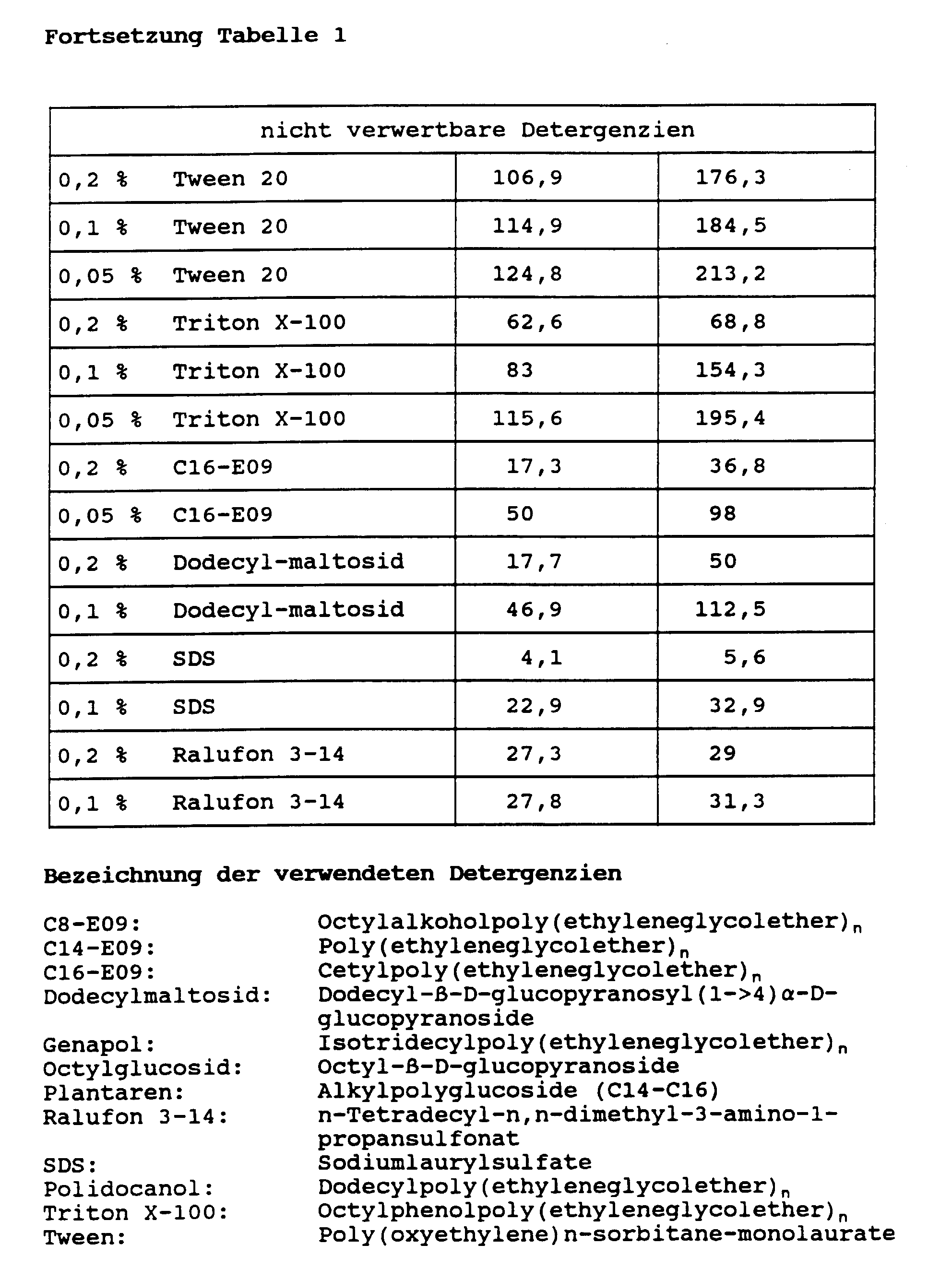
KH2PO4 * 2H2O 0,2 M KOH 0,076 M NaCl 0,05 mM TPA (Tripropylamin) 0,1 M Detergenz in den in der Tabelle angegebenen Konzentrationen Oxaban/Bioban 0,1/0,3 % pH 7,5 - Als Kontrolle wurden die bisher üblichen Detergenzien Tween 20 und Triton X-100 jeweils in einer Konzentration von 0,05 % eingesetzt. Zum Vergleich wurde in der Tabelle 1 die mit diesem Detergenz erhaltene Signalausbeute als 100 % betrachtet. Als weiterer Meßwert wurde die unspezifische Signalausbeute im Puffer (AB) bestimmt und hiermit das Verhältnis der Signalausbeute HSAP/AB ermittelt. Dieses Verhältnis zwischen der Signalausbeute mit und ohne HSAP stellt ein gutes Indiz für die Sensitivität des Testes dar. Aus den Ergebnissen der Tabelle 1 ist klar zu erkennen, daß die erfindungsgemäßen Detergenzien am geeignetsten sind.
- Polidocanol und C8-E09 zeigen den besten Einfluß auf das Verhältnis HSAP/AB. Andere Detergenzien bewirken im Vergleich zu Tween/Triton X-100 eine Verschlechterung der Signalausbeute.

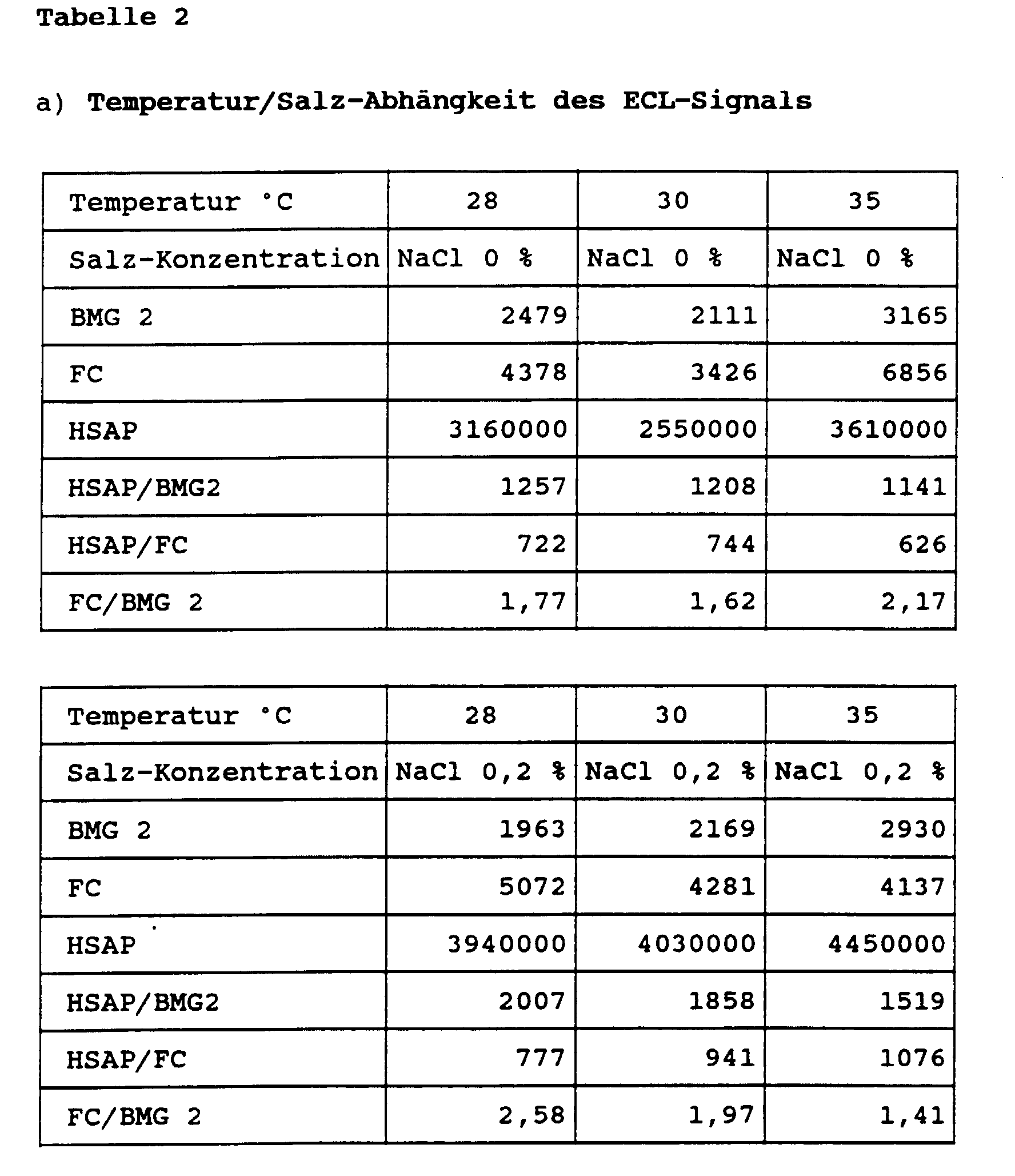
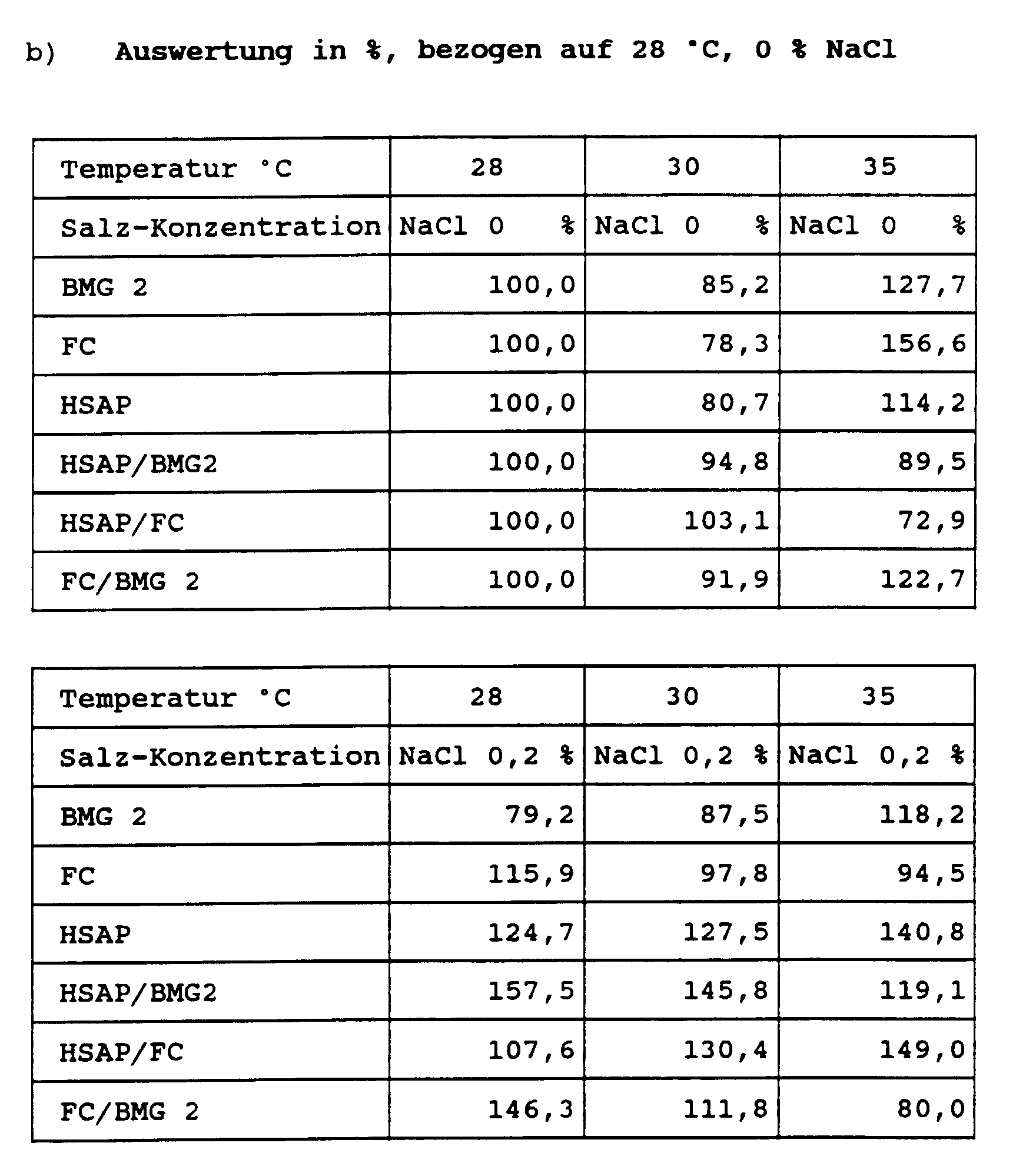
- Am Beispiel eines Parameterunabhängigen Tests (HSAP) wird die Auswirkung der Zelltemperatur auf die Signalwiederfindung und die Dynamik für den Fall einer Rampenspannung bei 28 - 35°C in der Meßzelle in Abhängigkeit von NaCl wiedergegeben.
- Der Test wurde wie im Beispiel 1 gezeigt durchgeführt. Anstatt des Puffers (AB) wurde der Puffer BMG 2 mit folgender Zusammensetzung verwendet:
H3PO4 0,2 M Polidocanol 0,1 % Oxaban 0,1 % Tripropylamin 0,16 M KOH 0,12 M pH 6,8 NaCl in der Tabelle angegebene Konzentration - Die Ergebnisse sind in der Tabelle 2 dargestellt. Durch eine Erhöhung der Temperatur und der Salzkonzentration steigen die ECL-Signale, die mit Puffer (BMG2) allein und mit HSAP erhalten wurden. Die Verhältnisse HSAP/AB, HSAP/FC und FC/AB sind von der Temperatur nahezu unabhängig, dagegen von der Salzkonzentration abhängig.


- Eine Erniedrigung der Temperatur unter 20 °C erfordert einen Zusatz eines Alkalichlorids und einen pH-Wert von bevorzugt 7,25 - 7,75.
- Am Beispiel eines Immunoassays zum Nachweis von Trijodthyronin (T3) wird die erfindungsgemäße Testzusammensetzung BMG 1 mit der Testzusammensetzung des Standes der Technik (BMG O) verglichen:
- Die Reagenzlösungen haben die folgende Zusammensetzung:
Reagenz BMG O BMG 1 KH2PO4 x2H2O 0,2 M 0,2 M H3 PO4 - - Detergenz Triton X-100 0,005 % Polidocanol 0,1 % Tween 0,05 % Konservierungsmittel NaN3 7,8 mM Oxaban 0,1 % Tripropylamin 0,1 M 0,1 M KOH 0,076 M 0,076 M pH 7,5 7,5 

- Dieses Gemisch wurde 16 Minuten bei 28 °C inkubiert, anschließend in die auf 28 °C temperierte Meßzelle überführt und die Partikel mit BMG 0 oder 1 je nach Testansatz gewaschen und darin vermessen. Es wurde eine Dreiecksrampenspannung angelegt. Die Meßspannung betrug 0,565 V und das PMT 720 mV.
- Die Ergebnisse sind in der Tabelle 3 dargestellt. Es zeigt sich, daß die Hämoglobin-Störung, die im BMG 0 zu beobachten ist, im BMG 1 vermieden wird. Die untere Nachweisgrenze wird nicht beeinflußt.
Tabelle 3: BMG O BMG 1 UNG (2s) 0,3 ng/ml 0,3 ng/ml Humanserum ohne Hb 100 % 100 % Humanserum mit Hb 307 % 106 % UNG (2s) = Untere Nachweisgrenze - Es wurde die erfindungsgemäße Testzusammensetzung BMG 1 im Vergleich zu BMG 0 am Beispiel eines Sandwich-Immunoassays zum Nachweis von HBsAg getestet. BMG 0 und 1 hatten die im Beispiel 3 angeführten Zusammensetzungen.


- Dieses Gemisch wurde 16 Minuten bei 28 °C inkubiert, anschließend in die auf 28 °C temperierte Meßzelle überführt und die Partikel mit BMG 0 oder 1 gewaschen und darin vermessen.
- Die Ergebnisse sind in der Tabelle 4 dargestellt. Durch die Verwendung von BMG 1 konnte die untere Nachweisgrenze deutlich verbessert werden. Ebenfalls wurde im Vergleich zu BMG 0 der VK erniedrigt. Das Verhältnis der Werte der Standardproben h zu a der Eichkurve ist bei BMG 1 erhöht, wodurch eine bessere Differenzierung der Eichkurve erreicht wird.
Tabelle 4: BMG 0 BMG 1 UNG [E/ml] 0,21 0,06 Standard h/a 40 78 VK [%] 6,9 4,3 UNG = Untere Nachweisgrenze
VK: = Variationskoeffizient - Am Beispiel eines Sandwich-Immunoassays zum Nachweis von TSH (Thyroid-stimulierendes Hormon) werden die erfindungsgemäßen Testzusammensetzungen BMG 1 und BMG 1 ohne Oxaban im Vergleich zur Testzusammensetzung nach dem Stand der Technik BMG 0 verglichen. BMG 0 und 1 hatten die in Beispiel 3 beschriebene Zusammensetzung.
- Thyroid-stimulierendes Hormon (TSH) wurde über einen Sandwich-Immunoassay bestimmt. Zur Ausführung kam hierbei ein Apparat, wie in Beispiel 1 beschrieben ist.
- Zum Nachweis wurden vereinigt:


- Dieses Gemisch wurde 16 Minuten bei Raumtemperatur (21°C) inkubiert und anschließend in die auf die gewünschte Meßtemperatur gebrachte Meßzelle überführt, die immobilisierten Partikel mit Reagenzlösung BMG1 gewaschen und in BMG1 vermessen.
- Als Probe wurden die Standards a - e mit TSH-Konzentrationen von
- a:
- 0 µU/ml
- b:
- 0,39 µU/ml
- c:
- 3,54 µU/ml
- d:
- 12,4 µU/ml
- e:
- 44,3 µU/ml
- Die Abkürzungen haben die in Beispiel 4 genannten Bedeutungen.
| BMG 0 | BMG 1 | BMG 1 ohne Oxaban | |
| UNG (2s) [mIU/ml] | 0,049 | 0,028 | 0,041 |
| VK [%] | 3,35 | 2,28 | 2,38 |
Claims (10)
- Verfahren zur Messung elektrochemilumineszenter Phänomene in einer Lösung oder aus einer an die Lösung angrenzenden festen Phase durch Inkontaktbringen einer zur Elektrochemilumineszenz fähigen Komponente, mit einem oxidierbaren Amin und Anlegen einer elektrischen Spannung zur Induktion der Elektrochemilumineszenz und Detektion der elektromagnetischen Strahlung, dadurch gekennzeichnet, daß die Lösung ein Detergenz ausgewählt aus der Gruppe Fettalkoholethoxylate, Plantaren und Octylglucosid oder ein Gemisch hiervon enthält.
- Verfahren nach Anspruch 1, dadurch gekennzeichnet, daß als Fettalkoholethoxylat Polidocanol, C14-E09, Genapol oder C8-E09 verwendet wird.
- Verfahren nach Anspruch 1 oder 2, dadurch gekennzeichnet, daß die Lösung ein oder mehrere Alkali- oder Erdalkalihalogenide enthält.
- Verfahren nach Anspruch 1 bis 3, dadurch gekennzeichnet, daß der pH der Lösung zwischen 6,5 und 9,0 liegt.
- Verfahren nach Anspruch 1 bis 4, dadurch gekennzeichnet, daß die Elektrochemilumineszenz durch Anlegen einer Rechtecks-Spannung von maximal 2,2 Volt oder einer Rampenspannung von maximal 3,0 Volt angeregt wird.
- Verfahren zum Nachweis eines Analyten nach einem der Ansprüche 1 bis 5, dadurch gekennzeichnet, daß die zur Elektrochemilumineszenz fähige Komponente eine Markierung eines Analyten, eines Analytanalogen oder einer analytspezifischen Substanz ist und die detektierbare Strahlung ein Maß für die Anwesenheit des Analyten darstellt.
- Reagenzlösung zur Messung elektrochemischer Phänomene enthaltend ein elektrochemisch oxidierbares Amin, das im oxidierten Zustand ein starkes Reduktionsmittel darstellt, dadurch gekennzeichnet, daß ein Detergenz ausgewählt aus der Gruppe Fettalkoholethoxylat, Plantaren und Octylglucosid oder ein Gemisch hiervon enthalten ist.
- Reagenzlösung nach Anspruch 6, dadurch gekennzeichnet, daß das Detergenz in einer Konzentration von 0,001 bis 1% enthalten ist.
- Reagenzlösung nach Anspruch 6 oder 7, dadurch gekennzeichnet, daß zusätzlich ein Alkalichlorid in einer Konzentration von 0,05 mmol/l bis 0,5 mol/l enthalten ist.
- Reagenzlösung nach Anspruch 6 bis 8, dadurch gekennzeichnet, daß sie einen pH zwischen 6,5 und 9,0 aufweist.
Applications Claiming Priority (7)
| Application Number | Priority Date | Filing Date | Title |
|---|---|---|---|
| DE4314547 | 1993-05-03 | ||
| DE4314547 | 1993-05-03 | ||
| DE4332697 | 1993-09-25 | ||
| DE4332697 | 1993-09-25 | ||
| DE4401577 | 1994-01-20 | ||
| DE4401577A DE4401577A1 (de) | 1993-05-03 | 1994-01-20 | Elektrochemilumineszenzverfahren |
| PCT/EP1994/001328 WO1994025853A1 (de) | 1993-05-03 | 1994-04-27 | Elektrochemilumineszenzverfahren |
Publications (2)
| Publication Number | Publication Date |
|---|---|
| EP0697106A1 EP0697106A1 (de) | 1996-02-21 |
| EP0697106B1 true EP0697106B1 (de) | 1997-04-02 |
Family
ID=27205044
Family Applications (2)
| Application Number | Title | Priority Date | Filing Date |
|---|---|---|---|
| EP94915552A Expired - Lifetime EP0697106B1 (de) | 1993-05-03 | 1994-04-27 | Elektrochemilumineszenzverfahren |
| EP94916160A Expired - Lifetime EP0697107B1 (de) | 1993-05-03 | 1994-04-27 | Elektrochemilumineszenzverfahren |
Family Applications After (1)
| Application Number | Title | Priority Date | Filing Date |
|---|---|---|---|
| EP94916160A Expired - Lifetime EP0697107B1 (de) | 1993-05-03 | 1994-04-27 | Elektrochemilumineszenzverfahren |
Country Status (14)
| Country | Link |
|---|---|
| US (2) | US5723342A (de) |
| EP (2) | EP0697106B1 (de) |
| JP (2) | JP3135921B2 (de) |
| CN (1) | CN1089899C (de) |
| AT (2) | ATE161955T1 (de) |
| AU (2) | AU678018B2 (de) |
| CA (2) | CA2161666C (de) |
| ES (1) | ES2102858T3 (de) |
| FI (1) | FI111415B (de) |
| IL (1) | IL109481A0 (de) |
| NO (2) | NO954387L (de) |
| NZ (1) | NZ266149A (de) |
| RU (1) | RU2116647C1 (de) |
| WO (2) | WO1994025853A1 (de) |
Families Citing this family (11)
| Publication number | Priority date | Publication date | Assignee | Title |
|---|---|---|---|---|
| KR20000036240A (ko) * | 1996-09-19 | 2000-06-26 | 구니요시 이에지 | 면역조직화학적 염색용 조성물 |
| US6146838A (en) * | 1997-03-18 | 2000-11-14 | Igen International, Inc. | Detecting water-borne parasites using electrochemiluminescence |
| RU2264613C2 (ru) * | 2000-08-10 | 2005-11-20 | Ягов Владимир Викторович | Способ электролюминесцентного определения свинца в растворе |
| JP2010237020A (ja) * | 2009-03-31 | 2010-10-21 | Japan Aerospace Exploration Agency | 生体分子検出装置及び生体分子検出方法 |
| WO2012055815A1 (en) * | 2010-10-25 | 2012-05-03 | Roche Diagnostics Gmbh | Use of signal enhancing compounds in electrochemiluminescence detection |
| KR101636250B1 (ko) * | 2014-12-12 | 2016-07-07 | 주식회사 도건이엔텍 | 헬리컬 파일 |
| CN104698164B (zh) * | 2015-02-13 | 2017-03-15 | 中山市创艺生化工程有限公司 | 一种电化学发光免疫分析仪用缓冲液及其制备方法 |
| CN105929010A (zh) * | 2016-04-14 | 2016-09-07 | 福建师范大学 | 一种基于曙红y的电致化学发光传感器 |
| KR101980079B1 (ko) | 2018-12-06 | 2019-08-28 | 주식회사 강탄산업 | 인발저항용 앵커를 갖는 방음벽기초의 시공방법 |
| SG11202106924VA (en) * | 2019-01-03 | 2021-07-29 | Meso Scale Technologies Llc | Compositions and methods for carrying out assay measurements |
| CN113295678B (zh) * | 2021-05-14 | 2022-11-08 | 济南迪曼生物科技有限公司 | 一种电化学发光清洗液 |
Family Cites Families (11)
| Publication number | Priority date | Publication date | Assignee | Title |
|---|---|---|---|---|
| JPS5227399A (en) * | 1975-08-27 | 1977-03-01 | Seiko Instr & Electronics Ltd | Driving system of electrochemical luminous element |
| JPS5247324A (en) * | 1975-10-14 | 1977-04-15 | Seiko Instr & Electronics Ltd | Driving system of display equipment |
| US4462931A (en) * | 1982-06-16 | 1984-07-31 | American Cyanamid Company | Enhanced aqueous chemiluminescent systems |
| US4927769A (en) * | 1987-07-08 | 1990-05-22 | Ciba Corning Diagnostics Corp. | Method for enhancement of chemiluminescence |
| IL90105A (en) * | 1988-04-29 | 1993-05-13 | Igen Inc | Method and apparatus for conducting electro- chemiluminescence measurements |
| US5061445A (en) * | 1988-11-03 | 1991-10-29 | Igen, Inc. | Apparatus for conducting measurements of electrochemiluminescent phenomena |
| JPH076913B2 (ja) * | 1988-11-03 | 1995-01-30 | イゲン,インコーポレーテッド | アミン誘導還元剤を利用する電気化学発光反応 |
| CA2002083C (en) * | 1988-11-03 | 2001-01-09 | Haresh P. Shah | Enhanced electrochemiluminescence |
| US5324457A (en) * | 1989-10-02 | 1994-06-28 | Board Of Regents, The University Of Tx System | Devices and methods for generating electrogenerated chemiluminescence |
| JPH07111400B2 (ja) * | 1991-02-28 | 1995-11-29 | 株式会社島津製作所 | 発光測定法 |
| US5466416A (en) * | 1993-05-14 | 1995-11-14 | Ghaed; Ali | Apparatus and methods for carrying out electrochemiluminescence test measurements |
-
1994
- 1994-04-27 WO PCT/EP1994/001328 patent/WO1994025853A1/de not_active Ceased
- 1994-04-27 AU AU67942/94A patent/AU678018B2/en not_active Ceased
- 1994-04-27 WO PCT/EP1994/001329 patent/WO1994025854A1/de not_active Ceased
- 1994-04-27 CN CN94192464A patent/CN1089899C/zh not_active Expired - Fee Related
- 1994-04-27 CA CA002161666A patent/CA2161666C/en not_active Expired - Fee Related
- 1994-04-27 JP JP06523879A patent/JP3135921B2/ja not_active Expired - Fee Related
- 1994-04-27 JP JP6523880A patent/JP2735688B2/ja not_active Expired - Lifetime
- 1994-04-27 ES ES94915552T patent/ES2102858T3/es not_active Expired - Lifetime
- 1994-04-27 CA CA002161704A patent/CA2161704C/en not_active Expired - Fee Related
- 1994-04-27 EP EP94915552A patent/EP0697106B1/de not_active Expired - Lifetime
- 1994-04-27 US US08/553,521 patent/US5723342A/en not_active Expired - Fee Related
- 1994-04-27 NZ NZ266149A patent/NZ266149A/en unknown
- 1994-04-27 AT AT94916160T patent/ATE161955T1/de not_active IP Right Cessation
- 1994-04-27 US US08/545,658 patent/US5677192A/en not_active Expired - Fee Related
- 1994-04-27 AT AT94915552T patent/ATE151171T1/de not_active IP Right Cessation
- 1994-04-27 AU AU67223/94A patent/AU674079B2/en not_active Ceased
- 1994-04-27 RU RU95122418/25A patent/RU2116647C1/ru not_active IP Right Cessation
- 1994-04-27 EP EP94916160A patent/EP0697107B1/de not_active Expired - Lifetime
- 1994-04-28 IL IL10948194A patent/IL109481A0/xx unknown
-
1995
- 1995-11-02 NO NO954387A patent/NO954387L/no not_active Application Discontinuation
- 1995-11-02 FI FI955252A patent/FI111415B/fi not_active IP Right Cessation
- 1995-11-02 NO NO19954386A patent/NO318946B1/no unknown
Also Published As
| Publication number | Publication date |
|---|---|
| ES2102858T3 (es) | 1997-08-01 |
| US5723342A (en) | 1998-03-03 |
| EP0697106A1 (de) | 1996-02-21 |
| JP2735688B2 (ja) | 1998-04-02 |
| WO1994025854A1 (de) | 1994-11-10 |
| FI111415B (fi) | 2003-07-15 |
| WO1994025853A1 (de) | 1994-11-10 |
| CN1089899C (zh) | 2002-08-28 |
| IL109481A0 (en) | 1994-07-31 |
| EP0697107B1 (de) | 1998-01-07 |
| AU674079B2 (en) | 1996-12-05 |
| NO954387D0 (no) | 1995-11-02 |
| NO318946B1 (no) | 2005-05-30 |
| NO954387L (no) | 1996-01-02 |
| NO954386L (no) | 1996-01-02 |
| CA2161666A1 (en) | 1994-11-10 |
| AU6794294A (en) | 1994-11-21 |
| CA2161704C (en) | 2002-01-22 |
| US5677192A (en) | 1997-10-14 |
| CN1125480A (zh) | 1996-06-26 |
| JPH08508102A (ja) | 1996-08-27 |
| RU2116647C1 (ru) | 1998-07-27 |
| CA2161666C (en) | 1999-08-10 |
| FI955252A0 (fi) | 1995-11-02 |
| ATE151171T1 (de) | 1997-04-15 |
| AU6722394A (en) | 1994-11-21 |
| ATE161955T1 (de) | 1998-01-15 |
| AU678018B2 (en) | 1997-05-15 |
| JPH08508570A (ja) | 1996-09-10 |
| NZ266149A (en) | 1996-11-26 |
| NO954386D0 (no) | 1995-11-02 |
| FI955252L (fi) | 1995-11-02 |
| EP0697107A1 (de) | 1996-02-21 |
| CA2161704A1 (en) | 1994-11-10 |
| JP3135921B2 (ja) | 2001-02-19 |
Similar Documents
| Publication | Publication Date | Title |
|---|---|---|
| DE68928492T2 (de) | Elektrochemilumineszente reaktion unter verwendung eines von einem amin abgeleiteten reduktionsmittels | |
| DE3587793T2 (de) | Lumineszierende metallchelatmarker und mittel zu deren nachweis. | |
| DE69829606T2 (de) | Reagenz und Verfahren zur Klassifizierung und Zählung von Leukozyten | |
| DE69535223T2 (de) | Verfahren und Vorrichtung zu Elektrochemilumineszenz-Detektion magnetischer Partikel | |
| DE69534856T2 (de) | Messung der geschwindigkeit biomolekularer reaktionen mittels elektrochemolumineszenz | |
| DE69422210T2 (de) | Biospezifischer Festphasenträger | |
| DE68924064T2 (de) | Verfahren zur Bestimmung eines oder mehrerer Analyte durch Anwendung verschiedene Typen von Partikeln, welche durchflusszytometrisch unterschieden sind. | |
| DE68928171T2 (de) | Gesteigerte elektrochemilumineszenz | |
| DE69023509T2 (de) | Vorrichtung und verfahren zur durchführung elektrochemilumineszenter messungen. | |
| DE2849708A1 (de) | Verfahren zur feststellung und quantitativen bestimmung biologisch wichtiger substanzen | |
| EP0046563B1 (de) | Verfahren zur Durchführung analytischer Bestimmungen mittels der Chemilumineszenzmethode und Anwendung des Verfahrens für Immunoassays | |
| DE68928168T2 (de) | Verfahren zur durchführung von elektrochemilumineszenz-messungen | |
| DE19803528A1 (de) | Verfahren zur Analyse einer Probe mittels eines Elektrochemolumineszenz-Bindungsreaktion-Tests | |
| EP0697107B1 (de) | Elektrochemilumineszenzverfahren | |
| EP0698217B1 (de) | Verfahren zum nachweis von substanzen | |
| DE2602068C2 (de) | Reagens zur Unlöslichmachung eines Antigen/Antikörper-Komplexes | |
| EP0658760A1 (de) | Vorrichtung und Verfahren zur Erzeugung optisch detektierbarer Signale durch Anlegen elektrischer Potentiale an Probenflüssigkeiten | |
| EP1295124B1 (de) | Kompetitives assay-verfahren | |
| DE7917122U1 (de) | Messgeraet fuer polarographische oder voltametermessungen | |
| DE4401577A1 (de) | Elektrochemilumineszenzverfahren | |
| DE19811582A1 (de) | Stabilisierung und Verstärkung von Elektrochemilumineszenz-Signalen | |
| EP1532447B1 (de) | Erzeugung von chemilumineszenz durch wasserstoff | |
| DE19828441A1 (de) | Verwendung derivatisierter Reagenzien in Chemilumineszenz- und Elektrochemilumineszenz-Nachweisverfahren | |
| EP0973033A1 (de) | Ionensensor | |
| DD284529A5 (de) | Verfahren zur quantitativen bestimmung von cuo in cu-haltigen hochtemperatursupraleitern |
Legal Events
| Date | Code | Title | Description |
|---|---|---|---|
| PUAI | Public reference made under article 153(3) epc to a published international application that has entered the european phase |
Free format text: ORIGINAL CODE: 0009012 |
|
| 17P | Request for examination filed |
Effective date: 19951204 |
|
| AK | Designated contracting states |
Kind code of ref document: A1 Designated state(s): AT BE CH DE DK ES FR GB GR IE IT LI LU NL PT SE |
|
| GRAG | Despatch of communication of intention to grant |
Free format text: ORIGINAL CODE: EPIDOS AGRA |
|
| 17Q | First examination report despatched |
Effective date: 19960702 |
|
| GRAH | Despatch of communication of intention to grant a patent |
Free format text: ORIGINAL CODE: EPIDOS IGRA |
|
| GRAH | Despatch of communication of intention to grant a patent |
Free format text: ORIGINAL CODE: EPIDOS IGRA |
|
| GRAA | (expected) grant |
Free format text: ORIGINAL CODE: 0009210 |
|
| AK | Designated contracting states |
Kind code of ref document: B1 Designated state(s): AT BE CH DE DK ES FR GB GR IE IT LI LU NL PT SE |
|
| PG25 | Lapsed in a contracting state [announced via postgrant information from national office to epo] |
Ref country code: GR Free format text: LAPSE BECAUSE OF FAILURE TO SUBMIT A TRANSLATION OF THE DESCRIPTION OR TO PAY THE FEE WITHIN THE PRESCRIBED TIME-LIMIT Effective date: 19970402 Ref country code: GB Effective date: 19970402 Ref country code: DK Effective date: 19970402 |
|
| REF | Corresponds to: |
Ref document number: 151171 Country of ref document: AT Date of ref document: 19970415 Kind code of ref document: T |
|
| REG | Reference to a national code |
Ref country code: CH Ref legal event code: EP |
|
| PG25 | Lapsed in a contracting state [announced via postgrant information from national office to epo] |
Ref country code: LU Free format text: LAPSE BECAUSE OF NON-PAYMENT OF DUE FEES Effective date: 19970427 |
|
| REF | Corresponds to: |
Ref document number: 59402311 Country of ref document: DE Date of ref document: 19970507 |
|
| REG | Reference to a national code |
Ref country code: CH Ref legal event code: NV Representative=s name: A. BRAUN, BRAUN, HERITIER, ESCHMANN AG PATENTANWAE |
|
| PG25 | Lapsed in a contracting state [announced via postgrant information from national office to epo] |
Ref country code: IE Free format text: LAPSE BECAUSE OF NON-PAYMENT OF DUE FEES Effective date: 19970602 |
|
| ET | Fr: translation filed | ||
| PG25 | Lapsed in a contracting state [announced via postgrant information from national office to epo] |
Ref country code: SE Effective date: 19970702 |
|
| REG | Reference to a national code |
Ref country code: IE Ref legal event code: FG4D Free format text: 73058 |
|
| REG | Reference to a national code |
Ref country code: ES Ref legal event code: FG2A Ref document number: 2102858 Country of ref document: ES Kind code of ref document: T3 |
|
| GBV | Gb: ep patent (uk) treated as always having been void in accordance with gb section 77(7)/1977 [no translation filed] |
Effective date: 19970402 |
|
| PLBE | No opposition filed within time limit |
Free format text: ORIGINAL CODE: 0009261 |
|
| STAA | Information on the status of an ep patent application or granted ep patent |
Free format text: STATUS: NO OPPOSITION FILED WITHIN TIME LIMIT |
|
| 26N | No opposition filed | ||
| PGFP | Annual fee paid to national office [announced via postgrant information from national office to epo] |
Ref country code: NL Payment date: 20040406 Year of fee payment: 11 |
|
| PGFP | Annual fee paid to national office [announced via postgrant information from national office to epo] |
Ref country code: PT Payment date: 20040422 Year of fee payment: 11 |
|
| PGFP | Annual fee paid to national office [announced via postgrant information from national office to epo] |
Ref country code: BE Payment date: 20040617 Year of fee payment: 11 |
|
| PG25 | Lapsed in a contracting state [announced via postgrant information from national office to epo] |
Ref country code: BE Free format text: LAPSE BECAUSE OF NON-PAYMENT OF DUE FEES Effective date: 20050430 |
|
| PG25 | Lapsed in a contracting state [announced via postgrant information from national office to epo] |
Ref country code: PT Free format text: LAPSE BECAUSE OF NON-PAYMENT OF DUE FEES Effective date: 20051027 |
|
| BERE | Be: lapsed |
Owner name: *BOEHRINGER MANNHEIM G.M.B.H. Effective date: 20050430 |
|
| PG25 | Lapsed in a contracting state [announced via postgrant information from national office to epo] |
Ref country code: NL Free format text: LAPSE BECAUSE OF NON-PAYMENT OF DUE FEES Effective date: 20051101 |
|
| NLV4 | Nl: lapsed or anulled due to non-payment of the annual fee |
Effective date: 20051101 |
|
| PGFP | Annual fee paid to national office [announced via postgrant information from national office to epo] |
Ref country code: AT Payment date: 20070314 Year of fee payment: 14 |
|
| PGFP | Annual fee paid to national office [announced via postgrant information from national office to epo] |
Ref country code: ES Payment date: 20070417 Year of fee payment: 14 |
|
| PGFP | Annual fee paid to national office [announced via postgrant information from national office to epo] |
Ref country code: CH Payment date: 20070427 Year of fee payment: 14 |
|
| PGFP | Annual fee paid to national office [announced via postgrant information from national office to epo] |
Ref country code: DE Payment date: 20070430 Year of fee payment: 14 |
|
| BERE | Be: lapsed |
Owner name: *BOEHRINGER MANNHEIM G.M.B.H. Effective date: 20050430 |
|
| PGFP | Annual fee paid to national office [announced via postgrant information from national office to epo] |
Ref country code: IT Payment date: 20070616 Year of fee payment: 14 |
|
| PGFP | Annual fee paid to national office [announced via postgrant information from national office to epo] |
Ref country code: FR Payment date: 20070404 Year of fee payment: 14 |
|
| REG | Reference to a national code |
Ref country code: CH Ref legal event code: PFA Owner name: BOEHRINGER MANNHEIM GMBH Free format text: BOEHRINGER MANNHEIM GMBH# #68298 MANNHEIM (DE) -TRANSFER TO- BOEHRINGER MANNHEIM GMBH# #68298 MANNHEIM (DE) |
|
| REG | Reference to a national code |
Ref country code: CH Ref legal event code: PL |
|
| PG25 | Lapsed in a contracting state [announced via postgrant information from national office to epo] |
Ref country code: LI Free format text: LAPSE BECAUSE OF NON-PAYMENT OF DUE FEES Effective date: 20080430 Ref country code: DE Free format text: LAPSE BECAUSE OF NON-PAYMENT OF DUE FEES Effective date: 20081101 Ref country code: CH Free format text: LAPSE BECAUSE OF NON-PAYMENT OF DUE FEES Effective date: 20080430 |
|
| REG | Reference to a national code |
Ref country code: FR Ref legal event code: ST Effective date: 20081231 |
|
| PG25 | Lapsed in a contracting state [announced via postgrant information from national office to epo] |
Ref country code: AT Free format text: LAPSE BECAUSE OF NON-PAYMENT OF DUE FEES Effective date: 20080427 |
|
| PG25 | Lapsed in a contracting state [announced via postgrant information from national office to epo] |
Ref country code: FR Free format text: LAPSE BECAUSE OF NON-PAYMENT OF DUE FEES Effective date: 20080430 |
|
| REG | Reference to a national code |
Ref country code: ES Ref legal event code: FD2A Effective date: 20080428 |
|
| PG25 | Lapsed in a contracting state [announced via postgrant information from national office to epo] |
Ref country code: ES Free format text: LAPSE BECAUSE OF NON-PAYMENT OF DUE FEES Effective date: 20080428 |
|
| PG25 | Lapsed in a contracting state [announced via postgrant information from national office to epo] |
Ref country code: IT Free format text: LAPSE BECAUSE OF NON-PAYMENT OF DUE FEES Effective date: 20080427 |