EP0696573A1 - Verfahren zur Herstellung von aromatischen Aminen - Google Patents
Verfahren zur Herstellung von aromatischen Aminen Download PDFInfo
- Publication number
- EP0696573A1 EP0696573A1 EP95111997A EP95111997A EP0696573A1 EP 0696573 A1 EP0696573 A1 EP 0696573A1 EP 95111997 A EP95111997 A EP 95111997A EP 95111997 A EP95111997 A EP 95111997A EP 0696573 A1 EP0696573 A1 EP 0696573A1
- Authority
- EP
- European Patent Office
- Prior art keywords
- particularly preferably
- catalyst
- mol
- hydrogen
- per
- Prior art date
- Legal status (The legal status is an assumption and is not a legal conclusion. Google has not performed a legal analysis and makes no representation as to the accuracy of the status listed.)
- Granted
Links
- 150000004982 aromatic amines Chemical class 0.000 title claims abstract description 21
- 238000000034 method Methods 0.000 title claims description 33
- 230000008569 process Effects 0.000 title claims description 20
- 238000002360 preparation method Methods 0.000 title claims description 3
- 239000003054 catalyst Substances 0.000 claims abstract description 92
- XLYOFNOQVPJJNP-UHFFFAOYSA-N water Substances O XLYOFNOQVPJJNP-UHFFFAOYSA-N 0.000 claims abstract description 36
- 238000005984 hydrogenation reaction Methods 0.000 claims abstract description 27
- 125000000449 nitro group Chemical group [O-][N+](*)=O 0.000 claims abstract description 12
- 150000001412 amines Chemical class 0.000 claims abstract description 4
- 125000002924 primary amino group Chemical group [H]N([H])* 0.000 claims abstract description 3
- 239000007789 gas Substances 0.000 claims description 45
- 229910052739 hydrogen Inorganic materials 0.000 claims description 40
- 239000001257 hydrogen Substances 0.000 claims description 40
- LQNUZADURLCDLV-UHFFFAOYSA-N nitrobenzene Chemical compound [O-][N+](=O)C1=CC=CC=C1 LQNUZADURLCDLV-UHFFFAOYSA-N 0.000 claims description 32
- UFHFLCQGNIYNRP-UHFFFAOYSA-N Hydrogen Chemical compound [H][H] UFHFLCQGNIYNRP-UHFFFAOYSA-N 0.000 claims description 27
- KDLHZDBZIXYQEI-UHFFFAOYSA-N Palladium Chemical compound [Pd] KDLHZDBZIXYQEI-UHFFFAOYSA-N 0.000 claims description 27
- 238000006243 chemical reaction Methods 0.000 claims description 22
- 150000002431 hydrogen Chemical class 0.000 claims description 17
- OAICVXFJPJFONN-UHFFFAOYSA-N Phosphorus Chemical compound [P] OAICVXFJPJFONN-UHFFFAOYSA-N 0.000 claims description 11
- 125000003277 amino group Chemical group 0.000 claims description 11
- 229910052698 phosphorus Inorganic materials 0.000 claims description 11
- 239000011574 phosphorus Substances 0.000 claims description 11
- 229910052751 metal Inorganic materials 0.000 claims description 10
- 239000002184 metal Substances 0.000 claims description 10
- 125000003118 aryl group Chemical group 0.000 claims description 9
- 229910052763 palladium Inorganic materials 0.000 claims description 9
- 150000001875 compounds Chemical class 0.000 claims description 8
- 125000001495 ethyl group Chemical group [H]C([H])([H])C([H])([H])* 0.000 claims description 8
- 125000002496 methyl group Chemical group [H]C([H])([H])* 0.000 claims description 8
- NINIDFKCEFEMDL-UHFFFAOYSA-N Sulfur Chemical compound [S] NINIDFKCEFEMDL-UHFFFAOYSA-N 0.000 claims description 5
- PNEYBMLMFCGWSK-UHFFFAOYSA-N aluminium oxide Inorganic materials [O-2].[O-2].[O-2].[Al+3].[Al+3] PNEYBMLMFCGWSK-UHFFFAOYSA-N 0.000 claims description 5
- 229910052707 ruthenium Inorganic materials 0.000 claims description 5
- 238000000926 separation method Methods 0.000 claims description 5
- 229910052717 sulfur Inorganic materials 0.000 claims description 5
- 239000011593 sulfur Substances 0.000 claims description 5
- 229910052593 corundum Inorganic materials 0.000 claims description 4
- 229910052594 sapphire Inorganic materials 0.000 claims description 4
- 229910052720 vanadium Inorganic materials 0.000 claims description 4
- 229910001845 yogo sapphire Inorganic materials 0.000 claims description 4
- 150000002739 metals Chemical class 0.000 claims description 3
- 229910052703 rhodium Inorganic materials 0.000 claims description 3
- 238000004140 cleaning Methods 0.000 claims description 2
- 229910052741 iridium Inorganic materials 0.000 claims description 2
- 230000035515 penetration Effects 0.000 claims 1
- 239000011541 reaction mixture Substances 0.000 claims 1
- 238000011084 recovery Methods 0.000 claims 1
- GPPXJZIENCGNKB-UHFFFAOYSA-N vanadium Chemical compound [V]#[V] GPPXJZIENCGNKB-UHFFFAOYSA-N 0.000 claims 1
- PAYRUJLWNCNPSJ-UHFFFAOYSA-N Aniline Chemical compound NC1=CC=CC=C1 PAYRUJLWNCNPSJ-UHFFFAOYSA-N 0.000 description 30
- OKTJSMMVPCPJKN-UHFFFAOYSA-N Carbon Chemical compound [C] OKTJSMMVPCPJKN-UHFFFAOYSA-N 0.000 description 13
- WEVYAHXRMPXWCK-UHFFFAOYSA-N Acetonitrile Chemical compound CC#N WEVYAHXRMPXWCK-UHFFFAOYSA-N 0.000 description 12
- 239000012071 phase Substances 0.000 description 10
- 239000000047 product Substances 0.000 description 9
- 239000012876 carrier material Substances 0.000 description 8
- 239000000243 solution Substances 0.000 description 8
- 238000001035 drying Methods 0.000 description 7
- 239000000203 mixture Substances 0.000 description 7
- IJGRMHOSHXDMSA-UHFFFAOYSA-N Atomic nitrogen Chemical compound N#N IJGRMHOSHXDMSA-UHFFFAOYSA-N 0.000 description 6
- 239000010439 graphite Substances 0.000 description 6
- 229910002804 graphite Inorganic materials 0.000 description 6
- 229910000510 noble metal Inorganic materials 0.000 description 6
- -1 partly as oxides Chemical class 0.000 description 6
- 230000008929 regeneration Effects 0.000 description 6
- 238000011069 regeneration method Methods 0.000 description 6
- 239000007787 solid Substances 0.000 description 6
- 229910052799 carbon Inorganic materials 0.000 description 5
- 150000003839 salts Chemical class 0.000 description 5
- 238000011282 treatment Methods 0.000 description 5
- VYPSYNLAJGMNEJ-UHFFFAOYSA-N Silicium dioxide Chemical compound O=[Si]=O VYPSYNLAJGMNEJ-UHFFFAOYSA-N 0.000 description 4
- GWEVSGVZZGPLCZ-UHFFFAOYSA-N Titan oxide Chemical compound O=[Ti]=O GWEVSGVZZGPLCZ-UHFFFAOYSA-N 0.000 description 4
- 239000013543 active substance Substances 0.000 description 4
- 230000009849 deactivation Effects 0.000 description 4
- QDOXWKRWXJOMAK-UHFFFAOYSA-N dichromium trioxide Chemical compound O=[Cr]O[Cr]=O QDOXWKRWXJOMAK-UHFFFAOYSA-N 0.000 description 4
- 238000009826 distribution Methods 0.000 description 4
- 238000001704 evaporation Methods 0.000 description 4
- 230000008020 evaporation Effects 0.000 description 4
- 239000008187 granular material Substances 0.000 description 4
- 238000005470 impregnation Methods 0.000 description 4
- 238000004519 manufacturing process Methods 0.000 description 4
- 150000002828 nitro derivatives Chemical class 0.000 description 4
- 239000012074 organic phase Substances 0.000 description 4
- 230000000630 rising effect Effects 0.000 description 4
- ZWEHNKRNPOVVGH-UHFFFAOYSA-N 2-Butanone Chemical compound CCC(C)=O ZWEHNKRNPOVVGH-UHFFFAOYSA-N 0.000 description 3
- CSCPPACGZOOCGX-UHFFFAOYSA-N Acetone Chemical compound CC(C)=O CSCPPACGZOOCGX-UHFFFAOYSA-N 0.000 description 3
- YMWUJEATGCHHMB-UHFFFAOYSA-N Dichloromethane Chemical compound ClCCl YMWUJEATGCHHMB-UHFFFAOYSA-N 0.000 description 3
- OKKJLVBELUTLKV-UHFFFAOYSA-N Methanol Chemical compound OC OKKJLVBELUTLKV-UHFFFAOYSA-N 0.000 description 3
- 239000008346 aqueous phase Substances 0.000 description 3
- 239000003245 coal Substances 0.000 description 3
- 238000001816 cooling Methods 0.000 description 3
- 239000010949 copper Substances 0.000 description 3
- 238000000605 extraction Methods 0.000 description 3
- 239000011552 falling film Substances 0.000 description 3
- 238000010438 heat treatment Methods 0.000 description 3
- 229930195733 hydrocarbon Natural products 0.000 description 3
- 150000002430 hydrocarbons Chemical class 0.000 description 3
- 229910052745 lead Inorganic materials 0.000 description 3
- 229910052757 nitrogen Inorganic materials 0.000 description 3
- 229910052697 platinum Inorganic materials 0.000 description 3
- BASFCYQUMIYNBI-UHFFFAOYSA-N platinum Substances [Pt] BASFCYQUMIYNBI-UHFFFAOYSA-N 0.000 description 3
- 238000012546 transfer Methods 0.000 description 3
- 229910052723 transition metal Inorganic materials 0.000 description 3
- 150000003624 transition metals Chemical class 0.000 description 3
- 239000004215 Carbon black (E152) Substances 0.000 description 2
- RYGMFSIKBFXOCR-UHFFFAOYSA-N Copper Chemical compound [Cu] RYGMFSIKBFXOCR-UHFFFAOYSA-N 0.000 description 2
- 241000196324 Embryophyta Species 0.000 description 2
- LFQSCWFLJHTTHZ-UHFFFAOYSA-N Ethanol Chemical compound CCO LFQSCWFLJHTTHZ-UHFFFAOYSA-N 0.000 description 2
- KFZMGEQAYNKOFK-UHFFFAOYSA-N Isopropanol Chemical compound CC(C)O KFZMGEQAYNKOFK-UHFFFAOYSA-N 0.000 description 2
- 238000005299 abrasion Methods 0.000 description 2
- 230000008901 benefit Effects 0.000 description 2
- 239000007795 chemical reaction product Substances 0.000 description 2
- 229910052804 chromium Inorganic materials 0.000 description 2
- 229910052681 coesite Inorganic materials 0.000 description 2
- 239000000571 coke Substances 0.000 description 2
- 229910052802 copper Inorganic materials 0.000 description 2
- 229910052906 cristobalite Inorganic materials 0.000 description 2
- DMBHHRLKUKUOEG-UHFFFAOYSA-N diphenylamine Chemical compound C=1C=CC=CC=1NC1=CC=CC=C1 DMBHHRLKUKUOEG-UHFFFAOYSA-N 0.000 description 2
- GNTDGMZSJNCJKK-UHFFFAOYSA-N divanadium pentaoxide Chemical compound O=[V](=O)O[V](=O)=O GNTDGMZSJNCJKK-UHFFFAOYSA-N 0.000 description 2
- 230000017525 heat dissipation Effects 0.000 description 2
- 239000007924 injection Substances 0.000 description 2
- 238000002347 injection Methods 0.000 description 2
- JEIPFZHSYJVQDO-UHFFFAOYSA-N iron(III) oxide Inorganic materials O=[Fe]O[Fe]=O JEIPFZHSYJVQDO-UHFFFAOYSA-N 0.000 description 2
- 239000007788 liquid Substances 0.000 description 2
- 239000012263 liquid product Substances 0.000 description 2
- 229910052750 molybdenum Inorganic materials 0.000 description 2
- PXHVJJICTQNCMI-UHFFFAOYSA-N nickel Substances [Ni] PXHVJJICTQNCMI-UHFFFAOYSA-N 0.000 description 2
- 239000003960 organic solvent Substances 0.000 description 2
- 230000000737 periodic effect Effects 0.000 description 2
- 239000000377 silicon dioxide Substances 0.000 description 2
- 235000012239 silicon dioxide Nutrition 0.000 description 2
- 239000002904 solvent Substances 0.000 description 2
- 239000007858 starting material Substances 0.000 description 2
- 229910052682 stishovite Inorganic materials 0.000 description 2
- 229910052719 titanium Inorganic materials 0.000 description 2
- 229910052905 tridymite Inorganic materials 0.000 description 2
- LWIHDJKSTIGBAC-UHFFFAOYSA-K tripotassium phosphate Chemical compound [K+].[K+].[K+].[O-]P([O-])([O-])=O LWIHDJKSTIGBAC-UHFFFAOYSA-K 0.000 description 2
- FVHAWXWFPBPFOS-UHFFFAOYSA-N 1,2-dimethyl-3-nitrobenzene Chemical group CC1=CC=CC([N+]([O-])=O)=C1C FVHAWXWFPBPFOS-UHFFFAOYSA-N 0.000 description 1
- RYHBNJHYFVUHQT-UHFFFAOYSA-N 1,4-Dioxane Chemical compound C1COCCO1 RYHBNJHYFVUHQT-UHFFFAOYSA-N 0.000 description 1
- CDULGHZNHURECF-UHFFFAOYSA-N 2,3-dimethylaniline 2,4-dimethylaniline 2,5-dimethylaniline 2,6-dimethylaniline 3,4-dimethylaniline 3,5-dimethylaniline Chemical group CC1=CC=C(N)C(C)=C1.CC1=CC=C(C)C(N)=C1.CC1=CC(C)=CC(N)=C1.CC1=CC=C(N)C=C1C.CC1=CC=CC(N)=C1C.CC1=CC=CC(C)=C1N CDULGHZNHURECF-UHFFFAOYSA-N 0.000 description 1
- KWSLGOVYXMQPPX-UHFFFAOYSA-N 5-[3-(trifluoromethyl)phenyl]-2h-tetrazole Chemical compound FC(F)(F)C1=CC=CC(C2=NNN=N2)=C1 KWSLGOVYXMQPPX-UHFFFAOYSA-N 0.000 description 1
- 229920000049 Carbon (fiber) Polymers 0.000 description 1
- 241000640882 Condea Species 0.000 description 1
- QXNVGIXVLWOKEQ-UHFFFAOYSA-N Disodium Chemical compound [Na][Na] QXNVGIXVLWOKEQ-UHFFFAOYSA-N 0.000 description 1
- 229910052692 Dysprosium Inorganic materials 0.000 description 1
- CWYNVVGOOAEACU-UHFFFAOYSA-N Fe2+ Chemical compound [Fe+2] CWYNVVGOOAEACU-UHFFFAOYSA-N 0.000 description 1
- 229910003953 H3PO2 Inorganic materials 0.000 description 1
- DGAQECJNVWCQMB-PUAWFVPOSA-M Ilexoside XXIX Chemical compound C[C@@H]1CC[C@@]2(CC[C@@]3(C(=CC[C@H]4[C@]3(CC[C@@H]5[C@@]4(CC[C@@H](C5(C)C)OS(=O)(=O)[O-])C)C)[C@@H]2[C@]1(C)O)C)C(=O)O[C@H]6[C@@H]([C@H]([C@@H]([C@H](O6)CO)O)O)O.[Na+] DGAQECJNVWCQMB-PUAWFVPOSA-M 0.000 description 1
- NBIIXXVUZAFLBC-UHFFFAOYSA-N Phosphoric acid Chemical compound OP(O)(O)=O NBIIXXVUZAFLBC-UHFFFAOYSA-N 0.000 description 1
- ABLZXFCXXLZCGV-UHFFFAOYSA-N Phosphorous acid Chemical compound OP(O)=O ABLZXFCXXLZCGV-UHFFFAOYSA-N 0.000 description 1
- KJTLSVCANCCWHF-UHFFFAOYSA-N Ruthenium Chemical compound [Ru] KJTLSVCANCCWHF-UHFFFAOYSA-N 0.000 description 1
- LXASOGUHMSNFCR-UHFFFAOYSA-D [V+5].[V+5].[O-]C(=O)C([O-])=O.[O-]C(=O)C([O-])=O.[O-]C(=O)C([O-])=O.[O-]C(=O)C([O-])=O.[O-]C(=O)C([O-])=O Chemical compound [V+5].[V+5].[O-]C(=O)C([O-])=O.[O-]C(=O)C([O-])=O.[O-]C(=O)C([O-])=O.[O-]C(=O)C([O-])=O.[O-]C(=O)C([O-])=O LXASOGUHMSNFCR-UHFFFAOYSA-D 0.000 description 1
- 150000001242 acetic acid derivatives Chemical class 0.000 description 1
- LXNAVEXFUKBNMK-UHFFFAOYSA-N acetic acid;palladium Chemical compound [Pd].CC(O)=O.CC(O)=O LXNAVEXFUKBNMK-UHFFFAOYSA-N 0.000 description 1
- KQNKJJBFUFKYFX-UHFFFAOYSA-N acetic acid;trihydrate Chemical compound O.O.O.CC(O)=O KQNKJJBFUFKYFX-UHFFFAOYSA-N 0.000 description 1
- 239000004480 active ingredient Substances 0.000 description 1
- 150000001298 alcohols Chemical class 0.000 description 1
- 150000001447 alkali salts Chemical class 0.000 description 1
- 239000000956 alloy Substances 0.000 description 1
- 229910045601 alloy Inorganic materials 0.000 description 1
- 238000013459 approach Methods 0.000 description 1
- 239000007864 aqueous solution Substances 0.000 description 1
- 230000001174 ascending effect Effects 0.000 description 1
- 229910052788 barium Inorganic materials 0.000 description 1
- 239000002585 base Substances 0.000 description 1
- VEFXTGTZJOWDOF-UHFFFAOYSA-N benzene;hydrate Chemical compound O.C1=CC=CC=C1 VEFXTGTZJOWDOF-UHFFFAOYSA-N 0.000 description 1
- 230000015572 biosynthetic process Effects 0.000 description 1
- 229910052797 bismuth Inorganic materials 0.000 description 1
- 239000006227 byproduct Substances 0.000 description 1
- 229910052793 cadmium Inorganic materials 0.000 description 1
- 239000004917 carbon fiber Substances 0.000 description 1
- 239000000969 carrier Substances 0.000 description 1
- 239000000919 ceramic Substances 0.000 description 1
- 150000001805 chlorine compounds Chemical class 0.000 description 1
- 238000010276 construction Methods 0.000 description 1
- 150000004292 cyclic ethers Chemical class 0.000 description 1
- 238000001514 detection method Methods 0.000 description 1
- 238000010790 dilution Methods 0.000 description 1
- 239000012895 dilution Substances 0.000 description 1
- 238000007599 discharging Methods 0.000 description 1
- 238000004821 distillation Methods 0.000 description 1
- 239000012153 distilled water Substances 0.000 description 1
- 239000002019 doping agent Substances 0.000 description 1
- 230000000694 effects Effects 0.000 description 1
- 238000002474 experimental method Methods 0.000 description 1
- 230000002349 favourable effect Effects 0.000 description 1
- 239000012634 fragment Substances 0.000 description 1
- 238000004817 gas chromatography Methods 0.000 description 1
- 229910052737 gold Inorganic materials 0.000 description 1
- 229910001849 group 12 element Inorganic materials 0.000 description 1
- 230000006872 improvement Effects 0.000 description 1
- 239000012535 impurity Substances 0.000 description 1
- 238000011065 in-situ storage Methods 0.000 description 1
- 229910002094 inorganic tetrachloropalladate Inorganic materials 0.000 description 1
- 239000013067 intermediate product Substances 0.000 description 1
- 229910052742 iron Inorganic materials 0.000 description 1
- 150000002576 ketones Chemical class 0.000 description 1
- 239000007791 liquid phase Substances 0.000 description 1
- 238000011068 loading method Methods 0.000 description 1
- 229910052748 manganese Inorganic materials 0.000 description 1
- 150000002736 metal compounds Chemical class 0.000 description 1
- 238000002156 mixing Methods 0.000 description 1
- 229910000403 monosodium phosphate Inorganic materials 0.000 description 1
- 235000019799 monosodium phosphate Nutrition 0.000 description 1
- TXTHKGMZDDTZFD-UHFFFAOYSA-N n-cyclohexylaniline Chemical compound C1CCCCC1NC1=CC=CC=C1 TXTHKGMZDDTZFD-UHFFFAOYSA-N 0.000 description 1
- 239000011331 needle coke Substances 0.000 description 1
- 229910052759 nickel Inorganic materials 0.000 description 1
- 229910052758 niobium Inorganic materials 0.000 description 1
- 150000002823 nitrates Chemical class 0.000 description 1
- 238000006396 nitration reaction Methods 0.000 description 1
- 150000002825 nitriles Chemical class 0.000 description 1
- 150000002891 organic anions Chemical class 0.000 description 1
- 238000013021 overheating Methods 0.000 description 1
- GEVPUGOOGXGPIO-UHFFFAOYSA-N oxalic acid;dihydrate Chemical compound O.O.OC(=O)C(O)=O GEVPUGOOGXGPIO-UHFFFAOYSA-N 0.000 description 1
- 150000002926 oxygen Chemical class 0.000 description 1
- 238000012856 packing Methods 0.000 description 1
- YJVFFLUZDVXJQI-UHFFFAOYSA-L palladium(ii) acetate Chemical compound [Pd+2].CC([O-])=O.CC([O-])=O YJVFFLUZDVXJQI-UHFFFAOYSA-L 0.000 description 1
- 239000002006 petroleum coke Substances 0.000 description 1
- ACVYVLVWPXVTIT-UHFFFAOYSA-N phosphinic acid Chemical compound O[PH2]=O ACVYVLVWPXVTIT-UHFFFAOYSA-N 0.000 description 1
- 235000011007 phosphoric acid Nutrition 0.000 description 1
- 239000006187 pill Substances 0.000 description 1
- 229910000160 potassium phosphate Inorganic materials 0.000 description 1
- 235000011009 potassium phosphates Nutrition 0.000 description 1
- 235000019353 potassium silicate Nutrition 0.000 description 1
- 238000010248 power generation Methods 0.000 description 1
- 238000012545 processing Methods 0.000 description 1
- BDERNNFJNOPAEC-UHFFFAOYSA-N propan-1-ol Chemical compound CCCO BDERNNFJNOPAEC-UHFFFAOYSA-N 0.000 description 1
- 239000000376 reactant Substances 0.000 description 1
- 238000004064 recycling Methods 0.000 description 1
- 230000009467 reduction Effects 0.000 description 1
- 229910052702 rhenium Inorganic materials 0.000 description 1
- 150000003346 selenoethers Chemical class 0.000 description 1
- 150000004760 silicates Chemical class 0.000 description 1
- 229910052709 silver Inorganic materials 0.000 description 1
- 235000015424 sodium Nutrition 0.000 description 1
- AJPJDKMHJJGVTQ-UHFFFAOYSA-M sodium dihydrogen phosphate Chemical compound [Na+].OP(O)([O-])=O AJPJDKMHJJGVTQ-UHFFFAOYSA-M 0.000 description 1
- 229910001379 sodium hypophosphite Inorganic materials 0.000 description 1
- 239000001488 sodium phosphate Substances 0.000 description 1
- 229910000162 sodium phosphate Inorganic materials 0.000 description 1
- NTHWMYGWWRZVTN-UHFFFAOYSA-N sodium silicate Chemical compound [Na+].[Na+].[O-][Si]([O-])=O NTHWMYGWWRZVTN-UHFFFAOYSA-N 0.000 description 1
- 239000000758 substrate Substances 0.000 description 1
- 229910052715 tantalum Inorganic materials 0.000 description 1
- 239000010409 thin film Substances 0.000 description 1
- 150000003568 thioethers Chemical class 0.000 description 1
- 229910052718 tin Inorganic materials 0.000 description 1
- 229910052721 tungsten Inorganic materials 0.000 description 1
- 238000010626 work up procedure Methods 0.000 description 1
- 229910052725 zinc Inorganic materials 0.000 description 1
- 229910003158 γ-Al2O3 Inorganic materials 0.000 description 1
Classifications
-
- C—CHEMISTRY; METALLURGY
- C07—ORGANIC CHEMISTRY
- C07C—ACYCLIC OR CARBOCYCLIC COMPOUNDS
- C07C209/00—Preparation of compounds containing amino groups bound to a carbon skeleton
- C07C209/30—Preparation of compounds containing amino groups bound to a carbon skeleton by reduction of nitrogen-to-oxygen or nitrogen-to-nitrogen bonds
- C07C209/32—Preparation of compounds containing amino groups bound to a carbon skeleton by reduction of nitrogen-to-oxygen or nitrogen-to-nitrogen bonds by reduction of nitro groups
- C07C209/36—Preparation of compounds containing amino groups bound to a carbon skeleton by reduction of nitrogen-to-oxygen or nitrogen-to-nitrogen bonds by reduction of nitro groups by reduction of nitro groups bound to carbon atoms of six-membered aromatic rings in presence of hydrogen-containing gases and a catalyst
Definitions
- the invention relates to a process for the hydrogenation of nitroaromatics to aromatic amines in the gas phase over fixed catalysts, in which neither heat nor heat is removed from the catalyst from outside, ie the process is carried out adiabatically, and in which the nitroaromatic to be reacted is multiplied the resulting aromatic amine and a multiple of water and hydrogen is passed under pressure over the catalyst.
- Aromatic amines are important intermediate products which have to be available inexpensively and in large quantities. Therefore e.g. for the hydrogenation of nitrobenzene plants with very large capacities.
- the hydrogenation of nitroaromatics is a highly exothermic reaction. At 200 ° C, about 488 kJ / mol (117 kcal / mol) is released during the hydrogenation of nitroxylene to xylidine and about 544 kJ / mol (130 kcal / mol) is released during the hydrogenation of nitrobenzene.
- the catalyst In an established procedure, the catalyst is operated as a fluidized, thermostabilized bed (US Pat. No. 3,136,818).
- the effective heat dissipation of this procedure is offset by problems due to non-uniform residence time distribution (nitrobenzene breakthrough) and catalyst abrasion.
- Simple reactors such as those used for the process according to the invention described below, contain only catalyst beds and have no system for heat management in the reactor. They are easy to transfer to a technical scale, inexpensive and robust in all sizes. The enthalpy of reaction is quantitatively reflected in this type of reactor in the temperature difference between the educt and product gas stream.
- GB 1,452,466 deals with a process for nitrobenzene hydrogenation, in which an adiabatic reactor is connected downstream of an isothermal reactor. Most of the nitrobenzene is in a thermostatted tube bundle reactor implemented, only the hydrogenation of the residual nitrobenzene takes place with a relatively small excess of hydrogen (less than 30: 1) in an adiabatic reactor.
- DE-AS 1 809 711 is concerned with the uniform introduction of liquid nitro compounds into a hot gas stream by atomizing, preferably at narrowed points immediately in front of the reactor.
- the structure of the reactor is not dealt with in the application.
- the example shows, however, that despite a considerable excess of hydrogen, at least 34% of the reaction temperature did not leave the reactor with the product gas.
- DE-OS 36 36 984 describes a process for the coupled production of nitro- and dinitroaromatics from the corresponding hydrocarbons by nitration and their subsequent hydrogenation.
- the hydrogenation takes place in the gas phase at temperatures between 176 and 343.5 ° C. It can be seen from the example that the hydrogen stream also serves to remove the heat of reaction from the reactors.
- An apparatus for gas phase hydrogenation is described, which essentially consists of two reactors connected in series with intermediate cooling and starting material feed, the size and structure of which are not discussed. However, it can be seen from the temperature profile of the reactors that a not inconsiderable proportion of the heat of reaction does not leave the reactor with the product gas stream. Reactor No.
- reactor No. 1 has an inlet temperature of 181.7 ° C, a hottest point of 315.6 ° C and an outlet temperature of 277.2 ° C
- reactor No. 2 has an inlet temperature of 203.9 ° C, a hottest point of 300 ° C and an initial temperature of 296.7 ° C. It is not stated in DE-OS 36 36 984 whether or not the reactors require a cooling device in the case of a conversion in technical orders of magnitude of 80,000 tpy. Both in DE-OS 36 36 984 as well as in DE-OS 18 09 711 does not explicitly address the problem of heat dissipation in gas phase hydrogenations.
- DE 1 809 711 and DE 3 636 984 are fed in relative to Amount of nitro compound at most small amounts of aromatic amine in the starting material for the reactor.
- DE 1 809 711 about 1 502 g of hydrogen, but only 692 g of water and even only 92.9 g of aniline are fed into the reactor per 1,000 g of nitrobenzene; this only reflects the fact that water and aniline can only be removed incompletely from the circulating gas with reasonable effort.
- nitro groups are only in the reactant molecules, the aromatic amino groups are only in the product molecules.
- Nitrobenzene is used in a particularly preferred manner.
- a production plant according to the invention consists of at least one adiabatic reactor with a stationary catalyst.
- a maximum of 10, preferably a maximum of 5, particularly preferably a maximum of 3 such reactors are connected in series.
- Each reactor connected in series can be replaced by several reactors connected in parallel.
- a maximum of 5, preferably a maximum of 3, particularly preferably a maximum of 2 reactors are connected in parallel to replace one reactor.
- the process according to the invention can therefore contain a maximum of 50 and a minimum of one reactor.
- a larger number of reactors with one catalyst bed can be replaced by a small number with several catalyst beds.
- the reactors consist of simple containers with insulated catalyst beds, e.g. in Ullmann's Encyclopedia of Industrial Chemistry (Fifth, Completely Revised Edition, Vol. B4, page 95-102, page 210-216).
- the catalyst beds are attached to or between gas-permeable walls.
- technical devices for uniform gas distribution are attached above, below or above and below the bed.
- Perforated plates, Bell bottoms, valve bottoms or other internals, which cause a uniform entry of the gas into the catalyst bed by generating low but uniform pressure loss, preferably metal or ceramic sintered mats are used, such as those sold by the company Krebsöge.
- suitable packings can also be used as carrier material. These would be e.g. Honeycomb bodies or corrugated layers, such as those offered by the Sulzer company under the name Katapak. For use in accordance with the invention, these packs are of course made active by introducing suitable metal compounds before being introduced into the reactor.
- fresh nitroaromatic is metered into the circulating gas stream, which mainly consists of recycled and freshly added hydrogen, as well as recycled aromatic amine and water.
- This can be done as described in DE 1 809 711, but preferably the nitroaromatic in the fresh hydrogen is completely evaporated and then added in gaseous form to the circulating gas stream.
- the advantage of this procedure lies in the significantly lower formation of deposits in the reactor and in the feed lines.
- the evaporation can take place according to the prior art in known evaporators, such as falling film, riser, injection, thin-film, circulation and spiral tube evaporators. Is preferably evaporated in falling film and injection, very particularly preferably in falling film evaporators.
- the product gas leaving it can be cooled with steam extraction. To do this, it is passed through one or more heat exchangers.
- These can be the heat exchangers known to the person skilled in the art, e.g. Tube, plate, ring groove, spiral flow, finned tube heat exchangers.
- a partial stream of the cycle gas can be branched off and further cooled in order to separate off aromatic amine and water formed. In a preferred and particularly economical manner, this takes place after leaving the last heat exchanger.
- the circulating gas flow then passes through a compressor to compensate for the flow resistance of reactors and heat exchangers and to control the mass flow of the circulating gas.
- the compressors can be simple, known apparatuses (e.g. blowers), since the pressure loss can be kept small due to the construction of the reactors; dry-running radial or axial compressors are preferred.
- the circulated hydrogen can in principle be fed back into the cycle gas stream at any point and thus recycled, just as the aromatic amine and the water of reaction can be removed at any point before a nitroaromatic feed and after a reactor together with hydrogen, but is preferred proceed as indicated above.
- the hydrogen which has been removed and largely freed of aromatic amine and water of reaction is reintroduced into the circulating gas stream (recycled) before the first reactor.
- the gas stream before each catalyst discharge is as homogeneous as possible and contains 2 to 100 moles of aromatic amino groups, preferably 2.5 to 50 moles of aromatic amino groups, particularly preferably 3 to 20 moles of aromatic amino groups, very particularly preferably 3.5 to 10 moles of aromatic amino groups, per mole of nitro groups .
- the circulating gas stream contains 2 to 6 mol of water, preferably 2.1 to 4 mol of water, particularly preferably 2.2 to 3 mol of water, per mol of amino groups.
- the gas stream per mole of nitro groups contains 3-150 moles of hydrogen, preferably 6-125 moles of hydrogen, particularly preferably 12-100 moles of hydrogen, very particularly preferably 25-75 moles of hydrogen, before each catalyst bed.
- the cycle gas is under pressure.
- the absolute pressure of the circulating gases is 2 to 50 bar, preferably 3-20 bar, particularly preferably 4-10 bar.
- the temperature of the cycle gas is in the range of 250 and 500 ° C, preferably 290-480 ° C, particularly preferably 320-440 ° C, very particularly preferably 340-410 ° C.
- the gas stream which has been removed in order to separate off the aromatic amine and water of reaction formed is cooled to a temperature between 80 and 20 ° C., preferably 60-25 ° C., particularly preferably 40-30 ° C.
- the condensate is passed into a technical facility for the separation of liquid phases and the aqueous and organic phases are worked up separately.
- Aromatic amine obtained from the aqueous phase is fed to the working up of the organic phase.
- the work-up is carried out in a known manner by distillation or by stripping with steam.
- a certain amount is separated from the separated cycle gas hydrogen in order to discharge gaseous impurities.
- the rest is warmed up again, compressed and returned to the circulating gas stream. This return can be dispensed with if necessary.
- the thickness of the catalyst beds can be between 1 cm and 5 m, preferably between 5 cm and 2 m, particularly preferably between 10 cm and 1 m, very particularly preferably between 30 cm and 60 cm.
- All contacts previously described for the gas phase hydrogenation of nitro compounds can be used as catalysts. These contain the elements of the so-called subgroups of the Periodic Table of the Elements, either as metals or alloys or as mixed oxides and optionally on an inert carrier material.
- Possible carrier materials are: ⁇ - and ⁇ -Al2O3, SiO2, TiO2, red earth and limonite, Fe2O3 / Al2O3 mixtures, CuO / Cr2O3 mixtures, water glass, graphite, activated carbon (BET 20-100 m2 / g) and carbon fibers. In principle, however, other carriers can also be used.
- the catalysts from DE 2 849 002 are preferably used. These are supported catalysts on inert supports with a BET surface area of less than 20 mg2 / g, or ⁇ -Al2O3 with a BET of less than 10 m2 / g.
- the pretreatment with a base described in DE-OS 2 849 002 is not absolutely necessary.
- Group IIb elements can thus act as active substances (a) and (b).
- Preferred active substances are Pd as metal (a), V, Nb, Ta, Cr, Mo, W, Ti as transition metal (b) and Pb and Bi as main group elements (c).
- the active substances are applied to the carrier in the form of their soluble salts; if necessary, several treatments (impregnations) per component are required.
- the active ingredients are only shell-shaped, i.e. applied near the surface of the catalyst.
- These contacts are operated in a temperature range between the inlet temperature of the feed gas and max. 500, preferably at most 480, particularly preferably at most 460, very particularly preferably at most 440 ° C.
- the metal content of these catalysts in the process according to the invention can be significantly higher than that described in DE 2 849 002, and catalysts with a high noble metal content surprisingly show particularly high selectivities.
- the Pd content of these contacts is a minimum of 1 g and a maximum of 100, preferably 60, particularly preferably 40, very particularly preferably 20 g Metal per 1 substrate. V and Pb can be applied to the same extent.
- catalysts are those which carry Pd alone or with Rh and / or Ir and / or Ru on carbon supports with a low BET surface area.
- Such carrier materials contain graphite, they are graphite itself and coke, such as needle coke or petroleum coke. These supports have a BET surface area of 0.2-10 m2 / g.
- catalysts are used which contain 0.001-1.5% by weight of Pd, based on the total weight of the catalyst, on graphite or graphite-containing coke, the Pd containing 0 to 40 relative percent of its amount by Ir and / or Rh and / or Ru can be replaced.
- These catalysts therefore contain the noble metal (s) in the following arrangements on the support: Pd alone, Pd / Ir, Pd / Rh, Pd / Ru, Pd / Ir / Rh, Pd / Ir / Ru, Pd / Rh / Ru, Pd / Ir / Rh / Ru. In many cases one of the two combinations mentioned or Pd is used alone.
- the palladium is preferably present in the catalysts on carbon supports in an amount of 0.005-1% by weight, preferably 0.05-0.5% by weight, based on the total weight of the catalyst.
- the lower limit zero of the relative percentages of the other platinum metals mentioned indicates the use of Pd alone. If the other platinum metals are used, their proportion is preferably a total of 10-40 relative percent; with each other their weight ratio is 1: 1-3: 1 between two.
- phosphorus-containing compounds for doping the catalysts according to the invention: the oxygen acids of phosphorus H3PO4, H3PO3, H3PO2 or their alkali salts, such as sodium dihydrogen phosphate, sodium or potassium phosphate or sodium hypophosphite.
- the procedure can be such that the named noble metals in the form of suitable salts and the sulfur-containing or phosphorus-containing compound are separated on one of the supports mentioned in the form of pills, spheres, strand granules or fragments of about 1-10 mm in size be applied, drying after each application. Drying takes place in a known manner, for example at 100-140 ° C. and reduced to normal pressure, for example at 1-1,000 mbar; a reduced pressure is, for example, that of a water jet pump. Aqueous solutions can be used to impregnate the support. This is preferably the case for the sulfur- or phosphorus-containing compounds, of which water-soluble compounds are preferred.
- the noble metal salts are preferably dissolved and applied in organic solvents, such as simple alcohols, ketones, cyclic ethers or nitriles.
- organic solvents such as simple alcohols, ketones, cyclic ethers or nitriles.
- organic solvents such as simple alcohols, ketones, cyclic ethers or nitriles.
- organic solvents such as methanol, ethanol, propanol, isopropanol, acetone, methyl ethyl ketone, dioxane, acetonitrile and comparable solvents.
- salts with organic anions methylene chloride and comparable solvents can also be used.
- Suitable salts of the noble metals are, for example, their chlorides, nitrates or acetates.
- the catalyst is available after impregnation and final drying. It is preferably activated in the reactor before the start of the hydrogenation of nitrolbenzene by treatment with hydrogen at elevated temperature.
- elevated temperature is, for example, in the range of 200-400 ° C, preferably in the range of 230-370 ° C.
- the catalysts mentioned can be used in an outstanding manner for the hydrogenation of nitrobenzene to aniline.
- the activity of the catalyst used drops, it can easily be carried out in situ, i.e. in the hydrogenation reactor.
- the catalyst is treated at 350-400 ° C in succession with water vapor, a nitrogen / air mixture or atmospheric air and finally nitrogen.
- the treatment with steam can last for 1 to 3 hours, the treatment with air or the nitrogen / air mixture for 1 to 4 hours.
- Such regeneration is not possible with noble metal catalysts on carbon supports other than those described, e.g. with activated coal as a carrier, since an activated coal begins to burn during such regeneration.
- treatment with hydrogen at 200-400 ° C can follow.
- These catalysts are operated in the temperature range below 480 ° C., preferably below 460 ° C., very particularly preferably below 440 ° C.
- the contacts described as preferred allow a particularly long running time between regenerations.
- the catalyst grains can have any shape, e.g. Balls, chopsticks, Raschig rings or granules or tablets. Shaped bodies are preferably used, the beds of which have a low flow resistance with good gas-surface contact, such as Raschig rings, saddle bodies, wagon wheels and spirals.
- the process according to the invention allows particularly advantageous gas phase hydrogenation to be carried out, which leads to consistently high selectivities of aromatic amine and long catalyst service lives between regeneration of the catalyst, which generally consist of burning carbon-rich deposits.
- One approach is to work at constant pressure and to start the catalyst with a particularly high load. The load is then withdrawn in the course of the catalyst deactivation during the running time between two regenerations in such a way that no nitroaromatic breaks through.
- Another equivalent method is to keep the catalyst load constant and start with low system pressure; shortly before nitroaromat begins to break through, the system pressure is slowly increased.
- the loading of the catalysts can be very high in the process according to the invention and from 0.1 g to 20 g nitroaromatic per ml cat. And hour, preferably up to 15 g / ml ⁇ h, particularly preferably up to 10 g / ml ⁇ h, very particularly preferably up to 5 g / ml ⁇ h.
- the method according to the invention is accordingly distinguished by high space-time yields, combined with a reduction in the size of the apparatus.
- the method according to the invention also allows simple standard apparatuses to be used and enables high system capacities with low investment costs.
- the gas circuit for removing the heat of reaction from the catalyst into the steam generator does not pass through any parts of the system for discharging the reaction products and therefore does not have to be cooled to such an extent that the reaction product condenses out. This means that only small heat exchanger surfaces are required. Components and pipelines that have to cope with the large circulating gas flow are reduced to the reactors, the high-temperature heat exchangers and the compressor.
- the system can be operated with a low pressure drop and thus with a large circulating gas circulation and thus with a small rise in temperature in the catalyst bed.
- the result is that the heat of reaction can be obtained at a high thermal level, which enables the lucrative extraction of high-tension steam for power generation.
- aniline is formed with consistently high selectivity; this is apparently due to the fact that the ratio of nitro groups to aromatic amino groups is not greater than 0.5 in any catalyst volume.
- the reducing and dried solid was then mixed at room temperature with a solution of 500 g oxalic acid dihydrate and 178.6 g vanadium pentoxide in 1030 g water and mixed by turning until the entire solution from Carrier material had been added.
- the solid was then dried for 10 minutes in a strong rising air stream at 40 ° C., followed by another impregnation with the same amount of a vanadium oxalate solution followed by drying in a warm air stream.
- the dried catalyst became Annealed for 4 hours at 300 ° C and then cooled to room temperature.
- the solid was then impregnated as described above with a solution of 128.2 g of lead II acetate trihydrate in 1200 g of water.
- the solid was then dried again in a strong rising air stream at 40 ° C. for 10 minutes, the dried catalyst was reduced with hydrogen at 350 ° C. for 3 hours and finally washed with distilled water at room temperature until the wash water had a pH of 7.
- the catalyst obtained in this way was subjected to a final drying for 10 minutes in a strongly rising air stream at 40 ° C.
- Example 2 30 ml (31 g) of the catalyst prepared in Example 1 were placed in a pressure-resistant apparatus consisting of three oil-heated evaporator superheaters, an insulated electrically heated reaction tube, a condenser, a collecting vessel for the liquid product with automatic level-controlled discharge and a droplet separator .
- the inner diameter of the reaction tube was 14.9 mm, the wall thickness 3.2 mm.
- the apparatus was evenly charged with a constant hydrogen flow at a defined pressure by the three evaporator superheaters. Water, aniline and nitrobenzene were separately pumped into the evaporators via metering pumps.
- the system was started up by introducing 460 Nl of hydrogen at 4 bar, heating the oil-thermostated evaporator superheaters to 300 ° C. and the reaction tube with the catalyst to 320 ° C.
- the aniline metering was set to 182 g (2 mol) and the water metering to 36 g (2 mol) per hour.
- the catalyst temperature which was previously a uniform 320 ° C along the tube axis, rose rapidly to approximately 439 ° C with the start of nitrobenzene production.
- the liquid product mixture consisted of an aqueous and an organic phase.
- the organic phase contained 98.5% aniline, contaminated with 0.5% cyclohexylaniline and 0.6% diphenylamine, and was returned to the aniline evaporator as "aniline" at 182 g per hour.
- the aqueous phase consisted almost entirely of water and was discarded.
- the detection limit of the GC analysis used was approx. 5 ppm.
- the by-products comprise approximately 16 compounds, which together make up approximately 0.2% of the product amount.
- the catalyst provided essentially the same hydrogenation product as the carbon supported catalyst.
Landscapes
- Chemical & Material Sciences (AREA)
- Organic Chemistry (AREA)
- Chemical Kinetics & Catalysis (AREA)
- Organic Low-Molecular-Weight Compounds And Preparation Thereof (AREA)
- Low-Molecular Organic Synthesis Reactions Using Catalysts (AREA)
Abstract
Description
- Gegenstand der Erfindung ist ein Verfahren zur Hydrierung von Nitroaromaten zu aromatischen Aminen in der Gasphase an ortsfesten Katalysatoren, worin dem Katalysator von außen weder Wärme zugeführt noch Wärme entzogen wird, d.h., daß das Verfahren adiabat durchgeführt wird, und worin der umzusetzende Nitroaromat mit einem Vielfachen des daraus entstehenden aromatischen Amins sowie einem Vielfachen an Wasser und Wasserstoff unter Druck über den Katalysator geleitet wird.
- Aromatische Amine sind wichtige Zwischenprodukte, welche preiswert und in großen Mengen zur Verfügung stehen müssen. Daher müssen z.B. für die Hydrierung von Nitrobenzol Anlagen mit sehr großen Kapazitäten gebaut werden.
- Die Hydrierung von Nitroaromaten ist eine stark exotherme Reaktion. So werden bei 200°C bei der Hydrierung von Nitroxylol zu Xylidin ca. 488 kJ/mol (117 kcal/mol) und bei der Hydrierung von Nitrobenzol ca. 544 kJ/mol (130 kcal/mol) freigesetzt.
- Die Abführung und Verwendung der Reaktionswärme ist demnach ein wichtiger Punkt bei der Durchführung von Verfahren zur Hydrierung von Nitroaromaten.
- So wird in einer etablierten Verfahrensweise der Katalysator als fluidisiertes, thermostabilisiertes Bett betrieben (US 3 136 818). Der effektiven Wärmeabfuhr dieser Verfahrensweise stehen Probleme durch uneinheitliche Verweilzeitverteilung (Nitrobenzoldurchbruch) und Katalysatorabrieb gegenüber.
- Enge Verweilzeitverteilungen und geringer Katalysatorabrieb sind in Reaktoren mit stationärer Katalysatorschüttung möglich. Jedoch ergeben sich in solchen Reaktoren Probleme mit der Thermostatisierung der Katalysatorbetten. Im allgemeinen werden thermostatisierte Rohrbündelreaktoren verwendet, welche, besonders bei großen Reaktoren, einen sehr aufwendigen Kühlkreislauf besitzen (DE-OS 2 201 528, DE-OS 3 414 714). Derartige Reaktoren sind komplex und verursachen hohe Investitionskosten. Mit der Baugröße rasch ansteigende Probleme bezüglich mechanischer Festigkeit und gleichmäßiger Thermostatisierung der Katalysatorschüttung machen große Aggregate solchen Typs unwirtschaftlich.
- Einfache Reaktoren, wie sie für das weiter unten beschriebene erfindungsgemäße Verfahren verwendet werden, enthalten nur Katalysatorschüttungen und besitzen kein System zur Wärmehaushaltung im Reaktor. Sie sind leicht in einen technischen Maßstab zu übertragen, in allen Größen preiswert und robust. Die Reaktionsenthalpie spiegelt sich bei diesem Reaktortyp in der Temperaturdifferenz zwischen Edukt- und Produktgasstrom quantitativ wieder.
- Für die stark exotherme Hydrierung von Nitroaromaten wird bisher weder die Verwendung solcher Reaktoren beschrieben, noch werden geeignete Katalysatoren und geeignete Betriebsweisen aufgezeigt.
- GB 1.452.466 befaßt sich mit einem Verfahren zur Nitrobenzolhydrierung, bei dem ein adiabater Reaktor einem isothermen Reaktor nachgeschaltet ist Dabei wird der größte Teil des Nitrobenzols in einem thermostatisierten Rohrbündelreaktor umgesetzt, lediglich die Hydrierung des Restgehaltes an Nitrobenzol erfolgt bei relativ geringem Wasserstoffüberschuß (kleiner 30:1) in einem adiabaten Reaktor.
- Der Vorteil des völligen Verzichts auf einen thermostatisierten Reaktor bei rein adiabater Umsetzung wurde nicht erkannt.
- DE-AS 1 809 711 befaßt sich mit dem gleichmäßigen Einbringen von flüssigen Nitroverbindungenn in einen heißen Gasstrom durch Verdüsen, bevorzugt an verengten Stellen unmittelbar vor dem Reaktor. Auf den Aufbau des Reaktors wird in der Anmeldungsschrift nicht eingegangen. Dem Beispiel kann man jedoch entnehmen, daß trotz eines beachtlichen Wasserstoffüberschusses mindestens 34 % der Reaktionsthalpie den Reaktor nicht mit dem Produktgas verlassen hat.
- In DE-OS 36 36 984 wird ein Verfahren zur gekoppelten Produktion von Nitro- und Dinitroaromaten aus den entsprechenden Kohlenwasserstoffen durch Nitrierung und deren nachfolgende Hydrierung beschrieben. Die Hydrierung erfolgt in der Gasphase bei Temperaturen zwischen 176 und 343,5°C. Dem Beispiel ist zu entnehmen, daß der Wasserstoffstrom auch zur Reaktionswärmeableitung aus den Reaktoren dient. Es wird eine Apparatur zur Gasphasenhydrierung beschrieben, die im wesentlichen aus zwei hintereinander geschalteten Reaktoren mit Zwischenkühlung und Eduktzwischeneinspeisung besteht, auf deren Größe und Aufbau nicht eingegangen wird. Jedoch kann man dem Temperaturprofil der Reaktoren entnehmen, daß ein nicht unerheblicher Anteil der Reaktionswärme nicht mit dem Produktgasstrom den Reaktor verläßt. So besitzt der Reaktor Nr. 1 eine Eingangstemperatur von 181,7°C, eine heißeste Stelle von 315,6°C und eine Ausgangstemperatur von 277,2°C, der Reaktor Nr. 2 besitzt eine Eingangstemperatur von 203,9°C, eine heißeste Stelle von 300°C und eine Ausgangstemperatur von 296,7°C. Ob bei einer Umsetzung in technische Größenordnungen von z.B. 80.000 jato die Reaktoren eine Kühleinrichtung benötigen oder nicht, wird in DE-OS 36 36 984 nicht gesagt. Sowohl in DE-OS 36 36 984 als auch in DE-OS 18 09 711 wird nicht explizit auf die Problematik der Wärmeabfuhr bei Gasphasenhydrierungen eingegangen.
- Daß neue, verbesserte Anlagen zur Nitrobenzolhydrierung zu Anilin in Betrieb genommen wurden, kann man der Zeitschrift "Hydrocarbon Processing 59" (Bd. 59, 1979, Heft 11, S. 136) entnehmen. Der Veröffentlichung ist zu entnehmen, daß die Dampfgewinnung und die Reaktion dabei in einem Verfahrensschritt eng gekoppelt durchgeführt werden.
- In allen oben genannten Veröffentlichungen werden Cu-Katalysatoren eingesetzt, die ausschließlich mit niedrigen Belastungen (<0,1 g/ml h) und auf niedrigem Temperaturniveau betrieben werden. Daraus resultieren geringe Raumzeitausbeuten.
- Neben den erwähnten Kupferkatalysatoren sind zahlreiche andere Kontakte für die Gasphasenhydrierung von Nitroaromaten beschrieben. Sie sind in vielen Publikationen beschrieben und umfassen als hydrieraktive Elemente und Verbindungen Pd, Pt, Ru, Fe, Co, Ni, Mn, Re, Cr, Mo, V, Pb, Ti, Sn, Dy, Zn, Cd, Ba, Cu, Ag, Au, zum Teil als Oxide, Sulfide oder Selenide und auch in Form einer Raney-Legierung sowie auf Trägern, wie Al₂O₃, Fe₂O₃/Al₂O₃, SiO₂, Silikaten, Kohle, TiO₂, Cr₂O₃.
- Auch diese Katalysatoren werden mit nur geringen Belastungen in einem Temperaturbereich unterhalb 350°C beschrieben.
- In keiner bisherigen Veröffentlichungen wird beschrieben, daß es vorteilhaft sei, eine größere Menge aromatisches Amin und Wasser mit der aromatischen Nitroverbindung über den Kontakt zu leiten.
- Meist wird im Gegenteil reiner Wasserstoff mit reiner Nitroverbindung über den Katalysator geleitet. In DE 1 809 711 und DE 3 636 984 sind relativ zur eingespeisten Menge an Nitroverbindung allenfalls geringe Mengen aromatisches Amin im Edukt für den Reaktor. In DE 1 809 711 werden pro 1 000 g Nitrobenzol ca. 1 502 g Wasserstoff, aber nur 692 g Wasser und sogar nur 92,9 g Anilin in den Reaktor gefahren; dies spiegelt lediglich die Tatsache wieder, daß man Wasser und Anilin mit vertretbarem Aufwand nur unvollständig aus dem Kreisgas entfernen kann.
- Man kann sagen, daß nach dem bisherigen Stand der Technik bei der Gasphasenhydrierung von Nitroaromaten immer nach folgendem Prinzip vorgegangen wurde: Verdampfen des Nitroaromaten, Leiten des Nitroaromaten mit einem Wasserstoffüberschuß über den Katalystar, möglichst vollständiges Abtrennen des entstandenen aromatischen Amins und Wasser vom Wasserstoffüberschuß, Recyclieren des Wasserstoffüberschusses.
- Es wurde überraschenderweise gefunden, daß man zu einer besonders günstigen Verfahrensweise zur Gasphasenhydrierung von Nitroaromaten gelangt, welche es gestattet, mit einfachen Apparaturen, bei hohen Energieausbeuten und hohen Produktselektivitäten aromatische Amine herzustellen, wenn man große Mengen an aromatischem Amin und Wasser mit dem Kreiswasserstoff recycliert und hauptsächlich nur das gebildetete aromatische Amin und Reaktionswasser aus diesem Gaskreislauf auskreist.
- Die Erfindung betrifft ein Verfahren zur Herstellung von aromatischen Aminen der Formel
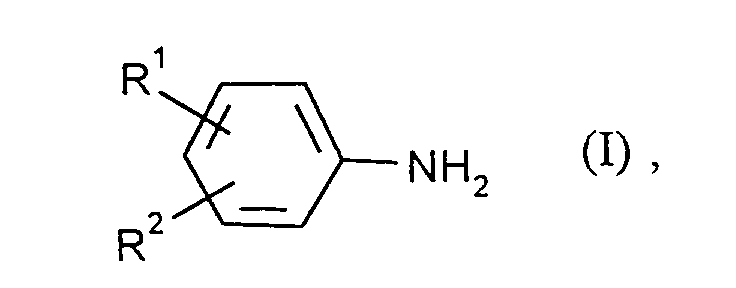
in der
R¹ und R² unabhängig voneinander Wasserstoff, Methyl oder Ethyl bedeuten, und
R¹ zusätzlich Amino bedeuten kann,
durch Hydrierung von Nitroaromaten der Formel
in der - R² und R³
- unabhängig voneinander Wasserstoff, Methyl oder Ethyl bedeuten, und R³ zusätzlich Nitro bedeuten kann,
- Die Nitrogruppen befinden sich ausschließlich in Eduktmolekülen, die aromatischen Aminogruppen ausschließlich in Produktmolekülen.
- In bevorzugter Weise werden Nitroaromaten der Formel

eingesetzt, in der - R³
- Wasserstoff, Methyl oder Ethyl bedeutet.
- In besonders bevorzugter Weise wird Nitrobenzol eingesetzt.
- Eine erfindungsgemäße Produktionsanlage besteht aus mindestens einem adiabaten Reaktor mit stationärem Katalysator. Es werden maximal 10, bevorzugt maximal 5, besonders bevorzugt maximal 3 solcher Reaktoren hintereinander geschaltet. Jeder in Reihe geschaltetete Reaktor kann durch mehrere parallel geschaltete ersetzt werden. Es werden maximal 5, bevorzugt maximal 3, besonders bevorzugt maximal 2 Reaktoren im Ersatz des einen Reaktors parallel geschaltet. Das erfindungsgemäße Verfahren kann demnach maximal 50 und minimal einen Reaktor beinhalten.
- Eine größere Zahl von Reaktoren mit einer Katalysatorschüttung kann durch eine kleine Zahl mit mehreren Katalysatorschüttungen ersetzt werden.
- Die Reaktoren bestehen aus einfachen Behältern mit isolierten Katalysatorschüttungen, wie sie z.B. in Ullmanns Encyclopedia of Industrial Chemistry (Fifth, Completely Revised Edition, Vol. B4, Seite 95-102, Seite 210-216) beschrieben werden.
- Die Katalysatorschüttungen werden nach dem Stand der Technik auf oder zwischen gasdurchlässigen Wandungen angebracht. Insbesondere bei dünnen Schüttungen werden oberhalb, unterhalb oder oberhalb und unterhalb der Schüttung technische Vorrichtungen zur gleichmäßigen Gasverteilung angebracht. Dies können Lochplatten, Glockenböden, Ventilböden oder andere Einbauten sein, die durch Erzeugung geringen, aber gleichmäßigen Druckverlusts einen gleichförmigen Eintritt des Gases in die Katalysatorschüttung bewirken, bevorzugt werden Metall- oder Keramiksintermatten benutzt, wie sie z.B. die Firma Krebsöge vertreibt.
- Statt Katalysatorschüttungen können auch als Trägermaterial geeignete Packungen verwendet werden. Dies wären z.B. Wabenkörper oder gewellte Schichten, wie sie von der Firma Sulzer unter dem Namen Katapak angeboten werden. Diese Packungen werden zum erfindungsgemäßen Einsatz natürlich vor dem Einbringen in den Reaktor durch das Aufbringen geeigneter Metallverbindungen aktiv gemacht.
- Vor jeder Katalysatorschüttung wird frischer Nitroaromat in den Kreisgasstrom, der hauptsächlich aus recyclisiertem und frisch zugesetztem Wasserstoff sowie aus recyclisiertem aromatischen Amin und Wasser besteht, eindosiert. Das kann so geschehen, wie in DE 1 809 711 beschrieben, bevorzugt wird jedoch der Nitroaromat im Frischwasserstoff vollständig verdampft und dann gasförmig in den Kreisgasstrom gegeben. Der Vorteil dieser Verfahrensweise liegt in der deutlich geringeren Bildung von Ablagerungen im Reaktor und in den Zuleitungen. Die Verdampfung kann nach dem Stand der Technik in bekannten Verdampfern erfolgen, wie z.B. Fallfilm-, Steigrohr-, Einspritz-, Dünnschicht-, Umlauf- und Wendelrohrverdampfern. Bevorzugt wird in Fallfilm- und Einspritz-, ganz besonders bevorzugt in Fallfilmverdampfern verdampft. Weiterhin ist die Verdüsung des flüssigen Nitroaromaten in den Frischwasserstoff- oder Kreisgaswasserstoffstrom mittels Einstoff- oder Zweistoffdüsen möglich, wobei die Vereinigung des Eduktgasstromes nach einer Überhitzung in einem Wärmetauscher erfolgen kann. Der Verdampfung kann eine grundsätzlich bekannte Tröpfchenabscheidung nachgeschaltet werden. Der Eduktgasstrom wird in bekannter Weise mittels entsprechender Zuführung und Verteilung und oder durch Vermischungseinrichtungen, wie z.B. Mischern vom Typ SUX oder SMV der Firma Sulzer oder Kenics im Kreisstrom vermischt.
- Nach jeder Katalysatorschüttung kann das sie verlassende Produktgas unter Dampfgewinnung abgekühlt werden. Dazu leitet man es durch einen oder mehrere Wärmetauscher. Dies können die dem Fachmann bekannten Wärmetauscher, wie z.B. Rohrbündel-, Platten-, Ringnut-, Spiralstrom-, Rippenrohrwärmetauscher sein.
- Nach Verlassen eines jeden Wärmetauschers zur Umwandlung von Reaktionswärme in Dampf kann ein Teilstrom des Kreisgases abgezweigt und weiter abgekühlt werden, um gebildetes aromatisches Amin und gebildetes Wasser abzutrennen. In bevorzugter und besonders wirtschaftlicher Art erfolgt dies nach Verlassen des letzten Wärmetauschers.
- Der Kreisgasstrom durchläuft daraufhin einen Kompressor, um den Strömungswiderstand von Reaktoren und Wärmeaustauschern auszugleichen und den Massenstrom des Kreisgases zu steuern.
- Die Kompressoren können einfache, bekannte Apparate (z.B. Gebläse) sein, da der Druckverlust durch die Bauweise der Reaktoren kleingehalten werden kann, bevorzugt werden trockenlaufende Radial- oder Axialverdichter benutzt.
- Der ausgekreiste Kreiswasserstoff kann prinzipiell an jeder beliebigen Stelle wieder in den Kreisgasstrom eingepeist und damit recyclisiert werden, ebenso wie das aromatische Amin und das Reaktionswasser an jeder beliebigen Stelle vor einer Nitroaromat-Einspeisung und nach einem Reaktor zusammen mit Wasserstoff ausgekreist werden kann, bevorzugt wird jedoch wie oben angegeben verfahren.
- In einer speziellen Ausführungsform wird vor dem ersten Reaktor der von aromatischem Amin und Reaktionswasser weit gehend befreite ausgekreiste Wasserstoff in den Kreisgasstrom wieder eingeleitet (recyclisiert).
- Der Gasstrom vor jeder Katalysatorausschüttung ist möglichst homogen und enthält pro Mol Nitrogruppen 2 bis 100 Mol aromatische Aminogruppen, bevorzugt 2,5 bis 50 Mol aromatische Aminogruppen, besonders bevorzugt 3 bis 20 Mol aromatische Aminogruppen, ganz besonders bevorzugt 3,5 bis 10 Mol aromatische Aminogruppen.
- Pro Mol Aminogruppen enthält der Kreisgasstrom 2 bis 6 Mol Wasser, bevorzugt 2,1 bis 4 Mol Wasser, besonders bevorzugt 2,2 bis 3 Mol Wasser.
- Pro Mol Nitrogruppen enthält der Gasstrom vor jeder Katalysatorschüttung 3-150 Mol Wasserstoff, bevorzugt 6-125 Mol Wasserstoff, besonders bevorzugt 12-100 Mol Wasserstoff, ganz besonders bevorzugt 25-75 Mol Wasserstoff.
- Das Kreisgas steht unter Druck. Der Absolutdruck der Kreisgase liegt bei 2 bis 50 bar, bevorzugt bei 3-20 bar, besonders bevorzugt bei 4-10 bar.
- Die Temperatur des Kreisgases liegt im Bereich von 250 und 500°C, bevorzugt 290-480°C, besonders bevorzugt 320-440°C, ganz besonders bevorzugt 340-410°C. Infolge der adiabaten Fahrweise steigt die Temperatur beim Reaktordurchgang.
- Der zur Abtrennung von gebildetem aromatischen Amin und Reaktionswasser ausgekreiste Gasstrom wird auf eine Temperatur zwischen 80 und 20°C bevorzugt 60-25°C, besonders bevorzugt 40-30°C abgekühlt.
- Das Kondensat wird in eine technische Einrichtung zur Trennung flüssiger Phasen geleitet und die wäßrige und die organische Phase getrennt aufgearbeitet.
- Aus der wäßrigen Phase gewonnenes aromatisches Amin wird der Aufarbeitung der organischen Phase zugeführt. Die Aufarbeitungen erfolgen in bekannter Weise durch Destillation bzw. durch Strippen mit Wasserdampf.
- Vom abgetrennten Kreisgaswasserstoff wird eine gewisse Menge zur Ausschleusung gasförmiger Verunreinigungen abgetrennt. Der Rest wird wieder aufgewärmt, komprimiert und in den Kreisgasstrom zurückgeführt. Auf diese Rückführung kann gegebenenfalls verzichtet werden.
- Die Dicke der Katalysatorschüttungen kann zwischen 1 cm und 5 m, bevorzugt zwischen 5 cm und 2 m, besonders bevorzugt zwischen 10 cm und 1 m, ganz besonders bevorzugt zwischen 30 cm und 60 cm liegen.
- Als Katalysatoren können alle bisher für die Gasphasenhydrierung von Nitroverbindungen beschriebenen Kontakte eingesetzt werden. Diese enthalten die Elemente der sogenannten Nebengruppen des Periodensystems der Elemente, entweder als Metalle oder Legierungen oder als Mischoxide und gegebenenfalls auf inertem Trägermaterial.
- Als Trägermaterialien kommen in Frage: α- und γ-Al₂O₃, SiO₂, TiO₂, Roterde und Limonit, Fe₂O₃/Al₂O₃-Mischungen, CuO/Cr₂O₃-Mischungen, Wasserglas , Graphit, Aktivkohle (BET 20-100 m²/g) und Kohlefasern. Es können aber prinzipiell auch andere Träger eingesetzt werden.
- Bevorzugt werden die Katalysatoren aus DE 2 849 002 eingesetzt. Dies sind Trägerkatalysatoren auf inerten Trägern mit einer BET-Oberfläche von weniger als 20 mg²/g, bzw. α-Al₂O₃ mit einer BET von weniger als 10 m²/g. Die in DE-OS 2 849 002 beschriebene Vorbehandlung mit einer Base ist nicht unbedingt erforderlich.
- Auf dem Trägermaterial sind drei Aktivstoffklassen niedergeschlagen:
- (a) 1 - 100 g/l Katalysator eines oder mehrerer Metalle der Gruppen VIIIa, Ib und IIb des Periodensystems der Elemente (Mendeljew),
- (b) 1 - 100 g/l eines oder mehrerer Übergangsmetalle der Gruppen IIb, IVa, Va und VIa und
- (c) 1 - 100 g/l eines oder mehrerer Hauptgruppenelemente der Gruppen IVb und Vb.
- Elemente der Gruppe IIb können somit als Aktivstoffe (a) und (b) wirken. Bevorzugte Aktivstoffe sind Pd als Metall (a), V, Nb, Ta, Cr, Mo, W, Ti als Übergangsmetall (b) und Pb und Bi als Hauptgruppenelemente (c).
- Besonders bevorzugt werden
- (a) 20 bis 60 g Pd,
- (b) 20 bis 60 g V und
- (c) 10 bis 40 g Pb auf den Träger gebracht.
- Die Aktivstoffe werden in Form ihrer löslichen Salze auf den Träger gebracht, gegebenenfalls sind mehrere Behandlungen (Tränkungen) pro Komponente erfordelrich. In bevorzugter Weise werden die Aktivstoffe nur schalenförmig, d.h. in der Nähe der Oberfläche des Katalysators aufgebracht.
- Diese Kontakte werden in einem Temperaturbereich betrieben, der zwischen der Eingangstemperatur des Eduktgases und max. 500, bevorzugt maximal 480, besonders bevorzugt maximal 460, ganz besonders bevorzugt maximal 440°C liegt.
- Der Metallgehalt dieser Katalysatoren kann beim erfindungsgemäßen Verfahren deutlich höher sein als in DE 2 849 002 beschrieben ist, dabei zeigen Katalysatoren mit großem Edelmetallgehalt überraschenderweise besonders hohe Selektivitäten. Der Gehalt an Pd liegt bei diesen Kontakten minimal bei 1 g und maximal bei 100, bevorzugt bei 60, besonders bevorzugt bei 40, ganz besonders bevorzugt bei 20 g Metall pro 1 Trägermaterial. V und Pb können im gleichen Maße verstärkt aufgebracht werden.
- Weitere bevorzugte Katalysatoren sind solche, die Pd alleine oder mit Rh und/oder Ir und/oder Ru auf Kohleträgern mit geringer BET-Oberfläche tragen. Solche Trägermaterialien sind graphithaltig, es sind Graphite selbst und Kokse, wie Nadelkoks oder Petrolskoks. Diese Träger haben eine BET-Oberfläche von 0,2-10 m²/g. Verwendung finden erfindungsgemäß Katalysatoren, die auf Graphit oder graphithaltigem Koks als Träger 0,001-1,5 Gew.-% Pd, bezogen auf das Gesamtgewicht des Katalysators, enthalten, wobei das Pd zu 0 - 40 Relativprozent seiner Menge durch Ir und/oder Rh und/oder Ru ersetzt sein kann. Diese Katalysatoren enthalten also das (die) Edelmetall(e) in folgenden Anordnungen auf dem Träger: Pd allein, Pd/Ir, Pd/Rh, Pd/Ru, Pd/Ir/Rh, Pd/Ir/Ru, Pd/Rh/Ru, Pd/Ir/Rh/Ru. In vielen Fällen werden eine der genannten Zweierkombinationen oder Pd allein eingesetzt. In bevorzugter Weise liegt in den Katalysatoren auf Kohleträgern das Palladium in einer Menge von 0,005-1 Gew.-%, bevorzugt 0,05-0,5 Gew.-%, bezogen auf das Gesamtgewicht des Katalyators, vor. Die Untergrenze Null der Relativprozente der anderen genannten Platinmetalle zeigt den Gebrauch von Pd alleine an. Falls die anderen Platinmetalle eingesetzt werden, beträgt ihr Anteil bevorzugt insgesamt 10-40 Relativprozent; untereinander beträgt ihr Gewichtsverhältnis 1:1-3:1 zwischen je zweien.
- Es hat sich weiterhin als vorteilhaft erwiesen, die genannten Katalysatoren zusätzlich mit einer schwefelhaltigen oder phosphorhaltigen, bevorzugt phosphorhaltigen Verbindungen zu dotieren. Ein solcher zusätzlicher Gehalt an Dotierungsmittel beträgt 0,1-2 Gew.-%, bevorzugt 0,1-1 Gew.-% Schwefel oder Phosphor, bevorzugt Phosphor, in chemisch gebundener Form, bezogen auf das Gesamtgewicht des Katalysators. Als phosphorhaltige Verbindungen für die Dotierung der erfindungsgemäßen Katalysatoren sind bevorzugt zu nennen: die Sauerstoffsäuren des Phosphors H₃PO₄, H₃PO₃, H₃PO₂ oder deren Alkalisalze, wie z.B. Natriumdihydrogenphosphat, Natrium- oder Kaliumphosphat oder Natriumhypophosphit.
- Zur Herstellung der Katalysatoren auf Kohleträgern kann so vorgegangen werden, daß auf einen der genannten Träger in Form von Pillen, Kugeln, Stranggranulat oder Bruchstücken von etwa 1-10 mm Abmessung die genannten Edelmetalle in Form geeigneter Salze sowie die schwefelhaltige oder phosphorhaltige Verbindung in getrennten Arbeitsgängen aufgetragen werden, wobei nach jedem Auftrag getrocknet wird. Das Trocknen geschieht in bekannter Weise, beispielsweise bei 100-140°C und vermindertem bis normalem Druck, beispielsweise bei 1-1.000 mbar; als verminderter Druck kommt beispielsweise der einer Wasserstrahlpumpe in Betracht. Zum Tränken des Trägers können wäßrige Lösungen verwendet werden. Dies ist in bevorzugter Weise bei den schwefel- oder phosphorhaltigen Verbindungen, von denen wasserlösliche bevorzugt werden, der Fall. Die Edelmetallsalze werden jedoch bevorzugt in organischen Lösungsmitteln, wie einfachen Alkoholen, Ketonen, cyclischen Ethern oder Nitrilen, gelöst und aufgetragen. Beispiele für solche organischen Lösungsmittel sind Methanol, Ethanol, Propanol, Isopropanol, Aceton, Methyl-ethylketon, Dioxan, Acetonitril und vergleichbare Lösungsmittel. Bei Salzen mit organischen Anionen können auch Methylenchlorid und vergleichbare Lösungsmittel eingesetzt werden. Geeignete Salze der Edelmetalle sind beispielsweise ihre Chloride, Nitrate oder Acetate.
- Nach dem Imprägnieren und dem abschließenden Trocknen steht der Katalysator zur Verfügung. Er wird in bevorzugter Weise im Reaktor vor Beginn der Hydrierung von Nitrolbenzol durch eine Behandlung mit Wasserstoff bei erhöhter Temperatur aktiviert. Eine solche erhöhte Temperatur liegt beispielsweise im Bereich von 200-400°C, bevorzugt im Bereich von 230-370°C.
- Die genannten Katalysatoren sind in hervorragender Weise zur Hydrierung von Nitrobenzol zu Anilin verwendbar.
- Bei Aktivitätsabfall des eingesetzten Katalysators kann er leicht in situ, d.h. im Hydrierreaktor, regeneriert werden. Hierzu wird der Katalysator bei 350-400°C nacheinander mit Wasserdampf, einem Stickstoff/Luft-Gemisch oder atmosphärischer Luft und schließlich Stickstoff behandelt. Die Behandlung mit Wasserdampf kann 1 bis 3 Stunden, die Behandlung mit Luft bzw. dem Stickstoff/Luft-Gemisch kann 1 bis 4 Stunden lang erfolgen. Eine solche Regenerierung ist nicht möglich bei Edelmetallkatalysatoren auf anderen als den beschriebenen Kohleträgern, z.B. bei aktivierter Kohle als Träger, da eine aktivierte Kohle bei einer solchen Regenerierung zu verbrennen beginnt. Zur erneuten Aktivierung des Katalysators kann sich eine Behandlung mit Wasserstoff bei 200-400°C anschließen.
- Diese Katalysatoren werden im Temperaturbereich unter 480°C, bevorzugt unter 460°C, ganz besonders bevorzugt unter 440°C betrieben.
- Die als bevorzugt beschriebenen Kontakte ermöglichen eine besonders lange Laufzeit zwischen den Regenerierungen.
- Prinzipiell können die Katalysatorkörner jede beliebige Form aufweisen, wie z.B. Kugeln, Stäbchen, Raschigringe oder Granulat oder Tabletten. Bevorzugt werden Formkörper benutzt, deren Schüttungen einen niedrigen Stromungswiderstand bei guten Gas-Oberflächen-Kontakt aufweisen, wie z.B. Raschigringe, Sattelkörper, Wagenräder und Spiralen.
- Das erfindungsgemäße Verfahren erlaubt besonders vorteilhafte Durchführungen der Gasphasenhydrierung, die zu konstant hohen Selektivitäten an aromatisehem Amin und langen Katalysatorstandzeiten zwischen den Regenerationen des Katalysators führen, die i.a. im Abbrennen von kohlenstoffreichen Ablagerungen bestehen.
- Eine Vorgehensweise besteht darin, daß bei konstantem Druck gearbeitet wird, und daß der Katalysator mit besonders hoher Belastung angefahren wird. Die Belastung wird dann im Zuge der Katalysatordesaktivierung während der Laufzeit zwischen zwei Regenerierungen so zurückgenommen, daß kein Nitroaromat durchbricht.
- Eine andere gleichwertige Methode besteht darin, die Belastung des Katalysators konstant zu halten und mit niedrigem Systemdruck zu beginnen; kurz bevor Nitroaromat durchzubrechen beginnt, wird der Systemdruck langsam gesteigert.
- Es kann auch eine Fahrweise zwischen den beiden Extremen konstanter Druck und konstante Belastung gewählt werden. Bevorzugt wird mit niedrigem Druck und niedriger Belastung angefahren, um dann im Verlauf der Katalysatordesaktivierung beide Größen zu steigern.
- Die Belastung der Katalysatoren kann beim erfindungsgemäßen Verfahren sehr hoch sein und von 0,1 g bis zu 20 g Nitroaromat pro ml Kat. und Stunde, bevorzugt bis zu 15 g/ml·h, besonders bevorzugt bis zu 10 g/ml·h, ganz besonders bevorzugt bis zu 5 g/ml·h betragen.
- Das erfindungsgemäße Verfahren zeichnet sich demnach durch hohe Raumzeitausbeuten aus, verbunden mit einer Verringerung der Apparategrößen. Das erfindungsgemäße Verfahren erlaubt ferner einfache Standard-Apparaturen zu benutzen und ermöglicht hohe Anlagenkapazitäten bei geringen Investitionskosten.
- Der Gaskreislauf zur Abfuhr der Reaktionswärme vom Katalysator in die Dampferzeuger durchläuft keine Anlagenteile zur Ausschleusung der Reaktionsprodukte und muß demnach nicht soweit abgekühlt werden, daß Reaktionsprodukt auskondensiert. Dadurch sind nur kleine Wärmetauscheroberflächen nötig. Bauteile und Rohrleitungen, die den großen Kreisgasstrom zu bewältigen haben, reduzieren sich auf die Reaktoren, die Hochtemperaturwärmetauscher und den Kompressor.
- Die Anlage kann mit geringem Druckabfall und damit mit großem Kreisgasumlauf und damit mit kleinem Temperaturanstieg im Katalysatorbett betrieben werden.
- Das führt dazu, daß die Reaktionswarme auf hohem thermischem Niveau gewonnen werden kann, was die lukrative Gewinnung von hochgespanntem Dampf zur Stromerzeugung ermöglicht.
- Dies führt zu einer spürbaren Verbesserung der Wirtschaftlichkeit des Verfahrens.
- Die hohen Temperaturen führen zusammen mit der Verdünnung der aromatischen Nitroverbindung mit dem aromatischem Amin, dem Wasser und dem Wasserstoff und der Druck- bzw. Belastungs- bzw. Druck-Belastungs-Gradienten-Fahrweise zu einer erstaunlich hohen Selektivität über den gesamten Produktionszyklus zwischen zwei Katalysatorregenererierungen durch Abbrennen.
- Das Verfahren ist besonders geeignet, um Nitrobenzol zu Anilin umzusetzen. Hierbei wird Anilin in durchgehend hoher Selektivität gebildet; dies liegt offenbar daran, daß in keinem Katalysatorvolumen das Verhältnis von Nitrogruppen zu aromatischen Aminogruppen größer als 0,5 ist.
- 400 g Graphitgranulat EG 17 der Firma Ringsdorf, Granulat 1-3 mm, Rüttelgewicht 650-1000 g/l, BET = 0,3-0,4 m²/g) mit einer Saugfähigkeit von 7 ml Acetonitril pro 100 g Träger wurden in` einem drehbaren Gefäß vorgelegt und mit einer Lösung aus 1,66 g Palladium-II-acetat in 26 g Acetonitril versetzt. Die Mischung wurde durch Drehen bis zur völligen Aufnahme der Lösung vom Trägermaterial bewegt. Danach erfolgte eine fünfminütige Trocknung des Feststoffes in einem starken aufsteigenden 40°C warmen Luftstrom. Die Tränkung mit Palladiumacetat in Acetonitril mit anschließender Trocknung wurde noch zweimal wiederholt. Der getrocknete Katalysator wurde anschließend 3 Stunden in einem 100°C heißem Wasserstoffstrom reduziert.
- 5000 ml α-Al₂O₃ der Firma Condea (α-Tonerde, Dichte 1,02 g/ml, Kugeln mit einem Durchmesser von 1 mm, BET = 4 m²/g) mit einer Saugfähigkeit von 33,4 ml Wasser pro 100 g Träger wurden in einem drehbaren Gefäß vorgelegt und mit einer Lösung aus 553 g Dinatrium-tetra-chloropalladat in 1200 g Wasser versetzt. Die Mischung wurde solange durch Drehen vermischt, bis die gesamte Lösung vom Trägermaterial aufgenommen worden war. Danach erfolgte eine 10minütige Trocknung des Feststoffes in einem starken aufsteigenden 40°C warmen Luftstrom. Der getrocknete Katalysator wurde 3 Stunden bei 350°C mit Wasserstoff reduziert, der reduzierende und getrocknete Feststoff anschließend bei Raumtemperatur mit einer Lösung aus 500 g Oxalsäuredihydrat und 178,6 g Vanadiumpentoxid in 1030 g Wasser versetzt und solange durch Drehen vermischt bis die gesamte Lösung vom Trägermaterial aufgenommen worden war. Danach erfolgte eine 10minütige Trocknung des Feststoffes in einem starken aufsteigenden 40°C warmen Luftstrom, worauf eine erneute Tränkung mit der gleichen Menge einer Vanadiumoxalat-Lösung mit anschließender Trocknung im warmen Luftstrom folgte. Der getrocknete Katalysator wurde 4 Stunden bei 300°C getempert und dann auf Raumtemperatur abgekühlt. Es folgte eine Tränkung des Feststoffes, wie oben beschrieben, mit einer Lösung aus 128,2 g Blei-II-acetat-trihydrat in 1200 g Wasser. Danach wurde der Feststoff wiederum in einem starken aufsteigenden 40°C warmen Luftstrom 10 Minuten getrocknet, der getrocknete Katalysator 3 Stunden bei 350°C mit Wasserstoff reduziert und abschließend bei Raumtemperatur mit destilliertem Wasser gewaschen, bis das Waschwasser einen pH-Wert von 7 aufwies. Der so erhaltene Katalysator erfuhr eine abschließende 10minütige Trocknung in einem stark aufsteigenden Luftstrom bei 40°C.
- 30 ml (31 g) des in Beispiel 1 hergestellten Katalysators wurden in eine druckfeste Apparatur, bestehend aus drei ölbeheizten Verdampfer-Überhitzern, einem isolierten elektrisch begleitbeheizten Reaktionsrohr, einem Kondensator, einem Auffanggefäß für das flüssige Produkt mit automatischer standgeregelter Austragung und einem Tröpfchenabscheider, gefüllt.
- Der Innendurchmesser des Reaktionsrohres betrug 14,9 mm, die Wandstärke 3,2 mm. Das Reaktionsrohr war von oben nach unten in Strömungsrichtung auf eine Länge von 300 mm durch Kupferkerne (⌀i = 24 mm, ⌀a = 44 mm) mit einem guten Wärmeübergang zur elektrischen Begleitheizung und darunter im Katalysatorbereich auf eine Länge von 500 mm durch eine 10 mm dicke Schicht Isolierband mit einem schlechten Wärmeübergang zur elektrischen Begleitheizung versehen.
- Die Katalysatorüberschüttung war 180 mm lang und entlang der Rohrachse mit einem hohlen Metallröhrchen (⌀a = 4 mm) zur Führung eines Thermoelementes versehen. Oberhalb und unterhalb der Katalysatorschüttung befanden sich Schüttungen aus 3 mm Maschendrahtringen zur Fixierung des Katalysatorbettes.
- Die Apparatur wurde durch die drei Verdampfer-Überhitzer gleichmäßig mit einem konstanten Wasserstoffstrom bei einem definierten Druck beaufschlagt. In die Verdampfer wurde über Dosierpumpen getrennt Wasser, Anilin und Nitrobenzol gepumpt.
- Nach vollständiger Verdampfung im Wasserstoffstrom wurden die Edukt-"Kreisgasströme" vereint und über den Kontakt geleitet.
- Das Anfahren der Anlage erfolgte, indem bei 4 bar 460 Nl Wasserstoff eingeleitet, die ölthermostatisierten Verdampfer-Überhitzer auf 300°C und das Reaktionsrohr mit dem Katalysator auf 320°C aufgeheizt wurden.
- Nach Erreichen der Solltemperaturen wurde die Anilindosierung auf 182 g (2 mol) und die Wasserdosierung auf 36 g (2 mol) pro Stunde eingestellt.
- Daraufhin wurde begonnen 32,6 g (0,27 mol) Nitrobenzol pro Stunde in den dritten Verdampfer zu fördern.
- Die Katalysatortemperatur, welche vorher entlang der Rohrachse einheitlich 320°C betrug, stieg mit Beginn der Nitrobenzolförderung rasch bis auf ca. 439°C an.
- Das flüssige Produktgemisch bestand aus einer wäßrigen und einer organischen Phase. Die organische Phase enthielt zu 98,5 % Anilin, mit 0,5 % Cyclohexylanilin und 0,6 % Diphenylamin verunreinigt, und wurde als "Anilin" mit 182 g pro Stunde in den Anilinverdampfer zurückgefahren.
- Die wäßrige Phase bestand fast ausschließlich aus Wasser und wurde verworfen.
- Nach 3 Stunden Laufzeit lieferte die Anlage bereits 99,5%iges Anilin und nach 23 Stunden was das erhaltene Anilin 99,8%ig.
- Mit diesesr Reinheit wurde das Anilin weitere 1000 Stunden ohne Anzeichen einer beginnenden Desaktivierung erhalten, worauf der Versuch abgebrochen wurde.
- Die Nachweisgrenze der verwendeten GC-Analytik betrug ca. 5 ppm.
- Die Nebenprodukte umfassen ca. 16 Verbindungen, die zusammen ca. 0,2 % der Produktmenge ausmachen.
- In die in Beispiel 3 beschriebene Apparatur wurden 30 ml des in Beispiel 2 beschriebenen Katalysators gefüllt und die Anlage, wie in Beispiel 3 beschrieben, betrieben.
- Der Katalysator lieferte im wesentlichen das gleiche Hydrierungsprodukt wie der Katalysator auf Kohlenstoffträger.
- Er erreichte 24 Stunden eine etwas bessere Anilinreinheit von 99,9 %, verglichen mit Beispiel 3, zeigte aber nach 1000 Stunden Laufzeit mit ca. 2 ppm Nitrobenzol im Produkt eine beginnende Desaktivierung.
Claims (10)
- Verfahren zur Herstellung von aromatischen Aminen der Formel

R¹ und R² unabhängig voneinander Wasserstoff, Methyl oder Ethyl bedeuten, und R¹ zusätzlich Amino bedeuten kann,
durch Hydrierung von Nitroaromaten der Formel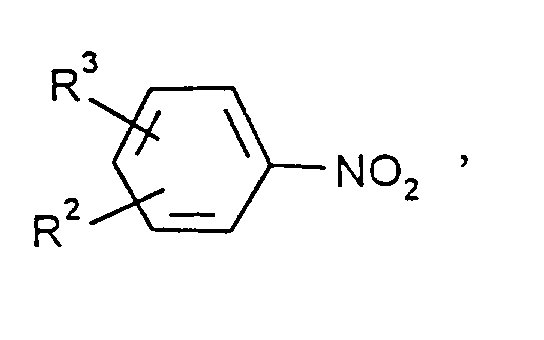 R² und R³ unabhängig voneinander Wasserstoff, Methyl oder Ethyl bedeuten und zusätzlich Nitro bedeuten kann,in der Gasphase mit H₂ an ortsfesten Katalysatoren, dadurch gekennzeichnet, daß bei einem Druck von 2 bis 50 bar, bevorzugt 3-25 bar, besonders bevorzugt 4-18 bar, und einer Temperatur im Bereich von 250-500°C, bevorzugt 290-480°C, besonders bevorzugt 320-440°C, ganz besonders bevorzugt 340-410°C, unter adiabatischen Bedingungen gearbeitet wird, wobei der Katalysator mit einem Kreisgas angeströmt wird, das pro Mol Nitrogruppen 3-150 Mol Wasserstoff, 2-100 Mol aromatische Aminogruppen und pro Mol aromatischer Aminogruppen 2-6 Mol, bevorzugt 2,1-4 Mol, besonders bevorzugt 2,2-3 Mol Wasser enthält, die pro Zeitheinheit gebildete Menge Amin und Wasser auskondensiert wird und das restliche Kreisgas, gegebenenfalls nach Abtrennung eines Reinigungsstromes, recyclisiert und mit verdampftem Nitroaromat und mit Frischwasserstoff angereichert wird.
 - Verfahren nach Anspruch 1, dadurch gekennzeichnet, daß Nitroaromaten der Formel
 R³ Wasserstoff, Methyl oder Ethyl bedeutet,und bevorzugt Nitrobenzol eingesetzt wird.
 - Verfahren nach Anspruch 1, dadurch gekennzeichnet, daß die Reaktion in 1-10, bevorzugt 1-5, besonders bevorzugt 1-3 hintereinandergeschalteten Reaktoren durchgeführt wird, von denen jeder Reaktor durch maximal 5, bevorzugt maximal 3, besonders bevorzugt maximal 2 parallel geschaltete Reakoren ersetzt werden kann.
- Verfahren nach 3, dadurch gekennzeichnet, daß nach jedem Reaktor die adiabatisch angestaule Reaktionswärme zur Dampfgewinnung eingesetzt wird.
- Verfahren nach 3, dadurch gekennzeichnet, daß vor jedem Reaktor erneut Nitroaromat dem Reaktionsgemisch zugefügt wird und unabhängig hiervon vor der Nitroaromat-Zugabe ein Teil des Kreisstromes ausgeschleust werden kann, um gebildetes Amin und Wasser auszukondensieren.
- Verfahren nach Anspruch 1, dadurch gekennzeichnet, daß die Durchdringungstiefe des Katalyatorbettes bei 1 cm - 5 m, bevorzugt 5 cm - 2 m, besonders bevorzugt 10 cm - 1 m, ganz besonders bevorzugt 30 - 60 cm beträgt.
- Verfahren nach Anspruch 1, dadurch gekennzeichnet, daß das den Katalysator anströmende Kreisgas pro Nitrogruppenäquivalent 2,5 - 50 Mol, bevorzugt 3 - 20 Mol, besonders bevorzugt 3,5 - 10 Mol der zu bildenden Aminogruppen und unabhängig hiervon 6 bis 125 Mol, bevorzugt 12-100 Mol, besonders bevorzugt 25-75 Mol Wasserstoff enthält.
- Verfahren nach Anspruch 1, dadurch gekennzeichnet, daß ein Palladium auf α-Al₂O₃ enthaltender Katalysator eingesetzt wird, der 1-100 g, bevorzugt 1-60 g, besonders bevorzugt 1-40 g, ganz besonders bevorzugt 1-20 g Pd pro Liter α-Al₂O₃ enthält, das bevorzugt schalenförmig niedergeschlagen ist, wobei der Katalysator zusätzlich Vanadin und Blei enthalten kann und bei einer maximalen Temperatur von 500°C, bevorzugt 480°C, besonders bevorzugt 460°C, ganz besonders bevorzugt 440°C betrieben wird.
- Verfahren nach Anspruch 1, dadurch gekennzeichnet, daß ein Palladium auf Kohleträgern enthaltender Katalysator eingesetzt wird, dessen Träger eine BET-Oberfläche von 0,2-10 m²/g aufweist, dessen Pd-Gehalt 0,001-1,5 Gew.-% beträgt, dessen Pd-Menge zu 0-40 Relativ-% durch eines oder mehrere Metalle aus der Grupe von Rh, Ir und Ru ersetzt ist, der zusätzlich einen Gehalt von 0,1-2 Gew.-%, bevorzugt 0,1-1 Gew.-% an einer schwefelhaltigen oder phosphorhaltigen, bevorzugt phosphorhaltigen Verbindung, gerechnet als Schwefel oder Phosphor, haben kann, wobei alle Gewichtsprozente auf das Gesamtgewicht des Katalysators bezogen sind, und der bei einer maximalen Temperatur von 480°C, bevorzugt 460°C, besonders bevorzugt 440°C betrieben wird.
- Verfahren nach Anspruch 1-9, dadurch gekennzeichnet, daß der Katalysator mit 0,1-20 g Nitroaromat pro ml Katalysator pro Stunde, bevorzugt mit 0,2-15 g/ml·h, besonders bevorzugt 0,5-10 g/ml·h, ganz besonders bevorzugt 1-5 g/ml·belastet wird.
Applications Claiming Priority (2)
| Application Number | Priority Date | Filing Date | Title |
|---|---|---|---|
| DE4428017A DE4428017A1 (de) | 1994-08-08 | 1994-08-08 | Verfahren zur Herstellung von aromatischen Aminen |
| DE4428017 | 1994-08-08 |
Publications (2)
| Publication Number | Publication Date |
|---|---|
| EP0696573A1 true EP0696573A1 (de) | 1996-02-14 |
| EP0696573B1 EP0696573B1 (de) | 1999-03-31 |
Family
ID=6525176
Family Applications (1)
| Application Number | Title | Priority Date | Filing Date |
|---|---|---|---|
| EP95111997A Expired - Lifetime EP0696573B1 (de) | 1994-08-08 | 1995-07-31 | Verfahren zur Herstellung von aromatischen Aminen |
Country Status (8)
| Country | Link |
|---|---|
| US (1) | US5808157A (de) |
| EP (1) | EP0696573B1 (de) |
| JP (1) | JP3847817B2 (de) |
| CN (1) | CN1073084C (de) |
| CA (1) | CA2155563A1 (de) |
| CZ (1) | CZ288096B6 (de) |
| DE (2) | DE4428017A1 (de) |
| ES (1) | ES2131239T3 (de) |
Cited By (21)
| Publication number | Priority date | Publication date | Assignee | Title |
|---|---|---|---|---|
| FR2741877A1 (fr) * | 1995-12-01 | 1997-06-06 | Rhone Poulenc Chimie | Procede d'hydrogenation de composes nitres aromatiques |
| EP0748789A3 (de) * | 1995-06-14 | 1998-04-08 | Bayer Ag | Verfahren und Katalysator zur Herstellung von aromatischen Aminen durch Gasphasenhydrierung |
| EP0748790A3 (de) * | 1995-06-14 | 1998-04-08 | Bayer Ag | Verfahren und Katalysator zur Herstellung von aromatischen Aminen durch Gasphasenhydrierung |
| WO1999019292A1 (de) * | 1997-10-15 | 1999-04-22 | Bayer Aktiengesellschaft | Kontinuierliches verfahren zur herstellung von aromatischen aminen |
| CN1059432C (zh) * | 1996-05-09 | 2000-12-13 | 河南省科学院化学研究所 | 芳香胺化合物的制备方法 |
| EP1882681A1 (de) * | 2006-07-29 | 2008-01-30 | Bayer MaterialScience AG | Verfahren zur Herstellung von aromatischen Aminen |
| EP2263997A1 (de) | 2009-06-18 | 2010-12-22 | Bayer MaterialScience AG | Verfahren zur Herstellung von aromatischen Aminen |
| WO2012052407A1 (de) | 2010-10-21 | 2012-04-26 | Bayer Materialscience Ag | Verfahren zur reinigung von anilin aus gasphasenhydrierungen |
| WO2012065969A1 (de) | 2010-11-18 | 2012-05-24 | Bayer Materialscience Ag | Chemischer reaktor mit drahtgestrick-maschenware als halteeinrichtung für partikel |
| WO2012160072A1 (de) | 2011-05-24 | 2012-11-29 | Basf Se | Verfahren zur herstellung von polyisocyanaten aus biomasse |
| EP2641892A1 (de) | 2012-03-23 | 2013-09-25 | Bayer MaterialScience AG | Verfahren zur Reinigung von Anilin aus Gasphasenhydrierungen |
| EP2653461A1 (de) * | 2012-04-16 | 2013-10-23 | Bayer MaterialScience AG | Verfahren zum verbesserten Abfahren der Reaktion bei der Herstellung von aromatischen Aminen aus Nitroaromaten |
| US8729309B2 (en) | 2010-07-28 | 2014-05-20 | Bayer Intellectual Property Gmbh | Method for producing nitrobenzene by adiabatic nitriding |
| US8933262B2 (en) | 2011-05-24 | 2015-01-13 | Basf Se | Process for preparing polyisocyanates from biomass |
| WO2015052068A1 (de) | 2013-10-08 | 2015-04-16 | Bayer Materialscience Ag | Verfahren zur herstellung von toluylendiamin |
| CN104741148A (zh) * | 2013-12-25 | 2015-07-01 | 浙江衢州万能达科技有限公司 | 一种3-氯-4氟硝基苯加氢催化剂的制备方法 |
| EP3643699A1 (de) | 2018-10-17 | 2020-04-29 | Covestro Deutschland AG | Verfahren zur reinigung von anilin |
| WO2021001424A1 (de) | 2019-07-03 | 2021-01-07 | Covestro Intellectual Property Gmbh & Co. Kg | Verfahren zur reinigung von anilin |
| WO2021037990A1 (de) | 2019-08-30 | 2021-03-04 | Covestro Deutschland Ag | Verfahren zur hydrierung von aromatischen nitroverbindungen |
| WO2022184614A1 (de) | 2021-03-01 | 2022-09-09 | Covestro Deutschland Ag | Verfahren zur hydrierung von aromatischen nitroverbindungen |
| WO2025244748A1 (en) | 2024-05-23 | 2025-11-27 | Covestro Llc | Method for recovering o-aminophenol |
Families Citing this family (25)
| Publication number | Priority date | Publication date | Assignee | Title |
|---|---|---|---|---|
| US6521791B1 (en) * | 2001-11-09 | 2003-02-18 | Air Products And Chemicals, Inc. | Process for regenerating a monolith hydrogenation catalytic reactor |
| DE10347439A1 (de) * | 2003-10-13 | 2005-05-04 | Bayer Materialscience Ag | Verfahren zur Herstellung von aromatischen Aminen durch heterogen katalysierte Hydrierung |
| US20090071873A1 (en) * | 2005-10-10 | 2009-03-19 | Fairstock Technologies Corporation | Methods for transforming organic compounds using a liquefied metal alloy and related apparatus |
| DE102006007619A1 (de) * | 2006-02-18 | 2007-08-23 | Bayer Materialscience Ag | Verfahren zur Herstellung von Anilin |
| DE102006007620A1 (de) * | 2006-02-18 | 2007-08-23 | Bayer Materialscience Ag | Verfahren zur Herstellung von Anilin |
| DE102006052989A1 (de) * | 2006-11-10 | 2008-05-15 | Bayer Materialscience Ag | Verfahren zur Entfernung von Verbindungen mit phenolischen Hydroxygruppen aus aromatischen Aminen |
| US7750188B2 (en) * | 2007-06-27 | 2010-07-06 | H R D Corporation | System and process for the production of aniline and toluenediamine |
| DE102007039091A1 (de) | 2007-08-18 | 2009-02-19 | Bayer Materialscience Ag | Verfahren zur Reinigung von aromatischen Aminen |
| DE102007045125A1 (de) | 2007-09-20 | 2009-04-02 | Bayer Technology Services Gmbh | Verfahren zur Herstellung von aromatischen Aminen |
| DE102009019436A1 (de) | 2009-04-29 | 2010-11-04 | Bayer Materialscience Ag | Verfahren zur Herstellung von aromatischen Aminen |
| CN102811996B (zh) * | 2010-03-18 | 2014-10-01 | 亨茨曼国际有限公司 | 将芳香族硝基化合物转化为胺的方法 |
| CN103068483B (zh) | 2010-07-30 | 2015-04-01 | 拜耳知识产权有限责任公司 | 恢复催化剂活性的方法 |
| DE102011081897A1 (de) | 2011-08-31 | 2013-02-28 | Bayer Materialscience Aktiengesellschaft | Katalysator und Verfahren zur Herstellung von aromatischen Aminen in der Gasphase |
| EP2653462A1 (de) | 2012-04-16 | 2013-10-23 | Bayer MaterialScience AG | Verfahren zum verbesserten Anfahren der Reaktion bei der Herstellung von aromatischen Aminen aus Nitroaromaten |
| CN104302617A (zh) | 2012-05-04 | 2015-01-21 | 拜耳材料科技股份有限公司 | 处理包含芳香胺的物质混合物,特别是粗制苯胺的物质混合物的方法 |
| CN103288651B (zh) * | 2013-06-20 | 2014-08-06 | 广西大学 | 一种硝基苯催化加氢合成苯胺的方法 |
| MX390867B (es) | 2014-06-24 | 2025-03-21 | Covestro Deutschland Ag | Metodos para producir productos quimicos con interrupciones de funcionamiento. |
| PT3500553T (pt) | 2016-08-17 | 2021-07-29 | Covestro Deutschland Ag | Processo para a produção de isocianato e pelo menos um outro produto químico num sistema de produção integrada |
| CN111646908B (zh) * | 2017-01-16 | 2023-03-10 | 宜昌尚诺德生物医药科技有限公司 | 一种制备芳胺化合物的方法 |
| CN106977406A (zh) * | 2017-03-10 | 2017-07-25 | 江苏华达化工集团有限公司 | 连续釜式催化加氢合成氨基萘的方法 |
| CN108623476B (zh) * | 2018-06-28 | 2023-05-30 | 万华化学集团股份有限公司 | 一种硝基化合物加氢制备胺类产品的方法 |
| CN109317139B (zh) * | 2018-08-28 | 2022-03-18 | 浙江工业大学 | 一种硫掺杂活性炭负载贵金属催化剂的制备及其在卤代芳香硝基化合物加氢反应中的应用 |
| CN115155570B (zh) * | 2022-06-21 | 2023-07-18 | 浙江理工大学 | 一种双金属掺杂钌碳催化剂的制备方法及其应用 |
| CN117358235A (zh) * | 2023-08-01 | 2024-01-09 | 江苏清泉化学股份有限公司 | 一种用于连续加氢制备macm的催化剂及其制备方法和应用 |
| EP4549619A1 (de) | 2023-10-31 | 2025-05-07 | Basf Se | Herstellung von aminen durch hydrierung von nitroverbindungen unter verwendung von wasserstoff mit niedrigem deuteriumgehalt |
Citations (4)
| Publication number | Priority date | Publication date | Assignee | Title |
|---|---|---|---|---|
| DE1809711A1 (de) * | 1967-12-01 | 1969-07-24 | Lonza Ag | Verfahren zur katalytischen Hydrierung organischer Nitroverbindungen in der Gasphase zu entsprechenden Aminen |
| GB1452466A (en) * | 1975-04-04 | 1976-10-13 | Chemopetrol | Process for the production of aniline and apparatus therefor |
| DE2849002A1 (de) * | 1978-11-11 | 1980-05-22 | Bayer Ag | Verfahren zur katalytischen hydrierung von nitrobenzol |
| GB2182330A (en) * | 1985-11-01 | 1987-05-13 | First Chemical Corp | Production of an aromatic monoamine and an aromatic diamine |
Family Cites Families (3)
| Publication number | Priority date | Publication date | Assignee | Title |
|---|---|---|---|---|
| US3136818A (en) * | 1960-01-15 | 1964-06-09 | Basf Ag | Production of aniline |
| BE793928A (fr) * | 1972-01-13 | 1973-05-02 | Deggendorfer Werft Eisenbau | Appareil pour la mise en oeuvre de processus chimiques exothermiques et endothermiques |
| DE3414717A1 (de) * | 1984-04-18 | 1985-10-31 | Linde Ag, 6200 Wiesbaden | Verfahren und reaktor zur durchfuehrung exothermer katalytischer reaktionen |
-
1994
- 1994-08-08 DE DE4428017A patent/DE4428017A1/de not_active Withdrawn
-
1995
- 1995-07-31 ES ES95111997T patent/ES2131239T3/es not_active Expired - Lifetime
- 1995-07-31 DE DE59505480T patent/DE59505480D1/de not_active Expired - Lifetime
- 1995-07-31 EP EP95111997A patent/EP0696573B1/de not_active Expired - Lifetime
- 1995-08-04 US US08/511,165 patent/US5808157A/en not_active Expired - Lifetime
- 1995-08-07 CA CA002155563A patent/CA2155563A1/en not_active Abandoned
- 1995-08-07 CZ CZ19952016A patent/CZ288096B6/cs not_active IP Right Cessation
- 1995-08-08 CN CN95116325A patent/CN1073084C/zh not_active Expired - Fee Related
- 1995-08-08 JP JP22117695A patent/JP3847817B2/ja not_active Expired - Fee Related
Patent Citations (6)
| Publication number | Priority date | Publication date | Assignee | Title |
|---|---|---|---|---|
| DE1809711A1 (de) * | 1967-12-01 | 1969-07-24 | Lonza Ag | Verfahren zur katalytischen Hydrierung organischer Nitroverbindungen in der Gasphase zu entsprechenden Aminen |
| GB1452466A (en) * | 1975-04-04 | 1976-10-13 | Chemopetrol | Process for the production of aniline and apparatus therefor |
| DE2849002A1 (de) * | 1978-11-11 | 1980-05-22 | Bayer Ag | Verfahren zur katalytischen hydrierung von nitrobenzol |
| EP0011090A1 (de) * | 1978-11-11 | 1980-05-28 | Bayer Ag | Verfahren zur katalytischen Hydrierung von Nitrobenzol |
| GB2182330A (en) * | 1985-11-01 | 1987-05-13 | First Chemical Corp | Production of an aromatic monoamine and an aromatic diamine |
| DE3636984A1 (de) * | 1985-11-01 | 1987-05-14 | First Chemical Corp | Verfahren zur gleichzeitigen herstellung eines aromatischen monoamins und eines aromatischen diamins und anlage zur durchfuehrung des verfahrens |
Non-Patent Citations (4)
| Title |
|---|
| CHEMICAL ABSTRACTS, vol. 100, no. 16, 16 April 1984, Columbus, Ohio, US; abstract no. 123155v, GRAMATIKOV, K. ET AL.: "Adiabatic process of catalytic reduction of nitrobenzene to aniline." page 108; column 2; XP002009187 * |
| CHEMICAL ABSTRACTS, vol. 112, no. 4, 22 January 1990, Columbus, Ohio, US; abstract no. 26341t, page 362; column 2; * |
| CHEMICAL ABSTRACTS, vol. 117, no. 20, 16 November 1992, Columbus, Ohio, US; abstract no. 194013j, page 120; column 2; * |
| IZV. KHIM., vol. 16, no. 1-2, pages 38 - 43 * |
Cited By (29)
| Publication number | Priority date | Publication date | Assignee | Title |
|---|---|---|---|---|
| EP0748789A3 (de) * | 1995-06-14 | 1998-04-08 | Bayer Ag | Verfahren und Katalysator zur Herstellung von aromatischen Aminen durch Gasphasenhydrierung |
| EP0748790A3 (de) * | 1995-06-14 | 1998-04-08 | Bayer Ag | Verfahren und Katalysator zur Herstellung von aromatischen Aminen durch Gasphasenhydrierung |
| WO1997020804A1 (fr) * | 1995-12-01 | 1997-06-12 | Rhodia Chimie | Procede d'hydrogenation de composes nitres aromatiques |
| FR2741877A1 (fr) * | 1995-12-01 | 1997-06-06 | Rhone Poulenc Chimie | Procede d'hydrogenation de composes nitres aromatiques |
| CN1059432C (zh) * | 1996-05-09 | 2000-12-13 | 河南省科学院化学研究所 | 芳香胺化合物的制备方法 |
| WO1999019292A1 (de) * | 1997-10-15 | 1999-04-22 | Bayer Aktiengesellschaft | Kontinuierliches verfahren zur herstellung von aromatischen aminen |
| EP1882681A1 (de) * | 2006-07-29 | 2008-01-30 | Bayer MaterialScience AG | Verfahren zur Herstellung von aromatischen Aminen |
| EP2263997A1 (de) | 2009-06-18 | 2010-12-22 | Bayer MaterialScience AG | Verfahren zur Herstellung von aromatischen Aminen |
| DE102009025374A1 (de) | 2009-06-18 | 2010-12-23 | Bayer Materialscience Ag | Verfahren zur Herstellung von aromatischen Aminen |
| US8729309B2 (en) | 2010-07-28 | 2014-05-20 | Bayer Intellectual Property Gmbh | Method for producing nitrobenzene by adiabatic nitriding |
| US9233910B2 (en) | 2010-10-21 | 2016-01-12 | Bayer Intellectual Property Gmbh | Process for purifying aniline from gas phase hydrogenations |
| WO2012052407A1 (de) | 2010-10-21 | 2012-04-26 | Bayer Materialscience Ag | Verfahren zur reinigung von anilin aus gasphasenhydrierungen |
| DE102010042731A1 (de) | 2010-10-21 | 2012-04-26 | Bayer Materialscience Aktiengesellschaft | Verfahren zur Reinigung von Anilin aus Gasphasenhydrierungen |
| WO2012065969A1 (de) | 2010-11-18 | 2012-05-24 | Bayer Materialscience Ag | Chemischer reaktor mit drahtgestrick-maschenware als halteeinrichtung für partikel |
| RU2579392C2 (ru) * | 2010-11-18 | 2016-04-10 | Баейр Интеллектуэль Проперти Гмбх | Химический реактор с вязанным из проволоки сетчатым материалом в качестве удерживающего устройства для частиц |
| WO2012160072A1 (de) | 2011-05-24 | 2012-11-29 | Basf Se | Verfahren zur herstellung von polyisocyanaten aus biomasse |
| US8933262B2 (en) | 2011-05-24 | 2015-01-13 | Basf Se | Process for preparing polyisocyanates from biomass |
| EP2641892A1 (de) | 2012-03-23 | 2013-09-25 | Bayer MaterialScience AG | Verfahren zur Reinigung von Anilin aus Gasphasenhydrierungen |
| WO2013139737A1 (de) | 2012-03-23 | 2013-09-26 | Bayer Intellectual Property Gmbh | Verfahren zur reinigung von anilin aus gasphasenhydrierungen |
| EP2653461A1 (de) * | 2012-04-16 | 2013-10-23 | Bayer MaterialScience AG | Verfahren zum verbesserten Abfahren der Reaktion bei der Herstellung von aromatischen Aminen aus Nitroaromaten |
| WO2013156409A1 (de) * | 2012-04-16 | 2013-10-24 | Bayer Materialscience Ag | Verfahren zum verbesserten abfahren der reaktion bei der herstellung von aromatischen aminen aus nitroaromaten |
| WO2015052068A1 (de) | 2013-10-08 | 2015-04-16 | Bayer Materialscience Ag | Verfahren zur herstellung von toluylendiamin |
| CN104741148A (zh) * | 2013-12-25 | 2015-07-01 | 浙江衢州万能达科技有限公司 | 一种3-氯-4氟硝基苯加氢催化剂的制备方法 |
| CN104741148B (zh) * | 2013-12-25 | 2017-02-08 | 浙江衢州万能达科技有限公司 | 一种3‑氯‑4氟硝基苯加氢催化剂的制备方法 |
| EP3643699A1 (de) | 2018-10-17 | 2020-04-29 | Covestro Deutschland AG | Verfahren zur reinigung von anilin |
| WO2021001424A1 (de) | 2019-07-03 | 2021-01-07 | Covestro Intellectual Property Gmbh & Co. Kg | Verfahren zur reinigung von anilin |
| WO2021037990A1 (de) | 2019-08-30 | 2021-03-04 | Covestro Deutschland Ag | Verfahren zur hydrierung von aromatischen nitroverbindungen |
| WO2022184614A1 (de) | 2021-03-01 | 2022-09-09 | Covestro Deutschland Ag | Verfahren zur hydrierung von aromatischen nitroverbindungen |
| WO2025244748A1 (en) | 2024-05-23 | 2025-11-27 | Covestro Llc | Method for recovering o-aminophenol |
Also Published As
| Publication number | Publication date |
|---|---|
| CN1073084C (zh) | 2001-10-17 |
| CZ288096B6 (cs) | 2001-04-11 |
| ES2131239T3 (es) | 1999-07-16 |
| US5808157A (en) | 1998-09-15 |
| CZ9502016A3 (en) | 1996-05-15 |
| CA2155563A1 (en) | 1996-02-09 |
| DE4428017A1 (de) | 1996-02-15 |
| JPH0859570A (ja) | 1996-03-05 |
| CN1123790A (zh) | 1996-06-05 |
| EP0696573B1 (de) | 1999-03-31 |
| DE59505480D1 (de) | 1999-05-06 |
| JP3847817B2 (ja) | 2006-11-22 |
Similar Documents
| Publication | Publication Date | Title |
|---|---|---|
| EP0696573B1 (de) | Verfahren zur Herstellung von aromatischen Aminen | |
| EP0696574B1 (de) | Verfahren zur Herstellung von aromatischen Aminen | |
| EP1882681B1 (de) | Verfahren zur Herstellung von aromatischen Aminen | |
| EP0070397B1 (de) | Verfahren und Katalysator zur Herstellung von cyclischen Iminen | |
| EP2598474B1 (de) | Verfahren zur kontinuierlichen herstellung von nitrobenzol | |
| EP2028176B1 (de) | Verfahren zur Reinigung von aromatischen Aminen | |
| EP2168942A1 (de) | Verfahren zur kontinuierlichen Herstellung von Nitrobenzol | |
| EP3201169B1 (de) | Abgasreinigung in einem verfahren zur kontinuierlichen herstellung von dinitrotoluol | |
| EP0490151B1 (de) | Verfahren zur Herstellung von Anilin | |
| EP2751064B1 (de) | Verfahren zur kontinuierlichen herstellung von nitrobenzol | |
| EP2263997B1 (de) | Verfahren zur Herstellung von aromatischen Aminen | |
| EP0748790B1 (de) | Verfahren und Katalysator zur Herstellung von aromatischen Aminen durch Gasphasenhydrierung | |
| EP2246320A1 (de) | Verfahren zur Herstellung von aromatischen Aminen | |
| EP2750793B1 (de) | Katalysator und verfahren zur herstellung von aromatischen aminen in der gasphase | |
| EP3055284B1 (de) | Verfahren zur hydrierung von dinitrotoluol in der gasphase zur herstellung von toluylendiamin | |
| EP0748789B1 (de) | Verfahren und Katalysator zur Herstellung von aromatischen Aminen durch Gasphasenhydrierung | |
| DE69803854T2 (de) | Verfahren zur aufarbeitung von säure und nitroverbindungen enthaltenden wässrigen lösungen | |
| EP2809644A1 (de) | Verfahren und anlage zur herstellung von nitrobenzol | |
| EP1921060B1 (de) | Verfahren zur Entfernung von Verbindungen mit phenolischen Hydroxygruppen aus aromatischen Aminen | |
| DE1118793B (de) | Verfahren zur Herstellung von Xylylendiaminen | |
| HK1113784A (zh) | 生产芳族胺的方法 |
Legal Events
| Date | Code | Title | Description |
|---|---|---|---|
| PUAI | Public reference made under article 153(3) epc to a published international application that has entered the european phase |
Free format text: ORIGINAL CODE: 0009012 |
|
| AK | Designated contracting states |
Kind code of ref document: A1 Designated state(s): BE DE ES FR GB IT NL |
|
| 17P | Request for examination filed |
Effective date: 19960722 |
|
| GRAG | Despatch of communication of intention to grant |
Free format text: ORIGINAL CODE: EPIDOS AGRA |
|
| 17Q | First examination report despatched |
Effective date: 19980508 |
|
| GRAG | Despatch of communication of intention to grant |
Free format text: ORIGINAL CODE: EPIDOS AGRA |
|
| GRAH | Despatch of communication of intention to grant a patent |
Free format text: ORIGINAL CODE: EPIDOS IGRA |
|
| GRAH | Despatch of communication of intention to grant a patent |
Free format text: ORIGINAL CODE: EPIDOS IGRA |
|
| GRAA | (expected) grant |
Free format text: ORIGINAL CODE: 0009210 |
|
| AK | Designated contracting states |
Kind code of ref document: B1 Designated state(s): BE DE ES FR GB IT NL |
|
| REF | Corresponds to: |
Ref document number: 59505480 Country of ref document: DE Date of ref document: 19990506 |
|
| GBT | Gb: translation of ep patent filed (gb section 77(6)(a)/1977) |
Effective date: 19990429 |
|
| ET | Fr: translation filed | ||
| REG | Reference to a national code |
Ref country code: ES Ref legal event code: FG2A Ref document number: 2131239 Country of ref document: ES Kind code of ref document: T3 |
|
| PLBE | No opposition filed within time limit |
Free format text: ORIGINAL CODE: 0009261 |
|
| STAA | Information on the status of an ep patent application or granted ep patent |
Free format text: STATUS: NO OPPOSITION FILED WITHIN TIME LIMIT |
|
| 26N | No opposition filed | ||
| REG | Reference to a national code |
Ref country code: GB Ref legal event code: IF02 |
|
| PGFP | Annual fee paid to national office [announced via postgrant information from national office to epo] |
Ref country code: ES Payment date: 20030708 Year of fee payment: 9 |
|
| PGFP | Annual fee paid to national office [announced via postgrant information from national office to epo] |
Ref country code: FR Payment date: 20030717 Year of fee payment: 9 |
|
| PG25 | Lapsed in a contracting state [announced via postgrant information from national office to epo] |
Ref country code: ES Free format text: LAPSE BECAUSE OF NON-PAYMENT OF DUE FEES Effective date: 20040802 |
|
| PG25 | Lapsed in a contracting state [announced via postgrant information from national office to epo] |
Ref country code: FR Free format text: LAPSE BECAUSE OF NON-PAYMENT OF DUE FEES Effective date: 20050331 |
|
| REG | Reference to a national code |
Ref country code: FR Ref legal event code: ST |
|
| REG | Reference to a national code |
Ref country code: ES Ref legal event code: FD2A Effective date: 20040802 |
|
| PGFP | Annual fee paid to national office [announced via postgrant information from national office to epo] |
Ref country code: IT Payment date: 20070731 Year of fee payment: 13 |
|
| PG25 | Lapsed in a contracting state [announced via postgrant information from national office to epo] |
Ref country code: IT Free format text: LAPSE BECAUSE OF NON-PAYMENT OF DUE FEES Effective date: 20080731 |
|
| PGFP | Annual fee paid to national office [announced via postgrant information from national office to epo] |
Ref country code: GB Payment date: 20110727 Year of fee payment: 17 Ref country code: DE Payment date: 20110628 Year of fee payment: 17 |
|
| PGFP | Annual fee paid to national office [announced via postgrant information from national office to epo] |
Ref country code: NL Payment date: 20110721 Year of fee payment: 17 Ref country code: BE Payment date: 20110712 Year of fee payment: 17 |
|
| BERE | Be: lapsed |
Owner name: *BAYER A.G. Effective date: 20120731 |
|
| REG | Reference to a national code |
Ref country code: NL Ref legal event code: V1 Effective date: 20130201 |
|
| GBPC | Gb: european patent ceased through non-payment of renewal fee |
Effective date: 20120731 |
|
| PG25 | Lapsed in a contracting state [announced via postgrant information from national office to epo] |
Ref country code: GB Free format text: LAPSE BECAUSE OF NON-PAYMENT OF DUE FEES Effective date: 20120731 Ref country code: DE Free format text: LAPSE BECAUSE OF NON-PAYMENT OF DUE FEES Effective date: 20130201 Ref country code: NL Free format text: LAPSE BECAUSE OF NON-PAYMENT OF DUE FEES Effective date: 20130201 |
|
| REG | Reference to a national code |
Ref country code: DE Ref legal event code: R119 Ref document number: 59505480 Country of ref document: DE Effective date: 20130201 |
|
| PG25 | Lapsed in a contracting state [announced via postgrant information from national office to epo] |
Ref country code: BE Free format text: LAPSE BECAUSE OF NON-PAYMENT OF DUE FEES Effective date: 20120731 |