EP0696282B1 - Verfahren zur herstellung von zwischenprodukten zur synthese von antimykotika - Google Patents
Verfahren zur herstellung von zwischenprodukten zur synthese von antimykotika Download PDFInfo
- Publication number
- EP0696282B1 EP0696282B1 EP94915399A EP94915399A EP0696282B1 EP 0696282 B1 EP0696282 B1 EP 0696282B1 EP 94915399 A EP94915399 A EP 94915399A EP 94915399 A EP94915399 A EP 94915399A EP 0696282 B1 EP0696282 B1 EP 0696282B1
- Authority
- EP
- European Patent Office
- Prior art keywords
- formula
- chiral
- defined above
- compound
- treating
- Prior art date
- Legal status (The legal status is an assumption and is not a legal conclusion. Google has not performed a legal analysis and makes no representation as to the accuracy of the status listed.)
- Expired - Lifetime
Links
- 0 *C(OC[C@@](CC(c1c(*)cc(*)cc1)=C)CO)=O Chemical compound *C(OC[C@@](CC(c1c(*)cc(*)cc1)=C)CO)=O 0.000 description 19
- WOLIKRXEOQATPC-UHFFFAOYSA-N C=C(CC(CO)CO)c(ccc(F)c1)c1F Chemical compound C=C(CC(CO)CO)c(ccc(F)c1)c1F WOLIKRXEOQATPC-UHFFFAOYSA-N 0.000 description 1
- CYXFJZBIUUQNNT-UHFFFAOYSA-N CC(C)C(C(CC1)C2)C11C2N(C)C[SiH+]C1 Chemical compound CC(C)C(C(CC1)C2)C11C2N(C)C[SiH+]C1 CYXFJZBIUUQNNT-UHFFFAOYSA-N 0.000 description 1
- ZZYGTVVXBJBRAQ-UHFFFAOYSA-N CCC(CC(c1ccc(CC)cc1N)=C)CO Chemical compound CCC(CC(c1ccc(CC)cc1N)=C)CO ZZYGTVVXBJBRAQ-UHFFFAOYSA-N 0.000 description 1
- OUPJHUXVUKJJMS-UHFFFAOYSA-N CCc1ccc(C(CC(CO)CO)=C)c(F)c1 Chemical compound CCc1ccc(C(CC(CO)CO)=C)c(F)c1 OUPJHUXVUKJJMS-UHFFFAOYSA-N 0.000 description 1
Classifications
-
- C—CHEMISTRY; METALLURGY
- C07—ORGANIC CHEMISTRY
- C07D—HETEROCYCLIC COMPOUNDS
- C07D249/00—Heterocyclic compounds containing five-membered rings having three nitrogen atoms as the only ring hetero atoms
- C07D249/02—Heterocyclic compounds containing five-membered rings having three nitrogen atoms as the only ring hetero atoms not condensed with other rings
- C07D249/08—1,2,4-Triazoles; Hydrogenated 1,2,4-triazoles
-
- C—CHEMISTRY; METALLURGY
- C07—ORGANIC CHEMISTRY
- C07C—ACYCLIC OR CARBOCYCLIC COMPOUNDS
- C07C69/00—Esters of carboxylic acids; Esters of carbonic or haloformic acids
- C07C69/62—Halogen-containing esters
- C07C69/63—Halogen-containing esters of saturated acids
-
- C—CHEMISTRY; METALLURGY
- C07—ORGANIC CHEMISTRY
- C07C—ACYCLIC OR CARBOCYCLIC COMPOUNDS
- C07C69/00—Esters of carboxylic acids; Esters of carbonic or haloformic acids
- C07C69/62—Halogen-containing esters
- C07C69/65—Halogen-containing esters of unsaturated acids
-
- C—CHEMISTRY; METALLURGY
- C07—ORGANIC CHEMISTRY
- C07D—HETEROCYCLIC COMPOUNDS
- C07D231/00—Heterocyclic compounds containing 1,2-diazole or hydrogenated 1,2-diazole rings
- C07D231/02—Heterocyclic compounds containing 1,2-diazole or hydrogenated 1,2-diazole rings not condensed with other rings
- C07D231/10—Heterocyclic compounds containing 1,2-diazole or hydrogenated 1,2-diazole rings not condensed with other rings having two or three double bonds between ring members or between ring members and non-ring members
- C07D231/12—Heterocyclic compounds containing 1,2-diazole or hydrogenated 1,2-diazole rings not condensed with other rings having two or three double bonds between ring members or between ring members and non-ring members with only hydrogen atoms, hydrocarbon or substituted hydrocarbon radicals, directly attached to ring carbon atoms
-
- C—CHEMISTRY; METALLURGY
- C07—ORGANIC CHEMISTRY
- C07D—HETEROCYCLIC COMPOUNDS
- C07D233/00—Heterocyclic compounds containing 1,3-diazole or hydrogenated 1,3-diazole rings, not condensed with other rings
- C07D233/54—Heterocyclic compounds containing 1,3-diazole or hydrogenated 1,3-diazole rings, not condensed with other rings having two double bonds between ring members or between ring members and non-ring members
- C07D233/56—Heterocyclic compounds containing 1,3-diazole or hydrogenated 1,3-diazole rings, not condensed with other rings having two double bonds between ring members or between ring members and non-ring members with only hydrogen atoms or radicals containing only hydrogen and carbon atoms, attached to ring carbon atoms
-
- C—CHEMISTRY; METALLURGY
- C07—ORGANIC CHEMISTRY
- C07D—HETEROCYCLIC COMPOUNDS
- C07D263/00—Heterocyclic compounds containing 1,3-oxazole or hydrogenated 1,3-oxazole rings
- C07D263/02—Heterocyclic compounds containing 1,3-oxazole or hydrogenated 1,3-oxazole rings not condensed with other rings
- C07D263/08—Heterocyclic compounds containing 1,3-oxazole or hydrogenated 1,3-oxazole rings not condensed with other rings having one double bond between ring members or between a ring member and a non-ring member
- C07D263/16—Heterocyclic compounds containing 1,3-oxazole or hydrogenated 1,3-oxazole rings not condensed with other rings having one double bond between ring members or between a ring member and a non-ring member with hetero atoms or with carbon atoms having three bonds to hetero atoms with at the most one bond to halogen, e.g. ester or nitrile radicals, directly attached to ring carbon atoms
- C07D263/18—Oxygen atoms
- C07D263/20—Oxygen atoms attached in position 2
- C07D263/26—Oxygen atoms attached in position 2 with hetero atoms or acyl radicals directly attached to the ring nitrogen atom
-
- C—CHEMISTRY; METALLURGY
- C07—ORGANIC CHEMISTRY
- C07D—HETEROCYCLIC COMPOUNDS
- C07D307/00—Heterocyclic compounds containing five-membered rings having one oxygen atom as the only ring hetero atom
- C07D307/02—Heterocyclic compounds containing five-membered rings having one oxygen atom as the only ring hetero atom not condensed with other rings
- C07D307/04—Heterocyclic compounds containing five-membered rings having one oxygen atom as the only ring hetero atom not condensed with other rings having no double bonds between ring members or between ring members and non-ring members
- C07D307/10—Heterocyclic compounds containing five-membered rings having one oxygen atom as the only ring hetero atom not condensed with other rings having no double bonds between ring members or between ring members and non-ring members with substituted hydrocarbon radicals attached to ring carbon atoms
- C07D307/12—Radicals substituted by oxygen atoms
-
- C—CHEMISTRY; METALLURGY
- C07—ORGANIC CHEMISTRY
- C07D—HETEROCYCLIC COMPOUNDS
- C07D405/00—Heterocyclic compounds containing both one or more hetero rings having oxygen atoms as the only ring hetero atoms, and one or more rings having nitrogen as the only ring hetero atom
- C07D405/02—Heterocyclic compounds containing both one or more hetero rings having oxygen atoms as the only ring hetero atoms, and one or more rings having nitrogen as the only ring hetero atom containing two hetero rings
- C07D405/06—Heterocyclic compounds containing both one or more hetero rings having oxygen atoms as the only ring hetero atoms, and one or more rings having nitrogen as the only ring hetero atom containing two hetero rings linked by a carbon chain containing only aliphatic carbon atoms
-
- C—CHEMISTRY; METALLURGY
- C07—ORGANIC CHEMISTRY
- C07D—HETEROCYCLIC COMPOUNDS
- C07D413/00—Heterocyclic compounds containing two or more hetero rings, at least one ring having nitrogen and oxygen atoms as the only ring hetero atoms
- C07D413/02—Heterocyclic compounds containing two or more hetero rings, at least one ring having nitrogen and oxygen atoms as the only ring hetero atoms containing two hetero rings
- C07D413/06—Heterocyclic compounds containing two or more hetero rings, at least one ring having nitrogen and oxygen atoms as the only ring hetero atoms containing two hetero rings linked by a carbon chain containing only aliphatic carbon atoms
-
- C—CHEMISTRY; METALLURGY
- C07—ORGANIC CHEMISTRY
- C07D—HETEROCYCLIC COMPOUNDS
- C07D417/00—Heterocyclic compounds containing two or more hetero rings, at least one ring having nitrogen and sulfur atoms as the only ring hetero atoms, not provided for by group C07D415/00
- C07D417/02—Heterocyclic compounds containing two or more hetero rings, at least one ring having nitrogen and sulfur atoms as the only ring hetero atoms, not provided for by group C07D415/00 containing two hetero rings
- C07D417/06—Heterocyclic compounds containing two or more hetero rings, at least one ring having nitrogen and sulfur atoms as the only ring hetero atoms, not provided for by group C07D415/00 containing two hetero rings linked by a carbon chain containing only aliphatic carbon atoms
-
- C—CHEMISTRY; METALLURGY
- C12—BIOCHEMISTRY; BEER; SPIRITS; WINE; VINEGAR; MICROBIOLOGY; ENZYMOLOGY; MUTATION OR GENETIC ENGINEERING
- C12P—FERMENTATION OR ENZYME-USING PROCESSES TO SYNTHESISE A DESIRED CHEMICAL COMPOUND OR COMPOSITION OR TO SEPARATE OPTICAL ISOMERS FROM A RACEMIC MIXTURE
- C12P41/00—Processes using enzymes or microorganisms to separate optical isomers from a racemic mixture
- C12P41/003—Processes using enzymes or microorganisms to separate optical isomers from a racemic mixture by ester formation, lactone formation or the inverse reactions
- C12P41/004—Processes using enzymes or microorganisms to separate optical isomers from a racemic mixture by ester formation, lactone formation or the inverse reactions by esterification of alcohol- or thiol groups in the enantiomers or the inverse reaction
-
- C—CHEMISTRY; METALLURGY
- C12—BIOCHEMISTRY; BEER; SPIRITS; WINE; VINEGAR; MICROBIOLOGY; ENZYMOLOGY; MUTATION OR GENETIC ENGINEERING
- C12P—FERMENTATION OR ENZYME-USING PROCESSES TO SYNTHESISE A DESIRED CHEMICAL COMPOUND OR COMPOSITION OR TO SEPARATE OPTICAL ISOMERS FROM A RACEMIC MIXTURE
- C12P7/00—Preparation of oxygen-containing organic compounds
- C12P7/62—Carboxylic acid esters
-
- Y—GENERAL TAGGING OF NEW TECHNOLOGICAL DEVELOPMENTS; GENERAL TAGGING OF CROSS-SECTIONAL TECHNOLOGIES SPANNING OVER SEVERAL SECTIONS OF THE IPC; TECHNICAL SUBJECTS COVERED BY FORMER USPC CROSS-REFERENCE ART COLLECTIONS [XRACs] AND DIGESTS
- Y02—TECHNOLOGIES OR APPLICATIONS FOR MITIGATION OR ADAPTATION AGAINST CLIMATE CHANGE
- Y02P—CLIMATE CHANGE MITIGATION TECHNOLOGIES IN THE PRODUCTION OR PROCESSING OF GOODS
- Y02P20/00—Technologies relating to chemical industry
- Y02P20/50—Improvements relating to the production of bulk chemicals
- Y02P20/55—Design of synthesis routes, e.g. reducing the use of auxiliary or protecting groups
Definitions
- the present invention comprises a process for preparing chiral intermediates useful in the preparation of tri-substituted tetrahydrofuran triazole or imidazole antifungals.
- PCT International Application No. PCT/US92/08981 relates to antifungal compounds of the formula wherein: X is both F or both Cl or one X is F and the other is Cl; and Y is a group of the formula or wherein:
- PCT/US92/08981 further discloses processes for the synthesis of tri-substituted tetrahydrofuran azole antifungals via a tosylate intermediate of the formula wherein X is as defined above.
- the present invention comprises a process for preparing compounds of the formula (I) wherein: X 1 and X 2 are independently F or Cl; and E is -SO 2 R 6 , wherein R 6 is C 1 -C 6 alkyl, aryl, substituted aryl or -CF 3 ; comprising the steps:
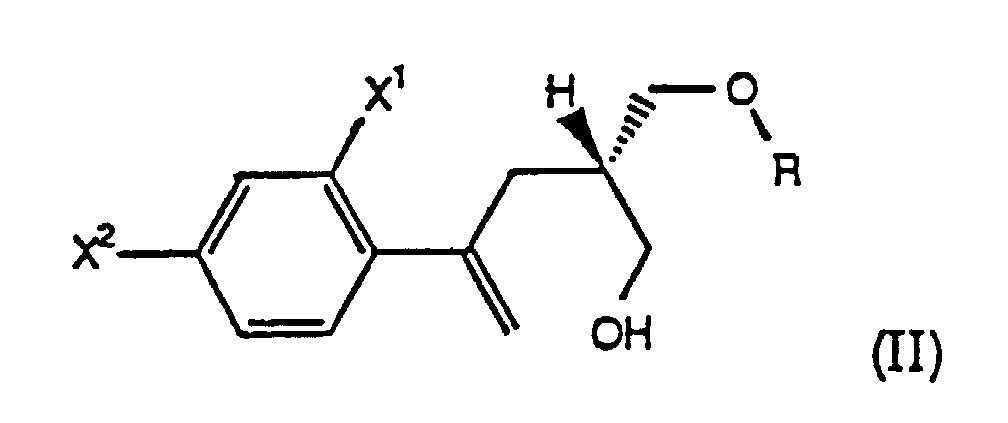
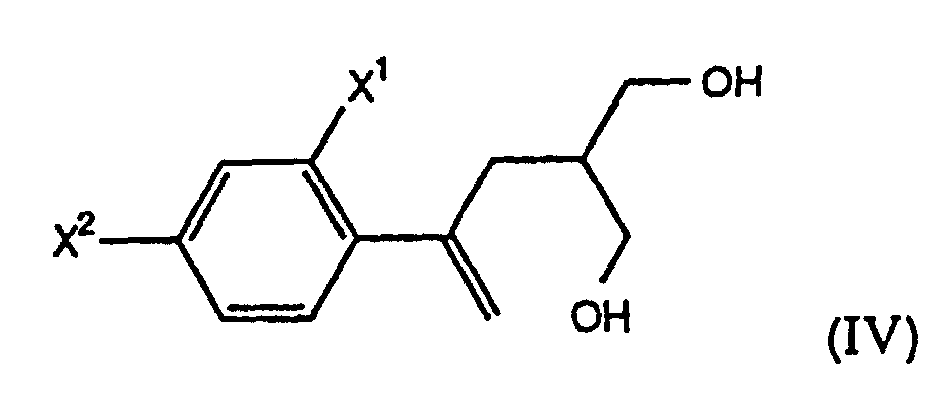
- the present invention further comprises a process, designated Process A, wherein R is -O(O)R 1 , and the starting compound of formula (II) of Step (a) is prepared by selectively esterifying a prochiral diol of the formula (IV) with an effective amount of a mild acylating agent in the presence of an enzyme to form a chiral hydroxy ester of the formula (IIa) wherein X 1 , X 2 are as defined above and R 1 is C 1 -C 6 alkyl, aryl or -(CH 2 ) n CO 2 H wherein n is 1, 2, 3 or 4.
- the present invention also further comprises a process according to Process A wherein the prochiral diol of formula (IV) is prepared via a process comprising the steps:
- the present invention comprises a process for preparing chiral compounds of formula (II), wherein R is -CH 2 -C 6 H 5 , for use in preparing compounds of the formula (I), comprising the steps:
- the present invention further comprises a process according to Process B wherein the starting compound of formula (IX) is prepared by a process comprising the steps:
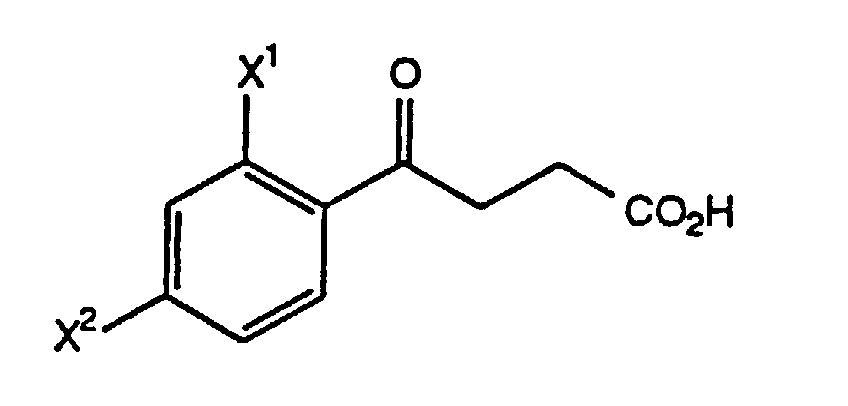
- the acid (XI) of step (B3) is prepared by reacting 1-(X 1 )-3-(X 2 )-benzene, wherein X 1 and X 2 are as defined above, with succinic anhydride in the presence of a Lewis acid to form a keto acid of the formula which is treated with CH 3 •P(C 6 H 5 ) 3 •Br and a nonaqueous base to form the acid (XI) for use in step (B4).
- the present invention comprises a process for preparing compounds of the formula (I) wherein the chiral halide of formula (III) of Step (a), wherein R is H, is prepared by a process comprising the steps:
- the process of the present invention can also be used to prepare compounds of the formula (XIV) wherein a, X 1 , X 2 and E are as defined above, i.e., enantiomers of compounds of the formula (I), by utilizing a chiral auxilary of the opposite configuration, or by the choice of an enzyme which selectively produces the R-enantiomer of a compound of the formula (II), e.g. a compound of the formula (XV) wherein X 1 , X 2 and R are as defined above.
- the present invention further comprises a process for converting compounds of the formula (XV) to compounds of the formula (II) by protection of the free hydroxy group using a suitable protecting group R a , and selective hydrolysis of the -OR group to form a compound of the formula (XVI) wherein X 1 and X 2 are as defined above and R a is a hydroxy protecting group.
- R a is -CH 2 C 6 H 5 , or -O(O)R 1 , wherein R 1 is as defined above, provided that R ⁇ R a , in which case compounds of formula (XVI) are compounds of the formula (II).
- the process of the present invention further comprises a process designated Process D for preparing a compound of the formula (I) wherein the chiral halide of Step (a), being a compound of the formula (III) wherein R is -C(O)R 1 , and R 1 is C 1 -C 6 alkyl, is prepared by a process comprising the steps:
- the present invention also further comprises chiral compounds of the formula (XVII) or (XVIII) wherein:
- the process of the present invention is chemically efficient and produces chiral compounds of the formula I in high optical purity. Therefore, the instantly claimed process does not suffer the shortcomings of the prior art process.
- the process of the present invention can also be used to prepare compounds of the formula I in racemic form by utilizing the achiral diol IV in place of a chiral compound of the formula II for the cyclization of Step (a) forming a racemic iodide of formula III wherein R is H. No deprotection is necessary in Step (b) where an iodide III, wherein R is H, is used.
- the process of the present invention utilizes a chiral auxilary group, or alternatively an enzyme, to stereoselectively produce chiral compounds from achiral starting materials.
- the stereochemical designations represented by and bonds denote both absolute stereochemistry and, where more than one chiral center is present, relative stereochemistry.
- the optical purity of compounds is generally given in terms of the enantiomeric excess (e.e.) of the indicated stereoisomer.
- the opposite enantiomer can be prepared by utilizing the opposite enantiomer of the chiral auxiliary employed.
- an enzyme is used to prepare a chiral compound from a prochiral starting material, the specific enantiomer obtained is controlled by selection of the proper enzyme.
- Enzymes for use in the present invention are selected from enzymes capable of stereoselectively hydrolyzing a symmetrical prochiral diester, or alternatively catalyzing the esterification of a symmetrical prochiral diol, such that a single chiral hydroxy ester is formed in high e.e.
- Enzymes for use in the process of the present invention include the commercially available enzyme preparations identified in Table 1 of Example 4 below.
- the preferred enzymes are porcine pancreatic lipase, Amano CE (Humicloa lanugiosa), Amano AY-30, Biocatalysts H. lanugiosa, Biocatalysts M. meihei, Biocatalysts Ps.
- the chiral auxilary "Q*" is a chiral oxazolidinone of the formula wherein R 5 is isopropyl or benzyl, as disclosed by Evans et al, in J. Amer. Chem. Soc. , 103 , 2127-2129 (1981) and Tetrahedron , 44 , 5525-5540 (1988); or a chiral sultam of the formula as disclosed by Oppolzer et al, J. Amer. Chem. Soc., 112 , 2767-2772 (1990).
- methanol MeOH
- tetrahydrofuran THF
- diethyl ether Et 2 O
- lithium di-isopropylamide LDA
- triethylamine Et 3 N
- di-isopropylethylamine Hünigs base
- ethyl acetate EtOAc
- ethanol EtOH
- N,N-dimethylformamide DMF
- N,N'-dimethylpropyleneurea DMPU
- DMAP 4-dimethylaminopyridine
- DMAP p-toluenesulfonyl chloride
- methanesulfonyl chloride meyl chloride or MsCl
- p-toluenesulfonic acid p-TSA
- Ts p-toluenesulfonyl radical
- Ac acetyl radical
- the present invention comprises a process for preparing a compound of the formula I as shown in Reaction Scheme 1.
- Step (a) the compound II is reacted with a halogen, such as Cl 2 , Br 2 or I 2 , preferably Br 2 or I 2 , in the presence of a base, such as pryidine or NaHCO 3 , in a suitable solvent, such as CH 3 CN, THF, EtOAc or CH 2 Cl 2 , at -20° to 30°C, preferably about 0° to 25°C, to form the halide III, wherein X 3 is Cl, Br or I.
- a halogen such as Cl 2 , Br 2 or I 2 , preferably Br 2 or I 2
- a base such as pryidine or NaHCO 3
- a suitable solvent such as CH 3 CN, THF, EtOAc or CH 2 Cl 2
- Step (b) the halide III is:
- the present invention further comprises a process wherein the chiral compound of formula (II) is a chiral hydroxy ester of the formula (IIa), i.e., a compound of the formula (II) wherein R is -C(O)R 1 and R 1 is as defined above.
- the chiral hydroxy ester of formula (IIa) is prepared from a prochiral diol of the formula (IV) by using an enzyme to selectively esterify the prochiral diol (IV), thus forming the chiral compound of formula (IIa).
- the selective esterification is accomplished according to the process shown in Reaction Scheme A.
- the prochiral diol IV is treated with a mild acylating agent, preferably an ester of the formula R 1 -C(O)-OR 3 , wherein R 1 is as defined above and R 3 is trifluoroethyl, C 1 -C 6 alkyl or C 2 -C 6 alkenyl, most preferably vinyl acetate, in the presence of an enzyme, most preferably Novo SP435, in a suitable solvent, such as toluene or CH 3 CN, at 0° to 35°C, preferably about 25°C, to form the chiral hydroxy ester of the formula IIa.
- a mild acylating agent preferably an ester of the formula R 1 -C(O)-OR 3 , wherein R 1 is as defined above and R 3 is trifluoroethyl, C 1 -C 6 alkyl or C 2 -C 6 alkenyl, most preferably vinyl acetate, in the presence of an enzyme, most preferably Novo SP435, in
- the R-enantiomer i.e., a compound of the formula XV, as defined above, can be prepared.
- the chiral hydroxy ester IIa is alternatively prepared by the process of Reaction Scheme AA.
- Step (b) the diester V is treated with an enzyme, preferably a lipase, most preferably Amano CE, in a suitable solvent, such as THF/water, at 15° to 35°C, preferably about 25°C, to form the chiral hydroxy ester IIa.
- an enzyme preferably a lipase, most preferably Amano CE
- a suitable solvent such as THF/water
- the present invention further comprises a process according to Process A wherein the prochiral diol IV is prepared by the process described in Reaction Scheme AAA.
- Step (A1) the allylic alcohol VI is treated with a sulfonylating agent, such as mesyl chloride or tosyl chloride, a tertiary amine base, such as Et 3 N, and DMAP, in a suitable solvent, such as CH 2 Cl 2 , at -10° to 35°C, preferably 0° to 25°C, to form the sulfonylated product, i.e., a compound of the formula VII wherein L 1 is -OSO 2 R 6 and R 6 is as defined above.
- a sulfonylating agent such as mesyl chloride or tosyl chloride
- a tertiary amine base such as Et 3 N
- DMAP a suitable solvent
- Step (A2) the compound of formula VII is treated with an alkali metal salt of the anion derived from di(C 1 -C 6 alkyl)malonate, preferably NaCH(CO 2 C 2 H 5 ) 2 , in a suitable solvent, such as THF, at 15° to 35°C, preferably about 25°C, for 1 to 3 h, preferably about 1.5 h, to form the diester VIII.
- a suitable solvent such as THF
- Step (A3) the diester VIII is treated with a hydride reducing agent, preferably LiAlH 4 , in a suitable solvent, such as THF or Et 2 O, at 0° to 35°C, preferably about 25°C, for 1 to 4 h, preferably about 2 h, to form the prochiral diol IV.
- a hydride reducing agent preferably LiAlH 4
- a suitable solvent such as THF or Et 2 O
- the diester VIII is treated with NaBH 4 , in the presence of LiCl, in a suitable solvent, such as EtOH, at 0° to 35°C, preferably 0° to 25°C, for 1 to 4 h, preferably about 11 ⁇ 2 h, to form the prochiral diol IV.
- a suitable solvent such as EtOH
- the present invention comprises a process wherein the chiral compound of formula (II) is a chiral benzyl ether of the formula (IIb), i.e., a compound of the formula (II) wherein R is -CH 2 C 6 H 5 .
- the chiral benzyl ether of formula (IIb) is prepared by the process shown in Reaction Scheme B.
- Step (B1) a compound of the formula IX is treated with TiCl 4 and a compound of the formula C 6 H 5 CH 2 OCH 2 L, wherein L is a leaving group, preferably a halide, in the presence of a tertiary amine base, such as Et 3 N, at -10° to 10°C, preferably about 0°C, to form a chiral compound of the formula X.
- L is a leaving group, preferably a halide
- Step (B2) the chiral compound of formula X is treated with LiAIH 4 in a suitable solvent, such as THF or Et 2 O, at 0° to 35°C, preferably about 25°C, to form the chiral benzyl ether IIb.
- a suitable solvent such as THF or Et 2 O
- the present invention further comprises a process according to Process B wherein the compound of the formula IX is prepared by the process described in Reaction Scheme BB.
- the allylic alcohol VI is treated with CH 3 C(OC 2 H 5 ) 3 and a catalytic amount of propionic acid at 90° to 130°C, preferably about 120°C, then treated with a hydroxide base, preferably KOH or NaOH, in a suitable solvent, such as MeOH, preferably MeOH/water, at 15° to 35°C, preferably about 25°C, to form the acid XI.
- a hydroxide base preferably KOH or NaOH
- Step (B4) the acid XI is treated with an activating agent, preferably SOCI 2 or oxalyl chloride, at 15° to 35°C, preferably about 25°C, to form a reactive derivative, such as an acid chloride.
- the reactive derivative is treated with an alkali metal salt of the formula M + - Q*, preferably the Li + salt, wherein -Q* is preferably an anion derived from a chiral oxazolidinone of the formula at -70° to 25°C, preferably -70° to 0°C, to form the compound of formula IX.
- Step (C1) the compound of the formula IX is converted to the chiral compound of the formula XII via the general procedure described by Evans et al, J. Amer. Chem. Soc., 112 , 8215-8216 (1990).
- Step (C2) the chiral compound of formula XII is treated with a halogen, preferably Br 2 or I 2 , and a base, preferably pyridine, in a suitable solvent, such as CH 3 CN, THF, EtOAc or CH 2 Cl 2 , at -20°C to 30°C, preferably about 0°C to 25°C, for 10 to 20 h, preferably about 20 h, to form the chiral halide XIII, wherein X 3 is Br or I.
- a suitable solvent such as CH 3 CN, THF, EtOAc or CH 2 Cl 2
- Step (C3) the chiral halide XIII is treated with a hydride reducing agent, such as LiBH 4 , in a suitable solvent, such as THF or Et 2 O, at -100° to 30°C, preferably starting at -78°C and continuing at 25°C, for 1 to 6 h, preferably about 3 h, to form the chiral hydride IIIa.
- a hydride reducing agent such as LiBH 4
- a suitable solvent such as THF or Et 2 O
- Step (D1) the chiral alcohol of formula II, wherein R is -CH 2 C 6 H 5 , i.e., a chiral alcohol of the formula IIb, is treated with an acylating agent, preferably acetyl chloride or acetic anhydride, in the presence of a base, such as pyridine, to form a chiral ester of the formula XIX, wherein X 1 , X 2 , R and R 1 are as defined above.
- an acylating agent preferably acetyl chloride or acetic anhydride
- Step (D2) the ester of the formula XIX is treated with a halogen, such as Cl 2 , Br 2 or I 2 , preferably Br or I 2 , in a suitable solvent, such as CH 3 CN, THF, EtOAc or CH 2 Cl 2 , at -20° to 30°C, preferably about 0° to 25°C, to form the halide IIIb, wherein X 3 is Cl, Br or I, and X 1 , X 2 and R 1 are as defined above.
- a halogen such as Cl 2 , Br 2 or I 2 , preferably Br or I 2
- a suitable solvent such as CH 3 CN, THF, EtOAc or CH 2 Cl 2
- Diesters of the formula V can also be prepared from a compound of the formula XI by esterification with an alcohol of the formula R 2 OH, wherein R 2 is as defined above, using known methods.
- the resulting ester XX is deprotonated by treating with base and the resulting anion reacted with a compound of the formula R 2 OC(O)-L, wherein L is a halide leaving group, as defined above.
- Step (b) Combine the diester product of Preparation 3, Step (b) (6.77 g, 21.7 mmol), LiCl (2.76 g, 65.1 mmol) and 100 mL of EtOH, cool to 0° to 5°C, then add NaBH 4 (2.46 g, 65.1 mmol), then slowly warm the mixture to room temperature and stir overnight. Add 100 mL of MeOH and 100 mL of water, stir for 90 min, then concentrate in vacuo to a residue. Partition the residue between 500 mL of EtOAc and 100 mL of water, wash the organic layer with 100 mL of brine, dry over MgSO 4 , and concentrate in vacuo to give 4.94 g of the diol product.
- reaction is run using a 0.9 M solution of the prochiral diol and 1.5 equivalents of vinyl acetate in CH 3 CN at 0° to 5°C.
- diol lipase time (min) % mono acetate e.e. 0.05 g 0.05 g 95 97 99 % 5.3 g 5.0 g 95 97.3 96% 1.0 g 0.1 g 930 92.8 91 % 5.0 g 5.0 g 170 97.6 97 % 7.7 g 1.0 g 170 91.3 95 %
- the reaction can also be run in water (excluding THF) by substantially the same procedure as described above.
Landscapes
- Chemical & Material Sciences (AREA)
- Organic Chemistry (AREA)
- Life Sciences & Earth Sciences (AREA)
- Engineering & Computer Science (AREA)
- Zoology (AREA)
- Wood Science & Technology (AREA)
- Biochemistry (AREA)
- General Health & Medical Sciences (AREA)
- General Chemical & Material Sciences (AREA)
- Chemical Kinetics & Catalysis (AREA)
- Biotechnology (AREA)
- Health & Medical Sciences (AREA)
- Genetics & Genomics (AREA)
- Bioinformatics & Cheminformatics (AREA)
- General Engineering & Computer Science (AREA)
- Microbiology (AREA)
- Analytical Chemistry (AREA)
- Organic Low-Molecular-Weight Compounds And Preparation Thereof (AREA)
- Pharmaceuticals Containing Other Organic And Inorganic Compounds (AREA)
- Plural Heterocyclic Compounds (AREA)
- Preparation Of Compounds By Using Micro-Organisms (AREA)
- Furan Compounds (AREA)
- Saccharide Compounds (AREA)
- Nitrogen Condensed Heterocyclic Rings (AREA)
- Steroid Compounds (AREA)
- Nitrogen And Oxygen Or Sulfur-Condensed Heterocyclic Ring Systems (AREA)
Claims (18)
- Verfahren zur Herstellung von Verbindungen der Formel (I)wobei X1 und X2 unabhängig F oder Cl sind und E -SO2R6 ist, wobei R6 C1-C6-Alkyl, Aryl, substituiertes Aryl oder -CF3 ist; umfassend die Schritte:
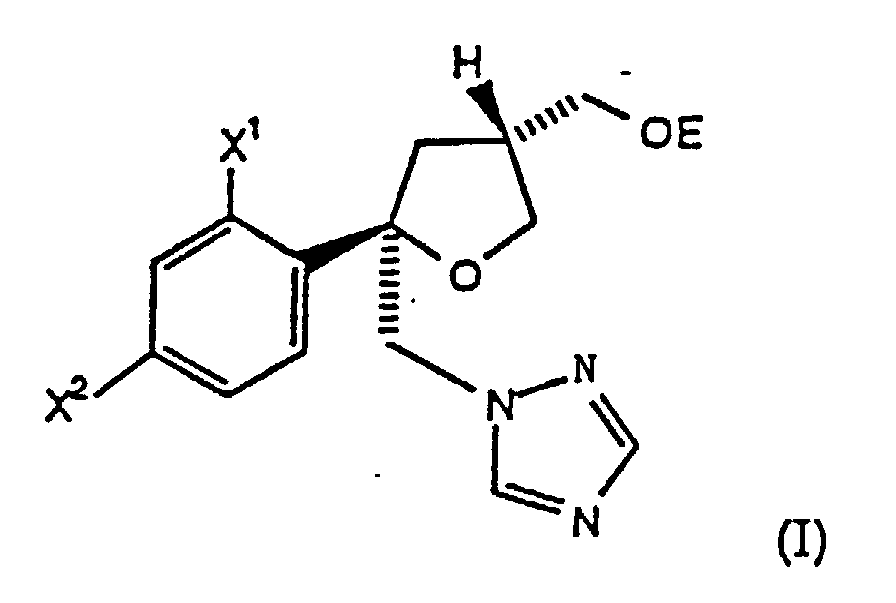 (a) Cyclisieren eines chiralen Alkohols der Formel (II)wobei X1 und X2 wie oben definiert sind und R eine Hydroxy-Schutzgruppe ist, die aus -CH2-C6H5 und -C(O)R1 ausgewählt ist, wobei R1 C1-C6-Alkyl, Aryl oder -(CH2)nCO2H ist, wobei n 1, 2, 3 oder 4 ist, durch Behandeln mit einem Halogen und einer Base unter Bildung eines chiralen Halogenids der Formel (III)
 wobei X1, X2 und R wie oben definiert sind und X3 Cl, Br oder 1 ist; und
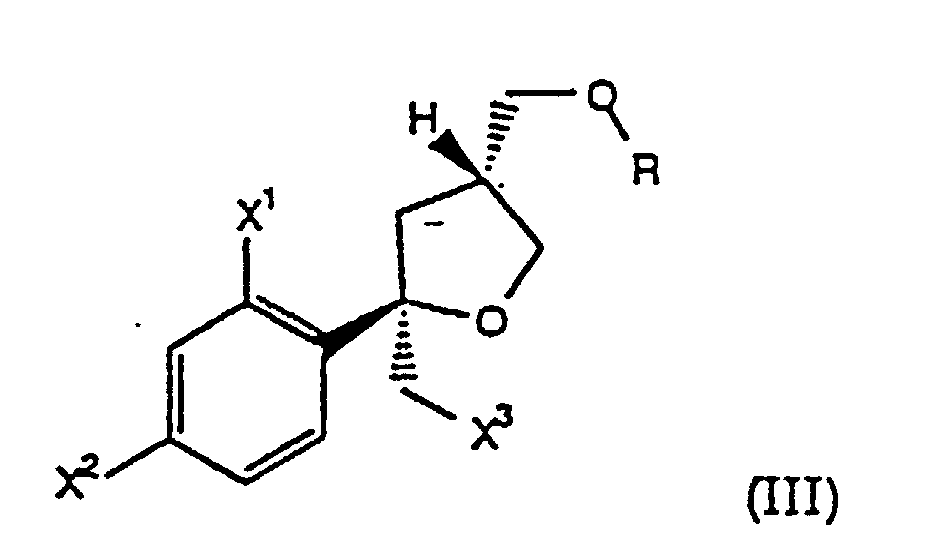 (b) Behandeln des Halogenids der Formel (III) von Schritt (a) mit einem Alkalimetalltriazol unter Bildung einer chiralen Verbindung der Formel (III), bei der X3 Triazolyl ist; Entfernen der Schutzgruppe R unter Bildung eines Alkohols der Formel (III), bei der R H ist; und Behandeln des Alkohols mit einer Verbindung der Formel E-X, wobei X Cl oder Br ist und E wie oben definiert ist, unter Bildung der Verbindung der Formel (I); oder(bi) Entfernen der Schutzgruppe R von dem Halogenid der Formel (III) von Schritt (a) unter Bildung eines Alkohols der Formel (III), bei der R H ist; Behandeln des Alkohols mit einem Alkalimetalltriazol oder -imidazol unter Bildung einer chiralen Verbindung der Formel (III), bei der X3 Triazolyl oder Imidazolyl ist und R H ist; und Behandeln des Alkohols mit einer Verbindung der Formel E-X, wobei X Cl oder Br ist und E wie oben definiert ist, unter Bildung der Verbindung der Formel (I).
 - Verfahren gemäß Anspruch 1, wobei R -C(O)R1 ist und die Ausgangsverbindung der Formel (II) von Schritt (a) hergestellt wird, indem man selektiv ein prochirales Diol der Formel (IV)mit einer effektiven Menge eines milden Acylierungsmittels in Gegenwart eines Enzyms verestert, so daß der chirale Hydroxyester der Formel (IIa)
 entsteht, wobei X1 und X2 wie oben definiert sind und R1 C1-C6-Alkyl, Aryl oder -(CH2)nCO2H ist, wobei n 1, 2, 3 oder 4 ist.
- Verfahren gemäß Anspruch 1, wobei R -C(O)R1 ist und der chirale Hydroxyester der Formel (II) von Schritt (a) nach einem Verfahren hergestellt wird, das die folgenden Schritte umfaßt:(i) Verestern des prochiralen Diols der Formel (IV) mit einer Menge eines Acylierungsmittels, die die Bildung eines Diesters der Formel (V)bewirkt, wobei X1, X2 und R wie oben definiert sind; und
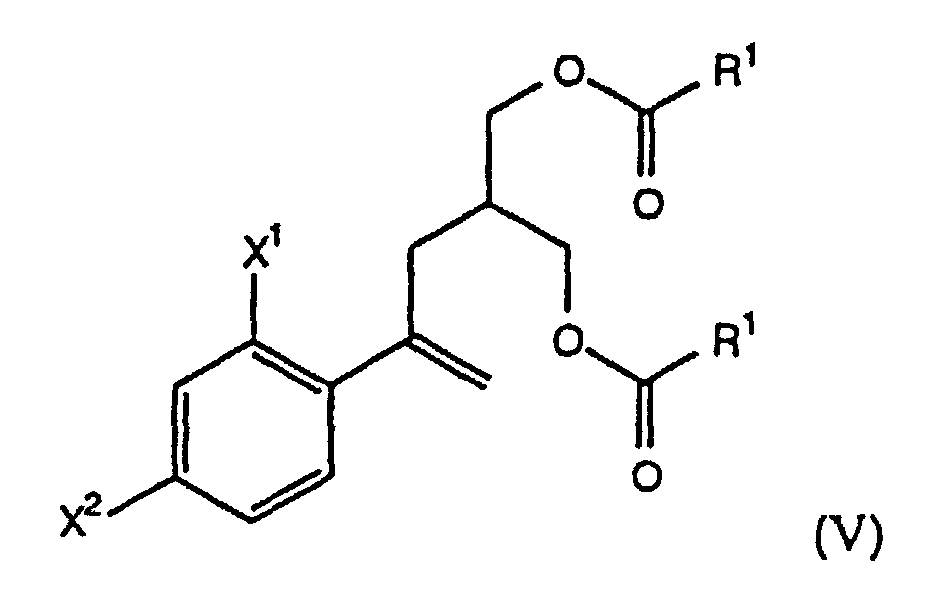 (ii) stereoselektives Hydrolysieren des Diesters der Formel (V) von Schritt (i) in Gegenwart eines Enzyms unter Bildung eines chiralen Hydroxyesters der Formel (IIa)wobei X1, X2 und R wie oben definiert sind.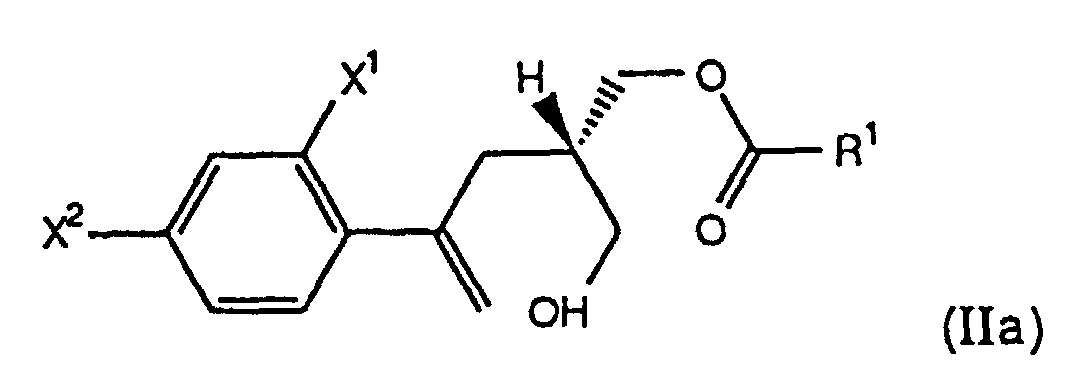
- Verfahren gemäß Anspruch 2 oder 3, wobei das prochirale Diol der Formel (IV) nach einem Verfahren hergestellt wird, das die folgenden Schritte umfaßt:(A1) Umwandeln eines Allylalkohols der Formel (VI)wobei X1 und X2 wie oben definiert sind, in eine Verbindung der Formel (VII)
 wobei X1 und X2 wie oben definiert sind und L1 eine Abgangsgruppe ist, die aus Halogen, -OSO2CF3 und -OSO2R6 ausgewählt ist, wobei R6 wie oben definiert ist;
 (A2) Umsetzen des Produkts von Schritt (Al) mit einer Menge eines Alkalimetallsalzes des von einem Di(C1-C6-alkyl)malonats abgeleiteten Anions, die die Bildung eines Diesters der Formel (VIII)bewirkt, wobei X1 und X2 wie oben definiert sind und R2 C1-C6-Alkyl ist;
 (A3) Behandeln des Diesters der Formel (VIII) von Schritt (A2) mit einer Menge eines Hydrid-Reduktionsmittels, die die Bildung des prochiralen Diols der Formel (IV) bewirkt.
 - Verfahren gemäß Anspruch 1, wobei der chirale Alkohol der Formel (II) von Schritt (a), bei der R -CH2-C6H5 ist, nach einem Verfahren hergestellt wird, das die folgenden Schritte umfaßt:(B1) Umsetzen einer Verbindung der Formel (IX)wobei X1 und X2 wie oben definiert sind und Q* eine chirale Hilfsgruppe ist, die aus chiralen Oxazolidinonen der Formel
 wobei R5 Isopropyl oder Benzyl ist, und chiralen Sultamen der Formel
 ausgewählt ist, mit einer Verbindung der Formel C6H5CH2-O-CH2L, wobei L eine Abgangsgruppe ist, die aus Cl, Br und I ausgewählt ist, in Gegenwart von TiCl4 und einer Base in Form eines tertiären Amins in Mengen, die die Bildung einer chiralen Verbindung der Formel (X)
 bewirken, wobei X1, X2 und Q* wie oben definiert sind; und
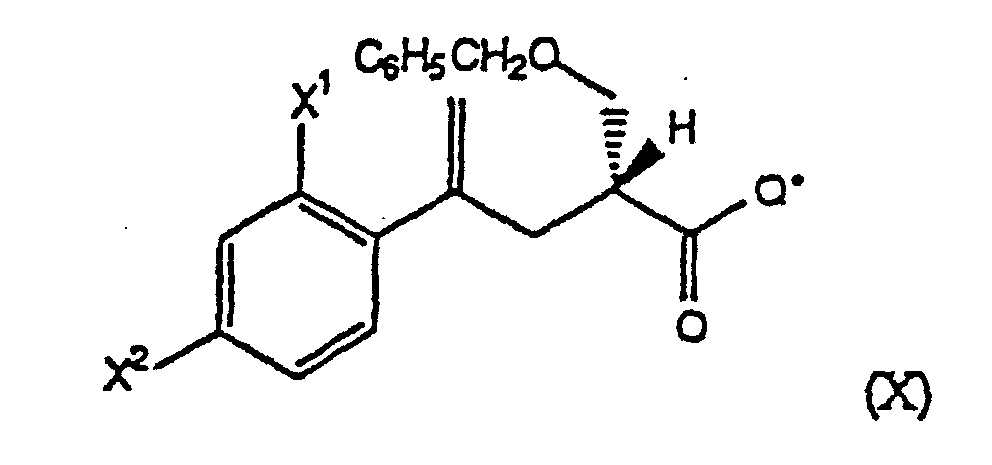 (B2) Behandeln des Produkts der Formel (X) von Schritt (B1) mit einer Menge LiAlH4, die die Bildung einer chiralen Verbindung der Formel (II) bewirkt, wobei R -CH2C6H5 ist.
 - Verfahren gemäß Anspruch 1, wobei das chirale Halogenid der Formel (III) von Schritt (a), bei der R H ist, nach einem Verfahren hergestellt wird, das die folgenden Schritte umfaßt:(C1) Behandeln einer Verbindung der Formel (IX)wobei X1 und X2 wie oben definiert sind und Q* eine chirale Hilfsgruppe ist, wie sie in Anspruch 5 definiert ist, mit effektiven Mengen Trioxan, TiCl4 und einer Base in Form eines tertiären Amins unter Bildung einer chiralen Verbindung der Formel (XII)
 wobei X1, X2 und Q* wie oben definiert sind;
 (C2) Cyclisieren einer Verbindung der Formel (XII) von Schritt (C1) durch Behandeln mit effektiven Mengen eines Halogens und einer Base unter Bildung eines chiralen Halogenids der Formel (XIII)wobei X3 Cl, Br oder I ist und X1, X2 und Q* wie oben definiert sind;
 (C3) Behandeln des chiralen Halogenids der Formel (XIII) von Schritt (C3) mit einer Menge eines Hydrid-Reduktionsmittels, die die Bildung eines chiralen Halogenids der Formel (III) bewirkt, bei der R H ist.
 - Verfahren gemäß Anspruch 5 oder 6, wobei die Ausgangsverbindung der Formel (IX)nach einem Verfahren hergestellt wird, das die folgenden Schritte umfaßt:
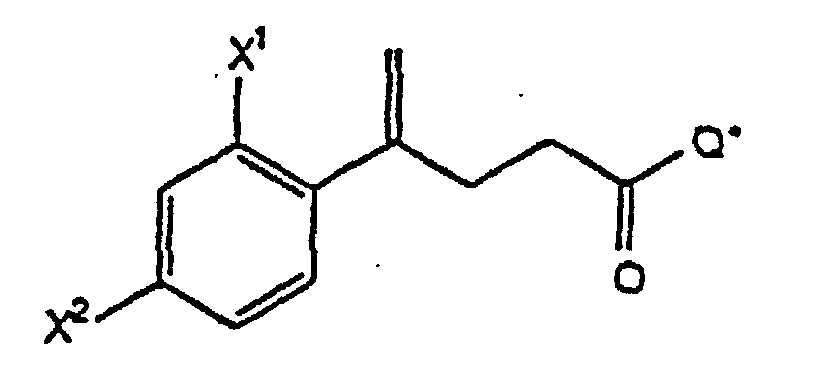
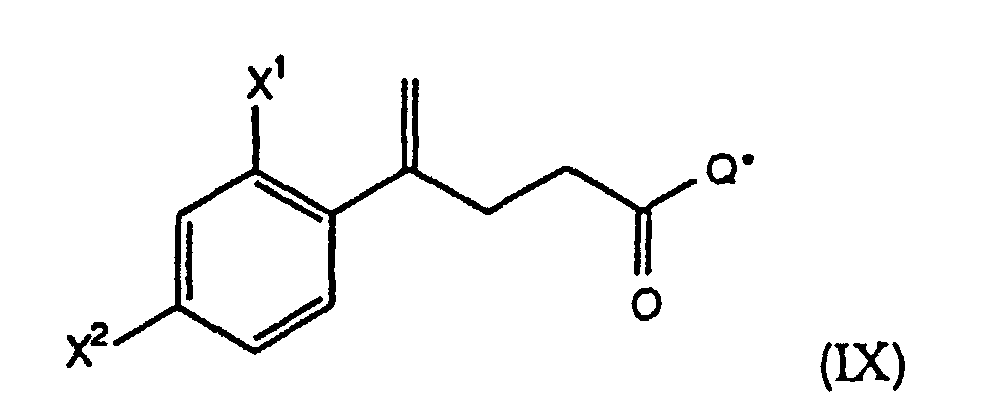 (B3) Erhitzen eines Allylalkohols der Formel (VI)wobei X1 und X2 wie oben definiert sind, mit effektiven Mengen eines Orthoesters der Formel CH3C(OR2)3, wobei R2 C1-C6-Alkyl ist, und einer katalytischen Menge R2CO2H, wobei R2 wie oben definiert ist, mit anschließender Behandlung mit einer Menge einer Hydroxidbase, die die Bildung einer Säure der Formel (XI)
 bewirkt, wobei X1 und X2 wie oben definiert sind; und
 (B4) Behandeln der Säure der Formel (XI) von Schritt (B3) mit einer effektiven Menge eines Aktivierungsmittels, dann mit einem Alkalimetallsalz der Formel M+ -Q*, wobei M+ ein Alkalimetall-Kation ist und Q* das von einer Verbindung der Formel HQ* abgeleitete Anion ist, wobei Q* wie oben definiert ist, unter Bildung einer Verbindung der Formel (IX).
 - Verfahren gemäß Anspruch 7, wobei die Säure (XI) von Schritt (B3) hergestellt wird, indem man 1-(X1)-3-(X2)-benzol, wobei X1 und X2 wie oben definiert sind, in Gegenwart einer Lewis-Säure mit Bernsteinsäureanhydrid umsetzt, so daß eine Ketosäure der Formelentsteht, und Behandeln der Ketosäure mit CH3·P(C6H5)3·Br und einer nichtwäßrigen Base unter Bildung der Säure (XI).
- Verfahren gemäß Anspruch 1, wobei das chirale Iodid der Formel (III) von Schritt (a), wobei R -C(O)R1 ist und R1 C1-C6-Alkyl ist, nach einem Verfahren hergestellt wird, das die folgenden Schritte umfaßt:(D1) Verestern eines chiralen Alkohols der Formel (II)wobei X1 und X2 wie oben definiert sind und R -CH2-C6H5 ist, durch Behandeln mit einer effektiven Menge eines Acylierungsmittels unter Bildung einer chiralen Verbindung der Formel (XIX)
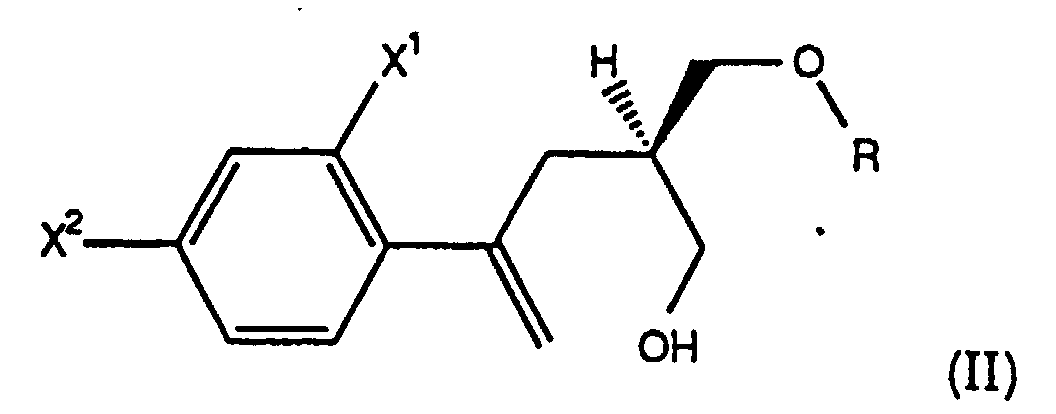 wobei X1 und X2 wie oben definiert sind, R -CH2-C6H5 ist und R1 C1-C6-Alkyl ist; und
 (D2) Cyclisieren des chiralen Produkts der Formel (XIX) von Schritt (D1) durch Behandeln mit einem Halogen unter Bildung eines chiralen Halogenids der Formel (III)wobei X1 und X2 wie oben definiert sind, R -C(O)R1 ist, R1 C1-C6-Alkyl ist und X3 Cl, Br oder I ist.
- Verfahren gemäß Anspruch 1, wobei:(a) in Schritt (a): das Halogen Br2 oder I2 ist, die Base Pyridin oder NaHCO3 ist und die Cyclisierung in Gegenwart eines Lösungsmittels durchgeführt wird, das aus CH3CN, Tetrahydrofuran, Ethylacetat und CH2Cl2 ausgewählt ist; und(b) in Schritt (b):(1) das Alkalimetalltriazol Natriumtriazol ist und die Triazolbehandlung in Gegenwart von DMPU und N,N-Dimethylformamid bei 70 bis 100°C durchgeführt wird; und(2) die Schutzgruppe R von der Triazolverbindung entfernt wird:so daß der Alkohol entsteht, bei dem R H ist und X3 Triazolyl ist; oder(i) wenn R -C(O)R1 ist und R1 C1-C6-Alkyl, Aryl oder -(CH2)nCO2H ist, wobei n 1, 2, 3 oder 4 ist, durch Behandeln mit einer Base, die aus K2CO3, Na2CO3 und NH4OH ausgewählt ist, in Gegenwart von Methanol und Wasser bei 0 bis 25 °C; oder(ii) wenn R -CH2C6H5 ist, durch Hydrieren in Gegenwart eines Katalysators in Form von Pd auf Kohle, einer Säure und von Ethanol;(b1) in Schritt (bi):(1) die Schutzgruppe R entfernt wird:(i) wenn R -C(O)R1 ist und R1 C1-C6-Alkyl, Aryl oder -(CH2)nCO2H ist, wobei n 1, 2, 3 oder 4 ist, durch Behandeln mit einer Base, die aus K2CO3, Na2CO3 und NH4OH ausgewählt ist, in Gegenwart von Methanol und Wasser bei 0 bis 25°C; oder(ii) wenn R -CH2C6H5 ist, durch Hydrieren in Gegenwart eines Katalysators in Form von Pd auf Kohle, einer Säure und von Ethanol; und(2) das Alkalimetalltriazol Natriumtriazol ist und die Triazolbehandlung in Gegenwart von DMPU und N,N-Dimethylformamid bei 70 bis 100°C durchgeführt wird;
so daß der Alkohol entsteht, bei dem R H ist und X3 Triazolyl ist; und(3) die Behandlung mit E-X in Gegenwart von Pyridin durchgeführt wird und X Cl ist. - Verfahren gemäß Anspruch 2, wobei das milde Acylierungsmittel aus Vinylacetat, Isopropenylacetat, Methylacetat und Ethylacetat ausgewählt ist und das Enzym aus Amano CE (Humicloa lanugiosa), Amano AY-30, H. lanugiosa von Biocatalysts, M. meihei von Biocatalysts, Ps. fluorescens von Biocatalysts, Meito MY, Meito PL, IM-20 von Novo Lipozyme und Novo SP435 (Candida antarctica) ausgewählt ist.
- Verfahren gemäß Anspruch 3, wobei das Acylierungsmittel aus Buttersäureanhydrid, Essigsäureanhydrid oder Acetylchlorid ausgewählt ist und das Enzym aus Amano CE (Humicloa lanugiosa), Amano AY-30, H. lanugiosa von Biocatalysts, M. meihei von Biocatalysts, Ps. fluorescens von Biocatalysts, Meito MY, Meito PL, IM-20 von Novo Lipozyme und Novo SP435 (Candida antarctica) ausgewählt ist.
- Verfahren gemäß Anspruch 4, wobei:in Schritt (A1) das Umwandeln durch Behandeln mit einem Bromierungsmittel oder einem Sulfonierungsmittel erfolgt;in Schritt (A2) das Alkalimetallsalz ein Natriumsalz ist und das Dialkylmalonat Diethylmalonat ist; undin Schritt (A3) das Hydrid-Reduktionsmittel LiAlH4 oder LiBH4 ist.
- Verfahren gemäß Anspruch 5, wobei in Schritt (B1) L Cl ist, die Base in Form eines tertiären Amins Triethylamin ist und die chirale Hilfsgruppe Q* ein Oxazolidinon der Formelist, wobei R5 Isopropyl ist.
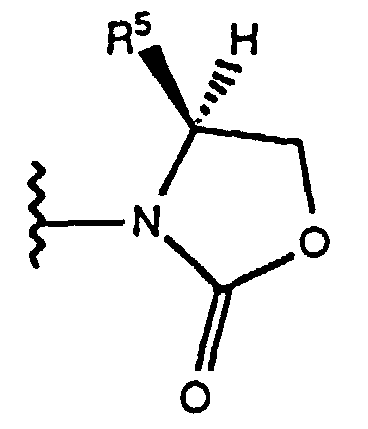
- Verfahren gemäß Anspruch 7, wobei in Schritt (B3) die Hydroxidbase KOH oder NaOH ist und in Schritt (B4) das Aktivierungsmittel Oxalylchlorid oder SOCl2 ist, M+ Li+ ist und -Q*ist, wobei R5 Isopropyl ist.
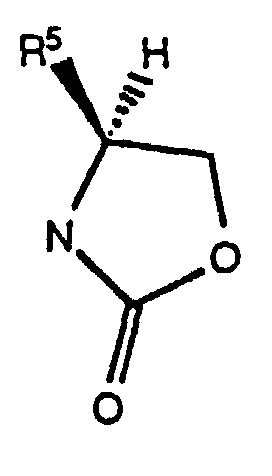
- Verfahren gemäß Anspruch 6, wobei Q* ein Oxazolidinon der Formelist, wobei R5 -CH2C6H5 ist, in Schritt (C2) das Halogen Br2 oder I2 ist und die Base Pyridin ist und in Schritt (C3) das Hydrid-Reduktionsmittel LiBH4 ist.

- Verfahren gemäß Anspruch 9, wobei in Schritt (D1) das Acetylierungsmittel Essigsäureanhydrid ist und in Schritt (D2) das Halogen I2 ist.
- Chirale Verbindung der Formel (XVII)wobei
 X1 und X2 unabhängig F oder Cl sind;A Cl, Br, I oder Triazolyl darstellt;B -C(O)Q* oder -CH2OR* darstellt;R* eine Hydroxy-Schutzgruppe darstellt, die aus -CH2C6H5 und -C(O)R1 ausgewählt ist, wobei R1 C1-C6-Alkyl, Aryl oder -(CH2)nCO2H ist, wobei n 1, 2, 3 oder 4 ist; undQ* eine chirale Hilfsgruppe darstellt, die ausausgewählt ist, wobei R5 Isopropyl oder Benzyl ist.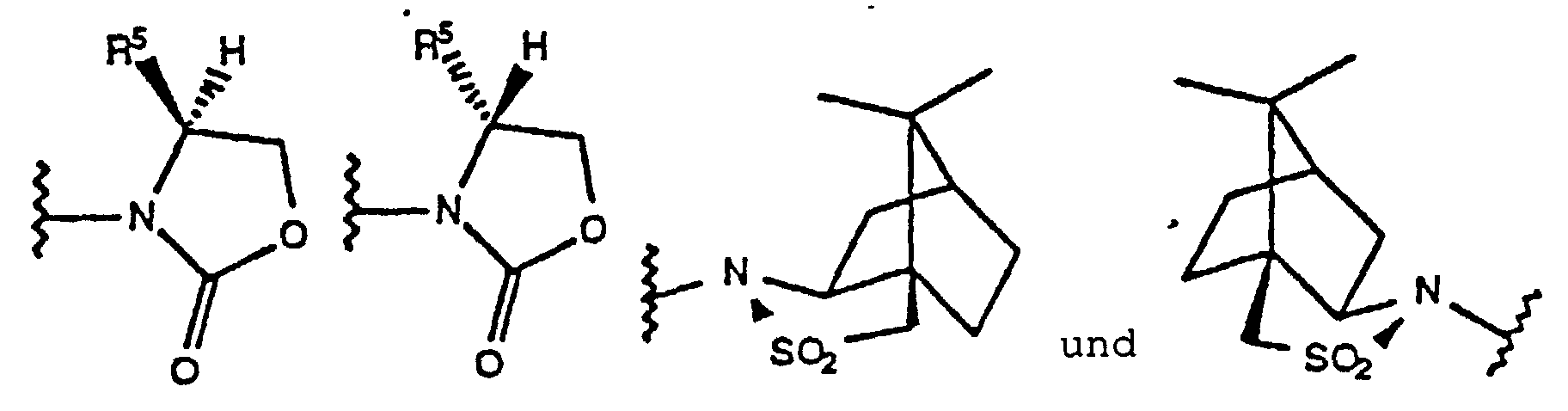
Applications Claiming Priority (3)
| Application Number | Priority Date | Filing Date | Title |
|---|---|---|---|
| US08/055,268 US5403937A (en) | 1993-04-30 | 1993-04-30 | Process for preparing intermediates for the synthesis of antifungal agents |
| US55268 | 1993-04-30 | ||
| PCT/US1994/004355 WO1994025452A1 (en) | 1993-04-30 | 1994-04-28 | Process for preparing intermediates for the synthesis of antifungal agents |
Publications (2)
| Publication Number | Publication Date |
|---|---|
| EP0696282A1 EP0696282A1 (de) | 1996-02-14 |
| EP0696282B1 true EP0696282B1 (de) | 1999-07-14 |
Family
ID=21996778
Family Applications (1)
| Application Number | Title | Priority Date | Filing Date |
|---|---|---|---|
| EP94915399A Expired - Lifetime EP0696282B1 (de) | 1993-04-30 | 1994-04-28 | Verfahren zur herstellung von zwischenprodukten zur synthese von antimykotika |
Country Status (24)
| Country | Link |
|---|---|
| US (1) | US5403937A (de) |
| EP (1) | EP0696282B1 (de) |
| JP (1) | JP3411283B2 (de) |
| KR (1) | KR100313650B1 (de) |
| CN (1) | CN1057089C (de) |
| AT (1) | ATE182146T1 (de) |
| AU (1) | AU681659B2 (de) |
| CA (1) | CA2161662C (de) |
| CZ (1) | CZ284395A3 (de) |
| DE (1) | DE69419505T2 (de) |
| DK (1) | DK0696282T3 (de) |
| ES (1) | ES2133559T3 (de) |
| FI (1) | FI955119A0 (de) |
| GR (1) | GR3030881T3 (de) |
| HU (1) | HU219143B (de) |
| IL (1) | IL109465A (de) |
| NO (1) | NO308606B1 (de) |
| NZ (1) | NZ266074A (de) |
| PH (1) | PH31511A (de) |
| PL (1) | PL182328B1 (de) |
| SG (1) | SG42883A1 (de) |
| SK (1) | SK281091B6 (de) |
| TW (1) | TW284763B (de) |
| WO (1) | WO1994025452A1 (de) |
Families Citing this family (24)
| Publication number | Priority date | Publication date | Assignee | Title |
|---|---|---|---|---|
| US5703236A (en) * | 1993-12-21 | 1997-12-30 | Schering Corporation | Tetrahydrofuran antifungals |
| US5486625A (en) * | 1994-07-08 | 1996-01-23 | Schering Corporation | Process for the preparation of chiral intermediates useful for the synthesis of antifungal agents |
| ES2112151B1 (es) * | 1995-03-17 | 1999-09-16 | Menarini Lab | Nuevos compuestos homoquirales para la preparacion de ketoconazol, terconazol y antifungicos relacionados, procedimiento para su fabricacion y utilizacion de los mismos. |
| US5616777A (en) * | 1995-04-19 | 1997-04-01 | Schering Corporation | Chiral hydrazine derivatives |
| US5625064A (en) * | 1995-04-19 | 1997-04-29 | Schering Corporation | Process for the preparation of triazolones |
| BR9612082A (pt) * | 1995-12-20 | 1999-05-11 | Schering Corp | Processo para preparar intermediários para a síntese de agentes antifúngicos |
| US5756830A (en) * | 1995-12-20 | 1998-05-26 | Schering Corporation | Process for preparing intermediates for the synthesis of antifungal agents |
| KR100326276B1 (ko) * | 1999-12-14 | 2002-03-08 | 정명식 | 테트라하이드로푸란 유도체, 이의 제조방법 및 이를포함하는 항진균제 |
| EP2571847B1 (de) | 2010-05-19 | 2016-09-21 | Sandoz AG | Verfahren zur herstellung chiraler hydrazide |
| AU2011254657B2 (en) * | 2010-05-19 | 2016-02-04 | Sandoz Ag | Preparation of posaconazole intermediates |
| CN102906087B (zh) | 2010-05-19 | 2016-03-23 | 桑多斯股份公司 | 制备手性三唑酮的方法 |
| JP5955837B2 (ja) * | 2010-05-19 | 2016-07-20 | サンド・アクチエンゲゼルシヤフト | ポサコナゾール及びポサコナゾール中間体の精製 |
| CA2838051C (en) | 2011-06-16 | 2019-09-24 | Sandoz Ag | Process for the preparation of a chiral compound |
| EP2758385B1 (de) * | 2011-09-19 | 2018-03-28 | MSN Laboratories Limited | Verfahren zur herstellung von antimykotischen triazolverbindungen , zwischenprodukten davon und polymorphen davon |
| CN102643194B (zh) * | 2012-03-27 | 2014-03-12 | 福州大学 | 一种泊沙康唑中间体的制备方法 |
| EP2789610A1 (de) | 2013-04-10 | 2014-10-15 | Sandoz Ag | Reinigung von Posaconazol-Zwischenprodukten |
| CN104119302B (zh) * | 2013-07-03 | 2017-01-18 | 郑州裕昌有机硅化工有限公司 | 手性四氢呋喃类化合物及其制备方法和脱水产物 |
| IN2013CH04757A (de) * | 2013-10-22 | 2015-04-24 | Msn Lab Private Ltd | |
| CN105503765B (zh) * | 2014-09-26 | 2019-03-12 | 浙江奥翔药业股份有限公司 | 泊沙康唑、组合物、中间体及其制备方法和用途 |
| EP3227277B1 (de) * | 2014-12-05 | 2020-02-05 | Pulmocide Limited | Antimykotische verbindung |
| KR20180115329A (ko) | 2016-03-04 | 2018-10-22 | 저장 아우선 파마슈티칼 씨오., 엘티디. | 포사코나졸, 조성물, 중간체, 제조방법 및 그의 용도 |
| CN106565639B (zh) * | 2016-10-14 | 2018-09-21 | 宁波大学 | 一种四氢呋喃类化合物及其制备方法和用途 |
| CN114591272B (zh) * | 2022-03-18 | 2024-04-05 | 浙江奥翔药业股份有限公司 | 作为合成泊沙康唑的中间体化合物的制备方法及其制备的中间化合物 |
| CN116496265A (zh) * | 2023-05-09 | 2023-07-28 | 浙江海翔药业股份有限公司 | 一种泊沙康唑卤环化中间体的合成方法 |
Family Cites Families (4)
| Publication number | Priority date | Publication date | Assignee | Title |
|---|---|---|---|---|
| DE3852477T2 (de) * | 1987-11-20 | 1995-05-04 | Schering Corp | Tri- und tetrasubstituierte Oxetane und Tetrahydrofurane und deren Zwischenprodukte. |
| US5039676A (en) * | 1990-05-11 | 1991-08-13 | Schering Corporation | Tri- and tetra-substituted-oxetanes and tetrahydrofurans and intermediates thereof |
| TW211006B (de) * | 1990-08-24 | 1993-08-11 | Mochida Pharm Co Ltd | |
| IL103558A0 (en) * | 1991-10-30 | 1993-03-15 | Schering Corp | Tri-substituted tetrahydrofuran antifungals |
-
1993
- 1993-04-30 US US08/055,268 patent/US5403937A/en not_active Expired - Lifetime
-
1994
- 1994-04-28 TW TW083103830A patent/TW284763B/zh active
- 1994-04-28 IL IL109465A patent/IL109465A/en not_active IP Right Cessation
- 1994-04-28 AU AU66671/94A patent/AU681659B2/en not_active Ceased
- 1994-04-28 SG SG1996000427A patent/SG42883A1/en unknown
- 1994-04-28 PL PL94311267A patent/PL182328B1/pl unknown
- 1994-04-28 AT AT94915399T patent/ATE182146T1/de not_active IP Right Cessation
- 1994-04-28 NZ NZ266074A patent/NZ266074A/xx unknown
- 1994-04-28 JP JP52437894A patent/JP3411283B2/ja not_active Expired - Fee Related
- 1994-04-28 CA CA002161662A patent/CA2161662C/en not_active Expired - Fee Related
- 1994-04-28 SK SK1342-95A patent/SK281091B6/sk unknown
- 1994-04-28 CZ CZ952843A patent/CZ284395A3/cs unknown
- 1994-04-28 DK DK94915399T patent/DK0696282T3/da active
- 1994-04-28 ES ES94915399T patent/ES2133559T3/es not_active Expired - Lifetime
- 1994-04-28 CN CN94191958A patent/CN1057089C/zh not_active Expired - Fee Related
- 1994-04-28 WO PCT/US1994/004355 patent/WO1994025452A1/en not_active Ceased
- 1994-04-28 EP EP94915399A patent/EP0696282B1/de not_active Expired - Lifetime
- 1994-04-28 KR KR1019950704755A patent/KR100313650B1/ko not_active Expired - Fee Related
- 1994-04-28 PH PH48183A patent/PH31511A/en unknown
- 1994-04-28 HU HU9503084A patent/HU219143B/hu not_active IP Right Cessation
- 1994-04-28 DE DE69419505T patent/DE69419505T2/de not_active Expired - Lifetime
-
1995
- 1995-10-27 NO NO954314A patent/NO308606B1/no not_active IP Right Cessation
- 1995-10-27 FI FI955119A patent/FI955119A0/fi unknown
-
1999
- 1999-07-30 GR GR990401962T patent/GR3030881T3/el unknown
Also Published As
Similar Documents
| Publication | Publication Date | Title |
|---|---|---|
| EP0696282B1 (de) | Verfahren zur herstellung von zwischenprodukten zur synthese von antimykotika | |
| SK329792A3 (en) | Method of production of optic pure esters of (+)-r-2- phenoxypropione acids | |
| US5260472A (en) | Efficient chemoenzymatic synthesis of D-myo-inositol 1,4,5-triphosphate, D-myo-inositol 1,3,4-triphosphate, and D-myo-inositol 1,3,4,5-tetraphosphate | |
| JP3772095B2 (ja) | ピラノン | |
| US5914263A (en) | Enzymatic process for the stereoselective preparation of a hetero-bicyclic alcohol enantiomer | |
| EP0770075B1 (de) | Verfahren zur herstellung von chiralen zwischenprodukten für die synthese von antifungalen mitteln | |
| US4745066A (en) | Method for producing optically active glycol derivatives | |
| HK1008822B (en) | Process for preparing intermediates for the synthesis of antifungal agents | |
| EP0328125A2 (de) | Verfahren zur enzymatischen Abtrennung von optischen Isomeren racemischer alpha-alkylsubstituierter primärer Alkohole | |
| SK284149B6 (sk) | Spôsob prípravy kryštalického chirálneho hydroxyesteru na syntézu činidiel pôsobiacich proti hubám | |
| US5840553A (en) | Process for preparing 1,2-propanediol derivative compounds | |
| EP1086942B1 (de) | Optisch-aktive Alkohole und Verfahren zu derer Herstellung | |
| US5731464A (en) | Process for preparation of indenol | |
| JPWO1995028374A1 (ja) | トリアゾール誘導体の製造法 | |
| US5702928A (en) | Process for producing optically active triazole compounds and method of racemizing optically active triazole compounds | |
| CS268542B2 (en) | Method of(+)-bicyclo(3,3,0)octanol's optically active derivatives production | |
| US6214611B1 (en) | Process for the preparation of prostaglandin precursors | |
| Izumi et al. | Enzymatic resolution of 1‐ferrocenylethanol and 1‐ferrocenyl‐2, 2, 2‐trifluoroethanol using lipases | |
| JP3024298B2 (ja) | シクロペンテンエステル類及びその利用 | |
| EP0490407A2 (de) | Verfahren zur enzymatischen Trennung von optischen Tosyloxyalkanol-Isomeren |
Legal Events
| Date | Code | Title | Description |
|---|---|---|---|
| PUAI | Public reference made under article 153(3) epc to a published international application that has entered the european phase |
Free format text: ORIGINAL CODE: 0009012 |
|
| 17P | Request for examination filed |
Effective date: 19950930 |
|
| AK | Designated contracting states |
Kind code of ref document: A1 Designated state(s): AT BE CH DE DK ES FR GB GR IE IT LI LU NL PT SE |
|
| 17Q | First examination report despatched |
Effective date: 19960422 |
|
| GRAG | Despatch of communication of intention to grant |
Free format text: ORIGINAL CODE: EPIDOS AGRA |
|
| GRAG | Despatch of communication of intention to grant |
Free format text: ORIGINAL CODE: EPIDOS AGRA |
|
| GRAG | Despatch of communication of intention to grant |
Free format text: ORIGINAL CODE: EPIDOS AGRA |
|
| GRAH | Despatch of communication of intention to grant a patent |
Free format text: ORIGINAL CODE: EPIDOS IGRA |
|
| GRAH | Despatch of communication of intention to grant a patent |
Free format text: ORIGINAL CODE: EPIDOS IGRA |
|
| GRAA | (expected) grant |
Free format text: ORIGINAL CODE: 0009210 |
|
| AK | Designated contracting states |
Kind code of ref document: B1 Designated state(s): AT BE CH DE DK ES FR GB GR IE IT LI LU NL PT SE |
|
| REF | Corresponds to: |
Ref document number: 182146 Country of ref document: AT Date of ref document: 19990715 Kind code of ref document: T |
|
| REG | Reference to a national code |
Ref country code: CH Ref legal event code: EP |
|
| REG | Reference to a national code |
Ref country code: CH Ref legal event code: NV Representative=s name: HUG INTERLIZENZ AG |
|
| REF | Corresponds to: |
Ref document number: 69419505 Country of ref document: DE Date of ref document: 19990819 |
|
| REG | Reference to a national code |
Ref country code: ES Ref legal event code: FG2A Ref document number: 2133559 Country of ref document: ES Kind code of ref document: T3 |
|
| REG | Reference to a national code |
Ref country code: IE Ref legal event code: FG4D |
|
| ITF | It: translation for a ep patent filed | ||
| ET | Fr: translation filed | ||
| REG | Reference to a national code |
Ref country code: PT Ref legal event code: SC4A Free format text: AVAILABILITY OF NATIONAL TRANSLATION Effective date: 19990831 |
|
| REG | Reference to a national code |
Ref country code: DK Ref legal event code: T3 |
|
| PLBE | No opposition filed within time limit |
Free format text: ORIGINAL CODE: 0009261 |
|
| STAA | Information on the status of an ep patent application or granted ep patent |
Free format text: STATUS: NO OPPOSITION FILED WITHIN TIME LIMIT |
|
| 26N | No opposition filed | ||
| PGFP | Annual fee paid to national office [announced via postgrant information from national office to epo] |
Ref country code: DK Payment date: 20010314 Year of fee payment: 8 Ref country code: AT Payment date: 20010314 Year of fee payment: 8 |
|
| PGFP | Annual fee paid to national office [announced via postgrant information from national office to epo] |
Ref country code: NL Payment date: 20010319 Year of fee payment: 8 |
|
| PGFP | Annual fee paid to national office [announced via postgrant information from national office to epo] |
Ref country code: LU Payment date: 20010327 Year of fee payment: 8 |
|
| PGFP | Annual fee paid to national office [announced via postgrant information from national office to epo] |
Ref country code: PT Payment date: 20010330 Year of fee payment: 8 |
|
| PGFP | Annual fee paid to national office [announced via postgrant information from national office to epo] |
Ref country code: SE Payment date: 20010405 Year of fee payment: 8 |
|
| PGFP | Annual fee paid to national office [announced via postgrant information from national office to epo] |
Ref country code: IE Payment date: 20010420 Year of fee payment: 8 Ref country code: GR Payment date: 20010420 Year of fee payment: 8 |
|
| PGFP | Annual fee paid to national office [announced via postgrant information from national office to epo] |
Ref country code: BE Payment date: 20010516 Year of fee payment: 8 |
|
| PGFP | Annual fee paid to national office [announced via postgrant information from national office to epo] |
Ref country code: CH Payment date: 20010627 Year of fee payment: 8 |
|
| REG | Reference to a national code |
Ref country code: GB Ref legal event code: IF02 |
|
| PG25 | Lapsed in a contracting state [announced via postgrant information from national office to epo] |
Ref country code: LU Free format text: LAPSE BECAUSE OF NON-PAYMENT OF DUE FEES Effective date: 20020428 Ref country code: AT Free format text: LAPSE BECAUSE OF NON-PAYMENT OF DUE FEES Effective date: 20020428 |
|
| PG25 | Lapsed in a contracting state [announced via postgrant information from national office to epo] |
Ref country code: SE Free format text: LAPSE BECAUSE OF NON-PAYMENT OF DUE FEES Effective date: 20020429 Ref country code: IE Free format text: LAPSE BECAUSE OF NON-PAYMENT OF DUE FEES Effective date: 20020429 |
|
| PG25 | Lapsed in a contracting state [announced via postgrant information from national office to epo] |
Ref country code: LI Free format text: LAPSE BECAUSE OF NON-PAYMENT OF DUE FEES Effective date: 20020430 Ref country code: DK Free format text: LAPSE BECAUSE OF NON-PAYMENT OF DUE FEES Effective date: 20020430 Ref country code: CH Free format text: LAPSE BECAUSE OF NON-PAYMENT OF DUE FEES Effective date: 20020430 Ref country code: BE Free format text: LAPSE BECAUSE OF NON-PAYMENT OF DUE FEES Effective date: 20020430 |
|
| PG25 | Lapsed in a contracting state [announced via postgrant information from national office to epo] |
Ref country code: PT Free format text: LAPSE BECAUSE OF NON-PAYMENT OF DUE FEES Effective date: 20021031 |
|
| PG25 | Lapsed in a contracting state [announced via postgrant information from national office to epo] |
Ref country code: NL Free format text: LAPSE BECAUSE OF NON-PAYMENT OF DUE FEES Effective date: 20021101 |
|
| PG25 | Lapsed in a contracting state [announced via postgrant information from national office to epo] |
Ref country code: GR Free format text: LAPSE BECAUSE OF NON-PAYMENT OF DUE FEES Effective date: 20021105 |
|
| EUG | Se: european patent has lapsed |
Ref document number: 94915399.3 |
|
| REG | Reference to a national code |
Ref country code: CH Ref legal event code: PL |
|
| REG | Reference to a national code |
Ref country code: DK Ref legal event code: EBP |
|
| NLV4 | Nl: lapsed or anulled due to non-payment of the annual fee |
Effective date: 20021101 |
|
| REG | Reference to a national code |
Ref country code: PT Ref legal event code: MM4A Free format text: LAPSE DUE TO NON-PAYMENT OF FEES Effective date: 20021031 |
|
| REG | Reference to a national code |
Ref country code: IE Ref legal event code: MM4A |
|
| PGFP | Annual fee paid to national office [announced via postgrant information from national office to epo] |
Ref country code: GB Payment date: 20100312 Year of fee payment: 17 |
|
| PGFP | Annual fee paid to national office [announced via postgrant information from national office to epo] |
Ref country code: FR Payment date: 20100420 Year of fee payment: 17 Ref country code: ES Payment date: 20100420 Year of fee payment: 17 |
|
| PGFP | Annual fee paid to national office [announced via postgrant information from national office to epo] |
Ref country code: IT Payment date: 20100422 Year of fee payment: 17 Ref country code: DE Payment date: 20100430 Year of fee payment: 17 |
|
| REG | Reference to a national code |
Ref country code: DE Ref legal event code: R119 Ref document number: 69419505 Country of ref document: DE |
|
| REG | Reference to a national code |
Ref country code: DE Ref legal event code: R119 Ref document number: 69419505 Country of ref document: DE |
|
| GBPC | Gb: european patent ceased through non-payment of renewal fee |
Effective date: 20110428 |
|
| REG | Reference to a national code |
Ref country code: FR Ref legal event code: ST Effective date: 20111230 |
|
| PG25 | Lapsed in a contracting state [announced via postgrant information from national office to epo] |
Ref country code: FR Free format text: LAPSE BECAUSE OF NON-PAYMENT OF DUE FEES Effective date: 20110502 |
|
| PG25 | Lapsed in a contracting state [announced via postgrant information from national office to epo] |
Ref country code: IT Free format text: LAPSE BECAUSE OF NON-PAYMENT OF DUE FEES Effective date: 20110428 Ref country code: GB Free format text: LAPSE BECAUSE OF NON-PAYMENT OF DUE FEES Effective date: 20110428 |
|
| REG | Reference to a national code |
Ref country code: ES Ref legal event code: FD2A Effective date: 20120524 |
|
| PG25 | Lapsed in a contracting state [announced via postgrant information from national office to epo] |
Ref country code: ES Free format text: LAPSE BECAUSE OF NON-PAYMENT OF DUE FEES Effective date: 20110429 |
|
| PG25 | Lapsed in a contracting state [announced via postgrant information from national office to epo] |
Ref country code: DE Free format text: LAPSE BECAUSE OF NON-PAYMENT OF DUE FEES Effective date: 20111031 |