EP0648331B1 - Verfahren und vorrichtung zur ermittlung eines gemischanteils eines gasgemisches - Google Patents
Verfahren und vorrichtung zur ermittlung eines gemischanteils eines gasgemisches Download PDFInfo
- Publication number
- EP0648331B1 EP0648331B1 EP93914590A EP93914590A EP0648331B1 EP 0648331 B1 EP0648331 B1 EP 0648331B1 EP 93914590 A EP93914590 A EP 93914590A EP 93914590 A EP93914590 A EP 93914590A EP 0648331 B1 EP0648331 B1 EP 0648331B1
- Authority
- EP
- European Patent Office
- Prior art keywords
- gas
- catalyst
- gas mixture
- jet pump
- fraction
- Prior art date
- Legal status (The legal status is an assumption and is not a legal conclusion. Google has not performed a legal analysis and makes no representation as to the accuracy of the status listed.)
- Expired - Lifetime
Links
Images

Classifications
-
- G—PHYSICS
- G01—MEASURING; TESTING
- G01N—INVESTIGATING OR ANALYSING MATERIALS BY DETERMINING THEIR CHEMICAL OR PHYSICAL PROPERTIES
- G01N33/00—Investigating or analysing materials by specific methods not covered by groups G01N1/00 - G01N31/00
- G01N33/0004—Gaseous mixtures, e.g. polluted air
- G01N33/0009—General constructional details of gas analysers, e.g. portable test equipment
- G01N33/0011—Sample conditioning
-
- Y—GENERAL TAGGING OF NEW TECHNOLOGICAL DEVELOPMENTS; GENERAL TAGGING OF CROSS-SECTIONAL TECHNOLOGIES SPANNING OVER SEVERAL SECTIONS OF THE IPC; TECHNICAL SUBJECTS COVERED BY FORMER USPC CROSS-REFERENCE ART COLLECTIONS [XRACs] AND DIGESTS
- Y10—TECHNICAL SUBJECTS COVERED BY FORMER USPC
- Y10T—TECHNICAL SUBJECTS COVERED BY FORMER US CLASSIFICATION
- Y10T436/00—Chemistry: analytical and immunological testing
- Y10T436/22—Hydrogen, per se
Definitions
- the invention relates to a method for determining a proportion of a mixture of a gas mixture in the containment atmosphere of a nuclear power plant, by measuring the temperature change occurring during a catalytic reaction. It further relates to an apparatus for performing the method.
- the temperature change resulting from a catalytic oxidation of hydrogen on a catalyst is detected with reference to a reference value by means of a thermocouple and converted into a corresponding voltage signal.
- the measured voltage is a measure of the hydrogen content of the gas mixture.
- This method can also be used to determine the proportion of carbon monoxide or hydrocarbon in the gas mixture.
- a temperature change is detected by means of a temperature-dependent ohmic resistance, which is part of a bridge circuit is.
- the invention is therefore based on the object of developing a method of the type mentioned at the outset such that a reliable determination of a mixture proportion, in particular the hydrogen and / or oxygen proportion, of a gas mixture in the containment atmosphere of a nuclear power plant is possible over a wide range.
- a particularly simple device for carrying out the method is also to be specified.
- the gas mixture fed to the catalyst is diluted with a propellant gas of known composition.
- the dilution takes place in a jet pump, e.g. a venturi nozzle.
- the gas mixture is expediently sucked in through a filter and atomized with the propellant gas or a propellant gas mixture.
- the dilution is adjustable, preferably in a ratio of 1: 1 to 1:10, e.g. in a ratio of 1: 4.
- the propellant can also be an oxidizing gas Proportion, preferably oxygen. Either air or, if sufficient oxygen is contained in the gas mixture, nitrogen can then be used as the propellant.
- the propellant gas advantageously contains an oxidizable content, e.g. Hydrogen or carbon monoxide.
- the jet pump expediently used to dilute the gas mixture with the propellant gas advantageously opens directly into the catalyst. It can then be arranged together with the catalytic converter in a housing, and a separate filter can be connected upstream of it. Alternatively, the jet pump can also be connected to the catalyst via a line. It is then arranged in a separate housing which is at least partially gas-permeable and at the same time serves as a filter. In both cases, the driving nozzle of the jet pump is connected to a propellant gas line, which can advantageously be designed in the form of a capillary line over at least part of its length.
- the advantages achieved by the invention are, in particular, that virtually any desired proportion of the mixture can be determined by diluting the gas mixture with a propellant gas.
- a propellant gas For example, when analyzing the gas atmosphere of a containment enclosing the nuclear reactor with a high hydrogen release, in particular also with a substoichiometric proportion of oxygen, hydrogen concentrations of more than 30 Vol .-% are determined. The analysis can be carried out both inside and outside the containment that encloses the containment atmosphere.
- this method can also be used advantageously to determine the mixture proportions of a gas mixture flowing out of the primary circuit or from other pressure-carrying systems of a nuclear power plant. The ignition temperature of a hydrogen-oxygen mixture is never reached.
- Different mixture proportions can be determined by using different propellant gases. Calibration or switching between measuring ranges on the one hand, e.g. between a first range for mixture proportions up to 10% and a second range for mixture proportions or concentrations above 10%, and changes in the propellant gas composition for the detection of different mixture proportions on the other hand possible within a short time.
- the measuring device shown in FIG. 1 comprises a number of arranged inside the security cover 1 Measuring heads 2, of which only one is shown schematically in FIG. 1.
- the measuring head 2 shown and all other measuring heads are each connected to a propellant gas line 8 via a throttle 4, which are arranged in a common distributor box 6.
- the propellant gas line 8, in which an actuator or throttle valve 10 is located, is connected via a feedthrough 12 in the safety cover 1 to a metering block 14 which has a number of valves 16.
- the metering block 14 is connected via gas lines 18 to a chamber 20 in which gas containers 22 are set up.
- the gas containers 22 are each filled with a propellant or calibration gas, for example with air, nitrogen, hydrogen or oxygen.
- the gas containers 22 and the metering block 14 can also be arranged within the safety cover.
- the measuring head 2 is e.g. in the manner of a diffusion measuring head known per se from DE-OS 34 38 659. It comprises a housing 24 in which a catalyst 26 and a jet pump 28, e.g. a Venturi nozzle are arranged. Instead of the jet pump 28, another mixing device, e.g. a static mixer may be provided.
- the housing 24 is constructed entirely or partially from a sintered metal. It is then gas-permeable due to the porosity of the sintered metal, whereby aerosols and moisture are retained.
- the jet pump 28 is connected on the input side via a capillary line 30 to the distributor box 6 and opens into the catalytic converter 26. It is also on the input side via a filter 32 with the interior formed by the safety cover 1, i.e. with the containment atmosphere surrounding the nuclear reactor (not shown).
- the catalytic converter 26 contains palladium or platinum as the catalytically active substance and is designed in the form of a net or cotton wool. However, the catalytic converter 26 can also be entirely or partially be formed spirally in the form of a heatable filament. A regeneration gas can be fed to the catalyst 26 via the propellant gas line 8. This enables regeneration of the catalyst material even at temperatures above 500 ° C.
- a temperature sensor 34 is provided, which is connected via a measuring line 36 to a device 38 for processing the measured values, e.g. in a control room.
- the measuring line 36 is guided through a bushing 40 in the safety cover 1.
- a temperature-dependent electrical resistance assigned to a bridge circuit is particularly suitable as the temperature sensor 34.
- a thermocouple or a coil with a temperature-dependent inductance can also be used for the same purpose.
- the containment atmosphere enclosed in the safety envelope 1 is a gas mixture which contains hydrogen, carbon monoxide, oxygen and / or hydrocarbon as mixture components under certain operating conditions.
- a propellant gas is supplied from one of the containers 22 to the jet pump 28 via the propellant gas line 8 and via the capillary line 30.
- the amount of propellant gas is set by means of the actuator 10, the setting expediently taking place automatically as a function of the pressure or the temperature of the gas mixture and as a function of the concentration of a mixture portion of the gas mixture, in particular as a function of the hydrogen concentration.
- the actuator 10 there is a largely constant volume throttling of the amount of propellant gas.
- the propellant gas reaches Laval velocity at a pressure ratio of 1/2 between the gas mixture pressure within the safety cover 1 and the propellant gas pressure.
- the propellant gas is distributed to the individual measuring heads 2 in the distributor box 6.
- the gas mixture flowing into the jet pump 28 in the direction of the arrows 41 via the filter 32 is mixed in a catch nozzle 27 of the jet pump 28 with the propellant gas jet emerging from a drive nozzle 29 of the jet pump 28 at high speed.
- the propellant gas can be at a sufficiently high propellant pressure of the gas mixture to be measured, e.g. due to an increase in pressure within the safety cover 1, are sucked in by the latter.
- the dilution is set by means of the actuator 10 and / or in the distributor box 6, the ratio e.g. Is 1: 4.
- the catalytic oxidation takes place on the catalyst 26, the heat of reaction or temperature change being detected by means of the temperature sensor 34.
- the temperature change is converted into a corresponding voltage signal.
- the mixture proportion e.g. the hydrogen or oxygen concentration in the containment atmosphere.
- Nitrogen or, if there is not enough oxygen in the containment atmosphere, air or oxygen-enriched air is used as the propellant to determine the hydrogen concentration.
- the propellant gas is mixed as an oxidizable component with carbon monoxide or hydrogen if only a small amount of hydrogen is released.
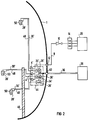
- FIG. 2 In the measuring device shown in FIG. 2, several catalysts 26 'are combined in a central measuring box 44, which is protected inside the security envelope 1 by a wall 46, for example against flying debris. Dilution devices or jet pumps 28 'connected to the measuring box 44 via inflow and outflow lines 30' and 48 are arranged distributed within the safety cover 1.
- the jet pumps 28 ' which are only shown schematically in FIG. 2, are each surrounded by a housing 50 which also serves as a filter.
- Each housing 50 consists at least partially of a gas-permeable material, for example of a sintered metal or a metal fiber braid. This prevents liquid components or coarse contamination with the gas mixture from getting into the jet pumps 28 '.
- the propellant gas led via the propellant gas line 8 is fed to the jet pumps 28 'via the inflow lines 30'.
- the throttles 4 'located in the inflow lines 30' and arranged within the measuring box 44 in turn serve to distribute the propellant gas to the individual jet pumps 28 '.
- the gas mixture reaches the respective jet pumps 28 'via the housing 50 serving as a filter and is mixed with the propellant gas flowing through the inflow lines 30'.
- the gas mixture is dried at the same time so that a condensation of residual moisture contained in the gas mixture, e.g. is safely avoided in cool room areas within the security cover 1.
- the gas mixture thus diluted reaches the respective catalytic converter 26 'via the outflow lines 48.
- the temperature change of each catalytic converter 26 ' is measured separately by means of a temperature sensor 34'.
- the corresponding measurement signals are sent via line 36 to the device 38 for processing the measured values.
- the susceptibility to faults of the assemblies or measuring groups which are distributed within the safety cover 1 and essentially consist of only one jet pump 28 'is particularly low.
Landscapes
- Chemical & Material Sciences (AREA)
- Life Sciences & Earth Sciences (AREA)
- Engineering & Computer Science (AREA)
- Health & Medical Sciences (AREA)
- Analytical Chemistry (AREA)
- General Physics & Mathematics (AREA)
- Medicinal Chemistry (AREA)
- Physics & Mathematics (AREA)
- Combustion & Propulsion (AREA)
- Biochemistry (AREA)
- General Health & Medical Sciences (AREA)
- Food Science & Technology (AREA)
- Immunology (AREA)
- Pathology (AREA)
- Investigating Or Analyzing Materials Using Thermal Means (AREA)
- Investigating Or Analyzing Materials By The Use Of Electric Means (AREA)
- Monitoring And Testing Of Nuclear Reactors (AREA)
- Investigating Or Analyzing Non-Biological Materials By The Use Of Chemical Means (AREA)
Abstract
Description
- Die Erfindung bezieht sich auf ein Verfahren zur Ermittlung eines Gemischanteils eines Gasgemisches in der Containment-Atmosphäre eines Kernkraftwerks, durch Messung der bei einer katalytischen Reaktion entstehenden Temperaturänderung. Sie bezieht sich weiter auf eine Vorrichtung zur Durchführung des Verfahrens.
- Es ist bekannt, daß Wasserstoff in Anwesenheit eines Katalysators, z.B. auf Platin- oder Palladiumbasis, schon bei Raumtemperatur in einer exothermen Reaktion oxidiert wird. Diese katalytische Oxidation von Wasserstoff wird auch als kalte Verbrennung bezeichnet. Durch Messung der bei dieser Reaktion entstehenden Wärmetönung oder Temperaturänderung kann die Wasserstoffkonzentration in einem Gasgemisch ermittelt werden.
- So wird z.B. bei einem aus der US-PS 4,298,574 bekannten Verfahren die infolge einer katalytischen Oxidation von Wasserstoff an einem Katalysator entstehende Temperaturänderung in bezug auf einen Referenzwert mittels eines Thermoelementes erfaßt und in ein entsprechendes Spannungssignal umgewandelt. Die gemessene Spannung ist ein Maß für den Wasserstoffanteil des Gasgemisches. Mit diesem Verfahren kann auch der Anteil an Kohlenmonoxid oder Kohlenwasserstoff im Gasgemisch ermittelt werden.
- Bei einem aus der DE-OS 30 46 560 bekannten Verfahren zur Feststell g von brennbaren Gasen, insbesondere von Wasserstoff in der Containment-Atmosphäre eines Kernkraftwerks, wird eine Temperaturänderung mittels eines temperaturabhängigen ohmschen Widerstands erfaßt, der Teil einer Brückenschaltung ist.
- Um ein reaktionsfähiges Wasserstoff/Sauerstoff-Gemisch zur Detektion von Wasserstoff in einem inerten Gasstrom zu erhalten, wird bei einem aus der US-PS 4,072,043 bekannten Verfahren dem inerten Gas (z.B. N₂) vor dessen Eintritt in eine Detektionskammer Luft zugemischt.
- Bei den bekannten Verfahren besteht allerdings die Gefahr, daß sich der Katalysator bis an die Zündgrenze eines zündfähigen Gemisches erhitzt. Dies kann aufgrund der hohen Wärmeentwicklung zu einer Zerstörung des Katalysators führen. In der Containment-Atmosphäre eines Kernkraftwerks können sich zündfähige Gemische bereits bei einem Wasserstoffanteil von weniger als 10% unkontrolliert mit hohen Raten abbauen, wobei dann eine zuverlässige Ermittlung der Gemischanteile nicht mehr möglich ist.
- Um auch bei einer über einen Grenzwert hinaus ansteigenden Konzentration eines brennbaren Gases innerhalb einer Gasprobe dennoch eine zufriedenstellende Detektion des brennbaren Gases zu ermöglichen, ist es aus der GB-OS 2 153 073 bekannt, ein Verdünnungsmittel, insbesondere Umgebungsluft, in eine die Gasprobe führende Leitung zu pumpen.
- Der Erfindung liegt daher die Aufgabe zugrunde, ein Verfahren der eingangs genannten Art derart weiterzubilden, daß eine zuverlässige Ermittlung eines Gemischanteils, insbesondere des Wasserstoff- und/oder Sauerstoffanteils, eines Gasgemisches in der Containment-Atmosphäre eines Kernkraftwerks, über einen großen Bereich möglich ist. Weiter soll eine besonders einfache Vorrichtung zur Durchführung des Verfahrens angegeben werden.
- Bezüglich des Verfahrens der eingangs genannten Art wird diese Aufgabe erfindungsgemäß durch die Kennzeichnenden Merkmale des Ansprüchs 1 gelöst.
- Das dem Katalysator zugeführte Gasgemisch wird mit einem Treibgas bekannter Zusammensetzung verdünnt. Die Verdünnung erfolgt in einer Strahlpumpe, z.B. einer Venturidüse. Dazu wird das Gasgemisch zweckmäßigerweise über einen Filter angesaugt und mit dem Treibgas oder einem Treibgasgemisch verdüst. Dabei ist die Verdünnung einstellbar, vorzugsweise im Verhältnis 1 : 1 bis 1 : 10, z.B. im Verhältnis 1 : 4.
- Zur Ermittlung des Wasserstoff- oder Kohlenmonoxidanteils im Gasgemisch kann das Treibgas auch einen oxidierenden Anteil, vorzugsweise Sauerstoff, enthalten. Als Treibgas kann dann entweder Luft oder, wenn genügend Sauerstoff im Gasgemisch enthalten ist, auch Stickstoff verwendet werden.
- Zur Ermittlung des Sauerstoffanteils im Gasgemisch enthält das Treibgas zweckmäßigerweise einen oxidierbaren Anteil, z.B. Wasserstoff oder Kohlenmonoxid.
- Bezüglich der Vorrichtung zur Dürchführung des Verfahrens mit Mitteln zur Messung der bei einer katalytischen Reaktion entstehenden Temperaturänderung wird die genannte Aufgabe erfindungsgemäß gelöst durch die Kennzeichnenden Merkmale des Ansprüchs 7.
- Die zur Verdünnung des Gasgemisches mit dem Treibgas zweckmäßigerweise eingesetzte Strahlpumpe mündet vorteilhafterweise direkt in den Katalysator. Sie kann dann zusammen mit dem Katalysator in einem Gehäuse angeordnet sein, wobei ihr ein separates Filter vorgeschaltet sein kann. Alternativ kann die Strahlpumpe aber auch über eine Leitung mit dem Katalysator verbunden sein. Sie ist dann in einem separaten Gehäuse angeordnet, das mindestens teilweise gasdurchlässig ist und gleichzeitig als Filter dient. In beiden Fällen ist die Treibdüse der Strahlpumpe mit einer Treibgasleitung verbunden, die vorteilhafterweise mindestens über einen Teil ihrer Länge in Form einer Kapillarleitung ausgebildet sein kann.
- Die mit der Erfindung erzielten Vorteile bestehen insbesondere darin, daß durch eine Verdünnung des Gas emisches mit einem Treibgas praktisch ein beliebig hoher Gemischanteil ermittelt werden kann. So können z.B. bei einer Analyse der Gasatmosphäre eines den Kernreaktor einschließenden Containments bei einer hohen Wasserstoff-Freisetzung, insbesondere auch bei einem unterstöchiometrischen Sauerstoffanteil, Wasserstoffkonzentrationen von mehr als 30 Vol.-% festgestellt werden. Dabei kann die Analyse sowohl innerhalb als auch außerhalb der die Containment-Atmosphäre einschließenden Sicherheitshülle durchgeführt werden. Weiterhin kann dieses Verfahren auch zur Ermittlung der Gemischanteile eines aus dem Primärkreis oder aus anderen druckführenden Systemen eines Kernkraftwerks abströmenden Gasgemische vorteilhaft angewendet werden. In keinem Fall wird die Zündtemperatur eines Wasserstoff-Sauerstoff-Gemisches erreicht.
- Durch Verwendung unterschiedlicher Treibgase können verschiedene Gemischanteile ermittelt werden. Dabei sind eine Kalibrierung oder Umschaltung zwischen Meßbereichen einerseits, z.B. zwischen einem ersten Bereich für Gemischanteile bis 10% und einem zweiten Bereich für Gemischanteile oder Konzentrationen oberhalb von 10%, sowie Änderungen der Treibgaszusammensetzung für die Erfassung unterschiedlicher Gemischanteile andererseits innerhalb kurzer Zeit möglich.
- Ausführungsbeispiele der Erfindung werden anhand einer Zeichnung näher erläutert; darin zeigen:
- Figur 1 im Ausschnitt eine Sicherheitshülle eines Kernreaktors mit einer Meßeinrichtung mit einem schematisch dargestellten Meßkopf als Vorrichtung zur Erfassung von Gemischanteilen eines Gasgemisches, und
- Figur 2 eine Meßeinrichtung gemäß Figur 1 mit einer Anzahl von verteilt angeordneten Verdünnungsvorrichtungen und mit in einer gemeinsamen Meßbox angeordneten Katalysatoren.
- Einander entsprechende Teile sind in beiden Figuren mit den gleichen Bezugszeichen versehen.
- Die in Figur 1 dargestellte Meßeinrichtung umfaßt eine Anzahl von innerhalb der Sicherheitshülle 1 angeordneten Meßköpfen 2, von denen in Figur 1 nur einer schematisch dargestellt ist. Der dargestellte Meßkopf 2 sowie alle anderen Meßköpfe sind über jeweils eine Drossel 4, die in einer gemeinsamen Verteilerbox 6 angeordnet sind, mit einer Treibgasleitung 8 verbunden. Die Treibgasleitung 8, in der ein Stellglied oder Drosselventil 10 liegt, ist über eine Durchführung 12 in der Sicherheitshülle 1 mit einem Dosierblock 14 verbunden, der eine Anzahl von Ventilen 16 aufweist. Der Dosierblock 14 ist über Gasleitungen 18 mit einer Kammer 20 verbunden, in der Gasbehälter 22 aufgestellt sind. Die Gasbehälter 22 sind jeweils mit einem Treib- oder Kalibriergas gefüllt, z.B. mit Luft, Stickstoff, Wasserstoff oder Sauerstoff. Die Gasbehälter 22 sowie der Dosierblock 14 können auch innerhalb der Sicherheitshülle angeordnet sein.
- Der Meßkopf 2 ist z.B. in der Art eines an sich aus der DE-OS 34 38 659 bekannten Diffusionsmeßkopfes ausgebildet. Er umfaßt ein Gehäuse 24, in dem ein Katalysator 26 und eine Strahlpumpe 28, z.B. eine Venturidüse, angeordnet sind. Anstelle der Strahlpumpe 28 kann auch eine andere Mischeinrichtung, z.B. ein statischer Mischer, vorgesehen sein. Das Gehäuse 24 ist ganz oder teilweise aus einem gesinterten Metall aufgebaut. Es ist dann aufgrund der Porosität des Sintermetalls gasdurchlässig, wobei Aerosole und Feuchtigkeit zurückgehalten werden.
- Die Strahlpumpe 28 ist eingangsseitig über eine Kapillarleitung 30 mit der Verteilerbox 6 verbunden und mündet in den Katalysator 26. Sie steht außerdem eingangsseitig über ein Filter 32 mit dem durch die Sicherheitshülle 1 gebildeten Innenraum, d.h. mit der den (nicht gezeigten) Kernreaktor umgebenden Containment-Atmosphäre, in Verbindung.
- Der Katalysator 26 enthält als katalytisch wirksamen Stoff Palladium oder Platin und ist netz- oder watteförmig ausgebildet. Der Katalysator 26 kann aber auch ganz oder teilweise spiralförmig in Form eines beheizbaren Filaments ausgebildet sein. Dem Katalysator 26 kann über die Treibgasleitung 8 ein Regenerationsgas zugeführt werden. Dadurch ist eine Regeneration des Katalysatormaterials auch bei Temperaturen oberhalb von 500° C möglich.
- Zur Ermittlung von Temperaturänderungen im Bereich des Katalysators 26 ist ein Temperatursensor 34 vorgesehen, der über eine Meßleitung 36 mit einer Einrichtung 38 zur Meßwertaufbereitung, z.B. in einer Leitwarte, verbunden ist. Die Meßleitung 36 ist über eine Durchführung 40 in der Sicherheitshülle 1 geführt. Als Temperatursensor 34 eignet sich besonders ein einer Brückenschaltung zugeordneter temperaturabhängiger elektrischer Widerstand. Zum gleichen Zweck kann aber auch ein Thermoelement oder eine Spule mit einer temperaturabhängigen Induktivität verwendet werden.
- Die in der Sicherheitshülle 1 eingeschlossene Containment-Atmosphäre ist ein Gasgemisch, das unter bestimmten Betriebsbedingungen Wasserstoff, Kohlenmonoxid, Sauerstoff und/oder Kohlenwasserstoff als Gemischanteile enthält. Zur Ermittlung eines Gemischanteils wird ein Treibgas aus einem der Behälter 22 über die Treibgasleitung 8 und über die Kapillarleitung 30 der Strahlpumpe 28 zugeführt. Die Treibgasmenge wird mittels des Stellglieds 10 eingestellt, wobei die Einstellung zweckmäßigerweise in Abhängigkeit vom Druck oder von der Temperatur des Gasgemisches sowie in Abhängigkeit von der Konzentration eines Gemischanteils des Gasgemisches, insbesondere in Abhängigkeit von der Wasserstoffkonzentration, automatisch erfolgt. Im Stellglied 10 erfolgt eine weitgehend volumenkonstante Drosselung der Treibgasmenge. Dabei erreicht das Treibgas bei einem Druckverhältnis von 1/2 zwischen dem Gasgemischdruck innerhalb der Sicherheitshülle 1 und dem Treibgasdruck Lavalgeschwindigkeit.
- Eine Verteilung des Treibgases auf die einzelnen Meßköpfe 2 erfolgt in der Verteilerbox 6.
- Das in Richtung der Pfeile 41 über das Filter 32 in die Strahlpumpe 28 einströmende Gasgemisch wird in einer Fangdüse 27 der Strahlpumpe 28 mit dem aus einer Treibdüse 29 der Strahlpumpe 28 mit großer Geschwindigkeit austretenden Treibgasstrahl gemischt. Dabei kann das Treibgas bei genügend hohem Treibdruck des zu messenden Gasgemisches, z.B. infolge einer Druckerhöhung innerhalb der Sicherheitshülle 1, von diesem angesaugt werden. Das somit mit dem Treibgas, dessen Zusammensetzung bekannt ist, verdünnte Gasgemisch strömt dem Katalysator 26 zu und tritt in Richtung der Pfeile 42 aus dem Meßkopf 2 aus. Die Verdünnung wird mittels des Stellglieds 10 und/oder in der Verteilerbox 6 eingestellt, wobei das Verhältnis z.B. 1 : 4 beträgt.
- Am Katalysator 26 findet die katalytische Oxidation statt, wobei die Reaktionswärme oder Temperaturänderung mittels des Temperatursensors 34 erfaßt wird. Die Temperaturänderung wird in ein entsprechendes Spannungssignal umgewandelt. In der Einrichtung 38 wird aus dem Betrag des Spannungssignals oder einer Änderung in bezug auf ein Referenzsignal unter Berücksichtigung des Verdünnungsverhältnisses der Gemischanteil, z.B. die Wasserstoff- oder Sauerstoffkonzentration in der Containment-Atmosphäre, ermittelt.
- Als Treibgas wird zur Ermittlung der Wasserstoffkonzentration Stickstoff oder, wenn nicht genügend Sauerstoff in der Containment-Atmosphäre vorhanden ist, Luft oder mit Sauerstoff angereicherte Luft verwendet. Zur Ermittlung des Sauerstoffanteils wird bei nur geringer Wasserstoff-Freisetzung dem Treibgas als oxidierbarer Anteil Kohlenmonoxid oder Wasserstoff zugemischt.
- Bei der in Figur 2 dargestellten Meßvorrichtung sind mehrere Katalysatoren 26' in einer zentralen Meßbox 44 zusammengefaßt, die innerhalb der Sicherheitshülle 1 durch eine Wand 46, z.B. gegen Trümmerflug, geschützt ist. Über Zu- und Abströmleitungen 30' bzw. 48 mit der Meßbox 44 verbundene Verdünnungsvorrichtungen oder Strahlpumpen 28' sind innerhalb der Sicherheitshülle 1 verteilt angeordnet. Die in Figur 2 nur schematisch dargestellten Strahlpumpen 28' sind jeweils von einem gleichzeitig als Filter dienenden Gehäuse 50 umgeben. Jedes Gehäuse 50 besteht mindestens teilweise aus einem gasdurchlässigen Material, z.B. aus einem Sintermetall oder einem Metallfasergeflecht. Dadurch wird vermieden, daß flüssige Bestandteile oder grobe Verunreinigung mit dem Gasgemisch in die Strahlpumpen 28' gelangen.
- Das über die Treibgasleitung 8 geführte Treibgas wird den Strahlpumpen 28' über die Zuströmleitungen 30' zugeführt. Die in den Zuströmleitungen 30' liegenden und innerhalb der Meßbox 44 angeordneten Drosseln 4' dienen wiederum zur Verteilung des Treibgases auf die einzelnen Strahlpumpen 28'.
- Das Gasgemisch gelangt über die als Filter dienenden Gehäuse 50 in die jeweiligen Strahlpumpen 28' und wird mit dem über die Zuströmleitungen 30' strömenden Treibgas vermischt. Dabei wird das Gasgemisch gleichzeitig getrocknet, so daß eine Kondensation von im Gasgemisch enthaltener Restfeuchtigkeit, z.B. in kühlen Raumbereichen innerhalb der Sicherheitshülle 1, sicher vermieden ist. Das so verdünnte Gasgemisch gelangt über die Abströmleitungen 48 an den jeweiligen Katalysator 26'. Die Temperaturänderung jedes Katalysators 26' wird mittels eines Temperatursensors 34' getrennt gemessen. Die entsprechenden Meßsignale werden über die Leitung 36 an die Einrichtung 38 zur Meßwertaufbereitung geleitet.
- Bei der Ausführungsform gemäß Figur 2 ist die Störanfälligkeit der innerhalb der Sicherheitshülle 1 verteilt angeordneten und im wesentlichen jeweils nur aus einer Strahlpumpe 28' bestehenden Bau- oder Meßgruppen besonders gering.
Claims (9)
- Verfahren zur Ermittlung eines Gemischanteils eines Gasgemisches in der Containment-Atmosphäre eines Kernkraftwerks, durch Messung der bei einer katalytischen Reaktion entstehenden Temperaturänderung,
dadurch gekennzeichnet,
daß das dem Katalysator zugeführte Gasgemisch mit einem Treibgas bekannter Zusammensetzung verdünnt wird, wobei die Verdünnung in einer Strahlpumpe (28, 28') erfolgt. - Verfahren nach Anspruch 1,
dadurch gekennzeichnet, daß die Verdünnung einstellbar ist, vorzugsweise im Verhältnis 1 : 1 bis 1 : 10. - Verfahren nach Anspruch 1 oder 2,
dadurch gekennzeichnet, daß als Treibgas inertes Gas, vorzugsweise Stickstoff, verwendet wird. - Verfahren nach einem der Ansprüche 1 bis 3,
dadurch gekennzeichnet, daß das Treibgas einen oxidierenden Anteil, vorzugsweise Sauerstoff, enthält. - Verfahren nach einem der Ansprüche 1 bis 3,
dadurch gekennzeichnet, daß das Treibgas einen oxidierbaren Anteil, vorzugsweise Wasserstoff oder Kohlenmonoxid, enthält. - Verfahren nach einem der Ansprüche 1 bis 5,
dadurch gekennzeichnet, daß der Katalysator beheizt wird. - Vorrichtung zur Durchführung des Verfahrens nach einem der Ansprüche 1 bis 6 mit Mitteln (34, 34') zur Messung der bei einer katalytischen Reaktion entstehenden Temperaturänderung,
dadurch gekennzeichnet, daß zur Verdünnung des dem Katalysator (26, 26') zugeführten Gasgemisches mit einem Treibgas bekannten Zusammensetzung eine eingangsseitig mit einer Treibgasleitung (8, 30, 30') und ausgangsseitig mit dem Katalysator (26') verbundene Strahlpumpe (28, 28') vorgesehen ist. - Vorrichtung nach Anspruch 7,
dadurch gekennzeichnet, daß die Strahlpumpe (28) direkt in den Katalysator (26) mündendet, wobei ihr ein Filter (32) vorgeschaltet ist. - Vorrichtung nach Anspruch 7,
dadurch gekennzeichnet, daß die Strahlpumpe (28') in einem mindestens teilweise gasdurchlässigen Gehäuse (50) angeordnet und über eine Abströmleitung (48) mit dem Katalysator (26') verbunden ist.
Applications Claiming Priority (3)
| Application Number | Priority Date | Filing Date | Title |
|---|---|---|---|
| DE4221692A DE4221692A1 (de) | 1992-07-02 | 1992-07-02 | Verfahren und Vorrichtung zur Ermittlung eines Gemischanteils eines Gasgemisches |
| DE4221692 | 1992-07-02 | ||
| PCT/DE1993/000531 WO1994001767A1 (de) | 1992-07-02 | 1993-06-21 | Verfahren und vorrichtung zur ermittlung eines gemischanteils eines gasgemisches |
Publications (2)
| Publication Number | Publication Date |
|---|---|
| EP0648331A1 EP0648331A1 (de) | 1995-04-19 |
| EP0648331B1 true EP0648331B1 (de) | 1996-04-24 |
Family
ID=6462304
Family Applications (1)
| Application Number | Title | Priority Date | Filing Date |
|---|---|---|---|
| EP93914590A Expired - Lifetime EP0648331B1 (de) | 1992-07-02 | 1993-06-21 | Verfahren und vorrichtung zur ermittlung eines gemischanteils eines gasgemisches |
Country Status (8)
| Country | Link |
|---|---|
| US (1) | US6074882A (de) |
| EP (1) | EP0648331B1 (de) |
| JP (1) | JP3226923B2 (de) |
| CA (1) | CA2139434A1 (de) |
| DE (2) | DE4221692A1 (de) |
| RU (1) | RU2115108C1 (de) |
| UA (1) | UA27913C2 (de) |
| WO (1) | WO1994001767A1 (de) |
Families Citing this family (29)
| Publication number | Priority date | Publication date | Assignee | Title |
|---|---|---|---|---|
| DE19704608C1 (de) * | 1997-02-07 | 1998-06-10 | Siemens Ag | Vorrichtung zur Rekombination von Wasserstoff in einem Gasgemisch |
| JP3997642B2 (ja) * | 1999-02-24 | 2007-10-24 | トヨタ自動車株式会社 | 一酸化炭素濃度検出装置および一酸化炭素濃度検出方法 |
| WO2003048640A1 (en) * | 2001-12-03 | 2003-06-12 | New England Catalytic Technologies, Inc. | Method of preheating catalytic heaters |
| DE10303299A1 (de) * | 2003-01-28 | 2004-08-19 | Framatome Anp Gmbh | Schutzsystem, insbesondere für den Primärkreislauf einer kerntechnischen Anlage, und Verfahren zum Betreiben einer kerntechnischen Anlage |
| US7955357B2 (en) | 2004-07-02 | 2011-06-07 | Ellipse Technologies, Inc. | Expandable rod system to treat scoliosis and method of using the same |
| DE102004050308A1 (de) * | 2004-10-14 | 2006-06-14 | Framatome Anp Gmbh | Verfahren und Probenahmesystem zur Gewinnung einer Probe aus der Atmosphäre in einem Reaktorsicherheitsbehälter einer kerntechnischen Anlage |
| US7862502B2 (en) | 2006-10-20 | 2011-01-04 | Ellipse Technologies, Inc. | Method and apparatus for adjusting a gastrointestinal restriction device |
| US20090112263A1 (en) | 2007-10-30 | 2009-04-30 | Scott Pool | Skeletal manipulation system |
| US11202707B2 (en) | 2008-03-25 | 2021-12-21 | Nuvasive Specialized Orthopedics, Inc. | Adjustable implant system |
| US8382756B2 (en) | 2008-11-10 | 2013-02-26 | Ellipse Technologies, Inc. | External adjustment device for distraction device |
| US8197490B2 (en) | 2009-02-23 | 2012-06-12 | Ellipse Technologies, Inc. | Non-invasive adjustable distraction system |
| US9622792B2 (en) | 2009-04-29 | 2017-04-18 | Nuvasive Specialized Orthopedics, Inc. | Interspinous process device and method |
| JP5766917B2 (ja) * | 2010-03-29 | 2015-08-19 | メタウォーター株式会社 | オゾン濃度計 |
| US9248043B2 (en) | 2010-06-30 | 2016-02-02 | Ellipse Technologies, Inc. | External adjustment device for distraction device |
| WO2012021378A2 (en) | 2010-08-09 | 2012-02-16 | Ellipse Technologies, Inc. | Maintenance feature in magnetic implant |
| WO2012112396A2 (en) | 2011-02-14 | 2012-08-23 | Ellipse Technologies, Inc. | Device and method for treating fractured bones |
| CN102208216B (zh) * | 2011-05-18 | 2013-06-05 | 华北电力大学 | 一种防止氢爆的缓解核电严重事故装置及缓解方法 |
| US10743794B2 (en) | 2011-10-04 | 2020-08-18 | Nuvasive Specialized Orthopedics, Inc. | Devices and methods for non-invasive implant length sensing |
| US10016220B2 (en) | 2011-11-01 | 2018-07-10 | Nuvasive Specialized Orthopedics, Inc. | Adjustable magnetic devices and methods of using same |
| US20130338714A1 (en) | 2012-06-15 | 2013-12-19 | Arvin Chang | Magnetic implants with improved anatomical compatibility |
| RU2017126066A (ru) | 2012-10-29 | 2019-01-31 | Нувэйсив Спешилайзд Ортопэдикс, Инк. | Корректируемые устройства для лечения артрита колена |
| US10751094B2 (en) | 2013-10-10 | 2020-08-25 | Nuvasive Specialized Orthopedics, Inc. | Adjustable spinal implant |
| WO2015168175A1 (en) | 2014-04-28 | 2015-11-05 | Ellipse Technologies, Inc. | System for informational magnetic feedback in adjustable implants |
| EP3236867B1 (de) | 2014-12-26 | 2022-02-23 | NuVasive Specialized Orthopedics, Inc. | Distraktionssysteme |
| US10238427B2 (en) | 2015-02-19 | 2019-03-26 | Nuvasive Specialized Orthopedics, Inc. | Systems and methods for vertebral adjustment |
| BR112018007347A2 (pt) | 2015-10-16 | 2018-10-23 | Nuvasive Specialized Orthopedics, Inc. | dispositivos ajustáveis para o tratamento da artrite do joelho |
| EP4512312B1 (de) | 2015-12-10 | 2026-08-12 | NuVasive Specialized Orthopedics, Inc. | Externe einstellvorrichtung für distraktionsvorrichtung |
| KR20180107173A (ko) | 2016-01-28 | 2018-10-01 | 누베이시브 스페셜라이즈드 오소페딕스, 인크. | 골 이동술용 시스템 |
| JP7777488B2 (ja) * | 2022-04-11 | 2025-11-28 | 矢崎エナジーシステム株式会社 | 熱量計 |
Family Cites Families (23)
| Publication number | Priority date | Publication date | Assignee | Title |
|---|---|---|---|---|
| US1957341A (en) * | 1931-01-21 | 1934-05-01 | Moto Vita Corp | Combustion analyzer |
| US3399398A (en) * | 1965-07-27 | 1968-08-27 | Mine Safety Appliances Co | Combustible gas monitoring system |
| US4170455A (en) * | 1976-03-11 | 1979-10-09 | Rockwell International Corporation | Gas monitoring method and apparatus therefor |
| US4072043A (en) * | 1976-12-20 | 1978-02-07 | Texaco Inc. | Method and system for detecting hydrogen in an inert gas stream |
| US4226675A (en) * | 1977-05-23 | 1980-10-07 | Comsip Delphi, Inc. | Method and apparatus for monitoring and measuring a gas |
| US4298574A (en) * | 1979-06-25 | 1981-11-03 | The Babcock & Wilcox Company | Hydrogen gas detector |
| JPS56118641A (en) * | 1980-02-22 | 1981-09-17 | Nippon Soken Inc | Fine particle discharge amount measuring apparatus for vehicle |
| DE3046560A1 (de) * | 1980-12-10 | 1982-07-15 | Kraftwerk Union AG, 4330 Mülheim | Sonde zur feststellung von brennbaren gasen |
| US4565086A (en) * | 1984-01-20 | 1986-01-21 | Baker Drilling Equipment Company | Method and apparatus for detecting entrained gases in fluids |
| JPS60259740A (ja) * | 1984-06-06 | 1985-12-21 | Toyota Central Res & Dev Lab Inc | 内燃機関の排気浄化方法 |
| DE3438659A1 (de) * | 1984-10-22 | 1986-04-24 | Kraftwerk Union AG, 4330 Mülheim | Sonde mit einem diffusionsmesskopf zum feststellen von gasen |
| JPH0619311B2 (ja) * | 1985-10-19 | 1994-03-16 | 株式会社堀場製作所 | 多成分同時測定用ガス分析装置 |
| US4911890A (en) * | 1986-01-29 | 1990-03-27 | The United States Of America As Represented By The Administrator Of The National Aeronautics And Space Administration | Device for quickly sensing the amount of O2 in a combustion product gas |
| DE3637795A1 (de) * | 1986-11-06 | 1988-05-11 | Siemens Ag | Kernkraftwerk mit einer sicherheitshuelle |
| DE58905933D1 (de) * | 1988-04-18 | 1993-11-25 | Siemens Ag | Kernkraftwerk mit einer Sicherheitshülle. |
| US5060473A (en) * | 1988-07-13 | 1991-10-29 | Nissan Motor Company, Limited | System for detecting deterioration of catalyst in catalytic converter |
| JPH0729494Y2 (ja) * | 1989-07-12 | 1995-07-05 | 株式会社堀場製作所 | 水素ガス分析装置 |
| US5167927A (en) * | 1989-10-31 | 1992-12-01 | Karlson Eskil L | Monitor for ozone, hydrogen peroxide and other gases in fluids |
| DE4003833A1 (de) * | 1990-01-08 | 1991-07-11 | Grs Ges Fuer Reaktorsicherheit | Vorrichtung zur entfernung von wasserstoff aus einem wasserstoff, sauerstoff, dampf und aerosole enthaltenden gasgemisch |
| US5133184A (en) * | 1990-02-10 | 1992-07-28 | Volkswagen Ag | Method and apparatus for monitoring the conversion ratio of a catalytic converter |
| DE4040734A1 (de) * | 1990-06-21 | 1992-01-02 | Siemens Ag | Verfahren und einrichtung zur oxidation von wasserstoff |
| AT393173B (de) * | 1990-08-14 | 1991-08-26 | Steyr Nutzfahrzeuge | Anlage zur schadstoffanalyse, insbesondere partikelemission, von dieselmotorenabgas, mit einer speziellen teilstromverduennungseinrichtung |
| US5374400A (en) * | 1992-05-07 | 1994-12-20 | The United States Of America As Represented By The Administrator Of The National Aeronautics And Space Administration | Two-stage gas measurement system |
-
1992
- 1992-07-02 DE DE4221692A patent/DE4221692A1/de not_active Withdrawn
-
1993
- 1993-06-21 WO PCT/DE1993/000531 patent/WO1994001767A1/de not_active Ceased
- 1993-06-21 CA CA002139434A patent/CA2139434A1/en not_active Abandoned
- 1993-06-21 DE DE59302383T patent/DE59302383D1/de not_active Expired - Fee Related
- 1993-06-21 RU RU94046345/25A patent/RU2115108C1/ru not_active IP Right Cessation
- 1993-06-21 JP JP50280894A patent/JP3226923B2/ja not_active Expired - Fee Related
- 1993-06-21 EP EP93914590A patent/EP0648331B1/de not_active Expired - Lifetime
- 1993-06-21 UA UA94129252A patent/UA27913C2/uk unknown
-
1996
- 1996-10-24 US US08/736,372 patent/US6074882A/en not_active Expired - Fee Related
Also Published As
| Publication number | Publication date |
|---|---|
| CA2139434A1 (en) | 1994-01-20 |
| DE59302383D1 (de) | 1996-05-30 |
| DE4221692A1 (de) | 1994-01-05 |
| US6074882A (en) | 2000-06-13 |
| RU2115108C1 (ru) | 1998-07-10 |
| RU94046345A (ru) | 1996-10-20 |
| JP3226923B2 (ja) | 2001-11-12 |
| WO1994001767A1 (de) | 1994-01-20 |
| UA27913C2 (uk) | 2000-10-16 |
| EP0648331A1 (de) | 1995-04-19 |
| JPH07508588A (ja) | 1995-09-21 |
Similar Documents
| Publication | Publication Date | Title |
|---|---|---|
| WO1994001767A1 (de) | Verfahren und vorrichtung zur ermittlung eines gemischanteils eines gasgemisches | |
| EP0670490B1 (de) | Verfahren und Vorrichtung zum Messen eines Gasmediums mit einem chemischen Sensor | |
| DE69117289T2 (de) | Stickoxyd-sensoraufbau | |
| EP0241751B1 (de) | Verfahren zum kontinuierlichen Überwachen von gasförmigen Bestandteilen in Gasgemischen, ausgenommen O2 | |
| DE1809622C2 (de) | Meßsonde zum Erfassen von Gasgehalten | |
| DE19851949C1 (de) | Sensor für die Untersuchung von Abgasen und Untersuchungsverfahren | |
| DE3135101C2 (de) | ||
| DE2801060A1 (de) | Chromatographisches system und chromatographisches analysenverfahren | |
| DE69909939T2 (de) | Analysegerät zur kontinuierlichen messung von h2s in einem gas und dessen verwendung in einer vorrichtung zur regelung der injizierten luftmenge in einen oxydationsreaktor zur umsetzung von h2s zu schwefel | |
| DE2524597A1 (de) | Verfahren und vorrichtung zum aufspueren eines gases | |
| DE2801081A1 (de) | Chromatographisches system und chromatographisches analysenverfahren | |
| DE19702570A1 (de) | Sauerstoffsensor des Grenzstromtyps | |
| DE1598351B2 (de) | Verfahren zur Bestimmung des Sauerstoffbedarfs einer wäßrigen Dispersion und Vorrichtung zur Durchführung des Verfahrens | |
| DE69017775T2 (de) | Wasserstoffprüfgerät. | |
| DE2261456B2 (de) | Pyrolytische analyse von fluessigkeiten | |
| DE2738755C3 (de) | Elektrochemische Meßzelle | |
| DE19746446C2 (de) | Verfahren zur Verdünnung von Proben für ein Chemilumineszenzanalysegerät und zur Anwendung des Verfahrens geeignetes Chemilumineszenzanalysegerät | |
| EP0298240B1 (de) | Verfahren und Vorrichtung zum Überwachen des Schadstoffgehaltes von Abgasen bei Brennkraftmaschinen | |
| EP0809109B1 (de) | Vorrichtung zur Messung von Brennkraftmaschinen-Abgas-Komponenten | |
| DE1176399B (de) | Verfahren zum Messen eines dem Sauerstoff-gehalt einer natuerlichen oder kuenstlichen Atmosphaere proportionalen Waermemengen-Messwertes und Vorrichtung zur Anzeige desSauerstoffgehaltes solcher Atmosphaeren | |
| DE2904872A1 (de) | Verfahren zur erzeugung eines no/no tief 2 -pruefgasgemisches sowie vorrichtung zu seiner durchfuehrung | |
| DE102006031206B4 (de) | Verfahren zur Herstellung eines Kalibrieraerosols für die Anzahlkonzentration luftgetragener Partikeln und Kalibrieraerosolgenerator | |
| DE2950261A1 (de) | Verfahren und vorrichtung zur ueberwachung chemischer vorgaenge | |
| DE2348090C2 (de) | Verfahren zur kontinuierlichen Überführung von in einer Flüssigkeit gelösten Gaskomponenten in ein Trägergas | |
| DE2851821A1 (de) | Verfahren zur umwandlung des in einem zu analysierenden gasgemisch enthaltenen anteils an ammoniak in stickmonoxyd mit hilfe eines in einer reaktionskammer erhitzten katalysators |
Legal Events
| Date | Code | Title | Description |
|---|---|---|---|
| PUAI | Public reference made under article 153(3) epc to a published international application that has entered the european phase |
Free format text: ORIGINAL CODE: 0009012 |
|
| 17P | Request for examination filed |
Effective date: 19941108 |
|
| AK | Designated contracting states |
Kind code of ref document: A1 Designated state(s): BE DE FR SE |
|
| 17Q | First examination report despatched |
Effective date: 19951012 |
|
| GRAH | Despatch of communication of intention to grant a patent |
Free format text: ORIGINAL CODE: EPIDOS IGRA |
|
| GRAA | (expected) grant |
Free format text: ORIGINAL CODE: 0009210 |
|
| AK | Designated contracting states |
Kind code of ref document: B1 Designated state(s): BE DE FR SE |
|
| REF | Corresponds to: |
Ref document number: 59302383 Country of ref document: DE Date of ref document: 19960530 |
|
| ET | Fr: translation filed | ||
| PLBE | No opposition filed within time limit |
Free format text: ORIGINAL CODE: 0009261 |
|
| STAA | Information on the status of an ep patent application or granted ep patent |
Free format text: STATUS: NO OPPOSITION FILED WITHIN TIME LIMIT |
|
| 26N | No opposition filed | ||
| PGFP | Annual fee paid to national office [announced via postgrant information from national office to epo] |
Ref country code: DE Payment date: 20020327 Year of fee payment: 10 |
|
| PGFP | Annual fee paid to national office [announced via postgrant information from national office to epo] |
Ref country code: FR Payment date: 20020617 Year of fee payment: 10 |
|
| PGFP | Annual fee paid to national office [announced via postgrant information from national office to epo] |
Ref country code: BE Payment date: 20020620 Year of fee payment: 10 |
|
| PGFP | Annual fee paid to national office [announced via postgrant information from national office to epo] |
Ref country code: SE Payment date: 20020624 Year of fee payment: 10 |
|
| PG25 | Lapsed in a contracting state [announced via postgrant information from national office to epo] |
Ref country code: SE Free format text: LAPSE BECAUSE OF NON-PAYMENT OF DUE FEES Effective date: 20030622 |
|
| PG25 | Lapsed in a contracting state [announced via postgrant information from national office to epo] |
Ref country code: BE Free format text: LAPSE BECAUSE OF NON-PAYMENT OF DUE FEES Effective date: 20030630 |
|
| BERE | Be: lapsed |
Owner name: *FRAMATOME ANP G.M.B.H. Effective date: 20030630 |
|
| PG25 | Lapsed in a contracting state [announced via postgrant information from national office to epo] |
Ref country code: DE Free format text: LAPSE BECAUSE OF NON-PAYMENT OF DUE FEES Effective date: 20040101 |
|
| EUG | Se: european patent has lapsed | ||
| PG25 | Lapsed in a contracting state [announced via postgrant information from national office to epo] |
Ref country code: FR Free format text: LAPSE BECAUSE OF NON-PAYMENT OF DUE FEES Effective date: 20040227 |
|
| REG | Reference to a national code |
Ref country code: FR Ref legal event code: ST |