EP0634829B1 - Machine électrique tournante - Google Patents
Machine électrique tournante Download PDFInfo
- Publication number
- EP0634829B1 EP0634829B1 EP94110836A EP94110836A EP0634829B1 EP 0634829 B1 EP0634829 B1 EP 0634829B1 EP 94110836 A EP94110836 A EP 94110836A EP 94110836 A EP94110836 A EP 94110836A EP 0634829 B1 EP0634829 B1 EP 0634829B1
- Authority
- EP
- European Patent Office
- Prior art keywords
- cooling
- support parts
- vicinity
- parts
- electric machine
- Prior art date
- Legal status (The legal status is an assumption and is not a legal conclusion. Google has not performed a legal analysis and makes no representation as to the accuracy of the status listed.)
- Expired - Lifetime
Links
- 238000001816 cooling Methods 0.000 claims description 98
- 230000002093 peripheral effect Effects 0.000 claims description 14
- 230000004323 axial length Effects 0.000 claims description 9
- 239000012530 fluid Substances 0.000 description 12
- 238000002474 experimental method Methods 0.000 description 7
- 239000011295 pitch Substances 0.000 description 4
- 238000010586 diagram Methods 0.000 description 3
- 230000000694 effects Effects 0.000 description 3
- 238000010276 construction Methods 0.000 description 2
- 230000007246 mechanism Effects 0.000 description 2
- 230000004048 modification Effects 0.000 description 2
- 238000012986 modification Methods 0.000 description 2
- 238000013459 approach Methods 0.000 description 1
- 230000008901 benefit Effects 0.000 description 1
- 238000007664 blowing Methods 0.000 description 1
- 238000005266 casting Methods 0.000 description 1
- 230000008859 change Effects 0.000 description 1
- 230000003247 decreasing effect Effects 0.000 description 1
- 238000004512 die casting Methods 0.000 description 1
- 230000005284 excitation Effects 0.000 description 1
- 230000020169 heat generation Effects 0.000 description 1
- 230000006872 improvement Effects 0.000 description 1
- 230000001788 irregular Effects 0.000 description 1
- 239000002184 metal Substances 0.000 description 1
- 230000005855 radiation Effects 0.000 description 1
Images


Classifications
-
- H—ELECTRICITY
- H02—GENERATION; CONVERSION OR DISTRIBUTION OF ELECTRIC POWER
- H02K—DYNAMO-ELECTRIC MACHINES
- H02K9/00—Arrangements for cooling or ventilating
- H02K9/02—Arrangements for cooling or ventilating by ambient air flowing through the machine
- H02K9/04—Arrangements for cooling or ventilating by ambient air flowing through the machine having means for generating a flow of cooling medium
- H02K9/06—Arrangements for cooling or ventilating by ambient air flowing through the machine having means for generating a flow of cooling medium with fans or impellers driven by the machine shaft
-
- H—ELECTRICITY
- H02—GENERATION; CONVERSION OR DISTRIBUTION OF ELECTRIC POWER
- H02K—DYNAMO-ELECTRIC MACHINES
- H02K5/00—Casings; Enclosures; Supports
- H02K5/04—Casings or enclosures characterised by the shape, form or construction thereof
- H02K5/20—Casings or enclosures characterised by the shape, form or construction thereof with channels or ducts for flow of cooling medium
- H02K5/207—Casings or enclosures characterised by the shape, form or construction thereof with channels or ducts for flow of cooling medium with openings in the casing specially adapted for ambient air
Definitions
- the present invention generally relates to a rotary electric machine such as an alternating current generator for vehicles and, more particularly, to a cooling mechanism of such rotary electric machine.
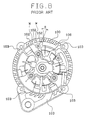
- Japanese Unexamined Patent Publication No. 3-178593 discloses an alternating current generator as illustrated in Fig. 8 and corresponding to the preamble of claim 1.
- This alternating current generator includes a housing 100 with a plurality of cooling windows w opened in a cylindrical peripheral wall thereof in circumferential alignment, and a centrifugal fan 106 positioned inside the cooling windows w and fixed to the end of a rotor (not illustrated) in the housing 100.
- the peripheral wall of the housing 100 has guide wall parts 102, each of which is positioned between circumferentially adjacent two of the cooling windows w and extends axially.
- Each guide wall part 102 is inclined at a constant angle ⁇ against the radial direction, so that the cooling wind blown out of the cooling windows w is blown out in this inclined direction.
- support parts 103 extend axially and the circumferential width of each support part 103 is made to be wider than the circumferential width of the guide wall part 102.
- the support parts 103 result in large fluid resistances against cooling wind generated by the centrifugal fan 106, causing increase in fluid loss, decrease in cooling ability or increase in whizzing sound.
- angle of inclination of guide wall parts formed on a periphery of a cylindrical housing against the radial direction is set to be larger in the vicinity of the forward end of each support part in rotating direction and smaller in the vicinity of the backward end of the support part in the rotating direction.
- the angle of inclination of the guide wall parts is set to become gradually smaller from the vicinity of the forward end of the support part in the rotating direction torwards the vicinity of the backward end of the support part in the rotating direction, whereby the cooling flow quantity can be increased and whizzing sound can be reduced.
- chord direction (blade length direction) of the guide wall parts is in the same direction as that of the cooling wind flowing into the cooling windows at the rotational speed at which the temperature of the blown air is the highest in a full-load operation.
- fluid resistance at the guide wall parts under the worst conditions can be minimized, and the cooling flow quantity can be increased under the worst conditions. That is, the worst heat load in the rotary electric machine is generated in the preset rotational speed range in a full-load operation.
- the electric generating power, the internal radiating resistance and the cooling flow quantity vary according to the rotational speed, and the difference (internal temperature rise) between the internal heat generation quantity and heat radiation quantity (which can be generally regarded as the cooling flow quantity) is the largest within the preset rotational speed range.
- the cooling windows are formed on the housing to extend from the peripheral wall of the housing to the end part thereof in the axial direction.
- a plurality of cooling windows can deliver the cooled air more smoothly.
- circumferential width of the cooling windows is set to be wider in the intermediate area between the adjacent two support parts than in the vicinity of said support parts.
- the circumferential width of the plurality of cooling windows is set to become gradually larger from the vicinity of each support part toward the intermediate area between the adjacent two support parts.
- the circumferential width of each cooling window can almost match with the flow quantity therethrough, whereby the fluid resistance can be further reduced and whizzing noise is further reduced.
- the axial length of the cooling windows is set to be longer in the intermediate area between the adjacent support parts than any other area.
- the increase in the fluid resistance can be controlled, the noise generated within the housing can effectively be shut off, and the strength around the support parts can be increased.
- the axial length of the plurality of cooling windows can become gradually longer from the vicinity of each support part to the intermediate area between the adjacent support parts, the axial length of each cooling window can match with the flow quantity therethrough.
- the axial length of the plurality of cooling windows may be set to be equal so that the mechanism can be simplified and the cooling flow quantity can be increased.
- cooling wind blown from the centrifugal fan flows in the direction of inclination of the guide parts against the radial and circumferential directions.
- the wind that bumps the support part is bent thereby in the circumferential direction, and as a result, the component of wind velocity in the circumferential direction in the vicinity of the forward end of the support in the rotating direction increases by the addition of the cooling wind that bumped the support part and was bent thereby in the circumferential direction. Accordingly, the fluid resistance at the guide wall part can be reduced, the effect of flow control can be improved, and the cooling flow quantity can be increased.
- the fluid resistance to the cooling wind blown from the centrifugal fan is large in the vicinity of the support part due to the interruption by the support parts and small in the intermediate area between the support parts due to the concentration of a numerosity of cooling windows therein.
- the quantity of the wind blown from the cooling window is small in the vicinity of the support part and large in the distance from the support part. Accordingly, overall fluid resistance is appropriately reduced and the cooling flow quantity can be increased.
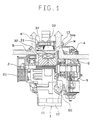
- a frame (or a generally cylindrical housing as referred to in the present invention) 1 comprises a front frame 11 and a rear frame 12 which are fastened to each other with fastening bolts 13.
- the frame 1 rotatably supports a rotary shaft or spindle 2 to which a field core 31 is fixed and the field core 31 is wound with a field coil 32 thereon.
- the field core 31 and the field coil 32 form a rotor of an alternating current generator.
- an armature core 33 circumferentially surrounding the field core 31 is fixed and the armature core 33 is wound with an armature coil 34 thereon.
- the armature core 33 and the armature coil 34 form a stator of the generator.
- An end cover 4 is fixed, covering the rear end face of the rear frame 12, and an electric component chamber S is formed between the rear frame 12 and the cover 4.
- the electric component chamber S houses therein a rectifier mounted by bolts 10, a brush and a regulator (these components being not illustrated).
- Each blade 60 of the centrifugal fan 6 is positioned at irregular pitches or angular spaces as illustrated in Fig. 3, i.e., four blades are positioned at a pitch a1, another four blades at a pitch a2, and the remaining three blades at a pitch a3, wherein a1 ⁇ a2 ⁇ a3.
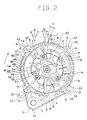
- the wind generated by the centrifugal fan 6 is blown out of the cooling windows w in centrifugal directions.
- Each of cooling windows w is provided between circumferentially adjacent two guide wall parts 7 as a circumferential border to define the direction of the wind blowing out of the cooling windows w.
- the guide wall parts 7 are integrally cast with the rear frame 12 to be a flat plate with the inner peripheral end part (blade front tip part) and the outer peripheral end (blade rear tip part) rounded.
- the dimension between the inner peripheral end (blade front tip end) and the outer peripheral end (blade rear tip end) is called as chord length or blade length.
- each chord direction G is the mean value of the angles of inclination of both the principal planes of the guide wall part 7 facing each other.
- the support parts 8 are provided at five locations at intervals in the circumferential direction.
- the circumferential width thereof is set to 2 to 5 times as wide as the sum of the circumferential widths of one guide wall 7 and one cooling window w.
- the support parts 8 are disposed beneath the fastening bolts 13 and one support part 8 in the supporting position for a stay 3.
- Bolt holes 14 through which the fastening bolts 13 are screwed in are made in ear parts 15 of the rear frame 12, the ear parts 15 being projecting in the outside diameter direction.
- Each ear part 15 extends in the outside diameter direction from the front end of each support parts 8. Accordingly, the support parts 8 function to transmit the fastening force of the fastening bolts 13 to the entire rear frame 12.
- the angle (the angle of inclination as referred to in the present invention) ⁇ between the chord direction G and radial direction R of the guide wall part 7 is set to be larger (more inclined in the circumferential or rotating direction) as the guide wall part 7 is nearer in the rotating direction to the forward end a of each support part 8 and smaller (more close to the radial direction R) as the guide wall part 7 is nearer in the rotating direction to the backward end b of each support part 8 as ⁇ 1 > ⁇ 2 > ⁇ 3 > ⁇ 4 > ⁇ 5 > ⁇ 6 > ⁇ 7, for example.
- the cooling wind is blown out with slight inclination against the circumferential direction nearby the forward end of the support part 8 in the rotating direction and with slight inclination against the radial direction nearby the backward end of the support 8 in the rotating direction.
- the cooling wind flows with inclination against the radial and circumferential directions.
- the wind bumping the support part 8 is bent thereby to the circumferential direction, and as a result, the component of velocity of the cooling wind in the circumferential direction nearby the forward end a of the support part 8 in the rotating direction increases by the addition of the cooling wind which bumped the support part 8 and was bent thereby in the circumferential direction.
- the wind blown out of the cooling window w is more inclined in the circumferential direction as the wind approaches the forward end a of the support part 8 in the rotating direction.
- each guide wall part 7 As the chord direction of each guide wall part 7 is gradually varied according to the variation in the cooling wind direction caused by the support parts 8, the cooling wind bumped at the support parts 8 is easily blown out through the guide wall parts 7 near the forward end a.
- the fluid resistance of each guide wall part 7 can be reduced, the effect of flow control can be improved, and the cooling wind flow quantity can be increased.
- the circumferential width H of each cooling window w is set to be narrower in the vicinity of the support part 8 and wider in the distance from the support part 8 as H2 ⁇ H3 ⁇ H4 > H5 > H6 > H7, for example.
- the fluid resistance to the wind blown out of the centrifugal fan 6 is large in the vicinity of the support part 8 due to the interruption by the support part 8 and small in the intermediate area between two support parts 8 due to the numerosity of cooling windows w concentratedly formed therein.
- the flow quantity of the cooling wind blown out of the cooling window w is smaller in the vicinity of the support part 8 and larger in the distance from the support part 8. Therefore, by so arranging that the opening area of the cooling windows w in the distance from the support part 8 is larger than that in the vicinity of the support part 8, the total fluid resistance can be reduced, the difference in the velocity of the cooling wind blown out of each cooling window w can be decreased, and the cooling flow quantity can be increased.
- chord direction (blade length direction) G of the guide wall part 7 is set in the direction K of the cooling wind blown into the cooling window w at the rotational speed at which the temperature of the blown air is the highest in a full-load operation (with the designed maximum allowable electric power supply).
- ntmax the rotational speed at which the temperature of the blown air is the highest in a full-load operation (with the designed maximum allowable electric power supply), ntmax, slightly varies according to the type of alternating current generators. In most alternators, such rotational speed ntmax ranges from 3,000 to 4,000 rpm. When the difference between the angle of inclination of the guide wall parts 7 and the inflow angle of the inflow cooling wind is 10 degrees or less, the fluid loss is small, and when the variation in the rotational speed is within a range from 0.8 to 1.2 ⁇ ntmax, the variation in the cooling wind direction is small.
- the angle of inclination, etc. of the guide wall parts 7 should be varied like the first embodiment.
- the cooling wind direction (the direction of the maximum cooling wind velocity referred to as peak angle in Fig. 4) and the cooling flow quantity both in each circumferential angle position ⁇ against the support part 8, using a model with all the guide wall parts 7 circumferentially dividing the cooling windows w between two support parts 8 in the upper part of Fig. 2 removed.
- the rotational speed was set to 3500rpm.
- the model used in the experiment was an alternating current generator for vehicles with a rated voltage of 12V and a rated output of 100A.
- the positions in the vicinity of 0° and 90° were the positions of the support parts 8.
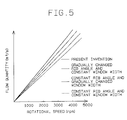
- Fig. 5 which shows relation between the flow quantity and the rotatioanl speed
- the solid line indicates the results of the experiment on the above embodiments.
- the chain line with one dot indicates the results of the experiment with the angle of the guide wall part (rib) gradually changed and the window width constant.
- the chain line with two dots indicates the results of the experiment with the rib angle constant and the window width gradually changed.
- the broken line indicates the results of the experiment on only the above modified embodiment (however, with the angle of inclination of each guide wall part 7 fixed).
- the angle of inclination ⁇ of the guide wall parts 7 is defined as the angle ⁇ LB of the wall on the backward end side of the rotating direction.
- this angle ⁇ LB is set to become gradually smaller from the vicinity of the forward end a of the support part 8 towards the backward end b of the support part 8 in the rotating direction.
- the width of the cooling window w is arranged in the same way as in the first embodiment.
- Fig. 7 is a side view viewed in the direction of the arrow A of Fig. 6.
- the axial length of cooling windows w are set to become gradually longer from the vicinity of the support parts 8 towards the intermediate area between the support parts 8.
- the noise generated from the bottom part of the armature coil 34 within the frame 1 can be sufficiently shut off.
- the guide wall parts 7 will be narrowed to the extent to be easily deformed.
- the guide wall parts 7 adjacent to the support parts 8 may cause the insufficient run of the molten metal due to sharp change in the width between the guide wall part and the support part 8 and the depth, resulting in insufficient strength.
- this embodiment is free from these problems, allowing very stable casting and substantial improvement in strength.
- each cooling window w it is possible to set the axial length of each cooling windows w to become gradually longer from the vicinity of the support part 8 towards the intermediate area between the support parts 8, or otherwise to be constant.
Landscapes
- Engineering & Computer Science (AREA)
- Power Engineering (AREA)
- Motor Or Generator Cooling System (AREA)
- Motor Or Generator Frames (AREA)
Claims (7)
- Une machine électrique rotative, comportant :[a] un boîtier (1) avec une pluralité de fenêtres de refroidissement (w) ouvertes dans une paroi périphérique cylindrique dans un alignement circonférentiel ;[b] un stator (33,34) fixé à l'intérieur de ce boîtier (1) ;[c] un rotor (31,32) supporté en rotation à l'intérieur dudit boîtier ; et[d] un ventilateur centrifuge (6) positionné à l'intérieur desdites fenêtres de refroidissement (w) et fixé à l'une des extrémités dudit rotor (31,32) ;[e] la paroi périphérique dudit boîtier (1) étant prévue avec[e1] des parties de paroi de guidage (7) positionnées entre deux desdites fenêtres de refroidissement (w) adjacentes circonférentiellement et s'étendant parallèlement audit rotor (31,32), définissant ainsi la direction de la ventilation de refroidissement soufflée desdites fenêtres de refroidissement (w), et[e2] des parties de support (8) positionnées entre deux desdites fenêtres de refroidissement (w) adjacentes circonférentiellement et s'étendant parallèlement audit rotor (31,32), la largeur circonférentielle desdites parties de support (8) étant plus grande que celle desdites parties de paroi de guidage (7);[f] la machine étant caractérisée en ce que[f1] l'angle d'inclinaison (θ) desdites parties de paroi de guidage (7) par rapport à la direction radiale est ajusté de manière à ce que cet angle soit plus grand à proximité d'une extrémité avant (a) desdites parties de support (8) dans la direction de rotation et plus petit à proximité d'une extrémité arrière (b) desdites parties de support (8) dans la direction de rotation, et/ou[f2] une largeur circonférentielle (H) desdites fenêtres de refroidissement (w) est ajustée de manière à ce qu'elle soit plus grande dans une zone intermédiaire entre lesdites parties de support (8) qu'à proximité desdites parties de support (8).
- Machine électrique rotative selon la revendication 1, dans laquelle l'angle d'inclinaison desdites parties de paroi de guidage (7) par rapport à la direction radiale est ajustée pour devenir graduellement plus petite de la proximité de l'extrémité avant (a) desdites parties de support (8) dans la direction de rotation, vers la proximité de l'extrémité arrière (b) desdites parties de support (8) dans la direction de rotation.
- Machine électrique rotative selon la revendication 1, dans laquelle lesdites parties de paroi de guidage (7) sont formées dans la direction de la ventilation de refroidissement soufflant dans lesdites fenêtres de refroidissement (w) à la vitesse de rotation à laquelle la température de l'air soufflé est la plus importante dans un fonctionnement à pleine charge.
- Machine électrique rotative selon la revendication 1, dans laquelle la largeur circonférentielle (H) de ladite pluralité des fenêtres de refroidissement (w) est ajustée pour devenir graduellement plus grande à partir de la proximité desdites parties de support (8).
- Machine électrique rotative selon l'une des revendications 1 à 4, dans laquelle ladite pluralité de fenêtres de refroidissement (w) s'étend axialement de la paroi périphérique dudit boîtier à son extrémité et la longueur axiale desdites fenêtres de refroidissement (w) est ajustée pour être plus grande dans la zone intermédiaire entre lesdites parties de support (8) qu'à proximité desdites parties de support (8).
- Machine électrique rotative selon l'une des revendications 1 à 4, dans laquelle lesdites fenêtres de refroidissement (w) s'étendent axialement de la paroi périphérique dudit boîtier à son extrémité et la longueur axiale desdites fenêtres de refroidissement (w) est ajustée pour être constante.
- Machine électrique rotative selon l'une des revendications 1 à 6, dans laquelle ledit ventilateur centrifuge (6) comporte une pluralité de pales de ventilateur (60) qui sont disposés circonférentiellement avec différents espaces angulaires (a1,a2,a3).
Applications Claiming Priority (4)
| Application Number | Priority Date | Filing Date | Title |
|---|---|---|---|
| JP17534193 | 1993-07-15 | ||
| JP175341/93 | 1993-07-15 | ||
| JP90983/94 | 1994-04-28 | ||
| JP6090983A JP2661545B2 (ja) | 1993-07-15 | 1994-04-28 | 回転電機 |
Publications (3)
| Publication Number | Publication Date |
|---|---|
| EP0634829A2 EP0634829A2 (fr) | 1995-01-18 |
| EP0634829A3 EP0634829A3 (fr) | 1995-06-07 |
| EP0634829B1 true EP0634829B1 (fr) | 1997-04-09 |
Family
ID=26432386
Family Applications (1)
| Application Number | Title | Priority Date | Filing Date |
|---|---|---|---|
| EP94110836A Expired - Lifetime EP0634829B1 (fr) | 1993-07-15 | 1994-07-12 | Machine électrique tournante |
Country Status (5)
| Country | Link |
|---|---|
| US (1) | US5650675A (fr) |
| EP (1) | EP0634829B1 (fr) |
| JP (1) | JP2661545B2 (fr) |
| CN (1) | CN1051413C (fr) |
| DE (1) | DE69402479T2 (fr) |
Families Citing this family (22)
| Publication number | Priority date | Publication date | Assignee | Title |
|---|---|---|---|---|
| GB9510997D0 (en) * | 1995-05-31 | 1995-07-26 | Turbo Genset The Company Ltd | Rotary electrical machines |
| US5962942A (en) * | 1996-05-31 | 1999-10-05 | The Turbo Genset Company Limited | Rotary electrical machines |
| JP3351690B2 (ja) * | 1996-08-26 | 2002-12-03 | 三菱電機株式会社 | 車両用交流発電機およびその組立方法 |
| US6404086B1 (en) * | 1996-09-13 | 2002-06-11 | Hitachi, Ltd. | Anisotropic magnet brushless motor having a rotor with elastic insulating support structure |
| EP1465321B1 (fr) | 1997-05-26 | 2013-10-16 | Denso Corporation | Disposition d'enroulement statorique d'un alternateur pour véhicules |
| FR2768870B1 (fr) * | 1997-09-25 | 2003-09-26 | Denso Corp | Alternateur pour un vehicule automobile |
| WO2000016467A1 (fr) | 1998-09-11 | 2000-03-23 | Mitsubishi Denki Kabushiki Kaisha | Generateur de courant alternatif pour vehicules |
| US6774514B2 (en) * | 2000-02-25 | 2004-08-10 | Kabushiki Kaisha Toshiba | Totally enclosed type driving electric motor |
| US6589018B2 (en) | 2001-08-14 | 2003-07-08 | Lakewood Engineering And Manufacturing Co. | Electric fan motor assembly with motor housing control switch and electrical input socket |
| JP4118548B2 (ja) * | 2001-11-06 | 2008-07-16 | 株式会社デンソー | 車両用交流発電機 |
| DE10154870A1 (de) * | 2001-11-08 | 2003-06-26 | Bosch Gmbh Robert | Elektrische Maschine, vorzugsweise Drehstromgenerator für Kraftfahrzeuge |
| JP3982369B2 (ja) * | 2002-09-12 | 2007-09-26 | 株式会社デンソー | 車両用交流発電機 |
| JP4055696B2 (ja) * | 2003-11-04 | 2008-03-05 | 株式会社デンソー | 車両用交流発電機 |
| FR2869477B1 (fr) * | 2004-03-26 | 2007-07-27 | Valeo Equip Electr Moteur | Machine electrique tournante, notamment alternateur de vehicule automobile, dont les entrees/sorties d'air comprennent des ailettes inclinees par rapport aux pales des ventilateurs |
| US7775576B2 (en) * | 2004-06-25 | 2010-08-17 | Robert Bosch Gmbh | Air pump assembly |
| JP4548264B2 (ja) | 2005-08-01 | 2010-09-22 | 株式会社デンソー | 車両用交流発電機 |
| JP4497090B2 (ja) | 2005-12-21 | 2010-07-07 | 株式会社デンソー | 車両用交流発電機 |
| BG66108B1 (bg) | 2007-04-16 | 2011-04-29 | Енчо Попов | Безчетков алтернатор с ротор с клюнообразни полюси |
| JP4493700B2 (ja) * | 2008-05-19 | 2010-06-30 | 三菱電機株式会社 | 制御装置一体型回転電機 |
| JP2011004501A (ja) * | 2009-06-18 | 2011-01-06 | Hitachi Automotive Systems Ltd | 回転電機 |
| JP5751319B2 (ja) * | 2013-12-10 | 2015-07-22 | 三菱電機株式会社 | 回転電機 |
| CN104283359A (zh) * | 2014-10-30 | 2015-01-14 | 江苏富丽华通用设备有限公司 | 一种电机端盖 |
Family Cites Families (17)
| Publication number | Priority date | Publication date | Assignee | Title |
|---|---|---|---|---|
| US1136142A (en) * | 1913-08-15 | 1915-04-20 | Charles Volney Kerr | Blower. |
| US1534721A (en) * | 1924-04-28 | 1925-04-21 | Aeg | Construction of elastic-fluid turbines to prevent breakage of blades due to vibrations |
| US2157002A (en) * | 1938-05-07 | 1939-05-02 | Gen Electric | Diffuser for centrifugal compressors |
| US2291478A (en) * | 1939-08-12 | 1942-07-28 | Bour Harry E La | Centrifugal pump |
| US2439933A (en) * | 1943-07-28 | 1948-04-20 | Westinghouse Electric Corp | Centrifugal blower |
| US3973872A (en) * | 1975-08-01 | 1976-08-10 | Konstantin Pavlovich Seleznev | Centrifugal compressor |
| JPS576551A (en) * | 1980-06-12 | 1982-01-13 | Nippon Denso Co Ltd | Ac generator for vehicle |
| JPS57186168A (en) * | 1981-05-12 | 1982-11-16 | Toshiba Corp | Method and apparatus for monitoring and measuring water pollution |
| JPS62140867A (ja) * | 1985-12-16 | 1987-06-24 | Matsushita Electric Ind Co Ltd | 電子式タイプライタ− |
| FR2602924B3 (fr) * | 1986-08-12 | 1988-11-10 | Ducellier & Cie | Dispositif interne de ventilation pour une machine electrique tournante telle qu'un alternateur pour vehicule automobile, et element de carcasse pour une telle machine |
| JPH0789727B2 (ja) * | 1988-12-27 | 1995-09-27 | 三笠産業株式会社 | 電動機の冷却機構 |
| JP2615185B2 (ja) * | 1989-02-15 | 1997-05-28 | 三菱電機株式会社 | 車両用交流発電機 |
| US5028826A (en) * | 1989-06-02 | 1991-07-02 | Mitsubishi Denki K.K. | Fan arrangement for a vehicular AC generator |
| JPH03178593A (ja) * | 1989-07-10 | 1991-08-02 | Mitsubishi Electric Corp | リニア搬送装置 |
| US5095235A (en) * | 1989-12-04 | 1992-03-10 | Mitsubishi Denki K.K. | Vehicle ac generator |
| DE4129411C2 (de) * | 1990-09-28 | 1995-10-12 | Mitsubishi Electric Corp | Fahrzeug-Wechselstromgenerator |
| IT1249859B (it) * | 1991-10-23 | 1995-03-28 | Magneti Marelli Spa | Macchina elettrica rotante, particolarmente alternatore per autoveicoli. |
-
1994
- 1994-04-28 JP JP6090983A patent/JP2661545B2/ja not_active Expired - Fee Related
- 1994-07-08 CN CN94107828A patent/CN1051413C/zh not_active Expired - Fee Related
- 1994-07-12 DE DE69402479T patent/DE69402479T2/de not_active Expired - Lifetime
- 1994-07-12 EP EP94110836A patent/EP0634829B1/fr not_active Expired - Lifetime
- 1994-07-14 US US08/274,815 patent/US5650675A/en not_active Expired - Lifetime
Also Published As
| Publication number | Publication date |
|---|---|
| JP2661545B2 (ja) | 1997-10-08 |
| CN1051413C (zh) | 2000-04-12 |
| EP0634829A3 (fr) | 1995-06-07 |
| JPH0779543A (ja) | 1995-03-20 |
| CN1102917A (zh) | 1995-05-24 |
| DE69402479T2 (de) | 1997-12-04 |
| US5650675A (en) | 1997-07-22 |
| EP0634829A2 (fr) | 1995-01-18 |
| DE69402479D1 (de) | 1997-05-15 |
Similar Documents
| Publication | Publication Date | Title |
|---|---|---|
| US5650675A (en) | Rotary electric machine having variably-dimensioned housing ventilation holes | |
| US5705865A (en) | Rotary electric machine with increased cooling capacity | |
| EP0418027B1 (fr) | Un ventilateur de refroidissement pour machine électrique tournante | |
| KR100367369B1 (ko) | 차량용 교류 발전기 | |
| US5093591A (en) | Alternating current generator with vented fan-like pulleys | |
| US5710467A (en) | Alternator | |
| US6172433B1 (en) | Alternating current generator with improved fans system | |
| US20050008483A1 (en) | Fan impeller for electrical machines | |
| US7168923B2 (en) | Alternator fan | |
| JP6366851B2 (ja) | 車両用交流発電機 | |
| CN101931284A (zh) | 旋转电机 | |
| US7888829B2 (en) | Vehicle AC generator | |
| JPH09289756A (ja) | 交流発電機 | |
| KR20040002405A (ko) | 회전 전기 기계 | |
| JP3294497B2 (ja) | 交流発電機 | |
| EP1443630B1 (fr) | Deflecteur d'air pour un générateur | |
| EP1443627B1 (fr) | Générateur avec un déflecteur d'air | |
| JP4118548B2 (ja) | 車両用交流発電機 | |
| JPH09172752A (ja) | 交流発電機 | |
| US7759838B2 (en) | Coil support for rotating electrical machine | |
| JP3656347B2 (ja) | 回転電機の回転子 | |
| JPH10225061A (ja) | 車両用交流発電機 | |
| JP3658863B2 (ja) | 回転電機 | |
| EP1750353B1 (fr) | Générateur pour véhicule ayant des sorties de refroidissement de largeurs différentes | |
| JP2007014104A (ja) | 車両用交流発電機 |
Legal Events
| Date | Code | Title | Description |
|---|---|---|---|
| PUAI | Public reference made under article 153(3) epc to a published international application that has entered the european phase |
Free format text: ORIGINAL CODE: 0009012 |
|
| AK | Designated contracting states |
Kind code of ref document: A2 Designated state(s): DE FR GB |
|
| PUAL | Search report despatched |
Free format text: ORIGINAL CODE: 0009013 |
|
| AK | Designated contracting states |
Kind code of ref document: A3 Designated state(s): DE FR GB |
|
| 17P | Request for examination filed |
Effective date: 19950714 |
|
| 17Q | First examination report despatched |
Effective date: 19960122 |
|
| GRAG | Despatch of communication of intention to grant |
Free format text: ORIGINAL CODE: EPIDOS AGRA |
|
| GRAH | Despatch of communication of intention to grant a patent |
Free format text: ORIGINAL CODE: EPIDOS IGRA |
|
| GRAH | Despatch of communication of intention to grant a patent |
Free format text: ORIGINAL CODE: EPIDOS IGRA |
|
| GRAA | (expected) grant |
Free format text: ORIGINAL CODE: 0009210 |
|
| AK | Designated contracting states |
Kind code of ref document: B1 Designated state(s): DE FR GB |
|
| REF | Corresponds to: |
Ref document number: 69402479 Country of ref document: DE Date of ref document: 19970515 |
|
| ET | Fr: translation filed | ||
| RAP2 | Party data changed (patent owner data changed or rights of a patent transferred) |
Owner name: DENSO CORPORATION |
|
| PLBE | No opposition filed within time limit |
Free format text: ORIGINAL CODE: 0009261 |
|
| STAA | Information on the status of an ep patent application or granted ep patent |
Free format text: STATUS: NO OPPOSITION FILED WITHIN TIME LIMIT |
|
| 26N | No opposition filed | ||
| REG | Reference to a national code |
Ref country code: GB Ref legal event code: IF02 |
|
| PGFP | Annual fee paid to national office [announced via postgrant information from national office to epo] |
Ref country code: FR Payment date: 20110727 Year of fee payment: 18 |
|
| PGFP | Annual fee paid to national office [announced via postgrant information from national office to epo] |
Ref country code: DE Payment date: 20110706 Year of fee payment: 18 Ref country code: GB Payment date: 20110706 Year of fee payment: 18 |
|
| GBPC | Gb: european patent ceased through non-payment of renewal fee |
Effective date: 20120712 |
|
| REG | Reference to a national code |
Ref country code: FR Ref legal event code: ST Effective date: 20130329 |
|
| PG25 | Lapsed in a contracting state [announced via postgrant information from national office to epo] |
Ref country code: FR Free format text: LAPSE BECAUSE OF NON-PAYMENT OF DUE FEES Effective date: 20120731 Ref country code: DE Free format text: LAPSE BECAUSE OF NON-PAYMENT OF DUE FEES Effective date: 20130201 Ref country code: GB Free format text: LAPSE BECAUSE OF NON-PAYMENT OF DUE FEES Effective date: 20120712 |
|
| REG | Reference to a national code |
Ref country code: DE Ref legal event code: R119 Ref document number: 69402479 Country of ref document: DE Effective date: 20130201 |