EP0624595A2 - nor-Gallensäurederivate, Verfahren zu ihrer Herstellung und Verwendung dieser Verbindungen als Arzneimittel - Google Patents
nor-Gallensäurederivate, Verfahren zu ihrer Herstellung und Verwendung dieser Verbindungen als Arzneimittel Download PDFInfo
- Publication number
- EP0624595A2 EP0624595A2 EP94106846A EP94106846A EP0624595A2 EP 0624595 A2 EP0624595 A2 EP 0624595A2 EP 94106846 A EP94106846 A EP 94106846A EP 94106846 A EP94106846 A EP 94106846A EP 0624595 A2 EP0624595 A2 EP 0624595A2
- Authority
- EP
- European Patent Office
- Prior art keywords
- radical
- bile acid
- atoms
- alkyl
- chain
- Prior art date
- Legal status (The legal status is an assumption and is not a legal conclusion. Google has not performed a legal analysis and makes no representation as to the accuracy of the status listed.)
- Granted
Links
- 0 CCC1(C[C@@]([C@@]2[C@]3CCC4*C(C)=O)[C@@](C)(CCC(C5)O)[C@@]5CC2(*2)*2=I)[C@@]34C(*)(*)*1C Chemical compound CCC1(C[C@@]([C@@]2[C@]3CCC4*C(C)=O)[C@@](C)(CCC(C5)O)[C@@]5CC2(*2)*2=I)[C@@]34C(*)(*)*1C 0.000 description 4
- LRXOAPBXOSVHQK-LIGWQEOUSA-N CC(CC(OC)=O)C(CC[C@H]1[C@@H]([C@H](C2)[C@@](C)(CC[C@H](C)C3)[C@@H]3C3)[C@@H]3O)[C@@]1(C)[C@H]2O Chemical compound CC(CC(OC)=O)C(CC[C@H]1[C@@H]([C@H](C2)[C@@](C)(CC[C@H](C)C3)[C@@H]3C3)[C@@H]3O)[C@@]1(C)[C@H]2O LRXOAPBXOSVHQK-LIGWQEOUSA-N 0.000 description 1
Classifications
-
- C—CHEMISTRY; METALLURGY
- C07—ORGANIC CHEMISTRY
- C07J—STEROIDS
- C07J3/00—Normal steroids containing carbon, hydrogen, halogen or oxygen, substituted in position 17 beta by one carbon atom
- C07J3/005—Normal steroids containing carbon, hydrogen, halogen or oxygen, substituted in position 17 beta by one carbon atom the carbon atom being part of a carboxylic function
-
- A—HUMAN NECESSITIES
- A61—MEDICAL OR VETERINARY SCIENCE; HYGIENE
- A61P—SPECIFIC THERAPEUTIC ACTIVITY OF CHEMICAL COMPOUNDS OR MEDICINAL PREPARATIONS
- A61P3/00—Drugs for disorders of the metabolism
- A61P3/06—Antihyperlipidemics
-
- A—HUMAN NECESSITIES
- A61—MEDICAL OR VETERINARY SCIENCE; HYGIENE
- A61P—SPECIFIC THERAPEUTIC ACTIVITY OF CHEMICAL COMPOUNDS OR MEDICINAL PREPARATIONS
- A61P9/00—Drugs for disorders of the cardiovascular system
-
- C—CHEMISTRY; METALLURGY
- C07—ORGANIC CHEMISTRY
- C07J—STEROIDS
- C07J3/00—Normal steroids containing carbon, hydrogen, halogen or oxygen, substituted in position 17 beta by one carbon atom
-
- C—CHEMISTRY; METALLURGY
- C07—ORGANIC CHEMISTRY
- C07J—STEROIDS
- C07J31/00—Normal steroids containing one or more sulfur atoms not belonging to a hetero ring
- C07J31/006—Normal steroids containing one or more sulfur atoms not belonging to a hetero ring not covered by C07J31/003
-
- C—CHEMISTRY; METALLURGY
- C07—ORGANIC CHEMISTRY
- C07J—STEROIDS
- C07J41/00—Normal steroids containing one or more nitrogen atoms not belonging to a hetero ring
- C07J41/0005—Normal steroids containing one or more nitrogen atoms not belonging to a hetero ring the nitrogen atom being directly linked to the cyclopenta(a)hydro phenanthrene skeleton
-
- C—CHEMISTRY; METALLURGY
- C07—ORGANIC CHEMISTRY
- C07J—STEROIDS
- C07J41/00—Normal steroids containing one or more nitrogen atoms not belonging to a hetero ring
- C07J41/0005—Normal steroids containing one or more nitrogen atoms not belonging to a hetero ring the nitrogen atom being directly linked to the cyclopenta(a)hydro phenanthrene skeleton
- C07J41/0011—Unsubstituted amino radicals
-
- C—CHEMISTRY; METALLURGY
- C07—ORGANIC CHEMISTRY
- C07J—STEROIDS
- C07J41/00—Normal steroids containing one or more nitrogen atoms not belonging to a hetero ring
- C07J41/0005—Normal steroids containing one or more nitrogen atoms not belonging to a hetero ring the nitrogen atom being directly linked to the cyclopenta(a)hydro phenanthrene skeleton
- C07J41/0027—Azides
-
- C—CHEMISTRY; METALLURGY
- C07—ORGANIC CHEMISTRY
- C07J—STEROIDS
- C07J41/00—Normal steroids containing one or more nitrogen atoms not belonging to a hetero ring
- C07J41/0033—Normal steroids containing one or more nitrogen atoms not belonging to a hetero ring not covered by C07J41/0005
- C07J41/0055—Normal steroids containing one or more nitrogen atoms not belonging to a hetero ring not covered by C07J41/0005 the 17-beta position being substituted by an uninterrupted chain of at least three carbon atoms which may or may not be branched, e.g. cholane or cholestane derivatives, optionally cyclised, e.g. 17-beta-phenyl or 17-beta-furyl derivatives
- C07J41/0061—Normal steroids containing one or more nitrogen atoms not belonging to a hetero ring not covered by C07J41/0005 the 17-beta position being substituted by an uninterrupted chain of at least three carbon atoms which may or may not be branched, e.g. cholane or cholestane derivatives, optionally cyclised, e.g. 17-beta-phenyl or 17-beta-furyl derivatives one of the carbon atoms being part of an amide group
-
- C—CHEMISTRY; METALLURGY
- C07—ORGANIC CHEMISTRY
- C07J—STEROIDS
- C07J41/00—Normal steroids containing one or more nitrogen atoms not belonging to a hetero ring
- C07J41/0033—Normal steroids containing one or more nitrogen atoms not belonging to a hetero ring not covered by C07J41/0005
- C07J41/0066—Normal steroids containing one or more nitrogen atoms not belonging to a hetero ring not covered by C07J41/0005 the 17-beta position being substituted by a carbon atom forming part of an amide group
-
- C—CHEMISTRY; METALLURGY
- C07—ORGANIC CHEMISTRY
- C07J—STEROIDS
- C07J41/00—Normal steroids containing one or more nitrogen atoms not belonging to a hetero ring
- C07J41/0033—Normal steroids containing one or more nitrogen atoms not belonging to a hetero ring not covered by C07J41/0005
- C07J41/0088—Normal steroids containing one or more nitrogen atoms not belonging to a hetero ring not covered by C07J41/0005 containing unsubstituted amino radicals
-
- C—CHEMISTRY; METALLURGY
- C07—ORGANIC CHEMISTRY
- C07J—STEROIDS
- C07J41/00—Normal steroids containing one or more nitrogen atoms not belonging to a hetero ring
- C07J41/0033—Normal steroids containing one or more nitrogen atoms not belonging to a hetero ring not covered by C07J41/0005
- C07J41/0094—Normal steroids containing one or more nitrogen atoms not belonging to a hetero ring not covered by C07J41/0005 containing nitrile radicals, including thiocyanide radicals
-
- C—CHEMISTRY; METALLURGY
- C07—ORGANIC CHEMISTRY
- C07J—STEROIDS
- C07J51/00—Normal steroids with unmodified cyclopenta(a)hydrophenanthrene skeleton not provided for in groups C07J1/00 - C07J43/00
-
- C—CHEMISTRY; METALLURGY
- C07—ORGANIC CHEMISTRY
- C07J—STEROIDS
- C07J7/00—Normal steroids containing carbon, hydrogen, halogen or oxygen substituted in position 17 beta by a chain of two carbon atoms
- C07J7/0005—Normal steroids containing carbon, hydrogen, halogen or oxygen substituted in position 17 beta by a chain of two carbon atoms not substituted in position 21
-
- C—CHEMISTRY; METALLURGY
- C07—ORGANIC CHEMISTRY
- C07J—STEROIDS
- C07J7/00—Normal steroids containing carbon, hydrogen, halogen or oxygen substituted in position 17 beta by a chain of two carbon atoms
- C07J7/0005—Normal steroids containing carbon, hydrogen, halogen or oxygen substituted in position 17 beta by a chain of two carbon atoms not substituted in position 21
- C07J7/001—Normal steroids containing carbon, hydrogen, halogen or oxygen substituted in position 17 beta by a chain of two carbon atoms not substituted in position 21 substituted in position 20 by a keto group
- C07J7/0015—Normal steroids containing carbon, hydrogen, halogen or oxygen substituted in position 17 beta by a chain of two carbon atoms not substituted in position 21 substituted in position 20 by a keto group not substituted in position 17 alfa
- C07J7/002—Normal steroids containing carbon, hydrogen, halogen or oxygen substituted in position 17 beta by a chain of two carbon atoms not substituted in position 21 substituted in position 20 by a keto group not substituted in position 17 alfa not substituted in position 16
-
- C—CHEMISTRY; METALLURGY
- C07—ORGANIC CHEMISTRY
- C07J—STEROIDS
- C07J7/00—Normal steroids containing carbon, hydrogen, halogen or oxygen substituted in position 17 beta by a chain of two carbon atoms
- C07J7/0005—Normal steroids containing carbon, hydrogen, halogen or oxygen substituted in position 17 beta by a chain of two carbon atoms not substituted in position 21
- C07J7/0065—Normal steroids containing carbon, hydrogen, halogen or oxygen substituted in position 17 beta by a chain of two carbon atoms not substituted in position 21 substituted in position 20 by an OH group free esterified or etherified
- C07J7/007—Normal steroids containing carbon, hydrogen, halogen or oxygen substituted in position 17 beta by a chain of two carbon atoms not substituted in position 21 substituted in position 20 by an OH group free esterified or etherified not substituted in position 17 alfa
-
- C—CHEMISTRY; METALLURGY
- C07—ORGANIC CHEMISTRY
- C07J—STEROIDS
- C07J9/00—Normal steroids containing carbon, hydrogen, halogen or oxygen substituted in position 17 beta by a chain of more than two carbon atoms, e.g. cholane, cholestane, coprostane
- C07J9/005—Normal steroids containing carbon, hydrogen, halogen or oxygen substituted in position 17 beta by a chain of more than two carbon atoms, e.g. cholane, cholestane, coprostane containing a carboxylic function directly attached or attached by a chain containing only carbon atoms to the cyclopenta[a]hydrophenanthrene skeleton
Definitions
- the invention relates to bile acid derivatives of the formula I. G1 - X - G2 I, Processes for their preparation, pharmaceutical preparations based on these compounds and the use of bile acid derivatives as medicaments.
- Bile acids have an important physiological function in fat digestion, e.g. B. as cofactors of pancreatic lipases and as natural detergents for solubilizing fats and fat-soluble vitamins. As the end product of cholesterol metabolism, they are synthesized in the liver, stored in the gallbladder and released by contraction into the small intestine, where they exert their physiological effect. Most of the secreted bile acids are recovered via the enterohepatic cycle. They return to the liver via the mesenteric veins of the small intestine and the portal vein system. Both active and passive transport processes play a role in reabsorption in the intestine.
- the majority of the bile acids are reabsorbed at the end of the small intestine, the terminal ileum, by a specific Na+-dependent transport system and reach the liver with the mesenteric vein blood via the portal vein, in order to be secreted again into the bile by the liver cells.
- the bile acids appear both as free acids and in the form of glycine and taurine conjugates.
- Bile acids in which the side chain is shortened by one or more C atoms, also called nor-bile acids, have a free or conjugated carboxyl group corresponding to the C atoms 23, 22 or 20. Some of these compounds occur in traces in natural bile . Nor bile acids differ in some metabolic and physiological properties of C24 bile acids (J. Lip. Res. 29 , 1387, 1988).
- Non-resorbable, insoluble, basic, cross-linked polymers have been used for some time to bind bile acids and are used therapeutically because of these properties.
- Bile acid derivatives described in patent application EP-A-0 489 423 have a high affinity for the intestinal bile acid transport system and therefore allow specific inhibition of the enterohepatic circulation. All diseases in which inhibition of bile acid absorption in the intestine, in particular in the small intestine, seems desirable are considered as the object of therapy. For example, cholagenic diarrhea after ileum resection, or increased cholesterol blood levels, are treated in this way. In the case of high cholesterol blood levels, intervention in the enterohepatic circulation can lower this level.
- LDL cholesterol which is found in the bloodstream, is used to cover the cholesterol requirement in the liver, with the hepatic LDL receptors being increasingly used.
- the resulting acceleration of LDL catabolism has an effect by reducing the atherogenic cholesterol content in the blood.
- the task was to find new drugs that are able to reduce the atherogenic cholesterol in the blood or the to influence the enterohepatic circulation with regard to increased bile acid excretion and consequent lowering of the cholesterol level.
- Modified bile acid residues are bile acid residues in the form of the free acid, the esters or amides, the salt forms, the forms derivatized on the hydroxyl groups and dimeric bile acid residues, such as those e.g. in EP-A-0 489 423.
- the compounds according to the invention have a high affinity for the specific bile acid transport system of the small intestine and inhibit bile acid absorption in a concentration-dependent and competitive manner.
- the compounds according to the invention are not themselves absorbed and therefore do not enter the bloodstream.
- the enterohepatic cycle of the bile acids can be interrupted very specifically and efficiently.
- the compounds according to the invention it is possible to add the amount of bile acid present in the enterohepatic circulation reduce so that there is a decrease in the cholesterol level in the serum.
- Avitaminoses are just as unlikely to be used in the application as influencing the absorption of other drugs or a negative effect on the intestinal flora.
- the side effects known from the polymers are not observed, ie fat digestion is not adversely affected. Because of the high affinity for the specific bile acid transport system of the small intestine, small daily doses are sufficient, so that the acceptance of such drugs by doctors and patients will be very high.
- Preferred compounds of the formula I are those in which the linkage between the bile acid residues G1 and G2 is not symmetrical, i. H. that a certain ring of the steroid structure of G1 is not linked to one another by the corresponding ring of the steroid structure of G2 via X, at least one of the bile acids G1 or G2 in the side chain being shortened by one or more C atoms.
- alkyl, alkenyl and alkoxy groups are straight-chain or branched.
- the nitrile VII is obtained, which leads to free bile acid VIII shortened by a further C atom by saponification with strong base.
- this compound can be used unprotected or in newly protected form IX (where R may also be acyl, silyl or also tetrahydropyranyl (THP) protective groups).
- R may also be acyl, silyl or also tetrahydropyranyl (THP) protective groups.
- Compound X is reduced to alcohol XI with sodium borohydride.
- the alcohol function is activated, for example by a methanesulfonyl or trifluoromethanesulfonyl group as in compound XII, and then with a suitable base, e.g. B. Diazabicycloundecen, eliminated to the vinyl system XIII.
- a suitable base e.g. B. Diazabicycloundecen
- the 20.21 double bond is cleaved with osmium tetroxide / sodium periodate or ozone in a suitable solvent to form the aldehyde XIV.
- Oxidation of XIV by known methods, e.g. B. with sodium chlorite, leads to the corresponding C-20 carboxyl bile acid derivative XV.
- After activation of the 3-hydroxy function e.g. B.
- a nitrile group can be introduced by nucleophilic substitution with sodium cyanide in a suitable solvent at elevated temperature.
- the compound XVII thus obtained can be hydrogenated with hydrogen in the presence of a suitable catalyst, for.
- Rhodium / Al2O3 be converted into the aminomethyl block XVIII.
- Trimethylsilyl cyanide can be added in good yields to 3-ketocholanoic acid ester XIX. Under the chosen reaction conditions (TMSCN, ZnJ2, CH2Cl2) a nitrile derivative XX is obtained in which all the hydroxyl groups are silylated.
- the nitrile group is directed into the axial ⁇ position, the diastereoselectivity is> 9: 1 (Lit .: Evans et al., J. Org. Chem. 39 (1974) 914).
- the nitrile function can be reduced to 3 ⁇ -aminomethyl derivative XXI with sodium borohydride / trifluoroacetic acid in THF. In this way, cholanic acid derivatives are obtained in which, in addition to an additional linker (X), the original 3 ⁇ -hydroxy function is retained.
- the invention further relates to the use of the compounds according to the invention for the production of a medicinal product.
- the compounds of the general formula I are dissolved or suspended in pharmacologically acceptable organic solvents, such as mono- or polyhydric alcohols, such as. As ethanol or glycerol, in triacetin, oils such as. B. sunflower oil, cod liver oil, ethers, such as. B. diethylene glycol dimethyl ether or polyethers such. B. polyethylene glycol, or in the presence of other pharmacologically acceptable polymer carriers, such as. As polyvinylpyrrolidone, or other pharmaceutically acceptable additives such as starch, cyclodextrin or polysaccharides.
- pharmacologically acceptable organic solvents such as mono- or polyhydric alcohols, such as. As ethanol or glycerol, in triacetin, oils such as. B. sunflower oil, cod liver oil, ethers, such as. B. diethylene glycol dimethyl ether or polyethers such
- the compounds according to the invention can be given in combination with other medicinal substances.
- the compounds of formula I are administered in various dosage forms, preferably orally in the form of tablets, capsules or liquids.
- the daily dose varies depending on the body weight and constitution of the patient in the range of 3 mg to 5000 mg, but preferably in the dose range 10 to 1000 mg.
- the compounds are particularly suitable as hypolipidemics.
- the invention therefore also relates to medicaments based on the compounds of the formula (I) and the use of the compounds as medicaments, in particular for lowering the cholesterol level.
- the compounds according to the invention were tested biologically by determining the inhibition of the [3 H] -taurocholate uptake in brush border membrane vesicles of the rabbit ileum.
- the inhibition test was carried out as follows:
- the preparation of brush border membrane particles from the intestinal cells of the small intestine was carried out using the so-called Mg2+ precipitation method.
- Male New Zealand rabbits (2 to 2.5 kg body weight) were examined intravenous injection of 0.5 ml of an aqueous solution of 2.5 mg tetracaine HCl, 100 T 61 R and 25 mg mebezonium iodide was killed.
- the small intestine was removed and rinsed with ice cold physiological saline.
- the terminal 7/10 of the small intestine (measured in the oral rectal direction, ie the terminal ileum, which contains the active Na+-dependent bile acid transport system) were used to prepare the brush border membrane vesicles.
- the intestines were frozen in plastic bags under nitrogen at -80 ° C. To prepare the membrane vesicles, the frozen intestines were thawed at 30 ° C in a water bath. The mucosa was scraped off and dissolved in 60 ml ice-cold 12 mM Tris / HCl buffer (pH 7.1) / 300 mM mannitol, 5 mM EGTA / 10 mg / l phenylmethylsulfonyl fluoride / 1 mg / l trypsin inhibitor v. Soybeans (32 U / mg) / 0.5 mg / l Trypsin Inhibitor v.
- the precipitate was dissolved in 0.5 to 2 ml of Tris / Hepes buffer (pH 7.4) / 280 mM mannitol (final concentration 20 mg / ml) and resuspended using a tuberculin syringe with a 27 gauge needle.
- the vesicles were either used immediately after preparation for transport studies or stored in 4 mg portions in liquid nitrogen at -196 ° C.
- the uptake of substrates in the brush border membrane vesicles described above was determined by means of the so-called membrane filtration technique. 10 ⁇ l of the vesicle suspension (100 ⁇ g protein) were pipetted as drops onto the wall of a polystyrene incubation tube (11 x 70 mm), which contained the incubation medium with the corresponding ligands (90 ⁇ l).
- the incubation medium was filtered through a polyvinylidene fluoride membrane filter (SYHV LO 4NS, 0.45 ⁇ m, 4 mm ⁇ , Millipore, Eschborn, FRG).
- the transport measurement was started by mixing the vesicles with the incubation medium.
- the concentration of taurocholate in the incubation mixture was 50 ⁇ M.
- the transport was stopped by adding 1 ml of ice-cold stop solution (10 mM Tris / Hepes (pH 7.4) / 150 mM KCl).
- the resulting mixture was immediately suctioned off under a vacuum of 25 to 35 mbar through a membrane filter made of cellulose nitrate (ME 25, 0.45 ⁇ m, 25 mm diameter, Schleicher & Schuell, Dassell, FRG). The filter was washed with 5 ml of ice-cold stop solution.
- the membrane filter was dissolved with 4 ml of the Quickszint 361 scintillator (Zinsser Analytik GmbH, Frankfurt, Germany) and the radioactivity was measured by liquid scintillation measurement in a TriCarb 2500 measuring device (Canberra Packard GmbH, Frankfurt, Germany) .
- the measured values were obtained after calibration of the device using standard samples and after correction of any chemiluminescence present as dpm (decompositions per minute).
- control values were determined in Na-T-P and K-T-P, respectively.
- the difference between the uptake in Na-T-P and K-T-P resulted in the Na+-dependent transport share.
- concentration of inhibitor at which the Na-dependent transport fraction was inhibited by 50% - based on the control - was designated as IC50 Na+.
- the pharmacological data comprise a series of tests in which the interaction of the compounds according to the invention with the intestinal bile acid transport system in the terminal small intestine was investigated. The results are summarized in Table 11.
- Example 5 340 mg (53%) of Example 5 are obtained from 500 mg (12.67 mmol) of norcholic acid and 450 mg (836 mmol) of taurine by the process described for Example 4. MS (FAB, 3-NBA) C25H43NO7S (501), 502 (M + H+)
- Example 6 38.7 g (81.9 mmol) of Example 6 and 6.9 g (106 mmol) of sodium azide are stirred for 2.5 hours at 130 ° C. in 350 ml of dimethylformamide. After cooling, it is poured onto 1.5 l of ice water and extracted three times with ethyl acetate. The organic phase is dried (MgSO4) and concentrated. The crude product is esterified in a methanolic hydrochloric acid solution prepared from 100 ml of methanol and 14 ml of acetyl chloride for 2 hours at room temperature. For working up, the mixture is partially concentrated, the product is poured onto 1 l of water and extracted three times with ethyl acetate.
- Examples 14 to 31 of Tables 1 to 3 are obtained analogously to Example 13 (reactive -X-G2 derivatives are described in EP-A-0 489 423 or EP-A-0 417 725).
- Example 13 3.0 g (3.76 mmol) of Example 13 are dissolved in 80 ml of ethanol, mixed with 30 mol! N aqueous NaOH and stirred for 16 hours at room temperature. For working up, 30 ml of water are added and the alcohol is removed completely. After acidification with 1N HCl, the precipitate is filtered off, washed with water and dried in vacuo. 2.5 g (85%) of Example 32 are obtained. MS (FAB, 3-NBA / LiCl) C47H77NO8 (784), 791 (M + Li+) Analogously to Example 32, Examples 33 to 50 of Tables 4 to 6 are obtained from the methyl esters (Tables 1-3).
- the sodium salts can be prepared from example 32 and all examples from tables 4 to 8 and 10.
- the compound is dissolved in methanol, mixed with an equimolar amount of 1N aqueous NaOH and then evaporated in vacuo.
- Table 11 shows measured values of the inhibition of the [3 H] -taurocholate uptake in brush border membrane vesicles of the rabbit ileum. They are given Quotients from the IC50 or IC 50Na values of the reference substance as taurochenodeoxycholate (TCDC) and the respective test substance.
Landscapes
- Chemical & Material Sciences (AREA)
- Organic Chemistry (AREA)
- Health & Medical Sciences (AREA)
- General Health & Medical Sciences (AREA)
- Veterinary Medicine (AREA)
- Bioinformatics & Cheminformatics (AREA)
- Engineering & Computer Science (AREA)
- Toxicology (AREA)
- Public Health (AREA)
- Chemical Kinetics & Catalysis (AREA)
- General Chemical & Material Sciences (AREA)
- Medicinal Chemistry (AREA)
- Nuclear Medicine, Radiotherapy & Molecular Imaging (AREA)
- Pharmacology & Pharmacy (AREA)
- Life Sciences & Earth Sciences (AREA)
- Animal Behavior & Ethology (AREA)
- Diabetes (AREA)
- Obesity (AREA)
- Cardiology (AREA)
- Heart & Thoracic Surgery (AREA)
- Hematology (AREA)
- Steroid Compounds (AREA)
- Acyclic And Carbocyclic Compounds In Medicinal Compositions (AREA)
- Organic Low-Molecular-Weight Compounds And Preparation Thereof (AREA)
- Pharmaceuticals Containing Other Organic And Inorganic Compounds (AREA)
Abstract
G1 - X - G2 I,
worin G1, G2 und X die angegebenen Bedeutungen, Verfahren zur Herstellung dieser Verbindungen und Arzneimittel beschrieben. Aufgrund ihrer pharmakologischen Wirkung können sie als Antihyperlipidämikum verwendet werden.
Description
- Die Erfindung betrifft Gallensäurederivate der Formel I
G1 - X - G2 I,
Verfahren zu ihrer Herstellung, pharmazeutische Präparate auf Basis diese Verbindungen sowie die Verwendung der Gallensäurederivate als Arzneimittel. - Gallensäuren haben eine wichtige physiologische Funktion bei der Fettverdauung, z. B. als Cofaktoren der pankreatischen Lipasen und als natürliche Detergentien zur Solubilisierung von Fetten und fettlöslichen Vitaminen. Als Endprodukt des Cholesterinstoffwechsels werden sie in der Leber synthetisiert, in der Gallenblase gespeichert und aus dieser durch Kontraktion in den Dünndarm abgegeben, wo sie ihre physiologische Wirkung entfalten. Der größte Teil der sezernierten Gallensäuren wird über den enterohepatischen Kreislauf zurückgewonnen. Sie gelangen über die Mesenterialvenen des Dünndarms und das Pfortadersystem wieder zur Leber zurück. Bei der Rückresorption im Darm spielen sowohl aktive als auch passive Transportprozesse eine Rolle. Die Hauptmenge der Gallensäuren wird am Ende des Dünndarms, dem terminalen Ileum, durch ein spezifisches Na⁺-abhängiges Transportsystem rückresorbiert und gelangt mit dem Mesenterialvenenblut über die Pfortader zurück zur Leber, um von den Leberzellen erneut in die Galle sezerniert zu werden. Im enterohepatischen Kreislauf treten die Gallensäuren sowohl als freie Säuren als auch in Form von Glycin- und Taurinkonjugaten in Erscheinung.
- Die meisten natürlichen Gallensäuren besitzen in der Seitenkette am D-Ring des Steroidgerüstes eine C-24 Carboxylgruppe in freier oder konjugierter Form. Gallensäuren, bei denen die Seitenkette um ein oder mehrere C-Atome verkürzt ist, auch nor-Gallensäuren genannt, besitzen eine freie oder konjugierte Carboxylgruppe entsprechend an den C-Atomen 23, 22 oder 20. Manche dieser Verbindungen kommen in Spuren in natürlicher Gallenflüssigkeit vor. Nor-Gallensäuren unterscheiden sich in einigen metabolischen und physiologischen Eigenschaften von C₂₄-Gallensäuren (J. Lip. Res. 29, 1387, 1988).
- Nichtresorbierbare, unlösliche, basische, vernetzte Polymere werden seit geraumer Zeit zur Bindung von Gallensäuren verwendet und aufgrund dieser Eigenschaften therapeutisch genutzt. In der Patentanmeldung EP-A-0 489 423 beschriebene Gallensäurederivate besitzen eine hohe Affinität zum intestinalen Gallensäuretransportsystem und erlauben daher eine spezifische Hemmung des enterohepatischen Kreislaufs. Als Therapieobjekt werden alle Erkrankungen, bei denen eine Hemmung der Gallensäureresorption im Darm, insbesondere im Dünndarm, wünschenswert erscheint, angesehen. Beispielsweise werden die cholagene Diarrhoe nach Ileumresektion, oder auch erhöhte Cholesterin-Blutspiegel auf diese Weise behandelt. Im Falle des erhöhten Cholesterin-Blutspiegels kann durch den Eingriff in den enterohepatischen Kreislauf eine Senkung dieses Spiegels erreicht werden. Durch Senkung des im enterohepatischen Kreislauf befindlichen Gallensäurepools wird die entsprechende Neusynthese von Gallensäuren aus Cholesterin in der Leber erzwungen. Zur Deckung des Cholesterinbedarfs in der Leber wird auf das im Blutkreislauf befindliche LDL-Cholesterin zurückgegriffen, wobei die hepatischen LDL-Rezeptoren vermehrt zum Einsatz kommen. Die so erfolgte Beschleunigung des LDL-Katabolismus wirkt sich durch Herabsetzung des atherogenen Cholesterinanteils im Blut aus.
- Es bestand die Aufgabe, neue Arzneimittel zu finden, die in der Lage sind, den atherogenen Cholesterinanteil im Blut herabzusetzen bzw. den enterohepatischen Kreislauf hinsichtlich erhöhter Gallensäureausscheidung und daraus folgender Senkung des Cholesterinspiegels zu beeinflussen.
- Diese Aufgabe wird durch die erfindungsgemäßen Gallensäurederivate abgelöst.
- Die Erfindung betrifft daher Gallensäurederivate der Formel I
G1 - X - G2 I
in der - G1 und G2
- Gallensäurereste bzw. modifizierte Gallensäurereste bedeuten, wobei mindestens einer der Gallensäurereste G1 oder G2 in der Seitenkette um ein oder mehrere C-Atome verkürzt ist und
- X
- eine Brückengruppe oder eine kovalente Bindung bedeutet, wobei G1 und G2 beliebig über X verbunden sind.
- Modifizierte Gallensäurereste sind Gallensäurereste in Form der freien Säure, der Ester oder Amide, der Salzformen, der an den Hydroxygruppen derivatisierten Formen sowie dimere Gallensäurereste, wie sie z.B. in EP-A-0 489 423 beschrieben werden.
- Die erfindungsgemäßen Verbindungen besitzen eine hohe Affinität zum spezifischen Gallensäuretransportsystem des Dünndarms und hemmen die Gallensäureresorption in konzentrationsabhängiger und kompetitiver Weise.
- Weiterhin werden die erfindungsgemäßen Verbindungen selbst nicht resorbiert und gelangen somit nicht in den Blutkreislauf. Durch Anwendung dieses Wirkprinzips kann der enterohepatische Kreislauf der Gallensäuren sehr spezifisch und effizient unterbrochen werden.
- Durch Verwendung der erfindungsgemäßen Verbindungen ist es möglich, die Menge der im enterohepatischen Kreislauf befindliche Gallensäure zu vermindern, so daß eine Senkung des Cholesterinspiegels im Serum erfolgt. Avitaminosen sind bei der Anwendung ebenso wenig zu erwarten wie die Beeinflussung der Resorption anderer Arzneimittel oder auch eine negative Wirkung auf die Darmflora. Weiterhin werden die von den Polymeren her bekannten Nebenwirkungen (Obstipation, Steratorrhoe) nicht beobachtet, d. h. die Fettverdauung wird nicht negativ beeinflußt. Wegen der hohen Affinität zum spezifischen Gallensäuretransportsystem des Dünndarms kommt man mit geringen Tagesdosen aus, so daß die Akzeptanz solcher Arzneimittel bei Arzt und Patient sehr hoch sein wird.
- Bevorzugt sind Verbindungen der Formel I, bei denen die Verknüpfung zwischen den Gallensäurenresten G1 und G2 nicht symmetrisch ist, d. h. daß ein bestimmter Ring des Steroidgerüstes von G1 nicht mit dem ihm entsprechenden Ring des Steroidgerüstes von G2 über X miteinander verknüpft ist, wobei mindestens eine der Gallensäure G1 oder G2 in der Seitenkette um ein oder mehrere C-Atome verkürzt ist.
- Insbesondere bevorzugt sind Verbindungen der Formel I, in denen der Gallensäurerest G1, der eine Gallensäure oder eine modifizierte Gallensäure bedeutet, über die Seitenkette am D-Ring mit dem Verbindungsglied X verknüpft ist, X eine Brückengruppe oder eine kovalente Bindung bedeutet und der Gallensäurerest G2, der eine Gallensäure oder eine modifizierte Gallensäure bedeutet, über den A-Ring mit X verbunden ist, wobei mindestens einer der Gallensäurereste G1 oder G2 in der Seitenkette um ein oder mehrere C-Atome verkürzt ist.
- Ganz besonders bevorzugt sind Verbindungen der Formel I, in denen G1 einen Rest der Formel II bedeutet,

wobei - Z
- einen der folgenden Reste

- R(1)
- H, einen Alkylrest mit 1 bis 10 C-Atomen, einen Alkenylrest mit 2 bis 10 C-Atomen,
einen Cycloalkylrest mit 3 bis 8 C-Atomen,
einen Benzylrest, der unsubstituiert oder 1 bis 3fach substituiert ist mit F, Cl, Br, (C₁-C₄)-Alkyl oder (C₁-C₄)-Alkoxy,
einen Diphenylmethylrest, der unsubstituiert oder in einem oder in beiden Phenylgruppen 1 bis 3fach substituiert ist mit F, Cl, Br, (C₁-C₄)-Alkyl oder (C₁-C₄)-Alkoxy,
einen Triphenylmethylrest, der unsubstituiert oder in einem, zwei oder drei Phenylresten 1 bis 3fach substituiert ist mit F, Cl, Br, (C₁-C₄)-Alkyl oder (C₁-C₄)-Alkoxy,
oder einen Rest der Formel
- X
- eine Einfachbindung oder ein Brückenglied der Formel III ist,

A eine Alkylenkette, die verzweigt oder unverzweigt ist, wobei die Kette ggf. durch -O-, -S- oder Phenylen unterbrochen sein kann, wobei die Verknüpfung am Phenylring ortho-, meta- oder paraständig erfolgt und die Kette insgesamt 2 bis 12, vorzugsweise 2 bis 6, Kettenglieder p umfaßt,
B eine Alkylenkette, die verzweigt oder unverzweigt ist, wobei die Kette ggf. durch -O-, -S- oder Phenylen unterbrochen sein kann, wobei die Verknüpfung am Phenylring ortho-, meta- oder paraständig erfolgt und die Kette insgesamt 2 bis 12, vorzugsweise 2 bis 6, Kettenglieder n umfaßt, L(1), L(2), L(3) gleich oder verschieden sind und die Bedeutung von L haben, sowie - q
- 0 bis 5
- r
- 0 oder 1
- s
- 0 oder 1
- t
- 0 oder 1 bedeuten,
- G2
- einen Rest der Formel IV bedeutet


- V
- -O-,

- W
- H oder, falls V = -CH₂-, -CH₂CH₂- ist, auch OH ist,
- Y
- -OL, -NHL,


H, einen Alkylrest mit 1 bis 10 C-Atomen, einen Alkenylrest mit 2 bis 10 C-Atomen, einen Cycloalkylrest mit 3 bis 8 C-Atomen, einen Phenylrest, der unsubstituiert ist oder 1- bis 3-fach substituiert ist mit F, Cl, Br, (C₁-C₄)-Alkyl oder (C₁-C₄)-Alkoxy, einen Benzylrest, der unsubstituiert oder 1 bis 3fach substituiert ist mit F, Cl, Br, (C₁-C₄)-Alkyl oder (C₁-C₄)-Alkoxy bedeutet, und - Ganz besonders bevorzugt sind Verbindungen der Formel I, in denen G1 über die Seitenkette am Ring D mit dem Verbindungsglied X an Ring A von G2 verknüpft ist, und worin G1 einen Rest der Formel II

wobei - Z
- einen der folgenden Reste

- R(1)
- H, einen Alkylrest mit 1 bis 10 C-Atomen, einen Alkenylrest mit 2 bis 10 C-Atomen bedeutet,
- X
- eine Einfachbindung oder ein Brückenglied der Formel III ist,

A eine Alkylenkette, die verzweigt oder unverzweigt ist und die Kette ggf. durch -O- oder -S- unterbrochen sein kann und 2 bis 6 Kettenglieder p umfaßt,
B eine Alkylenkette, die verzweigt oder unverzweigt ist und die Kette ggf. durch -O- oder -S- unterbrochen sein kann und die Kette 2 bis 6 Kettenglieder n umfaßt,
L(1), L(2), L(3) gleich oder verschieden sind und H, C₁-C₄-Alkyl oder Benzyl bedeuten, sowie - q
- 0 bis 5
- r
- 0 oder 1
- s
- 0 oder 1
- t
- 0 oder 1 bedeuten, und
- G2
- einen Rest der Formel IV bedeutet


- V
- -O-,

- W
- H oder, falls V = -CH₂-, -CH₂CH₂- ist, auch OH ist,
- Y
- -OL, -NHL,
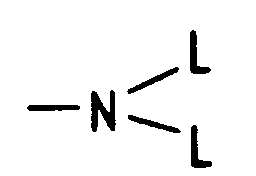

H, einen Alkylrest mit bis zu 10 C-Atomen, einen Alkenylrest mit 2 bis 10 C-Atomen, einen Cycloalkylrest mit 3 bis 8 C-Atomen, einen Phenylrest, der unsubstituiert ist oder 1- bis 3-fach substituiert ist mit F, Cl, Br, (C₁-C₄)-Alkyl oder (C₁-C₄)-Alkoxy, einen Benzylrest, der unsubstituiert oder 1 bis 3fach substituiert ist mit F, Cl, Br, (C₁-C₄)-Alkyl oder (C₁-C₄)-Alkoxy bedeutet, und - Sofern nicht anders angegeben, sind Alkyl-, Alkenyl- und Alkoxygruppen geradkettig oder verzweigt.
- Die Erfindung betrifft ferner ein Verfahren zur Herstellung von Verbindungen der Formel I, das dadurch gekennzeichnet ist, daß man
- a) im Falle von X = Einfachbindung geeignete reaktionsfähige Formen von G1 und G2 nach im Prinzip bekannten Verfahren miteinander zur Reaktion bringt oder
- b) im Falle von X = Brückengruppe
- α) reaktionsfähige Formen von G1-X mit G2 bzw.
- β) reaktionsfähige Formen von G2-X mit G1
- Die Verfahren können wie folgt durchgeführt werden:
- a) X = Einfachbindung
Die Gallensäuren G1 werden entweder in freier Form oder in geschützter Form eingesetzt. Nach der Verknüpfung mit G2, die ebenfalls in freier oder geschützter Form vorliegt, erfolgt gegebenenfalls die Abspaltung der Schutzgruppen und die Umwandlung der Carboxylfunktion in ein obengenanntes Derivat. Als Schutzgruppen für die Alkoholgruppen eignen sich zweckmäßigerweise Formyl, Acetyl, Tetrahydropyranyl oder t-Butyldimethylsilyl. Als Schutzgruppen für die Carboxylgruppe der Seitenkette kommen verschiedene Alkyl- oder Benzylester in Frage, aber auch z. B. Orthoester.
Beispielsweise reagiert Gallensäure bevorzugt an Position 3, aber auch an Position 7 mit aktivierten Formen von Carbonsäuren, wie Säurechloriden oder gemischten Anhydriden unter Zusatz von Basen wie Trialkylamin, Pyridin, aber auch NaOH bei Zimmertemperatur in geeigneten Lösungsmitteln wie Tetrahydrofuran, Methylenchlorid oder Essigester, aber auch Dimethylformamid (DMF) oder Dimethoxyethan (DME). Die verschiedenen Isomeren können z. B. chromatographisch getrennt werden.
Durch die Verwendung von geeigneten Schutzgruppen läßt sich die Reaktion selektiv durchführen.
Analog lassen sich entsprechende Aminogallensäuren in entsprechende Amide überführen. Auch hier kann die Reaktion entweder mit geschützten oder freien Gallensäuren durchgeführt werden.
Analog lassen sich weitere erfindungsgemäße Verbindungen nach bekannten Standardverfahren verknüpfen. - b) X = eine Brückengruppe
Die unter a) angegebenen Verfahren werden auch angewendet, um die Verknüpfung G1-X mit G2 bzw. G1 mit X-G2 durchzuführen. Zweckmäßigerweise setzt man auch hier den Gallensäureteil entweder geschützt oder ungeschützt ein.
Ein bevorzugtes Herstellungsverfahren besteht darin, reaktionsfähige Formen von G1 mit reaktionsfähigen Formen X-G2 umzusetzen. Gegebenenfalls schließen sich nach der Verknüpfung die Abspaltung von Schutzgruppen und die Umwandlungen der Carboxylgruppe in Derivate an. - Die Herstellung von reaktionsfähigen Gallensäurebausteinen ist in den folgenden Formelschemata (1 bis 4) am Beispiel von Cholsäurederivaten beschrieben (Schemata 1 und 2 betreffen die Verkürzung der Seitenkette, Schemata 3 und 4 betreffen die Aktivierung in 3-Stellung).

Die Synthese von nor-Cholsäure V aus Cholsäure wurde von Hofmann et al. (J. Lip. Res. 29, (1988), 1287) beschrieben. Nach diesem Verfahren kann die Seitenkette auch weiter zur C-22 Carbonsäure VIII bzw. IX verkürzt werden. Die Hydroxygruppen der nor-Gallensäure V werden geschützt z. B. mit Formyl-, Acetyl- oder Benzoylschutzgruppen (R). Durch Umsetzung der Verbindung VI mit Trifluoressigsäure/Trifluoressigsäureanhydrid/Natriumnitrit erhält man das Nitril VII, das durch Verseifung mit starker Base zur freien, um ein weiteres C-Atom verkürzte Gallensäure VIII führt. Zur weiteren Umsetzung kann diese Verbindung ungeschützt oder in erneut geschützter Form IX (wobei als R auch Acyl-, Silyl- oder auch Tetrahydropyranyl(THP)-Schutzgruppen in Betracht kommen) eingesetzt werden.
Die Verbindung X wird mit Natriumborhydrid zum Alkohol XI reduziert. Die Alkoholfunktion wird aktiviert, zum Beispiel durch einen Methansulfonyl- oder Trifluormethansulfonylrest wie in Verbindung XII, und anschließend mit einer geeigneten Base, z. B. Diazabicycloundecen, zum vinylischen System XIII eliminiert. Die 20,21-Doppelbindung wird mit Osmiumtetroxid/Natriumperjodat oder Ozon in einem geeigneten Lösungsmittel zum Aldehyd XIV gespalten. Oxidation von XIV nach bekannten Verfahren, z. B. mit Natriumchlorit, führt zum entsprechenden C-20-Carboxyl-Gallensäurederivat XV.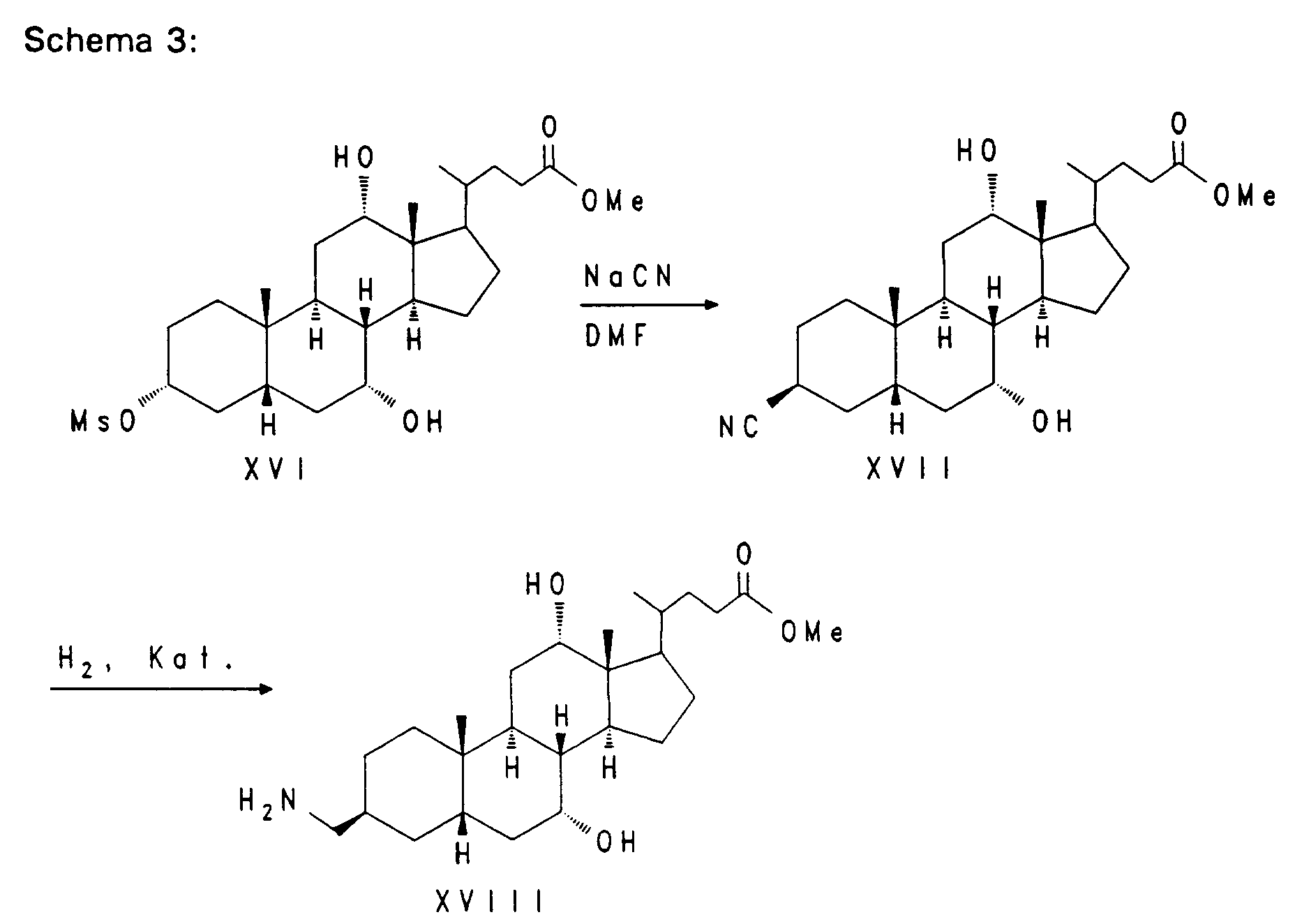
Nach Aktivierung der 3-Hydroxyfunktion, z. B. durch eine Methansulfonylgruppe wie bei Verbindung XVI, kann durch nukleophile Substitution mit Natriumcyanid in einem geeigneten Lösungsmittel bei erhöhter Temperatur eine Nitrilgruppe eingeführt werden. Die so erhaltene Verbindung XVII kann durch Hydrierung mit Wasserstoff in Gegenwart eines geeigneten Katalysators z. B. Rhodium/Al₂O₃ in den Aminomethylbaustein XVIII überführt werden.
Trimethylsilylcyanid kann in guten Ausbeuten an 3-Ketocholansäureester XIX addiert werden. Unter den gewählten Reaktionsbedingungen (TMSCN, ZnJ₂, CH₂Cl₂) erhält man ein Nitrilderivat XX, in dem alle Hydroxygruppen silyliert sind. Durch den großen Raumbedarf der TMS-Gruppe wird die Nitrilgruppe in die axiale β-Position dirigiert, die Diastereoselektivität ist > 9:1 (Lit.: Evans et al., J. Org. Chem. 39 (1974) 914). Die Nitrilfunktion läßt sich mit Natriumborhydrid/Trifluoressigsäure in THF zum 3β-Aminomethylderivat XXI reduzieren.
Auf diesem Weg erhält man Cholansäurederivate, bei denen neben einem zusätzlichen Linker (X) die ursprüngliche 3α-Hydroxyfunktion erhalten bleibt. - Die Erfindung betrifft weiterhin die Verwendung der erfindungsgemäßen Verbindungen zur Herstellung eines Heilmittels.
Hierzu werden die Verbindungen der allgemeinen Formel I gelöst oder suspendiert in pharmakologisch unbedenklichen organischen Lösungsmitteln, wie ein- oder mehrwertigen Alkoholen, wie z. B. Ethanol oder Glycerin, in Triacetin, Ölen wie z. B. Sonnenblumenöl, Lebertran, Ethern, wie z. B. Diethylenglykoldimethylether oder auch Polyethern wie z. B. Polyethylenglykol, oder auch in Gegenwart anderer pharmakologisch unbedenklicher Polymerträger, wie z. B. Polyvinylpyrrolidon, oder anderen pharmazeutisch annehmbaren Zusatzstoffen wie Stärke, Cyclodextrin oder Polysacchariden. Ferner können die erfindungsgemäßen Verbindungen in Kombination mit anderen Arzneistoffe, gegeben werden.
Die Verbindungen der Formel I werden in verschiedenen Dosierungsformen verabreicht, vorzugsweise oral in Form von Tabletten, Kapseln oder Flüssigkeiten. Die tägliche Dosis bewegt sich je nach Körpergewicht und Konstitution des Patienten im Bereich von 3 mg bis 5000 mg, vorzugsweise jedoch in Dosisbereich 10 bis 1000 mg. - Die Verbindungen eignen sich aufgrund ihrer pharmakologische Eigenschaften insbesondere als Hypolipidämika.
- Die Erfindung betrifft daher auch Arzneimittel auf Basis der Verbindungen der Formel (I) sowie die Verwendung der Verbindungen als Arzneimittel, insbesondere zur Senkung des Cholesterinspiegels.
- Die biologische Prüfung der erfindungsgemäßen Verbindungen erfolgte durch Ermittlung der Hemmung der [³H]-Taurocholataufnahme in Bürstensaummembranvesikel des Ileums von Kaninchen. Der Hemmtest wurde wie folgt durchgeführt:
- Die Präparation von Bürstensaummembranvisikeln aus den Darmzellen des Dünndarm erfolgte mit der sogenannten Mg²⁺-Präzipitationsmethode. Männliche Neuseeland-Kaninchen (2 bis 2,5 kg Körpergewicht) wurden durch intravenöse Injektion von 0,5 ml einer wäßrigen Lösung von 2,5 mg Tetracain HCl, 100 T 61R und 25 mg Mebezoniumjodid getötet. Der Dünndarm wurde entnommen und mit eiskalter physiologischer Kochsalzlösung gespült. Die terminalen 7/10 des Dünndarms (gemessen in oral rectaler Richtung, d. h. das terminale Ileum, welches das aktive Na⁺-abhängige Gallensäuretransportsystem enthält) wurden zur Präparation der Bürstensaummembranvesikel verwendet. Die Därme wurden in Kunststoffbeuteln unter Stickstoff bei -80°C eingefroren. Zur Präparation der Membranvesikel wurden die eingefrorenen Därme bei 30°C im Wasserbad aufgetaut. Die Mucosa wurde abgeschabt und in 60 ml eiskaltem 12 mM Tris/HCl-Puffer (pH 7,1)/300 mM Mannit, 5 mM EGTA/10 mg/l Phenylmethyl-sulfonylfluorid/1 mg/l Trypsin Inhibitor v. Sojabohnen (32 U/mg)/0,5 mg/l Trypsin Inhibitor v. Rinderlunge (193 U/mg)/5 mg/l Bacitracin suspendiert. Nach dem Verdünnen auf 300 ml mit eiskaltem destilliertem Wasser wurde mit einem Ultraturrax (18-Stab, IKA Werk Staufen, BRD) 3 Minuten bei 75 % max. Leistung unter Eiskühlung homogenisiert. Nach Zugabe von 3 ml 1 M MgCl₂-Lösung (Endkonzentration 10 mM) ließ man exakt 1 Minute bei 0°C stehen. Durch Zugabe von Mg²⁺ aggregieren die Zellmembranen und präzipitieren mit Ausnahme der Bürstensaummembranen. Nach einer 15-minütigen Zentrifugation bei 3000 x g (5000 rpm, SS-34-Rotor) wurde der Niederschlag verworfen und der Überstand, der die Bürstensaummembranen enthielt, 30 Minuten bei 267000 x g (15000 rpm, SS-34-Rotor) zentrifugiert. Der Überstand wurde verworfen, der Niederschlag in 60 ml 12 mM Tris/HCl-Puffer (pH 7,1)/60 mM Mannit, 5 mM EGTA mit einem Potter Elvejhem Homogenisator (Braun, Melsungen, 900 rpm, 10 Hübe) rehomogenisiert. Nach Zugabe von 0,1 ml 1 M MgCl₂-Lösung und 15-minütiger Inkubationszeit bei 0°C wurde erneut 15 Minuten bei 3000 x g zentrifugiert. Der Überstand wurde anschließend nochmals 30 Minuten bei 46000 x g (15000 rpm, SS-34-Rotor) zentrifugiert. Der Niederschlag wurde in 30 ml 10 mM Tris/Hepes-Puffer (pH 7,4)/300 mM Mannit aufgenommen und durch 20 Hübe in einem Potter Elvejhem Homogenisator bei 1000 rpm homogen resuspendiert. Nach 30 minütiger Zentrifugation bei 48000 x g (20000 rpm, SS-34-Rotor) wurde der Niederschlag in 0,5 bis 2 ml Tris/Hepes-Puffer (pH 7,4)/280 mM Mannit (Endkonzentration 20 mg/ml) aufgenommen und mit Hilfe einer Tuberkulinspritze mit einer 27 Gauge-Nadel resuspendiert. Die Vesikel wurden entweder unmittelbar nach der Präparation für Transportuntersuchungen verwendet oder bei -196°C in 4 mg Portionen in flüssigem Stickstoff aufbewahrt.
- Die Aufnahme von Substraten in die vorstehend beschriebenen Bürstensaummembranvesikel wurde mittels der sogenannten Membranfiltrationstechnik bestimmt. 10 µl der Vesikelsuspension (100 µg Protein) wurden als Tropfen an die Wand eines Polystyrolinkubationsröhrchens (11 x 70 mm) pipettiert, welches das Inkubationsmedium mit den entsprechenden Liganden enthielt (90 µl). Das Inkubationsmedium enthielt 0,75 µl = 0,75 µCi [³H(G)]-Taurocholat (spezifische Aktivität: 2,1 Ci/mMol) /0,5 µl 10 mM Taurocholat/8,75 µl Natrium-Transport-Puffer (10 mM Tris/Hepes, (pH 7,4)/100 mM Mannit/100 mM NaCl) (Na-T-P) bzw. 8,75 µl Kaum-Transport-Puffer (10 mM Tris/Hepes (pH 7,4)/100 mM Mannit/100 mM KCl) (K-T-P) und 80 µl der betreffenden Inhibitorlösung, je nach Experiment in Na-T-Puffer bzw. K-T-Puffer gelöst. Das Inkubationsmedium wurde durch ein Polyvinylidenfluorid-Membranfilter (SYHV LO 4NS, 0,45 µm, 4 mm ⌀, Millipore, Eschborn, BRD) filtriert. Durch Vermischung der Vesikel mit dem Inkubationsmedium wurde die Transportmessung gestartet. Die Konzentration an Taurocholat im Inkubationsansatz betrug 50 µM. Nach der gewünschten Inkubationszeit (üblicherweise 1 Minute) wurde der Transport durch Zugabe von 1 ml eiskalter Stoplösung (10 mM Tris/Hepes (pH 7,4)/150 mM KCl) gestoppt. Die entstehende Mischung wurde sofort bei einem Vakuum von 25 bis 35 mbar über ein Membranfilter aus Cellulosenitrat (ME 25, 0,45 µm, 25 mm Durchmesser, Schleicher & Schuell, Dassell, BRD) abgesaugt. Der Filter wurde mit 5 ml eiskalter Stoplösung nachgewaschen.
- Zur Messung der Aufnahme des radioaktiv markierten Taurocholats wurde das Membranfilter mit 4 ml des Szintillators Quickszint 361 (Zinsser Analytik GmbH, Frankfurt, BRD) aufgelöst und die Radioaktivität durch Flüssigkeits-Szintillationsmessung in einem Meßgerät TriCarb 2500 (Canberra Packard GmbH, Frankfurt, BRD) gemessen. Die gemessenen Werte wurden nach Eichung des Gerätes mit Hilfe von Standardproben und nach Korrektur evtl. vorhandener Chemilumineszenz als dpm (Decompositions per Minute) erhalten.
- Die Kontrollwerte wurden jeweils in Na-T-P und K-T-P ermittelt. Die Differenz zwischen der Aufnahme in Na-T-P und K-T-P ergab den Na⁺-abhängigen Transportanteil. Als IC₅₀ Na⁺ wurde diejenige Konzentration an Inhibitor bezeichnet, bei der der Na⁺-abhängige Transportanteil um 50 % - bezogen auf die Kontrolle - gehemmt war.
- Die pharmakologischen Daten umfassen eine Testserie, in der die Interaktion der erfindungsgemäßen Verbindungen mit dem intestinalen Gallensäuretransportsystem im terminalen Dünndarm untersucht wurde. Die Ergebnisse sind in Tabelle 11 zusammengefaßt.
-

- 48 g (122 mmol) 3α,7α,12α-Trihydroxy-24-nor-23-cholansäure (= Norcholsäure), 200 ml Ameisensäure und 1 ml Perchlorsäure (60 %) werden 1,5 Stunden bei 50°C gerührt, auf Zimmertemperatur abgekühlt, mit 160 ml Essigsäureanhydrid versetzt und noch 15 Minuten gerührt. Das Gemisch wird auf 1,5 l Wasser gegossen, die festen Bestandteile werden abgesaugt und mit 1 l Wasser gewaschen. Der Rückstand wird in 700 ml Ether gelöst und dreimal mit Wasser gewaschen. Die organische Phase wird getrocknet (MgSO₄) und eingeengt. Ausbeute 52 g (89 %) Beispiel 1.
MS (FAB, 3-NBA/LiCl) C₂₆H₃₈O₈ (478), 485 (M + Li⁺) -

- 5 g (10,4 mmol) Beispiel 1 werden bei 0°C in 20 ml Trifluoressigsäure/5 ml Trifluoressigsäureanhydrid gelöst. Innerhalb einer Stunde werden portionsweise 840 mg (12 mmol) Natriumnitrit zugegeben. Es wird noch eine Stunde bei 0°C, dann 2 Stunden bei 40°C nachgerührt. Die Lösung wird wieder auf 0°C gekühlt, mit 5N NaOH neutralisiert und mit Dichlormethan extrahiert. Die organische Phase wird getrocknet (MgSO₄) und eingeengt. Chromatographie des Rückstands über Kieselgel (Cyclohexan/Essigester = 2:1) ergibt 3,1 g (67 %) Beispiel 2.
MS (FAB, 3-NBA/LiCl) C₂₅H₃₅NO₆ (445), 452 (M + Li⁺) -

- 1,5 g (3,37 mmol) Beispiel 2 und 5 g KOH werden in 50 ml Ethanol/Wasser (= 1:1) gelöst und unter Rückfluß erhitzt. Nach Beendigung der Reaktion (DC-Kontrolle) wird das Ethanol abgezogen und der Rückstand mit Ether gewaschen. Die wäßrige Phase wird mit 2N HCl angesäuert und dreimal mit Essigester extrahiert. Die vereinigten organischen Phasen werden getrocknet (MgSO₄) und eingeengt. Man erhält 1,25 g (97 %) Beispiel 3.
MS (FAB, 3-NBA/LiCl) C₂₂H₃₆O₅ (380), 387 (M + Li⁺) -

- 500 mg (12,87 mmol) 3α,7α,12α-Trihydroxy-24-nor-23-cholansäure und 370 mg (36 mmol) N-Methylmorpholin werden in 20 ml THF gelöst. Bei 10°C werden 0,34 ml (36 mmol) Chlorameisensäureethylester zugegeben. Nach 15 Minuten wird eine Lösung von 270 mg (36 mmol) Glycin in 5 ml 1N NaOH zugetropft. Es wird 18 Stunden bei Zimmertemperatur nachgerührt. Das Reaktionsgemisch wird eingeengt und der Rückstand wird über Kieselgel chromatographiert (Dichlormethan/Methanol = 8:2). Man erhält 320 mg (56 %) Beispiel 4.
MS (FAB/ 3-NBA) C₂₅H₄₁NO₆ (451), 452 (M + H⁺) -

- Nach dem für Beispiel 4 beschriebenen Verfahren werden aus 500 mg (12,67 mmol) Norcholsäure und 450 mg (836 mmol) Taurin 340 mg (53 %) Beispiel 5 erhalten.
MS (FAB, 3-NBA) C₂₅H₄₃NO₇S (501), 502 (M + H⁺) -

- 10 g (25,3 mmol) Norcholsäure werden in 50 ml Pyridin gelöst. Bei 0°C werden 2,6 ml Methansulfonsäurechlorid zugetropft. Es wird anschließend 3 Stunden bei Zimmertemperatur gerührt. Das Reaktionsgemisch wird auf Eiswasser gegossen und dreimal mit Essigester extrahiert. Die organische Phase wird getrocknet (MgSO₄) und eingeengt. Das Rohprodukt wird aus Diisopropylether kristallisiert, abgesaugt und anschließend im Vakuum getrocknet. Es werden 11,2g (93 %) Beispiel 6 erhalten.
MS (FAB, 3-NBA/LiCl) C₂₄H₄₀O₇S (472), 485 (M + 2Li⁺-H⁺) -

- 38,7 g (81,9 mmol) Beispiel 6 und 6,9 g (106 mmol) Natriumazid werden 2,5 Stunden bei 130°C in 350 ml Dimethylformamid gerührt. Nach dem Abkühlen wird auf 1,5 l Eiswasser gegossen und dreimal mit Essigester extrahiert. Die organische Phase wird getrocknet (MgSO₄) und eingeengt. Das Rohprodukt wird in einer aus 100 ml Methanol und 14 ml Acetylchlorid hergestellten methanolischen Salzsäurelösung 2 Stunden bei Zimmertemperatur verestert. Zur Aufarbeitung wird teilweise eingeengt, das Produkt wird auf 1 l Wasser gegossen und dreimal mit Essigester extrahiert. Nach dem Trocknen und Einengen der organischen Phase wird das Rohprodukt über Kieselgel chromatographiert (Cyclohexan/Essigester = 6:4). Es werden 9,0 g (25 %) Beispiel 7 erhalten.
MS (FAB, 3-NBA/LiCl) C₂₄H₃₉N₃O₄ (433), 440 (M + Li⁺) -
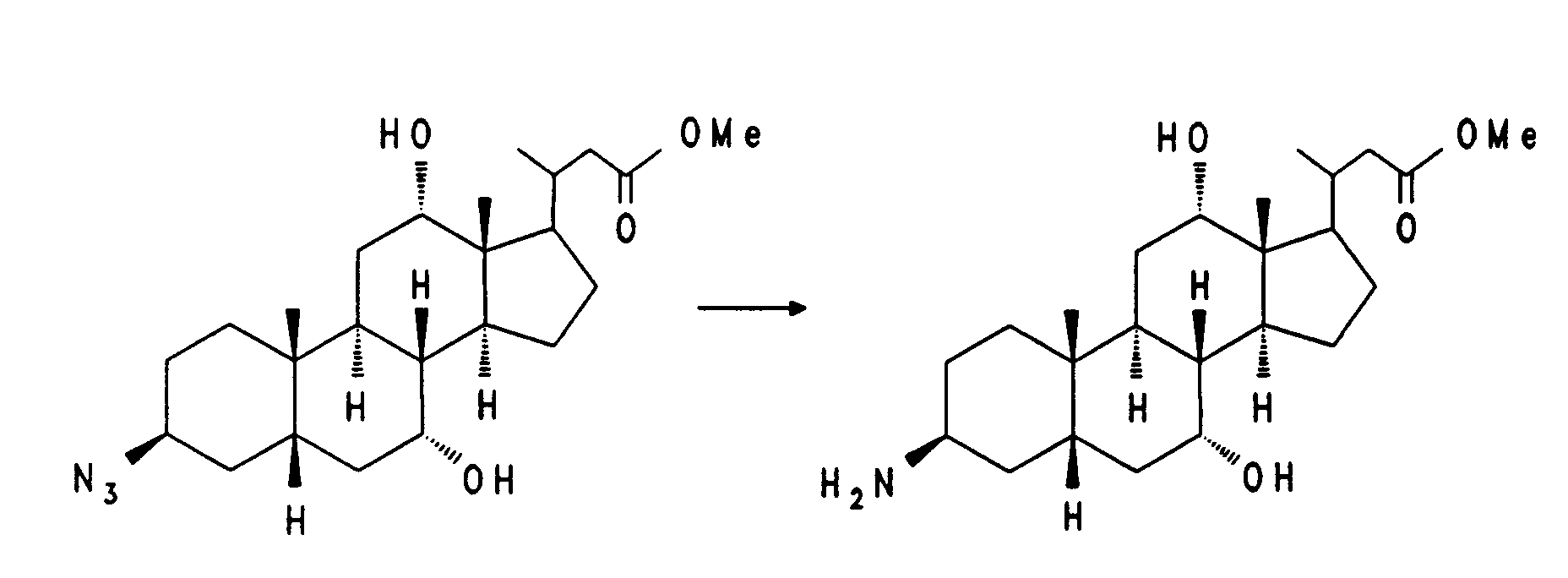
- 8,0 g (18,5 mmol) Beispiel 7 werden in 220 ml Essigester mit Wasserstoff in Gegenwart von ca. 50 mg 10 % Pd/C hydriert. Nach Beendigung der Reaktion wird vom Katalysator abfiltriert und das Filtrat wird eingeengt. Chromatographie des Rückstands (Methanol/Triethylamin = 95:5) ergibt 6,0 g (80 %) Beispiel 8.
MS (FAB, 3-NBA/LiCl) C₂₄H₄₁NO₄ (407), 414 (M + Li⁺) -
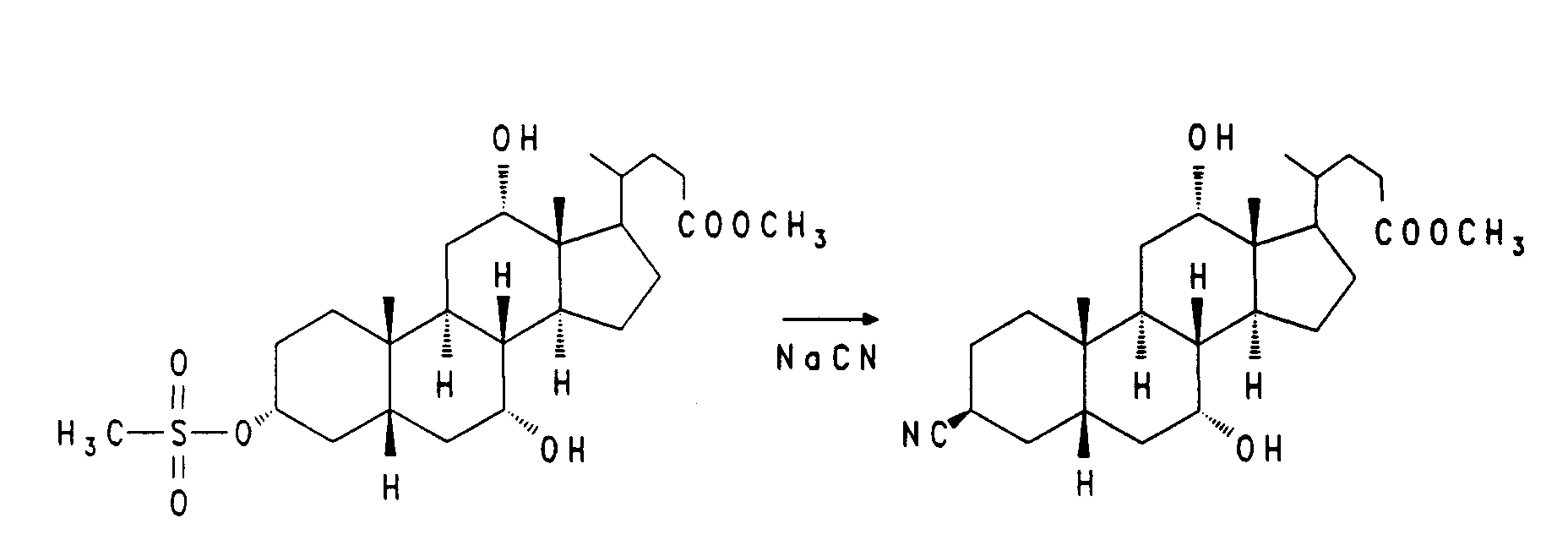
- 4,3 g (8,6 mmol) des Mesylats (vergl. EP-A-0 489 423) werden in 80 ml trockenem DMF mit 0,42 g (8,6 mmol) Natriumcyanid 3 Stunden auf 100 bis 110°C erhitzt. Man gießt auf Eiswasser, extrahiert mit Ethylacetat und filtriert den Rückstand der organischen Phase über Kieselgel. (Ethylacetat/Heptan = 2:1). Man erhält 890 mg (25 %) Nitril.
MS (FAB, 3-NBA/LiCl) C₂₆H₄₁NO₄ (431), 438 (M + Li⁺) -

- 1,5 g (3,48 mmol) des Nitrils aus Beispiel 9 werden in 100 ml Methanol unter Zusatz von 10 ml konz. Ammoniaklösung und 1 g 5 %igem Rhodium auf Al₂O₃ 24 Stunden bei 140 bar und 50°C hydriert. Man saugt vom Katalysator ab, engt das Filtrat ein und reinigt den Rückstand über Kieselgel (CH₂Cl₂/MeOH/konz. NH₃-Lösung = 100:15:2). Man erhält 1,1 g (73 %) Amin (Beispiel 10).
MS (FAB, 3-NBA/LiCl) C₂₆H₄₅NO₄ (435), 442 (M + Li⁺) -

- 9 g (21,4 mmol) Keton (vergl. Schema 4) werden unter Argon in 50 ml trockenem Dichlormethan mit 270 mg trockenem Zinkiodid und unter Eiskühlung portionsweise mit 10 ml (3,5 Äquiv.) Trimethylsilylcyanid versetzt. Nach ca. 1,5 Stunden ist die Umsetzung beendet. Der nach dem Einengen verbleibende Rückstand wird mit n-Heptan-Ethylacetat = 10:1 über Kieselgel gereinigt. Man erhält 12,1 g (85 %) des Produkts als farbloses Öl, das ganz überwiegend (> 9:1) aus einem Stereoisomer besteht.
MS (FAB, 3-NBA, LiCl) C₃₅H₆₅NO₅Si₃ (664), 671 (M + Li⁺) -
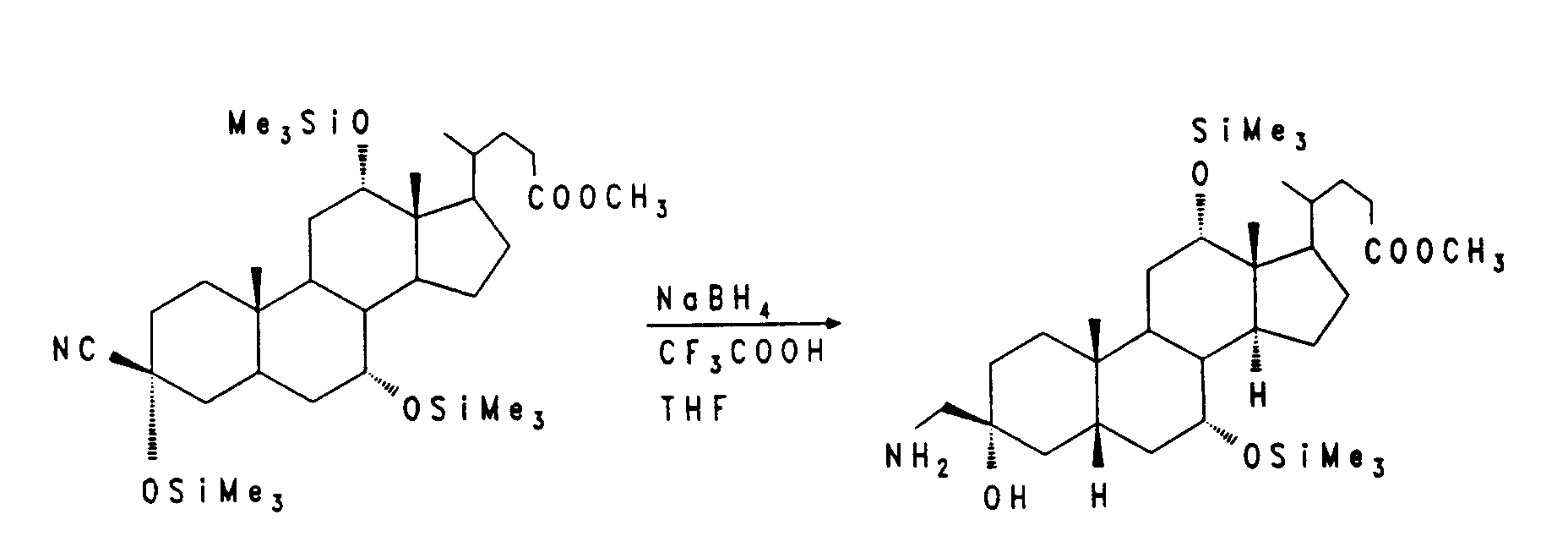
- Zu einer Suspension von 1,036 g (827,4 mmol) Natriumborhydrid in trockenem THF gibt man zunächst 2,1 ml (27,4 mmol) Trifluoressigsäure, rührt 15 Minuten und fügt dann unter Eiskühlung 12,1 g (18,2 mmol) des Nitrils aus Beispiel 11A in 40 ml trockenem THF hinzu. Nach 24 Stunden bei Raumtemperatur wird durch Zusatz von Wasser und Ether aufgearbeitet, die organische Phase mit Hydrogencarbonatlösung ausgeschüttelt und der Rückstand mit CH₂Cl₂/CH₃OH/konz. NH₃-Lösung = 100:10:1,5 chromatographisch gereinigt. Man erhält 7,83 g (48 %) des Amins.
MS (FAB), 3-NBA, LiCl) C₃₂H₆₁NO₅Si₂ (596), 603 (M + Li⁺) -

- 20 g (42 mmol) Methylketon (vergl. Schema 2) werden in 400 ml Methanol gelöst, mit 2,48 g (64 mmol) Natriumborhydrid versetzt und 45 Minuten bei Zimmertemperatur gerührt. Nach der Zugabe von 400 ml Wasser wird vorsichtig 2N HCl zugegeben bis pH 3 erreicht ist. Es wird eingeengt, erneut Wasser zugegeben und mit EE extrahiert. Die organische Phase wird getrocknet, eingeengt und der Rückstand wird über Kieselgel chromatographiert (Cyclohexan/Essigester 1:1).
Ausbeute: 15,1 g (75 %).
MS (FAB, 3-NBA/LiCl) C₂₇H₄₂O₇ (478), 485 (M + Li⁺) -

- 15,1 g (31,5 mol) Alkohol (Beispiel 12A) wird in 250 ml Dichlormethan/250 ml Pyridin gelöst, bei 0°C mit 4 g (35 mmol) Methansulfonsäurechlorid versetzt und 2 Stunden bei Zimmertemperatur gerührt. Zur Aufarbeitung wird Wasser zugegeben und mit Essigester extrahiert. Nach dem Trocknen und einengen der Essigesterphase werden 17,5 g (quart.) Mesylverbindung erhalten, die ohne weitere Reinigung umsetzt werden kann.
MS (FAB, 3-NBA/LiCl) C₂₈H₄₄O₉S (556), 563 (M + Li⁺) -

- 18 g (32,3 mmol) Beispiel 12B und 80 ml Diazabicycloundecen werden in 400 ml DMF gelöst. Es wird 16 Stunden bei 100°C gerührt. Nach dem Abkühlen wird das Reaktionsgemisch eingeengt und über Kieselgel chromatographiert (Cyclohexan/Essigester = 7:3). Die Ausbeute beträgt 9,6 g (64 %).
MS (FAB, 3-NBA/LiCl) C₂₇H₄₀O₆ (460), 467 (M + Li⁺) -

- 13,g (28,2 mmol) Beispiel 12C werden in 100 ml Dichlormethan gelöst, mit 10 ml Pyridin versetzt und auf -60°C gekühlt. Unter Rühren wird bis zur Blaufärbung Ozon eingeleitet. Anschließend wird mit N₂ gespült, auf Zimmertemperatur erwärmt und Dimethylsulfid zugegeben. Das Reaktionsgemisch wird eingeengt und der Rückstand wird über Kieselgel chromatographiert (Cyclohexan/Essigester = 7:3). Man erhält 5,8 g (44 %) Aldehyd.
MS (FAB, 3-NBA/LiCl) C₂₆H₃₈O₇ (462), 469 (M + Li⁺) -

- Der Aldehyd Beispiel 12D wird durch Jones Oxidation (J. Chem. Soc. 1953, 2548) zur freien C-20-Carbonsäure Beispiel 12E oxidiert.
MS (FAB, 3-NBA/LiCl) C₂₆H₃₈O₈ (478), 485 (M + Li⁺) -

- 550 mg (1,15 mmol) Beispiel 12E werden in 20 ml Ethanol gelöst, mit 10 ml 2N NaOH versetzt und 24 Stunden bei Zimmertemperatur gerührt. Es wird Wasser zugegeben und die organischen Lösungsmittel abgezogen. Der pH-Wert wird mit 2N HCl auf 3 bis 4 eingestellt. Danach wird vollständig eingeengt und über Kieselgel chromatographiert (CHCl₃/MeOH = 4:1). Es werden 270 mg (67 %) Produkt erhalten.
MS (FAB, 3-NBA/LiCl) C₂₀H₃₂O₅ (352), 359 (M + Li⁺) -

- 2,0 g (5,01 mmol) 3α,7α,12α-Trihydroxy-24-nor-23-cholansäure, 2,1 g (4,98 mmol) 3β-Amino-7α,12α-dihydroxy-24-cholansäuremethylester (vgl. EP-A-0 417 725), 1,36g (10 mmol) Hydroxybenzotriazol und 1,04g (5,4 mmol) Dicyclohexylcarbodiimid werden in 100 ml trockenem Tetrahydrofuran 24 Stunden bei Zimmertemperatur gerührt. Das Reaktionsgemisch wird eingeengt und der Rückstand über Kieselgel chromatographiert (Chloroform/Methanol = 85:15). Es werden 3,0 g (75 %) Beispiel 13 erhalten.
MS (FAB, 3-NBA/LiCl) C₄₈N₇₉NO₈ (798), 805 (M + Li⁺) - Analog zu Beispiel 13 werden die Beispiele 14 bis 31 der Tabellen 1 bis 3 erhalten (reaktionsfähige -X-G2-Derivate sind in EP-A-0 489 423 oder EP-A-0 417 725 beschrieben).


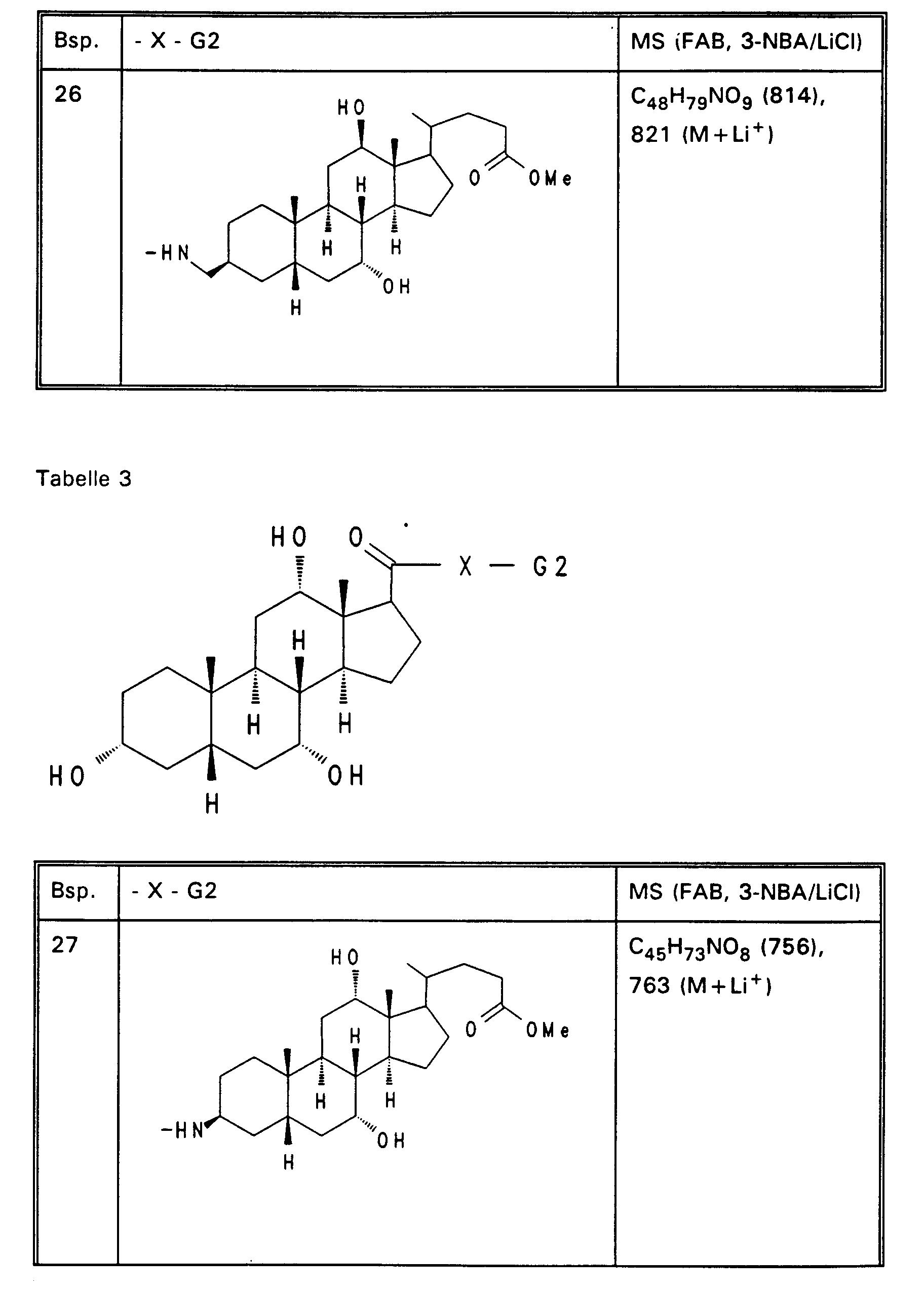


-

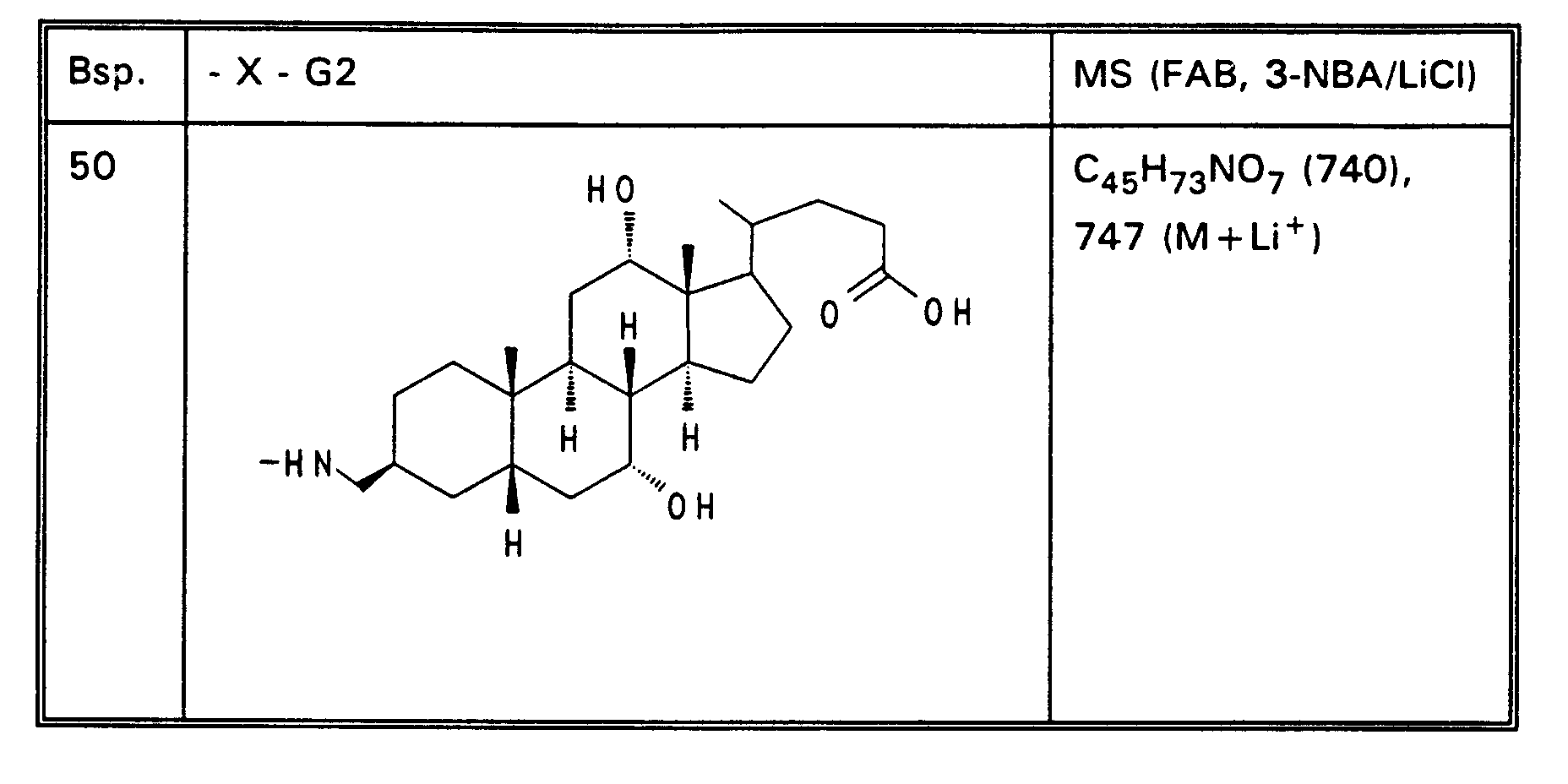
- 3,0 g (3,76 mmol) Beispiel 13 werden in 80 ml Ethanol gelöst, mit 30 mol !N wässriger NaOH versetzt und 16 Stunden bei Zimmertemperatur gerührt. Zur Aufarbeitung werden 30 ml Wasser zugegeben und der Alkohol vollständig abgezogen. Nach dem Ansäuern mit 1N HCl wird der Niederschlag abgesaugt, mit Wasser gewaschen und im Vakuum getrocknet. Es werden 2,5 g (85 %) Beispiel 32 erhalten.
MS (FAB, 3-NBA/LiCl) C₄₇H₇₇NO₈ (784), 791 (M + Li⁺)
Analog zu Beispiel 32 werden aus den Methylestern (Tabellen 1 - 3) die Beispiele 33 bis 50 der Tabelle 4 bis 6 erhalten.

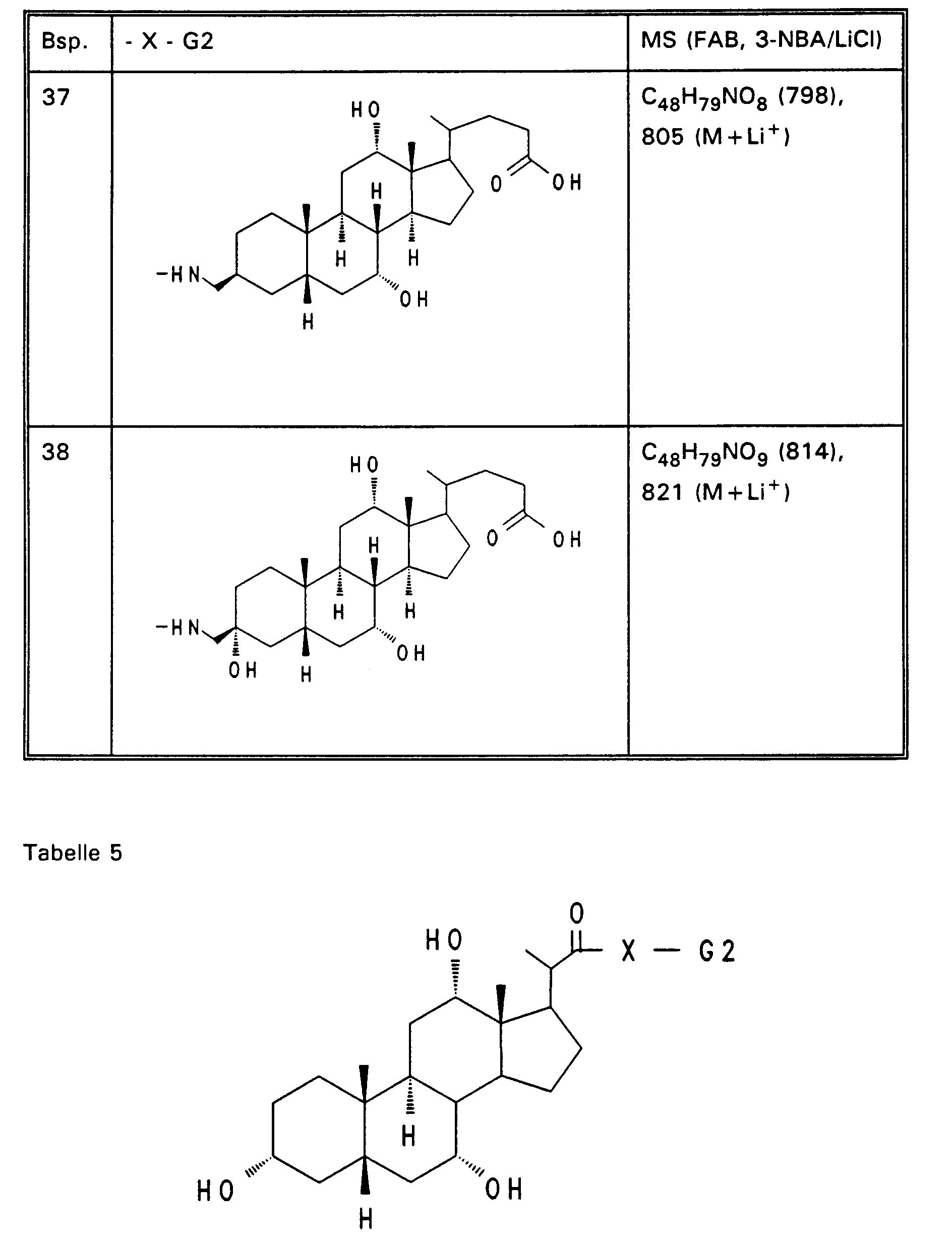

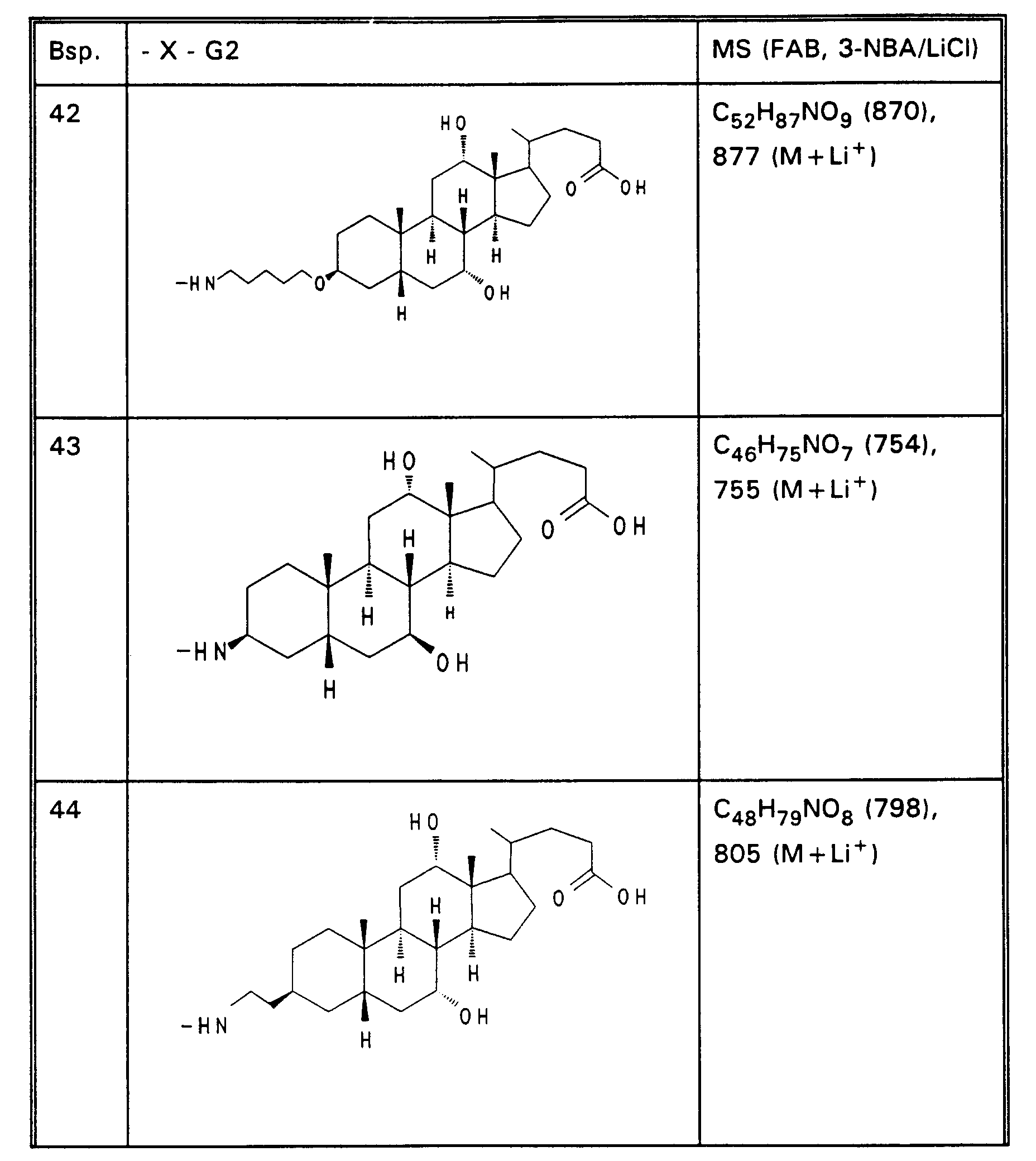


- Analog zu Beispiel 5 werden aus vorstehend beschriebenen Säuren die Beispiele 51 bis 54 der Tabelle 7 erhalten.


- Analog zu Beispiel 4 werden die Beispiele 55 bis 57 der Tabelle 8 erhalten.


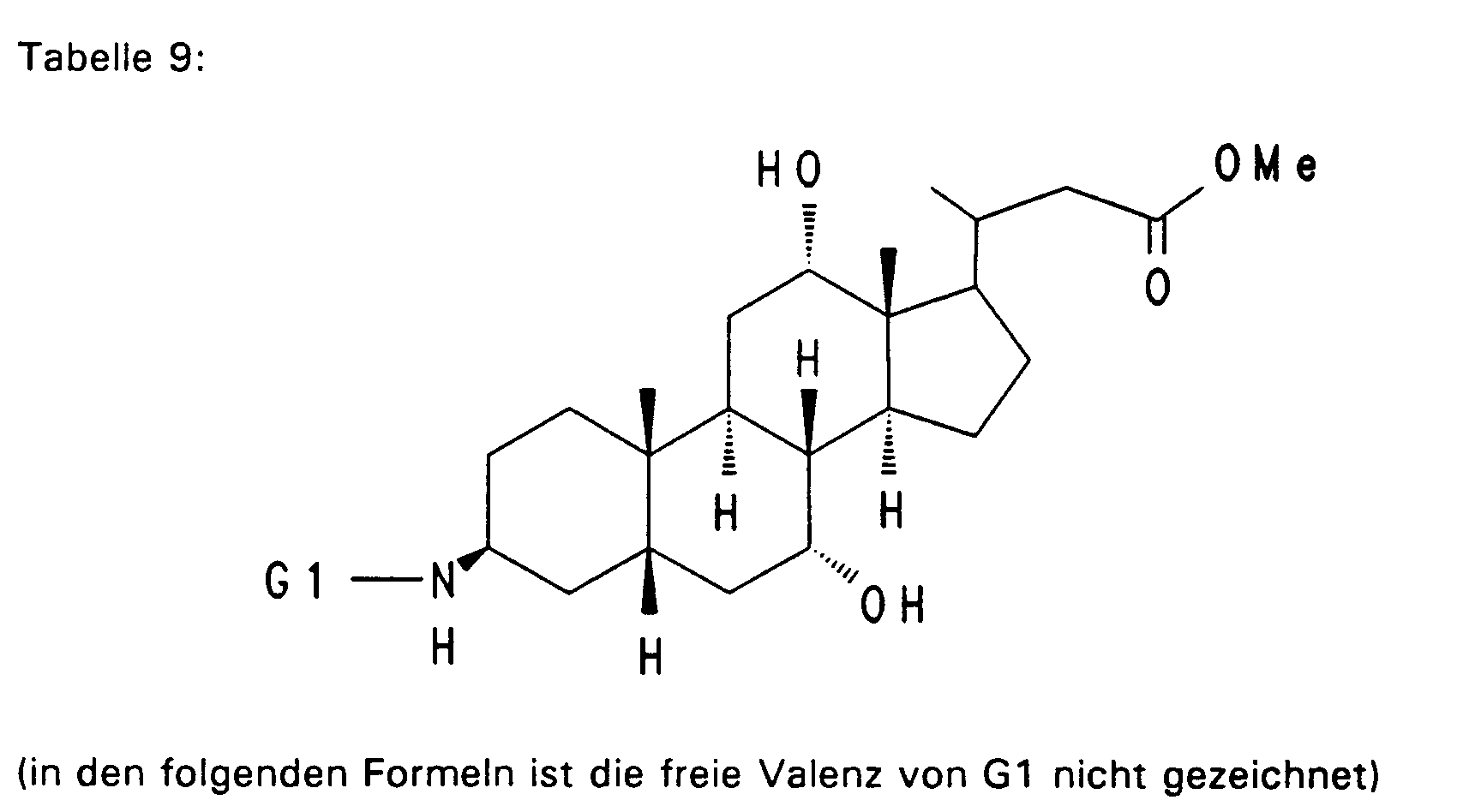
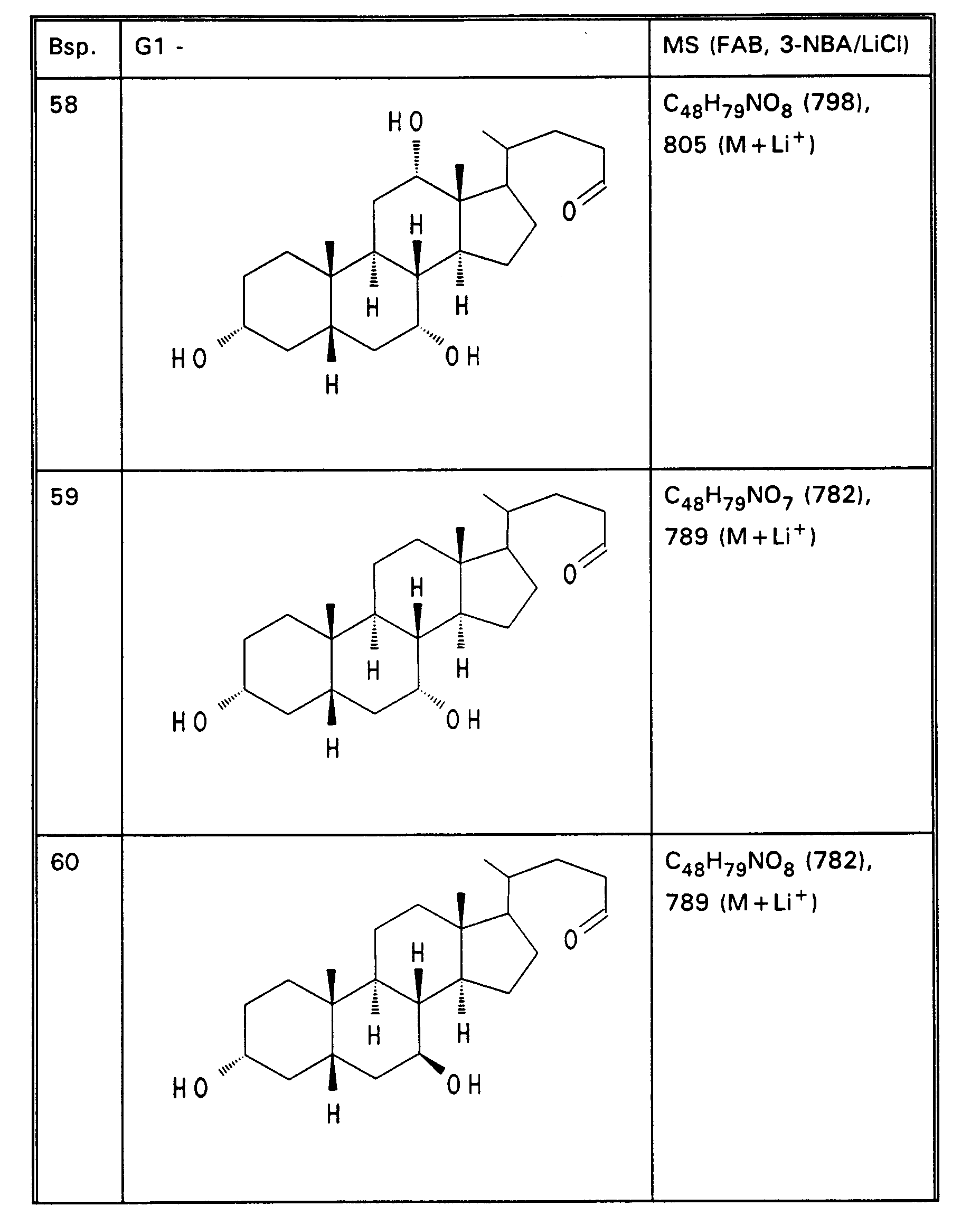
- Analog zu Beispiel 13 werden die Beispiele 58 bis 63 der Tabelle 9 erhalten.

- Analog zu Beispiel 32 werden die Beispiele 64 bis 69 der Tabelle 10 erhalten.


- Von Beispiel 32 und allen Beispielen der Tabellen 4 bis 8 und 10 können die Natriumsalze hergestellt werden. Die Verbindung wird in Methanol gelöst, mit einer äquimolaren Menge 1N wässriger NaOH versetzt und anschließend im Vakuum eingedampft.
- Tabelle 11 zeigt Meßwerte der Hemmung der [³H]-Taurocholataufnahme in Bürstensaummembranvesikel des Ileums von Kaninchen. Angegeben sind die Quotienten aus den IC₅₀- bzw. IC50Na-Werten der Referenzsubstanz als Taurochenodesoxycholat (TCDC) und der jeweiligen Testsubstanz.

H, einen Alkylrest mit 1 bis 10 C-Atomen, einen Alkenylrest mit 2 bis 10 C-Atomen, einen Cycloalkylrest mit 3 bis 8 C-Atomen, einen Phenylrest, der unsubstituiert oder 1- bis 3-fach substituiert ist mit F, Cl, Br, (C₁-C₄)-Alkyl oder (C₁-C₄)-Alkoxy, einen Benzylrest, der unsubstituiert oder 1- bis 3-fach substituiert ist mit F, Cl, Br, (C₁-C₄)-Alkyl oder (C₁-C₄)-Alkoxy, bedeutet, R(2) - R(5), wobei R(2) und R(3) bzw. R(4) und R(5) jeweils gemeinsam der Sauerstoff einer Carbonylgruppe oder einzeln und jeweils unabhängig voneinander H, -OL, -SL, -NHL bedeutet, wobei L die angegebene Bedeutung hat,

bedeutet.
Claims (9)
- Gallensäurederivate der Formel I
G1 - X - G2 I
in derG1 und G2 Gallensäurereste bzw. modifizierte Gallensäurereste bedeuten, wobei mindestens einer der Gallensäurereste G1 oder G2 in der Seitenkette um ein oder mehrere C-Atome verkürzt ist undX eine Brückengruppe oder eine kovalente Bindung bedeutet, wobei G1 und G2 beliebig über X verbunden sind. - Gallensäurederivate der Formel I gemäß Anspruch 1, dadurch gekennzeichnet, daß die Verknüpfung zwischen den Gallensäurenresten G1 und G2 nicht symmetrisch ist, und mindestens eine der Gallensäuren G1 oder G2 in der Seitenkette um ein oder mehrere C-Atome verkürzt ist.
- Gallensäurederivate der Formel I gemäß Anspruch 1, dadurch gekennzeichnet, daß der Gallensäurerest G1, der eine Gallensäure oder eine modifizierte Gallensäure bedeutet, über die Seitenkette am D-Ring mit dem Verbindungsglied X verknüpft ist, X eine Brückengruppe oder eine kovalente Bindung bedeutet und der Gallensäurerest G2, der eine Gallensäure oder eine modifizierte Gallensäure bedeutet, über den A-Ring mit X verbunden ist, wobei mindestens einer der Gallensäurereste G1 oder G2 in der Seitenkette um ein oder mehrere C-Atome verkürzt ist.
- Gallensäurederivate der Formel I gemäß Anspruch 1, dadurch gekennzeichnet, daß G1 einen Rest der Formel II bedeutet,
 Z einen der folgenden Reste
 R(1) H, einen Alkylrest mit 1 bis 10 C-Atomen, einen Alkenylrest mit 2 bis 10 C-Atomen,wobei L
einen Cycloalkylrest mit 3 bis 8 C-Atomen,
einen Benzylrest, der unsubstituiert oder 1 bis 3fach substituiert ist mit F, Cl, Br, (C₁-C₄)-Alkyl oder (C₁-C₄)-Alkoxy,
einen Diphenylmethylrest, der unsubstituiert oder in einem oder in beiden Phenylgruppen 1 bis 3fach substituiert ist mit F, Cl, Br, (C₁-C₄)-Alkyl oder (C₁-C₄)-Alkoxy,
einen Triphenylmethylrest, der unsubstituiert oder in einem, zwei oder drei Phenylresten 1 bis 3fach substituiert ist mit F, Cl, Br, (C₁-C₄)-Alkyl oder (C₁-C₄)-Alkoxy,
oder einen Rest der Formel
H, einen Alkylrest mit 1 bis 10 C-Atomen, einen Alkenylrest mit 2 bis 10 C-Atomen, einen Cycloalkylrest mit 3 bis 8 C-Atomen, einen Phenylrest, der unsubstituiert oder 1- bis 3-fach substituiert ist mit F, Cl, Br, (C₁-C₄)-Alkyl oder (C₁-C₄)-Alkoxy, einen Benzylrest, der unsubstituiert oder 1- bis 3-fach substituiert ist mit F, Cl, Br, (C₁-C₄)-Alkyl oder (C₁-C₄)-Alkoxy, bedeutet, R(2) - R(5), wobei R(2) und R(3) bzw. R(4) und R(5) jeweils gemeinsam der Sauerstoff einer Carbonylgruppe oder einzeln und jeweils unabhängig voneinander H, -OL, -SL, -NHL bedeutet, wobei L die angegebene Bedeutung hat,X eine Einfachbindung oder ein Brückenglied der Formel III ist,
A eine Alkylenkette, die verzweigt oder unverzweigt ist, wobei die Kette ggf. durch -O-, -S- oder Phenylen unterbrochen sein kann, wobei die Verknüpfung am Phenylring ortho-, meta- oder paraständig erfolgt und die Kette insgesamt 2 bis 12, vorzugsweise 2 bis 6, Kettenglieder p umfaßt,
B eine Alkylenkette, die verzweigt oder unverzweigt ist, wobei die Kette ggf. durch -O-, -S- oder Phenylen unterbrochen sein kann, wobei die Verknüpfung am Phenylring ortho-, meta- oder paraständig erfolgt und die Kette insgesamt 2 bis 12, vorzugsweise 2 bis 6, Kettenglieder n umfaßt, L(1), L(2), L(3) gleich oder verschieden sind und die Bedeutung von L haben, sowieq 0 bis 5r 0 oder 1s 0 oder 1t 0 oder 1 bedeuten,G2 einen Rest der Formel IV bedeutet
 V -O-,
 W H oder, falls V = -CH₂-, -CH₂CH₂- ist, auch OH ist,Y -OL, -NHL,R(6) - R(9), wobei R(6) und R(7) bzw. R(8) und R(9) jeweils gemeinsam der Sauerstoff einer Carbonylgruppe oder einzeln und jeweils unabhängig voneinander H, -OL, -SL, -NHL bedeutet, wobei L die angegebene Bedeutung hat und mindestens einer der beiden Gallensäurereste G1 oder G2 in der Seitenkette um ein oder mehrere C-Atome verkürzt ist, d. h. Z eine Bindung,

H, einen Alkylrest mit 1 bis 10 C-Atomen, einen Alkenylrest mit 2 bis 10 C-Atomen, einen Cycloalkylrest mit 3 bis 8 C-Atomen, einen Phenylrest, der unsubstituiert ist oder 1- bis 3-fach substituiert ist mit F, Cl, Br, (C₁-C₄)-Alkyl oder (C₁-C₄)-Alkoxy, einen Benzylrest, der unsubstituiert oder 1 bis 3fach substituiert ist mit F, Cl, Br, (C₁-C₄)-Alkyl oder (C₁-C₄)-Alkoxy bedeutet, und
- Gallensäurederivate der Formel I gemäß Anspruch 1, dadurch gekennzeichnet, daß G1 über die Seitenkette am Ring D mit dem Verbindungsglied X an Ring A von G2 verknüpft ist, und G1 einen Rest der Formel II
 Z einen der folgenden Reste
 R(1) H, einen Alkylrest mit 1 bis 10 C-Atomen, einen Alkenylrest mit 2 bis 10 C-Atomen bedeutet,R(2) bis R(5), wobei R(2) and R(3) bzw. R(4) and R(5) jeweils gemeinsam der Sauerstoff einer Carbonylgruppe oder jeweils unabhängig voneinander H oder OH bedeuten,X eine Einfachbindung oder ein Brückenglied der Formel III ist,
A eine Alkylenkette, die verzweigt oder unverzweigt ist und die Kette ggf. durch -O- oder -S- unterbrochen sein kann und 2 bis 6 Kettenglieder p umfaßt,
B eine Alkylenkette, die verzweigt oder unverzweigt ist und die Kette ggf. durch -O- oder -S- unterbrochen sein kann und die Kette 2 bis 6 Kettenglieder n umfaßt,
L(1), L(2), L(3) gleich oder verschieden sind und H, C₁-C₄-Alkyl oder Benzyl bedeuten, undq 0 bis 5r 0 oder 1s 0 oder 1t 0 oder 1 bedeuten, undG2 einen Rest der Formel IV bedeutet
 V -O-,
 W H oder, falls V = -CH₂-, -CH₂CH₂- ist, auch OH ist,Y -OL, -NHL,R(6) - R(9), wobei R(6) und R(7) bzw. R(8) und R(9) jeweils gemeinsam der Sauerstoff einer Carbonylgruppe oder einzeln und jeweils unabhängig voneinander H, -OH sind.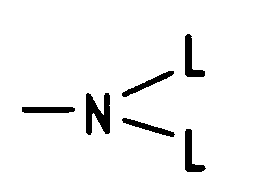

H, einen Alkylrest mit bis zu 10 C-Atomen, einen Alkenylrest mit 2 bis 10 C-Atomen, einen Cycloalkylrest mit 3 bis 8 C-Atomen, einen Phenylrest, der unsubstituiert ist oder 1- bis 3-fach substituiert ist mit F, Cl, Br, (C₁-C₄)-Alkyl oder (C₁-C₄)-Alkoxy, einen Benzylrest, der unsubstituiert oder 1 bis 3fach substituiert ist mit F, Cl, Br, (C₁-C₄)-Alkyl oder (C₁-C₄)-Alkoxy bedeutet, und - Verfahren zur Herstellung von Gallensäurederivaten der Formel I gemäß Anspruch 1, dadurch gekennzeichnet, daß mana) im Falle von X = Einfachbindung geeignete reaktionsfähige Formen von G1 und G2 nach im Prinzip bekannten Verfahren miteinander zur Reaktion bringt oderb) im Falle von X = Brückengruppeα) reaktionsfähige Formen von G1-X mit G2 bzw.β) reaktionsfähige Formen von G2-X mit G1nach im Prinzip bekannten Verfahren miteinander zur Reaktion bringt.
- Arzneimittel enthaltend ein Gallensäurederivat gemäß Anspruch 1.
- Hypolipidaemikum enthaltend ein Gallensäurederivat gemäß Anspruch 1.
- Verwendung eines Gallensäurederivates gemäß Anspruch 1 als Arzneimittel.
Applications Claiming Priority (2)
| Application Number | Priority Date | Filing Date | Title |
|---|---|---|---|
| DE4315370 | 1993-05-08 | ||
| DE4315370 | 1993-05-08 |
Publications (3)
| Publication Number | Publication Date |
|---|---|
| EP0624595A2 true EP0624595A2 (de) | 1994-11-17 |
| EP0624595A3 EP0624595A3 (de) | 1995-06-28 |
| EP0624595B1 EP0624595B1 (de) | 1998-08-12 |
Family
ID=6487580
Family Applications (1)
| Application Number | Title | Priority Date | Filing Date |
|---|---|---|---|
| EP94106846A Expired - Lifetime EP0624595B1 (de) | 1993-05-08 | 1994-05-02 | nor-Gallensäurederivate, Verfahren zu ihrer Herstellung und Verwendung dieser Verbindungen als Arzneimittel |
Country Status (17)
| Country | Link |
|---|---|
| US (1) | US5512558A (de) |
| EP (1) | EP0624595B1 (de) |
| JP (1) | JPH07316186A (de) |
| KR (1) | KR100333150B1 (de) |
| AT (1) | ATE169633T1 (de) |
| AU (1) | AU669278B2 (de) |
| CA (1) | CA2123051C (de) |
| CZ (1) | CZ289525B6 (de) |
| DE (1) | DE59406637D1 (de) |
| DK (1) | DK0624595T3 (de) |
| ES (1) | ES2122076T3 (de) |
| FI (1) | FI942074A7 (de) |
| HU (1) | HU217446B (de) |
| IL (1) | IL109578A (de) |
| NO (1) | NO304793B1 (de) |
| NZ (1) | NZ260468A (de) |
| TW (1) | TW289020B (de) |
Cited By (53)
| Publication number | Priority date | Publication date | Assignee | Title |
|---|---|---|---|---|
| EP1894564A2 (de) | 2003-04-05 | 2008-03-05 | AstraZeneca AB | Verwendung eines Ibat-Hemmers zur Behandlung oder Prophylaxe von Verstopfungen |
| WO2012064267A1 (en) | 2010-11-08 | 2012-05-18 | Albireo Ab | A pharmaceutical combination comprising an ibat inhibitor and a bile acid binder |
| WO2013063526A1 (en) | 2011-10-28 | 2013-05-02 | Lumena Pharmaceuticals, Inc. | Bile acid recycling inhibitors for treatment of hypercholemia and cholestatic liver disease |
| WO2014144485A1 (en) | 2013-03-15 | 2014-09-18 | Lumena Pharmaceuticals, Inc. | Bile acid recycling inhibitors for treatment of barrett's esophagus and gastroesophageal reflux disease |
| WO2014144650A2 (en) | 2013-03-15 | 2014-09-18 | Lumena Pharmaceuticals, Inc. | Bile acid recycling inhibitors for treatment of primary sclerosing cholangitis and inflammatory bowel disease |
| US8951995B2 (en) | 2005-05-12 | 2015-02-10 | Medizinische Universitat Graz | Use of 24-nor-UDCA |
| EP2995317A1 (de) | 2010-05-26 | 2016-03-16 | Satiogen Pharmaceuticals, Inc. | Gallensäurerückflusshemmer zur behandlung von diabetes, adipositas und entzündlichen magen-darm-erkrankungen |
| US9409875B2 (en) | 2013-04-26 | 2016-08-09 | Elobix Ab | Crystal modifications of elobixibat |
| US9512167B2 (en) | 2010-11-30 | 2016-12-06 | Dr. Falk Pharma Gmbh | Optimized synthesis of pure, non-polymorphic, crystalline bile acids with defined particle size |
| US9688720B2 (en) | 2010-11-04 | 2017-06-27 | Albireo Ab | IBAT inhibitors for the treatment of liver diseases |
| WO2017138878A1 (en) | 2016-02-09 | 2017-08-17 | Albireo Ab | Oral cholestyramine formulation and use thereof |
| WO2017138877A1 (en) | 2016-02-09 | 2017-08-17 | Albireo Ab | Oral cholestyramine formulation and use thereof |
| EP3266457A1 (de) | 2011-10-28 | 2018-01-10 | Lumena Pharmaceuticals LLC | Gallensäurerückflusshemmer zur behandlung von cholestase-erkrankungen im kindesalter |
| US10183920B2 (en) | 2014-10-24 | 2019-01-22 | Elobix Ab | Crystal modifications of elobixibat |
| WO2019032026A1 (en) | 2017-08-09 | 2019-02-14 | Albireo Ab | CHOLESTYRAMINE GRANULES, ORAL FORMULATIONS OF CHOLESTYRAMINE AND THEIR USE |
| WO2019032027A1 (en) | 2017-08-09 | 2019-02-14 | Albireo Ab | CHOLESTYRAMINE TABLETS, ORAL FORMULATIONS OF CHOLESTYRAMINE AND THEIR USE |
| US10441604B2 (en) | 2016-02-09 | 2019-10-15 | Albireo Ab | Cholestyramine pellets and methods for preparation thereof |
| US10441605B2 (en) | 2016-02-09 | 2019-10-15 | Albireo Ab | Oral cholestyramine formulation and use thereof |
| WO2019234077A1 (en) | 2018-06-05 | 2019-12-12 | Albireo Ab | Benzothia(di)azepine compounds and their use as bile acid modulators |
| US10709755B2 (en) | 2014-06-25 | 2020-07-14 | Elobix Ab | Solid formulation and method for preventing or reducing coloration thereof |
| US10722457B2 (en) | 2018-08-09 | 2020-07-28 | Albireo Ab | Oral cholestyramine formulation and use thereof |
| WO2020161216A1 (en) | 2019-02-06 | 2020-08-13 | Albireo Ab | Benzothiazepine compounds and their use as bile acid modulators |
| WO2020161217A1 (en) | 2019-02-06 | 2020-08-13 | Albireo Ab | Benzothiadiazepine compounds and their use as bile acid modulators |
| US10786529B2 (en) | 2016-02-09 | 2020-09-29 | Albireo Ab | Oral cholestyramine formulation and use thereof |
| US10793534B2 (en) | 2018-06-05 | 2020-10-06 | Albireo Ab | Benzothia(di)azepine compounds and their use as bile acid modulators |
| US10941127B2 (en) | 2019-02-06 | 2021-03-09 | Albireo Ab | Benzothiadiazepine compounds and their use as bile acid modulators |
| US10975046B2 (en) | 2018-06-20 | 2021-04-13 | Albireo Ab | Crystal modifications of odevixibat |
| US10975045B2 (en) | 2019-02-06 | 2021-04-13 | Aibireo AB | Benzothiazepine compounds and their use as bile acid modulators |
| US11007142B2 (en) | 2018-08-09 | 2021-05-18 | Albireo Ab | Oral cholestyramine formulation and use thereof |
| US11014898B1 (en) | 2020-12-04 | 2021-05-25 | Albireo Ab | Benzothiazepine compounds and their use as bile acid modulators |
| WO2021110887A1 (en) | 2019-12-04 | 2021-06-10 | Albireo Ab | Benzothiazepine compounds and their use as bile acid modulators |
| WO2021110886A1 (en) | 2019-12-04 | 2021-06-10 | Albireo Ab | Benzothia(di)azepine compounds and their use as bile acid modulators |
| WO2021110884A1 (en) | 2019-12-04 | 2021-06-10 | Albireo Ab | Benzothia(di)azepine compounds and their use as bile acid modulators |
| WO2021110883A1 (en) | 2019-12-04 | 2021-06-10 | Albireo Ab | Benzothia(di)azepine compounds and their use as bile acid modulators |
| WO2021110885A1 (en) | 2019-12-04 | 2021-06-10 | Albireo Ab | Benzothiadiazepine compounds and their use as bile acid modulators |
| US11111224B2 (en) | 2019-12-04 | 2021-09-07 | Albireo Ab | Benzothia(di)azepine compounds and their use as bile acid modulators |
| US11180465B2 (en) | 2019-12-04 | 2021-11-23 | Albireo Ab | Benzothia(di)azepine compounds and their use as bile acid modulators |
| US11225466B2 (en) | 2019-12-04 | 2022-01-18 | Albireo Ab | Benzothiadiazepine compounds and their use as bile acid modulators |
| WO2022029101A1 (en) | 2020-08-03 | 2022-02-10 | Albireo Ab | Benzothia(di)azepine compounds and their use as bile acid modulators |
| US11267794B2 (en) | 2019-12-04 | 2022-03-08 | Albireo Ab | Benzothia(di)azepine compounds and their use as bile acid modulators |
| WO2022117778A1 (en) | 2020-12-04 | 2022-06-09 | Albireo Ab | Benzothia(di)azepine compounds and their use as bile acid modulators |
| US11377429B2 (en) | 2020-08-03 | 2022-07-05 | Albireo Ab | Benzothia(di)azepine compounds and their use as bile acid modulators |
| WO2022253997A1 (en) | 2021-06-03 | 2022-12-08 | Albireo Ab | Benzothia(di)azepine compounds and their use as bile acid modulators |
| US11549878B2 (en) | 2018-08-09 | 2023-01-10 | Albireo Ab | In vitro method for determining the adsorbing capacity of an insoluble adsorbant |
| US11583539B2 (en) | 2020-11-12 | 2023-02-21 | Albireo Ab | Treating progressive familial intrahepatic cholestasis (PFIC) with IBAT inhibitors |
| EP4241840A2 (de) | 2019-02-12 | 2023-09-13 | Mirum Pharmaceuticals, Inc. | Verfahren zur behandlung von cholestase |
| WO2023203248A1 (en) | 2022-04-22 | 2023-10-26 | Albireo Ab | Subcutaneous administration of an asbt inhibitor |
| US11801226B2 (en) | 2018-06-20 | 2023-10-31 | Albireo Ab | Pharmaceutical formulation of odevixibat |
| WO2023237728A1 (en) | 2022-06-09 | 2023-12-14 | Albireo Ab | Treating hepatitis |
| WO2024008766A1 (en) | 2022-07-05 | 2024-01-11 | Albireo Ab | Benzothia(di)azepine compounds and their use as bile acid modulators |
| WO2024121434A1 (en) | 2022-12-09 | 2024-06-13 | Albireo Ab | Asbt inhibitors in the treatment of renal diseases |
| WO2025146507A1 (en) | 2024-01-05 | 2025-07-10 | Albireo Ab | Benzothia(di)azepine compounds and their use as bile acid modulators |
| WO2025146508A1 (en) | 2024-01-05 | 2025-07-10 | Albireo Ab | Benzothia(di)azepine compounds and their use as bile acid modulators |
Families Citing this family (39)
| Publication number | Priority date | Publication date | Assignee | Title |
|---|---|---|---|---|
| US6642268B2 (en) | 1994-09-13 | 2003-11-04 | G.D. Searle & Co. | Combination therapy employing ileal bile acid transport inhibiting benzothipines and HMG Co-A reductase inhibitors |
| US5994391A (en) * | 1994-09-13 | 1999-11-30 | G.D. Searle And Company | Benzothiepines having activity as inhibitors of ileal bile acid transport and taurocholate uptake |
| US6262277B1 (en) * | 1994-09-13 | 2001-07-17 | G.D. Searle And Company | Intermediates and processes for the preparation of benzothiepines having activity as inhibitors of ileal bile acid transport and taurocholate uptake |
| US6268392B1 (en) | 1994-09-13 | 2001-07-31 | G. D. Searle & Co. | Combination therapy employing ileal bile acid transport inhibiting benzothiepines and HMG Co-A reductase inhibitors |
| US6107494A (en) * | 1994-09-13 | 2000-08-22 | G.D. Searle And Company | Substituted 5-aryl-benzothiepines having activity as inhibitors of ileal bile acid transport and taurocholate uptake |
| DK1140185T3 (da) | 1998-12-23 | 2003-09-29 | Searle Llc | Kombinationer af cholesterylestertransferhæmmere og galdesyre kompleksdannende forbindelser til hjertekar indikationer |
| AU2157400A (en) | 1998-12-23 | 2000-07-31 | G.D. Searle & Co. | Combinations of cholesteryl ester transfer protein inhibitors and hmg coa reductase inhibitors for cardiovascular indications |
| PT1140187E (pt) * | 1998-12-23 | 2004-01-30 | Searle Llc | Combinacoes de um inibidor de ibat e de um inibidor de mtp para indicacoes cardiovasculares |
| EP1140190B1 (de) | 1998-12-23 | 2002-11-20 | G.D. Searle LLC. | Kombinationen von ileumgallensäuretransports inhibitoren und gallensäure sequestriermitteln für kardiovaskuläre indikationen |
| IL143949A0 (en) | 1998-12-23 | 2002-04-21 | Searle Llc | Combinations of cholesteryl ester transfer protein inhibitors and fibric acid derivatives for cardiovascular indications |
| WO2000038721A1 (en) | 1998-12-23 | 2000-07-06 | G.D. Searle Llc | Combinations of cholesteryl ester transfer protein inhibitors and nicotinic acid derivatives for cardiovascular indications |
| WO2000038726A1 (en) * | 1998-12-23 | 2000-07-06 | G.D. Searle Llc | Combinations of ileal bile acid transport inhibitors and cholesteryl ester transfer protein inhibitors for cardiovascular indications |
| ATE240120T1 (de) * | 1998-12-23 | 2003-05-15 | Searle Llc | Kombinationen von ileumgallensäuretransports inhibitoren und fibronsäure derivaten für kardiovaskuläre indikationen |
| SE9901387D0 (sv) * | 1999-04-19 | 1999-04-19 | Astra Ab | New pharmaceutical foromaulations |
| HK1052183A1 (zh) | 2000-03-10 | 2003-09-05 | Pharmacia Corporation | 制造tetrahydrobenzothiepines的方法 |
| US20020061888A1 (en) * | 2000-03-10 | 2002-05-23 | Keller Bradley T. | Combination therapy for the prophylaxis and treatment of hyperlipidemic conditions and disorders |
| US20040077625A1 (en) * | 2001-07-25 | 2004-04-22 | Tremont Samuel J. | Novel 1,4-benzothiazepine and 1,5-benzothiazepine compounds as inhibitors of apical sodium codependent bile acid transport abd taurocholate uptake |
| JP2005518347A (ja) * | 2001-11-02 | 2005-06-23 | ジー.ディー. サール エルエルシー | 頂端ナトリウム共依存性胆汁酸輸送(asbt)およびタウロコール酸塩取り込みの阻害剤としての新規一および二フッ化ベンゾチエピン化合物 |
| BR0306643A (pt) | 2002-01-17 | 2004-10-19 | Pharmacia Corp | Novos compostos de hidroxi alquil/aril ou ceto tiepina como inibidores do transporte co-dependente de ácido biliar-sódio apical |
| US7435757B2 (en) * | 2004-07-02 | 2008-10-14 | Schering Ag | 2-substituted D-homo-estra-1,3,5(10)-trienes as inhibitors of 17β-hydroxy steroid dehydrogenase type 1 |
| ES2709489T3 (es) * | 2007-07-25 | 2019-04-16 | Univ Graz Medizinische | Uso de ácidos nor-biliares en el tratamiento de arteriosclerosis |
| US11571431B2 (en) | 2013-12-04 | 2023-02-07 | Galmed Research And Development Ltd | Aramchol salts |
| BR112017009657A2 (pt) | 2014-11-06 | 2018-01-23 | Enanta Pharmaceuticals, Inc | análogos de ácidos biliares como agonistas de fxr/tgr5 e métodos de uso dos mesmos |
| WO2016086115A1 (en) | 2014-11-26 | 2016-06-02 | Enanta Pharmaceuticals, Inc. | Tetrazole derivatives of bile acids as fxr/tgr5 agonists and methods of use thereof |
| CA2968404A1 (en) * | 2014-11-26 | 2016-06-02 | Enanta Pharmaceuticals, Inc. | Bile acid analogs as fxr/tgr5 agonists and methods of use thereof |
| US10208081B2 (en) | 2014-11-26 | 2019-02-19 | Enanta Pharmaceuticals, Inc. | Bile acid derivatives as FXR/TGR5 agonists and methods of use thereof |
| RU2017130466A (ru) | 2015-02-11 | 2019-03-12 | Энанта Фармасьютикалс, Инк. | Аналоги желчной кислоты в качестве агонистов fxr/tgr5 и способы их применения |
| SI3277286T1 (sl) | 2015-03-31 | 2021-09-30 | Enanta Pharmaceuticals, Inc. | Derivati žolčne kisline kot antagonisti FXR/TGR5 in metode za njihovo uporabo |
| US10323061B2 (en) | 2016-02-23 | 2019-06-18 | Enanta Pharmaceuticals, Inc. | Heteroaryl containing bile acid analogs as FXR/TGR5 agonists and methods of use thereof |
| WO2017147137A1 (en) | 2016-02-23 | 2017-08-31 | Enanta Pharmaceuticals, Inc. | Benzoic acid derivatives of bile acid as fxr/tgr5 agonists and methods of use thereof |
| US10364267B2 (en) | 2016-02-23 | 2019-07-30 | Enanta Pharmaceuticals, Inc. | Deuterated bile acid derivatives as FXR/TGR5 agonists and methods of use thereof |
| US10584145B2 (en) | 2016-11-29 | 2020-03-10 | Enanta Pharmaceuticals, Inc. | Process for preparation of sulfonylurea bile acid derivatives |
| WO2018152171A1 (en) | 2017-02-14 | 2018-08-23 | Enanta Pharmaceuticals, Inc. | Bile acid derivatives as fxr agonists and methods of use thereof |
| ES2971092T3 (es) | 2017-04-07 | 2024-06-03 | Enanta Pharm Inc | Procedimiento para la preparación de derivados de ácidos biliares de carbamato de sulfonilo |
| CA3087898A1 (en) | 2018-02-02 | 2019-08-08 | Ripple Therapeutics Corporation | Glass formulations comprising steroid dimers and uses thereof |
| WO2020154815A1 (en) | 2019-02-01 | 2020-08-06 | Ripple Therapeutics Corporation | Crystalline forms of dexamethasone dimers and uses thereof |
| US12509469B2 (en) | 2019-08-07 | 2025-12-30 | Ripple Therapeutics Corporation | Compositions and methods for the treatment of pain and dependence disorders |
| GB201911821D0 (en) | 2019-08-16 | 2019-10-02 | Provost Fellows Found Scholars And The Other Members Of Board Of The College Of The Holy And Undivid | Compounds for use in the treatment of liver disease |
| JP2023524494A (ja) | 2020-05-01 | 2023-06-12 | リップル セラピューティクス コーポレーション | 眼障害を処置するためのヘテロ二量体組成物と方法 |
Family Cites Families (6)
| Publication number | Priority date | Publication date | Assignee | Title |
|---|---|---|---|---|
| US4104285A (en) * | 1977-04-22 | 1978-08-01 | Hoffmann-La Roche Inc. | Taurine and glycine derivatives |
| DE3930696A1 (de) * | 1989-09-14 | 1991-03-28 | Hoechst Ag | Gallensaeurederivate, verfahren zu ihrer herstellung, verwendung als arzneimittel |
| US5250524A (en) * | 1990-12-06 | 1993-10-05 | Hoechst Aktiengesellschaft | Bile acid derivatives, process for their preparation and use of these compounds as pharmaceuticals |
| TW289021B (de) * | 1993-05-08 | 1996-10-21 | Hoechst Ag | |
| TW289757B (de) * | 1993-05-08 | 1996-11-01 | Hoechst Ag | |
| EP0624593A3 (de) * | 1993-05-08 | 1995-06-07 | Hoechst Ag | Gallensäurederivate, Verfahren zu ihrer Herstellung und Verwendung dieser Verbindungen als Arzneimittel. |
-
1993
- 1993-11-23 TW TW082109827A patent/TW289020B/zh active
-
1994
- 1994-05-02 AT AT94106846T patent/ATE169633T1/de not_active IP Right Cessation
- 1994-05-02 ES ES94106846T patent/ES2122076T3/es not_active Expired - Lifetime
- 1994-05-02 DK DK94106846T patent/DK0624595T3/da active
- 1994-05-02 EP EP94106846A patent/EP0624595B1/de not_active Expired - Lifetime
- 1994-05-02 DE DE59406637T patent/DE59406637D1/de not_active Expired - Lifetime
- 1994-05-05 US US08/238,514 patent/US5512558A/en not_active Expired - Lifetime
- 1994-05-05 FI FI942074A patent/FI942074A7/fi unknown
- 1994-05-06 NO NO941677A patent/NO304793B1/no not_active IP Right Cessation
- 1994-05-06 CA CA002123051A patent/CA2123051C/en not_active Expired - Lifetime
- 1994-05-06 HU HU9401445A patent/HU217446B/hu not_active IP Right Cessation
- 1994-05-06 AU AU61946/94A patent/AU669278B2/en not_active Ceased
- 1994-05-06 JP JP6116070A patent/JPH07316186A/ja active Pending
- 1994-05-06 NZ NZ260468A patent/NZ260468A/en unknown
- 1994-05-06 IL IL10957894A patent/IL109578A/xx not_active IP Right Cessation
- 1994-05-06 CZ CZ19941134A patent/CZ289525B6/cs not_active IP Right Cessation
- 1994-05-07 KR KR1019940009972A patent/KR100333150B1/ko not_active Expired - Fee Related
Cited By (102)
| Publication number | Priority date | Publication date | Assignee | Title |
|---|---|---|---|---|
| EP1894564A2 (de) | 2003-04-05 | 2008-03-05 | AstraZeneca AB | Verwendung eines Ibat-Hemmers zur Behandlung oder Prophylaxe von Verstopfungen |
| US8951995B2 (en) | 2005-05-12 | 2015-02-10 | Medizinische Universitat Graz | Use of 24-nor-UDCA |
| EP3593802A2 (de) | 2010-05-26 | 2020-01-15 | Satiogen Pharmaceuticals, Inc. | Gallensäurerückflusshemmer zur behandlung von diabetes, adipositas und entzündlichen magen-darm-erkrankungen |
| EP4137137A1 (de) | 2010-05-26 | 2023-02-22 | Satiogen Pharmaceuticals, Inc. | Gallensäurerecyclinghemmer und satiogene zur behandlung von diabetes, adipositas und entzündlichen magen-darm-erkrankungen |
| EP2995317A1 (de) | 2010-05-26 | 2016-03-16 | Satiogen Pharmaceuticals, Inc. | Gallensäurerückflusshemmer zur behandlung von diabetes, adipositas und entzündlichen magen-darm-erkrankungen |
| US10000528B2 (en) | 2010-11-04 | 2018-06-19 | Albireo Ab | IBAT inhibitors for the treatment of liver diseases |
| US10487111B2 (en) | 2010-11-04 | 2019-11-26 | Albireo Ab | IBAT inhibitors for the treatment of liver diseases |
| US12545705B2 (en) | 2010-11-04 | 2026-02-10 | Albireo Ab | IBAT inhibitors for the treatment of liver diseases |
| US12187812B2 (en) | 2010-11-04 | 2025-01-07 | Albireo Ab | IBAT inhibitors for the treatment of liver diseases |
| US9688720B2 (en) | 2010-11-04 | 2017-06-27 | Albireo Ab | IBAT inhibitors for the treatment of liver diseases |
| US9694018B1 (en) | 2010-11-04 | 2017-07-04 | Albireo Ab | IBAT inhibitors for the treatment of liver disease |
| US11261212B2 (en) | 2010-11-04 | 2022-03-01 | Albireo Ab | IBAT inhibitors for the treatment of liver diseases |
| US10221212B2 (en) | 2010-11-04 | 2019-03-05 | Albireo Ab | IBAT inhibitors for the treatment of liver diseases |
| US11732006B2 (en) | 2010-11-04 | 2023-08-22 | Albireo Ab | IBAT inhibitors for the treatment of liver diseases |
| US10093697B2 (en) | 2010-11-04 | 2018-10-09 | Albireo Ab | IBAT inhibitors for the treatment of liver diseases |
| US10011633B2 (en) | 2010-11-04 | 2018-07-03 | Albireo Ab | IBAT inhibitors for the treatment of liver diseases |
| US10981952B2 (en) | 2010-11-04 | 2021-04-20 | Albireo Ab | IBAT inhibitors for the treatment of liver diseases |
| WO2012064267A1 (en) | 2010-11-08 | 2012-05-18 | Albireo Ab | A pharmaceutical combination comprising an ibat inhibitor and a bile acid binder |
| US9512167B2 (en) | 2010-11-30 | 2016-12-06 | Dr. Falk Pharma Gmbh | Optimized synthesis of pure, non-polymorphic, crystalline bile acids with defined particle size |
| US10000526B2 (en) | 2010-11-30 | 2018-06-19 | Dr. Falk Pharma Gmbh | Optimized synthesis of pure, non-polymorphic, crystalline bile acids with defined particle size |
| WO2013063526A1 (en) | 2011-10-28 | 2013-05-02 | Lumena Pharmaceuticals, Inc. | Bile acid recycling inhibitors for treatment of hypercholemia and cholestatic liver disease |
| US12350267B2 (en) | 2011-10-28 | 2025-07-08 | Shire Human Genetic Therapies, Inc. | Bile acid recycling inhibitors for treatment of pediatric cholestatic liver diseases |
| US11376251B2 (en) | 2011-10-28 | 2022-07-05 | Shire Human Genetic Therapies, Inc. | Bile acid recycling inhibitors for treatment of pediatric cholestatic liver diseases |
| US10512657B2 (en) | 2011-10-28 | 2019-12-24 | Lumena Pharmaceutials Llc | Bile acid recycling inhibitors for treatment of pediatric cholestatic liver diseases |
| EP3266457A1 (de) | 2011-10-28 | 2018-01-10 | Lumena Pharmaceuticals LLC | Gallensäurerückflusshemmer zur behandlung von cholestase-erkrankungen im kindesalter |
| US11229661B2 (en) | 2011-10-28 | 2022-01-25 | Shire Human Genetic Therapies, Inc. | Bile acid recycling inhibitors for treatment of pediatric cholestatic liver diseases |
| US12145959B2 (en) | 2011-10-28 | 2024-11-19 | Shire Human Genetic Therapies, Inc. | Bile acid recycling inhibitors for treatment of hypercholemia and cholestatic liver disease |
| EP3278796A1 (de) | 2011-10-28 | 2018-02-07 | Lumena Pharmaceuticals LLC | Gallensäurerückflusshemmer zur behandlung von hypercholämie und cholestatischer lebererkrankung |
| WO2014144485A1 (en) | 2013-03-15 | 2014-09-18 | Lumena Pharmaceuticals, Inc. | Bile acid recycling inhibitors for treatment of barrett's esophagus and gastroesophageal reflux disease |
| WO2014144650A2 (en) | 2013-03-15 | 2014-09-18 | Lumena Pharmaceuticals, Inc. | Bile acid recycling inhibitors for treatment of primary sclerosing cholangitis and inflammatory bowel disease |
| US9701649B2 (en) | 2013-04-26 | 2017-07-11 | Elobix Ab | Crystal modifications of elobixibat |
| US9745276B2 (en) | 2013-04-26 | 2017-08-29 | Elobix Ab | Crystal modifications of elobixibat |
| US9409875B2 (en) | 2013-04-26 | 2016-08-09 | Elobix Ab | Crystal modifications of elobixibat |
| US10709755B2 (en) | 2014-06-25 | 2020-07-14 | Elobix Ab | Solid formulation and method for preventing or reducing coloration thereof |
| US10519120B2 (en) | 2014-10-24 | 2019-12-31 | Elobix Ab | Crystal modifications of elobixibat |
| US10183920B2 (en) | 2014-10-24 | 2019-01-22 | Elobix Ab | Crystal modifications of elobixibat |
| US10610543B2 (en) | 2016-02-09 | 2020-04-07 | Albireo Ab | Cholestyramine pellets and methods for preparation thereof |
| US10441604B2 (en) | 2016-02-09 | 2019-10-15 | Albireo Ab | Cholestyramine pellets and methods for preparation thereof |
| US10758563B2 (en) | 2016-02-09 | 2020-09-01 | Albireo Ab | Oral cholestyramine formulation and use thereof |
| US10786529B2 (en) | 2016-02-09 | 2020-09-29 | Albireo Ab | Oral cholestyramine formulation and use thereof |
| US10493096B2 (en) | 2016-02-09 | 2019-12-03 | Albireo Ab | Oral cholestyramine formulation and use thereof |
| US10799527B2 (en) | 2016-02-09 | 2020-10-13 | Albireo Ab | Oral cholestyramine formulation and use thereof |
| US10864228B2 (en) | 2016-02-09 | 2020-12-15 | Albireo Ab | Oral cholestyramine formulation and use thereof |
| US10441605B2 (en) | 2016-02-09 | 2019-10-15 | Albireo Ab | Oral cholestyramine formulation and use thereof |
| WO2017138878A1 (en) | 2016-02-09 | 2017-08-17 | Albireo Ab | Oral cholestyramine formulation and use thereof |
| WO2017138877A1 (en) | 2016-02-09 | 2017-08-17 | Albireo Ab | Oral cholestyramine formulation and use thereof |
| WO2019032026A1 (en) | 2017-08-09 | 2019-02-14 | Albireo Ab | CHOLESTYRAMINE GRANULES, ORAL FORMULATIONS OF CHOLESTYRAMINE AND THEIR USE |
| WO2019032027A1 (en) | 2017-08-09 | 2019-02-14 | Albireo Ab | CHOLESTYRAMINE TABLETS, ORAL FORMULATIONS OF CHOLESTYRAMINE AND THEIR USE |
| US10881685B2 (en) | 2017-08-09 | 2021-01-05 | Albireo Ab | Cholestyramine granules, oral cholestyramine formulations and use thereof |
| US11306064B2 (en) | 2018-06-05 | 2022-04-19 | Albireo Ab | Benzothia(di)azepine compounds and their use as bile acid modulators |
| WO2019234077A1 (en) | 2018-06-05 | 2019-12-12 | Albireo Ab | Benzothia(di)azepine compounds and their use as bile acid modulators |
| US10793534B2 (en) | 2018-06-05 | 2020-10-06 | Albireo Ab | Benzothia(di)azepine compounds and their use as bile acid modulators |
| US10975046B2 (en) | 2018-06-20 | 2021-04-13 | Albireo Ab | Crystal modifications of odevixibat |
| US11365182B2 (en) | 2018-06-20 | 2022-06-21 | Albireo Ab | Crystal modifications of odevixibat |
| US12508234B2 (en) | 2018-06-20 | 2025-12-30 | Albireo Ab | Pharmaceutical formulation of odevixibat |
| US12091394B2 (en) | 2018-06-20 | 2024-09-17 | Albireo Ab | Crystal modifications of odevixibat |
| US11802115B2 (en) | 2018-06-20 | 2023-10-31 | Albireo Ab | Pharmaceutical formulation of odevixibat |
| US11801226B2 (en) | 2018-06-20 | 2023-10-31 | Albireo Ab | Pharmaceutical formulation of odevixibat |
| US11549878B2 (en) | 2018-08-09 | 2023-01-10 | Albireo Ab | In vitro method for determining the adsorbing capacity of an insoluble adsorbant |
| US10722457B2 (en) | 2018-08-09 | 2020-07-28 | Albireo Ab | Oral cholestyramine formulation and use thereof |
| US11007142B2 (en) | 2018-08-09 | 2021-05-18 | Albireo Ab | Oral cholestyramine formulation and use thereof |
| US11773071B2 (en) | 2019-02-06 | 2023-10-03 | Albireo Ab | Benzothiazepine compounds and their use as bile acid modulators |
| US12187690B2 (en) | 2019-02-06 | 2025-01-07 | Albireo Ab | Benzothiadiazepine compounds and their use as bile acid modulators |
| WO2020161217A1 (en) | 2019-02-06 | 2020-08-13 | Albireo Ab | Benzothiadiazepine compounds and their use as bile acid modulators |
| WO2020161216A1 (en) | 2019-02-06 | 2020-08-13 | Albireo Ab | Benzothiazepine compounds and their use as bile acid modulators |
| US10975045B2 (en) | 2019-02-06 | 2021-04-13 | Aibireo AB | Benzothiazepine compounds and their use as bile acid modulators |
| US11603359B2 (en) | 2019-02-06 | 2023-03-14 | Albireo Ab | Benzothiadiazepine compounds and their use as bile acid modulators |
| US10941127B2 (en) | 2019-02-06 | 2021-03-09 | Albireo Ab | Benzothiadiazepine compounds and their use as bile acid modulators |
| EP4241840A2 (de) | 2019-02-12 | 2023-09-13 | Mirum Pharmaceuticals, Inc. | Verfahren zur behandlung von cholestase |
| EP4245367A2 (de) | 2019-02-12 | 2023-09-20 | Mirum Pharmaceuticals, Inc. | Verfahren zur behandlung von cholestase |
| EP4464376A2 (de) | 2019-02-12 | 2024-11-20 | Mirum Pharmaceuticals, Inc. | Genotyp- und dosisabhängige reaktion auf ein asbti bei patienten mit gallensalzexportpumpenmangel |
| EP4424363A2 (de) | 2019-02-12 | 2024-09-04 | Mirum Pharmaceuticals, Inc. | Verfahren zur wachstumssteigerung bei pädiatrischen patienten mit cholestatischer lebererkrankung |
| WO2021110884A1 (en) | 2019-12-04 | 2021-06-10 | Albireo Ab | Benzothia(di)azepine compounds and their use as bile acid modulators |
| WO2021110883A1 (en) | 2019-12-04 | 2021-06-10 | Albireo Ab | Benzothia(di)azepine compounds and their use as bile acid modulators |
| WO2021110887A1 (en) | 2019-12-04 | 2021-06-10 | Albireo Ab | Benzothiazepine compounds and their use as bile acid modulators |
| US11267794B2 (en) | 2019-12-04 | 2022-03-08 | Albireo Ab | Benzothia(di)azepine compounds and their use as bile acid modulators |
| WO2021110886A1 (en) | 2019-12-04 | 2021-06-10 | Albireo Ab | Benzothia(di)azepine compounds and their use as bile acid modulators |
| US11111224B2 (en) | 2019-12-04 | 2021-09-07 | Albireo Ab | Benzothia(di)azepine compounds and their use as bile acid modulators |
| WO2021110885A1 (en) | 2019-12-04 | 2021-06-10 | Albireo Ab | Benzothiadiazepine compounds and their use as bile acid modulators |
| US11225466B2 (en) | 2019-12-04 | 2022-01-18 | Albireo Ab | Benzothiadiazepine compounds and their use as bile acid modulators |
| US11180465B2 (en) | 2019-12-04 | 2021-11-23 | Albireo Ab | Benzothia(di)azepine compounds and their use as bile acid modulators |
| US12202809B2 (en) | 2019-12-04 | 2025-01-21 | Albireo Ab | Benzothia(di)azepine compounds and their use as bile acid modulators |
| US12060338B2 (en) | 2019-12-04 | 2024-08-13 | Albireo Ab | Benzothia(di)azepine compounds and their use as bile acid modulators |
| US11891368B2 (en) | 2019-12-04 | 2024-02-06 | Albireo Ab | Benzothia(di)azepine compounds and their use as bile acid modulators |
| US11708340B2 (en) | 2019-12-04 | 2023-07-25 | Albireo Ab | Benzothia(di)azepine compounds and their use as bile acid modulators |
| US12024495B2 (en) | 2019-12-04 | 2024-07-02 | Albireo Ab | Benzothiazepine compounds and their use as bile acid modulators |
| WO2022029101A1 (en) | 2020-08-03 | 2022-02-10 | Albireo Ab | Benzothia(di)azepine compounds and their use as bile acid modulators |
| US11377429B2 (en) | 2020-08-03 | 2022-07-05 | Albireo Ab | Benzothia(di)azepine compounds and their use as bile acid modulators |
| US12447156B2 (en) | 2020-11-12 | 2025-10-21 | Albireo Ab | Treating progressive familial intrahepatic cholestasis (PFIC) with IBAT inhibitors |
| US11583539B2 (en) | 2020-11-12 | 2023-02-21 | Albireo Ab | Treating progressive familial intrahepatic cholestasis (PFIC) with IBAT inhibitors |
| US11014898B1 (en) | 2020-12-04 | 2021-05-25 | Albireo Ab | Benzothiazepine compounds and their use as bile acid modulators |
| WO2022117778A1 (en) | 2020-12-04 | 2022-06-09 | Albireo Ab | Benzothia(di)azepine compounds and their use as bile acid modulators |
| US12134606B2 (en) | 2020-12-04 | 2024-11-05 | Albireo Ab | Benzothia(di)azepine compounds and their use as bile acid modulators |
| US11572350B1 (en) | 2020-12-04 | 2023-02-07 | Albireo Ab | Benzothia(di)azepine compounds and their use as bile acid modulators |
| US12365658B2 (en) | 2021-06-03 | 2025-07-22 | Albireo Ab | Benzothia(di)azepine compounds and their use as bile acid modulators |
| WO2022253997A1 (en) | 2021-06-03 | 2022-12-08 | Albireo Ab | Benzothia(di)azepine compounds and their use as bile acid modulators |
| WO2023203248A1 (en) | 2022-04-22 | 2023-10-26 | Albireo Ab | Subcutaneous administration of an asbt inhibitor |
| WO2023237728A1 (en) | 2022-06-09 | 2023-12-14 | Albireo Ab | Treating hepatitis |
| WO2024008766A1 (en) | 2022-07-05 | 2024-01-11 | Albireo Ab | Benzothia(di)azepine compounds and their use as bile acid modulators |
| WO2024121434A1 (en) | 2022-12-09 | 2024-06-13 | Albireo Ab | Asbt inhibitors in the treatment of renal diseases |
| WO2025146507A1 (en) | 2024-01-05 | 2025-07-10 | Albireo Ab | Benzothia(di)azepine compounds and their use as bile acid modulators |
| WO2025146508A1 (en) | 2024-01-05 | 2025-07-10 | Albireo Ab | Benzothia(di)azepine compounds and their use as bile acid modulators |
Also Published As
| Publication number | Publication date |
|---|---|
| FI942074A0 (fi) | 1994-05-05 |
| EP0624595B1 (de) | 1998-08-12 |
| IL109578A0 (en) | 1994-08-26 |
| DK0624595T3 (da) | 1999-05-17 |
| TW289020B (de) | 1996-10-21 |
| NZ260468A (en) | 1995-02-24 |
| US5512558A (en) | 1996-04-30 |
| NO941678L (no) | 1994-11-09 |
| CA2123051A1 (en) | 1994-11-09 |
| HU9401445D0 (en) | 1994-08-29 |
| FI942074L (fi) | 1994-11-09 |
| ATE169633T1 (de) | 1998-08-15 |
| CZ289525B6 (cs) | 2002-02-13 |
| CZ113494A3 (en) | 1994-12-15 |
| HUT67653A (en) | 1995-04-28 |
| AU6194694A (en) | 1994-11-10 |
| CA2123051C (en) | 2004-01-20 |
| NO941678D0 (no) | 1994-05-06 |
| NO304793B1 (no) | 1999-02-15 |
| HU217446B (hu) | 2000-01-28 |
| ES2122076T3 (es) | 1998-12-16 |
| JPH07316186A (ja) | 1995-12-05 |
| EP0624595A3 (de) | 1995-06-28 |
| IL109578A (en) | 1999-08-17 |
| FI942074A7 (fi) | 1994-11-09 |
| KR100333150B1 (ko) | 2002-09-17 |
| AU669278B2 (en) | 1996-05-30 |
| DE59406637D1 (de) | 1998-09-17 |
Similar Documents
| Publication | Publication Date | Title |
|---|---|---|
| EP0624595B1 (de) | nor-Gallensäurederivate, Verfahren zu ihrer Herstellung und Verwendung dieser Verbindungen als Arzneimittel | |
| EP0624596B1 (de) | Tetrazolderivate von Gallebnsäuren, Verfahren zu ihrer Herstellung und Verwendung dieser Verbindungen als Arzneimittel | |
| EP0573848B1 (de) | Gallensäurederivate, Verfahren zu ihrer Herstellung und Verwendung dieser Verbindungen als Arzneimittel | |
| EP0624594B1 (de) | Monomere Gallensäurederivate, Verfahren zu ihrer Herstellung und Verwendung dieser Verbindungen als Arzneimittel | |
| EP0624593A2 (de) | Gallensäurederivate, Verfahren zu ihrer Herstellung und Verwendung dieser Verbindungen als Arzneimittel | |
| EP0489423B1 (de) | Gallensäurederivate, Verfahren zu ihrer Herstellung und Verwendung dieser Verbindung als Arzneimittel | |
| EP0417725B1 (de) | Gallensäurederivate, Verfahren zu ihrer Herstellung, Verwendung als Arzneimittel | |
| DE60205891T2 (de) | Steroide als agonisten für fxr | |
| EP0702026A2 (de) | Modifizierte Gallensäuren, Verfahren zu ihrer Herstellung und ihre Verwendung | |
| DE69023947T2 (de) | Fluorierte Gallensäure-Derivate, Verfahren zu deren Herstellung und pharmazeutische Zusammensetzungen daraus. | |
| DE69712900T2 (de) | Nitratester von corticoid verbindungen und die therapeutische verwendungen davon | |
| DE3873870T2 (de) | Androstan-17-carbonsaeureester, verfahren zu ihrer herstellung und arzneimittel, die sie enthalten. | |
| DE2932607C2 (de) | Chlorambucilderivate, Verfahren zur Herstellung derselben und Antitumormittel mit einem Gehalt derselben | |
| EP0815120B1 (de) | 17-difluormethylen-estratriene | |
| DE69815329T2 (de) | Estra-5(10),7-diene mit östrogener aktivität | |
| DE69102082T2 (de) | Ungesättigte Gallsäurederivate, Verfahren zu ihrer Herstellung und pharmazeutische Präparate diese enthaltend. | |
| CH505080A (de) | Verfahren zur Herstellung neuer Pregnene | |
| DE3741800A1 (de) | 17-halogenmethylen-estratriene | |
| DE2636405C2 (de) | Δ↑1↑↑5↑-17α-Chloräthinyl- und -Propinylsteroide der Östranreihe, Verfahren zu ihrer Herstellung sowie diese enthaltende pharmazeutische Präparate | |
| DE2048812A1 (de) | Ein neues 6alpha Methyl 19 nor pro gesteron und ein Verfahren zu dessen Her stellung | |
| DE2712862C2 (de) | Derivate des 9-Fluorprednisolons, Verfahren zu ihrer Herstellung und diese enthaltende Arzneimittel | |
| DE1443958C (de) | 9alpha-Chlor- bzw. 9alpha-Fluor-16beta-methyl-prednisolon-17-monoester und ein Verfahren zu deren Herstellung | |
| DE2357778C3 (de) | Neue Ester von 21-Mercaptosteroiden, Verfahren zu deren Herstellung und diese enthaltende pharmazeutische Zubereitungen | |
| DE1593225C3 (de) | Reine alpha- und beta-anomere, optisch aktive 3-(2'-Tetrahydropyranyloxy)-Derivate von Steroid-Östrogenen sowie Verfahren zu deren Herstellung | |
| WO1983003414A1 (fr) | Esters steroides d'acides amines n-(2-halogenoethyl)-n-nitroso-carbamoyl de leurs peptides |
Legal Events
| Date | Code | Title | Description |
|---|---|---|---|
| PUAI | Public reference made under article 153(3) epc to a published international application that has entered the european phase |
Free format text: ORIGINAL CODE: 0009012 |
|
| AK | Designated contracting states |
Kind code of ref document: A2 Designated state(s): AT BE CH DE DK ES FR GB GR IE IT LI LU NL PT SE |
|
| PUAL | Search report despatched |
Free format text: ORIGINAL CODE: 0009013 |
|
| AK | Designated contracting states |
Kind code of ref document: A3 Designated state(s): AT BE CH DE DK ES FR GB GR IE IT LI LU NL PT SE |
|
| 16A | New documents despatched to applicant after publication of the search report | ||
| 17P | Request for examination filed |
Effective date: 19951228 |
|
| 17Q | First examination report despatched |
Effective date: 19960308 |
|
| GRAG | Despatch of communication of intention to grant |
Free format text: ORIGINAL CODE: EPIDOS AGRA |
|
| GRAG | Despatch of communication of intention to grant |
Free format text: ORIGINAL CODE: EPIDOS AGRA |
|
| GRAH | Despatch of communication of intention to grant a patent |
Free format text: ORIGINAL CODE: EPIDOS IGRA |
|
| GRAH | Despatch of communication of intention to grant a patent |
Free format text: ORIGINAL CODE: EPIDOS IGRA |
|
| GRAA | (expected) grant |
Free format text: ORIGINAL CODE: 0009210 |
|
| AK | Designated contracting states |
Kind code of ref document: B1 Designated state(s): AT BE CH DE DK ES FR GB GR IE IT LI LU NL PT SE |
|
| REF | Corresponds to: |
Ref document number: 169633 Country of ref document: AT Date of ref document: 19980815 Kind code of ref document: T |
|
| REG | Reference to a national code |
Ref country code: CH Ref legal event code: EP |
|
| REF | Corresponds to: |
Ref document number: 59406637 Country of ref document: DE Date of ref document: 19980917 |
|
| ET | Fr: translation filed | ||
| GBT | Gb: translation of ep patent filed (gb section 77(6)(a)/1977) |
Effective date: 19981013 |
|
| REG | Reference to a national code |
Ref country code: IE Ref legal event code: FG4D Free format text: GERMAN |
|
| REG | Reference to a national code |
Ref country code: ES Ref legal event code: FG2A Ref document number: 2122076 Country of ref document: ES Kind code of ref document: T3 |
|
| REG | Reference to a national code |
Ref country code: PT Ref legal event code: SC4A Free format text: AVAILABILITY OF NATIONAL TRANSLATION Effective date: 19981022 |
|
| REG | Reference to a national code |
Ref country code: DK Ref legal event code: T3 |
|
| PLBE | No opposition filed within time limit |
Free format text: ORIGINAL CODE: 0009261 |
|
| STAA | Information on the status of an ep patent application or granted ep patent |
Free format text: STATUS: NO OPPOSITION FILED WITHIN TIME LIMIT |
|
| 26N | No opposition filed | ||
| REG | Reference to a national code |
Ref country code: GB Ref legal event code: IF02 |
|
| PGFP | Annual fee paid to national office [announced via postgrant information from national office to epo] |
Ref country code: AT Payment date: 20020422 Year of fee payment: 9 Ref country code: NL Payment date: 20020422 Year of fee payment: 9 Ref country code: DK Payment date: 20020422 Year of fee payment: 9 |
|
| PGFP | Annual fee paid to national office [announced via postgrant information from national office to epo] |
Ref country code: SE Payment date: 20020423 Year of fee payment: 9 Ref country code: PT Payment date: 20020423 Year of fee payment: 9 |
|
| PGFP | Annual fee paid to national office [announced via postgrant information from national office to epo] |
Ref country code: CH Payment date: 20020424 Year of fee payment: 9 |
|
| PGFP | Annual fee paid to national office [announced via postgrant information from national office to epo] |
Ref country code: GR Payment date: 20020425 Year of fee payment: 9 |
|
| PGFP | Annual fee paid to national office [announced via postgrant information from national office to epo] |
Ref country code: BE Payment date: 20020521 Year of fee payment: 9 |
|
| PGFP | Annual fee paid to national office [announced via postgrant information from national office to epo] |
Ref country code: IE Payment date: 20020531 Year of fee payment: 9 |
|
| PGFP | Annual fee paid to national office [announced via postgrant information from national office to epo] |
Ref country code: LU Payment date: 20020604 Year of fee payment: 9 |
|
| PG25 | Lapsed in a contracting state [announced via postgrant information from national office to epo] |
Ref country code: LU Free format text: LAPSE BECAUSE OF NON-PAYMENT OF DUE FEES Effective date: 20030502 Ref country code: IE Free format text: LAPSE BECAUSE OF NON-PAYMENT OF DUE FEES Effective date: 20030502 Ref country code: AT Free format text: LAPSE BECAUSE OF NON-PAYMENT OF DUE FEES Effective date: 20030502 |
|
| PG25 | Lapsed in a contracting state [announced via postgrant information from national office to epo] |
Ref country code: SE Free format text: LAPSE BECAUSE OF NON-PAYMENT OF DUE FEES Effective date: 20030503 |
|
| PG25 | Lapsed in a contracting state [announced via postgrant information from national office to epo] |
Ref country code: LI Free format text: LAPSE BECAUSE OF NON-PAYMENT OF DUE FEES Effective date: 20030531 Ref country code: CH Free format text: LAPSE BECAUSE OF NON-PAYMENT OF DUE FEES Effective date: 20030531 Ref country code: BE Free format text: LAPSE BECAUSE OF NON-PAYMENT OF DUE FEES Effective date: 20030531 |
|
| BERE | Be: lapsed |
Owner name: *HOECHST A.G. Effective date: 20030531 |
|
| PG25 | Lapsed in a contracting state [announced via postgrant information from national office to epo] |
Ref country code: PT Free format text: LAPSE BECAUSE OF NON-PAYMENT OF DUE FEES Effective date: 20031130 |
|
| PG25 | Lapsed in a contracting state [announced via postgrant information from national office to epo] |
Ref country code: NL Free format text: LAPSE BECAUSE OF NON-PAYMENT OF DUE FEES Effective date: 20031201 Ref country code: DK Free format text: LAPSE BECAUSE OF NON-PAYMENT OF DUE FEES Effective date: 20031201 |
|
| PG25 | Lapsed in a contracting state [announced via postgrant information from national office to epo] |
Ref country code: GR Free format text: LAPSE BECAUSE OF NON-PAYMENT OF DUE FEES Effective date: 20031203 |
|
| EUG | Se: european patent has lapsed | ||
| REG | Reference to a national code |
Ref country code: CH Ref legal event code: PL |
|
| NLV4 | Nl: lapsed or anulled due to non-payment of the annual fee |
Effective date: 20031201 |
|
| REG | Reference to a national code |
Ref country code: DK Ref legal event code: EBP |
|
| REG | Reference to a national code |
Ref country code: PT Ref legal event code: MM4A Free format text: LAPSE DUE TO NON-PAYMENT OF FEES Effective date: 20031130 |
|
| REG | Reference to a national code |
Ref country code: IE Ref legal event code: MM4A |
|
| PGFP | Annual fee paid to national office [announced via postgrant information from national office to epo] |
Ref country code: ES Payment date: 20120607 Year of fee payment: 19 |
|
| PGFP | Annual fee paid to national office [announced via postgrant information from national office to epo] |
Ref country code: GB Payment date: 20130501 Year of fee payment: 20 Ref country code: DE Payment date: 20130515 Year of fee payment: 20 |
|
| PGFP | Annual fee paid to national office [announced via postgrant information from national office to epo] |
Ref country code: IT Payment date: 20130515 Year of fee payment: 20 Ref country code: FR Payment date: 20130531 Year of fee payment: 20 |
|
| REG | Reference to a national code |
Ref country code: DE Ref legal event code: R071 Ref document number: 59406637 Country of ref document: DE |
|
| REG | Reference to a national code |
Ref country code: GB Ref legal event code: PE20 Expiry date: 20140501 |
|
| REG | Reference to a national code |
Ref country code: ES Ref legal event code: FD2A Effective date: 20140709 |
|
| PG25 | Lapsed in a contracting state [announced via postgrant information from national office to epo] |
Ref country code: GB Free format text: LAPSE BECAUSE OF EXPIRATION OF PROTECTION Effective date: 20140501 |
|
| PG25 | Lapsed in a contracting state [announced via postgrant information from national office to epo] |
Ref country code: DE Free format text: LAPSE BECAUSE OF EXPIRATION OF PROTECTION Effective date: 20140503 |
|
| PG25 | Lapsed in a contracting state [announced via postgrant information from national office to epo] |
Ref country code: ES Free format text: LAPSE BECAUSE OF EXPIRATION OF PROTECTION Effective date: 20140503 |