EP4464376A2 - Genotyp- und dosisabhängige reaktion auf ein asbti bei patienten mit gallensalzexportpumpenmangel - Google Patents
Genotyp- und dosisabhängige reaktion auf ein asbti bei patienten mit gallensalzexportpumpenmangel Download PDFInfo
- Publication number
- EP4464376A2 EP4464376A2 EP24191847.3A EP24191847A EP4464376A2 EP 4464376 A2 EP4464376 A2 EP 4464376A2 EP 24191847 A EP24191847 A EP 24191847A EP 4464376 A2 EP4464376 A2 EP 4464376A2
- Authority
- EP
- European Patent Office
- Prior art keywords
- asbti
- alkyl
- weeks
- day
- subject
- Prior art date
- Legal status (The legal status is an assumption and is not a legal conclusion. Google has not performed a legal analysis and makes no representation as to the accuracy of the status listed.)
- Pending
Links
Images




















Classifications
-
- A—HUMAN NECESSITIES
- A61—MEDICAL OR VETERINARY SCIENCE; HYGIENE
- A61K—PREPARATIONS FOR MEDICAL, DENTAL OR TOILETRY PURPOSES
- A61K31/00—Medicinal preparations containing organic active ingredients
- A61K31/33—Heterocyclic compounds
- A61K31/395—Heterocyclic compounds having nitrogen as a ring hetero atom, e.g. guanethidine or rifamycins
- A61K31/495—Heterocyclic compounds having nitrogen as a ring hetero atom, e.g. guanethidine or rifamycins having six-membered rings with two or more nitrogen atoms as the only ring heteroatoms, e.g. piperazine or tetrazines
- A61K31/4995—Pyrazines or piperazines forming part of bridged ring systems
-
- A—HUMAN NECESSITIES
- A61—MEDICAL OR VETERINARY SCIENCE; HYGIENE
- A61K—PREPARATIONS FOR MEDICAL, DENTAL OR TOILETRY PURPOSES
- A61K31/00—Medicinal preparations containing organic active ingredients
- A61K31/33—Heterocyclic compounds
- A61K31/395—Heterocyclic compounds having nitrogen as a ring hetero atom, e.g. guanethidine or rifamycins
- A61K31/55—Heterocyclic compounds having nitrogen as a ring hetero atom, e.g. guanethidine or rifamycins having seven-membered rings, e.g. azelastine, pentylenetetrazole
- A61K31/554—Heterocyclic compounds having nitrogen as a ring hetero atom, e.g. guanethidine or rifamycins having seven-membered rings, e.g. azelastine, pentylenetetrazole having at least one nitrogen and one sulfur as ring hetero atoms, e.g. clothiapine, diltiazem
-
- A—HUMAN NECESSITIES
- A61—MEDICAL OR VETERINARY SCIENCE; HYGIENE
- A61K—PREPARATIONS FOR MEDICAL, DENTAL OR TOILETRY PURPOSES
- A61K31/00—Medicinal preparations containing organic active ingredients
- A61K31/70—Carbohydrates; Sugars; Derivatives thereof
- A61K31/7042—Compounds having saccharide radicals and heterocyclic rings
-
- A—HUMAN NECESSITIES
- A61—MEDICAL OR VETERINARY SCIENCE; HYGIENE
- A61K—PREPARATIONS FOR MEDICAL, DENTAL OR TOILETRY PURPOSES
- A61K38/00—Medicinal preparations containing peptides
- A61K38/04—Peptides having up to 20 amino acids in a fully defined sequence; Derivatives thereof
- A61K38/05—Dipeptides
-
- A—HUMAN NECESSITIES
- A61—MEDICAL OR VETERINARY SCIENCE; HYGIENE
- A61K—PREPARATIONS FOR MEDICAL, DENTAL OR TOILETRY PURPOSES
- A61K38/00—Medicinal preparations containing peptides
- A61K38/04—Peptides having up to 20 amino acids in a fully defined sequence; Derivatives thereof
- A61K38/10—Peptides having 12 to 20 amino acids
-
- A—HUMAN NECESSITIES
- A61—MEDICAL OR VETERINARY SCIENCE; HYGIENE
- A61P—SPECIFIC THERAPEUTIC ACTIVITY OF CHEMICAL COMPOUNDS OR MEDICINAL PREPARATIONS
- A61P1/00—Drugs for disorders of the alimentary tract or the digestive system
- A61P1/16—Drugs for disorders of the alimentary tract or the digestive system for liver or gallbladder disorders, e.g. hepatoprotective agents, cholagogues, litholytics
-
- A—HUMAN NECESSITIES
- A61—MEDICAL OR VETERINARY SCIENCE; HYGIENE
- A61P—SPECIFIC THERAPEUTIC ACTIVITY OF CHEMICAL COMPOUNDS OR MEDICINAL PREPARATIONS
- A61P17/00—Drugs for dermatological disorders
- A61P17/04—Antipruritics
-
- C—CHEMISTRY; METALLURGY
- C12—BIOCHEMISTRY; BEER; SPIRITS; WINE; VINEGAR; MICROBIOLOGY; ENZYMOLOGY; MUTATION OR GENETIC ENGINEERING
- C12N—MICROORGANISMS OR ENZYMES; COMPOSITIONS THEREOF; PROPAGATING, PRESERVING, OR MAINTAINING MICROORGANISMS; MUTATION OR GENETIC ENGINEERING; CULTURE MEDIA
- C12N15/00—Mutation or genetic engineering; DNA or RNA concerning genetic engineering, vectors, e.g. plasmids, or their isolation, preparation or purification; Use of hosts therefor
- C12N15/09—Recombinant DNA-technology
- C12N15/11—DNA or RNA fragments; Modified forms thereof; Non-coding nucleic acids having a biological activity
-
- C—CHEMISTRY; METALLURGY
- C12—BIOCHEMISTRY; BEER; SPIRITS; WINE; VINEGAR; MICROBIOLOGY; ENZYMOLOGY; MUTATION OR GENETIC ENGINEERING
- C12N—MICROORGANISMS OR ENZYMES; COMPOSITIONS THEREOF; PROPAGATING, PRESERVING, OR MAINTAINING MICROORGANISMS; MUTATION OR GENETIC ENGINEERING; CULTURE MEDIA
- C12N15/00—Mutation or genetic engineering; DNA or RNA concerning genetic engineering, vectors, e.g. plasmids, or their isolation, preparation or purification; Use of hosts therefor
- C12N15/09—Recombinant DNA-technology
- C12N15/11—DNA or RNA fragments; Modified forms thereof; Non-coding nucleic acids having a biological activity
- C12N15/113—Non-coding nucleic acids modulating the expression of genes, e.g. antisense oligonucleotides; Antisense DNA or RNA; Triplex- forming oligonucleotides; Catalytic nucleic acids, e.g. ribozymes; Nucleic acids used in co-suppression or gene silencing
-
- C—CHEMISTRY; METALLURGY
- C12—BIOCHEMISTRY; BEER; SPIRITS; WINE; VINEGAR; MICROBIOLOGY; ENZYMOLOGY; MUTATION OR GENETIC ENGINEERING
- C12Q—MEASURING OR TESTING PROCESSES INVOLVING ENZYMES, NUCLEIC ACIDS OR MICROORGANISMS; COMPOSITIONS OR TEST PAPERS THEREFOR; PROCESSES OF PREPARING SUCH COMPOSITIONS; CONDITION-RESPONSIVE CONTROL IN MICROBIOLOGICAL OR ENZYMOLOGICAL PROCESSES
- C12Q1/00—Measuring or testing processes involving enzymes, nucleic acids or microorganisms; Compositions therefor; Processes of preparing such compositions
- C12Q1/68—Measuring or testing processes involving enzymes, nucleic acids or microorganisms; Compositions therefor; Processes of preparing such compositions involving nucleic acids
- C12Q1/6876—Nucleic acid products used in the analysis of nucleic acids, e.g. primers or probes
- C12Q1/6883—Nucleic acid products used in the analysis of nucleic acids, e.g. primers or probes for diseases caused by alterations of genetic material
-
- G—PHYSICS
- G01—MEASURING; TESTING
- G01N—INVESTIGATING OR ANALYSING MATERIALS BY DETERMINING THEIR CHEMICAL OR PHYSICAL PROPERTIES
- G01N33/00—Investigating or analysing materials by specific methods not covered by groups G01N1/00 - G01N31/00
- G01N33/48—Biological material, e.g. blood, urine; Haemocytometers
- G01N33/50—Chemical analysis of biological material, e.g. blood, urine; Testing involving biospecific ligand binding methods; Immunological testing
- G01N33/68—Chemical analysis of biological material, e.g. blood, urine; Testing involving biospecific ligand binding methods; Immunological testing involving proteins, peptides or amino acids
- G01N33/6893—Chemical analysis of biological material, e.g. blood, urine; Testing involving biospecific ligand binding methods; Immunological testing involving proteins, peptides or amino acids related to diseases not provided for elsewhere
-
- C—CHEMISTRY; METALLURGY
- C12—BIOCHEMISTRY; BEER; SPIRITS; WINE; VINEGAR; MICROBIOLOGY; ENZYMOLOGY; MUTATION OR GENETIC ENGINEERING
- C12Q—MEASURING OR TESTING PROCESSES INVOLVING ENZYMES, NUCLEIC ACIDS OR MICROORGANISMS; COMPOSITIONS OR TEST PAPERS THEREFOR; PROCESSES OF PREPARING SUCH COMPOSITIONS; CONDITION-RESPONSIVE CONTROL IN MICROBIOLOGICAL OR ENZYMOLOGICAL PROCESSES
- C12Q2600/00—Oligonucleotides characterized by their use
- C12Q2600/106—Pharmacogenomics, i.e. genetic variability in individual responses to drugs and drug metabolism
-
- C—CHEMISTRY; METALLURGY
- C12—BIOCHEMISTRY; BEER; SPIRITS; WINE; VINEGAR; MICROBIOLOGY; ENZYMOLOGY; MUTATION OR GENETIC ENGINEERING
- C12Q—MEASURING OR TESTING PROCESSES INVOLVING ENZYMES, NUCLEIC ACIDS OR MICROORGANISMS; COMPOSITIONS OR TEST PAPERS THEREFOR; PROCESSES OF PREPARING SUCH COMPOSITIONS; CONDITION-RESPONSIVE CONTROL IN MICROBIOLOGICAL OR ENZYMOLOGICAL PROCESSES
- C12Q2600/00—Oligonucleotides characterized by their use
- C12Q2600/156—Polymorphic or mutational markers
-
- G—PHYSICS
- G01—MEASURING; TESTING
- G01N—INVESTIGATING OR ANALYSING MATERIALS BY DETERMINING THEIR CHEMICAL OR PHYSICAL PROPERTIES
- G01N2800/00—Detection or diagnosis of diseases
- G01N2800/08—Hepato-biliairy disorders other than hepatitis
- G01N2800/085—Liver diseases, e.g. portal hypertension, fibrosis, cirrhosis, bilirubin
Definitions
- the present invention relates generally to methods for treating or ameliorating cholestatic liver disease.
- the invention relates to methods for modulating a dosage of an Apical Sodium-dependent Bile Acid Transport Inhibitor (ASBTI) administered to a subject and to methods for using subject genotype to predict response to ASBTI administration at a particular dosage level.
- ASBTI Apical Sodium-dependent Bile Acid Transport Inhibitor
- Hypercholemia and cholestatic liver diseases are liver diseases associated with impaired bile secretion (i.e., cholestasis), associated with and often secondary to the intracellular accumulation of bile acids/salts in the hepatocyte.
- Hypercholemia is characterized by increased serum concentration of bile acid or bile salt.
- Cholestasis can be categorized clinicopathologically into two principal categories of obstructive, often extrahepatic, cholestasis, and nonobstructive, or intrahepatic, cholestasis.
- Nonobstructive intrahepatic cholestasis can further be classified into two principal subgroups of primary intrahepatic cholestasis that result from constitutively defective bile secretion, and secondary intrahepatic cholestasis that result from hepatocellular injury.
- Primary intrahepatic cholestasis includes diseases such as benign recurrent intrahepatic cholestasis, which is predominantly an adult form with similar clinical symptoms, and progressive familial intrahepatic cholestasis (PFIC) types 1, 2, and 3, which are diseases that affect children.
- PFIC familial intrahepatic cholestasis
- Neonatal respiratory distress syndrome and lung pneumonia is often associated with intrahepatic cholestasis of pregnancy. Active treatment and prevention are limited. Currently, effective treatments for hypercholemia and cholestatic liver diseases include surgery, liver transplantation, and rarely administration of ursodiol. Effective and safe medication for hypercholemia and cholestatic liver diseases is needed.
- the present invention provides a method for treating or ameliorating cholestatic liver disease in a subject in need thereof, wherein the subject has a bile salt export pump (BSEP) deficiency and the method comprises administering to the subject an Apical Sodium-dependent Bile Acid Transport Inhibitor (ASBTI).
- ASBTI Apical Sodium-dependent Bile Acid Transport Inhibitor
- the ASBTI is or a pharmaceutically acceptable salt thereof.
- the ASBTI is maralixibat, or a pharmaceutically acceptable salt thereof.
- the ASBTI is volixibat, or a pharmaceutically acceptable salt thereof.
- the ASBTI is odevixibat, or a pharmaceutically acceptable salt thereof.
- the ASBTI is elobixibat, or a pharmaceutically acceptable salt thereof.
- the ASBTI is GSK2330672, or a pharmaceutically acceptable salt thereof.
- the cholestatic liver disease is progressive familial intrahepatic cholestasis type 2 (PFIC 2), benign recurrent intrahepatic cholestasis (BRIC) or intrahepatic cholestasis of pregnancy (ICP), or biliary atresia.
- PFIC 2 familial intrahepatic cholestasis type 2
- BRIC benign recurrent intrahepatic cholestasis
- ICP intrahepatic cholestasis of pregnancy
- biliary atresia biliary atresia.
- the subject has residual BSEP function.
- the BSEP deficiency results in impaired or reduced bile flow or cholestasis.
- an ABCB11 gene of the subject comprises a non-truncating mutation.
- the ABCB11 gene comprises one or more of E297G, D482G, an alternative missense mutation, or a combination thereof.
- the ABCB11 gene comprises an E297G or a D482G mutation, or both.
- the ABCB11 gene comprises a missense mutation and not an E297G or D482G mutation.
- the method further comprises determining a genotype of the subject. In some embodiments, determining the genotype comprises identifying and characterizing a mutation in the ABCB11 gene. In certain embodiments, the ABCB11 gene of the subject is characterized as comprising only non-truncating mutations.
- the method comprises determining a ratio of serum 7 ⁇ -hydroxy-4-cholesten-2-one (7 ⁇ C4) concentration to serum bile acid (sBA) concentration (7 ⁇ C4:sBA) prior to administering the ASBTI at a first dose level (baseline ratio), and further determining 7 ⁇ C4:sBA after the ASBTI administration, where the ASBTI administration results in a 7 ⁇ C4:sBA ratio about 2-fold or greater higher than the baseline 7 ⁇ C4:sBA ratio.
- a second dose level of the ASBTI is administered to the subject. The second dose level is higher than the first dose level.
- the method comprises determining a ratio of serum 7 ⁇ C4 concentration to sBA concentration (7 ⁇ C4:sBA) prior to administering the ASBTI at a first dose level (baseline ratio), and further determining 7 ⁇ C4:sBA after the ASBTI administration, wherein if the ASBTI administration fails to result in a 7 ⁇ C4:sBA ratio about 2-fold or greater higher than the baseline 7 ⁇ C4:sBA ratio, the subject is administered a second dose level of the ASBTI, wherein the second dose level is higher than the first dose level.
- the method further comprises modulating a dose of the ASBTI, the modulating comprising determining a ratio of serum 7 ⁇ C4 concentration to sBA concentration (7 ⁇ C4:sBA) prior to administering the ASBTI at a first dose level (baseline ratio), and further determining 7 ⁇ C4:sBA after the ASBTI administration, wherein if the ASBTI administration fails to result in a 7 ⁇ C4:sBA ratio about 2-fold or greater higher than the baseline 7 ⁇ C4:sBA ratio the ASBTI is then administered at a second dose level that does result in a 7 ⁇ C4:sBA ratio that is about a 2-fold or greater higher than the baseline ratio.
- the second dose is at least about twice and less than about five times the first dose.
- the method further comprises modulating a dose of the ASBTI, the modulating comprising determining a ratio of serum 7 ⁇ C4 concentration to sBA concentration (7 ⁇ C4:sBA) prior to administering the ASBTI at a first dose level (baseline ratio), and further determining 7 ⁇ C4:sBA after the ASBTI administration, wherein if a treating physician believes the ratio could be elevated beyond the current level with a higher dose level of the ASBTI, then the subject is administered the ASBTI at a second dose level that results in a 7 ⁇ C4:sBA ratio that is higher than the baseline ratio.
- the subject is a pediatric subject under 18 years of age.
- administration of the ASBTI results in improved growth of the subject relative to baseline growth.
- the improved growth of the subject is measured as an increase in height z-score.
- the ASBTI is administered at a daily dose of from about 140 ⁇ g/kg to about 1400 ⁇ g/kg. In some embodiments, the ASBTI is administered once daily. In various embodiments, the ASBTI is administered twice daily. In various embodiments, the ASBTI is administered at a daily dose of from about 5 mg/day to about 100 mg/day. In some embodiments, the ASBTI is administered regularly for a period of at least one year. In certain embodiments, the ASBTI is administered regularly for a period of at least 4 years.
- the administration of the ASBTI results in a reduction in a symptom or a change in a disease-relevant laboratory measure of the cholestatic liver disease that is maintained for at least one year.
- the reduction in a symptom or a change in a disease-relevant laboratory measure comprises a reduction in sBA concentration, an increase in serum 7 ⁇ C4 concentration, an increase in a ratio of serum 7 ⁇ C4 concentration to sBA concentration (7 ⁇ C4:sBA), a reduction in pruritis, an increase in a quality of life inventory score, an increase in a quality of life inventory score related to fatigue, or a combination thereof.
- the reduction in the symptom or a change in a disease-relevant laboratory measure is determined relative to a baseline level.
- the subject is a pediatric subject under 18 years of age, and the reduction in a symptom or a change in a disease-relevant laboratory measure comprises an increase in growth.
- the administration of the ASBTI results in an increase in serum 7 ⁇ C4 concentration.
- the serum 7 ⁇ C4 concentration is increased from about 1.5-fold to about 40-fold relative to baseline.
- the administration of the ASBTI results in an increase in a ratio of serum 7 ⁇ C4 concentration to sBA concentration (7 ⁇ C4:sBA).
- the 7 ⁇ C4:sBA is increased by from about 2-fold to about 5,000-fold relative to baseline.
- the administration of the ASBTI results in an increase in fecal bile acids (fBA) of at least 100% relative to baseline. In some embodiments, the administration of the ASBTI results in a decrease in sBA concentration of at least about 70% relative to baseline.
- fBA fecal bile acids
- the administration of the ASBTI results in a reduction in severity of pruritus.
- the reduction in severity of pruritis is measured as a reduction of at least 1.0 in an observer-reported itch reported outcome (ITCHRO(OBS)) score.
- the administration of the ASBTI results in an ITCHRO(OBS) score of ⁇ 1.
- the administration of the ASBTI results in an increase in a quality of life inventory score.
- the quality of life inventory score is a health-related quality of life (HRQoL) score. In some embodiments, the quality of life inventory score is a Pediatric Quality of Life Inventory (PedsQL) score, and the PedsQL score is increased by at least 10% relative to baseline.
- HRQoL health-related quality of life
- PedsQL Pediatric Quality of Life Inventory
- the serum bilirubin concentration is at pre-administration baseline level at about 4 months after first administration of the ASBTI.
- serum alanine aminotransferase (ALT) concentration is at pre-administration baseline level at about 4 months after first administration of the ASBTI.
- serum aspartate aminotransferase (AST) concentration, and serum bilirubin concentration are within a normal range at about 4 months after first administration of the ASBTI.
- the administration of the ASBTI results in serum ALT concentration decreasing by at least about 10% relative to baseline.
- the subject has biliary atresia or intrahepatic cholestasis of pregnancy.
- the present invention provides a method for predicting subject response to treatment of a cholestatic liver disease.
- the treatment comprises administering to the subject in need of such treatment an ASBTI.
- the method comprises determining a genotype of the subject and predicting subject response to the treatment based upon the genotype.
- the ASBTI is or a pharmaceutically acceptable salt thereof. In some embodiments, the ASBTI is maralixibat, or an alternative pharmaceutically acceptable salt thereof. In certain embodiments, the ASBTI is volixibat, or a pharmaceutically acceptable salt thereof. In various embodiments, the ASBTI is odevixibat, or a pharmaceutically acceptable salt thereof. In some embodiments, the ASBTI is elobixibat, or a pharmaceutically acceptable salt thereof. In various embodiments, the ASBTI is GSK2330672, or a pharmaceutically acceptable salt thereof.
- the method includes determining the genotype comprises determining a sequence of an ABCB11 gene. In some embodiments, the method includes identifying and characterizing a mutation of the ABCB11 gene. In various embodiments, the method further comprises predicting that the subject will not be responsive to administration of the ASBTI if the ABCB11 gene comprises a truncating mutation. In some embodiments, the method comprises predicting that the subject will not be responsive to administration of the ASBTI if the ABCB11 gene comprises a mutation resulting in total loss of BSEP activity.
- the method includes predicting that the subject will be responsive to administration of the ASBTI if the ABCB11 gene comprises mutations that result in residual BSEP activity and the ABCB11 gene comprises no mutations that result in absence of BSEP activity.
- the ABCB11 gene comprises one or more of an E297G, D482G, an alternative missense mutation, or some combination thereof.
- the method includes administering an ASBTI to the subject if the subject is predicted to be responsive to the administration of the ASBTI.
- the subject has biliary atresia or intrahepatic cholestasis of pregnancy.
- the present invention provides a method for treating or ameliorating cholestatic liver disease in a subject in need thereof.
- the subject has a BSEP deficiency.
- the method includes determining a genotype of the subject, using the genotype of the subject to predict whether the subject will be or will not be responsive to treatment with an ASBTI, and administering an ASBTI to the subject if the subject is predicted to be responsive to administration of the ASBTI.
- determining the genotype comprises determining a sequence of an ABCB11 gene. In some embodiments, the method includes identifying and characterizing a mutation of the ABCB11 gene. In various embodiments, the method comprises predicting that the subject will not be responsive to administration of the ASBTI if the ABCB11 gene comprises a truncating mutation. In some embodiments, the method includes predicting that the subject will not be responsive to administration of the ASBTI if the ABCB11 gene comprises a mutation resulting in total loss of BSEP activity.
- the method includes determining a ratio of serum 7 ⁇ C4 concentration to serum bile acid (sBA) concentration (7 ⁇ C4:sBA) prior to administering the ASBTI at a first dose (baseline ratio), and further determining the 7 ⁇ C4:sBA after the ASBTI administration.
- the method includes administering a second dose of the ASBTI, where the second dose is greater than the first dose, if after the administration of the first dose of the ASBTI the 7 ⁇ C4:sBA is not maintained about >2-fold higher than the baseline ratio.
- the method comprises administering a second dose of the ASBTI, where the second dose is greater than the first dose, if the 7 ⁇ C4:sBA initially increases by at least >2-fold higher than the baseline ratio and then begins to decrease back to the baseline ratio.
- the second dose is at least about twice and less than about five times the second dose.
- the subject is a pediatric subject under 18 years of age.
- the administration of the ASBTI results in improved growth of the subject.
- improved growth of the subject is measured as an increase in height z-score.
- the ASBTI is administered at a daily dose of from about 140 ⁇ g/kg to about 1400 ⁇ g/kg. In various embodiments the ASBTI is administered once daily. In some embodiments, the ASBTI is administered twice daily. In certain embodiments, the ASBTI is administered at a dose of from about 5 mg/day to about 100 mg/day. In various embodiments, the ASBTI is administered regularly for a period of at least one year. In some embodiments, the ASBTI is administered regularly for a period of at least 4 years.
- administration of the ASBTI results in a reduction in a symptom or a change in a disease-relevant laboratory measure of the cholestatic liver disease that is maintained for at least one year.
- the reduction in a symptom or a change in a disease-relevant laboratory measure comprises a reduction in sBA concentration, an increase in serum 7 ⁇ C4 concentration, an increase in a ratio of serum 7 ⁇ C4 concentration to sBA concentration (7 ⁇ C4:sBA), a reduction in pruritis, an increase in a quality of life inventory score, an increase in a quality of life inventory score related to fatigue, or a combination thereof.
- the reduction in the symptom or a change in a disease-relevant laboratory measure is determined relative to a baseline level.
- the subject is a pediatric subject under 18 years of age and the reduction in a symptom or a change in a disease-relevant laboratory measure comprises an increase in growth.
- the administration of the ASBTI results in an increase in serum 7 ⁇ C4 concentration.
- the serum 7 ⁇ C4 concentration is increased from about 1.5-fold to about 40-fold relative to baseline. In some embodiments, the serum 7 ⁇ C4 concentration is increased by at least 100% relative to baseline.
- the administration of the ASBTI results in an increase in a ratio of serum 7 ⁇ C4 concentration to sBA concentration (7 ⁇ C4:sBA).
- 7 ⁇ C4:sBA is increased by from about 2-fold to about 5,000-fold relative to baseline.
- the administration of the ASBTI results in an increase in fBA of at least 100% relative to baseline. In some embodiments, the administration of the ASBTI results in a decrease in sBA concentration of at least about 70% relative to baseline.
- administration of the ASBTI results in a reduction in severity of pruritus.
- the reduction in severity of pruritis is measured as a reduction of at least 1.0 in an observer-reported itch reported outcome (ITCHRO(OBS)) score relative to baseline.
- the administration of the ASBTI results in an ITCHRO(OBS) score of ⁇ 1.
- the administration of the ASBTI results in an increase in a quality of life inventory score.
- the quality of life inventory score is a health-related quality of life (HRQoL) score.
- the quality of life inventory score is a Pediatric Quality of Life Inventory (PedsQL) score.
- the PedsQL score is increased by at least 10% relative to baseline.
- serum bilirubin concentration is at pre-administration baseline level at about 4 months after first administration of the ASBTI.
- serum ALT concentration is at pre-administration baseline level at about 4 months after first administration of the ASBTI.
- serum ALT concentration, serum AST concentration, and serum bilirubin concentration being are within a normal range at about 4 months after first administration of the ASBTI.
- the administration of the ASBTI results in serum ALT concentration decreasing by at least about 10% relative to baseline.
- the subject has biliary atresia or intrahepatic cholestasis of pregnancy. In some embodiments, the subject has PFIC 2.
- Bile acids/salts play a critical role in activating digestive enzymes and solubilizing fats and fat- soluble vitamins and are involved in liver, biliary, and intestinal disease.
- Bile acids are synthesized in the liver by a multistep, multi organelle pathway. Hydroxyl groups are added to specific sites on the steroid structure, the double bond of the cholesterol B ring is reduced, and the hydrocarbon chain is shortened by three carbon atoms resulting in a carboxyl group at the end of the chain.
- the most common bile acids are cholic acid and chenodeoxycholic acid (the "primary bile acids").
- the bile acids are conjugated to either glycine (to produce glycocholic acid or glycochenodeoxycholic acid) or taurine (to produce taurocholic acid or taurochenodeoxycholic acid).
- the conjugated bile acids are called bile salts and their amphipathic nature makes them more efficient detergents than bile acids. Bile salts, not bile acids, are found in bile.
- Bile salts are excreted by the hepatocytes into the canaliculi to form bile.
- the canaliculi drain into the right and left hepatic ducts and the bile flows to the gallbladder. Bile is released from the gallbladder and travels to the duodenum, where it contributes to the metabolism and degradation of fat.
- the bile salts are reabsorbed in the terminal ileum and transported back to the liver via the portal vein. Bile salts often undergo multiple enterohepatic circulations before being excreted via feces. A small percentage of bile salts may be reabsorbed in the proximal intestine by either passive or carrier-mediated transport processes.
- ASBT sodium-dependent apically located bile acid transporter
- ASBT sodium-dependent apically located bile acid transporter
- a truncated version of ASBT is involved in vectoral transfer of bile acids/salts into the portal circulation.
- Completion of the enterohepatic circulation occurs at the basolateral surface of the hepatocyte by a transport process that is primarily mediated by a sodium-dependent bile acid transporter.
- Intestinal bile acid transport plays a key role in the enterohepatic circulation of bile salts. Molecular analysis of this process has recently led to important advances in understanding of the biology, physiology and pathophysiology of intestinal bile acid transport.
- compositions and methods that control bile acid concentrations in the intestinal lumen, thereby controlling the hepatocellular damage caused by bile acid accumulation in the liver.
- cholestasis means the disease or symptoms comprising impairment of bile formation and/or bile flow.
- cholestatic liver disease means a liver disease associated with cholestasis. Cholestatic liver diseases are often associated with jaundice, fatigue, and pruritis. Biomarkers of cholestatic liver disease include elevated serum bile acid concentrations, elevated serum alkaline phosphatase (AP), elevated gamma-glutamyltranspeptidease, elevated conjugated hyperbilirubinemia, and elevated serum cholesterol.
- AP serum alkaline phosphatase
- Cholestatic liver disease can be sorted clinicopathologically between two principal categories of obstructive, often extrahepatic, cholestasis, and nonobstructive, or intrahepatic, cholestasis. In the former, cholestasis results when bile flow is mechanically blocked, as by gallstones or tumor, or as in extrahepatic biliary atresia.
- cholestasis results when processes of bile secretion and modification, or of synthesis of constituents of bile, are caught up secondarily in hepatocellular injury so severe that nonspecific impairment of many functions can be expected, including those subserving bile formation.
- the second subgroup no presumed cause of hepatocellular injury can be identified. Cholestasis in such patients appears to result when one of the steps in bile secretion or modification, or of synthesis of constituents of bile, is constitutively damaged. Such cholestasis is considered primary.
- kits for stimulating epithelial proliferation and/or regeneration of intestinal lining and/or enhancement of the adaptive processes in the intestine in individuals with hypercholemia and/or a cholestatic liver disease comprise increasing bile acid concentrations and/or GLP-2 concentrations in the intestinal lumen.
- AP alkaline phosphatase
- LAP leukocyte alkaline phosphatase
- gamma GT gamma-glutamyl transpeptidase
- 5 '-nucleotidase are biochemical hallmarks of cholestasis and cholestatic liver disease.
- the methods comprise increasing bile acid concentrations in the intestinal lumen.
- AP alkaline phosphatase
- LAP leukocyte alkaline phosphatase
- gamma GT gamma-glutamyl transpeptidase
- 5 '-nucleotidase comprising reducing overall serum bile acid load by excreting bile acid in the feces.
- Pruritus is often associated with hypercholemia and cholestatic liver diseases. It has been suggested that pruritus results from bile salts acting on peripheral pain afferent nerves. The degree of pruritus varies with the individual (i.e., some individuals are more sensitive to elevated levels of bile acids/salts).
- kits for stimulating epithelial proliferation and/or regeneration of intestinal lining and/or enhancement of the adaptive processes in the intestine in individuals with pruritus comprise increasing bile acid concentrations in the intestinal lumen.
- methods and compositions for treating pruritus comprising reducing overall serum bile acid load by excreting bile acid in the feces.
- Another symptom of hypercholemia and cholestatic liver disease is the increase in serum concentration of conjugated bilirubin. Elevated serum concentrations of conjugated bilirubin result in jaundice and dark urine. The magnitude of elevation is not diagnostically important as no relationship has been established between serum levels of conjugated bilirubin and the severity of hypercholemia and cholestatic liver disease. Conjugated bilirubin concentration rarely exceeds 30 mg/dL. Accordingly, provided herein are methods and compositions for stimulating epithelial proliferation and/or regeneration of intestinal lining and/or enhancement of the adaptive processes in the intestine in individuals with elevated serum concentrations of conjugated bilirubin. In some of such embodiments, the methods comprise increasing bile acid concentrations in the intestinal lumen. Further provided herein, are methods and compositions for treating elevated serum concentrations of conjugated bilirubin comprising reducing overall serum bile acid load by excreting bile acid in the feces.
- Increased serum concentration of nonconjugated bilirubin is also considered diagnostic of hypercholemia and cholestatic liver disease. Portions of serum bilirubin and covalently bound to albumin (delta bilirubin or biliprotein). This fraction may account for a large proportion of total bilirubin in patients with cholestatic jaundice. The presence of large quantities of delta bilirubin indicates long-standing cholestasis. Delta bilirubin in cord blood or the blood of a newborn is indicative of cholestasis/cholestatic liver disease that antedates birth.
- kits for stimulating epithelial proliferation and/or regeneration of intestinal lining and/or enhancement of the adaptive processes in the intestine in individuals with elevated serum concentrations of nonconjugated bilirubin or delta bilirubin comprise increasing bile acid concentrations in the intestinal lumen.
- methods and compositions for treating elevated serum concentrations of nonconjugated bilirubin and delta bilirubin comprising reducing overall serum bile acid load by excreting bile acid in the feces.
- cholestatic liver disease results in hypercholemia.
- the hepatocytes retains bile salts.
- Bile salts are regurgitated from the hepatocyte into the serum, which results in an increase in the concentration of bile salts in the peripheral circulation.
- the uptake of bile salts entering the liver in portal vein blood is inefficient, which results in spillage of bile salts into the peripheral circulation.
- the methods comprise increasing bile acid concentrations in the intestinal lumen.
- methods and compositions for treating hypercholemia comprising reducing overall serum bile acid load by excreting bile acid in the feces.
- Hyperlipidemia is characteristic of some but not all cholestatic diseases. Serum cholesterol is elevated in cholestasis due to the decrease in circulating bile salts which contribute to the metabolism and degradation of cholesterol. Cholesterol retention is associated with an increase in membrane cholesterol content and a reduction in membrane fluidity and membrane function. Furthermore, as bile salts are the metabolic products of cholesterol, the reduction in cholesterol metabolism results in a decrease in bile acid/salt synthesis. Serum cholesterol observed in children with cholestasis ranges between about 1,000 mg/dL and about 4,000 mg/dL. Accordingly, provided herein are methods and compositions for stimulating epithelial proliferation and/or regeneration of intestinal lining and/or enhancement of the adaptive processes in the intestine in individuals with hyperlipidemia.
- the methods comprise increasing bile acid concentrations in the intestinal lumen.
- methods and compositions for treating hyperlipidemia comprising reducing overall serum bile acid load by excreting bile acid in the feces.
- xanthomas develop from the deposition of excess circulating cholesterol into the dermis.
- the development of xanthomas is more characteristic of obstructive cholestasis than of hepatocellular cholestasis.
- Planar xanthomas first occur around the eyes and then in the creases of the palms and soles, followed by the neck.
- Tuberous xanthomas are associated with chronic and long-term cholestasis. Accordingly, provided herein are methods and compositions for stimulating epithelial proliferation and/or regeneration of intestinal lining and/or enhancement of the adaptive processes in the intestine in individuals with xanthomas.
- the methods comprise increasing bile acid concentrations in the intestinal lumen.
- methods and compositions for treating xanthomas comprising reducing overall serum bile acid load by excreting bile acid in the feces.
- kits for stimulating epithelial proliferation and/or regeneration of intestinal lining and/or enhancement of the adaptive processes in the intestine in individuals (e.g., children) with failure to thrive comprise increasing bile acid concentrations in the intestinal lumen.
- methods and compositions for treating failure to thrive comprising reducing overall serum bile acid load by excreting bile acid in the feces.
- PBC Primary Biliary Cirrhosis
- Primary biliary cirrhosis is an autoimmune disease of the liver characterized by the destruction of the bile canaliculi. Damage to the bile cancliculi results in the build-up of bile in the liver (i.e., cholestasis). The retention of bile in the liver damages liver tissue and may lead to scarring, fibrosis, and cirrhosis. PBC usually presents in adulthood (e.g., ages 40 and over). Individuals with PBC often present with fatigue, pruritus, and/or jaundice.
- PBC is diagnosed if the individual has elevated AP concentrations for at least 6 months, elevated gammaGT levels, antimitochondrial antibodies (AMA) in the serum (>1 :40), and florid bile duct lesions. Serum ALT and serum AST and conjugated bilirubin may also be elevated, but these are not considered diagnostic. Cholestasis associated with PBC has been treated or ameliorated by administration of ursodeoxycholic acid (UDCA or Ursodiol).
- UDCA ursodeoxycholic acid
- Ursodiol Ursodiol
- Corticosteroids e.g., prednisone and budesonide
- immunosuppressive agents e.g., azathioprine, cyclosporin A, methotrexate, chlorambucil and mycophenolate
- azathioprine e.g., azathioprine, cyclosporin A, methotrexate, chlorambucil and mycophenolate
- Sulindac, bezafibrate, tamoxifen, and lamivudine have also been shown to treat or ameliorate cholestasis associated with PBC.
- PFIC is a rare genetic disorder that causes progressive liver disease typically leading to liver failure.
- liver cells are less able to secrete bile.
- the resulting buildup of bile causes liver disease in affected individuals.
- Signs and symptoms of PFIC typically begin in infancy. Patients experience severe itching, jaundice, failure to grow at the expected rate (failure to thrive), and an increasing inability of the liver to function (liver failure).
- the disease is estimated to affect one in every 50,000 to 100,000 births in the United States and Europe.
- Six types of PFIC have been genetically identified, all of which are similarly characterized by impaired bile flow and progressive liver disease.
- PFIC 1 also known as, Byler disease or FICI deficiency
- FICl mutations in the ATP8B1 gene (also designated as FICl).
- This gene which encodes a P-type ATPase, is located on human chromosome 18 and is also mutated in the milder phenotype, benign recurrent intrahepatic cholestasis type 1 (BRIO) and in Greenland familial cholestasis.
- FICl protein is located on the canalicular membrane of the hepatocyte but within the liver it is mainly expressed in cholangiocytes.
- P-type ATPase appears to be an aminophospholipid transporter responsible for maintaining the enrichment of phosphatidylserine and phophatidylethanolamme on the inner leaflet of the plasma membrane in comparison of the outer leaflet.
- the asymmetric distribution of lipids in the membrane bilayer plays a protective role against high bile salt concentrations in the canalicular lumen.
- the abnormal protein function may indirectly disturb the biliary secretion of bile acids.
- the anomalous secretion of bile acids/salts leads to hepatocyte bile acid overload.
- PFIC 1 typically presents in infants (e.g., age 6-18 months). The infants may show signs of pruritus jaundice, abdominal distension, diarrhea, malnutrition, and shortened stature. Biochemically, individuals with PFIC 1 have elevated serum transaminases, elevated bilirubin, elevated serum bile acid levels, and low levels of gammaGT. The individual may also have liver fibrosis. Individuals with PFIC 1 typically do not have bile duct proliferation. Most individuals with PFIC 1 will develop end-stage liver disease by 10 years of age. No medical treatments have proven beneficial for the long-term treatment of PFIC 1. In order to reduce extrahepatic symptoms (e.g., malnutrition and failure to thrive), children are often administered medium chain triglycerides and fat-soluble vitamins. Ursodiol has not been demonstrated as effective in individuals with PFIC 1.
- PFIC 2 (also known as, Byler Syndrome or BSEP deficiency) is associated with mutations in the ABCB11 gene (also designated BSEP).
- the ABCB11 gene encodes the ATP-dependent canalicular bile salt export pump (BSEP) of human liver and is located on human chromosome 2.
- BSEP protein expressed at the hepatocyte canalicular membrane, is the major exporter of primary bile acids/salts against extreme concentration gradients. Mutations in this protein are responsible for the decreased biliary bile salt secretion described in affected patients, leading to decreased bile flow and accumulation of bile salts inside the hepatocyte with ongoing severe hepatocellular damage.
- PFIC 2 typically presents in infants (e.g., age 6-18 months). The infants may show signs of pruritus. Biochemically, individuals with PFIC 2 have elevated serum transaminases, elevated bilirubin, elevated serum bile acid levels, and low levels of gammaGT. The individual may also have portal inflammation and giant cell hepatitis. Further, individuals often develop hepatocellular carcinoma. No medical treatments have proven beneficial for the long-term treatment of PFIC 2. In order to reduce extrahepatic symptoms (e.g., malnutrition and failure to thrive), children are often administered medium chain triglycerides and fat-soluble vitamins. The PFIC 2 patient population accounts for approximately 60% of the PFIC population.
- PFIC 3 (also known as MDR3 deficiency) is caused by a genetic defect in the ABCB4 gene (also designated MDR3) located on chromosome 7.
- MDR3 P-glycoprotein (P-gp) is a phospholipid translocator involved in biliary phospholipid (phosphatidylcholine) excretion in the canlicular membrane of the hepatocyte.
- PFIC 3 results from the toxicity of bile in which detergent bile salts are not inactivated by phospholipids, leading to bile canaliculi and biliary epithelium injuries.
- PFIC 3 also presents in early childhood. As opposed to PFIC 1 and PFIC 2, individuals have elevated gammaGT levels. Individuals also have portal inflammation, fibrosis, cirrhosis, and massive bile duct proliferation. Individuals may also develop intrahepatic gallstone disease. Ursodiol has been effective in treating or ameliorating PFIC 3. Benign Recurrent Intrahepatic Cholestasis (BRIC)
- BRIC1 is caused by a genetic defect of the FICl protein in the canalicular membrane of hepatocytes.
- BRIC1 is typically associated with normal serum cholesterol and ⁇ -glutamyltranspeptidase levels, but elevated serum bile salts. Residual FICl expression and function is associated with BRICl .
- cholestasis or cholestatic liver disease there is no progression to chronic liver disease in a majority of patients. During the attacks, the patients are severely jaundiced and have pruritis, steatorrhea, and weight loss. Some patients also have renal stones, pancreatitis, and diabetes.
- BRIC2 is caused by mutations in ABCB11, leading to defective BSEP expression and/or function in the canalicular membrane of hepatocytes.
- BRIC3 is related to the defective expression and/or function of MDR3 in the canalicular membrane of hepatocytes.
- Patients with MDR3 deficiency usually display elevated serum ⁇ -glutamyltranspeptidase levels in the presence of normal or slightly elevated bile acid levels.
- DJS is characterized by conjugated hyperbilirubinemia due to inherited dysfunction of MRP2. Hepatic function is preserved in affected patients. Several different mutations have been associated with this condition, resulting either in the complete absence of immunohistochemically detectable MRP2 in affected patients or impaired protein maturation and sorting.
- PBC Primary Biliary Cirrhosis
- PBC is a chronic inflammatory hepatic disorder slowly progressing to end stage liver failure in most of the affected patients.
- the inflammatory process affects predominantly the small bile ducts.
- PSC is a chronic inflammatory hepatic disorder slowly progressing to end stage liver failure in most of the affected patients. In PSC inflammation, fibrosis and obstruction of large and medium sized intra- and extrahepatic ductuli is predominant.
- PSC is characterized by progressive cholestasis. Cholestasis can often lead to severe pruritus which significantly impairs quality of life.
- ICP is characterized by occurrence of transient cholestasis or cholestatic liver disease in pregnant women typically occurring in the third trimester of pregnancy, when the circulating levels of estrogens are high. ICP is associated with pruritis and biochemical cholestasis or cholestatic liver disease of varying severity and constitutes a risk factor for prematurity and intrauterine fetal death.
- a genetic predisposition has been suspected based upon the strong regional clustering, the higher prevalence in female family members of patients with ICP and the susceptibility of ICP patients to develop intrahepatic cholestasis or cholestatic liver disease under other hormonal challenges such as oral contraception.
- a heterogeneous state for an MDR3 gene defect may represent a genetic predisposition.
- Gallstone disease is one of the most common and costly of all digestive diseases with a prevalence of up to 17% in Caucasian women. Cholesterol containing gallstones are the major form of gallstones and supersaturation of bile with cholesterol is therefore a prerequisite for gallstone formation. ABCB4 mutations may be involved in the pathogenesis of cholesterol gallstone disease.
- Inhibition of BSEP function by drugs is an important mechanism of drug-induced cholestasis, leading to the hepatic accumulation of bile salts and subsequent liver cell damage.
- drugs have been implicated in BSEP inhibition. Most of these drugs, such as rifampicin, cyclosporine, glibenclamide, or troglitazone directly cis-inhibit ATP-dependent taurocholate transport in a competitive manner, while estrogen and progesterone metabolites indirectly trans-inhibits BSEP after secretion into the bile canaliculus by Mrp2.
- drug-mediated stimulation of MRP2 can promote cholestasis or cholestatic liver disease by changing bile composition.
- TPNAC is one of the most serious clinical scenarios where cholestasis or cholestatic liver disease occurs rapidly and is highly linked with early death. Infants, who are usually premature and who have had gut resections are dependent upon TPN for growth and frequently develop cholestasis or cholestatic liver disease that rapidly progresses to fibrosis, cirrhosis, and portal hypertension, usually before 6 months of life. The degree of cholestasis or cholestatic liver disease and chance of survival in these infants have been linked to the number of septic episodes, likely initiated by recurrent bacterial translocation across their gut mucosa. Although there are also cholestatic effects from the intravenous formulation in these infants, septic mediators likely contribute the most to altered hepatic function.
- AGS Alagille syndrome
- Alagille syndrome is a genetic disorder that affects the liver and other organs.
- ALGS is also known as syndromic intrahepatic bile duct paucity or arteriohepatic dysplasia.
- ALGS is a rare genetic disorder in which bile ducts are abnormally narrow, malfomrmed, and reduced in number, which leads to bile accumulation in the liver and ultimately progressive liver disease.
- ALGS is autosomal dominant, caused by mutations in JAG1 (> 90% of cases) or NOTCH2.
- the estimated incidence of ALGS is one in every 30,000 or 50,000 births in the United States and Europe.
- multiple organ systems may be affected by the mutation, including the liver, heart, kidneys and central nervous system.
- bile acids prevents the liver from working properly to eliminate waste from the bloodstream and leads to progressive liver disease that ultimately requires liver transplantation in 15% to 47% of patients.
- Signs and symptoms arising from liver damage in ALGS may include jaundice, pruritus and xanthomas, and decreased growth.
- the pruritus experienced by patients with ALGS is among the most severe in any chronic liver disease and is present in most affected children by the third year of life.
- ALGS often presents during infancy (e.g., age 6-18 months) through early childhood (e.g., age 3-5 years) and may stabilize after the age of 10.
- Symptoms may include chronic progressive cholestasis, ductopenia, jaundice, pruritus, xanthomas, congenital heart problems, paucity of intrahepatic bile ducts, poor linear growth, hormone resistance, posterior embryotoxon, Axenfeld anomaly, retinitis pigmentosa, pupillary abnormalities, cardiac murmur, atrial septal defect, ventricular septal defect, patent ductus arteriosus, and Tetralogy of Fallot.
- Biliary atresia is a life-threatening condition in infants in which the bile ducts inside or outside the liver do not have normal openings. With biliary atresia, bile becomes trapped, builds up, and damages the liver. The damage leads to scarring, loss of liver tissue, and cirrhosis. Without treatment, the liver eventually fails, and the infant needs a liver transplant to stay alive.
- the two types of biliary atresia are fetal and perinatal. Fetal biliary atresia appears while the baby is in the womb. Perinatal biliary atresia is much more common and does not become evident until 2 to 4 weeks after birth.
- Biliary atresia is treated with surgery called the Kasai procedure or a liver transplant.
- the Kasai procedure is usually the first treatment for biliary atresia.
- the pediatric surgeon removes the infant's damaged bile ducts and brings up a loop of intestine to replace them. While the Kasai procedure can restore bile flow and correct many problems caused by biliary atresia, the surgery doesn't cure biliary atresia.
- the Kasai procedure is not successful, infants usually need a liver transplant within 1 to 2 years. Even after a successful surgery, most infants with biliary atresia slowly develop cirrhosis over the years and require a liver transplant by adulthood.
- Possible complications after the Kasai procedure include ascites, bacterial cholangitis, portal hypertension, and pruritis.
- liver transplantation is the only option. Although liver transplantation is generally successful at treating biliary atresia, liver transplantation may have complications such as organ rejection. Also, a donor liver may not become available. Further, in some patients, liver transplantation may not be successful at curing biliary atresia.
- Xanthoma is a skin condition associated with cholestatic liver diseases, in which certain fats build up under the surface of the skin. Cholestasis results in several disturbances of lipid metabolism resulting in formation of an abnormal lipid particle in the blood called lipoprotein X. Lipoprotein X is formed by regurgitation of bile lipids into the blood from the liver and does not bind to the LDL receptor to deliver cholesterol to cells throughout the body as does normal LDL. Lipoprotein X increases liver cholesterol production by fivefold and blocks normal removal of lipoprotein particles from the blood by the liver.
- baseline refers to information gathered at the beginning of a study or an initial known value which is used for comparison with later data.
- a baseline is an initial measurement of a measurable condition that is taken at an early time point and used for comparison over time to look for changes in the measurable condition. For example, serum bile acid concentration in a patient before administration of a drug (baseline) and after administration of the drug.
- Baseline is an observation or value that represents the normal or beginning level of a measurable quality, used for comparison with values representing response to intervention or an environmental stimulus.
- the baseline is time "zero", before participants in a study receive an experimental agent or intervention, or negative control.
- baseline may refer in some instances 1) to the state of a measurable quantity just prior to the initiation of a clinical study or 2) the state of a measurable quantity just prior to altering a dosage level or composition administered to a patient from a first dosage level or composition to a second dosage level or composition.
- level and “concentration,” as used herein, are used interchangeably.
- high serum levels of bilirubin may alternatively be phrased “high serum concentrations of bilirubin.”
- normalized or normal range indicates age-specific values that are within a range corresponding to a healthy individual (i.e., normal or normalized values).
- serum bilirubin concentratins were normalized within three weeks means that serum bilirubin concentrations fell within a range known in the art to correspond to that of a healthy individual (i.e., within a normal and not e.g. an elevated range) within three weeks.
- a normalized serum bilirubin concentration is from about 0.1 mg/dL to about 1.2 mg/dL.
- a normalized serum bile acid concentration is from about 0 ⁇ mol/L to about 25 ⁇ mol/L.
- ITCHRO(OBS) and "ITCHRO” (alternatively, “ItchRO(Pt)”) as used herein, are used interchangeably with the qualification that the ITCHRO(OBS) scale is used to measure severity of pruritus in children under the age of 18 and the ITCHRO scale is used to measure severity of pruritus in adults of at least 18 years of age. Therefore, where ITCHRO(OBS) scale is mentioned with regard to an adult patient, the ITCHRO scale is the scale being indicated. Similarly, whenever the ITCHRO scale is mentioned with regard to a pediatric patient, the ITCHRO(OBS) scale is usually the scale being indicated (some older children were permitted to report their own scores as ITCHRO scores.
- the ITCHRO(OBS) scale ranges from 0 to 4 and the ITCHRO scale ranges from 0 to 10.
- bile acid or "bile acids,” as used herein, includes steroid acids (and/or the carboxylate anion thereof), and salts thereof, found in the bile of an animal (e.g., a human), including, by way of non-limiting example, cholic acid, cholate, deoxycholic acid, deoxycholate, hyodeoxycholic acid, hyodeoxycholate, glycocholic acid, glycocholate, taurocholic acid, taurocholate, chenodeoxycholic acid, ursodeoxycholic acid, ursodiol, a tauroursodeoxycholic acid, a glycoursodeoxycholic acid, a 7-B-methyl cholic acid, a methyl lithocholic acid, chenodeoxycholate, lithocholic acid, lithocolate, and the like.
- Taurocholic acid and/or taurocholate are referred to herein as TCA.
- Any reference to a bile acid used herein includes reference to a bile acid, one and only one bile acid, one or more bile acids, or to at least one bile acid. Therefore, the terms “bile acid,” “bile salt,” “bile acid/salt,” “bile acids,” “bile salts,” and “bile acids/salts” are, unless otherwise indicated, utilized interchangeably herein.
- Any reference to a bile acid used herein includes reference to a bile acid or a salt thereof.
- bile acids are optionally utilized as the "bile acids" described herein, e.g., bile acids/salts conjugated to an amino acid (e.g., glycine or taurine).
- Other bile acid esters include, e.g., substituted or unsubstituted alkyl ester, substituted or unsubstituted heteroalkyl esters, substituted or unsubstituted aryl esters, substituted or unsubstituted heteroaryl esters, or the like.
- the term "bile acid” includes cholic acid conjugated with either glycine or taurine: glycocholate and taurocholate, respectively (and salts thereof).
- any reference to a bile acid used herein includes reference to an identical compound naturally or synthetically prepared. Furthermore, it is to be understood that any singular reference to a component (bile acid or otherwise) used herein includes reference to one and only one, one or more, or at least one of such components. Similarly, any plural reference to a component used herein includes reference to one and only one, one or more, or at least one of such components, unless otherwise noted.
- subject refers to mammals and non-mammals, e.g., suffering from a disorder described herein.
- mammals include, but are not limited to, any member of the mammalian class: humans, non-human primates such as chimpanzees, and other apes and monkey species; farm animals such as cattle, horses, sheep, goats, swine; domestic animals such as rabbits, dogs, and cats; laboratory animals including rodents, such as rats, mice and guinea pigs, and the like.
- non-mammals include, but are not limited to, birds, fish and the like.
- the mammal is a human.
- composition includes the disclosure of both a composition and a composition administered in a method as described herein.
- composition of the present invention is or comprises a "formulation,” an oral dosage form or a rectal dosage form as described herein.
- treat include alleviating, inhibiting or reducing symptoms, reducing or inhibiting severity of, reducing incidence of, reducing or inhibiting recurrence of, delaying onset of, delaying recurrence of, abating or ameliorating a disease or condition symptoms, ameliorating the underlying causes of symptoms, inhibiting the disease or condition, e.g., arresting the development of the disease or condition, relieving the disease or condition, causing regression of the disease or condition, relieving a condition caused by the disease or condition, or stopping the symptoms of the disease or condition.
- the terms further include achieving a therapeutic benefit.
- therapeutic benefit is meant eradication or amelioration of the underlying disorder being treated, and/or the eradication or amelioration of one or more of the physiological symptoms associated with the underlying disorder such that an improvement is observed in the patient.
- an "effective amount” or “therapeutically effective amount” as used herein refer to a sufficient amount of at least one agent (e.g., a therapeutically active agent) being administered which achieve a desired result in a subject or individual, e.g., to relieve to some extent one or more symptoms of a disease or condition being treated. In certain instances, the result is a reduction and/or alleviation of the signs, symptoms, or causes of a disease, or any other desired alteration of a biological system. In certain instances, an "effective amount” for therapeutic uses is the amount of the composition comprising an agent as set forth herein required to provide a clinically significant decrease in a disease. An appropriate "effective" amount in any individual case is determined using any suitable technique, such as a dose escalation study. In some embodiments, a "therapeutically effective amount,” or an “effective amount” of an ASBTI refers to a sufficient amount of an ASBTI to treat cholestasis or a cholestatic liver disease in a subject or individual.
- administer refers to the methods that may be used to enable delivery of agents or compositions to the desired site of biological action. These methods include, but are not limited to oral routes, intraduodenal routes, parenteral injection (including intravenous, subcutaneous, intraperitoneal, intramuscular, intravascular or infusion), topical and rectal administration.
- agents and compositions described herein are administered orally.
- ASBT inhibitor refers to a compound that inhibits apical sodium-dependent bile transport or any recuperative bile salt transport.
- Apical Sodium-dependent Bile Transporter ASBT
- IBAT Ileal Bile Acid Transporter
- compositions of the invention refers to molecular entities and other ingredients of such compositions that are physiologically tolerable and do not typically produce untoward reactions when administered to a mammal (e.g., a human).
- pharmaceutically acceptable means approved by a regulatory agency of the Federal or a state government or listed in the U.S. Pharmacopeia or other generally recognized pharmacopeia for use in mammals, and more particularly in humans.
- pharmaceutically acceptable salts described herein include, by way of non-limiting example, a nitrate, chloride, bromide, phosphate, sulfate, acetate, hexafluorophosphate, citrate, gluconate, benzoate, propionate, butyrate, subsalicylate, maleate, laurate, malate, fumarate, succinate, tartrate, amsonate, pamoate, p-tolunenesulfonate, mesylate and the like.
- pharmaceutically acceptable salts include, by way of non-limiting example, alkaline earth metal salts (e.g., calcium or magnesium), alkali metal salts (e.g., sodium-dependent or potassium), ammonium salts and the like.
- Bile contains water, electrolytes and a numerous organic molecules including bile acids, cholesterol, phospholipids and bilirubin. Bile is secreted from the liver and stored in the gall bladder, and upon gall bladder contraction, due to ingestion of a fatty meal, bile passes through the bile duct into the intestine. Bile acids/salts are critical for digestion and absorption of fats and fat-soluble vitamins in the small intestine. Adult humans produce 400 to 800 mL of bile daily. The secretion of bile can be considered to occur in two stages.
- hepatocytes secrete bile into canaliculi, from which it flows into bile ducts and this hepatic bile contains large quantities of bile acids, cholesterol and other organic molecules. Then, as bile flows through the bile ducts, it is modified by addition of a watery, bicarbonate -rich secretion from ductal epithelial cells. Bile is concentrated, typically five-fold, during storage in the gall bladder.
- the most potent stimulus for release of cholecystokinin is the presence of fat in the duodenum.
- Secretin is a hormone secreted in response to acid in the duodenum, and it simulates biliary duct cells to secrete bicarbonate and water, which expands the volume of bile and increases its flow out into the intestine.
- Bile acids/salts are derivatives of cholesterol. Cholesterol, ingested as part of the diet or derived from hepatic synthesis, are converted into bile acids/salts in the hepatocyte. Examples of such bile acids/salts include cholic and chenodeoxycholic acids, which are then conjugated to an amino acid (such as glycine or taurine) to yield the conjugated form that is actively secreted into cannaliculi. The most abundant of the bile salts in humans are cholate and deoxycholate, and they are normally conjugated with either glycine or taurine to give glycocholate or taurocholate respectively.
- bile acids/salts Free cholesterol is virtually insoluble in aqueous solutions, however in bile it is made soluble by the presence of bile acids/salts and lipids. Hepatic synthesis of bile acids/salts accounts for the majority of cholesterol breakdown in the body. In humans, roughly 500 mg of cholesterol are converted to bile acids/salts and eliminated in bile every day. Therefore, secretion into bile is a major route for elimination of cholesterol. Large amounts of bile acids/salts are secreted into the intestine every day, but only relatively small quantities are lost from the body. This is because approximately 95% of the bile acids/salts delivered to the duodenum are absorbed back into blood within the ileum, by a process is known as "Enterohepatic Recirculation".
- Bile biosynthesis represents the major metabolic fate of cholesterol, accounting for more than half of the approximate 800 mg/day of cholesterol that an average adult uses up in metabolic processes. In comparison, steroid hormone biosynthesis consumes only about 50 mg of cholesterol per day.
- Bile acids/salts are amphipathic, with the cholesterol-derived portion containing both hydrophobic (lipid soluble) and polar (hydrophilic) moieties while the amino acid conjugate is generally polar and hydrophilic. This amphipathic nature enables bile acids/salts to carry out two important functions: emulsification of lipid aggregates and solubilization and transport of lipids in an aqueous environment. Bile acids/salts have detergent action on particles of dietary fat which causes fat globules to break down or to be emulsified. Emulsification is important since it greatly increases the surface area of fat available for digestion by lipases which cannot access the inside of lipid droplets. Furthermore, bile acids/salts are lipid carriers and are able to solubilize many lipids by forming micelles and are critical for transport and absorption of the fat-soluble vitamins.
- non-systemic or “minimally absorbed,” as used herein, refers to low systemic bioavailability and/or absorption of an administered compound.
- a non-systemic compound is a compound that is substantially not absorbed systemically.
- ASBTI compositions described herein deliver the ASBTI to the distal ileum, colon, and/or rectum and not systemically (e.g., a substantial portion of the ASBTI is not systemically absorbed.
- the systemic absorption of a non-systemic compound is ⁇ 0.1%, ⁇ 0.3%, ⁇ 0.5%, ⁇ 0.6%, ⁇ 0.7%, ⁇ 0.8%, ⁇ 0.9%, ⁇ 1%, ⁇ 1.5%, ⁇ 2%, ⁇ 3%, or ⁇ 5 % of the administered dose (wt. % or mol %).
- the systemic absorption of a non-systemic compound is ⁇ 10 % of the administered dose.
- the systemic absorption of a non-systemic compound is ⁇ 15 % of the administered dose.
- the systemic absorption of a non-systemic compound is ⁇ 25% of the administered dose.
- a non-systemic ASBTI is a compound that has lower systemic bioavailability relative to the systemic bioavailability of a systemic ASBTI (e.g., compound 100A, 100C).
- the bioavailability of a non-systemic ASBTI described herein is ⁇ 30%, ⁇ 40%, ⁇ 50%, ⁇ 60%, or ⁇ 70% of the bioavailability of a systemic ASBTI (e.g., compound 100A, 100C).
- compositions described herein are formulated to deliver ⁇ 10 % of the administered dose of the ASBTI systemically. In some embodiments, the compositions described herein are formulated to deliver ⁇ 20 % of the administered dose of the ASBTI systemically. In some embodiments, the compositions described herein are formulated to deliver ⁇ 30 % of the administered dose of the ASBTI systemically. In some embodiments, the compositions described herein are formulated to deliver ⁇ 40 % of the administered dose of the ASBTI systemically. In some embodiments, the compositions described herein are formulated to deliver ⁇ 50 % of the administered dose of the ASBTI systemically.
- compositions described herein are formulated to deliver ⁇ 60 % of the administered dose of the ASBTI systemically. In some embodiments, the compositions described herein are formulated to deliver ⁇ 70 % of the administered dose of the ASBTI systemically. In some embodiments, systemic absorption is determined in any suitable manner, including the total circulating amount, the amount cleared after administration, or the like.
- the term "optionally substituted” or “substituted” means that the referenced group substituted with one or more additional group(s).
- the one or more additional group(s) are individually and independently selected from amide, ester, alkyl, cycloalkyl, heteroalkyl, aryl, heteroaryl, heteroalicyclic, hydroxy, alkoxy, aryloxy, alkylthio, arylthio, alkylsulfoxide, arylsulfoxide, ester, alkylsulfone, arylsulfone, cyano, halo, alkoyl, alkoyloxo, isocyanato, thiocyanato, isothiocyanato, nitro, haloalkyl, haloalkoxy, fluoroalkyl, amino, alkyl-amino, dialkyl-amino, amido.
- alkyl refers to an aliphatic hydrocarbon group. Reference to an alkyl group includes “saturated alkyl” and/or "unsaturated alkyl". The alkyl group, whether saturated or unsaturated, includes branched, straight chain, or cyclic groups. By way of example only, alkyl includes methyl, ethyl, propyl, iso-propyl, n-butyl, iso-butyl, sec-butyl, t-butyl, pentyl, iso-pentyl, neo-pentyl, and hexyl.
- alkyl groups include, but are in no way limited to, methyl, ethyl, propyl, isopropyl, butyl, isobutyl, tertiary butyl, pentyl, hexyl, ethenyl, propenyl, butenyl, cyclopropyl, cyclobutyl, cyclopentyl, cyclohexyl, and the like.
- a “lower alkyl” is a C 1 -C 6 alkyl.
- a "heteroalkyl” group substitutes any one of the carbons of the alkyl group with a heteroatom having the appropriate number of hydrogen atoms attached (e.g., a CH 2 group to an NH group or an O group).
- alkylene refers to a divalent alkyl radical. Any of the above mentioned monovalent alkyl groups may be an alkylene by abstraction of a second hydrogen atom from the alkyl. In one aspect, an alkelene is a C 1 -C 10 alkylene. In another apsect, an alkylene is a C 1 -C 6 alkylene.
- Typical alkylene groups include, but are not limited to, -CH 2 -, -CH(CH 3 )-,-C(CH 3 ) 2 -, -CH 2 CH 2 -, -CH 2 CH(CH 3 )-, -CH 2 C(CH 3 ) 2 -, -CH 2 CH 2 CH 2 -, -CH 2 CH 2 CH 2 CH 2 -, -CH 2 CH 2 CH 2 CH 2 -, -CH 2 CH 2 CH 2 CH 2 CH 2 -, -CH 2 CH 2 CH 2 CH 2 CH 2 CH 2 -, -CH 2 CH 2 CH 2 CH 2 CH 2 CH 2 -, and the like.
- alkoxy refers to a (alkyl)O- group, where alkyl is as defined herein.
- amide is a chemical moiety with formula -C(O)NHR or -NHC(O)R, where R is selected from alkyl, cycloalkyl, aryl, heteroaryl (bonded through a ring carbon) and heteroalicyclic (bonded through a ring carbon).
- aryl refers to an aromatic ring wherein each of the atoms forming the ring is a carbon atom.
- Aryl rings described herein include rings having five, six, seven, eight, nine, or more than nine carbon atoms.
- Aryl groups are optionally substituted. Examples of aryl groups include, but are not limited to phenyl, and naphthalenyl.
- aromatic refers to a planar ring having a delocalized ⁇ -electron system containing 4n+2 ⁇ electrons, where n is an integer. Aromatic rings can be formed from five, six, seven, eight, nine, ten, or more than ten atoms. Aromatics are optionally substituted.
- aromatic includes both carbocyclic aryl ("aryl”, e.g., phenyl) and heterocyclic aryl (or “heteroaryl” or “heteroaromatic”) groups (e.g., pyridine).
- aryl e.g., phenyl
- heterocyclic aryl or “heteroaryl” or “heteroaromatic” groups
- pyridine monocyclic or fused-ring polycyclic (i.e., rings which share adjacent pairs of carbon atoms) groups.
- cycloalkyl refers to a monocyclic or polycyclic non-aromatic radical, wherein each of the atoms forming the ring (i.e. skeletal atoms) is a carbon atom.
- cycloalkyls are saturated, or partially unsaturated.
- cycloalkyls are fused with an aromatic ring.
- Cycloalkyl groups include groups having from 3 to 10 ring atoms.
- Illustrative examples of cycloalkyl groups include, but are not limited to, the following moieties:
- Monocyclic cycloalkyls include, but are not limited to, cyclopropyl, cyclobutyl, cyclopentyl, cyclohexyl, cycloheptyl, and cyclooctyl.
- heterocyclo refers to heteroaromatic and heteroalicyclic groups containing one to four ring heteroatoms each selected from O, S and N. In certain instances, each heterocyclic group has from 4 to 10 atoms in its ring system, and with the proviso that the ring of said group does not contain two adjacent O or S atoms.
- Non-aromatic heterocyclic groups include groups having 3 atoms in their ring system, but aromatic heterocyclic groups must have at least 5 atoms in their ring system.
- the heterocyclic groups include benzo-fused ring systems.
- An example of a 3-membered heterocyclic group is aziridinyl (derived from aziridine).
- An example of a 4-membered heterocyclic group is azetidinyl (derived from azetidine).
- An example of a 5-membered heterocyclic group is thiazolyl.
- An example of a 6-membered heterocyclic group is pyridyl, and an example of a 10-membered heterocyclic group is quinolinyl.
- non-aromatic heterocyclic groups are pyrrolidinyl, tetrahydrofuranyl, dihydrofuranyl, tetrahydrothienyl, tetrahydropyranyl, dihydropyranyl, tetrahydrothiopyranyl, piperidino, morpholino, thiomorpholino, thioxanyl, piperazinyl, aziridinyl, azetidinyl, oxetanyl, thietanyl, homopiperidinyl, oxepanyl, thiepanyl, oxazepinyl, diazepinyl, thiazepinyl, 1,2,3,6-tetrahydropyridinyl, 2-pyrrolinyl, 3-pyrrolinyl, indolinyl, 2H-pyranyl, 4H-pyranyl, dioxanyl, 1,3-dioxolanyl, pyrazol
- aromatic heterocyclic groups are pyridinyl, imidazolyl, pyrimidinyl, pyrazolyl, triazolyl, pyrazinyl, tetrazolyl, furyl, thienyl, isoxazolyl, thiazolyl, oxazolyl, isothiazolyl, pyrrolyl, quinolinyl, isoquinolinyl, indolyl, benzimidazolyl, benzofuranyl, cinnolinyl, indazolyl, indolizinyl, phthalazinyl, pyridazinyl, triazinyl, isoindolyl, pteridinyl, purinyl, oxadiazolyl, thiadiazolyl, furazanyl, benzofurazanyl, benzothiophenyl, benzothiazolyl, benzoxazolyl, quinazolinyl, quinox
- heteroaryl or, alternatively, “heteroaromatic” refers to an aryl group that includes one or more ring heteroatoms selected from nitrogen, oxygen and sulfur.
- An N- containing “heteroaromatic” or “heteroaryl” moiety refers to an aromatic group in which at least one of the skeletal atoms of the ring is a nitrogen atom.
- heteroaryl groups are monocyclic or polycyclic. Illustrative examples of heteroaryl groups include the following moieties: and the like.
- heteroalicyclic group or “heterocyclo” group refers to a cycloalkyl group, wherein at least one skeletal ring atom is a heteroatom selected from nitrogen, oxygen and sulfur.
- the radicals are with an aryl or heteroaryl.
- heterocyclo groups also referred to as non-aromatic heterocycles, include: and the like.
- the term heteroalicyclic also includes all ring forms of the carbohydrates, including but not limited to the monosaccharides, the disaccharides and the oligosaccharides.
- halo or, alternatively, "halogen” means fluoro, chloro, bromo and iodo.
- haloalkyl and “haloalkoxy” include alkyl and alkoxy structures that are substituted with one or more halogens. In embodiments, where more than one halogen is included in the group, the halogens are the same or they are different.
- fluoroalkyl and fluoroalkoxy include haloalkyl and haloalkoxy groups, respectively, in which the halo is fluorine.
- heteroalkyl include optionally substituted alkyl, alkenyl and alkynyl radicals which have one or more skeletal chain atoms selected from an atom other than carbon, e.g., oxygen, nitrogen, sulfur, phosphorus, silicon, or combinations thereof.
- the heteroatom(s) is placed at any interior position of the heteroalkyl group.
- up to two heteroatoms are consecutive, such as, by way of example, -CH 2
- a "cyano" group refers to a -CN group.
- An “isocyanato” group refers to a -NCO group.
- a "thiocyanato" group refers to a -CNS group.
- An “isothiocyanato” group refers to a -NCS group.
- module refers to having some affect on (e.g., increasing, enhancing or maintaining a certain level).
- the protecting groups that may form the protective derivatives of the above substituents are known to those of skill in the art and may be found in references such as Greene and Wuts, above.
- alkyl groups described herein are optionally substituted with an O that is connected to two adjacent carbon atoms (i.e., forming an epoxide).
- ASBT inhibitors are administered to a subject.
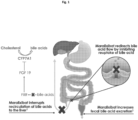
- ASBT inhibitors reduce or inhibit bile acid recycling in the distal gastrointestinal (GI) tract, including the distal ileum, the colon and/or the rectum. Inhibition of the apical sodium-dependent bile acid transport interrupts the enterohepatic circulation of bile acids and results in more bile acids being excreted in the feces, see Fig. 1 , leading to lower levels of bile acids systemically, thereby reducing bile acid mediated liver damage and related effects and complications.
- the ASBTIs are systemically absorbed. In certain embodiments, the ASBTIs are not systemically absorbed.
- ASBTIs described herein are modified or substituted (e.g., with a -L-K group) to be non-systemic.
- any ASBT inhibitor is modified or substituted with one or more charged groups (e.g., K) and optionally, one or more linker (e.g., L), wherein L and K are as defined herein.
- an ASBTI suitable for the methods described herein is a compound of Formula I: wherein:
- the compound of Formula I is a compound wherein
- the compound of Formula I is a compound wherein
- the compound of Formula I is a compound wherein
- the compound of Formula I is a compound wherein
- the compound of Formula I is (3R,5R)-3-Butyl-3-ethyl-2,3,4,5-tetrahydro-7,8- dimethoxy-5-phenyl-1,4-benzothiazepine 1,1-dioxide; (3R,5R)-3-Butyl-3-ethyl-2,3,4,5-tetrahydro-7,8- dimethoxy-5-phenyl-1,4-benzothiazepin-4-ol 1,1-dioxide; ( ⁇ )-Trans-3-butyl-3-ethyl-2,3,4,5-tetrahydro-7,8-dimethoxy-5-phenyl-1,4-benzothiazepine 1,1-dioxide; ( ⁇ )-Trans-3-butyl-3-ethyl-2,3,4,5-tetrahydro-7,8- dimethoxy-5-phenyl-1,4,-benzothiazepin-4-ol 1,1-dioxide; (3R,5R)-3-
- the compound of Formula I is or
- the compound of Formula I is N-(2-aminoethyl)-2-aminoethyl-N-(2-aminoethyl)-2-aminoethyl-N-(2-aminoethyl)-2-aminoethyl-N-(2-aminoethyl)-2-aminoethyl-N-(2-aminoethyl)-2-aminoethyl
- the compound of Formula I is not a structure shown as: wherein m represents an integer of 1 or 2, and R 3 and R 4 , which may be mutually different, each represents an alkyl group having 1 to 5 carbon atoms.
- an ASBTI suitable for the methods described herein is a compound of Formula II wherein:
- the compound of Formula II is a compound wherein
- the compound of Formula II is a compound wherein
- the compound of Formula II is a compound wherein
- the compound of Formula II is a compound wherein
- the compound of Formula II is a compound wherein
- the compound of Formula II is a compound wherein R 5 or R 6 is
- the compound of Formula II is a compound wherein n is 1 or 2. In some embodiments of the methods, the compound of Formula II is a compound wherein R 1 and R 2 are independently H or C 1-7 alkyl. In some embodiments of the methods, the compound of Formula II is a compound wherein each C 1-7 alkyl is independently ethyl, n-propyl, n-butyl, or isobutyl. In some embodiments of the methods, the compound of Formula II is a compound wherein R 3 and R 4 are independently H or OR 9 . In some embodiments of the methods, compound of Formula II is a compound wherein R 9 is H
- the compound of Formula II is a compound wherein one or more R x are in the 7-, 8- or 9- position of the benzo ring of Formula II. In some embodiments of the methods, the compound of Formula II is a compound wherein R x is in the 7- position of the benzo ring of Formula II. In some embodiments of the methods, the compound of Formula II is a compound wherein one or more R x are independently selected from OR 13 and NR 13 R 14 .
- the compound of Formula II is a compound wherein:
- a compound of Formula II is or the like.
- the compound of Formula II is N-(2-aminoethyl)-2-aminoethyl-N-(2-aminoethyl)-2-aminoethyl-N-(2-aminoethyl)-2-aminoethyl-N-(2-aminoethyl)-2-aminoethyl-N-(2-aminoethyl)-2-aminoethyl
- ASBTIs suitable for the methods described herein are non-systemic analogs of Compound 100C.
- Certain compounds provided herein are Compound 100C analogues modified or substituted to comprise a charged group.
- the Compound 100C analogues are modified or substituted with a charged group that is an ammonium group (e.g., a cyclic ar acyclic ammonium group).
- the ammonium group is a non-protic ammonium group that contains a quarternary nitrogen.
- a compound of Formula II is
- a compound of Formula II is 1-[[5-[[3-[(3S,4R,5R)-3-butyl-7-(dimethylamino)-3-ethyl-2,3,4,5-tetrahydro-4-hydroxy-1,1-dioxide-1-benzothiepin-Syl]phenyl]amino]-5-oxopentyl]amino]-1-deoxy-D-glucitol or SA HMR1741 (a.k.a. BARI-1741).
- a compound of Formula II is
- a compound of Formula II is potassium((2R,3R,4S,5R,6R)-4-benzyloxy-6- ⁇ 3-[3-((3S,4R,5R)-3-butyl-7-dimethylamino-3-ethyl-4-hydroxy-1,1-dioxo-2,3,4,5-tetrahydro-1H-benzo[b]thiepin-5-yl)-phenyl]-ureido ⁇ -3,5-dihydroxy-tetrahydropyran-2-ylmethyl)sulphate ethanolate, hydrate or SAR548304B (a.k.a. SAR-548304).
- an ASBTI suitable for the methods described herein is a compound of Formula III: wherein:
- R 1 and R 3 are -L-K. In some embodiments, R 1 , R 2 and R 3 are -L-K.
- R 1 , R 2 , R 3 , R 4 , R 5 , R 6 and R 7 is H.
- R 5 , R 6 , R 7 are H and R 1 , R 2 , R 3 and R 4 are alkyl, aryl, alkyl-aryl, or heteroalkyl.
- R 1 and R 2 are H.
- R 1 , R 2 , R 5 , R 6 and R 7 are H.
- R 6 and R 7 together form a bond.
- R 5 ,R 6 and R 7 are H, alkyl or O-alkyl.
- R 1 and R 3 are -L-K. In some embodiments, R 1 , R 2 and R 3 are -L-K. In some embodiments, R 3 and R 4 are -L-K. In some embodiments, R 1 and R 2 together with the nitrogen to which they are attached form a 3-8 membered ring and the ring is substituted with -L-K. In some embodiments, R 1 or R 2 or R 3 or R 4 are aryl optionally substituted with -L-K. In some embodiments, R 1 or R 2 or R 3 or R 4 are alkyl optionally substituted with -L-K.
- R 1 or R 2 or R 3 or R 4 are alky-aryl optionally substituted with -L-K. In some embodiments, R 1 or R 2 or R 3 or R 4 are heteroalkyl optionally substituted with -L-K.
- L is a C 1 -C 7 alkyl. In some embodiments, L is heteroalkyl. In certain embodiments, L is C 1 -C 7 alkyl-aryl. In some embodiments, L is C 1 -C 7 alkyl-aryl- C 1 -C 7 alkyl.
- K is a non-protic charged group. In some specific embodiments, each K is a ammonium group. In some embodiments, each K is a cyclic non-protic ammonium group. In some embodiments, each K is an acyclic non-protic ammonium group.
- each K is a cyclic non-protic ammonium group of structure:
- K is an acyclic non-protic ammonium group of structure: wherein p, q, R 9 , R 10 and Z are as defined above.
- p is 1.
- p is 2.
- p is 3.
- q is 0.
- q is 1.
- q is 2.
- the counterion is Cl - , Br - , I - , CH 2 CO 2 - , CH 3 SO 3 - , or C 6 H 5 SO 3 - or CO 2 - - (CH 2 ) 2 -CO 2 - .
- the compound of Formula III has one K group and one counterion. In other embodiments, the compound of Formula III has one K group, and two molecules of the compound of Formula III have one counterion. In yet other embodiments, the compound of Formula III has two K groups and two counterions. In some other embodiments, the compound of Formula III has one K group comprising two ammonium groups and two counterions.
- L is A n , wherein each A is substituted or unsubstituted alkyl, or substituted or unsubstituted heteroalkyl, and n is 0-7.
- R 1 is H.
- R 1 and R 2 together with the nitrogen to which they are attached form a 3-8-membered ring that is optionally susbtituted with -L-K.
- R 3 is H. In certain embodiments, R 3 and R 4 are each -L-K. In some embodiments, R 3 is H and R 4 is substituted or unsubstituted alkyl, substituted or unsubstituted heteroalkyl, substituted or unsubstituted aryl, substituted or unsubstituted alkyl-aryl containing one or two -L-K groups.
- an ASBTI suitable for the methods described herein is a compound of Formula IIIC wherein:
- K is selected from
- an ASBTI suitable for the methods described herein is a compound of Formula IV: wherein
- a compound of Formula IV has the structure of Formula IVA or Formula IVB:
- a compound of Formula IV has the structure of Formula IVC:
- X is O and R 7 is selected from
- a compound of Formula IV is:
- an ASBTI suitable for the methods described herein is a compound of Formula V: wherein:
- compound of Formula V is 1,1-dioxo-3,3-dibutyl-5-phenyl-7-methylthio-8-(N- ⁇ (R)- ⁇ -[N-((R)-1-carboxy-2-methylthio-ethyl)carbamoyl]-4-hydroxybenzyl ⁇ carbamoylmethoxy)-2,3,4,5-tetrahydro-1,2,5-benzothiadiazepine; 1,1-dioxo-3,3-dibutyl-5-phenyl-7-methylthio-8-(N- ⁇ (R)- ⁇ -[N-((S)-1-carboxy-2-(R)-hydroxypropyl)carbamoyl]-4-hydroxybenzyl ⁇ carbamoylmethoxy)-2,3,4,5-tetrahydro-1,2,5-benzothiadiazepine; 1,1-dioxo-3,3-dibutyl-5-phenyl-7-methylthio-8-(N
- compound of Formula V is or
- an ASBTI suitable for the methods described herein is a compound of Formula VI: wherein:
- a compound of Formula VI has the structure of Formula VID: wherein:
- a compound of Formula IV is 1,1-dioxo-3,3-dibutyl-5-phenyl-7-methylthio-8-(N- ⁇ (R)-1'-phenyl-1'-[N'-(carboxymethyl) carbamoyl] methyl ⁇ carbamoylmethoxy)-2,3,4,5-tetrahydro-1,5-benzothiazepine; 1,1-dioxo-3,3-dibutyl-5-phenyl-7-methylthio-8-(N- ⁇ (R)- ⁇ -[N'-((S)-1-carboxypropyl)carbamoyl]-4-hydroxybenzyl ⁇ carbamoylmethoxy)-2,3,4,5-tetrahydro-1,5-benzothiazepine; 1,1-dioxo-3,3-dibutyl-5-phenyl-7-methylthio-8-(N- ⁇ (R)-1'-phenyl-1'-[N
- any compound described herein is covalently conjugated to a bile acid using any suitable method.
- compounds described herein are covalently bonded to a cyclodextrin or a biodegradable polymer (e.g., a polysaccharide).
- compounds described herein are not systemically absorbed.
- compounds that inhibit bile salt recycling in the gastrointestinal tract of an individual may not be transported from the gut lumen and/or do not interact with ASBT.
- compounds described herein do not affect, or minimally affect, fat digestion and/or absorption.
- the administration of a therapeutically effective amount of any compound described herein does not result in gastrointestinal disturbance or lactic acidosis in an individual.
- compounds described herein are administered orally.
- an ASBTI is released in the distal ileum.
- An ASBTI compatible with the methods described herein may be a direct inhibitor, an allosteric inhibitor, or a partial inhibitor of the Apical Sodium-dependent Bile acid Transporter.
- compounds that inhibit ASBT or any recuperative bile acid transporters are compounds that are described in EP1810689 , US Patent Nos. 6,458,851 , 7413536 , 7514421 , US Appl. Publication Nos.
- compounds that inhibit ASBT or any recuperative bile acid transporters are compounds described in WO93/16055 , WO94/18183 , WO94/18184 , WO96/05188 , WO96/08484 , WO96/16051 , WO97/33882 , WO98/38182 , WO99/35135 , WO98/40375 , WO99/64409 , WO99/64410 , WO00/01687 , WO00/47568 , WO00/61568 , DE 19825804 , WO00/38725 , WO00/38726 , WO00/38727 (including those compounds with a 2,3,4,5-tetrahydro-1-benzothiepine 1,1-dioxide structure), WO00/38728 , WO01/66533 , WO02/50051 , EP0864582 (e.g.
- compounds that inhibit ASBT or any recuperative bile acid transporter are benzothiepines, benzothiazepines (including 1,2-benzothiazepines; 1,4-benzothiazepines; 1,5-benzothiazepines; and/or 1,2,5-benzothiadiazepines).
- compounds that inhibit ASBT or any recuperative bile acid transporter include and are not limited to S-8921 (disclosed in EP597107 , WO 93/08155 ), 264W94 (GSK) disclosed in WO 96/05188 ; SC-435 (1-[4-[4-[(4R,5R)-3,3-dibutyl-7-(dimethylamino)-2,3,4,5-tetrahydro-4-hydroxy-1,1-dioxido-1-benzothiepin-5-yl]phenoxy]butyl]4-aza-1-azoniabicyclo[2.2.2]octane methanesulfonate salt), SC-635 (Searle); 2164U90 (3-butyl-3-ethyl-2,3,4,5-tetrahydro-5-phenyl-1,4-benzothiazepine 1,1-dioxide); BARI-1741 (Aventis SA), AZD 7508 (Astra Zeneca
- compounds described herein have one or more chiral centers. As such, all stereoisomers are envisioned herein.
- compounds described herein are present in optically active or racemic forms. It is to be understood that the compounds of the present invention encompass racemic, optically-active, regioisomeric and stereoisomeric forms, or combinations thereof that possess the therapeutically useful properties described herein. Preparation of optically active forms is achieved in any suitable manner, including by way of non-limiting example, by resolution of the racemic form by recrystallization techniques, by synthesis from optically-active starting materials, by chiral synthesis, or by chromatographic separation using a chiral stationary phase.
- mixtures of one or more isomer is utilized as the therapeutic compound described herein.
- compounds described herein contains one or more chiral centers. These compounds are prepared by any means, including enantioselective synthesis and/or separation of a mixture of enantiomers and/or diastereomers. Resolution of compounds and isomers thereof is achieved by any means including, by way of non-limiting example, chemical processes, enzymatic processes, fractional crystallization, distillation, chromatography, and the like.
- the ASBTI is (maralixibat, LUM-001, SHP625, lopixibat chloride), or an alternative pharmaceutically acceptable salt thereof.
- the ASBTI is (volixibat, (2R,3R,4S,5R,6R)-4-benzyloxy-6- ⁇ 3-[3-((3S,4R,5R)-3-butyl-7-dimethylamino-3-ethyl-4-hydroxy-1,1-dioxo-2,3,4,5-tetrahydro-1H-benzo[b]thiepin-5-yl)-phenyl]-ureido ⁇ -3,5-dihydroxy-tetrahydro-pyran-2-ylmethyl) hydrogen sulfate), or a pharmaceutically acceptable salt thereof.
- the ASBTI is (LUM-002; SHP626; SAR548304; volixibat potassium), or an alternative pharmaceutically acceptable salt thereof.
- the ASBTI is (odevixibat; AZD8294; WHO10706; AR-H064974; SCHEMBL946468; A4250; 1,1-dioxo-3,3-dibutyl-5-phenyl-7-methylthio-8-(N- ⁇ (R)-a-[N-((S)-1-carboxypropyl) carbamoyl]-4-hydroxybenzyl ⁇ carbamoylmethoxy)-2,3,4,5-tetrahydro-1,2,5-benzothiadiazepine), or a pharmaceutically acceptable salt thereof.
- the ASBTI is (elobixibat; 2-[[(2R)-2-[[2-[(3,3-dibutyl-7-methylsulfanyl-1,1-dioxo-5-phenyl-2,4-dihydro-1 ⁇ 6,5-benzothiazepin-8-yl)oxy]acetyl]amino]-2-phenylacetyl]amino]acetic acid), or a pharmaceutically acceptable salt thereof.
- the ASBTI is (GSK2330672; linerixibat; 3-((((3R,5R)-3-butyl-3-ethyl-7-(methyloxy)-1,1-dioxido-5-phenyl-2,3,4,5-tetrahydro-1,4-benzothiazepin-8-yl)methyl)amino)pentanedioic acid), or a pharmaceutically acceptable salt thereof.
- ASBTIs described herein are synthesized as described in, for example, WO 96/05188 , U.S. Patent Nos. 5,994,391 ; 7,238,684 ; 6,906,058 ; 6,020,330 ; and 6,114,322 .
- the ASBTI used in the methods or compositions of the present invention is maralixibat (SHP625), volixibat (SHP626), or odevixibat (A4250), or a pharmaceutically acceptable salt thereof.
- the ASBTI used in the methods or compositions of the present invention is maralixibat, or a pharmaceutically acceptable salt thereof.
- ASBTI used in the methods or compositions of the present invention is volixibat, or a pharmaceutically acceptable salt thereof.
- the ASBTI used in the methods or compositions of the present invention is odevixibat, or a pharmaceutically acceptable salt thereof.
- the ASBTI used in the methods or compositions of the present invention is elobixibat, or a pharmaceutically acceptable salt thereof.
- ASBTI used in the methods or compositions of the present invention is GSK2330672, or a pharmaceutically acceptable salt thereof.
- the ASBTI may comprise a mixture of different ASBTIs; for example, the ASBTI may be a composition comprising maralixibat, volixibat, odevixibat, GSK2330672, elobixibat, or various combinations thereof.
- ARBTI Apical Sodium-dependent Bile Acid Transport Inhibitor
- a cholestatic liver disease is characterized by one or more symptoms selected from jaundice, pruritis, cirrhosis, hypercholemia, neonatal respiratory distress syndrome, lung pneumonia, increased serum concentration of bile acids, increased hepatic concentration of bile acids, increased serum concentration of bilirubin, hepatocellular injury, liver scarring, liver failure, hepatomegaly, xanthomas, malabsorption, splenomegaly, diarrhea, pancreatitis, hepatocellular necrosis, giant cell formation, hepatocellular carcinoma, gastrointestinal bleeding, portal hypertension, hearing loss, fatigue, loss of appetite, anorexia, peculiar smell, dark urine, light stools, steatorrhea, failure to thrive, and/or renal failure.
- the patient has biliary atresia.
- the patient has intrahepatic cholestasis of pregnancy (ICP).
- ICP intrahepatic cholestasis of pregnancy
- methods of the present invention comprise non-systemic administration of a therapeutically effective amount of an ASBTI.
- the methods comprise contacting the gastrointestinal tract, including the distal ileum and/or the colon and/or the rectum, of an individual in need thereof with an ASBTI.
- the methods of the present invention cause a reduction in intraenterocyte bile acids, or a reduction in damage to hepatocellular or intestinal architecture caused by cholestasis or a cholestatic liver disease.
- methods of the present invention comprise delivering to ileum or colon of the individual a therapeutically effective amount of any ASBTI described herein.
- the subject has a condition associated with, caused by or caused in part by a BSEP deficiency.
- the condition associated with, caused by or caused in part by the BSEP deficiency is neonatal hepatitis, primary biliary cirrhosis (PBC), primary sclerosing cholangitis (PSC), PFIC 2, benign recurrent intrahepatic cholestasis (BRIC), intrahepatic cholestasis of pregnancy (ICP), drug-induced cholestasis, oral-contraceptive-induced cholestasis, biliary atresia, or a combination thereof.
- PBC primary biliary cirrhosis
- PSC primary sclerosing cholangitis
- PFIC 2 benign recurrent intrahepatic cholestasis
- BRIC benign recurrent intrahepatic cholestasis
- ICP intrahepatic cholestasis of pregnancy
- methods of the present invention comprise reducing damage to hepatocellular or intestinal architecture or cells from cholestasis or a cholestatic liver disease comprising administration of a therapeutically effective amount of an ASBTI.
- the methods of the present invention comprise reducing intraenterocyte bile acids/salts through administration of a therapeutically effective amount of an ASBTI to an individual in need thereof.
- methods of the present invention provide for inhibition of bile salt recycling upon administration of any of the compounds described herein to an individual.
- an ASBTI described herein is systemically absorbed upon administration. In some embodiments, an ASBTI described herein is not absorbed systemically. In some embodiments, an ASBTI herein is administered to the individual orally. In some embodiments, an ASBTI described herein is delivered and/or released in the distal ileum of an individual.
- contacting the distal ileum of an individual with an ASBTI inhibits bile acid reuptake and increases the concentration of bile acids/salts in the vicinity of L-cells in the distal ileum and/or colon and/or rectum, thereby reducing intraenterocyte bile acids, reducing serum and/or hepatic bile acid levels, reducing overall serum bile acid load, and/or reducing damage to ileal architecture caused by cholestasis or a cholestatic liver disease.
- ASBTI e.g., any ASBTI described herein
- a compound or a composition comprising a compound described herein is administered for prophylactic and/or therapeutic treatments.
- the compositions are administered to an individual already suffering from a disease or condition, in an amount sufficient to cure or at least partially arrest the symptoms of the disease or condition.
- amounts effective for this use depend on the severity and course of the disease or condition, previous therapy, the individual's health status, weight, and response to the drugs, and the judgment of the treating physician.
- an individual's condition does not improve, upon the doctor's discretion the administration of a compound or composition described herein is optionally administered chronically, that is, for an extended period of time, including throughout the duration of the individual's life in order to ameliorate or otherwise control or limit the symptoms of the individual's disorder, disease or condition.
- an effective amount of a given agent varies depending upon one or more of a number of factors such as the particular compound, disease or condition and its severity, the identity (e.g., weight) of the subject or host in need of treatment, and is determined according to the particular circumstances surrounding the case, including, e.g., the specific agent being administered, the route of administration, the condition being treated, and the subject or host being treated.
- doses administered include those up to the maximum tolerable dose. In some embodiments, doses administered include those up to the maximum tolerable dose by a newborn or an infant.
- a desired dose is conveniently presented in a single dose or in divided doses administered simultaneously (or over a short period of time) or at appropriate intervals, for example as two, three, four or more sub-doses per day.
- a single dose of an ASBTI is administered every 6 hours, every 12 hours, every 24 hours, every 48 hours, every 72 hours, every 96 hours, every 5 days, every 6 days, or once a week.
- the total single dose of an ASBTI is in a range described below.
- an ASBTI is optionally given continuously; alternatively, the dose of drug being administered is temporarily reduced or temporarily suspended for a certain length of time (i.e., a "drug holiday").
- the length of the drug holiday optionally varies between 2 days and 1 year, including by way of example only, 2 days, 3 days, 4 days, 5 days, 6 days, 7 days, 10 days, 12 days, 15 days, 20 days, 28 days, 35 days, 50 days, 70 days, 100 days, 120 days, 150 days, 180 days, 200 days, 250 days, 280 days, 300 days, 320 days, 350 days, or 365 days.
- the dose reduction during a drug holiday includes from 10%-100% of the original dose, including, by way of example only, 10%, 15%, 20%, 25%, 30%, 35%, 40%, 45%, 50%, 55%, 60%, 65%, 70%, 75%, 80%, 85%, 90%, 95%, or 100% of the original dose.
- the total single dose of an ASBTI is in a range described below.
- a maintenance dose is administered if necessary. Subsequently, the dosage or the frequency of administration, or both, is reduced, as a function of the symptoms, to a level at which the improved disease, disorder or condition is retained.
- patients require intermittent treatment on a long-term basis upon any recurrence of symptoms.
- Toxicity and therapeutic efficacy of such therapeutic regimens are optionally determined by pharmaceutical procedures in cell cultures or experimental animals, including, but not limited to, the determination of the LD 50 (the dose lethal to 50% of the population) and the ED 50 (the dose therapeutically effective in 50% of the population).
- the dose ratio between the toxic and therapeutic effects is the therapeutic index and it can be expressed as the ratio between LD 50 and ED 50 .
- Compounds exhibiting high therapeutic indices are prefer ed.
- data obtained from cell culture assays and animal studies are used in formulating a range of dosage for use in human.
- the dosage of compounds described herein lies within a range of circulating concentrations that include the ED 50 with minimal toxicity. The dosage optionally varies within this range depending upon the dosage form employed and the route of administration utilized.
- the composition used or administered comprises an absorption inhibitor, a carrier, and one or more of a cholesterol absorption inhibitor, an enteroendocrine peptide, a peptidase inhibitor, a spreading agent, and a wetting agent.
- the composition used to prepare an oral dosage form or administered orally comprises an absorption inhibitor, an orally suitable carrier, an optional cholesterol absorption inhibitor, an optional enteroendocrine peptide, an optional peptidase inhibitor, an optional spreading agent, and an optional wetting agent.
- the orally administered compositions evoke an anorectal response.
- the anorectal response is an increase in secretion of one or more enteroendocrine by cells in the colon and/or rectum (e.g., in L-cells the epithelial layer of the colon, ileum, rectum, or a combination thereof).
- the anorectal response persists for at least 1, 2, 3, 4 ,5 ,6 ,7 ,8, 9, 10, 11,12, 13, 14, 15, 16, 17, 18, 19, 20, 21, 22, 23 or 24 hours. In other embodiments the anorectal response persists for a period between 24 hours and 48 hours, while in other embodiments the anorectal response persists for persists for a period greater than 48 hours.
- the BSEP deficiency is progressive familial intrahepatic cholestasis (PFIC 2), benign recurrent intrahepatic cholestasis, or intrahepatic cholestasis of pregnancy.
- the patient has residual BSEP function.
- the patient has at least about 95%, 90%, 85%, 80%, 75%, 70%, 65%, 60%, 55%, 50%, 45%, 40%, 35%, 30%, 25%, 20%, 25%, 20%, 5%, 2.5%, or 1% BSEP function relative to a healthy individual without any cholestatic liver disease.
- the patent has a maximum of about 99%, 95%, 95%, 90%, 85%, 80%, 75%, 70%, 65%, 60%, 55%, 50%, 45%, 40%, 35%, 30%, 25%, 20%, 25%, 20%, 5%, or 2.5% BSEP function relative to a healthy individual without any cholestatic liver disease.
- the BSEP deficiency can result in impaired or reduced bile flow or cholestasis.
- the BSEP deficiency is caused by a mutation in an ABCB11 gene.
- the mutation in the ABCB11 gene is a non-truncating mutation.
- truncating mutations to the ABCB11 gene can result in lack of residual function of the encoded BSEP ("severe" mutation).
- the ABCB11 gene includes a mutation and does not comprise any truncating mutations.
- the ABCB11 gene mutation can be a missense or nonsense mutation, an insertion, or a deletion.
- the ABCB11 gene includes an E297G or a D482G mutation, alternatively referred to as "mild” mutations or “mild PFIC 2.”
- the ABCB11 gene comprises a missense mutation and does not include an E297G or a D482G missense mutation, alternatively referred to as “moderate” mutations or “moderate PFIC 2.”
- the ABCB11 gene can include an E297G, D482G, alternative missense mutations, insertions, deletions, and various combinations thereof.
- the alternative missense mutation may be selected from one of those mutations listed in Byrne, et al., "Missense Mutations and Single Nucleotide Polymorphisms in ABCB11 Impair Bile Salt Export Pump Processing and Function or Disrupt Pre-Messanger RNA Splicing," Hepatology, 49:553-567 (2009 ), which is incorporated herein by reference in its entirety for all purposes.
- the patient has total loss of BSEP activity.
- the patient having total loss of BSEP activity is homozygous for ABCB11 genes having mutations resulting in total loss of encoded BSEP activity (e.g., truncating or frame-shift mutations).
- the patient has residual BSEP activity.
- the patient having residual BSEP activity is heterozygous for an ABCB11 gene having mutations resulting in total loss of encoded BSEP activity (e.g., patients having an ABCB11 gene with a truncating mutation and a wild type ABCB11 gene or patients having having an ABCB11 gene with a truncating mutation and and ABCB11 gene having mutations encoding BSEP having residual activity but activity that is reduced relative to wild type BSEP).
- the patient having residual BSEP activity is homozygous for ABCB11 genes having mutations resulting in residual BSEP activity and reduced activity of BSEP relative to wild type (e.g., patients having ABCB11 genes with the same or different missense mutation(s)).
- the patient having residual BSEP activity is heterozygous for ABCB11 genes having mutations resulting in residual BSEP activity and reduced activity of BSEP relative to wild type (e.g., patients having a wild type ABCB11 gene and an ABCB11 gene having a missense mutation).
- the method includes determining a genotype of the patient. Determining the genotype can include any of various methods known in the art for determining a gene sequence for the patient, including as non-limiting examples restriction fragment length polymorphism identification of genomic DNA, random amplified polymorphic detection of genomic DNA, amplified fragment length polymorphism detection, polymerase chain reaction, DNA sequencing, allele specific oligonucleotide probes, hybridization to DNA microarrays or beads, and various combinations thereof. In various embodiments, determining the genotype includes determining a sequence of the ABCB11 gene.
- the method includes determining the genotype includes identifying and characterizing a mutation in the ABCB11 gene. Determining the genotype can include determining a sequence for a portion or an entirety of the ABCB11 gene. Determining the genotype can further include determining a sequence for a genomic region surrounding the ABCB11 gene or determining a sequence for one or more introns and/or exons of the ABCB11 gene. Determining the genotype can include characterizing the ABCB11 gene by identifying one, multiple, or all mutations of ABCB11 gene-encoding alleles of the patient.
- determining the genotype includes determining whether or not the ABCB11 gene has a truncating mutation, an insertion, a deletion, a missense mutation, the E297G mutation, the D482G mutation, a splice site mutation, a nonsense mutation, a frameshift mutation, or various combinations thereof.
- the patient is a pediatric patient under the age of 1, 2, 3, 4, 5, 6, 7, 8, 9, 10, 11, 12, 13, 14, 15, 16, 17, or 18 years old.
- the pediatric patient is a newborn, a pre-term newborn, an infant, a toddler, a preschooler, a school-age child, a pre-pubescent child, post-pubescent child, an adolescent, or a teenager under the age of eighteen.
- the pediatric patient is a newborn, a pre-term newborn, an infant, a toddler, a preschooler, or a school-age child.
- the pediatric patient is a newborn, a pre-term newborn, an infant, a toddler, or a preschooler.
- the pediatric patient is a newborn, a pre-term newborn, an infant, or a toddler. In some embodiments, the pediatric patient is a newborn, a pre-term newborn, or an infant. In some embodiments, the pediatric patient is a newborn. In some embodiments, the pediatric patient is an infant. In some embodiments, the pediatric patient is a toddler.
- the patient is an adult over the age of 18, 20, 30, 40, 50, 60, or 70.
- ASBTI is maralixibat, volixibat, odevixibat, or a pharmaceutically acceptable salt thereof.
- efficacy and safety of ASBTI administration to the patient is monitored by measuring serum levels of 7 ⁇ -hydroxy-4-cholesten-3-one (7 ⁇ C4), sBA concentration, a ratio of 7 ⁇ C4 to sBA (7 ⁇ C4:sBA), serum bilirubin concentration, serum ALT concentration, serum AST concentration, or a combination thereof.
- efficacy of ASBTI administration is measured by monitoring observer-reported itch reported outcome (ITCHRO(OBS)) score, a HRQoL (e.g., PedsQL) score, a CSS score, a height Z-score, a weight Z-score, or various combinations thereof.
- the method includes monitoring serum levels of 7 ⁇ -hydroxy-4-cholesten-3-one (7 ⁇ C4), sBA concentration, a ratio of 7 ⁇ C4 to sBA (7 ⁇ C4:sBA), serum bilirubin concentration, serum ALT concentration, serum AST concentration, or a combination thereof.
- the method includes monitoring observer-reported itch reported outcome (ITCHRO(OBS)) score, a HRQoL (e.g., PedsQL) score, a CSS score, a height Z-score, a weight Z-score or various combinations thereof.
- ICHRO(OBS) observer-reported itch reported outcome
- HRQoL e.g., PedsQL
- CSS e.g., PedsQL
- the ASBTI is administered at a dose of about or at least about 0.5 ⁇ g/kg, 1 ⁇ g/kg, 2 ⁇ g/kg, 3 ⁇ g/kg, 4 ⁇ g/kg, 5 ⁇ g/kg, 6 ⁇ g/kg, 7 ⁇ g/kg, 8 ⁇ g/kg, 9 ⁇ g/kg, 10 ⁇ g/kg, 15 ⁇ g/kg, 20 ⁇ g/kg, 25 ⁇ g/kg, 30 ⁇ g/kg, 35 ⁇ g/kg, 40 ⁇ g/kg, 45 ⁇ g/kg, 50 ⁇ g/kg, 55 ⁇ g/kg, 60 ⁇ g/kg, 65 ⁇ g/kg, 70 ⁇ g/kg, 75 ⁇ g/kg, 80 ⁇ g/kg, 85 ⁇ g/kg, 90 ⁇ g/kg, 100 ⁇ g/kg, 140 ⁇ g/kg, 150 ⁇ g/kg, 200 ⁇ g/kg, 240 ⁇ g/kg, 280 ⁇ g/kg,
- the ASBTI is administered at a dose not exceeding about 1 ⁇ g/kg, 2 ⁇ g/kg, 3 ⁇ g/kg, 4 ⁇ g/kg, 5 ⁇ g/kg, 6 ⁇ g/kg, 7 ⁇ g/kg, 8 ⁇ g/kg, 9 ⁇ g/kg, 10 ⁇ g/kg, 15 ⁇ g/kg, 20 ⁇ g/kg, 25 ⁇ g/kg, 30 ⁇ g/kg, 35 ⁇ g/kg, 40 ⁇ g/kg, 45 ⁇ g/kg, 50 ⁇ g/kg, 55 ⁇ g/kg, 60 ⁇ g/kg, 65 ⁇ g/kg, 70 ⁇ g/kg, 75 ⁇ g/kg,
- the ASBTI is administered at a dose of about or of at least about 0.5 mg/day, 1 mg/day, 2 mg/day, 3 mg/day, 4 mg/day, 5 mg/day, 6 mg/day, 7 mg/day, 8 mg/day, 9 mg/day, 10 mg/day, 11 mg/day, 12 mg/day, 13 mg/day, 14 mg/day, 15 mg/day, 16 mg/day, 17 mg/day, 18 mg/day, 19 mg/day, 20 mg/day, 30 mg/day, 40 mg/day, 50 mg/day, 60 mg/day, 70 mg/day, 80 mg/day, 90 mg/day, 100 mg/day, 150 mg/day, 200 mg/day, 300 mg/day, 500 mg/day, 600 mg/day, 700 mg/day, 800 mg/day, 900 mg/day, 1000 mg/day.
- the ASBTI is administered at a dose of not more than about 1 mg/day, 2 mg/day, 3 mg/day, 4 mg/day, 5 mg/day, 6 mg/day, 7 mg/day, 8 mg/day, 9 mg/day, 10 mg/day, 11 mg/day, 12 mg/day, 13 mg/day, 14 mg/day, 15 mg/day, 16 mg/day, 17 mg/day, 18 mg/day, 19 mg/day, 20 mg/day, 30 mg/day, 40 mg/day, 50 mg/day, 60 mg/day, 70 mg/day, 80 mg/day, 90 mg/day, 100 mg/day, 150 mg/day, 200 mg/day, 300 mg/day, 500 mg/day, 600 mg/day, 700 mg/day, 800 mg/day, 900 mg/day, 1,000 mg/day, 1,100 mg/day.
- the ASBTI is administered at a dose of from about 140 ⁇ g/kg/day to about 1400 ⁇ g/kg/day. In various embodiments, the ASBTI is administered at a dose of about or at least about 0.5 ⁇ g/kg/day, 1 ⁇ g/kg/day, 2 ⁇ g/kg/day, 3 ⁇ g/kg/day, 4 ⁇ g/kg/day, 5 ⁇ g/kg/day, 6 ⁇ g/kg/day, 7 ⁇ g/kg/day, 8 ⁇ g/kg/day, 9 ⁇ g/kg/day 10 ⁇ g/kg/day, 15 ⁇ g/kg/day, 20 ⁇ g/kg/day, 25 ⁇ g/kg/day, 30 ⁇ g/kg/day, 35 ⁇ g/kg/day, 40 ⁇ g/kg/day, 45 ⁇ g/kg/day, 50 ⁇ g/kg/day, 100 ⁇ g/kg/day, 140 ⁇ g/kg/day, 150 ⁇ g/kg/day.
- the ASBTI is administered at a dose not exceeding about 1 ⁇ g/kg/day, 2 ⁇ g/kg/day, 3 ⁇ g/kg/day, 4 ⁇ g/kg/day, 5 ⁇ g/kg/day, 6 ⁇ g/kg/day, 7 ⁇ g/kg/day, 8 ⁇ g/kg/day, 9 ⁇ g/kg/day 10 ⁇ g/kg/day, 15 ⁇ g/kg/day, 20 ⁇ g/kg/day, 25 ⁇ g/kg/day, 30 ⁇ g/kg/day, 35 ⁇ g/kg/day, 40 ⁇ g/kg/day, 45 ⁇ g/kg/day, 50 ⁇ g/kg/day, 100 ⁇ g/kg/day, 140 ⁇ g/kg/day, 150 ⁇ g/kg/day, 200 ⁇ g/kg/day, 240 ⁇ g/kg/day, 280 ⁇ g/kg/day, 300 ⁇ g/kg/day, 250 ⁇ g/kg/day, 280
- the ASBTI is administered at a dose of from about 0.5 ⁇ g/kg/day to about 500 ⁇ g/kg/day, from about 0.5 ⁇ g/kg/day to about 250 ⁇ g/kg/day, from about 1 ⁇ g/kg/day to about 100 ⁇ g/kg/day, from about 10 ⁇ g/kg/day to about 50 ⁇ g/kg/day, from about 10 ⁇ g/kg/day to about 100 ⁇ g/kg/day, from about 0.5 ⁇ g/kg/day to about 2000 ⁇ g/kg/day, from about 280 ⁇ g/kg/day to about 1400 ⁇ g/kg/day, from about 420 ⁇ g/kg/day to about 1400 ⁇ g/kg/day, from about 250 to about 550 ⁇ g/kg/day, from about 560 ⁇ g/kg/day to about 1400 ⁇ g/kg/day, from 700 ⁇ g/kg/day to about 1400 ⁇ g/kg/day, from about 560 ⁇ g/kg
- the ASBTI is administered at a dose of from about 30 ⁇ g/kg to about 1400 ⁇ g/kg per dose. In some embodiments, the ASBTI is administered at a dose of from about 0.5 ⁇ g/kg to about 2000 ⁇ g/kg per dose, from about 0.5 ⁇ g/kg to about 1500 ⁇ g/kg per dose, from about 100 ⁇ g/kg to about 700 ⁇ g/kg per dose, from about 5 ⁇ g/kg to about 100 ⁇ g/kg per dose, from about 10 ⁇ g/kg to about 500 ⁇ g/kg per dose, from about 50 ⁇ g/kg to about 1400 ⁇ g/kg per dose, from about 300 ⁇ g/kg to about 2,000 ⁇ g/kg per dose, from about 60 ⁇ g/kg to about 1200 ⁇ g/kg per dose, from about 70 ⁇ g/kg to about 1000 ⁇ g/kg per dose, from about 70 ⁇ g/kg to about 700 ⁇ g/kg per dose, from 80 ⁇ g/kg to
- the ASBTI is administered at a dose of from about 0.5 mg/day to about 550 mg/day. In various embodiments, the ASBTI is administered at a dose of from about 1 mg/day to about 500 mg/day, from about 1 mg/day to about 300 mg/day , from about 1 mg/day to about 200 mg/day, from about 2 mg/day to about 300 mg/day, from about 2 mg/day to about 200 mg/day, from about 4 mg/day to about 300 mg/day, from about 4 mg/day to about 200 mg/day, from about 4 mg/day to about 150 mg/day, from about 5 mg/day to about 150 mg/day, from about 5 mg/day to about 150 mg/day, from about 5 mg/day to about 100 mg/day, from about 5 mg/day to about 80 mg/day, from about 5 mg/day to about 50 mg/day, from about 5 mg/day to about 40 mg/day, from about 5 mg/day to about 30 mg/day, from about 5 mg/day to about 20 mg/day, from about 5
- the dose of the ASBTI is a first dose level. In various embodiments, the dose of the ASBTI is a second dose level. In some embodiments, the second dose level is greater than the first dose level. In some embodiments, the second dose level is about or at least about 1.5, 2, 3, 4, 5, 6, 7, 8, 9, 10, 15, 20, 30, 40, 50, 60, 70, 80, 90 or 100 times or fold greater than the first dose level. In some embodiments, the second dose level is not in excess of about 1.5, 2, 3, 4, 5, 6, 7, 8, 9, 10, 15, 20, 30, 40, 50, 60, 70, 80, 90, 100, or 150 times or fold greater than the first dose level.
- the ASBTI is administered once daily (QD) at one of the above doses or within one of the above dose ranges. In various embodiments, the ASBTI is administered twice daily (BID) at one of the above doses or within one of the above dose ranges. In various embodiments, an ASBTI dose is administered daily, every other day, twice a week, or once a week.
- the ASBTI is administered regularly for a period of about or of at least about 1, 2, 3, 4, 5, 6, 7, 8, 9, 10, 15, 20, 30, 40, 48, 50, 75, 100, 150, 200, 250, 300, 350, 400, 450, 500, 600, 700, or 800 weeks. In various embodiments, the ASBTI is administered for not more than about 1, 2, 3, 4, 5, 6, 7, 8, 9, 10, 15, 20, 30, 40, 48, 50, 75, 100, 150, 200, 250, 300, 350, 400, 450, 500, 600, 700, 800, or 1000 weeks. In various embodiments, the ASBTI is administered regularly for a period of about or of at least about 0.5, 1, 1.5, 2, 3, 4, 5, 6, 7, 8, 9, or 10 years. In various embodiments, the ASBTI is administered regularly for a period not in excess of about 0.5, 1, 1.5, 2, 3, 4, 5, 6, 7, 8, 9, 10, or 15 years.
- the method includes modulating a dosage of the ASBTI administered to the patient.
- the modulation includes determining the 7 ⁇ C4:sBA ratio for the patient at a baseline (e.g., prior to administration of the ASBTI or prior to modulating (e.g., increasing) a dosage of the ASBTI), and further determining the 7 ⁇ C4:sBA ratio after administering the ASBTI at a first dose or modulating (e.g., increasing) a dosage amount of the ASBTI to a second dose.
- the dose of the ASBTI is increased until the ratio increases at least about 1.25, 1.5, 1.75, 2, 2.5, 3, 4, 5, 6, 7, 8, 9, 10, 15, 20, 30, 40, 50, 75, 100, 150, 200, 300, 500, 750, 1,000, 2,000, 3,000, 4,000, 5,000 or 10,000-fold relative to baseline.
- the dose of the ASBTI is increased or decreased to achieve and maintain a particular 7 ⁇ C4:sBA ratio.
- the modulating includes increasing a dose of the ASBTI from a first dose level to a second dose level greater than the first dose level if the 7 ⁇ C4:sBA ratio initially increases by at least 1, 1.25, 1.5, 1.75, 2, 2.5, 3, 4, 5, 6, 7, 8, 9, 10, 15, 20, 30, 40, 50, 75, 100, 150, 200, 300, 500, 750, 1,000, 2,000, 3,000, 4,000, 5,000 or 10,000-fold from baseline and then begins to decrease or decreases to less than 1, 1.25, 1.5, 1.75, 2, 2.5, 3, 4, 5, 6, 7, 8, 9, 10, 15, 20, 30, 40, 50, 75, 100, 150, 200, 300, 500, 750, 1,000, 2,000, 3,000, 4,000, 5,000 or 10,000-fold or greater higher than baseline.
- the dose level is increased until the 7 ⁇ C4:sBA ratio increases to at least 1, 1.25, 1.5, 1.75, 2, 2.5, 3, 4, 5, 6, 7, 8, 9, 10, 15, 20, 30, 40, 50, 75, 100, 150, 200, 300, 500, 750, 1,000, 2,000, 3,000, 4,000, 5,000 or 10,000-fold from the baseline.
- the modulation includes administering a first dose of the ASBTI to the patient. If the 7 ⁇ C4:sBA ratio does not increase or increase by at least 1, 1.25, 1.5, 1.75, 2, 2.5, 3, 4, 5, 6, 7, 8, 9, 10, 15, 20, 30, 40, 50, 75, 100, 150, 200, 300, 500, 750, 1,000, 2,000, 3,000, 4,000, 5,000 or 10,000-fold fold from baseline, the patient is then administered a second dose of the ASBTI higher than the first dose.
- the dose administered to the patient continues to be increased until the 7 ⁇ C4:sBA ratio increases by at least 1, 1.25, 1.5, 1.75, 2, 2.5, 3, 4, 5, 6, 7, 8, 9, 10, 15, 20, 30, 40, 50, 75, 100, 150, 200, 300, 500, 750, 1,000, 2,000, 3,000, 4,000, 5,000 or 10,000-fold from baseline.
- the 7 ⁇ C4:sBA ratio is measured about daily, bi-weekly, weekly, bi-monthly, monthly, every two months, every three months, every four months, every five months, every six months, or annually, and the dose of the ASBTI is modulated as necessary each time the ratio is measured.
- a prediction method for predicting patient response to treatment of a cholestatic liver disease.
- the treatment includes administering to the patient in need of such treatment an ASBTI.
- the method includes determining the genotype of the patient, as described above, and predicting patient response to the treatment based upon the genotype.
- the patient has a BSEP deficiency.
- the patient has PFIC 2.
- the prediction method includes predicting that the patient will not be responsive to administration of the ASBTI if the ABCB11 gene comprises a truncating mutation. In some embodiments, the method includes predicting that the patient will not be responsive to administration of the ASBTI if the ABCB11 gene comprises a mutation that leads to a lack of any residual BSEP activity in the patient (i.e., to a total loss of BSEP activity). In some embodiments, the method includes predicting that the patient will not be responsive to administration of the ASBTI if the patient has a genotype that corresponds to total lack or loss of BSEP activity (e.g., the patient has a genome sequence that includes no non-truncated alleles of the ABCB11 gene).
- the prediction method includes predicting that the patient will be responsive to administration of the ASBTI if the ABCB11 gene comprises mutations that result in residual BSEP activity and the ABCB11 gene comprises no mutations that result in absence of BSEP activity.
- the patient has a genome including at least one functional ABCB11 gene, the patient will have residual BSEP activity.
- the prediction method includes predicting that if the ABCB11 gene comprises the E297G mutation or the D482G mutation the method further comprises predicting that the patient will be responsive to administration of the ASBTI at the first daily dose. Further, if the ABCB11 gene comprises an alternative missense mutation and not the E287G or the D482G mutation, the method further includes predicting that the patient will be responsive to administration of the ASBTI at the second daily dose, where the second daily dose is greater than the first daily dose. If the patient is predicted to be responsive to administration of the ASBTI, the method further includes administering the ASBTI to the patient at the first daily dose or the second daily dose. In various embodiments, the ASBTI is not administered to the patient if the patient is predicted to not respond to ASBTI treatment.
- a method for treating or ameliorating cholestatic liver disease in a patient in need thereof, where the patient has a BSEP deficiency.
- the method includes determining a genotype of the patient, as described above.
- the method also includes using the genotype of the patient to predict whether the patient will be or will not be responsive to treatment with the ASBTI, as described above.
- the method further includes administering the ASBTI to the patient if the patient is predicted to be responsive to administration of the ASBTI.
- the BSEP deficiency is PFIC2.
- the method of the invention includes following a first dosing regimen of the ASBTI if the ABCB11 gene comprises an E297G or D482G mutation and following a second dosing regimen of the ASBTI if the ABCB11 gene comprises a missense mutation and does not comprise the E297G or the D482G mutation.
- the first dosing regimen comprises administering a first daily dose of the ASBTI and the second dosing regimen comprises administering a second total daily dose of the ASBTI, where the first total daily dose is greater than the second total daily dose.
- the first dosing regimen is not equivalent to the second dosing regimen in terms of administration frequency, dose, or a combination thereof.
- the first dosing regimen and the second dosing regimen may include any of the various above listed dosing frequencies, administration of any of the various above listed dosage levels to the patient, and various combinations thereof.
- administration of the ASBTI results in a reduction in a symptom or change in a disease-relevant laboratory measure of the cholestatic liver disease (i.e., improvement in the patient's condition) that is maintained for about or for at least about 1 day, 2 days, 3 days, 4 days, 5 days, 6 days, 1 week, 2 weeks, 3 weeks, 4 weeks, 5 weeks, 6 weeks, 7 weeks, 8 weeks, 9 weeks 10 weeks, 11 weeks, 12 weeks, 13 weeks, 14 weeks, 15 weeks, 16 weeks, 17 weeks, 18 weeks, 19 weeks, 20 weeks, 21 weeks, 22 weeks, 23 weeks, 24 weeks, 25 weeks, 26 weeks, 27 weeks, 28 weeks, 29 weeks, 30 weeks, 31 weeks, 32 weeks, 33 weeks, 34 weeks, 35 weeks, 36 weeks,
- the reduction in the symptom or a change in a disease-relevant laboratory measure comprises a reduction in sBA concentration, an increase in serum 7 ⁇ C4 concentration, an increase in the 7 ⁇ C4:sBA ratio, an increase in fBA excretion, a reduction in pruritis, a reduction in ALT levels, an increase in a quality of life inventory score, an increase in a quality of life inventory score related to fatigue, or a combination thereof.
- the reduction in the symptom or a change in a disease-relevant laboratory measure is determined relative to a baseline level.
- the reduction in the symptom or a change in a disease-relevant laboratory measure is determined relative to a measurement of the symptom or a change in a disease-relevant laboratory measure prior to 1) changing a dose level of the ASBTI administered to the patient, 2) changing a dosing regimen followed for the patient, 3) commencing administration of the ASBTI, or 4) any other of various alterations made with the intention of reducing the symptom or a change in a disease-relevant laboratory measure in the patient.
- the reduction in symptom or a change in a disease-relevant laboratory measure is a statistically significant reduction.
- the patient is the pediatric patient and the reduction in symptom or a change in a disease-relevant laboratory measure comprises an increase in growth.
- the increase in growth is measured relative to baseline.
- increase in growth is measured as an increase in height Z-score or in weight Z-score.
- the increase in height Z-score or in weight Z-score is statistically significant.
- the height Z-score, the weight Z-score, or both is increased by at least 0.1, 0.11, 0.12, 0.13, 0.14, 0.15, 0.16, 0.17., 0.18, 0.19, 0.2, 0.21, 0.22, 0.23, 0.24, 0.25, 0.26, 0.27, 0.28, 0.29 0.3, 0.31, 0.32, 0.33, 0.34, 0.35, 0.36, 0.37, 0.38, 0.39 0.4, 0.41, 0.42, 0.43, 0.44, 0.45, 0.46, 0.47, 0.48, 0.49, 0.5, 0.51, 0.52, 0.53, 0.54, 0.55, 0.56, 0.57, 0.58, 0.59, 0.6, 0.7, 0.8, or 0.9 relative to baseline.
- the height Z-score, the weight Z-score, or both progressively increases during administration of the ASBTI for a period of about or of at least about 1, 2, 3, 4, 5, 6, 7, 8, 9, 10, 20, 30, 40, 48, 50, 60, 70, or 72 weeks.
- the administration of the ASBTI results in an increase in serum 7 ⁇ C4 concentration.
- the serum 7 ⁇ C4 concentration is increased by about or at least about 1.5, 2, 3, 4, 5, 6, 7, 8, 9, 10, 15, 20, 30, 40, 50, 60, 70, 80, 90, 100, 200, 300, 400, or 500 times or fold relative to baseline.
- the serum 7 ⁇ C4 concentration is increased about or at least about 10%, 20%, 30%, 40%, 50%, 60%, 70%, 80%, 90%, 100%, 150%, 200%, 300%, 400%, 500%, 600%, 700%, 800%, 900%, 1,000%, or 10,000% relative to baseline.
- the administration of the ASBTI results in an increase in the 7 ⁇ C4:sBA ratio to about or by at least about 1, 1.25, 1.5, 1.75, 2, 2.5, 3, 4, 5, 6, 7, 8, 9, 10, 15, 20, 30, 40, 50, 75, 100, 150, 200, 300, 500, 750, 1,000, 2,000, 3,000, 4,000, 5,000 or 10,000-fold relative to baseline.
- the administration of the ASBTI results in an increase in fBA excretion.
- the administration of the ASBTI results in an increase in fBA excretion of about or of at least about 100%, 110%, 115%, 120%, 130%, 150%, 200%, 250%, 275%, 300%, 400%, 500%, 600%, 700%, 800%, 1,000%, 5,000%, 10,000% or 15,000% relative to baseline.
- fBA excretion is increased by about or by at least about 1, 2, 3, 4, 5, 6, 7, 8, 9, 10, 20, 30, 40, 50, 60, 70, 80, 90, or 100 fold or times relative to baseline.
- fBA excretion is increased by about or by at least about 100 ⁇ mol, 150 ⁇ mol, 200 ⁇ mol, 250 ⁇ mol, 300 ⁇ mol, 400 ⁇ mol, 500 ⁇ mol, 600 ⁇ mol, 700 ⁇ mol, 800 ⁇ mol, 900 ⁇ mol, 1,000 ⁇ mol, or 1,500 ⁇ mol relative to baseline.
- administration of the ASBTI results in a dose-dependent increase in fBA excretion so that administration of a higher dose of the ASBTI results in a corresponding higher level of fBA excretion.
- the ASBTI is administered at a dose sufficient to result in an increase in bile acid secretion relative to baseline of at least about or of about 1, 1.5, 2, 3, 4, 5, 6, 7, 8, 9, 10, 20, 30, 40, 50, 60, 70, 80, 90, or 100 fold or times relative to baseline.
- the administration of the ASBTI results in a reduction in severity of pruritus.
- the severity of pruritus is measured using an ITCHRO(OBS) score, an ITCHRO score, a CSS score, or a combination thereof.
- the administration of the ASBTI results in a reduction in the ITCHRO(OBS) score on a scale of 1 to 4 of about or of at least about 0.1, 0.2, 0.3, 0.4, 0.5, 0.6, 0.7, 0.8, 0.9, 1, 1.1, 1.2, 1.3, 1.4, 1.5, 1.6, 1.7, 1.8, 1.9, 2, 2.25, 2.5, or 3 relative to baseline.
- the administration of the ASBTI results in a reduction in the ITCHRO score on a scale of 1 to 10 of about or of at least about 0.1, 0.2, 0.3, 0.4, 0.5, 1, 1.5, 2, 2.5, 3, 3.5, 4, 4.5, 5, 5.5, 6, 6.5, 7, 7.5, 8, 8.5, 9, 9.5, or 10.
- the administration of the ASBTI results in a reduction of the ITCHRO(OBS) score, the ITCHRO score, or both to zero.
- the administration of the ASBTI results in a reduction of the ITCHRO(OBS) score or ITCHRO score to 1.0 or lower.
- the administration of the ASBTI results in a reduction of the CSS score by about of at least about 0.1, 0.2, 0.3, 0.4, 0.4, 0.5, 0.6, 0.7, 0.8, 0.9, 1, 1.1, 1.2, 1.3, 1.4, 1.5, 1.6, 1.7, 1.8, 1.9, 2, 2.25, 2.5, or 3 relative to baseline.
- the administration of the ASBTI results in a reduction of the CSS score to zero.
- the administration of the ASBTI results in a reduction in the CSS score, the ITCHRO(OBS) score, the ITCHRO score, or a combination thereof by about or by at least about 10%, 15%, 20%, 25%, 30%, 35%, 40%, 45%, 50%, 55%, 60%, 65%, 70%, 75%, 80%, 85%, 90%, 95%, or 100% relative to baseline.
- a reduced value relative to baseline of the CSS score, the ITCHRO(OBS) score, the ITCHRO score, or a combination thereof is observed on 10%, 20%, 30%, 40%, 50%, 60%, 70%, 75%, 80%, 85%, 90%, 91%, 92%, 93%, 94%, 95%, 96%, 97%, 98%, 99%, or 100% of days.
- administration of the ASBTI results in an increase in a quality of life inventory score or in a quality of life inventory score related to fatigue.
- the quality of life inventory score can be a health-related quality of life (HRQoL) score.
- HRQoL score is a PedsQL score.
- the administration of the ASBTI results an increase in the PedsQL score or in a PedsQL score related to fatigue of about or of at least about 5%, 10%, 15%, 20%, 25%, 30%, 45%, or 50% relative to baseline.
- the administration of the ASBTI results in the reduction in the symptom or a change in a disease-relevant laboratory measure by about 1 day, 2 days, 3 days, 4 days, 5 days, 6 days, 7 days, 8 days, 9 days, 10 days, 11 days, 12, days, 13 days, 14 days, 3 weeks, 4 weeks, 5 weeks, 6 weeks, 7 weeks, 8 weeks, 9 weeks 10 weeks, 11 weeks, 12 weeks, 13 weeks, 14 weeks, 15 weeks, 16 weeks, 17 weeks, 18 weeks, 19 weeks, 20 weeks, 21 weeks, 22 weeks, 23 weeks, 24 weeks, 25 weeks, 26 weeks, 27 weeks, 28 weeks, 29 weeks, 30 weeks, 31 weeks, 32 weeks, 33 weeks, 34 weeks, 35 weeks, 36 weeks, 37 weeks, 38 weeks, 39 weeks, 40 weeks, 41 weeks, 42 weeks, 43 weeks, 44 weeks, 45 weeks, 46 weeks, 47 weeks, 48 weeks, 49 weeks, 50 weeks, 51 weeks, 52 weeks, or 1 year.
- serum bilirubin concentration is at pre-administration baseline levels or at normal levels at about or by about 1 day, 2 days, 3 days, 4 days, 5 days, 6 days, 1 week, 2 weeks, 3 weeks, 4 weeks, 5 weeks, 6 weeks, 7 weeks, 8 weeks, 9 weeks 10 weeks, 11 weeks, 12 weeks, 13 weeks, 14 weeks, 15 weeks, 16 weeks, 4 months, 17 weeks, 18 weeks, 19 weeks, 20 weeks, 21 weeks, 22 weeks, 23 weeks, 24 weeks, 25 weeks, 26 weeks, 27 weeks, 28 weeks, 29 weeks, 30 weeks, 31 weeks, 32 weeks, 33 weeks, 34 weeks, 35 weeks, 36 weeks, 37 weeks, 38 weeks, 39 weeks, 40 weeks, 41 weeks, 42 weeks, 43 weeks, 44 weeks, 45 weeks, 46 weeks, 47 weeks, 48 weeks, 49 weeks, 50 weeks, 51 weeks, 52 weeks, or 1 year.
- serum ALT concentration is at pre-administration baseline levels or at normal levels at about or by about 1 day, 2 days, 3 days, 4 days, 5 days, 6 days, 1 week, 2 weeks, 3 weeks, 4 weeks, 5 weeks, 6 weeks, 7 weeks, 8 weeks, 9 weeks 10 weeks, 11 weeks, 12 weeks, 13 weeks, 14 weeks, 15 weeks, 16 weeks, 4 months, 17 weeks, 18 weeks, 19 weeks, 20 weeks, 21 weeks, 22 weeks, 23 weeks, 24 weeks, 25 weeks, 26 weeks, 27 weeks, 28 weeks, 29 weeks, 30 weeks, 31 weeks, 32 weeks, 33 weeks, 34 weeks, 35 weeks, 36 weeks, 37 weeks, 38 weeks, 39 weeks, 40 weeks, 41 weeks, 42 weeks, 43 weeks, 44 weeks, 45 weeks, 46 weeks, 47 weeks, 48 weeks, 49 weeks, 50 weeks, 51 weeks, 52 weeks, or 1 year.
- the administration of the ASBTI results in a reduction in ALT levels relative to baseline of about or of at least about 1%, 2%, 3%, 4%, 5%, 6%, 7%, 8%, 9%, 10%, 11%, 12%, 13%, 14%, or 15%.
- serum ALT concentration, serum AST concentration, serum bilirubin concentration, or various combinations thereof are within normal range or at pre-administration baseline levels at about or by about 1 day, 2 days, 3 days, 4 days, 5 days, 6 days, 1 week, 2 weeks, 3 weeks, 4 weeks, 5 weeks, 6 weeks, 7 weeks, 8 weeks, 9 weeks 10 weeks, 11 weeks, 12 weeks, 13 weeks, 14 weeks, 15 weeks, 16 weeks, 4 months, 17 weeks, 18 weeks, 19 weeks, 20 weeks, 21 weeks, 22 weeks, 23 weeks, 24 weeks, 25 weeks, 26 weeks, 27 weeks, 28 weeks, 29 weeks, 30 weeks, 31 weeks, 32 weeks, 33 weeks, 34 weeks,
- the administration of the ASBTI does not result in a statistically significant change from baseline in serum bilirubin concentration, serum AST concentration, serum ALT concentration, serum alkaline phosphatase concentration, or some combination thereof for a period of at least about or of about 1 day, 2 days, 3 days, 4 days, 5 days, 6 days, 1 week, 2 weeks, 3 weeks, 4 weeks, 5 weeks, 6 weeks, 7 weeks, 8 weeks, 9 weeks 10 weeks, 11 weeks, 12 weeks, 13 weeks, 14 weeks, 15 weeks, 16 weeks, 4 months, 17 weeks, 18 weeks, 19 weeks, 20 weeks, 21 weeks, 22 weeks, 23 weeks, 24 weeks, 25 weeks, 26 weeks, 27 weeks, 28 weeks, 29 weeks, 30 weeks, 31 weeks, 32 weeks, 33 weeks, 34 weeks, 35 weeks, 36 weeks,
- the ASBTI is administered as a pharmaceutical composition comprising an ASBTI (the composition or the pharmaceutical composition).
- Any composition described herein can be formulated for ileal, rectal and/or colonic delivery.
- the composition is formulated for non-systemic or local delivery to the rectum and/or colon. It is to be understood that, as used herein, delivery to the colon includes delivery to sigmoid colon, transverse colon, and/or ascending colon.
- the composition is formulated for non-systemic or local delivery to the rectum and/or colon is administered rectally. In other specific embodiments, the composition is formulated for non-systemic or local delivery to the rectum and/or colon is administered orally.
- a pharmaceutical composition comprising a therapeutically effective amount of any compound described herein.
- the pharmaceutical composition comprises an ASBT inhibitor (e.g., any ASBTI described herein).
- compositions are formulated in a conventional manner using one or more physiologically acceptable carriers including, e.g., excipients and auxiliaries which facilitate processing of the active compounds into preparations which are suitable for pharmaceutical use.
- physiologically acceptable carriers including, e.g., excipients and auxiliaries which facilitate processing of the active compounds into preparations which are suitable for pharmaceutical use.
- proper formulation is dependent upon the route of administration chosen.
- a pharmaceutical composition refers to a mixture of a compound described herein, with other chemical components, such as carriers, stabilizers, diluents, dispersing agents, suspending agents, thickening agents, and/or excipients.
- the pharmaceutical composition facilitates administration of the compound to an individual or cell.
- therapeutically effective amounts of compounds described herein are administered in a pharmaceutical composition to an individual having a disease, disorder, or condition to be treated.
- the individual is a human.
- the compounds described herein are either utilized singly or in combination with one or more additional therapeutic agents.
- the pharmaceutical formulations described herein are administered to an individual in any manner, including one or more of multiple administration routes, such as, by way of non-limiting example, oral, parenteral (e.g., intravenous, subcutaneous, intramuscular), intranasal, buccal, topical, rectal, or transdermal administration routes.
- oral parenteral
- parenteral e.g., intravenous, subcutaneous, intramuscular
- intranasal e.g., subcutaneous, intramuscular
- buccal e.g., topical, rectal, or transdermal administration routes.
- a pharmaceutical compositions described herein includes one or more compound described herein as an active ingredient in free-acid or free-base form, or in a pharmaceutically acceptable salt form.
- the compounds described herein are utilized as an N-oxide or in a crystalline or amorphous form (i.e., a polymorph).
- a compound described herein exists as tautomers. All tautomers are included within the scope of the compounds presented herein.
- a compound described herein exists in an unsolvated or solvated form, wherein solvated forms comprise any pharmaceutically acceptable solvent, e.g., water, ethanol, and the like. The solvated forms of the compounds presented herein are also considered to be described herein.
- a “carrier” includes, in some embodiments, a pharmaceutically acceptable excipient and is selected on the basis of compatibility with compounds described herein, such as, compounds of any of Formula I-VI, and the release profile properties of the desired dosage form.
- exemplary carrier materials include, e.g., binders, suspending agents, disintegration agents, filling agents, surfactants, solubilizers, stabilizers, lubricants, wetting agents, diluents, and the like. See, e.g., Remington: The Science and Practice of Pharmacy, Nineteenth Ed (Easton, Pa.: Mack Publishing Company, 1995 ); Hoover, John E., Remington's Pharmaceutical Sciences, Mack Publishing Co., Easton, Pennsylvania 1975 ; Liberman, H. A.
- the pharmaceutical compositions described herein are formulated as a dosage form.
- a dosage form comprising a compound described herein, suitable for administration to an individual.
- suitable dosage forms include, by way of non-limiting example, aqueous oral dispersions, liquids, gels, syrups, elixirs, slurries, suspensions, solid oral dosage forms, aerosols, controlled release formulations, fast melt formulations, effervescent formulations, lyophilized formulations, tablets, powders, pills, dragees, capsules, delayed release formulations, extended release formulations, pulsatile release formulations, multiparticulate formulations, and mixed immediate release and controlled release formulations.
- composition comprising an enteroendocrine peptide secretion enhancing agent and, optionally, a pharmaceutically acceptable carrier for alleviating symptoms of cholestasis or a cholestatic liver disease in an individual.
- the composition comprises an enteroendocrine peptide secretion enhancing agent and an absorption inhibitor.
- the absorption inhibitor is an inhibitor that inhibits the absorption of the (or at least one of the) specific enteroendocrine peptide secretion enhancing agent with which it is combined.
- the composition comprises an enteroendocrine peptide secretion enhancing agent, an absorption inhibitor and a carrier (e.g., an orally suitable carrier or a rectally suitable carrier, depending on the mode of intended administration).
- the composition comprises an enteroendocrine peptide secretion enhancing agent, an absorption inhibitor, a carrier, and one or more of a cholesterol absorption inhibitor, an enteroendocrine peptide, a peptidase inhibitor, a spreading agent, and a wetting agent.
- compositions described herein are administered orally for non-systemic delivery of the ASBTI to the rectum and/or colon, including the sigmoid colon, transverse colon, and/or ascending colon.
- compositions formulated for oral administration are, by way of non-limiting example, enterically coated or formulated oral dosage forms, such as, tablets and/or capsules.
- composition described herein as being formulated for the non-systemic delivery of ASBTI further includes an absorption inhibitor.
- an absorption inhibitor includes an agent or group of agents that inhibit absorption of a bile acid/salt.
- Suitable bile acid absorption inhibitors may include, by way of non-limiting example, anionic exchange matrices, polyamines, quaternary amine containing polymers, quaternary ammonium salts, polyallylamine polymers and copolymers, colesevelam, colesevelam hydrochloride, CholestaGel (N,N,N-trimethyl-6-(2-propenylamino)-1-hexanaminium chloride polymer with (chloromethyl)oxirane, 2-propen-1-amine and N-2-propenyl-1-decanamine hydrochloride), cyclodextrins, chitosan, chitosan derivatives, carbohydrates which bind bile acids, lipids which bind bile acids, proteins and proteinaceous materials which bind bile acids, and antibodies and albumins which bind bile acids.
- anionic exchange matrices polyamines, quaternary amine containing polymers, quaternary
- Suitable cyclodextrins include those that bind bile acids/salts such as, by way of non-limiting example, ⁇ -cyclodextrin and hydroxypropyl- ⁇ -cyclodextrin.
- Suitable proteins include those that bind bile acids/salts such as, by way of non-limiting example, bovine serum albumin, egg albumin, casein, ⁇ -acid glycoprotein, gelatin, soy proteins, peanut proteins, almond proteins, and wheat vegetable proteins.
- the absorption inhibitor is cholestyramine.
- cholestyramine is combined with a bile acid.
- Cholestyramine, an ion exchange resin is a styrene polymer containing quaternary ammonium groups crosslinked by divinylbenzene.
- the absorption inhibitor is colestipol.
- colestipol is combined with a bile acid.
- Colestipol, an ion exchange resin is a copolymer of diethylenetriamine and 1-chloro-2,3-epoxypropane.
- ASBTI is linked to an absorption inhibitor, while in other embodiments the ASBTI and the absorption inhibitor are separate molecular entities.
- a composition described herein optionally includes at least one cholesterol absorption inhibitor.
- Suitable cholesterol absorption inhibitors include, by way of non-limiting example, ezetimibe (SCH 58235), ezetimibe analogs, ACT inhibitors, stigmastanyl phosphorylcholine, stigmastanyl phosphorylcholine analogues, ⁇ -lactam cholesterol absorption inhibitors, sulfate polysaccharides, neomycin, plant sponins, plant sterols, phytostanol preparation FM-VP4, Sitostanol, ⁇ -sitosterol, acyl-CoA:cholesterol-O-acyltransferase (ACAT) inhibitors, Avasimibe, Implitapide, steroidal glycosides and the like.
- ezetimibe SCH 58235
- ezetimibe analogs include, by way of non-limiting example, ezetimibe (SCH 58235), ezetimibe analogs, ACT inhibitors, stigmastan
- Suitable enzetimibe analogs include, by way of non-limiting example, SCH 48461, SCH 58053 and the like.
- Suitable ACT inhibitors include, by way of non-limiting example, trimethoxy fatty acid anilides such as Cl-976, 3-[decyldimethylsilyl]-N-[2-(4-methylphenyl)-1-phenylethyl]-propanamide, melinamide and the like.
- ⁇ -lactam cholesterol absorption inhibitors include, by way of non-limiting example, ⁇ R-4S)-1,4-bis-(4-methoxyphenyl)-3- ⁇ -phenylpropyl)-2-azetidinone and the like.
- compositions described herein optionally include at least one peptidase inhibitor.
- peptidase inhibitors include, but are not limited to, dipeptidyl peptidase-4 inhibitors (DPP-4), neutral endopeptidase inhibitors, and converting enzyme inhibitors.
- Suitable dipeptidyl peptidase-4 inhibitors include, by way of non-limiting example, Vildaglipti, 2.S)-1- ⁇ 2-[ ⁇ -hydroxy-1-adamantyl)amino]acetyl ⁇ pyrrolidine-2-carbonitrile, Sitagliptin, ⁇ R)-3-amino-1-[9-(trifluoromethyl)-1,4,7,8-tetrazabicyclo[4.3.0]nona-6,8-d ien-4-yl]-4-(2,4,5-trifluorophenyl)butan-1-one, Saxagliptin, and (1S,3S,5S)-2-[(2S)-2-amino-2- ⁇ -hydroxy-1-adamantyl)acetyl]-2-azabicyclo[3.1.0]hexane-3-carbonitrile.
- neutral endopeptidase inhibitors include, but are not limited to, Candoxatrilat and Ecadotril
- the composition described herein optionally comprises a spreading agent.
- a spreading agent is utilized to improve spreading of the composition in the colon and/or rectum.
- Suitable spreading agents include, by way of non-limiting example, hydroxyethylcellulose, hydroxypropymethyl cellulose, polyethylene glycol, colloidal silicon dioxide, propylene glycol, cyclodextrins, microcrystalline cellulose, polyvinylpyrrolidone, polyoxyethylated glycerides, polycarbophil, di-n-octyl ethers, Cetiol TM OE, fatty alcohol polyalkylene glycol ethers, Aethoxal TM B), 2-ethylhexyl palmitate, Cegesoft TM C 24), and isopropyl fatty acid esters.
- surfactants are selected from, by way of non-limiting example, polysorbate (e.g., 20 or 80), stearyl hetanoate, caprylic/capric fatty acid esters of saturated fatty alcohols of chain length C 12 -C 18 , isostearyl diglycerol isostearic acid, sodium dodecyl sulphate, isopropyl myristate, isopropyl palmitate, and isopropyl myristate/isopropyl stearate/isopropyl palmitate mixture.
- polysorbate e.g., 20 or 80
- stearyl hetanoate caprylic/capric fatty acid esters of saturated fatty alcohols of chain length C 12 -C 18
- isostearyl diglycerol isostearic acid sodium dodecyl sulphate
- isopropyl myristate isopropyl palmitate
- the methods provided herein further comprise administering one or more vitamins.
- the vitamin is vitamin A, B1, B2, B3, B5, B6, B7, B9, B12, C, D, E, K, folic acid, pantothenic acid, niacin, riboflavin, thiamine, retinol, beta carotene, pyridoxine, ascorbic acid, cholecalciferol, cyanocobalamin, tocopherols, phylloquinone, menaquinone.
- the vitamin is a fat-soluble vitamin such as vitamin A, D, E, K, retinol, beta carotene, cholecalciferol, tocopherols, phylloquinone.
- the fat-soluble vitamin is tocopherol polyethylene glycol succinate (TPGS).
- a labile bile acid sequestrant is an enzyme dependent bile acid sequestrant.
- the enzyme is a bacterial enzyme.
- the enzyme is a bacterial enzyme found in high concentration in human colon or rectum relative to the concentration found in the small intestine. Examples of micro-flora activated systems include dosage forms comprising pectin, galactomannan, and/or Azo hydrogels and/or glycoside conjugates (e.g., conjugates of D-galactoside, ⁇ -D-xylopyranoside or the like) of the active agent.
- gastrointestinal micro-flora enzymes include bacterial glycosidases such as, for example, D-galactosidase, [3-D-glucosidase, ⁇ -L-arabinofuranosidase, ⁇ -D-xylopyranosidase or the like.
- a labile bile acid sequestrant is a time-dependent bile acid sequestrant. In some embodiments, a labile bile acid sequestrant releases a bile acid or is degraded after 1, 2, 3, 4, 5, 6, 7, 8, 9, or 10 seconds of sequestration. In some embodiments, a labile bile acid sequestrant releases a bile acid or is degraded after 15, 20, 25, 30, 35, 40, 45, 50, or 55 seconds of sequestration. In some embodiments, a labile bile acid sequestrant releases a bile acid or is degraded after 1, 2, 3, 4, 5, 6, 7, 8, 9, or 10 minutes of sequestration.
- a labile bile acid sequestrant releases a bile acid or is degraded after about 15, 20, 25, 30, 35, 45, 50, or 55 minutes of sequestration. In some embodiments, a labile bile acid sequestrant releases a bile acid or is degraded after about 1, 2, 3, 4, 5, 6, 7, 8, 9, 10, 11,12, 13, 14, 15, 16, 17, 18, 19, 20, 21, 22, 23, or 24 hours of sequestration. In some embodiments, a labile bile acid sequestrant releases a bile acid or is degraded after 1, 2, or 3 days of sequestration.
- the labile bile acid sequestrant has a low affinity for bile acid. In certain embodiments, the labile bile acid sequestrant has a high affinity for a primary bile acid and a low affinity for a secondary bile acid.
- the labile bile acid sequestrant is a pH dependent bile acid sequestrant.
- the pH dependent bile acid sequestrant has a high affinity for bile acid at a pH of 6 or below and a low affinity for bile acid at a pH above 6.
- the pH dependent bile acid sequestrant has a high affinity for bile acid at a pH of 6.5 or below and a low affinity for bile acid at a pH above 6.5.
- the pH dependent bile acid sequestrant has a high affinity for bile acid at a pH of 7 or below and a low affinity for bile acid at a pH above 7.
- the pH dependent bile acid sequestrant has a high affinity for bile acid at a pH of 7.1 or below and a low affinity for bile acid at a pH above 7.1. In certain embodiments, the pH dependent bile acid sequestrant has a high affinity for bile acid at a pH of 7.2 or below and a low affinity for bile acid at a pH above 7.2. In certain embodiments, the pH dependent bile acid sequestrant has a high affinity for bile acid at a pH of 7.3 or below and a low affinity for bile acid at a pH above 7.3.
- the pH dependent bile acid sequestrant has a high affinity for bile acid at a pH of 7.4 or below and a low affinity for bile acid at a pH above 7.4. In certain embodiments, the pH dependent bile acid sequestrant has a high affinity for bile acid at a pH of 7.5 or below and a low affinity for bile acid at a pH above 7.5. In certain embodiments, the pH dependent bile acid sequestrant has a high affinity for bile acid at a pH of 7.6 or below and a low affinity for bile acid at a pH above 7.6.
- the pH dependent bile acid sequestrant has a high affinity for bile acid at a pH of 7.7 or below and a low affinity for bile acid at a pH above 7.7. In certain embodiments, the pH dependent bile acid sequestrant has a high affinity for bile acid at a pH of 7.8 or below and a low affinity for bile acid at a pH above 7.8. In some embodiments, the pH dependent bile acid sequestrant degrades at a pH above 6. In some embodiments, the pH dependent bile acid sequestrant degrades at a pH above 6.5. In some embodiments, the pH dependent bile acid sequestrant degrades at a pH above 7.
- the pH dependent bile acid sequestrant degrades at a pH above 7.1. In some embodiments, the pH dependent bile acid sequestrant degrades at a pH above 7.2. In some embodiments, the pH dependent bile acid sequestrant degrades at a pH above 7.3. In some embodiments, the pH dependent bile acid sequestrant degrades at a pH above 7.4. In some embodiments, the pH dependent bile acid sequestrant degrades at a pH above 7.5. In some embodiments, the pH dependent bile acid sequestrant degrades at a pH above 7.6. In some embodiments, the pH dependent bile acid sequestrant degrades at a pH above 7.7. In some embodiments, the pH dependent bile acid sequestrant degrades at a pH above 7.8. In some embodiments, the pH dependent bile acid sequestrant degrades at a pH above 7.9.
- the labile bile acid sequestrant is lignin or a modified lignin. In some embodiments, the labile bile acid sequestrant is a polycationic polymer or copolymer. In certain embodiments, the labile bile acid sequestrant is a polymer or copolymer comprising one or more N-alkenyl-N-alkylamine residues; one or more N,N,N-trialkyl-N-(N'-alkenylamino)alkyl-azanium residues; one or more N,N,N-trialkyl-N-alkenyl-azanium residues; one or more alkenyl-amine residues; or a combination thereof.
- the bile acid binder is cholestyramine, and various compositions including cholestyramine, which are described, for example, in U. S. Pat. Nos. 3,383,281 ; 3,308,020 ; 3,769,399 ; 3,846,541 ; 3,974,272 ; 4,172,120 ; 4,252,790 ; 4,340,585 ; 4,814,354 ; 4,874,744 ; 4,895,723 ; 5,695,749 ; and 6,066, 336 , all of which are incorporated herein by reference in their entirety for all purposes.
- the bile acid binder is cholestipol or cholesevelam.
- compositions described herein, and the compositions administered in the methods described herein are formulated to inhibit bile acid reuptake or reduce serum or hepatic bile acid levels.
- the compositions described herein are formulated for rectal or oral administration. In some embodiments, such formulations are administered rectally or orally, respectively.
- the compositions described herein are combined with a device for local delivery of the compositions to the rectum and/or colon (sigmoid colon, transverse colon, or ascending colon).
- compositions described herein are formulated as enemas, rectal gels, rectal foams, rectal aerosols, suppositories, jelly suppositories, or retention enemas.
- compositions described herein are formulated for oral administration and enteric delivery to the colon.
- compositions or methods described herein are non-systemic.
- compositions described herein deliver the ASBTI to the distal ileum, colon, and/or rectum and not systemically (e.g., a substantial portion of the enteroendocrine peptide secretion enhancing agent is not systemically absorbed).
- oral compositions described herein deliver the ASBTI to the distal ileum, colon, and/or rectum and not systemically (e.g., a substantial portion of the enteroendocrine peptide secretion enhancing agent is not systemically absorbed).
- rectal compositions described herein deliver the ASBTI to the distal ileum, colon, and/or rectum and not systemically (e.g., a substantial portion of the enteroendocrine peptide secretion enhancing agent is not systemically absorbed).
- non-systemic compositions described herein deliver less than 90% w/w of the ASBTI systemically.
- non-systemic compositions described herein deliver less than 80% w/w of the ASBTI systemically.
- non-systemic compositions described herein deliver less than 70% w/w of the ASBTI systemically.
- non-systemic compositions described herein deliver less than 60% w/w of the ASBTI1 systemically.
- non-systemic compositions described herein deliver less than 50% w/w of the ASBTI systemically. In certain embodiments, non-systemic compositions described herein deliver less than 40% w/w of the ASBTI systemically. In certain embodiments, non-systemic compositions described herein deliver less than 30% w/w of the ASBTI systemically. In certain embodiments, non-systemic compositions described herein deliver less than 25% w/w of the ASBTI systemically. In certain embodiments, non-systemic compositions described herein deliver less than 20% w/w of the ASBTI systemically. In certain embodiments, non-systemic compositions described herein deliver less than 15% w/w of the ASBTI systemically.
- non-systemic compositions described herein deliver less than 10% w/w of the ASBTI systemically. In certain embodiments, non-systemic compositions described herein deliver less than 5% w/w of the ASBTI systemically. In some embodiments, systemic absorption is determined in any suitable manner, including the total circulating amount, the amount cleared after administration, or the like.
- compositions and/or formulations described herein are administered at least once a day.
- the formulations containing the ASBTI are administered at least twice a day, while in other embodiments the formulations containing the ASBTI are administered at least three times a day.
- the formulations containing the ASBTI are administered up to five times a day. It is to be understood that in certain embodiments, the dosage regimen of composition containing the ASBTI described herein to is determined by considering various factors such as the patient's age, sex, and diet.
- the concentration of the ASBTI administered in the formulations described herein ranges from about 1 mM to about 1 M. In certain embodiments the concentration of the ASBTI administered in the formulations described herein ranges from about 1 mM to about 750 mM. In certain embodiments the concentration of the ASBTI administered in the formulations described herein ranges from about 1 mM to about 500 mM. In certain embodiments the concentration of the ASBTI administered in the formulations described herein ranges from about 5 mM to about 500 mM. In certain embodiments the concentration of the ASBTI administered in the formulations described herein ranges from about 10 mM to about 500 mM.
- the concentration of the administered in the formulations described herein ranges from about 25 mM to about 500 mM. In certain embodiments the concentration of the ASBTI administered in the formulations described herein ranges from about 50 mM to about 500 mM. In certain embodiments the concentration of the ASBTI administered in the formulations described herein ranges from about 100 mM to about 500 mM. In certain embodiments the concentration of the ASBTI administered in the formulations described herein ranges from about 200 mM to about 500 mM.
- compositions and methods described herein provide efficacy (e.g., in reducing microbial growth and/or alleviating symptoms of cholestasis or a cholestatic liver disease) with a reduced dose of enteroendocrine peptide secretion enhancing agent (e.g., as compared to an oral dose that does not target the distal gastrointestinal tract).
- compositions described herein for the non-systemic delivery of a compound described herein to the rectum and/or colon are formulated for rectal administration as rectal enemas, rectal foams, rectal gels, and rectal suppositories.
- rectal formulations comprise rectal enemas, foams, gels, or suppositories.
- liquid carrier vehicles or co-solvents in the compositions and/or formulations described herein include, by way of non-limiting example, purified water, propylene glycol, PEG200, PEG300, PEG400, PEG600, polyethyleneglycol, ethanol, 1-propanol, 2-propanol, 1-propen-3-ol (allyl alcohol), propylene glycol, glycerol, 2-methyl-2-propanol, formamide, methyl formamide, dimethyl formamide, ethyl formamide, diethyl formamide, acetamide, methyl acetamide, dimethyl acetamide, ethyl acetamide, diethyl acetamide, 2-pyrrolidone, N-methyl-2-pyrrolidone, N-ethyl-2-pyrrolidone, tetramethyl urea, 1,3-dimethyl-2-imidazolidinone, propylene carbonate, 1,2-butylene carbonate, 2,3-
- stabilizers used in compositions and/or formulations described herein include, but are not limited to, partial glycerides of polyoxyethylenic saturated fatty acids.
- surfactants/emulsifiers used in the compositions and/or formulations described herein include, by way of non-limiting example, mixtures of cetostearylic alcohol with sorbitan esterified with polyoxyethylenic fatty acids, polyoxyethylene fatty ethers, polyoxyethylene fatty esters, fatty acids, sulfated fatty acids, phosphated fatty acids, sulfosuccinates, amphoteric surfactants, non-ionic poloxamers, non-ionic meroxapols, petroleum derivatives, aliphatic amines, polysiloxane derivatives, sorbitan fatty acid esters, laureth-4, PEG-2 dilaurate, stearic acid, sodium lauryl sulfate, dioctyl sodium sulfosuccinate, cocoamphopropionate, poloxamer 188, meroxapol 258, triethanolamine, dimethicone, polysorbate 60, sorbate
- non-ionic surfactants used in compositions and/or formulations described herein include, by way of non-limiting example, phospholipids, alkyl poly(ethylene oxide), poloxamers (e.g., poloxamer 188), polysorbates, sodium dioctyl sulfosuccinate, Brij TM -30 (Laureth-4), Brij TM -58 (Ceteth-20) and Brij TM -78 (Steareth-20), Brij TM -721 (Steareth-21), Crillet-1 (Polysorbate 20), Crillet-2 (Polysorbate 40), Crillet-3 (Polysorbate 60), Crillet 45 (Polysorbate 80), Myrj-52 (PEG-40 Stearate), Myrj-53 (PEG-50 Stearate), Pluronic TM F77 (Poloxamer 217), Pluronic TM F87 (Poloxamer 237), Pluronic TM F98 (Poloxamer 288), Pluronic TM F77 (
- anionic surfactants used in compositions and/or formulations described herein include, by way of non-limiting example, sodium laurylsulphate, sodium dodecyl sulfate (SDS), ammonium lauryl sulfate, alkyl sulfate salts, alkyl benzene sulfonate, and combinations thereof.
- the cationic surfactants used in compositions and/or formulations described herein include, by way of non-limiting example, benzalkonium chloride, benzethonium chloride, cetyl trimethylammonium bromide, hexadecyl trimethyl ammonium bromide, other alkyltrimethylammonium salts, cetylpyridinium chloride, polyethoxylated tallow and combinations thereof.
- the thickeners used in compositions and/or formulations described herein include, by way of non-limiting example, natural polysaccharides, semi-synthetic polymers, synthetic polymers, and combinations thereof.
- Natural polysaccharides include, by way of non-limiting example, acacia, agar, alginates, carrageenan, guar, arabic, tragacanth gum, pectins, dextran, gellan and xanthan gums.
- Semi-synthetic polymers include, by way of non-limiting example, cellulose esters, modified starehes, modified celluloses, carboxymethylcellulose, methyl cellulose, ethyl cellulose, hydroxyethyl cellulose, hydroxypropyl cellulose and hydroxypropyl methylcellulose.
- Synthetic polymers include, by way of non-limiting example, polyoxyalkylenes, polyvinyl alcohol, polyacrylamide, polyacrylates, carboxypolymethylene (carbomer), polyvinylpyrrolidone (povidones), polyvinylacetate, polyethylene glycols and poloxamer.
- thickeners include, by way of nonlimiting example, polyoxyethyleneglycol isostearate, cetyl alcohol, Polyglycol 300 isostearate, propyleneglycol, collagen, gelatin, and fatty acids (e.g., lauric acid, myristic acid, palmitic acid, stearic acid, palmitoleic acid, linoleic acid, linolenic acid, oleic acid and the like).
- fatty acids e.g., lauric acid, myristic acid, palmitic acid, stearic acid, palmitoleic acid, linoleic acid, linolenic acid, oleic acid and the like.
- chelating agents used in the compositions and/or formulations described herein include, by way of non-limiting example, ethylenediaminetetraacetic acid (EDTA) or salts thereof, phosphates and combinations thereof.
- EDTA ethylenediaminetetraacetic acid
- the concentration of the chelating agent or agents used in the rectal formulations described herein is a suitable concentration, e.g., about 0.1%, 0.15%, 0.2%, 0.25%, 0.3%, 0.4%, or 0.5% (w/v).
- preservatives used in compositions and/or formulations described herein include, by way of non-limiting example, parabens, ascorbyl palmitate, benzoic acid, butylated hydroxyanisole, butylated hydroxytoluene, chlorobutanol, ethylenediamine, ethylparaben, methylparaben, butyl paraben, propylparaben, monothioglycerol, phenol, phenylethyl alcohol, propylparaben, sodium benzoate, sodium propionate, sodium formaldehyde sulfoxylate, sodium metabisulfite, sorbic acid, sulfur dioxide, maleic acid, propyl gallate, benzalkonium chloride, benzethonium chloride, benzyl alcohol, chlorhexidine acetate, chlorhexidine gluconate, sorbic acid, potassium sorbitol, chlorbutanol, phenoxyethanol, cetylpyridin
- antioxidants used in compositions and/or formulations described herein include, by way of non-limiting example, ascorbic acid, ascorbyl palmitate, butylated hydroxyanisole, butylated hydroxy toluene, hypophosphorous acid, monothioglycerol, propyl gallate, sodium ascorbate, sodium sulfite, sodium bisulfite, sodium formaldehyde sulfoxylate, potassium metabisulphite, sodium metabisulfite, oxygen, quinones, t-butyl hydroquinone, erythorbic acid, olive (olea eurpaea) oil, pentasodium penetetate, pentetic acid, tocopheryl, tocopheryl acetate and combinations thereof.
- ascorbic acid ascorbyl palmitate
- butylated hydroxyanisole butylated hydroxy toluene
- hypophosphorous acid monothioglycerol
- propyl gallate sodium ascorbate
- concentration of the antioxidant or antioxidants used in the rectal formulations described herein is sufficient to achieve a desired result, e.g., about 0.1%, 0.15%, 0.2%, 0.25%, 0.3%, 0.4%, or 0.5% (w/v).
- lubricating agents used in compositions and/or formulations described herein include, by way of non-limiting example, natural or synthetic fat or oil (e.g., a tris-fatty acid glycerate and the like).
- lubricating agents include, by way of non-limiting example, glycerin (also called glycerine, glycerol, 1,2,3-propanetriol, and trihydroxypropane), polyethylene glycols (PEGs), polypropylene glycol, polyisobutene, polyethylene oxide, behenic acid, behenyl alcohol, sorbitol, mannitol, lactose, polydimethylsiloxane and combinations thereof.
- glycerin also called glycerine, glycerol, 1,2,3-propanetriol, and trihydroxypropane
- PEGs polyethylene glycols
- polypropylene glycol polyisobutene
- polyethylene oxide behenic acid
- behenyl alcohol
- mucoadhesive and/or bioadhesive polymers are used in the compositions and/or formulations described herein as agents for inhibiting absorption of the enteroendocrine peptide secretion enhancing agent across the rectal or colonic mucosa.
- Bioadhesive or mucoadhesive polymers include, by way of non-limiting example, hydroxypropyl cellulose, polyethylene oxide homopolymers, polyvinyl ether-maleic acid copolymers, methyl cellulose, ethyl cellulose, propyl cellulose, hydroxyethyl cellulose, hydroxypropyl cellulose, hydroxypropylmcthyl cellulose, carboxymethylcellulose, polycarbophil, polyvinylpyrrolidone, carbopol, polyurethanes, polyethylene oxide-polypropyline oxide copolymers, sodium carboxymethyl cellulose, polyethylene, polypropylene, lectins, xanthan gum, alginates, sodium alginate, polyacrylic acid, chitosan, hyaluronic acid and ester derivatives thereof, vinyl acetate homopolymer, calcium polycarbophil, gelatin, natural gums, karaya, tragacanth, algin, chitosan,
- buffers/pH adjusting agents used in compositions and/or formulations described herein include, by way of non-limiting example, phosphoric acid, monobasic sodium or potassium phosphate, triethanolamine (TRIS), BICINE, HEPES, Trizma, glycine, histidine, arginine, lysine, asparagine, aspartic acid, glutamine, glutamic acid, carbonate, bicarbonate, potassium metaphosphate, potassium phosphate, monobasic sodium acetate, acetic acid, acetate, citric acid, sodium citrate anhydrous, sodium citrate dihydrate and combinations thereof.
- an acid or a base is added to adjust the pH. Suitable acids or bases include, by way of non-limiting example, HCL, NaOH and KOH.
- concentration of the buffering agent or agents used in the rectal formulations described herein is sufficient to achieve or maintain a physiologically desirable pH, e.g., about 0.1%, 0.2%, 0.3%, 0.4%, 0.5%, 0.6%, 0.8%, 0.9%, or 1.0% (w/w).
- the tonicity modifiers used in compositions and/or formulations described herein include, by way of non-limiting example, sodium chloride, potassium chloride, sodium phosphate, mannitol, sorbitol or glucose.
- the composition or formulation containing one or more compounds described herein is orally administered for local delivery of an ASBTI, or a compound described herein to the colon and/or rectum.
- Unit dosage forms of such compositions include a pill, tablet or capsules formulated for enteric delivery to colon.
- such pills, tablets or capsule contain the compositions described herein entrapped or embedded in microspheres.
- microspheres include, by way of non-limiting example, chitosan microcores HPMC capsules and cellulose acetate butyrate (CAB) microspheres.
- oral dosage forms are prepared using conventional methods known to those in the field of pharmaceutical formulation. For example, in certain embodiments, tablets are manufactured using standard tablet processing procedures and equipment.
- An exemplary method for forming tablets is by direct compression of a powdered, crystalline or granular composition containing the active agent(s), alone or in combination with one or more carriers, additives, or the like.
- tablets are prepared using wet-granulation or dry-granulation processes.
- tablets are molded rather than compressed, starting with a moist or otherwise tractable material.
- tablets prepared for oral administration contain various excipients, including, by way of non-limiting example, binders, diluents, lubricants, disintegrants, fillers, stabilizers, surfactants, preservatives, coloring agents, flavoring agents and the like.
- binders are used to impart cohesive qualities to a tablet, ensuring that the tablet remains intact after compression.
- Suitable binder materials include, by way of non-limiting example, stareh (including corn stareh and pregelatinized stareh), gelatin, sugars (including sucrose, glucose, dextrose and lactose), polyethylene glycol, propylene glycol, waxes, and natural and synthetic gums, e.g., acacia sodium alginate, polyvinylpyrrolidone, cellulosic polymers (including hydroxypropyl cellulose, hydroxypropyl methylcellulose, methyl cellulose, ethyl cellulose, hydroxyethyl cellulose, and the like), Veegum, and combinations thereof.
- diluents are utilized to increase the bulk of the tablet so that a practical size tablet is provided.
- Suitable diluents include, by way of non-limiting example, dicalcium phosphate, calcium sulfate, lactose, cellulose, kaolin, mannitol, sodium chloride, dry stareh, powdered sugar and combinations thereof.
- lubricants are used to facilitate tablet manufacture; examples of suitable lubricants include, by way of non-limiting example, vegetable oils such as peanut oil, cottonseed oil, sesame oil, olive oil, corn oil, and oil of theobroma, glycerin, magnesium stearate, calcium stearate, stearic acid and combinations thereof.
- disintegrants are used to facilitate disintegration of the tablet, and include, by way of non-limiting example, starehes, clays, celluloses, algins, gums, crosslinked polymers and combinations thereof.
- Fillers include, by way of non-limiting example, materials such as silicon dioxide, titanium dioxide, alumina, talc, kaolin, powdered cellulose and microcrystalline cellulose, as well as soluble materials such as mannitol, urea, sucrose, lactose, dextrose, sodium chloride and sorbitol.
- stabilizers are used to inhibit or retard drug decomposition reactions that include, by way of example, oxidative reactions.
- surfactants are anionic, cationic, amphoteric or nonionic surface active agents.
- ASBTIs, or other compounds described herein are orally administered in association with a carrier suitable for delivery to the distal gastrointestinal tract (e.g., distal ileum, colon, and/or rectum).
- a carrier suitable for delivery to the distal gastrointestinal tract e.g., distal ileum, colon, and/or rectum.
- a composition described herein comprises an ASBTI, or other compounds described herein in association with a matrix (e.g., a matrix comprising hypermellose) that allows for controlled release of an active agent in the distal part of the ileum and/or the colon.
- a composition comprises a polymer that is pH sensitive (e.g., a MMX TM matrix from Cosmo Pharmaceuticals) and allows for controlled release of an active agent in the distal part of the ileum.
- pH sensitive polymers suitable for controlled release include and are not limited to polyacrylic polymers (e.g., anionic polymers of methacrylic acid and/or methacrylic acid esters, e.g., Carbopol ® polymers) that comprise acidic groups (e.g., -COOH, -SO 3 H) and swell in basic pH of the intestine (e.g., pH of about 7 to about 8).
- a composition suitable for controlled release in the distal ileum comprises microparticulate active agent (e.g., micronized active agent).
- a non-enzymatically degrading poly(dl-lactide-co-glycolide) (PLGA) core is suitable for delivery of an enteroendocrine peptide secretion enhancing agent to the distal ileum.
- a dosage form comprising an enteroendocrine peptide secretion enhancing agent is coated with an enteric polymer (e.g., Eudragit ® S-100, cellulose acetate phthalate, polyvinylacetate phthalate, hydroxypropylmethylcellulose phthalate, anionic polymers of methacrylic acid, methacrylic acid esters or the like) for site specific delivery to the distal ileum and/or the colon.
- an enteric polymer e.g., Eudragit ® S-100, cellulose acetate phthalate, polyvinylacetate phthalate, hydroxypropylmethylcellulose phthalate, anionic polymers of methacrylic acid, methacrylic acid esters or the like
- bacterially activated systems are suitable for targeted delivery to the distal part of the ileum.
- micro-flora activated systems include dosage forms comprising pectin, galactomannan, and/or Azo hydrogels and/or glycoside conjugates (e.g., conjugates of D-galactoside, ⁇ -D-xylopyranoside or the like) of the active agent.
- gastrointestinal micro-flora enzymes include bacterial glycosidases such as, for example, D-galactosidase, ⁇ -D-glucosidase, ⁇ -L-arabinofuranosidase, ⁇ -D-xylopyranosidase or the like.
- the pharmaceutical composition described herein optionally include an additional therapeutic compound described herein and one or more pharmaceutically acceptable additives such as a compatible carrier, binder, filling agent, suspending agent, flavoring agent, sweetening agent, disintegrating agent, dispersing agent, surfactant, lubricant, colorant, diluent, solubilizer, moistening agent, plasticizer, stabilizer, penetration enhancer, wetting agent, anti-foaming agent, antioxidant, preservative, or one or more combination thereof.
- a compatible carrier such as those described in Remington's Pharmaceutical Sciences, 20th Edition (2000 )
- a film coating is provided around the formulation of the compound of Formula I.
- a compound described herein is in the form of a particle and some or all of the particles of the compound are coated. In certain embodiments, some or all of the particles of a compound described herein are microencapsulated. In some embodiments, the particles of the compound described herein are not microencapsulated and are uncoated.
- a tablet or capsule comprising an ASBTI or other compounds described herein is film-coated for delivery to targeted sites within the gastrointestinal tract.
- enteric film coats include and are not limited to hydroxypropylmethylcellulose, polyvinyl pyrrolidone, hydroxypropyl cellulose, polyethylene glycol 3350, 4500, 8000, methyl cellulose, pseudoethylcellulose, amylopectin and the like.
- a pediatric dosage formulation or composition comprising a therapeutically effective amount of any compound described herein.
- the pharmaceutical composition comprises an ASBT inhibitor (e.g., any ASBTI described herein).
- suitable dosage forms for the pediatric dosage formulation or composition include, by way of non-limiting example, aqueous or non-aqueous oral dispersions, liquids, gels, syrups, elixirs, slurries, suspensions, solutions, controlled release formulations, fast melt formulations, effervescent formulations, lyophilized formulations, chewable tablets, gummy candy, orally disintegrating tablets, powders for reconstitution as suspension or solution, sprinkle oral powder or granules, dragees, delayed release formulations, extended release formulations, pulsatile release formulations, multiparticulate formulations, and mixed immediate release and controlled release formulations.
- aqueous or non-aqueous oral dispersions liquids, gels, syrups, elixirs, slurries, suspensions, solutions, controlled release formulations, fast melt formulations, effervescent formulations, lyophilized formulations, chewable tablets, gummy candy, orally disintegrating tablets, powders for reconstitution as suspension or solution
- a pharmaceutical composition wherein the pediatric dosage form is selected from a solution, syrup, suspension, elixir, powder for reconstitution as suspension or solution, dispersible/effervescent tablet, chewable tablet, gummy candy, lollipop, freezer pops, troches, oral thin strips, orally disintegrating tablet, orally disintegrating strip, sachet, and sprinkle oral powder or granules.
- a pharmaceutical composition wherein at least one excipient is a flavoring agent or a sweetener.
- a coating In some embodiments, provided herein is a taste-masking technology selected from coating of drug particles with a taste-neutral polymer by spray-drying, wet granulation, fluidized bed, and microencapsulation; coating with molten waxes of a mixture of molten waxes and other pharmaceutical adjuvants; entrapment of drug particles by complexation, flocculation or coagulation of an aqueous polymeric dispersion; adsorption of drug particles on resin and inorganic supports; and solid dispersion wherein a drug and one or more taste neutral compounds are melted and cooled, or co-precipitated by a solvent evaporation.
- a delayed or sustained release formulation comprising drug particles or granules in a rate controlling polymer or matrix.
- Suitable sweeteners include sucrose, glucose, fructose or intense sweeteners, i.e. agents with a high sweetening power when compared to sucrose (e.g. at least 10 times sweeter than sucrose).
- Suitable intense sweeteners comprise aspartame, saccharin, sodium or potassium or calcium saccharin, acesulfame potassium, sucralose, alitame, xylitol, cyclamate, neomate, neohesperidine dihydrochalcone or mixtures thereof, thaumatin, palatinit, stevioside, rebaudioside, Magnasweet ® .
- the total concentration of the sweeteners may range from effectively zero to about 300 mg/ml based on the liquid composition upon reconstitution.
- one or more taste-making agents may be added to the composition in order to mask the taste of the ASBT inhibitor.
- a taste-masking agent can be a sweetener, a flavoring agent or a combination thereof.
- the taste-masking agents typically provide up to about 0.1% or 5% by weight of the total pharmaceutical composition.
- the composition contains both sweetener(s) and flavor(s).
- a flavoring agent herein is a substance capable of enhancing taste or aroma of a composition.
- suitable natural or synthetic flavoring agents can be selected from standard reference books, for example Fenaroli's Handbook of Flavor Ingredients, 3rd edition (1995 ).
- Non-limiting examples of flavoring agents and/or sweeteners useful in the formulations described herein include, e.g., acacia syrup, acesulfame K, alitame, anise, apple, aspartame, banana, Bavarian cream, berry, black currant, butterscotch, calcium citrate, camphor, caramel, cherry, cherry cream, chocolate, cinnamon, bubble gum, citrus, citrus punch, citrus cream, cotton candy, cocoa, cola, cool cherry, cool citrus, cyclamate, cylamate, dextrose, eucalyptus, eugenol, fructose, fruit punch, ginger, glycyrrhetinate, glycyrrhiza (licorice)
- Flavoring agents can be used singly or in combinations of two or more.
- the aqueous liquid dispersion comprises a sweetening agent or flavoring agent in a concentration ranging from about 0.001% to about 5.0% the volume of the aqueous dispersion.
- the aqueous liquid dispersion comprises a sweetening agent or flavoring agent in a concentration ranging from about 0.001% to about 1.0% the volume of the aqueous dispersion.
- the aqueous liquid dispersion comprises a sweetening agent or flavoring agent in a concentration ranging from about 0.005% to about 0.5% the volume of the aqueous dispersion.
- the aqueous liquid dispersion comprises a sweetening agent or flavoring agent in a concentration ranging from about 0.01% to about 1.0% the volume of the aqueous dispersion. In yet another embodiment, the aqueous liquid dispersion comprises a sweetening agent or flavoring agent in a concentration ranging from about 0.01% to about 0.5% the volume of the aqueous dispersion.
- a pediatric pharmaceutical composition described herein includes one or more compound described herein as an active ingredient in free-acid or free-base form, or in a pharmaceutically acceptable salt form.
- the compounds described herein are utilized as an N-oxide or in a crystalline or amorphous form (i.e., a polymorph).
- a compound described herein exists as tautomers. All tautomers are included within the scope of the compounds presented herein.
- a compound described herein exists in an unsolvated or solvated form, wherein solvated forms comprise any pharmaceutically acceptable solvent, e.g., water, ethanol, and the like. The solvated forms of the compounds presented herein are also considered to be described herein.
- a “carrier” for pediatric pharmaceutical compositions includes, in some embodiments, a pharmaceutically acceptable excipient and is selected on the basis of compatibility with compounds described herein, such as, compounds of any of Formula I-VI, and the release profile properties of the desired dosage form.
- exemplary carrier materials include, e.g., binders, suspending agents, disintegration agents, filling agents, surfactants, solubilizers, stabilizers, lubricants, wetting agents, diluents, and the like. See, e.g., Remington: The Science and Practice of Pharmacy, Nineteenth Ed (Easton, Pa.: Mack Publishing Company, 1995 ); Hoover, John E., Remington's Pharmaceutical Sciences, Mack Publishing Co., Easton, Pa.
- the pediatric pharmaceutical compositions described herein are formulated as a dosage form.
- a dosage form comprising a compound described herein, suitable for administration to an individual.
- suitable dosage forms include, by way of non-limiting example, aqueous oral dispersions, liquids, gels, syrups, elixirs, slurries, suspensions, solid oral dosage forms, aerosols, controlled release formulations, fast melt formulations, effervescent formulations, lyophilized formulations, tablets, powders, pills, dragees, capsules, delayed release formulations, extended release formulations, pulsatile release formulations, multiparticulate formulations, and mixed immediate release and controlled release formulations.
- the pediatric composition or formulation containing one or more compounds described herein is orally administered for local delivery of an ASBTI, or a compound described herein to the colon and/or rectum.
- Unit dosage forms of such compositions include a pill, tablet or capsules formulated for enteric delivery to colon.
- such pills, tablets or capsule contain the compositions described herein entrapped or embedded in microspheres.
- microspheres include, by way of non-limiting example, chitosan microcores HPMC capsules and cellulose acetate butyrate (CAB) microspheres.
- oral dosage forms are prepared using conventional methods known to those in the field of pharmaceutical formulation. For example, in certain embodiments, tablets are manufactured using standard tablet processing procedures and equipment.
- An exemplary method for forming tablets is by direct compression of a powdered, crystalline or granular composition containing the active agent(s), alone or in combination with one or more carriers, additives, or the like.
- tablets are prepared using wet-granulation or dry-granulation processes.
- tablets are molded rather than compressed, starting with a moist or otherwise tractable material.
- tablets prepared for oral administration contain various excipients, including, by way of non-limiting example, binders, diluents, lubricants, disintegrants, fillers, stabilizers, surfactants, preservatives, coloring agents, flavoring agents and the like.
- binders are used to impart cohesive qualities to a tablet, ensuring that the tablet remains intact after compression.
- Suitable binder materials include, by way of non-limiting example, starch (including corn starch and pregelatinized starch), gelatin, sugars (including sucrose, glucose, dextrose and lactose), polyethylene glycol, propylene glycol, waxes, and natural and synthetic gums, e.g., acacia sodium alginate, polyvinylpyrrolidone, cellulosic polymers (including hydroxypropyl cellulose, hydroxypropyl methylcellulose, methyl cellulose, ethyl cellulose, hydroxyethyl cellulose, and the like), Veegum, and combinations thereof.
- diluents are utilized to increase the bulk of the tablet so that a practical size tablet is provided.
- Suitable diluents include, by way of non-limiting example, dicalcium phosphate, calcium sulfate, lactose, cellulose, kaolin, mannitol, sodium chloride, dry starch, powdered sugar and combinations thereof.
- lubricants are used to facilitate tablet manufacture; examples of suitable lubricants include, by way of non-limiting example, vegetable oils such as peanut oil, cottonseed oil, sesame oil, olive oil, corn oil, and oil of theobroma, glycerin, magnesium stearate, calcium stearate, stearic acid and combinations thereof.
- disintegrants are used to facilitate disintegration of the tablet, and include, by way of non-limiting example, starches, clays, celluloses, algins, gums, crosslinked polymers and combinations thereof.
- Fillers include, by way of non-limiting example, materials such as silicon dioxide, titanium dioxide, alumina, talc, kaolin, powdered cellulose and microcrystalline cellulose, as well as soluble materials such as mannitol, urea, sucrose, lactose, dextrose, sodium chloride and sorbitol.
- stabilizers are used to inhibit or retard drug decomposition reactions that include, by way of example, oxidative reactions.
- surfactants are anionic, cationic, amphoteric or nonionic surface active agents.
- ASBTIs, or other compounds described herein are orally administered in association with a carrier suitable for delivery to the distal gastrointestinal tract (e.g., distal ileum, colon, and/or rectum).
- a carrier suitable for delivery to the distal gastrointestinal tract e.g., distal ileum, colon, and/or rectum.
- a pediatric composition described herein comprises an ASBTI, or other compounds described herein in association with a matrix (e.g., a matrix comprising hypermellose) that allows for controlled release of an active agent in the distal part of the ileum and/or the colon.
- a composition comprises a polymer that is pH sensitive (e.g., a MMX TM matrix from Cosmo Pharmaceuticals) and allows for controlled release of an active agent in the distal part of the ileum.
- pH sensitive polymers suitable for controlled release include and are not limited to polyacrylic polymers (e.g., anionic polymers of methacrylic acid and/or methacrylic acid esters, e.g., Carbopol ® polymers) that comprise acidic groups (e.g., -COOH, -SO 3 H) and swell in basic pH of the intestine (e.g., pH of about 7 to about 8).
- a composition suitable for controlled release in the distal ileum comprises microparticulate active agent (e.g., micronized active agent).
- a non-enzymatically degrading poly(dl-lactide-co-glycolide) (PLGA) core is suitable for delivery of an enteroendocrine peptide secretion enhancing agent to the distal ileum.
- a dosage form comprising an enteroendocrine peptide secretion enhancing agent is coated with an enteric polymer (e.g., Eudragit ® S-100, cellulose acetate phthalate, polyvinylacetate phthalate, hydroxypropylmethylcellulose phthalate, anionic polymers of methacrylic acid, methacrylic acid esters or the like) for site specific delivery to the distal ileum and/or the colon.
- an enteric polymer e.g., Eudragit ® S-100, cellulose acetate phthalate, polyvinylacetate phthalate, hydroxypropylmethylcellulose phthalate, anionic polymers of methacrylic acid, methacrylic acid esters or the like
- bacterially activated systems are suitable for targeted delivery to the distal part of the ileum.
- micro-flora activated systems include dosage forms comprising pectin, galactomannan, and/or Azo hydrogels and/or glycoside conjugates (e.g., conjugates of D-galactoside, ⁇ -D-xylopyranoside or the like) of the active agent.
- gastrointestinal micro-flora enzymes include bacterial glycosidases such as, for example, D-galactosidase, ⁇ -D-glucosidase, ⁇ -L-arabinofuranosidase, ⁇ -D-xylopyranosidase or the like.
- the pediatric pharmaceutical composition described herein optionally include an additional therapeutic compound described herein and one or more pharmaceutically acceptable additives such as a compatible carrier, binder, filling agent, suspending agent, flavoring agent, sweetening agent, disintegrating agent, dispersing agent, surfactant, lubricant, colorant, diluent, solubilizer, moistening agent, plasticizer, stabilizer, penetration enhancer, wetting agent, anti-foaming agent, antioxidant, preservative, or one or more combination thereof.
- a compatible carrier such as those described in Remington's Pharmaceutical Sciences, 20th Edition (2000 )
- a film coating is provided around the formulation of the compound of Formula I.
- a compound described herein is in the form of a particle and some or all of the particles of the compound are coated. In certain embodiments, some or all of the particles of a compound described herein are microencapsulated. In some embodiments, the particles of the compound described herein are not microencapsulated and are uncoated.
- a tablet or capsule comprising an ASBTI or other compounds described herein is film-coated for delivery to targeted sites within the gastrointestinal tract.
- enteric film coats include and are not limited to hydroxypropylmethylcellulose, polyvinyl pyrrolidone, hydroxypropyl cellulose, polyethylene glycol 3350, 4500, 8000, methyl cellulose, pseudo ethylcellulose, amylopectin and the like.
- Solid dosage forms for pediatric administration of the present invention can be manufactured by standard manufacturing techniques. Non-limiting examples of oral solid dosage forms for pediatric administration are described below.
- compositions of the invention may be prepared according to techniques well-known in the art of pharmacy.
- Effervescent formulations contain and effervescent couple of a base component and an acid component, which components reach in the presence of water to generate a gas.
- the base component may comprise, for example, an alkali metal or alkaline earth metal carbonate, or bicarbonate.
- the acid component may comprise, for example, an aliphatic carboxylic acid or a salt thereof, such as citric acid.
- the base and acid components may each independently constitute, for example, 25% to 55% (w/w) of the effervescent composition.
- the ratio of acid component to base component may be within the range of 1:2 to 2: 1.
- the effervescent compositions of the invention may be formulated using additional pharmaceutically acceptable carriers or excipients as appropriate.
- additional pharmaceutically acceptable carriers or excipients for example, one or more taste masking agents may be used. Dyes may also be used, as pediatric patients often prefer colorful pharmaceutical combinations.
- the compositions may take the form of, for example, tablets, granules or powders, granules or powders presented in a sachet.
- the chewable tablets of the invention may be prepared according to techniques well-known in the art of pharmacy.
- Chewable tablets are tablets that are intended to disintegrate in the mouth under the action of chewing or sucking and where, in consequence, the active ingredient has greater opportunity to come into contact with the bitter-taste receptors on the tongue.
- Another approach involves forming the active ingredient into an aggregate along with a pre-swelled substantially anhydrous hydrocolloid.
- the hydrocolloid absorbs saliva and acquires a slippery texture which enables it to lubricate the particles of aggregate and mask the taste of the active ingredient.
- Another approach involves employing a water-insoluble hygroscopic excipient such as microcrystalline cellulose. This approach is known in the art and described for example in U.S. Pat. No. 5,275,823 , which is incorporated herein by reference in its entirety for all purposes.
- the chewable tablets of the present invention can also contain other standard tableting excipients such as a disintegrant and a taste-masking agent.
- the orodispersible tablets of the invention may be prepared according to techniques well-known in the art of pharmacy.
- the excipient mixtures are such as to provide it with a disintegration rate so that its disintegration in the buccal cavity occurs in an extremely short time and especially shorter than sixty seconds.
- the excipient mixture is characterized by the fact that the active substance is in the form of coated or non-coated microcrystals of microgranules.
- the orodispersible tablet comprises one or several disintegrating agents of the carboxymethylcellulose type or insoluble reticulated PVP type, one or several swelling agents which may comprise a carboxymethylcellulose, a starch, a modified starch, or a microcrystalline cellulose or optionally a direct compression sugar.
- the powder for reconstitution pharmaceutical compositions of the invention may be prepared according to techniques well-known in the art of pharmacy.
- the powder for reconstitution compositions of the invention comprise an effective amount of at least one internal dehydrating agent.
- the internal dehydrating agent can enhance the stability of the powder.
- the internal dehydrating agent is magnesium citrate or disodium carbonate.
- the powder composition comprises a pharmaceutically acceptable diluents, such as sucrose, dextrose, mannitol, xylitol, or lactose.
- Powder compositions of the inventions may be placed in sachets or bottles for contemporaneous dissolution or for short term storage in liquid form (e.g. 7 days).
- the gummy candies of the invention may be prepared according to techniques well-known in the art of pharmacy.
- the gummy candy pharmaceutical composition of the invention includes a binding agent, a sweetener, and an active ingredient.
- the binding agent is a pectin gel, gelatin, food starch, or any combination thereof.
- the gummy candy comprises sweeteners, a binding agent, natural and/or artificial flavors and colors and preservatives.
- the gummy candy comprises glucose syrup, natural cane juice, gelatin, citric acid, lactic acid, natural colors, natural flavors, fractionated coconut oil, and carnauba wax.
- the pharmaceutical liquid dosage forms of the invention may be prepared according to techniques well-known in the art of pharmacy.
- a solution refers to a liquid pharmaceutical formulation wherein the active ingredient is dissolved in the liquid.
- Pharmaceutical solutions of the invention include syrups and elixirs.
- a suspension refers to a liquid pharmaceutical formulation wherein the active ingredient is in a precipitate in the liquid.
- a suitable buffer system can be used.
- the buffer system should have sufficient capacity to maintain the desired pH range.
- the buffer system useful in the present invention include but are not limited to, citrate buffers, phosphate buffers, or any other suitable buffer known in the art.
- the buffer system include sodium citrate, potassium citrate, sodium bicarbonate, potassium bicarbonate, sodium dihydrogen phosphate and potassium dihydrogen phosphate, etc.
- the concentration of the buffer system in the final suspension varies according to factors such as the strength of the buffer system and the pH/pH ranges required for the liquid dosage form. In one embodiment, the concentration is within the range of 0.005 to 0.5 w/v % in the final liquid dosage form.
- the pharmaceutical composition comprising the liquid dosage form of the present invention can also include a suspending/stabilizing agent to prevent settling of the active material. Over time the settling could lead to caking of the active to the inside walls of the product pack, leading to difficulties with redispersion and accurate dispensing.
- Suitable stabilizing agents include but are not limited to, the polysaccharide stabilizers such as xanthan, guar and tragacanth gums as well as the cellulose derivatives HPMC (hydroxypropyl methylcellulose), methyl cellulose and Avicel RC-591 (microcrystalline cellulose/sodium carboxymethyl cellulose).
- polyvinylpyrrolidone (PVP) can also be used as a stabilizing agent.
- ASBTI oral suspension form can also optionally contain other excipients commonly found in pharmaceutical compositions such as alternative solvents, taste-masking agents, antioxidants, fillers, acidifiers, enzyme inhibitors and other components as described in Handbook of Pharmaceutical Excipients, Rowe et al., Eds., 4th Edition, Pharmaceutical Press (2003 ), which is hereby incorporated by reference in its entirety for all purposes.
- excipients commonly found in pharmaceutical compositions such as alternative solvents, taste-masking agents, antioxidants, fillers, acidifiers, enzyme inhibitors and other components as described in Handbook of Pharmaceutical Excipients, Rowe et al., Eds., 4th Edition, Pharmaceutical Press (2003 ), which is hereby incorporated by reference in its entirety for all purposes.
- an alternative solvent may help increase solubility of an active ingredient in the liquid dosage form, and consequently the absorption and bioavailability inside the body of a subject.
- the alternative solvents include methanol, ethanol or propylene glycol and the like.
- the present invention provides a process for preparing the liquid dosage form.
- the process comprises steps of bringing ASBTI or its pharmaceutically acceptable salts thereof into mixture with the components including glycerol or syrup or the mixture thereof, a preservative, a buffer system and a suspending/stabilizing agent, etc., in a liquid medium.
- the liquid dosage form is prepared by uniformly and intimately mixing these various components in the liquid medium.
- the components such as glycerol or syrup or the mixture thereof, a preservative, a buffer system and a suspending/stabilizing agent, etc., can be dissolved in water to form the aqueous solution, then the active ingredient can be then dispersed in the aqueous solution to form a suspension.
- the liquid dosage form provided herein can be in a volume of between about 5 ml to about 50 ml. In some embodiments, the liquid dosage form provided herein can be in a volume of between about 5 ml to about 40 ml. In some embodiments, the liquid dosage form provided herein can be in a volume of between about 5 ml to about 30 ml. In some embodiments, the liquid dosage form provided herein can be in a volume of between about 5 ml to about 20 ml. In some embodiments, the liquid dosage form provided herein can be in a volume of between about 10 ml to about 30 ml. In some embodiments, the liquid dosage form provided herein can be in a volume of about 20 ml.
- the ASBTI can be in an amount ranging from about 0.001% to about 90% of the total volume. In some embodiments, the ASBTI can be in an amount ranging from about 0.01% to about 80% of the total volume. In some embodiments, the ASBTI can be in an amount ranging from about 0.1% to about 70% of the total volume. In some embodiments, the ASBTI can be in an amount ranging from about 1% to about 60% of the total volume. In some embodiments, the ASBTI can be in an amount ranging from about 1% to about 50% of the total volume. In some embodiments, the ASBTI can be in an amount ranging from about 1% to about 40% of the total volume.
- the ASBTI can be in an amount ranging from about 1% to about 30% of the total volume. In some embodiments, the ASBTI can be in an amount ranging from about 1% to about 20% of the total volume. In some embodiments, the ASBTI can be in an amount ranging from about 1% to about 10% of the total volume. In some embodiments, the ASBTI can be in an amount ranging from about 5% to about 70% of the total volume. In some embodiments, the ASBTI can be in an amount ranging from about 5% to about 60% of the total volume. In some embodiments, the ASBTI can be in an amount ranging from about 5% to about 50% of the total volume.
- the ASBTI can be in an amount ranging from about 5% to about 40% of the total volume. In some embodiments, the ASBTI can be in an amount ranging from about 5% to about 30% of the total volume. In some embodiments, the ASBTI can be in an amount ranging from about 5% to about 20% of the total volume. In some embodiments, the ASBTI can be in an amount ranging from about 5% to about 10% of the total volume. In some embodiments, the ASBTI can be in an amount ranging from about 10% to about 50% of the total volume. In some embodiments, the ASBTI can be in an amount ranging from about 10% to about 40% of the total volume.
- the ASBTI can be in an amount ranging from about 10% to about 30% of the total volume. In some embodiments, the ASBTI can be in an amount ranging from about 10% to about 20% of the total volume. In one embodiment, the resulted liquid dosage form can be in a liquid volume of 10 ml to 30 ml, preferably 20 ml, and the active ingredient can be in an amount ranging from about 0.001 mg/ml to about 16 mg/ml, or from about 0.025 mg/ml to about 8 mg/ml, or from about 0.1 mg/ml to about 4 mg/ml, or about 0.25 mg/ml, or about 0.5 mg/ml, or about 1 mg/ml, or about 2 mg/ml, or about 4 mg/ml, or about 5 mg/ml, or about 8 mg/ml, or about 10 mg/ml, or about 12 mg/ml, or about 14 mg/ml or about 16 mg/ml.
- an oral formulation for use in any method described herein is, e.g., an ASBTI in association with a labile bile acid sequestrant.
- a labile bile acid sequestrant is a bile acid sequestrant with a labile affinity for bile acids.
- a bile acid sequestrant described herein is an agent that sequesters (e.g., absorbs or is charged with) bile acid, and/or the salts thereof.
- the labile bile acid sequestrant is an agent that sequesters (e.g., absorbs or is charged with) bile acid, and/or the salts thereof, and releases at least a portion of the absorbed or charged bile acid, and/or salts thereof in the distal gastrointestinal tract (e.g., the colon, ascending colon, sigmoid colon, distal colon, rectum, or any combination thereof).
- the labile bile acid sequestrant is an enzyme dependent bile acid sequestrant.
- the enzyme is a bacterial enzyme.
- the enzyme is a bacterial enzyme found in high concentration in human colon or rectum relative to the concentration found in the small intestine.
- micro-flora activated systems include dosage forms comprising pectin, galactomannan, and/or Azo hydrogels and/or glycoside conjugates (e.g., conjugates of D-galactoside, ⁇ -D-xylopyranoside or the like) of the active agent.
- glycoside conjugates e.g., conjugates of D-galactoside, ⁇ -D-xylopyranoside or the like
- gastrointestinal micro-flora enzymes include bacterial glycosidases such as, for example, D-galactosidase, ⁇ -D-glucosidase, ⁇ -L-arabinofuranosidase, ⁇ -D-xylopyranosidase or the like.
- the labile bile acid sequestrant is a time dependent bile acid sequestrant (i.e., the bile acid sequesters the bile acid and/or salts thereof and after a time releases at least a portion of the bile acid and/or salts thereof).
- a time dependent bile acid sequestrant is an agent that degrades in an aqueous environment over time.
- a labile bile acid sequestrant described herein is a bile acid sequestrant that has a low affinity for bile acid and/or salts thereof, thereby allowing the bile acid sequestrant to continue to sequester bile acid and/or salts thereof in an environ where the bile acids/salts and/or salts thereof are present in high concentration and release them in an environ wherein bile acids/salts and/or salts thereof are present in a lower relative concentration.
- the labile bile acid sequestrant has a high affinity for a primary bile acid and a low affinity for a secondary bile acid, allowing the bile acid sequestrant to sequester a primary bile acid or salt thereof and subsequently release a secondary bile acid or salt thereof as the primary bile acid or salt thereof is converted (e.g., metabolized) to the secondary bile acid or salt thereof.
- the labile bile acid sequestrant is a pH dependent bile acid sequestrant.
- the pH dependent bile acid sequestrant has a high affinity for bile acid at a pH of 6 or below and a low affinity for bile acid at a pH above 6. In certain embodiments, the pH dependent bile acid sequestrant degrades at a pH above 6.
- labile bile acid sequestrants described herein include any compound, e.g., a macro-structured compound, that can sequester bile acids/salts and/or salts thereof through any suitable mechanism.
- bile acid sequestrants sequester bile acids/salts and/or salts thereof through ionic interactions, polar interactions, static interactions, hydrophobic interactions, lipophilic interactions, hydrophilic interactions, steric interactions, or the like.
- macrostructured compounds sequester bile acids/salts and/or sequestrants by trapping the bile acids/salts and/or salts thereof in pockets of the macrostructured compounds and, optionally, other interactions, such as those described above.
- bile acid sequestrants include, by way of non-limiting example, lignin, modified lignin, polymers, polycationic polymers and copolymers, polymers and/or copolymers comprising anyone one or more of N-alkenyl-N-alkylaminc residues; one or more N,N,N-trialkyl-N-(N'-alkenylamino)alkyl-azanium residues; one or more N,N,N-trialkyl-N-alkenyl-azanium residues; one or more alkenyl-amine residues; or a combination thereof, or any combination thereof.
- strategies used for colon targeted delivery include, by way of non-limiting example, covalent linkage of the ASBTI or other compounds described herein to a carrier, coating the dosage form with a pH-sensitive polymer for delivery upon reaching the pH environment of the colon, using redox sensitive polymers, using a time released formulation, utilizing coatings that are specifically degraded by colonic bacteria, using bioadhesive system and using osmotically controlled drug delivery systems.
- compositions containing an ASBTI or other compounds described herein involves covalent linking to a carrier wherein upon oral administration the linked moiety remains intact in the stomach and small intestine. Upon entering the colon, the covalent linkage is broken by the change in pH, enzymes, and/or degradation by intestinal microflora.
- the covalent linkage between the ASBTI and the carrier includes, by way of non-limiting example, azo linkage, glycoside conjugates, glucuronide conjugates, cyclodextrin conjugates, dextran conjugates, and aminoacid conjugates (high hydrophilicity and long chain length of the carrier amino acid).
- the oral dosage forms described herein are coated with an enteric coating to facilitate the delivery of an ASBTI or other compounds described herein to the colon and/or rectum.
- an enteric coating is one that remains intact in the low pH environment of the stomach, but readily dissolved when the optimum dissolution pH of the particular coating is reached which depends upon the chemical composition of the enteric coating.
- the thickness of the coating will depend upon the solubility characteristics of the coating material. In certain embodiments, the coating thicknesses used in such formulations described herein range from about 25 ⁇ m to about 200 ⁇ m.
- compositions or formulations described herein are coated such that an ASBTI or other compounds described herein of the composition or formulation is delivered to the colon and/or rectum without absorbing at the upper part of the intestine.
- specific delivery to the colon and/or rectum is achieved by coating of the dosage form with polymers that degrade only in the pH environment of the colon.
- the composition is coated with an enteric coat that dissolves in the pH of the intestines and an outer layer matrix that slowly erodes in the intestine.
- the matrix slowly erodes until only a core composition comprising an enteroendocrine peptide secretion enhancing agent (and, in some embodiments, an absorption inhibitor of the agent) is left and the core is delivered to the colon and/or rectum.
- pH-dependent systems exploit the progressively increasing pH along the human gastrointestinal tract (GIT) from the stomach (pH 1-2 which increases to 4 during digestion), small intestine (pH 6-7) at the site of digestion and it to 7-8 in the distal ileum.
- dosage forms for oral administration of the compositions described herein are coated with pH-sensitive polymer(s) to provide delayed release and protect the enteroendocrine peptide secretion enhancing agents from gastric fluid.
- such polymers are be able to withstand the lower pH values of the stomach and of the proximal part of the small intestine but disintegrate at the neutral or slightly alkaline pH of the terminal ileum and/or ileocecal junction.
- an oral dosage form comprising a coating, the coating comprising a pH-sensitive polymer.
- the polymers used for colon and/or rectum targeting include, by way of non-limiting example, methacrylic acid copolymers, methacrylic acid and methyl methacrylate copolymers, Eudragit L100, Eudragit S100, Eudragit L-30D, Eudragit FS-30D, Eudragit L100-55, polyvinylacetate phthalate, hyrdoxypropyl ethyl cellulose phthalate, hyrdoxypropyl methyl cellulose phthalate 50, hyrdoxypropyl methyl cellulose phthalate 55, cellulose acetate trimelliate, cellulose acetate phthalate and combinations thereof.
- oral dosage forms suitable for delivery to the colon and/or rectum comprise a coating that has a biodegradable and/or bacteria degradable polymer or polymers that are degraded by the microflora (bacteria) in the colon.
- suitable polymers include, by way of non-limiting example, azo polymers, linear-type-segmented polyurethanes containing azo groups, polygalactomannans, pectin, glutaraldehyde crosslinked dextran, polysaccharides, amylose, guar gum, pectin, chitosan, inulin, cyclodextrins, chondroitin sulphate, dextrans, locust bean gum, chondroitin sulphate, chitosan, poly (-caprolactone), polylactic acid and poly(lactic-co-glycolic acid).
- azo polymers linear-type-segmented polyurethanes containing azo groups
- polygalactomannans pectin
- glutaraldehyde crosslinked dextran polysaccharides
- amylose amylose
- guar gum pectin
- chitosan inulin
- cyclodextrins chon
- compositions containing one or more ASBTIs or other compounds described herein are delivered to the colon without absorbing at the upper part of the intestine by coating of the dosage forms with redox sensitive polymers that are degraded by the microflora (bacteria) in the colon.
- redox sensitive polymers include, by way of non-limiting example, redox-sensitive polymers containing an azo and/or a disulfide linkage in the backbone.
- compositions formulated for delivery to the colon and/or rectum are formulated for time-release.
- time release formulations resist the acidic environment of the stomach, thereby delaying the release of the enteroendocrine peptide secretion enhancing agents until the dosage form enters the colon and/or rectum.
- the time released formulations described herein comprise a capsule (comprising an enteroendocrine peptide secretion enhancing agent and an optional absorption inhibitor) with hydrogel plug.
- the capsule and hydrogel plug are covered by a water-soluble cap and the whole unit is coated with an enteric polymer.
- enteric polymer When the capsule enters the small intestine the enteric coating dissolves and the hydrogels plug swells and dislodges from the capsule after a period of time and the composition is released from the capsule. The amount of hydrogel is used to adjust the period of time to the release the contents.
- an oral dosage form comprising a multilayered coat, wherein the coat comprises different layers of polymers having different pH-sensitivities. As the coated dosage form moves along GIT the different layers dissolve depending on the pH encountered.
- Polymers used in such formulations include, by way of non-limiting example, polymethacrylates with appropriate pH dissolution characteristics, Eudragit ® RL and Eudragit ® RS (inner layer), and Eudragit ® FS (outer layer).
- the dosage form is an enteric coated tablets having an outer shell of hydroxypropylcellulose or hydroxypropylmethylcellulose acetate succinate (HPMCAS).
- an oral dosage form that comprises coat with cellulose butyrate phthalate, cellulose hydrogen phthalate, cellulose proprionate phthalate, polyvinyl acetate phthalate, cellulose acetate phthalate, cellulose acetate trimellitate, hydroxypropyl methylcellulose phthalate, hydroxypropyl methylcellulose acetate, dioxypropyl methylcellulose succinate, carboxymethyl ethylcellulose, hydroxypropyl methylcellulose acetate succinate, polymers and copolymers formed from acrylic acid, methacrylic acid, and combinations thereof.
- the methods provided herein comprise administering a compound (e.g., an ASBTI) or composition described herein in combination with one or more additional agents.
- a compound e.g., an ASBTI
- the present invention also provides a composition comprising a compound (e.g., an ASBTI) with one or more additional agents.
- the methods provided herein further comprise administering one or more vitamins.
- the vitamin is vitamin A, B1, B2, B3, B5, B6, B7, B9, B12, C, D, E, K, folic acid, pantothenic acid, niacin, riboflavin, thiamine, retinol, beta carotene, pyridoxine, ascorbic acid, cholecalciferol, cyanocobalamin, tocopherols, phylloquinone, menaquinone.
- the vitamin is a fat soluble vitamin such as vitamin A, D, E, K, retinol, beta carotene, cholecalciferol, tocopherols, phylloquinone.
- the fat soluble vitamin is tocopherol polyethylene glycol succinate (TPGS).
- the methods provided herein further comprise using partial external biliary diversion as a treatment for patients who have not yet developed cirrhosis. This treatment helps reduce the circulation of bile acids/salts in the liver in order to reduce complications and prevent the need for early transplantation in many patients.
- This surgical technique involves isolating a segment of intestine 10 cm long for use as a biliary conduit (a channel for the passage of bile) from the rest of the intestine. One end of the conduit is attached to the gallbladder and the other end is brought out to the skin to form a stoma (a surgically constructed opening to permit the passage of waste).
- Partial external biliary diversion may be used for patients who are unresponsive to all medical therapy, especially older, larger patients. This procedure may not be of help to young patients such as infants. Partial external biliary diversion may decrease the intensity of the itching and abnormally low levels of cholesterol in the blood.
- the present invention provides methods of use of combinations of ASBTIs with PPAR (peroxisome proliferator-activated receptor) agonists.
- the PPAR agonist is a fibrate drug.
- the fibrate drug is clofibrate, gemfibrozil, ciprofibrate, benzafibrate, fenofibrate, or various combinations thereof.
- the PPAR agonist is aleglitazar, muraglitazar, tesaglitazar, saroglitazar, GW501516, GW-9662, a thiazolidinedione (TZD), a NSAID (e.g., IBUPROFEN), an indole, or various combinations thereof.
- a thiazolidinedione e.g., IBUPROFEN
- an indole e.g., IBUPROFEN
- the present invention provides methods of use of combinations of ASBTIs with famesoid X receptor (FXR) targeting drugs.
- FXR targeting drug is avermectin B1a, bepridil, fluticasone propionate, GW4064, gliquidone, nicardipine, triclosan, CDCA, ivermectin, chlorotrianisene, tribenoside, mometasone furoate, miconazole, amiodarone, butoconazolee, bromocryptine mesylate, pizotifen malate, or various combinations thereof.
- an ASBTI is administered in combination with ursodiol or ursodeoxycholic acid, chenodeoxycholic acid, cholic acid, taurocholic acid, ursocholic acid, glycocholic acid, glycodeoxycholic acid, taurodeoxycholic acid, taurocholate, glycochenodeoxycholic acid, tauroursodeoxycholic acid.
- an increase in the concentration of bile acids/salts in the distal intestine induces intestinal regeneration, attenuating intestinal injury, reducing bacterial translocation, inhibiting the release of free radical oxygen, inhibiting production of proinflammatory cytokines, or any combination thereof or any combination thereof.
- the patient is administered ursodiol at a daily dose of about or of at least about 5 mg, 10 mg, 15 mg, 20 mg, 25 mg, 30 mg, 35 mg, 36 mg, 40 mg, 45 mg, 50 mg, 55 mg, 60 mg, 65 mg, 70 mg, 75 mg, 80 mg, 85 mg, 90 mg, 95 mg, 100 mg, 150 mg, 200 mg, 250 mg, 300 mg, 350 mg, 400 mg, 450 mg, 500 mg, 550 mg, 600 mg, 650 mg, 700 mg, 750 mg, 800 mg, 850 mg, 900 mg, 950 mg, 1,000 mg, 1,250 mg, 1,500 mg, 1,750 mg, 2,000 mg, 2,250 mg, 2,500 mg, 2,750 mg, or 3,000 mg.
- the patient is administered ursodiol at a daily dose of about or of no more than about 10 mg, 15 mg, 20 mg, 25 mg, 30 mg, 35 mg, 36 mg, 40 mg, 45 mg, 50 mg, 55 mg, 60 mg, 65 mg, 70 mg, 75 mg, 80 mg, 85 mg, 90 mg, 95 mg, 100 mg, 150 mg, 200 mg, 250 mg, 300 mg, 350 mg, 400 mg, 450 mg, 500 mg, 550 mg, 600 mg, 650 mg, 700 mg, 750 mg, 800 mg, 850 mg, 900 mg, 950 mg, 1,000 mg, 1,250 mg, 1,500 mg, 1,750 mg, 2,000 mg, 2,250 mg, 2,500 mg, 2,750 mg, 3,000 mg, or 3,500 mg.
- the patient is administered ursodiol at a daily dose of about or of at least about 3 mg to about 300 mg, about 30 mg to about 250 mg, from about 36 mg to about 200 mg, from about 10 mg to about 3000 mg, from about 1000 mg to about 2000 mg, or from about 1500 to about 1900 mg.
- the ursodiol is administered as a tablet. In various embodiments, the ursodiol is administered as a suspension. In various embodiments, the concentration of ursodiol in the suspension is from about 10 mg/mL to about 200 mg/mL, from about 50 mg/mL to about 150 mg/mL, from about 10 mg/mL to about 500 mg/mL, or from about 40 mg/mL to about 60 mg/mL.
- the concentration of ursodiol in suspension is about or is at least about 20 mg/mL, 25 mg/mL , 30 mg/mL, 35 mg/mL, 40 mg/mL, 45 mg/mL, 50 mg/mL, 55 mg/mL, 60 mg/mL, 65 mg/mL, 70 mg/mL, 75 mg/mL, or 80 mg/mL.
- the concentration of ursodiol in suspension is no more than about 25 mg/mL , 30 mg/mL, 35 mg/mL, 40 mg/mL, 45 mg/mL, 50 mg/mL, 55 mg/mL, 60 mg/mL, 65 mg/mL, 70 mg/mL, 75 mg/mL, 80 mg/mL, or 85 mg/mL.
- an ASBTI and a second active ingredient are used such that the combination is present in a therapeutically effective amount.
- That therapeutically effective amount arises from the use of a combination of an ASBTI and the other active ingredient (e.g., ursodiol) wherein each is used in a therapeutically effective amount, or by virtue of additive or synergistic effects arising from the combined use, each can also be used in a subclinical therapeutically effective amount, i.e., an amount that, if used alone, provides for reduced effectiveness for the therapeutic purposes noted herein, provided that the combined use is therapeutically effective.
- the use of a combination of an ASBTI and any other active ingredient as described herein encompasses combinations where the ASBTI or the other active ingredient is present in a therapeutically effective amount, and the other is present in a subclinical therapeutically effective amount, provided that the combined use is therapeutically effective owing to their additive or synergistic effects.
- additive effect describes the combined effect of two (or more) pharmaceutically active agents that is equal to the sum of the effect of each agent given alone.
- a syngergistic effect is one in which the combined effect of two (or more) pharmaceutically active agents is greater than the sum of the effect of each agent given alone.
- Any suitable combination of an ASBTI with one or more of the aforementioned other active ingredients and optionally with one or more other pharmacologically active substances is contemplated as being within the scope of the methods described herein.
- the particular choice of compounds depends upon the diagnosis of the attending physicians and their judgment of the condition of the individual and the appropriate treatment protocol.
- the compounds are optionally administered concurrently (e.g., simultaneously, essentially simultaneously or within the same treatment protocol) or sequentially, depending upon the nature of the disease, disorder, or condition, the condition of the individual, and the actual choice of compounds used.
- the determination of the order of administration, and the number of repetitions of administration of each therapeutic agent during a treatment protocol is based on an evaluation of the disease being treated and the condition of the individual.
- therapeutically-effective dosages vary when the drugs are used in treatment combinations. Methods for experimentally determining therapeutically-effective dosages of drugs and other agents for use in combination treatment regimens are described in the literature.
- dosages of the co-administered compounds vary depending on the type of co-drug employed, on the specific drug employed, on the disease or condition being treated and so forth.
- the compound provided herein is optionally administered either simultaneously with the biologically active agent(s), or sequentially. In certain instances, if administered sequentially, the attending physician will decide on the appropriate sequence of therapeutic compound described herein in combination with the additional therapeutic agent.
- the multiple therapeutic agents are optionally administered in any order or even simultaneously. If simultaneously, the multiple therapeutic agents are optionally provided in a single, unified form, or in multiple forms (by way of example only, either as a single pill or as two separate pills). In certain instances, one of the therapeutic agents is optionally given in multiple doses. In other instances, both are optionally given as multiple doses. If not simultaneous, the timing between the multiple doses is any suitable timing; e.g, from more than zero weeks to less than four weeks. In addition, the combination methods, compositions and formulations are not to be limited to the use of only two agents; the use of multiple therapeutic combinations are also envisioned (including two or more compounds described herein).
- a dosage regimen to treat, prevent, or ameliorate the condition(s) for which relief is sought is modified in accordance with a variety of factors. These factors include the disorder from which the subject suffers, as well as the age, weight, sex, diet, and medical condition of the subject. Thus, in various embodiments, the dosage regimen actually employed varies and deviates from the dosage regimens set forth herein.
- the pharmaceutical agents which make up the combination therapy described herein are provided in a combined dosage form or in separate dosage forms intended for substantially simultaneous administration.
- the pharmaceutical agents that make up the combination therapy are administered sequentially, with either therapeutic compound being administered by a regimen calling for two-step administration.
- two-step administration regimen calls for sequential administration of the active agents or spaced-apart administration of the separate active agents.
- the time period between the multiple administration steps varies, by way of non-limiting example, from a few minutes to several hours, depending upon the properties of each pharmaceutical agent, such as potency, solubility, bioavailability, plasma half-life and kinetic profile of the pharmaceutical agent.
- compositions described herein comprise an additional therapeutic agent.
- methods described herein comprise administration of a second dosage form comprising an additional therapeutic agent.
- combination therapies the compositions described herein are administered as part of a regimen. Therefore, additional therapeutic agents and/or additional pharmaceutical dosage form can be applied to a patient either directly or indirectly, and concomitantly or sequentially, with the compositions and formulations described herein.
- kits containing a device for rectal administration pre-filled a pharmaceutical composition described herein contain a device for oral administration and a pharmaceutical composition as described herein.
- the kits include prefilled sachet or bottle for oral administration, while in other embodiments the kits include prefilled bags for administration of rectal gels.
- the kits include prefilled syringes for administration of oral enemas, while in other embodiments the kits include prefilled syringes for administration of rectal gels.
- the kits include prefilled pressurized cans for administration of rectal foams.
- a dosage form comprises a matrix (e.g., a matrix comprising hypermellose) that allows for controlled release of an active agent in the distal jejunum, proximal ileum, distal ileum and/or the colon.
- a dosage form comprises a polymer that is pH sensitive (e.g., a MMX TM matrix from Cosmo Pharmaceuticals) and allows for controlled release of an active agent in the ileum and/or the colon.
- pH sensitive polymers suitable for controlled release include and are not limited to polyacrylic polymers (e.g., anionic polymers of methacrylic acid and/or methacrylic acid esters, e.g., Carbopol ® polymers) that comprise acidic groups (e.g., - COOH, -SO 3 H) and swell in basic pH of the intestine (e.g., pH of about 7 to about 8).
- a dosage form suitable for controlled release in the distal ileum comprises microparticulate active agent (e.g., micronized active agent).
- a non-enzymatically degrading poly(dl-lactide-co-glycolide) (PLGA) core is suitable for delivery of an ASBTI to the distal ileum.
- a dosage form comprising an ASBTI is coated with an enteric polymer (e.g., Eudragit ® S-100, cellulose acetate phthalate, polyvinylacetate phthalate, hydroxypropylmethylcellulose phthalate, anionic polymers of methacrylic acid, methacrylic acid esters or the like) for site specific delivery to the ileum and/or the colon.
- enteric polymer e.g., Eudragit ® S-100, cellulose acetate phthalate, polyvinylacetate phthalate, hydroxypropylmethylcellulose phthalate, anionic polymers of methacrylic acid, methacrylic acid esters or the like
- bacterially activated systems are suitable for targeted delivery to the ileum.
- micro-flora activated systems include dosage forms comprising pectin, galactomannan, and/or Azo hydrogels and/or glycoside conjugates (e.g., conjugates of D-galactoside, ⁇ -D-xylopyranoside or the like) of the active agent.
- glycoside conjugates e.g., conjugates of D-galactoside, ⁇ -D-xylopyranoside or the like
- gastrointestinal micro-flora enzymes include bacterial glycosidases such as, for example, D-galactosidase, ⁇ -D-glucosidase, ⁇ -L-arabinofuranosidase, ⁇ -D-xylopyranosidase or the like.
- the pharmaceutical solid dosage forms described herein optionally include an additional therapeutic compound described herein and one or more pharmaceutically acceptable additives such as a compatible carrier, binder, filling agent, suspending agent, flavoring agent, sweetening agent, disintegrating agent, dispersing agent, surfactant, lubricant, colorant, diluent, solubilizer, moistening agent, plasticizer, stabilizer, penetration enhancer, wetting agent, anti-foaming agent, antioxidant, preservative, or one or more combination thereof.
- a compatible carrier such as those described in Remington's Pharmaceutical Sciences, 20th Edition (2000 )
- a film coating is provided around the formulation of the ASBTI.
- a compound described herein is in the form of a particle and some or all of the particles of the compound are coated. In certain embodiments, some or all of the particles of a compound described herein are microencapsulated. In some embodiments, the particles of the compound described herein are not microencapsulated and are uncoated.
- An ASBT inhibitor may be used in the preparation of medicaments for the prophylactic and/or therapeutic treatment of cholestasis or a cholestatic liver disease.
- a method for treating any of the diseases or conditions described herein in an individual in need of such treatment may involve administration of pharmaceutical compositions containing at least one ASBT inhibitor described herein, or a pharmaceutically acceptable salt, pharmaceutically acceptable N-oxide, pharmaceutically active metabolite, pharmaceutically acceptable prodrug, or pharmaceutically acceptable solvate thereof, in therapeutically effective amounts to said individual.
- Fig. 2 The dosing regimen used in the INDIGO clinical study is summarized in Fig. 2 .
- some patients were administered a dose of 280 ⁇ g/kg twice a day (BID) after initially being administered a dose of 280 ⁇ g/kg daily (QD).
- QD dose of 280 ⁇ g/kg daily
- Dosing was escalated up to 280 ⁇ g/kg QD over a period of 8 weeks.
- Key inclusion criteria for the INDIGO clinical study were the following: 1) aged 1-18 years; 2) clinically diagnosed with PFIC; 3) two mutant ABCB11 or ATB8B1 alleles.
- Key exclusion criteria for the INDIGO clinical study were the following: 1) surgically disrupted enterohepatic circulation; 2) liver transplant; 3) decompensated cirrhosis.
- cholestasis biomarkers were monitored in the INDIGO clinical study, among others: serum bile acid concentration (sBA); serum alanine aminotransferase (ALT) concentration; serum aspartate aminotransferase (AST) concentration; serum bilirubin concentration; and serum 7 ⁇ C4 concentration.
- Fecal bile acid (fBA) concentration was also measured. Severity of pruritus was assessed throughout the INDIGO clinical study using observer-reported itch-reported outcome (ITCHRO(OBS)) weekly average score (parent-rated e-diary) and clinician scratch scale (CSS) score (investigator-rated).
- HRQoL health-related quality of life
- Table 1 provides a summary of demographics and baseline health-related parameters for participants in the INDIGO clinical study.
- 19 participants had non-truncating ABCB11 mutations (classified as mild or moderate) and 6 participants had truncating ABCB11 mutations, see Tables 2-3 and 5.
- 29 participants reached week 48, see Table 4.
- Mild PFIC 2 was defined as PFIC 2 resulting from a E297G or a D482G mutation to the ABCB11 gene while moderate PFIC 2 was defined as PFIC 2 resulting from an ABCB11 gene comprising missense mutations but not comprising a E297G or a D482G mutation, see Table 3.
- the six patients demonstrating a response at 280 ⁇ g/kg/day of maralixibat demonstrated a decrease in sBA concentration, serum ALT concentration, serum bilirubin concentration, ITCHRO(OBS) score, and PEDSQL score and increase in serum 7 ⁇ C4 (C4) concentration by week 48 of the INDIGO clinical study, see Table 7.
- Two of the low-dose responders demonstrated a reduction in sBA from baseline of over 70% or over 80%, see Table 9.
- Four of the low-dose responders demonstrated a normalization in sBA, see Table 9.
- a detailed overview of each of the six low-dose responders to maralixibat administration is provided as Fig. 3 .
- All low-dose responders demonstrated an increase in C4 levels of at least 2.5-fold relative to baseline within 13 weeks of first administration of maralixibat in the INDIGO clinical study. All low-dose responders demonstrated establishment of normalized or only mildly elevated concentrations of serum ALT, AST, and bilirubin concentrations over time (e.g., within 2-6 months of first administration of maralixibat) in the INDIGO clinical study.
- Gastrointestinal infections were found to interfere with of the treatment effect of maralixibat in PFIC 2, see Figs. 3D and 3E . Therefore, gastrointestinal infections may cause otherwise responsive patients to appear non-responsive to administration of maralixibat.
- the low-dose responders demonstrated 7 ⁇ C4 concentrations at 48 weeks that were 14 x baseline (range, 3-43).
- Non-responder 7 ⁇ C4 concentrations were 1.8 x baseline (range, 0.5-6) at 48 weeks. This demonstrates a correlation between response and increased BA synthesis.
- the mean change from baseline at week 48 in the ratio of 7 ⁇ C4 concentration to sBA concentration (7 ⁇ C4:sBA) for the low-dose responders was 1388 times baseline ratio (range, 5-3982), whereas the ratio was 1.9 times baseline ratio (range, 0.43-12) in non-responders.
- the high-dose responder demonstrated a 7 ⁇ C4:sBA ratio of 12 times baseline prior to administration of 560 ⁇ g/kg/day of maralixibat, which increased to 1770 times baseline upon administration of the higher dose.
- patients with greater retained canicular transport may require higher doses of maralixibat to block absorption of BA than those patients with lower retained canicular transport.
- patients with biochemical effect increase in 7 ⁇ C4:sBA ratio but not clinical response may be rescued with higher maralixibat doses.
- Figures 5-8 plot measurements of cholestasis markers taken for all participants in the INDIGO clinical study over time.
- the high-dose responder was first administered a daily dose of 560 ⁇ g/kg/day (2 equal doses of 280 ⁇ g/kg daily, BID) at between 547 and 638 days, see Fig. 5A .
- the high-dose responder demonstrated an increase in 7 ⁇ C4:sBA ratio following administration of the higher dose, see Fig. 8 .
- a low-dose responder demonstrating an increase in sBA concentration, a decrease in serum 7 ⁇ C4 concentration, and a decrease in 7 ⁇ C4:sBA ratio during the long-term extension was administered a higher dose of maralixibat (280 ⁇ g/kg BID) at between 640 and 730 days, see Figs. 5A and 6-8 .
- maralixibat 280 ⁇ g/kg BID
- sBA concentration decreased, severity of pruritus decreased
- One low-dose responder demonstrated an increase in sBA during the long-term extension and was therefore administered a higher dose of maralixibat (280 ⁇ g/kg BID) at between 820 and 910 days, see
- One non-responder demonstrated an initial increase in 7 ⁇ C4:sBA ratio before 90 days, which subsequently decreased, see Fig. 8 .
- This non-responder may have demonstrated a response if the non-responder had been administered a higher dose of maralixibat (e.g., 280 ⁇ g/kg BID) prior to being withdrawing from the INDIGO clinical study.
- the initial increase, or spike, in 7 ⁇ C4:sBA ratio indicates that this patient may have been capable of demonstrating a response (i.e., a clinical response) to maralixibat administration.
- Figs. 5-8 demonstrate that 7 ⁇ C4:sBA ratio is a good predictor of response to ASBTI.
- Responders had genotypes consistent with residual BSEP function, whereas some non-responders had genotypes consistent with total lack of BSEP function.
- fBA excretion increased in a dose-dependent manner for maralixibat and volixibat, with no notable change for placebo, see Fig. 9 .
- Mean change from baseline was similar at the highest maralixibat doses: 1251 ⁇ m ⁇ l (95% confidence interval, 539-1963) for 50 mg BID and 1144 ⁇ m ⁇ l (95% confidence interval, 823-1466) for 100 mg QD, see Fig. 9 .
- mean change from baseline was 515 ⁇ m ⁇ l (95% confidence interval, 196-835) and 744 ⁇ m ⁇ l (95% confidence interval, 230-1257), respectively, see Fig. 9 .
- mean change from baseline was 532 ⁇ m ⁇ l (95% confidence interval, 60-1005) and 874 ⁇ m ⁇ l (95% confidence interval, 457-1290), respectively, see Fig. 9 .
- the CAMEO clinical trial included a 6-week dose-escalation period (maralixibat 0.5 mg/day, 1 mg/day, 2.5 mg/day, 5 mg/day, and 7.5 mg/day) followed by an 8-week dose-maintenance period (maralixibat 10 mg/day) and a 4-week follow-up period.
- PSC diagnosis included a documented history of alkaline phosphatase (ALP) levels greater than 1.5 times above the upper limit of normal, biliary obstruction, and histological findings consistent with PSC diagnosis (if previously biopsied). The study enrolled 27 adults.
- ALP alkaline phosphatase
- ITCHRO average daily score improved by >3 points in 6 of 27 (22.2%) participants and improved by >1 point in 8 out of 27 (29.6%) participants. No participants experienced worsening of pruritus by
- Mean levels of 7 ⁇ C4 increased from baseline by 130% (mean, 11.1 ng/mL [SD, 13.6]; p ⁇ 0.0001) overall and by 107% in participants with an ITCHRO daily score ⁇ 4 at baseline, see Fig. 12 .
- Maralixibat was well tolerated in the CAMEO study and associated with reduced serum BA levels in adults with PSC.
- autotaxin levels reduced and pruritus improved significantly from BL, with the greatest reductions in those with worst pruritus at baseline.
- Inclusion criteria for the ICONIC study included having cholestasis, which was defined as at least one of 1) sBA concentration (total sBA) >3x the upper limit of normal, 2) serum conjugated bilirubin concentration >1 mg/dL, 3) fat-soluble vitamin deficiency not otherwise explained, 4) serum gamma-glutamyl transferase concentration >3x the upper limit of normal, and 3) intractable pruritus explainable only by liver disease.
- Table 12 Disposition and demographics for participants in the ICONIC clinical study. Disposition and demographics Median Age (range), years 5.4 (1-15) Male, % 61.3 Genotype, n (%) JAG1 31 (100) Enrolled, n 31 Randomized week 18, n 29 Maralixibat 13 Placebo 16 Completed week 48, n 28 Table 13: Baseline characteristics for participants in the ICONIC clinical study. ALT, alanine transaminase.
- sBA responders were defined as those patients achieving ⁇ 50% reduction from baseline in sBA at week 12 or 18.
- ITCHRO responders were defined as those patients achieving at least a 1-point reduction from Baseline in weekly morning ITCHRO(OBS) score at week 12 or 18.
- FIG. 15 A summary of the experimental design for the ICONIC clinical study is provided as Fig. 15 .
- QD the dose of 400 ⁇ g/kg daily
- participants were able to continue long-term treatment with maralixibat 400 ⁇ g/kg QD (the extension portion of the study).
- the effect of higher doses was explored by increasing dosage to a maximum of 400 ⁇ g/kg BID in eligible participants.
- Efficacy assessments were based on changes from baseline in sBA concentration, weekly average ITCHRO(OBS) scores (0, none; 4, most severe), CSS score (0, none; 4 most severe), and Clinician Xanthoma Scale score (0, none; 4, disabling). During a randomized withdrawal period (week 18-22), differences between maralixibat and placebo in sBA concentration and ITCHRO(OBS) scores were evaluated. During the long-term extension, efficacy assessments were conducted every 12 weeks. Serum total cholesterol and serum 7 ⁇ C4 concentration were also monitored during the ICONIC clinical study, among other measures.
- sBA were measured using a fully validated liquid chromatography-electrospray ionization-mass electrospray (LC-ESI-MS) method using stable-isotope dilution analysis to measure serum concentrations of principal bile acids (cholic, chenodeoxycholic, ursodeoxycholic, deoxycholic acid, lithocholic, and their corresponding glycine and taurine conjugates).
- Serum samples were analyzed in the Division of Pathology and Laboratory Medicine, Cincinnati Children's Hospital Medical Center according to SOP # PATH.CMS.1033.
- Calibration standards of individual bile acids were in the range of 50-25,000 ng/mL and Quality Control samples were prepared at concentrations of 100, 500, 1000, 2500, and 20000 ng/mL.
- the intra- and inter-assay imprecision of the method for individual bile acids measured was within the accepted GLP quality assurance guidelines of ⁇ 15% coefficient of variance for these QC samples.
- the lower limit of quantification of the assay was set at 100 ng/mL and the imprecision at this concentration was ⁇ 20%.
- the limit of detection of the assay was 5 ng/mL.
- Total sBA is represented by the sum of the individual bile acid species measured.
- Reductions in sBA levels were maintained and continued to improve during the long-term extension, see Figs. 18 and 19 .
- ITCHRO(OBS) scores decreased from baseline (mean change, -1.7; SE, 0.2; p ⁇ 0.0001) during the first 18 weeks of treatment with maralixibat at 400 ⁇ g/kg QD, see Figs. 20 , 23 and 32 .
- ITCHRO(OBS) score was reduced from baseline (mean change, - 2.5; SE, 0.2; p ⁇ 0.0001), see Figs. 22-23 .
- Clinician xanthoma scale scores improved significantly (p ⁇ 0.01) across all participants by week 48, see Fig. 28 .
- Xanthomas continued to be reabsorbed during the long-term extension, see Fig. 29 .
- maralixibat improved xanthomas.
- Maralixibat was well tolerated during the core study and extension of the ICONIC clinical study for a period of over three years. Treatment effect was maintained over a period exceeding 48 weeks. Serum concentrations of GGT, ALT, AST, and bilirubin were monitored throughout the ICONIC clinical study, see Fig. 30 .
- Serum Bile Acid ( ⁇ mol/L) Change in ItchRO from Baseline to Week 48 Subject ID Baseline Week 48 Change from Baseline to Week 48 001021 79.4 22.9 -56.4 -0.12 001022 298.1 131.8 -166.3 0.49 001023 379.9 98.5 -281.4 -0.45 040001 411.8 578.1 166.4 1.29 040002 a 503.2 040003 142.0 20.8 -121.1 -3.86 050001 328.7 333.0 4.3 0.00 050003 370.5 119.6 -251.0 -2.57 050004 114.5 117.7 3.3 -1.86 050005 519.9 492.6 -27.3 -1.71 050006 583.4 427.9 -155.5 -1.00 050007 440.0 199.8 -240.2 -1.29 051001 20.2 29.2 9.0 -1.67 051002 748.5 891.6 143.1 -1.14 052002 275.6 163.4
- Table 19 ITCHRO(OBS) morning average score and sBA reduction levels for participants (subjects) in the ICONIC clinical study.
- Subject ID ItchRO(Obs) Weekly Morning Average Score Serum Bile Acid Baseline Week 48 Change from Baseline to Week 48 Normalization at Week 48 ( ⁇ 8.5 ⁇ mol/L) (Y or N) Reduction of ⁇ 80% from Baseline to Week 48 (Y or N) 001021 2.83 2.71 -0.12 N N 001022 2.71 3.20 0.49 N N 001023 2.29 1.83 -0.45 N N 040001 2.43 3.71 1.29 N N 040002 a 3.14 040003 4.00 0.14 -3.86 N Y 050001 1.86 1.86 0.00 N N 050003 3.29 0.71 -2.57 N N 050004 3.00 1.14 -1.86 N N 050005 2.00 0.29 -1.71 N N 050006 3.00 2.00 -1.00 N N 050007 3.00 1.71 -1.29
Landscapes
- Health & Medical Sciences (AREA)
- Life Sciences & Earth Sciences (AREA)
- Chemical & Material Sciences (AREA)
- General Health & Medical Sciences (AREA)
- Engineering & Computer Science (AREA)
- Medicinal Chemistry (AREA)
- Pharmacology & Pharmacy (AREA)
- Animal Behavior & Ethology (AREA)
- Public Health (AREA)
- Veterinary Medicine (AREA)
- Organic Chemistry (AREA)
- Bioinformatics & Cheminformatics (AREA)
- Epidemiology (AREA)
- Molecular Biology (AREA)
- Genetics & Genomics (AREA)
- Biomedical Technology (AREA)
- Chemical Kinetics & Catalysis (AREA)
- General Chemical & Material Sciences (AREA)
- Nuclear Medicine, Radiotherapy & Molecular Imaging (AREA)
- Gastroenterology & Hepatology (AREA)
- Proteomics, Peptides & Aminoacids (AREA)
- Biotechnology (AREA)
- Wood Science & Technology (AREA)
- Zoology (AREA)
- Immunology (AREA)
- General Engineering & Computer Science (AREA)
- Physics & Mathematics (AREA)
- Microbiology (AREA)
- Biochemistry (AREA)
- Dermatology (AREA)
- Analytical Chemistry (AREA)
- Biophysics (AREA)
- Hematology (AREA)
- Urology & Nephrology (AREA)
- Pathology (AREA)
- Plant Pathology (AREA)
- General Physics & Mathematics (AREA)
- Food Science & Technology (AREA)
- Cell Biology (AREA)
- Pharmaceuticals Containing Other Organic And Inorganic Compounds (AREA)
Applications Claiming Priority (6)
| Application Number | Priority Date | Filing Date | Title |
|---|---|---|---|
| US201962804523P | 2019-02-12 | 2019-02-12 | |
| US201962863904P | 2019-06-20 | 2019-06-20 | |
| US201962908431P | 2019-09-30 | 2019-09-30 | |
| US201962932015P | 2019-11-07 | 2019-11-07 | |
| PCT/US2020/017951 WO2020167964A1 (en) | 2019-02-12 | 2020-02-12 | Genotype and dose-dependent response to an asbti in patients with bile salt export pump deficiency |
| EP20755296.9A EP3923943B1 (de) | 2019-02-12 | 2020-02-12 | Genotyp und dosisabhängige reaktion auf einen asbti bei patienten mit gallensalzexportpumpenmangel |
Related Parent Applications (1)
| Application Number | Title | Priority Date | Filing Date |
|---|---|---|---|
| EP20755296.9A Division EP3923943B1 (de) | 2019-02-12 | 2020-02-12 | Genotyp und dosisabhängige reaktion auf einen asbti bei patienten mit gallensalzexportpumpenmangel |
Publications (2)
| Publication Number | Publication Date |
|---|---|
| EP4464376A2 true EP4464376A2 (de) | 2024-11-20 |
| EP4464376A3 EP4464376A3 (de) | 2025-01-29 |
Family
ID=72044264
Family Applications (7)
| Application Number | Title | Priority Date | Filing Date |
|---|---|---|---|
| EP24191847.3A Pending EP4464376A3 (de) | 2019-02-12 | 2020-02-12 | Genotyp- und dosisabhängige reaktion auf ein asbti bei patienten mit gallensalzexportpumpenmangel |
| EP23184125.5A Pending EP4241840A3 (de) | 2019-02-12 | 2020-02-12 | Verfahren zur behandlung von cholestase |
| EP20756251.3A Active EP3923970B1 (de) | 2019-02-12 | 2020-02-12 | Verfahren zur steigerung des wachstums in pädiatrischen personen mit cholestatischer lebererkrankung |
| EP23190792.4A Pending EP4245367A3 (de) | 2019-02-12 | 2020-02-12 | Verfahren zur behandlung von cholestase |
| EP24175348.2A Pending EP4424363A3 (de) | 2019-02-12 | 2020-02-12 | Verfahren zur wachstumssteigerung bei pädiatrischen patienten mit cholestatischer lebererkrankung |
| EP20756138.2A Pending EP3924490A4 (de) | 2019-02-12 | 2020-02-12 | Verfahren zur behandlung von cholestase |
| EP20755296.9A Active EP3923943B1 (de) | 2019-02-12 | 2020-02-12 | Genotyp und dosisabhängige reaktion auf einen asbti bei patienten mit gallensalzexportpumpenmangel |
Family Applications After (6)
| Application Number | Title | Priority Date | Filing Date |
|---|---|---|---|
| EP23184125.5A Pending EP4241840A3 (de) | 2019-02-12 | 2020-02-12 | Verfahren zur behandlung von cholestase |
| EP20756251.3A Active EP3923970B1 (de) | 2019-02-12 | 2020-02-12 | Verfahren zur steigerung des wachstums in pädiatrischen personen mit cholestatischer lebererkrankung |
| EP23190792.4A Pending EP4245367A3 (de) | 2019-02-12 | 2020-02-12 | Verfahren zur behandlung von cholestase |
| EP24175348.2A Pending EP4424363A3 (de) | 2019-02-12 | 2020-02-12 | Verfahren zur wachstumssteigerung bei pädiatrischen patienten mit cholestatischer lebererkrankung |
| EP20756138.2A Pending EP3924490A4 (de) | 2019-02-12 | 2020-02-12 | Verfahren zur behandlung von cholestase |
| EP20755296.9A Active EP3923943B1 (de) | 2019-02-12 | 2020-02-12 | Genotyp und dosisabhängige reaktion auf einen asbti bei patienten mit gallensalzexportpumpenmangel |
Country Status (17)
| Country | Link |
|---|---|
| US (10) | US20220152022A1 (de) |
| EP (7) | EP4464376A3 (de) |
| JP (6) | JP2022520121A (de) |
| KR (3) | KR20210137466A (de) |
| CN (3) | CN114096268A (de) |
| AU (3) | AU2020221834B2 (de) |
| BR (3) | BR112021015799A2 (de) |
| CA (3) | CA3129735A1 (de) |
| DK (1) | DK3923943T3 (de) |
| ES (2) | ES2982943T3 (de) |
| FI (1) | FI3923943T3 (de) |
| HR (2) | HRP20240801T1 (de) |
| IL (3) | IL285495A (de) |
| MX (4) | MX2021009623A (de) |
| PL (2) | PL3923970T3 (de) |
| PT (1) | PT3923943T (de) |
| WO (3) | WO2020167958A1 (de) |
Families Citing this family (26)
| Publication number | Priority date | Publication date | Assignee | Title |
|---|---|---|---|---|
| EP3400944B1 (de) | 2010-11-04 | 2020-07-15 | Albireo AB | Ibat-hemmer zur behandlung von lebererkrankungen |
| JP6751020B2 (ja) | 2014-06-25 | 2020-09-02 | Eaファーマ株式会社 | 固形製剤及びその着色防止又は着色低減方法 |
| US11801226B2 (en) | 2018-06-20 | 2023-10-31 | Albireo Ab | Pharmaceutical formulation of odevixibat |
| SG11202012170PA (en) | 2018-06-20 | 2021-01-28 | Albireo Ab | Pharmaceutical formulation of odevixibat |
| US10975045B2 (en) | 2019-02-06 | 2021-04-13 | Aibireo AB | Benzothiazepine compounds and their use as bile acid modulators |
| US10941127B2 (en) | 2019-02-06 | 2021-03-09 | Albireo Ab | Benzothiadiazepine compounds and their use as bile acid modulators |
| EP3921028B1 (de) | 2019-02-06 | 2022-11-09 | Albireo AB | Benzothiadiazepinverbindungen und ihre verwendung als gallensäuremodulatoren |
| ES2982943T3 (es) * | 2019-02-12 | 2024-10-21 | Mirum Pharmaceuticals Inc | Métodos para aumentar el crecimiento en sujetos pediátricos con hepatopatía colestásica |
| PE20230234A1 (es) | 2019-12-04 | 2023-02-07 | Albireo Ab | Compuestos de benzoti(di)azepina y su uso como moduladores del acido biliar |
| US11014898B1 (en) | 2020-12-04 | 2021-05-25 | Albireo Ab | Benzothiazepine compounds and their use as bile acid modulators |
| JP7696898B2 (ja) | 2019-12-04 | 2025-06-23 | アルビレオ・アクチボラグ | ベンゾチア(ジ)アゼピン化合物及び胆汁酸モジュレータとしてのそれらの使用 |
| JP7748451B2 (ja) | 2020-08-03 | 2025-10-02 | アルビレオ・アクチボラグ | ベンゾチア(ジ)アゼピン化合物及び胆汁酸モジュレータとしてのそれらの使用 |
| EP4243831A1 (de) | 2020-11-12 | 2023-09-20 | Albireo AB | Odevixibat zur behandlung von progressiver familiärer intrahepatischer cholestase (pfic) |
| CN116710100A (zh) * | 2020-11-12 | 2023-09-05 | 阿尔比里奥公司 | 用于治疗进行性家族性肝内胆汁淤积(pfic)的奥德昔巴特 |
| WO2022101379A1 (en) | 2020-11-12 | 2022-05-19 | Albireo Ab | Odevixibat for treating progressive familial intrahepatic cholestasis (pfic) |
| CA3198216A1 (en) | 2020-12-04 | 2022-06-09 | Albireo Ab | Benzothia(di)azepine compounds and their use as bile acid modulators |
| TW202313579A (zh) | 2021-06-03 | 2023-04-01 | 瑞典商艾爾比瑞歐公司 | 苯并噻(二)氮呯(benzothia(di)azepine)化合物及其作為膽酸調節劑之用途 |
| TW202333722A (zh) * | 2021-10-26 | 2023-09-01 | 美商米魯姆製藥公司 | 頂端鈉依賴型轉運蛋白抑制劑組合物 |
| TW202333723A (zh) * | 2021-10-26 | 2023-09-01 | 美商米魯姆製藥公司 | 頂端鈉依賴型膽酸轉運蛋白抑制劑(asbti)之給藥方法 |
| TW202333724A (zh) * | 2021-11-05 | 2023-09-01 | 美商米魯姆製藥公司 | 以迴腸膽酸轉運蛋白(ibat)抑制劑治療以增加無事件存活期(efs) |
| CN119053330A (zh) * | 2022-04-22 | 2024-11-29 | 阿尔比里奥公司 | 皮下给药asbt抑制剂 |
| CN120091821A (zh) * | 2022-10-23 | 2025-06-03 | 米鲁姆制药公司 | 治疗进行性家族性肝内胆汁淤积症的方法 |
| EP4611759A1 (de) | 2022-11-03 | 2025-09-10 | Albireo AB | Behandlung des alagillensyndroms (algs) |
| EP4629997A1 (de) * | 2022-12-09 | 2025-10-15 | Albireo AB | Asbt-hemmer bei der behandlung von nierenerkrankungen |
| US12296050B2 (en) * | 2023-10-05 | 2025-05-13 | Mirum Pharmaceuticals, Inc. | Pharmaceutical compositions comprising maralixibat and uses thereof |
| WO2025093760A1 (en) | 2023-11-03 | 2025-05-08 | Albireo Ab | Treating pfic2 with odevixibat |
Citations (132)
| Publication number | Priority date | Publication date | Assignee | Title |
|---|---|---|---|---|
| US336A (en) | 1837-07-31 | Improved process for removing wool and hair from skins | ||
| US6066A (en) | 1849-01-30 | Improvement in the manufacture of india-rubber | ||
| US3308020A (en) | 1961-09-22 | 1967-03-07 | Merck & Co Inc | Compositions and method for binding bile acids in vivo including hypocholesteremics |
| US3383281A (en) | 1961-09-22 | 1968-05-14 | Merck & Co Inc | Method for binding bile acids in vivo |
| US3769399A (en) | 1971-03-05 | 1973-10-30 | L Hagerman | Intestinal bile acid binding process and compositions |
| US3846541A (en) | 1970-10-15 | 1974-11-05 | Pharmacia Ab | Treatment of hypercholesteremia |
| US3974272A (en) | 1972-09-01 | 1976-08-10 | Merck & Co., Inc. | Palatable cholestyramine coacervate compositions |
| US4172120A (en) | 1977-03-10 | 1979-10-23 | Reckitt & Colman Products Limited | Cholestyramine compositions and method for treating biliary gastritis |
| US4252790A (en) | 1974-10-23 | 1981-02-24 | Interx Research Corporation | Method for treating gastric ulcer-prone patients |
| US4340585A (en) | 1978-12-21 | 1982-07-20 | Alfa Farmaceutici, S.P.A. | Salified anionic resin for cholesterol and lipid lowering |
| EP0190826A2 (de) | 1985-02-05 | 1986-08-13 | Warner-Lambert Company | Essbare Agglomerate und diese enthaltende Verabreichungssysteme |
| US4647459A (en) | 1983-07-20 | 1987-03-03 | Warner-Lambert Company | Confectionery compositions containing magnesium trisilicate adsorbates |
| EP0251315A2 (de) | 1986-07-01 | 1988-01-07 | Tanabe Seiyaku Co., Ltd. | Naphthalenderivate, ihr Herstellungsverfahren und diese enthaltende pharmazeutische Zusammensetzungen |
| US4814354A (en) | 1986-09-26 | 1989-03-21 | Warner-Lambert Company | Lipid regulating agents |
| US4874744A (en) | 1989-03-13 | 1989-10-17 | University Of Cincinnati | Method of using melanocyte stimulating hormone as dermatis treatment |
| US4895723A (en) | 1986-09-08 | 1990-01-23 | Amer And Company | Cholestyramine compositions and method for preparation thereof |
| EP0417725A2 (de) | 1989-09-14 | 1991-03-20 | Hoechst Aktiengesellschaft | Gallensäurederivate, Verfahren zu ihrer Herstellung, Verwendung als Arzneimittel |
| US5070103A (en) | 1985-01-10 | 1991-12-03 | Tanabe Seiyaku Co., Ltd. | Naphthalene derivatives and composition and methods of use, and aldehyde intermediates |
| WO1993008155A1 (fr) | 1991-10-17 | 1993-04-29 | Shionogi & Co., Ltd. | Analogue de lignane, sa production et medicament hypolipidemiant |
| EP0549967A1 (de) | 1991-12-20 | 1993-07-07 | Hoechst Aktiengesellschaft | Polymere und Oligomere von Gallensäurederivaten, Verfahren zu ihrer Herstellung und ihre Verwendung als Arzneimittel |
| WO1993016055A1 (en) | 1992-02-17 | 1993-08-19 | The Wellcome Foundation Limited | Hypolipidaemic benzothiazepine compounds |
| EP0573848A2 (de) | 1992-06-12 | 1993-12-15 | Hoechst Aktiengesellschaft | Gallensäurederivate, Verfahren zu ihrer Herstellung und Verwendung dieser Verbindungen als Arzneimittel |
| US5275823A (en) | 1989-04-27 | 1994-01-04 | Smith Kline & French Laboratories Ltd. | Pharmaceutical compositions |
| WO1994018184A1 (en) | 1993-02-15 | 1994-08-18 | The Wellcome Foundation Limited | Hypolipidaemic compounds |
| WO1994018183A1 (en) | 1993-02-15 | 1994-08-18 | The Wellcome Foundation Limited | Hypolipidaemic condensed 1,4-thiazepines |
| WO1994024087A1 (fr) | 1993-04-16 | 1994-10-27 | Shionogi & Co., Ltd. | Procede pour produire un compose de lignane |
| EP0624595A2 (de) | 1993-05-08 | 1994-11-17 | Hoechst Aktiengesellschaft | nor-Gallensäurederivate, Verfahren zu ihrer Herstellung und Verwendung dieser Verbindungen als Arzneimittel |
| EP0624594A2 (de) | 1993-05-08 | 1994-11-17 | Hoechst Aktiengesellschaft | Monomere Gallensäurederivate, Verfahren zu ihrer Herstellung und Verwendung dieser Verbindungen als Arzneimittel |
| EP0624593A2 (de) | 1993-05-08 | 1994-11-17 | Hoechst Aktiengesellschaft | Gallensäurederivate, Verfahren zu ihrer Herstellung und Verwendung dieser Verbindungen als Arzneimittel |
| WO1996005188A1 (en) | 1994-08-10 | 1996-02-22 | The Wellcome Foundation Limited | Hypolipidemic 1,4-benzothiazepine-1,1-dioxides |
| WO1996008484A1 (en) | 1994-09-13 | 1996-03-21 | Monsanto Company | Novel benzothiepines having activity as inhibitors of ileal bile acid transport and taurocholate uptake |
| WO1996016051A1 (en) | 1994-11-17 | 1996-05-30 | The Wellcome Foundation Limited | Hypolipidemic benzothiazepines |
| WO1997033882A1 (en) | 1996-03-11 | 1997-09-18 | G.D. Searle And Co. | Novel benzothiepines having activity as inhibitors of ileal bile acid transport and taurocholate uptake |
| US5695749A (en) | 1993-04-29 | 1997-12-09 | Astra Aktiebolag | Composition containing cholestyramine and method of producing the same |
| WO1998007749A1 (en) | 1996-08-23 | 1998-02-26 | Human Genome Sciences, Inc. | Novel human growth factors |
| WO1998038182A1 (en) | 1997-02-28 | 1998-09-03 | Glaxo Group Limited | Hypolipidemic bicyclic derivatives |
| EP0864582A2 (de) | 1997-03-14 | 1998-09-16 | Hoechst Aktiengesellschaft | Hypolipidemische 1,4-Benzothiazepin-1,1-dioxide |
| WO1998040375A2 (en) | 1997-03-11 | 1998-09-17 | G.D. Searle & Co. | COMBINATION OF ILEAL BILE ACID TRANSPORT INHIBITING BENZOTHIEPINES AND HMG Co-A REDUCTASE INHIBITORS |
| EP0869121A1 (de) | 1997-04-04 | 1998-10-07 | Hoechst Marion Roussel Deutschland GmbH | Hypolipidämische Propanolaminderivate |
| WO1998056757A1 (fr) | 1997-06-11 | 1998-12-17 | Sankyo Company, Limited | Derives de benzylamine |
| WO1999032478A1 (en) | 1997-12-19 | 1999-07-01 | G.D. Searle & Co. | Method of preparing enantiomerically-enriched tetrahydrobenzothiepine oxides |
| WO1999035135A1 (en) | 1998-01-10 | 1999-07-15 | Glaxo Group Limited | Hypolipidemic benzothiazepine compounds |
| US5994391A (en) | 1994-09-13 | 1999-11-30 | G.D. Searle And Company | Benzothiepines having activity as inhibitors of ileal bile acid transport and taurocholate uptake |
| WO1999064409A2 (de) | 1998-06-10 | 1999-12-16 | Aventis Pharma Deutschland Gmbh | Benzothiepin-1,1-dioxidderivate, verfahren zu deren herstellung, diese verbindungen enthaltende arzneimittel und deren verwendung |
| WO2000020393A1 (de) | 1998-10-02 | 2000-04-13 | Aventis Pharma Deutschland Gmbh | Substituierte 1,3-diaryl-2-pyridin-2-yl-3-(pyridin-2-ylamino)-propanolderivate, verfahren zu deren herstellung, diese verbindungen enthaltende arzneimittel und deren verwendung |
| WO2000020392A1 (de) | 1998-10-02 | 2000-04-13 | Aventis Pharma Deutschland Gmbh | Arylsubstituierte propanolaminderivate, verfahren zu deren herstellung, diese verbindungen enthaltende arzneimittel und deren verwendung |
| WO2000020437A1 (de) | 1998-10-02 | 2000-04-13 | Aventis Pharma Deutschland Gmbh | Mit gallensäuren verknüpfte propanolaminderivate zur behandlung von lipidstoffwechselstörungen |
| WO2000020410A1 (de) | 1998-10-02 | 2000-04-13 | Aventis Pharma Deutschland Gmbh | Mit heterocyclen substituierte propanolaminderivate, verfahren zu deren herstellung, diese verbindungen enthaltende arzneimittel und deren verwendung |
| WO2000035889A1 (en) | 1998-12-11 | 2000-06-22 | Sankyo Company, Limited | Substituted benzylamines |
| WO2000038727A1 (en) | 1998-12-23 | 2000-07-06 | G.D. Searle Llc | Combinations of ileal bile acid transport inhibitors and fibric acid derivatives for cardiovascular indications |
| WO2000038726A1 (en) | 1998-12-23 | 2000-07-06 | G.D. Searle Llc | Combinations of ileal bile acid transport inhibitors and cholesteryl ester transfer protein inhibitors for cardiovascular indications |
| WO2000038728A1 (en) | 1998-12-23 | 2000-07-06 | G.D. Searle Llc | Combinations of ileal bile acid transport inhibitors and bile acid sequestring agents for cardiovascular indications |
| WO2000038725A1 (en) | 1998-12-23 | 2000-07-06 | G.D. Searle Llc | Combinations for cardiovascular indications |
| WO2000047568A2 (en) | 1999-02-12 | 2000-08-17 | G.D. Searle Llc | 1,2-benzothiazepines for the treatment of hyperlipidemic diseases |
| US6107494A (en) | 1994-09-13 | 2000-08-22 | G.D. Searle And Company | Substituted 5-aryl-benzothiepines having activity as inhibitors of ileal bile acid transport and taurocholate uptake |
| WO2000061568A2 (de) | 1999-04-09 | 2000-10-19 | Aventis Pharma Deutschland Gmbh | Mit zuckerresten substituierte 1,4-benzothiazepin-1,1-dioxidderivate, verfahren zu deren herstellung, diese verbindungen enthaltende arzneimittel und deren verwendung |
| EP1070703A1 (de) | 1999-07-22 | 2001-01-24 | Sankyo Company Limited | Cyclobutenverbindungen |
| WO2001034570A1 (en) | 1999-11-08 | 2001-05-17 | Sankyo Company, Limited | Nitrogenous heterocycle derivatives |
| WO2001066533A1 (en) | 2000-03-08 | 2001-09-13 | Astrazeneca Ab | 1,5-benzothiazepines and their use as hypolipidaemics |
| WO2001068096A2 (en) | 2000-03-10 | 2001-09-20 | Pharmacia Corporation | Combination therapy for the prophylaxis and treatment of hyperlipidemic conditions and disorders |
| WO2001068637A2 (en) | 2000-03-10 | 2001-09-20 | Pharmacia Corporation | Method for the preparation of tetrahydrobenzothiepines |
| WO2002008211A2 (en) | 2000-07-26 | 2002-01-31 | G.D. Searle, Llc. | Benzothiazepines and their use as antihyperlipidemics |
| US6387924B2 (en) | 1994-09-13 | 2002-05-14 | G.D. Searle & Co. | Benzothiepines having activity as inhibitors of ileal bile acid transport and taurocholate uptake |
| WO2002050027A1 (de) | 2000-12-21 | 2002-06-27 | Aventis Pharma Deutschland Gmbh | Neue diphenzylazetidinone, verfahren zu deren herstellung, diese verbindungen enthaltende arzneimittel und deren verwendung zur behandlung von lipidstoffwechselstörungen |
| WO2002050051A1 (en) | 2000-12-21 | 2002-06-27 | Astrazeneca Ab | Chemical compounds |
| US20020147184A1 (en) | 2001-01-26 | 2002-10-10 | Schering Corporation | Combinations of sterol absorption inhibitor(s) with blood modifier(s) for treating vascular conditions |
| WO2003020710A1 (en) | 2001-09-04 | 2003-03-13 | Astrazeneca Ab | Benzothiazepine derivatives |
| WO2003022861A1 (en) | 2001-09-13 | 2003-03-20 | Bristol-Myers Squibb Company | Process for the preparation of rebeccamycin and analogs thereof |
| WO2003022830A1 (en) | 2001-09-07 | 2003-03-20 | Astrazeneca Ab | Benzothiepine ileal bile acid transport inhibitors |
| WO2003022825A1 (en) | 2001-09-07 | 2003-03-20 | Astrazeneca Ab | Benzothiazepine derivatives for the treatment of hyperlipidemia |
| US20030119809A1 (en) | 2001-09-21 | 2003-06-26 | Schering Corporation | Methods and therapeutic combinations for the treatment of xanthoma using sterol absorption inhibitors |
| US20030149010A1 (en) | 2001-07-19 | 2003-08-07 | Keller Bradley T. | Combination of an aldosterone receptor antagonist and an HMG CoA reductase inhibitor |
| WO2004005247A1 (en) | 2002-07-05 | 2004-01-15 | Astrazeneca Ab | Diphenylazetidinone derivatives for treating disorders of the lipid metabolism |
| US20040014806A1 (en) | 2002-03-08 | 2004-01-22 | Pharmacia Corporation | Methods and compositions for lowering levels of blood lipids |
| US20040092500A1 (en) | 2002-11-06 | 2004-05-13 | Schering Corporation | Methods and therapeutic combinations for the treatment of demyelination |
| US6740663B2 (en) | 2001-11-02 | 2004-05-25 | G.D. Searle, Llc | Mono- and di-fluorinated benzothiepine compounds as inhibitors of apical sodium co-dependent bile acid transport (ASBT) and taurocholate uptake |
| US20040180861A1 (en) | 2003-03-07 | 2004-09-16 | Schering Corporation | Substituted azetidinone compounds, processes for preparing the same, formulations and uses thereof |
| US20040180860A1 (en) | 2003-03-07 | 2004-09-16 | Schering Corporation | Substituted azetidinone compounds, processes for preparing the same, formulations and uses thereof |
| US6852753B2 (en) | 2002-01-17 | 2005-02-08 | Pharmacia Corporation | Alkyl/aryl hydroxy or keto thiepine compounds as inhibitors of apical sodium co-dependent bile acid transport (ASBT) and taurocholate uptake |
| US20050031651A1 (en) | 2002-12-24 | 2005-02-10 | Francine Gervais | Therapeutic formulations for the treatment of beta-amyloid related diseases |
| WO2005046797A2 (en) | 2003-11-05 | 2005-05-26 | Schering Corporation | Combinations of lipid modulating agents and substituted azetidinones and treatments for vascular conditions |
| WO2006017257A2 (en) | 2004-07-12 | 2006-02-16 | Phenomix Corporation | Azetidinone derivatives |
| US20060069080A1 (en) | 2004-09-29 | 2006-03-30 | Veltri Enrico P | Combinations of substituted azetidinones and CB1 antagonists |
| US20060199797A1 (en) | 2003-04-05 | 2006-09-07 | Abrahamsson Hasse R | Use of an ibat inhibitor for the treatment of prophylaxis of constipation |
| WO2006105912A2 (en) | 2005-04-04 | 2006-10-12 | Julius-Maximilians-Universität Würzburg | Peptides that down regulate the activity of plasma membrane transporters including sodium-d-glucose cotransporter sglt1 |
| WO2006105913A1 (en) | 2005-04-04 | 2006-10-12 | Julius-Maximillians-Universität Würzburg | Tripeptides that down regulate the activity of plasma membrane transporters including sodium-d-glucose cotransporter sglt1 |
| US20060241121A1 (en) | 2004-12-03 | 2006-10-26 | Greenlee William J | Substituted piperazines as CB1 antagonists |
| WO2006116499A1 (en) | 2005-04-26 | 2006-11-02 | Microbia, Inc. | 4-biarylyl-1-phenylazetidin-2-one glucuronide derivatives for hypercholesterolemia |
| WO2006117076A1 (de) | 2005-04-30 | 2006-11-09 | Bayer Healthcare Ag | Verwendung von indolin-phenylsulfonamid-derivaten |
| WO2006122186A2 (en) | 2005-05-10 | 2006-11-16 | Microbia, Inc. | 1,4-diphenyl-3-hydroxyalkyl-2-azetidinone derivatives for treating hypercholestrolemia |
| WO2006121861A2 (en) | 2005-05-05 | 2006-11-16 | Microbia, Inc. | Biphenylazetidinone cholesterol absorption inhibitors |
| WO2006124713A2 (en) | 2005-05-13 | 2006-11-23 | Microbia, Inc. | 4-biarylyl-1-phenylazetidin-2-ones |
| US7179792B2 (en) | 2001-08-22 | 2007-02-20 | Sanofi-Aventis Deulschland Gmbh | Combination product of a 1,4-benzothiepine 1,1-dioxide compound with at least one other active ingredient and the use of the product |
| US20070065428A1 (en) | 2004-02-12 | 2007-03-22 | Pepscan Systems B.V. | Early B-cell detection for selecting vaccines |
| US20070066644A1 (en) | 2005-09-20 | 2007-03-22 | Schering Corporation | 1-[[1-[(2-Amino-6-methyl-4-pyridinyl)methyl]-4-fluoro-4-piperidinyl]carbonyl]-4-[2-(2-pyridinyl)-3H-imidazo[4,5-b]pyridin-3-yl]piperidine |
| WO2007050628A2 (en) | 2005-10-24 | 2007-05-03 | Andrew Young | Biliary/pancreatic shunt device and method for treatment of metabolic and other diseases |
| US7238684B2 (en) | 2002-04-25 | 2007-07-03 | Astrazeneca Ab | Benzothiadiazepine derivatives, processes for their preparation and pharmaceutical compositions containing them |
| US20070161578A1 (en) | 2005-12-21 | 2007-07-12 | Hwa Joyce J | Treatment of nonalcoholic fatty liver disease using cholesterol lowering agents and/or H3 receptor antagonist/inverse agonist |
| EP1810689A1 (de) | 2004-10-15 | 2007-07-25 | Mitsubishi Pharma Corporation | Mittel zur prävention und/oder behandlung von diabetes |
| US20070197628A1 (en) | 2006-01-18 | 2007-08-23 | Samuel Chackalamannil | Cannabinoid receptor modulators |
| US20070203183A1 (en) | 2006-01-13 | 2007-08-30 | Schering Corporation | Diaryl piperidines as CB1 modulators |
| WO2007101531A1 (de) | 2006-03-01 | 2007-09-13 | Bayer Healthcare Ag | Verwendung von adenosin a1- und/oder dualen a1/a2b-agonisten zur herstellung von arzneimitteln zur behandlung von erkrankungen |
| US20070254952A1 (en) | 2006-04-21 | 2007-11-01 | Yuguang Wang | Cannabinoid receptor modulators |
| WO2007134862A1 (de) | 2006-05-23 | 2007-11-29 | Bayer Healthcare Ag | Substituierte arylimidaz0l0ne und -triaz0l0ne als inhibitoren der vasopressin-rezeptoren |
| WO2007140934A1 (de) | 2006-06-07 | 2007-12-13 | Bayer Healthcare Ag | Substituierte 4-aryl-1,4-dihydro-1,6-naphthyridine und ihre verwendung |
| WO2007140894A1 (de) | 2006-06-07 | 2007-12-13 | Bayer Healthcare Ag | 5-aryl-substituierte dihydropyridopyrimidine und dihydropyridazine und ihre verwendung als mineralkorticoidanatgonisten |
| WO2008028590A1 (de) | 2006-09-08 | 2008-03-13 | Bayer Schering Pharma Aktiengesellschaft | Neue substituierte bipyridin-derivate und ihre verwendung als adenosin rezeptor liganden |
| US20080070984A1 (en) | 2006-09-15 | 2008-03-20 | Tran Pierre V | Compositions and Methods of Treating Schizophrenia |
| US20080070888A1 (en) | 2006-09-15 | 2008-03-20 | Mckittrick Brian A | Azetidine and azetidone derivatives useful in treating pain and disorders of lipid metabolism |
| WO2008033464A2 (en) | 2006-09-15 | 2008-03-20 | Schering Corporation | Azetidinone derivatives for the treatment of disorders of the lipid metabolism |
| WO2008033465A1 (en) | 2006-09-15 | 2008-03-20 | Schering Corporation | Azetidinone derivatives and methods of use thereof |
| WO2008031501A2 (de) | 2006-09-12 | 2008-03-20 | Bayer Schering Pharma Aktiengesellschaft | 2-phenoxynikotinsäure-derivate und ihre verwendung |
| WO2008033431A1 (en) | 2006-09-15 | 2008-03-20 | Schering Corporation | Spirocyclic azetidinone derivatives for the treatment of disorders of lipid metabolism, pain, diabetes and other disorders |
| US20080070892A1 (en) | 2006-09-15 | 2008-03-20 | Harris Joel M | Treating pain, diabetes, and disorders of lipid metabolism |
| WO2008031500A1 (de) | 2006-09-12 | 2008-03-20 | Bayer Schering Pharma Aktiengesellschaft | 4-phenoxy-nikotinsäure-derivate und ihre verwendung als ppar-modulatoren |
| US20080070889A1 (en) | 2006-09-15 | 2008-03-20 | Burnett Duane A | Azetidine and azetidone derivatives useful in treating pain and disorders of lipid metabolism |
| WO2008034534A1 (de) | 2006-09-22 | 2008-03-27 | Bayer Schering Pharma Aktiengesellschaft | 3-cyano-5-thiazaheteroaryl-dihydropyridine und ihre verwendung zur behandlung kardiovaskulärer erkrankungen |
| WO2008039829A2 (en) | 2006-09-26 | 2008-04-03 | Ironwood Pharmaceuticals, Inc. | Diphenylheterocycle cholesterol absorption inhibitors |
| US20080089858A1 (en) | 2006-09-15 | 2008-04-17 | Mckittrick Brian A | Azetidine derivatives useful in treating pain, diabetes and disorders of lipid metabolism |
| US20080096921A1 (en) | 2006-10-24 | 2008-04-24 | Smithkline Beecham Corporation | Farnesoid x receptor agonists |
| WO2008064788A1 (de) | 2006-12-01 | 2008-06-05 | Bayer Schering Pharma Aktiengesellschaft | Cyclisch substituierte 3,5-dicyano-2-thiopyridine und ihre verwendung |
| WO2008064789A1 (de) | 2006-12-01 | 2008-06-05 | Bayer Schering Pharma Aktiengesellschaft | Substituierte 4-amino-3,5-dicyano-2-thiopyridine und ihre verwendung |
| US20080161400A1 (en) | 2006-10-26 | 2008-07-03 | Xenoport, Inc. | Use of forms of propofol for treating diseases associated with oxidative stress |
| US20080167356A1 (en) | 2005-12-19 | 2008-07-10 | Smithkline Beecham Corporation | Farnesoid x receptor agonists |
| WO2008088836A2 (en) | 2007-01-16 | 2008-07-24 | The Burnham Institute For Medical Research | Compositions and methods for treatment of colorectal cancer |
| US20080194598A1 (en) | 2005-03-12 | 2008-08-14 | Bayer Healthcare Ag | Pyrimidine Carboxylic Acid Derivatives and Use Thereof |
| US7413536B1 (en) | 1999-09-14 | 2008-08-19 | Xenoport, Inc. | Substrates and screening methods for transport proteins |
| WO2008104306A2 (de) | 2007-02-27 | 2008-09-04 | Bayer Schering Pharma Aktiengesellschaft | Substituierte 4-aryl-1,4-dihydro-1,6-naphthyridinamide und ihre verwendung |
| US20080255202A1 (en) | 2004-04-07 | 2008-10-16 | Bayer Healthcare Ag | Phenylthioacetic Acid Derivatives and Use Thereof |
| WO2008124505A2 (en) | 2007-04-05 | 2008-10-16 | Ironwood Pharmaceuticals,Inc. | Soluble guanylate cyclase (sgc) modulators for treatment of lipid related disorders |
| US20080261990A1 (en) | 2004-09-25 | 2008-10-23 | Bayer Healthcare Ag | Novel Pyrimidine Derivatives and their Use |
| WO2008130616A2 (en) | 2007-04-19 | 2008-10-30 | Schering Corporation | Diaryl morpholines as cb1 modulators |
Family Cites Families (24)
| Publication number | Priority date | Publication date | Assignee | Title |
|---|---|---|---|---|
| US5250524A (en) | 1990-12-06 | 1993-10-05 | Hoechst Aktiengesellschaft | Bile acid derivatives, process for their preparation and use of these compounds as pharmaceuticals |
| JPH1072371A (ja) | 1996-08-28 | 1998-03-17 | Sankyo Co Ltd | 回腸型胆汁酸トランスポーター阻害剤 |
| US6066336A (en) | 1997-09-29 | 2000-05-23 | Bristol-Myers Squibb Company | Cholesterol-lowering tablets |
| SE9901387D0 (sv) | 1999-04-19 | 1999-04-19 | Astra Ab | New pharmaceutical foromaulations |
| MXPA04002179A (es) | 2001-09-08 | 2004-06-29 | Astrazeneca Ab | Derivados de benzotiazepina y benzotiadiazepina con actividad inhibidora de transporte del acido ileal biliar (ibat) para tratar hiperlipidemia. |
| US7312208B2 (en) | 2002-08-28 | 2007-12-25 | Asahi Kasei Pharma Corporation | Quaternary ammonium compounds |
| JP2007505892A (ja) | 2003-09-19 | 2007-03-15 | ファイザー・ヘルス・アクティエボラーグ | 向上した成長障害の処置方法 |
| DE102006053635B4 (de) | 2006-11-14 | 2011-06-30 | Sanofi-Aventis Deutschland GmbH, 65929 | Neue mit Benzylresten substituierte 1,4-Benzothiepin-1,1-Dioxidderivate, diese Verbindungen enthaltende Arzneimittel und deren Verwendung |
| US9339480B2 (en) | 2008-11-26 | 2016-05-17 | Satiogen Pharmaceuticals, Inc. | Bile acid recycling inhibitors for treatment of obesity and diabetes |
| JO3131B1 (ar) * | 2010-04-27 | 2017-09-20 | Glaxosmithkline Llc | مركبات كيميائية |
| EP3400944B1 (de) | 2010-11-04 | 2020-07-15 | Albireo AB | Ibat-hemmer zur behandlung von lebererkrankungen |
| AU2011326872C1 (en) * | 2010-11-08 | 2015-02-19 | Albireo Ab | A pharmaceutical combination comprising an IBAT inhibitor and a bile acid binder |
| AU2012328453B2 (en) * | 2011-10-28 | 2017-05-04 | Shire Human Genetic Therapies, Inc. | Bile acid recycling inhibitors for treatment of hypercholemia and cholestatic liver disease |
| ES2633766T3 (es) * | 2011-10-28 | 2017-09-25 | Lumena Pharmaceuticals Llc | Inhibidores de reciclaje de ácido biliar para el tratamiento de enfermedades de hígado colestático pediátrico |
| KR20230152818A (ko) * | 2013-03-15 | 2023-11-03 | 샤이어 휴먼 지네틱 테라피즈 인크. | 원발성 담관염 및 염증성 장 질환 치료용 담즙산 재순환 억제제 |
| KR20170039195A (ko) * | 2014-08-05 | 2017-04-10 | 글락소스미스클라인 인털렉츄얼 프로퍼티 (넘버 2) 리미티드 | 벤조티아제핀의 합성 |
| CN107106569B (zh) | 2014-12-12 | 2020-07-28 | 兴和株式会社 | 组合物 |
| CN114478660B (zh) | 2015-06-29 | 2025-03-18 | 雅玛山酱油株式会社 | P1,p4-二(尿苷5′)-四磷酸晶体的保存方法 |
| FR3042903B1 (fr) | 2015-10-21 | 2017-12-08 | Commissariat Energie Atomique | Utilisation d'acides hydroxyiminoalcanoiques comme agents anti-nitreux dans des operations de desextraction reductrice du plutonium |
| MX388863B (es) * | 2016-03-31 | 2025-03-20 | Genfit | Metodos de tratamiento de enfermedades colestaticas. |
| RU2019100575A (ru) * | 2016-06-27 | 2020-07-28 | ГлаксоСмитКлайн Интеллекчуал Проперти (N2) Лимитед | Способы синтеза |
| CA3058542A1 (en) * | 2017-04-18 | 2018-10-25 | Genfit | Combination comprising a ppar agonist such as elafibranor and an acetyl-coa carboxylase (acc) inhibitor |
| ES2982943T3 (es) * | 2019-02-12 | 2024-10-21 | Mirum Pharmaceuticals Inc | Métodos para aumentar el crecimiento en sujetos pediátricos con hepatopatía colestásica |
| CN120091821A (zh) * | 2022-10-23 | 2025-06-03 | 米鲁姆制药公司 | 治疗进行性家族性肝内胆汁淤积症的方法 |
-
2020
- 2020-02-12 ES ES20756251T patent/ES2982943T3/es active Active
- 2020-02-12 US US17/430,168 patent/US20220152022A1/en active Pending
- 2020-02-12 FI FIEP20755296.9T patent/FI3923943T3/fi active
- 2020-02-12 CA CA3129735A patent/CA3129735A1/en active Pending
- 2020-02-12 BR BR112021015799A patent/BR112021015799A2/pt unknown
- 2020-02-12 US US17/430,210 patent/US20220160726A1/en active Pending
- 2020-02-12 HR HRP20240801TT patent/HRP20240801T1/hr unknown
- 2020-02-12 KR KR1020217029182A patent/KR20210137466A/ko active Pending
- 2020-02-12 JP JP2021547793A patent/JP2022520121A/ja active Pending
- 2020-02-12 KR KR1020217029184A patent/KR20210137467A/ko active Pending
- 2020-02-12 BR BR112021015809A patent/BR112021015809A2/pt unknown
- 2020-02-12 MX MX2021009623A patent/MX2021009623A/es unknown
- 2020-02-12 PL PL20756251.3T patent/PL3923970T3/pl unknown
- 2020-02-12 AU AU2020221834A patent/AU2020221834B2/en active Active
- 2020-02-12 KR KR1020217029186A patent/KR20210137046A/ko active Pending
- 2020-02-12 EP EP24191847.3A patent/EP4464376A3/de active Pending
- 2020-02-12 ES ES20755296T patent/ES2989678T3/es active Active
- 2020-02-12 US US17/430,125 patent/US20220133738A1/en active Pending
- 2020-02-12 DK DK20755296.9T patent/DK3923943T3/da active
- 2020-02-12 AU AU2020221239A patent/AU2020221239A1/en active Pending
- 2020-02-12 CN CN202080028345.1A patent/CN114096268A/zh active Pending
- 2020-02-12 PL PL20755296.9T patent/PL3923943T3/pl unknown
- 2020-02-12 EP EP23184125.5A patent/EP4241840A3/de active Pending
- 2020-02-12 HR HRP20241088TT patent/HRP20241088T1/hr unknown
- 2020-02-12 CN CN202080028321.6A patent/CN114072153A/zh active Pending
- 2020-02-12 WO PCT/US2020/017941 patent/WO2020167958A1/en not_active Ceased
- 2020-02-12 EP EP20756251.3A patent/EP3923970B1/de active Active
- 2020-02-12 CN CN202080028415.3A patent/CN114072152A/zh active Pending
- 2020-02-12 JP JP2021547790A patent/JP7592606B2/ja active Active
- 2020-02-12 WO PCT/US2020/017970 patent/WO2020167981A1/en not_active Ceased
- 2020-02-12 CA CA3129826A patent/CA3129826A1/en active Pending
- 2020-02-12 EP EP23190792.4A patent/EP4245367A3/de active Pending
- 2020-02-12 CA CA3129827A patent/CA3129827A1/en active Pending
- 2020-02-12 BR BR112021015815A patent/BR112021015815A2/pt unknown
- 2020-02-12 JP JP2021547575A patent/JP7562546B2/ja active Active
- 2020-02-12 AU AU2020223022A patent/AU2020223022A1/en active Pending
- 2020-02-12 MX MX2021009625A patent/MX2021009625A/es unknown
- 2020-02-12 MX MX2021009622A patent/MX2021009622A/es unknown
- 2020-02-12 WO PCT/US2020/017951 patent/WO2020167964A1/en not_active Ceased
- 2020-02-12 PT PT207552969T patent/PT3923943T/pt unknown
- 2020-02-12 EP EP24175348.2A patent/EP4424363A3/de active Pending
- 2020-02-12 EP EP20756138.2A patent/EP3924490A4/de active Pending
- 2020-02-12 EP EP20755296.9A patent/EP3923943B1/de active Active
- 2020-08-14 US US16/994,368 patent/US11229647B2/en active Active
- 2020-12-11 US US17/119,132 patent/US20210113585A1/en active Pending
-
2021
- 2021-08-10 IL IL285495A patent/IL285495A/en unknown
- 2021-08-10 IL IL285494A patent/IL285494A/en unknown
- 2021-08-10 IL IL285496A patent/IL285496A/en unknown
- 2021-08-11 MX MX2024005131A patent/MX2024005131A/es unknown
- 2021-12-17 US US17/554,588 patent/US11497745B2/en active Active
-
2022
- 2022-10-05 US US17/960,669 patent/US11918578B2/en active Active
-
2024
- 2024-01-19 US US18/417,725 patent/US20240189308A1/en active Pending
- 2024-01-25 US US18/423,029 patent/US20240207260A1/en active Pending
- 2024-08-28 JP JP2024146158A patent/JP2024164224A/ja active Pending
- 2024-09-25 JP JP2024165824A patent/JP2024174012A/ja active Pending
- 2024-11-08 JP JP2024195626A patent/JP2025013604A/ja active Pending
-
2025
- 2025-07-16 US US19/271,591 patent/US20250360127A1/en active Pending
Patent Citations (149)
| Publication number | Priority date | Publication date | Assignee | Title |
|---|---|---|---|---|
| US336A (en) | 1837-07-31 | Improved process for removing wool and hair from skins | ||
| US6066A (en) | 1849-01-30 | Improvement in the manufacture of india-rubber | ||
| US3308020A (en) | 1961-09-22 | 1967-03-07 | Merck & Co Inc | Compositions and method for binding bile acids in vivo including hypocholesteremics |
| US3383281A (en) | 1961-09-22 | 1968-05-14 | Merck & Co Inc | Method for binding bile acids in vivo |
| US3846541A (en) | 1970-10-15 | 1974-11-05 | Pharmacia Ab | Treatment of hypercholesteremia |
| US3769399A (en) | 1971-03-05 | 1973-10-30 | L Hagerman | Intestinal bile acid binding process and compositions |
| US3974272A (en) | 1972-09-01 | 1976-08-10 | Merck & Co., Inc. | Palatable cholestyramine coacervate compositions |
| US4252790A (en) | 1974-10-23 | 1981-02-24 | Interx Research Corporation | Method for treating gastric ulcer-prone patients |
| US4172120A (en) | 1977-03-10 | 1979-10-23 | Reckitt & Colman Products Limited | Cholestyramine compositions and method for treating biliary gastritis |
| US4340585A (en) | 1978-12-21 | 1982-07-20 | Alfa Farmaceutici, S.P.A. | Salified anionic resin for cholesterol and lipid lowering |
| US4647459A (en) | 1983-07-20 | 1987-03-03 | Warner-Lambert Company | Confectionery compositions containing magnesium trisilicate adsorbates |
| US5070103A (en) | 1985-01-10 | 1991-12-03 | Tanabe Seiyaku Co., Ltd. | Naphthalene derivatives and composition and methods of use, and aldehyde intermediates |
| EP0190826A2 (de) | 1985-02-05 | 1986-08-13 | Warner-Lambert Company | Essbare Agglomerate und diese enthaltende Verabreichungssysteme |
| EP0251315A2 (de) | 1986-07-01 | 1988-01-07 | Tanabe Seiyaku Co., Ltd. | Naphthalenderivate, ihr Herstellungsverfahren und diese enthaltende pharmazeutische Zusammensetzungen |
| US4895723A (en) | 1986-09-08 | 1990-01-23 | Amer And Company | Cholestyramine compositions and method for preparation thereof |
| US4814354A (en) | 1986-09-26 | 1989-03-21 | Warner-Lambert Company | Lipid regulating agents |
| US4874744A (en) | 1989-03-13 | 1989-10-17 | University Of Cincinnati | Method of using melanocyte stimulating hormone as dermatis treatment |
| US5275823A (en) | 1989-04-27 | 1994-01-04 | Smith Kline & French Laboratories Ltd. | Pharmaceutical compositions |
| EP0417725A2 (de) | 1989-09-14 | 1991-03-20 | Hoechst Aktiengesellschaft | Gallensäurederivate, Verfahren zu ihrer Herstellung, Verwendung als Arzneimittel |
| WO1993008155A1 (fr) | 1991-10-17 | 1993-04-29 | Shionogi & Co., Ltd. | Analogue de lignane, sa production et medicament hypolipidemiant |
| EP0597107A1 (de) | 1991-10-17 | 1994-05-18 | Shionogi & Co., Ltd. | Lignan-analoge, ihre herstellung und hypolipidemische arzneimittel |
| EP0549967A1 (de) | 1991-12-20 | 1993-07-07 | Hoechst Aktiengesellschaft | Polymere und Oligomere von Gallensäurederivaten, Verfahren zu ihrer Herstellung und ihre Verwendung als Arzneimittel |
| WO1993016055A1 (en) | 1992-02-17 | 1993-08-19 | The Wellcome Foundation Limited | Hypolipidaemic benzothiazepine compounds |
| US5663165A (en) | 1992-02-17 | 1997-09-02 | Glaxo Wellcome Inc. | Hypolipidaemic benzothiazepine compounds |
| EP0573848A2 (de) | 1992-06-12 | 1993-12-15 | Hoechst Aktiengesellschaft | Gallensäurederivate, Verfahren zu ihrer Herstellung und Verwendung dieser Verbindungen als Arzneimittel |
| WO1994018183A1 (en) | 1993-02-15 | 1994-08-18 | The Wellcome Foundation Limited | Hypolipidaemic condensed 1,4-thiazepines |
| US5723458A (en) | 1993-02-15 | 1998-03-03 | Glaxo Wellcome Inc. | Hypolipidaemic compounds |
| WO1994018184A1 (en) | 1993-02-15 | 1994-08-18 | The Wellcome Foundation Limited | Hypolipidaemic compounds |
| US5817652A (en) | 1993-02-15 | 1998-10-06 | Glaxo Wellcome Inc. | Hypolipidaemic condensed 1,4-thiazepines |
| WO1994024087A1 (fr) | 1993-04-16 | 1994-10-27 | Shionogi & Co., Ltd. | Procede pour produire un compose de lignane |
| US5695749A (en) | 1993-04-29 | 1997-12-09 | Astra Aktiebolag | Composition containing cholestyramine and method of producing the same |
| EP0624595A2 (de) | 1993-05-08 | 1994-11-17 | Hoechst Aktiengesellschaft | nor-Gallensäurederivate, Verfahren zu ihrer Herstellung und Verwendung dieser Verbindungen als Arzneimittel |
| EP0624594A2 (de) | 1993-05-08 | 1994-11-17 | Hoechst Aktiengesellschaft | Monomere Gallensäurederivate, Verfahren zu ihrer Herstellung und Verwendung dieser Verbindungen als Arzneimittel |
| EP0624593A2 (de) | 1993-05-08 | 1994-11-17 | Hoechst Aktiengesellschaft | Gallensäurederivate, Verfahren zu ihrer Herstellung und Verwendung dieser Verbindungen als Arzneimittel |
| WO1996005188A1 (en) | 1994-08-10 | 1996-02-22 | The Wellcome Foundation Limited | Hypolipidemic 1,4-benzothiazepine-1,1-dioxides |
| US5910494A (en) | 1994-08-10 | 1999-06-08 | Glaxo Wellcome Inc. | Hypolipidemic 1,4-benzothiazepine-1,1-dioxides |
| WO1996008484A1 (en) | 1994-09-13 | 1996-03-21 | Monsanto Company | Novel benzothiepines having activity as inhibitors of ileal bile acid transport and taurocholate uptake |
| US5994391A (en) | 1994-09-13 | 1999-11-30 | G.D. Searle And Company | Benzothiepines having activity as inhibitors of ileal bile acid transport and taurocholate uptake |
| US6784201B2 (en) | 1994-09-13 | 2004-08-31 | G.D. Searle & Company | Benzothiepines having activity as inhibitors of ileal bile acid transport and taurocholate uptake |
| US6387924B2 (en) | 1994-09-13 | 2002-05-14 | G.D. Searle & Co. | Benzothiepines having activity as inhibitors of ileal bile acid transport and taurocholate uptake |
| US6107494A (en) | 1994-09-13 | 2000-08-22 | G.D. Searle And Company | Substituted 5-aryl-benzothiepines having activity as inhibitors of ileal bile acid transport and taurocholate uptake |
| WO1996016051A1 (en) | 1994-11-17 | 1996-05-30 | The Wellcome Foundation Limited | Hypolipidemic benzothiazepines |
| US5998400A (en) | 1994-11-17 | 1999-12-07 | Glaxo Wellcome Inc. | Hypolipidemic benzothiazepines |
| WO1997033882A1 (en) | 1996-03-11 | 1997-09-18 | G.D. Searle And Co. | Novel benzothiepines having activity as inhibitors of ileal bile acid transport and taurocholate uptake |
| WO1998007749A1 (en) | 1996-08-23 | 1998-02-26 | Human Genome Sciences, Inc. | Novel human growth factors |
| WO1998038182A1 (en) | 1997-02-28 | 1998-09-03 | Glaxo Group Limited | Hypolipidemic bicyclic derivatives |
| WO1998040375A2 (en) | 1997-03-11 | 1998-09-17 | G.D. Searle & Co. | COMBINATION OF ILEAL BILE ACID TRANSPORT INHIBITING BENZOTHIEPINES AND HMG Co-A REDUCTASE INHIBITORS |
| US6020330A (en) | 1997-03-14 | 2000-02-01 | Hoechst Aktiengesellschaft | Hypolipidemic 1,4-benzothiazepine-1,1-dioxides |
| US6114322A (en) | 1997-03-14 | 2000-09-05 | Hoechst Aktiengesellschaft | Hypolipidemic 1,4-benzothiazepine-1,1-dioxides |
| EP0864582A2 (de) | 1997-03-14 | 1998-09-16 | Hoechst Aktiengesellschaft | Hypolipidemische 1,4-Benzothiazepin-1,1-dioxide |
| EP0869121A1 (de) | 1997-04-04 | 1998-10-07 | Hoechst Marion Roussel Deutschland GmbH | Hypolipidämische Propanolaminderivate |
| WO1998056757A1 (fr) | 1997-06-11 | 1998-12-17 | Sankyo Company, Limited | Derives de benzylamine |
| US6875877B2 (en) | 1997-12-19 | 2005-04-05 | Jinglin (James T.) Li | Method of preparing enantiomerically-enriched tetrahydrobenzothiepine oxides |
| WO1999032478A1 (en) | 1997-12-19 | 1999-07-01 | G.D. Searle & Co. | Method of preparing enantiomerically-enriched tetrahydrobenzothiepine oxides |
| US6465451B1 (en) | 1998-01-10 | 2002-10-15 | Smithkline Beecham Corporation | Hypolipidemic benzothiazepine compounds |
| WO1999035135A1 (en) | 1998-01-10 | 1999-07-15 | Glaxo Group Limited | Hypolipidemic benzothiazepine compounds |
| DE19825804A1 (de) | 1998-06-10 | 1999-12-16 | Hoechst Marion Roussel De Gmbh | 1,4-Benzothiazepin-1,1-dioxidderivate, Verfahren zu deren Herstellung, diese Verbindungen enthaltende Arzneimittel und deren Verwendung |
| WO1999064410A1 (de) | 1998-06-10 | 1999-12-16 | Aventis Pharma Deutschland Gmbh | BENZO(b)THIEPIN-1,1-DIOXIDDERIVATE, VERFAHREN ZU DEREN HERSTELLUNG, DIESE VERBINDUNGEN ENTHALTENDE ARZNEIMITTEL UND DEREN VERWENDUNG |
| WO1999064409A2 (de) | 1998-06-10 | 1999-12-16 | Aventis Pharma Deutschland Gmbh | Benzothiepin-1,1-dioxidderivate, verfahren zu deren herstellung, diese verbindungen enthaltende arzneimittel und deren verwendung |
| WO2000001687A1 (en) | 1998-07-02 | 2000-01-13 | G.D. Searle & Co. | Benzothiepines having activity as inhibitors of ileal bile acid transport and taurocholate uptake |
| WO2000020410A1 (de) | 1998-10-02 | 2000-04-13 | Aventis Pharma Deutschland Gmbh | Mit heterocyclen substituierte propanolaminderivate, verfahren zu deren herstellung, diese verbindungen enthaltende arzneimittel und deren verwendung |
| WO2000020437A1 (de) | 1998-10-02 | 2000-04-13 | Aventis Pharma Deutschland Gmbh | Mit gallensäuren verknüpfte propanolaminderivate zur behandlung von lipidstoffwechselstörungen |
| WO2000020392A1 (de) | 1998-10-02 | 2000-04-13 | Aventis Pharma Deutschland Gmbh | Arylsubstituierte propanolaminderivate, verfahren zu deren herstellung, diese verbindungen enthaltende arzneimittel und deren verwendung |
| WO2000020393A1 (de) | 1998-10-02 | 2000-04-13 | Aventis Pharma Deutschland Gmbh | Substituierte 1,3-diaryl-2-pyridin-2-yl-3-(pyridin-2-ylamino)-propanolderivate, verfahren zu deren herstellung, diese verbindungen enthaltende arzneimittel und deren verwendung |
| WO2000035889A1 (en) | 1998-12-11 | 2000-06-22 | Sankyo Company, Limited | Substituted benzylamines |
| WO2000038728A1 (en) | 1998-12-23 | 2000-07-06 | G.D. Searle Llc | Combinations of ileal bile acid transport inhibitors and bile acid sequestring agents for cardiovascular indications |
| WO2000038725A1 (en) | 1998-12-23 | 2000-07-06 | G.D. Searle Llc | Combinations for cardiovascular indications |
| WO2000038726A1 (en) | 1998-12-23 | 2000-07-06 | G.D. Searle Llc | Combinations of ileal bile acid transport inhibitors and cholesteryl ester transfer protein inhibitors for cardiovascular indications |
| WO2000038727A1 (en) | 1998-12-23 | 2000-07-06 | G.D. Searle Llc | Combinations of ileal bile acid transport inhibitors and fibric acid derivatives for cardiovascular indications |
| US6458851B1 (en) | 1998-12-23 | 2002-10-01 | G. D. Searle, Llc | Combinations of ileal bile acid transport inhibitors and cholesteryl ester transfer protein inhibitors for cardiovascular indications |
| WO2000047568A2 (en) | 1999-02-12 | 2000-08-17 | G.D. Searle Llc | 1,2-benzothiazepines for the treatment of hyperlipidemic diseases |
| WO2000061568A2 (de) | 1999-04-09 | 2000-10-19 | Aventis Pharma Deutschland Gmbh | Mit zuckerresten substituierte 1,4-benzothiazepin-1,1-dioxidderivate, verfahren zu deren herstellung, diese verbindungen enthaltende arzneimittel und deren verwendung |
| EP1070703A1 (de) | 1999-07-22 | 2001-01-24 | Sankyo Company Limited | Cyclobutenverbindungen |
| US7413536B1 (en) | 1999-09-14 | 2008-08-19 | Xenoport, Inc. | Substrates and screening methods for transport proteins |
| WO2001034570A1 (en) | 1999-11-08 | 2001-05-17 | Sankyo Company, Limited | Nitrogenous heterocycle derivatives |
| WO2001066533A1 (en) | 2000-03-08 | 2001-09-13 | Astrazeneca Ab | 1,5-benzothiazepines and their use as hypolipidaemics |
| US6906058B2 (en) | 2000-03-08 | 2005-06-14 | Astrazeneca Ab | 1,5-Benzothiazepines and their use as hypolipidaemics |
| WO2001068637A2 (en) | 2000-03-10 | 2001-09-20 | Pharmacia Corporation | Method for the preparation of tetrahydrobenzothiepines |
| WO2001068096A2 (en) | 2000-03-10 | 2001-09-20 | Pharmacia Corporation | Combination therapy for the prophylaxis and treatment of hyperlipidemic conditions and disorders |
| WO2002008211A2 (en) | 2000-07-26 | 2002-01-31 | G.D. Searle, Llc. | Benzothiazepines and their use as antihyperlipidemics |
| WO2002050027A1 (de) | 2000-12-21 | 2002-06-27 | Aventis Pharma Deutschland Gmbh | Neue diphenzylazetidinone, verfahren zu deren herstellung, diese verbindungen enthaltende arzneimittel und deren verwendung zur behandlung von lipidstoffwechselstörungen |
| WO2002050051A1 (en) | 2000-12-21 | 2002-06-27 | Astrazeneca Ab | Chemical compounds |
| US20020147184A1 (en) | 2001-01-26 | 2002-10-10 | Schering Corporation | Combinations of sterol absorption inhibitor(s) with blood modifier(s) for treating vascular conditions |
| US20030149010A1 (en) | 2001-07-19 | 2003-08-07 | Keller Bradley T. | Combination of an aldosterone receptor antagonist and an HMG CoA reductase inhibitor |
| US7179792B2 (en) | 2001-08-22 | 2007-02-20 | Sanofi-Aventis Deulschland Gmbh | Combination product of a 1,4-benzothiepine 1,1-dioxide compound with at least one other active ingredient and the use of the product |
| WO2003020710A1 (en) | 2001-09-04 | 2003-03-13 | Astrazeneca Ab | Benzothiazepine derivatives |
| WO2003022825A1 (en) | 2001-09-07 | 2003-03-20 | Astrazeneca Ab | Benzothiazepine derivatives for the treatment of hyperlipidemia |
| WO2003022830A1 (en) | 2001-09-07 | 2003-03-20 | Astrazeneca Ab | Benzothiepine ileal bile acid transport inhibitors |
| WO2003022861A1 (en) | 2001-09-13 | 2003-03-20 | Bristol-Myers Squibb Company | Process for the preparation of rebeccamycin and analogs thereof |
| US20030119809A1 (en) | 2001-09-21 | 2003-06-26 | Schering Corporation | Methods and therapeutic combinations for the treatment of xanthoma using sterol absorption inhibitors |
| US6740663B2 (en) | 2001-11-02 | 2004-05-25 | G.D. Searle, Llc | Mono- and di-fluorinated benzothiepine compounds as inhibitors of apical sodium co-dependent bile acid transport (ASBT) and taurocholate uptake |
| US6852753B2 (en) | 2002-01-17 | 2005-02-08 | Pharmacia Corporation | Alkyl/aryl hydroxy or keto thiepine compounds as inhibitors of apical sodium co-dependent bile acid transport (ASBT) and taurocholate uptake |
| US20040014806A1 (en) | 2002-03-08 | 2004-01-22 | Pharmacia Corporation | Methods and compositions for lowering levels of blood lipids |
| US7238684B2 (en) | 2002-04-25 | 2007-07-03 | Astrazeneca Ab | Benzothiadiazepine derivatives, processes for their preparation and pharmaceutical compositions containing them |
| WO2004005247A1 (en) | 2002-07-05 | 2004-01-15 | Astrazeneca Ab | Diphenylazetidinone derivatives for treating disorders of the lipid metabolism |
| US20040092500A1 (en) | 2002-11-06 | 2004-05-13 | Schering Corporation | Methods and therapeutic combinations for the treatment of demyelination |
| US20050031651A1 (en) | 2002-12-24 | 2005-02-10 | Francine Gervais | Therapeutic formulations for the treatment of beta-amyloid related diseases |
| US20040180860A1 (en) | 2003-03-07 | 2004-09-16 | Schering Corporation | Substituted azetidinone compounds, processes for preparing the same, formulations and uses thereof |
| US20040180861A1 (en) | 2003-03-07 | 2004-09-16 | Schering Corporation | Substituted azetidinone compounds, processes for preparing the same, formulations and uses thereof |
| US7514421B2 (en) | 2003-04-05 | 2009-04-07 | Albireo Ab | Use of an IBAT inhibitor for the treatment of constipation |
| US20060199797A1 (en) | 2003-04-05 | 2006-09-07 | Abrahamsson Hasse R | Use of an ibat inhibitor for the treatment of prophylaxis of constipation |
| WO2005046797A2 (en) | 2003-11-05 | 2005-05-26 | Schering Corporation | Combinations of lipid modulating agents and substituted azetidinones and treatments for vascular conditions |
| US20070065428A1 (en) | 2004-02-12 | 2007-03-22 | Pepscan Systems B.V. | Early B-cell detection for selecting vaccines |
| US20080255202A1 (en) | 2004-04-07 | 2008-10-16 | Bayer Healthcare Ag | Phenylthioacetic Acid Derivatives and Use Thereof |
| WO2006017257A2 (en) | 2004-07-12 | 2006-02-16 | Phenomix Corporation | Azetidinone derivatives |
| US20080261990A1 (en) | 2004-09-25 | 2008-10-23 | Bayer Healthcare Ag | Novel Pyrimidine Derivatives and their Use |
| US20060069080A1 (en) | 2004-09-29 | 2006-03-30 | Veltri Enrico P | Combinations of substituted azetidinones and CB1 antagonists |
| EP1810689A1 (de) | 2004-10-15 | 2007-07-25 | Mitsubishi Pharma Corporation | Mittel zur prävention und/oder behandlung von diabetes |
| US20060241121A1 (en) | 2004-12-03 | 2006-10-26 | Greenlee William J | Substituted piperazines as CB1 antagonists |
| US20080194598A1 (en) | 2005-03-12 | 2008-08-14 | Bayer Healthcare Ag | Pyrimidine Carboxylic Acid Derivatives and Use Thereof |
| WO2006105913A1 (en) | 2005-04-04 | 2006-10-12 | Julius-Maximillians-Universität Würzburg | Tripeptides that down regulate the activity of plasma membrane transporters including sodium-d-glucose cotransporter sglt1 |
| WO2006105912A2 (en) | 2005-04-04 | 2006-10-12 | Julius-Maximilians-Universität Würzburg | Peptides that down regulate the activity of plasma membrane transporters including sodium-d-glucose cotransporter sglt1 |
| WO2006116499A1 (en) | 2005-04-26 | 2006-11-02 | Microbia, Inc. | 4-biarylyl-1-phenylazetidin-2-one glucuronide derivatives for hypercholesterolemia |
| WO2006117076A1 (de) | 2005-04-30 | 2006-11-09 | Bayer Healthcare Ag | Verwendung von indolin-phenylsulfonamid-derivaten |
| WO2006121861A2 (en) | 2005-05-05 | 2006-11-16 | Microbia, Inc. | Biphenylazetidinone cholesterol absorption inhibitors |
| WO2006122186A2 (en) | 2005-05-10 | 2006-11-16 | Microbia, Inc. | 1,4-diphenyl-3-hydroxyalkyl-2-azetidinone derivatives for treating hypercholestrolemia |
| WO2006124713A2 (en) | 2005-05-13 | 2006-11-23 | Microbia, Inc. | 4-biarylyl-1-phenylazetidin-2-ones |
| US20070066644A1 (en) | 2005-09-20 | 2007-03-22 | Schering Corporation | 1-[[1-[(2-Amino-6-methyl-4-pyridinyl)methyl]-4-fluoro-4-piperidinyl]carbonyl]-4-[2-(2-pyridinyl)-3H-imidazo[4,5-b]pyridin-3-yl]piperidine |
| WO2007050628A2 (en) | 2005-10-24 | 2007-05-03 | Andrew Young | Biliary/pancreatic shunt device and method for treatment of metabolic and other diseases |
| US20080167356A1 (en) | 2005-12-19 | 2008-07-10 | Smithkline Beecham Corporation | Farnesoid x receptor agonists |
| US20070161578A1 (en) | 2005-12-21 | 2007-07-12 | Hwa Joyce J | Treatment of nonalcoholic fatty liver disease using cholesterol lowering agents and/or H3 receptor antagonist/inverse agonist |
| US20070203183A1 (en) | 2006-01-13 | 2007-08-30 | Schering Corporation | Diaryl piperidines as CB1 modulators |
| US20070197628A1 (en) | 2006-01-18 | 2007-08-23 | Samuel Chackalamannil | Cannabinoid receptor modulators |
| WO2007101531A1 (de) | 2006-03-01 | 2007-09-13 | Bayer Healthcare Ag | Verwendung von adenosin a1- und/oder dualen a1/a2b-agonisten zur herstellung von arzneimitteln zur behandlung von erkrankungen |
| US20070254952A1 (en) | 2006-04-21 | 2007-11-01 | Yuguang Wang | Cannabinoid receptor modulators |
| WO2007134862A1 (de) | 2006-05-23 | 2007-11-29 | Bayer Healthcare Ag | Substituierte arylimidaz0l0ne und -triaz0l0ne als inhibitoren der vasopressin-rezeptoren |
| WO2007140934A1 (de) | 2006-06-07 | 2007-12-13 | Bayer Healthcare Ag | Substituierte 4-aryl-1,4-dihydro-1,6-naphthyridine und ihre verwendung |
| WO2007140894A1 (de) | 2006-06-07 | 2007-12-13 | Bayer Healthcare Ag | 5-aryl-substituierte dihydropyridopyrimidine und dihydropyridazine und ihre verwendung als mineralkorticoidanatgonisten |
| WO2008028590A1 (de) | 2006-09-08 | 2008-03-13 | Bayer Schering Pharma Aktiengesellschaft | Neue substituierte bipyridin-derivate und ihre verwendung als adenosin rezeptor liganden |
| WO2008031501A2 (de) | 2006-09-12 | 2008-03-20 | Bayer Schering Pharma Aktiengesellschaft | 2-phenoxynikotinsäure-derivate und ihre verwendung |
| WO2008031500A1 (de) | 2006-09-12 | 2008-03-20 | Bayer Schering Pharma Aktiengesellschaft | 4-phenoxy-nikotinsäure-derivate und ihre verwendung als ppar-modulatoren |
| US20080089858A1 (en) | 2006-09-15 | 2008-04-17 | Mckittrick Brian A | Azetidine derivatives useful in treating pain, diabetes and disorders of lipid metabolism |
| WO2008033464A2 (en) | 2006-09-15 | 2008-03-20 | Schering Corporation | Azetidinone derivatives for the treatment of disorders of the lipid metabolism |
| US20080070889A1 (en) | 2006-09-15 | 2008-03-20 | Burnett Duane A | Azetidine and azetidone derivatives useful in treating pain and disorders of lipid metabolism |
| US20080070984A1 (en) | 2006-09-15 | 2008-03-20 | Tran Pierre V | Compositions and Methods of Treating Schizophrenia |
| US20080070892A1 (en) | 2006-09-15 | 2008-03-20 | Harris Joel M | Treating pain, diabetes, and disorders of lipid metabolism |
| US20080070888A1 (en) | 2006-09-15 | 2008-03-20 | Mckittrick Brian A | Azetidine and azetidone derivatives useful in treating pain and disorders of lipid metabolism |
| WO2008033431A1 (en) | 2006-09-15 | 2008-03-20 | Schering Corporation | Spirocyclic azetidinone derivatives for the treatment of disorders of lipid metabolism, pain, diabetes and other disorders |
| WO2008033465A1 (en) | 2006-09-15 | 2008-03-20 | Schering Corporation | Azetidinone derivatives and methods of use thereof |
| WO2008034534A1 (de) | 2006-09-22 | 2008-03-27 | Bayer Schering Pharma Aktiengesellschaft | 3-cyano-5-thiazaheteroaryl-dihydropyridine und ihre verwendung zur behandlung kardiovaskulärer erkrankungen |
| WO2008039829A2 (en) | 2006-09-26 | 2008-04-03 | Ironwood Pharmaceuticals, Inc. | Diphenylheterocycle cholesterol absorption inhibitors |
| US20080096921A1 (en) | 2006-10-24 | 2008-04-24 | Smithkline Beecham Corporation | Farnesoid x receptor agonists |
| US20080161400A1 (en) | 2006-10-26 | 2008-07-03 | Xenoport, Inc. | Use of forms of propofol for treating diseases associated with oxidative stress |
| WO2008064788A1 (de) | 2006-12-01 | 2008-06-05 | Bayer Schering Pharma Aktiengesellschaft | Cyclisch substituierte 3,5-dicyano-2-thiopyridine und ihre verwendung |
| WO2008064789A1 (de) | 2006-12-01 | 2008-06-05 | Bayer Schering Pharma Aktiengesellschaft | Substituierte 4-amino-3,5-dicyano-2-thiopyridine und ihre verwendung |
| WO2008088836A2 (en) | 2007-01-16 | 2008-07-24 | The Burnham Institute For Medical Research | Compositions and methods for treatment of colorectal cancer |
| WO2008104306A2 (de) | 2007-02-27 | 2008-09-04 | Bayer Schering Pharma Aktiengesellschaft | Substituierte 4-aryl-1,4-dihydro-1,6-naphthyridinamide und ihre verwendung |
| WO2008124505A2 (en) | 2007-04-05 | 2008-10-16 | Ironwood Pharmaceuticals,Inc. | Soluble guanylate cyclase (sgc) modulators for treatment of lipid related disorders |
| WO2008130616A2 (en) | 2007-04-19 | 2008-10-30 | Schering Corporation | Diaryl morpholines as cb1 modulators |
Non-Patent Citations (10)
| Title |
|---|
| "Handbook of Pharmaceutical Excipients", 2003, PHARMACEUTICAL PRESS |
| "Pharmaceutical Dosage Forms and Drug Delivery Systems", 1999, LIPPINCOTT WILLIAMS & WILKINS |
| "Pharmaceutical Dosage Forms", 1980, MARCEL DECKER |
| BYME ET AL.: "Missense Mutations and Single Nucleotide Polymorphisms in ABCB11 Impair Bile Salt Export Pump Processing and Function or Disrupt Pre-Messanger RNA Splicing", HEPATOLOGY, vol. 49, 2009, pages 553 - 567 |
| CURRENT MEDICINAL CHEMISTRY, vol. 13, 2006, pages 997 - 1016 |
| DRUGS OF THE FUTURE, vol. 24, 1999, pages 425 - 430 |
| GOODMANGILMAN: "Remington's, Pharmaceutical Sciences", MACK PUBLISHING CO., article "The Pharmacological Basis of Therapeutics" |
| HOOVER, JOHN E.: "Remington's Pharmaceutical Sciences", 2000, MACK PUBLISHING CO. |
| JOURNAL OF MEDICINAL CHEMISTRY, vol. 48, 2005, pages 5837 - 5852 |
| REMINGTON: "Remington: The Science and Practice of Pharmacy", 1995, MACK PUBLISHING COMPANY |
Also Published As
Similar Documents
| Publication | Publication Date | Title |
|---|---|---|
| US11497745B2 (en) | Methods for treating cholestasis | |
| US11229661B2 (en) | Bile acid recycling inhibitors for treatment of pediatric cholestatic liver diseases | |
| HK40118603A (en) | Genotype and dose-dependent response to an asbti in patients with bile salt export pump deficiency | |
| RU2829466C2 (ru) | Способы лечения холестаза | |
| HK40097431A (en) | Methods for treating cholestasis | |
| RU2846417C2 (ru) | Генотип и дозозависимый ответ на asbti у пациентов с недостаточностью насоса для выведения солей желчных кислот | |
| HK40065058B (en) | Methods for increasing growth in pediatric subjects having cholestatic liver disease | |
| HK40065058A (en) | Methods for increasing growth in pediatric subjects having cholestatic liver disease | |
| HK40065061B (en) | Genotype and dose-dependent response to an asbti in patients with bile salt export pump deficiency | |
| HK40065061A (en) | Genotype and dose-dependent response to an asbti in patients with bile salt export pump deficiency |
Legal Events
| Date | Code | Title | Description |
|---|---|---|---|
| PUAI | Public reference made under article 153(3) epc to a published international application that has entered the european phase |
Free format text: ORIGINAL CODE: 0009012 |
|
| STAA | Information on the status of an ep patent application or granted ep patent |
Free format text: STATUS: THE APPLICATION HAS BEEN PUBLISHED |
|
| AC | Divisional application: reference to earlier application |
Ref document number: 3923943 Country of ref document: EP Kind code of ref document: P |
|
| AK | Designated contracting states |
Kind code of ref document: A2 Designated state(s): AL AT BE BG CH CY CZ DE DK EE ES FI FR GB GR HR HU IE IS IT LI LT LU LV MC MK MT NL NO PL PT RO RS SE SI SK SM TR |
|
| REG | Reference to a national code |
Ref country code: DE Ref legal event code: R079 Free format text: PREVIOUS MAIN CLASS: A61P0017040000 Ipc: A61K0031499500 |
|
| PUAL | Search report despatched |
Free format text: ORIGINAL CODE: 0009013 |
|
| AK | Designated contracting states |
Kind code of ref document: A3 Designated state(s): AL AT BE BG CH CY CZ DE DK EE ES FI FR GB GR HR HU IE IS IT LI LT LU LV MC MK MT NL NO PL PT RO RS SE SI SK SM TR |
|
| RIC1 | Information provided on ipc code assigned before grant |
Ipc: A61P 1/16 20060101ALI20241223BHEP Ipc: A61P 17/04 20060101ALI20241223BHEP Ipc: A61K 31/7042 20060101ALI20241223BHEP Ipc: A61K 31/4995 20060101AFI20241223BHEP |
|
| P01 | Opt-out of the competence of the unified patent court (upc) registered |
Free format text: CASE NUMBER: APP_2275/2025 Effective date: 20250114 |
|
| REG | Reference to a national code |
Ref country code: HK Ref legal event code: DE Ref document number: 40118603 Country of ref document: HK |
|
| STAA | Information on the status of an ep patent application or granted ep patent |
Free format text: STATUS: REQUEST FOR EXAMINATION WAS MADE |
|
| 17P | Request for examination filed |
Effective date: 20250729 |