EP0585829B1 - Rekristallisierbare Polyimide - Google Patents
Rekristallisierbare Polyimide Download PDFInfo
- Publication number
- EP0585829B1 EP0585829B1 EP93113718A EP93113718A EP0585829B1 EP 0585829 B1 EP0585829 B1 EP 0585829B1 EP 93113718 A EP93113718 A EP 93113718A EP 93113718 A EP93113718 A EP 93113718A EP 0585829 B1 EP0585829 B1 EP 0585829B1
- Authority
- EP
- European Patent Office
- Prior art keywords
- mol
- polyimide
- dianhydride
- polyimides
- diamines
- Prior art date
- Legal status (The legal status is an assumption and is not a legal conclusion. Google has not performed a legal analysis and makes no representation as to the accuracy of the status listed.)
- Expired - Lifetime
Links
- REBAFNHTHDESCV-UHFFFAOYSA-N CC(c1cc(-c2ccc(C(O)OC3=O)c3c2)ccc1C(O)=O)=O Chemical compound CC(c1cc(-c2ccc(C(O)OC3=O)c3c2)ccc1C(O)=O)=O REBAFNHTHDESCV-UHFFFAOYSA-N 0.000 description 1
- DCEVSSYKSFOEGD-UHFFFAOYSA-N Cc(c(C)c1)cc2c1Oc1cc(C)c(C)cc1O2 Chemical compound Cc(c(C)c1)cc2c1Oc1cc(C)c(C)cc1O2 DCEVSSYKSFOEGD-UHFFFAOYSA-N 0.000 description 1
- JFOLTKUBAXCBQN-UHFFFAOYSA-N Cc1cccc([O](c2cccc(C)c2C)(=O)=[O]=C)c1C Chemical compound Cc1cccc([O](c2cccc(C)c2C)(=O)=[O]=C)c1C JFOLTKUBAXCBQN-UHFFFAOYSA-N 0.000 description 1
Classifications
-
- C—CHEMISTRY; METALLURGY
- C08—ORGANIC MACROMOLECULAR COMPOUNDS; THEIR PREPARATION OR CHEMICAL WORKING-UP; COMPOSITIONS BASED THEREON
- C08J—WORKING-UP; GENERAL PROCESSES OF COMPOUNDING; AFTER-TREATMENT NOT COVERED BY SUBCLASSES C08B, C08C, C08F, C08G or C08H
- C08J5/00—Manufacture of articles or shaped materials containing macromolecular substances
- C08J5/18—Manufacture of films or sheets
-
- C—CHEMISTRY; METALLURGY
- C08—ORGANIC MACROMOLECULAR COMPOUNDS; THEIR PREPARATION OR CHEMICAL WORKING-UP; COMPOSITIONS BASED THEREON
- C08G—MACROMOLECULAR COMPOUNDS OBTAINED OTHERWISE THAN BY REACTIONS ONLY INVOLVING UNSATURATED CARBON-TO-CARBON BONDS
- C08G73/00—Macromolecular compounds obtained by reactions forming a linkage containing nitrogen with or without oxygen or carbon in the main chain of the macromolecule, not provided for in groups C08G12/00 - C08G71/00
- C08G73/06—Polycondensates having nitrogen-containing heterocyclic rings in the main chain of the macromolecule
- C08G73/10—Polyimides; Polyester-imides; Polyamide-imides; Polyamide acids or similar polyimide precursors
- C08G73/1039—Polyimides; Polyester-imides; Polyamide-imides; Polyamide acids or similar polyimide precursors comprising halogen-containing substituents
-
- C—CHEMISTRY; METALLURGY
- C08—ORGANIC MACROMOLECULAR COMPOUNDS; THEIR PREPARATION OR CHEMICAL WORKING-UP; COMPOSITIONS BASED THEREON
- C08G—MACROMOLECULAR COMPOUNDS OBTAINED OTHERWISE THAN BY REACTIONS ONLY INVOLVING UNSATURATED CARBON-TO-CARBON BONDS
- C08G73/00—Macromolecular compounds obtained by reactions forming a linkage containing nitrogen with or without oxygen or carbon in the main chain of the macromolecule, not provided for in groups C08G12/00 - C08G71/00
- C08G73/06—Polycondensates having nitrogen-containing heterocyclic rings in the main chain of the macromolecule
- C08G73/10—Polyimides; Polyester-imides; Polyamide-imides; Polyamide acids or similar polyimide precursors
- C08G73/1042—Copolyimides derived from at least two different tetracarboxylic compounds or two different diamino compounds
-
- C—CHEMISTRY; METALLURGY
- C08—ORGANIC MACROMOLECULAR COMPOUNDS; THEIR PREPARATION OR CHEMICAL WORKING-UP; COMPOSITIONS BASED THEREON
- C08G—MACROMOLECULAR COMPOUNDS OBTAINED OTHERWISE THAN BY REACTIONS ONLY INVOLVING UNSATURATED CARBON-TO-CARBON BONDS
- C08G73/00—Macromolecular compounds obtained by reactions forming a linkage containing nitrogen with or without oxygen or carbon in the main chain of the macromolecule, not provided for in groups C08G12/00 - C08G71/00
- C08G73/06—Polycondensates having nitrogen-containing heterocyclic rings in the main chain of the macromolecule
- C08G73/10—Polyimides; Polyester-imides; Polyamide-imides; Polyamide acids or similar polyimide precursors
- C08G73/1046—Polyimides containing oxygen in the form of ether bonds in the main chain
-
- C—CHEMISTRY; METALLURGY
- C08—ORGANIC MACROMOLECULAR COMPOUNDS; THEIR PREPARATION OR CHEMICAL WORKING-UP; COMPOSITIONS BASED THEREON
- C08G—MACROMOLECULAR COMPOUNDS OBTAINED OTHERWISE THAN BY REACTIONS ONLY INVOLVING UNSATURATED CARBON-TO-CARBON BONDS
- C08G73/00—Macromolecular compounds obtained by reactions forming a linkage containing nitrogen with or without oxygen or carbon in the main chain of the macromolecule, not provided for in groups C08G12/00 - C08G71/00
- C08G73/06—Polycondensates having nitrogen-containing heterocyclic rings in the main chain of the macromolecule
- C08G73/10—Polyimides; Polyester-imides; Polyamide-imides; Polyamide acids or similar polyimide precursors
- C08G73/1046—Polyimides containing oxygen in the form of ether bonds in the main chain
- C08G73/1053—Polyimides containing oxygen in the form of ether bonds in the main chain with oxygen only in the tetracarboxylic moiety
-
- C—CHEMISTRY; METALLURGY
- C08—ORGANIC MACROMOLECULAR COMPOUNDS; THEIR PREPARATION OR CHEMICAL WORKING-UP; COMPOSITIONS BASED THEREON
- C08G—MACROMOLECULAR COMPOUNDS OBTAINED OTHERWISE THAN BY REACTIONS ONLY INVOLVING UNSATURATED CARBON-TO-CARBON BONDS
- C08G73/00—Macromolecular compounds obtained by reactions forming a linkage containing nitrogen with or without oxygen or carbon in the main chain of the macromolecule, not provided for in groups C08G12/00 - C08G71/00
- C08G73/06—Polycondensates having nitrogen-containing heterocyclic rings in the main chain of the macromolecule
- C08G73/10—Polyimides; Polyester-imides; Polyamide-imides; Polyamide acids or similar polyimide precursors
- C08G73/1057—Polyimides containing other atoms than carbon, hydrogen, nitrogen or oxygen in the main chain
- C08G73/1064—Polyimides containing other atoms than carbon, hydrogen, nitrogen or oxygen in the main chain containing sulfur
-
- D—TEXTILES; PAPER
- D01—NATURAL OR MAN-MADE THREADS OR FIBRES; SPINNING
- D01F—CHEMICAL FEATURES IN THE MANUFACTURE OF ARTIFICIAL FILAMENTS, THREADS, FIBRES, BRISTLES OR RIBBONS; APPARATUS SPECIALLY ADAPTED FOR THE MANUFACTURE OF CARBON FILAMENTS
- D01F6/00—Monocomponent artificial filaments or the like of synthetic polymers; Manufacture thereof
- D01F6/58—Monocomponent artificial filaments or the like of synthetic polymers; Manufacture thereof from homopolycondensation products
- D01F6/74—Monocomponent artificial filaments or the like of synthetic polymers; Manufacture thereof from homopolycondensation products from polycondensates of cyclic compounds, e.g. polyimides, polybenzimidazoles
-
- C—CHEMISTRY; METALLURGY
- C08—ORGANIC MACROMOLECULAR COMPOUNDS; THEIR PREPARATION OR CHEMICAL WORKING-UP; COMPOSITIONS BASED THEREON
- C08J—WORKING-UP; GENERAL PROCESSES OF COMPOUNDING; AFTER-TREATMENT NOT COVERED BY SUBCLASSES C08B, C08C, C08F, C08G or C08H
- C08J2379/00—Characterised by the use of macromolecular compounds obtained by reactions forming in the main chain of the macromolecule a linkage containing nitrogen with or without oxygen, or carbon only, not provided for in groups C08J2361/00 - C08J2377/00
- C08J2379/04—Polycondensates having nitrogen-containing heterocyclic rings in the main chain; Polyhydrazides; Polyamide acids or similar polyimide precursors
- C08J2379/08—Polyimides; Polyester-imides; Polyamide-imides; Polyamide acids or similar polyimide precursors
Definitions
- the present invention further relates to the use these polyimides for the production of moldings, fibers or foils and adhesives.
- EP-B1-71749 and US-A-5 072 046 are polyimides known on the basis of bisaminophenyl ketones.
- the object of the present invention was to use polyimides on the To provide the base of bisaminophenyl ketones, which are recrystallizable and preferably a melting temperature below 400 ° C.
- This task is performed by the polyimides described at the beginning Fulfills.
- the polyimides according to the invention can by reacting a Dianhydride component (A) with a diamine component (B) will.
- the dianhydride component is a mixture of 3,4,3 ', 4'-biphenyltetracarboxylic acid dianhydride (a 1 ) of the structure and 4,4'-oxydiphthalic anhydride (a 2 ) of the structure
- the dianhydride component can also contain further aromatic dianhydrides (a 3 ) that differ from (ai) and (a 2 ).
- the dianhydride component contains 65 to 98 mol%, preferably 75 to 98 mol%, in particular 80 to 94 mol% of the dianhydride (a 1 ) and 2 to 35 mol%, preferably 2 to 25 mol%, in particular 4 up to 18 mol% of the dianhydride (a 2 ).
- the proportion of dianhydrides (a 3 ) can be up to 35 mol%. 0 to 15 mol%, in particular 2 to 10 mol%, of these dianhydrides are preferably used.
- Particularly preferred dianhydrides (a 3 ) are or
- the diamine component (B) contains 65 to 100 mol%, preferably 80 to 100 mol%, in particular 90 to 98 mol% of diamines (b 1 ). However, it is also more of (b 1) various aromatic diamines (b 2) be included.
- the proportion of (B) can be 0 to 35 mol%, preferably 0 to 20 mol%, in particular 2 to 10 mol%.
- diamines of structures I 1 , I 2 and I 3 are particularly preferred.
- Diamines of structure (I 1 ) are very particularly preferably used.
- the polyimides according to the invention generally have reduced Viscosities in the range from 20 to 200 ml / g. preferably the reduced viscosities are in the range of 30 to 130 ml / g.
- the reduced viscosities in concentrated sulfuric acid at a concentration of 0.5 g / 100 ml measured.
- the melting points and glass transition temperatures of the polyimides according to the invention are DSC determined. To do this, the polyimides with a heating rate heated from 20 ° C / min. Generally the melting points are in the range from 250 to 400, in particular from 300 to 400 ° C. After the second or further heating up, they lie usually in the range of 240 to 400, especially from 250 to 390 ° C.
- the glass transition temperatures are in general in the range from 180 to 250, in particular from 200 up to 250 ° C.
- the number average molecular weight M n of the polyimides according to the invention is at least 10,000 g / mol.
- M n ranges from 15,000 to 20,000 g / mol; Molecular weights M n of more than 30,000 g / mol are usually not necessary.
- the polyimides are prepared by reacting the dianhydride component (A) with the diamine component (B). In the course of this reaction, the anhydride rings are probably first converted into the corresponding amide-carboxylic acid functions. This polyamide carboxylic acid prepolymer then cyclized with elimination of water to give the corresponding polyimide, as shown schematically below:
- Suitable monofunctional compounds are aromatic anhydrides such as Phthalic anhydride and aromatic amines, e.g. Aniline.
- a solvent preferably dipolar aprotic solvents such as N, N-dimethylformamide, N, N-dimethylacetamide, N-methylpyrrolidone, Dimethyl sulfoxide, diphenyl sulfone, sulfolane, ⁇ -butyrolactone or N-methylcaprolactam used. Is particularly preferred N-methylpyrrolidone.
- Co-solvents are azeotropic with water Form mixture that allows the water of reaction formed to remove by azeotropic distillation.
- One of the suitable cosolvents is, for example, toluene.
- the elimination of water takes place at an elevated temperature, preferably using a cosolvent, or at a lower temperature in the presence of a catalyst.
- a measure of the reactivity of the diamine component is its basicity constant, expressed as a pKa value (see, for example, Bessonov et al .: "Polyimides - Thermally Stable Polymers", Consultants Bureau, New York 1987 , 20 ff).
- the catalytic otherwise the purely thermal process is preferred for diamines with a pKa greater than 4.5.
- Mixtures are generally used as catalysts tertiary amines and anhydrides of lower fatty acids used.
- Aliphatic amines such as tributylamine come as tertiary amines or triisopropylamine or aromatic amines such as Pyridine, lutidine, quinoline or isoquinoline.
- suitable anhydrides are acetic anhydride, Hexanoic anhydride, caprylic anhydride and lauric anhydride.
- Acetic anhydride is preferably used.
- the polyimides according to the invention are notable for their good solubility in the solvents mentioned. in the generally they are also in concentrations of over 10% by weight completely soluble in these. Usually point they measured reduced viscosities from 20, preferably from 30 ml / g in N-methylpyrrolidone at a concentration of 0.5 g / 100 ml.
- the polyimides according to the invention mostly have no reduced viscosities above a value of 200 ml / g, measured in N-methylpyrrolidone at a concentration of 0.5 g / 100 ml.
- Polyimides are preferred with reduced viscosities of 130 ml / g or less of N-methylpyrrolidone at a concentration of 0.5 g / 100 ml.
- the polyimides according to the invention can be conventional additives in up to 50% by weight, preferably 5 to 30% by weight be added to the mixture.
- the additives include fibrous or particulate fillers or reinforcing agents such as carbon or glass fibers, glass balls and Calcium silicates such as wollastonite and kaolin.
- additives which contain the polyimides according to the invention can be, for example, stabilizers, flow improvers and dyes. These can generally be in amounts from 0.01 to 10% by weight in the polyimide sulfones according to the invention be included.
- the polyimides according to the invention can be prepared according to known methods Process thermoplastic to moldings, fibers or flat structures are processed. It is preferred to process the polyimides from the melt. However, it is also possible, for example, to place the polyimides before Process to disperse in a dispersant.
- the Processing can, for example, by pressing, extruding, Injection molding or deep drawing. One can but also a melt or dispersion on reinforcing fibers apply or mat and the semi-finished product obtained, if desired, after removing the dispersant, deform.
- the polyimides according to the invention can be used as structural Adhesives are used, the crystallinity of Polyimide the bonds a high strength as well as a gives high solvent resistance.
- the polyimides according to the invention can also be used Production of thermoplastic molding compounds by mixing with other known high temperature resistant polymers, such as. Polyaryl ethers can be used. To the, from their Partial crystallinity resulting, described special To make use of the advantages of the polyimides according to the invention, such mixtures contain the polyimides according to the invention preferably in a mixing ratio that maintains the Partially crystalline character allowed in the polymer mixtures.
- N-methylpyrrolidone NMP
- BPDE 4,4'-bis (4-aminobenzoyl) diphenyl ether
- I 1 BPDE
- BPDE 4,4'-bis (4-aminobenzoyl) diphenyl ether
- BPDE 4,4'-bis (4-aminobenzoyl) diphenyl ether
- PA Phthalic anhydride
- DMAPy 4-dimethylaminopyridine
- the yield of polymer was 32.8 g (98.5% of theory).
- the reduced viscosity was determined to be 76 ml / g.
- the DSC measurement showed a melting point when heated up for the first time at 276 ° C. After the second heating up there was only a glass transition observed at 239 ° C, i.e. the polyimide was amorphous.
- the reaction was carried out under nitrogen as a protective gas.
- 100 ml of N-methylpyrrolide (NMP) were introduced and 20.83 g (51 mmol) of 4,4'-bis (4-aminobenzoyl) diphenyl ether (I 1 ) were added.
- NMP N-methylpyrrolide
- I 1 4,4'-bis (4-aminobenzoyl) diphenyl ether
- the diamine had completely dissolved, 11.77 g (40 mmol) of 3,4,3 ', 4'-benzophenonic acid dianhydride (a 2 ) and 0.296 g (2 mmol) of phthalic anhydride were metered into the mixture with ice water cooling and as in the example 1 continue as described.
- the yield of polymer was 32.9 g (94.8% of theory).
- the reduced one Viscosity was determined to be 34 ml / g.
- the DSC measurement showed two melting points during the first heating process at 388 and 400 ° C. The second time there was a glass transition Observable at 240 ° C, but no melting point, i.e. the Polyimide was amorphous.
Landscapes
- Chemical & Material Sciences (AREA)
- Chemical Kinetics & Catalysis (AREA)
- Health & Medical Sciences (AREA)
- Medicinal Chemistry (AREA)
- Polymers & Plastics (AREA)
- Organic Chemistry (AREA)
- Engineering & Computer Science (AREA)
- Manufacturing & Machinery (AREA)
- Materials Engineering (AREA)
- General Chemical & Material Sciences (AREA)
- Textile Engineering (AREA)
- Macromolecular Compounds Obtained By Forming Nitrogen-Containing Linkages In General (AREA)
Description


- n
- 1 oder 2 sein kann und
- Q
- -O-, -S-, -SO2-, -C(CH3)2-, -C(CF3)2- oder -CH2- bedeutet


- n
- 1 oder 2 sein kann und
- Q
- -O-, -S-, -SO2-, -C(CH3)2-, -C(CF3)2- oder -CH2- bedeutet


- r, s, t und u
- unabhängig voneinander O oder 1 bedeuten und
- X, Y und Z
- unabhängig voneinander -O-, -CO-, -S-, -SO2 oder eine direkte Bindung bedeuten.


Claims (10)
- Polyimide, erhältlich durch UmsetzenA) einer Dianhydridkomponente ausa1) 65 bis 98 Mol-% 3,4,3',4'-Biphenyltetracarbonsäuredianhydrid der Strukturund
 a2) 2 bis 35 Mol-% Oxydiphthalsäuredianhydrid der Struktursowie darüber hinaus
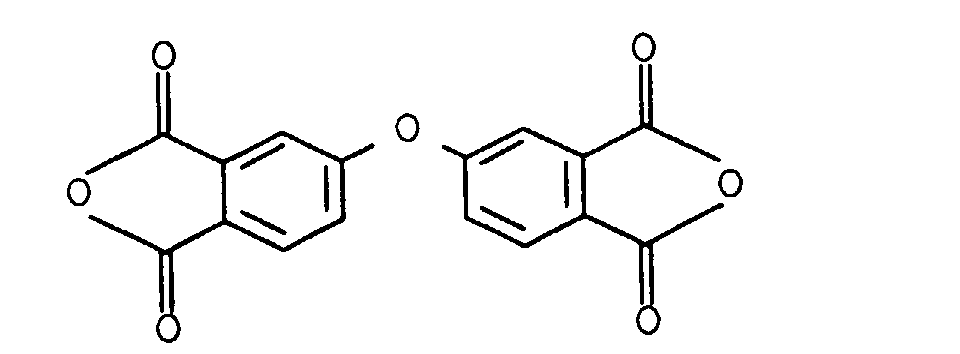 a3) 0 bis 30 Mol-%.weiteren, von (a1) und (a2) verschiedenen, aromatischen Dianhydriden mitB) einer Diaminkomponente ausb1) 65 bis 100 Mol-% Diaminen der allgemeinen Formelwobei
- n
- 1 oder 2 sein kann und
- Q
- -O-, -S-, -SO2-, -C(CH3)2-, -C(CF3)2- oder -CH2-bedeutet
b2) 0 bis 35 Mol-% weiterer, von (b1) verschiedener aromatischer Diamine. - Polyimide nach Anspruch 1, in denen die Dianhydride (a3) die allgemeine Formelwobei Ar
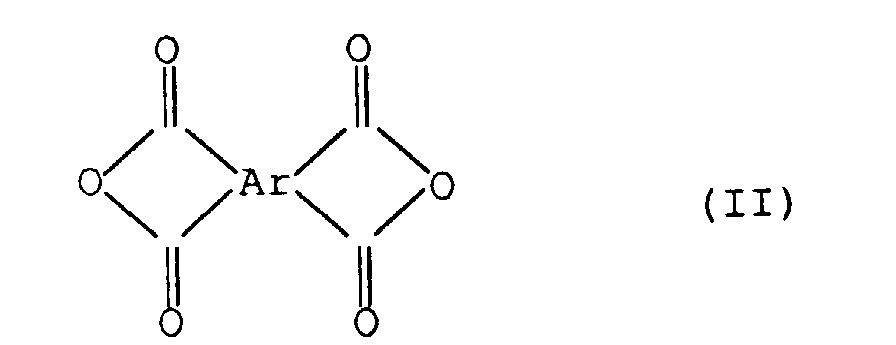


 bedeutet.
- Polyimide nach Anspruch 1 oder 2, in denen die Komponente (a3) ein Dianhydrid ist, ausgewählt aus der Gruppeund


- Polyimide nach einem der Ansprüche 1 bis 3, in denen die Diamine (b2) die allgemeine Formelhaben,
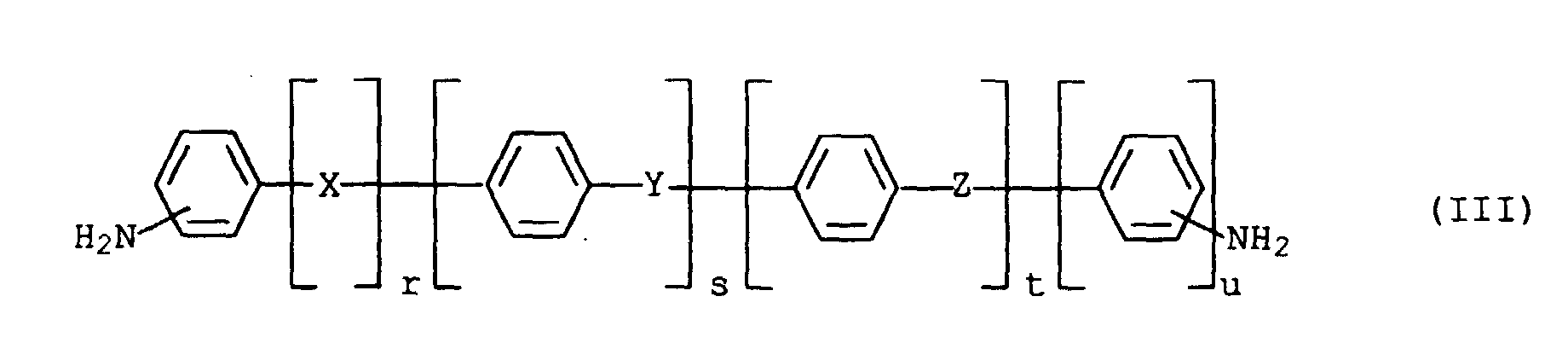
wobei- r, s, t und u
- unabhängig voneinander 0 oder 1 bedeuten und
- X, Y und Z
- unabhängig voneinander -O-, -CO-, -S-, -SO2-, -CH2-, -C(CH3)2-, -C(CF3)2- oder eine direkte Bindung bedeuten.
- Polyimide nach einem der Ansprüche 1 bis 4, in denen die Komponente (b2) ein Diamin ist, ausgewählt aus der Gruppe


- Polyimide nach einem der Ansprüche 1 bis 5, erhältlich durch Umsetzen vonA) einer Dianhydridkomponente ausa1) 75 bis 98 Mol-% 3,4, 3',4'-Biphenyltetracarbonsäuredianhydrid, a2) 2 bis 25 Mol-% 4,4'-Oxydiphthalsäuredianhydrid unda3) 0 bis 15 Mol-% Dianhydriden der allgemeinen Formel (II) mitB) einer Diaminkomponente ausb1) 80 bis 100 Mol-% Diamine der allgemeinen Formel (I) undb2) 0 bis 20 Mol-% Diamine der allgemeinen Formel (III).
- Verfahren zur Herstellung der Polyimide gemäß einem der Ansprüche 1 bis 6, dadurch gekennzeichnet, daß man die Dianhydridkomponente (A) mit der Diaminkomponente (B) umsetzt und das Umsetzungsprodukt in einem Lösungsmittel erhitzt.
- Verwendung der Polyimide gemäß einem der Ansprüche 1 bis 6, zur Herstellung von Formkörpern, Folien oder Fasern.
- Verwendung der Polyimide nach einem der Ansprüche 1 bis 6, zur Herstellung von Klebstoffen.
- Formkörper, Folien oder Fasern hergestellt unter Verwendung der Polyimide gemäß einem der Ansprüche 1 bis 6.
Applications Claiming Priority (2)
| Application Number | Priority Date | Filing Date | Title |
|---|---|---|---|
| DE4229180 | 1992-09-02 | ||
| DE4229180A DE4229180A1 (de) | 1992-09-02 | 1992-09-02 | Rekristallisierbare Polyimide |
Publications (3)
| Publication Number | Publication Date |
|---|---|
| EP0585829A2 EP0585829A2 (de) | 1994-03-09 |
| EP0585829A3 EP0585829A3 (en) | 1994-09-28 |
| EP0585829B1 true EP0585829B1 (de) | 1998-01-07 |
Family
ID=6466985
Family Applications (1)
| Application Number | Title | Priority Date | Filing Date |
|---|---|---|---|
| EP93113718A Expired - Lifetime EP0585829B1 (de) | 1992-09-02 | 1993-08-27 | Rekristallisierbare Polyimide |
Country Status (4)
| Country | Link |
|---|---|
| US (1) | US5374740A (de) |
| EP (1) | EP0585829B1 (de) |
| JP (1) | JPH06200021A (de) |
| DE (2) | DE4229180A1 (de) |
Families Citing this family (5)
| Publication number | Priority date | Publication date | Assignee | Title |
|---|---|---|---|---|
| US8568867B2 (en) * | 2006-06-26 | 2013-10-29 | Sabic Innovative Plastics Ip B.V. | Polyimide solvent cast films having a low coefficient of thermal expansion and method of manufacture thereof |
| US9161440B2 (en) * | 2006-06-26 | 2015-10-13 | Sabic Global Technologies B.V. | Articles comprising a polyimide solvent cast film having a low coefficient of thermal expansion and method of manufacture thereof |
| US8545975B2 (en) * | 2006-06-26 | 2013-10-01 | Sabic Innovative Plastics Ip B.V. | Articles comprising a polyimide solvent cast film having a low coefficient of thermal expansion and method of manufacture thereof |
| US20080044639A1 (en) * | 2006-06-26 | 2008-02-21 | Kwok Pong Chan | Polyimide solvent cast films having a low coefficient of thermal expansion and method of manufacture thereof |
| CN101809067B (zh) * | 2007-07-26 | 2015-04-29 | 沙伯基础创新塑料知识产权有限公司 | 可结晶的聚醚酰亚胺、制备方法和由其获得的制品 |
Family Cites Families (9)
| Publication number | Priority date | Publication date | Assignee | Title |
|---|---|---|---|---|
| US4405770A (en) * | 1981-08-12 | 1983-09-20 | National Starch And Chemical Corporation | Novel polyimides, and polyamic acid and ester intermediates thereof |
| US4393162A (en) * | 1982-05-14 | 1983-07-12 | Standard Oil Company (Indiana) | Polyamides and copolyamides comprising -1,2-di(p-aminophenoxy) ethane moieties |
| US4576857A (en) * | 1983-03-14 | 1986-03-18 | E. I. Du Pont De Nemours And Company | Melt-fusible polyimides |
| JP2574162B2 (ja) * | 1988-01-06 | 1997-01-22 | チッソ株式会社 | 低融点ポリイミド共重合体 |
| EP0392680A3 (de) * | 1989-04-13 | 1992-03-04 | Imperial Chemical Industries Plc | Aromatische Verbindungen |
| US5072046A (en) * | 1989-10-02 | 1991-12-10 | Air Products And Chemicals, Inc. | Bis-[aminophenyl ketones] compounds |
| US5077382A (en) * | 1989-10-26 | 1991-12-31 | Occidental Chemical Corporation | Copolyimide odpa/bpda/4,4'-oda or p-pda |
| US5268446A (en) * | 1990-08-24 | 1993-12-07 | Mitsui Toatsu Chemicals, Incorporated | Readily processable polyimide and preparation process of same |
| US5231160A (en) * | 1990-09-07 | 1993-07-27 | Mitsui Toatsu Chemicals, Incorporated | Aromatic diamine compound, preparation process of same and polyimide prepared from same |
-
1992
- 1992-09-02 DE DE4229180A patent/DE4229180A1/de not_active Withdrawn
-
1993
- 1993-08-27 DE DE59307918T patent/DE59307918D1/de not_active Expired - Lifetime
- 1993-08-27 EP EP93113718A patent/EP0585829B1/de not_active Expired - Lifetime
- 1993-08-30 US US08/113,093 patent/US5374740A/en not_active Expired - Fee Related
- 1993-09-02 JP JP5218702A patent/JPH06200021A/ja not_active Withdrawn
Also Published As
| Publication number | Publication date |
|---|---|
| US5374740A (en) | 1994-12-20 |
| DE59307918D1 (de) | 1998-02-12 |
| EP0585829A2 (de) | 1994-03-09 |
| DE4229180A1 (de) | 1994-03-03 |
| EP0585829A3 (en) | 1994-09-28 |
| JPH06200021A (ja) | 1994-07-19 |
Similar Documents
| Publication | Publication Date | Title |
|---|---|---|
| DE2446383C2 (de) | Von Phenylindandiaminen und -dianhydriden abgeleitete lösliche Polyimide | |
| DE69405646T2 (de) | Polyimidoligomere | |
| DE69321240T2 (de) | GASTRENNUNGSMEMBRANEN AUS t-BUTYL-SUBSTITUIERTEN POLYIMIDEN, POLYAMIDEN UND POLYAMIDIMIDEN | |
| DE2812276A1 (de) | Verfahren zur herstellung von acetylen- substituierten polyimidoligomeren | |
| DE68926551T2 (de) | Verfahren zur Herstellung von Polyimid mit ausgezeichneter Temperaturstabilität | |
| DE69432778T2 (de) | Verfahren zur Herstellung von Polysuccinimid | |
| DE68920824T2 (de) | Herstellungsverfahren für Polyimidfasern. | |
| DE2342464B2 (de) | Polyamid-Polyamidsäure-Blockcopolymere, Verfahren zu deren Herstellung und deren Verwendung zur Herstellung von industriellen Erzeugnissen | |
| DE2263190A1 (de) | Loesliche polyimide aus aromatischen dianhydriden und 2,4-diaminodiphenylaminen und 2,4-diaminodiphenylsulfiden | |
| DE2521305A1 (de) | Aromatische polyimide mit endstaendigen phthalsaeurenitrilgruppen und verfahren zur herstellung derselben | |
| DE2257996A1 (de) | Loesliche polyimide | |
| DE69109774T2 (de) | Direkt verarbeitbares Polyimid und Verfahren zur Herstellung. | |
| DE69209172T2 (de) | Bisimidderivate, daraus hergestellte polyimidharze sowie carbonfaser-verstärkte polyimidharze | |
| DE69027595T2 (de) | Polyimid giessling | |
| DE3883234T2 (de) | Verbesserung der Molekulargewichtsverteilung durch Lösungsmittelextraktion. | |
| DE69116650T2 (de) | Polyimidharz und dessen Zubereitung | |
| EP0585829A2 (de) | Rekristallisierbare Polyimide | |
| DE69212336T2 (de) | Diaminomesitylen-perfluoroalkyle und daraus gewonnene polyimide | |
| DE69127137T2 (de) | Leicht zu verarbeitende Polyimide und deren Herstellung | |
| DE3900675A1 (de) | Hochtemperaturbestaendige polysulfon-polyimid-blockcopolykondensate, verfahren zu ihrer herstellung durch schmelzkondensation und ihre verwendung | |
| EP0408540B1 (de) | Mischpolyimide sowie Verfahren zu ihrer Herstellung | |
| DE2018245A1 (de) | Gemischte heterocyclische Imid-Isoindolchinazolindion-Polymere, Verfahren zu ihrer Herstellung und Anwendung | |
| DE2321513A1 (de) | Loesliche polyimide aus aromatischen dianhydriden und 10,10-di-(p-aminophenyl)thioxanthen | |
| EP0381621A2 (de) | Neue Polymere | |
| DE2038275B2 (de) | Polyimide aus 2,6-Diamino-striazinen und Dianhydriden |
Legal Events
| Date | Code | Title | Description |
|---|---|---|---|
| PUAI | Public reference made under article 153(3) epc to a published international application that has entered the european phase |
Free format text: ORIGINAL CODE: 0009012 |
|
| AK | Designated contracting states |
Kind code of ref document: A2 Designated state(s): BE DE FR GB NL |
|
| PUAL | Search report despatched |
Free format text: ORIGINAL CODE: 0009013 |
|
| AK | Designated contracting states |
Kind code of ref document: A3 Designated state(s): BE DE FR GB NL |
|
| 17P | Request for examination filed |
Effective date: 19940827 |
|
| GRAG | Despatch of communication of intention to grant |
Free format text: ORIGINAL CODE: EPIDOS AGRA |
|
| 17Q | First examination report despatched |
Effective date: 19970220 |
|
| GRAG | Despatch of communication of intention to grant |
Free format text: ORIGINAL CODE: EPIDOS AGRA |
|
| GRAG | Despatch of communication of intention to grant |
Free format text: ORIGINAL CODE: EPIDOS AGRA |
|
| GRAH | Despatch of communication of intention to grant a patent |
Free format text: ORIGINAL CODE: EPIDOS IGRA |
|
| GRAH | Despatch of communication of intention to grant a patent |
Free format text: ORIGINAL CODE: EPIDOS IGRA |
|
| GRAA | (expected) grant |
Free format text: ORIGINAL CODE: 0009210 |
|
| AK | Designated contracting states |
Kind code of ref document: B1 Designated state(s): BE DE FR GB NL |
|
| GBT | Gb: translation of ep patent filed (gb section 77(6)(a)/1977) |
Effective date: 19980109 |
|
| REF | Corresponds to: |
Ref document number: 59307918 Country of ref document: DE Date of ref document: 19980212 |
|
| ET | Fr: translation filed | ||
| PG25 | Lapsed in a contracting state [announced via postgrant information from national office to epo] |
Ref country code: GB Free format text: LAPSE BECAUSE OF NON-PAYMENT OF DUE FEES Effective date: 19980827 |
|
| PGFP | Annual fee paid to national office [announced via postgrant information from national office to epo] |
Ref country code: DE Payment date: 19980829 Year of fee payment: 6 |
|
| PG25 | Lapsed in a contracting state [announced via postgrant information from national office to epo] |
Ref country code: BE Free format text: LAPSE BECAUSE OF NON-PAYMENT OF DUE FEES Effective date: 19980831 |
|
| PLBE | No opposition filed within time limit |
Free format text: ORIGINAL CODE: 0009261 |
|
| 26N | No opposition filed | ||
| BERE | Be: lapsed |
Owner name: BASF A.G. Effective date: 19980831 |
|
| PG25 | Lapsed in a contracting state [announced via postgrant information from national office to epo] |
Ref country code: NL Free format text: LAPSE BECAUSE OF NON-PAYMENT OF DUE FEES Effective date: 19990301 |
|
| GBPC | Gb: european patent ceased through non-payment of renewal fee |
Effective date: 19980827 |
|
| PG25 | Lapsed in a contracting state [announced via postgrant information from national office to epo] |
Ref country code: FR Free format text: LAPSE BECAUSE OF NON-PAYMENT OF DUE FEES Effective date: 19990430 |
|
| NLV4 | Nl: lapsed or anulled due to non-payment of the annual fee |
Effective date: 19990301 |
|
| REG | Reference to a national code |
Ref country code: FR Ref legal event code: ST |
|
| PG25 | Lapsed in a contracting state [announced via postgrant information from national office to epo] |
Ref country code: DE Free format text: LAPSE BECAUSE OF THE APPLICANT RENOUNCES Effective date: 19990804 |