EP0408540B1 - Mischpolyimide sowie Verfahren zu ihrer Herstellung - Google Patents
Mischpolyimide sowie Verfahren zu ihrer Herstellung Download PDFInfo
- Publication number
- EP0408540B1 EP0408540B1 EP90890203A EP90890203A EP0408540B1 EP 0408540 B1 EP0408540 B1 EP 0408540B1 EP 90890203 A EP90890203 A EP 90890203A EP 90890203 A EP90890203 A EP 90890203A EP 0408540 B1 EP0408540 B1 EP 0408540B1
- Authority
- EP
- European Patent Office
- Prior art keywords
- mol
- acid dianhydride
- mixed
- structural units
- polyimides
- Prior art date
- Legal status (The legal status is an assumption and is not a legal conclusion. Google has not performed a legal analysis and makes no representation as to the accuracy of the status listed.)
- Expired - Lifetime
Links
- 239000004642 Polyimide Substances 0.000 title claims abstract description 43
- 229920001721 polyimide Polymers 0.000 title claims abstract description 43
- 238000004519 manufacturing process Methods 0.000 title description 2
- 239000000203 mixture Substances 0.000 claims abstract description 7
- UPMLOUAZCHDJJD-UHFFFAOYSA-N 4,4'-Diphenylmethane Diisocyanate Chemical compound C1=CC(N=C=O)=CC=C1CC1=CC=C(N=C=O)C=C1 UPMLOUAZCHDJJD-UHFFFAOYSA-N 0.000 claims abstract description 6
- GTDPSWPPOUPBNX-UHFFFAOYSA-N ac1mqpva Chemical compound CC12C(=O)OC(=O)C1(C)C1(C)C2(C)C(=O)OC1=O GTDPSWPPOUPBNX-UHFFFAOYSA-N 0.000 claims abstract description 5
- 125000003118 aryl group Chemical group 0.000 claims abstract description 5
- 239000003880 polar aprotic solvent Substances 0.000 claims abstract description 4
- 239000002253 acid Substances 0.000 claims abstract description 3
- -1 tetracarboxylic acid dianhydride Chemical class 0.000 claims abstract description 3
- 238000000034 method Methods 0.000 claims description 14
- 238000006243 chemical reaction Methods 0.000 claims description 9
- 125000005442 diisocyanate group Chemical group 0.000 claims description 6
- 239000002904 solvent Substances 0.000 claims description 6
- 239000012429 reaction media Substances 0.000 claims description 5
- UITKHKNFVCYWNG-UHFFFAOYSA-N 4-(3,4-dicarboxybenzoyl)phthalic acid Chemical compound C1=C(C(O)=O)C(C(=O)O)=CC=C1C(=O)C1=CC=C(C(O)=O)C(C(O)=O)=C1 UITKHKNFVCYWNG-UHFFFAOYSA-N 0.000 claims description 3
- RLYCRLGLCUXUPO-UHFFFAOYSA-N 2,6-diaminotoluene Chemical compound CC1=C(N)C=CC=C1N RLYCRLGLCUXUPO-UHFFFAOYSA-N 0.000 claims description 2
- FZZMTSNZRBFGGU-UHFFFAOYSA-N 2-chloro-7-fluoroquinazolin-4-amine Chemical compound FC1=CC=C2C(N)=NC(Cl)=NC2=C1 FZZMTSNZRBFGGU-UHFFFAOYSA-N 0.000 claims description 2
- JHYNEQNPKGIOQF-UHFFFAOYSA-N 3,4-dihydro-2h-phosphole Chemical compound C1CC=PC1 JHYNEQNPKGIOQF-UHFFFAOYSA-N 0.000 claims description 2
- CNPURSDMOWDNOQ-UHFFFAOYSA-N 4-methoxy-7h-pyrrolo[2,3-d]pyrimidin-2-amine Chemical compound COC1=NC(N)=NC2=C1C=CN2 CNPURSDMOWDNOQ-UHFFFAOYSA-N 0.000 claims description 2
- BVKZGUZCCUSVTD-UHFFFAOYSA-L Carbonate Chemical compound [O-]C([O-])=O BVKZGUZCCUSVTD-UHFFFAOYSA-L 0.000 claims description 2
- 150000008044 alkali metal hydroxides Chemical class 0.000 claims description 2
- OHQOKJPHNPUMLN-UHFFFAOYSA-N n,n'-diphenylmethanediamine Chemical compound C=1C=CC=CC=1NCNC1=CC=CC=C1 OHQOKJPHNPUMLN-UHFFFAOYSA-N 0.000 claims description 2
- DGTNSSLYPYDJGL-UHFFFAOYSA-N phenyl isocyanate Chemical compound O=C=NC1=CC=CC=C1 DGTNSSLYPYDJGL-UHFFFAOYSA-N 0.000 claims description 2
- RVZJVYCTFGOEHX-UHFFFAOYSA-N phosphetane Chemical class C1CPC1 RVZJVYCTFGOEHX-UHFFFAOYSA-N 0.000 claims description 2
- GWLJTAJEHRYMCA-UHFFFAOYSA-N phospholane Chemical compound C1CCPC1 GWLJTAJEHRYMCA-UHFFFAOYSA-N 0.000 claims description 2
- 238000006116 polymerization reaction Methods 0.000 claims description 2
- JXCHMDATRWUOAP-UHFFFAOYSA-N diisocyanatomethylbenzene Chemical compound O=C=NC(N=C=O)C1=CC=CC=C1 JXCHMDATRWUOAP-UHFFFAOYSA-N 0.000 claims 1
- 239000003960 organic solvent Substances 0.000 abstract description 7
- RNFJDJUURJAICM-UHFFFAOYSA-N 2,2,4,4,6,6-hexaphenoxy-1,3,5-triaza-2$l^{5},4$l^{5},6$l^{5}-triphosphacyclohexa-1,3,5-triene Chemical compound N=1P(OC=2C=CC=CC=2)(OC=2C=CC=CC=2)=NP(OC=2C=CC=CC=2)(OC=2C=CC=CC=2)=NP=1(OC=1C=CC=CC=1)OC1=CC=CC=C1 RNFJDJUURJAICM-UHFFFAOYSA-N 0.000 abstract description 3
- 239000003063 flame retardant Substances 0.000 abstract description 3
- RUELTTOHQODFPA-UHFFFAOYSA-N toluene 2,6-diisocyanate Chemical compound CC1=C(N=C=O)C=CC=C1N=C=O RUELTTOHQODFPA-UHFFFAOYSA-N 0.000 abstract description 2
- ANSXAPJVJOKRDJ-UHFFFAOYSA-N furo[3,4-f][2]benzofuran-1,3,5,7-tetrone Chemical compound C1=C2C(=O)OC(=O)C2=CC2=C1C(=O)OC2=O ANSXAPJVJOKRDJ-UHFFFAOYSA-N 0.000 abstract 1
- 239000000243 solution Substances 0.000 description 12
- ZMXDDKWLCZADIW-UHFFFAOYSA-N N,N-Dimethylformamide Chemical compound CN(C)C=O ZMXDDKWLCZADIW-UHFFFAOYSA-N 0.000 description 9
- VLDPXPPHXDGHEW-UHFFFAOYSA-N 1-chloro-2-dichlorophosphoryloxybenzene Chemical compound ClC1=CC=CC=C1OP(Cl)(Cl)=O VLDPXPPHXDGHEW-UHFFFAOYSA-N 0.000 description 7
- 230000009477 glass transition Effects 0.000 description 7
- DVKJHBMWWAPEIU-UHFFFAOYSA-N toluene 2,4-diisocyanate Chemical compound CC1=CC=C(N=C=O)C=C1N=C=O DVKJHBMWWAPEIU-UHFFFAOYSA-N 0.000 description 6
- VQVIHDPBMFABCQ-UHFFFAOYSA-N 5-(1,3-dioxo-2-benzofuran-5-carbonyl)-2-benzofuran-1,3-dione Chemical compound C1=C2C(=O)OC(=O)C2=CC(C(C=2C=C3C(=O)OC(=O)C3=CC=2)=O)=C1 VQVIHDPBMFABCQ-UHFFFAOYSA-N 0.000 description 5
- CSCPPACGZOOCGX-UHFFFAOYSA-N Acetone Chemical compound CC(C)=O CSCPPACGZOOCGX-UHFFFAOYSA-N 0.000 description 4
- 238000010438 heat treatment Methods 0.000 description 4
- AMXOYNBUYSYVKV-UHFFFAOYSA-M lithium bromide Chemical compound [Li+].[Br-] AMXOYNBUYSYVKV-UHFFFAOYSA-M 0.000 description 4
- 239000011541 reaction mixture Substances 0.000 description 4
- XLYOFNOQVPJJNP-UHFFFAOYSA-N water Substances O XLYOFNOQVPJJNP-UHFFFAOYSA-N 0.000 description 4
- WFDIJRYMOXRFFG-UHFFFAOYSA-N Acetic anhydride Chemical compound CC(=O)OC(C)=O WFDIJRYMOXRFFG-UHFFFAOYSA-N 0.000 description 3
- SECXISVLQFMRJM-UHFFFAOYSA-N N-Methylpyrrolidone Chemical compound CN1CCCC1=O SECXISVLQFMRJM-UHFFFAOYSA-N 0.000 description 3
- 239000004952 Polyamide Substances 0.000 description 3
- 125000006159 dianhydride group Chemical group 0.000 description 3
- 229920002647 polyamide Polymers 0.000 description 3
- 238000002360 preparation method Methods 0.000 description 3
- IJGRMHOSHXDMSA-UHFFFAOYSA-N Atomic nitrogen Chemical compound N#N IJGRMHOSHXDMSA-UHFFFAOYSA-N 0.000 description 2
- YMWUJEATGCHHMB-UHFFFAOYSA-N Dichloromethane Chemical compound ClCCl YMWUJEATGCHHMB-UHFFFAOYSA-N 0.000 description 2
- IAZDPXIOMUYVGZ-UHFFFAOYSA-N Dimethylsulphoxide Chemical compound CS(C)=O IAZDPXIOMUYVGZ-UHFFFAOYSA-N 0.000 description 2
- KFZMGEQAYNKOFK-UHFFFAOYSA-N Isopropanol Chemical compound CC(C)O KFZMGEQAYNKOFK-UHFFFAOYSA-N 0.000 description 2
- FXHOOIRPVKKKFG-UHFFFAOYSA-N N,N-Dimethylacetamide Chemical compound CN(C)C(C)=O FXHOOIRPVKKKFG-UHFFFAOYSA-N 0.000 description 2
- WQDUMFSSJAZKTM-UHFFFAOYSA-N Sodium methoxide Chemical compound [Na+].[O-]C WQDUMFSSJAZKTM-UHFFFAOYSA-N 0.000 description 2
- 150000004982 aromatic amines Chemical class 0.000 description 2
- 150000001732 carboxylic acid derivatives Chemical class 0.000 description 2
- 230000007423 decrease Effects 0.000 description 2
- 230000018044 dehydration Effects 0.000 description 2
- 238000006297 dehydration reaction Methods 0.000 description 2
- 150000003949 imides Chemical class 0.000 description 2
- RLSSMJSEOOYNOY-UHFFFAOYSA-N m-cresol Chemical compound CC1=CC=CC(O)=C1 RLSSMJSEOOYNOY-UHFFFAOYSA-N 0.000 description 2
- 229910052760 oxygen Inorganic materials 0.000 description 2
- RZXMPPFPUUCRFN-UHFFFAOYSA-N p-toluidine Chemical compound CC1=CC=C(N)C=C1 RZXMPPFPUUCRFN-UHFFFAOYSA-N 0.000 description 2
- 238000006068 polycondensation reaction Methods 0.000 description 2
- 229920000642 polymer Polymers 0.000 description 2
- 239000000843 powder Substances 0.000 description 2
- 238000010183 spectrum analysis Methods 0.000 description 2
- 238000003756 stirring Methods 0.000 description 2
- 239000000126 substance Substances 0.000 description 2
- CBCKQZAAMUWICA-UHFFFAOYSA-N 1,4-phenylenediamine Chemical compound NC1=CC=C(N)C=C1 CBCKQZAAMUWICA-UHFFFAOYSA-N 0.000 description 1
- 238000010521 absorption reaction Methods 0.000 description 1
- 150000008065 acid anhydrides Chemical class 0.000 description 1
- 150000008064 anhydrides Chemical group 0.000 description 1
- QVGXLLKOCUKJST-UHFFFAOYSA-N atomic oxygen Chemical compound [O] QVGXLLKOCUKJST-UHFFFAOYSA-N 0.000 description 1
- 230000015572 biosynthetic process Effects 0.000 description 1
- 150000001735 carboxylic acids Chemical class 0.000 description 1
- 239000003054 catalyst Substances 0.000 description 1
- 238000012512 characterization method Methods 0.000 description 1
- 239000007795 chemical reaction product Substances 0.000 description 1
- 239000011248 coating agent Substances 0.000 description 1
- 238000000576 coating method Methods 0.000 description 1
- 150000001875 compounds Chemical class 0.000 description 1
- 238000006482 condensation reaction Methods 0.000 description 1
- 238000000354 decomposition reaction Methods 0.000 description 1
- 150000004985 diamines Chemical class 0.000 description 1
- 238000000578 dry spinning Methods 0.000 description 1
- 239000000835 fiber Substances 0.000 description 1
- 239000011888 foil Substances 0.000 description 1
- 239000012456 homogeneous solution Substances 0.000 description 1
- 238000007731 hot pressing Methods 0.000 description 1
- 230000003993 interaction Effects 0.000 description 1
- 239000000463 material Substances 0.000 description 1
- 238000000465 moulding Methods 0.000 description 1
- 229910052757 nitrogen Inorganic materials 0.000 description 1
- 239000012299 nitrogen atmosphere Substances 0.000 description 1
- 239000001301 oxygen Substances 0.000 description 1
- 239000002798 polar solvent Substances 0.000 description 1
- 229920005575 poly(amic acid) Polymers 0.000 description 1
- 239000002244 precipitate Substances 0.000 description 1
- 238000010926 purge Methods 0.000 description 1
- 239000000376 reactant Substances 0.000 description 1
- 238000010992 reflux Methods 0.000 description 1
- 238000005245 sintering Methods 0.000 description 1
- 238000003786 synthesis reaction Methods 0.000 description 1
- 150000003512 tertiary amines Chemical class 0.000 description 1
- 125000005425 toluyl group Chemical group 0.000 description 1
Classifications
-
- C—CHEMISTRY; METALLURGY
- C08—ORGANIC MACROMOLECULAR COMPOUNDS; THEIR PREPARATION OR CHEMICAL WORKING-UP; COMPOSITIONS BASED THEREON
- C08G—MACROMOLECULAR COMPOUNDS OBTAINED OTHERWISE THAN BY REACTIONS ONLY INVOLVING UNSATURATED CARBON-TO-CARBON BONDS
- C08G73/00—Macromolecular compounds obtained by reactions forming a linkage containing nitrogen with or without oxygen or carbon in the main chain of the macromolecule, not provided for in groups C08G12/00 - C08G71/00
- C08G73/06—Polycondensates having nitrogen-containing heterocyclic rings in the main chain of the macromolecule
- C08G73/10—Polyimides; Polyester-imides; Polyamide-imides; Polyamide acids or similar polyimide precursors
-
- C—CHEMISTRY; METALLURGY
- C08—ORGANIC MACROMOLECULAR COMPOUNDS; THEIR PREPARATION OR CHEMICAL WORKING-UP; COMPOSITIONS BASED THEREON
- C08G—MACROMOLECULAR COMPOUNDS OBTAINED OTHERWISE THAN BY REACTIONS ONLY INVOLVING UNSATURATED CARBON-TO-CARBON BONDS
- C08G73/00—Macromolecular compounds obtained by reactions forming a linkage containing nitrogen with or without oxygen or carbon in the main chain of the macromolecule, not provided for in groups C08G12/00 - C08G71/00
- C08G73/06—Polycondensates having nitrogen-containing heterocyclic rings in the main chain of the macromolecule
- C08G73/10—Polyimides; Polyester-imides; Polyamide-imides; Polyamide acids or similar polyimide precursors
- C08G73/1042—Copolyimides derived from at least two different tetracarboxylic compounds or two different diamino compounds
Definitions
- the invention relates to mixed polyimides with structural units of the general formulas and wherein n is an integer greater than 1 and R represents a divalent aromatic radical, and a process for their preparation.
- Aromatic polyimides are sought-after materials due to their extraordinarily high heat resistance, their chemical resistance and their flame retardancy.
- EP-A2-0 242 815 A similar process is known from EP-A2-0 242 815, according to which polyimides with the structural units mentioned at the outset consisting of benzophenone-3,3 ′, 4,4′-tetracarboxylic dianhydride (BTDA), pyromellitic dianhydride (PMDA) and 9.9 ′ -Bis (4-aminophenyl) fluorene are prepared by first stirring the reaction mixture at 40 ° C. for two hours in order to obtain a homogeneous solution, which is then heated to 150 ° C. and stirred for a further two hours. The water formed during the imidization is then distilled off at a temperature of 190 ° C., which takes another two hours.
- BTDA 4,4′-tetracarboxylic dianhydride
- PMDA pyromellitic dianhydride
- 9.9 ′ -Bis (4-aminophenyl) fluorene are prepared by first stirring the reaction mixture at 40
- the resulting polyimides have a certain solubility in organic solvents, such as dimethylacetamide, N-methylpyrrolidone or methylene dichloride, but the expensive and difficult to handle m-cresol must still be used as the reaction medium.
- organic solvents such as dimethylacetamide, N-methylpyrrolidone or methylene dichloride
- the method according to DE-A-19 62 588 has the same disadvantages, according to which, inter alia, Mixed polyimides from BTDA, PMDA, 2,4-aminotoluene and 4,4'-diaminodiphenylpropane are formed.
- CA-A - 1,240,438 describes aromatic polyimides which can be prepared from BTDA or PMDA and aromatic amines in N-methyl-pyrrolidone as the reaction medium. However, a dehydration step to the polyimide must also be provided here.
- the polyimide solution obtained can e.g. can be spun directly by a dry spinning process to high-temperature resistant, flame-retardant threads (EP-A - 0 119 185). It can also be used to manufacture high-temperature-resistant films and coating compounds (AT-B - 387.783). After the polyimide has precipitated, the polyimide powder can be processed further by sintering or hot pressing to give moldings which are resistant to high temperatures (US Pat. No. 3,708,458). The glass transition points of these polyimides are between 295 and 315 ° C and their decomposition point between 520 and 560 ° C.
- thermostability decreases with increasing solubility of the polyimides. This phenomenon is most clearly observed in the descendants of the polyimide which can be prepared from PMDA and p-diaminobenzene.
- the molecular chain of this polyimide consists exclusively of aromatic residues and imide cycles, it is insoluble in organic solvents and has the greatest thermal stability among the polyimides.
- so-called "hinge atoms” eg -CH 2 -; -CO-; -SO 2 ; -O-
- the object of the invention is to provide mixed polyimides with structural units of the type mentioned at the outset which are readily soluble in polar, aprotic organic solvents and nevertheless have high thermal stability.
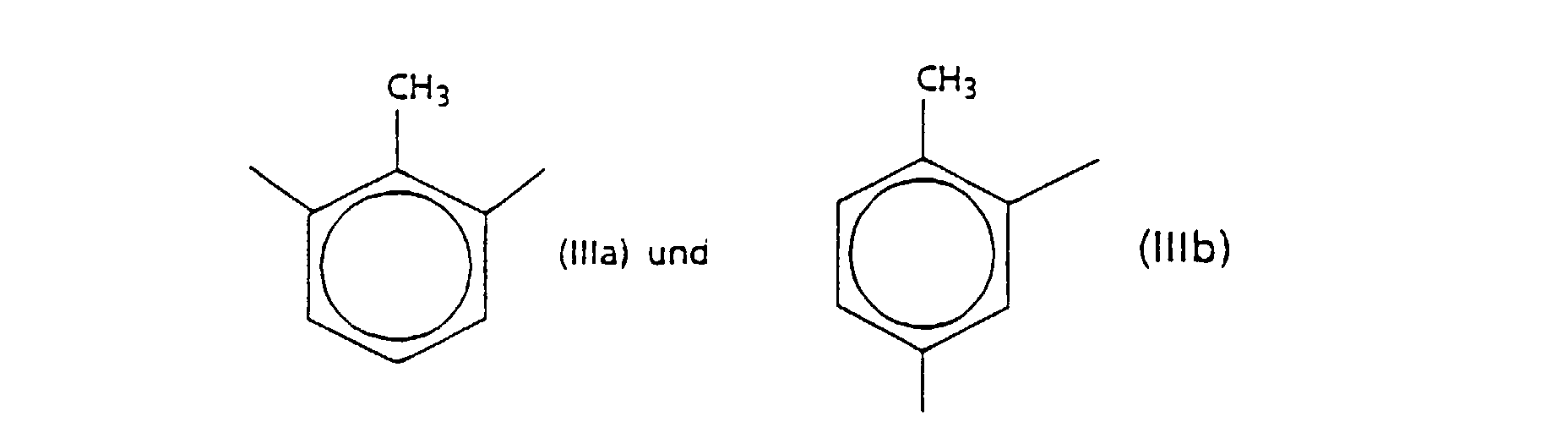
- the mixed polyimides according to the invention consist of structural units of the general formulas and wherein n is an integer greater than 1 and R represents a double-bonded aromatic radical, exclusively for the two groups and / or the group stands, and can be produced by a method according to claim 4.
- the improved high-temperature stability of the polyimides according to the invention manifests itself in the fact that in particular they have a glass transition point in the range from 330 ° C. to 370 ° C. and are also flame-retardant.
- LOI values (“Limited Oxygen Index", determined according to ASTMD 2863) were measured between 41 and 46% O 2 for films.
- a preferred embodiment of the mixed polyimides according to the invention contains the residue (IIIb) in an amount between 70% and 90% of the total toluyl residues (IIIa) and (IIIb) in the polyimide chain.
- Dimethylformamide, dimethylacetamide, N-methylpyrrolidone and dimethyl sulfoxide are particularly suitable as solvents.
- the upper limit of the amount of solvent used is preferably chosen so that the finished polymer solution contains 15 to 40 percent by weight of polyimide.
- the preparation of the mixed polyimides according to the invention can be catalyzed by adding an alkali metal hydroxide, alcoholate, carbonate or phospholene, phospholane or phosphetane derivative in an amount of between 0.0001 and 0.1 mol per mol of diisocyanate.
- the corresponding amount of diisocyanate is added dropwise as quickly as possible to dissolve the dianhydrides and the catalyst at a reaction temperature of 60 to 150 ° C., preferably at 70 to 100 ° C.
- the progress of the reaction can be monitored, for example, by IR spectral analysis (absence of absorption corresponding to free NCO groups) will.
- CO 2 is released during the reaction.
- the end of the CO 2 evolution indicates the end of the reaction.
- Free NCO or anhydride groups should no longer be detectable in the finished copolyimide solution by means of IR spectral analysis.
- the corresponding copolyimide is precipitated from the solution by adding a precipitant, such as acetone or isopropanol.
- the mixed polyimides according to the invention can also be prepared if 2,4- and / or 2,6-toluenediamine or methylenebis (phenylamine) are used instead of the tolylene diisocyanate and optionally methylene bis (phenyl isocyanate).
- the diamine is added dropwise to a solution of the dianhydrides in an aprotic polar solvent at temperatures from room temperature to 175 ° C.
- the polyamic acid obtained is then imidized by heating the reaction mixture to temperatures of 170 to 220 ° C. and removing the water formed.
- the imidization can also be done chemically by adding e.g. Acetic anhydride can be carried out in the presence of a tertiary amine.
- the polyimide was precipitated by adding acetone, the precipitate was filtered off, washed and dried.
- the glass transition temperature of the powder was 340 ° C.
- the TDI used in Examples 3 to 8 consisted of 80% 2,4- and 20% 2,6-isomer.
- the TDI used in Example 2 had a composition of 70% 2,4- and 30% 2,6-isomer.
Landscapes
- Chemical & Material Sciences (AREA)
- Health & Medical Sciences (AREA)
- Chemical Kinetics & Catalysis (AREA)
- Medicinal Chemistry (AREA)
- Polymers & Plastics (AREA)
- Organic Chemistry (AREA)
- Macromolecular Compounds Obtained By Forming Nitrogen-Containing Linkages In General (AREA)
- Polymers With Sulfur, Phosphorus Or Metals In The Main Chain (AREA)
- Polyurethanes Or Polyureas (AREA)
Description
- Die Erfindung betrifft Mischpolyimide mit Struktureinheiten der allgemeinen Formeln
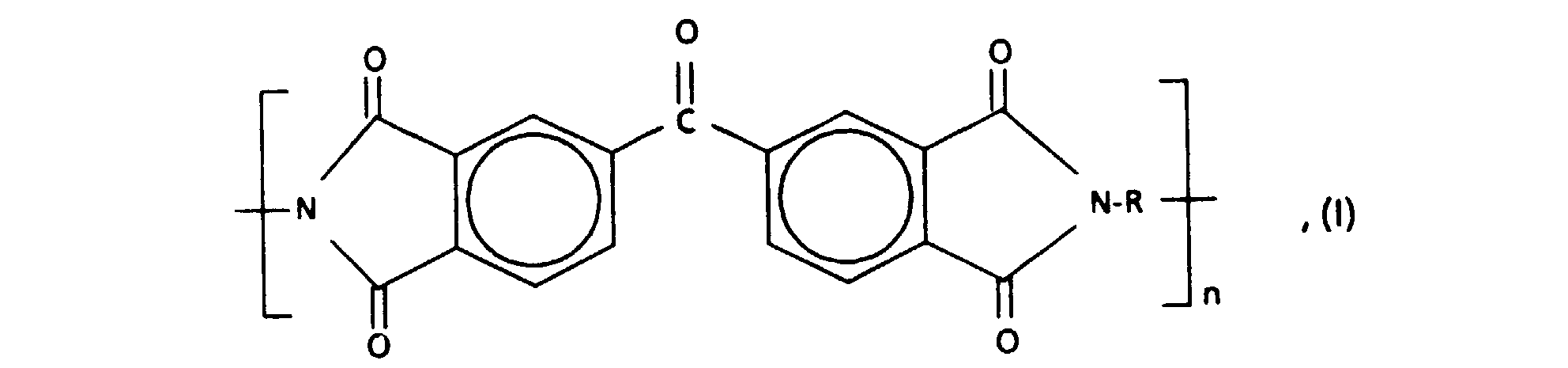

- Aromatische Polyimide sind aufgrund ihrer außerordentlich großen Hitzebeständigkeit, ihrer Chemikalienresistenz und ihrer Schwerentflammbarkeit begehrte Werkstoffe.
- Allerdings steht der Verarbeitung der Rohpolymeren meist entgegen, daß sie nicht schmelzbar sind und infolge der starken Wechselwirkungskräfte zwischen den Molekülketten auch nicht in organischen Lösungsmitteln gelöst werden können.
- Es wurde versucht, dieses Problem zu umgehen, indem das gewünschte Polyimid über eine Zweistufensynthese aus Polycarbonsäureanhydriden und aromatischen Aminen zunächst nur zur Polyamidcarbonsäure kondensiert wird. Diese Polyamidcarbonsäuren sind in organischen Lösungsmitteln leicht löslich und können daher auf einfache Weise zu Folien, Fasern und anderen Formkörpern weiterverarbeitet werden. Die Dehydratisierung der Polyamidcarbonsäure zum Polyimid wird meist erst danach, z.B. durch Erhitzen, durchgeführt.
- Dieser Weg hat jedoch den schwerwiegenden Nachteil, daß bei der Aushärtung zum Polyimid nochmals Wasser freigesetzt wird, worunter die Qualität des Endproduktes leidet.
- Ein ähnliches Verfahren ist aus der EP-A2 - 0 242 815 bekannt, nach dem Polyimide mit den eingangs genannten Struktureinheiten aus Benzophenon-3,3′,4,4′-tetracarbonsäuredianhydrid (BTDA), Pyromellithsäuredianhydrid (PMDA) und 9,9′-Bis(4-aminophenyl)fluoren hergestellt werden, indem die Reaktionsmischung zunächst zwei Stunden bei 40°C gerührt wird, um eine homogene Lösung zu erhalten, die dann auf 150°C erhitzt und weitere zwei Stunden gerührt wird. Danach wird bei einer Temperatur von 190°C das bei der Imidisierung sich bildende Wasser abdestilliert, was weitere zwei Stunden in Anspruch nimmt.
- Die entstehenden Polyimide besitzen zwar eine gewisse Löslichkeit in organischen Lösungsmitteln, wie Dimethylacetamid, N-Methylpyrrolidon oder Methylendichlorid, trotzdem muß aber als Reaktionsmedium das teure und schwer zu handhabende m-Kresol verwendet werden. Ein weiterer Nachteil dieses Verfahrens besteht in der langwierigen Reaktionsführung.
- Die gleichen Nachteile weist das Verfahren gemäß der DE-A - 19 62 588 auf, nach dem u.a. Mischpolyimide aus BTDA, PMDA, 2,4-Aminotoluol und 4,4′-Diaminodiphenylpropan gebildet werden.
- In der CA-A - 1,240,438 werden aromatische Polyimide beschrieben, die aus BTDA oder PMDA und aromatischen Aminen in N-Methyl-pyrrolidon als Reaktionsmedium hergestellt werden können. Allerdings muß auch hier ein Dehydratisierungsschritt zum Polyimid vorgesehen werden.
- Es wurde in der Vergangenheit weiters versucht, besser lösliche Polyimide in einem Einstufenverfahren aus Polycarbonsäuredianhydriden und Diisocyanaten herzustellen. Die US-A - 3,985,934 beispielsweise offenbart ein Verfahren zur Herstellung eines in DMF löslichen Mischpolyimides aus BTDA und einem Diisocyanatgemisch, bestehend aus 70 bis 90 Mol% Toluylendiisocyanat (TDI) und 10 bis 30 Mol% Methylenbis(phenylisocyanat) (MDI).
- Die Vorteile eines in organischen Lösungsmitteln gut löslichen Polyimides liegen klar auf der Hand: bei der Weiterverarbeitung muß nur mehr das Lösungsmittel entfernt werden. Weiteres Erhitzen bei höheren Temperaturen zum Imidisieren und Entfernen des entstehenden Reaktionswassers ist nicht notwendig.
- Die erhaltene Polyimidlösung kann z.B. direkt durch ein Trockenspinnverfahren zu hochtemperaturbeständigen, schwerentflammbaren Fäden versponnen werden (EP-A - 0 119 185). Weiters kann sie zum Herstellen von hochtemperaturbeständigen Folien und Beschichtungsmassen verwendet werden (AT-B - 387.783). Nach Ausfällen des Polyimides kann das Polyimidpulver durch Sintern oder Heißverpressen zu hochtemperaturbeständigen Formkörpern weiterverarbeitet werden (US-A - 3,708,458). Die Glasumwandlungspunkte dieser Polyimide liegen zwischen 295 und 315°C und ihr Zersetzungspunkt zwischen 520 und 560°C.
- Es hat sich allerdings gezeigt, daß mit zunehmender Löslichkeit der Polyimide ihre Thermostabilität abnimmt. Dieses Phänomen ist am deutlichsten an den Abkömmlingen des aus PMDA und p-Diaminobenzol herstellbaren Polyimides zu beobachten. Die Molekülkette dieses Polyimides besteht ausschließlich aus aromatischen Resten und Imidzyklen, es ist in organischen Lösungsmitteln unlöslich und besitzt die größte Thermostabilität unter den Polyimiden. Durch den Einbau von sogenannten "Scharnieratomen" (z.B. -CH2-; -CO-; -SO2; -O-) in die Molekülkette wird die Löslichkeit verbessert, die Thermostabilität nimmt aber ab.
- Die Erfindung stellt sich die Aufgabe, Mischpolyimide mit Struktureinheiten der eingangs genannten Art zur Verfügung zu stellen, die in polaren, aprotischen organischen Lösungsmitteln gut löslich sind und trotzdem eine hohe Thermostabilität aufweisen.
- Die erfindungsgemäßen Mischpolyimide bestehen aus Struktureinheiten der allgemeinen Formeln


- Die verbesserte Hochtemperaturstabilität der erfindungsgemäßen Polyimide äußert sich darin, daß sie insbesondere einen Glasumwandlungspunkt im Bereich von 330°C und 370°C aufweisen und auch schwerentflammbar sind. So wurden beispielsweise für Folien LOI-Werte ("Limited Oxygen Index", bestimmt nach ASTMD 2863) zwischen 41 und 46 % O2 gemessen.
- Es hat sich gezeigt, daß bei den erfindungsgemäßen Polyimiden ein eindeutiger Zusammenhang zwischen der Zusammensetzung aus den Struktureinheiten (I) und (II) und den thermischen Eigenschaften besteht. Besonders stark ausgeprägt ist dieser Zusammenhang, wenn das Molverhältnis der Struktureinheiten der allgemeinen Formel (I) zu den Struktureinheiten der allgemeinen Formel (II) im Bereich von 1:1 1 bis 99 : 1 liegt.
- In diesem Bereich besteht beispielsweise eine nahezu lineare Abhängigkeit zwischen dem Glasumwandlungspunkt des Mischpolyimides und seinem Anteil an der Imidstruktureinheit (II). Je höher dieser Anteil, desto höher liegt auch der Glasumwandlungspunkt, wobei eine Erhöhung um 10 Mol% (berechnet vom Gesamtgehalt an Struktureinheiten (I) und (II)) den Glasumwandlungspunkt um fast genau 10°C erhöht (siehe Tabelle).
- Diese Korrelation kann auch bei Mischpolyimiden beobachtet werden, bei denen der Rest R ausschließlich für die Gruppen (IIIa) und (IIIb), als auch noch zusätzlich für die Gruppe (IV) steht, wobei das Molverhältnis der Gruppen


- Eine bevorzugte Ausführungsform der erfindungsgemäßen Mischpolyimide enthält in der Polyimidkette den Rest (IIIb) in einer Menge zwischen 70 % bis 90 % der gesamten Toluylreste (IIIa) und (IIIb).
- Wie aus der Tabelle weiters ersichtlich, besitzen Mischpolyimide, in deren Molekülketten sowohl die Gruppen (III) und (IV) eingebaut sind, einen niedrigeren Glasumwandlungspunkt als jene, die nur die Gruppe(n) (III) aufweisen. Mit den erfindungsgemäßen Polyimiden wird somit die Möglichkeit eröffnet, durch Wahl der Anteile an der Struktureinheit (II) und der Gruppe (IV) die Hitzestabilität gezielt zu steuern.
- Die Erfindung betrifft auch ein Verfahren zur Herstellung der erfindungsgemäßen Mischpolyimide, das gekennzeichnet ist durch die Kombination der Maßnahmen, daß
- eine Lösung eines intramolekularen Tetracarbonsäuredianhydrid-Gemisches, bestehend aus 50 bis 99 Mol% Benzophenon-3,3',4,4'-tetracarbonsäuredianhydrid und 50 bis 1 Mol% Pyromellithsäuredianhydrid, in einem polaren aprotischen Lösungsmittel als Reaktionsmedium erwärmt und mit
- einer insgesamt äquimolaren Menge von 2,4- und 2,6- Toluylendiisocyanat und/oder Methylenbis(phenylisocyanat) versetzt wird,
- Als Lösungsmittel kommen vor allem Dimethylformamid, Dimethylacetamid, N-Methylpyrrolidon und Dimethylsulfoxid in Frage. Die Obergrenze der Menge an verwendetem Lösungsmittel wird bevorzugt so gewählt, daß die fertige Polymerlösung einen Gehalt von 15 bis 40 Gewichtsprozent Polyimid enthält.
- Die Herstellung der erfindungsgemäßen Mischpolyimide kann durch Zugabe eines Alkalimetallhydroxides, -alkoholates, -carbonates oder Phospholen-, Phospholan- oder Phosphetanderivates in einer Menge zwischen 0,0001 bis 0,1 Mol pro Mol Diisocyanat katalysiert werden. Diese Stoffe sind zum Teil bereits als Polymerisationsbeschleuniger bei anderen Kondensationsreaktionen bekannt.
- Bei der Durchführung der Umsetzung wird zur Lösung der Dianhydride und des Katalysators bei 60 bis 150°C Reaktionstemperatur, bevorzugt bei 70 bis 100°C, die entsprechende Menge Diisocyanat möglichst rasch zugetropft. Das Fortschreiten der Reaktion kann beispielsweise durch IR-Spektralanalyse (Abwesenheit einer Absorption entsprechend freien NCO-Gruppen) verfolgt werden. Während der Reaktion wird CO2 frei. Nach Zugabe der äquimolaren Menge Diisocyanat zeigt das Aufhören der CO2-Entwicklung das Ende der Reaktion an. In der fertigen Copolyimidlösung sollen keine freien NCO- oder Anhydridgruppen mittels IR-Spektralanalyse mehr nachweisbar sein.
- Nach Beendigung der Reaktion erhält man viskose Copolyimidlösungen mit einer inhärenten Viskosität (c = 0,5g/dl bei 25°C in DMF/1 % LiBr) von 30 bis 80 ml/g. Um die erhaltenen Copolyimide charakterisieren zu können, wird aus der Lösung durch Zugabe eines Fällungsmittels, wie Aceton oder Isopropanol, das entsprechende Copolyimid ausgefällt.
- Die erfindungsgemäßen Mischpolyimide können auch hergestellt werden, wenn statt des Toluylendiisocyanates und gegebenenfalls des Methylenbis(phenylisocyanates) 2,4- und/oder 2,6-Toluylendiamin bzw. Methylenbis(phenylamin) eingesetzt werden.
- In diesem Fall wird zu einer Lösung der Dianhydride in einem aprotisch polaren Lösungsmittel bei Temperaturen von Raumtemperatur bis 175°C das Diamin zugetropft. Die erhaltene Polyamidsäure wird danach durch Erhitzen des Reaktionsgemisches auf Temperaturen von 170 bis 220°C und Entfernen des entstehenden Wassers imidisiert. Die Imidisierung kann aber auch chemisch durch Zugabe von z.B. Acetanhydrid in Gegenwart eines tertiären Amines durchgeführt werden.
- Die folgenden Beispiele sollen die Erfindung noch näher erläutern.
- In einem 1000 ml Kolben mit Rührer, Rückflußkühler, Thermometer und Stickstoffspülung wurden 145g (0,45 mol) Benzophenon-3,3′,4,4′-tetracarbonsäuredianhydrid und 10,91 g (0,05 mol) Pyromellithsäuredianhydrid und 0,2 g (0,0037 mol) Natriummethylat in 597 g trockenem DMF gelöst. Die Reaktionsmischung wurde auf 80°C erwärmt, und unter konstantem Rühren unter Stickstoffatmosphäre wurden innerhalb von vier Stunden 87,08g (0,5 mol) Toluylendiisocyanat, bestehend zu 80 % aus 2,4- und zu 20 % aus 2,6-Isomerem, zugetropft. Die fertige Polykondensationslösung wurde danach bis zur Beendigung der CO2-Entwicklung eine Stunde bei 80°C weitergerührt.
- Die fertige Polykondensationslösung hatte eine inhärente Viskosität (c = 0,5 g/dl bei 25°C in DMF/1 % LiBr) von 32 ml/g. Durch Zugabe von Aceton wurde das Polyimid ausgefällt, der Niederschlag abfiltriert, gewaschen und getrocknet. Die Glasübergangstemperatur des Pulvers lag bei 340°C.
- Sieben weitere Copolyimide wurden nach der in Beispiel 1 beschriebenen Arbeitsvorschrift hergestellt. Die Zusammensetzung des Reaktionsgemisches und die Charakterisierung der entsprechenden Copolyimide sind der Tabelle zu entnehmen.
- Das in den Beispielen 3 bis 8 eingesetzte TDI bestand zu 80 % aus 2,4- und zu 20 % aus 2,6-Isomerem. Das im Beispiel 2 verwendete TDI wies eine Zusammensetzung von 70 % 2,4- und 30 % 2,6-Isomerem auf.

Claims (6)
- Mischpolyimide bestehend aus Struktureinheiten der allgemeinen Formeln

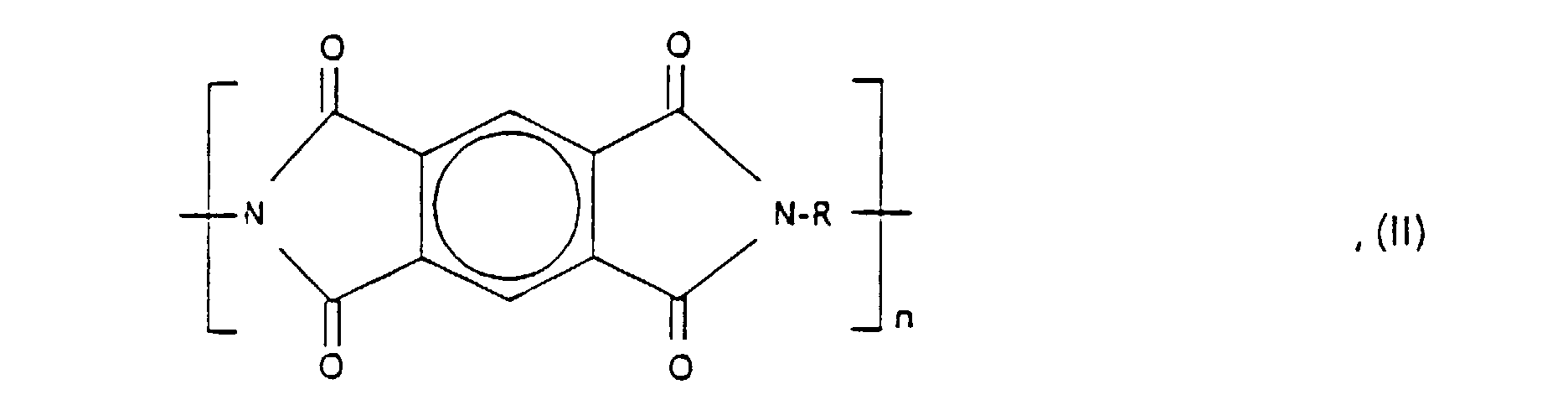

- Mischpolyimide nach Anspruch 1, dadurch gekennzeichnet, daß das Molverhältnis der Struktureinheiten der allgemeinen Formel (I) zu den Struktureinheiten der allgemeinen Formel (II) im Bereich von 1 : 1 bis 99 : 1 liegt.
- Mischpolyimide nach Anspruch 1 oder 2, dadurch gekennzeichnet, daß das Molverhältnis der Gruppen


- Verfahren zur Herstellung von Mischpolyimiden nach einem oder mehreren der Ansprüche 1 bis 3, gekennzeichnet durch die Kombination der Maßnahmen, daß- eine Lösung eines intramolekularen Tetracarbonsäuredianhydrid-Gemisches, bestehend aus 50 bis 99 Mol% Benzophenon-3,3',4,4'-tetracarbonsäuredianhydrid und 50 bis 1 Mol% Pyromellithsäuredianhydrid, in einem polaren aprotischen Lösungsmittel als Reaktionsmedium, auf Temperaturen zwischen 60°C und 150°C, vorzugsweise zwischen 70°C und 100°C, erwärmt und mit- einer insgesamt äquimolaren Menge von 2,4- und 2,6-Toluylendiisocyanat und/oder Methylenbis(phenylisocyanat) versetzt wird, wobei- die Menge des Lösungsmittels mindestens so groß sein soll, daß zunächst sämtliche Reaktionsteilnehmer in Lösung sind.
- Verfahren nach Anspruch 4, dadurch gekennzeichnet, daß der Lösung noch zusätzlich ein Alkalimetallhydroxid, -alkoholat, -carbonat oder Phospholen-, Phospholan- oder Phosphetanderivat als Polymerisationsbeschleuniger in einer Menge zwischen 0,0001 bis 0,1 Mol pro Mol Diisocyanat zugegeben wird.
- Verfahren nach Anspruch 4, dadurch gekennzeichnet, daß statt des Toluylendiisocyanates und gegebenenfalls des Methylenbis(phenylisocyanates) 2,4- und 2,6-Toluylendiamin bzw. Methylenbis(phenylamin) eingesetzt werden.
Applications Claiming Priority (2)
| Application Number | Priority Date | Filing Date | Title |
|---|---|---|---|
| AT1700/89 | 1989-07-13 | ||
| AT1700/89A AT392974B (de) | 1989-07-13 | 1989-07-13 | Mischpolyimide sowie verfahren zu ihrer herstellung |
Publications (2)
| Publication Number | Publication Date |
|---|---|
| EP0408540A1 EP0408540A1 (de) | 1991-01-16 |
| EP0408540B1 true EP0408540B1 (de) | 1996-10-16 |
Family
ID=3519100
Family Applications (1)
| Application Number | Title | Priority Date | Filing Date |
|---|---|---|---|
| EP90890203A Expired - Lifetime EP0408540B1 (de) | 1989-07-13 | 1990-07-05 | Mischpolyimide sowie Verfahren zu ihrer Herstellung |
Country Status (11)
| Country | Link |
|---|---|
| US (1) | US5066760A (de) |
| EP (1) | EP0408540B1 (de) |
| JP (1) | JPH0352916A (de) |
| KR (1) | KR910002953A (de) |
| AT (2) | AT392974B (de) |
| BR (1) | BR9003475A (de) |
| CA (1) | CA2021047C (de) |
| DE (1) | DE59010542D1 (de) |
| IE (1) | IE62768B1 (de) |
| IL (1) | IL94932A0 (de) |
| PT (1) | PT94686A (de) |
Families Citing this family (6)
| Publication number | Priority date | Publication date | Assignee | Title |
|---|---|---|---|---|
| US5725769A (en) * | 1995-07-18 | 1998-03-10 | Bend Research, Inc. | Solvent-resistant microporous polymide membranes |
| US6790930B1 (en) * | 1999-10-06 | 2004-09-14 | Kaneka Corporation | Process for producing polyimide resin |
| TWI492967B (zh) * | 2011-12-30 | 2015-07-21 | Ind Tech Res Inst | 聚亞醯胺 |
| CN102617857B (zh) * | 2012-04-16 | 2014-05-14 | 上海交通大学 | 一种聚酰亚胺及其制备方法 |
| EP3374411B1 (de) | 2015-11-13 | 2021-07-28 | ICL-IP America Inc. | Reaktive flammhemmer für polyurethan- und polyisocyanuratschaumstoffe |
| CN118221734A (zh) * | 2023-09-27 | 2024-06-21 | 比亚迪股份有限公司 | 含磷三酐单体及其制备方法、聚酰亚胺材料及其制备方法与应用 |
Citations (3)
| Publication number | Priority date | Publication date | Assignee | Title |
|---|---|---|---|---|
| DE1962588A1 (de) * | 1968-12-14 | 1970-07-09 | Showa Electric Wire & Cable Co | Lineare aromatische Polyimide und Verfahren zu deren Herstellung |
| JPS5225173A (en) * | 1975-08-13 | 1977-02-24 | Mitsubishi Rayon Co | Manufacture of heattresistant unwoven fabric and paper |
| EP0092486A1 (de) * | 1982-04-20 | 1983-10-26 | Regie Nationale Des Usines Renault | Anzeigevorrichtung für Geschwindigkeitsmesser für Kraftfahrzeug |
Family Cites Families (19)
| Publication number | Priority date | Publication date | Assignee | Title |
|---|---|---|---|---|
| US3666709A (en) * | 1968-12-14 | 1972-05-30 | Shawa Densen Denran Kk A K A S | Solvent soluble aromatic polymides and production thereof |
| US3701756A (en) * | 1969-01-17 | 1972-10-31 | Upjohn Co | Catalytic preparation of polyimides from polyisocyanates |
| US3708458A (en) * | 1971-03-16 | 1973-01-02 | Upjohn Co | Copolyimides of benzophenone tetracarboxylic acid dianhydride and mixture of diisocyanates |
| US3985934A (en) * | 1974-07-26 | 1976-10-12 | The Upjohn Company | Polyimide fiber having a serrated surface and a process of producing same |
| US4001186A (en) * | 1974-11-07 | 1977-01-04 | The Upjohn Company | Preparation of polyimide from organic diisocyanate with alkali metal salt of alcohol as catalyst |
| US3989284A (en) * | 1975-04-23 | 1976-11-02 | Hydril Company | Tubular connection |
| DE2641767B2 (de) * | 1976-09-14 | 1979-05-31 | Mannesmann Ag, 4000 Duesseldorf | Gewindeverbindung für ölfeldrohre |
| US4177333A (en) * | 1978-02-24 | 1979-12-04 | The United States Of America As Represented By The Administrator Of The National Aeronautics And Space Administration | Catalysts for polyimide foams from aromatic isocyanates and aromatic dianhydrides |
| JPS5867723A (ja) * | 1981-10-19 | 1983-04-22 | Mitsui Toatsu Chem Inc | ポリアミドの製造法 |
| AT377016B (de) * | 1983-03-09 | 1985-01-25 | Chemiefaser Lenzing Ag | Verfahren zur herstellung von schwer entflammbaren, hochtemperaturbestaendigen polyimidfasern |
| US4629777A (en) * | 1983-05-18 | 1986-12-16 | Ciba-Geigy Corporation | Polyimides, a process for their preparation and their use |
| US4657832A (en) * | 1983-05-18 | 1987-04-14 | Ciba-Geigy Corporation | Photosensitive polymers as coating materials |
| US4549754A (en) * | 1983-06-20 | 1985-10-29 | Reed Tubular Products Company | Tool joint |
| JPS6040114A (ja) * | 1983-08-12 | 1985-03-02 | Hitachi Chem Co Ltd | 粒子状重合体の製造法 |
| ES282513Y (es) * | 1984-11-12 | 1986-10-01 | Amper, S.A. | Dispositivo exclusor para telefonos instalados en paralelo |
| US4795795A (en) * | 1985-02-20 | 1989-01-03 | Mitsui Toatsu Chemicals, Incorporated | Catalytic preparation of polyamide or polyamide-polymide with N,N'-dimethyl alkylene urea solvent |
| US4845185A (en) * | 1986-04-22 | 1989-07-04 | Nippon Steel Corporation | Soluble copolyimide from 9,9-bis (4-amino phenyl) fluorene |
| AT387783B (de) * | 1987-06-09 | 1989-03-10 | Chemiefaser Lenzing Ag | Verfahren zur herstellung von hochtemperaturbestaendigen folien |
| JPH0264118A (ja) * | 1988-08-30 | 1990-03-05 | Mitsui Toatsu Chem Inc | 耐熱性重合体の製造方法 |
-
1989
- 1989-07-13 AT AT1700/89A patent/AT392974B/de not_active IP Right Cessation
-
1990
- 1990-06-29 US US07/546,517 patent/US5066760A/en not_active Expired - Lifetime
- 1990-06-29 IL IL94932A patent/IL94932A0/xx not_active IP Right Cessation
- 1990-07-05 IE IE244390A patent/IE62768B1/en not_active IP Right Cessation
- 1990-07-05 AT AT90890203T patent/ATE144267T1/de not_active IP Right Cessation
- 1990-07-05 EP EP90890203A patent/EP0408540B1/de not_active Expired - Lifetime
- 1990-07-05 DE DE59010542T patent/DE59010542D1/de not_active Expired - Lifetime
- 1990-07-12 CA CA002021047A patent/CA2021047C/en not_active Expired - Lifetime
- 1990-07-12 PT PT94686A patent/PT94686A/pt not_active Application Discontinuation
- 1990-07-12 BR BR909003475A patent/BR9003475A/pt not_active IP Right Cessation
- 1990-07-12 KR KR1019900010523A patent/KR910002953A/ko not_active Ceased
- 1990-07-13 JP JP2187009A patent/JPH0352916A/ja active Pending
Patent Citations (3)
| Publication number | Priority date | Publication date | Assignee | Title |
|---|---|---|---|---|
| DE1962588A1 (de) * | 1968-12-14 | 1970-07-09 | Showa Electric Wire & Cable Co | Lineare aromatische Polyimide und Verfahren zu deren Herstellung |
| JPS5225173A (en) * | 1975-08-13 | 1977-02-24 | Mitsubishi Rayon Co | Manufacture of heattresistant unwoven fabric and paper |
| EP0092486A1 (de) * | 1982-04-20 | 1983-10-26 | Regie Nationale Des Usines Renault | Anzeigevorrichtung für Geschwindigkeitsmesser für Kraftfahrzeug |
Also Published As
| Publication number | Publication date |
|---|---|
| KR910002953A (ko) | 1991-02-26 |
| PT94686A (pt) | 1991-03-20 |
| IL94932A0 (en) | 1991-04-15 |
| EP0408540A1 (de) | 1991-01-16 |
| BR9003475A (pt) | 1991-08-27 |
| CA2021047A1 (en) | 1991-01-14 |
| IE902443A1 (en) | 1991-02-13 |
| IE62768B1 (en) | 1995-02-22 |
| AT392974B (de) | 1991-07-25 |
| DE59010542D1 (de) | 1996-11-21 |
| US5066760A (en) | 1991-11-19 |
| ATA170089A (de) | 1990-12-15 |
| ATE144267T1 (de) | 1996-11-15 |
| JPH0352916A (ja) | 1991-03-07 |
| CA2021047C (en) | 1999-05-11 |
Similar Documents
| Publication | Publication Date | Title |
|---|---|---|
| DE3688945T2 (de) | Heissschmelzbare Copolyimide. | |
| DE3880128T2 (de) | Hochloesliche aromatische polyimide. | |
| EP2387593A1 (de) | Ligninderivat, das derivat umfassender formkörper und kohlenstoff-fasern hergestellt aus dem formkörper | |
| DE69026297T2 (de) | Polyamid-Polyimid- und Polybenzoxazol-Polyimid-Polymere | |
| DE3507879A1 (de) | Polyimide und verfahren zu ihrer herstellung | |
| DE3782140T2 (de) | Kumulierte phenylensulfid-einheiten enthaltende kristalline polyimide. | |
| DE4440409C2 (de) | Verfahren zur Herstellung von Polyamidimid-Harzen mit hohem Molekulargewicht | |
| EP0245815B1 (de) | Neue lösliche und/oder schmelzbare Polyimide und Polyamidimide | |
| AT392974B (de) | Mischpolyimide sowie verfahren zu ihrer herstellung | |
| DE69014990T2 (de) | Auf Dioxydiphthalsäureanhydrid basierende Polyimide und Co-Polyimide. | |
| DE69002711T2 (de) | Lineare aromatische Poly(amide-imide), die am Kettenende funktionalisiert sind durch latente Maleimidgruppen, Verfahren zu ihrer Herstellung und ihre Verwendung zur Herstellung vernetzter Polymere. | |
| DE1940065C3 (de) | Verfahren zur Verminderung der Viskosität von Polytrimellithamidimidlösungen | |
| DE69212336T2 (de) | Diaminomesitylen-perfluoroalkyle und daraus gewonnene polyimide | |
| EP0315993B1 (de) | Lösliche und/oder schmelzbare Polyamid-Polyamid-, Polyamid-Polyamidimid- und Polyamid-Polyimid-Blockcopolymere | |
| DE1770837C3 (de) | Unschmelzbare Polyamidimide | |
| EP0260709B1 (de) | Neue lösliche und/oder schmelzbare Polyamidimid-Polyimid-Blockcopolymere | |
| AT392973B (de) | Verfahren zur herstellung von polyimiden und imiden | |
| EP0388394B1 (de) | Verfahren zur Herstellung von schwer entflammbaren, thermostabilen Homopolyimiden | |
| EP0324315A2 (de) | Polyamid-Polyimid-Blockcopolymere | |
| EP0378106A2 (de) | Hochtemperaturbeständige Polysulfon-Polyimid-Blockcopolykondensate, Verfahren zu ihrer Herstellung und ihre Verwendung | |
| AT398977B (de) | Thermoplastische polyesterimide aus trimellitsäure, propandiphenol und einem aromatischen diamin mit verbesserten mechanischen eigenschaften, ihre herstellung und verwendung | |
| EP0487487A2 (de) | Verfahren zur Herstellung von Polysiloxanimiden | |
| WO1989004298A1 (fr) | Acides tetracarboxyliques aromatiques soufres et leurs derives | |
| DE1520968C3 (de) | Verfahren zur Herstellung von aromatischen Polyamidocarbonsäuren auf Basis der Trimellithsäure | |
| DE3701249A1 (de) | Alkoxy- und aryloxysubstituierte aromatische polyimide und verfahren zur herstellung von aromatischen polyimiden |
Legal Events
| Date | Code | Title | Description |
|---|---|---|---|
| PUAI | Public reference made under article 153(3) epc to a published international application that has entered the european phase |
Free format text: ORIGINAL CODE: 0009012 |
|
| AK | Designated contracting states |
Kind code of ref document: A1 Designated state(s): AT BE CH DE DK ES FR GB IT LI LU NL SE |
|
| 17P | Request for examination filed |
Effective date: 19901219 |
|
| 17Q | First examination report despatched |
Effective date: 19920921 |
|
| GRAG | Despatch of communication of intention to grant |
Free format text: ORIGINAL CODE: EPIDOS AGRA |
|
| GRAH | Despatch of communication of intention to grant a patent |
Free format text: ORIGINAL CODE: EPIDOS IGRA |
|
| GRAH | Despatch of communication of intention to grant a patent |
Free format text: ORIGINAL CODE: EPIDOS IGRA |
|
| GRAA | (expected) grant |
Free format text: ORIGINAL CODE: 0009210 |
|
| RAP1 | Party data changed (applicant data changed or rights of an application transferred) |
Owner name: IMI-TECH FIBRES GMBH |
|
| AK | Designated contracting states |
Kind code of ref document: B1 Designated state(s): AT BE CH DE DK ES FR GB IT LI LU NL SE |
|
| PG25 | Lapsed in a contracting state [announced via postgrant information from national office to epo] |
Ref country code: DK Effective date: 19961016 Ref country code: ES Free format text: THE PATENT HAS BEEN ANNULLED BY A DECISION OF A NATIONAL AUTHORITY Effective date: 19961016 |
|
| REF | Corresponds to: |
Ref document number: 144267 Country of ref document: AT Date of ref document: 19961115 Kind code of ref document: T |
|
| REF | Corresponds to: |
Ref document number: 59010542 Country of ref document: DE Date of ref document: 19961121 |
|
| ITF | It: translation for a ep patent filed | ||
| GBT | Gb: translation of ep patent filed (gb section 77(6)(a)/1977) |
Effective date: 19961217 |
|
| ET | Fr: translation filed | ||
| PG25 | Lapsed in a contracting state [announced via postgrant information from national office to epo] |
Ref country code: SE Effective date: 19970116 |
|
| PG25 | Lapsed in a contracting state [announced via postgrant information from national office to epo] |
Ref country code: AT Free format text: LAPSE BECAUSE OF NON-PAYMENT OF DUE FEES Effective date: 19970705 |
|
| PG25 | Lapsed in a contracting state [announced via postgrant information from national office to epo] |
Ref country code: CH Free format text: LAPSE BECAUSE OF NON-PAYMENT OF DUE FEES Effective date: 19970731 Ref country code: LI Free format text: LAPSE BECAUSE OF NON-PAYMENT OF DUE FEES Effective date: 19970731 Ref country code: LU Free format text: LAPSE BECAUSE OF NON-PAYMENT OF DUE FEES Effective date: 19970731 |
|
| PLBE | No opposition filed within time limit |
Free format text: ORIGINAL CODE: 0009261 |
|
| STAA | Information on the status of an ep patent application or granted ep patent |
Free format text: STATUS: NO OPPOSITION FILED WITHIN TIME LIMIT |
|
| 26N | No opposition filed | ||
| REG | Reference to a national code |
Ref country code: CH Ref legal event code: PL |
|
| REG | Reference to a national code |
Ref country code: GB Ref legal event code: IF02 |
|
| PGFP | Annual fee paid to national office [announced via postgrant information from national office to epo] |
Ref country code: FR Payment date: 20090716 Year of fee payment: 20 |
|
| PGFP | Annual fee paid to national office [announced via postgrant information from national office to epo] |
Ref country code: NL Payment date: 20090730 Year of fee payment: 20 Ref country code: GB Payment date: 20090720 Year of fee payment: 20 Ref country code: DE Payment date: 20090722 Year of fee payment: 20 |
|
| PGFP | Annual fee paid to national office [announced via postgrant information from national office to epo] |
Ref country code: BE Payment date: 20090818 Year of fee payment: 20 |
|
| PGFP | Annual fee paid to national office [announced via postgrant information from national office to epo] |
Ref country code: IT Payment date: 20090723 Year of fee payment: 20 |
|
| REG | Reference to a national code |
Ref country code: NL Ref legal event code: V4 Effective date: 20100705 |
|
| REG | Reference to a national code |
Ref country code: GB Ref legal event code: PE20 Expiry date: 20100704 |
|
| BE20 | Be: patent expired |
Owner name: *IMI-TECH FIBRES G.M.B.H. Effective date: 20100705 |
|
| PG25 | Lapsed in a contracting state [announced via postgrant information from national office to epo] |
Ref country code: NL Free format text: LAPSE BECAUSE OF EXPIRATION OF PROTECTION Effective date: 20100705 |
|
| PG25 | Lapsed in a contracting state [announced via postgrant information from national office to epo] |
Ref country code: GB Free format text: LAPSE BECAUSE OF EXPIRATION OF PROTECTION Effective date: 20100704 |
|
| PG25 | Lapsed in a contracting state [announced via postgrant information from national office to epo] |
Ref country code: DE Free format text: LAPSE BECAUSE OF EXPIRATION OF PROTECTION Effective date: 20100705 |