EP0550356B1 - Digital PID control - Google Patents
Digital PID control Download PDFInfo
- Publication number
- EP0550356B1 EP0550356B1 EP92420478A EP92420478A EP0550356B1 EP 0550356 B1 EP0550356 B1 EP 0550356B1 EP 92420478 A EP92420478 A EP 92420478A EP 92420478 A EP92420478 A EP 92420478A EP 0550356 B1 EP0550356 B1 EP 0550356B1
- Authority
- EP
- European Patent Office
- Prior art keywords
- derivative
- equation
- motor
- component
- torque
- Prior art date
- Legal status (The legal status is an assumption and is not a legal conclusion. Google has not performed a legal analysis and makes no representation as to the accuracy of the status listed.)
- Expired - Lifetime
Links
Images


Classifications
-
- G—PHYSICS
- G05—CONTROLLING; REGULATING
- G05B—CONTROL OR REGULATING SYSTEMS IN GENERAL; FUNCTIONAL ELEMENTS OF SUCH SYSTEMS; MONITORING OR TESTING ARRANGEMENTS FOR SUCH SYSTEMS OR ELEMENTS
- G05B11/00—Automatic controllers
- G05B11/01—Automatic controllers electric
- G05B11/36—Automatic controllers electric with provision for obtaining particular characteristics, e.g. proportional, integral, differential
- G05B11/42—Automatic controllers electric with provision for obtaining particular characteristics, e.g. proportional, integral, differential for obtaining a characteristic which is both proportional and time-dependent, e.g. P. I., P. I. D.
-
- B—PERFORMING OPERATIONS; TRANSPORTING
- B65—CONVEYING; PACKING; STORING; HANDLING THIN OR FILAMENTARY MATERIAL
- B65H—HANDLING THIN OR FILAMENTARY MATERIAL, e.g. SHEETS, WEBS, CABLES
- B65H23/00—Registering, tensioning, smoothing or guiding webs
- B65H23/04—Registering, tensioning, smoothing or guiding webs longitudinally
- B65H23/18—Registering, tensioning, smoothing or guiding webs longitudinally by controlling or regulating the web-advancing mechanism, e.g. mechanism acting on the running web
- B65H23/182—Registering, tensioning, smoothing or guiding webs longitudinally by controlling or regulating the web-advancing mechanism, e.g. mechanism acting on the running web in unwinding mechanisms or in connection with unwinding operations
-
- G—PHYSICS
- G05—CONTROLLING; REGULATING
- G05D—SYSTEMS FOR CONTROLLING OR REGULATING NON-ELECTRIC VARIABLES
- G05D15/00—Control of mechanical force or stress; Control of mechanical pressure
- G05D15/01—Control of mechanical force or stress; Control of mechanical pressure characterised by the use of electric means
Definitions
- the present invention relates to control and more particularly to an improvement to closed loop control systems.
- control systems generally used comprise control loops, optionally in cascades, to make it possible to regulate an intermediate quantity on which the influence of the perturbations shows itself more rapidly than on the principal quantity controlled.
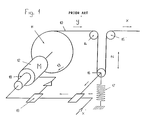
- Fig 1 shows a device of the prior art making it possible to regulate the movement of a strip 10 wound on a roll 11 driven by a motor 12.
- the motor 12 drives the roll 11 in the direction of the arrow 13 so as to reel out the strip 10 at a speed dy/dt.
- the strip 10 supplies a machine (not shown) at a feed speed dx/dt. So as to be able to control the speed of rotation of the motor 12 as a function of the feed speed dx/dt of the strip into the machine (not shown), it is necessary to measure the variation in speed between the feed into the machine and the speed at which the strip is reeled out. In order to do this, three idler rollers 14, 15, 16 are used, enabling the direction of the strip to be changed.
- the roller 16 is drawn back by a spring 17, a weight, a jack, or any other similar component.
- the position of the roller 16 is a function of the difference between the feed speed dx/dt and the reeling-out speed dy/dt. Normally the speed of rotation ⁇ of the motor 12 is measured by means of a tachometer 18.
- the speed at which the reel should rotate is derived from the position of the roller 16. It is compared at 19 with the signals coming from the tachometer so as to derive from this an error signal which is sent to the motor 12.
- PID devices with proportional, integral and derivative action well known in the art are used, which make it possible to obtain actions giving good stability whilst diminishing the transitory phases.
- the setting of the parameters of these PID devices is long and tedious since it is carried out by successive approximations and the actions on one of the parameters generally entail modification of the other parameters.
- US 3,770,946 describes a method for automatic control wherein a digital computer is used as a controller. In said method a control error is produced and sent to three separate circuits for computation of proportional, reset and rate components for applying respective coefficients K1, K2, K3. It is stated that coefficients could be modified. However, the document does not provide any hint how said coefficients are modified and the method only provides means to prevent an immediate proportional and rate response when the set point and/or coefficients are changed.
- DE-A-3 418 969 describes a device wherein a second derivative control is used.
- said document describes a cascade control device and the second derivative is only to adapt the speed of reaction of the control device. Nowhere an automatic regulation of the coefficients is described.
- the object of the invention is to provide a control method in which the settings are obtained systematically and without any empirical procedure, whatever the machine, ie independently of any small variations in friction or inertia in the components, either with respect to the theoretical value, or between two identical machines.
- the object is achieved by means of a method according to claim 1 in which:
- the motor is provided with a torque which depends on the error measured.
- Routh's criterion This condition is already known by the name of Routh's criterion but it is not sufficient to eliminate the transitory phase oscillations completely.
- the advantages inherent in the invention in having introduced the factor i can already be seen. In fact, this condition is independent of this factor.
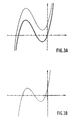
- Equation (10) The real roots of equation (10) are called z1, z2 and z3 where z3 ⁇ z2 ⁇ z1 ⁇ 0.
- Equation (10) gives a continuous third order curve between - ⁇ and + ⁇ . Equation (10) therefore permits at least one real root.
- Kdi 4 Kpi 2 ie: Kd 2 > 4p
- Fig 3C The curve provided by equation (10) can be considered to be the sum of a first function z3 and a second function Kdi zo + Kpi zo + Ki3.
- Fig 3C shows in a continuous line (single and double) the two functions and in a broken line their sum which is the left- hand side of equation (10).
- condition (12) can be written: d 2 > 4p
- the values of p and d should be within the non-hatched area in Fig 3D.
- these two conditions are independent of the value of the correction factor i.
- This factor was introduced into equation (5) in such a way that it does not interfere with the stability conditions. It therefore makes it possible to adjust the "reaction" of the system as a function of time and, during the transitory phases, the equilibrium position is achieved more quickly as the value of i becomes greater.
- i can be a variable factor, controllable by any external parameters to suit the different requirements which can be conceived.
- K was made equal to k / (a + J ⁇ ) and K ⁇ 1, where k is the general gain, ⁇ and ⁇ are constants and J the inertia of the system. It is well known that in order to avoid large accelerations which would impair the stability of the system, it is necessary to work with a moderate motor torque and use a low general gain k. When digital systems are used, idle times occur because the signals are sampled. This phenomenon causes errors. It has been found from experience that digital control of these systems could be achieved only if 1 ⁇ K ⁇ 2. This therefore gives k ⁇ a + J ⁇ and when J ⁇ is constant a zero value can be chosen for the factor a, which takes us back to the known art in which equation (5) does not involve the second derivative.
- K varies between a minimum value and a maximum value.
- J ⁇ varies between (J ⁇ )min and (J ⁇ )Max.
- Equation (7) has, up to now, been considered without the right-hand side.
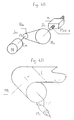
- J ⁇ m/ ⁇ + ⁇ je/ ⁇ 2 + ⁇ jm with m given by equation (18).
- Cd ⁇ (Cm - jm ⁇ ') in which jm represents the inertia of the motor carrying the drive pulley of radius Rm.
- the invention can be dealt with in a well-known digital manner.
- Co the maximum torque exerted by the motor when the digital/analogue transmitter controlling the motor amplifier is at its maximum
- Eo the maximum number of possible points which can be accepted by the transmitter
- N the sampling frequency N must be sufficiently large.
- N 50.
- condition (50) is more difficult to achieve.
- this condition is not achieved, it is nevertheless possible to use the invention by cancelling the value of the factor a and by using the value of the second derivative for automatically adjusting the factor k.
- the procedure is started with k N J ⁇ and the ideal gain k is sought by writing the condition with a constant i.
- the gain is decreased, verifying the following condition: If z" > z"max then ⁇ ⁇ Z > Zo N 2 z'' max .
- the advantage of the invention lies essentially in the fact that stability conditions (14) and (15) were discovered which up until then were unknown and that the use of an additional parameter independent of the stability conditions makes it possible to mitigate the approximations necessary for the calculation of the system.
Landscapes
- Physics & Mathematics (AREA)
- General Physics & Mathematics (AREA)
- Engineering & Computer Science (AREA)
- Automation & Control Theory (AREA)
- Feedback Control In General (AREA)
- Control Of Position Or Direction (AREA)
Applications Claiming Priority (2)
| Application Number | Priority Date | Filing Date | Title |
|---|---|---|---|
| FR9116468A FR2685792A1 (fr) | 1991-12-30 | 1991-12-30 | Regulation par pid numerique. |
| FR9116468 | 1991-12-30 |
Publications (2)
| Publication Number | Publication Date |
|---|---|
| EP0550356A1 EP0550356A1 (en) | 1993-07-07 |
| EP0550356B1 true EP0550356B1 (en) | 1996-03-20 |
Family
ID=9420782
Family Applications (1)
| Application Number | Title | Priority Date | Filing Date |
|---|---|---|---|
| EP92420478A Expired - Lifetime EP0550356B1 (en) | 1991-12-30 | 1992-12-22 | Digital PID control |
Country Status (5)
| Country | Link |
|---|---|
| US (1) | US5268626A (enExample) |
| EP (1) | EP0550356B1 (enExample) |
| JP (1) | JP2752559B2 (enExample) |
| DE (1) | DE69209267T2 (enExample) |
| FR (1) | FR2685792A1 (enExample) |
Families Citing this family (5)
| Publication number | Priority date | Publication date | Assignee | Title |
|---|---|---|---|---|
| DE102010001535A1 (de) * | 2010-02-03 | 2011-08-04 | manroland AG, 63075 | Verfahren zur Regelung eines Rollenwechslers sowie Rollenwechsler |
| CN101980095B (zh) * | 2010-09-19 | 2012-04-25 | 天津大学 | 陀螺经纬仪粗寻北的自动跟踪pid控制系统及控制方法 |
| US8744707B2 (en) | 2011-03-31 | 2014-06-03 | Caterpillar Inc. | CVT control using state space based gain scheduling |
| US9221641B2 (en) * | 2012-05-08 | 2015-12-29 | Kimberly-Clark Worldwide, Inc. | Controller and system for controllably rotating a roll of material |
| US9507365B2 (en) * | 2014-06-24 | 2016-11-29 | Woodward, Inc. | Adaptive PID control system for industrial turbines |
Family Cites Families (8)
| Publication number | Priority date | Publication date | Assignee | Title |
|---|---|---|---|---|
| US3584208A (en) * | 1970-01-28 | 1971-06-08 | George W Dahl Co Inc | Controller |
| US3657524A (en) * | 1970-06-15 | 1972-04-18 | Ibm | Dual mode process control with continuous feedback during coarse mode |
| US3770946A (en) * | 1971-02-25 | 1973-11-06 | Leeds & Northrup Co | Method for automatic control with time varying tuning |
| US3882368A (en) * | 1972-07-14 | 1975-05-06 | Westinghouse Electric Corp | Apparatus and method for automatic or manual process control |
| FR2423806A1 (fr) * | 1977-05-26 | 1979-11-16 | Anvar | Procede de regulation a modele de reference et regulateur mettant en oeuvre ce procede |
| DE3418969A1 (de) * | 1984-05-22 | 1985-11-28 | Robert Bosch Gmbh, 7000 Stuttgart | Proportionalventil |
| IT1208728B (it) * | 1984-12-27 | 1989-07-10 | Colgate Palmolive Co | Dispositivo di controllo dello stiramento nella laminazione di materi ali a nastro |
| JPH02212622A (ja) * | 1989-02-10 | 1990-08-23 | Koyo Seiko Co Ltd | 磁気軸受スピンドルユニット |
-
1991
- 1991-12-30 FR FR9116468A patent/FR2685792A1/fr active Granted
-
1992
- 1992-11-16 US US07/976,617 patent/US5268626A/en not_active Expired - Fee Related
- 1992-12-22 EP EP92420478A patent/EP0550356B1/en not_active Expired - Lifetime
- 1992-12-22 DE DE69209267T patent/DE69209267T2/de not_active Expired - Fee Related
- 1992-12-28 JP JP4349184A patent/JP2752559B2/ja not_active Expired - Lifetime
Also Published As
| Publication number | Publication date |
|---|---|
| EP0550356A1 (en) | 1993-07-07 |
| JP2752559B2 (ja) | 1998-05-18 |
| JPH0612125A (ja) | 1994-01-21 |
| DE69209267D1 (de) | 1996-04-25 |
| FR2685792B1 (enExample) | 1994-04-22 |
| FR2685792A1 (fr) | 1993-07-02 |
| DE69209267T2 (de) | 1996-10-31 |
| US5268626A (en) | 1993-12-07 |
Similar Documents
| Publication | Publication Date | Title |
|---|---|---|
| JP3575148B2 (ja) | サーボ機構の自動ゲイン調整方法及び装置 | |
| US4278213A (en) | Control arrangement for a roll carrier | |
| WO2015178084A1 (ja) | ロール間搬送制御装置 | |
| EP0550356B1 (en) | Digital PID control | |
| US2943809A (en) | Tension control apparatus | |
| JPS5826753A (ja) | 巻出機の張力制御装置 | |
| JP3425514B2 (ja) | 冷間圧延機の張力制御装置 | |
| JPS5842344Y2 (ja) | リ−ル駆動制御装置 | |
| JP3449305B2 (ja) | 帯状材の張力制御方法及び装置 | |
| US4448366A (en) | Coil diameter tracking system and tension regulation system using such tracking system | |
| JPH07196216A (ja) | 張力制御方法 | |
| DE69114739T2 (de) | Bandantriebsgerät für Bandaufnahme-Wiedergabegerät. | |
| JP2567147B2 (ja) | リワインダ制御装置 | |
| JPS63258368A (ja) | 慣性ピ−ク張力補償巻線装置 | |
| JPH0451463B2 (enExample) | ||
| JPH05204467A (ja) | リールの張力制御方法およびその制御装置 | |
| JPS60262766A (ja) | スリツタの巻取駆動装置 | |
| JPH04266355A (ja) | 巻取機制御装置 | |
| JP3533780B2 (ja) | 巻取り機用電動機の制御方法及びその制御装置 | |
| JPH02142610A (ja) | 圧延機の自動板厚制御装置 | |
| SU715417A1 (ru) | Устройство дл регулировани нат жени длинномерного материала при намотке в рулон | |
| JPH02215641A (ja) | ループ位置制御装置 | |
| JPH05116823A (ja) | シート状材料の張力制御装置 | |
| Kumar et al. | Web printing paper tension control system | |
| DE69405568T2 (de) | Regelung von eingerüstigen reversierwalzwerken |
Legal Events
| Date | Code | Title | Description |
|---|---|---|---|
| PUAI | Public reference made under article 153(3) epc to a published international application that has entered the european phase |
Free format text: ORIGINAL CODE: 0009012 |
|
| AK | Designated contracting states |
Kind code of ref document: A1 Designated state(s): DE FR GB NL |
|
| 17P | Request for examination filed |
Effective date: 19931215 |
|
| 17Q | First examination report despatched |
Effective date: 19940228 |
|
| GRAA | (expected) grant |
Free format text: ORIGINAL CODE: 0009210 |
|
| AK | Designated contracting states |
Kind code of ref document: B1 Designated state(s): DE FR GB NL |
|
| REF | Corresponds to: |
Ref document number: 69209267 Country of ref document: DE Date of ref document: 19960425 |
|
| ET | Fr: translation filed | ||
| PLBE | No opposition filed within time limit |
Free format text: ORIGINAL CODE: 0009261 |
|
| 26N | No opposition filed | ||
| PGFP | Annual fee paid to national office [announced via postgrant information from national office to epo] |
Ref country code: NL Payment date: 19980914 Year of fee payment: 7 |
|
| PGFP | Annual fee paid to national office [announced via postgrant information from national office to epo] |
Ref country code: GB Payment date: 19981110 Year of fee payment: 7 |
|
| PGFP | Annual fee paid to national office [announced via postgrant information from national office to epo] |
Ref country code: FR Payment date: 19981203 Year of fee payment: 7 |
|
| PGFP | Annual fee paid to national office [announced via postgrant information from national office to epo] |
Ref country code: DE Payment date: 19981230 Year of fee payment: 7 |
|
| PG25 | Lapsed in a contracting state [announced via postgrant information from national office to epo] |
Ref country code: GB Free format text: LAPSE BECAUSE OF NON-PAYMENT OF DUE FEES Effective date: 19991222 |
|
| PG25 | Lapsed in a contracting state [announced via postgrant information from national office to epo] |
Ref country code: NL Free format text: LAPSE BECAUSE OF NON-PAYMENT OF DUE FEES Effective date: 20000701 |
|
| GBPC | Gb: european patent ceased through non-payment of renewal fee |
Effective date: 19991222 |
|
| PG25 | Lapsed in a contracting state [announced via postgrant information from national office to epo] |
Ref country code: FR Free format text: LAPSE BECAUSE OF NON-PAYMENT OF DUE FEES Effective date: 20000831 |
|
| NLV4 | Nl: lapsed or anulled due to non-payment of the annual fee |
Effective date: 20000701 |
|
| PG25 | Lapsed in a contracting state [announced via postgrant information from national office to epo] |
Ref country code: DE Free format text: LAPSE BECAUSE OF NON-PAYMENT OF DUE FEES Effective date: 20001003 |
|
| REG | Reference to a national code |
Ref country code: FR Ref legal event code: ST |