EP0530768A1 - Zusatzmittelkombination zur Verbesserung der Verarbeitbarkeit von wasserhaltigen Baustoffgemischen - Google Patents
Zusatzmittelkombination zur Verbesserung der Verarbeitbarkeit von wasserhaltigen Baustoffgemischen Download PDFInfo
- Publication number
- EP0530768A1 EP0530768A1 EP92114980A EP92114980A EP0530768A1 EP 0530768 A1 EP0530768 A1 EP 0530768A1 EP 92114980 A EP92114980 A EP 92114980A EP 92114980 A EP92114980 A EP 92114980A EP 0530768 A1 EP0530768 A1 EP 0530768A1
- Authority
- EP
- European Patent Office
- Prior art keywords
- weight
- building material
- water
- material mixtures
- additive combination
- Prior art date
- Legal status (The legal status is an assumption and is not a legal conclusion. Google has not performed a legal analysis and makes no representation as to the accuracy of the status listed.)
- Granted
Links
Classifications
-
- C—CHEMISTRY; METALLURGY
- C04—CEMENTS; CONCRETE; ARTIFICIAL STONE; CERAMICS; REFRACTORIES
- C04B—LIME, MAGNESIA; SLAG; CEMENTS; COMPOSITIONS THEREOF, e.g. MORTARS, CONCRETE OR LIKE BUILDING MATERIALS; ARTIFICIAL STONE; CERAMICS; REFRACTORIES; TREATMENT OF NATURAL STONE
- C04B24/00—Use of organic materials as active ingredients for mortars, concrete or artificial stone, e.g. plasticisers
- C04B24/24—Macromolecular compounds
- C04B24/28—Macromolecular compounds obtained otherwise than by reactions only involving carbon-to-carbon unsaturated bonds
- C04B24/30—Condensation polymers of aldehydes or ketones
-
- C—CHEMISTRY; METALLURGY
- C04—CEMENTS; CONCRETE; ARTIFICIAL STONE; CERAMICS; REFRACTORIES
- C04B—LIME, MAGNESIA; SLAG; CEMENTS; COMPOSITIONS THEREOF, e.g. MORTARS, CONCRETE OR LIKE BUILDING MATERIALS; ARTIFICIAL STONE; CERAMICS; REFRACTORIES; TREATMENT OF NATURAL STONE
- C04B40/00—Processes, in general, for influencing or modifying the properties of mortars, concrete or artificial stone compositions, e.g. their setting or hardening ability
- C04B40/0028—Aspects relating to the mixing step of the mortar preparation
- C04B40/0039—Premixtures of ingredients
-
- C—CHEMISTRY; METALLURGY
- C04—CEMENTS; CONCRETE; ARTIFICIAL STONE; CERAMICS; REFRACTORIES
- C04B—LIME, MAGNESIA; SLAG; CEMENTS; COMPOSITIONS THEREOF, e.g. MORTARS, CONCRETE OR LIKE BUILDING MATERIALS; ARTIFICIAL STONE; CERAMICS; REFRACTORIES; TREATMENT OF NATURAL STONE
- C04B24/00—Use of organic materials as active ingredients for mortars, concrete or artificial stone, e.g. plasticisers
- C04B24/24—Macromolecular compounds
- C04B24/38—Polysaccharides or derivatives thereof
- C04B24/383—Cellulose or derivatives thereof
-
- C—CHEMISTRY; METALLURGY
- C04—CEMENTS; CONCRETE; ARTIFICIAL STONE; CERAMICS; REFRACTORIES
- C04B—LIME, MAGNESIA; SLAG; CEMENTS; COMPOSITIONS THEREOF, e.g. MORTARS, CONCRETE OR LIKE BUILDING MATERIALS; ARTIFICIAL STONE; CERAMICS; REFRACTORIES; TREATMENT OF NATURAL STONE
- C04B28/00—Compositions of mortars, concrete or artificial stone, containing inorganic binders or the reaction product of an inorganic and an organic binder, e.g. polycarboxylate cements
- C04B28/02—Compositions of mortars, concrete or artificial stone, containing inorganic binders or the reaction product of an inorganic and an organic binder, e.g. polycarboxylate cements containing hydraulic cements other than calcium sulfates
-
- C—CHEMISTRY; METALLURGY
- C04—CEMENTS; CONCRETE; ARTIFICIAL STONE; CERAMICS; REFRACTORIES
- C04B—LIME, MAGNESIA; SLAG; CEMENTS; COMPOSITIONS THEREOF, e.g. MORTARS, CONCRETE OR LIKE BUILDING MATERIALS; ARTIFICIAL STONE; CERAMICS; REFRACTORIES; TREATMENT OF NATURAL STONE
- C04B2201/00—Mortars, concrete or artificial stone characterised by specific physical values
- C04B2201/10—Mortars, concrete or artificial stone characterised by specific physical values for the viscosity
Definitions
- Water-containing building material mixtures are generally understood to mean plasters, masonry mortar, thin-bed adhesive mortar and leveling compounds, to which the amount of water required for processing and consolidation is added either in the manufacturing plant or at the construction site.
- these building material mixtures also contain additives.
- the most common additives are thickeners, air entraining agents, dispersants, plasticizers, stabilizers and water repellents.
- cellulose ethers have become the most important of the thickeners. Cellulose ethers and especially methyl cellulose have a significant influence on the processing properties of modern building material mixtures.
- methyl cellulose has made a decisive contribution to the development of modern building material mixtures, such as thin-bed adhesive mortar and machine plasters.
- Methyl cellulose significantly increases the water retention capacity of the basic building material mixture.
- the mortar is thickened, which results in a much better stability. Stability of building material mixtures means that, for example, plaster mortar applied to the wall does not sag or the tiles placed in a mortar bed do not slip.
- cellulose ethers are often modified with synthetic or natural organic polymers.
- Water factor Ratio of the required amount of water to the dry building material mixture, ie the amount of water (in parts by weight to 100 GT dry mixture) that is required to give the respective building material mixture a practical processing consistency. The water factor depends on the type and amount of the binder, the grain size and water absorption of the fillers and additives, the thickening or plasticizing properties of the mortar additives used and of the consistency of the building material mixture aimed at by the processor and tailored to the respective applications.
- Stamina Tile adhesives are stable if tiles and plates that are placed in the freshly applied adhesive mortar do not slip on vertical surfaces (walls).
- Putty, jointing and filling compounds show stability if they do not sag in holes and joints after the filling process or if surface coating on vertical surfaces does not slip during and after coating.
- Wind up Coating process with building material mixtures such as fillers, jointing or filling compounds on vertical and horizontal surfaces.
- Combing Coating process for tile, slab and block adhesive mortar using a trowel or comb spatula (triangular or square teeth) on the respective substrates. This creates a uniformly thick layer of mortar.
- Smoothing and closing the surface Finishing process for fillers, grouts and fillers to achieve a smooth surface.
- plasters and mortars can be assessed using the following evaluation criteria.
- Stamina Plaster and mortar are stable if they do not sag during application on walls and ceilings and during the subsequent smoothing process, for example, warping with a drawing stick (maple), ie they are stable.
- Warp First smoothing process, immediately after application of the plaster or mortar on walls and ceilings.
- Straighten (recutting) Second smoothing process with a drawing stick on which something is already stiffened Plaster or mortar. This smoothing process serves to straighten the still unevenly structured plaster surface.
- Sludge formation After moistening the already slightly dried plaster surface, for example by spraying it with water, rub with a sponge or felt disc, whereby a liquid-pasty mass, the so-called smoothing cream, accumulates on the plaster surface.
- Smooth Final processing with a trowel or trowel to achieve the final surface smoothness of the plaster.
- Additive combinations of the water-soluble cellulose ethers mentioned and their derivatives with polyacrylamide and with the superabsorbents also result in a significant reduction in the tendency to stick compared to the known additive combinations in water-containing building material mixtures.
- the invention further relates to mixtures of building materials which contain this combination of additives.
- the additive combinations described are suitable for all water-containing building material mixtures, in particular for plasters, mortars, adhesive mortars and fillers.
- these building material mixtures contain a mixture of the above components a) to e) in the stated composition. These components will be described in more detail below.
- Possible water-soluble cellulose ethers and their derivatives for the additive combination according to the invention are: methyl cellulose, methyl hydroxyethyl cellulose, methyl hydroxypropyl cellulose, hydroxyethyl cellulose and their hydrophobically substituted derivatives, hydroxyethyl hydroxypropyl cellulose and their hydrophobically substituted derivatives, carboxymethyl cellulose or carboxymethyl hydroxyalkyl cellulose. Hydroxyethyl and methylhydroxyalkyl cellulose ethers are preferred.
- the viscosity limits of these cellulose ethers are usually 10 to 500,000, in particular 50 to 150,000 mPa . s (measured as a 2% aqueous solution using a Höppler falling ball viscometer at 20 ° C in distilled water).
- the most important cellulose ethers in practice are listed in Table I with their etherification data.
- the average degree of substitution indicates the average number of alkyl groups (here: methyl, ethyl and propyl) per anhydroglucose unit.
- the molar degree of substitution indicates the average number of hydroxyalkyl end groups (here: ethyl and propyl) per anhydroglucose unit.
- the alkoxy group consists of 2 to 20 carbon atoms, which can be linked in a straight-chain or branched manner and make up 0.05 to 50% by weight, based on the weight of the substituted cellulose ether.
- Table II shows the cellulose ethers listed in the tests and comparative tests.
- Table I Water-soluble cellulose ethers and their derivatives DS MS Methyl cellulose 1.4 - 2.2 Methyl hydroxyethyl cellulose 1.3 - 2.0 0.05-0.5 Methyl hydroxypropyl cellulose 1.3 - 2.2 0.1-1.0 Hydroxyethyl cellulose - 1.5 - 3.5 Hydroxyethyl hydroxypropyl cellulose MS HE: 0.9 - 1.2 MS HP: 0.6-0.9 Hydroxypropyl cellulose - 2.0-3.5 Ethyl hydroxyethyl cellulose 0.7 - 1.2 0.8-2.7 Carboxymethyl cellulose 0.5 - 1.5 - Carboxymethylhydroxyethyl cellulose 0.3-0.6 0.3 - 2.3 Alkoxy-hydroxypropyl-hydroxyethyl cellulose - 1.5 - 3.5 Viscosity level measured in 2% aqueous solution Degree of etherification DS MS Methyl Hydr
- PAA polyacrylamide
- Anionic, cationic and nonionic polyacrylamides with a molecular weight (weight average) are used as polyacrylamides for the additive combination according to the invention.
- M ⁇ w used from 1 ⁇ 106 to 10 ⁇ 106.
- the anionic polyacrylamides used are partially saponified polyacrylamides, copolymers of acrylamide with alkali acrylates, vinyl sulfonates and 2-acrylamido-2-methyl-propanesulfonates.
- the cationic polyacrylamides used are copolymers of acrylamide with salts or quaternization products of diethylaminoethyl acrylates, dimethylaminoethyl methacrylate, dimethylaminopropyl methacrylamide, dialkylbisallylammonium salts or aminomethylated polyacrylamide.
- the nonionic polyacrylamides used are homopolymers of acrylamide with low proportions of carboxyl groups resulting from uncontrolled saponification.
- the polyacrylamides listed in Table III are preferably used as component b) in the additive combinations according to the invention.
- Table III In a combination of additives for: Ionogenicity Viscosity *) 0.5% in 10% NaCl solution.
- mPa s Nitrogen content % Grain fineness ⁇ 1.0 mm% Gypsum machine plaster (GMP) not ionic, weakly anionic 130 18th 100 or Gypsum lime machine plaster (GKMP) cationic 200 +) 15.5 100 Cement lime base plaster (ZKP) anionic 200 0.5 100 Tile adhesive (cement base) (ZFK) anionic 130 8th 100 Cement filler (ZSM) anionic 150 10.5 100 Gypsum filler (GSP) anionic 150 10.5 100 *) Viscosity measurement with Brookfield RV, spindle 1, 10 rpm, 20 ° C; +) Concentration 1% in 10% NaCl solution
- Superabsorbents are lattice structures based on neutralized or partially neutralized polyacrylic acids, which result from the radical copolymerization of the monomers with small amounts of certain crosslinking agents. There are essentially two production processes for the production of a polymer lattice structure:
- the manufacturing process mentioned under 1) is by far the most important for the production of SAPs.
- polymerization techniques such as e.g. the emulsion and gel polymerization used.
- An aqueous solution of the monomer acrylic acid is polymerized with small amounts of a crosslinking agent.
- Water serves as a diluent and solvent and helps to avoid the high temperatures that may occur in this exothermic process.
- the concentration of the monomer in the aqueous solution is usually up to 60% by weight.
- the amounts of crosslinking agent used are in the range of 0.05-1.5 mol%.
- the polymerization can take place in the boiler or using the thin-film process.
- the superabsorbents produced by the two methods mentioned can also be grafted with starch.
- This grafting with starch takes place during the polymerization and crosslinking process in the context of a so-called one-pot process.
- the starch is broken down by heating in water and added as a solution at the beginning of the polymerization process.
- the proportion of starch, based on the superabsorbent can be 3 to 30% by weight.
- Superabsorbents are able to absorb large volumes of aqueous liquids to form a stable gel structure and also under load to hold on. This ability is a prerequisite for successful application in the field of building materials and adhesives.
- the amount of aqueous liquid absorbed is in the range up to 400 to 1000 times its own weight.
- Superabsorbents can only absorb water in the pH range of 4 to 10. A partial neutralization required for this process can be carried out before or after the polymerization.
- the product resulting from the polymerization is a moist gel that is crushed with a gel cutter and then dried.
- Crosslinking for the production of superabsorbents takes place largely via covalent bonds between the individual polymer chains and the crosslinking agents used. Suitable crosslinking agents for the formation of covalent bonds are so-called polyfunctional monomers, ie crosslinking agents with a double bond. Typical representatives of these polyfunctional molecules are methylene bisacrylamide, diethylene glycol dialkyl ether and vinyl compounds such as vinyl ethers, vinyl esters and vinyl phosphonic acids.
- Polyfunctional molecules such as diepoxides, azirines and polyalcohols offer further possibilities for crosslinking via covalent bonds.
- the last-mentioned crosslinking agents are capable of additionally crosslinking already slightly crosslinked polymer chains. This additional surface crosslinking enables superabsorbents with different degrees of crosslinking to be produced. This allows combinations of the good absorption properties of the slightly crosslinked superabsorbents with the advantages of the highly crosslinked superabsorbents.
- Slightly cross-linked superabsorbents have a high absorption capacity for aqueous liquids, high amounts of extractable aqueous liquid but a low absorption ratio as a result of gel blocking.
- the highly cross-linked superabsorbents have no gel blocking, which means that they have better absorption capacity and stability under pressure.
- mixtures of highly and slightly reactive crosslinking reagents are used in the production process, the density and .through appropriate variation of the mixing ratios of the crosslinking components used
- the nature of the lattice structures can be changed over a wide range and adapted to the requirements.
- Characteristics of the suitable superabsorbents in the additive combination according to the invention are the highest possible total absorption capacity for deionized water (> 100 g / g) and an absorption capacity under pressure of ⁇ 50 ml 0.9% NaCl solution per g.
- the additive combinations according to the invention consist of components a), b), c) and optionally d) and e).
- Components a) to e) can consist of one compound or a mixture of several compounds. It is conceivable that in the case of component a) it consists of a cellulose ether or a derivative, or component a) consists of a mixture of several cellulose ethers or their Derivatives.
- the powdery or granular components a), b), c) and optionally d) and e) can be added individually to the building material products or components a), b), c), d) and e) are first mixed together and added Then mix to the building material products. These components are incorporated into the building material products using customary stirring and mixing processes.
- the sum of components a), b), c), d) and e) of the additive combination in the building material products is 0.01 to 2, preferably 0.02 to 1% by weight, based on the dry matter.
- Methylhydroxyethyl cellulose (2) from Table II; Polyacrylamide for cement lime plaster from Table III (anionic); Melamine formaldehyde - sulfonated - Na salt from Table VI (Melment® F 10, manufacturer: Süd Weg Kalk-nitrogen-Werke (SKW), Trostdorf) Superabsorbent (1) from Table IV (3D only)
- Methylhydroxyethyl cellulose (3) from Table II; Hydroxypropyl starch with MS 0.5 from Table V (not 4G, 5G, 6G); Polyacrylamide for cement filler and plaster filler from Table III, anionic (4E, 4F, 4G, 6E, 6F, 6G); Polyacrylamide for tile adhesive / cement base from Table III, anionic (5E, 5F, 5G).
- Superabsorbent (3) from Table IV (4F, 4G, 5F, 5G, 6F, 6G) Hostapur®OSB and Genapol®PF8O (manufacturer: Hoechst AG) were used as air entraining agents.
- the starch ethers used are commercially available preparations.
- Table X shows the composition of the tested building material mixtures 1A, 1C, 2A, 2C, 3D and 3C. Processing was carried out using a spray cleaning machine. Table XI shows the result of the spray tests. Table XII shows the composition of the tested building material mixtures 4E, 4F, 4G, 5E, 5F, 5G, 6E, 6F, 6G and the evaluation of the processability.
- Polycondensation product based on naphthalenesulfonic acid-formaldehyde alkali salt or melamine-formaldehyde sulfonated - alkali salt - 7 - - component A (wt TI) B (wt TI) E (wt TI) Cellulose ether 94 88 80 Starch ether - - 15 Polyacrylamide 6 5 5 waterl.
Landscapes
- Chemical & Material Sciences (AREA)
- Engineering & Computer Science (AREA)
- Ceramic Engineering (AREA)
- Materials Engineering (AREA)
- Structural Engineering (AREA)
- Organic Chemistry (AREA)
- Chemical Kinetics & Catalysis (AREA)
- Inorganic Chemistry (AREA)
- Curing Cements, Concrete, And Artificial Stone (AREA)
- Compositions Of Macromolecular Compounds (AREA)
- Adhesives Or Adhesive Processes (AREA)
Abstract
Description
- Unter wasserhaltigen Baustoffgemischen werden im allgemeinen Putze, Mauermörtel, Dünnbettklebemörtel und Spachtelmassen verstanden, denen die zur Verarbeitung und Verfestigung benötigte Wassermenge entweder im Herstellwerk oder an der Baustelle zugegeben wird.
- Diese Baustoffgemische enthalten neben den Hauptbestandteilen - wie Bindemittel, Zuschlag-, Füll- und Zusatzstoffen - noch Zusatzmittel. Die gebräuchlichsten Zusatzmittel sind Verdicker, Luftporenbildner, Dispergiermittel, Verflüssiger, Stabilisatoren und Hydrophobierungsmittel. Von den Verdickern haben in der Praxis Celluloseether die größte Bedeutung erlangt. Celluloseether und insbesondere Methylcellulose beeinflußen die Verarbeitungseigenschaften moderner Baustoffgemische erheblich.
- Die Verwendung von Methylcellulose hat entscheidend zur Entwicklung moderner Baustoffgemische, wie z.B. Dünnbettklebemörtel und Maschinenputze, beigetragen. Durch Methylcellulose wird das Wasserrückhaltevermögen der Baustoffgrundmischung deutlich angehoben. Gleichzeitig wird eine Verdickung des Mörtels erreicht, was eine wesentlich bessere Standfestigkeit zur Folge hat. Standfestigkeit von Baustoffgemischen bedeutet, daß z.B. auf der Wand aufgetragener Putzmörtel nicht absackt oder die in ein Mörtelbett eingelegten Fliesen nicht abrutschen.
Um diese Standfestigkeit noch zu verbessern, werden Celluloseether häufig mit synthetischen oder natürlichen organischen Polymeren modifiziert. - Die größte Bedeutung dieser zur Modifizierung von Celluloseethern eingesetzten Polymere haben Polyacrylamid (PAA) bzw. PAA-modifizierte Celluloseether erreicht (DE-A-1 283 726; DE-A-1 646 501; DE-A-2 146 709, US-A-4 021 257).
Neben der Zugabe von Polyacrylamid wird als weitere Modifizierungsvariante in DE-A-3 339 860 die chemische Verknüpfung von Celluloseethern mit Polyacrylamiden beschrieben.
In der noch nicht veröffentlichten deutschen Patentanmeldung mit dem Aktenzeichen P 41 09 092.6 (Titel: Baustoffprodukte enthaltend organische Polymere als Verdicker) werden Kombinationen aus wasserlöslichen natürlichen Polymeren oder deren Derivaten wie Celluloseether, Xanthamgums, Guarderivate, Stärkeether, Johannisbrotkernmehl mit Alkali- und Ammoniumsalzen von vernetzten und gegebenenfalls zusätzlich mit Stärke gepfropften Polyacrylaten und gegebenenfalls mit Zusätzen von Alkali- und Erdalkalisalzen von Kondensationsprodukten der Naphthalinsulfonsäure bzw. Phenolsulfonsäure mit Formaldehyd oder mit sulfonsäuremodifizierten Polykondensationsprodukten aus Melamin und Formaldehyd beschrieben, die als sogenannte Verdicker zur Erhöhung der Viskosität von Baustoffprodukten verwendet werden. - Bei wasserhaltigen Baustoffgemischen wird seitens der Anwender eine gute Verarbeitbarkeit gefordert. Die Verbesserung der Verarbeitbarkeit ist eines der wichtigsten Ziele bei der Weiterentwicklung moderner Baustoffgemische. Zur Beurteilung der Verarbeitbarkeit von Baustoffgemischen gibt es eine Reihe von Bewertungskriterien.
- Die Verarbeitbarkeit von Spachtelmassen und Fliesenklebern kann anhand folgender Bewertungskriterien beurteilt werden.
Wasserfaktor:
Verhältnis aus benötigter Wassermenge zu Baustoff-Trockenmischung, d.h. Wassermenge (in Gew.Teilen auf 100 GT Trockengemisch) die erforderlich ist, um dem jeweiligen Baustoffgemisch eine praxisgerechte Verarbeitungskonsistenz zu geben. Der Wasserfaktor hängt ab von der Art und Menge der Bindemittel, der Kornfeinheit und Wasserabsorption der Füll- und Zuschlagstoffe, den verdickend bzw. plastifizierend wirkenden Eigenschaften der verwendeten Mörteladditive sowie von der vom Verarbeiter angestrebten, auf die jeweiligen Anwendungen abgestimmte Konsistenz des Baustoffgemisches.
Standvermögen:
Fliesenkleber besitzen Standvermögen, wenn Fliesen und Platten, die in die frisch aufgetragenen Klebemörtel eingelegt werden, an vertikalen Flächen (Wänden) nicht abrutschen. Spachtel-, Fugen- und Füllmassen zeigen Standvermögen, wenn sie in Löchern und Fugen nach dem Verfüllvorgang nicht absacken oder bei Flächenbeschichtung auf vertikalen Oberflächen während und nach der Beschichtung nicht abrutschen.
Aufziehen:
Beschichtungsvorgang mit Baustoffgemischen wie Spachtel-, Fugen- oder Füllmassen auf vertikalen und horizontalen Oberflächen.
Aufkämmen:
Beschichtungsvorgang für Fliesen-, Platten- und Blockklebemörtel mittels Kammkelle oder Kammspachtel (drei- oder viereckig gezähnt) auf den jeweiligen Untergründen. Hierdurch wird eine gleichmäßig dicke Mörtelschicht erzielt.
Glätten und Schließen der Oberfläche:
Endbearbeitungsvorgang bei Spachtel-, Fugen- und Füllmassen zur Erzielung einer glatten Oberfläche. - Die Verarbeitbarkeit von Putzen und Mörteln kann anhand folgender Bewertungskriterien beurteilt werden.
Standvermögen:
Putze und Mörtel besitzen Standvermögen, wenn sie während des Auftrags auf Wänden und Decken sowie während des nachfolgenden Glättvorgangs z.B. dem Verziehen mit einer Ziehlatte (Kartätsche) nicht absacken, d.h. sich standfest verhalten.
Verziehen:
Erster Glättvorgang, unmittelbar nach Auftrag des Putzes oder Mörtels auf Wänden und Decken.
Begradigen (Nachschneiden):
Zweiter Glättvorgang mit Ziehlatte (Kartätsche) auf dem bereits etwas angesteiften Putz oder Mörtel. Dieser Glättvorgang dient dazu, die noch ungleichmäßig strukturierte Putzoberfläche zu begradigen.
Schlämmebildung (Glättschmand):
Nach Befeuchtung der bereits etwas angetrockneten Putzoberfläche, z.B. durch Bespritzen mit Wasser, wird mit einer Schwamm- oder Filzscheibe nachgerieben, wobei sich auf der Putzoberfläche eine flüssig-pastöse Masse, der sogenannte Glättschmand anreichert. Das Ausmaß der Schlämmedildung sowie die Konsistenz des Glättschmands, z.B. dünnflüssig oder dickflüssig-pastös, haben großen Einfluß auf die Oberflächengüte des erhärteten Putzes.
Glätten:
Abschließender Bearbeitungsvorgang mit Glättkelle oder Traufel zur Erzielung der endgültigen Oberflächenglätte des Putzes. - Vor allem die durch die eingesetzten Celluloseether hervorgerufene Klebneigung wasserhaltiger Baustoffgemische sollte bei gipshaltigen Putzen und Mörteln gering sein, da sie sich nachteilig auf die Verarbeitbarkeit auswirkt. Es zeigt sich, daß vor allem Putze und Mörtel mit starker Klebneigung schlecht aufzuziehen sind und nur unter körperlichen Anstrengungen verarbeitet werden können.
- Besonders seitens der Anwender besteht daher der Wunsch nach wasserhaltigen Baustoffgemischen, die eine verringerte Klebneigung besitzen und deren Verarbeitbarkeit somit verbessert wird.
- Überraschend wurde nun gefunden, daß Zusatzmittelkombinationen aus wasserlöslichen Celluloseethern und deren Derivaten, Polyacrylamid, Alkali- oder Ammoniumsalzen von vernetzten und gegebenenfalls zusätzlich mit Stärke gepfropften Polyacrylaten, in der Technik als Superabsorbents (SAPs) bezeichnet, gegebenenfalls Stärkeethern und gegebenenfalls Zusätzen von Alkali-, Erdalkali- oder Ammoniumsalzen von Kondensationsprodukten der Naphthalinsulfonsäure bzw. Phenolsulfonsäure mit Formaldehyd oder mit sulfonsäuremodifizierten Polykondensationsprodukten aus Melamin und Formaldehyd, die Verarbeitbarkeit von wasserhaltigen Baustoffgemischen verbessern, indem sie eine verringerte Klebneigung der wasserhaltigen Baustoffgemische bewirken.
- Auch Zusatzmittelkombinationen der genannten wasserlöslichen Celluloseether und deren Derivate mit Polyacrylamid und mit den Superabsorbents ergeben eine signifikante Verringerung der Klebneigung gegenüber den bekannten Zusatzmittelkombinationen in wasserhaltigen Baustoffgemischen.
- Gegenstand der Erfindung sind Zusatzmittelkombinationen für wasserhaltige Baustoffgemische enthaltend
- a) mindestens 65 Gew.-%, bevorzugt 65 bis 98 Gew.-% eines wasserlöslichen Celluloseethers oder eines Derivates,
- b) 1 bis 15 Gew.-% Polyacrylamid,
- c) 1 bis 20 Gew.-% eines Alkali- oder Ammoniumsalzes eines vernetzten, gegebenenfalls mit Stärke gepfropften Polyacrylats
- d) 0 bis 20 Gew.-% eines Stärkeethers und
- e) 0 bis 15 Gew.-% eines wasserlöslichen Alkali-, Erdalkali- oder Ammoniumsalzes von Arylsulfonsäure-Formaldehyd-Kondensationsprodukten oder eines sulfonsäuremodifizierten Polykondensationsproduktes aus Melamin und Formaldehyd.
- Gegenstand der Erfindung sind ferner Baustoffgemische, welche diese Zusatzmittelkombination enthalten.
- Die beschriebenen Zusatzmittelkombinationen eignen sich für alle wasserhaltigen Baustoffgemische, insbesondere für Putze, Mörtel, Klebemörtel und Spachtelmassen.
- Zur Verbesserung der Verarbeitbarkeit enthalten diese Baustoffgemische eine Mischung der obengenannten Komponenten a) bis e) in der angegebenen Zusammensetzung. Diese Komponenten sollen im folgenden näher beschrieben werden.
- Als wasserlösliche Celluloseether und deren Derivate für die erfindungsgemäße Zusatzmittelkombination kommen in Frage: Methylcellulose, Methylhydroxyethylcellulose, Methylhydroxypropylcellulose, Hydroxyethylcellulose sowie deren hydrophob substituierten Derivate, Hydroxyethylhydroxypropylcellulose sowie deren hydrophob substituierten Derivate, Carboxymethylcellulose oder Carboxymethylhydroxyalkylcellulose. Bevorzugt werden Hydroxyethyl- und Methylhydroxyalkylcelluloseether.
Die Viskositätsgrenzen dieser Celluloseether liegen üblicherweise bei 10 bis 500 000, insbesondere 50 bis 150 000 mPa.s (gemessen als 2 %ige wäßrige Lösung mit Höppler-Kugelfall-Viskosimeter bei 20°C in destilliertem Wasser). - Die in der Praxis wichtigsten Celluloseether werden in Tabelle I mit ihren Veretherungsdaten aufgeführt. Der durchschnittliche Substitutionsgrad (DS) gibt die durchschnittliche Anzahl der Alkylgruppen (hier: Methyl, Ethyl und Propyl) pro Anhydroglucoseeinheit an. Der molare Substitutionsgrad (MS) gibt die durchschnittliche Anzahl an Hydroxyalkylendgruppen (hier: Ethyl und Propyl) pro Anhydroglucoseeinheit an. Bei der in Tabelle I aufgeführten Alkoxy-hydroxypropylhydroxyethylcellulose besteht die Alkoxygruppe aus 2 bis 20 C-Atomen, die geradkettig oder verzweigt miteinander verknüpft sein können und 0,05 bis 50 Gew.-%, bezogen auf das Gewicht des substituierten Celluloseethers, ausmachen.
- In Tabelle II sind die in den Versuchen und Vergleichsversuchen aufgeführten Celluloseether angegeben.
Tabelle I Wasserlösliche Celluloseether und deren Derivate DS MS Methylcellulose 1,4 - 2,2 Methylhydroxyethylcellulose 1,3 - 2,0 0,05 - 0,5 Methylhydroxypropylcellulose 1,3 - 2,2 0,1 - 1,0 Hydroxyethylcellulose - 1,5 - 3,5 Hydroxyethylhydroxypropylcellulose MS HE: 0,9 - 1,2 MS HP: 0,6 - 0,9 Hydroxypropylcellulose - 2,0 - 3,5 Ethylhydroxyethylcellulose 0,7 - 1,2 0,8 - 2,7 Carboxymethylcellulose 0,5 - 1,5 - Carboxymethylhydroxyethylcellulose 0,3 - 0,6 0,3 - 2,3 Alkoxy-hydroxypropyl-hydroxyethylcellulose - 1,5 - 3,5 Tabelle II Viskositätsstufe gemessen in 2 %iger wäßriger Lösung Veretherungsgrad DS MS Methylhydroxyethylcellulose (1) 30 000 1,5 0,12 Methylhydroxyethylcellulose (2) 15 000 1,8 0,12 Methylhydroxyethylcellulose (3) 6 000 1,6 0,15 - Als Polyacrylamide für die erfindungsgemäße Zusatzmittelkombination werden anionische, kationische und nichtionische Polyacrylamide mit einem Molekulargewicht (Gewichtsmittel)

Bei den verwendeten anionischen Polyacrylamiden handelt es sich um teilverseifte Polyacrylamide, Copolymerisate von Acrylamid mit Alkaliacrylaten, Vinylsulfonaten und 2-Acrylamido-2-methyl-propansulfonaten.
Bei den verwendeten kationischen Polyacrylamiden handelt es sich um Copolymerisate des Acrylamids mit Salzen oder Quaternierungsprodukten von Diethylaminoethylacrylaten, Dimethylaminoethylmethacrylat, Dimethylaminopropylmethacrylamid, Dialkylbisallylammoniumsalzen oder aminomethyliertes Polyacrylamid.
Bei den verwendeten nichtionogenen Polyacrylamiden handelt es sich um Homopolymerisate des Acrylamids mit geringen durch unkontrollierte Verseifung entstandene Anteilen an Carboxylgruppen. - Bevorzugt werden die in Tabelle III aufgeführten Polyacrylamide als Komponente b) in den erfindungsgemäßen Zusatzmittelkombinationen eingesetzt.
Tabelle III In Zusatzmittelkombination für: Ionogenität Viskosität *) 0,5%ig in 10%iger NaCl-Lsg. mPa s Stickstoffgeh. % Kornfeinheit < 1,0 mm % Gipsmaschinenputz (GMP) nicht ionisch, schwach anionisch 130 18 100 oder Gipskalkmaschinenputz (GKMP) kationisch 200+) 15,5 100 Zementkalkgrundputz (ZKP) anionisch 200 0,5 100 Fliesenkleber (Zement-Basis) (ZFK) anionisch 130 8 100 Zementspachtelmasse (ZSM) anionisch 150 10,5 100 Gipsspachtelmasse (GSP) anionisch 150 10,5 100 *) Viskositätsmessung mit Brookfield RV, Spindel 1, 10 UpM, 20°C; +) Konzentration 1 %ig in 10 %iger NaCl-Lösung -
- 1) Die polymere Gitterstruktur wird in einem Polymerisationsschritt, beginnend mit den Monomeren, synthetisiert, wobei bestimmte Vernetzungsreagenzien, wie z.B. Methylenbisacrylamid, Diethylenglykoldialkylether unnd Vinylverbindungen, für die Verzweigung und Bildung der Gitterstruktur benötigt werden.
- 2) Ein vorsynthetisiertes, geradkettiges oder verzweigtes Polymer wird vernetzt.
- Für die Herstellung von SAPs besitzt das unter 1) genannte Herstellungsverfahren die weitaus größte Bedeutung. Für den Polymerisationsprozeß im Herstellungsverfahren 1) werden Polymerisationstechniken, wie z.B. die Emulsions- und Gelpolymerisation eingesetzt. Dabei wird eine wäßrige Lösung des Monomers Acrylsäure mit geringen Mengen eines Vernetzers polymerisiert. Wasser dient als Verdünnungs- und Lösemittel und hilft die bei diesem exothermen Prozeß gegebenenfalls auftretenden hohen Temperaturen zu vermeiden. Die Konzentration des Monomeren in der wäßrigen Lösung beträgt üblicherweise bis zu 60 Gew.-%. Die Mengen an eingesetztem Vernetzer liegen im Bereich von 0,05-1,5 mol-%. Die Polymerisation kann im Kessel oder mit Hilfe des Dünnschichtverfahrens erfolgen.
- Die nach den genannten beiden Methoden hergestellten Superabsorbents können auch mit Stärke gepfropft werden. Diese Pfropfung mit Stärke erfolgt während des Polymerisations- und Vernetzungsprozesses im Rahmen eines sogenannten Eintopf-Verfahrens. Dabei wird die Stärke durch Erhitzen in Wasser aufgeschlossen und als Lösung zu Beginn des Polymerisationsprozesses zugegeben. Der Stärkeanteil, bezogen auf den Superabsorbent, kann 3 bis 30 Gew.-% betragen. Superabsorbents sind in der Lage, große Volumina wäßriger Flüssigkeiten unter Bildung einer stabilen Gelstruktur zu absorbieren und auch bei Belastung festzuhalten. Diese Fähigkeit ist Voraussetzung für die erfolgreiche Anwendung in dem Bereich Baustoffe und Klebstoffe. Die Menge an absorbierter wäßriger Flüssigkeit liegt im Bereich bis zum 400- bis 1000-fachen des Eigengewichts. Superabsorbents können nur im pH-Bereich von 4 bis 10 Wasser absorbieren. Eine für diesen Vorgang erforderliche teilweise Neutralisation kann vor oder nach der Polymerisation vorgenommen werden. Das durch die Polymerisation entstandene Produkt ist ein feuchtes Gel, das mit einem Gelschneider zerkleinert und anschließend getrocknet wird. Die Vernetzung zur Herstellung von Superabsorbents erfolgt weitgehend über kovalente Bindungen zwischen den einzelnen Polymerketten und den verwendeten Vernetzungsmitteln. Geeignete Vernetzungsmittel zur Ausbildung von kovalenten Bindungen sind sogenannte polyfunktionale Monomere, d.h. Vernetzungsmittel mit Doppelbindung. Typische Vertreter dieser polyfunktionellen Moleküle sind Methylenbisacrylamid, Diethylenglykoldialkylether und Vinylverbindungen wie z.B. Vinylether, Vinylester und Vinylphosphonsäuren.
Weitere Möglichkeiten für die Vernetzung über kovalente Bindungen bieten polyfunktionale Moleküle wie z.B. Diepoxide, Azirine und Polyalkohole.
Die letzt genannten Vernetzungsmittel sind in der Lage bereits gering vernetzte Polymerketten zusätzlich zu vernetzen. Durch diese zusätzliche Oberflächenvernetzung können Superabsorbents mit unterschiedlichem Vernetzungsgrad hergestellt werden. Dies erlaubt Kombinationen der guten Absorptionseigenschaften der gering vernetzten Superabsorbents mit den Vorteilen der hoch vernetzten Superabsorbents. Gering vernetzte Superabsorbents besitzen eine hohe Absorptionsfähigkeit für wäßrige Flüssigkeiten, hohe Mengen an extrahierbarer wäßriger Flüssigkeit aber ein geringes Absorptionsverhältnis in Folge Gelblockierung. Die hochvernetzten Superabsorbents besitzen keine Gelblockierung, demzufolge eine bessere Absorptionskapazität und Stabilität unter Druckbeanspruchung.
Zur Erzielung einer optimalen Vernetzungs- und Gitterstruktur der Superabsorbents werden im Herstellungsprozeß Gemische von hoch und gering reaktiven Vernetzungsreagenzien eingesetzt, wobei durch entsprechende Variation der Mischungsverhältnisse der eingesetzten Vernetzungskomponenten die Dichte und Beschaffenheit der Gitterstrukturen über weite Bereich verändert und den Erfordernissen entsprechend angepaßt werden können.
Merkmale der geeigneten Superabsorbents in der erfindungsgemäßen Zusatzmittelkombination sind eine möglichst hohe Gesamtabsorptionsfähigkeit für entionisiertes Wasser (> 100 g/g) und eine Absorptionsfähigkeit unter Druck von < 50 ml 0,9 %ige NaCl-Lösung pro g. - Beispiele für Superabsorbents die in den erfindungsgemäßen Zusatzmittelkombinationen Verwendung finden sind in Tabelle IV aufgeführt.
- Die Kenndaten der Stärkeether, die in den erfindungsgemäßen Zusatzmittelkombinationen Verwendung finden sind in Tabelle V aufgeführt.
- Als wasserlösliche Polykondensationsprodukte kommen in Frage:
- 1. Polykondensationsprodukte aus Naphthalinsulfonsäure mit Formaldehyd in Form ihrer Alkali-, Ammonium- und Erdalkalisalze;
- 2. Sulfonsäuremodifizierte Polykondensationsprodukte aus Melamin und Formaldehyd in Form ihrer Alkali oder Ammoniumsalze.
- Die Kenndaten der wasserlöslichen Kondensationsprodukte auf Basis Arylsulfonsäuren und Formaldehyd sind in Tabelle VI aufgeführt.
Tabelle IV Gesamtabsorptionsfähigkeit in Zentrifugenretention Absorptionsfähigkeit unter Druck Extrahierbares (%) ention. H₂O (g/g) 0,9 %ige NaCl-Lsg. (g/g) 0,9 %ige NaCl-Lsg. (g/g) 0,9 %ige NaCl-Lsg. (ml/g) Superabsorbent (1) Sanwet® IM 1500 2) 500 50 32 15 7 Superabsorbent (2) Sanwet® IM 1000 2) 1000 65 42 5 14 Superabsorbent (3) Sanwet® IM 5000S 1) 400 48 32 32 3 Hersteller: Hoechst AG 1)
Hoechst Celanese Corp. 2)Tabelle V Stärkeether MS DS Viskosität* gem. als 2%ige wässr. Lösung Hydroxypropylstärke 0,1 - 0,8 - 5 - 100 Carboxymethylstärke - 0,1 - 0,8 5 - 500 Hydroxypropylcarboxymethylstärke 0,1 - 0,8 0,1 - 0,5 5 - 500 * Messung mit Höppler-Kugelfallviskosimeter bei 20°C in dest. Wasser. 
- Die erfindungsgemäßen Zusatzmittelkombinationen bestehen aus den Komponenten a), b), c) und gegebenenfalls d) und e).
- Die Komponenten a) bis e) können aus einer Verbindung oder einem Gemisch mehrerer Verbindungen bestehen. So ist es denkbar, daß im Falle der Komponente a) diese aus einem Celluloseether oder eines Derivates besteht, oder die Komponente a) besteht aus einem Gemisch mehrerer Celluloseether oder ihrer Derivate.
- Die pulverförmigen oder granulatförmigen Komponenten a), b), c) und gegebenenfalls d) und e) können den Baustoffprodukten einzeln zugemischt werden oder man mischt zunächst die Komponenten a), b), c), d) und e) miteinander und gibt diese Mischung dann zu den Baustoffprodukten. Das Einarbeiten dieser Komponenten in die Baustoffprodukte erfolgt durch übliche Rühr- und Mischprozesse.
Die Summe der Komponenten a), b), c), d) und e) der Zusatzmittelkombination in den Baustoffprodukten beträgt 0,01 bis 2, vorzugsweise 0,02 bis 1 Gew.-%, bezogen auf die Trockenmasse. - Um die Vorteile der erfindungsgemäßen Zusatzmittelkombinationen gegenüber den herkömmlichen Zusatzmittelkombinationen belegen zu können, wurden zahlreiche Versuche mit mineralischen Baustoffgemischen durchgeführt. Diese Versuche bestanden in der Herstellung, der Verarbeitung und der Bewertung der Verarbeitbarkeit der mineralischen Baustoffgemische.
Zu Versuchszwecken wurden die mineralischen Baustoffgemische (1) bis (6) eingesetzt. Ihre Zusammensetzung wird im Gewichtsteilen angegeben und ist Tabelle VII zu entnehmen. Die Herstellung erfolgte durch einfaches Mischen der Bestandteile in den angegebenen Mengenverhältnissen.
Diesen Baustoffgemischen (1) bis (6) wurden sowohl erfindungsgemäße Zusatzmittelkombinationen als auch herkömmliche Zusatzmittelkombinationen zugesetzt.
Die Herstellung der jeweiligen Zusatzmittelkombination erfolgte durch einfaches Mischen der einzelnen Komponenten. Die Zusammensetzung der erfindungsgemäßen Zusatzmittelkombinationen C,D,F und G, angegeben in Gewichtsteilen, ist den Tabellen VIII zu entnehmen. Die Zusammensetzung der herkömmlichen Zusatzmittelkombinationen A,B und E, angegeben in Gewichtsteilen, ist Tabelle IX zu entnehmen. - Für die Zusatzmittelkombinationen in den durchgeführten Versuchen (Tabellen X und XII) wurden folgende Substanzen verwertet:
- Methylhydroxyethylcellulose (1) aus Tabelle II;
Polyacrylamid für Gipsmaschinenputz aus Tabelle III (nicht ionisch);
Superabsorbent (3) aus Tabelle IV (nur 1C) - Methylhydroxyethylcellulose (1) aus Tabelle II;
Polyacrylamid für Gips-Kalk-Maschinenputze aus Tabelle III (kationisch);
Superabsorbent (1) aus Tabelle IV (nur 2C) - Methylhydroxyethylcellulose (2) aus Tabelle II;
Polyacrylamid für Zementkalkputz aus Tabelle III (anionisch);
Melamin-Formaldehyd - sulfoniert - Na-Salz aus Tabelle VI (Melment® F 10, Hersteller: Süddeutsche Kalk-Stickstoff-Werke (SKW), Trostdorf)
Superabsorbent (1) aus Tabelle IV (nur 3D) - Methylhydroxyethylcellulose (3) aus Tabelle II;
Hydroxypropylstärke mit MS = 0,5 aus Tabelle V (nicht 4G, 5G, 6G);
Polyacrylamid für Zementspachtelmasse und Gispspachtelmasse aus Tabelle III, anionisch (4E, 4F, 4G, 6E, 6F, 6G);
Polyacrylamid für Fliesenkleber/Zementbasis aus Tabelle III, anionisch (5E, 5F, 5G).
Superabsorbent (3) aus Tabelle IV (4F, 4G, 5F, 5G, 6F, 6G)
Als Luftporenbildner wurden Hostapur®OSB und Genapol®PF8O (Hersteller: Hoechst AG) verwendet.
Bei den eingesetzten Stärkeethern handelt es sich um handelsübliche Präparate. - Tabelle X zeigt die Zusammensetzung der geprüften Baustoffgemische 1A, 1C, 2A, 2C, 3D und 3C.
Die Verarbeitung erfolgte mittels Spritzputzmaschine. Tabelle XI zeigt das Ergebnis der Spritzversuche.
Tabelle XII zeigt die Zusammensetzung der geprüften Baustoffgemische 4E, 4F, 4G, 5E, 5F, 5G, 6E, 6F, 6G und die Bewertung der Verarbeitbarkeit. - Die Versuche 1C, 2C und 3D, die die erfindungsgemäßen Zusatzmittelkombinationen C und D enthalten, zeigen hinsichtlich der Bewertungskriterien:
- Standvermögen
- Verziehen
- Begradigen
- Schlämmebildung und
- Glätten im Vergleich zu den herkömmlichen Zusatzmittelkombinationen 1A, 2A und 3B deutlich bessere Ergebnisse.
- Die Versuche 4F, 4G, 5F, 5G, 6F und 6G, die die erfindungsgemäßen Zusatzmittelkombinationen F und G enthalten, zeigen hinsichtlich der Bewertungskriterien:
- Aufziehen
- Aufkämmen und
- Glätten und Schließen der Oberfläche im Vergleich zu den herkömmlichen Zusatzmittelkombinationen deutlich bessere Ergebnisse.
- Die Beurteilung der Bewertungskriterien erfolgte aufgrund einer Werteskala von 1 bis 6, die dem Schulnotensystem von 1 (sehr gut) bis 6 (ungenügend) entspricht. Tendenzen zwischen den Noten von 1 bis 6 werden mit + (plus) oder - (minus) hinter den Zahlen angegeben.

Tabelle VIII Komponente C (Gew.-TI) D (Gew.-TI) F (Gew.-TI) G (Gew.-TI) Celluloseether 88 83 80 88 Stärkeether - - 10 - Polyacrylamid 6 5 5 5 Superabsorbent 6 5 5 7 wasserl. Polykondensationsprodukt, Basis Naphthalinsulfon-säure-Formaldehyd-Alkalisalz oder Melamin-Formaldehyd -sulfoniert - Alkalisalz - 7 - - Tabelle IX Komponente A (Gew.-TI) B (Gew.-TI) E (Gew.-TI) Celluloseether 94 88 80 Stärkeether - - 15 Polyacrylamid 6 5 5 wasserl. Polykondensationsprodukt, Basis Naphthalinsulfonsäure-Formaldehyd-Alkalisalz - 7 - oder Melamin-Formaldehyd - sulfoniert - Alkalisalz 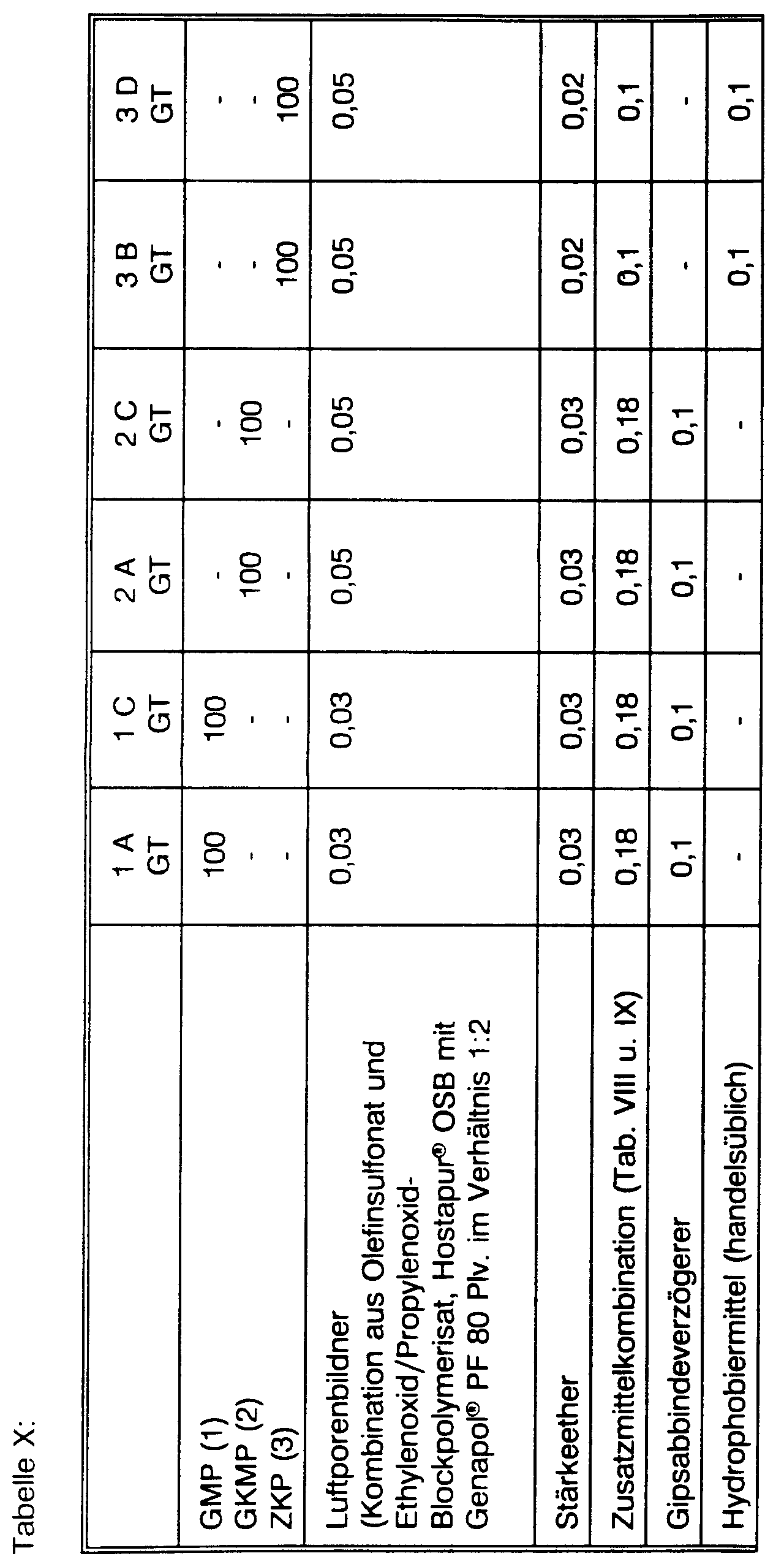


Claims (7)
- Zusatzmittelkombination für wasserhaltige Baustoffgemische bestehend ausa) mindestens 65 Gew.-%, bevorzugt 65 bis 98 Gew.-% eines wasserlöslichen Celluloseethers oder eines Derivates,b) 1 bis 15 Gew.-% Polyacrylamid,c) 1 bis 20 Gew.-% eines Alkali- oder Ammoniumsalzes eines vernetzten, gegebenenfalls mit Stärke gepfropften Polyacrylats,d) 0-20 Gew.-% Stärkeether unde) 0 bis 15 Gew.-% eines wasserlöslichen Alkali-, Erdalkali- oder Ammoniumsalzes von Arylsulfonsäure-Formaldehyd-Kondensationsprodukten oder eines sulfonsäuremodifizierten Polykondensationsproduktes aus Melamin und Formaldehyd.
- Zusatzmittelkombination nach Anspruch 1, dadurch gekennzeichnet, daß sie als wasserlösliche Celluloseether Methylhydroxyalkylcellulose, Hydroxyalkylcellulose und/oder Alkoxyhydroxyethylhydroxypropylcellulose mit einer Viskosität im Bereich von 10 bis 500000, insbesondere 50 bis 150000 mPa·s, enthält.
- Zusatzmittelkombination nach Anspruch 1 oder 2, dadurch gekennzeichnet, daß sie als Polyacrylamide anionische, kationische und/oder nichtionische Polyacrylamide mit einem Molekulargewicht (Gewichtsmittel)

- Zusatzmittelkombination nach einem der Ansprüche 1 bis 3, dadurch gekennzeichnet, daß sie als Stärkeether Hydroxypropylstärke, Carboxymethylstärke und/oder Hydroxypropylcarboxymethylstärke enthält.
- Baustoffgemische, enthaltend eine Zusatzmittelkombination nach einem der Ansprüche 1 bis 4.
- Baustoffgemische nach Anspruch 5, enthaltend 0,01 bis 2, bevorzugt 0,02 bis 1 Gew.-%, bezogen auf die Trockenmasse, der Zusatzmittelkombination.
- Verwendung der Zusatzmittelkombination nach einem der Ansprüche 1 bis 4 in Baustoffgemischen, insbesondere für Zementfliesenkleber, Spachtelmassen und Putze.
Applications Claiming Priority (2)
| Application Number | Priority Date | Filing Date | Title |
|---|---|---|---|
| DE4129169 | 1991-09-03 | ||
| DE4129169 | 1991-09-03 |
Publications (2)
| Publication Number | Publication Date |
|---|---|
| EP0530768A1 true EP0530768A1 (de) | 1993-03-10 |
| EP0530768B1 EP0530768B1 (de) | 1996-02-07 |
Family
ID=6439697
Family Applications (1)
| Application Number | Title | Priority Date | Filing Date |
|---|---|---|---|
| EP92114980A Expired - Lifetime EP0530768B1 (de) | 1991-09-03 | 1992-09-02 | Zusatzmittelkombination zur Verbesserung der Verarbeitbarkeit von wasserhaltigen Baustoffgemischen |
Country Status (11)
| Country | Link |
|---|---|
| US (1) | US5387626A (de) |
| EP (1) | EP0530768B1 (de) |
| JP (1) | JPH05201756A (de) |
| KR (1) | KR930005937A (de) |
| AT (1) | ATE133928T1 (de) |
| BR (1) | BR9203431A (de) |
| CZ (1) | CZ274392A3 (de) |
| DE (1) | DE59205287D1 (de) |
| ES (1) | ES2083041T3 (de) |
| MX (1) | MX9205038A (de) |
| TW (1) | TW210994B (de) |
Cited By (34)
| Publication number | Priority date | Publication date | Assignee | Title |
|---|---|---|---|---|
| DE3716974A1 (de) * | 1986-05-20 | 1987-12-10 | Nippon Zeon Co | Hydraulische masse |
| EP0520413A3 (de) * | 1991-06-25 | 1994-04-20 | Japan Dev & Construction | |
| DE4430362A1 (de) * | 1994-08-26 | 1996-02-29 | Sueddeutsche Kalkstickstoff | Fließmittel für zementhaltige Bindemittelsuspensionen |
| EP0774445A1 (de) * | 1995-11-14 | 1997-05-21 | Hercules Incorporated | Kalkenthaltender Gipsputz |
| EP0775678A1 (de) | 1995-11-25 | 1997-05-28 | Hoechst Aktiengesellschaft | Baustoffmischung |
| EP0955277A1 (de) * | 1998-04-28 | 1999-11-10 | Coöperatieve Verkoop- en Productievereniging van Aardappelmeel en Derivaten 'AVEBE' B.A. | Polysacharid-enthaltender, selbst-verdichtender Beton |
| WO1999064368A1 (en) * | 1998-06-10 | 1999-12-16 | The Dow Chemical Company | Additive composition for water-based building material mixtures |
| US6042638A (en) * | 1996-05-09 | 2000-03-28 | Glynson Industries, Inc. | Biocidal coating composition |
| US6231650B1 (en) | 1999-09-17 | 2001-05-15 | Alistagen Corporation | Biocidal coating composition |
| US6280509B1 (en) | 1996-05-09 | 2001-08-28 | Alistagen Corporation | Biocidal coating compositions and method |
| WO2004101952A1 (en) * | 2003-05-14 | 2004-11-25 | Services Petroliers Schlumberger | Self adaptive cement systems |
| EP1529805A1 (de) * | 2003-11-07 | 2005-05-11 | Wolff Cellulosics GmbH & Co.KG | Lagerstabile Teilchenzusammensetzung aus Polysacchariden und/oder Polysaccharidderivaten und zumindestens einem synthetischen Polymerisat, ein Verfahren zu deren Herstellung sowie deren Verwendung in Baustoffgemischen |
| WO2005105702A1 (en) * | 2004-04-27 | 2005-11-10 | Hercules Incorporated | Cement-based systems using water retention agents prepared from raw cotton linters |
| WO2005105699A1 (en) * | 2004-04-27 | 2005-11-10 | Hercules Incorporated | Cement-based plasters using water rentention agents prepared from raw cotton linters |
| WO2005105697A1 (en) * | 2004-04-27 | 2005-11-10 | Hercules Incorporated | Tile cement mortars using water retention agents |
| WO2005105698A1 (en) * | 2004-04-27 | 2005-11-10 | Hercules Incorporated | Gypsum-based mortars using water retention agents prepared from raw cotton linters |
| EP1676821A1 (de) * | 2004-12-29 | 2006-07-05 | Coöperatieve Verkoop- en Productievereniging van Aardappelmeel en Derivaten 'AVEBE' B.A. | Betonformkörper |
| WO2009024105A1 (de) * | 2007-08-23 | 2009-02-26 | Christoph Maier | Additivzusammensetzung für baustoffe auf mineralischer basis |
| FR2930258A1 (fr) * | 2008-04-22 | 2009-10-23 | Lafarge Platres Sa | Enduit de finition convenant pour support acoustique |
| US7642223B2 (en) | 2004-10-18 | 2010-01-05 | Halliburton Energy Services, Inc. | Methods of generating a gas in a plugging composition to improve its sealing ability in a downhole permeable zone |
| US7690429B2 (en) | 2004-10-21 | 2010-04-06 | Halliburton Energy Services, Inc. | Methods of using a swelling agent in a wellbore |
| US7866394B2 (en) | 2003-02-27 | 2011-01-11 | Halliburton Energy Services Inc. | Compositions and methods of cementing in subterranean formations using a swelling agent to inhibit the influx of water into a cement slurry |
| US7870903B2 (en) | 2005-07-13 | 2011-01-18 | Halliburton Energy Services Inc. | Inverse emulsion polymers as lost circulation material |
| US7891424B2 (en) | 2005-03-25 | 2011-02-22 | Halliburton Energy Services Inc. | Methods of delivering material downhole |
| FR2955103A1 (fr) * | 2010-01-13 | 2011-07-15 | Parexlanko | Adjuvant moussant pour la preparation de mousses minerales d'enduits, de mortiers et betons, mousses ainsi obtenues et produits durcis issu de ces mousses |
| WO2012030884A1 (en) * | 2010-08-31 | 2012-03-08 | H.B. Fuller Construction Products Inc. | Easy mix mortar/grout composition, method of making and using thereof |
| US8469095B2 (en) | 2003-05-14 | 2013-06-25 | Schlumberger Technology Corporation | Self adaptive cement systems |
| EP2418185A4 (de) * | 2009-03-12 | 2013-09-11 | Samsung Fine Chemicals Co Ltd | Bruchfeste zusatzmischung für zementmörtel und zementmörtel damit |
| EP2861543B1 (de) | 2012-06-18 | 2016-08-10 | United States Gypsum Company | Zusammensetzung mit einem superabsorbierenden polymer |
| CN109162413A (zh) * | 2018-09-07 | 2019-01-08 | 四川斯明特科技有限公司 | 一种营造生态环境的家装方法 |
| WO2019122787A1 (fr) * | 2017-12-22 | 2019-06-27 | Roquette Freres | Procédé de modification de matière polysaccharidique par fonctionnalisation chimique homogène séquencée |
| BE1026186B1 (nl) * | 2018-09-07 | 2019-10-30 | RDS Group bvba | Een isolerende en waterbestendige mortel |
| WO2021213652A1 (de) * | 2020-04-22 | 2021-10-28 | Wacker Chemie Ag | Superabsorber enthaltende abmischungen |
| EP4180463A1 (de) | 2021-11-12 | 2023-05-17 | Agrana Beteiligungs- Aktiengesellschaft | Hydroxypropylierte granuläre stärke mit niedrigem propylenglycolgehalt |
Families Citing this family (51)
| Publication number | Priority date | Publication date | Assignee | Title |
|---|---|---|---|---|
| AUPP970099A0 (en) * | 1999-04-09 | 1999-05-06 | James Hardie International Finance B.V. | Concrete formulation |
| AUPQ246599A0 (en) * | 1999-08-26 | 1999-09-16 | James Hardie Research Pty Limited | Extrudable cementitious material |
| MXPA02008921A (es) * | 2000-03-14 | 2004-10-15 | James Hardie Res Pty Ltd | Materiales de construccion de fibras-cemento, con aditivos de baja densidad. |
| JP4407779B2 (ja) * | 2000-03-27 | 2010-02-03 | 信越化学工業株式会社 | 押出成形用の水硬性組成物用バインダー及び水硬性組成物並びに押出成形品の製造方法 |
| DE10041311A1 (de) * | 2000-08-23 | 2002-03-07 | Clariant Gmbh | Verfahren zur Modifizierung von Celluseethern |
| US20030164119A1 (en) * | 2002-03-04 | 2003-09-04 | Basil Naji | Additive for dewaterable slurry and slurry incorporating same |
| HUP0303345A3 (en) * | 2001-03-02 | 2004-05-28 | James Hardie Int Finance Bv | A method and apparatus for forming a laminated sheet material by spattering |
| US7105587B2 (en) * | 2001-03-07 | 2006-09-12 | Innovative Construction And Building Materials | Method and composition for polymer-reinforced composite cementitious construction material |
| US6743830B2 (en) * | 2001-03-07 | 2004-06-01 | Innovative Construction And Building Materials | Construction board materials with engineered microstructures |
| WO2003082765A1 (en) * | 2002-03-27 | 2003-10-09 | United States Gypsum Company | High molecular weight additives for calcined gypsum and cementitious compositions |
| US7338990B2 (en) * | 2002-03-27 | 2008-03-04 | United States Gypsum Company | High molecular weight additives for calcined gypsum and cementitious compositions |
| US7993570B2 (en) | 2002-10-07 | 2011-08-09 | James Hardie Technology Limited | Durable medium-density fibre cement composite |
| US6902797B2 (en) * | 2002-11-12 | 2005-06-07 | Innovative Construction And Building Materials | Gypsum-based composite materials reinforced by cellulose ethers |
| US6841232B2 (en) * | 2002-11-12 | 2005-01-11 | Innovative Construction And Building Materials | Reinforced wallboard |
| DE10304816A1 (de) * | 2003-02-06 | 2004-08-19 | Wolff Cellulosics Gmbh & Co. Kg | Celluloseether enthaltende Abmischungen mit erhöhtem Schüttgewicht, deren Verwendung in Baustoffsystemen sowie ein Verfahren zur Herstellung von Celluloseether enthaltenden Abmischungen mit erhöhtem Schüttgewicht |
| DE10337012A1 (de) * | 2003-08-12 | 2005-03-10 | Wolff Cellulosics Gmbh & Co Kg | Celluloseetherzusammensetzung für die Extrusion mineralischer Formkörper sowie ein Verfahren zur Extrusion mineralischer Formkörper unter Verwendung dieser Celluloseetherzusammensetzung |
| US20050139377A1 (en) * | 2003-12-31 | 2005-06-30 | Levy Daniel N. | Paste extruded insulator with air channels |
| US7607483B2 (en) * | 2004-04-19 | 2009-10-27 | Halliburton Energy Services, Inc. | Sealant compositions comprising colloidally stabilized latex and methods of using the same |
| US7998571B2 (en) | 2004-07-09 | 2011-08-16 | James Hardie Technology Limited | Composite cement article incorporating a powder coating and methods of making same |
| US20070111901A1 (en) * | 2005-11-11 | 2007-05-17 | Reddy B R | Method of servicing a wellbore with a sealant composition comprising solid latex |
| US20070111900A1 (en) * | 2005-11-11 | 2007-05-17 | Reddy B R | Sealant compositions comprising solid latex |
| US7488705B2 (en) * | 2004-12-08 | 2009-02-10 | Halliburton Energy Services, Inc. | Oilwell sealant compositions comprising alkali swellable latex |
| US7875114B2 (en) * | 2005-06-14 | 2011-01-25 | United States Gypsum Company | Foamed slurry and building panel made therefrom |
| KR20080032094A (ko) * | 2005-06-14 | 2008-04-14 | 유나이티드 스테이츠 집섬 컴파니 | 2-반복하는 단위 분산제를 활용한 석고 제품 및 이들을제조하기 위한 방법 |
| US7544242B2 (en) | 2005-06-14 | 2009-06-09 | United States Gypsum Company | Effective use of dispersants in wallboard containing foam |
| US7504165B2 (en) * | 2005-06-14 | 2009-03-17 | United States Gypsum Company | High strength flooring compositions |
| US7572328B2 (en) * | 2005-06-14 | 2009-08-11 | United States Gypsum Company | Fast drying gypsum products |
| US20060280899A1 (en) * | 2005-06-14 | 2006-12-14 | United States Gypsum Company | Method of making a gypsum slurry with modifiers and dispersants |
| US20060278127A1 (en) | 2005-06-14 | 2006-12-14 | United States Gypsum Company | Gypsum products utilizing a two-repeating unit dispersant and a method for making them |
| US20060278128A1 (en) * | 2005-06-14 | 2006-12-14 | United States Gypsum Company | Effective use of dispersants in wallboard containing foam |
| US8088218B2 (en) * | 2005-06-14 | 2012-01-03 | United States Gypsum Company | Foamed slurry and building panel made therefrom |
| US20060280898A1 (en) * | 2005-06-14 | 2006-12-14 | United States Gypsum Company | Modifiers for gypsum slurries and method of using them |
| US8993462B2 (en) | 2006-04-12 | 2015-03-31 | James Hardie Technology Limited | Surface sealed reinforced building element |
| US8209927B2 (en) * | 2007-12-20 | 2012-07-03 | James Hardie Technology Limited | Structural fiber cement building materials |
| KR100881343B1 (ko) * | 2007-12-31 | 2009-02-02 | 삼성정밀화학 주식회사 | 시멘트 모르타르용 혼화제 및 이를 포함하는 시멘트모르타르 |
| KR101674535B1 (ko) | 2010-01-12 | 2016-11-09 | 롯데정밀화학 주식회사 | 타일시멘트 모르타르용 혼화제 조성물 및 이를 포함하는 타일시멘트 모르타르 조성물 |
| US9657200B2 (en) | 2012-09-27 | 2017-05-23 | Henkel IP & Holding GmbH | Waterborne adhesives for reduced basis weight multilayer substrates and use thereof |
| US9771499B2 (en) * | 2010-09-10 | 2017-09-26 | Henkel IP & Holding GmbH | Adhesive having structural integrity and insulative properties |
| WO2012033998A2 (en) | 2010-09-10 | 2012-03-15 | Henkel Corporation | Improved adhesive having insulative properties |
| CN103889924B (zh) | 2011-10-21 | 2018-04-10 | 陶氏环球技术有限公司 | 用于水硬性固化组合物的粘液 |
| WO2015081097A1 (en) | 2013-11-27 | 2015-06-04 | Henkel US IP LLC | Adhesive for insulative articles |
| EP3172282B1 (de) | 2014-07-23 | 2020-09-02 | Henkel IP & Holding GmbH | Expandierbare beschichtungszusammensetzungen und verwendungen davon |
| WO2017177209A1 (en) | 2016-04-08 | 2017-10-12 | Aermist Llc | Ceramic matrix compositions and uses thereof |
| AU2017343641B2 (en) | 2016-10-14 | 2022-03-10 | Gcp Applied Technologies Inc. | Controllable high flow concrete |
| US10476502B2 (en) | 2017-04-28 | 2019-11-12 | Cirrus Logic, Inc. | Control of switches in a variable impedance element |
| MX2019014565A (es) | 2017-07-18 | 2020-02-07 | Henkel IP & Holding GmbH | Calentamiento dielectrico de composiciones espumables. |
| MX2020001943A (es) | 2017-08-25 | 2020-09-28 | Henkel IP & Holding GmbH | Proceso para formar bolsa y empaque ecologicamente amigables protectores ecologicos y productos hechos de los mismos. |
| US12157619B2 (en) | 2017-08-25 | 2024-12-03 | Henkel Ag & Co. Kgaa | Process for forming improved protective eco-friendly pouch and packaging and products made therefrom |
| EP3527361A1 (de) | 2018-02-16 | 2019-08-21 | Henkel AG & Co. KGaA | Verfahren zur herstellung eines mehrschichtigen substrats |
| KR102424551B1 (ko) * | 2020-08-03 | 2022-07-25 | 동남기업 주식회사 | 조기강도 발현형 콘크리트 조성물 |
| KR102589585B1 (ko) * | 2021-04-21 | 2023-10-16 | 디엘이앤씨 주식회사 | 작업성 및 재료분리에 대한 저항성이 우수한 콘크리트 조성물 |
Citations (8)
| Publication number | Priority date | Publication date | Assignee | Title |
|---|---|---|---|---|
| FR1381817A (fr) * | 1963-02-01 | 1964-12-14 | Nouveau procédé de plafonnage et de décoration et produits destinés à réaliserce procédé | |
| FR2154035A5 (de) * | 1971-09-18 | 1973-05-04 | Sueddeutsche Kalkstickstoff | |
| DE2735216A1 (de) * | 1976-09-15 | 1978-03-16 | Ici Ltd | Calciumsulfat-hemihydrat-gipsmasse |
| EP0141360A2 (de) * | 1983-11-04 | 1985-05-15 | Wolff Walsrode Aktiengesellschaft | Wasserlösliche, mit Polymeren modifizierte Hydroxyalkylmethylcellulose und deren Verwendung als Zusatzmittel für asbestfreie Fliesenkleber-Formulierungen |
| US4687516A (en) * | 1984-12-11 | 1987-08-18 | Halliburton Company | Liquid fluid loss control additive for oil field cements |
| EP0327351A2 (de) * | 1988-02-02 | 1989-08-09 | The Dow Chemical Company | Polymermischung zur Verwendung in Dünnbett-Mörtel Zusammensetzungen |
| EP0375332A2 (de) * | 1988-12-19 | 1990-06-27 | The Dow Chemical Company | Bindemittel-Zusammensetzung aus einem Hydroxypropylenmethylcelluloseäthers mit hoher Viskosität und einem solchen mit niedriger Viskosität |
| DE3920025A1 (de) * | 1989-06-20 | 1991-01-03 | Aqualon Gmbh | Additivgemische auf basis von alkyl-, alkyl-hydroxyalkyl- und/oder hydroxyalkylzellulosen fuer moertel, spachtelmassen und/oder putzmassen auf gipsbasis und ihre anwendung in diesen bauhilfsmitteln |
Family Cites Families (9)
| Publication number | Priority date | Publication date | Assignee | Title |
|---|---|---|---|---|
| DE1283726B (de) * | 1964-06-05 | 1968-11-21 | Ardex Chemie Gmbh Fa | Zementmoertel mit Zuschlagstoffen, insbesondere zum Nivellieren und Glaetten von Wand-, Decken- und Bodenflaechen |
| DE1646501A1 (de) * | 1967-12-30 | 1971-03-11 | Dyckerhoff Zementwerke Ag | Zum Putzen und Mauern geeignetes Bindemittel |
| AT296863B (de) * | 1967-12-30 | 1972-02-25 | Dyckerhoff Zementwerke Ag | Hydraulisches Bindemittel zur Herstellung von Putz- und Mauermörtel |
| US3847630A (en) * | 1972-10-27 | 1974-11-12 | Henkel & Cie Gmbh | Method for the production of water-permeable porous concrete |
| US4021257A (en) * | 1973-11-02 | 1977-05-03 | Tile Council Of America, Inc. | Cementious composition for use in preparing pointing compounds or mortar compounds |
| US4654085A (en) * | 1984-10-11 | 1987-03-31 | Henkel Kommanditgesellschaft Auf Aktien | Additive for cementitious compositions |
| DE3609545A1 (de) * | 1986-03-21 | 1987-09-24 | Basf Ag | Verfahren zur diskontinuierlichen herstellung von vernetzten, feinteiligen polymerisaten |
| DE3716974A1 (de) * | 1986-05-20 | 1987-12-10 | Nippon Zeon Co | Hydraulische masse |
| DE3929400A1 (de) * | 1989-09-05 | 1991-03-07 | Wolff Walsrode Ag | Neue celluloseether-zusammensetzungen fuer waessrige medien |
-
1992
- 1992-08-08 TW TW081106287A patent/TW210994B/zh active
- 1992-09-02 ES ES92114980T patent/ES2083041T3/es not_active Expired - Lifetime
- 1992-09-02 BR BR929203431A patent/BR9203431A/pt not_active Application Discontinuation
- 1992-09-02 AT AT92114980T patent/ATE133928T1/de not_active IP Right Cessation
- 1992-09-02 CZ CS922743A patent/CZ274392A3/cs unknown
- 1992-09-02 MX MX9205038A patent/MX9205038A/es unknown
- 1992-09-02 JP JP4234944A patent/JPH05201756A/ja not_active Withdrawn
- 1992-09-02 DE DE59205287T patent/DE59205287D1/de not_active Expired - Fee Related
- 1992-09-02 EP EP92114980A patent/EP0530768B1/de not_active Expired - Lifetime
- 1992-09-03 KR KR1019920015982A patent/KR930005937A/ko not_active Withdrawn
-
1994
- 1994-04-28 US US08/234,730 patent/US5387626A/en not_active Expired - Fee Related
Patent Citations (8)
| Publication number | Priority date | Publication date | Assignee | Title |
|---|---|---|---|---|
| FR1381817A (fr) * | 1963-02-01 | 1964-12-14 | Nouveau procédé de plafonnage et de décoration et produits destinés à réaliserce procédé | |
| FR2154035A5 (de) * | 1971-09-18 | 1973-05-04 | Sueddeutsche Kalkstickstoff | |
| DE2735216A1 (de) * | 1976-09-15 | 1978-03-16 | Ici Ltd | Calciumsulfat-hemihydrat-gipsmasse |
| EP0141360A2 (de) * | 1983-11-04 | 1985-05-15 | Wolff Walsrode Aktiengesellschaft | Wasserlösliche, mit Polymeren modifizierte Hydroxyalkylmethylcellulose und deren Verwendung als Zusatzmittel für asbestfreie Fliesenkleber-Formulierungen |
| US4687516A (en) * | 1984-12-11 | 1987-08-18 | Halliburton Company | Liquid fluid loss control additive for oil field cements |
| EP0327351A2 (de) * | 1988-02-02 | 1989-08-09 | The Dow Chemical Company | Polymermischung zur Verwendung in Dünnbett-Mörtel Zusammensetzungen |
| EP0375332A2 (de) * | 1988-12-19 | 1990-06-27 | The Dow Chemical Company | Bindemittel-Zusammensetzung aus einem Hydroxypropylenmethylcelluloseäthers mit hoher Viskosität und einem solchen mit niedriger Viskosität |
| DE3920025A1 (de) * | 1989-06-20 | 1991-01-03 | Aqualon Gmbh | Additivgemische auf basis von alkyl-, alkyl-hydroxyalkyl- und/oder hydroxyalkylzellulosen fuer moertel, spachtelmassen und/oder putzmassen auf gipsbasis und ihre anwendung in diesen bauhilfsmitteln |
Cited By (42)
| Publication number | Priority date | Publication date | Assignee | Title |
|---|---|---|---|---|
| DE3716974A1 (de) * | 1986-05-20 | 1987-12-10 | Nippon Zeon Co | Hydraulische masse |
| EP0520413A3 (de) * | 1991-06-25 | 1994-04-20 | Japan Dev & Construction | |
| CN1051751C (zh) * | 1991-06-25 | 2000-04-26 | 日本国土开发株式会社 | 混凝土组合物 |
| DE4430362A1 (de) * | 1994-08-26 | 1996-02-29 | Sueddeutsche Kalkstickstoff | Fließmittel für zementhaltige Bindemittelsuspensionen |
| EP0774445A1 (de) * | 1995-11-14 | 1997-05-21 | Hercules Incorporated | Kalkenthaltender Gipsputz |
| EP0775678A1 (de) | 1995-11-25 | 1997-05-28 | Hoechst Aktiengesellschaft | Baustoffmischung |
| US6042638A (en) * | 1996-05-09 | 2000-03-28 | Glynson Industries, Inc. | Biocidal coating composition |
| US6280509B1 (en) | 1996-05-09 | 2001-08-28 | Alistagen Corporation | Biocidal coating compositions and method |
| EP0955277A1 (de) * | 1998-04-28 | 1999-11-10 | Coöperatieve Verkoop- en Productievereniging van Aardappelmeel en Derivaten 'AVEBE' B.A. | Polysacharid-enthaltender, selbst-verdichtender Beton |
| WO1999064368A1 (en) * | 1998-06-10 | 1999-12-16 | The Dow Chemical Company | Additive composition for water-based building material mixtures |
| US6231650B1 (en) | 1999-09-17 | 2001-05-15 | Alistagen Corporation | Biocidal coating composition |
| US7866394B2 (en) | 2003-02-27 | 2011-01-11 | Halliburton Energy Services Inc. | Compositions and methods of cementing in subterranean formations using a swelling agent to inhibit the influx of water into a cement slurry |
| US8469095B2 (en) | 2003-05-14 | 2013-06-25 | Schlumberger Technology Corporation | Self adaptive cement systems |
| WO2004101952A1 (en) * | 2003-05-14 | 2004-11-25 | Services Petroliers Schlumberger | Self adaptive cement systems |
| US8551244B2 (en) | 2003-05-14 | 2013-10-08 | Schlumberger Technology Corporation | Self adaptive cement systems |
| EP1529805A1 (de) * | 2003-11-07 | 2005-05-11 | Wolff Cellulosics GmbH & Co.KG | Lagerstabile Teilchenzusammensetzung aus Polysacchariden und/oder Polysaccharidderivaten und zumindestens einem synthetischen Polymerisat, ein Verfahren zu deren Herstellung sowie deren Verwendung in Baustoffgemischen |
| WO2005105699A1 (en) * | 2004-04-27 | 2005-11-10 | Hercules Incorporated | Cement-based plasters using water rentention agents prepared from raw cotton linters |
| WO2005105697A1 (en) * | 2004-04-27 | 2005-11-10 | Hercules Incorporated | Tile cement mortars using water retention agents |
| WO2005105698A1 (en) * | 2004-04-27 | 2005-11-10 | Hercules Incorporated | Gypsum-based mortars using water retention agents prepared from raw cotton linters |
| WO2005105702A1 (en) * | 2004-04-27 | 2005-11-10 | Hercules Incorporated | Cement-based systems using water retention agents prepared from raw cotton linters |
| US7642223B2 (en) | 2004-10-18 | 2010-01-05 | Halliburton Energy Services, Inc. | Methods of generating a gas in a plugging composition to improve its sealing ability in a downhole permeable zone |
| US7690429B2 (en) | 2004-10-21 | 2010-04-06 | Halliburton Energy Services, Inc. | Methods of using a swelling agent in a wellbore |
| EP1676821A1 (de) * | 2004-12-29 | 2006-07-05 | Coöperatieve Verkoop- en Productievereniging van Aardappelmeel en Derivaten 'AVEBE' B.A. | Betonformkörper |
| WO2006071116A1 (en) * | 2004-12-29 | 2006-07-06 | Coöperatie Avebe U.A. | Shaped concrete body |
| US7891424B2 (en) | 2005-03-25 | 2011-02-22 | Halliburton Energy Services Inc. | Methods of delivering material downhole |
| US7870903B2 (en) | 2005-07-13 | 2011-01-18 | Halliburton Energy Services Inc. | Inverse emulsion polymers as lost circulation material |
| US8703657B2 (en) | 2005-07-13 | 2014-04-22 | Halliburton Energy Services, Inc. | Inverse emulsion polymers as lost circulation material |
| WO2009024105A1 (de) * | 2007-08-23 | 2009-02-26 | Christoph Maier | Additivzusammensetzung für baustoffe auf mineralischer basis |
| FR2930258A1 (fr) * | 2008-04-22 | 2009-10-23 | Lafarge Platres Sa | Enduit de finition convenant pour support acoustique |
| EP2418185A4 (de) * | 2009-03-12 | 2013-09-11 | Samsung Fine Chemicals Co Ltd | Bruchfeste zusatzmischung für zementmörtel und zementmörtel damit |
| WO2011086133A1 (fr) * | 2010-01-13 | 2011-07-21 | Parexlanko | Adjuvant moussant pour la preparation de mousses minerales d'enduits, de mortiers et betons, mousses ainsi obtenues et produits durcis issus de ces mousses |
| CN102791656A (zh) * | 2010-01-13 | 2012-11-21 | 帕雷克斯集团有限公司 | 制备用于抹灰、砂浆和混凝土的矿物泡沫的发泡掺加物,由此获得的泡沫以及这些泡沫制成的硬化产品 |
| FR2955103A1 (fr) * | 2010-01-13 | 2011-07-15 | Parexlanko | Adjuvant moussant pour la preparation de mousses minerales d'enduits, de mortiers et betons, mousses ainsi obtenues et produits durcis issu de ces mousses |
| WO2012030884A1 (en) * | 2010-08-31 | 2012-03-08 | H.B. Fuller Construction Products Inc. | Easy mix mortar/grout composition, method of making and using thereof |
| EP2861543B1 (de) | 2012-06-18 | 2016-08-10 | United States Gypsum Company | Zusammensetzung mit einem superabsorbierenden polymer |
| WO2019122787A1 (fr) * | 2017-12-22 | 2019-06-27 | Roquette Freres | Procédé de modification de matière polysaccharidique par fonctionnalisation chimique homogène séquencée |
| FR3075799A1 (fr) * | 2017-12-22 | 2019-06-28 | Roquette Freres | Procede de modification de matiere polysaccharidique par fonctionnalisation chimique homogene sequencee |
| CN109162413A (zh) * | 2018-09-07 | 2019-01-08 | 四川斯明特科技有限公司 | 一种营造生态环境的家装方法 |
| BE1026186B1 (nl) * | 2018-09-07 | 2019-10-30 | RDS Group bvba | Een isolerende en waterbestendige mortel |
| WO2021213652A1 (de) * | 2020-04-22 | 2021-10-28 | Wacker Chemie Ag | Superabsorber enthaltende abmischungen |
| EP4180463A1 (de) | 2021-11-12 | 2023-05-17 | Agrana Beteiligungs- Aktiengesellschaft | Hydroxypropylierte granuläre stärke mit niedrigem propylenglycolgehalt |
| WO2023084025A1 (en) | 2021-11-12 | 2023-05-19 | Agrana Beteiligungs-Aktiengesellschaft | Hydroxypropylated granular starch with low propylene glycol content |
Also Published As
| Publication number | Publication date |
|---|---|
| DE59205287D1 (de) | 1996-03-21 |
| KR930005937A (ko) | 1993-04-20 |
| EP0530768B1 (de) | 1996-02-07 |
| ES2083041T3 (es) | 1996-04-01 |
| ATE133928T1 (de) | 1996-02-15 |
| JPH05201756A (ja) | 1993-08-10 |
| TW210994B (de) | 1993-08-11 |
| CZ274392A3 (en) | 1993-03-17 |
| US5387626A (en) | 1995-02-07 |
| BR9203431A (pt) | 1993-04-06 |
| MX9205038A (es) | 1993-07-30 |
Similar Documents
| Publication | Publication Date | Title |
|---|---|---|
| EP0530768B1 (de) | Zusatzmittelkombination zur Verbesserung der Verarbeitbarkeit von wasserhaltigen Baustoffgemischen | |
| DE3854410T2 (de) | 3-Alkoxy-2-hydroxypropylcellulosederivate und ihre Verwendung in Baumaterialien. | |
| EP0504870B1 (de) | Verdickermischungen für Baustoffe | |
| DE69622378T2 (de) | Stabile, wasserresistente wässrige schaumzubereitung | |
| DE69729995T2 (de) | Zusatzmittel für zementzusammensetzungen | |
| EP0573847B1 (de) | Verwendung von carboxymethylierten Methylhydroxyethyl- oder Methylhydroxypropylcelluloseethern und daraus erhältliche Zementmischungen | |
| DE60320011T2 (de) | Verstärkte wandplatte | |
| DE68906074T2 (de) | Wasserbestaendigkeit erhoehender zusatz fuer zementzusammensetzungen. | |
| EP1686103A2 (de) | Fliesenkleber-Zusammensetzung mit Leichtfüllstoff | |
| DE10013577A1 (de) | Verwendung von Polysacchariden oder Polysaccharidderivaten, die nach Vergelung und Heiß-Dampf-Mahltrocknung mittels Gas- oder Wasserdampftrocknung hergestellt wurden, in Baustoffgemischen | |
| EP1984410A1 (de) | Wasserlösliche sulfogruppenhaltige copolymere, verfahren zu deren herstellung und ihre verwendung | |
| DE2238095B2 (de) | Gipsmasse und Verfahren zur kontinuierlichen Herstellung von Formkörpern aus der Gipsmasse | |
| DE2049114B2 (de) | Herstellen freifliessender, blockfester, redispergierbarer kunststoffpulver | |
| DE10226088A1 (de) | Additiv für hydraulisch abbindende Systeme, die hydraulisch abbindenden Mischungen sowie deren Verwendung | |
| EP2496535A2 (de) | Wasserlösliche hydrophob assoziierende nanokomposite (als rheologiemodifizierer für bauchemische anwendungen) | |
| DE2652569A1 (de) | Zementmassen fuer keramische fliesen und platten | |
| DE60222923T2 (de) | Wässrige zementzusammensetzung | |
| EP2796436A1 (de) | Verfahren zur Behandlung von Gips | |
| DE102011120101B4 (de) | Zur Extrusion von Zement-gebundenen Gegenständen mit verbesserten Eigenschaften geeignete Celluloseether | |
| EP0824093B1 (de) | Zusatzmittel für Spritzbeton | |
| CH684945A5 (de) | Feinputzmasse. | |
| DE68927772T2 (de) | Wasserabsorbierendes Polymer und Verfahren zu seiner Herstellung | |
| DE19537141A1 (de) | Verfahren zur Herstellung einer Betonstruktur nach der Gleitschaltungsmethode | |
| DE60212646T2 (de) | Verwendung eines Dispergiermittels für wässrige Calciumsulfathemihydrat-Zusammensetzungen | |
| DE2820389C3 (de) | Verfahren zur Herstellung von wäßrigen Polyvinylalkohol-Dispersionen und deren Verwendung als Zementzusätze |
Legal Events
| Date | Code | Title | Description |
|---|---|---|---|
| PUAI | Public reference made under article 153(3) epc to a published international application that has entered the european phase |
Free format text: ORIGINAL CODE: 0009012 |
|
| AK | Designated contracting states |
Kind code of ref document: A1 Designated state(s): AT BE CH DE ES FR GB IT LI |
|
| 17P | Request for examination filed |
Effective date: 19930809 |
|
| 17Q | First examination report despatched |
Effective date: 19940829 |
|
| GRAA | (expected) grant |
Free format text: ORIGINAL CODE: 0009210 |
|
| AK | Designated contracting states |
Kind code of ref document: B1 Designated state(s): AT BE CH DE ES FR GB IT LI |
|
| REF | Corresponds to: |
Ref document number: 133928 Country of ref document: AT Date of ref document: 19960215 Kind code of ref document: T |
|
| REF | Corresponds to: |
Ref document number: 59205287 Country of ref document: DE Date of ref document: 19960321 |
|
| REG | Reference to a national code |
Ref country code: ES Ref legal event code: FG2A Ref document number: 2083041 Country of ref document: ES Kind code of ref document: T3 |
|
| ITF | It: translation for a ep patent filed | ||
| ET | Fr: translation filed | ||
| GBT | Gb: translation of ep patent filed (gb section 77(6)(a)/1977) |
Effective date: 19960502 |
|
| PGFP | Annual fee paid to national office [announced via postgrant information from national office to epo] |
Ref country code: GB Payment date: 19960822 Year of fee payment: 5 |
|
| PG25 | Lapsed in a contracting state [announced via postgrant information from national office to epo] |
Ref country code: LI Effective date: 19960930 Ref country code: CH Effective date: 19960930 |
|
| PLBE | No opposition filed within time limit |
Free format text: ORIGINAL CODE: 0009261 |
|
| 26N | No opposition filed | ||
| REG | Reference to a national code |
Ref country code: CH Ref legal event code: PL |
|
| PG25 | Lapsed in a contracting state [announced via postgrant information from national office to epo] |
Ref country code: GB Free format text: LAPSE BECAUSE OF NON-PAYMENT OF DUE FEES Effective date: 19970902 |
|
| GBPC | Gb: european patent ceased through non-payment of renewal fee |
Effective date: 19970902 |
|
| PGFP | Annual fee paid to national office [announced via postgrant information from national office to epo] |
Ref country code: AT Payment date: 19980714 Year of fee payment: 7 |
|
| PGFP | Annual fee paid to national office [announced via postgrant information from national office to epo] |
Ref country code: FR Payment date: 19980715 Year of fee payment: 7 |
|
| PGFP | Annual fee paid to national office [announced via postgrant information from national office to epo] |
Ref country code: BE Payment date: 19980717 Year of fee payment: 7 |
|
| PGFP | Annual fee paid to national office [announced via postgrant information from national office to epo] |
Ref country code: ES Payment date: 19980916 Year of fee payment: 7 |
|
| PGFP | Annual fee paid to national office [announced via postgrant information from national office to epo] |
Ref country code: DE Payment date: 19981113 Year of fee payment: 7 |
|
| PG25 | Lapsed in a contracting state [announced via postgrant information from national office to epo] |
Ref country code: AT Free format text: LAPSE BECAUSE OF NON-PAYMENT OF DUE FEES Effective date: 19990902 |
|
| PG25 | Lapsed in a contracting state [announced via postgrant information from national office to epo] |
Ref country code: ES Free format text: LAPSE BECAUSE OF NON-PAYMENT OF DUE FEES Effective date: 19990903 |
|
| PG25 | Lapsed in a contracting state [announced via postgrant information from national office to epo] |
Ref country code: BE Free format text: LAPSE BECAUSE OF NON-PAYMENT OF DUE FEES Effective date: 19990930 |
|
| BERE | Be: lapsed |
Owner name: HOECHST A.G. Effective date: 19990930 |
|
| PG25 | Lapsed in a contracting state [announced via postgrant information from national office to epo] |
Ref country code: FR Free format text: LAPSE BECAUSE OF NON-PAYMENT OF DUE FEES Effective date: 20000531 |
|
| PG25 | Lapsed in a contracting state [announced via postgrant information from national office to epo] |
Ref country code: DE Free format text: LAPSE BECAUSE OF NON-PAYMENT OF DUE FEES Effective date: 20000701 |
|
| REG | Reference to a national code |
Ref country code: FR Ref legal event code: ST |
|
| REG | Reference to a national code |
Ref country code: ES Ref legal event code: FD2A Effective date: 20001013 |
|
| PG25 | Lapsed in a contracting state [announced via postgrant information from national office to epo] |
Ref country code: IT Free format text: LAPSE BECAUSE OF NON-PAYMENT OF DUE FEES;WARNING: LAPSES OF ITALIAN PATENTS WITH EFFECTIVE DATE BEFORE 2007 MAY HAVE OCCURRED AT ANY TIME BEFORE 2007. THE CORRECT EFFECTIVE DATE MAY BE DIFFERENT FROM THE ONE RECORDED. Effective date: 20050902 |