EP0525904B1 - Mixed ligand aluminum chelate luminophors - Google Patents
Mixed ligand aluminum chelate luminophors Download PDFInfo
- Publication number
- EP0525904B1 EP0525904B1 EP92202324A EP92202324A EP0525904B1 EP 0525904 B1 EP0525904 B1 EP 0525904B1 EP 92202324 A EP92202324 A EP 92202324A EP 92202324 A EP92202324 A EP 92202324A EP 0525904 B1 EP0525904 B1 EP 0525904B1
- Authority
- EP
- European Patent Office
- Prior art keywords
- aluminum
- blue emitting
- iii
- composition according
- bis
- Prior art date
- Legal status (The legal status is an assumption and is not a legal conclusion. Google has not performed a legal analysis and makes no representation as to the accuracy of the status listed.)
- Expired - Lifetime
Links
- 0 *C1(*)NOc(cccc2cc3)c2*1c3*#* Chemical compound *C1(*)NOc(cccc2cc3)c2*1c3*#* 0.000 description 6
- YXVFYQXJAXKLAK-UHFFFAOYSA-N Oc(cc1)ccc1-c1ccccc1 Chemical compound Oc(cc1)ccc1-c1ccccc1 YXVFYQXJAXKLAK-UHFFFAOYSA-N 0.000 description 1
- UBXYXCRCOKCZIT-UHFFFAOYSA-N Oc1cccc(-c2ccccc2)c1 Chemical compound Oc1cccc(-c2ccccc2)c1 UBXYXCRCOKCZIT-UHFFFAOYSA-N 0.000 description 1
- LLEMOWNGBBNAJR-UHFFFAOYSA-N Oc1ccccc1-c1ccccc1 Chemical compound Oc1ccccc1-c1ccccc1 LLEMOWNGBBNAJR-UHFFFAOYSA-N 0.000 description 1
Images
Classifications
-
- C—CHEMISTRY; METALLURGY
- C09—DYES; PAINTS; POLISHES; NATURAL RESINS; ADHESIVES; COMPOSITIONS NOT OTHERWISE PROVIDED FOR; APPLICATIONS OF MATERIALS NOT OTHERWISE PROVIDED FOR
- C09K—MATERIALS FOR MISCELLANEOUS APPLICATIONS, NOT PROVIDED FOR ELSEWHERE
- C09K11/00—Luminescent materials, e.g. electroluminescent or chemiluminescent
- C09K11/06—Luminescent materials, e.g. electroluminescent or chemiluminescent containing organic luminescent materials
-
- C—CHEMISTRY; METALLURGY
- C07—ORGANIC CHEMISTRY
- C07F—ACYCLIC, CARBOCYCLIC OR HETEROCYCLIC COMPOUNDS CONTAINING ELEMENTS OTHER THAN CARBON, HYDROGEN, HALOGEN, OXYGEN, NITROGEN, SULFUR, SELENIUM OR TELLURIUM
- C07F5/00—Compounds containing elements of Groups 3 or 13 of the Periodic Table
- C07F5/06—Aluminium compounds
- C07F5/069—Aluminium compounds without C-aluminium linkages
-
- H—ELECTRICITY
- H10—SEMICONDUCTOR DEVICES; ELECTRIC SOLID-STATE DEVICES NOT OTHERWISE PROVIDED FOR
- H10K—ORGANIC ELECTRIC SOLID-STATE DEVICES
- H10K85/00—Organic materials used in the body or electrodes of devices covered by this subclass
- H10K85/30—Coordination compounds
- H10K85/321—Metal complexes comprising a group IIIA element, e.g. Tris (8-hydroxyquinoline) gallium [Gaq3]
-
- H—ELECTRICITY
- H10—SEMICONDUCTOR DEVICES; ELECTRIC SOLID-STATE DEVICES NOT OTHERWISE PROVIDED FOR
- H10K—ORGANIC ELECTRIC SOLID-STATE DEVICES
- H10K50/00—Organic light-emitting devices
- H10K50/10—OLEDs or polymer light-emitting diodes [PLED]
- H10K50/11—OLEDs or polymer light-emitting diodes [PLED] characterised by the electroluminescent [EL] layers
Definitions
- the invention relates to novel luminescent compositions.
- luminescent materials Materials that can be stimulated to emit light, commonly referred to as luminescent materials or luminophors, can be employed in a wide variety of applications.
- a luminophor can be employed to absorb ultraviolet radiation and emit visible light.
- stimulating sources of radiation such as electrons, ⁇ or ⁇ particles, ⁇ rays or X rays, can be employed.
- electroluminescence the recombination of hole-electron pairs can provide the stimulating energy source for luminescence.
- the invention is directed to a blue emitting luminescent composition comprised of an aluminum chelate of the formula: (R s -Q)2-Al-O-L where Q in each occurrence represents a substituted 8-quinolinolato ligand, R s represents an 8-quinolinolato ring substituent chosen to block sterically the attachment of more than two substituted 8-quinolinolato ligands to the aluminum atom, O-L is phenolato ligand, and L is a hydrocarbon of from 6 to 24 carbon atoms comprised of a phenyl moiety.
- the invention is directed to a composition of the type described further characterized in that the composition additionally includes a fluorescent dye.
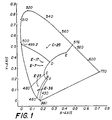
- Figure 1 is a 1931 C.I.E. chromaticity diagram with color regions of specific interest delineated.
- the present invention is directed to a novel luminescent composition that is blue emitting, and capable of vapor deposition.
- the composition is suited in terms of luminescence, vapor deposition characteristics, stability and electroluminescence efficiency for incorporation in an organic EL device as the luminescent layer.
- the terms “blue emitting” and “green emitting” are easy enough to understand and identify in most instances; but since there is a continuous spectrum of hues ranging from pure blue to pure green, a quantitative basis is required for precise delineation.
- This quantitative basis is provided by the 1931 C.I.E. chromaticity diagram shown in Figure 1.
- the 1931 C.I.E. chromaticity diagram is a widely accepted approach for quantifying hue within the visible spectrum.
- a full explanation of the 1931 C.I.E. chromaticity diagram is provided by Wyszecki and Stiles, Color Science, Concepts and Methods: Quantitative Data and Formulae, 2nd Ed., Chapter 3, Colorimetry, Wiley, 1982, pp. 117-143, and more succinct explanation is provided by James , The Theory of the Photographic Process, 4th Ed., Macmillan, 1977, Chapter 19, II, B. Colorimetry, pp. 563-565.
- the x and y axes are employed as descriptors for precisely locating each visible hue.
- the term "blue emitting” refers to the area of the diagram defined by the points extending from 430 to 499.2 nm to D, C, B and A and back to 430 nm.
- the area extending from 460 to 480 nm to C to B and back to 460 nm is perceived by the eye as being blue.
- the area extending from 430 to 460 nm to B to A and back to 430 nm is perceived by the eye as being bluish purple.
- the area extending from 480 to 499.2 nm to D to C and back to 480 nm is perceived by the eye as being greenish blue or bluish green.
- the area to right of points A, B, C and D are excluded, since the hue is so desaturated that the visual perception is primarily that of white.
- green emitting refers to the area of the diagram defined by the points extending from 499.2 to 576 nm to E and D and back to 499.2 nm. It is in this area of the spectrum that conventional green emitting organic EL devices emit. To the right of the boundary defined by 499.2 and D the observed hue is green while the left of the boundary defined by 576 and E the observed hue is greenish yellow.
- the blue emitting luminescent composition is comprised of a mixed ligand aluminum chelate, specifically a bis(R s -8-quinolinolato)(phenolato)-aluminum(III) chelate, where R s is a ring substituent of the 8-quinolinolato ring nucleus chosen to block the attachment of more than two 8-quinolinolato ligands to the aluminum atom.
- a mixed ligand aluminum chelate specifically a bis(R s -8-quinolinolato)(phenolato)-aluminum(III) chelate, where R s is a ring substituent of the 8-quinolinolato ring nucleus chosen to block the attachment of more than two 8-quinolinolato ligands to the aluminum atom.
- the advantage of employing an aluminum chelate with two substituted 8-quinolinolato ligands and a phenolato ligand is that all of the desirable physical properties of tris(8-quinolinolato)aluminum(III) chelates, the preferred green emitting luminophors of organic EL devices, are retained while emission is shifted to the blue region of the spectrum. More specifically, the combination of two substituted 8-quinolinolato ligands and a phenolato ligand produces an aluminum chelate that can be deposited from the vapor phase to form the electron transporting layer of the organic EL device. Vapor phase deposition is the preferred approach to construction of the organic layer sequence of organic EL devices.
- Vapor phase deposition allows extremely thin layers of well controlled thickness and uniformity to be deposited. No solvents or other extraneous materials need be brought into contact with the deposition substrate, the hole injecting and transporting zone, that would dissolve, contaminate or degrade the performance of this substrate zone. Vapor phase deposition has the further advantage of allowing the rate of deposition to be controlled and of allowing greater freedom and flexibility in device construction.
- phenolato ligand is employed in its art recognized usage to mean a ligand bonded to the aluminum atom by the deprotonated hydroxyl group of a phenol.
- the phenolato ligand can be provided by deprononation of hydroxybenzene.
- Ultraviolet stimulation has demonstrated that peak emission at a shorter wavelength than 500 nm can be realized.
- Testing in organic EL devices has established acceptable stability (retention of at least a half of initial luminescent intensity for more than 50 hours).
- the preferred phenolato ligands for the aluminum chelates of formula I are derived from HO-L phenols, where L is a hydrocarbon of from 6 to 24 carbon atoms comprised of a phenyl moiety. This includes not only hydroxybenzene, but a variety of hydrocarbon substituted hydroxybenzenes, hydroxynaphthalenes and other fused ring hydrocarbons. Since monomethyl substitution of the phenyl moiety shortened emission wavelengths, it is preferred that the phenolato ligand contain at least 7 carbon atoms. Generally there is little advantage to be gained by employing phenolato ligands with very large numbers of carbon atoms. However, investigations of phenolato ligands with 18 aromatic ring carbon atoms have revealed high levels of stability. Thus, the phenoloato ligands preferably contain from 7 to 18 total carbon atoms.
- Aliphatic substituents of the phenyl moiety of phenolato ligand are contemplated to contain from 1 to 12 carbon atoms each.
- Alkyl phenyl moiety substituents of from 1 to 3 carbon atoms are specifically preferred, with the best overall characteristics having been observed to be produced with methyl substituents.
- Aromatic hydrocarbon substituents of the phenyl moiety are preferably phenyl or naphthyl rings. Phenyl, diphenyl and triphenyl substitution of the phenyl moiety have all been observed to produce highly desirable organic EL device characteristics.
- Phenolato ligands derived from ⁇ or ⁇ naphthols have been observed to produce aluminum chelates of exceptional levels of stability. A limited degree of emission shifting to shorter wavelengths is also realized, similar to that exhibited by hydroxybenzene derived phenolato ligands.
- naphtholato ligand containing aluminum chelates in combination with blue emitting fluorescent dyes, described below, highly desirable device constructions are possible.
- the aluminum chelates satisfy the following formula: where Q and R s are as defined above and L1, L2, L3, L4 and L5 collectively contain 12 or fewer carbon atoms and each independently represent hydrogen or hydrocarbon groups of from 1 to 12 carbon atoms, with the proviso that L1 and L2 together or L2 and L3 together can form a fused benzo ring.
- either or both of the 8-quinolinolato rings can contain substituents other than the steric blocking substituent, further substitution of the rings is not required. It is appreciated further that more than one substituent per ring can contribute to steric blocking.
- the various steric blocking substituent possibilities are most easily visualized by reference to the following formula: where L can take any form described above and R2 to R7 represent substitutional possibilities at each of ring positions 2 to 7 inclusive of the 8-quinolinolato rings. Substituents at the 4, 5 and 6 ring positions are not favorably located to hinder sterically the bonding of three 8-quinolinolato nuclei to a single aluminum atom.
- the quinoline ring consists of fused benzo and pyrido rings.
- the pyrido ring component of the quinoline ring is substituted with one or more electron donating substituents the effect is to shift the hue of emission to shorter wavelengths. That is, emission is shifted away from the green region of the spectrum and toward a more primary blue emission.
- Electron donating substituents at the ortho and para positions of the pyrido ring particularly influence the hue of emission, while the meta position on the pyrido ring (the 3 position on the quinoline ring) has a comparatively small influence on the hue of emission. It is, in fact, recognized that an electron accepting substituent could, if desired, be located at the 3 ring position while retaining a blue emission characteristic.
- R2 can in theory take the form of either an electron donating or accepting group, it is preferred to choose R2 from among electron donating groups.
- R3 when present, can take any synthetically convenient form, but is preferably also electron donating.
- any or all of substituents at the 5, 6 and 7 quinoline ring positions, when present, are preferably electron accepting.
- R2 is preferably an amino, oxy or hydrocarbon substituent. Adequate steric hindrance is provided when R2 is methyl and is the sole 8-quinolinolato ring substituent (that is, each of R3, R4, R5, R6 and R7 is hydrogen).
- any amino, oxy or hydrocarbon substituent having at least 1 carbon atom falls within the perview of preferred substituents. Preferably no more than 10 carbon atoms are present in any one hydrocarbon moiety and optimally no more than 6 carbon atoms.
- R2 preferably takes the form of -R', -OR' or -N(R'')R', where R' is a hydrocarbon of from 1 to 10 carbon atoms and R'' is R' or hydrogen.
- R2 contains 10 or fewer carbon atoms and optimally 6 or fewer carbon atoms.
- R3 and R4 for the reasons set forth above can take a broader range of forms than R2, but are specifically contemplated to be selected from among the same group of preferred substituents as R2. Since 3 and 4 ring position substitution is not required, R3 and R4 can additionally be hydrogen.
- R5, R6 and R7 can represent hydrogen.
- R5, R6 and R7 can be selected from synthetically convenient electron accepting substituents, such as cyano, halogen, and ⁇ -haloalkyl, ⁇ -haloalkoxy, amido, sulfonyl, carbonyl, carbonyloxy and oxycarbonyl substituents containing up to 10 carbon atoms, most preferably 6 or fewer carbon atoms.
- the relationships and roles of the formula I compound and the fluorescent dye are simply reversed.
- the fluorescent dye acts as the host compound while the formula I compound is responsible for blue emission.
- the formula I compound exhibits a reduction potential less negative than that of the host compound
- the formula I compound exhibits a lower bandgap potential than that of host compound
- the host compound and formula I compound are spectrally coupled--that is, the host compound has a capability when used alone to emit at a wavelength that corresponds to an absorption wavelength of the formula I compound.
- the peak emission wavelength of the host correspond to the peak absorption wavelength of the formula I compound within ⁇ 100 nm, optimally ⁇ 25 nm.
- a third category is present in which each of the fluorescent dye and the formula I compounds emits at the same wavelength it emits in the absence of the other. In this instance it is preferred that both the formula I compound and the fluorescent dye be blue emitting.
- a fluorescent dye having a chromophoric unit containing at least 5 fused carbocyclic aromatic rings hereinafter referred to as a pentacarbocyclic aromatic fluorescent dye
- the pentacarbocyclic aromatic fluorescent dyes have been discovered to be highly advantageous for reducing the wavelength of organic EL device emission.
- all fluorescent dyes emit at a longer wavelength than they absorb. Stated another way, a dye cannot emit light of a higher energy level than its absorbs.
- the difference between the longest wavelength absorption maxima (hereinafter referred to as the peak absorption) and the shortest wavelength emission maxima (hereinafter referred to as the peak emission) of a fluorescent dye is known as its Stokes shift.
- Pentacarbocyclic aromatic fluorescent dyes are particularly suited for shifting organic EL device emissions to shorter blue wavelengths, since they exhibit Stokes shifts of from 80 nm to less than 20 nm, attributable to their relatively rigid chromophoric units. Thus, a hypsochromic shift in organic EL device emission can be realized even though the absorption peak of the pentacarbocyclic aromatic fluorescent dye is only 20 nm shorter in wavelength than the emission peak of the formula I compound.
- Preferred pentacarbocyclic aromatic fluorescent dyes are those that exhibit an absorption peak at wavelengths ranging from 100 to 20 nm shorter than the emission peak exhibited by the formula I compound.
- the pentacarbocyclic aromatic fluorescent dyes contemplated each contain at least 5 fused carbocyclic aromatic rings, which form a chromophoric unit. Fused aromatic carbocyclic rings in addition to the 5 required fused rings do not detract from performance characteristics.
- Preferred chromophoric units contain a perylene, benzopyrene, benzochrysene, benzonaphthacene, picene, pentaphene, pentacene, hexacene or anthanthrene nucleus, as the entire nucleus or fused with other aromatic rings to complete the nucleus.
- pentacarbocyclic aromatic rings have the advantage that they can be deposited by vacuum vapor deposition, similarly as the other components of the organic medium. Since the pentacarbocyclic aromatic rings represent chromophores in and of themselves, it is not necessary that other ring substituents be present. However, many dyes containing pentacarbocyclic aromatic rings as chromophores are conventional, having been originally prepared for use in solution chemistry and therefore having substituents intended to modify solubility and, in some instances, hue. Various ring substituents of the pentacarbocylic aromatic rings of the types disclosed by U.S. Patent 4,769,292, cited above, are contemplated.
- Fluorescent pentacarbocyclic aromatic dyes are preferably incorporated in a concentration ranging from 0.05 to 5 mole percent, based on the moles of formula I compound.
- a specifically preferred concentration range is from 0.2 to 3 mole percent, based on the moles of formula I compound, with a concentration range of from 0.5 to 2 mole percent, based on the moles of charge accepting compound, being in most instances optimum.
- This aluminum chelate was prepared similarly as PC-1, except that 2,4-dimethyl-8-quinolinol was substituted for 2-methyl-8-quinolinol.
- the orth o-phenylphenol used was from the Eastman Kodak Company. The title compound yield was 73%.
- This aluminum chelate was prepared similarly as PC-1, except that 2,4-dimethyl-8-quinolinol was substituted for 2-methyl-8-quinolinol.
- the para -phenylphenol used was from the Eastman Kodak Company. The title compound yield was 94%.
- the next task was to determine that the compounds were capable of undergoing vacuum evaporation followed by deposition while retaining their intended structure. For compounds that are capable of undergoing vacuum evaporation without decomposition this procedure has the desirable effect of purifying the materials.
- a powder sample was placed in a porcelain boat which was then inserted into a 2.54 cm diameter PyrexTM tube. Argon was flowed through the tube at a pressure of about 2 torr while the center of the tube was heated in a tube furance. Each of the samples was treated in this way. The solids condensed from the vapor phase were analyzed, and the results are reported in Table II.
- the compounds were further evaluated to determine that each was fluorescent.
- the fluorescence spectrum was recorded for each of the powders as initially prepared.
- the ultraviolet excited emission spectrum of each powder sample was obtained by packing the powder into a 2.48 cm diameter by 0.24 cm deep aluminum planchet and placing the loaded planchet into a sample chamber of a spectrofluorometer.
- Each sample was exposed to ultraviolet light with a 4 nm bandwidth centered at 355 nm from a xenon arc lamp that had passed through a monochromator and bandpass filter.
- the emitted light was collected, passed through an order-sorting filter and detected by a spectrometer which was calibrated to within ⁇ 1 nm with a resolution of approximately 4 nm (full width at half maximum).
- the wavelength of maximum intensity emission is provided in Table II.
- the luminescence of all of the aluminum chelates containing a phenolato ligand were measured as a powder and found to be blue emitting.
- the device was also blue emitting, although the emission peak was shifted to some extent to longer wavelengths as compared to the powder.
- the organic EL device with a C.I.E. chromaticity index nearest the green portion of the spectrum was that containing the aluminum chelate PC-17, shown in Figure 1.
- the organic EL device with a C.I.E. chromaticity index at the shortest wavelength position was that containing the aluminum chelate PC-23.
- PC-17 in Figure 1 lies within the blue-green portion of the spectrum defined by points D-C-480-499.2.
- E-23 in Figure 1 lies within the pure blue portion of the spectrum defined by points C-B-460-480. All of the remaining aluminum chelates containing a phenolato ligand were located within these same blue emitting regions of the spectrum at points intermediate the E-17 and E-23 extremes.
- Each of the organic EL devices were considered acceptable in terms of both initial efficiency and light output. Being able to maintain at least half of initial light output after 50 hours was taken as a measure of minimum acceptable stability. From Table II certain performance characteristics were correlated with the phenolato ligand of the aluminum chelate.
- Ligands derived from unsubstituted and methyl substituted hydroxybenzene ligands (PC-1-4) demonstrated acceptable chromaticitiy, maximum emission wavelengths, efficiencies and initial light output while exceeding minimum stability requirements.
- the methyl substituent produced a significant hypsochromic shift in emission as compared to the unsubstituted hydroxybenzene ligand.
- the ring position of the methyl substituent had little influence on any of the performance characteristics.
- Methyl substituents are considered representative of lower alkyl (1, 2 or 3 carbons atom) substituents while the phenyl substituents are considered representative of phenyl, biphenyl and naphthyl substituent group performance.
- Organic EL devices were constructed similarly as in Examples 1-23, except that the phenolato ligand containing aluminum chelate was replaced by one of the following aluminum chelates:
- Organic EL devices were constructed similarly as in Examples 1-23, except that the phenolato ligand containing aluminum chelate was replaced using C-30 or C-31 as a starting material for vacuum vapor deposition.
- the organic EL device constructed starting with C-30 exhibited a peak wavelength of emission of 493 nm and an efficiency of 0.022 W/A.
- the organic EL device constructed starting with C-31 exhibited a peak wavelength of emission of 530 nm and an efficiency of 0.018 W/A. Taking both peak emission wavelength and efficiency into account, C-30 and C-31 produced inferior blue emitting organic EL devices as compared with PC-1 to PC-23.
- Organic EL devices were constructed similarly as in Examples 1-23, except that the phenolato ligand containing aluminum chelate was replaced by one of the following aluminum chelates:
- An organic EL device was constructed similarly as in Examples 1-23, except that the phenolato ligand containing aluminum chelate was replaced by the following aluminum chelate:
Landscapes
- Chemical & Material Sciences (AREA)
- Organic Chemistry (AREA)
- Engineering & Computer Science (AREA)
- Materials Engineering (AREA)
- Inorganic Chemistry (AREA)
- Electroluminescent Light Sources (AREA)
- Luminescent Compositions (AREA)
Applications Claiming Priority (2)
| Application Number | Priority Date | Filing Date | Title |
|---|---|---|---|
| US738751 | 1991-08-01 | ||
| US07/738,751 US5141671A (en) | 1991-08-01 | 1991-08-01 | Mixed ligand 8-quinolinolato aluminum chelate luminophors |
Publications (2)
| Publication Number | Publication Date |
|---|---|
| EP0525904A1 EP0525904A1 (en) | 1993-02-03 |
| EP0525904B1 true EP0525904B1 (en) | 1994-12-14 |
Family
ID=24969332
Family Applications (1)
| Application Number | Title | Priority Date | Filing Date |
|---|---|---|---|
| EP92202324A Expired - Lifetime EP0525904B1 (en) | 1991-08-01 | 1992-08-01 | Mixed ligand aluminum chelate luminophors |
Country Status (6)
| Country | Link |
|---|---|
| US (1) | US5141671A (enExample) |
| EP (1) | EP0525904B1 (enExample) |
| JP (1) | JP3149991B2 (enExample) |
| AT (1) | ATE115617T1 (enExample) |
| CA (1) | CA2086192A1 (enExample) |
| DE (1) | DE69200908T2 (enExample) |
Families Citing this family (167)
| Publication number | Priority date | Publication date | Assignee | Title |
|---|---|---|---|---|
| EP0569827A2 (en) * | 1992-05-11 | 1993-11-18 | Idemitsu Kosan Company Limited | Organic electroluminescence device |
| DE69305262T2 (de) * | 1992-07-13 | 1997-04-30 | Eastman Kodak Co | Einen inneren Übergang aufweisende organisch elektrolumineszierende Vorrichtung mit einer neuen Zusammensetzung |
| US5466392A (en) * | 1993-06-02 | 1995-11-14 | Idemitsu Kosan Co., Ltd. | Organic electroluminescence device and compound having an aluminum complex structure |
| US5405709A (en) * | 1993-09-13 | 1995-04-11 | Eastman Kodak Company | White light emitting internal junction organic electroluminescent device |
| US6358631B1 (en) * | 1994-12-13 | 2002-03-19 | The Trustees Of Princeton University | Mixed vapor deposited films for electroluminescent devices |
| US5652930A (en) * | 1994-12-16 | 1997-07-29 | Eastman Kodak Company | Camera information display |
| US5554450A (en) * | 1995-03-08 | 1996-09-10 | Eastman Kodak Company | Organic electroluminescent devices with high thermal stability |
| JP4477150B2 (ja) * | 1996-01-17 | 2010-06-09 | 三星モバイルディスプレイ株式會社 | 有機薄膜el素子 |
| US5683823A (en) | 1996-01-26 | 1997-11-04 | Eastman Kodak Company | White light-emitting organic electroluminescent devices |
| US6312835B1 (en) | 1997-02-13 | 2001-11-06 | Queen's University At Kingston | Luminescent compounds and methods of making and using same |
| US6013383A (en) * | 1997-02-18 | 2000-01-11 | Motorola, Inc. | Organic electroluminescence device with improved hole transporting material |
| US5755999A (en) * | 1997-05-16 | 1998-05-26 | Eastman Kodak Company | Blue luminescent materials for organic electroluminescent devices |
| US6096496A (en) * | 1997-06-19 | 2000-08-01 | Frankel; Robert D. | Supports incorporating vertical cavity emitting lasers and tracking apparatus for use in combinatorial synthesis |
| JP2914361B2 (ja) * | 1997-10-09 | 1999-06-28 | 日本電気株式会社 | 有機薄膜el素子 |
| US6451455B1 (en) * | 1998-04-01 | 2002-09-17 | The Trustees Of Princeton University | Metal complexes bearing both electron transporting and hole transporting moieties |
| US6329083B1 (en) | 1997-11-05 | 2001-12-11 | Nec Corporation | Organic electroluminescent device containing a benzoperylene compound |
| US5935721A (en) * | 1998-03-20 | 1999-08-10 | Eastman Kodak Company | Organic electroluminescent elements for stable electroluminescent |
| US5972247A (en) * | 1998-03-20 | 1999-10-26 | Eastman Kodak Company | Organic electroluminescent elements for stable blue electroluminescent devices |
| US6699594B1 (en) * | 1998-06-08 | 2004-03-02 | Nec Corporation | Organic electroluminescent device |
| US6465116B1 (en) * | 1998-06-08 | 2002-10-15 | Nec Corporation | Organic electroluminescent device |
| US6208077B1 (en) | 1998-11-05 | 2001-03-27 | Eastman Kodak Company | Organic electroluminescent device with a non-conductive fluorocarbon polymer layer |
| US6384529B2 (en) | 1998-11-18 | 2002-05-07 | Eastman Kodak Company | Full color active matrix organic electroluminescent display panel having an integrated shadow mask |
| EP1009043A3 (en) | 1998-12-09 | 2002-07-03 | Eastman Kodak Company | Electroluminescent device with polyphenyl hydrocarbon hole transport layer |
| US6465115B2 (en) | 1998-12-09 | 2002-10-15 | Eastman Kodak Company | Electroluminescent device with anthracene derivatives hole transport layer |
| US6361886B2 (en) | 1998-12-09 | 2002-03-26 | Eastman Kodak Company | Electroluminescent device with improved hole transport layer |
| US6020078A (en) * | 1998-12-18 | 2000-02-01 | Eastman Kodak Company | Green organic electroluminescent devices |
| DE60027483T2 (de) | 1999-01-15 | 2007-05-03 | 3M Innovative Properties Co., Saint Paul | Materialstrukturierungsverfahren |
| US6114088A (en) | 1999-01-15 | 2000-09-05 | 3M Innovative Properties Company | Thermal transfer element for forming multilayer devices |
| US6127004A (en) * | 1999-01-29 | 2000-10-03 | Eastman Kodak Company | Forming an amorphous fluorocarbon layer in electroluminescent devices |
| US6362339B1 (en) | 1999-10-06 | 2002-03-26 | 3M Innovative Properties Company | Method of making metal 8-quinolinolato complexes |
| US6866947B1 (en) * | 1999-12-28 | 2005-03-15 | Idemitsu Kosan Co., Ltd. | Organic electroluminescence device emitting white light |
| KR100721656B1 (ko) * | 2005-11-01 | 2007-05-23 | 주식회사 엘지화학 | 유기 전기 소자 |
| CN1139649C (zh) | 2000-01-07 | 2004-02-25 | 清华大学 | 一种有机电致发光材料 |
| US6392250B1 (en) | 2000-06-30 | 2002-05-21 | Xerox Corporation | Organic light emitting devices having improved performance |
| US6676990B1 (en) | 2000-07-27 | 2004-01-13 | Eastman Kodak Company | Method of depositing aluminum-lithium alloy cathode in organic light emitting devices |
| US6734623B1 (en) | 2000-07-31 | 2004-05-11 | Xerox Corporation | Annealed organic light emitting devices and method of annealing organic light emitting devices |
| US6515314B1 (en) * | 2000-11-16 | 2003-02-04 | General Electric Company | Light-emitting device with organic layer doped with photoluminescent material |
| US6720090B2 (en) * | 2001-01-02 | 2004-04-13 | Eastman Kodak Company | Organic light emitting diode devices with improved luminance efficiency |
| US6765348B2 (en) | 2001-01-26 | 2004-07-20 | Xerox Corporation | Electroluminescent devices containing thermal protective layers |
| WO2002059294A1 (en) | 2001-01-26 | 2002-08-01 | Commonwealth Scientific And Industrial Research O Rganisation | Methods and means for producing efficient silencing construct using recombinational cloning |
| US6614175B2 (en) | 2001-01-26 | 2003-09-02 | Xerox Corporation | Organic light emitting devices |
| US6841932B2 (en) | 2001-03-08 | 2005-01-11 | Xerox Corporation | Display devices with organic-metal mixed layer |
| US7288887B2 (en) * | 2001-03-08 | 2007-10-30 | Lg.Philips Lcd Co. Ltd. | Devices with multiple organic-metal mixed layers |
| CN1394835B (zh) * | 2001-07-04 | 2011-02-09 | Tdk株式会社 | 苝衍生物的合成方法、苝衍生物以及有机电致发光元件 |
| JP4409942B2 (ja) * | 2001-08-29 | 2010-02-03 | ザ トラスティーズ オブ プリンストン ユニバーシテイ | 金属錯体を含むキャリア輸送層を有する有機発光デバイス |
| JP4268041B2 (ja) | 2001-08-29 | 2009-05-27 | ザ、トラスティーズ オブ プリンストン ユニバーシティ | 金属錯体を含むキャリア阻止層を有する有機発光デバイス |
| US6759146B2 (en) | 2001-11-08 | 2004-07-06 | Xerox Corporation | Organic devices |
| US6740429B2 (en) | 2001-11-08 | 2004-05-25 | Xerox Corporation | Organic light emitting devices |
| US6753098B2 (en) | 2001-11-08 | 2004-06-22 | Xerox Corporation | Organic light emitting devices |
| US6773830B2 (en) | 2001-11-08 | 2004-08-10 | Xerox Corporation | Green organic light emitting devices |
| US6737177B2 (en) | 2001-11-08 | 2004-05-18 | Xerox Corporation | Red organic light emitting devices |
| US6610455B1 (en) | 2002-01-30 | 2003-08-26 | Eastman Kodak Company | Making electroluminscent display devices |
| US6872472B2 (en) * | 2002-02-15 | 2005-03-29 | Eastman Kodak Company | Providing an organic electroluminescent device having stacked electroluminescent units |
| AU2003215733A1 (en) | 2002-03-09 | 2003-09-22 | Cdt Oxford Limited | Polymerisable compositions and organic light-emitting devices containing them |
| KR100673052B1 (ko) * | 2002-03-29 | 2007-01-22 | 파이오니아 가부시키가이샤 | 유기 일렉트로루미네슨스 소자 |
| US6770502B2 (en) * | 2002-04-04 | 2004-08-03 | Eastman Kodak Company | Method of manufacturing a top-emitting OLED display device with desiccant structures |
| JP2004026749A (ja) * | 2002-06-27 | 2004-01-29 | Tokyo Inst Of Technol | AlRq′2型アルミニウム化合物およびその製法ならびにその誘導体 |
| TW200402012A (en) * | 2002-07-23 | 2004-02-01 | Eastman Kodak Co | OLED displays with fiber-optic faceplates |
| US6939660B2 (en) * | 2002-08-02 | 2005-09-06 | Eastman Kodak Company | Laser thermal transfer donor including a separate dopant layer |
| US6890627B2 (en) | 2002-08-02 | 2005-05-10 | Eastman Kodak Company | Laser thermal transfer from a donor element containing a hole-transporting layer |
| US6747618B2 (en) | 2002-08-20 | 2004-06-08 | Eastman Kodak Company | Color organic light emitting diode display with improved lifetime |
| KR20040017065A (ko) * | 2002-08-20 | 2004-02-26 | 학교법인 인하학원 | 청색 유기 전계 발광 소자용 알루미늄 착 화합물, 그제조방법 및 이를 이용한 유기 전계 발광소자 |
| US20040043138A1 (en) * | 2002-08-21 | 2004-03-04 | Ramesh Jagannathan | Solid state lighting using compressed fluid coatings |
| US20040043140A1 (en) * | 2002-08-21 | 2004-03-04 | Ramesh Jagannathan | Solid state lighting using compressed fluid coatings |
| US6765349B2 (en) * | 2002-09-30 | 2004-07-20 | Eastman Kodak Company | High work function metal alloy cathode used in organic electroluminescent devices |
| US7230594B2 (en) | 2002-12-16 | 2007-06-12 | Eastman Kodak Company | Color OLED display with improved power efficiency |
| US20040142206A1 (en) | 2003-01-17 | 2004-07-22 | Bazan Guillermo C. | Binaphthol based chromophores for the fabrication of blue organic light emitting diodes |
| US20040142098A1 (en) * | 2003-01-21 | 2004-07-22 | Eastman Kodak Company | Using compacted organic materials in making white light emitting oleds |
| US20040151829A1 (en) * | 2003-01-31 | 2004-08-05 | Eastman Kodak Company | Optimizing OLED emission |
| US7232617B2 (en) * | 2003-02-04 | 2007-06-19 | Cityu Research Limited | Electroluminescent devices |
| WO2004073030A2 (en) * | 2003-02-06 | 2004-08-26 | Georgia Tech Research Corporation | Metal 8-hydroxyquinoline -functionalized polymers and related materials and methods of making and using the same |
| KR20040072004A (ko) * | 2003-02-07 | 2004-08-16 | 삼성에스디아이 주식회사 | 유기 전계 발광 소자용 발광 화합물 및 그를 이용한 유기전계발광 소자 |
| TWI390006B (zh) | 2003-08-07 | 2013-03-21 | Nippon Steel Chemical Co | Organic EL materials with aluminum clamps |
| GB0321781D0 (en) * | 2003-09-17 | 2003-10-15 | Toppan Printing Company Ltd | Electroluminescent device |
| US7175922B2 (en) * | 2003-10-22 | 2007-02-13 | Eastman Kodak Company | Aggregate organic light emitting diode devices with improved operational stability |
| US7221332B2 (en) * | 2003-12-19 | 2007-05-22 | Eastman Kodak Company | 3D stereo OLED display |
| US7368178B2 (en) * | 2004-01-08 | 2008-05-06 | Eastman Kodak Company | Stable organic light-emitting devices using aminoanthracenes |
| US7041608B2 (en) * | 2004-02-06 | 2006-05-09 | Eastman Kodak Company | Providing fluorocarbon layers on conductive electrodes in making electronic devices such as OLED devices |
| US7935836B2 (en) * | 2004-05-18 | 2011-05-03 | Alexander Graham Fallis | Compounds comprising a linear series of five fused carbon rings, and preparation thereof |
| US7655809B2 (en) * | 2004-05-18 | 2010-02-02 | University Of Ottawa | Compounds comprising a linear series of five fused carbon rings, and preparation thereof |
| US7629695B2 (en) * | 2004-05-20 | 2009-12-08 | Kabushiki Kaisha Toshiba | Stacked electronic component and manufacturing method thereof |
| US7504163B2 (en) * | 2004-07-12 | 2009-03-17 | Eastman Kodak Company | Hole-trapping materials for improved OLED efficiency |
| US20060017055A1 (en) * | 2004-07-23 | 2006-01-26 | Eastman Kodak Company | Method for manufacturing a display device with low temperature diamond coatings |
| US7316756B2 (en) | 2004-07-27 | 2008-01-08 | Eastman Kodak Company | Desiccant for top-emitting OLED |
| US7449831B2 (en) | 2004-08-02 | 2008-11-11 | Lg Display Co., Ltd. | OLEDs having inorganic material containing anode capping layer |
| US20060040131A1 (en) * | 2004-08-19 | 2006-02-23 | Eastman Kodak Company | OLEDs with improved operational lifetime |
| US20060141287A1 (en) * | 2004-08-19 | 2006-06-29 | Eastman Kodak Company | OLEDs with improved operational lifetime |
| US7579090B2 (en) * | 2004-09-20 | 2009-08-25 | Eastman Kodak Company | Organic element for electroluminescent devices |
| US9040170B2 (en) * | 2004-09-20 | 2015-05-26 | Global Oled Technology Llc | Electroluminescent device with quinazoline complex emitter |
| US7767316B2 (en) * | 2004-09-20 | 2010-08-03 | Global Oled Technology Llc | Organic electroluminescent devices and composition |
| US7501152B2 (en) | 2004-09-21 | 2009-03-10 | Eastman Kodak Company | Delivering particulate material to a vaporization zone |
| KR100787423B1 (ko) * | 2004-11-05 | 2007-12-26 | 삼성에스디아이 주식회사 | 유기 전계 발광 소자 |
| US7402346B2 (en) * | 2004-12-07 | 2008-07-22 | Lg. Philips Lcd Co., Ltd. | Organic electroluminescent devices |
| WO2006072015A2 (en) * | 2004-12-30 | 2006-07-06 | E.I. Dupont De Nemours And Company | Organometallic complexes |
| KR101233782B1 (ko) * | 2005-03-31 | 2013-02-15 | 도호꾸 파이오니어 가부시끼가이샤 | 유기el재료, 그것을 사용한 유기el소자 및 유기el소자의 제조방법 |
| US8057916B2 (en) * | 2005-04-20 | 2011-11-15 | Global Oled Technology, Llc. | OLED device with improved performance |
| US20060240281A1 (en) * | 2005-04-21 | 2006-10-26 | Eastman Kodak Company | Contaminant-scavenging layer on OLED anodes |
| JP2006306745A (ja) * | 2005-04-26 | 2006-11-09 | Idemitsu Kosan Co Ltd | 芳香族アミン誘導体及びそれを用いた有機エレクトロルミネッセンス素子 |
| US7777407B2 (en) * | 2005-05-04 | 2010-08-17 | Lg Display Co., Ltd. | Organic light emitting devices comprising a doped triazine electron transport layer |
| US8487527B2 (en) | 2005-05-04 | 2013-07-16 | Lg Display Co., Ltd. | Organic light emitting devices |
| US7943244B2 (en) * | 2005-05-20 | 2011-05-17 | Lg Display Co., Ltd. | Display device with metal-organic mixed layer anodes |
| US7728517B2 (en) * | 2005-05-20 | 2010-06-01 | Lg Display Co., Ltd. | Intermediate electrodes for stacked OLEDs |
| US7750561B2 (en) | 2005-05-20 | 2010-07-06 | Lg Display Co., Ltd. | Stacked OLED structure |
| US7811679B2 (en) * | 2005-05-20 | 2010-10-12 | Lg Display Co., Ltd. | Display devices with light absorbing metal nanoparticle layers |
| US7795806B2 (en) * | 2005-05-20 | 2010-09-14 | Lg Display Co., Ltd. | Reduced reflectance display devices containing a thin-layer metal-organic mixed layer (MOML) |
| CA2547799A1 (en) * | 2005-05-27 | 2006-11-27 | University Of Ottawa | Compounds comprising a linear series of five fused carbon rings, and preparation thereof |
| WO2007016454A2 (en) * | 2005-07-29 | 2007-02-08 | University Of Rochester | Light-emitting organic materials |
| US20070048545A1 (en) * | 2005-08-31 | 2007-03-01 | Eastman Kodak Company | Electron-transporting layer for white OLED device |
| CN101253222B (zh) | 2005-10-13 | 2010-12-22 | 山本化成株式会社 | 含有磺酸基的高分子化合物、及含有该化合物的有机场致发光元件 |
| US8956738B2 (en) * | 2005-10-26 | 2015-02-17 | Global Oled Technology Llc | Organic element for low voltage electroluminescent devices |
| US8119257B2 (en) * | 2005-10-31 | 2012-02-21 | Nippon Steel Chemical Co., Ltd. | Organic electroluminescent device |
| US9666826B2 (en) * | 2005-11-30 | 2017-05-30 | Global Oled Technology Llc | Electroluminescent device including an anthracene derivative |
| US20070122657A1 (en) * | 2005-11-30 | 2007-05-31 | Eastman Kodak Company | Electroluminescent device containing a phenanthroline derivative |
| US20070126347A1 (en) * | 2005-12-01 | 2007-06-07 | Eastman Kodak Company | OLEDS with improved efficiency |
| US7352125B2 (en) * | 2005-12-21 | 2008-04-01 | Lg.Philips Lcd Co., Ltd. | Organic light emitting devices with hole impeding materials |
| US7977862B2 (en) * | 2005-12-21 | 2011-07-12 | Lg Display Co., Ltd. | Organic light emitting devices |
| US7638206B2 (en) * | 2005-12-21 | 2009-12-29 | Lg Display Co., Ltd. | Bifunctional compounds and OLED using the same |
| US7645525B2 (en) * | 2005-12-27 | 2010-01-12 | Lg Display Co., Ltd. | Organic light emitting devices |
| KR100845694B1 (ko) | 2006-01-18 | 2008-07-11 | 주식회사 엘지화학 | 적층형 유기발광소자 |
| US8470208B2 (en) | 2006-01-24 | 2013-06-25 | E I Du Pont De Nemours And Company | Organometallic complexes |
| US20070207345A1 (en) * | 2006-03-01 | 2007-09-06 | Eastman Kodak Company | Electroluminescent device including gallium complexes |
| EP2016633A1 (en) | 2006-05-08 | 2009-01-21 | Eastman Kodak Company | Oled electron-injecting layer |
| US7667391B2 (en) * | 2006-08-04 | 2010-02-23 | Eastman Kodak Company | Electrically excited organic light-emitting diodes with spatial and spectral coherence |
| CN101506328B (zh) | 2006-08-31 | 2013-01-23 | 新日铁化学株式会社 | 有机场致发光元件材料及有机场致发光元件 |
| GB0625540D0 (en) * | 2006-12-22 | 2007-01-31 | Oled T Ltd | Electroluminescent devices |
| GB0625541D0 (en) * | 2006-12-22 | 2007-01-31 | Oled T Ltd | Electroluminescent devices |
| GB0625865D0 (en) | 2006-12-29 | 2007-02-07 | Oled T Ltd | Electro-optical or opto-electronic device |
| US20080176099A1 (en) * | 2007-01-18 | 2008-07-24 | Hatwar Tukaram K | White oled device with improved functions |
| US7911133B2 (en) * | 2007-05-10 | 2011-03-22 | Global Oled Technology Llc | Electroluminescent device having improved light output |
| US20080284317A1 (en) * | 2007-05-17 | 2008-11-20 | Liang-Sheng Liao | Hybrid oled having improved efficiency |
| US20080284318A1 (en) * | 2007-05-17 | 2008-11-20 | Deaton Joseph C | Hybrid fluorescent/phosphorescent oleds |
| KR101030007B1 (ko) * | 2007-06-15 | 2011-04-20 | 삼성모바일디스플레이주식회사 | 헤테로방향환 함유 화합물, 이의 제조 방법 및 이를 이용한유기 발광 소자 |
| US20090004485A1 (en) * | 2007-06-27 | 2009-01-01 | Shiying Zheng | 6-member ring structure used in electroluminescent devices |
| US7812531B2 (en) | 2007-07-25 | 2010-10-12 | Global Oled Technology Llc | Preventing stress transfer in OLED display components |
| CN101848882B (zh) * | 2007-09-20 | 2015-04-29 | 巴斯夫欧洲公司 | 电致发光器件 |
| US20090091242A1 (en) * | 2007-10-05 | 2009-04-09 | Liang-Sheng Liao | Hole-injecting layer in oleds |
| US8129039B2 (en) | 2007-10-26 | 2012-03-06 | Global Oled Technology, Llc | Phosphorescent OLED device with certain fluoranthene host |
| US8076009B2 (en) * | 2007-10-26 | 2011-12-13 | Global Oled Technology, Llc. | OLED device with fluoranthene electron transport materials |
| US8431242B2 (en) * | 2007-10-26 | 2013-04-30 | Global Oled Technology, Llc. | OLED device with certain fluoranthene host |
| US20090110956A1 (en) * | 2007-10-26 | 2009-04-30 | Begley William J | Oled device with electron transport material combination |
| US8420229B2 (en) * | 2007-10-26 | 2013-04-16 | Global OLED Technologies LLC | OLED device with certain fluoranthene light-emitting dopants |
| US8016631B2 (en) * | 2007-11-16 | 2011-09-13 | Global Oled Technology Llc | Desiccant sealing arrangement for OLED devices |
| WO2009066600A1 (ja) * | 2007-11-19 | 2009-05-28 | Idemitsu Kosan Co., Ltd. | モノベンゾクリセン誘導体、及びそれを含む有機エレクトロルミネッセンス素子用材料、並びにそれを用いた有機エレクトロルミネッセンス素子 |
| US8900722B2 (en) | 2007-11-29 | 2014-12-02 | Global Oled Technology Llc | OLED device employing alkali metal cluster compounds |
| US8877350B2 (en) * | 2007-12-11 | 2014-11-04 | Global Oled Technology Llc | White OLED with two blue light-emitting layers |
| US20090162612A1 (en) * | 2007-12-19 | 2009-06-25 | Hatwar Tukaram K | Oled device having two electron-transport layers |
| US8115399B2 (en) * | 2008-02-19 | 2012-02-14 | General Electric Company | OLED light source |
| GB0804469D0 (en) * | 2008-03-11 | 2008-04-16 | Oled T Ltd | Compounds having electroluminescent or electron transport properties |
| US7534635B1 (en) | 2008-03-24 | 2009-05-19 | General Electric Company | Getter precursors for hermetically sealed packaging |
| US7947974B2 (en) * | 2008-03-25 | 2011-05-24 | Global Oled Technology Llc | OLED device with hole-transport and electron-transport materials |
| US8247088B2 (en) * | 2008-08-28 | 2012-08-21 | Global Oled Technology Llc | Emitting complex for electroluminescent devices |
| EP2161272A1 (en) | 2008-09-05 | 2010-03-10 | Basf Se | Phenanthrolines |
| US7931975B2 (en) | 2008-11-07 | 2011-04-26 | Global Oled Technology Llc | Electroluminescent device containing a flouranthene compound |
| US8088500B2 (en) * | 2008-11-12 | 2012-01-03 | Global Oled Technology Llc | OLED device with fluoranthene electron injection materials |
| US7968215B2 (en) * | 2008-12-09 | 2011-06-28 | Global Oled Technology Llc | OLED device with cyclobutene electron injection materials |
| US8048541B2 (en) * | 2008-12-17 | 2011-11-01 | City University Of Hong Kong | Organic electroluminescence device |
| US8216697B2 (en) * | 2009-02-13 | 2012-07-10 | Global Oled Technology Llc | OLED with fluoranthene-macrocyclic materials |
| US8102114B2 (en) * | 2009-02-27 | 2012-01-24 | Global Oled Technology, Llc. | Method of manufacturing an inverted bottom-emitting OLED device |
| US8147989B2 (en) * | 2009-02-27 | 2012-04-03 | Global Oled Technology Llc | OLED device with stabilized green light-emitting layer |
| US20100244677A1 (en) * | 2009-03-31 | 2010-09-30 | Begley William J | Oled device containing a silyl-fluoranthene derivative |
| US8283054B2 (en) | 2009-04-03 | 2012-10-09 | Global Oled Technology Llc | Tandem white OLED with efficient electron transfer |
| US8206842B2 (en) * | 2009-04-06 | 2012-06-26 | Global Oled Technology Llc | Organic element for electroluminescent devices |
| JP5591328B2 (ja) | 2009-06-18 | 2014-09-17 | ビーエーエスエフ ソシエタス・ヨーロピア | エレクトロルミネセントデバイスのための正孔輸送材料としてのフェナントロアゾール化合物 |
| WO2014106523A1 (de) | 2013-01-03 | 2014-07-10 | Merck Patent Gmbh | Elektronische vorrichtung |
| GB201306365D0 (en) | 2013-04-09 | 2013-05-22 | Kathirgamanathan Poopathy | Heterocyclic compounds and their use in electro-optical or opto-electronic devices |
| US9735373B2 (en) | 2013-06-10 | 2017-08-15 | Universal Display Corporation | Organic electroluminescent materials and devices |
| US10593886B2 (en) | 2013-08-25 | 2020-03-17 | Molecular Glasses, Inc. | OLED devices with improved lifetime using non-crystallizable molecular glass mixture hosts |
Family Cites Families (13)
| Publication number | Priority date | Publication date | Assignee | Title |
|---|---|---|---|---|
| CA509299A (en) * | 1955-01-18 | N. Kalberg Victor | Fungicidal compounds and methods of making same | |
| US2608556A (en) * | 1950-07-10 | 1952-08-26 | Scient Oil Compounding Company | Preparation of a soluble metal quinolinolate |
| US2864771A (en) * | 1957-11-27 | 1958-12-16 | John D Steele | Method of making fluorescent paramagnetic pigments and product produced thereby |
| NL251235A (enExample) * | 1959-05-05 | |||
| US3567932A (en) * | 1968-03-06 | 1971-03-02 | James R Alburger | Fluorescent tracer processes employing a fluorescent europium chelate |
| US4539507A (en) * | 1983-03-25 | 1985-09-03 | Eastman Kodak Company | Organic electroluminescent devices having improved power conversion efficiencies |
| US4775820A (en) * | 1984-07-31 | 1988-10-04 | Canon Kabushiki Kaisha | Multilayer electroluminescent device |
| US4885211A (en) * | 1987-02-11 | 1989-12-05 | Eastman Kodak Company | Electroluminescent device with improved cathode |
| US4720432A (en) * | 1987-02-11 | 1988-01-19 | Eastman Kodak Company | Electroluminescent device with organic luminescent medium |
| US4769292A (en) * | 1987-03-02 | 1988-09-06 | Eastman Kodak Company | Electroluminescent device with modified thin film luminescent zone |
| JP2586583B2 (ja) * | 1988-06-28 | 1997-03-05 | 日本電気株式会社 | 有機薄膜el素子用有機蛍光体 |
| JPH02255790A (ja) * | 1989-03-30 | 1990-10-16 | Toppan Printing Co Ltd | 有機薄膜el素子 |
| US4950950A (en) * | 1989-05-18 | 1990-08-21 | Eastman Kodak Company | Electroluminescent device with silazane-containing luminescent zone |
-
1991
- 1991-08-01 US US07/738,751 patent/US5141671A/en not_active Expired - Lifetime
-
1992
- 1992-07-29 CA CA002086192A patent/CA2086192A1/en not_active Abandoned
- 1992-08-01 AT AT92202324T patent/ATE115617T1/de not_active IP Right Cessation
- 1992-08-01 EP EP92202324A patent/EP0525904B1/en not_active Expired - Lifetime
- 1992-08-01 DE DE69200908T patent/DE69200908T2/de not_active Expired - Lifetime
- 1992-08-03 JP JP20668592A patent/JP3149991B2/ja not_active Expired - Lifetime
Also Published As
| Publication number | Publication date |
|---|---|
| JP3149991B2 (ja) | 2001-03-26 |
| US5141671A (en) | 1992-08-25 |
| CA2086192A1 (en) | 1993-02-02 |
| DE69200908D1 (de) | 1995-01-26 |
| DE69200908T2 (de) | 1995-07-27 |
| EP0525904A1 (en) | 1993-02-03 |
| JPH05214332A (ja) | 1993-08-24 |
| ATE115617T1 (de) | 1994-12-15 |
Similar Documents
| Publication | Publication Date | Title |
|---|---|---|
| US5141671A (en) | Mixed ligand 8-quinolinolato aluminum chelate luminophors | |
| EP0534510B1 (en) | Improved blue emitting internal junction organic electroluminescent device | |
| EP0579151B1 (en) | An internal junction organic electroluminescent device with a novel composition | |
| US5405709A (en) | White light emitting internal junction organic electroluminescent device | |
| US6057048A (en) | Electroluminescent (EL) devices | |
| EP0786925B1 (en) | White light-emitting electroluminescent devices | |
| KR100687666B1 (ko) | 전계발광 재료, 전계발광 소자 및 색전환 필터 | |
| EP1486552B1 (en) | Organic electroluminescent material, organic electroluminescent device, and heterocycle-containing iridium complex compound | |
| US5593788A (en) | Organic electroluminescent devices with high operational stability | |
| EP0857007B1 (en) | Organic electroluminescent device | |
| EP0906947B1 (en) | Indolocarbazole electroluminescent devices | |
| US6562485B2 (en) | Electroluminescent (EL) devices | |
| EP0525739A1 (en) | Improved blue emitting internal junction organic electroluminescent device (I) | |
| JPH05198378A5 (enExample) | ||
| WO2001045469A1 (en) | Pentacene derivatives as red emitters in organic light emitting devices | |
| EP0766498B1 (en) | Organic electroluminescent devices with high operational stability | |
| EP0583861A1 (en) | Organic electroluminescene device | |
| US6322909B1 (en) | Organic electroluminescent device comprising a squarylium compound | |
| JP4308560B2 (ja) | 有機金属錯体、その配位子、および有機el素子 | |
| JP2000208267A (ja) | 発光素子 | |
| JP2000208268A (ja) | 発光素子 | |
| JP2000208269A (ja) | 発光素子 | |
| JPH05279662A (ja) | 有機電界発光素子 |
Legal Events
| Date | Code | Title | Description |
|---|---|---|---|
| PUAI | Public reference made under article 153(3) epc to a published international application that has entered the european phase |
Free format text: ORIGINAL CODE: 0009012 |
|
| AK | Designated contracting states |
Kind code of ref document: A1 Designated state(s): AT BE CH DE DK ES FR GB GR IE IT LI LU MC NL PT SE |
|
| 17P | Request for examination filed |
Effective date: 19930715 |
|
| 17Q | First examination report despatched |
Effective date: 19940128 |
|
| GRAA | (expected) grant |
Free format text: ORIGINAL CODE: 0009210 |
|
| AK | Designated contracting states |
Kind code of ref document: B1 Designated state(s): AT BE CH DE DK ES FR GB GR IE IT LI LU MC NL PT SE |
|
| PG25 | Lapsed in a contracting state [announced via postgrant information from national office to epo] |
Ref country code: IT Free format text: LAPSE BECAUSE OF FAILURE TO SUBMIT A TRANSLATION OF THE DESCRIPTION OR TO PAY THE FEE WITHIN THE PRESCRIBED TIME-LIMIT;WARNING: LAPSES OF ITALIAN PATENTS WITH EFFECTIVE DATE BEFORE 2007 MAY HAVE OCCURRED AT ANY TIME BEFORE 2007. THE CORRECT EFFECTIVE DATE MAY BE DIFFERENT FROM THE ONE RECORDED. Effective date: 19941214 Ref country code: ES Free format text: THE PATENT HAS BEEN ANNULLED BY A DECISION OF A NATIONAL AUTHORITY Effective date: 19941214 Ref country code: BE Effective date: 19941214 Ref country code: AT Effective date: 19941214 Ref country code: LI Effective date: 19941214 Ref country code: DK Effective date: 19941214 Ref country code: CH Effective date: 19941214 Ref country code: MC Free format text: LAPSE BECAUSE OF NON-PAYMENT OF DUE FEES Effective date: 19941214 Ref country code: GR Free format text: LAPSE BECAUSE OF FAILURE TO SUBMIT A TRANSLATION OF THE DESCRIPTION OR TO PAY THE FEE WITHIN THE PRESCRIBED TIME-LIMIT Effective date: 19941214 Ref country code: NL Effective date: 19941214 |
|
| REF | Corresponds to: |
Ref document number: 115617 Country of ref document: AT Date of ref document: 19941215 Kind code of ref document: T |
|
| REG | Reference to a national code |
Ref country code: IE Ref legal event code: FG4D Free format text: 62375 |
|
| REF | Corresponds to: |
Ref document number: 69200908 Country of ref document: DE Date of ref document: 19950126 |
|
| PG25 | Lapsed in a contracting state [announced via postgrant information from national office to epo] |
Ref country code: SE Effective date: 19950314 Ref country code: PT Effective date: 19950314 |
|
| ET | Fr: translation filed | ||
| REG | Reference to a national code |
Ref country code: CH Ref legal event code: PL |
|
| NLV1 | Nl: lapsed or annulled due to failure to fulfill the requirements of art. 29p and 29m of the patents act | ||
| PG25 | Lapsed in a contracting state [announced via postgrant information from national office to epo] |
Ref country code: LU Free format text: LAPSE BECAUSE OF NON-PAYMENT OF DUE FEES Effective date: 19950831 Ref country code: IE Free format text: LAPSE BECAUSE OF NON-PAYMENT OF DUE FEES Effective date: 19950831 |
|
| PLBE | No opposition filed within time limit |
Free format text: ORIGINAL CODE: 0009261 |
|
| 26N | No opposition filed | ||
| REG | Reference to a national code |
Ref country code: GB Ref legal event code: IF02 |
|
| REG | Reference to a national code |
Ref country code: FR Ref legal event code: TP |
|
| REG | Reference to a national code |
Ref country code: GB Ref legal event code: 732E Free format text: REGISTERED BETWEEN 20110224 AND 20110302 |
|
| PGFP | Annual fee paid to national office [announced via postgrant information from national office to epo] |
Ref country code: GB Payment date: 20110727 Year of fee payment: 20 Ref country code: FR Payment date: 20110818 Year of fee payment: 20 Ref country code: DE Payment date: 20110727 Year of fee payment: 20 |
|
| REG | Reference to a national code |
Ref country code: DE Ref legal event code: R071 Ref document number: 69200908 Country of ref document: DE |
|
| REG | Reference to a national code |
Ref country code: DE Ref legal event code: R071 Ref document number: 69200908 Country of ref document: DE |
|
| REG | Reference to a national code |
Ref country code: GB Ref legal event code: PE20 Expiry date: 20120731 |
|
| PG25 | Lapsed in a contracting state [announced via postgrant information from national office to epo] |
Ref country code: DE Free format text: LAPSE BECAUSE OF EXPIRATION OF PROTECTION Effective date: 20120802 Ref country code: GB Free format text: LAPSE BECAUSE OF EXPIRATION OF PROTECTION Effective date: 20120731 |