EP0502014B1 - Herbizide mittel - Google Patents
Herbizide mittel Download PDFInfo
- Publication number
- EP0502014B1 EP0502014B1 EP90917045A EP90917045A EP0502014B1 EP 0502014 B1 EP0502014 B1 EP 0502014B1 EP 90917045 A EP90917045 A EP 90917045A EP 90917045 A EP90917045 A EP 90917045A EP 0502014 B1 EP0502014 B1 EP 0502014B1
- Authority
- EP
- European Patent Office
- Prior art keywords
- salts
- formula
- alkyl
- imazapyr
- compounds
- Prior art date
- Legal status (The legal status is an assumption and is not a legal conclusion. Google has not performed a legal analysis and makes no representation as to the accuracy of the status listed.)
- Expired - Lifetime
Links
- 239000004009 herbicide Substances 0.000 title claims abstract description 21
- 239000000080 wetting agent Substances 0.000 claims abstract description 47
- -1 ether sulphates Chemical class 0.000 claims abstract description 15
- RTZKZFJDLAIYFH-UHFFFAOYSA-N ether Substances CCOCC RTZKZFJDLAIYFH-UHFFFAOYSA-N 0.000 claims abstract description 12
- 239000000654 additive Substances 0.000 claims abstract description 9
- 229920000151 polyglycol Polymers 0.000 claims abstract description 8
- 239000010695 polyglycol Substances 0.000 claims abstract description 8
- CLQMBPJKHLGMQK-UHFFFAOYSA-N 2-(4-isopropyl-4-methyl-5-oxo-4,5-dihydro-1H-imidazol-2-yl)nicotinic acid Chemical compound N1C(=O)C(C(C)C)(C)N=C1C1=NC=CC=C1C(O)=O CLQMBPJKHLGMQK-UHFFFAOYSA-N 0.000 claims description 43
- IAJOBQBIJHVGMQ-UHFFFAOYSA-N 2-amino-4-[hydroxy(methyl)phosphoryl]butanoic acid Chemical compound CP(O)(=O)CCC(N)C(O)=O IAJOBQBIJHVGMQ-UHFFFAOYSA-N 0.000 claims description 30
- 150000001875 compounds Chemical class 0.000 claims description 25
- 150000003839 salts Chemical class 0.000 claims description 22
- 125000004178 (C1-C4) alkyl group Chemical group 0.000 claims description 21
- 150000003863 ammonium salts Chemical class 0.000 claims description 10
- 125000000129 anionic group Chemical group 0.000 claims description 10
- KCTKQZUYHSKJLP-UHFFFAOYSA-N 2-(4-methyl-5-oxo-4-propan-2-yl-1h-imidazol-2-yl)pyridine-3-carboxylate;propan-2-ylazanium Chemical compound CC(C)[NH3+].N1C(=O)C(C(C)C)(C)N=C1C1=NC=CC=C1C([O-])=O KCTKQZUYHSKJLP-UHFFFAOYSA-N 0.000 claims description 9
- XVOKUMIPKHGGTN-UHFFFAOYSA-N Imazethapyr Chemical compound OC(=O)C1=CC(CC)=CN=C1C1=NC(C)(C(C)C)C(=O)N1 XVOKUMIPKHGGTN-UHFFFAOYSA-N 0.000 claims description 9
- CABMTIJINOIHOD-UHFFFAOYSA-N 2-[4-methyl-5-oxo-4-(propan-2-yl)-4,5-dihydro-1H-imidazol-2-yl]quinoline-3-carboxylic acid Chemical compound N1C(=O)C(C(C)C)(C)N=C1C1=NC2=CC=CC=C2C=C1C(O)=O CABMTIJINOIHOD-UHFFFAOYSA-N 0.000 claims description 8
- 239000005981 Imazaquin Substances 0.000 claims description 7
- 229910052783 alkali metal Inorganic materials 0.000 claims description 7
- KFEFNHNXZQYTEW-UHFFFAOYSA-N 2-(4-isopropyl-4-methyl-5-oxo-4,5-dihydro-1H-imidazol-2-yl)-4-methylbenzoic acid Chemical compound N1C(=O)C(C(C)C)(C)N=C1C1=CC(C)=CC=C1C(O)=O KFEFNHNXZQYTEW-UHFFFAOYSA-N 0.000 claims description 6
- 239000005561 Glufosinate Substances 0.000 claims description 6
- 238000000034 method Methods 0.000 claims description 6
- 229910052784 alkaline earth metal Inorganic materials 0.000 claims description 5
- 125000000217 alkyl group Chemical group 0.000 claims description 5
- GINJFDRNADDBIN-FXQIFTODSA-N bilanafos Chemical compound OC(=O)[C@H](C)NC(=O)[C@H](C)NC(=O)[C@@H](N)CCP(C)(O)=O GINJFDRNADDBIN-FXQIFTODSA-N 0.000 claims description 5
- 125000000229 (C1-C4)alkoxy group Chemical group 0.000 claims description 3
- 125000001997 phenyl group Chemical group [H]C1=C([H])C([H])=C(*)C([H])=C1[H] 0.000 claims description 3
- 125000004076 pyridyl group Chemical group 0.000 claims description 3
- 125000002943 quinolinyl group Chemical group N1=C(C=CC2=CC=CC=C12)* 0.000 claims description 3
- 125000004767 (C1-C4) haloalkoxy group Chemical group 0.000 claims description 2
- 125000004765 (C1-C4) haloalkyl group Chemical group 0.000 claims description 2
- 150000001767 cationic compounds Chemical class 0.000 claims description 2
- 229910052739 hydrogen Inorganic materials 0.000 claims description 2
- 239000001257 hydrogen Substances 0.000 claims description 2
- 125000002768 hydroxyalkyl group Chemical group 0.000 claims description 2
- 125000000959 isobutyl group Chemical group [H]C([H])([H])C([H])(C([H])([H])[H])C([H])([H])* 0.000 claims description 2
- 150000002892 organic cations Chemical class 0.000 claims description 2
- 159000000000 sodium salts Chemical class 0.000 claims description 2
- ZBMRKNMTMPPMMK-UHFFFAOYSA-N 2-amino-4-[hydroxy(methyl)phosphoryl]butanoic acid;azane Chemical compound [NH4+].CP(O)(=O)CCC(N)C([O-])=O ZBMRKNMTMPPMMK-UHFFFAOYSA-N 0.000 claims 1
- QAOWNCQODCNURD-UHFFFAOYSA-L Sulfate Chemical compound [O-]S([O-])(=O)=O QAOWNCQODCNURD-UHFFFAOYSA-L 0.000 claims 1
- 125000004435 hydrogen atom Chemical group [H]* 0.000 claims 1
- 230000008635 plant growth Effects 0.000 claims 1
- 230000000694 effects Effects 0.000 abstract description 30
- 239000003795 chemical substances by application Substances 0.000 abstract description 8
- 239000013543 active substance Substances 0.000 abstract description 5
- 150000002462 imidazolines Chemical class 0.000 abstract 1
- 239000000203 mixture Substances 0.000 description 27
- 241000196324 Embryophyta Species 0.000 description 25
- 239000004480 active ingredient Substances 0.000 description 22
- XLYOFNOQVPJJNP-UHFFFAOYSA-N water Substances O XLYOFNOQVPJJNP-UHFFFAOYSA-N 0.000 description 19
- 238000011282 treatment Methods 0.000 description 18
- 239000000243 solution Substances 0.000 description 13
- 230000002363 herbicidal effect Effects 0.000 description 12
- 239000002689 soil Substances 0.000 description 10
- 238000009472 formulation Methods 0.000 description 9
- 150000001340 alkali metals Chemical class 0.000 description 5
- ARXJGSRGQADJSQ-UHFFFAOYSA-N 1-methoxypropan-2-ol Chemical compound COCC(C)O ARXJGSRGQADJSQ-UHFFFAOYSA-N 0.000 description 4
- QGZKDVFQNNGYKY-UHFFFAOYSA-O Ammonium Chemical compound [NH4+] QGZKDVFQNNGYKY-UHFFFAOYSA-O 0.000 description 4
- KFZMGEQAYNKOFK-UHFFFAOYSA-N Isopropanol Chemical compound CC(C)O KFZMGEQAYNKOFK-UHFFFAOYSA-N 0.000 description 4
- 239000007864 aqueous solution Substances 0.000 description 4
- 150000002191 fatty alcohols Chemical class 0.000 description 4
- 238000003973 irrigation Methods 0.000 description 4
- 230000002262 irrigation Effects 0.000 description 4
- OKKJLVBELUTLKV-UHFFFAOYSA-N Methanol Chemical compound OC OKKJLVBELUTLKV-UHFFFAOYSA-N 0.000 description 3
- 239000002253 acid Substances 0.000 description 3
- BTANRVKWQNVYAZ-UHFFFAOYSA-N butan-2-ol Chemical compound CCC(C)O BTANRVKWQNVYAZ-UHFFFAOYSA-N 0.000 description 3
- KRKNYBCHXYNGOX-UHFFFAOYSA-N citric acid Chemical compound OC(=O)CC(O)(C(O)=O)CC(O)=O KRKNYBCHXYNGOX-UHFFFAOYSA-N 0.000 description 3
- 235000013399 edible fruits Nutrition 0.000 description 3
- 239000004495 emulsifiable concentrate Substances 0.000 description 3
- 239000000839 emulsion Substances 0.000 description 3
- 230000003631 expected effect Effects 0.000 description 3
- 238000002360 preparation method Methods 0.000 description 3
- 239000000126 substance Substances 0.000 description 3
- 239000004562 water dispersible granule Substances 0.000 description 3
- IVWWFWFVSWOTLP-YVZVNANGSA-N (3'as,4r,7'as)-2,2,2',2'-tetramethylspiro[1,3-dioxolane-4,6'-4,7a-dihydro-3ah-[1,3]dioxolo[4,5-c]pyran]-7'-one Chemical compound C([C@@H]1OC(O[C@@H]1C1=O)(C)C)O[C@]21COC(C)(C)O2 IVWWFWFVSWOTLP-YVZVNANGSA-N 0.000 description 2
- 241000132536 Cirsium Species 0.000 description 2
- 241000207199 Citrus Species 0.000 description 2
- 240000003133 Elaeis guineensis Species 0.000 description 2
- 235000001950 Elaeis guineensis Nutrition 0.000 description 2
- LFQSCWFLJHTTHZ-UHFFFAOYSA-N Ethanol Chemical compound CCO LFQSCWFLJHTTHZ-UHFFFAOYSA-N 0.000 description 2
- UFHFLCQGNIYNRP-UHFFFAOYSA-N Hydrogen Chemical compound [H][H] UFHFLCQGNIYNRP-UHFFFAOYSA-N 0.000 description 2
- 235000011430 Malus pumila Nutrition 0.000 description 2
- 244000070406 Malus silvestris Species 0.000 description 2
- 235000015103 Malus silvestris Nutrition 0.000 description 2
- DKGAVHZHDRPRBM-UHFFFAOYSA-N Tert-Butanol Chemical compound CC(C)(C)O DKGAVHZHDRPRBM-UHFFFAOYSA-N 0.000 description 2
- 238000010521 absorption reaction Methods 0.000 description 2
- 125000003636 chemical group Chemical group 0.000 description 2
- 235000020971 citrus fruits Nutrition 0.000 description 2
- 238000011109 contamination Methods 0.000 description 2
- 238000002474 experimental method Methods 0.000 description 2
- 239000003673 groundwater Substances 0.000 description 2
- 239000002736 nonionic surfactant Substances 0.000 description 2
- 239000000575 pesticide Substances 0.000 description 2
- 229910052708 sodium Inorganic materials 0.000 description 2
- 239000011734 sodium Substances 0.000 description 2
- 239000002904 solvent Substances 0.000 description 2
- 238000009331 sowing Methods 0.000 description 2
- 239000007921 spray Substances 0.000 description 2
- 239000004094 surface-active agent Substances 0.000 description 2
- 208000024891 symptom Diseases 0.000 description 2
- CAAMSDWKXXPUJR-UHFFFAOYSA-N 3,5-dihydro-4H-imidazol-4-one Chemical class O=C1CNC=N1 CAAMSDWKXXPUJR-UHFFFAOYSA-N 0.000 description 1
- ZQVKTHRQIXSMGY-UHFFFAOYSA-N 4-Ethylbenzoic acid Chemical compound CCC1=CC=C(C(O)=O)C=C1 ZQVKTHRQIXSMGY-UHFFFAOYSA-N 0.000 description 1
- HBAQYPYDRFILMT-UHFFFAOYSA-N 8-[3-(1-cyclopropylpyrazol-4-yl)-1H-pyrazolo[4,3-d]pyrimidin-5-yl]-3-methyl-3,8-diazabicyclo[3.2.1]octan-2-one Chemical class C1(CC1)N1N=CC(=C1)C1=NNC2=C1N=C(N=C2)N1C2C(N(CC1CC2)C)=O HBAQYPYDRFILMT-UHFFFAOYSA-N 0.000 description 1
- 241000254032 Acrididae Species 0.000 description 1
- 241000209136 Agropyron Species 0.000 description 1
- 241001136792 Alle Species 0.000 description 1
- QGZKDVFQNNGYKY-UHFFFAOYSA-N Ammonia Chemical compound N QGZKDVFQNNGYKY-UHFFFAOYSA-N 0.000 description 1
- 244000099147 Ananas comosus Species 0.000 description 1
- 235000007119 Ananas comosus Nutrition 0.000 description 1
- 241000339490 Brachyachne Species 0.000 description 1
- 240000001579 Cirsium arvense Species 0.000 description 1
- 235000005918 Cirsium arvense Nutrition 0.000 description 1
- 244000060011 Cocos nucifera Species 0.000 description 1
- 235000013162 Cocos nucifera Nutrition 0.000 description 1
- 240000007154 Coffea arabica Species 0.000 description 1
- 241000252095 Congridae Species 0.000 description 1
- 241000207892 Convolvulus Species 0.000 description 1
- 229920000742 Cotton Polymers 0.000 description 1
- FEWJPZIEWOKRBE-JCYAYHJZSA-N Dextrotartaric acid Chemical compound OC(=O)[C@H](O)[C@@H](O)C(O)=O FEWJPZIEWOKRBE-JCYAYHJZSA-N 0.000 description 1
- RWSOTUBLDIXVET-UHFFFAOYSA-N Dihydrogen sulfide Chemical class S RWSOTUBLDIXVET-UHFFFAOYSA-N 0.000 description 1
- 241000380130 Ehrharta erecta Species 0.000 description 1
- 241000508725 Elymus repens Species 0.000 description 1
- 241001136705 Glechoma hederacea Species 0.000 description 1
- 244000068988 Glycine max Species 0.000 description 1
- 235000010469 Glycine max Nutrition 0.000 description 1
- 241000219146 Gossypium Species 0.000 description 1
- 244000043261 Hevea brasiliensis Species 0.000 description 1
- 240000005979 Hordeum vulgare Species 0.000 description 1
- 235000007340 Hordeum vulgare Nutrition 0.000 description 1
- VEXZGXHMUGYJMC-UHFFFAOYSA-N Hydrochloric acid Chemical compound Cl VEXZGXHMUGYJMC-UHFFFAOYSA-N 0.000 description 1
- CPELXLSAUQHCOX-UHFFFAOYSA-N Hydrogen bromide Chemical compound Br CPELXLSAUQHCOX-UHFFFAOYSA-N 0.000 description 1
- 240000007171 Imperata cylindrica Species 0.000 description 1
- 241000209510 Liliopsida Species 0.000 description 1
- LRHPLDYGYMQRHN-UHFFFAOYSA-N N-Butanol Chemical compound CCCCO LRHPLDYGYMQRHN-UHFFFAOYSA-N 0.000 description 1
- 244000215554 Nepeta hederacea Species 0.000 description 1
- 235000011755 Nepeta hederacea Nutrition 0.000 description 1
- 241001268782 Paspalum dilatatum Species 0.000 description 1
- 241000209046 Pennisetum Species 0.000 description 1
- NBIIXXVUZAFLBC-UHFFFAOYSA-N Phosphoric acid Chemical compound OP(O)(O)=O NBIIXXVUZAFLBC-UHFFFAOYSA-N 0.000 description 1
- 240000004713 Pisum sativum Species 0.000 description 1
- 235000010582 Pisum sativum Nutrition 0.000 description 1
- 241000219053 Rumex Species 0.000 description 1
- PMZURENOXWZQFD-UHFFFAOYSA-L Sodium Sulfate Chemical compound [Na+].[Na+].[O-]S([O-])(=O)=O PMZURENOXWZQFD-UHFFFAOYSA-L 0.000 description 1
- QAOWNCQODCNURD-UHFFFAOYSA-N Sulfuric acid Chemical compound OS(O)(=O)=O QAOWNCQODCNURD-UHFFFAOYSA-N 0.000 description 1
- FEWJPZIEWOKRBE-UHFFFAOYSA-N Tartaric acid Natural products [H+].[H+].[O-]C(=O)C(O)C(O)C([O-])=O FEWJPZIEWOKRBE-UHFFFAOYSA-N 0.000 description 1
- 244000299461 Theobroma cacao Species 0.000 description 1
- 235000009470 Theobroma cacao Nutrition 0.000 description 1
- 240000008042 Zea mays Species 0.000 description 1
- 235000016383 Zea mays subsp huehuetenangensis Nutrition 0.000 description 1
- 235000002017 Zea mays subsp mays Nutrition 0.000 description 1
- 150000001243 acetic acids Chemical class 0.000 description 1
- 150000007513 acids Chemical class 0.000 description 1
- 108010056243 alanylalanine Proteins 0.000 description 1
- 150000001298 alcohols Chemical class 0.000 description 1
- 239000003513 alkali Substances 0.000 description 1
- 150000001342 alkaline earth metals Chemical class 0.000 description 1
- 150000001346 alkyl aryl ethers Chemical class 0.000 description 1
- 239000003945 anionic surfactant Substances 0.000 description 1
- 238000009305 arable farming Methods 0.000 description 1
- 229910052791 calcium Inorganic materials 0.000 description 1
- 229910052799 carbon Inorganic materials 0.000 description 1
- 125000004432 carbon atom Chemical group C* 0.000 description 1
- 150000001735 carboxylic acids Chemical class 0.000 description 1
- 235000015165 citric acid Nutrition 0.000 description 1
- 239000004927 clay Substances 0.000 description 1
- 238000011284 combination treatment Methods 0.000 description 1
- 230000003247 decreasing effect Effects 0.000 description 1
- 239000003599 detergent Substances 0.000 description 1
- 150000001983 dialkylethers Chemical class 0.000 description 1
- MTHSVFCYNBDYFN-UHFFFAOYSA-N diethylene glycol Chemical compound OCCOCCO MTHSVFCYNBDYFN-UHFFFAOYSA-N 0.000 description 1
- 239000006185 dispersion Substances 0.000 description 1
- 238000001035 drying Methods 0.000 description 1
- IAJOBQBIJHVGMQ-BYPYZUCNSA-N glufosinate-P Chemical compound CP(O)(=O)CC[C@H](N)C(O)=O IAJOBQBIJHVGMQ-BYPYZUCNSA-N 0.000 description 1
- 239000008187 granular material Substances 0.000 description 1
- 125000004438 haloalkoxy group Chemical group 0.000 description 1
- 125000001188 haloalkyl group Chemical group 0.000 description 1
- ZXEKIIBDNHEJCQ-UHFFFAOYSA-N isobutanol Chemical compound CC(C)CO ZXEKIIBDNHEJCQ-UHFFFAOYSA-N 0.000 description 1
- 125000001449 isopropyl group Chemical group [H]C([H])([H])C([H])(*)C([H])([H])[H] 0.000 description 1
- JJWLVOIRVHMVIS-UHFFFAOYSA-N isopropylamine Chemical class CC(C)N JJWLVOIRVHMVIS-UHFFFAOYSA-N 0.000 description 1
- 239000007788 liquid Substances 0.000 description 1
- 229910052749 magnesium Inorganic materials 0.000 description 1
- 239000011777 magnesium Substances 0.000 description 1
- 159000000003 magnesium salts Chemical class 0.000 description 1
- 235000009973 maize Nutrition 0.000 description 1
- 239000003094 microcapsule Substances 0.000 description 1
- 150000007522 mineralic acids Chemical class 0.000 description 1
- 238000002156 mixing Methods 0.000 description 1
- 239000003921 oil Substances 0.000 description 1
- 210000000056 organ Anatomy 0.000 description 1
- 150000007524 organic acids Chemical class 0.000 description 1
- 235000005985 organic acids Nutrition 0.000 description 1
- 239000003960 organic solvent Substances 0.000 description 1
- 125000005010 perfluoroalkyl group Chemical group 0.000 description 1
- 230000002085 persistent effect Effects 0.000 description 1
- 150000003009 phosphonic acids Chemical class 0.000 description 1
- XYFCBTPGUUZFHI-UHFFFAOYSA-O phosphonium Chemical compound [PH4+] XYFCBTPGUUZFHI-UHFFFAOYSA-O 0.000 description 1
- 235000011007 phosphoric acid Nutrition 0.000 description 1
- 229920001515 polyalkylene glycol Polymers 0.000 description 1
- 229910052700 potassium Inorganic materials 0.000 description 1
- 239000000843 powder Substances 0.000 description 1
- BDERNNFJNOPAEC-UHFFFAOYSA-N propan-1-ol Chemical compound CCCO BDERNNFJNOPAEC-UHFFFAOYSA-N 0.000 description 1
- QQONPFPTGQHPMA-UHFFFAOYSA-N propylene Natural products CC=C QQONPFPTGQHPMA-UHFFFAOYSA-N 0.000 description 1
- 125000004805 propylene group Chemical group [H]C([H])([H])C([H])([*:1])C([H])([H])[*:2] 0.000 description 1
- 239000004576 sand Substances 0.000 description 1
- 238000001179 sorption measurement Methods 0.000 description 1
- 238000003756 stirring Methods 0.000 description 1
- 125000001424 substituent group Chemical group 0.000 description 1
- 235000011149 sulphuric acid Nutrition 0.000 description 1
- 235000002906 tartaric acid Nutrition 0.000 description 1
- 239000011975 tartaric acid Substances 0.000 description 1
- 230000005945 translocation Effects 0.000 description 1
- 235000013311 vegetables Nutrition 0.000 description 1
- 238000005406 washing Methods 0.000 description 1
- 239000001993 wax Substances 0.000 description 1
Classifications
-
- A—HUMAN NECESSITIES
- A01—AGRICULTURE; FORESTRY; ANIMAL HUSBANDRY; HUNTING; TRAPPING; FISHING
- A01N—PRESERVATION OF BODIES OF HUMANS OR ANIMALS OR PLANTS OR PARTS THEREOF; BIOCIDES, e.g. AS DISINFECTANTS, AS PESTICIDES OR AS HERBICIDES; PEST REPELLANTS OR ATTRACTANTS; PLANT GROWTH REGULATORS
- A01N43/00—Biocides, pest repellants or attractants, or plant growth regulators containing heterocyclic compounds
- A01N43/48—Biocides, pest repellants or attractants, or plant growth regulators containing heterocyclic compounds having rings with two nitrogen atoms as the only ring hetero atoms
- A01N43/50—1,3-Diazoles; Hydrogenated 1,3-diazoles
Definitions
- the active ingredient glufosinate-ammonium (1) ie the ammonium salt of 4- [hydroxy (methyl) phosphinoyl] -DL-homoalanine
- glufosinate-ammonium (1) ie the ammonium salt of 4- [hydroxy (methyl) phosphinoyl] -DL-homoalanine
- the active ingredient mentioned contains an asymmetric carbon atom.
- Formula (1) includes all stereo isomers and their mixtures, in particular the racemate and the biologically active L enantiomer.
- the racemate is usually applied in doses between 200 and 1000 grams per hectare (in the form of the formulated product with 200 g ai / l).
- glufosinate ammonium is only effective if it is absorbed through green parts of the plant. Since it degrades microbially in the soil within a few days, it has no permanent effect in the soil.
- bialaphos sodium salt of 2-L-amino-4- [hydroxy (methyl) phosphinoyl] butanoyl alanylalanine
- the active ingredient belonging to the chemical group of imidazolinones is imazapyr, 2- (4-isopropyl-4-methyl-5-oxo-2-imidazolin-2-yl) -nicotinic acid in the form of the isopropylamine salt of can be used as a total herbicide in various indications (10th Internat. Congr. Plant Protection, 339 ff, 1983).
- This active ingredient can be absorbed by the plant via green parts of the plant such as leaves or stems as well as via underground parts such as roots or rhizomes. It is known that it acts slowly on the one hand, but on the other hand is only slowly degraded in the soil, so that it consequently remains effective in the soil for a long time. It is usually used on non-cultivated land in doses between 250 and 1000 g / ha. Imazapyr can only be used in exceptional cases in cultivated land because most crops are damaged even at low dosages, e.g. 125 g / ha.
- Active substances from the same chemical group e.g. Imazamethabenz, ie 6- (4-isopropyl-4-methyl-5-oxo-2-imidazolin-2-yl-m, methyl p-toluenecarboxylic acid, Imazaquine, ie 2- (4,5-dehydro-4-methyl-4- (1-methylethyl) -5-oxo-1-H-imidazol-2-yl) -3-quinolinecarboxylic acid, or Imazethapyr, ie (+) - 5-ethyl-2- (4-isopropyl-4-methyl-5-oxo-2-imidazolin-2-yl) nicotinic acid, have a similar mode of action, but can also be used in some crops to selectively control weeds.
- Imazamethabenz ie 6- (4-isopropyl-4-methyl-5-oxo-2-imidazolin-2-yl-m, methyl p-tolu
- wetting agents such as alkyl polyglycol ether sulfates, which are preferably in the form of their alkali metal or ammonium salts, but also can be used as the magnesium salt, for example C12 / C1 Fett fatty alcohol diglycol ether sulfate sodium, for example ®Genapol LRO (cf. EP-A-0 048 436 or US-A-4,400,196 and EP-A 0 336 151 and Proc. EWRS Symp. "Factors Affecting Herbicidal Activity and Selectivity", 227-232 (1988)).
- This substance is called wetting agent A in the following examples.
- Preferred herbicidal compositions according to the invention are those in which component a) is imazapyr-isopropylammonium or a combination of glufosinate-ammonium with imazapyr-isopropylammonium in a weight ratio of 10: 1 to 3: 1.
- Preferred anionic wetting agents are C10-C18 fatty alcohol polyglycol ether sulfate sodium salts.
- the compounds of the formulas (I) to (III) used according to the invention also include their salts which can be used for agriculture.
- the usual alkali metal, alkaline earth metal, substituted or unsubstituted ammonium, phosphonium or sulfonium salts are suitable as such.
- alkali metal and alkaline earth metal salts are primarily the Na, K, Mg or Ca salts.
- the compounds of the formulas (III) also include acid addition salts with inorganic acids such as HCl, HBr, H2SO4 or H3PO4 or with organic acids such as (C1-C4) carboxylic acids, chlorinated acetic acids, tartaric acid or citric acid.
- inorganic acids such as HCl, HBr, H2SO4 or H3PO4
- organic acids such as (C1-C4) carboxylic acids, chlorinated acetic acids, tartaric acid or citric acid.
- herbicidal compositions according to the invention can be present both as mixed formulations of the components (active ingredient + wetting agent) which are then diluted with water in the customary manner, or as so-called tank mixtures by mixing the unformulated or separately formulated active ingredients with the wetting agent and diluted together with water. If necessary, additional wetting agent can be added to the spray mixture before application.
- the herbicidal compositions can be formulated in various ways, depending on which biological and / or chemical-physical parameters are specified. Possible formulation options are, for example: wettable powders (WP), emulsifiable concentrates (EC), aqueous solutions (SL), emulsions, sprayable solutions, oil or water-based dispersions, suspoemulsions, dusts (DP), mordants, soil or scatter granules (FG), water-dispersible granules (WG), ULV formulations, microcapsules or waxes.
- WP wettable powders
- EC emulsifiable concentrates
- SL aqueous solutions
- emulsions sprayable solutions
- suspoemulsions dusts
- DP mordants
- FG soil or scatter granules
- WG water-dispersible granules
- ULV formulations microcapsules or waxes.
- Formulations in the form of emulsions, aqueous solutions, sprayable solutions, emulsifiable concentrates and water-dispersible granules are preferred.
- the agents according to the invention can contain those which are necessary or advantageous for the preparation of the special types of formulation.
- Preferred additives for the preparation of aqueous solutions and emulsions such as water, organic solvents and other anionic and nonionic surfactants, are preferred.
- preferred solvents are alcohols such as methanol, ethanol, propanol, isopropanol, n-, i-, t- and 2-butanol.
- Preferred surfactants are polyalkylene glycol monoalkyl ethers and dialkyl ethers such as propylene glycol monomethyl ether and monoethyl ethers, perfluoroalkyl group-containing surfactants such as perfluoro (C6-C12) alkylphosphinic acids and phosphonic acids and their alkali metal, ammonium and alkyl groups-substituted ammonium salts (e.g., ®Fluechowel AG).
- the agents according to the invention generally contain 10 to 95% by weight of components a) and b) and 5 to 90% by weight of conventional additives.
- Aqueous solutions preferably contain 10 to 40% by weight, in particular 15 to 30% by weight, of active ingredients of component a), 10 to 40% by weight, in particular 25 to 35% by weight of component b), 30 to 60% by weight .-% water and 5 to 30 wt .-% of conventional additives, in particular 5-20 wt .-% nonionic surfactants or solvents.
- the agents according to the invention cover a broad spectrum of weeds. They are suitable, for example, for controlling annual and perennial weeds such as, for example, agropyron, paspalum, cynodon, imperata, pennisetum, convolvulus, cirsium, rumex and others.
- the agents according to the invention can be used for the selective control of harmful plants in plantation crops such as oil palm, coconut palm, rubber tree, citrus, pineapple, cotton, coffee, cocoa and others as well as in fruit and wine growing.
- the combinations according to the invention can be used in arable farming in the so-called “no till” or “zero till” method. However, they can also be used non-selectively on paths, squares, industrial plants etc. in order to keep these areas free of unwanted vegetation.
- Herbicidal compositions according to the invention without any compound of the formula (III) can be used in particular in nonculture countries to control a broad spectrum of annual and perennial weeds and in rubber and oil palm plantations;
- the application rate of the active ingredient of the formula (I) and / or (II) can be significantly reduced compared to agents without component b) according to the invention.
- the risk of washing out the active ingredient and thus the risk of groundwater contamination is also reduced.
- Herbicidal compositions according to the invention containing compound of formula (III) can also be used very advantageously in fruit and wine growing, including citrus crops, in addition to the indications mentioned.
- An advantage is that the addition of the wetting agent b) accelerates the absorption of the active compounds of the formula (I) or (II) and that relatively low doses of the active compounds (I) or (II) and (III) are sufficient to to achieve a good effect.
- the rain resistance of the active compounds of the formula (III) is considerably improved.
- a particular advantage here is that the effective dosages of compounds of the formula (I) and / or (II) used in the combinations are so low that their soil effect is considerably reduced. This means that their use is not only possible in sensitive crops, but groundwater contamination is practically avoided.
- the application can take place in such a way that the components are mixed and applied together or that the components are applied in a suitable separate or partially separate formulation immediately one after the other.
- the application rate is generally 10 to 400 g / ha, preferably 25 to 200 g / ha for the compounds of the formula (I) and / or (II) and their salts and 50 to 800 g / ha, preferably 200 to 600 g / ha for compounds of the formula (III) and their salts.
- the amount of component b) is generally 500 to 2500 g / ha, preferably 700 to 1500 g / ha.
- wetting agent A means C12 / C14 fatty alcohol diethylene glycol ether sulfate sodium salt (®Genapol LRO, Hoechst AG)
- the dosage of wetting agent was 870 g WAS / ha.
- Table 1 Average and application rate 1) Effect in% 2) unrained sprinkled 2 WnB 4 WnB 2 WnB 4 WnB Imazapyr option A
- Variant B 31.25 0 15 0 55 62.5 20th 50 20th 58 125 30th 53 35 70 250 37 72
- Variant C Variant D 31.25 + 870 30th 65 25th 60 62.5 + 870 50 83 35 70 125 + 870 55 95 40 85 250 + 870 65 98 58 90 NM
- the active ingredient imazapyr can also be replaced by another active ingredient from the same group, e.g. Replace imazamethabenz, imazaquin or imazethapyr.
Landscapes
- Life Sciences & Earth Sciences (AREA)
- Agronomy & Crop Science (AREA)
- Pest Control & Pesticides (AREA)
- Plant Pathology (AREA)
- Health & Medical Sciences (AREA)
- Engineering & Computer Science (AREA)
- Dentistry (AREA)
- General Health & Medical Sciences (AREA)
- Wood Science & Technology (AREA)
- Zoology (AREA)
- Environmental Sciences (AREA)
- Agricultural Chemicals And Associated Chemicals (AREA)
- Carpets (AREA)
Abstract
Description
- Es ist bekannt, daß der Wirkstoff Glufosinate-ammonium (1)

d. h. das Ammonium-Salz des 4-[Hydroxy(methyl)phosphinoyl]-DL-homoalanin, als Blattherbizid eingesetzt werden kann, und zwar beispielsweise zur nicht-selektiven Bekämpfung von Unkräutern im Obst- und Weinbau, in tropischen Plantagen-Kulturen, im Gemüsebau vor der Ausaat oder dem Verpflanzen, vor der Direktsaat von Mais oder Sojabohne, sowie auf Nichtkulturland wie Wegrändern, Industriegelände und Bahnanlagen (vgl. Z.PflKrankh.PflSchutz, Sonderheft IX, 431 - 440, 1981). Der genannte Wirkstoff enthält ein asymmetrisches C-Atom. Die Formel (1) umfaßt alle Stereo-Isomeren und deren Gemische, insbesondere das Racemat und das biologisch aktive L-Enantiomere. Das Racemat wird üblicherweise in Dosierungen ausgebracht, die zwischen 200 und 1000 Gramm je Hektar (in Form des formulierten Produktes mit 200 g a.i./l) liegen. Glufosinateammonium ist in diesen Dosierungen nur dann wirksam, wenn es über grüne Pflanzenteile aufgenommen wird. Da es im Boden mikrobiell innerhalb weniger Tage abgebaut wird, hat es keinerlei Dauerwirkung im Boden. Ähnliches gilt auch für den verwandten Wirkstoff Bialaphos (Natriumsalz des 2-L-Amino-4-[hydroxy(methyl)phosphinoyl]-butanoyl-alanylalanin) der Formel (2)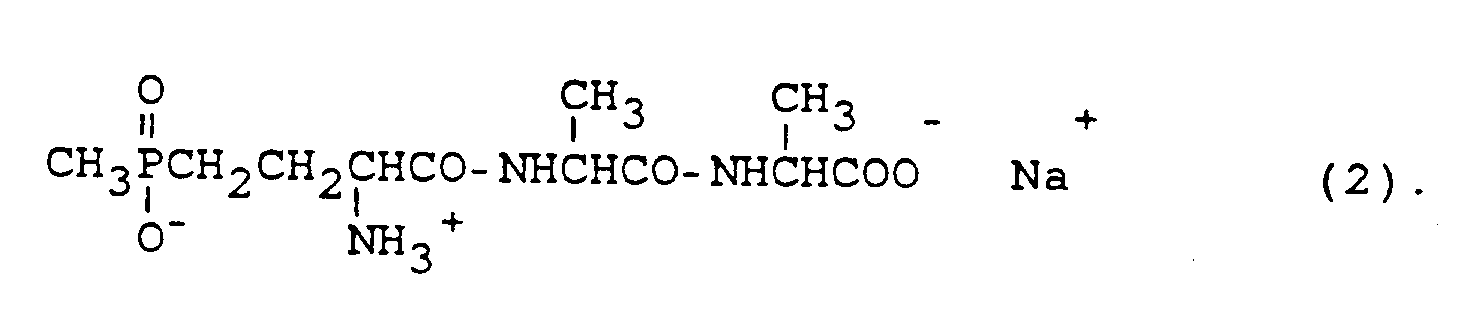
- Weiterhin ist bekannt, daß der zur chemischen Gruppe der Imidazolinone gehörende Wirkstoff Imazapyr, 2-(4-Isopropyl-4-methyl-5-oxo-2-imidazolin-2-yl)-nicotinsäure in Form des Isopropylaminsalzes der

als Totalherbizid in verschiedenen Indikationen verwendbar ist (10th Internat. Congr. Plant Protection, 339 ff, 1983). Dieser Wirkstoff kann sowohl über grüne Pflanzenteile wie Blatt oder Stengel als auch über unterirdische Teile wie Wurzeln oder Rhizome von der Pflanze aufgenommen werden. Er ist dafür bekannt, daß er einerseits langsam wirkt, andererseits aber im Boden auch nur langsam abgebaut wird, so daß er folglich also lange im Boden wirksam bleibt. Üblicherweise wird er auf Nichtkulturland in Dosierungen zwischen 250 und 1000 g/ha eingesetzt. Imazapyr kann nur in Ausnahmefällen in Kulturland verwendet werden, weil die meisten Kulturpflanzen schon bei niedrigen Dosierungen, z.B. 125 g/ha, geschädigt werden. - Wirkstoffe derselben chemischen Gruppe, wie z.B.
Imazamethabenz, d.h. 6-(4-isopropyl-4-methyl-5-oxo-2-imidazolin-2-yl-m,p-toluolcarbonsäuremethylester,
Imazaquin, d.h. 2-(4,5-Dehydro-4-methyl-4-(1-methylethyl)-5-oxo-1-H-imidazol-2-yl)-3-chinolincarbonsäure, oder
Imazethapyr, d.h. (+)-5-Ethyl-2-(4-isopropyl-4-methyl-5-oxo-2-imidazolin-2-yl)-nicotinsäure,
haben eine ähnliche Wirkungsweise, können aber in manchen Kulturen auch zur selektiven Bekämpfung von Unkräutern verwendet werden. - Wegen der besonders hohen Wasserlöslichkeit des Wirkstoffes Imazapyr (62 - 65 % nach Angaben der Hersteller-Firma) besteht insbesondere bei höheren Aufwandmengen die Gefahr der Auswaschung des Wirkstoffs nach stärkeren Regenfällen und vor allem auf leichten Böden mit geringer Sorptionskapazität.
- Weiterhin ist bekannt, daß die Wirkung von Glufosinate-ammonium ebenso wie die seines L-Enantiomeren durch eine größere Anzahl von oberflächenaktiven Substanzen deutlich verbessert werden kann, vorzugsweise durch Netzmittel wie Alkyl-polyglykolethersulfate, die vorzugsweise in Form ihrer Alkali- oder Ammoniumsalze, aber auch als Magnesiumsalz verwendet werden, beispielsweise C₁₂/C₁₄-Fettalkohol-diglykolethersulfat-Natrium, z.B. ®Genapol LRO (vgl. EP-A-0 048 436 oder US-A-4,400,196 und EP-A 0 336 151 sowie Proc. EWRS Symp. "Factors Affecting Herbicidal Activity and Selectivity", 227 - 232 (1988)). Diese Substanz wird in den folgenden Beispielen Netzmittel A genannt.
- Aus der EP-A 0 252 237 ist bekannt, daß es bei Kombinationen von Glufosinate-ammonium und Imazapyr zu Synergismus kommen kann, wobei sich aber die verwendeten Aufwandmengen im Rahmen der obengenannten Mengen-Bereiche halten.
- In weitergehenden Versuchen wurde nun überraschenderweise gefunden, daß durch Zusatz eines Netzmittels des genannten Typs die für eine ausreichende Wirkung erforderliche Aufwandmenge von Imazapyr bzw. dessen Analoga oder bestimmten Glufosinate/Imazapyr-Kombinationen oder analogen Herbizidkombinationen bei Anwendung gegen verschiedene Unkräuter deutlich verringert werden kann.
- Gegenstand der Erfindung sind herbizide Mittel mit einem wirksamen Gehalt an
- a) einem oder mehreren Herbiziden der allgemeinen Formeln (I) und (II) oder deren Salzen

- R¹
- Phenyl, Pyridyl, Chinolinyl, die alle gegebenenfalls ein- oder mehrfach durch (C₁-C₄)Alkyl, (C₁-C₄)-Alkoxy, (C₁-C₄)Halogenalkyl, (C₁-C₄)Halogenalkoxy, einen Rest der Formeln -COOR³, -COO-CHR³-COOR³, -CHR³COO(C₁-C₄-alkyl) oder -CHR³-COOCHR³-COOR³, worin jeweils unabhängig voneinander R³ = H oder (C₁-C₄)Alkyl bedeutet, oder einen Rest der Formel -CH₂-S(O)n-(C₁-C₄)alkyl, worin n = 0, 1 oder 2 bedeutet, substituiert sind, und
- R²
- H, einen Rest der Formeln -CONH(C₁-C₄-alkyl); -OCO(C₁-C₄-alkyl) oder -CO(C₁-C₄-alkyl)
oder an einer Kombination einer oder mehrerer Verbindungen der Formeln (I) bzw. (II) mit einer oder mehreren Verbindungen der Formel (III) oder deren Salzen,
- Z¹
- einen Rest der Formel -OM, -NHCH(CH₃)CONHCH(CH₃)COOM oder -NHCH(CH₃)CONHCH[CH₂CH(CH₃)₂]COOM, in denen M jeweils Wasserstoff oder ein anorganisches oder organisches Kation ist,
- b) anionischen Netzmitteln aus der Gruppe der C₁₀-C₁₈-Fettalkohol-polyglykolethersulfate in Form der Alkali-, Ammonium oder Erdalkalisalze oder der Ammoniumsalze, die durch Alkyl- oder Hydroxyalkylgruppen substituiert sind, und
- c) gegebenenfalls üblichen inerten Zusatzstoffen.
- Von besonderem Interesse sind herbizide Mittel mit einem wirksamen Gehalt an
- a) einem oder mehreren Herbiziden aus der Gruppe Imazapyr, Imazaquin, Imazarethabenz und Imazethapyr sowie deren Salzen oder
einer Kombination eines oder mehrerer der Herbizide aus der Gruppe Imazapyr, Imazaquin, Imazamethabenz und Imazethapyr sowie deren Salzen mit einem oder mehreren der Herbizide aus der Gruppe Glufosinate, Bialaphos und deren Salzen im Gewichtsverhältnis 1:3 bis 1:30, vorzugsweise 1:3 bis 1:15, - b) anionischen Netzmitteln aus der Gruppe der genannnten anionischen Netzmittel und
- c) inerten Zusatzstoffen.
- Bevorzugt sind erfindungsgemäße herbizide Mittel, bei denen die Komponente a) Imazapyr-isopropylammonium oder eine Kombination von Glufosinate-ammonium mit Imazapyr-isopropylammonium im Gewichtsverhältnis 10:1 bis 3:1 bedeutet.
- Bevorzugte anionische Netzmittel sind C₁₀-C₁₈-Fettalkoholpolyglykolethersulfat-Natriumsalze.
- Die Verbindungen der Formeln (I) bis (III) sind bekannt (s. EP-A-0252237 und dort zitierte Literatur; vgl. auch "The Pesticide Manual", British Crop Protection Council, 8. Auflage, 1987). Sie umfassen auch alle Stereoisomeren inklusive der möglichen reinen Enantiomeren, und deren Gemische.
- Im Falle R² = H liegen die beiden Formeln (I) und (II) im Tautomerengleichgewicht vor. In Abhängigkeit der Reste R² und der übrigen Substituenten kann daher die eine oder andere Form (I oder II) oder ein Gemisch beider Formen vorliegen, s. DE-A 3 121 636 und DE-A 2 833 274.
- Die erfindungsgemäß eingesetzten Verbindungen der Formeln (I) bis (III) umfassen auch deren für die Landwirtschaft einsetzbaren Salze. Als solche kommen beispielsweise die üblichen Alkali-, Erdalkali-, substituierten oder unsubstituierten Ammonium-, Phosphonium- oder Sulfoniumsalze in Betracht. Unter den Alkalimetall- und Erdalkalimetallsalzen sind in erster Linie die Na-, K-, Mg-oder Ca-Salze zu nennen.
- Ferner umfassen die Verbindungen der Formeln (III) auch Säureadditionssalze mit anorganischen Säuren wie HCl, HBr, H₂SO₄ oder H₃PO₄ oder mit organischen Säuren wie (C₁-C₄)-Carbonsäuren, chlorierten Essigsäuren, Weinsäure oder Zitronensäure.
- Die erfindungsgemäßen herbiziden Mittel können sowohl als Mischformulierungen der Komponenten (Wirkstoff + Netzmittel) vorliegen, die dann in üblicher Weise mit Wasser verdünnt zur Anwendung gebracht werden, oder als sogenannte Tankmischungen durch Mischung der unformulierten oder getrennt formulierten Wirkstoffe mit dem Netzmittel und gemeinsamer Verdünnung mit Wasser hergestellt werden. Bei Bedarf kann der Spritzbrühe vor der Ausbringung noch weiteres Netzmittel zugesetzt werden.
- Die herbiziden Mittel können auf verschiedene Art formuliert werden, je nachdem welche biologischen und/oder chemisch-physikalischen Parameter vorgegeben sind. Als Fomulierungsmöglichkeiten kommen beispielsweise in Frage: Spritzpulver (WP), emulgierbare Konzentrate (EC), wäßrige Lösungen (SL), Emulsionen, versprühbare Lösungen, Dispersionen auf Öl- oder Wasserbasis, Suspoemulsionen, Stäubemittel (DP), Beizmittel, Boden- bzw. Streugranulate (FG), wasserdispergierbare Granulate (WG), ULV-Formulierungen, Mikrokapseln oder Wachse.
- Diese einzelnen Formulierungstypen sind im Prinzip bekannt und werden beispielsweise beschrieben in: Winnacker-Küchler, "Chemische Technologie", Band 7, C. Hauser Verlag München, 4. Aufl. 1986; van Valkenburg, "Pesticides Formulations", Marcel Dekker N.Y., 2nd Ed. 1972-73; K. Martens, "Spay Drying Handbook", 3rd Ed. 1979, G. Goodwin Ltd. London.
- Bevorzugt sind Formulierungen in Form von Emulsionen, wäßrigen Lösungen, versprühbaren Lösungen, emulgierbaren Konzentraten und wasserdispergierbaren Granulaten.
- Als übliche Zusatzstoffe können die erfindungsgemäßen Mittel solche enthalten, die zur Herstellung der speziellen Formulierungstypen notwendig oder vorteilhaft sind.
- Bevorzugt sind übliche Zusatzstoffe für die Herstellung von wäßrigen Lösungen und Emulsionen, wie z.B. Wasser, organische Lösungsmittel und weitere anionische und nichtionischen Tenside.
- Beispiele für bevorzugte Lösungsmittel sind Alkohole wie Methanol, Ethanol, Propanol, Isopropanol, n-, i-, t- und 2-Butanol. Bevorzugte Tenside sind Polyalkylenglykolmonoalkylether und -dialkylether wie Propylenglykolmonomethylether und -monoethylether, perfluoralkylgruppenhaltige Tenside wie Perfluor-(C₆-C₁₂)-alkylphosphinsäuren und -phosphonsäuren und deren Alkalimetall-, Ammonium- und durch Alkylgruppen substituierte Ammoniumsalze (z.B. ®Fluowet PP, Hoechst AG).
- Die erfindungsgemäßen Mittel enthalten in der Regel 10 bis 95 Gew.-% Komponenten a) und b) und 5 bis 90 Gew.-% üblicher Zusatzstoffe. Wäßrige Lösungen enthalten vorzugsweise 10 bis 40 Gew.-%, insbesondere 15 bis 30 Gew.-% Wirkstoffe der Komponente a), 10 bis 40 Gew.-%, insbesondere 25 bis 35 Gew.-% Komponente b), 30 bis 60 Gew.-% Wasser und 5 bis 30 Gew.-% üblicher Zusatzstoffe, insbesondere 5-20 Gew.-% nichtionische Tenside oder Lösungsmittel.
- Die erfindungsgemäßen Mittel erfassen ein breites Unkrautspektrum. Sie eignen sich beispielsweise zur Bekämpfung von annuellen und perennierdenden Unkräutern wie beispielsweise Agropyron, Paspalum, Cynodon, Imperata, Pennisetum, Convolvulus, Cirsium, Rumex und andere.
- Die erfindungsgemäßen Mittel lassen sich zur selektiven Bekämpfung von Schadpflanzen in Plantagenkulturen wie Ölpalme, Kokospalme, Gummibaum, Zitrus, Ananas, Baumwolle, Kaffee, Kakao u.a. sowie im Obst- und Weinbau einsetzen. Ebenso können die erfindungsgemäßen Kombinationen im Ackerbau im sogenannten "no till" bzw. "zero till"-Verfahren eingesetzt werden. Sie können aber auch nicht-selektiv auf Wegen, Plätzen, Industrieanlagen etc. angewendet werden, um diese Flächen von unerwünschtem Pflanzenwuchs freizuhalten.
- Erfindungsgemäße herbizide Mittel ohne Gehalt an Verbindung der Formel (III) lassen sich besonders in Nichtkulturland zur Bekämpfung eines breiten Spektrums von annuellen und perennierenden Unkräutern sowie in Kautschuk- und Ölpalm-Plantagen einsetzen; hierbei kann die Aufwandmenge des Wirkstoffes der Formel (I) und/oder (II) im Vergleich zu Mitteln ohne erfindungsgemäße Komponente b) deutlich reduziert werden. Die Gefahr der Auswaschung des Wirkstoffs und damit das Risiko von Grundwasser-Kontaminationen wird ebenfalls verringert.
- Erfindungsgemäße herbizide Mittel mit Gehalt an Verbindung der Formel (III) lassen sich außer in den genannten Indikationen auch im Obst- und Weinbau einschließlich Citrus-Kulturen sehr vorteilhaft einsetzen. Ein Vorteil liegt darin, daß durch den Zusatz des Netzmittels b) die Aufnahme der Wirkstoffe der Formel (I) oder (II) beschleunigt wird und daß relativ niedrige Dosierungen der Wirkstoffe (I) bzw. (II) und (III) genügen, um eine gute Wirkung zu erreichen. Außerdem wird dabei auch die Regenfestigkeit der Wirkstoffe der Formel (III) erheblich verbessert. Als besonderer Vorteil fällt hierbei ins Gewicht, daß die in den Kombinationen verwendeten und wirksamen Dosierungen von Verbindungen der Formel (I) und/oder (II) so gering sind, daß ihre Bodenwirkung erheblich reduziert ist. Somit wird deren Einsatz nicht nur in empfindlichen Kulturen erst möglich, sondern Grundwasser-Kontaminationen werden praktisch vermieden.
- Durch die erfindungsgemäßen Kombination von Wirkstoffen und Netzmitteln wird eine erhebliche Reduzierung der nötigen Aufwandmenge der Wirkstoffe ermöglicht.
- Gegenstand der Erfindung ist deshalb auch ein Verfahren zur Bekämpfung von unerwünschtem Pflanzenwuchs, dadurch gekennzeichnet, daß man a) ein oder mehrere Herbizide der genannten Formeln (I) und/oder (II) oder deren Salze oder eine Kombination ein oder mehrerer Verbindungen der Formel (I) und/oder (II) oder deren Salze mit ein oder mehreren Verbindungen der genannten Formel (III) oder deren Salzen, wobei in der Kombination das Gewichtsverhältnis von (I) bzw. (II) zu (III) 1:3 bis 1:30, vorzugsweise 1:3 bis 3:15 beträgt, mit
- b) einem anionischen Netzmittel aus der Gruppe der C₁₀-C₁₈-Fettalkoholpolyglykolethersulfate in Form der Alkali-, Ammonium-, Erdalkali- oder alkyl- oder hydroxyalkylsubstituierten Ammoniumsalze auf die Pflanzen oder die Anbaufläche appliziert.
- Die Applikation kann dabei so erfolgen, daß die Komponenten gemischt und gemeinsam ausgebracht werden oder daß die Komponenten in geeigneter getrennter oder teilweise getrennter Formulierung unmittelbar hintereinander ausgebracht werden.
- Die Aufwandmenge beträgt in der Regel 10 bis 400 g/ha, vorzugsweise 25 bis 200 g/ha für die Verbindungen der Formel (I) und/oder (II) und deren Salze und 50 bis 800 g/ha, vorzugsweise 200 bis 600 g/ha für Verbindungen der Formel (III) und deren Salze.
- Die Menge an Komponente b) ist in der Regel bei 500 bis 2500 g/ha, vorzugsweise 700 bis 1500 g/ha.
-
- Zu einer Lösung von
11,50 g Imazapyr-isopropylammonium in
48,25 g Wasser
werden
30 g Netzmittel A (70 %ig in H₂O) und
10 g Propylenglykolmonomethylether
gegeben. Es wird so lange bei 40 °C gerührt, bis eine klare Lösung entstanden ist. Dann werden
0,25 g Fluowet PP (80 %ig in Wasser)
zugegeben und kurz nachgerührt. - Zu einer Lösung von
22,30 g Imazapyr-isopropylammonium in
37,45 g Wasser
werde
30 g Netzmittel A (70 %ig in Wasser) und
10 g Isopropanol
gegeben. Es wird so lange gerührt, bis eine klare Lösung entstanden ist. Dann werden
0,25 g Fluowet PP (80 %ig in Wasser)
zugegeben und kurz nachgerührt. - Zu einer Lösung von
18,00 g Glufosinate-ammonium und
2,25 g Imazapyr-isopropylammonium in
39,50 g Wasser
werden
30,00 g Netzmittel A (70 %ig in Wasser) und
10,00 g Propylenmonoglykolether
gegeben. Es wird so lange bei 40 °C gerührt, bis eine klare Lösung entstanden ist. Dann werden
0,25 g Fluowet PP (80 %ig)
zugegeben und kurz nachgerührt. - Zu einer Lösung von
18,00 g Glufosinate-ammonium und
4,50 g Imazapyr-isopropylammonium in
37,25 g Wasser
werden
30,00 g Netzmittel A (70 %ig in Wasser) und
10,00 g Propylenglykolmonomethylether sowie
0,25 g Fluowet PP (80 %ig)
gegeben und so lange gerührt, bis eine klare Lösung entstanden ist. - Zu einer Lösung von
9,30 g L-Glufosinate-ammonium und
2,30 g Imazapyr-isopropylammonium in
48,15 g Wasser
werden
30,00 g Netzmittel A (70 %ig in Wasser) und
10,00 g Propylenglykolmonomethylether
gegeben. Es wird so lange bei 40 °C nachgerührt, bis eine klare Lösung entstanden ist. Dann werden
0,25 g Fluowet PP (80 %ig) zugegeben und kurz nachgerührt. - Für einen Modellversuch wurden Erbsen in Töpfen (Durchmesser 10 cm), die mit einem Lehm-Sand-Gemisch gefüllt waren, ausgesät; anschließend wurden die Töpfe im Freien aufgestellt, bis die aufgelaufenen Pflanzen 3 bis 4 Blätter gebildet hatten. Dann wurden sie mit Imazapyr allein (in Form des Handelspräparates ®Arsenal mit 250 g a.e./l; a.e.=Säureäquivalent) oder in Mischung mit dem Netzmittel A (NM A = ®Genapol LRO flüssig mit 290 g/l "waschaktiver Substanz" = WAS, d.h. wirksamem Netzmittel) behandelt. Die Wasseraufwandmenge betrug 300 l/ha. Ein Teil der Töpfe wurde 3 bis 4 Stunden nach Behandlung einem künstlichen Regen von ca. 10 mm ausgesetzt. Die Dosierung an Netzmittel lag bei 870 g WAS/ha. Die Wirkung der Behandlung geht aus folgender Tabelle 1 hervor:
Tabelle 1 Mittel und Aufwandmenge 1) Wirkung in % 2) unberegnet beregnet 2 WnB 4 WnB 2 WnB 4 WnB Imazapyr Variante A Variante B 31,25 0 15 0 55 62,5 20 50 20 58 125 30 53 35 70 250 37 72 40 83 Imazapyr + NM A Variante C Variante D 31,25 + 870 30 65 25 60 62,5 + 870 50 83 35 70 125 + 870 55 95 40 85 250 + 870 65 98 58 90 NM A 870 0 0 0 0 1) Aufwandmenge Imazapyrin g a.e./ha
Aufwandmenge Netzmittel A in g WAS/ha2) Wirkung in % (100 = vollständige Abtötung, 0 = kein Schaden), WnB = Wochen nach Behandlung - Die Zahlen lassen erkennen,
- 1. daß die Wirkung des Imazapyr nach 2 Wochen nocht nicht sehr stark, nach 4 Wochen dagegen erheblich stärker ist (Variante A);
- 2. daß die Imazapyr-Wirkung nach einer Beregnung (Variante B) zunimmt, was leicht dadurch erklärt werden kann, daß der vom Blatt abgewaschene Wirkstoff nun über den Boden auf die Pflanze wirkt;
- 3. daß bei Zusatz des Netzmittels A (Variante C) sowohl die Anfangs- wie die Endwirkung des Imazapyr erheblich zunimmt;
- 4. daß aber im Gegensatz zur Variante B bei der Behandlung Imazapyr + Netzmittel mit Beregnung (Variante D) die Wirkung geringer ist als in der Variante C ohne Beregnung, allerdings deutlich stärker als in Variante B oder gar in Variante A.
- Daraus kann gefolgert werden, daß die Aufnahme des Wirkstoffes Imazapyr über das Blatt durch Zusatz des Netzmittels A erheblich beschleunigt wird.
- In einem Feldversuch zur Bekämpfung des ausdauernden Unkrautes Quecke (Agropyron repens) wurden Parzellen von 10 m² Größe mit Glufosinate-ammonium, Imazapyr und Netzmittel A in verschiedenen Dosierungen und erfindungsgemäßen Kombinationen behandelt, wobei die Wirkung auf die sichtbare Grünmasse im Vergleich zur unbehandelten Kontrolle bonitiert wurde (siehe Tabelle 2).
- Für die Bewertung der Kombinations-Wirkung wurde die Formel von Colby verwendet:
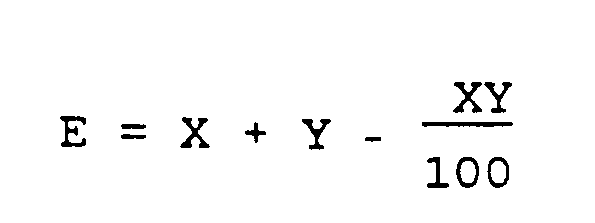
wobei E die zu erwartende Wirkung (in %) aus der Kombination des Wirkstoffes X mit dem Wirkstoff Y angibt (vgl. Weeds 15, 20 -22, 1967). Diese zu erwartende Wirkung ist bei den Kombinationsbehandlungen vor der tatsächlich erzielten Wirkung in Klammern angegeben. In der Tabelle 2 bedeuten NMA = ®Genapol LRO mit 290 g/l waschaktiver Substanz, WAS (Dosierung in g WAS/ha),
GLUA = Glufosinateammonium (Dosierung in g a.i./ha) und
IMZP = Imazapyr (Dosierung in a.e/ha). In der Spalte unter X ist die Nummer der Versuche angegeben, die als Bezugsbasis für die Berechung nach Colby herangezogen wurden.
- Folgerungen, die aus diesem Versuch gezogen werden können:
- 1. Dosierungen von 200 bis 600 g/ha Glufosinate-ammonium führen zu relativ schneller sichtbarer Wirkung; zum Teil lagen die Bonitur-Werte 2 Wochen nach Behandlung noch höher als die in der Tabelle 2 angegebenen Werte für 4 Wochen nach Behandlung. Durch Zusatz des Netzmittels wurde die Wirkung etwas verstärkt; das läßt sich auch 8 Wochen nach Behandlung bei der Beurteilung des Neuaufwuchses aus den überdauerenden Organen im Boden, den Rhizomen, erkennen; 4 Wochen später hat sich der Bestand jedoch vollkommen regeneriert, und es ist keinerlei Wirkung mehr erkennbar.
- 2. Behandlungen mit 25 oder 50 g/ha Imazapyr verursachten erwartungsgemäß nur sehr geringe Wirkung, die durch den Zusatz des Netzmittels jedoch verstärkt wurde.
- 3. Die Kombinationen von Glufosinate-ammonium + Imazapyr waren 4 Wochen nach Behandlung ähnlich wirksam wie Glufosinate-ammonium allein oder nur geringfügig besser. Eine deutlich bessere Wirkung, die über der zu erwartenden Wirkung lag, konnte 8 Wochen nach Behandlung beobachtet werden, sie verlor sich aber 12 Wochen nach Applikation wieder.
- 4. Wurden der genannten Mischung aber das Netzmittel A zugesetzt, lagen die Boniturwerte nach 8 und 12 Wochen deutlich, zum Teil weit über den Werten, die auf Grund der Wirkung der Einzelwirkstoffe nach der Colby-Formel zu erwarten gewesen wäre. Unter der Annahme, daß die Bodenwirkung der relativ geringen Imazapyr-Dosierungen unabhängig vom Netzmittel ist, kann man vermuten, daß die Aufnahme des Imazapyr über das Blatt und die Translokation zu den unterirdischen Teilen überraschenderweise durch den Netzmittel-Zusatz erheblich verstärkt wurde.
- In einer 3 jährigen Apfel-Anlage wurden verschiedene Behandlungen im Frühjahr, Ende April in den Baumreihen ausgebracht; die vorkommenden Unkräuter waren in erster Linie verschiedene ausdauernde Gräser, sowie Disteln (Cirsium arvense), Gundermann (Glechoma hederacea) u.a. Die Wirkung auf die Unkräuter und Verträglichkeit für die Kulturpflanzen wurden in Zeitabständen festgehalten. Die Apfelbäume waren von der Spritzbrühe nicht getroffen worden (siehe Tabelle 3).
Tabelle 3 Produkte Dosierungen in g a.i./ha, a.e./ha bzw. g WAS/ha Wirkung (%) Schäden 2* 3* 2* 3* Glufosinate-ammonium Imazapyr NM A 500 125 80 85 deutliche Schäden 500 125 1000 95 98 500 50 50 55 keine Schäden 500 50 1000 90 85 * = Monate nach Behandlung - Die Kombinationen mit einem höheren Anteil an Imazapyr waren erwartungsgemäß besser wirksam über einen längeren Zeitraum, wobei die Variante mit Zusatz von Netzmittel noch besser abschnitt als die ohne Netzmittel. In beiden Behandlungsgliedern traten aber nach 1,5 bis 2 Monaten deutliche Schäden an den Triebspitzen der Bäume auf, die zu einem Wachstumsstillstand führten; die Symptome entsprachen normalen Imazapyr-Symptomen, wobei der Wirkstoff offensichtlich über die Wurzeln aufgenommen worden war.
- Wurde die Aufwandmenge von Imazapyr reduziert, ging auch die Unkrautentwicklung so stark zurück, daß sie 2 - 3 Monate nach Behandlung nicht mehr ausreichte. Schäden traten hier dann allerdings nicht mehr auf. Dieselbe Herbizid-Kombination mit zusätzlichem Netzmittel führte zu einer wesentlich verbesserten Unkrautwirkung, die auch nach 3 Monaten noch als befriedigend zu beurteilen war. Auch hierbei traten keine Schäden an den Bäumen auf.
- In einem Feldversuch mit Gerste als monokotyler Testpflanze wurden Parzellen mit Glufosinate-ammonium in Kombination mit sehr niedrigen Mengen von Imazapyr mit und ohne Zusatz von Netzmittel A behandelt. Die Pflanzen befanden sich zur Zeit der Behandlung in der Phase der Bestockung. Die Wasseraufwandmenge lag bei 300 l/ha. Ein Teil der Parzellen wurde 3 Stunden nach Applikation einer künstlichen Beregnung von etwa 10 mm ausgesetzt. Das Ergebnis in Form von Wirkungsbonituren zwei Wochen nach Behandlung ist in Tabelle 4 angegeben.
Tabelle 4 Produkte, Dosierungen in g a.i./ha, bzw. g WAS/ha ohne Beregnung mit Beregnung Glufosinate-ammonium Imazapyr Netzmittel A 500 0 0 90 20 500 1000 95 45 0 20 0 0 0 20 1000 0 0 500 20 0 92 50 500 20 1000 95 85 - Das Ergebnis zeigt, daß Glufosinate alleine oder Glufosinate plus Netzmittel gut wirksam waren, und daß bei Beregnung 3 Stunden nach Behandlung die Wirkung in beiden Varianten sehr stark abfiel, wobei der Abfall bei Netzmittelzusatz nicht ganz so ausgeprägt war. Keinesfalls reichte hier aber die Wirkung für Praxis-Bedingungen aus. Imazapyr in der geringen Menge von 20 g/ha war ohne und mit Netzmittelzusatz wirkungslos. Glufosinate-ammonium plus Imazapyr war gut wirksam, in der beregneten Parzelle dagegen war die Wirkung völlig unzureichend. Nur bei der erfindungsgemäßen Behandlung, der Kombination Glufosinate-ammonium plus Imazapyr plus Netzmittel A, war die Wirkung auch in der beregneten Parzelle so gut, daß sie unter Praxis-Verhältnissen als akzeptabel zu bezeichnen war.
- Ähnliche Ergebnisse lassen sich auch erzielen, wenn man an Stelle des Glufosinate-ammoniums sein L-Enantiomeres oder aber auch den Wirkstoff Bialaphos verwendet. Ebenso läßt sich in solchen Kombinationen der Wirkstoff Imazapyr durch einen anderen Wirkstoff derselben Gruppe, z.B. Imazamethabenz, Imazaquin oder Imazethapyr ersetzen.
Claims (8)
- Herbzide Mittel mit einem wirksamen Gehalt ana) einem oder mehreren Herbziden der allgemeinen Formeln (I) und (II) oder deren Salze
 R¹ Phenyl, Pyridyl, Chinolinyl, die alle gegebenenfalls ein mehrfach durch (C₁-C₄)Alkyl, (C₁-C₄)-Alkoxy, (C₁-C₄)Halogenalkyl, (C₁-C₄)Halogenalkoxy, einen Rest der Formeln -COOR³, -COO-CHR³-COOR³, -CHR³-COO(C₁-C₄-alkyl) oder -CHR³-COOCHR³-COOR³, worin jeweils unabhängig voneinander R³ = H oder (C₁-C₄)Alkyl bedeutet, oder einen Rest der Formel -CH₂-S(O)n-(C₁-C₄)alkyl, worin n = 0, 1 oder 2 bedeutet, substituiert sind, undR² H, einen Rest der Formeln -CONH(C₁-C₄-alkyl); -OCO(C₁-C₄-alkyl) oder -CO(C₁-C₄-alkyl)bedeuten,
oder an einer Kombination einer oder mehrerer Verbindungen der Formeln (I) bzw. (II) mit einer oder mehreren Verbindungen der Formel (III) oder deren Salzen, Z¹ einen Rest der Formel -OM, -NHCH(CH₃)CONHCH(CH₃)COOM oder -NHCH(CH₃)CONHCH[CH₂CH(CH₃)₂]COOM, in denen M jeweils Wasserstoff oder ein anorganisches oder organisches Kation ist,bedeutet, im Gewichtsverhältnis von 1:3 bis 1:30 der Verbindungen der Formel (I) bzw. (II) zu Verbindungen der Formel (III),b) anionischen Netzmitteln aus der Gruppe der C₁₀-C₁₈-Fettalkohol-polyglykolethersulfate in Form der Alkali-, Ammonium- oder Erdalkalisalze oder der Ammoniumsalze, die durch Alkyl- oder Hydroxyalkylgruppen substituiert sind, undc) gegebenenfalls üblichen inerten Zusatzstoffen.
 - Herbizide Mittel nach Anspruch 1, dadurch gekennzeichnet, daß sie einen wirksamen Gehalt ana) einem oder mehreren Herbiziden aus der Gruppe Imazapyr, Imazaquin, Imazamethabenz und Imazethapyr sowie deren Salzen oder
einer Kombination eines oder mehrerer der Herbizide aus der Gruppe Imazapyr, Imazaquin, Imazamethabenz und Imazethapyr sowie deren Salzen mit einem oder mehreren der Herbizide aus der Gruppe Glufosinate, Bialaphos und deren Salzen im Gewichtsverhältnis 1:3 bis 1:30, vorzugsweise 1:3 bis 1:15,b) anionischen Netzmitteln aus der Gruppe der genannnten anionischen Netzmittel undc) inerten Zusatzstoffen. - Herbizide Mittel nach Anspruch 1 oder 2, dadurch gekennzeichnet, daß die Komponente a) Imazapyr-isopropylammonium oder eine Kombination von Glufosinate-ammonium mit Imazapyr-isopropylammonium im Gewichtsverhältnis 10:1 bis 3:1 bedeutet.
- Herbizide Mittel nach einem oder mehreren der Ansprüche 1 bis 3, dadurch gekennzeichnet, daß die Komponente b ein C₁₀-C₁₈-Fettalkoholpolyglykolethersulfat-Natriumsalz ist.
- Verfahren zur Bekämpfung von unerwünschtem Pflanzenwuchs, dadurch gekennzeichnet, daß mana) ein oder mehrere Herbizide der genannten Formeln (I) und (II) oder deren Salze oder eine Kombination ein oder mehrerer Verbindungen der Formel (I) bzw. (II) oder deren Salze mit ein oder mehreren Verbindungen der genannten Formel (III) oder deren Salze, wobei in der Kombination das Gewichtsverhältnis von (I) bzw. (II) zu (III) 1:3 bis 1:30, vorzugsweise 1:3 bis 3:15 beträgt, mitb) einem anionischen Netzmittel aus der Gruppe der C₁₀-C₁₈-Fettalkoholpolyglykolethersulfate in Form der Alkali-, Ammonium-, Erdalkali- oder alkyl- oder hydroxyalkylsubstituierten Ammoniumsalze auf die Pflanzen oder die Anbaufläche appliziert.
- Verfahren nach Anspruch 5, dadurch gekennzeichnet, daß die Aufwandmenge von Verbindungen der Formel (I) bzw. (II) oder deren Salzen 10 bis 400 g/ha, vorzugsweise 25-200 g/ha beträgt.
- Verfahren nach Anspruch 5 oder 6, dadurch gekennzeichnet, daß die Aufwandmenge für die Verbindungen der Formel (III) 50 bis 800 g/ha, vorzugsweise 200 bis 600 g/ha beträgt.
- Verfahren nach einem oder mehreren der Ansprüche 5 bis 7, dadurch gekennzeichnet daß die Aufwandmenge für die Komponente b) 500 bis 2500 g/ha, vorzugsweise 700 bis 1500 g/ha beträgt.
Applications Claiming Priority (3)
| Application Number | Priority Date | Filing Date | Title |
|---|---|---|---|
| DE3938564 | 1989-11-21 | ||
| DE3938564A DE3938564A1 (de) | 1989-11-21 | 1989-11-21 | Herbizide mittel |
| PCT/EP1990/001898 WO1991007089A1 (de) | 1989-11-21 | 1990-11-13 | Herbizide mittel |
Publications (2)
| Publication Number | Publication Date |
|---|---|
| EP0502014A1 EP0502014A1 (de) | 1992-09-09 |
| EP0502014B1 true EP0502014B1 (de) | 1995-02-01 |
Family
ID=6393902
Family Applications (1)
| Application Number | Title | Priority Date | Filing Date |
|---|---|---|---|
| EP90917045A Expired - Lifetime EP0502014B1 (de) | 1989-11-21 | 1990-11-13 | Herbizide mittel |
Country Status (16)
| Country | Link |
|---|---|
| EP (1) | EP0502014B1 (de) |
| JP (1) | JPH05502444A (de) |
| AU (1) | AU655576B2 (de) |
| CA (1) | CA2069114A1 (de) |
| DE (2) | DE3938564A1 (de) |
| DK (1) | DK0502014T3 (de) |
| ES (1) | ES2068403T3 (de) |
| GR (1) | GR3015495T3 (de) |
| HU (2) | HUT61433A (de) |
| IE (1) | IE66519B1 (de) |
| IL (1) | IL96400A (de) |
| MY (1) | MY104597A (de) |
| PH (1) | PH27232A (de) |
| PT (1) | PT95934B (de) |
| WO (1) | WO1991007089A1 (de) |
| ZA (1) | ZA909301B (de) |
Cited By (2)
| Publication number | Priority date | Publication date | Assignee | Title |
|---|---|---|---|---|
| US8883680B2 (en) | 2006-11-13 | 2014-11-11 | Bayer Cropscience Ag | Herbicide combinations with particular sulphonyl ureas |
| US10544426B2 (en) | 2010-10-15 | 2020-01-28 | Bayer Intellectual Property Gmbh | Methods of using ALS inhibitor herbicides for control of unwanted vegetation in ALS inhibitor herbicide tolerant beta vulgaris plants |
Families Citing this family (100)
| Publication number | Priority date | Publication date | Assignee | Title |
|---|---|---|---|---|
| DE4029304A1 (de) * | 1990-09-15 | 1992-03-19 | Hoechst Ag | Synergistische herbizide mittel |
| DE19815820A1 (de) | 1998-04-08 | 1999-10-14 | Hoechst Schering Agrevo Gmbh | Synergistische herbizide Mittel auf Basis von phosphorhaltigen Blattherbiziden, Imidazolinonen und Wuchsstoffherbiziden |
| DE19836660A1 (de) | 1998-08-13 | 2000-02-17 | Hoechst Schering Agrevo Gmbh | Herbizide Mittel für tolerante oder resistente Sojakulturen |
| DE19836673A1 (de) | 1998-08-13 | 2000-02-17 | Hoechst Schering Agrevo Gmbh | Herbizide Mittel für tolerante oder resistente Zuckerrübenkulturen |
| PL218413B1 (pl) | 1998-08-13 | 2014-12-31 | Bayer Cropscience Ag | Zastosowanie kompozycji zawierającej glifosat oraz chlopyralid do zwalczania szkodliwych roślin w uprawach kukurydzy oraz sposób zwalczania szkodliwych roślin w tolerujących uprawach kukurydzy |
| DE19836659A1 (de) | 1998-08-13 | 2000-02-17 | Hoechst Schering Agrevo Gmbh | Herbizide Mittel für tolerante oder resistente Baumwollkulturen |
| RU2187994C2 (ru) * | 2000-10-26 | 2002-08-27 | Пермское научно-производственное объединение "Биомед" | Способ приготовления основы для лекарственных и косметических средств |
| DE10135642A1 (de) | 2001-07-21 | 2003-02-27 | Bayer Cropscience Gmbh | Herbizid-Kombinationen mit speziellen Sulfonylharnstoffen |
| DE102007008528A1 (de) | 2007-02-21 | 2008-08-28 | Bayer Cropscience Ag | Herbizid-Kombinationen mit speziellen Pyrazolyloxyphenyl-Derivaten |
| DE102007036702A1 (de) | 2007-08-03 | 2009-02-05 | Bayer Cropscience Ag | Synergistische kulturpflanzenverträgliche herbizide Kombinationen enthaltend Herbizide aus der Gruppe der Pyrazolyloxyphenyl-Derivate |
| EP2052615A1 (de) | 2007-10-24 | 2009-04-29 | Bayer CropScience AG | Herbizid-Kombination |
| EP2052610A1 (de) | 2007-10-24 | 2009-04-29 | Bayer CropScience AG | Herbizid-Kombination |
| EP2052612A1 (de) | 2007-10-24 | 2009-04-29 | Bayer CropScience AG | Herbizid-Kombination |
| EP2052608A1 (de) | 2007-10-24 | 2009-04-29 | Bayer CropScience AG | Herbizid-Kombination |
| EP2052604A1 (de) | 2007-10-24 | 2009-04-29 | Bayer CropScience AG | Salz des 2-lodo-N-[(4-methoxy-6-methyl-1,3,5-triazin-2-yl)carbamoyl] benzolsulfonamids,Verfahren zu deren Herstellung, sowie deren Verwendung als Herbizide und Pflanzenwachstumregulatoren |
| EP2052613A1 (de) | 2007-10-24 | 2009-04-29 | Bayer CropScience AG | Herbizid-Kombination |
| EP2052605A1 (de) | 2007-10-24 | 2009-04-29 | Bayer CropScience AG | Herbizid-Kombination |
| EP2052609A1 (de) | 2007-10-24 | 2009-04-29 | Bayer CropScience AG | Herbizid-Kombination |
| EP2052606A1 (de) | 2007-10-24 | 2009-04-29 | Bayer CropScience AG | Herbizid-Kombination |
| EP2052614A1 (de) | 2007-10-24 | 2009-04-29 | Bayer CropScience AG | Herbizid-Kombination |
| EP2052603A1 (de) | 2007-10-24 | 2009-04-29 | Bayer CropScience AG | Verwendung des 2-lodo-N-[(4-methoxy-6-methyl-1,3,5-triazin-2-yl)carbamoyl] benzolsulfonamids und/oder dessen Salze zur Bekämpfung von unerwünschtem Pflanzenwuchs in ausgewählten Nutzpflanzenkulten oder Nichtkulturland |
| EP2052611A1 (de) | 2007-10-24 | 2009-04-29 | Bayer CropScience AG | Herbizid-Kombination |
| EP2052607A1 (de) | 2007-10-24 | 2009-04-29 | Bayer CropScience AG | Herbizid-Kombination |
| EP2052616A1 (de) | 2007-10-24 | 2009-04-29 | Bayer CropScience AG | Herbizid-Safener-Kombination |
| EP2095710A1 (de) | 2008-02-27 | 2009-09-02 | Bayer CropScience AG | Herbizid-Kombinationen enthaltend Diflufenican |
| EP2095711A1 (de) | 2008-02-27 | 2009-09-02 | Bayer CropScience AG | Herbizid-Kombinationen enthaltend Diflufenican |
| EP2095712A1 (de) | 2008-02-27 | 2009-09-02 | Bayer CropScience AG | Herbizid-Kombinationen enthaltend Diflufenican |
| EP2103216A1 (de) | 2008-03-19 | 2009-09-23 | Bayer CropScience AG | Ausgewählte Salze des 3-(5,6-dihydro-1,4,2-dioxazin-3-yl)-N-[(4,6-dimethoxypyrimidin-2-yl)carbamoyl] pyridin-2-sulfonamids, Verfahren zur deren Herstellung, sowie deren Verwendung als Herbizide und Pflanzenwachstumsregulatoren |
| DE102008037628A1 (de) | 2008-08-14 | 2010-02-18 | Bayer Crop Science Ag | Herbizid-Kombination mit Dimethoxytriazinyl-substituierten Difluormethansulfonylaniliden |
| DE102008037626A1 (de) | 2008-08-14 | 2010-02-18 | Bayer Cropscience Ag | Herbizid-Kombination mit Dimethoxytriazinyl-substituierten Difluormethansulfonylaniliden |
| DE102008037630A1 (de) | 2008-08-14 | 2010-02-18 | Bayer Cropscience Ag | Herbizid-Kombination mit Dimethoxytriazinyl-substituierten Difluormethansulfonylaniliden |
| DE102008037629A1 (de) | 2008-08-14 | 2010-02-18 | Bayer Cropscience Ag | Herbizid-Kombination mit Dimethoxytriazinyl-substituierten Difluormethansulfonylaniliden |
| DE102008037622A1 (de) | 2008-08-14 | 2010-02-25 | Bayer Cropscience Ag | Herbizid-Kombination mit Dimethoxytriazinyl-substituierten Difluormethansulfonylaniliden |
| DE102008037624A1 (de) | 2008-08-14 | 2010-02-18 | Bayer Cropscience Ag | Herbizid-Kombination mit Dimethoxytriazinyl-substituierten Difluormethansulfonylaniliden |
| DE102008037631A1 (de) | 2008-08-14 | 2010-02-18 | Bayer Cropscience Ag | Herbizid-Kombination mit Dimethoxytriazinyl-substituierten Difluormethansulfonylaniliden |
| DE102008037621A1 (de) | 2008-08-14 | 2010-02-18 | Bayer Cropscience Ag | Herbizid-Kombination mit Dimethoxytriazinyl-substituierten Difluormethansulfonylaniliden |
| DE102008037625A1 (de) | 2008-08-14 | 2010-02-18 | Bayer Cropscience Ag | Herbizid-Kombination mit Dimethoxytriazinyl-substituierten Difluormethansulfonylaniliden |
| DE102008037627A1 (de) | 2008-08-14 | 2010-02-18 | Bayer Cropscience Ag | Herbizid-Kombination mit Dimethoxytriazinyl-substituierten Difluormethansulfonylaniliden |
| DE102008037632A1 (de) | 2008-08-14 | 2010-02-18 | Bayer Cropscience Ag | Herbizid-Kombination mit Dimethoxytriazinyl-substituierten Difluormethansulfonylaniliden |
| DE102008058642A1 (de) | 2008-11-22 | 2010-05-27 | Bayer Cropscience Ag | Herbizid-Kombinationen enthaltend Diflufenican und ALS-Inhibitoren |
| WO2011082964A1 (de) | 2009-12-17 | 2011-07-14 | Bayer Cropscience Ag | Herbizide mittel enthaltend flufenacet |
| WO2011082957A2 (de) | 2009-12-17 | 2011-07-14 | Bayer Cropscience Ag | Herbizide mittel enthaltend flufenacet |
| WO2011082953A2 (de) | 2009-12-17 | 2011-07-14 | Bayer Cropscience Ag | Herbizide mittel enthaltend flufenacet |
| PL2512249T3 (pl) | 2009-12-17 | 2016-12-30 | Środki chwastobójcze zawierające flufenacet | |
| DK2515658T3 (en) | 2009-12-17 | 2016-09-12 | Bayer Ip Gmbh | HERBICIDE AGENTS CONTAINING FLUFENACET |
| WO2011082968A2 (de) | 2009-12-17 | 2011-07-14 | Bayer Cropscience Ag | Herbizide mittel enthaltend flufenacet |
| DK2512248T3 (en) | 2009-12-17 | 2016-11-21 | Bayer Ip Gmbh | HERBICIDE AGENTS CONTAINING FLUFENACET |
| WO2011082959A2 (de) | 2009-12-17 | 2011-07-14 | Bayer Cropscience Ag | Herbizide mittel enthaltend flufenacet |
| WO2011082954A2 (de) | 2009-12-17 | 2011-07-14 | Bayer Cropscience Ag | Herbizide mittel enthaltend flufenacet |
| WO2011082956A2 (de) | 2009-12-17 | 2011-07-14 | Bayer Cropscience Ag | Herbizide mittel enthaltend flufenacet |
| WO2011082955A2 (de) | 2009-12-17 | 2011-07-14 | Bayer Cropscience Ag | Herbizide mittel enthaltend flufenacet |
| WO2011107445A1 (de) | 2010-03-04 | 2011-09-09 | Bayer Cropscience Ag | Hydrat und wasserfreie kristallform des natriumsalzes des 2-iodo-n-[(4-methoxy-6-methyl-1,3,5-triazin-2-yl)carbamoyl]benzolsulfonamids, verfahren zu deren herstellung, sowie deren verwendung als herbizide und pflanzenwachstumsregulatoren |
| CA2799692A1 (en) | 2010-05-21 | 2011-11-24 | Bayer Intellectual Property Gmbh | Herbicidal agents for tolerant or resistant grain cultures |
| US20110287933A1 (en) | 2010-05-21 | 2011-11-24 | Bayer Cropscience Ag | Herbicidal composition for tolerant or resistant oilseed rape crops |
| EP2571364A1 (de) | 2010-05-21 | 2013-03-27 | Bayer Intellectual Property GmbH | Herbizide mittel für tolerante oder resistente reiskulturen |
| EP2571366A1 (de) | 2010-05-21 | 2013-03-27 | Bayer Intellectual Property GmbH | Herbizide mittel für tolerante oder resistente maiskulturen |
| WO2012052408A2 (de) | 2010-10-22 | 2012-04-26 | Bayer Cropscience Ag | Herbizid-kombination mit einem dimethoxytriazinyl-substituierten difluormethansulfonylanilid |
| DE102010042786A1 (de) | 2010-10-22 | 2012-04-26 | Bayer Cropscience Ag | Herbizid- Kombination mit einem Dimethoxytriazinyl-substituierten Difluormethansulfonylanilid |
| US9370183B2 (en) | 2011-05-04 | 2016-06-21 | Bayer Intellectual Property Gmbh | Use of ALS inhibitor herbicides for control of unwanted vegetation in ALS inhibitor herbicide tolerant Brassica, such as B. napus, plants |
| EP2524602A1 (de) | 2011-05-20 | 2012-11-21 | Bayer CropScience AG | Herbizide Mittel für tolerante oder resistente Sojakulturen |
| CA2865571A1 (en) | 2012-02-29 | 2013-09-06 | Bayer Cropscience Nv | Als inhibitor herbicide tolerant b. napus mutants |
| HUE042995T2 (hu) | 2012-06-27 | 2019-07-29 | Bayer Cropscience Ag | Flufenacetot tartalmazó herbicid készítmények |
| WO2014001361A1 (de) | 2012-06-27 | 2014-01-03 | Bayer Cropscience Ag | Herbizide mittel enthaltend flufenacet |
| WO2014001248A1 (de) | 2012-06-27 | 2014-01-03 | Bayer Cropscience Ag | Herbizide mittel enthaltend flufenacet |
| WO2014001357A1 (de) | 2012-06-27 | 2014-01-03 | Bayer Cropscience Ag | Herbizide mittel enthaltend flufenacet |
| UA117816C2 (uk) | 2012-11-06 | 2018-10-10 | Байєр Кропсайєнс Акцієнгезелльшафт | Гербіцидна комбінація для толерантних соєвих культур |
| RS57806B2 (sr) | 2012-12-13 | 2022-07-29 | Bayer Cropscience Ag | Upotreba als inhibitora herbicida za kontrolu neželjene vegetacije kod beta vulgaris biljaka tolerantnih na als inhibitore herbicida |
| AR093998A1 (es) | 2012-12-18 | 2015-07-01 | Bayer Cropscience Ag | Agentes herbicidas que contienen aclonifeno |
| AR093997A1 (es) | 2012-12-18 | 2015-07-01 | Bayer Cropscience Ag | Agentes herbicidas que contienen aclonifeno |
| AR094006A1 (es) | 2012-12-18 | 2015-07-01 | Bayer Cropscience Ag | Agentes herbicidas que contienen aclonifeno |
| US20160160232A1 (en) | 2013-07-12 | 2016-06-09 | Bayer Cropscience Lp | Als inhibitor herbicide tolerant mutant plants |
| UA118765C2 (uk) | 2013-08-09 | 2019-03-11 | Байєр Кропсайєнс Акцієнгезелльшафт | Третинні гербіцидні комбінації, що містять дві сульфонілсечовини |
| EP2936983A1 (de) | 2014-04-25 | 2015-10-28 | Bayer CropScience AG | Wirkstoffe zur Ertragssteigerung in Baumwollkulturen |
| WO2016079035A1 (en) | 2014-11-18 | 2016-05-26 | Bayer Cropscience Aktiengesellschaft | Use of certain herbicide combinations in tuberous root crop plants |
| WO2016173964A1 (en) | 2015-04-27 | 2016-11-03 | Bayer Cropscience Aktiengesellschaft | Use of certain herbicide combinations in tuberous root crop plants |
| BR112017023248A2 (pt) | 2015-04-27 | 2018-08-07 | Bayer Cropscience Ag | uso de determinadas combinações de herbicida em plantas de raiz tuberosa. |
| WO2017050635A1 (en) | 2015-09-22 | 2017-03-30 | Bayer Cropscience Aktiengesellschaft | Use of certain active ingredient combinations in tuberous root crop plants |
| EP3222143A1 (de) | 2016-03-24 | 2017-09-27 | Bayer CropScience Aktiengesellschaft | Verwendung bestimmter herbizidkombinationen auf basis von iodosulfuron in teff-pflanzen |
| CU24578B1 (es) | 2016-12-07 | 2022-02-04 | Bayer Cropscience Ag | Combinación herbicida que contiene triafamona e indaziflam |
| EP3338551A1 (de) | 2016-12-21 | 2018-06-27 | Bayer CropScience Aktiengesellschaft | Herbizidkombinationen |
| EP3378316A1 (de) | 2017-03-24 | 2018-09-26 | Bayer Aktiengesellschaft | Herbizide mischungen |
| EP3378315A1 (de) | 2017-03-24 | 2018-09-26 | Bayer CropScience Aktiengesellschaft | Herbizide mischungen enthaltend 2-[2,4-dichlorphenyl)methyl]-4,4-dimethyl-3-isoxazolidinon |
| WO2019030089A1 (en) | 2017-08-09 | 2019-02-14 | Basf Se | HERBICIDE MIXTURES COMPRISING L-GLUFOSINATE OR SALT THEREOF AND AT LEAST ONE ALS INHIBITOR |
| EP3823450A1 (de) | 2018-07-16 | 2021-05-26 | Bayer Aktiengesellschaft | Herbizide mischungen enthaltend aclonifen und cinmethylin |
| EP3639665A1 (de) | 2018-10-16 | 2020-04-22 | Bayer AG | Herbizid-kombinationen |
| EP3639664A1 (de) | 2018-10-16 | 2020-04-22 | Bayer AG | Herbizid-kombinationen |
| WO2020078874A1 (en) | 2018-10-16 | 2020-04-23 | Bayer Aktiengesellschaft | Herbicide combinations |
| EP3679794A1 (de) | 2019-11-27 | 2020-07-15 | Bayer AG | Herbizidzusammensetzungen |
| WO2021204859A1 (en) | 2020-04-09 | 2021-10-14 | Bayer Aktiengesellschaft | Compound combination with superior herbicidal activity |
| IL297162A (en) | 2020-04-09 | 2022-12-01 | Bayer Ag | Combination of compounds with excellent herbicidal activity |
| UA130814C2 (uk) | 2020-12-01 | 2026-05-20 | Баєр Акціенгезельшафт | Композиції, що містять мезосульфурон-метил і tehp |
| WO2022117515A1 (en) | 2020-12-01 | 2022-06-09 | Bayer Aktiengesellschaft | Compositions comprising iodosulfuron-methyl and tehp |
| UY39792A (es) | 2021-06-02 | 2023-01-31 | Bayer Ag | Composiciones herbicidas que comprenden etofumesato y un protector, y usos de las mismas |
| US20240334933A1 (en) | 2021-08-02 | 2024-10-10 | Bayer Aktiengesellschaft | Use of compositions with ethofumesate and bixlozone in wheat crops |
| US20250268166A1 (en) | 2021-09-02 | 2025-08-28 | Bayer Aktiengesellschaft | Als-inhibitor herbicide tolerant beta vulgaris hybrids with increased heterosis |
| CN118119272A (zh) | 2021-09-02 | 2024-05-31 | 拜耳公司 | 通过组合最佳适配的als大亚基和小亚基可提高als抑制剂除草剂耐受性甜菜植物的性能 |
| EP4429460B1 (de) | 2021-11-11 | 2025-10-15 | Bayer Aktiengesellschaft | Tensidkombination für wässrige agrochemische (pflanzenschutz-)suspensionsformulierungen mit hohem salzgehalt und niedriger konzentration von sulfonylharnstoffherbizid |
| KR20240115902A (ko) | 2021-12-15 | 2024-07-26 | 바이엘 악티엔게젤샤프트 | 발아 억제를 위한 이속사졸린카르복스아미드의 용도 |
| CN122341274A (zh) | 2023-08-30 | 2026-07-03 | 拜耳公司 | 除草剂结合物 |
| WO2025162909A1 (en) | 2024-02-02 | 2025-08-07 | Bayer Aktiengesellschaft | Herbicide combinations |
Family Cites Families (4)
| Publication number | Priority date | Publication date | Assignee | Title |
|---|---|---|---|---|
| IL55064A (en) * | 1977-08-08 | 1983-06-15 | American Cyanamid Co | 5,5-disubstituted-4-oxo-2-imidazolin-2-yl benzoic acid esters,their preparation and herbicidal compositions comprising them |
| DE3035554A1 (de) * | 1980-09-20 | 1982-05-06 | Hoechst Ag, 6000 Frankfurt | Herbizide mittel |
| EP0252237B1 (de) * | 1986-05-09 | 1991-07-03 | Hoechst Aktiengesellschaft | Herbizide Mittel |
| DE3809159A1 (de) * | 1988-03-18 | 1989-09-28 | Hoechst Ag | Fluessige herbizide mittel |
-
1989
- 1989-11-21 DE DE3938564A patent/DE3938564A1/de not_active Withdrawn
-
1990
- 1990-11-13 AU AU67358/90A patent/AU655576B2/en not_active Ceased
- 1990-11-13 DE DE59008421T patent/DE59008421D1/de not_active Expired - Fee Related
- 1990-11-13 ES ES90917045T patent/ES2068403T3/es not_active Expired - Lifetime
- 1990-11-13 WO PCT/EP1990/001898 patent/WO1991007089A1/de not_active Ceased
- 1990-11-13 JP JP2515756A patent/JPH05502444A/ja active Pending
- 1990-11-13 EP EP90917045A patent/EP0502014B1/de not_active Expired - Lifetime
- 1990-11-13 CA CA002069114A patent/CA2069114A1/en not_active Abandoned
- 1990-11-13 DK DK90917045.8T patent/DK0502014T3/da active
- 1990-11-13 HU HU9201679A patent/HUT61433A/hu unknown
- 1990-11-19 IL IL9640090A patent/IL96400A/en not_active IP Right Cessation
- 1990-11-19 PH PH41570A patent/PH27232A/en unknown
- 1990-11-20 PT PT95934A patent/PT95934B/pt not_active IP Right Cessation
- 1990-11-20 IE IE419090A patent/IE66519B1/en not_active IP Right Cessation
- 1990-11-20 ZA ZA909301A patent/ZA909301B/xx unknown
- 1990-11-20 MY MYPI90002038A patent/MY104597A/en unknown
-
1992
- 1992-05-20 HU HU9201679A patent/HU9201679D0/hu unknown
-
1995
- 1995-03-20 GR GR950400626T patent/GR3015495T3/el unknown
Cited By (3)
| Publication number | Priority date | Publication date | Assignee | Title |
|---|---|---|---|---|
| US8883680B2 (en) | 2006-11-13 | 2014-11-11 | Bayer Cropscience Ag | Herbicide combinations with particular sulphonyl ureas |
| US10544426B2 (en) | 2010-10-15 | 2020-01-28 | Bayer Intellectual Property Gmbh | Methods of using ALS inhibitor herbicides for control of unwanted vegetation in ALS inhibitor herbicide tolerant beta vulgaris plants |
| US11371057B2 (en) | 2010-10-15 | 2022-06-28 | Bayer Intellectual Property Gmbh | Methods of using ALS inhibitor herbicides for control of unwanted vegetation in ALS inhibitor herbicide tolerant beta vulgaris plants |
Also Published As
| Publication number | Publication date |
|---|---|
| DE59008421D1 (de) | 1995-03-16 |
| ES2068403T3 (es) | 1995-04-16 |
| JPH05502444A (ja) | 1993-04-28 |
| DE3938564A1 (de) | 1991-05-23 |
| PT95934B (pt) | 1998-01-30 |
| IL96400A (en) | 1995-11-27 |
| WO1991007089A1 (de) | 1991-05-30 |
| HU9201679D0 (en) | 1992-12-28 |
| HUT61433A (en) | 1993-01-28 |
| AU6735890A (en) | 1991-06-13 |
| DK0502014T3 (da) | 1995-07-03 |
| IE904190A1 (en) | 1991-05-22 |
| IE66519B1 (en) | 1996-01-10 |
| PH27232A (en) | 1993-05-04 |
| CA2069114A1 (en) | 1991-05-22 |
| IL96400A0 (en) | 1991-08-16 |
| PT95934A (pt) | 1991-09-13 |
| EP0502014A1 (de) | 1992-09-09 |
| ZA909301B (en) | 1991-08-28 |
| GR3015495T3 (en) | 1995-06-30 |
| MY104597A (en) | 1994-04-30 |
| AU655576B2 (en) | 1995-01-05 |
Similar Documents
| Publication | Publication Date | Title |
|---|---|---|
| WO1991007089A1 (de) | Herbizide mittel | |
| EP1093722B1 (de) | Flüssige herbizide Mittel | |
| EP0036106A2 (de) | Synergistische Kombinationen von Phosphinothricin | |
| EP1541023B1 (de) | Biozid-wirksame Kombination für landwirtschaftliche Anwendungen | |
| DE19501986A1 (de) | Synergistische herbizide Mittel aus Basis Glufosinate und Nitrodiphenylethern sowie deren Formulierungen | |
| DE19911165B4 (de) | Entlaubungsmittel | |
| EP0850565A1 (de) | Synergistische herbizide Mittel | |
| DE1643313C3 (de) | ||
| DE2408662A1 (de) | Verfahren zur bekaempfung von pilzbefall | |
| EP0252237A2 (de) | Herbizide Mittel | |
| DE2915085A1 (de) | Neue herbizid wirkende verbindungen, verfahren zu deren herstellung und herbizide, welche diese enthalten | |
| EP0162326B1 (de) | Herbizide Mittel | |
| EP0658308A1 (de) | Herbizide verbindung und verfahren zur bekämpfung unerwünschter vegetation | |
| US5525578A (en) | Herbicidal agents containing imidazole herbicide and ether sulfate surfactants | |
| DE4116626A1 (de) | Herbizide mittel | |
| DE69904955T2 (de) | Fungizide zusammensetzungen | |
| EP2936983A1 (de) | Wirkstoffe zur Ertragssteigerung in Baumwollkulturen | |
| DE2144700C3 (de) | Benzyl-N.N-di-sek.-butylthiolcarbamat, seine Herstellung und Verwendung | |
| DD232634A5 (de) | Synergistische herbizide zusammensetzungen | |
| CH657750A5 (de) | Schaedlingsbekaempfungsmittel. | |
| DE3615711A1 (de) | Herbizide mittel | |
| DD243632B1 (de) | Mittel zur bekaempfung von phytopathogenen bakterien und pilzen | |
| DE898308C (de) | Mittel und Verfahren zur Behandlung von Pflanzen | |
| DD232417C2 (de) | Mittel zur bekaempfung von phytopathogenen bakterien und pilzen | |
| DE952666C (de) | Behandlung von Pflanzen zwecks Bekaempfung von tierischen Parasiten sowie von Krankheitserregern |
Legal Events
| Date | Code | Title | Description |
|---|---|---|---|
| PUAI | Public reference made under article 153(3) epc to a published international application that has entered the european phase |
Free format text: ORIGINAL CODE: 0009012 |
|
| 17P | Request for examination filed |
Effective date: 19920404 |
|
| AK | Designated contracting states |
Kind code of ref document: A1 Designated state(s): BE DE DK ES FR GB GR IT NL |
|
| 17Q | First examination report despatched |
Effective date: 19940211 |
|
| RAP1 | Party data changed (applicant data changed or rights of an application transferred) |
Owner name: HOECHST SCHERING AGREVO GMBH |
|
| GRAA | (expected) grant |
Free format text: ORIGINAL CODE: 0009210 |
|
| AK | Designated contracting states |
Kind code of ref document: B1 Designated state(s): BE DE DK ES FR GB GR IT NL |
|
| REF | Corresponds to: |
Ref document number: 59008421 Country of ref document: DE Date of ref document: 19950316 |
|
| ITF | It: translation for a ep patent filed | ||
| REG | Reference to a national code |
Ref country code: ES Ref legal event code: FG2A Ref document number: 2068403 Country of ref document: ES Kind code of ref document: T3 |
|
| GBT | Gb: translation of ep patent filed (gb section 77(6)(a)/1977) |
Effective date: 19950407 |
|
| REG | Reference to a national code |
Ref country code: GR Ref legal event code: FG4A Free format text: 3015495 |
|
| ET | Fr: translation filed | ||
| REG | Reference to a national code |
Ref country code: DK Ref legal event code: T3 |
|
| PGFP | Annual fee paid to national office [announced via postgrant information from national office to epo] |
Ref country code: FR Payment date: 19951023 Year of fee payment: 6 |
|
| PGFP | Annual fee paid to national office [announced via postgrant information from national office to epo] |
Ref country code: DK Payment date: 19951025 Year of fee payment: 6 |
|
| PGFP | Annual fee paid to national office [announced via postgrant information from national office to epo] |
Ref country code: NL Payment date: 19951026 Year of fee payment: 6 Ref country code: GB Payment date: 19951026 Year of fee payment: 6 |
|
| PGFP | Annual fee paid to national office [announced via postgrant information from national office to epo] |
Ref country code: ES Payment date: 19951107 Year of fee payment: 6 |
|
| PGFP | Annual fee paid to national office [announced via postgrant information from national office to epo] |
Ref country code: BE Payment date: 19951110 Year of fee payment: 6 |
|
| PGFP | Annual fee paid to national office [announced via postgrant information from national office to epo] |
Ref country code: GR Payment date: 19951130 Year of fee payment: 6 |
|
| PLBE | No opposition filed within time limit |
Free format text: ORIGINAL CODE: 0009261 |
|
| STAA | Information on the status of an ep patent application or granted ep patent |
Free format text: STATUS: NO OPPOSITION FILED WITHIN TIME LIMIT |
|
| 26N | No opposition filed | ||
| PG25 | Lapsed in a contracting state [announced via postgrant information from national office to epo] |
Ref country code: GB Effective date: 19961113 Ref country code: DK Effective date: 19961113 |
|
| REG | Reference to a national code |
Ref country code: DK Ref legal event code: EBP |
|
| PG25 | Lapsed in a contracting state [announced via postgrant information from national office to epo] |
Ref country code: ES Free format text: LAPSE BECAUSE OF NON-PAYMENT OF DUE FEES Effective date: 19961114 |
|
| PG25 | Lapsed in a contracting state [announced via postgrant information from national office to epo] |
Ref country code: BE Effective date: 19961130 |
|
| PGFP | Annual fee paid to national office [announced via postgrant information from national office to epo] |
Ref country code: DE Payment date: 19970422 Year of fee payment: 7 |
|
| BERE | Be: lapsed |
Owner name: HOECHST SCHERING AGREVO G.M.B.H. Effective date: 19961130 |
|
| PG25 | Lapsed in a contracting state [announced via postgrant information from national office to epo] |
Ref country code: GR Free format text: THE PATENT HAS BEEN ANNULLED BY A DECISION OF A NATIONAL AUTHORITY Effective date: 19970531 |
|
| PG25 | Lapsed in a contracting state [announced via postgrant information from national office to epo] |
Ref country code: NL Effective date: 19970601 |
|
| REG | Reference to a national code |
Ref country code: GR Ref legal event code: MM2A Free format text: 3015495 |
|
| GBPC | Gb: european patent ceased through non-payment of renewal fee |
Effective date: 19961113 |
|
| PG25 | Lapsed in a contracting state [announced via postgrant information from national office to epo] |
Ref country code: FR Effective date: 19970731 |
|
| NLV4 | Nl: lapsed or anulled due to non-payment of the annual fee |
Effective date: 19970601 |
|
| REG | Reference to a national code |
Ref country code: FR Ref legal event code: ST |
|
| PG25 | Lapsed in a contracting state [announced via postgrant information from national office to epo] |
Ref country code: DE Free format text: LAPSE BECAUSE OF NON-PAYMENT OF DUE FEES Effective date: 19980801 |
|
| REG | Reference to a national code |
Ref country code: ES Ref legal event code: FD2A Effective date: 19971213 |
|
| PG25 | Lapsed in a contracting state [announced via postgrant information from national office to epo] |
Ref country code: IT Free format text: LAPSE BECAUSE OF NON-PAYMENT OF DUE FEES;WARNING: LAPSES OF ITALIAN PATENTS WITH EFFECTIVE DATE BEFORE 2007 MAY HAVE OCCURRED AT ANY TIME BEFORE 2007. THE CORRECT EFFECTIVE DATE MAY BE DIFFERENT FROM THE ONE RECORDED. Effective date: 20051113 |