EP0474889B1 - Verfahren zum thermischen abbau von polymeren - Google Patents
Verfahren zum thermischen abbau von polymeren Download PDFInfo
- Publication number
- EP0474889B1 EP0474889B1 EP91906972A EP91906972A EP0474889B1 EP 0474889 B1 EP0474889 B1 EP 0474889B1 EP 91906972 A EP91906972 A EP 91906972A EP 91906972 A EP91906972 A EP 91906972A EP 0474889 B1 EP0474889 B1 EP 0474889B1
- Authority
- EP
- European Patent Office
- Prior art keywords
- polymer
- molecular weight
- extruder
- low molecular
- pyrolytic
- Prior art date
- Legal status (The legal status is an assumption and is not a legal conclusion. Google has not performed a legal analysis and makes no representation as to the accuracy of the status listed.)
- Expired - Lifetime
Links
- HZFQGYWRFABYSR-UHFFFAOYSA-N COC1=CCCCC1 Chemical compound COC1=CCCCC1 HZFQGYWRFABYSR-UHFFFAOYSA-N 0.000 description 1
- BKMDQMLTUKEXTD-UHFFFAOYSA-N C[U]c1ccccc1 Chemical compound C[U]c1ccccc1 BKMDQMLTUKEXTD-UHFFFAOYSA-N 0.000 description 1
Images
Classifications
-
- B—PERFORMING OPERATIONS; TRANSPORTING
- B01—PHYSICAL OR CHEMICAL PROCESSES OR APPARATUS IN GENERAL
- B01J—CHEMICAL OR PHYSICAL PROCESSES, e.g. CATALYSIS OR COLLOID CHEMISTRY; THEIR RELEVANT APPARATUS
- B01J19/00—Chemical, physical or physico-chemical processes in general; Their relevant apparatus
- B01J19/24—Stationary reactors without moving elements inside
- B01J19/2415—Tubular reactors
-
- B—PERFORMING OPERATIONS; TRANSPORTING
- B29—WORKING OF PLASTICS; WORKING OF SUBSTANCES IN A PLASTIC STATE IN GENERAL
- B29C—SHAPING OR JOINING OF PLASTICS; SHAPING OF MATERIAL IN A PLASTIC STATE, NOT OTHERWISE PROVIDED FOR; AFTER-TREATMENT OF THE SHAPED PRODUCTS, e.g. REPAIRING
- B29C48/00—Extrusion moulding, i.e. expressing the moulding material through a die or nozzle which imparts the desired form; Apparatus therefor
- B29C48/25—Component parts, details or accessories; Auxiliary operations
- B29C48/92—Measuring, controlling or regulating
-
- C—CHEMISTRY; METALLURGY
- C08—ORGANIC MACROMOLECULAR COMPOUNDS; THEIR PREPARATION OR CHEMICAL WORKING-UP; COMPOSITIONS BASED THEREON
- C08F—MACROMOLECULAR COMPOUNDS OBTAINED BY REACTIONS ONLY INVOLVING CARBON-TO-CARBON UNSATURATED BONDS
- C08F8/00—Chemical modification by after-treatment
- C08F8/50—Partial depolymerisation
-
- B—PERFORMING OPERATIONS; TRANSPORTING
- B01—PHYSICAL OR CHEMICAL PROCESSES OR APPARATUS IN GENERAL
- B01J—CHEMICAL OR PHYSICAL PROCESSES, e.g. CATALYSIS OR COLLOID CHEMISTRY; THEIR RELEVANT APPARATUS
- B01J2219/00—Chemical, physical or physico-chemical processes in general; Their relevant apparatus
- B01J2219/00049—Controlling or regulating processes
- B01J2219/00051—Controlling the temperature
- B01J2219/00132—Controlling the temperature using electric heating or cooling elements
-
- B—PERFORMING OPERATIONS; TRANSPORTING
- B01—PHYSICAL OR CHEMICAL PROCESSES OR APPARATUS IN GENERAL
- B01J—CHEMICAL OR PHYSICAL PROCESSES, e.g. CATALYSIS OR COLLOID CHEMISTRY; THEIR RELEVANT APPARATUS
- B01J2219/00—Chemical, physical or physico-chemical processes in general; Their relevant apparatus
- B01J2219/00049—Controlling or regulating processes
- B01J2219/00162—Controlling or regulating processes controlling the pressure
-
- B—PERFORMING OPERATIONS; TRANSPORTING
- B01—PHYSICAL OR CHEMICAL PROCESSES OR APPARATUS IN GENERAL
- B01J—CHEMICAL OR PHYSICAL PROCESSES, e.g. CATALYSIS OR COLLOID CHEMISTRY; THEIR RELEVANT APPARATUS
- B01J2219/00—Chemical, physical or physico-chemical processes in general; Their relevant apparatus
- B01J2219/00049—Controlling or regulating processes
- B01J2219/00164—Controlling or regulating processes controlling the flow
- B01J2219/00166—Controlling or regulating processes controlling the flow controlling the residence time inside the reactor vessel
-
- B—PERFORMING OPERATIONS; TRANSPORTING
- B01—PHYSICAL OR CHEMICAL PROCESSES OR APPARATUS IN GENERAL
- B01J—CHEMICAL OR PHYSICAL PROCESSES, e.g. CATALYSIS OR COLLOID CHEMISTRY; THEIR RELEVANT APPARATUS
- B01J2219/00—Chemical, physical or physico-chemical processes in general; Their relevant apparatus
- B01J2219/00049—Controlling or regulating processes
- B01J2219/00168—Controlling or regulating processes controlling the viscosity
-
- B—PERFORMING OPERATIONS; TRANSPORTING
- B01—PHYSICAL OR CHEMICAL PROCESSES OR APPARATUS IN GENERAL
- B01J—CHEMICAL OR PHYSICAL PROCESSES, e.g. CATALYSIS OR COLLOID CHEMISTRY; THEIR RELEVANT APPARATUS
- B01J2219/00—Chemical, physical or physico-chemical processes in general; Their relevant apparatus
- B01J2219/00049—Controlling or regulating processes
- B01J2219/00184—Controlling or regulating processes controlling the weight of reactants in the reactor vessel
-
- B—PERFORMING OPERATIONS; TRANSPORTING
- B01—PHYSICAL OR CHEMICAL PROCESSES OR APPARATUS IN GENERAL
- B01J—CHEMICAL OR PHYSICAL PROCESSES, e.g. CATALYSIS OR COLLOID CHEMISTRY; THEIR RELEVANT APPARATUS
- B01J2219/00—Chemical, physical or physico-chemical processes in general; Their relevant apparatus
- B01J2219/30—Details relating to random packing elements
- B01J2219/302—Basic shape of the elements
- B01J2219/30203—Saddle
-
- B—PERFORMING OPERATIONS; TRANSPORTING
- B01—PHYSICAL OR CHEMICAL PROCESSES OR APPARATUS IN GENERAL
- B01J—CHEMICAL OR PHYSICAL PROCESSES, e.g. CATALYSIS OR COLLOID CHEMISTRY; THEIR RELEVANT APPARATUS
- B01J2219/00—Chemical, physical or physico-chemical processes in general; Their relevant apparatus
- B01J2219/30—Details relating to random packing elements
- B01J2219/302—Basic shape of the elements
- B01J2219/30207—Sphere
-
- B—PERFORMING OPERATIONS; TRANSPORTING
- B01—PHYSICAL OR CHEMICAL PROCESSES OR APPARATUS IN GENERAL
- B01J—CHEMICAL OR PHYSICAL PROCESSES, e.g. CATALYSIS OR COLLOID CHEMISTRY; THEIR RELEVANT APPARATUS
- B01J2219/00—Chemical, physical or physico-chemical processes in general; Their relevant apparatus
- B01J2219/30—Details relating to random packing elements
- B01J2219/302—Basic shape of the elements
- B01J2219/30215—Toroid or ring
-
- B—PERFORMING OPERATIONS; TRANSPORTING
- B01—PHYSICAL OR CHEMICAL PROCESSES OR APPARATUS IN GENERAL
- B01J—CHEMICAL OR PHYSICAL PROCESSES, e.g. CATALYSIS OR COLLOID CHEMISTRY; THEIR RELEVANT APPARATUS
- B01J2219/00—Chemical, physical or physico-chemical processes in general; Their relevant apparatus
- B01J2219/30—Details relating to random packing elements
- B01J2219/302—Basic shape of the elements
- B01J2219/30223—Cylinder
-
- B—PERFORMING OPERATIONS; TRANSPORTING
- B01—PHYSICAL OR CHEMICAL PROCESSES OR APPARATUS IN GENERAL
- B01J—CHEMICAL OR PHYSICAL PROCESSES, e.g. CATALYSIS OR COLLOID CHEMISTRY; THEIR RELEVANT APPARATUS
- B01J2219/00—Chemical, physical or physico-chemical processes in general; Their relevant apparatus
- B01J2219/30—Details relating to random packing elements
- B01J2219/304—Composition or microstructure of the elements
- B01J2219/30408—Metal
-
- B—PERFORMING OPERATIONS; TRANSPORTING
- B01—PHYSICAL OR CHEMICAL PROCESSES OR APPARATUS IN GENERAL
- B01J—CHEMICAL OR PHYSICAL PROCESSES, e.g. CATALYSIS OR COLLOID CHEMISTRY; THEIR RELEVANT APPARATUS
- B01J2219/00—Chemical, physical or physico-chemical processes in general; Their relevant apparatus
- B01J2219/30—Details relating to random packing elements
- B01J2219/304—Composition or microstructure of the elements
- B01J2219/30416—Ceramic
-
- B—PERFORMING OPERATIONS; TRANSPORTING
- B29—WORKING OF PLASTICS; WORKING OF SUBSTANCES IN A PLASTIC STATE IN GENERAL
- B29C—SHAPING OR JOINING OF PLASTICS; SHAPING OF MATERIAL IN A PLASTIC STATE, NOT OTHERWISE PROVIDED FOR; AFTER-TREATMENT OF THE SHAPED PRODUCTS, e.g. REPAIRING
- B29C2948/00—Indexing scheme relating to extrusion moulding
- B29C2948/92—Measuring, controlling or regulating
- B29C2948/92504—Controlled parameter
- B29C2948/92704—Temperature
-
- B—PERFORMING OPERATIONS; TRANSPORTING
- B29—WORKING OF PLASTICS; WORKING OF SUBSTANCES IN A PLASTIC STATE IN GENERAL
- B29C—SHAPING OR JOINING OF PLASTICS; SHAPING OF MATERIAL IN A PLASTIC STATE, NOT OTHERWISE PROVIDED FOR; AFTER-TREATMENT OF THE SHAPED PRODUCTS, e.g. REPAIRING
- B29C48/00—Extrusion moulding, i.e. expressing the moulding material through a die or nozzle which imparts the desired form; Apparatus therefor
- B29C48/022—Extrusion moulding, i.e. expressing the moulding material through a die or nozzle which imparts the desired form; Apparatus therefor characterised by the choice of material
-
- B—PERFORMING OPERATIONS; TRANSPORTING
- B29—WORKING OF PLASTICS; WORKING OF SUBSTANCES IN A PLASTIC STATE IN GENERAL
- B29C—SHAPING OR JOINING OF PLASTICS; SHAPING OF MATERIAL IN A PLASTIC STATE, NOT OTHERWISE PROVIDED FOR; AFTER-TREATMENT OF THE SHAPED PRODUCTS, e.g. REPAIRING
- B29C48/00—Extrusion moulding, i.e. expressing the moulding material through a die or nozzle which imparts the desired form; Apparatus therefor
- B29C48/25—Component parts, details or accessories; Auxiliary operations
- B29C48/36—Means for plasticising or homogenising the moulding material or forcing it through the nozzle or die
- B29C48/395—Means for plasticising or homogenising the moulding material or forcing it through the nozzle or die using screws surrounded by a cooperating barrel, e.g. single screw extruders
-
- C—CHEMISTRY; METALLURGY
- C08—ORGANIC MACROMOLECULAR COMPOUNDS; THEIR PREPARATION OR CHEMICAL WORKING-UP; COMPOSITIONS BASED THEREON
- C08F—MACROMOLECULAR COMPOUNDS OBTAINED BY REACTIONS ONLY INVOLVING CARBON-TO-CARBON UNSATURATED BONDS
- C08F2810/00—Chemical modification of a polymer
- C08F2810/10—Chemical modification of a polymer including a reactive processing step which leads, inter alia, to morphological and/or rheological modifications, e.g. visbreaking
Definitions
- This invention relates to a method for pyrolytically decomposing a polymer to continuously produce a low molecular weight polymer of quality in a simplified apparatus through simple steps, and to a method for producing a pyrolytic wax by pyrolytically decomposing an olefin polymer using a simplified apparatus whereby a pyrolytic wax of quality having satisfactory hue and a minimal content of contaminants is continuously produced in a stable manner for a long period.
- low molecular weight polymers for example, low molecular weight polyolefins such as polyethylene and polypropylene have been widely used as waxes in a variety of applications, for example, such as pigment dispersants, rubber processing aids, resin processing aids, additives to ink and coating compositions, fiber treating agents, and electrostatographic toners.
- low molecular weight polymers for example, low molecular weight polyolefins such as polyethylene and polypropylene have been widely used as waxes in a variety of applications, for example, such as pigment dispersants, rubber processing aids, resin processing aids, additives to ink and coating compositions, fiber treating agents, and electrostatographic toners.
- the demand for such low molecular weight polymers in these applications is increasing and more strict requirements are imposed on their quality.
- Known methods for producing low molecular weight polyolefins include telomerization of olefins, thermal degradation of high molecular weight polymers, and separation and purification of low molecular weight polymers by-produced during the preparation of high molecular weight polymers.
- volatile components including low molecular weight hydrocarbons are produced during pyrolysis of polyolefins, and if such volatile components, even in minor amounts, are left in the final product of pyrolytic wax, the pyrolytic wax becomes deteriorated in quality with respect to residual volatile content, smell, flash point, molecular weight distribution and the like.
- the low molecular weight hydrocarbons can be oxidized with air entrained with the polyolefin feed and air incidentally admitted on the way of the process to thereby produce oxygenated hydrocarbons which will adversely affect the hue of the pyrolytic wax product, and the degree of separation of such hydrocarbons varies among separating techniques. It is thus necessary to effectively remove the volatile components in the production process.
- United States patent application US-A-3519609 describes a method for making polyolefin waxes. Thermodegradation of higher molecular weight polyolefins is used and it is indicated that a higher fatty acid may be present during the process.
- German patent application DE-A-1940686 relates to a process for the continuous production of wax material of low molecular weight polyethylene from high molecular weight starting material.
- the high molecular weight material is extruded through a heated tube during which the decomposition occurs.
- German patent DE-C-859951 reveals a process for reducing high molecular weight compounds into lower molecular weight polymers or monomers.
- the high molecular weight material is pressed through small channels or slits in which it is heated and partially depolymerized.
- German Patent application DE-A-3146194 discloses a process and a device for the thermal depolymerization of polymers.
- the process is a continuous one and involves the use of an extruder and a tubular pyrolysis reactor.
- the extruder feeds molten polymer into the pyrolysis reactor, in which the polymer is decomposed.
- US patent application US-A-3087922 discloses a method and apparatus for pyrolyzing polymers.
- the pyrolysis method comprises passing a polymer through a pyrolysis zone in the form of a fluid having an anular cross section and heating both from the interior and exterior of the anular stream.
- An object of the present invention is to provide a method capable of pyrolytically decomposing a polymer to continuously produce low molecular weight polymers of quality in a simplified apparatus through simple steps and to continuously producing a pyrolytic wax of quality having satisfactory hue and a minimal content of contaminants, due to controlled formation of thermally deteriorated contaminants in the reactor, in a stable manner for a long period.
- a further object of the present invention is to provide a method capable of producing a pyrolytic wax of quality by pyrolytically decomposing a polymer, especially an olefin polymer.
- the present invention provides a method for the pyrolysis of a polymer comprising the steps of feeding a polymer to an extruder where the polymer is melted, metering the molten polymer from the extruder to a tubular pyrolysis reactor through a gear pump or screw pump connected to the extruder, whereby the delivery of the molten polymer is quantitatively controlled, and pyrolytically decomposing the polymer in the tubular pyrolysis reactor to produce low molecular weight polymers.
- the present invention also provides a method for producing a pyrolytic wax comprising the step of pyrolytically decomposing an olefin polymer preferably in the presence of a higher fatty acid and/or a hydrochloric acid acceptor.
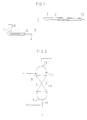
- FIG. 1 is a view illustrating a first embodiment of the present invention.
- FIG. 2 is a view illustrating a third embodiment of the present invention.
- the polymer pyrolysis method of the invention is not limited to a certain type of polymer, but applicable to all types of polymers as long as they are pyrolytically decomposable.
- the polymer include homopolymers of ⁇ -olefins such as ethylene, propylene, 1-butene, isobutene, 1-pentene, 2-methyl-1-butene, 3-methyl-1-butene, 1-hexene, 3-methyl-1-pentene, 4-methyl-1-pentene, 1-heptene, 1-octene, 1-decene, 1-dodecene, 1-tetradecene, 1-hexadecene, 1-octadecene, 1-eicosene; copolymers of these ⁇ -olefins with monomers copolymerizable therewith; and polymers of styrene, (meth)acrylic acid, (meth)acrylates, vinyl acetate, and all thermoplastic polymers excluding vinyl
- Examples of the monomers copolymerizable with ⁇ -olefins include acrylic acid, methacrylic acid, acrylates, methacrylates, vinyl acetate, polybasic unsaturated carboxylic acids such as maleic acid and anhydrides and esters thereof.
- the method of the invention is particularly useful in the pyrolysis of olefin polymers, for example, homopolymers of ⁇ -olefins such as polyethylene, polypropylene, poly-1-butene, and poly-4-methyl-1-pentene and polymers based on ⁇ -olefins into lower molecular weight ones, thereby producing a pyrolytic wax consisting of low molecular weight polymers.
- olefin polymers for example, homopolymers of ⁇ -olefins such as polyethylene, polypropylene, poly-1-butene, and poly-4-methyl-1-pentene and polymers based on ⁇ -olefins into lower molecular weight ones, thereby producing a pyrolytic wax consisting of low molecular weight polymers.
- ⁇ -olefins such as polyethylene, polypropylene, poly-1-butene, and poly-4-methyl-1-pentene
- FIG. 1 showing the first embodiment of the invention, there are illustrated an extruder 1, a tubular pyrolysis reactor 2, heater means 3 for heating the tubular pyrolysis reactor 2, and metering means 4.
- a polymer feed is supplied to the extruder 1 from a hopper 5 connected to a feed inlet 11 of the extruder 1, melted and milled in the extruder 1 at a predetermined temperature, and extruded out of an extruder outlet 12.
- the extruder is not particularly limited to a certain type, but all types of extruders can be used, for example single or twin screw type, as long as it can melt and extrude a polymer feed.
- the extruder For melting the polymer feed in the extruder, the extruder is heated to a temperature which may be properly selected in accordance with a particular type of polymer feed to be melted.
- temperatures of about 200 to 350°C, preferably about 270 to 330°C are used when olefin polymers such as polyethylene and polypropylene are used as the polymer feed for preparing pyrolytic wax consisting of lower molecular weight olefin polymers.
- the rate of extrusion of the polymer through the extruder may be properly selected in accordance with the type, form (pellet, powder or the like), quantity, and melting temperature of the polymer feed used.
- the diameter and length of the extruder screw may be similarly selected.
- olefin polymers such as polyethylene and polypropylene are used as the polymer feed for preparing pyrolytic wax consisting of lower molecular weight olefin polymers
- an inert gas atmosphere as the atmosphere extending from the feed inlet 11 through the extruder to the tubular pyrolysis reactor to be described later in detail, because such an atmosphere is effective for preventing oxidation of the polymer feed, oxidation and coloring of the resulting low molecular weight polymers, and formation of carbonaceous contaminants.
- An inert gas atmosphere may be established, for example, by passing an inert gas such as nitrogen through the feed inlet 11 from the hopper 5.
- the molten polymer feed is delivered to the tubular pyrolysis reactor 2 through a polymer flowpath 6.
- the metering means 4 is preferably disposed for quantitatively controlling the delivery of the molten polymer from the extruder 1 to the tubular pyrolysis reactor 2 because the controlled delivery ensures uniform progress of pyrolytic reaction, succeeding in obtaining homogeneous low molecular weight polymers with a narrow molecular weight distribution and therefore, in higher yields.
- the metering means 4 is a gear pump or screw pump, and any desired one may be selected in accordance with the feed rate of molten polymer to be pumped, viscosity of molten polymer, required precision of feed rate or operating temperature and pressure, Gear pumps are preferred especially because of their ability to pump even high viscosity molten polymers, precise feed rate, and pressure increase capacity.
- the molten polymer feed is heated by the heater means 3 around the reactor whereby it is pyrolytically decomposed.
- the tubular pyrolysis reactor which is effective for efficiently heating the reaction mixture passing therethrough for pyrolytically decomposing the molten polymer, may be of any desired structure including the single tube type, double tube type having an inner tube for passage of the reaction mixture and an outer tube for passage of heating medium, and multi-tube type having a plurality of reaction tubes for passage of the reaction mixture.
- the tubular pyrolysis reactor is longitudinally inclined such that its outlet 22 is at a higher level because gas components resulting from pyrolytic reaction of the polymer can be smoothly discharged from within the pyrolytic reactor, the pyrolytic reactor can be reduced in volume, and the generation of carbonaceous contaminants can be suppressed.
- tubular pyrolysis reactor is too long so that it is disposed in a folded arrangement rather than a linear arrangement, it is preferred for the above-mentioned reason to arrange the pyrolysis reactor so as to uniformly elevate from the inlet to the outlet.
- a so-called static mixer is disposed in the interior of the tubular pyrolysis reactor in order to properly control the flow, agitation, and mixing of the reaction mixture for achieving effective pyrolysis of the polymer feed with concomitant advantages including reduction of the necessary reaction volume of the reactor, increased yields of the resulting low molecular weight polymers, and minimized generation of carbonaceous contaminants.
- the static mixer is commercially available as the KENICS type from Kenics Co., USA, the SULZER type from Sulzer A.G., Germany, SQUARE mixer from Sakura Seisakusho K.K, Japan, HI-MIXER from Toray K.K., Japan, and T.K.-ROSS LPD mixer from Dow Chemical Co., USA.
- the tubular pyrolysis reactor is equipped with heater means which is not particularly limited and may be of any desired heating type including those based on an electric heater, low frequency induction heating, and molten salt heating medium.
- heating by an electric heater is easy to precisely control the longitudinal temperature distribution over the tubular pyrolysis reactor, thus resulting in low molecular weight polymers of higher quality.
- the heating temperature of the tubular pyrolysis reactor may be properly selected in accordance with the polymer feed to be pyrolytically decomposed. For example, a temperature of about 350 to 450°C, preferably about 360 to 430°C is selected when polyethylene is used as the polymer feed and a temperature is selected in the same range when polypropylene is used.
- the residence time of the reaction mixture in the tubular pyrolysis reactor is generally about 10 minutes to 5 hours, preferably from about 30 minutes to 3 hours, more preferably from about 30 to 100 minutes, about 5 Torr to 50 kg/cm 2 G, more preferably from about 500 Torr to 1.8 kg/cm 2 G, and from about 1/2 to 10 inches, preferably about 4 to 8 inches for single and double tube type pyrolysis reactors and about 3/4 to 1-1/2 inches for multi-tube type pyrolysis reactors, respectively.
- reaction mixture containing low molecular weight polymers resulting from pyrolysis is taken out of the tubular pyrolysis reactor 2 through the outlet 22 and further processed in subsequent steps.
- pyrolysis of polymers especially pyrolysis of olefin polymers into lower molecular weight pyrolytic waxes is carried out in the presence of a higher fatty acid and/or a hydrochloric acid acceptor.
- Examples of the higher fatty acid used herein include fatty acids having 10 or more carbon atoms such as capric acid, lauric acid, myristic acid, palmitic acid, stearic acid, oleic acid, 12-hydroxystearic acid, ricinoleic acid, arachidinic acid, behenic acid, and montanic acid.
- hydrochloric acid acceptor examples include metal salts of higher fatty acids, epoxidized higher fatty acid esters, hydrotalcite, and calcium oxide.
- Exemplary of the metal salts of higher fatty acids are metal salts of the above-mentioned higher fatty acids, with exemplary metals being lithium, sodium, potassium, magnesium, calcium, strontium, barium, zinc, cadmium, aluminum, tin, and lead.
- epoxidized higher fatty acid ester examples include e.g. epoxidized octyl stearate.
- the higher fatty acids and hydrochloric acid acceptors may be used alone or in admixture of two or more.
- Preferred inter alia are stearic acid, palmitic acid, and 12-hydroxystearic acid among the higher fatty acids and calcium stearate, aluminum stearate, and magnesium stearate among the hydrochloric acid acceptors.
- the higher fatty acid and/or hydrochloric acid acceptor is generally used in an amount of about 0.001 to 1 part by weight, preferably about 0.01 to 0.5 parts by weight per 100 parts by weight of the olefin polymer.
- the method of the invention may utilize thermal stabilizers, weathering stabilizers, surfactants, lubricants, nucleating agents, and anti-blocking agents as long as the benefits of the invention are not lost.
- thermal stabilizer examples include phenolic stabilizers and organic phosphorus stabilizers.
- phenolic stabilizers are 2,6-di-t-butyl-4-methylphenol, 2,6-di-t-butyl-4-ethylphenol, 2,6-dicyclohexyl-4-methylphenol, 2,6-diisopropyl-4-ethylphenol, 2,6-di-t-amyl-4-methylphenol, 2,6-di-t-octyl-4-n-propylphenol, 2,6-dicyclohexyl-4-n-octylphenol, 2-isopropyl-4-methyl-6-t-butylphenol, 2-t-butyl-4-ethyl-6-t-octylphenol, 2-isobutyl-4-ethyl-6-t-hexylphenol, 2-cyclohexyl-4-n-butyl-6-isopropylphenol, dl- ⁇ -tocopherol, t-butylhydroquinone, 2,2'-methylenebis (4
- Preferred among these are 2,6-di-t-butyl-4-methylphenol, tetrakis[methylene-3-(3,5-di-t-butyl-4-hydroxyphenyl)-propionate]methane, and n-octadecyl- ⁇ -(3,5-di-t-butyl-4-hydroxyphenyl)propionate belonging to the ⁇ -(3,5-di-t-butyl-4-hydroxyphenyl)propionic acid alkyl esters.
- organic phosphorus stabilizers are trioctyl phosphite, trilauryl phosphite, tridecyl phosphite, octyl diphenyl phosphite, tris(2,4-di-t-butylphenyl) phosphite, triphenyl phosphite, tris(butoxyethyl) phosphite, tris(nonylphenyl) phosphite, distearyl pentaerythritol diphosphite, tetra(trisdecyl)-1,1,3-tris(2-methyl-5-t-butyl-4-hydroxyphenyl)butane diphosphite, tetra(C 12-15 mixed alkyl)-4,4'-isopropylidene diphenyl diphosphite, tetra(tridecyl)-4,4'-butylidene
- the last-mentioned bis(dialkylphenyl)pentaerythritol diphosphite esters include spiro and cage types of the following formulae (1) and (2), respectively. Most often, mixtures of isomers are used for economical reason because conventional methods produce phosphite esters as an isomeric mixture.
- R 1 and R 2 are selected from alkyl groups having 1 to 9 carbon atoms, preferably branched alkyl groups, and are most preferably tert-butyl groups, and they are most preferably attached to the phenyl group at 2-, 4- and 6-positions.
- bis(dialkylphenyl)-pentaerythritol diphosphite esters are bis(2,4-di-t-butylphenyl)pentaerythritol diphosphite and bis(2,6-di-t-butyl-4-methylphenyl)pentaerythritol diphosphite.
- organic phosphorus stabilizers are phosphonites having a structure in which carbon is directly attached to phosphorus, for example, tetrakis(2,4-di-t-butylphenyl)-4,4'-biphenylene diphosphonite.
- organic phosphorus stabilizers are bis(2,6-di-t-butyl-4-methylphenyl)-pentaerythritol diphosphite and tetrakis(2,4-di-t-butylphenyl)-4,4'-biphenylene diphosphonite.
- the above-mentioned phenolic and organic phosphorus stabilizers may be used alone or in admixture of two or more.
- the amount of the thermal stabilizer is generally about 0.1 to 30 parts by weight, preferably about 0.5 to 10 parts by weight per part by weight of the higher fatty acid and/or hydrochloric acid acceptor.
- the higher fatty acid and/or hydrochloric acid acceptor and optionally used additives are supplied to the pyrolytic reaction of olefin polymers in any desired manner, for example, by incorporating them in the olefin polymer feed during pelletization thereof; by batchwise or continuously adding them to the olefin polymer feed at the same time or separately when the olefin polymer feed is admitted into the reactor; or by supplying an olefin polymer feed commercially available as a blend previously containing such higher fatty acid and/or hydrochloric acid acceptor and optional additives.
- the above-mentioned pyrolytic reaction in the pyrolysis reactor yields a reaction mixture which generally contains volatile components resulting from pyrolytic reaction.
- the volatile components are mainly composed of hydrogen and hydrocarbons having 1 to about 35 carbon atoms although the exact composition varies with a particular type of olefin polymer as the starting feed.
- the volatile components are mainly composed of hydrocarbons having about 25 to 35 carbon atoms when the starting feed is polyethylene and hydrocarbons having about 8 to 13 carbon atoms when the starting feed is polypropylene.
- FIG. 2 Illustrated in FIG. 2 are an evaporator 7, an inlet 8 for reaction mixture, an inlet 9 for inert gas, an outlet 10 for volatile components, an outlet 13 for reaction mixture, and an insert 14 disposed in the evaporator.
- a reaction mixture resulting from pyrolytic reaction of an olefin polymer in a pyrolysis reactor (not shown) as previously described is admitted into the evaporator 7 through the inlet 8.
- the evaporator 7 may be of any desired shape including tower, tube, and tank shapes although a tower shaped evaporator is especially preferred because of promoted contact of the reaction mixture with inert gas, consistent degree of decomposition of the olefin polymer feed, and stable operation.
- the evaporator is adjusted to a high temperature of about 250 to 430°C, preferably about 300 to 400°C because volatile components do not condense or dissolve in the end product or pyrolytic wax, because oxygenated hydrocarbons which would otherwise cause coloring of the wax and be difficult to subsequently separate from the wax do not dissolve in the wax and are thus easy to separate, and because the reaction mixture can be treated at the high temperature as in the pyrolysis reactor with saved energy.
- the pressure in the evaporator is adjusted to about 500 Torr to 1.8 kg/cm 2 G, preferably about 750 Torr to 0.5 kg/cm 2 G. These conditions are advantageous in that any extra equipment such as a vacuum pump and pressure control system is not required and stable operation is facilitated by a simple process.
- the volatile components separated from the reaction mixture are withdrawn from the vapor outlet 10 and provided to a condenser (not shown) where they are condensed into a liquid to be discharged as waste oil while the remaining noncondensible gases may be burned in order to prevent the smell from spreading.
- inert gas is blown into the evaporator 7 through the gas inlet 9 so as to provide counterflow contact with the reaction mixture for assisting in discharging the volatile components through the vapor outlet 10.
- the inert gases used herein include e.g. nitrogen gas, carbon dioxide gas or steam with nitrogen gas being preferred.
- the blowing rate of inert gas may be properly adjusted in accordance with the flow rate of the reaction mixture incoming from the pyrolysis reactor, that is, processing quantity, as well as the type of an olefin polymer used and the degree of pyrolysis although the inert gas is often used in an amount of about 0.1 to 20 mol, preferably about 1 to 5 mol per kg of the reaction mixture.
- the evaporator of tower or tubular type it is preferably equipped with plates or a static mixer, loaded with packings, or provided with wetted walls, because the contact between the reaction mixture and inert gas is promoted and more effective separation of volatile components from the reaction mixture is achieved.
- the plates used herein are not particularly limited and their examples include bubble cap trays, uniflux trays, perforated trays, valve trays (flexible trays, Natta float valve trays, ballast trays), cascade trays, Venturi trays, Kitter trays, recycling trays, jet trays, turbo grid trays, ripple trays, dual flow trays, baffle trays, and ring and doughnut trays.
- static mixer which is not particularly limited are KENICS type, SULZER type, SQUARE mixer, and T.K.-ROSS LPD mixer.
- the packings are generally formed of porcelain or metallic materials capable of withstand high temperatures prevailing in the evaporator. Since the shape is not particularly limited, exemplary packings include spherical packings, ring type packings (Raschig rings, Lessing rings, spiral rings, cross partition rings, and pole rings), saddle type packings (bevel saddles and interlocking saddles), spray packings, Pana packings, Goodloe packings, Stedman packings, Dickson packings, MacMahon packings, cannon protruded metal packings, helix, tellerette, and perpendicular plate packings.
- exemplary packings include spherical packings, ring type packings (Raschig rings, Lessing rings, spiral rings, cross partition rings, and pole rings), saddle type packings (bevel saddles and interlocking saddles), spray packings, Pana packings, Goodloe packings, Stedman packings, Dickson packings, MacMahon packings, cannon protrude
- the wetted wall may be obtained by utilizing the inner wall of the tower itself or providing a multi-tube structure. Utilization of the tower itself offers the most simple tubular structure because no insert is present in the evaporator interior.
- the method of the invention favors the use of perforated trays, jet trays, ripple trays, dual flow trays, baffle trays, and ring-and-doughnut trays among the plates, the above-mentioned ones among the static mixers, spherical packings, ring packings and saddle packings among the packings, and the above-mentioned two structures among the wetted walls because they are applicable to reaction mixtures which are highly viscous and can contain contaminants and because of simple structure.
- the quantity of inserts disposed in the evaporator corresponds to about 2 or 3 theoretical stages in view of the size of evaporator and separation capacity.
- reaction mixture exiting from the outlet 13 after removal of volatile components in the evaporator is provided to later stage steps where decomposition reaction is terminated by cooling and contaminants are removed by filtration. Finally the reaction mixture is cooled and solidified into a solid pyrolytic wax.
- a polymer was pyrolytically decomposed in a system constructed as shown in FIG. 1 by using polypropylene having an ultimate viscosity [ ⁇ ] of 1.6 dl/g as measured in decalin at 135°C as the polymer feed and operating an extruder and a tubular pyrolysis reactor of the following specifications under the following conditions.
- Extruder Screw diameter 39.85 mm Cylinder diameter 40.0 mm Extruder temperature (at outlet) 300°C Extrusion rate 10.5 kg/hr.
- Feed rate 10.5 kg/hr.
- the resulting reaction mixture was subjected to gas-liquid separation for removing volatile components, then filtered and purified, obtaining low molecular weight polymers.
- the low molecular weight polymers were evaluated or measured for melt viscosity, volatile content, powder hue, melt color, molecular weight distribution (Mw/Mn), and number of terminal double bonds by the following methods. The results are shown in Table 1.
- a low molecular weight polymer sample was heated and melted at 180°C and the melt viscosity was measured by means of a Brookfield viscometer.
- a low molecular weight polymer sample about 2 grams, was kept for 2 hours in a constant temperature hot air dryer at 150°C and a loss of weight was considered as the volatile content.
- a sample was ground into a powder having a mean particle size of about 300 ⁇ m which was measured for hue by means of a Hunter Laboratory color difference meter.
- a sample was melted at 180°C and the color of the molten sample was compared with a HAZEN colorimetric standard solution using color comparison tubes.
- Preparation of pyrolytic wax was continued for 9 days by means of a system shown in FIG. 1 by admitting a polymer feed consisting of 100 parts by weight of polypropylene having an ultimate viscosity [ ⁇ ] of 1.6 dl/g and an amount of the additive(s) shown in Table 2 to the extruder 1 through the inlet 11 and continuously delivering the feed to the tubular pyrolysis reactor 2 equipped with the heater 3 through the flowpath 6 under the following conditions.
- the operation was stopped on the second day.
- Extruder temperature (at outlet) 300°C Extrusion rate 10.5 kg/hr.
- the pyrolytic wax sample obtained everyday was measured for hue as in Example 1 and measured for contaminant content by the following method. The results are shown in Table 2.
- the present invention provides a method capable of continuously producing low molecular weight polymers of quality by pyrolytically decomposing a polymer with a simplified apparatus in a simple step.
- the invention is of great industrial value in practice because the polymer to which the invention is applicable is not particularly limited and a variety of polymers can be pyrolytically decomposed into low molecular weight polymers of quality.
- the method of the invention is also of great industrial value in practice when pyrolytic reaction is carried out in the presence of a higher fatty acid and/or a hydrochloric acid acceptor because there is obtained a pyrolytic wax which is improved in quality with respect to hue and contaminant content and preparation of such pyrolytic wax of quality can be continued for a long period in a stable manner.
- any desired pyrolytic wax can be obtained depending on the heating temperature in a tubular pyrolysis reactor or an olefin polymer used, and the pyrolytic wax is a homogeneous one having a narrow molecular weight distribution and improved in quality with respect to volatile content, hue, heat resistance, flash point, smell, and thermal stability. Consequently, the pyrolytic wax obtained by the method of the invention finds a wide variety of applications including usages as pigment dispersants requiring color (chromatic color) clearness, copying machine toners requiring image visibility and release property, resin modifiers for food and medical agents requiring odorless and hygienic features, hotmelt adhesives requiring heat resistance and thermal stability or heat resistant ink.
- usages as pigment dispersants requiring color (chromatic color) clearness, copying machine toners requiring image visibility and release property, resin modifiers for food and medical agents requiring odorless and hygienic features, hotmelt adhesives requiring heat resistance and thermal stability or heat resistant ink.
Landscapes
- Chemical & Material Sciences (AREA)
- Chemical Kinetics & Catalysis (AREA)
- Organic Chemistry (AREA)
- General Chemical & Material Sciences (AREA)
- Health & Medical Sciences (AREA)
- Medicinal Chemistry (AREA)
- Polymers & Plastics (AREA)
- Engineering & Computer Science (AREA)
- Mechanical Engineering (AREA)
- Addition Polymer Or Copolymer, Post-Treatments, Or Chemical Modifications (AREA)
- Separation, Recovery Or Treatment Of Waste Materials Containing Plastics (AREA)
- Production Of Liquid Hydrocarbon Mixture For Refining Petroleum (AREA)
Claims (4)
- Verfahren zur Pyrolyse eines Polymers, umfassend die Schritte:Zufuhr eines Polymers zu einem Extruder, worin das Polymer geschmolzen wird;Dosieren des geschmolzenen Polymers von dem Extruder zu einem röhrenförmigen Pyrolysereaktor durch eine Zahnradpumpe oder eine Schraubenpumpe, die mit dem Extruder verbunden ist, wodurch die Ausflußmenge des geschmolzenen Polymers quantitativ gesteuert wird, undpyrolytisches Zersetzen des Polymers in dem röhrenförmigen Pyrolysereaktor zur Herstellung von niedermolekularen Polymeren.
- Verfahren nach Anspruch 1, worin die Pyrolyse in der Gegenwart einer höheren Fettsäure und/oder eines Salzsäureakzeptors stattfindet.
- Verfahren zur Herstellung eines pyrolytischen Wachses, umfassend die Durchführung der Verfahrensschritte, wie in Anspruch 1 definiert, worin das zu einem Extruder geführte Polymer ein Olefinpolymer und das pyrolytisch zersetzte Polymer ein niedermolekulares Olefinpolymer ist.
- Verfahren nach Anspruch 3, worin die Pyrolyse in der Gegenwart einer höheren Fettsäure und/oder eines Salzsäureakzeptors stattfindet.
Applications Claiming Priority (7)
| Application Number | Priority Date | Filing Date | Title |
|---|---|---|---|
| JP2094498A JPH03292305A (ja) | 1990-04-10 | 1990-04-10 | ポリマーの熱減成方法 |
| JP94498/90 | 1990-04-10 | ||
| JP2123865A JP3020555B2 (ja) | 1990-05-14 | 1990-05-14 | 熱分解ワックスの製造方法 |
| JP123865/90 | 1990-05-14 | ||
| JP170438/90 | 1990-06-28 | ||
| JP2170438A JP2991463B2 (ja) | 1990-06-28 | 1990-06-28 | 熱分解ワックスの製造方法 |
| PCT/JP1991/000471 WO1991015521A1 (en) | 1990-04-10 | 1991-04-10 | Process for thermal degradation of polymer |
Publications (3)
| Publication Number | Publication Date |
|---|---|
| EP0474889A1 EP0474889A1 (de) | 1992-03-18 |
| EP0474889A4 EP0474889A4 (en) | 1992-09-23 |
| EP0474889B1 true EP0474889B1 (de) | 1998-01-07 |
Family
ID=27307565
Family Applications (1)
| Application Number | Title | Priority Date | Filing Date |
|---|---|---|---|
| EP91906972A Expired - Lifetime EP0474889B1 (de) | 1990-04-10 | 1991-04-10 | Verfahren zum thermischen abbau von polymeren |
Country Status (6)
| Country | Link |
|---|---|
| US (1) | US5292862A (de) |
| EP (1) | EP0474889B1 (de) |
| KR (1) | KR940005544B1 (de) |
| CA (1) | CA2058992C (de) |
| DE (1) | DE69128579T2 (de) |
| WO (1) | WO1991015521A1 (de) |
Families Citing this family (29)
| Publication number | Priority date | Publication date | Assignee | Title |
|---|---|---|---|---|
| DE4224990A1 (de) * | 1992-07-29 | 1994-02-03 | Guenter Hufschmid | Wiederverwertung von Polyolefinabfällen durch thermischen, oxidativen bzw. katalytischen Abbau zu Polyolefinwachsen, Polyolefinharzen oder durch Oxidation zu oxidierten Polyolefinen |
| DE4407643A1 (de) * | 1994-03-08 | 1995-09-14 | Deurex Wachs Chemie Gmbh | Wiederverwertung und Verarbeitung von polyolefinischen Kunststoffabfällen zu mikronisierten Polyolefinwachsen, mikronisierten Polyolefinharzen und mikronisierten niedermolekularen Polyolefinen |
| DE4437754A1 (de) * | 1994-10-21 | 1996-04-25 | Basf Ag | Verfahren zum thermomechanischen Abbau von Polyolefinen |
| DE19700892A1 (de) | 1997-01-14 | 1998-07-16 | Basf Ag | Verfahren zur Herstellung oxidierter Polyolefinwachse |
| DE19724148C1 (de) * | 1997-06-07 | 1998-12-24 | Paraffinwerk Webau Gmbh | Reaktor zur Depolymerisation von Kunststoffen |
| DE19724144C1 (de) * | 1997-06-07 | 1998-06-18 | Paraffinwerk Webau Gmbh | Reaktor zur Depolymerisation von Kunststoffen |
| US6060584A (en) * | 1998-05-13 | 2000-05-09 | Eastman Chemical Company | Process for the degradation of polyolefins |
| US6433133B1 (en) | 1999-11-16 | 2002-08-13 | Eastman Chemical Company | Process for reducing the weight average molecular weight and melt index ratio of polyethylenes and polyethylene products |
| PL211917B1 (pl) * | 2008-10-31 | 2012-07-31 | Bl Lab Społka Z Ograniczoną Odpowiedzialnością | Układ do prowadzenia termolizy odpadowych tworzyw sztucznych oraz sposób prowadzenia termolizy w sposób ciągły |
| PL212812B1 (pl) | 2009-03-14 | 2012-11-30 | Bl Lab Spolka Z Ograniczona Odpowiedzialnoscia | Uklad do prowadzenia termolizy odpadowych tworzyw sztucznych oraz sposób prowadzenia termolizy w sposób ciagly |
| US20170232416A1 (en) * | 2015-12-30 | 2017-08-17 | Greenmantra Recycling Technologies Ltd. | Reactor For Continuously Treating Polymeric Material |
| US10472487B2 (en) | 2015-12-30 | 2019-11-12 | Greenmantra Recycling Technologies Ltd. | Reactor for continuously treating polymeric material |
| PT3414302T (pt) | 2016-02-13 | 2022-09-27 | Greenmantra Recycling Tech Ltd | Asfalto modificado por polímero com um aditivo de cera |
| CN108884264A (zh) | 2016-03-24 | 2018-11-23 | 绿色颂歌再生科技有限公司 | 作为用于聚合物的熔体流动改性剂和加工助剂的蜡 |
| PT3408352T (pt) * | 2016-03-31 | 2025-08-11 | H&R Int Beteiligung Gmbh | Processo para a preparação de uma cera c20 até c60 a partir da decomposição térmica seletiva de polímero de poliolefina plástica |
| PL3408353T3 (pl) * | 2016-03-31 | 2023-05-02 | Trifol Resources Limited | Sposób wytwarzania surowca bazowego smaru obejmujący selektywny termiczny rozkład polimeru poliolefinowego tworzywa sztucznego |
| CN114479173A (zh) | 2016-09-29 | 2022-05-13 | 绿色颂歌再生科技有限公司 | 用于处理聚苯乙烯材料的反应器 |
| WO2019104430A1 (en) | 2017-11-28 | 2019-06-06 | Greenmantra Recycling Technologies Ltd. | Encapsulation of modifiers in depolymerized products |
| JP2021525816A (ja) | 2018-05-31 | 2021-09-27 | グリーンマントラ リサイクリング テクノロジーズ リミテッド | 解重合ポリスチレンを介して得られるスチレン系ポリマーの使用 |
| KR101995951B1 (ko) * | 2019-03-12 | 2019-07-03 | 주식회사 라이온켐텍 | 폴리올레핀 공중합체의 연속식 제조방법 |
| CN110665450B (zh) * | 2019-09-30 | 2021-05-18 | 东营市科德化工有限公司 | 一种顺酐生产中轻组分脱除装置 |
| US11891518B1 (en) | 2023-03-31 | 2024-02-06 | Nexus Circular LLC | Hydrocarbon compositions derived from pyrolysis of post-consumer and/or post-industrial plastics and methods of making and use thereof |
| US11964315B1 (en) | 2023-03-31 | 2024-04-23 | Nexus Circular LLC | Hydrocarbon compositions derived from pyrolysis of post-consumer and/or post-industrial plastics and methods of making and use thereof |
| US12453993B2 (en) | 2023-03-31 | 2025-10-28 | Nexus Circular LLC | Hydrocarbon compositions derived from pyrolysis of post-consumer and/or post-industrial plastics and methods of making and use thereof |
| US12435278B2 (en) | 2023-03-31 | 2025-10-07 | Nexus Circular LLC | Hydrocarbon compositions derived from pyrolysis of post-consumer and/or post-industrial plastics and methods of making and use thereof |
| US12453994B2 (en) | 2023-03-31 | 2025-10-28 | Nexus Circular LLC | Hydrocarbon compositions derived from pyrolysis of post-consumer and/or post-industrial plastics and methods of making and use thereof |
| US12473506B2 (en) | 2023-03-31 | 2025-11-18 | Nexus Circular LLC | Hydrocarbon compositions derived from pyrolysis of post-consumer and/or post-industrial plastics and methods of making and use thereof |
| FI131454B1 (en) * | 2023-10-25 | 2025-05-02 | Teknologian Tutkimuskeskus Vtt Oy | Method and arrangement for treating mixed plastic waste |
| US20250243408A1 (en) | 2024-01-29 | 2025-07-31 | Nexus Circular LLC | Systems and methods for making hydrocarbon compositions derived from pyrolysis of post-consumer and/or post-industrial plastics |
Family Cites Families (11)
| Publication number | Priority date | Publication date | Assignee | Title |
|---|---|---|---|---|
| US2372001A (en) * | 1942-02-26 | 1945-03-20 | Du Pont | Pyrolysis products of solid polymers of ethylene |
| DE859951C (de) * | 1944-05-21 | 1952-12-18 | Roehm & Haas G M B H | Verfahren zur Umwandlung hochpolymerer Verbindungen in solche von niedrigem Polymerisationsgrad und Monomere |
| US2835659A (en) * | 1957-02-11 | 1958-05-20 | Eastman Kodak Co | Polypropylene waxes and method of making |
| US3087922A (en) * | 1958-05-13 | 1963-04-30 | Phillips Petroleum Co | Method and apparatus for pyrolyzing polymers |
| US3083193A (en) * | 1960-06-30 | 1963-03-26 | Phillips Petroleum Co | Pyrolysis of polyolefins in a water slurry |
| US3248469A (en) * | 1961-08-28 | 1966-04-26 | Phillips Petroleum Co | High shear visbreaking method and apparatus |
| US3341621A (en) * | 1963-05-31 | 1967-09-12 | Eastman Kodak Co | Thermally degraded block copolymers of propylene and 1-butene |
| US3519609A (en) * | 1967-06-07 | 1970-07-07 | Eastman Kodak Co | Method for making polyolefin waxes by thermal degradation of higher molecular weight polyolefins in the presence of organic acids and anhydrides |
| BE754562A (fr) * | 1969-08-09 | 1971-02-08 | Basf Ag | Procede de preparation continue de polyethylene cireux a bas poids moleculaire a partir de polyethylene solide a poids moleculaireeleve |
| DE3146194A1 (de) * | 1981-11-21 | 1983-05-26 | Röhm GmbH, 6100 Darmstadt | Verfahren und vorrichtung zur thermischen depolymerisation von polymeren |
| US4710563A (en) * | 1986-08-15 | 1987-12-01 | El Paso Products Company | Process for the recovery of amorphous devaporized polyalphaolefin |
-
1991
- 1991-04-10 EP EP91906972A patent/EP0474889B1/de not_active Expired - Lifetime
- 1991-04-10 DE DE69128579T patent/DE69128579T2/de not_active Expired - Lifetime
- 1991-04-10 KR KR1019910701828A patent/KR940005544B1/ko not_active Expired - Lifetime
- 1991-04-10 CA CA002058992A patent/CA2058992C/en not_active Expired - Fee Related
- 1991-04-10 WO PCT/JP1991/000471 patent/WO1991015521A1/ja not_active Ceased
- 1991-04-10 US US07/778,051 patent/US5292862A/en not_active Expired - Lifetime
Also Published As
| Publication number | Publication date |
|---|---|
| KR920702696A (ko) | 1992-10-06 |
| EP0474889A4 (en) | 1992-09-23 |
| US5292862A (en) | 1994-03-08 |
| CA2058992A1 (en) | 1991-10-11 |
| WO1991015521A1 (en) | 1991-10-17 |
| DE69128579T2 (de) | 1998-05-28 |
| DE69128579D1 (de) | 1998-02-12 |
| EP0474889A1 (de) | 1992-03-18 |
| KR940005544B1 (ko) | 1994-06-20 |
| CA2058992C (en) | 1996-10-22 |
Similar Documents
| Publication | Publication Date | Title |
|---|---|---|
| EP0474889B1 (de) | Verfahren zum thermischen abbau von polymeren | |
| US7208569B2 (en) | Reaction of fluoropolymer melts | |
| US5137969A (en) | Melt extrudable polyvinyl alcohol pellets having reduced maximum melt temperature and reduced gel content | |
| EP0141733A1 (de) | Verfahren zum Vernetzen von Säureanhydridgruppen enthaltenden Äthylenpolymeren, vernetzbaren Zusammensetzungen und die Anwendung dieser Zusammensetzungen zum Streichen | |
| US6433133B1 (en) | Process for reducing the weight average molecular weight and melt index ratio of polyethylenes and polyethylene products | |
| US20220002532A1 (en) | Process and Apparatus for Manufacture of Processable Polyvinyl Alcohol | |
| JPH08208738A (ja) | 現場ポリエチレンブレンドの製造方法 | |
| DE19517166A1 (de) | Verfahren zur Herstellung von Milchsäurepolymeren und Verfahren zur direkten Herstellung von Formkörpern aus Milchsäurepolymeren | |
| US3503944A (en) | Polymerization of ethylene | |
| EP0415357B1 (de) | Extrudierbare Polyvinylalcoholzusammensetzungen | |
| CN114381078B (zh) | 一种热塑性聚合物用加工助剂以及包含该加工助剂的可熔融加工组合物 | |
| US5047188A (en) | Process for preparation of modified methacrylic resin molding material | |
| US5708133A (en) | Process for purifying polymer | |
| CA2154799C (en) | Method for the pyrolysis of polymers | |
| JP2002212347A (ja) | ポリオレフィン系樹脂組成物及びその成形体 | |
| KR100324986B1 (ko) | 중합체의정제방법 | |
| JP3020555B2 (ja) | 熱分解ワックスの製造方法 | |
| BE1008959A4 (fr) | Polymere du propylene, procede pour son obtention et utilisation. | |
| RU2176249C1 (ru) | Способ получения полиэтилена | |
| JPH0517547A (ja) | オキシメチレンコポリマの製造方法 | |
| JPH10158340A (ja) | 不飽和エステルにより部分架橋されたプラスチック組成物 | |
| JP7563531B2 (ja) | ポリブチレンテレフタレート及びその製造方法 | |
| JPH0457808A (ja) | 熱分解ワックスの製造方法 | |
| KR20010088411A (ko) | 폴리프로필렌 수지 조성물, 및 이로부터 제조된 성형품 및필름 | |
| JPH05279527A (ja) | 改良されたオレフィンポリマー組成物 |
Legal Events
| Date | Code | Title | Description |
|---|---|---|---|
| PUAI | Public reference made under article 153(3) epc to a published international application that has entered the european phase |
Free format text: ORIGINAL CODE: 0009012 |
|
| 17P | Request for examination filed |
Effective date: 19911210 |
|
| AK | Designated contracting states |
Kind code of ref document: A1 Designated state(s): DE FR GB IT NL |
|
| A4 | Supplementary search report drawn up and despatched |
Effective date: 19920805 |
|
| AK | Designated contracting states |
Kind code of ref document: A4 Designated state(s): DE FR GB IT NL |
|
| K1C3 | Correction of patent application (complete document) published |
Effective date: 19920318 |
|
| 17Q | First examination report despatched |
Effective date: 19941219 |
|
| GRAG | Despatch of communication of intention to grant |
Free format text: ORIGINAL CODE: EPIDOS AGRA |
|
| GRAG | Despatch of communication of intention to grant |
Free format text: ORIGINAL CODE: EPIDOS AGRA |
|
| GRAH | Despatch of communication of intention to grant a patent |
Free format text: ORIGINAL CODE: EPIDOS IGRA |
|
| GRAH | Despatch of communication of intention to grant a patent |
Free format text: ORIGINAL CODE: EPIDOS IGRA |
|
| GRAA | (expected) grant |
Free format text: ORIGINAL CODE: 0009210 |
|
| AK | Designated contracting states |
Kind code of ref document: B1 Designated state(s): DE FR GB IT NL |
|
| REF | Corresponds to: |
Ref document number: 69128579 Country of ref document: DE Date of ref document: 19980212 |
|
| ET | Fr: translation filed | ||
| ITF | It: translation for a ep patent filed | ||
| PLBE | No opposition filed within time limit |
Free format text: ORIGINAL CODE: 0009261 |
|
| STAA | Information on the status of an ep patent application or granted ep patent |
Free format text: STATUS: NO OPPOSITION FILED WITHIN TIME LIMIT |
|
| 26N | No opposition filed | ||
| REG | Reference to a national code |
Ref country code: GB Ref legal event code: IF02 |
|
| PGFP | Annual fee paid to national office [announced via postgrant information from national office to epo] |
Ref country code: FR Payment date: 20020410 Year of fee payment: 12 Ref country code: GB Payment date: 20020410 Year of fee payment: 12 |
|
| PGFP | Annual fee paid to national office [announced via postgrant information from national office to epo] |
Ref country code: NL Payment date: 20020426 Year of fee payment: 12 |
|
| PG25 | Lapsed in a contracting state [announced via postgrant information from national office to epo] |
Ref country code: GB Free format text: LAPSE BECAUSE OF NON-PAYMENT OF DUE FEES Effective date: 20030410 |
|
| PG25 | Lapsed in a contracting state [announced via postgrant information from national office to epo] |
Ref country code: NL Free format text: LAPSE BECAUSE OF NON-PAYMENT OF DUE FEES Effective date: 20031101 |
|
| NLV4 | Nl: lapsed or anulled due to non-payment of the annual fee |
Effective date: 20031101 |
|
| GBPC | Gb: european patent ceased through non-payment of renewal fee |
Effective date: 20030410 |
|
| PG25 | Lapsed in a contracting state [announced via postgrant information from national office to epo] |
Ref country code: FR Free format text: LAPSE BECAUSE OF NON-PAYMENT OF DUE FEES Effective date: 20031231 |
|
| REG | Reference to a national code |
Ref country code: FR Ref legal event code: ST |
|
| PG25 | Lapsed in a contracting state [announced via postgrant information from national office to epo] |
Ref country code: IT Free format text: LAPSE BECAUSE OF NON-PAYMENT OF DUE FEES;WARNING: LAPSES OF ITALIAN PATENTS WITH EFFECTIVE DATE BEFORE 2007 MAY HAVE OCCURRED AT ANY TIME BEFORE 2007. THE CORRECT EFFECTIVE DATE MAY BE DIFFERENT FROM THE ONE RECORDED. Effective date: 20050410 |
|
| PGFP | Annual fee paid to national office [announced via postgrant information from national office to epo] |
Ref country code: DE Payment date: 20100430 Year of fee payment: 20 |
|
| REG | Reference to a national code |
Ref country code: DE Ref legal event code: R071 Ref document number: 69128579 Country of ref document: DE |
|
| PG25 | Lapsed in a contracting state [announced via postgrant information from national office to epo] |
Ref country code: DE Free format text: LAPSE BECAUSE OF EXPIRATION OF PROTECTION Effective date: 20110410 |